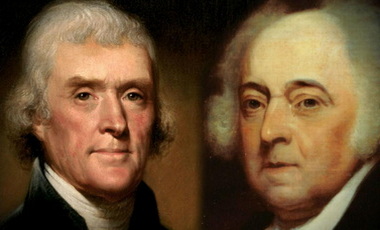
John Adams and Thomas Jefferson Discuss Calvin’s 5-Points

In John Adams letter to Thomas Jefferson he opens with this — and I have GROK put the old English into more modern terms.

The green box that follows the original text is GROK modernizing it

The sight of your well known hand writing in your favour of 25. Feb. last, gave me great pleasure, as it proved your arm to be restored and your pen still manageable—may it continue till you shall become as perfect a calvinist as I am in one particular. Poor Calvins infirmities his rheumatism his gouts and sciatics made him frequently cry out Mon dieu Jusque au quand Lord how long! Prat once Chief Justice of new york always tormented with infirmities dreamt that he was situated on a single rock in the midst of the Atlantick ocean, He heard a voice. “Why mourns the bard Apollo bids thee2 rise, renounce the dust,3 and claim thy native skies.”—

Here’s a modern English update of the excerpt from John Adams’s letter to Thomas Jefferson (dated March 10, 1823), keeping the original meaning, tone, and humor intact while making the language clearer and more contemporary:

Seeing your familiar handwriting in your letter from February 25th gave me great pleasure. It showed that your arm has recovered and you can still write easily—may that continue until you become as much of a Calvinist as I am in one respect. Poor Calvin’s ailments—his rheumatism, gout, and sciatica—often made him cry out, “Mon Dieu, jusqu’à quand?” which means “Lord, how long!” Pratt, who was once Chief Justice of New York and always plagued by health problems, dreamed that he was stranded on a lone rock in the middle of the Atlantic Ocean. Then he heard a voice say:

“Why does the bard mourn? Apollo bids you rise, renounce the dust, and claim your native skies.”

(For context: Adams is playfully teasing Jefferson about enduring old-age infirmities with Calvinist patience, referencing John Calvin’s sufferings and a poetic anecdote about Benjamin Pratt, an 18th-century New York judge known for his poetry and health issues.)

Here is the response to Adams via Jefferson:

The wishes expressed, in your last favor, that I may continue in life and health until I become a Calvinist, at least in his exclamation of ‘mon Dieu! jusque à quand’! would make me immortal. I can never join Calvin in addressing his god. he was indeed an Atheist, which I can never be; or rather his religion was Dæmonism. if ever man worshipped a false god, he did. the being described in his 5. points is not the God whom you and I acknolege and adore, the Creator and benevolent governor of the world; but a dæmon of malignant spirit. it would be more pardonable to believe in no god at all, than to blaspheme him by the atrocious attributes of Calvin. 

[….]

Of the nature of this being we know nothing. Jesus tells us that ‘God is a spirit.’ 4. John 24. but without defining what a spirit is. ‘πνευμα ὁ θεος.’ down to the 3d century we know that it was still deemed material; but of a lighter subtler matter than our gross bodies. so says Origen. ‘Deus igitur, cui anima similis est, juxta Originem, reapse4 corporalis est; sed graviorum tantum ratione corporum incorporeus.’ these are the words of Huet in his commentary on Origen. Origen himself says ‘appellatio ασωματον apud nostros scriptores est inusitata et incognita.’ so also Tertullian ‘quis autem negabit Deum esse corpus, etsi deus spiritus? spiritus etiam corporis sui generis, in suâ effigie.’ Tertullian. these two fathers were of the 3d century. Calvin’s character of this supreme being seems chiefly copied from that of the Jews. but the reformation of these blasphemous attributes, and substitution of those more worthy, pure and sublime, seems to have been the chief object of Jesus in his discources to the Jews: and his doctrine of the Cosmogony of the world is very clearly laid down in the 3 first verses of the 1st chapter of John, in these words, ‘εν αρχη ην ὁ λογος, και ὁ λογος ην προς τον θεον και θεος ην ὁ λογος. οὑτος ην εν αρχη προς τον θεον. παντα δε αυτου εγενετο, και χωρις αυτου εγενετο ουδε ἑν ὁ γεγονεν.’ which truly translated means ‘in the beginning God existed, and reason [or mind] was with God, and that mind was God. this was in the beginning with God. all things were created by it, and without it was made not one thing which was made.’ yet this text, so plainly declaring the doctrine of Jesus that the world was created by the supreme, intelligent being, has been perverted by modern Christians to build up a second person of their tritheism by a mistranslation of the word λογος. one of it’s legitimate meanings indeed is ‘a word.’ but, in that sense, it makes an unmeaning jargon: while the other meaning ‘reason,’ equally legitimate, explains rationally the eternal preexistence of God, and his creation of the world. knowing how incomprehensible it was that ‘a word,’ the mere action or articulation of the voice and organs of speech could create a world, they undertake to make of this articulation a second preexisting being, and ascribe to him, and not to God, the creation of the universe. the Atheist here plumes himself on the uselessness of such a God, and the simpler hypothesis of a self-existent universe. the truth is that the greatest enemies to the doctrines of Jesus are those calling themselves the expositors of them, who have perverted them for the structure of a system of fancy absolutely incomprehensible, and without any foundation in his genuine words. and the day will come when the mystical generation of Jesus, by the supreme being as his father in the womb of a virgin will be classed with the fable of the generation of Minerva in the brain of Jupiter. but we may hope that the dawn of reason and freedom of thought in these United States will do away all this artificial scaffolding, and restore to us the primitive and genuine doctrines of this the most venerated reformer of human errors.

So much for your quotation of Calvin’s ‘mon dieu! jusqu’a quand’ in which, when addressed to the God of Jesus, and our God, I join you cordially, and await his time and will with more readiness than reluctance. may we meet there again, in Congress, with our antient Colleagues, and recieve with them the seal of approbation ‘Well done, good and faithful servants.’

Here’s a modern English update of this excerpt from Thomas Jefferson’s letter to John Adams (dated April 11, 1823), preserving the original meaning, passion, and philosophical tone while making the language clearer and more accessible:

The wishes you expressed in your last letter—that I might live long and healthy until I become a Calvinist, at least in crying out “My God! How long?!”—would make me immortal if they came true. But I can never join Calvin in addressing his god that way. He was essentially an atheist (which I could never be), or rather, his religion was daemonism. If any man ever worshiped a false god, it was him. The being described in his five points is not the God whom you and I acknowledge and adore—the Creator and benevolent governor of the world—but a daemon with a malignant spirit. It would be more forgivable to believe in no god at all than to blaspheme the true God by attributing such atrocious qualities to Him.

[….]

Of the true nature of this Being, we know nothing. Jesus tells us that “God is a spirit” (John 4:24), but without defining what a spirit is—”πνεῦμα ὁ θεός” (pneuma ho theos). Down to the 3rd century, it was still considered material, though of a lighter, subtler substance than our gross bodies. So says Origen: “Therefore God, to whom the soul is similar, according to Origen, is actually corporeal, but incorporeal only in comparison to heavier bodies.” These are the words of Huet in his commentary on Origen. Origen himself says that the term “incorporeal” (ἀσώματον) is unusual and unknown in our [Christian] writers. Tertullian says the same: “Who will deny that God is a body, even though God is a spirit? For spirit is a body of its own kind, in its own form.” Both of these Church Fathers were from the 3rd century.

Calvin’s portrayal of the Supreme Being seems mostly copied from the Jewish conception. But reforming those blasphemous attributes and replacing them with ones more worthy, pure, and sublime appears to have been Jesus’s main goal in his discourses with the Jews. His doctrine of the world’s creation is very clearly stated in the first three verses of the Gospel of John:”Ἐν ἀρχῇ ἦν ὁ λόγος, καὶ ὁ λόγος ἦν πρὸς τὸν θεόν, καὶ θεὸς ἦν ὁ λόγος. Οὗτος ἦν ἐν ἀρχῇ πρὸς τὸν θεόν. Πάντα δι’ αὐτοῦ ἐγένετο, καὶ χωρὶς αὐτοῦ ἐγένετο οὐδὲ ἕν ὃ γέγονεν.”Which, truly translated, means: “In the beginning, God existed, and reason (or mind) was with God, and that mind was God. This was in the beginning with God. All things were created by it, and without it not one thing that was made came into being.” Yet this text—so plainly declaring Jesus’s doctrine that the world was created by the supreme intelligent Being—has been twisted by modern Christians to build up a second person in their tritheism through a mistranslation of the word λόγος (logos). One of its legitimate meanings is indeed “word,” but in that sense it produces meaningless nonsense. The other equally legitimate meaning—”reason”—explains rationally God’s eternal preexistence and His creation of the world. Knowing how incomprehensible it was that a mere “word”—the simple action of voice and speech organs—could create a world, they instead turn this “word” into a second pre-existing being and attribute the creation of the universe to him rather than to God. The atheist here boasts about the uselessness of such a God and prefers the simpler idea of a self-existent universe. The truth is that the greatest enemies of Jesus’s doctrines are those who call themselves their interpreters, who have perverted them to build a system of fantasy that is utterly incomprehensible and has no foundation in his actual words. And the day will come when the mystical story of Jesus being generated by the Supreme Being as His father in the womb of a virgin will be classed with the myth of Minerva springing from the brain of Jupiter. But we may hope that the dawn of reason and freedom of thought in these United States will sweep away all this artificial scaffolding and restore to us the primitive and genuine doctrines of this most venerated reformer of human errors. So much for your quotation of Calvin’s “Mon Dieu! jusqu’à quand!” When addressed to the God of Jesus—and our God—I join you in it wholeheartedly, and I await His time and will with more readiness than reluctance. May we meet again there, in a heavenly Congress with our old colleagues, and receive with them the seal of approval: “Well done, good and faithful servants.”

And here GROK did a redo making it :”more concise”

Here’s a more concise modern English version of Jefferson’s response (April 11, 1823):

Your wish that I live long enough to become a Calvinist—at least in crying “My God! How long?”—would make me immortal. But I can never pray to Calvin’s god. He was essentially an atheist, or his religion was daemonism. If anyone worshiped a false god, it was him. The being in his five points is not the God we both acknowledge—the benevolent Creator and governor of the world—but a malignant daemon. It is more forgivable to believe in no god than to blaspheme the true one with Calvin’s atrocious attributes.

We know nothing of this Being’s nature. Jesus said “God is a spirit” (John 4:24), but did not define it. Until the 3rd century, Christians considered spirit material, though subtler than flesh—as Origen and Tertullian both affirmed.

Calvin’s image of God largely copies the harsh Jewish portrayal. Jesus’s main mission seems to have been correcting those blasphemous attributes and teaching purer, more sublime ones. His cosmology is clearly stated in John 1:1–3:“In the beginning was the Logos, and the Logos was with God, and the Logos was God All things were made through it.”

Properly translated, Logos means “reason” or “mind”: In the beginning God existed, reason was with God, and reason was God. All things were created by it. Modern Christians, however, mistranslate Logos as “word” to invent a second divine person and build their tritheism. This turns a rational account of creation into incomprehensible jargon—and gives atheists an easy target.

The worst enemies of Jesus’s teachings are the so-called experts who have twisted them into a fanciful, groundless system. One day, the virgin birth of Jesus will be ranked with Minerva springing from Jupiter’s head. But I hope the spread of reason and free thought in America will sweep away this artificial scaffolding and restore Jesus’s original, genuine doctrines—the work of the greatest reformer of human errors.

As for Calvin’s “My God! How long?”—when addressed to the God of Jesus, our God—I join you wholeheartedly. I await His will with more readiness than reluctance. May we meet again in a heavenly Congress with our old colleagues and hear together: “Well done, good and faithful servants.”

GROK offered to explain Jefferson’s “5-Points Critique,” here that is:

Thomas Jefferson’s critique of Calvinism’s “five points” appears in his April 11, 1823, letter to John Adams. He did not break it down point-by-point but offered a sweeping condemnation, calling the God portrayed in these doctrines a “daemon of malignant spirit” rather than the benevolent Creator he and Adams revered. Jefferson viewed Calvin’s theology as blasphemous, arguing it would be better to believe in no God at all than to attribute such “atrocious” qualities to the divine. The Five Points of Calvinism (TULIP)These points, formalized after John Calvin’s death at the Synod of Dort (1618–1619) in response to Arminianism, summarize key Reformed doctrines on salvation:

  • Total Depravity: Humanity is utterly corrupted by sin, incapable of choosing God or doing spiritual good without divine intervention.
  • Unconditional Election: God chooses (elects) certain individuals for salvation based solely on His will, not on any foreseen merit or faith.
  • Limited Atonement (or Particular Redemption): Christ’s death effectively atones only for the sins of the elect, not for all humanity.
  • Irresistible Grace: God’s grace effectively calls the elect to faith; they cannot ultimately resist it.
  • Perseverance of the Saints: The elect will persevere in faith and cannot finally lose salvation.

Jefferson’s Core Objection

Jefferson, influenced by Enlightenment rationalism, Deism, and Unitarian leanings, emphasized a God of benevolence, reason, and moral governance. He saw Calvinism’s emphasis on God’s absolute sovereignty—especially in predestination (including “double predestination,” where God decrees both election to salvation and reprobation to damnation)—as portraying a tyrannical, arbitrary deity. This God predestines most of humanity to eternal punishment without regard to their actions, which Jefferson found cruel and incompatible with divine goodness. He contrasted this with Jesus’s teachings, which he believed focused on moral reform, free will, and a loving God. Jefferson also linked Calvinism to historical intolerance (e.g., Calvin’s role in the execution of Michael Servetus) and saw it as a perversion of true Christianity. In essence, Jefferson rejected the five points not for subtle theological nuances but because they collectively depicted a God he considered morally repugnant—a “malignant” being closer to a demon than the rational, kind Creator revealed (in his view) by nature and Jesus’s ethical teachings. This reflected his broader anti-Trinitarian, anti-orthodox stance, favoring a simplified, moralistic Christianity over doctrinal systems like Calvinism.

Keep in mind GROK is not a theologian. I asked GROK about John Adam’s views of Calvinism, this was the short answer:

John Adams, raised in a Puritan New England Congregationalist family with strong Calvinist roots, ultimately rejected core Calvinist doctrines and evolved into a Unitarian Christian.

Early Rejection of Calvinism

He rejected key Calvinist tenets early in life, including:

  • Predestination
  • Total depravity
  • Limited atonement
  • Eternal damnation for most

He called Calvinism “frigid,” irrational, and marked by a “domineering and persecuting spirit.” Influenced by liberal Congregationalist preachers and Enlightenment rationalism, Adams viewed strict Calvinism as incompatible with a benevolent God and human free will. He leaned toward Arminianism (emphasizing free choice in salvation) before fully embracing Unitarianism.

Self-Identification as Unitarian

In later years, Adams explicitly identified as a Unitarian, writing to his son John Quincy Adams in 1816: “We Unitarians, one of whom I have had the Honour to be, for more than Sixty Years…” He rejected the Trinity, the divinity of Jesus, original sin, and salvation by arbitrary grace alone, favoring a rational, moral Christianity focused on benevolence, good works, and the Sermon on the Mount.

Playful Teasing in Correspondence

In his famous 1823 correspondence with Thomas Jefferson (the letters you referenced earlier), Adams playfully teased Jefferson about old-age sufferings, joking that Jefferson might yet become “as perfect a Calvinist as I am in one particular”—referring only to enduring infirmities with stoic patience (echoing John Calvin’s own cries of “Mon Dieu! Jusqu’à quand?”). This was ironic humor, not an endorsement of Calvinism. Adams shared Jefferson’s disdain for Calvin’s “atrocious attributes” and predestinarian God, aligning with Jefferson’s view of a benevolent Creator.

Overall Religious Outlook

Adams remained deeply religious—a “church-going animal” who believed in divine providence, prayer, and morality’s role in society—but his faith was liberal, tolerant, and anti-dogmatic. He saw religion as essential for public virtue yet warned against ecclesiastical tyranny. Historians describe him as a blend of Puritan heritage and Enlightenment reason, ultimately a conservative Unitarian who retained belief in Jesus as a moral teacher (though not divine) and an active God.

In short, Adams was emphatically not a Calvinist; he detested its harsher doctrines and spent much of his life moving away from them toward Unitarian rationalism.

Mind you, I am not a Unitarian whatsoever, but needless to say not only would Calvin had burned Christ at the stake in Geneva, he would have done the same to the Founders of America!

BAPTIST MARTYRS

This Baptist History is brought to you by Steve Brady at Fairhaven Baptist Church in Chesterton, Indiana. (Full playlist of 50 Baptists You Should Know here)

Here is what was said in a post that included the above drawing via Facebook:

It has been decreed this day by the Council of the Two Hundred (of Zurich) that the leaders of the Catabaptists shall be cast into the Tower, in which they formerly lay, and allured by bread and water diet until either they give up the ghost or surrender. It is also added that he who after this is dipped shall be submerged permanently (qtti posthac tingatur, prossus mcrgatur); this is not published (Zwingli, Opera, vii. 477).

This is but one of numerous decrees by city councils in Calvinist principalities levied against “Catabaptists”. This word means someone who opposes baptism, but even in their usage of the term the Calvinists reveal themselves to be liars. The Baptists didn’t oppose baptism, they opposed infant baptism, which is nowhere evidenced in Scripture. The Calvinists knew Baptists baptized believing adults – that’s one of the reasons they murdered them – “submerged permanently,” as opposed to submerged briefly, in baptism.

Note that in his final comment, Zwingli writes that this is “not published”. He wanted the homicidal order to remain a secret. So he knew that what he was doing was immoral. He just didn’t want the general population to know about it.

Zwingli and the Calvinists were murderers. They knew they were murderers. They congratulated themselves on being murderers. And history has preserved the evidence of their murders.

I asked GROK to explain the above a little more and then GROK offered up info on Felix Manz

Key Historical Context

In 1525, a group of Zwingli’s former followers (including Conrad Grebel and Felix Manz) broke away because they believed Zwingli and the Zurich authorities were reforming the church too slowly and compromising with civil government. They rejected infant baptism (paedobaptism) as unscriptural, insisting baptism should be for believing adults only—who could consciously confess faith. On January 21, 1525, they performed the first adult baptisms in Zurich, marking the start of the Anabaptist movement (from Greek ana- meaning “again,” implying “re-baptizers” in the eyes of critics, since they viewed infant baptism as invalid).Zwingli strongly defended infant baptism (seeing it as the New Testament equivalent of Old Testament circumcision, a covenant sign for children of believers). After public debates in 1525 failed to resolve the issue, the Zurich Council sided with Zwingli and began cracking down on the Anabaptists, viewing their separatism, refusal of oaths/civic duties, and defiance of authority as threats to social and religious order.

The Decree and Quote Explained

The decree Zwingli describes had two parts:

  • Leaders of the Anabaptists (called “Catabaptists” here—see below) were to be imprisoned in the tower on bread-and-water rations until they recanted or died.
  • Anyone who continued to perform adult (“re-“)baptism would be executed by drowning (a grim, ironic punishment: “whoever dips shall be dipped/submerged permanently”).

This was an escalation from earlier penalties (fines, banishment). A similar but formalized mandate followed shortly after, and the first execution under it was Felix Manz, drowned in the Limmat River on January 5, 1527. Several others followed in Zurich before the movement was suppressed there.

Regarding your quote’s final line: “this is not published (Zwingli, Opera, vii. 477).” Most historical sources (including direct translations of the letter) actually read that the decision was published—or at least do not mention secrecy. It’s possible this is a transcription/translation variant in the specific edition you referenced, or a slight misremembering. Zwingli’s letter was private correspondence, not a public statement, and he expresses approval of the council’s action without hinting at shame or secrecy. The drowning penalty was openly enforced later, so it wasn’t kept hidden long-term.

On “Catabaptists”

This was a term Zwingli and some allies (like Oecolampadius) briefly used in Latin writings around 1525–1527 (e.g., in his 1527 book In Catabaptistarum Strophas Elenchus—”Refutation of the Tricks of the Catabaptists”). From Greek kata- (down/against), it carried a double meaning:

  • “Against baptism” (implying they undermined true [infant] baptism).
  • Ironically, “down-dipper” or “one who submerges/drowns” (playing on immersion baptism and foreshadowing the drowning punishment).

It was a derogatory label, not what the group called themselves (they preferred “Brethren” or similar). The more common term “Anabaptist” stuck. You’re correct that they didn’t “oppose baptism” outright—they practiced believer’s baptism (often by immersion or pouring)—but critics framed it as rejecting the established sacrament.

Broader Perspective

The Anabaptists were seen as dangerous radicals in the 16th century (both by Catholics and magisterial Protestants like Zwingli/Calvin/Luther) because their ideas challenged the unity of church and state. Persecution was harsh and widespread: drowning in Protestant Zurich, burning/beheading elsewhere. Modern historians view this as a tragic episode where Reformation leaders, fearing anarchy, used state power to enforce orthodoxy—similar to how Catholics persecuted Protestants.

From a Baptist perspective (as your text seems to reflect), Anabaptists are often seen as forerunners of believer’s baptism and church-state separation. Zwingli and the Zurich Reformed tradition defended infant baptism and a closer church-government alliance.

This event highlights the deep divisions within the early Reformation—Zwingli started as a bold reformer against Catholic practices but ended up opposing those he saw as going “too far.”

[….]

Background on Felix Manz

Felix Manz (c. 1498–1527) was a Swiss Anabaptist leader and co-founder of the Swiss Brethren, the earliest Anabaptist congregation. Initially a follower and collaborator of Huldrych Zwingli (helping with Bible translation), Manz broke away over theological differences, particularly the rejection of infant baptism in favor of believer’s baptism (adult baptism upon confession of faith). He participated in the first adult baptisms on January 21, 1525, at his mother’s home in Zurich, marking the birth of the Anabaptist movement.Manz was arrested multiple times between 1525 and 1527 for preaching and performing adult baptisms, seen by Zurich authorities as seditious and threatening to social order.

The Decree Leading to Execution

On March 7, 1526, the Zurich City Council—aligned with Zwingli’s Reformed position—issued an edict making adult “re-baptism” punishable by drowning. This ironic penalty (“a third baptism”) was intended to mock Anabaptist views on immersion baptism.

Details of the Execution: January 5, 1527

Manz was rearrested in December 1526 while baptizing in the Grüningen region and imprisoned in Zurich’s Wellenberg Tower. He refused to recant during interrogation.On January 5, 1527, around 3 p.m., he was sentenced to death for persisting in Anabaptism, separatism, and defiance of authority. Led in procession from prison through the fish market to the Limmat River (flowing through central Zurich), Manz praised God and preached to onlookers.

Contemporary accounts (e.g., from Heinrich Bullinger, Zwingli’s successor) describe:

  • His hands bound behind his knees with a pole inserted (a common binding for drowning executions).
  • Placed in a boat and rowed to mid-river (near a fishing hut/platform).
  • Pushed into the icy water to drown.

A Reformed preacher accompanied him, urging recantation, but Manz remained steadfast. Crowds lined both banks.

Family Presence and Last Words

Manz’s mother (Anna Manz) and brother were present on the shore, encouraging him to stay firm in his faith—her cries reportedly rang out across the water.

As he was thrown in, Manz sang loudly in Latin: “In manus tuas, Domine, commendo spiritum meum” (“Into Thy hands, O Lord, I commend my spirit”—echoing Jesus’ words on the cross, Luke 23:46).His property was confiscated, and he was buried in a common grave.

Zwingli’s Role

Zwingli, once Manz’s mentor, debated against the Anabaptists publicly (e.g., 1525 disputations) and supported the council’s measures. While he did not personally order the execution, sources indicate he approved of the edict and viewed Anabaptism as heretical and anarchic. No record shows him opposing the drowning.

Legacy and Memorial

Manz became the first Anabaptist martyr executed by Protestants (predating radical events like the Münster Rebellion). His death inspired the movement rather than suppressing it.A memorial plaque on the Limmat River wall at Schipfe (opposite No. 43) commemorates Manz and other drowned Anabaptists (1527–1532):The plaque reads (in translation): “Here in the middle of the Limmat from a fishing platform were drowned Felix Manz and five other Anabaptists during the Reformation 1527 to 1532.”This event highlights the tragic intolerance within the early Reformation, where theological disputes led to state-enforced executions.
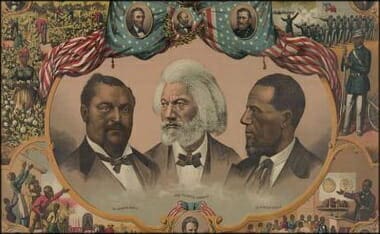
This Harlem Woman Knew Her History! Wow

I haven’t checked the links in a while, so some may be dead… but my “RACIAL PAGE” is a must see if this is up your alley. I love this woman, and I pray she is mentoring young women. Wow.

Brandon Straka Interviews black Americans in Harlem about how their allegiance to the Democrats is working out. He didn’t expect to meet these ladies!!!


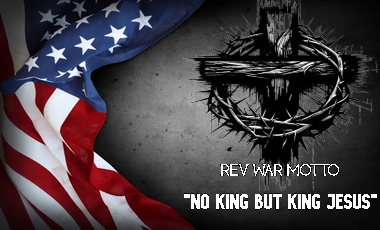
No King But King Jesus! The Revolutionary War Motto

I am leading at a small group this next week, and this is my outline (PDF) for the group to read. What follows after that is an excerpt from a larger post I put up every Fourth of July.

On April 18, 1775, a British soldier ordered John Hancock and others to “disperse in the name of George the Sovereign King of England”; John Adams responded to him:

“We recognize no sovereign but God, and no king but Jesus!”

Most wars have a motto. The motto of World War II was “Remember Pearl Harbor.” The motto during the Texas war for independence was “Remember the Alamo.” The spiritual emphasis, directed towards King George III who violated God’s laws, gave rise to a motto during the American Revolution: “No King but King Jesus.” Many in the colonies used the phrase to reject the crown in conversation.

KING of the JEWS

  • After Jesus was born in Bethlehem of Judea in the days of King Herod, wise men from the east arrived in Jerusalem, saying, “Where is he who has been born king of the Jews? For we saw his star at its rising and have come to worship him.” (Matthew 2:1-2a)
  • Pilate also had a sign made and put on the cross. It said: Jesus of Nazareth, the King of the Jews. Many of the Jews read this sign, because the place where Jesus was crucified was near the city, and it was written in Aramaic, Latin, and Greek. So the chief priests of the Jews said to Pilate, “Don’t write, ‘The king of the Jews,’ but that he said, ‘I am the king of the Jews.’ ” Pilate replied, “What I have written, I have written.” (John 19:19-22)

So, for all time, there stands the truth of God that the Jews crucified their king! God has His way of mocking those who mock Him! In other words, God often fashions what is meant for evil and mockery and creates a good out of it to save those whom He loves: “You planned evil against me; God planned it for good to bring about the present result—the survival of many people” (Genesis 50:20)

At the beginning of the Passion week, the multitudes had cried, “Blessed is the King of Israel!” (John 12:13). Before Pilate, Christ himself bore witness to his “kingdom” (18:36–37). And now His royal title was affixed to His very “gallow.”

Zechariah 9:9 notes the humble form of transportation of the Savior: “ your King is coming to you; he is righteous and victorious, humble and riding on a donkey, on a colt, the foal of a donkey.”

This humble nature of the Sovereign of the Universe is noted in Philippians 2:6-8

PART 1 OF PHIL

who, existing in the form of God, did not consider equality with God as something to be exploited. Instead, he emptied himself by assuming the form of a servant, taking on the likeness of humanity. And when he had come as a man, he humbled himself by becoming obedient to the point of death— even to death on a cross.

As well as in John 13:1-2; 4-8

Now before the Passover Festival, Jesus realized that his hour had come to leave this world and return to the Father. Having loved his own who were in the world, he loved them to the end.  [….] Because Jesus knew that the Father had given everything into his control, that he had come from God, and that he was returning to God, therefore he got up from the table, removed his outer robe, and took a towel and fastened it around his waist. Then he poured some water into a basin and began to wash the disciples’ feet and to dry them with the towel that was tied around his waist.

Then he came to Simon Peter, who asked him, “Lord, are you going to wash my feet?”

Jesus answered him, “You do not realize now what I am doing, but later on you will understand.”

Peter told him, “You must never wash my feet!”

Jesus answered him, “Unless I wash you, you cannot be involved with me.”

This is another version [the original real story — I contend, told to Paul by the council in Jerusalem and rewritten under Devine guidance] of God disrobing divinity, and coming to die as ransom for us, like Philippians:

Many take the story [John 13:1-2; 4-8] as no more than a lesson in humility, quite overlooking the fact that, in that case, Jesus’ dialogue with Peter completely obscures its significance! But those words, spoken in the shadow of the cross, have to do with cleansing, that cleansing without which no one belongs to Christ, that cleansing which is given by the cross alone. As Hunter says, “The deeper meaning then is that there is no place in his fellowship for those who have not been cleansed by his atoning death. The episode dramatically symbolizes the truth enunciated in I John 1:7, ‘We are being cleansed from every sin by the blood of Jesus’.” *[1]


* See my post for further notes on this verse: “The Totality of God’s Work at Calvary (Grace)

[1] Leon Morris, The Gospel according to John, The New International Commentary on the New Testament (Grand Rapids, MI: Wm. B. Eerdmans Publishing Co., 1995), 544–545.

In Revelation however, we see a shift – Jesus’ “ride” even got upgraded yo! [“yo” — by Josh Goertzen]

Then I saw heaven opened, and there was a white horse. Its rider is called Faithful and True, and with justice he judges and makes war. His eyes were like a fiery flame, and many crowns were on his head. He had a name written that no one knows except himself. He wore a robe dipped in blood, and his name is called the Word of God. The armies that were in heaven followed him on white horses, wearing pure white linen. A sharp sword came from his mouth, so that he might strike the nations with it. He will rule them with an iron rod. He will also trample the winepress of the fierce anger of God, the Almighty. And he has a name written on his robe and on his thigh: KING OF KINGS AND LORD OF LORDS. (Revelation 19:11-16).

This picture of a returning King is found in the 2nd half of that early church creedal statement we read in part via Philippians:

PART 2 OF PHIL

For this reason, God highly exalted him and gave him the name that is above every name, so that at the name of Jesus every knee will bow— in heaven and on earth and under the earth— and every tongue will confess that Jesus Christ is Lord, to the glory of God the Father. (2:9-11)

Psalm 2:6-9; 110:1-3 reads:

“I have installed my king on Zion, my holy mountain.” I will declare the LORD’s decree. He said to me, “You are my Son; today I have become your Father. Ask of me, and I will make the nations your inheritance and the ends of the earth your possession. You will break them with an iron scepter; you will shatter them like pottery.” [….] This is the declaration of the LORD to my Lord: “Sit at my right hand until I make your enemies your footstool.” The LORD will extend your mighty scepter from Zion. Rule over your surrounding enemies. Your people will volunteer on your day of battle. In holy splendor, from the womb of the dawn, the dew of your youth belongs to you.

Jeremiah 23:5-6 reads,

“Look, the days are coming”—this is the LORD’s declaration— “when I will raise up a Righteous Branch for David. He will reign wisely as king and administer justice and righteousness in the land. In his days Judah will be saved, and Israel will dwell securely. This is the name he will be called: The LORD Is Our Righteousness.

He who gives his testimony to all this says,

“Yes indeed! I am coming soon!”

So be it. Come, Lord Jesus!

Revelation 22:20-21

In a book by C.S. Lewis called Prince Caspian, a girl named Lucy sees a lion named Aslan [representing Christ]. She hadn’t seen him in many years. He has changed; he is bigger.

“Aslan, you’re bigger,” she says. The lion can talk. He replies: “That is because you are older, little one.”

“Not because you are?”, she asks. “I am not. But every year you grow, you will find me bigger.”

So it is with Jesus in our lives. The more we trust him, the bigger he gets. Well, he doesn’t get bigger in a physical sense (Hebrews 13:8). But the more we know him, the bigger we know him to be.

In considering last week’s study on faithfulness and obedience….

QUESTIONS

  • to whom are we being faithful to?
  • A lowly humble figure or the Lion of Judah?
  • Is this dichotomy better viewed as-a-whole to meet the needs of the Body of Christ [His subjects] in our fallen world?
  • Our Healer and Counselor at times; and in others, the conquering King?
  • Is this Ruler one whom we can be faithful in?
  • When I say that I have faith in God, I mean that I place my trust in God based on what I know about him.[2] What do we know of our Messiah?
  • Is He trusted by His words and deeds?
  • We have a picture of a future ruler and King over a kingdom healed, how does Christ ruling from heaven NOW affect your understanding of your walk? 
  • Your growth?
  • Your view of our promised land?

[2] “Certain words can mean very different things to different people. For instance, if I say to an atheist, ‘I have faith in God,’ the atheist assumes I mean that my belief in God has nothing to do with evidence. But this isn’t what I mean by faith at all. When I say that I have faith in God, I mean that I place my trust in God based on what I know about him.” — William A. Dembski and Michael R. Licona, Evidence for God: 50 Arguments for Faith from the Bible, History, Philosophy, and Science (Grand Rapids, MI: Baker Books, 2010), 38.

CORONATION OF THE SON (Psalm 2)

Why do the nations rage

and the peoples plot in vain?

The kings of the earth take their stand,

and the rulers conspire together

against the Lord and his Anointed One:

“Let’s tear off their chains

and throw their ropes off of us.”

The one enthroned in heaven laughs;

the Lord ridicules them.

Then he speaks to them in his anger

and terrifies them in his wrath:

“I have installed my king

on Zion, my holy mountain.”

I will declare the Lord’s decree.

He said to me, “You are my Son;

today I have become your Father.

Ask of me,

and I will make the nations your inheritance

and the ends of the earth your possession.

You will break them with an iron scepter;

you will shatter them like pottery.”

10 So now, kings, be wise;

receive instruction, you judges of the earth.

11 Serve the Lord with reverential awe

and rejoice with trembling.

12 Pay homage to the Son or he will be angry

and you will perish in your rebellion,

for his anger may ignite at any moment.

All who take refuge in him are happy.

MORE VIA PREVIOUS POST:

With thanks to the Heritage Foundation:

During the 1700s, Philadelphia was an unpleasant place in the summer. Malaria and yellow fever were rampant. There were no cures and no known ways to prevent infection. Most people of means tried to escape the city, if they could.

But in the scorching summer of 1776, scores of our country’s leading men remained behind closed doors in Philadelphia. They were kept there by their work. And what a monumental work it turned out to be.

The 56 leaders, representing all 13 British colonies, signed a declaration that would birth a great nation and illuminate the very future of humankind. It’s this Declaration of Independence that Americans celebrate each July 4.

The document’s first job was to officially announce to the world that all the colonies had decided to declare themselves free and independent states, absolved from any allegiance to Great Britain. That was momentous enough for the years ahead, since in order to make good on that declaration, the colonies would have to defeat the British in a war that stretched until 1783.

But the greater meaning of the Declaration — then as well as now — is as a statement of the conditions that underlie legitimate political authority and as an explanation of the proper ends of government.

The signers proclaimed that political power would spring from the sovereignty of the people, not a crowned hereditary monarch. This idea shook Europe to its very core.

The Declaration appealed not to any conventional law or political contract but to the equal rights possessed by all men and “the separate and equal station to which the Laws of Nature and nature’s God” entitled them.

What is revolutionary about the Declaration of Independence is not that a particular group of Americans declared their independence under particular circumstances. It’s that they did so by appealing to –and promising to base their particular government on — a universal standard of justice.

It is in this sense that Abraham Lincoln praised “the man who, in the concrete pressure of a struggle for national independence by a single people, had the coolness, forecast, and capacity to introduce into a merely revolutionary document, an abstract truth, applicable to all men and all times.”

Of course, it required another war to extend those rights to all Americans, but the fact that they were written down in the Declaration was crucial in 1865, in 1965 and remains so today as well.

“If the American Revolution had produced nothing but the Declaration of Independence,” wrote noted historian Samuel Eliot Morrison, “it would have been worthwhile.”

As Thomas Jefferson, lead author of the Declaration, put it in 1821, “The flames kindled on the 4th of July 1776, have spread over too much of the globe to be extinguished by the feeble engines of despotism; on the contrary, they will consume these engines and all who work them.”

Those flames, the flames of freedom and opportunity, continue to spread. That’s a truth worth celebrating on the Fourth — and all year ’round.

From, The Spirit of the American Revolution:

Even the Minutemen reflected strong religious involvement. While they are generally recognized for their exploits as a group, few today know many specifics about them. For example, these men who stood to fight for their liberties and defend their town were often groups of laymen from local congregations led either by their pastor or a deacon!  Records even indicate that it was not unusual that following their militia drills they would go to church “where they listened to exhortation and prayer.”

The spiritual emphasis manifested so often by the Americans during the Revolution caused one Crown-appointed British governor to write to Great Britain complaining that:

If you ask an American who is his master, he’ll tell you he has none. And he has no governor but Jesus Christ.

Letters like this, coupled with statements like that delivered by Ethan Allen, and sermons like those preached by the Reverend Peter Powers (“Jesus Christ the King”), gave rise to a motto of the American Revolution. Most of us are unaware that the American Revolution even had a motto, but most wars do (e.g., World War II—”Remember Pearl Harbor”; the Texas’ war for independence—”Remember the Alamo”; etc.). The motto of the American Revolution was directed against King George III—considered the primary source of the conflict; for it was he who was arbitrarily, capriciously, and regularly violated “the laws of nature and of nature’s God.” The motto was very simple and very direct:

No King but King Jesus!

See also

Were the Founders Religious? Was America Founded to Be Secular?

Progressivism vs. Declaration (4th of July Primer)

(School is in!) Mark Levin shares his study of the U.S. Constitution and it’s Founding. The American Founding. Levin discusses the miracle of the death of the two men key to the Declaration’s appearance (Jefferson and Adams) on the Fourth of July. He then treads into progressive waters and the current dislike of our American Founding as compared to history. He reads from Woodrow Wilson (our first Ph.D. President) and his disdain for the Founding document and Principles. Then a reading from — really a counter point — Calvin Coolidge to cement the idea that these are eternal principles. Levin wonders aloud how Leftists can even celebrate the 4th in good conscience.

About the Declaration there is a finality that is exceedingly restful. It is often asserted that the world has made a great deal of progress since 1776, that we have had new thoughts and new experiences which have given us a great advance over the people of that day, and that we may therefore very well discard their conclusions for something more modern. But that reasoning can not be applied to this great charter. If all men are created equal, that is final. If they are endowed with inalienable rights, that is final. If governments derive their just powers from the consent of the governed, that is final. No advance, no progress can be made beyond these propositions. If anyone wishes to deny their truth or their soundness, the only direction in which he can proceed historically is not forward, but backward toward the time when there was no equality, no rights of the individual, no rule of the people. Those who wish to proceed in that direction can not lay claim to progress. They are reactionary. Their ideas are not more modern, but more ancient, than those of the Revolutionary fathers. — Calvin Coolidge (POWERLINE)

BTW, if one does not know the history of the fourth in regard to Jefferson and Adams, or the eternal principles BEHIND the Declaration, here are some decent videos:

Were the Founders Religious? Was America Founded to Be Secular?

JUMP TO:

Did the Founding Fathers want American society to be religious or secular? Joshua Charles, author of Liberty’s Secrets, explains.

What did the Founding Fathers believe about religion? Were they Christians, or just deists? Did they believe in secularism, or did they want Americans to be religious? Joshua Charles, New York Times bestselling author and researcher at the Museum of the Bible, explains.


UPDATED w/ Combined Posts


A Facebook friend posts a lot of stuff from the Left. And while I could spend all day refuting in similar fashion much of it (like the below), this topic caught my eye. Here is the FB graphic she posted on her wall:

So, let’s deal with these in order, shall we?

THOMAS JEFFERSON

This is the headline at THE JEFFERSON MONTICELLO site: “Christianity is the most perverted system that ever shone on man (Spurious Quotation)” — spurious indeed. They follow this with the fuller quote:

This comment on Christianity is a somewhat paraphrased excerpt from the following letter written by Thomas Jefferson to Joseph Priestley:

“this was the real ground of all the attacks on you: those who live by mystery & charlatanerie, fearing you would render them useless by simplifying the Christian philosophy, the most sublime & benevolent, but most perverted system that ever shone on man, endeavored to crush your well earnt, & well deserved fame.” – Jefferson to Priestley, March 21, 18011 (entire letter)

There are other useful links at MONTICELLO’S link to this topic. Even CHECK YOUR FACT has this regarding the Jefferson quote:

Verdict: False

There is no evidence that Jefferson ever said or wrote this. His estate at Monticello includes the saying on its list of “spurious quotations.”

Fact Check:

The quote has been frequently attributed to Jefferson on social media, appearing in numerous memes and posts on Facebook.

However, the Daily Caller found no record of Jefferson ever saying or writing this expression. A search of the Papers of Thomas Jefferson returned no results matching the alleged saying. It doesn’t appear in a collection of his quotes and letters either.

His estate at Monticello also includes the statement on its list of “spurious quotations.” The first known appearance in print dates back to 1996, according to the Thomas Jefferson Foundation…..

Did Thomas Jefferson dislike religion? Ben Shapiro speaks with author and Wallbuilders founder David Barton about Jefferson and his version of the Bible.

Sorry Charlie.

But history is more complex than your meme.

BENJAMIN FRANKLIN

The fuller quote reads… and note, many say this about their youth as well. I say similar things — as I stayed out of the church as a youth when I could.

  • “I have found Christian dogma unintelligible. Early in life I absented myself from Christian assemblies.”

Later in life however, Franklin (and I would say myself) wrestled with religious matters well, and came out on the theistic end of life. Here, for example, is a letter from Benjamin Franklin to the “atheist” Thomas Paine:

TO THOMAS PAINE.

[Date uncertain.]

DEAR SIR,

I have read your manuscript with some attention. By the argument it contains against a particular Providence, though you allow a general Providence, you strike at the foundations of all religion. For without the belief of a Providence, that takes cognizance of, guards, and guides, and may favor particular persons, there is no motive to worship a Deity, to fear his displeasure, or to pray for his protection. I will not enter into any discussion of your principles, though you seem to desire it. At present I shall only give you my opinion, that, though your reasonings are subtile and may prevail with some readers, you will not succeed so as to change the general sentiments of mankind on that subject, and the consequence of printing this piece will be, a great deal of odium drawn upon yourself, mischief to you, and no benefit to others. He that spits against the wind, spits in his own face.

But, were you to succeed, do you imagine any good would be done by it? You yourself may find it easy to live a virtuous life, without the assistance afforded by religion; you having a clear perception of the advantages of virtue, and the disadvantages of vice, and possessing a strength of resolution sufficient to enable you to resist common temptations. But think how great a portion of mankind consists of weak and ignorant men and women, and of inexperienced, inconsiderate youth of both sexes, who have need of the motives of religion to restrain them from vice, to support their virtue, and retain them in the practice of it till it becomes habitual, which is the great point for its security. And perhaps you are indebted to her originally, that is, to your religious education, for the habits of virtue upon which you now justly value yourself. You might easily display your excellent talents of reasoning upon a less hazardous subject, and thereby obtain a rank with our most distinguished authors. For among us it is not necessary, as among the Hottentots, that a youth, to be raised into the company of men, should prove his manhood by beating his mother.

I would advise you, therefore, not to attempt unchaining the tiger, but to burn this piece before it is seen by any other person; whereby you will save yourself a great deal of mortification by the enemies it may raise against you, and perhaps a good deal of regret and repentance. If men are so wicked with religion, what would they be if without it. I intend this letter itself as a proof of my friendship, and therefore add no professions to it; but subscribe simply yours,

B. Franklin

Other interesting items of Mr. Franklin’s faith in God can be found here: Benjamin Franklin Was Not A Secularist

I start out this upload with a call into the show this week… after a little back-n-forth it ends. BUT, I include a bit of the show Dennis Prager speaks about during the call. That is from late February. A great topic covered well. Here is the creed spoken of:

✦ I believe in one God, the creator of the universe.
✦ That he governs by his providence.
✦ That he ought to be worshipped.
✦ That the most acceptable service we render to him is doing good to his other children.
✦ That the soul of man is immortal, and will be treated with justice in another life respecting its conduct in this.

For a very good discussion of the influence of the Calvinistic tradition on the thinking of Benjamin, see:

  • John Eidsmoe, Christianity and the Constitution: The Faith of Our Founding Fathers (Grand Rapids: Baker Book House, 1987), 191-213.

JOHN ADAMS

The fuller quote from Adam’s sheds some light on Calvinism’ influence on the founders. The quote was taken out of context from a letter from John Adams to Thomas Jefferson, 19 April 1817 (entire letter):

  • Twenty times, in the course of my late Reading, have I been upon the point of breaking out, “This would be the best of all possible Worlds, if there were no Religion in it”!!! But in this exclamati[on] I Should have been as fanatical as Bryant or Cleverly. Without Religion this World would be Something not fit to be mentioned in polite Company, I mean Hell. So far from believing in the total and universal depravity on human Nature; I believe there is no Individual totally depraved. 

A slightly more English friendly version is this:

“Twenty times, in the course of my late reading, have I been on the point of breaking out, ‘this would be the best of all possible Worlds, if there were no Religion in it!!!’ But in this exclamation, I should have been as fanatical as Bryant or Cleverly. Without religion, this world would be something not fit to be mentioned in public company – I mean hell.” (Charles Francis Adams [ed.], The Works of John Adams, 10 vols. [Boston, 1856], X, p. 254.)

  • Taken from They Never Said It: A Book of Fake Quotes, Misquotes, & Misleading Attributions, by Paul F. Boller, Jr. & John George, p. 3.

Adam’s was using the quote as a hyperbolic analogy to make a larger point. The opposite point as displayed in the meme. And the point was the depravity of mankind in a VERY Calvinistic structure. Here, as a way to drive the point home that this topic — that is, religious influences on the founding of America — is a topic I have for seminary studied well. Here is a bibliography of books used for a class. Books that sit on my shelves, I will highlight one in particular I recommend:

BIBLIOGRAPHY

Atkinson, James. The Great Light: Luther and the Reformation (Eugene, OR: Wipf and Stock, 2006).

Barton, David. America’s Godly Heritage (Aledo, TX: Wallbuilders Press, 1993).

___________. Original Intent: The Courts, the Constitution, & Religion, 3rd ed. (Aledo, TX: Wallbuilders Press, 2000).

Belloc, Hilaire. The Protestant Reformation (Rockford, IL: Tan Books and Publishers, 1928).

___________. Characters of the Reformation: Historical Portraits of 23 Men and Women and Their Place in the Great Religious Revolution of the 16th Century (Rockford, IL: Tan Books and Publishers, 1936).

Berman, Harold J. Law and Revolution II: The Impact of the Protestant Reformations on the Western Legal Tradition (Cambridge, MA: Harvard University Press, 2003).

_____________. Law and Revolution: The Formation of the Western Legal Tradition (Cambridge, MA: Harvard University Press, 1983).

Eidsmoe, John. Christianity and the Constitution: The Faith of Our Founding Fathers (Grand Rapids, MI: Baker Books, 1987).

Esolen, Anthony. The Politically Incorrect Guide to Western Civilization (Washington, DC: Regnery, 2008).

Estep, William R. Renaissance and Reformation (Wm B. Eerdmans Publishing Company, 1986).

Evans, M. Stanton. The Theme is Freedom: Religion, Politics, and the American Tradition (Washington, DC: Regnery, 1994).

George, Timothy. Theology of the Reformers (Nashville, TN: Broadman & Holman, 1988).

Hannah, John D. Charts of Reformation and Enlightenment Church History (Grand Rapids, MI: Zondervan Publishing House, 2004).

Hillerbrand, Hans J. The Reformation: A Narrative History Related by Contemporary Observances and Participants (New York, NY: Harper & Row, 1964).

___________. How the Reformation Happened (New York, NY: Harper Perennial, 1968).

Hoffecker, W. Andrew. Revolutions in Worldviews: Understanding the Flow of Western Thought (Phillipsburg, NJ: P & R, 2007).

House, Wayne H. Charts of Christian Theology & Doctrine (Grand Rapids, MI: Zondervan Publishing House, 1992).

_____________. Charts on Systematic Theology ( Grand Rapids, MI: Kregel, 2006).

Lowenthal, David. No Liberty for License: the Forgotten Logic of the First Amendment (Dallas, TX: Spence Publishing, 1997).

MacCullouch, Diarmaid. The Reformation: A History (New York, NY: Penguin, 2004).

Marshall, Paul. God and the Constitution: Christianity and American Politics (Lanham, MD: Rowman & Littlefield, 2002).

McGrath, Alister E. Reformation Thought: An Introduction, 3rd ed. (Malden, MA: Blackwell Publishing, 1999).

______________, ed. The Christian Theology Reader (Malden, MA: Blackwell Publishers, 1995).

Nichols, Stephen J. The Reformation: How a Monk and a Mallet Changed the World (Wheaton, IL: Crossway Books, 2007).

Noll, Mark A. America’s God: From Jonathan Edwards to Abraham Lincoln (New York, NY: Oxford University Press).

Olberman, Heiko A. The Dawn of the Reformation: Essays in Late Medieval and Early Reformation Thought (Wm B. Eerdmans Publishing Company, 1992).

Parker, G.W.H. The Morning Star: Wycliffe and the Dawn of the Reformation (Eugene, OR: Wipf and Stock, 2006).

Pelikan, Jaroslav, Reformation of Church and Dogma (1300-1700), vol. 4 (Chicago, IL: University of Chicago Press, 1984).

Sandoz, Ellis, ed. Political Sermons of the American Founding Era: 1730-1805 (Indianapolis, IN: Liberty Fund, 1991).

Sharansky, Natan. Defending Identity: It’s Indispensible Role In Protecting Democracy (New York, NY: Public Affairs, 2008).

Skinner, Quentin. The Foundations of Modern Political Thought: The Age of Reformation, vol. 2 (New York, NY: Cambridge University Press, 1978).

_____________. The Foundations of Modern Political Thought: The Renaissance, vol. 1 (New York, NY: Cambridge University Press, 1998).

_____________. Liberty Before Liberalism (New York, NY: Cambridge University Press, 1998).

Spellman, W.M. John Locke and the Problem of Depravity (New York, NY: Oxford University Press, 1988).

Stark, Rodney. The Victory of Reason: How Christianity Led to Freedom, Capitalism, and Western Success (, New York, NY: Random House, 2006).

            _____________. For the Glory of God: How Monotheism Led to Reformations, Science, Witch-Hunts, and the End of Slavery (Princeton, NJ: Princeton university Press, 2004)

Tomkins, Stephen. A Short History of Christianity (Wm B. Eerdmans Publishing Company, 2005).

Walton, Robert C. Chronological and Background Charts of Church History: Revised and Expanded (Grand Rapids, MI: Zondervan Publishing House, 2005).

Witte, John Jr. Religion and American Constitutional Experiment (Boulder, CO: Westview Press, 2005).

___________. The Reformation of Rights: Law, Religion, and Human Rights in Early Modern Calvinism (New York, NY: Cambridge University Press, 2007).

___________., and Frank s. Alexander, eds. Christianity and Law: An Introduction (New York, NY: Cambridge University Press, 2008).

___________. From Sacrament to Contract: Marriage, Religion, and Law in the Western Tradition (Louisville, KY: WJK, 1997)

___________. God’s Joust, God’s Justice: Law and Religion in the Western Tradition (Wm B. Eerdmans Publishing Company, 2006).

___________. Law and Protestantism: The Legal Teachings of the Lutheran Reformation (New York, NY: Cambridge University Press, 2002).

Woods, Thomas J. Jr. The Politically Incorrect Guide to American History (Washington, DC: Regnery, 2004).

Later in life, Adams wrote:

  • “I love and revere the memories of Huss, Wickliff, Luther, Calvin, Zwingli, Melancton, and all the other Reformers, how muchsoever I may differ from them all in many theological metaphysical & philosophical points. As you justly observe, without their great exertions & severe sufferings, the USA had never existed.” — John Adams to F. C. Schaeffer, November 25, 1821, in James Hutson, ed., The Founders on Religion: A Book of Quotations (Princeton: Princeton University Press, 2005), 15–16.

GEORGE WASHINGTON

The quote by our first official President does not even hint at secular thought? The entire letter in fact does not. An excellent site recording the non-secular events surrounding the Constitution, also note the following — to use just one example from the many via Is the Constitution a “Secular Document?”

After being sworn in, George Washington delivered his “Inaugural Address” to a joint session of Congress. In it Washington declared:

[I]t would be peculiarly improper to omit in this first official act my fervent supplications to that Almighty Being who rules over the universe, who presides in the councils of nations, and whose providential aids can supply every human defect, that His benediction may consecrate to the liberties and happiness of the people of the United States a Government instituted by themselves . . . .  In tendering this homage to the Great Author of every public and private good, I assure myself that it expresses your sentiments not less than my own, nor those of my fellow-citizens at large less than either. No people can be bound to acknowledge and adore the Invisible Hand which conducts the affairs of men more than those of the United States. Every step by which they have advanced to the character of an independent nation seems to have been distinguished by some token of providential agency; and . . . can not be compared with the means by which most governments have been established without some return of pious gratitude, along with an humble anticipation of the future blessings which the past seem to presage.

[W]e ought to be no less persuaded that the propitious smiles of Heaven can never be expected on a nation that disregards the eternal rules of order and right which Heaven itself has ordained….

    • Messages and Papers of the PresidentsGeorge Washington, Richardson, ed., vol. 1, p.44-45

Following his address, the Annals of Congress reported that:

The President, the Vice-President, the Senate, and House of Representatives, &c., then proceeded to St. Paul’s Chapel, where Divine service was performed by the chaplain of Congress.

These people obviously didn’t get the memo about the Constitution creating a secular government…..

More on Washington can be found HERE.

In recent conversation a similar meme was sent to me that added Thomas Pain. So here is a quick dealing with this that should add more context to Mr. Pain’s complexity that is not represented in the “out of context” thoughts in full he had about the subject.

THOMAS PAIN UPDATE

Many posit that Thomas Pain was a deist. The problem is that Pain had issues with God, yes, but “deism” represented in thought of the 1700’s is a bit different than what the 21st century mind posits. Obviously he is no Evangelical Christian, but neither is he “anti-God.”  For instance:

Even Thomas Paine, in his discourse on “The Study of God,” forcefully asserts that it is “the error of schools” to teach sciences without “reference to the Being who is author of them: for all the principles of science are of Divine origin.” He laments that “the evil that has resulted from the error of the schools in teaching [science without God] has been that of generating in the pupils a species of atheism.” Paine not only believed in God, he believed in a reality beyond the visible world.

I wrote a post defining deism through a debate I had in the very early 2000s, here is a snippet of thought from that POST:

“A being who could [as deists believe] bring the universe into existence from nothing could certainly perform lesser miracles if He chose to do so. A God who created water could part it or make it possible for a person to walk on it. The immediate multiplication of loaves of bread and fish would be no problem to a God who created matter and life in the first place. A virgin birth or even a physical resurrection from the dead would be minor miracles in comparison to the miracle of creating the universe from nothing [as deists believe]. It seems self-defeating to admit a great miracle like creation and then to deny the possibility of lesser miracles.”

(Baker Encyclopedia of Christian Apologetics, by Norman L. Geisler, p. 189.)

Author Joshua Charles also succinctly catalogued Thomas Pain’s complexity of thought on the matter:

Even Thomas Paine, who in the second half of his life was an ardent opponent of orthodox Christianity (mostly Catholicism) and the clergy and did not believe the Bible was divinely inspired, wrote at the same time, “All the principles of science are of divine origin. Man cannot make or invent or contrive principles. He can only discover them, and he ought to look through the discovery to the Author.”

Paine criticized any teaching of “natural philosophy” (i.e., science) that asserted that the universe was simply “an accomplishment” (i.e., self-existent). He also criticized those teachers who “labor with studied ingenuity to ascribe everything they behold to innate properties of matter and jump over all the rest by saying that matter is eternal” and thereby encouraged the “evil” of atheism. “Instead of looking through the works of creation to the Creator Himself, they stop short and employ the knowl­edge they acquire to create doubts of His existence,” he lamented. “When we examine an extraordinary piece of machinery, an astonishing pile of architecture, a well-executed statue, or a highly-finished painting… our ideas are naturally led to think of the extensive genius and talent of the artist. When we study the elements of geometry, we think of Euclid. When we speak of gravitation, we think of Newton. How, then, is it that when we study the works of God in creation, we stop short and do not think of God?”….


For more context, read Joshua Charles, Liberty’s Secrets: The Lost Wisdom of America’s Founders (Washington, DC: WND Books, 2015), 82-91.

Here is some more in-depth study of God and shows that what is ripped out of a lifetime does not do justice to the topic but merely reinforces presuppositions. First, a definition for the below:

  • theophilanthropist: a member of a deistic society established in Paris during the period of the Directory aiming to institute in place of Christianity

Stedman and Hutchinson, comps.  A Library of American Literature:
An Anthology in Eleven Volumes.  1891.
Vol. III: Literature of the Revolutionary Period, 1765–1787

The Study of God
By Thomas Paine (1737–1809)

[A Discourse delivered to the Society of Theophilanthropists at Paris.]

RELIGION has two principal enemies, Fanaticism and Infidelity, or that which is called atheism. The first requires to be combated by reason and morality, the other by natural philosophy.

  The existence of a God is the first dogma of the Theophilanthropists….

  The universe is the Bible of a true Theophilanthropist. It is there that he reads of God. It is there that the proofs of his existence are to be sought and to be found. As to written or printed books, by whatever name they are called, they are the works of man’s hands, and carry no evidence in themselves that God is the author of any of them. It must be in something that man could not make that we must seek evidence for our belief, and that something is the universe; the true Bible; the inimitable work of God.

  Contemplating the universe, the whole system of creation, in this point of light, we shall discover that all that which is called natural philosophy is properly a divine study. It is the study of God through his works. It is the best study by which we can arrive at a knowledge of his existence, and the only one by which we can gain a glimpse of his perfection.

  Do we want to contemplate his power? We see it in the immensity of the creation. Do we want to contemplate his wisdom? We see it in the unchangeable order by which the incomprehensible whole is governed. Do we want to contemplate his munificence? We see it in the abundance with which he fills the earth. Do we want to contemplate his mercy? We see it in his not withholding that abundance even from the unthankful. In fine, do we want to know what God is? Search not written or printed books, but the scripture called the Creation.

  It has been the error of the schools to teach astronomy, and all the other sciences and subjects of natural philosophy, as accomplishments only; whereas they should be taught theologically, or with reference to the Being who is the author of them: for all the principles of science are of divine origin. Man cannot make, or invent, or contrive principles. He can only discover them; and he ought to look through the discovery to the Author.

  When we examine an extraordinary piece of machinery, an astonishing pile of architecture, a well executed statue, or a highly finished painting, where life and action are imitated, and habit only prevents our mistaking a surface of light and shade for cubical solidity, our ideas are naturally led to think of the extensive genius and talents of the artist. When we study the elements of geometry, we think of Euclid. When we speak of gravitation, we think of Newton. How then is it, that when we study the works of God in the creation, we stop short, and do not think of God? It is from the error of the schools in having taught those subjects as accomplishments only, and thereby separated the study of them from the Being who is the author of them.

  The schools have made the study of theology to consist in the study of opinions in written or printed books; whereas theology should be studied in the works or books of the creation. The study of theology in books of opinions has often produced fanaticism, rancor, and cruelty of temper; and from hence have proceeded the numerous persecutions, the fanatical quarrels, the religious burnings and massacres that have desolated Europe. But the study of theology in the works of the creation produces a direct contrary effect. The mind becomes at once enlightened and serene; a copy of the scene it beholds: information and adoration go hand in hand; and all the social faculties become enlarged.

  The evil that has resulted from the error of the schools in teaching natural philosophy as an accomplishment only, has been that of generating in the pupils a species of atheism. Instead of looking through the works of the creation to the Creator himself, they stop short, and employ the knowledge they acquire to create doubts of his existence. They labor with studied ingenuity to ascribe everything they behold to innate properties of matter; and jump over all the rest, by saying that matter is eternal.

In a great synopsis of how complex people change over time, Pain’s pro-God arguments happened during the American Revolution and independence. Only later did he become more secular and defended atrocities like those in France. CHRISTIAN HERITAGE FELLOWSHIP opines well (the entire article is worth reading as well as following up with the footnotes):

….What many now fail to realize is that the Thomas Paine of the 1770s and 1780s (or the era of the American Revolution) was not the later Thomas Paine of the 1790s and early nineteenth century. Characteristic of much of his life, Paine soon found himself at odds with leading figures of the American Revolution. Following the War of Independence, he returned to England, where he was born. A few years later, he ventured to France (1790) where he was caught-up in the events of the French Revolution. Unlike the American Revolution, the French Revolution of 1789 and the many years that followed were the result of the godless influence of Voltaire, Rousseau, and the European “Intellectuals.” From these wells of irreligion that sprang from the French Revolution, Paine drank freely and deeply—a fact that was reflected in his subsequent writings.

Though Paine produced other works, two writings defended the anti-Christian French Revolution and the philosophy that justified its horrors. The first of these two works, Rights of Man (1791), included thirty-one articles that argued in defense of revolution when a government does not safeguard the natural rights of its people.[5] The second work, The Age of Reason—published in three parts in 1794, 1795, and 1807, was a traditional deistic attack upon Christianity, institutional religion, and denied the legitimacy of the Bible. Particularly the latter work amounted to a betrayal of the Founding Father’s understanding of the foundation of human government.

No King, But God!

It is not possible to argue that the latter Thomas Paine was the “real” influence upon the origin of America. No; it was the younger, Thomas Paine who exerted a religious influence upon the formation of America that was consistent with the Christian convictions of other Founding Fathers. Paine’s Common Sense made no attempt to disparage or ridicule the Bible, but rather, employed Scripture and Christian thought to develop his arguments in favor of American independence. While a detailed analysis of this book would further support this claim, only a couple of extended quotes should be sufficient to convince the most candid readers.

First, the fact that the Bible is used favorably by Paine as part of his collage detailing his understanding of human government which began with the “Sovereign, the King of heaven”:

The children of Israel being oppressed by the Midianites, Gideon marched against them with a small army, and victory, thro’ the divine interposition [providence], decided in his favor. The Jews elate with success, and attributing it to the generalship of Gideon, proposed making him a king, saying, Rule thou over us, thou and thy son and thy son’s son. Here was temptation in its fullest extent; not a kingdom only, but a hereditary one, but Gideon in the piety of his soul replied, I will not rule over you, neither shall my son rule over you. The Lord shall rule over you. Words need not be more explicit; Gideon doth not decline the honor, but denieth their right to give it; neither doth he compliment them with invented declarations of his thanks, but in the positive stile of a prophet charges them with disaffection to their proper Sovereign, the King of heaven.[6] 

Second, Paine extended his argument in favor of the rule of the “Sovereign, the King of heaven” to include his right to rule in America. Writing eleven years prior to the drafting of the United States Constitution, Paine referred to a written form of government he called a “Charter.” What is critical to Paine’s understanding of human government is the fact that he believed the supreme law giver was the One who “reigns above,” and He has made his law known through “the Divine Law, the Word of God.”

But where, say some, is the King of America? I’ll tell you, friend, he reigns above, and doth not make havoc of mankind like the Royal Brute of Great Britain. Yet that we may not appear to be defective even in earthly honors, let a day be solemnly set apart for proclaiming the Charter; let it be brought forth placed on the Divine Law, the Word of God; let a crown be placed thereon, by which the world may know, that so far as we approve of monarchy, that in America the law is king. For as in absolute governments the King is law, so in free countries the law ought to be king; and there ought to be no other. But lest any ill use should afterwards arise, let the Crown at the conclusion of the ceremony be demolished, and scattered among the people whose right it is.[7] 

Conclusion

For Thomas Paine, there was “No king, but God!” He believed that human government must proceed from divine government, or “the Charter” (or Constitution) must be founded upon or arise out of, or be “placed on the Divine Law, the Word of God.”

Thomas Paine did have a great impact upon the origin of America as an independent nation, but it was the religious, not irreligious Thomas Paine that exercised this influence. And, given the fact that Americans were Trinitarians (believing in God the Father, Son, and Spirit), they believed Jesus was God, and, therefore, there was little or no difference between the expressions, “No king, but Jesus” and “No king, but God.”

So the meme is lacking context, obviously.

JAMES MADISON UPDATE

Another new portion of a meme I hadn’t seen before dealt with a portrayal of Madison and the “separation of religion and state.” You wanna talk about “ripped out of context”? Hoo boy.

  • “There is no principle in all of Madison’s wide range of private opinions and long public career,” writes biographer Ralph Ketcham, “to which he held with greater vigor and tenacity than this one of religious liberty.” (HERITAGE FOUNDATION)

While Madison fought against anti-Catholic sentiments and inserting the word “Jesus Christ” in an amended preamble of Virginia’s Bill for Religious Liberty, he was not for separation of church n state as progressives see it. For instance,  in a letter of Madison to William Bradford (September 25, 1773), Madison spoke of the desire that all public officials – including Bradford – would declare
openly and publicly their Christian beliefs and testimony:

  • I have sometimes thought there could not be a stronger testimony in favor of religion or against temporal enjoyments, even the most rational and manly, than for men who occupy the most honorable and gainful departments and [who] are rising in reputation and wealth, publicly to declare their unsatisfactoriness by becoming fervent advocates in the cause of Christ; and I wish you may give in your evidence in this way.

James Madison is the author of how we view “conscience” in our public life. To wit:

In addition to his passion for religious liberty, Madison underscored that “conscience is the most sacred of all property.” Because religious rights were central to Madison’s worldview, he saw the inherent link between freedom of conscience and freedom of religion.

In particular, Madison was convinced that keeping government out of the affairs of the church (or religion) was the only way that people could follow the dictates of their conscience. He viewed established state religion as a denial of the fundamental, God-given right of conscience. Due to this, he concluded that the institution of the church should be separate from the state and not directed by the government in any way, a principle that was enshrined in his original draft of the First Amendment.

Expanding a bit on this is my post from years back, SEPARATION OF CHURCH AND STATE:

The First Amendment never intended to separate Christian principles from government.  Yet today we so often hear the First Amendment coupled with the phrase “separation of church and state.  The First Amendment simply states: “Congress shall make no law respecting an establishment of religion or prohibiting the free exercise thereof.”

Obviously, the words “separation,” “church,” or “state” are not found in the First Amendment; furthermore, that phrase appears in no founding document!  While most recognize the phrase “separation of church and state,” few know its source; but it is important to understand the origins of that phrase.  What is the history of the First Amendment?

The process of drafting the First Amendment made the intent of the Founders abundantly clear; for before they approved the final wording, the First Amendment went through nearly a dozen different iterations and extensive discussions.

Those discussions – recorded in the Congressional Records from June 7 through September 25, 1789 – make clear their intent for the First Amendment.  For example, the original version (followed by later versions) introduced in the Senate on September 3, 1789, stated:

  • “Congress shall not make any law establishing any religious denomination.”
  • “Congress shall make no law establishing any particular denomination.”
  • “Congress shall make no law establishing any particular denomination in preference to another.”
  • “Congress shall make no law establishing religion [denomination] or prohibiting the free exercise there of.”

By it, the Founders were saying: “We do not want in America what we had in Great Britain: we don’t want one denomination running the nation.  We will not have Catholics, or Anglicans, or any other single denomination. We do want God’s principles, but we don’t want one denomination running the nation.”

Of interest is the proposal that George Mason – a member of the Constitutional Convention and “The Father of the Bill of Rights” – put forth for the First Amendment:

  • “All men have equal, natural and unalienable right to the free exercise of religion, according to the dictates of conscience; and that no particular sect or society of Christians [denomination] ought to be favored or established by law in preference to others.”

Their intent was well understood, as evidence by court rulings after the First Amendment.  For example, a 1799 court declared:

  • “By our form of government, the Christian principles – we do want God’s principles – but we don’t want one denomination to run the nation.”

Again, note the emphasis: “We do want Christian principles – we do want God’s principles – but we don’t want one denomination to run the nation.”

[….]

On the day the Founding Fathers signed the Declaration of Independence, they underwent an immediate transformation.  The day before, each of them had been a British citizen, living in a British colony, with thirteen crown-appointed British state governments.  However, when they signed that document and separated from Greta Britain, they lost all of their State governments.

Consequently, they returned home from Philadelphia to their own States and began to create new State constitutions.  Samuel Adams and John Adams helped write the Massachusetts constitution; Benjamin Rush and James Wilson helped write Pennsylvania’s constitution; George Read and Thomas McKean helped write Delaware’s constitution; the same is true in other States as well.  The Supreme Court in Church of Holy Trinity v. United States (1892) pointed to these State constitutions as precedents to demonstrate the Founders’ intent.

Notice, for example, what Thomas McKean and George Read placed in the Delaware constitution:

  • “Every person, who shall be chosen a member of either house, or appointed to any office or place of trust… shall… make and subscribe the following declaration, to wit: ‘I do profess faith in God the Father, and in Jesus Christ, his only Son, and in the Holy Ghost, one God, blessed forever more, and I acknowledge the Holy Scripture of the Old and New Testament to be given by divine inspiration.’”

Take note of some other State constitutions.  The Pennsylvania constitution authored by Benjamin Rush and James Wilson declared:

  • “And each member [of the legislature], before he takes his seat, shall make and subscribe the following declaration, viz: ‘I do believe in one God, the Creator and Governor of the Universe, the rewarded of the good and the punisher of the wicked, and I do acknowledge the Scriptures of the Old and New Testament to be given by Divine Inspiration.’”

The Massachusetts constitution, authored by Samuel Adams – the Father of the American Revolution – and John Adams, stated:

  • “All persons elected must make and subscribe the following declaration, viz. ‘I do declare that I believe the Christian religion and have firm persuasions of its truth.’”

North Carolina’s constitution required that:

  • “No person, who shall deny the being of God, or the truth of the [Christian] religion, or the Divine authority either of the Old or New Testaments, or who shall hold religious principles incompatible with the freedom and safety of the State, shall be capable of holding any office, or place of trust or profit in the civil department, within this State.”

You had to apply God’s principles to public service, otherwise you were not allowed to be a part of the civil government.  In 1892, the Supreme Court (Church of Holy Trinity v. United States) pointed out that of the forty-four States that were then in the Union, each had some type of God-centered declaration in its constitution.  Not just any God, or a general God, say a “higher power,” but thee Christian God as understood in the Judeo-Christian principles and Scriptures.  This same Supreme Court was driven to explain the following:

  • “This is a religious people.  This is historically true.  From the discovery of this continent to the present hour, there is a single voice making this affirmation….  These are not individual sayings, declarations of private persons: they are organic utterances; they speak the voice of the entire people….  These and many other matters which might be noticed, add a volume of unofficial declarations to the mass of organic utterances that this is a Christian nation.”

Madison was intimately involved in those iterations. Remember as well that Madison was a member of the committee that authored the 1776 Virginia Bill of Rights and approved of its clause declaring that:

  • It is the mutual duty of all to practice Christian forbearance, love, and charity toward each other.

In 1789, Madison served on the Congressional committee which authorized, approved, and selected paid Congressional chaplains. in 1812, President Madison signed a federal bill which economically aided a Bible Society in its goal of the mass distribution of the Bible. Throughout his Presidency (1809-1816), Madison endorsed public and official religious expressions by issuing several proclamations for national days of prayer, fasting, and thanksgiving. (Much more can be found at WALLBUILDERS)

4th of July ~ History 101

What Follows

  • Videos Of People Who Do Not Know History…
  • Followed By Some History,
  • Patriotism, Remembreance

Just a quick word regarding Mark Dice — who is the guy in the first video (and 3rd n 4th):

While I like their rants (Paul Watson, Mark Dice, and others) and these commentaries hold much truth in them, I do wish to caution you… he is part of Info Wars/Prison Planet network of yahoos, a crazy conspiracy arm of Alex Jones shite. Also, I bet if I talked to him he would reveal some pretty-crazy conspiratorial beliefs that would naturally undermine and be at-odds-with some of his rants. Just to be clear, I do not endorse these people or orgs.

Media analyst Mark Dice asks beachgoers in San Diego, California some basic questions about America’s 4th of July Independence Day celebration and their answers are quite disturbing.

MORE SADNESS:

FOR THE HISTORICAL RECORD:

The signers of the Declaration of Independence (ALL BIOS HERE)

Delaware

George Read | Caesar Rodney | Thomas McKean

Pennsylvania

George Clymer | Benjamin Franklin | Robert Morris | John Morton | Benjamin Rush | George Ross | James Smith | James Wilson | George Taylor

Massachusetts

John Adams | Samuel Adams | John Hancock | Robert Treat Paine

New Hampshire

Josiah Bartlett | William Whipple | Matthew Thornton |

Rhode Island

Stephen Hopkins | William Ellery |

New York

Lewis Morris | Philip Livingston | Francis Lewis | William Floyd |

Georgia

Button Gwinnett | Lyman Hall | George Walton |

Virginia

Richard Henry Lee | Francis Lightfoot Lee | Carter Braxton | Benjamin Harrison | Thomas Jefferson | George Wythe | Thomas Nelson, Jr. |

North Carolina

William Hooper | John Penn |

South Carolina

Edward Rutledge | Arthur Middleton | Thomas Lynch, Jr. | Thomas Heyward, Jr. |

New Jersey

Abraham Clark | John Hart | Francis Hopkinson | Richard Stockton | John Witherspoon |

Connecticut

Samuel Huntington | Roger Sherman | William Williams | Oliver Wolcott |

Maryland

Charles Carroll | Samuel Chase | Thomas Stone | William Paca |


Reagan, Cash, and Harvey


Dennis Prager


Video Description:

Dennis Prager reads from the popular leftist website, VOX. From newspapers such as the N.Y. TIMES, the L.A. TIMES, and the N.Y. DAILY NEWS. These mainstream opinion pieces bemoan and degrade America to the point of hatred. Anti-Americanism is growing on the Left, and in taking these positions these people benighted themselves as our cultural commissars… dishing out their version of history to those unintelligent lap-dog readers they call customers.


Some More History


I want to thank Israel Matzav for the following, good stuff!

With thanks to the Heritage Foundation:

During the 1700s, Philadelphia was an unpleasant place in the summer. Malaria and yellow fever were rampant. There were no cures and no known ways to prevent infection. Most people of means tried to escape the city, if they could.

But in the scorching summer of 1776, scores of our country’s leading men remained behind closed doors in Philadelphia. They were kept there by their work. And what a monumental work it turned out to be.

The 56 leaders, representing all 13 British colonies, signed a declaration that would birth a great nation and illuminate the very future of humankind. It’s this Declaration of Independence that Americans celebrate each July 4.

The document’s first job was to officially announce to the world that all the colonies had decided to declare themselves free and independent states, absolved from any allegiance to Great Britain. That was momentous enough for the years ahead, since in order to make good on that declaration, the colonies would have to defeat the British in a war that stretched until 1783.

But the greater meaning of the Declaration — then as well as now — is as a statement of the conditions that underlie legitimate political authority and as an explanation of the proper ends of government.

The signers proclaimed that political power would spring from the sovereignty of the people, not a crowned hereditary monarch. This idea shook Europe to its very core.

The Declaration appealed not to any conventional law or political contract but to the equal rights possessed by all men and “the separate and equal station to which the Laws of Nature and nature’s God” entitled them.

What is revolutionary about the Declaration of Independence is not that a particular group of Americans declared their independence under particular circumstances. It’s that they did so by appealing to –and promising to base their particular government on — a universal standard of justice.

It is in this sense that Abraham Lincoln praised “the man who, in the concrete pressure of a struggle for national independence by a single people, had the coolness, forecast, and capacity to introduce into a merely revolutionary document, an abstract truth, applicable to all men and all times.”

Of course, it required another war to extend those rights to all Americans, but the fact that they were written down in the Declaration was crucial in 1865, in 1965 and remains so today as well.

“If the American Revolution had produced nothing but the Declaration of Independence,” wrote noted historian Samuel Eliot Morrison, “it would have been worthwhile.”

As Thomas Jefferson, lead author of the Declaration, put it in 1821, “The flames kindled on the 4th of July 1776, have spread over too much of the globe to be extinguished by the feeble engines of despotism; on the contrary, they will consume these engines and all who work them.”

Those flames, the flames of freedom and opportunity, continue to spread. That’s a truth worth celebrating on the Fourth — and all year ’round.

From, The Spirit of the American Revolution:

Even the Minutemen reflected strong religious involvement. While they are generally recognized for their exploits as a group, few today know many specifics about them. For example, these men who stood to fight for their liberties and defend their town were often groups of laymen from local congregations led either by their pastor or a deacon!  Records even indicate that it was not unusual that following their militia drills they would go to church “where they listened to exhortation and prayer.”

The spiritual emphasis manifested so often by the Americans during the Revolution caused one Crown-appointed British governor to write to Great Britain complaining that:

If you ask an American who is his master, he’ll tell you he has none. And he has no governor but Jesus Christ.

Letters like this, coupled with statements like that delivered by Ethan Allen, and sermons like those preached by the Reverend Peter Powers (“Jesus Christ the King”), gave rise to a motto of the American Revolution. Most of us are unaware that the American Revolution even had a motto, but most wars do (e.g., World War II—”Remember Pearl Harbor”; the Texas’ war for independence—”Remember the Alamo”; etc.). The motto of the American Revolution was directed against King George III—considered the primary source of the conflict; for it was he who was arbitrarily, capriciously, and regularly violated “the laws of nature and of nature’s God.” The motto was very simple and very direct:

No King but King Jesus!

History Keepers | Glenn Beck for Prager U

Saving History: The Case for Clay Pots

There is no guarantee that future historians will accurately depict the American story. In PragerU’s 2025 commencement address, ‪@glennbeck‬ warns that we all have an obligation to preserve history in our own “clay pots.” If we don’t, historical truth might disappear forever in a fog of political correctness.

“It Was Me…” | The Fallen Soldier

All Gave Some, But Some Gave All

Others have made the ultimate sacrifice so that you could be free. Remember them—today, and always. A moving tribute, written and narrated by former Navy SEAL and author Jocko Willink.


…It Was Them…


While the speeches and cartoons are perfect for this Memorial Day… they do not express the loss persons individually feel that express our Nation’s loss through their pain. Pray for the families of the fallen, always.


 photo Powerful Memorial Day 024.jpg


 photo Powerful Memorial Day 023.jpg
 photo Powerful Memorial Day 022.jpg
 photo Powerful Memorial Day 020.jpg
 photo Powerful Memorial Day 016.jpg
 photo Powerful Memorial Day 019.jpg
 photo Powerful Memorial Day 018.jpg
 photo Powerful Memorial Day 017.jpg
 photo Powerful Memorial Day 014.jpg
 photo Powerful Memorial Day 013.jpg
 photo Powerful Memorial Day 012.jpg
 photo Powerful Memorial Day 011.jpg
 photo Powerful Memorial Day 010.jpg
 photo Powerful Memorial Day 9.jpg
 photo Powerful Memorial Day 8.jpg
 photo Powerful Memorial Day 7.jpg
 photo Powerful Memorial Day 2 680.jpg
 photo Powerful Memorial Day 5.jpg
 photo Powerful Memorial Day 4.jpg
 photo Powerful Memorial Day 3.jpg
 photo flaggarden-header1.jpg
 photo Powerful Memorial Day 015.jpg
 photo Powerful Memorial Day 1 680.jpg


A few of the below are from the same heroes funeral,

a link to the story is in the pictures


 photo Powerful Memorial Day 021.jpg


 photo Powerful Memorial Day 6.jpg


Heroes!


Ronald Reagan’s Memorial Day Speech | President Reagan commemorates those Americans who have willingly sacrificed their lives for their country, during the Memorial Day ceremonies held at the Arlington National Cemetery, May 31, 1982. Video (5/28/18) by Airman 1st Class Ryan Brooks, 31st Fighter Wing Public Affairs. Courtesy DVIDS. The appearance of U.S. Department of Defense (DoD) visual information does not imply or constitute DoD endorsement.

Lies My Leftist Teacher Told Me | Wilfred Reilly and John Stossel

SLAVERY:

Schools teach children that, when it comes to slavery, America was the worst.

But Wilfred Reilly, author of “Lies My Liberal Teacher Taught Me,” says that’s just not true.

“Slavery around the world, was slavery,” says Reilly in our new video.

He believes it’s better to teach the truth – that almost every society had slavery: the Aztecs, Persians, Egyptians, Greeks, Romans, Vikings, and most of all, the Islamic world.

American slavery was horrible. But it wasn’t unique.

Our culture would be healthier if we learned about that.

NOBLE WARRIOR:

Americans are taught that the native people were stewards of the environment.

Movies like Pocahontas sell that message.

But Wilfred Reilly’s new book, “Lies My Liberal Teacher Told Me” debunks this and other myths about America’s history.

Government guides for teachers say, “Native Americans lived in harmony with nature… They did not kill anything they could not use.”

I believed it!

But Reilly points out the Natives took slaves, set big forest fires to clear land, and often were just as cruel as white Europeans.

Our new video looks at myths American schools still teach.

Settler vs Native Killing from 1511-to-1890

I will excerpt the section I read this from, but the reason I am noting it is that I have come across similar studies. And while it corrects the thinking of those on the other side of the political aisle as myself. It also corrects my thinking that things were much-much worse [killing wise] during those time.

I will first post my stats collected and included in my Crusades Post, followed by these new ones.

Enjoy:

There was nothing wrong, in principle, with the Crusades. They were an appropriate (if belated and badly managed) response to the conquest of the Holy Land by Islam. Did marauding 11th century armies inevitably commit outrages? They certainly did. In fact, that still happens today. But the most unfortunate thing about the Crusades is that they failed. (POWERLINE)

CHRISTIANITY (Crusades)

  • 9 Total Crusades from 1095-1272 A.D;
  • The crusades lasted about 177 years;
  • About 1-million deaths – this includes: disease, the selling into slavery, and died en-route to the Holy land;
  • About 5,650 deaths a year.

ATHEISM (Stalin)

  • His rise to power in 1927 lasted until his death in 1953;
  • Stalin’s reign was 26-years;
  • Middle road estimates of deaths are 40-to-50-million;
  • That clocks in at about 1,923,076 deaths a year.

(Some put the death toll per-week by Stalin at 40,000 every week — even during “peacetime”)

ISLAM (killing Hindus)

  • 80-million killed;
  • 500-year war;
  • 160,000 a year.

(As an aside about 5.714 [to be clear, that is: five-point-seven one four people] people were killed a year by the Spanish Inquisition if you take the highest number over its 350-year long stretch if you use the leading historian on the topic.)

Also, the next section is taken from my Religious Wars Post:

  • Not only were students able to demonstrate the paucity of evidence for this claim, but we helped them discover that the facts of history show the opposite: religion is the cause of a very small minority of wars. Phillips and Axelrod’s three-volume Encyclopedia of Wars lays out the simple facts. In 5 millennia worth of wars—1,763 total—only 123 (or about 7%) were religious in nature (according to author Vox Day in the book The Irrational Atheist). If you remove the 66 wars waged in the name of Islam, it cuts the number down to a little more than 3%. A second [5-volume] scholarly source, The Encyclopedia of War edited by Gordon Martel, confirms this data, concluding that only 6% of the wars listed in its pages can be labelled religious wars. Thirdly, William Cavanaugh’s book, The Myth of Religious Violence, exposes the “wars of religion” claim. And finally, a recent report (2014) from the Institute for Economics and Peace further debunks this myth.

Okay, the new stat added?

Between 1511 and 1890 were about 7,193 Natives who died at the hands of Europeans, and about 9,156 Europeans who died at the hands of Native Americans.

[….]

When you remember that we are discussing a period of some four centuries of conflict, then approximately ten thousand victims over four hundred years gives us an average of twenty-five massacred Indians per year, across an entire continent, over the entire course of colonial and American history. These massacres also tended to come in clusters, normally during outbreaks of war.

So, from 1511 to 1890 is 379 years, ergo…

  • Settlers killed by Injuns: 9,156 = 24.15 killed a year by Native-Americans
  • Native-Americans killed by Settlers: 7,193 = 18.97 killed a year by Settlers

Here is the section I got it from…

HOW FREQUENT WAS SETTLER-INDIAN WARFARE?

In the popular mind, as in Silverman’s telling, the history of New England-Indian relations was one of nearly continuous, racially motivated slaughter. A Wikipedia page of “Indian Massacres of North America” provides details for most of the violent incidents that took place between settlers and Indians, defining a “massacre” as an event in which five or more disarmed combatants or noncombatants were slaughtered. Among the most egregious slaughters of seventeenth-century New England were the Pequot or Mystic Massacre of 163 7 and the Great Swamp Massacre of 1675.

The Mystic Massacre took place in the context of the Pequot War. It saw a group of Connecticut colonists under Captain John Mason besiege a Pequot village containing between four hundred and seven hundred civilians. They shot anyone who tried to escape. In the end, the Connecticut colonists and their Indian allies stormed the fort, slaughtering all inhabitants including men, women, and children.

Some thirty-eight years later, the Great Swamp Massacre saw a group of Connecticut colonists and their Pequot allies slaughter hundreds of Narragansett women and children. They had been staying in a fortified village with a natural moat, but winter temperatures froze the moat, enabling the colonists and Pequots to storm the Narragansett settlement. In this case, however, the massacre was not entirely one-sided; the colonists lost some 70 killed and 150 wounded, in a struggle whose alternate name is “the Great Swamp Fight.”

Despite the relative rarity of such massacres in New England history, they feature prominently in popular articles on Thanksgiving. Such portrayals are distorted from multiple angles. First, they are spun to represent one-sided instances of colonist-on-Indian aggression. Secondly, they are spun to appear unprovoked. Third, they are spun as though they were motivated by racial hatred and a desire for ethnic cleansing above all else, based on an underlying greed for land. And finally, they are spun as though this sort of thing was happening all the time—as though they were typical of and “stand for” early New England history. All four of these interpretations are false, or at least misleading.

The charge of continuous warfare is a highly embellished view of colonial New England history. According to William M. Osborn, who incidentally is cited on the “Indian Massacres” page referenced above, the total casualties of Indian-settler massacres between 1511 and 1890 were about 7,193 Natives who died at the hands of Europeans, and about 9,156 Europeans who died at the hands of Native Americans.100 Osborn’s account might well be undercounting the number of Natives who died in the California Gold Rush era, as we will discuss in a later chapter. But it’s important to remember that for all this talk of massacre, the numbers involved were surprisingly small. Not only this, but Osborn’s numbers make plain that Europeans were at least as much victims as perpetrators in the grand scheme of things. When you remember that we are discussing a period of some four centuries of conflict, then approximately ten thousand victims over four hundred years gives us an average of twenty-five massacred Indians per year, across an entire continent, over the entire course of colonial and American history. These massacres also tended to come in clusters, normally during outbreaks of war.

Not only this, but often—as in the case of both the Mystic and Great Swamp Massacres—the perpetrators were colonists and their Indian allies. In many cases, it’s next to impossible for anyone to say whether the majority of killings were carried out by colonists or by Indian warriors thirsty for revenge against their enemies. We have already seen how hundreds of eyewitness accounts attest to the brutality of Indian revenge killings, which often resulted in the assimilation or literal genocide of neighboring tribes. And certainly, when Indians and colonists were working together as allies during a time of war, to imply that slaughters perpetrated by the allies were “racially motivated” is farcical. As the historian James A. Warren reminds us, King Philip’s War in the 1670s helped to destroy a “fascinatingbi-cultural experiment in Rhode Island that [the colonist Roger] Williams and the Narragansett leaders had worked so hard to maintain.”101

The Indian wars of the 1670s destroyed decades of patient work, which saw both Indian and colonial leaders lay the foundations for a multiethnic society across New England. To pretend that destruction and division was one-sided and routine is to completely ignore the “lived experience” of thousands of New Englanders who wanted to create a multicultural society even in the seventeenth century.

As to causality, James Warren is at pains to point out that “the causes of the Great Swamp Fight were varied and complex.” Warren explains that this was anything but simple colonist-on-Indian violence; it had much more to do with local power politics and the self-interest of various Indian chiefs than an overriding civilizational conflict. As to the question of whether the Great Swamp Fight was a battle or a massacre, Warren points out:

one could make a decent argument for either, and in a sense, it was both. The casualty figures among the Puritans confirm that the Narragansetts put up fierce resistance, which, to my mind, makes the engagement a battle. The Narragansetts had good reason to expect an attack, given the general turbulence that prevailed at that time in southeastern New England. The burning and the killing of non-combatants that followed after the Puritans [and their Indian allies] gained control of the fort, however, could certainly be called a massacre.

When war did break out, it often took the colonists by surprise. The largest scale colonial-Indian wars typically began with surprise attacks by Indians, which saw reeling colonists scramble to orchestrate a response.

In Virginia, the year 1622 saw the Powhatan Indians precipitate a war on the colonists, beginning with a surprise attack. The Virginians had settled in widely dispersed farmhouses, often very near Indian settlements, and the two peoples were used to trading and socializing with one another. This is why the English proved so vulnerable to ambush and massacre. In this case the Indians, whose intent was nakedly genocidal, managed to kill 347 people—one-quarter of the entire English population of Virginia. After signing a peace treaty, the Indians broke the peace again in 1644, managing to massacre some 400 colonists in the process. Another peace treaty was signed with them in 1646, and many of their descendants still live in Virginia today.

In the Pequot War of 1636-37, the Connecticut colony suffered months of raids on military forts and stockpiles without declaring an offensive war against the Indians. Only after the Pequots killed several women and children at Wethersfield did the colonists ally with local Indians to bring an offensive war to the Pequots. This campaign culminated in the above-mentioned Pequot or Mystic Massacre, when a force of some 77 Connecticut militia and over 250 Native allies attacked and massacred a Pequot stronghold.

King Philip’s War in the 1670s also began with a surprise attack by Indians. It too resulted in the massacre of a large number of colonists. Like the Virginia colonists earlier, several generations of largely peaceful relations had taught the colonists that they had nothing to fear from their Indian neighbors; so the Massachusetts colonists had similarly settled in widely dispersed farmhouses that were vulnerable to Indian attack. In the series of massacres perpetrated in 1675-76, the death toll to the colonists was fully twenty-five hundred people —approximately one-third of the total population of New England.102

Both the Powhatan Wars of Virginia and King Philip’s War in New England were calculated gambles on the part of powerful chiefs who hoped to deal a knockout blow to the English, thereby driving them from their territory forever. This was similar to how Indian chiefs dealt with neighboring tribes with whom they had a major grievance, when they believed they had a sufficient military advantage. The responsibility for the decision to go to war often lay with individual chiefs, and the logic they used made sense within the context of their social milieu.

After the 1670s, major conflict between the English and the Indians did not occur again until the French and Indian War of 1754-63—the better part of a century later. Hostilities once again began with Indian raids on widely scattered colonial farmsteads, resulting in the massacre and capture of colonists along long stretches of frontier. Many colonists were taken by surprise, because they were used to generations of peaceful relations and trade with the Indians who lived nearby.

While it is easy today to view this list of wars as an indication of continuous warfare, that is not how the frontier was experienced by the people of that era. For them, brief and intense conflicts were flashpoints that interrupted long, mostly uneventful decades of peace, trust, and trade.

FOOTNOTES

100 William M. Osborn, The Wild Frontier: Atrocities during the American-Indian War from Jamestown Colony to Wounded Knee (New York: Random House, 2009).

101 The Great Swamp Massacre, a Conversation with James A. Warren,” Rhode Island Historical Society, December 19, 2020, (Link to interview)

102 See Robert Cray, “‘Weltering in Their Own Blood’: Puritan Casualties in King Philip’s War,” Historical Journal of Massachusetts 37, no. 2, 106-124.  (PDF)

Jeff Fynn-Paul, Not Stolen: The Truth About European Colonialism in the New World (Nashville, TN: Bombardier Books, 2023), 212-217.

17th Century American Genocide | Iroquois

“If anyone in seventeenth-century America can be consid­ered genocidal,
it should be the Iroquois, rather than the French or English.”
~ Jeff Fynn-Paul ~

The Brutality of Ancient American Tribe – The Iroquois and what tactics did they employ? This video explores the historical Iroquois Confederacy, also known as the Haudenosaunee, and their formidable strategies in warfare and diplomacy. Join us as we delve into the brutal and sophisticated methods used by the Mohawk, Oneida, Onondaga, Cayuga, and Seneca tribes, along with the later addition of the Tuscarora.

Thomas Sowell discusses the Iroquois Confederacy.

I did some reading on vacation and wanted to excerpt a very small portion of what I read:

In North America, the history of Indian tribes shows a similar pattern of warfare with little evident “moderation.” On the contrary, victorious tribes often found it expedient to extermi­nate enemy tribes altogether, so as to avoid the problem of retributive attacks. Women and children of defeated tribes were carted off and enslaved to en­sure no continuation of enemy bloodlines and traditions.

Iroquois history begins with the tale of Hiawatha, a semi-mythical leader who was re­markable insofar as he was a peacemaker—the implication being that most other tribal leaders were not. The archae­ology of the period before Hiawatha has revealed many warrior skeletons riddled with arrows and/or hacked into pieces, indicating that violent warfare was normative in these regions before contact with Europeans.

The seventeenth century, the first for which we have written records, shows the Iroquois Confederacy maintaining an uneasy truce among its own membership, but only insofar as this enabled them to intensify warfare against their traditional enemies the Huron and the Al­gonquin. These so-called Beaver Wars lasted for many decades; they witnessed the destruction of the Wendat people, the Neu­tral Indians, the fabled Mohi­cans, and many other tribes.

Faced with the threat of what the modern Left should acknowledge as genocidal warfare, many of the Iroquois’ enemies were forced to flee to French, Dutch, and English settlements for protection, where their descendants eventually took up farming, converted to Christianity, or otherwise assimilated into the dominant culture. They gave up their vaunted “traditional” lifestyle because they preferred a peaceful life as a farmer to the omnipresent threat of death by tomahawk. Later in the eighteenth century, a few thousand Iroquois were to visit similar grisly fates on dozens of other neighbors, until only a handful of Native Americans remained in the entire territory circling the Great Lakes.

[….]

The same process occurred farther west in the Great Lakes region, where the Five Nations territory proved to be continu­ously in flux. The Five Nations group is thought to have been formed only a generation or two before French explorers contacted them, and the early years of French settlement in the region witnessed a number of horrific (dare I say “genoci­dal”) encounters. In 1649, the Iroquois took advantage of the weakened position of the Huron people to practically wipe them off the North American map.

“About twelve hundred Iroquois came,” a Huron remembered. “They took their anger out on the Fathers: they stripped them naked; they tore their fingernails off. They rained blows on their shoulders with sticks, on their kidneys and stomach and legs and face, and no part of their body was spared this torment.”

In the process of the Beaver Wars, the Iroquois “stole” land from the Hurons and other tribes equal in size to their orig­inal territory in New York State. Later on, the Iroquois continued their imperialist campaigns, ranging far to the south and west of their original territories. They destroyed the Erie Indians and the famed Mohicans, and conquered several other tribes. In the years around 1700, they ousted the Sioux Indians from West Virginia and Kentucky, who were forced by Iroquois aggression to vacate the land forever and to settle farther west on more marginal ground. The Iroquois thereafter claimed the Sioux hunting grounds for their own.

By 1780, the Iroquois Nation had stolen the equivalent of at least six times their original territory, all from neighboring tribes. From their original base in New York State, they had emptied much of Pennsylvania, West Virginia, Ohio, Indiana, and much of southern Ontario of its former inhabitants. Whether or not one ascribes the Iroquois success to the presence of European firearms, the fact is the Iroquois, when given enough power, proved more than willing to permanently ex­tinguish every Indian tribe they could get their hands on—this despite the efforts of the French and English to protect many of the Iroquois’ victims.

If anyone in seventeenth-century America can be consid­ered genocidal, it should be the Iroquois, rather than the French or English. It is believed that the intra-Indian wars of attrition, which resulted in the expulsion of many tribes from the Great Lakes region, so fatally weak­ened Native populations in the area, that they had little choice but to abandon most of this land to American settler expansion in subsequent decades.

Farther west, groups such as the Apache are famous for displacing and dispossessing dozens of tribes from their ancestral lands within living memory of the whites’ arrival. The Apache are thought by ar­chaeologists to have originated in Alaska and then rampaged southwards. Conquering and intimidating as they went, like a group of New World Huns or Vandals, the Apache finally reached the region of Texas by the time the first Spanish arrived in the early sixteenth century. From the Spanish, the Apaches received horses and guns, which enticed them to give up their semi-agricultural lifestyles and start hunting buffalo full. The irony is that many of these Indians only began hunting riding horses and buffalo because contact with Europeans enabled them to do so.

Meanwhile, shortly after 1700, a push by the Comanches dis­placed many Apache Indians, who in turn put pressure on the Pueblo Indians, raiding them and despoiling them of their own food supplies. The fierce Comanche went on to displace, assimilate, and/or an­nihilate dozens of other tribes and smaller groups in a series of well-documented attacks. Neighboring tribes feared them as a merciless scourge, and rightly so: like most other Native American tribes they routinely killed babies, tor­tured men, raped women, and enslaved children as they conquered.

Jeff Fynn-Paul, Not Stolen: The Truth About European Colonialism in the New World (Nashville, TN: Bombardier Books, 2023), 141-142, 186-188.

The following video is pretty good. He falters a bit in some history, but the presentation and humor are worth it:

Join me on a journey to uncover the untold story of “The Beaver Wars” in this captivating historical exploration. Together, we’ll delve deep into the tumultuous period of North American history, revealing the causes, consequences, and lasting impacts of this little-known conflict.

During the 17th century, rival indigenous nations clashed in a struggle for control over the lucrative fur trade, igniting what would become known as “The Beaver Wars.” We’ll unravel the socio-political dynamics at play, the strategic alliances formed, and the consequences across the region.

From the initial skirmishes to the full-scale warfare that engulfed the Great Lakes and Ohio Valley regions, we’ll explore the complex web of alliances, betrayals, and shifting power dynamics that characterized this pivotal era.

Together, we’ll shed light on this often overlooked chapter of history, exploring the cultural, economic, and environmental ramifications of “The Beaver Wars.” Gain insight into the legacy of this conflict and its enduring impact on North America.

Don’t miss out on this enlightening journey through history. I encourage you to like, comment, and subscribe to my channel for more fascinating insights into the past. Your support helps me continue to bring these stories to life.

BLACK HILLS

Activists suggest that all “colonized” land should be returned to the previous owners. Is it really that simple? Michael Knowles has thoughts.

Here is a quick blurb by Dinesh D’Souza discussing the American Indian battles over territory (land). Gruesome warfare, rape, pillaging, etc., were all part of these “land-grabs.”


Juneteenth Celebrates the Grand Ol’ Party’s Proud History

(The “Black National Anthem” is related to this holiday… JUMP TO THAT.) The BABYLON BEE hits the nail on the head! They use sarcasm to show the way to the GOP’s proud history!

WASHINGTON, D.C. – The Senate has unanimously passed a resolution to recognize Juneteenth as a federal holiday, commemorating the glorious day Republicans freed the last of the Democrats’ slaves. 

“We are so proud to show the world how not racist we are by officially recognizing the day the Republicans came charging in to free all our slaves,” said Senate Democrat Chuck Schumer. “Yeah– we Democrats did a little ‘whoopsie’ with that whole slavery thing, but the Republicans corrected it. Thanks, Republicans!” 

During this year’s Juneteenth, the nation will gather to celebrate the American political party that was founded on protecting human rights of people of all skin colors. Democrats around the country will write letters of apology and organize celebrations for the vast network of Christians, Catholics, Quakers, and Republicans who fought and died to end the scourge of slavery in America. 

Congress has also approved the building of a giant elephant statue in D.C. to honor the party responsible for the freeing of slaves from Democrat plantations. 

Biden has confirmed he will organize a celebration at the White House after he lays a wreath on the grave of his best friend Robert Byrd.

FIRST, two 5-minute videos on the Republican’s proud history that led to JUNETEENTH

The Inconvenient Truth
About the Democrat Party

The Inconvenient Truth
About the Republican Party

Last year, President Joe Biden made Juneteenth the newest federal holiday. The day is said to commemorate slaves in Texas hearing the news of Abraham Lincoln’s Emancipation Proclamation and of their impending freedom on June 19, 1865. Let’s set aside the fact the 13th Amendment wasn’t ratified until December 1865 and was not officially banned in President Biden’s home state of Delaware until 1901. June 19, 2020, was the first time that many Americans heard the word Juneteenth, but it wasn’t in connection with freed slaves from a century and a half ago, it was a part of the protests following the death of George Floyd. Jason believes the connection to Floyd is problematic. “I suspect most people don’t fully comprehend or get Juneteenth. It’s a national holiday because of the death of George Floyd, not because our political leaders had a sincere interest in celebrating the emancipation of slaves in Texas or across the South.” Jason has an alternative to the polarizing, over-politicized holiday. “Fearless” contributor Delano Squires shares his thoughts and discusses the problem with the colors red, green, and black being associated with Juneteenth. “Fearless” soldier Dave Shannon answers the question of whether America will ever accept the holiday as a legitimate one. Plus, Shemeka Michelle has some words for Joy Reid.

The following comes by way of AMERICAN DEFENSE NEWS:

ANALYSIS – While the Left wants to make the heretofore little-known date of June 19, 1965, a new holiday to bash America due to its partial history of slavery, Juneteenth (as it is now known) is not the date slavery ended in the United States.

Or the day the last slaves were freed.

[….]

Juneteenth is actually only a day to celebrate a great Republican president’s historic message freeing the slaves finally reaching the Confederate state of Texas.

That great Republican president was of course, Abraham Lincoln, and his historic message was the Emancipation Proclamation of January 1, 1863.

As the nation approached its third year of bloody civil war, Lincoln’s proclamation declared “that all persons held as slaves” within the rebellious states “are, and henceforward shall be free.”

So, January 1, 1963, could be a great day to celebrate. But despite Lincoln’s’ message, the reality or ending slavery took a while longer.

So, what exactly is Juneteenth about?

Well, this latest federal holiday, created last year when President Biden signed legislation that made Juneteenth a federal holiday in the wake of the Black Lives Matters’ (BLM) 2020 ‘summer of love’ and riots, marks the day residents of Galveston received General Orders No. 3, which freed slaves in Texas.

On June 19, 1865, about two months after the Confederate general Robert E. Lee surrendered at Appomattox, Va., Gordon Granger, a Union general, arrived in Galveston, Texas, the last remaining Confederate state, to inform enslaved black Americans of their freedom and that the Civil War had ended.

That is the day slavery officially ended in the Confederate South.

However, that wasn’t the end of slavery in America. That didn’t come until a full six months later on December 6, 1865.

And that is another great day to celebrate.

That is the date the last American slaves in two remaining Union states (Kentucky which was nominally part of the Union and Biden’s home state of Delaware) were officially freed when the 13th Amendment was ratified and officially proclaimed.

That’s the real date slavery fully ended in America.

So, while Juneteenth has some significance for Texas and the Confederacy, it’s neither the day announcing the end of slavery by a great Republican President on January 1, 1963, nor the date slavery was finally ended in the entire United States on December 6, 1865.

It is the date Lincoln’s freeing of the slaves finally reached Texas though. The last Confederate state standing.

JUNETEENTH is related to the …

BLACK NATIONAL ANTHEM:

BILL MAHER

New Rule: We need to unite as one nation, who come together and sing one anthem. It doesn’t have to be the one we currently use, but it has to be just one.

HODGE TWINS

NFL To Play “BLACK NATIONAL ANTHEM” Before National Anthem


MORE Proud History!


Hat-tip to GATEWAY PUNDIT:

September 22, 1862: Republican President Abraham Lincoln issues preliminary Emancipation Proclamation

January 1, 1863: The Emancipation Proclamation, implementing the Republicans’ Confiscation Act of 1862, takes effect

The Democratic Party continues to Support Slavery.

February 9, 1864: Susan B. Anthony and Elizabeth Cady Stanton deliver over 100,000 signatures to U.S. Senate supporting Republicans’ plans for constitutional amendment to ban slavery

June 15, 1864: Republican Congress votes equal pay for African-American troops serving in U.S. Army during Civil War

June 28, 1864: Republican majority in Congress repeals Fugitive Slave Acts

October 29, 1864: African-American abolitionist Sojourner Truth says of President Lincoln: “I never was treated by anyone with more kindness and cordiality than were shown to me by that great and good man”

January 31, 1865: 13th Amendment banning slavery passed by U.S. House with unanimous Republican support, intense Democrat opposition

Republican Party Support: 100% Democratic Party Support: 23%

March 3, 1865: Republican Congress establishes Freedmen’s Bureau to provide health care, education, and technical assistance to emancipated slaves

April 8, 1865: 13th Amendment banning slavery passed by U.S. Senate

Republican support 100% Democrat support 37%

June 19, 1865: On “Juneteenth,” U.S. troops land in Galveston, TX to enforce ban on slavery that had been declared more than two years before by the Emancipation Proclamation

November 22, 1865: Republicans denounce Democrat legislature of Mississippi for enacting “black codes,” which institutionalized racial discrimination

1866: The Republican Party passes the Civil Rights Act of 1866 to protect the rights of newly freed slaves

December 6, 1865: Republican Party’s 13th Amendment, banning slavery, is ratified

*1865: The KKK launches as the “Terrorist Arm” of the Democratic Party

February 5, 1866: U.S. Rep. Thaddeus Stevens (R-PA) introduces legislation, successfully opposed by Democrat President Andrew Johnson, to implement “40 acres and a mule” relief by distributing land to former slaves

April 9, 1866: Republican Congress overrides Democrat President Johnson’s veto; Civil Rights Act of 1866, conferring rights of citizenship on African-Americans, becomes law

April 19, 1866: Thousands assemble in Washington, DC to celebrate Republican Party’s abolition of slavery

May 10, 1866: U.S. House passes Republicans’ 14th Amendment guaranteeing due process and equal protection of the laws to all citizens; 100% of Democrats vote no

June 8, 1866: U.S. Senate passes Republicans’ 14th Amendment guaranteeing due process and equal protection of the law to all citizens; 94% of Republicans vote yes and 100% of Democrats vote no

July 16, 1866: Republican Congress overrides Democrat President Andrew Johnson’s veto of Freedman’s Bureau Act, which protected former slaves from “black codes” denying their rights

July 28, 1866: Republican Congress authorizes formation of the Buffalo Soldiers, two regiments of African-American cavalrymen

July 30, 1866: Democrat-controlled City of New Orleans orders police to storm racially-integrated Republican meeting; raid kills 40 and wounds more than 150

January 8, 1867: Republicans override Democrat President Andrew Johnson’s veto of law granting voting rights to African-Americans in D.C.

July 19, 1867: Republican Congress overrides Democrat President Andrew Johnson’s veto of legislation protecting voting rights of African-Americans

March 30, 1868: Republicans begin impeachment trial of Democrat President Andrew Johnson, who declared: “This is a country for white men, and by God, as long as I am President, it shall be a government of white men”

May 20, 1868: Republican National Convention marks debut of African-American politicians on national stage; two – Pinckney Pinchback and James Harris – attend as delegates, and several serve as presidential electors

1868 (July 9): 14th Amendment passes and recognizes newly freed slaves as U.S. Citizens

Republican Party Support: 94% Democratic Party Support: 0%

September 3, 1868: 25 African-Americans in Georgia legislature, all Republicans, expelled by Democrat majority; later reinstated by Republican Congress

September 12, 1868: Civil rights activist Tunis Campbell and all other African-Americans in Georgia Senate, every one a Republican, expelled by Democrat majority; would later be reinstated by Republican Congress

September 28, 1868: Democrats in Opelousas, Louisiana murder nearly 300 African-Americans who tried to prevent an assault against a Republican newspaper editor

October 7, 1868: Republicans denounce Democratic Party’s national campaign theme: “This is a white man’s country: Let white men rule”

October 22, 1868: While campaigning for re-election, Republican U.S. Rep. James Hinds (R-AR) is assassinated by Democrat terrorists who organized as the Ku Klux Klan

November 3, 1868: Republican Ulysses Grant defeats Democrat Horatio Seymour in presidential election; Seymour had denounced Emancipation Proclamation

December 10, 1869: Republican Gov. John Campbell of Wyoming Territory signs FIRST-in-nation law granting women right to vote and to hold public office

February 3, 1870: The US House ratifies the 15th Amendment granting voting rights to all Americans regardless of race

Republican support: 97% Democrat support: 3%

February 25, 1870: Hiram Rhodes Revels becomes the first Black seated in the US Senate, becoming the First Black in Congress and the first Black Senator.

May 19, 1870: African American John Langston, law professor and future Republican Congressman from Virginia, delivers influential speech supporting President Ulysses Grant’s civil rights policies

May 31, 1870: President U.S. Grant signs Republicans’ Enforcement Act, providing stiff penalties for depriving any American’s civil rights

June 22, 1870: Republican Congress creates U.S. Department of Justice, to safeguard the civil rights of African-Americans against Democrats in the South

September 6, 1870: Women vote in Wyoming, in FIRST election after women’s suffrage signed into law by Republican Gov. John Campbell

December 12, 1870: Republican Joseph Hayne Rainey becomes the first Black duly elected by the people and the first Black in the US House of Representatives

In 1870 and 1871, along with Revels (R-Miss) and Rainey (R-SC), other Blacks were elected to Congress from Alabama, Florida, Georgia, Louisiana, Mississippi, North Carolina and Virginia – all Republicans.

A Black Democrat Senator didn’t show up on Capitol Hill until 1993. The first Black Congressman was not elected until 1935.

February 28, 1871: Republican Congress passes Enforcement Act providing federal protection for African-American voters

March 22, 1871: Spartansburg Republican newspaper denounces Ku Klux Klan campaign to eradicate the Republican Party in South Carolina

April 20, 1871: Republican Congress enacts the (anti) Ku Klux Klan Act, outlawing Democratic Party-affiliated terrorist groups which oppressed African-Americans

*** You get the picture. MORE AT FREE REPUBLIC

PART 1 – Revealing the Truth About The Democratic Party!!

PART 2 – Revealing the Truth about the Democratic Party Part 2: The Parties Switched