Sproul’s View of Double Predestination (Logical Consequences)

Jump to the UPDATE inspired by the GOSPEL COALITION.

R.C. Sproul’s Statement on Predestination (from Chosen by God):

What predestination means, in its most elementary form, is that our final destination, heaven or hell, is decided by God not only before we get there, but before we are even born. It teaches that our ultimate destiny is in the hands of God. Another way of saying it is this: From all eternity, before we ever live, God decided to save some members of the human race and to let the rest of the human race perish. God made a choice–he chose some individuals to be saved unto everlasting blessedness in heaven and others he chose to pass over, to allow them to follow the consequences of their sins into eternal torment in hell.” (Chosen By God, p.22, emphasis mine)

This is double predestination in practice, even if Sproul calls the active-positive version for reprobation a caricature.

  • If the elect cannot fail to be saved,
  • and the reprobate cannot be saved because God withholds the only grace capable of producing faith,
  • then what practical difference remains between active reprobation and passive reprobation?

Elect infants, dying in infancy, are regenerated, and saved by Christ, through the Spirit, who works when, and where, and how He pleases: so also are all other elect persons who are incapable of being outwardly called by the ministry of the Word.

Westminster Confession of Faith (WCF) 10.3

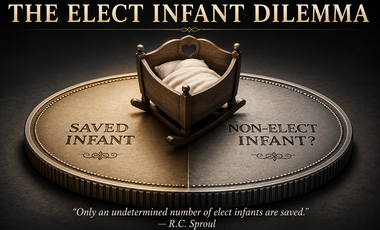
“Holy Spirit can save an infant by changing his heart, giving grace, and applying the merit of Christ to him. The Westminster divines certainly believed that babies can be saved. They did not teach that all infants are necessarily saved; rather, they taught that only an undetermined number of elect infants are saved. Obviously, an elect infant is going to be saved, and any saved infant is elect, but the divines did not speculate on which infants those would be.”

– R.C. Sproul, Truths We Confess: A Systematic Exposition of the Westminster Confession of Faith (Sanford, FL: Reformation Trust, 2019), 321.


Sproul conforms his support for the ideas in the WCF:

One of the most important confessions of faith ever penned, particularly in the English-speaking world, is the Westminster Confession of Faith. By the confession’s own statements, no confession written by uninspired authors is to be taken as having supreme authority over the believer. Confessions cannot bind the conscience in the manner that the Word of God can and does. At the same time, though human confessions and creeds are penned by fallible people without the benefit of the inspiration of the Holy Spirit, the profound level of theological and biblical precision manifest in the Westminster Confession of Faith is awe-inspiring. (Ibid., xvii.)

[….]

The Westminster Confession is the most precise and accurate summary of the content of biblical Christianity ever set forth in a creedal form. Creeds such as the Belgic Confession, the Heidelberg Catechism, and the Scots Confession should be highly regarded, but no historic confession surpasses in eloquence, grandeur, and theological accuracy the Westminster Confession of Faith. (Ibid., xix)


Critiquing the matter via CHAT:

The Internal Tension

Sproul writes:

“The Westminster divines certainly believed that babies can be saved. They did not teach that all infants are necessarily saved; rather, they taught that only an undetermined number of elect infants are saved.”

The immediate question is:

If only elect infants are saved, what happens to non-elect infants?

Historically, Westminster does not explicitly answer that question. Critics argue that the silence is revealing. If the Confession intended to teach universal infant salvation, it could have said:

“All infants dying in infancy are saved.”

Instead it says: “Elect infants.” Sproul defends that wording rather than correcting it.

Critique #1: Election Becomes the Ultimate Divider

Sproul affirms:

  • unconditional election,
  • total inability,
  • monergistic regeneration,
  • and reprobation.

Therefore, infant salvation cannot be based upon:

  • personal faith,
  • conscious belief,
  • repentance,
  • or moral innocence.

It must ultimately rest on election.

Critics respond:

If election alone determines which infants are saved, then election alone determines which infants are not saved.

Thus the question becomes: Why would God elect some infants and not others? Sproul never provides a clear answer.

Critique #2: Original Guilt Creates the Problem

Sproul consistently taught:

  • Adam’s guilt is imputed to humanity,
  • infants are fallen,
  • infants need Christ’s grace.

Critics agree infants need grace but ask:

Does inherited guilt alone make an infant deserving of eternal punishment?

Many opponents argue Scripture consistently ties judgment to:

  • knowledge,
  • personal rebellion,
  • actual transgression.

Examples often cited:

  • Deuteronomy 1:39
  • Isaiah 7:15-16
  • Jonah 4:11
  • Romans 4:15

The criticism is:

Sproul imports Augustine’s doctrine of inherited guilt and then must wrestle with implications Augustine himself embraced.

Critique #3: The Moral Character of God

This is probably the most emotionally and philosophically powerful objection.

If:

  • an infant never consciously sins,
  • never rejects God,
  • never suppresses truth,
  • never commits personal acts of rebellion,

Yet could still be damned, Critics ask:

What meaningful sense of justice remains?

This is where many critics invoke the same concern raised by Juncker regarding determinism:

If moral categories are detached from personal responsibility, words like justice become difficult to understand.

FULLER QUOTE:

“If determinism is true then either God is evil and the author of evil or all talk of good and evil, of praise and blame, of moral responsibility, and of justice is meaningless and incomprehensible with reference to God. That is, if God can cause or determine evil and yet remain good, and if God can punish those who do exactly and only what He has meticulously caused and determined them to do and yet remain just, then we have no idea who God is or what He might or might not do or what Scripture could possibly mean when it calls Him ‘good’ and ‘just.'”

— Günther H. Juncker, “The Dilemma of Theistic Determinism

The objection becomes:

Eternal punishment without personal rebellion appears inconsistent with ordinary moral reasoning and the biblical portrayal of God’s fairness.

Critique #4: Westminster Creates an Unnecessary Problem

Many critics argue Westminster itself created the issue. The Confession says:

“Elect infants.”

Critics ask why not simply say:

“Infants dying in infancy are saved through Christ”?

Mohler, Warfield, and Spurgeon essentially move in that direction. Sproul, however, insists the Westminster divines intentionally did not teach universal infant salvation. Critics argue:

That commitment to confessional precision ends up preserving a theological possibility that Scripture never explicitly teaches.

Critique #5: Sproul’s Loyalty to Westminster

This critique becomes stronger when paired with Sproul’s own statements:

“The Westminster Confession is the most precise and accurate summary of the content of biblical Christianity ever set forth in a creedal form.”

and

“One of the most important confessions of faith ever penned…”

Because Sproul viewed Westminster so highly, critics argue he was reluctant to depart from its language regarding elect infants even when later Reformed theologians moved toward affirming universal infant salvation.

The Strongest One-Sentence Critique

The strongest critique is probably this:

By affirming unconditional election, inherited guilt, and Westminster’s doctrine of “elect infants,” Sproul leaves open the possibility that some infants are not elect and therefore not saved, a conclusion many critics believe is inconsistent with both the justice and goodness of God as revealed in Scripture.

Exhaustive Determinism:

Sproul affirms that God ordains whatsoever comes to pass (echoing Westminster):

He knows all things that will happen because he ordains everything that does happen. This is crucial to our understanding of God’s omniscience. He does not know what will happen by virtue of exceedingly good guesswork about future events. He knows it with certainty because he has decreed it.

The Westminster Confession avers: “God from all eternity, did, by the most wise and holy counsel of His own will, freely, and unchangeably ordain whatsoever comes to pass. . . .

This statement refers to God’s eternal and immutable decretive will. It applies to everything that happens. Does this mean that everything that happens is the will of God? Yes. Augustine qualified this answer by adding the words, “in a certain sense.” That is, God ordains “in some sense” everything that happens. Nothing that takes place is beyond the scope of his sovereign will. The movement of every molecule, the actions of every plant, the falling of every star, the choices of every volitional creature, all of these are subject to his sovereign will. No maverick molecules run loose in the universe, beyond the control of the Creator. If one such molecule existed, it could be the critical fly in the eternal ointment. As one grain of sand in the kidney of Oliver Cromwell changed the course of English history, so one maverick molecule could destroy every promise God has ever made about the outcome of history.

What Is Reformed Theology, p. 172

Sproul’s view functionally equivalent to Calvin’s broader decretive will, even if he rejects “equal ultimacy” (symmetrical positive-positive reprobation where God actively works sin in the reprobate the same way He works faith in the elect). Sproul’s inconsistency is “too embarrassed to follow Calvinism to its logical extreme” and pleading ignorance/mystery on hard questions (e.g., the fall of Adam/Eve).

Calvin (Institutes 3.21.5): Explicitly symmetric language —

“some are preordained to eternal life, others to eternal damnation… created for one or the other of these ends.”

Sproul: Rejects the symmetrical mode (equal ultimacy / positive-positive) as sub-Calvinist or a caricature that makes God the author of sin. He prefers asymmetric (positive election + negative reprobation/preterition: God passes over the non-elect, leaving them in their sin). Yet critics [like myself] argue this is rhetorical softening — because Sproul still affirms:

  • God’s decree covers all events.
  • Reprobation is part of the eternal decree before creation.
  • The non-elect are chosen to be passed over before birth.

Sproul’s distinctions, while rhetorically softer than Calvin’s, do not ultimately escape the force of double predestination or exhaustive determinism.

… The issue here seems to be how one defines “ordains” or “foreordains.” Calvinists I debate on the internet consistently argue that “ordain” means to decree. I ask them, “Did God decree the Holocaust?” “Did God decree the killing fields of Cambodia?” “Did God decree every act of rape, torture and murder that has ever taken place?” And they say yes! Unbelievable.

What about Calvin on this issue? You deny he was supralapsarian, claiming God’s positive-positive, double-predestination, but excerpts from his writings strongly suggest that was his position. Calvin was quite straightforward on saying God decreed the Fall, writing:

whence does it happen that Adam’s fall irremediably involved so many peoples, together with their infant offspring, in eternal death unless because it so pleased God?…The decree is dreadful indeed, I confess. Yet no one can deny that God foreknew what end man was to have before he created him, and consequently foreknew because he so ordained by his decree…God not only foresaw the fall of the first man, and in him the ruin of his descendants, but also meted it out in accordance with his own decision.” (Institutes of the Christian Religion, 3.23.7)

That seems to go beyond mere “permission.” He also wrote:

The predestination by which God adopts some to the hope of life, and adjudges others to eternal death, no man who would be thought pious ventures simply to deny….By predestination we mean the eternal decree of God, by which he determined with himself whatever he wished to happen with regard to every man. All are not created on equal terms, but some are preordained to eternal life, others to eternal damnation; and, accordingly, as each has been created for one or other of these ends, we say that he has been predestinated to life or to death (Institutes of the Christian Religion 3.21.5).

We also read:

From this it is easy to conclude how foolish and frail is the support of divine justice afforded by the suggestion that evils come to be not by [God’s] will, but merely by his permission. Of course, so far as they are evils, which men perpetrate with their evil mind, as I shall show in greater detail shortly, I admit that they are not pleasing to God. But it is a quite frivolous refuge to say that God otiosely [= idly] permits them, when Scripture shows Him not only willing but the author of them…Who does not tremble at these judgments with which God works in the hearts of even the wicked whatever He will, rewarding them nonetheless according to desert. Again, it is quite clear from the evidence of Scripture that God works in the hearts of men to incline their will just as he will, whether to good for his mercy’s sake, or to evil according to their merits.” (Concerning the Eternal Predestination of God, 177)

Other famous Calvinists say, for example,

“The Sovereignty of God over all, and his independency, clearly shew, that whatever is done in time is according to his decrees in eternity.” (John Gill, A Body of Doctrinal and Practical Divinity, p. 173)

Or

“As a builder draws his plan before he begins to build, so the great Architect predestined everything before a single creature was called into existence.” (Arthur Pink, The Doctrines of Election and Justification, p.9)

Or

“Surely if God had not willed the fall, He could, and no doubt would, have prevented it; but he did not prevent it: ergo, He willed it. And if He willed it, He certainly decreed it.” (Jerome Zanchius, The Doctrine of Absolute Predestination, p. 88)

So, by claiming supralapsarianism is “anti-Calvinism,” you are dismissing not only prominent Calvinists from the past, but also Calvin himself. …

(JOHN WAGNER letter to R.C. SPROUL)

Jerry Walls’s observation at this point is apt:

    • [T]heological compatibilists [RPT: like Grudem, Sproul, MacArthur, and the like] often make claims and engage in rhetoric that naturally lead people to conclude that God loves them and desires their salvation in ways that are surely misleading to all but those trained in the subtleties of Reformed rhetoric. . . . Such language loses all meaning, not to mention all rhetorical force, when we remember that on compatibilist premises God could determine the impenitent to freely repent, but has chosen instead to determine things in such a way that they freely persist in their sins.

Why No Classical Theist – Let Alone Orthodox Christian – Should Ever Be a Compatibilist (PDF)

God’s refusal to determine the repentance of sinners when it is within his power to do so can be called nothing other than immoral. Damning certain people by withholding something freely given to others is not glorious.

MORE: Is Double Predestination and Active Reprobation, Equal Ultimacy? (good critique of Sproul)

Sproul and Calvin say it is indeed a horrible decree. Sproul’s honesty at this point would be refreshing if his conclusions weren’t so disturbing:

  • “The nasty problem for the Calvinist [is] . . . . If God can and does choose to insure the salvation of some, why then does he not insure the salvation of all? . . . The only answer I can give to this question is that I don’t know. . . . One thing I do know. If it pleases God to save some and not all, there is nothing wrong with that.” On the contrary, it is the very definition of wrong.” (Fuller Quote)

Here is Sproul’s chapter 58 from his book, Essential Truths of the Christian Faith, I will add some emphasis:

PREDESTINATION AND REPROBATION

Every coin has a flip side. There is also a flip side to the doctrine of election. Election refers to only one aspect of the broader question of predestination. The other side of the coin is the question of reprobation.

God declared that He loved Jacob but hated Esau. How are we to understand this reference to divine hatred?

Predestination is double. The only way to avoid the doctrine of double predestination is to either affirm that God predestinates everybody to election or that He predestinates no one to either election or reprobation.

Since the Bible clearly teaches predestination to election and denies universal salvation, we must conclude that predestination is double. It includes both election and reprobation. Double predestination is unavoidable if we take Scripture seriously. What is crucial, however, is how double predestination is understood.

Some have viewed double predestination as a matter of equal causation, where God is equally responsible for causing the reprobate not to believe as He is for causing the elect to believe. We call this a positive-positive view of predestination.

The positive-positive view of predestination teaches that God positively and actively intervenes in the lives of the elect to work grace in their hearts and bring them to faith. Likewise, in the case of the reprobates, He works evil in the hearts of the reprobate and actively prevents them from coming to faith. This view has often been called “hyper-Calvinism” because it goes beyond the view of Calvin, Luther, and the other Reformers.

The Reformed view of double predestination follows a positive-negative schema. In the case of the elect, God intervenes to positively and actively work grace in their souls and bring them to saving faith. He unilaterally regenerates the elect and insures their salvation. In the case of the reprobate He does not work evil in them or prevent them from coming to faith. Rather, He passes over them, leaving them to their own sinful devices. In this view there is no symmetry of divine action. God’s activity is asymmetrical between the elect and the reprobate. There is, however, a kind of equal ultimacy. The reprobate, who are passed over by God, are ultimately doomed, and their damnation is as certain and sure as the ultimate salvation of the elect.

The problem is linked to biblical statements such as those regarding God’s hardening of Pharaoh’s heart. That the Bible says God hardened Pharaoh’s heart is beyond dispute. The question remains, how did God harden Pharaoh? Luther argued for a passive rather than an active hardening. That is, God did not create fresh evil in Pharaoh’s heart. There was already enough evil present in Pharaoh’s heart to incline him to resist the will of God at every turn. All God ever has to do to harden anybody is to remove His restraining grace from them and give them over to their own evil impulses. This is precisely what God does to the damned in hell. He abandons them to their own wickedness.

In what sense did God “hate” Esau? Two different explanations are offered to solve this problem. The first explains it by defining hate not as a negative passion directed toward Esau but as simply the absence of redemptive love. That God “loved” Jacob simply means that He made Jacob the recipient of His unmerited grace. He gave Jacob a benefit that Jacob did not deserve. Esau did not receive the same benefit and in that sense was hated by God.

The first explanation sounds a bit like special pleading to get God off the hook for hating somebody. The second explanation gives more strength to the word hate. It says simply that God did in fact hate Esau. Esau was odious in the sight of God. There was nothing in Esau for God to love.

Esau was a vessel fit for destruction and altogether worthy of God’s wrath and holy hatred. Let the reader decide.

Summary

  1. Predestination is double; it has two sides to it.
  2. Some teach that God is equally responsible for election and reprobation. This is characteristic of hyper-Calvinism.
  3. The Reformed view of double predestination reflects a positive-negative schema.
  4. God passively, not actively, hardened Pharaoh’s heart.
  5. God hated Esau in the sense of failing to give him a blessing of grace or in the sense of abhorring him as a vessel fit for destruction.

Biblical passages for reflection:

Exodus 7:1-5
Proverbs 16:4
Romans 9
Ephesians 1:3-6
Jude 1:4

In other words, as The Encyclopedia of The Reformed Faith (page 144), and later the The Westminster Handbook to Reformed Theology (page 87) clearly says:

The Reformed approach to divine freedom is nowhere more apparent than in the doc­trine of the eternal decrees: God freely wills the existence and preservation of the created order and freely determines the eternal destiny of all creatures, solely on the ground of God’s goodness and solely for the sake of God’s ultimate glory. In creation and providence, God encounters no barriers to the exercise of God’s will, and in the work of redemp­tion God acts utterly graciously, apart from any merit belonging to the creature.

[….]

Reformed theology has followed an Augustinian paradigm in its under­standing of human freedom

Donald K. McKim and David F. Wright, eds., Encyclopedia of the Reformed Faith (Louisville, KY: Westminster John Knox Press, 1992), 144,146.

JOHN 6:44

Steve Lemke

R. C. Sproul argued at great length that John 6:44 (“No one can come to Me unless the Father who sent Me draws him” [HCSB]) does not refer merely to the necessity that God “woo or entice men to Christ,” such that humans can “resist this wooing” and “refuse the enticement.”11 In philosophical language, Sproul said, this wooing is a necessary but not sufficient condition for salvation “because the wooing does not, in fact, guarantee that we will come to Christ.”12 Sproul stated that such an interpretation is “incorrect” and “does violence to the text of Scripture.”13

Instead, Sproul insists, the term “draw” is “a much more forceful concept than to woo” and means “to compel by irresistible superiority.”14 However, in discussing irresistible grace, Sproul tells of a student who, hearing a lecture on predestination by John Gerstner, rejected it. When Gerstner asked the student how he defined Calvinism, the student described it as the perspective that “God forces some people to choose Christ and prevents other people from choosing Christ.” Gerstner then said, “If that is what a Calvinist is, then you can be sure that I am not a Calvinist either.”15 What is the difference between compelling “by irresistible superiority” and “forcing” people to do something? Sproul likewise chastised a Presbyterian seminary president for rejecting the Calvinist doctrine that “God brings some people, kicking and screaming against their wills, into the kingdom.” Sproul described this Presbyterian theologian’s view as “a gross misconception of his own church’s theology,” as a “caricature,” and “as far away from Calvinism as one could possibly get.”16 So which way is it? If God compels people with “irresistible superiority,” in what way is it inaccurate to say that God forces people to choose Christ? The Synod of Dort insisted that such attempts at moral persuasion of unsaved persons was wasted time. The irresistibility of God’s grace (and not merely the use of strong moral persuasion) was precisely what the Synod of Dort rejected and the Remonstrants affirmed. While the Remonstrants affirmed that the compelling grace of God persuades the lost to receive Christ as Lord and Savior, the Synod of Dort insisted that this was not going far enough. Note their explicit denial that a person can “resist” God. The language used in the Synod of Dort describes God’s omnipotence as being such that God can “potently and infallibly bend man’s will to faith and conversion.”17

Bending the will of a fallible being by an omnipotent Being powerfully and unfailingly is not merely sweet persuasion. It is forcing one to change one’s mind against one’s will. Calvinists often describe their position as monergism as opposed to synergism. In monergism, God works entirely alone, apart from any human role.18

11. Sproul, Chosen by God, 69–70 (see chap. 1, n. 106).
12. Sproul, 69.
13. Sproul, 69.
14. Sproul, 69.
15. Sproul, 122.
16. Sproul, 122.
17. Dennison, Reformed Confessions, 4:143 (III–IV, Rejection of Errors, par. 8).

John Wagner’s Letter to Sproul

Let me deal next with the issue of your concept and use of the Greek word helkō, commonly translated “draws” in John 6:44. Even if you reject everything else I write here, please accept this one. You really did not get this right. And Calvinists who have read CBG have passed on this incorrect information. You quoted Kittel’s Theological Dictionary of the New Testament, and claim because that word means “drag” or “compel” in a physical context such as Acts 16:19 and James 2:6, that therefore it means “drag” or “compel” in the spiritual context of John 6:44.

The evidence indicates it doesn’t. I assume you are aware that a Greek word can have more than one meaning. I looked at Kittel and I see for helkō in regard to John (i.e. 6:44, 12:32) it means, “a beneficent ‘drawing of God…of drawing to oneself in love. This usage is distinctively developed by Jn., perhaps with some influence of Gnosticism. Force or magic may be discounted, but not the supernatural element.” The abridged version of Kittel says, “There is no thought here of force or magic. The term figuratively expresses the supernatural power of the love of God or Christ which goes out to all (12:32) but without which no one can come.”

Did you get that? Both summaries dismiss force, which would be consistent with “drag” or “compel” (though I agree that would be accurate when the word is used in a physical context). Just wondering why you didn’t mention that! Let’s put your position to rest with more citations:

  1. BDAG: has helkō in John 6:44 as “draw, attract.”
  2. Analytical Lexicon to the Greek New Testament by William Mounce says helkō means “to draw mentally and morally, John 6:44; 12:32.”
  3. The Hebrew-Greek Key Study Bible by Calvinist Spiro Zodhiates: “Helko is used of Jesus on the cross drawing by love, not force” (Jn. 6:44; 12:32).
  4. A Critical Lexicon and Concordance to the English and Greek New Testament by Ethelbert W. Bullinger, p. 235: Helko means “to draw, esp. implying a certain attraction mentally or morally; also to draw to a certain point.” This source also mentions surō as a word more consistent with how Calvinists interpret helkō. Surō generally implies a violent dragging. This source defines it as “to draw, drag or trail along as a net; esp. with the notion of force and sometimes with violence.”
  5. The Renaissance New Testament by Randolph Yeager, says about helkō:

It does not necessarily involve coercion, though it does involve persuasion and motivation–John 6:44; 12:32…. [Helkō] does not imply coercion in the two places where it is applied to the elect [the two just-mentioned verses]. Swords, fish nets and political prisoners (John 18:10; 21:6, 11: Acts 16:19) may resist, but the element of resistance is not implicit in the word itself….

  1. Greek and English Lexicon of the New Testament by Edward Robinson, say helkō means “to draw by a moral influence, John 6:44, 12:32.”

Please notice that none of these sources indicate that helkō means drag or compel in John 6:44. And your version is especially problematic for John 12:32. Do you believe God drags all men to himself? So it’s kind of funny that the Arminian professor you debated didn’t need to cite some “obscure Greek poet.” The info is clear in many lexicons and similar sources. And by the way, contrary to what you experienced, in the formal 1999 debate I was in against a Calvinist pastor, he repeated your argument on helkō and I nailed him on this point.

And that ties into the issue of the nature of unsaved man. You write, “If a person who is still in the flesh, who is not reborn by the power of the Holy Spirit, can incline or dispose himself to Christ, what good is rebirth?” This is another strawman. Classical Arminians do not believe man can “incline or dispose himself ” all by himself. Arminius wrote strongly of man being depraved and dead and that man needs the heavy convicting and drawing of the Holy Spirit. However, he completely rejected irresistible grace, the biggest oxymoron I can think of. And as for rebirth, that comes after faith, not before.

You slightly acknowledge the idea of prevenient grace and then ask “If so, where” does the Bible teach this concept? Did you even make any effort toward finding an answer for this? Well, John 6:44, which I have proven is not about “dragging,” is one. Furthermore, let’s recall John 16:8, saying that the paraclete “will convict the world of guilt in regard to sin and righteousness and judgment in regard to sin because men do not believe in me.”

The Greek for “convict” is elenchō, and has the connotation of a trial attorney making a legal and moral argument to a jury. In this case, the Holy Spirit conducts that function in the human heart—but not in irresistible manner. Other verses include John 1:9: “The true light that gives light to every man was coming into the world.” Also, John 12:32, in which Christ says, “When I am lifted up from the earth. I will draw (helkō) all men to myself.” But this is also not irresistible.

Describing prevenient grace, Thomas C. Oden writes:

Prevenient grace antecedes human responsiveness so as to prepare the soul for the effective hearing of the redeeming Word. This preceding grace draws persons closer to God, lessens their blindness to divine remedies, strengthens their will to accept revealed truth, and enables repentance. Only when sinners are assisted by prevenient grace can they begin to yield their hearts to cooperation with subsequent forms of grace….

Does scripture teach the concept of prevenient grace? There is no one passage that lays out a systematic definition of it, however, the concept becomes apparent throughout the overall tenor of scripture. Here are some passages that refer to the different aspects of prevenient grace:

Prevenient Grace Draws:

John 6:44 No one can come to me unless the Father who sent me draws him, and I will raise him up at the last day.

John 12:32 And I, if I am lifted up from the earth, will draw all men to Myself. Prevenient Grace is Universal:

Titus 2:11 For the grace of God that brings salvation has appeared to all men. John 1:9 The true light that gives light to every man was coming into the world.

John 16:7-8 But I tell you the truth: It is for your good that I am going away. Unless I go away, the Counselor will not come to you; but if I go, I will send him to you. When he comes, he will convict the world of guilt in regard to sin and righteousness and judgment:

Romans 1:18-19 The wrath of God is being revealed from heaven against all the godlessness and wickedness of men who suppress the truth by their wickedness, since what may be known about God is plain to them, because God has made it plain to them.

Prevenient Grace Convicts the Non-Believer:

Acts 16:14 One of those listening was a woman named Lydia, a dealer in purple cloth from the city of Thyatira, who was a worshiper of God. The Lord opened her heart to respond to Paul’s message.

Acts 16:29-30 The jailer called for lights, rushed in and fell trembling before Paul and Silas. He then brought them out and asked, “Sirs, what must I do to be saved?”

Prevenient Grace Works in Combination with the Hearing of the Word:

Acts 2:37 When the people heard this, they were cut to the heart and said to Peter and the other apostles, “Brothers, what shall we do?”

Romans 10:17 Consequently, faith comes from hearing the message, and the message is heard through the word of Christ.

Prevenient Grace is Given Generously:

Romans 8:32 He who did not spare His own Son, but delivered Him over for us all, how will He not also with Him freely give us all things?

Romans 2:4 Or do you think lightly of the riches of His kindness and tolerance and patience, not knowing that the kindness of God leads you to repentance?

Acts 17:26-27 From one man he made every nation of men, that they should inhabit the whole earth; and he determined the times set for them and the exact places where they should live. God did this so that men would seek him and perhaps reach out for him and find him, though he is not far from each one of us.

Prevenient Grace Can be Rejected:

Matt. 23:37 O Jerusalem, Jerusalem, you who kill the prophets and stone those sent to you, how often I have longed to gather your children together, as a hen gathers her chicks under her wings, but you were not willing.

John 5:34,39,40 Not that I accept human testimony; but I mention it that you may be saved…You diligently study the Scriptures because you think that by them you possess eternal life. These are the Scriptures that testify about me, yet you refuse to come to me to have life.

Acts 7:51 You stiff-necked people, with uncircumcised hearts and ears! You are just like your fathers: You always resist the Holy Spirit!

Heb 4:2 For we also have had the gospel preached to us, just as they did; but the message they heard was of no value to them, because those who heard did not combine it with faith.

Heb 10:29 How much more severely do you think a man deserves to be punished who has trampled the Son of God under foot, who has treated as an unholy thing the blood of the covenant that sanctified him, and who has insulted the Spirit of grace?

Prevenient Grace Results in Saving Grace when it is Accepted:

Ephesians 5:14 For it is light that makes everything visible. This is why it is said: “Wake up, O sleeper, rise from the dead, and Christ will shine on you.”

Ephesians 2:8-9 For it is by grace you have been saved, through faith—and this not from yourselves, it is the gift of God— not by works, so that no one can boast.

There are actually three very good books on this issue of prevenient grace: The Transforming Power of Grace by Thomas C. Oden, Prevenient Grace by W. Brian Shelton, and Streams of Mercy by J. Gregory Crofford.

BTW, I prefer pastor Rogers understanding vs a straight Arminian:

  • Within the Non-Calvinist camp, there are at least two nuanced views on how God allows sinners to respond in faith. The first view is the Arminian view — which says that God’s work of grace (prevenient grace) for all people is needed to enable any sinner to freely choose to respond in faith to the Gospel message. The second view is the Provisionist View — which says that the Gospel message itself [see more below]  is God’s work of grace so that when it is preached to all people, any sinner can freely choose to respond in faith. The proclamation of the Gospel is powerfully sufficient enough to bring salvation to those who will believe. While the Arminian and the Provisionist each have a different take on why all humans can respond to God’s offer, these two views both affirm the importance of God’s initiative of grace to invite all sinners to salvation. (from the book Grace For All: Understanding God’s Plan of Salvation).

Michael R. Cariño

The “More Below”

Grace Enablements

Includes but are not limited to: God’s salvific love for all (John 3:16), God’s manifestation of his power so that all may know he is the Sovereign (Isa 45:21–22) and Creator (Rom 1:18–20), which assures that everyone has opportunity to know about him. Christ paying for all sins (John 1:29), conviction of the Holy Spirit (John 16:7–11), working of the Holy Spirit (Heb 6:1–6), enlightening of the Son (John 1:9), God’s teaching (John 6:45), God opening minds and hearts (Luke 24:45; Acts 16:14; 26:17–18;), and the power of the gospel (Rom 1:16), without such redemptive grace, no one seeks or comes to God (Rom 3:11).

Because of these gracious provisions and workings of God, man can choose to seek and find God (Jer 29:13; Acts 17:11–12). Moreover, no one can come to God without God calling (Acts 2:39), drawing (John 6:44), and that God is drawing all individuals (John 12:32). The same Greek word for draw, helkuō, is used in both verses. “About 115 passages condition salvation on believing alone, and about 35 simply on faith.” Other grace enablements may include providential workings in and through other people, situations, and timing or circumstances that are a part of grace to provide an opportunity for every individual to choose to follow Christ.

These are grace enablements in at least three ways; first, they are provided by God’s grace rather than deserved by mankind; second, the necessary components for each and every individual to have a genuine opportunity to believe unto salvation are provided or restored by God; third, they are provided by God without respect to whether the individual will believe or reject, which response God knew in eternity past.

The offer of the gospel is unconditional, but God sovereignly determined to condition the reception of the offer upon grace-enabled faith; therefore, faith is not reflective of a work or virtue of man, but of God’s sovereign plan of salvation by grace through faith (Eph 2:8). This indicates faith is the means to being regenerated and saved, not the reason for being saved. This truth of Scripture does not imply God is held captive to the choice of man, but rather it demonstrates God in eternity coextensively determined to create man with otherwise choice and provide a genuine offer of salvation, which can be accepted by grace-enabled faith or rejected. Additionally, to fulfill this plan, God is not obligated to disseminate the gospel to people he knows have rejected the light he has given them (Rom 1:18–23) and will also reject the gospel; although he may still send the gospel to them.

Sproul continues his thinking is an audio message I have audio of here. In it he says:

Augustine said, I still, in my fallenness, have the ability to choose what I want, but in my heart there’s no desire for God. I have lost any desire for the things of God. If I’m left to myself, the desires of my heart are only wicked continuously. My heart and my soul are dead to the things of God.

I can listen to preaching, I can hear hymns, I can see — I can do all those things and see other people weeping and in ecstasy and all moved by all kinds of religious overtones and consideration.

It leaves me cold.

My heart has calluses on it. It’s recalcitrant.

My neck is stiff.

I’m not moved by anything that has anything to do with God. That’s our natural state. The Bible says that we are dead to the things of God in our fallen condition. Original sin deadens the soul to the things of God.

God so loved the world, He gave His only begotten Son, that whosoever believeth should not perish, but have everlasting life. And I have people quote that to me, to say man is not fallen to such a degree that he’s lost his power to choose Christ, because that verse says that whosoever believeth will not perish, but have everlasting life.

Now, what does that verse teach us about the extent of the fall of man? Absolutely nothing. It doesn’t say who will believe in Christ. All it says is, if you do A, if you believe, you will not perish, and you will have everlasting — you will live forever.

But the question still is left, Why does one person believe and another person not believe?

Augustine said, Now, you’re dead in your sins and trespasses. You don’t have any desire for Christ, and the only way you will ever choose Christ is if God melts your heart, if God softens that stone-cold, recalcitrant heart, if God the Holy Spirit rapes your soul and puts in you a desire for Christ.

That’s what has to happen.

According to Augustine.

And many try to do away with this control of God through what is called “compatibilism”, but as MacArthur notes, this is fictitious in the end:


In order to understand this better theologians have come up with the term “compatibilism” to describe the concurrence of God’s sovereignty and man’s responsibility. Compatibilism is a form of determinism, and it should be noted that this position is no less deterministic than hard determinism.

John Hendryx (John Hendryx is the creator and editor of Monergism . com)

And then this is John MacArthur:

So free will trumps evil on God’s value scale, so God had to allow for the possibility of evil in order to protect the more highly prized autonomy; and He had to protect autonomy to protect Himself from this bad press, being responsible for evil. Humans then must have self-determination, freedom to act. If God acted as the primary cause and humans only as a secondary cause moved by the primary cause, then God being the primary cause is responsible; and people are not free, and therefore God decided and God compelled and God coerced, and God actually overturned human will. Then God is responsible for all the evil and all the divine judgment and the determination of eternal punishment. This is a God that some people just can’t live with; they’ve got to get Him off the hook.

(See video to add to the above and Grace To You)

This passage is John MacArthur directly describing (and strongly rejecting) the popular “free will defense” theodicy. He uses it to contrast with his own high Calvinist / compatibilist view of God’s sovereignty.

Some AI convo:

Yes. If we define determinism as:

Every human choice is ultimately rendered certain by God’s decree and providential causation, such that no person could ultimately do otherwise than what God ordained,

then John MacArthur is unquestionably on the deterministic side of the spectrum.

The important thing is that MacArthur would almost certainly reject the label “fatalist”, and he would likely prefer “compatibilist” or “Reformed”, but philosophically speaking, compatibilism is a species of determinism. Hendryx is correct on that point.

The key question is:

Does MacArthur believe humans possess libertarian freedom (the ability to choose A or not-A under identical circumstances)?

The answer is no.


The MacArthur Quote You Posted

The fascinating thing about that quotation is that MacArthur is not denying determinism.

He is describing what he believes his opponents fear determinism entails.

Notice the structure:

“If God acted as the primary cause

“If God compelled

“If God actually overturned human will

“Then God is responsible

MacArthur is setting up the objection.

The question becomes:

Does MacArthur believe God does these things?

Elsewhere he clearly teaches:

  • Total inability
  • Unconditional election
  • Irresistible grace
  • Monergistic regeneration
  • God’s exhaustive sovereignty

Those doctrines require that God determine who will believe.


Compare MacArthur to Sproul

Sproul says:

“The only way you will ever choose Christ is if God melts your heart.”

Then he quotes Augustine:

“God the Holy Spirit rapes your soul and puts in you a desire for Christ.”

Sproul is being more explicit.

MacArthur teaches the same monergistic regeneration, but usually with softer language.

Both affirm:

  • Fallen man cannot come.
  • God must first regenerate.
  • Regeneration guarantees faith.
  • Those not regenerated remain unable.

That is deterministic in the relevant philosophical sense.


The Real Tell: MacArthur on Election

MacArthur repeatedly teaches:

  • God chose the elect before creation.
  • The elect will certainly come.
  • The non-elect will not come.
  • Faith itself is a gift from God.

Once those propositions are accepted, the outcome is fixed.

That is why Hendryx says:

“Compatibilism is a form of determinism.”

Because the certainty of the outcome remains intact.


The Important Distinction

A lot of Calvinists hear:

“determinism”

and immediately think:

“atheistic hard determinism.”

But philosophers don’t define determinism that way.

Determinism simply means:

Given the causes and conditions, only one outcome is possible.

MacArthur’s theology appears to satisfy that definition.


Why Your Argument Finds Tension Here

What’s interesting is that the quotation you cited almost sounds like MacArthur is describing your objection:

If God is the primary cause and humans are merely secondary causes moved by Him, then God becomes responsible.

The difficulty is that Calvin, Sproul, Piper, and many Reformed theologians frequently describe God as:

  • determining wills,
  • inclining hearts,
  • ordaining evil events,
  • governing every detail,
  • and ensuring outcomes.

So critics ask:

If God determines the desires, determines the will, determines the outcome, and determines who receives regenerating grace, how is He not functioning as the primary determining cause?

That is the exact issue your series has been exploring.


In Short

If by determinism you mean:

Human choices are rendered certain by God’s eternal decree and providential governance, with no ultimate ability to do otherwise,

then:

  • Calvin = Determinist
  • Edwards = Determinist
  • Sproul = Determinist
  • Piper = Determinist
  • MacArthur = Determinist
  • Hendryx explicitly admits compatibilism is determinism

The real debate is not whether these men are deterministic.

The real debate is whether compatibilist determinism can preserve meaningful moral responsibility, justice, and divine goodness.

That’s where the battle shifts from historical theology into philosophy.

This video is long, but has turned into one of my favorites!

Calvinist’s Fatal Flaw: Guilty Babies

Dr. Leighton Flowers plays a clip from Jeremiah Notier, aka The Apologetic Dog, in which he accuses Dr. Flowers of being a “Pelagian” because I do not affirm the concept that all babies are born guilty and deserving of Hell.


GOSPEL COALITION article summary


One-Paragraph Summary

The article defends the Reformed doctrine of double predestination/reprobation, arguing that God’s eternal decree includes both the unconditional election of some individuals to salvation and the passing over of others, who are ultimately condemned according to divine justice. It appeals particularly to Pharaoh and Romans 9, arguing that God actively hardened Pharaoh and raised him up to display His glory, and that Paul’s “vessels of mercy” and “vessels of wrath” describe God’s sovereign distinction between individuals. The article further argues that reprobation logically follows from unconditional election: if God unconditionally chooses some but not all for salvation, then the others are necessarily excluded from that saving choice. It distinguishes preterition, God’s withholding of saving grace, from predamnation, God’s determination to judge the non-elect according to justice. Although Reformed theology maintains an asymmetry between election and reprobation, the article nevertheless places both salvation and condemnation within God’s eternal sovereign decree rather than treating the damnation of the non-elect as merely something God foreknows or passively permits.

SUMMARY OF THE GOSPEL COALITION ARTICLE: “THE DOCTRINE OF REPROBATION

The article is a defense of the Augustinian/Reformed doctrine of reprobation, which teaches that God’s eternal decree concerns not only those whom He chooses to save, but also those whom He does not choose to save. In the author’s formulation, reprobation involves God eternally withholding saving grace from certain individuals and determining to judge them according to divine justice. The author therefore understands reprobation as more than God’s foreknowledge that certain people will reject Him; their exclusion from saving grace and ultimate condemnation fall within God’s sovereign eternal decree.

The article develops this position in three primary ways.

Scripture Teaches Reprobation

The author argues that Scripture directly supports reprobation, with Pharaoh and Romans 9 serving as the principal examples. In the Exodus account, the author rejects the interpretation that God hardened Pharaoh merely as a response to Pharaoh’s prior self-hardening. Instead, the article argues that God announced beforehand that He would harden Pharaoh and raised him up for the purpose of displaying His power and glory.

Romans 9 is presented as the clearest New Testament explanation of this principle. The author interprets Paul’s discussion of the “vessels of mercy” and “vessels of wrath” as teaching that God sovereignly distinguishes between individuals, preparing some for mercy and enduring others who are prepared for destruction. The purpose is ultimately God’s glory: His mercy and grace are displayed toward the elect while His wrath and power are displayed toward those destined for destruction.

Reprobation Logically Follows From Unconditional Election

This is one of the article’s most important arguments.

If salvation depends upon God’s unconditional choice of particular individuals, and God does not choose everyone, then there must necessarily be individuals whom God does not choose for salvation.

The author therefore argues that unconditional election necessarily entails reprobation. Simply calling the position “single predestination”—God predestines some to salvation but does not predestine anyone to condemnation—does not resolve the problem. According to the article, such a view leaves the destiny of the non-elect outside God’s purposeful decree, which the author considers inconsistent with God’s comprehensive sovereignty.

The argument is therefore:

Unconditional election → some are chosen → others are not chosen →
their exclusion from saving grace falls within God’s sovereign decree.

God’s sovereignty extends over salvation and human choices

The article’s argument does not stop with election. It presents God’s sovereignty as extending over everything that comes to pass, including human choices. Consequently, the distinction between those who believe and those who reject Christ ultimately falls under God’s sovereign will.

The doctrine is also presented as spiritually beneficial because it humbles humanity. Rather than viewing humanity as the ultimate reference point, believers are reminded that human beings exist for God’s glory and that God’s purposes, rather than human preferences, determine reality.

The Two Aspects of Reprobation

The article makes an important distinction between two aspects of reprobation:

Preterition — the negative aspect:
God eternally chooses not to extend saving grace to particular individuals. The article says this decision is not based on foreseen works, merit, or sin, but on God’s sovereign will.

Predamnation — the positive aspect:
God eternally determines to deal with those individuals according to divine justice. Reformed theologians disagree over whether this decree itself is conditioned upon foreseen or actual sin, but the article maintains that the ultimate condemnation of these individuals is included within God’s sovereign purpose.

The article goes further and states that the Augustinian/Reformed tradition agrees that God predestines certain individuals to be justly punished, and that at least some aspect of this reprobation is not based on foreseen sin but on God’s good pleasure, with the purpose of magnifying His justice and grace.

Is This Double Predestination?

In substance, yes. The article is defending a form of double predestination, although it insists that election and reprobation are not perfectly symmetrical. The distinction can be summarized this way:

The author specifically identifies the “asymmetry between election and reprobation” as an important qualification within Reformed theology. Thus, the article is not merely saying that God permits some people to reject Him. Its position is substantially stronger:

  • God’s eternal decree establishes both who will receive saving grace and who will be passed over, with the non-elect ultimately being condemned according to divine justice.

And the author’s fundamental argument is that this conclusion follows from the combination of unconditional election, God’s exhaustive sovereignty, and the author’s interpretation of passages such as Pharaoh and Romans 9.


BABIES DESTINED TO HELL


Mind you, I am not the biggest fan of Faith On Fire, but once in a while there is really good stuff. It is 10-minutes long, here is his description:

Christianity is under attack more today than ever, and a big part of that attack comes from Calvinists. Did God create billons of people that God never wanted? Calvinism teaches that God did exactly. Calvinists want people to believe that the God of the Bible has predestined billions of people to hell before they were ever born. They think God has kept any hope of salvation from most people on purpose for His own glory and so God can demonstrate His wrath on them because God ordained and decreed their eternal punishment before the foundation of the world. They believe God reserves salvation for only some preselected elect people who are saved unconditionally by God’s grace.

According to Calvinism, Satan wants all people to join him in hell and the lake of fire, and they think God wants only most people to join Satan in hell and the lake of fire, and Satan doesn’t even have much of anything to do with any of it because it was all meticulously and divinely determined by God before Creation anyway.

TULIP or the 5 points of Calvinism are doctrines of salvation unique and distinctive to Calvinism, not Biblical Christianity. Those Calvinistic doctrines are from Satan and I expose the implications of them and the dangerous errors of that theology.

KINDA THE SUMMARY OF THE ABOVE [added to by RPT]

The Argument

  1. Heaven is infinitely better than earthly life.
    If a person dies in infancy and is therefore guaranteed eternal joy with God, then death produces an infinitely greater outcome than continued earthly existence. If that same child survives, however, the outcome is no longer certain. The child may eventually believe and be saved—or reject Christ and be lost.
  2. On the assumption that all infants who die are saved, death in infancy cannot result in hell.
    The theological premise establishes a guaranteed positive eternal outcome. The child loses earthly life, but does not lose salvation. Indeed, the child is removed from the possibility of later rejecting Christ and experiencing eternal condemnation.
  3. Continued life therefore introduces a risk that did not previously exist.
    The infant who dies remains within the category of guaranteed salvation. The infant who survives eventually becomes a morally accountable person whose eternal destiny, under the same theological system, is no longer universally guaranteed. Poverty, abuse, family circumstances, unbelieving parents, cultural influences, and personal rejection of the gospel can all become factors in that person’s earthly and spiritual history.
  4. This creates an uncomfortable asymmetry.
    If universal infant salvation is true, then preserving an infant’s earthly life simultaneously preserves the possibility of that person’s eternal salvation and the possibility of eternal loss. Death removes the second possibility entirely. Thus, within the stated theological premises, earthly life is not an unqualified spiritual benefit; it is also an exposure to the possibility of damnation.
  5. The argument cannot simply appeal to the value of earthly life without addressing the theological premise.
    If the decisive consideration is that every human life must be preserved because earthly life is intrinsically preferable to death, then that principle needs to be reconciled with the claim that death in infancy results in guaranteed eternal happiness. Likewise, saying that humans must never interfere with God’s timing does not by itself resolve the underlying question: Why is death unquestionably tragic if the death of an infant guarantees the very heavenly outcome that the believer regards as infinitely superior to earthly existence?
  6. The same reasoning raises a broader question about moral consistency.
    If the theological argument works because infants who die are guaranteed salvation, one must explain why that principle stops at infancy. If accountability is the relevant dividing line, then the argument necessarily raises questions about children who have not yet reached that threshold. If the argument does not extend beyond infancy, then the theological basis for making infancy the decisive boundary must be identified.

The central A→B problem is therefore this:

A: Every infant who dies is guaranteed eternal salvation.

B: Continued earthly life introduces the possibility that the child will eventually reject Christ and be eternally lost.

Question: Why should earthly preservation be treated as an unequivocal spiritual good when, according to A and B, preserving earthly life also preserves the possibility of eternal damnation?

The force of the argument is not that abortion is thereby proven morally permissible. Rather, it exposes a tension within the theological premises themselves. If universal infant salvation is asserted, then the believer must explain why preventing the loss of earthly life is necessarily more important than preventing the possibility of eternal loss. Simply saying that earthly life is valuable does not answer the theological question; it changes the question from

“What happens eternally to this child?”

to

“Is earthly life intrinsically valuable even when it introduces the possibility of eternal damnation?”

JAMES WHITE:
Calvinist’s Hiding Their Dreadful Decree Behind the Good News

This video examines why the doctrine of Calvinistic predestination—particularly double predestination and reprobation—has repeatedly produced intense disagreement within the Christian church. The discussion asks an important historical question: if these doctrines were foundational teachings of the apostles and earliest Christians, why do we find so little evidence of the kind of intense intra-Christian controversy surrounding them before Augustine?

The video looks particularly at Augustine’s role in the development of theological determinism, including his earlier association with Manichaeism and Neoplatonism, and the later development of his views on predestination. It also considers the historical evidence concerning the early church fathers and their opposition to deterministic ideas associated with Gnosticism and other movements.

The discussion then turns to the modern Calvinist debate and the striking divisions that arise when these doctrines are introduced into churches. Are these disagreements simply evidence that the doctrines are difficult truths that Christians must accept by faith, or do they indicate that something fundamentally different from the teaching of the earliest church has been introduced? The video also examines the problem of “double-speak”—the attempt to hold apparently contradictory propositions together by appealing to God’s mysterious or supposedly different logic.

Ultimately, the video asks viewers to consider a larger question: If Calvinistic determinism was truly a foundational doctrine of Christianity, why is its historical emergence and subsequent divisiveness so pronounced? Rather than simply telling the viewer what to believe, the goal is to examine the historical and theological claims and encourage the viewer to “report, you decide.”

PARTIAL TRANSCRIPT OF THE ABOVE PDF 

2) The earliest Christian scholars did not teach “Calvinistic” doc­trines.

If Jesus really was teaching TULIP theology so clearly in John chapter 6, as White likes to emphasize, why on earth don’t we see any of these theological concepts expounded upon or even mentioned in the earliest Christian writings? Instead, we have a preponderance of teachings from the early church, which rebut the conclusions that Calvinists have drawn from this and other passages. A widely-accepted notion among biblical scholars and historians is that doc­trines obtained from those who were present at the time they were created are more likely to be accurate. In contrast, the likelihood of errors in doctrine increases as one moves further away from the ori­ginal sources.

Irenaeus (ca. 130-202) was a martyr and influential figure in the early development of Christian theology. He was a student of Poly-carp, who was a disciple of John. In 180 AD, Irenaeus wrote a book called “Against Heresies,” specifically addressing ideas that would later be associated with Calvinistic Theology. These “heresies” being addressed denied free will, as can be seen in the following summar­ies:

Men are possessed of free will and endowed with the faculty of making a choice. It is not true, therefore, that some are by nature good and others bad.

This expression [of our Lord], How often would I have gathered your children together, and you would not, Matthew 23:37 set forth the ancient law of human liberty, because God made man a free [agent] from the beginning, possessing his own power, even as he does his own soul, to obey the behests (ad utendum senten-tia) of God voluntarily, and not by compulsion of God. For there is no coercion with God, but a good will [towards us] is present with Him continually. And therefore does He give good counsel to all. And in man, as well as in angels, He has placed the power of choice (for angels are rational beings) so that those who had yielded obedience might justly possess what is good, given indeed by God, but preserved by themselves. On the other hand, they who have not obeyed shall, with justice, be not found in possession of the good, and shall receive condign punishment: for God did kindly bestow on them what was good, but they themselves did not diligently keep it, nor deem it something precious, but poured contempt upon His super-eminent goodness. Rejecting therefore the good, and as it were spuing it out, they shall all deservedly incur the just judgment of God, which also the Apostle Paul testi­fies in his Epistle to the Romans, where he says, But do you des­pise the riches of His goodness, and patience, and long-suffering, being ignorant that the goodness of God leads you to repentance? But according to your hardness and impenitent heart, you store to yourself wrath against the day of wrath and the revelation of the righteous judgment of God. But glory and honour, he says, to everyone that does good. God, therefore, has given that which is good, as the apostle tells us in this Epistle, and they who work it shall receive glory and honour, because they have done that which is good when they had it in their power not to do it; but those who do it not shall receive the just judgment of God, because they did not work good when they had it in their power so to do.

But if some had been made by nature bad, and others good, these latter would not be deserving of praise for being good, for such were they created; nor would the former be reprehensible, for thus they were made [originally]. But since all men are of the same nature, able both to hold fast and to do what is good; and, on the other hand, having also the power to cast it from them and not to do it — some do justly receive praise even among men who are under the control of good laws (and much more from God), and obtain deserved testimony of their choice of good in general, and of persevering therein; but the others are blamed, and receive a just condemnation, because of their rejection of what is fair and good. And therefore the prophets used to exhort men to what was good, to act justly and to work righteousness, as I have so largely demonstrated, because it is in our power so to do, and because by excessive negligence we might become forgetful, and thus stand in need of that good counsel which the good God has given us to know by means of the prophets.43

Justin Martyr, who lived from c. 100/114AD to c. 162/168 AD was a prominent early Christian apologist who defended the faith. He courageously faced martyrdom through beheading. His writings are significant as they are the earliest surviving examples of substantial Christian apologia. He taught:

Man acts by his own free will and not by fate. We have learned from the prophets, and we hold it to be true, that punishments, chastisements, and rewards are rendered according to the merit of each man’s actions. Otherwise, if all things happen by fate, then nothing is in our own power, for if it be predestined that one man be good and another man evil, then the first is not deserving of praise or the other to be blamed. Unless humans have the power to avoid evil and choose good by free choice, they are not accountable for their actions-whatever they may be….

For neither would a man be worthy of reward or praise if he did not of himself choose the good but was merely created for that end. Likewise, if a man were evil, he would not deserve punish­ment since he was not evil of himself, being unable to do any­thing else than what he was made for.

But that you may not have a pretext for saying that Christ must have been crucified, and that those who transgressed must have been among your nation, and that the matter could not have been otherwise, I said briefly by anticipation, that God, wishing men and angels to follow His will, resolved to create them free to do righteousness; possessing reason, that they may know by whom they are created, and through whom they, not existing formerly, do now exist; and with a law that they should be judged by Him, if they do anything contrary to right reason: and of ourselves we, men and angels, shall be con­victed of having acted sinfully unless we repent beforehand. But if the word of God foretells that some angels and men shall be certainly punished, it did so because it foreknew that they would be unchangeably wicked, but not because God had created them so.44

Clement of Alexandria, known to have lived from c. 150 to c. 215 AD, was an important figure in early Christianity. He was an influ­ential Christian theologian and philosopher who sought to integrate Greek philosophy with Christian teachings. Despite living in turbu­lent times, Clement remained devoted to defending and promoting the Christian faith. His written works, which have survived to this day, provide valuable insights into the early development of Christian thought, making Clement of Alexandria a notable figure in early Christian apologetics. He wrote:

A man by himself working and toiling at freedom from sinful desires achieves nothing. But if he plainly shows himself to be very eager and earnest about this, he attains it by the add­ition of the power of God. God works together with willing soul­s. But if the person abandons his eagerness, the spirit of God is also restrained. To save the unwilling is the act of one using com­pulsion, but to save the willing, that of one showing grace.

Neither praise nor condemnation, neither rewards nor pun­ishments, are right if the soul does not have the power of choice and avoidance if evil is involuntary.

I could have provided more examples from early church leaders, but the point has been established. To address any concerns about selectively quoting to support my view, let’s consider the viewpoints of unbiased sources like Loraine Boettner, a well-known Calvinist, on the beliefs of early church leaders. Boettner acknowledges that the early church fathers did not endorse the doctrine of predestination:

It may occasion some surprise to discover that the doctrine of Predestination was not made a matter of special study un­til near the end of the fourth century They, of course, taught that salvation was through Christ, yet they assumed that man had full power to accept or reject the gospel. Some of their writings contain passages in which the sovereignty of God is rec­ognized; yet alongside those are others which teach the absolute freedom of the human will. Since they could not reconcile the two, they would have denied the doctrine of Predestination They taught a kind of synergism in which there was a cooper­ation between grace and free will45

Regarding what we now call the doctrine of predestination, Boettner went on to say, “This cardinal truth of Christianity was first clearly seen by Augustine…” Augustine lived from 354 – 430 A.D., well after the church fathers quoted above. However, Boett-ner was not alone in his findings. In 1882, James Morrison wrote in The Extent of Atonement about an English Bishop, John Davenant (1572-1641), who was a Calvinist present at the Synod of Dort in 1618. Bishop Davenant wrote:

It may be truly said before Augustine and Pelagius that there was no question concerning the death of Christ, whether it was to be extended to all mankind or to be confined only to the elect. For the Fathers…not a word (that I know of) occurs among them of the exclusion of any persons by the decree of God. They agree that it is actually beneficial to those only who believe, yet every­where confess that Christ died on behalf of all mankind…

Augustine died in AD 429, and up to his time, at least, there is not the slightest evidence that any Christian ever dreamed of a propitiation for the elect alone. Even after him, the doctrine of limited propitiation was but slowly propagated, and for long but partially received.46

Herman Bavinck, another well-respected Calvinistic scholar, came to virtually the same conclusion:

In the early church, at a time when it had to contend with pagan fatalism and gnostic naturalism, its representatives focused ex­clusively on the moral nature, freedom, and responsibility of hu­mans and could not do justice, therefore, to the teaching of Scrip­ture concerning the counsel of God. Though humans had been more or less corrupted by sin, they remained free and were able to accept the proffered grace of God. The church’s teaching did not include a doctrine of absolute predestination and irresistible grace.47

In their book titled “Why I Am Not An Arminian,” two Calvinis­tic professors of theology at Covenant Theological Seminary, Robert Peterson and Michael Williams, reflect on the same basic historical fact:

The Semi-Pelagians were convinced that Augustine’s monergistic emphasis upon salvation by grace alone represented a signifi­cant departure from the traditional teaching of the church. And a survey of the thoughts of the apostolic fathers shows that the argument is valid… In comparison to Augustine’s monergistic doctrine of grace, the teachings of the apostolic fathers tended to­ward a synergistic view of redemption.48

Louis Berkhof, who was both President of Calvin Seminary and a professor of Systematic Theology, affirms this “assured fact, a fact knowing no exceptions, and acknowledge by all well versed in the matter:”

Predestination does not form an important subject of discussion in history until the time of Augustine. Earlier Church Fathers al­lude to it, but do not as yet seem to have a very clear conception of it. On the whole, they regard it as the prescience of God with reference to human deeds, on the basis of which He determines their future destiny… Their representations are naturally rather indefinite, imperfect, incomplete, and sometimes even erroneous and self-contradictory. Says Kahnis: “It stands as an assured fact, a fact knowing no exceptions, and acknowledged by all well versed in the matter, that all of the pre-Augustinian Fathers taught that in the appropriation of salvation, there is a co-work­ing of freedom and grace.” 49

Berkhof goes on to admit that “they [the early church scholars] do not hold to an entire corruption of the human will, and consequently adhere to the synergistic theory of regeneration…” In other words, he admits there were no “monergists” before Augustine.50

John Calvin himself even admitted that Augustine was the only early source he could find to validate his views:

Moreover, although the Greek Fathers, above others, and espe­cially Chrysostom, have exceeded due bounds in extolling the powers of the human will, yet all ancient theologians, with the exception of Augustine, are so confused, vacillating, and contra­dictory on this subject, that no certainty can be obtained from their writings.51

I suspect that the reason Calvin singled out his frustration with John Chrysostom (347-407) is probably because Chrysostom linked the Calvinistic interpretation of passages like John 6:44 to their Gnos­tic origin when he wrote:

No man can come unto Me, except the Father which has sent Me draw Him. The Manichaeans spring upon these words, saying that nothing lies in our own power, yet the expression shows that we are masters of our will.52

Augustine was a Manichaean for about a decade of his life before converting to Christianity, so many scholars throughout the ages have suspected that this might have been one significant influence explaining why Augustine’s teachings “represented a significant de­parture from the traditional teaching of the church,” as acknow­ledged by “all well versed in the matter.”53

And we cannot downplay the amount of influence Augustine had, especially on the Calvinistic form of Christianity. R.C. Sproul, a highly esteemed Calvinistic theologian, wrote:

It has been said that all of Western theology is a footnote to the work of Augustine. This is because no other writer, with the ex­ception of the biblical authors, has had more influence on Chris­tendom. When Martin Luther and John Calvin were accused of teaching new doctrine, they pointed to Augustine as an example of one who had taught the things they were teaching.54

On this point, James Leo Garrett, a prominent Baptist theologian and scholar, aptly noted:

From Augustine of Hippo to the twentieth century, Western Christianity has tended to interpret the doctrine of election from the perspective of and with regard to individual human beings. During those same centuries the doctrine has been far less em­phasized and seldom ever controversial in Eastern Orthodoxy. Is it possible that Augustine and later Calvin, with the help of many others, contributed to a hyper-individualization of this doctrine that was hardly warranted by Romans 9-11, Eph. 1, and I Peter 2? Is it not true that the major emphasis in both testaments falls upon an elect people—Israel (OT) and disciples or church (NT)?55

Considering that even Calvinists discourage the teaching of TULIP to skeptical non-believers and the fact that the Christian church in its first 400 years did not interpret the Bible from a Calvin­istic perspective, it seems highly improbable that Jesus intended to introduce this complex and controversial soteriological systematic to a group of grumbling unbelieving Israelites who were superficial fol­lowers looking for a free meal.


Leighton C. Flowers, Drawn by Jesus: A Biblical Defense of God’s Provision for All and a Rebuttal of James White’s Book “Drawn by the Father” on John 6:35–45 (Trinity Academic Press, 2024), 63–77.

SEE ALSO: Did the Early Church Fathers teach Calvinistic Doctrines?

FOOTNOTES:

40. Calvinism is generally known by its unwavering commitment to the soteriology (doctrine of salvation) most popularly represented by the acronym “TULIP” (Total depravity, Unconditional election, Limited atonement, Irresistiblegrace, and Perseverance of the saints), also referenced as “five points.” Some Cal­vinists call themselves “four pointers” (Amyrauldians), because they reject Limited atonement. Others, like White, add additional letters, such as “S” for “sovereignty” which is redefined to mean “theistic determinism,” making the acronym “STULIP.”

41. In a casual poll on X, I posed the question to Calvinists: “Should you teach TULIP to a crowd of unbelievers.” The overwhelming response was, no. Here are a few replies that best represent the consensus: “No. Secondary matters are second­ary.” “No need to get into the deeper things of God, given that they reject milk.” “This is why we sit down and talk to people and find out who they are and where they are. Any system of doctrine is a guard rail. This is not be to preached or evangelized.”

42. On a Dividing Line program titled “Radio Free Geneva: Atheists, William Lane Craig, Warren McGrew,” White responded to a discussion between an Atheist (PineCreekDoug) and a Calvinistic Christian (Derek Murrell) saying, “…there’s no reason to be discussing the sovereign grace of God and things like that with some­one who just doesn’t even believe…”  accessed online [by RPT 8/27/2026] 

43. Irenaeus, Against Heresies, accessed online [by RPT 8/27/2026] (NEW ADVENT)

44 Justin Martyr, The First Apology (chapter 43), accessed online [by RPT 8/27/2026] (NEW ADVENT).

45. Loraine Boettner, Reformed Doctrine of Predestination, accessed online [by RPT 8/27/2026] (MONERGISM)

46. David Allen, The Synod of Dort and the Extent of the Atonement, accessed online [by RPT 8/27/2026] (DR. DAVID ALLEN)

47. Herman Bavinck, Reformed Dogmatics, ed. John Bolt, trans. John Vriend, vol. 2, God and Creation (Grand Rapids: Baker, 2004), 348. He references Justin Mar­tyr, Irenaeus, and Tertullian among the ante-Nicene fathers, and John of Damascus among the later Eastern teachers.

48. Robert Peterson and Michael Williams, Why I Am Not an Arminian (IVP, 2004) 36.

49. Louis Berkhof, Systematic Theology (Eerdmans, 1932) 130.

50. The categories of “monergism” versus “synergism” were created by Calvin­ists in order to reframe the discussion over the role of God and man in the process of salvation which is based on a fallacy of conflation. More on this topic can be found here: “Calvinism’s Conflation” (SOTO 101); and “Calvinism’s Conflation | Flowers and Tozer” (RELIGIO-POLITICAL TALK)

51. John Calvin, Institutes, book 2, chapter 2, section 4

52. John Chrysostom, Homily 46 on the Gospel of John, accessed online [by RPT 8/27/2026] (NEW ADVENT)

53. For more on this topic see: Ken Wilson, The Foundation of Augustinian-Calvinism (Mohr Siebeck, 2019).

54. Quote taken from a recommendation for The Works of Saint Augustine: The Confessions. Accessed online [by RPT 8/27/2026] (THE OLD GUYS)

55. James Leo Garrett Jr., Systematic Theology: Biblical Historical, and Evangel­ical, vol. 2 (Grand Rapids: Eerdmans, 1995), 500

This stuff is striking a chord with me. Why, part of this year+ journey I left a church where this “two face” theology is preached from the pulpit and something different is discussed behind doors (adult classes and men’s and women’s groups). My past pastor said this:

  • “Make a choice. Choose this day. In fact, you can choose one of the… He’s not saying that he’s happy if you choose the pagan gods, but he says, in fact, pick one of the pagan gods. Do you know that something that God is extremely kind and gracious to us and that he gave us free will? Did you know that? He didn’t force a relationship on us. He gave us free will. Do you remember what he gave Adam and Eve? Free will. You can make a choice. I’m not gonna force it. Hey, you choose, yeah, you, make the choice.”

When I asked an elder if this pastor really believed this statement he made regarding free will from the pulpit, I got an honest answer of “No.” And when discussing the issue the night before I turned in my letter of leaving to the church, this was said via another pastor:

Interestingly enough Josh McDowell’s warning rang very true to me. He writes:

  • A feature of some cultic groups is that they say one thing publicly but internally believe something totally different. Many organizations call themselves Christians when in fact they deny the fundamentals of the faith. . . . One therefore must be on the alert for the organizations that advertise themselves as “Christians” but whose internal teachings disagree with Scripture.

And part of the reason for this “secrecy” is that is is not good news, it is a “dreadful decree”.

Although we cannot know the true intentions of John Calvin’s pursuit in evangelism, for several reasons it seems unlikely that he aimed only to proclaim salvation in Christ. First, his theological view clearly makes evangelism ultimately useless. Second, cult leaders usually seek their own desires, as opposed to the desires of God as revealed in Scripture. Third, John Calvin knew that his missionaries were not spreading good news to anyone whom God would not save. In fact, as Reformation historian Diarmaid MacCulloch writes, “Calvin was perfectly aware that the determinism of predestination was ‘dreadful indeed’ to humanity.”[22]* In fact, his missionaries were spreading nothing but bad news to almost all of those who were supposedly not of the elect. According to MacCulloch, “The most discordant noises came from Basel, where one anonymous pamphlet with bitter sarcasm described the Genevan Church as proclaiming ‘its good news with flames.”[23]

[….]

(4) Why Calvinism’s gospel and other cult theologies are dishonestly presented

When I share the gospel message, either from the pulpit or one-on-one, I have nothing to hide or water down about my beliefs and theology. This may sound very basic, but it must be noted. If I were a people pleaser, I would be tempted to overlook those parts of my theology that might offend a potential believer. Certain aspects of the gospel’s good news, like “personal sin” and “divine judgment,” are not merely a part of understanding one’s need for God’s grace but are imperative to receiving it. Thus, although the prospective convert might not welcome the true notion of his rebellion before God (i.e., his sin) and a time of God’s future judgment, I withhold nothing and keep no secrets in laying out the full gospel.

This is not the case with Mormonism and Jehovah’s Witnesses. This is also not the case with the gospel according to Calvinism. George Bryson writes:

Some Calvinists are not only less than totally up-front, but they are not even being altogether honest with the non-Calvinists whom they are targeting. In the promotion of doctrine, what is held back or not expressed (relative to those doctrines) can be very misleading.[33]

Bryson contends that “some Calvinists do not want non-Calvinists to know the full implications of Calvinism until after they have become committed Calvinists.”[34] It should not be hard to figure out the reasons why a “potential” convert might not want to know intimately the core doctrines of Calvinism from the beginning.

If the forbearer of the Calvinist gospel message cannot or will not be upfront and direct about the doctrines pertaining to salvation (in public or private life), the skeptic must seriously consider why. Furthermore, we should wonder whether Jesus Himself was hiding some important aspects of His messages. Was He withholding the doctrine of double predestination when He called everyone to come and receive the Bread of Life? Did He expect the crowds to understand that when He said “all” or “world” what He really meant was “some” and “elect”? Did He assume that His followers would understand that “grace” could have multiple definitions? Did Jesus expect His apostles to understand that their efforts to evangelize would be ultimately futile? Indeed, Chuck Smith asks, “Why would the God of all truth, who speaks so sternly against lying, send His servants out to promote such a lie?”[35]

Yet, some Calvinists today seem guilty of being dishonest in presenting their particular gospel. One Reformed Southern Baptist pastor, in an article entitled “Instructions for Local Church Reformation,” advises other Calvinist pastors:

Choose a few men who are sincere, teachable and spiritually minded and spend time with them in study and prayer. They will help you to reform. . . . In the pulpit, don’t use theological language that is not found in the Bible. Avoid terms such as Calvinism, reformed, doctrines of grace, particular redemption, etc. Most people will not know what you are talking about. Many that do will become inflamed against you.[36]

We read about dishonesty concerning the gospel early in church history. Certain men came down from Jerusalem teaching the brethren that unless they were “circumcised according to the custom of Moses,” they could “not be saved” (Acts 15:1, NKJV).[37] Because of this threat to the gospel message, the apostles gathered and directly faced the problem. The main reason the apostles opposed this teaching was because of its false message of salvation, which added “works” to the free grace of God and limited those who could be saved to those who were circumcised. Similarly, Calvinism limits salvation to “the elect.” “Certain men” (Calvinists) are teaching the brethren that some people can “not be saved” at all.

Like Paul, the Christian is called to confront those who are “not straightforward about the truth of the gospel.”[38] In Galatians chapter 2, Paul confronted Peter about his hypocrisy. Although the gospel was commanded to be taken to all of humanity, Peter would fellowship only with the Gentiles in the absence of the Jewish elite. Thus, while Peter believed the gospel was for the Gentiles as well as the Jews, his actions differed from his beliefs. He witnessed mainly to the Jewish people who came from Jerusalem. When Paul noticed Peter compromising the truth of the gospel, he said, “Now when Peter had come to Antioch, I withstood him to his face, because he was to be blamed; . . . But when I saw that they were not straightforward about the gospel, I said to Peter before them all . . .”[39] (Galatians 2:11–14, NKJV). Paul then brings Peter’s hypocrisy into the light.

Likewise, those who herald Calvinism today do not practice what they preach. While on the outside, Calvinists claim that their gospel is for all people, their doctrines clearly declare otherwise. To win the minds of those around them, their doctrine of limited atonement is not openly addressed. Calvinists, as with all cultists, are not straightforward about their message. If they were straightforward, there would be no need for Calvin expositors like Pink, White, and Sproul to malign the intended meanings of simple words like “world”; there would be no need for Calvinist teachers to make unfounded distinctions in words like “love,” “grace,” and “calling”; and there would be no need to change the TULIP labels. The following example illustrates how far from straightforward a Calvinist can be.

I recently watched an episode of a sitcom, in which the manager of a paper resale office was offered a promotion in the company, but only if he laid off several of his employees. The manager, though close friends with many of his employees, agreed to take the new position. Not knowing their fate, his staff anxiously sought his decision. When he came out of his office, he said, “I have good news and bad news. I’ll tell you the bad news first. A lot of you will lose your job here or be forced to relocate to Sweden.” At this, the employees were distraught and saddened. But their regional manager was quick to try and raise their spirits by finishing, “And now the good news—I was offered to be head manager over all of the U.K.” As he looked for approval among his employees, they offered him none. After a minute of silence, one of the employees pointed out the stupidity of his ex-manager: “That’s not good news. All you have is bad news and irrelevant news. We’ve just lost our jobs so you could be promoted, and you think we should be happy for you?”[40]

Likewise, the gospel of Calvinism looks into the faces of people whom their god has doomed to eternal fire and expects a joyful response to their fate. In Luke 2:10, the angel of the Lord announces the true gospel of Christ as “good tidings of great joy which will be to all people.” Is one to believe that this angel from God held the same unreasonable logic of the new U.K. branch manager? Did the angel really think that the unfortunate souls would find the news of their damnation as “good tidings and great joy?”

These types of contradictions that plague Calvin’s TULIP make for a confusing and inconsistent theology. Why does it maintain such contradictions? Is it because Christians would not swallow Calvinism if it were not watered down? Is it because Calvinism’s “unveiled” gospel would turn potential new converts away instead of winning them over? Why unbelievers, let alone Christians, would be repulsed by Calvinism’s deterministic form of Christianity should be no surprise, for it must bear a certain fruit in the lives of its followers.


Micah Coate, A Cultish Side of Calvinism (Innovo Publishing, 2011), 263, 267–71.

* Calvin was perfectly aware that the determinism of divine predestination was ‘dreadful indeed’ to humanity. Moreover, like most believers in predestination (Luther and Augustine included), he felt that only a minority would be saved – it was not Calvin but Augustine in one of his savage late anti-Pelagian works who observed that God had arranged this in order to give the elect all the more reason to be grateful for their elect status.38 Calvin was not prepared to put a figure on the proportion of the saved, varying his estimates for artistic effect from his habitual estimate of one in a hundred to one in twenty, or even one in five in more generous moods. He was also very wary of saying that people could be certain of their own election, let alone identify others among the elect.

Diarmaid MacCulloch, The Reformation: A History (New York: Penguin Books, 2005), 244.

FOOTNOTES:

[22] MacCulloch, The Reformation, 244.

[23] Ibid., 245.

[….]

[33] George Bryson, The Dark Side of Calvinism: The Calvinist Caste System (Santa Ana, CA: Calvary Chapel Publishing, 2004), 23.

[34] Ibid., 22.

[35] Smith, Foreword to The Dark Side of Calvinism.

[36] Ernest C. Reisinger and D. Matthew Allen, A Quiet Revolution: A Chronicle of Beginnings of Reformation in the Southern Baptist Convention [online]; accessed by RPT 8/27/2026             

[37] NKJV, Acts 15:1.

[38] NKJV, Galatians 2:14.

[39] NKJV, Galatians 2:11–14.

[40] Ricky Gervais, The Office, Season 1, Disc 2, Episode 6 (BBC Amazon Prime Video)


How the Cults Redefine Biblical Terms

i wanted to start with a large excerpt from Walter Martin’s Kingdom of the Cults (6th edition) to get the main idea across… I was reading Micah Coate’s book, “The Cultish Side of Calvinism, and he had some great sections of a chapter that are incredibly important. But first, Walter Martin:

The Riddle of Semantics

The problem of semantics has always played an important part in human affairs, for by its use or abuse, whichever the case may be, entire churches, thrones, and even governments for that matter, have been erected, sustained, or overthrown. The late George Orwell’s stirring novel 1984, in which he points out that the redefinition of common political terms can lead to slavery when it is allowed to pass unchallenged by a lethargic populace, is a classic illustration of the dangers of perverted semantics. It should be of no particular surprise to any student of world history that trick terminology is a powerful propaganda weapon. The communist dictatorship of China, which even the Russian theorists rejected as incalculably brutal and inept, dares to call itself the People’s Republic of China. As history testifies, the people have very little, if any, say in the actual operation of communism, and if democracy is to be understood as the rule of the people, the Chinese communists have canonized the greatest misnomer of all time!

Both the Chinese communists and the Russians have paid a terrible price for not defining terminology, and for listening to the siren song of Marxism without carefully studying and analyzing the atheistic collectivism through which the music came.

Applying this analogy to the field of cults, it is at once evident that a distinct parallel exists between the two systems. For cultism, like communism, plays a type of hypnotic music upon a semantic harp of terminological deception. And there are many who historically have followed these strains down the broad road to spiritual eternal judgment. There is a common denominator then, and it is inextricably connected with language and the precise definition of terminology. It is what we might call the key to understanding cultism.Precisely how to utilize the key that will help unlock the jargon of cult semantics is best illustrated by the following facts, drawn from over thirty years of research and practical fieldwork with cultists of every variety.

The average non-Christian cult owes its very existence to the fact that it has utilized the terminology of Christianity, has borrowed liberally from the Bible (almost always out of context), and sprinkled its format with evangelical clichés and terms wherever possible or advantageous. Up to now this has been a highly successful attempt to represent their respective systems of thought as “Christian.”

On encountering a cultist, then, always remember that you are dealing with a person who is familiar with Christian terminology, and who has carefully redefined it to fit the system of thought he or she now embraces.

A concrete example of a redefinition of terms can be illustrated in the case of almost any of the Gnostic cult systems that emphasize healing and hold in common a pantheistic concept of God (Christian Science, New Thought, Unity, Christ Unity Science, Metaphysics, Religious Science, Divine Science).

In the course of numerous contacts with this type of cultist, the author has had many opportunities to see the semantic maze in full operation, and it is awesome to behold. Such a cult adherent will begin talking at length about God and Christ. He will speak especially about love, tolerance, forgiveness, the Sermon on the Mount, and, as always, the out-of-context perversion of James’s “faith without works is dead.”

It should be noted that hardly ever in their discourses will such cultists discuss the essential problem of evil, the existence of personal sin, or the necessity of the substitutionary atonement of Christ as the sole means of salvation from sin, through the agency of divine grace and the exercise of faith. In fact, they conscientiously avoid such distasteful subjects like the proverbial plague and discuss them only with great reluctance. Of course, there are exceptions to this rule, but on the average it is safe to assume that reticence will characterize any exploration of these touchy issues. Both Christian Science and Unity talk of God as Trinity; but their real concept of God is a pantheistic abstraction (Life, Truth, and Love constitute the triune divine principles—Christian Science).

The historic doctrine of the Trinity is seldom, if ever, considered without careful redefinition. If the reader consults the Metaphysical Bible Dictionary, published by the Unity School of Christianity, he will see the masterpiece of redefinition for himself. For in this particular volume, Unity has redefined exhaustively many of the cardinal terms of biblical theology, much as Mary Baker Eddy did in her Glossary of Terms in the book Science and Health With Key to the Scriptures. The reader will be positively amazed to find what has happened to biblical history, the person of Adam, the concept of human sin, spiritual depravity, and eternal judgment. One thing, however, will emerge very clearly from this study: Unity may use the terminology of the Bible, but by no stretch of the imagination can the redefinition be equated with the thing itself.

Another confusing aspect of non-Christian cultists’ approach to semantics is the manner in which they will surprise the Christian with voluminous quotations from no less authority than the Bible, and give the appearance of agreeing with nearly every statement the Christian makes in attempting to evangelize the cultist. Such stock phrases as “We believe that way too; we agree on this point” or the more familiar: “Mrs. Eddy, Mr. or Mrs. Fillmore, Mr. Evans, Dr. Buchman, Joseph Smith, or Brigham Young says exactly the same thing; we are completely in agreement.” All such tactics based upon the juggling of terms usually have the effect of frustrating the average Christian, for he is unable to put his finger on what he knows is error, and is repeatedly tantalized by seeming agreement which, as he knows, does not exist. He is therefore often forced into silence because he is unaware of what the cultist is actually doing. Often, even though he may be aware of this in a limited sense, he hesitates to plunge into a discussion for fear of ridicule because of an inadequate background or a lack of biblical information.

The solution to this perplexing problem is far from simple. The Christian must realize that for every biblical or doctrinal term he mentions, a redefinition light flashes on in the mind of the cultist, and a lightning-fast redefinition is accomplished. Realizing that the cultist will apparently agree with the doctrine under discussion while firmly disagreeing in reality with the historical and biblical concept, the Christian is on his way to dealing effectively with cult terminology. This amazing operation of terminological redefinition works very much like a word association test in psychology.

It is simple for a cultist to spiritualize and redefine the clear meaning of biblical texts and teachings so as to be in apparent harmony with the historic Christian faith. However, such a harmony is at best a surface agreement, based upon double meanings of words that cannot stand the test of biblical context, grammar, or sound exegesis. Language is, to be sure, a complex subject; all are agreed on this. But one thing is beyond dispute, and that is that in context words mean just what they say. Either we admit this or we must be prepared to surrender all the accomplishments of grammar and scholastic progress and return to writing on cave walls with charcoal sticks in the tradition of our alleged stone-age ancestors. To illustrate this point more sharply, the experience of everyday life points out the absurdity of terminological redefinitions in every way of life.

An attorney who is retained by his client must know the laws that govern trial procedure, cross-examination, and evidence. But above all else he must believe in the innocence of his client. A client who tells his attorney that he is guilty of a misdemeanor but not a felony is using the vocabulary of law. But if his attorney finds out that his client has perverted that vocabulary so that the terms are interchangeable, he will either refuse to defend him or will clarify the terminology before the court, because by definition a misdemeanor is a misdemeanor and a felony is a felony. A man who says he stole only ninety dollars (petty theft), but who really means that it was ninety dollars more or less, and in reality knows that it was in excess of five hundred dollars (grand theft), is playing a game that the law will not tolerate. He will most certainly be punished for such perversions of standard legal terms. In the realm of medicine, a doctor who announces that he will perform an open-heart operation, then proceeds in the presence of his colleagues to remove the gall bladder, and then attempts to defend his action by the claim that open-heart surgery actually means removal of the gall bladder in his vocabulary, could not practice medicine for long! Open- heart surgery is delicate repair of the heart muscle. Removal of the gall bladder is, by definition, surgery of another type. In law and in medicine, therefore, terms are what they are by definition. On the business and professional level this also holds true. But to the cultists words do not always mean what they have always meant by definition in specific context. And just as the American Bar Association will not tolerate confusion of terminology in the trial of cases, and as the American Medical Association will not tolerate redefinition of terminology in diagnostic and surgical medicine, so also the Church of Jesus Christ has every right not to tolerate the gross perversions and redefinitions of historical, biblical terminology simply to accommodate a culture and a society that cannot tolerate an absolute standard or criterion of truth, even if it be revealed by God in His Word and through the true witness of His Spirit.

The major cult systems, then, change the definition of historical terms without a quibble. They answer the objections of Christian theologians with the meaningless phrase, “You interpret it your way and I’ll interpret it mine. Let’s be broad-minded. After all, one interpretation is as good as another.”

A quick survey of how cults redefine Christian terminology illustrates this important observation:

Click to enlarger

Is it any wonder, then, that orthodox Christians feel called upon to openly denounce such perversions of clearly defined and historically accepted biblical terminology, and claim that the cults have no rights—scholastically, biblically, or linguistically—to redefine biblical terms as they do?

We ought never to forget for one moment that things are what they are by definition. Any geometric figure whose circumference is 2πr is by definition circular. Any two figures whose congruency can be determined by the application of angle-side-angle, side-angle-side, or side-side-side is, by definition, a triangle. To expand this, we might point out that any formula that expresses hydrogen to be in two parts and oxygen to be in one is water, and hydrogen to be in two parts, sulfur in one part, and oxygen in four parts is sulfuric acid. H2O can never be H2SO4. Nor can the Atonement become at-one-ment as the theology of the Gnostic cults (Christian Science, Unity, New Thought) explains it. It simply cannot be, if language means anything.

To spiritualize texts and doctrines or attempt to explain them away on the basis of the nebulous word interpretation is scholastic dishonesty, and it is not uncommonly found in leading cult literature. Cultists are destined to find out that the power of Christianity is not in its terminology but in the relationship of the individual to the historic Christ of revelation. The divine-human encounter must take place. One must become a new creation in Christ Jesus, and the emptying of Christian terminology of all its historic meanings serves only the purpose of confusion and can never vitiate the force of the Gospel, which is the Person of the Savior performing the historic function of redeeming the sinner by grace.

The Christ of Scripture is an eternal, divine personality who cannot be dismissed by a flip of the cultist’s redefinition switch, regardless of how deftly it is done. The average Christian will do well to remember the basic conflict of terminology that he is certain to encounter when dealing with cultists of practically every variety.

Summary

Whenever a Christian encounters a cultist, certain primary thoughts must be paramount in his mind: (1) he must strive to direct the conversation to the problem of terminology and maneuver the cult adherent into a position where he must define his usage of terms and his authority, if any, for

drastic, unbiblical redefinitions, which are certain to emerge; (2) the Christian must then compare these “definitions” with the various contexts of the verses upon which the cultist draws support of his doctrinal interpretations; (3) he must define the words interpretation and historic orthodoxy, and standard doctrinal phrases such as the new birth, atonement, context, exegesis, eternal judgment, etc., so that no misunderstanding will exist when these things come under discussion, as they inevitably will; (4) the Christian must attempt to lead the cultist to a review of the importance of properly defining terms for all important doctrines involved, particularly the doctrine of personal redemption from sin, which most cult systems define in a markedly unbiblical manner; (5) it is the responsibility of the Christian to present a clear testimony of his own regenerative experience with Jesus Christ in terminology that has been carefully clarified regarding the necessity of such regeneration on the part of the cultist in the light of the certain reality of God’s inevitable justice. It may be necessary also, in the course of discussing terminology and its dishonest recasting by cult systems, to resort to occasional polemic utterances. In such cases, the Christian should be certain that they are tempered with patience and love, so that the cultist appreciates that such tactics are motivated by one’s personal concern for his eternal welfare, and not just to “win the argument.”

Let it never be forgotten that cultists are experts at lifting texts out of their respective contexts without proper concern for the laws of language or the established principles of biblical interpretation. There are those of whom Peter warns us, who “wrest . . . scriptures, unto their own destruction” (2 Peter 3:16). This is an accurate picture of the kingdom of the cults in the realm of terminology.

Looking back over the picture of cult semantics, the following facts emerge:

  1. The average cultist knows his own terminology very thoroughly. He also has a historic knowledge of Christian usage and is therefore prepared to discuss many areas of Christian theology intelligently.
  2. The well-trained cultist will carefully avoid definition of terms concerning cardinal doctrines such as the Trinity, the Deity of Christ, the Atonement, the Bodily Resurrection of our Lord, the process of salvation by grace and justification by faith. If pressed in these areas, he will redefine the terms to fit the semantic framework of orthodoxy unless he is forced to define his terms explicitly.
  3. The informed Christian must seek for a point of departure, preferably the authority of the Scriptures, which can become a powerful and useful tool in the hands of the Christian, if properly exercised.
  4. The concerned Christian worker must familiarize himself to some extent with the terminology of the major cult systems if he is to enjoy any measure of success in understanding the cultist’s mind when bearing a witness for Christ.

We have stressed heavily the issue of terminology and a proper definition of terms throughout this entire chapter. It will not have been wasted effort if the reader has come to realize its importance, and will be guided accordingly when approaching the language barrier, which is an extremely formidable obstacle both to evangelizing cultists and to giving a systematic and effective defense of the Christian faith against their perversions.

As an armchair apologist and reading these ideas in the first edition… it made an impact on me. So much so that it is now a basis I incorporate into my understanding of how Calvinist “Reformed” ideology goes astray. In one of the best books I have read yet, there is some great apologetic themes in his critique of Calvinists changing terms that should be simply understood.

I will introduce each excerpt.

Section Introduction — “His Writing”

In this opening section, Coate examines the formative role of John Calvin’s writings—particularly the Institutes of the Christian Religion—in the development and interpretation of Calvinist theology. He argues that Calvin’s writings became more than historical works of theology: they became a framework through which Scripture was subsequently read and understood. Coate traces Calvin’s intellectual influences, his use of Augustine and earlier Reformers, and the continuing influence of Calvin’s commentary traditions, including the Geneva Bible and later Reformed study materials. His central concern is whether a theological system can remain genuinely Scripture-driven when the writings and interpretations of its principal theologian become the lens through which Scripture itself is interpreted.

The question Coate ultimately puts before the reader is simple:

  • Are we allowing Scripture to determine our theology, or are we allowing a theological system to determine how we read Scripture?

His Writing

Calvin goes on from the original Protestant experience of conversion to build a system, to extrapolate, to raise all the dark questions and give without flinching the dark answers.[1]  

—C. S. Lewis, on Calvin’s Institutes

Cult leaders rarely lead without their own writings. Mary Baker Eddie penned her Science and Health with Key to the Scriptures; Joseph Smith wrote The Book of Mormon; Ron Hubbard, Dianetics: The Modern Science of Mental Health; and John Calvin has his famed Institutes. Out of all his writings and commentaries, which by his own words were subordinate to his Institutes, no other writing has so “determined the course of history and changed the face of Europe” as have Calvin’s Institutes.[2] So influential are the Institutes that comparing them to other cultish writings might at first seem absurd.

To refresh our memory, John Calvin was eight years old when Martin Luther penned his Ninety-Five Theses in 1517. Born in one of the most tumultuous times in church history, John Calvin grew up in the midst of heavy Roman Catholic influence. Although Calvin officially broke allegiance to the Catholic Church at the age of twenty-five, a majority of his education had been completed under its authority. He studied at the University of Paris and later studied law at the University of Orleans. He wrote the first edition of his Institutes of the Christian Religion in 1536 at the age of twenty-seven. Because Calvin was so young, some scholars question his credibility. Dave Hunt states that the Institutes:

. . . could not possibly have come from a deep and fully developed evangelical understanding of Scripture. Instead, they came from an energetic enthusiasm of a recent law graduate and a fervent study of philosophy and religion, a young genius devoted to Augustine and a newly adopted cause.[3]

Version 1.0.0

It is also important to note that five years after writing the Institutes, the Genevan authorities asked Calvin to draft the Ecclesiastical Ordinances, an outline of church structure and doctrine. “Calvin borrowed Bucer’s assertion that the New Testament indicated four functions of ministry: pastors, doctors, elders, and deacons [but] was himself never ordained as priest or minister in any Church.” Nevertheless, he classified himself as a doctor. “Together the pastors and the senior doctors, who were obviously close to them in ministry, notably Calvin himself, formed a company of Pastors.” [4]

Although people have said that Calvin gave Protestantism its first systemized theology, it can hardly be said that he was the sole mind in formulating it. Calvin was well-read in the works of Reformers before him, and he relied heavily upon Bucer and Luther. However, he referred to no other theologian more than Augustine of Hippo, who is quoted in Calvin’s Institutes over 400 times. Spurgeon, acknowledging Calvin’s use of Augustine’s works, observes, “Perhaps Calvin himself derived it [sotereological system] mainly from the writings of Augustine,” and affirms that “Augustine obtained his views, without doubt, through the Spirit of God, from the diligent studies of the writings of Paul, and Paul received them from the Holy Ghost, from Jesus Christ.”[5]  

If Augustine “without doubt” received his views from the Holy Spirit and Calvin heavily received his views from Augustine, then one could nearly conclude that the Institutes of John Calvin are divinely inspired. Many Calvinists seem to have concluded just that. From the Institutes, Calvinism draws its doctrine, interpretation of Scripture, systemized theology, and distorted view of God. Claiming to be a Calvinist is nothing less than trusting that the Institutes are unparalleled in defining “true” Christianity. After the Institute’s twenty-three years of revisions, it was finally finished in 1559, just five years before Calvin’s death on May 27, 1564.

In most cults, the leader’s writings and doctrines determine the followers’ involvement with and interpretation of the Bible. Instead of plain Scripture leading to doctrine, doctrine leads the interpretation of Scripture. Although we will look at this in more depth in the next chapter, here are two examples: Those who follow The Book of Mormon consider it to be the fullness of the gospel. Thus, they deem it as more authoritative than the Bible itself. Those who follow the doctrines of Charles Taze Russell consider any translation of the Bible other than the New World to be incorrect. Cult members also interpret the Bible to fit the theology of their leader. For example, the audience of Mary Baker Eddie’s Key to the Scriptures interprets the Scripture from a very mystical, nonliteral perspective. The same can be said of Jehovah’s Witnesses and Mormons. Likewise, when Calvinists read the Scriptures, they usually do so in the light of John Calvin’s Institutes, confirming the words of Kent R. Rieske:

Calvinists hold John Calvin in such a high esteem that his writings and teachings are studied and quoted in preference to Scripture. His teachings are used by Calvinists to interpret Scripture rather than the sound doctrine of using Scripture to interpret Scripture.[6]  

In Calvin hotbeds, the Institutes is referred to as often as the Bible, and is even studied in the same manner. Latter-day Saints are educated in the book of Mormon just as students at Calvin Theological Seminary in Grand Rapids, Michigan, can take classes on Calvin’s Institutes and commentaries. Brigham Young founded the Mormon Brigham Young College (BYC) in Logan, Utah, on July 24, 1877, just two years after he founded Brigham Young Academy (Brigham Young University from 1903) in Provo, Utah. In the Mormon schools, students learn theology and read the Scriptures as interpreted by Joseph Smith, just as students in both Calvin Seminary and Calvin College learn the Bible as interpreted by John Calvin. At one school, Joseph Smith is highly esteemed; in the other, John Calvin is greatly revered.

Other than his Institutes, John Calvin offered much commentary in the marginal notes of the Geneva Bible. When England was ruled under Queen Mary I, many Protestant scholars escaped her persecution to Geneva. The city of Geneva was ruled by John Calvin who we know lead both church and civil matters. The Geneva Bible was partially printed in England in 1575 and fully printed a year later. There were over 150 editions made. With John Knox collaborating with Calvin in the new Bible, a law was passed in Scotland in 1579 requiring all houses to purchase a copy if financially possible. The commentary in the Bible’s margins was prized by Calvinists but was not liked by the Church of England nor King James, who later commissioned the “Authorized Version” or King James Version to replace it in 1611. Until the English Civil War, the Geneva Bible was widespread among all Puritans and Calvinists.

Kent Rieske astutely notes the apparent “need” for the Geneva Bible to be full of Calvin’s commentary. He writes, “Calvin’s theology could not be ascertained by the typical student of the Bible without the external study of Calvin’s Institutes . . . Calvin wrote commentary notes in the margin of the Bible to be used as the interpretation of the Scripture.”[7] Although soundly translated from Greek and Hebrew, the marginal notes of the Geneva Bible made it what is was. To its credit, the Geneva Bible was in fact the first “‘Study Bible,’ with extensive commentary notes in the margins.”[8] With Calvin’s commentaries included in its 1599 edition, the Geneva Bible was “the most complete study aide for Biblical scholars and students” at that time; the “extensive collection” of commentary was not a trivial part of the new Bible, for it is still considered the “greatest distinction of the Geneva Bible.”[9] Calvin’s notes comprise nearly 300,000 words, or nearly one-third the length of the Bible itself, and they are justifiably considered “the most complete source of Protestant religious thought available.”[10] As a result, the Geneva Bible became:

. . . the most widely read and influential English Bible of the 16th and 17th centuries. It was continually printed from 1560 to 1644 in over 200 different editions. It was the Bible of choice for many of the greatest writers, thinkers, and historical figures of the Reformation era. [11]

With men such as William Shakespeare, John Milton, John Bunyan, and Oliver Cromwell using the Geneva Bible, we can again see why Calvinism has had a strong foothold on theology.

Despite the wide acceptance of the Geneva Bible, its place in history was relatively short. Although the Geneva translation was accurate, the “not so marginal” notes of John Calvin so angered the Catholic Church, namely King James of England, that it was promptly replaced by the widely known 1611 King James translation, which was published without commentary. From then on, the Geneva Bible has gone mostly unnoticed in Christianity. And now that Calvinism is making a comeback, the new Reformation Study Bible[12] has recently appeared on the scene. Although it uses both the New King James Version and English Standard Version translations, it is full of marginal notes written by leading Calvinists.

One could rightly argue that this fact is unimportant, since most of today’s Calvinists are not even familiar with the Geneva Bible. However, although many Calvinists might not use either the new Reformation Study Bible or old Geneva Bible or hold them in the same light that past Calvinists have, the readers are indeed affected by their adherence to Calvin’s biblical interpretation. This point is made clear by a conversation I had recently with a Jehovah’s Witness as my truck was being fixed. We briefly discussed the New World Translation. (This purposely mistranslated Bible was proved in a court of law to have mangled the original language of the Bible for the intent of substantiating unorthodox views of Jesus and other biblical doctrines that accompany salvation). He was quick to mention that he reads all translations of the Bible. Regardless of this fact, the damage has already been done for him. Whenever this man had read other translations, his views of God, which are based on ideas by Charles Taze Russell, twisted his interpretation of even correctly translated verses that reveal the deity of Jesus.

Ultimately, no matter what translation of the Bible the man may read, his unorthodox views of Jesus will remain unchanged, because he holds to Russell’s teachings. The same can be said of the Mormon. Mormons read orthodox translations of the Bible. Yet, the unorthodoxy from Joseph Smith’s writings has horribly corrupted the sound interpretation found in other Bibles. Likewise, the Key to the Scriptures and Watchtower magazines can pervert the minds of readers and obscure their vision of plain scriptural truth.

This is true for many Calvinists today. They might not have a clue that the footnotes in the Geneva Bibles are unorthodox, but they still understand John 3:16 to mean something other than that Christ died for all of humanity. When one professes to be a Calvinist or a Reformed Christian, the damage has already been done. Calvinists align themselves with John Calvin’s beliefs and his interpretation of selective salvation. They align themselves with all his writings and footnotes—both the orthodox and the unorthodox.

Collin Hansen has recently noted that John Calvin, “appear[s] not to be a major figure among the latest generation to claim the theology he made famous.”[13] How can one not acknowledge John Calvin in Calvinism? Despite the claims from most cultists that they hold their leader’s writings as merely being equal to the Bible, in practice, the Bible usually takes a back seat. The Book of Mormon is blatantly tagged as “the fullness of the gospel.” Ellen G. White, the Seventh-day Adventists’ prophetess, claims that she writes not her own ideas but “what God has opened before me in vision.”[14] Although most Calvinists would never be so bold as to say that the Institutes are as authoritative as Scripture, the outcome of their biblical theology suggests otherwise. As with Joseph Smith, Charles Russell, Ellen White, Mary Eddie, and many other cult leaders, John Calvin’s writings have radically changed the way his followers interpret the Bible.

NOTES

  1. C.S. Lewis, Quote 139, “Calvin, John,” taken from the Introduction to English Literature in the Sixteenth Century, para. 61, p. 42, in The Quotable Lewis, ed. Wayne Martindale and Jerry Root (Wheaton, IL: Tyndale House Publishers, 1898), 83.
  2. Alister McGrath, A Life of John Calvin (Oxford: Basil Blackwell, 1990), xiii, 209.
  3. Hunt, What Love Is This?
  4. MacCulloch, The Reformation, 238.
  5. Charles H. Spurgeon, message delivered at the opening ceremony of the inaugural ceremonies for the new Metropolitan Tabernacle, in “Expositions of the Doctrines of Grace,” sermons 385-388 of The Spurgeon Archive [online]; accessed 28 January 2010; available from; Internet.
  6. Rieske, “Calvinism.”
  7. Rieske, “Calvinism.”
  8. Greatsite Marketing website, [online]; accessed 23 December 2010;
  9. “1599 Geneva Bible,” Introduction from L. L. Brown Publishing [online]; accessed 25 June 2010; available from website, Link.
  10. Ibid.
  11. Ibid.
  12. “Widely considered one of the best tools available for Bible study and previously only available in the New King James translation, The Reformation Study Bible has been updated to the readable and accurate English Standard Version (ESV). This foundational resource was created by more than fifty scholars and features thousands of in-depth study notes, 96 theological articles, 19 in-text maps, colored maps, and 12 charts to help you understand the Bible better.” [online]; accessed 23 December 2010; (LINK)
  13. Hansen, “Young, Restless, Reformed.”
  14. Ellen G. White, Testimonies for the Church Volume 5, 67 [online]; accessed 2 February 2010; all volumes.

Section Introduction — “Its Twisting of Scripture”

In this section, Coate shifts from the influence of Calvin’s writings to the more specific question of how Scripture is interpreted through a theological system. He argues that the central problem is not necessarily a new translation of the Bible, but the reinterpretation of biblical words, passages, contexts, and even study notes to make them conform to established Calvinist doctrines. Coate compares this approach with other examples of religious movements interpreting Scripture through the lens of their own authorities, then focuses on Calvinist treatments of passages concerning “world,” “all,” “whosoever,” human freedom, God’s desire for salvation, and the atonement.

A recurring theme throughout the section is redefinition: Coate argues that when a biblical passage appears to conflict with TULIP theology, the solution is sometimes found not by changing the doctrine, but by changing the way the biblical language is understood. He summarizes the concern through Norman Geisler’s description of theological “doublespeak” and Kent Rieske’s claim that Calvinism redefines biblical terminology and applies passages in ways that conform them to Calvin’s theological system.

The central question Coate raises in this section is therefore:

  • Are we allowing Scripture to interpret Scripture, or are theological conclusions being used to determine what Scripture is allowed to mean?

Its Twisting of Scripture

    • The fact is, the cults are notorious Scripture-twisters. When dealing with cults, one must keep in mind that they are always built not upon what the Bible teaches but upon what the founders or leaders of the respective cults say the Bible teaches.[1]

—Norman L. Geisler and Ron Rhodes

    • I am deeply troubled over the Reformed version of grace because through it, the precious and scriptural truths concerning grace are so maligned.[2]

—George Bryson

Manipulation of Scripture in order to construe a certain meaning that was not or could not be intended for the reader is the hallmark of a cult. The “Bible Answer Man,” Hank Hanegraaff, writes, “The first mark of a cult is its manipulation of Scripture. The Bible is twisted to fit the leader or group’s interpretation.”[3] Nothing has done more damage in Christianity than the use of unorthodox hermeneutics. As an example, there has been no more flagrant forgery of Scripture than the New World Translation of the Bible. Jehovah’s Witnesses claim that this so-called Bible was translated by Greek, Aramaic, and Hebrew scholars and theologians. However, not only did the purported translators lie about having an education in Greek and Hebrew, the entire translation committee was sponsored solely by Jehovah’s Witnesses and composed by members of the Watchtower Bible and Tract Society.

Because Jehovah’s Witnesses do not believe that Jesus Christ was God, verses from the Bible that reveal His being more than a man or an angel, were altered to support their heretical belief. Correct words were purposely omitted and false words were intentionally added in order to change an essential doctrine of the Bible— namely, that Jesus is God. Here are some examples of their twisting of Scripture.

The New World Translation (NWT) has exchanged the truth for a lie. In the NWT, Zechariah 12:10 reads, “They will look upon the one whom they have pierced.” Here the Hebrew “. . . look upon me whom they have pierced”—in which God is the speaker—has been altered in order to avoid the implication that the one who is to be pierced (on the cross) is God Himself.

Again, because the cult teaches that Jesus was a created being rather than the Creator God, Colossians 1:15–17 in the NWT reads:

He is the image of the invisible God, the firstborn of all creation; because by means of him all [other] things were created in the heavens and upon the earth, the things visible and the things invisible, no matter whether they are thrones or lordships or governments or authorities. All [other] things have been created through him and for him. Also, he is before all [other] things and by means of him all [other] things were made to exist.[4] 

The word “other” has been inserted several times to avoid the deity of Jesus. The first edition of the NWT was printed without brackets.

The NWT version of Hebrews 1:8 reads: “God is your throne forever.”[5] Despite that the translation makes no grammatical or logical sense, it continues to be used in place of the correct translation, which is, “Your throne, O God, is forever.”[6] Again, the text was altered because the original statement is referring to the Christ.

The most famous of the Watchtower mistranslations is found in John 1:1, where one letter, the article “a,” is slipped into the passage with huge theological consequences. The NWT translates John 1:1 as, “In the beginning was the Word, and the Word was with God, and the Word was a god.”[7] The correct translation is, “. . . and the Word was God.” The distorted translation of the NWT implies that Jesus was merely an angelic or supernatural being rather than God Himself.

Although the Watchtower Bible and Tract Society has been proven guilty of lies and perjury in an American court of law (March 17, 1913, Russell v. Ross) the incorrect renditions have not been retracted. Because the Jehovah’s Witnesses use the NWT as their scriptures they are continually misled and intellectually compromised, believing unbiblical doctrine. The NWT is a “translation” of the Bible written to fit a particular group’s beliefs by means of deception through the manipulation of God’s revealed words.

Since Mormons adhere to The Book of Mormon more than the Bible, a need to distort the Bible’s message is less essential. When essential contradictions are found between The Book of Mormon and the Bible, Mormons look to The Book of Mormon as their ultimate authority. Therefore, the need for Mormons to alter biblical doctrines is not as great as for Jehovah’s Witnesses, whose doctrine is supposedly derived directly from the Bible itself. Because Jehovah’s Witnesses do not have the option to claim another source of authority, they must make their peculiar doctrine seem as sound as possible. Mormons, nevertheless, do their fair share of mangling Scripture in hopes of passing their theology off as orthodox.

Because the founders of Mormonism were polygamists, Mormon doctrine concludes that a man should practice polygamy in order to enter the highest heaven.[8] This doctrine supposedly came from Joseph Smith’s “revelation.” Today, polygamy is still practiced among various sects of Mormonism even in light of the Bible’s denouncing of it. Mormon theology has purposefully misconstrued many biblical verses showing God’s tolerance of the practice in the Old Testament, for He clearly commanded His people not to “multiply wives” in Exodus 20:14–17. Other like verses include Deuteronomy 17:17; 1 Kings 11:1; and Matthew 19:9. There are also a number of other verses referring to the folly of practicing polygamy that are either ignored or twisted to confuse their intended purpose.

The Catholic Answers Web site also notes the Mormons’ misinterpretation of God’s Word. Concerning Ezekiel 37 they write:

Mormons neglect the plain sense of the words and ignore their true interpretation, given by God—in the very same chapter. The text makes clear, this is a prophecy of national reunification, not about the appearance of hidden scriptures. The Hebrew term translated as “stick” (aits) is never used anywhere in the Old Testament to mean “book,” “scroll,” “writing” or anything similar. It is variously translated as “wood” or “branch,” “timber,” or “tree.” Needless to say, the Book of Mormon was allegedly written on metal plates, not scrolls or sticks.

Only Mormonism can manage to mistake “timber” for “scrolls” and “nations” for “metal plates.”[9]

Mormons also teach that God the Father has a physical body. They pull the doctrine from Genesis 1:26–27, in which God says, “Let Us make man in Our image” (NKJV). From this statement, Mormons conclude that God has a body.[10] This idea contradicts what Jesus says, “God is Spirit, and those who worship Him must worship in spirit and truth”[11] (John 4:24, NKJV). Jesus also points out that “a spirit has not flesh and bones” (Luke 24:39, NKJV).[12] Mormons choose to disregard any verse that clearly counters their doctrine. More verses distorted or ignored by Mormons about the nature of God include Numbers 23:19; Isaiah 45:12; Hosea 11:9; and Romans 1:22–23.

Likewise, unorthodox “Word Faith” leaders like Kenneth Hagin, Kenneth Copeland, Paul Crouch, and Benny Hinn also misconstrue Genesis 1:26–27. They teach that according to these verses, God’s followers are themselves “little gods.”[13] Although this belief is held at different levels of intensity by Word Faith followers, it is an unbiblical doctrine needing correction. The complete and “purest” meaning of Genesis 1:26–27 can indeed be argued and debated (as with many other verses), but its interpretation cannot fly in the face of other parts of Scripture if it is to be true. The two errant doctrines teaching that Christians are little gods and that God the Father has a physical body arise from poorly interpreted verses and discount others verses relevant to the subject. Despite claiming a biblical foundation for these doctrines, both Mormon and Word Faith teachers set themselves clearly against biblical orthodoxy.

John Calvin’s practice of manipulating Scripture is obvious to those who have taken a careful look at his theology. Although the majority of his commentaries are accurate, he was not afraid to change the words and meanings of certain verses in order to make his particular interpretation work. Historian Diarmaid MacCulloch writes:

Like the mainstream tradition of Judaism, he [Calvin] felt that imagery in relation to the divine was best restricted to words, where it could be extravagant or as startling as he pleased: in one sermon on Deuteronomy preached in 1555–6, for instance, he radically adapted some words of Jesus in order to compare God’s coming in flesh in the birth of Jesus Christ to a hen stooping down to the ground.[14]  

As we remember the words of historian James P. Byrd, Jr. when he states what Roger Williams thought of Calvin’s poor interpretive skills concerning ecclesiastical government over civil affairs, we see the validity of Williams’ claim. Byrd writes, “Williams revered Calvin’s theological genius and considered him a great man, but he attacked Calvin’s biblical interpretation, calling it a dangerous perversion that turned the Holy Word into a bloody instrument of persecution.”[15]

We will see many examples of how Calvin and his followers have misinterpreted portions of Scripture for the sake of TULIP. Calvinists have not invented their own religious books, as have the Mormons, nor have they created a new translation of the Bible, as have the Jehovah’s Witnesses, but they have taken a step in that direction. Although the Geneva Bible was once banned by King James of the Catholic Church, Thomas Nelson Publishing began printing the New Geneva Study Bible, or the Reformation Study Bible (RSB) in 1995 with the English Standard Version (ESV). Leading Calvinist R. C. Sproul gives the introduction, titled “Reformation Truth,” to the RSB with its explanations of Scripture. The Christian must ask: can absolute biblical truth be reformed? Sure, it can . . . but only into something less than absolute biblical truth. Look how clearly we can see this in the following attempts of the Reformation Study Bible to do away with the biblical doctrine of man’s free will and God’s offer of salvation to the whole world.

The ESV correctly translates John 3:16 as, “For God so loved the world, that he gave his only Son, that whoever believes in him should not perish but have eternal life.” However, under the guise of “Reformation Truth,” the RSB footnote interprets the verse to mean something quite different:

Some have insisted that God sent Jesus to die for the purpose of bringing salvation to everyone without exception, but only as a possibility . . . The point made by the “world” is that Christ’s saving work is not limited to one time or place but applies to the elect from all over the world.[16]

Again, knowing that the message of John 3:16 does away with Calvin’s third point of TULIP, Calvinists twist the Scripture at all cost. Leading Calvinist James White says that “whosoever believeth on him should not perish” actually means “in order that everyone believing on him should not perish.”[17] With the addition of a few words, White defends Calvinism by saying that the elect alone believe and thus Christ died for them only. How does this differ from the Jehovah’s Witnesses’ practice of adding words to the text and thereby changing its meaning?

The twisting of Scripture in the Reformation Study Bible is no less devious than that of the New World Translation. Orthodox Christian leaders often speak against Jehovah’s Witnesses for their new interpretation of the Bible while remaining silent regarding Calvinists, who also add words to scriptural texts in order to support their false claims.

First Timothy 2 speaks of God’s concern for all men and women of all classes. We are commanded to pray, intercede for, and give thanks for all people. In the RSB, 1 Timothy 2:1 reads, “First of all, then, I urge that supplications, prayers, and thanksgivings be made for all people . . .” (ESV). Here, however, a footnote appears, explaining that “all people” really does not “mean ‘every human being’ but rather ‘all types of people,’ whatever their station of life” (RSB).[18]

In verse 1 Timothy 2:3–4, Paul continues his thought: “. . . God our Savior, who desires all people to be saved and to come to the knowledge of the truth” (ESV). Once again, the RSB attempts to “reform” this truth in its footnote:

. . . who desires all people to be saved. This does not mean that God sovereignly wills every human being to be saved . . . It may refer to God’s general benevolence in taking no delight in the death of the wicked, or to God’s desire that all types be saved (i.e., God does not choose His elect from any single group).[19]

With many verses contradicting TULIP theology within the English Standard Version, the RSB must rely on its footnotes to provide some connection between the actual text and its Calvinistic ideas and undertones.

Another example of the Reformation Study Bible’s mutilation of the intended meaning of the Word is in 2 Corinthians 5:14. The ESV reads, “For the love of Christ controls us, because we have concluded this: that one has died for all, therefore all have died.” Without reading into the verse’s meaning, we understand that Christ is the “one” who “died” literally “for all.” If Christ died for all, then all—not some—have died. Because this Scripture affirms what the five points of Calvinism deny, the footnote in the RSB reads, “The ones He died for are the same as the ‘all’ who ‘died’ with Him as a result of His death . . .”[20] No. The verse does not say nor give any indication that the ones for whom He died are the “ones who died with Him.” The verse clearly reads that the “one,” who is Christ, “has died for all.” Christ has died for all, regardless of whether or not we who have placed faith in Him undergo the salvific process of dying “with Him as a result of His death.”

This kind of biblical interpretation illuminates Kent R. Rieske’s radical statement that, “Calvinists have typically taught from the margin notes in the Calvinist’s Geneva Bible in preference to the Scriptural text.”[21] Although Calvinists would vehemently disagree, the few examples above show that when a verse clearly contradicts a doctrine of TULIP, it is usually supplemented by a footnote misinterpreting the verse to fit the doctrine. Like most cults, when confronted with scriptural truth that affirms what they deny, the followers are led by the founder’s interpretation.

Biblical footnotes can be very useful, but they can only be trusted when Scripture is interpreting Scripture. Did the above footnotes from the Reformation Study Bible sound like Scripture was being used to interpret Scripture or like Calvin’s TULIP was being used to interpret Scripture? We will answer this question in more detail later.

Many Calvinists praise John Calvin in an unhealthy and unbalanced way, heralding him as the apostle Paul’s “faithful interpreter.”[22] By this selective mentality, a Reformed conscience can be held captive by Calvin’s radical and unorthodox interpretations. Josh McDowell claims that one of the key characteristics of a cult is its offering “new interpretations of the Scripture.” He states, “Some cults make no claim to know truth or extra-biblical revelation, but believe they alone have the key to interpreting the mysteries in the Bible.”[23] Let’s stop here and note that a great mystery found within the Bible is how man’s free will and God’s sovereignty work together. But Calvinism claims to have the answer! This theological system does away with the mystery by doing away with man’s free will. Calvinists believe that, “they alone have the key to interpreting the mysteries in the Bible.”[24]  Reformed Theology, as Calvinist W. Robert Godfrey asserts, even has a “Reformed interpretation of Romans.”[25] Godfrey assumes that non-Reformed churches likely “miss the real meaning of the Word of God,” as well as “the real need of the un-churched—namely, the gospel of the grace of Jesus Christ.” He then concludes that, “To find that real meaning, we must turn from stories to a system.”[26]

Also note that Calvinism has cleverly interpreted the mysteries of the Bible without claiming (as most cults do) to have “new truth” or “extra-biblical revelation.” Instead, as McDowell states:

The scriptures are their only acknowledged source of authority, but . . . are interpreted unreasonably and in a way different from that of orthodox Christianity. They testify that the historic beliefs and interpretations of Scripture are based upon a misunderstanding of the Bible or were pagan in origin.[27]  

Is it a coincidence that leading Calvinists claim that the traditional doctrines of orthodox Christianity are at odds with TULIP theology? Since Calvinists believe that their interpretation is the “true gospel” message (coming on the scene 1500 years after the birth of Christianity), every Christian doctrine before their time must have been somewhat unorthodox. Could this be true?

Were the doctrines of the free will of man, God’s desire for all men to be saved, and Christ’s universal offer of atonement merely man-made teachings, having their roots in humanistic tradition rather than Scripture?

Leading Calvinist James Whites believes that:

If we derive our beliefs from the Bible (rather than assuming them as a tradition . . . ), we will conclude that the phrase, “God is love” does not mean that God has the same kind and level of love for all things, including for each and every single individual human being.[28] [Italics mine.]

He continues:

Surely it is part of the modern evangelical tradition to say, “God loves you and has a wonderful plan for your life,” but providing a meaningful biblical basis for this assertion is significantly more difficult. Unfortunately, most are never challenged to think through their traditions.[29] [Italics mine.]

Though the Bible-believing Christian should be challenged to think through traditions, to say that God’s love for humanity stems from tradition rather than “biblical truth” is simply ludicrous—but then again, so are most twisted interpretations of the Bible. Mormons defend their trust in The Book of Mormon by asserting that the Bible has been corrupted, whereas Calvinists defend their trust in TULIP theology by asserting that the mainstream understanding of God’s universal offer of salvation is a man­made tradition and a “denial of biblical truth.”

McDowell concludes that cults reinterpret the Bible:

. . . usually out of context, to justify the peculiar doctrines of a cult. Without an objective and reasonable way to understand what the Bible teaches, the cult member is at the whims of the cult leader.[30]

Again, we see a perfect example of this through John Calvin’s attempt to justify one of his peculiar doctrines concerning his strict ecclesiastical rule over Geneva. Concerning Jesus’ parable of the weeds in Matthew 13, American historian James P. Byrd, Jr. states:

Above all, Calvin believed that the parable of the weeds contained valuable instruction on church discipline. . . . Calvin’s argument that the parable had to do with church discipline rested on his belief that the field signified the church. This presented an embarrassing dilemma because, as Jesus himself explained, “the field is the world (Matt 13:38).” Calvin’s exegesis of the parable therefore seemed to contradict the explanation that Christ gave to his disciples. In treating this delicate problem, Calvin argued that although Christ called the field the world, he intended “to apply” the field “to the Church, about which, after all, he was speaking,”. . . Calvin solved the apparent conflict by not taking literally Jesus’ interpretation of the field as the world. Calvin claimed that Jesus “transfers by synecdoche to the world what is more apt a part of it.” Jesus did not mean that the field was the world itself, but rather the church that existed within the world.[31]

James Byrd concludes that “Calvin rejected a simple reading of the Christ’s interpretation of the field as the world, preferring instead a figural interpretation at this crucial juncture in the parable.”[32] Therefore, Calvin arrogantly altered the actual meaning of Jesus’ words in this parable because they posed a threat to his conscience and his systematic approach to understanding the Bible.

Apart from changing the definitions of biblical words, the main aspect of twisting Scripture is taking a verse out of its immediate context, placing it in a different area of Scripture, and then using it to uphold a false doctrine. Sometimes this is done innocently and sometimes not. As we have seen before, the account of Jesus raising Lazarus from the dead has been used a number of times by Calvinists to support their false doctrine of Total Depravity, as well as other doctrines in TULIP. We also see an example of this in James White’s book, Debating Calvinism. White uses Ezekiel 37:1– 14 to support “man’s inability” to come to Christ. However, Ezekiel 37 narrates a one-time event, experienced by one man, that took place in the Old Covenant, and it is meant to point to the future restoration of the nation and people of Israel. But White moves this passage from its context and places it as central to the salvation of all New Covenant believers, in order to support the belief that regeneration somehow precedes faith.

In responding to James White’s book, The Potter’s Freedom (a refutation of Geisler’s book, Chosen but Free), Norman Geisler states:

“Another technique employed by PF [Potter’s Freedom] to further its position is to redefine terms that cover the harsh reality of a biblically, morally, and rationally indefensible view.”[33] [italics mine]

Geisler also says:

A similar problem emerges when PF [Potter’s Freedom] employs a kind of theological doublespeak to forward its view. For example, it affirms that fallen humans can will, but yet they have no will (192); that grace is irresistible, but yet it is not coercive (161); that depraved humans are dead but are alive enough to hear and reject the gospel (101); that God does not force anyone, but He regenerates them contrary to their will (200). [34]

Calvinists have not produced a whole new book to support their theology as did the Mormons. They need only to explain away those verses that contradict TULIP. As Geisler states above, this is done by redefining terms and theological doublespeak. Kent Rieske also explains how this is accomplished:

Calvinism consists of theological doctrines which use words found in the Bible. However, Calvinism consistently redefines those words, takes them out of context, applies the doctrines inappropriately, exaggerates the meaning of the words to the extreme, or in some other way distorts the Word of God to match the theology written by John Calvin in his book, Institutes of the Christian Religion.[35]

While an orthodox Christian can easily point out the flaws found within the New World Translation, the theology of Calvinism is not so blatantly twisted since there is not a Calvinistic translation of the Bible. In dissecting Calvinism’s TULIP, one must point to the ill interpreted as opposed to ill translated verses. In either case, both pose serious problems with similar consequences. Using twisted footnotes, words, and contexts are all ways to pull unintended meanings from the Bible.

And yet it is under an intellectual guise of spiritual fervency that Calvinism shows just how it’s done.

NOTES

  1. Geisler and Rhodes, Correcting the Cults, 18.
  2. Bryson, The Dark Side of Calvinism, 30.
  3. Hanegraaff, “What Are Some Common Marks of a Cult?”
  4. New World Translation of the Holy Scriptures (NWT) (New York: Watch Tower Bible and Tract Society of Pennsylvania, 1961).
  5. NWT, Hebrews 1:8.
  6. NKJV, Hebrews 1:8.
  7. NWT, John 1:1.
  8. Smith, Introduction to The Book of Mormon.
  9. Isaiah Bennett, Catholic Answers (San Diego, CA, 1979-2008) [online]; accessed 5 July 2006; available from [Best I could find]
  10. Smith, The Book of Mormon, Doctrine and Covenants 130:3.
  11. NKJV, John 4:24.
  12. NKJV, Luke 24:39.
  13. Geisler and Rhodes, Correcting the Cults, 21.
  14. MacCulloch, The Reformation, 249.
  15. Byrd, The Challenges of Roger Williams, 190.
  16. C. Sproul, ed., The Reformation Study Bible (RSB), (Orlando, FL: Ligonier Ministries, 2005) p. 1,514.
  17. James White, “Blinded By Tradition: An Open Letter to Dave Hunt Regarding His Newly Published Attack Upon the Reformation, What Love Is This? Calvin’s Misrepresentation of God” [online]; accessed 13 July 2007; (Link).
  18. RSB Footnote, p. 1,752.
  19. RSB Footnote, p. 1,752.
  20. RSB Footnote, p. 1,679.
  21. Rieske, “Calvinism.”
  22. Godfrey, An Unexpected Journey, p. 60
  23. McDowell, Handbook of Today’s Religions, 20.
  24. Ibid.
  25. Godfrey, An Unexpected Journey, 26.
  26. Ibid., 36.
  27. McDowell, Handbook of Today’s Religions, 21.
  28. White, in Debating Calvinism, p. 268.
  29. , 265.
  30. McDowell, Handbook of Today’s Religions, 21.
  31. Byrd, The Challenges of Roger Williams, 94–95; Byrd quotes
  32. Matthew 13:38 and Calvin, Harmony of the Gospels, Vol. 2 of Calvin’s Commentaries, 75.
  33. Ibid., 261.
  34. Geisler, Chosen but Free, p. 261.
  35. Ibid.
  36. Rieske, “Calvinism.”

Section Introduction — “Its Ignoring of Scripture”

In this section, Coate moves from the problem of twisting or redefining Scripture to the related problem of selectively ignoring Scripture. His argument is that a theological system can appear consistent when it focuses on the passages that support its conclusions while minimizing, excluding, or reinterpreting passages that create tension with those conclusions. He uses examples from several religious movements before applying the same principle to Calvinism, particularly concerning God’s sovereignty, human freedom, and God’s desire for all people to be saved.

Coate’s central concern is that Scripture must be considered as a whole rather than selectively. He argues that affirming God’s sovereignty does not require ignoring passages concerning human responsibility or God’s universal saving desire. Likewise, affirming human freedom or a universal offer of salvation should not require ignoring passages concerning God’s sovereignty and election.

The section therefore builds on the previous one: where the preceding section examines the reinterpretation of difficult passages, this section examines what happens when passages are simply left out of the theological equation. Coate ultimately argues that both practices can produce the same result—allowing a theological system to determine which biblical data receive controlling weight.

The question Coate places before the reader is:

  • Are we allowing the whole counsel of Scripture to shape our theology, or are we constructing our theology from selected passages and then finding ways to deal with everything else?

Its Ignoring of Scripture

When certain Scripture is ignored, the most ridiculous teachings can easily fool the novice and usher in a tidal wave of theological confusion. Although this practice varies among cults, it is indeed found to some degree in every cult. Radical cults with more glaringly unorthodox doctrines disregard hosts of passages, whereas more conservative cults may choose to overlook only the few passages that obstruct their beliefs. Either way, ignoring parts of Scripture to any degree has huge theological consequences for the cult’s followers.

A tragic example of a cult that excluded a vast majority of Scripture, despite claiming to have a biblical foundation, was the “Children or God” or “The Family” cult. The biblical “foundation” this cult claimed was from Matthew 4:19, in which Jesus says, “Follow me, and I will make you fishers of men.” Yet in the hands of Children of God leader David Berg, Matthew 4:19 was bizarrely twisted into a justification of religious prostitution. This cult formed in 1974 and ended in 1987 (partially due to the AIDS scare). In David’s theology, being a fisher of men was the call for women to win converts by sexual attraction. These women were called “hookers for Jesus” and their offspring were sadly referred to as “Jesus Babies.” Prostitution was widely used as a means for “converts” or solicitors to donate or raise money for the cult. David’s foul “teaching” of the Scriptures were so perverted they insult and degrade common sense. Yet, internal records of the Children of God indicate that over 223,000 people or “fish” took the bait. These naïve people believed the lie and were sexually loved between 1978 and 1988.[1] The point is made: any doctrine, no matter how absurd, can amass a large cult following by claiming biblical roots and godly motives when Scripture is picked apart and discarded.

A fundamental difference between orthodox Christianity and Calvinism is that one holds two truths equally whereas the other holds one truth to the detriment of the other. The non-Calvinist does not rail against the truth that God is completely sovereign. The Calvinist, however, would have you believe that if you accept that God is sovereign, you cannot also believe that man has a free will. Orthodox Christians hold both to be true.

Think of it this way: If I were to debate a Calvinist, I would never deny the scriptural fact that God is completely sovereign. My opponent could go through a plethora of verses revealing that God is sovereign over creation and has an elect people. I would not argue or debate with these. We are not discussing whether or not God is sovereign. That is a biblical fact. But because the Calvinist ignores the biblical truth that man has a free will and that God offers salvation to all men, he must do one of two things when handling the Bible. Like a typical cultist, he must either falsely interpret any verses that testify to whatever he does not believe in, or more simply, to ignore those portions of Scripture altogether. Again, while the orthodox Christian should hold both truths in equality, Calvinists hold one truth—God’s sovereignty—over the other— man’s free will.

If I were trying to persuade you to believe that God is not sovereign and that there is no such thing as the elect, I would have to ignore that part of Scripture that teaches otherwise. I would only teach and focus on those passages that support my theology—and that would be absurd. Could I make a case that man has free will and that God desires to save all men, without regard to God’s sovereign elect? Of course . . . as long as I ignore the part of Scripture about God’s sovereign elect. Could the Calvinist make a case that God is sovereign and that He has an elect, without regard to man’s free will and God’s desire to save all men? Of course . . . as long as he ignores the part of Scripture about man’s free will.

To ignore means to refuse to notice or pay attention to somebody or something. The word stems from the Latin word ignorant, which means “to not know” or “to be without knowledge.”[2] But to ignore is different than simply not knowing. To ignore is purposefully to disregard. I might understand the reasoning behind Calvinistic theology if its followers withheld those scriptural texts that teach man’s free will and God’s universal offer of salvation to mankind. But no Scripture is withheld from the Calvinist, and they are accountable for purposefully ignoring parts of Scripture.

Dave Hunt argues, in his response to James White’s defense of “man’s inability”:

To support Calvinism’s denial of human ability and responsibility, White gives a few favorite proof texts while ignoring a plethora of passages that present the other side. He offers inferences but not one Scripture that clearly states that unregenerate man is unable to believe the gospel.[3]

In his book, Problems with Evangelical Theology, Ben Witherington notes this particular problem within Calvinism (especially among those who like to debate). He states, “It is perfectly possible to argue consistently and logically about something, but draw the circle of argumentation too narrowly, and so wrongly exclude some of the most important data.”[4] Excluding Scripture, or “important data,” is precisely the error of all cults. In order to practice prostitution and fulfill his own lusts, David Berg paid no attention to the parts of Scripture that deals with sexual purity, monogamy, and marital faithfulness. To uphold his book and writings, Joseph Smith disregarded the part of the Bible that condemned adding to it or subtracting from it. He upheld his book as the “fullness of the gospel” anyway, caring nothing for the words of Paul written to the Galatian believers: “But even if we, or an angel from heaven, preach any other gospel to you than what we have preached to you, let him be accursed” (Galatians 1:8, NKJV).[5] Likewise, in holding their belief that the apostle Peter was never married (being the supposed first pope), Catholics close their eyes to Matthew 8:14, “Now when Jesus had come into Peter’s house, He saw his wife’s mother lying sick with a fever.” In believing Jesus to be less than God, Jehovah’s Witnesses choose not to take into account that Jesus “is the image of the invisible God . . . For by Him all things were created . . . All things were created through Him and for Him. And He is before all things, and in Him all things consist” (Colossians 1:15– 17, NKJV).[6] Lastly, to believe that man has no free will and that God does not desire all to be saved, Calvinism simply glosses over verses like John 3:16, “For God so loved the world that He gave His only begotten Son, that whoever believes in Him should not perish but have everlasting life,” and 1 Timothy 2:3–4, “For this is good and acceptable in the sight of God our Savior, who desires all men to be saved and to come to the knowledge of the truth” (NKJV). While very few cults would ever admit to purposefully ignoring certain verses, some attempt to get around any verse that appears to threaten the validity of their doctrines by simply redefining the meanings of words. This maneuver is not easy to detect and usually misleads those not familiar with the details of the passage at hand. We see this clearly in Calvinism.

NOTES

  1. http://www.xfamily.org/index.php/Main_Page; Under “Flirty Fishing” (CAUTION: The article under ‘Flirty Fishing’ contains explicit text and/or images that some may find disturbing or offensive.), [online]; accessed 25 June, 2007; Internet. Found it in GROKEPEDIA
  2. Webster’s New World Dictionary, s.v. “Ignorant”.
  3. Hunt, in Debating Calvinism, 75.
  4. Witherington, The Problem with Evangelical Theology, 5.
  5. NKJV, Galatians 2:8.
  6. NKJV, Colossians 1:15 – 17.

Section Introduction — “Its Twisted Terminology”

This is the section where Coate brings the preceding arguments together most directly: theological systems can preserve familiar biblical vocabulary while assigning that vocabulary meanings that serve the system itself. He argues that this makes theological disagreement especially difficult, because two people can use the same words—grace, calling, election, foreknowledge, atonement, world, love, and others—while actually communicating different concepts.

Coate begins with the broader principle that terminology matters. He draws on Hank Hanegraaff, George Bryson, Walter Martin, and others to argue that using orthodox Christian words does not necessarily establish orthodox definitions. He then applies that concern specifically to Calvinist theology, examining distinctions such as external and internal calling, general and particular election, foreknowledge as “forelove,” common and regenerating grace, and various descriptions of the atonement.

The centerpiece of the section is Coate’s examination of words such as “world” and “love.” He argues that the theological significance of these words becomes especially apparent when their ordinary contextual meanings create difficulties for limited atonement or particular redemption. He therefore examines how writers such as A. W. Pink interpret passages containing world and how Calvinist explanations of God’s love distinguish between kinds of divine love.

Coate closes by returning to a principle emphasized by Hanegraaff:

  • biblical interpretation should follow the basic rules of language rather than assuming that ordinary words acquire hidden meanings whenever a theological system requires them to do so.

The central question of this section is perhaps the simplest—and the most important:

  • When two theological systems use the same biblical words, are they actually talking about the same things?

Its Twisted Terminology

[Cults] manipulate the Scriptures to fit their own beliefs. Although they may claim to serve Jesus Christ, and may even use the same terminology orthodox Christians use, their definitions are vastly different.[1]  

—Hank Hanegraaff

Monergism can, however, be defined unscripturally—as it is in Reformed Theology. The same can be said for just about any theological term. In the wrong hands, an otherwise good term can be used to convey a bad concept. So it is with monergism in the hands of a Calvinist.[2]

—George Bryson

Having a proper understanding of a cult’s terminology is paramount in differentiating the orthodox from the unorthodox. The novice might ask:

How does the Latter-day Saint differ from me? They believe that we all need God’s grace, and that we are all sinners. They believe in the Holy Spirit and in the work of Jesus on the cross and redemption.

The key words in the statements above are God, grace, sinners, Holy Spirit, Jesus, and forgiveness. Jonathan Rowe, a critic of Mormonism writes, “There is a lot of Christian terminology on the official [Mormon] website, but upon examination, you come to understand that though the terms are familiar, the meanings of those terms are foreign and heretical.”[3]

Although cults use Christian words, their definitions of them are far from orthodox. Some examples include the following:

The orthodox Christian believes in one God. The Mormon believes in many gods. The orthodox Christian believes that Jesus is the Son of God and Creator of all. Jehovah’s Witnesses believe Jesus was created and that He is not God. The orthodox Christian believes that sin is disobedience to God. Christian Science believes that sin is an illusion and merely an err in humanity. The orthodox Christian believes that salvation is reconciliation to God by Jesus’ death and resurrection. The New Age follower believes that salvation is being one with the universe. The orthodox Christian believes that God desires all of mankind to be saved. The Calvinist must logically believe that God desires a majority of mankind not to be saved but eternally punished in Hell.

In a frustrating argument with a Calvinist, in which no progress was made, Josh McDowell’s warning rang very true to me. He writes:

A feature of some cultic groups is that they say one thing publicly but internally believe something totally different. Many organizations call themselves Christians when in fact they deny the fundamentals of the faith. . . . One therefore must be on the alert for the organizations that advertise themselves as “Christians” but whose internal teachings disagree with Scripture.[4]

Cult leaders form new meanings of passages by redefining the words of the text. When faced with Scripture that seemed contradictory to his own teachings, John Calvin did just that. In his commentary on 1 Timothy 2:1–4, Calvin wrote that the modifier “all” men “doesn’t mean all men but all kinds and races of men.”[5] Dave Hunt writes, “Calvin’s audacity in changing the meaning of Scripture is breathtaking.”[6] He also writes, “For turning all men into all kinds and races of men and ‘princes and foreign nations’ in order to accommodate their system of theology, Calvinists will answer to God.”[7]

In his classic Kingdom of the Cults, Walter Martin challenges the Christian to tolerate absolutely no confusion of Christian terminology. He writes:

And just as the American Bar Association will not tolerate confusion of terminology in the trial of cases, and as the American Medical Association will not tolerate redefinition of terminology of diagnostic and surgical medicine, so also the church of Jesus Christ has every right to not tolerate the gross perversions and redefinitions of historical and Biblical terminology simply to accommodate a culture and a society that cannot tolerate an absolute standard or criterion of truth, even if it is revealed by God in his Word and through the true Witness of His Holy Spirit.[8]

In order to argue effectively and dialogue with a Calvinist, one must know his language. Calvinists often refer to the term regenerational grace (a term nowhere found in the Bible). As we have seen earlier, the terms total depravity of man, and the fall also take on new meanings with the Calvinist, as do the words, grace, atonement, mankind, and race. Concerning the word “grace,” George Bryson notes that, “It cannot be reasonably denied that Calvinists hold to a distinctive definition of grace.”[9] It is when we correctly understand how the Calvinist uses these terms that the playing field of argumentation will be even.

Not only do biblical words referring to salvation have different meanings as Calvinist terminology but the invention of new words and ideas seems to have no end. For example, Sproul’s What Is Reformed Theology? contains numerous terms in both categories, including monergism, synergism, operative grace, cooperative grace, prescient view, external call, internal call, effectual calling, ordo salutis, (order of salvation), pelagianism, semi-pelagianism, moral inability, moral ability, double predestination, reprobation, active decree, antinomianism, civil virtue, common grace, condign merit, congruous merit, consubstantiation, dynamic monarchianism, determinism, decretive will, general revelation, infralapsarianism, modalism, neo-platonism, passive decree, permissive will, pluralism, perceptive will, radical corruption, and utter depravity.[10] Thankfully, he includes a “Glossary of Foreign Terms.”[11] Although some of these words have the potential to clarify biblical theology, some do just the opposite. Again, in order to defend TULIP rather than the message of the Bible, Calvinists have been forced to invent new terms and redefine others. The Bible clearly reveals that God desires all to be saved and thus, calls all to repentance. But because Calvinists hold that God only calls those who will believe, they make a distinction regarding the word “call.” As Sproul says, “In Theology, we distinguish between two kinds of divine calling: the external call and the internal call.”[12] Only the theology of Calvinism and other Christian cults make such distinctions about vital biblical words pertaining to salvation. The Bible does not identify an “internal” and “external” calling, but simply a “calling.” Because the Scriptures were not written only for biblical scholars, the obvious and intended meaning of this “calling” and other words like it, are intended to be straightforward, with no double or hidden meanings.

John Calvin himself redefined the word “election.” Diarmaid MacCulloch explains Calvin’s interpretation of the “elect” within both the Old and New Testament:

Israel was the Old Testament equivalent of the true Church; it had been a covenanted, chosen nation. Everyone in Israel was elect: they enjoyed a “general election.” But not all Israelites followed God’s commandments . . .[13]

Calvin wrote, “We must now add a second, more limited degree of election . . . when from the same race of Abraham God rejected some but showed that he kept others among his sons by cherishing them in the Church.”[14] Yet the Bible does not speak of a “general election” or a “more limited degree of election.” While these terms are not even mentioned in Scripture, John Calvin and his followers have taken the liberty not to only invent them but to establish doctrine on their foundation, as well.

Because many non-Calvinists believe that the doctrine of election is based upon God’s foreknowledge of who will choose to receive Jesus, leading Calvinists have boldly changed the meaning of “foreknew” in Romans 8:28 (“For those whom He foreknew He also predestined . . .”). Steele, Thomas, and Quinn write in their book The Five Points of Calvinism that, “The word ‘foreknew’ as used here is thus understood to be equivalent to ‘foreloved’— those who were the objects of God’s love He marked out for salvation.”[15] This is what Calvinists believe.

This concept of adjusting definitions is also found with the salvific word “grace.” To accurately define the word “grace” in all of its multifaceted relations to mankind and the world is impossible. Nevertheless, Calvinists have meddled with the word to make distinctions like operative grace, cooperative grace, regenerational grace, and common grace, in order to promote Calvin’s TULIP. Titus 2:11 says, “For the grace of God that brings salvation has appeared to all men . . .” But because this verse and many like it give the idea that God desires all to be saved and has extended His grace to everyone, the word “grace” undergoes a butchering, or in the words of a Calvinist, a “distinction.” George Bryson understands how Calvinists define grace differently than does the Bible, writing, “It cannot be reasonably denied that Calvinists hold to a distinctive definition of grace . . . I am deeply troubled over the Reformed version of grace because through it, the precious and scriptural truths concerning grace are so maligned.”[16] Once again, since Titus 2:11 reads that the “grace of God has appeared to all men,” the Calvinist is compelled to interpret “grace” as meaning common grace, as opposed to regenerational grace. “Common grace” does not lead to salvation and can be resisted, whereas “the grace of regeneration is irresistible.”[17] Again, these words do not appear in Scripture and are not even used consistently by major defenders of Calvinism. Ephesians 2:8 reads that grace is essential to one’s salvation: “For by grace you have been saved through faith.” Calvinism totally distorts this idea by redefining the word “grace.”

Several more words in Calvinism’s dictionary have been born from mere speculative philosophy, such as double predestination and reprobation. Sproul uses twisted and invented terminology both to defend and “sugar coat” the true doctrines of Calvinism. He even goes so far as to label himself not as a Calvinist but as a Reformed theologian. Richard Mouw, however, remains faithful to his Calvinist label, saying that such labels “serve us well when they are informative, when they tell us something important about the person who chooses to use a specific label.”[18] R. C. Sproul, however, seems to shy away from traditional Calvinistic names. Thus, he titled his book: What Is Reformed Theology? not What Is Calvinism? Inside, he goes further in renaming the Five Points of Calvinism “The Five Points of Reformed Theology.” He continues in this vein by revising the name of each point. Total Depravity is changed to “Humanity’s Radical Corruption”; Unconditional Election is “God’s Sovereign Choice”; and Irresistible Grace is the “Spirit’s Effective Call.” No longer is Christ’s atonement “limited” (lest the word “limited” suggest that Jesus died only for a few)—Sproul calls it Purposeful. One specific doctrine in Calvinism that has undergone many different name changes is Limited Atonement. Whether referred to as “limited,” “specific,” “particular,” “effective,” or “definite and personal,” calling Limited Atonement by other names “can never change the fact of what it really is.”[19]

Kent R. Rieske has also noted Calvinism’s modification of words and ideas:

John Calvin defined important doctrinal Bible words differently than the orthodox and historic Christian interpretation. These erroneous definitions are needed to give logical support to Calvin’s blasphemous doctrines. This technique is typical of cults such as Mormons who hold Joseph Smith in high esteem and base their doctrines on his writings. Calvinists are so indoctrinated with these false definitions that they cannot understand the opposition to their doctrines. Naturally Calvinists believe the false doctrines of John Calvin because they believe the false definitions of major doctrinal words.[20]

No other word in the history of Calvinism has been so maligned as the word “world.” How this word is interpreted determines whether Jesus’ atonement was limited or not, and ultimately whether TULIP blooms or dies. Calvinist author Duane Spencer says, “Much of what we think about the atoning death of Christ will be tempered by what we understand the simple word world to mean.”[21] At least he acknowledges that the word is indeed “simple,” but ironically, in the hands of a Calvinist, it is anything but simple. The word, instead, takes on several mysteriously incorrect and inconsistent meanings. In examining the theological weight of this word, Vance rightly states that “everything hinges on the meaning of the word world.”[22] The following verses give light to the fact that the standard meaning of the word “world” poses a great threat to the doctrine of Limited Atonement and TULIP as a whole.

John 1:29: “The next day John saw Jesus coming toward him, and said, ‘Behold! The Lamb of God who takes away the sin of the world.’”

John 3:16: “For God so loved the world that He gave His only begotten Son, that whoever believes in Him should not perish but have everlasting life.”

John 4:42: “Then they said to the woman, ‘Now we believe, not because of what you said, for we ourselves have heard Him and we know that this is indeed the Christ, the Savior of the world.’”

John 6:33: “For the bread of God is He Who comes down from Heaven and gives life to the world.”

John 6:51: “I am the living bread which came down from Heaven. If anyone eats of this bread, he will live forever; and the bread that I shall give is My flesh, which I shall give for the life of the world.”

John 12:47: “. . . for I did not come to judge the world but to save the world.”

1 John 2:2: “And He Himself is the propitiation for our sins, and not for ours only but also for the whole world.”

2 Corinthians 5:19: “. . . God was in Christ, reconciling the world to Himself . . .”

1 John 4:14: “And we have seen and testify that the Father has sent the Son as Savior of the world.”

In order to remain faithful to TULIP theology, the Calvinist must reinterpret what the word “world” really means.

A.W. Pink, a popular expositor for Calvinism, goes to great lengths to avoid the plain truth of John 1:29 (see above). He changes the meanings of two words in the text: “‘Sin,’ here signifies guilt (condemnation) as in Hebrews 9:26; and ‘the world,’ refers to the world of believers.”[23] The word “sin” in this verse actually has no abnormal implication of guilt or condemnation in the original language and has no connection at all to Hebrews 9:26. Furthermore, saying that “the world” refers to the “world of the elect” is completely speculative and fundamentally changes the meaning of the word, verse, and message of the Bible.

In the example below, the word “world” is again interpreted by the Calvinist as the world of the godly.

In response to John 4:42 (see above), Pink proclaims, “This does not mean that Christ is the Saviour of the human race, but is a general term used in contradistinction from Israel, including all believing Gentiles scattered throughout the earth.”[24]

Another example of how “world” equates to the world of believers is found in the Calvinist’s most feared verse in all the Bible:

1 John 2:2 (see above). Regarding this verse, Pink explains:

. . .when John says, “He is the propitiation for our sins” he can only mean for the sins of Jewish believers. . . . when John added, “And not for ours only, but also for the whole world,” he signified that Christ was the propitiation for the sins of the Gentile believers too, for, as previously shown, “the world” is a term contrasted from Israel.[25]

Similarly, regarding John 6:33 (see above), Pink again writes, “The ‘world’ here does not include the whole human race . . . It is the ‘world’ of believers who are here in view.” [26]

According to Pink’s interpretations, Christ came for the elect only. Christ Himself said, however, that He had come for the sick and sinful, as opposed to the healthy and righteous: “When Jesus heard it, He said to them, ‘Those who are well have no need of a physician, but those who are sick. I did not come to call the righteous, but sinners, to repentance’” (Mark 2:17, NKJV).

After studying the eighty appearances of the word “world” in the Gospel of John, Vance emphatically concluded: “Not only does the word ‘world’ never denote the elect, it is unequivocally demeaned and condemned by God.”[27] In fact, the word “world” was written over two hundred times in the New Testament and never does it denote or even vaguely imply God’s elect.

The other most misused and incriminating word in Calvinist theology is the word “love.” Recognizing this, Dave Hunt based the title of his book on the question Calvinists have yet to adequately answer: What Love Is This? Calvinism defenders, Doug VanderMeulin and Steve Watkins, have tried to answer the question by confronting Dave Hunt on the grounds that his book inaccurately portrays Calvinism. Though after a two-hour discussion, Doug and Steve might have clarified some nonessentials of their faith, they only solidified the vital claims of Mr. Hunt’s book. When Dave Hunt asked, “Does God love those that he has predestined from eternity past to eternal doom?”[28] They replied, “Yes, He loves them . . . with an ‘agape’ love.”[29] To this, Hunt replied, “And that is why I titled my book, What Love Is This?[30]

George Bryson also acknowledges the Calvinistic redefinition of the word “love,” stating, “Even those Calvinists who believe God loves all people have redefined that love, in their thinking and theology, to exclude any kind of saving grace for some of the people they say God loves.” [31] We find this to be true in how Calvinists such as Doug VanderMeulin and Steve Watkins justify the assertion that God does indeed love the people He has predestined to eternal doom by giving the definition of “love” a new meaning. Although the Greek language has four words for different kinds of love, not one of them hints of a love that is “salvific” in nature.[32] Not even eros, the most fleshly sort of love, would justify the act of forcing someone to suffer eternal punishment. The kind of love prescribed in Calvinism is well summarized by Hunt: “I’m going to shoot you guys, I’m going to torture you, I’m going to shoot you, but I want to show some love towards you and some mercy towards you, so I’m going to give you a good meal.”[33] 

Norman Geisler has also identified how Calvinist leader James White redefines certain verses in his book The Potter’s Freedom:

Yet PF [Potter’s Freedom] repeatedly reads “some men” into passages that clearly and emphatically say “all men” (140, 142). It insists against the context that 2 Peter 3:9 (where God desires that all men be saved) is not speaking about salvation (146–147) . . . It distorts the word “saves” to “saves himself” (64), and so on. . . . PF [Potter’s Freedom] is permeated with logical fallacies and reveals an inadequate comprehension of the unjustified theological and philosophical underpinnings of extreme Calvinism. . . . PF futilely attempts to make the implausible sound plausible and the unbiblical seem biblical.[34]

Geisler provides another example of problematic Calvinist terminology:

From the time of the later Augustine this text [1 Timothy 2:3–4] has been manhandled by extreme Calvinists. Spurgeon summarizes their attempts to avoid the obvious. He said here is how “our older Calvinistic friends deal with this text. ‘All men,’ say they—‘that is, some men’: as if the Holy Ghost could not have said ‘some men’ if he had meant some men. ‘All men,’ say they; that is, ‘some of all sorts of men’; as if the Lord could not have said ‘All sorts of men’ if he had meant that. The Holy Ghost by the apostle has written ‘all men,’ and unquestionably he means all men.’[35]  

Similarly,

Of this and like passages John Owen [also] offers the dubious view that “all” does not mean “all” here.[36]

In his book, The Apocalypse Code, Hank Hanegraaff writes about how unorthodox views of the Bible can stem from changing the meanings of simple words. He prefaces his argument by stating that we should “interpret the Bible in accordance with the basic rules of language.”[37] He then writes:

Suppose I told my children, “I don’t want you to touch this gingerbread cake, because we are going to have dinner soon!” They wouldn’t need an advanced degree in English from Yale to understand that by “this” I meant this gingerbread cake—not that gingerbread cake, as in a gingerbread cake that would be baked for their twenty-first birthday. Nor are they the least bit confused about the meaning of the “you,” which in context refers to them, not to children of a future generation. “Soon” is equally unambiguous. To say we were going to have dinner “soon” could possibly mean dinner in the distant future. When it comes to interpreting scripture, we should not suppose that the rules of grammar mysteriously change.[38]

Calvinists would do well to reconsider the core tenets of their theology in light of Hanegraaff’s advice. Let’s again ponder closely the words of Walter Martin on the danger of twisting the Bible’s words:

And just as the American Bar Association will not tolerate confusion of terminology in the trial of cases, and as the American Medical Association will not tolerate redefinition of terminology of diagnostic and surgical medicine, so also the church of Jesus Christ has every right to not tolerate the gross perversions and redefinitions of historical and Biblical terminology . . .[39]

Despite Calvinism’s historical and biblical appearance of intellectual orthodoxy, its insistence on maintaining the doctrines of TULIP has led it perilously close to “the kingdom of the cults.”

Most Christians would say that Calvinism is simply a Christian theology based upon John Calvin’s teachings. In my explanation of the five points, I argued that Calvinism is a Christian but cultlike theology that strips humanity of free will. Although descriptions may vary, the essential philosophy of Calvinistic religion has a name—fatalism. As George Bryson writes:

For all practical purposes, Calvinism amounts to Theistic Fatalism. A theist believes in a personal God. A fatalist believes the future (especially regarding the destiny of individuals) is fixed. A Theistic Fatalist believes that a personal God unconditionally determines where individuals go when they die, that is, whether they go to heaven or hell. . . When I say that Calvinism amounts to Theistic Fatalism or that it has a dark side, it is not for the purpose of offending Calvinists, though some will no doubt take offense at my use of these words. I use the label Theistic Fatalism because it perfectly describes Reformed Theology. I use the words dark side, because Calvinism has, as a central tenet, a very dark and disturbing distinctive.[40]

Lawrence Vance, as well, deduces the following:

Although Calvinists go out of their way to distance themselves from fatalism, they are in essence teaching the same thing. When a philosopher believes “what is to be will be” it is called determinism. When a stoic believes “what is to be will be” it is called fate. When a Muslim believes “what is to be will be” it is called fatalism. But when a Calvinist believes “what is to be will be” it is called predestination.[41]

Geisler likewise states that “there is no real difference . . . between the extreme Calvinists and fatalistic Islam,”[42] concluding that:

. . . some Calvinists reject this “double-predestination” in favor of God simply “passing over” the non-elect, but even they must admit that the result is the same: since God did not give them the desire to be saved “they are condemned to eternal misery.”[43]

NOTES

  1. Hanegraaff, “What Are Some Common Marks of a Cult?”
  2. Bryson, The Dark Side of Calvinism, 352.
  3. (This link was dead, so I tracked down the article and PDF’ed it.)
  4. McDowell, Handbook of Today’s Religions, 22-23.
  5. Calvin, Commentary, 1 Timothy 2:3–4, also noted in, [online] accessed 2 February 2010; available from Internet Link.
  6. Hunt, in Debating Calvinism, 316.
  7. Ibid., 317.
  8. Martin, The Kingdom of the Cults, 31.
  9. Bryson, The Dark Side of Calvinism, 28.
  10. Sproul, What Is Reformed Theology?
  11. Ibid., 225.
  12. Ibid., 143.
  13. MacCulloch, The Reformation, 244.
  14. John Calvin, Institutes, vol. 2, ed. John Thomas McNeill (Westminster Press, Louisville Kentucky, 1960, Reprinted in 2006), p. 929.
  15. Steele, Thomas, and Quinn, The Five Points of Calvinism
  16. Bryson, The Dark Side of Calvinism, 28-30.
  17. Sproul, What Is Reformed Theology?
  18. Mouw, Calvinism in the Las Vegas Airport, 18–19.
  19. Vance, The Other Side of Calvinism, 407.
  20. Rieske, “Calvinism.”
  21. Duane E. Spencer, Duane E., TULIP, The Five Points of Calvinism in the Light of Scripture (Grand Rapids: Baker Books, 1979), 46.
  22. Vance, The Other Side of Calvinism, 435.
  23. W. Pink, Exposition of the Gospel of John, Volume One, John 1–7, (Grand Rapids: Zondervan, 1945), 59.
  24. Ibid., 225.
  25. Arthur W. Pink, The Sovereignty of God (I. C. Herenedeen, 1930; Grand Rapids: Baker Books, 1984), 259.
  26. Ibid., 325.
  27. Vance, The Other Side of Calvinism, 435.
  28. Dave Hunt, Conversation on Calvinism (Bend, OR: The Berean Call, 2002) [CD-ROM].
  29. Ibid.
  30. Ibid.
  31. Bryson, The Dark Side of Calvinism, 26.
  32. Hunt, Conversation on Calvinism.
  33. Ibid.
  34. Geisler, Chosen but Free, p. 262–63.
  35. ,Ibid. 210; Footnote 19: Cited by Murray, Spurgeon v. Hyper-Calvinism, 150–151.
  36. Ibid., 211.
  37. Hanegraaff, Hank, The Apocalypse Code (Nashville: Thomas Nelson, Nashville, 2007), 72.
  38. Ibid., 72.
  39. Martin, The Kingdom of the Cults, 31.
  40. Bryson, The Dark Side of Calvinism, 21–22.
  41. Vance, The Other Side of Calvinism, 278.

Section Introduction — “The Calvinist Redefinition of Biblical Language”

This section brings together the terminology Coate examines throughout The Cultish Side of Calvinism and presents it in a more systematic way. Rather than focusing on a single disputed passage, the comparison looks at a broad range of biblical terms and theological concepts—including all, world, whosoever, love, sovereignty, grace, call, election, foreknew, predestination, regeneration, faith, repentance, free will, atonement, propitiation, perseverance, warning, monergism, synergism, common grace, effectual grace, gospel, and exegesis. The purpose is to show how the same biblical vocabulary can take on substantially different meanings within competing theological systems.

The chart is intentionally framed as “Biblical Term / Concept,” “Calvinistic Change / Redefinition as Characterized by the Sources,” and “Biblical / Traditional Reading.” It therefore does not claim that every Calvinist uses every term in exactly the same way. Rather, it identifies recurring definitions, distinctions, and theological usages presented in the sources and contrasts them with the readings argued for by the non-Calvinist sources.

One of the most important patterns is that the issue is not limited to individual words such as “all” or “world.” The same interpretive question extends into larger theological concepts: sovereignty and determinism, grace and regeneration, calling and effectual calling, election and individual selection, foreknowledge and forelove, faith and regeneration, atonement and particular redemption, and perseverance and the interpretation of apostasy warnings.

The chart should therefore be read as a comparative theological vocabulary guide, not as a claim that the English words themselves have only one possible meaning. Context matters. The central question is whether a particular meaning is being drawn from the biblical text and its context—or supplied by a theological system and then brought back to the text.

In short:

  • before debating a doctrine, we need to make sure we are using the same dictionary.
BIBLICAL TERM / CONCEPT CALVINISTIC CHANGE / REDEFINITION AS CHARACTERIZED BY THE SOURCES BIBLICAL / TRADITIONAL READING
All “All” may be restricted to all kinds, classes, or races of people, or to all of the elect, rather than every person under discussion. All means the whole of the group or persons specified by the context. The word itself does not inherently mean “all kinds” or “the elect.”
World “World” can mean the world of the elect, believing Gentiles, or people from every nation rather than humanity generally. World ordinarily refers to the world, humanity, or created order. Its precise scope is determined by context; it does not inherently mean “the elect.”
Whosoever “Whosoever” can effectively become whoever among the elect believes. Whosoever means whoever responds to the stated condition—such as whoever believes. The invitation is genuinely open to anyone who responds.
Love God does not love all people in the same way. His saving love is particularly directed toward the elect; whatever love, mercy, or benevolence He shows toward the non-elect does not entail an intention to save them. God’s love is genuine, benevolent, and not inherently restricted to the elect. Scripture presents God as loving the world, showing mercy and kindness broadly, and desiring the salvation of all rather than limiting His saving concern to a predetermined few.
Sovereignty God’s sovereignty is understood as exhaustive determinism: God has decreed everything that comes to pass, including human decisions and sinful actions. Sovereignty means God’s supreme authority, kingship, and rule. God is sovereign without the word itself meaning that He determines every human choice.
Grace Grace is narrowed into effectual / regenerating grace—God’s sovereign action toward the elect that regenerates them and guarantees their salvation. Grace is God’s unmerited favor and gracious provision. It is proclaimed through the gospel and genuinely offered to humanity.
Call A distinction is made between an external / general call and an internal / effectual call, with only the latter actually bringing the elect to salvation. Call is God’s summons through the gospel, genuinely extended to those who hear it and calling them to respond.
Election Election becomes unconditional individual selection: God chooses particular individuals for salvation before they believe and passes over others. Election means God’s choosing. Scripture speaks of God choosing people and peoples for particular purposes—including Israel and the church. The context determines whether a passage concerns individuals, a people, or a purpose.
Foreknew “Foreknew” is understood essentially as “foreloved”—God’s prior choice or love of particular individuals whom He marks out for salvation. Foreknew means to know beforehand or previously know. Its theological implications must be determined by the passage rather than automatically equating foreknowledge with predestination.
Predestination Predestination becomes God’s eternal determination of the individual destinies of the elect and, in many formulations, the corresponding reprobation of others. Predestination means determining beforehand. Scripture associates it particularly with the destiny and purpose of believers in Christ, such as conformity to Christ and adoption.
Regeneration The new birth is placed before faith, becoming the divine act that makes faith possible. Regeneration / new birth is the spiritual rebirth associated with conversion to Christ. The sources argue that Scripture does not require an unconscious regeneration to occur before a person can believe.
Faith Faith becomes a special supernatural gift given to the elect after regeneration, rather than the human response of believing the gospel. Faith is believing or trusting in Christ and the gospel—the human response to what God has revealed and offered.
Repentance Repentance is understood as a grace or gift irresistibly produced in the elect as the result of regeneration. Repentance is a genuine turning from sin toward God. Scripture commands people to repent and presents repentance as a genuine response to God’s summons.
Sin Sin is understood as an inherited condition so comprehensive that humanity is unable to respond positively to God apart from prior regeneration. Sin is rebellion, disobedience, and transgression against God—something human beings actually commit and for which they are morally responsible.
Dead / Dead in sin “Dead in sin” is interpreted as absolute spiritual inability: the sinner cannot respond to God in faith unless first regenerated. “Dead in sin” describes profound spiritual alienation and enslavement to sin; the term does not by itself establish absolute inability to respond to God’s gracious initiative.
Free Will Human libertarian freedom is rejected; human choices are understood as determined by God’s decree while remaining morally responsible. Free will / choice means that human beings genuinely make choices and are accountable for those choices. Genuine choice does not mean that humans save themselves by works.
Works “Works salvation” may be applied to any doctrine in which a human response or choice has a meaningful role in receiving salvation. Works are human deeds. Salvation is not earned by works, but a response of faith is therefore not automatically equivalent to earning salvation.
Salvation Salvation is narrowed to the elect and organized through a system of justification, regeneration, and sanctification in which the decisive saving act occurs before faith. Salvation is God’s rescue and reconciliation of sinners through Christ, received through faith.
Atonement Christ’s atonement becomes limited / definite / particular / effectual, with its saving intention specifically directed toward securing salvation for the elect. Atonement is Christ’s sacrificial provision for sin. The sources argue that Scripture presents Christ’s provision as extending to all humanity, with its saving benefits received through faith.
Propitiation Passages saying Christ is the propitiation for the “whole world” are restricted to the elect throughout the world. Propitiation refers to Christ’s sacrifice dealing with sin and satisfying God’s righteous judgment. “Whole world” should not automatically be converted into “the elect.”
Righteousness Imputed righteousness is understood as Christ’s righteousness being credited to the believer as the basis of justification. Righteousness concerns conformity to what is right before God. Justification involves God declaring the believer righteous on the basis of Christ.
Sanctification Sanctification is understood as an inevitable progressive work in the elect, with continuing sin expected throughout the Christian life. Sanctification is being set apart to God and growing in holiness through obedience to Him.
Holiness Holiness is understood as compatible with the continuing presence and inevitability of sin in the believer. Holiness means separation from sin and dedication to God; believers are repeatedly commanded to pursue it.
Perseverance “Perseverance of the saints” means that everyone truly regenerated will inevitably persevere to the end; ultimate apostasy demonstrates that a person was never genuinely saved. Perseverance describes continuing faithfully in Christ. Biblical warnings concerning falling away are treated as genuine warnings rather than automatically hypothetical descriptions.
Fall Away / Depart from the Faith Passages describing falling away or departing from the faith are interpreted to mean that the person was never truly saved. “Fall away,” “depart,” and similar expressions should be understood according to their immediate context rather than automatically supplied with “was never saved.”
If Biblical conditional statements may be interpreted as hypothetical descriptions rather than genuine conditions or possibilities. If ordinarily introduces a condition or possibility; its precise force is determined by context.
Warning Biblical warnings to believers can be understood as means God uses to preserve the elect rather than as genuine warnings concerning the danger they describe. Warning is a genuine admonition to avoid a stated danger; the warning should not be emptied of its apparent force.
Justice Divine justice is understood as compatible with God determining a person’s actions and eternal destiny while still holding that person responsible for those actions. Justice means judging rightly and impartially according to what a person does and is responsible for.
Reprobation Reprobation is a theological category describing God’s eternal decision to pass over some individuals and consign them to condemnation. Scripture clearly speaks of judgment and condemnation; whether Scripture teaches an eternal individual decree of reprobation in the specifically Calvinistic sense is a separate theological question.
Double Predestination God eternally determines both the salvation of the elect and the condemnation of the non-elect. The Bible teaches predestination, election, judgment, and condemnation; whether these constitute the Calvinistic doctrine of symmetrical “double predestination” is a separate theological question.
Monergism Salvation is understood as God alone acting, with the human response contributing nothing to the saving process, even as a genuine response. Salvation is entirely dependent upon God’s grace, while Scripture nevertheless calls people to believe, repent, receive Christ, and respond to the gospel.
Synergism Human cooperation with God is treated as compromising divine sovereignty or turning salvation into human works. Cooperation does not necessarily mean earning salvation. Scripture can command a genuine human response while salvation remains entirely dependent upon God’s grace.
Sovereign “Sovereign” becomes virtually synonymous with deterministic control of every event and human decision. Sovereign means supreme ruler—one who possesses supreme authority and the right to govern.
Common Grace “Common grace” becomes a special theological category explaining God’s goodness toward all people while reserving saving / regenerating grace for the elect. Scripture speaks of God’s goodness and grace toward humanity. Whether “common grace” and “saving grace” constitute fundamentally different kinds of grace is a theological distinction rather than a definition inherent in the word “grace.”
Effectual / Irresistible Grace Grace becomes God’s irresistible regeneration of the elect, guaranteeing their response and salvation. Grace is God’s unmerited favor. The gospel calls people to respond, and the sources argue that Scripture portrays people as capable of resisting God’s gracious appeal.
Gospel The gospel invitation can function primarily as the means by which those already determined to be elect are brought to faith rather than as a genuine offer of salvation to everyone who hears. The gospel is the good news of Christ’s death and resurrection and the means by which people are called to believe and be saved.
Evangelism Evangelism becomes the means by which the already-determined elect are brought to faith, while the evangelist does not know who those elect are. Evangelism is genuinely proclaiming the gospel so that people may hear, believe, repent, and be saved.
Context Context can be invoked within a theological system to interpret difficult passages in accordance with established Calvinistic conclusions. Context means interpreting a word or passage according to its surrounding literary, historical, grammatical, and theological setting.
Exegesis Exegesis can become the process of extracting a predetermined Calvinistic conclusion from the biblical text rather than allowing the text to determine the conclusion. Exegesis means drawing the meaning out of the text rather than importing a theological conclusion into it.
Hermeneutics A theological system can establish interpretive principles that consistently produce Calvinistic readings of disputed passages. Hermeneutics is the principles and practice used to interpret Scripture.
Pelagian The term can be used broadly as a label for those who reject Calvinistic doctrines of human inability, unconditional election, or irresistible grace. Pelagian properly refers to the specific theological position associated with Pelagius. Rejecting Calvinism does not automatically make someone Pelagian.
Calvinism Calvinism may be presented as synonymous with biblical Christianity or the gospel itself. Calvinism is a particular historical theological system within Christianity; it is not itself a synonym for Christianity or the gospel.
Reformed “Reformed” can function as a broader theological designation for the Calvinistic system. Reformed is a historical designation associated with the Protestant Reformation and a family of theological traditions; it is not itself a biblical synonym for “Christian.”

Resources for the above

  • Walter MartinThe Kingdom of the Cults, 6th ed.
  • Micah CoateA Cultish Side of Calvinism
  • Leighton FlowersThe Potter’s Promise: A Biblical Defense of Traditional Soteriology
  • Leighton FlowersDrawn by Jesus: A Biblical Defense of God’s Provision for All
  • “Language and Calvinism” — supplied PDF/article
  • Kerrigan SkellyThe Calvinism Dictionary (Official)
  • Brian’s NotebookThe Code Words of Calvinism
  • “Calvinism is Stupid: Redefining Words — Exposing the Calvinist Playbook — Part #1” — YouTube video/transcript
  • “War of the Words: How Calvinism Quietly Redefines Theological Terms” — YouTube video/transcript

Calvinism’s God Is Too Small | Planes and Boats Edition

Right Click and “open link in new tab” for Largest Version

A. W. Pink

“God not only knew the end from the beginning, but He planned, fixed, predestinated everything from the beginning. And, as cause stands to effect, so God’s purpose is the ground of His prescience.” (Teaching Resources International)

DUMMY DIALECT: “God knows the future because God planned the future.”

— Source: Teaching Resources International

Source: A. W. Pink, The Attributes of God, chapter 4, “The Foreknowledge of God.”

Loraine Boettner 

“Foreordination in general cannot rest on foreknowledge; for only that which is certain can be foreknown, and only that which is predetermined can be certain. […] and God foreknows only because He has pre-determined. His foreknowledge is but a transcript of His will as to what shall come to pass in the future, and the course which the world takes under His providential control is but the execution of His all-embracing plan.” (Christian Classics Ethereal Library)

DUMMY DIALECT: “God knows what will happen because God has already decided what will happen.”

— Source: The Reformed Doctrine of Predestination, p. 99 (PDF of Chapter)

James White — debate with A. K. Richardson

“Okay. How many free choices of human beings do you think were involved from the time of Adam downward to the cross that could bring about that exact—the exact people—the high priests, the Romans, Pilate, Herod? I can’t imagine [the] hundreds of millions and literally billions of free choices, and yet their result was fixed. How does that not demonstrate that God’s decree does in fact determine the actions of mankind in time?”

DUMMY DIALECT: “God has to determine the choices in order to guarantee the outcome.”

AK RESPONDS:

Well, first of all, nothing’s too hard for God. I mean, billions and zillions and bajillions of free will choices seems like a lot to us. [….] So I don’t know that, all these millions and millions of free will choices seems like a lot to us, but it doesn’t to God. I don’t think he does.

— Source: James White / A. K. Richardson debate | RPT’s RUMBLE

I want to compare this to my post dealing with my memorized routine when Mormons come to my door. Here is the summary of this presentation:

When Mormon missionaries come to the door, I begin by establishing from Mormon teaching that Heavenly Father is an exalted being who exists within an eternally existing cosmos. I then work through the implications: matter, space, time, intelligences, and the governing laws of reality are not ultimately created by God but precede or exist independently of him. Consequently, laws governing things such as gravity, biology, mathematics, morality, and logic impose themselves upon Mormon deity rather than being realities that God Himself ultimately authored. In this framework, God is therefore not the ultimate, self-existent Creator standing above and sustaining all reality, but a powerful being who exists and operates within a larger, preexisting reality. The punchline of the routine is that the Mormon concept of God is ultimately finite, contingent, and constrained by the very cosmic order in which he exists—in other words, “your God is too small.”

Similarly, I believe Calvinism falls into the same man-made trap.

The Calvinist conception of divine sovereignty raises a different kind of limitation. If God’s sovereignty is defined as the exhaustive determination of everything that comes to pass, then God’s purposes are guaranteed by determining the very thoughts, desires, decisions, and actions through which those purposes are accomplished. As the Good News Apologetics chapter argues, Calvinist determinism makes God the cause of every historical event down to its smallest details, including human attitudes, beliefs, desires, decisions, and actions; in this framework, divine sovereignty effectively becomes theistic determinism.

James White’s argument illustrates the practical implication: if the crucifixion was fixed from eternity, how could billions of genuinely free human choices possibly produce that exact outcome? His answer is that God’s decree “does in fact determine the actions of mankind in time.” In other words, God guarantees the victory by controlling the entire chessboard.

But is determining every move really necessary for an omnipotent God to accomplish His purposes? A greater conception of sovereignty allows God to give His creatures genuine freedom—including the freedom to sin, rebel, resist, and make choices God does not approve—while remaining completely capable of accomplishing His ultimate purposes through and even in spite of those choices. The Good News Apologetics chapter makes this distinction explicitly, arguing that biblical sovereignty does not require God to predetermine everything, but can include God sovereignly establishing the boundaries of creation while granting human beings substantial self-determination.

A.W. Tozer captures this understanding particularly well:

God can sovereignly decree that man be free to make moral choices without decreeing which choices he will make. When man chooses evil, he has not thwarted God’s sovereign will, because God’s decree was not that man choose a particular action, but that man be genuinely free to choose.

As Tozer puts it,

“Man’s will is free because God is sovereign. A God less than sovereign could not bestow moral freedom upon His creatures.”

In other words, genuine human freedom is not evidence that God has surrendered control; it can actually be evidence of a greater sovereignty—one in which God is confident enough in His own power to permit His creatures to make real choices without having to determine those choices Himself.

Tozer’s ocean-liner illustration makes the distinction even clearer. The ship has a predetermined destination, yet the passengers aboard it are not robots whose every movement has been programmed. They can eat, sleep, talk, read, walk the deck, or do countless other things as they please, while the ship continues steadily toward its appointed destination. Tozer’s point is that freedom and sovereignty do not contradict one another. God’s sovereign purposes can establish the ultimate destination without requiring Him to predetermine every action of every passenger along the way.

This provides a striking contrast to the deterministic model: the deterministic God guarantees the destination by controlling the passengers; the sovereign God described by Tozer guarantees the destination while allowing the passengers genuine freedom along the journey.

This is precisely the point of Leighton Flowers’ chess analogy.

One chess master guarantees victory by controlling both sides of the board; the other allows his opponents to make genuinely free moves and nevertheless defeats every opponent because he is simply better at the game. Both arrive at victory, but only one demonstrates the ability to remain sovereign in the presence of genuine opposition. Flowers’ point is that God’s victory over evil does not have to come from controlling or manipulating every evil action that occurs. God can permit evil choices while possessing the wisdom, power, and goodness to overcome them, redirect their consequences, and ultimately accomplish His purposes. The question, then, is not whether God can guarantee His victory, but why He would have to determine every move in order to do so.

A God who must control the board to win demonstrates control; a God who can allow genuine freedom and still unfailingly accomplish His purposes demonstrates something far greater—omnipotence. The first says, in effect,

“I must determine the moves so that I can guarantee the outcome.”

The second says,

“Make your moves. I am still God.”

The first guarantees victory by eliminating the possibility of genuine opposition; the second demonstrates that genuine opposition cannot ultimately threaten God’s purposes. The greater display of sovereignty is not God’s inability to lose because He controls every move, but God’s ability to permit real freedom, endure real rebellion, confront real evil, and still bring His sovereign purposes to pass.

As Tozer’s ocean liner illustrates, the destination can be certain without every passenger’s movement being predetermined. And as Flowers’ chess master illustrates, victory can be certain without controlling the opponent’s hand. That is not a diminished sovereignty. It is sovereignty confident enough to let creation move freely while God remains completely capable of bringing history exactly where He intends it to go.

In a sense the Determinist states:

“If God doesn’t determine every move, He might not accomplish His purposes.”

To which the reply is:

“Why would an omnipotent God need to control the moves of His creatures in order to accomplish His purposes?”

The Flight

Imagine that you decide to take a trip. You call a travel agent and say, “I’d like to book a flight.” The first question the agent asks is simple: “What is your destination?”

“Where are you going?”

You tell the agent your destination, because a trip has to have somewhere it’s going. The destination is the terminus—the point toward which the journey is headed. Whether you’re traveling by airplane, train, or ship, the travel agent needs to know where you’re ultimately going.

Now suppose the agent tells you, “Your destination has already been decided. Your ticket has been booked, your destination has been fixed, and your arrival point has been established before you ever began the journey.”

That’s essentially the basic idea behind the word predestination. Destination tells us where we’re going; predestination means that the destination has been determined beforehand. In the theological sense, the ultimate destinations are heaven and hell. According to the Calvinist understanding, God determined those destinations before we were born—even before the creation of the world. From eternity, God decided to save some people unto everlasting blessedness and to pass over others, allowing them to perish in their sins.

But now consider something important about the analogy: knowing and fixing the destination does not, by itself, tell us everything that happens during the journey.

You board the airplane. You take your seat. Someone else gets up and walks to the restroom. Another passenger reads a book. Someone talks to the person beside him. Another passenger sleeps through the flight. Someone orders a drink. Someone decides to look out the window. Hundreds of individual decisions and movements occur during the flight, yet the plane continues toward its destination.

The destination remains fixed.

The passengers are still moving.

The question is whether the certainty of the destination requires the determination of every movement made by every passenger along the way.

That is where the analogy becomes important for the debate over divine sovereignty and human freedom. Does God have to determine every human thought, desire, decision, and action in order to guarantee His ultimate purposes? Or is God sufficiently sovereign, wise, and powerful to establish His purposes while allowing His creatures genuine freedom along the journey?

A predetermined destination does not necessarily imply a predetermined journey.

ADAPTED FROM:

  • R. C. Sproul, Chosen by God (Wheaton, IL: Tyndale House Publishers, 1986; rev. ed. 1997/2011), chap. 2, “Predestination and the Sovereignty of God,” p 22.
  • R.C. Sproul, “All Christians Believe in Predestination: The Classic Collection with R.C. Sproul,” YouTube, approximately 11:55–14:15, accessed August 15, 2026.

This will be our bridge Tozer’s ocean liner and Flowers’ chessboard.

The Sailing

Tozer’s ocean liner makes the distinction even clearer: the ship has a predetermined destination, but the passengers are not predetermined. They are free to move about the ship as they please, while the ship continues steadily toward its appointed port.

Imagine two ships sitting in the harbor. Both ships represent Christ. Both are headed toward the same ultimate destination: the blessings God has prepared for those who are “in Christ”—holiness and blamelessness, adoption into God’s family, redemption and forgiveness, an inheritance, and the fulfillment of God’s purpose. The question isn’t whether God provides the ship or whether the destination is ultimately in His hands. The question is who determines which passengers actually board.

In the Calvinist understanding, God chooses the passengers before the voyage ever begins. The passenger does not ultimately determine whether he will board; God has chosen him for salvation and effectually calls him. That calling changes the person’s heart and desires so that he willingly comes to Christ. So the Calvinist can rightly say, “Nobody is forced into heaven against his will.” The person boards willingly—but his willingness itself is the result of God’s prior determining work. God chooses the passenger, God changes the passenger’s disposition, and the passenger then willingly boards. The elect cannot finally refuse the call because God’s grace ensures that they will come.

In the Provisionist understanding, God provides the ship and announces the destination to everyone. Christ is the provision of salvation, and God genuinely invites people to come. His grace precedes the response and enables sinners to respond to the Gospel, but God does not determine which individuals will exercise that response. The person can genuinely say yes—or genuinely say no. Those who trust Christ board the ship and are thereby found “in Christ.” Those who reject the invitation remain outside. The destination and all the blessings belonging to those in Christ are God’s provision; entering into that relationship occurs through faith.

That means the disagreement is not really “forced boarding versus voluntary boarding.” Both sides say the believer boards willingly. The deeper question is: Who determined the willingness? Calvinism says God determined the person who would board and, through effectual calling, ensured that person’s willing response. Provisionism says God graciously enables the response and genuinely invites all, but leaves the decision itself undetermined. In one model, God determines the passenger and guarantees the boarding; in the other, God provides the ship and guarantees that His purposes are not threatened by the passenger’s choice.

And this brings us back to the larger question of sovereignty. If God must determine which passengers will board in order to guarantee His ultimate purposes, then God’s sovereignty is expressed through controlling the passenger. But if God can provide Christ to all, genuinely allow people to accept or reject Him, and still accomplish everything He has purposed, then His sovereignty is expressed through His ability to remain completely sovereign without determining the passenger’s choice.

The question becomes: Does an omnipotent God need to determine every person’s decision in order to accomplish His purposes—or is He powerful enough to let people make real choices and still bring His ship safely into port?

Well?

THE TOWER

Previous Posts:

Pastor Cucuzza on Election, Foreknowledge, and Predestination

Correcting the “Reformed” Interpretation of Ephesians 2:8-9 (+)

Ephesians 1:4-5 explained without Exhaustive Divine Determinism (EDD), and free will involvement.

[….]

Whosoever Believes in Christ Will Become Chosen IN CHRIST (Ephesians 1:3-14) | By Dr. Leighton Flowers, Soteriology101

How one comes to be in Christ is by hearing the Gospel and believing, and then you’re marked in Christ. God has destined beforehand that if you are in Christ (i.e. if you believe in Christ), you will be saved.

This analogy really helps people to see it from this vantage point.

If a storm was coming and a messenger was sent from God saying that a huge storm like no other was coming through and everybody was going to perish. God has placed a Fortress in the middle of the city, and anybody who gets into this Fortress will live. Anybody who stays outside The Fortress will surely die.

The storm comes. Everybody who believes the messenger and gets into The Fortress lives, and everybody outside The Fortress dies. So you could rightly say that it was predestined that those people in The Fortress would live, and it was predestined (and determined beforehand) that everybody outside The Fortress would die.

Notice I have not said anything about God destining who would and would not get into The Fortress. Choosing to run to The Fortress, that is your responsibility.

Well, Christ is our Fortress. So the warning is, if you get into Christ through faith, here are the spiritual blessings that he has destined beforehand: (1) he will save you, (2) he will conform you, (3) he will bring you to where he wants you to be in your Christian walk through circumstances in life, and (4) he will let you live a life participating in the Spirit. But it’s your responsibility to put your faith in him, to trust in him.

It so valuable to understand we do hold to a robust teaching of the doctrine of predestination. We believe the doctrine of predestination. Our source of hope is in the fact that I know my adoption is coming because God has predestined for my adoption according to Romans 8:23, and that God has predestined for those who choose to believe in Christ to be adopted. We eagerly await for our adoption and the redemption of our bodies.

So how do I know I am going to be adopted, and will be brought up to the mansion God has prepared for me? I know that because God has predestined beforehand that spiritual blessing for those who put their faith in Christ. So your responsibility is to put your faith in Christ, get into His Fortress, and then you will live. If you remain outside The Fortress then you will surely die but that’s your fault, not because God didn’t really love you, not because you were created from the womb to be destined for destruction, not because God is demonstrating his wrath through you or created you to to be an object of his wrath. Those teachings are just baggage that’s been added on to the teachings of the Church years after the first century. They were not even introduced into the Church until Augustine, in the fifth century, taught these concepts.

And when you begin to just tear that wrong stuff off that baggage that’s been put on to the Scripture, the Gospel is so much more simple it is so clear, it is so beautiful, and yes it maintains God’s sovereignty and his goodness and his grace, and your responsibility in the whole process. Doesn’t it show the love that God has for everyone by giving them the same Fortress to come into.

The people did not build the Fortress themselves by entering it. God provides the Fortress for all the world. You choose to come in that Fortress, or you choose to stay outside where death and destruction are certain.

The Consequences of Exhaustive Divine Determinism

A theological system should be judged not only by the verses it cites,
but by the world it creates when all of its doctrines are held together.

The Consequences of Exhaustive Divine Determinism

One of the least discussed aspects of Calvinism is its commitment to compatibilism—the view that God’s exhaustive sovereignty and man’s moral responsibility are compatible because people freely choose according to the desires God has ordained. Compatibilism is not an alternative to determinism; it is a particular form of determinism. As John Hendryx explains, compatibilism is no less deterministic than hard determinism; it simply attempts to reconcile exhaustive divine causation with human accountability.[1]

Ironically, John MacArthur has articulated what many critics see as the central problem with determinism. He argues that if God is the primary cause who compels and determines every human action, then God—not man—would ultimately bear responsibility for evil, divine judgment, and eternal punishment. He concludes that this is a view of God many people simply cannot accept.[2]

Yet many leading Reformed theologians openly affirm that God’s eternal decree extends to every event, including the Fall itself.

Loraine Boettner writes:

“Even the fall of Adam, and through him the fall of the race, was not by chance or accident, but was so ordained in the secret counsels of God.”[3]

Jerome Zanchius is even more explicit:

“Surely, if God had not willed the fall, He could, and no doubt would, have prevented it; but He did not prevent it: ergo He willed it. And if He willed it, He certainly decreed it.”[4]

Arthur W. Pink likewise rejects the idea that God merely permitted sin:

“Plainly it was God’s will that sin should enter this world, otherwise it would not have entered, for nothing happens except what God has eternally decreed. Moreover, there was more than a simple permission, for God only permits things that fulfill His purpose.”[5]

Pink continues:

“Not only did God have a perfect foreknowledge of the outcome of Adam’s trial; not only did His omniscient eye see Adam eating of the forbidden fruit, but He decreed beforehand that he should do so.”[6]

Contemporary Calvinist philosopher Vincent Cheung states the conclusion without qualification:

“I would not say that God permitted Adam to fall, but that God caused it.”[7]

John Calvin himself wrote:

“God not only foresaw the fall of the first man, and in him the ruin of his posterity; but also at His own pleasure arranged it…. Though their perdition depends on the predestination of God, the cause and matter of it is in themselves…. Man therefore falls, divine providence so ordaining, but he falls by his own fault.”[8]

Likewise, Gordon H. Clark argued:

“I wish very frankly and pointedly to assert that if a man gets drunk and shoots his family, it was the will of God that he should do so…. In Ephesians 1:11, Paul tells us that God works all things, not some things only, after the counsel of his own will.”[9]

John Piper and Justin Taylor likewise argue that God does not merely permit evil but actively brings it about according to His sovereign purpose. They write:

“…he himself brings about these evil aspects for his glory…. This includes—as incredible and as unacceptable as it may currently seem—God’s having even brought about the Nazis’ brutality at Birkenau and Auschwitz, as well as the terrible killings of Dennis Rader and even the sexual abuse of a young child.”[10]

These quotations are not drawn from obscure hyper-Calvinists. They represent respected voices within the Reformed tradition and reveal a consistent theological principle: the Fall was not merely foreknown or permitted—it was specifically decreed.

That conclusion raises an unavoidable theological question. Scripture opens by declaring:

“God saw all that he had made, and it was very good indeed.” (Genesis 1:31, CSB)

Yet if Adam’s sin was eternally decreed before creation, then humanity was declared “very good” while already destined by divine decree to rebel. Scripture also records God condemning the burning of children to Molech:

something I never commanded or mentioned; I never entertained the thought.” (Jeremiah 19:5) (CSB)


Those words appear difficult to reconcile with the claim that every evil act was specifically ordained from eternity. Which leads to the central question:

If God eternally decreed every sin—including Adam’s fall, every murder, every rape, and every atrocity—then isn’t the cross ultimately saving humanity from the consequences of God’s own decree?

Or stated another way:

If the Fall was not merely permitted but specifically decreed as part of God’s eternal plan, in what meaningful sense is humanity being saved from anything other than the consequences of God’s own decree?

C.S. Lewis recognized the danger of resolving this tension by redefining God’s goodness. He observed that if God’s moral standard bears no meaningful resemblance to ours, then calling Him “good” becomes an empty statement. We could no longer distinguish the God of Scripture from an omnipotent tyrant. Lewis warned that when the doctrine of total depravity is extended to mean that mankind’s understanding of good is entirely worthless, Christianity risks collapsing into a form of what he called “devil-worship.”[11]

The issue, then, is not whether God is sovereign. Critics of exhaustive divine determinism [Calvinism] do not deny God’s sovereignty. The issue has never been whether God determines some events. Scripture plainly teaches He does. The question is whether Scripture teaches that God determines every thought, desire, and sinful act. The issue, then, is what kind of sovereignty Scripture actually teaches.

Does God’s sovereignty require that He eternally decree every evil act in order to accomplish His purposes? Or is God’s wisdom, power, and providence so great that He can infallibly accomplish His redemptive plan without specifically decreeing every sin that made redemption necessary?

Clay Jones notes: Paul promises that with every temptation God provides “the way of escape” (1 Cor. 10:13). If every sinful choice has already been eternally determined, from what exactly is the believer escaping? No one can escape what God has decreed must occur.

Every theological system must harmonize difficult passages. The question is whether our theology is being shaped by Scripture, or whether Scripture is continually being reshaped to preserve the system. When the plain meaning of passage after passage must be qualified, restricted, redefined, or explained away to fit a prior theological commitment—when ordinary words such as “all,” “world,” “whoever,” or “desires” are repeatedly given specialized meanings, or when distinctions such as God’s “decretive” will and “preceptive” will are invoked to reconcile texts that appear to conflict—it is worth asking whether these interpretive moves arise naturally from the biblical text or from the theological framework brought to it.

At some point, the question is no longer whether Scripture is shaping our theology, but whether our theology is reshaping Scripture.

[1] John MacArthur, “Why Doesn’t God Save Everyone?” Grace to You. (Insert the exact sermon or transcript citation once verified.)

[2] John Hendryx, “What Is Compatibilism?” Monergism.

[3] Loraine Boettner, The Reformed Doctrine of Predestination (Philadelphia: Presbyterian and Reformed Publishing Co., 1932), 234.

[4] Jerome Zanchius, The Doctrine of Absolute Predestination, chap. 2, sec. 2, para. 4.

[5] Arthur W. Pink, The Sovereignty of God (Grand Rapids, MI: Baker Book House, 1930), 162.

[6] Ibid., Appendix II, “The Case of Adam,” 283.

[7] Vincent Cheung, “The Author of Sin,” accessed July 29, 2025.

[8] John Calvin, Institutes of the Christian Religion, trans. Henry Beveridge (Peabody, MA: Hendrickson Publishers, 2008), 3.23.7–8.

[9] Gordon H. Clark, Religion, Reason and Revelation (Nutley, N. J.: Craig Press, 1961), 221.

[10] John Piper and Justin Taylor, eds., Suffering and the Sovereignty of God (Wheaton, IL: Crossway Books, 2006), 42.

[11] C. S. Lewis, The Problem of Pain (New York: HarperOne, 2001), chap. 3, “Divine Goodness.”

Is God the “devil” Behind Satan? | The Redundancy Argument (TRA)

I sent a friend the video of Dr. Theodore Zachariades stating that God wills [causes, not just permits] a man to be unfaithful to his wife.

  • God works all things after the Council of His will. Even keeping those kings who want to commit adultery from committing so! And when He wants to, he orders those to commit adultery when he wants to! (Video)

My friend dismissed this person as a hyper-Calvinist. But as the video below notes, using his definition of a “hyper Calvinist,” A.W. Pink, John Piper, Jeff Durbin, James White, and many-many more, would thus be considered the same. Because of the age restriction, the video must be watch on YouTube, link in pic.

When I asked him: “Question RW, is Piper, Calvin, White and Durbin hyper-Calvinists?” He simply replied “Fishing Bait.” But this is an interesting phenomena… and after decades of encountering Mormons and J-Dubs, the disconnect is the same. I get links and not actualizing on statements made when challenged. When shown a person who follows to the end the logical conclusion of theistic determinism found in Calvinism, the person who is the Calvinist is dismissed as a “hyper-Calvinist” by their fellow Calvinist’s if they are challenged. When that label is then applied rightly to others for the same reason — meaning, using RW’s definition of what a hyper-Calvinist is — then all these others have said worse; and would be by definition, hyper-Calvinists.

Two quick examples. 1st John Calvin, then, John Piper:

John CALVIN:

how foolish and frail is the support of divine justice afforded by the suggestion that evils come to be, not by His will but by His permission. . . . It is a quite frivolous refuge to say that God otiosely permits them, when Scripture shows Him not only willing, but the author of them. . . . Who does not tremble at these judgments with which God works in the hearts of even the wicked whatever He will, rewarding them nonetheless according to desert? Again it is quite clear from the evidence of Scripture that God works in the hearts of men to incline their wills just as he will, whether to good for His mercy’s sake, or to evil according to their merits.

John Calvin, “The Eternal Predestination of God,” 10:11

John Piper:

Ephesians 1:11 goes even further by declaring that God in Christ

“works all things according to the counsel of his will.” Here the Greek word for “works” is energeø, which indicates that God not merely carries all of the universe’s objects and events to their appointed ends but that he actually brings about all things in accordance with his will. In other words, it isn’t just that God manages to turn the evil aspects of our world to good for those who love him; it is rather that he himself brings about these evil aspects for his glory (see Ex. 9:13-16; John 9:3) and his people’s good (see Heb. 12:3-11; James 1:2-4). This includes—as incredible and as unacceptable as it may currently seem—God’s having even brought about the Nazis’ brutality at Birkenau and Auschwitz as well as the terrible killings of Dennis Rader and even the sexual abuse of a young child: “The LORD has made everything for its own purpose, even the wicked for the day of evil” (Prov. 16:4, NASB ).14 “When times are good, be happy; but when times are bad, consider: God has made the one as well as the other” (Eccl. 7:14, NIV).

John Piper and Justin Taylor, eds., Suffering and the Sovereignty of God (Wheaton, IL: Crossway Books, 2006), 42. (FULLER QUOTE VIA THIS PDF)

John Lennox notes in his wonderful book,  Determined to Believe? The Sovereignty of God, Freedom, Faith, and Human Responsibility,” that Martin Luther struggled with the consequences of this form of thought:

Martin Luther at the time of the Reformation. In his book The Bondage of the Will, written in response to Erasmus’ essay On Free Will, Luther said:

[The] omnipotence and foreknowledge of God, I repeat, utterly destroy the doctrine of “free-will” Doubtless it gives the greatest possible offence to common sense or natural reason, that God, Who is proclaimed as being full of mercy and goodness, and so on, should of His own mere will abandon, harden and damn men, as though He delighted in the sins and great eternal torments of such poor wretches. It seems an iniquitous, cruel, intolerable thought to think of God; and it is this that has been such a stumbling block to so many great men down through the ages. And who would not stumble at it? I have stumbled at it myself more than once, down to the deepest pit of despair, so that I wished I had never been made a man. (That was before I knew how health-giving that despair was, and how close to grace.)

In this passage Luther seems to be aware that there is a deep moral problem with aspects of his view [RPT: before redefining “grace” that is – almost like what is, is.]

Calvinism’s [T.U.L.I.P.] Logical Conclusion Displayed

In a reference in that above book is this paper:I Believe In Divine Sovereignty,” by Thomas H. McCall in Trinity Journal (TRINJ 29:2 [Fall 2008]), 209-210. Of which I excerpt:

He [John Piper] works long and hard to illustrate this [theistic determinism] from Rom 9:1-23, which he concludes is about the purposes of God being preserved “by means of the predestination of individuals to their respective eternal destines.”11 And we are not to think that God is righteous in spite of such action—instead we are to see that God is righteous because of this action, for the “heart of Paul’s defense” is this: “in choosing unconditionally those on whom he will have mercy and those whom he will harden God is not unrighteous, for in this ‘electing purpose’ he is acting out of a full allegiance to his name and esteem of his glory.12

This all-determining action of God notably includes predestination and election, but it extends far beyond—it extends to everything. God determines all events that occur in the universe, including all demonic and satanic action.13 As Mark R. Talbot puts it, God creates, sends, instigates, and moves others to do evil, because “nothing that exists or occurs falls outside God’s ordaining will.”14 Talbot makes the point with relentless and unmistakable clarity:

Nothing, including no evil person or thing or event or deed. God’s foreordination is the ultimate reason why everything comes about, including the existence of all evil persons and things and the occurrence of any evil acts or events.15

Make no mistake: “when even the worst of evils befall us, they do not ultimately come from anywhere other than God’s hand.”16

NOTES:

11. John Piper, The Justification of God: An Exegetical and Theological Study of Romans 9:1-23 (Grand Rapids: Baker, 1993), 218, cf. 56-73.

12. Ibid., 219.

13. On this see John Piper, “Suffering and the Sovereignty of God: Ten Aspects of God’s Sovereignty Over Satan and Satan’s Hand in It,” in Suffering and the Sovereignty of God, 19-30. Piper here uses the rather confusing (given his determinism) language of “permission.” By my lights, what he means when he says that God “permits” something is this (a) God determines it to occur and then (b) does not act so as to override his previous ordination. Regarding talk of “permission,” I think that John Calvin’s approach is more consistent, [….]  see John Calvin, Institutes of the Christian Religion I.xviii.1, and John S. Feinberg, No One Like Him: The Doctrine of God (Wheaton: Crossway, 2001), 696.

14. Mark R. Talbot, “‘All the Good That Is Ours in Christ: Seeing God’s Gracious Hand in the Hurts Others Do to Us,” in Suffering and the Sovereignty of God, 43 (41-43), emphasis original.

15. Ibid., 43-44.

16. lbid., 47.

Dave Hunt is right to say that Calvin uses unbiblical positions in dealing with this Augustinian determinism:

There is yet another question that troubles many: If man is free to choose between options, would that not in itself deny both God’s sovereignty and His foreknowledge? Luther claimed that this question was the very heart of the Reformation and of the gospel itself. In fact, Luther dogmatically insisted that it was impossible for God to foreknow the future and for man at the same time to be a free agent to act as he wills.

Believing firmly in God’s foreknowledge, Luther wrote an entire book titled The Bondage of the Will, to prove that the very idea of man’s free will is a fallacy and an illusion. Several reasons have already been given as to why Luther was wrong on this point, and that issue will be dealt with further in the next chapter.

Though Calvin took so much from Augustine, like Luther he also rejected the Augustinian belief that God could foreknow the future, while at the same time man could have a free will. According to Calvin, foreknowledge leaves no room whatsoever for free will, because foreknowledge is the same as predestination:

If God merely foresaw human events, and did not also arrange and dispose of them at his pleasure, there might be room for agitating the question [of free will] but since he foresees the things which are to happen, simply because he has decreed them, they are so to happen, it is vain to debate about prescience. …

If this frigid fiction [of free will] is received, where will be the omnipotence of God, by which, according to his secret counsel on which everything depends, he rules over all? (Calvin, Institutes, III: xxiii, 6–7.)

Calvin repeatedly uses such unbiblical and utterly fallacious reasoning.

The Calvinist assumes a contradiction between sovereignty and free will that doesn’t exist. The fact that God is able to allow man freedom of choice, while still effecting His purposes unhindered, is all the more glorifying to His sovereign wisdom, power, and foreknowledge.

And one last point on this via MONERGISM.COM:

  • In order to understand this better theologians have come up with the term “compatibilism” to describe the concurrence of God’s sovereignty and man’s responsibility. Compatibilism is a form of determinism and it should be noted that this position is no less deterministic than hard determinism. — John Hendryx (John Hendryx is the creator and editor of Monergism.com | SEE: “We are not Determinists!” for more)

Here is A.W. Tozer’s take of the above:

  • Here is my view: God sovereignly decreed that man should be free to exercise moral choice, and man from the beginning has fulfilled that decree by making his choice between good and evil. When he chooses to do evil, he does not thereby countervail the sovereign will of God but fulfills it, inasmuch as the eternal decree decided not which choice the man should make but that he should be free to make it. If in His absolute freedom God has willed to give man limited freedom, who is there to stay His hand or say, What doest thou? Mans will is free because God is sovereign. A God less than sovereign could not bestow moral freedom upon His creatures. He would be afraid to do so.

Tozer is saying that the Calvinist God is too small. Something I run through with Mormon Elders if they decide to come into my home to discuss further their “mission.” Not just too small as in Mormonism, but a character deficient God is what we see in Calvinism.

One of the single strongest philosophical critiques of exhaustive Calvinistic determinism is that it isn’t merely, “God ordaining evil.” That’s been debated for centuries. It’s that once every thought, desire, temptation, deception, warning, and response is exhaustively decreed, enormous portions of Scripture become functionally redundant.

Glen Shellrude makes this point from dozens of New Testament angles—not just Satan, but exhortations, warnings, prayer, false teaching, perseverance, church discipline, evangelism, and moral responsibility.

The Redundancy Problem in Exhaustive Calvinistic Determinism

The Redundancy Argument (TRA)

Theological determinism, as commonly defined within Reformed theology, is the belief that God unconditionally decreed every event in history. The Stanford Encyclopedia of Philosophy summarizes the position as the view that God determines every event that occurs in the history of the world, whether described as His decree, providential control, or efficacious will. Under this understanding, nothing—including every human decision, temptation, belief, unbelief, deception, repentance, or act of faith—could ever occur differently than God eternally ordained.

This creates what may be called the Redundancy Problem. If mankind is already born morally incapable of responding positively to God’s revelation apart from irresistible grace, then many of Scripture’s mechanisms for explaining unbelief become strangely unnecessary. Why does Satan need to blind minds already born incapable of seeing? Why would God judicially harden people who are supposedly already hardened by nature? Why speak in parables to conceal truth from those who could never understand it anyway? Why send strong delusion upon people who were already unable to believe? These biblical actions make perfect sense as judicial acts against previously resistible rebels, but they appear redundant if Total Inability already guarantees the identical outcome.

The redundancy extends far beyond Satan. Throughout the New Testament believers are warned against false teachers, exhorted to persevere, commanded to resist temptation, urged to pray, rebuked for sin, corrected for doctrinal error, and called to repentance. Yet under exhaustive theological determinism, God not only ordains every warning but also ordains every false doctrine, every deception, every act of apostasy, every sinful choice, and every response to those warnings. As Glen Shellrude observes, if theological determinism is consistently applied, God choreographs both the rise of heresy and the degree to which believers either resist or embrace it. Likewise, God ordains every act of obedience and every act of disobedience, every success and every failure, rendering many of Scripture’s exhortations and warnings functionally descriptive of God’s decree rather than genuine appeals capable of being either accepted or rejected.

The issue is not merely philosophical—it is exegetical. Scripture repeatedly portrays Satan as actively blinding unbelievers (2 Corinthians 4:4), false teachers as genuinely deceiving the church, and believers as capable of resisting deception through faithful perseverance. Those realities fit naturally within a framework in which people are accountable moral agents who may either receive or suppress God’s revelation. However, if every thought, temptation, deception, rejection, and response has already been immutably determined by divine decree, then Satan’s blinding activity, warnings against apostasy, calls to repentance, and commands to resist error appear to accomplish nothing that had not already been guaranteed from eternity. In that sense, Satan becomes less a genuine adversary than an unnecessary middleman carrying out a script whose outcome could never have been otherwise.

The result is that Scripture’s repeated appeals to “hear,” “repent,” “believe,” “beware,” “stand firm,” “do not be deceived,” and “choose” lose much of their ordinary force. The biblical narrative consistently presents these as meaningful appeals directed toward responsible hearers, whereas exhaustive theological determinism necessarily understands them as elements within an already settled decree. The irony is striking: the very worldview intended to magnify God’s sovereignty can unintentionally render many of Scripture’s warnings, explanations, and even Satan’s own ministry logically redundant.

The Redundancy Argument Against Exhaustive Theological Determinism

P1

If every human thought, desire, temptation, deception, belief, and response is exhaustively determined by God’s eternal decree, then no secondary means can alter or further secure the predetermined outcome.

P2

Scripture presents secondary means—Satan’s blinding, judicial hardening, parables concealing truth, warnings against apostasy, false teachers, exhortations, rebukes, and calls to repentance—as genuine means affecting people’s responses.

P3

If those responses are already exhaustively determined and cannot occur otherwise, these secondary means do not function to change or secure any outcome that was not already guaranteed.

Conclusion

Therefore, under exhaustive theological determinism, many of Scripture’s stated means—including Satan’s blinding ministry—become functionally redundant.

[Hat-Tip, Adapted via Freethinking Ministry]

Satan is Exhibit A in a much larger pattern. The same logic applies to:

  • Satan blinding minds.
  • God hardening hearts.
  • Jesus speaking in parables to conceal truth.
  • Warnings against false teachers.
  • Commands to repent.
  • Calls to believe.
  • Exhortations to persevere.
  • Church discipline.
  • Appeals to resist temptation.

This broader framing also aligns well with the point Glen Shellrude develops:

  • if exhaustive determinism is assumed, many New Testament warnings and appeals become difficult to understand as genuine means of influencing human response because the responses are already fixed by decree.

QUOTE:

Warnings to Believers

Related to the above point are the frequent warnings in the New Testament about embracing erroneous teaching. Jesus warns about false prophets (e.g., Matt. 7:15-20), Paul warns the Philippian church about the dangers of both Judaizers and libertines (Phil. 3:2­21), and the Colossian church about a theology that is somewhat difficult to reconstruct precisely (Col. 2:16-23). In his letter to the Galatians he rebukes Christians for embracing a Judaizing theology, and in the Johannine epistles, John rebukes those who embrace a theology that again is difficult to reconstruct precisely. When read within the framework of theological determinism, the conclusion is that God choreographed all the details of these heretical theologies as well as the extent to which believers would resist or embrace false teaching or realign themselves with truth when they stumbled.

In Rev. 14:9-13 believers are warned not to compromise when persecuted. Those who fail to heed this warning and deny their faith will come under eschatological judgment, while those who remain faithful to the point of death will “rest from their labor” (i.e. will experience eschatological salvation). Elsewhere Revelation explicitly states that God extends the grace that will enable believers to remain faithful in a tribulation context (e.g., Rev. 7:1­8; 11:1-2). Revelation 14:9-13 assumes that believers can exercise their grace-empowered libertarian freedom by choosing either to defend their faith or to deny it. However, based on Calvinist assumptions, God is the one who decided “before the foundation of the world” how each believer would choose.

In a similar vein, philosophical determinism (atheism/evolutionary paradigms). In what follows — quote’wise — if this is true fore secular forms of determinism, then so to it applies to THEISTIC DETERMINISM:

Atheists reject evidence as illusory…

Why?

Because they “have to.”

Donald C. Abel in his book, Fifty Readings in Philosophy, asks us to imagine for a moment that you walking along and come to a fork in the road. One street is called Divinity Avenue, the other Oxford Street. Assuming you have to walk down one of them, there is a confrontation of choice.  Continuing he says,

  • Now, I ask you seriously to suppose that this ambiguity of my choice is real; and then to make the impossible hypothesis that the choice is made twice over, and each time falls on a different street. In other words, imagine that I first walk through Divinity Avenue, and then imagine that the powers governing the universe annihilate ten minutes of time with all that it contained, and set me back at the door of this hall just as I was before the choice was made. Imagine then that, everything else being the same, I now make a different choice and traverse Oxford Street. You, as passive spectators, look on and see the two alternative universes; one of them with me walking through Divinity Avenue in it, the other with the same me walking through Oxford Street. Now, if you are determinists, you believe one of these universes eternally impossible, because of the intrinsic irrationality or accidentality somewhere involved in it. However, looking outwardly at these universes, can you say which is the impossible and accidental one, and which the rational and necessary one?

Donald C. Abel, Fifty Readings in Philosophy (New York, NY: McGraw-Hill, 1994), 296.

  • “He thus acknowledged the need for any theory to allow that humans have genuine freedom to recognize the truth. He (again, correctly) saw that if all thought, belief, feeling, and choice are determined (i.e., forced on humans by outside conditions) then so is the determinists’ acceptance of the theory of determinism forced on them by those same conditions. In that case they could never claim to know their theory is true since the theory making that claim would be self-referentially incoherent. In other words, the theory requires that no belief is ever a free judgment made on the basis of experience or reason, but is always a compulsion over which the believer has no control.”

Roy A. Clouser, The Myth of Religious Neutrality: An Essay on the Hidden Role of Religious Belief in Theories (Notre Dame, IN: Notre Dame University Press, 2005), 174.

The implications of strict naturalism are grim or even counterintuitive. For example, Bertrand Russell affirmed that any philosophy hoping to stand must ultimately take for granted the (naturalistic) picture of unguided causes and accidental collocations of atoms and must be built on the “firm foundation of unyielding despair.” When it comes to naturalism’s implications for morality, naturalist Kai Nielsen contends that reason can’t bring us to morality; this picture ”is not a pleasant one,” and that reflecting on it ”depresses me.” When it comes to consciousness, naturalist Daniel Dennett considers it an illusion- -something fellow-atheist Thomas Nagel finds utterly confused:

  • You may well ask how consciousness can be an illusion, since every illusion is itself a conscious experience …. So it cannot appear to me that I am conscious though I am not the reality of my own consciousness is the one thing I cannot be deluded about …. The view [of Dennett] is so unnatural that it is hard to convey …. Dennett asks us to turn our backs on what is glaringly obvious. … And he asks us to do this because the reality of such phenomena is incompatible with the scientific materialism that in his view sets the outer bounds of reality. He is, in Aristotle’s words, ”maintaining a thesis at all costs.”

Jaegwon Kim acknowledges the stark picture painted by the naturalistic brush. Naturalism is ”imperialistic; it demands ‘full coverage’ … and exacts a terribly high ontological price.”

Paul Copan and Charles Taliaferro (editors), The Naturalness of Belief: New Essays on Theism’s Rationality (New York, NY: Lexington Books, 2019), viii

I could go on, but you get the point. To fashion the issue for you to see, Jaegwon Kim could have said:

  • Theistic determinism is ”imperialistic; it demands ‘full coverage’ and exacts a terribly high ontological price.” (added for emphasis) 

What is this price? Here is just one example… God vs. God:

Here is a Facebook post I recently posted:

  • “What is there for God to harden, provoke, or restrain if not the autonomous will of creatures?”

If God knows the future because He planned the future [Sproul, Piper, MacArthur, etc.], when God hardens, provokes, or restraines…. is He working against Himself?

If the “T” of TULIP [total depravity] is a reality, wouldn’t hardening, provoking, or restraining someone be the same thing as digging up bodies in a cemetery and putting blindfolds on the rotting cadavers?

In other words, does He plan the abuse of a child just to redeem that act in some way to bring glory to Himself? Is Satan superfluous?

Are all the prescriptions in the Bible making God out to be duplicitous – since he has planned our actions thru determinitive means?

You could not argue that “evil” is really “evil.” Eastern philosophies run into the same problems as the atheist’s/evolutionist’s I just noted above. The Calvinist runs into the same issue. And it is a distortion of Christianity (T.U.L.I.P.):

(Eph 1:11) “works all things according to the counsel of his will.” Here the Greek word for “works” is 𝑒𝑛𝑒𝑟𝑔𝑒ø, which indicates that God not merely carries all of the universe’s objects and events to their appointed ends but that he actually 𝑏𝑟𝑖𝑛𝑔𝑠 𝑎𝑏𝑜𝑢𝑡 all things in accordance with his will. In other words, it isn’t just that God manages to turn the evil aspects of our world to good for those who love him; it is rather that he himself brings about these evil aspects for his glory (see Ex. 9:13-16; John 9:3) and his people’s good (see Heb. 12:3-11; James 1:2-4). This includes—as incredible and as unacceptable as it may currently seem—God’s having even brought about the Nazis’ brutality at Birkenau and Auschwitz as well as the terrible killings of Dennis Rader and even the sexual abuse of a young child: “The LORD has made everything for its own purpose, even the wicked for the day of evil” (Prov. 16:4, NASB ).14 “When times are good, be happy; but when times are bad, consider: God has made the one as well as the other” (Eccl. 7:14, NIV).

John Piper and Justin Taylor, eds., Suffering and the Sovereignty of God (Wheaton, IL: Crossway Books, 2006), 42.

Or

Is it more like Tozer notes — which lowers man’s position by making him/her responsible to God’s law; and keeps God’s holiness and glory intact as He truly redeems or judges such actions (is He judging Himself in Calvinism? Working against His own will? Secretly?)

TOZER:

God sovereignly decreed that man should be free to exercise moral choice, and man from the beginning has fulfilled that decree by making his choice between good and evil. When he chooses to do evil, he does not thereby countervail the sovereign will of God but fulfills it, inasmuch as the eternal decree decided not which choice the man should make but that he should be free to make it. If in His absolute freedom God has willed to give man limited freedom, who is there to stay His hand or say, ‘What doest thou?’ Man’s will is free because God is sovereign. A God less than sovereign could not bestow moral freedom upon His creatures. He would be afraid to do so.

There is an analogy of two chess players. As you walk up on one professional chess player, he is sitting on one side of the bench, and at the end of his move he gets up walks to the other side, sits down, thinks a moment and makes his move. This process is repeated until the game is over and the chess player wins.

Guaranteed.

When you ask him why he is playing chess alone, he says to ensure his victory. Or as Piper notes in his book astonished by God: “…the reason God knows the future is because he plans the future and accomplishes it.”

You wouldn’t think too highly of his skills, would you? As you walk down the road a bit further, you come across another chess master. This time however, there is a line of players, world famous chess players, lined up as far as the eye could see. As you watched, the one chess player was handily beating every player that sat before him. Player after player.

With whom would you be more impressed with?

And it is this perceived contradiction that leads Calvinists to a polluting of God’s character, which A.W. Tozer tackles in his book, Knowledge of the Holy. Here is a excerpt…. I changed a couple words to read better:

While a complete explanation of the origin of sin eludes us, there are a few things we do know. In His sovereign wisdom God has permitted evil to exist in carefully restricted areas of His creation, a kind of fugitive outlaw whose activities are temporary and limited in scope. In doing this God has acted according to His infinite wisdom and goodness. More than that no one knows at present; and more than that no one needs to know. The name of God is sufficient guarantee of the perfection of His works.

Another real problem created by the doctrine of the divine sovereignty has to do with the will of man. If God rules His universe by His sovereign decrees, how is it possible for man to exercise free choice? And if he cannot exercise freedom of choice, how can he be held responsible for his conduct? Is he not a mere puppet whose actions are determined by a behind-the-scenes God who pulls the strings as it pleases Him?

The attempt to answer these questions has divided the Christian church neatly into two camps which have borne the names of two distinguished theologians, Jacobus Arminius and John Calvin. Most Christians are content to get into one camp or the other and deny either sovereignty to God or free will to man. It appears possible, however, to reconcile these two positions without doing violence to either, although the effort that follows may prove deficient to partisans of one camp or the other.

Here is my view: God sovereignly decreed that man should be free to exercise moral choice, and man from the beginning has fulfilled that decree by making his choice between good and evil. When he chooses to do evil, he does not thereby countervail the sovereign will of God but fulfills it, inasmuch as the eternal decree decided not which choice the man should make but that he should be free to make it. If in His absolute freedom God has willed to give man limited freedom, who is there to stay His hand or say, What doest thou? Mans will is free because God is sovereign. A God less than sovereign could not bestow moral freedom upon His creatures. He would be afraid to do so.

Perhaps a homely illustration might help us to understand. An ocean liner leaves New York bound for Liverpool. Its destination has been determined by proper authorities. Nothing can change it. This is at least a faint picture of sovereignty.

On board the liner are several scores of passengers. These are not in chains, neither are their activities determined for them by decree. They are completely free to move about as they will. They eat, sleep, play, lounge about on the deck, read, talk, altogether as they please; but all the while the great liner is carrying them steadily onward toward a predetermined port.

Both freedom and sovereignty are present here and they do not contradict each other. So it is, I believe, with mans freedom and the sovereignty of God. The mighty liner of Gods sovereign design keeps its steady course over the sea of history. God moves undisturbed and unhindered toward the fulfilment of those eternal purposes which He purposed in Christ Jesus before the world began. We do not know all that is included in those purposes, but enough has been disclosed to furnish us with a broad outline of things to come and to give us good hope and firm assurance of future well-being.

We know that God will fulfil every promise made to the prophets; we know that sinners will some day be cleansed out of the earth; we know that a ransomed company will enter into the joy of God and that the righteous will shine forth in the kingdom of their Father; we know that Gods perfections will yet receive universal acclamation, that all created intelligences will own Jesus Christ Lord to the glory of God the Father, that the present imperfect order will be done away, and a new heaven and a new earth be established forever.

Toward all this God is moving with infinite wisdom and perfect precision of action. No one can dissuade Him from His purposes; nothing turn Him aside from His plans. Since He is omniscient, there can be no unforeseen circumstances, no accidents. As He is sovereign, there can be no countermanded orders, no breakdown in authority; and as He is omninpotent, there can be no want of power to achieve His chosen ends. God is sufficient unto Himself for all these things.

In the meanwhile things are not as smooth as this quick outline might suggest. The mystery of iniquity doth already work. Within the broad field of Gods sovereign, permissive will the deadly conflict of good with evil continues with increasing fury. God will yet have His way in the whirlwind and the storm, but the storm and the whirlwind are here, and as responsible beings we must make our choice in the present moral situation.

Certain things have been decreed by the free determination of God, and one of these is the law of choice and consequences. God has decreed that all who willingly commit themselves to His Son Jesus Christ in the obedience of faith shall receive eternal life and become sons of God. He has also decreed that all who love darkness and continue in rebellion against the high authority of heaven shall remain in a state of spiritual alienation and suffer eternal death at last.

Reducing the whole matter to individual terms, we arrive at some vital and highly personal conclusions. In the moral conflict now raging around us whoever is on Gods side is on the winning side and cannot lose; whoever is on the other side is on the losing side and cannot win. Here there is no chance, no gamble. There is freedom to choose which side we shall be on but no freedom to negotiate the results of the choice once it is made. By the mercy of God we may repent a wrong choice and alter the consequences by making a new and right choice. Beyond that we cannot go.

The whole matter of moral choice centers around Jesus Christ. Christ stated it plainly: He that is not with me is against me, and No man cometh unto the Father, but by me. The gospel message embodies three distinct elements: an announcement, a command, and a call. It announces the good news of redemption accomplished in mercy; it commands all men everywhere to repent and it calls all men to surrender to the terms of grace by believing on Jesus Christ as Lord and Saviour.

We must all choose whether we will obey the gospel or turn away in unbelief and reject its authority. Our choice is our own, but the consequences of the choice have already been determined by the sovereign will of God, and from this there is no appeal.

Calvinism: God Meticulously Controls Everything | even this post

  • God from all eternity did, by the most wise and holy counsel of his own will, freely and unchangeably ordain whatsoever comes to pass; yet so as thereby neither is God the author of sin, nor is violence offered to the will of the creatures, nor is the liberty or contingency of second causes taken away, but rather established. – Westminster Confession, III.I. 
  • Although in relation to the foreknowledge and decree of God, the first cause, all things come to pass immutably and infallibly, yet by the same providence he ordereth them to fall out, according to the nature of second causes, either necessarily, freely, or contingently. – Westminster Confession, V.II. 

  • “So here I see that God’s command is that the sons of Eli ought to listen to and obey their father, yet the will of God was that they would not listen so that He would put them to death.” – Peter Pike
  • “Nothing has ever come to pass, or ever will, merely because God knew it. The cause of all things is the will of God.” – Arthur Pink
  • “The question, though, is whether God merely permits evil, or whether in addition he actually brings evil about in some sense. I think the latter is true. Scripture often says that God brings about sinful decisions of human beings If evil comes from some source other than God, that would be pretty scary.” – John Frame
  • “That men do nothing save at the secret instigation of God, and do not discuss or deliberate on anything but what he has previously decreed with himself, and brings to pass by his secret direction, is proved by numberless passages of Scripture.” – John Calvin
  • “But where it is a matter of men’s counsels, wills, endeavours, and exertions, there is greater difficulty in seeing how the providence of God rules here too, so that nothing happens but by His assent and that men can deliberately do nothing unless He inspire it.” – John Calvin

John MacArthur Tells Us There Is No Free Will

God controls first as well as secondary causes… in the determinism that has infected the Christian church. This idea is extra Biblical, brought in by Augustinian gnosis and ramped up by Calvin.

Neoplatonism (ca. AD 250) had invented this crucial theodicy by appealing to the inscrutable secret counsels of God, who is fair by definition, regardless of whatever apparent evils he desires and ordains. Prior Christians had never required this implausible and disingenuous attempt at a defense for their God.

Page 235 of “Calvinism: A Biblical and Theological Critique” (excerpt here)

I asked GROK the following:

Can you dumb this down like we are discussion this over coffee

  • how foolish and frail is the support of divine justice afforded by the suggestion that evils come to be, not by His will but by His permission. . . . It is a quite frivolous refuge to say that God otiosely permits them, when Scripture shows Him not only willing, but the author of them. . . . Who does not tremble at these judgments with which God works in the hearts of even the wicked whatever He will, rewarding them nonetheless according to desert? Again it is quite clear from the evidence of Scripture that God works in the hearts of men to incline their wills just as he will, whether to good for His mercy’s sake, or to evil according to their merits.

John Calvin, The Eternal Predestination of God, 10:11

Here is GROK’s input:

Alright, let’s grab that coffee and talk this through like normal people—no big theology words unless we have to, and I’ll explain them right away.

So John Calvin (the 1500s guy who shaped a lot of Protestant thinking) is basically saying: “Look, some people try to defend God by saying He doesn’t want evil stuff to happen—He just kinda allows it or ‘permits’ it, like He’s hands-off. But that’s weak sauce, in Calvin’s view. He thinks the Bible shows God is way more involved: God actually wills (decides and makes happen) even the bad things, and in some sense He’s behind them as their ultimate ‘author’ or source.”

He calls the “God just permits it” idea a flimsy excuse (“frivolous refuge”) because Scripture (in his reading) pictures God actively steering everything—including hardening hearts, inclining people’s wills toward evil when they deserve it, and using wicked people to carry out His judgments.

The key bits:

  • God doesn’t just sit back and go “Eh, okay, let that sin happen if you want.” Nope—He actively works in people’s hearts to turn their desires one way or another.
  • For good people/actions: God does this out of mercy (He chooses to make someone want good).
  • For bad people/actions: He does it “according to their merits” (they deserve judgment, so He inclines them toward evil as part of punishing them fairly).
  • Even so, God still judges and punishes them for what they did—He rewards “according to desert” (what they deserve).

In coffee terms: Imagine you’re watching a movie where the director not only lets the villain do villainous things but actually scripts and directs every move the villain makes—down to the thoughts in their head. The villain is still 100% guilty and evil for choosing/doing it, but nothing happened outside the director’s plan. Calvin’s saying God is that ultimate Director over everything, including the evil plot twists. The “He just permitted it” line feels like downplaying how in control the Director really is.

This ties into his bigger idea of predestination: God has already decided from eternity who gets saved (by His mercy) and who doesn’t (left to their deserved fate), and He sovereignly shapes everything—including sins—to bring that about.

A lot of people (then and now) hear this and go “Whoa, that makes God sound like the author of evil!” Calvin would push back hard: No, because the evil comes from the person’s wicked heart and desires (they really want it, they’re not robots forced against their will). God just sovereignly uses and directs it for His purposes, without being tainted by it Himself. But yeah—he’s not shy about saying God is behind it all, not merely watching from the sidelines.

Modern Calvinists sometimes soften this a bit (they talk more about “permission” but insist it’s not “bare” or passive permission—God ordains what He permits). But Calvin himself? In this passage, he’s pretty blunt:

  • the permission idea is foolish if it pretends God isn’t willing and authoring these things in some real sense.

Heavy stuff over coffee, right? Makes you wonder about free will, justice, and how a good God runs a world with so much darkness. What’s your take—does that framing help, or does it still feel off?

In a wonderful article, I excerpt a long clip from the end of it:

  • Chapter 3 – The Calvinist Theological and Soteriological Doctrines

(from GOOD NEWS APOLOGETICS)

…. Predestination refers to what God will surely do for the believer once that choice is made. Believers are predestined to adoption, sanctification, salvation, and eternal life. Unbelievers are predestined to alienation from God, eternal death, and hell. God has not predestined or predetermined the “obedience of faith” for certain unconditionally elected individuals and the “love of darkness,” “rebellion,” “spiritual alienation,” and “eternal death” for all others.  No doubt, the Bible teaches that there are special divine predeterminations regarding God’s plans and purposes for the world, especially concerning salvation history.  God is personal.  Therefore, we would expect God to act personally in his world with creatures made in his image.  These divine predeterminations apply in special ways to certain individuals and groups.  These individuals are divinely appointed to certain tasks, as in the case of Jesus himself, to be the Christ, our Savior.  The nation of Israel was established by God through the revelation of Himself to Abraham, Isaac, and Jacob (i.e., Israel) and therefore “chosen” by God to fulfill a certain role in salvation history.  Israel is spoken of as God’s “chosen people,” and yet the group was obviously comprised of individuals with free moral agency.  The church also is comprised of individuals designated as “a chosen race, a royal priesthood, a holy nation, a people for his own possession” (1 Pet. 2:9) because they believe in God and Christ as the way of salvation.  These believers are referred to in terminology corresponding to the descriptions used of Israel in the Old Testament. The relationship God had with Israel, of which Abraham’s faith is paradigmatic, is now applied to Gentiles who are of the faith of Abraham.  Only now Christ has come, and New Testament believers live on this side of an unfolding salvation history.  Therefore, these New Testament believers – both Jew and Gentile – are now among “the elect” by virtue of being “in Christ” by faith; a faith like that of Abraham, exercised freely upon hearing from God (OT) or the gospel message (NT).  These believers, spoken of in language reminiscent of Israel’s status in the Old Testament, were once “not a people, but now you are God’s people; once you had not received mercy, but now you have received mercy.” (I Pet. 2:10)  Sinners are among “the elect” because they believe in Christ who is the Chosen One, that is, as they “come to him, a living stone rejected by men but in the sight of God chosen and precious” (1 Pet. 2:4).

The point is that Scripture testifies to the fact that divine sovereignty cannot mean that God predetermined the minutest details of all human thought and action, along with each person’s eternal destiny, which lands us in an inevitable and nonsensical theistic determinism.  This is not the biblical meaning of “election” or “predestination.”  We know this by virtue of the logical and moral incoherence of the Calvinist interpretations.  An objective, rational, moral assessment of Scripture and human history, from the past to the present, makes evident that theistic determinism is false.  Rather than looking through the lens of theistic determinism, we can see that God’s purposes are realized through his divine actions in relation to submissive and cooperative persons as well as through indifferent or hostile persons.  All that occurs is not decreed to happen as it does by the will of God and therefore caused by God, for this would logically indict God as the author and doer of evil.  Rather, certain actions and events occur by the free decisions of human beings, especially evil doings.  But God is still sovereign.  He can incorporate what he sees fit into his ultimate plans and purposes for the world and mankind by either his direct intervention and spiritual activity and influence, or his final judgment. But the believer has this promise – “And we know that in all things God works for the good of those who love him, who have been called according to his purpose.” (Rom. 8:28, NIV). Those who love him are those who put their faith in God and Christ as savior when they heard the call of the message of “good news.”  Those “called according to his purpose” refer to all those who, having heard the “good news” of Jesus Christ, believed it, and have received eternal life. All this was the result of God’s purpose to save mankind in Christ.  It has been God’s purpose to save sinners by sending Christ to die and bring this good news to all from the very beginning (Gen. 3:15).  And this salvation is for everyone. “For God has bound everyone over to disobedience so that he may have mercy on them all.” (Rom. 11:32, NIV)

In addition, God will also bring about a final conquering of all his enemies.  Not all things are good, and God is not responsible for evil acts.  Therefore, God has not ordained “whatsoever comes to pass” as stated in the Westminster Confession of Faith.  This is evident in that at Christ’s second coming, he will judge, punish, and rectify evil and injustice.  Again, to believe that God predetermined and is the ultimate cause of the evil he will one day judge and punish would be nonsense.  Furthermore, it impugns the character of God.

The point to note is that divine sovereignty, election, predestination, and foreknowledge do not require theistic determinism.  The scriptures everywhere affirm both God’s sovereignty and substantial, meaningful human freedom and responsibility.  Therefore, God’s sovereignty, biblically defined, cannot be understood as divine determinism but rather should be understood as God’s personal and authoritative involvement in human affairs and his creation.  The scope of divine providence certainly extends to the minutest details regarding his care and concern for his creatures, especially believers.  But divine providence is not divine determinism.  Providence includes God’s ability to intervene in the affairs of this world and on behalf of believers as he wills.  It includes his ability to employ actions that are evil and wrong to serve his purposes (Gen. 50:15-31). This certainly is the biblical testimony regarding divine sovereignty and providence.  If there is “mystery” to be had, it lies here. It does not lie in accepting what we know to be incoherent, inconsistent, and contradictory interpretations of the Bible. That is just to ignore the God-given rules of logic and our moral intuitions in one’s hermeneutic. Hence, biblical sovereignty and providence cannot be defined as the universal divine causal determinism of Calvinism.  Therefore, Calvinism is untenable and a misinterpretation of Scripture. It is to be rejected.

Conclusions

We have seen that the Calvinists’ interpretation of the eternal divine decree and God’s sovereignty amounts to a universal divine causal determinism.  Hopefully, you may have begun to grasp the negative logical and moral implications of this theistic determinism.  In a world that is predetermined by God down to the minutest details, which includes everyone’s thoughts, beliefs, desires, and actions, what happens to human freedom, decision-making, and choices?  What happens to personal moral responsibility, culpability, judgment, and justice?  And what do we do with the fact that everyone’s eternal destiny is already decided unilaterally by God himself and has absolutely nothing to do with you, me, or anyone else?  What do human beings become in a world in which God predetermined every detail? Robots? Puppets? These analogies are appropriate. Furthermore, who is among the elect, and who is among the non-elect, remains unknown to us.  The Calvinist will respond that, regardless of these problematic implications, we need to accept these Calvinist tenets because the Bible teaches them.

But how do we know the Bible teaches them, especially when they do not square with the fact that the Bible overwhelmingly testifies to a contingent reality and human responsibility?  How do we know this is what the Bible teaches when theistic determinism wreaks logical and moral havoc with other things that this same Bible clearly teaches, especially regarding the definition of the gospel as “good news,” the nature of faith, and God’s character as loving and just? Where has the gospel gone? You may also be asking, if God is the sole agent and cause of everything that occurs, doesn’t that make him the source and doer of all evil?  If not, why not? Moreover, if you cannot know that God loves you, desires that you be saved, and has provided for your salvation, how does that influence your relationship to God and the meaning and purpose of life?  These questions are profound and therefore need answers. Calvinists need to answer them. We will deal with them in due course.

Having reviewed the Reformed Calvinist doctrines, we can conclude that Calvinism amounts to a theistic determinism.  That theistic determinism, by virtue of being a determinism, is contrary to Scripture. As such, Calvinism is unbiblical.

How Calvinists Get God’s Sovereignty Wrong
Leighton Flowers | Calvinism | Soteriology 101

Calvinists love to talk about God’s sovereignty, but do they define sovereignty correctly? Calvinists typically choose to define sovereignty as meticulous determinism, i.e. that God controls and/or brings about everything that happens…including all evil. Check out the full video here:    Calvinism is Determinism  

Of course there is a fatal flaw involved in this thinking, one “I” point out here in this post on Al Mohler… however, the flaw, in short, is this:

  • Thus in a world governed by meticulous, divine determinism, beliefs are not the product of examination, analysis, reason and contemplation whereby we search for truth and weigh various options and make informed decisions. Rather they are just the spin-offs of God’s universal, exhaustive, meticulous divine decrees. White would have to concede that a person who believes in meticulous, divine determinism does so for the same reason that another person disbelieves meticulous, divine determinism. It has nothing to do with evaluation, truth and reason—and everything to do with what has been determined for them to believe! — A Theology in Tension (hat-tip to SOTO 101, “Calvinism’s Greatest Fallacy“)

The following is with a Hat-Tip to Brian H.W. — adding to a thought I had:

Religio-Political Talk (RPT), Here’s enough that should get Calvinists to rethink! Unfortunately too many are now too heavily invested in defending it, their pride keeps them from rejecting it.

Those who call themselves “Calvinist” – On which of the following do you DISAGREE with Calvin and why label yourself after the name of a fallible man? Would Jesus want you to?

  1. Evanescent Grace: God making some reprobates think they are elect to better convict them
  2. Impassibility: God did not grieve in his heart for the lost in Noah’s day
  3. Capital Punishment for heretics: Including those who write against his doctrine of predestination
  4. Born to Burn: Some are damned by God from birth, to be tormented in hell for God’s glory and pleasure.
  5. Scripture’s Description of God can not be known from His perspective: but only as a false one, not as He really is.
  6. Disproving Calvin’s predestination doctrine: according to Calvin is only attempted by those who think they are wiser than the Holy Spirit.

1)experience shows that the reprobate are sometimes affected in a way so similar to the elect, that even in their own judgment there is no difference between them. a taste of heavenly gifts, a temporary faith, is ascribed to them. Not that they truly perceive the power of spiritual grace and the sure light of faith; but the Lord, the better to convict them, and leave them without excuse, instills into their minds such a sense of his goodness as can be felt without the Spirit of adoption.” (Institutes – 3.2.11)

2) “The repentance which is here ascribed to God does not properly belong to him…. The same reasoning, and remark, applies to what follows, that God was affected with grief. Certainly God is not sorrowful or sad; but remains forever like himself in his celestial and happy repose….” (Comm. Gen 6:6)

3) In his letter to the church in Poitiers, #389 SLW6 – “papers and books of his Castalion [former reformer in Geneva with Calvin], in which an attempt was made to impugn our doctrine touching predestination, have been condemned with a prohibition to publish them 👉on pain of death👈…. that indeed the least we can expect is that the Seigneurs, to whom have been entrusted the sword and authority, should not permit the faith in which they are instructed to be lightly spoken of in their own city. “

4)he arranges all things by his sovereign counsel, in such a way that individuals are born, who are 👉doomed from the womb👈 to certain death and are to glorify him by their destruction.” (Institutes – 3.23.6) And – “We say, then, that Scripture clearly proves this much, that God by his eternal and immutable counsel determined once for all those whom it was his pleasure one day to admit to salvation, and those whom, on the other hand, it was 👉his pleasure to doom👈 to destruction.” Calvin, ICR, 3.21.7

5)any description which we receive of him must be lowered to our capacity in order to be intelligible. And the mode of lowering is 👉to represent him not as he really is👈, but as we conceive of him.” (Institutes – 1.17.13)

6) “The observation with which I opened this discussion, I now repeat at its close: that no one will ever attempt to disprove the doctrine which I have set forth herein, but he who may imagine himself to be 👉wiser than the Spirit of God👈.” (Eternal Predestination of God, trans. Cole, p. 170, the translation by Reid says – “no one can disprove”, p.162)

Calvinism’s “Reading Rainbow” | John 11

One of the many issues I saw in a study on sovereignty at church was this side-by-side statement in our handout:

  • God chooses some people for salvation, this is one of His decrees
  • Man is responsible for rejecting God

This is the furthest thing from the truth if one understands the “T” in TULIP. We will also visit the “U” and the “I.” Let us start in order of the acronym however.

Man cannot react to, freely, an offer of salvation through enablement’s or grace offered evidence the work at Calvary. Other grace enablement’s that are soaked with the Holy Spirit are the Gospel, preachers teaching from the Word, other Christians witnessing, etc. I do not accept selective regeneration of the elect which precedes faith and necessarily results in faith in Christ “IS” how one is saved (Acts 16:31-32; Romans 1:16).

Calvinists believe that a totally depraved person is spiritually dead. By ‘spiritual death’ they mean the elimination of all human ability to understand or respond to God, not just a separation from God. Further, the effects of sin are intensive (destroying the ability to receive salvation) ~ Geisler, Chosen but Free (Minneapolis: Bethany House Publishers, 1999), 56.

Pastor Rogers helps us define it as well:

Total Depravity: The whole of man’s being is corrupted by sin and he is, therefore, incapable of doing any eternal spiritual good.

Calvinism’s understanding of total depravity includes a compatibilist view of human nature, unconditional election, and limited and selective regeneration. This means the only interpretive option Calvinism permits for God to be able to redeem such a compatibly defined totally depraved person is that God must give him a new nature (variously called quickening, regeneration, or restoration), which he is pleased to do only for the limited unconditionally elect; thereby, guarantying their subsequent free exercise of faith.

Viewing man from a compatibilist perspective means that while fallen man freely chooses to sin, he cannot freely choose to believe in the gospel unless God gives him a new nature and past that assures he will freely choose to exercise faith in Christ; however, in either state, man cannot choose to do other than he did choose because while freely choosing, he has no salvific choice.

Although it seems most Calvinists in the SBC do believe in regeneration prior to faith, it is true not all Calvinists depend upon regeneration preceding faith. Nevertheless, they all do depend upon on a preceding determinative work of God that changes the elect’s past. This work of God changes their nature from what it was before to something different after the work. This is due to their commitment to compatibilism. Technically, compatibilism requires that given the same past, man cannot choose, in the moral moment of decision, other than he did in fact choose.

Consequently, while some may seek to avoid reliance upon a new nature preceding faith, if they are going to be consistent compatibilists, they must believe God works determinatively in the unconditionally elect so as to change man’s past in order that he can transition from only being able to reject Christ to only being able to accept Christ. Therefore, regardless of what term they choose to employ, it never changes the deterministic nature of salvation nor its limited accessibility. This pre-faith work necessary to exercising faith is intentionally withheld by God from the non-elect.

Ronnie W. Rogers, Does God Love All or Some? Comparing Biblical Extensivism and Calvinism’s Exclusivism (Eugene, OR: Wipf and Stock, 2019), 30-31.

Calvinistic Election says to the unregenerate elect, “Don’t Worry, your Depravity is no obstacle to salvation,” and to the unelect, “Too bad, you have not been predestined for salvation but damnation” (George L Bryson, The Five Points of Calvinism: Weighed and Found Wanting). Here is a definition of Total Depravity’s “inability” (more… longer PDF):

The doctrine of total depravity is explained as total inability in the writings of some theologians. James Boice and Philip Ryken explained, “In this sad and pervasively sinful state we have no inclination to seek God, and therefore cannot seek him or even respond to the gospel when it is presented to us. In our unregenerate state, we do not have free will so far as ‘believing on’ or ‘receiving’ Jesus Christ as Savior is concerned.”130 They clarified that unbelievers “cannot” respond to the gospel by repenting and believing in Jesus when it is presented. Consistent with article 3 in the Canons of Dort, they taught that a person believes in Jesus after they are born again. Mark DeVine wrote, “Humanity’s fall into sin results in a condition that must be described in terms of spiritual blindness and deadness and in which the will is enslaved, not free.” DeVine continued, “We need to ask whether the Arminian insistence that the work of the Holy Spirit frees the will to either repent and believe or refuse to do so does not evidence a deeper misunderstanding of the nature of depravity itself.”131 John Piper wrote, “Faith is the evidence of new birth, not the cause of it.”132 “Regeneration precedes faith,” R. C. Sproul explained. He added, “We do not believe in order to be born again; we are born again in order to believe.”133 R. Albert Mohler Jr. also affirmed that regeneration precedes faith:

In the mystery of the sovereign purposes of God and by his sheer grace and mercy alone, the Word was brought near to us. As a result, we were called, made alive, and regenerated. We then believed what we otherwise would never have been able to believe, and we grasped hold of it, knowing that it is the sole provision of our need. We came to know of our need and of God’s response and provision for us in Christ, and then we came to know of our necessary response of faith, repentance, confession, and belief.134

According to these views of total depravity, spiritual blindness and deadness results in the enslavement of the human will so that people do not have the ability to repent and believe the message of the gospel unless they are first regenerated, or born again.

[130] James Montgomery Boice and Philip Graham Ryken, The Doctrines of Grace: Rediscovering the Evangelical Gospel (Wheaton, IL: Crossway, 2009), 30; italics in the original.

[131] Mark DeVine, “Total Depravity,” in Barrett and Nettles, Whomever He Wills, 35 (see intro., n. 22).

[132] John Piper, Desiring God: Meditations of a Christian Hedonist (Sisters, OR: Multnomah, 1986), 50.

[133] Robert C. Sproul, Chosen by God (Wheaton, IL: Tyndale, 1986), 72.

[134] R. Albert Mohler Jr., “The Power of the Articulated Gospel,” in The Underestimated Gospel, ed. Jonathan Leeman (Nashville: B&H, 2014), 19.

To further the point, here is John MacArthur explaining it:

Now, any discussion of the doctrine of predestination or the doctrine of divine sovereign election, or, if you will, sovereign salvation as a work of God is based on another doctrine, on another doctrine.  God must save us.  He must choose us, call us, regenerate us, justify us by his divine power, because we are neither willing nor able to do it for ourselves.  And this takes us to what I’m going to call the “doctrine of absolute inability.” 

[….]

Especially would I never say to a dead man, “Bill, come forth.”  I mean, you wouldn’t waste words.  You’d look foolish.  Dead men can’t hear.  Dead men can’t think.  Dead men can’t respond cause they’re dead and dead means the absolute inability to do anything in response to any stimulus.  There’s no will.  There’s no power to think or act. 

[….]

Those who deny the doctrine of divine election, those who deny the doctrine of divine salvation as an act of God have to believe that there’s something in man left to himself that enables him to become willing and to come to life.  Is that what the Bible teaches?  The Bible doesn’t describe our condition as a disability.  It describes it as death.  And everybody knows that death means an inability to respond.

[….]

That is not what is meant when theologians refer to total depravity because not everybody is as bad as they could be, and not everybody is as bad as everybody else.  What we’re talking about here is what I’ve chosen to call “absolute inability.”  What is true of everybody is we have no ability to respond to the gospel.  We are completely unable to raise ourselves out of a state of death.  We are completely unable to give our blind hearts sight.  We are completely unable to free ourselves from slavery to sin.  We are completely unable to turn from ignorance to truth.  We are completely unable to stop rebelling against God, stop being hostile to His Word.

So far the point about “Man is responsible for rejecting God” is not in the cards. Romans 1:19-20:

  • since what can be known about God is evident among them, because God has shown it to them. For his invisible attributes, that is, his eternal power and divine nature, have been clearly seen since the creation of the world, being understood through what he has made.al As a result, people are without excuse. (CSB).
  • God punishes them, because what can be known about God is plain to them, for God himself made it plain. Ever since God created the world, his invisible qualities, both his eternal power and his divine nature, have been clearly seen; they are perceived in the things that God has made. So those people have no excuse at all! (GNB)
  • because that which is known about God is evident within them; for God made it evident to them. For since the creation of the world His invisible attributes, His eternal power and divine nature, have been clearly seen, being understood through what has been made, so that they are without excuse. (NASB95)
  • For what can be known about God is plain to them, because God himself has made it plain to them. For since the creation of the world God’s invisible attributes—his eternal power and divine nature—have been understood and observed by what he made, so that people are without excuse. (ISV)
  • since what may be known about God is plain to them, because God has made it plain to them. For since the creation of the world God’s invisible qualities—his eternal power and divine nature—have been clearly seen, being understood from what has been made, so that people are without excuse. (NIV)
  • For what can be known about God is plain to them, because God has shown it to them. For his invisible attributes, namely, his eternal power and divine nature, have been clearly perceived, ever since the creation of the world, in the things that have been made. So they are without excuse. (ESV)

Romans continues to say (CSB): “For though they knew God, …. They exchanged the truth of God for a lie.” So, they knew God, and had the truth, but with the hardening of their hearts and chasing after worldly pleasure and letting their emotions trample on the Imago Dei, they handed over that plain truth to lies and sensuality.

MacArthur and the others contradict the plain reading of Scripture, and they have to throw in Lazarus to try and prove their point by Eisogesis rather that exegesis. Because Christ Himself told us what that story meant.

  • Jesus, however, was speaking about his death, but they thought he was speaking about natural sleep. So Jesus then told them plainly, “Lazarus has died. I’m glad for you that I wasn’t there so that you may believe” (John 11:13-15, CSB)

Notice what Jesus didn’t say, via the HCBV (Honest Calvinist Bible Version):

Jesus, however, was speaking about his death, but they thought he was speaking about natural sleep. So Jesus then told them “plainly,”

Lazarus serves as an example that everyone on earth is born spiritually dead. Not everybody is as bad as they could be with their hands, but spiritually they are bad as they could be. Completely blind, unable to respond to any grace enablements, so the words I speak and the truth I present are 100% impossible to be responded to, the 115 passages which condition salvation on believing alone, and about 35 simply on faith all that is poppycock I tell you, truly!

There is a narrow way in which I effectually call you from before time was created, and nothing you have or will do made God choose you. You were arbitrarily and unconditionally chosen, and the vast majority of people made in my image I [God] chose for perdition, hell. They cannot respond because they are totally unable, not effectually called and drawn irresistibly to truth.

So my death to come soon on Calvary is secondary to that unconditional, arbitrary choice. Sorry, many here I have chosen, irresistibly, to end up in eternal torment — not based on them rejecting anything; because, if you are unconditionally chosen, likewise, you are unconditionally ‘unchosen.’ Too bad, soo ‘sad’ that you have not been predestined for salvation but damnation.

Truly, truly I tell you, that when you’re in heaven, the very few listening to my words I have chosen since before time will be so sanctified that you will be able to see your own mother, brother, sister, best friend standing next to you now — in hell — and rejoice in that, knowing that God’s perfect justice is being carried out. Again I tell you, You will be so sanctified in heaven that you can look into the pit of hell, see your mother there, and be glad.

Remember when I said to Matthew:

  • Look at the birds of the air, for they neither sow nor reap nor gather into barns; yet your heavenly Father feeds them. Are you not of more value than they? 

Or what Peter clearly heard, that

  • the Lord is not slow about his promise, as some people understand slowness, but is being patient with you. He does not want anyone to perish, but wants everyone to come to repentance.

Those are merely my public statements. Secretly I care for birds more than you and wish most to be damned. I will only allow a very select few to understand this gnosis [secret] of the material flesh being bad and the ‘secret will of my counsel,’ so that much the Gnostics got right — So toughen up buttercup, eternal torture is in store for most hearing and reading my words not because of anything you didn’t do, but because of what I didn’t do.

I wish to be clear, I realize I told an audience in front of my beloved disciple, John, 

  • You study the Scriptures, because you think that in them you will find eternal life. And these very Scriptures speak about me! Yet you are not willing to come to me in order to have life.

What I was REALLY SAYING was this:

  • You pore over the Scriptures because you think you have eternal life in them, but there is no salvation in the book called the Bible unless I irresistible and effectually called you to believethe Gospel is powerless to effectually save you, and yet they testify about me. But I have not elected you for effectual salvation before the foundation of the world so that you can not irresistibly come to me so that you may have life. 

So that you may believe. HOW?

By God forcing you to believe — against your will.

Got it? Good. Selah.

[See: Born Dead? and The Walking Dead]

In other words, Jesus didn’t teach Calvinism. The Calvinist repeatedly uses such unbiblical and utterly fallacious reasoning. The Calvinist also assumes a contradiction between sovereignty and free will that doesn’t exist.

  • If God merely foresaw human events, and did not also arrange and dispose of them at his pleasure, there might be room for agitating the question [of free will] …but since he foresees the things which are to happen, simply because he has decreed them, they are so to happen, it is vain to debate about prescience. … If this frigid fiction [of free will] is received, where will be the omnipotence of God, by which, according to his secret counsel on which everything depends, he rules over all? (Calvin, Institutes, III: xxiii, 6–7.)

VERSUS TOZER:

  • Here is my view: God sovereignly decreed that man should be free to exercise moral choice, and man from the beginning has fulfilled that decree by making his choice between good and evil. When he chooses to do evil, he does not thereby countervail the sovereign will of God but fulfills it, inasmuch as the eternal decree decided not which choice the man should make but that he should be free to make it. If in His absolute freedom God has willed to give man limited freedom, who is there to stay His hand or say, What doest thou? Mans will is free because God is sovereign. A God less than sovereign could not bestow moral freedom upon His creatures. He would be afraid to do so.

Tozer is saying that the Calvinist God is too small. Can I return quickly to Johnny Mac?

He said this of the Lazarus story:

Especially would I never say to a dead man, “Bill, come forth.”  I mean, you wouldn’t waste words.  You’d look foolish.  Dead men can’t hear.  Dead men can’t think.  Dead men can’t respond cause they’re dead and dead means the absolute inability to do anything in response to any stimulus.  There’s no will.  There’s no power to think or act. 

What I personally view as foolish is that God is made to look like a fool with that non-Biblical retelling through the lens of a systematic invented in the 16th century. If [BIG IF] the “T” from TULIP is correct, why restrain? Why harden? Why provoke? Why mention to resist the Devil or veil things? That would be like going around a graveyard and digging up bodies and putting blindfolds on them and ear plugs in their ear — or what is left of the cadavers.

It also changes the nature of God in a dangerous way. Making the God of the Bible more like Allah of the Qur’an.

  • God saw all that he had made, and it was very good indeed. (Genesis 1:31, CSB)

I just added the below quote from Calvin to Genesis 1:31 in my Bible…. if Calvinism is correct, and the theistic determinism that is its baggage, then God called “good” His creation [man] by nature destined by decree to sin.

  • “God not only foresaw the fall of the first man, and in him the ruin of his posterity; but also at His own pleasure arranged it … Though their perdition depends on the predestination of God, the cause and matter of it is in themselves Man therefore falls, divine providence so ordaining, but he falls by his own fault.” (John Calvin, Institutes of the Christian Religion, 3.23.7; 3.23.8)

Gordon H. Clark: “I wish very Frankly and pointedly to assert that if a man gets drunk and shoots his family, it was the will of God that he should do so …In Ephesians 1:11, Paul tells us that God works all things, not some things only, after the counsel of his own will.”

  • They have built high places to Baal on which to burn their children in the fire as burnt offerings to Baal, something I have never commanded or mentioned; I never entertained the thought (Jeremiah 19:5, CSB)

James 1 says every good gift that we get is from God. He doesn’t cause our sin thru 1st or secondary causes.

  • No one undergoing a trial should say, “I am being tempted by God,” since God is not tempted by evil, and he himself doesn’t tempt anyone. But each person is tempted when he is drawn away and enticed by his own evil desire. Then after desire has conceived, it gives birth to sin, and when sin is fully grown, it gives birth to death. Don’t be deceived, my dear brothers and sisters. Every good and perfect gift is from above, coming down from the Father of lights, who does not change like shifting shadows. (James 1:13-17, CSB)

Otherwise, He would be redeeming His own decree, a dualistic God of Eastern metaphysics. Even our prayers are rendered useless, “Your will be done on earth as it is in heaven” ~ His will is being done, to the “T”. Which is why when challenged in a lecture about prayer and Reformed ideas, Wayne Grudem said our prayers were even decreed [scripted] before the creation of the time-space-continuum.

To be clear, I do not worship a God restricted by a Calvinistic theological systematic.

  • how foolish and frail is the support of divine justice afforded by the suggestion that evils come to be, not by His will but by His permission…It is a quite frivolous refuge to say that God otiosely permits them, when Scripture shows Him not only willing, but the author of them…Who does not tremble at these judgments with which God works in the hearts of even the wicked whatever He will, rewarding them nonetheless according to desert? Again it is quite clear from the evidence of Scripture that God works in the hearts of men to incline their wills just as he will, whether to good for His mercy’s sake, or to evil according to their merits. ” — John Calvin, “The Eternal Predestination of God,” 10:11)
  • “Hence we maintain that, by his providence, not heaven and earth and inanimate creatures only, but also the counsels and wills of men are so governed as to move exactly in the course which he has destined.” — John Calvin, Inst. I.xvi.8. 1539 edition. Quoted in A.N.S. Lane, “Did Calvin Believe in Freewill?” Vox Evangelica 12 (1981): 73
  • “Men do nothing save at the secret instigation of God, and do not discuss and deliberate on anything but what he has previously decreed with himself, and brings to pass by his secret direction.” — John Calvin, Concerning the Eternal Predestination of God 177 (OC 8.360) (‘summam et praecipuam rerum omnium causam’). Cf. Inst. I.xviii.2 (1559). See A.N.S. Lane, “Did Calvin Believe in Freewill?” Vox Evangelica 12 (1981): 73
  • “Plainly it was God’s will that sin should enter this world, otherwise it would not have entered, for nothing happens except what God has eternally decreed. Moreover, there was more than a simple permission, for God only permits things that fulfill his purpose.” — A.W Pink, The Sovereignty of God, 2009, 162.
  • (Eph 1:11) “works all things according to the counsel of his will.” Here the Greek word for “works” is 𝑒𝑛𝑒𝑟𝑔𝑒ø, which indicates that God not merely carries all of the universe’s objects and events to their appointed ends but that he actually 𝑏𝑟𝑖𝑛𝑔𝑠 𝑎𝑏𝑜𝑢𝑡 all things in accordance with his will. In other words, it isn’t just that God manages to turn the evil aspects of our world to good for those who love him; it is rather that he himself brings about these evil aspects for his glory (see Ex. 9:13-16; John 9:3) and his people’s good (see Heb. 12:3-11; James 1:2-4). This includes—as incredible and as unacceptable as it may currently seem—God’s having even brought about the Nazis’ brutality at Birkenau and Auschwitz as well as the terrible killings of Dennis Rader and even the sexual abuse of a young child: “The LORD has made everything for its own purpose, even the wicked for the day of evil” (Prov. 16:4, NASB ).14 “When times are good, be happy; but when times are bad, consider: God has made the one as well as the other” (Eccl. 7:14, NIV). — John Piper and Justin Taylor, eds., Suffering and the Sovereignty of God (Wheaton, IL: Crossway Books, 2006), 42.

This is unbiblical. And as C.S. Lewis cogently noted:

“On the one hand, if God is wiser than we His judge­ment must differ from ours on many things, and not least on good and evil. What seems to us good may therefore not be good in His eyes, and what seems to us evil may not be evil.

On the other hand, if God’s moral judgement differs from ours so that our ‘black’ may be His ‘white’, we can mean nothing by calling Him good; for to say ‘God is good’, while asserting that His goodness is wholly other than ours, is really only to say ‘God is we know not what’. And an utterly unknown quality in God cannot give us moral grounds for loving or obeying Him. If He is not (in our sense) ‘good’ we shall obey, if at all, only through fear—and should be equally ready to obey an omnipotent Fiend. The doctrine of Total Depravity— when the consequence is drawn that, since we are totally depraved, our idea of good is worth simply nothing— may thus turn Christianity into a form of devil-worship.”

CS LEWIS, from chapter 3 of The Problem of Pain.

Yep, I refuse to worship “a god” that is the “devil behind Satan.”

God has never desired sin, nor will He ever. God always desires holiness.

TO SUMMARIZE:

  • If the “T” is correct, there is no rebellion against God’s will. Add the “U” and the “I,” the Gospel is rendered meaningless. It is sad, but it is a logical outgrowth of those. The Word of God, the Gospel message sent to a dying and sick world is secondary, Calvary becomes moot. Your hope can only be in if you won the cosmic lottery.

So when the unbeliever stands before God and Romans 1:19-20 is in the thought of our Holy God, when the words come out of said unbelievers mouth,

“I could not believe in your salvific offer because of my nature which you ensured. I suspect you won’t torture a cow [cows are biologically designed to eat grass] for eternity because your command was to eat meat, but ensured their nature was vegetarian.

What should God’s response be?

Calvinism’s Tyrannical Bent | Dave Hunt (PLUS: Closet Calvinists?)

This post is going to be a bit long, as if that is abnormal. (I am including an entire chapter from WHAT LOVE IS THIS? as you proceed… like I said, long.) For the record, I am not an Arminian, their view of prevenient grace is too Calvinistic for me. I added a few graphics to drive these excellent points home that Jerry Walls made in his larger presentation.

“Perhaps Christ died for you.”

“Maybe God so loved you.”

“Christ shed His blood for you, perhaps.”

“Salvation has been provided for you, maybe.”

“Possibly God commendeth His love toward you.”

“Hopefully He’s the propitiation for your sins.”

“There is a possibility that Christ died as your Substitute.”

“I bring you good news, maybe.”

“It’s possible that Christ died for you. If you get saved then we know that He did die for you, but if you continue to reject Him then He did not die for you.”

“Christ died for you only if you believe that Christ died for you (thus proving you are elect), but if you do not believe this and if you continue in your unbelief until the day you die, then Christ did not die for you.”

Here is Dave Hunt discussing the issue in a larger lecture: Why Baptist’s would import Calvinism into the pulpit and put up with it is the theme of the topic.

Here is chapter 5 from Hunt’s book

5

Irresistibly Imposed “Christianity”

Arguably, one of Satan’s cleverest and most effective strategies was to delude the Emperor Constantine with a false conversion. Accounts differ, but whether this came about through a vision or a dream as recounted by Eusebius and Lactantius,1 Constantine saw a “cross” in the sky and heard a “voice” proclaiming (by some accounts the words were inscribed on the cross), “In this sign thou shalt conquer.” In the prior year the god Apollo had also promised him victory.

Constantine’s edicts of toleration gave every man “a right to choose his religion according to the dictates of his own conscience and honest conviction, without compulsion and interference from the government.” 2 Schaff views Constantine’s conversion as a wonderful advance for Christianity: “The church ascends the throne of the Caesars under the banner of the cross, and gives new vigor and lustre to the hoary empire of Rome. 3 In fact, that “conversion” began the corruption of the church and its marriage to the world. 4

How could a true follower of the Christ whose kingdom is not of this world and whose servants do not wage war proceed to wage war in His name, and under the banner of His cross to conquer with the sword? Of course, the Crusaders did the same, slaughtering both Muslims and Jews to retake the “holy land” under Pope Urban II’s pledge (matching Muhammad’s and the Qur’an’s promise to Muslims) of full forgiveness of sins for those who died in this holy war (Muslim jihad). But it was all very Augustinian. The City of God had to be defended!

From Constantine To Augustine

As Durant and other historians have pointed out, Constantine never renounced his loyalty to the pagan gods. He abolished neither the Altar of Victory in the Senate nor the Vestal Virgins who tended the sacred fire of the goddess Vesta. The Sun-god, not Christ, continued to be honored on the imperial coins. In spite of the “cross” (actually the cross of the god Mithras) on his shields and military banners, Constantine had a medallion created honoring the Sun for the “liberation” of Rome; and when he prescribed a day of rest it was again in the name of the Sun-god (“the day celebrated by the veneration of the Sun” 5 ) and not the Son of God. 6 Durant reminds us that throughout his “Christian” life Constantine used pagan as well as Christian rites and continued to rely upon “pagan magic formulas to protect crops and heal disease.”7

That Constantine murdered those who might have had a claim to his throne, including his son Crispus, a nephew and brother-in-law, is further evidence that his “conversion” was, as many historians agree, a clever political maneuver to unite the empire. Historian Philip Hughes, himself a Catholic priest, reminds us, “in his manners he [Constantine] remained, to the end, very much the Pagan of his early life. His furious tempers, the cruelty which, once aroused, spared not the lives even of his wife and son, are … an unpleasing witness to the imperfection of his conversion.” 8

It was not long after the new tolerance that Constantine found himself faced with a problem he had never anticipated: division within the Christian church to which he had given freedom. As we noted in the last chapter, it came to a head in North Africa with the Donatists, who, concerned for purity of the faith, separated from the Catholic churches, rejected their ordinances and insisted upon rebaptizing clergy who had repented after having denied the faith during the persecutions which arose when the Emperor Diocletian demanded that he be worshiped as a god. 9 After years of futile efforts to reestablish unity through discussion, pleadings, councils and decrees, Constantine finally resorted to force. Frend puts it well:

In the spring of 317 he [Constantine] followed up his decision by publishing a “most severe” edict against the Donatists, confiscating their property and exiling their leaders. Within four years, the universal freedom of conscience proclaimed at Milan had been abrogated, and the state had become a persecutor once more, only this time in favor of Christian orthodoxy ….

[The Donatists] neither understood nor cared about Constantine’s conversion. For them it was a case of the Devil insisting that “Christ was a lover of unity” …. In their view, the fundamental hostility of the state toward the church had not been altered. 10

In his own day and way, Augustine followed Constantine’s lead in his treatment of the Donatists, who were still a thorn in the side of the Roman Church. “While Augustine and the Catholics emphasized the unity of the Church, the Donatists insisted upon the purity of the Church and rebaptized all those who came to them from the Catholics – considering the Catholics corrupt.”11 Constantine had been “relentless [as would Augustine and his disciple Calvin be] in his pursuit of `heretics’ [forbidding] those outside of the Catholic church to assemble … and confiscated their property … the very things Christians had endured themselves were now being practiced in the name of Christianity.” 12

As a good Catholic enjoying the blessing of the Emperor and believing in the state church Constantine had established, Augustine persecuted and even sanctioned the killing of the Donatists and other schismatics, as we have already seen. Gibbon tells us that the severe measures against the Donatists “obtained the warmest approbation of St. Augustine [and thereby] great numbers of the Donatists were reconciled to [forced back into] the Catholic Church.” 13 Of Augustine it has been well said that “the very greatness of his name has been the means of perpetuating the grossest errors which he himself propagated. More than anyone else, Augustine has encouraged the pernicious doctrine of salvation through the sacraments of an organized earthly Church, which brought with it priestcraft with all the evil and miseries that has entailed down through the centuries.” 14

From Augustine To Calvin

There is no question that John Calvin had a great zeal for God and His Word. As we have already seen, however, there was a serious defect in his understanding of true Christianity. In many ways which colored his perspective until his death, he still viewed the church of Christ through Roman Catholic eyes. One of those ways was his acceptance of the church as Constantine had molded it and Augustine had cemented it: a partner of the state, with the state enforcing orthodoxy (as the state church defined it) upon all its citizens. Based upon this misunderstanding, Calvin applied his legal training and natural brilliance to the development of a system of Christianity based upon an extreme view of God’s sovereignty which by the sheer force of its logic would compel kings and all mankind to conform all affairs to righteousness. Indeed, in partnership with the church, kings and other civil rulers would enforce Calvinistic Christianity.

Calvin has impossibly been called both an amillennialist and postmillenialist. Of those who believed in a thousand-year reign of Christ upon earth, Calvin said their “fiction is too puerile to need or to deserve refutation.” 15 As far as Calvin was concerned, Christ’s kingdom began with His advent upon earth and had been in process ever since. Rejecting the literal future reign of Christ upon the earth through His Second Coming to establish his earthly kingdom upon David’s throne in Jerusalem, Calvin felt obliged to establish the kingdom by his own efforts in Christ’s absence.

The Bible makes it clear that one must be “born again” even to “see the kingdom of God” (John 3:3) and that “flesh and blood cannot inherit the kingdom of God” (1 Corinthians 15:50). Ignoring this biblical truth and following Augustine’s error, Calvin determined (along with Guillaume Farel) to establish a beachhead for the kingdom of God on earth in Geneva, Switzerland. His first attempt there ended with his expulsion from that city. Boettner acknowledges, “Due to an attempt of Calvin and Farel to enforce a too severe system of discipline in Geneva, it became necessary for them to leave the city temporarily.” 16

Three years later, however, facing Catholic opposition from within and the threat of armed intervention by Roman Catholics from without, Geneva’s city council decided that they needed Calvin’s strong measures and invited him back. This time he succeeded in imposing his religion upon Geneva’s citizens with an iron hand. His first act was to hand the city council his Ecclesiastical Ordinances, which were adopted November 20, 1561. Stefan Zweig tells us:

One of the most momentous experiments of all time began when this lean and harsh man entered the Cornavian Gate [of Geneva]. A State [the walled citystate of Geneva] was to be converted into a rigid mechanism; innumerable souls, people with countless feelings and thoughts, were to be compacted into an all-embracing and unique system. This was the first attempt made in Europe to impose a uniform subordination upon an entire populace.

With systematic thoroughness, Calvin set to work for the realization of his plan to convert Geneva into the first Kingdom of God on earth. It was to be a community without corruption, disorder, vice or sin; it was to be the New Jerusalem, a centre from which the salvation of the world would radiate … the whole of his life was devoted to the service of this one idea. 17

Tyranny in Geneva

Perhaps Calvin thought he was God’s instrument to force Irresistible Grace (a key doctrine in Calvinism) upon the citizens of Geneva, Switzerland, even upon those who proved their unworthiness by resisting to the death. He unquestionably did his best to be irresistible in imposing “righteousness,” but what he imposed and the manner in which he imposed it was far from grace and the teachings and example of Christ.

Many of those who profess a “Reformed” faith today, especially those known as Reconstructionists such as the late Rousas J. Rushdoony, Gary North, Jay Grimstead and others (including organizations such as the Coalition on Revival), take Calvin’s Geneva as their model and thus hope to Christianize the United States and then the world. Many Christian activists of looser attachment to Calvin hope in their own way, through protest marches and the organizing of large enough voting blocks, to force an ungodly American citizenry into godly living. No one ever worked so hard at attempting to do this and for so long a time as Calvin. Durant reports:

To regulate lay conduct a system of domiciliary visits was established and questioned the occupants on all phases of their lives …. The allowable color and quantity of clothing, and the number of dishes permissible at a meal, were specified by law. Jewelry and lace were frowned upon. A woman was jailed for arranging her hair to an immoral height ….

Censorship of the press was taken over from Catholic and secular precedents and enlarged: books of immoral tendency were banned …. To speak disrespectfully of Calvin or the clergy was a crime. A first violation of these ordinances was punished with a reprimand, further violation with fines, persistent violation with imprisonment or banishment. Fornication was to be punished with exile or drowning; adultery, blasphemy, or idolatry, with death . . . a child was beheaded for striking its parents. In the years 1558-59 there were 414 prosecutions for moral offenses; between 1542 and 1564 there were seventy-six banishments and fifty-eight executions; the total population of Geneva was then about 20,000.18

Certainly, much of Calvin’s unusual zeal could not have come from the Holy Spirit’s guidance but rather from his powerful personality and extreme view of God’s sovereignty that denied all power of choice to man. Thus “grace” had to be irresistibly imposed. This was evident in the unbiblical manner in which he attempted to inflict his understanding of godliness upon the citizens of Geneva. In contrast to the humility, mercy, love, compassion and longsuffering of Christ, whom he loved and tried to serve, Calvin exerted authority much like the papacy which he now despised. Ironically, in spite of opposing the tyranny of the papacy, Calvin wielded the same unbiblical authoritarianism in attempting to enforce godliness upon ungodly people. Moreover, he criticized other Protestant leaders for not doing the same:

Seeing that the defenders of the Papacy are so bitter and bold in behalf of their superstitions, that in their atrocious fury they shed the blood of the innocent, it should shame Christian magistrates that in the protection of certain truth, they are entirely destitute of spirit. 19

Calvin’s defenders turn a blind eye to the facts when they attempt to exonerate him by blaming events in Geneva on the civil authorities. In the face of so much evidence to the contrary, Boettner even insists that “Calvin was the first of the Reformers to demand complete separation between Church and State.” 20 In fact, Calvin not only established ecclesiastical law but he codified the civil legislation. 21 He held the civil authorities responsible to “foster and maintain the external worship of God, to defend sound doctrine and the condition of the church” 22 and to see that “no idolatry, no blasphemy against God’s name, no calumnies against his truth, nor other offenses to religion break out and be disseminated among the people [but] to prevent the true religion from being with impunity openly violated and polluted by public blasphemy.” 23

Calvin used the civil arm to impose his peculiar doctrines upon the citizens of Geneva and to enforce them. Zweig, who pored over the official records of the City Council for Calvin’s day, tells us, “There is hardly a day, in the records of the settings of the Town Council, in which we do not find the remark: `Better consult Master Calvin about this.’ 24 Za Pike reminds us that Calvin was given a “consultant’s chair” in every meeting of the city authorities and “when he was sick the authorities would come to his house for their sessions.” 25 Rather than diminishing with time, Calvin’s power only grew. John McNeil, a Calvinist, admits that “in Calvin’s latter years, and under his influence, the laws of Geneva became more detailed and more stringent.” 26

Don’t Cross Dr. Calvin!

With dictatorial control over the populace (“he ruled as few sovereigns have done” 27), Calvin imposed his brand of Christianity upon the citizenry with floggings, imprisonments, banishments and burnings at the stake. Calvin has been called “the Protestant Pope” and “the Genevese dictator” who “would tolerate in Geneva the opinions of only one person, his own.” 28 Concerning the adoption in Geneva of a confession of faith that was made mandatory for all citizens, the historian Philip Schaff comments:

It was a glaring inconsistency that those who had just shaken off the yoke of popery as an intolerable burden, should subject their conscience and intellect to a human creed; in other words, substitute for the old Roman popery a modern Protestant popery.” 29

Durant says that “Calvin held power as the head of this consistory; from 1541 till his death in 1564, his voice was the most influential in Geneva.” 30 Vance reminds us that

Calvin was involved in every conceivable aspect of city life: safety regulations to protect children, laws against recruiting mercenaries, new inventions, the introduction of cloth manufacturing, and even dentistry. He was consulted not only on all important state affairs, but on the supervision of the markets and assistance for the poor. 31

Most of these were laudable efforts, but matters of faith were legislated as well. A confession of faith drawn up by Calvin was made mandatory for all citizens. It was a crime for anyone to disagree with this Protestant pope. Durant comments:

All the claims of the popes for the supremacy of the church over the state were renewed by Calvin for his church …. [Calvin] was as thorough as any pope in rejecting individualism of belief; this greatest legislator of Protestantism completely repudiated that principle of private judgment with which the new religion had begun …. In Genevathose who could not accept it would have to seek other habitats. Persistent absence from Protestant [Calvinist] services, or continued refusal to take the Eucharist was a punishable offense.

Heresy again became [under Calvin as under Augustine]treason to the state, and was to be punished with deathin one year, on the advice of the Consistory, fourteen alleged witches were sent to the stake on the charge that they had persuaded Satan to afflict Geneva with plague. 32

Calvin was again following in the footsteps of Augustine, who had enforced “unity through common participation in the Sacraments . . . .33 A medical doctor named Jerome Bolsec dared to disagree with Calvin’s doctrine of predestination. He was arrested for saying that “those who posit an eternal decree in God by which he has ordained some to life and the rest to death make of Him a tyrant, and in fact an idol, as the pagans made of Jupiter.” 34 Bolsec was arrested and banished from Geneva with the warning that if he ever returned he would be flogged. 35 John Trolliet, a city notary, criticized Calvin’s view of predestination for “making God the author of sin.” 36 In fact, the charge was true, as Calvin’s own writings clearly state. The court decreed that “thenceforward no one should dare to speak against this book [Institutes] and its doctrine.” 37 So much for the freedom of conscience which had been promised would replace the popes’ intolerable oppression!

Calvin’s power was so great that it was tantamount to treason against the state to oppose him. A citizen named Jacques Gruet was arrested on suspicion of having placed a placard on Calvin’s pulpit which read in part, “Gross hypocrite … ! After people have suffered long, they avenge themselves …. Take care that you are not served like M. Verle [who had been killed] . . . .38

Gruet was tortured twice daily in a manner similar to which Rome, rightly condemned by the Reformers for doing so, tortured the victims of her inquisitions who were accused of daring to disagree with her dogmas. The use of torture for extracting “confessions” was approved by Calvin. 39 After thirty days of severe suffering, Gruet finally confessed-whether truthfully, or in desperation to end the torture, no one knows. On July 16, 1547, “half dead, he was tied to a stake, his feet were nailed to it. and his head was cut off.” 40

Good Intentions Gone Astray

No one has ever been as successful as John Calvin at totalitarian imposition of “godliness” upon a whole society. And therefore no one has proved as clearly as he that coercion cannot succeed because it can never change the hearts of men. Calvin’s theology as laid out in his Institutes denied that unregenerate man could choose to believe and obey God. Apparently he was ignorant of the commonsense fact that genuine choice is essential if man is to love and obey God or show love and real compassion to his fellows. By his determined efforts to make Geneva’s citizens obey, Calvin disproved his own theories of Unconditional Election and Irresistible Grace. What he did prove, seemingly, by years of totalitarian and surely ungodly force, was the first of Calvinism’s Five Points, Total Depravity. Try as he might, there were many whom he simply could not persuade to live as he decreed, no matter how severe the penalty for failing to do so. He did succeed in creating many hypocrites who outwardly conformed to the law so long as the authorities were looking, but in their hearts longed for and practiced, when possible, the same old sins of the past.

Yes, there were reports from visitors that “cursing and swearing, unchastity, sacrilege, adultery, and impure living” such as were found elsewhere were absent from Geneva. 41 John Knox, of course, was enthusiastic. He called Geneva “the most perfect school of Christ that ever was in the earth since the days of the Apostles.” 42 A visiting Lutheran minister, who thought Calvin’s coercion was commendable, wrote in 1610, “When I was in Geneva I observed something great which I shall remember and desire as long as I live.” He praised the “weekly investigations into the conduct, and even the smallest transgressions, of the citizens” and concluded, “If it were not for the difference of religion, I would have been chained to Geneva forever.” 43 Difference of religion? Yes, Calvinism was not Lutheranism, although both persecuted the Anabaptists. Protestantism involved several rival factions to say nothing of millions of true Christians who had never given allegiance to Rome and thus had not come out of her as “Protestants.” These believers had been martyred by Roman Catholics at the instigations of various popes for a thousand years before Luther and Calvin were born. Thus today’s representation of Calvinism as “Reformation theology” that supposedly revived true Christianity is grossly inaccurate. Calvinists have, in fact, hijacked the Reformation.

Admirers of John Calvin cite favorable stories as proof of the godly influence he and his theories exerted in changing a godless society into one that honored God. His methods, however, far from Christlike, could not be justified by any results. Nor could Calvin’s means, as we have already noted, be justified by the fact that torture, imprisonment and execution had been employed by Luther and the popes and other Roman Catholic clergy to force their religious views upon those under their power. A true follower of Christ is not to be conformed to this world but in his behavior is to follow Christ’s example.

Calvin’s followers boast that he was the greatest of exegetes and followed Scripture meticulously both in formulating his theology and in guiding his life. Supposedly, Calvin “was willing to break sharply with tradition where it was contrary to the Word of God.” 44 At the same time, he is defended with the excuse that he was only conforming to the traditions long established by Rome which began with Constantine. Scott says, “In the early years of the Reformation, censorship of manners and morals remained a settled, accepted part of existing, ancient police regulations not only in Geneva, but in all Europe.” 45 This is true. Such curbs discouraged rebellious attempts to leave one’s “class,” etc. But that was not Christianity as taught and exemplified by Christ and His apostles.

There is no way to defend Calvin’s conduct from Scripture. Yes, he was loving and caring toward those who agreed with him. Yes, he expended himself and shortened his life through visiting the sick, caring for the flock and preaching continually. But in his treatment of those who disagreed with him he was anything but a Christian.

The Hopelessness Of Imposed “Godliness”

Sadly, upon looking a bit more closely we find that in spite of threats and torture, Calvin’s Geneva was not as righteous a city as the selected optimistic stories seem to indicate. The surviving records of the Council of Geneva unveil a city more similar to the rest of the world than Calvin’s admirers would like to admit. These documents reveal “a high percentage of illegitimate children, abandoned infants, forced marriages, and sentences of death.” 46 The stepdaughter and son-in-law of Calvin were among the many condemned for adultery. 47 Calvin had done his best, but at his death he felt that he had failed. Certainly he had not been able to produce among sinners, by the irresistible grace he sought to impose upon them, the ideal society – Augustine’s City of God – which he had envisioned when he wrote Institutes.

Some critics have falsely accused Calvinists of teaching that totally depraved man is incapable of responding to God. That is not exactly their position. They believe that the unsaved can and do respond to God but only in unbelief, rebellion and opposition. White explains: “Unregenerate men who are enemies of God most assuredly respond to God: in a universally negative fashion.” 48 That being the case, by his own theory, Calvin’s efforts at Geneva were doomed before they began! Speaking for all Calvinists, R.C. Sproul explains that according to the “Reformed view of predestination before a person can choose Christ … he must be born again” 49 by a sovereign act of God. How could Calvin be sure that God had done this work in the hearts of all in Geneva? If God had not predestined every citizen of Geneva to salvation, then Calvin was wrong in trying to force them into a Christian mold. Yet coercion even by force was an integral part of the system as practiced by Calvin himself and his immediate successors.

Do Calvinists today approve of such conduct? It’s doubtful. Then is it not probable that the Calvinism which produced such tyranny was also wrong in other respects?

How many of the “elect” were there in Geneva? As Jay Adams points out, no one, not even Calvin, could know. Calvinism has no explanation for how the elect could have been identified with certainty among the hypocrites who acted as though they were among the elect by behaving themselves, but did so only out of fear of the consequences. No matter how hard Calvin tried, if God had not elected every citizen in Geneva to salvation (and He apparently had not), then evil would still persist – though not as blatantly as in other cities of that day.

One wonders why Calvin, while insisting upon the doctrine of Total Depravity, didn’t realize the hopelessness of trying to impose godliness upon the totally depraved citizens of Geneva. One wonders also, considering Calvin’s abysmal record of failure, why today’s Reconstructionists who hold to the same dogma nevertheless believe they will be able to impose righteous living upon entire nations – or why evangelicals continue to praise Calvin, the oppressor of Geneva.

Servetus: The Arch Heretic

Born Miguel Serveto in Villanova in 1511, the man known to the world as Michael Servetus “discovered the pulmonary circulation of the blood – the passage of the blood from the right chamber of the heart along the pulmonary artery to and through the lungs, its purification there by aeration, and its return via the pulmonary vein to the left chamber of the heart.” He was in some ways “a bit more insane than the average of his time,” announcing the end of the world in which “the Archangel Michael would lead a holy war against both the papal and Genevese Antichrists.” 50

There is no question that he was a rank heretic whose ravings about Christ reflected a combination of Islam and Judaism, both of which intrigued him. He was, however, right about some things: that God does not predestine souls to hell and that God is love. His otherwise outrageous ideas might have passed unnoticed had he not published them and attempted to force them upon Calvin and his fellow ministers in Geneva with aggressive, contemptuous and blasphemous railings. That Servetus titled one of his published works The Restitution of Christianity could only be taken as an intentional personal affront by the author of the Institutes of the Christian Religion.

Servetus’s persistence is seen in the fact that he wrote at least thirty letters to Calvin, an attention which must have irritated the recipient greatly. On February 13, 1546, Calvin wrote to Farel, “Servetus has just sent me a long volume of his ravings. If I consent he will come here, but I will not give my word, for should he come, if my authority is of any avail, I will not suffer him to get out alive.” 51 Servetus made the mistake of passing through Geneva seven years later on his way to Naples and was recognized when he attended church (possibly out of fear of arrest for nonattendance) by someone who saw through his disguise and notified Calvin, who in turn ordered his arrest.

The Torture And Burning Of Servetus

Early in the trial, which lasted two months, Calvin wrote to Farel, “I hope that sentence of death will be passed upon him.” 52 To understand Calvin, we need to consider that if the God one believes in predestines billions of the “totally depraved” to a burning hell (all of whom He could rescue), then to burn at the stake an obviously totally depraved heretic would seem quite mild and easily justifiable. That logic, however, seems somehow to escape many of today’s evangelical Christians who admire the man and call themselves Calvinists.

The indictment, drawn up by Calvin the lawyer, contained thirty-eight charges (including rejection both of the Trinity and infant baptism) supported by quotations from Servetus’s writings. Calvin personally appeared in court as the accuser and as “chief witness for the prosecution.” 53 Calvin’s reports of the trial matched Servetus’s railings with such un-Christian epithets as “the dirty dog wiped his snout the perfidious scamp soils each page with impious ravings,” etc. 54 The Council consulted the other churches of Protestant Switzerland, and six weeks later their reply was received: Servetus should be condemned but not executed. Nevertheless, under Calvin’s leadership, He was sentenced to death on two counts of heresy: Unitarianism and rejection of infant baptism. Durant writes:

He asked to be beheaded rather than burned; Calvin was inclined to support this plea, but the aged Farel reproved him for such tolerance; and the Council voted that Servetus should be burned alive.

The sentence was carried out the next morning, October 17, 1553…. On the way [to the burning] Farel importuned Servetus to earn divine mercy by confessing the crime of heresy; according to Farel the condemned man replied, “I am not guilty, I have not merited death”; and he besought God to pardon his accusers. He was fastened to a stake by iron chains, and his last book was bound to his side. When the flames reached his face he shrieked with agony. After half an hour of burning he died. 55

The Failure Of Attempted Exonerations

Many attempts have been made by his modern followers to exonerate Calvin for the unconscionably cruel death of Michael Servetus. It is said that Calvin visited him in prison and pleaded with him to recant. Calvin’s willingness for Servetus to be beheaded rather than burned at the stake was not necessarily motivated by kindness, however, but was an attempt to transfer the responsibility from himself to the civil authority. Beheading was the penalty for civil crimes; burning at the stake was for heresy. The charges, however, were clearly theological rather than civil and brought by Calvin himself.

There is no question that the civil authority only acted at the behest of the church. According to the laws of Geneva, Servetus, as a traveler passing through, not a citizen and not being guilty of any crime within the city, should have been expelled from the city, not executed. It was only his heresy which doomed him – and only because Calvin pressed the charges. Calvin did exactly what his view of God required in keeping with what he had written to Farel seven years before. Here again, over Calvin’s shoulder, we see the long shadow of Augustine. To justify his actions, Calvin borrowed the same perverted interpretation of Luke 14:23 which Augustine had used. Frend said, “Seldom have gospel words been given so unexpected a meaning.” 56 Farrar writes:

To him [AugustineI are due above all the bitter spirit of theological hatred and persecution. His writings became the Bible of the Inquisition. His name was adduced – and could there be a more terrible Nemesis on his errors? – to justify the murder of Servetus. 57

There was wide acclaim from Catholics and Protestants alike for the burning of Servetus. The Inquisition in Vienne burned him in effigy. Melanchthon wrote Calvin a letter in which he called the burning “a pious and memorable example to all posterity” and gave “thanks to the Son of God” for the just “punishment of this blasphemous man.” Others, however, disagreed; and Calvin became the target of criticism.

Calvin’s Self-Justifications

Some critics argued that burning Servetus would only encourage the Roman Catholics of France to do the same to the Huguenots (70,000 would be slaughtered in one night in 1572). Stung by such opposition, in February 1554, Calvin published a broadside aimed at his critics: Defensio orthodoxae fidei de sacra Trinitate contra prodigiosos errores Michaelis Serveti. He argued that all who oppose God’s truth are worse than murderers because murder merely kills the body whereas heresy damns the soul for eternity (was that worse than predestination by God to eternal damnation?) and that God had explicitly instructed Christians to kill heretics and even to smite with the sword any city that abandoned the true faith:

Whoever shall maintain that wrong is done to heretics and blasphemers in punishing them [with death] makes himself an accomplice in their crime … it is God who speaks, and it is clear what law He would have kept in the Church even to the end of the world … so that we spare not kin nor blood of any, and forget all humanity when the matter is to combat for His glory. 58

Historian R. Tudor Jones declares that this tract, which Calvin wrote in defense of the burning of Michael Servetus, “is Calvin at his most chilling … as frightening in its way as Luther’s tract against the rebellious peasants.” 59 Eight years later Calvin was still defending himself against criticism and still advocating the burning of heretics. In a 1561 letter to the Marquis de Poet, high chamberlain to the King of Navarre, Calvin advises sternly:

… do not fail to rid the country of those zealous scoundrels who stir up the people to revolt against us. Such monsters should be exterminated, as I have exterminated Michael Servetus the Spaniard. 60

A year later (just two years before his own death), Calvin again justifies Servetus’s death, while at the same time acknowledging that he was responsible: “And what crime was it of mine if our Council at my exhortation . . . took vengeance upon his execrable blasphemies?” (Emphasis added.) 61 Much further documentation could be presented to expose the partisan bias of Calvinists who persist in offering one excuse after another for their hero. No wonder that even such a staunch Calvinist as William Cunningham writes:

There can be no doubt that Calvin beforehand, at the time, and after the event, explicitly approved and defended the putting him [Servetus] to death, and assumed the responsibility of the transaction. 62

Does The Christian Life Conform To Culture?

Today Calvin’s supporters complain, “No Christian leader has ever been so often condemned by so many. And the usual grounds for condemnation are the execution of Servetus and the doctrine of predestination.” 63 In fact, Servetus was only one of many such victims of Calvinism put into practice. Calvin is defended with the plea that such dealings were common practice and that he should be judged by the standard of his time. Do Calvin’s defenders really mean that “new creatures in Christ Jesus” are to rise no higher than the conventions of their culture and moment in history?

God’s sovereignty in controlling and causing everything that occurs is the very heart of Calvinism as conceived and taught by Calvin himself. Staunch Calvinist C. Gregg Singer declares that “the secret grandeur of Calvin’s theology lies in his grasp of the biblical teaching of the sovereignty of God.” 64 Could Calvin truly have believed that he was God’s instrument chosen from past eternity to coerce, torture and kill in forcing Geneva’s citizens into behavior that God had predestined for them? How else could he have justified his actions?

Calvin has been acclaimed as a godly example, one who based his theology and actions upon Scripture alone. We have seen that his actions were in fact unbiblical in the extreme but were consistent with his theology. Is not that fact sufficient reason to question Calvinism itself and to examine it carefully from Scripture? That the Pope and Luther joined in unholy alliances with civil rulers to imprison, flog, torture, and kill dissenters in the name of Christ is no excuse for Calvin having done so also. Do his modern defenders really believe that Calvin’s conduct conformed to Scripture? Is it not possible that some of his theology was just as unscriptural as the principles which drove his conduct? William Jones declares:

And with respect to Calvin, it is manifest, that the leading, and to me at least, the most hateful feature in all the multiform character of popery adhered to him through life – I mean the spirit of persecution. 65

Is not Christ alone the standard for His followers? And is He not always the same, unchanged by time or culture? How can the popes be condemned (and rightly so) for the evil they did under the banner of the Cross while excusing Calvin for doing much the same, though on a smaller scale? Calvin’s conduct day after day and year after year was the very antithesis of what it would have been had he truly been led of the Spirit of God. We cannot escape drawing that conclusion from God’s Word. The following are just two passages among many that condemn Calvin:

But the wisdom that is from above is first pure, then peaceable, gentle, and easy to be intreated, full of mercy and good fruits, without partiality, and without hypocrisy. (James 3:17)

He that saith he abideth in him [Christ] ought himself also so to walk, even as he [Christ] walked. (I John 2:6)

One wonders why so many of today’s Christian leaders who call themselves Calvinists are so quick to laud a man who was so far removed from the biblical exemplar reflected above.

FOOTNOTES:

1 W.H.C. Frend, The Rise of Christianity (Fortress Press, 1984), 482.

2 Philip Schaff, History of the Christian Church (Charles Scribner’s Sons, 1910; Wm. B. Eerdmans Publishing Company, reprint 1959),11:72-73.

3 Ibid.

4 FE Bruce, Lightin the West, Bk. III of The Spreading Flame (Wm. B. Eerdmans Publishing Co., 1956), 11-13.

5 Codex Theodosianus, (July 3, AX. 321), XVI:8.1.

6 Frend, op. cit., 484.

7 Will Durant, “Caesar and Christ,” Pt. III of The Story of Civilization (Simon and Schuster, 1950), 656.

8 Philip Hughes, A History of the Church (London, 1934), 1:198.

9 E.H. Broadbent, The Pilgrim Church (Gospel Folio Press, reprint 1999), 38-39.

10 Frend, op. cit., 492.

11 John Laurence Mosheim, An Ecclesiastical History, Ancient and Modern, trans. Archibald MacLaine (Applegate and Co., 1854), 101; and many other historians.

12 Laurence M. Vance, The Other Side of Calvinism (Vance Publications, Pensacola FL, rev. ed. 1999), 45.

13 Edward Gibbon, The Decline and Fall of the Roman Empire (Modern Library, n.d.), 2:233.

14 John W. Kennedy, The Torch of the Testimony (Christian Books Publishing House, 1963), 68.

15 John Calvin, Institutes of the Christian Religion, trans. Henry Beveridge (Wm. B. Eerdmans Publishing Company, 1998 ed.), III: xxv, 5

16 Loraine Boettner, The Reformed Doctrine of Predestination (Presbyterian and Reformed Publishing Co., 1932), 408.

17 Stefan Zweig, Eden Paul and Cedar Paul, trans.,Erasmus: The Right to Heresy (Cassell and Company, 1936), 207-208; cited in Henry R. Pike, The Other Side of John Calvin (Head to Heart, n.d.), 21-22.

18 Durant, op. cit., 474.

19 George Park Fisher, The Reformation (Scribner, Armstrong and Co., 1873), 224.

20 Boettner, op. cit., 410.

21 Ronald S. Wallace, Calvin, Geneva, and the Reformation (Baker Book House, 1990), 29.

22 Calvin, op. cit., IV:xx,2.

23 Op. cit., IV:xx,3.

24 Zweig, op. cit., 217.

25 Pike, op. cit., 26.

26 John T. McNeil, The History and Character of Calvinism (Oxford University Press, 1966), 189.

27 Williston Walker, John Calvin: The Organizer of Reformed Protestantism (Schocken Books, 1969), 259.

28 Op. cit., 107.

29 Schaff, op. cit., 8:357.

30 Durant, op. cit., VI:473.

31 Vance, op. cit., 85.

32  Durant, op. cit., 465.

33 Frend, op. cit., 669.

34 The Register of the Company of Pastors of Geneva in the Time of Calvin, trans. and ed. Philip E. Hughes (Wm. B. Eerdmans Publishing Co., 1966), 137-38; cited in Vance, op. cit., 84.

35 Schaff, op. cit., 8:618.

36 G.R. Potter and M. Greengrass, John Calvin (St. Martin’s Press, 1983), 92-93.

37 Register of Geneva, op. cit., cited in Vance, op. cit., 201.

38 Schaff, op. cit., 502.

39 Fisher, op. cit., 222.

40 J.M. Robertson, Short History of Freethought (London, 1914),1:443-44.

41 Schaff, op. cit., 644.

42 Bard Thompson, Humanists and Reformers: A History of the Renaissance and Reformation (Wm. B. Eerdmans Publishing Co., 1996), 501.

43 Schaff, op. cit., 519.

44 C. Gregg Singer, John Calvin: His Roots and Fruits (A Press, 1989), 19.

45 Otto Scott, The Great Christian Revolution (The Reformer Library, 1994), 46.

46 Charles Beard, The Reformation of the Sixteenth Century in Relation to Modern Thought and Knowledge (London, 1885), 353; also see Edwin Muir, John Knox (London, 1920), 108.

47 Preserved Smith, The Age of the Reformation (New York, 1920), 174.

48 James R. White, The Potter’s Freedom (Calvary Press Publishing, 2000), 98.

49 R.C. Sproul, Chosen by God (Tyndale House Publishers, Inc., 1986), 72.

50 Durant, op. cit., VIA81.

51 Roland P Bainton, Hunted Heretic: The Life of Michael Servetus (Boston: The Beacon Press, 1953), 144; cited in Durant, op. cit., VI:481. See also John Calvin, The Letters of John Calvin (The Banner of Truth Trust, 1980), 159.

52 John Calvin, dated August 20, 1553; quoted in Letters, op. cit.

53 Wallace, op. cit., 77.

54 Durant, op. cit., VIA83.

55 Op. cit., 484.

56 Frend, op. cit., 672.

57 Frederic W. Farrar, History of Interpretation (E.P Dutton and Co., 1886), 235-38.

58 J.W. Allen, History of Political Thought in the Sixteenth Century (London, 1951), 87.

59 R. Tudor Jones, The Great Reformation (Inter-Varsity Press, n.d.), 140.

60 John Calvin to the Marquis de Poet, in The Works of Voltaire (E.R. Dumont, 1901), 4:89; quoted in Vance, op. cit., 95, who gives two other sources for this quote.

61 Schaff, op. cit., 8:690-91.

62 William Cunningham, The Reformers and the Theology of the Reformation (The Banner of Truth Trust, 1967), 316-17.

63 Scott, op. cit., 100.

64 Singer, op. cit., 32.

65 William Jones, The History of the Christian Church (Church History Research and Archives, 5th ed. 1983), 2:238.

Balthasar Hubmaier: Baptist History in the Reformation (Updated)

Balthasar Hubmaier (1480–1528) was an influential German Anabaptist leader and one of the most well-known and respected Anabaptist theologians of the Reformation.

Balthasar Hubmaier

It is important that we remember, not only those who were martyred for preaching the truth of salvation by faith in Christ alone, but also those within our Baptist heritage who were martyred for their convictions in Scripture as the final authority and believers’ baptism. Balthasar Hubmaier was one of these men. Learn more about his courageous stand for Christ in this short video.

While he was an early martyr by fellow Reformationists… the firsts were:

The Martyrdom of Felix Manz & George Blaurock

In the closing of his work entitled “Freedom of the Will” he laid out a very strong argument against theistic determinism and fatalism which are the undercurrent of Augustinian philosophy and Calvinist “Sovereignty”.

BAPTIST MARTYRS

This Baptist History is brought to you by Steve Brady at Fairhaven Baptist Church in Chesterton, Indiana. (Full playlist of 50 Baptists You Should Know here)

A little more history on Hubmaier…

Here, you can find more information about our online class program, and how you can earn your Associate in Bible degree online. Whether you are a pastor or a layman wanting to increase your Bible knowledge, a teacher desiring to refine your teaching methods, or someone who is curious about a certain course being offered, we encourage you to register today and begin working toward your degree, and more importantly, furthering your knowledge of the Bible. (Full playlist of Baptist History here)

One of Hubmaier’s best works was his “On The Sword,” sort of his “95-thesis” – so to speak. Here is some discussion of the history of his views on violence.

Shawn sits down with Drew from the Provisionist Perspective to discuss Balthasar Hubmaier’s two works on violence: On Heretics and Those Who Burn Them and On the Sword. This discussion covers how we should treat Christians who disagree with us (don’t burn them at the stake) and how we should relate to government (be a part of it if you can!).

Other worthwhile watches:

Many will simply dismiss people like this with labels, especially the modern movement of Provisionists/Baptist traditionalism.

LABELS

Let me say something to ppl who do not take the time to know what something is and dismiss with labels. Stalin called Lenin a fascist

In similar fashion, we find this “labeling” among the Reformers: See Leighton’e Full Interview of Professor Harwood

Which brings me to an excerpt from a book I have a PDF form of… so the pages and the footnotes will not be properly marked.

As I am going thru this book (pictured), I am rejecting more of my compatibilism and drilling down on a more solid foundation.

Note also how Paul wheels the argument of Romans 1—11 to a climactic conclusion: “For God has bound all men over to disobedience so that he may have mercy on them all” (Rom 11:32, emphasis added). Here the scope of God’s intention to have mercy matches the scope of human sinfulness, as indicated by the repeated all. If Paul has already established in Romans 1—3 that all human beings without exception have been consigned to disobedience, then the symmetry of Paul’s expression in Romans 11:32 strongly implies that God intends to have mercy in a similar scope: on all human beings without exception. Even if we allow that Paul may here be referring to Jews and Gentiles as people groups, we must not imagine that God’s desire to show mercy fails to apply to every individual within each group. After all, Paul establishes that all humans are under sin by arguing that both Gentiles (Rom 1:18-32) and Jews (Rom 2:1—3:20) as people groups are under sin. If we accept Paul’s strategy of indicting every individual through indictment of the group, then consistency requires that we allow the same extension to hold with regard to God’s mercy, as Romans 11:32 seems to say.

The Pastoral Epistles abound with passages pointing toward God’s universal saving intentions: “God our Savior, who wants all men to be saved and to come to a knowledge of the truth” (1 Tim 2:3-4); “Christ Jesus, who gave himself as a ransom for all” (1 Tim 2:5-6); “We have put our hope in the living God, who is the Savior of all men, and especially of those who believe” (1 Tim 4:10); “For the grace of God that brings salvation has appeared to all” (Tit 2:11). Given the unqualified use of all in these passages to identify those whom God desires to save, the burden of proving otherwise is on those who hold that biblical writers assumed a limitation on those who would be saved.1

Of course Calvinists have offered their own accountings of these passages. Some argue, for example, that the “world” loved by God in John 3:16 must refer only to “the elect within the world.”2 Similarly, they read the unqualified all in restricted senses (e.g., “all types of people” or “all the elect”). Accordingly, the scriptural claim that Jesus died not only for our sins but also for the sins of the whole world means that Jesus died not only for the sins of (some) Jews but also for the sins of (some) Gentiles. But D. A. Carson, certainly no Arminian sympathizer, considers such moves to be clever but unconvincing exegetical ploys that feebly attempt to overcome “simply too many texts on the other side of the issue.”3 These restrictive interpretations of all require such textual gymnastics that they condemn themselves as invalid.

[….]

 compatibilism is a popular position among Calvinists, particularly among the philosophically informed, we want to stress that not all Calvinists embrace it. Some Reformed theologians have argued for another option. These writers do not agree with Feinberg that a Calvinist must either give up freedom altogether or accept compatibilism. To the contrary, they hold that we are required by Scripture to accept both God’s control of all things and human freedom, but they insist that it is not up to us to find a way to reconcile these truths. Popular evangelical author J. I. Packer is a proponent of this view. He endorses this position in his widely read book Evangelism and the Sovereignty of God.

As he notes, divine sovereignty and human responsibility are both clearly taught in Scripture. And he understands sovereignty in the Calvinistic sense that God unconditionally determines everything that happens. “Man is a responsible moral agent, though he is also divinely controlled; man is divinely controlled, though he is also a responsible moral agent.”4 Packer identifies this pair of claims as an “antinomy” because he believes we cannot dispense with either one of them, nor can we understand how they are compatible. From the standpoint of finite human reason, it may seem contradictory to affirm both of these claims and therefore impossible to do so. Here is Packer’s advice for dealing with such antinomies.

Accept it for what it is, and learn to live with it. Refuse to regard the apparent inconsistency as real; put down the semblance of contradiction to the deficiency of your own understanding; think of the two principles as, not rival alternatives, but, in some way that at present you do not grasp, complementary to each other.5

Apparently Packer means to affirm that both determinism and freedom in the libertarian sense are true. It is the affirmation of both of these that produces antinomy. By contrast, the affirmation of determinism and the compatibilist account of freedom produces no such intellectual tension. The resolution of antinomy will need the perspective of eternity, but it is easy to see here and now how freedom and determinism can be held together if one accepts a compatibilist account of freedom.

[….]

Second, we believe that there are large stretches of Scripture that are hard to make sense of if humans aren’t free in the libertarian sense of the word. In chapter two we examined some of these, but now let us consider another one, namely, Jeremiah 7:1-29. In this passage God calls his people to repentance. God enumerates the sins of his people and reminds them that while they were doing such things, he spoke to them again and again (Jer 7:13). But instead of repenting, they persist in idolatry and other self-destructive behavior. God promises to punish them for their sin, but he again reiterates that he repeatedly sent his prophets to them to urge them to obedience (Jer 7:20-26).

This passage is hardly unusual. The book of Jeremiah contains several other similar passages, as do most of the Prophets as well as some other biblical texts. Now the question we want to raise is, what view of freedom is implied in such texts? Of course, as we have already noted, Scripture does not expressly define the nature of our freedom or draw philosophical distinctions for us. But it is still worth asking what sort of freedom is implied by various texts of Scripture.

  1. For a helpful treatment of such terms as all and every in the Pastoral Epistles, see I. Howard Marshall, “Universal Grace and Atonement in the Pastoral Epistles,” in The Grace of God and the Will of Man: A Case for Arminianism, ed. Clark H. Pinnock (Grand Rapids, Mich.: Zondervan, 1989), pp. 57-63.
  2. See D. A. Carson’s characterization of this point of view in The Difficult Doctrine of the Love of God (Wheaton, Ill.: Crossway, 2000), p. 17.
  3. Ibid., p. 75.
  4. John S. Feinberg, “God, Freedom and Evil in Calvinist Thinking,” in The Grace of God, the Bondage of the Will, ed. Thomas R. Schreiner and Bruce A. Ware (Grand Rapids, Mich.: Baker, 1995), 2:465.
  5. J. I. Packer, Evangelism and the Sovereignty of God (Downers Grove, Ill.: InterVarsity Press, 1961), p. 23. […] 21.

So there is wiggle room in orthodoxy – is my main point. Spurgeon is wrong:

And I have my own private opinion, that there is no such thing as preaching Christ and him crucified, unless you preach what now-a-days is called Calvinism.  I have my own ideas, and those I always state boldly.  It is a nickname to call it Calvinism.  Calvinism is the gospel, and nothing else.

— Charles Spurgeon, Spurgeon’s Sermons, vol. I (Baker Books, reprinted 2007), 88-89.

And, I can disagree with Pink:

  • When we say that God is Sovereign in the exercise of His love, we mean that He loves whom He chooses. God does not love everybody. — A.W. Pink