RPT’s Views on Calvinism…

(NOTE: All graphics are linked to articles by artist or their website.)

After an entire year of studies so far, many more to go, I have come to the conclusion that Calvinism teaches a different Gospel. In fact, Calvinism destroys the Gospel and makes good news into anything but.

Calvinism: A Different Gospel

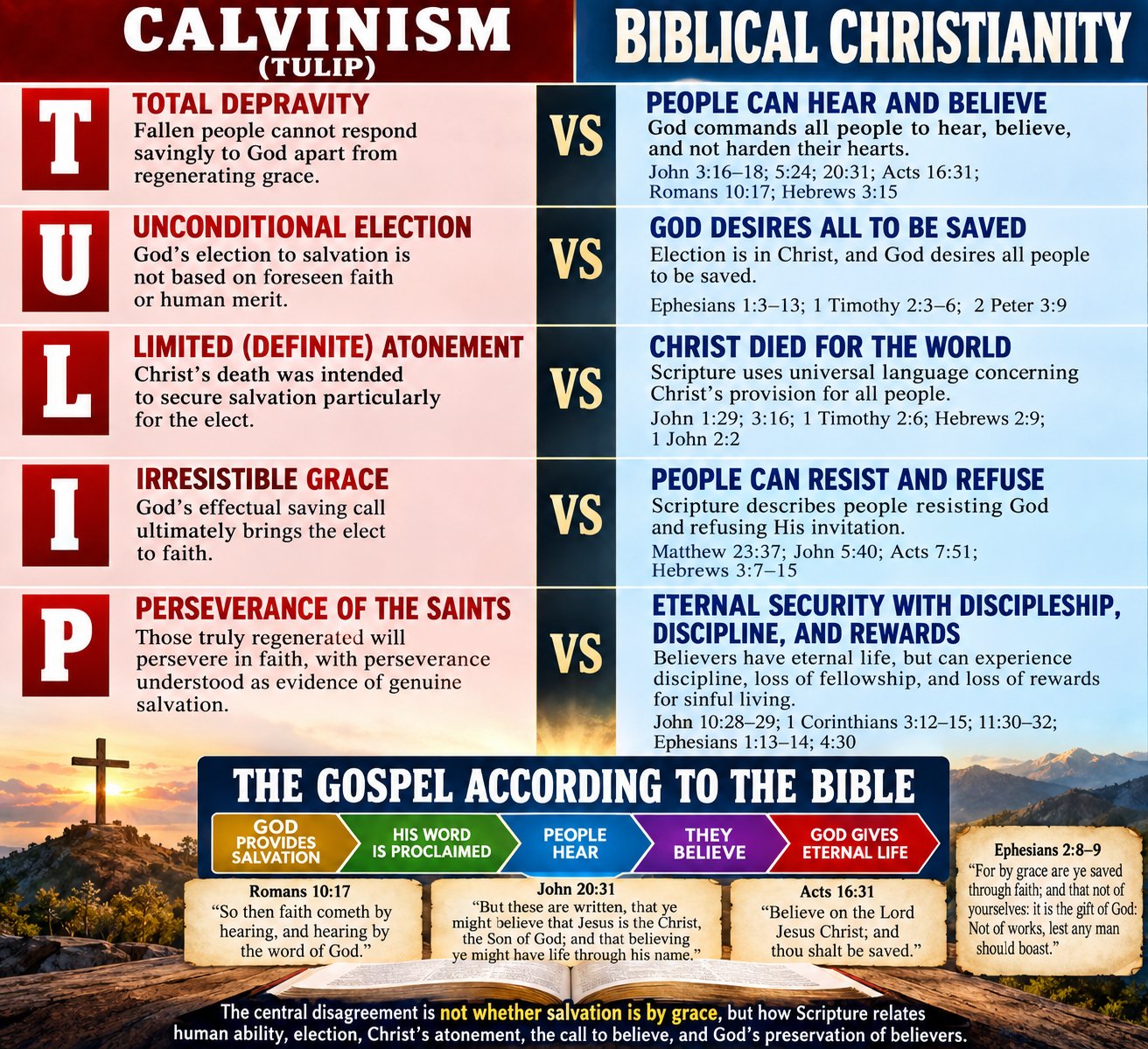
Among other things TULIP / Calvinist Reformational thinking distorts or undermines:

The biggest issue however, that got me thinking differently on this issue a year ago was an article by Albert Mohler.

Here is the full Al Mohler article: “So… Why Did I Write This? The Delusion of Determinism

The subversion of moral responsibility is one of the most significant developments of recent decades. Though this subversion was originally philosophical, more recent efforts have been based in biology and psychology. Various theorists have argued that our decisions and actions are determined by genetics, environmental factors, or other forces. Now, Scientific American is out with a report on a study linking determinism and moral responsibility.

The diverse theories of determinism propose that our choices and decisions are not an exercise of the will, but simply the inevitable outcome of factors outside our control. As Scientific American explains, determinists argue that “everything that happens is determined by what happened before — our actions are inevitable consequences of the events leading up to the action.”

In other words, free will doesn’t exist. Used in this sense, free will means the exercise of authentic moral choice and agency. We choose to take one action rather than the other, and must then take responsibility for that choice.

This link between moral choice and moral responsibility is virtually instinctive to humans. As a matter of fact, it is basic to our understanding of what it means to be human. We hold each other responsible for actions and choices. But if all of our choices are illusory — and everything is merely the “inevitable consequence” of something beyond our control, moral responsibility is an exercise in delusion.

Scientific American reports on a study performed by psychologists Kathleen Vohs and Jonathan Schooler. The psychologists found that individuals who were told that their moral choices were determined, rather than free, were also more likely to cheat on an experimental examination.

As Shaun Nichols reports:

The Western conception idea of free will seems bound up with our sense of moral responsibility, guilt for misdeads and pride in accomplishment. We hold ourselves responsible precisely when we think that our actions come from free will. In this light, it’s not surprising that people behave less morally as they become skeptical of free will. Further, the Vohs and Schooler result fits with the idea that people will behave less responsibly if they regard their actions as beyond their control. If I think that there’s no point in trying to be good, then I’m less likely to try.

Even if giving up on free will does have these deleterious effects, one might wonder how far they go. One question is whether the effects extend across the moral domain. Cheating in a psychology experiment doesn’t seem too terrible. Presumably the experiment didn’t also lead to a rash of criminal activity among those who read the anti-free will passage. Our moral revulsion at killing and hurting others is likely too strong to be dismantled by reflections about determinism. It might well turn out that other kinds of immoral behavior, like cheating in school, would be affected by the rejection of free will, however.

There are limitations to this kind of research, of course, but the report is both revealing and unsurprising. If we are not responsible for our actions, they why would people do the right thing? The most immediate result of such thinking is the subversion of moral accountability.

Of course, this pattern of thought also renders human existence irrational. How can we understand ourselves, our children, our spouses, our friends, or our neighbors if moral responsibility is undermined by determinism. Our legal system would completely collapse, as would the entire experience of relating to other human beings.

Shaun Nichols explains that “the Western conception of free will seems bound up with our sense of moral responsibility.” That “Western conception” is a product of the Christian inheritance and the biblical worldview. The Bible clearly presents human beings as morally responsible. Christians of virtually all theological traditions — including Reformed theology, Arminianism, and Catholicism — affirm moral and spiritual responsibility and the authenticity of the experience of choice.

As a matter of fact, this capacity and accountability is rooted in the biblical concept of the imago Dei — the image of God. Our Creator made us as moral creatures and planted within us the capacity of conscience. All this refutes the concept of moral determinism.

In its most modern forms, determinism is a product of naturalism — the belief that everything must be explained in purely natural terms. Naturalism explains the human mind (including the experience of moral choice) as a matter of chemical reactions in the brain, and nothing more.

Determinism is implied by naturalism and relieves human beings of moral responsibility. There is no moral revolt against the Creator, no Fall, and no need for the Gospel. This subversion of moral responsibility is both a delusion and a trap. And, as the Scientific American report indicates, even those who say they believe in moral determinism are unable to live consistently with this assumption. We know we are responsible.

If Mohler applies that to his own theological determinism, he would have to reject it. More here: Why Both Atheists and Christians Need to Believe in Free Will. It is this “Exhaustive Divine Determination [EDD]”, or theistic determinism, that really got me studying the issue. Because Calvinist apologists show the self-refuting nature of it when dissecting atheism, but they do not apply it to their determinism.

The implications of strict naturalism are grim or even counterintuitive. For example, Bertrand Russell affirmed that any philosophy hoping to stand must ultimately take for granted the (naturalistic) picture of unguided causes and accidental collocations of atoms and must be built on the “firm foundation of unyielding despair.” When it comes to naturalism’s implications for morality, naturalist Kai Nielsen contends that reason can’t bring us to morality; this picture ”is not a pleasant one,” and that reflecting on it ”depresses me.” When it comes to consciousness, naturalist Daniel Dennett considers it an illusion- -something fellow-atheist Thomas Nagel finds utterly confused:

  • You may well ask how consciousness can be an illusion, since every illusion is itself a conscious experience …. So it cannot appear to me that I am conscious though I am not … the reality of my own consciousness is the one thing I cannot be deluded about …. The view [of Dennett] is so unnatural that it is hard to convey …. Dennett asks us to turn our backs on what is glaringly obvious. … And he asks us to do this because the reality of such phenomena is incompatible with the scientific materialism that in his view sets the outer bounds of reality. He is, in Aristotle’s words, ”maintaining a thesis at all costs.”

Jaegwon Kim acknowledges the stark picture painted by the naturalistic brush. Naturalism is ”imperialistic; it demands ‘full coverage’ … and exacts a terribly high ontological price.”

Paul Copan and Charles Taliaferro (editors), The Naturalness of Belief: New Essays on Theism’s Rationality (New York, NY: Lexington Books, 2019), viii

Let me restate that last sentence:

  • Jaegwon Kim acknowledges the stark picture painted by the EDD adherent’s brush. EDD is ”imperialistic; it demands ‘full coverage’ … and exacts a terribly high ontological price.”

Yep.

What are some of the imperialism in theistic determinism? Here is one:

And there is more:

Divine Rape | Exhaustive Divine Determinism at It’s “Best”?

The Origin of Evil… Calvinist’s Say God, Same as the Atheist

Is Divine Determinism a Different Gospel?

John Piper’s Theistic “Dust Particle” Determinism (Soto 101)

Is God the “devil” Behind Satan? | Sovereign Puppeteer (Updated)

Logical Ends of TULIP (No Rebellious Creatures)

Calvinism: God Meticulously Controls Everything | even this post

Dumbing Down John Calvin via GROK (Romans Edition)

However, one of the best dealing with the topic can be found in in the book “Calvin’s Desperation: How John Calvin’s Unbiblical Divine Determinism Destroys the Credibility of the Christian Faith

This video and the following chapter deal with another aspect of why this “new Calvinism” [really it’s old] is really a degradation of God’s character and trustworthiness. The below is an excerpt of the end of a longer video found over at IDOL KILLER. Here is that videos description:

Author, speaker, debater and self-confessed trouble-maker Phil Bair joins Idol Killer to discuss how to destroy Christian credibility. We discuss the various ways in which Theistic Determinism destroys God’s righteousness, human knowledge, and helps atheists justifiably reject Christian theism. We note how Theistic Determinism is not only in opposition to the Bible, but any reasonable world view and thus should be rejected.

Here is the chapter Phil Bair mentioned in the above video:

  • To state the problem concisely, anyone who wants to grant God the type of sovereignty proposed by strong Calvinism, which is a causal account of human willing and acting, yet wants to say that the world is not as it should be (sin) is under a particular burden to explain how they can make these claims in conjunction with one another. —Jeremy Evans [245]

I referred earlier to the possibility of whether God can be divided within himself. Calvin is keenly aware of the problem that if God wills that which he condemns, he is indeed a divided being, and worse, is in conflict with himself. Calvin attempts to deal with this objection:

Their first objection—that if nothing happens without the will of God, he must have two contrary wills, decreeing by a secret counsel what he has openly forbidden in his law—is easily disposed of.[246]

How does he “easily dispose of” this objection? Like this:

Still, however, the will of God is not at variance with itself. It undergoes no change. He makes no pretense of not willing what he wills, but while in himself the will is one and undivided, to us it appears manifold, because, from the feebleness of our intellect, we cannot comprehend how, though after a different manner, he wills and wills not the very same thing. Paul terms the calling of the Gentiles a hidden mystery, and shortly after adds, that therein was manifested the manifold wisdom of God (Eph. 3:10). Since, on account of the dullness of our sense, the wisdom of God seems manifold (or, as an old interpreter rendered it, multiform), are we, therefore, to dream of some variation in God, as if he either changed his counsel, or disagreed with himself?[247]

I have observed how Calvin expresses the contradictory postures he attributes to God. For example:

  • It is God’s will that all come to repentance.
  • It is God’s will that not all come to repentance.

The two propositions above are indisputably contradictory. Now, Calvin claims that the will of God is not at variance with itself. His will is “one and undivided.” It only “appears manifold” to us. But Calvin affirms both of the above propositions. Therefore he absolutely affirms that the will of God is at variance with itself despite his prior denial of the idea. The only way it isn’t is to define God’s will differently between the two propositions. Calvin alludes to this when he says, “we cannot comprehend how, though after a different manner, he wills and wills not the very same thing.” Note the phrase “though after a different manner.” The obvious question is, how are the two “wills” different? If they are “after a different manner,” how does Calvin explain the two kinds of will, and how does he support that explanation? He doesn’t. Instead, he takes a hard left turn that we would never expect from a dignified biblical scholar. Since he denies that the will of God is “multiform” or “manifold,” and tells us that this perception on our part is due to the “feebleness of our intellect,” he has to explain how there aren’t multiple wills that “disagree with himself.”

But for the moment let’s give him the benefit of the doubt. Let’s assume that the word “will” means something different between the two sides of the dilemma. What alternate definition of will might we apply to one or the other? Consider the first proposition 1 quoted above. It’s God’s will that all come to repentance. How do we justify the term will? Acts 17:30 is where it comes from. That verse reads:

In the past God overlooked such ignorance, but now he commands all people everywhere to repent.

So God commands all people everywhere to repent. If God commands something, is it not his will that the command is obeyed? Is this not intuitively obvious and clear to reason?

Consider the captain of a sea-going vessel. The captain issues a command for the first mate to set a course for the mainland. It’s the captain’s will that the first mate obey that command. But what if the first mate doesn’t obey? It would be a valid observation that the first mate did not do the will of his captain. Would it ever be the captain’s will that the first mate disobey his command? Not in this sense of the word. The captain has what we could call “sovereignty” over the crew. And in that sense, the word sovereignty means authority.[248] If the first mate disobeys the captain’s will (expressed by his commands), he has rebelled against the captain’s authority, and thus against his sovereignty.

In this case, the captain’s will does not causally determine the decisions and actions of the crew. But if the crew disobeys the captain’s will, there will be consequences. Why? Because the captain has the authority to impose those consequences on the disobedient.

Now consider an inventor who builds a ship and a dozen or so robots having the ability to be its pilots. Now suppose that the inventor puts on a captain’s uniform and issues a verbal command to the robot he designated as the first mate. The robot cannot “obey” the captain’s command. Obedience implies will, something a robot does not have. The robot will simply respond to the captain’s command because the captain programmed the robot in such a way that it will execute the captain’s orders and cannot do otherwise (assuming the captain’s engineering is flawless).

In the second case, the will of the captain is causal rather than authoritative. The robot will execute the captain’s command not because it chooses to obey, but because it is programmed that way. The captain could still be said to have “sovereignty” over the robots, but the meaning of the term would not be the same as it was in the first analogy. In this case, rather than authority or lordship, sovereignty means causality. The will of the captain is now the cause of everything the robots do, and in fact, the cause of everything that happens on the automated ship.

Do either of these definitions of will sound familiar? Recall Calvin’s fundamental axiom: the will of God is the sole determining cause of all things. Which of the definitions of will is he referring to? The second, obviously. Since Calvin, as I have frequently observed, routinely identifies God’s will as the cause of all things, does he have the luxury of using the term “God’s will” in the first sense? If God’s will is something that can be disobeyed, it cannot be causal; it must be authoritative. But Calvin rules this out. If a creature is able to disobey God’s will, only two possibilities exist: either the creature has a functioning will that can cause something (namely, the disobedience), or the creature is only doing what God has programmed it to do. And since for Calvin God’s will is the sole cause of all things, the first option must be discarded. This is because Calvin asks the rhetorical question “are we, therefore, to dream of some variation in God, as if he either changed his counsel, or disagreed with himself?”[249]  To say we could only “dream of” such a variation seals off all exit routes and guarantees there is no “variation” in God’s will.

Where does this leave us? For Calvin, there can only be one kind of God’s will. That would be the causal kind. What does that do to Calvin’s phrase “though after a different manner?” It obliterates it. So he cannot invoke the idea of God’s will working itself out in a “different manner” since for Calvin there is only one species of God’s will: the causal one. This means that for Calvin, the phrase “he wills and wills not the very same thing” cannot be after a different manner but after the same manner, whether he realizes it or can face it or not. What does this mean? It means that Calvin’s conclusion that God “wills and wills not the very same thin, certified indisputable contradiction.

This is the only way Calvin can say that “the will of God is not at varia with itself.” Notice this refers to the “will” (singular) of God, not being variance “with itself” (singular). Calvin believes, and has always believe that there is only one version of God’s will—the causal one. This is the only kind he can deal with. Any other kind introduces the potential condition that God’s will is not the sole cause of all things, and for Cal vi this is too terrifying to conceive. So even the possibility that we could come up with more varieties of God’s will does not solve the problem. if they are not causal, they have to be ruled out. If they are causal, in terms of their outcomes they are ultimately no different from the first variety.

Now Calvin has a serious problem. He denies what he implies in various places: that there is a secret counsel in God’s will that is beyond the reach of human intellect where he wills that which he condemns. There is no such secret counsel. For if indeed the thesis that “the will of God is not at variance with itself” is true, God’s will must be uniform and undivided.

To put it another way, Calvin has two options:

  1. God’s will is at variance with itself. For Calvin affirms both propositions above. They contradict each other, which is the same thing as variance. Yet Calvin denies this So this option doesn’t work.
  2. God’s will is not at variance with itself, which means that the two contradictory propositions must both be true at the same time and in the same way. For Calvin has no choice but to affirm that it is God’s will that all come to repentance (because the Word of God, namely, Acts 17:30, compels him to affirm this), and in the same way it’s God’s will that not all come to repentance (because according to Calvin God causally determines certain specific individuals of his choosing not to repent, and thus defy his will that they must). It’s God’s will that men must not commit murder, but it’s God’s will that certain men commit murder so as to carry out God’s purposes.[250]

The first option is unreasonable and unacceptable. Why? Because it would mean Calvin is wrong when he says God’s will is not at variance with itself. Calvin can’t admit he’s wrong here or his entire deterministic narrative collapses.

This means Calvin must accept the second option. (There is no third option because of the law of excluded middle.) But accepting the second option means affirming various pairs of propositions that contradict each other. As soon as he writes the words “God’s will is not at variance with itself when he wills and wills not the very same thing,” he is suddenly painfully aware that he has fallen into a trap of his own making. How does he deal with this logical train wreck?

It doesn’t take long to realize that at this point, Calvin has become desperate. He has no choice but to accept a glaring contradiction he can’t pretend isn’t there. His entire ideology has led up to this climax, even though he deals with it in the middle of his Institutes. That doesn’t matter. Two opposing locomotives of thought have been carrying him along the tracks of his thinking and brought him to a point where their hundreds of tons of steel are now fiercely racing toward each other at breakneck speed on the same track. This impending calamity haunts Calvin, knowing that what he is looking at is like the nightmare of an unstoppable force meeting an immovable object. Sooner or later there will be a violent earth-shaking collision. It is only a matter of time.

There is an episode in the original Star Trek series (1966) where Mr. Spock, the champion of logic who has completely suppressed all emotion and passion, finds himself in an impossible situation. He is the pilot of a shuttle craft that has just lifted off to escape a hostile planet. They are in orbit—for now. There is a small handful of passengers On board, all of which know they are doomed. For you see, the ship’s fuel supply is almost gone, the orbit is decaying, and help is nowhere in sight. The situation is hopeless. So Spock makes a decision that defies logic, and the members of the crew are stunned at his irrationality. He jettisons the fuel and ignites it, causing a long luminous trail of burning plasma shooting out of the rear of the shuttle craft. Now they are out of fuel—completely. The shuttle plunges into the atmosphere and begins to incinerate. The cabin fills with toxic smoke and the occupants are choking on it. The dialogue at that moment goes like this:

Doctor McCoy: It may be the last action you’ll ever take, Mister Spock, but it was all human.

Spock: Totally illogical. There was no chance.

McCoy: That’s exactly what I mean.

At the last minute, they are transported out of the shuttle craft and aboard the Enterprise just in the nick of time, where Captain Kirk eventually queries Mr. Spock on the rationale behind his decision:

Kirk: I don’t understand all this, and maybe you can explain, logically of course. When you jettisoned the fuel and ignited it, you knew there was virtually no chance of being seen, and yet you did it anyhow. And that would seem to me to be an act of desperation.

Spock: Quite correct, Captain.

Kirk: Now we all know, and I’m sure the doctor would agree with me, that desperation is a highly emotional state of mind. How does your well-known logic explain that?

Spock: Quite simply, Captain. I examined the problem from all angles, and it was plainly hopeless. Logic informed me that under the circumstances, the only possible action would have to be one of desperation. Logical decision, logically arrived at.

Kirk: Aha. You mean you reasoned that it was time for an emotional outburst.

Spock: Well, I wouldn’t put it in exactly those terms, Captain, but those are essentially the facts.

Kirk: You’re not going to admit that for the first time in your life you committed a purely human, emotional act?

Spock: No, sir.

Kirk: Mr. Spock, you’re a stubborn man.

Spock: Yes, sir.[251]

When you combine desperation with stubbornness, it does not end well. You make decisions that baffle your colleagues (or should), and those who see clearly what is really going on lose all remaining respect they ever had for you. In the Star Trek story, the shuttle craft crew is rescued just before their time runs out. There is no such happy ending for Calvin, who will stubbornly cling to his deterministic ideology until it blasts him into catastrophic rational oblivion. His orbit is definitely decaying, and there is no chance of a rescue. He will never give up his self-inflicted deterministic ruin, because he sincerely believes that to do so will rupture his faulty concept of God’s sovereignty.

Calvin is projecting his own insecurity on God himself, and God does not come off very well as a result. Calvin cannot live with the damage he thinks human libertarian free will inflicts on God’s sovereignty. But neither can he live with the loss of God’s righteousness. He therefore denies that God’s goodness dies of a thousand cuts from how he directly perpetrates the multitudes of evil choices and actions of man. But the only way to deny this is to abandon rationality itself and push the issue into the obfuscating obscurity of the “secret counsel” of God. Calvin must either divide God’s will in two, or divide God’s mind in two. Those are the only choices left, and the first one is unthinkable since it incinerates The Precious: Calvin’s unrelenting deterministic worldview. The following is the ultimate expression of Calvin’s overwhelming desperation:

Nay, when we cannot comprehend how God can will that to be done which he forbids us to do, let us call to mind our imbecility, and remember that the light in which he dwells is not without cause termed inaccessible (1 Tim. 6:16), because shrouded in darkness.[252]

This is the point where the two locomotives of God’s will have their ear-bleeding crash. How can God will (i.e. cause) to be done that which he forbids us to do? Multiple scholars and thinkers have attempted to reconcile these contradictory trains of thought, and many still believe this is possible. But Calvin knew beyond any doubt that they couldn’t. If they could, he would not have had to resort to his irrational desperate maneuver of running away[253] and hiding behind “our imbecility.” This is the only option left, and no one knows this better than Calvin.

As I have already said, there are some “reformed” theologians who will tell us that the solution to the problem is quite simple: there are two aspects of God’s will—his decretive will and his preceptive (or prescriptive) will. But if this was such an obvious and simple solution, why didn’t Calvin ultimately invoke it? It would have saved him one horrific train wreck. As we saw before, Calvin tried, but knew it doesn’t work, which is why he had to resort to such desperate measures. If it worked, he would have adopted it as his grand solution, and presto: problem solved. After all, appealing to two aspects of God’s will is quite easy, and presumably removes the necessity to drag our “imbecility” into the formula to solve the problem. But no. Lest we forget, he, like the preponderance of the “reformed” theologians following in his footsteps, is a determinist. There is nothing more central and all-encompassing in his theology than exhaustive divine determinism. It looms over the entire landscape of his thinking like a solar eclipse. If there’s such a thing as man’s libertarian free will, it has the capacity to be causal, and Calvin loses his mind. The appeal to mystery, which is ultimately what Calvin did, and ultimately what his disciples who truly understand the dilemma do, would not be necessary if the contradiction was not real. Since it is unquestionably real, the “solution” mentioned above is no solution at all. It’s nothing more than a theological game all self-respecting theologians should refuse to play.

To review and recap to settle the matter once and for all, if there’s a separate aspect of God’s will one could call preceptive or prescriptive (as opposed to decretive), the possibility that man could obey it or disobey it based on his own volition suddenly appears on the radar, and Calvin has no choice but to hunt it down and torpedo it. Why? Because it introduces additional causality, and therefore blunts God’s causal sovereignty in the caverns of Calvin’s calculus. Even if a case could be made for the “preceptive” will of God, it must also be causal in order to satisfy the demands of determinism. If it’s not causal, but something that can be obeyed or disobeyed by free agents other than God, something could be “left to fortune” and the world “moves at random,” which causes Calvin’s head to explode. It must therefore be sacrificed to the pagan god EDD, lest it get in the way of Calvin’s desperate maneuver and what

subsequently has become a tragically deformed theology.

That Calvin himself ultimately rejected the possibility that there actually are two species of God’s will is decisively settled by reference to his commentary on Matthew:

if it be objected, that it is absurd to suppose the existence of two wills in God, I reply, we fully believe that his will is simple and one; but as our minds do not fathom the deep abyss of secret election, in accommodation to the capacity of our weakness, the will of God is exhibited to us in two ways.[254]

This excerpt from Calvin’s commentary puts the final seal on the issue: God’s will is “simple and one.” It is not divided, and this ontological split of God’s will into two different halves is a myth. It only seems to us that there are “two wills in God.” It is the same will “exhibited to us in two ways” because “our minds do not fathom the deep abyss of secret election” (a restatement of his never-ending fallacy of begging the question).

But suppose we ignore for the moment Calvin’s indisputable affirmation that God’s will is unquestionably simple and one, and that the concept of two versions of God’s will is a fable. If the preceptive will of God is not causal, the decretive will of God, as I stated earlier, still remains the sole determining cause of all things, including the fact of man’s disobedience to God’s moral and soteriological imperatives. In other words, God’s decretive will is directly and unalterably causing man’s disobedience to his “preceptive will,” removing man from the whole equation entirely. So again, adding an additional species of God’s will changes nothing. And if the preceptive will is causal, we are right back where we started—the entire effort to differentiate between the two is futile, and the rational dilemma remains. Therefore the paltry attempt to split God’s will in half like this is a dead end. Calvin would rather take the option of trashing reason than allow his deterministic ideology to disintegrate as he stares down the barrel of a devastating contradiction.

But how valid is this option? Recall my earlier treatment of the cognitive barrier. We saw that the border between God’s intellect and man’s does not lie along the contours of the laws of logic, but between the limits of man’s comprehension and God’s infinite wisdom. But what Calvin is attempting here is to say that God can reconcile a hard logical contradiction behind the curtain of his “inaccessible” intellect ‑- inaccessible because it is “shrouded in darkness.”[255] This means that Calvin rejects the idea that the cognitive barrier is not located where the laws of logic prevail. He thinks logic is the very locus of the cognitive barrier. Beyond the barrier, God can violate the laws of logic to his heart’s content, expressing the agenda of his dark irrational alter ego lurking somewhere in the godhead, ready to burst into the light whenever some confused theologian somewhere feels the need to embrace abject imbecility.

If we recall the discussion of what happens if God or creation can vitiate rationality, I said there was a reason for bringing it up. If there is a part of God’s mind that can circumvent the laws of logic, the door is open to all sorts of contradictions of the central principles of the nature of reality, the relationship between God and creation, and the reliability of revelation. By embracing the concept of God’s dual mental cavities where one is rational and the other is anti-rational, Calvin has opened this door, and released a panoply of disasters from which there is no recovery. Once this door is open, it can never be closed. The entire superstructure of Christian theism completely breaks down.

Most criminals are desperate, and Calvin’s desperation has driven him to commit the perfect rational crime. He breaks the laws of logic by affirming two contradictory propositions, and demands that God cover for him—giving him a bullet-proof alibi: we puny humans are just too stupid to understand how these contradictory propositions can all be true. But God is so brilliant that he can resolve the unresolvable conundrum on Calvin’s behalf. And since the solution God is expected to provide to bail Calvin out of logic jail is allegedly beyond the cognitive barrier, Calvin doesn’t even have to explain how it works. It’s God’s problem now—if you have an objection, talk to him. Of course, if you do, based on Calvin’s misplacement of the boundaries of the cognitive barrier, no one can guarantee which of the divine schizophrenic personalities you’ll be addressing. In this context, Calvin has just removed himself from the category of serious biblical scholar and his move toward a disappointing form of anti-intellectualism is complete.

But desperate times call for desperate measures. I have seen a similar pattern where some theologians (who consider themselves “reformed”) embrace a bewildering array of irrational and mutually contradictory positions that reveal a disturbing trend that is emblematic of a growing contempt for sound philosophical principles within the orbit of hermeneutics and exegesis. What the Body of Christ needs right now is a renewed recognition that the Word of God is never philosophically inept, the protests of certain anti-philosophical debating opponents notwithstanding. / would strongly suggest that there are some aspects of what is called “reformed” theology that are in dire need of reform. To take what is irrational and correct its incoherent errors is one of the highest expressions of reform we can achieve. I must also restate the fundamental principle I articulated earlier in this volume: anything that violates basic rationality by affirming two contradictory propositions is automatically at war with God’s divine Logos.

In his book The God Who Is There, Francis Schaeffer defends his fundamental thesis that the current gap between the generations is caused by a shift in the concept of truth.[256] Prior to the advent of the gap, almost everyone in our society remained loyal to the law of non-contradiction: that A cannot be non-A at the same time in the same way. But since then, the concept of truth has undergone a fundamental transformation. This is partly due to the influence of the dialectic methodology[257] for arriving at what’s true and false—an approach that finds its roots in the ideas of German philosopher GWF Hegel. Hegel influenced Karl Marx, who influenced the West—and especially the modern-day West—to the point where truth and rationality have become so severely weakened that they have almost reached the point of extinction.

On its face, it is difficult to comprehend the widespread popularity of John Calvin’s incoherent deterministic philosophy. I believe the deterioration of the concept of truth in the West that Schaeffer articulated could be a significant part of the answer. How else can we account for the propensity of so many people of faith to swallow the self‑

contradictory sophistry of Calvinism? If truth is no longer truth in the classical sense, the abandonment of the very categories of true and false is not far behind. I am not suggesting that Calvin was influenced by this shift—it occurred long after he departed this vale of tears. He didn’t accept his contradictions because of the modern erosion of the concept of truth. He accepted them for a different reason: misguided as he was, he sincerely believed God could clean up his reckless logical wet spill with divine brute force and mystery. But this recent emergence of postmodernism could easily be part of the reason why his self-contradictory doctrines find so much sympathy in today’s world. For Calvin, to squander the rules of inference grounded in the divine mind can be justified by appealing to the “secret counsel” of God—which here means cheating while no one is looking. For too many souls in our century, it’s not even called cheating any more.

FOOTNOTES

[245] Jeremy A. Evans, Whosoever Will, 266.

[246] Calvin, Institutes, Book 1, Chapter 18, Section 3, Paragraph 2.

[247] Ibid.

[248] Or lordship.

[249] Calvin, Institutes, Book 1, Chapter 18, Section 3, Paragraph 2.

[250] There may be a temptation to challenge this narrative by saying God occasionally commands his people to kill other human beings within the context of God’s judgment against them. But this is not an example of murder. It is therefore irrelevant to the present discussion.

[251] Star Trek, The Galileo Seven (1967).

[252] Calvin, Institutes, Book 1, Chapter 18, Section 3, Paragraph 2, emphasis mine.

[253] Calvin’s maneuver is a sad reminder of the strategy of the cowardly knights in Monty Python and the Holy Grail: “RUN AWAY!”

[254] John Calvin, Commentary on Matthew, 631.

[255] And all along we’ve been led to believe that God is light, and in him there is no darkness at all (1 John 1:5).

[256] Francis Schaeffer, The Cod Who Is There, 33.

[257] The Socratic Method is often referred to in the literature as the “dialectic method.” This is not what I am referring to here.

Calvinism makes the Word of God null and void through this determinism:


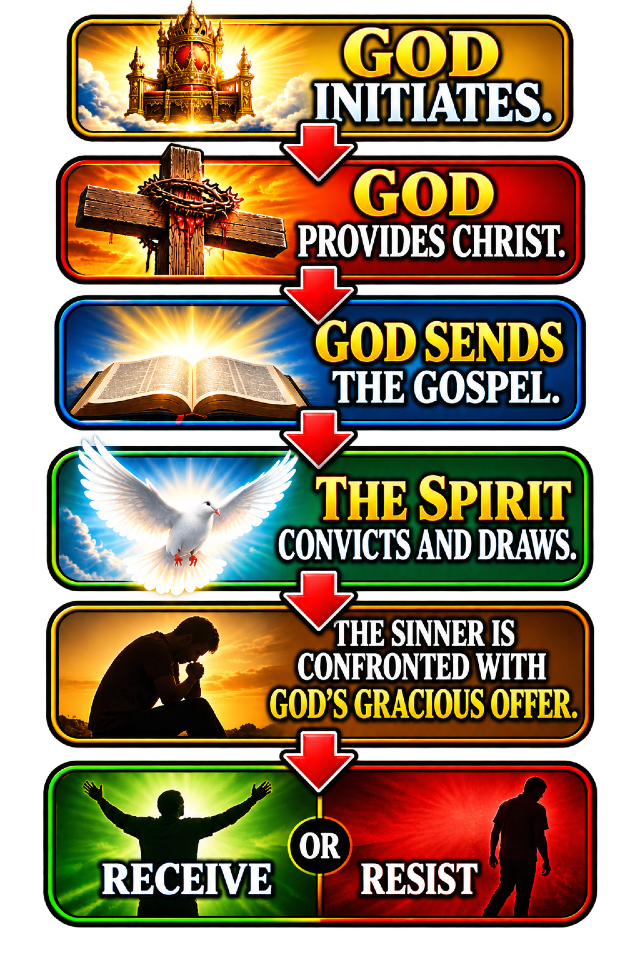
I worked with CHATGPT to redesign this next “Calvinist Toon”

This next section is from Ronnie W. Rogers, Reflections of a Disenchanted Calvinist: The Disquieting Realities of Calvinism (Bloomington, IL: WestBow Press, 2016), 86-97. [Chpt 13, “Preaching of the Gospel” | PDF]

As a pastor, I am intensely concerned with what is included in preaching of the gospel. I realize that all Christians are concerned, and rightly so, but because I do this week in and week out, it is of utmost importance not only to understand the gospel, but to articulate the gospel message in such a way that it clearly reflects what the Scripture teaches and what I believe. I offer the following to elucidate my understanding of the call to preach the gospel.

  1. I affirm the mandate to preach the gospel to everyone (John 6:44, 12:32; Revelation 22:17); that “God was well-pleased through the foolishness of the message preached to save those who believe” (1 Corinthians 1:21). Further, I affirm that the proclamation of the gospel that appeals to the heart and mind in persuasiveness, aided by divine enablements of grace, may result in salvation for anyone who hears.

The means of this grace enablement include but are not limited to: Gods’ salvific love for all (John 3:16), God’s manifestation of His power so that all may know He is the Sovereign (Isaiah 45:21-22) and Creator (Romans 1:18-20), which assures that everyone has opportunity to know about Him. Christ paying for all sins (John 1:29), conviction of the Holy Spirit (John 16:7-11), working of the Holy Spirit (Hebrews 6:1-6), enlightening of the Son (John 1:9), God’s teaching (John 6:4S), God opening hearts (Acts 16:14), and the power of the gospel (Romans 1:16), without such redemptive grace, no one seeks or comes to God (Romans 3:11). Further, I believe that man, because of these gracious provisions and workings of God, can choose to seek and find God (Jeremiah 29:13; Acts 17:11-12). Moreover, no one can come to God without God drawing (John 6:44), and that God is drawing all men, individuals (John 12:32). The same Greek word for draw, helkuo, is used in both verses.” About 115 passages condition salvation on believing alone, and about 35 simply on faith.”[96]Other grace enablements may include providential workings in and through other people, situations, and timing or circumstances that are a part of grace to provide an opportunity for every individual to choose to follow Christ.

John Piper asked the question, “What message would missionaries rather take than the message: Be glad in God! Rejoice in God! Sing for joy in God! …God loves to exalt himself by showing mercy to sinners.”[97] My answer to this question, the truth that when anyone hears this glorious message, is that same someone has a chance, by the grace and mercy of God, to receive the truth of the message by faith. Further, without opportunity for all sinners to accept, that message should be changed to say, “some can be glad in God if He predestined you” or “God loves to exalt Himself by showing mercy to some sinners.” This is the actual message of Calvinism, a disquieting reality, and I would appreciate their due diligence always to make that clear.

I affirm that a truly good faith offer seems to necessitate a willingness to tell a person that Christ died for them. For example, Paul said to the Corinthians, “For I delivered to you as of first importance what I also received, that Christ died for our sins according to the Scriptures” (1 Corinthians 15:1-3). Thus, he told them Christ died for “our” sins when they were lost. Peter preached to the Jews saying, “For you first, God raised up His Servant and sent Him to bless you by turning every one of you from your wicked ways” (Acts 3:26). The blessing is the “turning every one of you from your wicked ways,” i.e. salvation. Notice that the blessing is not corporate—Israel—but for “every one” who turns from wickedness, which clearly implies that they can and should. In addition, our Lord said concerning His blood, “And in the same way He took the cup after they had eaten, saying, ‘This cup which is poured out for you is the new covenant in My blood” (Luke 22:20, italics added). When He said that, Judas was sitting there, verse 21.

Commenting on Acts 3:26, John MacArthur says, “All the rich blessings of salvation and all the covenant promises were available. Peter’s hearers could only obtain them, however, by turning from their wicked ways. Repentance was the key that unlocked everything. Peter had clearly shown that the claims of Jesus were consistent with Old Testament prophecy, so that it was a compelling case for his hearers to respond in repentance and belief Tragically, most of Peter’s audience refused to repent. Like their fathers before them, they hardened their hearts and failed to enter God’s rest (Hebrews 3:8; 4:3). As a result, within the lifetime of many in the audience the nation would be destroyed. And those who refused to turn from their sins would find themselves ‘cast out into the outer darkness’ (Matthew 8:12), where they will `pay the penalty of eternal destruction, away from the presence of the Lord and from the glory of His power’ (2 Thessalonians 1:9). Such a fate awaits all those in every age and place who refuse to repent and receive God’s gracious offer of salvation in Jesus Christ.”[98] (italics added)

Now I unconditionally agree with MacArthur’s explanation of this verse; however, his Calvinism turns the otherwise precise interpretation of this verse into double-talk. His comments give every appearance that he believes that, as this Scripture clearly teaches, “All the rich blessings of Salvation…were available” and these could and should repent, but they did not because “[they] refused to repent …. [and] they hardened their hearts.” He deems their refusal to be a tragedy.

From a non-Calvinist interpretation, it is indeed an eternal tragedy, but from a Calvinist perspective, it is not. Because according to Calvinism’s unconditional election, irresistible selective regeneration, and monergistic salvation, their non-repentance was exactly what God desired and predetermined that they could only do; they will spend eternity in torment, as He also desired. They will serve as predetermined monuments of His wrath. Furthermore, they did not refuse to repent, in any sense of being able to have chosen to do otherwise. As an incontrovertible fact of Calvinism, they did the only thing they could do; thereby proving they were not the elect. Moreover, everyone of God’s elect who heard this was selectively regenerated against his will so that he would unavoidably believe in the Messiah. From his Calvinism, there can be nothing tragic about this event, for everything went according to God’s plan, a disquieting reality, whereas, from a non-Calvinist perspective, it is tragic indeed, and heart wrenchingly so. For they have truly rejected “the rich blessings of salvation” which God had made available through grace-enabled faith.

  1. I disaffirm that while I am commanded to preach the power of the gospel—the good news—to the entire world, God has predetermined to make that power unavailable to the entire audience of the message and has limited it to only those chosen by God apart from faith (Acts 16:31­32, Romans 10:13). It seems that the message to the Philippian jailer, if Paul were a Calvinist, should have been, “Believe on the Lord Jesus Christ, which is the only thing you can do if you have been selected and the one thing you cannot do if you have not been selectively regenerated; consequently, while belief is necessary for salvation, it is not for you to worry about; you should worry about things you can do something about.” Apart from mere obedience and process, the underlying message of Calvinism allows no room for urgency or passionate and emotional pleading either toward or with the unsaved to repent, because all who are predestined to repent will and those who are not cannot repent, i.e., irresistible grace. This is a disquieting reality.

Calvinism is not devoid of passion for seeing the lost come to Christ. Nevertheless, if logic prevails, it is only a vertical passion. That is to say, it is a passion to carry out the mandate of God, to be used by God to gather His elect. It cannot be a Holy Spirit led horizontal passion, which is a burden, love and hurt for all of the lost of the world, or even each particular individual, to come to know Christ. For God, according to Calvinism, does not even have such passion. A consistent Calvinist’s passion is not actually toward the individual but always toward God, which some Calvinists would revel in as vindicating Calvinism; however, that is only true if the Scripture supports such, and I do not think it does. Further, if Calvinism is true, unless the Calvinist knows that God has truly drawn him to one of His elect—which seems impossible to objectively know—the Calvinist needs to refuse to give in to horizontal passion because it can only be mere human sentiment or satanic influence, both of which would actually be contrary to God’s passion.

Paul clearly had a vertical passion for God, but equally clear was his horizontal passion for the lost. He said, “I am telling the truth in Christ, I am not lying, my conscience testifies with me in the Holy Spirit, that I have great sorrow and unceasing grief in my heart. For I could wish that I myself were accursed, separated from Christ for the sake of my brethren, my kinsmen according to the flesh, who are Israelites” (Romans 9:1-4a).

Paul’s passion for his fellow Jews who were rejecting Christ and therefore headed for hell was inconsolable. Although he knew that he could not relinquish his salvation, and even if he did that would not cause others to receive salvation, he did actually love them so deeply and hurt so profoundly for them that he would have surrendered his own salvation and home in heaven for an eternity in the hollows of hell for their sake. This is truly the love of God ( John 3:16) and of Jesus who died willingly for all (John 1:29). Paul’s love for his lost countrymen was of the sacrificial quality that is seen in God who loved the fallen and rebellious human race and therefore, “He who did not spare His own Son, but delivered Him over for us all (Romans 8:32). It is seen in Jesus “who gave Himself as a ransom for all” (1 Timothy 2:6), and therefore sacrificed everything that was rightfully His for this same undeserving humanity. And it is seen in Paul in that he would willingly give up the greatest love and future ever known for his countrymen.

This kind of passion and desire for the lost is exceedingly convicting and constantly challenges me to unreservedly disdain and resist excusing my own jejune love for the lost. Of course, if God has elected only some of the Jews for whom Paul so passionately grieved, then Paul’s passion and burden seem at best nothing more than a misdirected human sentimentalism that is quite contrary to the heart and love of God; possibly even the sin of arrogance. For how can Paul be led by the Holy Spirit who, according to Calvinism, cares not one whit about the final destiny of some of those Paul is so deeply concerned about.

Calvinism’s passion cannot logically, being consistent with Calvinism, be toward the lost in the same way as the simple reading of the Scripture conveys God’s, Christ’s, Paul’s or others’ passion toward all, each person, the lost of the world. If a Calvinist is so disposed, it is an inconsistency with Calvinism rather than a corollary of Calvinism. This is a disquieting reality. As a Calvinist, I would have denied—double-talked my way out of—the truthfulness of this conclusion, but as a disenchanted Calvinist, its undeniableness is indubitable.

This is not to say that Calvinists do not claim to be justified in having passion for the lost and a sense of urgency in reaching them. Regarding God’s secret will to deliver some by unconditional election, J.I. Packer says, “But this does not help us to determine the nature of the evangelistic task, nor does it affect our duty to evangelize universally and indiscriminately. The doctrine of God’s sovereignty in grace has no bearing on these things.” [99] (italics added)

The proposition that either God loves every individual and grace enables each person with an opportunity to receive forgiveness or that God only loves some enough to unconditionally elect them to salvation and loves the rest of the world to hell, and then saying that this has “no bearing” on evangelism is the apotheosis of double-talk. Furthermore, “indiscriminately” intimating or telling people that God loves them and desires for them to be saved is not a message sanctioned by God, according to Calvinism, since He does not so love everyone. They may well seek to justify their doing so, but they cannot claim that God is leading them to do so.

With regard to urgency, Packer says, “the belief that God is sovereign in grace does not affect the urgency of evangelism …. And we who are Christ’s are sent to tell them of the One—the only One—who can save them from perishing. Is not their need urgent? …. If you knew that a man was asleep in a blazing building, you would think it a matter of urgency to try and get to him, and wake him up, and bring him out. The world is full of people who are unaware that they stand under the wrath of God: is it not similarly a matter of urgency that we should go to them, and try to arouse them, and show them the way of escape?”[100]

My heart is truly saddened each time I read such double-talk. First, if truth prevails, the Calvinist must not only tell the lost that Christ is the only One who can save them from perishing, but also the devastating news that the “only One” may have been more pleased to damn them to hell—time will tell, i.e. que sera sera. Second, I agree that their need is urgent, perilously so, and that it is the good and loving thing to rescue sleeping men from blazing buildings, and analogically to arouse the lost who stand under the wrath of God by showing them the way of escape. However, that is not the gospel of Calvinism because according to Calvinism, God does not love everyone that much. How can the Calvinist be so deluded, or believe we are so credulous, to believe that he can love more than God? All the Calvinist can honestly say is, here is the way of escape for some and the rest must burn. It is indeed odd and misleading for Calvinists to attribute a greater passion to themselves for rescuing people who are perishing than they claim for God.

Packer argues that their being the non-elect “should make no difference in our actions. In the first place, it is always wrong to abstain from doing good for fear that it might not be appreciated …. our calling as Christians is not to love God’s elect, and them only, but to love our neighbor, irrespective of whether he is elect or not. Now, the nature of love is to do good and to relieve need. If, then, our neighbor is unconverted, we are to show love to him as best we can by seeking to share with him the good news without which he must needs perish.”[101] (italics added) That there are non-elect and elect must make a difference in actions if one is going to be led by the Holy Spirit who does not love everyone enough to offer salvation that can be accepted by all. I agree “the nature of love is to do good and to relieve need.” However, the Calvinist cannot claim that it is showing our unconverted neighbors love to share the gospel since God, who is love, does not and actually withholds the very love and deliverance some of our neighbors need. Moreover, the Calvinist gospel is definitely not good news to the non-elect, and no amount of double-talk can make it so, a disquieting reality.

He further claims, “The belief that God is sovereign in grace does not affect the genuineness of the gospel invitations, or the truth of the gospel promises. Whatever we may believe about election, and, for that matter, about the extent of the atonement, the fact remains that God in the gospel really does offer Christ and promise justification and life to ‘whosoever will’. `Whosoever shall call upon the name of the Lord shall be saved.”[102] Actually God, according to Calvinism, does not offer Christ and a genuine promise of justification and life to whosoever because only some whosoevers can actually believe. Moreover, in what meaningful sense can an offer that has been sovereignly predetermined to be absolutely unavailable to some who hear be touted as real and genuine? To do so is to egregiously transmogrify those words into the bafflegab of all bafflegab; therefore, to the non-elect, it is neither a genuine or real offer, but rather a crushing illusion and a disquieting reality.

Piper says, “The doctrine of irresistible grace means that God is sovereign and can overcome all resistance when he wills.”[103] It is vitally important to recognize that the Calvinist, as well as Piper’s position, is actually stronger than this with regard to salvation. Their position is that not only does the doctrine of irresistible grace mean that God can overcome, but it actually means He will or must. And later in the same document Piper says, “Irresistible grace never implies that God forces us to believe against our will ….On the contrary, irresistible grace is compatible with preaching and witnessing that tries to persuade people to do what is reasonable and what will accord with their own best interests.”[104] With all due respect to Piper, this is the very kind of obfuscating verbal gymnastics that causes such confusion about the harsh realities of Calvinism. This is a disquieting reality.

Of course, technically speaking, Piper is correct. God does not force faith upon anyone, and I have never contended that Calvinism teaches that He does. However, He does in fact, according to the doctrine of irresistible grace, invincibly impose a new nature upon the elect against their will by means of “irresistible grace” so they will necessarily choose to believe. Furthermore, persuasion, prayers, preaching, etc., have nothing to do with assuring, aiding or impeding the imposition of a new nature because it is a sovereign monergistic act of God, irrespective of anything done by humans or angels. The Calvinist’s response that what they do is a part of the process, or obedience, does not change the nature of the irresistible imposition of a new nature. Steve Lemke comments, “The Synod of Dort insisted that such attempts at moral persuasion of unsaved persons was wasted time.”[105]

When Calvinists respond that witnessing, praying, persuasion, etc., are a part of the process of God bringing people to salvation, they do not mean the same thing as a disenchanted or non-Calvinist saying that God uses such because we mean that they are actual substantive and integral parts of enabling grace. In contrast, according to Calvinism’s soteriology, nothing contributes one whit to the change of the elect’s nature except the monergistic, selective, irresistible, regenerative act of God. Therefore, as far as the process for what leads up to that act, God could have replaced whatever did happen with having His chosen Calvinists to recite the code of Hammurabi in tongues backwards or the national anthem of Bangladesh in Swahili, because nothing actually substantively matters except unconditional election, followed by irresistible grace in selective regeneration. That is a disquieting reality.

I am well aware of the answers to this by Calvinism, but is it not a little disingenuous to proclaim the message without telling the listeners the all too often undisclosed truth of Calvinism? If I preached to the jailer and said Paul’s words, underlying that message would be the truth that the jailer, or any jailer who heard the message, should and could repent, and that is what I believe Paul clearly believed and meant. However, if a Calvinist said it, the underlying message would be that “although I told you to believe you can’t until you are regenerated and if you are regenerated you will believe” and that is a quite different gospel.[106] This is a disquieting reality.

Again, my concern here has nothing to do with whether someone believes it is a good faith offer on the part of the Calvinist, but whether the person hearing it has a real chance to be saved or not. That is to say, if all of the Scriptures that seem to indicate God really wants everyone to be saved and has provided for that possibility are what they appear to be, and if Calvinists really believe what they say, which is that He really does not want everyone saved because according to irresistible grace, if He did, they would be; they should make sure their message makes that clear because it is an extraordinarily important and an indispensable component of their belief and message. Thus, I am satisfied that Calvinists may possibly make a good faith offer because they do not know who the elect are, and that is not my concern here. I am concerned with the idea that some believe that claim exonerates God from appearing to make a real offer because He does know. Therefore, while it is crucial that my offer of the gospel is in good faith, it is infinitely more vital that God’s offer of the gospel is one of good faith as well.

I further disaffirm that God wants the gospel presented to all, and calls on all to repent, but has no intention of those offers of the gospel being real chances for salvation except for some.[107] I believe we should replace the term general call with the more biblically coherent term sufficient call. The sufficient call, along with God’s grace enablement, is sufficient for anyone and everyone to receive salvation. The sufficient call is simply the proclamation of the good news to the world. It is the call of God on men and women everywhere to heed the call to repent and believe the gospel before it is everlasting too late (Acts 17:30-31). It is the call of the Great Commission (Matthew 28:18-20). It is the message preached by Jesus and His disciples (Mark 6:12, 8:35; Luke 3:18, 4:18; Acts 8:12, 8:37, 13:32, 13:38-40, 16:10, 21:28; Romans 1:16, 10:8; Revelation 22:17). Whereas, the efficacious call is received after the sufficient call is heeded, resulting in regeneration and consummating in salvation for those whom God foreknew, predestined, called, justified, and glorifies (Romans 8:28-30).

The means of this grace enablement include but are not limited to: Gods’ salvific love for all (John 3:16), God’s manifestation of His power so that all may know He is the Sovereign (Isaiah 45:21-22) and Creator (Romans 1:18-20), which assures that everyone has opportunity to know about Him. Christ paying for all sins (John 1:29), conviction of the Holy Spirit (John 16:7-11), working of the Holy Spirit (Hebrews 6:1-6), enlightening of the Son (John 1:9), God’s teaching ( John 6:45), God opening hearts (Acts 16:14), and the power of the gospel (Romans 1:16), without such redemptive grace, no one seeks or comes to God (Romans 3:11). Further, I believe that man, because of these gracious provisions and workings of God, can choose to seek and find God (Jeremiah 29:13; Acts 17:11-12). Moreover, no one can come to God without God drawing (John 6:44), and that God is drawing all men, individuals (John 12:32). The same Greek word for draw, helkuo, is used in both verses.” About 115 passages condition salvation on believing alone, and about 35 simply on faith.”[108] Other grace enablements may include providential workings in and through other people, situations, and timing or circumstances that are a part of grace to provide an opportunity for every individual to choose to follow Christ.

Those whom God foreknew would, once graciously enabled to exercise faith or not exercise faith in Christ, trust His salvation message, quite unlike Adam did in the garden, receive the efficacious call that consummates His gracious and genuine offer of salvation. That God foreknows and predestines those whom He foreknows “to be conformed to the image of His Son” is not a point of contention. Neither is the reality that God efficaciously calls those He predestined to “be conformed to the image of His Son” by sanctification, justification, and glorification because salvation requires not only enabling grace, but also sustaining and completing grace. The point of disagreement with my Calvinist friends is whether foreknowledge means, “to know beforehand” or “determine”. I believe that the evidence points to it meaning to know beforehand rather than to determine beforehand. Further, to use verses such as Romans 8:28 or 1 Corinthians 1:24 in order to prove that the effectual call of God is as the Calvinist explains it is to read into the text more than is warranted. They simply assume their answer rather than prove it.

Thus, in contradistinction to Calvinism, I maintain that God made salvation available to everyone through His grace enablements via the sufficient call of the gospel. As a result, because of God’s grace enablements, anyone can accept by faith the sufficient call or reject it. If a person accepts the sufficient call, he receives the efficacious call that consummates salvation. Therefore, the efficacious call is the consummation of salvation for all who believe rather than the initiation in order for some to believe. God sovereignly determined the order and purpose of the two calls. Consequently, being predestined to salvation is not a requirement for receiving the sufficient call of the gospel; it is a requirement for receiving the efficient call of the gospel.

I also disaffirm that the whole mission enterprise is merely obedience, an endeavor that has no real effect upon anyone’s opportunity to receive or reject the gospel and salvation. This disaffirmation is in direct contrast with Calvinism because from a Calvinist view, it does not matter if anyone ever witnesses—beyond being merely a part of the salvific process or only an act of obedience. Moreover, I disaffirm that the Calvinist’s answer that preaching the gospel is the means by which God saves is either satisfactory or adequate if, as the Calvinist believes, salvation is monergistic, and prior to monergistic regeneration, any and every appeal to the heart and mind is meaningless to the person addressed by the Calvinist. Regeneration is an act totally against the person’s will, mind and heart regardless of what he hears or has not heard. This is a disquieting reality.

The Calvinist is right to say that a person is not forced to trust God against his will because according to the doctrine of “irresistible grace”, along with a compatibilist view of free will, God changes the nature of a person by regenerating him, and the changed person then freely chooses to believe in Christ. However, the irresistible change of the nature via regeneration, which results in the free exercise of faith, is an act that is invincibly forced upon the unsaved. Thus, since regeneration is a part of salvation, and according to Calvinism, regeneration is imposed against the will of the unsaved prior to faith; Calvinists err in saying or implying that salvation is by faith alone. This is a disquieting reality. This is a subtle but crucial distinction in understanding how Calvinists feel free to say that a person freely exercises faith in Christ even though he is also irresistibly drawn. When these two essential components of Calvinism’s salvific process are fully understood, the heraldic sign “saved by faith” becomes tarnished. This is a disquieting reality.

I disaffirm that any person cannot repent, or by the grace of God, answer the call of the gospel, which is in fact the ultimate meaning of Calvinism because Calvinists believe that prior to regeneration a person cannot repent and after regeneration they cannot not repent. Further, I disaffirm that preaching out of mere obedience to God is the picture presented in Scripture, where Jesus (Matthew 23:37-39) and Paul (Acts 17:4, 18:4, 18:13; 2 Corinthians 5:11) passionately sought to persuade and were emotional because they spoke to people who would not repent or might not repent. Their passionate appeals seem disingenuous if they actually knew certain ones could come and they would, and certain ones could not come and they would not, and nothing could ever change that or even affect it in the most infinitesimal degree. Moreover, I disaffirm that it is an escapable reality of Calvinism that God must desire those who go to hell to be in hell because everyone He regenerates is saved from hell and the ones He chooses not to regenerate must go to hell. This is a disquieting reality. I wish they would preach this more often so that it could be compared to the quite contrary picture of God in the Scripture.

Why don’t all true Calvinists regularly stand in the pulpit and celebrate their doctrine that selective regeneration precedes faith by saying repeatedly to those who are listening that you cannot be saved unless God regenerates you: if He does you will be saved, if He doesn’t you will not, and nothing can change that or add to it? To preach repent and believe in any way that steers one away from the aforementioned truth of Calvinism is, at best misleading, and at times even deceptive because people cannot believe prior to regeneration and if they are regenerated, they will believe. This is a disquieting reality.

The Calvinist may answer, “We preach believe and repent because we are commanded to.” I would agree, but God also commands us to “speak the truth in love.” Therefore, Calvinists should tell everything they really believe and guard against misleading people to think that Christ loves all of them and they can really receive salvation. They should at least do this as fiercely as they guard their understanding of God’s sovereignty or the TULIP. Some Calvinists do this, and I appreciate and respect them for doing so. I am not referring to them. That the Scripture says to preach the gospel is true, but it does not affirm irresistible grace or the experience of the new birth prior to exercising faith.

FOOTNOTES

[96] Chafer, Systematic Theology, vol. VII, 273-274.

[97] Piper, Let the Nations Be Glad, 33.

[98] John MacArthur, Acts (Chicago: Moody Press, 1994, c1996), 123.

[99] J.I Packer, Evangelism and the Sovereignty of God (Downers Grove, IL., InterVarsity Press, 1961), 97.

[100] Ibid., 98-99.

[101] Ibid., 99.

[102] Ibid., 100.

[103] J. Piper and the Bethlehem Baptist Church staff, “What We Believe About the Five Points of Calvinism,” as quoted in Allen and Lemke, Whosoever Will, 112. [RPT: the full fifth chapter is here for an excellent read.]

[104] Ibid.

[105] Allen and Lemke, Whosoever Will, 113.

[106] I am not making a reference to Galatians 1:6, nor implying heresy in the Calvinist message. I simply mean that some can be saved and some cannot, in contrast with the message that everyone can be saved by faith, is a very different message.

[107] Thomas R. Edgar has written an extensive article on this issue which is worth reading: THE MEANING OF PROGINWSKW (“FOREKNOWLEDGE”). Found at Chafer Theological Seminary | and at Evangelical Arminians | as well as RPT.

[108] Chafer, Systematic Theology, vol. VII, 273-274.

Calvinism: A Different Gospel

It is hard for me to sit quiet and hear person’s I adore talk about the gospel and salvation, and they put meaning behind these ideas/words when ultimately they reject these meanings. One of the [many] reasons I reject TULIP [theistic determinism] is because IT rejects the sufficiency of the living Word of God (the Gospel), as well as Calvary (the lynchpin to the Gospel).

The Gospel of God vs. The Gospel of Calvinism (Ronnie Rogers)

…. Calvinists may respond that they believe the gospel is the “power of God to everyone who believes.” By which they seem to mean, when you believe, you will experience the power of God, and that is true for everyone who believes. But, hidden in this explanation is that while this is trivially true, it is not an actualizable truth as it stands (that the listener can benefit from or by simple faith) without UE, IG, and SR, so one can and will believe, all of which is reserved for the elect and withheld from the non-elect.

As it stands in Scripture, the gospel is portrayed and understood by those who hear it to be sufficiently imbued by God’s power to save the most wretched of sinners if they only believe. Therefore, I beseech Calvinists to be more forthcoming in their gospel encounters with the lost about the other Calvinist requirements, by telling the listener what else must happen before they can believe and experience the power of the gospel—that is, the whole nature of the gospel according to Calvinism. Please fully explain to those who reject the gospel why they did so according to Calvinism. Do not let them leave with a false notion that it was because they rejected the gospel when they should have, and could have, accepted it. It was not just an act of the grace-enabled will, as they think and Scripture testifies.

The biblical gospel is simple and clear (John 3:16; 1 Cor 15:1–4). Anyone can believe and be saved by simply believing this revelation—the gospel—in which resides the power of God almighty to overcome any and all obstacles to salvation by faith. Calvinists should be equally clear about their quite different full understanding of the gospel of Christ. As Calvinists, please tell those whom you evangelize that belief in the gospel is the effect of God’s eternal and unconditional election, the internal efficacious call of God reserved for only the elect, and the renewing pre-faith work of God (regeneration or some form of renewal) of some, rather than what it is in Scripture and the minds of most, if not all, that hear the good news; that believing the gospel is the activating event that results in salvation and all that entails. Contrary to the biblical simple gospel, Calvinism’s gospel should only be shared in a way that listeners understand the gospel is not good news for everyone, and its real good news is that if you accept it, you can know you are one of the elect.

Therefore, according to Calvinism, hearing and believing in the gospel is not the sufficient call to move sinners from being a lost hell-bound sinner to being a child of God by faith. That requires the person to be elected in eternity past, a recipient of the internal efficacious call, and selectively regenerated by God. All of that empowers one to respond positively to the external call of the gospel, without which the gospel is incapable of doing anything except confirming the irreversible state of the damned.

Any veneer of Calvinism that even suggests, or leaves the listener thinking they have a choice to believe or not believe the gospel, is deception, because only after those monergistic renewal works can one truly believe the gospel unto salvation. Moreover, believing the gospel is not the turning point in a person’s eternal destination; it is actually the conduit that brings the truth to a person whose turning point in their life was being unconditionally elected in eternity past, from which believing the gospel is a result. Calvinism undermines the intelligibility of God so that the message derived from a normal reading of Scripture in light of Calvinism makes God appear indecipherable unless one possesses the Calvinist code. …..

Is God’s Word Enough?

Billy Wendeln, of the Bible Brodown is back to talk about God’s witness of Himself to the world and what the Bible teaches us about the sufficiency of the Divine revelation made known to all people.

FREE THINKING MINISTRIES discussed if “Calvinism a Different Gospel?“, to which they discussed the lowering of God’s

… Notable Calvinist scholar, Matthew J. Hart, is clear: “Calvinists . . . are theological determinists. They hold that God causes every contingent event, either directly . . . or indirectly.” Since human thoughts and states of belief are contingent events, this means that God, according to Calvinistic determinism, causes each and every thought and belief, including all of our false and evil beliefs. In his work titled The Providence of God, Paul Helm — who many consider to be the world’s leading Calvinist philosopher — explains where our thoughts come from according to his Calvinistic view:

  • “Not only is every atom and molecule, every thought and desire, kept in being by God, but every twist and turn of each of these is under the direct control of God. He has not, as far as we know, delegated that control to anyone else.”

If these scholars are correct in their assessment of Calvinism (that Calvinism entails exhaustive determinism), then I contend that Calvinism — the view that God determines all things about humanity — promotes the following incorrect views:

1- A low view of God.

As I’ve explained elsewhere, if exhaustive divine determinism is true, then God is a deity of deception and an untrustworthy source of theological beliefs. 

2- A low view of God’s word.

Based on the transfer of trust principle, if God is an untrustworthy source of theological beliefs, then why should we trust a book authored by a deity of deception that is full of theological statements you are supposed to believe?  If God is untrustworthy, so is a book he inspired. Thus, appealing to Bible verses or to the original Greek does nothing to escape this presupposed false and low view of God and His word. 

3- A low view of man.

Man does not have the ability to reason free from antecedent conditions which are sufficient to necessitate all of his thoughts and beliefs. Man is nothing but a caused cause or a passive cog (a puppet) who is always tethered to prior deterministic forces. 

Thus, on this view, man does not have the active power to infer better beliefs in a deliberative circumstance. He is merely a passive cog who is determined (by something or someone else) to believe truth or to believe falsities.  

4- A low view of sin.

The definition of sin is to “miss the mark.” However, there is no missing the mark if God determines all things about humanity. Everyone always hits the mark perfectly — exactly as God determined. 

5- A low view of the gospel.

This, in my opinion, is the deal-breaker. Calvinism is a low view of the gospel. The gospel literally means “the good news.” Here’s how Christianity has traditionally understood this “good news” with the help of the G.O.S.P.E.L. acronym:

G – God–a perfect being–created all people to be in an eternal loving relationship with Him (that is the objective purpose of life – this is why humanity exist).(Psalm 100:3)

O – Our sins (emphasis on “our”) infect us and separate us from God (like oil and water, necessary perfection and infection do not mix). (Romans 3:23)

S – Sins cannot be removed by good deeds (there’s nothing we as infected people can do about it – we need a miracle). (Isaiah 64:6)

P – Paying the price for sin, Jesus died and rose again (this is that miracle – Jesus paid it all). (Romans 5:8)

E – Everyone who freely trusts in Christ alone – and has not rejected His offer of love and grace – has eternal life (John 3:16).

L – Life with Jesus starts now and lasts forever (to infinity . . . and beyond). (John 10:28)

But Calvinism literally preaches a different gospel. Consider Paul’s words in Galatians 1: 6-8:

  • “I am astonished that you are so quickly deserting him who called you in the grace of Christ and are turning to a different gospel— not that there is another one, but there are some who trouble you and want to distort the gospel of Christ. But even if we or an angel from heaven should preach to you a gospel contrary to the one we preached to you, let him be accursed.”

Here’s the Calvinist’s different G.O.S.P.E.L.*:

G* – God created a few people to be with him. Most people were created for the specific purpose of eternal suffering in Hell.

Right off the bat, we see that this is not the Gospel message that has been preached in Scripture or through the history of the Christian Church. At the least, it’s a radically different message than what most Christians have had in mind over the past 2,000 years when sharing the good news.

It gets worse . . .

O* – Our separation from God is caused and determined by God.

Let that sink in! 

S* – Sins are illusory.

As noted above, no one ever misses the mark (the definition of sin), but everyone does exactly what God determines us to do. Every arrow hits the bulls eye. 

P* – Paying the price for what God caused and determined all people to do, Jesus died and rose again.

At least Calvinists and non-Calvinist Christians all affirm the historical resurrection (but so do Mormons). 

E* – Everyone who God determines to go to heaven goes to heaven; everyone else (the majority of humanity) is determined to suffer in the fires of hell.

Unless, of course, the Calvinist affirms universalism and argue that allpeople are given irresistible grace and determined to go to heaven. Calvinists can also affirm annihilationism and contend that eternal separation from God is still determined by God (so the problem still remains), but there is no eternal conscious suffering. Both views are typically rejected by most Calvinists. 

L* – Life in hell lasts forever.

Does this sound like “good news”? No, in fact, it’s horrible news to the vast majority of humanity. Calvinism is not the message of Christianity. It is a distorted understanding of the gospel that ought to be rejected by Christ followers. ….

(READ MORE VIA FTM!)

Calvinism: A Different Gospel

If Calvinists, Molinists, and Arminians are all Christians, why does Tim Stratton spend so much time arguing about free will, divine providence, and salvation? The answer might make some angry or uncomfortable. But if we are committed to truth, we should have an open dialogue and respectful conversations. Stratton believes that Calvinism contains within itself several problems that must be addressed. He agues that Calvinism presents us with a low view of God, a low view of God’s word, and a low view of the Gospel! (To name a few.) Because of this and other reasons, it is reasonable to conclude that Calvinism presents a different Gospel, which we ought to vehemently reject.


Calvinism’s Reading Rainbow | John 3:36

John 3:36 (CSB):

  • The one who believes in the Son has eternal life, but the one who rejects the Son will not see life; instead, the wrath of God remains on him.”

How could this be rewritten using the Calvinist TULIP philosophy overlaid to it (3-versions):

  • The one whom God, in His sovereign and unconditional election, has irresistibly drawn out of total depravity by His effectual grace—causing him to believe in the Son—has eternal life; but the one whom God has justly passed over, for whom Christ’s atonement was never intended, and who therefore remains dead in sins and rejects the Son, will not see life; instead, the wrath of God abides on him forever, for he was never chosen to persevere.
  • “The one whom God has sovereignly chosen and irresistibly drawn to believe in the Son has eternal life. But the one God has not chosen rejects the Son and remains under God’s wrath, for he was never given new life.”
  • “Those elected by God and irresistibly caused to believe in the Son receive eternal life. Those passed over by God reject the Son and stay under His abiding wrath.”

Looping in R.C. Spoul’s and John MacArthur’s “programmed to believe lies” and can “never choose good”

  • “The one whom God has sovereignly elected and irresistibly caused to believe in the Son has eternal life [primary cause]. But the one God has passed over—decreeing his total depravity, programming him to love sin and believe lies so that he can never choose good [secondary cause]—rejects the Son and remains under God’s abiding wrath.”

RC Sproul’s Hyperbole Doesn’t Explain His Reprobation Views

RONNIE W. ROGERS

John Calvin is unabashed in his defense of his views and says, “Many professing a desire to defend the Deity from an invidious charge admit the doctrine of election, but deny that any one is reprobated. This they do ignorantly, and childishly, since there could be no election without this opposite reprobation. God is said to set apart those whom he adopts for salvation. It were most absurd to say, that he admits others fortuitously, or that they by their industry acquire what election alone confers on a few. Those, therefore, whom God passes by he reprobates, and that for no other cause but because he is pleased to exclude them from the inheritance which he predestines to his children”[1]

As I have maintained, all Calvinists, arguments to the contrary notwithstanding, inevitably believe in double predestination, but most shy from the forthrightness of Calvin. They either believe that God actively predestined some to hell, as Calvin does, or He did so by choosing not to offer what surely would have delivered them from hell to heaven, i.e. selective regeneration. Calvin refers to this cold inescapable reality as “his incomprehensible counsel,” i.e. mystery.[2] I find this to be another disquieting reality of Calvinism.

All of the euphemizing in the world will not purge Calvinism of the harsh reality that people are saved because God desired for them to be, and people are in hell for the same reason. This is true even if some Calvinists continue to resist admitting it because according to Calvinism, if God pleased, not only could everyone have been saved, but they would in fact have been saved, which is disquieting reality.

Calvinism asks us to believe that God chose eternal torment for the vast majority of His creation (Matthew 7:13-14). They want us to rejoice in a God who desires and chooses for the vast majority of his creation to go to hell when He could have redeemed them. That is indeed God according to Calvinism, but not the Scripture. Where is the plethora of Scripture where God expresses His desire for the vast majority of His creation to perish in eternal torment, and this with equal clarity and abundance as those Scriptures that declare His indefatigable, sacrificial love and desire that all repent and be saved? I suggest that they do not exist and for good reason.


[1] John Calvin, Institutes of the Christian Religion, Book 3, Chapter 23, pages 225-226.
[2] John Calvin, Institutes of the Christian Religion, Book 3, Chapter 23, page 226.

(Via pastor Ronnie Rogers)

Ezekiel 33:11 ESV
Say to them, As I live, declares the Lord God, I have no pleasure in the death of the wicked, but that the wicked turn from his way and live; turn back, turn back from your evil ways, for why will you die, O house of Israel?

Ezekiel 18:23 ESV
Have I any pleasure in the death of the wicked, declares the Lord God, and not rather that he should turn from his way and live?

Ezekiel 18:32 ESV
For I have no pleasure in the death of anyone, declares the Lord God; so turn, and live.”

RC SPROUL

What predestination means, in its most elementary form, is that our final destination, heaven or hell, is de­cided by God not only before we get there, but before we are even born. It teaches that our ultimate destiny is in the hands of God. Another way of saying it is this: From all eternity, before we ever live, God decided to save some members of the human race and to let the rest of the human race perish. God made a choice—he chose some individuals to be saved unto everlasting blessedness in heaven and others he chose to pass over, to allow them to follow the consequences of their sins into eternal torment in hell.

R.C. Sproul, Chosen By God (Wheaton, IL: Tyndale House Publishers, 1986), 22.

“The nasty problem for the Calvinist [is]… If God can and does choose to insure the salvation of some, why then does he not insure the salvation of all? [35]

[….]

The only answer I can give to this question is that I don’t know. I have no idea why God saves some but not all. I don’t doubt for a moment that God has the power to save all but I know that he does not choose to save all I don’t know why.

One thing I do know. If it pleases God to save some and not all there is nothing wrong with that. God is not under obligation to save anybody If he chooses to save some, that in no way obligates him to save the rest. Again the Bible insists that it is God’s divine prerogative to have mercy upon whom he will have mercy. [37]

R.C. Sproul, Chosen By God: Know God’s Perfect Plan for His Glory and His Children (Wheaton, IL: Tyndal House Publishers, 1986), 35,37.

Sproul’s hyperbole doesn’t save him from who puts the “mother” in hell. To wit:


ERIC HANKINS

Does Romans 9 teach Calvinistic Reprobation? Guest Dr. Eric Hankins

Eric Hankins, PhD joins Dr. Flowers to discuss Dr. Hankins article recently published at the Journal for Baptist Theology and Ministry from New Orleans Baptist Theological Seminary,

  • There are two places you can read the article being discussed below. One is the PDF extracted piece by Pastor Hankins from the Journal for Baptist Theology and Ministry (spring 2018) volume 15, number 1, HERE. Or the reproduction of it over at Soteriology 101, HERE.

WAYNE GRUDEM

“reprobation,” the decision of God to pass over those who will not be saved, and to punish them for their sins. As will be explained below, election and reprobation are different in several important respects, and it is important to distinguish these so that we do not think wrongly about God or his activity.

The term predestination is also frequently used in this discussion. In this textbook, and in Reformed theology generally, predestination is a broader term and includes the two aspects of election (for believers) and reprobation (for unbelievers). However, the term double predestination is not a helpful term because it gives the impression that both election and reprobation are carried out in the same way by God and have no essential differences between them, which is certainly not true. Therefore, the term double predestination is not generally used by Reformed theologians, though it is sometimes used to refer to Reformed teaching by those who criticize it. The term double predestination will not be used in this book to refer to election and reprobation, since it blurs the distinctions between them and does not give an accurate indication of what is actually being taught. [670]

[….]

When we understand election as God’s sovereign choice of some persons to be saved, then there is necessarily another aspect of that choice, namely, God’s sovereign decision to pass over others and not to save them. This decision of God in eternity past is called reprobation. Reprobation is the sovereign decision of God before creation to pass over some persons, in sorrow deciding not to save them, and to punish them for their sins, and thereby to manifest his justice.

In many ways the doctrine of reprobation is the most difficult of all the teachings of Scripture for us to think about and to accept, because it deals with such horrible and eternal consequences for human beings made in the image of God. The love that God gives us for our fellow human beings and the love that he commands us to have toward our neighbor cause us to recoil against this doctrine, and it is right that we feel such dread in contemplating it.

[….]

In spite of the fact that we recoil against this doctrine, we must be careful of our attitude toward God and toward these passages of Scripture. We must never begin to wish that the Bible was written in another way, or that it did not contain these verses.

Moreover, if we are convinced that these verses teach reprobation, then we are obligated both to believe it and accept it as fair and just of God, even though it still causes us to tremble in horror as we think of it. [684-685]

Wayne Grudem, Systematic Theology: An Introduction to Bible Doctrine (Leicester LE17GP, Great Britain: Inter-Varsity Press, 1994; and, Grand Rapids, MI: Zondervan Publishing House, 1994), 670, 684-685.

LORAINE BOETTNER

REPROBATION

The doctrine of absolute Predestination of course logically holds that some are foreordained to death as truly as others are foreordained to life. The very terms “elect” and “election” imply the terms “non-elect” and “reprobation.” When some are chosen out others are left not chosen. The high privileges and glorious destiny of the former are not shared with the latter. This, too, is of God. We believe that from all eternity God has intended to leave some of Adam’s posterity in their sins, and that the decisive factor in the life of each is to be found only in God’s will. As Mozley has said, the whole race after the fall was “one mass of perdition,” and “it pleased God of His sovereign mercy to rescue some and to leave others where they were; to raise some to glory, giving them such grace as necessarily qualified them for it, and abandon the rest, from whom He withheld such grace, to eternal punishments.”50

The chief difficulty with the doctrine of Election of course arises in regard to the unsaved; and the Scriptures have given us no extended explanation of their state. Since the mission of Jesus in the world was to save the world rather than to judge it, this side of the matter is less dwelt upon.

In all of the Reformed creeds in which the doctrine of Reprobation is dealt with at all it is treated as an essential part of the doctrine of Predestination. The Westminster Confession, after stating the doctrine of election, adds: “The rest of mankind, God was pleased, according to the inscrutable counsel of His own will, whereby He extendeth or withholdeth mercy as He pleaseth, for the glory of His sovereign power over His creatures, to pass by, and to ordain them to dishonor and wrath for their sin, to the praise of His glorious justice.”51

Those who hold the doctrine of Election but deny that of Reprobation can lay but little claim to consistency. To affirm the former while denying the latter makes the decree of predestination an illogical and lop-sided decree. The creed which states the former but denies the latter will resemble a wounded eagle attempting to fly with but one wing. In the interests of a “mild Calvinism” some have been inclined to give up the doctrine of Reprobation, and this term (in itself a very innocent term) has been the entering wedge for harmful attacks upon Calvinism pure and simple. “Mild Calvinism” is synonymous with sickly Calvinism, and sickness, if not cured, is the beginning of the end.

Comments by Calvin, Luther, and Warfield

Calvin did not hesitate to base the reprobation of the lost, as well as the election of the saved, on the eternal purpose of God. We have already quoted him to the effect that “not all men are created with a similar destiny but eternal life is foreordained for some, and eternal damnation for others. Every man, therefore, being created for one or the other of these ends, we say, he is predestinated either to life or to death.” And again he says, “There can be no election without its opposite, reprobation.”52 That the latter raises problems which are not easy to solve, he readily admits, but advocates it as the only intelligent and Scriptural explanation of the facts.

Luther also as certainly as Calvin attributes the eternal perdition of the wicked, as well as the eternal salvation of the righteous, to the plan of God. “This mightily offends our rational nature,” he says, “that God should, of His own mere unbiased will, leave some men to themselves, harden them and condemn them; but He gives abundant demonstration, and does continually, that this is really the case; namely, that the sole cause why some are saved, and others perish, proceeds from His willing the salvation of the former, and the perdition of the latter, according to that of St. Paul, ‘He hath mercy on whom He will have mercy, and whom He will He hardeneth.”‘ And again, “It may seem absurd to human wisdom that God should harden, blind, and deliver up some men to a reprobate sense; that He should first deliver them over to evil, and condemn them for that evil; but the believing, spiritual man sees no absurdity at all in this; knowing that God would be never a whit less good, even though He should destroy all men.” He then goes on to say that this must not be understood to mean that God finds men good, wise, obedient, and makes them evil, foolish, and obdurate, but that they are already depraved and fallen and that those who are not regenerated, instead of becoming better under the divine commands and influences, only react to become worse. In reference to Romans IX, X, XI, Luther says that “all things whatever arise from and depend upon the Divine appointment, whereby it was preordained who should receive the word of life and who should disbelieve it, who should be delivered from their sins and who should be hardened in them, who should be justified and who condemned.”53

“The Biblical writers,” says Dr. Warfield, “are as far as possible from obscuring the doctrine of election because of any seemingly unpleasant corollaries that flow from it. On the contrary, they expressly draw the corollaries which have often been so designated, and make them a part of their explicit teaching. Their doctrine of election, they are free to tell us, for example, does certainly involve a corresponding doctrine of preterition. The very term adopted in the New Testament to express it—eklegomai, which, as Meyer justly says (Ephesians 1:4), ‘always has, and must of logical necessity have, a reference to others to whom the chosen would, without the ekloga, still belong’—embodies a declaration of the fact that in their election others are passed by and left without the gift of salvation; the whole presentation of the doctrine is such as either to imply or openly to assert, on its very emergence, the removal of the elect by the pure grace of God, not merely from a state of condemnation, but out of the company of the condemned—a company on whom the grace of God has no saving effect, and who are therefore left without hope in their sins; and the positive just reprobation of the impenitent for their sins is repeatedly explicitly taught in sharp contrast with the gratuitous salvation of the elect despite their sins.”54

And again he says: “The difficulty which is felt by some in following the apostle’s argument here (Romans 11 f), we may suspect, has its roots in part in a shrinking from what appears to them an arbitrary assignment of men to diverse destinies without consideration of their desert. Certainly St. Paul as explicitly affirms the sovereignty of reprobation as election,—if these twin ideas are, indeed, separable even in thought; if he represents God as sovereignly loving Jacob, he represents Him equally as sovereignly hating Esau; if he declares that He has mercy on whom He will, He equally declares that He hardens whom He will. Doubtless the difficulty often felt here is, in part, an outgrowth of an insufficient realization of St. Paul’s basal conception of the state of men at large as condemned sinners before an angry God. It is with a world of lost sinners that he represents God as dealing; and out of that world building up a Kingdom of Grace. Were not all men sinners, there might still be an election, as sovereign as now; and there being an election, there would still be as sovereign a rejection; but the rejection would not be a rejection to punishment, to destruction, to eternal death, but to some other destiny consonant to the state in which those passed by should be left. It is not indeed, then, because men are sinners that men are left unelected; election is free, and its obverse of rejection must be equally free; but it is solely because men are sinners that what they are left to is destruction. And it is in this universalism of ruin rather than in a universalism of salvation that St. Paul really roots his theodicy. When all deserve death it is a marvel of pure grace that any receive life; and who shall gainsay the right of Him who shows this miraculous mercy, to have mercy on whom He will, and whom He will to harden?”55

NOTES

  1. The Augustinian Doctrine of Predestination, p. 297.
  2. Ch. III: Sec. 7
  3. Institutes, Book III, Ch. 23.
  4. In Praefat, and Epist. ad Rom., quoted by Zanchius, Predestination, p. 92.
  5. B.B. Warfield, Biblical Doctrines, art. Predestination, p. 64.
  6. Biblical Doctrines. p. 54.

Loraine Boettner, The Reformed Doctrine of Predestination (Phillipsburg, NJ: Presbyterian and Reformed Publishing Co., 1932), 104-108.

Kenneth Keathley

Worse yet, the hidden/revealed wills approach appears to make God out to be hypocritical, which is a fifth problem. God universally offers a salvation that He has no intention for all to receive. Reformed soteriology teaches that the gospel is offered to all, but efficacious grace is given only to the elect.46 The limits of salvation are set by the sovereign and secret choice of God. Numerous times—through the prophets, the Savior, and the apostles—God publicly reveals a desire for Israel’s salvation while secretly seeing to it they will not repent. Calvin, citing Augustine, states that since we do not know who is elect and who is reprobate we should desire the salvation of all.47 Shank retorts, “But why? If this be not God’s desire, why should it be Calvin’s? Why does Calvin wish to be more gracious than God?”48

Which brings us to a sixth and fundamental objection to the hidden/revealed wills paradigm: it fails to face the very problems it was intended to address. It avoids the very dilemma decretal theology creates. Peterson, in his defense of the Reformed position on God’s two wills, states, “God does not save all sinners, for ultimately he does not intend to save all of them. The gift of faith is necessary for salvation, yet for reasons beyond our ken, the gift of faith has not been given to all.”49 But then he concludes, “While God commands all to repent and takes no delight in the death of the sinner, all are not saved because it is not God’s intention to give his redeeming grace to all.”50 I must be candid and confess that to me the last quote makes no sense.

Let us remember that there is no disagreement about human responsibility. Molinists, Calvinists, Arminians, and all other orthodox Christians agree that the lost are lost because of their own sin. But that is not the question at hand. The question is not, “Why are the lost lost?” but “Why aren’t the lost saved?” The nasty, awful, “deep-dark-dirty-little-secret” of Calvinism is that it teaches there is one and only one answer to the second question, and it is that God does not want them saved.51 Molinism is sometimes accused of having similar problems,52 but Reformed theology has the distinction of making this difficulty the foundational cornerstone for its understanding of salvation.

NOTES

  1. See T. R. Schreiner and B. A. Ware, “Introduction” in The Grace of God, the Bondage of the Will, 12. They affirm that efficacious grace is given only to the elect: “Our understanding of God’s saving grace is very different. We contend that Scripture does not teach that all people receive grace in equal measure, even though such a democratic notion is attractive today. What Scripture teaches is that God’s saving grace is set only upon some, namely, those whom, in his great love, he elected long ago to save, and that this grace is necessarily effective in turning them to belief.”
  2. J. Calvin, Institutes of the Christian Religion (Philadelphia: Westminster, [1559] 1960), 3.23.14.
  3. R. Shank, Elect in the Son (Minneapolis: Bethany House, 1989), 166.
  4. R. Peterson and M. Williams, Why I Am Not an Arminian (Downers Grove, IL: InterVarsity, 2004), 130.
  5. Ibid.
  6. Both the point and the phrase come from Walls and Dongell, Why I Am Not a Calvinist, 186–87. Cf. Daane, The Freedom of God, 184. Both Dort and Westminster warn about preaching decretal theology publicly. Many thoughtful Calvinists concede that the moral and logical problems with the doctrine of reprobation are irresolvable. See P. Jewett, Election and Predestination (Grand Rapids: Eerdmans, 1985), 76–77, 99–100; and T. R. Schreiner, “Does Scripture Teach Prevenient Grace in the Wesleyan Sense?” in Schreiner and Ware, The Grace of God, the Bondage of the Will, 381–82.
  7. See J. Walls, “Is Molinism as Bad as Calvinism?” Faith and Philosophy 7 (1990):85–98.

Kenneth Keathley, Salvation and the Sovereignty: A Molinist Approach (Nashville, TN: B&H Publishing Group, 2010), 57-58.

ADAM HARWOOD

A widely—though not universally—accepted view in Protestant theological literature is that God determines all things, including the salvation and reprobation of individuals. 3 For example, Millard Erickson begins his chapter on predestination with this statement: “Predestination is God’s choice of persons for eternal life or eternal death.” 4 Robert Letham writes, “Predestination refers to God’s ordaining this or that immutably from eternity.” Letham adds, “Election is that aspect of predestination that relates to those whom God ordains to salvation in Christ.” 5 Alan Cairns refers to predestination in both wide and narrow senses. In a wide sense, predestination refers to God’s foreordaining of all things; in a narrow sense, it refers to God selecting some individuals for salvation and others for reprobation. 6 This widely accepted understanding of predestination and election can be traced to Augustine.

One of Augustine’s final writings was the short work titled A Treatise on the Predestination of the Saints. 7 The African bishop wrote it in 428 or 429 to warn Prosper and Hilary against Pelagian views. 8 Augustine argues that the Lord prepares the will of the elect for faith, and only some people are elected to salvation, which is an act of God’s mercy. Faith is a gift given to only some people, and only some are called by God to be believers. Those elected are called in order to believe. Augustine explains, “He chose them that they might choose Him.” 9 Augustine’s views established a grid for understanding predestination and election that has significantly influenced subsequent interpreters. The Calvinist-Arminian tradition adopted his interpretation (though it modified it at certain points), while others (such as the Eastern Orthodox Church) rejected it. Other Christian groups are composed of some who accept his view and others who reject it. 10 Though some Christians affirm a version of Augustinian predestination, the view has never gained a consensus in the church.11 [580-581]

[….]

Although Augustinian predestination has influenced many Christian interpreters, Paul is addressing in Romans 9 the temporal rejection and hardening of Israel, not the eternal fate of individuals. 62 The hardening of Israel should be interpreted as God rejecting his people for a period of time to bring in the gentiles rather than God’s precreation choice to condemn certain individuals. 63 Reprobation (the view that God decides before creation, whether actively or passively, to condemn certain individuals) was not Paul’s intended meaning in Romans 9 but Augustine’s innovation. 64 [602-603]

NOTES

3 Election, defined as God’s choice of certain individuals for salvation, is either presupposed or explicitly taught in most of the recent Protestant theological literature. See, e.g., Wayne Grudem, Systematic Theology: An Introduction to Biblical Doctrine , 2nd ed. (Grand Rapids: Zondervan Academic, 2020), 816–41 ; Katherine Sonderdegger, “Election ,” in The Oxford Handbook of Systematic Theology , ed. John Webster, Kathryn Tanner, and Iain Torrance (Oxford: Oxford University Press, 2007), 105–20 ; Michael Horton, The Christian Faith: A Systematic Theology for Pilgrims on the Way (Grand Rapids: Zondervan, 2011), 309–23 ; Millard J. Erickson, Christian Theology , 3rd ed. (Grand Rapids: Baker Academic, 2013), 841–59 ; John M. Frame, Systematic Theology: An Introduction to Christian Belief (Phillipsburg, NJ: P&R, 2013), 163–64 , 206–30 ; Kenneth Keathley, “The Work of God: Salvation ,” in A Theology for the Church , rev. ed., ed. Daniel L. Akin (Nashville: B&H Academic, 2014), 557–70 ; and Robert Letham, Systematic Theology (Wheaton, IL: Crossway, 2019), 405–39 . A notable exception is Stanley J. Grenz, Theology for the Community of God (Grand Rapids: Eerdmans, 2000), 448–60. He summarizes the Calvinist-Arminian position but prefers Pannenberg’s approach of considering God’s plans for the future rather than past decrees. See also James Leo Garrett Jr., Systematic Theology: Biblical, Historical and Evangelical (Grand Rapids: Eerdmans, 1995), 2:453–54. He wonders whether Augustine and Calvin’s views have “contributed to a hyper-individualization of this doctrine.”

4 Erickson, Christian Theology, 841.

5 Letham, Systematic Theology, 173–74 (emphasis original).

6 Alan Cairns, Dictionary of Theological Terms (Greenville, SC: Ambassador Emerald International, 2002), 335–36: “In the widest sense, predestination ‘is the theological doctrine … that from eternity God has foreordained all things which come to pass’ (Boettner). In this sense it is synonymous with God’s decree. However, it is most frequently used in a narrower sense, ‘as designating only the counsel of God concerning fallen men, including the sovereign election of some and the most righteous reprobation of the rest’ (A. A. Hodge). In this sense, predestination is in two parts, election and reprobation (see Westminster Confession, chap. 3, sec. 3, 7).”

7 Augustine, A Treatise on the Predestination of the Saints.

8 For more on Augustine’s views of grace and predestination, see J. N. D. Kelly, Early Christian Doctrines, rev. ed. (New York: HarperCollins, 1978), 366–69. For Augustine’s shift from prioritizing human free will in salvation to prioritizing God’s sovereign choice in election, see David Roach, “From Free Choice to God’s Choice: Augustine’s Exegesis of Romans 9 ,” Evangelical Quarterly 80.2 (2008): 129–41 ; Eric L. Jenkins, Free to Say No?: Free Will in Augustine’s Evolving Doctrines of Grace and Election (Eugene, OR: Wipf & Stock, 2012) ; and Kenneth M. Wilson, Augustine’s Conversion from Traditional Free Choice to “Non-free Free Will ,” Studien und Texte zu Antike und Christentum 111 (Tübingen: Mohr Siebeck, 2018).

9 Augustine, Treatise on the Predestination 10–11, 16, 32, 34 ( NPNF 1 5:515).

10 My own theological tradition is composed of some who affirm Augustinian predestination, others who reject it, and still others who suspend judgment on the matter. See E. Ray Clendenen and Brad J. Waggoner, eds., Calvinism: A Southern Baptist Dialogue (Nashville: B&H Academic, 2008) , for a collection of essays representing the two major sides of that discussion from within the same convention of churches. The Abstract of Principles (1858) defines election according to Augustinian predestination, but the BFM (2000) is ambiguous. According to Daniel L. Akin, “the nature and basis of election is not defined” in the confession. Akin, “Article V: God’s Purpose of Grace ,” in Baptist Faith and Message 2000: Critical Issues in America’s Largest Protestant Denomination , ed. Douglas K. Blount and Joseph D. Woodell (Lanham, MD: Rowman & Littlefield, 2007), 46.

11 Thomas C. Oden, Classic Christianity: A Systematic Theology (New York: HarperOne, 2009), 182–83 , “However great Augustine may have been, his views of predestination were never fully received and often modified, so those particular views can hardly be regarded as having received the consent necessary for being viewed as ancient ecumenical consensual tradition.”

[….]

62 For commentators who argue that Paul is not addressing the eternal fate of individuals in Rom 9, see N. T. Wright, The Climax of the Covenant: Christ and the Law in Pauline Theology (Edinburgh: T & T Clark, 1992), 238–39 ; Joseph A. Fitzmyer, Romans: A New Translation with Introduction and Commentary , AB 33 (New York: Doubleday, 1993), 563 ; Brendan Byrne, Romans , Sacra Pagina 6 (Collegeville, MN: Liturgical, 1996), 299 ; Luke T. Johnson, Reading Romans (New York: Crossroad, 1997), 140 ; Witherington with Hyatt, Paul’s Letter to the Romans , 246–59 ; and Brian J. Abasciano’s three volumes in the Library of New Testament Studies: Paul’s Use of the Old Testament in Romans 9.1–9: An Intertextual and Theological Exegesis (London: T&T Clark, 2005) ; Paul’s Use of the Old Testament in Romans 9:10–18: An Intertextual and Theological Exegesis (London: T&T Clark, 2011) ; and Paul’s Use of the Old Testament in Romans 9:19–24: An Intertextual and Theological Exegesis (London: T&T Clark, forthcoming) . For commentators who argue that Paul is addressing unconditional election to salvation in Rom 9, see Schreiner, “Does Romans 9 Teach,” 89–106; Schreiner, Romans, 2nd ed., BECNT (Grand Rapids: Baker Academic, 2018), 460–529; Douglas J. Moo, The Epistle to the Romans, NICNT (Grand Rapids: Eerdmans, 1996); and John Piper, The Justification of God: An Exegetical and Theological Study of Romans 9:1–23, 2nd ed. (Grand Rapids: Baker, 1993).

63 The temporary hardening of Israel (Rom 9–11) was for gentile salvation (11:25). See Matthew W. Bates, Salvation by Allegiance Alone (Grand Rapids: Baker Academic, 2017), 106.

64 See Eric Hankins, “Romans 9 and the Calvinist Doctrine of Reprobation,” JBTM 15.1 (Spring 2018): 62–74.

Adam Harwood, Christian Theology: Biblical, Historical, and Systematic (Bellingham, WA: Lexham Academic, 2022), 580-581, 602-603.

For his chapters 23 and 24, you can read them here:

Alex Sorin DEBOONK’s Total Depravity (TULIP, Part One)

Calvinism is cooked. The top Calvinist apologists consistently blunder online. They don’t even debate Calvinism anymore. When they do, they get pwned by Orthodox Christians like ‪@JayDyer‬ and ‪@PatristicFaith‬, or by open theists like ‪@IdolKiller‬.

Since Calvinist apologetics are falling apart online, I figured I’d try to help speed along the process by adding some of my own gasoline to the fire with a series deboonking the TULIP doctrines. Starting with today’s episode on the doctrine of total depravity, we’re going letter-by-letter through TULIP to show why those doctrines can’t withstand even basic scrutiny.

In doing so, my hope is to help bring the truth of the one, holy, catholic, and apostolic Orthodox Church to all. Glory to God for all things.

Chapters:

0:00 Introduction
1:01 Neo-Calvinists have lost it
2:11 They’re running
4:09 Roadmap
4:59 What is TD?
9:59 TD violates the Bible
11:09 Not vipers in diapers
12:50 Bible presupposes synergy
14:43 Incoherent epistemology
16:40 Impossible Christology
18:38 Orthodox anthropology
19:51 Psalm 51:5
21:01 Ephesians 2
21:40 Romans 5:12
23:25 Conclusion

The Fatal Error of Calvinists | Augustine

AN EXCERPT FROM:

Calvinism: A Biblical and Theological Critique,
by David L. Allen (Editor), Steve W Lemke (Editor),
CHAPTER 6 by Ken Wilson — pages 230-237.


The Fatal Error of Calvinists


A Critique of Augustine’s Reversion to Pagan Concepts

When he redefined Christian terms and concepts, Augustine misrepresented earlier Christian authors. Lewis Ayres politely noted, “Augustine was an attentive reader of his forebears, but one whose interpretations of them were frequently very much his own.”44 As a result, Luther and Calvin mistakenly believed that Augustine was merely teaching what all of the earlier church fathers had taught.45 But in fact, Augustine himself admitted that he had tried but failed to continue in the Christian doctrine of free will of the first four centuries. He consistently utilized the same Christian terms but inserted new meanings into those terms.46 Roger Haight wrote, “Grace for Augustine was delight in the good, a new form of liberty that required an internal modification of the human will. No one [Christian] prior to Augustine had really asserted anything like this need for an inner working of God within human freedom.”47 Augustine redefined free will, utilizing Stoic concepts, deformed original sin with Manichaean dualism, and mutilated faith into a divine gift to match Gnostic and Manichaean unilateral election.48 Augustinian scholar Eugene TeSelle noted:

Augustine always reacted vigorously to the suggestion that he taught what amounted to a doctrine of fate. Now it is undeniable that he did hold to something like what is usually meant by fate. . . . To him fate meant something precise: the doctrine that external occurrences, bodily actions, even thoughts and decisions are determined by the position of the heavenly bodies [C. dua ep Pel., II,6,12] or more broadly, universal material determinism [C. dua ep Pel. II, 6,12; De Civ. Dei. IV.33, V.1,8].49

Augustine said if anyone “calls the will of God or the power of God itself by the name of fate, let him keep his opinion but correct his language” (C. dua ep. Pel.1.2.4). Over a thousand years later, Augustine’s novel and syncretistic reinterpretations of Christian Scripture (TULIP) would be faithfully replicated by Calvin and his followers.

Similarly, modern Calvinists (such as the contributing authors of Whomever He Wills) vehemently defend their theology using Scripture. But they refuse to admit their own interpretations are based on the pagan philosophies and Manichaean religion deeply imbedded into their current syncretistic scriptural interpretations by Augustine.50 God as micromanager of the universe (Stoic sovereignty) stands foremost and paramount: total depravity (Manichaean) follows logically from it (using the same pagan arguments).51 For Calvinists like Andrew Davis, “Romans 9:11–13 is the mortal wound for conditional election.”52 This replicates the “biblical” arguments by Gnostics and Manichaeans for unconditional election (determinism); but all pre-Augustinian Christian writings opposed this pagan doctrine. Thomas Schreiner claimed all Christians will inevitably persevere. This assumes the perfect divine gift of faith unilaterally infused by (the Gnostic/Manichaean) God cannot fail, because ultimate salvation requires perseverance—faith plus works (i.e., not our own but fruit God produces, per Augustine). This includes Schreiner’s appeal to Phil 1:6, repeating Augustine’s tortured interpretation.53 Bruce Ware’s chapter on the compatibility of determinism and freedom could have been argued by a Stoic or Manichaean who was familiar with Scripture. His argument for compatibility was unnecessary in pre-Augustinian Christian theology.54 Likewise, Stephen Wellum repeated Augustine’s appeal to “mystery” that was not required until his Stoic god unilaterally desired, predetermined, and ordained all things, including monstrous evils (such as genocide, rape, torture, and child sacrifice).55 Matthew Barrett’s “The Scriptural Affirmation of Monergism” would have shocked all pre-Augustinian Christians, while making the ancient monergistic Manichaeans proud.56

For Calvinists, the only reasonable theological choice must be Calvinism, since in Arminianism, “God is robbed of his glory at the expense of demanding libertarian freedom.”57 This false disjunction (limited to two poor choices of Calvinism and Arminianism) ignores the centuries of unanimous pre-Augustinian Christian theology on human free will and God’s general sovereignty. Calvinism’s God is puny. Calvinism limits God’s sovereignty.

Calvinists must either ignore these facts or attempt to marginalize them. The vast majority of Christianity—Catholics, Orthodox, Protestants, and other Christian groups—have been unsuccessful in using these facts to convince Calvinists of their errors. We cannot seem to break through the resilient barrier of indoctrinated self-deception to reach adherents of modern Calvinism. In Calvinism, tradition has triumphed over truth.

Conclusion

Augustine of Hippo subverted Christian theology in AD 412 by incorporating his prior Stoic view of meticulous providence and his prior Manichaean doctrine of Divine Unilateral Predetermination of Eternal Destinies (DUPED). All prior Christians had fought against Stoic meticulous providence and Gnostic/Manichaean DUPED. They taught the Christian God is relational and exercises general (not specific) sovereignty for the purpose of allowing human freedom. The Christian God chooses persons for salvation based upon his foreknowledge of their free choices. Augustine reverted to his Manichaean deterministic interpretations of Scripture when attempting to explain infant baptism against the Pelagians. For twenty-five years he had refuted those interpretations as heresy.

After AD 411, Augustine’s final eighteen years of theology was DUPED as the Manicheans had claimed—monergistic, to the glory of Augustine’s new inscrutable sovereign God who creates then damns innocent babies to hell.58 He confessed, “I cannot find a satisfactory and worthy explanation— because I can’t find one, not because there isn’t one” (Serm.294.7). After 1,600 years, no philosopher or theologian has found a “satisfactory and worthy explanation” to salvage Augustine’s syncretism of pagan ideas into Christianity that damns innocent babies to hell. It will forever remain a “mystery.”

Cicero (ca. 50 BC), one of Augustine’s favorite authors, had argued for the in-compatibility between divine omniscience and human free will. Augustine’s final answer was to claim that divine foreknowledge of the future occurs only through God’s unilateral predetermination and ordaining of every event, both good and evil (Civ.5). By this move he departed from all prior Christian teaching and syncretized a concept common in Stoicism: “God foreordains human wills.”59 The Stoic scholar John Rist concluded that Augustine’s novel Christian determinism produced “a theology which fails to do justice to his own theory of God’s love.”60 In contrast, Jerome succeeded in refuting the Pelagians without adopting the extremes of Augustinianism (Against the Pelagians 3) and retained the traditional Christian beliefs in God’s general sovereignty, grace, and free will.61

Harry Wolfson, historian and philosopher at Harvard University’s Judaic Studies Center, concluded, “Augustine’s doctrine of grace is only a Christianization of the Stoic doctrine of fate.”62 Because of Augustine’s AD 412 reversion to pagan ideas, the exalted justice of the relational Christian God (used to combat pagan philosophies and heresies) was instantly transformed into inscrutable theology—deformed theology. Augustine overtly wrote of God’s predestination of the ones he purposefully created for damnation in eternal torment (“double predestination”; Nat. orig.1.14, Civ.14.26, 15.1; Serm.229S, Serm.260D.1; An.et or.4.16).63 Augustine borrowed his prior Neoplatonic inscrutable mystery as his defense for this horrendous divine injustice (Serm.D.29.10 and Serm.294.7). Neoplatonism (ca. AD 250) had invented this crucial theodicy by appealing to the inscrutable secret counsels of God, who is fair by definition, regardless of whatever apparent evils he desires and ordains. Prior Christians had never required this implausible and disingenuous attempt at a defense for their God.

Modern Calvinists teach Augustine’s theology. Calvinists appeal to the same deterministic interpretations of the same Scripture passages taught by Manichaeans. Calvinism’s historical foundation is dangerously unstable. Its foundation relies on the Manichaean interpretations of Scripture by a single man in the ancient church who rejected three hundred years of unanimous church teaching of free will, a teaching that had refuted Stoic and Gnostic/Manichaean determinism. This man was indoctrinated for decades in extremely deterministic pagan philosophies and heretical Manichaeism. Augustine admitted he changed his theology regarding free will: he abandoned the Christian rule of faith regarding free choice. “In the solution of this question I struggled in behalf of free choice of the will, but the grace of God won out” (Retr.2.1).

But the grace that “won out” was not Christian grace: it was Manichaean grace. According to Augustine (Conf.7.5), he only escaped the philosophical prison of Manichaean DUPED by accepting Christian free choice. This freed him from viewing God as punishing unjustly. But ironically, after finally escaping, Augustine’s later “inscrutable justice” of Christianized pagan DUPED reimprisoned both himself and his followers.

In contrast, the prior nearly unanimous Christian teaching (that God offers his grace to every human equally) persisted throughout the Patristic period into the eighth century with John of Damascus (d. ca. AD 760): “We ought to understand that while God knows all things beforehand, yet He does not predetermine all things. . . . So that predetermination is the work of the divine command based on foreknowledge” (Exp. fid.44). Eleonore Stump astutely concluded, “Unless Augustine is willing to accept that God’s giving of grace is responsive to something in human beings, even if that something is not good or worthy of merit, I don’t see how he can be saved from the imputation of theological determinism with all its infelicitous consequences.”64

A willingness to return to the universal Christian theology that God gives grace as a response to human choice would never come for Augustine. The famous rhetorician never looked back in his resolve to win his debate against the Pelagians at all costs. William Frend explained, “Augustine could not concede a single point to his adversaries and this was his undoing.”65 Augustine died eighteen years after reverting to his pagan monergistic determinism, still trusting in his self-crafted syncretistic theology.

As we observed in the introduction, Calvinists address the blatant absence of their theology in the pre-Augustinian centuries in one of two possible ways. The less scholarly Calvinists invent proto-Calvinists among early Christian authors. Scholarly Calvinists claim Augustine was the first theologian since the apostle Paul to interpret Scripture correctly. Benjamin Warfield opined Augustine’s “doctrine was not new” but was lost for four centuries between the time the apostle Paul wrote it and Augustine “ recovered” it for the church (the Calvinist Gap Theory).66 These scholars appear oblivious to the enormous chasm separating Paul from Augustine. This formidable chasm is Augustine’s Stoicism, Neoplatonism, and Manichaeism. It separates Paul from Augustine by hundreds of years and thousands of miles. Calvinists attempt to bridge this insurmountable gap by using the “hermeneutical” lens of Augustine’s Manichaeism to reinterpret Pauline (and other) Scriptures within their own paradigm.

Calvinism’s alleged “biblical foundation” rests on Augustine’s deterministic interpretations of Scripture from his decade of Gnostic/Manichaean training (John 6:44–66; 14:6; Rom 9–11; Eph 2:1–3, 8–9; Phil 2:13; etc.). Such a dangerous foundation requires a precarious “faith” in Augustine’s “Sovereign God,” caricatured through syncretism with Stoic and Neoplatonic philosophy and the heretical Manichaean religion.67 He baptized his prior pagan philosophies and religion into Christianity, resulting in an unrecognizable doctrinal conglomeration. Calvinism is Augustinianism. Augustinianism is Christian theology scrambled with Gnostic/Manichaean theology and Stoic/Neoplatonic philosophy. As John Rist concluded, Augustinianism is “Ancient [pagan] Thought Baptized.”68

Nevertheless, these serious syncretistic errors did not make Augustine a heretic or a non-Christian. Augustine still embraced the essential doctrines of the Christian faith. Modern Calvinists also embrace the major tenets of Christianity regarding Jesus Christ as God in the flesh and Savior from sin. Despite their divergent views (sovereignty, total depravity/inability, and DUPED determinism) imported from Augustine’s paganism, Calvinists remain Christian brothers and sisters worthy of respect, love, and fellowship —contrary to the opinion of one extreme evangelical sect.69 In this anti-Christian period of history, Christians of all persuasions must be unified, despite our internal disagreements.

NOTES

44 Lewis Ayres, Augustine and the Trinity (Cambridge: Cambridge University Press, 2010), 86.

45 See Martin Luther, “To George Spalatin—Wittenberg, October 19, 1516,” in Luther’s Works, 48:23 (see chap. 5, n. 13); Luther, “Lectures on Romans: Glosses and Scholia,” in Luther’s Works, vol. 25; Calvin, Institutes, trans. Battles, 1:158–59 (I.xiii.29) (see chap. 4, n. 85); Harry Wolfson, Religious Philosophy: A Group of Essays (Cambridge, MA: Belknap Press of Harvard University Press, 1961), 158– 76, in which he explained the centuries-old traditional Judeo-Christian understanding of free will (despite the sinful inclination) that persisted until the “later Augustine” introduced Stoic ideas into Judeo-Christian theology, and especially Augustine’s misunderstanding of concupiscentia in his Latin translation of Wisdom of Solomon 8:21.

46 This included the terms original sin, grace, predestination, free will, and so forth. “For example, in the early patristic writers we find references to the origin of sin, to a fall, and to the inheritance of sin, but what is meant is often different from the meaning given to those terms in the later classical tradition influenced by Augustine.” Tatha Wiley, Original Sin: Origins, Developments, Contemporary Meanings (New York: Paulist Press, 2002), 53; italics in the original; Ralph Mathiesen, “For Specialists Only: The Reception of Augustine and His Teachings in the Fifth Century Gaul” in Collectanea Augustina: Presbyter Factus Sum, ed. Joseph Lienhard, Earl Muller, and Roland Teske (New York: Peter Lang, 1993), 30–31; Rebecca Weaver, s.v. “Predestination,” in Encyclopedia of Early Christianity, 2nd ed., ed. Everett Ferguson (New York: Garland, 1998): “The now centuries-old characterization of the human being as capable of free choice and thus accountable at the last judgment had been retained, but the meaning of its elements had been considerably altered”; Peter J. Leithart, “Review of Adam, Eve, and the Serpent” by Elaine Pagels, Westminster Theological Seminary Journal 51, no. 1 (Spring 1989): 186. “Augustine’s concept of free will certainly differs from that of earlier theologians.”

47 Roger Haight, The Experience of Language of Grace (New York: Paulist, 1979), 36.

48 In Stoicism, fate controls every minute occurrence in the universe (Cicero, Div.1, 125–26), and although a person has no possibility of actuating an opportunity, “free will” remains solely by definition (Cicero, Fat.12–15). See Margaret Reesor, “Fate and Possibility in Early Stoic Philosophy,” Phoenix 19, no. 4 (1965): 285–97, esp. 201; Stoics, “took elaborate precautions to protect their system from rigid determinism.” Neoplatonists did the same.

49 TeSelle, Augustine the Theologian, 313; emphasis in the original.

50 Barrett and Nettles, Whomever He Wills (see intro., n. 22).

51 Steven Lawson, “Our Sovereign Savior,” 3–15; and Mark DeVine, “Total Depravity,” 16–36, in Whomever He Wills.

52 Andrew Davis, “Unconditional Election: A Biblical and God-Glorifying Doctrine,” in Whomever He Wills, 51.

53 Thomas Schreiner, “Promises of Preservation and Exhortations to Persevere,” in Whomever He Wills, 188–211, esp. 192. His “biblical” arguments all rest on those pagan assumptions inherited from Augustine. Distinguishing works as necessary fruit for final salvation but not the basis of it mimics Roman Catholicism’s theology. Calvinists merely replace (Faith + Works ➡ Salvation) with (Faith ➡ Works ➡ Salvation). Neither Roman Catholics nor Calvinists believe in faith alone for salvation—both require good works.

54 Bruce Ware, “The Compatibility of Determinism and Human Freedom,” in Whomever He Wills, 212–30. There was no Christian tension between general sovereignty and free will for centuries before Augustine; Fergusson, s.v. “Predestination,” Oxford Companion.

55 Stephen Wellum, “God’s Sovereignty over Evil,” in Barrett and Nettles, Whomever He Wills, 256.

56 Barrett, “Monergism,” 120–87 (see intro., n. 22).

57 Barrett and Nettles, introduction to Whomever He Wills, xxvi.

58 See Augustine, Serm.294.7: “Here too I like to exclaim with Paul, Oh the depths of the riches! (Rom 11:33). Unbaptized infants go to damnation; they are like the apostles’ words, after all: From one to condemnation (Rom 5:16). I cannot find a satisfactory and worthy explanation . . . [he cited all of Rom 11:33–36].” See The Works of Saint Augustine, III/8, 196n8, with Hill’s comments: “Babies who die unbaptized therefore go to hell. . . . It is precisely this assumption that renders his whole argument weak, and his conclusion highly questionable.”

59 Christopher Kirwan, Augustine, The Arguments of the Philosophers (New York: Routledge, 1989), 98–103.

60 John Rist, Augustine: Ancient Thought Baptized (Cambridge: Cambridge University Press, 1994), 307.

61 See Vít Hušek, “Human Freedom According to the Earliest Latin Commentaries on Paul’s Letters,” Studia Patristica 44 (2010): 385–90.

62 Harry Wolfson, Religious Philosophy: A Group of Essays (Cambridge, MA: Belknap Press of Harvard University Press, 1961), 176. See also Michael Frede and Halszka Osmolska, A Free Will: Origins of the Notion in Ancient Thought (Berkley, CA: University of California Press, 2011), especially 153–174, “Chapter Nine—Augustine: A Radically New Notion of a Free Will?”

63 Gerard O’Daly, “Predestination and Freedom in Augustine’s Ethics,” in The Philosophy in Christianity, ed. Godfrey Vesey (Cambridge: Cambridge University Press, 1989), 90.

64 Eleonore Stump, “Augustine on Free Will,” in The Cambridge Companion to Augustine, ed. Eleonore Stump and Norman Kretzmann (Cambridge: Cambridge University Press, 2001), 124–147 at 142.

65 William H. C. Frend, “Doctrine of Man in the Early Church: An Historical Approach,” Modern Churchman 45, no. 3 (1955): 227.

66 Warfield, Tertullian and Augustine, 129.

67 Wilson, Foundation of Augustinian-Calvinism, 97–103. Translated into Spanish—Fundación del Calvinismo Agustiniano; into German—War Augustin der erste Calvinist?; and into Portuguese —Fundamento do Calvinismo-Agostiniano.

68 See note 60. Rist’s focus was pagan Stoicism.

69 Some Christian groups can press anti-Calvinism too far, so much that they themselves violate the limits of historical orthodoxy. See, e.g., Kenneth Wilson, Heresy of the Grace Evangelical Society: Become a Christian without Faith in Jesus as God and Savior (Montgomery, TX: Regula Fidei Press, 2020). Bob Wilkin and his Grace Evangelical Society teach “assurance is of the essence of saving faith.” Calvinists cannot have assurance of their own eternal security because Calvinists teach perseverance in faith and works until physical death is required for final salvation. Therefore, Calvinists are not Christians. This GES heresy requires absolute assurance in Jesus’s promise of personal eternal security to become a Christian, yet does not require faith in Jesus as God and Savior.

Never does the Bible say, ‘Be saved in order to believe’ | Geisler

Jump to James 2:19

Here is an excerpt from page 77 of Ronnie Rogers book, “Reflections of a Disenchanted Calvinist.”

Pastor Ronnie Rogers

Jesus continually called on people to believe so that they would not die in their sins. “Therefore I said to you that you will die in your sins; for unless you believe that I am He, you will die in your sins” (John 8:24). The obvious conclusion to draw from this statement is that they need to believe and can believe in order not to die in their sins; rather than the Calvinist secret that while it is true, that if one does not believe he will die in his sins, the other truth is that Jesus is telling them what to do but knows they cannot unless they are the elect; therefore, Calvinism transmogrifies this merciful plea into an academic recitation. This is a disquieting reality.

As far as the Scripture is concerned, it is very clear that faith and believing come first and the new birth follows. The Scripture is replete, lucid, and compelling in teaching that the order is faith prior to regeneration, and faith is a gift that God endowed man with in creation not in selective regeneration; moreover, God is working in order to give men and women a real chance to trust Him unto salvation (John 16:8). Salvation is offered as a free gift (Romans 6:23) to all who are in need of forgiveness (Romans 5:15, 18), and people are summoned to act upon the offer by accepting the gift by—grace-enabled—faith (John 1:12). “Never does the Bible say, ‘Be saved in order to believe; instead, repeatedly, it commands, ‘Believe in order to be saved.'”80

80. Geisler, Systematic Theology, vol. 3, 129

Here is an extended section from Geisler’s Systematic (PDF):

Professor Norman Geisler

Loss of Fellowship

Not only did Adam lose his relationship with God, he also lost his fellowship with Him. Adam no longer wanted to talk with his Creator but instead hid from Him in the Garden. John reminds us:

If we claim to have fellowship with him yet walk in the darkness, we lie and do not live by the truth. But if we walk in the light, as he is in the light, we have fellowship with one another, and the blood of Jesus, his Son, purifies us from all sin. (1 John 1:6–7)

The Effects of Sin on Relationship With Other Human Beings

Along with the loss of relationship (and fellowship) with God, the relationship between Adam and other people was also disturbed; sin has a horizontal as well as vertical effect, which is evident in two events that followed.

First, Adam blamed Eve for his situation. Responding to God’s questioning about the forbidden fruit, he said, “The woman you put here with me—she gave me some fruit from the tree, and I ate it” (Gen. 3:12).

Second, sibling relationship was disrupted by sin when, because of anger, Cain killed his brother Abel (Gen. 4:1–8).

The Effects of Sin on Relationship With the Environment

Adam’s sin affected his relationship with God, other human beings, and the environment. Before the Fall, Adam and Eve were told to “subdue” the earth (Gen. 1:28); they were to “work” and “take care of” the Garden (Gen. 2:15), not destroy it; to rule over it, not ruin it; to cultivate it, not pollute it.

However, after the Fall, Adam’s connection with his environment was disrupted. Thorns and thistles appeared. He had to work by the sweat of his brow. Death became a fact of life. Indeed, everything, because of his sin, was put under bondage. Paul writes:

The creation was subjected to frustration, not by its own choice, but by the will of the one who subjected it, in hope that the creation itself will be liberated from its bondage to decay and brought into the glorious freedom of the children of God. (Rom. 8:20–21)

The Volitional Effects of Adam’s Sin

In addition to Adam’s sin affecting his relationship with God, other human beings, and the environment, it also had an effect on his will.

Free Will Before the Fall

The power of free choice is part of humankind having been created in the image of God (Gen. 1:27). Adam and Eve were commanded to multiply their kind (1:28) and to refrain from eating the forbidden fruit (2:16–17). Both of these responsibilities imply the ability to respond. As noted above, the fact that they ought to do these things implied that they could do them.

The text narrates their choice, saying, “She took some and ate it. She also gave some to her husband, who was with her, and he ate it” (Gen. 3:6). God’s condemnation of their actions makes it evident that they were morally free to choose (Gen. 3:11, 13).

The New Testament references to Adam’s action make it plain that he made a free choice for which he was responsible. Again, Romans 5 calls it “sin” (v. 16); a “trespass” (v. 15); and “disobedience” (v. 19). First Timothy 2:14 (RSV) refers to Eve as a “transgressor,” pointedly implying culpability.

Free Will After the Fall

Even after Adam sinned and became spiritually “dead”22 (Gen. 2:17; cf. Eph. 2:1) and thus, a sinner because of “[his] sinful nature” (Eph. 2:3), he was not so completely depraved that it was impossible for him to hear the voice of God or make a free response: “The LORD God called to the man, ‘Where are you?’ He answered, ‘I heard you in the garden, and I was afraid because I was naked; so I Fhid’ ” (Gen. 3:9–10).23 As already noted, God’s image in Adam was effaced but not erased by the Fall; it was corrupted (damaged) but not eliminated (annihilated). Indeed, the image of God (which includes free will) is still in human beings—this is why the murder or cursing of anyone, Christian or non-Christian, is sin, “for in the image of God has God made man” (Gen. 9:6).24

Fallen Descendants of Adam Have Free Will

Both Scripture and good reason inform us that depraved human beings have the power of free will. The Bible says that fallen humans are ignorant, depraved, and slaves of sin—all involving choice. Peter speaks of depraved ignorance as being “willingly” ignorant (2 Peter 3:5 KJV). Paul teaches that unsaved people perceive the truth, but they willfully “suppress” it (Rom. 1:18–19),25 so that they are, as a result, “without excuse” (v. 20). He adds, “Don’t you know that when you offer your selves to someone to obey him as slaves, you are slaves to the one whom you obey?” (Rom. 6:16). Even our spiritual blindness is a result of the choice not to believe.

With respect to initiating or attaining salvation, both Martin Luther and John Calvin were right—fallen humans are not free with regard to “things above.”26 Salvation is received by a free act of faith (John 1:12; Eph. 2:8–9), yet it does not find its source in our will but in God (John 1:13; Rom. 9:16). With respect to the freedom of accepting God’s gift of salvation, the Bible is clear: fallen beings have the ability to so do, since God’s Word repeatedly calls upon us to receive salvation by exercising our faith (cf. Acts 16:31; 17:30; 20:21).

Thus, the free will of fallen human beings is both “horizontal” (social) with respect to this world and “vertical” (spiritual) with respect to God. The horizontal freedom is evident, for instance, in our choice of a mate: “If her husband dies, she is free to marry anyone she wishes, but he must belong to the Lord” (1 Cor. 7:39). This freedom is described as having “no constraint,” a freedom where one has “authority over his own will” and where one “has decided this in his own heart” (v. 37 NASB). This is also described in an act of giving “entirely on their own” (2 Cor. 8:3) as well as being “spontaneous and not forced” (Philem. 14).

The vertical freedom to believe is everywhere implied in the gospel call (e.g., cf. John 3:16; Acts 16:31; 17:30). That is, humans are offered salvation as a gift (Rom. 6:23) and called upon to believe it and accept it (John 1:12). Never does the Bible say, “Be saved in order to believe”; instead, repeatedly, it commands,

“Believe in order to be saved.”27 Peter describes what is meant by free choice in saying that it is “not under compulsion” but “voluntarily” (1 Peter 5:2 NASB). Paul depicts the nature of freedom as an act where one “purposed in his heart” and does not act “under compulsion” (2 Cor. 9:7 NASB). In Philemon 14 he also says that choice is an act of “consent” and should “not be … by compulsion, but of your own free will” (NASB).

Unsaved people have a free choice regarding the reception or rejection of God’s gift of salvation (Rom. 6:23). Jesus lamented the state of those who rejected Him: “O Jerusalem, Jerusalem … how often I have longed to gather your children together, as a hen gathers her chicks under her wings, but you were not willing” (Matt. 23:37). John affirmed, “All who received him [Christ], to those who believed in his name, he gave the right to become children of God” (John 1:12). Indeed, as we have frequently observed, God desires that all unsaved people will change their mind (i.e., repent), for “he is patient with you, not wanting anyone to perish, but everyone to come to repentance” (2 Peter 3:9).

Like the alternatives of life and death that Moses gave to Israel, God says, “Choose life” (cf. Deut. 30:19). Joshua said to his people: “Choose for yourselves this day whom you will serve” (Josh. 24:15). God sets morally and spiritually responsible alternatives before human beings, leaving the choice and responsibility to them. Jesus said to the unbelievers of His day: “If you do not believe that I am … you will indeed die in your sins” (John 8:24), which implies they could have and should have believed.

Over and over, “belief” is declared to be something we are accountable to embrace: “We believe and know that you are the Holy One of God” (John 6:69); “Who is he, sir?… Tell me so that I may believe in him” (John 9:36); “Then the man said, ‘Lord, I believe,’ and he worshiped him” (John 9:38); “Jesus answered, ‘I did tell you, but you do not believe’ ” (John 10:25). This is why Jesus said, “Whoever believes in [me] is not condemned, but whoever does not believe stands condemned already because he has not believed in the name of God’s one and only Son” (John 3:18).

NOTES

22 Again, spiritual death in the Bible does not mean “annihilation” but “separation”: “Your iniquities have separated you from your God” (Isa. 59:2). Likewise, the “second death” (Rev. 20:14; cf. 19:20; 20:10) is not permanent non-existence but eternal conscious separation from God.

23 See chapter 4.

24 Note that Genesis 9 is post-Fall; see also James 3:9.

25 That is, they willfully “hold it down.”

26 See Luther, Bondage of the Will, especially 75–76; 126–28; 198; 216; 316–18 and Calvin, Institutes of the Christian Religion, especially 1.1.15; 1.1.18; 1.2.4.

27 See chapters 12 and 16.

Norman L. Geisler, Systematic Theology, Volume Three: Sin, Salvation (Minneapolis, MN: Bethany House Publishers, 2004), 127-130.

Pastor Ronnie Rogers again

The non-Christian can still respond to such things as:

Grace Enablements

Includes but are not limited to: God’s salvific love for all (John 3:16), God’s manifestation of his power so that all may know he is the Sovereign (Isa 45:21–22) and Creator (Rom 1:18–20), which assures that everyone has opportunity to know about him. Christ paying for all sins (John 1:29), conviction of the Holy Spirit (John 16:7–11), working of the Holy Spirit (Heb 6:1–6), enlightening of the Son (John 1:9), God’s teaching (John 6:45), God opening minds and hearts (Luke 24:45; Acts 16:14; 26:17–18;), and the power of the gospel (Rom 1:16), without such redemptive grace, no one seeks or comes to God (Rom 3:11).

Because of these gracious provisions and workings of God, man can choose to seek and find God (Jer 29:13; Acts 17:11–12). Moreover, no one can come to God without God calling (Acts 2:39), drawing (John 6:44), and that God is drawing all individuals (John 12:32). The same Greek word for draw, helkuō, is used in both verses. “About 115 passages condition salvation on believing alone, and about 35 simply on faith.” Other grace enablements may include providential workings in and through other people, situations, and timing or circumstances that are a part of grace to provide an opportunity for every individual to choose to follow Christ.

These are grace enablements in at least three ways; first, they are provided by God’s grace rather than deserved by mankind; second, the necessary components for each and every individual to have a genuine opportunity to believe unto salvation are provided or restored by God; third, they are provided by God without respect to whether the individual will believe or reject, which response God knew in eternity past.

The offer of the gospel is unconditional, but God sovereignly determined to condition the reception of the offer upon grace-enabled faith; therefore, faith is not reflective of a work or virtue of man, but of God’s sovereign plan of salvation by grace through faith (Eph 2:8). This indicates faith is the means to being regenerated and saved, not the reason for being saved. This truth of Scripture does not imply God is held captive to the choice of man, but rather it demonstrates God in eternity coextensively determined to create man with otherwise choice and provide a genuine offer of salvation, which can be accepted by grace-enabled faith or rejected. Additionally, to fulfill this plan, God is not obligated to disseminate the gospel to people he knows have rejected the light he has given them (Rom 1:18–23) and will also reject the gospel; although he may still send the gospel to them.

From the authors glossary in the book

And some Charles C. Ryrie in his book standing against Lordship Salvation:

Charles C. Ryrie

Chapter 11 / IT’S NOT EASY TO BELIEVE

There ought to be a law. A law against a merchant accepting a personal check in payment for anything under twenty dollars.

How often I have waited and waited in line while someone writes a check to pay for six dollars’ worth of groceries or eight dollars’ worth of miscellaneous items.

Why the wait? Simply because it is not easy to believe.

Imagine you are the customer trying to cash the check. You know the check is good. And perhaps even the cashier has received your checks from you earlier and knows you’re good for the amount. It doesn’t matter. The scenario is always the same. “Let me see your driver’s license.” Then she has to punch in the number to be sure your record is clear. All clear. “Let me see a major credit card.” She punches in that number. All clear. At last the clerk initials the check. Now the store believes you. But it wasn’t easy.

We’re only talking about money. And most of the time not a very large amount.

BELIEVING IN JESUS IS NOT EASY

Suppose the issue was not six or eight dollars but eternal life? And suppose I was being told that to have eternal life all I had to do was believe. It would not be easy to believe. Too much is at stake, and the more that is at stake, the harder it is to believe.

When we Christians ask someone to believe in the Lord Jesus Christ, we are asking something very difficult. We are asking the person to believe in someone he or she has never seen. Someone who lived in the very distant past. Someone who has no living eyewitnesses who can vouch for His character and the truth of His words. Someone whose biography was written very long ago and by those who were His friends.

For another reason, we are asking someone to believe in an almost unbelievable concept when we ask him to believe that Christ can forgive his sins. The issue at stake is not the tab at the supermarket or whether someone lived and said this or that. We are asking the person to believe that this unseen individual, Jesus, who lived so long ago, can forgive sins, give eternal life, and guarantee us a home in heaven. And this forgiveness can be given because He died as our substitute. Is this easy?

If one’s faith is mistaken or misplaced, it could be a very costly error. The issue does not concern a few dollars or a few years of life on earth. It concerns eternity. Since all of this is involved in faith, it is not easy to believe.

WE BELIEVE ALL THE TIME

And yet we all do believe in hundreds of ways every day. We believe that everyone at the water company is doing his job well, so we can turn on the tap and drink safely. We believe that the letter we mailed will be delivered. We believe that the skill of engineers and contractors who designed and built the many buildings we walk in and out of will keep them from falling on our heads. And (this one always amazes me) we believe the cashier who tells us, “Your photos will be back in one hour.”

WHAT IS FAITH?

What is faith? Is it merely assent to facts? Does it involve any kind of commitment, particularly the commitment of the years of one’s life on earth? What does it mean when the Bible says that the demons believe and shudder (James 2:19)? How can some people apparently believe and not be saved, while others believe and are saved?

Faith means “confidence, trust, holding something as true.” Certainly, faith must have some content. There must be confidence about something or in someone. To believe in Christ for salvation means to have confidence that He can remove the guilt of sin and give eternal life. It means to believe that He can solve the problem of sin, which is what keeps a person out of heaven.

One can also believe Christ about a multitude of other things, but these are not involved in salvation. A person can believe He is Israel’s Messiah, and He is. One can believe He was born without a human father being involved in the act of conception, and that is true. A person can believe that what Jesus taught while on earth was good, noble, and true, and it was. He can believe Jesus will return to earth, and He will. One can believe Christ is the Judge of all, and He is. A person can believe He is a prophet and a priest, that priesthood being shaped after the order of Melchizedek, and one would be right.

We can believe all those things. You and I also may believe He is able to run our lives—and He surely is able to do that, and He wants to. But these are not the issues of salvation.

The only issue is whether or not you believe that His death paid for all your sin and that by believing in Him you can have forgiveness and eternal life.

Faith has an intellectual facet to it. The essential facts are that Christ died for our sins and rose from the dead (1 Corinthians 15:3–4; Romans 4:25). In addition, faith involves assent or agreement with those facts. One can know the facts of the Gospel and either agree or disagree with them. But faith also involves an act of the will, for we can decide either to obey or to reject God’s command to believe (Acts 16:31). And making whichever choice we do involves our will.

These three aspects of faith are quite standard in theology. For example, Charles Hodge summarized the meaning of faith that is connected with the Gospel this way:

That faith, therefore, which is connected with salvation includes knowledge, that is a perception of the truth and its qualities; assent, or the persuasion of the truth of the object of faith; and trust, or reliance. The exercise, or state of mind expressed by the word faith, as used in the Scriptures, is not mere assent, or mere trust; it is the intelligent perception, reception, and reliance on the truth, as revealed in the Gospel.[1]

Please observe the clear focus of Hodge’s definition. He is defining faith “which is connected with salvation.”

Louis Berkhof, a Reformed theologian like Hodge, included the same three elements in faith: (1) an intellectual element (notitia) or knowledge; (2) an emotional element (assensus) or assent to the truth; and (3) a volitional element (fiducia) or the involvement of the human will.[2]

In elaborating on the third element in faith—the volitional— Berkhof focused clearly on what that consists of. He wrote: “The third element consists in a personal trust in Christ as Saviour and Lord, including a surrender of the soul as guilty and defiled to Christ, and a reception and appropriation of Christ as the source of pardon and spiritual life.”[3] And further, “The object of special faith, then, is Jesus Christ and the promise of salvation through Him. The special act of faith consists in receiving Christ and resting on Him as He is presented in the gospel.”[4] Berkhof did not speak to the issue of the mastery of Christ over one’s life when discussing these three elements of faith. His third aspect, fiducia, concerned the involvement of the human will in personal trust in the Lord for salvation, not commitment of the years of one’s life to His mastery (contrary to the proponents of lordship salvation).[5]

John Murray, another Reformed theologian, also saw the same three elements in faith: knowledge, conviction, and trust are his words. In further describing trust, he wrote it is

A transference of reliance upon ourselves and all human resources to reliance upon Christ alone for salvation. It is a receiving and resting upon him. It is here that the most characteristic act of faith appears; it is engagement of person to person, the engagement of the sinner as lost to the person of the Saviour able and willing to save…. Faith is trust in a person, the person of Christ, the Son of God and Saviour of the lost. It is entrustment of ourselves to him. It is not simply believing him; it is believing in him and on him.[6]

MORE THAN FACTS

From these suggested descriptions of faith, it is obvious that faith involves more than the knowledge of facts. The facts must be there or faith is empty. But even assent, however genuine, must be accompanied by an act of the will to trust in the truth that one has come to know and assented to.

Hodge’s use of the word trust may be particularly appropriate today, for the words believe and faith sometimes seem to be watered down so that they convey little more than knowing facts. Trust, however, implies reliance, commitment, and confidence in the objects or truths that one is trusting. An element of commitment must be present in trusting Christ for salvation, but it is commitment to Him, His promise, and His ability to give eternal life to those who believe.

The object of faith or trust is the Lord Jesus Christ, however little or much one may know about Him. The issue about which we trust Him is His ability to forgive our sins and take us to heaven. And because He is the Lord God, there is an element in bowing before Him and acknowledging Him as a most superior person when one trusts Him for salvation.

BELIEF THAT DOES NOT SAVE

But is there not a kind of faith that does not save? Do not the demons exhibit such faith? In James 2:19 we are told that the demons believe and shudder. What is it that demons believe? The first part of the verse answers that question. They believe in one God. They are monotheists. And they shudder because they know that this God will someday judge them. They will not have the option of being judged by some other god who might overlook their sins, since there exists only one true God. James does not say what else they believe. In this verse, the only thing we are told is that they believe in one God. Thus this verse that is often quoted to show that some creatures can believe but not be saved is irrelevant to the issue of salvation, for it says only that demons are monotheists.

Nevertheless, it is true that some people can believe and not be saved. King Agrippa apparently believed the facts that confirmed that Jesus of Nazareth was the promised Savior (Acts 26:27). But he refused to receive Jesus and His salvation.

What makes the difference between those who believe and are not saved and those who believe and are saved? Apparently those who believe and are not saved know the facts of the Gospel and may even give assent to its truthfulness, but they are unwilling to trust the Savior for their personal salvation. Knowledge and assent without being willing to trust cannot in themselves save.

The New Testament always says that salvation is through faith, not because of faith (Ephesians 2:8). Faith is the channel through which we receive God’s gift of forgiveness and eternal life. God has arranged it so that no one can ever boast, not even about his faith.

Normally the New Testament word for believe is used with the preposition that means “in” (John 3:16), indicating reliance or confidence or trust in the object of the faith. Sometimes the word believe is followed by a preposition that means “upon,” emphasizing laying hold on the object of faith (Romans 9:33). Sometimes it is followed by a clause that explains the content of faith (Romans 10:9, 11).

Does the New Testament use other words interchangeably with believe? Yes, it does. Receive is one (John 1:12); call is another (Romans 10:13). Confess is one (Romans 10:9; Hebrews 4:14); ask is another (John 4:10). Come is one (Revelation 22:17); take is another (Revelation 22:17).The person who asks or confesses or calls or receives or comes or takes, believes.

Of course, when one believes he commits to God. Commits what? His eternal destiny. That’s the issue, not the years of his life on earth. Certainly when one believes he bows to a superior person, to the most superior person in all the universe. So superior that He can remove sin.

But it is not easy to believe that someone whom neither you nor any other living person has ever seen did something nearly two thousand years ago that can take away sin and make you acceptable before a holy God. But it is believing that brings eternal life.

Charles C. Ryrie, So Great Salvation: What It Means to Believe In Jesus Christ (Wheaton, IL: Victor Books, 1989), 115-123.

NOTES

[1] Charles Hodge, Commentary on the Epistle to the Romans (Grand Rapids: Eerdmans, 1967), 29.

[2] Louis Berkhof, Systematic Theology (Grand Rapids: Eerdmans, 1941), 503–5.

[3] Ibid., 505.

[4] Ibid., 506.

[5] John MacArthur, The Gospel According to Jesus (Grand Rapids: Zondervan, 1988), 173.

[6] John Murray, Redemption—Accomplished and Applied (Grand Rapids: Eerdmans, 1965), 138.

This is an update to the above
after conversation broke out over this post.

While we are discussing Calvinism… I was recently discussing faith with a Calvinist, and they mentioned that even the Demons believe, quoting James 2:19. I want to mention here that my friend was reading too much into this verse. First a video I shared with him and then some commentary to elucidate others:

James 2:19 Observation

Transcript below video:

  • Thou believest that there is one God, thou doest well. The devils also believe and tremble.

People often misinterpret and misuse James chapter 2 verse 19 in an attempt to discredit and disprove salvation through faith alone. Here’s why that falls flat on its face. Number one, the word of God is explicitly clear that salvation is by grace through faith alone. The question was put forth in Acts chapter 16, verse 30, and the answer was given in verse 31 of the same chapter. Sirs, what must I do to be saved? And they said, Believe on the Lord Jesus Christ, and thou shalt be saved, and thy house.

And brought them out and said, Sirs, what must I do to be saved? And they said, Believe on the Lord Jesus Christ, and thou shalt be saved in thy house.

Secondly, James chapter 2, verse 19 does not say, The devils believe on the Lord Jesus Christ. Is that what it said? The devils trust in Jesus Christ alone for their salvation. The devils believe that Jesus Christ died for their sins, was buried, and rose again the third day. No, it says, Thou believest that there is one God, thou doest well. The devils also believe and tremble. The devils also believe what? That there is one God. That’s what the Bible says the devils believe. Believing that there is one God saves no one. The Jews believe that there is one God. The Muslims believe that there is one God. What must I do to be saved? Believe that there is one God? No, the devils believe that. What must I do to be saved? Believe on the Lord Jesus Christ and now shall be saved. So this verse is often quoted to discredit and disprove salvation through faith alone. It doesn’t say that the devils believe on the Lord Jesus Christ. It says that the devils believe that there is one God. Believing that there is one God will not save you. You must believe on the Lord Jesus Christ.

Forasmuch then as the children are partakers of flesh and blood, he also himself likewise took part of the same, that through death he might destroy him that had the power of death. that is, the devil, and deliver them who through fear of death were all their lifetime subject to bondage. For verily he took not on him the nature of angels, but he took on him the seed of Abraham. Wherefore in all things it behooved him to be made like unto his brethren, that he might be a merciful and faithful high priest in things pertaining to God, to make reconciliation for the sins of the people.

Thirdly, Jesus did not die for devils. I’ll say that again. Jesus did not die for devils. The Word of God says He is the Savior of all men. Not all devils, not all angels. Jesus did not die for angels. The Word of God says He tasted death for every, watch this, every man. So the third reason why this application makes absolutely no sense is that Jesus did not die for devils. Jesus does not offer salvation to devils. Salvation is offered to mankind and mankind alone.

This was one of my first videos I came across about 3-months ago by this guy. Good find on my part. I also enjoy this commentary on the verse via

The Bible Knowledge Commentary:

2:19. It may be well to include even verse 19 as part of the respondent’s argument: You believe that there is one God. Good! Even the demons believe that—and shudder. If so, he may be a typical Gentile believer who attacked the creedal belief of monotheism accepted by all Jews. He was saying, to “believe” in one God may be good so far as it goes, but it does not go far enough. The demons do that. In fact not only do they believe (the same verb, pisteuō); they even “shudder,” or “bristle up” (phrissousin, an onomatopoeic verb used only here in the NT). The “belief” in one God may not be “trust” in that God. Unless it is “trust,” it is not true faith and will not be evidenced in good works.

In other words the respondent is saying, “Faith is not the key; what counts is works.” Thus the respondent has gone too far. James did not say that works are essential to faith, or that faith is unimportant. His argument was that works are evidence of faith.

Other writers understand this passage to mean that James (v. 18b) challenged the “someone” to show his faith without deeds—the point being that it cannot be done! James, however, said that faith can be demonstrated (only) by what one does (v. 18c). The demons’ “belief” in God is inadequate. Such a so-called but unreal faith is obviously unaccompanied by deeds on their parts.

2:20. James did not launch into a lengthy refutation of the respondent. The apostle simply addressed him forcefully, You foolish man, and returned to his original argument that faith without deeds is useless (argē, “lazy, idle, negligent”). The adjective “foolish” (kene) is usually translated “vain,” “empty,” or “hollow” (cf. mataios, “worthless, fruitless, useless,” in 1:26). Flimsy faith is dead; so are empty, faithless works. James’ argument is not pro-works/anti-faith or pro-faith/anti-works. He has simply said that genuine faith is accompanied by good works. Spiritual works are the evidence, not the energizer, of sincere faith

Ronald Blue, “James,” in The Bible Knowledge Commentary: An Exposition of the Scriptures, ed. J. F. Walvoord and R. B. Zuck, vol. 2 (Wheaton, IL: Victor Books, 1985), 826.

James emphasizes that acceptance of a creed is not enough to save a person. In another great commentary on James, we see the main idea being fleshed out by James regarding the “testing”

Beacon Bible Expositions

3. James now turns to two Old Testament illustrations. They are drawn from opposite realms of experience and stand in sharp contrast to each other. Yet both show clearly the need for holding together true faith and loving obedience.

a. The faith of Abraham, 21-24. No name meant more to a Jew than the name of Abraham. Abraham was universally respected as the father of the nation. His willingness to offer his son Isaac was a clear example of the reflex action of works as the fruit of faith, and faith as made perfect by works (21-23).

This two-way relationship between faith and obedience is of great practical importance. Faith leads to obedience. But obedience in turn strengthens faith. “If any man will do his will, he shall know of the doctrine, whether it be of God, or whether I speak of myself,” said Jesus (John 7:17). Augustine wrote, “The Word of God belongs to those who obey it.” Both understanding and faith depend upon obedience.

There are indeed real intellectual problems in the Christian faith. Yet in many cases, the root of the problem is “not with the Apostles’ Creed but with the Ten Commandments.” Disobedience creates doubt. Obedience dissolves doubt.

James does not dispute the record of Gen. 15:6 or the application Paul made of the same truth in Rom. 4:1-3: “Abraham believed God, and it was counted unto him for righteousness.” He simply points out that a faith lacking in obedience is not faith at all. The only way the scripture can say that Abraham believed God and was counted righteous is that Abraham’s faith was both genuine and full. Justification is not by a truncated faith that has no obedience in it. Justification is by a faith that works (24). Paul says this also in Gal. 5:6.

b. The faith of Rahab, 25-26. The second illustration of faith is Rahab, the Canaanite woman who hid Israel’s two spies (Joshua 2). Some have thought to soften the meaning of the term harlot as applied to Rahab (Josh. 2:1) on the ground that the same term may mean simply “innkeeper.” But the word James uses (pome) admits of no softening. It means a prostitute, an immoral woman.

The faith of Abraham, the seeking pilgrim from Ur, was the faith that finds truth and righteousness through obedience. The faith of Rahab, the prostitute, was the faith that redeems and lifts the fallen. How complete was that redemption is testified to by Matthew in his genealogy of Jesus (Matt. 1:5-6). A man of the tribe of Judah by the name of Salmon married Rahab. They had a son named Boaz (Ruth 4:21-22; Matt. 2:5). Boaz married Ruth, the Moabitess widow. Their son Obed was the father of Jesse and the grandfather of King David, from whose line of descent came Jesus the Messiah.

James concludes his discussion with an analogy already introduced in vv. 17 and 20: For as the body without the spirit is dead, so faith without works is dead also (26). A religion of externals is a ghost, spirit without body. But a subjective faith without loving obedience to the will of God is a corpse. The one is futile. The other is empty. What our day demands, as has every day, is full-orbed faith expressing itself in love and obedience.

W.T. Purkiser, Beacon Bible Expositions: Hebrews, James, PeterVolume 11 (Kansas City, MO: Beacon Hill Press Of Kansas City, 1974) cf., James 2:14-26

Note, this section can be paired with my response to an atheist author’s position on faith: What Is Faith? Is It Blind? Or Is It Trustworthy?

How To Pray Like An Honest Calvinist | IDOL KILLER (+RPT)

The 2nd video is Idol Killer’s original, the first is my reimagining it:

Praying Like A Consistent Calvinist | Adapted from Idol Killer >>> I rejiggered it into a better order [IMHO], added some graphics/quotes, and uploaded it a second time finding an edit error on my part.

Not for the faint of heart!

Somewhere outside the city of Geneva, on Earth 1689, it happened that a Calvinist Theologian was praying, and when he had finished, one of his disciples said to him, “Pastor, teach us to pray, just as John also taught his disciples.” and he said to them:

“Oh Sovereign God, whom from all eternity, freely and unchangeably ordained whatsoever comes to pass, I thank you I know you bring about all things in accordance with your will, I know the evils of this world have NOT arisen by your mere permission, (or as a result of your patient call to repentance), but that YOU yourself bring about all evils for your glory and good pleasure,…

I thank you for bringing evil into the world. I thank you for the brutality at Birkenau and at Auschwitz.

I thank you for the terrible killings of Dennis Rader.

I thank you for the brutality of war, and the countless widows and orphans it creates. I thank you for the perverse abuse of young children. I know these evil men were perfectly obeying your Sovereign will.

I thank you. I see your gracious hand in the hurts others do to me, (like the Ford Focus that cut me off at the light this afternoon).

I thank you. I thank you for my wife, and the abuse she inflicts upon our children while I’m away from the home. I know you did this to build mine and my children’s character. I thank you that its only been bruises and bloody noses. I know you saw fit to have my boss fire me from my job, during the holiday season, just as I know it was your Sovereign will that he hire Stephanie this past Spring and that we have an affair.

I thank you for giving me an irresistible desire for red heads. Above all, I know it was your Sovereign hand keeping my wife ignorant of our illicit love making, (during our lunch break at the motel six).

I thank you. I know that it was your perfect will that my neighbor got drunk and took his own life this morning, just as it was your perfect will that I was distracted on my cell phone and backed the car over his son last week.

I thank you. I know you’ve regenerated me and elected me unto salvation, and while I’m unsure about my wife and children’s eternal destiny, I thank you. Please bless this food to the nourishment of our bodies and bless the hands that prepared it, or don’t. Whatever your Sovereign will is. Thank you, and amen!”

Total Depravity Defined (Soteriology 101)

What you will find below:

The long debate [which I won’t replicate here] from Soteriology 101 Discussion’s Facebook Page, is over — essentially — this portion of Leighton Flower’s’ book, “Drawn by Jesus.” BUT FIRST, what I will reproduce is the extent of the debate summed up in these two back-n-forths:

ROGER H. responds to Jason R.

[Jason R said] “This is a clear logical impasse you are confronted with

What is the logical impasse? A person is born with no ability to choose God. This requires that the person be regenerated. Once regenerated, a person can desire God and can choose God.

[Jason R said] “and there is no compatibilism that can harmonize this faulty logic.”

Once a person is regenerated, he has new desires. He can choose according to his greatest desire.

I don’t see a problem.

JASON R. responds to ROGER H.

it is fascinating to observe how you see no problem with the fact that God ultimately judges the majority of humanity for not receiving Christ when He determined that they never could do so in the first place. You seem content to accept that God can judge someone for their sin of non-repentance even though they have no way of repenting. This is blatantly unjust. You admit that God necessarily has to regenerate someone so that they can believe which equates to conceding that man cannot choose God unless God first chooses and changes them. Man is born into a hopeless state of inability and you cannot see a problem with God judging and condemning man for this inability when he has no way of escaping its pre-determined inevitabilities. I have never heard a sound defense against this Achilles heel of Calvinism only concessions such as yours.

The entire discussion is enlightening, as it is a real working out of the issue. But this is the portion that Roger H. started out with, mistakenly saying it was from chapter 3:

Chapter 5

The Calvinistic Presupposition of Total Inability

A presupposition is “a thing tacitly assumed beforehand at the beginning of a line of argument.”23 We all have presuppositions. Some of them are right, but others are wrong. Wrong presuppos­itions brought to a passage can influence people to draw erroneous conclusions about the meaning of the text in question. This is why objectively evaluating our presuppositions is so important when any passage is in dispute between well-intending brethren.

Your theological opponents have every right to challenge your presuppositions. After all, wrong presuppositions lead to bad exe­gesis. And assuming your presuppositions are correct is just a falla­cious game of question-begging. Unfortunately, this has been James White’s bread and butter. When non-Calvinists have challenged one of his presuppositions in the past, he accuses us of either “changing the topic,” “running off to other scriptures,” or “doing improper exe­gesis.” This is ironic, given that proper exegesis requires biblically correct presuppositions.

Calvinism’s underlying premise is that God decreed for all people since the Fall to be born morally unable to believe what He Himself teaches, so unless you were unconditionally chosen before you were born and irresistibly regenerated into a new creation by a supernat­ural intervening work of God, you will never be morally capable of believing in Him.24 Needless to say, that premise will greatly influence how you understand the Bible regardless of the hermeneutical methodologies, grammatical nuances, contextual considerations, or semantic word studies. A wrong premise skews everything and, therefore, must be evaluated objectively prior to getting into the other pertinent matters. So, let’s start by looking at these three major presuppositions White brings into John 6 based primarily upon his Calvinistic interpretation of Paul.25

Total Inability26

The entire sixth chapter in White’s book on the topic, titled “Human Inability,” sets out to establish this doctrine. Based on his in­terpretation of other scripture, White presupposes that God decreed for all people (since the Fall) to be born unable to believe His own teachings, but God still punishes all who do not believe. Therefore, when White reads John 6 through those presuppositional lenses, he understands the phrase “no one can come” to mean that the natural condition of everyone from birth is such that they cannot under­stand and believe what God teaches.27 For instance, White wrote,

In response to the crowd’s disbelief, Jesus also gives forth a clear explanation of their inability to understand and their inability to come to Him as the one and only source of spiritual life.

Notice that White assumes that the reason the crowds cannot come to Christ is due to a universal inherent condition in which they were born, something God Himself decreed and the individuals had absolutely no control over. In other words, in White’s view, the crowd remains in unbelief because they were born inherently blinded to divinely revealed truth, and God has not intervened to irresistibly change their inherent “default” condition. This is the root of what is known as theistic determinism, a primarily philosophical commitment to the idea that God unchangeably brings to pass (or deter­mines) every meticulous detail, including all moral evil.28

NOTES

23 Oxford Languages Online Dictionary (Oxford University Press)

24 This represents the T,U and I of the Calvinistic TULIP, which will be ex­plored further in the following pages.

25 White wrote, “When the doctrine of election is discussed, most people think immediately of the discussions provided by the Apostle Paul in such great passages as Romans 8-9 and Ephesians 1.” James R. White, The Sovereign Grace of God (New York: Great Christian Books, 2003), 68.

26 White wrote, “Some Reformed writers like others names for this doctrine. One of the best alternatives is `total inability.” Ibid., 48.

27 White wrote, “[Man] is utterly incapable of coming to Christ, incapable of accepting and understanding spiritual things” Ibid., 59. Given that White also affirms the 1689 London Baptist Confession of Faith, we know that he affirms God’s universal exhaustive decree of whatsoever comes to pass, which must necessarily include mankind’s innate “default” inability to believe.

28 White wrote, “God’s knowledge of the future is related to His role as Creator —He knows the future because He ordained the future! The course of the future is certain because God created it.” Ibid., 68. Vicens wrote, “We might, for instance, take Feinberg’s definition of an `unconditional’ decree as one `based on nothing out­side of God that move[s] Him to choose one thing or another’ (2001, p. 527) and then characterize theological determinism as the view that God unconditionally decrees every event that occurs in the history of the world. Such a view would ex­clude the possibility that God merely permits some events which He foresees will happen in some circumstances but which He does not Himself determine.” Leigh Vicens, Theological Determinism (Internet Encyclopedia of Philosophy: A Peer-Reviewed Academic Resource) accessed online on 12/19/2023. [RPT: 1/29/2026]

Leighton [Charles] Flowers, Drawn By Jesus (Trinity Academic Press, 2024), 47-49.

ROMANS 3:11

A common verse I hear from my fellow believers is “…there is no one who understands; there is no one who seeks God.” – Romans 3:11

SOTERIOLOGY 101 posts combined are from:

In an effort to demonstrate that all people have fallen short of the glory of God and broken His law, Paul quotes from Psalm 14:2-3, which says:

“The Lord looks down from heaven on all mankind to see if there are any who understand, any who seek God. All have turned away, all have become corrupt; there is no one who does good, not even one.”

There are basically two theological approaches for interpreting this passage:

(1) Calvinistic Approach: Apart from a Divine irresistible work of regeneration (by which God changes a chosen individual’s nature and desires), mankind cannot willingly seek to know, understand, or follow God.
(2) Non-Calvinistic (Traditionalist) Approach: Apart from God’s gracious initiative in bringing His Son, the Holy Spirit, and the inspired gospel appeal, no one can merit salvation or consistently seek to obey God in a way that will attain his own righteousness.

The contrast between these two perspectives can be illustrated by this simple question: Does proof that I am incapable of calling the president on the telephone also prove that I am incapable of answering the telephone if the president were to call me? Of course not, yet that is essentially the principle a Calvinist is assuming in their theological approach to this text.

Calvinists read this text to mean that our lack of initiative somehow proves our inability to respond positively to His initiative. They presume that God’s work in sending His Son, the Holy Spirit, and the inspired gospel, calling for all to be reconciled through faith in Christ, is insufficient to enable the lost to respond in faith. But the text simply never says this.

In Romans chapter 3:10-20 the apostle is seeking to prove that no one can attain righteousness by means of the law. But in verse 21 he shifts to reveal a righteousness that can be obtained by means of grace through faith in Christ.

Calvinists seem to think that because mankind is unable to attain righteousness by means of the law that they must equally be unable to obtain righteousness by means of grace through faith in Christ. This, however, is never established anywhere in the pages of Scripture.

Of course, we all can affirm that no one is righteous with regard to the demands of the law. But there have been many throughout the pages of Scripture who have been declared righteous by means of grace through faith.

Calvinists wrongly assume that because mankind is unable to fully keep the demands of the law that they are equally unable to admit their inability to keep those demands and trust in the One who has. Again, this is simply never established in the Bible. HERE>

THE “HERE>” EXCERPT

If I told my son to clean up his room it would strongly imply that I believed it was within his abilities to do so, especially if I punished him for failure to do so. No decent parent would tell their two day old infant to clean up a mess and then punish them for not doing so. Such an action would expose the parent as insane or completely immoral.

This is basic common sense, but is it applicable to how God deals with humanity? Is the implication in scripture of “you should” mean that “you could?” I think we can all agree that “ought” strongly implies moral ability for all practical purposes, but is that a biblical reality? Sometimes the Bible defies our practical sensibilities and turns our reality up on its ear. Is that the case here? Do God’s expressions of what we SHOULD do imply that we actually COULD do it.[1]

Could the “Rich Young Ruler” have willingly given up his wealth to follow Christ as Zacchaeus does in the very next chapter? Or was Zacchaeus granted an ability that was withheld from the Rich Young Ruler? (Note: I’m speaking of man’s moral/spiritual abilities to repent in faith, not their physical ability or mental assent, so please don’t try to rebut this article with the all too often “catch all” phrase of, “He is able but not willing.”)

Calvinists would agree with the Traditionalists that both Zacchaeus and Rich Young Ruler SHOULD have given up everything to follow Christ, but only the Traditionalist maintains that both of them COULD have willingly done so.

Why do Calvinists insist that COULD doesn’t imply SHOULD when it comes to the Biblical revelation?

Dr. Wayne Grudem, a Calvinistic scholar, explains the issue in this manner:

“Advocates of the Arminian position draw attention to the frequency of the free offer of the gospel in the New Testament. They would say that these invitations to people to repent and come to Christ for salvation, if bona fide, must imply the ability to respond to them. Thus, all people without exception have the ability to respond, not just those who have been sovereignly given that ability by God in a special way.” [2]

Grudem, like John Hendryx of mongerism.com, rebuts this perspective by making arguments such as:

“What the Scriptures say we ‘ought’ to do does not necessarily imply what we ‘can’ do. The Ten Commandments, likewise, speak of what we ought to do but they do not imply that we have the moral ability to carry them out. The law of God was given so that we would be stripped of having any hope from ourselves. Even faith itself is a divine command that we cannot fulfill without the application of God’s regenerative grace by the Holy Spirit.”[3]

Are you following the Calvinistic argument? Here it is put very simply:

  1. God tells man they SHOULD keep all the commandments.
  2. Man CANNOT keep all the commandments.
  3. God also tells man they SHOULD believe and repent for breaking commandments.
  4. Therefore man also CANNOT believe and repent for breaking commandments.[4]

If the fallacy in this argument is not obvious to you, please allow me to explain in this way:

Back when my kids were younger we did a family activity that our church had suggested. I stood at the top of the stairs with my four children at the bottom.

I said to them, “Here are the rules. You must get from the bottom of the stairs to the top of the stairs without touching any of the railing, the wall or even the stairs. Ready, go!”

My kids looked at me and then each other and then back at their mother. With bewilderment in their eyes, they immediately began to whine and complain saying, “Dad, that is impossible!”

I told them to stop whining and figure it out.

The youngest stood at the bottom and started trying to jump, slamming himself into the steps over and over. The more creative one of the bunch began looking for tools to help build some kind of contraption. Another set down on the floor while loudly declaring, “This is just stupid, no one can do that!”

Finally, in exasperation one of the kids yelled out, “Dad, why don’t you just help us?” I raised my eyebrows as if to give them a clue that they may be on the right track. The eldest caught on quickly.

“Can you help us dad?” he shouted.

I replied quietly, “No one even asked me.”

“Can you carry us up the stairs?” he asked.

“I will if you ask me,” I said.

And one by one, I carried each child to the top after they simply asked.

Then, we sat down and talked about salvation. We talked about how it is impossible for us to get to heaven by our own efforts, but if we ask Christ for help then He will carry us. It was a great visual lesson of God’s grace in contrast with man’s works.

But suppose that my children’s inability to get to the top the stairs also meant they were incapable of asking me for help. Imagine how this story would’ve played out if it was impossible for my children not only to get to the top of the stairs but equally impossible for them to recognize that inability and request help when it was offered.

This illustrates the mistake of Calvinism. Let’s go back to their fallacy above as it relates to my story:

  1. Dad tells his kids they SHOULD get to the top of stairs.
  2. Kids CANNOT complete this task as requested.
  3. Dad also tells the kids they SHOULD ask for help.
  4. Therefore the kids CANNOT ask for help.

Do you see the problem now? The whole purpose of presenting my kids with that dilemma was to help them to discover their need for help. To suggest that they cannot realize their need and ask for help on the basis that they cannot get to the top of stairs completely undermines the very purpose of the giving them that dilemma. ….

George C. Scott Explains Calvinism

A scene from the 1979 movie Hardcore, in which an old Calvinist elder goes to find his runaway daughter in the porn underbelly of Los Angeles. This scene with George C. Scott inspired Richard Mouw’s book “Calvinism in the Las Vegas Airport.” HEADS UP: there’s some saucy language. And the rest of the film is what you’d expect from a movie about the porn industry in the 70’s.

And here is that promised chapter:


DISHENCHANTED CALVINIST


Chapter 9, GRACE (PDF)

  1. I affirm that the grace of God can be and is at times resisted, and this includes but is not limited to the genuine offer of salvation and resisting the Holy Spirit. The Bible says in 2 Thessalonians 2:10 that reprobates “perish because they refused to love the truth and so be saved.” (italics added) Of course, I am rejecting the Calvinist and compatibilist answer that a person refuses because, as a sinner, that is all that he can do. It seems crystal clear in reading the passage without Calvinist spectacles on that the context and language clearly imply that they “should not have refused” and therefore could have believed which entails the idea of otherwise choice, exactly what Calvinism denies.

Further, I affirm that the ability of man to accept or to resist God’s genuine offer of salvation is a part of God’s plan and redounds to His glory; moreover, this genuine offer of the gospel is more than “a good faith offer” as taught by the Calvinist. It is an actual offer from God through His chosen medium, which can be accepted by faith or rejected unto damnation. Finally, this includes the reality that God has given the gift of repentance, and that the clear call of Scripture is for everyone everywhere (Acts 17:30) to repent and be saved, which implies that those called upon to repent can, by the grace of God, repent (Matthew 3:2, 4:17, 11:20; Mark 6:12; Luke 5:32, 13:3, 13:5, 24:47; Acts 2:38, 3:19, 5:31, 11:18, 20:21, 26:20; Romans 2:4; 2 Peter 3:9).

Jesus pronounced woe upon all the people of Chorazin and Bethsaida because they did not repent, obviously indicating He believed they had the capacity to repent (see Matthew 11:21). The book of Revelation leaves believers stunned that unregenerate people refuse to repent even when they are suffering from the wrath of God (see Revelation 9:20-21, 16:9, 11). Acts 17:30 reminds us that the call of God to repent is for everyone. Paul said, “and with all the deception of wickedness for those who perish, because they did not receive the love of the truth so as to be saved” (2 Thessalonians 2:10). The implication obviously means that they could have received the love of the truth and been saved.

In like manner, Stephen preached, “You men who are stiff-necked and uncircumcised in heart and ears are always resisting the Holy Spirit; you are doing just as your fathers did”(Acts 7:51). The writer of Hebrews said of those who draw back unto destruction, “How much severer punishment do you think he will deserve who has trampled underfoot the Son of God, and has regarded as unclean the blood of the covenant by which he was sanctified, and has insulted the Spirit of grace”? (Hebrews 10:29, italics added). In Noah’s day, God said, “My Spirit shall not strive with man forever” (Genesis 6:3), clearly implying that He was then. Also why did God bring judgment upon leaders and Jews so they could not hear and see and return if that in fact was their state already? (Isaiah 6:9-10 and Matthew 13:10-17).

Lastly, I affirm the biblical doctrines of grace. Calvinists refer to their beliefs as “The Doctrines of Grace,” which is fine, but it actually does not tell us much. That is to say, the doctrines of any Biblicist are all “doctrines of Grace.” There simply are no other kinds. It is similar to the Calvinist’s continual reference to the sovereignty of God. It tells us nothing since all believers with any biblical fidelity and understanding of God believe in His sovereignty. Further, disavowal of the Calvinist’s definition of the doctrines of grace and sovereignty is not a denial or undermining of the doctrines of grace or the sovereignty of God, but it is what it is, a denial of Calvinism’s definition.

  1. I disaffirm that the Bible teaches that God carries out His salvation plan through selective “irresistible grace.” John Piper describes irresistible grace thusly, “When a person hears a preacher call for repentance he can resist that call. But if God gives him repentance he cannot resist because the gift is the removal of the resistance. Not being willing to repent is the same as resisting the Holy Spirit. So if God gives repentance it is the same as taking away the resistance. This is why we call this work of God “irresistible grace.”63 Note that those who receive this act of grace against their will can only believe and those who don’t receive this cannot be saved; therefore, any talk from a Calvinist that God loves people, the lost, hurting, etc., is double-talk because He, according to Calvinism, actually only loves some lost and hurting people enough to offer help. This is a disquieting reality.

Piper says also, “The doctrine of irresistible grace means that God is sovereign and can overcome all resistance when he wills.”” I would note that the Calvinist, as well as Piper’s position, is actually stronger than this in that, not only does the doctrine of irresistible grace mean that God can overcome, but it actually means He will or must. Further, I disaffirm that all verses that say, teach, or imply that man can resist are merely reiterating the position of compatibilism—sure they resist salvation because that is all, according to their nature, that they can do. Moreover, I disaffirm that an offer of salvation through proclamation of the gospel by anyone who views salvation through the grid of Calvinism constitutes a real offer of salvation from God if it can be resisted; because according to Calvinism and compatibilism the real offer of salvation, in any meaningful sense to the person, cannot be resisted because the real offer of salvation from God always results in regeneration. This is a disquieting reality. An example of my point is, in what sense can a person be said to be offered a job if it is impossible for him to accept it, and not only is there no intent to actually give it to him, but in reality there was a predetermined unalterable decision by the CEO not to give it to him; this is in spite of the personnel manager’s sincerity in offering the job. The answer seems obvious, NONE!

Let me elucidate this further. Calvinists seek to emphasize the positive of irresistible grace, e.g., God saves some unworthy sinners who otherwise would perish in hell. But the dark side of irresistible grace is that although the “good faith offer” of a Calvinist seems to exonerate him from being guilty of making an artificial offer of salvation (as long as he is careful not to say specifically to someone things like “God loves you or God cares about you or God wants you to go to heaven”) to sinners who cannot, according to Calvinism, really repent, believe, and be saved, because the Calvinist can never be sure who God has selected to regenerate. However, even if the Calvinist is vindicated, it does not exonerate God from using language, commands, parables, etc., which clearly picture God as wanting all to be saved even though, according to Calvinism, He is the sole determiner and only reason they cannot be saved. Therefore, Calvinism’s irresistible grace makes God the sole determiner of who goes to heaven and who goes to hell because He could have saved everyone. This truth is dramatically contrary to the picture of God and His offer of salvation as drawn in Scripture, a disquieting reality.

We all seek to emphasize what we deem to be the positives of our message or position. However, it is morally incumbent upon every messenger to quest for full disclosure and to shun any appearance of obscuring the negative or harsher teachings of our position. The Calvinist emphasis that irresistible grace assures salvation for some, while minimizing the truth that irresistible grace just as assuredly and irrevocably destines some to eternal torment in hell, reminds me of the Darwinist obsession with the beauty of natural selection’s determination that the strong and healthy survive, while they seldom with the same clarity and enthusiasm speak of the dark side of natural selection that requires the brutal and merciless elimination of the weak.

Consequently, the insurmountable obstacle to irresistible grace determining who receives eternal salvation—besides the fact that it is not taught in Scripture—is that it puts God the Father, the Lord Jesus, and the Holy Spirit in the position of appearing to offer deliverance from the wrath to come to all who cry for mercy while, actually, God has no intention of doing so. For, according to Calvinism, He predetermined, contrary to what the gospel and the Scriptures say, to offer salvation to only a few. In other words, it makes God the CEO who allows, yea commands, and says He wants all to be hired, but He has in reality predetermined long ago that they cannot ever be hired even though his personnel managers continue to offer jobs to them. This is a disquieting reality. In order to sustain the idea of irresistible grace, it appears that we must turn common language upon its head, take the obvious and simple meaning of language as seen in Scripture and used in everyday life, and subject it to biblically unnecessary restrictions and meanings, which is one of the pervasive problems in Calvinism. This is a disquieting reality.

For example, Christ felt love for the rich young ruler and out of that love told him how to receive salvation, but the young man refused; after which Jesus noted how difficult it was for a rich person to “enter the kingdom of heaven.” The passage clearly indicates that the young man could have been saved if he had chosen to follow Christ, and part of the reason that he chose not to follow Christ was that he was rich (Mark 10:21-23). From the standpoint of Calvinism, whether he was rich or poor had no bearing on whether he would come or not because the draw is irresistible. Christ’s encounter with this young man also demonstrates that Christ loves the lost and loves them enough to tell them how to have eternal life. By every normal meaning, those words meant he could have received salvation at that time had he chosen to believe. The idea of a “good faith offer” may relieve the human Calvinist of malicious deception, but it cannot be so of Jesus or the Trinity. The statement that “all things are possible with God” is exactly my point and in no way proves Calvinism true, but is actually contrary to their system. This is a disquieting reality. Therefore, I absolutely disaffirm that the Scripture teaches or logic demands that God’s sovereignty is undermined or minimized when He grants the opportunity to resist His genuine offer of salvation because He sovereignly chose to grant that choice.

Finally, I disaffirm that the doctrine of irresistible grace applied to some in salvation is what the Scriptures teach, or that it is consistent with what God reveals about Himself. The truth is that God revealed Himself in Scripture as actually loving the world—human race—so much that He sent His own Son to die for them (John 3:16), thereby providing for their salvation. And any human can receive this salvation if he will obey God’s command and repent and believe, which he can do by God’s grace. I do not believe that God offers what cannot be accepted or what He has no intention of providing. Nor do I believe that God condemns people for rejecting what He predetermined that they could not accept.

NOTES

  1. John Piper, “Irresistible Grace” in What We Believe About the Five Points of Calvinism, copyright Desiring God.org, revised March 1998.
  2. J. Piper and the Bethlehem Baptist Church staff, “What We Believe About the
    Five Points of Calvinism,” #Grace