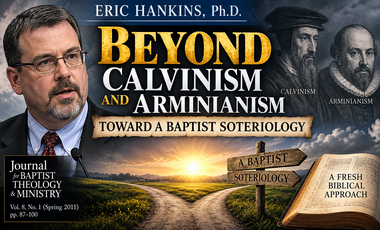
Eric Hankins, “Beyond Calvinism and Arminianism: Toward a Baptist Soteriology,”
Journal for Baptist Theology and Ministry 8, no. 1 (Spring 2011): 87–100.
Beyond Calvinism And Arminianism
Toward A Baptist Soteriology (PDF)
Eric Hankins, Ph.D.
Dr. Hankins is the Pastor of First Baptist
Church in Oxford, Mississippi.
The Claim
After four hundred years, Calvinism and Arminianism remain at an impasse. The strengths and weaknesses of both systems are well-documented, and their proponents vociferously aver each system’s mutual exclusivity. This paper is based on the observation that these two theological programs have had sufficient time to demonstrate their superiority over the other and have failed to do so. The time has come, therefore, to look beyond them for a paradigm that gives a better account of the biblical and theological data. Indeed, the stalemate itself is related not so much to the unique features of each system but to a set of erroneous presuppositions upon which both are constructed. As the fault lines in these foundational concepts are exposed, it will become clear that the Baptist vision for soteriology, which has always resisted absolute fidelity to either system, has been the correct instinct all along. Baptist theology must be willing to articulate this vision in a compelling and comprehensive manner.
The following four presuppositions shared by Calvinism and Arminianism demonstrate the degree to which a new approach to soteriology is needed. One presupposition is primarily biblical, one is primarily philosophical, one is primarily theological, and one is primarily anthropological, although each is intertwined with the others. Having established the need for a new approach to soteriology and the Baptist vision for such an approach, the paper will conclude with a brief description of a way forward.
The Biblical Presupposition:
Individual Election
The idea that God, in eternity past, elected certain individuals to salvation is a fundamental tenet of Calvinism and Arminianism. The interpretation of this biblical concept needs to be revised. Quite simply, when the Bible speaks of election in the context of God’s saving action, it is always referring to corporate election, God’s decision to have a people for Himself. When the election of individuals is raised in Scripture, it is always election to a purpose or calling within Gods plans for His people as a whole. In the OT, the writers understood election to be God’s choice of Israel, yet they also clearly taught that the benefits of corporate election could only be experienced by the individual Israelite (or the particular generation of Israelites) who responded faithfully to the covenant that had been offered to the whole nation.[1] This trajectory within the OT is unassailable. It is reinforced in the intertestamental literature and is the basis for the way election is treated in the NT.[2] The Bible, therefore, does not speak of God’s choice of certain individuals and not others for salvation.[3] When the Bible does speak of the salvation of individuals, its central concept is “faith,” never “election.”
Take away individual election, and the key components of Calvinism and Arminianism disappear.[4] God does not elect individuals to salvation on the basis of His hidden councils, nor does He elect them on the basis of His foreknowledge of their future faith. Simply put, God does not “elect” individuals to salvation. He has elected an eschatological people whom He has determined to have for Himself. This group will be populated by individuals who have responded in faith to the gracious, free offer of the gospel. The group, “the Elect,” is comprised of individuals who are “saved by faith,” not “saved by election.” This being the case, there is no longer any need for the theological maneuvering required to explain how God elects individuals without respect to their response (which evacuates the biblical concept of “faith” of all its meaning) or how He elects individuals based on foreseen faith (which evacuates the biblical concept of “election” of all its meaning).
Asserting that “individual election” should be abandoned is striking, to say the least. It is the foundation on which evangelical soteriology is often constructed.[5] It is painful to consider the enormous investment of time and energy that has been spent trying to reconcile how God chooses individuals and, at the same time, how individuals choose God, only to discover that the whole endeavor has been based on a misreading of Scripture. Nevertheless, most Baptists have never felt fully comfortable with either Calvinist or Arminian understandings of election because neither comport well with the whole counsel of God. The reason is clear. The Scriptures lead to the conclusion that Augustine, Calvin, and Arminius were simply wrong in their construction of individual election. Baptists have never been theologically or confessionally committed to these august theologians, and the time has come to move beyond them.
The Philosophical Presupposition:
The “Problem” of Determinism and Free-Will
Like Calvinism and Arminianism, the 2,500-year-old debate concerning the “problem” of determinism and free-will has also reached an impasse. This is because absolute causal determinism is untenable.[6] Put simply, the “problem” is not a problem because the paradigm for causation in the Western philosophical tradition is wrong. The whole of reality cannot be explained in terms of uni-directional causation from a single first-principle. The universe does not work that way. Causation is complex, hierarchical, and interdependent. God sits sovereignly and non-contingently atop a hierarchy that owes its existence to the functioning of the levels below it, levels that include the fully operational free-will of humans.[7] Opposing God’s sovereign guidance of the universe and the operation of free-will within that universe is a false dichotomy based on reductionistic metaphysical assumptions. God has made a free and sovereign decision to have a universe in which human free-will plays a decisive role. Human agency is one force among many that God has created to accomplish His cosmic purposes.
Free-will plays a unique role within God’s purposes for the universe because it is the unique power of human beings freely to enter into and maintain covenant relationships, especially a covenant relationship with God. This makes human willing fundamentally moral. Under certain circumstances, God, in His freedom, contravenes free-will, just as He is free to contravene any other force in nature, but this is not His normal modus operandi. Because God is God, He knows all of the free acts of humans from eternity, but this knowledge does not cause these acts nor does it make Him responsible for them. Moreover, the existence of these acts in no way impinges upon either His freedom or His ability to bring about His ultimate purposes. The ability of humans “to do otherwise” does not call God’s sovereignty into question; it actually establishes and ratifies His sovereignty over the particular universe that was His good pleasure to create. Opposing free-will and sovereignty is, from a philosophical perspective, nonsensical.[8]
Calvinism’s desire to protect God’s divine status from the infringement of human free-will by denying it completely or reducing it to some form of “soft-determinism”[9] is unnecessary. God’s corporate elective purposes are accomplished by individual free acts of faith. Arminianism’s need to inject ideas such as God’s election of individuals based on their future free acts is also a move designed to maintain both a strong view of God’s sovereignty and the free choice of individuals. Unfortunately, this move is made at the expense of any regular understanding of biblical election, which is unilateral. God does not choose Israel because He knows she will choose Him in return. He chooses her even though He knows that her history will be one of rebellion and failure. Moreover, Arminianism’s desire to protect the inviolability of free-will to the degree that God cannot keep His promise to seal a believer’s free response fails to take seriously the totality of the biblical concept of faith.
Many Baptists have tended to opt for what they think is a “compatibilist” understanding of determinism and free-will in salvation: God chooses individuals unconditionally, and individuals choose God by faith.[10] Unfortunately, compatibilism demands a deterministic view of both God and free-will with which those same Baptists would be very uncomfortable. What these Baptists really want to say is that a “determinist” view of God is compatible with a “libertarian” view of free-will, but this is philosophically impermissible. Another typical strategy of Baptists, at this point, is to appeal to “mystery” or “paradox:” We don’t know how God chooses individuals, and, at the same time, individuals choose God. But, like other complex doctrines such as the Trinity or the hypostatic union, it is still true. To say, however, that God chooses individuals unconditionally and that He does not choose individuals unconditionally is not to affirm a mystery; it is to assert a logical contradiction. Baptists need to abandon the language of compatibilism and “mystery,” which do not adequately reflect what they believe about God and salvation, and embrace the concept that a robust (soft-) libertarian free-will is the actualization of God’s sovereign direction of His universe.
The Theological Presupposition:
Federal Theology
Both Arminians and Calvinists assume a “Covenant of Works” between Adam and God in the Garden of Eden, even though there is no biblical basis for such.[11] The Covenant of Works, they assert, was a deal God made with Adam whereby Adam would be rewarded with eternal life if he could remain morally perfect through a probationary period. Failure would bring about guilt and “spiritual death,” which includes the loss of his capacity for a good will toward God. Adam’s success or failure, in turn, would be credited to his posterity. This “Federal Theology” imputes Adam’s guilt and total depravity to every human.[12] In Calvinism, actual guilt and total depravity are the plight of every person. Free-will with respect to salvation is, by definition, impossible, and with it, the possibility of a free response to God’s offer of covenant through the gospel. The only hope for salvation for any individual is the elective activity of God. In Calvinist soteriology, election is privileged above faith because regeneration must be prior to conversion. In Arminianism, the effects of Federal Theology and the Covenant of Works must be countermanded by further speculative adjustments like “prevenient grace” and election based on “foreseen faith,” a faith which is only possible because prevenient grace overcomes the depravity and guilt of the whole human race due to Adam’s failure. All this strays far beyond the biblical data. Such speculation does not emerge from clear inferences from the Bible, but is actually a priori argumentation designed to buttress Augustine, not Paul.
God’s gracious action in Christ is not “Plan B,” a “Covenant of Grace,” executed in response to Adam’s failure at “Plan A,” the “Covenant of Works.” The pre-existent Son has always been the center-point of creation and covenant. Adam was not created and placed in the Garden for the purpose of demonstrating moral perfection through his own efforts.[13]
This original “works righteousness” was read into the Garden by Pelagius and assumed by Augustine. Adam was not being called to moral perfection; he was being called into world-changing covenant relationship. The command not to eat of the tree was simply a negative construal of God’s offer for Adam to know Him and be satisfied in Him and His plan alone. It was a specific instantiation of the covenant offered to Adam and Eve in Gen. 1:26-28: In a blessed relationship with God, they were to be fruitful, multiply, fill the earth, subdue it, and rule over it.[14] In the Garden, Adam was being asked to do what Noah, Abraham, Moses, Israel, David, and, ultimately, everyone would be asked to do: trust and accept the gracious covenant offer of God in Christ for the purpose of bringing the created order to its intended conclusion. Adam and Eve were to respond to God in faith. The sensual temptation of the fruit itself came after the temptation to question God’s character and His covenant plan. It was in Adam’s rejection of God’s covenant offer that he failed to be moral. In Christ, God re-offers the covenant through successive renewals, culminating in His final offer of the gospel revealed in the life, death, and resurrection of the Incarnate Son. Adam was asked to believe God and bless the whole world, as were Noah, Abraham, Israel, David, and ultimately Christ, who succeeded where all others failed. His victory is extended to all those who put their faith in Him, just like Abraham, the father of the faithful did.[15] Covenant in Christ by faith is not “Plan B;” it is the point of the Bible.
Once again, speculation such as a Covenant of Works, Federal Theology, prevenient grace, etc. are little more than theological “fudge factors” designed to make the Augustinian synthesis work. They do not emerge from the biblical text but are a priori arguments pressed into the service of a fifth century Catholic bishop, not the authors of the Scriptures, and Baptists have never been comfortable with them. These adjustments mitigate the centrality, power, and immediacy of the biblical concept of “covenant” which has, at its heart, God’s desire for a relationship with His people through a real response of faith to the gospel of Jesus Christ. This is the nexus of Baptist soteriology.
The Anthropological Presupposition:
Total Depravity
The Scriptures clearly affirm that all people are sinners. Because of sin, humans are in a disastrous state, unable to alter the trajectory of their rebellion against God, unable to clear their debt of sin against Him, unable to work their way back to Him through their best efforts. This situation is one of their own creating and for which they are ultimately responsible.[16]
About these realities, there is little debate in evangelical theology. What is at issue is what being a sinner means when it comes to responding to God’s offer of covenant relationship through the power of the gospel.
Both Calvinism and Arminianism affirm that the Fall resulted in “total depravity,” the complete incapacitation of humanity’s free response to God’s gracious offer of covenant relationship.[17] In Calvinism, the only remedies for this state-of-affairs are the “doctrines of grace” in which the free response of individuals is not decisive. For Arminianism, total depravity, which is purely speculative, is corrected by prevenient grace, which is even more speculative, and makes total depravity ultimately meaningless because God never allows it to have any effect on any person.
Nothing in Scripture indicates that humans have been rendered “totally depraved” through Adam’s sin. Genesis 3 gives an extensive account of the consequences of Adam’s sin, but nowhere is there the idea that Adam or his progeny lost the ability to respond to God in faith, a condition which then required some sort of restoration by regeneration or prevenient grace. In fact, just the opposite appears to be the case. The story of God’s relationship with humankind is fraught with frustration, sadness, and wrath on God’s part, not because humans are incapable of a faith response, but because they are capable of it, yet reject God’s offer of covenant relationship anyway. To be sure, they are not capable of responding in faith without God’s special revelation of Himself through Christ and His Spirit’s drawing. Any morally responsible person, however, who encounters the gospel in the power of the Spirit (even though he has a will so damaged by sin that he is incapable of having a relationship with God without the gospel) is able to respond to that “well-meant offer.”
Therefore, the time has come once again for Baptists to reject another dichotomy mediated by the Calvinist/Arminian debate: monergism and synergism. Monergism insists that salvation is all of God. Monergists conclude that faith emerging from a decision within the will of the believer is a “work” that makes salvation meritorious, but this idea demands a theologically objectionable determinism. As a technical theological concept, synergism[18] still operates off of a framework that views sovereignty and free-will as problematic, often forcing too fine a distinction between “what God does” and “what man does.” Synergism tends to put “faith” in the category of performance, rather than an attitude of surrender. This has led some Arminian theology into over-speculation concerning the nature of the act of faith, psychologizing and sensationalizing the “moment of decision,” so that one’s experience becomes the basis of his assurance. Synergism also tends to demand further acts in order to receive further blessing and opens the door to the possibility that, if a person fails to act faithfully subsequent to the experience of salvation, God will cease to save.
Baptists must get off of this grid.[19] We have preferred terms like “trust,” “surrender,” and “relationship” to “monergism” or “synergism” when we reflect on God’s offer and our response. These terms secure the affirmation both that individuals can do nothing to save themselves, yet their salvation cannot occur against their wills or without a response of faith that belongs to them alone.
The Baptist Vision
So, what would a biblically-sound, Christ-centered, grace-filled soteriology look like without appeals to individual election, determinism, Federal Theology, or total depravity? What would it look like if it were free from the presuppositions of Calvinism and Arminianism? It would look exactly like what most Baptists have believed instinctively all along. Baptists have consistently resisted the impulse to embrace completely either Calvinism or Arminianism. We simply posit that we are “neither.”[20] The basis for this resistance to the two systems is our aversion to theological speculation beyond the clear sense of Scripture and our willingness to go our own way when Scripture and conscience demand. The way forward is basically backward, a massive simplification, a walking out of the convoluted labyrinth that evangelical soteriology has become in the debate between Calvinism and Arminianism. It is a move not dissimilar to the basic impulse of Luther at the birth of the Reformation, which was to reject the Medieval scholasticism that had turned the gloriously simple gospel of grace into its absolute antithesis. For Luther, the solution was to start over with the Scriptures (and Augustine), no matter what the implications. Baptists need to apply the Reformation principles of sola scriptura and semper reformanda to Luther himself. Augustine’s soteriology and the bulwark constructed subsequently to defend it must be removed.
Baptists believe in the clarity and simplicity of the Bible. We search in vain for decrees, a Covenants of Works, the distinction between a “general call” and an “effectual call,” hidden wills, and prevenient grace. We react with consternation to the ideas that God regenerates before He converts, that He hates sinners, that reprobation without respect to a response of faith brings Him the greatest glory, or that the truly converted can lose their salvation. Baptists have felt free to agree with certain emphases within Calvinism and Arminianism, while rejecting those that offend our commitments to the possibility of salvation for all and to the eternal security of that salvation based exclusively on faith in the covenant promises of God. The free offer of an eternal, life-changing covenant with the Father through the Son by the Spirit to all sinners by the free exercise of personal faith alone has been the simple, non-speculative but inviolable core of Baptist soteriological belief and practice. Baptist soteriology (specifically including the doctrines of the sovereign, elective purposes of God, the sinfulness of all humans, the substitutionary atonement of Christ, salvation by grace alone through faith alone, and the security of the believer) is not in jeopardy and does not need to be reinforced by Calvinism or Arminianism. It can be successfully taught, maintained, and defended without resorting to either system.
It has been typical of Baptists to believe that anyone who reaches the point of moral responsibility has the capacity to respond to the gospel. While all persons are radically sinful and totally unable to save themselves, their ability to “choose otherwise” defines human existence, including the ability to respond to the gospel in faith or reject it in rebellion. God initiates the process; He imbues it with His Spirit’s enabling. When people respond in faith, God acts according to His promises to seal that relationship for eternity, welding the will of the believer to His own, setting the believer free by His sovereign embrace. Our assurance of salvation comes not from a “sense” that we are elect or from our persistence in holy living. Assurance comes from the simple, surrendered faith that God keeps every one of His promises in Christ Jesus.
Baptists’ historical insistence on believer’s baptism is a solid indicator of our soteriological instinct. Historically, neither Calvinism nor Arminianism had a correct word for infant baptism because both were burdened with the justification for total depravity, original sin, and individual election. For many Arminians (like those in the Wesleyan tradition), infant baptism functions with reference to original sin and prevenient grace and plays a role in the faith that God “foresees.”[21] For many Calvinists, infant baptism has become an extremely odd vehicle by which they deal with the fate of infants, an issue that is illustrative of the fundamental inadequacy of the system. If Calvinism is true, then its own logic demands that at least some infants who die before reaching the point of moral responsibility spend eternity in hell.[22] By and large, Calvinists do not want to say this and will go to great lengths to avoid doing so.[23] Covenant Theology and infant baptism have been the preferred method for assuring (at least Christian) parents that they can believe in original guilt and total depravity and still know that their children who die in infancy will be with them in heaven. While Baptist Calvinists and Arminians do not allow for infant baptism, the fact that their systems allow for and even advocate it is telling.
Prevenient grace and Covenant Theology have never played a role in Baptist theology. This frees us to deal biblically with the issue of infant baptism: it is simply a popular vestige of Roman Catholic sacramentalism that the Magisterial Reformers did not have either the courage or theological acuity to address. Privileging election necessarily diminishes the significance of the individual response of faith for salvation, thus creating room for infant baptism and its theological justification. But with faith as the proper center of Baptist soteriology, infant baptism has never made any sense. Our distinctive understanding of the ordinance of baptism celebrates the centrality of the individual’s actual response of faith to the free offer of the gospel.
Finally, Baptists’ historic passion for evangelism and missions is underdetermined by Calvinism and Arminianism. For Calvinism, if the decision about who is saved and who is not has already been made by God, then the actual sharing of the gospel with the lost does not matter. The vast majority of Calvinists strenuously object to this charge, employing a variety of tactics to obviate what is, unfortunately, the only logical conclusion of their system. Saying that God elects the “means” of salvation as well as the individuals who are saved demands a determinism that is theologically unacceptable and philosophically unsustainable. Insisting that evangelism is still necessary because it “glorifies God” and demonstrates obedience to the Scriptures is simply a variation of that same determinism. The historical struggles of Calvinism with doctrinal and attitudinal opposition to missions and the “promiscuous preaching of the gospel” is evidence of the weakness of their system. Insisting on a “well-meant offer” while at the same time insisting that not all are able to respond is not the affirmation of a “mystery;” it is stubborn fidelity to a logical contradiction. For Arminianism, if election is based on foreseen faith, then it must be assumed that every person will receive enough of the gospel to trust or reject Christ. We know that billions still have not heard the gospel. This privileges the effort of the faith-capacity of people over the power of the gospel alone to save. If all people have the ability to figure out some form of faith in Christ, why worry overmuch about evangelism? It is this sort of weakness that lends itself to the frequent liberal trend in Arminianism.
Baptist anthropology affirms that, because of personal sinfulness, no one is capable of coming to faith in Christ without the proclamation of the gospel in the power of the Spirit. While there are certainly unique instances of individuals receiving the gospel through dreams and non-human proclamation, this is not God’s normal manner of working and those instances of salvation still require both a proclamation of Jesus as Lord and a response of faith. Baptists believe that the proclamation of the gospel is necessary for a faith response to Christ. Those who do not hear will not be saved. Everyone who does hear has the opportunity to respond to Christ in faith or persist in unbelief. This is the only proper biblical motivation for the urgent proclamation of the gospel. Baptists have excelled in evangelism and missions because we believe it really matters.
It is safe to say that Federal Theology, Eternal Decrees, Covenants of Works, Grace, and Redemption, and prevenient grace have played essentially no major role in the expansion of the Baptist witness, especially among Southern Baptists, from the late nineteenth through the late twentieth centuries. This is not because ordinary Baptists are unintelligent or simplistic in their beliefs; it is because ordinary Baptists have played a significant role in the direction of denominational identity, and they have been serious about what the Bible plainly does and does not say. In the older Baptist confessions and in the writings of older Baptist heroes like Spurgeon, Fuller, and Carey, echoes of the doctrinal speculation above can be heard, but they sit uncomfortably with the strong affirmations of the opportunity of everyone to respond in faith to the preaching of the gospel and the inability of any believer to fall away. In the Baptist Faith and Message, such problematic speculation disappears completely.[24] Baptists have known that these things were unnecessary for the articulation of God’s unstoppable plan to redeem the whole world through the bold proclamation of salvation in Christ alone by faith alone. From the beginning, the work of Christ in creation and redemption for the purpose of covenant relationship with humankind has always been the center of the biblical narrative. There is no need for an alternate metanarrative of secret decrees and hidden covenants to sort out the history of redemption. The plot of God’s purpose for humankind can be found right on the surface of the text from Genesis 1 to Revelation 22, all summed up succinctly in John 3:16.[25]
Without committing to either Calvinism or Arminianism, Baptists have evangelized millions, planted thousands of churches, and reached literally around the globe the with life-changing, world-changing message of salvation by grace through faith. When either system has come to the forefront in debate or dispute, the outcome has rarely been positive for kingdom work through us. Baptists have been well-served by a simpler, less-speculative, less metaphysical approach to soteriology. As we move into a new millennium, a more constructive, positive statement of our soteriology based on this heritage of simplicity and faith-focus will sharpen us as to what is essential to the message and motivation of the gospel for all who stand in desperate need of it.
A Baptist Soteriology
So, what would a soteriology based on the Baptist vision look like? The four presuppositions discussed above, indeed, provide a sound framework upon which the Baptist vision could be set. Around the core biblical principle of faith, the philosophical principle of God’s purpose for human free-will, the theological principle of “covenant in Christ alone,” and the anthropological principle of the sinfulness and salvability of every person could be arranged. It is interesting that, in actual practice, these key concepts are identical with the emphases in the most widely used personal evangelism tools in Baptist life. F.A.I.T.H. Evangelism, Continuing Witness Training, Evangelism Explosion, The Four Spiritual Laws, and Share Jesus without Fear all highlight (1) faith in Christ, unpacking such faith as (2) the absolute necessity of a personal, individual response of repentance and trust, (3) an entry into God’s holy and loving, eternal purposes in the person and work of Christ alone, and (4) available for anyone who will admit his radical sinfulness and inability to save himself.[26] In none of these gospel presentations is there even a hint of the issues of election, determinism, Federal Theology, or total depravity. In such gospel witness, the principle of lex orandi, lex credendi is a helpful reminder that our actual evangelistic practices are crucial indicators of what we truly believe about soteriology.
The Biblical Presupposition:
Individual Faith
The central biblical presupposition for a Baptist soteriology is, therefore, “faith” (Eph. 2.89). “Election” is a term that belongs properly in the Doctrine of God. Faith captures the fundamentally relational nature of NT soteriology. “Justification by faith,” which lies at the center of Protestant soteriological identity, speaks of the initiating and sustaining activity of God in bringing an individual into right relationship with Himself and the necessity of the individual’s response for God’s justifying work to be actualized in his life. While the totality of justification has numerous aspects (past, present, future, spiritual, physical, individual, moral, social, ecclesiological, cosmic, etc.), it does not happen without personal faith. Faith has a variety of nuances as well, but, ultimately, it is an act of the will that belongs to the believer. It is not a “gift” God gives to some and not others. When we call people to salvation, we emphasize the biblical concept of faith, not election.
The Philosophical Presupposition:
The Freedom of God and the Free-Will of People
The manner in which biblical faith functions in creation is this: God sovereignly and freely made a universe in which the free-will of humans plays a decisive role in His ultimate purposes for that universe (Rom. 10:9-10). Without free-will, there is no mechanism for the defeat of sin and evil, no mechanism for covenant relationship, no mechanism for a world-changing, world-completing partnership between God and His people. For Baptists, faith has never been something that occurs without our willing. We deny that people’s eternal destinies have been fixed without respect to a free-response of repentance and faith. We preach that the decision of each individual is both possible and necessary for salvation.
The Theological Presupposition:
Covenant in Christ
In a Baptist soteriology, Christ is the central object of belief. He is believed as the mediator of covenant relationship, the full expression of the kingdom of God, eternal life, God’s ultimate purpose for everyone and for the cosmos (John 3:16). We have no interest in a series of extra-biblical covenants created to bolster a soteriology that does not take seriously the necessity of personal faith as an expression of free-will. In our preaching, we do not burden people with the calculus of covenants of works, grace, and redemption. We do not invite people to believe in Calvinism or Arminianism. We offer Christ alone, the only hope of Adam, Noah, Abraham, the Patriarchs, Moses, David, Israel, and the whole of humankind. His perfect life, substitutionary death, and victorious resurrection comprise the object of confession and belief that is sufficient to save (John 14:6, Rom. 10.9-10).
The Anthropological Presupposition:
The Sinfulness and Salvability of Everyone
Finally, the anthropological presupposition is that no one can save himself, but anyone can be saved (Rom. 3:23). No person ever takes the first step toward God. Humankind’s history is broken; its destiny is death; it’s context darkness; its reality is rebellion. This sinfulness has put us out of fellowship with God and under the verdict of eternal separation (Rom. 6.23). Through the person and work of Christ, which is proclaimed through the gospel, God reaches out His hand of “first love,” providing a ground of salvation to which any one can respond in faith. If people do not hear and respond to this gospel, they will not be saved. So, we preach the gospel broadly, regularly, and passionately. We offer an invitation every time we preach because we believe every unbeliever, no matter how sinful and broken, can respond, and no matter how moral and self-righteous, must respond (Rev. 3:20).
These four pillars are the super-structure of the soteriology that has driven Baptist preaching, evangelism, and missions. It is the basis for life in Christ and the way of discipleship. Into this matrix, the totality of biblical soteriological language can be fed, but no other single concept can be allowed to dominate doctrinal development to such a degree that one or more of these emphases are abandoned or effectively neutralized. From these fixed-points of Baptist soteriology, such issues as the effects of the Fall, the order of salvation in its various dimensions, and other important implications can be discussed in full. In this construction, election is an important but tangential and transitional concept, connecting the borders of soteriology, ecclesiology, eschatology, and theology proper. Faith, however, must stand at the center of Baptist soteriology, so that we might proclaim to all with firm conviction: “Believe on the name of the Lord Jesus Christ, and you will be saved” (Acts 16:31).
FOOTNOTES
[1] See, for instance, Deut. 29:14-21. Israel is reaffirming the covenant promised to the patriarchs and to future generations. However, if there is an individual man or woman who boasts, “I have peace with God though I walk in the stubbornness of my heart,” the Lord will “single him out” from the people for destruction (vv. 18-21, NASB). Although the covenant is for the whole community, the individual must respond in faith in order to benefit from those corporate covenant promises.
[2] Critics of the corporate view of election will quickly raise Rom. 8:29-30 and 9-11 (among others) in defense of their position, but the pre-temporal election of individuals is not Paul’s purpose there. Rom. 8:29-30 is setting up Paul’s point in chapters 9-11 about two groups: Jews and Gentiles. The end of Romans 8 crescendos with the greatness of salvation in Christ. Verses 29-30 articulate God’s actions toward His people from beginning to end in order to bring about His ultimate “purpose” (28): God knew He was going to have a people; He determined to bring them into existence in Christ; He actualized that people in history through His call; He justified them by faith; He has determined to bring them into resurrection glory. In light of this incredible plan to have this kind of people for Himself, Paul is heartbroken at the beginning of Romans 9 that his Jewish brothers have responded to the gospel with unbelief. The Jews appear to be “out,” and the Gentiles appear to be “in.” But God works in unexpected ways. Jews are “out” now so that the Gentiles can come “in.” But the Gentiles coming “in” will ultimately cause the Jews to come “in” at the proper time. That is why Paul will continue to preach the gospel to Jews as a part of his mission to the whole world, looking forward to the response of a remnant by faith. One thing is certain: Romans 9-11 is not teaching the election of some individuals and the reprobation of others without respect to their genuine response of faith. Ephesians 1:4, 5, and 11 function in Ephesians 2 the same way that Rom. 8:29-30 functions in Romans 9-11.
[3] See William W. Klein, The New Chosen People: A Corporate View of Election (Eugene, OR: Wipf and Stock, 2001), 257–63 for an extended exegetical analysis of all the relevant biblical data concerning the concept of “corporate election.” Klein argues that there is not a single verse or overarching tendency in the Scriptures in support of the idea that God chooses certain individuals for salvation.
[4] Indeed, if “individual election” is what the writers of the NT meant, then Calvinism and Arminianism really are the only options, and Baptists should pick one and move on to other matters. It is significant that we have been unwilling to do so.
[5] For example, if individual election to salvation were removed from Millard Erickson’s massive systematic theology, there would be essentially nothing left in his chapters on “God’s Plan” and those in the whole section on “Salvation.” See Millard J. Erickson, Christian Theology, 2d ed. (Grand Rapids: Baker, 1998).
[6] Kenneth Keathley, Salvation and Sovereignty: A Molinist Approach (Nashville: B&H Academic, 2010), 93–99.
[7] Nancey Murphy, “Introduction and Overview,” in Downward Causation and the Neurobiology of Free Will, ed. Nancey Murphy, George F. R. Ellis, and Timothy O’Connor (Berlin: Springer-Verlag, 2009), 2–3.
I change up footnote 8 a bit. I add the fuller quote from Lewis as well as a bit of a summary of it
[8] C. S. Lewis, Yours, Jack: Spiritual Directions from C. S. Lewis, ed. Paul Ford (New York: HarperCollins, 2008), 186. Lewis provides a helpful perspective on the traditional debate between divine sovereignty and human freedom. He writes:
“All that Calvinist question—Free-Will and Predestination, is to my mind undiscussable, insoluble. Of course (say us) if a man repents God will accept him. Ah yes, (say they) but the fact of his repenting shows that God has already moved him to do so. This at any rate leaves us with the fact that in any concrete case the question never arrives as a practical one. But I suspect it is really a meaningless question. The difference between Freedom and Necessity is fairly clear on the bodily level: we know the difference between making our teeth chatter on purpose and just finding them chattering with cold. It begins to be less clear when we talk of human love (leaving out the erotic kind). ‘Do I like him because I choose or because I must?’—there are cases where this has an answer, but others where it seems to me to mean nothing. When we carry it up to relations between God and Man, has the distinction perhaps become nonsensical? After all, when we are most free, it is only with a freedom God has given us: and when our will is most influenced by Grace, it is still our will. And if what our will does is not ‘voluntary,’ and if ‘voluntary’ does not mean ‘free,’ what are we talking about? I’d leave it all alone. Blessings.”
RPT SUMMARY: Lewis is not attempting here to construct a systematic doctrine of free will or to resolve the Calvinist-Arminian controversy. Rather, his point is that the categories of “freedom” and “necessity,” while relatively clear when applied to physical actions, become increasingly difficult to apply to human willing and ultimately to the relationship between God and humanity. Divine influence upon the human will does not necessarily make the resulting action something other than the person’s own voluntary action; indeed, Lewis insists that even when the will is most influenced by grace, “it is still our will.” Thus, the attempt to force divine grace and human freedom into a simple opposition between “necessity” and “freedom” may itself rest upon a category mistake.
This observation is consistent with Lewis’s broader treatment of divine goodness and human wickedness in The Problem of Pain. In chapter 3, “Divine Goodness,” Lewis argues that God’s goodness cannot be defined as merely the human notion of kindness or as something wholly unrelated to the moral categories available to human beings. God’s goodness is greater and more complete than ours, but it is not its opposite. He therefore maintains that God’s purposes may involve painful correction and transformation without ceasing to be expressions of divine love. In chapter 4, “Human Wickedness,” Lewis grounds the need for such divine correction in humanity’s misuse of free will: human beings have “used [their] free will to become very bad,” and the Christian message begins with the recognition that humanity requires moral and spiritual healing.
This makes Lewis’s language in Yours, Jack especially significant. Lewis himself says he “suspect[s]” that the question is “meaningless” and asks whether the distinction between freedom and necessity has “perhaps become nonsensical.” The qualified language is important. He is not making an unqualified declaration that the Calvinist-Arminian debate is meaningless, nor is he presenting a systematic argument for libertarian free will. Rather, he is questioning whether the philosophical categories being used are adequate to describe the relationship between God’s grace and a genuinely willing human response. His larger theology in The Problem of Pain nevertheless treats human beings as morally responsible agents who have genuinely misused their freedom and therefore genuinely require transformation. Divine influence and human willing are consequently not presented as simple opposites. Lewis provides philosophical support for distinguishing God’s gracious influence from coercion, without necessarily settling the larger question of exactly how divine sovereignty and human freedom relate
[9] “Soft-determinism” is the view that humans are free to do what they desire most, but they are not free to choose what they desire. Since, “the good” is off the table as an object of desire (because of the Fall), “evil” is the only option left, and therefore, humans always “choose” to do evil because they cannot do otherwise. “Soft-libertarianism” (mentioned below) is the view that human freedom, while limited in many aspects by environment and prior choices, is still characterized by the ability, often at crucial moments, to choose between two live options for which the agent is responsible. For a more full discussion, see Keathley, Salvation and Sovereignty, 63–79.
[10] This often expressed in the old saw that “Whosoever will may come” is written over the entry into heaven, but, once inside, the verse over the door reads, “you did not choose Me, but I have chosen you.”
[11] William J. Dumbrell, Covenant and Creation: A Theology of Old Testament Covenants (Eugene, OR: Wipf and Stock, 2009), 44–6, Reprint.
[12] The principle text for Federal Theology is Rom. 5.12-21, but the evidence within this text and its place within the argument of Romans speaks against such an interpretation. The strict parallelism between Adam and “all” demands a strict parallelism between Christ and “all,” necessitating universalism, which is not possible theologically and not the point exegetically. Paul’s focus in the passage is clearly on physical death and eternal life, not the imputation of Adam’s guilt to all people (the same is true for Eph. 2:1-7 and 1 Cor. 15:20-28). Paul’s point: Adam’s sin brought in the condemnation of death for all people. All people demonstrate that they deserve such condemnation by their own sin. Christ, the sinless one, has overthrown that condemnation by receiving it undeservedly into Himself, which is the ultimate act of obedience, and rising again. All who ratify Christ’s obedient life, death, and resurrection with their faith in Him will have eternal life.
[13] This is not to say that perfect obedience was not the standard; it was just not the point. True obedience is the expression of covenant faithfulness and utter dependence on God.
[14] Eugene H. Merrill, Everlasting Dominion: A Theology of the Old Testament (Nashville: Broadman and Holman, 2006), 17.
[15] In Gal. 3:8, Paul states quite clearly and without any need for further explanation that “The Scripture, foreseeing that God would justify the Gentiles by faith, preached the gospel beforehand to Abraham saying, ‘ALL THE NATIONS OF THE EARTH WILL BE BLESSED IN YOU.’” This single covenant in Christ is also in view in 1 Cor. 10:4: “. . . and all [Israel] drank the same spiritual drink, for they were drinking from a spiritual rock which followed them; and the rock was Christ.”
[16] Paul’s point in Rom. 1-3, the locus classicus of human sinfulness, is not that people cannot respond to God, but that they will not, even though the results lead to their utter ruin.
[17] Ephesians 2:1 and 5 are frequently cited in support of this view, with a focus on the phrase “dead in your trespasses.” “Dead” here is taken to mean “spiritually” dead, utterly unresponsive to spiritual things. This reading, however, does not work exegetically. Paul’s point in 2.1-7 is that Jews and Gentiles alike were in the same sorry situation and in need of the resurrected and ascended Christ. If Paul means that everyone was “spiritually” dead, then he must also mean that everyone was made “spiritually” alive “with Him.” Does this mean that Jesus was, at some point, incapable of a response to God? Is Paul’s point that Jesus is now “spiritually” alive, responsive to God? Are we now “spiritually” raised and seated with Him in heavenly places? What could this possibly mean? Clearly, Paul is speaking eschatologically here: “Before we trusted Christ our destiny was the condemnation of death. Our behavior confirmed that we were deserving of that sentence. But now our destiny is bound up with His destiny so that ‘in ages to come’ the inclusion of sinners like us will put God’s unbelievable grace on display. How did we come to belong to Christ? By faith.” Paul’s point is not that we are incapable of faith without “regeneration.” His point is that Christ has made a way for those deserving of death to have eternal life, no matter what their ethnicity or level of religious effort. Moreover, if Paul thought that Adam’s sin resulted in spiritual death/total depravity for everyone else, how could he write in Rom. 7:9: “I was once alive apart from the Law”?
[18] “Synergism,” to be sure, would be the category to which the soteriological viewpoint of this paper belongs, if we persist in using these categories, because monergism, in the true sense of the term, in untenable. Unfortunately, this word has theological associations that Baptists reject. Synergism is often considered to be the functional equivalent of semi-Pelagianism, which throws the whole discussion back into abstruse arguments about “operative” and “cooperative” grace, “general” and “effectual” calling, facere quod in se est, etc. forcing us to approach soteriology from Augustinian and medieval Roman Catholic categories rather than biblical ones. Monergism and synergism have simply outlived their usefulness.
[19] See Keathley, Salvation and Sovereignty, 101–8. After thoroughly dismantling the determinism of Calvinism, Keathley, a Baptist theologian, still wants to retain the term “monergism,” qualifying it with his assertion that people can still refuse God’s grace. But if one’s refusal matters, then salvation is not monergistic. Any Calvinist worth his salt would agree. Persisting in the use of the term “monergism” and in defending the logically contradictory concept that “what man does matters and what man does doesn’t matter” is unhelpful.
[20] Malcolm yarnell, Neither Calvinists Nor Arminians but Baptists, White Paper 36 (Ft. Worth, TX: Center for Theological Research, 2010), 7.
[21] The question remains, however, concerning how God foresees faith in the child that dies in infancy. Now God is making decisions based on possibilities rather than actualities, which is extremely problematic. In Arminian traditions that do not practice infant baptism, the tendency toward belief in baptismal regeneration or subsequent Spirit-baptism over-emphasizes human effort in the understanding of free-will over against God’s sovereignty.
[22] Adam Harwood, The Spiritual Condition of Infants: A Biblical-Historical Survey and Systematic Proposal (Eugene, OR: Wipf and Stock, 2011), 23.
[23] R. Albert Mohler, Jr. and Daniel L. Akin, “The Salvation of the ‘Little Ones:’ Do Infants Who Die Go to Heaven?” [article on-line]; June 16, 2009 AlbertMohler.com; Mohler and Akin’s argument is that all infants who die are elect. It is an astounding display of a priori reasoning that runs like this: Since Calvinism is true and since we don’t want to say that some infants go to hell, all infants who die must be elect (even though there is no biblical basis for such a claim).
[24] Malcolm yarnell, “The TULIP of Calvinism in Light of History and the Baptist Faith and Message,” SBC Life, April 2006.
[25] Jerry Vines, “Sermon on John 3:16,” in Whosoever Will, ed. David L. Allen and Steve W. Lemke (Nashville: B&H Academic, 2010), 13–15.
[26] The scriptural basis for each soteriological presupposition discussed below is drawn from the scripture references most common to these gospel presentations.