Early Spurgeon vs. Late Spurgeon

  • 1858 — Spurgeon is 24 and makes his extremely strong anti-Arminian statement.
  • 1862 — age 28, he says there is truth in both Calvinism and Arminianism.
  • 1876 — age 42, he says the Calvinist is right on some points and the Arminian on others.
  • 1881 — age 47, he says he is content being called an “Arminian Calvinist” or “Calvinistic Arminian,” provided he stays close to Scripture.

That and the below is adapted from Andrew Hnatiuk

This is what I mean when I talk about “early” and “late” Spurgeon.

When Spurgeon was a young pastor, taking over the now-famous New Park Street Chapel at just 19 years old, he could speak about Calvinism with remarkable certainty. At 22, he famously said:

“Calvinism is the gospel, and nothing else.”

Two years later, at 24, he could say:

“A mutable god may be the god for the Arminian—he is not the god for me.”

But something changed as Spurgeon grew older.

As he matured in his faith, spent years shepherding a congregation, and rubbed shoulders with actual people in the pews, his language became considerably more nuanced. He didn’t simply abandon Calvinism, but he became increasingly unwilling to force every biblical text into a theological system.

At 28, he put it this way:

“There is some truth in Calvinism and some in Arminianism, and he who would hold the whole Truth of God must neither be cramped by the one system nor bound by the other, but take Truth wherever he can find it in the Bible.”

That is a significant change from the young Spurgeon who could confidently declare, “Calvinism is the gospel, and nothing else.”

And Spurgeon continued moving in this direction.

“Preaching Like an Arminian, but Sleeping as a Calvinist”

By 1876, at the age of 42, Spurgeon reflected on the long-running debate between Calvinists and Arminians and acknowledged that both sides had captured important truths—and that both sides had also fallen into error.

He wrote:

“There has long been a great doctrinal discussion between the Calvinists and the Arminians upon many important points. I am myself persuaded that the Calvinist alone is right upon some points, and the Arminian alone is right upon others. There is a great deal of truth in the positive side of both systems, and a great deal of error in the negative side of both.”

Then he made the point even more plainly:

“If I was asked, ‘Why is a man damned?’ I should answer as an Arminian answers, ‘He destroys himself.’”

This is the Spurgeon I have in mind when I distinguish between early and late Spurgeon. The one who said in an 1863 sermon The Minister’s Stock-Taking contains language that sounds remarkably different from his 1858 rhetoric:

“Do I hear some one say, ‘Why, that is Arminianism!’ Precisely so.”

The older Spurgeon was still unmistakably Calvinistic in many respects, but he was increasingly uncomfortable with the idea that every biblical statement had to conform neatly to either the Calvinist or Arminian system.

“An Arminian Calvinist or a Calvinistic Arminian”

By 1881, Spurgeon was 47 years old, and his position had become even more explicit.

He had been called both “an Arminian Calvinist” and “a Calvinistic Arminian”—and, rather remarkably, he didn’t seem particularly bothered by either label.

Instead, his concern was whether his theology remained faithful to Scripture.

“What a host of revised versions we have! Everybody has one of his own. Certain texts which will not fit into our system must be planed and cut down. Have you ever seen the hard work that some Brethren have to shape a Scripture to their mind? One text is not Calvinistic, it looks rather Arminian—of course it cannot be so and, therefore, they twist and tug to get it right. As for our Arminian Brethren, it is wonderful to see how they hammer away at the 9th Chapter of Romans—steam-hammers and screw-jacks are nothing to their appliances for getting rid of Election from that chapter! We have all been guilty of racking Scripture, more or less, and it will be well to have done with the evil, forever! We had far better be inconsistent with ourselves than with the Inspired Word of God.”

And then Spurgeon gives us the key to understanding the whole progression:

“I have been called an Arminian Calvinist or a Calvinistic Arminian and I am quite content so long as I can keep close to my Bible. I desire to preach what I find in this Book whether I find it in anybody else’s book or not.”

That, to me, is the crucial distinction.

The question isn’t whether Spurgeon remained a Calvinist. Clearly, much of his theology remained deeply Calvinistic. The more interesting question is whether the later Spurgeon was willing to let Scripture challenge the boundaries of his theological system.

And by his own words, the answer appears to be yes.

He would rather be “inconsistent” with his theological system than inconsistent with the inspired Word of God.

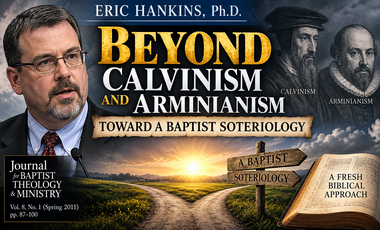
A Baptist Soteriology | Pastor Eric Hankins

Eric Hankins, “Beyond Calvinism and Arminianism: Toward a Baptist Soteriology,”

Journal for Baptist Theology and Ministry 8, no. 1 (Spring 2011): 87–100.


Beyond Calvinism And Arminianism
Toward A Baptist Soteriology (PDF)

Eric Hankins, Ph.D.

Dr. Hankins is the Pastor of First Baptist
Church in Oxford, Mississippi.


The Claim

After four hundred years, Calvinism and Arminianism remain at an impasse. The strengths and weaknesses of both systems are well-documented, and their proponents vociferously aver each system’s mutual exclusivity. This paper is based on the observation that these two theological programs have had sufficient time to demonstrate their superiority over the other and have failed to do so. The time has come, therefore, to look beyond them for a paradigm that gives a better account of the biblical and theological data. Indeed, the stalemate itself is related not so much to the unique features of each system but to a set of erroneous presuppositions upon which both are constructed. As the fault lines in these foundational concepts are exposed, it will become clear that the Baptist vision for soteriology, which has always resisted absolute fidelity to either system, has been the correct instinct all along. Baptist theology must be willing to articulate this vision in a compelling and comprehensive manner.

The following four presuppositions shared by Calvinism and Arminianism demonstrate the degree to which a new approach to soteriology is needed. One presupposition is primarily biblical, one is primarily philosophical, one is primarily theological, and one is primarily anthropological, although each is intertwined with the others. Having established the need for a new approach to soteriology and the Baptist vision for such an approach, the paper will conclude with a brief description of a way forward.

The Biblical Presupposition:
Individual Election

The idea that God, in eternity past, elected certain individuals to salvation is a fundamental tenet of Calvinism and Arminianism. The interpretation of this biblical concept needs to be revised. Quite simply, when the Bible speaks of election in the context of God’s saving action, it is always referring to corporate election, God’s decision to have a people for Himself. When the election of individuals is raised in Scripture, it is always election to a purpose or calling within Gods plans for His people as a whole. In the OT, the writers understood election to be God’s choice of Israel, yet they also clearly taught that the benefits of corporate election could only be experienced by the individual Israelite (or the particular generation of Israelites) who responded faithfully to the covenant that had been offered to the whole nation.[1] This trajectory within the OT is unassailable. It is reinforced in the intertestamental literature and is the basis for the way election is treated in the NT.[2] The Bible, therefore, does not speak of God’s choice of certain individuals and not others for salvation.[3] When the Bible does speak of the salvation of individuals, its central concept is “faith,” never “election.”

Take away individual election, and the key components of Calvinism and Arminianism disappear.[4] God does not elect individuals to salvation on the basis of His hidden councils, nor does He elect them on the basis of His foreknowledge of their future faith. Simply put, God does not “elect” individuals to salvation. He has elected an eschatological people whom He has determined to have for Himself. This group will be populated by individuals who have responded in faith to the gracious, free offer of the gospel. The group, “the Elect,” is comprised of individuals who are “saved by faith,” not “saved by election.” This being the case, there is no longer any need for the theological maneuvering required to explain how God elects individuals without respect to their response (which evacuates the biblical concept of “faith” of all its meaning) or how He elects individuals based on foreseen faith (which evacuates the biblical concept of “election” of all its meaning).

Asserting that “individual election” should be abandoned is striking, to say the least. It is the foundation on which evangelical soteriology is often constructed.[5] It is painful to consider the enormous investment of time and energy that has been spent trying to reconcile how God chooses individuals and, at the same time, how individuals choose God, only to discover that the whole endeavor has been based on a misreading of Scripture. Nevertheless, most Baptists have never felt fully comfortable with either Calvinist or Arminian understandings of election because neither comport well with the whole counsel of God. The reason is clear. The Scriptures lead to the conclusion that Augustine, Calvin, and Arminius were simply wrong in their construction of individual election. Baptists have never been theologically or confessionally committed to these august theologians, and the time has come to move beyond them.

The Philosophical Presupposition:
The “Problem” of Determinism and Free-Will

Like Calvinism and Arminianism, the 2,500-year-old debate concerning the “problem” of determinism and free-will has also reached an impasse. This is because absolute causal determinism is untenable.[6] Put simply, the “problem” is not a problem because the paradigm for causation in the Western philosophical tradition is wrong. The whole of reality cannot be explained in terms of uni-directional causation from a single first-principle. The universe does not work that way. Causation is complex, hierarchical, and interdependent. God sits sovereignly and non-contingently atop a hierarchy that owes its existence to the functioning of the levels below it, levels that include the fully operational free-will of humans.[7] Opposing God’s sovereign guidance of the universe and the operation of free-will within that universe is a false dichotomy based on reductionistic metaphysical assumptions. God has made a free and sovereign decision to have a universe in which human free-will plays a decisive role. Human agency is one force among many that God has created to accomplish His cosmic purposes.

Free-will plays a unique role within God’s purposes for the universe because it is the unique power of human beings freely to enter into and maintain covenant relationships, especially a covenant relationship with God. This makes human willing fundamentally moral. Under certain circumstances, God, in His freedom, contravenes free-will, just as He is free to contravene any other force in nature, but this is not His normal modus operandi. Because God is God, He knows all of the free acts of humans from eternity, but this knowledge does not cause these acts nor does it make Him responsible for them. Moreover, the existence of these acts in no way impinges upon either His freedom or His ability to bring about His ultimate purposes. The ability of humans “to do otherwise” does not call God’s sovereignty into question; it actually establishes and ratifies His sovereignty over the particular universe that was His good pleasure to create. Opposing free-will and sovereignty is, from a philosophical perspective, nonsensical.[8]

Calvinism’s desire to protect God’s divine status from the infringement of human free-will by denying it completely or reducing it to some form of “soft-determinism”[9] is unnecessary. God’s corporate elective purposes are accomplished by individual free acts of faith. Arminianism’s need to inject ideas such as God’s election of individuals based on their future free acts is also a move designed to maintain both a strong view of God’s sovereignty and the free choice of individuals. Unfortunately, this move is made at the expense of any regular understanding of biblical election, which is unilateral. God does not choose Israel because He knows she will choose Him in return. He chooses her even though He knows that her history will be one of rebellion and failure. Moreover, Arminianism’s desire to protect the inviolability of free-will to the degree that God cannot keep His promise to seal a believer’s free response fails to take seriously the totality of the biblical concept of faith.

Many Baptists have tended to opt for what they think is a “compatibilist” understanding of determinism and free-will in salvation: God chooses individuals unconditionally, and individuals choose God by faith.[10] Unfortunately, compatibilism demands a deterministic view of both God and free-will with which those same Baptists would be very uncomfortable. What these Baptists really want to say is that a “determinist” view of God is compatible with a “libertarian” view of free-will, but this is philosophically impermissible. Another typical strategy of Baptists, at this point, is to appeal to “mystery” or “paradox:” We don’t know how God chooses individuals, and, at the same time, individuals choose God. But, like other complex doctrines such as the Trinity or the hypostatic union, it is still true. To say, however, that God chooses individuals unconditionally and that He does not choose individuals unconditionally is not to affirm a mystery; it is to assert a logical contradiction. Baptists need to abandon the language of compatibilism and “mystery,” which do not adequately reflect what they believe about God and salvation, and embrace the concept that a robust (soft-) libertarian free-will is the actualization of God’s sovereign direction of His universe.

The Theological Presupposition:
Federal Theology

Both Arminians and Calvinists assume a “Covenant of Works” between Adam and God in the Garden of Eden, even though there is no biblical basis for such.[11] The Covenant of Works, they assert, was a deal God made with Adam whereby Adam would be rewarded with eternal life if he could remain morally perfect through a probationary period. Failure would bring about guilt and “spiritual death,” which includes the loss of his capacity for a good will toward God. Adam’s success or failure, in turn, would be credited to his posterity. This “Federal Theology” imputes Adam’s guilt and total depravity to every human.[12] In Calvinism, actual guilt and total depravity are the plight of every person. Free-will with respect to salvation is, by definition, impossible, and with it, the possibility of a free response to God’s offer of covenant through the gospel. The only hope for salvation for any individual is the elective activity of God. In Calvinist soteriology, election is privileged above faith because regeneration must be prior to conversion. In Arminianism, the effects of Federal Theology and the Covenant of Works must be countermanded by further speculative adjustments like “prevenient grace” and election based on “foreseen faith,” a faith which is only possible because prevenient grace overcomes the depravity and guilt of the whole human race due to Adam’s failure. All this strays far beyond the biblical data. Such speculation does not emerge from clear inferences from the Bible, but is actually a priori argumentation designed to buttress Augustine, not Paul.

God’s gracious action in Christ is not “Plan B,” a “Covenant of Grace,” executed in response to Adam’s failure at “Plan A,” the “Covenant of Works.” The pre-existent Son has always been the center-point of creation and covenant. Adam was not created and placed in the Garden for the purpose of demonstrating moral perfection through his own efforts.[13]

This original “works righteousness” was read into the Garden by Pelagius and assumed by Augustine. Adam was not being called to moral perfection; he was being called into world-changing covenant relationship. The command not to eat of the tree was simply a negative construal of God’s offer for Adam to know Him and be satisfied in Him and His plan alone. It was a specific instantiation of the covenant offered to Adam and Eve in Gen. 1:26-28: In a blessed relationship with God, they were to be fruitful, multiply, fill the earth, subdue it, and rule over it.[14] In the Garden, Adam was being asked to do what Noah, Abraham, Moses, Israel, David, and, ultimately, everyone would be asked to do: trust and accept the gracious covenant offer of God in Christ for the purpose of bringing the created order to its intended conclusion. Adam and Eve were to respond to God in faith. The sensual temptation of the fruit itself came after the temptation to question God’s character and His covenant plan. It was in Adam’s rejection of God’s covenant offer that he failed to be moral. In Christ, God re-offers the covenant through successive renewals, culminating in His final offer of the gospel revealed in the life, death, and resurrection of the Incarnate Son. Adam was asked to believe God and bless the whole world, as were Noah, Abraham, Israel, David, and ultimately Christ, who succeeded where all others failed. His victory is extended to all those who put their faith in Him, just like Abraham, the father of the faithful did.[15] Covenant in Christ by faith is not “Plan B;” it is the point of the Bible.

Once again, speculation such as a Covenant of Works, Federal Theology, prevenient grace, etc. are little more than theological “fudge factors” designed to make the Augustinian synthesis work. They do not emerge from the biblical text but are a priori arguments pressed into the service of a fifth century Catholic bishop, not the authors of the Scriptures, and Baptists have never been comfortable with them. These adjustments mitigate the centrality, power, and immediacy of the biblical concept of “covenant” which has, at its heart, God’s desire for a relationship with His people through a real response of faith to the gospel of Jesus Christ. This is the nexus of Baptist soteriology.

The Anthropological Presupposition:
Total Depravity

The Scriptures clearly affirm that all people are sinners. Because of sin, humans are in a disastrous state, unable to alter the trajectory of their rebellion against God, unable to clear their debt of sin against Him, unable to work their way back to Him through their best efforts. This situation is one of their own creating and for which they are ultimately responsible.[16]

About these realities, there is little debate in evangelical theology. What is at issue is what being a sinner means when it comes to responding to God’s offer of covenant relationship through the power of the gospel.

Both Calvinism and Arminianism affirm that the Fall resulted in “total depravity,” the complete incapacitation of humanity’s free response to God’s gracious offer of covenant relationship.[17] In Calvinism, the only remedies for this state-of-affairs are the “doctrines of grace” in which the free response of individuals is not decisive. For Arminianism, total depravity, which is purely speculative, is corrected by prevenient grace, which is even more speculative, and makes total depravity ultimately meaningless because God never allows it to have any effect on any person.

Nothing in Scripture indicates that humans have been rendered “totally depraved” through Adam’s sin. Genesis 3 gives an extensive account of the consequences of Adam’s sin, but nowhere is there the idea that Adam or his progeny lost the ability to respond to God in faith, a condition which then required some sort of restoration by regeneration or prevenient grace. In fact, just the opposite appears to be the case. The story of God’s relationship with humankind is fraught with frustration, sadness, and wrath on God’s part, not because humans are incapable of a faith response, but because they are capable of it, yet reject God’s offer of covenant relationship anyway. To be sure, they are not capable of responding in faith without God’s special revelation of Himself through Christ and His Spirit’s drawing. Any morally responsible person, however, who encounters the gospel in the power of the Spirit (even though he has a will so damaged by sin that he is incapable of having a relationship with God without the gospel) is able to respond to that “well-meant offer.”

Therefore, the time has come once again for Baptists to reject another dichotomy mediated by the Calvinist/Arminian debate: monergism and synergism. Monergism insists that salvation is all of God. Monergists conclude that faith emerging from a decision within the will of the believer is a “work” that makes salvation meritorious, but this idea demands a theologically objectionable determinism. As a technical theological concept, synergism[18] still operates off of a framework that views sovereignty and free-will as problematic, often forcing too fine a distinction between “what God does” and “what man does.” Synergism tends to put “faith” in the category of performance, rather than an attitude of surrender. This has led some Arminian theology into over-speculation concerning the nature of the act of faith, psychologizing and sensationalizing the “moment of decision,” so that one’s experience becomes the basis of his assurance. Synergism also tends to demand further acts in order to receive further blessing and opens the door to the possibility that, if a person fails to act faithfully subsequent to the experience of salvation, God will cease to save.

Baptists must get off of this grid.[19] We have preferred terms like “trust,” “surrender,” and “relationship” to “monergism” or “synergism” when we reflect on God’s offer and our response. These terms secure the affirmation both that individuals can do nothing to save themselves, yet their salvation cannot occur against their wills or without a response of faith that belongs to them alone.

The Baptist Vision

So, what would a biblically-sound, Christ-centered, grace-filled soteriology look like without appeals to individual election, determinism, Federal Theology, or total depravity? What would it look like if it were free from the presuppositions of Calvinism and Arminianism? It would look exactly like what most Baptists have believed instinctively all along. Baptists have consistently resisted the impulse to embrace completely either Calvinism or Arminianism. We simply posit that we are “neither.”[20] The basis for this resistance to the two systems is our aversion to theological speculation beyond the clear sense of Scripture and our willingness to go our own way when Scripture and conscience demand. The way forward is basically backward, a massive simplification, a walking out of the convoluted labyrinth that evangelical soteriology has become in the debate between Calvinism and Arminianism. It is a move not dissimilar to the basic impulse of Luther at the birth of the Reformation, which was to reject the Medieval scholasticism that had turned the gloriously simple gospel of grace into its absolute antithesis. For Luther, the solution was to start over with the Scriptures (and Augustine), no matter what the implications. Baptists need to apply the Reformation principles of sola scriptura and semper reformanda to Luther himself. Augustine’s soteriology and the bulwark constructed subsequently to defend it must be removed.

Baptists believe in the clarity and simplicity of the Bible. We search in vain for decrees, a Covenants of Works, the distinction between a “general call” and an “effectual call,” hidden wills, and prevenient grace. We react with consternation to the ideas that God regenerates before He converts, that He hates sinners, that reprobation without respect to a response of faith brings Him the greatest glory, or that the truly converted can lose their salvation. Baptists have felt free to agree with certain emphases within Calvinism and Arminianism, while rejecting those that offend our commitments to the possibility of salvation for all and to the eternal security of that salvation based exclusively on faith in the covenant promises of God. The free offer of an eternal, life-changing covenant with the Father through the Son by the Spirit to all sinners by the free exercise of personal faith alone has been the simple, non-speculative but inviolable core of Baptist soteriological belief and practice. Baptist soteriology (specifically including the doctrines of the sovereign, elective purposes of God, the sinfulness of all humans, the substitutionary atonement of Christ, salvation by grace alone through faith alone, and the security of the believer) is not in jeopardy and does not need to be reinforced by Calvinism or Arminianism. It can be successfully taught, maintained, and defended without resorting to either system.

It has been typical of Baptists to believe that anyone who reaches the point of moral responsibility has the capacity to respond to the gospel. While all persons are radically sinful and totally unable to save themselves, their ability to “choose otherwise” defines human existence, including the ability to respond to the gospel in faith or reject it in rebellion. God initiates the process; He imbues it with His Spirit’s enabling. When people respond in faith, God acts according to His promises to seal that relationship for eternity, welding the will of the believer to His own, setting the believer free by His sovereign embrace. Our assurance of salvation comes not from a “sense” that we are elect or from our persistence in holy living. Assurance comes from the simple, surrendered faith that God keeps every one of His promises in Christ Jesus.

Baptists’ historical insistence on believer’s baptism is a solid indicator of our soteriological instinct. Historically, neither Calvinism nor Arminianism had a correct word for infant baptism because both were burdened with the justification for total depravity, original sin, and individual election. For many Arminians (like those in the Wesleyan tradition), infant baptism functions with reference to original sin and prevenient grace and plays a role in the faith that God “foresees.”[21] For many Calvinists, infant baptism has become an extremely odd vehicle by which they deal with the fate of infants, an issue that is illustrative of the fundamental inadequacy of the system. If Calvinism is true, then its own logic demands that at least some infants who die before reaching the point of moral responsibility spend eternity in hell.[22] By and large, Calvinists do not want to say this and will go to great lengths to avoid doing so.[23] Covenant Theology and infant baptism have been the preferred method for assuring (at least Christian) parents that they can believe in original guilt and total depravity and still know that their children who die in infancy will be with them in heaven. While Baptist Calvinists and Arminians do not allow for infant baptism, the fact that their systems allow for and even advocate it is telling.

Prevenient grace and Covenant Theology have never played a role in Baptist theology. This frees us to deal biblically with the issue of infant baptism: it is simply a popular vestige of Roman Catholic sacramentalism that the Magisterial Reformers did not have either the courage or theological acuity to address. Privileging election necessarily diminishes the significance of the individual response of faith for salvation, thus creating room for infant baptism and its theological justification. But with faith as the proper center of Baptist soteriology, infant baptism has never made any sense. Our distinctive understanding of the ordinance of baptism celebrates the centrality of the individual’s actual response of faith to the free offer of the gospel.

Finally, Baptists’ historic passion for evangelism and missions is underdetermined by Calvinism and Arminianism. For Calvinism, if the decision about who is saved and who is not has already been made by God, then the actual sharing of the gospel with the lost does not matter. The vast majority of Calvinists strenuously object to this charge, employing a variety of tactics to obviate what is, unfortunately, the only logical conclusion of their system. Saying that God elects the “means” of salvation as well as the individuals who are saved demands a determinism that is theologically unacceptable and philosophically unsustainable. Insisting that evangelism is still necessary because it “glorifies God” and demonstrates obedience to the Scriptures is simply a variation of that same determinism. The historical struggles of Calvinism with doctrinal and attitudinal opposition to missions and the “promiscuous preaching of the gospel” is evidence of the weakness of their system. Insisting on a “well-meant offer” while at the same time insisting that not all are able to respond is not the affirmation of a “mystery;” it is stubborn fidelity to a logical contradiction. For Arminianism, if election is based on foreseen faith, then it must be assumed that every person will receive enough of the gospel to trust or reject Christ. We know that billions still have not heard the gospel. This privileges the effort of the faith-capacity of people over the power of the gospel alone to save. If all people have the ability to figure out some form of faith in Christ, why worry overmuch about evangelism? It is this sort of weakness that lends itself to the frequent liberal trend in Arminianism.

Baptist anthropology affirms that, because of personal sinfulness, no one is capable of coming to faith in Christ without the proclamation of the gospel in the power of the Spirit. While there are certainly unique instances of individuals receiving the gospel through dreams and non-human proclamation, this is not God’s normal manner of working and those instances of salvation still require both a proclamation of Jesus as Lord and a response of faith. Baptists believe that the proclamation of the gospel is necessary for a faith response to Christ. Those who do not hear will not be saved. Everyone who does hear has the opportunity to respond to Christ in faith or persist in unbelief. This is the only proper biblical motivation for the urgent proclamation of the gospel. Baptists have excelled in evangelism and missions because we believe it really matters.

It is safe to say that Federal Theology, Eternal Decrees, Covenants of Works, Grace, and Redemption, and prevenient grace have played essentially no major role in the expansion of the Baptist witness, especially among Southern Baptists, from the late nineteenth through the late twentieth centuries. This is not because ordinary Baptists are unintelligent or simplistic in their beliefs; it is because ordinary Baptists have played a significant role in the direction of denominational identity, and they have been serious about what the Bible plainly does and does not say. In the older Baptist confessions and in the writings of older Baptist heroes like Spurgeon, Fuller, and Carey, echoes of the doctrinal speculation above can be heard, but they sit uncomfortably with the strong affirmations of the opportunity of everyone to respond in faith to the preaching of the gospel and the inability of any believer to fall away. In the Baptist Faith and Message, such problematic speculation disappears completely.[24] Baptists have known that these things were unnecessary for the articulation of God’s unstoppable plan to redeem the whole world through the bold proclamation of salvation in Christ alone by faith alone. From the beginning, the work of Christ in creation and redemption for the purpose of covenant relationship with humankind has always been the center of the biblical narrative. There is no need for an alternate metanarrative of secret decrees and hidden covenants to sort out the history of redemption. The plot of God’s purpose for humankind can be found right on the surface of the text from Genesis 1 to Revelation 22, all summed up succinctly in John 3:16.[25]

Without committing to either Calvinism or Arminianism, Baptists have evangelized millions, planted thousands of churches, and reached literally around the globe the with life-changing, world-changing message of salvation by grace through faith. When either system has come to the forefront in debate or dispute, the outcome has rarely been positive for kingdom work through us. Baptists have been well-served by a simpler, less-speculative, less metaphysical approach to soteriology. As we move into a new millennium, a more constructive, positive statement of our soteriology based on this heritage of simplicity and faith-focus will sharpen us as to what is essential to the message and motivation of the gospel for all who stand in desperate need of it.

A Baptist Soteriology

So, what would a soteriology based on the Baptist vision look like? The four presuppositions discussed above, indeed, provide a sound framework upon which the Baptist vision could be set. Around the core biblical principle of faith, the philosophical principle of God’s purpose for human free-will, the theological principle of “covenant in Christ alone,” and the anthropological principle of the sinfulness and salvability of every person could be arranged. It is interesting that, in actual practice, these key concepts are identical with the emphases in the most widely used personal evangelism tools in Baptist life. F.A.I.T.H. Evangelism, Continuing Witness Training, Evangelism Explosion, The Four Spiritual Laws, and Share Jesus without Fear all highlight (1) faith in Christ, unpacking such faith as (2) the absolute necessity of a personal, individual response of repentance and trust, (3) an entry into God’s holy and loving, eternal purposes in the person and work of Christ alone, and (4) available for anyone who will admit his radical sinfulness and inability to save himself.[26] In none of these gospel presentations is there even a hint of the issues of election, determinism, Federal Theology, or total depravity. In such gospel witness, the principle of lex orandi, lex credendi is a helpful reminder that our actual evangelistic practices are crucial indicators of what we truly believe about soteriology.

The Biblical Presupposition:
Individual Faith

The central biblical presupposition for a Baptist soteriology is, therefore, “faith” (Eph. 2.8­9). “Election” is a term that belongs properly in the Doctrine of God. Faith captures the fundamentally relational nature of NT soteriology. “Justification by faith,” which lies at the center of Protestant soteriological identity, speaks of the initiating and sustaining activity of God in bringing an individual into right relationship with Himself and the necessity of the individual’s response for God’s justifying work to be actualized in his life. While the totality of justification has numerous aspects (past, present, future, spiritual, physical, individual, moral, social, ecclesiological, cosmic, etc.), it does not happen without personal faith. Faith has a variety of nuances as well, but, ultimately, it is an act of the will that belongs to the believer. It is not a “gift” God gives to some and not others. When we call people to salvation, we emphasize the biblical concept of faith, not election.

The Philosophical Presupposition:
The Freedom of God and the Free-Will of People

The manner in which biblical faith functions in creation is this: God sovereignly and freely made a universe in which the free-will of humans plays a decisive role in His ultimate purposes for that universe (Rom. 10:9-10). Without free-will, there is no mechanism for the defeat of sin and evil, no mechanism for covenant relationship, no mechanism for a world-changing, world-completing partnership between God and His people. For Baptists, faith has never been something that occurs without our willing. We deny that people’s eternal destinies have been fixed without respect to a free-response of repentance and faith. We preach that the decision of each individual is both possible and necessary for salvation.

The Theological Presupposition:
Covenant in Christ

In a Baptist soteriology, Christ is the central object of belief. He is believed as the mediator of covenant relationship, the full expression of the kingdom of God, eternal life, God’s ultimate purpose for everyone and for the cosmos (John 3:16). We have no interest in a series of extra-biblical covenants created to bolster a soteriology that does not take seriously the necessity of personal faith as an expression of free-will. In our preaching, we do not burden people with the calculus of covenants of works, grace, and redemption. We do not invite people to believe in Calvinism or Arminianism. We offer Christ alone, the only hope of Adam, Noah, Abraham, the Patriarchs, Moses, David, Israel, and the whole of humankind. His perfect life, substitutionary death, and victorious resurrection comprise the object of confession and belief that is sufficient to save (John 14:6, Rom. 10.9-10).

The Anthropological Presupposition:
The Sinfulness and Salvability of Everyone

Finally, the anthropological presupposition is that no one can save himself, but anyone can be saved (Rom. 3:23). No person ever takes the first step toward God. Humankind’s history is broken; its destiny is death; it’s context darkness; its reality is rebellion. This sinfulness has put us out of fellowship with God and under the verdict of eternal separation (Rom. 6.23). Through the person and work of Christ, which is proclaimed through the gospel, God reaches out His hand of “first love,” providing a ground of salvation to which any one can respond in faith. If people do not hear and respond to this gospel, they will not be saved. So, we preach the gospel broadly, regularly, and passionately. We offer an invitation every time we preach because we believe every unbeliever, no matter how sinful and broken, can respond, and no matter how moral and self-righteous, must respond (Rev. 3:20).

These four pillars are the super-structure of the soteriology that has driven Baptist preaching, evangelism, and missions. It is the basis for life in Christ and the way of discipleship. Into this matrix, the totality of biblical soteriological language can be fed, but no other single concept can be allowed to dominate doctrinal development to such a degree that one or more of these emphases are abandoned or effectively neutralized. From these fixed-points of Baptist soteriology, such issues as the effects of the Fall, the order of salvation in its various dimensions, and other important implications can be discussed in full. In this construction, election is an important but tangential and transitional concept, connecting the borders of soteriology, ecclesiology, eschatology, and theology proper. Faith, however, must stand at the center of Baptist soteriology, so that we might proclaim to all with firm conviction: “Believe on the name of the Lord Jesus Christ, and you will be saved” (Acts 16:31).

FOOTNOTES

[1] See, for instance, Deut. 29:14-21. Israel is reaffirming the covenant promised to the patriarchs and to future generations. However, if there is an individual man or woman who boasts, “I have peace with God though I walk in the stubbornness of my heart,” the Lord will “single him out” from the people for destruction (vv. 18-21, NASB). Although the covenant is for the whole community, the individual must respond in faith in order to benefit from those corporate covenant promises.

[2] Critics of the corporate view of election will quickly raise Rom. 8:29-30 and 9-11 (among others) in defense of their position, but the pre-temporal election of individuals is not Paul’s purpose there. Rom. 8:29-30 is setting up Paul’s point in chapters 9-11 about two groups: Jews and Gentiles. The end of Romans 8 crescendos with the greatness of salvation in Christ. Verses 29-30 articulate God’s actions toward His people from beginning to end in order to bring about His ultimate “purpose” (28): God knew He was going to have a people; He determined to bring them into existence in Christ; He actualized that people in history through His call; He justified them by faith; He has determined to bring them into resurrection glory. In light of this incredible plan to have this kind of people for Himself, Paul is heartbroken at the beginning of Romans 9 that his Jewish brothers have responded to the gospel with unbelief. The Jews appear to be “out,” and the Gentiles appear to be “in.” But God works in unexpected ways. Jews are “out” now so that the Gentiles can come “in.” But the Gentiles coming “in” will ultimately cause the Jews to come “in” at the proper time. That is why Paul will continue to preach the gospel to Jews as a part of his mission to the whole world, looking forward to the response of a remnant by faith. One thing is certain: Romans 9-11 is not teaching the election of some individuals and the reprobation of others without respect to their genuine response of faith. Ephesians 1:4, 5, and 11 function in Ephesians 2 the same way that Rom. 8:29-30 functions in Romans 9-11.

[3] See William W. Klein, The New Chosen People: A Corporate View of Election (Eugene, OR: Wipf and Stock, 2001), 257–63 for an extended exegetical analysis of all the relevant biblical data concerning the concept of “corporate election.” Klein argues that there is not a single verse or overarching tendency in the Scriptures in support of the idea that God chooses certain individuals for salvation.

[4] Indeed, if “individual election” is what the writers of the NT meant, then Calvinism and Arminianism really are the only options, and Baptists should pick one and move on to other matters. It is significant that we have been unwilling to do so.

[5] For example, if individual election to salvation were removed from Millard Erickson’s massive systematic theology, there would be essentially nothing left in his chapters on “God’s Plan” and those in the whole section on “Salvation.” See Millard J. Erickson, Christian Theology, 2d ed. (Grand Rapids: Baker, 1998).

[6] Kenneth Keathley, Salvation and Sovereignty: A Molinist Approach (Nashville: B&H Academic, 2010), 93–99.

[7] Nancey Murphy, “Introduction and Overview,” in Downward Causation and the Neurobiology of Free Will, ed. Nancey Murphy, George F. R. Ellis, and Timothy O’Connor (Berlin: Springer-Verlag, 2009), 2–3.

I change up footnote 8 a bit. I add the fuller quote from Lewis as well as a bit of a summary of it

[8] C. S. Lewis, Yours, Jack: Spiritual Directions from C. S. Lewis, ed. Paul Ford (New York: HarperCollins, 2008), 186. Lewis provides a helpful perspective on the traditional debate between divine sovereignty and human freedom. He writes:

“All that Calvinist question—Free-Will and Predestination, is to my mind undiscussable, insoluble. Of course (say us) if a man repents God will accept him. Ah yes, (say they) but the fact of his repenting shows that God has already moved him to do so. This at any rate leaves us with the fact that in any concrete case the question never arrives as a practical one. But I suspect it is really a meaningless question. The difference between Freedom and Necessity is fairly clear on the bodily level: we know the difference between making our teeth chatter on purpose and just finding them chattering with cold. It begins to be less clear when we talk of human love (leaving out the erotic kind). ‘Do I like him because I choose or because I must?’—there are cases where this has an answer, but others where it seems to me to mean nothing. When we carry it up to relations between God and Man, has the distinction perhaps become nonsensical? After all, when we are most free, it is only with a freedom God has given us: and when our will is most influenced by Grace, it is still our will. And if what our will does is not ‘voluntary,’ and if ‘voluntary’ does not mean ‘free,’ what are we talking about? I’d leave it all alone. Blessings.”

RPT SUMMARY: Lewis is not attempting here to construct a systematic doctrine of free will or to resolve the Calvinist-Arminian controversy. Rather, his point is that the categories of “freedom” and “necessity,” while relatively clear when applied to physical actions, become increasingly difficult to apply to human willing and ultimately to the relationship between God and humanity. Divine influence upon the human will does not necessarily make the resulting action something other than the person’s own voluntary action; indeed, Lewis insists that even when the will is most influenced by grace, “it is still our will.” Thus, the attempt to force divine grace and human freedom into a simple opposition between “necessity” and “freedom” may itself rest upon a category mistake.

This observation is consistent with Lewis’s broader treatment of divine goodness and human wickedness in The Problem of Pain. In chapter 3, “Divine Goodness,” Lewis argues that God’s goodness cannot be defined as merely the human notion of kindness or as something wholly unrelated to the moral categories available to human beings. God’s goodness is greater and more complete than ours, but it is not its opposite. He therefore maintains that God’s purposes may involve painful correction and transformation without ceasing to be expressions of divine love. In chapter 4, “Human Wickedness,” Lewis grounds the need for such divine correction in humanity’s misuse of free will: human beings have “used [their] free will to become very bad,” and the Christian message begins with the recognition that humanity requires moral and spiritual healing.

This makes Lewis’s language in Yours, Jack especially significant. Lewis himself says he “suspect[s]” that the question is “meaningless” and asks whether the distinction between freedom and necessity has “perhaps become nonsensical.” The qualified language is important. He is not making an unqualified declaration that the Calvinist-Arminian debate is meaningless, nor is he presenting a systematic argument for libertarian free will. Rather, he is questioning whether the philosophical categories being used are adequate to describe the relationship between God’s grace and a genuinely willing human response. His larger theology in The Problem of Pain nevertheless treats human beings as morally responsible agents who have genuinely misused their freedom and therefore genuinely require transformation. Divine influence and human willing are consequently not presented as simple opposites. Lewis provides philosophical support for distinguishing God’s gracious influence from coercion, without necessarily settling the larger question of exactly how divine sovereignty and human freedom relate

[9] “Soft-determinism” is the view that humans are free to do what they desire most, but they are not free to choose what they desire. Since, “the good” is off the table as an object of desire (because of the Fall), “evil” is the only option left, and therefore, humans always “choose” to do evil because they cannot do otherwise. “Soft-libertarianism” (mentioned below) is the view that human freedom, while limited in many aspects by environment and prior choices, is still characterized by the ability, often at crucial moments, to choose between two live options for which the agent is responsible. For a more full discussion, see Keathley, Salvation and Sovereignty, 63–79.

[10] This often expressed in the old saw that “Whosoever will may come” is written over the entry into heaven, but, once inside, the verse over the door reads, “you did not choose Me, but I have chosen you.”

[11] William J. Dumbrell, Covenant and Creation: A Theology of Old Testament Covenants (Eugene, OR: Wipf and Stock, 2009), 44–6, Reprint.

[12] The principle text for Federal Theology is Rom. 5.12-21, but the evidence within this text and its place within the argument of Romans speaks against such an interpretation. The strict parallelism between Adam and “all” demands a strict parallelism between Christ and “all,” necessitating universalism, which is not possible theologically and not the point exegetically. Paul’s focus in the passage is clearly on physical death and eternal life, not the imputation of Adam’s guilt to all people (the same is true for Eph. 2:1-7 and 1 Cor. 15:20-28). Paul’s point: Adam’s sin brought in the condemnation of death for all people. All people demonstrate that they deserve such condemnation by their own sin. Christ, the sinless one, has overthrown that condemnation by receiving it undeservedly into Himself, which is the ultimate act of obedience, and rising again. All who ratify Christ’s obedient life, death, and resurrection with their faith in Him will have eternal life.

[13] This is not to say that perfect obedience was not the standard; it was just not the point. True obedience is the expression of covenant faithfulness and utter dependence on God.

[14] Eugene H. Merrill, Everlasting Dominion: A Theology of the Old Testament (Nashville: Broadman and Holman, 2006), 17.

[15] In Gal. 3:8, Paul states quite clearly and without any need for further explanation that “The Scripture, foreseeing that God would justify the Gentiles by faith, preached the gospel beforehand to Abraham saying, ‘ALL THE NATIONS OF THE EARTH WILL BE BLESSED IN YOU.’” This single covenant in Christ is also in view in 1 Cor. 10:4: “. . . and all [Israel] drank the same spiritual drink, for they were drinking from a spiritual rock which followed them; and the rock was Christ.”

[16] Paul’s point in Rom. 1-3, the locus classicus of human sinfulness, is not that people cannot respond to God, but that they will not, even though the results lead to their utter ruin.

[17] Ephesians 2:1 and 5 are frequently cited in support of this view, with a focus on the phrase “dead in your trespasses.” “Dead” here is taken to mean “spiritually” dead, utterly unresponsive to spiritual things. This reading, however, does not work exegetically. Paul’s point in 2.1-7 is that Jews and Gentiles alike were in the same sorry situation and in need of the resurrected and ascended Christ. If Paul means that everyone was “spiritually” dead, then he must also mean that everyone was made “spiritually” alive “with Him.” Does this mean that Jesus was, at some point, incapable of a response to God? Is Paul’s point that Jesus is now “spiritually” alive, responsive to God? Are we now “spiritually” raised and seated with Him in heavenly places? What could this possibly mean? Clearly, Paul is speaking eschatologically here: “Before we trusted Christ our destiny was the condemnation of death. Our behavior confirmed that we were deserving of that sentence. But now our destiny is bound up with His destiny so that ‘in ages to come’ the inclusion of sinners like us will put God’s unbelievable grace on display. How did we come to belong to Christ? By faith.” Paul’s point is not that we are incapable of faith without “regeneration.” His point is that Christ has made a way for those deserving of death to have eternal life, no matter what their ethnicity or level of religious effort. Moreover, if Paul thought that Adam’s sin resulted in spiritual death/total depravity for everyone else, how could he write in Rom. 7:9: “I was once alive apart from the Law”?

[18] “Synergism,” to be sure, would be the category to which the soteriological viewpoint of this paper belongs, if we persist in using these categories, because monergism, in the true sense of the term, in untenable. Unfortunately, this word has theological associations that Baptists reject. Synergism is often considered to be the functional equivalent of semi-Pelagianism, which throws the whole discussion back into abstruse arguments about “operative” and “cooperative” grace, “general” and “effectual” calling, facere quod in se est, etc. forcing us to approach soteriology from Augustinian and medieval Roman Catholic categories rather than biblical ones. Monergism and synergism have simply outlived their usefulness.

[19] See Keathley, Salvation and Sovereignty, 101–8. After thoroughly dismantling the determinism of Calvinism, Keathley, a Baptist theologian, still wants to retain the term “monergism,” qualifying it with his assertion that people can still refuse God’s grace. But if one’s refusal matters, then salvation is not monergistic. Any Calvinist worth his salt would agree. Persisting in the use of the term “monergism” and in defending the logically contradictory concept that “what man does matters and what man does doesn’t matter” is unhelpful.

[20] Malcolm yarnell, Neither Calvinists Nor Arminians but Baptists, White Paper 36 (Ft. Worth, TX: Center for Theological Research, 2010), 7.

[21] The question remains, however, concerning how God foresees faith in the child that dies in infancy. Now God is making decisions based on possibilities rather than actualities, which is extremely problematic. In Arminian traditions that do not practice infant baptism, the tendency toward belief in baptismal regeneration or subsequent Spirit-baptism over-emphasizes human effort in the understanding of free-will over against God’s sovereignty.

[22] Adam Harwood, The Spiritual Condition of Infants: A Biblical-Historical Survey and Systematic Proposal (Eugene, OR: Wipf and Stock, 2011), 23.

[23] R. Albert Mohler, Jr. and Daniel L. Akin, “The Salvation of the ‘Little Ones:’ Do Infants Who Die Go to Heaven?” [article on-line]; June 16, 2009 AlbertMohler.com; Mohler and Akin’s argument is that all infants who die are elect. It is an astounding display of a priori reasoning that runs like this: Since Calvinism is true and since we don’t want to say that some infants go to hell, all infants who die must be elect (even though there is no biblical basis for such a claim).

[24] Malcolm yarnell, “The TULIP of Calvinism in Light of History and the Baptist Faith and Message,” SBC Life, April 2006.

[25] Jerry Vines, “Sermon on John 3:16,” in Whosoever Will, ed. David L. Allen and Steve W. Lemke (Nashville: B&H Academic, 2010), 13–15.

[26] The scriptural basis for each soteriological presupposition discussed below is drawn from the scripture references most common to these gospel presentations.

Calvinist’s Hiding Their Dreadful Decree Behind the Good News

This video examines why the doctrine of Calvinistic predestination—particularly double predestination and reprobation—has repeatedly produced intense disagreement within the Christian church. The discussion asks an important historical question: if these doctrines were foundational teachings of the apostles and earliest Christians, why do we find so little evidence of the kind of intense intra-Christian controversy surrounding them before Augustine?

The video looks particularly at Augustine’s role in the development of theological determinism, including his earlier association with Manichaeism and Neoplatonism, and the later development of his views on predestination. It also considers the historical evidence concerning the early church fathers and their opposition to deterministic ideas associated with Gnosticism and other movements.

The discussion then turns to the modern Calvinist debate and the striking divisions that arise when these doctrines are introduced into churches. Are these disagreements simply evidence that the doctrines are difficult truths that Christians must accept by faith, or do they indicate that something fundamentally different from the teaching of the earliest church has been introduced? The video also examines the problem of “double-speak”—the attempt to hold apparently contradictory propositions together by appealing to God’s mysterious or supposedly different logic.

Ultimately, the video asks viewers to consider a larger question: If Calvinistic determinism was truly a foundational doctrine of Christianity, why is its historical emergence and subsequent divisiveness so pronounced? Rather than simply telling the viewer what to believe, the goal is to examine the historical and theological claims and encourage the viewer to “report, you decide.”

PARTIAL TRANSCRIPT OF THE ABOVE PDF 

2) The earliest Christian scholars did not teach “Calvinistic” doc­trines.

If Jesus really was teaching TULIP theology so clearly in John chapter 6, as White likes to emphasize, why on earth don’t we see any of these theological concepts expounded upon or even mentioned in the earliest Christian writings? Instead, we have a preponderance of teachings from the early church, which rebut the conclusions that Calvinists have drawn from this and other passages. A widely-accepted notion among biblical scholars and historians is that doc­trines obtained from those who were present at the time they were created are more likely to be accurate. In contrast, the likelihood of errors in doctrine increases as one moves further away from the ori­ginal sources.

Irenaeus (ca. 130-202) was a martyr and influential figure in the early development of Christian theology. He was a student of Poly-carp, who was a disciple of John. In 180 AD, Irenaeus wrote a book called “Against Heresies,” specifically addressing ideas that would later be associated with Calvinistic Theology. These “heresies” being addressed denied free will, as can be seen in the following summar­ies:

Men are possessed of free will and endowed with the faculty of making a choice. It is not true, therefore, that some are by nature good and others bad.

This expression [of our Lord], How often would I have gathered your children together, and you would not, Matthew 23:37 set forth the ancient law of human liberty, because God made man a free [agent] from the beginning, possessing his own power, even as he does his own soul, to obey the behests (ad utendum senten-tia) of God voluntarily, and not by compulsion of God. For there is no coercion with God, but a good will [towards us] is present with Him continually. And therefore does He give good counsel to all. And in man, as well as in angels, He has placed the power of choice (for angels are rational beings) so that those who had yielded obedience might justly possess what is good, given indeed by God, but preserved by themselves. On the other hand, they who have not obeyed shall, with justice, be not found in possession of the good, and shall receive condign punishment: for God did kindly bestow on them what was good, but they themselves did not diligently keep it, nor deem it something precious, but poured contempt upon His super-eminent goodness. Rejecting therefore the good, and as it were spuing it out, they shall all deservedly incur the just judgment of God, which also the Apostle Paul testi­fies in his Epistle to the Romans, where he says, But do you des­pise the riches of His goodness, and patience, and long-suffering, being ignorant that the goodness of God leads you to repentance? But according to your hardness and impenitent heart, you store to yourself wrath against the day of wrath and the revelation of the righteous judgment of God. But glory and honour, he says, to everyone that does good. God, therefore, has given that which is good, as the apostle tells us in this Epistle, and they who work it shall receive glory and honour, because they have done that which is good when they had it in their power not to do it; but those who do it not shall receive the just judgment of God, because they did not work good when they had it in their power so to do.

But if some had been made by nature bad, and others good, these latter would not be deserving of praise for being good, for such were they created; nor would the former be reprehensible, for thus they were made [originally]. But since all men are of the same nature, able both to hold fast and to do what is good; and, on the other hand, having also the power to cast it from them and not to do it — some do justly receive praise even among men who are under the control of good laws (and much more from God), and obtain deserved testimony of their choice of good in general, and of persevering therein; but the others are blamed, and receive a just condemnation, because of their rejection of what is fair and good. And therefore the prophets used to exhort men to what was good, to act justly and to work righteousness, as I have so largely demonstrated, because it is in our power so to do, and because by excessive negligence we might become forgetful, and thus stand in need of that good counsel which the good God has given us to know by means of the prophets.43

Justin Martyr, who lived from c. 100/114AD to c. 162/168 AD was a prominent early Christian apologist who defended the faith. He courageously faced martyrdom through beheading. His writings are significant as they are the earliest surviving examples of substantial Christian apologia. He taught:

Man acts by his own free will and not by fate. We have learned from the prophets, and we hold it to be true, that punishments, chastisements, and rewards are rendered according to the merit of each man’s actions. Otherwise, if all things happen by fate, then nothing is in our own power, for if it be predestined that one man be good and another man evil, then the first is not deserving of praise or the other to be blamed. Unless humans have the power to avoid evil and choose good by free choice, they are not accountable for their actions-whatever they may be….

For neither would a man be worthy of reward or praise if he did not of himself choose the good but was merely created for that end. Likewise, if a man were evil, he would not deserve punish­ment since he was not evil of himself, being unable to do any­thing else than what he was made for.

But that you may not have a pretext for saying that Christ must have been crucified, and that those who transgressed must have been among your nation, and that the matter could not have been otherwise, I said briefly by anticipation, that God, wishing men and angels to follow His will, resolved to create them free to do righteousness; possessing reason, that they may know by whom they are created, and through whom they, not existing formerly, do now exist; and with a law that they should be judged by Him, if they do anything contrary to right reason: and of ourselves we, men and angels, shall be con­victed of having acted sinfully unless we repent beforehand. But if the word of God foretells that some angels and men shall be certainly punished, it did so because it foreknew that they would be unchangeably wicked, but not because God had created them so.44

Clement of Alexandria, known to have lived from c. 150 to c. 215 AD, was an important figure in early Christianity. He was an influ­ential Christian theologian and philosopher who sought to integrate Greek philosophy with Christian teachings. Despite living in turbu­lent times, Clement remained devoted to defending and promoting the Christian faith. His written works, which have survived to this day, provide valuable insights into the early development of Christian thought, making Clement of Alexandria a notable figure in early Christian apologetics. He wrote:

A man by himself working and toiling at freedom from sinful desires achieves nothing. But if he plainly shows himself to be very eager and earnest about this, he attains it by the add­ition of the power of God. God works together with willing soul­s. But if the person abandons his eagerness, the spirit of God is also restrained. To save the unwilling is the act of one using com­pulsion, but to save the willing, that of one showing grace.

Neither praise nor condemnation, neither rewards nor pun­ishments, are right if the soul does not have the power of choice and avoidance if evil is involuntary.

I could have provided more examples from early church leaders, but the point has been established. To address any concerns about selectively quoting to support my view, let’s consider the viewpoints of unbiased sources like Loraine Boettner, a well-known Calvinist, on the beliefs of early church leaders. Boettner acknowledges that the early church fathers did not endorse the doctrine of predestination:

It may occasion some surprise to discover that the doctrine of Predestination was not made a matter of special study un­til near the end of the fourth century They, of course, taught that salvation was through Christ, yet they assumed that man had full power to accept or reject the gospel. Some of their writings contain passages in which the sovereignty of God is rec­ognized; yet alongside those are others which teach the absolute freedom of the human will. Since they could not reconcile the two, they would have denied the doctrine of Predestination They taught a kind of synergism in which there was a cooper­ation between grace and free will45

Regarding what we now call the doctrine of predestination, Boettner went on to say, “This cardinal truth of Christianity was first clearly seen by Augustine…” Augustine lived from 354 – 430 A.D., well after the church fathers quoted above. However, Boett-ner was not alone in his findings. In 1882, James Morrison wrote in The Extent of Atonement about an English Bishop, John Davenant (1572-1641), who was a Calvinist present at the Synod of Dort in 1618. Bishop Davenant wrote:

It may be truly said before Augustine and Pelagius that there was no question concerning the death of Christ, whether it was to be extended to all mankind or to be confined only to the elect. For the Fathers…not a word (that I know of) occurs among them of the exclusion of any persons by the decree of God. They agree that it is actually beneficial to those only who believe, yet every­where confess that Christ died on behalf of all mankind…

Augustine died in AD 429, and up to his time, at least, there is not the slightest evidence that any Christian ever dreamed of a propitiation for the elect alone. Even after him, the doctrine of limited propitiation was but slowly propagated, and for long but partially received.46

Herman Bavinck, another well-respected Calvinistic scholar, came to virtually the same conclusion:

In the early church, at a time when it had to contend with pagan fatalism and gnostic naturalism, its representatives focused ex­clusively on the moral nature, freedom, and responsibility of hu­mans and could not do justice, therefore, to the teaching of Scrip­ture concerning the counsel of God. Though humans had been more or less corrupted by sin, they remained free and were able to accept the proffered grace of God. The church’s teaching did not include a doctrine of absolute predestination and irresistible grace.47

In their book titled “Why I Am Not An Arminian,” two Calvinis­tic professors of theology at Covenant Theological Seminary, Robert Peterson and Michael Williams, reflect on the same basic historical fact:

The Semi-Pelagians were convinced that Augustine’s monergistic emphasis upon salvation by grace alone represented a signifi­cant departure from the traditional teaching of the church. And a survey of the thoughts of the apostolic fathers shows that the argument is valid… In comparison to Augustine’s monergistic doctrine of grace, the teachings of the apostolic fathers tended to­ward a synergistic view of redemption.48

Louis Berkhof, who was both President of Calvin Seminary and a professor of Systematic Theology, affirms this “assured fact, a fact knowing no exceptions, and acknowledge by all well versed in the matter:”

Predestination does not form an important subject of discussion in history until the time of Augustine. Earlier Church Fathers al­lude to it, but do not as yet seem to have a very clear conception of it. On the whole, they regard it as the prescience of God with reference to human deeds, on the basis of which He determines their future destiny… Their representations are naturally rather indefinite, imperfect, incomplete, and sometimes even erroneous and self-contradictory. Says Kahnis: “It stands as an assured fact, a fact knowing no exceptions, and acknowledged by all well versed in the matter, that all of the pre-Augustinian Fathers taught that in the appropriation of salvation, there is a co-work­ing of freedom and grace.” 49

Berkhof goes on to admit that “they [the early church scholars] do not hold to an entire corruption of the human will, and consequently adhere to the synergistic theory of regeneration…” In other words, he admits there were no “monergists” before Augustine.50

John Calvin himself even admitted that Augustine was the only early source he could find to validate his views:

Moreover, although the Greek Fathers, above others, and espe­cially Chrysostom, have exceeded due bounds in extolling the powers of the human will, yet all ancient theologians, with the exception of Augustine, are so confused, vacillating, and contra­dictory on this subject, that no certainty can be obtained from their writings.51

I suspect that the reason Calvin singled out his frustration with John Chrysostom (347-407) is probably because Chrysostom linked the Calvinistic interpretation of passages like John 6:44 to their Gnos­tic origin when he wrote:

No man can come unto Me, except the Father which has sent Me draw Him. The Manichaeans spring upon these words, saying that nothing lies in our own power, yet the expression shows that we are masters of our will.52

Augustine was a Manichaean for about a decade of his life before converting to Christianity, so many scholars throughout the ages have suspected that this might have been one significant influence explaining why Augustine’s teachings “represented a significant de­parture from the traditional teaching of the church,” as acknow­ledged by “all well versed in the matter.”53

And we cannot downplay the amount of influence Augustine had, especially on the Calvinistic form of Christianity. R.C. Sproul, a highly esteemed Calvinistic theologian, wrote:

It has been said that all of Western theology is a footnote to the work of Augustine. This is because no other writer, with the ex­ception of the biblical authors, has had more influence on Chris­tendom. When Martin Luther and John Calvin were accused of teaching new doctrine, they pointed to Augustine as an example of one who had taught the things they were teaching.54

On this point, James Leo Garrett, a prominent Baptist theologian and scholar, aptly noted:

From Augustine of Hippo to the twentieth century, Western Christianity has tended to interpret the doctrine of election from the perspective of and with regard to individual human beings. During those same centuries the doctrine has been far less em­phasized and seldom ever controversial in Eastern Orthodoxy. Is it possible that Augustine and later Calvin, with the help of many others, contributed to a hyper-individualization of this doctrine that was hardly warranted by Romans 9-11, Eph. 1, and I Peter 2? Is it not true that the major emphasis in both testaments falls upon an elect people—Israel (OT) and disciples or church (NT)?55

Considering that even Calvinists discourage the teaching of TULIP to skeptical non-believers and the fact that the Christian church in its first 400 years did not interpret the Bible from a Calvin­istic perspective, it seems highly improbable that Jesus intended to introduce this complex and controversial soteriological systematic to a group of grumbling unbelieving Israelites who were superficial fol­lowers looking for a free meal.


Leighton C. Flowers, Drawn by Jesus: A Biblical Defense of God’s Provision for All and a Rebuttal of James White’s Book “Drawn by the Father” on John 6:35–45 (Trinity Academic Press, 2024), 63–77.

SEE ALSO: Did the Early Church Fathers teach Calvinistic Doctrines?

FOOTNOTES:

40. Calvinism is generally known by its unwavering commitment to the soteriology (doctrine of salvation) most popularly represented by the acronym “TULIP” (Total depravity, Unconditional election, Limited atonement, Irresistiblegrace, and Perseverance of the saints), also referenced as “five points.” Some Cal­vinists call themselves “four pointers” (Amyrauldians), because they reject Limited atonement. Others, like White, add additional letters, such as “S” for “sovereignty” which is redefined to mean “theistic determinism,” making the acronym “STULIP.”

41. In a casual poll on X, I posed the question to Calvinists: “Should you teach TULIP to a crowd of unbelievers.” The overwhelming response was, no. Here are a few replies that best represent the consensus: “No. Secondary matters are second­ary.” “No need to get into the deeper things of God, given that they reject milk.” “This is why we sit down and talk to people and find out who they are and where they are. Any system of doctrine is a guard rail. This is not be to preached or evangelized.”

42. On a Dividing Line program titled “Radio Free Geneva: Atheists, William Lane Craig, Warren McGrew,” White responded to a discussion between an Atheist (PineCreekDoug) and a Calvinistic Christian (Derek Murrell) saying, “…there’s no reason to be discussing the sovereign grace of God and things like that with some­one who just doesn’t even believe…”  accessed online [by RPT 8/27/2026] 

43. Irenaeus, Against Heresies, accessed online [by RPT 8/27/2026] (NEW ADVENT)

44 Justin Martyr, The First Apology (chapter 43), accessed online [by RPT 8/27/2026] (NEW ADVENT).

45. Loraine Boettner, Reformed Doctrine of Predestination, accessed online [by RPT 8/27/2026] (MONERGISM)

46. David Allen, The Synod of Dort and the Extent of the Atonement, accessed online [by RPT 8/27/2026] (DR. DAVID ALLEN)

47. Herman Bavinck, Reformed Dogmatics, ed. John Bolt, trans. John Vriend, vol. 2, God and Creation (Grand Rapids: Baker, 2004), 348. He references Justin Mar­tyr, Irenaeus, and Tertullian among the ante-Nicene fathers, and John of Damascus among the later Eastern teachers.

48. Robert Peterson and Michael Williams, Why I Am Not an Arminian (IVP, 2004) 36.

49. Louis Berkhof, Systematic Theology (Eerdmans, 1932) 130.

50. The categories of “monergism” versus “synergism” were created by Calvin­ists in order to reframe the discussion over the role of God and man in the process of salvation which is based on a fallacy of conflation. More on this topic can be found here: “Calvinism’s Conflation” (SOTO 101); and “Calvinism’s Conflation | Flowers and Tozer” (RELIGIO-POLITICAL TALK)

51. John Calvin, Institutes, book 2, chapter 2, section 4

52. John Chrysostom, Homily 46 on the Gospel of John, accessed online [by RPT 8/27/2026] (NEW ADVENT)

53. For more on this topic see: Ken Wilson, The Foundation of Augustinian-Calvinism (Mohr Siebeck, 2019).

54. Quote taken from a recommendation for The Works of Saint Augustine: The Confessions. Accessed online [by RPT 8/27/2026] (THE OLD GUYS)

55. James Leo Garrett Jr., Systematic Theology: Biblical Historical, and Evangel­ical, vol. 2 (Grand Rapids: Eerdmans, 1995), 500

This stuff is striking a chord with me. Why, part of this year+ journey I left a church where this “two face” theology is preached from the pulpit and something different is discussed behind doors (adult classes and men’s and women’s groups). My past pastor said this:

  • “Make a choice. Choose this day. In fact, you can choose one of the… He’s not saying that he’s happy if you choose the pagan gods, but he says, in fact, pick one of the pagan gods. Do you know that something that God is extremely kind and gracious to us and that he gave us free will? Did you know that? He didn’t force a relationship on us. He gave us free will. Do you remember what he gave Adam and Eve? Free will. You can make a choice. I’m not gonna force it. Hey, you choose, yeah, you, make the choice.”

When I asked an elder if this pastor really believed this statement he made regarding free will from the pulpit, I got an honest answer of “No.” And when discussing the issue the night before I turned in my letter of leaving to the church, this was said via another pastor:

Interestingly enough Josh McDowell’s warning rang very true to me. He writes:

  • A feature of some cultic groups is that they say one thing publicly but internally believe something totally different. Many organizations call themselves Christians when in fact they deny the fundamentals of the faith. . . . One therefore must be on the alert for the organizations that advertise themselves as “Christians” but whose internal teachings disagree with Scripture.

And part of the reason for this “secrecy” is that is is not good news, it is a “dreadful decree”.

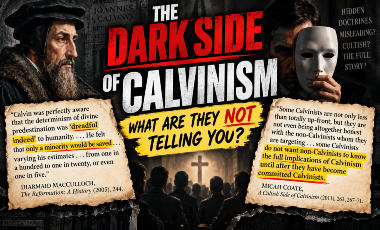
Although we cannot know the true intentions of John Calvin’s pursuit in evangelism, for several reasons it seems unlikely that he aimed only to proclaim salvation in Christ. First, his theological view clearly makes evangelism ultimately useless. Second, cult leaders usually seek their own desires, as opposed to the desires of God as revealed in Scripture. Third, John Calvin knew that his missionaries were not spreading good news to anyone whom God would not save. In fact, as Reformation historian Diarmaid MacCulloch writes, “Calvin was perfectly aware that the determinism of predestination was ‘dreadful indeed’ to humanity.”[22]* In fact, his missionaries were spreading nothing but bad news to almost all of those who were supposedly not of the elect. According to MacCulloch, “The most discordant noises came from Basel, where one anonymous pamphlet with bitter sarcasm described the Genevan Church as proclaiming ‘its good news with flames.”[23]

[….]

(4) Why Calvinism’s gospel and other cult theologies are dishonestly presented

When I share the gospel message, either from the pulpit or one-on-one, I have nothing to hide or water down about my beliefs and theology. This may sound very basic, but it must be noted. If I were a people pleaser, I would be tempted to overlook those parts of my theology that might offend a potential believer. Certain aspects of the gospel’s good news, like “personal sin” and “divine judgment,” are not merely a part of understanding one’s need for God’s grace but are imperative to receiving it. Thus, although the prospective convert might not welcome the true notion of his rebellion before God (i.e., his sin) and a time of God’s future judgment, I withhold nothing and keep no secrets in laying out the full gospel.

This is not the case with Mormonism and Jehovah’s Witnesses. This is also not the case with the gospel according to Calvinism. George Bryson writes:

Some Calvinists are not only less than totally up-front, but they are not even being altogether honest with the non-Calvinists whom they are targeting. In the promotion of doctrine, what is held back or not expressed (relative to those doctrines) can be very misleading.[33]

Bryson contends that “some Calvinists do not want non-Calvinists to know the full implications of Calvinism until after they have become committed Calvinists.”[34] It should not be hard to figure out the reasons why a “potential” convert might not want to know intimately the core doctrines of Calvinism from the beginning.

If the forbearer of the Calvinist gospel message cannot or will not be upfront and direct about the doctrines pertaining to salvation (in public or private life), the skeptic must seriously consider why. Furthermore, we should wonder whether Jesus Himself was hiding some important aspects of His messages. Was He withholding the doctrine of double predestination when He called everyone to come and receive the Bread of Life? Did He expect the crowds to understand that when He said “all” or “world” what He really meant was “some” and “elect”? Did He assume that His followers would understand that “grace” could have multiple definitions? Did Jesus expect His apostles to understand that their efforts to evangelize would be ultimately futile? Indeed, Chuck Smith asks, “Why would the God of all truth, who speaks so sternly against lying, send His servants out to promote such a lie?”[35]

Yet, some Calvinists today seem guilty of being dishonest in presenting their particular gospel. One Reformed Southern Baptist pastor, in an article entitled “Instructions for Local Church Reformation,” advises other Calvinist pastors:

Choose a few men who are sincere, teachable and spiritually minded and spend time with them in study and prayer. They will help you to reform. . . . In the pulpit, don’t use theological language that is not found in the Bible. Avoid terms such as Calvinism, reformed, doctrines of grace, particular redemption, etc. Most people will not know what you are talking about. Many that do will become inflamed against you.[36]

We read about dishonesty concerning the gospel early in church history. Certain men came down from Jerusalem teaching the brethren that unless they were “circumcised according to the custom of Moses,” they could “not be saved” (Acts 15:1, NKJV).[37] Because of this threat to the gospel message, the apostles gathered and directly faced the problem. The main reason the apostles opposed this teaching was because of its false message of salvation, which added “works” to the free grace of God and limited those who could be saved to those who were circumcised. Similarly, Calvinism limits salvation to “the elect.” “Certain men” (Calvinists) are teaching the brethren that some people can “not be saved” at all.

Like Paul, the Christian is called to confront those who are “not straightforward about the truth of the gospel.”[38] In Galatians chapter 2, Paul confronted Peter about his hypocrisy. Although the gospel was commanded to be taken to all of humanity, Peter would fellowship only with the Gentiles in the absence of the Jewish elite. Thus, while Peter believed the gospel was for the Gentiles as well as the Jews, his actions differed from his beliefs. He witnessed mainly to the Jewish people who came from Jerusalem. When Paul noticed Peter compromising the truth of the gospel, he said, “Now when Peter had come to Antioch, I withstood him to his face, because he was to be blamed; . . . But when I saw that they were not straightforward about the gospel, I said to Peter before them all . . .”[39] (Galatians 2:11–14, NKJV). Paul then brings Peter’s hypocrisy into the light.

Likewise, those who herald Calvinism today do not practice what they preach. While on the outside, Calvinists claim that their gospel is for all people, their doctrines clearly declare otherwise. To win the minds of those around them, their doctrine of limited atonement is not openly addressed. Calvinists, as with all cultists, are not straightforward about their message. If they were straightforward, there would be no need for Calvin expositors like Pink, White, and Sproul to malign the intended meanings of simple words like “world”; there would be no need for Calvinist teachers to make unfounded distinctions in words like “love,” “grace,” and “calling”; and there would be no need to change the TULIP labels. The following example illustrates how far from straightforward a Calvinist can be.

I recently watched an episode of a sitcom, in which the manager of a paper resale office was offered a promotion in the company, but only if he laid off several of his employees. The manager, though close friends with many of his employees, agreed to take the new position. Not knowing their fate, his staff anxiously sought his decision. When he came out of his office, he said, “I have good news and bad news. I’ll tell you the bad news first. A lot of you will lose your job here or be forced to relocate to Sweden.” At this, the employees were distraught and saddened. But their regional manager was quick to try and raise their spirits by finishing, “And now the good news—I was offered to be head manager over all of the U.K.” As he looked for approval among his employees, they offered him none. After a minute of silence, one of the employees pointed out the stupidity of his ex-manager: “That’s not good news. All you have is bad news and irrelevant news. We’ve just lost our jobs so you could be promoted, and you think we should be happy for you?”[40]

Likewise, the gospel of Calvinism looks into the faces of people whom their god has doomed to eternal fire and expects a joyful response to their fate. In Luke 2:10, the angel of the Lord announces the true gospel of Christ as “good tidings of great joy which will be to all people.” Is one to believe that this angel from God held the same unreasonable logic of the new U.K. branch manager? Did the angel really think that the unfortunate souls would find the news of their damnation as “good tidings and great joy?”

These types of contradictions that plague Calvin’s TULIP make for a confusing and inconsistent theology. Why does it maintain such contradictions? Is it because Christians would not swallow Calvinism if it were not watered down? Is it because Calvinism’s “unveiled” gospel would turn potential new converts away instead of winning them over? Why unbelievers, let alone Christians, would be repulsed by Calvinism’s deterministic form of Christianity should be no surprise, for it must bear a certain fruit in the lives of its followers.


Micah Coate, A Cultish Side of Calvinism (Innovo Publishing, 2011), 263, 267–71.

* Calvin was perfectly aware that the determinism of divine predestination was ‘dreadful indeed’ to humanity. Moreover, like most believers in predestination (Luther and Augustine included), he felt that only a minority would be saved – it was not Calvin but Augustine in one of his savage late anti-Pelagian works who observed that God had arranged this in order to give the elect all the more reason to be grateful for their elect status.38 Calvin was not prepared to put a figure on the proportion of the saved, varying his estimates for artistic effect from his habitual estimate of one in a hundred to one in twenty, or even one in five in more generous moods. He was also very wary of saying that people could be certain of their own election, let alone identify others among the elect.

Diarmaid MacCulloch, The Reformation: A History (New York: Penguin Books, 2005), 244.

FOOTNOTES:

[22] MacCulloch, The Reformation, 244.

[23] Ibid., 245.

[….]

[33] George Bryson, The Dark Side of Calvinism: The Calvinist Caste System (Santa Ana, CA: Calvary Chapel Publishing, 2004), 23.

[34] Ibid., 22.

[35] Smith, Foreword to The Dark Side of Calvinism.

[36] Ernest C. Reisinger and D. Matthew Allen, A Quiet Revolution: A Chronicle of Beginnings of Reformation in the Southern Baptist Convention [online]; accessed by RPT 8/27/2026             

[37] NKJV, Acts 15:1.

[38] NKJV, Galatians 2:14.

[39] NKJV, Galatians 2:11–14.

[40] Ricky Gervais, The Office, Season 1, Disc 2, Episode 6 (BBC Amazon Prime Video)


Saved by Grace Through Faith or Saved by Decree? (Chapter 1)

This is an excerpt from Geoffrey D. Robinson’s book, Saved by Grace Through Faith or Saved by Decree? A Biblical and Theological Critique of Calvinist Soteriology (Eugene, OR: Wipf and Stock, 2022), pages 1-19.

Chapter 1

A Brief History of the Doctrine of Salvation

(The PDF includes the INTRODUCTION)

The history outlined below focuses on those aspects of salvation denoted by TULIP. There are other aspects of salvation that will not be included such as justification, sanctification, and adoption into the family of God. While undoubtedly Christians differ on their understanding of these aspects of salvation also, the differences are not pivotal in the same way as TULIP.

The Early Church1

The early church fathers tended to stress the role of human free will in decision-making in general, and in responding to the gospel call specifically. This emphasis was, at least in part, due to the prevailing philosophies and worldviews of the day that emphasized fatalism and absolute, impersonal determinism.2 “For Origen, as for all the early fathers, freedom was vital as the antithesis of fate or necessity.”3

Of course, the early church’s theologians recognized the references to predestination in the Christian Scriptures, especially in Paul’s writings, and understood predestination to salvation to be based on God’s foreknowledge of how people would respond to the gospel call; those who responded favorably (by exercising faith and repenting of their sins) were predestined to salvation. Justin Martyr (d. AD 163) for example, held that “the people foreknown to believe in [Christ] were foreknown to pursue diligently the fear of the Lord.”4 However predestination was understood, there was the general conviction that it would not entail the overruling of human choice in the matter of salvation.

At this early stage of doctrinal development, the view that subsequently came to be known as synergism—the idea that God and man cooperate in the appropriation of God’s gift of salvation—was naturally dominant. Clement of Alexandria (150-215) is a good example:

And as the physician ministers health to those who co-operate with him in order to health, so also God ministers eternal salvation to those who co-operate for the attainment of knowledge and good conduct; and since what the commandments command are in our own power, along with the performance of them, the promise is accomplished.5

This state of affairs was radically changed around 410 when Pelagius, a British monk and Christian moralist who was distressed by the lax moral conditions prevailing at Rome in his day, took offense at a prayer of Augustine, Bishop of Hippo, in which the latter stated: “Give what thou commandest and command what thou wilt.”6 He believed Augustine’s prayer would lead to a resignation to sin. If God’s grace was such that only God could give what God commanded then this raised the question as to the role of man’s responsibility for his behavior in moral affairs. For Pelagius moral responsibility implied moral ability. If Augustine was right, what room was there for human choices and moral responsibility?

Pelagius opposed the sentiment that a given moral responsibility is “too hard and difficult. We cannot do it. We are only human and hindered by the weakness of the flesh.”7 Such an outlook, argued Pelagius, implied God was unaware of the weaknesses of men in giving commands that men could not consistently fulfill. Also, God was not so unjust as to condemn a man for what he could not help.

With respect to the question of human freedom, Pelagius argued that three elements exist: (1) the possibility to make moral decisions (posse in Latin), (2) the will to make moral decisions (velle), and (3) the capacity to effect or realize the moral decision (esse).8 The first (the possibility) may be ascribed to God and associated with man’s creation by God, the other two elements (will and capacity) he attributed to the human agent. Consequently,

man’s praise lies in his willing and doing a good work; or rather this praise belongs both to man and to God who has granted the possibility of willing and working, and who by the help of his grace, ever assists this very possibility. That a man has this possibility of willing and effecting is due to God alone.9

In addition to ascribing to man significant capacity to do the moral good, Pelagius also denied the view concerning the origin of man’s sinfulness, namely original sin.10 “Everything good and everything evil in respect of which we are either worthy of praise or of blame, is done by us, not born with us.”11

Finally, for our purposes here, Pelagius and his disciple Coelestius also taught the following: (1) that a person can be without sin if he chooses, and (2) that unbaptized infants have eternal life.12 (3) God’s grace is manifested (a) in providing a revelation of his will in the Bible and in (b) forgiving those who repent of their sin. (4) Predestination to salvation was based upon God’s foreknowledge (prescience) of those who would respond favorably to God’s grace of forgiveness and thereby be saved.

Through his writings and his interactions with Augustine, Pelagius raised key issues concerning the doctrine of salvation that reverberated down the centuries to this day. The origin and extent of sin, the origin of the soul, the relationship between grace and human moral freedom, the extent of a person’s ability to do moral good, the nature of grace itself, the basis and nature of God’s predestination, and ultimately the nature of divine sovereignty. Most fundamentally, is salvation monergistic (all of God in every respect) or synergistic (aspects uniquely of God and also aspects that require man’s cooperation)?

Augustine strongly opposed Pelagius. Though, in his disputes with the Manichaean sect, Augustine had stressed the role of free will in being the source of evil, later in his disputes with Pelagius Augustine agreed the will was free—but only to do evil, to sin. The will was in fact in bondage to sin. Furthermore, it was in this state from birth.

While a few of the early church fathers had hinted at a connection between Adam and subsequent humanity’s sin, it was Augustine who almost single-handedly synthesized and developed this notion which he called “original sin.”13 Augustine’s strongly negative view of man’s ability to not sin was strongly influenced by his conversion experience. In his book The Confessions Augustine describes his depravity and struggle with sexual sins. This experience convinced him that human nature is so depraved that an unregenerate person is “not able not to sin.”14 Furthermore, Augustine found justification for this understanding of sin in his view of original sin in Rom 5:12-21, where Paul connects Adam’s disobedience with sin, death, and condemnation. The prevailing common practice of baptizing infants was appealed to as further evidence of the devastating effects of the fall on subsequent humanity.15

Through his emphasis on the corporate solidarity between Adam and the rest of humanity, the tragic situation of original sin into which all people are born, the liability to condemnation for all unbaptized persons because of the guilt of Adam that they bear, and the inheritance of a corrupt nature that spells the inevitability of actual sins whenever unbelievers will to act, Augustine both defeated Pelagius and left a legacy of a robust theology of sin.16

Unlike Pelagius, who ascribed the universal sinfulness of humanity subsequent to Adam as being due to living in a fallen world and in following the example of Adam, Augustine attributed universal sinfulness to original sin.

Before leaving Augustine, it is necessary to briefly summarize other key aspects of his soteriology. Given the inherently sinful state in which every person enters the world, Augustine’s teachings inevitably raised the question concerning how any person could be saved. Since total depravity entailed a total inability to do any morally or spiritually good including, of course, a turning to God in response to the call to repent and believe the gospel then salvation would depend exclusively on the grace of God. For Pelagius grace was conceived objectively in terms of God’s undeserved actions for our good —such as revealing himself to mankind, sending his Son, providing a universal call to salvation. For Augustine, however, grace was understood as some kind of internal, subjective force that acted directly upon the will and was infused into the person.17 This understanding of grace was necessitated by his view of original sin as entailing total depravity, which in turn entailed a total inability to do any good, especially the good of responding in repentance and faith to the gospel call. If anyone was to be saved it would be because God would choose to act supernaturally to provide grace that would free the person’s will from its bondage to sin and enable the desired response of repentance and faith. “Unless this damage [to our moral nature due to sin] were overcome by the assistance of grace, no one would turn to holiness; nor would anyone enjoy the peace of righteousness unless the flaw were mended by the operation of grace.”18

Furthermore, Augustine insisted that this grace is irresistible. If God chooses to apply grace then its actions upon the will cannot be thwarted or resisted. “Grace moves the will, but only through a `soft-violence’ that acts in such a way that the will agrees with it.”19

Intrinsic to the strong monergism developed by Augustine are the issues of election, predestination, and perseverance.20 The logic is clear; since no one is capable of responding to the gospel due to sin (both original and personal), then if anyone is to be saved such salvation must require and be due to the initiative of God. God chooses who will be saved unconditionally.21 Since it is obvious that not everyone is saved, then God’s election of individuals is selective. The basis of the choice made by God is a mystery. God is not subject to the charge of injustice because he is under no obligation to save anyone from the consequences of their sin (divine wrath and judgment)—they are merely getting what they deserve. Since God’s choosing is accomplished “before the foundation of the world” then we may rightly term this sovereign electing act of God as predestination. God predestines those who will be saved. “The elect are pulled out of this `mass of condemnation’ which is humanity through a sovereign act of God, who has predestined them for salvation.”22 Finally, since God has determined a fixed number of the elect then their salvation is assured, and that requires that they persevere to the end of their lives. God grants a persevering grace that guarantees the elect continue in their faith.

Unsurprisingly, given the emphasis until Augustine by the church fathers upon the reality of human freedom as opposed to the deterministic tendencies of the gnostics and prevailing religious cults as noted earlier, and the relatively novel teaching concerning the irresistibility of grace and Augustine’s strong predestinarian thrust, his views were not left unchallenged. As Henry Chadwick remarks: “Augustine’s propositions provoked a quick reaction in several quarters.”23 Julian (380-455), bishop of Eclanum, in Italy, insisted Augustine was wrong to view sex negatively (as concupiscence)24 and a contributing factor in the transmission of original sin.25 As Chadwick comments, “Julian thought . . . Augustine had brought his Manachean ways of thinking into the church, was defaming the good handiwork of the Creator under the influence of a hagridden attitude to sex resulting from the adolescent follies described in the Confessions, and was denying St. Paul’s clear teaching that God wills all men to be saved.”26

John Cassian (360-435), a theologian in one of the monasteries in southern Gaul (France), was likewise distressed to hear of Augustine’s strong predestinarian views, coupled with a grace that was irresistible. He was convinced these emphases in Augustine represented “a most disturbing innovation, quite out of line with `orthodoxy’ . . . that body of belief which is held undeviatingly by the universal church.”27 Wand concurs: Cassian “felt considerable difficulty in accepting Augustine’s teaching, and . . . denied that divine grace was irresistible. He asserted that man’s will always remains free.”28 Cassian’s soteriology accepted Augustine’s stress on the need for divine grace to assist the will; however, he also agreed with Pelagius that the nature of human freedom was such that the will could choose to either do good or evil, and not as Augustine asserted, that the will could only choose to do evil. This mediating view came to be known as semi-Pelagianism (though it could just as easily have been called semi-Augustinianism).

Despite these voices of dissent, Augustine’s views generally prevailed in the church of his day. In AD 416 two African synods condemned the Pelagians. In AD 418 Emperor Honorius ordered Pelagius to be exiled. However, that same year a council met at Carthage in north Africa to condemn Pelagius’s teachings in favor of Augustine’s views of sin and salvation. Again, a few years later, despite the fact that nineteen bishops refused to sign the document of condemnation, Pelagius’s views were formally anathematized by the Council of Ephesus in AD 431.29

Debate in the church continued beyond AD 432, however. Due to the influence of Cassian and others who took a softer, semi-Pelagian, line, the Synod of Arles condemned certain aspects of Augustine’s theology in AD 473. The offending aspects included Augustine’s denial of the need for the human will to cooperate with God’s grace (synergism), and the destruction of free will.30 The latter was viewed as weakened or warped, but not eliminated.31

Finally, in AD 529 another ecumenical council at Orange opposed the tendency toward semi-Pelagianism evident at Arles. This council was more Augustinian in flavor,32 insisting that even beginning moves toward God followed from God’s grace that enlightened the mind and enabled belief. Grace was prior to faith. (This kind of grace was later to be called prevenient grace.) However, the council also strongly condemned any notion of double predestination—the idea that God not only predetermines those whom he would save, but also predetermines those who would be lost.33

The Medieval Church34

The influence of Augustine’s soteriology on subsequent church history cannot be exaggerated. Erickson sums up Augustine’s impact on subsequent centuries thus: “In the fifth century Augustine developed a synthesis of Platonic philosophy and theology (The City of God) which in many ways dominated theology for more than eight hundred years.”35 Gonzales also notes the tremendous influence Augustine has had on the history of Christian theology: Augustine’s “theology was to such an extent responsive to the needs of human existence as well as to the requirements of the human mind that for centuries, and even to this day, Augustine has been, after Paul, the most influential thinker in the history of Christian thought.”36 Noting the influence of Augustine’s conversion experience on the subsequent history of the doctrine of salvation Gonzales likewise notes that “the overwhelming and dynamic experience set forth in the Confessions is being transformed into an entire system of grace—a process that was perhaps inevitable, but nonetheless unfortunate.”37

As far as the doctrine of salvation is concerned Augustine’s views were reinforced, consolidated, and solidified through the various councils noted above that were convened (often at Augustine’s insistence) in response to the Pelagian controversy.38 The significance of all this is that if Augustine’s soteriology is mistaken and does not in fact accurately represent the biblical data then subsequent outworking of church history is likewise, at least to some extent, mistaken in its doctrine of salvation.

As was to be expected, though Augustine’s views did not become immediately universally accepted, his views ultimately prevailed during most of the medieval period.39 Anselm, Archbishop of Canterbury (1033­1109), understood sin in conformity with the notions of his day concerning the relationship between a lord and his serfs. To sin is to dishonor God and to fail to give God the honor due to him as protector and provider. Thomas Aquinas (1225-1274), a giant in medieval church history and a key theologian of Roman Catholic theology, viewed sin as a voluntary act by which people choose a perceived good in the created order rather than the ultimate good, God. For Aquinas then, sin is essentially idolatry. Neither God nor Satan can be held responsible for a person sinning. Aquinas distinguished between two types of sin. There is a form of sin in which a person deliberately chooses to turn his back on God as a willful and defiant act; such sins are termed “mortal” and deserve eternal punishment. Venial sins, on the other hand, occur when a person sins but does so without hostility toward God or a desire to permanently turn away from God. This distinction between mortal and venial sins was to play a significant role in subsequent church practices.40

Aquinas followed Augustine on the question of original sin. “Through origin from the first man, sin entered into the world. According to the Catholic faith, we are bound to hold that the first sin of the first man is transmitted to his descendants by way of origin.”41 In keeping with the traditional view of original sin from Augustine onward, Aquinas understood the sin of Adam to entail a loss of original righteousness, with an associated corruption of human nature. Consequently, men’s sins flow from a “disordered” nature stemming all the way back to Adam. Aquinas argued that the “disorder which is in people born of Adam is voluntary, not by their will but the will of their first parent. By the process of generation, Adam moves all who originate from him, even as the soul’s will moves all the members [of the body] to their actions.”42 In other words, just as a hand or foot does not move independently from the soul (the originating source), so a person’s sins today flow from the original originating source, a corrupt nature inherited from Adam.

The relationship between grace and the human will featured also in the medieval theology of conversion. Was the will completely in bondage to sin so that it played no constructive role in the reception of salvation as Augustine taught? Or was the human will free in some sense to choose to accept the gospel call to salvation? If it was free then to what extent, and in what way did it relate to God’s grace in the gospel?

On the topic of predestination, the Gottschalk debate “shows plainly that the issues raised in the Pelagian controversy had not been satisfactorily settled.”43 Gottschalk (808-867), an astute student of Augustine, was a Saxon monk who soon after ordination preached in Italy. His very strong and uncompromising preaching of Augustinian monergism led to him being condemned in AD 848 and even eventually to his imprisonment in AD 849.

His message included the theses (1) that God foreordained both to the kingdom and also to death those whom he willed, (2) that there is absolute certainty of salvation and perdition, (3) that God does not will the salvation of all, (4) that Christ did die only for the elect, and (5) that fallen man has freedom only for evil.44

The controversy created by Gottschalk’s forthright preaching of Augustinianism was unfortunate and showed his detractors in a poor light, but also serves to show how aspects of Augustine’s soteriology—unconditional election, double predestination, limited atonement, total depravity—were not universally accepted by the church. There were always those who felt Augustine went beyond the bounds of Scripture in these formulations.

Anselm sought to harmonize predestination and free will by positing that God ordains directly all good deeds (by his grace working in the elect) and he ordains evil deeds indirectly by permitting the evil to happen. Starting from the premise “that whatever God decrees to happen in the future shall necessarily happen:’ it is “in the sense that it is by permitting the [evil deed] that God is said to be the cause of evils which he does not actually cause.”45

Aquinas related predestination to providence. Essentially, he argued that since salvation was beyond a rational creature’s natural capabilities its only source must be from God. Such supernatural directing (special providence) he called predestination. Conversely, the predestination of the reprobate (the non-elect) occurs when God permits the punishment justly deserved. It is interesting that Aquinas uses the language of permission to soften the harshness of positive predestination of the non-elect to eternal punishment.

Baptism played a prominent role in medieval views about regeneration and conversion. Generally, newly converted adults were baptized and infants of Christian parents within the church were also baptized. In both cases regeneration—the new (spiritual) birth—was associated with the rite. Baptism of infants was needed to remove the effects of original sin.46

Generally, Augustine’s theology dominated the first centuries of Western theologians.47 Augustine had made use of Neoplatonic thought in developing his theology and Neoplatonism was the dominant philosophy during most of the medieval period.48 In the thirteenth century a more philosophical approach to theology took place under the influence of Aristotelian philosophy. The main impact of this new thought form was in the area of epistemology—how God could be known—rather than soteriology. The next major church period, the Reformation, however, saw a revival of the conflicts seen earlier between Augustine and Pelagius. It is to that tension we now turn.

The Reformation

The Protestant Reformation is formally dated to the time when the Augustinian monk and theologian Martin Luther (1483-1546) pinned his ninety-five theses listing complaints against the church of his day on the Wittenberg church door in Germany in 1517.49 The primary issue for Luther was the sale of indulgences by the Roman church for the purpose of raising money for the rebuilding of St. Peter’s Basilica in Rome.50 As the flames of the Reformation spread throughout Europe other issues quickly came to prominence. Chief among these was the view that a person was justified (declared not guilty by God) only on the basis of faith in God—justification and salvation was not in any way aided or supplemented with good works. The recovery of this important doctrine together with other biblical ideas such as the priesthood of all believers, the unique authority of the Bible, and salvation as a gift of grace alone became the hallmark of the Reformation and was accepted by all the Reformers.51

However, as a student of Augustine and holding to the prevailing Augustinian view of key aspects of salvation, Luther accepted the monergism of his day with respect to predestination, election, human depravity, and the perseverance of the saints in faith. Due to sin and the resulting total inability of man to do good, faith itself must be a gift from God: “It is up to God alone to give faith contrary to nature, and ability to believe contrary to reason.”52 In fact, the will is in bondage to sin, we can only do evil. Luther likens the human will to a horse ridden either by Christ or the devil: “If God rides it, it wills and goes where God wills. . . . If Satan rides it, it wills and goes where Satan wills; nor can it choose to run to either of the two riders or to seek him out, but the riders themselves contend for the possession and control of it.”53 God elects unconditionally those whom he wills to be saved.54 There is such a thing as a general, outward call to salvation and an inward call which effectually saves the elect. The general call cannot be responded to in faith because of sin.55 The close connection between salvation and the (unconditional, secret) electing work of God naturally tends to raise questions of uncertainty regarding the reality of one’s own salvation. Luther countered this by encouraging believers to assurance of salvation by continuing to trust God’s word.56 He taught that the elect would persevere in faith to the end.57

The great Genevan Reformer John Calvin (1509-1564), like Luther, imbibed deeply of Augustinian soteriology.58 Calvin, like Augustine, held to the doctrine of original sin. The original righteousness of Adam prior to the fall was replaced by “those dire pests, blindness, impotence, vanity, impurity, and unrighteousness [which] involved his [Adam’s] posterity also, and plunged them in the same wretchedness.”59 This resulted in the propagation of a corrupted human nature in all of Adam’s posterity: “We are not corrupted by acquired wickedness, but by an innate corruption from the very womb.”60 Consequently, “before we behold the light of the sun we are in God’s sight defiled and polluted.”61 The will is “enchained as the slave of sin, it cannot make a movement towards goodness, far less steadily pursue it.”62 The elect are those chosen by God unconditionally for salvation. In fact, the saved have been predestined for salvation and the reprobate have been destined for judgment:

As the Lord by the efficacy of his calling accomplishes towards his elect the salvation to which he had by his eternal counsel destined them, so he has judgments against the reprobate, by which he executes his counsel concerning them. . . . The Supreme Disposer then makes way for his own predestination, when depriving those whom he has reprobated of the communication of his light, he leaves them in blindness.63

Thus, Calvin did not shy away from the notion of double predestination; both the saved and the lost were predestined for their respective ends. For Calvin, the predestination of the reprobate is for the glory of God: the reprobate “were raised up by the just but inscrutable judgment of God, to show forth his glory by their condemnation.” And all this is the outworking of an unchangeable and eternal decree of God: “[God’s] immutable decree had once for all doomed them to destruction.”64 Since the sinner cannot believe, then faith itself must be a gift given by God.65

Quite consistently, Calvin (citing Augustine) taught that God’s grace acted continuously to prevent the believer from failing to persevere in the faith: “To meet the infirmity of the human will, and prevent it from failing, how weak soever it might be, divine grace was made to act on it inseparably and uninterruptedly.”66

While Luther’s view on the extent of the atonement was that the work of the cross was intended for the whole world, Calvin’s position has been debated among scholars. However, there can be no doubt that subsequent Calvinism held to a limited atonement—Christ’s death was only intended for the elect.67

In the years following Calvin’s death in AD 1564, a certain hardening of Calvin’s teachings toward a rigorously consistent position developed. This came to be known as Protestant Scholasticism. A pioneer of this more rigorous approach to Augustinian soteriology was the contemporary of Calvin, Peter Martyr Vermigli (1499-1562), who, under the influence of Aristotelian philosophy,

introduced into Reformed theology a methodological approach that would have profound influence on the later development of that theology. Whereas Calvin started from the concrete revelation of God, and always retained an awesome sense of the mystery of God’s will, later Reformed theology tended more and more to proceed from the divine decrees down to particulars in a deductive fashion.68

As during the Pelagian controversy, and for similar reasons, not all agreed with the determinism associated with Calvinism.69 A famous dispute arose between the Dutch theologian Jacobus Arminius (1560-1609) and the Reformed soteriology of his day. Arminius was a pastor of a church in Amsterdam until AD 1603 and then a professor of theology at Leiden until his death. Arminius was very much a thinker in the Reformed tradition in which he had been educated and moved.70 His teacher at Geneva had at one time been Calvin’s son-in-law Theodore Beza.

Arminius’s distinct teaching relative to certain key aspects of Reformed soteriology began soon after he began his teaching position at the University of Leiden in Holland. The occasion that prompted dispute involved the teachings of his colleague at Leiden, Franciscus Gomarus (1563-1641) concerning the doctrine of predestination, specifically the supralapsarianism taught by Gomarus. Supralapsarianism is the view that God decreed not only who would be saved (the elect), but that God also decreed the fall of Adam and Eve and the entrance of sin into the world.71 Arminius thought Gomarus’s view of predestination too detached from a Christ-focused understanding and argued for a doctrine of predestination that was less rationalistic, more christocentric, and which served to edify God’s people. But the distinctive aspect of Arminius’s teaching on this subject was that predestination was not, as Gomarus and the other strict Calvinists taught, unconditional, simply following from God’s decree to save some, but rather was conditional on the foreseen faith of those who would come to believe the gospel.

Gomarus and his followers sought to pressure Leiden University for the removal of all theologians that were of an Arminian persuasion. This in turn prompted a reaction by forty-six pastors who signed a Remonstrance in AD 1610 upholding Arminius’s views. It is easiest to summarize the Arminian perspective by examining the five points of the Remonstrance:

Article #1: Addresses the issue of predestination. It affirms God’s predestination but makes it apply to “those who . . . shall believe on [God’s] son Jesus . . . and shall persevere in this faith.”72 God predestines those to salvation who believe the gospel.

Article #2: The atonement is not limited to the elect only, but rather the Savior “died for all men, and for every man . . . yet so that no one is partaker of this remission [of sins] except the believers.”73

Article #3: With Calvinism, Arminius agreed that human depravity is total in the sense that the human will is so corrupted that, unaided by grace, no one would be saved.

Article #4: God does provide a grace that is prevenient—it goes before and enables the person to believe the gospel. However, unlike Calvinism, this grace is resistible. (Though not stated in this Article #4, Arminianism understands prevenient grace to be universal.)

Article #5: This article addressed the issue of the perseverance of the saints—that those once truly saved cannot fall away from the faith. Unlike Arminius himself who felt that it was indeed possible for a Christian to fall away from the faith, the fifth article did not reach a conclusion on this point and asserted that it “must be the subject of more exact inquiry in the Holy Scriptures before we can teach it with full confidence of our minds.”74

Eventually, and after some political tussle involving the cities of Rotterdam, which was supportive of the Remonstrants, and Amsterdam, which opposed the Remonstrants, and in response to the Remonstrance,75 a synod was called for at Dort in the Netherlands to consider the teaching of Arminianism generally and these articles specifically. It was from Dort that the acrostic TULIP emerged. The synod met from 1618 to 1619 and adopted the classic Calvinist position on these contentious aspects of the doctrine of salvation. Predestination is not based on God’s foreknowledge of those who would respond to the gospel but rather is based unconditionally on God’s sovereign choice. This choice would be put into effect through a grace that was irresistible, and which would inevitably result in faith being granted the elect person. Whereas the Arminians viewed grace as a necessary prerequisite to overcome the effects of human depravity (prevenient grace) and thus make it possible for a believer to choose to respond to the gospel, the synod viewed grace to be irresistible in order to ensure the salvation of the elect. The synod rejected the possibility of a believer falling away and insisted that such a person would persevere to the end. By God’s design the atonement would be limited only to the elect; the death of Christ was not intended for everyone.

The synod members required the Remonstrant ministers at that time to refrain from preaching and conducting other ministerial duties. They agreed to this demand when ministering in state churches, but insisted on the right to continue teaching Arminianism among those churches that met and held to the teachings of the Remonstrants.

Post-Reformational Developments

The broad contours of evangelical soteriology as outlined so far have remained surprisingly constant down the centuries following the Reformation. That is because evangelical Christianity traces its heritage back to the Reformation and with the key stands made back then: sola Scriptura (the Bible alone as a source of divine authority), sola gratia (grace alone as the basis for salvation, not meritorious works), sola fide (by faith alone, not faith plus works). These essentials have not changed for all expressions of evangelical faith. In addition, the key aspects of the doctrine of salvation argued over first by Augustine and the Pelagians, and then by Arminius and scholastic Calvinism have remained surprisingly persistent—right up to the present day. These include predestination, election, the resistibility of grace, the extent of the atonement, and the perseverance of the saints. For this reason, I will only very briefly sketch the development of this doctrine in subsequent church history, slanting the focus toward the people and movements influenced by these aspects of salvation. We will see that, broadly speaking, the two positions, Calvinism and Arminianism, have largely crystallized into denominational movements holding to their respective theologies.

In England, the struggle over Christian expression in the land involved mainly the Protestant / Roman Catholic division, with the form of Protestantism being decidedly Calvinistic. In AD 1534 King Henry VIII proclaimed himself the head of the church in England (not the pope). This was done for personal and political reasons, not religious, and Henry himself remained somewhat sympathetic to Roman Catholicism. Subsequently civil war broke out in England as various monarchies tried to impose either their Catholicism or their (Calvinistic) Protestantism. It was from within this turbulent period of English church history that the Puritans were formed. These Christians were staunch Calvinists and were not happy with the compromise with Rome that the Church of England represented. They sought to “purify” the church. Most of the Puritans sought to work within the Anglican church to reform it. However, a small separatist movement was formed that chose to seek reform exclusively outside the established church. The Separatists, led by Robert Browne (1550-1633), were persecuted and many fled to Holland. Eventually, a small group of these Puritan Separatists (subsequently known as the Pilgrim Fathers) led by John Robinson (1576-1625) emigrated to the New World (America) crossing the Atlantic in the Mayflower in AD 1620. In this manner early American Christian expression was decidedly Calvinistic. Beginning around the 1730s a revival, known as the First Great Awakening, occurred among the nominal Christians at that time. A key figure who played an instrumental role in the early stages of the revival was the Puritan pastor-theologian Jonathan Edwards (1703-1758), who ministered at a Congregational church in Northampton, Massachusetts.

Edwards, in addition to furthering the revival through his preaching and writings, was a highly intellectual Calvinist and his impact on subsequent church history—especially in providing Calvinism with a strong philosophical and theological rationale—cannot be overestimated. Interestingly Edwards, like Augustine, had a dramatic conversion experience which he recounted in his work Personal Narrative (AD 1739). Sainsbury remarks concerning Edwards that he “had an experience which gave him a new awareness of God’s absolute sovereignty, and on his own dependence on God.”76

In addition to a strong sense of God’s sovereignty Edwards also had a keen sense of human depravity and the bondage of the will. “Edwards produced his most important work at Stockbridge on the Freedom of the Will (AD 1754). In it he denies that man is free to choose. This viewpoint fitted with his Calvinistic doctrines of election, predestination and the fallenness of man in every respect.”77

Another significant church figure associated with the First Awakening was the English Anglican priest and outstanding Calvinist outdoor evangelistic preacher George Whitfield (1714-1770). His outdoor preaching alienated him from the Church of England and later he became associated with a Calvinistic form of Methodism. In fact, he founded the English Calvinistic Methodist Connexion, later absorbed into Congregationalism. In addition to preaching in England, Scotland, and Wales, he also visited America (Georgia) on several occasions on evangelistic trips. “Whitfield centered his theology on the old English Puritan themes of original sin, justification by faith and regeneration.”78

Contemporary with Whitfield and Edwards were the Wesley brothers, John (1703-1791) and Charles (1707-1788). Both were members of the Church of England and were heavily involved with the English Revival that occurred in the early 1740s. Charles Wesley is most famous for his many devotional hymns that he wrote—many of which endure to this day. John Wesley, however, had great organizational abilities and spearheaded what initially were called societies—groups of Christians touched by the revival and who tended to meet in one another’s homes for methodical study of the Bible. Later these societies evolved into the Methodist Church.

Unlike Edwards and Whitfield, however, John Wesley strongly opposed the doctrine of unconditional election. Instead, he made election conditional on faith in Christ. Similarly, the reprobate were such because of their refusal to trust Christ for salvation, not because of a supposed unconditional decree of God; “God proceeds according to the known rules of his justice and mercy, but never assigns his sovereignty as the cause why any man is punished with everlasting destruction.”79 Wesley agreed with Augustinians in the idea of original sin-thus all babies are born with a sinful devilish nature and subject to divine condemnation. On this basis Wesley justified infant baptism. The corrupted human nature that follows from Adam’s sin (as well as the guilt of Adam), results inevitably in sinful human acts, and it is for these personal sins that one can be justly punished by God. So Wesley, along with the Calvinists, held to total depravity. To counter the total inability for any good that results from original sin, Wesley taught the idea of prevenient grace. This grace is provided to all men and removes the fatal disablement associated with original sin and thereby enabling the sinner to believe the gospel. Unlike the Calvinist’s irresistible grace, prevenient grace can be resisted and so does not guarantee salvation —it merely removes any impediments to the sinner hearing and responding to the gospel call to be saved. Not surprisingly, Wesley denied the Calvinist view that it is impossible for one of the elect to fail to persevere to the end. Not only was it possible for a true believer to turn his back on God, but also to be reconciled if that person subsequently repents and exercises faith again.80

In the first half of the nineteenth century another revival broke out in America. This time, the Second Great Awakening was more directed toward the saving of the unconverted (as opposed to the convicting of those professing Christian faith). A key figure during this period was the Arminian Congregationalist minister Charles G. Finney (1792-1875). Finney is best known as an innovative revivalist, especially during the years 18 25 -18 3 5 in the New York area.

Finney’s anthropology was more Pelagian than typically Arminian. For example, Finney denied original sin, viewing it as unjust of God to hold subsequent humanity guilty for the sin of Adam. He also denied that human nature was fundamentally corrupted by the fall of Adam into sin. He viewed sin as only an external matter—a willful disobedience to God’s moral law—not an inevitable consequence of an inherited corrupted human nature.

Moral depravity is not then to be accounted for by ascribing it to a nature or constitution sinful in itself. To talk of a sinful nature, or sinful constitution, in the sense of physical sinfulness, is to ascribe sinfulness to the Creator, who is the author of nature. It is to overlook the essential nature of sin, and to make sin a physical virus, instead of a voluntary and responsible choice.81

Finney, while denying that all people would be saved (universal election), denied the Calvinistic view of unconditional election. Rather election was conditioned upon foreseen faith: “The elect were chosen to salvation, upon condition that God foresaw that he could secure their repentance, faith, and final perseverance.”82

While Augustinians83 separated regeneration (the new birth) from conversion (turning to God), arguing that the latter was only possible due to the former because of total human depravity, Finney denied such a separation, viewing both as two sides of the same coin. “The fact that a new heart is the thing done, demonstrates the activity of the subject [God]; and the word regeneration . . . asserts the Divine agency. The same is true of conversion, or the turning of the sinner to God. God is said to turn him, and he is said to turn himself. God draws him, and he follows.”84

Finney held to what is known as the governmental theory of the atonement. In this understanding of the significance of Christ’s death there was not penal substitution, but rather “the atonement is a governmental expedient to sustain law without the execution of its penalty on the sinner.”85 The concern is with the preservation of public order—the sustenance of law. It was public, not retributive justice that mattered—it would not be just for God to punish an innocent person for the crimes of another. In this understanding of the atonement God’s intent in putting forth his Son was not limited to an elect few, but rather to all sinners; Finney held to a universal understanding of the extent of the atonement.

Not surprisingly Finney held to perseverance as conditional on faithful obedience to the end: “Perseverance in obedience to the end of life is also a condition of justification.”86 Apostasy is a real possibility even for the true Christian: “It must be naturally possible for all moral agents to sin at any time. Saints on earth and in heaven can by natural possibility apostatize and fall, and be lost.”87

While the doctrines of sin and salvation developed, especially following the Renaissance and the rise of liberal Protestantism, as far as evangelical theology is concerned the broad contours of the debate between Calvinism and non-Calvinists had been set by the end of the Second Great Awakening noted above. Subsequent American church history has been a history of denominations that are essentially Calvinistic in outlook and those that are more Arminian. Among the former denominations may be listed the Presbyterian, Congregationalist, Lutheran, Episcopalian, and varieties of Reformed churches (Dutch—including the Christian Reformed Church, German, Baptist, and Charismatic). Among the latter would be the United Methodist Church, Wesleyan Church, the Free Methodist Church, Pentecostal churches, Holiness churches (Nazarene, Christian 8r Missionary Alliance, etc.), some Baptist churches (e.g., Free Will Baptist), Christian Churches and Churches of Christ, and the Salvation Army.

Having briefly sketched the historical background to the doctrine of salvation, with a focus on human depravity, election, the extent of the atonement, the role of grace in an individual’s salvation, and the nature of Christian perseverance in the faith, we are now positioned to critically examine both biblically and theologically the Calvinist understanding of these aspects of salvation.

NOTES

  1. The early church period is roughly the time between the apostles and the death of Augustine of Hippo in AD 430.
  2. Stoicism would be an example. Burke writes concerning this worldview: “Fate also plays a key role and underlies the belief in the cyclical character of the natural order, in which each cycle is identical to all the others:’ Burke, “Stoics,” 1055.
  3. Bromiley, Historical Theology,
  4. Cited by Allison, Historical Theology,
  5. Clement of Alexandria, Writings of Clement,
  6. Augustine, Confessions, 29.298.
  7. Henry Bettenson, Documents of the Christian Church,
  8. Bettenson, Documents of the Christian Church,
  9. Bettenson, Documents of the Christian Church,
  10. Original sin is the doctrine that every person born subsequent to Adam and Eve is born with a sinful nature and with the associated (original) guilt before God due to Adam’s sin. This doctrine relies heavily on Paul’s teaching in Rom 5:12-21.
  11. Bettenson, Documents of the Christian Church, 53, emphasis mine.
  12. Bettenson, Documents of the Christian Church,
  13. See Toews, Story of Original Sin.
  14. Allison, Historical Theology, Ridderbos also notes that “in [Augustine’s] own experience he had known the meaning of moral impotence. It seemed to him quite unreal to speak with the Pelagians of a free will and an uncorrupted nature:’ Churches of Galatia, 234. Similarly, Wand, History of the Early Church, 231, also notes the influence of Augustine’s conversion experience upon his view of sin and grace: Augustine “relied upon his own experience of special grace, without which he was sure that he could never have recovered from his evil ways.” Augustine is known for saying that before the fall Adam was able to not sin, Jesus Christ was not able to sin, fallen man is not able to not sin.
  15. Allison, Historical Theology, 232: “The practice of infant baptism for the remission of sins presupposes that infants arrive polluted by sin; since they have committed no actual sin, remission must be for the guilt attaching to a fault in their nature. Therefore, if babies die unbaptized they are damned.”
  16. Allison, Historical Theology,
  17. “Augustine understood grace as a divine power or fluid that is infused into us. For him grace is no longer an attitude on God’s part, but rather the manner in which God acts in us.” Gonzalez, History of Christian Thought, 2:49.
  18. Augustine, Retractions,
  19. Gonzalez, History of Christian Thought, 2:47.
  20. Monergism is the belief that every aspect of salvation originates in, is accomplished and applied by, God alone. That Augustine was a pioneer in this respect is seen in the Calvinist Loraine Boettner when he remarked concerning the early church before Augustine’s day: “The earlier church fathers placed chief emphasis on good works such as faith, repentance, almsgiving, prayers, submission to baptism, etc., as the basis of salvation. They of course taught that salvation was through Christ; yet they assumed that man had full power to accept or reject the gospel. . . . They taught a kind of synergism in which there was a cooperation between grace and free will.” Boettner, “Reformed Doctrine of Predestination:’ 364,432. This coheres with our earlier observation that the early church fathers emphasized the reality of human free will in the role of salvation; Boettner, like all Calvinists, denied the will an ability to freely choose “to accept or reject” the gospel.
  21. There is nothing outside of God that conditions whom God chooses to save. If there were any condition, such as repentance and faith originating as a human response, then God’s choice would be conditioned on such faith and salvation would not be viewed as all of God.
  22. Gonzalez, History of Christian Thought, 2:48.
  23. Chadwick, Early Church, 232.
  24. The inclination and tendency to long for fleshly, often proscribed, appetites.
  25. “The sex instinct is only wrong when used in a way outside the limits laid down by God, and [Augustine] is quite wrong to confuse original sin with concupiscence:’ Chadwick, Early Church, 233.
  26. Chadwick, Early Church, 233.
  27. Chadwick, Early Church, 233.
  28. Wand, History of the Early Church,
  29. Wand, History of the Early Church,
  30. Understood as a human capacity to choose either good or evil.
  31. Allison, Historical Theology,
  32. Though Gonzales comments, “The synod itself, while condemning Pelagianism .. . did not adopt more than a diluted form of Augustinianism:’ Gonzales, History of Christian Thought, 2:61.
  33. “Both those who are saved and those who are lost are so predetermined:’ Geisler, “Augustine:’ io6. See also Allison, Historical Theology, 458: “On the doctrine of predestination it was reluctant to embrace Augustine’s theology:’ Bromiley also notes Augustine’s double predestination: “Augustine, in The City of God and the Enchiridion, teaches predestination to both salvation and perdition:’ Historical Theology,
  34. Approximately the time between Augustine’s death in 43o and the beginning of the Reformation in 1517.
  35. Erickson, Christian Theology,
  36. Gonzales, History of Christian Thought, 1:55.
  37. Gonzales, History of Christian Thought, 2:63. Gonzales is here remarking upon the conclusions of the Council of Orange in 529 on the brink of the medieval period. The reference to Augustine’s view of grace on subsequent church history as “unfortunate” is all the more significant since Gonzales himself is quite sympathetic to Augustinian theology.
  38. There was also, to some extent, a softening of rigid Augustinianism during the medieval period associated with leaders such as Pope Gregory the Great (590-604), Peter Abelard (1079-1142), and John Duns Scotus (1266-1308)—all taking a more semi-Pelagian view of the effects of original sin; Adam’s sin weakened human nature but did not fatally corrupt it.
  39. Those who opposed some parts of Augustinian soteriology became known as semi-Pelagians. Though, as Gonzales notes, “the so-called semi-Pelagians were in truth `semi-Augustinians’ who, while rejecting the doctrines of Pelagius and admiring and respecting Augustine, were not willing to follow the Bishop of Hippo to the last consequences of this theology:’ Gonzales, History of Christian Thought, 2:57.
  40. Allison, Historical Theology, I am indebted to Allison for much in this section on medieval soteriology.
  41. Allison, Historical Theology, Note the appeal to church tradition here, not to biblical exegesis or even appeal to a biblical passage.
  42. Cited by Allison, Historical Theology, The idea of a voluntary action on the part of a contemporary person that flows inevitably from the actions of a past event or person seems dubious to me.
  43. Bromiley, Historical Theology,
  44. Bromiley, Historical Theology, Bromiley inadvertently says, “Christ did not die only for the elect.” But in his later elaboration makes it clear that Gottschalk taught limited atonement in keeping with his teacher Augustine. I have omitted the word “not” for clarity. The second point means that the elect can never perish and that the reprobate can never be saved.
  45. Anselm, The Compatibility of God’s Foreknowledge, Predestination, and Grace with Human Freedom 1, 2.2, cited by Allison, Historical Theology, 459.
  46. Infant baptism preceded Augustine and was generally viewed as the initiation rite into the church. Augustine later appealed to the rite to justify his view of original sin—baptism washed away the guilt of Adam’s sin in the newborn.
  47. The Eastern, Greek-speaking church was relatively uninfluenced by Augustine’s teachings in contrast to the Western, Latin-speaking church.
  48. Gonzales, History of Christian Thought, 2:244. The Greek philosopher Plato taught that Forms represent the ideal copies from which realities in the sense world are patterned.
  49. There had been predecessors to Luther in the decades up to 1517. For example, the English scholastic philosopher John Wycliffe (1331-1384) anticipated the central role of the Bible in the Reformation by insisting that the Bible needed to be translated from the Latin to the vernacular so that all people could have access to the word of God.
  50. An indulgence was a declaration by the church that a loved one’s soul would spend less time in purgatory or even be released altogether to heaven.
  51. Luther made a big distinction between grace and law, and gospel and law. Not all followed him in such a radical disjunction.
  52. Cited by Gonzales, History of Christian Thought, 3:45. 5.3.
  53. Gordon Rupp and Watson, Luther and Erasmus,
  54. There is nothing outside of God himself that conditions his choice of whom to save. This is in contrast to the idea of conditional election which holds that salvation is conditioned on faith and that God elects those whom he foresees meets the condition, i.e., believes.
  55. Allison, Historical Theology,
  56. Allison, Historical Theology,
  57. Allison, Historical Theology,
  58. Han notes that “Calvin frequently referred to and quoted Augustine in his writings. Augustine undoubtedly exerted an influence on Calvin’s views and arguments:’ Han, “Investigation into Calvin’s Use of Augustine:’ 1. According to Han, Calvin cites Augustine about 1214 times in Calvin’s Institutes of the Christian Religion.
  59. Calvin, Institutes, 1.5.
  60. Calvin, Institutes, 1.5.
  61. Calvin, Institutes, 1.5.
  62. Calvin, Institutes, 3.5.
  63. Calvin, Institutes, 24.12.
  64. Calvin, Institutes, 24.14.
  65. Calvin, Institutes, 3.8.
  66. Calvin, Institutes, 3.13.
  67. Allison, Historical Theology,
  68. Gonzales, History of Christian Thought, 3:268.
  69. I am using the term Calvinism here to refer primarily to the theology of Protestant Scholasticism. Determinism is the belief that God determines all events and outcomes.
  70. “By sixteenth century standards, Arminius and the Remonstrants would have been seen as Calvinists by both Catholics and Lutherans:’ Gonzales, History of Christian Thought, 3:286. The Remonstrants were those who sided with Arminius.
  71. This view is in contrast to an alternative Calvinist notion called infralapsarianism, which holds that God decreed who the elect would be but only did so after the fall.
  72. Bettenson, Documents of the Christian Church,
  73. Bettenson, Documents of the Christian Church,
  74. Bettenson, Documents of the Christian Church,
  75. Gonzales, History of Christian Thought, 3:283.
  76. Sainsbury, “Jonathan Edwards,” 438.
  77. Sainsbury, “Jonathan Edwards,” 438. Actually, Edwards didn’t deny man’s freedom outright, merely the freedom to choose either x or y (known as libertarian freedom). In fact, as we shall see later, Edwards developed another form of freedom that was compatible with Calvinism’s determinism.
  78. Sainsbury, “Jonathan Edwards,” 441.
  79. Wesley, Predestination Calmly Considered,
  80. Allison, Historical Theology, 558•
  81. Finney, Moral Depravity, 8.4.
  82. Finney, Election, 4.
  83. That is, those who followed Augustine’s soteriology, including Lutherans and Calvinists and all of Reformed persuasion.
  84. Finney, Election, 4.
  85. Finney, “Atonement:’ line 19.
  86. Finney, Justification,
  87. Finney, Systematic Theology,

________________

Geoffrey D. Robinson, Saved by Grace Through Faith or Saved by Decree? A Biblical and Theological Critique of Calvinist Soteriology (Eugene, OR: Wipf and Stock, 2022), 1-19.