Calvinist’s Hiding Their Dreadful Decree Behind the Good News

This video examines why the doctrine of Calvinistic predestination—particularly double predestination and reprobation—has repeatedly produced intense disagreement within the Christian church. The discussion asks an important historical question: if these doctrines were foundational teachings of the apostles and earliest Christians, why do we find so little evidence of the kind of intense intra-Christian controversy surrounding them before Augustine?

The video looks particularly at Augustine’s role in the development of theological determinism, including his earlier association with Manichaeism and Neoplatonism, and the later development of his views on predestination. It also considers the historical evidence concerning the early church fathers and their opposition to deterministic ideas associated with Gnosticism and other movements.

The discussion then turns to the modern Calvinist debate and the striking divisions that arise when these doctrines are introduced into churches. Are these disagreements simply evidence that the doctrines are difficult truths that Christians must accept by faith, or do they indicate that something fundamentally different from the teaching of the earliest church has been introduced? The video also examines the problem of “double-speak”—the attempt to hold apparently contradictory propositions together by appealing to God’s mysterious or supposedly different logic.

Ultimately, the video asks viewers to consider a larger question: If Calvinistic determinism was truly a foundational doctrine of Christianity, why is its historical emergence and subsequent divisiveness so pronounced? Rather than simply telling the viewer what to believe, the goal is to examine the historical and theological claims and encourage the viewer to “report, you decide.”

PARTIAL TRANSCRIPT OF THE ABOVE PDF 

2) The earliest Christian scholars did not teach “Calvinistic” doc­trines.

If Jesus really was teaching TULIP theology so clearly in John chapter 6, as White likes to emphasize, why on earth don’t we see any of these theological concepts expounded upon or even mentioned in the earliest Christian writings? Instead, we have a preponderance of teachings from the early church, which rebut the conclusions that Calvinists have drawn from this and other passages. A widely-accepted notion among biblical scholars and historians is that doc­trines obtained from those who were present at the time they were created are more likely to be accurate. In contrast, the likelihood of errors in doctrine increases as one moves further away from the ori­ginal sources.

Irenaeus (ca. 130-202) was a martyr and influential figure in the early development of Christian theology. He was a student of Poly-carp, who was a disciple of John. In 180 AD, Irenaeus wrote a book called “Against Heresies,” specifically addressing ideas that would later be associated with Calvinistic Theology. These “heresies” being addressed denied free will, as can be seen in the following summar­ies:

Men are possessed of free will and endowed with the faculty of making a choice. It is not true, therefore, that some are by nature good and others bad.

This expression [of our Lord], How often would I have gathered your children together, and you would not, Matthew 23:37 set forth the ancient law of human liberty, because God made man a free [agent] from the beginning, possessing his own power, even as he does his own soul, to obey the behests (ad utendum senten-tia) of God voluntarily, and not by compulsion of God. For there is no coercion with God, but a good will [towards us] is present with Him continually. And therefore does He give good counsel to all. And in man, as well as in angels, He has placed the power of choice (for angels are rational beings) so that those who had yielded obedience might justly possess what is good, given indeed by God, but preserved by themselves. On the other hand, they who have not obeyed shall, with justice, be not found in possession of the good, and shall receive condign punishment: for God did kindly bestow on them what was good, but they themselves did not diligently keep it, nor deem it something precious, but poured contempt upon His super-eminent goodness. Rejecting therefore the good, and as it were spuing it out, they shall all deservedly incur the just judgment of God, which also the Apostle Paul testi­fies in his Epistle to the Romans, where he says, But do you des­pise the riches of His goodness, and patience, and long-suffering, being ignorant that the goodness of God leads you to repentance? But according to your hardness and impenitent heart, you store to yourself wrath against the day of wrath and the revelation of the righteous judgment of God. But glory and honour, he says, to everyone that does good. God, therefore, has given that which is good, as the apostle tells us in this Epistle, and they who work it shall receive glory and honour, because they have done that which is good when they had it in their power not to do it; but those who do it not shall receive the just judgment of God, because they did not work good when they had it in their power so to do.

But if some had been made by nature bad, and others good, these latter would not be deserving of praise for being good, for such were they created; nor would the former be reprehensible, for thus they were made [originally]. But since all men are of the same nature, able both to hold fast and to do what is good; and, on the other hand, having also the power to cast it from them and not to do it — some do justly receive praise even among men who are under the control of good laws (and much more from God), and obtain deserved testimony of their choice of good in general, and of persevering therein; but the others are blamed, and receive a just condemnation, because of their rejection of what is fair and good. And therefore the prophets used to exhort men to what was good, to act justly and to work righteousness, as I have so largely demonstrated, because it is in our power so to do, and because by excessive negligence we might become forgetful, and thus stand in need of that good counsel which the good God has given us to know by means of the prophets.43

Justin Martyr, who lived from c. 100/114AD to c. 162/168 AD was a prominent early Christian apologist who defended the faith. He courageously faced martyrdom through beheading. His writings are significant as they are the earliest surviving examples of substantial Christian apologia. He taught:

Man acts by his own free will and not by fate. We have learned from the prophets, and we hold it to be true, that punishments, chastisements, and rewards are rendered according to the merit of each man’s actions. Otherwise, if all things happen by fate, then nothing is in our own power, for if it be predestined that one man be good and another man evil, then the first is not deserving of praise or the other to be blamed. Unless humans have the power to avoid evil and choose good by free choice, they are not accountable for their actions-whatever they may be….

For neither would a man be worthy of reward or praise if he did not of himself choose the good but was merely created for that end. Likewise, if a man were evil, he would not deserve punish­ment since he was not evil of himself, being unable to do any­thing else than what he was made for.

But that you may not have a pretext for saying that Christ must have been crucified, and that those who transgressed must have been among your nation, and that the matter could not have been otherwise, I said briefly by anticipation, that God, wishing men and angels to follow His will, resolved to create them free to do righteousness; possessing reason, that they may know by whom they are created, and through whom they, not existing formerly, do now exist; and with a law that they should be judged by Him, if they do anything contrary to right reason: and of ourselves we, men and angels, shall be con­victed of having acted sinfully unless we repent beforehand. But if the word of God foretells that some angels and men shall be certainly punished, it did so because it foreknew that they would be unchangeably wicked, but not because God had created them so.44

Clement of Alexandria, known to have lived from c. 150 to c. 215 AD, was an important figure in early Christianity. He was an influ­ential Christian theologian and philosopher who sought to integrate Greek philosophy with Christian teachings. Despite living in turbu­lent times, Clement remained devoted to defending and promoting the Christian faith. His written works, which have survived to this day, provide valuable insights into the early development of Christian thought, making Clement of Alexandria a notable figure in early Christian apologetics. He wrote:

A man by himself working and toiling at freedom from sinful desires achieves nothing. But if he plainly shows himself to be very eager and earnest about this, he attains it by the add­ition of the power of God. God works together with willing soul­s. But if the person abandons his eagerness, the spirit of God is also restrained. To save the unwilling is the act of one using com­pulsion, but to save the willing, that of one showing grace.

Neither praise nor condemnation, neither rewards nor pun­ishments, are right if the soul does not have the power of choice and avoidance if evil is involuntary.

I could have provided more examples from early church leaders, but the point has been established. To address any concerns about selectively quoting to support my view, let’s consider the viewpoints of unbiased sources like Loraine Boettner, a well-known Calvinist, on the beliefs of early church leaders. Boettner acknowledges that the early church fathers did not endorse the doctrine of predestination:

It may occasion some surprise to discover that the doctrine of Predestination was not made a matter of special study un­til near the end of the fourth century They, of course, taught that salvation was through Christ, yet they assumed that man had full power to accept or reject the gospel. Some of their writings contain passages in which the sovereignty of God is rec­ognized; yet alongside those are others which teach the absolute freedom of the human will. Since they could not reconcile the two, they would have denied the doctrine of Predestination They taught a kind of synergism in which there was a cooper­ation between grace and free will45

Regarding what we now call the doctrine of predestination, Boettner went on to say, “This cardinal truth of Christianity was first clearly seen by Augustine…” Augustine lived from 354 – 430 A.D., well after the church fathers quoted above. However, Boett-ner was not alone in his findings. In 1882, James Morrison wrote in The Extent of Atonement about an English Bishop, John Davenant (1572-1641), who was a Calvinist present at the Synod of Dort in 1618. Bishop Davenant wrote:

It may be truly said before Augustine and Pelagius that there was no question concerning the death of Christ, whether it was to be extended to all mankind or to be confined only to the elect. For the Fathers…not a word (that I know of) occurs among them of the exclusion of any persons by the decree of God. They agree that it is actually beneficial to those only who believe, yet every­where confess that Christ died on behalf of all mankind…

Augustine died in AD 429, and up to his time, at least, there is not the slightest evidence that any Christian ever dreamed of a propitiation for the elect alone. Even after him, the doctrine of limited propitiation was but slowly propagated, and for long but partially received.46

Herman Bavinck, another well-respected Calvinistic scholar, came to virtually the same conclusion:

In the early church, at a time when it had to contend with pagan fatalism and gnostic naturalism, its representatives focused ex­clusively on the moral nature, freedom, and responsibility of hu­mans and could not do justice, therefore, to the teaching of Scrip­ture concerning the counsel of God. Though humans had been more or less corrupted by sin, they remained free and were able to accept the proffered grace of God. The church’s teaching did not include a doctrine of absolute predestination and irresistible grace.47

In their book titled “Why I Am Not An Arminian,” two Calvinis­tic professors of theology at Covenant Theological Seminary, Robert Peterson and Michael Williams, reflect on the same basic historical fact:

The Semi-Pelagians were convinced that Augustine’s monergistic emphasis upon salvation by grace alone represented a signifi­cant departure from the traditional teaching of the church. And a survey of the thoughts of the apostolic fathers shows that the argument is valid… In comparison to Augustine’s monergistic doctrine of grace, the teachings of the apostolic fathers tended to­ward a synergistic view of redemption.48

Louis Berkhof, who was both President of Calvin Seminary and a professor of Systematic Theology, affirms this “assured fact, a fact knowing no exceptions, and acknowledge by all well versed in the matter:”

Predestination does not form an important subject of discussion in history until the time of Augustine. Earlier Church Fathers al­lude to it, but do not as yet seem to have a very clear conception of it. On the whole, they regard it as the prescience of God with reference to human deeds, on the basis of which He determines their future destiny… Their representations are naturally rather indefinite, imperfect, incomplete, and sometimes even erroneous and self-contradictory. Says Kahnis: “It stands as an assured fact, a fact knowing no exceptions, and acknowledged by all well versed in the matter, that all of the pre-Augustinian Fathers taught that in the appropriation of salvation, there is a co-work­ing of freedom and grace.” 49

Berkhof goes on to admit that “they [the early church scholars] do not hold to an entire corruption of the human will, and consequently adhere to the synergistic theory of regeneration…” In other words, he admits there were no “monergists” before Augustine.50

John Calvin himself even admitted that Augustine was the only early source he could find to validate his views:

Moreover, although the Greek Fathers, above others, and espe­cially Chrysostom, have exceeded due bounds in extolling the powers of the human will, yet all ancient theologians, with the exception of Augustine, are so confused, vacillating, and contra­dictory on this subject, that no certainty can be obtained from their writings.51

I suspect that the reason Calvin singled out his frustration with John Chrysostom (347-407) is probably because Chrysostom linked the Calvinistic interpretation of passages like John 6:44 to their Gnos­tic origin when he wrote:

No man can come unto Me, except the Father which has sent Me draw Him. The Manichaeans spring upon these words, saying that nothing lies in our own power, yet the expression shows that we are masters of our will.52

Augustine was a Manichaean for about a decade of his life before converting to Christianity, so many scholars throughout the ages have suspected that this might have been one significant influence explaining why Augustine’s teachings “represented a significant de­parture from the traditional teaching of the church,” as acknow­ledged by “all well versed in the matter.”53

And we cannot downplay the amount of influence Augustine had, especially on the Calvinistic form of Christianity. R.C. Sproul, a highly esteemed Calvinistic theologian, wrote:

It has been said that all of Western theology is a footnote to the work of Augustine. This is because no other writer, with the ex­ception of the biblical authors, has had more influence on Chris­tendom. When Martin Luther and John Calvin were accused of teaching new doctrine, they pointed to Augustine as an example of one who had taught the things they were teaching.54

On this point, James Leo Garrett, a prominent Baptist theologian and scholar, aptly noted:

From Augustine of Hippo to the twentieth century, Western Christianity has tended to interpret the doctrine of election from the perspective of and with regard to individual human beings. During those same centuries the doctrine has been far less em­phasized and seldom ever controversial in Eastern Orthodoxy. Is it possible that Augustine and later Calvin, with the help of many others, contributed to a hyper-individualization of this doctrine that was hardly warranted by Romans 9-11, Eph. 1, and I Peter 2? Is it not true that the major emphasis in both testaments falls upon an elect people—Israel (OT) and disciples or church (NT)?55

Considering that even Calvinists discourage the teaching of TULIP to skeptical non-believers and the fact that the Christian church in its first 400 years did not interpret the Bible from a Calvin­istic perspective, it seems highly improbable that Jesus intended to introduce this complex and controversial soteriological systematic to a group of grumbling unbelieving Israelites who were superficial fol­lowers looking for a free meal.


Leighton C. Flowers, Drawn by Jesus: A Biblical Defense of God’s Provision for All and a Rebuttal of James White’s Book “Drawn by the Father” on John 6:35–45 (Trinity Academic Press, 2024), 63–77.

SEE ALSO: Did the Early Church Fathers teach Calvinistic Doctrines?

FOOTNOTES:

40. Calvinism is generally known by its unwavering commitment to the soteriology (doctrine of salvation) most popularly represented by the acronym “TULIP” (Total depravity, Unconditional election, Limited atonement, Irresistiblegrace, and Perseverance of the saints), also referenced as “five points.” Some Cal­vinists call themselves “four pointers” (Amyrauldians), because they reject Limited atonement. Others, like White, add additional letters, such as “S” for “sovereignty” which is redefined to mean “theistic determinism,” making the acronym “STULIP.”

41. In a casual poll on X, I posed the question to Calvinists: “Should you teach TULIP to a crowd of unbelievers.” The overwhelming response was, no. Here are a few replies that best represent the consensus: “No. Secondary matters are second­ary.” “No need to get into the deeper things of God, given that they reject milk.” “This is why we sit down and talk to people and find out who they are and where they are. Any system of doctrine is a guard rail. This is not be to preached or evangelized.”

42. On a Dividing Line program titled “Radio Free Geneva: Atheists, William Lane Craig, Warren McGrew,” White responded to a discussion between an Atheist (PineCreekDoug) and a Calvinistic Christian (Derek Murrell) saying, “…there’s no reason to be discussing the sovereign grace of God and things like that with some­one who just doesn’t even believe…”  accessed online [by RPT 8/27/2026] 

43. Irenaeus, Against Heresies, accessed online [by RPT 8/27/2026] (NEW ADVENT)

44 Justin Martyr, The First Apology (chapter 43), accessed online [by RPT 8/27/2026] (NEW ADVENT).

45. Loraine Boettner, Reformed Doctrine of Predestination, accessed online [by RPT 8/27/2026] (MONERGISM)

46. David Allen, The Synod of Dort and the Extent of the Atonement, accessed online [by RPT 8/27/2026] (DR. DAVID ALLEN)

47. Herman Bavinck, Reformed Dogmatics, ed. John Bolt, trans. John Vriend, vol. 2, God and Creation (Grand Rapids: Baker, 2004), 348. He references Justin Mar­tyr, Irenaeus, and Tertullian among the ante-Nicene fathers, and John of Damascus among the later Eastern teachers.

48. Robert Peterson and Michael Williams, Why I Am Not an Arminian (IVP, 2004) 36.

49. Louis Berkhof, Systematic Theology (Eerdmans, 1932) 130.

50. The categories of “monergism” versus “synergism” were created by Calvin­ists in order to reframe the discussion over the role of God and man in the process of salvation which is based on a fallacy of conflation. More on this topic can be found here: “Calvinism’s Conflation” (SOTO 101); and “Calvinism’s Conflation | Flowers and Tozer” (RELIGIO-POLITICAL TALK)

51. John Calvin, Institutes, book 2, chapter 2, section 4

52. John Chrysostom, Homily 46 on the Gospel of John, accessed online [by RPT 8/27/2026] (NEW ADVENT)

53. For more on this topic see: Ken Wilson, The Foundation of Augustinian-Calvinism (Mohr Siebeck, 2019).

54. Quote taken from a recommendation for The Works of Saint Augustine: The Confessions. Accessed online [by RPT 8/27/2026] (THE OLD GUYS)

55. James Leo Garrett Jr., Systematic Theology: Biblical Historical, and Evangel­ical, vol. 2 (Grand Rapids: Eerdmans, 1995), 500

This stuff is striking a chord with me. Why, part of this year+ journey I left a church where this “two face” theology is preached from the pulpit and something different is discussed behind doors (adult classes and men’s and women’s groups). My past pastor said this:

  • “Make a choice. Choose this day. In fact, you can choose one of the… He’s not saying that he’s happy if you choose the pagan gods, but he says, in fact, pick one of the pagan gods. Do you know that something that God is extremely kind and gracious to us and that he gave us free will? Did you know that? He didn’t force a relationship on us. He gave us free will. Do you remember what he gave Adam and Eve? Free will. You can make a choice. I’m not gonna force it. Hey, you choose, yeah, you, make the choice.”

When I asked an elder if this pastor really believed this statement he made regarding free will from the pulpit, I got an honest answer of “No.” And when discussing the issue the night before I turned in my letter of leaving to the church, this was said via another pastor:

Interestingly enough Josh McDowell’s warning rang very true to me. He writes:

  • A feature of some cultic groups is that they say one thing publicly but internally believe something totally different. Many organizations call themselves Christians when in fact they deny the fundamentals of the faith. . . . One therefore must be on the alert for the organizations that advertise themselves as “Christians” but whose internal teachings disagree with Scripture.

And part of the reason for this “secrecy” is that is is not good news, it is a “dreadful decree”.

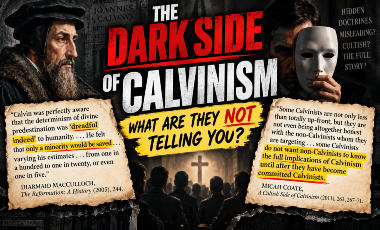
Although we cannot know the true intentions of John Calvin’s pursuit in evangelism, for several reasons it seems unlikely that he aimed only to proclaim salvation in Christ. First, his theological view clearly makes evangelism ultimately useless. Second, cult leaders usually seek their own desires, as opposed to the desires of God as revealed in Scripture. Third, John Calvin knew that his missionaries were not spreading good news to anyone whom God would not save. In fact, as Reformation historian Diarmaid MacCulloch writes, “Calvin was perfectly aware that the determinism of predestination was ‘dreadful indeed’ to humanity.”[22]* In fact, his missionaries were spreading nothing but bad news to almost all of those who were supposedly not of the elect. According to MacCulloch, “The most discordant noises came from Basel, where one anonymous pamphlet with bitter sarcasm described the Genevan Church as proclaiming ‘its good news with flames.”[23]

[….]

(4) Why Calvinism’s gospel and other cult theologies are dishonestly presented

When I share the gospel message, either from the pulpit or one-on-one, I have nothing to hide or water down about my beliefs and theology. This may sound very basic, but it must be noted. If I were a people pleaser, I would be tempted to overlook those parts of my theology that might offend a potential believer. Certain aspects of the gospel’s good news, like “personal sin” and “divine judgment,” are not merely a part of understanding one’s need for God’s grace but are imperative to receiving it. Thus, although the prospective convert might not welcome the true notion of his rebellion before God (i.e., his sin) and a time of God’s future judgment, I withhold nothing and keep no secrets in laying out the full gospel.

This is not the case with Mormonism and Jehovah’s Witnesses. This is also not the case with the gospel according to Calvinism. George Bryson writes:

Some Calvinists are not only less than totally up-front, but they are not even being altogether honest with the non-Calvinists whom they are targeting. In the promotion of doctrine, what is held back or not expressed (relative to those doctrines) can be very misleading.[33]

Bryson contends that “some Calvinists do not want non-Calvinists to know the full implications of Calvinism until after they have become committed Calvinists.”[34] It should not be hard to figure out the reasons why a “potential” convert might not want to know intimately the core doctrines of Calvinism from the beginning.

If the forbearer of the Calvinist gospel message cannot or will not be upfront and direct about the doctrines pertaining to salvation (in public or private life), the skeptic must seriously consider why. Furthermore, we should wonder whether Jesus Himself was hiding some important aspects of His messages. Was He withholding the doctrine of double predestination when He called everyone to come and receive the Bread of Life? Did He expect the crowds to understand that when He said “all” or “world” what He really meant was “some” and “elect”? Did He assume that His followers would understand that “grace” could have multiple definitions? Did Jesus expect His apostles to understand that their efforts to evangelize would be ultimately futile? Indeed, Chuck Smith asks, “Why would the God of all truth, who speaks so sternly against lying, send His servants out to promote such a lie?”[35]

Yet, some Calvinists today seem guilty of being dishonest in presenting their particular gospel. One Reformed Southern Baptist pastor, in an article entitled “Instructions for Local Church Reformation,” advises other Calvinist pastors:

Choose a few men who are sincere, teachable and spiritually minded and spend time with them in study and prayer. They will help you to reform. . . . In the pulpit, don’t use theological language that is not found in the Bible. Avoid terms such as Calvinism, reformed, doctrines of grace, particular redemption, etc. Most people will not know what you are talking about. Many that do will become inflamed against you.[36]

We read about dishonesty concerning the gospel early in church history. Certain men came down from Jerusalem teaching the brethren that unless they were “circumcised according to the custom of Moses,” they could “not be saved” (Acts 15:1, NKJV).[37] Because of this threat to the gospel message, the apostles gathered and directly faced the problem. The main reason the apostles opposed this teaching was because of its false message of salvation, which added “works” to the free grace of God and limited those who could be saved to those who were circumcised. Similarly, Calvinism limits salvation to “the elect.” “Certain men” (Calvinists) are teaching the brethren that some people can “not be saved” at all.

Like Paul, the Christian is called to confront those who are “not straightforward about the truth of the gospel.”[38] In Galatians chapter 2, Paul confronted Peter about his hypocrisy. Although the gospel was commanded to be taken to all of humanity, Peter would fellowship only with the Gentiles in the absence of the Jewish elite. Thus, while Peter believed the gospel was for the Gentiles as well as the Jews, his actions differed from his beliefs. He witnessed mainly to the Jewish people who came from Jerusalem. When Paul noticed Peter compromising the truth of the gospel, he said, “Now when Peter had come to Antioch, I withstood him to his face, because he was to be blamed; . . . But when I saw that they were not straightforward about the gospel, I said to Peter before them all . . .”[39] (Galatians 2:11–14, NKJV). Paul then brings Peter’s hypocrisy into the light.

Likewise, those who herald Calvinism today do not practice what they preach. While on the outside, Calvinists claim that their gospel is for all people, their doctrines clearly declare otherwise. To win the minds of those around them, their doctrine of limited atonement is not openly addressed. Calvinists, as with all cultists, are not straightforward about their message. If they were straightforward, there would be no need for Calvin expositors like Pink, White, and Sproul to malign the intended meanings of simple words like “world”; there would be no need for Calvinist teachers to make unfounded distinctions in words like “love,” “grace,” and “calling”; and there would be no need to change the TULIP labels. The following example illustrates how far from straightforward a Calvinist can be.

I recently watched an episode of a sitcom, in which the manager of a paper resale office was offered a promotion in the company, but only if he laid off several of his employees. The manager, though close friends with many of his employees, agreed to take the new position. Not knowing their fate, his staff anxiously sought his decision. When he came out of his office, he said, “I have good news and bad news. I’ll tell you the bad news first. A lot of you will lose your job here or be forced to relocate to Sweden.” At this, the employees were distraught and saddened. But their regional manager was quick to try and raise their spirits by finishing, “And now the good news—I was offered to be head manager over all of the U.K.” As he looked for approval among his employees, they offered him none. After a minute of silence, one of the employees pointed out the stupidity of his ex-manager: “That’s not good news. All you have is bad news and irrelevant news. We’ve just lost our jobs so you could be promoted, and you think we should be happy for you?”[40]

Likewise, the gospel of Calvinism looks into the faces of people whom their god has doomed to eternal fire and expects a joyful response to their fate. In Luke 2:10, the angel of the Lord announces the true gospel of Christ as “good tidings of great joy which will be to all people.” Is one to believe that this angel from God held the same unreasonable logic of the new U.K. branch manager? Did the angel really think that the unfortunate souls would find the news of their damnation as “good tidings and great joy?”

These types of contradictions that plague Calvin’s TULIP make for a confusing and inconsistent theology. Why does it maintain such contradictions? Is it because Christians would not swallow Calvinism if it were not watered down? Is it because Calvinism’s “unveiled” gospel would turn potential new converts away instead of winning them over? Why unbelievers, let alone Christians, would be repulsed by Calvinism’s deterministic form of Christianity should be no surprise, for it must bear a certain fruit in the lives of its followers.


Micah Coate, A Cultish Side of Calvinism (Innovo Publishing, 2011), 263, 267–71.

* Calvin was perfectly aware that the determinism of divine predestination was ‘dreadful indeed’ to humanity. Moreover, like most believers in predestination (Luther and Augustine included), he felt that only a minority would be saved – it was not Calvin but Augustine in one of his savage late anti-Pelagian works who observed that God had arranged this in order to give the elect all the more reason to be grateful for their elect status.38 Calvin was not prepared to put a figure on the proportion of the saved, varying his estimates for artistic effect from his habitual estimate of one in a hundred to one in twenty, or even one in five in more generous moods. He was also very wary of saying that people could be certain of their own election, let alone identify others among the elect.

Diarmaid MacCulloch, The Reformation: A History (New York: Penguin Books, 2005), 244.

FOOTNOTES:

[22] MacCulloch, The Reformation, 244.

[23] Ibid., 245.

[….]

[33] George Bryson, The Dark Side of Calvinism: The Calvinist Caste System (Santa Ana, CA: Calvary Chapel Publishing, 2004), 23.

[34] Ibid., 22.

[35] Smith, Foreword to The Dark Side of Calvinism.

[36] Ernest C. Reisinger and D. Matthew Allen, A Quiet Revolution: A Chronicle of Beginnings of Reformation in the Southern Baptist Convention [online]; accessed by RPT 8/27/2026             

[37] NKJV, Acts 15:1.

[38] NKJV, Galatians 2:14.

[39] NKJV, Galatians 2:11–14.

[40] Ricky Gervais, The Office, Season 1, Disc 2, Episode 6 (BBC Amazon Prime Video)
 

Who Is Paul Answering in Romans 9?

SNEAK PEEK:

The Calvinist reading:

“If God sovereignly determines who will be saved and who will be damned, why does He still find fault?”

The alternative reading:

“If my rebellion and unrighteousness are being used by God to accomplish His redemptive purposes, why am I still being blamed?”

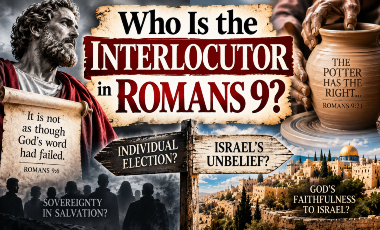
For years, Romans 9 has been used to support Calvinism’s most controversial doctrines—unconditional election, reprobation, and double predestination. But what if you’ve been reading it all wrong? In this eye-opening breakdown, we unpack the true identity of the interlocutor in Romans 9—hint: it’s not a 21st-century Arminian or Provisionist. It’s a hardened first-century Israelite rebelling against God’s redemptive plan. Discover how Paul uses the potter and clay analogy, not to teach predestined damnation, but to reveal God’s sovereign right to use Israel’s rebellion to bring salvation to the Gentiles.

00:00 – All are sinful, but all are responsible
00:45 – Who is the interlocutor in Romans 9?
02:00 – Calvinism and the potter-clay analogy
04:00 – Israel’s hardening: self-inflicted, not decreed
05:25 – Echoes of Romans 3: The same objector returns
07:00 – Sovereignty doesn’t require control
09:00 – Cross-reference: 2 Timothy 2 and Jeremiah 18
11:00 – You can cleanse yourself and be used for good
13:00 – God uses rebellion, but doesn’t cause it
14:30 – Why Calvinism’s reading of Romans 9 falls apart

Who Is the Interlocutor in Romans 9?

One of the most important—and often overlooked—questions in the debate over Romans 9 is the identity of Paul’s interlocutor: the person Paul anticipates objecting to what he has just said.

The answer matters because the identity of the objector determines what Paul’s response is actually addressing. If the interlocutor is objecting to God’s unconditional election and reprobation of individuals, then Romans 9 can be read as Paul’s answer to the familiar Calvinist objection:

If God determines who will be saved and who will be damned, why does He still find fault?

But if the interlocutor is someone else, then Paul may be answering an entirely different question.

The Calvinist Reading

The traditional Calvinist interpretation understands Paul’s argument roughly this way:

Paul declares that God has mercy on whom He wills and hardens whom He wills. The interlocutor then objects: “Then why does God still find fault? For who can resist His will?”

Under this reading, the objection is essentially:

“If God sovereignly determines who will receive saving grace and who will not, and no one can resist His sovereign will, how can God justly blame those who remain unbelieving?”

Paul’s answer is then understood as a response to that objection:

“Who are you, O man, to answer back to God?”

In other words, the Calvinist interpretation sees Paul anticipating the very objection that Provisionists, Arminians, and other non-Calvinists raise against unconditional election and reprobation today.

But there is a significant problem with that interpretation: the identity of the objector cannot simply be assumed. It must be established from the context.

If the Calvinist begins by assuming that Paul’s interlocutor is objecting to individual election and reprobation and then uses Paul’s response to prove individual election and reprobation, the argument becomes circular.

It is question begging. The very thing that must first be demonstrated—what Paul is talking about—has already been assumed.

What Problem Is Paul Actually Addressing?

Romans 9 does not begin with a philosophical discussion about free will, determinism, or individual predestination. It begins with Israel.

Paul expresses profound sorrow over his fellow Israelites. He even says that he could wish himself accursed and cut off from Christ for the sake of his fellow Jews. He then lists Israel’s extraordinary privileges: adoption, glory, covenants, the giving of the Law, worship, promises, the patriarchs, and ultimately the Messiah.

That immediately raises the central question Paul is attempting to answer:

If Israel was God’s covenant people and had received all these promises, why are so many Israelites rejecting their own Messiah? Has God’s promise failed?

Paul’s answer begins with a crucial statement:

“It is not as though God’s word had failed.”

That statement provides an important lens through which the rest of Romans 9–11 can be understood. The issue is not simply, “Who goes to heaven and who goes to hell?” The larger issue is whether God’s promises and purposes concerning Israel have failed because so many Israelites have rejected Christ.

The argument presented in The Potter’s Promise therefore understands Romans 9–11 as addressing God’s faithfulness to His promises despite Israel’s unfaithfulness. God’s purposes will stand even when the people through whom He intended to accomplish those purposes prove unfaithful.

So Who Is the Interlocutor?

On this reading, Paul’s interlocutor is essentially a hardened, self-righteous Israelite within the context of Paul’s discussion of Israel.

The person is not necessarily a hypothetical first-century equivalent of a modern Arminian saying, “If God unconditionally elects some people and reprobates others, then how can He blame them?”

Instead, the objection is connected to God’s use of Israel’s rebellion to accomplish His purposes:

“If my unrighteousness and rebellion are being used by God to accomplish His purposes, why am I still being blamed?”

This becomes particularly significant when Romans 9:19 is compared with the earlier objection in Romans 3:1–7. In Romans 3, Paul anticipates essentially the same kind of objection:

“If our unrighteousness brings out God’s righteousness more clearly, what shall we say? That God is unjust in bringing His wrath on us?”

The objector’s reasoning is straightforward:

If my unrighteousness ultimately serves to demonstrate God’s righteousness, why should God judge me for it?

Romans 9:19 then presents a remarkably similar question:

“Why does he still find fault? For who can resist his will?”

The connection suggests that Paul is dealing with a recurring objection from within the same larger argument—not necessarily introducing an entirely new philosophical objection about individual predestination.

The Potter, the Clay, and Israel

This also changes how the imagery of the potter and the clay is understood.

The potter imagery has its background in Jeremiah 18, where God explicitly applies the potter analogy to Israel: “Can I not do with you, Israel, as this potter does?”

Israel is the clay in the Potter’s hands. The Potter has sovereign authority over His covenant people and can reshape, judge, or use them according to His purposes.

That makes the immediate context of Romans 9 especially important. The question is not merely whether God possesses sovereignty over individual human beings. Of course He does. The question is what He is sovereignly doing in this particular passage.

The argument is that God is sovereignly working through Israel’s history to accomplish His redemptive plan. Israel’s failure does not cause God’s promise to fail.

Pharaoh Is Part of the Same Argument

This is also why Pharaoh is significant. The argument does not treat Pharaoh primarily as an example of God arbitrarily selecting an individual for eternal damnation. Instead, Pharaoh functions as a paradigm for what God is doing with Israel.

God raised Pharaoh up so that His power would be demonstrated and His name proclaimed throughout the earth. In the same way, God can use even an unfaithful and rebellious people to accomplish His larger redemptive purpose.

Thus, when Paul says: “Therefore God has mercy on whom He wants to have mercy, and He hardens whom He wants to harden,” the argument does not necessarily concern God’s arbitrary determination of the eternal destiny of individuals.

Rather, God’s sovereignty includes His right to determine how particular people and groups will be used within His redemptive purposes.

That distinction is critical.

God’s “mercy” and “hardening” can concern a person’s role in God’s historical and redemptive plan without automatically meaning that the person has been unconditionally predestined to heaven or hell.

Hardening Is Not the Same Thing as Being Born Reprobate

There is another important distinction.

The hardened Israelites described in this argument are not portrayed as people who were born judicially hardened. Rather, they had already become hardened through rebellion, unbelief, and resistance to God. God then judicially hardened them for a particular purpose.

That distinction becomes particularly important when Romans 9 is read together with Romans 11. Paul says that Israel was cut off because of unbelief, but he also holds out the possibility that those who were cut off could be grafted in again if they did not continue in unbelief.

That is a very different picture from an eternally reprobated individual who was unconditionally passed over before birth with no possibility of salvation. The hardened Israelites remain objects of Paul’s hope. They can be provoked to jealousy, turn from unbelief, and be grafted back into God’s people. That continuing possibility of restoration is highly significant for understanding the nature of the hardening in Romans 9.

Romans 9 Cannot Be Separated From Romans 10 and 11

This is perhaps the most important contextual point.

Romans 9 cannot simply be lifted out of Romans 9–11 and treated as an isolated proof text for unconditional individual election.

Paul’s discussion continues into Romans 10, where he expresses his heart’s desire and prayer to God for Israel—that they may be saved. He then describes Israel as having stumbled through unbelief while the Gentiles are being brought into God’s righteousness through faith.

Romans 11 continues the same story. Israel’s rejection is not the end of the story. The branches that were broken off because of unbelief can be grafted in again. The overarching picture, then, is of God’s sovereign plan moving forward despite Israel’s unbelief, not God’s arbitrary creation of two classes of human beings—those unconditionally destined for salvation and those unconditionally destined for destruction.

The Two Interpretations


Who Is the Interlocutor in Romans 9?
CLICK TO ENLARGE

The difference can therefore be summarized very simply. The Calvinist reading:

“If God sovereignly determines who will be saved and who will be damned, why does He still find fault?”

The alternative reading:

“If my rebellion and unrighteousness are being used by God to accomplish His redemptive purposes, why am I still being blamed?”

Those are two fundamentally different objections.

And consequently, Paul’s response—

“Who are you, O man, to answer back to God?”

—takes on a different meaning depending upon which objection is actually being presented.

If the Calvinist interpretation is correct, Romans 9 is a powerful answer to the charge that God’s sovereign election and reprobation are unjust.

But if the alternative interpretation is correct, Romans 9 is not Paul defending Calvinistic reprobation at all.

Paul is explaining how God’s sovereign purposes concerning Israel remain intact despite Israel’s rebellion, how God can use even hardened vessels to accomplish His purposes, and how His covenant promises ultimately extend beyond ethnic Israel to include believing Gentiles.

That makes the identity of the interlocutor absolutely critical. The question is therefore not merely: “Does Romans 9 teach God’s sovereignty?”

It unquestionably does. The more important question is:

“What is the objection Paul is answering, and what exactly is the sovereign activity of God that the objector believes is unjust?”

Until that question is answered from the context, using Romans 9 as Paul’s definitive answer to the Calvinist doctrine of unconditional election and reprobation risks putting a theological question into Paul’s mouth that he may not actually be answering.

The Totality of God’s Work At Calvary (Grace)

As you get older, the idea that the Old and New Testament are just about Jesus, comes into focus more-and-more. This explanation [below/right] of the scene in the Garden of Gethsemane, in focus, is another picture of the Salvation given us… let me repeat that… GIVEN/GIFTED TO US by our Great God’s work at Calvary

  • Then the other men [the company of soldiers, the commander, and the Jewish temple police] surged forward, took hold of Jesus, and arrested him. At that moment Simon Peter drew his sword and struck the high priest’s slave, Malchus’, right ear off. But Jesus responded, “No more of this!” Jesus said to Peter, “Sheathe your sword! […]”, the Jesus touched Malchus’ wound and healed him.

[Adapted telling from Luke 22:49-51; John 18:9-15; Matthew 26:49-55 via the International Standard Version (ISV) and the Holman Christian Standard Bible (HCSB)]

A neighbor noted this when watching that video of the “flyover country” Christian’s insight:

So good. Romans 8:1. There is now no condemnation for those in Christ Jesus. It’s the sweet exchange. As human beings, it’s normal to want to come and bring something, show some effort. Earn our salvation. But we can’t.

THIS IS WORTHY OF A FEW VERSES FROM ROMANS 8:1-5 (ISV):

  • Therefore, there is now no condemnation for those who are in union with the Messiah Jesus. For the Spirit’s law of life in the Messiah Jesus has set me free from the Law of sin and death. For what the Law was powerless to do in that it was weakened by the flesh, God did. By sending his own Son in the form of humanity, he condemned sin by being incarnate, so that the righteous requirement of the Law might be fulfilled in us, who do not live according to human nature but according to the Spirit.

I have an insight into a verse many have not seen a connection in. The Apostle Paul visited the Church in Jerusalem ~ keep in mind that Paul was God’s replacement to Judas, not Matthias (who was chosen by lots). In visiting with some of the other Apostles in Jerusalem, he would have surely heard stories about Jesus’ life.

This event in John 13:1-20 would have been one:

JOHN 13:1-2; 4-8

Now before the Passover Festival, Jesus realized that his hour had come to leave this world and return to the Father. Having loved his own who were in the world, he loved them to the end.  [….] Because Jesus knew that the Father had given everything into his control, that he had come from God, and that he was returning to God, therefore he got up from the table, removed his outer robe, and took a towel and fastened it around his waist. Then he poured some water into a basin and began to wash the disciples’ feet and to dry them with the towel that was tied around his waist.

Then he came to Simon Peter, who asked him, “Lord, are you going to wash my feet?”

Jesus answered him, “You do not realize now what I am doing, but later on you will understand.”

Peter told him, “You must never wash my feet!”

Jesus answered him, “Unless I wash you, you cannot be involved with me.”

Leon Morris notes of this section in one of the best commentaries on John that this was a story about the cross:

Many take the story as no more than a lesson in humility, quite overlooking the fact that, in that case, Jesus’ dialogue with Peter completely obscures its significance! But those words, spoken in the shadow of the cross, have to do with cleansing, that cleansing without which no one belongs to Christ, that cleansing which is given by the cross alone. As Hunter says, “The deeper meaning then is that there is no place in his fellowship for those who have not been cleansed by his atoning death. The episode dramatically symbolizes the truth enunciated in I John 1:7, ‘We are being cleansed from every sin by the blood of Jesus’.”4


4 Hunter A. M. Hunter, The Gospel according to John, The Cambridge Bible Commentary (Cambridge, 1965) Hunter adds, “Many people today would like to be Christians but see no need of the cross. They are ready to admire Jesus’ life and to praise the sublimity of his moral teaching, but they cannot bring themselves to believe that Christ died for their sins, and that without that death they would be lost in sin. This, as Brunner has said, is one of the prime ‘scandals’ of Christianity for modern man—and the very heart of the apostolic Gospel.”

Leon Morris, The Gospel according to John, The New International Commentary on the New Testament (Grand Rapids, MI: Wm. B. Eerdmans Publishing Co., 1995), 544–545.

Now, this is me, but I think that that story was the Holy Spirit inspired precursor to this well known verse in Christendom.

In other words, Paul refashioned this Last Supper story of Jesus washing feet to Philippians 2:6–11:

He loved them to the end […] Jesus rising from his seat [throne], removed his outer robe [Godhood], took a towel and fastened it around his waist [took on humanity], he poured some water into a basin and began to wash the disciples [ work on the cross for our punishment]

… hence Paul’s rewording of the core of this story:

PHILIPPIANS 2:6–11

6 who, existing in the form of God,

 did not consider equality with God

as something to be exploited.

 7 Instead he emptied himself

 by assuming the form of a servant,

 taking on the likeness of humanity.

And when he had come as a man,

8 he humbled himself by becoming obedient

to the point of death—

even to death on a cross.

 9 For this reason God highly exalted him

and gave him the name

 that is above every name,

10 so that at the name of Jesus

every knee will bow—

in heaven and on earth

and under the earth—

11 and every tongue will confess

that Jesus Christ is Lord,

to the glory of God the Father.

Jesus’s “servant work” was to cleanse us completely! Even when we live our Christian life at times trampling on His Imago Dei in each of us causing his wrathful jealousy to protect this Image by judgement…

  • The remarkable plotline of God’s story is that the depth of the brokenness of the world’s inhabitants is answered by the uniqueness of Jesus. God is jealous of His own image in man, an image created to reflect the rays of His moral majesty. In fact, our creational identity as the image of God says a great deal about who we are, and our purpose, and meaning. (GOSPEL for LIFE)

…all He sees is Christ. It is the old man who is judged righteously in the trampling of this Holy Image in his or her rebellion. And they will know one day that God’s Grace was involved in every breath they took! Every tongue will confess

And everyone will confess that Jesus Christ is Lord
  and bring glory to God the Father

Amen?

Man, God is Good.

[To compliment the above graphic]

A. W. Tozer said of Leonard Ravenhill: “To such men as this, the church owes a debt too heavy to pay. The curious thing is that she seldom tries to pay him while he lives. Rather, the next generation builds his sepulchre and writes his biography — as if instinctively and awkwardly to discharge an obligation the previous generation to a large extent ignored.”

Soak in this understanding of Law vs. Gospel via THE WHITE HORSE INN’s discussion of God’s grace in Genesis chapters 15 thru 18 and the promises of redemptive history. Here is the description of this episode from White Horse Inn:

In his Genesis commentary, Walter Brueggemann notes that in chapters 16 to 18, Abraham and Sarah “are not offered as models of faith but as models of disbelief.” In this part of the narrative, he says, “the call is not embraced, but is rejected as non-sensical.” This helps to explain why the couple sought to fulfill God’s promise with Hagar’s assistance. But as Paul explains in Galatians chapter 4, this entire narrative is a tale of two covenants: one of grace, and another of works. Shane Rosenthal talks with Mike Brown about these issues and more as we continue our series on the Gospel in Genesis.

Show Quote:

There are only two kinds of religions in the world – one that seeks righteousness by keeping the law and one that seeks righteousness through faith in Christ. With the exception of Christianity, all of the religions in the world with their pursuits of enlightenment, salvation or self-realization fall into the first category, the category of trusting in self, in one’s own obedience. It’s a religion of human ascent that tries to earn God’s blessing through personal effort rather that receiving God’s blessing by grace through faith alone.

Mike Brown


Apostles 101 | Chris Rosebrough

(BTW, I love this video because of the clear explanations surrounding the “Apostolic” office. Love it.)

Full interview on the New Apostolic Reformation (NAR) with Chris Rosebrough, Pastor of Kongsvinger Lutheran Church and Founder of Pirate Christian Radio. Some topics discussed in this interview include modern Apostles, the Latter Rain, the term New Apostolic Reformation (NAR), the Apostolic Commissioning of Todd Bentley, C. Peter Wagner, IHOP, Bethel, and the Seven Mountains Mandate.

Did Paul Have The Authority To Arrest People in Damascus?

(Per my usual modus operandi, all pics are linked)

For reference, we are dealing with the first four verses of Acts chapter 9, I will include the main story for clarity:

Meanwhile, Saul was still breathing threats and murder against the disciples of the Lord. He went to the high priest and requested lettersfrom him to the synagogues in Damascus, so that if he found any men or women who belonged to the Way, he might bring them as prisoners to Jerusalem. As he traveled and was nearing Damascus, a light from heaven suddenly flashed around him. Falling to the ground, he heard a voice saying to him, “Saul, Saul, why are you persecuting Me?”

 “Who are You, Lord?” he said.

I am Jesus, the One you are persecuting, He replied. But get up and go into the city, and you will be told what you must do.

The men who were traveling with him stood speechless, hearing the sound but seeing no one. Then Saul got up from the ground, and though his eyes were open, he could see nothing. So they took him by the hand and led him into Damascus. He was unable to see for three days and did not eat or drink.

(Acts 9:1-9, Holman Christian Standard Bible [HCSB])

CHALLENGE

I had an interesting challenge… one that I have never heard before. Here is the challenge:

But Saul (Paul) was an obvious fraud if you understand ancient Roman law. There is no possible way that a Roman ‘provinciale’ citizen of Judea would have any authority to travel to the neighboring province of Syria to extradite religious heretics (also Roman citizens) back to Jerusalem.

The high priest and Sanhedrin in Judea were only allowed to involve themselves in Judean affairs. Even then, there is not a single shred of text in Roman, Sanhedrin, or independent record that supports or even mentions such a bounty hunter practice. Only the bible in Saul’s imagination.

If you are aware of a corroborating source outside the bible, I’d love to see it. I have been searching for one for 20+ years now.

As we will see, he has been searching in the wrong places. Later in conversation the challenge was restated a bit after I said Paul was “arresting Jews who became Christians. In fact, all the early converts were Jewish? He wasn’t arresting Roman citizens?”

RESTATED

All Judeans were considered Roman Provinciale citizens, and taxpayers to Rome. Hence the revolt…. Syrian provincials, also taxpaying Roman citizens. He would not have any legal authority to arrest anyone in Damascus, and there is no record of this practice outside the bible.

(I will build a case for the reliability of Luke before answering the specific charge)

I pointed out of course that this is an argument from silence. There ends up being good evidence of this being a special agreement with Rome and the Jewish religious leaders as part of Rome preserving their version of religious freedom, but my point still stands:

ACTS HISTORICITY

I find it doubtful that most of the historical points in Paul’s life are real… but this is not.

It reminds me of times when archaeologists said there is no archaeological evidence for Abraham, no archaeological evidence for the Hittites, no archaeological evidence for King David, no archaeological evidence for the Pool of Bethesda… etc., etc.

And then walla… all of a suddenly these people who said the Bible was not real because it made up “whole-cloth” these places.

Now there is — an example — an entire museum dedicated to the Hittites.

QUOTES

Besides my example above of the previous VERY SMALL list of attack on the Bible via skeptics arguing from silence and later being proven wrong, to wit:

  • “There can be no doubt that archaeology has confirmed the substantial historicity of Old Testament tradition.” – Dr. William F. Albright, Archaeology and the Religions of Israel (Johns Hopkins University Press, Baltimore, 1956), p. 176.
  • “On the whole, however, archaeological work has unquestionably strengthened confidence in the reliability of the Scriptural record. More than one archaeologist has found his respect for the Bible increased by the experience of excavation in Palestine….Archaeology has in many cases refuted the views of modern critics. It has shown, in a number of instances, that these views rest on false assumptions and unreal, artificial schemes of historical development. This is a real contribution and not to be minimized.” – Millar Burrows, Professor of Archaeology at Yale University, What Mean These Stones? (Meridian Books, New York, NY, 1956), p. 1
  • “The excessive skepticism of many liberal theologians stems not from a careful evaluation of the available data, but from an enormous predisposition against the supernatural.” – Professor Millar Burrows (Professor of Archaeology at Yale University), What Mean These Stones? (Meridian Books, New York, NY, 1956), p. 176.
  • “It may be stated categorically that no archaeological discovery has ever controverted a Biblical reference. Scores of archaeological findings have been made which confirm in clear outline or exact detail historical statements in the Bible. And, by the same token, proper evaluation of Biblical description has often led to amazing discoveries.” – Dr. Nelson Glueck, Rivers in the Desert (New York: Farrar, Strous and Cudahy, 1959), 136.
  • “I set out to look for truth on the borderland where Greece and Asia meet, and found it there. You may press the words of Luke in a degree beyond any other historian’s and they stand the keenest scrutiny and the hardest treatment.” – Sir William Ramsey (eminent archaeologists who changed his mind regarding Luke after extensive study in the field), (1915), The Bearing of Recent Discovery on the Trustworthiness of the New Testament (Grand Rapids, MI: Baker, 1975 reprint), page 89.

But most importantly about the author of Acts:

“Luke is a historian of the first rank; not merely are his statements of facts trustworthy; he is possessed of the true historic sense…In short this author should be placed along with the very greatest of historians.” ~ Sir William Ramsey (archaeologist), The Bearing of Recent Discovery on the Trustworthiness of the New Testament, 1915, pages 81, 222

(Creation WIKI)

To wit, this external evidence for the reliability of the Bible is immense:

25,000 SITES CONFIRM N.T.

More than 25,000 sites confirm, in clear outline or exact detail, historical statements in the Bible. Archeologist Nelson Glueck wrote, “No archaeological discovery has ever controverted a biblical reference.” Archeologists have found the bones of a first-century crucifixion victim confirming the accuracy of the New Testament writers.

The “Nazareth Decree,” issued by Emperor Claudius between 41-54, threatens tomb robbers with death instead of the usual fine, possibly because rumors were still circulating about the body of Christ being stolen!

Colin Hemer’s text confirms hundreds of archaeological finds that support specific persons, events, and facts presented in Luke and Acts alone. The confirmation of historicity for Acts is overwhelming.

(Christian Medical and Dental Association)

William Ramsay, the skeptical archaeologist and foremost authority of his day on the history of Asia Minor, was converted to faith because of the ACCURACY and historicity of the book of Acts, here is a snippet from a wonderful book entitled, A Zeal For God Not According to Knowledge:

WILLIAM MITCHELL RAMSAY

RAMSAY CONVERTED BY LUKE’S HISTORICAL RELIABILITY

What archeological evidence is there for the New Testament’s reliability generally, and Luke’s in particular? The English archeologist Sir William Ramsay (professor of humanity at Aberdeen University in Scotland, 1886-­1911) had been totally skeptical about the accuracy of the New Testament, especially the writings of Luke. After going to what is now Turkey, and doing a topographical study, he totally reversed his thinking. After reconsidering, he wrote: “Luke is a historian of the first rank; not merely are his statements of fact trustworthy; he is possessed of the true historic sense… this author should be placed along with the very greatest of historians.” He had believed, as per nineteenth-century German higher criticism, that Acts was written in the second century. But he found it must have been written earlier, because it reflected conditions typical of the second half of the first century. After having gone to Asia Minor (Turkey) to do archeological and topographical work, Ramsay discovered Luke’s reliability:

It was gradually borne upon me that in various details the narrative [of Luke in Acts] showed marvelous truth. In fact, beginning with a fixed idea that the work was essentially a second-century composition, and never relying on its evi­dence as trustworthy for first-century conditions, I gradually came to find it a useful ally in some obscure and difficult investigations.

So when Maccoby writes that Luke’s description of Paul’s defense before Agrippa “has the atmosphere of fiction, and is full of unhistorical aspects:’ he is ignoring the implications of the reality that whenever Luke could be checked, he has repeatedly proven to be correct.[66]

[66] W.M. Ramsay, The Bearing of Recent Discovery on the Trustworthiness of the New Testament (Grand Rapids, MI: Baker Book House, 1953), 222; William Ramsay, St. Paul the Traveler and the Roman Citizen (Grand Rapids, MI: Baker Book House, 1962), 7-8; McDowell, Evidence That Demands a Verdict, 1:70; Maccoby, The Mythmaker, 171.

Eric Snow, A Zeal For God Not According to Knowledge: A Refutation of Judaism’s Arguments Against Christianity, 2nd Edition (New York, NY: iUniverse Inc., 2005), 82-83.


~ PIVOT ~


Nothing has changed other than MORE archaeological proofs have substantiated Acts since Ramsey’s time. But now we will pivot to a more specific refutation of the challenge by first allowing the honest “what we do not know” into the conversation as well as “what we do know.”

What we do not know is “that we have no certain information as to whether the Sanhedrin had this kind of power.” But what we do know or can question is this:

TEKTONIC

  • a question as to whether Rome was in control of the city at this time or the Nabeteans were
  • We do know that Damascus was known in Jewish history and thought as a place of refuge and exile… it is conceivable that Jewish Christians would flee there.
    • We also know that the Sanhedrin had jurisdiction as a legislative body over Jews throughout the Diaspora
    • collecting the Temple tax abroad
    • and that Jews had the right of internal discipline in their synagogues
  • Therefore, we could conceive of some sort of right of extradition,
  • especially since we know that the Romans granted this right to Judaea as a sovereign state under the Hasmoneans
  • and that this privilege was renewed in 47 BC

(Tektonics)

Tektonics continues in their summation: “But the question is really not relevant, because we don’t know whether Saul/Paul would have been successful in his intentions, whatever they were – remembering that he was stopped cold by his encounter with the Risen Christ.”

Another site words the challenge thus:

  • It has been claimed there is no historical basis for Paul’s commission from the High Priest to extradite from Damascus to Jerusalem any Jews who had become Christians, and that neither the High Priest nor the Sanhedrin had any jurisdiction in Damascus.

BIBLE APOLOGETICS

And then is the refutation:

  • Peerbolte raises a parallel in the history of the Maccabees, in which a Roman consul ordered Jewish rebels in Egypt to be extradited to the High Priest for punishment according to Jewish law
  • [F.F.] Bruce defends it with reference to a decree by Julius Caesar re-affirming all the previously held rights of the High Priest [quoted below]
  • Kistemaker and Hendriksen likewise believe the High Priest actually had extradition authority [quoted below]
  • Dunn disputes the idea of formal jurisdiction,  [BUT] notes the informal influence of the high priest and Sanhedrin over provincial synagogues was far higher.
  • Wallace and Williams approach the legal-historical background with care. Observing the letters were addressed to the synagogues not local officials, they argue the matter was internal Jewish business in which Roman officials would not become involved…. 
    • Noting the apparent absence of Roman forces in Damascus at the time, they suggest this would have reduced the probability of Roman interference.

(Bible Apologetics)

So we see some great evidence from history and culture that would allow such a practice to have happened… but again to repeat Tektonics,

  • “But the question is really not relevant, because we don’t know whether Saul/Paul would have been successful in his intentions, whatever they were – remembering that he was stopped cold by his encounter with the Risen Christ.”

Amen, and Amen.

20[+] Year Search Answered

So here is effectively how the discussion ended. The skeptic wanted — essentially — paperwork from Paul’s time-period rather than a few years prior showing authority to do this. This is an unreasonable request and show the “enmity” between the natural man and God (including reasonable evidence for their countering their pet peeves ~ Romans 8:7). Why is this unreasonable? Simply because filing, file cabinets, computers, computer server back-ups, copy machines, and the like were not the normal order then.

So all the historian needs to do is show that this happened close to the time, coupled with the dual-citizen Saul knowing that this extradition was still possible under past/current laws. Until a specific “order” of cease-and-desist can be shown, it is REASONABLE to assume the players involved here knew from history that the law was still up-and-running.

This is the reason I included the many commentaries below, because they show basically the following to some extent or another:

  • Extradition from Egypt was granted for Simon the high priest by Ptolemy VII in 142 B.C. (1 Macc. 15:15-21)
  • Julius Caesar formally acknowledged the sovereignty of the high priest in all matters of Jewish religion in a decree of 47 B.C. (Josephus, Ant. 14. 192-195)

(via John B. Polhill)

Of course, apropos of my presented response the skeptic merely countered with the time between Julias Caesars death and Saul (Paul), and then said “do you know how many laws have changed in America in a similar time-period?” Unfortunately for him, this is not how history is interpreted — that is, by applying 21st Century customes to the B.C. and A.D. shift in rulers and laws in Rome. So the skeptic felt unfulfilled, but I can now teach well on these three verses in a class setting preparing younger (and older) minds to combat secular silliness and encourage them in their faith.

Here are some great commentaries to support this historicity. I include pics because the people I deal with think I “google” stuff, little do they know. (In fact, in referencing my own site they mentioned my site is biased when I merely used my own library to note stats in a post/challenge on “religious wars” from The Encyclopedia of War.)

BTW, much thank to Bible Apologetics for all the work done there (part 1, part 2, part 3, part 4, part 5). They led me to my own book case (pics added) or my Logos program.


Commentaries


Acts Book FF Bruce

  • F.F. Bruce, Commentary on the Book of Acts, NICNT (Grand Rapids, MI: Willaim B. Eerdmans Publishing Co., 1988), 180-181.

2. When the Jewish state won its independence under the Hasmonaean dynasty of ruling priests (142 B.C.), the Romans, who patronized the new state for reasons of their own, required neighboring states to grant it the privileges of a sovereign state, including the right of extradition. A letter delivered at that time by a Roman ambassador to Ptolemy VIII of Egypt concludes with the demand: “If any pestilent men have fled to you from their own country [Judaea], hand them over to Simon the high priest, so that he may punish them according to their law” (1 Macc. 15:21). In 47 B.C. Julius Caesar confirmed those rights and privileges anew to the Jewish nation (although Judaea was no longer a sovereign state), and more particularly to the high-priesthood.[5] Luke’s narrative implies that the right of extradition continued to be enjoyed by the high priest under the provincial administra¬tion set up in A.D. 6. The followers of The Way whom Saul was authorized to bring back from Damascus were refugees from Jerusalem, not native Damascene disciples. The charge against them may have been complicity in Stephen’s offense against the temple.

“The Way” is a designation for the new movement used several times in Acts (19:9, 23; 22:4; 24:14, 22; cf. also 16:17; 18:25-26). It was evidently a term used by the early followers of Jesus to denote their movement as the way of life or the way of salvation. Similar words are used in a religious sense elsewhere; a specially close parallel is the use of the Hebrew word for “way” in the Zadokite Work and other documents of the Qumran community to denote the membership and life-style of that community.[6]

The history of Damascus goes back to remote antiquity. It was a city in the days of Abraham, and at the time of the Israelite monarchy it was the capital of the most important Aramaean kingdom. Later it was the seat of administration of an Assyrian province. In Hellenistic times it was com¬pletely replanned, on the Hippodamian grid-system. From 64 B.C. on it belonged to the Roman province of Syria, but had a measure of municipal autonomy in the loose federation of cities called the Decapolis. There was a very large Jewish population in the city,[7] so it is not surprising that there were several synagogues, each exercising disciplinary supervision over its members.


[5] Josephus, Ant. 14.192-95; see S. Safrai and M. Stern (ed.), The Jewish People in the First Century, I (Assen, 1974), p. 456.

[6] CD 1.13; 2.6; 1QS 9.17-18; 10.20-21; see E. Repo, Der “Weg” als Selbst-bezeichnung des Urchristentums, AASF B 132.2 (Helsinki, 1964). The Zadokite Work, discovered toward the end of the nineteenth century in two mutilated manuscripts in the ancient synagogue of Fostat (Old Cairo), and first published in Fragments of a Zadokite Work, ed: S. Schechter, I (Cambridge, 1910), revealed the presence in Damascus of a Jewish group (now known to have been closely related to, if not identical with, the Qumran community) bound together by covenant as a new and purified Israel, devoted to the Zadokite priesthood and a distinctive form of the messianic hope. See L. Ginzberg, An Unknown Jewish Sect (New York, 1976); P. R. Davies, The Damascus Covenant, JSOT Sup. 25 (Sheffield, 1983); also G. Vermes, The Dead Sea Scrolls in English (Har-mondsworth, 1975), pp. 95-117. If the “Damascus” of this document is to be understood literally, it may be asked what relation the covenanters of Damascus bore to the local disciples of Jesus, but it is probably impossible to answer the question with anything like certainty.

[7] According to Josephus, BJ 2.561, the outbreak of the Judaean revolt in A.D. 66 was marked by the massacre of 10,500 Damascene Jews; in BJ 7.368, their number has risen to 18,000.

Acts Book Kistemaker

  • Simon J. Kistemaker and William Hendriksen, Exposition of the Acts of the Apostles, vol. 17, New Testament Commentary (Grand Rapids: Baker Book House, 1953–2001), 329–330.

b. “He went to the high priest.” The high priest served as head of the Sanhedrin, which as a legislative body had jurisdiction over the Jews living in Jerusalem, Palestine, and the dispersion. Thus the high priest had power to issue warrants to the synagogues in Damascus for the arrests of Christian Jews residing there (see 9:2; 22:5; 26:12).[1] Did the Romans permit religious persecution in their provinces? We are not sure whether at that time the Roman government had full control over Damascus. In the fourth decade of the first century, the Nabatean Arabs under the leadership of Aretas IV were exerting their influence on that city and gave the Damascenes temporary autonomy. The Nabateans and Jews probably collaborated because of their anti-Roman stance.

From the New Testament and other historical records we know that the high priest was Caiaphas, the son-in-law of Annas.[2] Nevertheless, Annas exercised the authority of high priest, as is evident from verse 14, where the plural term chief priests occurs.

c. “And asked him for letters to the synagogues in Damascus.” That city gave residence to a large Jewish population, so that for centuries Damascus had its own Jewish quarter (compare v. 22).[3] Consequently, Jewish synagogues were common in the Syrian capital. From the annals of Jewish history we learn that at the time of the Jewish war against Rome (a.d. 66), no fewer than ten thousand Jews were killed in Damascus.

Scripture tells us that Damascus already existed in the time of Abraham (Gen. 14:15; 15:2), was conquered by David (2 Sam. 8:6), regained independence during the reign of Solomon (1 Kings 11:24–25), and became a hotbed of hostility toward Israel and eventually dominated it for some time (Amos 1:3–5). During the Roman conquest (64 b.c.), Damascus was the seat of government for Rome’s Syrian province and one of the ten cities in the region known as the Decapolis (Mark 5:20; 7:31). The Nabatean Arabs ruled the Arabian desert area and under the leadership of Aretas IV, who was the father-in-law of Herod Antipas (Matt. 14:3; Mark 6:17; Luke 3:19), controlled Damascus for a few years (2 Cor. 11:32).

Damascus is situated along the Abana River, from which it draws water to irrigate the sun-parched landscape in and around the city. In Paul’s day, to journey on foot from Jerusalem to Damascus took about five or six days to cover the approximate distance of 150 miles. The city was a commercial center where caravans converged from all directions in the ancient world and where the Christian faith began to flourish. Paul realized that from Damascus, the gospel of Christ would spread throughout the world. For that reason, he wanted to stop the influence of Christianity and asked the high priest for warrants to arrest Christians, both men and women, in the Damascus synagogues. He knew that among the worshipers in the local assemblies were countless followers of Jesus Christ. Here Paul intended to make multiple arrests.

d. “If he found any persons who belonged to the Way.” In the beginning, Christians used a variety of names to identify themselves. The term the Way is one of the first names that describes the Christian faith (compare the term the Name [5:41]). In Acts it appears a few times (19:9, 23; 22:4; 24:14, 22). The term denotes the teaching of the gospel,[4] the Christian’s conduct directed and guided by this gospel, and the Christian community in general. Granted that the believers formed a distinct group, they nevertheless continued to meet with fellow Jews in the Damascus synagogues. As a result, the rulers of these synagogues could readily identify the followers of the Way; Paul intended to depend on the rulers for help in arresting the Christians. He planned to lead Christ’s followers as bound prisoners to Jerusalem, where they would have to stand trial.


[1] Emil Schürer, The History of the Jewish People in the Age of Jesus Christ (175 B.C.—A.D. 135), rev. and ed. Geza Vermes and Fergus Millar, 3 vols. (Edinburgh: Clark, 1973-87), vol. 2, p. 218.

[2] Matt. 26:3; Luke 3:2; John 11:49; 18:13-14, 24, 28; Acts 4:6.

[3] Josephus War 2.20.2 [561]; 7.8.7 [368].

[4] Consult Wilhelm Michaelis, TDNT, vol. 5, p. 89; Günther Ebel, NIDNTT, vol. 3, p. 942.

Acts Book Longenecker

  • Richard N. Longenecker, Frank E. Gaebelein, gen. ed., Acts, The Expositor’s Bible Commentary – John and Acts, vol 9 (Grand Rapids, MI: Zondervan Publishing, 1981), 368-370.

It is, of course, impossible today to speak with certainty about what was going on in Saul’s subconscious mind at the time, for psychoanalysis two millennia or so later is hardly a fruitful exercise. His own references as a Christian to this earlier time in his life, however, do not require us to view him as struggling with uncertainty, doubt, and guilt before becoming a Christian. They rather suggest that humanly speaking he was immune to the Christian proclamation and immensely satisfied with his own ancestral faith (cf. my Paul, pp. 65-105). While he looked forward to the full realization of the hope of Israel, Paul seems from his reminiscences of those earlier days to have been thoroughly satisfied with the revelation of God that was given through Moses and to have counted it his chief delight to worship God through those revealed forms. Nor need we suppose that the logic of the early Christian preachers greatly affected Paul. His later references to “the offense of the cross” show that for him the cross was the great stumbling block to any acknowledgment of Jesus of Nazareth as Israel’s Messiah—a stumbling block no amount of logic or verbal gymnastics could remove (cf. 1 Cor 1:23; Gal 5:11; note also Justin Martyr, Dialogue 32, 89).

It is probable that Saul took up his brutal task of persecution with full knowledge of the earnestness of his opponents, the stamina of the martyrs, and the agony he would necessarily cause. Fanaticism was not so foreign to Palestine in his day as to leave him unaware of these things, and it is quite possible that he was prepared for the emotional strain involved in persecuting those he believed to be dangerous schismatics within Israel.

More important, however, in days when the rabbis viewed the keeping of the Mosaic law as the vitally important prerequisite for the coming of the Messianic Age (cf. b Sanhedrin 97b-98a; b Baba Bathra 10a; b Yoma 86b), Paul could validate his actions against the Christians by reference to such godly precedents as (1) Moses’ slaying of the immoral Israelites at Baal-peor (cf. Num 25:1-5); (2) Phinehas’s slaying of the Israelite man and Midianite woman in the plains of Moab (cf. Num 25:6-15); and (3) the actions of Mattathias and the Hasidim in rooting out apostasy among the people (cf. 1 Macc 2:23-28, 42-48). Perhaps even the divine commendation of Phinehas’s action in Num­bers 25:11-13 rang in his ears:

Phinehas son of Eleazar, the son of Aaron, the priest, has turned my anger away from the Israelites; for he was as jealous as I am for my honor among them, so that in my zeal I did not put an end to them. Therefore tell him I am making my covenant of peace with him. He and his descendants will have a covenant of a lasting priesthood, because he was zealous for the honor of his God and made atonement for the Israelites.

Second Maccabees 6:13 counsels that “it is a mark of great kindness when the impious are not let alone for a long time, but punished at once.”

The DSS define a righteous man as one who “bears unremitting hatred toward all men of ill repute” (1QS 9.22). They speak of unswerving allegiance to God and his laws as alone providing a firm foundation for the Holy Spirit, truth, and the arrival of Israel’s hope (cf. 1QS 9.3-4, 20-21) and call for volunteers who are blameless in spirit and body to root out apostasy in the final eschatological days (cf. 1QM 7.5; 10.2-5). The Qumran psalmist, in fact, directly associates commitment to God and his laws with zeal against apostates and perverters of the law when he says:

The nearer I draw to you, the more am I filled with zeal against all that do wickedness and against all men of deceit. For they that draw near to you cannot see your com­mandments defiled, and they that have knowledge of you can brook no change of your words, seeing that you are the essence of right, and all your elect are the proof of your truth (1QH 14.13-15).

With such precedents and parallels, coupled with the rising tide of messianic expecta­tion within Israel, Saul could very well have felt justified in mounting a further persecu­tion against the Christians. Probably he felt that in light of Israel’s rising messianic hopes the nation must be united and faithful in its obedience to the law and kept from schism or going astray. In his task, he doubtless expected to receive God’s commendation. According to 1 Maccabees, Judah, Jonathan, and Simeon (the three great Hasmonean rulers) established friendly relations with Rome (cf. 1 Macc 8:17-32; 12:1-4; 14:16-24), a reciprocal extradition clause being included in Rome’s reply to Simeon (cf. 1 Macc 15:15-24). And the decrees of the Roman senate that Josephus records appear to indi­cate that the treaties of friendship between Rome and the Jewish people were renewed in the time of John Hyrcanus (cf. Antiq. XIII, 259-66 [ix.2]; XIV, 145-48 [viii.5]). While the Sadducean high priests of Jerusalem no longer exercised the civil authority of their predecessors, they were, it seems, recognized by Rome as the titular rulers of their people in most internal matters; and evidently they retained the right of extradition in strictly religious situations. Therefore Saul, seeking the return of Jewish Christians, “went to the high priest and asked him for letters to the synagogues in Damascus, so that if he found any there who belonged to the Way, whether men or women, he might take them as prisoners to Jerusalem” (cf. 22:5; 26:12).

Damascus was a large and thriving commercial center at the foot of the Anti-Lebanon mountain range. Since 64 B.C. it had been part of the Roman province of Syria and was granted certain civic rights by Rome as one of the ten cities of eastern Syria and the Transjordan called the Decapolis (cf. Mark 5:20; 7:31). It had a large Nabatean Arab population, and possibly was ruled by the Nabatean king Aretas IV (9 B.C.-A.D. 40) at some time during this period (cf. 2 Cor 11:32). It also had a large Jewish population, 10,500 of whom Josephus reports were killed by the people of Damascus at the outbreak of Jewish-Roman hostilities in A.D. 66 (cf. War II, 561 [xx.2]; though in War VII, 368 [viii.7] the figure is 18,000). It was to this city that Saul went with the authority of the Jewish Sanhedrin, seeking to return to Jerusalem those Christians who had fled the city—chiefly the Hellenistic Jewish Christians—in order to contain the spread of what he considered to be a pernicious and deadly contagion within Israel.

While we have spoken repeatedly of the early believers in Jesus as Christians, the term “Christian” (Christianos) was first coined at Antioch of Syria (cf. 11:26) and appears only three times in the entire NT (11:26; 26:28; 1 Peter 4:16). Before being named at Syrian Antioch and during the early existence of the church, those who accepted Jesus’ messiahship and claimed him as their Lord called themselves those of “the Way” (hē hodos, as here and at 19:9, 23; 22:4; 24:14, 22; cf. also 16:17; 18:25-26), while their opponents spoke of them as members of “the sect of the Nazarenes” (hē hairesis tan Nazōraiōn; cf. 24:5, 14; 28:22). The origin of the absolute use of “the Way” for Christians is uncertain, though it surely had something to do with the early believers’ consciousness of walking in the true path of God’s salvation and moving forward to accomplish his purposes. In the vignette of 9:1-30, it is synonymous with such self-designations as “the disciples of the Lord” (vv.2, 10, 19), “saints” (v.13), “all who call on your [Jesus’] name” (v.14), and “brothers” (vv.17, 30).


Additional Notes:

2 Some have noted that in 9:1-2, 14, and 26:10, 12, it is the high priest (or “chief priests”) from whom Saul received letters of authority, whereas in 22:5 he is shown as saying that he obtained letters from the whole council (i.e., “the high priest and all the council”). The difference, how­ever, is merely verbal and hardly worth commenting on.

3-6 Though the apparition of 2 Macc 3 of the great horse, its frightful rider, and the two accompanying youths who attacked Heliodorus finds a parallel in Luke’s portrayal here, the resemblances are superficial.

Acts Book Witherington

  • Ben Witherington III, The Acts of the Apostles: A Socio-Rhetorical Commentary (Grand Rapids, MI: Wm. B. Eerdmans Publishing Co., 1998), 315–316.

Probably too much ink has been spilled on whether the high priest actually had such right of extradition during this period. In the first place our text says nothing about a legal right; the impression left is that the high priest was providing letters requesting permission for such actions by Saul. But even if a right is in view here, it is possible that the material found in Josephus, Ant. 14.192–95 is of relevance. There we are told that Julius Caesar confirmed such rights and privileges to the Jewish people and the high priest in particular, even though they were no longer a sovereign or independent state. This privilege may have still existed in Saul’s day.[41]

[….]

Damascus was an important city 135 miles north-northeast of Jerusalem. Lying on the main route from Egypt to Mesopotamia, it became a commercial center. Part of the league of cities known as the Decapolis (Pliny, Nat. Hist. 5.74), it had a considerable Jewish population (cf. Josephus, War 2.561). This city formed part of the Roman province of Syria from 64 b.c. on, but retained its municipal independence as part of the Decapolis.[45] There is perhaps incidental confirmation of Saul’s conversion near or in this city in the reference to a “return” to Damascus in Gal. 1:17.


[41] This is of more relevance than the earlier material found in 1 Macc. 15:21, where a Roman ambassador requests extradition of Ptolemy VII in 138 b.c. with the person in question to be handed over to the high priest. See the discussion in Bruce, The Acts of the Apostles, p. 233, and Marshall, Acts, p. 168.

[45] See Bruce, The Acts of the Apostles, p. 233, and the discussion of Syria in general by Tracy, “Syria.”

  • Harold Mare, New Testament Background Commentary: A New Dictionary of Words, Phrases and Situations in Bible Order (Ross-shire, UK: Mentor, 2004), 163–164

9:2. to the high priest… for letters. Probably Caiaphas and/or Annas, his father-in-law, and possibly also members of the high priest’s family and the Sanhedrin (cf. 4:5, 6, 15).

the synagogues in Damascus. Damascus was located in the Roman province of Syria and was a member of the Decapolis group of cities (Matt. 4:24; Mark 5:20; 7:31), which were mainly located in Syria and the Transjordan. At this time Damascus was under the rule of the Nabataeans under King Aretas IV (2 Cor. 11:32), and had a large Jewish population. Damascus was 80 to 90 miles north of the Decapolis cities of Abila and Capitolias, and was about 150 miles north of Jerusalem, a distance taking several days to traverse.

Acts Book Keener

  • Craig S. Keener, The IVP Bible Background Commentary: New Testament (Downers Grove, IL: InterVarsity Press, 1993), Ac 9:1–2.

9:1–2. Official letters of introduction authorizing or recommending their sender were common, and Josephus confirms that Palestinian agents could take orders from the Jerusalem Sanhedrin. Jewish communities outside Palestine respected the high priest, and letters from him authorize Saul to carry out his mission with the full cooperation of synagogues there. Because the high priest had exercised extradition rights over fugitive Judeans when he ruled Palestine under the Romans, local synagogues in Syria likely still recognized this right, although the local ruler would probably not. These synagogue communities could cooperate with Saul in his mission to weed out the Jewish Christians.

The Essene sect at Qumran also described itself as “the way”; this was a natural designation for a group that believed that it alone followed the way of righteousness. Essenes had apparently also settled in Damascus, if their writings on this point are meant literally. Tens of thousands of Jews lived in Damascus (as many as eighteen thousand were massacred there in a.d. 66).

  • C. H. Lenski, The Interpretation of the Acts of the Apostles (Minneapolis, MN: Augsburg Publishing House, 1961), 350–351.

2) Caiaphas was still the high priest, for not until the year 36 did Jonathan, a son of Annas, and in 37 Theophilus, another son of Annas, succeed Caiaphas; the latter were not sons of Caiaphas (R., W. P.). The authorization Saul desired was not requested from the high priest alone but from him as being head of the Sanhedrin who issued “the letters” on vote of the entire body as we see from 22:5; 26:10.

The middle ᾐτήσατο is not to be understood in the sense that Saul asked these letters “as a favor to himself” (R., W. P.); the middle of this verb is used with reference to business transactions, when business claims are made. So here the great business of persecuting the Christians had been officially delegated to Saul, and in prosecuting this business of his “he asked in due order” for documents that would enable him to execute this business of his also in Damascus. While Saul had his heart and soul in this persecution, it was not a private enterprise of his, could not be in the nature of the case, but an official enterprise of the supreme Jewish court itself with Saul as its head agent. For the persecutions in Jerusalem he had as his assistants a body of Levite police that had been granted him by the Sanhedrin in order to hale men and women to prison (8:3) and he was similarly equipped with police when he was authorized to operate in Damascus.

Damascus, the oldest city in the world (apparently a city already in Abraham’s time, B. C. 1912, Gen. 14:15; 15:2) that still exists as a famous city, had a large number of resident Jews and, as Luke’s plural shows, a number of synagogues. Nero butchered 10,000 Jews in Damascus. It was under the rule of King Aretas three years after the event narrated in this section and must have been strongly Jewish when Saul went there on his errand. The Roman emperors granted the Sanhedrin authority over Jews outside of Palestine, and Aretas was a Roman vassal. What this authority included and in what territory the Sanhedrin might exercise it, is uncertain; but Saul’s expedition to Damascus evidently assumes that arrests could be made there and the prisoners brought to the Sanhedrin in Jerusalem for trial. We have “both men and women” as in 8:3.


Additional Resources


  • John B. Polhill, Paul and His Letters (Nashville, TN: B&H Academic), 45-47.

Paul’s persecuting (9:1-2; 22:3-5; 26:4-5, 9-12). In his two testimonies, Paul began by noting his Jewish heritage. He was brought up in a Jewish family in Tarsus, trained in the law under Gamaliel, zealous for God (22:3; 26:4). He had lived by the “strictest sect” of the Jewish religion—a Pharisee (26:5). Paul’s Jewish background was essential to the argument of his speeches before the temple mob and Agrippa. It was not necessary in the conversion narrative of Acts 9. What was essential there was Paul’s preconversion role of being the ravager of the church. So that is where Luke began. Paul was “breathing out murderous threats against the Lord’s disciples” (9:1). Paul was so intense in his persecution of the Christians that he drew his very breath from the threats and slaughter which he harbored against them. Paul’s testi­monies go into greater detail: he persecuted the Christians “to death,” dragging off both men and women to prison (22:4); when it was a question of the death penalty, he “cast [his] vote against them” (26:10). Paul’s persecuting in Jerusalem is not elab­orated in Acts.’ The only death detailed by Luke is that of Stephen. Paul need not have been a member of the Sanhedrin, even though his testimony would indicate that the chief priests gave him authorization for his persecuting activities (26:10). Paul went into the greatest detail about his persecuting in his testimony before Agrippa. There he noted how he had consistently attempted to make the Christians “blaspheme”; that is, to renounce the name of Christ (26:11a). He added that he extended his persecution “even . . . to foreign cities” (25:1 lb).

The persecution in Jerusalem probably did not last long. It erupted after Stephen’s martyrdom and may have been conducted by the Greek-speaking Jews of Jerusalem who had brought Stephen to trial (Acts 6:8-14). Paul may well have been a member of their synagogue. The main target of the persecution were the “Hellenists,” the Greek-speaking Jewish Christians like Stephen and Philip. Because of the persecu­tion, they quickly were “scattered” away from the center of the persecution in Jeru­salem (Acts 8:1). One of them, Philip, went to Samaria (Acts 8:5). Others went to the coastal cities like Antioch (Acts 11:19). Still others probably went to Damascus. In any event, when they fled from Jerusalem, Paul determined to pursue them wher­ever they might go. All three accounts in Acts mention that Paul went to Damascus on the authority of the high priests. Specifically, he obtained from them “letters” addressed to the synagogues of Damascus, requesting their assistance in bringing back to Jerusalem for trial any Christians whom he might find in the city (9:2; 22:5). This sounds very much like an official right of extradition. There is evidence that the high priest was granted such rights in earlier times, but no indication that the Romans had granted him such power in Paul’s time.[2] It is more likely that the high priest had granted Paul letters of introduction to the Damascus synagogues, requesting their assistance in his persecuting effort. In the Roman period, local synagogues were permitted to discipline their members.[3] Later Paul would experience himself the severe synagogue discipline of the thirty-nine lashes on five separate occasions (2 Cor. 11:24).

Paul’s letters from the high priest may have requested that the Damascus syna­gogues defer their disciplinary prerogatives to the Jerusalem Sanhedrin, allowing Paul to take his Christian prisoners there for trial. At this point in the life of the early church, the Christian movement was still closely identified with Judaism and attached to both temple and synagogue. Luke indicates as much by referring to the Christians as “the Way” (9:2). This term was also used as a self-designation by the Essenes of Qumran. For Essenes and Christians alike, it indicated the conviction that theirs was the true “way of the Lord” within the larger Jewish community.[4]

Why would the Christian Hellenists have fled to Damascus? There was an exten­sive Jewish community in Damascus. Josephus mentions pogroms against the Jews during the time of the Jewish War with Rome. He stated that some 10,500 Dama­scene Jews were slaughtered by the Gentiles of Damascus at that time (War, 2.559-561). In the same passage he noted that “with few exceptions” the Gentile wives of Damascus had become Jewish proselytes. Josephus was prone to exaggerate and probably did so in this account. Allowing for this, he still seems to indicate that there was an extensive Jewish community in Damascus with a significant component of God-fearers and proselytes in their synagogues, all of which would have made the city a prime place for the witness of the hellenist Christians.

Damascus had a close relationship to Israel throughout its history. The oldest con­tinually occupied city in the world, it is first mentioned in the Old Testament in con­nection with Abraham (Gen. 14:15; 15:2). It was within the borders of David’s empire, and he garrisoned troops there (2 Sam. 8:6). In the period of the divided kingdom, it was the main enemy of the northern tribes and like them was eventually captured by the Assyrians. In fact, its political history largely parallels that of Israel thereafter, with subsequent occupation by the Babylonians, Persians, Ptolemies, and Seleucids. In 66 B.C., it came under Roman control and was listed among the cities of the Decapolis. During the Roman period, Damascus had close ties with Israel. Herod the Great built a gymnasium and a theater there. Damascus was on the major north-south trade route, and Israel allied with the city to protect their mutual com­mercial interests, particularly against the Nabatean tribes of Arabia. Jewish client kings like Agrippa I were given small holdings in the vicinity of Damascus by the Roman emperors, who probably felt that the Jewish presence would help contain the Nabateans. Its long history of relationship with Israel, its extensive Jewish commu­nity, and its commercial alliances with the Jews all made Damascus attractive for the missionary work of the hellenist Christians. In many ways, it was a natural extension of their Judaean witness.

There were two main routes between Jerusalem and Damascus in Paul’s day. One led through Samaria and forded the Jordan at Bethsean (Scythopolis). There was a southern ford at Bethany near Jericho, which went directly north through Perea and Batanea. This was the shorter of the two, a six- to seven-day journey of around 140 miles. This is probably the route that Paul followed.[5]


[2] Extradition from Egypt was granted for Simon the high priest by Ptolemy VII in 142 B.C. (1 Macc. 15:15-21). Julius Caesar formally acknowledged the sovereignty of the high priest in all matters of Jewish religion in a decree of 47 B.C. (Josephus, Ant. 14. 192-195).

[3] M. Hengel and A. M. Schwemer, Paul Between Damascus and Antioch: The Unknowns Years (Louisville: Westminster John Knox, 1997), 50.

[4] S. V. McCasland, “The Way,” Journal of Biblical Literature 77 (1958): 222-230.

[5] D. Smith, The Life and Letters of St. Paul (New York: Doran, n.d.), 47.

Acts Book Bock

  • Darrell L. Bock, Acts, Baker Exegetical Commentary on the New Testament, ECNT (Grand Rapids, MI: Baker Academic, 2007), 354-356.

9:1-2 Saul is still (ἔτι, eti) at work against the church (Acts 8:3), breathing threats and murder against its members. This is the only NT use of the term ἐμπνέω (empneō) for “breathe.” It is part of an idiom about breathing out threats and murder (BAGD 256 §1; BDAG 324 §1).’ The expression reflects Saul’s highly hostile attitude toward believers. It may not mean that he seeks to murder them himself, given that execu­tion remains in Roman hands, but it expresses what he hopes will be the result of his arrests (22:4; 26:10; Marshall 1980: 168; Weiser 1981: 222-23). If (ἐάν, ean) he should find them, Saul would deliver them to prison, where they may well be sent on to Rome as troublemakers. The conditional clause is third class and is presented with a touch of uncer tainty (Culy and Parsons 2003: 170). It may also be that Rome already has not decided to give the Jews such authority to imprison, given the scope of the perceived problem. Saul has consented to Stephen’s death already, which indicates that he is accepting of such an outcome for Jesus’s followers (8:1).

Saul pursues the disciples even beyond Jerusalem and obtains author­ity for doing so (probably from Caiaphas; 22:5; 26:10). Bruce (1988a: 180) suggests that Saul models his zeal after Phinehas (Num. 25:7-13; Ps. 106:30-31), Elijah (1 Kings 18:40; 19:10, 14), and Mattathias (1 Macc. 2:23-28). The Maccabean period makes clear that religious zeal often did work its way into Jewish practice. Witherington (1998: 302-3) notes the later activism that led Rome to destroy Jerusalem in AD 70. Paul himself confesses that he was a persecutor of the church (1 Cor. 15:9; Gal. 1:13-14; Phil. 3:6; 1 Tim. 1:13).

The letters that Paul asks for concern the right of extradition, if 1 Macc. 15:21 applies. Conzelmann (1987: 71) disputes the genuineness and the relevance of the letter in 1 Macc. 15:16-21, noting that it is too far removed in time to be relevant, even if it were genuine. Barrett (1994: 446-47) has a full discussion and concludes that the more important issue is how the Sanhedrin is related to outside synagogues. Haenchen (1987: 320n2) is also skeptical of such extradition authority. Even though the Maccabean letter is old, however, it might reflect Jewish beliefs and Roman practice that continued into Paul’s time regarding religious is­sues. Josephus in Ant. 14.10.2 §§192-95 describes a later, parallel letter of authorization. Thus the practice appears to span Paul’s time period.

Conzelmann argues that Josephus, J. W. 1.24.2 §474, does not agree with this right of extradition, since it makes a unique claim for such authority for Herod. Conzelmann does not note, however, the Ant. 14 text, which indicates the possibility of such authorization to a Jew. Haenchen calls the Ant. 14 text irrelevant, but it does show the poten­tial for a close relationship like the one Caiaphas had with Pilate. In addition, the subject at hand is the authority over the synagogues of Judaism, a religious-oversight issue. Since this is not so much a matter of legal execution as imprisonment, it is quite likely that the high priest and Sanhedrin had such authority and that with a letter the synagogues of the Diaspora might cooperate if it were a question of the presence of heterodoxy. That the governor under king Aretas sought to arrest Saul in Damascus (2 Cor. 11:32) is not surprising, given Saul’s turn in allegiance and the public destabilization it may well have brought (but Schille 1984: 219 is skeptical); this detail does not indicate a lack of authority of Jews over their faith in Syria (Acts 26:12; 2 Cor. 11:32-33). As a whole, then, the scenario involving letters for Paul seems credible.

Christianity has already spread as far as Damascus, an important city 135 miles north-northeast of Jerusalem. This is the first city outside the land of Israel to be noted as having Christians. Hengel and Schwemer  (1997: 80-90) see it as a small community, something Saul’s own letters in verse 2 suggest by the words “might find” Christians there. They also propose that it was fleeing Jewish Christian Hellenists from Jerusalem who helped found the community, something the juxtaposition of this event with Acts 7 suggests (given that Peter and Philip went in the other direc­tion). These Hellenists may well have pushed steadily north and shared the gospel. If so, Saul is sent to block the advance of the message.

Damascus was a commercial center on the way between Egypt and Mesopotamia. It had a substantial Jewish population.[2]  The mention of Damascus is significant, for Luke has not told us anything about this church yet. In Acts the church has now moved north to Samaria (Acts 8), west and south to the coast, and east to Syria (Acts 9).

“The Way” is the early name for Christians (19:9, 23; 24:14, 22), sometimes referred to as “the way of the Lord” or “the way of God” (18:25-26).[3] It appears to point to the way of salvation as a way of and to life. Later Christian works such as Did. 1-6 may well have borrowed this metaphor in speaking of the two ways, one leading to life, the other to death. Haenchen (1987: 319n2) discusses the various names given to Christians in Acts 9: disciples, those of the Way, saints, those who call on the name of the Lord, brothers, and witnesses. Each name points out a distinct feature of what being a believer means or entails.

Saul will apprehend both men and women, as he must know that the faith is spreading among both genders (Jervell 1998: 279).


[2] Josephus, J. W. 2.20.2 §561, speaks of at least ten thousand being massacred there, but 7.8.7 §368 speaks of more than eighteen thousand killed. Both are estimates and point to a large Jewish population. On the city’s history, see Fitzmyer 1998: 423; details in Hengel and Schwemer 1997: 55-61.

[3] For a similar description at Qumran, see 1QS 9.17-18; 10.21; 11.13; CD 1.13; 2.6; 20.18. In Judaism, see 1 En. 91.18; 2 En. 30.15; T. Ash. 3.1-6.5; Ebel, NIDNTT 3:935-43; Johnson 1992: 162; Fitzmyer 1998: 424 notes multiple references at Qumran. It is also present in the OT: Pss. 1:1, 6; 2:12.

  • Craig S. Keener, Acts: An Exegetical Commentary & 2: Introduction and 1:1–14:28, vol. 1 (Grand Rapids, MI: Baker Academic, 2012–2013), 1622–1626.

(4) Letters of Authorization (9:2)

Letters from Jerusalem to the Diaspora are attested over a long period.231 Official letters from a person in an office to others also in office were often posted in public locations, which made them a readily recognizable letter form.232 Here, however, the letters are letters of recommendation that Paul carries.

Those who carried letters from a high official acted on that official’s authorization (1 Esd 4:61; Neh 2:7, 9). Letters of recommendation of various sorts reflect a pervasive custom (Rom 16:1–2; 1 Cor 16:15–18; Phil 2:29–30; 4:2–3; 1 Thess 5:12–13; Phlm 8–17; Heb 13:17; 3 John 12);233 thus, for example, leaders in Jerusalem sent letters confirming Josephus in his authority (Jos. Life 310–11).234 Sometimes people of rank sent such letters for their clients or others to provide them “credentials for some activity rather than merely to introduce” them.235 In general, travelers could carry letters of recommendation so that the receiver would know to welcome them.236

Some comments about the context of recommendation letters can illustrate their general function, although many of the specific elements mentioned here (perhaps especially in formal Roman letters) would not appear in the high priest’s letters for Paul. Recommenders placed their own credibility on the line when writing such letters,237 but they socially indebted to themselves those so recommended.238 Appeal to the potential benefactor’s generosity was a natural element in many recommendation letters.239 Further, when two people shared a mutual friend, they became friends, part of the same in-group.240 The receiver of the recommendation would act on the basis of the receiver’s relationship with the recommender, and hence recommendations might spell out the beneficiary’s relationship with the recommender.241 By generosity to the beneficiary, the benefactor displayed friendship with the recommender242 and also guarded the recommender’s honor in the eyes of the beneficiary.243 When the letter’s receiver was of the same (rather than lower) social station as the recommender, the receiver might express or anticipate reciprocity for the favor done.244

Despite conventional forms, writers could prove creative in articulating reasons for receiving the recommendations.245 Powerful writers sometimes claimed that the person on whose behalf they wrote was more deserving than any other (cf. Phil 2:20) or that this beneficiary was a particularly special one—even when they had written many other such letters with superlative claims.246 They could also request that the beneficiary be treated as if the beneficiary were in fact the recommender.247 Or they could simply request that the letter recipient receive well its bearer.248 Sometimes, at least in later times, they might assert that the receiver already knew the worth of the one recommended, or that no letter was really necessary.249

Among Romans of rank, such letters were often only one250 to four paragraphs in length. At least in Egypt, the usual structure of letters of recommendation was as follows:251

  1. Opening
    1. Salutation formula
    2. Formula valetudinis
  2. Background
    1. Identification formula
    2. Background proper
  3. Request period
    1. Request clause
    2. Circumstantial clause
    3. Purpose or causal clause
  4. Appreciation
  5. Closing
    1. Closing formula valetudinis
    2. Closing salutation

The letters usually began by identifying the person recommended and designating the person’s relationship to the sender;252 for Saul, then, it would be a great honor to carry such a letter (cf. Gal 1:1, 14). Later, as an apostle “not from men” but from Christ (1:1), Paul would eschew dependence on such letters of recommendation (2 Cor 3:1–3). (Even when Paul writes recommendations in his letters, the basis differs from that in most other letters of recommendation.)254

(5) Extradition Requests Here? (9:2)

People of higher rank expected subordinates to obey their letters (e.g., 1 Kgs 21:8; Esth 1:22; 8:10; 9:20, 30; 1 Macc 1:44). But is obedience demanded here? Some scholars have argued that the high priest had extradition rights for Judean fugitives that would be respected by rulers in the region.255 This may have been true in the second century b.c.e. if we may trust our sources on this point; the Romans granted Judea extradition rights from Egypt’s ruler (1 Macc 15:21),256 [see] and Julius Caesar presumably reconfirmed these rights in 47 b.c.e. by making the high-priestly family ethnarchs over all Jews and arbiters of Jewish customs (Jos. Ant. 14.189–95). Rome also granted King Herod extraordinary rights for extraditing fugitives from the region of his jurisdiction (War 1.474, acknowledging this situation as unusual).257 [see

In this period, however, Judea had a Roman governor.258 [see Even if Pilate in Caesarea remained aloof from the Jerusalem aristocracy’s affairs, other governors were under no legal or political obligation to another city’s aristocracy. The letters, however, are not to local governments but, as Luke expressly claims, to synagogues (Acts 9:2).259 [see Local Jewish communities retained rights to practice their own customs as ethnic conclaves in foreign cities;260 [see consequently, they would be able to continue practicing disciplines in their own synagogues (Luke 21:12; Matt 10:17; 2 Cor 11:24) so long as no one renounced Judaism and complained of subsequent abuse.261 [see Just as Alexandrian Jews had an ethnarch and Nabateans in Damascus had an ethnarch (2 Cor 11:32), Damascene Jews would possess a measure of autonomy. Most synagogue leaders would have acted out of respect for the high priest.262 [see If conflicts arose, local municipal authorities probably would have (though need not have) chosen to defer to the rights of minority communities in disciplining their own members.263 [see In this case, they may have secured the cooperation of other groups as well (2 Cor 11:32).

But at minimum, the letters could encourage support less forcefully, simply commending Paul (see discussion of recommendation letters, above) and authorizing his mission in more basic ways. Saul and his companions would not have the advantages of travel given to those traveling on Rome’s business,264 [see but letters of recommendation from the high priest would guarantee them aid along the way from local Jewish communities. The objects of Saul’s quest would not be local Jewish Christians (he and his allies may well have hoped there were none) but fugitives from Jerusalem, where the high priest exercised direct civic authority.265 [see

Synagogues appear often in Luke-Acts, but the reference to their involvement in persecution here (cf. Acts 22:19; 26:11) partly fulfills the warning of Luke 21:12: soon after Jesus’s ministry but before predicted wars and earthquakes (21:10–12), his followers would be handed over to synagogues for discipline. “Binding” free people was a terrible insult to their dignity (Polyb. 1.69.5; see comment on Acts 21:33–34). That women were also targets indicates the vicious lengths to which Saul went to eradicate the movement (cf. Val. Max. 9.2.1); see comment on Acts 8:3.


231. Bauckham, “James,” 423–24, cites the Elephantine papyri (fifth century b.c.e.) and 2 Macc 1:1–10.

232. Aune, Environment, 164–65.

233. E.g., Cic. Fam. 7.5.2–3 (with 7.6.1; 7.7.1; 7.8.1; 7.10.3); 13.1–79 (all of Fam. 13 except 13.68); Socratics Ep. 28; cf. Men. Rhet. 2.5, 397.21–24; see esp. Kim, Letter of Recommendation, passim (for nt examples, 119–20; for papyri, 150–238); also Agosto, “Conventions,” 70–117; Keyes, “Letter of Introduction”; Marshall, Enmity, 91–129, 268–71; more briefly, Stowers, Letter Writing, 153–65; Aune, Environment, 166–67; Malherbe, Social Aspects, 102; Keener, Corinthians, 166–67.

234. For a later rabbinic example, see, e.g., y. Moʾed Qaṭ. 3:1, §2.

235. Stowers, Letter Writing, 153. Writers normally interceded for the third party to establish his positive relationship with the receivers or secure him some other favor with them (ibid., 155); they also often identify the sender with the one recommended (Malherbe, Social Aspects, 102–3, citing P.Oslo 55).

236. E.g., Lucian Lucius 2.

237. E.g., Pliny Ep. 2.9.2. Although writing many letters, Cicero assures his receiver that he is sensitive to his reputation and thus does not recommend indiscriminately (Fam. 13.48.1). Thus some letters are worded more cautiously (e.g., Symm. Ep. 1.72).

238. E.g., Pliny Ep. 2.13.9; 3.2.6; 3.8.2.

239. E.g., Cic. Fam. 13.44.1; Pliny Ep. 10.4.1; 10.94.3; 10.120.2; Phlm 14.

240. Malina, Windows, 48.

241. E.g., P.Oxy. 292; Cic. Fam. 13.3.1; 13.5.3; 13.44.1; Dio Chrys. Ep. 2; Pliny Ep. 2.13.7, 10; 3.2.4; 7.16.5; 10.4.1, 4; 10.5.1; 10.11.1; 10.87.1; 10.94.1; Fronto Ad Ant. Pium 9.2. For the papyri, see further Kim, Letter of Recommendation, 37–42. Cf. the recommendee’s readiness to depend on the recommender’s relationship with the receiver of the letter (e.g., Symm. Ep. 1.70; 1.81; 1.106; 1.107).

242. So explicitly in Pliny Ep. 10.4.6; see also Symm. Ep. 1.30; 1.71. In some parts of the world today, such social demands lead to considerable corruption; this was true in Rome as well, but ethical constraints did impose some limitations.

243. E.g., Cic. Fam. 1.3.2. Cicero’s letters of recommendation often ask the benefactor to prove to the recommended person how good a recommendation Cicero had written on the recommended one’s behalf and how influential Cicero had been for good (e.g., Cic. Fam. 13.19.3; 13.20.1; 13.26.4; 13.30.2; 13.35.2; 13.36.2; 13.44.1; 13.45.1; 13.46.1; 13.49.1; 13.58.1; 13.77.2; 13.78.2); cf. also Symm. Ep 1.93; 1.106. For correspondents proving their love, cf., e.g., Symm. 1.14.1; 1.27; 1.43.2; 1.87; 1.98; 2 Cor 8:24.

244. E.g., Pliny Ep. 2.13.1–2; 3.2.1; 4.4.2–3; 7.31.7. If the letter receiver’s status was less, the receiver would respond especially with gratitude (Fronto Ad Ant. Pium 9.1). Gratitude was critical, both for the recommender and for the beneficiary (e.g., Cic. Fam. 13.3.1; Pliny Ep. 4.12.1, 5–7).

245. E.g., Pliny Ep. 3.3.5; 6.8.1–2, 5. Articulating reasons was essential (Dio Chrys. Ep. 1; esp. Pliny Ep. 2.13.11).

246. E.g., Cic. Fam. 3.1.3; 13.1.5; 13.5.3; 13.18.2; 13.19.1; 13.26.1; 13.32.2; 13.34.1; 13.35.1; 13.36.1–2; 13.39.1; 13.45.1; 13.51.1; 13.78.2.

247. E.g., P.Oxy. 32; Cic. Fam. 13.5.3; cf. 1 Cor 16:10; Phlm 17; Kim, Letters of Recommendation, 7, 37–42.

248. See, e.g., P.Grenf. 2.77.34–38 (from the third or fourth century c.e.). Officials could also use public recommendations to commend their friends (e.g., P.Lond. 1912.105–8).

249. E.g., Symm. Ep. 1.22; 1.67; 1.75; 1.81. In Ep. 1.63, Symmachus claims that he recommends one for the letter receiver’s benefit; in Ep. 1.94, he hopes his letter adequate to communicate the recommendee’s merits; in Ep. 1.104, the recommendee is better than the letter is able to convey.

250. For one paragraph, see, e.g., Cic. Fam. 13.45–49.

251. Kim, Letter of Recommendation, 7 (mostly using his words). Paul’s letters do not share this form (128), but most Christian letters of recommendation from Egypt do (99–118); for the eighty-three letters that Kim analyzed, see 156–238.

252. Ibid., 37–42.

253. Paul does send his own recommendations, usually embedded in larger letters; see ibid., 120; Agosto, “Paul and Commendation,” esp. 110–28. But like some philosophers (Diogenes Ep. 9; Epict. Diatr. 1.9.27, 33–34; 2.3.1–2; cf. 4.12.12), he did not want to depend on them for himself.

254. See esp. Agosto, “Paul and Commendation,” 127: Paul commends especially on the basis of work in the church rather than of social connections. But even with Paul, such connections remain; e.g., Rom 16:2; Phil 2:22, 30; Phlm 10–13.

255. E.g., Reicke, Era, 149; Bruce, Apostle, 72.

256. Bruce, Apostle, 72, noting that the author Lucius (1 Macc 15:16) is presumably Lucius Caecilius Metellus, consul in 142 b.c.e. Not all accept as certain the document’s authenticity (Wallace and Williams, Acts, 52, who favor unofficial action here).

257. Bruce, Apostle, 72; idem, Commentary, 193; Johnson, Acts, 162 (providing the information but not committed to the conclusion). Cities normally agreed to extraditions only if they were on good terms (Livy 41.23.1–5; Dio Chrys. Or. 38.41–42).

258. Some argue that Damascus may not have even been under direct Roman rule in this period (see Barrett, Acts, 446); for further discussion, see excursus on Nabateans at Acts 9:23.

259. With Barrett, Acts, 446. Haenchen, Acts, 320–21n3, has therefore misread Acts (in averring that Luke read the Maccabean situation into it) no less than its attempted defenders above. For influential festal letters uniting Jewish communities, see Whitters, “Observations” (citing Esth 9:20–32; 2 Macc 1:1–9; 1:10–2:18; Elephantine’s “Passover Papyrus”; and later 2 Bar. 78–87); for some early encyclical letters from sages, see Aune, Environment, 185.

260. E.g., Jos. Ant. 14.213–16, 223, 227, 242, 245–46, 258, 260, 263; 16.162–65; see discussion in Sanders, Judaism, 212; Rabello, “Condition”; Rajak, “Charter.”

261. For a discussion of proper scourgings as outlined in m. Mak. 3, cf. Gallas, “Fünfmal.”

262. Many scholars doubt that the high priest exercised authority over other Diaspora Jews; others argue the contrary (Bruce, Commentary, 193) or against doubting Luke without firm evidence (Munck, Acts, 81). I doubt that the high priest had in the Diaspora any legal authority recognized by the empire; nevertheless, the effectiveness of the temple tax (Jos. Ant. 18.312) and the biblical and Maccabean roles for the high priesthood indicate the respect and influence that he commanded (rightly, Dunn, Acts, 120–21; Witherington, Acts, 316; Haenchen, Acts, 71). Nevertheless, later rabbinic arguments about the Sanhedrin’s Diaspora influence (m. Mak. 1:10, cited in Rapske, Custody, 101; t. ʿOr. 1:8; Sanh. 3:10; Sipre Deut. 59.1.2; 188.1.2; perhaps y. B. Qam. 4:1, §3; Giṭ. 5:6, §3; cf. negative relations in t. ʿAbod. Zar. 4:6) are uncertain for their own period and certainly cannot be retrojected into Paul’s (see Keener, John, 212–13). And even later rabbis allowed courts outside the land (t. Sanh. 3:10).

263. This may have been especially the case if Damascus’s minority communities had influential ethnarchs, as at least the Nabateans seem to have had; see comment on Acts 9:23–24. Cf. Campbell, Deliverance, 147: “With the permission of the local authorities, the Jerusalem authorities could have claimed jurisdiction over Jews in other regions.… Moreover, the ‘letters’ in question may have been ‘requests’ rather than ‘orders’ and Luke a little hyperbolic at this point.”

264. On which see Casson, Travel, 188; cf. 197. Paul’s companions could have been Levite police delegated to him (e.g., Lenski, Acts, 357) but may have simply been other young and zealous members of the Hellenist synagogue (6:9) who shared his commitments.

265. With, e.g., Lake and Cadbury, Commentary, 100. It is possible that these events occur before the Samaritan and Gentile conversions in Acts 8 and hence too early for many local conversions to have occurred; otherwise, they may occur only shortly later.