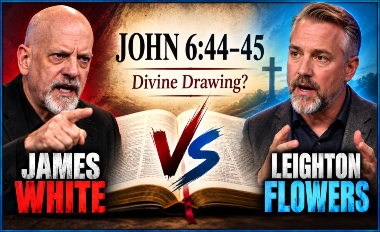
John 6:44 | Did James White Refute Provisionism? Or Just Assume Calvinism?

The video I clipped will follow the summary. After the video is the full transcript of the clip I excerpted. Enjoy:


Summary of Each Speaker’s Main Points


James White

James White argues that John 6:44–45 describes an effectual work of God in which the Father draws people to Christ by causing them to hear and learn from Him. White connects the statements in verses 44 and 45: those whom the Father draws are the same people who hear and learn from the Father, come to Christ, and are raised up on the last day. He therefore understands the drawing in John 6 as something ultimately accomplished by God rather than something that merely makes salvation possible.

White also argues that appeals to John 12:32—where Jesus says that He will draw “all men” to Himself—create a problem for interpretations that understand “all” as every individual without exception while also making the drawing in John 6 effectual. If everyone is drawn in exactly the same effectual sense, White argues, universalism would follow. He therefore treats the distinction between John 6 and John 12 as important to his argument against non-Calvinist interpretations.

A major part of White’s argument concerns John 6:45: “they shall all be taught by God.” He asks Flowers to consider what would happen to his theology if the hearing and learning described in the passage were the result of God’s effective action—if God Himself causes the individual to hear and learn. White treats Flowers’ answer—that if this were true, the five points of Calvinism would follow—as an admission that the passage supports his position.

White therefore presents the exchange as evidence that Flowers effectively conceded the crucial point during the debate.

Leighton Flowers

Leighton Flowers argues that White is answering an argument that Flowers is not actually making. Flowers maintains that his interpretation of John 6 does not require the Father to be drawing every individual at that point in Jesus’ ministry. Instead, he understands the Father as drawing those Israelites who had listened to and learned from God through Moses and the prophets to the Son. The immediate context, in Flowers’ interpretation, concerns the remnant of Israel being brought to Christ.

Flowers then distinguishes John 6 from John 12. He argues that John 12:32 describes a later stage in salvation history, after the Son is lifted up. At that point Jesus says He will draw “all men” to Himself. Flowers understands this as the expansion of God’s redemptive work beyond Israel to the nations, rather than as a statement that every individual will inevitably be saved. He therefore rejects White’s claim that his interpretation necessarily leads to universalism.

Flowers also rejects the assumption that being taught or drawn by God means being irresistibly regenerated. He argues that God’s teaching can be genuine and powerful while remaining resistible. His teacher analogy illustrates the point: a teacher can sincerely teach students and desire that they learn, while some students nevertheless refuse to listen. In such a case, the student’s refusal does not demonstrate that the teacher secretly intended only certain students to learn.

Flowers’ argument therefore challenges a crucial Calvinist inference:

God teaches → therefore God effectually causes the person to believe.

Flowers accepts the first proposition but rejects the necessity of the second.

Flowers also appeals to Jesus’ use of parables. He argues that Jesus sometimes deliberately concealed truth from people who otherwise could hear, understand, and turn. Flowers sees this as significant because, if Calvinism is correct that unregenerate people are incapable of believing until they are first regenerated, then Jesus would not need to conceal the truth from them in order to prevent their belief. He could simply leave them unregenerated.

Flowers instead interprets the parables and the hardening of Israel as part of God’s redemptive-historical purpose leading to the crucifixion.

This leads Flowers into Romans 9–11. He argues that the hardening of Israel should not automatically be interpreted as evidence that particular individuals were eternally reprobated from birth. He points to Romans 11:23, where those who were cut off because of unbelief can be grafted back in if they do not remain in unbelief. Flowers therefore understands the hardening as judicial and connected to God’s larger redemptive plan involving Israel, the Gentiles, the crucifixion, and the eventual possibility of Israel’s restoration.

Finally, Flowers rejects White’s characterization of their debate exchange as a concession. Flowers argues that White’s question was conditional:

if White’s interpretation were true, then Calvinism would follow.

Flowers’ response acknowledged the logical consequence of White’s premise without conceding that the premise itself was true.

In Flowers’ view, that premise—the claim that God effectually causes the hearing and learning in John 6—is precisely the issue being debated.

Flowers therefore accuses White of treating a disputed interpretation as though it had already been established and then claiming victory based on the hypothetical consequences of that interpretation.

The Central Disagreement

At the deepest level, the disagreement is not simply over whether God draws people to Christ. Both men affirm divine drawing and divine teaching.

The disagreement is over what kind of drawing John 6 describes and what must be inferred from God’s teaching.

White’s argument can be represented roughly as:

Father draws → Father teaches → person hears and learns → person comes to Christ → person is raised

White understands this sequence as effectual and ultimately grounded in God’s sovereign action.

Flowers’ argument is closer to:

Father teaches/draws → people are genuinely confronted with God’s revelation → some respond and some resist → those who respond come to Christ

while also arguing that the particular drawing in John 6 has a specific redemptive-historical focus on Israel and should not simply be equated with the universal drawing described in John 12.

That distinction is what White’s universalism objection, according to Flowers, fails to address.

The central issue, therefore, is not simply whether Flowers believes in divine drawing or divine initiative. He does. His objection is to the additional inference that divine teaching or drawing must necessarily be effectual in the Calvinistic sense—that God’s act of drawing necessarily produces regeneration, faith, and perseverance in the individual being drawn.

In other words, Flowers is challenging the logical bridge between God’s sovereign initiative and an irresistible human response. His argument is that the former does not automatically establish the latter.

Source Note: The transcript excerpts discussed above are from my video, “James White’s Ignorance On Display – Subverting Truth,” which reproduces commentary and clips from Leighton Flowers’ Soteriology 101 video, “James White’s Repeated Errors Exposed | Leighton Flowers | Soteriology 101.”

Original source videos:

TRANSCRIPT:


Transcript:

A lot is being discussed about the theology of salvation and the Calvinist doctrine of limited atonement, which I disagree with.

So I want to answer one argument that I think the Calvinists falsely attribute to those of us who have a Provisionist view.

The Calvinist posits that if salvation requires faith, then faith must be a human contribution and therefore salvation is partly earned. In other words, acceptance is a work.

That argument assumes saving faith is like consideration in a contract, something of value exchanged for a promise. So if God promises salvation in response to faith, then faith must be the payment or consideration that completes the bargain.

But that’s the wrong view of faith. It confuses consideration or bargain for exchange with a conditional gift.

Imagine I offer you a gift and say, it’s yours. Come and receive it.

When you accept the gift, you aren’t purchasing it. You’re not providing any value. You’re not earning it.

I provided the gift. I paid the entire cost. I freely offered it. Your acceptance does not make me indebted to you. It simply means you receive what I have already provided.

Importantly, accepting is necessary to receive the gift because I’m not forcing it upon you against your will or knowledge.

A conditional gift is the biblical model of salvation. Christ paid the full price. Human beings contribute no merit, no righteousness, no works, no value, no payment toward salvation.

But God does condition our receiving that gift upon repentance and faith. And Scripture clearly distinguishes faith from works. 5 says, To the one who does not work but believes, his faith is counted as righteousness.

Faith is not a payment exchanged for salvation. It’s not a contribution that makes salvation possible. Faith is the empty hand that receives what God has graciously provided.

The gift is entirely God’s. The provision is entirely Christ’s. And accepting a gift does not mean you earned it.

So faith does not give man grounds for boasting. It gives God all the glory because salvation is freely offered, fully paid for, and received by faith alone through Christ alone in mercy and grace alone.

I will include Jenna’s video below/right

James White

Anyway, so these are some of the questions that I posted. So here’s Leighton Flowers pops in. And I don’t remember, I saw it yesterday. Jenna Ellis had tagged me and said, would you care to comment? And I couldn’t see what I was supposed to comment to because I had them blocked and nothing came up on my screen. I tried scrolling down, nothing happened. And so I’m sort of like, well, I’d be happy to do it. And while we’re at it, how about you respond to the question I asked you, which she will not do.

Leighton Flowers

I think she’s already responded to your answer and then later posted mine because she found out you blocked me. So again, facts.

James White

She will not do. There’s no reason to try to seek to engage her. She’s not an honest interlocutor. She’s just not. She’s turned out to be pretty wild. No two ways about it.

Leighton Flowers

Oh, the irony. Jenna is more kind and compassionate and loving towards people than you will ever hope to be, Dr. White. Sorry, again, to the man arguments, or in this case, to the woman arguments. Nothing to do with what Jenna wrote or what I wrote, but what does he have to do? He has to talk down to his opponent. He can’t be respectful. He can’t be kind. He can’t be nice to him. He’s got to talk down to him.

James White

So I found this today. And so here is the great Leighton Flowers. Now again, I was gonna play this, but I posted it three times yesterday on my X feed, so if you wanna see it, someone, thank you, whoever did it, pulled a clip from the debate with Leighton Flowers, that this is where James White won the debate with Leighton Flowers.

During the cross-examination, John 6:45, he always jumps John 6:45. He always ends up talking about it. 45 right there. And I’m pressing him and I say, okay, the one hearing, the one learning from the Father comes to me. I will raise him up on the last day. In context, that’s what the drawing is. You have to be drawn by the Father. If you’re drawn by the Father, you’re raised up by the Son.

So everybody jumps to John chapter 12, totally different context and that leads to universalism. They don’t care ’cause they don’t debate universalists. They only hate Calvinism, so they don’t care if they’re completely open to refutation from another perspective, they’re never gonna deal with those people anyway, so they don’t even think about it.

Leighton Flowers

None of that applies to my position or Dinesh’s position that he posted, or Jenna’s position that she posted, or John Lennox’s position, or none of what he just said refutes any one of those positions. Why? Because if you understand what we’re saying about John chapter 6, we’re saying that the Father is drawing those who’ve listened and learned from Moses, those who’ve listened and learned from the Father, that he’s drawing them to his Son at this point in time. He’s not drawing everyone to himself because John 12:32 wouldn’t exist if he was, because he says it’s not until the Son is lifted up that I will draw all men to myself.

So he’s not drawing all men to himself yet. And you can even say that’s all without distinction, not all without exception. So, okay, so he’s not drawing both Jews and Gentiles yet. Okay. So you have to acknowledge that in John 6, Jesus is not drawing all people to himself. What does that mean? The Father is drawing, Hebrews chapter 1. Read it. In days gone by, the Father drew, taught all people through the prophets. But in these current days, we are taught by the Son. There’s a shift that’s taking place. And so you’ve got the Father drawing whom? The people of Israel, the remnant of Israel, to believe in his Son so that he will raise them up in the last day.

We agree with that language, that grammatical thing. You can even make drawing irresistible if you want in that reading. And I don’t believe that drawing has to be interpreted or should be understood as irresistible because it’s simply referring to exactly what White admitted in his own book. The means of drawing is the teaching of God, that he’s the one who teaches. People can resist his teaching. They can refuse his teaching. They can accept it or refuse it. Common understanding of all teachers. Everybody knows that a teacher may be a great teacher, the best teacher that ever existed, but there may be some students who refuse to listen. And we blame the student for not learning, not the teacher or the intentions of the teacher as if the teacher doesn’t really want all the students to learn.

We blame the student for refusing to learn or not listening or closing their ears with their eyes. We don’t blame the teacher, okay? i.e., the teacher really doesn’t want it, secretly has a secret will, teaches all of them, but I only want some of them to really learn—all these kinds of nonsensical caveats and conclusions that Calvinists try to insert into the text. And so if you understand our position with regard to chapter 6 and chapter 12, you recognize that it’s not until he’s raised up that he draws all men to himself.

You see Mark 9:9, for example, they come down from the Mount of Transfiguration. He says, don’t tell anybody about this yet. Not until the Son of Man is lifted up. Then you can tell them because telling them would be a means of drawing. Preaching to them the gospel would be a means of drawing, and I don’t want you doing that yet. Why doesn’t he want them to do that? Same reason he said, I teach them in parables. Those on the inside, I tell them the truth. Those on the outside, I don’t. I teach them only in parables, lest they see, hear, understand, and turn, and I would heal them. He doesn’t want them to come yet. Why? Because then they’re not going to crucify him.

In order to accomplish the crucifixion, he’s using parabolic language. He’s giving them a spirit of stupor. He’s hardening them in their rebellion, speaking of the Jewish people, in order to get to Calvary. This is the interlocutor in Romans chapter 9 who’s crying out with him, why am I still to be blamed? Same interlocutor in chapter 3. Why are you to blame us? If our unrighteousness brings about your redemptive plan for good, your righteousness, why are we still to be blamed? Paul answers it in chapter 3 and he answers it more fully in chapters 9, 10, and 11.

And his conclusion’s not, well, some are reprobates from birth and cut off from birth. No, he says they’re cut off because of their unbelief, chapter 11, verse 23. He even says that he holds that hope that his ministry to the Gentiles will provoke them to envy so that they too will see the error of their ways and be grafted back in, leave their unbelief so as to be grafted back in. Does that sound like a reprobate who has no hope? Of course not, because that’s not who Paul is addressing.

In chapters 9, 10, and 11, he’s addressing the people of Israel who’ve grown calloused and hardened, who have now been cut off in their unbelief, judicially hardened by God, sent a spirit of stupor, being spoken to in parabolic language by their own Messiah, so as to ensure the crucifixion, so as to ensure the resurrection and the engrafting of the Gentile nations. When you understand that, none of what White’s saying right here, all of it just goes right past. This is why you say people are talking past each other. He’s not engaging the point of our contention. He’s jumping over to John chapter 12 and saying, well, see if those who are drawn are certainly raised up and Jesus draws all people without exception over in chapter 12, then that means everybody without exception is gonna be saved, and so you get universalism, so ha ha ha, we must be right. And he doesn’t even consider that the drawing is by the Father of those of the remnant of Israel being drawn to Jesus to be raised up for the purpose of bringing redemption to the world.

He doesn’t even consider that as an option, so he doesn’t even address it as an option, so therefore he never actually answers the argument of his opponents. He talks right past them. Now he thinks he’s got it figured out. He thinks he’s answering the typical Arminian response because some Arminians maybe go there. Maybe some Arminian responses do focus more on a different explanation of John chapter 6 or 12 or those kinds of things. But he’s certainly not engaging with mine or with what Jenna posted or with what Dinesh posted because we all take the same exact approach that Lennox took, that Michael Brown took, and that Steve Gregg took. Still White doesn’t either get it or he’s being deceptive. Ignorance or deception, you decide.

James White

So we had gotten to John 6:45 and I said, so if the phraseology is used there, and I suppose what I need to do here is, oh, I can’t do it because I have this maxed out and you can’t put two of those on top of each other, but I can do this just for a moment. I will get rid of it here in a second.

But right here in John 6:45, it is written in the prophets, and they shall all be taught by God. So, everyone hearing, and then mathon is going to be drawing its syntactical relationship from akousas. Everyone hearing and learning from the Father is coming to me.

So I said to Leighton, I said, if these are descriptive of divine power being exercised, if this is something that God effectuates, he causes people to hear, he causes people to learn, what would that do to your system? And his answer was, it would mean that the five points of Calvinism are true.

And so they put that question and answer together with my closing statement where I said, did you hear what he just said? Because that’s exactly what this is. This is the description of what being drawn in verse 44 is. That’s why everyone who’s drawn is raised up in the last day. That’s why every one of you that quoted John chapter 12 and said everybody’s drawn, we need to be universalists.

Leighton Flowers

See what I mean? Notice the tautology. He basically asked if I’m right, am I right? And I said, well, yes, if you’re right, you’re right. But I don’t believe you’re right. And you don’t believe me. Let’s go to the receipts. Okay.

James White

All who are taught by God, all who are, who hear from the father, all who learn from the father, that’s provided in scripture and being described by Jesus. What if that were that, what would that do to your theological understanding of this text?

Leighton Flowers

If that were true, then your presupposition TULIP would be true. And I don’t think your presupposition is true. I believe they actually have the responsibility, the ability to respond to the teaching of God.

James White

They can deny it or they can accept it.

Leighton Flowers

Everybody heard that, right? So he claims that is ultimately what ensured that he won the debate. Okay. So he basically says that if this teaching is effectual, then am I right? And obviously if he believes the teaching is effectual, meaning it has an effectual result in the belief of the elect, which is what he’s asking, then am I right? And I’m basically saying, yeah, obviously that’s the debate. That’s the very point up for debate, whether that’s what this is teaching or not.

And he claims that that’s why he won the debate, despite the fact that most people who watched it, according to 1,400 votes, said that I won the debate. No, he still says, oh, I won the debate because Leighton admitted that if I’m right, I’m right. Again, this is the level of argumentation, folks, of the best scholar, at least that’s confronting provisionism. This is the highest level of argumentation you’re getting from them so far.

This is why I thank God for James White. Every time he does these kinds of broadcasts, I think any person with an iota of logical ability can see through some of these lower-level arguments. And they’re just, at least if they’re not already swallowed hook, line and sinker Kool-Aid drinkers, I think they can see this. And so a lot of the people who come to him because of a lot of the other arguments that he’s arguing with the King James Version only or the Trinity or other things he’s doing, they’ll get introduced to this Calvinism stuff and they’ll begin to hear him and they’ll be going to go, that doesn’t make any sense.

I know this is happening because I have people come all the time, like the guy commenting earlier, that come to me through James White because they like what he’s doing on all these other subjects. But when he comes to Calvinism, he just goes off the rails. And he starts making really bad logical conclusions and really poor argumentation and starts attacking his opponents in unfair ways and making ad hominem remarks about them and all these kinds of other things that we’ve seen from White.

And they begin to go, I just get so turned off by the way he’s approaching provisionists and Arminians that I begin to look at provisionism and Arminianism and see whether it’s really right or not. And then I begin to go, oh yeah, that doesn’t make any sense. And so that’s, again, another reason I really love the fact that James White confronts us. He does a lot to push people towards provisionism. So thank you, James White, for that.

James White

Which means you are not handling scripture accurately and correctly. And the thing that’s bothering me the most about X right now is you don’t seem to care. You don’t seem to care. Hey, if it allows me to deny Calvinism, I don’t care what the universalists say. That is.

Leighton Flowers

Again, nothing about universalism has anything to do with John chapter 12 or how we would understand it.

Nathan’s right, Jesus’ reason for speaking in parables refutes Calvinism because if they needed to be regenerated, then Jesus could have spoken plainly and just not regenerated them. Exactly. It’s one of the things that led me out of Calvinism was that very point. Why would he need to use parables to keep them from belief if they can’t believe without being regenerated first?
Calvinist’s Hiding Their Dreadful Decree Behind the Good News

This video examines why the doctrine of Calvinistic predestination—particularly double predestination and reprobation—has repeatedly produced intense disagreement within the Christian church. The discussion asks an important historical question: if these doctrines were foundational teachings of the apostles and earliest Christians, why do we find so little evidence of the kind of intense intra-Christian controversy surrounding them before Augustine?

The video looks particularly at Augustine’s role in the development of theological determinism, including his earlier association with Manichaeism and Neoplatonism, and the later development of his views on predestination. It also considers the historical evidence concerning the early church fathers and their opposition to deterministic ideas associated with Gnosticism and other movements.

The discussion then turns to the modern Calvinist debate and the striking divisions that arise when these doctrines are introduced into churches. Are these disagreements simply evidence that the doctrines are difficult truths that Christians must accept by faith, or do they indicate that something fundamentally different from the teaching of the earliest church has been introduced? The video also examines the problem of “double-speak”—the attempt to hold apparently contradictory propositions together by appealing to God’s mysterious or supposedly different logic.

Ultimately, the video asks viewers to consider a larger question: If Calvinistic determinism was truly a foundational doctrine of Christianity, why is its historical emergence and subsequent divisiveness so pronounced? Rather than simply telling the viewer what to believe, the goal is to examine the historical and theological claims and encourage the viewer to “report, you decide.”

PARTIAL TRANSCRIPT OF THE ABOVE PDF 

2) The earliest Christian scholars did not teach “Calvinistic” doc­trines.

If Jesus really was teaching TULIP theology so clearly in John chapter 6, as White likes to emphasize, why on earth don’t we see any of these theological concepts expounded upon or even mentioned in the earliest Christian writings? Instead, we have a preponderance of teachings from the early church, which rebut the conclusions that Calvinists have drawn from this and other passages. A widely-accepted notion among biblical scholars and historians is that doc­trines obtained from those who were present at the time they were created are more likely to be accurate. In contrast, the likelihood of errors in doctrine increases as one moves further away from the ori­ginal sources.

Irenaeus (ca. 130-202) was a martyr and influential figure in the early development of Christian theology. He was a student of Poly-carp, who was a disciple of John. In 180 AD, Irenaeus wrote a book called “Against Heresies,” specifically addressing ideas that would later be associated with Calvinistic Theology. These “heresies” being addressed denied free will, as can be seen in the following summar­ies:

Men are possessed of free will and endowed with the faculty of making a choice. It is not true, therefore, that some are by nature good and others bad.

This expression [of our Lord], How often would I have gathered your children together, and you would not, Matthew 23:37 set forth the ancient law of human liberty, because God made man a free [agent] from the beginning, possessing his own power, even as he does his own soul, to obey the behests (ad utendum senten-tia) of God voluntarily, and not by compulsion of God. For there is no coercion with God, but a good will [towards us] is present with Him continually. And therefore does He give good counsel to all. And in man, as well as in angels, He has placed the power of choice (for angels are rational beings) so that those who had yielded obedience might justly possess what is good, given indeed by God, but preserved by themselves. On the other hand, they who have not obeyed shall, with justice, be not found in possession of the good, and shall receive condign punishment: for God did kindly bestow on them what was good, but they themselves did not diligently keep it, nor deem it something precious, but poured contempt upon His super-eminent goodness. Rejecting therefore the good, and as it were spuing it out, they shall all deservedly incur the just judgment of God, which also the Apostle Paul testi­fies in his Epistle to the Romans, where he says, But do you des­pise the riches of His goodness, and patience, and long-suffering, being ignorant that the goodness of God leads you to repentance? But according to your hardness and impenitent heart, you store to yourself wrath against the day of wrath and the revelation of the righteous judgment of God. But glory and honour, he says, to everyone that does good. God, therefore, has given that which is good, as the apostle tells us in this Epistle, and they who work it shall receive glory and honour, because they have done that which is good when they had it in their power not to do it; but those who do it not shall receive the just judgment of God, because they did not work good when they had it in their power so to do.

But if some had been made by nature bad, and others good, these latter would not be deserving of praise for being good, for such were they created; nor would the former be reprehensible, for thus they were made [originally]. But since all men are of the same nature, able both to hold fast and to do what is good; and, on the other hand, having also the power to cast it from them and not to do it — some do justly receive praise even among men who are under the control of good laws (and much more from God), and obtain deserved testimony of their choice of good in general, and of persevering therein; but the others are blamed, and receive a just condemnation, because of their rejection of what is fair and good. And therefore the prophets used to exhort men to what was good, to act justly and to work righteousness, as I have so largely demonstrated, because it is in our power so to do, and because by excessive negligence we might become forgetful, and thus stand in need of that good counsel which the good God has given us to know by means of the prophets.43

Justin Martyr, who lived from c. 100/114AD to c. 162/168 AD was a prominent early Christian apologist who defended the faith. He courageously faced martyrdom through beheading. His writings are significant as they are the earliest surviving examples of substantial Christian apologia. He taught:

Man acts by his own free will and not by fate. We have learned from the prophets, and we hold it to be true, that punishments, chastisements, and rewards are rendered according to the merit of each man’s actions. Otherwise, if all things happen by fate, then nothing is in our own power, for if it be predestined that one man be good and another man evil, then the first is not deserving of praise or the other to be blamed. Unless humans have the power to avoid evil and choose good by free choice, they are not accountable for their actions-whatever they may be….

For neither would a man be worthy of reward or praise if he did not of himself choose the good but was merely created for that end. Likewise, if a man were evil, he would not deserve punish­ment since he was not evil of himself, being unable to do any­thing else than what he was made for.

But that you may not have a pretext for saying that Christ must have been crucified, and that those who transgressed must have been among your nation, and that the matter could not have been otherwise, I said briefly by anticipation, that God, wishing men and angels to follow His will, resolved to create them free to do righteousness; possessing reason, that they may know by whom they are created, and through whom they, not existing formerly, do now exist; and with a law that they should be judged by Him, if they do anything contrary to right reason: and of ourselves we, men and angels, shall be con­victed of having acted sinfully unless we repent beforehand. But if the word of God foretells that some angels and men shall be certainly punished, it did so because it foreknew that they would be unchangeably wicked, but not because God had created them so.44

Clement of Alexandria, known to have lived from c. 150 to c. 215 AD, was an important figure in early Christianity. He was an influ­ential Christian theologian and philosopher who sought to integrate Greek philosophy with Christian teachings. Despite living in turbu­lent times, Clement remained devoted to defending and promoting the Christian faith. His written works, which have survived to this day, provide valuable insights into the early development of Christian thought, making Clement of Alexandria a notable figure in early Christian apologetics. He wrote:

A man by himself working and toiling at freedom from sinful desires achieves nothing. But if he plainly shows himself to be very eager and earnest about this, he attains it by the add­ition of the power of God. God works together with willing soul­s. But if the person abandons his eagerness, the spirit of God is also restrained. To save the unwilling is the act of one using com­pulsion, but to save the willing, that of one showing grace.

Neither praise nor condemnation, neither rewards nor pun­ishments, are right if the soul does not have the power of choice and avoidance if evil is involuntary.

I could have provided more examples from early church leaders, but the point has been established. To address any concerns about selectively quoting to support my view, let’s consider the viewpoints of unbiased sources like Loraine Boettner, a well-known Calvinist, on the beliefs of early church leaders. Boettner acknowledges that the early church fathers did not endorse the doctrine of predestination:

It may occasion some surprise to discover that the doctrine of Predestination was not made a matter of special study un­til near the end of the fourth century They, of course, taught that salvation was through Christ, yet they assumed that man had full power to accept or reject the gospel. Some of their writings contain passages in which the sovereignty of God is rec­ognized; yet alongside those are others which teach the absolute freedom of the human will. Since they could not reconcile the two, they would have denied the doctrine of Predestination They taught a kind of synergism in which there was a cooper­ation between grace and free will45

Regarding what we now call the doctrine of predestination, Boettner went on to say, “This cardinal truth of Christianity was first clearly seen by Augustine…” Augustine lived from 354 – 430 A.D., well after the church fathers quoted above. However, Boett-ner was not alone in his findings. In 1882, James Morrison wrote in The Extent of Atonement about an English Bishop, John Davenant (1572-1641), who was a Calvinist present at the Synod of Dort in 1618. Bishop Davenant wrote:

It may be truly said before Augustine and Pelagius that there was no question concerning the death of Christ, whether it was to be extended to all mankind or to be confined only to the elect. For the Fathers…not a word (that I know of) occurs among them of the exclusion of any persons by the decree of God. They agree that it is actually beneficial to those only who believe, yet every­where confess that Christ died on behalf of all mankind…

Augustine died in AD 429, and up to his time, at least, there is not the slightest evidence that any Christian ever dreamed of a propitiation for the elect alone. Even after him, the doctrine of limited propitiation was but slowly propagated, and for long but partially received.46

Herman Bavinck, another well-respected Calvinistic scholar, came to virtually the same conclusion:

In the early church, at a time when it had to contend with pagan fatalism and gnostic naturalism, its representatives focused ex­clusively on the moral nature, freedom, and responsibility of hu­mans and could not do justice, therefore, to the teaching of Scrip­ture concerning the counsel of God. Though humans had been more or less corrupted by sin, they remained free and were able to accept the proffered grace of God. The church’s teaching did not include a doctrine of absolute predestination and irresistible grace.47

In their book titled “Why I Am Not An Arminian,” two Calvinis­tic professors of theology at Covenant Theological Seminary, Robert Peterson and Michael Williams, reflect on the same basic historical fact:

The Semi-Pelagians were convinced that Augustine’s monergistic emphasis upon salvation by grace alone represented a signifi­cant departure from the traditional teaching of the church. And a survey of the thoughts of the apostolic fathers shows that the argument is valid… In comparison to Augustine’s monergistic doctrine of grace, the teachings of the apostolic fathers tended to­ward a synergistic view of redemption.48

Louis Berkhof, who was both President of Calvin Seminary and a professor of Systematic Theology, affirms this “assured fact, a fact knowing no exceptions, and acknowledge by all well versed in the matter:”

Predestination does not form an important subject of discussion in history until the time of Augustine. Earlier Church Fathers al­lude to it, but do not as yet seem to have a very clear conception of it. On the whole, they regard it as the prescience of God with reference to human deeds, on the basis of which He determines their future destiny… Their representations are naturally rather indefinite, imperfect, incomplete, and sometimes even erroneous and self-contradictory. Says Kahnis: “It stands as an assured fact, a fact knowing no exceptions, and acknowledged by all well versed in the matter, that all of the pre-Augustinian Fathers taught that in the appropriation of salvation, there is a co-work­ing of freedom and grace.” 49

Berkhof goes on to admit that “they [the early church scholars] do not hold to an entire corruption of the human will, and consequently adhere to the synergistic theory of regeneration…” In other words, he admits there were no “monergists” before Augustine.50

John Calvin himself even admitted that Augustine was the only early source he could find to validate his views:

Moreover, although the Greek Fathers, above others, and espe­cially Chrysostom, have exceeded due bounds in extolling the powers of the human will, yet all ancient theologians, with the exception of Augustine, are so confused, vacillating, and contra­dictory on this subject, that no certainty can be obtained from their writings.51

I suspect that the reason Calvin singled out his frustration with John Chrysostom (347-407) is probably because Chrysostom linked the Calvinistic interpretation of passages like John 6:44 to their Gnos­tic origin when he wrote:

No man can come unto Me, except the Father which has sent Me draw Him. The Manichaeans spring upon these words, saying that nothing lies in our own power, yet the expression shows that we are masters of our will.52

Augustine was a Manichaean for about a decade of his life before converting to Christianity, so many scholars throughout the ages have suspected that this might have been one significant influence explaining why Augustine’s teachings “represented a significant de­parture from the traditional teaching of the church,” as acknow­ledged by “all well versed in the matter.”53

And we cannot downplay the amount of influence Augustine had, especially on the Calvinistic form of Christianity. R.C. Sproul, a highly esteemed Calvinistic theologian, wrote:

It has been said that all of Western theology is a footnote to the work of Augustine. This is because no other writer, with the ex­ception of the biblical authors, has had more influence on Chris­tendom. When Martin Luther and John Calvin were accused of teaching new doctrine, they pointed to Augustine as an example of one who had taught the things they were teaching.54

On this point, James Leo Garrett, a prominent Baptist theologian and scholar, aptly noted:

From Augustine of Hippo to the twentieth century, Western Christianity has tended to interpret the doctrine of election from the perspective of and with regard to individual human beings. During those same centuries the doctrine has been far less em­phasized and seldom ever controversial in Eastern Orthodoxy. Is it possible that Augustine and later Calvin, with the help of many others, contributed to a hyper-individualization of this doctrine that was hardly warranted by Romans 9-11, Eph. 1, and I Peter 2? Is it not true that the major emphasis in both testaments falls upon an elect people—Israel (OT) and disciples or church (NT)?55

Considering that even Calvinists discourage the teaching of TULIP to skeptical non-believers and the fact that the Christian church in its first 400 years did not interpret the Bible from a Calvin­istic perspective, it seems highly improbable that Jesus intended to introduce this complex and controversial soteriological systematic to a group of grumbling unbelieving Israelites who were superficial fol­lowers looking for a free meal.


Leighton C. Flowers, Drawn by Jesus: A Biblical Defense of God’s Provision for All and a Rebuttal of James White’s Book “Drawn by the Father” on John 6:35–45 (Trinity Academic Press, 2024), 63–77.

SEE ALSO: Did the Early Church Fathers teach Calvinistic Doctrines?

FOOTNOTES:

40. Calvinism is generally known by its unwavering commitment to the soteriology (doctrine of salvation) most popularly represented by the acronym “TULIP” (Total depravity, Unconditional election, Limited atonement, Irresistiblegrace, and Perseverance of the saints), also referenced as “five points.” Some Cal­vinists call themselves “four pointers” (Amyrauldians), because they reject Limited atonement. Others, like White, add additional letters, such as “S” for “sovereignty” which is redefined to mean “theistic determinism,” making the acronym “STULIP.”

41. In a casual poll on X, I posed the question to Calvinists: “Should you teach TULIP to a crowd of unbelievers.” The overwhelming response was, no. Here are a few replies that best represent the consensus: “No. Secondary matters are second­ary.” “No need to get into the deeper things of God, given that they reject milk.” “This is why we sit down and talk to people and find out who they are and where they are. Any system of doctrine is a guard rail. This is not be to preached or evangelized.”

42. On a Dividing Line program titled “Radio Free Geneva: Atheists, William Lane Craig, Warren McGrew,” White responded to a discussion between an Atheist (PineCreekDoug) and a Calvinistic Christian (Derek Murrell) saying, “…there’s no reason to be discussing the sovereign grace of God and things like that with some­one who just doesn’t even believe…”  accessed online [by RPT 8/27/2026] 

43. Irenaeus, Against Heresies, accessed online [by RPT 8/27/2026] (NEW ADVENT)

44 Justin Martyr, The First Apology (chapter 43), accessed online [by RPT 8/27/2026] (NEW ADVENT).

45. Loraine Boettner, Reformed Doctrine of Predestination, accessed online [by RPT 8/27/2026] (MONERGISM)

46. David Allen, The Synod of Dort and the Extent of the Atonement, accessed online [by RPT 8/27/2026] (DR. DAVID ALLEN)

47. Herman Bavinck, Reformed Dogmatics, ed. John Bolt, trans. John Vriend, vol. 2, God and Creation (Grand Rapids: Baker, 2004), 348. He references Justin Mar­tyr, Irenaeus, and Tertullian among the ante-Nicene fathers, and John of Damascus among the later Eastern teachers.

48. Robert Peterson and Michael Williams, Why I Am Not an Arminian (IVP, 2004) 36.

49. Louis Berkhof, Systematic Theology (Eerdmans, 1932) 130.

50. The categories of “monergism” versus “synergism” were created by Calvin­ists in order to reframe the discussion over the role of God and man in the process of salvation which is based on a fallacy of conflation. More on this topic can be found here: “Calvinism’s Conflation” (SOTO 101); and “Calvinism’s Conflation | Flowers and Tozer” (RELIGIO-POLITICAL TALK)

51. John Calvin, Institutes, book 2, chapter 2, section 4

52. John Chrysostom, Homily 46 on the Gospel of John, accessed online [by RPT 8/27/2026] (NEW ADVENT)

53. For more on this topic see: Ken Wilson, The Foundation of Augustinian-Calvinism (Mohr Siebeck, 2019).

54. Quote taken from a recommendation for The Works of Saint Augustine: The Confessions. Accessed online [by RPT 8/27/2026] (THE OLD GUYS)

55. James Leo Garrett Jr., Systematic Theology: Biblical Historical, and Evangel­ical, vol. 2 (Grand Rapids: Eerdmans, 1995), 500

This stuff is striking a chord with me. Why, part of this year+ journey I left a church where this “two face” theology is preached from the pulpit and something different is discussed behind doors (adult classes and men’s and women’s groups). My past pastor said this:

  • “Make a choice. Choose this day. In fact, you can choose one of the… He’s not saying that he’s happy if you choose the pagan gods, but he says, in fact, pick one of the pagan gods. Do you know that something that God is extremely kind and gracious to us and that he gave us free will? Did you know that? He didn’t force a relationship on us. He gave us free will. Do you remember what he gave Adam and Eve? Free will. You can make a choice. I’m not gonna force it. Hey, you choose, yeah, you, make the choice.”

When I asked an elder if this pastor really believed this statement he made regarding free will from the pulpit, I got an honest answer of “No.” And when discussing the issue the night before I turned in my letter of leaving to the church, this was said via another pastor:

Interestingly enough Josh McDowell’s warning rang very true to me. He writes:

  • A feature of some cultic groups is that they say one thing publicly but internally believe something totally different. Many organizations call themselves Christians when in fact they deny the fundamentals of the faith. . . . One therefore must be on the alert for the organizations that advertise themselves as “Christians” but whose internal teachings disagree with Scripture.

And part of the reason for this “secrecy” is that is is not good news, it is a “dreadful decree”.

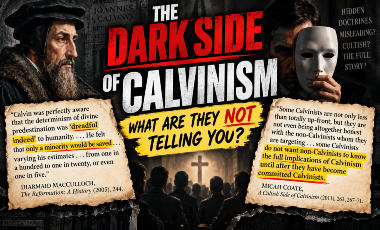
Although we cannot know the true intentions of John Calvin’s pursuit in evangelism, for several reasons it seems unlikely that he aimed only to proclaim salvation in Christ. First, his theological view clearly makes evangelism ultimately useless. Second, cult leaders usually seek their own desires, as opposed to the desires of God as revealed in Scripture. Third, John Calvin knew that his missionaries were not spreading good news to anyone whom God would not save. In fact, as Reformation historian Diarmaid MacCulloch writes, “Calvin was perfectly aware that the determinism of predestination was ‘dreadful indeed’ to humanity.”[22]* In fact, his missionaries were spreading nothing but bad news to almost all of those who were supposedly not of the elect. According to MacCulloch, “The most discordant noises came from Basel, where one anonymous pamphlet with bitter sarcasm described the Genevan Church as proclaiming ‘its good news with flames.”[23]

[….]

(4) Why Calvinism’s gospel and other cult theologies are dishonestly presented

When I share the gospel message, either from the pulpit or one-on-one, I have nothing to hide or water down about my beliefs and theology. This may sound very basic, but it must be noted. If I were a people pleaser, I would be tempted to overlook those parts of my theology that might offend a potential believer. Certain aspects of the gospel’s good news, like “personal sin” and “divine judgment,” are not merely a part of understanding one’s need for God’s grace but are imperative to receiving it. Thus, although the prospective convert might not welcome the true notion of his rebellion before God (i.e., his sin) and a time of God’s future judgment, I withhold nothing and keep no secrets in laying out the full gospel.

This is not the case with Mormonism and Jehovah’s Witnesses. This is also not the case with the gospel according to Calvinism. George Bryson writes:

Some Calvinists are not only less than totally up-front, but they are not even being altogether honest with the non-Calvinists whom they are targeting. In the promotion of doctrine, what is held back or not expressed (relative to those doctrines) can be very misleading.[33]

Bryson contends that “some Calvinists do not want non-Calvinists to know the full implications of Calvinism until after they have become committed Calvinists.”[34] It should not be hard to figure out the reasons why a “potential” convert might not want to know intimately the core doctrines of Calvinism from the beginning.

If the forbearer of the Calvinist gospel message cannot or will not be upfront and direct about the doctrines pertaining to salvation (in public or private life), the skeptic must seriously consider why. Furthermore, we should wonder whether Jesus Himself was hiding some important aspects of His messages. Was He withholding the doctrine of double predestination when He called everyone to come and receive the Bread of Life? Did He expect the crowds to understand that when He said “all” or “world” what He really meant was “some” and “elect”? Did He assume that His followers would understand that “grace” could have multiple definitions? Did Jesus expect His apostles to understand that their efforts to evangelize would be ultimately futile? Indeed, Chuck Smith asks, “Why would the God of all truth, who speaks so sternly against lying, send His servants out to promote such a lie?”[35]

Yet, some Calvinists today seem guilty of being dishonest in presenting their particular gospel. One Reformed Southern Baptist pastor, in an article entitled “Instructions for Local Church Reformation,” advises other Calvinist pastors:

Choose a few men who are sincere, teachable and spiritually minded and spend time with them in study and prayer. They will help you to reform. . . . In the pulpit, don’t use theological language that is not found in the Bible. Avoid terms such as Calvinism, reformed, doctrines of grace, particular redemption, etc. Most people will not know what you are talking about. Many that do will become inflamed against you.[36]

We read about dishonesty concerning the gospel early in church history. Certain men came down from Jerusalem teaching the brethren that unless they were “circumcised according to the custom of Moses,” they could “not be saved” (Acts 15:1, NKJV).[37] Because of this threat to the gospel message, the apostles gathered and directly faced the problem. The main reason the apostles opposed this teaching was because of its false message of salvation, which added “works” to the free grace of God and limited those who could be saved to those who were circumcised. Similarly, Calvinism limits salvation to “the elect.” “Certain men” (Calvinists) are teaching the brethren that some people can “not be saved” at all.

Like Paul, the Christian is called to confront those who are “not straightforward about the truth of the gospel.”[38] In Galatians chapter 2, Paul confronted Peter about his hypocrisy. Although the gospel was commanded to be taken to all of humanity, Peter would fellowship only with the Gentiles in the absence of the Jewish elite. Thus, while Peter believed the gospel was for the Gentiles as well as the Jews, his actions differed from his beliefs. He witnessed mainly to the Jewish people who came from Jerusalem. When Paul noticed Peter compromising the truth of the gospel, he said, “Now when Peter had come to Antioch, I withstood him to his face, because he was to be blamed; . . . But when I saw that they were not straightforward about the gospel, I said to Peter before them all . . .”[39] (Galatians 2:11–14, NKJV). Paul then brings Peter’s hypocrisy into the light.

Likewise, those who herald Calvinism today do not practice what they preach. While on the outside, Calvinists claim that their gospel is for all people, their doctrines clearly declare otherwise. To win the minds of those around them, their doctrine of limited atonement is not openly addressed. Calvinists, as with all cultists, are not straightforward about their message. If they were straightforward, there would be no need for Calvin expositors like Pink, White, and Sproul to malign the intended meanings of simple words like “world”; there would be no need for Calvinist teachers to make unfounded distinctions in words like “love,” “grace,” and “calling”; and there would be no need to change the TULIP labels. The following example illustrates how far from straightforward a Calvinist can be.

I recently watched an episode of a sitcom, in which the manager of a paper resale office was offered a promotion in the company, but only if he laid off several of his employees. The manager, though close friends with many of his employees, agreed to take the new position. Not knowing their fate, his staff anxiously sought his decision. When he came out of his office, he said, “I have good news and bad news. I’ll tell you the bad news first. A lot of you will lose your job here or be forced to relocate to Sweden.” At this, the employees were distraught and saddened. But their regional manager was quick to try and raise their spirits by finishing, “And now the good news—I was offered to be head manager over all of the U.K.” As he looked for approval among his employees, they offered him none. After a minute of silence, one of the employees pointed out the stupidity of his ex-manager: “That’s not good news. All you have is bad news and irrelevant news. We’ve just lost our jobs so you could be promoted, and you think we should be happy for you?”[40]

Likewise, the gospel of Calvinism looks into the faces of people whom their god has doomed to eternal fire and expects a joyful response to their fate. In Luke 2:10, the angel of the Lord announces the true gospel of Christ as “good tidings of great joy which will be to all people.” Is one to believe that this angel from God held the same unreasonable logic of the new U.K. branch manager? Did the angel really think that the unfortunate souls would find the news of their damnation as “good tidings and great joy?”

These types of contradictions that plague Calvin’s TULIP make for a confusing and inconsistent theology. Why does it maintain such contradictions? Is it because Christians would not swallow Calvinism if it were not watered down? Is it because Calvinism’s “unveiled” gospel would turn potential new converts away instead of winning them over? Why unbelievers, let alone Christians, would be repulsed by Calvinism’s deterministic form of Christianity should be no surprise, for it must bear a certain fruit in the lives of its followers.


Micah Coate, A Cultish Side of Calvinism (Innovo Publishing, 2011), 263, 267–71.

* Calvin was perfectly aware that the determinism of divine predestination was ‘dreadful indeed’ to humanity. Moreover, like most believers in predestination (Luther and Augustine included), he felt that only a minority would be saved – it was not Calvin but Augustine in one of his savage late anti-Pelagian works who observed that God had arranged this in order to give the elect all the more reason to be grateful for their elect status.38 Calvin was not prepared to put a figure on the proportion of the saved, varying his estimates for artistic effect from his habitual estimate of one in a hundred to one in twenty, or even one in five in more generous moods. He was also very wary of saying that people could be certain of their own election, let alone identify others among the elect.

Diarmaid MacCulloch, The Reformation: A History (New York: Penguin Books, 2005), 244.

FOOTNOTES:

[22] MacCulloch, The Reformation, 244.

[23] Ibid., 245.

[….]

[33] George Bryson, The Dark Side of Calvinism: The Calvinist Caste System (Santa Ana, CA: Calvary Chapel Publishing, 2004), 23.

[34] Ibid., 22.

[35] Smith, Foreword to The Dark Side of Calvinism.

[36] Ernest C. Reisinger and D. Matthew Allen, A Quiet Revolution: A Chronicle of Beginnings of Reformation in the Southern Baptist Convention [online]; accessed by RPT 8/27/2026             

[37] NKJV, Acts 15:1.

[38] NKJV, Galatians 2:14.

[39] NKJV, Galatians 2:11–14.

[40] Ricky Gervais, The Office, Season 1, Disc 2, Episode 6 (BBC Amazon Prime Video)


The Grace Calvinists and Arminians Miss

This has been updated (7/24/2026)
This is the thumbnail in my “slider” for the curious

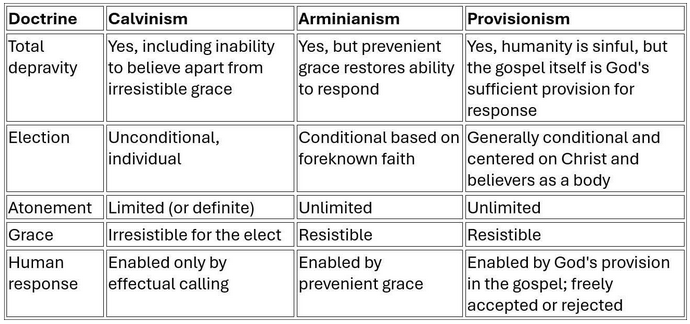
This first graph is what got me thinking about this update, and I will fix what I see is wrong with it in a bit:

One of the most common misconceptions about Provisionism—and one of the reasons I’ve updated this post—is the assumption that Provisionists believe the Gospel alone functions as the only means by which God graciously enables people to respond to Him. While the Gospel is God’s supreme and saving revelation, Provisionism has always affirmed that God graciously reveals Himself and calls humanity through multiple means, including creation, conscience, providence, the convicting work of the Holy Spirit, Scripture, and ultimately the proclamation of the Gospel.

The disagreement with Calvinism and Arminianism is not whether God enables, but what Scripture teaches about the nature of that enabling and whether mankind is born with an inherited inability that requires a special grace before one can respond in faith.

The issue is that the above column subtly reduce Provisionism’s doctrine of grace to “the Gospel alone” as though the Gospel were merely information that unaided sinners evaluate. That’s not how Leighton Flowers or most thoughtful Provisionists describe it.

Provisionism doesn’t deny that God enables; it denies that He gives a special, universally distributed prevenient grace that restores a lost faculty of faith. Instead, God has provided a multitude of gracious means by which He reveals Himself and calls sinners.

For example, God’s gracious revelation includes:

  • Creation (Romans 1:18–20)
  • Conscience (Romans 2:14–15)
  • Providence and God’s kindness (Acts 14:17; Romans 2:4)
  • The convicting ministry of the Holy Spirit (John 16:8–11)
  • The inspired Word of God (2 Timothy 3:15; Hebrews 4:12)
  • The preaching of the Gospel (Romans 10:14–17)
  • The testimony of believers (2 Corinthians 5:20)
  • God’s patient appeals throughout history (Acts 17:26–31)

The Gospel is the climax of God’s provision, not the entirety of it.

Provisionists argue that God has graciously provided everything necessary for people to respond to Him through His self-revelation in creation, conscience, providence, the convicting ministry of the Holy Spirit, the inspired Scriptures, and especially the proclamation of the Gospel. Rather than a universal prevenient grace restoring an innate inability, Provisionists see these God-ordained means as sufficient to render every person genuinely accountable before Him.

Soteriology 101 is right when they emphasizes the Gospel because Romans 10 and the Great Commission are about how people come to saving faith:

Article Two says:

“We deny that any sinner is saved apart from a free response to the Holy Spirit’s drawing through the Gospel.”

Article Four says:

providing atonement, in freely offering the Gospel in the power of the Holy Spirit

Article Eight says:

accepting or rejecting God’s gracious call to salvation by the Holy Spirit through the Gospel.”

Article Ten says:

the proclamation of the Gospel is God’s means of bringing any person to salvation.”

Amen!

I am angling a slightly different question that Soto 101’s Statement of Faith, which simply asks [even if unsaid]: “How does God save people?”

What I am saying retroactively applies to times prior to Calvary and the Gospel and the spread of it across the world, as well as to those who have not heard the Gospel presented. This is RPT’s question:

  • How has God graciously revealed Himself throughout history so that every person is morally accountable before Him while also providing His saving revelation according to His redemptive plan?

Those are not identical questions. Romans 1 and Romans 2 aren’t explaining how someone is regenerated. They’re explaining why everyone is “without excuse.”

This covers:

  • Adam through Noah.
  • Abraham and the patriarchs.
  • Israel under the Law.
  • Native Americans before European contact.
  • Modern unreached people groups.
  • Those of us who have heard the Gospel.

Your Native American article raises precisely the kind of question that illustrates this continuity: What about those who lived centuries before the Gospel reached the Americas? The New Testament doesn’t give a detailed answer about every case, but it consistently affirms two truths:

  1. God has never left Himself without witness (creation, conscience, providence, etc.). Acts 14:17 is especially explicit: “Yet He did not leave Himself without witness” Romans 1–2 makes the same point regarding accountability.
  2. The Gospel is God’s appointed means of proclaiming salvation under the New Covenant (Romans 10), while salvation itself has always been through Christ, even for those who lived before His incarnation (Hebrews 11).

MORE HERE:

  • What About Those Who Never Hear the Gospel? (Apologetic Press)
  • What About Those Who’ve Never Heard the Gospel? (Be Thinking)
  • Are Those Who Have Not Heard the Gospel Damned? RPT Q&A +More (RPT)

Provisionism’s doctrine of divine provision is not limited to the post-Pentecost proclamation of the Gospel. Throughout redemptive history, God has graciously revealed Himself through creation, conscience, providence, and His promises, rendering humanity accountable while progressively revealing His plan of redemption. Though salvation has always been through Christ alone, the Gospel is God’s appointed means of bringing people to saving faith under the New Covenant.

My Re-Write:

Provisionists affirm that the Holy Spirit draws sinners through the Gospel unto salvation. At the same time, Provisionism recognizes that God has never left Himself without witness. Through creation (Rom. 1:18–20), conscience (Rom. 2:14–15), providence (Acts 14:17; 17:24–31), the convicting ministry of the Holy Spirit (John 16:8–11), and ultimately the proclamation of the Gospel, God graciously reveals Himself, rendering every person without excuse and genuinely responsible for his or her response to His revelation. Saving faith comes through the Gospel (Rom. 10:17), but God’s gracious self-revelation is broader than the Gospel alone.

This is how I describe it on my X ARTICLE to bolster the idea:

Throughout history, God has graciously revealed Himself in many ways, including:

  • Creation
  • Conscience
  • Providence
  • Covenants
  • The Prophets
  • The convicting work of the Holy Spirit
  • The incarnation of Christ
  • The proclamation of the gospel

These expressions of God’s self-revelation are not rigid stages through which every person passes in the same sequence. Rather, they represent the many ways God has made Himself known throughout redemptive history, often overlapping in a person’s life and always finding their fullest expression in the person and work of Jesus Christ. At Calvary, God’s self-revelation reached its clearest expression, where His holiness, justice, love, and grace were displayed in the sacrificial death and victorious resurrection of His Son.

Physicist Michael Guillen’s testimony illustrates this beautifully. As a committed atheist, it was not one isolated event that brought him to Christ. Rather, his understanding was gradually shaped by the wonder of creation, the limits of scientific materialism, his search through competing worldviews, meaningful relationships, and ultimately the witness of Scripture.

His journey reminds us that God often draws people through many converging streams of revelation, each pointing beyond itself until they find their fulfillment in Jesus Christ.

(I just want to give a shout out to Provisionist Perspective for encouraging me to do an X version of my post)

  • Within the Non-Calvinist camp, there are at least two nuanced views on how God allows sinners to respond in faith. The first view is the Arminian view — which says that God’s work of grace (prevenient grace) for all people is needed to enable any sinner to freely choose to respond in faith to the Gospel message. The second view is the Provisionist View — which says that the Gospel message itself [see more below]  is God’s work of grace so that when it is preached to all people, any sinner can freely choose to respond in faith. The proclamation of the Gospel is powerfully sufficient enough to bring salvation to those who will believe. While the Arminian and the Provisionist each have a different take on why all humans can respond to God’s offer, these two views both affirm the importance of God’s initiative of grace to invite all sinners to salvation. (from the book Grace For All: Understanding God’s Plan of Salvation).

Michael R. Cariño

The “More Below”

Grace Enablements

Includes but are not limited to: God’s salvific love for all (John 3:16), God’s manifestation of his power so that all may know he is the Sovereign (Isa 45:21–22) and Creator (Rom 1:18–20), which assures that everyone has opportunity to know about him. Christ paying for all sins (John 1:29), conviction of the Holy Spirit (John 16:7–11), working of the Holy Spirit (Heb 6:1–6), enlightening of the Son (John 1:9), God’s teaching (John 6:45), God opening minds and hearts (Luke 24:45; Acts 16:14; 26:17–18;), and the power of the Gospel (Rom 1:16), without such redemptive grace, no one seeks or comes to God (Rom 3:11).

Because of these gracious provisions and workings of God, man can choose to seek and find God (Jer 29:13; Acts 17:11–12). Moreover, no one can come to God without God calling (Acts 2:39), drawing (John 6:44), and that God is drawing all individuals (John 12:32). The same Greek word for draw, helkuō, is used in both verses. “About 115 passages condition salvation on believing alone, and about 35 simply on faith.” Other grace enablements may include providential workings in and through other people, situations, and timing or circumstances that are a part of grace to provide an opportunity for every individual to choose to follow Christ.

These are grace enablements in at least three ways; first, they are provided by God’s grace rather than deserved by mankind; second, the necessary components for each and every individual to have a genuine opportunity to believe unto salvation are provided or restored by God; third, they are provided by God without respect to whether the individual will believe or reject, which response God knew in eternity past.

The offer of the Gospel is unconditional, but God sovereignly determined to condition the reception of the offer upon grace-enabled faith; therefore, faith is not reflective of a work or virtue of man, but of God’s sovereign plan of salvation by grace through faith (Eph 2:8). This indicates faith is the means to being regenerated and saved, not the reason for being saved. This truth of Scripture does not imply God is held captive to the choice of man, but rather it demonstrates God in eternity coextensively determined to create man with otherwise choice and provide a genuine offer of salvation, which can be accepted by grace-enabled faith or rejected. Additionally, to fulfill this plan, God is not obligated to disseminate the Gospel to people he knows have rejected the light he has given them (Rom 1:18–23) and will also reject the Gospel; although he may still send the Gospel to them.

IMPORTANT?

Why I think this is important. The North American Missions Board (NAMB) essentially states:

People have not heard the Gospel.

Therefore, they are condemned because they never heard it.

Provisionism does not begin by asking, “What happens to those who never hear the Gospel?”

It first asks, “Has God graciously revealed Himself sufficiently to every person to hold them morally accountable?”

Scripture repeatedly answers that He has. From creation and conscience to providence and the convicting work of the Holy Spirit, God has never left Himself without witness (Acts 14:17). The Gospel is God’s appointed means of proclaiming salvation through Christ, but His gracious self-revelation has never been limited to the Gospel era or to places where missionaries have already arrived.

NAMB says:

  • “people who never have an opportunity to hear the Gospel stand condemned.”

To which I ask: Are they condemned because they never heard the Gospel?

Another version (thanks B.J.)

William Lane Craig:

WLC’s view is anathema to NAMB, sadly. And this is the evidence of the rot of Calvinism.

Here is my chart on the differences broadly speaking:

CLICK TO ENLARGE – right click and choose:
“Open Image In New Tab” and it be at it’s largest

Challenges To Strict 5-Point Calvinism | Tozer/Winger/Geisler/Lewis

This post will include lengthy excerpts combined with media… so buckle up buttercup!

  • Let him, therefore, who would beware of such unbelief, always bear in mind, that there is no random power, or agency, or motion in the creatures, who are so governed by the secret counsel of God, that nothing happens but what he has knowingly and willingly decreed. – John Calvin

I reject this strict interpretation by Calvin… Tozer reopens this “knowingly and willingly decreed” to a slightly different understanding that I see is a better fit to this mystery God has unveiled.

This first audio is from A.W. Tozer regarding God’s sovereignty. I also include a partial excerpt from his book, The Knowledge of the Holy: The Attributes of God. Their Meaning in the Christian Life, chapter 22 ~ “The Sovereignty of God” ~ of which the entire chapter is here.

Here is that partial chapter excerpt.

I changed a couple words as can not reads better as cannot:

While a complete explanation of the origin of sin eludes us, there are a few things we do know. In His sovereign wisdom God has permitted evil to exist in carefully restricted areas of His creation, a kind of fugitive outlaw whose activities are temporary and limited in scope. In doing this God has acted according to His infinite wisdom and goodness. More than that no one knows at present; and more than that no one needs to know. The name of God is sufficient guarantee of the perfection of His works.

Another real problem created by the doctrine of the divine sovereignty has to do with the will of man. If God rules His universe by His sovereign decrees, how is it possible for man to exercise free choice? And if he cannot exercise freedom of choice, how can he be held responsible for his conduct? Is he not a mere puppet whose actions are determined by a behind-the-scenes God who pulls the strings as it pleases Him?

The attempt to answer these questions has divided the Christian church neatly into two camps which have borne the names of two distinguished theologians, Jacobus Arminius and John Calvin. Most Christians are content to get into one camp or the other and deny either sovereignty to God or free will to man. It appears possible, however, to reconcile these two positions without doing violence to either, although the effort that follows may prove deficient to partisans of one camp or the other.

Here is my view: God sovereignly decreed that man should be free to exercise moral choice, and man from the beginning has fulfilled that decree by making his choice between good and evil. When he chooses to do evil, he does not thereby countervail the sovereign will of God but fulfills it, inasmuch as the eternal decree decided not which choice the man should make but that he should be free to make it. If in His absolute freedom God has willed to give man limited freedom, who is there to stay His hand or say, What doest thou? Mans will is free because God is sovereign. A God less than sovereign could not bestow moral freedom upon His creatures. He would be afraid to do so.

Perhaps a homely illustration might help us to understand. An ocean liner leaves New York bound for Liverpool. Its destination has been determined by proper authorities. Nothing can change it. This is at least a faint picture of sovereignty.

On board the liner are several scores of passengers. These are not in chains, neither are their activities determined for them by decree. They are completely free to move about as they will. They eat, sleep, play, lounge about on the deck, read, talk, altogether as they please; but all the while the great liner is carrying them steadily onward toward a predetermined port.

Both freedom and sovereignty are present here and they do not contradict each other. So it is, I believe, with mans freedom and the sovereignty of God. The mighty liner of Gods sovereign design keeps its steady course over the sea of history. God moves undisturbed and unhindered toward the fulfilment of those eternal purposes which He purposed in Christ Jesus before the world began. We do not know all that is included in those purposes, but enough has been disclosed to furnish us with a broad outline of things to come and to give us good hope and firm assurance of future well-being.

We know that God will fulfil every promise made to the prophets; we know that sinners will some day be cleansed out of the earth; we know that a ransomed company will enter into the joy of God and that the righteous will shine forth in the kingdom of their Father; we know that Gods perfections will yet receive universal acclamation, that all created intelligences will own Jesus Christ Lord to the glory of God the Father, that the present imperfect order will be done away, and a new heaven and a new earth be established forever.

Toward all this God is moving with infinite wisdom and perfect precision of action. No one can dissuade Him from His purposes; nothing turn Him aside from His plans. Since He is omniscient, there can be no unforeseen circumstances, no accidents. As He is sovereign, there can be no countermanded orders, no breakdown in authority; and as He is omninpotent, there can be no want of power to achieve His chosen ends. God is sufficient unto Himself for all these things.

In the meanwhile things are not as smooth as this quick outline might suggest. The mystery of iniquity doth already work. Within the broad field of Gods sovereign, permissive will the deadly conflict of good with evil continues with increasing fury. God will yet have His way in the whirlwind and the storm, but the storm and the whirlwind are here, and as responsible beings we must make our choice in the present moral situation.

Certain things have been decreed by the free determination of God, and one of these is the law of choice and consequences. God has decreed that all who willingly commit themselves to His Son Jesus Christ in the obedience of faith shall receive eternal life and become sons of God. He has also decreed that all who love darkness and continue in rebellion against the high authority of heaven shall remain in a state of spiritual alienation and suffer eternal death at last.

Reducing the whole matter to individual terms, we arrive at some vital and highly personal conclusions. In the moral conflict now raging around us whoever is on Gods side is on the winning side and cannot lose; whoever is on the other side is on the losing side and cannot win. Here there is no chance, no gamble. There is freedom to choose which side we shall be on but no freedom to negotiate the results of the choice once it is made. By the mercy of God we may repent a wrong choice and alter the consequences by making a new and right choice. Beyond that we cannot go.

The whole matter of moral choice centers around Jesus Christ. Christ stated it plainly: He that is not with me is against me, and No man cometh unto the Father, but by me. The gospel message embodies three distinct elements: an announcement, a command, and a call. It announces the good news of redemption accomplished in mercy; it commands all men everywhere to repent and it calls all men to surrender to the terms of grace by believing on Jesus Christ as Lord and Saviour.

We must all choose whether we will obey the gospel or turn away in unbelief and reject its authority. Our choice is our own, but the consequences of the choice have already been determined by the sovereign will of God, and from this there is no appeal.

Here is the excellent first question [of twenty] Mike was attempting to get to get through, which then prompted me to go thru a bunch of his videos. I will include links to those below the video I grabbed the response to that first question from:

Why God Hardens Hearts: Romans 9:17-24 (YouTube) – This topic is what, many years ago led me to come up with the idea that as God [in His perfect justice] and Man [in his freedom to rebel] working in a mystery together led to the eventual hardening of Pharoah’s heart. God’s perfect sovereignty and man’s limited freedom will culminate in God’s will/plan/glory being executed perfectly.

AND THIS IS A MYSTERY

Our freedoms — as such, and God’s sovereignty. Working in tandem. One of many mysteries involving an infinite Being: the Judeo/Christian God, YHWH.

  • “But I will harden Pharaoh’s heart and multiply my signs and wonders in the land of Egypt.”  – Exodus 7:3
  • “But the LORD hardened Pharaoh’s heart and he did not listen to them, as the LORD had told Moses.” – Exodus 9:12
  • “Then the Lord said to Moses, ‘Go to Pharaoh, for I have hardened his heart and the heart of his servants, that I may show these signs of mine among them.’” – Exodus 10:1
  • “I will harden Pharaoh’s heart so that he will pursue them. Then I will receive glory by means of Pharaoh and all his army, and the Egyptians will know that I am the LORD.” So the Israelites did this.” – Exodus 14:4
  • “The LORD hardened the heart of Pharaoh king of Egypt, and he pursued the Israelites, who were going out defiantly.” – Exodus 14:8

— combined with Romans 1:18-25:

For God’s wrath is revealed from heaven against all godlessness and unrighteousness of people who by their unrighteousness suppress the truth, since what can be known about God is evident among them, because God has shown it to them. For his invisible attributes, that is, his eternal power and divine nature, have been clearly seen since the creation of the world, being understood through what he has made. As a result, people are without excuse. For though they knew God, they did not glorify him as God or show gratitude. Instead, their thinking became worthless, and their senseless hearts were darkened. Claiming to be wise, they became fools and exchanged the glory of the immortal God for images resembling mortal man, birds, four-footed animals, and reptiles.

Therefore God delivered them over in the desires of their hearts to sexual impurity, so that their bodies were degraded among themselves. They exchanged the truth of God for a lie, and worshiped and served what has been created instead of the Creator, who is praised forever. Amen.

A good dealing with the order of the verbs in these and other passages of the hardening of Pharoah’s heart is HERE (it is a must read in my opinion, even though it is long). The author is more on the hard-Armenian side of the aisle, but nonetheless his treatment of the issue is one I made years ago. I believe both the strict 5-pointer and the Arminian over-step their bound like we try to relegate the Trinity to water/ice/steam. We all misuse language in trying to describe the God who saved us, and we will continue in this failure/endeavor in our discussions. Thankfully the Holy Spirit is the giver of real Truth by pointing us to Jesus for the Glory of the Father:

fundamentally, the way we know Christianity to be true is by the self-authenticating witness of God’s Holy Spirit. Now what do I mean by that? I mean that the experience of the Holy Spirit is veridical and unmistakable (though not necessarily irresistible or indubitable) for him who has it; that such a person does not need supplementary arguments or evidence in order to know and to know with confidence that he is in fact experiencing the Spirit of God; that such experience does not function in this case as a premise in any argument from religious experience to God, but rather is the immediate experiencing of God himself; that in certain contexts the experience of the Holy Spirit will imply the apprehension of certain truths of the Christian religion, such as “God exists,” “I am condemned by God,” “I am reconciled to God,” “Christ lives in me,” and so forth; that such an experience Provides one not only with a subjective assurance of Christianity’s truth, but with objective knowledge of that truth; and that arguments and evidence incompatible with that truth are overwhelmed by the experience of the Holy Spirit for him who attends fully to it.

William Lane Craig, Reasonable Faith: Christian Truth and Apologetics, 3rd ed. (Wheaton, IL: Crossway Books, 2008), 43

Other Mike Winger YouTube discussions are…

BTW, there are many debates I have watched on this topic by James White. I highly recommend Dr. White and his ministry, they have had a huge apologetic influence on me over the years.

I also use thinking over the years to note this idea of God’s sovereignty and foreknowledge in my life in a two page testimony I use this graphic in:

Another influential apologetics “coach” in my life was Dr. Norman Geisler. Here is a presentation I uploaded for this post:

CS LEWIS was another huge influence on my apologetic life. I noted in his book, The Problem of Pain, this part from chapter 3 and 4,

“Divine Goodness”

Any consideration of the goodness of God at once threat­ens us with the following dilemma.

On the one hand, if God is wiser than we His judge­ment must differ from ours on many things, and not least on good and evil. What seems to us good may therefore not be good in His eyes, and what seems to us evil may not be evil.

On the other hand, if God’s moral judgement differs from ours so that our ‘black’ may be His ‘white’, we can mean nothing by calling Him good; for to say ‘God is good’, while asserting that His goodness is wholly other than ours, is really only to say ‘God is we know not what’. And an utterly unknown quality in God cannot give us moral grounds for loving or obeying Him. If He is not (in our sense) ‘good’ we shall obey, if at all, only through fear—and should be equally ready to obey an omnipotent Fiend. The doctrine of Total Depravity— when the consequence is drawn that, since we are totally depraved, our idea of good is worth simply nothing— may thus turn Christianity into a form of devil-worship.

The escape from this dilemma depends on observing what happens, in human relations, when the man of infe­rior moral standards enters the society of those who are better and wiser than he and gradually learns to accept their standards—a process which, as it happens, I can describe fairly accurately, since I have undergone it. When I came first to the University I was as nearly with­out a moral conscience as a boy could be. Some faint dis­taste for cruelty and for meanness about money was my utmost reach—of chastity, truthfulness, and self-sacrifice I thought as a baboon thinks of classical music. By the mercy of God I fell among a set of young men (none of them, by the way, Christians) who were sufficiently close to me in intellect and imagination to secure immediate intimacy, but who knew, and tried to obey, the moral law. Thus their judgement of good and evil was very different from mine. Now what happens in such a case is not in the least like being asked to treat as ‘white’ what was hitherto called black. The new moral judgements never enter the mind as mere reversals (though they do reverse them) of previous judgements but ‘as lords that are certainly expected’. You can have no doubt in which direction you are moving: they are more like good than the little shreds of good you already had, but are, in a sense, continuous with them. But the great test is that the recognition of the new standards is accompanied with the sense of shame and guilt: one is conscious of having blundered into soci­ety that one is unfit for. It is in the light of such experi­ences that we must consider the goodness of God. Beyond all doubt, His idea of ‘goodness’ differs from ours; but you need have no fear that, as you approach it, you will be asked simply to reverse your moral standards. When the relevant difference between the Divine ethics and your own appears to you, you will not, in fact, be in any doubt that the change demanded of you is in the direction you already call ‘better’. The Divine ‘goodness’ differs from ours, but it is not sheerly different: it differs from ours not as white from black but as a perfect circle from a child’s first attempt to draw a wheel. But when the child has learned to draw, it will know that the circle it then makes is what it was trying to make from the very beginning.

This doctrine is presupposed in Scripture. Christ calls men to repent—a call which would be meaningless if God’s standards were sheerly different from that which they already knew and failed to practise. He appeals to our existing moral judgement—‘Why even of yourselves judge ye not what is right?’ (Luke 12:57) God in the Old Testament expostulates with men on the basis of their own concep­tions of gratitude, fidelity, and fair play: and puts Himself, as it were, at the bar before His own creatures—‘What iniquity have your fathers found in me, that they are gone far from me?’ (Jeremiah 2:5.)


CS Lewis | The Problem of Pain (Chapter 3)

“Human Wickedness”

A recovery of the old sense of sin is essential to Christianity. Christ takes it for granted that men are bad. Until we really feel this assumption of His to be true, though we are part of the world He came to save, we are not part of the audience to whom His words are addressed. We lack the first condition for understanding what He is talking about. And when men attempt to be Christians without this preliminary consciousness of sin, the result is almost bound to be a certain resentment against God as to one always inexplicably angry. Most of us have at times felt a secret sympathy with the dying farmer who replied to the Vicar’s dissertation on repentance by asking ‘What harm have I ever done Him?’ There is the real rub. The worst we have done to God is to leave Him alone—why can’t He return the compliment? Why not live and let live? What call has He, of all beings, to be ‘angry’? It’s easy for Him to be good!

Now at the moment when a man feels real guilt— moments too rare in our lives—all these blasphemies vanish away. Much, we may feel, can be excused to human infirmities: but not this—this incredibly mean and ugly action which none of our friends would have done, which even such a thorough-going little rotter as X would have been ashamed of, which we would not for the world allow to be published. At such a moment we really do know that our character, as revealed in this action, is, and ought to be, hateful to all good men, and, if there are powers above man, to them. A God who did not regard this with unappeasable distaste would not be a good being. We cannot even wish for such a God—it is like wishing that every nose in the universe were abol­ished, that smell of hay or roses or the sea should never again delight any creature, because our own breath hap­pens to stink.

When we merely say that we are bad, the ‘wrath’ of God seems a barbarous doctrine; as soon as we perceive our badness, it appears inevitable, a mere corollary from God’s goodness. To keep ever before us the insight derived from such a moment as I have been describing, to learn to detect the same real inexcusable corruption under more and more of its complex disguises, is therefore indis­pensable to a real understanding of the Christian faith. This is not, of course, a new doctrine. I am attempting nothing very splendid in this chapter. I am merely trying to get my reader (and, still more, myself) over a pons asi-norum—to take the first step out of fools’ paradise and utter illusion. But the illusion has grown, in modern times, so strong, that I must add a few considerations tending to make the reality less incredible.

  1. We are deceived by looking on the outside of things. We suppose ourselves to be roughly not much worse than Y, whom all acknowledge for a decent sort of person, and certainly (though we should not claim it out loud) better than the abominable X. Even on the superficial level we are probably deceived about this. Don’t be too sure that your friends think you as good as Y. The very fact that you selected him for the comparison is suspicious: he is prob­ably head and shoulders above you and your circle. But let us suppose that Y and yourself both appear ‘not bad’. How far Y’s appearance is deceptive, is between Y and God. His may not be deceptive: you know that yours is.

Does this seem to you a mere trick, because I could say the same to Y and so to every man in turn? But that is just the point. Every man, not very holy or very arrogant, has to ‘live up to’ the outward appearance of other men: he knows there is that within him which falls far below even his most careless public behaviour, even his loosest talk. In an instant of time—while your friend hesitates for a word—what things pass through your mind? We have never told the whole truth. We may confess ugly facts— the meanest cowardice or the shabbiest and most prosaic impurity—but the tone is false. The very act of confess-ing—an infinitesimally hypocritical glance—a dash of humour—all this contrives to dissociate the facts from your very self. No one could guess how familiar and, in a sense, congenial to your soul these things were, how much of a piece with all the rest: down there, in the dreaming inner warmth, they struck no such discordant note, were not nearly so odd and detachable from the rest of you, as they seem when they are turned into words. We imply, and often believe, that habitual vices are excep­tional single acts, and make the opposite mistake about our virtues—like the bad tennis player who calls his nor­mal form his ‘bad days’ and mistakes his rare successes for his normal. I do not think it is our fault that we cannot tell the real truth about ourselves; the persistent, life-long, inner murmur of spite, jealousy, prurience, greed and self-complacence, simply will not go into words. But the  important thing is that we should not mistake our inevitably limited utterances for a full account of the worst that is inside.

  1. A reaction—in itself wholesome—is now going on against purely private or domestic conceptions of moral­ity, a reawakening of the social We feel our­selves to be involved in an iniquitous social system and to share a corporate guilt. This is very true: but the enemy can exploit even truths to our deception. Beware lest you are making use of the idea of corporate guilt to distract your attention from those humdrum, old-fashioned guilts of your own which have nothing to do with ‘the system’ and which can be dealt with without waiting for the mil­lennium. For corporate guilt perhaps cannot be, and cer­tainly is not, felt with the same force as personal guilt. For most of us, as we now are, this conception is a mere excuse for evading the real issue. When we have really learned to know our individual corruption, then indeed we can go on to think of the corporate guilt and can hardly think of it too much. But we must learn to walk before we run.
  2. We have a strange illusion that mere time cancels sin. I have heard others, and I have heard myself, recounting cruelties and falsehoods committed in boyhood as if they were no concern of the present speaker’s, and even with laughter. But mere time does nothing either to the fact or to the guilt of a sin. The guilt is washed out not by time but by repentance and the blood of Christ: if we have repented these early sins we should remember the price of our forgiveness and be humble. As for the fact of a sin, is it probable that anything cancels it? All times are eternally present to God. Is it not at least possible that along some one line of His multi-dimensional eternity He sees you forever in the nursery pulling the wings off a fly, forever toadying, lying, and lusting as a schoolboy, forever in that moment of cowardice or insolence as a subaltern? It may be that salvation consists not in the cancelling of these eternal moments but in the perfected humanity that bears the shame forever, rejoicing in the occasion which it fur­nished to God’s compassion and glad that it should be common knowledge to the universe. Perhaps in that eter­nal moment St Peter—he will forgive me if I am wrong— forever denies his Master. If so, it would indeed be true that the joys of Heaven are for most of us, in our present condition, ‘an acquired taste’—and certain ways of life may render the taste impossible of acquisition. Perhaps the lost are those who dare not go to such a public Of course I do not know that this is true; but I think the possibility is worth keeping in mind.
  3. We must guard against the feeling that there is ‘safety in numbers’. It is natural to feel that if all men are as bad as the Christians say, then badness must be very excus­able. If all the boys plough in the examination, surely the papers must have been too hard? And so the masters at that school feel till they learn that there are other schools where ninety per cent of the boys passed on the same papers. Then they begin to suspect that the fault did not lie with the examiners. Again, many of us have had the experience of living in some local pocket of human soci-ety—some particular school, college, regiment or profes­sion where the tone was bad. And inside that pocket certain actions were regarded as merely normal (‘Every­one does it’) and certain others as impracticably virtuous and Quixotic. But when we emerged from that bad soci­ety we made the horrible discovery that in the outer world our ‘normal’ was the kind of thing that no decent person ever dreamed of doing, and our ‘Quixotic’ was taken for granted as the minimum standard of decency. What had seemed to us morbid and fantastic scruples so long as we were in the ‘pocket’ now turned out to be the only moments of sanity we there enjoyed. It is wise to face the possibility that the whole human race (being a small thing in the universe) is, in fact, just such a local pocket of evil—an isolated bad school or regiment inside which minimum decency passes for heroic virtue and utter corruption for pardonable imperfection. But is there any evidence—except Christian doctrine itself—that this is so? I am afraid there is. In the first place, there are those odd people among us who do not accept the local stan­dard, who demonstrate the alarming truth that a quite dif­ferent behaviour is, in fact, possible. Worse still, there is the fact that these people, even when separated widely in space and time, have a suspicious knack of agreeing with one another in the main—almost as if they were in touch with some larger public opinion outside the pocket. What is common to Zarathustra, Jeremiah, Socrates, Gautama, Christ1 and Marcus Aurelius, is something pretty sub­stantial. Thirdly, we find in ourselves even now a theoret­ical approval of this behaviour which no one practises. Even inside the pocket we do not say that justice, mercy, fortitude, and temperance are of no value, but only that the local custom is as just, brave, temperate and merciful as can reasonably be expected. It begins to look as if the neglected school rules even inside this bad school were connected with some larger world—and that when the term ends we might find ourselves facing the public opin­ion of that larger world. But the worst of all is this: we cannot help seeing that only the degree of virtue which we now regard as impracticable can possibly save our race from disaster even on this planet. The standard which seems to have come into the ‘pocket’ from outside, turns out to be terribly relevant to conditions inside the pocket—so relevant that a consistent practice of virtue by the human race even for ten years would fill the earth from pole to pole with peace, plenty, health, merriment, and heartsease, and that nothing else will. It may be the custom, down here, to treat the regimental rules as a dead letter or a counsel of perfection: but even now, everyone who stops to think can see that when we meet the enemy this neglect is going to cost every man of us his life. It is then that we shall envy the ‘morbid’ person, the ‘pedant’ or ‘enthusiast’ who really has taught his company to shoot and dig in and spare their water bottles.

[….]

This chapter will have been misunderstood if anyone describes it as a reinstatement of the doctrine of Total Depravity. I disbelieve that doctrine, partly on the logical ground that if our depravity were total we should not know ourselves to be depraved, and partly because experience shows us much goodness in human nature. Nor am I recommending universal gloom. The emotion of shame has been valued not as an emotion but because of the insight to which it leads. I think that insight should be permanent in each man’s mind: but whether the painful emotions that attend it should also be encouraged, is a technical problem of spiritual direction on which, as a layman, I have little call to speak. My own idea, for what it is worth, is that all sadness which is not either arising from the repentance of a concrete sin and hastening towards concrete amendment or restitution, or else arising from pity and hastening to active assistance, is simply bad; and I think we all sin by needlessly disobeying the apostolic injunction to ‘rejoice’ as much as by anything else. Humility, after the first shock, is a cheerful virtue: it is the high-minded unbeliever, desperately trying in the teeth of repeated disillusions to retain his ‘faith in human nature’, who is really sad. I have been aiming at an intellectual, not an emotional, effect: I have been trying to make the reader believe that we actually are, at present, creatures whose character must be, in some respects, a horror to God, as it is, when we really see it, a horror to ourselves. This I believe to be a fact: and I notice that the holier a man is, the more fully he is aware of that fact. Perhaps you have imagined that this humility in the saints is a pious illusion at which God smiles. That is a most dangerous error. It is theoretically dangerous, because it makes you identify a virtue (i.e., a perfection) with an illusion (i.e., an imperfection), which must be nonsense. It is practically dangerous because it encourages a man to mistake his first insights into his own corruption for the first beginnings of a halo round his own silly head. No, depend upon it; when the saints say that they—even they—are vile, they are recording truth with scientific accuracy.


CS Lewis | The Problem of Pain (Chapter 4)

Needless to say I have been privy to this debate since the 80’s.

I like to say I am a Baptist except for dress and drink… but a Baptist nonetheless. I am not a 1689 Confession type Baptist. I have always joked that I am a 3.5 Calvinist when I read Norman Geisler, and a 4.5 Calvinist when I read James White.

No more.

This next part comes from a post about preaching the Gospel to ourselves. And in the middle of this post I have the following. And THE REASON I put that there was to note that a majority of Calvinists give lip play to a distinction between “total” and “utter” depravity, but many use language and ideas to the “utter” end of the spectrum.

A TEACHING BREAK

A spiritually dead person, then, is in need of spiritual life from God. But he does exist, and he can know and choose. His faculties that make up the image of God are not absent; they are simply incapable of initiating or attaining their own salvation. Like a drowning person, a fallen person can reach out and accept the lifeline even though he cannot make it to safety on his own.

The below is from Geisler’s book, Chosen but Free:

Sproul has a wonderful ministry, and he [Sproul] has asked ~ rhetorically ~ how: anyone could be involved in believing in the value of human worth and at the same time believing in TOTAL depravity? He responds:

The very fact that Calvinists take sin so seriously is because they take the value of human beings so seriously. It is because man was made in the image of God, called to mirror and reflect God’s holiness, that we have the distinction of being the image-bearers of God.

But what does ‘total depravity’ mean? Total depravity means simply this: that sin affects every aspect of our human existence: our minds, our wills and our bodies are affected by sin. Every dimension of our personality suffers at some point from the weight of sin that has infected the human race.

So the argument is nuanced and deep.

Thus I split the horns and end up tweaking some of the 5-points, and getting rid of others.

Again:

  • Let him, therefore, who would beware of such unbelief, always bear in mind, that there is no random power, or agency, or motion in the creatures, who are so governed by the secret counsel of God, that nothing happens but what he has knowingly and willingly decreed. – John Calvin

I do not take that as Gospel Truth, in other words. The following graph serves as a good comparison between the two (larger here):