Calvinist’s Hiding Their Dreadful Decree Behind the Good News

This video examines why the doctrine of Calvinistic predestination—particularly double predestination and reprobation—has repeatedly produced intense disagreement within the Christian church. The discussion asks an important historical question: if these doctrines were foundational teachings of the apostles and earliest Christians, why do we find so little evidence of the kind of intense intra-Christian controversy surrounding them before Augustine?

The video looks particularly at Augustine’s role in the development of theological determinism, including his earlier association with Manichaeism and Neoplatonism, and the later development of his views on predestination. It also considers the historical evidence concerning the early church fathers and their opposition to deterministic ideas associated with Gnosticism and other movements.

The discussion then turns to the modern Calvinist debate and the striking divisions that arise when these doctrines are introduced into churches. Are these disagreements simply evidence that the doctrines are difficult truths that Christians must accept by faith, or do they indicate that something fundamentally different from the teaching of the earliest church has been introduced? The video also examines the problem of “double-speak”—the attempt to hold apparently contradictory propositions together by appealing to God’s mysterious or supposedly different logic.

Ultimately, the video asks viewers to consider a larger question: If Calvinistic determinism was truly a foundational doctrine of Christianity, why is its historical emergence and subsequent divisiveness so pronounced? Rather than simply telling the viewer what to believe, the goal is to examine the historical and theological claims and encourage the viewer to “report, you decide.”

PARTIAL TRANSCRIPT OF THE ABOVE PDF 

2) The earliest Christian scholars did not teach “Calvinistic” doc­trines.

If Jesus really was teaching TULIP theology so clearly in John chapter 6, as White likes to emphasize, why on earth don’t we see any of these theological concepts expounded upon or even mentioned in the earliest Christian writings? Instead, we have a preponderance of teachings from the early church, which rebut the conclusions that Calvinists have drawn from this and other passages. A widely-accepted notion among biblical scholars and historians is that doc­trines obtained from those who were present at the time they were created are more likely to be accurate. In contrast, the likelihood of errors in doctrine increases as one moves further away from the ori­ginal sources.

Irenaeus (ca. 130-202) was a martyr and influential figure in the early development of Christian theology. He was a student of Poly-carp, who was a disciple of John. In 180 AD, Irenaeus wrote a book called “Against Heresies,” specifically addressing ideas that would later be associated with Calvinistic Theology. These “heresies” being addressed denied free will, as can be seen in the following summar­ies:

Men are possessed of free will and endowed with the faculty of making a choice. It is not true, therefore, that some are by nature good and others bad.

This expression [of our Lord], How often would I have gathered your children together, and you would not, Matthew 23:37 set forth the ancient law of human liberty, because God made man a free [agent] from the beginning, possessing his own power, even as he does his own soul, to obey the behests (ad utendum senten-tia) of God voluntarily, and not by compulsion of God. For there is no coercion with God, but a good will [towards us] is present with Him continually. And therefore does He give good counsel to all. And in man, as well as in angels, He has placed the power of choice (for angels are rational beings) so that those who had yielded obedience might justly possess what is good, given indeed by God, but preserved by themselves. On the other hand, they who have not obeyed shall, with justice, be not found in possession of the good, and shall receive condign punishment: for God did kindly bestow on them what was good, but they themselves did not diligently keep it, nor deem it something precious, but poured contempt upon His super-eminent goodness. Rejecting therefore the good, and as it were spuing it out, they shall all deservedly incur the just judgment of God, which also the Apostle Paul testi­fies in his Epistle to the Romans, where he says, But do you des­pise the riches of His goodness, and patience, and long-suffering, being ignorant that the goodness of God leads you to repentance? But according to your hardness and impenitent heart, you store to yourself wrath against the day of wrath and the revelation of the righteous judgment of God. But glory and honour, he says, to everyone that does good. God, therefore, has given that which is good, as the apostle tells us in this Epistle, and they who work it shall receive glory and honour, because they have done that which is good when they had it in their power not to do it; but those who do it not shall receive the just judgment of God, because they did not work good when they had it in their power so to do.

But if some had been made by nature bad, and others good, these latter would not be deserving of praise for being good, for such were they created; nor would the former be reprehensible, for thus they were made [originally]. But since all men are of the same nature, able both to hold fast and to do what is good; and, on the other hand, having also the power to cast it from them and not to do it — some do justly receive praise even among men who are under the control of good laws (and much more from God), and obtain deserved testimony of their choice of good in general, and of persevering therein; but the others are blamed, and receive a just condemnation, because of their rejection of what is fair and good. And therefore the prophets used to exhort men to what was good, to act justly and to work righteousness, as I have so largely demonstrated, because it is in our power so to do, and because by excessive negligence we might become forgetful, and thus stand in need of that good counsel which the good God has given us to know by means of the prophets.43

Justin Martyr, who lived from c. 100/114AD to c. 162/168 AD was a prominent early Christian apologist who defended the faith. He courageously faced martyrdom through beheading. His writings are significant as they are the earliest surviving examples of substantial Christian apologia. He taught:

Man acts by his own free will and not by fate. We have learned from the prophets, and we hold it to be true, that punishments, chastisements, and rewards are rendered according to the merit of each man’s actions. Otherwise, if all things happen by fate, then nothing is in our own power, for if it be predestined that one man be good and another man evil, then the first is not deserving of praise or the other to be blamed. Unless humans have the power to avoid evil and choose good by free choice, they are not accountable for their actions-whatever they may be….

For neither would a man be worthy of reward or praise if he did not of himself choose the good but was merely created for that end. Likewise, if a man were evil, he would not deserve punish­ment since he was not evil of himself, being unable to do any­thing else than what he was made for.

But that you may not have a pretext for saying that Christ must have been crucified, and that those who transgressed must have been among your nation, and that the matter could not have been otherwise, I said briefly by anticipation, that God, wishing men and angels to follow His will, resolved to create them free to do righteousness; possessing reason, that they may know by whom they are created, and through whom they, not existing formerly, do now exist; and with a law that they should be judged by Him, if they do anything contrary to right reason: and of ourselves we, men and angels, shall be con­victed of having acted sinfully unless we repent beforehand. But if the word of God foretells that some angels and men shall be certainly punished, it did so because it foreknew that they would be unchangeably wicked, but not because God had created them so.44

Clement of Alexandria, known to have lived from c. 150 to c. 215 AD, was an important figure in early Christianity. He was an influ­ential Christian theologian and philosopher who sought to integrate Greek philosophy with Christian teachings. Despite living in turbu­lent times, Clement remained devoted to defending and promoting the Christian faith. His written works, which have survived to this day, provide valuable insights into the early development of Christian thought, making Clement of Alexandria a notable figure in early Christian apologetics. He wrote:

A man by himself working and toiling at freedom from sinful desires achieves nothing. But if he plainly shows himself to be very eager and earnest about this, he attains it by the add­ition of the power of God. God works together with willing soul­s. But if the person abandons his eagerness, the spirit of God is also restrained. To save the unwilling is the act of one using com­pulsion, but to save the willing, that of one showing grace.

Neither praise nor condemnation, neither rewards nor pun­ishments, are right if the soul does not have the power of choice and avoidance if evil is involuntary.

I could have provided more examples from early church leaders, but the point has been established. To address any concerns about selectively quoting to support my view, let’s consider the viewpoints of unbiased sources like Loraine Boettner, a well-known Calvinist, on the beliefs of early church leaders. Boettner acknowledges that the early church fathers did not endorse the doctrine of predestination:

It may occasion some surprise to discover that the doctrine of Predestination was not made a matter of special study un­til near the end of the fourth century They, of course, taught that salvation was through Christ, yet they assumed that man had full power to accept or reject the gospel. Some of their writings contain passages in which the sovereignty of God is rec­ognized; yet alongside those are others which teach the absolute freedom of the human will. Since they could not reconcile the two, they would have denied the doctrine of Predestination They taught a kind of synergism in which there was a cooper­ation between grace and free will45

Regarding what we now call the doctrine of predestination, Boettner went on to say, “This cardinal truth of Christianity was first clearly seen by Augustine…” Augustine lived from 354 – 430 A.D., well after the church fathers quoted above. However, Boett-ner was not alone in his findings. In 1882, James Morrison wrote in The Extent of Atonement about an English Bishop, John Davenant (1572-1641), who was a Calvinist present at the Synod of Dort in 1618. Bishop Davenant wrote:

It may be truly said before Augustine and Pelagius that there was no question concerning the death of Christ, whether it was to be extended to all mankind or to be confined only to the elect. For the Fathers…not a word (that I know of) occurs among them of the exclusion of any persons by the decree of God. They agree that it is actually beneficial to those only who believe, yet every­where confess that Christ died on behalf of all mankind…

Augustine died in AD 429, and up to his time, at least, there is not the slightest evidence that any Christian ever dreamed of a propitiation for the elect alone. Even after him, the doctrine of limited propitiation was but slowly propagated, and for long but partially received.46

Herman Bavinck, another well-respected Calvinistic scholar, came to virtually the same conclusion:

In the early church, at a time when it had to contend with pagan fatalism and gnostic naturalism, its representatives focused ex­clusively on the moral nature, freedom, and responsibility of hu­mans and could not do justice, therefore, to the teaching of Scrip­ture concerning the counsel of God. Though humans had been more or less corrupted by sin, they remained free and were able to accept the proffered grace of God. The church’s teaching did not include a doctrine of absolute predestination and irresistible grace.47

In their book titled “Why I Am Not An Arminian,” two Calvinis­tic professors of theology at Covenant Theological Seminary, Robert Peterson and Michael Williams, reflect on the same basic historical fact:

The Semi-Pelagians were convinced that Augustine’s monergistic emphasis upon salvation by grace alone represented a signifi­cant departure from the traditional teaching of the church. And a survey of the thoughts of the apostolic fathers shows that the argument is valid… In comparison to Augustine’s monergistic doctrine of grace, the teachings of the apostolic fathers tended to­ward a synergistic view of redemption.48

Louis Berkhof, who was both President of Calvin Seminary and a professor of Systematic Theology, affirms this “assured fact, a fact knowing no exceptions, and acknowledge by all well versed in the matter:”

Predestination does not form an important subject of discussion in history until the time of Augustine. Earlier Church Fathers al­lude to it, but do not as yet seem to have a very clear conception of it. On the whole, they regard it as the prescience of God with reference to human deeds, on the basis of which He determines their future destiny… Their representations are naturally rather indefinite, imperfect, incomplete, and sometimes even erroneous and self-contradictory. Says Kahnis: “It stands as an assured fact, a fact knowing no exceptions, and acknowledged by all well versed in the matter, that all of the pre-Augustinian Fathers taught that in the appropriation of salvation, there is a co-work­ing of freedom and grace.” 49

Berkhof goes on to admit that “they [the early church scholars] do not hold to an entire corruption of the human will, and consequently adhere to the synergistic theory of regeneration…” In other words, he admits there were no “monergists” before Augustine.50

John Calvin himself even admitted that Augustine was the only early source he could find to validate his views:

Moreover, although the Greek Fathers, above others, and espe­cially Chrysostom, have exceeded due bounds in extolling the powers of the human will, yet all ancient theologians, with the exception of Augustine, are so confused, vacillating, and contra­dictory on this subject, that no certainty can be obtained from their writings.51

I suspect that the reason Calvin singled out his frustration with John Chrysostom (347-407) is probably because Chrysostom linked the Calvinistic interpretation of passages like John 6:44 to their Gnos­tic origin when he wrote:

No man can come unto Me, except the Father which has sent Me draw Him. The Manichaeans spring upon these words, saying that nothing lies in our own power, yet the expression shows that we are masters of our will.52

Augustine was a Manichaean for about a decade of his life before converting to Christianity, so many scholars throughout the ages have suspected that this might have been one significant influence explaining why Augustine’s teachings “represented a significant de­parture from the traditional teaching of the church,” as acknow­ledged by “all well versed in the matter.”53

And we cannot downplay the amount of influence Augustine had, especially on the Calvinistic form of Christianity. R.C. Sproul, a highly esteemed Calvinistic theologian, wrote:

It has been said that all of Western theology is a footnote to the work of Augustine. This is because no other writer, with the ex­ception of the biblical authors, has had more influence on Chris­tendom. When Martin Luther and John Calvin were accused of teaching new doctrine, they pointed to Augustine as an example of one who had taught the things they were teaching.54

On this point, James Leo Garrett, a prominent Baptist theologian and scholar, aptly noted:

From Augustine of Hippo to the twentieth century, Western Christianity has tended to interpret the doctrine of election from the perspective of and with regard to individual human beings. During those same centuries the doctrine has been far less em­phasized and seldom ever controversial in Eastern Orthodoxy. Is it possible that Augustine and later Calvin, with the help of many others, contributed to a hyper-individualization of this doctrine that was hardly warranted by Romans 9-11, Eph. 1, and I Peter 2? Is it not true that the major emphasis in both testaments falls upon an elect people—Israel (OT) and disciples or church (NT)?55

Considering that even Calvinists discourage the teaching of TULIP to skeptical non-believers and the fact that the Christian church in its first 400 years did not interpret the Bible from a Calvin­istic perspective, it seems highly improbable that Jesus intended to introduce this complex and controversial soteriological systematic to a group of grumbling unbelieving Israelites who were superficial fol­lowers looking for a free meal.


Leighton C. Flowers, Drawn by Jesus: A Biblical Defense of God’s Provision for All and a Rebuttal of James White’s Book “Drawn by the Father” on John 6:35–45 (Trinity Academic Press, 2024), 63–77.

SEE ALSO: Did the Early Church Fathers teach Calvinistic Doctrines?

FOOTNOTES:

40. Calvinism is generally known by its unwavering commitment to the soteriology (doctrine of salvation) most popularly represented by the acronym “TULIP” (Total depravity, Unconditional election, Limited atonement, Irresistiblegrace, and Perseverance of the saints), also referenced as “five points.” Some Cal­vinists call themselves “four pointers” (Amyrauldians), because they reject Limited atonement. Others, like White, add additional letters, such as “S” for “sovereignty” which is redefined to mean “theistic determinism,” making the acronym “STULIP.”

41. In a casual poll on X, I posed the question to Calvinists: “Should you teach TULIP to a crowd of unbelievers.” The overwhelming response was, no. Here are a few replies that best represent the consensus: “No. Secondary matters are second­ary.” “No need to get into the deeper things of God, given that they reject milk.” “This is why we sit down and talk to people and find out who they are and where they are. Any system of doctrine is a guard rail. This is not be to preached or evangelized.”

42. On a Dividing Line program titled “Radio Free Geneva: Atheists, William Lane Craig, Warren McGrew,” White responded to a discussion between an Atheist (PineCreekDoug) and a Calvinistic Christian (Derek Murrell) saying, “…there’s no reason to be discussing the sovereign grace of God and things like that with some­one who just doesn’t even believe…”  accessed online [by RPT 8/27/2026] 

43. Irenaeus, Against Heresies, accessed online [by RPT 8/27/2026] (NEW ADVENT)

44 Justin Martyr, The First Apology (chapter 43), accessed online [by RPT 8/27/2026] (NEW ADVENT).

45. Loraine Boettner, Reformed Doctrine of Predestination, accessed online [by RPT 8/27/2026] (MONERGISM)

46. David Allen, The Synod of Dort and the Extent of the Atonement, accessed online [by RPT 8/27/2026] (DR. DAVID ALLEN)

47. Herman Bavinck, Reformed Dogmatics, ed. John Bolt, trans. John Vriend, vol. 2, God and Creation (Grand Rapids: Baker, 2004), 348. He references Justin Mar­tyr, Irenaeus, and Tertullian among the ante-Nicene fathers, and John of Damascus among the later Eastern teachers.

48. Robert Peterson and Michael Williams, Why I Am Not an Arminian (IVP, 2004) 36.

49. Louis Berkhof, Systematic Theology (Eerdmans, 1932) 130.

50. The categories of “monergism” versus “synergism” were created by Calvin­ists in order to reframe the discussion over the role of God and man in the process of salvation which is based on a fallacy of conflation. More on this topic can be found here: “Calvinism’s Conflation” (SOTO 101); and “Calvinism’s Conflation | Flowers and Tozer” (RELIGIO-POLITICAL TALK)

51. John Calvin, Institutes, book 2, chapter 2, section 4

52. John Chrysostom, Homily 46 on the Gospel of John, accessed online [by RPT 8/27/2026] (NEW ADVENT)

53. For more on this topic see: Ken Wilson, The Foundation of Augustinian-Calvinism (Mohr Siebeck, 2019).

54. Quote taken from a recommendation for The Works of Saint Augustine: The Confessions. Accessed online [by RPT 8/27/2026] (THE OLD GUYS)

55. James Leo Garrett Jr., Systematic Theology: Biblical Historical, and Evangel­ical, vol. 2 (Grand Rapids: Eerdmans, 1995), 500

This stuff is striking a chord with me. Why, part of this year+ journey I left a church where this “two face” theology is preached from the pulpit and something different is discussed behind doors (adult classes and men’s and women’s groups). My past pastor said this:

  • “Make a choice. Choose this day. In fact, you can choose one of the… He’s not saying that he’s happy if you choose the pagan gods, but he says, in fact, pick one of the pagan gods. Do you know that something that God is extremely kind and gracious to us and that he gave us free will? Did you know that? He didn’t force a relationship on us. He gave us free will. Do you remember what he gave Adam and Eve? Free will. You can make a choice. I’m not gonna force it. Hey, you choose, yeah, you, make the choice.”

When I asked an elder if this pastor really believed this statement he made regarding free will from the pulpit, I got an honest answer of “No.” And when discussing the issue the night before I turned in my letter of leaving to the church, this was said via another pastor:

Interestingly enough Josh McDowell’s warning rang very true to me. He writes:

  • A feature of some cultic groups is that they say one thing publicly but internally believe something totally different. Many organizations call themselves Christians when in fact they deny the fundamentals of the faith. . . . One therefore must be on the alert for the organizations that advertise themselves as “Christians” but whose internal teachings disagree with Scripture.

And part of the reason for this “secrecy” is that is is not good news, it is a “dreadful decree”.

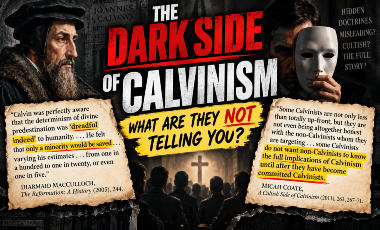
Although we cannot know the true intentions of John Calvin’s pursuit in evangelism, for several reasons it seems unlikely that he aimed only to proclaim salvation in Christ. First, his theological view clearly makes evangelism ultimately useless. Second, cult leaders usually seek their own desires, as opposed to the desires of God as revealed in Scripture. Third, John Calvin knew that his missionaries were not spreading good news to anyone whom God would not save. In fact, as Reformation historian Diarmaid MacCulloch writes, “Calvin was perfectly aware that the determinism of predestination was ‘dreadful indeed’ to humanity.”[22]* In fact, his missionaries were spreading nothing but bad news to almost all of those who were supposedly not of the elect. According to MacCulloch, “The most discordant noises came from Basel, where one anonymous pamphlet with bitter sarcasm described the Genevan Church as proclaiming ‘its good news with flames.”[23]

[….]

(4) Why Calvinism’s gospel and other cult theologies are dishonestly presented

When I share the gospel message, either from the pulpit or one-on-one, I have nothing to hide or water down about my beliefs and theology. This may sound very basic, but it must be noted. If I were a people pleaser, I would be tempted to overlook those parts of my theology that might offend a potential believer. Certain aspects of the gospel’s good news, like “personal sin” and “divine judgment,” are not merely a part of understanding one’s need for God’s grace but are imperative to receiving it. Thus, although the prospective convert might not welcome the true notion of his rebellion before God (i.e., his sin) and a time of God’s future judgment, I withhold nothing and keep no secrets in laying out the full gospel.

This is not the case with Mormonism and Jehovah’s Witnesses. This is also not the case with the gospel according to Calvinism. George Bryson writes:

Some Calvinists are not only less than totally up-front, but they are not even being altogether honest with the non-Calvinists whom they are targeting. In the promotion of doctrine, what is held back or not expressed (relative to those doctrines) can be very misleading.[33]

Bryson contends that “some Calvinists do not want non-Calvinists to know the full implications of Calvinism until after they have become committed Calvinists.”[34] It should not be hard to figure out the reasons why a “potential” convert might not want to know intimately the core doctrines of Calvinism from the beginning.

If the forbearer of the Calvinist gospel message cannot or will not be upfront and direct about the doctrines pertaining to salvation (in public or private life), the skeptic must seriously consider why. Furthermore, we should wonder whether Jesus Himself was hiding some important aspects of His messages. Was He withholding the doctrine of double predestination when He called everyone to come and receive the Bread of Life? Did He expect the crowds to understand that when He said “all” or “world” what He really meant was “some” and “elect”? Did He assume that His followers would understand that “grace” could have multiple definitions? Did Jesus expect His apostles to understand that their efforts to evangelize would be ultimately futile? Indeed, Chuck Smith asks, “Why would the God of all truth, who speaks so sternly against lying, send His servants out to promote such a lie?”[35]

Yet, some Calvinists today seem guilty of being dishonest in presenting their particular gospel. One Reformed Southern Baptist pastor, in an article entitled “Instructions for Local Church Reformation,” advises other Calvinist pastors:

Choose a few men who are sincere, teachable and spiritually minded and spend time with them in study and prayer. They will help you to reform. . . . In the pulpit, don’t use theological language that is not found in the Bible. Avoid terms such as Calvinism, reformed, doctrines of grace, particular redemption, etc. Most people will not know what you are talking about. Many that do will become inflamed against you.[36]

We read about dishonesty concerning the gospel early in church history. Certain men came down from Jerusalem teaching the brethren that unless they were “circumcised according to the custom of Moses,” they could “not be saved” (Acts 15:1, NKJV).[37] Because of this threat to the gospel message, the apostles gathered and directly faced the problem. The main reason the apostles opposed this teaching was because of its false message of salvation, which added “works” to the free grace of God and limited those who could be saved to those who were circumcised. Similarly, Calvinism limits salvation to “the elect.” “Certain men” (Calvinists) are teaching the brethren that some people can “not be saved” at all.

Like Paul, the Christian is called to confront those who are “not straightforward about the truth of the gospel.”[38] In Galatians chapter 2, Paul confronted Peter about his hypocrisy. Although the gospel was commanded to be taken to all of humanity, Peter would fellowship only with the Gentiles in the absence of the Jewish elite. Thus, while Peter believed the gospel was for the Gentiles as well as the Jews, his actions differed from his beliefs. He witnessed mainly to the Jewish people who came from Jerusalem. When Paul noticed Peter compromising the truth of the gospel, he said, “Now when Peter had come to Antioch, I withstood him to his face, because he was to be blamed; . . . But when I saw that they were not straightforward about the gospel, I said to Peter before them all . . .”[39] (Galatians 2:11–14, NKJV). Paul then brings Peter’s hypocrisy into the light.

Likewise, those who herald Calvinism today do not practice what they preach. While on the outside, Calvinists claim that their gospel is for all people, their doctrines clearly declare otherwise. To win the minds of those around them, their doctrine of limited atonement is not openly addressed. Calvinists, as with all cultists, are not straightforward about their message. If they were straightforward, there would be no need for Calvin expositors like Pink, White, and Sproul to malign the intended meanings of simple words like “world”; there would be no need for Calvinist teachers to make unfounded distinctions in words like “love,” “grace,” and “calling”; and there would be no need to change the TULIP labels. The following example illustrates how far from straightforward a Calvinist can be.

I recently watched an episode of a sitcom, in which the manager of a paper resale office was offered a promotion in the company, but only if he laid off several of his employees. The manager, though close friends with many of his employees, agreed to take the new position. Not knowing their fate, his staff anxiously sought his decision. When he came out of his office, he said, “I have good news and bad news. I’ll tell you the bad news first. A lot of you will lose your job here or be forced to relocate to Sweden.” At this, the employees were distraught and saddened. But their regional manager was quick to try and raise their spirits by finishing, “And now the good news—I was offered to be head manager over all of the U.K.” As he looked for approval among his employees, they offered him none. After a minute of silence, one of the employees pointed out the stupidity of his ex-manager: “That’s not good news. All you have is bad news and irrelevant news. We’ve just lost our jobs so you could be promoted, and you think we should be happy for you?”[40]

Likewise, the gospel of Calvinism looks into the faces of people whom their god has doomed to eternal fire and expects a joyful response to their fate. In Luke 2:10, the angel of the Lord announces the true gospel of Christ as “good tidings of great joy which will be to all people.” Is one to believe that this angel from God held the same unreasonable logic of the new U.K. branch manager? Did the angel really think that the unfortunate souls would find the news of their damnation as “good tidings and great joy?”

These types of contradictions that plague Calvin’s TULIP make for a confusing and inconsistent theology. Why does it maintain such contradictions? Is it because Christians would not swallow Calvinism if it were not watered down? Is it because Calvinism’s “unveiled” gospel would turn potential new converts away instead of winning them over? Why unbelievers, let alone Christians, would be repulsed by Calvinism’s deterministic form of Christianity should be no surprise, for it must bear a certain fruit in the lives of its followers.


Micah Coate, A Cultish Side of Calvinism (Innovo Publishing, 2011), 263, 267–71.

* Calvin was perfectly aware that the determinism of divine predestination was ‘dreadful indeed’ to humanity. Moreover, like most believers in predestination (Luther and Augustine included), he felt that only a minority would be saved – it was not Calvin but Augustine in one of his savage late anti-Pelagian works who observed that God had arranged this in order to give the elect all the more reason to be grateful for their elect status.38 Calvin was not prepared to put a figure on the proportion of the saved, varying his estimates for artistic effect from his habitual estimate of one in a hundred to one in twenty, or even one in five in more generous moods. He was also very wary of saying that people could be certain of their own election, let alone identify others among the elect.

Diarmaid MacCulloch, The Reformation: A History (New York: Penguin Books, 2005), 244.

FOOTNOTES:

[22] MacCulloch, The Reformation, 244.

[23] Ibid., 245.

[….]

[33] George Bryson, The Dark Side of Calvinism: The Calvinist Caste System (Santa Ana, CA: Calvary Chapel Publishing, 2004), 23.

[34] Ibid., 22.

[35] Smith, Foreword to The Dark Side of Calvinism.

[36] Ernest C. Reisinger and D. Matthew Allen, A Quiet Revolution: A Chronicle of Beginnings of Reformation in the Southern Baptist Convention [online]; accessed by RPT 8/27/2026             

[37] NKJV, Acts 15:1.

[38] NKJV, Galatians 2:14.

[39] NKJV, Galatians 2:11–14.

[40] Ricky Gervais, The Office, Season 1, Disc 2, Episode 6 (BBC Amazon Prime Video)
 

How the Cults Redefine Biblical Terms

i wanted to start with a large excerpt from Walter Martin’s Kingdom of the Cults (6th edition) to get the main idea across… I was reading Micah Coate’s book, “The Cultish Side of Calvinism, and he had some great sections of a chapter that are incredibly important. But first, Walter Martin:

The Riddle of Semantics

The problem of semantics has always played an important part in human affairs, for by its use or abuse, whichever the case may be, entire churches, thrones, and even governments for that matter, have been erected, sustained, or overthrown. The late George Orwell’s stirring novel 1984, in which he points out that the redefinition of common political terms can lead to slavery when it is allowed to pass unchallenged by a lethargic populace, is a classic illustration of the dangers of perverted semantics. It should be of no particular surprise to any student of world history that trick terminology is a powerful propaganda weapon. The communist dictatorship of China, which even the Russian theorists rejected as incalculably brutal and inept, dares to call itself the People’s Republic of China. As history testifies, the people have very little, if any, say in the actual operation of communism, and if democracy is to be understood as the rule of the people, the Chinese communists have canonized the greatest misnomer of all time!

Both the Chinese communists and the Russians have paid a terrible price for not defining terminology, and for listening to the siren song of Marxism without carefully studying and analyzing the atheistic collectivism through which the music came.

Applying this analogy to the field of cults, it is at once evident that a distinct parallel exists between the two systems. For cultism, like communism, plays a type of hypnotic music upon a semantic harp of terminological deception. And there are many who historically have followed these strains down the broad road to spiritual eternal judgment. There is a common denominator then, and it is inextricably connected with language and the precise definition of terminology. It is what we might call the key to understanding cultism.Precisely how to utilize the key that will help unlock the jargon of cult semantics is best illustrated by the following facts, drawn from over thirty years of research and practical fieldwork with cultists of every variety.

The average non-Christian cult owes its very existence to the fact that it has utilized the terminology of Christianity, has borrowed liberally from the Bible (almost always out of context), and sprinkled its format with evangelical clichés and terms wherever possible or advantageous. Up to now this has been a highly successful attempt to represent their respective systems of thought as “Christian.”

On encountering a cultist, then, always remember that you are dealing with a person who is familiar with Christian terminology, and who has carefully redefined it to fit the system of thought he or she now embraces.

A concrete example of a redefinition of terms can be illustrated in the case of almost any of the Gnostic cult systems that emphasize healing and hold in common a pantheistic concept of God (Christian Science, New Thought, Unity, Christ Unity Science, Metaphysics, Religious Science, Divine Science).

In the course of numerous contacts with this type of cultist, the author has had many opportunities to see the semantic maze in full operation, and it is awesome to behold. Such a cult adherent will begin talking at length about God and Christ. He will speak especially about love, tolerance, forgiveness, the Sermon on the Mount, and, as always, the out-of-context perversion of James’s “faith without works is dead.”

It should be noted that hardly ever in their discourses will such cultists discuss the essential problem of evil, the existence of personal sin, or the necessity of the substitutionary atonement of Christ as the sole means of salvation from sin, through the agency of divine grace and the exercise of faith. In fact, they conscientiously avoid such distasteful subjects like the proverbial plague and discuss them only with great reluctance. Of course, there are exceptions to this rule, but on the average it is safe to assume that reticence will characterize any exploration of these touchy issues. Both Christian Science and Unity talk of God as Trinity; but their real concept of God is a pantheistic abstraction (Life, Truth, and Love constitute the triune divine principles—Christian Science).

The historic doctrine of the Trinity is seldom, if ever, considered without careful redefinition. If the reader consults the Metaphysical Bible Dictionary, published by the Unity School of Christianity, he will see the masterpiece of redefinition for himself. For in this particular volume, Unity has redefined exhaustively many of the cardinal terms of biblical theology, much as Mary Baker Eddy did in her Glossary of Terms in the book Science and Health With Key to the Scriptures. The reader will be positively amazed to find what has happened to biblical history, the person of Adam, the concept of human sin, spiritual depravity, and eternal judgment. One thing, however, will emerge very clearly from this study: Unity may use the terminology of the Bible, but by no stretch of the imagination can the redefinition be equated with the thing itself.

Another confusing aspect of non-Christian cultists’ approach to semantics is the manner in which they will surprise the Christian with voluminous quotations from no less authority than the Bible, and give the appearance of agreeing with nearly every statement the Christian makes in attempting to evangelize the cultist. Such stock phrases as “We believe that way too; we agree on this point” or the more familiar: “Mrs. Eddy, Mr. or Mrs. Fillmore, Mr. Evans, Dr. Buchman, Joseph Smith, or Brigham Young says exactly the same thing; we are completely in agreement.” All such tactics based upon the juggling of terms usually have the effect of frustrating the average Christian, for he is unable to put his finger on what he knows is error, and is repeatedly tantalized by seeming agreement which, as he knows, does not exist. He is therefore often forced into silence because he is unaware of what the cultist is actually doing. Often, even though he may be aware of this in a limited sense, he hesitates to plunge into a discussion for fear of ridicule because of an inadequate background or a lack of biblical information.

The solution to this perplexing problem is far from simple. The Christian must realize that for every biblical or doctrinal term he mentions, a redefinition light flashes on in the mind of the cultist, and a lightning-fast redefinition is accomplished. Realizing that the cultist will apparently agree with the doctrine under discussion while firmly disagreeing in reality with the historical and biblical concept, the Christian is on his way to dealing effectively with cult terminology. This amazing operation of terminological redefinition works very much like a word association test in psychology.

It is simple for a cultist to spiritualize and redefine the clear meaning of biblical texts and teachings so as to be in apparent harmony with the historic Christian faith. However, such a harmony is at best a surface agreement, based upon double meanings of words that cannot stand the test of biblical context, grammar, or sound exegesis. Language is, to be sure, a complex subject; all are agreed on this. But one thing is beyond dispute, and that is that in context words mean just what they say. Either we admit this or we must be prepared to surrender all the accomplishments of grammar and scholastic progress and return to writing on cave walls with charcoal sticks in the tradition of our alleged stone-age ancestors. To illustrate this point more sharply, the experience of everyday life points out the absurdity of terminological redefinitions in every way of life.

An attorney who is retained by his client must know the laws that govern trial procedure, cross-examination, and evidence. But above all else he must believe in the innocence of his client. A client who tells his attorney that he is guilty of a misdemeanor but not a felony is using the vocabulary of law. But if his attorney finds out that his client has perverted that vocabulary so that the terms are interchangeable, he will either refuse to defend him or will clarify the terminology before the court, because by definition a misdemeanor is a misdemeanor and a felony is a felony. A man who says he stole only ninety dollars (petty theft), but who really means that it was ninety dollars more or less, and in reality knows that it was in excess of five hundred dollars (grand theft), is playing a game that the law will not tolerate. He will most certainly be punished for such perversions of standard legal terms. In the realm of medicine, a doctor who announces that he will perform an open-heart operation, then proceeds in the presence of his colleagues to remove the gall bladder, and then attempts to defend his action by the claim that open-heart surgery actually means removal of the gall bladder in his vocabulary, could not practice medicine for long! Open- heart surgery is delicate repair of the heart muscle. Removal of the gall bladder is, by definition, surgery of another type. In law and in medicine, therefore, terms are what they are by definition. On the business and professional level this also holds true. But to the cultists words do not always mean what they have always meant by definition in specific context. And just as the American Bar Association will not tolerate confusion of terminology in the trial of cases, and as the American Medical Association will not tolerate redefinition of terminology in diagnostic and surgical medicine, so also the Church of Jesus Christ has every right not to tolerate the gross perversions and redefinitions of historical, biblical terminology simply to accommodate a culture and a society that cannot tolerate an absolute standard or criterion of truth, even if it be revealed by God in His Word and through the true witness of His Spirit.

The major cult systems, then, change the definition of historical terms without a quibble. They answer the objections of Christian theologians with the meaningless phrase, “You interpret it your way and I’ll interpret it mine. Let’s be broad-minded. After all, one interpretation is as good as another.”

A quick survey of how cults redefine Christian terminology illustrates this important observation:

Click to enlarger

Is it any wonder, then, that orthodox Christians feel called upon to openly denounce such perversions of clearly defined and historically accepted biblical terminology, and claim that the cults have no rights—scholastically, biblically, or linguistically—to redefine biblical terms as they do?

We ought never to forget for one moment that things are what they are by definition. Any geometric figure whose circumference is 2πr is by definition circular. Any two figures whose congruency can be determined by the application of angle-side-angle, side-angle-side, or side-side-side is, by definition, a triangle. To expand this, we might point out that any formula that expresses hydrogen to be in two parts and oxygen to be in one is water, and hydrogen to be in two parts, sulfur in one part, and oxygen in four parts is sulfuric acid. H2O can never be H2SO4. Nor can the Atonement become at-one-ment as the theology of the Gnostic cults (Christian Science, Unity, New Thought) explains it. It simply cannot be, if language means anything.

To spiritualize texts and doctrines or attempt to explain them away on the basis of the nebulous word interpretation is scholastic dishonesty, and it is not uncommonly found in leading cult literature. Cultists are destined to find out that the power of Christianity is not in its terminology but in the relationship of the individual to the historic Christ of revelation. The divine-human encounter must take place. One must become a new creation in Christ Jesus, and the emptying of Christian terminology of all its historic meanings serves only the purpose of confusion and can never vitiate the force of the Gospel, which is the Person of the Savior performing the historic function of redeeming the sinner by grace.

The Christ of Scripture is an eternal, divine personality who cannot be dismissed by a flip of the cultist’s redefinition switch, regardless of how deftly it is done. The average Christian will do well to remember the basic conflict of terminology that he is certain to encounter when dealing with cultists of practically every variety.

Summary

Whenever a Christian encounters a cultist, certain primary thoughts must be paramount in his mind: (1) he must strive to direct the conversation to the problem of terminology and maneuver the cult adherent into a position where he must define his usage of terms and his authority, if any, for

drastic, unbiblical redefinitions, which are certain to emerge; (2) the Christian must then compare these “definitions” with the various contexts of the verses upon which the cultist draws support of his doctrinal interpretations; (3) he must define the words interpretation and historic orthodoxy, and standard doctrinal phrases such as the new birth, atonement, context, exegesis, eternal judgment, etc., so that no misunderstanding will exist when these things come under discussion, as they inevitably will; (4) the Christian must attempt to lead the cultist to a review of the importance of properly defining terms for all important doctrines involved, particularly the doctrine of personal redemption from sin, which most cult systems define in a markedly unbiblical manner; (5) it is the responsibility of the Christian to present a clear testimony of his own regenerative experience with Jesus Christ in terminology that has been carefully clarified regarding the necessity of such regeneration on the part of the cultist in the light of the certain reality of God’s inevitable justice. It may be necessary also, in the course of discussing terminology and its dishonest recasting by cult systems, to resort to occasional polemic utterances. In such cases, the Christian should be certain that they are tempered with patience and love, so that the cultist appreciates that such tactics are motivated by one’s personal concern for his eternal welfare, and not just to “win the argument.”

Let it never be forgotten that cultists are experts at lifting texts out of their respective contexts without proper concern for the laws of language or the established principles of biblical interpretation. There are those of whom Peter warns us, who “wrest . . . scriptures, unto their own destruction” (2 Peter 3:16). This is an accurate picture of the kingdom of the cults in the realm of terminology.

Looking back over the picture of cult semantics, the following facts emerge:

  1. The average cultist knows his own terminology very thoroughly. He also has a historic knowledge of Christian usage and is therefore prepared to discuss many areas of Christian theology intelligently.
  2. The well-trained cultist will carefully avoid definition of terms concerning cardinal doctrines such as the Trinity, the Deity of Christ, the Atonement, the Bodily Resurrection of our Lord, the process of salvation by grace and justification by faith. If pressed in these areas, he will redefine the terms to fit the semantic framework of orthodoxy unless he is forced to define his terms explicitly.
  3. The informed Christian must seek for a point of departure, preferably the authority of the Scriptures, which can become a powerful and useful tool in the hands of the Christian, if properly exercised.
  4. The concerned Christian worker must familiarize himself to some extent with the terminology of the major cult systems if he is to enjoy any measure of success in understanding the cultist’s mind when bearing a witness for Christ.

We have stressed heavily the issue of terminology and a proper definition of terms throughout this entire chapter. It will not have been wasted effort if the reader has come to realize its importance, and will be guided accordingly when approaching the language barrier, which is an extremely formidable obstacle both to evangelizing cultists and to giving a systematic and effective defense of the Christian faith against their perversions.

As an armchair apologist and reading these ideas in the first edition… it made an impact on me. So much so that it is now a basis I incorporate into my understanding of how Calvinist “Reformed” ideology goes astray. In one of the best books I have read yet, there is some great apologetic themes in his critique of Calvinists changing terms that should be simply understood.

I will introduce each excerpt.

Section Introduction — “His Writing”

In this opening section, Coate examines the formative role of John Calvin’s writings—particularly the Institutes of the Christian Religion—in the development and interpretation of Calvinist theology. He argues that Calvin’s writings became more than historical works of theology: they became a framework through which Scripture was subsequently read and understood. Coate traces Calvin’s intellectual influences, his use of Augustine and earlier Reformers, and the continuing influence of Calvin’s commentary traditions, including the Geneva Bible and later Reformed study materials. His central concern is whether a theological system can remain genuinely Scripture-driven when the writings and interpretations of its principal theologian become the lens through which Scripture itself is interpreted.

The question Coate ultimately puts before the reader is simple:

  • Are we allowing Scripture to determine our theology, or are we allowing a theological system to determine how we read Scripture?

His Writing

Calvin goes on from the original Protestant experience of conversion to build a system, to extrapolate, to raise all the dark questions and give without flinching the dark answers.[1]  

—C. S. Lewis, on Calvin’s Institutes

Cult leaders rarely lead without their own writings. Mary Baker Eddie penned her Science and Health with Key to the Scriptures; Joseph Smith wrote The Book of Mormon; Ron Hubbard, Dianetics: The Modern Science of Mental Health; and John Calvin has his famed Institutes. Out of all his writings and commentaries, which by his own words were subordinate to his Institutes, no other writing has so “determined the course of history and changed the face of Europe” as have Calvin’s Institutes.[2] So influential are the Institutes that comparing them to other cultish writings might at first seem absurd.

To refresh our memory, John Calvin was eight years old when Martin Luther penned his Ninety-Five Theses in 1517. Born in one of the most tumultuous times in church history, John Calvin grew up in the midst of heavy Roman Catholic influence. Although Calvin officially broke allegiance to the Catholic Church at the age of twenty-five, a majority of his education had been completed under its authority. He studied at the University of Paris and later studied law at the University of Orleans. He wrote the first edition of his Institutes of the Christian Religion in 1536 at the age of twenty-seven. Because Calvin was so young, some scholars question his credibility. Dave Hunt states that the Institutes:

. . . could not possibly have come from a deep and fully developed evangelical understanding of Scripture. Instead, they came from an energetic enthusiasm of a recent law graduate and a fervent study of philosophy and religion, a young genius devoted to Augustine and a newly adopted cause.[3]

Version 1.0.0

It is also important to note that five years after writing the Institutes, the Genevan authorities asked Calvin to draft the Ecclesiastical Ordinances, an outline of church structure and doctrine. “Calvin borrowed Bucer’s assertion that the New Testament indicated four functions of ministry: pastors, doctors, elders, and deacons [but] was himself never ordained as priest or minister in any Church.” Nevertheless, he classified himself as a doctor. “Together the pastors and the senior doctors, who were obviously close to them in ministry, notably Calvin himself, formed a company of Pastors.” [4]

Although people have said that Calvin gave Protestantism its first systemized theology, it can hardly be said that he was the sole mind in formulating it. Calvin was well-read in the works of Reformers before him, and he relied heavily upon Bucer and Luther. However, he referred to no other theologian more than Augustine of Hippo, who is quoted in Calvin’s Institutes over 400 times. Spurgeon, acknowledging Calvin’s use of Augustine’s works, observes, “Perhaps Calvin himself derived it [sotereological system] mainly from the writings of Augustine,” and affirms that “Augustine obtained his views, without doubt, through the Spirit of God, from the diligent studies of the writings of Paul, and Paul received them from the Holy Ghost, from Jesus Christ.”[5]  

If Augustine “without doubt” received his views from the Holy Spirit and Calvin heavily received his views from Augustine, then one could nearly conclude that the Institutes of John Calvin are divinely inspired. Many Calvinists seem to have concluded just that. From the Institutes, Calvinism draws its doctrine, interpretation of Scripture, systemized theology, and distorted view of God. Claiming to be a Calvinist is nothing less than trusting that the Institutes are unparalleled in defining “true” Christianity. After the Institute’s twenty-three years of revisions, it was finally finished in 1559, just five years before Calvin’s death on May 27, 1564.

In most cults, the leader’s writings and doctrines determine the followers’ involvement with and interpretation of the Bible. Instead of plain Scripture leading to doctrine, doctrine leads the interpretation of Scripture. Although we will look at this in more depth in the next chapter, here are two examples: Those who follow The Book of Mormon consider it to be the fullness of the gospel. Thus, they deem it as more authoritative than the Bible itself. Those who follow the doctrines of Charles Taze Russell consider any translation of the Bible other than the New World to be incorrect. Cult members also interpret the Bible to fit the theology of their leader. For example, the audience of Mary Baker Eddie’s Key to the Scriptures interprets the Scripture from a very mystical, nonliteral perspective. The same can be said of Jehovah’s Witnesses and Mormons. Likewise, when Calvinists read the Scriptures, they usually do so in the light of John Calvin’s Institutes, confirming the words of Kent R. Rieske:

Calvinists hold John Calvin in such a high esteem that his writings and teachings are studied and quoted in preference to Scripture. His teachings are used by Calvinists to interpret Scripture rather than the sound doctrine of using Scripture to interpret Scripture.[6]  

In Calvin hotbeds, the Institutes is referred to as often as the Bible, and is even studied in the same manner. Latter-day Saints are educated in the book of Mormon just as students at Calvin Theological Seminary in Grand Rapids, Michigan, can take classes on Calvin’s Institutes and commentaries. Brigham Young founded the Mormon Brigham Young College (BYC) in Logan, Utah, on July 24, 1877, just two years after he founded Brigham Young Academy (Brigham Young University from 1903) in Provo, Utah. In the Mormon schools, students learn theology and read the Scriptures as interpreted by Joseph Smith, just as students in both Calvin Seminary and Calvin College learn the Bible as interpreted by John Calvin. At one school, Joseph Smith is highly esteemed; in the other, John Calvin is greatly revered.

Other than his Institutes, John Calvin offered much commentary in the marginal notes of the Geneva Bible. When England was ruled under Queen Mary I, many Protestant scholars escaped her persecution to Geneva. The city of Geneva was ruled by John Calvin who we know lead both church and civil matters. The Geneva Bible was partially printed in England in 1575 and fully printed a year later. There were over 150 editions made. With John Knox collaborating with Calvin in the new Bible, a law was passed in Scotland in 1579 requiring all houses to purchase a copy if financially possible. The commentary in the Bible’s margins was prized by Calvinists but was not liked by the Church of England nor King James, who later commissioned the “Authorized Version” or King James Version to replace it in 1611. Until the English Civil War, the Geneva Bible was widespread among all Puritans and Calvinists.

Kent Rieske astutely notes the apparent “need” for the Geneva Bible to be full of Calvin’s commentary. He writes, “Calvin’s theology could not be ascertained by the typical student of the Bible without the external study of Calvin’s Institutes . . . Calvin wrote commentary notes in the margin of the Bible to be used as the interpretation of the Scripture.”[7] Although soundly translated from Greek and Hebrew, the marginal notes of the Geneva Bible made it what is was. To its credit, the Geneva Bible was in fact the first “‘Study Bible,’ with extensive commentary notes in the margins.”[8] With Calvin’s commentaries included in its 1599 edition, the Geneva Bible was “the most complete study aide for Biblical scholars and students” at that time; the “extensive collection” of commentary was not a trivial part of the new Bible, for it is still considered the “greatest distinction of the Geneva Bible.”[9] Calvin’s notes comprise nearly 300,000 words, or nearly one-third the length of the Bible itself, and they are justifiably considered “the most complete source of Protestant religious thought available.”[10] As a result, the Geneva Bible became:

. . . the most widely read and influential English Bible of the 16th and 17th centuries. It was continually printed from 1560 to 1644 in over 200 different editions. It was the Bible of choice for many of the greatest writers, thinkers, and historical figures of the Reformation era. [11]

With men such as William Shakespeare, John Milton, John Bunyan, and Oliver Cromwell using the Geneva Bible, we can again see why Calvinism has had a strong foothold on theology.

Despite the wide acceptance of the Geneva Bible, its place in history was relatively short. Although the Geneva translation was accurate, the “not so marginal” notes of John Calvin so angered the Catholic Church, namely King James of England, that it was promptly replaced by the widely known 1611 King James translation, which was published without commentary. From then on, the Geneva Bible has gone mostly unnoticed in Christianity. And now that Calvinism is making a comeback, the new Reformation Study Bible[12] has recently appeared on the scene. Although it uses both the New King James Version and English Standard Version translations, it is full of marginal notes written by leading Calvinists.

One could rightly argue that this fact is unimportant, since most of today’s Calvinists are not even familiar with the Geneva Bible. However, although many Calvinists might not use either the new Reformation Study Bible or old Geneva Bible or hold them in the same light that past Calvinists have, the readers are indeed affected by their adherence to Calvin’s biblical interpretation. This point is made clear by a conversation I had recently with a Jehovah’s Witness as my truck was being fixed. We briefly discussed the New World Translation. (This purposely mistranslated Bible was proved in a court of law to have mangled the original language of the Bible for the intent of substantiating unorthodox views of Jesus and other biblical doctrines that accompany salvation). He was quick to mention that he reads all translations of the Bible. Regardless of this fact, the damage has already been done for him. Whenever this man had read other translations, his views of God, which are based on ideas by Charles Taze Russell, twisted his interpretation of even correctly translated verses that reveal the deity of Jesus.

Ultimately, no matter what translation of the Bible the man may read, his unorthodox views of Jesus will remain unchanged, because he holds to Russell’s teachings. The same can be said of the Mormon. Mormons read orthodox translations of the Bible. Yet, the unorthodoxy from Joseph Smith’s writings has horribly corrupted the sound interpretation found in other Bibles. Likewise, the Key to the Scriptures and Watchtower magazines can pervert the minds of readers and obscure their vision of plain scriptural truth.

This is true for many Calvinists today. They might not have a clue that the footnotes in the Geneva Bibles are unorthodox, but they still understand John 3:16 to mean something other than that Christ died for all of humanity. When one professes to be a Calvinist or a Reformed Christian, the damage has already been done. Calvinists align themselves with John Calvin’s beliefs and his interpretation of selective salvation. They align themselves with all his writings and footnotes—both the orthodox and the unorthodox.

Collin Hansen has recently noted that John Calvin, “appear[s] not to be a major figure among the latest generation to claim the theology he made famous.”[13] How can one not acknowledge John Calvin in Calvinism? Despite the claims from most cultists that they hold their leader’s writings as merely being equal to the Bible, in practice, the Bible usually takes a back seat. The Book of Mormon is blatantly tagged as “the fullness of the gospel.” Ellen G. White, the Seventh-day Adventists’ prophetess, claims that she writes not her own ideas but “what God has opened before me in vision.”[14] Although most Calvinists would never be so bold as to say that the Institutes are as authoritative as Scripture, the outcome of their biblical theology suggests otherwise. As with Joseph Smith, Charles Russell, Ellen White, Mary Eddie, and many other cult leaders, John Calvin’s writings have radically changed the way his followers interpret the Bible.

NOTES

  1. C.S. Lewis, Quote 139, “Calvin, John,” taken from the Introduction to English Literature in the Sixteenth Century, para. 61, p. 42, in The Quotable Lewis, ed. Wayne Martindale and Jerry Root (Wheaton, IL: Tyndale House Publishers, 1898), 83.
  2. Alister McGrath, A Life of John Calvin (Oxford: Basil Blackwell, 1990), xiii, 209.
  3. Hunt, What Love Is This?
  4. MacCulloch, The Reformation, 238.
  5. Charles H. Spurgeon, message delivered at the opening ceremony of the inaugural ceremonies for the new Metropolitan Tabernacle, in “Expositions of the Doctrines of Grace,” sermons 385-388 of The Spurgeon Archive [online]; accessed 28 January 2010; available from; Internet.
  6. Rieske, “Calvinism.”
  7. Rieske, “Calvinism.”
  8. Greatsite Marketing website, [online]; accessed 23 December 2010;
  9. “1599 Geneva Bible,” Introduction from L. L. Brown Publishing [online]; accessed 25 June 2010; available from website, Link.
  10. Ibid.
  11. Ibid.
  12. “Widely considered one of the best tools available for Bible study and previously only available in the New King James translation, The Reformation Study Bible has been updated to the readable and accurate English Standard Version (ESV). This foundational resource was created by more than fifty scholars and features thousands of in-depth study notes, 96 theological articles, 19 in-text maps, colored maps, and 12 charts to help you understand the Bible better.” [online]; accessed 23 December 2010; (LINK)
  13. Hansen, “Young, Restless, Reformed.”
  14. Ellen G. White, Testimonies for the Church Volume 5, 67 [online]; accessed 2 February 2010; all volumes.

Section Introduction — “Its Twisting of Scripture”

In this section, Coate shifts from the influence of Calvin’s writings to the more specific question of how Scripture is interpreted through a theological system. He argues that the central problem is not necessarily a new translation of the Bible, but the reinterpretation of biblical words, passages, contexts, and even study notes to make them conform to established Calvinist doctrines. Coate compares this approach with other examples of religious movements interpreting Scripture through the lens of their own authorities, then focuses on Calvinist treatments of passages concerning “world,” “all,” “whosoever,” human freedom, God’s desire for salvation, and the atonement.

A recurring theme throughout the section is redefinition: Coate argues that when a biblical passage appears to conflict with TULIP theology, the solution is sometimes found not by changing the doctrine, but by changing the way the biblical language is understood. He summarizes the concern through Norman Geisler’s description of theological “doublespeak” and Kent Rieske’s claim that Calvinism redefines biblical terminology and applies passages in ways that conform them to Calvin’s theological system.

The central question Coate raises in this section is therefore:

  • Are we allowing Scripture to interpret Scripture, or are theological conclusions being used to determine what Scripture is allowed to mean?

Its Twisting of Scripture

    • The fact is, the cults are notorious Scripture-twisters. When dealing with cults, one must keep in mind that they are always built not upon what the Bible teaches but upon what the founders or leaders of the respective cults say the Bible teaches.[1]

—Norman L. Geisler and Ron Rhodes

    • I am deeply troubled over the Reformed version of grace because through it, the precious and scriptural truths concerning grace are so maligned.[2]

—George Bryson

Manipulation of Scripture in order to construe a certain meaning that was not or could not be intended for the reader is the hallmark of a cult. The “Bible Answer Man,” Hank Hanegraaff, writes, “The first mark of a cult is its manipulation of Scripture. The Bible is twisted to fit the leader or group’s interpretation.”[3] Nothing has done more damage in Christianity than the use of unorthodox hermeneutics. As an example, there has been no more flagrant forgery of Scripture than the New World Translation of the Bible. Jehovah’s Witnesses claim that this so-called Bible was translated by Greek, Aramaic, and Hebrew scholars and theologians. However, not only did the purported translators lie about having an education in Greek and Hebrew, the entire translation committee was sponsored solely by Jehovah’s Witnesses and composed by members of the Watchtower Bible and Tract Society.

Because Jehovah’s Witnesses do not believe that Jesus Christ was God, verses from the Bible that reveal His being more than a man or an angel, were altered to support their heretical belief. Correct words were purposely omitted and false words were intentionally added in order to change an essential doctrine of the Bible— namely, that Jesus is God. Here are some examples of their twisting of Scripture.

The New World Translation (NWT) has exchanged the truth for a lie. In the NWT, Zechariah 12:10 reads, “They will look upon the one whom they have pierced.” Here the Hebrew “. . . look upon me whom they have pierced”—in which God is the speaker—has been altered in order to avoid the implication that the one who is to be pierced (on the cross) is God Himself.

Again, because the cult teaches that Jesus was a created being rather than the Creator God, Colossians 1:15–17 in the NWT reads:

He is the image of the invisible God, the firstborn of all creation; because by means of him all [other] things were created in the heavens and upon the earth, the things visible and the things invisible, no matter whether they are thrones or lordships or governments or authorities. All [other] things have been created through him and for him. Also, he is before all [other] things and by means of him all [other] things were made to exist.[4] 

The word “other” has been inserted several times to avoid the deity of Jesus. The first edition of the NWT was printed without brackets.

The NWT version of Hebrews 1:8 reads: “God is your throne forever.”[5] Despite that the translation makes no grammatical or logical sense, it continues to be used in place of the correct translation, which is, “Your throne, O God, is forever.”[6] Again, the text was altered because the original statement is referring to the Christ.

The most famous of the Watchtower mistranslations is found in John 1:1, where one letter, the article “a,” is slipped into the passage with huge theological consequences. The NWT translates John 1:1 as, “In the beginning was the Word, and the Word was with God, and the Word was a god.”[7] The correct translation is, “. . . and the Word was God.” The distorted translation of the NWT implies that Jesus was merely an angelic or supernatural being rather than God Himself.

Although the Watchtower Bible and Tract Society has been proven guilty of lies and perjury in an American court of law (March 17, 1913, Russell v. Ross) the incorrect renditions have not been retracted. Because the Jehovah’s Witnesses use the NWT as their scriptures they are continually misled and intellectually compromised, believing unbiblical doctrine. The NWT is a “translation” of the Bible written to fit a particular group’s beliefs by means of deception through the manipulation of God’s revealed words.

Since Mormons adhere to The Book of Mormon more than the Bible, a need to distort the Bible’s message is less essential. When essential contradictions are found between The Book of Mormon and the Bible, Mormons look to The Book of Mormon as their ultimate authority. Therefore, the need for Mormons to alter biblical doctrines is not as great as for Jehovah’s Witnesses, whose doctrine is supposedly derived directly from the Bible itself. Because Jehovah’s Witnesses do not have the option to claim another source of authority, they must make their peculiar doctrine seem as sound as possible. Mormons, nevertheless, do their fair share of mangling Scripture in hopes of passing their theology off as orthodox.

Because the founders of Mormonism were polygamists, Mormon doctrine concludes that a man should practice polygamy in order to enter the highest heaven.[8] This doctrine supposedly came from Joseph Smith’s “revelation.” Today, polygamy is still practiced among various sects of Mormonism even in light of the Bible’s denouncing of it. Mormon theology has purposefully misconstrued many biblical verses showing God’s tolerance of the practice in the Old Testament, for He clearly commanded His people not to “multiply wives” in Exodus 20:14–17. Other like verses include Deuteronomy 17:17; 1 Kings 11:1; and Matthew 19:9. There are also a number of other verses referring to the folly of practicing polygamy that are either ignored or twisted to confuse their intended purpose.

The Catholic Answers Web site also notes the Mormons’ misinterpretation of God’s Word. Concerning Ezekiel 37 they write:

Mormons neglect the plain sense of the words and ignore their true interpretation, given by God—in the very same chapter. The text makes clear, this is a prophecy of national reunification, not about the appearance of hidden scriptures. The Hebrew term translated as “stick” (aits) is never used anywhere in the Old Testament to mean “book,” “scroll,” “writing” or anything similar. It is variously translated as “wood” or “branch,” “timber,” or “tree.” Needless to say, the Book of Mormon was allegedly written on metal plates, not scrolls or sticks.

Only Mormonism can manage to mistake “timber” for “scrolls” and “nations” for “metal plates.”[9]

Mormons also teach that God the Father has a physical body. They pull the doctrine from Genesis 1:26–27, in which God says, “Let Us make man in Our image” (NKJV). From this statement, Mormons conclude that God has a body.[10] This idea contradicts what Jesus says, “God is Spirit, and those who worship Him must worship in spirit and truth”[11] (John 4:24, NKJV). Jesus also points out that “a spirit has not flesh and bones” (Luke 24:39, NKJV).[12] Mormons choose to disregard any verse that clearly counters their doctrine. More verses distorted or ignored by Mormons about the nature of God include Numbers 23:19; Isaiah 45:12; Hosea 11:9; and Romans 1:22–23.

Likewise, unorthodox “Word Faith” leaders like Kenneth Hagin, Kenneth Copeland, Paul Crouch, and Benny Hinn also misconstrue Genesis 1:26–27. They teach that according to these verses, God’s followers are themselves “little gods.”[13] Although this belief is held at different levels of intensity by Word Faith followers, it is an unbiblical doctrine needing correction. The complete and “purest” meaning of Genesis 1:26–27 can indeed be argued and debated (as with many other verses), but its interpretation cannot fly in the face of other parts of Scripture if it is to be true. The two errant doctrines teaching that Christians are little gods and that God the Father has a physical body arise from poorly interpreted verses and discount others verses relevant to the subject. Despite claiming a biblical foundation for these doctrines, both Mormon and Word Faith teachers set themselves clearly against biblical orthodoxy.

John Calvin’s practice of manipulating Scripture is obvious to those who have taken a careful look at his theology. Although the majority of his commentaries are accurate, he was not afraid to change the words and meanings of certain verses in order to make his particular interpretation work. Historian Diarmaid MacCulloch writes:

Like the mainstream tradition of Judaism, he [Calvin] felt that imagery in relation to the divine was best restricted to words, where it could be extravagant or as startling as he pleased: in one sermon on Deuteronomy preached in 1555–6, for instance, he radically adapted some words of Jesus in order to compare God’s coming in flesh in the birth of Jesus Christ to a hen stooping down to the ground.[14]  

As we remember the words of historian James P. Byrd, Jr. when he states what Roger Williams thought of Calvin’s poor interpretive skills concerning ecclesiastical government over civil affairs, we see the validity of Williams’ claim. Byrd writes, “Williams revered Calvin’s theological genius and considered him a great man, but he attacked Calvin’s biblical interpretation, calling it a dangerous perversion that turned the Holy Word into a bloody instrument of persecution.”[15]

We will see many examples of how Calvin and his followers have misinterpreted portions of Scripture for the sake of TULIP. Calvinists have not invented their own religious books, as have the Mormons, nor have they created a new translation of the Bible, as have the Jehovah’s Witnesses, but they have taken a step in that direction. Although the Geneva Bible was once banned by King James of the Catholic Church, Thomas Nelson Publishing began printing the New Geneva Study Bible, or the Reformation Study Bible (RSB) in 1995 with the English Standard Version (ESV). Leading Calvinist R. C. Sproul gives the introduction, titled “Reformation Truth,” to the RSB with its explanations of Scripture. The Christian must ask: can absolute biblical truth be reformed? Sure, it can . . . but only into something less than absolute biblical truth. Look how clearly we can see this in the following attempts of the Reformation Study Bible to do away with the biblical doctrine of man’s free will and God’s offer of salvation to the whole world.

The ESV correctly translates John 3:16 as, “For God so loved the world, that he gave his only Son, that whoever believes in him should not perish but have eternal life.” However, under the guise of “Reformation Truth,” the RSB footnote interprets the verse to mean something quite different:

Some have insisted that God sent Jesus to die for the purpose of bringing salvation to everyone without exception, but only as a possibility . . . The point made by the “world” is that Christ’s saving work is not limited to one time or place but applies to the elect from all over the world.[16]

Again, knowing that the message of John 3:16 does away with Calvin’s third point of TULIP, Calvinists twist the Scripture at all cost. Leading Calvinist James White says that “whosoever believeth on him should not perish” actually means “in order that everyone believing on him should not perish.”[17] With the addition of a few words, White defends Calvinism by saying that the elect alone believe and thus Christ died for them only. How does this differ from the Jehovah’s Witnesses’ practice of adding words to the text and thereby changing its meaning?

The twisting of Scripture in the Reformation Study Bible is no less devious than that of the New World Translation. Orthodox Christian leaders often speak against Jehovah’s Witnesses for their new interpretation of the Bible while remaining silent regarding Calvinists, who also add words to scriptural texts in order to support their false claims.

First Timothy 2 speaks of God’s concern for all men and women of all classes. We are commanded to pray, intercede for, and give thanks for all people. In the RSB, 1 Timothy 2:1 reads, “First of all, then, I urge that supplications, prayers, and thanksgivings be made for all people . . .” (ESV). Here, however, a footnote appears, explaining that “all people” really does not “mean ‘every human being’ but rather ‘all types of people,’ whatever their station of life” (RSB).[18]

In verse 1 Timothy 2:3–4, Paul continues his thought: “. . . God our Savior, who desires all people to be saved and to come to the knowledge of the truth” (ESV). Once again, the RSB attempts to “reform” this truth in its footnote:

. . . who desires all people to be saved. This does not mean that God sovereignly wills every human being to be saved . . . It may refer to God’s general benevolence in taking no delight in the death of the wicked, or to God’s desire that all types be saved (i.e., God does not choose His elect from any single group).[19]

With many verses contradicting TULIP theology within the English Standard Version, the RSB must rely on its footnotes to provide some connection between the actual text and its Calvinistic ideas and undertones.

Another example of the Reformation Study Bible’s mutilation of the intended meaning of the Word is in 2 Corinthians 5:14. The ESV reads, “For the love of Christ controls us, because we have concluded this: that one has died for all, therefore all have died.” Without reading into the verse’s meaning, we understand that Christ is the “one” who “died” literally “for all.” If Christ died for all, then all—not some—have died. Because this Scripture affirms what the five points of Calvinism deny, the footnote in the RSB reads, “The ones He died for are the same as the ‘all’ who ‘died’ with Him as a result of His death . . .”[20] No. The verse does not say nor give any indication that the ones for whom He died are the “ones who died with Him.” The verse clearly reads that the “one,” who is Christ, “has died for all.” Christ has died for all, regardless of whether or not we who have placed faith in Him undergo the salvific process of dying “with Him as a result of His death.”

This kind of biblical interpretation illuminates Kent R. Rieske’s radical statement that, “Calvinists have typically taught from the margin notes in the Calvinist’s Geneva Bible in preference to the Scriptural text.”[21] Although Calvinists would vehemently disagree, the few examples above show that when a verse clearly contradicts a doctrine of TULIP, it is usually supplemented by a footnote misinterpreting the verse to fit the doctrine. Like most cults, when confronted with scriptural truth that affirms what they deny, the followers are led by the founder’s interpretation.

Biblical footnotes can be very useful, but they can only be trusted when Scripture is interpreting Scripture. Did the above footnotes from the Reformation Study Bible sound like Scripture was being used to interpret Scripture or like Calvin’s TULIP was being used to interpret Scripture? We will answer this question in more detail later.

Many Calvinists praise John Calvin in an unhealthy and unbalanced way, heralding him as the apostle Paul’s “faithful interpreter.”[22] By this selective mentality, a Reformed conscience can be held captive by Calvin’s radical and unorthodox interpretations. Josh McDowell claims that one of the key characteristics of a cult is its offering “new interpretations of the Scripture.” He states, “Some cults make no claim to know truth or extra-biblical revelation, but believe they alone have the key to interpreting the mysteries in the Bible.”[23] Let’s stop here and note that a great mystery found within the Bible is how man’s free will and God’s sovereignty work together. But Calvinism claims to have the answer! This theological system does away with the mystery by doing away with man’s free will. Calvinists believe that, “they alone have the key to interpreting the mysteries in the Bible.”[24]  Reformed Theology, as Calvinist W. Robert Godfrey asserts, even has a “Reformed interpretation of Romans.”[25] Godfrey assumes that non-Reformed churches likely “miss the real meaning of the Word of God,” as well as “the real need of the un-churched—namely, the gospel of the grace of Jesus Christ.” He then concludes that, “To find that real meaning, we must turn from stories to a system.”[26]

Also note that Calvinism has cleverly interpreted the mysteries of the Bible without claiming (as most cults do) to have “new truth” or “extra-biblical revelation.” Instead, as McDowell states:

The scriptures are their only acknowledged source of authority, but . . . are interpreted unreasonably and in a way different from that of orthodox Christianity. They testify that the historic beliefs and interpretations of Scripture are based upon a misunderstanding of the Bible or were pagan in origin.[27]  

Is it a coincidence that leading Calvinists claim that the traditional doctrines of orthodox Christianity are at odds with TULIP theology? Since Calvinists believe that their interpretation is the “true gospel” message (coming on the scene 1500 years after the birth of Christianity), every Christian doctrine before their time must have been somewhat unorthodox. Could this be true?

Were the doctrines of the free will of man, God’s desire for all men to be saved, and Christ’s universal offer of atonement merely man-made teachings, having their roots in humanistic tradition rather than Scripture?

Leading Calvinist James Whites believes that:

If we derive our beliefs from the Bible (rather than assuming them as a tradition . . . ), we will conclude that the phrase, “God is love” does not mean that God has the same kind and level of love for all things, including for each and every single individual human being.[28] [Italics mine.]

He continues:

Surely it is part of the modern evangelical tradition to say, “God loves you and has a wonderful plan for your life,” but providing a meaningful biblical basis for this assertion is significantly more difficult. Unfortunately, most are never challenged to think through their traditions.[29] [Italics mine.]

Though the Bible-believing Christian should be challenged to think through traditions, to say that God’s love for humanity stems from tradition rather than “biblical truth” is simply ludicrous—but then again, so are most twisted interpretations of the Bible. Mormons defend their trust in The Book of Mormon by asserting that the Bible has been corrupted, whereas Calvinists defend their trust in TULIP theology by asserting that the mainstream understanding of God’s universal offer of salvation is a man­made tradition and a “denial of biblical truth.”

McDowell concludes that cults reinterpret the Bible:

. . . usually out of context, to justify the peculiar doctrines of a cult. Without an objective and reasonable way to understand what the Bible teaches, the cult member is at the whims of the cult leader.[30]

Again, we see a perfect example of this through John Calvin’s attempt to justify one of his peculiar doctrines concerning his strict ecclesiastical rule over Geneva. Concerning Jesus’ parable of the weeds in Matthew 13, American historian James P. Byrd, Jr. states:

Above all, Calvin believed that the parable of the weeds contained valuable instruction on church discipline. . . . Calvin’s argument that the parable had to do with church discipline rested on his belief that the field signified the church. This presented an embarrassing dilemma because, as Jesus himself explained, “the field is the world (Matt 13:38).” Calvin’s exegesis of the parable therefore seemed to contradict the explanation that Christ gave to his disciples. In treating this delicate problem, Calvin argued that although Christ called the field the world, he intended “to apply” the field “to the Church, about which, after all, he was speaking,”. . . Calvin solved the apparent conflict by not taking literally Jesus’ interpretation of the field as the world. Calvin claimed that Jesus “transfers by synecdoche to the world what is more apt a part of it.” Jesus did not mean that the field was the world itself, but rather the church that existed within the world.[31]

James Byrd concludes that “Calvin rejected a simple reading of the Christ’s interpretation of the field as the world, preferring instead a figural interpretation at this crucial juncture in the parable.”[32] Therefore, Calvin arrogantly altered the actual meaning of Jesus’ words in this parable because they posed a threat to his conscience and his systematic approach to understanding the Bible.

Apart from changing the definitions of biblical words, the main aspect of twisting Scripture is taking a verse out of its immediate context, placing it in a different area of Scripture, and then using it to uphold a false doctrine. Sometimes this is done innocently and sometimes not. As we have seen before, the account of Jesus raising Lazarus from the dead has been used a number of times by Calvinists to support their false doctrine of Total Depravity, as well as other doctrines in TULIP. We also see an example of this in James White’s book, Debating Calvinism. White uses Ezekiel 37:1– 14 to support “man’s inability” to come to Christ. However, Ezekiel 37 narrates a one-time event, experienced by one man, that took place in the Old Covenant, and it is meant to point to the future restoration of the nation and people of Israel. But White moves this passage from its context and places it as central to the salvation of all New Covenant believers, in order to support the belief that regeneration somehow precedes faith.

In responding to James White’s book, The Potter’s Freedom (a refutation of Geisler’s book, Chosen but Free), Norman Geisler states:

“Another technique employed by PF [Potter’s Freedom] to further its position is to redefine terms that cover the harsh reality of a biblically, morally, and rationally indefensible view.”[33] [italics mine]

Geisler also says:

A similar problem emerges when PF [Potter’s Freedom] employs a kind of theological doublespeak to forward its view. For example, it affirms that fallen humans can will, but yet they have no will (192); that grace is irresistible, but yet it is not coercive (161); that depraved humans are dead but are alive enough to hear and reject the gospel (101); that God does not force anyone, but He regenerates them contrary to their will (200). [34]

Calvinists have not produced a whole new book to support their theology as did the Mormons. They need only to explain away those verses that contradict TULIP. As Geisler states above, this is done by redefining terms and theological doublespeak. Kent Rieske also explains how this is accomplished:

Calvinism consists of theological doctrines which use words found in the Bible. However, Calvinism consistently redefines those words, takes them out of context, applies the doctrines inappropriately, exaggerates the meaning of the words to the extreme, or in some other way distorts the Word of God to match the theology written by John Calvin in his book, Institutes of the Christian Religion.[35]

While an orthodox Christian can easily point out the flaws found within the New World Translation, the theology of Calvinism is not so blatantly twisted since there is not a Calvinistic translation of the Bible. In dissecting Calvinism’s TULIP, one must point to the ill interpreted as opposed to ill translated verses. In either case, both pose serious problems with similar consequences. Using twisted footnotes, words, and contexts are all ways to pull unintended meanings from the Bible.

And yet it is under an intellectual guise of spiritual fervency that Calvinism shows just how it’s done.

NOTES

  1. Geisler and Rhodes, Correcting the Cults, 18.
  2. Bryson, The Dark Side of Calvinism, 30.
  3. Hanegraaff, “What Are Some Common Marks of a Cult?”
  4. New World Translation of the Holy Scriptures (NWT) (New York: Watch Tower Bible and Tract Society of Pennsylvania, 1961).
  5. NWT, Hebrews 1:8.
  6. NKJV, Hebrews 1:8.
  7. NWT, John 1:1.
  8. Smith, Introduction to The Book of Mormon.
  9. Isaiah Bennett, Catholic Answers (San Diego, CA, 1979-2008) [online]; accessed 5 July 2006; available from [Best I could find]
  10. Smith, The Book of Mormon, Doctrine and Covenants 130:3.
  11. NKJV, John 4:24.
  12. NKJV, Luke 24:39.
  13. Geisler and Rhodes, Correcting the Cults, 21.
  14. MacCulloch, The Reformation, 249.
  15. Byrd, The Challenges of Roger Williams, 190.
  16. C. Sproul, ed., The Reformation Study Bible (RSB), (Orlando, FL: Ligonier Ministries, 2005) p. 1,514.
  17. James White, “Blinded By Tradition: An Open Letter to Dave Hunt Regarding His Newly Published Attack Upon the Reformation, What Love Is This? Calvin’s Misrepresentation of God” [online]; accessed 13 July 2007; (Link).
  18. RSB Footnote, p. 1,752.
  19. RSB Footnote, p. 1,752.
  20. RSB Footnote, p. 1,679.
  21. Rieske, “Calvinism.”
  22. Godfrey, An Unexpected Journey, p. 60
  23. McDowell, Handbook of Today’s Religions, 20.
  24. Ibid.
  25. Godfrey, An Unexpected Journey, 26.
  26. Ibid., 36.
  27. McDowell, Handbook of Today’s Religions, 21.
  28. White, in Debating Calvinism, p. 268.
  29. , 265.
  30. McDowell, Handbook of Today’s Religions, 21.
  31. Byrd, The Challenges of Roger Williams, 94–95; Byrd quotes
  32. Matthew 13:38 and Calvin, Harmony of the Gospels, Vol. 2 of Calvin’s Commentaries, 75.
  33. Ibid., 261.
  34. Geisler, Chosen but Free, p. 261.
  35. Ibid.
  36. Rieske, “Calvinism.”

Section Introduction — “Its Ignoring of Scripture”

In this section, Coate moves from the problem of twisting or redefining Scripture to the related problem of selectively ignoring Scripture. His argument is that a theological system can appear consistent when it focuses on the passages that support its conclusions while minimizing, excluding, or reinterpreting passages that create tension with those conclusions. He uses examples from several religious movements before applying the same principle to Calvinism, particularly concerning God’s sovereignty, human freedom, and God’s desire for all people to be saved.

Coate’s central concern is that Scripture must be considered as a whole rather than selectively. He argues that affirming God’s sovereignty does not require ignoring passages concerning human responsibility or God’s universal saving desire. Likewise, affirming human freedom or a universal offer of salvation should not require ignoring passages concerning God’s sovereignty and election.

The section therefore builds on the previous one: where the preceding section examines the reinterpretation of difficult passages, this section examines what happens when passages are simply left out of the theological equation. Coate ultimately argues that both practices can produce the same result—allowing a theological system to determine which biblical data receive controlling weight.

The question Coate places before the reader is:

  • Are we allowing the whole counsel of Scripture to shape our theology, or are we constructing our theology from selected passages and then finding ways to deal with everything else?

Its Ignoring of Scripture

When certain Scripture is ignored, the most ridiculous teachings can easily fool the novice and usher in a tidal wave of theological confusion. Although this practice varies among cults, it is indeed found to some degree in every cult. Radical cults with more glaringly unorthodox doctrines disregard hosts of passages, whereas more conservative cults may choose to overlook only the few passages that obstruct their beliefs. Either way, ignoring parts of Scripture to any degree has huge theological consequences for the cult’s followers.

A tragic example of a cult that excluded a vast majority of Scripture, despite claiming to have a biblical foundation, was the “Children or God” or “The Family” cult. The biblical “foundation” this cult claimed was from Matthew 4:19, in which Jesus says, “Follow me, and I will make you fishers of men.” Yet in the hands of Children of God leader David Berg, Matthew 4:19 was bizarrely twisted into a justification of religious prostitution. This cult formed in 1974 and ended in 1987 (partially due to the AIDS scare). In David’s theology, being a fisher of men was the call for women to win converts by sexual attraction. These women were called “hookers for Jesus” and their offspring were sadly referred to as “Jesus Babies.” Prostitution was widely used as a means for “converts” or solicitors to donate or raise money for the cult. David’s foul “teaching” of the Scriptures were so perverted they insult and degrade common sense. Yet, internal records of the Children of God indicate that over 223,000 people or “fish” took the bait. These naïve people believed the lie and were sexually loved between 1978 and 1988.[1] The point is made: any doctrine, no matter how absurd, can amass a large cult following by claiming biblical roots and godly motives when Scripture is picked apart and discarded.

A fundamental difference between orthodox Christianity and Calvinism is that one holds two truths equally whereas the other holds one truth to the detriment of the other. The non-Calvinist does not rail against the truth that God is completely sovereign. The Calvinist, however, would have you believe that if you accept that God is sovereign, you cannot also believe that man has a free will. Orthodox Christians hold both to be true.

Think of it this way: If I were to debate a Calvinist, I would never deny the scriptural fact that God is completely sovereign. My opponent could go through a plethora of verses revealing that God is sovereign over creation and has an elect people. I would not argue or debate with these. We are not discussing whether or not God is sovereign. That is a biblical fact. But because the Calvinist ignores the biblical truth that man has a free will and that God offers salvation to all men, he must do one of two things when handling the Bible. Like a typical cultist, he must either falsely interpret any verses that testify to whatever he does not believe in, or more simply, to ignore those portions of Scripture altogether. Again, while the orthodox Christian should hold both truths in equality, Calvinists hold one truth—God’s sovereignty—over the other— man’s free will.

If I were trying to persuade you to believe that God is not sovereign and that there is no such thing as the elect, I would have to ignore that part of Scripture that teaches otherwise. I would only teach and focus on those passages that support my theology—and that would be absurd. Could I make a case that man has free will and that God desires to save all men, without regard to God’s sovereign elect? Of course . . . as long as I ignore the part of Scripture about God’s sovereign elect. Could the Calvinist make a case that God is sovereign and that He has an elect, without regard to man’s free will and God’s desire to save all men? Of course . . . as long as he ignores the part of Scripture about man’s free will.

To ignore means to refuse to notice or pay attention to somebody or something. The word stems from the Latin word ignorant, which means “to not know” or “to be without knowledge.”[2] But to ignore is different than simply not knowing. To ignore is purposefully to disregard. I might understand the reasoning behind Calvinistic theology if its followers withheld those scriptural texts that teach man’s free will and God’s universal offer of salvation to mankind. But no Scripture is withheld from the Calvinist, and they are accountable for purposefully ignoring parts of Scripture.

Dave Hunt argues, in his response to James White’s defense of “man’s inability”:

To support Calvinism’s denial of human ability and responsibility, White gives a few favorite proof texts while ignoring a plethora of passages that present the other side. He offers inferences but not one Scripture that clearly states that unregenerate man is unable to believe the gospel.[3]

In his book, Problems with Evangelical Theology, Ben Witherington notes this particular problem within Calvinism (especially among those who like to debate). He states, “It is perfectly possible to argue consistently and logically about something, but draw the circle of argumentation too narrowly, and so wrongly exclude some of the most important data.”[4] Excluding Scripture, or “important data,” is precisely the error of all cults. In order to practice prostitution and fulfill his own lusts, David Berg paid no attention to the parts of Scripture that deals with sexual purity, monogamy, and marital faithfulness. To uphold his book and writings, Joseph Smith disregarded the part of the Bible that condemned adding to it or subtracting from it. He upheld his book as the “fullness of the gospel” anyway, caring nothing for the words of Paul written to the Galatian believers: “But even if we, or an angel from heaven, preach any other gospel to you than what we have preached to you, let him be accursed” (Galatians 1:8, NKJV).[5] Likewise, in holding their belief that the apostle Peter was never married (being the supposed first pope), Catholics close their eyes to Matthew 8:14, “Now when Jesus had come into Peter’s house, He saw his wife’s mother lying sick with a fever.” In believing Jesus to be less than God, Jehovah’s Witnesses choose not to take into account that Jesus “is the image of the invisible God . . . For by Him all things were created . . . All things were created through Him and for Him. And He is before all things, and in Him all things consist” (Colossians 1:15– 17, NKJV).[6] Lastly, to believe that man has no free will and that God does not desire all to be saved, Calvinism simply glosses over verses like John 3:16, “For God so loved the world that He gave His only begotten Son, that whoever believes in Him should not perish but have everlasting life,” and 1 Timothy 2:3–4, “For this is good and acceptable in the sight of God our Savior, who desires all men to be saved and to come to the knowledge of the truth” (NKJV). While very few cults would ever admit to purposefully ignoring certain verses, some attempt to get around any verse that appears to threaten the validity of their doctrines by simply redefining the meanings of words. This maneuver is not easy to detect and usually misleads those not familiar with the details of the passage at hand. We see this clearly in Calvinism.

NOTES

  1. http://www.xfamily.org/index.php/Main_Page; Under “Flirty Fishing” (CAUTION: The article under ‘Flirty Fishing’ contains explicit text and/or images that some may find disturbing or offensive.), [online]; accessed 25 June, 2007; Internet. Found it in GROKEPEDIA
  2. Webster’s New World Dictionary, s.v. “Ignorant”.
  3. Hunt, in Debating Calvinism, 75.
  4. Witherington, The Problem with Evangelical Theology, 5.
  5. NKJV, Galatians 2:8.
  6. NKJV, Colossians 1:15 – 17.

Section Introduction — “Its Twisted Terminology”

This is the section where Coate brings the preceding arguments together most directly: theological systems can preserve familiar biblical vocabulary while assigning that vocabulary meanings that serve the system itself. He argues that this makes theological disagreement especially difficult, because two people can use the same words—grace, calling, election, foreknowledge, atonement, world, love, and others—while actually communicating different concepts.

Coate begins with the broader principle that terminology matters. He draws on Hank Hanegraaff, George Bryson, Walter Martin, and others to argue that using orthodox Christian words does not necessarily establish orthodox definitions. He then applies that concern specifically to Calvinist theology, examining distinctions such as external and internal calling, general and particular election, foreknowledge as “forelove,” common and regenerating grace, and various descriptions of the atonement.

The centerpiece of the section is Coate’s examination of words such as “world” and “love.” He argues that the theological significance of these words becomes especially apparent when their ordinary contextual meanings create difficulties for limited atonement or particular redemption. He therefore examines how writers such as A. W. Pink interpret passages containing world and how Calvinist explanations of God’s love distinguish between kinds of divine love.

Coate closes by returning to a principle emphasized by Hanegraaff:

  • biblical interpretation should follow the basic rules of language rather than assuming that ordinary words acquire hidden meanings whenever a theological system requires them to do so.

The central question of this section is perhaps the simplest—and the most important:

  • When two theological systems use the same biblical words, are they actually talking about the same things?

Its Twisted Terminology

[Cults] manipulate the Scriptures to fit their own beliefs. Although they may claim to serve Jesus Christ, and may even use the same terminology orthodox Christians use, their definitions are vastly different.[1]  

—Hank Hanegraaff

Monergism can, however, be defined unscripturally—as it is in Reformed Theology. The same can be said for just about any theological term. In the wrong hands, an otherwise good term can be used to convey a bad concept. So it is with monergism in the hands of a Calvinist.[2]

—George Bryson

Having a proper understanding of a cult’s terminology is paramount in differentiating the orthodox from the unorthodox. The novice might ask:

How does the Latter-day Saint differ from me? They believe that we all need God’s grace, and that we are all sinners. They believe in the Holy Spirit and in the work of Jesus on the cross and redemption.

The key words in the statements above are God, grace, sinners, Holy Spirit, Jesus, and forgiveness. Jonathan Rowe, a critic of Mormonism writes, “There is a lot of Christian terminology on the official [Mormon] website, but upon examination, you come to understand that though the terms are familiar, the meanings of those terms are foreign and heretical.”[3]

Although cults use Christian words, their definitions of them are far from orthodox. Some examples include the following:

The orthodox Christian believes in one God. The Mormon believes in many gods. The orthodox Christian believes that Jesus is the Son of God and Creator of all. Jehovah’s Witnesses believe Jesus was created and that He is not God. The orthodox Christian believes that sin is disobedience to God. Christian Science believes that sin is an illusion and merely an err in humanity. The orthodox Christian believes that salvation is reconciliation to God by Jesus’ death and resurrection. The New Age follower believes that salvation is being one with the universe. The orthodox Christian believes that God desires all of mankind to be saved. The Calvinist must logically believe that God desires a majority of mankind not to be saved but eternally punished in Hell.

In a frustrating argument with a Calvinist, in which no progress was made, Josh McDowell’s warning rang very true to me. He writes:

A feature of some cultic groups is that they say one thing publicly but internally believe something totally different. Many organizations call themselves Christians when in fact they deny the fundamentals of the faith. . . . One therefore must be on the alert for the organizations that advertise themselves as “Christians” but whose internal teachings disagree with Scripture.[4]

Cult leaders form new meanings of passages by redefining the words of the text. When faced with Scripture that seemed contradictory to his own teachings, John Calvin did just that. In his commentary on 1 Timothy 2:1–4, Calvin wrote that the modifier “all” men “doesn’t mean all men but all kinds and races of men.”[5] Dave Hunt writes, “Calvin’s audacity in changing the meaning of Scripture is breathtaking.”[6] He also writes, “For turning all men into all kinds and races of men and ‘princes and foreign nations’ in order to accommodate their system of theology, Calvinists will answer to God.”[7]

In his classic Kingdom of the Cults, Walter Martin challenges the Christian to tolerate absolutely no confusion of Christian terminology. He writes:

And just as the American Bar Association will not tolerate confusion of terminology in the trial of cases, and as the American Medical Association will not tolerate redefinition of terminology of diagnostic and surgical medicine, so also the church of Jesus Christ has every right to not tolerate the gross perversions and redefinitions of historical and Biblical terminology simply to accommodate a culture and a society that cannot tolerate an absolute standard or criterion of truth, even if it is revealed by God in his Word and through the true Witness of His Holy Spirit.[8]

In order to argue effectively and dialogue with a Calvinist, one must know his language. Calvinists often refer to the term regenerational grace (a term nowhere found in the Bible). As we have seen earlier, the terms total depravity of man, and the fall also take on new meanings with the Calvinist, as do the words, grace, atonement, mankind, and race. Concerning the word “grace,” George Bryson notes that, “It cannot be reasonably denied that Calvinists hold to a distinctive definition of grace.”[9] It is when we correctly understand how the Calvinist uses these terms that the playing field of argumentation will be even.

Not only do biblical words referring to salvation have different meanings as Calvinist terminology but the invention of new words and ideas seems to have no end. For example, Sproul’s What Is Reformed Theology? contains numerous terms in both categories, including monergism, synergism, operative grace, cooperative grace, prescient view, external call, internal call, effectual calling, ordo salutis, (order of salvation), pelagianism, semi-pelagianism, moral inability, moral ability, double predestination, reprobation, active decree, antinomianism, civil virtue, common grace, condign merit, congruous merit, consubstantiation, dynamic monarchianism, determinism, decretive will, general revelation, infralapsarianism, modalism, neo-platonism, passive decree, permissive will, pluralism, perceptive will, radical corruption, and utter depravity.[10] Thankfully, he includes a “Glossary of Foreign Terms.”[11] Although some of these words have the potential to clarify biblical theology, some do just the opposite. Again, in order to defend TULIP rather than the message of the Bible, Calvinists have been forced to invent new terms and redefine others. The Bible clearly reveals that God desires all to be saved and thus, calls all to repentance. But because Calvinists hold that God only calls those who will believe, they make a distinction regarding the word “call.” As Sproul says, “In Theology, we distinguish between two kinds of divine calling: the external call and the internal call.”[12] Only the theology of Calvinism and other Christian cults make such distinctions about vital biblical words pertaining to salvation. The Bible does not identify an “internal” and “external” calling, but simply a “calling.” Because the Scriptures were not written only for biblical scholars, the obvious and intended meaning of this “calling” and other words like it, are intended to be straightforward, with no double or hidden meanings.

John Calvin himself redefined the word “election.” Diarmaid MacCulloch explains Calvin’s interpretation of the “elect” within both the Old and New Testament:

Israel was the Old Testament equivalent of the true Church; it had been a covenanted, chosen nation. Everyone in Israel was elect: they enjoyed a “general election.” But not all Israelites followed God’s commandments . . .[13]

Calvin wrote, “We must now add a second, more limited degree of election . . . when from the same race of Abraham God rejected some but showed that he kept others among his sons by cherishing them in the Church.”[14] Yet the Bible does not speak of a “general election” or a “more limited degree of election.” While these terms are not even mentioned in Scripture, John Calvin and his followers have taken the liberty not to only invent them but to establish doctrine on their foundation, as well.

Because many non-Calvinists believe that the doctrine of election is based upon God’s foreknowledge of who will choose to receive Jesus, leading Calvinists have boldly changed the meaning of “foreknew” in Romans 8:28 (“For those whom He foreknew He also predestined . . .”). Steele, Thomas, and Quinn write in their book The Five Points of Calvinism that, “The word ‘foreknew’ as used here is thus understood to be equivalent to ‘foreloved’— those who were the objects of God’s love He marked out for salvation.”[15] This is what Calvinists believe.

This concept of adjusting definitions is also found with the salvific word “grace.” To accurately define the word “grace” in all of its multifaceted relations to mankind and the world is impossible. Nevertheless, Calvinists have meddled with the word to make distinctions like operative grace, cooperative grace, regenerational grace, and common grace, in order to promote Calvin’s TULIP. Titus 2:11 says, “For the grace of God that brings salvation has appeared to all men . . .” But because this verse and many like it give the idea that God desires all to be saved and has extended His grace to everyone, the word “grace” undergoes a butchering, or in the words of a Calvinist, a “distinction.” George Bryson understands how Calvinists define grace differently than does the Bible, writing, “It cannot be reasonably denied that Calvinists hold to a distinctive definition of grace . . . I am deeply troubled over the Reformed version of grace because through it, the precious and scriptural truths concerning grace are so maligned.”[16] Once again, since Titus 2:11 reads that the “grace of God has appeared to all men,” the Calvinist is compelled to interpret “grace” as meaning common grace, as opposed to regenerational grace. “Common grace” does not lead to salvation and can be resisted, whereas “the grace of regeneration is irresistible.”[17] Again, these words do not appear in Scripture and are not even used consistently by major defenders of Calvinism. Ephesians 2:8 reads that grace is essential to one’s salvation: “For by grace you have been saved through faith.” Calvinism totally distorts this idea by redefining the word “grace.”

Several more words in Calvinism’s dictionary have been born from mere speculative philosophy, such as double predestination and reprobation. Sproul uses twisted and invented terminology both to defend and “sugar coat” the true doctrines of Calvinism. He even goes so far as to label himself not as a Calvinist but as a Reformed theologian. Richard Mouw, however, remains faithful to his Calvinist label, saying that such labels “serve us well when they are informative, when they tell us something important about the person who chooses to use a specific label.”[18] R. C. Sproul, however, seems to shy away from traditional Calvinistic names. Thus, he titled his book: What Is Reformed Theology? not What Is Calvinism? Inside, he goes further in renaming the Five Points of Calvinism “The Five Points of Reformed Theology.” He continues in this vein by revising the name of each point. Total Depravity is changed to “Humanity’s Radical Corruption”; Unconditional Election is “God’s Sovereign Choice”; and Irresistible Grace is the “Spirit’s Effective Call.” No longer is Christ’s atonement “limited” (lest the word “limited” suggest that Jesus died only for a few)—Sproul calls it Purposeful. One specific doctrine in Calvinism that has undergone many different name changes is Limited Atonement. Whether referred to as “limited,” “specific,” “particular,” “effective,” or “definite and personal,” calling Limited Atonement by other names “can never change the fact of what it really is.”[19]

Kent R. Rieske has also noted Calvinism’s modification of words and ideas:

John Calvin defined important doctrinal Bible words differently than the orthodox and historic Christian interpretation. These erroneous definitions are needed to give logical support to Calvin’s blasphemous doctrines. This technique is typical of cults such as Mormons who hold Joseph Smith in high esteem and base their doctrines on his writings. Calvinists are so indoctrinated with these false definitions that they cannot understand the opposition to their doctrines. Naturally Calvinists believe the false doctrines of John Calvin because they believe the false definitions of major doctrinal words.[20]

No other word in the history of Calvinism has been so maligned as the word “world.” How this word is interpreted determines whether Jesus’ atonement was limited or not, and ultimately whether TULIP blooms or dies. Calvinist author Duane Spencer says, “Much of what we think about the atoning death of Christ will be tempered by what we understand the simple word world to mean.”[21] At least he acknowledges that the word is indeed “simple,” but ironically, in the hands of a Calvinist, it is anything but simple. The word, instead, takes on several mysteriously incorrect and inconsistent meanings. In examining the theological weight of this word, Vance rightly states that “everything hinges on the meaning of the word world.”[22] The following verses give light to the fact that the standard meaning of the word “world” poses a great threat to the doctrine of Limited Atonement and TULIP as a whole.

John 1:29: “The next day John saw Jesus coming toward him, and said, ‘Behold! The Lamb of God who takes away the sin of the world.’”

John 3:16: “For God so loved the world that He gave His only begotten Son, that whoever believes in Him should not perish but have everlasting life.”

John 4:42: “Then they said to the woman, ‘Now we believe, not because of what you said, for we ourselves have heard Him and we know that this is indeed the Christ, the Savior of the world.’”

John 6:33: “For the bread of God is He Who comes down from Heaven and gives life to the world.”

John 6:51: “I am the living bread which came down from Heaven. If anyone eats of this bread, he will live forever; and the bread that I shall give is My flesh, which I shall give for the life of the world.”

John 12:47: “. . . for I did not come to judge the world but to save the world.”

1 John 2:2: “And He Himself is the propitiation for our sins, and not for ours only but also for the whole world.”

2 Corinthians 5:19: “. . . God was in Christ, reconciling the world to Himself . . .”

1 John 4:14: “And we have seen and testify that the Father has sent the Son as Savior of the world.”

In order to remain faithful to TULIP theology, the Calvinist must reinterpret what the word “world” really means.

A.W. Pink, a popular expositor for Calvinism, goes to great lengths to avoid the plain truth of John 1:29 (see above). He changes the meanings of two words in the text: “‘Sin,’ here signifies guilt (condemnation) as in Hebrews 9:26; and ‘the world,’ refers to the world of believers.”[23] The word “sin” in this verse actually has no abnormal implication of guilt or condemnation in the original language and has no connection at all to Hebrews 9:26. Furthermore, saying that “the world” refers to the “world of the elect” is completely speculative and fundamentally changes the meaning of the word, verse, and message of the Bible.

In the example below, the word “world” is again interpreted by the Calvinist as the world of the godly.

In response to John 4:42 (see above), Pink proclaims, “This does not mean that Christ is the Saviour of the human race, but is a general term used in contradistinction from Israel, including all believing Gentiles scattered throughout the earth.”[24]

Another example of how “world” equates to the world of believers is found in the Calvinist’s most feared verse in all the Bible:

1 John 2:2 (see above). Regarding this verse, Pink explains:

. . .when John says, “He is the propitiation for our sins” he can only mean for the sins of Jewish believers. . . . when John added, “And not for ours only, but also for the whole world,” he signified that Christ was the propitiation for the sins of the Gentile believers too, for, as previously shown, “the world” is a term contrasted from Israel.[25]

Similarly, regarding John 6:33 (see above), Pink again writes, “The ‘world’ here does not include the whole human race . . . It is the ‘world’ of believers who are here in view.” [26]

According to Pink’s interpretations, Christ came for the elect only. Christ Himself said, however, that He had come for the sick and sinful, as opposed to the healthy and righteous: “When Jesus heard it, He said to them, ‘Those who are well have no need of a physician, but those who are sick. I did not come to call the righteous, but sinners, to repentance’” (Mark 2:17, NKJV).

After studying the eighty appearances of the word “world” in the Gospel of John, Vance emphatically concluded: “Not only does the word ‘world’ never denote the elect, it is unequivocally demeaned and condemned by God.”[27] In fact, the word “world” was written over two hundred times in the New Testament and never does it denote or even vaguely imply God’s elect.

The other most misused and incriminating word in Calvinist theology is the word “love.” Recognizing this, Dave Hunt based the title of his book on the question Calvinists have yet to adequately answer: What Love Is This? Calvinism defenders, Doug VanderMeulin and Steve Watkins, have tried to answer the question by confronting Dave Hunt on the grounds that his book inaccurately portrays Calvinism. Though after a two-hour discussion, Doug and Steve might have clarified some nonessentials of their faith, they only solidified the vital claims of Mr. Hunt’s book. When Dave Hunt asked, “Does God love those that he has predestined from eternity past to eternal doom?”[28] They replied, “Yes, He loves them . . . with an ‘agape’ love.”[29] To this, Hunt replied, “And that is why I titled my book, What Love Is This?[30]

George Bryson also acknowledges the Calvinistic redefinition of the word “love,” stating, “Even those Calvinists who believe God loves all people have redefined that love, in their thinking and theology, to exclude any kind of saving grace for some of the people they say God loves.” [31] We find this to be true in how Calvinists such as Doug VanderMeulin and Steve Watkins justify the assertion that God does indeed love the people He has predestined to eternal doom by giving the definition of “love” a new meaning. Although the Greek language has four words for different kinds of love, not one of them hints of a love that is “salvific” in nature.[32] Not even eros, the most fleshly sort of love, would justify the act of forcing someone to suffer eternal punishment. The kind of love prescribed in Calvinism is well summarized by Hunt: “I’m going to shoot you guys, I’m going to torture you, I’m going to shoot you, but I want to show some love towards you and some mercy towards you, so I’m going to give you a good meal.”[33] 

Norman Geisler has also identified how Calvinist leader James White redefines certain verses in his book The Potter’s Freedom:

Yet PF [Potter’s Freedom] repeatedly reads “some men” into passages that clearly and emphatically say “all men” (140, 142). It insists against the context that 2 Peter 3:9 (where God desires that all men be saved) is not speaking about salvation (146–147) . . . It distorts the word “saves” to “saves himself” (64), and so on. . . . PF [Potter’s Freedom] is permeated with logical fallacies and reveals an inadequate comprehension of the unjustified theological and philosophical underpinnings of extreme Calvinism. . . . PF futilely attempts to make the implausible sound plausible and the unbiblical seem biblical.[34]

Geisler provides another example of problematic Calvinist terminology:

From the time of the later Augustine this text [1 Timothy 2:3–4] has been manhandled by extreme Calvinists. Spurgeon summarizes their attempts to avoid the obvious. He said here is how “our older Calvinistic friends deal with this text. ‘All men,’ say they—‘that is, some men’: as if the Holy Ghost could not have said ‘some men’ if he had meant some men. ‘All men,’ say they; that is, ‘some of all sorts of men’; as if the Lord could not have said ‘All sorts of men’ if he had meant that. The Holy Ghost by the apostle has written ‘all men,’ and unquestionably he means all men.’[35]  

Similarly,

Of this and like passages John Owen [also] offers the dubious view that “all” does not mean “all” here.[36]

In his book, The Apocalypse Code, Hank Hanegraaff writes about how unorthodox views of the Bible can stem from changing the meanings of simple words. He prefaces his argument by stating that we should “interpret the Bible in accordance with the basic rules of language.”[37] He then writes:

Suppose I told my children, “I don’t want you to touch this gingerbread cake, because we are going to have dinner soon!” They wouldn’t need an advanced degree in English from Yale to understand that by “this” I meant this gingerbread cake—not that gingerbread cake, as in a gingerbread cake that would be baked for their twenty-first birthday. Nor are they the least bit confused about the meaning of the “you,” which in context refers to them, not to children of a future generation. “Soon” is equally unambiguous. To say we were going to have dinner “soon” could possibly mean dinner in the distant future. When it comes to interpreting scripture, we should not suppose that the rules of grammar mysteriously change.[38]

Calvinists would do well to reconsider the core tenets of their theology in light of Hanegraaff’s advice. Let’s again ponder closely the words of Walter Martin on the danger of twisting the Bible’s words:

And just as the American Bar Association will not tolerate confusion of terminology in the trial of cases, and as the American Medical Association will not tolerate redefinition of terminology of diagnostic and surgical medicine, so also the church of Jesus Christ has every right to not tolerate the gross perversions and redefinitions of historical and Biblical terminology . . .[39]

Despite Calvinism’s historical and biblical appearance of intellectual orthodoxy, its insistence on maintaining the doctrines of TULIP has led it perilously close to “the kingdom of the cults.”

Most Christians would say that Calvinism is simply a Christian theology based upon John Calvin’s teachings. In my explanation of the five points, I argued that Calvinism is a Christian but cultlike theology that strips humanity of free will. Although descriptions may vary, the essential philosophy of Calvinistic religion has a name—fatalism. As George Bryson writes:

For all practical purposes, Calvinism amounts to Theistic Fatalism. A theist believes in a personal God. A fatalist believes the future (especially regarding the destiny of individuals) is fixed. A Theistic Fatalist believes that a personal God unconditionally determines where individuals go when they die, that is, whether they go to heaven or hell. . . When I say that Calvinism amounts to Theistic Fatalism or that it has a dark side, it is not for the purpose of offending Calvinists, though some will no doubt take offense at my use of these words. I use the label Theistic Fatalism because it perfectly describes Reformed Theology. I use the words dark side, because Calvinism has, as a central tenet, a very dark and disturbing distinctive.[40]

Lawrence Vance, as well, deduces the following:

Although Calvinists go out of their way to distance themselves from fatalism, they are in essence teaching the same thing. When a philosopher believes “what is to be will be” it is called determinism. When a stoic believes “what is to be will be” it is called fate. When a Muslim believes “what is to be will be” it is called fatalism. But when a Calvinist believes “what is to be will be” it is called predestination.[41]

Geisler likewise states that “there is no real difference . . . between the extreme Calvinists and fatalistic Islam,”[42] concluding that:

. . . some Calvinists reject this “double-predestination” in favor of God simply “passing over” the non-elect, but even they must admit that the result is the same: since God did not give them the desire to be saved “they are condemned to eternal misery.”[43]

NOTES

  1. Hanegraaff, “What Are Some Common Marks of a Cult?”
  2. Bryson, The Dark Side of Calvinism, 352.
  3. (This link was dead, so I tracked down the article and PDF’ed it.)
  4. McDowell, Handbook of Today’s Religions, 22-23.
  5. Calvin, Commentary, 1 Timothy 2:3–4, also noted in, [online] accessed 2 February 2010; available from Internet Link.
  6. Hunt, in Debating Calvinism, 316.
  7. Ibid., 317.
  8. Martin, The Kingdom of the Cults, 31.
  9. Bryson, The Dark Side of Calvinism, 28.
  10. Sproul, What Is Reformed Theology?
  11. Ibid., 225.
  12. Ibid., 143.
  13. MacCulloch, The Reformation, 244.
  14. John Calvin, Institutes, vol. 2, ed. John Thomas McNeill (Westminster Press, Louisville Kentucky, 1960, Reprinted in 2006), p. 929.
  15. Steele, Thomas, and Quinn, The Five Points of Calvinism
  16. Bryson, The Dark Side of Calvinism, 28-30.
  17. Sproul, What Is Reformed Theology?
  18. Mouw, Calvinism in the Las Vegas Airport, 18–19.
  19. Vance, The Other Side of Calvinism, 407.
  20. Rieske, “Calvinism.”
  21. Duane E. Spencer, Duane E., TULIP, The Five Points of Calvinism in the Light of Scripture (Grand Rapids: Baker Books, 1979), 46.
  22. Vance, The Other Side of Calvinism, 435.
  23. W. Pink, Exposition of the Gospel of John, Volume One, John 1–7, (Grand Rapids: Zondervan, 1945), 59.
  24. Ibid., 225.
  25. Arthur W. Pink, The Sovereignty of God (I. C. Herenedeen, 1930; Grand Rapids: Baker Books, 1984), 259.
  26. Ibid., 325.
  27. Vance, The Other Side of Calvinism, 435.
  28. Dave Hunt, Conversation on Calvinism (Bend, OR: The Berean Call, 2002) [CD-ROM].
  29. Ibid.
  30. Ibid.
  31. Bryson, The Dark Side of Calvinism, 26.
  32. Hunt, Conversation on Calvinism.
  33. Ibid.
  34. Geisler, Chosen but Free, p. 262–63.
  35. ,Ibid. 210; Footnote 19: Cited by Murray, Spurgeon v. Hyper-Calvinism, 150–151.
  36. Ibid., 211.
  37. Hanegraaff, Hank, The Apocalypse Code (Nashville: Thomas Nelson, Nashville, 2007), 72.
  38. Ibid., 72.
  39. Martin, The Kingdom of the Cults, 31.
  40. Bryson, The Dark Side of Calvinism, 21–22.
  41. Vance, The Other Side of Calvinism, 278.

Section Introduction — “The Calvinist Redefinition of Biblical Language”

This section brings together the terminology Coate examines throughout The Cultish Side of Calvinism and presents it in a more systematic way. Rather than focusing on a single disputed passage, the comparison looks at a broad range of biblical terms and theological concepts—including all, world, whosoever, love, sovereignty, grace, call, election, foreknew, predestination, regeneration, faith, repentance, free will, atonement, propitiation, perseverance, warning, monergism, synergism, common grace, effectual grace, gospel, and exegesis. The purpose is to show how the same biblical vocabulary can take on substantially different meanings within competing theological systems.

The chart is intentionally framed as “Biblical Term / Concept,” “Calvinistic Change / Redefinition as Characterized by the Sources,” and “Biblical / Traditional Reading.” It therefore does not claim that every Calvinist uses every term in exactly the same way. Rather, it identifies recurring definitions, distinctions, and theological usages presented in the sources and contrasts them with the readings argued for by the non-Calvinist sources.

One of the most important patterns is that the issue is not limited to individual words such as “all” or “world.” The same interpretive question extends into larger theological concepts: sovereignty and determinism, grace and regeneration, calling and effectual calling, election and individual selection, foreknowledge and forelove, faith and regeneration, atonement and particular redemption, and perseverance and the interpretation of apostasy warnings.

The chart should therefore be read as a comparative theological vocabulary guide, not as a claim that the English words themselves have only one possible meaning. Context matters. The central question is whether a particular meaning is being drawn from the biblical text and its context—or supplied by a theological system and then brought back to the text.

In short:

  • before debating a doctrine, we need to make sure we are using the same dictionary.
BIBLICAL TERM / CONCEPT CALVINISTIC CHANGE / REDEFINITION AS CHARACTERIZED BY THE SOURCES BIBLICAL / TRADITIONAL READING
All “All” may be restricted to all kinds, classes, or races of people, or to all of the elect, rather than every person under discussion. All means the whole of the group or persons specified by the context. The word itself does not inherently mean “all kinds” or “the elect.”
World “World” can mean the world of the elect, believing Gentiles, or people from every nation rather than humanity generally. World ordinarily refers to the world, humanity, or created order. Its precise scope is determined by context; it does not inherently mean “the elect.”
Whosoever “Whosoever” can effectively become whoever among the elect believes. Whosoever means whoever responds to the stated condition—such as whoever believes. The invitation is genuinely open to anyone who responds.
Love God does not love all people in the same way. His saving love is particularly directed toward the elect; whatever love, mercy, or benevolence He shows toward the non-elect does not entail an intention to save them. God’s love is genuine, benevolent, and not inherently restricted to the elect. Scripture presents God as loving the world, showing mercy and kindness broadly, and desiring the salvation of all rather than limiting His saving concern to a predetermined few.
Sovereignty God’s sovereignty is understood as exhaustive determinism: God has decreed everything that comes to pass, including human decisions and sinful actions. Sovereignty means God’s supreme authority, kingship, and rule. God is sovereign without the word itself meaning that He determines every human choice.
Grace Grace is narrowed into effectual / regenerating grace—God’s sovereign action toward the elect that regenerates them and guarantees their salvation. Grace is God’s unmerited favor and gracious provision. It is proclaimed through the gospel and genuinely offered to humanity.
Call A distinction is made between an external / general call and an internal / effectual call, with only the latter actually bringing the elect to salvation. Call is God’s summons through the gospel, genuinely extended to those who hear it and calling them to respond.
Election Election becomes unconditional individual selection: God chooses particular individuals for salvation before they believe and passes over others. Election means God’s choosing. Scripture speaks of God choosing people and peoples for particular purposes—including Israel and the church. The context determines whether a passage concerns individuals, a people, or a purpose.
Foreknew “Foreknew” is understood essentially as “foreloved”—God’s prior choice or love of particular individuals whom He marks out for salvation. Foreknew means to know beforehand or previously know. Its theological implications must be determined by the passage rather than automatically equating foreknowledge with predestination.
Predestination Predestination becomes God’s eternal determination of the individual destinies of the elect and, in many formulations, the corresponding reprobation of others. Predestination means determining beforehand. Scripture associates it particularly with the destiny and purpose of believers in Christ, such as conformity to Christ and adoption.
Regeneration The new birth is placed before faith, becoming the divine act that makes faith possible. Regeneration / new birth is the spiritual rebirth associated with conversion to Christ. The sources argue that Scripture does not require an unconscious regeneration to occur before a person can believe.
Faith Faith becomes a special supernatural gift given to the elect after regeneration, rather than the human response of believing the gospel. Faith is believing or trusting in Christ and the gospel—the human response to what God has revealed and offered.
Repentance Repentance is understood as a grace or gift irresistibly produced in the elect as the result of regeneration. Repentance is a genuine turning from sin toward God. Scripture commands people to repent and presents repentance as a genuine response to God’s summons.
Sin Sin is understood as an inherited condition so comprehensive that humanity is unable to respond positively to God apart from prior regeneration. Sin is rebellion, disobedience, and transgression against God—something human beings actually commit and for which they are morally responsible.
Dead / Dead in sin “Dead in sin” is interpreted as absolute spiritual inability: the sinner cannot respond to God in faith unless first regenerated. “Dead in sin” describes profound spiritual alienation and enslavement to sin; the term does not by itself establish absolute inability to respond to God’s gracious initiative.
Free Will Human libertarian freedom is rejected; human choices are understood as determined by God’s decree while remaining morally responsible. Free will / choice means that human beings genuinely make choices and are accountable for those choices. Genuine choice does not mean that humans save themselves by works.
Works “Works salvation” may be applied to any doctrine in which a human response or choice has a meaningful role in receiving salvation. Works are human deeds. Salvation is not earned by works, but a response of faith is therefore not automatically equivalent to earning salvation.
Salvation Salvation is narrowed to the elect and organized through a system of justification, regeneration, and sanctification in which the decisive saving act occurs before faith. Salvation is God’s rescue and reconciliation of sinners through Christ, received through faith.
Atonement Christ’s atonement becomes limited / definite / particular / effectual, with its saving intention specifically directed toward securing salvation for the elect. Atonement is Christ’s sacrificial provision for sin. The sources argue that Scripture presents Christ’s provision as extending to all humanity, with its saving benefits received through faith.
Propitiation Passages saying Christ is the propitiation for the “whole world” are restricted to the elect throughout the world. Propitiation refers to Christ’s sacrifice dealing with sin and satisfying God’s righteous judgment. “Whole world” should not automatically be converted into “the elect.”
Righteousness Imputed righteousness is understood as Christ’s righteousness being credited to the believer as the basis of justification. Righteousness concerns conformity to what is right before God. Justification involves God declaring the believer righteous on the basis of Christ.
Sanctification Sanctification is understood as an inevitable progressive work in the elect, with continuing sin expected throughout the Christian life. Sanctification is being set apart to God and growing in holiness through obedience to Him.
Holiness Holiness is understood as compatible with the continuing presence and inevitability of sin in the believer. Holiness means separation from sin and dedication to God; believers are repeatedly commanded to pursue it.
Perseverance “Perseverance of the saints” means that everyone truly regenerated will inevitably persevere to the end; ultimate apostasy demonstrates that a person was never genuinely saved. Perseverance describes continuing faithfully in Christ. Biblical warnings concerning falling away are treated as genuine warnings rather than automatically hypothetical descriptions.
Fall Away / Depart from the Faith Passages describing falling away or departing from the faith are interpreted to mean that the person was never truly saved. “Fall away,” “depart,” and similar expressions should be understood according to their immediate context rather than automatically supplied with “was never saved.”
If Biblical conditional statements may be interpreted as hypothetical descriptions rather than genuine conditions or possibilities. If ordinarily introduces a condition or possibility; its precise force is determined by context.
Warning Biblical warnings to believers can be understood as means God uses to preserve the elect rather than as genuine warnings concerning the danger they describe. Warning is a genuine admonition to avoid a stated danger; the warning should not be emptied of its apparent force.
Justice Divine justice is understood as compatible with God determining a person’s actions and eternal destiny while still holding that person responsible for those actions. Justice means judging rightly and impartially according to what a person does and is responsible for.
Reprobation Reprobation is a theological category describing God’s eternal decision to pass over some individuals and consign them to condemnation. Scripture clearly speaks of judgment and condemnation; whether Scripture teaches an eternal individual decree of reprobation in the specifically Calvinistic sense is a separate theological question.
Double Predestination God eternally determines both the salvation of the elect and the condemnation of the non-elect. The Bible teaches predestination, election, judgment, and condemnation; whether these constitute the Calvinistic doctrine of symmetrical “double predestination” is a separate theological question.
Monergism Salvation is understood as God alone acting, with the human response contributing nothing to the saving process, even as a genuine response. Salvation is entirely dependent upon God’s grace, while Scripture nevertheless calls people to believe, repent, receive Christ, and respond to the gospel.
Synergism Human cooperation with God is treated as compromising divine sovereignty or turning salvation into human works. Cooperation does not necessarily mean earning salvation. Scripture can command a genuine human response while salvation remains entirely dependent upon God’s grace.
Sovereign “Sovereign” becomes virtually synonymous with deterministic control of every event and human decision. Sovereign means supreme ruler—one who possesses supreme authority and the right to govern.
Common Grace “Common grace” becomes a special theological category explaining God’s goodness toward all people while reserving saving / regenerating grace for the elect. Scripture speaks of God’s goodness and grace toward humanity. Whether “common grace” and “saving grace” constitute fundamentally different kinds of grace is a theological distinction rather than a definition inherent in the word “grace.”
Effectual / Irresistible Grace Grace becomes God’s irresistible regeneration of the elect, guaranteeing their response and salvation. Grace is God’s unmerited favor. The gospel calls people to respond, and the sources argue that Scripture portrays people as capable of resisting God’s gracious appeal.
Gospel The gospel invitation can function primarily as the means by which those already determined to be elect are brought to faith rather than as a genuine offer of salvation to everyone who hears. The gospel is the good news of Christ’s death and resurrection and the means by which people are called to believe and be saved.
Evangelism Evangelism becomes the means by which the already-determined elect are brought to faith, while the evangelist does not know who those elect are. Evangelism is genuinely proclaiming the gospel so that people may hear, believe, repent, and be saved.
Context Context can be invoked within a theological system to interpret difficult passages in accordance with established Calvinistic conclusions. Context means interpreting a word or passage according to its surrounding literary, historical, grammatical, and theological setting.
Exegesis Exegesis can become the process of extracting a predetermined Calvinistic conclusion from the biblical text rather than allowing the text to determine the conclusion. Exegesis means drawing the meaning out of the text rather than importing a theological conclusion into it.
Hermeneutics A theological system can establish interpretive principles that consistently produce Calvinistic readings of disputed passages. Hermeneutics is the principles and practice used to interpret Scripture.
Pelagian The term can be used broadly as a label for those who reject Calvinistic doctrines of human inability, unconditional election, or irresistible grace. Pelagian properly refers to the specific theological position associated with Pelagius. Rejecting Calvinism does not automatically make someone Pelagian.
Calvinism Calvinism may be presented as synonymous with biblical Christianity or the gospel itself. Calvinism is a particular historical theological system within Christianity; it is not itself a synonym for Christianity or the gospel.
Reformed “Reformed” can function as a broader theological designation for the Calvinistic system. Reformed is a historical designation associated with the Protestant Reformation and a family of theological traditions; it is not itself a biblical synonym for “Christian.”

Resources for the above

  • Walter MartinThe Kingdom of the Cults, 6th ed.
  • Micah CoateA Cultish Side of Calvinism
  • Leighton FlowersThe Potter’s Promise: A Biblical Defense of Traditional Soteriology
  • Leighton FlowersDrawn by Jesus: A Biblical Defense of God’s Provision for All
  • “Language and Calvinism” — supplied PDF/article
  • Kerrigan SkellyThe Calvinism Dictionary (Official)
  • Brian’s NotebookThe Code Words of Calvinism
  • “Calvinism is Stupid: Redefining Words — Exposing the Calvinist Playbook — Part #1” — YouTube video/transcript
  • “War of the Words: How Calvinism Quietly Redefines Theological Terms” — YouTube video/transcript

The Dalai Lama Borrows from Christianity To Support Buddhism

(Originally posted November 2014)
(Updated December of 2023)

(Updated some graphics today August 2026)

(JUMP TO COMPARISON OF MANUSCRIPTS)

BUDDHIST ETHICS

LOVE? COMPASSION?

I want to suggest that the Lama’s use of “love” and “compassion” are not found in Buddhism, but used in the Judeo-Christian sense (borrowed in other words) because Eastern metaphysics lack such thought. The Dalai Lama may do this out of ignorance of his own belief, or out of wanting to pull on Western heart strings of compassion (honed itself by the Judeo-Christian ethic), which is often followed by monetary support. Here is a discussion I had with a Buddhist apologist about such thinking, it is taken from my chapter, REINCARNATION VS. LAWS OF LOGIC:


My initial engagement:

Does the idea of “violence” as a moral good or bad truly exist in the Buddhist mindset? What I mean is that according to a major school of Buddhism, isn’t there a denial that distinctions exist in reality… that separate “selves” is really a false perception? Language is considered something the Buddhist must get beyond because it serves as a tool that creates and makes these apparently illusory distinctions more grounded, or rooted in “our” psyche. For instance, the statement that “all statements are empty of meaning,” would almost be self refuting, because, that statement — then — would be meaningless. So how can one go from that teaching inherent to Buddhistic thought and say that self-defense (and using WWII as an example) is really meaningful. Isn’t the [Dalai] Lama drawing distinction by assuming the reality of Aristotelian logic in his responses to questions? (He used at least three Laws of Logic [thus, drawing distinctions using Western principles]: The Law of Contradiction; the Law of Excluded Middle; and the Law of Identity.)  Curious.

They Call Him James Ure, responds:

You’re right that language is just a tool and in the end a useless one at that but It’s important to be able run a blog. That or teach people the particulars of the religion. It’s like a lamp needed to make your way through the dark until you reach the lighthouse (Enlightenment, Nirvana, etc.) Then of course the lamp is no longer useful unless you have taken the vow to teach others.  Which in my analogy is returning into the dark to bring your brothers and sisters along (via the lamp-i.e. language) to the lighthouse (enlightenment, Nirvana, etc.)

I respond:

Then… if reality is ultimately characterless and distinctionless, then the distinction between being enlightened and unenlightened is ultimately an illusion and reality is ultimately unreal. Whom is doing the leading? Leading to what? These still are distinctions being made, that is: “between knowing you are enlightened and not knowing you are enlightened.” In the Diamond Sutra, ultimately, the Bodhisattva loves no one, since no one exists and the Bodhisattva[a][b] knows this:

  • “All beings must I lead to Nirvana, into the Realm of Nirvana which leaves nothing behind; and yet, after beings have been led to Nirvana, no being at all has been led to Nirvana. And why? If in a Bodhisattva the notion of a “being” should take place, he could not be called a “Bodhi-being.” And likewise if the notion of a soul, or a person should take place in him. (Diamond Sutra, Sura 14)

So even the act of loving others, therefore, is inconsistent with what is taught in the Buddhistic worldview, because there is “no one to love.” This is shown quite well (this self-refuting aspect of Buddhism) in the book, The Lotus and the Cross: Jesus Talks with Buddha (Ravi), a book I recommend with love, from a worldview that can use the word love well.

[BTW, Ravi contradicted God’s ideals / character, where Christian ethics have a root in and gain their sustenance from. Neither did Ravi do any damage to the theistic argument of ethics regarding the Judeo-Christian foundations in God’s nature. We can say that Ravi’s actions were in fact wrong. Ethically. In Buddhism the posit would be — ultimately — an illusion/delusion, so ethics is likewise — in the end — an illusory position.. Not only that, but Buddhism would note that the victims in Ravi’s reach previous karmic lives demand that their abuse were to happen.]

One writer puts it thusly: “When human existence is blown out, nothing real disappears because life itself is an illusion. Nirvana is neither a re-absorption into an eternal Ultimate Reality, nor the annihilation of a self, because there is no self to annihilate. It is rather an annihilation of the illusion of an existing self. Nirvana is a state of supreme bliss and freedom without any subject left to experience it.”

My Final Response:

I haven’t seen a response yet. Which is fitting… because whom would be responding to whom? Put another way, would there be one mind trying to actively convince the other mind that no minds exist at all?

Here’s another way to see the same thing, Dan Story weighs in again:

  • Here’s another way to see the same thing. It may be possible that nothing exists. However, it is impossible to demonstrate that nothing exists because to do so would be to deny our own existence. We must exist in order to affirm that reality doesn’t exist. To claim that reality is an illusion is logically impossible because it also requires claiming that the claim itself is unreal—a self-defeating statement. If reality is an illusion, how do we know that pantheism isn’t an illusion too?[1]

Another author put it thusly, “if pantheism is true (and my individuality an illusion), it is false, since there is no basis by which to explain the illusion.”[2]  The challenge then becomes this: “if reality is an illusion, how do we know then that pantheism isn’t an illusion as well?”[3]


[1] Dan Story, Christianity on the Offense, 112-113.

[2] Francis J. Beckwith and Stephen E. Parrish, See the Gods Fall: Four Rivals to Christianity (Joplin, MO: College Press, 1997), 210.

[3] Dan Story, Christianity on the Offense, 112-113.


[a] “One who has taken a vow to become a Buddha.” David Burnett, The Spirit of Buddhism: A Christian Perspective on Buddhist Thought (Grand Rapids, MI: Monarch Books, 2003), 329. 

[b] “Celestial” Buddha’s and bodhisattvas are said to be able to assist in guiding believers towards salvation as supernatural beings.  These bodhisattvas vary in their rolls and offices as the many gods of Hinduism, from which Buddhism comes.  See: Michael D. Coogan, Eastern Religions: Hinduism, Buddhism, Toaism, Confucianism, Shinto (New York, NY: Oxford University Press, 2005), 133-139.

Ultimately, if you show love to a spouse, a child — or compassion towards animals, you are participating in the illusion that has you stuck in a “karma loop,” so-to-speak. On top of that, the Bodhisattva [the Dalai Lama] shouldn’t want “humanity to survive,” he is trying to guide them to extinction.

This excerpt of Dallas Theological Seminaries presentation by Timothy Tennent is to compliment my post on Buddhism. Dr. Timothy Tennent, President of Asbury Seminary in Wilmore, KY, talks about Buddhism, its high regard for compassion and ethics, and how Christians can have a conversation about religion and faith. (See FULL VIDEO)

One of my very favorite quotes deals with the founders of the great religions and the consistency found in these founders:

The nine founders among the eleven living religions in the world had characters which attracted many devoted followers during their own lifetime, and still larger numbers during the centuries of subsequent history. They were humble in certain respects, yet they were also confident of a great religious mission. Two of the nine, Mahavira and Buddha, were men so strongminded and self-reliant that, according to the records, they displayed no need of any divine help, though they both taught the inexorable cosmic law of Karma. They are not reported as having possessed any consciousness of a supreme personal deity. Yet they have been strangely deified by their followers. Indeed, they themselves have been worshiped, even with multitudinous idols. All of the nine founders of religion, with the exception of Jesus Christ, are reported in their respective sacred scriptures as having passed through a preliminary period of uncertainty, or of searching for religious light. Confucius, late in life, confessed his own sense of shortcomings and his desire for further improvement in knowledge and character. All the founders of the non-Christian religions evinced inconsistencies in their personal character; some of them altered their practical policies under change of circumstances. Jesus Christ alone is reported as having had a consistent God-consciousness, a consistent character himself, and a consistent program for his religion. The most remarkable and valuable aspect of the personality of Jesus Christ is the comprehensiveness and universal availability of his character, as well as its own loftiness, consistency, and sinlessness.

Robert Hume, The World’s Living Religions (New York, NY: Charles Scribner’s Sons, 1959), 285-286.

An example of a self-refuting/incoherent worldview that deals a bit with Eastern philosophy/religion comes from A Handbook for Christian Philosophy, by L. Russ Bush. After giving a basic definition of what a worldview is,[1] Dr. Bush goes on to explain how differing worldviews can interpret reality and then he applies some first principles to the matter:

most people assume that something exists. There may be someone, perhaps, who believes that nothing exists, but who would that person be? How could he or she make such an affirmation? Sometimes in studying the history of philosophy, one may come to the conclusion that some of the viewpoints expressed actually lead to that conclusion, but no one ever consciously tries to defend the position that nothing exists. It would be a useless endeavor since there would be no one to convince. Even more significantly, it would be impossible to defend that position since, if it were true, there would be no one to make the defense. So to defend the position that nothing exists seems immediately to be absurd and self-contradictory.[2]


[1] “A worldview is that basic set of assumptions that gives meaning to one’s thoughts. A worldview is the set of assumptions that someone has about the way things are, about what things are, about why things are.” L. Russ Bush, A Handbook for Christian Philosophy (Grand Rapids, MI: Zondervan, 1991), 70.

[2] Ibid.

I will say here that Buddhism and Christianity agree that the proper relation in a marriage situation is a male and female. But many “Western “adherents” to Buddhism do not know what they are saying when statements are made about Buddhism being “such-and-such.” Two short videos are perfect for setting up an excerpt from my book:

So here is a portion of my chapter dealing with Eastern Thought:

Pantheism

Now that we have defined what the Law of Noncontradiction is, lets apply it to some basic Eastern thinking.  All Hindus, Buddhists, New Agers (etc), are pantheists.  The term Pantheist “designates one who holds both that everything there is constitutes a unity and that this unity is divine.”  Most pantheists (Hindus, Buddhists, New Agers, etc.) would hold that physical reality, and all the evils it produces, is merely an illusion.  This holds true for the personality of man as well.  This distinction explains why, in both Hinduism and Buddhism, the personality is seen as an “enemy” and is finally destroyed by absorption into Brahmin or Nirvana. Not only is the material creation absorbed, but human existence are either an illusion, as in Hinduism (maya), or so empty and impermanent, as in Buddhism (sunyata), that they are ultimately meaningless.

But is an impersonal “immortality” truly meaningful when it extinguishes our personal existence forever? Is it even desirable? As Sri Lanken Ajith Fernando, who has spoken to hundreds of Buddhists and Hindus, illustrates:

“When I asked a girl who converted from Buddhism to Christianity through our ministry what attracted her to Christianity, the first thing she told [me] was, ‘I did not want Nirvana.’ The prospect of having all her desires snuffed out after a long and dreary climb [toward ‘liberation’] was not attractive to her.”

In the end, man himself is a hindrance to spiritual enlightenment and must be “destroyed” to find so called “liberation.” As Dr. Frits Staal comments in an article entitled, “Indian Concepts of the Body,” “Whatever the alleged differences between Hindu and Buddhist doctrines, one conclusion follows from the preceding analysis. No features of the individual[‘s] personality survive death in either state”

With the above in mind, take note of a major problem that faces the pantheist visa viz, “that there is no reality except the all-encompassing ‘God’.”  Using the Law of Noncontradiction we can see that this is a nonsensical statement that is logically self-refuting.  If everything is illusion, then those making that statement are themselves illusions.  There’s a real problem here.  As Norman Geisler pointed out, “One must exist in order to affirm that he does not exist.”  When we claim that there is no reality except the all-encompassing God, we are proving just the opposite.  The fact that we exist to make the claim demonstrates that there is a reality distinct from God, which makes this key doctrine of pantheism a self-defeating proposition.  It is an untruth – by definition.

Reincarnation

Another belief that is accepted by all Eastern philosophies as well as the New Age movement is that of reincarnation.  I will explain the concept with some examples, after I define the term.  Reincarnation is a “belief in the successive rebirth of souls into new bodies, as the soul progresses toward perfection.”

Some examples of this “karmic law” are warranted: first, lets assume I beat and abused my wife horribly, treated her like the dirt on my shoes, I would be storing up some pretty bad karma.  When I come around for my next human life, after, of course, traveling through the insect, and animal lives, I would come back as the woman being beat.  This is karma’s answer to evil, which is really no answer at all.  In fact, it perpetuates evil.  How so?  It necessitates a beatee,” which mandates a “beater.”  Karma, then, creates a never-ending circle of violence, or, “evil.”  In addition it states (emphatically I might add) that we choose our current destiny (or events) in this life due to past life experiences and choices.  This is why the holy men in Buddhist and Hindu nations generally walk right by the maimed, injured, starving, and uneducated, and do not care for them.  This next true story drives this point home.

While speaking in Thailand, Ron Carlson was invited to visit some refugee camps along the Cambodian border.  Over 300,000 refugees were caught in a no-man’s-land along the border.  This resulted from the Cambodian massacre under Pol Pot and the Khmer Rouge in the mid-70’s (which is known as the “killing fields”) and then subsequently by the invasion of the Vietnamese at the end of the 70’s.  One of the most fascinating things about these refugee camps was the realization of who was caring for the refugees.  Here, in this Buddhist country of Thailand, with Buddhist refugees coming from Cambodia and Laos, there were no Buddhists taking care of their Buddhist brothers.  There were also no Atheists, Hindus, or Muslims taking care of those people.  The only people there, taking care of these 300,000[+] people, were Christians from Christian mission organizations and Christian relief organizations.  One of the men Ron was with had lived in Thailand for over twenty-years and was heading up a major portion of the relief effort for one of these organizations. Ron asked him: “Why, in a Buddhist country, with Buddhist refugees, are there no Buddhists here taking care of their Buddhist brothers?” Ron will never forget his answer:

“Ron, have you ever seen what Buddhism does to a nation or a people? Buddha taught that each man is an island unto himself. Buddha said, ‘if someone is suffering, that is his karma.’ You are not to interfere with another person’s karma because he is purging himself through suffering and reincarnation! Buddha said, ‘You are to be an island unto yourself.’” –  “Ron, the only people that have a reason to be here today taking care of these 300,000 refugees are Christians. It is only Christianity that people have a basis for human value that people are important enough to educate and to care for.  For Christians, these people are of ultimate value, created in the image of God, so valuable that Jesus Christ died for each and every one of them.  You find that value in no other religion, in no other philosophy, but in Jesus Christ.” [Ron Carlson & Ed Decker, Fast Facts on False Teachings (Eugene, OR: Harvest House, 1994), 28-29.]

Do you get it now?  It takes a “Mother Teresa” with a Christian worldview to go into these embattled countries and bathe, feed, educate, care for these people – who otherwise are ignored due to harmful religious beliefs of the East.

Another example is a graphic one, but it drives the point home.  While at home on my day off, my work calls me in due to an emergency.  I cannot find a sitter for my youngest son, so I call a family member, say, uncle Steve.  While I am at work, uncle Steve rapes and sodomizes my son.  Should I call the authorities??  If I am a believer in reincarnation, then I must realize that this “evil” is an illusion, number one, and number two, this “evil” was brought on my son most likely because of something my son did in a previous incarnation.  Something my son did in a previous lifetime demands that this happened to him in this lifetime.  (Or something I did, or my wife did, whomever.)  Only recently have some Indian people rejected reincarnation and started to kill the massive infestation of disease-ridden rodents that inhabit India’s cities.  These rodents carry and transmit many diseases as well as destroying and infecting large portions of food that could have made it to the starving population.  Most, however, continue to nurture or ignore these disease-carrying animals in the belief that they are a soul stuck in the cosmic wheel.  This is just one example of a horrible religious practice that is part of the many destructive practices that are hurting precious people.  The caste system mentioned before is another that promotes and encourages racism, malnourishment, lack of education, and death….

(…all material referenced in my chapter…)

What’s The Difference Between Christianity… and Buddhism

The longer version of this can be found HERE. Here is THAT description:

  • (September 3, 2012) Ravi Zacharias responds with “precise language” to a written question. With his patented charm and clarity, Ravi responds to the challenge of “exclusivity in Christianity” that skeptics seem to think is exclusive to our faith. This is one of Ravi’s best.

Here is my slightly adapted script of this upload:

(MY POSITION ON RAVI IS ENCAPSULATED BY ACTS 17 APOLOGETICS)

Here is my adapted transcript of the above:

Many people like to criticize Christianity’s arrogant exclusivity, they will say that if the end result is to be good, how could I embrace a faith that claims to be the only true way?

This is the perceived problem with exclusivity. How can there be only one way to God?

The answer with the post-modernist when they raise this question of the Christian faith is that the post-modernist has not again examined his or her own question. It is not only the Christian faith that claims to be exclusive.

  • Islam claims exclusivity.
  • Buddhism claims exclusivity.
  • Sikhism claims exclusivity.
  • Hinduism claims exclusivity.
  • All religions claim exclusivity at some point in their philosophy.

Gautama Buddha was born a Hindu. He rejected Hinduism on two major accounts.

(1) Hinduism assumes, for example, that the Vedas are the ultimate revelation, and in that sense their inerrant scriptures. Buddha rejected the Veda.

(2) Hinduism claims the caste system on the hierarchy of human birth. Gautama Buddha rejected the caste system.

Two principal beliefs of Hinduism, the Vedas and the caste system, Gautama Buddha completely rejected. That’s why even in recent times you will hear Hindu leaders sometimes getting disgruntled with Hinduism because of the caste system and the hierarchical system of human birth that is attributed to it.

Now, what did Gautama Buddha do in its place? He changed the notion of self from Hinduism into no essential self. In Buddhism he changed even the idea of reincarnation, what reincarnation actually means.

All this to say it is not true that Christianity is the only exclusive claim every major religion claim exclusivity. The Bahais are the only so-called all inclusivist, but even they exclude the exclusivists.

Life vs. Death |or| Christianity vs. Buddhism

(The original file I used is HERE)

dating Buddhist Scripture vs. 

manuscript comparisons

So to say the Dalia Lama or the Buddha are “Christ like” is to wholly misunderstand the chasm of differences in the two completely different leaders of these religions… and their logical conclusions. Also worth noting is that the date between writings, and so the possibility of corruption of the text is vastly different between the two faiths. For instance, the Buddha is said to have dies around (using the earliest date) 400 B.C..

The earliest portion of a Buddhist writing is dated at about 179 A.D. So let us compare this:

...Compare/Contrast

References for the above dating of the Buddhist fragments: 

  • Richard Salomon, Ancient Buddhist Scrolls from Gandhara: The British Library Kharosthi Fragments (PDF summation, book);
  • Ingo Strauch, The Bajaur collection: A new collection of Kharoṣṭhīmanuscripts:  A preliminary catalogue and survey (PDF).

DIAMOND SUTRA COMPARED TO BOOK OF JOHN

The most complete copy that dates early is the Gospel of John (Bodmer Papyrus II – 150-200 A.D.). That is 127 years after Christ, for the Gospel of John. The earliest fragment is dated to 120 A.D. And Clement of Rome quoted from it about 95 A.D., and Polycarp quoted from it around 110 A.D. [+]. So we KNOW John is older.

The oldest full book key to Buddhist thought is the Diamond Sutra, dated at about 868AD. That is 1,268-to-1,468 years after Buddha’s death. We KNOW the Diamond Sutra is older… but the fragments and quotes of the Gospel of John match up well with earliest text. The earlier quotes of the Diamond Sutra and it’s fragments show drastic change.

Another example. The earliest copy of Isaiah the church had was dated to about 900AD. They found a copy of Isaiah dated to 1,200 years earlier. Because of how the Jewish scribes copied text… there were only a few letters in the entirety of the text that were different. Most were in a word known to be “light” No meaning or concept was changed in those letters being different. (Sources: here, here, and here.)

The change in meaning in the Diamond Sutra from earlier Buddhist teaching as well as fragments is great:

Since at least the fifth century, generations of Buddhists have memorized and chanted the Diamond Sutra, a short Mahayana Buddhist scripture. The work, which offers meditations on illusion and perception, was originally written in Sanskrit and first translated into Chinese in 402 A.D. Despite the text’s longevity, Stanford religious studies professor Paul Harrison’s latest research suggests that previous translations may have incorrectly interpreted certain words in a way that affects the entire meaning of the text.

For the last seven years Prof. Harrison has been working on re-editing and re-translating the Diamond Sutra. Though he is a professor of religious studies his translation work falls squarely in the field of philology. Harrison is often surrounded by a large semicircle of previous translations and dictionaries that he consults as he combs through the sutra one word at a time.

The Diamond Sutra is one of the most historically important texts in the Buddhist faith, in part because a copy of it is the oldest surviving dated printed book in the world (868 A.D.). Also known by its Sanskrit title Vajracchedika, the Diamond Sutra posits that something is what it is only because of what it is not. The text challenges the common belief that inside each and every one of us is an immovable core, or soul—in favor of a more fluid and relational view of existence. Negative, or seemingly paradoxical statements by the Buddha abound in the text, such as “The very Perfection of Insight which the Buddha has preached is itself perfection-less.”

Professor Harrison elaborated, “I think the Diamond Sutra is undermining our perception that there are essential properties in the objects of our experience….

(Source: here)

I write about the early attestation to the New Testament in the first 16-pages of my chapter on Gnosticism and Feminism. But I reworked Kenneth Boa’s graphic on comparing dating of ancient texts with some updated information not only cataloged via the aforementioned chapter from my book, but also from here, and the books:

  • Norman L. Geisler, Baker Encyclopedia of Christian Apologetics (Grand Rapids, MI: Baker Books/Academic, 1999);
  • Carsten Peter Theide and Matthew d’Ancona, The Jesus Papyrus: The Most Sensational Evidence on the Origins of the Gospels Since the Discovery of the Dead Sea Scrolls (New York, NY: Galilee DoubleDay, 1996).

(I edited the last column under “Date Written” and “Time Span”)

COMPARE THIS [for the scholar] to ANCIENT BUDDHIST TEXTS

Below is some of the evidence for the early dating of the New Testament.

More on this from Dr. Geisler:

...Earliest Attested Fragments

[DSS stands for Dead Sea Scrolls]

….Light on the New Testament. Some DSS frag­ments have been identified as the earliest known pieces of the New Testament. Further, the mes­sianic expectations reveal that the New Testa­ment view of a personal messiah-God who would rise from the dead is in line with first-century Jewish thought.Geisler 188 CHART

The New Testament fragments? Jose *O’Callahan, a Spanish Jesuit paleographer, made headlines around the world in 1972 when he announced that he had translated a piece of the Gospel of Mark on a DSS fragment. This was the earliest known piece of Mark. Fragments from cave 7 had previously been dated between 50 B.C. and A.D. 50 and listed under “not identified” and clas­sified as “Biblical Texts.” O’Callahan eventually identified nine fragments. The center column in the following chart uses the numbering system established for manuscripts. For example, “7Q5” means fragment 5 from Qumran cave 7.

[RPT’s Note: 7Q5 matches up well with Mark 6:52-53 ~ see below, sources for graphic: here, here, as well as this chapter and the aforementioned books.]

Both friend and critic acknowledged from the beginning that, if valid, O’Callahan’s conclusions would revolutionize current New Testament the­ories. The New York Times reported: “If Father O’Callahan’s theory is accepted, it would prove that at least one of the gospels—that of St. Mark—was written only a few years after the death of Jesus.” United Press International (UPI) noted that his conclusions meant that “the peo­ple closest to the events—Jesus’ original followers—found Mark’s report accurate and trustwor­thy, not myth but true history” (ibid., 137). Time magazine quoted one scholar who claimed that, if correct, “they can make a bonfire of 70 tons of indigestible German scholarship” (Estrada, 136).

Of course, O’Callahan’s critics object to his identification and have tried to find other possi­bilities. The fragmentary nature of the ms. makes it difficult to be dogmatic about identifi­cations. Nonetheless, O’Callahan offers a plausi­ble, albeit revolutionary, possibility. If the iden­tification of even one of these fragments as New Testament is valid, then the implications for Christian apologetics are enormous. It would be shown that the Gospel of Mark was written within the life time of the apostles and contem­poraries of the events.

A date before A.D. 50 leaves no time for mythological embellishment of the records. They would have to be accepted as historical. It would also show Mark to be one of the earlier Gospels. Fur­ther, since these manuscripts are not originals but copies, it would reveal that the New Testa­ment was “published”—copied and disseminated—during the life time of the writers. It would also reveal the existence of the New Testa­ment canon during this early period, with pieces representing every major section of the New Tes­tament: Gospels, Acts, and both Pauline and Gen­eral Epistles.

The fragment of 2 Peter would argue for the authenticity of this often disputed epistle. The absence of fragments of John’s writings might in­dicate that they were written later (A.D. 80-90) in accordance with the traditional dates. With all these revolutionary conclusions it is little wonder that their authenticity is being challenged.

First-Century Jewish Messianic Expectations. The DSS have also yielded text that, while not re­ferring to the Christ of the New Testament, have some interesting parallels, as well as some signif­icant differences. The similarities that confirm the New Testament picture accurately describes Jew­ish expectation of a personal, individual Messiah who would die and rise from the dead. A frag­ment called “A Genesis Florilegorium” (4Q252) re­flects belief in an individual Messiah who would be a descendant of David. “Column 5 (1) (the) Government shall not pass from the tribe of Judah. During Israel’s dominion, (2) a Davidic descendant on the throne shall [not cease . . until the Messiah of Righteousness, the Branch of (4) David comes” (see Eisenman, 89).

Even the deity of the Messiah is affirmed in the fragment known as “The Son of God” (4Q246), Plate 4, columns one and two: “Oppression will be upon the earth . . . [until] the King of the people of God arises, . . . and he shall become [gre]at upon the earth. [ . . . All w]ill make [peace,] and all will serve [him.] He will be called [son of the Gr]eat [God;] by His name he shall be desig­nated. . . . He will be called the son of God; they will call him son of the Most High” (ibid., 70).

“The Messiah of Heaven and Earth” fragment (4Q521) even speaks of the Messiah raising the dead: “(12) then He will heal the sick, resurrect :he dead, and to the Meek announce glad tidings” (ibid., 23; cf. 63, 95).

The Dead Sea Scrolls also confirm that Qum­ran was not the source of early Christianity. There are significant differences between their concept of the “Teacher of Righteousness,” ap­parently an Essene messianic hope, and the Jesus revealed in Scripture and early Christianity. The differences are enough to show that early Chris­tianity was not just an offshoot of the Essenes, as has been theorized (see Billington, 8-10). The Essenes emphasized hating one’s enemies; Jesus stressed love. The Essenes were exclusivistic re­garding women, sinners, and outsiders; Jesus was inclusive. The Essenes were legalistic sabbatarians; Jesus was not. The Essenes stressed Jewish purification laws; Jesus attacked them. The Essenes believed two messiahs would come; Christians held that Jesus was the only one (see Charlesworth).

Conclusion. The DSS provide an important apologetic contribution toward establishing the general reliability of the Old Testament Hebrew text, as well as the earliest copies of parts of Old Testament books and even whole books. This is important in showing that the predictive prophe­cies of the Old Testament were indeed made cen­turies before they were literally fulfilled. Further­more, the DSS provide possible support for the New Testament. They may contain the earliest known fragments of the New Testament, and they definitely contain references to messianic beliefs similar to those taught in the New Testament.

Norman L. Geisler, Baker Encyclopedia of Christian Apologetics (Grand Rapids, MI: Baker Books/Academic, 1999), 188-189.

Take note as well that the earliest Church Fathers quoted Scripture… which would need to be completed and widely used by then:

  • You write “All four gospels are quoted in patristic writings (a technical term which means writings by the early church “fathers.”) before AD 100 in books such as the Epistle of Barnabus, the book of Clement of Rome and the Didache.” There is nothing said about the four Gospels in the “Clement of Rome”. It is really pathetic that you must base supernatural ideas on false evidence and then you show this false evidence to the masses. I’d really like to get a response as to where I can find the gospels mention in the “Clement of Rome”. I’m curious to know what words you rummaged through to come up with this ridiculous accusation.

Answer:

I sense a lot of anger here. The use of words like “pathetic” and “ridiculous” are really not helpful if you want to engage in honest conversations. I want to encourage you to use a more respectful tone, even with those with whom you do not agree. In any case, I just gave a very quick little read of the Letter of Clement to Rome. I found a few quotations from the gospels as well as ones from the letters. Below is a sampling. Besides these, I found a number of allusions to the gospels and other New Testament Books. After each quote, I will have a very short comment.

1Clem 13:1 Let us therefore be lowly minded, brethren, laying aside all arrogance and conceit and folly and anger, and let us do that which is written. For the Holy Ghost saith, Let not the wise man boast in his wisdom, nor the strong in his strength, neither the rich in his riches; but he that boasteth let him boast in the Lord, that he may seek Him out, and do judgment and righteousness most of all remembering the words of the Lord Jesus which He spake, teaching forbearance and long-suffering.

This is a quote from 1 Corinthians 1:31

1Clem 13:2 for thus He spake Have mercy, that ye may receive mercy: forgive, that it may be forgiven to you. As ye do, so shall it be done to you. As ye give, so shall it be given unto you. As ye judge, so shall ye be judged. As ye show kindness, so shall kindness be showed unto you. With what measure ye mete, it shall be measured withal to you.

This is a quote from Matthew 7:2

1Clem 15:2 For He saith in a certain place This people honoreth Me with their lips, but their heart is far from Me.

This is quoting from either Matthew 15:8 or Mark 7:6

1Clem 16:1 For Christ is with them that are lowly of mind, not with them that exalt themselves over the flock.

This is an allusion to Luke 22:26 or Matthew 23:11

1Clem 34:8 For He saith, Eye hath not seen and ear hath not heard, and it hath not entered into the heart of man what great things He hath prepared for them that patiently await Him.

This is a quote from 1 Cor 2:9

1Clem 36:2 Through Him let us look steadfastly unto the heights of the heavens; through Him we behold as in a mirror His faultless and most excellent visage; through Him the eyes of our hearts were opened; through Him our foolish and darkened mind springeth up unto the light; through Him the Master willed that we should taste of the immortal knowledge Who being the brightness of His majesty is so much greater than angels, as He hath inherited a more excellent name. 1Clem 36:3 For so it is written Who maketh His angels spirits and His ministers aflame of fire 1Clem 36:4 but of His Son the Master said thus, Thou art My Son, I this day have begotten thee. Ask of Me, and I will give Thee the Gentiles for Thine inheritance, and the ends of the earth for Thy possession. 1Clem 36:5 And again He saith unto Him Sit Thou on My right hand, until I make Thine enemies a footstool for Thy feet.

These are quoting from Hebrews Chapter one….

(EVIDENCE FOR CHRISTIANITY)

Ignatius of Antioch would be another prime example.

Effectively the above information updates this older Josh McDowell graph here. In other words, we know the early history of Christianity because of the wealth of evidence behind certain events. For instance:

“Pharisaic Judaizers come down to Antioch (Acts 15:1, 5) in the late summer of 49 A.D. and teach that circumcision is necessary before a person can be saved. Paul, Barnabas, Titus and certain others (Galatians 2:1-2) are sent to Jerusalem to confer with other apostles, elders and brethren concerning the relationship between circumcision and salvation. This gathering is commonly referred to as the Jerusalem Conference. This conference occurs in the Fall of 49 A.D. around the time of the Feast of Tabernacles (Acts 15:2).”

We know this because of the evidence… the same evidence to say that two letters describing the eruption of Mount Vesuvius are considered history.

CLICK TO ENLARGE

Buddhism lacks this historical attestation and predictive power that the New Testament has in that the original texts are much closer to the events that happened. In fact, the New Testament is superior to ALL ancient documents in this respect.

NEW GRAPHIC FOR POST:

If you right click with your mouse and “Open Link In New Tab”, that is an expandible graphic.


“…but test all things. Hold on to what is good” (I Thessalonians 5:21);
“Dear friends, do not believe every spirit, but test the spirits to determine if they are from God, because many false prophets have gone out into the world” (1 John 4:1);
“Test yourselves to see if you are in the faith. Examine yourselves. Or do you yourselves not recognize that Jesus Christ is in you?—unless you fail the test[a]” (2 Corinthians 13:5 — [a] “unless you are disqualified” or “you are counterfeit”).

Should The Book of Enoch Be Considered Part of the Canon?

Why this post? I was in a conversation that took a turn to Enoch as a proof text for a theological viewpoint. I will include a section from it that gets to why I cobbled together the post following this dialogue excerpt. First, as I pickup the convo, STACY M. said that history and Scriptures were “scrubbed by Rome.” Keep that in mind as you travel through this convo:

RPT: So, explain [please], what have you “dug and found” that history has scrubbed?


Stacy M: Eye witness accounts to the armies in the sky. Evidence of highly advanced, free energy architecture. Evidence of the sun not giving it’s light for a whole year, as prophesied in Enoch. There’s so much to find.


RPT: Sounds a bit “New Age’ish” [….] especially with Enoch being mentioned. Do you have a book or article you would recommend?


Stacy M: Enoch isn’t “new age.” ? It was removed from the canon because it contains truths that go against the “Jesus is your savior” narrative constructed by Rome.

One channel that has lots of amazing research is The Unexpected Cosmology on YouTube. While I don’t agree with him wholly, he does deep dive extensively.


COMMENT ON REFERENCED RESOURCE: an unorthodox, almost cultic
reservoir of odd, far-fetched, flat earther, and wild eschatological stuff.


RPT: What is your evidence it was removed with a narrative constructed by Rome?


Stacy M: My evidence Enoch is removed by Rome is its not in any modern Bible.


RPT: That is a bit of circular reasoning. Like, red is the color red. Or, to put into a bullet point:

  • A is true, because B is true
  • B is true, because A is true

So, you may not know WHY the Old Testament canon is the way the Bible shows it today. I isolated and PDF’ed a section on this and uploaded it to my website to read online or download (and print out if that is easier). That is a better place to start than circular reasoning.


Stacy M: I know “why” the Canon is as it isYahushua took the whole house of Israel with Him at the destruction of the temple. All that was left was corruption.


RPT: Okay. So no answer is your answer. Just out of curiosity, if you were to join with others who think like you do what is your religious group called?


Stacy M: There IS an answer. You just haven’t looked into it. Maybe start seeking. I gave you one resource. I prefer to jump off at HEARING the wordnot trying to make the word fit into today.

I’m of no religion.


RPT:  “I’m of no religion” meetings must be lonely.

ERGO . . . .

Should Enoch be included in the Bible? How old is Enoch? Is there any truth in this book?

See my PDF excerpt take from EVIDENCE THAT DEMANDS A VERDICT for how the Old Testament Canon was compiled. In a good post by CHRISTIAN QUESTIONS we see this short description:

The Book of Enoch was never considered authentic by the Jewish rabbis, and it was never included in the Hebrew Scriptures’ canon. There are twenty Book of Enoch manuscripts in the Dead Sea Scrolls, but all are in Aramaic, not Hebrew. Thus, they are not part of the Hebrew Old Testament. We have far less early manuscripts for the Book of Enoch than we do for the recognized canon. For comparison, we have a thousand manuscripts for each of the four Gospels, 500 for the book of Acts and the Epistles and several hundred for the book of Revelation. This indicates Enoch was not as acclaimed as the books deemed to be inspired. Throughout the Gospel Age, it was never up for consideration to be part of the Bible, including in the Catholic or Greek Orthodox Bibles.

[….]

The rules of canonicity were the general recognition of certain practical ideals, described in three principles:

  1. The writings had to be authored by a recognized prophet, apostle or someone associated with them.
  2. The writings could not contradict previously-accepted books of Scripture.
  3. The writings had to be widely accepted by the church and its leaders as inspired of God.

The Book of Enoch Would be Included In This List by James White

TRANSCRIPT of the ABOVE:

And so as we examined this issue this evening, my thesis will be very straightforward.

The Apocryphal books, including Tobit, Judith, the Maccabees, Sirach, along with the additions to the canonical books like Baruch, Bell and the Dragon and the Epistle to Jeremiah. Whatever it might be, they are not inspired Scripture. These books were not accepted as Canonical scripture, by the Jews, to whom the oracles of God had been committed as the apostle Paul says in Romans chapter 3 verse 2.

SCRIPTURE BREAK ~ ROMANS 3:1-2

(NCV) So, do Jews have anything that other people do not have? [….] The most important thing is this: God trusted the Jews with his teachings.

(CSB) So what advantage does the Jew have? [….] First, they were entrusted with the very words of God.

(SDNT) What then is the advantage of the Jew? [….] First indeed, that they were entrusted with the oracles of God. {Samuel Davidson, The New Testament: Translated from the Critical Text of Von Tischendorf [PDF, takes a bit to load]}

(MESSAGE) So what difference does it make who’s a Jew and who isn’t, who has been trained in God’s ways and who hasn’t? As it turns out, it makes a lot of difference—but not the difference so many have assumed. First, there’s the matter of being put in charge of writing down and caring for God’s revelation, these Holy Scriptures.

They were not a part of the books laid up in the temple and considered Holy, in Palestine, or anywhere else for that matter.

The books themselves refute the claim of their own canonical standing, either by containing clear and irreconcilable contradictions and historical errors, or by themselves making reference to the already closed canon of the Old Testament.

Likewise, the Lord Jesus and the Apostles, though surely aware — as we have seen — of these books and their contents, never once cite them with the authoritative phrases:

“it is written”

“thus saith the Lord”

All the typical phrases that are used to identify Scripture, which they do with the Old Testament books.

Nor do we find any evidence of disagreement on the extent of the cannon between the Lord and the Apostles and their Jewish opponents, for example, in the gospel narrative.

[BREAK]

We have what’s called a BARAITA. A Baraita is an ancient tradition. Many of these traditions go well beyond the time of the New Testament, even into the Intertestamental period. It is these writings which shed so much light upon the customs of the Jews that we see in the Gospels.

And there you have a listing given to us [of]19 books in the Old Testament, excluding the books of the law, which were of course five: 19 + 5 is 24 — and we consistently find one of two numbers in Jewish sources: 22 or 24.  And they’re not actually two different numbers. It depends on whether you, for example, attach lamentations, Jeremiah, how you count the books in that way.

Both numbers represent the same canon found in Protestant Bibles today, and this is found in a Baraita, an ancient tradition going back even before the time the New Testament.

Josephus, an excellent resource, Josephus the historian, refers to the practice that they had where they would “lay up scrolls of the Scriptures in the Temple.” And he makes reference to this; for example, a number of places in Antiquities [Dr. White goes through the reference list too quick] that they would lay these Scriptures up in the Temple. The Apocryphal books were never laid up in the Temple.

Why would they be treated differently by the Jews themselves?

We also read, for example, if as the tannaitic literature maintains, not just the law and the prophets, but also the Hagiographa, that is, the writings belong[ing] to the temple collection, those kept within the temple and by the end of the temple period had belonged to it for such a long time that it was no longer permitted even to bring in fresh copies of the books, let alone copies of fresh books. How can this be reconciled with the current beliefs that the Hagiographer were not formally recognized as canonical until the Senate of Jamnia held after the Temple had been destroyed.

Here, Roger Beckwith has fine work, The Old Testament Canon of the New Testament Church, demonstrates that the idea that the canon was still open and unknown at this time is simply against the factual evidence that we see in this particular situation.

Josephus again, in Against Apion 1:7, gives the number of books as 22. He specifically rejects those books written after Malachi. That is, the Apocryphal books. There is no reason to believe that Josephus’ cannon is recent. That is, as most believe today, he is referring to a cannon that had been in place for 300 years.

[BREAK]

Now time precludes our investing much more time in another important area relevant to our subject, that being the fact that the Apocryphal books simply do not measure up as Scripture regarding their historical errors.

The Book of Judith, for example, is a mishmash of historical errors so obvious, and so extreme, that defenders of its canonicity have been forced to say it is actually an allegory, or something along those lines; but there’s no evidence of this.

Likewise, you do not find canonical Scripture asking the readers to forgive the book of its shortfalls as you do in Second Maccabees chapter 15.

But what about Jamnia?  

What about this alleged closing of the Canon?

Well, actually, Jamnia was merely a Jewish college or academy founded by Rabbi Yohanan ben Zakkai. The date of the session may have been as early as AD 75 or as late as AD 117 as regards to the disputed books, the discussion was confined to the question of whether Ecclesiastes and the Song of Psalms, and possibly just Ecclesiastes alone, made the hands unclean.

When you would touch the scrolls of Scripture, it would make your hands unclean because they were Holy. That is, were they divinely inspired? That’s all that was discussed there. There was no discussion about the Apocryphal books being canonical because the Jews had not ever viewed them in that way.

And what about Jesus and the apostles? Well, as Beckwith says, “the undeniable truth is that the New Testament, by contrast with the early fathers and by contrast with its own practice in relation to the books of the Hebrew Bible, never actually quotes from or ascribes authority to any of the Apocrypha.”

Did they know of those books?

Of course they knew of those books.

But remember, they knew of a lot of books. Paul quoted from Pagan philosophers. Jude quotes from the Pseudepigrapha. That doesn’t mean they accepted those books as canonical, but they had read those books and were aware. Of their existence.

SEE ALSO:

BIBLE ASK goes over some of the issues with the Book of Enoch pretty well for a short clip to get the larger point across.

…. The book was not accepted in the canon of Holy books because of its flawed doctrines that don’t line up with Biblical truths. Here are some of the errors it contains:

The Book of Enoch claims that a demon named Gadreel led Eve astray. This demon later introduced weaponry to mankind. But the Bible states that the angel Satan is the one that used the serpent to deceive Eve in the Garden of Eden (Ezekiel 28:13).

Further, the Book of Enoch presents the story of how 200 angels, or Watchers, rebelled against heaven. Then, these fallen angels descended to the plains of earth, married human wives, and fathered the Nephilim. The union of these angles with women produced 450-feet tall giants (chapter 7:12-15).

These fallen angels asked Enoch to plead on their behalf with God after He announced their final judgement. However, this teaching is not scriptural. Jesus clearly taught that angels do not marry. We find this in Mark 12:25: “For when they shall rise from the dead, they neither marry, nor are given in marriage; but are as the angels which are in heaven.”

Also, the first chapter of the book, which claims to have been written before the flood, describes summer and winter. However, the Bible says that the seasons came after the flood: “And in the second month, on the seven and twentieth day of the month, was the earth dried… While the earth remaineth, seedtime and harvest, and cold and heat, and summer and winter, and day and night shall not cease” (Genesis 8:14 & 22). Before the flood the earth was watered by dew (Genesis 2:6).

[….]

The Book of Enoch was examined and tested by Bible scholars, who determined that it was not inspired or written by Enoch. As a result, this book was not included in the Holy Canon. It appears that the book was authored by someone else after the flood. Most Christian Churches exclude the Book of Enoch from the Bible. Yet, in spite of the evidence against its inspiration, some early Christian groups, like the Ethiopian Orthodox Church, still accept sections or all of 1 Enoch as inspired.

Ending with Inspiring Philosophy like I started.

Bart Ehrman vs. The Gospel of Mark | McDowell and McGuire

I am going through this debate [below] and as soon as Dr. Ehrman said this, my thoughts raced back to the first time I read “More Than a Carpenter“; and so I grabbed this video to make the point I read — also by Josh McDowell.

In this video, Bart Ehrman & Peter J Williams discuss what Ehrman calls a “developmental view” of the 4 Gospels, that is, the idea that Jesus’ claims of divinity were added to the later gospels but did not exist in the gospel of Mark. His ultimate point is that Jesus did not believe Himself to be, nor ever claim to be, God. This turns out to be a really interesting discussion and a useful example of the philosophical presuppositions of modern scholarship. And yes.. Ehrman’s argument is refutted… Enjoy!

In this clip, Dr. William Lane Craig addresses Dr. Bart Ehrman’s claim that conflicting accounts in the Gospels undermine the credibility of the Resurrection.

The Genealogies of Jesus | A Supposed Contradiction, Explained

(This was originally posted in May of 2015, updated in Oct of 2022, and  Nov 2023)

This first video is the why the genealogies of Christ in Matthew and Luke are important. It is in Hebrew with English text underneath, so you may need a larger home computer screen for it. If the text moves too fast, there is a tool in the lower right of the YouTube video to slow it down. This helps. But this is a powerful video, a must watch. (Video Description) Is Jesus a descendant of the line of David? Or is His lineage full of contradictions as the Rabbis claim?? (This is my 2022 addition)

2022

This is my original post, I will note the addition I will add to it after.

2015

The “Genealogy” of Jesus

Norman Geisler explains the apparent contradiction between Matthew and Luke’s genealogies.

This is one of the more popular examples of a Biblical contradiction that is for the most part brought up by Muslims to show the Bible is a document riddled with problems. However, if one gives this document the same attestation as one gives to any other text of history, say, Livy’s History of Rome or Caesar’s Gallic Wars, then the alleged contradictions disappear. On this test John Warwick Montgomery writes that literary critics still follow Aristotle’s dictum that “the benefit of the doubt is to be given to the document itself, not arrogated by the critic himself.” With this in mind, lets see what some have to say about this “contradiction.”


Matthew 1:1-16 gives the genealogy of Jesus through Joseph, who was himself a descendant of King David. As Joseph’s adopted Son, Jesus became his legal heir, so far as his inheritance was concerned. Notice carefully the wording of verse 16: “And Jacob begat Joseph the husband of Mary, of whom was born Jesus, who is called Christ [messiah]” (NASB). This stands in contrast to the format followed in the preceding verses of the succession of Joseph’s ancestors: “Abraham begat [egennesen] Isaac, and Isaac begat Jacob, etc.” Joseph is not said to have begotten Jesus: rather he is referred to as “the husband of Mary, of whom [Gk. feminine genitive] Jesus was born.”

Luke 3:23-38, on the other hand seems to record the genealogical line of Mary herself, carried all the way back beyond the time of Abraham to Adam and the commencement of the human race. This seems to be implied by the wording of verse 23: “Jesus… being (as was supposed) the son of Joseph.” This “as was supposed” indicates that Jesus was not really the biological son of Joseph, even though this was commonly assumed by the public. It further calls attention to the mother, Mary, who must of necessity have been the sole human parent through whom Jesus could have descended from a line of ancestors. Her genealogy is thereupon listed, starting with Heli, who was actually Joseph’s father-in-law, in contradistinction to Joseph’s own father, Jacob:


And Jesus himself began to be about thirty years of age, being (as was supposed) the son of Joseph, which was the son of Heli – Luke 3:23 [Mary]

And Jacob begat Joseph the husband of Mary – Matthew 1:16 [Joseph]

Mary’s line of descent came through Nathan, a son of Bathsheba (or “Bathshua,” according to 1 Chronicles 3:5), the wife of David. Therefore, Jesus was descended from David naturally through Nathan and legally through Solomon.

The coming Messiah of Israel had to be able to prove this lineage as it was prophesied in the Old Testament that He would in fact be a descendant of David. The Jews kept meticulous records at the temple mount of all the genealogical records of the Hebrew people. This information was “public knowledge,” or, verifiable by even the Pharisees. The Romans destroyed these records in A.D. 70. (This is very important – prophetically speaking – because the Orthodox Jews [as opposed to the Messianic Jews] are still awaiting their Messiah, however, he cannot be traced to David or Abraham! A prerequisite for Messiah clearly stated in the Old Testament.) Also of importance is the fact that Luke is very close to Mary, remember that Jesus gave him charge of her while shortly before he died.

Here is Norman Geisler and Thomas Howe in their book, When Critics Ask: A Popular Handbook on Bible Difficulties, explaining the dealio:

LUKE 3:23 —Why does Luke present a different ancestral tree for Jesus than the one in Matthew?

PROBLEM: Jesus has a different grandfather here in Luke 3:23 (Heli) than He does in Matthew 1:16 (Jacob). Which one is the right one?

SOLUTION: This should be expected, since they are two different lines of ancestors, one traced through His legal father, Joseph and the other through His actual mother, Mary. Matthew gives the official line, since he addresses Jesus’ genealogy to Jewish concerns for the Jewish Messiah’s credentials which required that Messiah come from the seed of Abraham and the line of David (cf. Matt. 1:1). Luke, with a broader Greek audi­ence in view, addresses himself to their interest in Jesus as the Perfect Man (which was the quest of Greek thought). Thus, he traces Jesus back to the first man, Adam (Luke 3:38).

That Matthew gives Jesus’ paternal genealogy and Luke his maternal genealogy is further supported by several facts. First of all, while both lines trace Christ to David, each is through a different son of David. Matthew traces Jesus through Joseph (his legal father) to David’s son, Solomon the king, by whom Christ rightfully inherited the throne of David (cf. 2 Sam. 7:12ff). Luke’s purpose, on the other hand, is to show Christ as an actual human. So he traces Christ to David’s son, Nathan, through his actual mother, Mary, through whom He can rightfully claim to be fully human, the redeemer of humanity.

Further, Luke does not say that he is giving Jesus’ genealogy through Joseph. Rather, he notes that Jesus was “as was supposed” (Luke 3:23) the son of Joseph, while He was actually the son of Mary. Also, that Luke would record Mary’s genealogy fits with his interest as a doctor in mothers and birth and with his emphasis on women in his Gospel which has been called “the Gospel for Women.”

Finally, the fact that the two genealogies have some names in common (such as Shealtiel and Zerubbabel, Matt. 1:12; cf. Luke 3:27) does not prove they are the same genealogy for two reasons. One, these are not uncommon names. Further, even the same genealogy (Luke’s) has a repeat of the names Joseph and Judah (3: 26, 30).

Matthew and Luke each record a different Genealogy for the family of Jesus, so is this a Bible contradiction that cannot be resolved? This video addresses this Supposed Bible Contradiction.

This a a partial excerpt from a great article over
at APOLOGETIC PRESS, enjoy. Click to enlarge:

First, Matthew reported the lineage of Christ only back to Abraham; Luke traced it all the way back to Adam. Second, Matthew used the expression “begat;” Luke used the expression “son of,” which results in his list being a complete reversal of Matthew’s. Third, the two genealogical lines parallel each other from Abraham to David. Fourth, beginning with David, Matthew traced the paternal line of descent through Solomon; Luke traced the maternal line through Solomon’s brother, Nathan.

A fifth factor that must be recognized is that the two lines (paternal and maternal) link together in the intermarriage of Shealtiel and Zerubbabel. But the linkage separates again in the two sons of Zerubbabel—Rhesa and Abiud. Sixth, the two lines come together once again for a final time in the marriage of Joseph and Mary. Joseph was the end of the paternal line, while Mary was the last of the maternal line as the daughter of Heli.

The reason Joseph is said to be the “son” of Heli (Mary’s father) brings forth a seventh consideration: the Jewish use of “son.” Hebrews used the word in at least five distinct senses: (1) in the sense used today of a one-generation offspring; (2) in the sense of a descendant, whether a grandson or a more remote descendant many generations previous, e.g., Matthew 1:1; 21:9; 22:42 (“begat” had this same flexibility in application); (3) as a son-in-law (the Jews had no word to express this concept and so just used “son”—e.g., 1 Samuel 24:16; 26:17); (4) in accordance with the Levirate marriage law (Deuteronomy 25:5-10; cf. Matthew 22:24-26), a deceased man would have a son through a surrogate father who legally married the deceased man’s widow (e.g., Ruth 2:20; 3:9,12; 4:3-5); and (5) in the sense of a step-son who took on the legal status of his step-father—the relationship sustained by Jesus to Joseph (Matthew 13:55; Mark 6:3; Luke 3:23; 4:22; John 6:42).

Notice carefully that Joseph was a direct-line, blood descendant of David and, therefore, of David’s throne. Here is the precise purpose of Matthew’s genealogy: it demonstrated Jesus’ legal right to inherit the throne of David—a necessary prerequisite to authenticating His Messianic claim. However, an equally critical credential was His blood/physical descent from David—a point that could not be established through Joseph since “after His mother Mary was betrothed to Joseph, before they came together, she was found with child of the Holy Spirit” (Matthew 1:18, emp. added). This feature of Christ’s Messiahship was established through His mother Mary, who was also a blood descendant of David (Luke 1:30-32). Both the blood of David and the throne of David were necessary variables to qualify and authenticate Jesus as the Messiah

Here is Dr. Archer getting into the technical aspects of another part of the genealogy lineage:

Does not Matthew 1:9 err in listing Uzziah as the father of Jotham?

Matthew 1:9, which gives the gene­alogy of Jesus through His legal father, Joseph, states, “Ozias begat Joatham.” These are the Greek forms of Uzziah and Jotham. Some are con­fused by this mention of Uzziah, be­cause Jotham’s father is called Azariah in 2 Kings 15:1-7 and in 1 Chronicles 3:12. On the other hand, 2 Kings 15:32,34 calls him Uzziah rather than Azariah and refers to him as the father of Jotham. The same is true of 2 Chronicles 26:1-23; 27:2; Isaiah 1:1: 6:1; 7:1. The names are different. but they refer to the same king. `” zaryah (“Azariah”) means “Yahweh has helped,” whereas `uzzi-yahu (“Uzziah”) means “Yahweh is my strength.” The reason for the two names is not given in the biblical record, but the fact that he bore them both (perhaps Azariah was later replaced by Uzziah) is beyond dispute.

There are various reasons for the acquisition of second names in the case of Israel’s leaders. Gideon acquired the name Jerubbaal because of his destruc­tion of the altar of Baal at Ophrah (Judg. 6:32; 7:1; 8:29, etc.). Rehoboam’s son Abijam was also called Abijah (cf. 1 Kings 14:31; 15:1,7-8 for Abijam and 1 Chron. 3:10; 2 Chron. 12:16 for Abijah). Jehoahaz son of Josiah also bore the name of Shallum (2 Kings 23:21 and 1 Chron. 3:15; Jer. 22:11). Jehoiakim, Josiah’s oldest son, was originally named Eliakim; but Pharaoh Necho changed his name to Jehoiakim (i.e., “Yahweh will establish” rather than “God will establish”), ac­cording to 2 Kings 23:34. Likewise Jehoiachin son of Jehoiakim was also known as Jeconiah, and Zedekiah’s original name was Mattaniah.

Gleason Archer, Encyclopedia of Bible Difficulties (Grand Rapids, MI: Zondervan, 1982), 316-317.

The above comes from:

RECOMMENDED:

2023

WHAT IS NEW is the information I recently came across by THE BIBLE PROJECT (TBP). Their opening part of their Matthew video is informative in the genealogical aspect as to the deeper meaning.

But they got me on to another tangent as well. And it made me think, that to the Jewish mind at the time, it was like a flashing sign in the background of Matthews adept work. Here is a portion of the commentary by TBP:

Just think about the separated sections of the genealogy of Matthew. It is broken up into three parts that cover 14 generations each. But why 14?

Within the written language of Hebrew, the letters are also used as their numbers, and so each letter is assigned a numerical value. The name of David in Hebrew is “דוד,” and from here you just do the math. The numerical value of the first and third letter “ד” (called dalet) is 4. The middle letter “ו” (called waw) has a numerical value of 6. Put it into your mental calculator: 4+6+4=14, the numerical value of the name of “David.”

Matthew has created the genealogy so that it links Jesus to David both explicitly and in the very literary design of the list. In fact, Matthew wants to highlight this “14=David” idea so much that he’s intentionally left out multiple generations of the line of David (three, to be exact) to make the numbers work.

Wait, Matthew has taken people out of the genealogy?

Yes, but this is not a scandal. Leaving out generations to create symbolic numbers in genealogies is a common Hebrew literary practice, going all the way back to the genealogies in Genesis (the 10 generations of Genesis 5, or the 70 descendants of Genesis 46). Ancient genealogies were ways of making theological claims, and Matthew’s readers would have understood exactly what he was doing and why.

Matthew didn’t make numerical adjustments only. He also adjusted a few letters in some names for the same purpose. For example, he changed the names of Asa and Amon to Asaph (the poet featured in the book of Psalms) and Amos (the famous prophet). Matthew is winking at us here, knowing that his readers would spot these out of place names. The point, of course, is that Jesus doesn’t just fulfill Israel’s royal hopes, but also the hope of the Psalms (Asaph) and the Prophets (Amos). Jesus is from a line of kingly succession that also culminates the rich tradition of worship and prophecy of Israel. This way, readers are thinking about all of Israel and her history as they meet Jesus for the first time. The irony is that some modern translations haven’t gotten the pun, and so have changed the names back to their “original” referents. Ah, well.

Let me just break out here and note Ligonier’s comment of the number 14 being used. They simply state:

  • “fourteen” is likely intended as an aid for memorization.

This may be the only reason behind Matthew’s use of 14, but, I believe it is a bit more than just that. I tend to side a bit with Hank Hanegraaff’s comments being added as “and another reason”…

  • Matthew employs the practice of gematria and orders the genealogy according to the numerical equivalent of the Hebrew letters in King David’s name (4 + 6 + 4 = D + V + D). Matthew highlights the most significant names in the lineage of Jesus, artistically emphasizing Jesus as Messiah, who forever sits upon the throne of David. 

Some Christians may think this is “numerology” in some occultic sense, it is not that at all.

A word of warning however, the Kabbalistic tradition does take this to an occultic level. For instance, Christian Apologetics and Research Ministry (CARM) has this notation to their “Gematria” post:

  • Though it does seem that there are some very legitimate and interesting Gematria relationships found in the Bible, we can also see that Kabbalists could take the phenomena too far in their esoteric and mystical explanations of Scripture.

 I will “highlight” the portion below in one of the Biblical dictionaries noting this, as well as putting in the APPENDIX more info on Kabbalism.

gematria

Here is Biblical critic, Bart Ehrman talking about this section (yes, I paid the man to open up this section for this post. I donated to an atheist critic, lol). The second theory here is the one I think is in Matthews wheelhouse:

…..I pointed out in the previous post that Matthew presents a numerically significant genealogy of Jesus in order to show that something of major significance happen every fourteen generations:  from Abraham, the father of the Jews, to David, the greatest king of the Jews: fourteen generations; from King David to the Babylonian Captivity, the greatest disaster for the Jews: fourteen generations; and from the Babylonian Captivity to the Messiah Jesus, the ultimate savior of the Jews: fourteen generations.

It’s a terrific genealogy.  But to get to this 14-14-14 schema, Matthew had to manipulate the names in a couple of places, for example, by leaving out some of the generations and by counting the final set of names as fourteen, even though there are only thirteen.   And so, we might wonder whether the number fourteen, in particular, was for some reasons significant for Matthew.  Why not 15, or 12?

Over the years interpreters of Matthew have puzzled over the question and have suggested two, in particular, that strike me as interesting.

First, in ancient Israel, as in a number of other ancient societies where numbers had symbolic significance, the number seven was supremely important: it signified perfection or even divinity (as you’ll notice when you read the book of Revelation, for example, where seven’s turn up a lot).   The ancients divided the week into seven days, probably because they believed that there were seven planets.  For some ancient Jews there were seven stages in a person’s life and seven parts to the human soul; there were seven heavens, seven compartments of hell, and seven divisions of Paradise and seven attributes of God.  There were seven classes of angels.  And so on.   Consider the words of the famous first-century Jewish philosopher Philo: “I doubt whether anyone could adequately celebrate the properties of the number seven, for they are beyond words” (On the Creation of the World, 30).

If seven is a perfect number, a number associated with the divine, what then is fourteen?  Twice seven!  In cultures for which numbers matter, fourteen would have been a doubly perfect number.  Did Matthew set up Jesus’ genealogy to show the divine perfection of his descent?

A second theory ties the genealogy yet more closely into Matthew’s own portrayal of Jesus.  In ancient languages the numbers were typically represented by letters of the alphabet, so that in Hebrew, for example, Aleph was one, Beth was two, Gimel three, etc.  When you hit ten, then the next letter was twenty, then thirty, and so on; and when you hit 100 the next letter was 200, then 300 and so on.   Among other things, this meant that every word had a numerical value: you could just add up the letters.  (In ancient Judaism, this method of interpreting words according to their numerical value was called “gematria.”)

Matthew in particular wants to emphasize that Jesus is the Jewish messiah, the “son of David.”  And what does David’s name add up to?  In Hebrew there are no vowels, only consonants (which makes reading it very interesting indeed!  Luckily, in the middle ages, Jewish scribes added a series of dots to the consonantal letters to indicate the appropriate vowels, so that some of us who are not experts – like me – read Hebrew only with the vowels added.  But originally there weren’t any).  And so David is spelled D-V-D (Daleth-Vav-Daleth).   The D (Daleth) is worth 4 and the V (Vav) is worth 6.   So the numerical value of David’s name is fourteen!  Has Matthew emphasized the number fourteen in Jesus’ genealogy in order to stress his Davidic roots as the messiah of the Jews?

Okay, time to bring that big word Bart used, gematria, into the Biblical definition arena… many do not know the extent of the use of this was in Matthews day. Games were even played using it.

And I wish to note, my wife, who is an accountant/finance person, loves playing what game? Sudoku. You don’t think Matthew was a numbers guy? First a shorter Biblical dictionary definition then a more in-depth one. In this Tyndale Bible Dictionary excerpt, I include their commentary partial explanation to the significance of the number fourteen.

GEMATRIA* One of the rabbinic hermeneutic rules for interpreting the OT. It consisted of explaining a word or group of words according to the numerical value of the letters or by substituting and rearranging certain letters according to a set system. By that rule of interpretation, for example, some rabbis have argued that Eliezer (Gn 15:2) was worth all the servants of Abraham put together, for Abraham had 318 servants and Eliezer’s name equaled 318 (Gn 14:14). The name Babylon is arrived at in Jeremiah 25:26 and 51:41 by substituting the last letter of the Hebrew word for the first letter of the same word.

The pseudepigraphal Epistle of Barnabas interprets the 318 servants of Abraham (Gn 14:14) as pointing to Jesus’ death on the cross, because 300 is the numerical value of the Greek letter “t,” which is cross-shaped, and 18 the value of the first two letters of the Greek word for Jesus. In the book of Revelation the number of the beast is 666 (Rv 13:18). If the number seven is considered to be the perfect number in the Bible, and if three sevens represent complete perfection, then the number 666 falls completely short of perfection.

[….]

5. In verse 6 David is called “the king.”

From these data, it is obvious that Matthew does not intend to present a strict genealogy; the arrangement is contrived, and extraneous material is included, probably for some other purpose than merely to present Jesus’ forebears. Matthew’s arrangement of the names into groups of 14, probably guided by an interest in portraying Jesus to Jews as the promised king of Israel and rightful heir to the Davidic throne, gives a definite historical movement to the genealogy by dividing it into three periods of time. These respectively highlight the origin, rise to power, and decay of the Davidic house, the last point represented by the lowly birth of the promised heir to a carpenter of Nazareth.

The 14 names in each group may be an effort to call attention to the thrice-royal character of Mary’s son by focusing on the numerical value 14 of the Hebrew letters in David’s name (d=4, v=6, d=4). This number also happens to be twice the sacred number seven, so that the whole list is composed of three sets of two sevens each. It may be, however, that the contrived groupings were merely intended to aid in memorization.

Walter A. Elwell and Philip Wesley Comfort, Tyndale Bible Dictionary, Tyndale Reference Library (Wheaton, IL: Tyndale House Publishers, 2001), 517, 519.

Here is The HarperCollins Bible Dictionary description which delves a little deeper on the subject of gematria for the studious researcher with limited resources:

gematria (gay-mah´tree-uh), the practice of assigning a numerical value to proper names or to related words and expressions. This was easily done in the ancient world because, in both Hebrew and Greek, letters of the alphabet were also used as numerals. It became commonplace for people to add up the numerical value of the letters that were used to spell any person’s name and to regard the sum of those numbers as “the number of (that) person’s name” (cf. Rev. 13:17–18). For example, if gematria were practiced with the modern-day English alphabet, an A would be equal to 1, a B would be equal to 2, and so forth. After the tenth letter, the eleventh (K) would be equal to 20, the twelfth (L) would be equal to 30, and so on until, with the twenty-first letter (U), multiples of 100 would be used. The proper name “Mark” would end up consisting of four letters with these numerical values: M = 40; A = 1; R = 90; K = 20. The sum of these numbers (40 + 1 + 90 + 20) would be 151, so in modern-day gematria, it could be said that the number of Mark’s name is 151. Today, this would seem like a code, but the whole process would have been less mysterious in the biblical world, when everyone already knew the numerical value of each individual letter. In any case, gematria became very popular in certain times and places. In the Greco-Roman world, during nt times, it often became the basis for jokes and riddles; for these to have functioned as they did at a popular level, most people would have to have known the numbers of their own names, as well as the numbers to be associated with other prominent people. Most Jews would have known that the letters in the name “David” (in Hebrew) added to 14 and most Christians would have known that the letters in the name “Jesus” (in Greek) added to 888. Likewise, the first readers of the book of Revelation probably knew that the letters in the name “Caesar Nero” (in Hebrew) added to either 666 or 616, depending on how it was spelled. Accordingly, Rev. 13:18 reveals the number of the beast to be 666 in some manuscripts and 616 in others.

The practice of gematria consists of assigning a numerical value to a word or phrase by adding together the values of the individual letters. This works in Hebrew and Greek, where the letters of the alphabet can also serve as numerals. In Greek, the marks signifying 6 and 90 were not used as letters in New Testament times.

In the Roman world, gematria became a basis for riddles, jokes, and games:

  • Graffiti on a wall in Pompeii reads, “I love her whose number is 545.”
  • As a political joke, Suetonius (Nero 39) indicates that the name “Nero” (Νέρων) and the phrase “killed his own mother” (ίδίαν μντέρα άπέκτεινε) have the same numerical value (1,005) when written in Greek. This was pertinent because the emperor was rumored to have murdered his mother.

In Christianity and Judaism, gematria could provide a basis for religious symbolism:

  • Rabbis noted that “Eliezer’ (אליעזר), the name of Abraham’s favored servant (Gen. 15:2), has a numerical value of 318, which is the total number of servants mentioned in Gen. 14:14. Thus, Eliezer was equal to all the rest of the servants combined.
  • The Hebrew letters in the name “David” (דוד) add up to 14, so that number could be accorded messianic significance: the messiah was to be the Son of David. This is probably why Matthew’s Gospel emphasizes that the genealogy of Jesus can be divided into three sets of 14 generations (Matt. 1:17).
  • The Greek letters in the name “Jesus” (′Ιησογυς) add up to 888, which some early Christians found significant: 8 surpasses 7 (the number for perfection) and heralds a “new creation” beyond what God did in the first 7 days (Gen. 1:1–2:3).

Many scholars think that gematria holds the clue to resolving the puzzle of 666, the number attributed to the beast in Rev. 13:18:

  • A popular spelling for the name of the emperor Nero adds up to 666 when written in Hebrew (קסרנרון = Caesar Neron). An alternate spelling (קסרנרו = Caesar Nero) adds up to 616, a variant reading for the number of the beast found in some manuscripts of Revelation.
  • A designation for the emperor Domitian that sometimes appeared on Greek coins also adds up to 666: Kai. Domet. Seb. Ge. (an abbreviation for Autokratōr Kaisar Dometianos Sebastos Germanikos = Emperor Caesar Domitian Augustus Germanicus).

Over time, most Jewish and Christian groups abandoned the practice of gematria, perhaps because certain groups used numerology in connection with magic and the occult. The practice still features prominently in kabbalah and other mystical traditions.

Mark Allan Powell, “Gematria,” in The HarperCollins Bible Dictionary (Revised and Updated), ed. Mark Allan Powell (New York: HarperCollins, 2011), 316.

How can we start to dissect what Matthew was writing? By looking at the time he wrote it, to whom he was writing to, the culture and practices we know of from that time and people group, etc:

  • Who was the writer?
  • To whom were they writing?
  • Is the choice of words, wording, or word order significant in this particular passage?
  • What is the cultural, historical context?
  • What was the author’s original intended meaning?
  • How did the author’s contemporaries understand him?
  • Why did he say it that way?

(See my post on hermeneutics)

The above in the 2023 section goes a long way — I believe — to add more context to the issue of Matthews 14/14/14. So, all this to say that Matthew was throwing in that “flashing Neon Sign” that was saying three times:

David – David – David


APPENDIX


KABBALISM

This section is not important to the above… I am place carding this here as my first dealing with the topi/issue of Kabbalism. The WATCHMEN FELLOWSHIP has a good short definition of it:

  • Kabbalah: (Various spellings) Mystical Jewish teachings intermingled with teachings of gnosticism, Neoplatonism, magic and the occult. The word Kabbalah means secret oral tradition and was coined by an eleventh century Spanish philosopher, Ibn Gabirol. The philosophy developed in Babylon during the middle ages from earlier Hebrew speculation and numerology. An early Kabbalist, Moses de Leon, developed and systematized the philosophy in his thirteenth century work, The Book of Zolar (sometimes spelled Zohar meaning “Splendor”).

Here is the most accessible post on Kabbalism for the layman via GOT QUESTIONS:

Kabbalah, also spelled Kaballah, Qabalah, or Cabalah, developed between the 6th and 13th centuries among the Jews in Babylonia, Italy, Provence, and Spain. The word “Kabbalah” means “to receive” and refers to revelation from God received by Jews and passed to succeeding generations through oral tradition. The word was first used by mainstream Judaism but later came to refer to those who believed that only a select few were given the secret knowledge from God as to the “true” meaning of Scriptures. Kabbalah uses occult practices and is considered to be a cult.

Kabbalah closely resembles some of the beliefs held by the Greek Gnostics in that both groups believed that only a select few were given deeper understanding or knowledge. Also, Kabbalah teaches that “emanations” from God did the work of creation, denying that creation was a creative act directly from God (Genesis 1). With each descending emanation, the emanation became farther away from God. The final emanation took the personal form of angels.

[….]

Kabbalah, like all false doctrine and religions, denies the deity of Christ and the necessity of faith in Him as the only means of salvation (John 14:6). Jesus is God in the flesh, and He came to die for the sins of all who would believe in Him. If an individual trusts in Christ—that He is God (John 1:1-3) and paid for sin (Romans 8:3)—then that person is forgiven and becomes a child of God (John 1:12).

They have a lot in common with Gnostics I doodled this explanation of “emanations” during a very long conversation with actor Michael Berryman in discussion about [among other things] another modern day Gnostic religion, Freemasons:

Like Gnostics and Freemason and followers of the other New Age religions, Jesus is not Divine, God. Madonna is one of the more famous celebrities to “dabble” in it’s practices.

New York: `Material Girl` Madonna has been promoted to the highest level that can be achieved without being ordained, at the Kabbalah Church.

According to Ratethemusic.com, the singer, who is a staunch follower of the mystical Jewish religion, was promoted to an upper category of Kabbalah followers in a ceremony conducted by the Kabbalah Centre founder Rabbi Berg.

“Her teachers think she has reached the pinnacle of spiritual understanding. To Madonna this is the best achievement of her life,” a source said.

It was under Madge’s influence that celebrities like Demi Moore and Britney Spears became attracted towards Kabbalah.

(RELIGION NEWS BLOG)

  • There is a pretty good 1920 definition of this esoteric, “New” Age occultic tradition by Lewis Spence in his Encyclopedia of Occultism. He is not a Christian source FYI. (I PDF’ed It) It does get into the weeds a bit, and is dated.
  • The Christian Research Institute tackles it a bi in their article “What Is Kabbalah?
  • Christian Apologetics and Research Ministry (CARM) has quite a few articles to dissect Kabbalism.

A decent covering of the topic:

The Messianic Movement is a broad term to refer to Jewish believers in Jesus. There are many Messianic movements today such as Jews for Jesus and others. However, within the Messianic Movement there are also some who teach heretical doctrines like the cults. Among some of these heretical doctrines is a denial of God’s compound unity (God is Father, Son, and Holy Spirit). Dr. Tony Costa interviews Dr. Igal German in a series of questions related to the Messianic Movement. Dr. Igal German is a Jewish believer in Jesus.

A Short Study Defining “Inerrancy” (Updated)

In the appendix to Misquoting Jesus, added to the paperback version, there is a Q&A section. I do not know who the questioner is, but it is obviously someone affiliated with the editors of the book. Consider this question asked of Ehrman:

✦ Bruce Metzger, your mentor in textual criticism to whom this book dedicated, has said that there is nothing in these variants of Scripture that challenges any essential Christian beliefs (e.g., the bodily resurrection of Jesus or the Trinity). Why do you believe these core tenets Of Christian orthodoxy to be in jeopardy based on the scribal errors you discovered in the biblical manuscripts?

Note that the wording of the question is not “Do you believe…” but “Why do you believe these core tenets of Christian orthodoxy to be in jeopardy?” This is a question that presumably came from someone who read the book very carefully. How does Ehrman respond?

  • The position I argue for in Misquoting Jesus does not actually stand at odds with Prof. Metzger’s position that the essential Christian beliefs are not affected by textual variants in the manuscript tradition of the New Testament.

Suffice it to say that viable textual variants that disturb cardinal doctrines found in the NT have not yet been produced.

Daniel B. Wallace, Revisiting the Corruption of the New Testament (Grand Rapids, MI: Kregal Publications, 2011), 54-55.

So with all that in mind (one should familiarize themselves with the first part of this), can we then define what we mean by biblical inerrancy, of course my favorite definition comes from the main text I used at the seminary I attended.  I will also give definitions from some other main text that other seminaries use as well.

inerrancy means that Scripture in the original manuscripts[1] does not affirm anything that is contrary to fact.”[2]

In case you didn’t catch what that sentence meant is “that the Bible always tells the truth, and that it always tells the truth concerning everything it talks about.”[3]

In the index in the back under “inerrancy” you find some of the following topics under that heading: allows for free quotation; allows for ordinary language; allows for round numbers; allows for textual variants; allows for uncommon grammar; allows for vague statements; human language doesn’t prevent.  I will choose one example from this list so you can get the “gist” of what Grudem is saying:

A similar consideration applies to numbers when used in measuring or in counting. A reporter can say that 8,000 men were killed in a certain battle without thereby implying that he has counted everyone and that there are not 7,999 or 8,001 dead soldiers. If roughly 8,000 died, it would of course be false to say that 16,000 died, but it would not be false in most contexts for a reporter to say that 8,000 men died when in fact 7,823 or 8,242 had died: the limits of truthfulness would depend on the degree of precision implied by the speaker and expected by his original hearers.

This is also true for measurements. Whether I say, “I don’t live far from my office,” or “I live a little over a mile from my office,” or “I live one mile from my office,” or “I live 1.287 miles from my office” all four statements are still approximations to some degree of accuracy. Further degrees of accuracy might be obtained with more precise scientific instruments, but these would still be approximations to a certain degree of accuracy. Thus, measurements also, in order to be true, should conform to the degree of precision implied by the speaker and expected by the hearers in the original context. It should not trouble us, then, to affirm both that the Bible is absolutely truthful in everything it says and that it uses ordinary language to describe natural phenomena or to give approximations or round numbers when those are appropriate in the context.

We should also note that language can make vague or imprecise statements without being untrue. “I live a little over a mile from my office” is a vague and imprecise statement, but it is also inerrant: there is nothing untrue about it. It does not affirm anything that is contrary to fact. In a similar way, biblical statements can be imprecise and still be totally true.  Inerrancy has to do with truthfulness, not with the degree of precision with which events are reported.[4]

Another definition comes from a newer systematic theological 4-volumn set, it reads as follows:

the inspiration of Scripture is the supernatural operation of the Holy Spirit who, through the dif­ferent personalities and literary styles of the chosen human authors, invested the very words of the original books of Holy Scripture, alone and in their entirety, as the very Word of God without error in all that they teach (including history and science) and is thereby the infallible rule and final authority for the faith and practice of all believers.[5]

Another popular text in seminaries defines inerrancy in this way:

By “inerrancy” we mean that as a product of supernatural inspiration the information affirmed by the sentences of the original autographs of the sixty-six canonical books of the Bible is true.

By “true” content we mean propositions that correspond to the thought of God and created reality because they are logically noncontradictory, factually reliable, and experientially viable. Therefore, as given, the Bible provides a reliable guide for healthfully experiencing the physical, mental, moral, and spiritual realities that people face in time and eternity.

To grasp the truth that was given, as fully as possible, a passage of Scripture must be taken (interpreted) by a believer in accord with its author’s purpose; degrees of precision appropriate to that purpose at that time; and its grammatical, historical, cultural, and theological contexts (all under the illumination of the Holy Spirit who inspired it).[6]

One of my favorites comes from large theological treatise, I will here only put his definition, however, the author goes on for about four pages defining some of the ideas and words used in that smaller definition:

We may now state our understanding of inerrancy: The Bible, when correctly interpreted in light of the level to which culture and the means of communication had developed at the time it was written, and in view of the purposes for which it was given, is fully truthful in all that it af­firms.[7]

One must also keep in mind the psychological foreboding that all of us have.  The question is thus: in order to suppress our biases as much as possible, is there a construct and model in which one should view any literary work with in order to test it internal soundness?  Besides what I will again post as some rules all persons should follow in order to limit his or her preconceived values and biases they bring to the table, C. Sanders, a famous military historian, in his Introduction to Research in English Literary History, lists and explains the three basic principles of historiography.  These are the bibliographical test, the internal evidence test, and the external evidence test.

Bibliographical Test

The bibliographical test is an examination of the textual transmission by which documents reach us.  In other words, since we do not have the original documents, how reliable are the copies we have in regard to the number of manuscripts (MSS and the time interval between the original and the extant (currently existing) copies?

Internal Evidence

Internal Evidence, of which John Warwick Montgomery writes that literary critics still follow Aristotle’s dictum that “the benefit of the doubt is to be given to the document itself, not arrogated by the critic to himself.”  therefore, one must listen to the claims of the document  under analysis, and do not assume fraud or error unless the author disqualified himself by contradictions or known factual inaccuracies.  As Dr. Horn continues:

“Think for a moment about what needs to be demonstrated concerning a ‘difficulty’ in order to transfer it into the category of a valid argument against doctrine.  Certainly much more is required than the mere appearance of a contradiction.  First, we must be certain that we have correctly understood the passage, the sense in which it uses words or numbers.  Second, that we possess all available knowledge in this matter.  Third, that no further light can possibly be thrown on it by advancing knowledge, textual research, archaeology, etc….  Difficulties do not constitute objections.  Unresolved problems are not of necessity errors.  This is not to minimize the area of difficulty; it is to see it in perspective.  Difficulties are to be grappled with and problems are to drive us to seek clearer light; but until such time as we have total and final light on any issue we are in no position to affirm, ‘Here is a proven error, an unquestionable objection to an infallible Bible.’  It is common knowledge that countless ‘objections’ have fully been resolved since this century began.” (see more)

External Evidence

Do other historical materials confirm or deny the internal testimony provided by the documents themselves?  In other words, what sources are there – apart from the literature under analysis – that substantiate its accuracy, reliability, and authenticity?[8]

Of course there will be people who refuse to use the tools that literary critics and legal scholars have devised to keep as much prejudice out as possible.  My final story I wish to share with the reader explains what this looks like better than I ever could:

Psychological Prejudice

But even a sound epistemic system, flawless deductive reasoning, and impeccable inductive procedure does not guarantee a proper conclusion. Emotional bias or antipathy might block the way to the necessary conclusion of the research. That thinkers may obstinately resist a logical verdict is humorously illustrated by John Warwick Montgomery’s modern parable:

Once upon a time (note the mystical cast) there was a man who thought he was dead. His concerned wife and friends sent him to the friendly neighborhood psychiatrist determined to cure him by convincing him of one fact that contradicted his beliefs that he was dead. The fact that the psychiatrist decided to use was the simple truth that dead men do not bleed. He put his patient to work reading medical texts, observing autopsies, etc. After weeks of effort the patient finally said, “All right, all right! You’ve convinced me. Dead men do not bleed.” Whereupon the psychiatrist stuck him in the arm with a needle, and the blood flowed. The man looked down with a contorted, ashen face and cried, “Good Lord! Dead men bleed after all!”

Emotional prejudice is not limited to dull-witted, the illiterate, and poorly educated. Philosophers and theologians are not exempt from the vested interests and psychological prejudice that distort logical thinking. The question of the existence of God evokes deep emotional and psychological prejudice. People understand that the question of the existence of God is not one that is of neutral consequence. We understand intuitively, if not in terms of its full rational implication, that the existence of an eternal Creator before whom we are ultimately accountable and responsible is a matter that touches the very core of life.[9]

And I would be remiss to note how the Christian world looks at what “the inspired Word of God” means to the individuals involved in the writing of Scripture. Do these lose their person-hood? Do they become automatons? Losing all ability to self, or control like automatic writing in paganism or the occult? These are important questions:

Orr says that inspiration “must be held to include the insight given by the divine Spirit into the meaning of the history, through which holy men are enabled to write it for the instruction of all ages.” But that is never taught in the Scriptures.

Dr. Edward Young, one of the most careful and devoted scholars on the matter of the inspiration of the Scriptures, makes a slip here, we believe. He strongly teaches the verbal inspiration of the Scripture but says:

According to the Bible, inspiration is a superintendence of God the Holy Spirit over the writers of the Scriptures, as a result of which these Scriptures possess Divine authority and trustworthiness and, possessing such Divine authority and trustworthiness, are free from error.”

He is right that the Scripture has divine authority and is free from error. I do not think, however, that the term “superintendence” is the proper word for the work of the Holy Spirit. The Bible never indicates that the Holy Spirit breathed on men or superintended men as they wrote. Rather, David said, “The Spirit of the Lord spake by me” (II Sam. 23:2). And “God spake in time past unto the fathers by the prophets” (Heb. 1:1). And the men of God who wrote were rather “holy men of God spake as they were moved by the Holy Ghost” (II Pet. 1:21), or literally, “as they were borne along by the Holy Ghost.” Superintendence is too weak a word and leaves the initiative with men, with the Holy Spirit somewhere near and more or less supervising, checking. But according to the Scriptures, the initiative was with God the Holy Spirit and men are His instruments in writing the Scriptures.

Drs. Lindsell and Woodbridge say about the Bible writers:

They retained their own styles, personalities and self-command. Their personal powers were not suspended but sharpened. The Holy Spirit commanded the operation; but Moses, John and Peter remained Moses, John and Peter while writing. Because of the close, sustained, continuous, effective supervision of the Holy Spirit, the Bible is the inspired Word of God.

Now, the end the good doctors declare is correct. The Bible is the inspired Word of God. It is true that the writers were not automata. In some sense they did retain their own style and personalities and self-command. But the Bible never says that “their personal powers weresharpened.” Whether or not their powers were sharpened we do not know. The unintended indication is that here, if men have enough illumination, enough supervision by the Holy Spirit, they could write the perfect Word of God. But that is not what the Bible teaches and surely not what Lindsell and Woodbridge intended to convey.

But Lindsell and Woodbridge correct themselves on the pre­ceding page:

“Inspiration” is not mere “Illumination.” The Holy Spirit illumines one’s soul before he can understand spiritual truth (See I Cor. 2:10-12.) But when we speak of the inspiration of the Bible, we do not have in mind this sort of spiritual percep­tion. We do not mean merely that the intuitive faculties of the writers were quickened, or their spiritual insights clarified. Their “inspiration” was different, not only in degree but also in kind, from the heightened powers of ordinary men, even of men known for their spiritual genius. The inspiration of the Biblical authors was unique: it was special, direct, reliable, life-giving, inerrant.

That is better. The Bible does not come from “the heightened powers of ordinary men, even of men known for their spiritual genius.” If “the intuitive faculties of the writers were quickened,” the Bible says nothing about it, and it is obviously not necessary to the kind of inspiration the Bible teaches. There is no evidence that the “intuitive faculties” of Balaam were quickened when by inspiration he gave a prophecy he did not want to give nor that the “intuitive faculties” of Caiaphas the high priest were quickened when he prophesied that Christ would die for the people, meaning something else. When God breathed out the words of the Bible, and the Bible discusses it, it never speaks of men’s “intuitive faculties” being quickened nor of their “height­ened powers” nor that “their personal powers were… shar­ened.” I am sure that, without intending to do so and trying to someway explain the human color and imprint in the Scrip­tures, good men say about this more than the Bible itself says here.

Let us say it again: the Scriptures did not come from height­ened powers or quickened senses nor by simple illumination of the Holy Spirit. God Himself gave the Scriptures and inspi­ration was far more than some superintendence or supervision of spiritually illumined men with heightened faculties.[10]

A really good article chronicling various theories on this is here: Who Wrote the Bible: God or Man? Another great post on the matter that does a bang-up job on bullet pointing the issues of textual transmission is this post: History of the Bible: How The Bible Came To Us.

All this defining and understanding above is key for any person to start dissecting Scripture (or as some would view it, scripture) on a level playing field with others who come to this conversation as well.

Here is an often heard MANTRA that Credo House deals with nicely: “You Can’t Use the Bible to Prove the Bible

….This statement is not only wrong, but completely misunderstands its own argument; ironically, it makes the exact circular assumptions that it accuses believers of.

1. The “Bible” is not one book

When we are talking about “proving” or evidencing the truths of the Gospel message, we have to put our historian hats on (not our religious hats). The argument is meant to place Christians in this rather odd situation where they sound like they are saying the Bible is true because it says it is true. But the Bible is not one book. In fact, the term “Bible” is not in the Bible. The Bible is a collection of works that spans over a thousand years, written by dozens of authors, some who are connected, some who are not. All together there are sixty-six books in the Protestant Bible.

When we are talking about the claims of the “New Testament,” we are talking about the story of Christianity, the very foundation and apex of Christianity as it deals with the incarnation of Christ, who he was, and what he did. But even then, to say one can’t prove the New Testament with the New Testament is quite ill-informed and unreflective. The designation “New Testament” (along with its list of books) is not even in the New Testament. Like with the whole Bible, it is just a name given to a certain related corpus of writings that speaks about the story and implications of the advent of Jesus Christ. There are twenty-seven books in the New Testament.

If one were to look at this with a historian’s eye, to say we cannot use the Bible to prove or evidence the Bible is about the most misguided thing one could possibly say. What does that mean? Are you saying that we cannot use the testimony that the book of Matthew gives to evidence Mark? Or that one cannot attempt to piece together Galatians with the Book of Acts? Of course you can. In fact, you must. These twenty-seven documents, all written around the same time, all telling similar stories, must be used to prove or evidence each other. If not, the historian is not being a historian, but something entirely different.

2. One must assume the inspiration of the Bible to say the Bible can’t prove the Bible

You see, if a person says, “You can’t use the Bible to prove the Bible,” he probably doesn’t realize he is borrowing a bit from the Christian worldview in order to even make such an assertion. What is being borrowed? The idea of the basic unity of Scripture or the single-authorship of the Bible. The only way to say the Bible can’t prove the Bible is to presume the inspiration of Scripture. Otherwise, there is no reason to link the canon of Scripture together in such a way. For the non-Christian especially, the Bible should be seen as sixty-six ancient documents, all of which stand or fall on their own. In order to make them stand or fall together, one must assume a single authorship of some sort. At that point, the argument becomes self-defeating, as the very statement (“You can’t use the Bible to prove the Bible”) proves the Bible!

…continue on for #3…


Footnotes


[1] For the seminary student:

The significance of the distinction between inerrant autograph and errant apograph may be seen from another angle. What difference would it make, some have asked, if the autographs did contain some of the errors that are present in the copies? Is not the end result of textual criticism and hermeneutics by both nonevangelical and evangelical essentially the same? As far as the results of textual criticism and hermeneutics as such are concerned, the answer to this last query is yes. By sound application of the canons of textual criticism, most by far of the errors in the text may be detected and corrected. And both nonevangelical and evangelical can properly exegete the critically established text. But the nonevangelical who fails to make a distinction between the inerrancy of the autographs and the errancy of the copies, after he has done his textual criticism and grammatical-historical exegesis, is still left with the question, Is the statement which I have now reached by my text-critical work and my hermeneutics true? He can only attempt to determine this on other (extrabiblical) grounds, but he will never know for sure if his determination is correct. The evangelical, however, who draws the distinction between inerrant autograph and errant apograph, once he has done proper text-critical analysis which assures him that he is working with the original text and properly applied the canons of exegesis to that text, rests in the confidence that his labor has resulted in the attainment of truth.

Some critical scholars have suggested that the distinction between inerrant autographs and errant apographs is of fairly recent vintage, indeed, an evangelical ploy to minimize the impact of the “assured results of textual criticism” upon their position. This is erroneous. Augustine’s statement, which represents the opinion generally of the Patristic Age, is a sufficient answer to demonstrate that the distinction is not a recent novelty:

I have learned to defer this respect and honor to the canonical books of Scripture alone, that I most firmly believe that no one of their authors has committed any error in writing. And if in their writings I am perplexed by anything which seems to me contrary to truth, I do not doubt that it is nothing else than either that the manuscript is corrupt, or that the translator has not followed what was said, or that I have myself failed to understand it. But when I read other authors, however eminent they may be in sanctity and learning, I do not necessarily believe a thing is true because they think so, but because they have been able to convince me, either on the authority of the canonical writers or by a probable reason which is not inconsistent with truth. And I think that you, my brother, feel the same way; moreover, I say, I do not believe that you want your books to be read as if they were those of Prophets and Apostles, about whose writings, free of all error, it is unlawful to doubt.

Robert L. Reymond, A New Systematic Theology of the Christian Faith, 2nd ed. (Nashville, TN: Thomas Nelson, 1998), 91-92.

[2] Wayne Grudem, Systematic Theology: An Introduction to Biblical Doctrine (Grand Rapids, MI: Zondervan, 1994), 90.

[3] Ibid., 91.

[4] Ibid., 91-92.

[5] Norman Geisler, Systematic Theology: Introduction: Bible, vol. I (Minneapolis, MN: Bethany House Publishers, 2002), 498.

[6] Gordon R. Lewis and Bruce A. Demarest, Integrative Theology: Three Volumes in One, vol. I (Grand Rapids, MI: Zondervan, 1996), 160-161.

[7] Millard J. Erickson, Christian Theology, 2nd ed. (Grand Rapids, MI: Baker Books/Academic, 1998), 259.

[8] Taken primarily from, Bill Wilson, ed., A Ready Defense: The Best of Josh McDowell (Nashville, TN: Thomas Nelson, 1993), 43.

[9] R.C. Sproul, John Gerstner, and Arthur Lindsley, Classical Apologetics: A Rational Defense of the Christian Faith and a Critique of Presuppositional Apologetics (Grand Rapids, MI: Zondervan, 1984), 69-70.

[10] John R. Rice, Our God Breathed Book – The Bible (Murfreesboro, TN: Sword of the Word Publishers, 1969), 72-74.

See more on the Canon here.


Extended Video Presentations


Did the Ancient Church Muzzle the Canon?

Is What We Have Now What They Wrote Then? Part 1

Part 2

This next video is a very interesting video in that it is an argument on a Temple Library and the transmission of Scripture. Great presentation… shows that there are breakthroughs in Biblical history waiting to be correlated.

Dr. John Meade – The Ancient Library from The Gospel Coalition AZ on Vimeo.

The Gospel Coalition (Januray 2015) – Lecture by John Meade. Meade speaks on the authenticity of the Bible. This video is part of ‘The Bible: Canon, Texts, and Translations’ playlist: YouTube Playlist.

This next video is a lecture from Masters Seminary, Theology I Lecture 08 “Authority and Canonicity of Scripture”

And a greatr study is with R.C. Sproul, and he makes a point that has eluded me a bit until now, and they are:

Roman Catholic View:

  • The canon is an infallible collecting of infallible books.

The Protestant view:

  • The canon is an fallible collecting of infallible books.

Tim Stratton’s Apologetic Journey: Minimizing Atheism in the Church

A video letter to Reasonable Faith Ministries that is important:

Imagine being the youth pastor at your church, leading a Bible study for two years, only to have an elder’s son tell you that he’s decided to become an atheist. Tim Stratton was shocked. “Why would you believe that?” he exclaimed. The student responded, “I’ll tell you what. If you can answer just one of these questions, just one of these objections, I’ll stick around.” However, Tim was not equipped to answer any of the objections the young man had found reading the New Atheists.

Tim was shaken, but he realized that as a shepherd of God’s people, he needed to learn how to defend the sheep. That’s when he discovered the resources of Reasonable Faith. Tim says, “Wow! My life was transformed by the renewing of my mind. Now, I had reasons to believe!”

Josh McDowell Shares His Struggle With Circumstances and Coming to Faith

We have had some great commencement and convocation speeches these past few weeks, and some really horrible ones. But Liberty University — I don’t think — was ready for this honest, and at times, raw, testimony. Josh McDowell’s struggle against the odds and his hatred/blame of God creating seemingly insurmountable hurdles in his life that made coming to faith in Jesus Christ impossible to the natural mind. But we deal with a miraculous God:

Matthew 19:26

  • But Jesus looked at them and said, With men this is impossible, but with God all things are possible.” (Holman Christian Standard Bible)
  • Jesus looked hard at them and said, “No chance at all if you think you can pull it off yourself. Every chance in the world if you trust God to do it.” (The Message)

Josh McDowell is a prolific apologetic writer who has written classics in the defense of the Christian faith, based on his own skepticism. But only recently has he talked about his childhood and expanded on what drove him to this skepticism. The movie of this is called Undaunted (2012), and it is a must watch.

I wish to thank Pastor Matt in bringing this speech to my attention. And I ask you settle in and enjoy the huge dose of God’s hand working in one man’s life: