There Is No Calvinist Potter in the Bible (6-Potters)

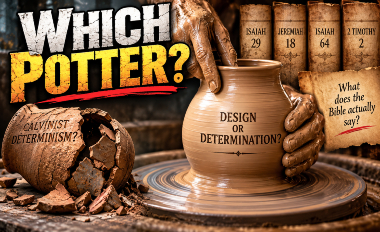
Romans 9:20 (The Premise): The top header notes that Romans 9:20 quotes one of these Old Testament passages (“But who are you, a human being, to talk back to God? ‘Shall what is formed say to the one who formed it, “Why did you make me like this?”‘”).


Isaiah 29:16: Described as “The one Paul quotes. The clay denies its maker sees.” In context, this verse rebukes those who try to hide their plans from the Lord, acting as if the clay has more knowledge than the potter.

Isaiah 45:9: Described as “God frees a Gentile. Cyrus, for Israel’s rescue.” This passage warns against arguing with one’s Creator, set against the backdrop of God sovereignly choosing Cyrus (a pagan king) to liberate Israel.

2 Timothy 2:21: Described as “Paul’s own potter. The vessel purges itself.” This verse emphasizes human responsibility, stating that if a person cleanses themselves from dishonorable things, they will become a vessel instrument for noble purposes.

Jeremiah 18: Described as “Marred and remade. He relents when the nation turns.” This passage shows that the potter reshapes the clay based on its response, illustrating that God alters His planned judgment if a nation repents.

Isaiah 64:8: Described as “The clay calls him Father, asks mercy, and is heard.” A communal prayer of confession acknowledging God as the potter and Father, pleading for Him not to remain angry forever.

Job 10:9: Described as “The clay pleads its case. Job is called blameless.” Job remembers that God molded him like clay and questions why he is facing such intense, seemingly unprovoked suffering.

WHOSOEVERWILL on X
On the WWW

I checked. Every one of them.

Paul did not invent the potter in Romans 9. He quoted it. Five words straight from Isaiah 29:16.

Isaiah 29

The clay there is hiding its works and saying:

“Who seeth us?” — Isaiah 29:15

Paul is answering a man who ducked behind God’s power to escape his own guilt.

Then read the rest.

Jeremiah 18

The vessel is marred and remade, and God says why:

“If that nation turn from their evil, I will repent of the evil.” — Jeremiah 18:8

Isaiah 64

The clay calls the potter Father and asks mercy.

It is not rebuked.

Paul’s Own Potter — 2 Timothy 2

How does a vessel become a vessel of honour?

“If a man therefore purge himself.” — 2 Timothy 2:21

Every potter in Scripture relents, frees, listens, or is purged by the man himself.

Not one shapes a vessel for the fire and gives the clay no say.

Not even Paul’s.

And a Helpful Resource on the Potter-and-Clay Metaphor (HERE)

Israel Steinmetz’s article, “Salvation by Design or Determination? Re-examining the Potter-and-Clay Metaphor,” takes a fresh look at Romans 9 by asking an important question: What did Paul mean by the potter-and-clay imagery, and where did that imagery come from? Steinmetz argues that Paul was not inventing a new metaphor but drawing heavily from the Old Testament, particularly Isaiah 29, Isaiah 45, Isaiah 64, and Jeremiah 18.

One of the article’s strongest points is its treatment of Isaiah 29:16, the passage behind Paul’s statement in Romans 9:20. Isaiah 29 is not presenting clay as an utterly passive object with no moral responsibility. The surrounding context concerns people attempting to hide their works from God and questioning God’s knowledge of them. The passage ultimately moves toward repentance and restoration. Steinmetz therefore argues that the potter-and-clay metaphor emphasizes God’s design and authority, but not the deterministic conclusion that God unconditionally determines the eternal destiny of passive individuals.

The discussion of Jeremiah 18 is even more explicit. God sends Jeremiah to watch a potter reshape a marred vessel and then applies the illustration to Israel. God says that if a nation turns from its evil, He will relent concerning the judgment He announced; likewise, if a nation turns to evil, He will reconsider the good He had intended for it. Steinmetz sees this as demonstrating that the biblical potter metaphor involves a dynamic relationship between God and His creatures, rather than a picture of God mechanically determining an unchangeable outcome.

Steinmetz also brings the discussion back to Paul himself, pointing to 2 Timothy 2:20–21, where Paul describes vessels and then says that the person who cleanses himself becomes “an instrument for special purposes.” This reinforces the article’s larger argument: when the Old Testament background and Paul’s own usage are considered together, the potter-and-clay imagery does not require the Calvinistic concept of human beings as passive clay whose eternal destinies are unconditionally determined by God.

The article ultimately argues that “the point of the potter-and-clay metaphor is design, not determination.” That’s particularly relevant to the argument in this post because it challenges the assumption that Romans 9 can be interpreted independently of the Old Testament passages Paul is invoking.

Recommended reading: Israel Steinmetz, “Salvation by Design or Determination? Re-examining the Potter-and-Clay Metaphor,” Firebrand Magazine, August 13, 2024.

And one more article to drive the point home:

Charles Edward White: “Does God Call All the Shots?

Charles Edward White’s “Does God Call All the Shots?” challenges the Calvinist interpretation of Romans 9 by arguing that Paul’s discussion must be understood within the larger context of Romans 9–11 and the Old Testament passages Paul draws upon. White argues that Romans 9 is primarily dealing with God’s purposes concerning Israel, the Gentiles, faith, and unbelief—not teaching that God unconditionally determines the eternal destiny of every individual.

White also examines Paul’s use of Jacob and Esau, Pharaoh, and the potter-and-clay imagery. His treatment of the potter is particularly relevant here. He argues that the Old Testament passages behind Romans 9—including Isaiah 29, Isaiah 45, Isaiah 64, and Jeremiah 18—do not portray human beings as passive lumps of clay whose eternal destinies are unconditionally determined by God. Instead, they repeatedly portray God as sovereign while also responding to human actions. White even points to Paul’s own use of vessel imagery in 2 Timothy 2:21, where a person becomes a vessel for honorable use by cleansing himself.

White’s argument therefore provides a direct challenge to the common Calvinist assumption that Romans 9’s potter-and-clay imagery necessarily teaches exhaustive divine determinism. His larger point is that God’s sovereignty does not require human beings to be passive or morally irrelevant participants in His dealings with them.
Who Is Paul Answering in Romans 9?

SNEAK PEEK:

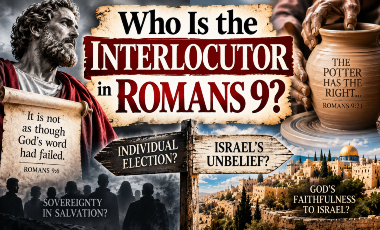
The Calvinist reading:

“If God sovereignly determines who will be saved and who will be damned, why does He still find fault?”

The alternative reading:

“If my rebellion and unrighteousness are being used by God to accomplish His redemptive purposes, why am I still being blamed?”

For years, Romans 9 has been used to support Calvinism’s most controversial doctrines—unconditional election, reprobation, and double predestination. But what if you’ve been reading it all wrong? In this eye-opening breakdown, we unpack the true identity of the interlocutor in Romans 9—hint: it’s not a 21st-century Arminian or Provisionist. It’s a hardened first-century Israelite rebelling against God’s redemptive plan. Discover how Paul uses the potter and clay analogy, not to teach predestined damnation, but to reveal God’s sovereign right to use Israel’s rebellion to bring salvation to the Gentiles.

00:00 – All are sinful, but all are responsible
00:45 – Who is the interlocutor in Romans 9?
02:00 – Calvinism and the potter-clay analogy
04:00 – Israel’s hardening: self-inflicted, not decreed
05:25 – Echoes of Romans 3: The same objector returns
07:00 – Sovereignty doesn’t require control
09:00 – Cross-reference: 2 Timothy 2 and Jeremiah 18
11:00 – You can cleanse yourself and be used for good
13:00 – God uses rebellion, but doesn’t cause it
14:30 – Why Calvinism’s reading of Romans 9 falls apart

Who Is the Interlocutor in Romans 9?

One of the most important—and often overlooked—questions in the debate over Romans 9 is the identity of Paul’s interlocutor: the person Paul anticipates objecting to what he has just said.

The answer matters because the identity of the objector determines what Paul’s response is actually addressing. If the interlocutor is objecting to God’s unconditional election and reprobation of individuals, then Romans 9 can be read as Paul’s answer to the familiar Calvinist objection:

If God determines who will be saved and who will be damned, why does He still find fault?

But if the interlocutor is someone else, then Paul may be answering an entirely different question.

The Calvinist Reading

The traditional Calvinist interpretation understands Paul’s argument roughly this way:

Paul declares that God has mercy on whom He wills and hardens whom He wills. The interlocutor then objects: “Then why does God still find fault? For who can resist His will?”

Under this reading, the objection is essentially:

“If God sovereignly determines who will receive saving grace and who will not, and no one can resist His sovereign will, how can God justly blame those who remain unbelieving?”

Paul’s answer is then understood as a response to that objection:

“Who are you, O man, to answer back to God?”

In other words, the Calvinist interpretation sees Paul anticipating the very objection that Provisionists, Arminians, and other non-Calvinists raise against unconditional election and reprobation today.

But there is a significant problem with that interpretation: the identity of the objector cannot simply be assumed. It must be established from the context.

If the Calvinist begins by assuming that Paul’s interlocutor is objecting to individual election and reprobation and then uses Paul’s response to prove individual election and reprobation, the argument becomes circular.

It is question begging. The very thing that must first be demonstrated—what Paul is talking about—has already been assumed.

What Problem Is Paul Actually Addressing?

Romans 9 does not begin with a philosophical discussion about free will, determinism, or individual predestination. It begins with Israel.

Paul expresses profound sorrow over his fellow Israelites. He even says that he could wish himself accursed and cut off from Christ for the sake of his fellow Jews. He then lists Israel’s extraordinary privileges: adoption, glory, covenants, the giving of the Law, worship, promises, the patriarchs, and ultimately the Messiah.

That immediately raises the central question Paul is attempting to answer:

If Israel was God’s covenant people and had received all these promises, why are so many Israelites rejecting their own Messiah? Has God’s promise failed?

Paul’s answer begins with a crucial statement:

“It is not as though God’s word had failed.”

That statement provides an important lens through which the rest of Romans 9–11 can be understood. The issue is not simply, “Who goes to heaven and who goes to hell?” The larger issue is whether God’s promises and purposes concerning Israel have failed because so many Israelites have rejected Christ.

The argument presented in The Potter’s Promise therefore understands Romans 9–11 as addressing God’s faithfulness to His promises despite Israel’s unfaithfulness. God’s purposes will stand even when the people through whom He intended to accomplish those purposes prove unfaithful.

So Who Is the Interlocutor?

On this reading, Paul’s interlocutor is essentially a hardened, self-righteous Israelite within the context of Paul’s discussion of Israel.

The person is not necessarily a hypothetical first-century equivalent of a modern Arminian saying, “If God unconditionally elects some people and reprobates others, then how can He blame them?”

Instead, the objection is connected to God’s use of Israel’s rebellion to accomplish His purposes:

“If my unrighteousness and rebellion are being used by God to accomplish His purposes, why am I still being blamed?”

This becomes particularly significant when Romans 9:19 is compared with the earlier objection in Romans 3:1–7. In Romans 3, Paul anticipates essentially the same kind of objection:

“If our unrighteousness brings out God’s righteousness more clearly, what shall we say? That God is unjust in bringing His wrath on us?”

The objector’s reasoning is straightforward:

If my unrighteousness ultimately serves to demonstrate God’s righteousness, why should God judge me for it?

Romans 9:19 then presents a remarkably similar question:

“Why does he still find fault? For who can resist his will?”

The connection suggests that Paul is dealing with a recurring objection from within the same larger argument—not necessarily introducing an entirely new philosophical objection about individual predestination.

The Potter, the Clay, and Israel

This also changes how the imagery of the potter and the clay is understood.

The potter imagery has its background in Jeremiah 18, where God explicitly applies the potter analogy to Israel: “Can I not do with you, Israel, as this potter does?”

Israel is the clay in the Potter’s hands. The Potter has sovereign authority over His covenant people and can reshape, judge, or use them according to His purposes.

That makes the immediate context of Romans 9 especially important. The question is not merely whether God possesses sovereignty over individual human beings. Of course He does. The question is what He is sovereignly doing in this particular passage.

The argument is that God is sovereignly working through Israel’s history to accomplish His redemptive plan. Israel’s failure does not cause God’s promise to fail.

Pharaoh Is Part of the Same Argument

This is also why Pharaoh is significant. The argument does not treat Pharaoh primarily as an example of God arbitrarily selecting an individual for eternal damnation. Instead, Pharaoh functions as a paradigm for what God is doing with Israel.

God raised Pharaoh up so that His power would be demonstrated and His name proclaimed throughout the earth. In the same way, God can use even an unfaithful and rebellious people to accomplish His larger redemptive purpose.

Thus, when Paul says: “Therefore God has mercy on whom He wants to have mercy, and He hardens whom He wants to harden,” the argument does not necessarily concern God’s arbitrary determination of the eternal destiny of individuals.

Rather, God’s sovereignty includes His right to determine how particular people and groups will be used within His redemptive purposes.

That distinction is critical.

God’s “mercy” and “hardening” can concern a person’s role in God’s historical and redemptive plan without automatically meaning that the person has been unconditionally predestined to heaven or hell.

Hardening Is Not the Same Thing as Being Born Reprobate

There is another important distinction.

The hardened Israelites described in this argument are not portrayed as people who were born judicially hardened. Rather, they had already become hardened through rebellion, unbelief, and resistance to God. God then judicially hardened them for a particular purpose.

That distinction becomes particularly important when Romans 9 is read together with Romans 11. Paul says that Israel was cut off because of unbelief, but he also holds out the possibility that those who were cut off could be grafted in again if they did not continue in unbelief.

That is a very different picture from an eternally reprobated individual who was unconditionally passed over before birth with no possibility of salvation. The hardened Israelites remain objects of Paul’s hope. They can be provoked to jealousy, turn from unbelief, and be grafted back into God’s people. That continuing possibility of restoration is highly significant for understanding the nature of the hardening in Romans 9.

Romans 9 Cannot Be Separated From Romans 10 and 11

This is perhaps the most important contextual point.

Romans 9 cannot simply be lifted out of Romans 9–11 and treated as an isolated proof text for unconditional individual election.

Paul’s discussion continues into Romans 10, where he expresses his heart’s desire and prayer to God for Israel—that they may be saved. He then describes Israel as having stumbled through unbelief while the Gentiles are being brought into God’s righteousness through faith.

Romans 11 continues the same story. Israel’s rejection is not the end of the story. The branches that were broken off because of unbelief can be grafted in again. The overarching picture, then, is of God’s sovereign plan moving forward despite Israel’s unbelief, not God’s arbitrary creation of two classes of human beings—those unconditionally destined for salvation and those unconditionally destined for destruction.

The Two Interpretations


Who Is the Interlocutor in Romans 9?
CLICK TO ENLARGE

The difference can therefore be summarized very simply. The Calvinist reading:

“If God sovereignly determines who will be saved and who will be damned, why does He still find fault?”

The alternative reading:

“If my rebellion and unrighteousness are being used by God to accomplish His redemptive purposes, why am I still being blamed?”

Those are two fundamentally different objections.

And consequently, Paul’s response—

“Who are you, O man, to answer back to God?”

—takes on a different meaning depending upon which objection is actually being presented.

If the Calvinist interpretation is correct, Romans 9 is a powerful answer to the charge that God’s sovereign election and reprobation are unjust.

But if the alternative interpretation is correct, Romans 9 is not Paul defending Calvinistic reprobation at all.

Paul is explaining how God’s sovereign purposes concerning Israel remain intact despite Israel’s rebellion, how God can use even hardened vessels to accomplish His purposes, and how His covenant promises ultimately extend beyond ethnic Israel to include believing Gentiles.

That makes the identity of the interlocutor absolutely critical. The question is therefore not merely: “Does Romans 9 teach God’s sovereignty?”

It unquestionably does. The more important question is:

“What is the objection Paul is answering, and what exactly is the sovereign activity of God that the objector believes is unjust?”

Until that question is answered from the context, using Romans 9 as Paul’s definitive answer to the Calvinist doctrine of unconditional election and reprobation risks putting a theological question into Paul’s mouth that he may not actually be answering.

Dumbing Down John Calvin via GROK (Romans Edition)

I also had to start this out with Doc Flowers

This is merely a posting of the raw Calvin and my asking GROK to “laymanize it,” so-to-speak. Meant for my own use in the future and others who might find it helpful:

Grok, can you put into layman’s understanding this older John Calvin quote, so it fits better with American English, please?

Again I ask: whence does it happen that Adam’s fall irremediably involved so many peoples, together with their infant offspring, in eternal death unless because it so pleased God? Here their tongues, otherwise so loquacious, must become mute. The decree is dreadful indeed, I confess. (latin. “Decretum quidem horribile, fateor.”; french. “Je confesse que ce decret nous doit epouvanter.”) Yet no one can deny that God foreknew what end man was to have before he created him, and consequently foreknew because he so ordained by his decree. If anyone inveighs against God’s foreknowledge at this point, he stumbles rashly and heedlessly. What reason is there to accuse the Heavenly Judge because he was not ignorant of what was to happen? If there is any just or manifest complaint, it applies to predestination. And it ought not to seem absurd for me to say that God not only foresaw the fall of the first man, and in him the ruin of his descendants, but also meted it out in accordance with his own decision. For as it pertains to his wisdom to foreknow everything that is to happen, so it pertains to his might to rule and control everything by his hand. And Augustine also skillfully disposes of this question, as of others: “We most wholesomely confess what we most correctly believe, that the God and Lord of all things, who created all things exceedingly good [cf. Gen 1:31], and foreknew that evil things would rise out of good, and also knew that it pertained to his most omnipotent goodness to bring good out of evil things to be . . . , so ordained the life of angels and men that in it he might first of all show what free will could do, and then what the blessing of his grace and the verdict of his justice could do. (Augustine, On Rebuke and Grace X. 27)”.

John Calvin, Institutes of the Christian Religion III.xxiii.7 (The Library of Christian Classics), trans. Ford Lewis Battles, Westminster John Knox Press (January 1, 1960), pg 955-956

PARAPHRASE ONE from GROK:

Here’s a straightforward, modern American English paraphrase of that passage from John Calvin’s Institutes (Book III, Chapter 23, Section 7), breaking it down into plain talk while staying true to what he was saying:

Calvin is wrestling with this tough question: Why did Adam’s sin drag so many people—including babies and everyone else—into eternal damnation with no way out? The only answer is: because that’s what God decided, and it pleased Him to do it that way.

At this point, people who love to argue and talk endlessly about fairness have to shut up. They’ve got nothing left to say.

Yes, I admit it—this decision (or “decree”) of God’s is dreadful/horrible/awful. It’s shocking and hard to stomach. (That’s where the famous Latin “Decretum quidem horribile, fateor” comes from—he’s owning how tough it sounds.)

But no one can seriously deny that God knew ahead of time what would happen to humanity before He even created us. And the reason He knew it? Because He Himself planned and ordained it that way from the beginning.

If somebody tries to attack God just for knowing the future in advance, they’re being reckless and foolish. What’s wrong with God being all-knowing? The real issue isn’t His foreknowledge—it’s His predestination (His choice to decide and make it happen).

So don’t think it’s weird when I say this: God didn’t just predict that Adam would fall and that the whole human race would crash with him—He actually arranged it according to His own purpose and will.

Why? Because:

  • It belongs to God’s perfect wisdom to know everything that will ever happen.
  • It belongs to His almighty power to actively rule and direct everything that happens.

Calvin then quotes Augustine to back this up (in simpler terms): We rightly believe and confess that God—who created everything very good—knew evil would come out of good things. But He also knew that His supreme goodness and power could bring even greater good out of that evil (rather than never allowing evil at all). So God set up the lives of angels and humans in such a way that:

  • First, He would show what people could do with their free will.
  • Then, He would show what His grace could do to rescue some, and what His justice could do in judging others.

In short, Calvin is saying: This teaching about God sovereignly deciding some people’s eternal destinies (including allowing or ordaining the fall and its consequences) feels terrifying and hard to accept—he calls it dreadful himself—but it’s the clear teaching of Scripture. Attacking God’s foreknowledge misses the point; the real sticking point is His deliberate choice (predestination). And even though it’s mind-bending, God uses even the worst things to display both His mercy (to the saved) and His justice (to the unsaved), ultimately bringing good out of it all in line with His perfect plan.

This is classic Calvin: blunt about how unsettling the doctrine is, but insistent that we have to accept it because it’s what the Bible reveals about God’s absolute sovereignty.

PARAPHRASE TWO from GROK:

Here’s a more concise modern American English paraphrase of that Calvin passage (Institutes III.xxiii.7):Why did Adam’s sin doom so many people—including infants—to eternal death with no escape? Because God willed it that way, and it pleased Him.

People who love to debate this get silent here. Yes, I admit it—this decree is dreadful and horrifying. But no one can deny God knew the outcome before creating humanity—because He Himself decreed it.

Attacking God’s foreknowledge is pointless and reckless. The real issue is predestination—His deliberate choice to ordain the fall and its consequences, not just foresee them.

As God wisely knows all that will happen, so His power rules and directs everything. Augustine puts it well: God created all things good, foresaw evil arising from good, yet in His almighty goodness ordained human (and angelic) life to first show what free will can do, then display His grace to some and justice to others—ultimately bringing greater good from evil.

In plain terms: Calvin calls double predestination (election to life and reprobation to damnation) terrifying and hard to accept—he owns how awful it sounds—but insists it’s biblical truth about God’s total sovereignty. God doesn’t just predict disaster; He sovereignly plans it to reveal both mercy and justice.

Grok, at this link there is a commentary by John Calvin on Romans 9:19-21, can you modernize and paraphrase this to American English please.

https://www.ccel.org/ccel/calvin/calcom38.xiii.v.html

PARAPHRASE ONE from GROK:

Here’s a concise, modern American English paraphrase of John Calvin’s commentary on Romans 9:19-21 (from his Commentary on Romans, as found at the linked CCEL page). I’ve kept it straightforward and easy to follow while staying faithful to Calvin’s meaning—he’s defending God’s absolute sovereignty in election and reprobation (choosing some for mercy, passing over others for judgment) against human objections.

Verse 19 – The objection Paul anticipates:

Paul knows this teaching (that God hardens whom He wills and has mercy on whom He wills) triggers huge pushback. Our sinful human nature (“the flesh”) explodes in anger when it hears that people who end up lost were destined by God’s will to destruction. So Paul quotes the typical angry comeback from unbelievers:

“Why does God still blame us? If He’s the one who made us the way we are and controls everything we do, then He’s just punishing His own creation! We can’t fight Him—He always wins. So His judgment is unfair, and His power is basically tyrannical.”

It’s like they’re shifting all blame to God and then raging at Him for it. (Calvin notes this is similar to how medieval theologians foolishly debated God’s “absolute power” as if He could act arbitrarily without regard to His own justice.)

Verse 20 – Paul’s first response: Shut up and remember who you are!

Paul doesn’t give a long philosophical defense right away. Instead, he shuts down the blasphemy with a blunt reminder of human limits:

“But who do you think you are, O mere human, arguing back against God? Does the thing that’s made get to talk back to the one who made it and say, ‘Why did you make me like this?'”

Calvin explains: Paul starts here because the highest and ultimate reason for everything is God’s will—nothing is higher. If someone claims God arbitrarily rejects some and chooses others out of pure grace, Paul doesn’t deny it; he affirms it! People have no right to challenge or accuse God.

Why doesn’t Paul just say, “There’s a good reason for the difference”? Because any deeper explanation would be beyond our grasp anyway. Paul isn’t dodging because he lacks answers—he’s reminding us of our ignorance and weakness. Proud people complain that Paul gives no “cause” beyond God’s secret counsel, but that’s the point: This is a mystery we can’t fully understand, so we should humbly adore it instead of demanding explanations our tiny minds can’t handle. God stays silent on the “why” not because there’s no reason, but because our small brains can’t contain His infinite wisdom. He accommodates our frailty by calling us to humility and self-control.

Paul hammers home that God’s will is always just, even if we don’t see the reasons. Denying God the right to decide the fate of His creatures robs Him of His proper authority.

The potter-clay illustration (verses 20-21):

Paul uses a vivid analogy (echoing Isaiah 45:9 more than Jeremiah 18:6) to crush human arrogance:

The clay has no right to complain to the potter. The potter has full authority over the clay—he can shape the same lump into whatever he wants: one vessel for honorable use (like a fancy vase), another for ordinary or even dishonorable use (like a trash pot).

Calvin stresses: This isn’t about raw brute force (“power” here means rightful authority, not just might). The potter isn’t stealing anything from the clay by shaping it however he pleases. Similarly, God doesn’t take away anything from humans by deciding their destiny—whether for mercy or judgment.

To deny God this sovereign right as the ultimate decider of life and death is to strip Him of part of His glory and honor.

In plain terms: Calvin says Paul is teaching that God’s choices in salvation (electing some to mercy, hardening/ordaining others to judgment) rest ultimately on His free will, not on anything in us. Human objections that scream “Unfair!” are arrogant and ignorant—like clay yelling at the potter. We should bow in humble awe rather than demand answers we can’t comprehend. This upholds God’s justice and sovereignty without making Him arbitrary or tyrannical—His will is always right, even when hidden from us.

PARAPHRASE TWO from GROK:

Here’s a more concise modern American English paraphrase of John Calvin’s commentary on Romans 9:19-21:The angry objection (v. 19):

Paul anticipates the furious pushback: “If God hardens some and has mercy on others according to His will, why does He still blame us? We’re just His creation—He made us this way and controls everything. Punishing us is like punishing His own work. We can’t fight Him, so His judgment is unfair and His power is tyrannical!”

People shift blame to God, then rage at Him for it—like medieval thinkers foolishly debating God’s “absolute power” as if He could act without justice.

Paul’s response (v. 20):

Paul doesn’t dive into deep explanations first. He shuts it down bluntly: “Who do you think you are, mere human, arguing back at God? Does the thing made get to question the Maker: ‘Why did you make me like this?'”

Calvin explains: The ultimate reason is God’s sovereign will—nothing tops that. Paul affirms (doesn’t deny) that God freely chooses some for mercy and passes over others for judgment. Humans have no right to challenge Him or call it unfair.

Why no “just reasons” given? Because any full answer is beyond our grasp. Paul isn’t short on logic—he’s reminding us of our limits. We’re dust; we can’t comprehend God’s infinite wisdom. Proud critics complain he gives no cause, but that’s intentional: This mystery should be humbly worshiped, not dissected by our curiosity. God stays silent to keep us modest and sober.

Paul keeps stressing: God’s hidden-will decisions are always just. Denying Him the right to shape destinies robs Him of His authority.

The potter-clay picture (vv. 20-21):

Paul uses the analogy (mainly from Isaiah 45:9): The clay has zero right to complain to the potter. From the same lump, the potter can make one vessel for honor, another for common use—it’s his rightful authority, not arbitrary force.

Calvin adds: The potter doesn’t steal from the clay by shaping it. Likewise, God doesn’t rob humans by deciding their end (mercy or judgment). To deny God this role as ultimate Lord over life and death strips Him of due honor.

Bottom line: Calvin says Paul’s teaching upholds God’s total sovereignty in election/reprobation. Human cries of “unfair!” are arrogant ignorance—like clay yelling at the potter. We should bow in awe, not demand answers our finite minds can’t handle. God’s will is righteous, even when mysterious.

Grok, at this link there is a commentary by John Calvin on Romans 9:22-23, can you modernize and paraphrase this to American English please.

https://www.ccel.org/ccel/calvin/calcom38.xiii.vi.html

PARAPHRASE ONE from GROK:

Here’s a concise, modern American English paraphrase of John Calvin’s commentary on Romans 9:22-23 (from his Commentary on Romans, as at the linked CCEL page). I’ve kept it straightforward and true to his intent—he’s defending God’s justice in predestination by showing how both reprobation (vessels of wrath) and election (vessels of mercy) display God’s glory.

Verse 22 – God’s patient endurance of the “vessels of wrath”

Paul’s second answer: Even though God’s plan is mysterious and beyond full human understanding, His perfect justice is clear in both saving the elect and dooming the reprobate.

He asks rhetorically: “What if God, wanting to display His wrath and make His power known, patiently endured (with great forbearance) the vessels of wrath—people prepared/fitted for destruction?”

Calvin explains: These are people God has appointed to destruction as examples of His vengeance and anger. Yet He doesn’t wipe them out instantly—He holds back judgment for a time. Why?

  • To showcase His severity (terrifying others with these examples).
  • To demonstrate His mighty power (using them in various ways to serve His purposes).
  • To make the vastness of His mercy toward the elect shine even brighter by contrast.

If God does all this, what’s unfair or blameworthy? Nothing. Paul doesn’t explain why certain people are prepared for destruction—that reason is hidden in God’s secret, unsearchable counsel. We should worship His justice rather than demand to probe it.

He calls them “vessels” because all creatures serve as instruments of God’s power. The reprobate are “vessels of wrath” because they display God’s judgments.

Verse 23 – Displaying the riches of God’s glory on the “vessels of mercy”

“…so that He might also make known the riches of His glory on the vessels of mercy, which He prepared beforehand for glory.”

Calvin: This is the flip side—the second purpose. By contrasting the doomed with the saved, God’s infinite mercy toward the elect stands out more vividly. What makes the elect different? Nothing in themselves—they were headed for the same destruction but were graciously rescued by God, not by any merit of their own.

Seeing how miserable everyone else is (under God’s wrath) highlights how praiseworthy His kindness is. “Glory” here refers mainly to God’s mercy (His chief glory shines in acts of grace and kindness).

The elect are “vessels of mercy” because God uses them to display and glorify His mercy. Paul stresses that God Himself “prepared” them beforehand for glory—just as the reprobate were prepared for destruction—both tied to His secret eternal counsel (not something they did or earned).

In plain terms: Calvin says Paul’s point is that God’s choices in election and reprobation aren’t unjust. Letting the wicked persist for a while and then judging them reveals His wrath, power, and severity. Saving the elect reveals His boundless mercy even more dramatically by comparison. Everything serves to magnify God’s glory. We don’t get to question the “why” behind who gets what—it’s God’s sovereign right, and we should humbly adore His justice rather than accuse Him.

PARAPHRASE TWO from GROK:

Here’s a more concise modern American English paraphrase of John Calvin’s commentary on Romans 9:22-23:

Verse 22 – God patiently endures the “vessels of wrath”

Paul’s second defense: Even though God’s plan is mysterious, His justice is obvious in both the doom of the reprobate and the salvation of the elect.

He asks: “What if God, desiring to show His wrath and reveal His power, patiently endured (with great forbearance) the vessels of wrath—people fitted/prepared for destruction?”

Calvin: These are people God has sovereignly appointed to destruction to display His vengeance. Yet He doesn’t destroy them immediately—He holds back judgment to:

  • Demonstrate His terrifying severity (warning others through their examples).
  • Make His mighty power known (using them to serve His purposes in various ways).
  • Highlight the vastness of His mercy toward the elect by stark contrast.

Nothing here is unjust. Paul doesn’t explain why some are prepared for destruction—that reason is hidden in God’s secret, unsearchable counsel. We should adore His justice, not probe it.

“Vessels” means instruments: All creatures serve God’s power. The reprobate are “vessels of wrath” because they manifest God’s judgments.

Verse 23 – Revealing the riches of God’s glory on the “vessels of mercy”

“…so that He might also make known the riches of His glory on the vessels of mercy, which He prepared beforehand for glory.”

Calvin: This is the contrasting purpose. By judging the reprobate, God’s infinite mercy to the elect shines brighter. The elect differ from the doomed only because God graciously rescues them from the same destruction—not by their merit, but by pure kindness. Seeing everyone else’s misery makes God’s mercy to them even more praiseworthy.

“Glory” here mainly means God’s mercy (His highest praise comes through acts of grace). The elect are “vessels of mercy” because God uses them to display and glorify His mercy.

God Himself “prepared” them beforehand for glory—just as the reprobate were prepared for destruction—both rooted in His eternal, secret counsel.

In short: Calvin says Paul’s argument shows God’s predestination is just. Enduring the wicked before judging them reveals wrath, power, and severity. Saving the elect reveals boundless mercy by comparison. All of it magnifies God’s glory. We don’t question the hidden “why”—we humbly worship His sovereign justice.

Dr. Flowers Reads from Pastor Mitchell’s Book: Rediscovering Romans 9

Dr. Flowers welcomes Pastor Scott Mitchell, of Calvary Chapel in Boston, who has authored a new book titled, “Rediscovering Romans 9: How Calvinism Distorts the Nature & Character of God” (FULL VIDEO EMBEDDED BELOW)

Leighton read this section from Pastor Scott’s book:

REDISCOVERING RESPECT

Disrespect through misrepresentation is nothing new; it happens among people all the time. I cannot count the number of times I have had people misrepresent me, or put words in my mouth that I never said. I have had people tell me what I believe, when in fact I do not. Even when I attempt to correct their claim, many refuse to listen and continue to tell me what I believe. The point here is, if I am disrespected because someone misrepresents me, though frustrating, it is not necessarily going to affect me and I typically do not take it personally. What others claim I believe does not actually change me, it just makes me aware of their opinion. People are always going to have their opinions and I cannot correct everyone’s perspective of what they think I believe. I have taught enough Bible studies over the past 30 plus years so people can know what I believe and why I believe it. There will always be detractors; as they say, it goes with the territory.

Sometimes disrespectful statements can hurt those beyond the one targeted. If someone makes a disrespectful or inaccurate statement about me and it results in hurt to others, then you have my attention. Affecting others causes the stakes of the case to rise. Moreover, if the claim is against my character and it results in a damaged relationship with someone dear to me (including those God has placed under my care as a pastor) this requires my undivided attention. Not because of how I feel about the personal disrespect, but because of how it affects others who are innocent victims and vulnerable to unnecessary hurt. This issue corresponds to the intention of this book. I believe that Calvinism misrepresents God’s character. Though I do not believe Calvinists do this intentionally, the resulting effect is still the same.

When any Christian misrepresents God, it can result in hurt or confusion to believers and effect the presentation of the gospel to unbelievers. Calvinism has a particular problem in this area since their doctrines are notoriously controversial. When a neophyte Calvinist begins to realize the incongruity of the “doctrines of grace” with the clear teachings of Scripture, it can certainly result in confusion. The real problem in this case can be a distrust in the Bible instead of the Calvinistic teachings, since there may not be enough previous Bible education for a fair comparison to take place.

Calvinists typically reject any presentation of the gospel to large groups or crusades because they believe it is deceptive to offer the gospel to those in the crowd who are not the elect. Their actions in rejection of these events spans from refusing involvement to outright picketing as unbelievers enter these events. What does that say to unbelievers? Any concern Calvinists have with the gospel preached to the “non-elect” (in their minds) is a result of their own theological bias and is both unbiblical and illogical. First, in the Bible Jesus and the apostles preach the gospel to groups. We are told that some or many believed, implying naturally that not all believed, or that others rejected. Peter’s sermon on the day of Pentecost (Acts 2) is a classic example along with the multiple cities Paul visited on his missionary journeys. His efforts involved crowds of people he preached to, not to mention his visit to Jerusalem (Acts 22). Second, it is illogical to hold the gospel back from anyone through concern they are not one of the elect. Whether it is one or one hundred thousand to whom the gospel is shared, no one knows who will respond positively until after the presentation is made. Moreover, an initial positive response may not be genuine faith; this is only discoverable over time no matter whether it is one or more. There is never a biblical or logical reason to prevent sharing the gospel with anyone when the opportunity presents itself. No one knows or can assume a person will receive or reject the truth.

God has big shoulders and can certainly handle people who do not accurately understand Him because they do not know Him. But, when false or misleading statements made about Him are by those who know Him, this presents a different picture. This can affect the relationship between God and His people, and when this occurs, I think you will have His attention. There is a particular responsibility assigned to pastors, Bible teachers, and Christian leaders to represent Him reverently and biblically. All Christians have the responsibility to engage in “casting down imaginations, and every high thing that exalteth itself against the [accurate} knowledge of God” (2 Cor. 10:5), but those whom God has specifically tasked with overseeing and caring for His flock (1 Peter 5:2-3; Titus 1:9-11) must pay particular attention for the sake of His flock. “The flock of God” (1 Peter 5:2) are His blood-bought people!

False statements and claims about God can easily result in unbelievers rejecting Christ. This however is also a problem in the church among God’s people. If there is a place people should be able to go and get a clear understanding of God’s self-revelation through His word, it is the church, “the pillar and ground of the truth” (1 Tim. 3:15). His word accurately represents His nature and character; thus, a poor exposition of His word can easily result in misrepresenting Him in the congregation. Paul was well-aware of this problem and spent much of the New Testament (NT) instructing about God and correcting misrepresentations or misunderstandings related to Him. Therefore, this issue requires our utmost attention. Misrepresenting God kept Moses from entering the Promised Land (Num. 20:7-13) after a life of faithful service (Heb. 3:5)—it is a serious matter with God for sure.

Pages 5-7 of Scott Mitchell’s book, Rediscovering Romans 9: How Calvinism Distorts The Nature And Character Of God

“For He says to Moses” | Biblical Mercy

For He says to Moses, “I will have mercy on whomever I will have mercy, and I will have compassion on whomever I will have compassion.”

Dr. Leighton Flowers confronts Dr. James White’s faulty critique of Dr. William Lane Craig (and other non-Calvinists).

This is a condensed critique. To see the longer video going through each of Dr. White’s points go here: • What about those who never hear about Jesus?

Often we hear the objection that God is not obligated to have mercy on anyone. That’s true. However, the fact that God is not obligated to be merciful towards all people is what makes the display of His mercy to all people so amazingly gracious and abundantly glorious. That God does what He is not obligated to do for no other reason than He desires to be merciful to all is glorious.

Anyone suggesting this display of mercy isn’t genuine (or that’s it’s just an outward/external “prescriptive” will of God, but that His real secret desire is only to show mercy to a preselected few) is diminishing the abundance of His mercy and the glory of His grace extended to every person.

Also, I think sometimes there is an assumption that mercy is weakness. But that could not be further from the truth. Mercy can only be handed down by someone in a place of judgement over another. If it is not within my power to pass condemnation on someone, then it is also not within my power to have mercy on them. Mercy is an expression of power, not of weakness.

“The Lord is gracious and compassionate, slow to anger and rich in love. The Lord is good to all; he has compassion on all he has made.” -Ps 145:8-9

“For God has bound everyone over to disobedience so that he may have mercy on them all.” -Rom 11:32

Some more from SOTO 101:

V.  WHY GOD IS JUST IN SHOWING MERCY TO UNFAITHFUL ISRAELITES TO ACCOMPLISH HIS PROMISE IN BRINGING THE WORD (14-16)

  • Does God’s choosing to bless one descendant over another descendant make God unrighteous? What shall we say then? Is there unrighteousness with God? Certainly not!

The descendants of Abraham in Paul’s day had two false perceptions:

Every descendant deserves the benefit of bringing God’s Word. However, the truth is that God has only selected a remnant through whom to bring His Word.

Every descendant deserves eternal life on the basis of their being of Israel. However, no one is saved based on nationality but only upon grace through faith. Those nations, and the individuals therein, who oppose God’s Word remain under the curse (hatred), as illustrated by Edom (direct descendants of Isaac himself).

There is no unrighteousness with God for choosing some descendants for a noble cause and not others, nor is it unjust to condemn a descendant of Abraham who stands in opposition to the Word of God.

  • For He says to Moses, “I will have mercy on whomever I will have mercy, and I will have compassion on whomever I will have compassion.”

Paul’s reference to Moses’ encounter with God in Exodus 32-33 gives a perfect historical example of when God was merciful to Israel when they deserved to be destroyed for their unfaithfulness (worshipping a golden calf).

This example also parallels Moses’ self-sacrificial Christ-like love for Israel as reflected by Paul in the opening verses of this chapter… “forgive their sin—and if not blot me out…” (Ex. 32:31-32).

Certainly God may choose to save whosoever He is pleased to save (scripture teaches He chooses to save those who humble themselves and repent in faith – 1 Pt. 5:5-6), but this passage is in reference to God showing mercy to unfaithful Israel so as to fulfill His original promise through them even though they deserve condemnation.

  • So then it is not of him who wills, nor of him who runs, but of God who shows mercy.

“It” refers to the fulfillment of God’s promise to bring His Word despite Israel’s unfaithfulness (Rom. 3:3-4).

The promise depends on our merciful God, not on the faithfulness (“willing and running”) of Abraham or his descendants.

Abraham “willed and ran” in the flesh to produce a son through Hagar (who Paul used symbolically to represent the covenant of law and works, Gal. 4:24).

God, by his mercy, provided Isaac through the free woman, Sarah (who Paul used symbolically to represent the covenant of grace by faith in the call of God, Gal. 4:21-26).

VI.  WHY GOD IS JUST TO HARDEN UNFAITHFUL ISRAELITES TO ACCOMPLISH HIS PROMISE IN BRINGING THE WORD (17-18)

  • For the Scripture says to Pharaoh, “For this very purpose I have raised you up, that I may show My power in you, and that My name may be declared in all the earth.”

In the same way God hardened the already rebellious will of Pharaoh in order to accomplish the first Passover, so too God hardened the already rebellious wills of Israelites to accomplish the real Passover.

God’s power and goodness was displayed in mercy-ing unfaithful Israelites in the day of Moses and in hardening the unfaithful Israelites in the day of the Messiah.

  • Therefore He has mercy on whom He wills, and whom He wills He hardens.

Sometimes God will fulfill His promises by showing Israelites mercy, but His Word will never fail.

Sometimes God will fulfill His promises by hardening Israelites, but His Word will never fail.

Note: Those judicially hardened or cut off are not born in this condition, but have “grown hardened” over years of rebellion (Acts 28:27), they are cut off for unbelief (11:20) and the hope of the apostle is that they may be grafted back in and saved (11:11-32).

VII.  IF THE ISRAELITES’ UNRIGHTEOUSNESS ACCOMPLISHES GOD’S PROMISE TO BRING HIS WORD, WHY ARE THEY TO BLAME? (19-21)

  • “You will say to me then, “Why does He still find fault? For who has resisted His will? But indeed, O man, who are you to reply against God?”

You (an Israelite hardened to accomplish God’s promise) will say to me (an Israelite shown mercy to accomplish God’s promise), why are we to blame if God’s will is being fulfilled?

As the apostle already indicated in 3:5, this is a man-made argument that reveals a heart that has become calloused in its rebellion, otherwise they might see, hear, understand and repent (Acts 17:30; 28:27).

  • “Will the thing formed say to him who formed it, “Why have you made me like this?” Does not the potter have power over the clay, from the same lump to make one vessel for honor and another for dishonor?”

The lump of hardened clay represents Israel who is had grown calloused in rebellion (Acts 28:27) and who are now being remolded into two kinds of vessels:

Those unfaithful Israelites remolded, by means of signs from the incarnate Messiah Himself, to bring the Word.

Those unfaithful Israelites remolded, by means of judicially hardening, to accomplish the ignoble purpose of bringing redemption on the cross and the grafting in of the Gentiles (yet they still may be saved, Rom. 11:11-32).

Romans 9 explained. This video is very relevant in today’s world as we see believers departing from the faith while only the chosen ones will be able to stand by God and God will also provide and have mercey on them. God is able to raise leaders and kings so His Name is exalted among the nations. just like He did with the Pharaoh.

Romans 9:21-23 says, “Has the potter no right over the clay, to make out of the same lump one vessel for honorable use and another for dishonorable use? What if God, desiring to show his wrath and to make known his power, has endured with much patience vessels of wrath prepared for destruction, in order to make known the riches of his glory for vessels of mercy, which he has prepared beforehand for glory…”

RC Sproul, a notable Calvinist, interprets this to mean that God creates some people for salvation and the rest for damnation, but is that what the Apostle Paul really had in mind? Let’s explore!

~ R.C. SPROUL PLAYLIST ~


Pastor Gary Hamrick Preaches Through Romans 9-11

This is the churches “hello page,” and they are part of Calvary Chapel. This section of a longer sermon series is the best I have heard romans preached.

PART 1 | Are the Jewish people God’s “chosen people”? And if so, why have most Jews not accepted Jesus as Messiah? Has the Church “replaced” Israel in terms of promises God made to her that now belong to the Church? Pastor Gary answers these and other questions in today’s study from Romans 9-11. In these three chapters, Paul addresses the subject of Israel and the Jewish people and how they fit into God’s redemptive plan.

PART 2 | Does God predetermine some people to go to Heaven and others to go to Hell? Did Jesus die only for the Elect (those whom God decided to save)? Does man have a free will to choose Jesus, or is that God’s choice? Pastor Gary answers these questions and more in today’s teaching on predestination and election.