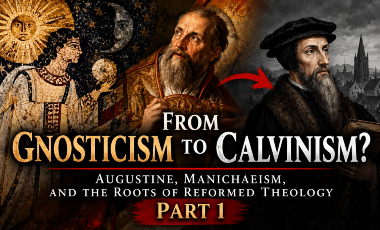
Augustine of Hippo’s Gnostic Influence on the Church (Part 1)

I wanted to go through these referenced sources and summarize them and reproduce portions of the manuscript. Here are the sources:

THE CORE CONNECTIONS & ACCUSATIONS

  • Augustine’s Background: Critics point to Augustine of Hippo’s approximately nine years of involvement with Manichaeism, a religious movement with dualistic teachings, before his conversion to Christianity. Because Augustine’s writings significantly influenced John Calvin and later Reformed theology, critics question whether aspects of his earlier worldview influenced his understanding of sin and human nature. [1, 2]
  • Total Inability / Total Depravity: Manichaeism presented a deeply dualistic understanding of good and evil and the human condition. Critics argue that Calvinism’s doctrine of total inability—the “T” in TULIP, which teaches that fallen humanity cannot come to faith apart from God’s enabling grace—resembles this pessimistic view of human nature. [1, 2, 3, 4]
  • The Material World and the Flesh: Gnostic movements often viewed the material world as inferior, corrupt, or even evil, although Gnostic beliefs varied. Critics argue that Augustine’s teachings concerning original sin, its transmission through human generation, and the effects of sexual desire reflect a similar pessimism about embodied human existence. They further contend that aspects of this outlook carried into later Reformed theology. [1, 2]

Today I want to deal with the first bullet point — “Augustine’s Background,” source #2 — I say TODAY because I want to open up some of those resources for a better deep dive, of which this is the first. I will try to offer some of the mentioned resources highlighted in the videos and partial transcripts in the videos or summaries.

These sources I put into my earlier post: “Is Calvinism a Heresy? (Bonus: Allie Beth Stuckey)“, and the first source I am opening up today is “Did Gnosticism Influence Calvinism? ‪@Soteriology101‬ Dr. Leighton Flowers Ruslan Interview“, and here is a partial transcript with the video:

Books explicitly mentioned in the video

Resource Author(s) / details Context in the transcript
Foundations of Augustinian Calvinism Ken Wilson Discussed as an accessible version of Wilson’s Oxford doctoral dissertation, examining the historical roots of Augustinian Calvinism.
Why I’m Not an Arminian Robert A. Peterson and Michael D. Williams Cited by Leighton Flowers as a book by two Calvinist professors that acknowledges a difference between Augustine’s monergistic doctrine of grace and the tendencies of the Apostolic Fathers.

Important spelling correction: The transcript’s automatic transcription says “Why I’m Not an Armenian.” The intended title is Why I’m Not an Arminian.

Historical sources mentioned

  • Herman Bavinck — Mentioned as a Calvinist theologian whose writings are invoked in the discussion.
  • Lorraine Boettner — Mentioned as a Reformed historical and theological source. The transcript renders the name as “Buttner” or “Betner”; the likely intended author is Lorraine Boettner.
  • The Apostolic Fathers — Early Christian writers whose views on human nature, free will, and salvation are discussed through the quotation from Peterson and Williams.
  • Augustine of Hippo — His writings and theological development are the central historical subject.
  • John Calvin, Institutes of the Christian Religion — Explicitly mentioned as a work in which Calvin cites Augustine extensively.

Partial Transcript:

Leighton Flowers

There’s also the book Why I’m Not an Armenian by two Calvinistic professors. They write, the semi-Pelagians were convinced that Augustine’s monergistic emphasis upon salvation by grace alone represented a significant departure from the traditional teaching of the church. They say, quote, and a survey of the thought of the Apostolic Father shows that their argument is valid.

From Calvinist scholars Robert A. Peterson and Michael D. Williams, Why I Am Not An Arminian, p. 39 (pages 35-41 quoted at the bottom):

Does the antipathy between Calvinism and Arminianism suggest that Pelagius, the arch-opposite of Augustine, is the proper ancestor of Arminianism? Calvinists have often sought to paint Arminianism in Pelagian colors. Associating your opponent with a position that the historic faith has repeatedly judged heretical can only help one’s cause. However, the allegation that Arminianism is Pelagian is unfortunate and indeed unwarranted. From Jacob Arminius and the ‘Remonstrance Articles’ on, the Arminian tradition has affirmed the corruption of the will by sin and the necessity of grace for redemption. Arminianism is not Pelagianism….The Semi-Pelagians thought of salvation as beginning with human beings. We must first seek God; and his grace is a response to that seeking. The Arminians of the seventeenth century, however, held that the human will has been so corrupted by sin that a person cannot seek grace without the enablement of grace. They therefore affirmed the necessity and priority of grace in redemption. Grace must go before a person’s response to the gospel. This suggests that Arminianism is closer to Semi-Augustinianism than it is to Semi-Pelagianism or Pelagianism.

Ruslan KD

Ruslan. Let’s talk about this idea of Gnosticism. You had a video up about Augustine, who’s the father of Calvinism. Augustine is who influenced John Calvin and Edwards and Martin Luther, who then influenced a lot of Charles Spurgeon and a lot of our guys today.

You could trace it all back to this gentleman named Augustine, who was a great thinker and a philosopher and all these amazing things. What people don’t know is that He came from a Gnostic background and that then impacted some of his views that you said were not there with the majority of Christians prior to Augustine.

So can you break down what Gnosticism is briefly and how it impacted some of Augustine’s views? Because I have a very specific segue that I deal with all the time with people in my community.

Can you give us just a brief breakdown of what Gnosticism is, how it impacted Augustine, how then that impacted John Calvin and Calvin?

Leighton Flowers

Saying what is Gnosticism can take some time because there’s a lot of different kinds of Gnosticism. Manichean Gnosticism, Manicheanism was the most predominant Gnostic group that many people would have heard of. And it was in particular what Augustine was for 10 years of his life. He was a Manichean Gnostic.

And Manicheanism is very, very different than Christian theology, but there are some similarities. And there are writings from the Manichaeans where they use many of the same proof texts like John 6.44 and other texts like that in order to demonstrate what they believe with regard to total inability.

In other words, one of the things they do teach, they have more of a dualistic view that there’s a good God and a bad God, an evil God and a good God. And they have a lot of different things that are not not like Christianity at all, but one of the things that’s similar to at least Calvinistic Christianity is that they believe that when we’re born, we’re born in a completely evil state and that we’re completely incapable of doing anything without a divine influence.

Ruslan KD

Sounds a lot like total depravity.

Leighton Flowers

Exactly. And so the argument is that this concept of total inability really did not originate within the Bible or early church teachings, but in a more Gnostic or Manichean philosophy of theistic determinism. Now that’s the argument.

But what’s interesting is if you even study John Calvin, he even says that the early church writings, he says they extol the powers of the human will. He says save the exception of Augustine, he said, are confused and they’re vacillating, they’re contradictory, and they extol the powers of the free will of man.

In other words, John Calvin, he wants to validate himself. His doctrines, he wants to make sure people believe them. And oftentimes, especially in that day of the Reformation, you would be reaching back to orthodoxy in order to establish your views as orthodox and as viable. And so he quoted from Augustine over 4,000 times in the Institutes of the Christian Religion.

And he admits, he says the early church writers, all the other early church writers prior to Augustine and even Augustine in his earliest writings, when he first converted out of Manichaeanism into Christianity for the first part of his Christian life, he did teach a doctrine of free will like you and I might believe it.

But only after many years and then eventually a debate with Pelagius does he begin to swing back, we believe, back into a more deterministic, philosophical way of thinking, and he begins to use some of the same arguments that you hear Manichaeans make.

Interesting, I recommend people read Ken Wilson on this particular subject. He’s taken his Oxford doctoral dissertation and made it into a smaller layman book that’s easier to approach than the one with seven different languages in it, and that’s huge.

And at our request, in fact, He was so gracious to do this, but at our request, he actually took his doctoral dissertation and broke it down to the basics and put it all into easy to approach, more English accessible. And it’s called the Foundations of Augustinian Calvinism.

And it really does kind of break down the roots of this and really goes through scholar after scholar after scholar who’s come to the same conclusion. And that’s what’s interesting about this. is not, you know, Leighton Flowers, the, you know, anti-Calvinist saying these things.

We’ve got quotes from Bavinck, Henry Herman Bavinck, who’s a well-known Calvinist, Lorraine Buttner, who is a well-known historical historian from the Calvinist. Matter of fact, Betner is the guy who made Tulip, the Across the Tulip, famous.

There’s also the book, Why I’m Not an Armenian, by two Calvinistic professors from Covenant Theological Seminary, Dr. Robert Peterson and Michael Williams. And they write this, they write, the semi-Pelagians were convinced, and semi-Pelagian is a pejorative term, we wouldn’t like that term, but that’s what they call us oftentimes, semi-Pelagians.

The semi-Pelagians were convinced that Augustine’s monergistic emphasis upon salvation by grace alone represented a significant departure from the traditional teaching of the church. So notice what they’re saying. They’re saying that Augustine, the accusation from semi-Pelagians is that Augustine took a significant departure from the early church.

And they say, quote, and a survey of the thought of the apostolic fathers shows that their argument is valid. In comparison to Augustine’s monergistic doctrine of grace, the teachings of the apostolic fathers tended toward a synergistic view of redemption, end quote.

In other words, I could read you about a dozen quotes here from Calvinist sources, not Armenian sources or provisional sources from actual Calvinistic historians who are intellectually honest enough to say, yeah, really Augustine is the first one on record to really begin to teach these doctrines.

And that’s just the fact of the matter. And it is a fact of the matter that he was influenced by Stoicism, Neoplatonism, and Manichean Gnosticism. That’s just a fact of the matter. That’s a part of his testimony. It’s on record. It’s not a disputable matter.

And so I think many of the scholars who know what they’re talking about realize that Augustine really is the first one to systematize and to teach more Calvinistic theology in the church.

Ruslan KD

That’s interesting. So here is where the logical conclusion of some of that goes. If he then elevates how evil man is and makes man just utterly evil. And you’re saying this doctrine isn’t found in the early church. We don’t see any of the other church fathers who believe them.

And if man is super duper, utterly sinful, hates God this whole bit, well then the material world, which is what also Gnosticism believes, the material world, the physical world is also evil. And everything here is evil and everything here is bad. And so you get saved. God could have just zapped you straight to heaven, but he kind of just leaves you on earth to suffer for a while with all these other filthy humans that he may elect or not elect.

This becomes extremely problematic when it again goes back to my heart for people is, hey, I want people to live out Matthew 25. I want people to live out the parable of the talents, the taking care of the least of these, having an amazing marriage, a godly marriage, a godly family. honoring God with your time, talent, and treasure, this becomes disconnected and incompatible when the worldview is people are utterly evil, humans are utterly evil, the world’s all evil, everyone’s evil, everything’s evil, the material is evil, the physical is evil.

So then, man, should I take that promotion at my job so that I can get my family out of this two-bedroom apartment? Because we’re crammed in here. I literally had somebody ask me this at a Bible study. We’re crammed into this little itty bitty place with two bedrooms. We got four kids. But is it evil? Is it my flesh to take this promotion? Because I don’t know. I mean, does God want me to have influence at my job and have a promotion?

And I’m like, bro, there’s certain things you don’t need to pray about. Your family’s hurting because you’re crammed into into this freaking small apartment, take the promotion and honor your family, right?

And begin, this is seeped into almost every denominational camp has this very low view of the material world of the physical world, forgetting that Jesus comes into the material world in material form as a baby.

I have a four week old, a four week old. She can’t do anything. She just lays there, right? She just lays there. We got to move her. We got to, she got to clean her. Jesus comes as a human, as a baby, and has to be cared for a minute before he could do anything. in the material physical world,

and so many Christians are caught up in this idea of the material physical world that escalates to this persecution complex. Everyone’s out to get me. I’m A Christian victim. The world’s all bad. It’s all evil. What’s the point of honoring God with my time, talent and treasure? What’s the point of taking care of my body? And then it literally just becomes fatalism. Like, well, what’s the point? It’s just all going to hell. It doesn’t make any sense.

And I think this is a vast heresy that is, I mean, every camp, whether you’re Pentecostal, Calvinistic, whatever, has this very low view of the physical material world, has this very low view of the Imago Dean people, has this very low view of our time, talent, and treasure on this side of eternity.

And it’s very frustrating because I deal with it all the time. So I want to hear your thoughts on some of this. And am I seeing the connection from Calvin to Augustine to Gnosticism? Do I see that connection? Is it as connected as I’m making it out to be? What are your thoughts, Doctor?

Leighton Flowers

I mean, there are some aspects of what you’re talking about that I would definitely see as some connection points. I call it worm theology, where no matter what is said in the Bible about us being created in the image of God and all the good things that God says about his creation and it being good, that some people will overemphasize the evil of man and how unworthy and our worthlessness of man.

And there’s a balance. There’s always a biblical balance between the extremes. You’ve got the extreme on the one side is just saying we’re all really good people and nobody’s really bad. And everybody’s basically good. You got that side, which a lot of the world is more in that camp.

You got the other side, the worm theology guys that we’re absolutely viper and diapers. We’re just horrible and nothing good whatsoever. we’re just worthless, all these kinds of things.

And I think that the balance is in the middle of those two things, where we obviously have worth in Christ and that we are created in his image and we are image bearers of the divine. Therefore, God doesn’t make junk. We don’t want to criticize that which God has created because it’s his.

Now, we can’t also underemphasize the impact of sin and corruption in this world. And sometimes we’re accused of doing that, but that’s usually by people who haven’t heard us out and really understood what we’re saying.

Because like I said from the very beginning of this interview with you, we’re in bondage to sin. We’re in enmity with God. We have horrible corruption, but the gospel is sufficient. That’s the good news.

All of the bad news is just as bad on our view as it is on Calvinism. It’s just that we believe that the gospel is sufficient for those who are in that condition.

And whereas the Calvinist says the gospel is not sufficient for the world, that it has to, really what’s sufficient is irresistible grace, this effectual regeneration that is only for some people and not for everyone. And that’s not good news as far as I can tell. That doesn’t seem like very good news.

It’s just It’s just, hey, if you won the divine lottery, so to speak, and I know that sounds pejorative and that’s a bad way to put it, but it’s kind of what it boils down to. It’s like, we don’t know why God picked some people and not others. He just, he picked some people and not others. And if you happen to be one of the blessed ones that got picked, then he’s going to grace you with this miracle of faith to cause you to believe.

I just don’t see this as the tenor of scripture. Instead, what I see within scripture is the good news is yes, we’re all fallen, we’re broken, we’re sinful, we’re depraved, we’ve gone our own ways.

And therefore, what is our only hope? Our only hope is to turn to the Lord so as to be saved. And he has provided a way of salvation for every man, woman, boy, and girl that no one perishes for lack of atonement. No one perishes because they’re rejected by their God. Anyone and everyone can be saved. And that’s what we want to try to highlight.

The book excerpt I mentioned by two Calvinist professors that acknowledges a difference between Augustine’s monergistic doctrine of grace and the tendencies of the Apostolic Fathers will follow these quotes.

BTW, other Calvinists agree with professors Peterson and Williams, which is to say they agree that Augustine introduced something new into the church previously not found in the early Fathers. [RPT and other will add: actually, it existed, but in Gnosticism.]

Herman Bavinck:

  • In the early church, at a time when it had to contend with pagan fatalism and gnostic naturalism, its representatives focused exclusively on the moral nature, freedom, and responsibility of humans and could not do justice, therefore, to the teaching of Scripture concerning the counsel of God. Though humans had been more or less corrupted by sin, they remained free and were able to accept the proffered grace of God. The church’s teaching did not include a doctrine of absolute predestination and irresistible grace.

Loraine Boettner:

  • “It may occasion some surprise to discover that the doctrine of Predestination was not made a matter of special study until near the end of the fourth century….They of course taught that salvation was through Christ; yet they assumed that man had full power to accept or reject the gospel. Some of their writings contain passages in which the sovereignty of God is recognized; yet along side of those are others which teach the absolute freedom of the human will. Since they could not reconcile the two they would have denied the doctrine of Predestination… They taught a kind of synergism in which there was a co-operation between grace and free … this cardinal truth of Christianity was first clearly seen by Augustine…“

Robert Peterson and Michael Williams of Covenant Theological Seminary:

  • “The Semi-Pelagians were convinced that Augustine’s monergistic emphasis upon salvation by grace alone represented a significant departure from the traditional teaching of the church. And a survey of the thought of the apostolic father’s shows that the argument is valid… In comparison to Augustine’s monergistic doctrine of grace, the teachings of the apostolic fathers tended toward a synergistic view of redemption” (36).

Louis Berkhof [in The History of Christian Doctrines]:

  • “Their representations are naturally rather indefinite, imperfect, and incomplete, and sometimes even erroneous and self-contradictory. Says Kahnis: “It stands as an assured fact, a fact knowing no exceptions, and acknowledged by all well versed in the matter, that all of the pre-Augustinian Fathers taught that in the appropriation of salvation there is a co-working of freedom and grace.”

Berkhof goes on to admit that “they do not hold to an entire corruption of the human will, and consequently adhere to the synergistic theory of regeneration…” (130).

Alister E. McGrath, Historical Theology: An Introduction to the History of Christian Thought (Malden, MA: Wiley & Sons LTD, 2013), 34.

  • One aspect of Augustine’s understanding of grace needs further comment. As human beings were incapable of saving themselves, and as God gave his gift of grace to some (but not all), it followed that God had “preselected” those who would be saved. Developing hints of this idea to be found in the New Testament, Augustine developed a doctrine of predestination. The term “predestination” refers to God’s original or eternal decision to save some, and not others. It was this aspect of Augustine’s thought which many of his contemporaries, not to mention his successors, found unacceptable. It need hardly be said that there is no direct equivalent in Pelagius’s thought.


Here is that excerpt…

Robert A. Peterson and Michael D. Williams, Why I Am Not an Arminian (Downers Grove, IL: InterVarsity Press, 2004), 35–41.

(PDF of these pages)

Semi-Pelagianism and the Synod of Orange

Although Pelagius was condemned by the bishop of Rome in 417 and then after his death by the Council of Ephesus in 431, he certainly did not set out to be a heretic. Bernhard Lohse makes the point that Pelagius’s intent was “to elevate the difficult ascetic demands which were then permeating monasticism to a position of a fundamental principle for all Christians.” While Pelagius’s inordinately low view of sin and grace might—and should—strike us as scandalous and indeed heretical, Lohse does not exaggerate when he notes that “there is hardly an opinion” in Pelagius’s teaching on sin and grace “for which some confirmation could not be found among the earlier fathers of the church.” Indeed, one could easily argue that it was Augustine, not Pelagius, who was out of step with the tradition of the church.

The generation after Augustine and Pelagius would give birth to the Semi-Pelagian movement. Monks like John Cassian and Vincent of Lérins agreed with Augustine regarding the seriousness of sin, yet they objected to his ideas of the total and disabling bondage of the will to sin, the irresistible power of grace and predestination as predicated upon a particular election. In 434 Vincent of Lérins wrote the Commonitory, which contained both a polemic against Augustine’s doctrine of grace as a dangerous innovation and a description of the Catholic principle of tradition that would become normative for the church. The Augustinian understanding of sin and grace, said Vincent, is contrary to the ancient tradition of the church, “that faith which has been believed everywhere, always, by all. For that is truly and in the strictest sense ‘Catholic,’ which, as the name itself and the reason of the thing declare, comprehends all universality.”[1]

The Semi-Pelagians were convinced that Augustine’s monergistic emphasis upon salvation by grace alone represented a significant departure from the traditional teaching of the church. And a survey of the thought of the apostolic fathers shows that the argument is valid.

While affirming the necessity of grace for salvation, early Christian theological reflection tended to be highly moralistic and even legalistic, emphasizing a view of the Christian life that focused more on conduct—often expressed as rigorous prescription—rather than grace, faith or forgiveness. In comparison to Augustine’s monergistic doctrine of grace, the teachings of the apostolic fathers tended toward a synergistic view of redemption. For them, salvation is the result of a working together of divine grace and human agency. Human beings are fallen such that they need divine help, but that help cooperates with our own striving toward God and the moral life. The synergism in pre-Augustinian thought held that divine grace is necessary for salvation but that our salvation is as much the product of the exercise of human free will and obedience to the law of God as of grace.

The Semi-Pelagian monastics affirmed the free will and ability of human beings. Yet they were far removed from the humanistic monergism of Pelagius. The Semi-Pelagians insisted that human beings cannot be saved apart from the supernatural assisting grace of God. But the fallen human will is not held in bondage to sin; it is not completely disabled by sinful corruption. Human beings can, unaided by grace, take the first step toward salvation. John Cassian held that human nature is weakened but not disabled by sin; we are fallen but able, fallen enough that we need help, but not so fallen that we cannot contribute to our own recovery. Cassian wrote, “And when He [God] sees in us some beginnings of a good will, He at once enlightens it and strengthens it and urges it on towards salvation, increasing that which He Himself implanted or which He sees to have arisen from our own efforts.”[2] In Semi-Pelagian synergism, human beings are the initiators of faith. Grace is responsive to our search for God and the good. God helps those who help themselves.

Throughout the fifth and early sixth centuries, the Augustinians and the Semi-Pelagians continued their debate, until the bishops met in 529 at the Synod of Orange to seek a resolution of the controversy. Even a century after his death, Augustine’s influence was so great that the synod sought to expunge any lingering strands of Pelagianism within the church. This does not mean, however, that the bishops affirmed Augustine’s teaching in its entirety. Somewhat inconsistently, they affirmed the doctrine of original sin and Augustine’s teaching on the bondage of the will, but they failed to affirm the doctrine of pre­destination. They argued that the freedom of the will has been destroyed by sin such that the only thing inherent in fallen humankind is “untruth and sin.”[3] Faith is not initiated by human beings and then completed by divine grace so that God’s work is dependent upon people. Rather, faith begins in the illuminating work and infused presence of the Holy Spirit, which “precedes” and “enables” human beings’ response to grace.[4] Much of the language of the Canons of the Council of Orange was taken directly from the works of Augustine. For example, using a citation from Augustine himself, the canons rejected the Pelagian charge that Augustine’s teaching was deterministic: “Men do their own will and not the will of God when they do what displeases him; but when they follow their own will and comply with the will of God, however willingly they do so, yet it is his will by which what they will is both prepared and instructed.”[5]

Any goodness or righteousness that humankind displays is the result of God’s grace working in them. But this should not be taken as evidence that the Synod of Orange affirmed Augustine’s gracious monergism. The synod softened the Augustinian teaching into a gracious synergism. First, as stated above, the synod did not endorse predestination. The canons explicitly reject predestination to damnation,[6] but they are completely silent concerning predestination to redemption. Second, while the synod insisted that the initiation of faith begins with the work of grace, it suggested that human agency cooperates with the divine in order to produce redemption. This synergism is subtly but crucially different from that of the Semi-Pelagians. While both see redemption as the product of both divine grace and human effort, the Semi-Pelagians depict redemption as beginning with human agency. The Semi-Augustinian synergism of Orange reversed the sequence. Hence, a person’s contribution to salvation is faithful response to the grace of God. Grace is prevenient here in that it precedes human response.

Nevertheless, there is a problem with the conclusions of the synod. If faith is a gift of God in that the seeds of faith are found in a grace that precedes the actual expression of faith in the responsive heart, and if grace must be given to people enabling them to respond (for a person cannot take the first step toward God), how does one account for the fact that not all respond in faith to the gospel? It seems that the bishops at Orange sought to escape having to address this question.

While the synod held that divine grace is necessary unto faith, its refusal to affirm the particularism of Augustine’s doctrine of predestination seems to be an implicit affirmation of universal preceding grace. That is, universal repairing and enabling grace is given to all, but each person must obediently respond to the illuminating work of the Holy Spirit in order to be saved.

Where Do Calvinism and Arminianism Fit?

The Calvinist understanding of the doctrines of sin and redemption closely conforms to Augustine’s gracious monergism. Redemption is utterly the work of grace. Does the antipathy between Calvinism and Arminianism suggest that Pelagius, the arch-opposite of Augustine, is the proper ancestor of Arminianism? Calvinists have often sought to paint Arminianism in Pelagian colors. Associating your opponent with a position that the historic faith has repeatedly judged heretical can only help one’s cause. However, the allegation that Arminianism is Pelagian is unfortunate and indeed unwarranted. From Jacob Arminius and the “Remonstrant Articles” on, the Arminian tradition has affirmed the corruption of the will by sin and the necessity of grace for redemption. Arminianism is not Pelagian.

If Arminianism cannot be traced back to Pelagius, perhaps the Semi-Pelagianism of John Cassian and Vincent of Lérins is the ancestor of Arminianism. Both Semi-Pelagianism and Arminianism insist upon a synergistic view of redemption. A person’s salvation is the result of two agencies: (1) God’s grace and (2) human faith and obedience. But here again, there are important dissimilarities. The Semi-Pelagians thought of salvation as beginning with human beings. We must first seek God; and his grace is a response to that seeking. The Arminians of the seventeenth century, however, held that the human will has been so corrupted by sin that a person cannot seek grace without the enablement of grace. They therefore affirmed the necessity and priority of grace in redemption. Grace must go before a person’s response to the gospel. This suggests that Arminianism is closer to Semi-Augustinianism than it is to Semi-Pelagianism or Pelagianism. The word Pelagian as a description of Arminians—or Roman Catholics for that matter—does them an injustice because it associates them with a theological tradition that is truly heretical in that Pelagius trivialized grace, and in so doing trivialized the work of Christ. Both the Semi-Augustinians of the fifth and sixth centuries and the Arminians of the seventeenth century sought understandings of sin and redemption that were qualifications of Augustinianism. Semi-Augustinianism was not a Pelagianism that had moved toward Augustine but rather a softening of Augustinianism that sought to modify or excise elements of Augustine’s teaching that were found offensive (particularist election and a doctrine of divine agency that seemed to render human agency irrelevant). As Arminianism began as a reaction to the Augustinian commitments of the Reformed churches and reacted negatively to much the same issues as had the Semi-Augustinians, Arminianism is properly understood as Semi-Augustinianism.

Yet we should appreciate the reality that the four positions sketched here as coming out of the Augustinian-Pelagian controversy of the fifth century do not exhaust the list of possible ways that sin and redemption can be understood or the ways in which divine agency can be thought of as relating to human action and decision making. Yes, Augustinianism (salvation is all of God’s grace) and Pelagianism (salvation is the product of human achievement) do seem to mark the polar extremes. But what lies between might be more of a continuum than a few discrete points. Between the two monergistic poles is the admixture, the synergism of dual agency in redemption. The realization of a continuum of beliefs may help us understand something of the diversity of belief within a tradition.

In 529 the Synod of Orange declared Semi-Pelagianism a heresy and declared a form of Augustinianism to be the official teaching of the Roman Church. Yet the emphasis upon the cooperation of human agency in redemption left a space for Semi-Pelagian ideas to flourish in popular belief. Even though the synod did not affirm a doctrine of meritorious works and insisted that God’s grace is the sole efficient cause of salvation, a Semi-Pelagian—and often an outright Pelagian—view of human agency would dominate in common folk belief. Indeed, the customs and structures that arose within the medieval Roman Church would lean to­ward a view of Christianity as a religion of performance, merit and obligatory rite. Something quite similar seems to exist within the Arminian tradition. Popular Arminian writing often tends to be so dismissive of anything that might qualify “libertarian free will” that it gives itself over to a moralist and meritorious doctrine of redemption. Redemption is offered by God, but we must earn it. This is, of course, the very danger that the Calvinist sees in all synergistic understandings of redemption.

But we Calvinists have our own version of popular or folk belief as well. If Arminian popular belief tends toward the overestimation of human ability and the redemptive contribution of human achievement, Calvinist popular belief often seems to overemphasize its redemptive monergism. We seek to out-Augustine Augustine. If a little monergism is good, more is better. As a result, we make God the sole cause of all things, sin as well as grace, unbelief as well as belief. And human beings do become mere pawns or actors walking through the scenery of their lives.

The Augustine-Pelagius controversy is our first monumental historical event. This controversy sets the stage for the following two chapters, which focus on issues keenly debated by Augustine and Pelagius and still disputed today: predestination and the perseverance of the saints.

NOTES

[1] Vincent of Lérins Commonitory for the Antiquity and Universality of the Catholic Faith Against the Profane Novelties of All Heresies 2.6.

[2] Quoted in Olson, Story of Christian Theology, p. 283.

[3] Canons of the Council of Orange, para. 1-2, 13, 22.

[4] Ibid., para. 3-7, 18.

[5] Ibid., para. 23.

[6] Ibid., para. 25.


How R.C. Sproul Got Pelagius and Pelagianism Wrong (Part 1)

I want to first head into Sproul’s position on Pelagius. The opening sources for this are

1. Sproul’s basic historical story

In The Pelagian Captivity of the Church, Sproul presents the historical sequence roughly like this:

Pelagius

  • denies original sin / human corruption
  • says grace isn’t necessary for obedience
  • Augustine responds with total dependence on grace
  • a “middle ground” develops

Semi-Pelagianism

  • Semi-Pelagianism says grace is necessary but human beings retain the ability to accept or reject it
  • the Roman Catholic Church later embraces this position
  • Arminianism represents essentially the same theological error today.

That’s very explicit in the article. Sproul says Semi-Pelagianism is the “middle ground” between Augustine and Pelagius and describes its “island of righteousness” from which fallen humans can choose to cooperate with grace.

And he repeats essentially the same framework in Willing to Believe. His chapter describes the issue as whether regeneration is monergistic or synergistic and says:

“All forms of semi-Pelagianism” involve synergism in regeneration.

Sproul’s historical framework is quite explicit:


“The classic issue between Augustinian theology and all forms of semi-Pelagianism” is whether regeneration precedes faith or whether a person first believes and is then regenerated. He says, “All forms of semi-Pelagianism assert some sort of synergism in the work of regeneration,” with God’s grace dependent upon human cooperation.

He then says that, according to Semi-Pelagianism, “regeneration is wrought by God, but only in those who have first responded in faith to him.”

[…]

And Sproul ultimately connects this directly to Arminianism, saying that those who believe salvation “ultimately depends on something that we do for ourselves” thereby affirm “a form of semi-Pelagianism.” So this wasn’t an incidental comment in one magazine article. It was part of Sproul’s larger theological framework.


R.C. SPROUL’S HISTORICAL FRAMEWORK:

Pelagianism Semi-Pelagianism Arminianism

R.C. Sproul’s treatment of Pelagianism and Semi-Pelagianism is important because he does not merely use “Semi-Pelagian” as a passing theological label. In Willing to Believe, he presents a historical and theological framework in which Augustinianism stands opposed to Pelagianism and Semi-Pelagianism, with Arminian theology later falling into essentially the same category.

Sproul’s framework is explicit:

“The classic issue between Augustinian theology and all forms of semi-Pelagianism focuses on one aspect of the order of salvation (ordo salutis): What is the relationship between regeneration and faith? Is regeneration a monergistic or synergistic work? Must a person first exercise faith in order to be born again? Or must rebirth occur before a person is able to exercise faith?”¹

Sproul then defines the distinction between monergism and synergism:

“Monergistic regeneration means that regeneration is accomplished by a single actor, God. It means literally a ‘one-working.’ Synergism, on the other hand, refers to a work that involves the action of two or more parties. It is a co-working.”

He immediately makes this a historical claim about Semi-Pelagianism:

“All forms of semi-Pelagianism assert some sort of synergism in the work of regeneration. Usually God’s assisting grace is seen as a necessary ingredient, but it is dependent on human cooperation for its efficacy.”

And he goes further:

“According to semi-Pelagianism regeneration is wrought by God, but only in those who have first responded in faith to him. Faith is seen not as the fruit of regeneration, but as an act of the will cooperating with God’s offer of grace.”²

Thus, Sproul establishes a very definite sequence:

God provides grace man cooperates by believing  God regenerates.

His Augustinian/Reformed alternative reverses the order:

God regenerates  regeneration produces faith.

Sproul states the latter position just as explicitly:

“The Reformers taught not only that regeneration does precede faith but also that it must precede faith. Because of the moral bondage of the unregenerate sinner, he cannot have faith until he is changed internally by the operative, monergistic work of the Holy Spirit. Faith is regeneration’s fruit, not its cause.”³

From Semi-Pelagianism To Arminianism

Sproul does not leave this framework in the fifth century. He applies it directly to later Arminian theology. Discussing the question of whether salvation ultimately depends upon something human beings do for themselves, Sproul writes that those who answer yes:

“thereby deny man’s utter helplessness in sin, and affirm that a form of semi-Pelagianism is true after all.”⁴

He then describes the Reformed assessment of Arminianism as a return to Rome and a betrayal of the Reformation.⁵ The progression is therefore fairly clear:⁶

This is important because it shows that Sproul is doing more than arguing that Calvinism and Arminianism have different ordo salutis. He is placing the later dispute within a historical narrative that runs from Pelagianism through Semi-Pelagianism to Arminianism, with Augustinianism and the Reformation on the opposing side.

Where the Historical Question Begins

The problem is not that Sproul distinguishes monergism from synergism. That is a legitimate theological distinction, and his argument that Reformed theology understands regeneration as a monergistic work can be evaluated on biblical and systematic-theological grounds.

The historical question is different:

Did the fifth-century Christians later labeled “Semi-Pelagians” actually constitute a coherent theological movement holding the precise position Sproul attributes to them?

And even more fundamentally: Is “Semi-Pelagianism” an appropriate fifth-century historical designation in the first place?

This is where modern historical scholarship complicates Sproul’s presentation.

John Cassian is a particularly useful example. Cassian has traditionally been placed under the Semi-Pelagian label, yet Lauren Pristas’s research argues that Cassian understood salvation as being, from beginning to end, the effect of God’s grace while simultaneously insisting that salvation involves genuine human consent. Pristas therefore concludes that Cassian’s theology “is not Semi-Pelagian.”⁷

That creates an important complication for Sproul’s definition.

If Semi-Pelagianism simply means that human beings cooperate with divine grace, then Cassian may appear to fit the category. But if Cassian can affirm that salvation is entirely the effect of divine grace while also affirming genuine human consent, then the label “Semi-Pelagian” may obscure important distinctions within the actual fifth-century debate.

There is another problem: the terminology itself is much later than the controversy it is commonly used to describe.

The term “Semi-Pelagianism” was not the self-designation of a fifth-century movement. Historical research by Irena Backus and Aza Goudriaan traces the term to the sixteenth century, with its first known use by Theodore Beza around 1556. Initially, Beza used it polemically to describe contemporary Roman Catholic teaching concerning grace and human will; only later was the term applied retrospectively to the fifth-century Massilian controversy.⁸

That does not mean the fifth-century controversy was imaginary. There were genuine disagreements among Augustine, Prosper, Cassian, Faustus of Riez, the monks of Hadrumetum, and others concerning grace, free will, predestination, and the beginning of faith.

The issue is whether we should take the later category “Semi-Pelagianism” and treat it as though it were the name of a clearly defined fifth-century movement whose members all shared Sproul’s theological definition.

That is considerably harder to establish.

The Important Distinction

We therefore need to separate two questions.

I am not arguing that Sproul was wrong to distinguish monergism from synergism. Nor am I arguing that he was wrong that Arminian theology differs from Reformed theology concerning the relationship between regeneration and faith.

Those are theological propositions that can be debated on biblical and systematic-theological grounds. The historical issue is narrower:

Sproul takes a later theological category—“Semi-Pelagianism”—and presents it as though it straightforwardly describes the historical opponents of Augustine, then uses that category as a bridge to characterize Arminianism.

That is a substantially different claim. Sproul’s theological taxonomy may be internally coherent. That does not automatically make his historical taxonomy accurate. And this distinction becomes even more important when we return to Pelagius himself.

Modern examination of Pelagius’s surviving writings has complicated the traditional portrait of him as someone who simply believed human beings could achieve righteousness without divine grace. Pelagius repeatedly spoke of God’s grace and assistance, Christ’s work, the help of the Holy Spirit, baptism, and God’s continuing help. Ali Bonner’s examination of the surviving Pelagian corpus emphasizes precisely these features.⁹

That does not make Pelagius Augustinian. It certainly does not make him Calvinistic.

But it does raise a significant historical question:

If Pelagius himself does not fit the caricature later associated with “Pelagianism,” and if the Christians later labeled “Semi-Pelagians” did not necessarily share a single coherent theological system, how reliable is the traditional historical chain from Pelagius Semi-Pelagianism Arminianism?

That is the question worth investigating.

And this is why Sproul’s Willing to Believe is so useful. He puts his historical framework on the table in unusually clear language. We do not have to infer what he means. He explicitly defines Semi-Pelagianism as synergism in regeneration, contrasts it with Augustinian monergism, and then applies the category to those who believe that human faith precedes regeneration—including Arminians.¹⁰

The question, then, is not simply whether Sproul’s theology is Reformed.

It obviously is.

The more interesting question is whether his history accurately represents the people and controversies to which he applies those categories.


Notes

  1. R. C. Sproul, Willing to Believe: The Controversy over Free Will (Grand Rapids, MI: Baker Books, 1997), 3.
  2. Sproul, Willing to Believe, 3.
  3. Ibid., 3.
  4. Ibid., 4.
  5. Ibid., 4.
  6. Ibid., 5.
  7. Lauren Pristas, The Theological Anthropology of John Cassian (PhD diss., Boston College, 1993), cited in God’s Provision for All: A Defense of God’s Goodness.
  8. Irena Backus and Aza Goudriaan, “‘Semipelagianism’: The Origins of the Term and Its Passage into the History of Heresy,” Journal of Ecclesiastical History 65, no. 1 (2014): 25–46.
  9. Ali Bonner, The Myth of Pelagianism (Oxford: Oxford University Press, 2018), especially her discussion of Pelagius’s surviving writings and his treatment of grace and divine assistance.
  10. Sproul, Willing to Believe, 3–5.

…more below

The TRUTH About Semi-Pelagianism | Leighton Flowers | Calvinism

Many people love to throw around the terms “Pelagianism” and “Semi-Pelagianism”, but many folks have no idea what those terms entail. More often than not, they are effectively a boogeyman and/or straw man to avoid actual, productive discourse. Leighton Flowers explains what the terms mean and why Provisionism does not fit into either category.

To read Dr. Adam Harwood’s article on the topic please go here; To read Dr. David Allen’s article on the topic please go here.

2. The First Problem:
Sproul’s Portrait of Pelagius—and the History Behind It

The first major problem with Sproul’s historical framework is his portrayal of Pelagius himself.

In his Chosen by God teaching, reproduced in the Renewing Your Mind broadcast “Everyone Believes This Doctrine,” Sproul explicitly lays out the threefold historical framework he accepts:

He says:

“I didn’t invent this designation, but I agree with it. These are the three major generic types of theology that have influenced church history.”¹

That is important because Sproul is not merely using these terms casually. He is consciously adopting this threefold historical taxonomy.¹

He then describes the fundamental disagreement between Augustine and Pelagius as the question of how necessary God’s grace is for salvation. And his description of Pelagius is exceptionally strong:

“Pelagius was of the opinion that the grace of God assists human beings to be saved, but is in no way necessary.”²

Sproul immediately explains:

“His fundamental assumption was that man in his natural state has within himself the capacity to keep the commandments of God to such a degree as to be redeemed without any help from divine grace.”²

Sproul therefore presents Pelagianism as essentially human ability without a necessary dependence upon divine grace. That is a very significant historical claim.

The problem with that characterization

The question is not whether Pelagius agreed with Augustine.

HE DIDN’T.

Nor is the question whether Pelagius had a different understanding of grace, human ability, original sin, and salvation.

HE CLEARLY DID.

The more precise question is whether Pelagius actually taught what Sproul says he taught: that divine grace was “in no way necessary” and that human beings could be redeemed “without any help from divine grace.” That is where the surviving writings of Pelagius become important.

Ali Bonner’s examination of those writings finds repeated references to God’s grace, God’s help, the Holy Spirit, Christ’s work, baptism, and divine assistance. Her discussion of Pelagius’s On Free Will, for example, points to his acknowledgment of God’s continuing and daily help. That does not make Pelagius Augustinian. But it creates an important distinction:

Pelagius rejected Augustine’s understanding of grace

is one claim.

Pelagius believed God’s grace was unnecessary for salvation

is another.

The second claim requires considerably more scrutiny.

The chronology of Augustine’s own theology also complicates the story

There is another reason the traditional narrative deserves closer examination: the chronology of Augustine’s theology itself.

Ken Wilson, in The Foundation of Augustinian-Calvinism, argues that Augustine’s later deterministic theology did not emerge in its mature form in the 396–397 period, as is commonly associated with Ad Simplicianum. Wilson argues instead that a major theological transition occurred around 412, during Augustine’s developing conflict with the Pelagians. According to Wilson, Augustine’s theology prior to 412 continued to affirm human free choice and election according to God’s foreknowledge, while his later writings increasingly introduced the concepts that would become central to Augustinian predestination and inability.³

Wilson specifically argues that Augustine’s theological shift began during the controversy with Pelagius and included the loss of human free will, inherited damnable guilt, unilateral divine gift of faith, and selective perseverance.³

This is important because it changes the way the historical story can be framed. Instead of simply assuming:

Pelagius challenged Augustine’s already fully developed Augustinian theology

we have to at least consider the possibility that

the Pelagian controversy itself was one of the major catalysts in the development and radicalization of Augustine’s later anthropology.

Wilson goes even further. He argues that Augustine had maintained what Wilson calls the traditional Christian understanding of free choice for roughly twenty-five years before 412, and that Augustine’s later deterministic theology represented a significant departure from his earlier position.⁴

That is Wilson’s thesis, which is important because it demonstrates that the historical development of Augustine’s theology is itself a subject of scholarly dispute.

And that matters because the question before us is not merely:

“Was Augustine right?”

It is also:

“How did Augustine’s understanding of human nature and grace become the dominant Western position?”

Those are two different historical questions.

And the church’s response was not as simple as the traditional narrative suggests

Once we examine the fifth-century controversy itself, the simple story begins to break down. The traditional presentation can sound like this:

But the historical process was considerably more complicated.

Pelagius was vindicated at Diospolis in 415. African bishops continued to oppose Pelagius and Caelestius, and African councils condemned teachings associated with them. Pope Zosimus subsequently reopened the case and initially treated Caelestius’s position favorably. The controversy then escalated until Emperor Honorius intervened in 418.

On April 30, 418, Honorius issued an imperial decree against Pelagius and Caelestius. The Council of Carthage followed with condemnation on May 1, and Pope Zosimus subsequently endorsed the African position through his Epistola tractoria. So the historical progression was not simply: Augustine convinces the church Pelagius loses.

It was:

That does not mean that Augustine simply bypassed the church and imposed his theology by the “Roman sword.” There were genuine councils, bishops, theological arguments, and papal involvement.

But neither should the history be reduced to an uncontested theological consensus.

Imperial authority became an important part of the final settlement.

And Wilson adds another interesting historical observation. He argues that the earliest reactions to what became known as the Pelagian controversy occurred principally in the East and that Eastern bishops—not Augustine—initiated the initial opposition to Pelagianism. He also notes that Eastern theology concerning nature, grace, original sin, and the necessity of grace could agree with Augustine on important points without embracing his later deterministic anthropology.⁵

Again, Wilson’s larger conclusions are his interpretation of the evidence, not something that should simply be treated as settled fact. But the historical point is important:

“Augustine versus Pelagius” does not adequately describe the entire controversy.

There were multiple figures, multiple theological questions, different regional responses, councils, papal decisions, and eventually imperial intervention.

This is where Sproul’s framework needs qualification

Sproul’s theological argument can be evaluated on its own terms:

  • What is the condition of fallen humanity?
  • What does grace accomplish?
  • Can the human will respond to grace?
  • Does regeneration precede faith?

Those are legitimate theological questions.

But Sproul’s historical taxonomy is another matter.

He presents:

as essentially successive expressions of the same basic theological problem, standing against the Augustinian understanding of grace. Indeed, he explicitly connects the later Remonstrants, Calvinists, and Methodists to this same underlying dispute.⁶ That is precisely where modern historical scholarship raises questions.

The people later classified as “Semi-Pelagians” did not necessarily constitute one unified movement, and the term itself was coined centuries after the fifth-century controversy. Likewise, the surviving writings of Pelagius make it increasingly difficult to sustain the simplest version of the traditional caricature.

And the chronology of Augustine’s own theological development is disputed as well. Wilson argues for a significant transition around 412, while other scholars place Augustine’s decisive shift earlier or interpret the development as more gradual. The important point for our purposes is not that Wilson has settled the question, but that the historical development of Augustinian anthropology is itself contested. Granted, “Sproul didn’t understand Pelagius” is too basic. Rather:

Sproul’s historical account is heavily shaped by the Augustinian/Reformed interpretation of the Pelagian controversy. His theological taxonomy is clear and internally coherent, but modern examination of Pelagius’s surviving writings, the complicated history of the fifth-century controversy, and competing reconstructions of Augustine’s own theological development make his historical construction considerably more difficult to maintain in its traditional form.

And that is really the larger point. Sproul’s theological argument may stand or fall on Scripture and theology. But his historical genealogy should not simply be assumed. It has to be demonstrated.


Notes

  1. R. C. Sproul, “Everyone Believes This Doctrine,” Renewing Your Mind, transcript, p. 2.
  2. Ibid., p. 3.
  3. Ken Wilson, The Foundation of Augustinian-Calvinism (Regula Fidei Press, 2019), pp. 40–42. Wilson argues that Augustine’s major transition toward his later deterministic theology occurred around 412 during his conflict with the Pelagians.
  4. Wilson, The Foundation of Augustinian-Calvinism, pp. 25, 36, 40. Wilson argues that Augustine maintained traditional Christian free-choice theology prior to 412 and that the later transition occurred during the Pelagian controversy.
  5. Wilson, The Foundation of Augustinian-Calvinism, pp. 71–72. Wilson argues that pre-Augustinian Christian authors generally defended free choice against unilateral determinism and that the initial reactions to Pelagianism occurred principally in the East.
  6. R. C. Sproul, “Everyone Believes This Doctrine,” Renewing Your Mind, transcript, p. 4.

3. The Second Problem:
Sproul Turns a Theological Distinction
into a Historical Taxonomy

This is where the issue becomes more complicated. R.C. Sproul’s distinction between monergism and synergism is clear. More importantly, Sproul himself is very clear about what he believes separates the Reformed position from what he calls Semi-Pelagianism.

In Willing to Believe, Sproul frames the issue around the relationship between regeneration and faith:

“The classic issue between Augustinian theology and all forms of semi-Pelagianism focuses on one aspect of the order of salvation (ordo salutis): What is the relationship between regeneration and faith?”¹

He then defines the two alternatives:

“Monergistic regeneration means that regeneration is accomplished by a single actor, God.”¹

By contrast, synergism involves “the action of two or more parties”—a “co-working.”¹ Sproul then makes his historical-theological classification explicit:

“All forms of semi-Pelagianism assert some sort of synergism in the work of regeneration.”¹

For Sproul, the decisive question is therefore not simply whether human beings possess a will, or whether they make genuine choices. The question is whether an unregenerate person can respond to God’s grace in faith before regeneration occurs. Sproul’s answer is no. He says:

“The Reformers taught not only that regeneration does precede faith but also that it must precede faith.”¹

And he explains why:

“Because of the moral bondage of the unregenerate sinner, he cannot have faith until he is changed internally by the operative, monergistic work of the Holy Spirit. Faith is regeneration’s fruit, not its cause.”¹

That gives us a very clear picture of Sproul’s theological system:

Sproul Then Extends This Category to Arminianism

This is particularly important because Sproul does not leave Semi-Pelagianism as a description of an isolated fifth-century controversy.

In the same discussion, Sproul quotes J. I. Packer and O. R. Johnston asking whether salvation is “wholly of God” or whether it “ultimately depend[s] on something that we do for ourselves.” Their conclusion is that those who take the latter position “affirm that a form of semi-Pelagianism is true after all.”¹

Sproul accepts this assessment and connects it directly to Arminian theology. He describes later Reformed opposition to Arminianism as a rejection of the Reformation’s doctrine of sola gratia, even describing Arminianism as, in principle, a “return to Rome” and a “betrayal of the Reformation.”¹

This is not merely a criticism of a contemporary theological alternative. Sproul is presenting a historical continuity:

Sproul summarizes the larger conflict by saying:

“The age-old debate between Pelagianism and Augustinianism is played out in the arena of these issues.”¹

That sentence is important. Sproul is not simply saying, “I disagree with Arminianism.” He is placing the Arminian controversy within what he considers an age-old Pelagian-versus-Augustinian conflict.

Sproul’s Chosen by God Reinforces the Same Framework

This was not an argument Sproul made only in Willing to Believe.

In Chosen by God, he makes essentially the same distinction when discussing the Reformed understanding of predestination. Sproul says that, in the Reformed view, God’s choice precedes man’s choice. God intervenes to bring the elect to saving faith, and the ultimate destiny of the individual is therefore determined by God rather than resting ultimately upon human choice.²

He contrasts this with what he calls the “foreknowledge view”, arguing that if God’s inward call merely accompanies people whom God already knows will respond, then the decisive difference still lies in the human response.²

Likewise, when discussing regeneration and faith, Sproul argues that God’s grace can be resisted in a general sense, but God’s regenerating grace cannot fail to accomplish its purpose. Once God creates spiritual life and gives the person a desire for Christ, the person will choose Christ.³

This is why Sproul prefers the term “effectual grace” to “irresistible grace.”³ His reasoning is internally consistent: If regeneration actually occurs, faith necessarily follows.

Therefore, if faith must occur before regeneration, then faith cannot be the fruit of regeneration. It must instead be the human response that precedes it. For Sproul, that is the fundamental theological error.

Truths We Confess Makes the Same Point

Sproul’s Truths We Confess: A Layman’s Guide to the Westminster Confession of Faith provides another particularly useful example.

There he describes what he calls the “semi-Pelagian position” as the belief that God gives saving or “prevenient” grace to everybody, but that after God has done His part, “the final decision depends on what each individual does with that grace.”⁴

Sproul then asks why one person cooperates with grace while another rejects it. His answer is that, if both received the same grace, the person who responded correctly has ultimately done something the other person did not do.⁴ He therefore argues that the Reformed position gives God the decisive role in salvation, whereas the alternative ultimately leaves the final distinction between the saved and the lost in the human response.⁴

Again, the theological structure is unmistakable:

But Here We Need to Separate Two Different Questions

And this is the point where I think we need to be especially careful.

Sproul’s theological distinction is one question.

Is regeneration monergistic or synergistic? Does regeneration precede faith? Can an unregenerate person respond positively to God’s grace? Does saving faith originate entirely in God’s action, or does the human response constitute a genuine condition that God has chosen to honor?

Those are legitimate theological questions, and Sproul presents a coherent Reformed answer to them.

But Sproul’s historical taxonomy is a different question.

Did the fifth-century Christians later called “Semi-Pelagians” actually constitute a unified movement that held the precise theological position Sproul attributes to them? And even more fundamentally: Is “Semi-Pelagianism” an appropriate name for a fifth-century movement at all?

That is where the historical evidence becomes considerably less tidy.

The problem is not that there were no fifth-century disagreements about grace and free will. There certainly were. The problem is that later historians and theologians grouped a variety of people, texts, and controversies under a single category and then treated that category as though it described a clearly identifiable historical movement.

John Cassian is a particularly useful example. The traditional designation of Cassian as “Semi-Pelagian” has itself been disputed. One study cited in our research describes Cassian’s position as teaching that salvation is, from beginning to end, the effect of God’s grace while simultaneously involving genuine human consent and the rehabilitation of human freedom. The author explicitly concludes that Cassian’s thought is NOT SEMI-PELAGIAN.⁵

That should make us pause.

If “Semi-Pelagianism” simply means human cooperation with divine grace, Cassian appears to fit the category.

But if a Christian can affirm that salvation is entirely dependent upon God’s grace while also affirming genuine human consent, then cooperation by itself cannot establish that someone was historically “Semi-Pelagian.”

RPT BREAK:

This distinction is important because it is easy to confuse human response with human contribution. As discussed in Calvinism’s Conflation | Flowers and Tozer, the non-Calvinist position can affirm that salvation is entirely dependent upon God’s gracious provision while still maintaining that the sinner must personally respond in repentance and faith. In that framework, God provides the atonement, the gospel, the gracious invitation, and the means of salvation; the person’s response does not add merit to Christ’s work or make salvation partly man’s accomplishment.

That is precisely why the mere presence of human cooperation cannot, by itself, establish the historical label “Semi-Pelagian.” The real historical question is what kind of cooperation was being affirmed, and how was that cooperation understood in relation to God’s grace?

The Name Itself Creates Another Historical Problem

The term “Semi-Pelagianism” was not the self-designation of a fifth-century theological movement. It is a later label applied retrospectively to a collection of fifth-and-sixth-century debates. This does not mean that the controversies were invented. It means we have to distinguish between:

  1. the actual fifth-century debates over grace, free will, predestination, and perseverance;
  2. the particular individuals and positions involved in those debates;
  3. the later category called “Semi-Pelagianism”; and
  4. the modern theological system to which that label is sometimes applied.

Those are not necessarily the same thing.

Ali Bonner’s examination of Pelagius’s surviving writings makes the problem even sharper. She argues that there is a “profound disjunction” between the Pelagianism described by Pelagius’s opponents and what can actually be found in Pelagius’s surviving writings.⁶ She argues that many of the propositions later associated with “Pelagianism” cannot be demonstrated from Pelagius’s own surviving texts.⁶

Bonner also argues that ideas associated with Pelagius—particularly human freedom and the goodness of human nature—were already widespread in earlier ascetic Christian literature.⁷

Whether one accepts Bonner’s much stronger thesis that “Pelagianism” itself was a historical fiction is another question. Her work is revisionist and has generated substantial scholarly discussion, with some scholars accepting important parts of her critique while questioning aspects of her reconstruction and methodology. But the primary-source evidence is sufficient to establish a more modest point:

So What Exactly Is the Problem With Sproul?

It isn’t that R.C. Sproul didn’t understand Pelagius, it is rather that Sproul was working within a longstanding Augustinian and Reformed interpretation, and his theological argument is quite clear. A more historically defensible criticism is this:

Sproul’s theological distinction between monergism and synergism is clear and internally coherent, but his historical taxonomy treats “Pelagianism” and “Semi-Pelagianism” as though they were straightforward descriptions of identifiable historical movements. Modern examination of the surviving sources makes that historical construction considerably more complicated.

And that distinction matters.

That historical connection has to be demonstrated from the historical evidence.

And that is precisely where the traditional narrative begins to come apart.


Notes

  1. R. C. Sproul, Willing to Believe: The Controversy over Free Will (Grand Rapids, MI: Baker Books, 1997), 35–37.
  2. R. C. Sproul, Chosen by God (Wheaton, IL: Tyndale House, 1986), 136–37.
  3. Sproul, Chosen by God, 120–21.
  4. R. C. Sproul, Truths We Confess: A Layman’s Guide to the Westminster Confession of Faith, discussion of Westminster Confession 3.1–4. ;
  5. Lauren Pristas, discussion of John Cassian, cited in God’s Provision for All: A Defense of God’s Goodness. The source summarizes Pristas as arguing that for Cassian salvation is “from beginning to end” the effect of God’s grace while also involving genuine human consent.
  6. Ali Bonner, The Myth of Pelagianism (Oxford: Oxford University Press, 2018), discussion of Pelagius’s surviving writings and Augustine’s fourteen attributed tenets.
  7. Bonner, The Myth of Pelagianism, discussion of pre-Pelagian ascetic literature and the continuity of its teaching on human nature, free will, and grace.

4. The Third Problem:
Human Cooperation with Grace Is
Not the Same as Semi-Pelagianism

This is where the distinction becomes especially important.

R.C. Sproul’s definition of Semi-Pelagianism centers on human cooperation in salvation. In Willing to Believe, he describes the classic disagreement between Augustinian theology and what he calls Semi-Pelagianism as a question of whether regeneration precedes or follows faith. For Sproul, the Reformed position is monergistic: God alone acts in regeneration, and regeneration produces faith. Semi-Pelagianism, by contrast, is synergistic: God provides grace, but the human response is involved in bringing about regeneration.¹

That theological distinction is clear enough. The problem comes when synergism itself becomes virtually synonymous with Semi-Pelagianism.

Roger Olson points out that the terms monergism and synergism are broader theological categories. Synergism simply refers to some form of free human participation in salvation; it does not automatically mean Pelagianism or Semi-Pelagianism. Olson explicitly distinguishes heretical synergism from what he calls evangelical synergism. Classical Arminianism, he argues, is synergistic, but it is not Pelagian or Semi-Pelagian because it teaches that God’s prevenient grace precedes every human response toward God.²

That distinction matters.

If Semi-Pelagianism means that fallen human beings can initiate salvation out of their own natural ability, then classical Arminianism does not fit that definition. Olson describes classical Arminianism as affirming that fallen humanity is spiritually helpless and that supernatural grace is necessary even for the first movement of the will toward God. He summarizes the Arminian position this way: God initiates the relationship and enables the person to respond freely; no one can repent, believe, or be saved without the Holy Spirit’s supernatural work.³

In other words, the question cannot simply be:

Does the human being respond?

The more important question is:

Where does the ability to respond come from?

That is a very different question.

Grace Does Not Have to Eliminate Human Response

Jerry Walls makes essentially this distinction in Does God Love Everyone? His model gives God the decisive role in salvation while still treating human faith and cooperation as genuinely significant. He describes God’s actions as the dominant ones: God initiates, regenerates, sanctifies, glorifies, and ultimately secures salvation. At the same time, human free response is a necessary condition for salvation. Walls therefore does not see human response as competing with God’s grace. Rather, God’s gracious initiative makes the human response possible without making that response meaningless.⁴ This is important because it exposes a weakness in a common Reformed argument:

If salvation involves human cooperation, then salvation is no longer entirely of grace.

That conclusion does not necessarily follow. A person can receive something entirely by grace and still be required to respond to it. The response does not thereby become the meritorious cause of the gift.

Chuck Smith’s Calvinism, Arminianism & the Word of God provides a useful evangelical illustration of this distinction. Smith affirms that humanity is fallen, that no one can earn or deserve salvation, and that salvation depends upon God’s grace and the work of the Holy Spirit. Yet he also says that God offers salvation to all and that human beings must accept God’s invitation.

Smith’s position is therefore neither:

“Man saves himself.”

nor:

“Man contributes nothing whatsoever to the response of faith.”

Instead, it is essentially:

God provides the gracious provision; the human being must respond to it.

Whether that theological model is ultimately biblical is a separate question. But it demonstrates why “human cooperation” by itself is insufficient to establish Semi-Pelagianism.

Even Arminian Sources Distinguish the Two

Olson is particularly valuable here because he does not merely defend Arminianism against Calvinist criticism. He traces the distinction historically within the Arminian tradition itself.

He points to theologians such as Richard Watson, William Burton Pope, Thomas Summers, and John Wesley, who strongly affirmed original sin and the necessity of supernatural grace while rejecting Semi-Pelagianism. William Burton Pope, for example, insisted that humanity has no ability to return to God apart from grace and that even cooperation with grace is itself the result of grace.

Olson likewise distinguishes the classical Arminian tradition from later figures whom he considers more properly Semi-Pelagian. He argues that Philip Limborch moved in a Semi-Pelagian direction because his conception of prevenient grace merely assisted remaining human capabilities, whereas Arminius and Wesley understood prevenient grace as a supernatural work of God that enables the fallen person to respond.

That is a significant historical distinction. It means that even within the Arminian tradition, the important question was not simply whether humans cooperate with grace. The question was what grace does to the fallen human will before that cooperation occurs.

This Also Complicates Sproul’s Identification of Arminianism with Semi-Pelagianism

This is where Sproul’s taxonomy becomes especially difficult.

Sproul does not merely use Semi-Pelagianism to describe a fifth-century controversy. He also applies the category to later theological systems. In Willing to Believe, he accepts the argument that if salvation ultimately depends upon something human beings do for themselves, then a form of Semi-Pelagianism has effectively been embraced. He therefore places Arminianism on the synergistic side of the same basic divide.⁵

But Olson specifically challenges this identification.

He notes that Arminianism has repeatedly been equated with Semi-Pelagianism in Reformed literature while ignoring the Arminian doctrine of prevenient grace. He even documents cases in which Calvinist writers treated Arminianism as Semi-Pelagian while failing to engage its explicit teaching that grace precedes and enables the human response.

Olson’s point deserves consideration even if one ultimately rejects his Arminian theology:

  • If an opponent’s actual doctrine includes supernatural grace preceding and enabling the human response, then calling that doctrine Semi-Pelagian requires more argument than simply pointing to the existence of human response.

And that brings us back to the historical question.

The Category Needs to Be Used Carefully

There is a legitimate theological disagreement between Calvinism and Arminianism concerning the relationship between grace, regeneration, faith, and human freedom. Sproul is perfectly within his rights to argue that his monergistic understanding is the biblical one.

But that theological argument should not be confused with the historical claim that every theology involving human cooperation with grace belongs to the historical category of “Semi-Pelagianism.”

Those are two different propositions.

The first asks:

What does Scripture teach about God’s grace, regeneration, faith, and the human will?

The second asks:

Who in church history actually taught what we now call Semi-Pelagianism, and does that category accurately describe them?

The first is a theological question. The second is a historical question.

And once those questions are separated, Sproul’s argument becomes much more complicated. His monergism-versus-synergism framework is clear and internally coherent, but it does not automatically establish his historical taxonomy.

Human cooperation does not prove Pelagianism.

Human cooperation does not even prove Semi-Pelagianism.

The decisive historical question is what kind of cooperation is being described, and whether that cooperation originates in unaided human ability or in God’s prior grace.

That distinction is crucial—not only for evaluating Arminianism, but also for determining whether the fifth-century Christians later labeled “Semi-Pelagians” actually belonged under that label in the first place.

Notes

  1. R. C. Sproul, Willing to Believe: The Controversy over Free Will (Grand Rapids, MI: Baker Books, 1997), 35–37. Sproul defines the classic issue as the relationship between regeneration and faith and distinguishes monergism from synergism.
  2. Roger E. Olson, Arminian Theology: Myths and Realities (Downers Grove, IL: IVP Academic, 2006). Olson distinguishes heretical Pelagian/Semi-Pelagian synergism from what he calls evangelical synergism.
  3. Olson, Arminian Theology, discussion of prevenient grace. Olson states that God initiates the relationship and enables the person to respond freely and that no person can repent, believe, or be saved without the Spirit’s supernatural support.
  4. Jerry L. Walls, Does God Love Everyone? The Heart of What’s Wrong with Calvinism (Eugene, OR: Cascade Books, 2016). Walls distinguishes God’s decisive role in salvation from the necessity of human free response.
  5. Sproul, Willing to Believe, 36–37.
  6. Roger E. Olson, Arminian Theology, discussion of the historical identification of Arminianism with Semi-Pelagianism and the distinction between classical Arminianism and later developments.

5. There’s an Even Bigger Irony

Sproul makes another statement that deserves closer examination:

“Historically semi-Pelagianism is not called semi-Augustinianism, but semi-Pelagianism.”¹

At first glance, this sounds like a straightforward historical observation. But there is an irony here:

the historical label Sproul is using to explain the movement was not actually a fifth-century label.

The people later classified as “Semi-Pelagians” did not identify themselves by that name. More importantly, the term Semi-Pelagianism did not arise during the fifth-century controversies over Augustine, Pelagius, and the Gallic monks. The terminology arose much later. Irena Backus and Aza Goudriaan trace the origin of the term to sixteenth-century Protestant polemics, identifying Theodore Beza as the first person known to have used the term, around 1556.²

The existence of a later label does not, by itself, demonstrate the existence of the historical system that the label eventually came to describe. Otherwise, we risk reasoning backward:

But that is precisely the historical question that needs to be demonstrated.

The proper question is not simply

what later theologians called these people.

The question is

what the fifth-century theologians actually believed about sin, grace, human freedom, faith, and the beginning of salvation.

This does NOT mean that there was no fifth-century controversy over grace and human freedom. There clearly was. Nor does the later origin of the term prove that the people eventually labeled “Semi-Pelagians” agreed with one another on every point. It means that we need to distinguish the historical people and their writings from the later theological category imposed upon them.

And this is where Sproul’s statement becomes particularly interesting. His argument is that Semi-Pelagianism represents a compromise with Augustinianism because it retains an “island of righteousness” within fallen humanity—a capacity by which the person can “turn,” “change,” “incline,” or “dispose” himself toward grace.¹

But notice what has happened.

📢 The theological definition is being used to justify the historical label, while the historical label is then used to reinforce the theological definition.

That creates a potential circularity. The historical question cannot simply be:

“Why did later theologians call them Semi-Pelagians rather than Semi-Augustinians?”

The more important questions are:

  • What did the fifth-century theologians actually teach?
  • Did they believe that fallen humanity could initiate the movement toward God apart from preceding grace?
  • What did they believe about original sin, prevenient grace, free will, faith, and the beginning of salvation?
  • And to what extent did these theologians actually constitute a single theological movement?

Those questions have to be answered from the fifth-century sources themselves—not simply from the terminology later applied to them.

The history of the term makes this even more important. Backus and Goudriaan show that the meaning of Semi-Pelagianism itself CHANGED OVER TIME. Beza initially used the term for contemporary opponents. The Formula of Concord used it in 1577 for Lutheran synergists. Then, beginning with the Roman Catholic polemicist Nicholas Sanders in 1571, the term increasingly became associated with the fifth-century Massilian monks. Thus, the familiar historical meaning of Semi-Pelagianism was itself the product of a developing post-Reformation classification.²

That is a significant qualification to the traditional historical storyline. It means we should be careful with a neat progression such as:

because those labels do not necessarily represent three neatly connected historical stages in which one self-conscious movement simply developed into the next.

The terminology came later. The categories were refined later. And the application of those categories to fifth-century figures was itself part of a later theological and historical debate.² This does not settle the theological question in favor of Arminianism, Provisionism, or any other position. Nor does it prove that the fifth-century critics of Augustine were simply “Semi-Augustinians” in every meaningful sense. Those are separate questions.

What it does establish is something much more modest—and much more important for our purposes:

We cannot use the later name “Semi-Pelagianism” as though the name itself proves the existence, unity, or theological content of the historical movement to which it was eventually applied.

Sproul is therefore making two different arguments that need to be separated.

  1. The first can be debated from Scripture and theology.
  2. The second has to be established from history, texts, terminology, and context.

And once we make that distinction, the historical picture becomes considerably more complicated than Sproul’s theological taxonomy suggests.

The irony, then, is not that the fifth-century controversy was imaginary. It is that the very name being used to organize the history is itself a later construction.

And that brings us to the next question:

But Were the So-Called “Semi-Pelagians” Actually Semi-Pelagian?


Footnotes

  1. R. C. Sproul, “The Pelagian Captivity of the Church,” Modern Reformation 10, no. 3 (May/June 2001): 22–29.
  2. Irena Backus and Aza Goudriaan, “‘Semipelagianism’: The Origins of the Term and Its Passage into the History of Heresy,” Journal of Ecclesiastical History 65, no. 1 (2014): 25–46.

6. But Were the So-Called “Semi-Pelagians”
Actually Semi-Pelagian?

Once we recognize that the term Semi-Pelagianism was applied retrospectively, another question becomes unavoidable:

Did the fifth-century theologians later given that label actually hold the theological position that the label came to represent?

The answer is not nearly as simple as the traditional storyline suggests.

There certainly were real fifth-century disagreements over grace, free will, predestination, and the beginning of faith. Augustine’s theology of grace provoked concerns among some Christians in southern Gaul, and figures such as John Cassian, Prosper of Aquitaine, Vincent of Lérins, Faustus of Riez, and the monks associated with Hadrumetum became involved in different ways. The issue, therefore, is not whether there was a controversy.

There was.

The issue is whether these diverse people should be grouped together under a single theological system called Semi-Pelagianism.¹ John Cassian is probably the most important test case.

Cassian has traditionally been presented as the leading representative of the so-called Semi-Pelagians. In the traditional account, he represented a middle position between Pelagius and Augustine: he affirmed the necessity of grace but maintained that the human will must cooperate with that grace. His Conferences, particularly Conference XIII, have therefore frequently been cited as evidence of Semi-Pelagian theology.²

But there is a significant problem with simply equating human cooperation with Semi-Pelagianism.

Lauren Pristas’s study of Cassian reaches a very different conclusion. She argues that, for Cassian, salvation is “from beginning to end, the effect of God’s grace” and that it is therefore fully divine. At the same time, because salvation is the salvation of a rational creature who has sinned through free choice, Cassian maintains that salvation necessarily includes genuine human consent and the restoration of the faculty of free choice.

Pristas’s conclusion is explicit: Cassian’s theology is not Semi-Pelagian.

That distinction is extremely important for our discussion.

Cassian can affirm human cooperation with grace without affirming that human beings independently initiate salvation. Those are not necessarily the same thing.

And that brings us back to the central problem with Sproul’s classification. If Semi-Pelagianism is defined broadly enough to mean any theological system in which human beings cooperate with God’s grace, then Cassian can readily be placed inside the category. But if the defining issue is whether fallen humanity can make the first movement toward God apart from preceding divine grace, then the question becomes much more complicated.

In other words: Human cooperation with grace does not necessarily equal human initiative apart from grace.

That distinction cannot simply be dismissed as a minor technicality. It is precisely the distinction that separates classical Arminian theology from Pelagianism and Semi-Pelagianism as those terms are ordinarily understood by their defenders.

The historical evidence also complicates the idea that the fifth-century “Semi-Pelagians” formed one unified movement. Backus and Goudriaan note that the traditional use of the term can misleadingly suggest that the fifth-century figures formed a coherent movement that consciously identified its teaching with Pelagius. They point out that neither Augustine nor the Capitula of the Council of Orange called such a movement “Semi-Pelagian,” and they highlight scholarship questioning whether there was actually a sustained, unified controversy in fifth-century Gaul corresponding neatly to the later category.³

This is why the word “so-called” is useful here. It does not mean that the people in question held no distinctive views. It means that we should distinguish the historical people from the later classification applied to them.

The problem becomes even clearer when we consider that some of these figures agreed with Augustine on far more than the traditional “middle position” description suggests. The Massilian opponents of Augustine were not simply defenders of Pelagius. They accepted the reality of the Fall and the necessity of divine grace. Their disagreements centered on questions such as the operation of grace, human freedom, predestination, and the beginning of faith.³

This makes the familiar three-step genealogy increasingly difficult to sustain:

The diagram looks neat.

The history is not.

Indeed, Ali Bonner goes considerably further than this. Bonner argues that the very category of “Pelagianism” itself breaks down under close examination and that the later classification of various fifth-century texts and authors creates distinctions that were not necessarily present in the original historical setting. Her thesis is controversial and should not simply be treated as settled scholarship, but it illustrates how seriously some modern historians question the traditional categories themselves.⁴

We therefore need to resist two opposite mistakes. The first mistake would be to say:

“The term was coined later, therefore Semi-Pelagianism never existed.”

That conclusion does not follow. A later label can describe an earlier theological position.

The second mistake is the opposite:

“Later theologians called them Semi-Pelagians, therefore they must have held the later definition of Semi-Pelagianism.”

That conclusion does not follow either. The proper historical method lies between those extremes.

We have to examine the actual writings, arguments, historical circumstances, and relationships among the fifth-century figures and then ask whether the later category accurately describes them.

And this brings us back to the theological distinction established earlier in this article.

Those questions overlap, but they are not identical.

And that is precisely why the charge “Semi-Pelagian” cannot simply be established by pointing to the existence of human cooperation. We have to determine what kind of cooperation was being taught, where the ability to cooperate came from, and whether grace preceded and enabled that response.

That is especially important when evaluating later Arminian theology. Classical Arminian writers such as Arminius and Wesley did not appeal to some surviving “island of righteousness” within fallen humanity as the source of saving faith. They explicitly grounded the sinner’s ability to respond in divine grace. Arminius, for example, described the fallen will as powerless toward spiritual good except as it is “excited by Divine grace.” Wesley likewise emphasized the supernatural and enabling character of prevenient grace.

So we are now in a position to make an important distinction:

Whether one ultimately agrees with that Arminian theology is another matter. But historically and theologically, it cannot simply be dismissed as “Semi-Pelagian” merely because it rejects Reformed monergism.

That is the point at which Sproul’s taxonomy becomes less convincing as a historical genealogy. His monergism-versus-synergism distinction may be a legitimate theological framework for evaluating different doctrines of salvation. But it does not automatically establish that everyone who falls on the synergistic side belongs to the historical category Semi-Pelagianism.

The fifth-century evidence has to be allowed to speak for itself.And when it does, the picture is considerably more complicated than:


Footnotes

  1. Irena Backus and Aza Goudriaan, “‘Semipelagianism’: The Origins of the Term and Its Passage into the History of Heresy,” Journal of Ecclesiastical History 65, no. 1 (2014): 25–46. Backus and Goudriaan note that the traditional designation can suggest a coherent fifth-century movement that consciously identified itself with Pelagius, while also discussing scholarship that questions whether there was a sustained controversy in fifth-century Gaul corresponding neatly to the later category. (Cambridge University Press)
  2. See John Cassian, Conferences, especially Conference XIII, traditionally regarded as important evidence for the position later called Semi-Pelagianism. The traditional identification of Cassian with Semi-Pelagianism, however, has been disputed by modern scholarship.
  3. Backus and Goudriaan, “‘Semipelagianism,’” 25–46. They note that neither Augustine nor the Capitula of the Council of Orange refers to a movement as “Semi-Pelagian,” and they discuss the problems involved in treating the fifth-century Massilians as a single, coherent movement. (Cambridge University Press)
  4. Ali Bonner, The Myth of Pelagianism (Oxford: Oxford University Press, 2018). Bonner argues that the traditional category of Pelagianism itself is historically problematic and that later classifications have sometimes imposed artificial divisions upon what was a broader ascetic movement. Her reconstruction is revisionist and contested, so it should be treated as an argument within the scholarly discussion rather than as settled consensus.
  5. Roger E. Olson, Arminian Theology: Myths and Realities (Downers Grove, IL: IVP Academic, 2006), discussion of Arminius, original sin, prevenient grace, and the distinction between classical Arminianism and Semi-Pelagianism. Arminius’s statement that the fallen will has no spiritual power except those “excited by Divine grace” is reproduced in Olson’s discussion.
  6. Olson, Arminian Theology, discussion of John Wesley’s doctrine of prevenient grace.