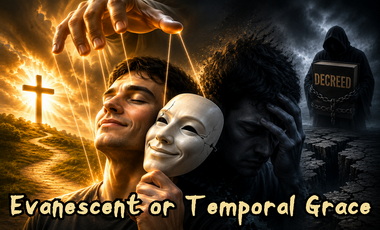
I sent a friend the video of Dr. Theodore Zachariades stating that God wills [causes, not just permits] a man to be unfaithful to his wife.
- God works all things after the Council of His will. Even keeping those kings who want to commit adultery from committing so! And when He wants to, he orders those to commit adultery when he wants to! (Video)
My friend dismissed this person as a hyper-Calvinist. But as the video below notes, using his definition of a “hyper Calvinist,” A.W. Pink, John Piper, Jeff Durbin, James White, and many-many more, would thus be considered the same. Because of the age restriction, the video must be watch on YouTube, link in pic.

When I asked him: “Question RW, is Piper, Calvin, White and Durbin hyper-Calvinists?” He simply replied “Fishing Bait.” But this is an interesting phenomena… and after decades of encountering Mormons and J-Dubs, the disconnect is the same. I get links and not actualizing on statements made when challenged. When shown a person who follows to the end the logical conclusion of theistic determinism found in Calvinism, the person who is the Calvinist is dismissed as a “hyper-Calvinist” by their fellow Calvinist’s if they are challenged. When that label is then applied rightly to others for the same reason — meaning, using RW’s definition of what a hyper-Calvinist is — then all these others have said worse; and would be by definition, hyper-Calvinists.
Two quick examples. 1st John Calvin, then, John Piper:
John CALVIN:
… how foolish and frail is the support of divine justice afforded by the suggestion that evils come to be, not by His will but by His permission. . . . It is a quite frivolous refuge to say that God otiosely permits them, when Scripture shows Him not only willing, but the author of them. . . . Who does not tremble at these judgments with which God works in the hearts of even the wicked whatever He will, rewarding them nonetheless according to desert? Again it is quite clear from the evidence of Scripture that God works in the hearts of men to incline their wills just as he will, whether to good for His mercy’s sake, or to evil according to their merits.
John Calvin, “The Eternal Predestination of God,” 10:11
John Piper:
Ephesians 1:11 goes even further by declaring that God in Christ
“works all things according to the counsel of his will.” Here the Greek word for “works” is energeø, which indicates that God not merely carries all of the universe’s objects and events to their appointed ends but that he actually brings about all things in accordance with his will. In other words, it isn’t just that God manages to turn the evil aspects of our world to good for those who love him; it is rather that he himself brings about these evil aspects for his glory (see Ex. 9:13-16; John 9:3) and his people’s good (see Heb. 12:3-11; James 1:2-4). This includes—as incredible and as unacceptable as it may currently seem—God’s having even brought about the Nazis’ brutality at Birkenau and Auschwitz as well as the terrible killings of Dennis Rader and even the sexual abuse of a young child: “The LORD has made everything for its own purpose, even the wicked for the day of evil” (Prov. 16:4, NASB ).14 “When times are good, be happy; but when times are bad, consider: God has made the one as well as the other” (Eccl. 7:14, NIV).
John Piper and Justin Taylor, eds., Suffering and the Sovereignty of God (Wheaton, IL: Crossway Books, 2006), 42. (FULLER QUOTE VIA THIS PDF)


John Lennox notes in his wonderful book, “Determined to Believe? The Sovereignty of God, Freedom, Faith, and Human Responsibility,” that Martin Luther struggled with the consequences of this form of thought:
Martin Luther at the time of the Reformation. In his book The Bondage of the Will, written in response to Erasmus’ essay On Free Will, Luther said:
[The] omnipotence and foreknowledge of God, I repeat, utterly destroy the doctrine of “free-will”… Doubtless it gives the greatest possible offence to common sense or natural reason, that God, Who is proclaimed as being full of mercy and goodness, and so on, should of His own mere will abandon, harden and damn men, as though He delighted in the sins and great eternal torments of such poor wretches. It seems an iniquitous, cruel, intolerable thought to think of God; and it is this that has been such a stumbling block to so many great men down through the ages. And who would not stumble at it? I have stumbled at it myself more than once, down to the deepest pit of despair, so that I wished I had never been made a man. (That was before I knew how health-giving that despair was, and how close to grace.)
In this passage Luther seems to be aware that there is a deep moral problem with aspects of his view… [RPT: before redefining “grace” that is – almost like what is, is.]
Calvinism’s [T.U.L.I.P.] Logical Conclusion Displayed
In a reference in that above book is this paper: “I Believe In Divine Sovereignty,” by Thomas H. McCall in Trinity Journal (TRINJ 29:2 [Fall 2008]), 209-210. Of which I excerpt:
… He [John Piper] works long and hard to illustrate this [theistic determinism] from Rom 9:1-23, which he concludes is about the purposes of God being preserved “by means of the predestination of individuals to their respective eternal destines.”11 And we are not to think that God is righteous in spite of such action—instead we are to see that God is righteous because of this action, for the “heart of Paul’s defense” is this: “in choosing unconditionally those on whom he will have mercy and those whom he will harden God is not unrighteous, for in this ‘electing purpose’ he is acting out of a full allegiance to his name and esteem of his glory.”12
This all-determining action of God notably includes predestination and election, but it extends far beyond—it extends to everything. God determines all events that occur in the universe, including all demonic and satanic action.13 As Mark R. Talbot puts it, God creates, sends, instigates, and moves others to do evil, because “nothing that exists or occurs falls outside God’s ordaining will.”14 Talbot makes the point with relentless and unmistakable clarity:
Nothing, including no evil person or thing or event or deed. God’s foreordination is the ultimate reason why everything comes about, including the existence of all evil persons and things and the occurrence of any evil acts or events.15
Make no mistake: “when even the worst of evils befall us, they do not ultimately come from anywhere other than God’s hand.”16 …
NOTES:
11. John Piper, The Justification of God: An Exegetical and Theological Study of Romans 9:1-23 (Grand Rapids: Baker, 1993), 218, cf. 56-73.
12. Ibid., 219.
13. On this see John Piper, “Suffering and the Sovereignty of God: Ten Aspects of God’s Sovereignty Over Satan and Satan’s Hand in It,” in Suffering and the Sovereignty of God, 19-30. Piper here uses the rather confusing (given his determinism) language of “permission.” By my lights, what he means when he says that God “permits” something is this (a) God determines it to occur and then (b) does not act so as to override his previous ordination. Regarding talk of “permission,” I think that John Calvin’s approach is more consistent, [….] see John Calvin, Institutes of the Christian Religion I.xviii.1, and John S. Feinberg, No One Like Him: The Doctrine of God (Wheaton: Crossway, 2001), 696.
14. Mark R. Talbot, “‘All the Good That Is Ours in Christ: Seeing God’s Gracious Hand in the Hurts Others Do to Us,” in Suffering and the Sovereignty of God, 43 (41-43), emphasis original.
15. Ibid., 43-44.
16. lbid., 47.

Dave Hunt is right to say that Calvin uses unbiblical positions in dealing with this Augustinian determinism:
There is yet another question that troubles many: If man is free to choose between options, would that not in itself deny both God’s sovereignty and His foreknowledge? Luther claimed that this question was the very heart of the Reformation and of the gospel itself. In fact, Luther dogmatically insisted that it was impossible for God to foreknow the future and for man at the same time to be a free agent to act as he wills.
Believing firmly in God’s foreknowledge, Luther wrote an entire book titled The Bondage of the Will, to prove that the very idea of man’s free will is a fallacy and an illusion. Several reasons have already been given as to why Luther was wrong on this point, and that issue will be dealt with further in the next chapter.
Though Calvin took so much from Augustine, like Luther he also rejected the Augustinian belief that God could foreknow the future, while at the same time man could have a free will. According to Calvin, foreknowledge leaves no room whatsoever for free will, because foreknowledge is the same as predestination:
If God merely foresaw human events, and did not also arrange and dispose of them at his pleasure, there might be room for agitating the question [of free will] … but since he foresees the things which are to happen, simply because he has decreed them, they are so to happen, it is vain to debate about prescience. …
If this frigid fiction [of free will] is received, where will be the omnipotence of God, by which, according to his secret counsel on which everything depends, he rules over all? (Calvin, Institutes, III: xxiii, 6–7.)
Calvin repeatedly uses such unbiblical and utterly fallacious reasoning.
The Calvinist assumes a contradiction between sovereignty and free will that doesn’t exist. The fact that God is able to allow man freedom of choice, while still effecting His purposes unhindered, is all the more glorifying to His sovereign wisdom, power, and foreknowledge.
And one last point on this via MONERGISM.COM:
- In order to understand this better theologians have come up with the term “compatibilism” to describe the concurrence of God’s sovereignty and man’s responsibility. Compatibilism is a form of determinism and it should be noted that this position is no less deterministic than hard determinism. — John Hendryx (John Hendryx is the creator and editor of Monergism.com | SEE: “We are not Determinists!” for more)
Here is A.W. Tozer’s take of the above:
- Here is my view: God sovereignly decreed that man should be free to exercise moral choice, and man from the beginning has fulfilled that decree by making his choice between good and evil. When he chooses to do evil, he does not thereby countervail the sovereign will of God but fulfills it, inasmuch as the eternal decree decided not which choice the man should make but that he should be free to make it. If in His absolute freedom God has willed to give man limited freedom, who is there to stay His hand or say, What doest thou? Mans will is free because God is sovereign. A God less than sovereign could not bestow moral freedom upon His creatures. He would be afraid to do so.
Tozer is saying that the Calvinist God is too small. Something I run through with Mormon Elders if they decide to come into my home to discuss further their “mission.” Not just too small as in Mormonism, but a character deficient God is what we see in Calvinism.

One of the single strongest philosophical critiques of exhaustive Calvinistic determinism is that it isn’t merely, “God ordaining evil.” That’s been debated for centuries. It’s that once every thought, desire, temptation, deception, warning, and response is exhaustively decreed, enormous portions of Scripture become functionally redundant.

Glen Shellrude makes this point from dozens of New Testament angles—not just Satan, but exhortations, warnings, prayer, false teaching, perseverance, church discipline, evangelism, and moral responsibility.
The Redundancy Problem in Exhaustive Calvinistic Determinism
The Redundancy Argument (TRA)
Theological determinism, as commonly defined within Reformed theology, is the belief that God unconditionally decreed every event in history. The Stanford Encyclopedia of Philosophy summarizes the position as the view that God determines every event that occurs in the history of the world, whether described as His decree, providential control, or efficacious will. Under this understanding, nothing—including every human decision, temptation, belief, unbelief, deception, repentance, or act of faith—could ever occur differently than God eternally ordained.
This creates what may be called the Redundancy Problem. If mankind is already born morally incapable of responding positively to God’s revelation apart from irresistible grace, then many of Scripture’s mechanisms for explaining unbelief become strangely unnecessary. Why does Satan need to blind minds already born incapable of seeing? Why would God judicially harden people who are supposedly already hardened by nature? Why speak in parables to conceal truth from those who could never understand it anyway? Why send strong delusion upon people who were already unable to believe? These biblical actions make perfect sense as judicial acts against previously resistible rebels, but they appear redundant if Total Inability already guarantees the identical outcome.
The redundancy extends far beyond Satan. Throughout the New Testament believers are warned against false teachers, exhorted to persevere, commanded to resist temptation, urged to pray, rebuked for sin, corrected for doctrinal error, and called to repentance. Yet under exhaustive theological determinism, God not only ordains every warning but also ordains every false doctrine, every deception, every act of apostasy, every sinful choice, and every response to those warnings. As Glen Shellrude observes, if theological determinism is consistently applied, God choreographs both the rise of heresy and the degree to which believers either resist or embrace it. Likewise, God ordains every act of obedience and every act of disobedience, every success and every failure, rendering many of Scripture’s exhortations and warnings functionally descriptive of God’s decree rather than genuine appeals capable of being either accepted or rejected.
The issue is not merely philosophical—it is exegetical. Scripture repeatedly portrays Satan as actively blinding unbelievers (2 Corinthians 4:4), false teachers as genuinely deceiving the church, and believers as capable of resisting deception through faithful perseverance. Those realities fit naturally within a framework in which people are accountable moral agents who may either receive or suppress God’s revelation. However, if every thought, temptation, deception, rejection, and response has already been immutably determined by divine decree, then Satan’s blinding activity, warnings against apostasy, calls to repentance, and commands to resist error appear to accomplish nothing that had not already been guaranteed from eternity. In that sense, Satan becomes less a genuine adversary than an unnecessary middleman carrying out a script whose outcome could never have been otherwise.
The result is that Scripture’s repeated appeals to “hear,” “repent,” “believe,” “beware,” “stand firm,” “do not be deceived,” and “choose” lose much of their ordinary force. The biblical narrative consistently presents these as meaningful appeals directed toward responsible hearers, whereas exhaustive theological determinism necessarily understands them as elements within an already settled decree. The irony is striking: the very worldview intended to magnify God’s sovereignty can unintentionally render many of Scripture’s warnings, explanations, and even Satan’s own ministry logically redundant.

The Redundancy Argument Against Exhaustive Theological Determinism
P1
If every human thought, desire, temptation, deception, belief, and response is exhaustively determined by God’s eternal decree, then no secondary means can alter or further secure the predetermined outcome.
P2
Scripture presents secondary means—Satan’s blinding, judicial hardening, parables concealing truth, warnings against apostasy, false teachers, exhortations, rebukes, and calls to repentance—as genuine means affecting people’s responses.
P3
If those responses are already exhaustively determined and cannot occur otherwise, these secondary means do not function to change or secure any outcome that was not already guaranteed.
Conclusion
Therefore, under exhaustive theological determinism, many of Scripture’s stated means—including Satan’s blinding ministry—become functionally redundant.
[Hat-Tip, Adapted via Freethinking Ministry]
Satan is Exhibit A in a much larger pattern. The same logic applies to:
- Satan blinding minds.
- God hardening hearts.
- Jesus speaking in parables to conceal truth.
- Warnings against false teachers.
- Commands to repent.
- Calls to believe.
- Exhortations to persevere.
- Church discipline.
- Appeals to resist temptation.
This broader framing also aligns well with the point Glen Shellrude develops:
- if exhaustive determinism is assumed, many New Testament warnings and appeals become difficult to understand as genuine means of influencing human response because the responses are already fixed by decree.
QUOTE:
Warnings to Believers
Related to the above point are the frequent warnings in the New Testament about embracing erroneous teaching. Jesus warns about false prophets (e.g., Matt. 7:15-20), Paul warns the Philippian church about the dangers of both Judaizers and libertines (Phil. 3:221), and the Colossian church about a theology that is somewhat difficult to reconstruct precisely (Col. 2:16-23). In his letter to the Galatians he rebukes Christians for embracing a Judaizing theology, and in the Johannine epistles, John rebukes those who embrace a theology that again is difficult to reconstruct precisely. When read within the framework of theological determinism, the conclusion is that God choreographed all the details of these heretical theologies as well as the extent to which believers would resist or embrace false teaching or realign themselves with truth when they stumbled.
In Rev. 14:9-13 believers are warned not to compromise when persecuted. Those who fail to heed this warning and deny their faith will come under eschatological judgment, while those who remain faithful to the point of death will “rest from their labor” (i.e. will experience eschatological salvation). Elsewhere Revelation explicitly states that God extends the grace that will enable believers to remain faithful in a tribulation context (e.g., Rev. 7:18; 11:1-2). Revelation 14:9-13 assumes that believers can exercise their grace-empowered libertarian freedom by choosing either to defend their faith or to deny it. However, based on Calvinist assumptions, God is the one who decided “before the foundation of the world” how each believer would choose.
In a similar vein, philosophical determinism (atheism/evolutionary paradigms). In what follows — quote’wise — if this is true fore secular forms of determinism, then so to it applies to THEISTIC DETERMINISM:
Atheists reject evidence as illusory…
Why?
Because they “have to.”
Donald C. Abel in his book, Fifty Readings in Philosophy, asks us to imagine for a moment that you walking along and come to a fork in the road. One street is called Divinity Avenue, the other Oxford Street. Assuming you have to walk down one of them, there is a confrontation of choice. Continuing he says,
- Now, I ask you seriously to suppose that this ambiguity of my choice is real; and then to make the impossible hypothesis that the choice is made twice over, and each time falls on a different street. In other words, imagine that I first walk through Divinity Avenue, and then imagine that the powers governing the universe annihilate ten minutes of time with all that it contained, and set me back at the door of this hall just as I was before the choice was made. Imagine then that, everything else being the same, I now make a different choice and traverse Oxford Street. You, as passive spectators, look on and see the two alternative universes; one of them with me walking through Divinity Avenue in it, the other with the same me walking through Oxford Street. Now, if you are determinists, you believe one of these universes eternally impossible, because of the intrinsic irrationality or accidentality somewhere involved in it. However, looking outwardly at these universes, can you say which is the impossible and accidental one, and which the rational and necessary one?
Donald C. Abel, Fifty Readings in Philosophy (New York, NY: McGraw-Hill, 1994), 296.
- “He thus acknowledged the need for any theory to allow that humans have genuine freedom to recognize the truth. He (again, correctly) saw that if all thought, belief, feeling, and choice are determined (i.e., forced on humans by outside conditions) then so is the determinists’ acceptance of the theory of determinism forced on them by those same conditions. In that case they could never claim to know their theory is true since the theory making that claim would be self-referentially incoherent. In other words, the theory requires that no belief is ever a free judgment made on the basis of experience or reason, but is always a compulsion over which the believer has no control.”
Roy A. Clouser, The Myth of Religious Neutrality: An Essay on the Hidden Role of Religious Belief in Theories (Notre Dame, IN: Notre Dame University Press, 2005), 174.
The implications of strict naturalism are grim or even counterintuitive. For example, Bertrand Russell affirmed that any philosophy hoping to stand must ultimately take for granted the (naturalistic) picture of unguided causes and accidental collocations of atoms and must be built on the “firm foundation of unyielding despair.” When it comes to naturalism’s implications for morality, naturalist Kai Nielsen contends that reason can’t bring us to morality; this picture ”is not a pleasant one,” and that reflecting on it ”depresses me.” When it comes to consciousness, naturalist Daniel Dennett considers it an illusion- -something fellow-atheist Thomas Nagel finds utterly confused:
- You may well ask how consciousness can be an illusion, since every illusion is itself a conscious experience …. So it cannot appear to me that I am conscious though I am not … the reality of my own consciousness is the one thing I cannot be deluded about …. The view [of Dennett] is so unnatural that it is hard to convey …. Dennett asks us to turn our backs on what is glaringly obvious. … And he asks us to do this because the reality of such phenomena is incompatible with the scientific materialism that in his view sets the outer bounds of reality. He is, in Aristotle’s words, ”maintaining a thesis at all costs.”
Jaegwon Kim acknowledges the stark picture painted by the naturalistic brush. Naturalism is ”imperialistic; it demands ‘full coverage’ … and exacts a terribly high ontological price.”
Paul Copan and Charles Taliaferro (editors), The Naturalness of Belief: New Essays on Theism’s Rationality (New York, NY: Lexington Books, 2019), viii
I could go on, but you get the point. To fashion the issue for you to see, Jaegwon Kim could have said:
- Theistic determinism is ”imperialistic; it demands ‘full coverage’ … and exacts a terribly high ontological price.” (added for emphasis)
What is this price? Here is just one example… God vs. God:
Here is a Facebook post I recently posted:
- “What is there for God to harden, provoke, or restrain if not the autonomous will of creatures?”
If God knows the future because He planned the future [Sproul, Piper, MacArthur, etc.], when God hardens, provokes, or restraines…. is He working against Himself?
If the “T” of TULIP [total depravity] is a reality, wouldn’t hardening, provoking, or restraining someone be the same thing as digging up bodies in a cemetery and putting blindfolds on the rotting cadavers?

In other words, does He plan the abuse of a child just to redeem that act in some way to bring glory to Himself? Is Satan superfluous?
Are all the prescriptions in the Bible making God out to be duplicitous – since he has planned our actions thru determinitive means?
You could not argue that “evil” is really “evil.” Eastern philosophies run into the same problems as the atheist’s/evolutionist’s I just noted above. The Calvinist runs into the same issue. And it is a distortion of Christianity (T.U.L.I.P.):
(Eph 1:11) “works all things according to the counsel of his will.” Here the Greek word for “works” is 𝑒𝑛𝑒𝑟𝑔𝑒ø, which indicates that God not merely carries all of the universe’s objects and events to their appointed ends but that he actually 𝑏𝑟𝑖𝑛𝑔𝑠 𝑎𝑏𝑜𝑢𝑡 all things in accordance with his will. In other words, it isn’t just that God manages to turn the evil aspects of our world to good for those who love him; it is rather that he himself brings about these evil aspects for his glory (see Ex. 9:13-16; John 9:3) and his people’s good (see Heb. 12:3-11; James 1:2-4). This includes—as incredible and as unacceptable as it may currently seem—God’s having even brought about the Nazis’ brutality at Birkenau and Auschwitz as well as the terrible killings of Dennis Rader and even the sexual abuse of a young child: “The LORD has made everything for its own purpose, even the wicked for the day of evil” (Prov. 16:4, NASB ).14 “When times are good, be happy; but when times are bad, consider: God has made the one as well as the other” (Eccl. 7:14, NIV). John Piper and Justin Taylor, eds., Suffering and the Sovereignty of God (Wheaton, IL: Crossway Books, 2006), 42.
Or…
Is it more like Tozer notes — which lowers man’s position by making him/her responsible to God’s law; and keeps God’s holiness and glory intact as He truly redeems or judges such actions (is He judging Himself in Calvinism? Working against His own will? Secretly?)
TOZER:
God sovereignly decreed that man should be free to exercise moral choice, and man from the beginning has fulfilled that decree by making his choice between good and evil. When he chooses to do evil, he does not thereby countervail the sovereign will of God but fulfills it, inasmuch as the eternal decree decided not which choice the man should make but that he should be free to make it. If in His absolute freedom God has willed to give man limited freedom, who is there to stay His hand or say, ‘What doest thou?’ Man’s will is free because God is sovereign. A God less than sovereign could not bestow moral freedom upon His creatures. He would be afraid to do so.
There is an analogy of two chess players. As you walk up on one professional chess player, he is sitting on one side of the bench, and at the end of his move he gets up walks to the other side, sits down, thinks a moment and makes his move. This process is repeated until the game is over and the chess player wins.
Guaranteed.
When you ask him why he is playing chess alone, he says to ensure his victory. Or as Piper notes in his book astonished by God: “…the reason God knows the future is because he plans the future and accomplishes it.”
You wouldn’t think too highly of his skills, would you? As you walk down the road a bit further, you come across another chess master. This time however, there is a line of players, world famous chess players, lined up as far as the eye could see. As you watched, the one chess player was handily beating every player that sat before him. Player after player.
With whom would you be more impressed with?
 And it is this perceived contradiction that leads Calvinists to a polluting of God’s character, which A.W. Tozer tackles in his book, Knowledge of the Holy. Here is a excerpt…. I changed a couple words to read better:
… While a complete explanation of the origin of sin eludes us, there are a few things we do know. In His sovereign wisdom God has permitted evil to exist in carefully restricted areas of His creation, a kind of fugitive outlaw whose activities are temporary and limited in scope. In doing this God has acted according to His infinite wisdom and goodness. More than that no one knows at present; and more than that no one needs to know. The name of God is sufficient guarantee of the perfection of His works.
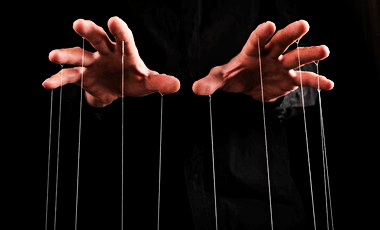
Another real problem created by the doctrine of the divine sovereignty has to do with the will of man. If God rules His universe by His sovereign decrees, how is it possible for man to exercise free choice? And if he cannot exercise freedom of choice, how can he be held responsible for his conduct? Is he not a mere puppet whose actions are determined by a behind-the-scenes God who pulls the strings as it pleases Him?
The attempt to answer these questions has divided the Christian church neatly into two camps which have borne the names of two distinguished theologians, Jacobus Arminius and John Calvin. Most Christians are content to get into one camp or the other and deny either sovereignty to God or free will to man. It appears possible, however, to reconcile these two positions without doing violence to either, although the effort that follows may prove deficient to partisans of one camp or the other.
Here is my view: God sovereignly decreed that man should be free to exercise moral choice, and man from the beginning has fulfilled that decree by making his choice between good and evil. When he chooses to do evil, he does not thereby countervail the sovereign will of God but fulfills it, inasmuch as the eternal decree decided not which choice the man should make but that he should be free to make it. If in His absolute freedom God has willed to give man limited freedom, who is there to stay His hand or say, What doest thou? Mans will is free because God is sovereign. A God less than sovereign could not bestow moral freedom upon His creatures. He would be afraid to do so.
Perhaps a homely illustration might help us to understand. An ocean liner leaves New York bound for Liverpool. Its destination has been determined by proper authorities. Nothing can change it. This is at least a faint picture of sovereignty.
On board the liner are several scores of passengers. These are not in chains, neither are their activities determined for them by decree. They are completely free to move about as they will. They eat, sleep, play, lounge about on the deck, read, talk, altogether as they please; but all the while the great liner is carrying them steadily onward toward a predetermined port.
Both freedom and sovereignty are present here and they do not contradict each other. So it is, I believe, with mans freedom and the sovereignty of God. The mighty liner of Gods sovereign design keeps its steady course over the sea of history. God moves undisturbed and unhindered toward the fulfilment of those eternal purposes which He purposed in Christ Jesus before the world began. We do not know all that is included in those purposes, but enough has been disclosed to furnish us with a broad outline of things to come and to give us good hope and firm assurance of future well-being.
We know that God will fulfil every promise made to the prophets; we know that sinners will some day be cleansed out of the earth; we know that a ransomed company will enter into the joy of God and that the righteous will shine forth in the kingdom of their Father; we know that Gods perfections will yet receive universal acclamation, that all created intelligences will own Jesus Christ Lord to the glory of God the Father, that the present imperfect order will be done away, and a new heaven and a new earth be established forever.
Toward all this God is moving with infinite wisdom and perfect precision of action. No one can dissuade Him from His purposes; nothing turn Him aside from His plans. Since He is omniscient, there can be no unforeseen circumstances, no accidents. As He is sovereign, there can be no countermanded orders, no breakdown in authority; and as He is omninpotent, there can be no want of power to achieve His chosen ends. God is sufficient unto Himself for all these things.
In the meanwhile things are not as smooth as this quick outline might suggest. The mystery of iniquity doth already work. Within the broad field of Gods sovereign, permissive will the deadly conflict of good with evil continues with increasing fury. God will yet have His way in the whirlwind and the storm, but the storm and the whirlwind are here, and as responsible beings we must make our choice in the present moral situation.
Certain things have been decreed by the free determination of God, and one of these is the law of choice and consequences. God has decreed that all who willingly commit themselves to His Son Jesus Christ in the obedience of faith shall receive eternal life and become sons of God. He has also decreed that all who love darkness and continue in rebellion against the high authority of heaven shall remain in a state of spiritual alienation and suffer eternal death at last.
Reducing the whole matter to individual terms, we arrive at some vital and highly personal conclusions. In the moral conflict now raging around us whoever is on Gods side is on the winning side and cannot lose; whoever is on the other side is on the losing side and cannot win. Here there is no chance, no gamble. There is freedom to choose which side we shall be on but no freedom to negotiate the results of the choice once it is made. By the mercy of God we may repent a wrong choice and alter the consequences by making a new and right choice. Beyond that we cannot go.
The whole matter of moral choice centers around Jesus Christ. Christ stated it plainly: He that is not with me is against me, and No man cometh unto the Father, but by me. The gospel message embodies three distinct elements: an announcement, a command, and a call. It announces the good news of redemption accomplished in mercy; it commands all men everywhere to repent and it calls all men to surrender to the terms of grace by believing on Jesus Christ as Lord and Saviour.
We must all choose whether we will obey the gospel or turn away in unbelief and reject its authority. Our choice is our own, but the consequences of the choice have already been determined by the sovereign will of God, and from this there is no appeal.