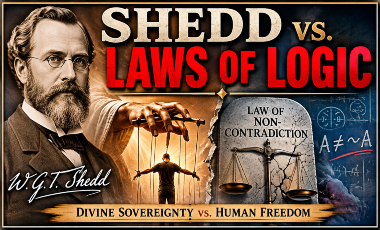
Divine Sovereignty and Human Freedom (Shedd vs. Laws of Logic)

The Logical Problem (PDF for download)

The central problem is that W. G. T. Shedd [(1820–1894) was a prominent 19th-century American Presbyterian theologian and professor, best known for his rigorous defense of Reformed theology and divine sovereignty] attempts to hold together exhaustive divine determination and a genuinely self-determining human will without first showing that those claims are logically compatible in the same respect.

This critique is therefore directed first at Shedd’s formulation and only secondarily at Calvinism insofar as Calvinistic compatibilism supplies the framework that creates the tension.

“The Westminster Standards, in common with the Calvinistic creeds generally, begin with affirming the universal sovereignty of God over his entire universe: over heaven, earth, and hell; and comprehend all beings and all events under his dominion. Nothing comes to pass contrary to his decree. Nothing happens by chance. Even moral evil, which he abhors and forbids, occurs by ‘the determinate counsel and foreknowledge of God;’ and yet occurs through the agency of the unforced and self-determining will of man as the efficient.”[1]

Shedd is therefore making three claims:

  • A. Nothing happens contrary to God’s decree.
  • B. God’s decree encompasses even moral evil.
  • C. Moral evil nevertheless occurs through the “unforced and self-determining will of man.”

And this is where the law of non-contradiction becomes relevant.

The law of non-contradiction is one of the foundational principles of rational thought. As Ted Honderich’s Oxford Companion to Philosophy explains, “a theory in which this law fails…is an inconsistent theory.”[2] Manuel Velasquez likewise describes the law as “the foundation of logical reasoning.”[3]

William S. Sahakian and Mabel Lewis Sahakian make the implication especially clear when discussing contradictory premises. They explain that when an argument contains premises that contradict one another, “one premise cancels out the other.” It may be possible for one proposition or the other to be true, but contradictory propositions cannot be true simultaneously.[4]

J.P. Moreland makes this principle especially useful by showing how a proposition can also undermine itself. As he puts it, “When a statement fails to satisfy itself (i.e., to conform to its own criteria of validity or acceptability), it is self-refuting…,” in other words, “A” cannot be both “non-A” and “A” at the same time.[5] His examples include statements such as “I cannot say a word in English” when spoken in English, “I do not exist,” and “there are no truths.” In each case, the statement defeats itself because its truth would require the very thing it denies.

This distinction is important because the problem under consideration is not merely that Shedd’s formulation is difficult to understand. The question is whether the propositions themselves are logically compatible.

The appeal to mystery cannot resolve the issue unless the relevant terms are first stabilized: “determines” must identify the factor that makes one outcome certain rather than merely foreknown, “self-determining” must clarify whether the will ultimately settles between alternatives, “ultimate determiner” must distinguish the immediate agent from the decisive causal source, and “permission” must explain whether God merely allows an outcome or decrees the conditions that render it certain.

That principle matters here.

The question is not whether we can place Shedd’s statements together in the same paragraph. Obviously, we can. The question is whether they can all be true in the same sense at the same time.

If “self-determining” means that the human will genuinely determines which choice it will make, then God’s exhaustive decree cannot simultaneously be the determining cause of that same choice. But if God’s decree determines which choice the person will inevitably make, then the person may be the immediate agent of that choice, but calling his will “self-determining” becomes problematic.

So consider the two propositions at the heart of Shedd’s formulation:

God’s decree determines that this particular human action will occur.

And:

The human will is itself self-determining with respect to this particular action.

If “self-determining” means only that the person acts voluntarily according to desire, Shedd may be describing compatibilist freedom; if it means that the person could ultimately determine otherwise under the same conditions, he is invoking libertarian freedom, and the two uses cannot be treated as interchangeable.

The person can be the immediate agent who chooses and can act willingly without external compulsion, but agency and voluntariness do not by themselves establish that the will is the ultimate determiner of the action.

That distinction brings us to the real philosophical question:

  • Could the person have determined otherwise?

If God’s decree has made one particular outcome certain, then the important question isn’t merely whether the person wanted to do it. The question is whether he possessed the genuine ability to determine an alternative outcome.

And that is why simply calling the will “unforced” does not settle the question. Nor does calling it “self-determining.” Those terms themselves require definition. If “unforced” merely means that nobody externally coerced the person, there is no contradiction in saying that he acted willingly.

But if “self-determining” means that the person’s will ultimately determined which of genuinely available alternatives would occur, then exhaustive divine determination presents a serious logical problem.

The issue, then, is not whether God can know something we do not understand. The issue is whether two mutually exclusive descriptions of the same human choice can both be true in the same sense.

Mystery, Contradiction, and the Limits of the Calvinist Reconciliation

It is important at the outset to distinguish between a mystery and a contradiction. Christianity unquestionably contains truths whose full explanation exceeds human comprehension. The existence of mystery, therefore, is not itself problematic. The more precise question is whether an appeal to mystery acknowledges the limits of human understanding concerning truths revealed in Scripture, or whether it is being employed to reconcile propositions that are themselves incompatible.

This framework now applies directly to the Calvinist appeal to mystery. Wayne Grudem recognizes that Christianity contains truths that exceed full human comprehension, but he also insists that Scripture does not require belief in contradiction.

But it should also be said that Scripture does not ask us to believe in a contradiction. A contradiction would be “There is one God and there is not one God,” or “God is three persons and God is not three persons,” or even (which is similar to the previous statement) “God is three persons and God is one person.” But to say that “God is three persons and there is one God” is not a contradiction.[6]

The significance of Grudem’s observation is not that mystery is illegitimate, but that mystery cannot simply be invoked as a substitute for theological coherence. Doctrine may transcend our comprehension without being contradictory.

Rogers advances the argument by moving the issue from general logical coherence to the source of the alleged mystery: if the difficulty arises only after Calvinistic premises are added, then the burden rests on those premises rather than on biblical mystery itself.

This distinction is especially significant in William G. T. Shedd’s treatment of the origin of sin. Shedd acknowledges that the relationship between God’s permissive decree and the entrance of sin presents an “inscrutable mystery.”

Yet Rogers argues that the mystery arises precisely because Calvinism combines divine determinism with compatibilism. Within compatibilism, the creature freely acts according to his strongest desire, but that desire itself is determined by antecedent conditions. Consequently, the creature’s choice is free in the compatibilist sense while, given the identical antecedent conditions, he could not actually have chosen otherwise.

Compatibilism is therefore not an escape from determinism but a particular account of freedom within determinism. John Hendryx explicitly acknowledges that “compatibilism is a form of determinism,” adding that it is “no less deterministic than hard determinism,” so the key question becomes whether responsibility and voluntariness are enough to justify calling the will self-determining.

MacArthur sharpens the causal issue by framing God as the primary cause and human beings as secondary causes “moved by the primary cause.” Even if MacArthur rejects the conclusion that God is morally responsible for evil, his formulation confirms the analytical question: can a will moved by a determining primary cause also be called the ultimate determiner of its own choice?

This creates a significant difficulty for Shedd’s appeal to divine permission. Shedd can distinguish God’s permission from direct efficiency and can affirm that the creature freely apostatized. But if God sovereignly established the nature and antecedent conditions from which the creature’s desires necessarily arose, then describing the fall as something God merely permitted does not by itself explain how the fall was not also encompassed within the determinative structure of God’s decree. Rogers therefore observes that Shedd’s language concerning the unfallen will possessing the power to remain holy, while simultaneously acknowledging that its apostasy became certain through a permissive decree, exposes rather than resolves the underlying tension. Shedd himself concludes that the manner in which a non-efficient permissive decree makes the fall certain is an “inscrutable mystery.”[7]

The same pattern becomes even more conspicuous when the issue moves from the origin of sin to God’s salvific will.

Here the testimony of David Engelsma is particularly significant precisely because Engelsma is not attempting to soften the implications of historic Calvinism. He states:

“That God is gracious only to some in predestination, but gracious to all in the gospel, and that God wills only some to be saved in predestination but wills all to be saved by the gospel, is flat, irreconcilable contradiction. It is not paradox, but contradiction. I speak reverently: God Himself cannot reconcile these teachings.”[8]

Engelsma then makes an observation that is particularly important to the common appeal to the Trinity as an analogy for this problem. The Trinity is mysterious, but it is not contradictory, because God is one in being and three in persons—not one and three in the same respect. That distinction is crucial. The Christian does not say:

  • God is one person and three persons.

Nor does he say:

  • God is one being and three beings.

The apparent numerical conflict disappears because the predicates are being asserted in different respects.

Consequently, to call every difficult Calvinistic reconciliation a “mystery” does not establish that the reconciliation is legitimate. One must first demonstrate that the propositions are compatible.

Indeed, Engelsma goes further. He rejects the attempt to resolve the difficulty through an appeal to different kinds of grace:

“There is no relief for the sheer contradiction … in the doctrine of ‘common grace,’ as though the grace of predestination were a different kind of grace from that revealed in the gospel.”

His argument is that the gospel offer itself is presented as saving grace directed toward those who hear it. If predestination simultaneously teaches that God has eternally determined that only some will receive saving grace, then the distinction between God’s grace in the gospel and God’s grace in predestination cannot simply be introduced as a terminological escape hatch.

And this is where Engelsma becomes especially valuable for our treatment of Shedd. The question is no longer merely:

  • Can we understand how these things work?

It becomes:

  • Are the things being asserted actually compatible?

That is a much more fundamental question.

Rogers then shows that the same pattern recurs across Calvinist treatments of compatibilism, the origin of sin, unconditional election, reprobation, the two wills of God, and the “good-faith offer.” Each mechanism—compatibilistic freedom, permissive decree, two wills, hypothetical otherwise-choice, and finally “mystery”—must be evaluated by whether it clarifies the propositions or merely relocates the contradiction.

Importantly, Rogers does not argue that every Calvinist who employs such language is intentionally deceptive. He explicitly says his use of “double talk” is not a charge of malicious intent. Rather, he uses the expression for language that obscures or elides the determinative implications of the system, allowing Calvinists to speak of genuine human choice, divine universal desire, or God’s hatred of sin in ways that may sound libertarian or non-deterministic while the underlying theological definitions remain compatibilistic and decretal.

Thus the issue with Shedd’s appeal to “inscrutable mystery” should not be caricatured as an objection to mystery itself. The issue is whether mystery has actually explained anything. If Shedd’s premises entail that God could have created a world without sin, that God determined the conditions under which the creature would freely choose sin, and that the creature could not have chosen otherwise given those same conditions, then calling the relationship between God’s decree and the certain occurrence of sin an “inscrutable mystery” does not remove those entailments. It merely marks the point at which the system can no longer provide an account that satisfies its own competing assertions.

And that brings us to the crucial distinction:

A mystery tells us that we do not know how two truths that Scripture teaches fit together. A contradiction occurs when two propositions cannot both be true in the same respect and at the same time. The former is a limitation upon our knowledge; the latter is a problem in the propositions themselves.

Consequently, the appeal to mystery must come after the compatibility of the propositions has been established, not before.

The issue, therefore, is not whether Christianity contains mysteries; it unquestionably does.

Nor is the issue whether finite human beings can comprehend every truth concerning the infinite God; they cannot.

The issue is whether “mystery” is being used to acknowledge the limits of human knowledge concerning what Scripture reveals, or to protect a theological deduction from the consequences that follow from its own premises.

A mystery may transcend comprehension without violating coherence. But when propositions asserted in the same respect cannot be reconciled, calling the resulting contradiction a “mystery” does not resolve it. It merely gives the contradiction a theological name.

We should not call something a “mystery” merely because we have not yet demonstrated that the propositions are compatible. Before mystery can be invoked, the terms must first be shown to be logically coherent.

That is the point at which Shedd’s formulation deserves scrutiny: unless he can define divine determination, human self-determination, and divine permission in non-equivocal terms, the appeal to mystery does not answer the logical objection but marks the place where the system has stopped explaining itself.

[1] W. G. T. Shedd, Calvinism: Mixed and Pure: A Defence of the Westminster Standards (1893), 37.

[2] Ted Honderich, ed., The Oxford Companion to Philosophy (New York: Oxford University Press, 1995), 625.

[3] Manuel Velasquez, Philosophy: A Text with Readings (Belmont, CA: Wadsworth, 2001), 51.

[4] William S. Sahakian and Mabel Lewis Sahakian, Ideas of the Great Philosophers (New York: Barnes & Noble, 1966), 23, under “Contradictory Premises.”

Contradictory Premises – Self-Contradictions are necessarily false; consequently, when an argument contains premises which contradict each other, no conclusion is possible. Any conclusion would involve the fallacy of contradictory premises; that is, it would constitute a self-contradiction. When contradictory premises are present in an argument, one premise cancels out the other. It is possible for one or the other of the two premises to be true, but not for both to be simultaneously true. Note the contradictory premises in the following questions: “If God is all-powerful, can he put himself out of existence, then come to life with twice the power he had originally?” “Can God make a stone so heavy that he cannot lift it?” “Can God make a round square?” “What would happen if an irresistible force met an immovable object?” (page 23)

[5] J. P. Moreland, Scaling the Secular City: A Defense of Christianity (Grand Rapids, MI: Baker Book House, 1987), 92.

[6] Wayne Grudem, Bible Doctrine: Essential Teachings of the Christian Faith (Grand Rapids, MI: Zondervan, 1999), 168.

[7] Ronnie W. Rogers, Does God Love All or Some? Comparing Biblical Extensivism and Calvinism’s Exclusivism (Eugene, OR: Wipf & Stock, 2019), 54–60.

[8] David J. Engelsma, “Is the Denial of the ‘Well-Meant Offer’ Hyper-Calvinism?,” Protestant Reformed Theological Journal 23, no. 2 (April 1990): 60. (Fuller quote from this “high Calvinist”):

It is part of our defence of the denial of the offer that we take the offensive against the offer. We charge that the offer involves a Calvinist in sheer contradiction. That God is gracious only to some in predestination, but gracious to all in the gospel, and that God wills only some to be saved in predestination but wills all to be saved by the gospel, is flat, irreconcilable contradiction. It is not paradox, but contradiction. I speak reverently: God Himself cannot reconcile these teachings. Nor is there any similarity between this contradiction and the truth of the Trinity that surpasses our understanding. The truth of the Trinity is not contradictory, for it holds that God is one in being and three in persons, not, therefore, one and three in the very same respects.

There is no relief for the sheer contradiction in which the offer involves a Calvinist in the doctrine of “common grace,” as though the grace of predestination were a different kind of grace from that revealed in the gospel. For the offer exactly teaches that the grace of God for all is grace shown in the preaching of the gospel. This grace is not some non-saving favour directed towards a prosperous earthly life, but saving grace, the grace of God in His dear Son, a grace that desires eternal salvation for all who hear the gospel. The offer proposes universal saving grace—precisely that which is denied by predestination.

Nor is there any relief from this absolute, intolerable contradiction in a distinction between God’s hidden will and God’s revealed will. This is attempted as some kind of explanation and mitigation of the contradiction: The desire to save all (of the offer) is God’s revealed will; the will to save only some (of predestination) is His hidden will. But this effort to relieve the tension of the contradiction in which the offer involves Calvinists gets us nowhere. For one thing, the will of God to save only some and not all is not hidden, but revealed. It is found on every page of Scripture. It is Jesus’ teaching in Matthew 22:14: God has eternally chosen only some (“few”) to be saved, in distinction from the others (“many”). For another thing, the distinction leaves us right where we were before the distinction was invented: God has two, diametrically opposite, conflicting wills.

Such teaching is destructive of truth and fatal to knowledge of truth. Such teaching thrusts confusion and strife into the very being of God: Does God, or does He not, desire every human to be saved? Is God, or is He not, in His own being, gracious in Jesus to every human? I make bold to suggest that the god of the offer had a very peculiar way of displaying his grace to all and of carrying out his will to save all in the time of the old covenant, when he showed his word unto Jacob, but did not deal so with any nation (cf. Psalm 147:19-20). Is it presumptuous humbly to request of the offer-god worshipped by professing Calvinists that he make up his mind between the alternatives of the offer (the will to save all) and of predestination (the will to damn some)?

A Recent Sermon Maligning God’s Character/Holiness

Originally posted January 1st, 2026 – Updated Today

My visual video response:

TRANSCRIPT AT THE END – JUMP TO IT

Yes, this is from the church I attend. A wonderful place to attend, but definitely Calvinistic. This is a newer pastor, and I must say, even though I vehemently disagree, at least he is preaching honestly. Another pastor months before preached a sermon where he quoted Joshua 24:15 and said:

  • “Make a choice. Choose this day. In fact, you can choose one of the… He’s not saying that he’s happy if you choose the pagan gods, but he says, in fact, pick one of the pagan gods. Do you know that something that God is extremely kind and gracious to us and that he gave us free will? Did you know that? He didn’t force a relationship on us. He gave us free will. Do you remember what he gave Adam and Eve? Free will. You can make a choice. I’m not gonna force it. Hey, you choose, yeah, you, make the choice.”

When I asked an elder if this pastor really believed this statement he made regarding free will from the pulpit, I got an honest answer of “No.”

So I love the almost Provisionist preaching and call to come to God in faith — but this is not what is REALLY believed as these pastors overlay TULIP on to their understanding of Biblical text. I struggle with the good that can come from the “alter call” type preaching of the “Armininian style” while they sleep as a Calvinist. That being said, it is a duplicitous preaching like they make God out to be by overlaying a 16th century philosophy onto God. A Jaundiced view at best. AND, I can truly appreciate the rawness of the logical outcomes being honestly preached from the pulpit. Although even this pastor does not follow his own thinking to their ends without hemming and hawing with a myriad of qualifiers and nuances.

Here is my FACEBOOK comments on this sermon:

So, in the past I have praised good sermons from my church… if I do that, should I at times not critique [as publicly] a bad one? I will be clipping the main idea of it from the video for my site [like I have uploaded some clips from the good ones], but that is in the future tense. I am thankful, however, that this pastor was so forthright, and didn’t hide behind the “preaching as an Arminian, sleep as a Calvinist” idea.

Honest preaching is laudable. This was essentially the sermon:

(a) God decrees and ordains all evil for His glory
(b) God saves us from the evil He decreed and ordained…. for His glory.

In other words, while this pastor didn’t follow his sermon to its logical conclusion, it is essentially God saving us from Himself. So, all the pain and suffering mentioned in stories and text are all God caused. Remember, this pastor chose AW Pink’s book for the last Monday men’s service series. [It could have been more in the pastorate choosing Pink’s book, as far as I know — because I do not actually know how these books are approved.] Pink is a hyper Calvinist, like this Pastor publicly is.

All I was thinking was,

  • “well, people who don’t get the raw [5-point, Calvinist] truth from other pastors are hearing it now.”

On the flip side of that “positive”, the new people on the “faith fence” — which only makes sense to those of the non-Calvinist soteriological bent — may have wrote off Crossroads as their home. Or worse yet, wrote off God.

Which in this pastor’s view, was also ordained.

The same pastor here eisegetes into Scripture a 16th century doctrine not understood as being the Bible before Calvin popularized it via his doctrinal hero:

  • The reason I added the SNL skit was to note that right when the sermon was starting to state some good position or truth, it was dashed shortly after by the “doctrines of grace.”

UPDATED CONVO

In another example, after a wonderful, Gospel oriented presentation by a senior pastor at the men’s Monday night class, I was perplexed. I thought I was crazy in fact. I was just about to tender my separation letter to the elders, pastors, and peeps at church. So I asked a question in text of the pastor (again, no names):

Ouch. That confirmed and upset me a bit. Did you catch it? This pastor admits that in order to convert people with the Gospel message, he withholds parts of his systematic because it would interfere with his evangelism.

Um… yeah it would.

But again, it is duplicitous in nature, as stated earlier.

How?

There is no Gospel in Calvinism.

See also: “Logical Ends of TULIP (No Rebellious Creatures)

This illustration [via NotWilliangThatAny] is aiming to reflect a real tension in Calvinist theology, not exaggerate it. It takes the idea of election and shows it visually in terms of proportion. One petal represents the elect, while many “nots” represent those passed over. The focus is on how small the number of the elect might be compared to everyone else.

First, this connects to limited atonement. In this view, Christ’s death is effective only for the elect, not for every individual. Passages like John 10:26, “you do not believe because you are not among my sheep,” and John 17:9, “I am not praying for the world but for those whom you have given me,” are often used to support this. The illustration reflects that by showing a small number who are truly loved in a saving sense, and many who are not.

Second, it ties to unconditional election and reprobation. God chooses some to receive mercy while others are passed over. Romans 9:13 says, “Jacob I loved, but Esau I hated,” and Romans 9:22 speaks of “vessels of wrath prepared for destruction.” The many “nots” in the image visually represent this larger group who are not chosen, emphasizing the imbalance.

Third, it reflects the idea that salvific love is not universal. While Calvinists affirm that God shows a kind of general love or kindness to all (Matthew 5:45), His saving love is reserved for a specific people. The illustration presses on that distinction by asking what it means in practice. If most people are not recipients of that saving love, then the experience of humanity is largely outside of it.

This leads to a key question. If Scripture says God “so loved the world” (John 3:16) and desires “all people to be saved” (1 Timothy 2:4), how should we understand the scope of His love? Does the picture of a few loved and many not align with the overall tone and message of the Bible, or should we rethink how we define God’s saving love?


Transcript With More Commentary:


A Recent Sermon Maligning God’s Character Holiness – TRANSCRIPT

Now before we jump into this, I do want to take a few moments to give us some context. I think it’s important sometimes, if you just pluck a passage out of a book, to take some time to give the book a little bit of context. So I want to do that this morning, just give you a couple of things to put in your mind.

We’re going to go to seminary for the next few minutes. Some of you are saying, “Pastor, I am in my seventh level of eggnog hangover. You’re asking me to think.” Let me give you a couple of points we can hang our thoughts on.

Number one, I want you to note God’s providential rule. Look there at verse 16:

“Then Herod, when he saw that he had been tricked by the wise man, became furious, and he sent and killed all the male children in Bethlehem and in all the region who were two years old or under, according to the time that he had ascertained from the wise men.”

This man was so obsessed with himself, so obsessed with his rule, he wouldn’t suffer a single person to have his rule, to have his power. He’d kill whole swaths of people to make sure.

Now, this was a small village. Bethlehem was a tiny village back then. Most scholars believed he put to death about 20 or 30 young boys. And you may say, “Well, they got nothing on America. We killed millions of them.”

He killed 20 or 30 out of a very small village. The village was smaller than the people in this room. Can you imagine this room if suddenly we all discovered every one of your boys two years younger were dead, were killed? Wouldn’t that be awful?

Can you imagine them being pulled away from the mothers clinging on to their boys as they took the boys and executed them? A sad, terrible thought. This man, his rage made this happen. His tyranny made this happen.

It may come as a surprise to you, maybe not, but this existence, this universe, I mentioned a moment ago, this world is a history of tragedy. I know I’m speaking in generalizations. I know there’s lots of joy and lots of happiness and family, especially this time of year.

But again, prior to really the modern era, we didn’t have ways of hiding all the difficulty and hardship. We didn’t have sanitized institutions that sort of hid that away from us. We didn’t develop communities full of cops and firemen where there’s lots of safety and joy and peace.

No, everyone was exposed to everything. Most people who died of old age died in the home with their family members. So most people would have seen death for most of history in most cultures.

Let me point this out. When all those inventions came, democracy and capitalism and all the things that raised our standard of life and hid away some of the darker things of this world, did this world become less tragic?

Not at all.

The twentieth century, by every measure, both percentage and numerically, was the bloodiest century of all.

We live in a world of tragedy. We live in a world of darkness. And as believers, we’re forced to reconcile these two realities: that God is sovereign, God is in charge of everything, God is controlling the universe, but there remains this curse on the universe.

This is a difficulty for us. And we see this difficulty all the way to the point to our greatest difficulty, which is death, right? We face death just like these boys did.

How do a lot of people cope with this curse?

Well, some people just try to remain ignorant, right? I do this sometimes. I read news for a few weeks and I just get sick of it. I’m just tired of bad news and I just turn it off and turn that tap off and ignore it for a few days. Because it’s just so sad. It’s so tragic. It seems like there’s just an ever-ending flow of sin and depravity. I get tired of it.

So a lot of us, you stick your head in the sand. Ignorance is bliss. We just try to ignore what’s going on around us.

Second, a lot of people medicate, right? Whether they medicate through the bottle or through prescribed drugs or newly legal drugs or whatever, they try to find a way to escape it mentally. Again, it’s sort of like ignorance; it’s just getting away from it, ignoring it, trying to find a new way to deal with it.

And of course, another way that people deal with it is they just indulge. They say, “Well, this world’s such a terrible place. I might as well just give in to my carnal desires. If I can’t beat them, join them. Might as well just be as depraved as the rest of this world here.”

Well, we as believers have a different hope. We believe that any evil, no matter how dark, no matter how horrifying, no matter how deadly, any evil is not merely allowed, not merely permitted, but purposed and ordained by our God so that He can display His power, His beauty, His joy in the midst of it.

It’s so He can display His love, His mercy. It’s so He can have something that He can save us from.

And Herod, when he saw that he had been tricked by the wise man, became furious. And he sent and killed all the male children in Bethlehem and in all that region who were two years old or under.

The saddest song of all time, by my estimation, is in fact a Christmas song, likely from the 1300s. We know it as “Coventry Carol.” You may not recognize the title, but if you heard the very haunting, ominous tune, it has what’s called the Picardy Third.

Don’t get too excited; I’m not going to sing it for you. Don’t want your ears to bleed.

This sad song probably was written, the educated guess, it was written after the bubonic plague had swept through a small village and, of course, killed a number of people, but notably killed all the children from a certain age and younger.

And that’s when the bard, when he could hear the weeping of the mothers in the homes, he picked up his pen, so to speak, and wrote this song, “Coventry Carol.”

THE BEEPS ARE GOING BACK INTO THE SERMON AND REMINDING
THE LISTENER WHAT GOD SOVEREIGNLY BROUGHT ABOUT
– AS A REMINDER OF HOW JON UNDERMINED HIS OWN POSITION AND STATEMENTS.

[beep]

Now I want you to understand something. I don’t think that these fellows, the Maccabeans, were always faithful Yahweh followers who put their hope in the Messiah. In fact, we know it’s true by some of the things they did.

Indeed, one of the things that they did is sort of in a Muslim way, they would go around and convert people at the point of a sword.

[beep]

Herod the Great, when he wasn’t building, he was killing. And he killed anybody he thought would come in his way of ruling and having power. He started with his in-laws. He killed his father-in-law and mother-in-law.

Some of you fellows are saying, “Well, I can understand, you know, but sometimes you can get in a situation where…” He went on to kill several other in-laws. He killed some cousins, and then he discovered for some reason his wife didn’t like him anymore, so he killed her.

He thought he was done killing, and then he realized his oldest son was coming of age and he was pretty bright and articulate, so he killed him as well.

This man was a psychopath, at the very least, probably demon-possessed.

[beep]

But Matthew repeats it to say that this curse that we live under, this tragedy, this tyranny is about to be reversed.

Here is a Rebuttal of sorts… first with this reminder: One of the quotes used here is from a book recommended at a men’s group at my old church. Can you guess why I moved on and caution others of this unhealthy doctrine? VIDEO DESCRIPTION:

Calvinism Limits God’s Holiness and Omnipotence

Does Calvinism’s doctrine of exhaustive divine determinism actually magnify God’s sovereignty—or does it create serious problems for God’s holiness, omnipotence, and human responsibility?

In this presentation, prominent Calvinists—including John Piper, J.I. Packer, Edwin Palmer, Gordon Clark, R.C. Sproul, and John Calvin himself—are allowed to speak for themselves about God’s decree, sin, human choices, and the events that come to pass.

If God has eternally determined everything that happens, including sinful actions, what does that mean for God’s relationship to evil? And does God really need to determine every human choice in order to remain sovereign?

The argument presented here is simple: a God who can allow genuine human rebellion and still accomplish everything He intends is not less sovereign—but more sovereign.


RESPONSE


When Sovereignty Becomes the Explanation for Evil

What makes this sermon particularly troubling is not simply that the pastor believes in a strong doctrine of divine sovereignty. Christians should believe that God is sovereign. The problem is the definition of sovereignty being employed. The pastor tells his congregation that God is “in charge of everything” and “controlling the universe,” but then makes the crucial assertion that any evil—no matter how dark, horrifying, or deadly—is “not merely allowed, not merely permitted, but purposed and ordained by our God.”

That is a very different claim from saying that God permits evil, restrains evil, works through evil, or sovereignly brings good out of evil. He explicitly rejects those lesser formulations and insists upon divine purpose and ordination of evil itself.

That becomes especially disturbing because of how he has already described Herod. Herod’s rage “made this happen.” His tyranny “made this happen.” He was obsessed with power, murdered his family members, murdered his own wife and son, and was described as a psychopath. The pastor wants us to see Herod’s actions as genuinely wicked and genuinely attributable to Herod.

But if the murders of Bethlehem were themselves eternally and infallibly purposed and ordained by God, then the sermon owes us an explanation of what God’s sovereignty means in relation to Herod’s wickedness. Herod certainly intended evil—but under exhaustive divine determinism, God had already determined that Herod would have that intention, would make those decisions, would perform those murders, and that those particular children would die. The creature is then condemned for carrying out what the decree made certain would occur.

This is precisely why the distinction between permission and ordination matters so much. If God permits Herod to murder, God has not thereby become the moral author of Herod’s murderous decision. God can judge Herod for an act that God permitted while simultaneously overruling that act for His own purposes. But if God specifically ordained the murderous act itself—if the event could not possibly have occurred otherwise because God eternally decreed that it occur—then the theological problem becomes considerably more serious. The question is no longer merely, “Can God use evil for good?” Of course He can. The question becomes, “Why must the evil itself be included within God’s determining decree in order for God to be sovereign?”

And the answer cannot simply be, “Because otherwise God would not be sovereign.” That assumes the very definition that needs to be demonstrated. A God who must causally determine every human decision in order to remain sovereign is not necessarily a God with a larger view of sovereignty. One could argue that it is actually a smaller view of God:

  • a God who must determine every movement in order to guarantee His purposes.

A greater sovereignty is possible—the God who can permit genuine rebellion, allow creatures to act contrary to His moral desires, and still guarantee that no rebellion can ultimately frustrate His purposes. In that framework, God does not lose control when Herod sins. Herod is genuinely responsible for Herod’s evil, while God remains fully capable of accomplishing His purposes through and despite it.

This is especially important in light of the theological material being promoted within the church. You mentioned that the church sold books by John Piper that present an extremely strong view of God’s relationship to evil, and that this pastor had the men studying A. W. Pink’s The Sovereignty of God. That matters because Pink does not merely teach a generic doctrine that God is sovereign.

He explicitly argues that God decreed the Fall and that God “foreordained all its fruits and activities.” He describes God as having “foreordained all the activities of evil” and says that wicked creatures can do nothing except what God’s eternal counsel has determined. Pink even argues that saying God merely permits evil is insufficient to account for the biblical facts; he insists that God’s hand and counsel determined what wicked people would do.

So the pastor’s language in this sermon should not be treated as an isolated slip of the tongue. When someone steeped in that theological tradition tells his congregation that evil is not merely permitted but “purposed and ordained” by God, there is a very specific theological meaning available to that statement. It is the same theological trajectory in which God’s exhaustive decree encompasses not merely the existence of evil but the particular acts through which evil occurs.

That is why the statement deserves to be challenged rather than softened into the harmless proposition that “God can bring good out of bad circumstances.”

And this is where the sermon begins to undermine its own moral force. The pastor spends considerable time asking the congregation to recoil from Herod. He wants us to feel the horror of mothers having their children ripped away and executed. He wants us to recognize Herod’s rage and tyranny as the cause of the tragedy. He wants us to understand that Herod was a wicked man who killed people because he wanted power. All of that makes perfect moral sense. But then he tells us that every evil is ultimately purposed and ordained by God. If that statement is meant in the exhaustive Calvinistic sense, then Herod’s evil was not merely something God knew would happen and permitted. It was something God had eternally incorporated into His decree.

That produces an uncomfortable asymmetry. Herod cannot escape responsibility because he acted according to his own wicked desires. But God, according to the same system, determined that Herod would possess those wicked desires, determined that he would exercise them, determined the particular murders that would result, and determined that those particular children would die. The standard Calvinist answer is that God and Herod had different intentions:

  • Herod intended evil, while God intended a righteous purpose.

But that distinction does not answer the deeper question. It explains why Herod’s motive was evil, but it does not explain why God had to eternally determine that the evil action occur at all.

This is where the doctrine begins to put pressure on God’s holiness. The biblical God does not need to be the determiner of sin in order to remain sovereign over sinners. James does not tell us merely that God does not personally commit sin. He gives us a categorical statement about God’s relationship to evil:

  • “God cannot be tempted by evil, nor does He Himself tempt anyone.”

The concern is God’s character. God is holy. Evil is contrary to His nature. Sin is something God judges, hates, and ultimately destroys. We therefore ought to be very cautious about constructing a doctrine of sovereignty that requires us to say that every sinful action was eternally and infallibly determined by God.

There is an important distinction between saying

  • “God ordained that Christ would redeem the world through the evil actions of wicked men”

and saying

  • “God ordained every evil action because every evil action was part of His exhaustive decree.”

The first can be seen clearly in the biblical story of the Crucifixion: wicked men genuinely intended evil, while God brought about redemption through what they did. But once the principle is universalized to every evil act, the moral problem becomes much larger. Why stop at the Crucifixion? If every evil is equally “purposed and ordained,” then Herod’s murders, genocide, rape, torture, betrayal, child abuse, and every other horror become part of the same exhaustive decree.

And this is where some formulations of high Calvinism become particularly difficult to defend morally. Pink himself argues that God’s decree extends to “all the activities of evil.” He argues that even the evil actions of Judas and the crucifiers were decreed by God, while simultaneously maintaining that their evil intentions made them guilty. That distinction may preserve a formal doctrine of creaturely culpability, but it does not remove the question of why a holy God had to determine the evil act itself.

The other sermon you provided actually offers a better way to frame God’s greatness. It argues that Scripture presents a world filled with human actions that are “totally antithetical to the desires of a thrice holy God” while God nevertheless remains sovereign.

The point is profound:

  • God’s sovereignty is not measured by how much evil He determines, but by how completely He can accomplish His purposes without having to become the determiner of evil.

The same sermon argues that God can allow billions of human volitions to occur while still bringing all things together for good and holding people responsible for the choices they make.

That presents a much more compelling picture of divine power. God does not need to micromanage every human decision to remain God. He does not need to decree Herod’s murderous rage in order to guarantee the safety of Christ. He does not need to cause every evil in order to redeem some evil. He can permit rebellion without being threatened by rebellion. He can allow creatures to genuinely resist His moral will without surrendering His ultimate purpose. He can take what Joseph’s brothers meant for evil and turn it toward good without making God the author of their hatred. He can take the greatest act of human wickedness—the murder of His Son—and turn it into the greatest act of redemption in history.

That is not a smaller sovereignty. It is arguably a far greater one.

And this is ultimately why I think your “beeps” in the sermon are important. You were not merely interrupting him to disagree with Calvinism. You were forcing the listener to remember his own words.

  1. First he tells us that Herod’s rage made this happen. Herod’s tyranny made this happen.
  2. Then he tells us that every evil is not merely permitted but purposed and ordained by God.

The listener needs to hold those statements together and ask whether they actually fit.

If the pastor means that God sovereignly permitted Herod’s evil, restrained its extent, and used it to accomplish His redemptive purposes, then there is no fundamental problem. But if he means what the high-Calvinist tradition he was teaching means—that God eternally and infallibly determined that Herod would perform those murders—then the sermon has a serious theological problem. It is asking the congregation to condemn as evil something that, according to its own doctrine, God first determined would necessarily occur.

And that is precisely where I would sharpen the criticism:

  • the issue is not whether God is sovereign enough to overcome evil. The issue is whether we must redefine God’s sovereignty so that He becomes the determiner of every evil we subsequently condemn.

If that is what sovereignty means, then the doctrine has not magnified God’s holiness and power. It has made God’s relationship to evil unnecessarily—and dangerously—close.

The Consequences of Exhaustive Divine Determinism

A theological system should be judged not only by the verses it cites,
but by the world it creates when all of its doctrines are held together.

The Consequences of Exhaustive Divine Determinism

One of the least discussed aspects of Calvinism is its commitment to compatibilism—the view that God’s exhaustive sovereignty and man’s moral responsibility are compatible because people freely choose according to the desires God has ordained. Compatibilism is not an alternative to determinism; it is a particular form of determinism. As John Hendryx explains, compatibilism is no less deterministic than hard determinism; it simply attempts to reconcile exhaustive divine causation with human accountability.[1]

Ironically, John MacArthur has articulated what many critics see as the central problem with determinism. He argues that if God is the primary cause who compels and determines every human action, then God—not man—would ultimately bear responsibility for evil, divine judgment, and eternal punishment. He concludes that this is a view of God many people simply cannot accept.[2]

Yet many leading Reformed theologians openly affirm that God’s eternal decree extends to every event, including the Fall itself.

Loraine Boettner writes:

“Even the fall of Adam, and through him the fall of the race, was not by chance or accident, but was so ordained in the secret counsels of God.”[3]

Jerome Zanchius is even more explicit:

“Surely, if God had not willed the fall, He could, and no doubt would, have prevented it; but He did not prevent it: ergo He willed it. And if He willed it, He certainly decreed it.”[4]

Arthur W. Pink likewise rejects the idea that God merely permitted sin:

“Plainly it was God’s will that sin should enter this world, otherwise it would not have entered, for nothing happens except what God has eternally decreed. Moreover, there was more than a simple permission, for God only permits things that fulfill His purpose.”[5]

Pink continues:

“Not only did God have a perfect foreknowledge of the outcome of Adam’s trial; not only did His omniscient eye see Adam eating of the forbidden fruit, but He decreed beforehand that he should do so.”[6]

Contemporary Calvinist philosopher Vincent Cheung states the conclusion without qualification:

“I would not say that God permitted Adam to fall, but that God caused it.”[7]

John Calvin himself wrote:

“God not only foresaw the fall of the first man, and in him the ruin of his posterity; but also at His own pleasure arranged it…. Though their perdition depends on the predestination of God, the cause and matter of it is in themselves…. Man therefore falls, divine providence so ordaining, but he falls by his own fault.”[8]

Likewise, Gordon H. Clark argued:

“I wish very frankly and pointedly to assert that if a man gets drunk and shoots his family, it was the will of God that he should do so…. In Ephesians 1:11, Paul tells us that God works all things, not some things only, after the counsel of his own will.”[9]

John Piper and Justin Taylor likewise argue that God does not merely permit evil but actively brings it about according to His sovereign purpose. They write:

“…he himself brings about these evil aspects for his glory…. This includes—as incredible and as unacceptable as it may currently seem—God’s having even brought about the Nazis’ brutality at Birkenau and Auschwitz, as well as the terrible killings of Dennis Rader and even the sexual abuse of a young child.”[10]

These quotations are not drawn from obscure hyper-Calvinists. They represent respected voices within the Reformed tradition and reveal a consistent theological principle: the Fall was not merely foreknown or permitted—it was specifically decreed.

That conclusion raises an unavoidable theological question. Scripture opens by declaring:

“God saw all that he had made, and it was very good indeed.” (Genesis 1:31, CSB)

Yet if Adam’s sin was eternally decreed before creation, then humanity was declared “very good” while already destined by divine decree to rebel. Scripture also records God condemning the burning of children to Molech:

something I never commanded or mentioned; I never entertained the thought.” (Jeremiah 19:5) (CSB)


Those words appear difficult to reconcile with the claim that every evil act was specifically ordained from eternity. Which leads to the central question:

If God eternally decreed every sin—including Adam’s fall, every murder, every rape, and every atrocity—then isn’t the cross ultimately saving humanity from the consequences of God’s own decree?

Or stated another way:

If the Fall was not merely permitted but specifically decreed as part of God’s eternal plan, in what meaningful sense is humanity being saved from anything other than the consequences of God’s own decree?

C.S. Lewis recognized the danger of resolving this tension by redefining God’s goodness. He observed that if God’s moral standard bears no meaningful resemblance to ours, then calling Him “good” becomes an empty statement. We could no longer distinguish the God of Scripture from an omnipotent tyrant. Lewis warned that when the doctrine of total depravity is extended to mean that mankind’s understanding of good is entirely worthless, Christianity risks collapsing into a form of what he called “devil-worship.”[11]

The issue, then, is not whether God is sovereign. Critics of exhaustive divine determinism [Calvinism] do not deny God’s sovereignty. The issue has never been whether God determines some events. Scripture plainly teaches He does. The question is whether Scripture teaches that God determines every thought, desire, and sinful act. The issue, then, is what kind of sovereignty Scripture actually teaches.

Does God’s sovereignty require that He eternally decree every evil act in order to accomplish His purposes? Or is God’s wisdom, power, and providence so great that He can infallibly accomplish His redemptive plan without specifically decreeing every sin that made redemption necessary?

Clay Jones notes: Paul promises that with every temptation God provides “the way of escape” (1 Cor. 10:13). If every sinful choice has already been eternally determined, from what exactly is the believer escaping? No one can escape what God has decreed must occur.

Every theological system must harmonize difficult passages. The question is whether our theology is being shaped by Scripture, or whether Scripture is continually being reshaped to preserve the system. When the plain meaning of passage after passage must be qualified, restricted, redefined, or explained away to fit a prior theological commitment—when ordinary words such as “all,” “world,” “whoever,” or “desires” are repeatedly given specialized meanings, or when distinctions such as God’s “decretive” will and “preceptive” will are invoked to reconcile texts that appear to conflict—it is worth asking whether these interpretive moves arise naturally from the biblical text or from the theological framework brought to it.

At some point, the question is no longer whether Scripture is shaping our theology, but whether our theology is reshaping Scripture.

[1] John MacArthur, “Why Doesn’t God Save Everyone?” Grace to You. (Insert the exact sermon or transcript citation once verified.)

[2] John Hendryx, “What Is Compatibilism?” Monergism.

[3] Loraine Boettner, The Reformed Doctrine of Predestination (Philadelphia: Presbyterian and Reformed Publishing Co., 1932), 234.

[4] Jerome Zanchius, The Doctrine of Absolute Predestination, chap. 2, sec. 2, para. 4.

[5] Arthur W. Pink, The Sovereignty of God (Grand Rapids, MI: Baker Book House, 1930), 162.

[6] Ibid., Appendix II, “The Case of Adam,” 283.

[7] Vincent Cheung, “The Author of Sin,” accessed July 29, 2025.

[8] John Calvin, Institutes of the Christian Religion, trans. Henry Beveridge (Peabody, MA: Hendrickson Publishers, 2008), 3.23.7–8.

[9] Gordon H. Clark, Religion, Reason and Revelation (Nutley, N. J.: Craig Press, 1961), 221.

[10] John Piper and Justin Taylor, eds., Suffering and the Sovereignty of God (Wheaton, IL: Crossway Books, 2006), 42.

[11] C. S. Lewis, The Problem of Pain (New York: HarperOne, 2001), chap. 3, “Divine Goodness.”

Leaving Calvinism By God’s Decree (Memevangelsit)

[BTW, I love this post because it show just how “off” Calvinism is, and how it undermines any Biblical commands and categories.]

Here is the original (to the left) with an edit by whom I assume are Calvinistic in their leaning (to the right). I say this because they are saying that Satan is driving out solid Biblical teaching via that Calvinist teachers:

Which got me thinking. The person did not realize it, but they undercut their own argument.

How?

This is how [I created a larger cartoon – click to enlarge]:

Satan’s ultimate ambition is to usurp God’s position (Isaiah 14:13-15, 2 Thes. 2:3,4).

Right?

However, John Calvin notes:

  • “[W]e infer that God was the author of that trial of which Satan and wicked robbers were merely the instruments.”
  • “Therefore, whatever men or Satan himself devise, God holds the helm, and makes all their efforts contribute to the execution of His judgments”
  • “That men do nothing save at the secret instigation of God, and do not discuss and deliberate on anything but what He has previously decreed with Himself, and brings to pass by His secret direction, is proved by numberless clear passages of Scripture”
  • “That men do nothing save at the secret instigation of God, and do not discuss and deliberate on anything but what He has previously decreed with Himself, and brings to pass by His secret direction, is proved by numberless clear passages of Scripture”
  • “not that He intends to teach wicked and obstinate man to obey spontaneously, but because He bends them to execute His judgments, just as if they carried their orders engraven on their minds. And hence it appears that they are impelled by the sure appointment of God.”

Etc, etc. (Institutes 1.18.1. and 1.18.2.).


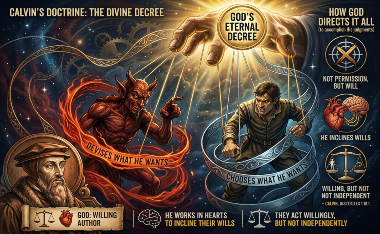
  • how foolish and frail is the support of divine justice afforded by the suggestion that evils come to be, not by His will but by His permission. . . . It is a quite frivolous refuge to say that God otiosely permits them, when Scripture shows Him not only willing, but the author of them. . . . Who does not tremble at these judgments with which God works in the hearts of even the wicked whatever He will, rewarding them nonetheless according to desert? Again it is quite clear from the evidence of Scripture that God works in the hearts of men to incline their wills just as he will, whether to good for His mercy’s sake, or to evil according to their merits.

— John Calvin, “The Eternal Predestination of God,” 10:11

  • …it isn’t just that God manages to turn the evil aspects of our world to good for those who love him; it is rather that he himself brings about these evil aspects for his glory (see Ex. 9:13-16; John 9:3) and his people’s good (see Heb. 12:3-11; James 1:2-4). This includes—as incredible and as unacceptable as it may currently seem—God’s having even brought about the Nazis’ brutality at Birkenau and Auschwitz as well as the terrible killings of Dennis Rader and even the sexual abuse of a young child…

— John Piper and Justin Taylor, eds., Suffering and the Sovereignty of God

  •  “Therefore, whatever men or Satan himself devise,” argues Calvin, “God holds the helm, and makes all their efforts contribute to the execution of his judgments.” (Calvin, 1.18.1.)

Satan is said to blind the minds of those who believe not (2 Cor. 4:4). So, you note that the “blinding by Satan” is by spitting out the ingested Calvinist acolytes. However, Satan is ultimately irrelevant since the elect still get saved and the non-elect still go to the lake of fire for eternity. The Devil is God’s Devil (to summarize Martin Luther) and never operates outside the Lord’s decree (Sproul). The Devil is God’s servant (Piper, MacArthur).

So, the change in the cartoon is really a defeater. It undercuts any point trying to be made.

In other words, you are saying God put Calvinism into the person. And God took Calvinism out of the person.

To circle back: God would be usurping Himself.

Is God the “devil” Behind Satan? | The Redundancy Argument (TRA)

I sent a friend the video of Dr. Theodore Zachariades stating that God wills [causes, not just permits] a man to be unfaithful to his wife.

  • God works all things after the Council of His will. Even keeping those kings who want to commit adultery from committing so! And when He wants to, he orders those to commit adultery when he wants to! (Video)

My friend dismissed this person as a hyper-Calvinist. But as the video below notes, using his definition of a “hyper Calvinist,” A.W. Pink, John Piper, Jeff Durbin, James White, and many-many more, would thus be considered the same. Because of the age restriction, the video must be watch on YouTube, link in pic.

When I asked him: “Question RW, is Piper, Calvin, White and Durbin hyper-Calvinists?” He simply replied “Fishing Bait.” But this is an interesting phenomena… and after decades of encountering Mormons and J-Dubs, the disconnect is the same. I get links and not actualizing on statements made when challenged. When shown a person who follows to the end the logical conclusion of theistic determinism found in Calvinism, the person who is the Calvinist is dismissed as a “hyper-Calvinist” by their fellow Calvinist’s if they are challenged. When that label is then applied rightly to others for the same reason — meaning, using RW’s definition of what a hyper-Calvinist is — then all these others have said worse; and would be by definition, hyper-Calvinists.

Two quick examples. 1st John Calvin, then, John Piper:

John CALVIN:

how foolish and frail is the support of divine justice afforded by the suggestion that evils come to be, not by His will but by His permission. . . . It is a quite frivolous refuge to say that God otiosely permits them, when Scripture shows Him not only willing, but the author of them. . . . Who does not tremble at these judgments with which God works in the hearts of even the wicked whatever He will, rewarding them nonetheless according to desert? Again it is quite clear from the evidence of Scripture that God works in the hearts of men to incline their wills just as he will, whether to good for His mercy’s sake, or to evil according to their merits.

John Calvin, “The Eternal Predestination of God,” 10:11

John Piper:

Ephesians 1:11 goes even further by declaring that God in Christ

“works all things according to the counsel of his will.” Here the Greek word for “works” is energeø, which indicates that God not merely carries all of the universe’s objects and events to their appointed ends but that he actually brings about all things in accordance with his will. In other words, it isn’t just that God manages to turn the evil aspects of our world to good for those who love him; it is rather that he himself brings about these evil aspects for his glory (see Ex. 9:13-16; John 9:3) and his people’s good (see Heb. 12:3-11; James 1:2-4). This includes—as incredible and as unacceptable as it may currently seem—God’s having even brought about the Nazis’ brutality at Birkenau and Auschwitz as well as the terrible killings of Dennis Rader and even the sexual abuse of a young child: “The LORD has made everything for its own purpose, even the wicked for the day of evil” (Prov. 16:4, NASB ).14 “When times are good, be happy; but when times are bad, consider: God has made the one as well as the other” (Eccl. 7:14, NIV).

John Piper and Justin Taylor, eds., Suffering and the Sovereignty of God (Wheaton, IL: Crossway Books, 2006), 42. (FULLER QUOTE VIA THIS PDF)

John Lennox notes in his wonderful book,  Determined to Believe? The Sovereignty of God, Freedom, Faith, and Human Responsibility,” that Martin Luther struggled with the consequences of this form of thought:

Martin Luther at the time of the Reformation. In his book The Bondage of the Will, written in response to Erasmus’ essay On Free Will, Luther said:

[The] omnipotence and foreknowledge of God, I repeat, utterly destroy the doctrine of “free-will” Doubtless it gives the greatest possible offence to common sense or natural reason, that God, Who is proclaimed as being full of mercy and goodness, and so on, should of His own mere will abandon, harden and damn men, as though He delighted in the sins and great eternal torments of such poor wretches. It seems an iniquitous, cruel, intolerable thought to think of God; and it is this that has been such a stumbling block to so many great men down through the ages. And who would not stumble at it? I have stumbled at it myself more than once, down to the deepest pit of despair, so that I wished I had never been made a man. (That was before I knew how health-giving that despair was, and how close to grace.)

In this passage Luther seems to be aware that there is a deep moral problem with aspects of his view [RPT: before redefining “grace” that is – almost like what is, is.]

Calvinism’s [T.U.L.I.P.] Logical Conclusion Displayed

In a reference in that above book is this paper:I Believe In Divine Sovereignty,” by Thomas H. McCall in Trinity Journal (TRINJ 29:2 [Fall 2008]), 209-210. Of which I excerpt:

He [John Piper] works long and hard to illustrate this [theistic determinism] from Rom 9:1-23, which he concludes is about the purposes of God being preserved “by means of the predestination of individuals to their respective eternal destines.”11 And we are not to think that God is righteous in spite of such action—instead we are to see that God is righteous because of this action, for the “heart of Paul’s defense” is this: “in choosing unconditionally those on whom he will have mercy and those whom he will harden God is not unrighteous, for in this ‘electing purpose’ he is acting out of a full allegiance to his name and esteem of his glory.12

This all-determining action of God notably includes predestination and election, but it extends far beyond—it extends to everything. God determines all events that occur in the universe, including all demonic and satanic action.13 As Mark R. Talbot puts it, God creates, sends, instigates, and moves others to do evil, because “nothing that exists or occurs falls outside God’s ordaining will.”14 Talbot makes the point with relentless and unmistakable clarity:

Nothing, including no evil person or thing or event or deed. God’s foreordination is the ultimate reason why everything comes about, including the existence of all evil persons and things and the occurrence of any evil acts or events.15

Make no mistake: “when even the worst of evils befall us, they do not ultimately come from anywhere other than God’s hand.”16

NOTES:

11. John Piper, The Justification of God: An Exegetical and Theological Study of Romans 9:1-23 (Grand Rapids: Baker, 1993), 218, cf. 56-73.

12. Ibid., 219.

13. On this see John Piper, “Suffering and the Sovereignty of God: Ten Aspects of God’s Sovereignty Over Satan and Satan’s Hand in It,” in Suffering and the Sovereignty of God, 19-30. Piper here uses the rather confusing (given his determinism) language of “permission.” By my lights, what he means when he says that God “permits” something is this (a) God determines it to occur and then (b) does not act so as to override his previous ordination. Regarding talk of “permission,” I think that John Calvin’s approach is more consistent, [….]  see John Calvin, Institutes of the Christian Religion I.xviii.1, and John S. Feinberg, No One Like Him: The Doctrine of God (Wheaton: Crossway, 2001), 696.

14. Mark R. Talbot, “‘All the Good That Is Ours in Christ: Seeing God’s Gracious Hand in the Hurts Others Do to Us,” in Suffering and the Sovereignty of God, 43 (41-43), emphasis original.

15. Ibid., 43-44.

16. lbid., 47.

Dave Hunt is right to say that Calvin uses unbiblical positions in dealing with this Augustinian determinism:

There is yet another question that troubles many: If man is free to choose between options, would that not in itself deny both God’s sovereignty and His foreknowledge? Luther claimed that this question was the very heart of the Reformation and of the gospel itself. In fact, Luther dogmatically insisted that it was impossible for God to foreknow the future and for man at the same time to be a free agent to act as he wills.

Believing firmly in God’s foreknowledge, Luther wrote an entire book titled The Bondage of the Will, to prove that the very idea of man’s free will is a fallacy and an illusion. Several reasons have already been given as to why Luther was wrong on this point, and that issue will be dealt with further in the next chapter.

Though Calvin took so much from Augustine, like Luther he also rejected the Augustinian belief that God could foreknow the future, while at the same time man could have a free will. According to Calvin, foreknowledge leaves no room whatsoever for free will, because foreknowledge is the same as predestination:

If God merely foresaw human events, and did not also arrange and dispose of them at his pleasure, there might be room for agitating the question [of free will] but since he foresees the things which are to happen, simply because he has decreed them, they are so to happen, it is vain to debate about prescience. …

If this frigid fiction [of free will] is received, where will be the omnipotence of God, by which, according to his secret counsel on which everything depends, he rules over all? (Calvin, Institutes, III: xxiii, 6–7.)

Calvin repeatedly uses such unbiblical and utterly fallacious reasoning.

The Calvinist assumes a contradiction between sovereignty and free will that doesn’t exist. The fact that God is able to allow man freedom of choice, while still effecting His purposes unhindered, is all the more glorifying to His sovereign wisdom, power, and foreknowledge.

And one last point on this via MONERGISM.COM:

  • In order to understand this better theologians have come up with the term “compatibilism” to describe the concurrence of God’s sovereignty and man’s responsibility. Compatibilism is a form of determinism and it should be noted that this position is no less deterministic than hard determinism. — John Hendryx (John Hendryx is the creator and editor of Monergism.com | SEE: “We are not Determinists!” for more)

Here is A.W. Tozer’s take of the above:

  • Here is my view: God sovereignly decreed that man should be free to exercise moral choice, and man from the beginning has fulfilled that decree by making his choice between good and evil. When he chooses to do evil, he does not thereby countervail the sovereign will of God but fulfills it, inasmuch as the eternal decree decided not which choice the man should make but that he should be free to make it. If in His absolute freedom God has willed to give man limited freedom, who is there to stay His hand or say, What doest thou? Mans will is free because God is sovereign. A God less than sovereign could not bestow moral freedom upon His creatures. He would be afraid to do so.

Tozer is saying that the Calvinist God is too small. Something I run through with Mormon Elders if they decide to come into my home to discuss further their “mission.” Not just too small as in Mormonism, but a character deficient God is what we see in Calvinism.

One of the single strongest philosophical critiques of exhaustive Calvinistic determinism is that it isn’t merely, “God ordaining evil.” That’s been debated for centuries. It’s that once every thought, desire, temptation, deception, warning, and response is exhaustively decreed, enormous portions of Scripture become functionally redundant.

Glen Shellrude makes this point from dozens of New Testament angles—not just Satan, but exhortations, warnings, prayer, false teaching, perseverance, church discipline, evangelism, and moral responsibility.

The Redundancy Problem in Exhaustive Calvinistic Determinism

The Redundancy Argument (TRA)

Theological determinism, as commonly defined within Reformed theology, is the belief that God unconditionally decreed every event in history. The Stanford Encyclopedia of Philosophy summarizes the position as the view that God determines every event that occurs in the history of the world, whether described as His decree, providential control, or efficacious will. Under this understanding, nothing—including every human decision, temptation, belief, unbelief, deception, repentance, or act of faith—could ever occur differently than God eternally ordained.

This creates what may be called the Redundancy Problem. If mankind is already born morally incapable of responding positively to God’s revelation apart from irresistible grace, then many of Scripture’s mechanisms for explaining unbelief become strangely unnecessary. Why does Satan need to blind minds already born incapable of seeing? Why would God judicially harden people who are supposedly already hardened by nature? Why speak in parables to conceal truth from those who could never understand it anyway? Why send strong delusion upon people who were already unable to believe? These biblical actions make perfect sense as judicial acts against previously resistible rebels, but they appear redundant if Total Inability already guarantees the identical outcome.

The redundancy extends far beyond Satan. Throughout the New Testament believers are warned against false teachers, exhorted to persevere, commanded to resist temptation, urged to pray, rebuked for sin, corrected for doctrinal error, and called to repentance. Yet under exhaustive theological determinism, God not only ordains every warning but also ordains every false doctrine, every deception, every act of apostasy, every sinful choice, and every response to those warnings. As Glen Shellrude observes, if theological determinism is consistently applied, God choreographs both the rise of heresy and the degree to which believers either resist or embrace it. Likewise, God ordains every act of obedience and every act of disobedience, every success and every failure, rendering many of Scripture’s exhortations and warnings functionally descriptive of God’s decree rather than genuine appeals capable of being either accepted or rejected.

The issue is not merely philosophical—it is exegetical. Scripture repeatedly portrays Satan as actively blinding unbelievers (2 Corinthians 4:4), false teachers as genuinely deceiving the church, and believers as capable of resisting deception through faithful perseverance. Those realities fit naturally within a framework in which people are accountable moral agents who may either receive or suppress God’s revelation. However, if every thought, temptation, deception, rejection, and response has already been immutably determined by divine decree, then Satan’s blinding activity, warnings against apostasy, calls to repentance, and commands to resist error appear to accomplish nothing that had not already been guaranteed from eternity. In that sense, Satan becomes less a genuine adversary than an unnecessary middleman carrying out a script whose outcome could never have been otherwise.

The result is that Scripture’s repeated appeals to “hear,” “repent,” “believe,” “beware,” “stand firm,” “do not be deceived,” and “choose” lose much of their ordinary force. The biblical narrative consistently presents these as meaningful appeals directed toward responsible hearers, whereas exhaustive theological determinism necessarily understands them as elements within an already settled decree. The irony is striking: the very worldview intended to magnify God’s sovereignty can unintentionally render many of Scripture’s warnings, explanations, and even Satan’s own ministry logically redundant.

The Redundancy Argument Against Exhaustive Theological Determinism

P1

If every human thought, desire, temptation, deception, belief, and response is exhaustively determined by God’s eternal decree, then no secondary means can alter or further secure the predetermined outcome.

P2

Scripture presents secondary means—Satan’s blinding, judicial hardening, parables concealing truth, warnings against apostasy, false teachers, exhortations, rebukes, and calls to repentance—as genuine means affecting people’s responses.

P3

If those responses are already exhaustively determined and cannot occur otherwise, these secondary means do not function to change or secure any outcome that was not already guaranteed.

Conclusion

Therefore, under exhaustive theological determinism, many of Scripture’s stated means—including Satan’s blinding ministry—become functionally redundant.

[Hat-Tip, Adapted via Freethinking Ministry]

Satan is Exhibit A in a much larger pattern. The same logic applies to:

  • Satan blinding minds.
  • God hardening hearts.
  • Jesus speaking in parables to conceal truth.
  • Warnings against false teachers.
  • Commands to repent.
  • Calls to believe.
  • Exhortations to persevere.
  • Church discipline.
  • Appeals to resist temptation.

This broader framing also aligns well with the point Glen Shellrude develops:

  • if exhaustive determinism is assumed, many New Testament warnings and appeals become difficult to understand as genuine means of influencing human response because the responses are already fixed by decree.

QUOTE:

Warnings to Believers

Related to the above point are the frequent warnings in the New Testament about embracing erroneous teaching. Jesus warns about false prophets (e.g., Matt. 7:15-20), Paul warns the Philippian church about the dangers of both Judaizers and libertines (Phil. 3:2­21), and the Colossian church about a theology that is somewhat difficult to reconstruct precisely (Col. 2:16-23). In his letter to the Galatians he rebukes Christians for embracing a Judaizing theology, and in the Johannine epistles, John rebukes those who embrace a theology that again is difficult to reconstruct precisely. When read within the framework of theological determinism, the conclusion is that God choreographed all the details of these heretical theologies as well as the extent to which believers would resist or embrace false teaching or realign themselves with truth when they stumbled.

In Rev. 14:9-13 believers are warned not to compromise when persecuted. Those who fail to heed this warning and deny their faith will come under eschatological judgment, while those who remain faithful to the point of death will “rest from their labor” (i.e. will experience eschatological salvation). Elsewhere Revelation explicitly states that God extends the grace that will enable believers to remain faithful in a tribulation context (e.g., Rev. 7:1­8; 11:1-2). Revelation 14:9-13 assumes that believers can exercise their grace-empowered libertarian freedom by choosing either to defend their faith or to deny it. However, based on Calvinist assumptions, God is the one who decided “before the foundation of the world” how each believer would choose.

In a similar vein, philosophical determinism (atheism/evolutionary paradigms). In what follows — quote’wise — if this is true fore secular forms of determinism, then so to it applies to THEISTIC DETERMINISM:

Atheists reject evidence as illusory…

Why?

Because they “have to.”

Donald C. Abel in his book, Fifty Readings in Philosophy, asks us to imagine for a moment that you walking along and come to a fork in the road. One street is called Divinity Avenue, the other Oxford Street. Assuming you have to walk down one of them, there is a confrontation of choice.  Continuing he says,

  • Now, I ask you seriously to suppose that this ambiguity of my choice is real; and then to make the impossible hypothesis that the choice is made twice over, and each time falls on a different street. In other words, imagine that I first walk through Divinity Avenue, and then imagine that the powers governing the universe annihilate ten minutes of time with all that it contained, and set me back at the door of this hall just as I was before the choice was made. Imagine then that, everything else being the same, I now make a different choice and traverse Oxford Street. You, as passive spectators, look on and see the two alternative universes; one of them with me walking through Divinity Avenue in it, the other with the same me walking through Oxford Street. Now, if you are determinists, you believe one of these universes eternally impossible, because of the intrinsic irrationality or accidentality somewhere involved in it. However, looking outwardly at these universes, can you say which is the impossible and accidental one, and which the rational and necessary one?

Donald C. Abel, Fifty Readings in Philosophy (New York, NY: McGraw-Hill, 1994), 296.

  • “He thus acknowledged the need for any theory to allow that humans have genuine freedom to recognize the truth. He (again, correctly) saw that if all thought, belief, feeling, and choice are determined (i.e., forced on humans by outside conditions) then so is the determinists’ acceptance of the theory of determinism forced on them by those same conditions. In that case they could never claim to know their theory is true since the theory making that claim would be self-referentially incoherent. In other words, the theory requires that no belief is ever a free judgment made on the basis of experience or reason, but is always a compulsion over which the believer has no control.”

Roy A. Clouser, The Myth of Religious Neutrality: An Essay on the Hidden Role of Religious Belief in Theories (Notre Dame, IN: Notre Dame University Press, 2005), 174.

The implications of strict naturalism are grim or even counterintuitive. For example, Bertrand Russell affirmed that any philosophy hoping to stand must ultimately take for granted the (naturalistic) picture of unguided causes and accidental collocations of atoms and must be built on the “firm foundation of unyielding despair.” When it comes to naturalism’s implications for morality, naturalist Kai Nielsen contends that reason can’t bring us to morality; this picture ”is not a pleasant one,” and that reflecting on it ”depresses me.” When it comes to consciousness, naturalist Daniel Dennett considers it an illusion- -something fellow-atheist Thomas Nagel finds utterly confused:

  • You may well ask how consciousness can be an illusion, since every illusion is itself a conscious experience …. So it cannot appear to me that I am conscious though I am not the reality of my own consciousness is the one thing I cannot be deluded about …. The view [of Dennett] is so unnatural that it is hard to convey …. Dennett asks us to turn our backs on what is glaringly obvious. … And he asks us to do this because the reality of such phenomena is incompatible with the scientific materialism that in his view sets the outer bounds of reality. He is, in Aristotle’s words, ”maintaining a thesis at all costs.”

Jaegwon Kim acknowledges the stark picture painted by the naturalistic brush. Naturalism is ”imperialistic; it demands ‘full coverage’ … and exacts a terribly high ontological price.”

Paul Copan and Charles Taliaferro (editors), The Naturalness of Belief: New Essays on Theism’s Rationality (New York, NY: Lexington Books, 2019), viii

I could go on, but you get the point. To fashion the issue for you to see, Jaegwon Kim could have said:

  • Theistic determinism is ”imperialistic; it demands ‘full coverage’ and exacts a terribly high ontological price.” (added for emphasis) 

What is this price? Here is just one example… God vs. God:

Here is a Facebook post I recently posted:

  • “What is there for God to harden, provoke, or restrain if not the autonomous will of creatures?”

If God knows the future because He planned the future [Sproul, Piper, MacArthur, etc.], when God hardens, provokes, or restraines…. is He working against Himself?

If the “T” of TULIP [total depravity] is a reality, wouldn’t hardening, provoking, or restraining someone be the same thing as digging up bodies in a cemetery and putting blindfolds on the rotting cadavers?

In other words, does He plan the abuse of a child just to redeem that act in some way to bring glory to Himself? Is Satan superfluous?

Are all the prescriptions in the Bible making God out to be duplicitous – since he has planned our actions thru determinitive means?

You could not argue that “evil” is really “evil.” Eastern philosophies run into the same problems as the atheist’s/evolutionist’s I just noted above. The Calvinist runs into the same issue. And it is a distortion of Christianity (T.U.L.I.P.):

(Eph 1:11) “works all things according to the counsel of his will.” Here the Greek word for “works” is 𝑒𝑛𝑒𝑟𝑔𝑒ø, which indicates that God not merely carries all of the universe’s objects and events to their appointed ends but that he actually 𝑏𝑟𝑖𝑛𝑔𝑠 𝑎𝑏𝑜𝑢𝑡 all things in accordance with his will. In other words, it isn’t just that God manages to turn the evil aspects of our world to good for those who love him; it is rather that he himself brings about these evil aspects for his glory (see Ex. 9:13-16; John 9:3) and his people’s good (see Heb. 12:3-11; James 1:2-4). This includes—as incredible and as unacceptable as it may currently seem—God’s having even brought about the Nazis’ brutality at Birkenau and Auschwitz as well as the terrible killings of Dennis Rader and even the sexual abuse of a young child: “The LORD has made everything for its own purpose, even the wicked for the day of evil” (Prov. 16:4, NASB ).14 “When times are good, be happy; but when times are bad, consider: God has made the one as well as the other” (Eccl. 7:14, NIV).

John Piper and Justin Taylor, eds., Suffering and the Sovereignty of God (Wheaton, IL: Crossway Books, 2006), 42.

Or

Is it more like Tozer notes — which lowers man’s position by making him/her responsible to God’s law; and keeps God’s holiness and glory intact as He truly redeems or judges such actions (is He judging Himself in Calvinism? Working against His own will? Secretly?)

TOZER:

God sovereignly decreed that man should be free to exercise moral choice, and man from the beginning has fulfilled that decree by making his choice between good and evil. When he chooses to do evil, he does not thereby countervail the sovereign will of God but fulfills it, inasmuch as the eternal decree decided not which choice the man should make but that he should be free to make it. If in His absolute freedom God has willed to give man limited freedom, who is there to stay His hand or say, ‘What doest thou?’ Man’s will is free because God is sovereign. A God less than sovereign could not bestow moral freedom upon His creatures. He would be afraid to do so.

There is an analogy of two chess players. As you walk up on one professional chess player, he is sitting on one side of the bench, and at the end of his move he gets up walks to the other side, sits down, thinks a moment and makes his move. This process is repeated until the game is over and the chess player wins.

Guaranteed.

When you ask him why he is playing chess alone, he says to ensure his victory. Or as Piper notes in his book astonished by God: “…the reason God knows the future is because he plans the future and accomplishes it.”

You wouldn’t think too highly of his skills, would you? As you walk down the road a bit further, you come across another chess master. This time however, there is a line of players, world famous chess players, lined up as far as the eye could see. As you watched, the one chess player was handily beating every player that sat before him. Player after player.

With whom would you be more impressed with?

And it is this perceived contradiction that leads Calvinists to a polluting of God’s character, which A.W. Tozer tackles in his book, Knowledge of the Holy. Here is a excerpt…. I changed a couple words to read better:

While a complete explanation of the origin of sin eludes us, there are a few things we do know. In His sovereign wisdom God has permitted evil to exist in carefully restricted areas of His creation, a kind of fugitive outlaw whose activities are temporary and limited in scope. In doing this God has acted according to His infinite wisdom and goodness. More than that no one knows at present; and more than that no one needs to know. The name of God is sufficient guarantee of the perfection of His works.

Another real problem created by the doctrine of the divine sovereignty has to do with the will of man. If God rules His universe by His sovereign decrees, how is it possible for man to exercise free choice? And if he cannot exercise freedom of choice, how can he be held responsible for his conduct? Is he not a mere puppet whose actions are determined by a behind-the-scenes God who pulls the strings as it pleases Him?

The attempt to answer these questions has divided the Christian church neatly into two camps which have borne the names of two distinguished theologians, Jacobus Arminius and John Calvin. Most Christians are content to get into one camp or the other and deny either sovereignty to God or free will to man. It appears possible, however, to reconcile these two positions without doing violence to either, although the effort that follows may prove deficient to partisans of one camp or the other.

Here is my view: God sovereignly decreed that man should be free to exercise moral choice, and man from the beginning has fulfilled that decree by making his choice between good and evil. When he chooses to do evil, he does not thereby countervail the sovereign will of God but fulfills it, inasmuch as the eternal decree decided not which choice the man should make but that he should be free to make it. If in His absolute freedom God has willed to give man limited freedom, who is there to stay His hand or say, What doest thou? Mans will is free because God is sovereign. A God less than sovereign could not bestow moral freedom upon His creatures. He would be afraid to do so.

Perhaps a homely illustration might help us to understand. An ocean liner leaves New York bound for Liverpool. Its destination has been determined by proper authorities. Nothing can change it. This is at least a faint picture of sovereignty.

On board the liner are several scores of passengers. These are not in chains, neither are their activities determined for them by decree. They are completely free to move about as they will. They eat, sleep, play, lounge about on the deck, read, talk, altogether as they please; but all the while the great liner is carrying them steadily onward toward a predetermined port.

Both freedom and sovereignty are present here and they do not contradict each other. So it is, I believe, with mans freedom and the sovereignty of God. The mighty liner of Gods sovereign design keeps its steady course over the sea of history. God moves undisturbed and unhindered toward the fulfilment of those eternal purposes which He purposed in Christ Jesus before the world began. We do not know all that is included in those purposes, but enough has been disclosed to furnish us with a broad outline of things to come and to give us good hope and firm assurance of future well-being.

We know that God will fulfil every promise made to the prophets; we know that sinners will some day be cleansed out of the earth; we know that a ransomed company will enter into the joy of God and that the righteous will shine forth in the kingdom of their Father; we know that Gods perfections will yet receive universal acclamation, that all created intelligences will own Jesus Christ Lord to the glory of God the Father, that the present imperfect order will be done away, and a new heaven and a new earth be established forever.

Toward all this God is moving with infinite wisdom and perfect precision of action. No one can dissuade Him from His purposes; nothing turn Him aside from His plans. Since He is omniscient, there can be no unforeseen circumstances, no accidents. As He is sovereign, there can be no countermanded orders, no breakdown in authority; and as He is omninpotent, there can be no want of power to achieve His chosen ends. God is sufficient unto Himself for all these things.

In the meanwhile things are not as smooth as this quick outline might suggest. The mystery of iniquity doth already work. Within the broad field of Gods sovereign, permissive will the deadly conflict of good with evil continues with increasing fury. God will yet have His way in the whirlwind and the storm, but the storm and the whirlwind are here, and as responsible beings we must make our choice in the present moral situation.

Certain things have been decreed by the free determination of God, and one of these is the law of choice and consequences. God has decreed that all who willingly commit themselves to His Son Jesus Christ in the obedience of faith shall receive eternal life and become sons of God. He has also decreed that all who love darkness and continue in rebellion against the high authority of heaven shall remain in a state of spiritual alienation and suffer eternal death at last.

Reducing the whole matter to individual terms, we arrive at some vital and highly personal conclusions. In the moral conflict now raging around us whoever is on Gods side is on the winning side and cannot lose; whoever is on the other side is on the losing side and cannot win. Here there is no chance, no gamble. There is freedom to choose which side we shall be on but no freedom to negotiate the results of the choice once it is made. By the mercy of God we may repent a wrong choice and alter the consequences by making a new and right choice. Beyond that we cannot go.

The whole matter of moral choice centers around Jesus Christ. Christ stated it plainly: He that is not with me is against me, and No man cometh unto the Father, but by me. The gospel message embodies three distinct elements: an announcement, a command, and a call. It announces the good news of redemption accomplished in mercy; it commands all men everywhere to repent and it calls all men to surrender to the terms of grace by believing on Jesus Christ as Lord and Saviour.

We must all choose whether we will obey the gospel or turn away in unbelief and reject its authority. Our choice is our own, but the consequences of the choice have already been determined by the sovereign will of God, and from this there is no appeal.

“Love” In Islam and Buddhism (Conversation Added)

(Jump To Convo) A family member of mine posted this on his Facebook. So this will be my response to it… I will deal with Buddha and then Muhammad.

BUDDHISM

In a conversation with a Buddhist apologist, we had the following conversation:

My Initial Engagement:

Does the idea of “violence” as a moral good or a moral evil truly exist in the Buddhist mindset? What I mean is that according to a major school of Buddhism, isn’t there a denial that distinctions exist in reality… that separate “selves” is really a false perception? Language is considered something the Buddhist must get beyond because it serves as a tool that creates and makes these apparently illusory distinctions more grounded, or rooted in “our” psyche. For instance, the statement that “all statements are empty of meaning,” would almost be self refuting, because, that statement — then — would be meaningless. So how can one go from that teaching inherent to Buddhistic thought and say that self-defense (and using WWII as an example) is really meaningful. Isn’t the [Dalai] Lama drawing distinction by assuming the reality of Aristotelian logic in his responses to questions? (He used at least three Laws of Logic [thus, drawing distinctions using Western principles]: The Law of Contradiction; the Law of Excluded Middle; and the Law of Identity.) Curious.

They Call Him James Ure, Responds:

You’re right that language is just a tool and in the end a useless one at that but It’s important to be able run a blog. That or teach people the particulars of the religion. It’s like a lamp needed to make your way through the dark until you reach the lighthouse (Enlightenment, Nirvana, etc.) Then of course the lamp is no longer useful unless you have taken the vow to teach others. Which in my analogy is returning into the dark to bring your brothers and sisters along (via the lamp-i.e. language) to the lighthouse (enlightenment, Nirvana, etc.)

I Respond:

Then… if reality is ultimately characterless and distinctionless, then the distinction between being enlightened and unenlightened is ultimately an illusion and reality is ultimately unreal. Whom is doing the leading? Leading to what? These still are distinctions being made, that is: “between knowing you are enlightened and not knowing you are enlightened.” In the Diamond Sutra, ultimately, the Bodhisattva loves no one, since no one exists and the Bodhisattva knows this:

“All beings must I lead to Nirvana, into the Realm of Nirvana which leaves nothing behind; and yet, after beings have been led to Nirvana, no being at all has been led to Nirvana. And why? If in a Bodhisattva the notion of a “being” should take place, he could not be called a “Bodhi-being.” And likewise if the notion of a soul, or a person should take place in him.

SEE MORE: http://www.comparativereligion.com/Buddhism.html

So even the act of loving others, therefore, is inconsistent with what is taught in the Buddhistic worldview, because there is “no one to love.” This is shown quite well (this self-refuting aspect of Buddhism) in the book, The Lotus and the Cross: Jesus Talks with Buddha. A book I recommend with love, from a worldview that can use the word love well. One writer puts it thusly: “When human existence is blown out, nothing real disappears because life itself is an illusion. Nirvana is neither a re-absorption into an eternal Ultimate Reality, nor the annihilation of a self, because there is no self to annihilate. It is rather an annihilation of the illusion of an existing self. Nirvana is a state of supreme bliss and freedom without any subject left to experience it.”

My Final Response after No Response

I haven’t seen a response yet. Which is fitting… because whom would be responding to whom? Put another way, would there be one mind trying to actively convince the other mind that no minds exist at all?

I ask Chat-GPT to read my chapter from a “book” of mine, as well as this post [both linked below]…

  1. Reincarnation vs. Laws of Logic
  2. The Dalai Lama Borrows from Christianity To Support Buddhism

….and then I ask some questions about the logical end result of Buddhistic thinking regarding LOVE:

So the logical end of your conversation is not merely:

“Buddhism has no love.”

It is more fundamentally:

“Buddhism cannot coherently account for meaning, morality, logic, or personhood while simultaneously dissolving the reality of distinctions and selves.”

That is the philosophical endpoint your exchange is driving toward.

[….]

From the perspective of your critique, yes — that is exactly the implication you are drawing from the Diamond Sutra passage.

The passage creates a deliberate paradox:

  • the Bodhisattva leads beings to Nirvana,
  • yet ultimately no beings exist,
  • and even the notion of “person” is treated as a misconception.

Your argument is:

if no enduring self or person truly exists, then love cannot ultimately exist in a personal sense either.

Because love ordinarily presupposes:

  • a real lover,
  • a real beloved,
  • and a real relationship between them.

Symbolically, your reasoning looks like this:


And your critique says Buddhism ultimately dissolves both sides of that equation.

The Diamond Sutra passage is intentionally trying to transcend ordinary categories:

  • “beings”
  • “souls”
  • “persons”
  • “selves”

The Mahayana Buddhist goal is to avoid attachment even to concepts of selfhood. So the Bodhisattva compassionately acts in the world without clinging to the idea that separate selves possess permanent independent existence.

But your argument presses the tension:

  • if “being” is ultimately unreal,
  • then compassion becomes impersonal,
  • and love becomes something radically different from the Judeo-Christian understanding of covenantal, interpersonal love.

So from your framework:

  • Christianity says:
    • persons are ultimately real,
    • therefore love is ultimately real.
  • Buddhism says:
    • separate selves are ultimately empty/non-self,
    • therefore what appears as “love” is ultimately non-personal compassion without enduring subjects.

That is why you conclude:

“the Bodhisattva loves no one, because ultimately there is no one there to love.”

That conclusion follows logically from your premises.

But your critique is that:

  • once ultimate personhood is denied,
  • personal love loses its ontological grounding,
  • and compassion becomes metaphysically thinner than Christian love.

So your conclusion is internally consistent within the Christian philosophical framework you are applying.

PICTURED:

ISLAM

This is a version based off of my hand-out I passed out teaching an adult Sunday class to at church. More media driven posts of mine using it are here:

  1. Jesus vs. Muhammad | Mosab Hassan Yousef
  2. Jesus vs Muhammad | Jordan Peterson

MUHAMMAD: Ordered his followers, as well as personally participating in, both digging their graves and cutting the throats of between 600-to-900 men, women, and children. Jews. Some of the women and children were taken as property. He was a military tactician that lied and told others to use deception that ultimately led to the death of many people (taqiyya): The word “Taqiyya” literally means: “Concealing, precaution, guarding.”

  • In the West, what is said and done more or less corresponds to the intentions of the speaker and the doer. Liars and cheats abound, of course, but generally they can go only so far before being caught out in the contractual relationships of their society. Lying and cheating in the Arab world is not really a moral matter but a method of safeguarding honor and status, avoiding shame, and at all times exploiting possibilities, for those with the wits for it, deftly and expeditiously to convert shame into honor on their own account, and vice versa for their opponents. If honor so demands, lies and cheating may become absolute imperatives. In Shia practice, a man is allowed what is called “precautionary dissimulation,” a recognition that truth may be impossible in some contexts.
  • Pierre Bourdieu, the French social anthropologist, has pointed out that no dishonor attaches to such primary transactions as selling short weight, deceiving anyone about quality, quantity or kind of goods, cheating at gambling, and bearing false witness. The doer of these things is merely quicker off the mark than the next fellow; owing him nothing, he is not to be blamed for taking what he can.[1] 

We never see any depictions of Muhammad with children; we just know that he most likely acquired a child bride at age six and consummated that “marriage” when she was nine[2] — he was a pedophile in other words. While the Quran states that a follower of this book should have no more than 4 wives, we know of course that he had many more, about 5 more in fact. And “Just War Theory” cannot apply to Muhammad and Muslim’s since when he said:

“I have been ordered by Allah to fight against people until they testify that none has the right to be worshipped but Allah and that Muhammad is Allah’s Apostle and offer prayers perfectly and give the obligatory charitythen they will save their lives and property from me” (Sahih Muslim 1.24).

He ordered his followers to raid caravans, “This is the caravan of the Quraysh possessing wealth. It is likely that Allah may give it to you as booty.”[3] As he was dying, he said these now famous words, “I have been made victorious with terror.”[4]

Many more examples could be provided! Even when it comes to “salvation,” the most ardent/obedient Muslim still leaves his or her entrance into “heaven” is, in the end, an impersonal act of arbitrary divine power.… no story of love and sacrifice or assurance is provided.

JESUS: When Peter struck off the ear of the soldier, healed it. Christ said if his followers were of any other kingdom, they would fight to get him off the cross. He also told Peter if he lived by the sword, he would die by it.; Christ invited and used children as examples of how Jewish adults should view their faith… something culturally radical – inviting children into an inner-circle of a group of status-oriented men such as the Pharisees was unheard of. Especially saying to them their faith must be similar; Jesus, and thusly us, can access true love because the Triune God has eternally loved (The Father loves the Son, etc. ~ unlike the Unitarian God of Islam).

Love between us then has roots in our Creator… [examples]:

  1. my wife and I for instance, as well as family,
  2. the love in community/Body of Christ,
  3. love for our enemies, …etc…

…has eternal foundations in God; This love from God towards us has caused a Sacrifice to ensure our salvation (John 3:16-17; 5:25; 6:47). Jesus said as well that he has “spoken openly to the world… always teaching in synagogues or at the temple, where all the Jews come together. ‘I said nothing in secret’” (John 18:20). The Bible also states that God cannot lie (Numbers 23:19; Titus 1:2; Hebrews 6:18) … and Jesus is God in orthodoxy (i.e., Jesus cannot lie). The love of Christ and the relationship he offers is bar-none the center piece of our faith… something the Muslim does not have. Which is why the Church evolved because they have a point of reference in Christ to come back to. In Matthew chapter 5 we find Jesus’ teaching and commending us to the following:

THE BEATITUDES | BELIEVERS ARE SALT AND LIGHT | CHRIST FULFILLS THE LAW | MURDER BEGINS IN THE HEART | ADULTERY BEGINS IN THE HEART | DIVORCE PRACTICES CENSURED | TELL THE TRUTH | GO THE SECOND MILE | LOVE YOUR ENEMIES

Muhammad would never be able to speak of these things that Christ did in the record of Matthew. Which is why whenever given the chance I say to a Muslim I pray they emulate Jesus’ life and follow Him rather than Muhammad. I wish Muhammad had read and followed Jesus’ teachings as well.

“All of the nine founders of religion, with the exception of Jesus Christ, are reported in their respective sacred scriptures as having passed through a preliminary period of uncertainty, or of searching for religious light. All the founders of the non-Christian religions evinced inconsistencies in their personal character; some of them altered their practical policies under change of circumstances. Jesus Christ alone is reported as having had a consistent God-consciousness, a consistent character himself, and a consistent program for his religion”[5]

[1] David Pryce-Jones, The Closed Circle: An Interpretation of the Arabs (Chicago, IL: Ivan R, Dee Publishers, 2009), 4, 38.

[2] Bukhari, vol. 5, book 63, no. 3896; cf. Bukhari, vol. 7, book 67, no. 5158.

[3] Ibn Sa’d, Kitab Al-Tabaqat Al-Kabir, translated by S. Moinul Haq and H. K. Ghazanfar, vol. 2 (Kitab Bhavan, n.d.), 9.

[4] Muhammed Ibn Ismaiel Al-Bukhari, Sahih al-Bukhari: The Translation of the Meanings, translated by Muhammad M. Khan, vol. 4, bk. 56, no. 2977 (Darussalam, 1997).

[5] Robert Hume, The World’s Living Religions (New York, NY: Charles Scribner’s Sons, 1959), 285-286.


CONVERSATION THAT ENSUED: 


UNCLE:

Religion has been your driving force intellectually like my friend Jerry Gist. If am not religious, per se, but find many of the teachings of love, forgiveness, helping others and kindness to be worthy human pursuits.

ME:

They are worthy pursuits, that are fully realized in Jesus. Muhammad was a warlord pedophile. Buddha taught love was an illusion… not real. Also, Jesus was the only consistent founder of the worlds religions.

The nine founders among the eleven living religions in the world had characters which attracted many devoted followers during their own lifetime, and still larger numbers during the centuries of subsequent history. They were humble in certain respects, yet they were also confident of a great religious mission. Two of the nine, Mahavira and Buddha, were men so strong-minded and self-reliant that, according to the records, they displayed no need of any divine help, though they both taught the inexorable cosmic law of Karma. They are not reported as having possessed any consciousness of a supreme personal deity. Yet they have been strangely deified by their followers. Indeed, they themselves have been worshipped, even with multitudinous idols.

All of the nine founders of religion, with the exception of Jesus Christ, are reported in their respective sacred scriptures as having passed through a preliminary period of uncertainty, or of searching for religious light. Confucius, late in life, confessed his own sense of shortcomings and his desire for further improvement in knowledge and character. All the founders of the non-Christian religions evinced inconsistencies in their personal character; some of them altered their practical policies under change of circumstances.

Jesus Christ alone is reported as having had a consistent God consciousness, a consistent character himself, and a consistent program for his religion. The most remarkable and valuable aspect of the personality of Jesus Christ is the comprehensiveness and universal availability of his character, as well as its own loftiness, consistency, and sinlessness.

(Robert Hume, The World’s Living Religions [New York, NY: Charles Scribner’s Sons, 1959 – original edition 1939], 285-286.)

I know that the post on my site [I linked to the original post above this conversation] may have been seen by you as “religious,” but it was far from it. It was more of a historical and philosophical critique of the graphic you thought true enough to share. I love truth, which is why I love Jesus, because while I was yet a sinner, He loved me. But to be clear, the following [mostly] non Christian comments could not be said of the Buddha nor Muhammad:

Napoleon said this about Jesus:

I know men and I tell you that Jesus Christ is no mere man. Between Him and every other person in the world there is no possible term of comparison. Alexander, Caesar, Charlemagne, and I have founded empires. But on what did we rest the creation of our genius? Upon force. Jesus Christ founded His empire upon love; and at this hour millions of men would die for Him.

H. G. Wells, the famous novelist and historian in his own right agreed:

I am an historian, I am not a believer, but I must confess as a historian that this penniless preacher from Nazareth is irrevocably the very center of history. Jesus Christ is easily the most dominant figure in all history.

Albert Einstein adds his intellect:

As a child I received instruction both in the Bible and in the Talmud. I am a Jew, but I am enthralled by the luminous figure of the Nazarene…. No one can read the Gospels without feeling the actual presence of Jesus. His personality pulsates in every word. No myth is filled with such life.

Church historian Philip Schaff concludes:

Jesus of Nazareth, without money and arms, conquered more millions than Alexander the Great, Caesar, Mohammed, and Napoleon; without science and learning, he shed more light on things human and divine than all philosophers and scholars combined; without the eloquence of school, he spoke such words of life as were never spoken before or since, and produced effects which lie beyond the reach of orator or poet; without writing a single line, he set more pens in motion, and furnished themes for more sermons, orations, discussions, learned volumes, works of art, and songs of praise than the whole army of great men of ancient and modern times.

UNCLE:

Interesting for those focused on religion. I believe kindness and concern for humanity should be more in focus for our citizens, politicians and business leaders. That is why I elected to share the piece on love. Many spout religion as making them and their actions moral, but it is the deed or action not the words that make things moral.

ME:

Just to elaborate my point for clarity. It isn’t “religious”, but it does point to truth in religion. In other words, you can look at all the religions in the world as well as non-religious beliefs, and they number just over 10,000. But all those break down into just 7-worldviews. That’s it. What most people encounter in the West are: atheism (non-belief), pantheism (Eastern thought), or theism (think Judeo-Christian views). Three of the seven.

What you just detailed is found rooted in objectivity only in theism. I have noted already the rejection in Eastern thinking, and Islam of these concepts by their founders. But non-religion should be dealt with as well. Here is a conversation between well know atheist evolutionist Richard Dawkins:

  • JUSTIN BRIERLEY: When you make a value judgement don’t you immediately step yourself outside of this evolutionary process and say that the reason this is good is that it’s good. And you don’t have any way to stand on that statement.
  • RICHARD DAWKINS: My value judgement itself could come from my evolutionary past.
  • JUSTIN BRIERLEY: So therefore it’s just as random in a sense as any product of evolution.
  • RICHARD DAWKINS: You could say that, it doesn’t in any case, nothing about it makes it more probable that there is anything supernatural.
  • JUSTIN BRIERLEY: Ultimately, your belief that rape is wrong is as arbitrary as the fact that we’ve evolved five fingers rather than six.
  • RICHARD DAWKINS: You could say that, yeah.

(As an aside, I read these evolutionary books “Demonic Males: Apes and the Origins of Human Violence” and “A Natural History of Rape: Biological Bases of Sexual Coercion” — that influenced even more my views on atheistic naturalism/evolution and its [lack of] ethics.)

Thus:

THEISM: Rape is evil, wrong at all times and places in the universe — absolutely.

ATHEISM: Rape is currently taboo, it was used in our species in the past for the survival of the fittest and is thus a vestige of evolutionary progressand so may once again become a tool for survival — it is in every corner of nature.

PANTHEISM: The evil of and act of rape is illusory, all morals and ethical actions and positions are an illusion (Hinduism – maya; Buddhism – sunyata). To reach some state of Nirvana one must retract from this world in their thinking on moral matters, such as love and hate, good and bad. Not only that, but often the person being raped has built up bad karma and thus is the main driver for his or her state of affairs (thus, in one sense it is “right” that rape happens).

So, what would be a better graphic quoting ideas formed by those following the only consistent religious founder? See Graphic.

UNCLE:

Sorry, Sean, not interested. But, I am glad you’re involved and care deeply about these matters in depth. I am not. Hope things are well with you and your family.

ME:

 I hear you uncle. You remind me of this quote (almost to the tee):

I was riding in a cab in London and happened to mention something about Jesus to the driver. Immediately he retorted, “I don’t like to discuss religion, especially Jesus.” I couldn’t help but notice the similarity of his reaction to my own when the young Christian woman told me that Jesus Christ had changed her life. The very name Jesus seems to bother people. It embarrasses them, makes them angry, or makes them want to change the subject. You can talk about God, and people don’t necessarily get upset, but mention Jesus, and people want to stop the conversation. Why don’t the names of Buddha, Muhammad, or Confucius offend people the way the name of Jesus does? I think the reason is that these other religious leaders didn’t claim to be God. That is the big difference between Jesus and the others.”

Josh and Sean McDowell, More Than a Carpenter (Carol Stream, IL: Tyndale House Publishers, 2009), 9.

ADDED NOTE: My uncle was not picking up on a few items. One reason I believe is based in not wanting to come to a conclusion on this topic because that would require a shift in his [probably life-long] positions regarding whom [sorry, Whom] he is responsible to.

Additionally, the graphic itself he put on his wall to make a point did not comport to reality: religious reality; philosophical reality; historical reality. 

And finally. Kindness, concern, caring, love, and the like, do not exist in Pantheism nor in atheistic evolution. They exist, but those making those choices to love, have compassion or concern for their neighbors and expect politicians and others to adhere to a moral standard of some sort — are stealing from the Judeo Christian ethos/ethic that has real, ontological grounding. So when a person says “politician ‘A’ should do ‘X'”, they are inserting a universal “ought” into the equation that the graphic my uncle used cannot support.

CS Lewis: Our White Being God’s Black

I wanted to separate out two CS Lewis chapters I quote from in my first (May 2025) dealing with the topic at hand. I wanted to let Lewis’ insights burn in the mind of the believer. I will add stuff after the Lewis excerpts, one being a quote from a book recommended from the “lectern” by a pastor at a church I am in the process of leaving… and I wonder what Lewis would have thought if he had read this — more than he already intimates below. [But read the Lewis excerpts before even reading the quote, Lewis stands on his own. I will add the short quote AFTER the focus of one of the 20th century’s apologetic giants thoughts.] I include the full audio chapter at the end of each partial “print” excerpt.

CS LEWIS had a huge influence on my apologetic life. The quotes are from his The Problem of Pain, chapters 3 and 4:

“Divine Goodness”

Any consideration of the goodness of God at once threat­ens us with the following dilemma.

On the one hand, if God is wiser than we His judge­ment must differ from ours on many things, and not least on good and evil. What seems to us good may therefore not be good in His eyes, and what seems to us evil may not be evil.

On the other hand, if God’s moral judgement differs from ours so that our ‘black’ may be His ‘white’, we can mean nothing by calling Him good; for to say ‘God is good’, while asserting that His goodness is wholly other than ours, is really only to say ‘God is we know not what’. And an utterly unknown quality in God cannot give us moral grounds for loving or obeying Him. If He is not (in our sense) ‘good’ we shall obey, if at all, only through fear—and should be equally ready to obey an omnipotent Fiend. The doctrine of Total Depravity— when the consequence is drawn that, since we are totally depraved, our idea of good is worth simply nothing— may thus turn Christianity into a form of devil-worship.

The escape from this dilemma depends on observing what happens, in human relations, when the man of infe­rior moral standards enters the society of those who are better and wiser than he and gradually learns to accept their standards—a process which, as it happens, I can describe fairly accurately, since I have undergone it. When I came first to the University I was as nearly with­out a moral conscience as a boy could be. Some faint dis­taste for cruelty and for meanness about money was my utmost reach—of chastity, truthfulness, and self-sacrifice I thought as a baboon thinks of classical music. By the mercy of God I fell among a set of young men (none of them, by the way, Christians) who were sufficiently close to me in intellect and imagination to secure immediate intimacy, but who knew, and tried to obey, the moral law. Thus their judgement of good and evil was very different from mine. Now what happens in such a case is not in the least like being asked to treat as ‘white’ what was hitherto called black. The new moral judgements never enter the mind as mere reversals (though they do reverse them) of previous judgements but ‘as lords that are certainly expected’. You can have no doubt in which direction you are moving: they are more like good than the little shreds of good you already had, but are, in a sense, continuous with them. But the great test is that the recognition of the new standards is accompanied with the sense of shame and guilt: one is conscious of having blundered into soci­ety that one is unfit for. It is in the light of such experi­ences that we must consider the goodness of God. Beyond all doubt, His idea of ‘goodness’ differs from ours; but you need have no fear that, as you approach it, you will be asked simply to reverse your moral standards. When the relevant difference between the Divine ethics and your own appears to you, you will not, in fact, be in any doubt that the change demanded of you is in the direction you already call ‘better’. The Divine ‘goodness’ differs from ours, but it is not sheerly different: it differs from ours not as white from black but as a perfect circle from a child’s first attempt to draw a wheel. But when the child has learned to draw, it will know that the circle it then makes is what it was trying to make from the very beginning.

This doctrine is presupposed in Scripture. Christ calls men to repent—a call which would be meaningless if God’s standards were sheerly different from that which they already knew and failed to practise. He appeals to our existing moral judgement—‘Why even of yourselves judge ye not what is right?’ (Luke 12:57) God in the Old Testament expostulates with men on the basis of their own concep­tions of gratitude, fidelity, and fair play: and puts Himself, as it were, at the bar before His own creatures—‘What iniquity have your fathers found in me, that they are gone far from me?’ (Jeremiah 2:5.)


CS Lewis | The Problem of Pain (Chapter 3)

“Human Wickedness”

A recovery of the old sense of sin is essential to Christianity. Christ takes it for granted that men are bad. Until we really feel this assumption of His to be true, though we are part of the world He came to save, we are not part of the audience to whom His words are addressed. We lack the first condition for understanding what He is talking about. And when men attempt to be Christians without this preliminary consciousness of sin, the result is almost bound to be a certain resentment against God as to one always inexplicably angry. Most of us have at times felt a secret sympathy with the dying farmer who replied to the Vicar’s dissertation on repentance by asking ‘What harm have I ever done Him?’ There is the real rub. The worst we have done to God is to leave Him alone—why can’t He return the compliment? Why not live and let live? What call has He, of all beings, to be ‘angry’? It’s easy for Him to be good!

Now at the moment when a man feels real guilt— moments too rare in our lives—all these blasphemies vanish away. Much, we may feel, can be excused to human infirmities: but not this—this incredibly mean and ugly action which none of our friends would have done, which even such a thorough-going little rotter as X would have been ashamed of, which we would not for the world allow to be published. At such a moment we really do know that our character, as revealed in this action, is, and ought to be, hateful to all good men, and, if there are powers above man, to them. A God who did not regard this with unappeasable distaste would not be a good being. We cannot even wish for such a God—it is like wishing that every nose in the universe were abol­ished, that smell of hay or roses or the sea should never again delight any creature, because our own breath hap­pens to stink.

When we merely say that we are bad, the ‘wrath’ of God seems a barbarous doctrine; as soon as we perceive our badness, it appears inevitable, a mere corollary from God’s goodness. To keep ever before us the insight derived from such a moment as I have been describing, to learn to detect the same real inexcusable corruption under more and more of its complex disguises, is therefore indis­pensable to a real understanding of the Christian faith. This is not, of course, a new doctrine. I am attempting nothing very splendid in this chapter. I am merely trying to get my reader (and, still more, myself) over a pons asi-norum—to take the first step out of fools’ paradise and utter illusion. But the illusion has grown, in modern times, so strong, that I must add a few considerations tending to make the reality less incredible.

  1. We are deceived by looking on the outside of things. We suppose ourselves to be roughly not much worse than Y, whom all acknowledge for a decent sort of person, and certainly (though we should not claim it out loud) better than the abominable X. Even on the superficial level we are probably deceived about this. Don’t be too sure that your friends think you as good as Y. The very fact that you selected him for the comparison is suspicious: he is prob­ably head and shoulders above you and your circle. But let us suppose that Y and yourself both appear ‘not bad’. How far Y’s appearance is deceptive, is between Y and God. His may not be deceptive: you know that yours is.

Does this seem to you a mere trick, because I could say the same to Y and so to every man in turn? But that is just the point. Every man, not very holy or very arrogant, has to ‘live up to’ the outward appearance of other men: he knows there is that within him which falls far below even his most careless public behaviour, even his loosest talk. In an instant of time—while your friend hesitates for a word—what things pass through your mind? We have never told the whole truth. We may confess ugly facts— the meanest cowardice or the shabbiest and most prosaic impurity—but the tone is false. The very act of confess-ing—an infinitesimally hypocritical glance—a dash of humour—all this contrives to dissociate the facts from your very self. No one could guess how familiar and, in a sense, congenial to your soul these things were, how much of a piece with all the rest: down there, in the dreaming inner warmth, they struck no such discordant note, were not nearly so odd and detachable from the rest of you, as they seem when they are turned into words. We imply, and often believe, that habitual vices are excep­tional single acts, and make the opposite mistake about our virtues—like the bad tennis player who calls his nor­mal form his ‘bad days’ and mistakes his rare successes for his normal. I do not think it is our fault that we cannot tell the real truth about ourselves; the persistent, life-long, inner murmur of spite, jealousy, prurience, greed and self-complacence, simply will not go into words. But the  important thing is that we should not mistake our inevitably limited utterances for a full account of the worst that is inside.

  1. A reaction—in itself wholesome—is now going on against purely private or domestic conceptions of moral­ity, a reawakening of the social We feel our­selves to be involved in an iniquitous social system and to share a corporate guilt. This is very true: but the enemy can exploit even truths to our deception. Beware lest you are making use of the idea of corporate guilt to distract your attention from those humdrum, old-fashioned guilts of your own which have nothing to do with ‘the system’ and which can be dealt with without waiting for the mil­lennium. For corporate guilt perhaps cannot be, and cer­tainly is not, felt with the same force as personal guilt. For most of us, as we now are, this conception is a mere excuse for evading the real issue. When we have really learned to know our individual corruption, then indeed we can go on to think of the corporate guilt and can hardly think of it too much. But we must learn to walk before we run.
  2. We have a strange illusion that mere time cancels sin. I have heard others, and I have heard myself, recounting cruelties and falsehoods committed in boyhood as if they were no concern of the present speaker’s, and even with laughter. But mere time does nothing either to the fact or to the guilt of a sin. The guilt is washed out not by time but by repentance and the blood of Christ: if we have repented these early sins we should remember the price of our forgiveness and be humble. As for the fact of a sin, is it probable that anything cancels it? All times are eternally present to God. Is it not at least possible that along some one line of His multi-dimensional eternity He sees you forever in the nursery pulling the wings off a fly, forever toadying, lying, and lusting as a schoolboy, forever in that moment of cowardice or insolence as a subaltern? It may be that salvation consists not in the cancelling of these eternal moments but in the perfected humanity that bears the shame forever, rejoicing in the occasion which it fur­nished to God’s compassion and glad that it should be common knowledge to the universe. Perhaps in that eter­nal moment St Peter—he will forgive me if I am wrong— forever denies his Master. If so, it would indeed be true that the joys of Heaven are for most of us, in our present condition, ‘an acquired taste’—and certain ways of life may render the taste impossible of acquisition. Perhaps the lost are those who dare not go to such a public Of course I do not know that this is true; but I think the possibility is worth keeping in mind.
  3. We must guard against the feeling that there is ‘safety in numbers’. It is natural to feel that if all men are as bad as the Christians say, then badness must be very excus­able. If all the boys plough in the examination, surely the papers must have been too hard? And so the masters at that school feel till they learn that there are other schools where ninety per cent of the boys passed on the same papers. Then they begin to suspect that the fault did not lie with the examiners. Again, many of us have had the experience of living in some local pocket of human soci-ety—some particular school, college, regiment or profes­sion where the tone was bad. And inside that pocket certain actions were regarded as merely normal (‘Every­one does it’) and certain others as impracticably virtuous and Quixotic. But when we emerged from that bad soci­ety we made the horrible discovery that in the outer world our ‘normal’ was the kind of thing that no decent person ever dreamed of doing, and our ‘Quixotic’ was taken for granted as the minimum standard of decency. What had seemed to us morbid and fantastic scruples so long as we were in the ‘pocket’ now turned out to be the only moments of sanity we there enjoyed. It is wise to face the possibility that the whole human race (being a small thing in the universe) is, in fact, just such a local pocket of evil—an isolated bad school or regiment inside which minimum decency passes for heroic virtue and utter corruption for pardonable imperfection. But is there any evidence—except Christian doctrine itself—that this is so? I am afraid there is. In the first place, there are those odd people among us who do not accept the local stan­dard, who demonstrate the alarming truth that a quite dif­ferent behaviour is, in fact, possible. Worse still, there is the fact that these people, even when separated widely in space and time, have a suspicious knack of agreeing with one another in the main—almost as if they were in touch with some larger public opinion outside the pocket. What is common to Zarathustra, Jeremiah, Socrates, Gautama, Christ1 and Marcus Aurelius, is something pretty sub­stantial. Thirdly, we find in ourselves even now a theoret­ical approval of this behaviour which no one practises. Even inside the pocket we do not say that justice, mercy, fortitude, and temperance are of no value, but only that the local custom is as just, brave, temperate and merciful as can reasonably be expected. It begins to look as if the neglected school rules even inside this bad school were connected with some larger world—and that when the term ends we might find ourselves facing the public opin­ion of that larger world. But the worst of all is this: we cannot help seeing that only the degree of virtue which we now regard as impracticable can possibly save our race from disaster even on this planet. The standard which seems to have come into the ‘pocket’ from outside, turns out to be terribly relevant to conditions inside the pocket—so relevant that a consistent practice of virtue by the human race even for ten years would fill the earth from pole to pole with peace, plenty, health, merriment, and heartsease, and that nothing else will. It may be the custom, down here, to treat the regimental rules as a dead letter or a counsel of perfection: but even now, everyone who stops to think can see that when we meet the enemy this neglect is going to cost every man of us his life. It is then that we shall envy the ‘morbid’ person, the ‘pedant’ or ‘enthusiast’ who really has taught his company to shoot and dig in and spare their water bottles.

[….]

This chapter will have been misunderstood if anyone describes it as a reinstatement of the doctrine of Total Depravity. I disbelieve that doctrine, partly on the logical ground that if our depravity were total we should not know ourselves to be depraved, and partly because experience shows us much goodness in human nature. Nor am I recommending universal gloom. The emotion of shame has been valued not as an emotion but because of the insight to which it leads. I think that insight should be permanent in each man’s mind: but whether the painful emotions that attend it should also be encouraged, is a technical problem of spiritual direction on which, as a layman, I have little call to speak. My own idea, for what it is worth, is that all sadness which is not either arising from the repentance of a concrete sin and hastening towards concrete amendment or restitution, or else arising from pity and hastening to active assistance, is simply bad; and I think we all sin by needlessly disobeying the apostolic injunction to ‘rejoice’ as much as by anything else. Humility, after the first shock, is a cheerful virtue: it is the high-minded unbeliever, desperately trying in the teeth of repeated disillusions to retain his ‘faith in human nature’, who is really sad. I have been aiming at an intellectual, not an emotional, effect: I have been trying to make the reader believe that we actually are, at present, creatures whose character must be, in some respects, a horror to God, as it is, when we really see it, a horror to ourselves. This I believe to be a fact: and I notice that the holier a man is, the more fully he is aware of that fact. Perhaps you have imagined that this humility in the saints is a pious illusion at which God smiles. That is a most dangerous error. It is theoretically dangerous, because it makes you identify a virtue (i.e., a perfection) with an illusion (i.e., an imperfection), which must be nonsense. It is practically dangerous because it encourages a man to mistake his first insights into his own corruption for the first beginnings of a halo round his own silly head. No, depend upon it; when the saints say that they—even they—are vile, they are recording truth with scientific accuracy.


CS Lewis | The Problem of Pain (Chapter 4)

THE STONE IN THE SHOE:

This was a book recommended in a men’s group, and this comes from my copy… it is repeated below as well in the excerpt from SOTERIOLOGY 101:

Ephesians 1:11 goes even further by declaring that God in Christ

“works all things according to the counsel of his will.” Here the Greek word for “works” is energeø, which indicates that God not merely carries all of the universe’s objects and events to their appointed ends but that he actually brings about all things in accordance with his will. In other words, it isn’t just that God manages to turn the evil aspects of our world to good for those who love him; it is rather that he himself brings about these evil aspects for his glory (see Ex. 9:13-16; John 9:3) and his people’s good (see Heb. 12:3-11; James 1:2-4). This includes—as incredible and as unacceptable as it may currently seem—God’s having even brought about the Nazis’ brutality at Birkenau and Auschwitz as well as the terrible killings of Dennis Rader and even the sexual abuse of a young child: “The LORD has made everything for its own purpose, even the wicked for the day of evil” (Prov. 16:4, NASB ).14 “When times are good, be happy; but when times are bad, consider: God has made the one as well as the other” (Eccl. 7:14, NIV).

Mark Talbot, in John Piper and Justin Taylor, eds., Suffering and the Sovereignty of God (Wheaton, IL: Crossway Books, 2006), 42.

This entire article is well worth the read… and I understand Calvinists do not even allow free will even in secondary cause (see short video embedded in my introduction to a letter which includes John Hendryx and John MacArthur)

Here is the short excerpt from the longer article, keep in mind that our ‘black’ may be His ‘white’,”

I recently came upon this question in my twitter feed.  In case it isn’t obvious, my answer to this shocking question is unapologetically, “HELL NO!”  And I mean that quite literally. Hell, the place were creatures go who “BRING ABOUT” such atrocities, screams what should be the obvious answer: NO! Our perfectly HOLY God does not bring about the sins for which people suffer for in Hell!

However, as obvious as the answer to this question may seem, John Piper, and other notable Calvinistic scholars, teach a highly controversial perspective:

“God . . . brings about all things in accordance with his will. In other words, it isn’t just that God manages to turn the evil aspects of our world to good for those who love him; it is rather that he himself brings about these evil aspects for his glory (see Ex. 9:13-16; John 9:3) and his people’s good (see Heb. 12:3-11; James 1:2-4). This includes—as incredible and as unacceptable as it may currently seem—God’s having even brought about the Nazis’ brutality at Birkenau and Auschwitz as well as the terrible killings of Dennis Rader and even the sexual abuse of a young child” 

(Video Link) — Mark R. Talbot, “’All the Good That Is Ours in Christ’: Seeing God’s Gracious Hand in the Hurts Others Do to Us,” in John Piper and Justin Taylor (eds.), Suffering and the Sovereignty of God (Wheaton: Crossway, 2006), 31-77 (quote from p. 42).

So, look at the two different beliefs side by side:

  • Traditionalism affirms that God works to redeem man’s morally evil choices and bring about good from the heinous consequences of those autonomous choices. God is seen as most glorious because of His redemptive grace in overcoming evil.
  • Calvinism, according to Piper, affirms that God “isn’t just managing to turn the evil aspects of our world to good; it is rather that He Himself brings about these evil aspects for His glory.” God, according to this perspective, is seen as most glorious for His power and control of the evil itself.

So, is God bringing about the very moral evil that He works to redeem? 

[….]

I’ll allow John MacArthur, another notable Calvinistic pastor, bring some much needed balance to this approach:

If God is sovereign, is He responsible for evil?

No. Scripture says that when God finished His creation, He saw everything and declared it “very good” (Genesis 1:31). Many Scriptures affirm that God is not the author of evil: “God cannot be tempted by evil, and He Himself does not tempt anyone” (James 1:13). “God is light, and in Him there is no darkness at all” (1 John 1:5). “God is not the author of confusion” (1 Corinthians 14:33)—and if that is true, He cannot in any way be the author of evil.

Occasionally someone will quote Isaiah 45:7 (KJV) and claim it proves God made evil as a part of His creation: “I form the light, and create darkness: I make peace, and create evil: I the Lord do all these things.”

But the New American Standard Bible gives the sense of Isaiah 45:6-7 more clearly: “There is no one besides Me. I am the Lord, and there is no other, the One forming light and creating darkness, causing well-being and creating calamity; I am the Lord who does all these.” In other words, God devises calamity as a judgment for the wicked. But in no sense is He the author of evil. …

[See my post in responding to an atheist on Isaiah 45]

Romans 5:12 says that death entered the world because of sin. Death, pain, disease, stress, exhaustion, calamity, and all the bad things that happen came as a result of the entrance of sin into the universe (see Genesis 3:14-24). All those evil effects of sin continue to work in the world and will be with us as long as sin is.

First Corinthians 10:13 promises us that God will not permit a greater trial than we can bear. And James 1:13 tells us that God will not tempt us with evil.

God is certainly sovereign over evil. There’s a sense in which it is proper even to say that evil is part of His eternal decree. He planned for it. It did not take Him by surprise. It is not an interruption of His eternal plan. He declared the end from the beginning, and He is still working all things for His good pleasure (Isaiah 46:9-10).

But God’s role with regard to evil is never as its author. He simply permits evil agents to work, then overrules evil for His own wise and holy ends. Ultimately He is able to make all things-including all the fruits of all the evil of all time-work together for a greater good (Romans 8:28). – John MacArthur

Please re-read that last paragraph that I emboldened. He says, “He simply permits evil agents to work, then overrules evil for His own wise and holy ends,” while Piper’s article says the opposite, “God isn’t just managing to turn the evil aspects of our world to good; it is rather that He Himself brings about these evil aspects for His glory.”  So, which is it? Is God bringing about evil or simply permitting it?

In another must read article, and why I consider myself a Baptist, but not in the Al Mohler sense, is this one which — again — should be read in full. Here is the short clip via BAPTIST NEWS:

“This is excruciatingly troubling to me,” the user commented.

So to the Calvinists
Pamela Butler
10 years old
Rollerblading
Kidnapped by Keith Nelson
Taken to a wooded area
Tortured for hours including electrocution
Raped
Strangled to death
Please tell me how this is NOT a tragedy.

Then along came R.C. Sproul Jr. in an attempt to do just that.

Without offering a single word of empathy or lament, Sproul Jr. started in: “The closest the world has ever come to a tragedy is when a man, who had never sinned, was tortured to death. Do you believe God ordained that event?”

When the X poster asked how the Crucifixion of Jesus “remotely compares to the event I described,” Sproul Jr. added: “No, it does not remotely compare. Because in one instance a little girl received the judgment from God she had earned. In the other a perfect man received the judgment I earn. So you are OK with saying God ordained the torment of Jesus but not a sinner?”

From there, Sproul Jr. boasted of being “an orthodox theologian who affirms the doctrine of original sin,” attacked the original poster for using “an emotional appeal that denies what the Bible clearly teaches about our sin,” and demanded that the person “submit to what the Bible plainly teaches.”

He concluded, “If the girl is not a believer, she received justice from God.”

While Sproul Jr.’s words are horrifyingly shocking to anyone who has even a hint of human decency about them, they are indeed the logical outflow of the power- and violence-obsessed gospel prevalent among conservative evangelical Calvinists today. There’s a link between the pop-Calvinist’s obsession with power over women and their indifference to violence against women. And when we begin to probe, we’ll discover the connection in their gospel.

[….]

‘Meaningful rape’

Lest we think this intellectualized indifference toward the rape and murder of 10-year-old girls is a unique manifestation of the internal rot of the Sprouls, it’s actually one of the skeletons in the closet of the conservative evangelical Calvinist world that has come to dominate much of the conservative Reformed Baptist and Pentecostal worlds today.

In a debate on The Bible Answer Man, the Calvinist apologist James White was asked, “When a child is raped, is God responsible? And did he decree that rape?”

White answered, “If he didn’t, then that rape is an element of meaningless evil that has no purpose.” And when pressed further, he doubled down, asserting, “Yes. Because if not, then it’s meaningless and purposeless.”

While talking with a woman about people who have been gang raped, Jeff Durbin said, “God actually has a morally sufficient reason for all the evil he plans. … He actually decrees all things.”

In Suffering and the Sovereignty of God, which was edited by John Piper, Mark Talbot argued: “It isn’t just that God manages to turn the evil aspects of our world to good for those that love him; it is rather that he himself brings about these evil aspects. … This includes God’s having even brought about the Nazi’s brutality at Birkenau and Auschwitz as well as the terrible killings of Dennis Nadar and even the sexual abuse of a young child.”

Vincent Cheung wrote: “Scripture teaches that God’s will determines everything. Nothing exists or happens without God, not merely permitting, but actively willing it to exist or happen.”

John Piper tried to make sense of it by saying: “God disapproves of some of what he ordains to happen. That is, he forbids some of the things he brings about.”

In other words, Sproul Jr.’s indifference toward rape and murder isn’t simply the rantings of a drunk driver who goes on websites designed to facilitate adultery. It’s part of what mainstream conservative evangelical Calvinist leaders across the board celebrate today as good news.

I have a collection of quotes related to this here.

Calvinism: God Meticulously Controls Everything | even this post

  • God from all eternity did, by the most wise and holy counsel of his own will, freely and unchangeably ordain whatsoever comes to pass; yet so as thereby neither is God the author of sin, nor is violence offered to the will of the creatures, nor is the liberty or contingency of second causes taken away, but rather established. – Westminster Confession, III.I. 
  • Although in relation to the foreknowledge and decree of God, the first cause, all things come to pass immutably and infallibly, yet by the same providence he ordereth them to fall out, according to the nature of second causes, either necessarily, freely, or contingently. – Westminster Confession, V.II. 

  • “So here I see that God’s command is that the sons of Eli ought to listen to and obey their father, yet the will of God was that they would not listen so that He would put them to death.” – Peter Pike
  • “Nothing has ever come to pass, or ever will, merely because God knew it. The cause of all things is the will of God.” – Arthur Pink
  • “The question, though, is whether God merely permits evil, or whether in addition he actually brings evil about in some sense. I think the latter is true. Scripture often says that God brings about sinful decisions of human beings If evil comes from some source other than God, that would be pretty scary.” – John Frame
  • “That men do nothing save at the secret instigation of God, and do not discuss or deliberate on anything but what he has previously decreed with himself, and brings to pass by his secret direction, is proved by numberless passages of Scripture.” – John Calvin
  • “But where it is a matter of men’s counsels, wills, endeavours, and exertions, there is greater difficulty in seeing how the providence of God rules here too, so that nothing happens but by His assent and that men can deliberately do nothing unless He inspire it.” – John Calvin

John MacArthur Tells Us There Is No Free Will

God controls first as well as secondary causes… in the determinism that has infected the Christian church. This idea is extra Biblical, brought in by Augustinian gnosis and ramped up by Calvin.

Neoplatonism (ca. AD 250) had invented this crucial theodicy by appealing to the inscrutable secret counsels of God, who is fair by definition, regardless of whatever apparent evils he desires and ordains. Prior Christians had never required this implausible and disingenuous attempt at a defense for their God.

Page 235 of “Calvinism: A Biblical and Theological Critique” (excerpt here)

I asked GROK the following:

Can you dumb this down like we are discussion this over coffee

  • how foolish and frail is the support of divine justice afforded by the suggestion that evils come to be, not by His will but by His permission. . . . It is a quite frivolous refuge to say that God otiosely permits them, when Scripture shows Him not only willing, but the author of them. . . . Who does not tremble at these judgments with which God works in the hearts of even the wicked whatever He will, rewarding them nonetheless according to desert? Again it is quite clear from the evidence of Scripture that God works in the hearts of men to incline their wills just as he will, whether to good for His mercy’s sake, or to evil according to their merits.

John Calvin, The Eternal Predestination of God, 10:11

Here is GROK’s input:

Alright, let’s grab that coffee and talk this through like normal people—no big theology words unless we have to, and I’ll explain them right away.

So John Calvin (the 1500s guy who shaped a lot of Protestant thinking) is basically saying: “Look, some people try to defend God by saying He doesn’t want evil stuff to happen—He just kinda allows it or ‘permits’ it, like He’s hands-off. But that’s weak sauce, in Calvin’s view. He thinks the Bible shows God is way more involved: God actually wills (decides and makes happen) even the bad things, and in some sense He’s behind them as their ultimate ‘author’ or source.”

He calls the “God just permits it” idea a flimsy excuse (“frivolous refuge”) because Scripture (in his reading) pictures God actively steering everything—including hardening hearts, inclining people’s wills toward evil when they deserve it, and using wicked people to carry out His judgments.

The key bits:

  • God doesn’t just sit back and go “Eh, okay, let that sin happen if you want.” Nope—He actively works in people’s hearts to turn their desires one way or another.
  • For good people/actions: God does this out of mercy (He chooses to make someone want good).
  • For bad people/actions: He does it “according to their merits” (they deserve judgment, so He inclines them toward evil as part of punishing them fairly).
  • Even so, God still judges and punishes them for what they did—He rewards “according to desert” (what they deserve).

In coffee terms: Imagine you’re watching a movie where the director not only lets the villain do villainous things but actually scripts and directs every move the villain makes—down to the thoughts in their head. The villain is still 100% guilty and evil for choosing/doing it, but nothing happened outside the director’s plan. Calvin’s saying God is that ultimate Director over everything, including the evil plot twists. The “He just permitted it” line feels like downplaying how in control the Director really is.

This ties into his bigger idea of predestination: God has already decided from eternity who gets saved (by His mercy) and who doesn’t (left to their deserved fate), and He sovereignly shapes everything—including sins—to bring that about.

A lot of people (then and now) hear this and go “Whoa, that makes God sound like the author of evil!” Calvin would push back hard: No, because the evil comes from the person’s wicked heart and desires (they really want it, they’re not robots forced against their will). God just sovereignly uses and directs it for His purposes, without being tainted by it Himself. But yeah—he’s not shy about saying God is behind it all, not merely watching from the sidelines.

Modern Calvinists sometimes soften this a bit (they talk more about “permission” but insist it’s not “bare” or passive permission—God ordains what He permits). But Calvin himself? In this passage, he’s pretty blunt:

  • the permission idea is foolish if it pretends God isn’t willing and authoring these things in some real sense.

Heavy stuff over coffee, right? Makes you wonder about free will, justice, and how a good God runs a world with so much darkness. What’s your take—does that framing help, or does it still feel off?

In a wonderful article, I excerpt a long clip from the end of it:

  • Chapter 3 – The Calvinist Theological and Soteriological Doctrines

(from GOOD NEWS APOLOGETICS)

…. Predestination refers to what God will surely do for the believer once that choice is made. Believers are predestined to adoption, sanctification, salvation, and eternal life. Unbelievers are predestined to alienation from God, eternal death, and hell. God has not predestined or predetermined the “obedience of faith” for certain unconditionally elected individuals and the “love of darkness,” “rebellion,” “spiritual alienation,” and “eternal death” for all others.  No doubt, the Bible teaches that there are special divine predeterminations regarding God’s plans and purposes for the world, especially concerning salvation history.  God is personal.  Therefore, we would expect God to act personally in his world with creatures made in his image.  These divine predeterminations apply in special ways to certain individuals and groups.  These individuals are divinely appointed to certain tasks, as in the case of Jesus himself, to be the Christ, our Savior.  The nation of Israel was established by God through the revelation of Himself to Abraham, Isaac, and Jacob (i.e., Israel) and therefore “chosen” by God to fulfill a certain role in salvation history.  Israel is spoken of as God’s “chosen people,” and yet the group was obviously comprised of individuals with free moral agency.  The church also is comprised of individuals designated as “a chosen race, a royal priesthood, a holy nation, a people for his own possession” (1 Pet. 2:9) because they believe in God and Christ as the way of salvation.  These believers are referred to in terminology corresponding to the descriptions used of Israel in the Old Testament. The relationship God had with Israel, of which Abraham’s faith is paradigmatic, is now applied to Gentiles who are of the faith of Abraham.  Only now Christ has come, and New Testament believers live on this side of an unfolding salvation history.  Therefore, these New Testament believers – both Jew and Gentile – are now among “the elect” by virtue of being “in Christ” by faith; a faith like that of Abraham, exercised freely upon hearing from God (OT) or the gospel message (NT).  These believers, spoken of in language reminiscent of Israel’s status in the Old Testament, were once “not a people, but now you are God’s people; once you had not received mercy, but now you have received mercy.” (I Pet. 2:10)  Sinners are among “the elect” because they believe in Christ who is the Chosen One, that is, as they “come to him, a living stone rejected by men but in the sight of God chosen and precious” (1 Pet. 2:4).

The point is that Scripture testifies to the fact that divine sovereignty cannot mean that God predetermined the minutest details of all human thought and action, along with each person’s eternal destiny, which lands us in an inevitable and nonsensical theistic determinism.  This is not the biblical meaning of “election” or “predestination.”  We know this by virtue of the logical and moral incoherence of the Calvinist interpretations.  An objective, rational, moral assessment of Scripture and human history, from the past to the present, makes evident that theistic determinism is false.  Rather than looking through the lens of theistic determinism, we can see that God’s purposes are realized through his divine actions in relation to submissive and cooperative persons as well as through indifferent or hostile persons.  All that occurs is not decreed to happen as it does by the will of God and therefore caused by God, for this would logically indict God as the author and doer of evil.  Rather, certain actions and events occur by the free decisions of human beings, especially evil doings.  But God is still sovereign.  He can incorporate what he sees fit into his ultimate plans and purposes for the world and mankind by either his direct intervention and spiritual activity and influence, or his final judgment. But the believer has this promise – “And we know that in all things God works for the good of those who love him, who have been called according to his purpose.” (Rom. 8:28, NIV). Those who love him are those who put their faith in God and Christ as savior when they heard the call of the message of “good news.”  Those “called according to his purpose” refer to all those who, having heard the “good news” of Jesus Christ, believed it, and have received eternal life. All this was the result of God’s purpose to save mankind in Christ.  It has been God’s purpose to save sinners by sending Christ to die and bring this good news to all from the very beginning (Gen. 3:15).  And this salvation is for everyone. “For God has bound everyone over to disobedience so that he may have mercy on them all.” (Rom. 11:32, NIV)

In addition, God will also bring about a final conquering of all his enemies.  Not all things are good, and God is not responsible for evil acts.  Therefore, God has not ordained “whatsoever comes to pass” as stated in the Westminster Confession of Faith.  This is evident in that at Christ’s second coming, he will judge, punish, and rectify evil and injustice.  Again, to believe that God predetermined and is the ultimate cause of the evil he will one day judge and punish would be nonsense.  Furthermore, it impugns the character of God.

The point to note is that divine sovereignty, election, predestination, and foreknowledge do not require theistic determinism.  The scriptures everywhere affirm both God’s sovereignty and substantial, meaningful human freedom and responsibility.  Therefore, God’s sovereignty, biblically defined, cannot be understood as divine determinism but rather should be understood as God’s personal and authoritative involvement in human affairs and his creation.  The scope of divine providence certainly extends to the minutest details regarding his care and concern for his creatures, especially believers.  But divine providence is not divine determinism.  Providence includes God’s ability to intervene in the affairs of this world and on behalf of believers as he wills.  It includes his ability to employ actions that are evil and wrong to serve his purposes (Gen. 50:15-31). This certainly is the biblical testimony regarding divine sovereignty and providence.  If there is “mystery” to be had, it lies here. It does not lie in accepting what we know to be incoherent, inconsistent, and contradictory interpretations of the Bible. That is just to ignore the God-given rules of logic and our moral intuitions in one’s hermeneutic. Hence, biblical sovereignty and providence cannot be defined as the universal divine causal determinism of Calvinism.  Therefore, Calvinism is untenable and a misinterpretation of Scripture. It is to be rejected.

Conclusions

We have seen that the Calvinists’ interpretation of the eternal divine decree and God’s sovereignty amounts to a universal divine causal determinism.  Hopefully, you may have begun to grasp the negative logical and moral implications of this theistic determinism.  In a world that is predetermined by God down to the minutest details, which includes everyone’s thoughts, beliefs, desires, and actions, what happens to human freedom, decision-making, and choices?  What happens to personal moral responsibility, culpability, judgment, and justice?  And what do we do with the fact that everyone’s eternal destiny is already decided unilaterally by God himself and has absolutely nothing to do with you, me, or anyone else?  What do human beings become in a world in which God predetermined every detail? Robots? Puppets? These analogies are appropriate. Furthermore, who is among the elect, and who is among the non-elect, remains unknown to us.  The Calvinist will respond that, regardless of these problematic implications, we need to accept these Calvinist tenets because the Bible teaches them.

But how do we know the Bible teaches them, especially when they do not square with the fact that the Bible overwhelmingly testifies to a contingent reality and human responsibility?  How do we know this is what the Bible teaches when theistic determinism wreaks logical and moral havoc with other things that this same Bible clearly teaches, especially regarding the definition of the gospel as “good news,” the nature of faith, and God’s character as loving and just? Where has the gospel gone? You may also be asking, if God is the sole agent and cause of everything that occurs, doesn’t that make him the source and doer of all evil?  If not, why not? Moreover, if you cannot know that God loves you, desires that you be saved, and has provided for your salvation, how does that influence your relationship to God and the meaning and purpose of life?  These questions are profound and therefore need answers. Calvinists need to answer them. We will deal with them in due course.

Having reviewed the Reformed Calvinist doctrines, we can conclude that Calvinism amounts to a theistic determinism.  That theistic determinism, by virtue of being a determinism, is contrary to Scripture. As such, Calvinism is unbiblical.

How Calvinists Get God’s Sovereignty Wrong
Leighton Flowers | Calvinism | Soteriology 101

Calvinists love to talk about God’s sovereignty, but do they define sovereignty correctly? Calvinists typically choose to define sovereignty as meticulous determinism, i.e. that God controls and/or brings about everything that happens…including all evil. Check out the full video here:    Calvinism is Determinism  

Of course there is a fatal flaw involved in this thinking, one “I” point out here in this post on Al Mohler… however, the flaw, in short, is this:

  • Thus in a world governed by meticulous, divine determinism, beliefs are not the product of examination, analysis, reason and contemplation whereby we search for truth and weigh various options and make informed decisions. Rather they are just the spin-offs of God’s universal, exhaustive, meticulous divine decrees. White would have to concede that a person who believes in meticulous, divine determinism does so for the same reason that another person disbelieves meticulous, divine determinism. It has nothing to do with evaluation, truth and reason—and everything to do with what has been determined for them to believe! — A Theology in Tension (hat-tip to SOTO 101, “Calvinism’s Greatest Fallacy“)

The following is with a Hat-Tip to Brian H.W. — adding to a thought I had:

Religio-Political Talk (RPT), Here’s enough that should get Calvinists to rethink! Unfortunately too many are now too heavily invested in defending it, their pride keeps them from rejecting it.

Those who call themselves “Calvinist” – On which of the following do you DISAGREE with Calvin and why label yourself after the name of a fallible man? Would Jesus want you to?

  1. Evanescent Grace: God making some reprobates think they are elect to better convict them
  2. Impassibility: God did not grieve in his heart for the lost in Noah’s day
  3. Capital Punishment for heretics: Including those who write against his doctrine of predestination
  4. Born to Burn: Some are damned by God from birth, to be tormented in hell for God’s glory and pleasure.
  5. Scripture’s Description of God can not be known from His perspective: but only as a false one, not as He really is.
  6. Disproving Calvin’s predestination doctrine: according to Calvin is only attempted by those who think they are wiser than the Holy Spirit.

1)experience shows that the reprobate are sometimes affected in a way so similar to the elect, that even in their own judgment there is no difference between them. a taste of heavenly gifts, a temporary faith, is ascribed to them. Not that they truly perceive the power of spiritual grace and the sure light of faith; but the Lord, the better to convict them, and leave them without excuse, instills into their minds such a sense of his goodness as can be felt without the Spirit of adoption.” (Institutes – 3.2.11)

2) “The repentance which is here ascribed to God does not properly belong to him…. The same reasoning, and remark, applies to what follows, that God was affected with grief. Certainly God is not sorrowful or sad; but remains forever like himself in his celestial and happy repose….” (Comm. Gen 6:6)

3) In his letter to the church in Poitiers, #389 SLW6 – “papers and books of his Castalion [former reformer in Geneva with Calvin], in which an attempt was made to impugn our doctrine touching predestination, have been condemned with a prohibition to publish them 👉on pain of death👈…. that indeed the least we can expect is that the Seigneurs, to whom have been entrusted the sword and authority, should not permit the faith in which they are instructed to be lightly spoken of in their own city. “

4)he arranges all things by his sovereign counsel, in such a way that individuals are born, who are 👉doomed from the womb👈 to certain death and are to glorify him by their destruction.” (Institutes – 3.23.6) And – “We say, then, that Scripture clearly proves this much, that God by his eternal and immutable counsel determined once for all those whom it was his pleasure one day to admit to salvation, and those whom, on the other hand, it was 👉his pleasure to doom👈 to destruction.” Calvin, ICR, 3.21.7

5)any description which we receive of him must be lowered to our capacity in order to be intelligible. And the mode of lowering is 👉to represent him not as he really is👈, but as we conceive of him.” (Institutes – 1.17.13)

6) “The observation with which I opened this discussion, I now repeat at its close: that no one will ever attempt to disprove the doctrine which I have set forth herein, but he who may imagine himself to be 👉wiser than the Spirit of God👈.” (Eternal Predestination of God, trans. Cole, p. 170, the translation by Reid says – “no one can disprove”, p.162)

How To Pray Like An Honest Calvinist | IDOL KILLER (+RPT)

The 2nd video is Idol Killer’s original, the first is my reimagining it:

Praying Like A Consistent Calvinist | Adapted from Idol Killer >>> I rejiggered it into a better order [IMHO], added some graphics/quotes, and uploaded it a second time finding an edit error on my part.

Not for the faint of heart!

Somewhere outside the city of Geneva, on Earth 1689, it happened that a Calvinist Theologian was praying, and when he had finished, one of his disciples said to him, “Pastor, teach us to pray, just as John also taught his disciples.” and he said to them:

“Oh Sovereign God, whom from all eternity, freely and unchangeably ordained whatsoever comes to pass, I thank you I know you bring about all things in accordance with your will, I know the evils of this world have NOT arisen by your mere permission, (or as a result of your patient call to repentance), but that YOU yourself bring about all evils for your glory and good pleasure,…

I thank you for bringing evil into the world. I thank you for the brutality at Birkenau and at Auschwitz.

I thank you for the terrible killings of Dennis Rader.

I thank you for the brutality of war, and the countless widows and orphans it creates. I thank you for the perverse abuse of young children. I know these evil men were perfectly obeying your Sovereign will.

I thank you. I see your gracious hand in the hurts others do to me, (like the Ford Focus that cut me off at the light this afternoon).

I thank you. I thank you for my wife, and the abuse she inflicts upon our children while I’m away from the home. I know you did this to build mine and my children’s character. I thank you that its only been bruises and bloody noses. I know you saw fit to have my boss fire me from my job, during the holiday season, just as I know it was your Sovereign will that he hire Stephanie this past Spring and that we have an affair.

I thank you for giving me an irresistible desire for red heads. Above all, I know it was your Sovereign hand keeping my wife ignorant of our illicit love making, (during our lunch break at the motel six).

I thank you. I know that it was your perfect will that my neighbor got drunk and took his own life this morning, just as it was your perfect will that I was distracted on my cell phone and backed the car over his son last week.

I thank you. I know you’ve regenerated me and elected me unto salvation, and while I’m unsure about my wife and children’s eternal destiny, I thank you. Please bless this food to the nourishment of our bodies and bless the hands that prepared it, or don’t. Whatever your Sovereign will is. Thank you, and amen!”

The Origin of Evil… Calvinist’s Say God, Same as the Atheist

CLICK TO ENLARGE

(Below Video Description) Dr. Leighton Flowers plays clips from Drs. James White, RC Sproul and John Piper on the question of the origin of moral evil so as to compare and contrast the various perspectives and the apparent inconsistencies of the Calvinistic worldview.

See my other posts on this topic:

William Lane Craig discusses [below] being a “consistent Calvinist” vs. an “inconsistent Calvinism”

Is the Calvinist God the Author of Evil? w/ William Lane Craig Dr. William Lane Craig explains why he believes that Calvinism is forced to conclude that God is the author of evil.

The below is from my “Challenges To Strict 5-Point Calvinism | Tozer/Winger/Geisler/Lewis


“Divine Goodness”

Any consideration of the goodness of God at once threat­ens us with the following dilemma.

On the one hand, if God is wiser than we His judge­ment must differ from ours on many things, and not least on good and evil. What seems to us good may therefore not be good in His eyes, and what seems to us evil may not be evil.

On the other hand, if God’s moral judgement differs from ours so that our ‘black’ may be His ‘white’, we can mean nothing by calling Him good; for to say ‘God is good’, while asserting that His goodness is wholly other than ours, is really only to say ‘God is we know not what’. And an utterly unknown quality in God cannot give us moral grounds for loving or obeying Him. If He is not (in our sense) ‘good’ we shall obey, if at all, only through fear—and should be equally ready to obey an omnipotent Fiend. The doctrine of Total Depravity— when the consequence is drawn that, since we are totally depraved, our idea of good is worth simply nothing— may thus turn Christianity into a form of devil-worship.

The escape from this dilemma depends on observing what happens, in human relations, when the man of infe­rior moral standards enters the society of those who are better and wiser than he and gradually learns to accept their standards—a process which, as it happens, I can describe fairly accurately, since I have undergone it. When I came first to the University I was as nearly with­out a moral conscience as a boy could be. Some faint dis­taste for cruelty and for meanness about money was my utmost reach—of chastity, truthfulness, and self-sacrifice I thought as a baboon thinks of classical music. By the mercy of God I fell among a set of young men (none of them, by the way, Christians) who were sufficiently close to me in intellect and imagination to secure immediate intimacy, but who knew, and tried to obey, the moral law. Thus their judgement of good and evil was very different from mine. Now what happens in such a case is not in the least like being asked to treat as ‘white’ what was hitherto called black. The new moral judgements never enter the mind as mere reversals (though they do reverse them) of previous judgements but ‘as lords that are certainly expected’. You can have no doubt in which direction you are moving: they are more like good than the little shreds of good you already had, but are, in a sense, continuous with them. But the great test is that the recognition of the new standards is accompanied with the sense of shame and guilt: one is conscious of having blundered into soci­ety that one is unfit for. It is in the light of such experi­ences that we must consider the goodness of God. Beyond all doubt, His idea of ‘goodness’ differs from ours; but you need have no fear that, as you approach it, you will be asked simply to reverse your moral standards. When the relevant difference between the Divine ethics and your own appears to you, you will not, in fact, be in any doubt that the change demanded of you is in the direction you already call ‘better’. The Divine ‘goodness’ differs from ours, but it is not sheerly different: it differs from ours not as white from black but as a perfect circle from a child’s first attempt to draw a wheel. But when the child has learned to draw, it will know that the circle it then makes is what it was trying to make from the very beginning.

This doctrine is presupposed in Scripture. Christ calls men to repent—a call which would be meaningless if God’s standards were sheerly different from that which they already knew and failed to practise. He appeals to our existing moral judgement—‘Why even of yourselves judge ye not what is right?’ (Luke 12:57) God in the Old Testament expostulates with men on the basis of their own concep­tions of gratitude, fidelity, and fair play: and puts Himself, as it were, at the bar before His own creatures—‘What iniquity have your fathers found in me, that they are gone far from me?’ (Jeremiah 2:5.)


CS Lewis | The Problem of Pain (Chapter 3)

“Human Wickedness”

A recovery of the old sense of sin is essential to Christianity. Christ takes it for granted that men are bad. Until we really feel this assumption of His to be true, though we are part of the world He came to save, we are not part of the audience to whom His words are addressed. We lack the first condition for understanding what He is talking about. And when men attempt to be Christians without this preliminary consciousness of sin, the result is almost bound to be a certain resentment against God as to one always inexplicably angry. Most of us have at times felt a secret sympathy with the dying farmer who replied to the Vicar’s dissertation on repentance by asking ‘What harm have I ever done Him?’ There is the real rub. The worst we have done to God is to leave Him alone—why can’t He return the compliment? Why not live and let live? What call has He, of all beings, to be ‘angry’? It’s easy for Him to be good!

Now at the moment when a man feels real guilt— moments too rare in our lives—all these blasphemies vanish away. Much, we may feel, can be excused to human infirmities: but not this—this incredibly mean and ugly action which none of our friends would have done, which even such a thorough-going little rotter as X would have been ashamed of, which we would not for the world allow to be published. At such a moment we really do know that our character, as revealed in this action, is, and ought to be, hateful to all good men, and, if there are powers above man, to them. A God who did not regard this with unappeasable distaste would not be a good being. We cannot even wish for such a God—it is like wishing that every nose in the universe were abol­ished, that smell of hay or roses or the sea should never again delight any creature, because our own breath hap­pens to stink.

When we merely say that we are bad, the ‘wrath’ of God seems a barbarous doctrine; as soon as we perceive our badness, it appears inevitable, a mere corollary from God’s goodness. To keep ever before us the insight derived from such a moment as I have been describing, to learn to detect the same real inexcusable corruption under more and more of its complex disguises, is therefore indis­pensable to a real understanding of the Christian faith. This is not, of course, a new doctrine. I am attempting nothing very splendid in this chapter. I am merely trying to get my reader (and, still more, myself) over a pons asi-norum—to take the first step out of fools’ paradise and utter illusion. But the illusion has grown, in modern times, so strong, that I must add a few considerations tending to make the reality less incredible.

  1. We are deceived by looking on the outside of things. We suppose ourselves to be roughly not much worse than Y, whom all acknowledge for a decent sort of person, and certainly (though we should not claim it out loud) better than the abominable X. Even on the superficial level we are probably deceived about this. Don’t be too sure that your friends think you as good as Y. The very fact that you selected him for the comparison is suspicious: he is prob­ably head and shoulders above you and your circle. But let us suppose that Y and yourself both appear ‘not bad’. How far Y’s appearance is deceptive, is between Y and God. His may not be deceptive: you know that yours is.

Does this seem to you a mere trick, because I could say the same to Y and so to every man in turn? But that is just the point. Every man, not very holy or very arrogant, has to ‘live up to’ the outward appearance of other men: he knows there is that within him which falls far below even his most careless public behaviour, even his loosest talk. In an instant of time—while your friend hesitates for a word—what things pass through your mind? We have never told the whole truth. We may confess ugly facts— the meanest cowardice or the shabbiest and most prosaic impurity—but the tone is false. The very act of confess-ing—an infinitesimally hypocritical glance—a dash of humour—all this contrives to dissociate the facts from your very self. No one could guess how familiar and, in a sense, congenial to your soul these things were, how much of a piece with all the rest: down there, in the dreaming inner warmth, they struck no such discordant note, were not nearly so odd and detachable from the rest of you, as they seem when they are turned into words. We imply, and often believe, that habitual vices are excep­tional single acts, and make the opposite mistake about our virtues—like the bad tennis player who calls his nor­mal form his ‘bad days’ and mistakes his rare successes for his normal. I do not think it is our fault that we cannot tell the real truth about ourselves; the persistent, life-long, inner murmur of spite, jealousy, prurience, greed and self-complacence, simply will not go into words. But the  important thing is that we should not mistake our inevitably limited utterances for a full account of the worst that is inside.

  1. A reaction—in itself wholesome—is now going on against purely private or domestic conceptions of moral­ity, a reawakening of the social We feel our­selves to be involved in an iniquitous social system and to share a corporate guilt. This is very true: but the enemy can exploit even truths to our deception. Beware lest you are making use of the idea of corporate guilt to distract your attention from those humdrum, old-fashioned guilts of your own which have nothing to do with ‘the system’ and which can be dealt with without waiting for the mil­lennium. For corporate guilt perhaps cannot be, and cer­tainly is not, felt with the same force as personal guilt. For most of us, as we now are, this conception is a mere excuse for evading the real issue. When we have really learned to know our individual corruption, then indeed we can go on to think of the corporate guilt and can hardly think of it too much. But we must learn to walk before we run.
  2. We have a strange illusion that mere time cancels sin. I have heard others, and I have heard myself, recounting cruelties and falsehoods committed in boyhood as if they were no concern of the present speaker’s, and even with laughter. But mere time does nothing either to the fact or to the guilt of a sin. The guilt is washed out not by time but by repentance and the blood of Christ: if we have repented these early sins we should remember the price of our forgiveness and be humble. As for the fact of a sin, is it probable that anything cancels it? All times are eternally present to God. Is it not at least possible that along some one line of His multi-dimensional eternity He sees you forever in the nursery pulling the wings off a fly, forever toadying, lying, and lusting as a schoolboy, forever in that moment of cowardice or insolence as a subaltern? It may be that salvation consists not in the cancelling of these eternal moments but in the perfected humanity that bears the shame forever, rejoicing in the occasion which it fur­nished to God’s compassion and glad that it should be common knowledge to the universe. Perhaps in that eter­nal moment St Peter—he will forgive me if I am wrong— forever denies his Master. If so, it would indeed be true that the joys of Heaven are for most of us, in our present condition, ‘an acquired taste’—and certain ways of life may render the taste impossible of acquisition. Perhaps the lost are those who dare not go to such a public Of course I do not know that this is true; but I think the possibility is worth keeping in mind.
  3. We must guard against the feeling that there is ‘safety in numbers’. It is natural to feel that if all men are as bad as the Christians say, then badness must be very excus­able. If all the boys plough in the examination, surely the papers must have been too hard? And so the masters at that school feel till they learn that there are other schools where ninety per cent of the boys passed on the same papers. Then they begin to suspect that the fault did not lie with the examiners. Again, many of us have had the experience of living in some local pocket of human soci-ety—some particular school, college, regiment or profes­sion where the tone was bad. And inside that pocket certain actions were regarded as merely normal (‘Every­one does it’) and certain others as impracticably virtuous and Quixotic. But when we emerged from that bad soci­ety we made the horrible discovery that in the outer world our ‘normal’ was the kind of thing that no decent person ever dreamed of doing, and our ‘Quixotic’ was taken for granted as the minimum standard of decency. What had seemed to us morbid and fantastic scruples so long as we were in the ‘pocket’ now turned out to be the only moments of sanity we there enjoyed. It is wise to face the possibility that the whole human race (being a small thing in the universe) is, in fact, just such a local pocket of evil—an isolated bad school or regiment inside which minimum decency passes for heroic virtue and utter corruption for pardonable imperfection. But is there any evidence—except Christian doctrine itself—that this is so? I am afraid there is. In the first place, there are those odd people among us who do not accept the local stan­dard, who demonstrate the alarming truth that a quite dif­ferent behaviour is, in fact, possible. Worse still, there is the fact that these people, even when separated widely in space and time, have a suspicious knack of agreeing with one another in the main—almost as if they were in touch with some larger public opinion outside the pocket. What is common to Zarathustra, Jeremiah, Socrates, Gautama, Christ1 and Marcus Aurelius, is something pretty sub­stantial. Thirdly, we find in ourselves even now a theoret­ical approval of this behaviour which no one practises. Even inside the pocket we do not say that justice, mercy, fortitude, and temperance are of no value, but only that the local custom is as just, brave, temperate and merciful as can reasonably be expected. It begins to look as if the neglected school rules even inside this bad school were connected with some larger world—and that when the term ends we might find ourselves facing the public opin­ion of that larger world. But the worst of all is this: we cannot help seeing that only the degree of virtue which we now regard as impracticable can possibly save our race from disaster even on this planet. The standard which seems to have come into the ‘pocket’ from outside, turns out to be terribly relevant to conditions inside the pocket—so relevant that a consistent practice of virtue by the human race even for ten years would fill the earth from pole to pole with peace, plenty, health, merriment, and heartsease, and that nothing else will. It may be the custom, down here, to treat the regimental rules as a dead letter or a counsel of perfection: but even now, everyone who stops to think can see that when we meet the enemy this neglect is going to cost every man of us his life. It is then that we shall envy the ‘morbid’ person, the ‘pedant’ or ‘enthusiast’ who really has taught his company to shoot and dig in and spare their water bottles.

[….]

This chapter will have been misunderstood if anyone describes it as a reinstatement of the doctrine of Total Depravity. I disbelieve that doctrine, partly on the logical ground that if our depravity were total we should not know ourselves to be depraved, and partly because experience shows us much goodness in human nature. Nor am I recommending universal gloom. The emotion of shame has been valued not as an emotion but because of the insight to which it leads. I think that insight should be permanent in each man’s mind: but whether the painful emotions that attend it should also be encouraged, is a technical problem of spiritual direction on which, as a layman, I have little call to speak. My own idea, for what it is worth, is that all sadness which is not either arising from the repentance of a concrete sin and hastening towards concrete amendment or restitution, or else arising from pity and hastening to active assistance, is simply bad; and I think we all sin by needlessly disobeying the apostolic injunction to ‘rejoice’ as much as by anything else. Humility, after the first shock, is a cheerful virtue: it is the high-minded unbeliever, desperately trying in the teeth of repeated disillusions to retain his ‘faith in human nature’, who is really sad. I have been aiming at an intellectual, not an emotional, effect: I have been trying to make the reader believe that we actually are, at present, creatures whose character must be, in some respects, a horror to God, as it is, when we really see it, a horror to ourselves. This I believe to be a fact: and I notice that the holier a man is, the more fully he is aware of that fact. Perhaps you have imagined that this humility in the saints is a pious illusion at which God smiles. That is a most dangerous error. It is theoretically dangerous, because it makes you identify a virtue (i.e., a perfection) with an illusion (i.e., an imperfection), which must be nonsense. It is practically dangerous because it encourages a man to mistake his first insights into his own corruption for the first beginnings of a halo round his own silly head. No, depend upon it; when the saints say that they—even they—are vile, they are recording truth with scientific accuracy.


CS Lewis | The Problem of Pain (Chapter 4)

A Facebook Question | “Nominal Calvinists” | PLUS: Calvin and Hobbs

Before going on with “another” post on Calvinism, a reader on my site’s Facebook (FB) was asking why all the hub-bub regarding the topic of Calvinism as of late… although worded differently:

QUESTION:

RANDALL L. ASKED ME ON MY FB PAGE:

  • so what happens to a soul when you are so tired of hearing all the arguments instead of just hearing the Gospel?….there are many who believe that the Calvinists are heretics…there are many who believe that the Arminians are heretics…there are many who believe that the Charismatics/Non-Charismatics are heretics…what if John 3:36 is actually true?…He who believes on the Son has eternal life

I RESPOND:

I am posting a lot on the topic because it is “new” to me. I say “new” [in quotes] because I live in the Santa Clarita Valley. Which is under the shadow of MacArthur. And the churches I have enjoyed in our valley are more reformed Baptist. And a Bible study I was in for 10-years was led by a part time Masters College professor. He was [and is] a discipling mentor to me and many men.

When pressed on the issues – for instance, we studied through the 1689 Baptist Confession for a long study – I would always joke that when I read James White, I was a 4-point-5 [4.5] Calvinist, and when I read Norman Geisler, I was a 3-point-Calvinist [3.0]. But the truth is being an Apologetic animal and getting a master’s in theology from a Lutheran seminary, I never accepted the idea of theistic determinism. As I had read CS Lewis and Norman Geisler’s many works in the 90s. I was inoculated against it, so-to-speak.

Some events happened about 6-months ago that when I told my running joke, it was stale in my mouth. Left a bad taste. So, I said to myself, “you know, I have said that for decades. No more. I need to really know-know the entirety of why I reject the 5-points.” And so, I have a two year+ reading plan and am gobbling up tons of videos and series.

And so, just 6-months into the new passion, I can confidently say that if the 5-points [or even 4 points] are true, then there is no rebellion by man against God. Calvary and the Gospel are secondary to election, etc.

But I have a lot more reading ta do.

Thank you for the question/statement – and I understand the frustration. My website has posts galore on the topic as well.

I may add that I love the Christian faith and all it’s history and theological turns. Of which I am still coming to grips with, as it is a large subject. Speaking of LOVE, here is Pastor Rogers chapter on love — well worth your time:

Ronnie W. Rogers, Reflections of a Disenchanted Calvinist, CPHT 7, Love of God

And this happens to be my current pinned post on my sites FB as well as my personal page. I wrote it when I saw this question on Dr. Flowers live stream:

FB PINNED POST

Most church goers do not realize what Calvinism teaches. A pastor might say we have free will, but that is from the pulpit. Get them in an honest conversation, they revert right back to TULIP, which negates free will. Then another pastor may note we do not have free will, and then define it in a fuzzy way, and then two sentences later say we are elected to salvation. THIS MEANS that we cannot make a choice to positively affirm [respond to] the Word of God – at all… but to reject it.

So, TULIP says that if you have three choices:

  1. reject the Gospel message.
  2. be ambivalent to the message of God’s Word.
  3. see the truth in the grace enabled message of God’s Word.

TULIP only – only – allows for A. and B. The Holy Spirit inspired Word of God, sharper than any two-edged sword [cutting between soul and body], the facts of God’s work at Calvary, the preaching of God’s message via pastor’s or the broader body of Christ… NONE OF THAT IS EFFECTIVE.

Piper, MacArthur, many pastors I know, in the end say that one has to be unconditionally chosen before the time-space-continuum and drawn irresistibly to salvation – because they would never be able to even see the truth in the Gospel and have faith by what they see.

Which means those who are not drawn with the “U” and the “I” of TULIP, and chosen likewise to go to hell and be tormented eternally not because they rejected God’s message. But because our nature was designed this way through first and secondary causes, not by a “mother nature,” but by God’s decree.

The “T” ensures no one can respond to God’s many grace enablements.

They must be chosen by nothing in themselves. No ability to respond at all to the Holy Spirit drenched Word of God.

This makes Calvary and the Gospel secondary [ineffective] according to Baptist Reformed thinkers [Calvinists].

It is, really, for lack of a better idea: an anti-Christ theology.

Not only that, but, what is there for God to harden, provoke, or restrain if not the autonomous will of creatures?

If God knows the future because He planned the future [Sproul, Piper, MacArthur, etc.], when God hardens, provokes, or restrains…. is He working against Himself? Since He decreed it all to happen?

See more here: What Love Is This? Calvinism’s “Evil” Problem | Determinism

If the “T” of TULIP [total depravity] is a reality, wouldn’t hardening, provoking, or restraining someone be the same thing as digging up bodies in a cemetery and putting blindfold on the rotting cadaver?

In other words, does He plan the abuse of a child just to redeem that act in some way to bring glory to Himself? Is Satan superfluous?

See more here: “Is God the ‘devil’ Behind Satan? | Sovereign Puppeteer

Are all the prescriptions in the Bible making God out to be duplicitous – since he has planned our actions thru determinative means?

Or

Is it more like Tozer notes — which lowers man’s position by making him/her responsible to God’s law; and keeps God’s holiness and glory intact as He truly redeems or judges such actions (is He judging Himself in Calvinism?)

God sovereignly decreed that man should be free to exercise moral choice, and man from the beginning has fulfilled that decree by making his choice between good and evil. When he chooses to do evil, he does not thereby countervail the sovereign will of God but fulfills it, inasmuch as the eternal decree decided not which choice the man should make but that he should be free to make it. If in His absolute freedom God has willed to give man limited freedom, who is there to stay His hand or say, ‘What doest thou?’ Man’s will is free because God is sovereign. A God less than sovereign could not bestow moral freedom upon His creatures. He would be afraid to do so.

Fuller quote here: “Challenges To Strict 5-Point Calvinism | Tozer/Winger/Geisler/Lewis

Here I wanted to share a large clip from a slightly longer post… and may I set it up with a Piper endorsed book that [I think still] Desiring God [Piper’s site] still has it up on their website:

Ephesians 1:11 goes even further by declaring that God in Christ

“works all things according to the counsel of his will.” Here the Greek word for “works” is energeø, which indicates that God not merely carries all of the universe’s objects and events to their appointed ends but that he actually brings about all things in accordance with his will. In other words, it isn’t just that God manages to turn the evil aspects of our world to good for those who love him; it is rather that he himself brings about these evil aspects for his glory (see Ex. 9:13-16; John 9:3) and his people’s good (see Heb. 12:3-11; James 1:2-4). This includes—as incredible and as unacceptable as it may currently seem—God’s having even brought about the Nazis’ brutality at Birkenau and Auschwitz as well as the terrible killings of Dennis Rader and even the sexual abuse of a young child: “The LORD has made everything for its own purpose, even the wicked for the day of evil” (Prov. 16:4, NASB ).14 “When times are good, be happy; but when times are bad, consider: God has made the one as well as the other” (Eccl. 7:14, NIV).

John Piper and Justin Taylor, eds., Suffering and the Sovereignty of God (Wheaton, IL: Crossway Books, 2006), 42.

Put that in yur Pipe[r] and smoke it!

THE “YOU TOO” BULLY
Via: Soteriology 101

This is probably the most employed logical fallacy of the Calvinistic believer when engaging in a debate over the claims of their TULIP systematic. Here is how the conversation typically goes:

Calvin: God brings about every meticulous detail for His own glory, including man’s sinful inclinations and choices.[1]

Hobbs: That claim undermines the character, holiness and goodness of God who abhors moral evil (Prov. 6:16-19; Jer. 7:31), is holy or separate from all evil (Is. 6:3; Ex. 15:11) and who does not even tempt men to sin (Jm. 1:13). He is the redeemer of sinful choices, not the one who brings them about!

Calvin: YOU TOO have the same problem because you believe God knows every evil thing that is going to happen but did not prevent it.

Notice that the Traditionalist (Hobbs) is critiquing an ACTUAL CLAIM of the Calvinistic systematic.  The Calvinist does not answer that critique, but instead they commit the “you too” fallacy by appealing NOT to an ACTUAL CLAIM of the Traditionalistic scholars, but to their own philosophical conclusion about the infinite attribute of divine omniscience – a philosophical conclusion that Traditionalists deny.  

So, the Traditionalist is critiquing an actual claim of Calvinism while the Calvinist is appealing to something all Traditionalists deny (i.e. if God knows something and does not prevent it then it is the same as Him determining it).

Let’s take a look at this same fallacy in a “real world” discussion and see how it plays itself out:

Calvin: I hired a mean kid at my son’s school to bully him so as to toughen him up so he can represent my name in a strong powerful way.

Hobbs: You did what?!? How can a good and loving father do that to his own child?! If your son finds out what you did he will never trust you again.

Calvin: YOU TOO did the same thing last year when your son told you about that bully and you sent him to school anyway. You didn’t have to send your son to school knowing there was a bully there. You could have prevented him from being bullied, but you didn’t, so YOU TOO are as bad as I am!

Hobbs: WHAT!?  I did not hire some mean kid to mercilessly torture my son. I hated that he went through that. I wept with him. I worked with him every night on what to say and do in order to confront his bully. I helped redeem that horrible situation to make him stronger. I did not cause it, or bring it about, or make it happen for my own namesake. If someone went to my house and convinced my son that I had actually hired that bully last year then he would never trust me again. It would undermine my character and trustworthiness and completely ruin our relationship. I am the helper and redeemer of my son’s bad situation, not the cause of it! How dare you even compare what I did to what you did!

The idea that God’s choice to permit free creatures to make free choices and suffer the full weight and consequences of those choices is somehow equal to the divine meticulous determinism being promoted by pastors like John Piper is blantantly absurd. ……

James White and Jeff Durbin’s Horrendous 5-Point View of God

James White and Jeff Durbin exemplify just how 5-point Calvinism can destroy a good apologetic. It allows for an easy refutation of a Mormon apologist to show the God of Christianity is an evil god.

This defining sovereignty as some “determinism” creates a god more in line with a Muslim view of god than a Judeo-Christian view. 5-Pointers admit infants are created for destruction in Calvinism:

  • “We may rest assured that God would never have suffered any infants to be slain except those who were already damned and predestined for eternal death.” — John Calvin

The same in ISLAM: Babies CAN Go To HELL In Islam | Not only that, but we are more moral than the god of Calvinism or Islam.

In other words, the god of Calvinism is, as Lewis aptly notes, this thinking “may thus turn Christianity into a form of devil-worship.” Yup:

Any consideration of the goodness of God at once threat­ens us with the following dilemma.

On the one hand, if God is wiser than we His judge­ment must differ from ours on many things, and not least on good and evil. What seems to us good may therefore not be good in His eyes, and what seems to us evil may not be evil.

On the other hand, if God’s moral judgement differs from ours so that our ‘black’ may be His ‘white’, we can mean nothing by calling Him good; for to say ‘God is good’, while asserting that His goodness is wholly other than ours, is really only to say ‘God is we know not what’. And an utterly unknown quality in God cannot give us moral grounds for loving or obeying Him. If He is not (in our sense) ‘good’ we shall obey, if at all, only through fear—and should be equally ready to obey an omnipotent Fiend. The doctrine of Total Depravity— when the consequence is drawn that, since we are totally depraved, our idea of good is worth simply nothing— may thus turn Christianity into a form of devil-worship.

The escape from this dilemma depends on observing what happens, in human relations, when the man of infe­rior moral standards enters the society of those who are better and wiser than he and gradually learns to accept their standards—a process which, as it happens, I can describe fairly accurately, since I have undergone it. When I came first to the University I was as nearly with­out a moral conscience as a boy could be. Some faint dis­taste for cruelty and for meanness about money was my utmost reach—of chastity, truthfulness, and self-sacrifice I thought as a baboon thinks of classical music. By the mercy of God I fell among a set of young men (none of them, by the way, Christians) who were sufficiently close to me in intellect and imagination to secure immediate intimacy, but who knew, and tried to obey, the moral law. Thus their judgement of good and evil was very different from mine. Now what happens in such a case is not in the least like being asked to treat as ‘white’ what was hitherto called black. The new moral judgements never enter the mind as mere reversals (though they do reverse them) of previous judgements but ‘as lords that are certainly expected’. You can have no doubt in which direction you are moving: they are more like good than the little shreds of good you already had, but are, in a sense, continuous with them. But the great test is that the recognition of the new standards is accompanied with the sense of shame and guilt: one is conscious of having blundered into soci­ety that one is unfit for. It is in the light of such experi­ences that we must consider the goodness of God. Beyond all doubt, His idea of ‘goodness’ differs from ours; but you need have no fear that, as you approach it, you will be asked simply to reverse your moral standards. When the relevant difference between the Divine ethics and your own appears to you, you will not, in fact, be in any doubt that the change demanded of you is in the direction you already call ‘better’. The Divine ‘goodness’ differs from ours, but it is not sheerly different: it differs from ours not as white from black but as a perfect circle from a child’s first attempt to draw a wheel. But when the child has learned to draw, it will know that the circle it then makes is what it was trying to make from the very beginning.

SEE MORE IN MY POST TITLED:

Challenges To Strict 5-Point Calvinism | Tozer/Winger/Geisler/Lewis

Children and Depravity – Two Shorts

(Left video) 5-minutes plus; (Right video) 15-minutes plus

(See more about who introduced such “determinism into the church in a previous post, HERE)

As I am studying this, I wonder if a few of the Reformers borrowed the fatalism of Allah. At any rate, you can watch James and Jeff (and other Calvinistic theologians/pastors, but not always stated as clearly) say that the god of the Bible authored sex trafficking and the Holocaust. Bravo to the Mormon in slapping these two down. Mormons are easy to discuss issues with… unless you posit a god thru the rose colored lenses of the Calvinistic systematic. [See my using lower case for “god” — the Calvinistic god is too small. Like the Mormon god… not the God of the Bible] BTW, these are all arguments a healthy view of a theistic God used against philosophical naturalism – atheism.

Observe How Calvinistic Determinism Undermines Christian Apologetics

Dr. Leighton Flowers interacts with a recent video where a young Mormon picks apart the Calvinistic determinism of James White and Jeff Durbin making their perspective seem completely irrational and untenable. Theistic determinism is an unnecessary burden that some Christians have adopted making it virtually impossible to rationally defend scriptural truths against the false teaching of groups like Mormons. Theology will drive your methodology and one’s apologetic suffers when they adopt a deterministic theology, as witnessed in this video. (Full Video Here)

John Calvin, for which the systematic is named, explains more ~ via an excerpt from The Potter’s Promise: A Biblical Defense of Traditional Soteriology:

If you do not already know what Calvinism is all about, I recommend that you study the teachings of Calvinists themselves and keep in mind that not all Calvinists are the same.[2] Learn from my mistake, you should always study the opposition’s viewpoint for yourself.

Back when I was a Calvinist, I had so saturated myself with Calvinistic preachers and authors that the only thing I knew of the opposing views was what they told me. Thus, I had been led to believe the only real alternative to Calvinism was this strange concept of God “looking through the corridors of time to elect those He foresees would choose Him.” Notable Calvinistic teachers almost always paint non-Calvinistic scholars as holding to this perspective. Once I realized I had been misled on this point, I was more open to consider other interpretations objectively. So, just as it is only fair to learn Calvinism from actual Calvinists, it is also only fair to learn Traditionalism from a Southern Baptist Traditionalist.[3]

With this in mind, here is a direct quote from John Calvin which most clearly reveals the Traditionalist’s major point of contention with our Calvinistic brethren:

“By predestination we mean the eternal decree of God, by which He determined with Himself whatever He wished to happen with regard to every man. All are not created on equal terms, but some are preordained to eternal life, others to eternal damnation; and, accordingly, as each has been created for one or other of those ends, we say that he has been predestined to life or death…[4] Some are predestined to salvation, others to damnation… Regarding the lost: it was His good pleasure to doom to destruction… Since the disposition of all things is in the hands of God and He can give life or death at His pleasure, He dispenses and ordains by His judgment that some, from their mother’s womb, are destined irrevocably to eternal death in order to glorify His name in their perdition… All are not created on equal terms, but some are predestined to eternal life, others to eternal damnation…”[5]

The very thought of a creator making human beings, with real conscious feelings and emotions, for the sole purpose of pouring out His everlasting wrath so as to manifest His glory leaves even Calvinists pondering.[6]

The “dreadfulness” of such a decree may accomplish some measure of terror filled “thankfulness” in the hearts of those who happen to be rescued from this unthinkable fate, but no one can objectively claim that they are not on some level troubled by such a doctrine.[7] If the Scripture clearly teaches us to adopt these doctrines and the emotional abhorrence that typically follows, then we certainly must submit ourselves to it. However, suppose that was not the intention of the biblical authors at all? Think of what damage such interpretations impose upon the church and the believer’s view of God if the “dreadfulness” of these doctrines are simply untrue.

[….]

John Calvin forthrightly reveals where his own systematic leads:

“A distinction has been invented between doing and permitting, because to many it seemed altogether inexplicable how Satan and all the wicked are so under the hand and authority of God, that He directs their malice to whatever end He pleases, and employs their iniquities to execute His judgments…

How foolish and frail is the support of divine justice afforded by the suggestion that evils come to be, not by His will but by His permission… It is a quite frivolous refuge to say that God otiosely permits them, when Scripture shows Him not only willing, but the author of them… Who does not tremble at these judgments with which God works in the hearts of even the wicked whatever He will, rewarding them nonetheless according to desert? Again it is quite clear from the evidence of Scripture that God works in the hearts of men to incline their wills just as He will, whether to good for His mercy’s sake, or to evil according to their merits.”[32]  

Many modern day Calvinists would not go so far as to candidly admit what John Calvin does in the quote above. Yet, can the Calvinistic systematic avoid the necessity of this logical end? Their namesake does not think so.

FOOTNOTES:

[2] Examples of other points where Calvinists simply do not agree among themselves: (1) Atonement: Phil Johnson, President of Grace to You ministries, writes, “But second, don’t imagine that there is just one view for the Limited Atonement position and another view for the Unlimited Atonement position. As if there are two polar opposites here and they compete against each other. This is not really an either/or position even among Calvinists. And in fact, historically, the most intense debates about Limited Atonement have come over the past 400 years, they’ve all been intramural debates between Calvinists, among Calvinists… There are at least six possible Calvinists’ interpretations of it [Scripture]…” Phil Johnson, The Nature of the Atonement: Why and for Whom did Christ die? Quote taken from: http://www.bible-bb.com/files/MAC/SC03-1027.htm; [date accessed: 4/2/15] (2) God’s Love for All, see John MacArthur, Does God Love the World? (3) Lapsarian Controversy (4) God’s genuine desire for all to be saved (5) The “order salutis” (the temporal vs. logical order).

[3] Non-Calvinistic Southern Baptists have been using the term “Traditionalist” to describe the most commonly held Southern Baptist view of salvation taught by leaders over the last one hundred years or so. In 2012, a document was produced to better articulate the scholarly non-Calvinistic soteriology of Southern Baptists, whose primary author was Eric Hankins, and was entitled A Statement of the Traditional Southern Baptist Understanding of God’s Plan of Salvation. The word “traditional” was again used for the basic Baptist view of non-Calvinists. This term has never been meant to suggest that all Southern Baptists have been non-Calvinistic because it is clear there have been two clear streams of soteriology throughout Baptist history. […]

[4] John Calvin, Institutes of the Christian Religion, trans. Henry Beveridge (Grand Rapids: Christian Classics Ethereal Library, 2002), sec. 5, 1030–1031.

[5] Gilbert VanOrder, Jr. Calvinism’s Conflicts: An Examination of the Problems in Reformed Theology (Lulu Publishers, 2013), 99.

[6] John Calvin, pg. 124: “How it was ordained by the foreknowledge and decree of God what man’s future was without God being implicated as associate in the fault as the author or approver of transgression, is clearly a secret so much excelling the insight of the human mind, that I am not ashamed to confess ignorance…. I daily so meditate on these mysteries of his judgments that curiosity to know anything more does not attract me.”

[7] John Calvin himself admitted the dreadfulness of this teaching: “Again I ask: whence does it happen that Adam’s fall irremediably involved so many peoples, together with their infant offspring, in eternal death unless because it so pleased God? Here their tongues, otherwise so loquacious, must become mute. The decree is dreadful indeed, I confess. Yet no one can deny that God foreknew what end man was to have before he created him, and consequently foreknew because he so ordained by His decree.” Quote taken from: http://postbarthian.com/2014/05/31/john-calvin-confessed-double-prede-stination-horrible-dreadful-decree/; [date accessed: 3/25/15]

[….]

[32] John Calvin, The Eternal Predestination of God; 10:11, [emphasis added.]

4-more examples of this evil god:

THEODORE ZACHARIADES

CONSISTENT CALVINIST

JOHN PIPER

CALVINISM ON RAVI’S FALL