
The “Pauline Particularism” Thought Experiment (+ JohnnyMac)

Calvinism is built on prooftexts. In this episode we will be conducting an experiment to demonstrate why CONTEXT is more important than prooftexts. We will also consider why people become Calvinists in the first place. Get ready to see ULTRA Limited Atonement!

Here is the “Pauline” Systematic:

The Thought Experiment: Inventing Pauline Particularism

J17 Apologetics makes an unusual move in Why CONTEXT Beats Prooftexts! – Episode 24. Rather than simply telling the audience that proof-texting can be misleading, he invents a fictitious theological system and then demonstrates how easily that system can be made to appear biblical when passages are removed from their contexts. He repeatedly interrupts himself to remind the audience that the theology is fake, that he invented it, and that he does not actually believe it. The purpose of the exercise is methodological: it shows what happens when a theological conclusion is established first and biblical passages are then gathered to support it.

He calls his fictional system “Pauline Particularism,” which he also describes as an “ultra limited atonement.” The central proposition is deliberately outrageous, and that outrageousness is part of the demonstration: if a reader can be shown a case for a claim this obviously false, then the problem with proof-texting becomes easier to see.

Jesus Christ died only for Paul.

Obviously, J17 is not arguing that Scripture actually teaches this. Instead, he asks us to imagine someone who genuinely believed it and then constructed a theological case for it using biblical proof texts. The exercise shows how statements that are individually true can be removed from their contexts, linked to other statements, and arranged into an elaborate theological system that appears to have substantial biblical support.

The key to the exercise is that the conclusion comes before the evidence. The fictional theologian begins by deciding that Jesus died only for Paul. He then goes looking through the Bible for passages that contain language that might be made to fit that conclusion. J17 describes this as starting with an idea and then searching Scripture for verses that appear to support it. Once enough verses have been collected, the resulting list can be presented as evidence that the Bible teaches the doctrine.

Building the Case from Isolated Passages

Galatians 2:20 becomes an obvious starting point because Paul says that the Son of God “loved me and gave himself for me.” The fictional theologian can emphasize the word “me”:

Christ loved Paul, Christ gave Himself for Paul, and Paul is therefore the particular object of Christ’s self-giving.

The same verse can then be pressed further through Paul’s statement, “I have been crucified with Christ,” so that the passage begins to sound as though it describes a uniquely Pauline relationship to Christ’s death.

J17 also demonstrates how someone could make the argument sound more authoritative by appealing to Greek. He walks through grammatical features of Galatians 2:20 and shows how Paul’s relationship to the verbs of loving and giving can be emphasized. The grammatical observations themselves do not establish the fictitious doctrine; they show how technical language can give an interpretation an appearance of greater certainty. J17’s point is that Greek does not automatically rescue someone from bad interpretation. A person can understand the grammar and still misunderstand the author’s intention.

The fictional theologian can then move to 1 Timothy 1:15, where Paul says that Christ Jesus came into the world to save sinners and identifies himself as the chief of sinners. The reasoning becomes deceptively simple: Jesus came to save sinners; Paul says he is the chief of sinners; therefore, Jesus came to save Paul. Once that conclusion is accepted, the theologian can connect it back to Galatians 2:20 and say that Jesus not only came to save Paul but gave Himself specifically for Paul.

The same approach can be applied to Jesus’ teaching about the lost sheep. Because Jesus speaks of leaving the ninety-nine and going after the one sheep that has gone astray, the fictional theologian can simply identify Paul as the one sheep. Once that identification is assumed, another biblical passage appears to support the theory: Jesus goes after the one, and Paul is the one.

Therefore, the argument goes, Paul’s salvation occupies this unique place in Christ’s saving work. The passage has now been made to serve a conclusion that was already established before the passage was examined.

The argument can continue with Paul’s discussion of the race and the prize in 1 Corinthians 9. Paul says that those who run a race run to obtain a prize, and he speaks about running in such a way as to obtain it. The fictional theologian can then connect this with Paul’s statement in 2 Timothy 4 that he has finished the race and kept the faith. Paul receives the crown of righteousness. Therefore, the argument can be constructed that Paul is the particular person who has been selected to receive the ultimate prize.

When Contradictions Are Reinterpreted by the System

But the same passage also creates a problem. Paul says that the crown is not for him only, but also for all who have loved Christ’s appearing. The fictitious theology therefore has to absorb a statement that appears to broaden the promise beyond Paul. Rather than abandoning the system, the theologian reinterprets or qualifies the contradiction. J17 uses this move to demonstrate an important feature of proof-text systems: once the conclusion becomes the controlling framework, passages that appear to challenge it are given secondary interpretations rather than being allowed to challenge the conclusion itself.

Paul’s unique apostolic calling can then be recruited into the system. Paul is described as a chosen instrument, separated to the gospel, and given a distinctive mission. Those statements are true descriptions of Paul’s ministry, but the fictional theologian can subtly move from Paul has a unique calling to Paul has a unique salvific status. The distinction between Paul’s particular apostolic role and the broader biblical discussion of salvation disappears because the theological system requires it to disappear.

Romans 9 can then be brought into the argument to explain why everyone except Paul is excluded. The fictional theologian appeals to the potter and the clay and the vessels made for honor and dishonor. Paul becomes the vessel of honor, while everyone else becomes a vessel of dishonor. God’s sovereign authority over His creation then becomes the theological explanation for why Paul alone receives salvation. J17 intentionally pushes the language in this direction to show how biblical statements about God’s sovereignty can be incorporated into a completely invented system when the surrounding context is ignored.

At this point, the fictitious theology has become self-reinforcing. Whenever a passage appears to contradict the doctrine, the theologian does not necessarily reconsider the doctrine. Instead, the passage is reclassified, qualified, or interpreted through the already-established system.

In effect, the doctrine has stopped being something derived from Scripture and has become the lens through which Scripture is interpreted.

Why Context, Not Quantity, Tests an Interpretation

That is the critical distinction J17 wants the viewer to recognize. There is nothing inherently wrong with having biblical evidence for a theological position. The problem occurs when a person starts with a theological conclusion and then searches Scripture for isolated statements that can be made to support it. The resulting collection can become extremely persuasive simply because of its size. A person can look at twenty, thirty, or even a hundred references and conclude, “Surely this doctrine must be biblical.”

But the number of references does not answer the more important question:

What does each passage actually mean in its own context?

J17’s fictional Pauline Particularism demonstrates this by producing a surprisingly large collection of apparently supportive texts for an obviously fabricated doctrine. He says that he assembled roughly twenty-five passages and could easily have found more. Once the passages are gathered together, the temptation is to assume that the sheer quantity of biblical material proves the conclusion. But none of the authors of those passages intended to establish the proposition that Jesus died only for Paul. The appearance of support comes from the way the texts have been selected and assembled.

This is why context is so important. A biblical statement cannot be understood merely by extracting its words. We need to know who is speaking, who is being addressed, what circumstances are being discussed, what question or problem the author is addressing, and how the statement fits within the author’s larger argument. The meaning of a sentence is not determined simply by the fact that its individual words can be found somewhere else in support of our preferred theological conclusion.

J17 makes the same point about the original languages. Greek can provide valuable information, but simply knowing Greek does not make an interpretation automatically correct. He illustrates this with an ordinary expression such as “we’re going to go in there and take them out.” The exact same words could mean very different things depending upon whether the speaker is a military operator, a dentist, or a contractor. The words themselves do not tell us what is happening. The context does.

That principle applies just as strongly to biblical Greek. A person can identify the correct vocabulary, grammatical forms, cases, tenses, and syntactical relationships and still miss what the author is actually saying. Grammar tells us important things about the text, but grammar operates within context. As J17 puts it, “Context is more powerful than Greek.”

The Pauline Particularism thought experiment therefore exposes a fundamental weakness in the “pile of proof texts” approach (Phil Bair | Soteriology 101).

Passage Calvinist use Contextual observation
Matthew 10:22 “He who endures to the end will be saved” = perseverance of the saints Examine who is being addressed, the immediate mission/persecution context, and what “saved” means
Luke 21:19 Endurance proves genuine faith Examine the Olivet context and the relationship between endurance and deliverance
1 Peter 1:5 God guarantees perseverance Explicitly examine whether the passage establishes that proposition or is being used to interpret Matthew 24:13
Jeremiah 32:40 God guarantees that believers will never turn away Covenant context and the identity of the people addressed matter
1 John 2:19 Those who leave were never genuinely saved Examine John’s immediate argument concerning the antichrists/false teachers
John 10:28–29 No true believer can ultimately fall away Directly discuss what the passage says about Christ’s protection
Philippians 1:6 God completes His work Examine Paul’s specific context and what “good work” refers to
Jude 24 God keeps believers from stumbling Distinguish divine preservation from the particular meaning of Matthew 24:13
Ephesians 1:3–14 Unconditional election / individual predestination Is Paul describing individuals predestined to believe, or what God predestined for those who are “in Christ”?
Romans 9:6–24 Unconditional election / reprobation Is Paul answering a question about individual eternal destinies, or explaining God’s faithfulness to His covenant purposes concerning Israel?
John 6:25–71 Total inability / irresistible grace What does Jesus mean by “draw,” “give,” “come,” and “believe,” and how does the entire discourse function?
Romans 8:28–30 Foreknowledge → predestination → calling → justification → glorification Does “foreknew” necessarily mean foreordination of individuals, and does the passage itself establish the entire Calvinistic causal chain?
Acts 13:48 Unconditional election / effectual calling What does Luke mean by “appointed/ordained” and who exactly are the people being described in the immediate context?
Ephesians 1:11 Meticulous divine determinism Does “works all things according to the counsel of His will” actually establish that God determines every individual human choice?
Romans 8:7–9 Total inability Does inability to live according to the flesh equal inability to respond to the gospel?
1 Corinthians 2:14 Total inability Does “the natural person does not accept…” mean the unregenerate person cannot understand/respond to the gospel at all?
Ephesians 2:1–3 Spiritual death / Total Depravity Does being “dead in trespasses” itself define the mechanics of the sinner’s will?
Romans 3:10–18 Total Depravity Does Paul’s indictment establish inability to believe, or does it establish universal unrighteousness apart from God’s provision of righteousness by faith?

SEE APPENDIX FOR MORE – JUMP

Imagine someone appearing in a church and announcing that Jesus died only for Paul. Suppose that person then produced a long list of biblical references: Galatians 2:20, 1 Timothy 1:15, Acts 9, 1 Corinthians 9, 2 Timothy 4, Romans 9, Matthew 18, 2 Corinthians 12, and many others. 

The natural reaction might be, “That’s an awful lot of Scripture.” The right test is not how many passages have been collected, but whether those passages actually teach the doctrine being attributed to them.

This is ultimately what J17 is attempting to demonstrate with his fictional theology. He is not claiming that Calvinists literally believe Jesus died only for Paul. He is demonstrating that a theological system can be made to look biblical when its conclusion is established first and Scripture is subsequently mined for supporting statements. The warning is aimed at the method, not at a claim that any real group teaches Pauline Particularism.

The Proper Movement from Text to Doctrine

The lesson, then, is not that proof texts are useless. Biblical passages are the foundation of Christian theology. The issue is how those passages are used. Scripture should not merely be searched for words that resemble our doctrinal vocabulary. It should be read as communication from authors who wrote to particular audiences, in particular circumstances, for particular purposes.

J17’s fictitious Pauline Particularism makes the difference visible. If someone can construct an elaborate theological system claiming that Jesus died only for Paul by collecting enough isolated biblical statements, then the mere existence of a large collection of proof texts cannot be considered sufficient evidence that a theological system is true.

The number of proof texts is not the proof; context is the test.

For a quick adult Sunday class handout I made [and taught years back], see my “Five Finger Life Punch.”

RELATED TOPIC: John MacArthur Practicing Eisegesis in Matthew 24:13

VIDEO DESCRIPTION:

What does Jesus mean when He says “he who endures to the end will be saved” in Matthew 24:13?

Much of Scripture has been hijacked by wrong theology due to philosophical presuppositions, seeking to interpret passages from a Western mindset, and attempting to spiritualize or allegorize its meaning. When we understand the passage within the literary genre, cultural context, and surrounding context, we often discover that what we’ve heard doesn’t match with what God’s word actually says.

This is the case with Matthew 24:13, where some teach that if you don’t endure in good works, faith, love, or obedience, then either you lose your eternal life, or you never truly had it. But is that really what Matthew 24:13 means?

This video uncovers the cultural context surrounding Matthew 24:13 and how a Jewish perspective is vital in properly understanding these words of Jesus.

More on this with MacArthur’s take:

Matthew 24:13 — When a System Enters the Flow of the Text

A closer look at John MacArthur’s treatment of
endurance, salvation, and perseverance

Matthew 24:13 in Its Immediate Prophetic Context

This study argues that Matthew 24:13 should first be read within Jesus’ end-times discourse before it is enlisted as a proof text for a broader doctrine of perseverance. The concern is not whether perseverance is biblical, nor whether systematic theology has a legitimate place, but whether this specific verse carries the full theological weight often placed on it. The argument proceeds by examining the verse’s immediate context, the meaning of “saved,” the force of Jesus’ warning, MacArthur’s treatment in both the Study Bible and larger commentary, and the qualified contrast provided by the Bible Knowledge Commentary. That contrast is useful not because BKC agrees with every Free Grace conclusion, but because it shows that a conservative premillennial commentary can read Matthew 24:13 as Tribulation deliverance within the passage’s own prophetic framework.

Matthew 24:13 occurs within Jesus’ response to the disciples’ question about the destruction of the temple, the sign of His coming, and the end of the age (Matt. 24:1–3). The surrounding discourse is unmistakably concerned with events associated with the end: false Christs and deception, wars, famines and earthquakes, persecution, death, betrayal, false prophets, increasing lawlessness, the cooling of love, the abomination of desolation, the Great Tribulation, the coming of the Son of Man, and the gathering of the elect.

Within that flow Jesus says, in Matthew 24:13, that the one who endures to the end will be saved. The statement is direct. The interpretive question is not whether Jesus expects endurance—He plainly does—but what theological conclusions may legitimately be drawn from this statement in its immediate context.

A broader Calvinistic formulation can turn the statement into a larger theological chain: regeneration produces certain perseverance; perseverance demonstrates that regeneration was genuine; and failure to persevere demonstrates that regeneration never occurred. That may be defended from a wider systematic theology, but it is not identical to the proposition stated in Matthew 24:13.

The exegetical issue, then, is one of direction. Is the larger theological system being derived from Matthew 24:13, or is Matthew 24:13 being interpreted through conclusions already established elsewhere in the system? A theologian may argue for the broader doctrine from other passages, but this verse should first be allowed to speak within the argument Jesus is actually making.

What Does “Saved” Mean Here?

By “systematic theology,” this study means the practice of organizing biblical teaching across multiple passages into a coherent doctrinal framework. The issue is not whether that practice is legitimate, but whether the completed framework is allowed to determine the meaning of a passage before the passage has been read in its own literary and historical setting.

The Greek verb sōzō can refer to salvation in the ultimate spiritual sense, but its range can also include deliverance or preservation from danger. Because Jesus is discussing persecution, tribulation, deception, and the culmination of the age, the immediate context matters before the word is automatically assigned a fully developed systematic meaning.

This reading is strengthened by a common Free Grace observation: the verb sōzō does not always mean eternal salvation from condemnation. It can mean to save, preserve, rescue, or deliver from danger, and the context must determine which sense is in view. Since Matthew 24 describes persecution, deception, betrayal, flight, tribulation, and the coming deliverance associated with Christ’s return, the possibility of physical deliverance or preservation should not be dismissed before the context has been allowed to speak.

A related point is the use of “saved” later in the same discourse. In Matthew 24:22, Jesus says that unless those days were cut short, “no flesh” would be saved. That use naturally refers to physical survival through the severe days of tribulation. While verse 13 and verse 22 are not identical statements, their proximity within the same prophetic discourse cautions against assuming that “saved” in verse 13 must automatically mean justification or final entrance into heaven.

The question is not whether Matthew 24:13 can have implications for ultimate salvation. It may. The question is whether the verse itself establishes the additional claims that regeneration necessarily guarantees perseverance and that failure to endure proves regeneration never took place.

The phrase “to the end” should also be read in the discourse itself. Jesus is answering questions about the end of the age, the events that precede His coming, and the climactic period of distress described immediately afterward. On that reading, “the end” need not mean the end of an individual believer’s life; it may refer to the end of the tribulational period in view. This reinforces the need to distinguish endurance through a prophetic crisis from a generalized proof text for lifelong perseverance.

The Bible Knowledge Commentary makes this contextual point with unusual clarity, though its use here should be carefully qualified. Louis A. Barbieri Jr. interprets Matthew 24:9–14 as part of the coming Tribulation and states that those who remain faithful “until the end of that period of time” will be saved, “that is, delivered.” He then distinguishes this from the idea of personal endurance producing eternal salvation, explaining the verse as physical deliverance for those who trust in the Savior during the Tribulation and who will enter the kingdom in physical bodies. This does not make BKC a Free Grace commentary in every respect; it makes BKC a valuable witness to the fact that the immediate prophetic context can control the meaning of “saved” in Matthew 24:13.

That sequence is important:

Tribulation, persecution, endurance, deliverance, and entrance into the earthly kingdom.

It is not the same sequence as regeneration, guaranteed perseverance, evidence of regeneration, and proof of eternal salvation. The issue, again, is not whether the latter doctrine can be argued from other passages, but whether Matthew 24:13 itself establishes that doctrine when read in the flow of Jesus’ discourse.

The Force of the Warning

The warning in Matthew 24 is presented as a real warning. Jesus tells His hearers to beware of deception, remain faithful amid persecution, and endure to the end. If a theological system already defines the perseverance of every genuine believer as infallibly guaranteed, however, the reader must still ask what function the warning has within Jesus’ own argument.

A Calvinist can answer that God uses warnings as the means by which He secures the perseverance He has already ordained. That answer may be internally coherent within the system, but it also illustrates the precise interpretive issue under examination. The warning is no longer being explained only from Matthew 24; it is being explained through a prior doctrine concerning God’s determination of the believer’s perseverance.

The distinction is important. Jesus plainly commands endurance, and BKC also treats faithfulness, watchfulness, and preparedness as meaningful responses of those who trust the Savior during the Tribulation. The further claim that endurance is guaranteed because of prior regeneration, and that eventual failure therefore proves the absence of genuine regeneration, is a theological inference that requires its own exegetical demonstration.

MacArthur’s Study Bible and Larger Commentary:
Same Theological Move, Different Presentation

That distinction becomes especially important when evaluating MacArthur, because the question is not whether he recognizes the prophetic setting, but how he connects that setting to the doctrine of perseverance. The comparison with BKC should therefore be framed narrowly: both readings operate within an eschatological framework, but they draw different conclusions from the function of “saved” and “endure” in verse 13.

A more precise assessment of John MacArthur’s treatment is important here. MacArthur does not simply remove Matthew 24:13 from its prophetic setting. Both his Study Bible and his larger commentary understand Matthew 24 within an end-times framework involving Christ’s coming, persecution, deception, apostasy, the Tribulation, the proclamation of the gospel, and the events surrounding the end of the age.

The Study Bible actually preserves that prophetic framework around Matthew 24:13. Its note on verse 10 interprets those who fall away as people who demonstrate that they were never true believers. Its note on verse 13 then explains perseverance through the doctrine that God secures the perseverance of true believers and that those who ultimately fall away prove that they were never truly believers. Most significantly, its note on verse 14 explicitly identifies “the end” with the final birth pains associated with the Great Tribulation.

The larger commentary gives the same theological move a longer contextual runway. MacArthur first establishes that Matthew 24:4–14 describes events associated with Christ’s future coming and the Tribulation. He then treats verses 10–13 under the heading “Defection of False Believers,” explaining the people who fall away as individuals who had an outward identification with Christ but demonstrate by their defection that they never truly belonged to Him.

At verses 12–13, the larger commentary makes the systematic connection especially explicit. MacArthur explains that endurance does not produce salvation but functions as a Spirit-empowered product and proof that a person is already saved. True believers, he argues, will not ultimately renounce Christ because Christ protects them from such defection. Endurance therefore becomes evidence of genuine salvation within his broader doctrine of perseverance.

The difference between the two works is therefore primarily one of presentation, not of basic theological direction. The Study Bible states the systematic conclusion very compactly at verse 13, while the larger commentary develops the prophetic setting more extensively before making the same connection between endurance, genuine salvation, and perseverance.

This distinction matters because the criticism should not be that MacArthur fails to recognize the end-times context. He clearly does. The more precise issue is that, within that recognized end-times context, he interprets Jesus’ statement about enduring to the end through a broader Reformed doctrine of perseverance.

The Bible Knowledge Commentary Provides an Important Contrast

The Bible Knowledge Commentary offers a useful comparison because it explicitly maintains the same prophetic framework while interpreting Matthew 24:13 differently. Barbieri understands Matthew 24:4–14 as describing events associated with the future period preceding Christ’s return, with verses 9–14 describing persecution, deception, apostasy, and increasing wickedness during the Tribulation.

When Barbieri reaches Matthew 24:13, he states that those who remain faithful “until the end of that period of time” will be saved, “that is, delivered.” He then specifically distinguishes this from eternal salvation resulting from human endurance, explaining that the verse refers instead to physical deliverance of those who trust in the Savior during the Tribulation, followed by their entrance into the kingdom in physical bodies.

This interpretation is significant because it demonstrates that recognizing endurance in Matthew 24:13 does not necessarily require interpreting endurance as the Calvinistic doctrine of guaranteed perseverance of the saints. The BKC recognizes the command and necessity of remaining faithful, yet understands the promised “salvation” in the immediate prophetic context as deliverance from the Tribulation and preservation into the Messianic kingdom.

The BKC further states that the primary application of Jesus’ instructions in this section concerns the future generation that will experience the days of the Tribulation, while allowing a secondary application for believers living today. It also adds that the church is not directly in view in these verses. That qualification matters because the argument does not depend on treating Matthew 24:13 as addressed to the church in the same direct way that later epistles are. The primary contextual setting is a future prophetic crisis, while broader application must be drawn carefully by principle rather than assumed as the verse’s immediate doctrinal subject.

Thus, the contrast is instructive. MacArthur reads endurance as evidence of genuine salvation within a broader doctrine of perseverance. The Bible Knowledge Commentary reads endurance through the Tribulation as resulting in physical deliverance and entrance into the earthly kingdom. The difference demonstrates the central question of this study: what does Matthew 24:13 establish from its own context before a broader theological system is brought to bear on the passage?

This comparison also helps keep the critique fair. The point is not that the Bible Knowledge Commentary agrees with every aspect of a Free Grace interpretation or rejects every theological concern MacArthur is trying to protect. Barbieri operates within a conservative premillennial framework, speaks of people being redeemed during the Tribulation, identifies them as believers, and understands later judgment scenes as revealing genuine faith through preparedness, watchfulness, mercy, and faithfulness. The narrower point is stronger: even within that framework, Matthew 24:13 is interpreted as deliverance through the Tribulation rather than as a direct formulation of guaranteed perseverance.

This qualification also prevents an overstatement of the evidence. The BKC can be used to show that a contextual, Tribulation-focused reading of “saved” as delivered is not novel or merely polemical. It should not be used to claim that Barbieri shares the same doctrine of justification, assurance, rewards, or perseverance as every Free Grace writer. Its value is comparative and exegetical:

it demonstrates that the immediate prophetic context can control the meaning of “saved” in Matthew 24:13 even in a commentary that remains conservative, premillennial, and concerned with genuine faith.

Where Does the System Enter the Interpretation?

Matthew 24:13 says, in straightforward terms:

The one who endures to the end will be saved.

MacArthur’s theological explanation becomes substantially larger:

Genuine believer → God secures perseverance → believer necessarily endures → endurance demonstrates genuine salvation → those who ultimately fall away were never genuinely believers.

The second formulation is not simply a restatement of the first. It is a theological synthesis that brings Matthew 24:13 together with numerous other passages concerning divine preservation, perseverance, apostasy, and genuine faith. MacArthur cites texts such as 1 Peter 1:5, Jeremiah 32:40, 1 John 2:19, John 10:28–29, Romans 8:38–39, 1 Corinthians 1:8–9, Philippians 1:6, Hebrews 10, Revelation 3, and Jude in developing this argument.

Those passages may be relevant to a broader doctrine of perseverance. But their accumulation also demonstrates that the argument has moved beyond what Matthew 24:13 says by itself. A theological system can take a statement from one passage, connect it with statements from several other passages, and then bring the resulting synthesis back to the original passage as though the entire synthesis were already present there. Consistency with a theological system is not the same thing as demonstrating that the original passage teaches every component of that system.

A Significant Point of Agreement—and a Significant Point of Difference

Interestingly, MacArthur’s treatment actually provides substantial support for the contextual observation that Matthew 24:13 belongs within an end-times setting. His larger commentary explicitly connects the passage with the future Tribulation and the people who will experience that period. The Study Bible likewise connects the surrounding verses with the Great Tribulation and Christ’s return.

The more precise disagreement concerns what is then made to follow from verse 13. MacArthur moves from Jesus’ statement that the one who endures to the end will be saved to a broader conclusion in which endurance functions as evidence of prior genuine salvation and ultimate defection demonstrates that a person was never truly a believer. BKC, while still concerned with genuine faith and redeemed Tribulation believers, does not make verse 13 itself carry that full doctrinal sequence.

That may be a legitimate topic for a broader theological argument. But it should not be confused with the immediate grammatical statement of Matthew 24:13 itself. The question is not whether MacArthur can construct a doctrine of perseverance from Scripture. The question is whether this particular verse establishes that doctrine in the full sense assigned to it.

The Cross-References Reveal the System

The cross-references make the method especially visible. MacArthur appeals to passages such as Matthew 10:22, Luke 21:19, 1 Peter 1:5, Jeremiah 32:40, 1 John 2:19, John 8:31, Matthew 7:23, Matthew 10:32–38, and 2 Timothy 2:12. These texts may be relevant to a broader doctrine of perseverance, but their accumulation shows that the argument has moved beyond the immediate statement of Matthew 24:13.

This is an important distinction for any study of proof texts. The more passages that must be assembled to explain what a single verse supposedly means, the more carefully we should distinguish the meaning of the verse from the theological synthesis built around it.

The Free Grace critique therefore presses the same methodological concern from another angle, and the BKC comparison gives that concern an important qualification. If Matthew 24:13 is read as a Tribulation-context promise of deliverance for those who endure that period, then using it as a direct proof of perseverance of the saints requires an additional interpretive step. At the same time, the argument should not imply that every commentator who reads “saved” as deliverance shares the same doctrine of assurance, rewards, or perseverance. The narrower point is that the verse may still be discussed alongside passages on endurance, reward, faithfulness, and preservation, but it should not be made to bear conclusions that arise only after it has been relocated into a different doctrinal framework.

The literary flow supports that caution. Matthew 24:9–14 describes Tribulation conditions and the need for endurance. Matthew 24:15–26 continues with the abomination of desolation and the Great Tribulation. Matthew 24:27–31 then describes the visible return of the Son of Man and the gathering of the elect. Matthew 25 develops judgment and preparation for the kingdom. Read in that sequence, verse 13 functions naturally within a prophetic argument about enduring through the crisis until Christ’s delivering intervention.

Context Before System

The better starting point is to resist the temptation to ask, “What verse proves perseverance of the saints?” Instead, begin with the passage in front of us. Who is Jesus addressing? What question is He answering? What events does He describe? What does “the end” refer to in this discourse? What does “saved” mean in this setting? How do verses 10–14 function together? What happens immediately afterward in verses 15 and following?

Only after those questions have been answered should we ask how Matthew 24:13 relates to doctrines developed from the rest of Scripture. That order matters because it prevents the theological system from silently becoming the interpretive framework by which the text is defined. It also keeps comparative evidence in its proper place: BKC may support the contextual reading of “saved” as deliverance, while still operating from theological commitments that are not identical to a Free Grace framework.

The principle is simple: establish the meaning and context of the passage before drawing the theological conclusion. Define the terms, examine their usage, follow the author’s argument, and consider the historical and literary setting. Only then should the conclusion be compared with other passages of Scripture. In that order, Scripture controls the system rather than the system controlling the text.

The concern is not that systematic theology exists; it is whether the system is being derived from the text or imported into the interpretation of it.

The result is a more disciplined use of proof texts and a fairer use of secondary sources. Matthew 24:13 can still contribute to a larger discussion of perseverance, but it should do so after its own context has been heard clearly. The Bible Knowledge Commentary helps show that this contextual reading is not merely polemical, but its support must be stated with precision: it confirms a Tribulation-deliverance reading of the verse without requiring agreement on every related doctrinal question. That approach does not weaken doctrine; it strengthens it by requiring theological conclusions to rest on careful reading rather than inherited assumptions.

Primary Sources Used

John MacArthur, commentary on Matthew 24:1–14, in the uploaded PDF “Macarthur – Jesus 2nd coming.pdf,” especially the sections on the background (24:1–3), the birth pains (24:4–14), and “Defection of False Believers” (24:10–13).

John MacArthur, Study Bible notes on Matthew 24:10–15, including the notes on falling away, perseverance, and “the end” in relation to the Great Tribulation.

“A Free Grace Interpretation of Matthew 24:13,” Free Grace Free Speech, January 25, 2026.

Bob Wilkin, “He Who Endures Will Be Saved (Matthew 24:13),” Grace Evangelical Society, November 17, 2020.

Louis A. Barbieri Jr., “Matthew,” in The Bible Knowledge Commentary: An Exposition of the Scriptures, ed. J. F. Walvoord and R. B. Zuck, vol. 2 (Wheaton, IL: Victor Books, 1985), 76–81.

The main argument directly above has focused on Matthew 24:13 and the danger of allowing a broader doctrinal system to determine the meaning of a single text before that text has been read in context. The appendix applies the same method to several other passages commonly used in discussions of perseverance, offering brief contextual checks rather than full exegetical treatments.


Appendix — The “Proof Text” Problem


Quick contextual responses to commonly cited perseverance texts via Phil Bair (The Wilted Flower) and SOTO 101 (Answering Calvinistic Proof Texts | and more: HERE, 

The following passages are among the texts commonly brought into discussions of the perseverance of the saints. The point is not that these passages are irrelevant to security, God’s faithfulness, or perseverance. Rather, each passage should first be allowed to make its own contextual claim. A promise of God’s faithfulness is not automatically a statement that apostasy is metaphysically impossible, and a description of present security is not automatically a guarantee of future perseverance.

1. John 5:24 — “Whoever hears … and believes”

“Whoever hears my word and believes … has eternal life.”

The verse gives strong assurance to the person who hears and believes. The Calvinist argument often moves from present possession of eternal life to the conclusion that the person can never subsequently abandon the faith. But the verse itself does not discuss the possibility of later apostasy. Its stated condition is hearing and believing. The text therefore establishes a promise to the believer; the additional claim of guaranteed future perseverance requires support from other passages.

2. John 6:35–37 — “I will never cast out”

“Everyone who comes to me will never be hungry, and the one who believes in me will never be thirsty.”

Jesus gives assurance to those who come to Him and believe. Nothing in the promise says that Christ will cast away a person who genuinely continues to come to Him. The larger discourse must be considered before turning the promise into a proposition about the impossibility of future apostasy. John 6:66 also records disciples who stopped following Jesus, demonstrating that the discourse itself contains a distinction between those who follow and those who depart.

3. Romans 8:35–39 — Nothing can separate us

“Who can separate us from the love of Christ?”

Paul’s list emphasizes external afflictions and hostile forces—trouble, distress, persecution, famine, nakedness, danger, sword, death, life, angels, rulers, things present, things to come, powers, height, depth, and creation. The passage establishes the invincibility of God’s love against external opposition. It does not explicitly address a believer’s own repudiation of Christ. Therefore, the conclusion that the passage proves the impossibility of apostasy goes beyond what the listed obstacles actually address.

4. 1 Peter 1:3–5 — “Kept … through faith”

“You are being guarded by God’s power through faith for a salvation that is ready to be revealed in the last time.”

This is one of the most important texts to examine because it explicitly combines divine preservation with faith. God’s power guards believers, but Peter says this guarding operates “through faith.” The verse therefore strongly affirms God’s active preservation without, by itself, defining preservation as an unconditional mechanism that eliminates the believer’s continuing response.

5. Philippians 1:6 — “He who started a good work”

“He who started a good work in you will carry it on to completion until the day of Christ Jesus.”

Paul expresses confidence in God’s faithfulness toward the Philippians. But the verse is a pastoral expression of confidence within a letter that repeatedly calls believers to continue in faithful obedience. It does not explicitly formulate the proposition that every genuinely regenerated individual is metaphysically incapable of apostasy. That broader doctrine must be established from the whole biblical witness rather than assumed from the promise.

6. Ephesians 1:13–14 — Sealed with the Spirit

“In him you also were sealed with the promised Holy Spirit. He is the down payment of our inheritance…”

The seal signifies God’s ownership and the Spirit’s role as a pledge of the inheritance. That is powerful assurance. But the passage does not use the word “seal” to define a doctrine of inevitable perseverance. The same letter contains exhortations to believers and warns them not to grieve the Holy Spirit (Eph. 4:30). The existence of a divine seal therefore should not be expanded into a conclusion the immediate verse does not state.

7. 1 Corinthians 1:6–8 — “He will sustain you to the end”

“He will also strengthen you to the end, so that you will be blameless in the day of our Lord Jesus Christ.”

This is a significant assurance of God’s faithfulness. But it occurs in a letter that repeatedly warns believers about serious consequences of disobedience and falling. The promise establishes God’s ability and faithfulness to sustain His people; it does not, standing alone, define the precise relationship between divine sustaining grace and a believer’s continuing response.

8. Jeremiah 32:39–40 — “They will not turn away from me”

“I will put the fear of me in their hearts so that they will not turn away from me.”

This is a strong covenant promise concerning God’s work among His covenant people. It is therefore important evidence for divine initiative and preservation. But its covenantal and prophetic setting should be established before it is transformed into a universal proposition about the mechanics of individual regeneration. A promise concerning God’s covenant faithfulness does not automatically settle every question about the possibility of apostasy in every context.

9. John 17:12 — “I guarded them”

“I protected them in your name that you have given me.”

Jesus is speaking specifically about the disciples entrusted to Him. The verse demonstrates Christ’s protective care over those disciples in the context of His earthly ministry and prayer. It should not automatically be generalized into a systematic proposition that every true believer must necessarily persevere. The identity and situation of the persons Jesus is describing matter.

10. Hebrews 13:20–21 — God equips believers

“May the God of peace … equip you with everything good to do his will.”

This benediction celebrates God’s ability to equip His people for faithful living. It is not a technical statement about whether apostasy is possible. Hebrews must be read as a whole, including its repeated warnings about drifting, hardening, and failing to continue. The benediction should therefore be read alongside—not used to erase—the warnings.

11. Hebrews 6:17–19 — “Hope as an anchor”

“We have this hope as an anchor for the soul, firm and secure.”

The imagery emphasizes the reliability of God’s promise and gives believers strong encouragement. It does not itself say that a believer cannot abandon the hope. The same chapter contains the sobering warning of verses 4–6. Consequently, the assurance passage and the warning passage should both be permitted to retain their force rather than allowing one to cancel the other.


SOME OF THE BIGGIES


12. Ephesians 1:3–14 — “Chosen in Him”

“He chose us in him before the foundation of the world … having predestined us to adoption as sons through Jesus Christ.”

Ephesians 1 clearly teaches divine initiative, election, predestination, adoption, redemption, and the believer’s inheritance. The question is not whether Paul speaks about God’s choosing and predestining work, but who was chosen, for what purpose, and how the passage describes participation in those blessings.

The phrase “in Christ” is especially prominent throughout the passage. Paul speaks of believers being blessed “in Christ” (v. 3), chosen “in Him” (v. 4), accepted “in the Beloved” (v. 6), redeemed “in Him” (v. 7), receiving an inheritance “in Him” (v. 11), and finally being “sealed with the promised Holy Spirit” after hearing the gospel and believing in Christ (v. 13).

Verse 4 also states the purpose of the choosing: “that we should be holy and blameless before Him.” The passage therefore clearly connects God’s choice with a specific purpose, but it does not explicitly state the complete theological sequence often inferred from it:


unconditional individual election regeneration irresistible calling faith.


That sequence requires additional theological premises drawn from other passages.

Verse 13 deserves particular attention because Paul explicitly describes the readers’ response in this order:

they heard the gospel, believed in Christ, and were sealed with the Holy Spirit.

Thus, the passage itself gives us a clear hearing believing   sealing sequence, while the stronger Calvinistic sequence must be established through a synthesis of this passage with other texts.

The grammatical relationship between “He chose us” and “to be holy and blameless” also raises an important exegetical question:

Is Paul describing individuals being selected for salvation before creation, or is he describing the blessings and destiny of those who are “in Christ”?

The passage itself must be examined carefully before the broader theological system is brought to bear. The key question is therefore not whether Ephesians 1 teaches election. It does. The question is whether Ephesians 1 itself defines that election as unconditional individual election to salvation followed by regeneration and an irresistible call to faith.


13. Romans 9:6–24 — “The Potter and the Clay”

“So then it does not depend on human will or effort but on God who shows mercy.”

Romans 9 is one of the strongest passages cited for unconditional individual election and reprobation. Paul certainly emphasizes God’s sovereignty, His freedom to show mercy, His right to harden, and His authority as the Potter. The question, however, is what problem Paul is actually addressing and what conclusion the potter-and-clay analogy is intended to establish.

Paul begins Romans 9 by expressing profound sorrow over Israel (vv. 1–5). He then immediately explains that “not all who are descended from Israel are Israel” (v. 6), and develops his argument through Isaac and Ishmael, Jacob and Esau, Pharaoh, and finally the potter and the clay. The issue is therefore introduced in the context of God’s covenant purposes, Israel, the Gentiles, and the question of whether God’s promises have failed.

That context matters when Paul reaches the potter-and-clay analogy in verses 20–24. The passage certainly establishes God’s sovereign authority: “Does not the potter have the right over the clay?” But the analogy itself does not explicitly say that God eternally and unconditionally selects particular individuals for salvation while passing over others for reprobation.

The Old Testament background is especially important. Paul is not inventing the potter-and-clay metaphor. Scripture repeatedly uses this imagery to describe God’s sovereign relationship with His creation and with His covenant people. Jeremiah 18 is particularly significant: God sends Jeremiah to observe a potter reshaping a marred vessel and then explicitly applies the illustration to nations. God says that if a nation turns from its evil, He will relent concerning the announced judgment; if a nation turns to evil, He will reconsider the good He had intended.

Other biblical uses of the imagery likewise emphasize God’s authority without automatically establishing the Calvinistic doctrine of unconditional individual salvation or reprobation. Isaiah 29 uses the potter-and-clay imagery in addressing rebellious people who are attempting to hide their works from God. Isaiah 45 uses it in the context of God’s sovereign use of Cyrus for Israel’s deliverance. Isaiah 64 presents Israel collectively as clay in the Potter’s hands while appealing to God for mercy. Paul himself later uses vessel imagery in 2 Timothy 2:20–21, where a person becomes a vessel for honorable use by cleansing himself.

There is therefore an important distinction between what the metaphor clearly establishes and what a theological system may infer from it:

The immediate argument also continues beyond Romans 9. In Romans 9:30–33, Paul contrasts Gentiles who attained righteousness by faith with Israel, which pursued righteousness as though it were by works. Romans 10 then repeatedly places the emphasis on hearing, believing, confessing, and calling upon the Lord, culminating in the statement that “everyone who calls on the name of the Lord will be saved” (10:13). Romans 11 continues the discussion by describing branches being broken off because of unbelief and warning others to continue in faith (11:20–23).

GRACIOUSLY GRAFTED BACK IN:

Thus, Romans 9 certainly establishes God’s sovereignty and freedom in accomplishing His purposes. What remains to be demonstrated is whether Paul is using the potter-and-clay imagery to establish the specific proposition that God unconditionally determines the eternal salvation or destruction of individual people apart from their response to Him.

The key question is therefore not whether Romans 9 teaches divine sovereignty. It unmistakably does. The question is:

whether Romans 9:6–24 itself establishes the Calvinistic doctrine of unconditional individual election and reprobation, or whether that conclusion depends upon importing additional theological premises into Paul’s potter-and-clay analogy.

SOTO 101: HERE | RPT: HERE and HERE


14. John 6:25–71 — “Drawing, Giving, Coming, and Believing”

“No one can come to me unless the Father who sent me draws him.”

John 6 contains several statements that are central to Calvinistic arguments concerning human inability and irresistible grace. Jesus speaks of those whom the Father gives to Him, those who come to Him, those who believe in Him, and the Father’s drawing. Jesus says that no one can come unless the Father draws him, and that the one who comes will be raised up on the last day.

The important contextual question is what Jesus means by the Father’s drawing. Jesus immediately explains the drawing in terms of being taught by God:

“Everyone who has heard and learned from the Father comes to me” (John 6:45).

The passage therefore clearly teaches divine initiative. But the text does not itself define that drawing as an irresistible inward regeneration given only to a predetermined group of individuals.

This becomes especially important when the surrounding context is considered. Flowers argues that Jesus is addressing an audience of Israelites who had already received extensive revelation through the Law and the prophets but were responding to that revelation with unbelief and grumbling. His reading of John 6:45 connects the Father’s teaching with the broader biblical theme of hearing God’s revealed word and responding to it. He specifically connects this with Romans 10:17:

“faith comes from hearing, and hearing by the word of Christ.”

The Greek verb translated “draw” (helkō) also does not, by itself, settle the question of irresistibility. The same verb appears in John 12:32, where Jesus says, “I will draw all people to myself.”

The parallel does not automatically resolve the interpretation of either passage, but it demonstrates why the meaning of draw must be established from context rather than simply equated with “irresistibly regenerate.”

The larger discourse must also be considered. John 6 includes people who believe, people who object to Jesus’ teaching, and disciples who subsequently turn back and no longer walk with Him (6:66). These observations do not by themselves establish a doctrine of apostasy or disprove Calvinism. They do demonstrate, however, that the chapter contains more contextual material than the isolated statement, “No one can come unless the Father draws him.”

John 6:37–40 also places repeated emphasis on coming and believing: “the one who comes to Me I will never cast out” (v. 37), while verse 40 states, “everyone who looks on the Son and believes in Him should have eternal life.” Thus, the passage simultaneously emphasizes God’s initiative and the human response of coming, looking, hearing, learning, and believing.

The text clearly establishes God’s initiative in bringing people to Christ. The question is whether John 6 itself establishes the additional propositions that this drawing is irresistible, restricted to the elect, and accomplished through regeneration prior to faith. Those conclusions require additional theological argument beyond the mere statement that “the Father draws.”

The key question is therefore not whether John 6 teaches divine drawing. It does. The question is whether Jesus’ explanation of that drawing—hearing, learning, and coming—requires the specifically Calvinistic doctrine of irresistible grace and regeneration preceding faith.

A Closer Look at “I Will Draw All” — John 12:32

John 12:32 deserves particular attention because Jesus uses the same Greek verb for “draw” (helkō) found in John 6:44:

  • No one can come to me unless the Father who sent me draws him, and I will raise him up on the last day. (John 6:44)
  • As for me, if I am lifted up from the earth I will draw all people to myself.” (John 12:32)

But John 12 does not present this statement in isolation. Jesus immediately explains that being “lifted up” refers to the manner of His death (12:33). This also recalls Jesus’ earlier comparison between Himself and the bronze serpent Moses lifted up in the wilderness:

“Just as Moses lifted up the snake in the wilderness, so the Son of Man must be lifted up, so that everyone who believes may have eternal life in Him.” — John 3:14–15

The Numbers 21 account is therefore worth considering. God provided a means of deliverance, but the Israelites were told to look at the lifted-up serpent in order to live. The remedy was provided by God; the response of faith was still required. John then presents Christ as the ultimate fulfillment of that imagery: the Son of Man is lifted up, and those who believe in Him receive life.

This does not by itself settle every question surrounding helkō in John 12:32. Nor does the serpent account establish a particular doctrine of prevenient or irresistible grace. But it does place Jesus’ statement within a larger Johannine pattern of divine provision, Christ being lifted up, and a response of faith.

That matters when John 12:32 is compared with John 6:44. If helkō in John 6 is defined as an irresistible saving action given only to the elect, then John 12:32 requires an explanation of why Jesus says that He will draw ALL. Calvinistic interpreters commonly answer that “all” means all kinds of people—Jews and Gentiles—rather than every individual. The presence of Greeks seeking Jesus in the immediate context (12:20–22) provides a contextual basis for that interpretation.

But “all without distinction” is an interpretation of “all”; it is not the literal wording of the verse. The contextual argument must therefore be demonstrated rather than simply assumed.

The same Greek verb appears in both passages. The question is consequently not whether helkō can have different contextual nuances, but what each context requires the word to mean.

Context should determine the meaning of “draw”—not the theological system being used to interpret it.


15. Romans 8:28–30 — “Foreknown, Predestined, Called, Justified, Glorified”

“Those he foreknew he also predestined to be conformed to the image of his Son … those he predestined, he also called; those he called, he also justified; those he justified, he also glorified.”

Romans 8:28–30 presents one of the most important passages in the discussion because Paul describes a closely connected sequence of God’s activity: those whom God foreknew, He also predestined, called, justified, and glorified. The passage therefore provides a strong statement about God’s purposeful work concerning those who belong to Him.

The crucial questions are what Paul means by “foreknew” and what exactly those people are predestined to. Paul explicitly says they are predestined “to be conformed to the image of his Son.” The text does not explicitly say that God predestined particular individuals to believe, nor does it define foreknew as synonymous with unconditional individual election.

But there is another important contextual consideration:

Romans 8:28–30 should not be detached from the argument that follows in Romans 9–11.

Paul moves from God’s purpose and calling in 8:28–30 to the assurance that nothing can separate His people from His love (8:31–39), and then immediately turns to his anguish over Israel (9:1–5). Richard B. Hays observes that readers who have followed Paul’s argument through the first eight chapters should not be surprised when Paul turns to Israel in Romans 9–11. Hays argues that this section is not “some excursus or appendix peripheral to the letter’s theme,” but “the heart of the matter.” He specifically connects Romans 8:39 with the question Paul confronts concerning Israel.¹

This broader context matters because Romans 9–11 repeatedly develops themes introduced in Romans 8:

God’s purpose, election, calling, mercy, Israel, the Gentiles, and the faithfulness of God’s promises.

Hays describes Romans 9–11 as an extended demonstration that God’s dealings with Israel and the nations are consistent with His past actions and declared purposes. He describes the scriptural connections throughout these chapters as “structural girders, not filigrees.”²

The meaning of “foreknew” therefore deserves careful attention. Interpreters have understood the term in different ways. Frédéric Godet, for example, argues that God’s foreknowledge in Romans 8:29 refers to His foreseeing the faith of those who would believe, while distinguishing that foreknowledge from predestination. He maintains that the object of predestination is glory, not faith itself.³ William R. Newell likewise connects Paul’s language of divine foreknowledge with God’s prior “acquaintanceship,” drawing particular attention to Paul’s statement in Romans 11:2 that God “foreknew” His people.⁴

Leighton Flowers, drawing on several interpreters, presents another possible reading: foreknew may carry the sense of formerly or previously known, emphasizing God’s prior relationship or knowledge rather than making the word itself synonymous with unconditional individual election.⁵ Tim Warner’s Last Generation Version of Romans also provides a useful resource for examining Paul’s terminology and argument across Romans rather than treating 8:28–30 as an isolated theological proposition.⁶

The passage itself clearly establishes a remarkable connection between foreknowledge, predestination, calling, justification, and glorification. But it does not, by itself, explain every theological question concerning the nature of foreknowledge, the condition or scope of election, or precisely how calling relates to faith. Those conclusions require interpretation of Romans 8:28–30 within its immediate context and in light of the argument Paul develops through Romans 9–11.

In that sense, Romans 8:28–39 functions almost like a theological table of contents for questions Paul will develop in Romans 9–11. That is an interpretive analogy, not a claim that Paul literally intended the chapter divisions that way.

The text gives us the sequence. The context gives us the questions Paul is addressing. The theological system must still explain what each term means and what the sequence establishes.

Footnotes

  1. Richard B. Hays, Echoes of Scripture in the Letters of Paul (New Haven, CT: Yale University Press, 1989), 63.
  2. Hays, Echoes of Scripture in the Letters of Paul, 64.
  3. Frédéric Godet, Commentary on the Epistle to the Romans, trans. A. Cusin, rev. and ed. Talbot W. Chambers (Grand Rapids, MI: Zondervan Publishing House, 1956), 325–26. Godet discusses Romans 8:29 specifically, arguing that foreknowledge concerns those whom God foresees as believing and that predestination is directed toward glory rather than toward faith itself.
  4. William R. Newell, Romans Verse-by-Verse (Chicago: Moody Press, 1938), 186. Newell discusses Romans 8:29 and connects divine foreknowledge with the idea of prior “acquaintanceship,” specifically bringing Amos 3:2, Romans 11:2, and 1 Peter 1:20 into his discussion.
  5. Leighton Flowers, “Romans 8:28–30: Foreknowledge and Predestination,” Soteriology 101, February 14, 2018. Soteriology 101 article
  6. Tim Warner, The Letter of Paul to the Romans: Last Generation Version, trans. and notes by Tim Warner (rev. September 11, 2026), 20–21. Warner’s notes on Romans 8:28–30 explicitly interpret “foreknew” as referring to those God “knew previously,” connect the term with God’s prior relationship with figures such as Abraham and David, and interpret the predetermination in verse 29 in relation to resurrection.

16. Acts 13:48 — “Appointed to Eternal Life”

“As many as were appointed to eternal life believed.”

Acts 13:48 is one of the shortest and most frequently cited texts in arguments for unconditional election. Read in the traditional rendering, the verse appears to present a straightforward sequence: certain people were appointed to eternal life, and consequently they believed. Calvinistic theology naturally understands this as evidence that God’s prior appointment produces saving faith.

The important question is not simply whether the word “appointed” can describe divine action, but what Luke means by the appointment and how the statement functions within the larger narrative. The immediate context concerns Paul’s preaching in Pisidian Antioch, where Jews, Gentiles, and Gentile God-fearers respond differently to the gospel. The contrast becomes especially important in verses 46–48: some Jews reject the message and “judge yourselves unworthy of eternal life,” while Gentiles rejoice and believe.

The Greek verb tassō can carry the sense of arranging, appointing, assigning, or ordering, and the precise interpretation of its participle in Acts 13:48 has been debated. A 2024 scholarly study specifically reexamines the traditional strongly predestinarian interpretation, arguing that the lexical and discourse evidence does not adequately establish the usual understanding of the passage.

Craig Keener likewise notes that “appointed” can refer to enrollment, while suggesting that the verse may concern God’s plan for the Gentiles. He connects this possibility with Acts 13:17, where Luke has already described God as choosing Israel, and with the immediate contrast between 13:46 and 13:48. Keener also observes that early Jewish thought did not necessarily regard divine predestination and human responsibility as mutually exclusive, and he sees a deliberate tension between God’s sovereignty and human choice in the passage.

This does not mean that Acts 13:48 cannot support a Calvinistic interpretation. It means that the theological conclusion should not simply be smuggled into the English word “appointed.” The interpreter still has to establish what Luke means by the appointment, who is being described, how the statement relates to the Jewish rejection and Gentile response in verses 46–48, and how it fits Luke’s larger presentation of God’s purposes for Israel and the Gentiles.

The question, therefore, is not whether Acts 13:48 speaks of divine appointment. It does. The question is whether the passage itself establishes the full theological proposition of unconditional individual election producing irresistible saving faith—or whether that conclusion requires additional theological premises brought to the text.


17. 1 Corinthians 2:14 — “The Natural Person”

“The natural person does not accept the things of God’s Spirit, because they are foolishness to him; he is not able to understand them because they are spiritually discerned.”

This passage is frequently used to support the doctrine of total inability. The argument is straightforward: the natural person cannot understand spiritual things; therefore the unregenerate person cannot respond positively to the gospel unless God first regenerates him. The verse certainly describes a serious spiritual incapacity and emphasizes the necessity of the Spirit for spiritual discernment.

The contextual question, however, is what kind of inability Paul is describing and what “the things of God’s Spirit” refers to in this particular argument. The immediate context is dominated by the contrast between the wisdom of the world and the wisdom of God. Paul speaks of God’s previously hidden wisdom, now revealed through the Spirit, and explains that these things are spiritually discerned (1 Corinthians 1:18–2:16). The issue is therefore not simply “saved versus unsaved,” but the contrast between human wisdom and God’s revealed wisdom, as well as the distinction between those who are spiritually discerning and those who are not.

The following chapter adds an important contextual consideration. Paul addresses the Corinthians as people who are already “in Christ,” yet describes them as immature and “of the flesh,” unable at that point to receive the deeper instruction he wants to give them (1 Corinthians 3:1–3). This does not mean that psychikos (“natural”) in 2:14 and sarkinos/sarkikos (“fleshly”) in 3:1 are simply interchangeable terms. They are not. Rather, the progression cautions against turning Paul’s discussion of spiritual discernment into a technical definition of every aspect of human ability. The same letter can describe believers as possessing the Spirit while still being unable to receive certain spiritual instruction because of immaturity.

There is also an important distinction between the Spirit’s necessity for understanding spiritual truth and the additional claim that regeneration must precede faith. Paul certainly teaches that God’s wisdom cannot be discovered by human wisdom alone and that spiritual discernment depends upon God’s revelation through the Spirit. But the passage does not explicitly state the complete theological sequence, regeneration → spiritual ability → faith. That sequence requires additional theological argument.

The passage therefore establishes an important truth:

human wisdom is insufficient to comprehend God’s revealed wisdom, and genuine spiritual discernment depends upon the Spirit.

The additional proposition that an unregenerate person is metaphysically incapable of believing the gospel unless regeneration occurs first is a theological conclusion that must be demonstrated rather than simply read into the word “unable.”

The question, then, is not whether 1 Corinthians 2:14 teaches spiritual inability. It does. The question is whether Paul’s particular discussion of spiritual discernment establishes the full Calvinistic doctrine of total inability and regeneration preceding faith.


Returning to Matthew 24:13

This is why the cross-references must not be allowed to determine the meaning of Matthew 24:13 before Matthew 24:13 has been interpreted in its own setting. The surrounding discourse concerns the events leading to Christ’s return, including persecution, deception, tribulation, and the end of the age. The Bible Knowledge Commentary interprets those who endure to the end as being delivered through the Tribulation, specifically describing this as physical deliverance into the kingdom. The verse therefore deserves to be understood in that immediate prophetic framework before it is recruited as a proof text for a broader doctrine of guaranteed perseverance.
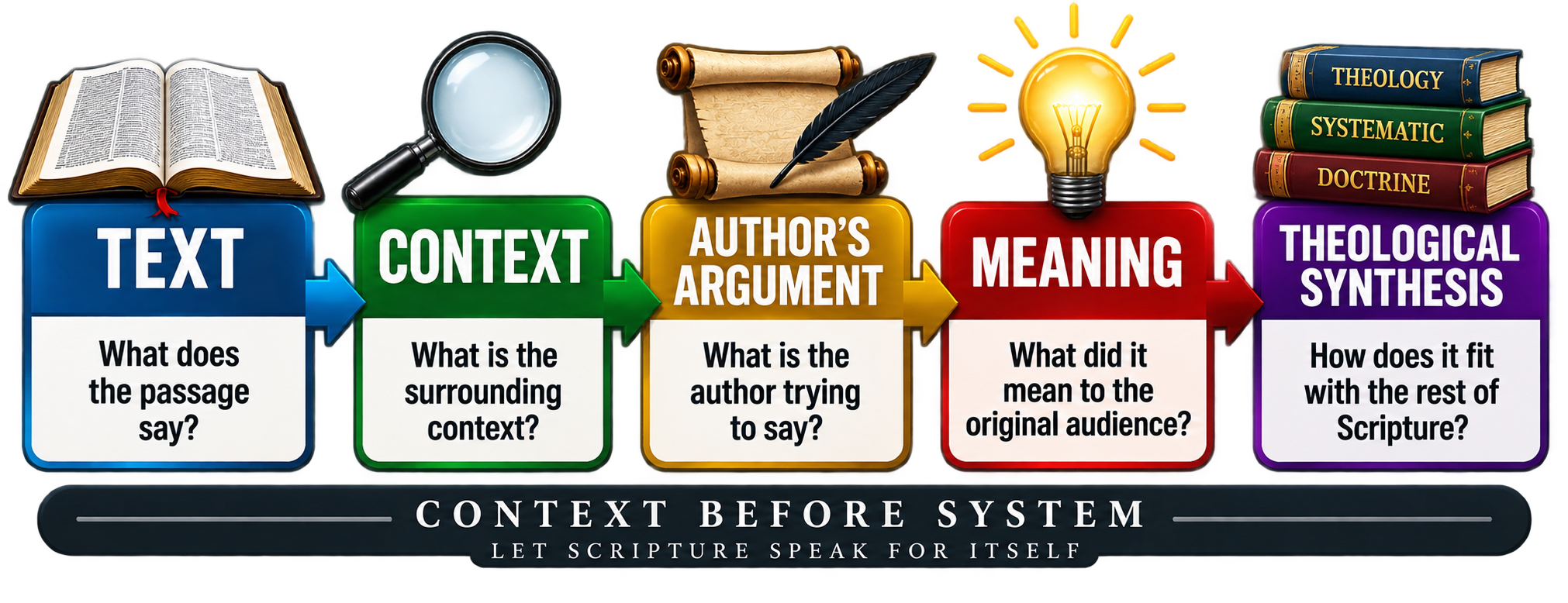
The issue is not whether other passages can be assembled into a doctrine of perseverance. The issue is whether the doctrine has first been demonstrated from those passages in their own contexts—and whether that demonstrated doctrine should then be imported into Matthew 24:13.


Source credit: Appendix adapted from ideas associated with Phil Bair, The Wilted TULIP, with additional contextual framing for this study. As well as Answering Calvinistic Proof Texts (with others mentioned above.

RPT’s Views on Calvinism…

(NOTE: All graphics are linked to articles by artist or their website.)

After an entire year of studies so far, many more to go, I have come to the conclusion that Calvinism teaches a different Gospel. In fact, Calvinism destroys the Gospel and makes good news into anything but.

Calvinism: A Different Gospel

Among other things TULIP / Calvinist Reformational thinking distorts or undermines:

The biggest issue however, that got me thinking differently on this issue a year ago was an article by Albert Mohler.

Here is the full Al Mohler article: “So… Why Did I Write This? The Delusion of Determinism“

The subversion of moral responsibility is one of the most significant developments of recent decades. Though this subversion was originally philosophical, more recent efforts have been based in biology and psychology. Various theorists have argued that our decisions and actions are determined by genetics, environmental factors, or other forces. Now, Scientific American is out with a report on a study linking determinism and moral responsibility.

The diverse theories of determinism propose that our choices and decisions are not an exercise of the will, but simply the inevitable outcome of factors outside our control. As Scientific American explains, determinists argue that “everything that happens is determined by what happened before — our actions are inevitable consequences of the events leading up to the action.”

In other words, free will doesn’t exist. Used in this sense, free will means the exercise of authentic moral choice and agency. We choose to take one action rather than the other, and must then take responsibility for that choice.

This link between moral choice and moral responsibility is virtually instinctive to humans. As a matter of fact, it is basic to our understanding of what it means to be human. We hold each other responsible for actions and choices. But if all of our choices are illusory — and everything is merely the “inevitable consequence” of something beyond our control, moral responsibility is an exercise in delusion.

Scientific American reports on a study performed by psychologists Kathleen Vohs and Jonathan Schooler. The psychologists found that individuals who were told that their moral choices were determined, rather than free, were also more likely to cheat on an experimental examination.

As Shaun Nichols reports:

The Western conception idea of free will seems bound up with our sense of moral responsibility, guilt for misdeads and pride in accomplishment. We hold ourselves responsible precisely when we think that our actions come from free will. In this light, it’s not surprising that people behave less morally as they become skeptical of free will. Further, the Vohs and Schooler result fits with the idea that people will behave less responsibly if they regard their actions as beyond their control. If I think that there’s no point in trying to be good, then I’m less likely to try.

Even if giving up on free will does have these deleterious effects, one might wonder how far they go. One question is whether the effects extend across the moral domain. Cheating in a psychology experiment doesn’t seem too terrible. Presumably the experiment didn’t also lead to a rash of criminal activity among those who read the anti-free will passage. Our moral revulsion at killing and hurting others is likely too strong to be dismantled by reflections about determinism. It might well turn out that other kinds of immoral behavior, like cheating in school, would be affected by the rejection of free will, however.

There are limitations to this kind of research, of course, but the report is both revealing and unsurprising. If we are not responsible for our actions, they why would people do the right thing? The most immediate result of such thinking is the subversion of moral accountability.

Of course, this pattern of thought also renders human existence irrational. How can we understand ourselves, our children, our spouses, our friends, or our neighbors if moral responsibility is undermined by determinism. Our legal system would completely collapse, as would the entire experience of relating to other human beings.

Shaun Nichols explains that “the Western conception of free will seems bound up with our sense of moral responsibility.” That “Western conception” is a product of the Christian inheritance and the biblical worldview. The Bible clearly presents human beings as morally responsible. Christians of virtually all theological traditions — including Reformed theology, Arminianism, and Catholicism — affirm moral and spiritual responsibility and the authenticity of the experience of choice.

As a matter of fact, this capacity and accountability is rooted in the biblical concept of the imago Dei — the image of God. Our Creator made us as moral creatures and planted within us the capacity of conscience. All this refutes the concept of moral determinism.

In its most modern forms, determinism is a product of naturalism — the belief that everything must be explained in purely natural terms. Naturalism explains the human mind (including the experience of moral choice) as a matter of chemical reactions in the brain, and nothing more.

Determinism is implied by naturalism and relieves human beings of moral responsibility. There is no moral revolt against the Creator, no Fall, and no need for the Gospel. This subversion of moral responsibility is both a delusion and a trap. And, as the Scientific American report indicates, even those who say they believe in moral determinism are unable to live consistently with this assumption. We know we are responsible.

If Mohler applies that to his own theological determinism, he would have to reject it. More here: Why Both Atheists and Christians Need to Believe in Free Will. It is this “Exhaustive Divine Determination [EDD]”, or theistic determinism, that really got me studying the issue. Because Calvinist apologists show the self-refuting nature of it when dissecting atheism, but they do not apply it to their determinism.

The implications of strict naturalism are grim or even counterintuitive. For example, Bertrand Russell affirmed that any philosophy hoping to stand must ultimately take for granted the (naturalistic) picture of unguided causes and accidental collocations of atoms and must be built on the “firm foundation of unyielding despair.” When it comes to naturalism’s implications for morality, naturalist Kai Nielsen contends that reason can’t bring us to morality; this picture ”is not a pleasant one,” and that reflecting on it ”depresses me.” When it comes to consciousness, naturalist Daniel Dennett considers it an illusion- -something fellow-atheist Thomas Nagel finds utterly confused:

  • You may well ask how consciousness can be an illusion, since every illusion is itself a conscious experience …. So it cannot appear to me that I am conscious though I am not … the reality of my own consciousness is the one thing I cannot be deluded about …. The view [of Dennett] is so unnatural that it is hard to convey …. Dennett asks us to turn our backs on what is glaringly obvious. … And he asks us to do this because the reality of such phenomena is incompatible with the scientific materialism that in his view sets the outer bounds of reality. He is, in Aristotle’s words, ”maintaining a thesis at all costs.”

Jaegwon Kim acknowledges the stark picture painted by the naturalistic brush. Naturalism is ”imperialistic; it demands ‘full coverage’ … and exacts a terribly high ontological price.”

Paul Copan and Charles Taliaferro (editors), The Naturalness of Belief: New Essays on Theism’s Rationality (New York, NY: Lexington Books, 2019), viii

Let me restate that last sentence:

  • Jaegwon Kim acknowledges the stark picture painted by the EDD adherent’s brush. EDD is ”imperialistic; it demands ‘full coverage’ … and exacts a terribly high ontological price.”

Yep.

What are some of the imperialism in theistic determinism? Here is one:

And there is more:

Divine Rape | Exhaustive Divine Determinism at It’s “Best”?

The Origin of Evil… Calvinist’s Say God, Same as the Atheist

Is Divine Determinism a Different Gospel?

John Piper’s Theistic “Dust Particle” Determinism (Soto 101)

Is God the “devil” Behind Satan? | The Redundancy Argument (TRA)

Logical Ends of TULIP (No Rebellious Creatures)

Calvinism: God Meticulously Controls Everything | even this post

Dumbing Down John Calvin via GROK (Romans Edition)

However, one of the best dealing with the topic can be found in in the book “Calvin’s Desperation: How John Calvin’s Unbiblical Divine Determinism Destroys the Credibility of the Christian Faith“

This video and the following chapter deal with another aspect of why this “new Calvinism” [really it’s old] is really a degradation of God’s character and trustworthiness. The below is an excerpt of the end of a longer video found over at IDOL KILLER. Here is that videos description:

Author, speaker, debater and self-confessed trouble-maker Phil Bair joins Idol Killer to discuss how to destroy Christian credibility. We discuss the various ways in which Theistic Determinism destroys God’s righteousness, human knowledge, and helps atheists justifiably reject Christian theism. We note how Theistic Determinism is not only in opposition to the Bible, but any reasonable world view and thus should be rejected.

Here is the chapter Phil Bair mentioned in the above video:

  • To state the problem concisely, anyone who wants to grant God the type of sovereignty proposed by strong Calvinism, which is a causal account of human willing and acting, yet wants to say that the world is not as it should be (sin) is under a particular burden to explain how they can make these claims in conjunction with one another. —Jeremy Evans [245]

I referred earlier to the possibility of whether God can be divided within himself. Calvin is keenly aware of the problem that if God wills that which he condemns, he is indeed a divided being, and worse, is in conflict with himself. Calvin attempts to deal with this objection:

Their first objection—that if nothing happens without the will of God, he must have two contrary wills, decreeing by a secret counsel what he has openly forbidden in his law—is easily disposed of.[246]

How does he “easily dispose of” this objection? Like this:

Still, however, the will of God is not at variance with itself. It undergoes no change. He makes no pretense of not willing what he wills, but while in himself the will is one and undivided, to us it appears manifold, because, from the feebleness of our intellect, we cannot comprehend how, though after a different manner, he wills and wills not the very same thing. Paul terms the calling of the Gentiles a hidden mystery, and shortly after adds, that therein was manifested the manifold wisdom of God (Eph. 3:10). Since, on account of the dullness of our sense, the wisdom of God seems manifold (or, as an old interpreter rendered it, multiform), are we, therefore, to dream of some variation in God, as if he either changed his counsel, or disagreed with himself?[247]

I have observed how Calvin expresses the contradictory postures he attributes to God. For example:

  • It is God’s will that all come to repentance.
  • It is God’s will that not all come to repentance.

The two propositions above are indisputably contradictory. Now, Calvin claims that the will of God is not at variance with itself. His will is “one and undivided.” It only “appears manifold” to us. But Calvin affirms both of the above propositions. Therefore he absolutely affirms that the will of God is at variance with itself despite his prior denial of the idea. The only way it isn’t is to define God’s will differently between the two propositions. Calvin alludes to this when he says, “we cannot comprehend how, though after a different manner, he wills and wills not the very same thing.” Note the phrase “though after a different manner.” The obvious question is, how are the two “wills” different? If they are “after a different manner,” how does Calvin explain the two kinds of will, and how does he support that explanation? He doesn’t. Instead, he takes a hard left turn that we would never expect from a dignified biblical scholar. Since he denies that the will of God is “multiform” or “manifold,” and tells us that this perception on our part is due to the “feebleness of our intellect,” he has to explain how there aren’t multiple wills that “disagree with himself.”

But for the moment let’s give him the benefit of the doubt. Let’s assume that the word “will” means something different between the two sides of the dilemma. What alternate definition of will might we apply to one or the other? Consider the first proposition 1 quoted above. It’s God’s will that all come to repentance. How do we justify the term will? Acts 17:30 is where it comes from. That verse reads:

In the past God overlooked such ignorance, but now he commands all people everywhere to repent.

So God commands all people everywhere to repent. If God commands something, is it not his will that the command is obeyed? Is this not intuitively obvious and clear to reason?

Consider the captain of a sea-going vessel. The captain issues a command for the first mate to set a course for the mainland. It’s the captain’s will that the first mate obey that command. But what if the first mate doesn’t obey? It would be a valid observation that the first mate did not do the will of his captain. Would it ever be the captain’s will that the first mate disobey his command? Not in this sense of the word. The captain has what we could call “sovereignty” over the crew. And in that sense, the word sovereignty means authority.[248] If the first mate disobeys the captain’s will (expressed by his commands), he has rebelled against the captain’s authority, and thus against his sovereignty.

In this case, the captain’s will does not causally determine the decisions and actions of the crew. But if the crew disobeys the captain’s will, there will be consequences. Why? Because the captain has the authority to impose those consequences on the disobedient.

Now consider an inventor who builds a ship and a dozen or so robots having the ability to be its pilots. Now suppose that the inventor puts on a captain’s uniform and issues a verbal command to the robot he designated as the first mate. The robot cannot “obey” the captain’s command. Obedience implies will, something a robot does not have. The robot will simply respond to the captain’s command because the captain programmed the robot in such a way that it will execute the captain’s orders and cannot do otherwise (assuming the captain’s engineering is flawless).

In the second case, the will of the captain is causal rather than authoritative. The robot will execute the captain’s command not because it chooses to obey, but because it is programmed that way. The captain could still be said to have “sovereignty” over the robots, but the meaning of the term would not be the same as it was in the first analogy. In this case, rather than authority or lordship, sovereignty means causality. The will of the captain is now the cause of everything the robots do, and in fact, the cause of everything that happens on the automated ship.

Do either of these definitions of will sound familiar? Recall Calvin’s fundamental axiom: the will of God is the sole determining cause of all things. Which of the definitions of will is he referring to? The second, obviously. Since Calvin, as I have frequently observed, routinely identifies God’s will as the cause of all things, does he have the luxury of using the term “God’s will” in the first sense? If God’s will is something that can be disobeyed, it cannot be causal; it must be authoritative. But Calvin rules this out. If a creature is able to disobey God’s will, only two possibilities exist: either the creature has a functioning will that can cause something (namely, the disobedience), or the creature is only doing what God has programmed it to do. And since for Calvin God’s will is the sole cause of all things, the first option must be discarded. This is because Calvin asks the rhetorical question “are we, therefore, to dream of some variation in God, as if he either changed his counsel, or disagreed with himself?”[249]  To say we could only “dream of” such a variation seals off all exit routes and guarantees there is no “variation” in God’s will.

Where does this leave us? For Calvin, there can only be one kind of God’s will. That would be the causal kind. What does that do to Calvin’s phrase “though after a different manner?” It obliterates it. So he cannot invoke the idea of God’s will working itself out in a “different manner” since for Calvin there is only one species of God’s will: the causal one. This means that for Calvin, the phrase “he wills and wills not the very same thing” cannot be after a different manner but after the same manner, whether he realizes it or can face it or not. What does this mean? It means that Calvin’s conclusion that God “wills and wills not the very same thin, certified indisputable contradiction.

This is the only way Calvin can say that “the will of God is not at varia with itself.” Notice this refers to the “will” (singular) of God, not being variance “with itself” (singular). Calvin believes, and has always believe that there is only one version of God’s will—the causal one. This is the only kind he can deal with. Any other kind introduces the potential condition that God’s will is not the sole cause of all things, and for Cal vi this is too terrifying to conceive. So even the possibility that we could come up with more varieties of God’s will does not solve the problem. if they are not causal, they have to be ruled out. If they are causal, in terms of their outcomes they are ultimately no different from the first variety.

Now Calvin has a serious problem. He denies what he implies in various places: that there is a secret counsel in God’s will that is beyond the reach of human intellect where he wills that which he condemns. There is no such secret counsel. For if indeed the thesis that “the will of God is not at variance with itself” is true, God’s will must be uniform and undivided.

To put it another way, Calvin has two options:

  1. God’s will is at variance with itself. For Calvin affirms both propositions above. They contradict each other, which is the same thing as variance. Yet Calvin denies this So this option doesn’t work.
  2. God’s will is not at variance with itself, which means that the two contradictory propositions must both be true at the same time and in the same way. For Calvin has no choice but to affirm that it is God’s will that all come to repentance (because the Word of God, namely, Acts 17:30, compels him to affirm this), and in the same way it’s God’s will that not all come to repentance (because according to Calvin God causally determines certain specific individuals of his choosing not to repent, and thus defy his will that they must). It’s God’s will that men must not commit murder, but it’s God’s will that certain men commit murder so as to carry out God’s purposes.[250]

The first option is unreasonable and unacceptable. Why? Because it would mean Calvin is wrong when he says God’s will is not at variance with itself. Calvin can’t admit he’s wrong here or his entire deterministic narrative collapses.

This means Calvin must accept the second option. (There is no third option because of the law of excluded middle.) But accepting the second option means affirming various pairs of propositions that contradict each other. As soon as he writes the words “God’s will is not at variance with itself when he wills and wills not the very same thing,” he is suddenly painfully aware that he has fallen into a trap of his own making. How does he deal with this logical train wreck?

It doesn’t take long to realize that at this point, Calvin has become desperate. He has no choice but to accept a glaring contradiction he can’t pretend isn’t there. His entire ideology has led up to this climax, even though he deals with it in the middle of his Institutes. That doesn’t matter. Two opposing locomotives of thought have been carrying him along the tracks of his thinking and brought him to a point where their hundreds of tons of steel are now fiercely racing toward each other at breakneck speed on the same track. This impending calamity haunts Calvin, knowing that what he is looking at is like the nightmare of an unstoppable force meeting an immovable object. Sooner or later there will be a violent earth-shaking collision. It is only a matter of time.

There is an episode in the original Star Trek series (1966) where Mr. Spock, the champion of logic who has completely suppressed all emotion and passion, finds himself in an impossible situation. He is the pilot of a shuttle craft that has just lifted off to escape a hostile planet. They are in orbit—for now. There is a small handful of passengers On board, all of which know they are doomed. For you see, the ship’s fuel supply is almost gone, the orbit is decaying, and help is nowhere in sight. The situation is hopeless. So Spock makes a decision that defies logic, and the members of the crew are stunned at his irrationality. He jettisons the fuel and ignites it, causing a long luminous trail of burning plasma shooting out of the rear of the shuttle craft. Now they are out of fuel—completely. The shuttle plunges into the atmosphere and begins to incinerate. The cabin fills with toxic smoke and the occupants are choking on it. The dialogue at that moment goes like this:

Doctor McCoy: It may be the last action you’ll ever take, Mister Spock, but it was all human.

Spock: Totally illogical. There was no chance.

McCoy: That’s exactly what I mean.

At the last minute, they are transported out of the shuttle craft and aboard the Enterprise just in the nick of time, where Captain Kirk eventually queries Mr. Spock on the rationale behind his decision:

Kirk: I don’t understand all this, and maybe you can explain, logically of course. When you jettisoned the fuel and ignited it, you knew there was virtually no chance of being seen, and yet you did it anyhow. And that would seem to me to be an act of desperation.

Spock: Quite correct, Captain.

Kirk: Now we all know, and I’m sure the doctor would agree with me, that desperation is a highly emotional state of mind. How does your well-known logic explain that?

Spock: Quite simply, Captain. I examined the problem from all angles, and it was plainly hopeless. Logic informed me that under the circumstances, the only possible action would have to be one of desperation. Logical decision, logically arrived at.

Kirk: Aha. You mean you reasoned that it was time for an emotional outburst.

Spock: Well, I wouldn’t put it in exactly those terms, Captain, but those are essentially the facts.

Kirk: You’re not going to admit that for the first time in your life you committed a purely human, emotional act?

Spock: No, sir.

Kirk: Mr. Spock, you’re a stubborn man.

Spock: Yes, sir.[251]

When you combine desperation with stubbornness, it does not end well. You make decisions that baffle your colleagues (or should), and those who see clearly what is really going on lose all remaining respect they ever had for you. In the Star Trek story, the shuttle craft crew is rescued just before their time runs out. There is no such happy ending for Calvin, who will stubbornly cling to his deterministic ideology until it blasts him into catastrophic rational oblivion. His orbit is definitely decaying, and there is no chance of a rescue. He will never give up his self-inflicted deterministic ruin, because he sincerely believes that to do so will rupture his faulty concept of God’s sovereignty.

Calvin is projecting his own insecurity on God himself, and God does not come off very well as a result. Calvin cannot live with the damage he thinks human libertarian free will inflicts on God’s sovereignty. But neither can he live with the loss of God’s righteousness. He therefore denies that God’s goodness dies of a thousand cuts from how he directly perpetrates the multitudes of evil choices and actions of man. But the only way to deny this is to abandon rationality itself and push the issue into the obfuscating obscurity of the “secret counsel” of God. Calvin must either divide God’s will in two, or divide God’s mind in two. Those are the only choices left, and the first one is unthinkable since it incinerates The Precious: Calvin’s unrelenting deterministic worldview. The following is the ultimate expression of Calvin’s overwhelming desperation:

Nay, when we cannot comprehend how God can will that to be done which he forbids us to do, let us call to mind our imbecility, and remember that the light in which he dwells is not without cause termed inaccessible (1 Tim. 6:16), because shrouded in darkness.[252]

This is the point where the two locomotives of God’s will have their ear-bleeding crash. How can God will (i.e. cause) to be done that which he forbids us to do? Multiple scholars and thinkers have attempted to reconcile these contradictory trains of thought, and many still believe this is possible. But Calvin knew beyond any doubt that they couldn’t. If they could, he would not have had to resort to his irrational desperate maneuver of running away[253] and hiding behind “our imbecility.” This is the only option left, and no one knows this better than Calvin.

As I have already said, there are some “reformed” theologians who will tell us that the solution to the problem is quite simple: there are two aspects of God’s will—his decretive will and his preceptive (or prescriptive) will. But if this was such an obvious and simple solution, why didn’t Calvin ultimately invoke it? It would have saved him one horrific train wreck. As we saw before, Calvin tried, but knew it doesn’t work, which is why he had to resort to such desperate measures. If it worked, he would have adopted it as his grand solution, and presto: problem solved. After all, appealing to two aspects of God’s will is quite easy, and presumably removes the necessity to drag our “imbecility” into the formula to solve the problem. But no. Lest we forget, he, like the preponderance of the “reformed” theologians following in his footsteps, is a determinist. There is nothing more central and all-encompassing in his theology than exhaustive divine determinism. It looms over the entire landscape of his thinking like a solar eclipse. If there’s such a thing as man’s libertarian free will, it has the capacity to be causal, and Calvin loses his mind. The appeal to mystery, which is ultimately what Calvin did, and ultimately what his disciples who truly understand the dilemma do, would not be necessary if the contradiction was not real. Since it is unquestionably real, the “solution” mentioned above is no solution at all. It’s nothing more than a theological game all self-respecting theologians should refuse to play.

To review and recap to settle the matter once and for all, if there’s a separate aspect of God’s will one could call preceptive or prescriptive (as opposed to decretive), the possibility that man could obey it or disobey it based on his own volition suddenly appears on the radar, and Calvin has no choice but to hunt it down and torpedo it. Why? Because it introduces additional causality, and therefore blunts God’s causal sovereignty in the caverns of Calvin’s calculus. Even if a case could be made for the “preceptive” will of God, it must also be causal in order to satisfy the demands of determinism. If it’s not causal, but something that can be obeyed or disobeyed by free agents other than God, something could be “left to fortune” and the world “moves at random,” which causes Calvin’s head to explode. It must therefore be sacrificed to the pagan god EDD, lest it get in the way of Calvin’s desperate maneuver and what

subsequently has become a tragically deformed theology.

That Calvin himself ultimately rejected the possibility that there actually are two species of God’s will is decisively settled by reference to his commentary on Matthew:

if it be objected, that it is absurd to suppose the existence of two wills in God, I reply, we fully believe that his will is simple and one; but as our minds do not fathom the deep abyss of secret election, in accommodation to the capacity of our weakness, the will of God is exhibited to us in two ways.[254]

This excerpt from Calvin’s commentary puts the final seal on the issue: God’s will is “simple and one.” It is not divided, and this ontological split of God’s will into two different halves is a myth. It only seems to us that there are “two wills in God.” It is the same will “exhibited to us in two ways” because “our minds do not fathom the deep abyss of secret election” (a restatement of his never-ending fallacy of begging the question).

But suppose we ignore for the moment Calvin’s indisputable affirmation that God’s will is unquestionably simple and one, and that the concept of two versions of God’s will is a fable. If the preceptive will of God is not causal, the decretive will of God, as I stated earlier, still remains the sole determining cause of all things, including the fact of man’s disobedience to God’s moral and soteriological imperatives. In other words, God’s decretive will is directly and unalterably causing man’s disobedience to his “preceptive will,” removing man from the whole equation entirely. So again, adding an additional species of God’s will changes nothing. And if the preceptive will is causal, we are right back where we started—the entire effort to differentiate between the two is futile, and the rational dilemma remains. Therefore the paltry attempt to split God’s will in half like this is a dead end. Calvin would rather take the option of trashing reason than allow his deterministic ideology to disintegrate as he stares down the barrel of a devastating contradiction.

But how valid is this option? Recall my earlier treatment of the cognitive barrier. We saw that the border between God’s intellect and man’s does not lie along the contours of the laws of logic, but between the limits of man’s comprehension and God’s infinite wisdom. But what Calvin is attempting here is to say that God can reconcile a hard logical contradiction behind the curtain of his “inaccessible” intellect ‑- inaccessible because it is “shrouded in darkness.”[255] This means that Calvin rejects the idea that the cognitive barrier is not located where the laws of logic prevail. He thinks logic is the very locus of the cognitive barrier. Beyond the barrier, God can violate the laws of logic to his heart’s content, expressing the agenda of his dark irrational alter ego lurking somewhere in the godhead, ready to burst into the light whenever some confused theologian somewhere feels the need to embrace abject imbecility.

If we recall the discussion of what happens if God or creation can vitiate rationality, I said there was a reason for bringing it up. If there is a part of God’s mind that can circumvent the laws of logic, the door is open to all sorts of contradictions of the central principles of the nature of reality, the relationship between God and creation, and the reliability of revelation. By embracing the concept of God’s dual mental cavities where one is rational and the other is anti-rational, Calvin has opened this door, and released a panoply of disasters from which there is no recovery. Once this door is open, it can never be closed. The entire superstructure of Christian theism completely breaks down.

Most criminals are desperate, and Calvin’s desperation has driven him to commit the perfect rational crime. He breaks the laws of logic by affirming two contradictory propositions, and demands that God cover for him—giving him a bullet-proof alibi: we puny humans are just too stupid to understand how these contradictory propositions can all be true. But God is so brilliant that he can resolve the unresolvable conundrum on Calvin’s behalf. And since the solution God is expected to provide to bail Calvin out of logic jail is allegedly beyond the cognitive barrier, Calvin doesn’t even have to explain how it works. It’s God’s problem now—if you have an objection, talk to him. Of course, if you do, based on Calvin’s misplacement of the boundaries of the cognitive barrier, no one can guarantee which of the divine schizophrenic personalities you’ll be addressing. In this context, Calvin has just removed himself from the category of serious biblical scholar and his move toward a disappointing form of anti-intellectualism is complete.

But desperate times call for desperate measures. I have seen a similar pattern where some theologians (who consider themselves “reformed”) embrace a bewildering array of irrational and mutually contradictory positions that reveal a disturbing trend that is emblematic of a growing contempt for sound philosophical principles within the orbit of hermeneutics and exegesis. What the Body of Christ needs right now is a renewed recognition that the Word of God is never philosophically inept, the protests of certain anti-philosophical debating opponents notwithstanding. / would strongly suggest that there are some aspects of what is called “reformed” theology that are in dire need of reform. To take what is irrational and correct its incoherent errors is one of the highest expressions of reform we can achieve. I must also restate the fundamental principle I articulated earlier in this volume: anything that violates basic rationality by affirming two contradictory propositions is automatically at war with God’s divine Logos.

In his book The God Who Is There, Francis Schaeffer defends his fundamental thesis that the current gap between the generations is caused by a shift in the concept of truth.[256] Prior to the advent of the gap, almost everyone in our society remained loyal to the law of non-contradiction: that A cannot be non-A at the same time in the same way. But since then, the concept of truth has undergone a fundamental transformation. This is partly due to the influence of the dialectic methodology[257] for arriving at what’s true and false—an approach that finds its roots in the ideas of German philosopher GWF Hegel. Hegel influenced Karl Marx, who influenced the West—and especially the modern-day West—to the point where truth and rationality have become so severely weakened that they have almost reached the point of extinction.

On its face, it is difficult to comprehend the widespread popularity of John Calvin’s incoherent deterministic philosophy. I believe the deterioration of the concept of truth in the West that Schaeffer articulated could be a significant part of the answer. How else can we account for the propensity of so many people of faith to swallow the self‑

contradictory sophistry of Calvinism? If truth is no longer truth in the classical sense, the abandonment of the very categories of true and false is not far behind. I am not suggesting that Calvin was influenced by this shift—it occurred long after he departed this vale of tears. He didn’t accept his contradictions because of the modern erosion of the concept of truth. He accepted them for a different reason: misguided as he was, he sincerely believed God could clean up his reckless logical wet spill with divine brute force and mystery. But this recent emergence of postmodernism could easily be part of the reason why his self-contradictory doctrines find so much sympathy in today’s world. For Calvin, to squander the rules of inference grounded in the divine mind can be justified by appealing to the “secret counsel” of God—which here means cheating while no one is looking. For too many souls in our century, it’s not even called cheating any more.

FOOTNOTES

[245] Jeremy A. Evans, Whosoever Will, 266.

[246] Calvin, Institutes, Book 1, Chapter 18, Section 3, Paragraph 2.

[247] Ibid.

[248] Or lordship.

[249] Calvin, Institutes, Book 1, Chapter 18, Section 3, Paragraph 2.

[250] There may be a temptation to challenge this narrative by saying God occasionally commands his people to kill other human beings within the context of God’s judgment against them. But this is not an example of murder. It is therefore irrelevant to the present discussion.

[251] Star Trek, The Galileo Seven (1967).

[252] Calvin, Institutes, Book 1, Chapter 18, Section 3, Paragraph 2, emphasis mine.

[253] Calvin’s maneuver is a sad reminder of the strategy of the cowardly knights in Monty Python and the Holy Grail: “RUN AWAY!”

[254] John Calvin, Commentary on Matthew, 631.

[255] And all along we’ve been led to believe that God is light, and in him there is no darkness at all (1 John 1:5).

[256] Francis Schaeffer, The Cod Who Is There, 33.

[257] The Socratic Method is often referred to in the literature as the “dialectic method.” This is not what I am referring to here.

Calvinism makes the Word of God null and void through this determinism:


I worked with CHATGPT to redesign this next “Calvinist Toon”

This next section is from Ronnie W. Rogers, Reflections of a Disenchanted Calvinist: The Disquieting Realities of Calvinism (Bloomington, IL: WestBow Press, 2016), 86-97. [Chpt 13, “Preaching of the Gospel” | PDF]

As a pastor, I am intensely concerned with what is included in preaching of the gospel. I realize that all Christians are concerned, and rightly so, but because I do this week in and week out, it is of utmost importance not only to understand the gospel, but to articulate the gospel message in such a way that it clearly reflects what the Scripture teaches and what I believe. I offer the following to elucidate my understanding of the call to preach the gospel.

  1. I affirm the mandate to preach the gospel to everyone (John 6:44, 12:32; Revelation 22:17); that “God was well-pleased through the foolishness of the message preached to save those who believe” (1 Corinthians 1:21). Further, I affirm that the proclamation of the gospel that appeals to the heart and mind in persuasiveness, aided by divine enablements of grace, may result in salvation for anyone who hears.

The means of this grace enablement include but are not limited to: Gods’ salvific love for all (John 3:16), God’s manifestation of His power so that all may know He is the Sovereign (Isaiah 45:21-22) and Creator (Romans 1:18-20), which assures that everyone has opportunity to know about Him. Christ paying for all sins (John 1:29), conviction of the Holy Spirit (John 16:7-11), working of the Holy Spirit (Hebrews 6:1-6), enlightening of the Son (John 1:9), God’s teaching (John 6:4S), God opening hearts (Acts 16:14), and the power of the gospel (Romans 1:16), without such redemptive grace, no one seeks or comes to God (Romans 3:11). Further, I believe that man, because of these gracious provisions and workings of God, can choose to seek and find God (Jeremiah 29:13; Acts 17:11-12). Moreover, no one can come to God without God drawing (John 6:44), and that God is drawing all men, individuals (John 12:32). The same Greek word for draw, helkuo, is used in both verses.” About 115 passages condition salvation on believing alone, and about 35 simply on faith.”[96]Other grace enablements may include providential workings in and through other people, situations, and timing or circumstances that are a part of grace to provide an opportunity for every individual to choose to follow Christ.

John Piper asked the question, “What message would missionaries rather take than the message: Be glad in God! Rejoice in God! Sing for joy in God! …God loves to exalt himself by showing mercy to sinners.”[97] My answer to this question, the truth that when anyone hears this glorious message, is that same someone has a chance, by the grace and mercy of God, to receive the truth of the message by faith. Further, without opportunity for all sinners to accept, that message should be changed to say, “some can be glad in God if He predestined you” or “God loves to exalt Himself by showing mercy to some sinners.” This is the actual message of Calvinism, a disquieting reality, and I would appreciate their due diligence always to make that clear.

I affirm that a truly good faith offer seems to necessitate a willingness to tell a person that Christ died for them. For example, Paul said to the Corinthians, “For I delivered to you as of first importance what I also received, that Christ died for our sins according to the Scriptures” (1 Corinthians 15:1-3). Thus, he told them Christ died for “our” sins when they were lost. Peter preached to the Jews saying, “For you first, God raised up His Servant and sent Him to bless you by turning every one of you from your wicked ways” (Acts 3:26). The blessing is the “turning every one of you from your wicked ways,” i.e. salvation. Notice that the blessing is not corporate—Israel—but for “every one” who turns from wickedness, which clearly implies that they can and should. In addition, our Lord said concerning His blood, “And in the same way He took the cup after they had eaten, saying, ‘This cup which is poured out for you is the new covenant in My blood” (Luke 22:20, italics added). When He said that, Judas was sitting there, verse 21.

Commenting on Acts 3:26, John MacArthur says, “All the rich blessings of salvation and all the covenant promises were available. Peter’s hearers could only obtain them, however, by turning from their wicked ways. Repentance was the key that unlocked everything. Peter had clearly shown that the claims of Jesus were consistent with Old Testament prophecy, so that it was a compelling case for his hearers to respond in repentance and belief Tragically, most of Peter’s audience refused to repent. Like their fathers before them, they hardened their hearts and failed to enter God’s rest (Hebrews 3:8; 4:3). As a result, within the lifetime of many in the audience the nation would be destroyed. And those who refused to turn from their sins would find themselves ‘cast out into the outer darkness’ (Matthew 8:12), where they will `pay the penalty of eternal destruction, away from the presence of the Lord and from the glory of His power’ (2 Thessalonians 1:9). Such a fate awaits all those in every age and place who refuse to repent and receive God’s gracious offer of salvation in Jesus Christ.”[98] (italics added)

Now I unconditionally agree with MacArthur’s explanation of this verse; however, his Calvinism turns the otherwise precise interpretation of this verse into double-talk. His comments give every appearance that he believes that, as this Scripture clearly teaches, “All the rich blessings of Salvation…were available” and these could and should repent, but they did not because “[they] refused to repent …. [and] they hardened their hearts.” He deems their refusal to be a tragedy.

From a non-Calvinist interpretation, it is indeed an eternal tragedy, but from a Calvinist perspective, it is not. Because according to Calvinism’s unconditional election, irresistible selective regeneration, and monergistic salvation, their non-repentance was exactly what God desired and predetermined that they could only do; they will spend eternity in torment, as He also desired. They will serve as predetermined monuments of His wrath. Furthermore, they did not refuse to repent, in any sense of being able to have chosen to do otherwise. As an incontrovertible fact of Calvinism, they did the only thing they could do; thereby proving they were not the elect. Moreover, everyone of God’s elect who heard this was selectively regenerated against his will so that he would unavoidably believe in the Messiah. From his Calvinism, there can be nothing tragic about this event, for everything went according to God’s plan, a disquieting reality, whereas, from a non-Calvinist perspective, it is tragic indeed, and heart wrenchingly so. For they have truly rejected “the rich blessings of salvation” which God had made available through grace-enabled faith.

  1. I disaffirm that while I am commanded to preach the power of the gospel—the good news—to the entire world, God has predetermined to make that power unavailable to the entire audience of the message and has limited it to only those chosen by God apart from faith (Acts 16:31­32, Romans 10:13). It seems that the message to the Philippian jailer, if Paul were a Calvinist, should have been, “Believe on the Lord Jesus Christ, which is the only thing you can do if you have been selected and the one thing you cannot do if you have not been selectively regenerated; consequently, while belief is necessary for salvation, it is not for you to worry about; you should worry about things you can do something about.” Apart from mere obedience and process, the underlying message of Calvinism allows no room for urgency or passionate and emotional pleading either toward or with the unsaved to repent, because all who are predestined to repent will and those who are not cannot repent, i.e., irresistible grace. This is a disquieting reality.

Calvinism is not devoid of passion for seeing the lost come to Christ. Nevertheless, if logic prevails, it is only a vertical passion. That is to say, it is a passion to carry out the mandate of God, to be used by God to gather His elect. It cannot be a Holy Spirit led horizontal passion, which is a burden, love and hurt for all of the lost of the world, or even each particular individual, to come to know Christ. For God, according to Calvinism, does not even have such passion. A consistent Calvinist’s passion is not actually toward the individual but always toward God, which some Calvinists would revel in as vindicating Calvinism; however, that is only true if the Scripture supports such, and I do not think it does. Further, if Calvinism is true, unless the Calvinist knows that God has truly drawn him to one of His elect—which seems impossible to objectively know—the Calvinist needs to refuse to give in to horizontal passion because it can only be mere human sentiment or satanic influence, both of which would actually be contrary to God’s passion.

Paul clearly had a vertical passion for God, but equally clear was his horizontal passion for the lost. He said, “I am telling the truth in Christ, I am not lying, my conscience testifies with me in the Holy Spirit, that I have great sorrow and unceasing grief in my heart. For I could wish that I myself were accursed, separated from Christ for the sake of my brethren, my kinsmen according to the flesh, who are Israelites” (Romans 9:1-4a).

Paul’s passion for his fellow Jews who were rejecting Christ and therefore headed for hell was inconsolable. Although he knew that he could not relinquish his salvation, and even if he did that would not cause others to receive salvation, he did actually love them so deeply and hurt so profoundly for them that he would have surrendered his own salvation and home in heaven for an eternity in the hollows of hell for their sake. This is truly the love of God ( John 3:16) and of Jesus who died willingly for all (John 1:29). Paul’s love for his lost countrymen was of the sacrificial quality that is seen in God who loved the fallen and rebellious human race and therefore, “He who did not spare His own Son, but delivered Him over for us all (Romans 8:32). It is seen in Jesus “who gave Himself as a ransom for all” (1 Timothy 2:6), and therefore sacrificed everything that was rightfully His for this same undeserving humanity. And it is seen in Paul in that he would willingly give up the greatest love and future ever known for his countrymen.

This kind of passion and desire for the lost is exceedingly convicting and constantly challenges me to unreservedly disdain and resist excusing my own jejune love for the lost. Of course, if God has elected only some of the Jews for whom Paul so passionately grieved, then Paul’s passion and burden seem at best nothing more than a misdirected human sentimentalism that is quite contrary to the heart and love of God; possibly even the sin of arrogance. For how can Paul be led by the Holy Spirit who, according to Calvinism, cares not one whit about the final destiny of some of those Paul is so deeply concerned about.

Calvinism’s passion cannot logically, being consistent with Calvinism, be toward the lost in the same way as the simple reading of the Scripture conveys God’s, Christ’s, Paul’s or others’ passion toward all, each person, the lost of the world. If a Calvinist is so disposed, it is an inconsistency with Calvinism rather than a corollary of Calvinism. This is a disquieting reality. As a Calvinist, I would have denied—double-talked my way out of—the truthfulness of this conclusion, but as a disenchanted Calvinist, its undeniableness is indubitable.

This is not to say that Calvinists do not claim to be justified in having passion for the lost and a sense of urgency in reaching them. Regarding God’s secret will to deliver some by unconditional election, J.I. Packer says, “But this does not help us to determine the nature of the evangelistic task, nor does it affect our duty to evangelize universally and indiscriminately. The doctrine of God’s sovereignty in grace has no bearing on these things.” [99] (italics added)

The proposition that either God loves every individual and grace enables each person with an opportunity to receive forgiveness or that God only loves some enough to unconditionally elect them to salvation and loves the rest of the world to hell, and then saying that this has “no bearing” on evangelism is the apotheosis of double-talk. Furthermore, “indiscriminately” intimating or telling people that God loves them and desires for them to be saved is not a message sanctioned by God, according to Calvinism, since He does not so love everyone. They may well seek to justify their doing so, but they cannot claim that God is leading them to do so.

With regard to urgency, Packer says, “the belief that God is sovereign in grace does not affect the urgency of evangelism …. And we who are Christ’s are sent to tell them of the One—the only One—who can save them from perishing. Is not their need urgent? …. If you knew that a man was asleep in a blazing building, you would think it a matter of urgency to try and get to him, and wake him up, and bring him out. The world is full of people who are unaware that they stand under the wrath of God: is it not similarly a matter of urgency that we should go to them, and try to arouse them, and show them the way of escape?”[100]

My heart is truly saddened each time I read such double-talk. First, if truth prevails, the Calvinist must not only tell the lost that Christ is the only One who can save them from perishing, but also the devastating news that the “only One” may have been more pleased to damn them to hell—time will tell, i.e. que sera sera. Second, I agree that their need is urgent, perilously so, and that it is the good and loving thing to rescue sleeping men from blazing buildings, and analogically to arouse the lost who stand under the wrath of God by showing them the way of escape. However, that is not the gospel of Calvinism because according to Calvinism, God does not love everyone that much. How can the Calvinist be so deluded, or believe we are so credulous, to believe that he can love more than God? All the Calvinist can honestly say is, here is the way of escape for some and the rest must burn. It is indeed odd and misleading for Calvinists to attribute a greater passion to themselves for rescuing people who are perishing than they claim for God.

Packer argues that their being the non-elect “should make no difference in our actions. In the first place, it is always wrong to abstain from doing good for fear that it might not be appreciated …. our calling as Christians is not to love God’s elect, and them only, but to love our neighbor, irrespective of whether he is elect or not. Now, the nature of love is to do good and to relieve need. If, then, our neighbor is unconverted, we are to show love to him as best we can by seeking to share with him the good news without which he must needs perish.”[101] (italics added) That there are non-elect and elect must make a difference in actions if one is going to be led by the Holy Spirit who does not love everyone enough to offer salvation that can be accepted by all. I agree “the nature of love is to do good and to relieve need.” However, the Calvinist cannot claim that it is showing our unconverted neighbors love to share the gospel since God, who is love, does not and actually withholds the very love and deliverance some of our neighbors need. Moreover, the Calvinist gospel is definitely not good news to the non-elect, and no amount of double-talk can make it so, a disquieting reality.

He further claims, “The belief that God is sovereign in grace does not affect the genuineness of the gospel invitations, or the truth of the gospel promises. Whatever we may believe about election, and, for that matter, about the extent of the atonement, the fact remains that God in the gospel really does offer Christ and promise justification and life to ‘whosoever will’. `Whosoever shall call upon the name of the Lord shall be saved.”[102] Actually God, according to Calvinism, does not offer Christ and a genuine promise of justification and life to whosoever because only some whosoevers can actually believe. Moreover, in what meaningful sense can an offer that has been sovereignly predetermined to be absolutely unavailable to some who hear be touted as real and genuine? To do so is to egregiously transmogrify those words into the bafflegab of all bafflegab; therefore, to the non-elect, it is neither a genuine or real offer, but rather a crushing illusion and a disquieting reality.

Piper says, “The doctrine of irresistible grace means that God is sovereign and can overcome all resistance when he wills.”[103] It is vitally important to recognize that the Calvinist, as well as Piper’s position, is actually stronger than this with regard to salvation. Their position is that not only does the doctrine of irresistible grace mean that God can overcome, but it actually means He will or must. And later in the same document Piper says, “Irresistible grace never implies that God forces us to believe against our will ….On the contrary, irresistible grace is compatible with preaching and witnessing that tries to persuade people to do what is reasonable and what will accord with their own best interests.”[104] With all due respect to Piper, this is the very kind of obfuscating verbal gymnastics that causes such confusion about the harsh realities of Calvinism. This is a disquieting reality.

Of course, technically speaking, Piper is correct. God does not force faith upon anyone, and I have never contended that Calvinism teaches that He does. However, He does in fact, according to the doctrine of irresistible grace, invincibly impose a new nature upon the elect against their will by means of “irresistible grace” so they will necessarily choose to believe. Furthermore, persuasion, prayers, preaching, etc., have nothing to do with assuring, aiding or impeding the imposition of a new nature because it is a sovereign monergistic act of God, irrespective of anything done by humans or angels. The Calvinist’s response that what they do is a part of the process, or obedience, does not change the nature of the irresistible imposition of a new nature. Steve Lemke comments, “The Synod of Dort insisted that such attempts at moral persuasion of unsaved persons was wasted time.”[105]

When Calvinists respond that witnessing, praying, persuasion, etc., are a part of the process of God bringing people to salvation, they do not mean the same thing as a disenchanted or non-Calvinist saying that God uses such because we mean that they are actual substantive and integral parts of enabling grace. In contrast, according to Calvinism’s soteriology, nothing contributes one whit to the change of the elect’s nature except the monergistic, selective, irresistible, regenerative act of God. Therefore, as far as the process for what leads up to that act, God could have replaced whatever did happen with having His chosen Calvinists to recite the code of Hammurabi in tongues backwards or the national anthem of Bangladesh in Swahili, because nothing actually substantively matters except unconditional election, followed by irresistible grace in selective regeneration. That is a disquieting reality.

I am well aware of the answers to this by Calvinism, but is it not a little disingenuous to proclaim the message without telling the listeners the all too often undisclosed truth of Calvinism? If I preached to the jailer and said Paul’s words, underlying that message would be the truth that the jailer, or any jailer who heard the message, should and could repent, and that is what I believe Paul clearly believed and meant. However, if a Calvinist said it, the underlying message would be that “although I told you to believe you can’t until you are regenerated and if you are regenerated you will believe” and that is a quite different gospel.[106] This is a disquieting reality.

Again, my concern here has nothing to do with whether someone believes it is a good faith offer on the part of the Calvinist, but whether the person hearing it has a real chance to be saved or not. That is to say, if all of the Scriptures that seem to indicate God really wants everyone to be saved and has provided for that possibility are what they appear to be, and if Calvinists really believe what they say, which is that He really does not want everyone saved because according to irresistible grace, if He did, they would be; they should make sure their message makes that clear because it is an extraordinarily important and an indispensable component of their belief and message. Thus, I am satisfied that Calvinists may possibly make a good faith offer because they do not know who the elect are, and that is not my concern here. I am concerned with the idea that some believe that claim exonerates God from appearing to make a real offer because He does know. Therefore, while it is crucial that my offer of the gospel is in good faith, it is infinitely more vital that God’s offer of the gospel is one of good faith as well.

I further disaffirm that God wants the gospel presented to all, and calls on all to repent, but has no intention of those offers of the gospel being real chances for salvation except for some.[107] I believe we should replace the term general call with the more biblically coherent term sufficient call. The sufficient call, along with God’s grace enablement, is sufficient for anyone and everyone to receive salvation. The sufficient call is simply the proclamation of the good news to the world. It is the call of God on men and women everywhere to heed the call to repent and believe the gospel before it is everlasting too late (Acts 17:30-31). It is the call of the Great Commission (Matthew 28:18-20). It is the message preached by Jesus and His disciples (Mark 6:12, 8:35; Luke 3:18, 4:18; Acts 8:12, 8:37, 13:32, 13:38-40, 16:10, 21:28; Romans 1:16, 10:8; Revelation 22:17). Whereas, the efficacious call is received after the sufficient call is heeded, resulting in regeneration and consummating in salvation for those whom God foreknew, predestined, called, justified, and glorifies (Romans 8:28-30).

The means of this grace enablement include but are not limited to: Gods’ salvific love for all (John 3:16), God’s manifestation of His power so that all may know He is the Sovereign (Isaiah 45:21-22) and Creator (Romans 1:18-20), which assures that everyone has opportunity to know about Him. Christ paying for all sins (John 1:29), conviction of the Holy Spirit (John 16:7-11), working of the Holy Spirit (Hebrews 6:1-6), enlightening of the Son (John 1:9), God’s teaching ( John 6:45), God opening hearts (Acts 16:14), and the power of the gospel (Romans 1:16), without such redemptive grace, no one seeks or comes to God (Romans 3:11). Further, I believe that man, because of these gracious provisions and workings of God, can choose to seek and find God (Jeremiah 29:13; Acts 17:11-12). Moreover, no one can come to God without God drawing (John 6:44), and that God is drawing all men, individuals (John 12:32). The same Greek word for draw, helkuo, is used in both verses.” About 115 passages condition salvation on believing alone, and about 35 simply on faith.”[108] Other grace enablements may include providential workings in and through other people, situations, and timing or circumstances that are a part of grace to provide an opportunity for every individual to choose to follow Christ.

Those whom God foreknew would, once graciously enabled to exercise faith or not exercise faith in Christ, trust His salvation message, quite unlike Adam did in the garden, receive the efficacious call that consummates His gracious and genuine offer of salvation. That God foreknows and predestines those whom He foreknows “to be conformed to the image of His Son” is not a point of contention. Neither is the reality that God efficaciously calls those He predestined to “be conformed to the image of His Son” by sanctification, justification, and glorification because salvation requires not only enabling grace, but also sustaining and completing grace. The point of disagreement with my Calvinist friends is whether foreknowledge means, “to know beforehand” or “determine”. I believe that the evidence points to it meaning to know beforehand rather than to determine beforehand. Further, to use verses such as Romans 8:28 or 1 Corinthians 1:24 in order to prove that the effectual call of God is as the Calvinist explains it is to read into the text more than is warranted. They simply assume their answer rather than prove it.

Thus, in contradistinction to Calvinism, I maintain that God made salvation available to everyone through His grace enablements via the sufficient call of the gospel. As a result, because of God’s grace enablements, anyone can accept by faith the sufficient call or reject it. If a person accepts the sufficient call, he receives the efficacious call that consummates salvation. Therefore, the efficacious call is the consummation of salvation for all who believe rather than the initiation in order for some to believe. God sovereignly determined the order and purpose of the two calls. Consequently, being predestined to salvation is not a requirement for receiving the sufficient call of the gospel; it is a requirement for receiving the efficient call of the gospel.

I also disaffirm that the whole mission enterprise is merely obedience, an endeavor that has no real effect upon anyone’s opportunity to receive or reject the gospel and salvation. This disaffirmation is in direct contrast with Calvinism because from a Calvinist view, it does not matter if anyone ever witnesses—beyond being merely a part of the salvific process or only an act of obedience. Moreover, I disaffirm that the Calvinist’s answer that preaching the gospel is the means by which God saves is either satisfactory or adequate if, as the Calvinist believes, salvation is monergistic, and prior to monergistic regeneration, any and every appeal to the heart and mind is meaningless to the person addressed by the Calvinist. Regeneration is an act totally against the person’s will, mind and heart regardless of what he hears or has not heard. This is a disquieting reality.

The Calvinist is right to say that a person is not forced to trust God against his will because according to the doctrine of “irresistible grace”, along with a compatibilist view of free will, God changes the nature of a person by regenerating him, and the changed person then freely chooses to believe in Christ. However, the irresistible change of the nature via regeneration, which results in the free exercise of faith, is an act that is invincibly forced upon the unsaved. Thus, since regeneration is a part of salvation, and according to Calvinism, regeneration is imposed against the will of the unsaved prior to faith; Calvinists err in saying or implying that salvation is by faith alone. This is a disquieting reality. This is a subtle but crucial distinction in understanding how Calvinists feel free to say that a person freely exercises faith in Christ even though he is also irresistibly drawn. When these two essential components of Calvinism’s salvific process are fully understood, the heraldic sign “saved by faith” becomes tarnished. This is a disquieting reality.

I disaffirm that any person cannot repent, or by the grace of God, answer the call of the gospel, which is in fact the ultimate meaning of Calvinism because Calvinists believe that prior to regeneration a person cannot repent and after regeneration they cannot not repent. Further, I disaffirm that preaching out of mere obedience to God is the picture presented in Scripture, where Jesus (Matthew 23:37-39) and Paul (Acts 17:4, 18:4, 18:13; 2 Corinthians 5:11) passionately sought to persuade and were emotional because they spoke to people who would not repent or might not repent. Their passionate appeals seem disingenuous if they actually knew certain ones could come and they would, and certain ones could not come and they would not, and nothing could ever change that or even affect it in the most infinitesimal degree. Moreover, I disaffirm that it is an escapable reality of Calvinism that God must desire those who go to hell to be in hell because everyone He regenerates is saved from hell and the ones He chooses not to regenerate must go to hell. This is a disquieting reality. I wish they would preach this more often so that it could be compared to the quite contrary picture of God in the Scripture.

Why don’t all true Calvinists regularly stand in the pulpit and celebrate their doctrine that selective regeneration precedes faith by saying repeatedly to those who are listening that you cannot be saved unless God regenerates you: if He does you will be saved, if He doesn’t you will not, and nothing can change that or add to it? To preach repent and believe in any way that steers one away from the aforementioned truth of Calvinism is, at best misleading, and at times even deceptive because people cannot believe prior to regeneration and if they are regenerated, they will believe. This is a disquieting reality.

The Calvinist may answer, “We preach believe and repent because we are commanded to.” I would agree, but God also commands us to “speak the truth in love.” Therefore, Calvinists should tell everything they really believe and guard against misleading people to think that Christ loves all of them and they can really receive salvation. They should at least do this as fiercely as they guard their understanding of God’s sovereignty or the TULIP. Some Calvinists do this, and I appreciate and respect them for doing so. I am not referring to them. That the Scripture says to preach the gospel is true, but it does not affirm irresistible grace or the experience of the new birth prior to exercising faith.

FOOTNOTES

[96] Chafer, Systematic Theology, vol. VII, 273-274.

[97] Piper, Let the Nations Be Glad, 33.

[98] John MacArthur, Acts (Chicago: Moody Press, 1994, c1996), 123.

[99] J.I Packer, Evangelism and the Sovereignty of God (Downers Grove, IL., InterVarsity Press, 1961), 97.

[100] Ibid., 98-99.

[101] Ibid., 99.

[102] Ibid., 100.

[103] J. Piper and the Bethlehem Baptist Church staff, “What We Believe About the Five Points of Calvinism,” as quoted in Allen and Lemke, Whosoever Will, 112. [RPT: the full fifth chapter is here for an excellent read.]

[104] Ibid.

[105] Allen and Lemke, Whosoever Will, 113.

[106] I am not making a reference to Galatians 1:6, nor implying heresy in the Calvinist message. I simply mean that some can be saved and some cannot, in contrast with the message that everyone can be saved by faith, is a very different message.

[107] Thomas R. Edgar has written an extensive article on this issue which is worth reading: THE MEANING OF PROGINWSKW (“FOREKNOWLEDGE”). Found at Chafer Theological Seminary | and at Evangelical Arminians | as well as RPT.

[108] Chafer, Systematic Theology, vol. VII, 273-274.

The Ninth Wave (Assisting Grace)

“The Ninth Wave”
(1850 painting by Ivan Aivazovsky)

The above painting is mentioned in the below excerpt of “Calvinism: A Biblical and Theological Critique” by David L. Allen (Editor), Steve W Lemke (Editor), pages 175-182

All images added by RPT

The Alternative of Prevenient or Assisting Grace. What alternative is there to affirming irresistible grace? The most common alternative to irresistible grace is usually called prevenient or assisting grace.107 In assisting or enabling grace, God through the Holy Spirit convicts, convinces, and impels the unsaved toward repentance and faith. God can exert powerful influences through the Holy Spirit to incline unbelievers toward faith and obedience without literally forcing them to do so or changing their wills (John 15:26–27; 16:7–15; 1 Thess 1:5).

Humans cannot save themselves. This situation was depicted powerfully in an 1850 painting by Ivan Aivazovsky, “The Ninth Wave,” which hangs in the Russian Museum in St. Petersburg. The painting on an enormous canvas depicts the aftermath of a sunken sailing ship. Only the mast of the ship remains afloat. The survivors of the sunken ship cling to the mast of the ship, buffeted by high waves. Like much of earlier Russian art, the painting communicates a powerful spiritual message. Like most sailing ship masts, this mast is in the shape of a cross. Only those who cling to the cross will be saved. No one can save themselves. It is only by the grace of God that the mast can save them, though they must take hold of it.

While driving home from preaching one Sunday night years ago, I experienced a terrible wreck. The car rolled off the road out of my control, making me feel as if I was being tossed round and round like clothes in a dryer. The airbag crushed my glasses, so I could not find the brake as the vehicle rolled. Since I knew I had been going at interstate highway speed and never touched the brake, I simply waited for the last crash that I thought would end my life. However, when the vehicle stopped rolling, I was alive but in pain. I crawled out of the car into the ditch. I was hurting and alone on this cold night in a remote area. But drivers who saw the wreck called 911, and an ambulance came to get me. I couldn’t even get up myself because of the pain. They put me on a stretcher and took me to the hospital. There the doctors ministered to me, diagnosed the problem, and put me on a path toward healing. But before the medical staff helped me, they first asked me to sign a consent form. I had to consent before I could receive care. I was delighted to receive from them what I could not do for myself!108

Eternal salvation has some similarities to my physical rescue. We cannot save ourselves. We can do no good “works” to rescue ourselves (Eph 2:8–9). The only thing humans can do is assent to be rescued, or at least not resist being rescued. Giving one’s assent to be saved is not a “good work.” Unfortunately, in the world of salvation, all too many refuse to accept Jesus’s gracious offer of salvation. Most do not even recognize they are drowning and reject all efforts to warn them. Some foolishly think they can save themselves, but they cannot. In the end, because of their rejection of the persistent witness of the Holy Spirit and the salvation proffered through Christ, God reluctantly allows them to drown eternally in their own sins (Matt 12:32; Mark 3:29; Luke 12:10; Rom 1:21–32; 5:6–21).

Billy Graham put it so well:

There is also volitional resolution. The will is necessarily involved in conversion. People can pass through mental conflicts and emotional crises without being converted. Not until they exercise the prerogative of a free moral agent and will to be converted are they actually converted. This act of will is an act of acceptance and commitment. They willingly accept God’s mercy and receive God’s Son and then commit themselves to do God’s will. In every true conversion the will of man comes into line with the will of God. Almost the last word of the Bible is this invitation: “And whosoever will, let him take of the water of life freely” (Rev 22:17). It is up to you. You must will to be saved. It is God’s will, but it must become your will, too.109

We have it from God’s own Word—God chooses how he wants to exercise his sovereignty. We should understand sovereignty from God’s perspective, not from a sinful human perspective. If we truly believe in the sovereignty of God, we must be obedient to the criteria he has laid down. We should let God be God and rule the world and bring about salvation as he has sovereignly established in his Word.

Irresistible Grace Gives God More Glory

Non-Calvinists are happy to affirm the strong emphasis that glorifying God should be our primary vocation, as John Piper has articulated so well.110 However, while agreeing that God’s people should give him the praise he rightfully deserves, we should be mindful that (a) God does not need our praise, and (b) our praise does not make God more glorious. God is glorious! His shekinah glory radiates from him every moment of eternity. There is nothing you or I could do to make him more glorious. We can and should simply join in the heavenly chorus giving him the praise and glory he rightfully deserves. Praising God is one of our responsibilities and privileges as believers, but he is already perfectly glorious. The key question is, what gives God maximal glory?

Moral Problems with Monergism. Many Calvinists believe that only monergistic salvation gives God the maximal glory. According to Matthew Barrett, “Monergism preserves God’s glory”:111

If God’s work in calling and regenerating the sinner is conditioned upon man’s will, then God cannot receive all the glory in salvation. But if God works alone, effectually to call and regenerate dead sinners, then He does receive all of the glory in our salvation. . . . [O]nly monergism can do justice to the glory of God in salvation.112

Let there be no doubt what monergism entails. It entails God’s culpability for reprobation because he predestines a few to heaven and most to hell. Hear the words of John Calvin himself:

God not only foresaw the fall of the first man, and in him the ruin of his posterity, but also at His own pleasure arranged it.113

We say, then, that Scripture clearly proves this much, that God by his eternal and immutable counsel determined once for all those whom it was his pleasure one day to admit to salvation, and those whom, on the other hand, it was his pleasure to doom to destruction.114

First, how do Calvin’s words align with God’s Word? Calvin’s words stand in sharp contrast to the words of God recorded in Ezek 33:11: “Tell them, ‘As I live—this is the declaration of the Lord GOD—I take no pleasure in the death of the wicked, but rather that the wicked person should turn from his way and live. Repent, repent of your evil ways! Why will you die, house of Israel?’” as well as the repeated assertions in the New Testament that God desires that all persons be saved (Matt 18:14; 1 Tim 2:4; 2 Pet 3:9; 1 John 2:2).

Second, is God’s refusal to save the majority of persons praiseworthy for God? I think not! Imagine a fireman who goes into a burning orphanage to save some young children because they are unable to escape by themselves and can be saved only if he rescues them. Only the fireman can save them because he has an asbestos suit. He comes back in a few minutes, bringing out three of the thirty children; but rather than going back in to save more children, the fireman goes over to the news media and brags about how praiseworthy he is for saving the three children. He believes he should be glorified for saving a few. Indeed, saving the three children was a good, heroic deed. But the pressing question on everyone’s mind is, What about the other twenty-seven children? Since he has the means to rescue the children and, indeed, is the only one who can save the children since they cannot save themselves, do we view the fireman as morally praiseworthy? We would not. In fact, probably he would be charged with depraved indifference homicide. He had the means to help them, but he would not. If we do not find that praiseworthy in a human, why would we find it praiseworthy in God? If God deliberately decided not to save (i.e., give irresistible grace to) anyone in your family (your parents, siblings, spouse, or children), indeed, if he took a pernicious pleasure in dooming them to destruction, would that make him more glorious for you? For most of us, it would make him less glorious.

[….]

[….]

Questions about Conflict within God’s Will. Second, the notion of irresistible grace also creates questions about the character of God that present him as less glorious. The two callings (the outward and inward, effectual and ineffectual, serious and not serious callings) correspond to two apparently contradictory wills within God (the revealed and secret wills of God). The revealed will of God issues the Great Commission that the gospel should be preached to all nations, but the secret will is that only a small group of elect will be saved through irresistible grace. The revealed will commands the general, outward call to be proclaimed, but the secret will knows that only a few will receive the effectual, serious calling from the Holy Spirit. The God of hard Calvinism is either disingenuous, cynically making a pseudo-offer of salvation to persons whom he has not given the means to accept, or there is a deep inner conflict within the will of God. If he has extended a general call to all persons to be saved, but has given the effectual call irresistibly to just a few, the general call seems rather misleading. This conflict between the wills of God portrays him as having a divided mind. In response to this challenge, Calvinists appeal to mystery. Is that a successful move? No, because God’s revealed will is not a mystery; it is revealed in his Word.

The Remonstrants, against whom the Synod of Dort was directed, raised the concern that the hard Calvinist perspective advocated by the Synod of Dort portrayed God as riddled by inner conflict. The Remonstrants later affirmed in a response written after the Synod of Dort:

  1. All those whom God calls to salvation, those he calls seriously, that is, with an upright and altogether unfeigned purpose and will to save. And we do not agree with those who hold that God externally calls some whom He does not will to call internally, that is, does not will that they be actually converted, even before they have rejected the grace of the calling.
  2. There is not in God such a hidden will which stands over against His will which is revealed in the Word, that He according to that will (that is, the hidden will) does not will the conversion and the salvation of the greater part of those whom He through the Word of the gospel, and according to the revealed will, is seriously calling and inviting unto faith and salvation; neither do we here acknowledge, as some speak, a holy dissimulation, or a double person in God.115

Some Calvinists attempt to downplay this criticism by advocating the “well-meant offer” or “free offer” of the gospel to the lost. As the Synod of Dort affirmed in Doctrine 2, article 5:

Moreover, the promise of the gospel is, that whosoever believes in Christ crucified shall not perish, but have everlasting life. This promise, together with the command to repent and believe, ought to be declared and published to all nations, and to all persons promiscuously and without distinction, to whom God out of His good pleasure sends the gospel.116

However, such a claim appears to be not only logically contradictory but also mean-spirited to proclaim a false offer of salvation to persons who have no possible chance to receive it because they were not one of the lucky ones to get irresistible grace. Obviously, portraying God as having a divided mind and will is not the way we want to go. It seems disingenuous for God to offer a definitive, serious calling to some but not at all offer a serious calling to others. This does not make God appear more glorious!

Irresistible Grace Is Impersonal. The biblical image of God is based on God as love (1 John 4:7–8) and God as holy (1 Pet 1:16). A God who says he loves all people and desires to save all people but intentionally saves just a few is not the God of the New Testament. The God of the Bible deals with persons as persons, as F. Leroy Forlines articulated; for us to be in a relationship with God, we must be dealt with as persons rather than as machines:

In the relationship of the physical to the physical, or the relationship of the parts of a machine to one another, we are dealing with cause and effect relationships. . . . When a hammer hits a nail, the hammer is active and the nail is passive. The hammer causes the nail to be driven into the wood. The nail had no choice. A force outside the nail caused the nail to be driven into the wood. Interpersonal relationships do not submit to such a simple analysis. Influence and response provide more appropriate terms. . . . [T]he inability of one person to cause another person to do something grows out of the nature of what it means to be a person. . . . There is no such thing as a person doing or not doing something without having made a decision. . . . [I]t has been a mistake over the centuries to focus the conflict between Calvinists and Arminians on whether fallen or redeemed man has a free will. The real question is: Is fallen man a personal being, or is he sub-personal? Human beings are personal beings, by God’s design, and were made for a personal relationship with a personal God. God will not violate His own plan.117

The same concern pertains to the distinction that Calvinists make between the “universal” (ineffective) call and the “particular” (effective) call. Suppose we had a “will changer” machine or pill that turned its victim into a mindless robot who always did what he or she was instructed. The 1975 cult movie The Stepford Wives told this story, often repeated with variations in various science fiction story lines. The Stepford, Connecticut Men’s Association had the technology to turn their wives into subservient, robotic women who existed only to please their husbands. If taken to court, the Men’s Association members would definitely not be held up for praise. They would be accused and tried for crimes such as kidnapping, enslavement, and brainwashing. We would not consider the men to be glorious. We would consider them to be depraved. Is this not how Calvinists are portraying God? He is changing people’s will so they will glorify him? Why would the omnipotent Lord of the universe even care about that? To even suggest such a thing is to view the Bible from a radically anthropocentric point of view in which God desperately needs people to give their approval to him, even if he has to force them to do so. Love is only meaningful when it is chosen. Therefore, if we are concerned about God’s greater glory, it would be in a world of free persons, not persons whose will was mechanically overridden.

What understanding of sovereignty gives God greater glory? Does this notion of sovereignty as total control bring the greatest glory to God? No. Suppose a couple desires to have a baby. They have at least two options. Option one is that they can go down to Walmart and purchase a doll. That plastic doll, for every time they pull its string, will say, “Daddy, I love you!” Now that is total control. They can have that doll say, “I love you” anytime they want. They just pull its string; the doll has no decision but to react the way it has been programmed to react. Option two, however, is to have a real baby. Now, they know from the beginning that the baby is going to be more trouble. Babies do not come home from the hospital housebroken. They cry all night. They break their toes, and they break your hearts. But when that child of his or her own volition says, “Daddy, I love you,” it really means something. The parents are more glorified with a real child than with a doll that could not have praised them had they not pulled its string. So, then, which gives God the greater glory—a view that the only persons who can praise God are those whose wills he changes without their permission, or the view that persons respond to the gracious invitation of God and the conviction of the Holy Spirit to praise God truly of their own volition?

NOTES

[107] Although “prevenient grace” is the term most often used in the non-Calvinist tradition, I prefer to use the term “assisting grace,” “enabling grace,” or to simply use the biblical language as in John 16:7–15. For further exploration of the concept of prevenient grace see W. Brian Shelton, Prevenient Grace: God’s Provision for Humanity (Wilmore, KY: Francis Asbury Press, 2014).

[108] For another version of this “ambulatory” model, see Cross, “Resistibility of Grace,” 199–210; and Keathley, Salvation and Sovereignty, 103–5. Cross and Keathley use this example to argue that one can affirm both that salvation is monergistically brought about by God and that God’s grace is resistible. My position adds to their view that a positive response is necessary, which, regarding salvation, requires responding in faith to Jesus Christ.

[109] Billy Graham, The World Aflame (Minneapolis: Billy Graham Evangelistic Association, 1967), 134.

[110] John Piper, God’s Passion for His Glory: Living the Vision of Jonathan Edwards (Wheaton, IL: Crossway, 1998).

[111] Barrett, “Monergism,” 186.

[112] Barrett, 120–21.

[113] Calvin, Institutes, trans. H. Beveridge, 232 (3.23.7); emphasis added.

[114] Calvin, 210 (3.21.7); emphasis added.

[115] “The Opinions of the Remonstrants,” Responses to article 3 of the Synod of Dort, comments 8– 9, in Vance, The Other Side of Calvinism, rev. ed. (Pensacola, FL: Vance Publications, 1999), appendix 3, 604; also available online at “C. The Opinion of the Remonstrants regarding the third and fourth articles, concerning the grace of God and the conversion of man,” The Arminian Opinions (Heretical), A Puritans Mind.

[116] “The Canons of the Synod of Dort,” in Schaff, Creeds of Christendom, 3:586 (II, art. 5); available online.

[117] F. Leroy Forlines, The Quest for Truth: Answering Life’s Inescapable Questions (Nashville: Randall House, 2001), 313; italics in the original.

Sproul’s Theology Posits a Majority of Christians Are Really Atheists

So since I reject the “Reformed” definition of God’s sovereignty and hold to more of a Provisionist stance… I am an atheist?

Is Tozer an atheist?

  • “God sovereignly decreed that man should be free to exercise moral choice, and man from the beginning has fulfilled that decree by making his choice between good and evil. When he chooses to do evil, he does not thereby countervail the sovereign will of God but fulfills it, inasmuch as the eternal decree decided not which choice the man should make but that he should be free to make it. If in His absolute freedom God has willed to give man limited freedom, who is there to stay His hand or say, What doest thou? Mans will is free because God is sovereign. A God less than sovereign could not bestow moral freedom upon His creatures. He would be afraid to do so.”

In an earlier post I highlight Dr. Wayne Grudem, a five-pointer, saying our prayers are even scripted since before time by the [Calvinistic] sovereignty of God. Hear it for yourself:

I re-edited the original video from SOTO 101 because I cannot stand double time playback. Plus, I wanted to isolate this section… see some of Phil Bair’s books HERE.