John 15:16 says, “You did not choose me, but I chose you…” Does this teach the the doctrine of divine election? Albert Mohler says yes, but James White says no. Who is correct. Let’s discuss… (More at Election According to Jesus)
Here is the Calvinist/TULIP/Reformed reading
John 15:14–19 — The “Calvinized” Reading
What happens when we take Jesus’ words to His disciples and read them as though He were directly explaining the Calvinistic doctrine of unconditional individual election to a modern Reformed believer?
14 “You are my friends if you do what I command you.”
[MODERN REFORMED BELIEVER]: I am one of Christ’s elect, and my obedience demonstrates that I am truly regenerated and therefore one of His genuine believers.
15 “I do not call you servants anymore, because a servant doesn’t know what his master is doing. I have called you friends, because I have made known to you everything I have heard from my Father.”
[MODERN REFORMED BELIEVER]: Jesus has revealed the truth to me because I am one of God’s elect. His saving revelation has been effectually given to me because God has chosen me.
16 “You did not choose me, but I chose you. I appointed you to go and produce fruit and that your fruit should remain…”
[MODERN REFORMED BELIEVER]: “I did not choose Christ. Christ unconditionally chose me for salvation before I was born. His sovereign choice preceded my faith, and His effectual calling ensured that I would believe.”
17 “This is what I command you: Love one another.”
[MODERN REFORMED BELIEVER]: My obedience and love for other believers are evidence that I am genuinely elect. If I persevere in faith and obedience, I demonstrate that I was truly regenerated.
18 “If the world hates you, understand that it hated me before it hated you.”
[MODERN REFORMED BELIEVER]: The world hates me because I am one of God’s elect and therefore belong to Christ rather than to the world.
19 “If you were of the world, the world would love you as its own. However, because you are not of the world, but I have chosen you out of it, the world hates you.”
[MODERN REFORMED BELIEVER]: “Jesus chose me out of the world because I am one of the individuals God unconditionally elected to salvation rather than one of those whom He passed over.”
Responding to the Calvinist Reading
The Calvinist reading of John 15:16 begins with something absolutely true: Jesus chose His disciples. The problem is what is then inferred from that statement. Jesus says,
“You did not choose Me, but I chose you. I appointed you to go and produce fruit and that your fruit should remain.”
The Calvinist interpretation often moves from “I chose you” to “God unconditionally chose you for salvation,” and then from “I appointed you” to “God effectually called you.”
But those additional theological conclusions are not actually stated in the passage. The immediate context tells us what Jesus’ choice involved: He chose and appointed these disciples to go, bear fruit, remain faithful, love one another, and serve as His witnesses in the world. In fact, just three verses later Jesus explains this choice by saying, “because I have chosen you out of the world,” in the context of warning these same disciples that the world will hate and persecute them. The question is therefore not whether there is divine election in John 15:16—there clearly is—but what Jesus elected these people to do. A sound hermeneutic requires us to let the context answer that question before importing a systematic-theological definition of election into the text.
This is where hermeneutics becomes especially important. The principles of definition, usage, context, historical setting, logic, unity, and inference remind us that a conclusion may be true in a larger theological system without being the meaning of a particular verse. See my Five-Finger Life Punch that simply puts the matter thus:
biblical hermeneutics seeks to recover the meaning communicated to the original hearers, while exegesis draws meaning out of the text rather than reading our presuppositions into it.
John 15 is Jesus speaking to His disciples on the eve of His crucifixion, preparing them for continued obedience, fruitfulness, persecution, and witness. John 17 continues this same distinction: Jesus specifically prays for those given to Him and entrusted with His word, and then distinguishes them from those who will subsequently believe through their message. The apostles have a unique role as Christ’s appointed witnesses.
Therefore, when a modern Reformed believer reads “You did not choose Me” as “you were unable to choose Christ,” “I chose you” as “I unconditionally elected you to salvation,” and “I appointed you” as “I effectually called you,” he has moved beyond what John 15:16 actually says.
The issue is not whether God chooses; the issue is whether we have allowed the text to define what His choosing means, or whether we have made the Calvinistic system define it for us.
That is precisely the difference between exegesis and eisegesis.
Exegesis – (Gk. explanation) Critical exposition or explanation of the meaning of a scriptural passage in the context of the whole Bible. The reader of Scripture studies the word meanings and grammar of the text to discern what… was communicated, drawing the meaning out of the text rather than reading what he wants into the text (eisegesis).
Eisegesis – is the process of interpreting a text or portion of text in such a way that it introduces one’s own presuppositions, agendas, and/or biases into and onto the text.
[….]
Who was the writer?
To whom were they writing?
Is the choice of words, wording, or word order significant in this particular passage?
What is the cultural, historical context?
What was the author’s original intended meaning?
How did the author’s contemporaries understand him?
Why did he say it that way?
[….]
3) Rule of Context: Avoid using words out of context. Context must define terms and how words are used.
Many a passage of Scripture will not be understood at all without the help afforded by the context; for many a sentence derives all its point and force from the connection in which it stands. (Biblical Hermeneutics, Terry. M. S.. p. 117. 1896.)
[Bible words] must be understood according to the requirements of the context. (Thayer’s Greek English Lexicon of the New Testament, p. 97.)
Every word you read must be understood in the light of the words that come before and after it. (How to Make Sense, Flesch, Rudolph, p. 51, Harper & Brothers. 1959.)
[Bible words] when used out of context . . . can prove almost anything. [Some interpreters] twist them . . . from a natural to a non?natural sense. (Irenaeus, second century church father, quoted in Inspiration and Interpretation, p. 50, Eerdmans Pub. Co., 1957.)
The meaning must be gathered from the context. (Encyclopedia Britannica, Interpretation of Documents. V. 8, p. 912. 1959.)
This is a slightly truncated version of a Faith On Fire video. I am not always a fan of his style, or hyperbole… but this was good.
BIBLIOGRAPHY:
RPT. “A Short Study on Ways to Approach Scripture That Create Sound Doctrine.” Religio-Political Talk. Accessed October 4, 2026. Religio-Political Talk
RPT. Five-Finger Life Punch. Religio-Political Talk, August 2023. Five-Finger Life Punch
Myers, Jeremy. “John 15:16—‘You Did Not Choose Me, but I Chose You.’” Redeeming God. Redeeming God
“John 15:16—‘You Did Not Choose Me, but I Chose You.’” Answering Calvinism. Answering Calvinism
BIBLICAL PASSAGES REFERENCED
The argument also draws substantially on John 6:70; John 13:18; John 15:1–27; John 17:6–20; Acts 10:39–43; Romans 3:1–2; Ephesians 3:1–12; and Genesis 12:1–3.
Calvinism is built on prooftexts. In this episode we will be conducting an experiment to demonstrate why CONTEXT is more important than prooftexts. We will also consider why people become Calvinists in the first place. Get ready to see ULTRA Limited Atonement!
Here is the “Pauline” Systematic:
The Thought Experiment: Inventing Pauline Particularism
J17 Apologetics makes an unusual move in Why CONTEXT Beats Prooftexts! – Episode 24. Rather than simply telling the audience that proof-texting can be misleading, he invents a fictitious theological system and then demonstrates how easily that system can be made to appear biblical when passages are removed from their contexts. He repeatedly interrupts himself to remind the audience that the theology is fake, that he invented it, and that he does not actually believe it. The purpose of the exercise is methodological: it shows what happens when a theological conclusion is established first and biblical passages are then gathered to support it.
He calls his fictional system “Pauline Particularism,” which he also describes as an “ultra limited atonement.” The central proposition is deliberately outrageous, and that outrageousness is part of the demonstration: if a reader can be shown a case for a claim this obviously false, then the problem with proof-texting becomes easier to see.
Jesus Christ died only for Paul.
Obviously, J17 is not arguing that Scripture actually teaches this. Instead, he asks us to imagine someone who genuinely believed it and then constructed a theological case for it using biblical proof texts. The exercise shows how statements that are individually true can be removed from their contexts, linked to other statements, and arranged into an elaborate theological system that appears to have substantial biblical support.
The key to the exercise is that the conclusion comes before the evidence. The fictional theologian begins by deciding that Jesus died only for Paul. He then goes looking through the Bible for passages that contain language that might be made to fit that conclusion. J17 describes this as starting with an idea and then searching Scripture for verses that appear to support it. Once enough verses have been collected, the resulting list can be presented as evidence that the Bible teaches the doctrine.
Building the Case from Isolated Passages
Galatians 2:20 becomes an obvious starting point because Paul says that the Son of God “loved me and gave himself for me.” The fictional theologian can emphasize the word “me”:
Christ loved Paul, Christ gave Himself for Paul, and Paul is therefore the particular object of Christ’s self-giving.
The same verse can then be pressed further through Paul’s statement, “I have been crucified with Christ,” so that the passage begins to sound as though it describes a uniquely Pauline relationship to Christ’s death.
J17 also demonstrates how someone could make the argument sound more authoritative by appealing to Greek. He walks through grammatical features of Galatians 2:20 and shows how Paul’s relationship to the verbs of loving and giving can be emphasized. The grammatical observations themselves do not establish the fictitious doctrine; they show how technical language can give an interpretation an appearance of greater certainty. J17’s point is that Greek does not automatically rescue someone from bad interpretation. A person can understand the grammar and still misunderstand the author’s intention.
The fictional theologian can then move to1 Timothy 1:15, where Paul says that Christ Jesus came into the world to save sinners and identifies himself as the chief of sinners. The reasoning becomes deceptively simple: Jesus came to save sinners; Paul says he is the chief of sinners; therefore, Jesus came to save Paul. Once that conclusion is accepted, the theologian can connect it back to Galatians 2:20 and say that Jesus not only came to save Paul but gave Himself specifically for Paul.
The same approach can be applied to Jesus’ teaching about the lost sheep. Because Jesus speaks of leaving the ninety-nine and going after the one sheep that has gone astray, the fictional theologian can simply identify Paul as the one sheep. Once that identification is assumed, another biblical passage appears to support the theory: Jesus goes after the one, and Paul is the one.
Therefore, the argument goes, Paul’s salvation occupies this unique place in Christ’s saving work. The passage has now been made to serve a conclusion that was already established before the passage was examined.
The argument can continue with Paul’s discussion of the race and the prize in 1 Corinthians 9. Paul says that those who run a race run to obtain a prize, and he speaks about running in such a way as to obtain it. The fictional theologian can then connect this with Paul’s statement in 2 Timothy 4 that he has finished the race and kept the faith. Paul receives the crown of righteousness. Therefore, the argument can be constructed that Paul is the particular person who has been selected to receive the ultimate prize.
When Contradictions Are Reinterpreted by the System
But the same passage also creates a problem. Paul says that the crown is not for him only, but also for all who have loved Christ’s appearing. The fictitious theology therefore has to absorb a statement that appears to broaden the promise beyond Paul. Rather than abandoning the system, the theologian reinterprets or qualifies the contradiction. J17 uses this move to demonstrate an important feature of proof-text systems: once the conclusion becomes the controlling framework, passages that appear to challenge it are given secondary interpretations rather than being allowed to challenge the conclusion itself.
Paul’s unique apostolic calling can then be recruited into the system. Paul is described as a chosen instrument, separated to the gospel, and given a distinctive mission. Those statements are true descriptions of Paul’s ministry, but the fictional theologian can subtly move from Paul has a unique calling to Paul has a unique salvific status. The distinction between Paul’s particular apostolic role and the broader biblical discussion of salvation disappears because the theological system requires it to disappear.
Romans 9 can then be brought into the argument to explain why everyone except Paul is excluded. The fictional theologian appeals to the potter and the clay and the vessels made for honor and dishonor. Paul becomes the vessel of honor, while everyone else becomes a vessel of dishonor. God’s sovereign authority over His creation then becomes the theological explanation for why Paul alone receives salvation. J17 intentionally pushes the language in this direction to show how biblical statements about God’s sovereignty can be incorporated into a completely invented system when the surrounding context is ignored.
At this point, the fictitious theology has become self-reinforcing. Whenever a passage appears to contradict the doctrine, the theologian does not necessarily reconsider the doctrine. Instead, the passage is reclassified, qualified, or interpreted through the already-established system.
In effect, the doctrine has stopped being something derived from Scripture and has become the lens through which Scripture is interpreted.
Why Context, Not Quantity, Tests an Interpretation
That is the critical distinction J17 wants the viewer to recognize. There is nothing inherently wrong with having biblical evidence for a theological position. The problem occurs when a person starts with a theological conclusion and then searches Scripture for isolated statements that can be made to support it. The resulting collection can become extremely persuasive simply because of its size. A person can look at twenty, thirty, or even a hundred references and conclude, “Surely this doctrine must be biblical.”
But the number of references does not answer the more important question:
What does each passage actually mean in its own context?
J17’s fictional Pauline Particularism demonstrates this by producing a surprisingly large collection of apparently supportive texts for an obviously fabricated doctrine. He says that he assembled roughly twenty-five passages and could easily have found more. Once the passages are gathered together, the temptation is to assume that the sheer quantity of biblical material proves the conclusion. But none of the authors of those passages intended to establish the proposition that Jesus died only for Paul. The appearance of support comes from the way the texts have been selected and assembled.
This is why context is so important. A biblical statement cannot be understood merely by extracting its words. We need to know who is speaking, who is being addressed, what circumstances are being discussed, what question or problem the author is addressing, and how the statement fits within the author’s larger argument. The meaning of a sentence is not determined simply by the fact that its individual words can be found somewhere else in support of our preferred theological conclusion.
J17 makes the same point about the original languages. Greek can provide valuable information, but simply knowing Greek does not make an interpretation automatically correct. He illustrates this with an ordinary expression such as “we’re going to go in there and take them out.” The exact same words could mean very different things depending upon whether the speaker is a military operator, a dentist, or a contractor. The words themselves do not tell us what is happening. The context does.
That principle applies just as strongly to biblical Greek. A person can identify the correct vocabulary, grammatical forms, cases, tenses, and syntactical relationships and still miss what the author is actually saying. Grammar tells us important things about the text, but grammar operates within context. As J17 puts it, “Context is more powerful than Greek.”
The Pauline Particularism thought experiment therefore exposes a fundamental weakness in the “pile of proof texts” approach (Phil Bair | Soteriology 101).
Passage
Calvinist use
Contextual observation
Matthew 10:22
“He who endures to the end will be saved” = perseverance of the saints
Examine who is being addressed, the immediate mission/persecution context, and what “saved” means
Luke 21:19
Endurance proves genuine faith
Examine the Olivet context and the relationship between endurance and deliverance
1 Peter 1:5
God guarantees perseverance
Explicitly examine whether the passage establishes that proposition or is being used to interpret Matthew 24:13
Jeremiah 32:40
God guarantees that believers will never turn away
Covenant context and the identity of the people addressed matter
1 John 2:19
Those who leave were never genuinely saved
Examine John’s immediate argument concerning the antichrists/false teachers
John 10:28–29
No true believer can ultimately fall away
Directly discuss what the passage says about Christ’s protection
Philippians 1:6
God completes His work
Examine Paul’s specific context and what “good work” refers to
Jude 24
God keeps believers from stumbling
Distinguish divine preservation from the particular meaning of Matthew 24:13
Does “foreknew” necessarily mean foreordination of individuals, and does the passage itself establish the entire Calvinistic causal chain?
Acts 13:48
Unconditional election / effectual calling
What does Luke mean by “appointed/ordained” and who exactly are the people being described in the immediate context?
Ephesians 1:11
Meticulous divine determinism
Does “works all things according to the counsel of His will” actually establish that God determines every individual human choice?
Romans 8:7–9
Total inability
Does inability to live according to the flesh equal inability to respond to the gospel?
1 Corinthians 2:14
Total inability
Does “the natural person does not accept…” mean the unregenerate person cannot understand/respond to the gospel at all?
Ephesians 2:1–3
Spiritual death / Total Depravity
Does being “dead in trespasses” itself define the mechanics of the sinner’s will?
Romans 3:10–18
Total Depravity
Does Paul’s indictment establish inability to believe, or does it establish universal unrighteousness apart from God’s provision of righteousness by faith?
Imagine someone appearing in a church and announcing that Jesus died only for Paul. Suppose that person then produced a long list of biblical references: Galatians 2:20, 1 Timothy 1:15, Acts 9, 1 Corinthians 9, 2 Timothy 4, Romans 9, Matthew 18, 2 Corinthians 12, and many others.
The natural reaction might be, “That’s an awful lot of Scripture.” The right test is not how many passages have been collected, but whether those passages actually teach the doctrine being attributed to them.
This is ultimately what J17 is attempting to demonstrate with his fictional theology. He is not claiming that Calvinists literally believe Jesus died only for Paul. He is demonstrating that a theological system can be made to look biblical when its conclusion is established first and Scripture is subsequently mined for supporting statements. The warning is aimed at the method, not at a claim that any real group teaches Pauline Particularism.
The Proper Movement from Text to Doctrine
The lesson, then, is not that proof texts are useless. Biblical passages are the foundation of Christian theology. The issue is how those passages are used. Scripture should not merely be searched for words that resemble our doctrinal vocabulary. It should be read as communication from authors who wrote to particular audiences, in particular circumstances, for particular purposes.
J17’s fictitious Pauline Particularism makes the difference visible. If someone can construct an elaborate theological system claiming that Jesus died only for Paul by collecting enough isolated biblical statements, then the mere existence of a large collection of proof texts cannot be considered sufficient evidence that a theological system is true.
The number of proof texts is not the proof; context is the test.
For a quick adult Sunday class handout I made [and taught years back], see my “Five Finger Life Punch.”
What does Jesus mean when He says “he who endures to the end will be saved” in Matthew 24:13?
Much of Scripture has been hijacked by wrong theology due to philosophical presuppositions, seeking to interpret passages from a Western mindset, and attempting to spiritualize or allegorize its meaning. When we understand the passage within the literary genre, cultural context, and surrounding context, we often discover that what we’ve heard doesn’t match with what God’s word actually says.
This is the case with Matthew 24:13, where some teach that if you don’t endure in good works, faith, love, or obedience, then either you lose your eternal life, or you never truly had it. But is that really what Matthew 24:13 means?
This video uncovers the cultural context surrounding Matthew 24:13 and how a Jewish perspective is vital in properly understanding these words of Jesus.
More on this with MacArthur’s take:
Matthew 24:13 — When a System Enters the Flow of the Text
A closer look at John MacArthur’s treatment of
endurance, salvation, and perseverance
Matthew 24:13 in Its Immediate Prophetic Context
This study argues that Matthew 24:13 should first be read within Jesus’ end-times discourse before it is enlisted as a proof text for a broader doctrine of perseverance. The concern is not whether perseverance is biblical, nor whether systematic theology has a legitimate place, but whether this specific verse carries the full theological weight often placed on it. The argument proceeds by examining the verse’s immediate context, the meaning of “saved,” the force of Jesus’ warning, MacArthur’s treatment in both the Study Bible and larger commentary, and the qualified contrast provided by the Bible Knowledge Commentary. That contrast is useful not because BKC agrees with every Free Grace conclusion, but because it shows that a conservative premillennial commentary can read Matthew 24:13 as Tribulation deliverance within the passage’s own prophetic framework.
Matthew 24:13 occurs within Jesus’ response to the disciples’ question about the destruction of the temple, the sign of His coming, and the end of the age (Matt. 24:1–3). The surrounding discourse is unmistakably concerned with events associated with the end: false Christs and deception, wars, famines and earthquakes, persecution, death, betrayal, false prophets, increasing lawlessness, the cooling of love, the abomination of desolation, the Great Tribulation, the coming of the Son of Man, and the gathering of the elect.
Within that flow Jesus says, in Matthew 24:13, that the one who endures to the end will be saved. The statement is direct. The interpretive question is not whether Jesus expects endurance—He plainly does—but what theological conclusions may legitimately be drawn from this statement in its immediate context.
A broader Calvinistic formulation can turn the statement into a larger theological chain: regeneration produces certain perseverance; perseverance demonstrates that regeneration was genuine; and failure to persevere demonstrates that regeneration never occurred. That may be defended from a wider systematic theology, but it is not identical to the proposition stated in Matthew 24:13.
The exegetical issue, then, is one of direction. Is the larger theological system being derived from Matthew 24:13, or is Matthew 24:13 being interpreted through conclusions already established elsewhere in the system? A theologian may argue for the broader doctrine from other passages, but this verse should first be allowed to speak within the argument Jesus is actually making.
What Does “Saved” Mean Here?
By “systematic theology,” this study means the practice of organizing biblical teaching across multiple passages into a coherent doctrinal framework. The issue is not whether that practice is legitimate, but whether the completed framework is allowed to determine the meaning of a passage before the passage has been read in its own literary and historical setting.
The Greek verb sōzō can refer to salvation in the ultimate spiritual sense, but its range can also include deliverance or preservation from danger. Because Jesus is discussing persecution, tribulation, deception, and the culmination of the age, the immediate context matters before the word is automatically assigned a fully developed systematic meaning.
This reading is strengthened by a common Free Grace observation: the verb sōzō does not always mean eternal salvation from condemnation. It can mean to save, preserve, rescue, or deliver from danger, and the context must determine which sense is in view. Since Matthew 24 describes persecution, deception, betrayal, flight, tribulation, and the coming deliverance associated with Christ’s return, the possibility of physical deliverance or preservation should not be dismissed before the context has been allowed to speak.
A related point is the use of “saved” later in the same discourse. In Matthew 24:22, Jesus says that unless those days were cut short, “no flesh” would be saved. That use naturally refers to physical survival through the severe days of tribulation. While verse 13 and verse 22 are not identical statements, their proximity within the same prophetic discourse cautions against assuming that “saved” in verse 13 must automatically mean justification or final entrance into heaven.
The question is not whether Matthew 24:13 can have implications for ultimate salvation. It may. The question is whether the verse itself establishes the additional claims that regeneration necessarily guarantees perseverance and that failure to endure proves regeneration never took place.
The phrase “to the end” should also be read in the discourse itself. Jesus is answering questions about the end of the age, the events that precede His coming, and the climactic period of distress described immediately afterward. On that reading, “the end” need not mean the end of an individual believer’s life; it may refer to the end of the tribulational period in view. This reinforces the need to distinguish endurance through a prophetic crisis from a generalized proof text for lifelong perseverance.
The Bible Knowledge Commentary makes this contextual point with unusual clarity, though its use here should be carefully qualified. Louis A. Barbieri Jr. interprets Matthew 24:9–14 as part of the coming Tribulation and states that those who remain faithful “until the end of that period of time” will be saved, “that is, delivered.” He then distinguishes this from the idea of personal endurance producing eternal salvation, explaining the verse as physical deliverance for those who trust in the Savior during the Tribulation and who will enter the kingdom in physical bodies. This does not make BKC a Free Grace commentary in every respect; it makes BKC a valuable witness to the fact that the immediate prophetic context can control the meaning of “saved” in Matthew 24:13.
That sequence is important:
Tribulation, persecution, endurance, deliverance, and entrance into the earthly kingdom.
It is not the same sequence as regeneration, guaranteed perseverance, evidence of regeneration, and proof of eternal salvation. The issue, again, is not whether the latter doctrine can be argued from other passages, but whether Matthew 24:13 itself establishes that doctrine when read in the flow of Jesus’ discourse.
The Force of the Warning
The warning in Matthew 24 is presented as a real warning. Jesus tells His hearers to beware of deception, remain faithful amid persecution, and endure to the end. If a theological system already defines the perseverance of every genuine believer as infallibly guaranteed, however, the reader must still ask what function the warning has within Jesus’ own argument.
A Calvinist can answer that God uses warnings as the means by which He secures the perseverance He has already ordained. That answer may be internally coherent within the system, but it also illustrates the precise interpretive issue under examination. The warning is no longer being explained only from Matthew 24; it is being explained through a prior doctrine concerning God’s determination of the believer’s perseverance.
The distinction is important. Jesus plainly commands endurance, and BKC also treats faithfulness, watchfulness, and preparedness as meaningful responses of those who trust the Savior during the Tribulation. The further claim that endurance is guaranteed because of prior regeneration, and that eventual failure therefore proves the absence of genuine regeneration, is a theological inference that requires its own exegetical demonstration.
MacArthur’s Study Bible and Larger Commentary: Same Theological Move, Different Presentation
That distinction becomes especially important when evaluating MacArthur, because the question is not whether he recognizes the prophetic setting, but how he connects that setting to the doctrine of perseverance. The comparison with BKC should therefore be framed narrowly: both readings operate within an eschatological framework, but they draw different conclusions from the function of “saved” and “endure” in verse 13.
A more precise assessment of John MacArthur’s treatment is important here. MacArthur does not simply remove Matthew 24:13 from its prophetic setting. Both his Study Bible and his larger commentary understand Matthew 24 within an end-times framework involving Christ’s coming, persecution, deception, apostasy, the Tribulation, the proclamation of the gospel, and the events surrounding the end of the age.
The Study Bible actually preserves that prophetic framework around Matthew 24:13. Its note on verse 10 interprets those who fall away as people who demonstrate that they were never true believers. Its note on verse 13 then explains perseverance through the doctrine that God secures the perseverance of true believers and that those who ultimately fall away prove that they were never truly believers. Most significantly, its note on verse 14 explicitly identifies “the end” with the final birth pains associated with the Great Tribulation.
The larger commentary gives the same theological move a longer contextual runway. MacArthur first establishes that Matthew 24:4–14 describes events associated with Christ’s future coming and the Tribulation. He then treats verses 10–13 under the heading “Defection of False Believers,” explaining the people who fall away as individuals who had an outward identification with Christ but demonstrate by their defection that they never truly belonged to Him.
At verses 12–13, the larger commentary makes the systematic connection especially explicit. MacArthur explains that endurance does not produce salvation but functions as a Spirit-empowered product and proof that a person is already saved. True believers, he argues, will not ultimately renounce Christ because Christ protects them from such defection. Endurance therefore becomes evidence of genuine salvation within his broader doctrine of perseverance.
The difference between the two works is therefore primarily one of presentation, not of basic theological direction. The Study Bible states the systematic conclusion very compactly at verse 13, while the larger commentary develops the prophetic setting more extensively before making the same connection between endurance, genuine salvation, and perseverance.
This distinction matters because the criticism should not be that MacArthur fails to recognize the end-times context. He clearly does. The more precise issue is that, within that recognized end-times context, he interprets Jesus’ statement about enduring to the end through a broader Reformed doctrine of perseverance.
The Bible Knowledge Commentary Provides an Important Contrast
The Bible Knowledge Commentary offers a useful comparison because it explicitly maintains the same prophetic framework while interpreting Matthew 24:13 differently. Barbieri understands Matthew 24:4–14 as describing events associated with the future period preceding Christ’s return, with verses 9–14 describing persecution, deception, apostasy, and increasing wickedness during the Tribulation.
When Barbieri reaches Matthew 24:13, he states that those who remain faithful “until the end of that period of time” will be saved, “that is, delivered.” He then specifically distinguishes this from eternal salvation resulting from human endurance, explaining that the verse refers instead to physical deliverance of those who trust in the Savior during the Tribulation, followed by their entrance into the kingdom in physical bodies.
This interpretation is significant because it demonstrates that recognizing endurance in Matthew 24:13 does not necessarily require interpreting endurance as the Calvinistic doctrine of guaranteed perseverance of the saints. The BKC recognizes the command and necessity of remaining faithful, yet understands the promised “salvation” in the immediate prophetic context as deliverance from the Tribulation and preservation into the Messianic kingdom.
The BKC further states that the primary application of Jesus’ instructions in this section concerns the future generation that will experience the days of the Tribulation, while allowing a secondary application for believers living today. It also adds that the church is not directly in view in these verses. That qualification matters because the argument does not depend on treating Matthew 24:13 as addressed to the church in the same direct way that later epistles are. The primary contextual setting is a future prophetic crisis, while broader application must be drawn carefully by principle rather than assumed as the verse’s immediate doctrinal subject.
Thus, the contrast is instructive. MacArthur reads endurance as evidence of genuine salvation within a broader doctrine of perseverance. The Bible Knowledge Commentary reads endurance through the Tribulation as resulting in physical deliverance and entrance into the earthly kingdom. The difference demonstrates the central question of this study: what does Matthew 24:13 establish from its own context before a broader theological system is brought to bear on the passage?
This comparison also helps keep the critique fair. The point is not that the Bible Knowledge Commentary agrees with every aspect of a Free Grace interpretation or rejects every theological concern MacArthur is trying to protect. Barbieri operates within a conservative premillennial framework, speaks of people being redeemed during the Tribulation, identifies them as believers, and understands later judgment scenes as revealing genuine faith through preparedness, watchfulness, mercy, and faithfulness. The narrower point is stronger: even within that framework, Matthew 24:13 is interpreted as deliverance through the Tribulation rather than as a direct formulation of guaranteed perseverance.
This qualification also prevents an overstatement of the evidence. The BKC can be used to show that a contextual, Tribulation-focused reading of “saved” as delivered is not novel or merely polemical. It should not be used to claim that Barbieri shares the same doctrine of justification, assurance, rewards, or perseverance as every Free Grace writer. Its value is comparative and exegetical:
it demonstrates that the immediate prophetic context can control the meaning of “saved” in Matthew 24:13 even in a commentary that remains conservative, premillennial, and concerned with genuine faith.
Genuine believer → God secures perseverance → believer necessarily endures → endurance demonstrates genuine salvation → those who ultimately fall away were never genuinely believers.
The second formulation is not simply a restatement of the first. It is a theological synthesis that brings Matthew 24:13 together with numerous other passages concerning divine preservation, perseverance, apostasy, and genuine faith. MacArthur cites texts such as 1 Peter 1:5, Jeremiah 32:40, 1 John 2:19, John 10:28–29, Romans 8:38–39, 1 Corinthians 1:8–9, Philippians 1:6, Hebrews 10, Revelation 3, and Jude in developing this argument.
Those passages may be relevant to a broader doctrine of perseverance. But their accumulation also demonstrates that the argument has moved beyond what Matthew 24:13 says by itself. A theological system can take a statement from one passage, connect it with statements from several other passages, and then bring the resulting synthesis back to the original passage as though the entire synthesis were already present there. Consistency with a theological system is not the same thing as demonstrating that the original passage teaches every component of that system.
A Significant Point of Agreement—and a Significant Point of Difference
Interestingly, MacArthur’s treatment actually provides substantial support for the contextual observation that Matthew 24:13 belongs within an end-times setting. His larger commentary explicitly connects the passage with the future Tribulation and the people who will experience that period. The Study Bible likewise connects the surrounding verses with the Great Tribulation and Christ’s return.
The more precise disagreement concerns what is then made to follow from verse 13. MacArthur moves from Jesus’ statement that the one who endures to the end will be saved to a broader conclusion in which endurance functions as evidence of prior genuine salvation and ultimate defection demonstrates that a person was never truly a believer. BKC, while still concerned with genuine faith and redeemed Tribulation believers, does not make verse 13 itself carry that full doctrinal sequence.
That may be a legitimate topic for a broader theological argument. But it should not be confused with the immediate grammatical statement of Matthew 24:13 itself. The question is not whether MacArthur can construct a doctrine of perseverance from Scripture. The question is whether this particular verse establishes that doctrine in the full sense assigned to it.
The Cross-References Reveal the System
The cross-references make the method especially visible. MacArthur appeals to passages such as Matthew 10:22, Luke 21:19, 1 Peter 1:5, Jeremiah 32:40, 1 John 2:19, John 8:31, Matthew 7:23, Matthew 10:32–38, and 2 Timothy 2:12. These texts may be relevant to a broader doctrine of perseverance, but their accumulation shows that the argument has moved beyond the immediate statement of Matthew 24:13.
This is an important distinction for any study of proof texts. The more passages that must be assembled to explain what a single verse supposedly means, the more carefully we should distinguish the meaning of the verse from the theological synthesis built around it.
The Free Grace critique therefore presses the same methodological concern from another angle, and the BKC comparison gives that concern an important qualification. If Matthew 24:13 is read as a Tribulation-context promise of deliverance for those who endure that period, then using it as a direct proof of perseverance of the saints requires an additional interpretive step. At the same time, the argument should not imply that every commentator who reads “saved” as deliverance shares the same doctrine of assurance, rewards, or perseverance. The narrower point is that the verse may still be discussed alongside passages on endurance, reward, faithfulness, and preservation, but it should not be made to bear conclusions that arise only after it has been relocated into a different doctrinal framework.
The literary flow supports that caution. Matthew 24:9–14 describes Tribulation conditions and the need for endurance. Matthew 24:15–26 continues with the abomination of desolation and the Great Tribulation. Matthew 24:27–31 then describes the visible return of the Son of Man and the gathering of the elect. Matthew 25 develops judgment and preparation for the kingdom. Read in that sequence, verse 13 functions naturally within a prophetic argument about enduring through the crisis until Christ’s delivering intervention.
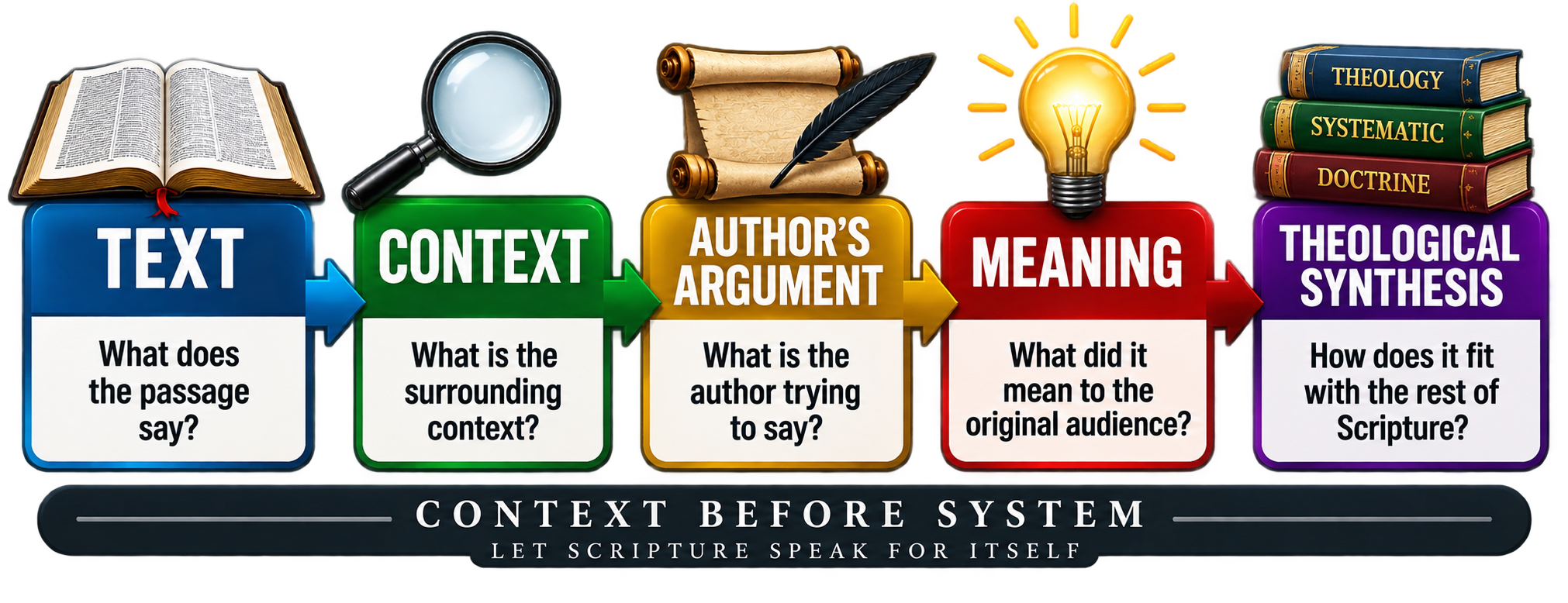
Context Before System
The better starting point is to resist the temptation to ask, “What verse proves perseverance of the saints?” Instead, begin with the passage in front of us. Who is Jesus addressing? What question is He answering? What events does He describe? What does “the end” refer to in this discourse? What does “saved” mean in this setting? How do verses 10–14 function together? What happens immediately afterward in verses 15 and following?
Only after those questions have been answered should we ask how Matthew 24:13 relates to doctrines developed from the rest of Scripture. That order matters because it prevents the theological system from silently becoming the interpretive framework by which the text is defined. It also keeps comparative evidence in its proper place: BKC may support the contextual reading of “saved” as deliverance, while still operating from theological commitments that are not identical to a Free Grace framework.
The principle is simple: establish the meaning and context of the passage before drawing the theological conclusion. Define the terms, examine their usage, follow the author’s argument, and consider the historical and literary setting. Only then should the conclusion be compared with other passages of Scripture. In that order, Scripture controls the system rather than the system controlling the text.
The concern is not that systematic theology exists; it is whether the system is being derived from the text or imported into the interpretation of it.
The result is a more disciplined use of proof texts and a fairer use of secondary sources. Matthew 24:13 can still contribute to a larger discussion of perseverance, but it should do so after its own context has been heard clearly. The Bible Knowledge Commentary helps show that this contextual reading is not merely polemical, but its support must be stated with precision: it confirms a Tribulation-deliverance reading of the verse without requiring agreement on every related doctrinal question. That approach does not weaken doctrine; it strengthens it by requiring theological conclusions to rest on careful reading rather than inherited assumptions.
Primary Sources Used
John MacArthur, commentary on Matthew 24:1–14, in the uploaded PDF “Macarthur – Jesus 2nd coming.pdf,” especially the sections on the background (24:1–3), the birth pains (24:4–14), and “Defection of False Believers” (24:10–13).
John MacArthur, Study Bible notes on Matthew 24:10–15, including the notes on falling away, perseverance, and “the end” in relation to the Great Tribulation.
“A Free Grace Interpretation of Matthew 24:13,” Free Grace Free Speech, January 25, 2026.
Bob Wilkin, “He Who Endures Will Be Saved (Matthew 24:13),” Grace Evangelical Society, November 17, 2020.
Louis A. Barbieri Jr., “Matthew,” in The Bible Knowledge Commentary: An Exposition of the Scriptures, ed. J. F. Walvoord and R. B. Zuck, vol. 2 (Wheaton, IL: Victor Books, 1985), 76–81.
The main argument directly above has focused on Matthew 24:13 and the danger of allowing a broader doctrinal system to determine the meaning of a single text before that text has been read in context. The appendix applies the same method to several other passages commonly used in discussions of perseverance, offering brief contextual checks rather than full exegetical treatments.
Appendix — The “Proof Text” Problem
Quick contextual responses to commonly cited perseverance texts via Phil Bair (The Wilted Flower) and SOTO 101 (Answering Calvinistic Proof Texts | and more: HERE,
The following passages are among the texts commonly brought into discussions of the perseverance of the saints. The point is not that these passages are irrelevant to security, God’s faithfulness, or perseverance. Rather, each passage should first be allowed to make its own contextual claim. A promise of God’s faithfulness is not automatically a statement that apostasy is metaphysically impossible, and a description of present security is not automatically a guarantee of future perseverance.
1. John 5:24 — “Whoever hears … and believes”
“Whoever hears my word and believes … has eternal life.”
The verse gives strong assurance to the person who hears and believes. The Calvinist argument often moves from present possession of eternal life to the conclusion that the person can never subsequently abandon the faith. But the verse itself does not discuss the possibility of later apostasy. Its stated condition is hearing and believing. The text therefore establishes a promise to the believer; the additional claim of guaranteed future perseverance requires support from other passages.
2. John 6:35–37 — “I will never cast out”
“Everyone who comes to me will never be hungry, and the one who believes in me will never be thirsty.”
Jesus gives assurance to those who come to Him and believe. Nothing in the promise says that Christ will cast away a person who genuinely continues to come to Him. The larger discourse must be considered before turning the promise into a proposition about the impossibility of future apostasy. John 6:66 also records disciples who stopped following Jesus, demonstrating that the discourse itself contains a distinction between those who follow and those who depart.
3. Romans 8:35–39 — Nothing can separate us
“Who can separate us from the love of Christ?”
Paul’s list emphasizes external afflictions and hostile forces—trouble, distress, persecution, famine, nakedness, danger, sword, death, life, angels, rulers, things present, things to come, powers, height, depth, and creation. The passage establishes the invincibility of God’s love against external opposition. It does not explicitly address a believer’s own repudiation of Christ. Therefore, the conclusion that the passage proves the impossibility of apostasy goes beyond what the listed obstacles actually address.
4. 1 Peter 1:3–5 — “Kept … through faith”
“You are being guarded by God’s power through faith for a salvation that is ready to be revealed in the last time.”
This is one of the most important texts to examine because it explicitly combines divine preservation with faith. God’s power guards believers, but Peter says this guarding operates “through faith.” The verse therefore strongly affirms God’s active preservation without, by itself, defining preservation as an unconditional mechanism that eliminates the believer’s continuing response.
5. Philippians 1:6 — “He who started a good work”
“He who started a good work in you will carry it on to completion until the day of Christ Jesus.”
Paul expresses confidence in God’s faithfulness toward the Philippians. But the verse is a pastoral expression of confidence within a letter that repeatedly calls believers to continue in faithful obedience. It does not explicitly formulate the proposition that every genuinely regenerated individual is metaphysically incapable of apostasy. That broader doctrine must be established from the whole biblical witness rather than assumed from the promise.
6. Ephesians 1:13–14 — Sealed with the Spirit
“In him you also were sealed with the promised Holy Spirit. He is the down payment of our inheritance…”
The seal signifies God’s ownership and the Spirit’s role as a pledge of the inheritance. That is powerful assurance. But the passage does not use the word “seal” to define a doctrine of inevitable perseverance. The same letter contains exhortations to believers and warns them not to grieve the Holy Spirit (Eph. 4:30). The existence of a divine seal therefore should not be expanded into a conclusion the immediate verse does not state.
7. 1 Corinthians 1:6–8 — “He will sustain you to the end”
“He will also strengthen you to the end, so that you will be blameless in the day of our Lord Jesus Christ.”
This is a significant assurance of God’s faithfulness. But it occurs in a letter that repeatedly warns believers about serious consequences of disobedience and falling. The promise establishes God’s ability and faithfulness to sustain His people; it does not, standing alone, define the precise relationship between divine sustaining grace and a believer’s continuing response.
8. Jeremiah 32:39–40 — “They will not turn away from me”
“I will put the fear of me in their hearts so that they will not turn away from me.”
This is a strong covenant promise concerning God’s work among His covenant people. It is therefore important evidence for divine initiative and preservation. But its covenantal and prophetic setting should be established before it is transformed into a universal proposition about the mechanics of individual regeneration. A promise concerning God’s covenant faithfulness does not automatically settle every question about the possibility of apostasy in every context.
9. John 17:12 — “I guarded them”
“I protected them in your name that you have given me.”
Jesus is speaking specifically about the disciples entrusted to Him. The verse demonstrates Christ’s protective care over those disciples in the context of His earthly ministry and prayer. It should not automatically be generalized into a systematic proposition that every true believer must necessarily persevere. The identity and situation of the persons Jesus is describing matter.
10. Hebrews 13:20–21 — God equips believers
“May the God of peace … equip you with everything good to do his will.”
This benediction celebrates God’s ability to equip His people for faithful living. It is not a technical statement about whether apostasy is possible. Hebrews must be read as a whole, including its repeated warnings about drifting, hardening, and failing to continue. The benediction should therefore be read alongside—not used to erase—the warnings.
11. Hebrews 6:17–19 — “Hope as an anchor”
“We have this hope as an anchor for the soul, firm and secure.”
The imagery emphasizes the reliability of God’s promise and gives believers strong encouragement. It does not itself say that a believer cannot abandon the hope. The same chapter contains the sobering warning of verses 4–6. Consequently, the assurance passage and the warning passage should both be permitted to retain their force rather than allowing one to cancel the other.
SOME OF THE BIGGIES
12. Ephesians 1:3–14 — “Chosen in Him”
“He chose us in him before the foundation of the world … having predestined us to adoption as sons through Jesus Christ.”
Ephesians 1 clearly teaches divine initiative, election, predestination, adoption, redemption, and the believer’s inheritance. The question is not whether Paul speaks about God’s choosing and predestining work, but who was chosen, for what purpose, and how the passage describes participation in those blessings.
The phrase “in Christ” is especially prominent throughout the passage. Paul speaks of believers being blessed “in Christ” (v. 3), chosen “in Him” (v. 4), accepted “in the Beloved” (v. 6), redeemed “in Him” (v. 7), receiving an inheritance “in Him” (v. 11), and finally being “sealed with the promised Holy Spirit” after hearing the gospel and believing in Christ (v. 13).
Verse 4 also states the purpose of the choosing: “that we should be holy and blameless before Him.” The passage therefore clearly connects God’s choice with a specific purpose, but it does not explicitly state the complete theological sequence often inferred from it:
That sequence requires additional theological premises drawn from other passages.
Verse 13 deserves particular attention because Paul explicitly describes the readers’ response in this order:
they heard the gospel, believed in Christ, and were sealed with the Holy Spirit.
Thus, the passage itself gives us a clear hearing believing sealing sequence, while the stronger Calvinistic sequence must be established through a synthesis of this passage with other texts.
The grammatical relationship between “He chose us” and “to be holy and blameless” also raises an important exegetical question:
Is Paul describing individuals being selected for salvation before creation, or is he describing the blessings and destiny of those who are “in Christ”?
The passage itself must be examined carefully before the broader theological system is brought to bear. The key question is therefore not whether Ephesians 1 teaches election. It does. The question is whether Ephesians 1 itself defines that election as unconditional individual election to salvation followed by regeneration and an irresistible call to faith.
13. Romans 9:6–24 — “The Potter and the Clay”
“So then it does not depend on human will or effort but on God who shows mercy.”
Romans 9 is one of the strongest passages cited for unconditional individual election and reprobation. Paul certainly emphasizes God’s sovereignty, His freedom to show mercy, His right to harden, and His authority as the Potter. The question, however, is what problem Paul is actually addressing and what conclusion the potter-and-clay analogy is intended to establish.
Paul begins Romans 9 by expressing profound sorrow over Israel (vv. 1–5). He then immediately explains that “not all who are descended from Israel are Israel” (v. 6), and develops his argument through Isaac and Ishmael, Jacob and Esau, Pharaoh, and finally the potter and the clay. The issue is therefore introduced in the context of God’s covenant purposes, Israel, the Gentiles, and the question of whether God’s promises have failed.
That context matters when Paul reaches the potter-and-clay analogy in verses 20–24. The passage certainly establishes God’s sovereign authority: “Does not the potter have the right over the clay?” But the analogy itself does not explicitly say that God eternally and unconditionally selects particular individuals for salvation while passing over others for reprobation.
The Old Testament background is especially important. Paul is not inventing the potter-and-clay metaphor. Scripture repeatedly uses this imagery to describe God’s sovereign relationship with His creation and with His covenant people. Jeremiah 18 is particularly significant: God sends Jeremiah to observe a potter reshaping a marred vessel and then explicitly applies the illustration to nations. God says that if a nation turns from its evil, He will relent concerning the announced judgment; if a nation turns to evil, He will reconsider the good He had intended.
Other biblical uses of the imagery likewise emphasize God’s authority without automatically establishing the Calvinistic doctrine of unconditional individual salvation or reprobation. Isaiah 29 uses the potter-and-clay imagery in addressing rebellious people who are attempting to hide their works from God. Isaiah 45 uses it in the context of God’s sovereign use of Cyrus for Israel’s deliverance. Isaiah 64 presents Israel collectively as clay in the Potter’s hands while appealing to God for mercy. Paul himself later uses vessel imagery in 2 Timothy 2:20–21, where a person becomes a vessel for honorable use by cleansing himself.
There is therefore an important distinction between what the metaphor clearly establishes and what a theological system may infer from it:
The immediate argument also continues beyond Romans 9. In Romans 9:30–33, Paul contrasts Gentiles who attained righteousness by faith with Israel, which pursued righteousness as though it were by works. Romans 10 then repeatedly places the emphasis on hearing, believing, confessing, and calling upon the Lord, culminating in the statement that “everyone who calls on the name of the Lord will be saved” (10:13). Romans 11 continues the discussion by describing branches being broken off because of unbelief and warning others to continue in faith (11:20–23).
GRACIOUSLY GRAFTED BACK IN:
Thus, Romans 9 certainly establishes God’s sovereignty and freedom in accomplishing His purposes. What remains to be demonstrated is whether Paul is using the potter-and-clay imagery to establish the specific proposition that God unconditionally determines the eternal salvation or destruction of individual people apart from their response to Him.
The key question is therefore not whether Romans 9 teaches divine sovereignty. It unmistakably does. The question is:
whether Romans 9:6–24 itself establishes the Calvinistic doctrine of unconditional individual election and reprobation, or whether that conclusion depends upon importing additional theological premises into Paul’s potter-and-clay analogy.
14. John 6:25–71 — “Drawing, Giving, Coming, and Believing”
“No one can come to me unless the Father who sent me draws him.”
John 6 contains several statements that are central to Calvinistic arguments concerning human inability and irresistible grace. Jesus speaks of those whom the Father gives to Him, those who come to Him, those who believe in Him, and the Father’s drawing. Jesus says that no one can come unless the Father draws him, and that the one who comes will be raised up on the last day.
The important contextual question is what Jesus means by the Father’s drawing. Jesus immediately explains the drawing in terms of being taught by God:
“Everyone who has heard and learned from the Father comes to me” (John 6:45).
The passage therefore clearly teaches divine initiative. But the text does not itself define that drawing as an irresistible inward regeneration given only to a predetermined group of individuals.
This becomes especially important when the surrounding context is considered. Flowers argues that Jesus is addressing an audience of Israelites who had already received extensive revelation through the Law and the prophets but were responding to that revelation with unbelief and grumbling. His reading of John 6:45 connects the Father’s teaching with the broader biblical theme of hearing God’s revealed word and responding to it. He specifically connects this with Romans 10:17:
“faith comes from hearing, and hearing by the word of Christ.”
The Greek verb translated “draw” (helkō) also does not, by itself, settle the question of irresistibility. The same verb appears in John 12:32, where Jesus says, “I will draw all people to myself.”
The parallel does not automatically resolve the interpretation of either passage, but it demonstrates why the meaning of draw must be established from context rather than simply equated with “irresistibly regenerate.”
The larger discourse must also be considered. John 6 includes people who believe, people who object to Jesus’ teaching, and disciples who subsequently turn back and no longer walk with Him (6:66). These observations do not by themselves establish a doctrine of apostasy or disprove Calvinism. They do demonstrate, however, that the chapter contains more contextual material than the isolated statement, “No one can come unless the Father draws him.”
John 6:37–40 also places repeated emphasis on coming and believing: “the one who comes to Me I will never cast out” (v. 37), while verse 40 states, “everyone who looks on the Son and believes in Him should have eternal life.” Thus, the passage simultaneously emphasizes God’s initiative and the human response of coming, looking, hearing, learning, and believing.
The text clearly establishes God’s initiative in bringing people to Christ. The question is whether John 6 itself establishes the additional propositions that this drawing is irresistible, restricted to the elect, and accomplished through regeneration prior to faith. Those conclusions require additional theological argument beyond the mere statement that “the Father draws.”
The key question is therefore not whether John 6 teaches divine drawing. It does. The question is whether Jesus’ explanation of that drawing—hearing, learning, and coming—requires the specifically Calvinistic doctrine of irresistible grace and regeneration preceding faith.
A Closer Look at “I Will Draw All” — John 12:32
John 12:32 deserves particular attention because Jesus uses the same Greek verb for “draw” (helkō) found in John 6:44:
No one can come to me unless the Father who sent me drawshim, and I will raise him up on the last day. (John 6:44)
As for me, if I am lifted upfrom the earth I will drawall people to myself.” (John 12:32)
But John 12 does not present this statement in isolation. Jesus immediately explains that being “lifted up” refers to the manner of His death (12:33). This also recalls Jesus’ earlier comparison between Himself and the bronze serpent Moses lifted up in the wilderness:
“Just as Moses lifted up the snake in the wilderness, so the Son of Man must be lifted up, so that everyone who believes may have eternal life in Him.” — John 3:14–15
The Numbers 21 account is therefore worth considering. God provided a means of deliverance, but the Israelites were told to look at the lifted-up serpent in order to live. The remedy was provided by God; the response of faith was still required. John then presents Christ as the ultimate fulfillment of that imagery: the Son of Man is lifted up, and those who believe in Him receive life.
This does not by itself settle every question surrounding helkō in John 12:32. Nor does the serpent account establish a particular doctrine of prevenient or irresistible grace. But it does place Jesus’ statement within a larger Johannine pattern of divine provision, Christ being lifted up, and a response of faith.
That matters when John 12:32 is compared with John 6:44. If helkō in John 6 is defined as an irresistible saving action given only to the elect, then John 12:32 requires an explanation of why Jesus says that He will draw ALL. Calvinistic interpreters commonly answer that “all” means all kinds of people—Jews and Gentiles—rather than every individual. The presence of Greeks seeking Jesus in the immediate context (12:20–22) provides a contextual basis for that interpretation.
But “all without distinction” is an interpretation of “all”; it is not the literal wording of the verse. The contextual argument must therefore be demonstrated rather than simply assumed.
The same Greek verb appears in both passages. The question is consequently not whether helkō can have different contextual nuances, but what each context requires the word to mean.
Context should determine the meaning of “draw”—not the theological system being used to interpret it.
“Those he foreknew he also predestined to be conformed to the image of his Son … those he predestined, he also called; those he called, he also justified; those he justified, he also glorified.”
Romans 8:28–30 presents one of the most important passages in the discussion because Paul describes a closely connected sequence of God’s activity: those whom God foreknew, He also predestined, called, justified, and glorified. The passage therefore provides a strong statement about God’s purposeful work concerning those who belong to Him.
The crucial questions are what Paul means by “foreknew” and what exactly those people are predestined to. Paul explicitly says they are predestined “to be conformed to the image of his Son.”The text does not explicitly say that God predestined particular individuals to believe, nor does it define foreknew as synonymous with unconditional individual election.
But there is another important contextual consideration:
Romans 8:28–30 should not be detached from the argument that follows in Romans 9–11.
Paul moves from God’s purpose and calling in 8:28–30 to the assurance that nothing can separate His people from His love (8:31–39), and then immediately turns to his anguish over Israel (9:1–5). Richard B. Hays observes that readers who have followed Paul’s argument through the first eight chapters should not be surprised when Paul turns to Israel in Romans 9–11. Hays argues that this section is not “some excursus or appendix peripheral to the letter’s theme,” but “the heart of the matter.” He specifically connects Romans 8:39 with the question Paul confronts concerning Israel.¹
This broader context matters because Romans 9–11 repeatedly develops themes introduced in Romans 8:
God’s purpose, election, calling, mercy, Israel, the Gentiles, and the faithfulness of God’s promises.
Hays describes Romans 9–11 as an extended demonstration that God’s dealings with Israel and the nations are consistent with His past actions and declared purposes. He describes the scriptural connections throughout these chapters as “structural girders, not filigrees.”²
The meaning of “foreknew” therefore deserves careful attention. Interpreters have understood the term in different ways. Frédéric Godet, for example, argues that God’s foreknowledge in Romans 8:29 refers to His foreseeing the faith of those who would believe, while distinguishing that foreknowledge from predestination. He maintains that the object of predestination is glory, not faith itself.³William R. Newell likewise connects Paul’s language of divine foreknowledge with God’s prior “acquaintanceship,” drawing particular attention to Paul’s statement in Romans 11:2 that God “foreknew” His people.⁴
Leighton Flowers, drawing on several interpreters, presents another possible reading: foreknew may carry the sense of formerly or previously known, emphasizing God’s prior relationship or knowledge rather than making the word itself synonymous with unconditional individual election.⁵ Tim Warner’s Last Generation Version of Romans also provides a useful resource for examining Paul’s terminology and argument across Romans rather than treating 8:28–30 as an isolated theological proposition.⁶
The passage itself clearly establishes a remarkable connection between foreknowledge, predestination, calling, justification, and glorification. But it does not, by itself, explain every theological question concerning the nature of foreknowledge, the condition or scope of election, or precisely how calling relates to faith. Those conclusions require interpretation of Romans 8:28–30 within its immediate context and in light of the argument Paul develops through Romans 9–11.
In that sense, Romans 8:28–39 functions almost like a theological table of contents for questions Paul will develop in Romans 9–11. That is an interpretive analogy, not a claim that Paul literally intended the chapter divisions that way.
The text gives us the sequence. The context gives us the questions Paul is addressing. The theological system must still explain what each term means and what the sequence establishes.
Footnotes
Richard B. Hays, Echoes of Scripture in the Letters of Paul (New Haven, CT: Yale University Press, 1989), 63.
Hays, Echoes of Scripture in the Letters of Paul, 64.
Frédéric Godet, Commentary on the Epistle to the Romans, trans. A. Cusin, rev. and ed. Talbot W. Chambers (Grand Rapids, MI: Zondervan Publishing House, 1956), 325–26. Godet discusses Romans 8:29 specifically, arguing that foreknowledge concerns those whom God foresees as believing and that predestination is directed toward glory rather than toward faith itself.
William R. Newell, Romans Verse-by-Verse (Chicago: Moody Press, 1938), 186. Newell discusses Romans 8:29 and connects divine foreknowledge with the idea of prior “acquaintanceship,” specifically bringing Amos 3:2, Romans 11:2, and 1 Peter 1:20 into his discussion.
Leighton Flowers, “Romans 8:28–30: Foreknowledge and Predestination,” Soteriology 101, February 14, 2018. Soteriology 101 article
Tim Warner, The Letter of Paul to the Romans: Last Generation Version, trans. and notes by Tim Warner (rev. September 11, 2026), 20–21. Warner’s notes on Romans 8:28–30 explicitly interpret “foreknew” as referring to those God “knew previously,” connect the term with God’s prior relationship with figures such as Abraham and David, and interpret the predetermination in verse 29 in relation to resurrection.
16. Acts 13:48 — “Appointed to Eternal Life”
“As many as were appointed to eternal life believed.”
Acts 13:48 is one of the shortest and most frequently cited texts in arguments for unconditional election. Read in the traditional rendering, the verse appears to present a straightforward sequence: certain people were appointed to eternal life, and consequently they believed. Calvinistic theology naturally understands this as evidence that God’s prior appointment produces saving faith.
The important question is not simply whether the word “appointed” can describe divine action, but what Luke means by the appointment and how the statement functions within the larger narrative. The immediate context concerns Paul’s preaching in Pisidian Antioch, where Jews, Gentiles, and Gentile God-fearers respond differently to the gospel. The contrast becomes especially important in verses 46–48: some Jews reject the message and “judge yourselves unworthy of eternal life,” while Gentiles rejoice and believe.
The Greek verb tassō can carry the sense of arranging, appointing, assigning, or ordering, and the precise interpretation of its participle in Acts 13:48 has been debated. A 2024 scholarly study specifically reexamines the traditional strongly predestinarian interpretation, arguing that the lexical and discourse evidence does not adequately establish the usual understanding of the passage.
Craig Keener likewise notes that “appointed” can refer to enrollment, while suggesting that the verse may concern God’s plan for the Gentiles. He connects this possibility with Acts 13:17, where Luke has already described God as choosing Israel, and with the immediate contrast between 13:46 and 13:48. Keener also observes that early Jewish thought did not necessarily regard divine predestination and human responsibility as mutually exclusive, and he sees a deliberate tension between God’s sovereignty and human choice in the passage.
This does not mean that Acts 13:48 cannot support a Calvinistic interpretation. It means that the theological conclusion should not simply be smuggled into the English word “appointed.” The interpreter still has to establish what Luke means by the appointment, who is being described, how the statement relates to the Jewish rejection and Gentile response in verses 46–48, and how it fits Luke’s larger presentation of God’s purposes for Israel and the Gentiles.
The question, therefore, is not whether Acts 13:48 speaks of divine appointment. It does. The question is whether the passage itself establishes the full theological proposition of unconditional individual election producing irresistible saving faith—or whether that conclusion requires additional theological premises brought to the text.
17. 1 Corinthians 2:14 — “The Natural Person”
“The natural person does not accept the things of God’s Spirit, because they are foolishness to him; he is not able to understand them because they are spiritually discerned.”
This passage is frequently used to support the doctrine of total inability. The argument is straightforward: the natural person cannot understand spiritual things; therefore the unregenerate person cannot respond positively to the gospel unless God first regenerates him. The verse certainly describes a serious spiritual incapacity and emphasizes the necessity of the Spirit for spiritual discernment.
The contextual question, however, is what kind of inability Paul is describing and what “the things of God’s Spirit” refers to in this particular argument. The immediate context is dominated by the contrast between the wisdom of the world and the wisdom of God. Paul speaks of God’s previously hidden wisdom, now revealed through the Spirit, and explains that these things are spiritually discerned (1 Corinthians 1:18–2:16). The issue is therefore not simply “saved versus unsaved,” but the contrast between human wisdom and God’s revealed wisdom, as well as the distinction between those who are spiritually discerning and those who are not.
The following chapter adds an important contextual consideration. Paul addresses the Corinthians as people who are already “in Christ,” yet describes them as immature and “of the flesh,” unable at that point to receive the deeper instruction he wants to give them (1 Corinthians 3:1–3). This does not mean that psychikos (“natural”) in 2:14 and sarkinos/sarkikos (“fleshly”) in 3:1 are simply interchangeable terms. They are not. Rather, the progression cautions against turning Paul’s discussion of spiritual discernment into a technical definition of every aspect of human ability. The same letter can describe believers as possessing the Spirit while still being unable to receive certain spiritual instruction because of immaturity.
There is also an important distinction between the Spirit’s necessity for understanding spiritual truth and the additional claim that regeneration must precede faith. Paul certainly teaches that God’s wisdom cannot be discovered by human wisdom alone and that spiritual discernment depends upon God’s revelation through the Spirit. But the passage does not explicitly state the complete theological sequence, regeneration → spiritual ability → faith. That sequence requires additional theological argument.
The passage therefore establishes an important truth:
human wisdom is insufficient to comprehend God’s revealed wisdom, and genuine spiritual discernment depends upon the Spirit.
The additional proposition that an unregenerate person is metaphysically incapable of believing the gospel unless regeneration occurs first is a theological conclusion that must be demonstrated rather than simply read into the word “unable.”
The question, then, is not whether 1 Corinthians 2:14 teaches spiritual inability. It does. The question is whether Paul’s particular discussion of spiritual discernment establishes the full Calvinistic doctrine of total inability and regeneration preceding faith.
Returning to Matthew 24:13
This is why the cross-references must not be allowed to determine the meaning of Matthew 24:13 before Matthew 24:13 has been interpreted in its own setting. The surrounding discourse concerns the events leading to Christ’s return, including persecution, deception, tribulation, and the end of the age. The Bible Knowledge Commentary interprets those who endure to the end as being delivered through the Tribulation, specifically describing this as physical deliverance into the kingdom. The verse therefore deserves to be understood in that immediate prophetic framework before it is recruited as a proof text for a broader doctrine of guaranteed perseverance.
The issue is not whether other passages can be assembled into a doctrine of perseverance. The issue is whether the doctrine has first been demonstrated from those passages in their own contexts—and whether that demonstrated doctrine should then be imported into Matthew 24:13.
Source credit: Appendix adapted from ideas associated with Phil Bair, The Wilted TULIP, with additional contextual framing for this study. As well as Answering Calvinistic Proof Texts(with others mentioned above.
The quick commentary on this swath of Scripture is this:
Concerning the non-virgin bride, there is an element of fraud here. A woman who admitted she was not a virgin was immune from prosecution; only one who pretended to be a virgin bride was subject to execution, and even then, only if her husband accused her. Furthermore, if any man seduced her prior to her betrothal, she needed only publicly confess this fact, and she could require him to marry her and never divorce her. If she was raped in the city, her cries for help would vindicate her. If she was raped in the field, she was presumed innocent and would be vindicated by her own words. Under those circumstances, it is quite reasonable that a woman who married under false claim of virginity was presumed to be guilty of adultery, that is, having sexual relations with someone other than her betrothed during her betrothal.
While this is a response to a particular “meme,” I will be bringing in previous discussions, posts, and ideas to build to a response that should be instructive in approaching other verses or challenges often given to the Christian as evidence that the Bible shows an “evil” God, and thus undermines the Christians reliance on the Bible.
If you want to just go to a refutation of the meme and skip the build-up, you can do so by CLICKING HERE. Otherwise, enjoy the tour through other challenges that end up being the opposite of the claims of the skeptics.
If a man encounters a young woman, a virgin who is not engaged, takes hold of her and rapes her, and they are discovered, the man who raped her must give the young woman’s father 50 silver shekels, and she must become his wife because he violated her. He cannot divorce her as long as he lives. (Deuteronomy 22:28-29)
The meme [upper/right] was posted by my son to engender deeper conversation on his Facebook. I began to post a series of responses giving hints to ways to approach ancient documents. One must REMEMBER this as you read… I am not showing the divine nature of the Bible… I am merely pointing out the generally accepted rules of engagement when approaching ancient literature most legal systems in the West and literary critics accept as a guideline[s] to sift through documents [ancient or new]. These rules are not meant to prove the divine nature of anything. They are however meant to engender a level playing field (if-you-will) to help anyone approach weighty subjects, texts, and the like.
By using these “rules of engagement” we will find that the typical atheist/skeptic who refuses to mature in their approach to these issues use shallow thinking by promoting such “challenges,” so-called. The real purpose of such memes are merely to produce an emotional — visceral — reaction, emotive in nature, having nothing to do with good thinking in any way.
This approach, then, not only makes it easy for the believer to show the folly in such positions, BUT SHOULD make the skeptic pause and contemplate how they are making themselves look in a public place. They [the skeptic] should want to make their case full of gravitas, facts, context, and the like so they can garner a level of respect in their own positions. These memes do just the opposite. They make the skeptic look childish.
(As an aside, almost all of the graphics/pics inserted in my posts will be linked to similarly contextual article or posts.)
This is key:
Raising one’s self-consciousness [awareness] about worldviews is an essential part of intellectual maturity…. The right eyeglasses can put the world into clearer focus, and the correct worldview can function in much the same way. When someone looks at the world from the perspective of the wrong worldview, the world won’t make much sense to him. Or what he thinks makes sense will, in fact, be wrong in important respects. Putting on the right conceptual scheme, that is, viewing the world through the correct worldview, can have important repercussions for the rest of the person’s understanding of events and ideas…. Instead of thinking of Christianity as a collection of theological bits and pieces to be believed or debated, we should approach our faith as a conceptual system, as a total world-and-life view.
Ronald H. Nash, Worldviews in Conflict: Choosing Christianity in a World of Ideas (Grand Rapids, MI: Zondervan, 1992), 9, 17-18, 19.
Okay then, I will cut’n’paste much of the posts/discussion from my son’s Facebook below (with some editing/addition).
RULES OF ENGAGEMENT
This is one reason why people who say they are skeptics really are not all that skeptical… because they do not do the yeoman’s work to know how to accept or reject their own beliefs well nor those beliefs of whom they are challenging. It does a great disservice to themselves AS WELL as others… and really shows a disregard for a world religion that I have not seen shown to the other great religions of the world. Some even will defend these other Religions without knowing the religions own stated positions.
This is the first of a few points I will make.
This is an issue that has many depths to it. And when atheists or skeptics reject the Bible for such verses, they do a disservice to good thinking. And mind you, one of the most important aspects of this debate is how do we approach ancient texts in a fair way. FIRST and FOREMOST, the idea that the writers of the Bible were robotic in their transmission, called in occultism, “automatic writing,” is not what we see here – where the writer gives over control of himself to write [word-for-word] what is being relayed to him or her. Geisler so aptly words the issue this way:
The [biblical authors] who wrote Scripture were not automatons. They were more than recording secretaries. They wrote with full intent and consciousness in the normal exercise of their own literary styles and vocabularies. The personalities of the [biblical authors] were not violated by a supernatural intrusion. The Bible which they wrote is the Word of God, but it is also the words of men. God used their personalities to convey His propositions. The [biblical authors] were the immediate cause of what was written, but God was the ultimate cause.
(See references for this and Aristotle quote to follow, here)
So the idea that the Bible is a word-for-word dictum is NOT the case. The idea that the Bible is not something akin to “automatic writing” has no bearing on if this is the Divine Word of God however. Rather, the Christians concern should be to show the viable nature of the Bible in its internal context. There are techniques to help the truth seeker to do just that. In fact, our courts today incorporate some help in how they approach documents submitted as evidence, and literary-textual critics employ these Grecian helps that Aristotle and others formulated well.
The internal test utilizes one Aristotle’s dictums from his Poetics. He said,
They [the critics] start with some improbable presumption; and having so decreed it themselves, proceed to draw inferences, and censure the poet as though he had actually said whatever they happen to believe, if his statement conflicts with their notion of things…. Whenever a word seems to imply some contradiction, it is necessary to reflect how many ways there may be of understanding it in the passage in question…. So it is probably the mistake of the critics that has given rise to the Problem…. See whether he [the author] means the same thing, in the same relation, and in the same sense, before admitting that he has contradicted something he has said himself or what a man of sound sense assumes as true.
So are there rules that apply to approaching subjects in a fashion that maximizes the best conclusion on the text/topic that is the subject? Yes there is, this list is also from the Greeks and is summed up in these 8-points are summed up well in a short handout to a class I taught at church dealing with how believers should approach Scripture:
1)Rule of Definition: Define the term or words being considered and then adhere to the defined meanings. 2)Rule of Usage: Don’t add meaning to established words and terms. Ask what was the common usage in the culture at that time period. 3)Rule of Context: Avoid using words out of context. Context must define terms and how words are used. 4)Rule of Historical background: Don’t separate interpretation from historical investigation. 5)Rule of Logic: Be certain that words as interpreted agree with the overall premise. 6)Rule of Precedent: Use the known and commonly accepted meanings of words, not obscure meanings for which there is no precedent. 7)Rule of Unity: Even though many documents may be used there must be a general unity among them. 8)Rule of Inference: Base conclusions on what is already known and proven or can be reasonably implied from all known facts.
(These are more fully explained in the outline I wrote for that teaching here)
This is always helpful to the believer to fall back on when skeptics take a single Scripture out of context and uses it as an example of why they reject the Bible. (The same would be said if something was done in similar fashion to such works as Homer’s Iliad, Caesar’s Gallic Wars, a play from Shakespeare, or the like.) These people not only try to show the Bible in a certain light, but take a leap to say Scripture is not divine in how the Christian or Jew think it is. This is a leap that the text does not warrant. Again, the conclusion they make is not warranted by properly approaching the text… in other words they destroy any warrant they feel they have or have shown by sloppy thinking. By creating this “straw-man” they come to a conclusion that is really a non-sequitur, effectively making their position incoherent.
I will talk about two such texts in the next post.
EXAMPLE ONE
Over the years I have been challenged with many verses. While I have responded to this in the past, Dennis Prager’s critiques is hard to beat. This challenge has to do with Deuteronomy 21:18-21. The Scripture and argument go something like this:
“If any man has a stubborn and rebellious son who will not obey his father or his mother, and when they chastise him, he will not even listen to them, 19 then his father and mother shall seize him, and bring him out to the elders of his city at the gateway of his home town. 20 “And they shall say to the elders of his city, ‘This son of ours is stubborn and rebellious, he will not obey us, he is a glutton and a drunkard.’ 21 “Then all the men of his city shall stone him to death; so you shall remove the evil from your midst, and all Israel shall hear of it and fear,” (Deut. 21:18-21).
BEFORE getting to Prager’s rebuttal… let us deal with some qualifications one need to know and apply to a text in order to maximize a skeptical look at said text.
This seemingly harsh punishment for rebellion has been used by the critics of Christianity to infer the moral backwardness of Old Testament ethics. It is easy to throw stones from the comfort of our 21st-century perspective. If you apply our own understanding to this situation… then yes, I would agree with the skeptic. But this is not how thoughtful people approach ancient texts. For instance… there are many gaps from our 21st-Century post Judeo-Christian, Western culture that one should account for.
Some are:
THE LANGUAGE GAP
✦ …Consider how confused a foreigner must be when he reads in a daily newspaper: “The prospectors made a strike yesterday up in the mountains.” “The union went on strike this morning.” “The batter made his third strike and was called out by the umpire.” “Strike up with the Star Spangled Banner.” “The fisherman got a good strike in the middle of the lake.” Presumably each of these completely different uses of the same word go back to the parent and have the same etymology. But complete confusion may result from misunderstanding how the speaker meant the word to be used…. We must engage in careful exegesis in order to find out what he meant in light of contemporary conditions and usage.
We speak English, but the Bible was written in Hebrew and Greek (and a few parts in Aramaic, which is similar to Hebrew). Therefore, we have a language gap; if we don’t bridge it, we won’t fully be able to understand the Bible.
THE CULTURE GAP
If we don’t understand the various cultures of the time in which the Bible was written, we’ll never comprehend its meaning. For example, if we did not know anything about the Jewish culture at the time of Christ, the Gospel of Matthew would be very difficult to grasp. Concepts such as the Sabbath, Jewish rituals, the temple ceremonies, and other customs of the Jews must be under¬stood within cultural context in order to gain the true meaning of the author’s ideas.
THE GEOGRAPHY GAP
A failure to be familiar with geography will hinder learning. For instance, in I Thessalonians 1:8 we read, “For from you sounded out the word of the Lord not only in Macedonia and Achaia, but also in every place your faith [toward] God is spread abroad.” What is so remarkable about this text is that the message traveled so quickly. In order to understand how, it is necessary to know the geography.
Paul had just been there, and when he wrote the letter, very little time had passed. Paul had been with them for a couple of weeks, but their testimony had already spread far. How could that happen so fast? If you study the geography of the area you’ll find that the Ignatian Highway runs right through the middle of Thessalonica. It was the main concourse between the East and the West, and whatever happened there was passed all the way down the line.
THE HISTORY GAP
Knowing the history behind a passage will enhance our comprehension of what was written. In the Gospel of John, the whole key to understanding the interplay between Pilate and Jesus is based on the knowledge of history.
When Pilate came into the land with his emperor worship, it literally infuriated the Jews and their priests. So he was off to a bad start from the very beginning. Then he tried to pull something on the Jews, and when they caught him, they reported him to Rome, and he almost lost his job. Pilate was afraid of the Jews, and that’s why he let Christ be crucified. Why was he afraid? Because he already had a rotten track record, and his job was on the line.
Consider something known as the psychology of testimony. This refers to the way witnesses of the same event recall it with a certain level of discrepancy, based on how they individually observe, process, store, and retrieve the memories of an event.
One person may recall an event in strict chronological order; another may testify according to the principle of the association of ideas. One person may remember events minutely and consecutively, while someone else omits, condenses, or expands. These factors must be considered in comparing eyewitness accounts, and this is why history expects a certain amount of variability in human testimony. For example, let’s say that twelve eyewitnesses observed the same event–a car accident. If those witnesses were called to testify in a court of law, what would the judge think if all twelve witnesses gave the same exact testimony of the event, with every detail being identical? Any good judge would immediately conclude they were in collusion and reject their accounts. The variations of the observations of the eyewitness testimonies actually add to the integrity of their recall.
These are just a few of the many examples one needs to seriously consider when approaching ANY ancient text – especially ancient religious texts.
GENRE (IN THE OLD TESTAMENT)
Law is “God’s law,” they are the expressions of His sovereign will and character. The writings of Moses contain a lot of Law. God provided the Jews with many laws (619 or so). These laws defined the proper relationship with God to each others and the world (the alien)….
History. Almost every OT book contains history. Some books of the Bible are grouped together and commonly referred to as the “History” (Joshua, Kings & Chronicles). These books tell us the history of the Jewish people from the time of the Judges through the Persian Empire…. In the NT, Acts contains some of the history of the early church, and the Gospels also have History as Jesus’ life is told as History….
Wisdom Literature is focus on questions about the meaning of life (Job, Ecclesiastes), practical living, and common sense (Proverbs and some Psalms)….
Poetryis found mostly in the Old Testament and is similar to modern poetry. Since it is a different language, “Hebrew,” the Bible’s poetry can be very different, because it does not translate into English very well….
Prophecy is the type of literature that is often associated with predicting the future; however, it is also God’s words of “get with it” or else. Thus Prophecy also exposes sin and calls for repentance and obedience. It shows how God’s law can be applied to specific problems and situations, such as the repeated warnings to the Jews before their captivity….
Apocalyptic Writing is a more specific form of prophecy. Apocalyptic writing is a type of literature that warns us of future events which, full meaning, is hidden to us for the time being….
Approaching portions of Scripture (or ANY ancient text) knowing even the genre is helpful to dissect it well.
DENNIS PRAGER exemplifies how to approach Deuteronomy 21:18-21 by explaining much of what we have talked about already plus more:
Moving on…
EXAMPLE
In an ongoing discussion at an atheist’s website, I was challenged with how evil God is to kill children with a Bear (2 Kings 2:23-25). I mean children? Here we have proof that God killed innocent children. Or so a light reading would express as much.
This is a post I can truly pat-myself-on-the-back for… because I offered a twist on this that other apologists have not. Let me explain after this verse is read:
He went up from there to Bethel, and while he was going up on the way, some small boys came out of the city and jeered at him, saying, “Go up, you baldhead! Go up, you baldhead!” And he turned around, and when he saw them, he cursed them in the name of the LORD. And two she-bears came out of the woods and tore forty-two of the boys. From there he went on to Mount Carmel, and from there he returned to Samaria. (2 Kings 2:23-25)
It looks like we are seeing God killing kids for essentially – and just as cutely – as a young child gets frustrated and calls a friend “poopy head.”
However, if you come at this ancient text taking the Grecian examples of the credibility afforded a text, and step out of our 21st-Century post Judeo-Christian “Western” culture and ask if there are gaps in our knowledge (historical time periods, who was this written to, who wrote it, does understanding geography help us in understanding this tough verse, does understanding the culture of the writer help [how are the two cultures different], are there hint in the Hebrew that will help us as well, etc) Using this we can ask like any CSI detective:
Who;
What;
When;
Where;
Why;
And How It Happened.
…as well as does the text…
Emphasize something;
Does it repeat a theme in the larger text;
Is it related or unrelated;
Is it alike or similar to other portions of the text or cultures in the area;
Is it true to our modern life in some way.
By doing so we can find out that:
✔ The crowd was in their late teens to early twenties (NOT CHILDREN, but military age, and this is known from other parts of the Bible where the Hebrew is used AS WELL AS from other ancient documents and cultures in the area of the Middle-East); ✔ they were antisemitic (this is known from most of the previous passages and books as well – also historical anthropology and other ancient texts); ✔ they were from a violently cultic city (ditto); ✔ the crowd was large (large enough to do the following….
(Here is my “pat-on-the-back” coming up)
✔ this large crowd had already turned violent and riotess.
I can say this because as the pictures of cultural customs from this time-period [key!] show on my in-depth response to this by using drawings of historical figures from Israels history: priests, prophets, spiritual leaders, and even Flavius Josephus.
What did you notice above in the cover to an A&E documentary to the right? Yup, a turban as well as a cloak which covers the heads of the priests and prophets. Take note of the below as well.
The Jewish High Priests Annas (Ananus) and Caiaphas
Samuel anointing Saul
King David
I will post continue with a snippet from the aforementioned post:
I posted multiple images to drive a point home in our mind. The prophet Elisha would have had a couple cultural accoutrements that changes this story from simple name calling to an assault. He wouldn’t have been alone either, in other words, he would have had some people attached to him that would lay down their lives to protect him. And secondly, he would have had a head covering on, especially since he was returning from a “priestly” intervention. So we know from cultural history the following:
He would have had a head dressing on — some sort of turbin; and he would have had an entourage of men to dissuade any attack or mistreatment of a priest of Israel on a journey.
One last point before we bullet point the complete idea behind the Holy and Rightful judgement from the Judge of all mankind. There were 42 persons killed by two bears. Obviously this would require many more than 42 people. Why? What happens when you have a group of ten people and a bear comes crashing out of the bushes in preparation to attack? Every one will immediately scatter! In the debate I pointed out that freezing 42 people and allowing the bears time to go down the line to kill each one would be even more of a miracle than this skeptic would want to allow. So the common sense position would require a large crowd and some sort of terrain to cut off escape. So the crowd would probably have been at least a few hundred.
Also, this holy man of God was coming back from a “mission,” he would have had an entourage with him ~ as already mentioned, as well as having some sort of head-covering on as pictured above ~ as already mentioned.
QUESTION: So, what do these cultural and historical points cause us to rightly assume?
ANSWER: That the crowd could not see that the prophet was bald.
Which means they would have had to of gotten physical — forcefully removing the head covering. Which means also that the men with the prophet Elisha would have also been overpowered. So lets bullet point the points that undermine the skeptics viewpoint.
✔ The crowd was in their late teens to early twenties; ✔ they were antisemitic (this is known from most of the previous passages and books); ✔ they were from a violently cultic city; ✔ the crowd was large; ✔ the crowd had already turned violent.
These points caused God in his foreknowledge to protect the prophet and send in nature to disperse the crowd. Nature is not kind, and the death of these men were done by a just Judge. This explains the actions of a just God better than many of the references I read.
Your welcome.
COMMENT AFTER THIS EXAMPLE
Skeptic’s and liberal leaning persons deride the religious or conservative folks for being shallow and not thinking well, but in fact these rejections of BIG IDEAS and ancient text are done by doing just that — low information positions. which is why I ask people to pause and to think more deeply on their own positions. To learn their position better as well as to know better without making straw-men type arguments the position they are rejecting. In-other-words, Know what you reject, and why you reject it.
AGAIN, bringing this to current examples in our political lives, and repeating myself in a way:
Very rarely do you find someone who is an honest enough skeptic that after watching the above 3 short videos asks questions like: “Okay, since my suggestion was obviously false, what would be the driving presuppositions/biases behind such a production?” “What are my driving biases/presuppositions that caused me to grab onto such false positions?” You see, few people take the time and do the hard work to compare and contrast ideas and facts. A good example of this is taken from years of discussing various topics with persons of opposing views, I often ask if they have taken the time to “compare and contrast.” Here is my example:
I own and have watched (some of the below are shown in high-school classes):
Bowling for Columbine
Roger and Me
Fahrenheit 9/11
Wal-Mart: The High Cost of Low Price
Sicko
An Inconvenient Truth
Loose Change
Zeitgeist
Religulouse
The God Who Wasn’t There
Super-Size Me
But rarely [really never] do I meet someone of the opposite persuasion from me that have watched any of the following (I own and have watched):
Celsius41.11: The Temperature at Which the Brain Dies
FahrenHYPE 9/11
Michael & Me
Michael Moore Hates America
Bullshit! Fifth Season… Read More (where they tear apart the Wal-Mart documentary)
Indoctrinate U
Mine Your Own Business
Screw Loose Change
3-part response to Zeitgeist
Fat-Head
Privileged Planet
Unlocking the Mystery of Life
AFTERTHOUGHT
Just as an afterthought. A skeptic who rejects God and accepts naturalism cannot say rape is wrong like the theist can say this:
RAPE:
theism: evil, wrong at all times and places in the universe — absolutely;
atheism: taboo, it was used in our species in the past for the survival of the fittest, and is thus a vestige of evolutionary progress… and so may once again become a tool for survival — it is in every corner of nature;
pantheism: illusion, all morals and ethical actions and positions are actually an illusion (Hinduism – maya; Buddhism – sunyata). In order to reach some state of Nirvana one must retract from this world in their thinking on moral matters, such as love and hate, good and bad. Not only that, but often times the person being raped has built up bad karma and thus is the main driver for his or her state of affairs (thus, in one sense it is “right” that rape happens).
An example from an “evangelical” atheist:
★ Richard Dawkins: My value judgement itself could come from my evolutionary past. ★ Justin Brierley: So therefore it’s just as random in a sense as any product of evolution. ★ Richard Dawkins: You could say that, it doesn’t in any case, nothing about it makes it more probable that there is anything supernatural. ★ Justin Brierley: Ultimately, your belief that rape is wrong is as arbitrary as the fact that we’ve evolved five fingers rather than six. ★ Richard Dawkins: You could say that, yeah.
In other words they have to BORROW FROM ethics the worldview that they are trying to disprove.
For more on this, see my post noting many more atheist/evolutionary (philosophical naturalism) positions followed to their logical conclusions here:
Here are some questions from a person trying to figure out what I have been getting at. At first they seem like “snarky” comments, but end up in a good honest question.
S.C. said:
So when you say rape was “okay then and not now”, you mean that it was ok according to the people, or according to God? (Or both?)
I say this is snarky because the questioner either was not aware (or on purpose) formulated the question which would only allow for a response that “damned” the responder.
In a very neat book meant to dumb down big ideas in logic, we read the following example that will surely persuade the reader who dislike “Dubya’s” rhetoric:
A false dilemma is an argument that presents a limited set of two possible categories and assumes that everything in the scope of the discussion must be an element of that set. Thus, by rejecting one category, you are forced to accept the other. For example, “In the war on fanaticism, there are no sidelines; you are either with us or with the fanatics.” In reality, there is a third option, one could very well be neutral; and a fourth option, one may be against both; and even a fifth option, one may empathize with elements of both.
Ali Almossawi, An Illustrated Book of Bad Arguments: Learn the Lost Art of Making Sense (New York, NY: The Experiment, 2013), 16.
To backtrack just a bit, I am sure S.C. missed the previous two point response to the meme specifically in the original post on Facebook. So I will post these here for clarity and then pick back up with the convo
Back Tracking
I linked to a post on Dr. William Lane Craig’s Reasonable Faith site explaining some of the issues. Here is an excerpt of the challenge… followed by an excerpt of the response:
…you believe that the Bible is the revealed word of God, as you seem to regarding the existence of Jesus of Nazareth, then how do you find child rape so abhorrent when there is nothing in the Bible condemning it? Indeed, Deuteronomy 22:28-29 NLT says that if a woman (regardless of age) is raped, the rapist must pay her father 50 silvers and marry the woman, which hardly seems a punishment to the rapist. This, of course, excludes engaged women, for whom the punishment for being raped is death if they don’t cry for help (Deuteronomy 22:23-24 NAB). The only instance in which it is only the rapist who is punished is if the victim is engaged (possible but not likely if they are a child), and they cry for help (again, a child would very likely be intimidated into not calling for help, and therefore, by Biblical law, be killed)….
Dr. Craig responds in full, but here is the point I wish to zero in on:
But do your examples even do that? The immorality of rape is immediately given in the seventh of the Ten Commandments “You shall not commit adultery.” Any sexual intercourse outside the bounds of marriage is proscribed by the Bible. So rape is always regarded as immoral in the Bible. That puts a quite different perspective on things. What your complaint really is is that the penalties for rape in the passages you cite seem unduly lenient. You think that the criminal laws against rape needed to be even stronger than they were in ancient Israel. Well, maybe you’re right. What does that prove? There’s no claim that Israel’s laws were perfect or adequately expressed God’s moral will. Jesus himself regarded the Mosaic law on divorce as inadequate and failing to capture God’s ideal will for marriage ( Matthew 5.31-2 ). Maybe the same was true for rape laws. Israel’s criminal statutes were not timeless truths for all societies but were intended for Israel at a certain specific time in its history. Moreover, these statutes are examples of case law: if such-and-such happens, then do so-and-so. These were idealizations which served as guides and might admit all sorts of exceptions and mitigating circumstances (like a child’s being afraid to cry for help).
In any case, Spencer, how much effort have you really made to understand these laws in the cultural context of the ancient Near East? None at all, I suspect; you probably got these passages from some free-thought publication or website and repeat them here with little attempt to understand them. By contrast, Paul Copan in his Is God a Moral Monster? (Baker: 2010) deals with these passages in their historical context, thereby shedding light on their meaning (pp. 118-119). Copan observes that there are three cases considered here:
1. Consensual sex between a man and a woman who is engaged to another man, which was a violation of marriage ( Deuteronomy 22.23 ). Both parties were to be executed. 2. Rape of a woman who is engaged to another man ( Deuteronomy 22.25 ). Only the rapist is executed; the woman is an innocent victim. 3. Seduction of a young woman who is not engaged to another man Deuteronomy 22.28 ; cf . Exodus 22.16-17 ). The seducer is obliged to marry the young woman and provide for her, if she will have him; otherwise her father may refuse him and demand payment of the usual bridal gift (rather like a dowry) anyway. In short, rape was a capital crime in ancient Israel. As for Leviticus 20.13 , this verse prescribes the death penalty for consensual sexual intercourse between two men; that you interpret this passage to condemn a child who is assaulted by a pedophile only shows how tendentious your exegesis is.
If anything, then, the Bible is far stricter in its laws concerning sexual behavior than we are today. So even though appeal to the Bible is no part of my argument for (2), what the Bible teaches about the immorality of rape is right in line with my claim that objective moral values and duties exist.
Another good — short — response is this “cool as Colt 45” response to the same topic incorporating the language and context used in these verses:
So the main challenge is dealt with quite handily herein. However, continued discussion will always ad to the understanding of such a tough topic.
…Continuing…
Remember I am still responding to S.C.’s challenge that was a false dilemma, but try to steer the convo to what I know he means. Keep in mind, things do not fall into place easily, so repeating the same thing multiple times ~ just differently or with additional information ~ will often times make a subject click with an individual. I am hoping this will be the case here.
I respond:
Again, “rape” is not part of that verse. The Bible was the first book to legally codify for an entire culture the punishment of the rapist.
…Let’s compare this with ANE law. Copan writes,
Middle Assyrian laws punished not a rapist but a rapist’s wife and even allowed her to be gang-raped. In other ancient Near Eastern laws, men could freely whip their wives, pull out their hair, mutilate their ears, or strike them –a dramatic contrast to Israel’s laws, which gave no such permission.
The previously posted link to a video uploaded to my YouTube of parents being able to kill their children for disobedience is another oft misquoted verse to make a point without any depth of real understanding 12-minutes long):
You see, these verses do the exact opposite of what the meme says they do. The meme says they support rape… in their full context they are protecting the woman from rape by making death the punishment for the rapist.
AGAIN, for CLARITY purposes:
In Deuteronomy 22:28-29 is appears as if a rape victim is to marry the rapist, the verse is as follows:
“If a man meets a virgin who is not betrothed, and seizes her and lies with her, and they are found, then the man who lay with her shall give to the father of the young woman fifty shekels of silver, and she shall be his wife, because he has violated her. He may not divorce her all his days.”
This issue is, however, addressed in another verse from Exodus in the laws of social justice:
“If a man seduces a virgin who is not betrothed and lies with her, he shall give the bride-price for her and make her his wife. If her father utterly refuses to give her to him, he shall pay money equal to the bride-price for virgins.” (Exodus 22:16–17)
Copan explains that “In each case, the man is guilty. However, the critics’ argument focuses on verses 28–29: the rape victim is being treated like she is her father’s property. She’s been violated, and the rapist gets off by paying a bridal fee. No concern is shown for the girl at all”.
He goes on to say that “The girl’s father (the legal point person) has the right to refuse any such permanent arrangement as well as the right to demand the payment that would be given for a bride, even though the seducer doesn’t marry his daughter (since she has been sexually compromised, marriage to another man would be difficult if not impossible). The girl has to agree with this arrangement, and she isn’t required to marry the seducer. In this arrangement, she is still treated as a virgin”.
So, rather than undermining women this law instead emphasizes their protection…
[….]
…So, I don’t think that these verses are condoning rape. Instead these laws were in place to protect the vulnerable, such as women, should undesirable circumstances arise. No, the Bible nor God condones rape.
S.C. is now understanding a bit more about the context, culture, language, the intended audience, the author, etc. I say this because even if he does not admit it, when you start to ask good questions it means you are becoming invested and interested in an outcome. The real challenge is to get beyond one’s presuppositions and reach a conclusion that may be as minimal as this, “wow, maybe I was wrong in coming at this topic in the past… what can I do to better treat the subject as well as respecting others beliefs.”
Respecting others can often times be respecting friends or family.
So here is the question from S.C.
There seems to be a lot of assumptions made there. Where in the text does it say anything that gives us the idea that “The girl has to agree with this arrangement, and she isn’t required to marry the seducer. In this arrangement, she is still treated as a virgin”?
Some of the answer is already dealt with in detail above. We are incorporating many of the points from the “8-Rules,” Aristotles dictum, Israels cultural mores in a lawless time period as well as the surrounding nations cultural mores. In fact we have used in this post many of the points discussed.
CONTEXT
One we will focus on here is Context:
3) Rule of Context: Avoid using words out of context. Context must define terms and how words are used.
Many a passage of Scripture will not be understood at all without the help afforded by the context; for many a sentence derives all its point and force from the connection in which it stands. (Biblical Hermeneutics, Terry. M. S.. p. 117. 1896.)
[Bible words] must be understood according to the requirements of the context. (Thayer’s Greek?English Lexicon of the New Testament, p. 97.)
Every word you read must be understood in the light of the words that come before and after it. (How to Make Sense, Flesch, Rudolph, p. 51, Harper & Brothers. 1959.)
[Bible words] when used out of context… can prove almost anything. [Some interpreters] twist them… from a natural to a non?natural sense. (Irenaeus, second?century church father, quoted in Inspiration and Interpretation, p. 50, Eerdmans Pub. Co., 1957.)
The meaning must be gathered from the context. (Encyclopedia Britannica, Interpretation of Documents. V. 8, p. 912. 1959.)
A good rule of thumb in life is to remember that Context is King.
So using the language and context of the text in question, remembering these key points (pic to the right), we begin to have the tools to answer the issue ourselves by investigating the language, context of the book itself, history, and the like. Here, Apologetics Press has done precisely that (also noted in what I called the “smooth as Colt 45” video):
…The truth is, however, the Hebrew word in this case translated “seizes” (tapas [see more below on this]) can mean many things. Here are some examples of the way it is translated in Deuteronomy 22:28 in several different English translations:
“lay hold on her” (ASV)
“taking her” (DRA)
“and takes her” (NLV/NAB)
“and hath caught her” (YLT).
By looking at other passages that use the word, we can see that the word tapas sometimes has nothing to do with force, and therefore nothing to do with rape. As Greg Bahnsen has written:
The Hebrew word tapas (“lay hold of her,” emphasized above) simply means to take hold of something, grasp it in hand, and (by application) to capture or seize something. It is the verb used for “handling” the harp and flute (Gen. 4:21), the sword (Ezek. 21:11; 30:21), the sickle (Jer. 50:16), the shield (Jer. 46:9), the oars (Ezek. 27:29), and the bow (Amos 2:15). It is likewise used for “taking” God’s name (Prov. 30:9) or “dealing” with the law of God (Jer. 2:8). Joseph’s garment was “grasped” (Gen. 39:12; cf. 1 Kings 11:30), even as Moses “took” the two tablets of the law (Deut. 9:17)… [T]he Hebrew verb “to handle, grasp, capture” does not in itself indicate anything about the use of force (italics in orig.).
In truth, we use English words in this way on a regular basis. For instance, a brief look at the English word “take” illustrates the point. You can take someone’s cookie, or take a person’s wife, or take a bride to be your wife. The idea of force is not inherent in the word at all. If you take a person in your arms, what have you done? Or if a young man takes a young woman to be his wife, is there force involved? No. Also, think about the English word “hold.” You can take hold of something in a number of ways. We often say that a woman will holdthe child in her arms, or a bridegroom takes a bride to “have and to hold.” The Hebrew wordtapas is acting in exactly the same way as the English words “hold” and “take” are.
In addition, it is clearly evident from the immediate context of Deuteronomy 22 that rape is not being discussed in verses 28-29. We know that for two primary reasons. First, verses 25-27 give a clear instance in which rape is being discussed. In that case, a man raped a woman, she “cried out” (v. 27), but she was in the country and no one was there to help her. The text says that the man who committed the crime “shall die” (v. 25), but the Israelites were supposed to “do nothing to the young woman” since “there is in the young woman no sin worthy of death” (v. 26). It is of great interest that in this clear case of rape, the text uses a completely different word. The word translated “forces her” in verse 25 is the Hebrew word chazaq and yet in verse 28, the verb has been intentionally changed to tapas (see Shamoun, 2015). Second, the natural reading of verses 28-29 makes it evident that both parties are guilty of at least some of the blame. Notice that at the end of verse 28 the text says, “and they are found out.” When the passage discusses the obvious case of rape, the text specifically only mentions the man in verse 25 when it says “then only the man who lay with her,” and conspicuously leaves out any indication of “they” being involved in the sin. Dr. Bahsen compares Deuteronomy 22:28-29 to Exodus 22:16, which reads, “If a man entices a virgin who is not betrothed, and lies with her, he shall surely pay the bride-price for her to be his wife” (1992). Notice that in this verse in Exodus, there is no force and both parties shoulder some of the guilt.
The practical value of God’s instruction in Deuteronomy 22:28-29 is easy to see. A man has sexual intercourse with a young woman who is not betrothed to anyone. There is no force involved, and it is not rape. But their action has been discovered. Now, who in the land of Israel wanted to marry a young girl who has not kept herself pure? The man cannot walk away from his sin. He has put the young woman in a very difficult life situation, in which there would be few (or no) other men who would want to marry her. Since it was often the case that women had an extremely difficult time financially without the help of a husband, this would be even more devastating to the young woman. God holds both the parties accountable, instructing them to get married and stay together, both suffer the shame, and work through the difficulties that they have brought on themselves. Nothing could be more moral, loving, and wise than these instructions. Once again, the skeptical charge against God’s love is without foundation.
MOST COMPASSIONATE LAW
Just to repeat an important note:
Again, “Nothing could be more moral, loving, and wise than these instructions in that area and culture.” Why? Because it, for the first time in the ancient world, stripped the power of choice away from men and allowed for choice in the woman’s decision. Sexual abuse, including rape, are prohibited in Scripture. In a Blaze article addressing modern myths regarding the Bible and various sexual behaviors, Rabbi Aryeh Spero and Rabbi Moshe Averick (and others) bring clarity to the argument that the Bible requires a woman to marry her rapist:
Averick addressed Deuteronomy — the book that is most targeted by biblical critics.
“The ‘rape’ that is talked about in Dvarim (Deuteronomy), is obviously not criminal rape; it is talking about a case where a relationship between a young man and woman got out of hand,” he said. “Sexual relationships in a Torah society are strictly forbidden before marriage — dating is only for purposes of marriage in the Orthodox community.”
Averick also pointed out that in Jewish law, women cannot be forced to marry against her will. If a man does not fulfill his duties as a husband, the woman is “entitled to initiate divorce proceedings.” The “rapist,” or fornicator, is not allowed to initiate such proceedings but is obligated to fulfill spousal duties.
This requirement that a “rapist” marry the violated woman, Bock noted, was enacted in order to protect the woman whom he defiled with his sexual advances.
“His act has rendered her unacceptable as a wife for others,” he explained. “So this law was designed to indicate responsibility in the sex act for the person in a patriarchal context where women had little power and where the women if left to the event would be on her own.”
Nettelhorst acknowledged that in a modern context, the situation mentioned in Deuteronomy “sounds awful,” and it was not ideal at the time it occurred either, but the idea was to, again, protect the woman and discourage sexual immorality. By marrying her, the “rapist” was accepting the consequences of his actions, paying her father a restitution and taking on the responsibilities of a husband to provide protection and security.
Spero added that a rape victim could “opt out” of marrying her rapist if she so desired, for, “if not, men could forcibly bring to altar any single woman he desired simply by raping her.”
CONCLUSION TO FIRST QUESTION
BTW, the penalty was 10-years wages, AND marriage to provide for and feed, house, and raise children with this wife… IF SHE SO DESIRED! Which often times she did, considering that the “rape” spoken of here isn’t violent but a more consensual fling. And considering the importance placed on virginity in that time period. One author notes:
…it could be viewed as merciful to the woman, who, because of the rape, would be considered unmarriageable. In that culture, a woman without a husband would have a very difficult time providing for herself. Unmarried women often had no choice but to sell themselves into slavery or prostitution just to survive.
[….]
That punishment consisted of two parts: he must pay the woman’s father fifty shekels of silver and he must marry and support the woman for the rest of her life. Fifty shekels of silver was a very substantial fine as at that time a shekel was a measurement of weight and not an actual coin. Some scholars believe it could have represented as much as 10 years of wages for the average person. The fact that a man was in any way punished for rape was revolutionary for that period of time in history. No other ancient legal system punished rape to anywhere near the degree outlined in Deuteronomy 22:22-29. While it is unrealistic to say that because of this command rape never occurred, hopefully the severity of the punishment was a strong deterrent to the exceedingly evil act of rape. …
That should explain WELL the verse [verses] used out of context to engender emotive responses based in just that, feelings.
NOT TO MENTION that no where in Israels ancient writings, rabbinical tradition and writings [etc.], did the position taken in the meme ever get recorded historically. Showing that how the people of the time understood exactly what was meant by this codified law. This is another clue to show the skeptics grasping at straws to build a straw-man position and attack it.
ANOTHER POINT MADE BY S.C.
I understand that the earlier verses in the chapter are referring to consensual sex, but to me passage 28 specifically cannot be about consensual relations when it uses the term “seize” (or “lay hold”, depending on which translation you are using). A Strongs concordance search of this shows that this term was used to show the taking of something, or someone, without consent, in multiple passages throughout the Bible.
I respond as well as a person in an apologetics group I am a part of (thanks to Z.E. Kendall for his insight… I was on the same track with …USE SKILLFULLY)
No, you have it backwards… the earlier verses talk about rape, the later talks about a more consensual relation.
✦ A primitive root; TWOT 2538; GK 9530; 65 occurrences; AV translates as “take” 27 times, “taken” 12 times, “handle” eight times, “hold” eight times, “catch” four times, “surprised” twice, and translated miscellaneously four times. 1 to catch, handle, lay hold, take hold of, seize, wield. 1a (Qal). 1a1 to lay hold of, seize, arrest, catch. 1a2 to grasp (in order to) wield, wield, use skillfully. 1b (Niphal) to be seized, be arrested, be caught, be taken, captured. 1c (Piel) to catch, grasp (with the hands). — James Strong, Enhanced Strong’s Lexicon (Woodside Bible Fellowship, 1995).
“Taphas” is the Hebrew word for “Lay hold on her”, and it can mean “to catch, handle, lay hold, take hold of, seize, wield, USE SKILLFULLY…”. It doesn’t necessitate a wrongful handling, or laying hold of. This verse concerns seduction, not rape. In no way is rape condoned in any part of the Bible, a simple reading of the larger context of Deuteronomy 22:25-29 easily confirms this. Notice that verse 25 gives the Law regarding rape, but uses an entirely different word than that in verses 28-29. The word used in vs 25 is chazaq- “to force”. In the other stories of the Bible that recount rape, none of them use the expression “taphas Shekahb” as in the Deuteronomy 22:28-29 passage.
…As for Deut. 22:28-29, interesting other uses closer to the meaning of Hebrew 8610 in the passage are likely such that the man in the passage “plays her like a harp,” as it were, or “uses her like the bow.” (Genesis 4:21 and Amos 2:15). So yeah, I’d say that enticement or the like is in view there.
The passage is connected with the immediately preceding passage, of course not through the concept of rape but rather, through the concept of outcomes that the parents/father wouldn’t desire.
Good stuff Maynard. And remember the context of the verses leading up to 28-29 dictate this is a woman deceived by a man’s promises, played like a harp. The primitive root meaning of the word means “to manipulate.”
Answering Islam has a good two paragraph section out of their larger post on the topic of rape:
The Hebrew word tapas (“lay hold of her,” emphasized above) simply means to take hold of something, grasp it in hand, and (by application) to capture or seize something. It is the verb used for “handling” the harp and flute (Gen. 4:21), the sword (Ezek. 21:11; 30:21), the sickle (Jer. 50:16), the shield (Jer. 46:9), the oars (Ezek. 27:29), and the bow (Amos 2:15). It is likewise used for “taking” God’s name (Prov. 30:9) or “dealing” with the law of God (Jer. 2:8). Joseph’s garment was “grasped” (Gen. 39:12; cf. I Kings 11:30), even as Moses “took” the two tablets of the law (Deut. 9:17). People are “caught” (I Kings 20:18), even as cities are “captured” (Deut. 20:19; Isa. 36:1). An adulterous wife may not have been “caught” in the act (Num. 5:13). In all of these instances it is clear that, while force may come into the picture from further description, the Hebrew verb “to handle, grasp, capture” does not in itself indicate anything about the use of force.
This verb used in Deuteronomy 22:28 is different from the verb used in verse 25 (chazak, from the root meaning “to be strong, firm”) which can mean “to seize” a bear and kill it (I Sam. 17:35; cf. 2 Sam. 2:16; Zech. 14:13), “to prevail” (2 Sam. 24:4; Dan. 11:7), “to be strong” (Deut. 31:6; 2 Sam. 2:7), etc. Deuteronomy 22:25 thus speaks of a man finding a woman and “forcing her.” Just three verses later (Deut. 25:28), the verb is changed to simply “take hold of” her – indicating an action less intense and violent than the action dealt with in verse 25 (viz., rape).
The author of the above article, Sam Shamoun, responds to Muslims bringing up Deuteronomy 22:28:
My son asked Sari (the woman I am talking to in this post) to continue on with the conversation to its conclusion, to which I pointed the following out to my son for clarity:
It’s simple Dominic, when I bump into someone in Starbucks and they ask me about this verse, I open up my Bible and find these notes (my Bible is to the right || right click on image and choose “open link in new tab” to fully enlarge). When Sari is at Starbucks and pulls out her Bible [insert laugh track] when someone asks about this verse, she has these notes (hers is to the left || right click on image and choose “open link in new tab” to fully enlarge):
Romans 8:7 simply states: “For the mind-set of the flesh is hostile to God because it does not submit itself to God’s law, for it is unable to do so.” (see some commentary below). I can only give so many “helps” to apply to a proper hermeneutic:
original language,
Aristotle’s Dictum,
Greek rules of interpretation (which the courts in Western culture use),
other verses (the Bible interpret’s the Bible ~ Aristotle’s Dictum),
cultural and historical keys to the Hebraic culture,
as well as the others surrounding Israel… etc.
J.C. Ryle said in “Fire! Fire!,” this,
“Beware of manufacturing a god of your own: a god who is all mercy but not just, a god who is all love but not holy, a god who has a heaven for everybody but a hell for none, a god who can allow good and bad to be side by side in time, but will make no distinction between good and bad in eternity. Such a god is an idol of your own, as truly an idol as any snake or crocodile in an Egyptian temple. The hands of your own fancy and sentimentality have made him. He is not the God of the Bible, and beside the God of the Bible, there is no God at all. Beware of making selections from your Bible to suit your taste. Dare not to say, ‘I believe this verse, for I like it. I refuse that, for I cannot reconcile it with my views.’ Nay! But O man, who art thou that repliest against God? By what right do you talk in this way? Surely it were better to say over EVERY chapter in the word, ‘Speak Lord, for thy servant heareth.’ Ah! If men would do this, they would never deny the unquenchable fire.”
To use the laws of logic and reason, to rightfully divide the Word (2 Tim 2:15), to apply laws in the universe discovered by the Greeks — like Newton discovered the law of gravity, it had always been there, it was merely codified.
Men do not make laws. They do but discover them. Laws must be justified by something more than the will of the majority. They must rest on the eternal foundation of righteousness. ~ Calvin Coolidge
All this [and more] in application to the faith in the construct of the Christian-theistic worldview is something non-regenerate men and women have deep lasting trouble with. For they cannot even see [again, even see] the Kingdom of Heaven (John 3:3)… because regeneration brings a new sight, a new awakening to the soul (1 John 2:29; John 3:6; James 1:18). In other words, Sari HAS fleshed (pun intended) it out to its logical conclusion (Psalm 146:8; Luke 24:31), that is, blindness, rebellion, in the sight of something so evident (2 Corinthians 3:16; 2 Kings 6:17).
It is like saying “look at that ‘fast’ car,” contrasted with “look at that ‘slow’ car.” The car stays the same… the word preceding it defines it’s context… and in our culture it could denote a Pinto [a junker piece of shite!] or a Marzoratti [an expensive sports car].
You see, sexual assault [rape] stayed the same — because the culture looked on sexual purity as important. But the word preceding it defines it’s context — AS WELL AS the actions taken after the context is spoken. So the assault stays the same… the modifier denotes a willingness of a non-willingness in the action (AS WELL as the punishment following such an action ~ death penalty or a “shotgun wedding”).
A shotgun wedding is a wedding that is arranged to avoid embarrassment due to an unplanned pregnancy, rather than out of the desire of the participants. The phrase is an American colloquialism, though it is also used in other parts of the world, based on a supposed scenario (usually hyperbole) that the father of the pregnant daughter, almost by accepted custom, must resort to using coercion (such as threatening with a shotgun) to ensure that the man who impregnated her follows through with the wedding.
The use of duress or violent coercion to marry is no longer common in the U.S., although many anecdotal stories and folk songs record instances of such coercion in 18th- and 19th-century America. Often a couple will arrange a shotgun wedding without explicit outside encouragement, and some religious teachings consider it a moral imperative to marry in that situation.
One purpose of such a wedding can be to get recourse from the man for the act of impregnation; another reason is to ensure that the child is raised by both parents. In some cases, as in early America and in the Middle East, a major objective was the restoring of social honor to the mother.…
This is why leftists can say 1-out-of-4 women are sexually assaulted on college campuses… who would want to send their daughter to such a place like higher education. It isn’t until we see that they define an “unwanted kiss” and “rape” as sexual assault (and everything in-between).
The same idea is applied to these verses ~ Ergo, CONTEXT IS KING!
This verse reveals how hopelessly incorrigible and utterly destitute the flesh really is. It is a spiritual anarchist. This demolishes any theory that there is a divine spark in man and that somehow he has a secret bent toward God. The truth is that man is the enemy of God. He is not only dead in trespasses and sins but active in rebellion against God. Man will even become religious in order to stay away from the living and true God and the person of Jesus Christ. Man in his natural condition, if taken to heaven, would start a revolution, and he would have a protest meeting going on before the sun went down! Jacob, in his natural condition, engaged in a wrestling match. He did not seek it, but he fought back when God wrestled with him. It wasn’t until he yielded that he won, my friend. Anything that the flesh produces is not acceptable to God. The so–called good work, the civilization, the culture, and man’s vaunted progress are all a stench in the nostrils of God. The religious works of church people done in the lukewarmness of the flesh make Christ sick to His stomach (see Rev. 3:15–16)….
~ J. Vernon McGee, Thru the Bible Commentary: The Epistles (Romans 1-8), electronic ed., vol. 42 (Nashville: Thomas Nelson, 1991), 145.
The mind-set of the flesh is death because it is enmity against God. The sinner is a rebel against God and in active hostility to Him. If any proof were needed, it is seen most clearly in the crucifixion of the Lord Jesus Christ. The mind of the flesh is not subject to the law of God. It wants its own will, not God’s will. It wants to be its own master, not to bow to His rule. Its nature is such that it cannot be subject to God’s law. It is not only the inclination that is missing but the power as well. The flesh is dead toward God.
~ William MacDonald, Believer’s Bible Commentary: Old and New Testaments, ed. Arthur Farstad (Nashville: Thomas Nelson, 1995), 1709.
…“Monogamy seems to direct male motivations in ways that create lower crime rates, greater wealth (GDP) per capita and better outcomes for children,” Henrich concludes. But what’s more surprising than his conclusions is his speculation that monogamy is at the root of democracy and equality.”…. ~ Canadian scholar Joseph Henrich
In talking to a few people, I have noticed that they simply assume that polygamy is a valid lifestyle… that no harm, when compared to the ideal of one-man-and-one-woman in a marriage raising children. They do not know any history and why empires and countries have devolved in the past, nor do they follow logical arguments to their conclusions. (Here is the TinyURL for this post: http://tinyurl.com/k3o247o)
For instance, I had a conversation with a man I know (he is a man, but speaks on topics of importance as a boy) who simply stated, “I see no problem with it [being legalized], it doesn’t harm me personally.” He then asked what would “harm him.
A liberal society might, then, find it prudent to ignore homosexuality. It might well deem it unwise to peer into private bedrooms. However, this is not the issue before us. Today the demand is that homosexuality be endorsed and promoted with the full power of the law. This would require us to abandon the standard of nature, the one standard that can teach us the difference between freedom and slavery, between right and wrong…. (Read More)…. In Reynolds v. United States (1878) the Court rejected the Mormons’ free exercise argument on the grounds that even though “Congress was deprived of all legislative power over mere opinion,… [it] was left free to reach actions [such as polygamy] which were in violation of social duties or subversive to the public good.” What the Court meant by this is that certain institutions and ways of life, such as marriage and the family, are essential to the preservation of civil society. (Read More)
I made multiple points throughout the conversation that many things he does “harms him” that he would not think do. For instance, he knows people personally affected by legislating laws via a vote towards a specific party. He knows two people, personally, that he works with that because of Obamacare lost their policies. One can afford to pay substantially more for his new coverage (thus, having less capital to invest in the company), and the other cannot afford a new policy. The point being that any change in legislation (small or large) has direct consequences to many.
Let us say that single-motherhood brought on by the father walking out on his responsibility and is rewarded for this action by being subsidized for his choice (seeThomas Sowell’sclassic 1980 debate about the dynamics of welfare with Pennsylvania Secretary of Welfare, Helen O’Banion). Now, we KNOW the many consequences of fatherless homes (crime, delinquency, drug use, not finishing education, etc), even Obama admits this… higher tax rates and land taxes are incurred to pay for the jails, these persons also creating at a higher rate fatherless homes, and the like. Our co-worker in the shop had his biological father killed at an ATM… any bets on the murderers family structure? The statistics are on my side. So the question becomes this: “which of the two should government support in order to have a society that is best for the safety, well being, productivity, of its citizens?”
Another legislative act talked about in the shop after this conversation about polygamy took place, are politicians listening to environmental activists and legislating the regular light-bulb illegal. In January it will be officially against the law to sell most forms of the standard — incandescent — light-bulb (BREITBART). The idea is that if we use higher efficiency bulbs we will “save the planet” from thoseevil* fossil fuel emissions. (*I picture blood dripping from the word as well as evil laughter off in the distance somewhere.)
The problem? In every bulb that researchers tested they found that the protective coating around the light creating ‘phosphor’ was cracked, allowing dangerous ultraviolet rays to escape (RPT). You got it… through legislation, the power of government has made many people, in their own homes mind you, at a far greater risk for skin-cancer. A risk that this Irish-man knows all too well. What sounded good and altruistic, “saving the planet,” ironically has deadly consequences.
The question[s] coming from this event that made my home more dangerous is this: “Is a government big enough to tell me, the consumer, what light-bulb I can-and-cannot buy… is this good for liberty, or bad for liberty?”; “Is this a threat to or a bolstering of this experiment in freedom and self-governance the Founders started?”
“Of all tyrannies, a tyranny exercised for the good of its victims may be the most oppressive. It may be better to live under robber barons than under omnipotent moral busybodies. The robber baron’s cruelty may sometimes sleep, his cupidity may at some point be satiated; but those who torment us for our own good will torment us without end for they do so with the approval of their own conscience.” — CS Lewis
“The nine most terrifying words in the English language are, ‘I’m from the government and I’m here to help’.” — Ronald Reagan
I pointed out as well that society, while not outlawing same-sex relationships (see quote to the right), should not raise these relationships to the status of the ideal, that is, heterosexual, monogamous, marriages. Whether you believe in evolution or creation… the best environment for children to be raised is the hetero one[all things being equal]. This doesn’t mean there are not great single or gay parents… but there is an ideal that we know works… and was honed throughout mankind’s time on earth (naturally or Divinely inspired). We know. for instance, that polygamy increases “crime, prostitution and anti-social behavior. Greater inequality between men and women. Less parental investment in children. And, a general driving down of the age of marriage for all women” (Canadian study used in court, quoted more further below).
So the question becomes this: “which of the two should government support in order to have a society that is best for the safety, well being, productivity, of its citizens?” In other words, when society puts its stamp of approval on something, making other forms of “marriage” equal in worth to society as the hetero one, is that a net benefit to the health of society, or a net detraction from it?
I made a few points as found in my Cumalative Case against same-sex marriage which likewise apply to polygamy. In other words, we can see some detrimental aspects to relationships that are “less than” the ideal, and the results have different effects on society.
The conservative asks three questions the liberal, as we will see, does not ask:
1) compared to what? 2) at what cost? 3) what hard-evidence do you have?
I mentioned statistics of the jail population being from a less than ideal family structure, the jealousies in polygamous marriages and broken families. I asked as well if he (this person I know) knew about what philosophical/family structures the liberty he enjoys came from. After all this, I think he missed the point, because he told me, “this is MY belief… you can’t laugh [fault me] at my beliefs.” And the point is this:
A person may think polygamy (or other legislative rulings/laws) do not affect them, but when given evidence on how it can or does effect them AND the people involved — more negatively than the traditional family structure… you cannot then substitute your opinion in the place of facts. Society should support that structure that is best to raise children in, period. Same-sex “marriages,” single-motherhood/fatherhood, show devolution when compared to [everything being equal] the nuclear family structure.
Honesty is sometimes the best policy. One could say have said, “you know what, I never heard that before, let me think this over.” Or one can even say, “You are right… it does affect me, and it harms specifically the people involved… I don’t care.” So my friend should really have said this entering into to adults talking about a recent ruling in our United States:
“I see no problem with it [being legalized], it doesn’t harm me personally… and no matter what evidence you can show me of how the less than ideal family structure [traditional marriage] causes more incarceration, drug use, torn families, stresses on liberty, and the like… I am firm in ‘my opinion that opinion‘ trumps reality. MY reality IS fact. I do not wish to participate in possibly being wrong on a position [based only in my immediate understanding with no input from history, social scientists, statistics, or the like], or being mature enough to enter adulthood by taking in previously unknown evidence and testing it against my opinion, thus evolving or changing/challenging my previously held [actually — newly found] position based on evidence or differing points of conclusions based on others knowledge of history, social scientists, statistics, the cults, or the like.”
Or, put another way: “These are my unfounded, unassailable thoughts that I am sharing with you.” To engage in this type of conversation with a person who holds to this form of firm-absolutism is more a commentary on said person than the topic brought up in the shop.
...Politically Correct Emoting
Political correctness is the invention of Western intellectuals who feel guilty about the universal triumph of Western values and economic prosperity…. “In the long run of history, political correctness will be seen as an aberration in Western thought. The product of the uniquely unchallenged position of the West and unrivalled affluence, the comparative decline of the West compared to the East is likely to spell its demise. Finally, Western minds may be free again to reason rather than just emote, to pursue objective truth rather than subjective virtue.” — The Retreat of Reason, page 87
A person who practices this way of thinking is like a child telling the group of adults they like chocolate cake (or turtles). It is a form of emoting oneself to others. To which I would simply respond,
➯“thank-you for sharing [emote, act-out] your unassailable position with us, but please, in the future abstain from adult conversation.”
Alternatively, if you do wish to emote, be prepared to not be taken seriously, ignored… or even derided a bit.
What advice do I have? Cut down on video games and pick up a goddamn book! “…growing into a mature man with a stature measured by Christ’s fullness. Then we will no longer be little children, tossed by the waves and blown around by every wind of pop-culture and shallow thinking…” (Ephesians 4;14, PapaG’s version).
An adult would formulate Sowell’s questions something like this:
1) How do polygamous marriages compare to traditional marriages? 2) What are the costs incurred by such choices? Are there any harmful effects to the
a.) persons involved as well as to the b.) society and c.) societies founding principles that have given us the freedoms we currently enjoy?
Is there a loss of or a gain in freedom in this indigenous structure? Are young girls more or less protected from predators or exploitation or used to gain affluence? 3) I have come to a firm conclusion on a subject I just heard of, HOW have I come to my conclusion? Is this new to mankind, or have past cultures practiced this? What were their outcomes?
The above is just an example of where “Stage-Two“ thinking can get you.
This thinking ~ thank God! ~is the keystone to a healthy/well-balanced faith that is separate from but that interacts and can even change the culture it finds itself in (link in pic).
Lets see if we can shed some light on the history behind many freedoms assumed or freedoms not realized today, under-girded by the family structure via this “ethos” we speak of, Christianity:
Paul, who often gets a bad rap for his perceived low view of women, considered at least twelve women coworkers in his ministry.* Paul clearly had a high view of women: “There is neither Jew nor Greek, slave nor free, male nor female, for you are all one in Christ Jesus.” The earliest Christians recited these remarkable, countercultural words as a baptismal confession. Widows, far from being abandoned, were cared for, and older women were given a place of honor. In light of all of this, is it any wonder “the ancient sources and modern historians agree that primary conversion to Christianity was far more prevalent among females than males”?
In recent history, Christians were responsible for the banning of three despicable practices inflicted upon women around the world. Christian missionaries pressured the Chinese government to abolish foot binding in 1912. This practice was done for the sole reason of pleasing men— “it made a woman with her feet bound in an arch walk tiptoe and sway seductively.” In 1829 the English outlawed the Indian practice of suttee, in which widows were burned alive on the funeral pyres of their husbands, because of Christianity’s teaching regarding widows and women. Finally, Western countries influenced by a Christian view of women and sexuality have condemned clitoridectomy (female genital mutilation), a gruesome practice that is still common in Muslim countries in Africa and the Middle East.
AGAIN:
“But what’s more surprising than his conclusions is his speculation that monogamy is at the root of democracy and equality” — Canadian scholarJoseph Henrich
Historian Alvin Schmidt points out how the spread of Christianity and Christian influence on government was primarily responsible for outlawing infanticide, child abandonment, and abortion in the Roman Empire (in AD 374); outlawing the brutal battles-to-the-death in which thousands of gladiators had died (in 404); outlawing the cruel punishment of branding the faces of criminals (in 315); instituting prison reforms such as the segregating of male and female prisoners (by 361); stopping the practice of human sacrifice among the Irish, the Prussians, and the Lithuanians as well as among other nations; outlawing pedophilia; granting of property rights and other protections to women; banning polygamy (which is still practiced in some Muslim nations today); prohibiting the burning alive of widows in India (in 1829); outlawing the painful and crippling practice of binding young women’s feet in China (in 1912); persuading government officials to begin a system of public schools in Germany (in the sixteenth century); and advancing the idea of compulsory education of all children in a number of European countries.
During the history of the church, Christians have had a decisive influence in opposing and often abolishing slavery in the Roman Empire, in Ireland, and in most of Europe (though Schmidt frankly notes that a minority of “erring” Christian teachers have supported slavery in various centuries). In England, William Wilberforce, a devout Christian, led the successful effort to abolish the slave trade and then slavery itself throughout the British Empire by 1840.
In the United States, though there were vocal defenders of slavery among Christians in the South, they were vastly outnumbered by the many Christians who were ardent abolitionists, speaking, writing, and agitating constantly for the abolition of slavery in the United States. Schmidt notes that two-thirds of the American abolitionists in the mid-1830s were Christian clergymen, and he gives numerous examples of the strong Christian commitment of several of the most influential of the antislavery crusaders, including Elijah Lovejoy (the first abolitionist martyr), Lyman Beecher, Edward Beecher, Harriet Beecher Stowe (author of Uncle Tom’s Cabin), Charles Finney, Charles T. Torrey, Theodore Weld, William Lloyd Garrison, “and others too numerous to mention.” The American civil rights movement that resulted in the outlawing of racial segregation and discrimination was led by Martin Luther King Jr., a Christian pastor, and supported by many Christian churches and groups.
There was also strong influence from Christian ideas and influential Christians in the formulation of the Magna Carta in England (1215) and of the Declaration of Independence (1776) and the Constitution (1787) in the United States. These are three of the most significant documents in the history of governments on the earth, and all three show the marks of significant Christian influence in the foundational ideas of how governments should function.
Social commentator and radio show host, Dennis Prager, takes note that males tend to be “rule oriented.” The implication being that Western culture is heavily influenced in the Judeo-Christian standards of moral code — this, he says, is ironic… that, in the name of feminism women are attempting to emasculate the God of Western religious morality. “For if their goal is achieved, it is women who will suffer most from lawless males.”[1] This is seen in the history of pagan cultures and their tendency to crumble under the weight of licentiousness and the lowly place women had in it. Christianity raised women out of these “pagan cultures in which polygamy, arranged marriages, and oppression of women predominated, the church promoted the idea of monogamous marriage by free consent of both spouses.”[2]
…what [if any] are the negative affects of polygamy on society? Are there any secular, progressive, arguments against it? We will explore this a bit here as the main topic of this post. To wit, the later point is the first I wish to deal with right now… and it shows a lack of asking the above three questions any conservatively minded libertarian would. Take note that equality is the guiding force in this short — honest — look by a group of decidedly progressive persons:
That’s right. Trying to argue against something as arbitrary as a number (e.g., marriage is between two people) once you have argued against a clear delineation that nature has honed, such as gender… is useless. Gay Patriot eruditely explains that is one, then the other (take note the emphasized portion near the end):
Interestingly, the judge’s 91-page opinion cites a series of legal precedents that have gradually redefined marriage, and limited the ability of the state to define it. Almost as though there had been some kind of negative gradient, and the law had been gravitationally drawn to the lower end of the gradient as a result of the lack of adhesion on that gradient.
(Breitbart) In his 91-page opinion in Brown v. Buhman, on Dec. 13, U.S. District Judge Clark Waddoups struck down Utah’s law making polygamy a crime. In so doing, he may have opened Pandora’s Box.
As a condition for becoming a state in 1896, Congress required Utah to outlaw polygamy, which is marriage between three or more persons. This case involved a family of fundamentalist offshoots of nineteenth-century Mormonism. The Church of Jesus Christ of Latter-Day Saints disavowed polygamy in 1890, and again in 1904, but some splinter groups continue the practice.
Waddoups’ opinion would not only cover such groups, however, but also Muslims or anyone else who claims a right—religious or otherwise—to have multiple-person marriages. He notes that the Supreme Court ruled against polygamy in its 1878 case Reynolds v. U.S., but said he cannot simply rest upon that decision “without seriously addressing the much developed constitutional jurisprudence that now protects individuals from the criminal consequences intended by legislatures to apply to certain personal choices.” (read more)
Since marriage is no longer about creating a stable environment for children, and has become (and this mainly the fault of heterosexual liberals) about personal fulfillment, validation, and access to social benefits, there literally is no constraint on how much more broadly it can be redefined.
Take note that religious freedom IS enumerated specifically in the Constitution, whereas… marriage between same genders and multiple partners is not. Why mention this? Because in order to get “equality” as the progressive left sees it, religious positions will need to be expunged. In doing so, one ends without liberty, freedom, and the like.
The American Trinity:
“Socialism values equality more than liberty” ~ Prager
Here you find agreement between people who you would assume would be at odds with each-other, but share a love for both:
✂ tradition of [all] cultures (“tradition means giving a vote to most obscure of all classes, our ancestors. It is the democracy of the dead” ~ G.K. Chesterton) [even Grecian thinkers argued for heterosexual unions]; ✂ what made societies collapse in the past (our Founders were students of history); ✂ and what is the best ideal for our experiment in freedom.
This next great commentary comes from two people who you would never think would be in such agreement… a conservative evangelical apologist, and a libertarian gay-man. The commentary is about a different case, but is similar in many ways. Here is conservative apologist, Frank Turek, making a point about a similar case:
“…imagine a homosexual videographer being forced to video a speech that a conservative makes against homosexual behavior and same sex marriage. Should that homosexual videographer be forced to do so? Of course not! Then why Elane Photography?….”
Now, here is the libertarian, conservative, guy[s] I know who blogs — GayPatriot:
“…it’s a bad law, a law that violates natural human rights to freedom of association and to freely-chosen work. It is not good for gays; picture a gay photographer being required by law to serve the wedding of some social conservative whom he or she despises.”
Again, if “for ‘a’,” it must be applied to “b.” What comes from this ILLIBERAL EGALITARIANISM is a TOTALITARIAN view that all must think alike. But lets get to some of the harms this does to our society. Lets start with a well-known Canadian [gay] sociologist who is against raising same-sex marriage to that of equal status of heterosexual marriage. I am not here arguing against same-sex marriage, I do that elsewhere… but we are taking Paul Nathanson’s premise and applying it to polygamy:
One of the most respected Canadian sociologist/scholar/homosexual, Paul Nathanson, writes that there are at least five functions that marriage serves–things that every culture must do in order to survive and thrive. They are:
1. Foster the bonding between men and women 2. Foster the birth and rearing of children 3. Foster the bonding between men and children 4. Foster some form of healthy masculine identity 5. Foster the transformation of adolescents into sexually responsible adults
Note that Nathanson considers these points critical to the continued survival of any culture. He continues “Because heterosexuality is directly related to both reproduction and survival, … every human societ[y] has had to promote it actively . … Heterosexuality is always fostered by a cultural norm” that limits marriage to unions of men and women. He adds that people “are wrong in assuming that any society can do without it.”
Polygamy, likewise, breaks down this OH-SO-IMPORTANT aspect that is crucial to a healthy society.
Unmentioned Boys:
This is from the documentary “Banking on Heaven: Polygamy in Heartland of the American West,” and is a small portion that talks about the harm of polygamy to boys. We know of the harm to women and girls… but this aspect is often not realized. Boys who have no fathers because the men need less boys to get more wives.
We know about the damages to women in these polygamous families (see some resources below), but these family structures have consequences for men as well. This “trickle up” negative affect, then, brings us to this larger question involved in this “rubber stamp of approval” by society on “less than” the ideal:
➯ “is polygamy good or bad for the liberty, freedom [and the like], for the following generations?”
There are many resources showing the deleterious effects of polygamy on men and women. Two resources not pictured in my resources are Sons of Perdition(which is a digital download and follows the lives of three boys) and a movie(YouTube) from a ministry I highly recommend, Sacred Groves. What is pictured above are:
(For the above video) This is a combination of excerpts, both audio and video from the following sources:
NPR: Talk of the Nation | “’Sons Of Perdition,’ Exiles From Jeffs’ Church” (June 24, 2010)
LAW & CRIME | Sexy Darling: Polygamist Cult Leader Allegedly Had Phone Sex with Underage Wives in Jail (March 8, 2023)
LAW & CRIME | Polygamist Cult ‘Prophet’ Faces Kidnapping Charges for Towing Underage Girls in Trailer with Wives (February 1, 2023)
Here is a great interview with a woman who was in a polygamous community for many years, it is long, but to understand why something is or may be bad to society’s “net goals,” one needs to spend time reading, watching, reflecting, and the like (see more interviews of people personally impacted by polygamy and the cults, here):
In a recent dealing with this in our neighbor to the north, well known Canadian scholar Joseph Henrich pointed out the following facts about this “net benefit” in regards to the traditional understanding of hetero marriages involving one-man-and-one-woman:
POLYGAMY IS HARMFUL TO SOCIETY, SCHOLAR FINDS
…Increased crime, prostitution and anti-social behaviour. Greater inequality between men and women. Less parental investment in children. And, a general driving down of the age of marriage for all women.
These are some of the harms of polygamy (or more correctly, polygyny, since it is almost always men marrying more than once) that are outlined in a 45-page research paper by noted Canadian scholar Joseph Henrich, filed Friday in B.C. Supreme Court.
Henrich is uniquely qualified to look at polygamy’s harm. He’s a member of the departments of economics, psychology and anthropology at the University of British Columbia and holds the Canada Research Chair in Culture, Cognition and Coevolution.
But he’d never really thought about it until this year when Craig Jones approached him. Jones is the lead lawyer in the B.C. government’s constitutional reference case, which will be heard in November by B.C. Supreme Court Chief Justice Robert Bauman.
[….]
Another social harm that Henrich says is consistent regardless of whether researchers use data from 19th-century Mormon communities or contemporary African societies is that children from polygynous families have considerably lower survival rates. It seems polygynous men, rather than investing in their offspring, use their money to add wives.
“Monogamy seems to direct male motivations in ways that create lower crime rates, greater wealth (GDP) per capita and better outcomes for children,” Henrich concludes.
But what’s more surprising than his conclusions is his speculation that monogamy is at the root of democracy and equality.
He argues that as the idea of monogamy spread through Europe during the 15th century, king and peasant alike had the same rules and the idea of equality gained a foothold — at least among men.
With reduced competition for women, men began loosening their tight control over wives and daughters.
And with fewer unmarried men, the pool of soldiers that had previously been harnessed by warring rulers was reduced.
Even though this compelling argument goes far beyond the scope of the trial, it may make it even harder for polygamy’s advocates to convince the judge that its practice is benign.
When the above debate was happening in Canada, our radio talk-shows here in the states discussed the matter in-depth. Here is one such show from Michael Medved on the topic This is either from 2009 or 2011’ish:
(Updated! This post is now married — ha — to this post of dietary laws in Leviticus. Also, posted some excerpts from a book at bottom.) After posting the above graphic, Jonathan Lewis [I believe Jonathan closed his FB down since last checked] said this in response to a friends post.
Here is his initial post.
The point of this, for me, is that marriage has been something that changes. I hate when people use the bibles example to deny my friends the right to get married when marriage today is nothing like marriage was in the bible. On top of all this, almost all marriages where arranged. Just as it used to be illegal for a black man to marry a white women. That had to change and it did. And people used the bible to try to stop it from changing. It’s just here to show that marriage has changed. And needs to change again to allow the LGBT community rights.
There are a few things wrong with how Jonathan has come at this issue. The first is how one should approach any historical document, this is called Hermeneutics. This way of approaching any document of antiquity pre-dates Christ [by about 500-years] and can be summed up in the “eight rules.”
Rule of Definition. Define the term or words being considered and then adhere to the defined meanings.
Rule of Usage. Don’t add meaning to established words and terms. What was the common usage in the cultural and time period when the passage was written?
Rule of Context. Avoid using words out of context. Context must define terms and how words are used.
Rule of Historical Background. Don’t separate interpretation and historical investigation.
Rule of Logic. Be certain that words as interpreted agree with the overall premise.
Rule of Precedent. Use the known and commonly accepted meanings of words, not obscure meanings for which their is no precedent.
Rule of Unity. Even though many documents may be used there must be a general unity among them.
Rule of Inference. Base conclusions on what is already known and proven or can be reasonably implied from all known facts.
Another important term that is often missed in a post like Jonathan’s to engender emotional responses and not critical thinking, is Etymology:
“the study of the origins of words or parts of words and how they have arrived at their current form and meaning” (Encarta Dictionary).
So, what does a historical thinker say about the above?
They [the critics] start with some improbable presumption; and having so decreed it themselves, proceed to draw inferences, and censure the poet as though he had actually said whatever they happen to believe, if his statement conflicts with their notion of things…. Whenever a word seems to imply some contradiction, it is necessary to reflect how many ways there may be of understanding it in the passage in question…. So it is probably the mistake of the critics that has given rise to the Problem…. See whether he [the author] means the same thing, in the same relation, and in the same sense, before admitting that he has contradicted something he has said himself or what a man of sound sense assumes as true…. The objections, then, of critics start with faults of five kinds: the allegation is always that something is either (1) impossible, (2) improbable, (3) corrupting, (4) contradictory, or (5) against technical correctness. The answers to these objections must be sought under one or other of the above–mentioned heads, which are twelve in number.
So taking the above from Aristotle and applying this thinking to one area, say, language, will afford us a great deal of help:
LANGUAGE GAP
…Consider how confused a foreigner must be when he reads in a daily newspaper: “The prospectors made a strike yesterday up in the mountains.” “The union went on strike this morning.” “The batter made his third strike and was called out by the umpire.” “Strike up with the Star Spangled Banner.” “The fisherman got a good strike in the middle of the lake.” Presumably each of these completely different uses of the same word go back to the parent and have the same etymology. But complete confusion may result from misunderstanding how the speaker meant the word to be used…. We must engage in careful exegesis in order to find out what he meant in light of contemporary conditions and usage.
So these are just some quick, higher educational deep-thinking skills/points, to apply to the graph. There is a history gap not mentioned in the graph or following conversations about the graph. For instance, King David in the Old Testament had many wives. Why would someone take this event (fact) and rip it from its historical context and apply modern day thinking to it? If this is done then there is another purpose behind doing so, an agenda. Sure, the Bible states that God “gave David Saul’s wives” (2 Samuel 12:8),but that is just a figure of speech. In ancient times, it was commonplace for a new king to take possession of everything owned by the former king, including his wives. So let’s take the “cultural gap” here and open it up a bit:
8. I gave thee thy master’s house, and thy master’s wives-The phraseology means nothing more than that God in His providence had given David, as king of Israel, everything that was Saul’s. The history furnishes conclusive evidence that he never actually married any of the wives of Saul. But the harem of the preceding king belongs, according to Oriental notions, as a part of the regalia to his successor.
Knowing now that culturally speaking (using the understanding of idioms and ideas as known in a particular time-period) that it was commonplace for a new king to take possession of everything owned by the former king, including his wives, is not the same as God saying go out and take many wives to fulfill the lust of man. In-other-words, just because a great man in the Bible had more than one wife does not mean we should. The Bible faithfully records — as a true history book would — both the advances and the failures of people. Not only that (e.g., ripping something from its historical, cultural, geographic, etymological, and theological understanding), but context is important as well, context in a book recording evil deeds done along side righteous ones, and how to regulate man’s inhibitions.
The only direct command against polygamy is given to the kings that were to rule Israel, as they are told not to “multiply wives” to themselves (Deuteronomy 17:17). It is also interesting to note that polygamous relationships seem to be regulated in the commands Moses gave to the nation of Israel. Leviticus 18:18 instructs that a man should not marry sisters, and Deuteronomy 21:15 talks of assigning an heir to a man with two wives. Many commentators suggest that the passages do not endorse polygamy but rather prohibit it. Deuteronomy 21:15 may also be translated as “has had two wives” in succession rather than at the same time. The sisters in Leviticus 18:18 are understood by some to be any Israelite women. Regardless of the interpretation of these passages, the taking of multiple wives is not in accord with God’s design from the beginning.
An analogous understanding is that the Bible gives commands on how to treat slaves, even having an entire New Testament book written with regards to this understanding. Does this mean the Bible supports slavery? Of course not, however, slavery was an institution around almost as long as man, so the Bible treats the reality of this institution in a way that will create the most fair actions of “owners” of slaves towards the humanity of current affairs. The Bible was the first historical document to say such a radical thing as “There is neither Jew nor Greek, slave nor free, male nor female, for you are all one in Christ Jesus” (Galatians 3:28). And this radical change in direction led to women and slavery being defeated (see my chapter in my book on Feminism, and, Listen to Thomas Sowell’s chapter from his book on slavery).
Now, in Christian thinking, Christ is understood to be God, bringing something new to man. He taught on many aspects of this “something new,” and even dealt with this topic – marriage.
In Matthew 19:4 (and Mark 10:2) we find the Pharisees challenging Him by asking if it is lawful for a man to put away his wife:
(vv. 3-8) Some Pharisees came to him. In order to test him, they said, “Does the Law allow a man to divorce his wife for just any reason?” Jesus answered, “Haven’t you read that at the beginning the creator made them male and female? And God said, ‘Because of this a man should leave his father and mother and be joined together with his wife, and the two will be one flesh.’ So they are no longer two but one flesh. Therefore, humans must not pull apart what God has put together.” The Pharisees said to him, “Then why did Moses command us to give a divorce certificate and divorce her?” Jesus replied, “Moses allowed you to divorce your wives because your hearts are unyielding. But it wasn’t that way from the beginning. I say to you that whoever divorces his wife, except for sexual unfaithfulness, and marries another woman commits adultery.”
Christ took it back to Adam and Eve one man one woman as did Paul in 1st Corinthians 7:1-2 ~
(vv 1-2) Now, about what you wrote: “It’s good for a man not to have sex with a woman.” Each man should have his own wife, and each woman should have her own husband because of sexual immorality.
Oneness is clear here as is it here Malachi 2:14 ~
But you say, “Why?” Because the LORD testifies about you and the wife of your youth against whom you cheated. She is your partner, the wife of your covenant.
Notice how the practice of many wives just does not fit into the passage? Context. We know that God intended for one man, one woman and that this relationship was to be for the duration (Matthew 19:4) the only allowable cause for divorce is fornication God then sought to regulate the polygamous practice (Exodus 21:10). So, again I reference my thinking on the matter of regulating versus abolishing institutions:
In Scripture, God sometimes allowed what was less than ideal because people’s hard hearts made the ideal unattainable (e.g., Ex 13:17; 1 Sam 12:12-13). To be able to exercise some degree of restraint over human injustice, Moses’ civil laws regulated some institutions rather than seeking to abolish them altogether: divorce, polygyny, the avengers of blood, and slavery (Keener 1992: 192-96). Jewish lawyers in fact recognized that God had allowed some behavior (marrying a Gentile captive in Deut 21:11-13; according to some, slavery) as a concession to human weakness (Daube 1959); some of their own rulings, such as the prosbul, conceded human weakness in hopes of improving the situation of justice (Daube 1959: 10). Nevertheless, Jesus’ opponents here assume that whatever the law addressed it permitted (19:7; cf. ARN 24, §49B); Jesus responds that Moses permitted this merely as a concession to Israel’s hard hearts.14 That his questioners exploit this concession thereby implies their own hardness of hearts, a charge ancients would easily enough apply to those deficient in love toward family members (Epict. Disc. 3.3.5). Thus in Matthew (in contrast to Mark), the Pharisees even exploit Moses’ concession as a command (Gundry 1982: 380). Jesus, by contrast, uses Scripture differently (cf. 12:7), here probably seeking to protect an innocent Jewish wife from her husband wrongfully divorcing her….
Craig S. Keener, The Gospel of Matthew: A Socio-Rhetorical Commentary (Grand Rpids, MI: Eerdmans Publishing, 2009), 465.
I wish also to posit another idea completely missed by this chart, or the conversation that insued, and that is “is it wrong?” For instance, Christopher Wolfe makes the point that “arguments about whether homosexuality is biological or inherited are secondary to arguments about whether or not it is moral.” He continues,
Dallas declares that “even if it can be proven that genetic or biological influences predispose people toward homosexuality, that will never prove that homosexuality is in and of itself normal.” I have argued elsewhere that “it is an epistemological error to base value decisions on empirical data alone. For example, parents may reject dishonesty or homosexual behavior on moral grounds, regardless of what percentage of the population happily engages in those behaviors.”
Christopher Wolfe, ed., Homosexuality and American Public Life (Dallas, TX: Spence Publishing, 1999), 83-84.
Not only this, but the chart points out another fact, that is, no where in the Bible or in all religious history and cultural history, that homosexuality was never normalized. Therefore, the radical change is coming from those who support this idea. that is, that homosexuality should be normalized via marriage “rights.” In fact, this is one of the main strains of thought in comparing political worldviews. In the book A Conflict of Visions, Thomas Sowell makes this point in comparing the two models for coming to decisions:
While the constrained vision sees human nature as essentially unchanged across the ages and around the world, the particular cultural expressions of human needs peculiar to specific societies are not seen as being readily and beneficially changeable by forcible intervention. By contrast, those with the unconstrained vision tend to view human nature as beneficially changeable and social customs as expendable holdovers from the past. Ideals are weighed against the cost of achieving them, in the unconstrained vision. But in the unconstrained vision, every closer approximation to the ideal should be preferred….
Continuing Dr. Sowell quotes Hayek and then makes his point:
The growth of knowledge and the growth of civilization are the same only if we interpret knowledge to include all the human adaptations to environment in which past experience has been incorporated. Not all knowledge in this sense is part of our intellect, nor is our intellect the whole of our knowledge. Our habits and skills, our emotional attitudes, our tools, and our institutions— all are in this sense adaptations to past experience which have grown up by selective elimination of less suitable conduct. They are as much an indispensable foundation of successful action as is our conscious knowledge.
In this vision, it is not simply that individuals rationally choose what works from what does not work, but also — and more fundamentally — that the competition of institutions and whole societies leads to a general survival of more effective collections of cultural traits, even if neither the winners nor the losers rationally understand what was better or worse about one set or the other. Values which may be effective at the tribal level will tend to be overwhelmed by values that permit or promote the functioning of larger aggregations of people. From this perspective, “man has certainly more often learnt to do the right thing without comprehending why it was the right thing, and he still is better served by ‘ custom than understanding.” There is thus “more ‘intelligence’ incorporated in the system of rules of conduct than in man’s thoughts about his surroundings.”
Thomas Sowell, A Conflict of Visions: Ideological Origins of Political Struggles (New York, NY: basic Books, 2007), 28, 37-38.
Which explains the almost elitist “knowing better than all of human history” — mentality:
The following are excerpts are from the following book, click to enlarge:
Here is an example of “eisegesis” and not “exegesis.” I will emphasize the text from this Evangelical Universalist book:
What I want to suggest is that we ought to ask how the language of eschatological punishment, which was adopted from Second Temple Judaism, should be understood when situated within the theological environment of the New Testament. There was no single concept of hell in Second Temple Judaism but a cluster of images and concepts that held in common the claim that God would bring the wicked to account and punish them. Jesus and his followers took and made use of some of the language and images employed in the discourse of the time without endorsing every aspect of Second Temple Jewish beliefs about this fate. In particular, I shall argue that Jesus never explicitly endorsed the claim made by some Jews that the wicked would be tormented forever nor the claim of others that they would be annihilated. My claim is that although Jesus only once mitigated his claims about hell so as to suggest that it was a temporary fate (Mark 9:47-49), there are good rhetorical reasons why he would not have done so normally. I shall argue further that when the language of hell is located within the framework of New Testament theology A REINTERPRETATION OF IT THAT ALLOWS FOR BELIEF IN REDEMPTION FROM HELL IS LEGITIMATED. This is simply a canonical expansion of my strategy for interpreting the hell passages in Revelation…. Clearly my interpretation is underdetermined by the texts, so I cannot claim that it is obviously the only way to interpret the matter. I AM NOT SO MUCH EXEGETING THE TEXTS AS TRYING TO DRAW OUT THE LOGIC OF NEW TESTAMENT THEOLOGY AS I UNDERSTAND IT AND ITS IMPLICATIONS FOR THOSE TEXTS. IN THE PROCESS I MAY BE OFFERING WAYS OF READING THE TEXTS THAT GO BEYOND WHAT THEIR AUTHORS HAD IN MIND.
Gregory MacDonald, The Evangelical Universalist: The Biblical Hope That God’s Love Will Save Us All (Eugene, OR: Wipf and Stock Publishers, 2012), 140.
A stark warning from many a year ago:
“Beware of manufacturing a god of your own: a god who is all mercy but not just, a god who is all love but not holy, a god who has a heaven for everybody but a hell for none, a god who can allow good and bad to be side by side in time, but will make no distinction between good and bad in eternity. Such a god is an idol of your own, as truly an idol as any snake or crocodile in an Egyptian temple. The hands of your own fancy and sentimentality have made him. He is not the God of the Bible, and beside the God of the Bible, there is no God at all. Beware of making selections from your Bible to suit your taste. Dare not to say, ‘I believe this verse, for I like it. I refuse that, for I cannot reconcile it with my views.’ Nay! But O man, who art thou that repliest against God? By what right do you talk in this way? Surely it were better to say over EVERY chapter in the word, ‘Speak Lord, for thy servant heareth.’ Ah! If men would do this, they would never deny the unquenchable fire.”
— J.C. Ryle (1878)
ex·e·ge·sis – From the Greek meaning “interpretation,” from ex, “out,” and hegeisthai, “to guide.” Exegesis is a method of attempting to understand a Bible passage. The reader of Scripture studies the word meanings and grammar of the text to discern what… was communicated, drawing the meaning out of the text rather than reading what he wants into the text (isegesis). The Compact Dictionary of Doctrinal Words, 1988
ex·e·ge·sis – (Gk., explanation) Critical exposition or explanation of the meaning of a scriptural passage in the context of the whole Bible. Nelson’e New Christian Dictionary 2001
After “The Donald” is asked about a favorite verse of the Bible, Ben Shapiro takes a quick tour on the meaning of an “eye-for-an-eye.” Included at the end is the John Kasich’s faux-pas in a library surrounded by Hasidic Jews.
a wise man will listen and increase his learning… for understanding a proverb or a parable… and their riddles.
So there seems to be a way to learn techniques that help us inculcate well, Scripture, and to represent it well to others. In theology, there is a technique called Hermeneutics, and while used quite often in Christian theology, these techniques “pre-date” Christ and should be looked at as truths imbued into nature by its Creator, like reason and logic. So let’s define these ideas a bit before continuing:
Hermeneutics – From the Greek hermeneutikos, “interpretation.” Hermeneutics is the science of the study and interpretation of Scripture, the branch of theology that prescribes rules by which the Bible should be interpreted. Biblical hermeneutics strives to formulate guidelines for studying Scripture that help recover the meaning a Biblical text had for its original hearers. (The Compact Dictionary of Doctrinal Words, 1988).
Underneath the “hermeneutic umbrella” is the idea of using the document in question to interpret the entire document.
Exegesis – (Gk. explanation) Critical exposition or explanation of the meaning of a scriptural passage in the context of the whole Bible. The reader of Scripture studies the word meanings and grammar of the text to discern what… was communicated, drawing the meaning out of the text rather than reading what he wants into the text (eisegesis).
Eisegesis – is the process of interpreting a text or portion of text in such a way that it introduces one’s own presuppositions, agendas, and/or biases into and onto the text.
Why do people insert their biases or anachronistic thinking into the Biblical text? We know why the unregenerate person does:
…the mind set on the flesh is hostile toward God; for it does not subject itself to the law of God, for it is not even able to do so (Romans 8:7)
But even Christian thinkers will undutifully insert ideas into the text that the text itself does not call for. A neat story to further my point comes from a story retold from John Warwick Montgomery in Classical Apologetics
STORY OF A DEAD GUY
Once upon a time — note the mystical cast — there was a man who thought he was dead. His concerned wife and friends sent him to the friendly neighborhood psychiatrist determined to cure him by convincing him of one fact that contradicted his beliefs that he was dead. The fact that the psychiatrist decided to use was the simple truth that dead men do not bleed. He put his patient to work reading medical texts, observing autopsies, etc. After weeks of effort the patient finally said, “All right, all right! You’ve convinced me. Dead men do not bleed.” Whereupon the psychiatrist stuck him in the arm with a needle, and the blood flowed. The man looked down with a contorted, ashen face and cried, “Good Lord! Dead men bleed after all!”
Emotional prejudice IS NOT LIMITEDto:
1) the dull-witted, 2) the illiterate, 3) and poorly educated.
…are not exempt from the vested interests and psychological prejudice that distort logical thinking. One of my favorite examples of this adding to the text that many do to this day can be found in Genesis. James Barr — one of the most trusted scholars on ancient Hebrew — long time Oriel professor at Oxford — and himself a neo-orthodox believer, rightly applied to Scripture a point of view he personally rejects:
…probably, so far as I know, there is no professor of Hebrew or Old Testament at any world-class university who does not believe that the writer(s) of Genesis [chapters] 1–11 intended to convey to their readers the ideas that:
1. creation took place in a series of six days which were the same as the days of 24 hours we now experience; 2. the figures contained in the Genesis genealogies provided by simple addition a chronology from the beginning of the world up to later stages in the biblical story; 3. Noah’s flood was understood to be world-wide and extinguished all human and animal life except for those in the ark.
You see, professor Barr asked some of the following questions that are simple questions one should ask coming to any text, especially ancient texts:
Who was the writer?
To whom were they writing?
Is the choice of words, wording, or word order significant in this particular passage?
What is the cultural, historical context?
What was the author’s original intended meaning?
How did the author’s contemporaries understand him?
Why did he say it that way?
Bully for Barr! Who was no friend to this interpretation of Scripture by He was also an outspoken critic of conservative Evangelicalism (WIKI).
Why do we insist on putting our own thoughts and ideas into/onto the Bible, or why we allow the skeptic to think he has mastered God’s Holy word by placing onto Scripture anachronistic thinking and creating straw-man arguments which they then immediately tear down? With the skeptic, the belief in God is VERY personal… e-v-e-n if they don’t admit it. The question of the existence of God evokes deep emotional and psychological prejudice. People understand that the question of the existence of God is not one that is of neutral consequence. We understand intuitively, if not in terms of its full rational implication, that the existence of an eternal Creator before whom we are ultimately accountable and responsible is a matter that touches the very core of life.
How do we try and keep our, yes our, biases out so we “correctly teaching the word of truth”? And not abrogate control of the conversation to the skeptical friend or family member? One way is the old-fashioned way, the eight rules of interpretation. These 8-Rules pre-date Christ, that being said, they matured greatly under Christianity and are used across many disciplines to this day.
Greeks (Aristotle and Cicero) are the genesis of, Irenaeus used them when he wrote Against Heresies, which dealt with Gnosticism and other untruths. Every law court religiously follows them and honest theologians dare not violate them. Much false teaching is the result of violating one or more of these universal rules of interpretation. They were used by the master expositors of the Middle Ages all the way to Luther and the Reformation theologians who disproved Roman fallacies with them. These rules were involved in the great doctrinal debates of the theologians from the Council of Nice (324 A.D.) to the Council of Trent (1545-1563).
WHAT ARE THESE RULES?
1) Rule of Definition: Define the term or words being considered and then adhere to the defined meanings.
Any study of Scripture . . . must begin with a study of words. (Protestant Biblical Interpretation, Ramm, Bernard, p. 129. W. A. Wilde Co.. Boston. 1956. )
Define your terms and then keep to the terms defined. (The Structural Principles of the Bible, Marsh, F. E., p. 1. Kregel Publications.)
In the last analysis, our theology finds its solid foundation only in the grammatical sense of Scripture. The interpreter should . . . conscientiously abide by the plain meaning of the words. (Principles of Biblical Interpretation, Berkhof, pp. 74?75, Baker Book House, 1960.)
The Bible writers could not coin new words since they would not be understood, and were therefore forced to use those already in use. The content of meaning in these words is not to be determined by each individual expositor . . . to do so would be a method of interpretation [that is] a most vicious thing. (Studies in the Vocabulary of the Greek New Testament, bluest, Kenneth. pp. 30-37, Eerdmans Pub. Co., 1945.)
[The author] confines the definitions strictly to their literal or idiomatic force; which, after all. will be found to form the best. and indeed the only safe and solid basis for theological deductions of any kind. (Young’s Analytical Concordance, Prefatory Note.)
2) Rule of Usage: Don’t add meaning to established words and terms. Ask what was the common usage in the culture at that time period.
The whole Bible may be regarded as written for “the Jew first.” and its words and idioms ought to be rendered according to Hebrew usage. (Synonyms of the Old Testament, Girdlestone. R. B., p. 14.)
Christ then accepted the usage He found existing. He did not alter it. (Pulpit Commentary, Matthew, V. 1, xxv. old edition.)
Jesus of Nazareth was a Jew, spoke to and moved among Jews in Palestine …. He spoke first and directly to the Jews, and His words must have been intelligible to them… It was absolutely necessary to view that Life and Teaching in all its surroundings of place. society. popular life…. This would form not only the frame in which to set the picture of the Christ, but the very background of the picture itself. (The Life and Times of Jesus the Messiah, Edersheim, Alfred. V, 1, xii, Eerdmans Pub. Co., 1953.)
In interpreting very many phrases and histories of the New Testament, it is not so much worth what we think of them from notions of our own . . . as in what sense these things were understood by the hearers and lookers on. according to the usual custom and vulgar dialect of the nation. (Bishop Lightfoot, quoted in The Vocabulary of the Greek New Testament, xii. Moulton & Mulligan, Eerdmans Pub. Co., 1959.)
3) Rule of Context: Avoid using words out of context. Context must define terms and how words are used.
Many a passage of Scripture will not be understood at all without the help afforded by the context; for many a sentence derives all its point and force from the connection in which it stands. (Biblical Hermeneutics, Terry. M. S.. p. 117. 1896.)
[Bible words] must be understood according to the requirements of the context. (Thayer’s Greek English Lexicon of the New Testament, p. 97.)
Every word you read must be understood in the light of the words that come before and after it. (How to Make Sense, Flesch, Rudolph, p. 51, Harper & Brothers. 1959.)
[Bible words] when used out of context . . . can prove almost anything. [Some interpreters] twist them . . . from a natural to a non?natural sense. (Irenaeus, second century church father, quoted in Inspiration and Interpretation, p. 50, Eerdmans Pub. Co., 1957.)
The meaning must be gathered from the context. (Encyclopedia Britannica, Interpretation of Documents. V. 8, p. 912. 1959.)
4) Rule of Historical background: Don’t separate interpretation from historical investigation.
Even the general reader must be aware that some knowledge of Jewish life and society at the time is requisite for the understanding of the Gospel history. (The Life and Times of Jesus the Messiah, Edersheim. Alfred. V. 1, xiii, Eerdmans Pub. Co., 1953.)
The moment the student has in his mind what was in the mind of the author or authors of the Biblical books when these were written. he has interpreted the thought of Scripture …. If he adds anything of his own. it is not exegesis. (International Standard Bible Encyclopedia. V. 3. p. 1489. 1952.)
Theological interpretation and historical investigation can never be separated from each other. . . . The strictest historical . . . scrutiny is an indispensable discipline to all Biblical theology. (A Theological Word Book of the Bible, 30 scholars. Preface, Macmillan Co., 1958.)
I have said enough to show the part which the study of history necessarily plays in the intelligent study of the law as it is today …. Our only interest in the past is for the light it throws upon the present. (U.S. Supreme Court Justice Oliver Wendell Holmes, Jr., [sat on the bench from 1902 to 1932] quoted in The World of Law, V. 2. p. 630. Simon & Schuster. 1960.)
5) Rule of Logic: Be certain that words as interpreted agree with the overall premise.
Interpretation is merely logical reasoning. (Encyclopedia Americana. V. 15. p. 261. 1953.)
The use of reason in the interpretation of Scripture is everywhere to be assumed. The Bible comes to us in the forms of human language, and appeals to our reason . . . it invites investigation. and it is to be interpreted as we interpret any other volume by a rigid application of the same laws of language, and the same grammatical analysis. (Biblical Hermeneutics, Terry, M. S., p. 25. 1895.)
What is the control we use to weed out false theological speculation? Certainly the control is logic and evidence . . . interpreters who have not had the sharpening experience of logic . . . may have improper notions of implication and evidence. Too frequently such a person uses a basis of appeal that is a notorious violation of the laws of logic and evidence. (Protestant Biblical Interpretation, Ramm, Bernard. pp. 151153, W. A. Wilde Co., 1956.)
It is one of the most firmly established principles of law in England and in America that “a law means exactly what it says, and is to be interpreted and enforced exactly as it reads.” This is just as good a principle for interpreting the Bible as for interpreting law. (The Importance and Value of Proper Bible Study, Torrey. R. A., pp. 67-70, Moody Press, 1921.)
Charles G. Finney, lawyer and theologian, is widely considered the greatest theologian and most successful revivalist since apostolic times. He was often in sharp conflict with the theologians of his day because they violated these rules of interpretation. Finney said he interpreted a Bible passage as he “would have understood the same or like passage in a law book” (Autobiography, pp. 42-43 ).
Finney stressed the need for definition and logic in theology and said the Bible must be understood on “fair principles of interpretation such as would be admitted in a court of justice” (Systematic Theology. Preface, ix).
6) Rule of Precedent: Use the known and commonly accepted meanings of words, not obscure meanings for which there is no precedent.
We must not violate the known usage of a word and invent another for which there is no precedent. (The Greek New Testament for English Readers, Alford, Dean, p. 1098, Moody Press.)
The professional ability of lawyers in arguing a question of law, and the judges in deciding it, is thus chiefly occupied with a critical study of previous cases. in order to determine whether the previous cases really support some alleged doctrine. (Introduction to the Study of Law, p. 40, Woodruff, E. H., 1898.)
The first thing he [the judge] does is to compare the case before him with precedents …. Back of precedents are the basic judicial conceptions which are postulates of judicial reasoning, and farther back are the habits of life, the institutions of society, in which those conceptions had their origin …. Precedents have so covered the ground that they fix the point of departure from which the labor of the judge begins. Almost invariably, his first step is to examine and compare them. It is a process of search, comparison. and little more. (U.S. Supreme Court Justice Benjamin Cardozo, [sat on the bench from 1902 to 1932], The Nature of the Judicial Process, quoted in The World of Law, V. 2. p. 671. Simon & Schuster, 1960.)
7) Rule of Unity: Even though many documents may be used there must be a general unity among them.
[It is] fundamental to a true interpretation of the Scripture. viz.. that the parts of a document. law, or instrument are to be construed with reference to the significance of the whole. (Dean Abbot. Commentary on Matthew, Interpretation, p. 31. )
Where a transaction is carried out by mean of several documents so that together they form part of a single whole, these documents are read together as one …. [They are to be so read], that, THATconstruction is to be preferred which will render them consistent. (Interpretation of Documents, Sir Roland Burrows. p. 49. Lutterworth & Co., London. 1946.)
8) Rule of Inference: Base conclusions on what is already known and proven or can be reasonably implied from all known facts.
In the law of evidence. an inference is a fact reasonably implied from another fact. It is a logical consequence. It is a process of reasoning. It derives a conclusion from a given fact or premise. It is the deduction of one proposition from another proposition. It is a conclusion drawn from evidence. An inferential fact or proposition. although not expressly stated. is sufficient to bind. This principle of interpretation is upheld by law courts. (Jesus proved the resurrection of the dead to the unbelieving Sadducees by this rule [Matt. 22:31. 32]. See Encyclopedia Britannia, V. 6. p. 615 [1952] and Black’s Law Dictionary, p. 436, Fourth Edition. West Pub. Co.. 1951. )
A proposition of fact is proved when its truth is established by competent and satisfactory evidence. By competent evidence is meant such evidence as the nature of the thing to be proved admits. By satisfactory evidence is meant that amount of proof which ordinarily satisfies an unprejudiced mind beyond reasonable doubt. Scripture facts are therefore proved when they are established by that. kind and degree of evidence which would in the affairs of ordinary life satisfy the mind and conscience of a common man. When we have this kind and degree of evidence it is unreasonable to require more. (Systematic Theology, Strong. Augustus H.. p. 142. Judson Press. 1899.)
Is there an ancient example exemplifying a bit of what we are talking about? We find in Aristotle’s Poetics(25) the following:
They [the critics] start with some improbable presumption; and having so decreed it themselves, proceed to draw inferences, and censure the poet as though he had actually said whatever they happen to believe, if, his statement conflicts with their notion of things….
Whenever a word seems to imply some contradiction, it is necessary to reflect how many ways there may be of understanding it in the passage in question…. So it is probably the mistake of the critics that has given rise to the Problem….
So let us deal with four major missteps people make in coming to the Bible which also translate to the believer as a deeper study of God’s Word:
LANGUAGE GAP
…Consider how confused a foreigner must be when he reads in a daily newspaper:
“The prospectors made a strike yesterday up in the mountains.”
“The union went on strike this morning.”
“The batter made his third strike and was called out by the umpire.”
“Strike up with the Star Spangled Banner.”
“The fisherman got a good strike in the middle of the lake.”
Or consider what Dr. Edgar Andrews wrote about in his book, Who Made God:
When I first began visiting the USA regularly on business, I was struck by the huge versatility of one little word — check. Not only could you write a check to pay a bill and check that your airline hadn’t gone bankrupt overnight, but you could request your check at the end of a restaurant meal, check the boxes on your laundry list (or any other form for that matter), check your luggage at the airline desk, check in or check out of a hotel, check out a new product, check your hasty words when you got mad with some officious bureaucrat, and so on. Then, of course, the word lends itself beautifully to portmanteau usage, as in checklist, raincheck and checkup (I never did encounter checkdown but I’m still optimistic). Why, with a few more words like ‘check’ we could halve the weight of our dictionaries!
Another step that will enlighten our study time is
THE CULTURE GAP
If we don’t understand the various cultures of the time in which the Bible was written, we’ll never comprehend its meaning. For example, if we did not know anything about the Jewish culture at the time of Christ, the Gospel of Matthew would be very difficult to grasp. Concepts such as the Sabbath, Jewish rituals, the temple ceremonies, and other customs of the Jews must be understood within cultural context in order to gain the true meaning of the author’s ideas.
THE GEOGRAPHY GAP
A failure to be familiar with geography will hinder learning. For instance, in 1 Thessalonians 1:8 we read, “The Lord’s message rang out from you not only in Macedonia and Achaia—your faith in God has become known everywhere.” What is so remarkable about this text is that the message traveled so quickly. In order to understand how, it is necessary to know the geography.
Paul had just been there, and when he wrote the letter, very little time had passed. Paul had been with them for a couple of weeks, but their testimony had already spread far. How could that happen so fast? If you study the geography of the area you’ll find that the Ignatian Highway runs right through the middle of Thessalonica. It was the main concourse between the East and the West, and whatever happened there was passed all the way down the line.
THE HISTORY GAP
Knowing the history behind a passage will enhance our comprehension of what was written. In the Gospel of John, the whole key to understanding the interplay between Pilate and Jesus is based on the knowledge of history. John MacArthur in “How to Study the Bible” says about Pilate:
When Pilate came into the land with his emperor worship, it literally infuriated the Jews and their priests. So he was off to a bad start from the very beginning. Then he tried to pull something on the Jews, and when they caught him, they reported him to Rome, and he almost lost his job. Pilate was afraid of the Jews, and that’s why he let Christ be crucified. Why was he afraid? Because he already had a rotten track record, and his job was on the line.
Let’s apply, then, what we learned from these literary skills from Aristotle and others, and see where they lead us with supposed difficulties in the Bible. Aristotle’s dictum ~ the benefit of the doubt is afforded to the author of the document, not allowing it to be arrogated by the critic, is standard practice in court rooms to this day. That is, the benefit of the doubt to the document unless there is clear evidence that it is not what it claims to be. First we will start with a hypothetical, then go to the historical.
Let’s say you have a friend—let’s call him Ken—who lives in the Midwest. Ken had three very good friends—let’s call them Jim, John, and Mark—who live on the East Coast. One day Ken received a note from John saying that Jim was involved in a terrible car accident and died instantly. The following day, Ken received a letter from Mark saying that Jim was in an car accident and survived but died some time later.
At first glance, these two accounts seem to contradict each other. Either Jim died instantly in the accident or he did not.
Now, Ken knew that John and Mark were reliable sources, and he trusted them to give him an accurate account of the events surrounding their mutual friend’s death. As it turned out, John and Mark were both right, but there was missing information.
Jim was actually involved in two automobile accidents on the same day. In the first accident, Jim was badly injured but survived. A “Good Samaritan” stopped to help him, taking him to the nearest emergency room. However, on the way to the hospital, the driver of that vehicle was involved in a very serious accident, and as a result Jim was instantly killed. Hence, both accounts were correct. John was not aware of the first accident; he only knew about the second one that instantly killed Jim. Mark was only aware of the details of the first accident in which Jim survived, and not the second; he only knew that Jim died later that day. The apparent contradiction was solved when the rest of the truth was discovered.
STORY OF JUDAS
In theGospel according to Matthew, he records the death Judas as suicide by hanging (Matthew 27:5). However, in Acts 1:18 Luke records the death of Judas as having occurred when he fell down and his body “burst open.” Some scholars have determined that these two divergent accounts are, irreconcilable; they assume that one or even both of these accounts are incorrect. If Matthew and Luke are trustworthy in giving an accurate accounts of the events, it certainly seems as if at least one of them is in error: Judas either fell down or he hung himself. Or is it another option?
If the branch from which Judas hung himself was dead and dry–and there are many trees that match this description even to this day on the brink of the canyon that tradition identifies the place where Judas died–it would take only one strong gust of wind to yank the heavy corpse and split the branch to which it was attached and plunge both with great force into the bottom of the chasm below. There is indication that a strong wind arose at the hour Christ died and ripped the great curtain inside the temple from top to bottom (Matthew 27:50C.)
These accounts are not contradictory, but mutually complementary. Judas hung himself exactly as Matthew affirms that he did. The account in Acts simply adds that Judas fell, and his body opened up at the middle and his intestines gushed out. This is the very thing one would expect of someone who hanged himself from a tree over a cliff and fell on sharp rocks below.
So this application and understanding that seemingly divergent tales may in fact be mutually complementary… if giving the benefit of the doubt to this ancient book. And you can see how teaching sound doctrine just is placed in us miraculously, is situ.
“But you must say the things that are consistent with sound teaching” (Titus 2:1).
THERE IS ALSO GENRE (IN THE OLD TESTAMENT)
Lawis “God’s law,” they are the expressions of His sovereign will and character. The writings of Moses contain a lot of Law. God provided the Jews with many laws (619 or so). These laws defined the proper relationship with God to each others and the world (the alien)….
History. Almost every OT book contains history. Some books of the Bible are grouped together and commonly referred to as the “History” (Joshua, Kings & Chronicles). These books tell us the history of the Jewish people from the time of the Judges through the Persian Empire…. In the NT, Acts contains some of the history of the early church, and the Gospels also have History as Jesus’ life is told as History….
Wisdom Literature is focus on questions about the meaning of life (Job, Ecclesiastes), practical living, and common sense (Proverbs and some Psalms )….
Poetryis found mostly in the Old Testament and is similar to modern poetry. Since it is a different language, “Hebrew,” the Bible’s poetry can be very different, because it does not translate into English very well….
Prophecy is the type of literature that is often associated with predicting the future; however, it is also God’s words of “get with it” or else. Thus Prophecy also exposes sin and calls for repentance and obedience. It shows how God’s law can be applied to specific problems and situations, such as the repeated warnings to the Jews before their captivity….
Apocalyptic Writing is a more specific form of prophecy. Apocalyptic writing is a type of literature that warns us of future events which, full meaning, is hidden to us for the time being….
Just the other day an atheist got on my YouTube account and posted this on Prager critiquing seculrism:
Secularism makes more sense that some imaginary friend in the sky. They mention unicorns and dragons in the bible. Yes, I will take that seriously… NOT!
So lets apply some of what we learned (#’s 2 and 4 should suffice). Through the study of the word in question, “unicorn,” we come to find is only in the King James Bible, which is known for it’s “Queens language,” having been written in the early 1600’s. So what did the word “unicorn” mean in the 1600’s? We have a clue in Websters first edition (1828) of his dictionary.
(Take note that “bicorn” is defined in the 1828 edition as an animal with two horns) What does the Webstersdictionary say today?
…a mythical animal generally depicted with the body and head of a horse, the hind legs of a stag, the tail of a lion, and a single horn in the middle of the forehead.
They even are so kind as to furnish their readers with a picture (to the right). Let us apply another of the eight rules of interpretation (#’s 7 and 8 should do). Elsewhere in the KJV we read the following:
mentions them traveling like bullocks, and bleeding when they die.
Horses have been tamed for agricultural work, so the above descriptions fit something else. Let’s use the term as was used in the day of its writing to define the meaning.
HERE IS A UNICORN:
HERE IS A BICORN:
Definitely not a creature typically see doing agricultural work. You see, what the skeptic has done is taken a word as defined today and ripped it from it’s historical context, placed it onto another culture/time period (built a straw-man), and then attack it. The argument really shouldn’t involve us at all. It is all going on in the head of the skeptic… he is arguing with himself! All you have to call for is lithium for this bi-polar person. Since, however, I am a young earth creationist (YEC), I would even posit that Job was viewing the Elasmotherium (Greek for “plated beast”; pronounced ell-azz-moe-THEE-ree-um):
But whether you posit the ELASMOTHERIUM (pictured above), or a simple rhino… this is using a lane-line guide to look at — not only the Bible (but especially the Bible ~ *smile*), but any ancient text.
He went up from there to Bethel, and while he was going up on the way, some small boys came out of the city and jeered at him, saying, “Go up, you baldhead! Go up, you baldhead!” And he turned around, and when he saw them, he cursed them in the name of the LORD. And two she-bears came out of the woods and tore forty-two of the boys. From there he went on to Mount Carmel, and from there he returned to Samaria.
Here the skeptic posits God’s wrath on 42 children, presumably innocent in that their greatest offense was calling someone a “bald-head.” It would be similar to a guy being called “four-eyes” by a bunch of kids and then whipping out an AK-47 and mowing them down… and then expecting you to view him as a moral agent. In accessing the following books,
The New Manners & Customs of Bible Times;
Manners and Customs in the Bible: An Illustrated Guide to Daily Life in Bible Times;
An Introduction to the Old Testament;
The IVP Bible Background Commentary: Old Testament;
Old Testament Survey: The Message, Form, and Background of the Old Testament;
A Popular Survey of the Old Testament;
New International Encyclopedia of Bible Difficulties;
Hard Sayings of the Bible;
When Critics Ask: A Popular Handbook on Bible Difficulties.
I noticed something was missing. That is, a bit more of what is not said in the text, but we can assume using and accessing what any historical literary critic would with the principles that predate Christ — mentioned in the above “latte” link. Mind you, many of the responses in my home library that I came across were great, and, in fact they made me dig a bit further. (I do not want the reader to think that I place myself on a higher academic level that these fine theologians and professors.) Three big points stuck out from texts I reviewed:
“LITTLE KIDS”
“Little children” is an unfortunate translation. The Hebrew expression neurim qetannim is best rendered “young lads” or “young men.” From numerous examples where ages are specified in the Old Testament, we know that these were boys from twelve to thirty years old. One of these words described Isaac at his sacrifice in Genesis 22:12, when he was easily in his early twenties. It described Joseph in Genesis 37:2 when he was seventeen years old. In fact, the same word described army men in 1 Kings 20:14-15…these are young men ages between twelve and thirty.” (Hard Sayings of the Bible)
HARMLESS TEASING/PUBLIC SAFETY
A careful study of this incident in context shows that it was far more serious than a “mild personal offense.” It was a situation of serious public danger, quite as grave as the large youth gangs that roam the ghetto sections of our modern American cities. If these young hoodlums were ranging about in packs of fifty or more, derisive toward respectable adults and ready to mock even a well-known man of God, there is no telling what violence they might have inflicted on the citizenry of the religious center of the kingdom of Israel (as Bethel was), had they been allowed to continue their riotous course. (Encyclopedia of Bible Difficulties)
The harmless “teasing” was hardly that–they were direct confrontation between the forces of Baal and the prophet of YHWH that had just healed the water supply (casting doubt on the power and beneficence of Baal!). This was a mass demonstration (if 42 were mauled, how many people were in the crowd to begin with? 50? 100? 400?):
“As Elisha was traveling from Jericho to Bethel several dozen youths (young men, not children) confronted him. Perhaps they were young false prophets of Baal. Their jeering, recorded in the slang of their day, implied that if Elisha were a great prophet of the Lord, as Elijah was, he should go on up into heaven as Elijah reportedly had done. The epithet baldhead may allude to lepers who had to shave their heads and were considered detestable outcasts. Or it may simply have been a form of scorn, for baldness was undesirable (cf. Isa. 3:17, 24). Since it was customary for men to cover their heads, the young men probably could not tell if Elisha was bald or not. They regarded God’s prophet with contempt….Elisha then called down a curse on the villains. This cursing stemmed not from Elisha pride but from their disrespect for the Lord as reflected in their treatment of His spokesman (cf. 1:9-14). Again God used wild animals to execute His judgment (cf., e.g., 1 Kings 13:24). That 42 men were mauled by the two bears suggests that a mass demonstration had been organized against God and Elisha.” [Bible Knowledge Commentary]
ELISHA’S MISSION-HELPING NEEDY
The chapter closes with two miracles of Elisha. These immediately established the character of his ministry–his would be a helping ministry to those in need, but one that would brook no disrespect for God and his earthly representatives. In the case of Jericho, though the city had been rebuilt (with difficulty) in the days of Ahab (1 Kings 16:34, q.v.), it had remained unproductive. Apparently the water still lay under Joshua’s curse (cf. Josh 6:26), so that both citizenry and land suffered greatly (v. 19). Elisha’s miracle fully removed the age-old judgment, thus allowing a new era to dawn on this area (vv. 20-22). Interestingly Elisha wrought the cure through means supplied by the people of Jericho so that their faith might be strengthened through submission and active participation in God’s cleansing work. (Encyclopedia of Bible Difficulties)
All good stuff, but something is missing. During the course of the debate I pieced together some truths, using culture and history as keys to a “crime scene.” Again, I want to stress what some of the habits were in this small town where this group of people came from:
Molech was a Canaanite underworld deity represented as an upright, bull-headed idol with human body in whose belly a fire was stoked and in whose arms a child was placed that would be burnt to death. It was not just unwanted children who were sacrificed. Plutarch reports that during the Phoenician (Canaanite) sacrifices, “the whole area before the statue was filled with a loud noise of flutes and drums so that the cries and wailing should not reach the ears of the people.”
This crowd of persons was older than what is typically posited by skeptics. Secondly, this group was a very bad lot. But didn’t explain why bald-head was egregious enough for God to call 42 scurvy bastards to judgement. To be fair, I sympathize with the skeptic here. That being said, there is more to the story. I want us to view some artistic drawings of historical figures from Israels history: priests, prophets, spiritual leaders, and even Flavius Josephus.
What did you notice above in the cover to an A&E documentary? Yup, a turban or covering of some sort as well as a cloak which covers the heads of the priests and prophets. Take note of the below as well.
I posted so many images to drive a point home in our mind. The prophet Elisha would have had a couple of things that changes this story from simple name calling to an assault. Firstly, he wouldn’t have been alone, he would have had some people attached to him that would lay down their lives to protect him. And secondly, he would have had a head covering on, especially since he was returning from a “priestly” intervention.
One last point before we bullet point the complete idea behind the Holy and Rightful judgement from the Judge of all mankind. There were 42 persons killed by two bears. Obviously this would require many more than 42 people. Why? What happens when you have a group of ten people and a bear comes crashing out of the bushes in preparation to attack? Every one will immediately scatter! In the debate I pointed out that freezing 42 people and allowing the bears time to go down the line to kill each one would be even more of a miracle than this skeptic would want to allow. So the common sense position would require a large crowd and some sort of terrain to cut off escape. So the crowd would probably have been at least a few hundred.
Also, this holy man of God was coming back from a “mission,” he would have had an entourage with him, as well as having some sort of head-covering on as pictured above. So, what do these cultural and historical points cause us to rightly assume? That the crowd could not see that the prophet was bald. Which means they would have had to of gotten physical — forcefully removing the head covering. Which means also that the men with the prophet Elisha would have also been overpowered. So lets bullet point the points that undermine the skeptics viewpoint.
✔ The crowd was in their late teens to early twenties; ✔ they were antisemitic (this is known from most of the previous passages and books); ✔ they were from a violently cultic city; ✔ the crowd was large;
And unique to me having shown that there is no way for the crowd to know Elisha was bald unless they had already attacked him and his entourage, is this point:
✔ the crowd had already turned violent.
These points caused God in his foreknowledge to protect the prophet and send in nature to disperse the crowd. Nature is not kind, and the death of these men were done by a just Judge. This explains the actions of a just God better than many of the references I read.
SO IN CONCLUSION,
a knowledge of history, culture, language, the words being used and their history, and the like… all contribute to the “sound doctrine” we are called to express.
Because otherwise, we will be the time-keepers in the story below, wronger and wronger all the time:
THE BELL TOWER
Have you ever heard the story of a man who used to go to work at a factory and every day would stop outside a clockmaker’s store to synchronize his watch with the clock outside? At the end of several days the clockmaker stopped him and said, “Excuse me, sir, I do have a question for you. I see that every day you stop and adjust your watch with my clock. What kind of work do you do?” The man said, “I’m embarrassed to tell you this; I keep the time at the factory nearby, and I have to ring the bell at four o clock every afternoon when it is time for the people to go home. My watch doesn’t work very well, so I synchronize it with your clock.” The clockmaker says, “I’ve got bad news for you. My clock doesn’t work very well either, so I synchronize it with the bell that I hear from the factory at 4:00 every afternoon.” If you’ll pardon the grammar, what happens when two wrong watches correct themselves by each other? They will get wronger and wronger all the time. Even a clock that doesn’t work may show you the right time twice a day…but it’s not because it’s keeping time!
Ravi Zacharias, “Address to the United Nations’ Prayer Breakfast.”
(Short description) There is a band called Five Finger Death Punch… in this short hand-out I explain how to get the most out of Bible reading. This was [again] a handout for a Sunday school class I filled in for at Grace Baptist. This class I taught was on Hermeneutics and dissecting Scripture through exegesis.