Calvinism is built on prooftexts. In this episode we will be conducting an experiment to demonstrate why CONTEXT is more important than prooftexts. We will also consider why people become Calvinists in the first place. Get ready to see ULTRA Limited Atonement!
Here is the “Pauline” Systematic:
The Thought Experiment: Inventing Pauline Particularism
J17 Apologetics makes an unusual move in Why CONTEXT Beats Prooftexts! – Episode 24. Rather than simply telling the audience that proof-texting can be misleading, he invents a fictitious theological system and then demonstrates how easily that system can be made to appear biblical when passages are removed from their contexts. He repeatedly interrupts himself to remind the audience that the theology is fake, that he invented it, and that he does not actually believe it. The purpose of the exercise is methodological: it shows what happens when a theological conclusion is established first and biblical passages are then gathered to support it.
He calls his fictional system “Pauline Particularism,” which he also describes as an “ultra limited atonement.” The central proposition is deliberately outrageous, and that outrageousness is part of the demonstration: if a reader can be shown a case for a claim this obviously false, then the problem with proof-texting becomes easier to see.
Jesus Christ died only for Paul.
Obviously, J17 is not arguing that Scripture actually teaches this. Instead, he asks us to imagine someone who genuinely believed it and then constructed a theological case for it using biblical proof texts. The exercise shows how statements that are individually true can be removed from their contexts, linked to other statements, and arranged into an elaborate theological system that appears to have substantial biblical support.
The key to the exercise is that the conclusion comes before the evidence. The fictional theologian begins by deciding that Jesus died only for Paul. He then goes looking through the Bible for passages that contain language that might be made to fit that conclusion. J17 describes this as starting with an idea and then searching Scripture for verses that appear to support it. Once enough verses have been collected, the resulting list can be presented as evidence that the Bible teaches the doctrine.
Building the Case from Isolated Passages
Galatians 2:20 becomes an obvious starting point because Paul says that the Son of God “loved me and gave himself for me.” The fictional theologian can emphasize the word “me”:
Christ loved Paul, Christ gave Himself for Paul, and Paul is therefore the particular object of Christ’s self-giving.
The same verse can then be pressed further through Paul’s statement, “I have been crucified with Christ,” so that the passage begins to sound as though it describes a uniquely Pauline relationship to Christ’s death.
J17 also demonstrates how someone could make the argument sound more authoritative by appealing to Greek. He walks through grammatical features of Galatians 2:20 and shows how Paul’s relationship to the verbs of loving and giving can be emphasized. The grammatical observations themselves do not establish the fictitious doctrine; they show how technical language can give an interpretation an appearance of greater certainty. J17’s point is that Greek does not automatically rescue someone from bad interpretation. A person can understand the grammar and still misunderstand the author’s intention.
The fictional theologian can then move to 1 Timothy 1:15, where Paul says that Christ Jesus came into the world to save sinners and identifies himself as the chief of sinners. The reasoning becomes deceptively simple: Jesus came to save sinners; Paul says he is the chief of sinners; therefore, Jesus came to save Paul. Once that conclusion is accepted, the theologian can connect it back to Galatians 2:20 and say that Jesus not only came to save Paul but gave Himself specifically for Paul.
The same approach can be applied to Jesus’ teaching about the lost sheep. Because Jesus speaks of leaving the ninety-nine and going after the one sheep that has gone astray, the fictional theologian can simply identify Paul as the one sheep. Once that identification is assumed, another biblical passage appears to support the theory: Jesus goes after the one, and Paul is the one.
Therefore, the argument goes, Paul’s salvation occupies this unique place in Christ’s saving work. The passage has now been made to serve a conclusion that was already established before the passage was examined.
The argument can continue with Paul’s discussion of the race and the prize in 1 Corinthians 9. Paul says that those who run a race run to obtain a prize, and he speaks about running in such a way as to obtain it. The fictional theologian can then connect this with Paul’s statement in 2 Timothy 4 that he has finished the race and kept the faith. Paul receives the crown of righteousness. Therefore, the argument can be constructed that Paul is the particular person who has been selected to receive the ultimate prize.
When Contradictions Are Reinterpreted by the System
But the same passage also creates a problem. Paul says that the crown is not for him only, but also for all who have loved Christ’s appearing. The fictitious theology therefore has to absorb a statement that appears to broaden the promise beyond Paul. Rather than abandoning the system, the theologian reinterprets or qualifies the contradiction. J17 uses this move to demonstrate an important feature of proof-text systems: once the conclusion becomes the controlling framework, passages that appear to challenge it are given secondary interpretations rather than being allowed to challenge the conclusion itself.
Paul’s unique apostolic calling can then be recruited into the system. Paul is described as a chosen instrument, separated to the gospel, and given a distinctive mission. Those statements are true descriptions of Paul’s ministry, but the fictional theologian can subtly move from Paul has a unique calling to Paul has a unique salvific status. The distinction between Paul’s particular apostolic role and the broader biblical discussion of salvation disappears because the theological system requires it to disappear.
Romans 9 can then be brought into the argument to explain why everyone except Paul is excluded. The fictional theologian appeals to the potter and the clay and the vessels made for honor and dishonor. Paul becomes the vessel of honor, while everyone else becomes a vessel of dishonor. God’s sovereign authority over His creation then becomes the theological explanation for why Paul alone receives salvation. J17 intentionally pushes the language in this direction to show how biblical statements about God’s sovereignty can be incorporated into a completely invented system when the surrounding context is ignored.
At this point, the fictitious theology has become self-reinforcing. Whenever a passage appears to contradict the doctrine, the theologian does not necessarily reconsider the doctrine. Instead, the passage is reclassified, qualified, or interpreted through the already-established system.
In effect, the doctrine has stopped being something derived from Scripture and has become the lens through which Scripture is interpreted.
Why Context, Not Quantity, Tests an Interpretation
That is the critical distinction J17 wants the viewer to recognize. There is nothing inherently wrong with having biblical evidence for a theological position. The problem occurs when a person starts with a theological conclusion and then searches Scripture for isolated statements that can be made to support it. The resulting collection can become extremely persuasive simply because of its size. A person can look at twenty, thirty, or even a hundred references and conclude, “Surely this doctrine must be biblical.”
But the number of references does not answer the more important question:
What does each passage actually mean in its own context?
J17’s fictional Pauline Particularism demonstrates this by producing a surprisingly large collection of apparently supportive texts for an obviously fabricated doctrine. He says that he assembled roughly twenty-five passages and could easily have found more. Once the passages are gathered together, the temptation is to assume that the sheer quantity of biblical material proves the conclusion. But none of the authors of those passages intended to establish the proposition that Jesus died only for Paul. The appearance of support comes from the way the texts have been selected and assembled.
This is why context is so important. A biblical statement cannot be understood merely by extracting its words. We need to know who is speaking, who is being addressed, what circumstances are being discussed, what question or problem the author is addressing, and how the statement fits within the author’s larger argument. The meaning of a sentence is not determined simply by the fact that its individual words can be found somewhere else in support of our preferred theological conclusion.
J17 makes the same point about the original languages. Greek can provide valuable information, but simply knowing Greek does not make an interpretation automatically correct. He illustrates this with an ordinary expression such as “we’re going to go in there and take them out.” The exact same words could mean very different things depending upon whether the speaker is a military operator, a dentist, or a contractor. The words themselves do not tell us what is happening. The context does.
That principle applies just as strongly to biblical Greek. A person can identify the correct vocabulary, grammatical forms, cases, tenses, and syntactical relationships and still miss what the author is actually saying. Grammar tells us important things about the text, but grammar operates within context. As J17 puts it, “Context is more powerful than Greek.”
The Pauline Particularism thought experiment therefore exposes a fundamental weakness in the “pile of proof texts” approach (Phil Bair | Soteriology 101).
| Passage | Calvinist use | Contextual observation |
|---|---|---|
| Matthew 10:22 | “He who endures to the end will be saved” = perseverance of the saints | Examine who is being addressed, the immediate mission/persecution context, and what “saved” means |
| Luke 21:19 | Endurance proves genuine faith | Examine the Olivet context and the relationship between endurance and deliverance |
| 1 Peter 1:5 | God guarantees perseverance | Explicitly examine whether the passage establishes that proposition or is being used to interpret Matthew 24:13 |
| Jeremiah 32:40 | God guarantees that believers will never turn away | Covenant context and the identity of the people addressed matter |
| 1 John 2:19 | Those who leave were never genuinely saved | Examine John’s immediate argument concerning the antichrists/false teachers |
| John 10:28–29 | No true believer can ultimately fall away | Directly discuss what the passage says about Christ’s protection |
| Philippians 1:6 | God completes His work | Examine Paul’s specific context and what “good work” refers to |
| Jude 24 | God keeps believers from stumbling | Distinguish divine preservation from the particular meaning of Matthew 24:13 |
| Ephesians 1:3–14 | Unconditional election / individual predestination | Is Paul describing individuals predestined to believe, or what God predestined for those who are “in Christ”? |
| Romans 9:6–24 | Unconditional election / reprobation | Is Paul answering a question about individual eternal destinies, or explaining God’s faithfulness to His covenant purposes concerning Israel? |
| John 6:25–71 | Total inability / irresistible grace | What does Jesus mean by “draw,” “give,” “come,” and “believe,” and how does the entire discourse function? |
| Romans 8:28–30 | Foreknowledge → predestination → calling → justification → glorification | Does “foreknew” necessarily mean foreordination of individuals, and does the passage itself establish the entire Calvinistic causal chain? |
| Acts 13:48 | Unconditional election / effectual calling | What does Luke mean by “appointed/ordained” and who exactly are the people being described in the immediate context? |
| Ephesians 1:11 | Meticulous divine determinism | Does “works all things according to the counsel of His will” actually establish that God determines every individual human choice? |
| Romans 8:7–9 | Total inability | Does inability to live according to the flesh equal inability to respond to the gospel? |
| 1 Corinthians 2:14 | Total inability | Does “the natural person does not accept…” mean the unregenerate person cannot understand/respond to the gospel at all? |
| Ephesians 2:1–3 | Spiritual death / Total Depravity | Does being “dead in trespasses” itself define the mechanics of the sinner’s will? |
| Romans 3:10–18 | Total Depravity | Does Paul’s indictment establish inability to believe, or does it establish universal unrighteousness apart from God’s provision of righteousness by faith? |
SEE APPENDIX FOR MORE – JUMP
Imagine someone appearing in a church and announcing that Jesus died only for Paul. Suppose that person then produced a long list of biblical references: Galatians 2:20, 1 Timothy 1:15, Acts 9, 1 Corinthians 9, 2 Timothy 4, Romans 9, Matthew 18, 2 Corinthians 12, and many others.

The natural reaction might be, “That’s an awful lot of Scripture.” The right test is not how many passages have been collected, but whether those passages actually teach the doctrine being attributed to them.
This is ultimately what J17 is attempting to demonstrate with his fictional theology. He is not claiming that Calvinists literally believe Jesus died only for Paul. He is demonstrating that a theological system can be made to look biblical when its conclusion is established first and Scripture is subsequently mined for supporting statements. The warning is aimed at the method, not at a claim that any real group teaches Pauline Particularism.
The Proper Movement from Text to Doctrine
The lesson, then, is not that proof texts are useless. Biblical passages are the foundation of Christian theology. The issue is how those passages are used. Scripture should not merely be searched for words that resemble our doctrinal vocabulary. It should be read as communication from authors who wrote to particular audiences, in particular circumstances, for particular purposes.

J17’s fictitious Pauline Particularism makes the difference visible. If someone can construct an elaborate theological system claiming that Jesus died only for Paul by collecting enough isolated biblical statements, then the mere existence of a large collection of proof texts cannot be considered sufficient evidence that a theological system is true.
The number of proof texts is not the proof; context is the test.
For a quick adult Sunday class handout I made [and taught years back], see my “Five Finger Life Punch.”

RELATED TOPIC: John MacArthur Practicing Eisegesis in Matthew 24:13
VIDEO DESCRIPTION:
What does Jesus mean when He says “he who endures to the end will be saved” in Matthew 24:13?
Much of Scripture has been hijacked by wrong theology due to philosophical presuppositions, seeking to interpret passages from a Western mindset, and attempting to spiritualize or allegorize its meaning. When we understand the passage within the literary genre, cultural context, and surrounding context, we often discover that what we’ve heard doesn’t match with what God’s word actually says.
This is the case with Matthew 24:13, where some teach that if you don’t endure in good works, faith, love, or obedience, then either you lose your eternal life, or you never truly had it. But is that really what Matthew 24:13 means?
This video uncovers the cultural context surrounding Matthew 24:13 and how a Jewish perspective is vital in properly understanding these words of Jesus.
More on this with MacArthur’s take:
Matthew 24:13 — When a System Enters the Flow of the Text
A closer look at John MacArthur’s treatment of
endurance, salvation, and perseverance
Matthew 24:13 in Its Immediate Prophetic Context
This study argues that Matthew 24:13 should first be read within Jesus’ end-times discourse before it is enlisted as a proof text for a broader doctrine of perseverance. The concern is not whether perseverance is biblical, nor whether systematic theology has a legitimate place, but whether this specific verse carries the full theological weight often placed on it. The argument proceeds by examining the verse’s immediate context, the meaning of “saved,” the force of Jesus’ warning, MacArthur’s treatment in both the Study Bible and larger commentary, and the qualified contrast provided by the Bible Knowledge Commentary. That contrast is useful not because BKC agrees with every Free Grace conclusion, but because it shows that a conservative premillennial commentary can read Matthew 24:13 as Tribulation deliverance within the passage’s own prophetic framework.
Matthew 24:13 occurs within Jesus’ response to the disciples’ question about the destruction of the temple, the sign of His coming, and the end of the age (Matt. 24:1–3). The surrounding discourse is unmistakably concerned with events associated with the end: false Christs and deception, wars, famines and earthquakes, persecution, death, betrayal, false prophets, increasing lawlessness, the cooling of love, the abomination of desolation, the Great Tribulation, the coming of the Son of Man, and the gathering of the elect.
Within that flow Jesus says, in Matthew 24:13, that the one who endures to the end will be saved. The statement is direct. The interpretive question is not whether Jesus expects endurance—He plainly does—but what theological conclusions may legitimately be drawn from this statement in its immediate context.
A broader Calvinistic formulation can turn the statement into a larger theological chain: regeneration produces certain perseverance; perseverance demonstrates that regeneration was genuine; and failure to persevere demonstrates that regeneration never occurred. That may be defended from a wider systematic theology, but it is not identical to the proposition stated in Matthew 24:13.
The exegetical issue, then, is one of direction. Is the larger theological system being derived from Matthew 24:13, or is Matthew 24:13 being interpreted through conclusions already established elsewhere in the system? A theologian may argue for the broader doctrine from other passages, but this verse should first be allowed to speak within the argument Jesus is actually making.
What Does “Saved” Mean Here?
By “systematic theology,” this study means the practice of organizing biblical teaching across multiple passages into a coherent doctrinal framework. The issue is not whether that practice is legitimate, but whether the completed framework is allowed to determine the meaning of a passage before the passage has been read in its own literary and historical setting.
The Greek verb sōzō can refer to salvation in the ultimate spiritual sense, but its range can also include deliverance or preservation from danger. Because Jesus is discussing persecution, tribulation, deception, and the culmination of the age, the immediate context matters before the word is automatically assigned a fully developed systematic meaning.
This reading is strengthened by a common Free Grace observation: the verb sōzō does not always mean eternal salvation from condemnation. It can mean to save, preserve, rescue, or deliver from danger, and the context must determine which sense is in view. Since Matthew 24 describes persecution, deception, betrayal, flight, tribulation, and the coming deliverance associated with Christ’s return, the possibility of physical deliverance or preservation should not be dismissed before the context has been allowed to speak.
A related point is the use of “saved” later in the same discourse. In Matthew 24:22, Jesus says that unless those days were cut short, “no flesh” would be saved. That use naturally refers to physical survival through the severe days of tribulation. While verse 13 and verse 22 are not identical statements, their proximity within the same prophetic discourse cautions against assuming that “saved” in verse 13 must automatically mean justification or final entrance into heaven.
The question is not whether Matthew 24:13 can have implications for ultimate salvation. It may. The question is whether the verse itself establishes the additional claims that regeneration necessarily guarantees perseverance and that failure to endure proves regeneration never took place.
The phrase “to the end” should also be read in the discourse itself. Jesus is answering questions about the end of the age, the events that precede His coming, and the climactic period of distress described immediately afterward. On that reading, “the end” need not mean the end of an individual believer’s life; it may refer to the end of the tribulational period in view. This reinforces the need to distinguish endurance through a prophetic crisis from a generalized proof text for lifelong perseverance.
The Bible Knowledge Commentary makes this contextual point with unusual clarity, though its use here should be carefully qualified. Louis A. Barbieri Jr. interprets Matthew 24:9–14 as part of the coming Tribulation and states that those who remain faithful “until the end of that period of time” will be saved, “that is, delivered.” He then distinguishes this from the idea of personal endurance producing eternal salvation, explaining the verse as physical deliverance for those who trust in the Savior during the Tribulation and who will enter the kingdom in physical bodies. This does not make BKC a Free Grace commentary in every respect; it makes BKC a valuable witness to the fact that the immediate prophetic context can control the meaning of “saved” in Matthew 24:13.
That sequence is important:
Tribulation, persecution, endurance, deliverance, and entrance into the earthly kingdom.
It is not the same sequence as regeneration, guaranteed perseverance, evidence of regeneration, and proof of eternal salvation. The issue, again, is not whether the latter doctrine can be argued from other passages, but whether Matthew 24:13 itself establishes that doctrine when read in the flow of Jesus’ discourse.
The Force of the Warning
The warning in Matthew 24 is presented as a real warning. Jesus tells His hearers to beware of deception, remain faithful amid persecution, and endure to the end. If a theological system already defines the perseverance of every genuine believer as infallibly guaranteed, however, the reader must still ask what function the warning has within Jesus’ own argument.
A Calvinist can answer that God uses warnings as the means by which He secures the perseverance He has already ordained. That answer may be internally coherent within the system, but it also illustrates the precise interpretive issue under examination. The warning is no longer being explained only from Matthew 24; it is being explained through a prior doctrine concerning God’s determination of the believer’s perseverance.
The distinction is important. Jesus plainly commands endurance, and BKC also treats faithfulness, watchfulness, and preparedness as meaningful responses of those who trust the Savior during the Tribulation. The further claim that endurance is guaranteed because of prior regeneration, and that eventual failure therefore proves the absence of genuine regeneration, is a theological inference that requires its own exegetical demonstration.
MacArthur’s Study Bible and Larger Commentary:
Same Theological Move, Different Presentation
That distinction becomes especially important when evaluating MacArthur, because the question is not whether he recognizes the prophetic setting, but how he connects that setting to the doctrine of perseverance. The comparison with BKC should therefore be framed narrowly: both readings operate within an eschatological framework, but they draw different conclusions from the function of “saved” and “endure” in verse 13.
A more precise assessment of John MacArthur’s treatment is important here. MacArthur does not simply remove Matthew 24:13 from its prophetic setting. Both his Study Bible and his larger commentary understand Matthew 24 within an end-times framework involving Christ’s coming, persecution, deception, apostasy, the Tribulation, the proclamation of the gospel, and the events surrounding the end of the age.
The Study Bible actually preserves that prophetic framework around Matthew 24:13. Its note on verse 10 interprets those who fall away as people who demonstrate that they were never true believers. Its note on verse 13 then explains perseverance through the doctrine that God secures the perseverance of true believers and that those who ultimately fall away prove that they were never truly believers. Most significantly, its note on verse 14 explicitly identifies “the end” with the final birth pains associated with the Great Tribulation.
The larger commentary gives the same theological move a longer contextual runway. MacArthur first establishes that Matthew 24:4–14 describes events associated with Christ’s future coming and the Tribulation. He then treats verses 10–13 under the heading “Defection of False Believers,” explaining the people who fall away as individuals who had an outward identification with Christ but demonstrate by their defection that they never truly belonged to Him.
At verses 12–13, the larger commentary makes the systematic connection especially explicit. MacArthur explains that endurance does not produce salvation but functions as a Spirit-empowered product and proof that a person is already saved. True believers, he argues, will not ultimately renounce Christ because Christ protects them from such defection. Endurance therefore becomes evidence of genuine salvation within his broader doctrine of perseverance.
The difference between the two works is therefore primarily one of presentation, not of basic theological direction. The Study Bible states the systematic conclusion very compactly at verse 13, while the larger commentary develops the prophetic setting more extensively before making the same connection between endurance, genuine salvation, and perseverance.
This distinction matters because the criticism should not be that MacArthur fails to recognize the end-times context. He clearly does. The more precise issue is that, within that recognized end-times context, he interprets Jesus’ statement about enduring to the end through a broader Reformed doctrine of perseverance.
The Bible Knowledge Commentary Provides an Important Contrast
The Bible Knowledge Commentary offers a useful comparison because it explicitly maintains the same prophetic framework while interpreting Matthew 24:13 differently. Barbieri understands Matthew 24:4–14 as describing events associated with the future period preceding Christ’s return, with verses 9–14 describing persecution, deception, apostasy, and increasing wickedness during the Tribulation.
When Barbieri reaches Matthew 24:13, he states that those who remain faithful “until the end of that period of time” will be saved, “that is, delivered.” He then specifically distinguishes this from eternal salvation resulting from human endurance, explaining that the verse refers instead to physical deliverance of those who trust in the Savior during the Tribulation, followed by their entrance into the kingdom in physical bodies.
This interpretation is significant because it demonstrates that recognizing endurance in Matthew 24:13 does not necessarily require interpreting endurance as the Calvinistic doctrine of guaranteed perseverance of the saints. The BKC recognizes the command and necessity of remaining faithful, yet understands the promised “salvation” in the immediate prophetic context as deliverance from the Tribulation and preservation into the Messianic kingdom.
The BKC further states that the primary application of Jesus’ instructions in this section concerns the future generation that will experience the days of the Tribulation, while allowing a secondary application for believers living today. It also adds that the church is not directly in view in these verses. That qualification matters because the argument does not depend on treating Matthew 24:13 as addressed to the church in the same direct way that later epistles are. The primary contextual setting is a future prophetic crisis, while broader application must be drawn carefully by principle rather than assumed as the verse’s immediate doctrinal subject.
Thus, the contrast is instructive. MacArthur reads endurance as evidence of genuine salvation within a broader doctrine of perseverance. The Bible Knowledge Commentary reads endurance through the Tribulation as resulting in physical deliverance and entrance into the earthly kingdom. The difference demonstrates the central question of this study: what does Matthew 24:13 establish from its own context before a broader theological system is brought to bear on the passage?
This comparison also helps keep the critique fair. The point is not that the Bible Knowledge Commentary agrees with every aspect of a Free Grace interpretation or rejects every theological concern MacArthur is trying to protect. Barbieri operates within a conservative premillennial framework, speaks of people being redeemed during the Tribulation, identifies them as believers, and understands later judgment scenes as revealing genuine faith through preparedness, watchfulness, mercy, and faithfulness. The narrower point is stronger: even within that framework, Matthew 24:13 is interpreted as deliverance through the Tribulation rather than as a direct formulation of guaranteed perseverance.
This qualification also prevents an overstatement of the evidence. The BKC can be used to show that a contextual, Tribulation-focused reading of “saved” as delivered is not novel or merely polemical. It should not be used to claim that Barbieri shares the same doctrine of justification, assurance, rewards, or perseverance as every Free Grace writer. Its value is comparative and exegetical:
it demonstrates that the immediate prophetic context can control the meaning of “saved” in Matthew 24:13 even in a commentary that remains conservative, premillennial, and concerned with genuine faith.
Where Does the System Enter the Interpretation?
Matthew 24:13 says, in straightforward terms:
The one who endures to the end  will be saved.
MacArthur’s theological explanation becomes substantially larger:
Genuine believer → God secures perseverance → believer necessarily endures → endurance demonstrates genuine salvation → those who ultimately fall away were never genuinely believers.

The second formulation is not simply a restatement of the first. It is a theological synthesis that brings Matthew 24:13 together with numerous other passages concerning divine preservation, perseverance, apostasy, and genuine faith. MacArthur cites texts such as 1 Peter 1:5, Jeremiah 32:40, 1 John 2:19, John 10:28–29, Romans 8:38–39, 1 Corinthians 1:8–9, Philippians 1:6, Hebrews 10, Revelation 3, and Jude in developing this argument.
Those passages may be relevant to a broader doctrine of perseverance. But their accumulation also demonstrates that the argument has moved beyond what Matthew 24:13 says by itself. A theological system can take a statement from one passage, connect it with statements from several other passages, and then bring the resulting synthesis back to the original passage as though the entire synthesis were already present there. Consistency with a theological system is not the same thing as demonstrating that the original passage teaches every component of that system.
A Significant Point of Agreement—and a Significant Point of Difference
Interestingly, MacArthur’s treatment actually provides substantial support for the contextual observation that Matthew 24:13 belongs within an end-times setting. His larger commentary explicitly connects the passage with the future Tribulation and the people who will experience that period. The Study Bible likewise connects the surrounding verses with the Great Tribulation and Christ’s return.
The more precise disagreement concerns what is then made to follow from verse 13. MacArthur moves from Jesus’ statement that the one who endures to the end will be saved to a broader conclusion in which endurance functions as evidence of prior genuine salvation and ultimate defection demonstrates that a person was never truly a believer. BKC, while still concerned with genuine faith and redeemed Tribulation believers, does not make verse 13 itself carry that full doctrinal sequence.
That may be a legitimate topic for a broader theological argument. But it should not be confused with the immediate grammatical statement of Matthew 24:13 itself. The question is not whether MacArthur can construct a doctrine of perseverance from Scripture. The question is whether this particular verse establishes that doctrine in the full sense assigned to it.
The Cross-References Reveal the System
The cross-references make the method especially visible. MacArthur appeals to passages such as Matthew 10:22, Luke 21:19, 1 Peter 1:5, Jeremiah 32:40, 1 John 2:19, John 8:31, Matthew 7:23, Matthew 10:32–38, and 2 Timothy 2:12. These texts may be relevant to a broader doctrine of perseverance, but their accumulation shows that the argument has moved beyond the immediate statement of Matthew 24:13.
This is an important distinction for any study of proof texts. The more passages that must be assembled to explain what a single verse supposedly means, the more carefully we should distinguish the meaning of the verse from the theological synthesis built around it.
The Free Grace critique therefore presses the same methodological concern from another angle, and the BKC comparison gives that concern an important qualification. If Matthew 24:13 is read as a Tribulation-context promise of deliverance for those who endure that period, then using it as a direct proof of perseverance of the saints requires an additional interpretive step. At the same time, the argument should not imply that every commentator who reads “saved” as deliverance shares the same doctrine of assurance, rewards, or perseverance. The narrower point is that the verse may still be discussed alongside passages on endurance, reward, faithfulness, and preservation, but it should not be made to bear conclusions that arise only after it has been relocated into a different doctrinal framework.
The literary flow supports that caution. Matthew 24:9–14 describes Tribulation conditions and the need for endurance. Matthew 24:15–26 continues with the abomination of desolation and the Great Tribulation. Matthew 24:27–31 then describes the visible return of the Son of Man and the gathering of the elect. Matthew 25 develops judgment and preparation for the kingdom. Read in that sequence, verse 13 functions naturally within a prophetic argument about enduring through the crisis until Christ’s delivering intervention.

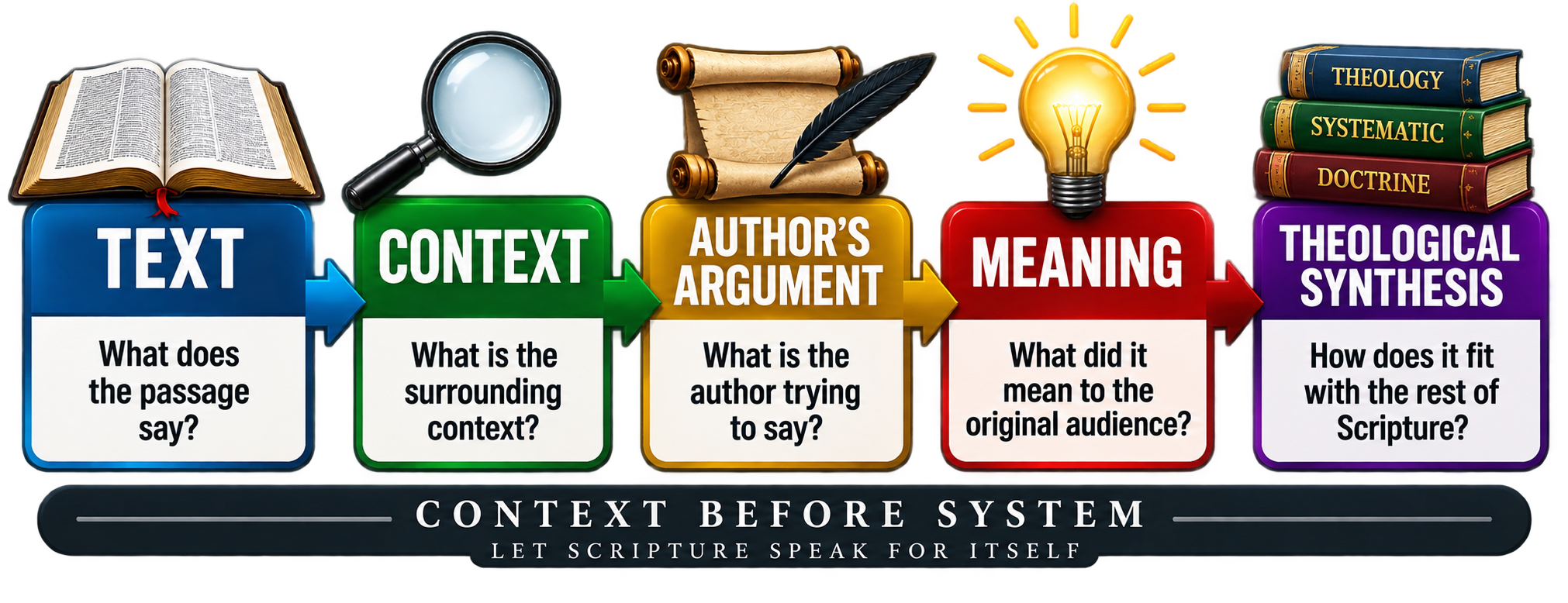
Context Before System
The better starting point is to resist the temptation to ask, “What verse proves perseverance of the saints?” Instead, begin with the passage in front of us. Who is Jesus addressing? What question is He answering? What events does He describe? What does “the end” refer to in this discourse? What does “saved” mean in this setting? How do verses 10–14 function together? What happens immediately afterward in verses 15 and following?
Only after those questions have been answered should we ask how Matthew 24:13 relates to doctrines developed from the rest of Scripture. That order matters because it prevents the theological system from silently becoming the interpretive framework by which the text is defined. It also keeps comparative evidence in its proper place: BKC may support the contextual reading of “saved” as deliverance, while still operating from theological commitments that are not identical to a Free Grace framework.
The principle is simple: establish the meaning and context of the passage before drawing the theological conclusion. Define the terms, examine their usage, follow the author’s argument, and consider the historical and literary setting. Only then should the conclusion be compared with other passages of Scripture. In that order, Scripture controls the system rather than the system controlling the text.
The concern is not that systematic theology exists; it is whether the system is being derived from the text or imported into the interpretation of it.
The result is a more disciplined use of proof texts and a fairer use of secondary sources. Matthew 24:13 can still contribute to a larger discussion of perseverance, but it should do so after its own context has been heard clearly. The Bible Knowledge Commentary helps show that this contextual reading is not merely polemical, but its support must be stated with precision: it confirms a Tribulation-deliverance reading of the verse without requiring agreement on every related doctrinal question. That approach does not weaken doctrine; it strengthens it by requiring theological conclusions to rest on careful reading rather than inherited assumptions.
Primary Sources Used
John MacArthur, commentary on Matthew 24:1–14, in the uploaded PDF “Macarthur – Jesus 2nd coming.pdf,” especially the sections on the background (24:1–3), the birth pains (24:4–14), and “Defection of False Believers” (24:10–13).
John MacArthur, Study Bible notes on Matthew 24:10–15, including the notes on falling away, perseverance, and “the end” in relation to the Great Tribulation.
“A Free Grace Interpretation of Matthew 24:13,” Free Grace Free Speech, January 25, 2026.
Bob Wilkin, “He Who Endures Will Be Saved (Matthew 24:13),” Grace Evangelical Society, November 17, 2020.
Louis A. Barbieri Jr., “Matthew,” in The Bible Knowledge Commentary: An Exposition of the Scriptures, ed. J. F. Walvoord and R. B. Zuck, vol. 2 (Wheaton, IL: Victor Books, 1985), 76–81.
The main argument directly above has focused on Matthew 24:13 and the danger of allowing a broader doctrinal system to determine the meaning of a single text before that text has been read in context. The appendix applies the same method to several other passages commonly used in discussions of perseverance, offering brief contextual checks rather than full exegetical treatments.
Appendix — The “Proof Text” Problem
Quick contextual responses to commonly cited perseverance texts via Phil Bair (The Wilted Flower) and SOTO 101 (Answering Calvinistic Proof Texts | and more: HERE,
The following passages are among the texts commonly brought into discussions of the perseverance of the saints. The point is not that these passages are irrelevant to security, God’s faithfulness, or perseverance. Rather, each passage should first be allowed to make its own contextual claim. A promise of God’s faithfulness is not automatically a statement that apostasy is metaphysically impossible, and a description of present security is not automatically a guarantee of future perseverance.
1. John 5:24 — “Whoever hears … and believes”
“Whoever hears my word and believes … has eternal life.”
The verse gives strong assurance to the person who hears and believes. The Calvinist argument often moves from present possession of eternal life to the conclusion that the person can never subsequently abandon the faith. But the verse itself does not discuss the possibility of later apostasy. Its stated condition is hearing and believing. The text therefore establishes a promise to the believer; the additional claim of guaranteed future perseverance requires support from other passages.
2. John 6:35–37 — “I will never cast out”
“Everyone who comes to me will never be hungry, and the one who believes in me will never be thirsty.”
Jesus gives assurance to those who come to Him and believe. Nothing in the promise says that Christ will cast away a person who genuinely continues to come to Him. The larger discourse must be considered before turning the promise into a proposition about the impossibility of future apostasy. John 6:66 also records disciples who stopped following Jesus, demonstrating that the discourse itself contains a distinction between those who follow and those who depart.
3. Romans 8:35–39 — Nothing can separate us
“Who can separate us from the love of Christ?”
Paul’s list emphasizes external afflictions and hostile forces—trouble, distress, persecution, famine, nakedness, danger, sword, death, life, angels, rulers, things present, things to come, powers, height, depth, and creation. The passage establishes the invincibility of God’s love against external opposition. It does not explicitly address a believer’s own repudiation of Christ. Therefore, the conclusion that the passage proves the impossibility of apostasy goes beyond what the listed obstacles actually address.
4. 1 Peter 1:3–5 — “Kept … through faith”
“You are being guarded by God’s power through faith for a salvation that is ready to be revealed in the last time.”
This is one of the most important texts to examine because it explicitly combines divine preservation with faith. God’s power guards believers, but Peter says this guarding operates “through faith.” The verse therefore strongly affirms God’s active preservation without, by itself, defining preservation as an unconditional mechanism that eliminates the believer’s continuing response.
5. Philippians 1:6 — “He who started a good work”
“He who started a good work in you will carry it on to completion until the day of Christ Jesus.”
Paul expresses confidence in God’s faithfulness toward the Philippians. But the verse is a pastoral expression of confidence within a letter that repeatedly calls believers to continue in faithful obedience. It does not explicitly formulate the proposition that every genuinely regenerated individual is metaphysically incapable of apostasy. That broader doctrine must be established from the whole biblical witness rather than assumed from the promise.
6. Ephesians 1:13–14 — Sealed with the Spirit
“In him you also were sealed with the promised Holy Spirit. He is the down payment of our inheritance…”
The seal signifies God’s ownership and the Spirit’s role as a pledge of the inheritance. That is powerful assurance. But the passage does not use the word “seal” to define a doctrine of inevitable perseverance. The same letter contains exhortations to believers and warns them not to grieve the Holy Spirit (Eph. 4:30). The existence of a divine seal therefore should not be expanded into a conclusion the immediate verse does not state.
7. 1 Corinthians 1:6–8 — “He will sustain you to the end”
“He will also strengthen you to the end, so that you will be blameless in the day of our Lord Jesus Christ.”
This is a significant assurance of God’s faithfulness. But it occurs in a letter that repeatedly warns believers about serious consequences of disobedience and falling. The promise establishes God’s ability and faithfulness to sustain His people; it does not, standing alone, define the precise relationship between divine sustaining grace and a believer’s continuing response.
8. Jeremiah 32:39–40 — “They will not turn away from me”
“I will put the fear of me in their hearts so that they will not turn away from me.”
This is a strong covenant promise concerning God’s work among His covenant people. It is therefore important evidence for divine initiative and preservation. But its covenantal and prophetic setting should be established before it is transformed into a universal proposition about the mechanics of individual regeneration. A promise concerning God’s covenant faithfulness does not automatically settle every question about the possibility of apostasy in every context.
9. John 17:12 — “I guarded them”
“I protected them in your name that you have given me.”
Jesus is speaking specifically about the disciples entrusted to Him. The verse demonstrates Christ’s protective care over those disciples in the context of His earthly ministry and prayer. It should not automatically be generalized into a systematic proposition that every true believer must necessarily persevere. The identity and situation of the persons Jesus is describing matter.
10. Hebrews 13:20–21 — God equips believers
“May the God of peace … equip you with everything good to do his will.”
This benediction celebrates God’s ability to equip His people for faithful living. It is not a technical statement about whether apostasy is possible. Hebrews must be read as a whole, including its repeated warnings about drifting, hardening, and failing to continue. The benediction should therefore be read alongside—not used to erase—the warnings.
11. Hebrews 6:17–19 — “Hope as an anchor”
“We have this hope as an anchor for the soul, firm and secure.”
The imagery emphasizes the reliability of God’s promise and gives believers strong encouragement. It does not itself say that a believer cannot abandon the hope. The same chapter contains the sobering warning of verses 4–6. Consequently, the assurance passage and the warning passage should both be permitted to retain their force rather than allowing one to cancel the other.
SOME OF THE BIGGIES
12. Ephesians 1:3–14 — “Chosen in Him”
“He chose us in him before the foundation of the world … having predestined us to adoption as sons through Jesus Christ.”
Ephesians 1 clearly teaches divine initiative, election, predestination, adoption, redemption, and the believer’s inheritance. The question is not whether Paul speaks about God’s choosing and predestining work, but who was chosen, for what purpose, and how the passage describes participation in those blessings.
The phrase “in Christ” is especially prominent throughout the passage. Paul speaks of believers being blessed “in Christ” (v. 3), chosen “in Him” (v. 4), accepted “in the Beloved” (v. 6), redeemed “in Him” (v. 7), receiving an inheritance “in Him” (v. 11), and finally being “sealed with the promised Holy Spirit” after hearing the gospel and believing in Christ (v. 13).
Verse 4 also states the purpose of the choosing: “that we should be holy and blameless before Him.” The passage therefore clearly connects God’s choice with a specific purpose, but it does not explicitly state the complete theological sequence often inferred from it:
unconditional individual election regeneration irresistible calling faith.

That sequence requires additional theological premises drawn from other passages.
Verse 13 deserves particular attention because Paul explicitly describes the readers’ response in this order:
they heard the gospel, believed in Christ, and were sealed with the Holy Spirit.
Thus, the passage itself gives us a clear hearing believing sealing sequence, while the stronger Calvinistic sequence must be established through a synthesis of this passage with other texts.
The grammatical relationship between “He chose us” and “to be holy and blameless” also raises an important exegetical question:
Is Paul describing individuals being selected for salvation before creation, or is he describing the blessings and destiny of those who are “in Christ”?
The passage itself must be examined carefully before the broader theological system is brought to bear. The key question is therefore not whether Ephesians 1 teaches election. It does. The question is whether Ephesians 1 itself defines that election as unconditional individual election to salvation followed by regeneration and an irresistible call to faith.
13. Romans 9:6–24 — “The Potter and the Clay”
“So then it does not depend on human will or effort but on God who shows mercy.”
Romans 9 is one of the strongest passages cited for unconditional individual election and reprobation. Paul certainly emphasizes God’s sovereignty, His freedom to show mercy, His right to harden, and His authority as the Potter. The question, however, is what problem Paul is actually addressing and what conclusion the potter-and-clay analogy is intended to establish.
Paul begins Romans 9 by expressing profound sorrow over Israel (vv. 1–5). He then immediately explains that “not all who are descended from Israel are Israel” (v. 6), and develops his argument through Isaac and Ishmael, Jacob and Esau, Pharaoh, and finally the potter and the clay. The issue is therefore introduced in the context of God’s covenant purposes, Israel, the Gentiles, and the question of whether God’s promises have failed.
That context matters when Paul reaches the potter-and-clay analogy in verses 20–24. The passage certainly establishes God’s sovereign authority: “Does not the potter have the right over the clay?” But the analogy itself does not explicitly say that God eternally and unconditionally selects particular individuals for salvation while passing over others for reprobation.
The Old Testament background is especially important. Paul is not inventing the potter-and-clay metaphor. Scripture repeatedly uses this imagery to describe God’s sovereign relationship with His creation and with His covenant people. Jeremiah 18 is particularly significant: God sends Jeremiah to observe a potter reshaping a marred vessel and then explicitly applies the illustration to nations. God says that if a nation turns from its evil, He will relent concerning the announced judgment; if a nation turns to evil, He will reconsider the good He had intended.
Other biblical uses of the imagery likewise emphasize God’s authority without automatically establishing the Calvinistic doctrine of unconditional individual salvation or reprobation. Isaiah 29 uses the potter-and-clay imagery in addressing rebellious people who are attempting to hide their works from God. Isaiah 45 uses it in the context of God’s sovereign use of Cyrus for Israel’s deliverance. Isaiah 64 presents Israel collectively as clay in the Potter’s hands while appealing to God for mercy. Paul himself later uses vessel imagery in 2 Timothy 2:20–21, where a person becomes a vessel for honorable use by cleansing himself.
There is therefore an important distinction between what the metaphor clearly establishes and what a theological system may infer from it:

The immediate argument also continues beyond Romans 9. In Romans 9:30–33, Paul contrasts Gentiles who attained righteousness by faith with Israel, which pursued righteousness as though it were by works. Romans 10 then repeatedly places the emphasis on hearing, believing, confessing, and calling upon the Lord, culminating in the statement that “everyone who calls on the name of the Lord will be saved” (10:13). Romans 11 continues the discussion by describing branches being broken off because of unbelief and warning others to continue in faith (11:20–23).
GRACIOUSLY GRAFTED BACK IN:
Thus, Romans 9 certainly establishes God’s sovereignty and freedom in accomplishing His purposes. What remains to be demonstrated is whether Paul is using the potter-and-clay imagery to establish the specific proposition that God unconditionally determines the eternal salvation or destruction of individual people apart from their response to Him.
The key question is therefore not whether Romans 9 teaches divine sovereignty. It unmistakably does. The question is:
whether Romans 9:6–24 itself establishes the Calvinistic doctrine of unconditional individual election and reprobation, or whether that conclusion depends upon importing additional theological premises into Paul’s potter-and-clay analogy.
SOTO 101: HERE | RPT: HERE and HERE
14. John 6:25–71 — “Drawing, Giving, Coming, and Believing”
“No one can come to me unless the Father who sent me draws him.”
John 6 contains several statements that are central to Calvinistic arguments concerning human inability and irresistible grace. Jesus speaks of those whom the Father gives to Him, those who come to Him, those who believe in Him, and the Father’s drawing. Jesus says that no one can come unless the Father draws him, and that the one who comes will be raised up on the last day.
The important contextual question is what Jesus means by the Father’s drawing. Jesus immediately explains the drawing in terms of being taught by God:
“Everyone who has heard and learned from the Father comes to me” (John 6:45).
The passage therefore clearly teaches divine initiative. But the text does not itself define that drawing as an irresistible inward regeneration given only to a predetermined group of individuals.
This becomes especially important when the surrounding context is considered. Flowers argues that Jesus is addressing an audience of Israelites who had already received extensive revelation through the Law and the prophets but were responding to that revelation with unbelief and grumbling. His reading of John 6:45 connects the Father’s teaching with the broader biblical theme of hearing God’s revealed word and responding to it. He specifically connects this with Romans 10:17:
“faith comes from hearing, and hearing by the word of Christ.”
The Greek verb translated “draw” (helkō) also does not, by itself, settle the question of irresistibility. The same verb appears in John 12:32, where Jesus says, “I will draw all people to myself.”
The parallel does not automatically resolve the interpretation of either passage, but it demonstrates why the meaning of draw must be established from context rather than simply equated with “irresistibly regenerate.”
The larger discourse must also be considered. John 6 includes people who believe, people who object to Jesus’ teaching, and disciples who subsequently turn back and no longer walk with Him (6:66). These observations do not by themselves establish a doctrine of apostasy or disprove Calvinism. They do demonstrate, however, that the chapter contains more contextual material than the isolated statement, “No one can come unless the Father draws him.”
John 6:37–40 also places repeated emphasis on coming and believing: “the one who comes to Me I will never cast out” (v. 37), while verse 40 states, “everyone who looks on the Son and believes in Him should have eternal life.” Thus, the passage simultaneously emphasizes God’s initiative and the human response of coming, looking, hearing, learning, and believing.
The text clearly establishes God’s initiative in bringing people to Christ. The question is whether John 6 itself establishes the additional propositions that this drawing is irresistible, restricted to the elect, and accomplished through regeneration prior to faith. Those conclusions require additional theological argument beyond the mere statement that “the Father draws.”
The key question is therefore not whether John 6 teaches divine drawing. It does. The question is whether Jesus’ explanation of that drawing—hearing, learning, and coming—requires the specifically Calvinistic doctrine of irresistible grace and regeneration preceding faith.

A Closer Look at “I Will Draw All” — John 12:32
John 12:32 deserves particular attention because Jesus uses the same Greek verb for “draw” (helkō) found in John 6:44:
- No one can come to me unless the Father who sent me draws him, and I will raise him up on the last day. (John 6:44)
- As for me, if I am lifted up from the earth I will draw all people to myself.” (John 12:32)
But John 12 does not present this statement in isolation. Jesus immediately explains that being “lifted up” refers to the manner of His death (12:33). This also recalls Jesus’ earlier comparison between Himself and the bronze serpent Moses lifted up in the wilderness:
“Just as Moses lifted up the snake in the wilderness, so the Son of Man must be lifted up, so that everyone who believes may have eternal life in Him.” — John 3:14–15
The Numbers 21 account is therefore worth considering. God provided a means of deliverance, but the Israelites were told to look at the lifted-up serpent in order to live. The remedy was provided by God; the response of faith was still required. John then presents Christ as the ultimate fulfillment of that imagery: the Son of Man is lifted up, and those who believe in Him receive life.
This does not by itself settle every question surrounding helkō in John 12:32. Nor does the serpent account establish a particular doctrine of prevenient or irresistible grace. But it does place Jesus’ statement within a larger Johannine pattern of divine provision, Christ being lifted up, and a response of faith.
That matters when John 12:32 is compared with John 6:44. If helkō in John 6 is defined as an irresistible saving action given only to the elect, then John 12:32 requires an explanation of why Jesus says that He will draw ALL. Calvinistic interpreters commonly answer that “all” means all kinds of people—Jews and Gentiles—rather than every individual. The presence of Greeks seeking Jesus in the immediate context (12:20–22) provides a contextual basis for that interpretation.
But “all without distinction” is an interpretation of “all”; it is not the literal wording of the verse. The contextual argument must therefore be demonstrated rather than simply assumed.
The same Greek verb appears in both passages. The question is consequently not whether helkō can have different contextual nuances, but what each context requires the word to mean.
Context should determine the meaning of “draw”—not the theological system being used to interpret it.
15. Romans 8:28–30 — “Foreknown, Predestined, Called, Justified, Glorified”
“Those he foreknew he also predestined to be conformed to the image of his Son … those he predestined, he also called; those he called, he also justified; those he justified, he also glorified.”
Romans 8:28–30 presents one of the most important passages in the discussion because Paul describes a closely connected sequence of God’s activity: those whom God foreknew, He also predestined, called, justified, and glorified. The passage therefore provides a strong statement about God’s purposeful work concerning those who belong to Him.
The crucial questions are what Paul means by “foreknew” and what exactly those people are predestined to. Paul explicitly says they are predestined “to be conformed to the image of his Son.” The text does not explicitly say that God predestined particular individuals to believe, nor does it define foreknew as synonymous with unconditional individual election.
But there is another important contextual consideration:
Romans 8:28–30 should not be detached from the argument that follows in Romans 9–11.
Paul moves from God’s purpose and calling in 8:28–30 to the assurance that nothing can separate His people from His love (8:31–39), and then immediately turns to his anguish over Israel (9:1–5). Richard B. Hays observes that readers who have followed Paul’s argument through the first eight chapters should not be surprised when Paul turns to Israel in Romans 9–11. Hays argues that this section is not “some excursus or appendix peripheral to the letter’s theme,” but “the heart of the matter.” He specifically connects Romans 8:39 with the question Paul confronts concerning Israel.¹
This broader context matters because Romans 9–11 repeatedly develops themes introduced in Romans 8:
God’s purpose, election, calling, mercy, Israel, the Gentiles, and the faithfulness of God’s promises.
Hays describes Romans 9–11 as an extended demonstration that God’s dealings with Israel and the nations are consistent with His past actions and declared purposes. He describes the scriptural connections throughout these chapters as “structural girders, not filigrees.”²
The meaning of “foreknew” therefore deserves careful attention. Interpreters have understood the term in different ways. Frédéric Godet, for example, argues that God’s foreknowledge in Romans 8:29 refers to His foreseeing the faith of those who would believe, while distinguishing that foreknowledge from predestination. He maintains that the object of predestination is glory, not faith itself.³ William R. Newell likewise connects Paul’s language of divine foreknowledge with God’s prior “acquaintanceship,” drawing particular attention to Paul’s statement in Romans 11:2 that God “foreknew” His people.⁴
Leighton Flowers, drawing on several interpreters, presents another possible reading: foreknew may carry the sense of formerly or previously known, emphasizing God’s prior relationship or knowledge rather than making the word itself synonymous with unconditional individual election.⁵ Tim Warner’s Last Generation Version of Romans also provides a useful resource for examining Paul’s terminology and argument across Romans rather than treating 8:28–30 as an isolated theological proposition.⁶
The passage itself clearly establishes a remarkable connection between foreknowledge, predestination, calling, justification, and glorification. But it does not, by itself, explain every theological question concerning the nature of foreknowledge, the condition or scope of election, or precisely how calling relates to faith. Those conclusions require interpretation of Romans 8:28–30 within its immediate context and in light of the argument Paul develops through Romans 9–11.
In that sense, Romans 8:28–39 functions almost like a theological table of contents for questions Paul will develop in Romans 9–11. That is an interpretive analogy, not a claim that Paul literally intended the chapter divisions that way.
The text gives us the sequence. The context gives us the questions Paul is addressing. The theological system must still explain what each term means and what the sequence establishes.
Footnotes
- Richard B. Hays, Echoes of Scripture in the Letters of Paul (New Haven, CT: Yale University Press, 1989), 63.
- Hays, Echoes of Scripture in the Letters of Paul, 64.
- Frédéric Godet, Commentary on the Epistle to the Romans, trans. A. Cusin, rev. and ed. Talbot W. Chambers (Grand Rapids, MI: Zondervan Publishing House, 1956), 325–26. Godet discusses Romans 8:29 specifically, arguing that foreknowledge concerns those whom God foresees as believing and that predestination is directed toward glory rather than toward faith itself.
- William R. Newell, Romans Verse-by-Verse (Chicago: Moody Press, 1938), 186. Newell discusses Romans 8:29 and connects divine foreknowledge with the idea of prior “acquaintanceship,” specifically bringing Amos 3:2, Romans 11:2, and 1 Peter 1:20 into his discussion.
- Leighton Flowers, “Romans 8:28–30: Foreknowledge and Predestination,” Soteriology 101, February 14, 2018. Soteriology 101 article
- Tim Warner, The Letter of Paul to the Romans: Last Generation Version, trans. and notes by Tim Warner (rev. September 11, 2026), 20–21. Warner’s notes on Romans 8:28–30 explicitly interpret “foreknew” as referring to those God “knew previously,” connect the term with God’s prior relationship with figures such as Abraham and David, and interpret the predetermination in verse 29 in relation to resurrection.
16. Acts 13:48 — “Appointed to Eternal Life”
“As many as were appointed to eternal life believed.”
Acts 13:48 is one of the shortest and most frequently cited texts in arguments for unconditional election. Read in the traditional rendering, the verse appears to present a straightforward sequence: certain people were appointed to eternal life, and consequently they believed. Calvinistic theology naturally understands this as evidence that God’s prior appointment produces saving faith.
The important question is not simply whether the word “appointed” can describe divine action, but what Luke means by the appointment and how the statement functions within the larger narrative. The immediate context concerns Paul’s preaching in Pisidian Antioch, where Jews, Gentiles, and Gentile God-fearers respond differently to the gospel. The contrast becomes especially important in verses 46–48: some Jews reject the message and “judge yourselves unworthy of eternal life,” while Gentiles rejoice and believe.
The Greek verb tassō can carry the sense of arranging, appointing, assigning, or ordering, and the precise interpretation of its participle in Acts 13:48 has been debated. A 2024 scholarly study specifically reexamines the traditional strongly predestinarian interpretation, arguing that the lexical and discourse evidence does not adequately establish the usual understanding of the passage.
Craig Keener likewise notes that “appointed” can refer to enrollment, while suggesting that the verse may concern God’s plan for the Gentiles. He connects this possibility with Acts 13:17, where Luke has already described God as choosing Israel, and with the immediate contrast between 13:46 and 13:48. Keener also observes that early Jewish thought did not necessarily regard divine predestination and human responsibility as mutually exclusive, and he sees a deliberate tension between God’s sovereignty and human choice in the passage.
This does not mean that Acts 13:48 cannot support a Calvinistic interpretation. It means that the theological conclusion should not simply be smuggled into the English word “appointed.” The interpreter still has to establish what Luke means by the appointment, who is being described, how the statement relates to the Jewish rejection and Gentile response in verses 46–48, and how it fits Luke’s larger presentation of God’s purposes for Israel and the Gentiles.

The question, therefore, is not whether Acts 13:48 speaks of divine appointment. It does. The question is whether the passage itself establishes the full theological proposition of unconditional individual election producing irresistible saving faith—or whether that conclusion requires additional theological premises brought to the text.
17. 1 Corinthians 2:14 — “The Natural Person”
“The natural person does not accept the things of God’s Spirit, because they are foolishness to him; he is not able to understand them because they are spiritually discerned.”
This passage is frequently used to support the doctrine of total inability. The argument is straightforward: the natural person cannot understand spiritual things; therefore the unregenerate person cannot respond positively to the gospel unless God first regenerates him. The verse certainly describes a serious spiritual incapacity and emphasizes the necessity of the Spirit for spiritual discernment.
The contextual question, however, is what kind of inability Paul is describing and what “the things of God’s Spirit” refers to in this particular argument. The immediate context is dominated by the contrast between the wisdom of the world and the wisdom of God. Paul speaks of God’s previously hidden wisdom, now revealed through the Spirit, and explains that these things are spiritually discerned (1 Corinthians 1:18–2:16). The issue is therefore not simply “saved versus unsaved,” but the contrast between human wisdom and God’s revealed wisdom, as well as the distinction between those who are spiritually discerning and those who are not.
The following chapter adds an important contextual consideration. Paul addresses the Corinthians as people who are already “in Christ,” yet describes them as immature and “of the flesh,” unable at that point to receive the deeper instruction he wants to give them (1 Corinthians 3:1–3). This does not mean that psychikos (“natural”) in 2:14 and sarkinos/sarkikos (“fleshly”) in 3:1 are simply interchangeable terms. They are not. Rather, the progression cautions against turning Paul’s discussion of spiritual discernment into a technical definition of every aspect of human ability. The same letter can describe believers as possessing the Spirit while still being unable to receive certain spiritual instruction because of immaturity.
There is also an important distinction between the Spirit’s necessity for understanding spiritual truth and the additional claim that regeneration must precede faith. Paul certainly teaches that God’s wisdom cannot be discovered by human wisdom alone and that spiritual discernment depends upon God’s revelation through the Spirit. But the passage does not explicitly state the complete theological sequence, regeneration → spiritual ability → faith. That sequence requires additional theological argument.
The passage therefore establishes an important truth:
human wisdom is insufficient to comprehend God’s revealed wisdom, and genuine spiritual discernment depends upon the Spirit.
The additional proposition that an unregenerate person is metaphysically incapable of believing the gospel unless regeneration occurs first is a theological conclusion that must be demonstrated rather than simply read into the word “unable.”
The question, then, is not whether 1 Corinthians 2:14 teaches spiritual inability. It does. The question is whether Paul’s particular discussion of spiritual discernment establishes the full Calvinistic doctrine of total inability and regeneration preceding faith.
Returning to Matthew 24:13
This is why the cross-references must not be allowed to determine the meaning of Matthew 24:13 before Matthew 24:13 has been interpreted in its own setting. The surrounding discourse concerns the events leading to Christ’s return, including persecution, deception, tribulation, and the end of the age. The Bible Knowledge Commentary interprets those who endure to the end as being delivered through the Tribulation, specifically describing this as physical deliverance into the kingdom. The verse therefore deserves to be understood in that immediate prophetic framework before it is recruited as a proof text for a broader doctrine of guaranteed perseverance.
The issue is not whether other passages can be assembled into a doctrine of perseverance. The issue is whether the doctrine has first been demonstrated from those passages in their own contexts—and whether that demonstrated doctrine should then be imported into Matthew 24:13.
Source credit: Appendix adapted from ideas associated with Phil Bair, The Wilted TULIP, with additional contextual framing for this study. As well as Answering Calvinistic Proof Texts (with others mentioned above.