Jump to the UPDATE inspired by the GOSPEL COALITION.
R.C. Sproul’s Statement on Predestination (from Chosen by God):
“What predestination means, in its most elementary form, is that our final destination, heaven or hell, is decided by God not only before we get there, but before we are even born. It teaches that our ultimate destiny is in the hands of God. Another way of saying it is this: From all eternity, before we ever live, God decided to save some members of the human race and to let the rest of the human race perish. God made a choice–he chose some individuals to be saved unto everlasting blessedness in heaven and others he chose to pass over, to allow them to follow the consequences of their sins into eternal torment in hell.” (Chosen By God, p.22, emphasis mine)
This is double predestination in practice, even if Sproul calls the active-positive version for reprobation a caricature.
- If the elect cannot fail to be saved,
- and the reprobate cannot be saved because God withholds the only grace capable of producing faith,
- then what practical difference remains between active reprobation and passive reprobation?
Elect infants, dying in infancy, are regenerated, and saved by Christ, through the Spirit, who works when, and where, and how He pleases: so also are all other elect persons who are incapable of being outwardly called by the ministry of the Word.
– Westminster Confession of Faith (WCF) 10.3
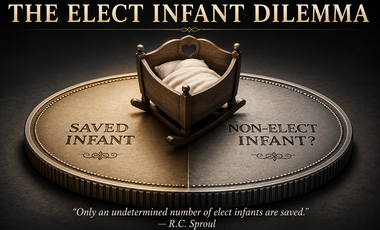
“Holy Spirit can save an infant by changing his heart, giving grace, and applying the merit of Christ to him. The Westminster divines certainly believed that babies can be saved. They did not teach that all infants are necessarily saved; rather, they taught that only an undetermined number of elect infants are saved. Obviously, an elect infant is going to be saved, and any saved infant is elect, but the divines did not speculate on which infants those would be.”
– R.C. Sproul, Truths We Confess: A Systematic Exposition of the Westminster Confession of Faith (Sanford, FL: Reformation Trust, 2019), 321.
Sproul conforms his support for the ideas in the WCF:
One of the most important confessions of faith ever penned, particularly in the English-speaking world, is the Westminster Confession of Faith. By the confession’s own statements, no confession written by uninspired authors is to be taken as having supreme authority over the believer. Confessions cannot bind the conscience in the manner that the Word of God can and does. At the same time, though human confessions and creeds are penned by fallible people without the benefit of the inspiration of the Holy Spirit, the profound level of theological and biblical precision manifest in the Westminster Confession of Faith is awe-inspiring. (Ibid., xvii.)
[….]
The Westminster Confession is the most precise and accurate summary of the content of biblical Christianity ever set forth in a creedal form. Creeds such as the Belgic Confession, the Heidelberg Catechism, and the Scots Confession should be highly regarded, but no historic confession surpasses in eloquence, grandeur, and theological accuracy the Westminster Confession of Faith. (Ibid., xix)

Critiquing the matter via CHAT:
The Internal Tension
Sproul writes:
“The Westminster divines certainly believed that babies can be saved. They did not teach that all infants are necessarily saved; rather, they taught that only an undetermined number of elect infants are saved.”
The immediate question is:
If only elect infants are saved, what happens to non-elect infants?
Historically, Westminster does not explicitly answer that question. Critics argue that the silence is revealing. If the Confession intended to teach universal infant salvation, it could have said:
“All infants dying in infancy are saved.”
Instead it says: “Elect infants.” Sproul defends that wording rather than correcting it.
Critique #1: Election Becomes the Ultimate Divider
Sproul affirms:
- unconditional election,
- total inability,
- monergistic regeneration,
- and reprobation.
Therefore, infant salvation cannot be based upon:
- personal faith,
- conscious belief,
- repentance,
- or moral innocence.
It must ultimately rest on election.
Critics respond:
If election alone determines which infants are saved, then election alone determines which infants are not saved.
Thus the question becomes: Why would God elect some infants and not others? Sproul never provides a clear answer.
Critique #2: Original Guilt Creates the Problem
Sproul consistently taught:
- Adam’s guilt is imputed to humanity,
- infants are fallen,
- infants need Christ’s grace.
Critics agree infants need grace but ask:
Does inherited guilt alone make an infant deserving of eternal punishment?
Many opponents argue Scripture consistently ties judgment to:
- knowledge,
- personal rebellion,
- actual transgression.
Examples often cited:
- Deuteronomy 1:39
- Isaiah 7:15-16
- Jonah 4:11
- Romans 4:15
The criticism is:
Sproul imports Augustine’s doctrine of inherited guilt and then must wrestle with implications Augustine himself embraced.
Critique #3: The Moral Character of God
This is probably the most emotionally and philosophically powerful objection.
If:
- an infant never consciously sins,
- never rejects God,
- never suppresses truth,
- never commits personal acts of rebellion,
Yet could still be damned, Critics ask:
What meaningful sense of justice remains?
This is where many critics invoke the same concern raised by Juncker regarding determinism:
If moral categories are detached from personal responsibility, words like justice become difficult to understand.
FULLER QUOTE:
“If determinism is true then either God is evil and the author of evil or all talk of good and evil, of praise and blame, of moral responsibility, and of justice is meaningless and incomprehensible with reference to God. That is, if God can cause or determine evil and yet remain good, and if God can punish those who do exactly and only what He has meticulously caused and determined them to do and yet remain just, then we have no idea who God is or what He might or might not do or what Scripture could possibly mean when it calls Him ‘good’ and ‘just.'”
— Günther H. Juncker, “The Dilemma of Theistic Determinism“
The objection becomes:
Eternal punishment without personal rebellion appears inconsistent with ordinary moral reasoning and the biblical portrayal of God’s fairness.
Critique #4: Westminster Creates an Unnecessary Problem
Many critics argue Westminster itself created the issue. The Confession says:
“Elect infants.”
Critics ask why not simply say:
“Infants dying in infancy are saved through Christ”?
Mohler, Warfield, and Spurgeon essentially move in that direction. Sproul, however, insists the Westminster divines intentionally did not teach universal infant salvation. Critics argue:
That commitment to confessional precision ends up preserving a theological possibility that Scripture never explicitly teaches.
Critique #5: Sproul’s Loyalty to Westminster
This critique becomes stronger when paired with Sproul’s own statements:
“The Westminster Confession is the most precise and accurate summary of the content of biblical Christianity ever set forth in a creedal form.”
and
“One of the most important confessions of faith ever penned…”
Because Sproul viewed Westminster so highly, critics argue he was reluctant to depart from its language regarding elect infants even when later Reformed theologians moved toward affirming universal infant salvation.
The Strongest One-Sentence Critique
The strongest critique is probably this:
By affirming unconditional election, inherited guilt, and Westminster’s doctrine of “elect infants,” Sproul leaves open the possibility that some infants are not elect and therefore not saved, a conclusion many critics believe is inconsistent with both the justice and goodness of God as revealed in Scripture.

Exhaustive Determinism:
Sproul affirms that God ordains whatsoever comes to pass (echoing Westminster):
He knows all things that will happen because he ordains everything that does happen. This is crucial to our understanding of God’s omniscience. He does not know what will happen by virtue of exceedingly good guesswork about future events. He knows it with certainty because he has decreed it.
The Westminster Confession avers: “God from all eternity, did, by the most wise and holy counsel of His own will, freely, and unchangeably ordain whatsoever comes to pass. . . .”
This statement refers to God’s eternal and immutable decretive will. It applies to everything that happens. Does this mean that everything that happens is the will of God? Yes. Augustine qualified this answer by adding the words, “in a certain sense.” That is, God ordains “in some sense” everything that happens. Nothing that takes place is beyond the scope of his sovereign will. The movement of every molecule, the actions of every plant, the falling of every star, the choices of every volitional creature, all of these are subject to his sovereign will. No maverick molecules run loose in the universe, beyond the control of the Creator. If one such molecule existed, it could be the critical fly in the eternal ointment. As one grain of sand in the kidney of Oliver Cromwell changed the course of English history, so one maverick molecule could destroy every promise God has ever made about the outcome of history.
— What Is Reformed Theology, p. 172
Sproul’s view functionally equivalent to Calvin’s broader decretive will, even if he rejects “equal ultimacy” (symmetrical positive-positive reprobation where God actively works sin in the reprobate the same way He works faith in the elect). Sproul’s inconsistency is “too embarrassed to follow Calvinism to its logical extreme” and pleading ignorance/mystery on hard questions (e.g., the fall of Adam/Eve).
Calvin (Institutes 3.21.5): Explicitly symmetric language —
“some are preordained to eternal life, others to eternal damnation… created for one or the other of these ends.”
Sproul: Rejects the symmetrical mode (equal ultimacy / positive-positive) as sub-Calvinist or a caricature that makes God the author of sin. He prefers asymmetric (positive election + negative reprobation/preterition: God passes over the non-elect, leaving them in their sin). Yet critics [like myself] argue this is rhetorical softening — because Sproul still affirms:
- God’s decree covers all events.
- Reprobation is part of the eternal decree before creation.
- The non-elect are chosen to be passed over before birth.
Sproul’s distinctions, while rhetorically softer than Calvin’s, do not ultimately escape the force of double predestination or exhaustive determinism.

… The issue here seems to be how one defines “ordains” or “foreordains.” Calvinists I debate on the internet consistently argue that “ordain” means to decree. I ask them, “Did God decree the Holocaust?” “Did God decree the killing fields of Cambodia?” “Did God decree every act of rape, torture and murder that has ever taken place?” And they say yes! Unbelievable.
What about Calvin on this issue? You deny he was supralapsarian, claiming God’s positive-positive, double-predestination, but excerpts from his writings strongly suggest that was his position. Calvin was quite straightforward on saying God decreed the Fall, writing:
…whence does it happen that Adam’s fall irremediably involved so many peoples, together with their infant offspring, in eternal death unless because it so pleased God?…The decree is dreadful indeed, I confess. Yet no one can deny that God foreknew what end man was to have before he created him, and consequently foreknew because he so ordained by his decree…God not only foresaw the fall of the first man, and in him the ruin of his descendants, but also meted it out in accordance with his own decision.” (Institutes of the Christian Religion, 3.23.7)
That seems to go beyond mere “permission.” He also wrote:
The predestination by which God adopts some to the hope of life, and adjudges others to eternal death, no man who would be thought pious ventures simply to deny….By predestination we mean the eternal decree of God, by which he determined with himself whatever he wished to happen with regard to every man. All are not created on equal terms, but some are preordained to eternal life, others to eternal damnation; and, accordingly, as each has been created for one or other of these ends, we say that he has been predestinated to life or to death (Institutes of the Christian Religion 3.21.5).
We also read:
From this it is easy to conclude how foolish and frail is the support of divine justice afforded by the suggestion that evils come to be not by [God’s] will, but merely by his permission. Of course, so far as they are evils, which men perpetrate with their evil mind, as I shall show in greater detail shortly, I admit that they are not pleasing to God. But it is a quite frivolous refuge to say that God otiosely [= idly] permits them, when Scripture shows Him not only willing but the author of them…Who does not tremble at these judgments with which God works in the hearts of even the wicked whatever He will, rewarding them nonetheless according to desert. Again, it is quite clear from the evidence of Scripture that God works in the hearts of men to incline their will just as he will, whether to good for his mercy’s sake, or to evil according to their merits.” (Concerning the Eternal Predestination of God, 177)
Other famous Calvinists say, for example,
“The Sovereignty of God over all, and his independency, clearly shew, that whatever is done in time is according to his decrees in eternity.” (John Gill, A Body of Doctrinal and Practical Divinity, p. 173)
Or
“As a builder draws his plan before he begins to build, so the great Architect predestined everything before a single creature was called into existence.” (Arthur Pink, The Doctrines of Election and Justification, p.9)
Or
“Surely if God had not willed the fall, He could, and no doubt would, have prevented it; but he did not prevent it: ergo, He willed it. And if He willed it, He certainly decreed it.” (Jerome Zanchius, The Doctrine of Absolute Predestination, p. 88)
So, by claiming supralapsarianism is “anti-Calvinism,” you are dismissing not only prominent Calvinists from the past, but also Calvin himself. …
Jerry Walls’s observation at this point is apt:
-
- [T]heological compatibilists [RPT: like Grudem, Sproul, MacArthur, and the like] often make claims and engage in rhetoric that naturally lead people to conclude that God loves them and desires their salvation in ways that are surely misleading to all but those trained in the subtleties of Reformed rhetoric. . . . Such language loses all meaning, not to mention all rhetorical force, when we remember that on compatibilist premises God could determine the impenitent to freely repent, but has chosen instead to determine things in such a way that they freely persist in their sins.
Why No Classical Theist – Let Alone Orthodox Christian – Should Ever Be a Compatibilist (PDF)

God’s refusal to determine the repentance of sinners when it is within his power to do so can be called nothing other than immoral. Damning certain people by withholding something freely given to others is not glorious.
MORE: Is Double Predestination and Active Reprobation, Equal Ultimacy? (good critique of Sproul)
Sproul and Calvin say it is indeed a horrible decree. Sproul’s honesty at this point would be refreshing if his conclusions weren’t so disturbing:
- “The nasty problem for the Calvinist [is] . . . . If God can and does choose to insure the salvation of some, why then does he not insure the salvation of all? . . . The only answer I can give to this question is that I don’t know. . . . One thing I do know. If it pleases God to save some and not all, there is nothing wrong with that.” On the contrary, it is the very definition of wrong.” (Fuller Quote)


Here is Sproul’s chapter 58 from his book, Essential Truths of the Christian Faith, I will add some emphasis:
PREDESTINATION AND REPROBATION
Every coin has a flip side. There is also a flip side to the doctrine of election. Election refers to only one aspect of the broader question of predestination. The other side of the coin is the question of reprobation.
God declared that He loved Jacob but hated Esau. How are we to understand this reference to divine hatred?
Predestination is double. The only way to avoid the doctrine of double predestination is to either affirm that God predestinates everybody to election or that He predestinates no one to either election or reprobation.
Since the Bible clearly teaches predestination to election and denies universal salvation, we must conclude that predestination is double. It includes both election and reprobation. Double predestination is unavoidable if we take Scripture seriously. What is crucial, however, is how double predestination is understood.
Some have viewed double predestination as a matter of equal causation, where God is equally responsible for causing the reprobate not to believe as He is for causing the elect to believe. We call this a positive-positive view of predestination.
The positive-positive view of predestination teaches that God positively and actively intervenes in the lives of the elect to work grace in their hearts and bring them to faith. Likewise, in the case of the reprobates, He works evil in the hearts of the reprobate and actively prevents them from coming to faith. This view has often been called “hyper-Calvinism” because it goes beyond the view of Calvin, Luther, and the other Reformers.
The Reformed view of double predestination follows a positive-negative schema. In the case of the elect, God intervenes to positively and actively work grace in their souls and bring them to saving faith. He unilaterally regenerates the elect and insures their salvation. In the case of the reprobate He does not work evil in them or prevent them from coming to faith. Rather, He passes over them, leaving them to their own sinful devices. In this view there is no symmetry of divine action. God’s activity is asymmetrical between the elect and the reprobate. There is, however, a kind of equal ultimacy. The reprobate, who are passed over by God, are ultimately doomed, and their damnation is as certain and sure as the ultimate salvation of the elect.
The problem is linked to biblical statements such as those regarding God’s hardening of Pharaoh’s heart. That the Bible says God hardened Pharaoh’s heart is beyond dispute. The question remains, how did God harden Pharaoh? Luther argued for a passive rather than an active hardening. That is, God did not create fresh evil in Pharaoh’s heart. There was already enough evil present in Pharaoh’s heart to incline him to resist the will of God at every turn. All God ever has to do to harden anybody is to remove His restraining grace from them and give them over to their own evil impulses. This is precisely what God does to the damned in hell. He abandons them to their own wickedness.
In what sense did God “hate” Esau? Two different explanations are offered to solve this problem. The first explains it by defining hate not as a negative passion directed toward Esau but as simply the absence of redemptive love. That God “loved” Jacob simply means that He made Jacob the recipient of His unmerited grace. He gave Jacob a benefit that Jacob did not deserve. Esau did not receive the same benefit and in that sense was hated by God.
The first explanation sounds a bit like special pleading to get God off the hook for hating somebody. The second explanation gives more strength to the word hate. It says simply that God did in fact hate Esau. Esau was odious in the sight of God. There was nothing in Esau for God to love.
Esau was a vessel fit for destruction and altogether worthy of God’s wrath and holy hatred. Let the reader decide.
Summary
- Predestination is double; it has two sides to it.
- Some teach that God is equally responsible for election and reprobation. This is characteristic of hyper-Calvinism.
- The Reformed view of double predestination reflects a positive-negative schema.
- God passively, not actively, hardened Pharaoh’s heart.
- God hated Esau in the sense of failing to give him a blessing of grace or in the sense of abhorring him as a vessel fit for destruction.
Biblical passages for reflection:
Exodus 7:1-5
Proverbs 16:4
Romans 9
Ephesians 1:3-6
Jude 1:4
In other words, as The Encyclopedia of The Reformed Faith (page 144), and later the The Westminster Handbook to Reformed Theology (page 87) clearly says:
The Reformed approach to divine freedom is nowhere more apparent than in the doctrine of the eternal decrees: God freely wills the existence and preservation of the created order and freely determines the eternal destiny of all creatures, solely on the ground of God’s goodness and solely for the sake of God’s ultimate glory. In creation and providence, God encounters no barriers to the exercise of God’s will, and in the work of redemption God acts utterly graciously, apart from any merit belonging to the creature.
[….]
Reformed theology has followed an Augustinian paradigm in its understanding of human freedom…
Donald K. McKim and David F. Wright, eds., Encyclopedia of the Reformed Faith (Louisville, KY: Westminster John Knox Press, 1992), 144,146.
JOHN 6:44
Steve Lemke
R. C. Sproul argued at great length that John 6:44 (“No one can come to Me unless the Father who sent Me draws him” [HCSB]) does not refer merely to the necessity that God “woo or entice men to Christ,” such that humans can “resist this wooing” and “refuse the enticement.”11 In philosophical language, Sproul said, this wooing is a necessary but not sufficient condition for salvation “because the wooing does not, in fact, guarantee that we will come to Christ.”12 Sproul stated that such an interpretation is “incorrect” and “does violence to the text of Scripture.”13
Instead, Sproul insists, the term “draw” is “a much more forceful concept than to woo” and means “to compel by irresistible superiority.”14 However, in discussing irresistible grace, Sproul tells of a student who, hearing a lecture on predestination by John Gerstner, rejected it. When Gerstner asked the student how he defined Calvinism, the student described it as the perspective that “God forces some people to choose Christ and prevents other people from choosing Christ.” Gerstner then said, “If that is what a Calvinist is, then you can be sure that I am not a Calvinist either.”15 What is the difference between compelling “by irresistible superiority” and “forcing” people to do something? Sproul likewise chastised a Presbyterian seminary president for rejecting the Calvinist doctrine that “God brings some people, kicking and screaming against their wills, into the kingdom.” Sproul described this Presbyterian theologian’s view as “a gross misconception of his own church’s theology,” as a “caricature,” and “as far away from Calvinism as one could possibly get.”16 So which way is it? If God compels people with “irresistible superiority,” in what way is it inaccurate to say that God forces people to choose Christ? The Synod of Dort insisted that such attempts at moral persuasion of unsaved persons was wasted time. The irresistibility of God’s grace (and not merely the use of strong moral persuasion) was precisely what the Synod of Dort rejected and the Remonstrants affirmed. While the Remonstrants affirmed that the compelling grace of God persuades the lost to receive Christ as Lord and Savior, the Synod of Dort insisted that this was not going far enough. Note their explicit denial that a person can “resist” God. The language used in the Synod of Dort describes God’s omnipotence as being such that God can “potently and infallibly bend man’s will to faith and conversion.”17
Bending the will of a fallible being by an omnipotent Being powerfully and unfailingly is not merely sweet persuasion. It is forcing one to change one’s mind against one’s will. Calvinists often describe their position as monergism as opposed to synergism. In monergism, God works entirely alone, apart from any human role.18
11. Sproul, Chosen by God, 69–70 (see chap. 1, n. 106).
12. Sproul, 69.
13. Sproul, 69.
14. Sproul, 69.
15. Sproul, 122.
16. Sproul, 122.
17. Dennison, Reformed Confessions, 4:143 (III–IV, Rejection of Errors, par. 8).
John Wagner’s Letter to Sproul
… Let me deal next with the issue of your concept and use of the Greek word helkō, commonly translated “draws” in John 6:44. Even if you reject everything else I write here, please accept this one. You really did not get this right. And Calvinists who have read CBG have passed on this incorrect information. You quoted Kittel’s Theological Dictionary of the New Testament, and claim because that word means “drag” or “compel” in a physical context such as Acts 16:19 and James 2:6, that therefore it means “drag” or “compel” in the spiritual context of John 6:44.
The evidence indicates it doesn’t. I assume you are aware that a Greek word can have more than one meaning. I looked at Kittel and I see for helkō in regard to John (i.e. 6:44, 12:32) it means, “a beneficent ‘drawing of God…of drawing to oneself in love. This usage is distinctively developed by Jn., perhaps with some influence of Gnosticism. Force or magic may be discounted, but not the supernatural element.” The abridged version of Kittel says, “There is no thought here of force or magic. The term figuratively expresses the supernatural power of the love of God or Christ which goes out to all (12:32) but without which no one can come.”
Did you get that? Both summaries dismiss force, which would be consistent with “drag” or “compel” (though I agree that would be accurate when the word is used in a physical context). Just wondering why you didn’t mention that! Let’s put your position to rest with more citations:
- BDAG: has helkō in John 6:44 as “draw, attract.”
- Analytical Lexicon to the Greek New Testament by William Mounce says helkō means “to draw mentally and morally, John 6:44; 12:32.”
- The Hebrew-Greek Key Study Bible by Calvinist Spiro Zodhiates: “Helko is used of Jesus on the cross drawing by love, not force” (Jn. 6:44; 12:32).
- A Critical Lexicon and Concordance to the English and Greek New Testament by Ethelbert W. Bullinger, p. 235: Helko means “to draw, esp. implying a certain attraction mentally or morally; also to draw to a certain point.” This source also mentions surō as a word more consistent with how Calvinists interpret helkō. Surō generally implies a violent dragging. This source defines it as “to draw, drag or trail along as a net; esp. with the notion of force and sometimes with violence.”
- The Renaissance New Testament by Randolph Yeager, says about helkō:
It does not necessarily involve coercion, though it does involve persuasion and motivation–John 6:44; 12:32…. [Helkō] does not imply coercion in the two places where it is applied to the elect [the two just-mentioned verses]. Swords, fish nets and political prisoners (John 18:10; 21:6, 11: Acts 16:19) may resist, but the element of resistance is not implicit in the word itself….
- Greek and English Lexicon of the New Testament by Edward Robinson, say helkō means “to draw by a moral influence, John 6:44, 12:32.”
Please notice that none of these sources indicate that helkō means drag or compel in John 6:44. And your version is especially problematic for John 12:32. Do you believe God drags all men to himself? So it’s kind of funny that the Arminian professor you debated didn’t need to cite some “obscure Greek poet.” The info is clear in many lexicons and similar sources. And by the way, contrary to what you experienced, in the formal 1999 debate I was in against a Calvinist pastor, he repeated your argument on helkō and I nailed him on this point.
And that ties into the issue of the nature of unsaved man. You write, “If a person who is still in the flesh, who is not reborn by the power of the Holy Spirit, can incline or dispose himself to Christ, what good is rebirth?” This is another strawman. Classical Arminians do not believe man can “incline or dispose himself ” all by himself. Arminius wrote strongly of man being depraved and dead and that man needs the heavy convicting and drawing of the Holy Spirit. However, he completely rejected irresistible grace, the biggest oxymoron I can think of. And as for rebirth, that comes after faith, not before.
You slightly acknowledge the idea of prevenient grace and then ask “If so, where” does the Bible teach this concept? Did you even make any effort toward finding an answer for this? Well, John 6:44, which I have proven is not about “dragging,” is one. Furthermore, let’s recall John 16:8, saying that the paraclete “will convict the world of guilt in regard to sin and righteousness and judgment in regard to sin because men do not believe in me.”
The Greek for “convict” is elenchō, and has the connotation of a trial attorney making a legal and moral argument to a jury. In this case, the Holy Spirit conducts that function in the human heart—but not in irresistible manner. Other verses include John 1:9: “The true light that gives light to every man was coming into the world.” Also, John 12:32, in which Christ says, “When I am lifted up from the earth. I will draw (helkō) all men to myself.” But this is also not irresistible.
Describing prevenient grace, Thomas C. Oden writes:
Prevenient grace antecedes human responsiveness so as to prepare the soul for the effective hearing of the redeeming Word. This preceding grace draws persons closer to God, lessens their blindness to divine remedies, strengthens their will to accept revealed truth, and enables repentance. Only when sinners are assisted by prevenient grace can they begin to yield their hearts to cooperation with subsequent forms of grace….
Does scripture teach the concept of prevenient grace? There is no one passage that lays out a systematic definition of it, however, the concept becomes apparent throughout the overall tenor of scripture. Here are some passages that refer to the different aspects of prevenient grace:
Prevenient Grace Draws:
John 6:44 No one can come to me unless the Father who sent me draws him, and I will raise him up at the last day.
John 12:32 And I, if I am lifted up from the earth, will draw all men to Myself. Prevenient Grace is Universal:
Titus 2:11 For the grace of God that brings salvation has appeared to all men. John 1:9 The true light that gives light to every man was coming into the world.
John 16:7-8 But I tell you the truth: It is for your good that I am going away. Unless I go away, the Counselor will not come to you; but if I go, I will send him to you. When he comes, he will convict the world of guilt in regard to sin and righteousness and judgment:
Romans 1:18-19 The wrath of God is being revealed from heaven against all the godlessness and wickedness of men who suppress the truth by their wickedness, since what may be known about God is plain to them, because God has made it plain to them.
Prevenient Grace Convicts the Non-Believer:
Acts 16:14 One of those listening was a woman named Lydia, a dealer in purple cloth from the city of Thyatira, who was a worshiper of God. The Lord opened her heart to respond to Paul’s message.
Acts 16:29-30 The jailer called for lights, rushed in and fell trembling before Paul and Silas. He then brought them out and asked, “Sirs, what must I do to be saved?”
Prevenient Grace Works in Combination with the Hearing of the Word:
Acts 2:37 When the people heard this, they were cut to the heart and said to Peter and the other apostles, “Brothers, what shall we do?”
Romans 10:17 Consequently, faith comes from hearing the message, and the message is heard through the word of Christ.
Prevenient Grace is Given Generously:
Romans 8:32 He who did not spare His own Son, but delivered Him over for us all, how will He not also with Him freely give us all things?
Romans 2:4 Or do you think lightly of the riches of His kindness and tolerance and patience, not knowing that the kindness of God leads you to repentance?
Acts 17:26-27 From one man he made every nation of men, that they should inhabit the whole earth; and he determined the times set for them and the exact places where they should live. God did this so that men would seek him and perhaps reach out for him and find him, though he is not far from each one of us.
Prevenient Grace Can be Rejected:
Matt. 23:37 O Jerusalem, Jerusalem, you who kill the prophets and stone those sent to you, how often I have longed to gather your children together, as a hen gathers her chicks under her wings, but you were not willing.
John 5:34,39,40 Not that I accept human testimony; but I mention it that you may be saved…You diligently study the Scriptures because you think that by them you possess eternal life. These are the Scriptures that testify about me, yet you refuse to come to me to have life.
Acts 7:51 You stiff-necked people, with uncircumcised hearts and ears! You are just like your fathers: You always resist the Holy Spirit!
Heb 4:2 For we also have had the gospel preached to us, just as they did; but the message they heard was of no value to them, because those who heard did not combine it with faith.
Heb 10:29 How much more severely do you think a man deserves to be punished who has trampled the Son of God under foot, who has treated as an unholy thing the blood of the covenant that sanctified him, and who has insulted the Spirit of grace?
Prevenient Grace Results in Saving Grace when it is Accepted:
Ephesians 5:14 For it is light that makes everything visible. This is why it is said: “Wake up, O sleeper, rise from the dead, and Christ will shine on you.”
Ephesians 2:8-9 For it is by grace you have been saved, through faith—and this not from yourselves, it is the gift of God— not by works, so that no one can boast.
There are actually three very good books on this issue of prevenient grace: The Transforming Power of Grace by Thomas C. Oden, Prevenient Grace by W. Brian Shelton, and Streams of Mercy by J. Gregory Crofford. …

BTW, I prefer pastor Rogers understanding vs a straight Arminian:
- Within the Non-Calvinist camp, there are at least two nuanced views on how God allows sinners to respond in faith. The first view is the Arminian view — which says that God’s work of grace (prevenient grace) for all people is needed to enable any sinner to freely choose to respond in faith to the Gospel message. The second view is the Provisionist View — which says that the Gospel message itself [see more below] is God’s work of grace so that when it is preached to all people, any sinner can freely choose to respond in faith. The proclamation of the Gospel is powerfully sufficient enough to bring salvation to those who will believe. While the Arminian and the Provisionist each have a different take on why all humans can respond to God’s offer, these two views both affirm the importance of God’s initiative of grace to invite all sinners to salvation. (from the book Grace For All: Understanding God’s Plan of Salvation).
— Michael R. Cariño
The “More Below”
Grace Enablements
Includes but are not limited to: God’s salvific love for all (John 3:16), God’s manifestation of his power so that all may know he is the Sovereign (Isa 45:21–22) and Creator (Rom 1:18–20), which assures that everyone has opportunity to know about him. Christ paying for all sins (John 1:29), conviction of the Holy Spirit (John 16:7–11), working of the Holy Spirit (Heb 6:1–6), enlightening of the Son (John 1:9), God’s teaching (John 6:45), God opening minds and hearts (Luke 24:45; Acts 16:14; 26:17–18;), and the power of the gospel (Rom 1:16), without such redemptive grace, no one seeks or comes to God (Rom 3:11).
Because of these gracious provisions and workings of God, man can choose to seek and find God (Jer 29:13; Acts 17:11–12). Moreover, no one can come to God without God calling (Acts 2:39), drawing (John 6:44), and that God is drawing all individuals (John 12:32). The same Greek word for draw, helkuō, is used in both verses. “About 115 passages condition salvation on believing alone, and about 35 simply on faith.” Other grace enablements may include providential workings in and through other people, situations, and timing or circumstances that are a part of grace to provide an opportunity for every individual to choose to follow Christ.
These are grace enablements in at least three ways; first, they are provided by God’s grace rather than deserved by mankind; second, the necessary components for each and every individual to have a genuine opportunity to believe unto salvation are provided or restored by God; third, they are provided by God without respect to whether the individual will believe or reject, which response God knew in eternity past.
The offer of the gospel is unconditional, but God sovereignly determined to condition the reception of the offer upon grace-enabled faith; therefore, faith is not reflective of a work or virtue of man, but of God’s sovereign plan of salvation by grace through faith (Eph 2:8). This indicates faith is the means to being regenerated and saved, not the reason for being saved. This truth of Scripture does not imply God is held captive to the choice of man, but rather it demonstrates God in eternity coextensively determined to create man with otherwise choice and provide a genuine offer of salvation, which can be accepted by grace-enabled faith or rejected. Additionally, to fulfill this plan, God is not obligated to disseminate the gospel to people he knows have rejected the light he has given them (Rom 1:18–23) and will also reject the gospel; although he may still send the gospel to them.
Sproul continues his thinking is an audio message I have audio of here. In it he says:
Augustine said, I still, in my fallenness, have the ability to choose what I want, but in my heart there’s no desire for God. I have lost any desire for the things of God. If I’m left to myself, the desires of my heart are only wicked continuously. My heart and my soul are dead to the things of God.
I can listen to preaching, I can hear hymns, I can see — I can do all those things and see other people weeping and in ecstasy and all moved by all kinds of religious overtones and consideration.
It leaves me cold.
My heart has calluses on it. It’s recalcitrant.
My neck is stiff.
I’m not moved by anything that has anything to do with God. That’s our natural state. The Bible says that we are dead to the things of God in our fallen condition. Original sin deadens the soul to the things of God.
God so loved the world, He gave His only begotten Son, that whosoever believeth should not perish, but have everlasting life. And I have people quote that to me, to say man is not fallen to such a degree that he’s lost his power to choose Christ, because that verse says that whosoever believeth will not perish, but have everlasting life.
Now, what does that verse teach us about the extent of the fall of man? Absolutely nothing. It doesn’t say who will believe in Christ. All it says is, if you do A, if you believe, you will not perish, and you will have everlasting — you will live forever.
But the question still is left, Why does one person believe and another person not believe?
Augustine said, Now, you’re dead in your sins and trespasses. You don’t have any desire for Christ, and the only way you will ever choose Christ is if God melts your heart, if God softens that stone-cold, recalcitrant heart, if God the Holy Spirit rapes your soul and puts in you a desire for Christ.
That’s what has to happen.
According to Augustine.
And many try to do away with this control of God through what is called “compatibilism”, but as MacArthur notes, this is fictitious in the end:
In order to understand this better theologians have come up with the term “compatibilism” to describe the concurrence of God’s sovereignty and man’s responsibility. Compatibilism is a form of determinism, and it should be noted that this position is no less deterministic than hard determinism.
John Hendryx (John Hendryx is the creator and editor of Monergism . com)
And then this is John MacArthur:
So free will trumps evil on God’s value scale, so God had to allow for the possibility of evil in order to protect the more highly prized autonomy; and He had to protect autonomy to protect Himself from this bad press, being responsible for evil. Humans then must have self-determination, freedom to act. If God acted as the primary cause and humans only as a secondary cause moved by the primary cause, then God being the primary cause is responsible; and people are not free, and therefore God decided and God compelled and God coerced, and God actually overturned human will. Then God is responsible for all the evil and all the divine judgment and the determination of eternal punishment. This is a God that some people just can’t live with; they’ve got to get Him off the hook.
(See video to add to the above and Grace To You)
This passage is John MacArthur directly describing (and strongly rejecting) the popular “free will defense” theodicy. He uses it to contrast with his own high Calvinist / compatibilist view of God’s sovereignty.

Some AI convo:
Yes. If we define determinism as:
Every human choice is ultimately rendered certain by God’s decree and providential causation, such that no person could ultimately do otherwise than what God ordained,
then John MacArthur is unquestionably on the deterministic side of the spectrum.
The important thing is that MacArthur would almost certainly reject the label “fatalist”, and he would likely prefer “compatibilist” or “Reformed”, but philosophically speaking, compatibilism is a species of determinism. Hendryx is correct on that point.
The key question is:
Does MacArthur believe humans possess libertarian freedom (the ability to choose A or not-A under identical circumstances)?
The answer is no.
The MacArthur Quote You Posted
The fascinating thing about that quotation is that MacArthur is not denying determinism.
He is describing what he believes his opponents fear determinism entails.
Notice the structure:
“If God acted as the primary cause…“
“If God compelled…“
“If God actually overturned human will…“
“Then God is responsible…“
MacArthur is setting up the objection.
The question becomes:
Does MacArthur believe God does these things?
Elsewhere he clearly teaches:
- Total inability
- Unconditional election
- Irresistible grace
- Monergistic regeneration
- God’s exhaustive sovereignty
Those doctrines require that God determine who will believe.
Compare MacArthur to Sproul
Sproul says:
“The only way you will ever choose Christ is if God melts your heart.”
Then he quotes Augustine:
“God the Holy Spirit rapes your soul and puts in you a desire for Christ.”
Sproul is being more explicit.
MacArthur teaches the same monergistic regeneration, but usually with softer language.
Both affirm:
- Fallen man cannot come.
- God must first regenerate.
- Regeneration guarantees faith.
- Those not regenerated remain unable.
That is deterministic in the relevant philosophical sense.
The Real Tell: MacArthur on Election
MacArthur repeatedly teaches:
- God chose the elect before creation.
- The elect will certainly come.
- The non-elect will not come.
- Faith itself is a gift from God.
Once those propositions are accepted, the outcome is fixed.
That is why Hendryx says:
“Compatibilism is a form of determinism.”
Because the certainty of the outcome remains intact.
The Important Distinction
A lot of Calvinists hear:
“determinism”
and immediately think:
“atheistic hard determinism.”
But philosophers don’t define determinism that way.
Determinism simply means:
Given the causes and conditions, only one outcome is possible.
MacArthur’s theology appears to satisfy that definition.
Why Your Argument Finds Tension Here
What’s interesting is that the quotation you cited almost sounds like MacArthur is describing your objection:
If God is the primary cause and humans are merely secondary causes moved by Him, then God becomes responsible.
The difficulty is that Calvin, Sproul, Piper, and many Reformed theologians frequently describe God as:
- determining wills,
- inclining hearts,
- ordaining evil events,
- governing every detail,
- and ensuring outcomes.
So critics ask:
If God determines the desires, determines the will, determines the outcome, and determines who receives regenerating grace, how is He not functioning as the primary determining cause?
That is the exact issue your series has been exploring.
In Short
If by determinism you mean:
Human choices are rendered certain by God’s eternal decree and providential governance, with no ultimate ability to do otherwise,
then:
- Calvin = Determinist
- Edwards = Determinist
- Sproul = Determinist
- Piper = Determinist
- MacArthur = Determinist
- Hendryx explicitly admits compatibilism is determinism
The real debate is not whether these men are deterministic.
The real debate is whether compatibilist determinism can preserve meaningful moral responsibility, justice, and divine goodness.
That’s where the battle shifts from historical theology into philosophy.
This video is long, but has turned into one of my favorites!
Calvinist’s Fatal Flaw: Guilty Babies
Dr. Leighton Flowers plays a clip from Jeremiah Notier, aka The Apologetic Dog, in which he accuses Dr. Flowers of being a “Pelagian” because I do not affirm the concept that all babies are born guilty and deserving of Hell.
GOSPEL COALITION article summary
One-Paragraph Summary
The article defends the Reformed doctrine of double predestination/reprobation, arguing that God’s eternal decree includes both the unconditional election of some individuals to salvation and the passing over of others, who are ultimately condemned according to divine justice. It appeals particularly to Pharaoh and Romans 9, arguing that God actively hardened Pharaoh and raised him up to display His glory, and that Paul’s “vessels of mercy” and “vessels of wrath” describe God’s sovereign distinction between individuals. The article further argues that reprobation logically follows from unconditional election: if God unconditionally chooses some but not all for salvation, then the others are necessarily excluded from that saving choice. It distinguishes preterition, God’s withholding of saving grace, from predamnation, God’s determination to judge the non-elect according to justice. Although Reformed theology maintains an asymmetry between election and reprobation, the article nevertheless places both salvation and condemnation within God’s eternal sovereign decree rather than treating the damnation of the non-elect as merely something God foreknows or passively permits.
SUMMARY OF THE GOSPEL COALITION ARTICLE: “THE DOCTRINE OF REPROBATION”
The article is a defense of the Augustinian/Reformed doctrine of reprobation, which teaches that God’s eternal decree concerns not only those whom He chooses to save, but also those whom He does not choose to save. In the author’s formulation, reprobation involves God eternally withholding saving grace from certain individuals and determining to judge them according to divine justice. The author therefore understands reprobation as more than God’s foreknowledge that certain people will reject Him; their exclusion from saving grace and ultimate condemnation fall within God’s sovereign eternal decree.
The article develops this position in three primary ways.
Scripture Teaches Reprobation
The author argues that Scripture directly supports reprobation, with Pharaoh and Romans 9 serving as the principal examples. In the Exodus account, the author rejects the interpretation that God hardened Pharaoh merely as a response to Pharaoh’s prior self-hardening. Instead, the article argues that God announced beforehand that He would harden Pharaoh and raised him up for the purpose of displaying His power and glory.
Romans 9 is presented as the clearest New Testament explanation of this principle. The author interprets Paul’s discussion of the “vessels of mercy” and “vessels of wrath” as teaching that God sovereignly distinguishes between individuals, preparing some for mercy and enduring others who are prepared for destruction. The purpose is ultimately God’s glory: His mercy and grace are displayed toward the elect while His wrath and power are displayed toward those destined for destruction.
Reprobation Logically Follows From Unconditional Election
This is one of the article’s most important arguments.
If salvation depends upon God’s unconditional choice of particular individuals, and God does not choose everyone, then there must necessarily be individuals whom God does not choose for salvation.
The author therefore argues that unconditional election necessarily entails reprobation. Simply calling the position “single predestination”—God predestines some to salvation but does not predestine anyone to condemnation—does not resolve the problem. According to the article, such a view leaves the destiny of the non-elect outside God’s purposeful decree, which the author considers inconsistent with God’s comprehensive sovereignty.
The argument is therefore:

Unconditional election → some are chosen → others are not chosen →
their exclusion from saving grace falls within God’s sovereign decree.
God’s sovereignty extends over salvation and human choices
The article’s argument does not stop with election. It presents God’s sovereignty as extending over everything that comes to pass, including human choices. Consequently, the distinction between those who believe and those who reject Christ ultimately falls under God’s sovereign will.
The doctrine is also presented as spiritually beneficial because it humbles humanity. Rather than viewing humanity as the ultimate reference point, believers are reminded that human beings exist for God’s glory and that God’s purposes, rather than human preferences, determine reality.
The Two Aspects of Reprobation
The article makes an important distinction between two aspects of reprobation:
Preterition — the negative aspect:
God eternally chooses not to extend saving grace to particular individuals. The article says this decision is not based on foreseen works, merit, or sin, but on God’s sovereign will.
Predamnation — the positive aspect:
God eternally determines to deal with those individuals according to divine justice. Reformed theologians disagree over whether this decree itself is conditioned upon foreseen or actual sin, but the article maintains that the ultimate condemnation of these individuals is included within God’s sovereign purpose.
The article goes further and states that the Augustinian/Reformed tradition agrees that God predestines certain individuals to be justly punished, and that at least some aspect of this reprobation is not based on foreseen sin but on God’s good pleasure, with the purpose of magnifying His justice and grace.
Is This Double Predestination?
In substance, yes. The article is defending a form of double predestination, although it insists that election and reprobation are not perfectly symmetrical. The distinction can be summarized this way:

The author specifically identifies the “asymmetry between election and reprobation” as an important qualification within Reformed theology. Thus, the article is not merely saying that God permits some people to reject Him. Its position is substantially stronger:
- God’s eternal decree establishes both who will receive saving grace and who will be passed over, with the non-elect ultimately being condemned according to divine justice.
And the author’s fundamental argument is that this conclusion follows from the combination of unconditional election, God’s exhaustive sovereignty, and the author’s interpretation of passages such as Pharaoh and Romans 9.

BABIES DESTINED TO HELL
Mind you, I am not the biggest fan of Faith On Fire, but once in a while there is really good stuff. It is 10-minutes long, here is his description:
Christianity is under attack more today than ever, and a big part of that attack comes from Calvinists. Did God create billons of people that God never wanted? Calvinism teaches that God did exactly. Calvinists want people to believe that the God of the Bible has predestined billions of people to hell before they were ever born. They think God has kept any hope of salvation from most people on purpose for His own glory and so God can demonstrate His wrath on them because God ordained and decreed their eternal punishment before the foundation of the world. They believe God reserves salvation for only some preselected elect people who are saved unconditionally by God’s grace.
According to Calvinism, Satan wants all people to join him in hell and the lake of fire, and they think God wants only most people to join Satan in hell and the lake of fire, and Satan doesn’t even have much of anything to do with any of it because it was all meticulously and divinely determined by God before Creation anyway.
TULIP or the 5 points of Calvinism are doctrines of salvation unique and distinctive to Calvinism, not Biblical Christianity. Those Calvinistic doctrines are from Satan and I expose the implications of them and the dangerous errors of that theology.
KINDA THE SUMMARY OF THE ABOVE [added to by RPT]
The Argument
- Heaven is infinitely better than earthly life.
If a person dies in infancy and is therefore guaranteed eternal joy with God, then death produces an infinitely greater outcome than continued earthly existence. If that same child survives, however, the outcome is no longer certain. The child may eventually believe and be saved—or reject Christ and be lost. - On the assumption that all infants who die are saved, death in infancy cannot result in hell.
The theological premise establishes a guaranteed positive eternal outcome. The child loses earthly life, but does not lose salvation. Indeed, the child is removed from the possibility of later rejecting Christ and experiencing eternal condemnation. - Continued life therefore introduces a risk that did not previously exist.
The infant who dies remains within the category of guaranteed salvation. The infant who survives eventually becomes a morally accountable person whose eternal destiny, under the same theological system, is no longer universally guaranteed. Poverty, abuse, family circumstances, unbelieving parents, cultural influences, and personal rejection of the gospel can all become factors in that person’s earthly and spiritual history. - This creates an uncomfortable asymmetry.
If universal infant salvation is true, then preserving an infant’s earthly life simultaneously preserves the possibility of that person’s eternal salvation and the possibility of eternal loss. Death removes the second possibility entirely. Thus, within the stated theological premises, earthly life is not an unqualified spiritual benefit; it is also an exposure to the possibility of damnation. - The argument cannot simply appeal to the value of earthly life without addressing the theological premise.
If the decisive consideration is that every human life must be preserved because earthly life is intrinsically preferable to death, then that principle needs to be reconciled with the claim that death in infancy results in guaranteed eternal happiness. Likewise, saying that humans must never interfere with God’s timing does not by itself resolve the underlying question: Why is death unquestionably tragic if the death of an infant guarantees the very heavenly outcome that the believer regards as infinitely superior to earthly existence? - The same reasoning raises a broader question about moral consistency.
If the theological argument works because infants who die are guaranteed salvation, one must explain why that principle stops at infancy. If accountability is the relevant dividing line, then the argument necessarily raises questions about children who have not yet reached that threshold. If the argument does not extend beyond infancy, then the theological basis for making infancy the decisive boundary must be identified.
The central A→B problem is therefore this:
A: Every infant who dies is guaranteed eternal salvation.
B: Continued earthly life introduces the possibility that the child will eventually reject Christ and be eternally lost.
Question: Why should earthly preservation be treated as an unequivocal spiritual good when, according to A and B, preserving earthly life also preserves the possibility of eternal damnation?
The force of the argument is not that abortion is thereby proven morally permissible. Rather, it exposes a tension within the theological premises themselves. If universal infant salvation is asserted, then the believer must explain why preventing the loss of earthly life is necessarily more important than preventing the possibility of eternal loss. Simply saying that earthly life is valuable does not answer the theological question; it changes the question from
“What happens eternally to this child?”
to
“Is earthly life intrinsically valuable even when it introduces the possibility of eternal damnation?”
JAMES WHITE: