Jump to the history of the phrase “preaching like and Arminian, but sleeping as a Calvinist” and a response to Spurgeon’s “Arminian prayer.”

A recent short sermon clip I listened to by a yute pastor is this one…. and I must say, it is impossible to preach like a Reformed determinist or Calvinist who agrees with TULIP.
I will critique a bit [decode] his ideas lurking behind the scenes and show a more honest interpolation of the major issues:
Guys, God’s law makes demands of you. It demands that you be something you cannot be.
But the gospel — the gospel — doesn’t demand something from you that you don’t have. The gospel gives you something you desperately need: righteousness—clean hands and a pure heart.
One man put it this way:
“Run and run, the law demands,
but gives me neither feet nor hands.
Better news the gospel brings:
it bids me fly and gives me wings.”
Amen. That’s the gospel.
The law tells you to run, and you feel that pressure: “I’ve got to work to appease God. Run and run and run.”
If you’re on that treadmill of self-righteousness today, get off it. Throw yourself at the mercy of Jesus. Collapse there, and you can be made righteous today.
Maybe you, like me, have felt ashamed and thought, “I’m not the man I’m supposed to be. I’m not the man I was meant to be. I’m not the man I should be.”
But Jesus was—and He was for you.

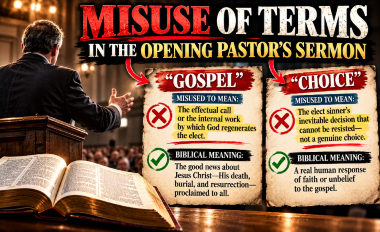
Okay, first, I want to deal with two issues I hear as Josh preaches that are running around behind the scenes. Both are important. The first issue deals with “The Gospel”. While I resonate with the gospel’s message being preached, the 16th century Augustinian systematic idea of election slides into the picture.
The “Gospel of Election”
Calvary or the Cosmic Lottery of Election?
Paul declares that the gospel “is the power of God for salvation to everyone who believes” (Romans 1:16, CSB). But in Reformed determinism, the decisive question is not simply whether Christ died for sinners, whether His provision is sufficient, or whether the gospel is proclaimed. The decisive question is whom God unconditionally chose to make willing to believe before the foundation of the world.
Consider the implications.
Two sinners hear the same gospel. Both are commanded to repent. Both are told that Christ is the Savior and that they must believe in Him. Yet, according to this system, one will certainly believe because God has decreed to grant him effectual grace, while the other will remain in unbelief because God has not decreed to grant him that same grace.
What made the difference? Was it the clarity of the gospel? The sufficiency of Christ’s sacrifice? The gracious invitation to repent and believe? No—not ultimately. The decisive difference was God’s prior, unconditional decree to bring one sinner to faith while withholding the effectual grace that, according to this system, would certainly bring the other to faith.
Election becomes the ultimate arbiter of who will be saved, while the gospel serves as the predetermined instrument through which the elect are brought to their predetermined response.
This is the heart of the problem: the gospel is proclaimed to both, but only one has been unconditionally chosen to receive the inward work that guarantees belief. The same message is preached; the same Savior is announced; the same command to repent and believe is issued. Yet the decisive difference was settled before either sinner heard a word.
What, then, is the ultimate explanation for the difference between them? The gospel they heard—or the decree that determined which one would certainly respond to it?
Jonah Preached, but Had Election Already Decided?
Consider Jonah and Nineveh. Jonah preached, and the Ninevites repented. Scripture presents a remarkable example of a divine warning followed by a genuine human response. God sent His messenger, the people heard the warning, and they turned from their wickedness.
Yet under Reformed determinism, their repentance was not ultimately what distinguished them from those who would remain unrepentant. God had already unconditionally determined whom He would effectually bring to repentance. Jonah’s message was the ordained means, but the decisive distinction had been settled before anyone heard him preach.
The question is not whether God ordained Jonah’s mission. He plainly did. The question is whether the proclamation itself was God’s gracious call to which the Ninevites responded, or whether the decisive explanation for their response must be found in an earlier, selective decree that guaranteed the repentance of some while withholding the same effectual grace from others.
In this framework, the preacher announces the warning, but the prior decree determines who will certainly respond. The message is indispensable as the ordained means, yet it is not the ultimate explanation for why one person repents and another does not.
That is why the image of a “cosmic lottery” presses the issue—not because Calvinists would describe their doctrine in those terms, but because the decisive distinction between the saved and the lost is assigned to an unconditional choice made before either person believes, repents, or hears the gospel.
What Does It Mean to Tell Someone, “Christ Died for You”?
The same problem becomes intensely personal when we consider the gospel invitation.
Suppose a preacher tells an unbeliever, “Christ died for you. His death is sufficient to save you. Repent and believe in Him, and you will be forgiven.”
Under a universal-provision understanding of the atonement, this is a straightforward announcement of good news: Christ provided salvation for humanity, and the sinner is called to receive that provision through faith.
But under a strict particular-redemption framework, the preacher cannot affirm that Christ bore that person’s sins in the same saving sense unless that person belongs to the elect. The preacher does not know whether the person is elect. The individual may hear the invitation, remain unconvinced, and die in unbelief—and, according to the system, Christ may never have died for that individual in the particular, saving sense being discussed.
What, then, can the preacher confidently promise that Christ has done for this specific person?
The invitation can still be sincerely offered within the Calvinistic system. Calvinists argue that the gospel command is genuine, that everyone who comes to Christ will be received, and that the preacher need not know the secret decree. But the Provisionist challenge remains:
How can the universal invitation be grounded in Christ’s provision for every person if the atonement itself is restricted to the elect?
Consider the difference between these two announcements:
- “Christ died for you, and He calls you to receive the salvation He has provided.”
- “Christ may have died for you—but whether He did depends on whether you were among the elect chosen before the foundation of the world.”
The second statement is not how Calvinists ordinarily frame their gospel invitations, and it would be unfair to suggest that every Calvinist preacher speaks that way. Nevertheless, it exposes the theological tension the Provisionist critique is addressing:
the preacher proclaims a universal command, while the scope of Christ’s particular saving work is understood to be limited to those already chosen.
The gospel invitation is heard in time. The decree, in this system, determines the outcome before time.
The Qualified-Buyer Problem
Imagine a car dealership advertising, “Good news! Qualified buyers can receive zero-percent financing.”
That offer may be perfectly honest. But notice the qualification: the offer is not available to everyone. Whether you receive the benefit depends on whether you meet the requirements.
Now apply the analogy to the question of atonement. If the announcement is, “Christ died for the elect,” the decisive question becomes:
HOW DO YOU KNOW YOU QUALIFY?
In Calvinism, the answer is not that you independently meet a condition that causes God to elect you. Rather, election is unconditional, and effectual grace brings the elect to faith. Faith reveals the saving work of God; it does not determine whom God chose.
But that is precisely the issue. If you believe, it is because you were elected and effectually brought to faith. If you remain in unbelief, you were not granted that decisive grace. The difference is not ultimately found in the atoning provision offered to both, nor in a response that God graciously enables both to make. It is found in God’s selective decree.
The question is no longer simply, “Will you trust the Savior?” It is, “Has God chosen to make you willing to trust Him?”
The Calvinist will answer that those who come to Christ do so willingly because God has renewed their hearts. The Provisionist objection is that this does not remove the problem; it identifies where the problem lies. Why does God effectually renew one person’s heart but not another’s?
If that selective renewal is the decisive difference, then election—not the sinner’s response to the proclaimed gospel—is the ultimate explanation for why one person believes and another does not.
Does Election Become the Fountain, and Christ the Means?
This concern is not merely a criticism imposed from outside Reformed theology. The Canons of Dort, a foundational Reformed confession, describe election as the “fountain of every saving good,” from which faith, holiness, and the other gifts of salvation proceed, ultimately leading to eternal life.
That language makes the issue especially clear. In the Reformed account, election is not merely God’s recognition of those who will believe. It is the unconditional decree from which saving faith and the other saving benefits flow.
The second video places this claim alongside John MacArthur’s defense of sovereign election throughout redemptive history. MacArthur points to God’s choice of Israel, Jacob, and the covenant people. Such passages certainly establish that God elects and chooses according to His purposes. But the further question is whether God’s election of a people for a historical and covenantal role automatically establishes the Calvinistic claim that God unconditionally selects particular individuals for salvation and effectually determines their response to the gospel.
Those are related questions, but they are not identical. God’s choice of Israel as a people does not, by itself, settle every question about individual election, the scope of the atonement, or the nature of saving faith.
The Provisionist challenge is that the Calvinistic system takes the reality of divine election and makes unconditional individual election the fountain from which every saving response flows. The result is a theological order in which the decree explains who will believe, while Christ’s work provides the necessary basis for the salvation of those already chosen.
Here the question becomes unavoidable:
- If election is the fountain of every saving good, what does that make the cross in the explanation of why one sinner is saved and another is lost?
Christ’s death remains necessary in the Calvinistic account. But the cross, considered by itself, does not explain why one sinner receives its saving benefits while another does not. Both need Christ. Both need forgiveness. Both need grace. Yet only one receives the effectual grace that guarantees faith.
Election supplies the decisive distinction.
Does Election Overshadow the One Who Is “The Way, the Truth, and the Life”?
Jesus declares, “I am the way, the truth, and the life. No one comes to the Father except through me” (John 14:6, CSB).
Calvinists affirm this verse. They insist that no one is saved apart from Christ, His atoning death, and His resurrection. It would be inaccurate to claim that they consciously replace Jesus with election or believe that the cross is unnecessary.
But the question is one of explanatory priority.
If the ultimate reason a person believes in Christ is that God unconditionally elected that person and effectually renewed the person’s heart, while another person remains in unbelief because that same effectual grace was not granted, then election determines who will certainly come to the One who is the way, the truth, and the life.
Christ is indispensable to salvation. Yet election is the decisive explanation for why one sinner receives Christ’s saving benefits and another does not.
The Provisionist objection is not that Christ has become literally unnecessary in Calvinist theology. It is that the system makes the selective decree the decisive differentiator of salvation, even though the New Testament presents Christ and the gospel as the focus of God’s saving provision and proclamation.
Calvary provides the ground of salvation. The gospel proclaims Christ. But in this deterministic framework, election decides who will certainly believe the proclamation and receive its saving benefits.
Calvary or the Cosmic Lottery?
Return to the two sinners who hear the same gospel.
One believes. The other does not.
The Calvinist says the believer comes willingly because God effectually renews the heart; the unbeliever remains responsible because he acts according to his own desires. Yet both the believer’s renewed desires and the unbeliever’s continued resistance occur within God’s sovereign decree. The decisive question remains: Why does God grant the heart-changing grace to one and not the other?
The answer cannot ultimately be that one was more receptive, more spiritually perceptive, or more willing to respond to the gospel. In the Calvinistic account under consideration, the elect person’s willingness is itself the result of God’s effectual work. The decisive difference lies in God’s unconditional choice.
That is the issue. Not whether Calvinists believe in the cross or preach the gospel, but whether the decisive explanation for the difference between the saved and the lost is the gospel’s gracious call to faith—or God’s prior, selective decree.
Paul says the gospel “is the power of God for salvation to everyone who believes” (Romans 1:16, CSB). He also writes that faith comes from hearing the message about Christ (Romans 10:17). The Provisionist challenge is this:
- Why make an unconditional decree of selective regeneration the ultimate explanation for who can and will believe, rather than understand the gospel as God’s gracious call through which sinners may respond to His provision in Christ?
The question is not whether God saves by grace. The question is whether His grace is proclaimed in Christ as a genuine provision and invitation for all, or whether the decisive saving difference has already been settled by an unconditional decree that effectually brings some to faith while leaving others without that same grace.
Calvary provides the saving provision. The gospel announces the good news. But if election alone determines who will certainly believe, then election—not the proclamation of Christ—is the ultimate explanation for who receives salvation.
And that is the question every honest discussion of election and the gospel must confront:
- Is the good news centered on what God has done for sinners in Christ and graciously calls them to receive—or does the ultimate answer to who will be saved lie in a selective decree that determines who will ever be willing to believe?
Okay, in this second section, some ideas need to be put in place BEFORE dealing with “looking at the man in the mirror.” I have more quotes here but I have chosen a select few to make the point:
Some Quotes Before Section Two
JOHN CALVIN:
- “Hence we maintain that, by his providence, not heaven and earth and inanimate creatures only, but also the counsels and wills of men are so governed as to move exactly in the course which he has destined.” — Institutes 1.16.8.
- “Men do nothing save at the secret instigation of God, and do not discuss and deliberate on anything but what he has previously decreed with himself, and brings to pass by his secret direction.” — Institutes 1.18.1.
- “The hand of God rules the interior affections no less than it superintends external actions; nor would God have effected by the hand of man what he decreed, unless he worked in their hearts to make them will before they acted.” — Concerning the Eternal Predestination of God, trans. J. K. S. Reid, p. 175f.
- “… how foolish and frail is the support of divine justice afforded by the suggestion that evils come to be, not by His will but by His permission. … It is a quite frivolous refuge to say that God otiosely permits them, when Scripture shows Him not only willing, but the author of them. … Who does not tremble at these judgments with which God works in the hearts of even the wicked whatever He will, rewarding them nonetheless according to desert? Again it is quite clear from the evidence of Scripture that God works in the hearts of men to incline their wills just as he will, whether to good for His mercy’s sake, or to evil according to their merits.” — The Eternal Predestination of God 10:11.
- “From these statements of the inspired word … it is, I think, sufficiently clear that God works in the hearts of men to incline their wills whithersoever He wills, whether to good deeds according to His mercy, or to evil after their own deserts; His own judgment being sometimes manifest, sometimes secret, but always righteous.” — Concerning the Eternal Predestination of God.
- “Does God control even the evil wills of evil men? Calvin’s answer, in accord with Scripture, was ‘yes.’ Just as God controlled the rebellion of Pharaoh (Ex. 9:12), the cursing of Shimei (2 Sam. 16:10), and the rage of the Jerusalem crowds (Acts 2:23), so He controls even the will of all wicked men.” — The Secret Providence of God, ed. Paul Helm, trans. Keith Goad (Wheaton: Crossway, 2010), 79–80. (Note: The last block is Helm/Goad framing Calvin, not a continuous Calvin paragraph.)
ALL men’s acts are decreed and happen by the will and purpose of God. All.
JOHN PIPER:
QUESTION: Has God predetermined every tiny detail in the universe, such as dust particles in the air? And then I should add here, including all our besetting sins.
PIPER RESPONDS: Yes, which means yes…
— John Piper (Video)
God determines every single thing even dust but you have to make the decision about the cross… What?
“Is God less glorious because he ordained that evil be? … no, just the opposite. God is more glorious for having conceived and created and governed a world like this with all its evil. The effort to absolve him by denying his foreknowledge of sin … or by denying his control of sin … is fatal.”
John Piper, “Is God Less Glorious Because He Ordained That Evil Be?” (1998).
“God so disposes all things … so that in accordance with moral necessity all men make only those choices ordained by God from all eternity.” […] “In this way He ultimately determines all acts of volition (though not all in the same way) and yet holds man accountable only for those acts which they want most to do.”
John Piper, Desiring God, A Response to J.I. Packer on the So-Called Antinomy Between the Sovereignty of God and Human Responsibility.
Mark Talbot/John Piper:
Ephesians 1:11 goes even further by declaring that God in Christ
“works all things according to the counsel of his will.” Here the Greek word for “works” is energeø, which indicates that God not merely carries all of the universe’s objects and events to their appointed ends but that he actually brings about all things in accordance with his will. In other words, it isn’t just that God manages to turn the evil aspects of our world to good for those who love him; it is rather that he himself brings about these evil aspects for his glory (see Ex. 9:13-16; John 9:3) and his people’s good (see Heb. 12:3-11; James 1:2-4). This includes—as incredible and as unacceptable as it may currently seem—God’s having even brought about the Nazis’ brutality at Birkenau and Auschwitz as well as the terrible killings of Dennis Rader and even the sexual abuse of a young child…
Mark Talbot, in John Piper and Justin Taylor, eds., Suffering and the Sovereignty of God (Wheaton, IL: Crossway Books, 2006), 42.
God can cause, actively, men to rape, torture, kill, and conduct horrendous scientific experiments on people just because they are Jewish
Theodore Zachariades:
God works all things after the Council of His will. Even keeping those kings who want to commit adultery from committing so! And when He wants to, he orders those to commit adultery when he wants to!
— Dr. Theodore Zachariades (Video)
Pastor Zachariades says that God wills [causes, not just permits] a man to be unfaithful to his wife in his comment on becoming a Calvinist via Ephesians 1.
Gordon H. Clark:
“I wish very frankly and pointedly to assert that if a man gets drunk and shoots his family, it was the will of God that he should do so. … In Ephesians 1:11, Paul tells us that God works all things, not some things only, after the counsel of his own will.”
Religion, Reason and Revelation (Nutley, N.J.: Craig Press, 1961), 221.
Excessive alcoholism? Murdering your family? All God’s fault.
End Of Quotes
The Man in the Mirror
The Man God Decreed You to Be
The preacher asks you to look in the mirror and admit, “I’m not the man I’m supposed to be. I’m not the man I was meant to be. I’m not the man I should be.”
But under theological determinism, that confession raises a deeper question: Who decreed the man staring back at you?
Who decreed his desires, his circumstances, his struggles, his failures, and the decisions that shaped his life?
John Calvin wrote that people act under God’s secret direction and that God works in human hearts to bring about His purposes. John Piper likewise affirms that God determines all things, even the smallest details of the universe, including human choices and sin. If these claims are taken seriously, then the man in the mirror is not merely a man whose choices fall within God’s foreknowledge. He is a man whose desires, decisions, and circumstances all fall within God’s exhaustive decree.
Yet the preacher still tells him to change.
- “I need to quit drinking.”
- “I need to stop hurting people.”
- “I need to control my anger.”
- “I need to become a different man.”
But here is the tension:
under theological determinism, the man cannot ultimately determine whether he will become that different man.
He must repent, yet his repentance will occur only if God has decreed to bring it about. He must believe, yet saving faith will occur only if God grants the effectual grace that ensures it.
And that raises the central question:
If God determines the desires and decisions that make one man who he is, and selectively grants the grace that transforms one man but not another, why does one change while the other remains unchanged?
The Calvinist response is that people act willingly according to their desires and are therefore responsible for their actions. But the Provisionist objection goes deeper than whether a person acts willingly. It asks where those desires ultimately came from and why the decisive, heart-changing grace is granted to one person but not another.
If God determines the circumstances and desires that shape a man, and if only God’s selective effectual grace can ensure that he will believe and be transformed, then the difference between the man who changes and the man who does not ultimately rests on God’s decree.
The law commands the man to become better. The gospel points him to Christ. Yet, in this deterministic framework, the man cannot finally be the one who determines whether he will respond to that call. The decisive difference is whether God has decreed to bring about the response in him.
IT’S GETS EVEN WORSE:
If the man in the mirror cries out to God for help in overcoming his sin, another question arises:
- Under theological determinism, is he asking God to help him fight against desires and actions that God Himself decreed?
If God determines both the sinful desires he struggles with and the grace by which those desires are overcome, is the man essentially asking God to help him fight a battle whose opposing forces God has ultimately ordained?
So returning to the mirror. The man sees what is wrong and recognizes what needs to change. But if God decreed the very desires and decisions that made him the man he is, and also decreed whether he would receive the grace that ensures his transformation, the question cannot be avoided:
What exactly is the man being condemned for failing to become—and why was the decisive grace withheld from him?

So, that is my critique when I here these Calvinist – Reformed – TULIP types preach. They are preaching like and Arminian, but sleeping as a Calvinist. [As the saying goes.]
To Wit….
(GROK) The core observation—that Arminians (or those who emphasize free will/human responsibility) often sound different when preaching or talking slowly versus when praying (where dependence on God comes out more strongly)—is most famously and early associated with Charles H. Spurgeon. In his sermon “Free Will—A Slave” (preached December 2, 1855, on John 5:40), he said:
“You have heard a great many Arminian sermons, I dare say; but you never heard an Arminian prayer—for the saints in prayer appear as one in word, and deed and mind. An Arminian on his knees would pray desperately like a Calvinist. He cannot pray about free-will: there is no room for it.”
He then imagines a satirical “Arminian prayer” that no real Christian would actually pray, arguing that true prayer reveals a deeper dependence on God’s sovereign grace.
Here is that prayer:
“Fancy him praying, ‘Lord, I thank thee I am not like those poor presumptuous Calvinists. Lord, I was born with a glorious free-will; I was born with power by which I can turn to thee of myself; I have improved my grace. If everybody had done the same with their grace that I have, they might all have been saved.
“Lord, I know thou dost not make us willing if we are not willing ourselves. Thou givest grace to everybody; some do not improve it, but I do. There are many that will go to hell as much bought with the blood of Christ as I was; they had as much of the Holy Ghost given to them; they had as good a chance, and were as much blessed as I am. It was not thy grace that made us to differ; I know it did a great deal, still I turned the point; I made use of what was given me, and others did not—that is the difference between me and them.’”
Spurgeon then delivers his punchline:
“That is a prayer for the devil, for nobody else would offer such a prayer as that.”
This is the earliest clear, well-documented statement of the idea that people (especially Arminians) “pray like Calvinists.”
Related later variants and attributions
- J.C. Ryle (in Expository Thoughts on the Gospels on John 6:44, published around 1869) made a similar point: “Many people are very low Arminians in print or in the pulpit, but excellent Calvinists on their knees.”
- A.W. Tozer is sometimes quoted as saying something like “I preach like an Arminian but I pray like a Calvinist.” When asked about his own views, he reportedly quoted the Scottish Baptist preacher W. Graham Scroggie (1877–1958): “I am a Calvinist when I pray and an Arminian when I preach.”
- Common modern sayings include “Work like an Arminian, sleep like a Calvinist,” “Pray/evangelize like an Arminian, but sleep like a Calvinist,” and “Be a Calvinist on your knees and an Arminian in the pulpit.” These appear frequently in 20th–21st-century Reformed discussions (e.g., critiques by John Piper and others) as popular or longstanding counsel, but they are often criticized as misleading or inconsistent with either system.
The idea has circulated as a rhetorical observation or piece of practical advice in Calvinist-leaning evangelical and Reformed circles for well over a century and a half. Spurgeon’s 1855 formulation is the earliest prominent, dated use of the core “pray like a Calvinist / Arminian on his knees” point. The exact phrasing you mentioned (“preaching or pray like an Arminian, but sleeping as a Calvinist”) is a later popular variant of that older theme rather than a phrase with one clear inventor.
A CALVINIST PRAYER
RPT: Source One | Source Two
A longer CALVINIST PRAYER using Theistic Determinisms systematic, bringing it to it’s logical conclusion:
An adaptation of the themes in Spurgeon’s “Free Will—A Slave”
O Sovereign God, I thank You that before the foundation of the world You unchangeably decreed whatsoever comes to pass. Nothing occurs outside Your eternal counsel—not a thought, not a desire, not a decision, not a word spoken in anger, not a crime committed in secret, and not a molecule that moves beyond Your meticulous determination.
I thank You that my life unfolded exactly as You ordained. You determined the circumstances of my birth, the family that raised me, the influences that shaped me, the thoughts that entered my mind, the desires that stirred within my heart, and the decisions that followed. I could not ultimately have become anyone other than the person You decreed I would be.
I thank You that even my prayer this morning was ordained before the foundation of the world. I could not have prayed it differently, for to do so would have required a different decree. I praise You for determining the words I speak, the thoughts I entertain, and the conclusions I reach concerning Your sovereignty.
Lord, I thank You that everything happens according to Your decree—even the things You command me not to do.
I thank You that when I am tempted, the temptation itself falls within Your eternal plan. When lust arises, when anger burns, when pride swells, when envy takes hold, and when hatred forms in my heart, none of these desires surprises You. You have ordained whatsoever comes to pass, and therefore these events cannot fall outside Your determination.
When I sin, I know that I act according to my own desires. I do what I want to do, and I am accountable for my actions. Yet those desires, the circumstances surrounding them, and the decision that follows all fall within Your exhaustive decree. I could not finally have desired otherwise, for the desires I possess are the desires You determined would govern my actions.
I thank You that I am responsible for doing what I could not ultimately have done otherwise.
O Lord, I thank You that You have ordained both the command and the transgression of the command, both the prohibition and the act prohibited. You command me to resist temptation, yet the temptation and my response to it are included in Your decree. You command me to repent, yet my repentance will occur only if You have decreed to bring it about.
I thank You that when I fall into sin, I have disobeyed Your revealed command, even though my disobedience has not fallen outside Your eternal decree. I thank You that You judge me for the desires and actions that You have determined would characterize my life, while I remain accountable because I acted willingly according to those desires.
Lord, I confess that I cannot resolve every question this raises. I shall therefore affirm that You ordain all things, that human beings remain responsible, and that Your decree is righteous, even when I struggle to understand how these claims fit together.
I thank You for the cross of Christ, without which there is no salvation. I thank You that Christ’s sacrifice was necessary to redeem sinners and that His blood provides the ground of forgiveness. Yet I also thank You that the benefits of His sacrifice are applied only to those whom You have unconditionally elected and effectually called to faith.
I thank You that before the foundation of the world You determined not only the provision of salvation but also which sinners would certainly believe and receive it. You ordained the preaching of the gospel, the hearing of the message, the conviction of sin, and the effectual work of grace by which Your elect are brought to faith.
When two sinners hear the same gospel, I thank You that one believes and the other remains in unbelief because You have determined to grant effectual grace to one and not the other. The believer did not ultimately supply the decisive difference, and the unbeliever cannot produce the faith that would change his condition apart from the grace You have decreed to grant.
I thank You that I cannot boast in my faith, because You determined that I would believe. But I must ask:
Why did You decree to bring me to faith while leaving another sinner without the effectual grace that would certainly bring him to faith?
I know that Your election is gracious and not based on foreseen merit. I know that You owe salvation to no one. Yet I ask why Your grace takes the form of a selective decree that guarantees the faith of some while leaving others in unbelief.
I thank You that You command all people to repent and believe, while in this system only those whom You effectually call will certainly do so. I thank You that the gospel is proclaimed to people whose ultimate response has already been settled by Your eternal counsel.
When I preach to the lost, help me proclaim Christ sincerely. Let me call sinners to repentance, urge them to believe, and tell them that everyone who comes to Christ will be received. Yet I cannot know which hearers You have elected, nor can I grant the effectual grace that will ensure their response.
So I pray for the lost: Lord, save them. Grant them the grace that brings them to faith. And when I ask You to save someone who remains unbelieving, I acknowledge that the decisive difference is not something I can produce through better preaching or more earnest prayer. It rests in Your sovereign determination.
But if I ask You to grant that person the grace You have decreed not to grant, I must also ask whether my prayer itself has been ordained to change the outcome or merely to accomplish the means by which Your already-determined outcome will occur.
O Lord, I thank You for ordaining all things, including the horrors of human history. I thank You