A theological system should be judged not only by the verses it cites,
but by the world it creates when all of its doctrines are held together.
The Consequences of Exhaustive Divine Determinism
One of the least discussed aspects of Calvinism is its commitment to compatibilism—the view that God’s exhaustive sovereignty and man’s moral responsibility are compatible because people freely choose according to the desires God has ordained. Compatibilism is not an alternative to determinism; it is a particular form of determinism. As John Hendryx explains, compatibilism is no less deterministic than hard determinism; it simply attempts to reconcile exhaustive divine causation with human accountability.[1]
Ironically, John MacArthur has articulated what many critics see as the central problem with determinism. He argues that if God is the primary cause who compels and determines every human action, then God—not man—would ultimately bear responsibility for evil, divine judgment, and eternal punishment. He concludes that this is a view of God many people simply cannot accept.[2]
Yet many leading Reformed theologians openly affirm that God’s eternal decree extends to every event, including the Fall itself.
Loraine Boettner writes:
“Even the fall of Adam, and through him the fall of the race, was not by chance or accident, but was so ordained in the secret counsels of God.”[3]
Jerome Zanchius is even more explicit:
“Surely, if God had not willed the fall, He could, and no doubt would, have prevented it; but He did not prevent it: ergo He willed it. And if He willed it, He certainly decreed it.”[4]
Arthur W. Pink likewise rejects the idea that God merely permitted sin:
“Plainly it was God’s will that sin should enter this world, otherwise it would not have entered, for nothing happens except what God has eternally decreed. Moreover, there was more than a simple permission, for God only permits things that fulfill His purpose.”[5]
Pink continues:
“Not only did God have a perfect foreknowledge of the outcome of Adam’s trial; not only did His omniscient eye see Adam eating of the forbidden fruit, but He decreed beforehand that he should do so.”[6]
Contemporary Calvinist philosopher Vincent Cheung states the conclusion without qualification:
“I would not say that God permitted Adam to fall, but that God caused it.”[7]
John Calvin himself wrote:
“God not only foresaw the fall of the first man, and in him the ruin of his posterity; but also at His own pleasure arranged it…. Though their perdition depends on the predestination of God, the cause and matter of it is in themselves…. Man therefore falls, divine providence so ordaining, but he falls by his own fault.”[8]
Likewise, Gordon H. Clark argued:
“I wish very frankly and pointedly to assert that if a man gets drunk and shoots his family, it was the will of God that he should do so…. In Ephesians 1:11, Paul tells us that God works all things, not some things only, after the counsel of his own will.”[9]
John Piper and Justin Taylor likewise argue that God does not merely permit evil but actively brings it about according to His sovereign purpose. They write:
“…he himself brings about these evil aspects for his glory…. This includes—as incredible and as unacceptable as it may currently seem—God’s having even brought about the Nazis’ brutality at Birkenau and Auschwitz, as well as the terrible killings of Dennis Rader and even the sexual abuse of a young child.”[10]
These quotations are not drawn from obscure hyper-Calvinists. They represent respected voices within the Reformed tradition and reveal a consistent theological principle: the Fall was not merely foreknown or permitted—it was specifically decreed.
That conclusion raises an unavoidable theological question. Scripture opens by declaring:
“God saw all that he had made, and it was very good indeed.” (Genesis 1:31, CSB)
Yet if Adam’s sin was eternally decreed before creation, then humanity was declared “very good” while already destined by divine decree to rebel. Scripture also records God condemning the burning of children to Molech:
“…something I never commanded or mentioned; I never entertained the thought.” (Jeremiah 19:5) (CSB)
Those words appear difficult to reconcile with the claim that every evil act was specifically ordained from eternity. Which leads to the central question:
If God eternally decreed every sin—including Adam’s fall, every murder, every rape, and every atrocity—then isn’t the cross ultimately saving humanity from the consequences of God’s own decree?
Or stated another way:
If the Fall was not merely permitted but specifically decreed as part of God’s eternal plan, in what meaningful sense is humanity being saved from anything other than the consequences of God’s own decree?

C.S. Lewis recognized the danger of resolving this tension by redefining God’s goodness. He observed that if God’s moral standard bears no meaningful resemblance to ours, then calling Him “good” becomes an empty statement. We could no longer distinguish the God of Scripture from an omnipotent tyrant. Lewis warned that when the doctrine of total depravity is extended to mean that mankind’s understanding of good is entirely worthless, Christianity risks collapsing into a form of what he called “devil-worship.”[11]
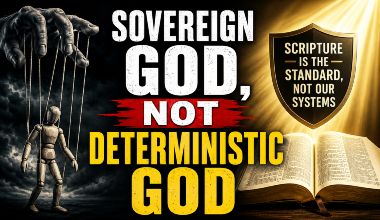
The issue, then, is not whether God is sovereign. Critics of exhaustive divine determinism [Calvinism] do not deny God’s sovereignty. The issue has never been whether God determines some events. Scripture plainly teaches He does. The question is whether Scripture teaches that God determines every thought, desire, and sinful act. The issue, then, is what kind of sovereignty Scripture actually teaches.
Does God’s sovereignty require that He eternally decree every evil act in order to accomplish His purposes? Or is God’s wisdom, power, and providence so great that He can infallibly accomplish His redemptive plan without specifically decreeing every sin that made redemption necessary?
Clay Jones notes: Paul promises that with every temptation God provides “the way of escape” (1 Cor. 10:13). If every sinful choice has already been eternally determined, from what exactly is the believer escaping? No one can escape what God has decreed must occur.
Every theological system must harmonize difficult passages. The question is whether our theology is being shaped by Scripture, or whether Scripture is continually being reshaped to preserve the system. When the plain meaning of passage after passage must be qualified, restricted, redefined, or explained away to fit a prior theological commitment—when ordinary words such as “all,” “world,” “whoever,” or “desires” are repeatedly given specialized meanings, or when distinctions such as God’s “decretive” will and “preceptive” will are invoked to reconcile texts that appear to conflict—it is worth asking whether these interpretive moves arise naturally from the biblical text or from the theological framework brought to it.
At some point, the question is no longer whether Scripture is shaping our theology, but whether our theology is reshaping Scripture.
[1] John MacArthur, “Why Doesn’t God Save Everyone?” Grace to You. (Insert the exact sermon or transcript citation once verified.)
[2] John Hendryx, “What Is Compatibilism?” Monergism.
[3] Loraine Boettner, The Reformed Doctrine of Predestination (Philadelphia: Presbyterian and Reformed Publishing Co., 1932), 234.
[4] Jerome Zanchius, The Doctrine of Absolute Predestination, chap. 2, sec. 2, para. 4.
[5] Arthur W. Pink, The Sovereignty of God (Grand Rapids, MI: Baker Book House, 1930), 162.
[6] Ibid., Appendix II, “The Case of Adam,” 283.
[7] Vincent Cheung, “The Author of Sin,” accessed July 29, 2025.
[8] John Calvin, Institutes of the Christian Religion, trans. Henry Beveridge (Peabody, MA: Hendrickson Publishers, 2008), 3.23.7–8.
[9] Gordon H. Clark, Religion, Reason and Revelation (Nutley, N. J.: Craig Press, 1961), 221.
[10] John Piper and Justin Taylor, eds., Suffering and the Sovereignty of God (Wheaton, IL: Crossway Books, 2006), 42.
[11] C. S. Lewis, The Problem of Pain (New York: HarperOne, 2001), chap. 3, “Divine Goodness.”