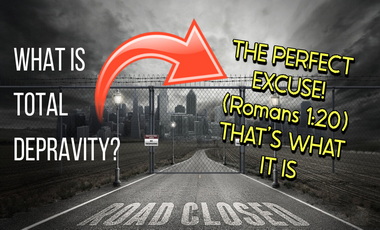
(There are only two types of Calvinists/”Reformed” models: consistent and inconsistent. Double predestination is consistent.) In the video that follows these two quotes, you will see the quote by John Calvin… but I wanted to put an old quote by RC Sproul — who — apparently hasn’t read John Calvin:
DO YOU SCHOLAR MUCH RC?
- Herein lies the problem. Before a person can commit an act of sin he must first have a desire to perform that act. The Bible tells us that evil actions flow from evil desires. But the presence of an evil desire is already sin. We sin because we are sinners. We were born with a sin nature. We are fallen creatures. But Adam and Eve were not created fallen. They had no sin nature. They were good creatures with a free will. Yet they chose to sin. Why ? I don’t know. Nor have I found anyone yet who does know.
RC Sproul, Chosen By God (Wheaton, IL: Thomas Nelson Inc., Publishers, 1986), 30-31
- “God not only foresaw the fall of the first man, and in him the ruin of his posterity; but also at His own pleasure arranged it … Though their perdition depends on the predestination of God, the cause and matter of it is in themselves … Man therefore falls, divine providence so ordaining, but he falls by his own fault.”
John Calvin, Institutes of the Christian Religion, 3.23.7; 3.23.8
What if Calvin was more extreme than most Calvinists today? In this clip, Austin Fischer and Leighton Flowers unpack the forgotten (or ignored) parts of Calvin’s own words—especially around God ordaining the Fall and reprobation. If you’ve ever been told Calvinism is misrepresented, this is the clip you need to see.
MORE:
- “Even the fall of Adam, and through him the fall of the race, was not by chance or accident, but was so ordained in the secret counsels of God.”1
- “Surely, if God had not willed the fall, He could, and no doubt would, have prevented it; but He did not prevent it: ergo He willed it. And if He willed it, He certainly decreed it”2
- “Plainly it was God’s will that sin should enter this world, otherwise it would not have entered, for nothing happens except what God has eternally decreed. Moreover, there was more than a simple permission, for God only permits things that fulfill His purpose.”3
- “Not only did God have a perfect foreknowledge of the outcome of Adam’s trial; not only did His omniscient eye see Adam eating of the forbidden fruit, but He decreed beforehand that he should do so.”4
- “Also, Calvinists often affirm that Adam was free before the Fall. But again, I always speak of freedom relative to God, and from this perspective, I would say that Adam had no freedom whatsoever even before the Fall. To be “free” from sin is irrelevant. The issue is whether Adam was free from God to choose to remain free from sin – he was not. In addition, I would not say that God permitted Adam to fall, but that God caused it.”5
1 Loraine Boettner, The Reformed Doctrine of Predestination, p. 234
2 Jerome Zanchius, The Doctrine of Absolute Predestination, Ch. II, Sec. II, Par. 4 (Link)
3 A.W. Pink, The Sovereignty of God, p. 162
4 A.W. Pink, The Sovereignty of God, Appendix II, The Case of Adam, p. 283
5 Vicent Cheung, The Author of Sin (WEBSITE), last accessed 7/29/2025.
GENESIS 1:31
God saw all that he had made, and it was very good indeed. (Genesis 1:31, CSB)
I just added the below quote from Calvin to Genesis 1:31 in my Bible…. if Calvinism is correct, and the theistic determinism that is its baggage, then God called “good” His creation [man] by nature destined by decree to sin.
- “God not only foresaw the fall of the first man, and in him the ruin of his posterity; but also at His own pleasure arranged it … Though their perdition depends on the predestination of God, the cause and matter of it is in themselves … Man therefore falls, divine providence so ordaining, but he falls by his own fault.” (John Calvin, Institutes of the Christian Religion, 3.23.7; 3.23.8)
Gordon H. Clark: “I wish very Frankly and pointedly to assert that if a man gets drunk and shoots his family, it was the will of God that he should do so …In Ephesians 1:11, Paul tells us that God works all things, not some things only, after the counsel of his own will.”
- They have built high places to Baal on which to burn their children in the fire as burnt offerings to Baal, something I have never commanded or mentioned; I never entertained the thought (Jeremiah 19:5, CSB)
James 1 says every good gift that we get is from God. He doesn’t cause our sin thru 1st or secondary causes.
- No one undergoing a trial should say, “I am being tempted by God,” since God is not tempted by evil, and he himself doesn’t tempt anyone. But each person is tempted when he is drawn away and enticed by his own evil desire. Then after desire has conceived, it gives birth to sin, and when sin is fully grown, it gives birth to death. Don’t be deceived, my dear brothers and sisters. Every good and perfect gift is from above, coming down from the Father of lights, who does not change like shifting shadows. (James 1:13-17, CSB)
Otherwise, He would be redeeming His own decree, a dualistic God of Eastern metaphysics. Even our prayers are rendered useless, “Your will be done on earth as it is in heaven” ~ His will is being done, to the “T”. Which is why when challenged in a lecture about prayer and Reformed ideas, Wayne Grudem said our prayers were even decreed [scripted] before the creation of the time-space-continuum.
MORE: Calvinism’s “Reading Rainbow” | John 11
WORTHWHILE: The “Connective Tissue” Between Islam and Calvinism
Ronnie Rogers zeroes in on the main issue that I will note C.S. Lewis hits first:
LEWIS
Any consideration of the goodness of God at once threatens us with the following dilemma.
On the one hand, if God is wiser than we His judgement must differ from ours on many things, and not least on good and evil. What seems to us good may therefore not be good in His eyes, and what seems to us evil may not be evil.
On the other hand, if God’s moral judgement differs from ours so that our ‘black’ may be His ‘white’, we can mean nothing by calling Him good; for to say ‘God is good’, while asserting that His goodness is wholly other than ours, is really only to say ‘God is we know not what’. And an utterly unknown quality in God cannot give us moral grounds for loving or obeying Him. If He is not (in our sense) ‘good’ we shall obey, if at all, only through fear—and should be equally ready to obey an omnipotent Fiend. The doctrine of Total Depravity— when the consequence is drawn that, since we are totally depraved, our idea of good is worth simply nothing— may thus turn Christianity into a form of devil-worship.
The escape from this dilemma depends on observing what happens, in human relations, when the man of inferior moral standards enters the society of those who are better and wiser than he and gradually learns to accept their standards—a process which, as it happens, I can describe fairly accurately, since I have undergone it. When I came first to the University I was as nearly without a moral conscience as a boy could be. Some faint distaste for cruelty and for meanness about money was my utmost reach—of chastity, truthfulness, and self-sacrifice I thought as a baboon thinks of classical music. By the mercy of God I fell among a set of young men (none of them, by the way, Christians) who were sufficiently close to me in intellect and imagination to secure immediate intimacy, but who knew, and tried to obey, the moral law. Thus their judgement of good and evil was very different from mine. Now what happens in such a case is not in the least like being asked to treat as ‘white’ what was hitherto called black. The new moral judgements never enter the mind as mere reversals (though they do reverse them) of previous judgements but ‘as lords that are certainly expected’. You can have no doubt in which direction you are moving: they are more like good than the little shreds of good you already had, but are, in a sense, continuous with them. But the great test is that the recognition of the new standards is accompanied with the sense of shame and guilt: one is conscious of having blundered into society that one is unfit for. It is in the light of such experiences that we must consider the goodness of God. Beyond all doubt, His idea of ‘goodness’ differs from ours; but you need have no fear that, as you approach it, you will be asked simply to reverse your moral standards. When the relevant difference between the Divine ethics and your own appears to you, you will not, in fact, be in any doubt that the change demanded of you is in the direction you already call ‘better’. The Divine ‘goodness’ differs from ours, but it is not sheerly different: it differs from ours not as white from black but as a perfect circle from a child’s first attempt to draw a wheel. But when the child has learned to draw, it will know that the circle it then makes is what it was trying to make from the very beginning. …
(MORE: CS Lewis: Our White Being God’s Black)
ROGERS
Origin of Sin
- I affirm that sin and evil are the corruption of God’s good creation; further, this corruption is due to the act of free moral agents making free choices to choose contrary to what is righteous and good when they could have chosen to do otherwise. Libertarian freedom entails the ability to act or refrain. Moreover, I affirm that Lucifer, Adam, and Eve possessed the ability to have exercised their free choice of either obeying God or disobeying Him. ‘Therefore, sin is the result of God’s creatures, as free moral agencies, making choices by exercising free will in the libertarian sense of free will, thereby revealing sin to be deprivation rather than a part of creation. By libertarian, I am not implying that man after the fall is fully free, but rather that before the fall, Lucifer, Adam, and Eve had “otherwise choice.”
As Norman Geisler distinguishes, “Technically, free will is not the efficient cause of a free act …. The efficient cause of a free act is really the free agent, not the free choice. Free choice is simply the power by which the free agent acts …. And once we have arrived at the free agent, it is meaningless to ask what caused its free acts. For if something else caused its actions, then the agent is not the cause of them and thus is not responsible for them. The free moral agent is the cause of free moral actions.”31
- I disaffirm that the origin of sin is due to God creating creatures to inevitably sin, withholding grace or ordering circumstances so that man had to sin, or that sin was in any way caused by God.32 Further, I disaffirm that sovereignty precludes Lucifer or man before the first sin from being truly free to sin or not to sin. Moreover, I disaffirm that compatibilism, wherein man is free to act according to his nature or desires, sufficiently answers the origin of the first sin question because Lucifer had no external or internal stimuli to precipitate sin.33 See Chapter 18 for a fuller discussion of this dilemma for Calvinism.
Here again, the distinction between the compatibilist view of free will and the libertarian view is a critical one. See Chapter 17 for a fuller comparison. Compatibilism is the view that moral freedom and determinism are compatible. However, compatibilism does not satisfactorily answer the question of what caused the first sin. In other words, if it is not the product of free choice in the libertarian sense, but only in the compatibilist sense, then did it arise out of the nature of Lucifer, which God directly created, or from overpowering stimuli from Lucifer’s environment, which God also directly created? Furthermore, although the serpent tempted Adam and Eve, there could have been no reason that man would have had to choose sin freely (compatibilism) lest we have what God called “good” being by nature destined to sin, a disquieting reality.
The compatibilist perspective seems to be exactly what Jonathan Edwards meant when he said, “If a person is able to do what he wills or chooses, he is free, no matter how he came to make this choice.”34 This understanding seems further confirmed by his statement regarding the nature of free choice when he says, “the ability to do what we will, or according to our pleasure.”35 Consequently, for the compatibilist, free choice is merely the freedom to choose to do what a person desires to do, even if the range of desires are limited by some preceding event like creation or the fall of man in the garden. As far as original sin, it seems as though he is arguing that man freely chose to eat of the fruit, but then God is the only one who could have given Adam that desire. Thus, Edwards’ compatibilism seems to imply God calling the desire that would ensure the fall and sin “very good” (Genesis 1:31).
I also disaffirm similar contemporary sentiments regarding God’s relation to sin such as R.C. Sproul Jr.’s comment that “Every Bible-believing Christian must conclude at least that God in some sense desired that man would fall into sin… I am not accusing God of sinning; I am suggesting that he created sin.”36 He “describes God as ‘the Culprit’ that caused Eve to sin in the garden.”37 Then there is Gordon Clark’s assessment, “As God cannot sin, so in the next place, God is not responsible for sin, even though he decrees it.”38 Again, Clark in response to Arminians asseverates, “I wish very frankly and pointedly to assert that if a man gets drunk and shoots his family, it was the will of God that he should do so … In Ephesians 1:11. Paul tells us that God works all things, not some things only, after the counsel of his own will.”39 Contrary to Clark, Ephesians does not say that God wills—directly causes—everything, but rather that “he works all things after the counsel of His will” (Ephesians 1:11).
God never has desired sin, nor will He ever. God always desires holiness. In creating man to freely love and walk with God without internal or external coercion, God accomplished the impossible. God desired a holy, loving, personal and eternal relationship with man that would glorify Him and be eternal, joyful bliss for man. That type of relationship would require God creating a being in His own image. Therefore, God chose to create man in His image (Genesis 1:26-28.), which necessitated man being created with true ability to choose to follow God or not follow God. God’s unwavering desire and will was and is for man to experience God’s love for eternity and for man to walk in holiness and love for God without ever using his free will to choose sin. God knew that it was an actual impossibility to guarantee that a truly free created person would never freely choose to misuse his freedom. God knew with absolute certainty that man would use his freedom to sin.40
For that reason, God coextensively determined to allow man to sin, provide His Son as the payment for the sins of the first man and woman and their offspring (1 John 2:2), and unconditionally offer salvation to every sinner, conditioning the reception of the offer upon grace-enabled faith (John 3:16; Ephesians 2:8-10). Although God’s desire for holiness never included a desire for man to sin, this plan allowed man to use his freedom to sin, and his grace-enabled freedom to repent and believe, which results in man being born again with a new nature that is created in righteousness and holiness (Colossians 3:10; Ephesians 4:20-22), but now with the experiential knowledge of sin and redemption.
God also coextensively knew that this transformed man, once salvation is completed in glorification (Romans 8:28-30), who now knows sin experientially and its consequences more fully, as well as redemptive love, will freely choose to live eternally in holiness and love with God and never use his freedom to sin again. God knows this because He knows everything (John 21:17). Thus, what mere creation could not accomplish, creation and redemption could. ‘Therefore, redemption was not a plan subsequent to creation, but rather an essential part of the plan of creation.41
When Satan tempted Eve, he said, “For God knows that in the day you eat from it your eyes will be opened, and you will be like God, knowing good and evil” (Genesis 3:5, italics added). This statement was true. Adam and Eve only knew sin as something forbidden by God, with claimed dire consequences. They did not know sin like God. They did not know it experientially, with all of its heartache, loss, damage, dishonor, depression, separation, and death, and its eternal consequences and corollaries. Satan told them the truth. They would know more about sin, and in that sense they would be more like God; however, he intentionally deceived them by not telling them that in every other way, they would become less like God, and irrevocably so if it were not for the predetermined gracious plan of redemption by God. God knows everything and always has. God has never had a new thought and nothing has ever occurred to God. Therefore, God knows sin experientially, without having ever experienced sin. This is something that cannot be true of a created being like man.
Some things are actual impossibilities, like God ceasing to exist, God sinning, forgiveness without sin’s penalty being borne, and creating a truly free moral being with libertarian free will and guaranteeing that he will not sin. God knew with infinite and invincible certitude that man would use his freedom to sin. He also knew that while it is impossible to create a truly free person without the possibility of him using his freedom to sin, it is not impossible for a completely redeemed and glorified created free being to choose always to walk in holiness. Therefore, what is impossible for man is not impossible for God; albeit, infinitely costly (John 3:16). Further, this is how God could create man while never desiring sin, but only righteousness, and still maintain certitude without Calvinism’s causality. This is the epitome of “God working all things together for good” (Romans 8:28).
Although all earthly analogies are inadequate to illustrate the full orb of eternal truths, they can provide a simple illustration of the eternal truth. A simple analogy of the difference between unfallen man and fallen, redeemed man would be a child having been told not to touch the hot stove. Even with the sternest warnings, cautions and lectures from mom, children are still often drawn to touch the stove; however, if they do touch the burner, and their hands are burned; they are rushed to the hospital and painful treatments, and recuperation are endured over a period of weeks. Once healing is complete, they will not intentionally touch the hot stove again. At this point, they are no longer naive children merely trusting their mother’s caution, but they have experienced the pain of wrong choices and restorative healing.
An illustration of how God could allow sin and yet never desire sin can be found in parents’ desires to have children. When Gina and I decided to have children, our passionate desire was that they would always choose righteousness, and never have to suffer the consequences of their own or someone else’s sin. We desired that they would live the fullest life in fellowship with God that is possible. We desired that they would never choose to act contrary to God’s Word. During the over thirty-four years that our two daughters have been alive, we have remained unequivocally true to those desires. There never has been, nor is there today, a desire to see them sin or be hurt by sin. Yet, we knew enough about the Scripture to know that it would be impossible for them to live the life we desired for them in this life, but that knowledge never altered our desire for righteousness. Furthermore, because God has graciously saved both of our daughters, our desire for them to walk in eternal fellowship with God will be realized.
《《 《《 FOOTNOTES 》》》》
- Norman Geisler, Chosen But Free, (Minneapolis: Bethany House Publishers, 1999), 176.
- Jonathan Edwards, Freedom of the Will, (New Haven: Yale University Press, 1957), 413.
- Edwards, Freedom, 15.
- Edwards, Freedom, 15.
- Edwards, Freedom, 11.
- David L. Allen and Steve W. Lemke, eds., Whosoever Will: A Biblical-Theological Critique of Five-Point Calvinism, (Nashville, B&H Academic, 2010), 148.
- Ibid.
- Ibid., 292.
- Ibid
- The same is true of Lucifer and the fallen angels. However, their creation was different and therefore redemption is not a part of the plan concerning them.
- Additionally, the range of options changes without dispossessing one of libertarian freedom. For example, Adam and Eve had a range of options that man presently does not, and heaven will change the range of options from either state of affairs. In this life, the range of options is very different for a toddler, teenager, adult, and an elderly person, but each has libertarian freedom.

In an excellent post, Robin Phillips explains the reasoning behind the “Reformers” positing WHY God HAD TO make mankind fall:
…. As already mentioned, this theory says that God hates evil so much that He must ensure its eternal perpetuation, for if in a trillion years from now there was even a millisecond of time in which God didn’t have a group of sinners to be angry at, then this would be tragic as one whole part of His character (justice) would be unable to be expressed.
As Douglas Wilson once put it on his blog,
In a world without sin, two of God’s most glorious attributes—His justice and His mercy—would go undisplayed. This, obviously, would be horrible … In a world without sin and evil, at least two attributes of God would have gone unrevealed and unmanifested, those attributes being wrath and mercy. Since this is obviously intolerable, God determined to direct our affairs the way that He did.
Jonathan Edwards expressed a similar idea when he wrote:
It is a proper and excellent thing for infinite glory to shine forth; and for the same reason, it is proper that the shining forth of God’s glory should be complete; that is, that all parts of his glory should shine forth, that every beauty should be proportionably effulgent, that the beholder may have a proper notion of God. It is not proper that one glory should be exceedingly manifested, and another not at all … Thus it is necessary, that God’s awful majesty, his authority and dreadful greatness, justice, and holiness, should be manifested. But this could not be, unless sin and punishment had been decreed; so that the shining forth of God’s glory would be very imperfect, both because these parts of divine glory would not shine forth as the others do, and also the glory of his goodness, love, and holiness would be faint without them; nay, they could scarcely shine forth at all. If it were not right that God should decree and permit and punish sin, there could be no manifestation of God’s holiness in hatred of sin, or in showing any preference, in his providence, of godliness before it. There would be no manifestation of God’s grace or true goodness, if there was no sin to be pardoned, no misery to be saved from. How much happiness soever he bestowed, his goodness would not be so much prized and admired … So evil is necessary, in order to the highest happiness of the creature, and the completeness of that communication of God, for which he made the world; because the creature’s happiness consists in the knowledge of God, and the sense of his love. And if the knowledge of him be imperfect, the happiness of the creature must be proportionably imperfect.
The same notion is present in the works of Saint Augustine:
…if all had remained condemned to the punishment entailed by just condemnation, then God’s merciful grace would not have been seen at work in anyone, on the other hand, if all had been transferred from darkness to light, the truth of God’s vengeance would not have been made evident. —City of God 21.11
[….]
The problem with Calvinism is that its quest for rationalistic clarity does away with this necessary mystery. Calvinism asserts that evil exists because God wants it to be there—end of story. As Calvin put it in his Institutes of the Christian Religion, “I say with Augustine that the Lord has created those who, as He certainly foreknew, were to go to destruction, and He did so because He so willed,” while later Calvin extends this idea to its consistent corollary, which is that “man by the righteous impulsion of God does that which is unlawful.” In other words, according to Calvin, the sinner sins because God impels him to do so.
Calvin picked up on this same theme later when he wrote that:
[M]an falls, the Providence of God so ordaining …that by the will of God all the sons of Adam fell into the state of wretchedness in which they are now involved … Nor ought it to seem absurd when I say, that God not only foresaw the fall of the first man, and in him the ruin of his posterity; but also at his own pleasure arranged it.
God, in His own pleasure, arranged evil?
These are difficult words, especially since they appear to directly implicate God in all the wickedness of the world. It easily solves the problem of evil, but does so at the expense of other scriptural teaching. For example, Psalm 5:5. In the Septuagint—the Old Testament text quoted by the New Testament writers and the canonical text of the ancient Church—Psalms 5:4 reads “For You are not a God who wills (thelon) lawlessness (anomian).”
In fairness to Calvin, he was able to maintain some degree of dialectical balance that would be lacking in his followers. That is why my critique of Calvinism recognizes that Calvinism is larger than simply the teachings of John Calvin. This was impressed upon me when our former church put on a family camp and invited R.C. Sproul, Jr. to speak. The younger Sproul has taken Calvin’s teachings to such an extreme, going even further than his father—let alone Calvin himself. For example, Sproul took particular delight in describing to us in detail how God desired sin to come about, and how God forced the devil to sin like a man operating a remote control. In his book Almighty Over All, Sproul expands on this point, writing, “I am suggesting that he [God] created sin … Where, I must ask, does the law of God forbid the creation of evil? I would suggest that it just isn’t there.”
This leads to what I consider to be a trivialization of evil.
R.C. Sproul, Jr. posted a Facebook status saying that since God is sovereign, even those things which are not as they ought to be really are just as things ought to be. He went on to say that there are ultimately no “bad” things, since God is completely sovereign. Now if all he means is that even bad things work out ultimately for good, then I have no problem. But there is a great difference between saying, on the one hand, that God works good out of evil, and on the other hand, saying that that since God is the author of all things, evil isn’t really bad (or that everything which happens ought to be).
If, as Sproul maintains, God is the author of evil, then we would have to say that He fosters wickedness in people’s hearts. But if so, then God is sinful by the Biblical definitions of sin and evil. Consider that in the Proverbs, the ones who incite and tempt to evil (like the fool’s friends or the prostitute) are as morally guilty as the simple man who falls prey to those temptations. James says that God does not tempt us, but if God is the author of evil then He is doing a lot more than merely tempting us: He is fostering the evil in our hearts and inciting us to sin.
Under this scheme, the words “God is good” are no longer intelligible, as God is violating His own self-revelation of what constitutes “goodness.” Consequently, if God really is the energizing principle behind both the seed of the woman and the seed of the serpent, then we would have to conclude that the Biblical categories used to describe God are ultimately non-descriptive. Moreover, it would make a mockery of the antithesis that we find throughout the war-Psalms, if God is the causal force behind both sides.
Moreover, if God is the author of evil, then we would have to conclude that evil is just as much an intrinsic part of God’s character as His goodness. But in that case, we are left without a standard for distinguishing between good and evil. Using God’s character as the standard would then be akin to using a tape measure on which inches and centimeters are all mixed up. God can only be the standard for distinguishing between good and evil if the former and not the latter is fundamental to His character. …
I will finish the thought I have…
GOD NEEDED TO CREATE MAN TO BE WHOLE
… according to Calvinism. A theological “heresy” in my mind at least.