Who Wrote Gospel of Mark (Martyr for the Cause?)

(Jump to “Atheist Morals“)

Two Quotes I Love About Jesus:

Even if we did not have the New Testament or Christian writings, we would be able to conclude from such non-Christian writings as Josephus, the Talmud, Tacitus, and Pliny the Younger that: 1) Jesus was a Jewish teacher; 2) many people believed that he performed healings and exorcisms; 3) he was rejected by the Jewish leaders; 4) he was crucified under Pontius Pilot in the reign of Tiberius; 5) despite this shameful death, his followers, who believed that he was still alive, spread beyond Palestine so that there were multitudes of them in Rome by A.D. 64; 6) all kinds of people from the cities and countryside – men and women, slave and free – worshipped him as God by the beginning of the second century (100 A.D.)

Michael J. Wilkins, ed., Jesus Under Fire: Modern Scholarship Reinvents the Historical Jesus (Grand Rapids, MI: Zondervan, 1996), 221-222.

The nine founders among the eleven living religions in the world had characters which attracted many devoted followers during their own lifetime, and still larger numbers during the centuries of subsequent history. They were humble in certain respects, yet they were also confident of a great religious mission. Two of the nine, Mahavira and Buddha, were men so strong-minded and self-reliant that, according to the records, they displayed no need of any divine help, though they both taught the inexorable cosmic law of Karma. They are not reported as having possessed any consciousness of a supreme personal deity. Yet they have been strangely deified by their followers. Indeed, they themselves have been worshipped, even with multitudinous idols.

All of the nine founders of religion, with the exception of Jesus Christ, are reported in their respective sacred scriptures as having passed through a preliminary period of uncertainty, or of searching for religious light. Confucius, late in life, confessed his own sense of shortcomings and his desire for further improvement in knowledge and character. All the founders of the non-Christian religions evinced inconsistencies in their personal character; some of them altered their practical policies under change of circumstances.

Jesus Christ alone is reported as having had a consistent God consciousness, a consistent character himself, and a consistent program for his religion. The most remarkable and valuable aspect of the personality of Jesus Christ is the comprehensiveness and universal availability of his character, as well as its own loftiness, consistency, and sinlessness.

Robert Hume, The World’s Living Religions (New York, NY: Charles Scribner’s Sons, 1959), 285-286.

I want to first deal with the “authorship of Mark” challenge. I may deal with the video authors challenge about the Old Testament God — but really this is old news by the “new atheists.” This has been thoroughly dealt with by many, many fine apologists over the years. If I do it will be in a “PART 2” But for now, this will suffice:

Missing The Moral Mark

“If the solar system was brought about by an accidental collision, then the appearance of organic life on this planet was also an accident, and the whole evolution of Man was an accident too. If so, then all our thought processes are mere accidents – the accidental by-product of the movement of atoms. And this holds for the materialists and astronomers as well as for anyone else’s. But if their thoughts — i.e. of Materialism and — are merely accidental by-products, why should we believe them to be true? I see no reason for believing that one accident should be able to give a correct account of all the other accidents. It’s like expecting that the accidental shape taken by the splash when you upset a milk-jug should give you a correct account of how the jug was made and why it was upset.”

C.S. Lewis, God In the Dock (Grand Rapids: Eerdmans Publishing Co., 1970), pp. 52–53.

If a good God made the world why has it gone wrong? And for many years I simply refused to listen to the Christian answers to this question, because I kept on feeling “whatever you say and however clever your arguments are, isn’t it much simpler and easier to say that the world was not made by any intelligent power? Aren’t all your arguments simply a complicated attempt to avoid the obvious?” But then that threw me back into another difficulty.

My argument against God was that the universe seemed so cruel and unjust. But how had I gotten this idea of just and unjust? A man does not call a line crooked unless he has some idea of a straight line. What was I comparing this universe with when I called it unjust? If the whole show was bad and senseless from A to Z, so to speak, why did I, who was supposed to be part of the show, find myself in such violent reaction against it? A man feels wet when he falls into water, because man is not a water animal: a fish would not feel wet. Of course I could have given up my idea of justice by saying it was nothing but a private idea of my own. But if I did that, then my argument against God collapsed too — for the argument depended on saying that the world was really unjust, not simply that it did not happen to please my private fancies. Thus in the very act of trying to prove that God did not exist — in other words, that the whole of reality was senseless — I found I was forced to assume that one part of reality — namely my idea of justice — was full of sense. Consequently, atheism turns out to be too simple. If the whole universe has no meaning, we should never have found out that it has no meaning: just as, if there were no light in the universe and therefore no creatures with eyes, we should never know it was dark. Dark would be without meaning.

C.S. Lewis, Mere Christianity (San Francisco, CA: Harper San Francisco, 1952), 38-39.

— Atheist Morals Noted Below —

Calling All Martyrs

In the VIDEO, the author tries to make a connection between the zealots who died following Jim Jones, and what Jesus has called people to in Mark 8:34-35:

34 Calling the crowd along with his disciples, he said to them, “If anyone wants to follow after me, let him deny himself, take up his cross, and follow me. 35 For whoever wants to save his life will lose it, but whoever loses his life because of me and the gospel will save it. 36 For what does it benefit someone to gain the whole world and yet lose his life? 37 What can anyone give in exchange for his life? 38 For whoever is ashamed of me and my words in this adulterous and sinful generation, the Son of Man will also be ashamed of him when he comes in the glory of his Father with the holy angels.”

— Christian Standard Bible (Nashville, TN: Holman Bible Publishers, 2020), Mk 8:34–38.

What are the KEY THEMES via the ESV Study Bible?

But to sum up the people willing to die after Jesus’ ascension, you have a myriad of martyrs being burned alive, fed to lions, and the like. They did not poison themselves or die fighting to convert others. For instance, in 2016 about 90,000 Christians were killed for their faith worldwide. Christians are the most martyred group in the world. Maybe Jesus was foreshadowing this reality’s in His omniscience? (I will post a commentary at the end to show the slightly more complex idea than the simpleton one in the video.)

AUTHORSHIP!

This first – short – video is by J. Warner Wallace, followed by a quick blurb I assume many do not know well… followed still by some more of the same. I wanted to post on this topic because of a video by , the part that got me thinking was the section from the 10:32 mark to the 12:05 time stamps.

LEARN RELIGIONS has this interesting blurb for the uninitiated:

John Mark in the Bible

John Mark was not one of the 12 apostles of Jesus. He is first mentioned by name in the book of Acts in connection with his mother. Peter had been thrown in prison by Herod Antipas, who was persecuting the early church. In answer to the church’s prayers, an angel came to Peter and helped him escape. Peter hurried to the house of Mary, the mother of John Mark, where she was holding a prayer gathering of many of the church members (Acts 12:12).

Both the home and household of John Mark’s mother Mary were important in the early Christian community of Jerusalem. Peter seemed to know that fellow believers would be gathered there for prayer. The family was presumably wealthy enough to have a maidservant (Rhoda) and host large worship meetings.

The earliest manuscripts tell us Mark wrote the Gospel: “according to Mark.” But who was Mark?

Mark, or John Mark, as he was known, lived in Jerusalem, and his mother owned a home where the earliest followers of Jesus gathered. He worked with Paul and Barnabas on their first missionary journey. Later, he joined Peter in Rome. It was in Rome, according to church tradition, where Mark wrote Peter’s version of the Gospel.

ZONDERVAN has an excellent article titled,Who Wrote the Gospel of Mark?. Here is part of that article:

The earliest tradition on Mark’s authorship

Despite this anonymity, there is strong and early tradition identifying the author of the Third Gospel as John Mark, part-time associate of both Paul and Peter. The earliest tradition is reported by the church historian Eusebius (c. AD 263 – 339), who quotes Papias, bishop of Hierapolis, in the latter’s five-volume work known as Interpretation of the Sayings of the Lord (Λογίων κυριακῶν ἑξήγησις). Papias, likely writing around AD 95 – 110,37 quotes John “the Elder” concerning the authorship of the Second Gospel:

The Presbyter used to say this also: “Mark became Peter’s interpreter and wrote down accurately, but not in order, all that he remembered of the things said and done by the Lord. For he had not heard the Lord or been one of his followers, but later, as I said, a follower of Peter. Peter used to teach as the occasion demanded, without giving systematic arrangement to the Lord’s sayings, so that Mark did not err in writing down some things just as he recalled them. For he had one overriding purpose: to omit nothing that he had heard and to make no false statements in his account.”2

Eusebius points out that though Papias did not himself know the apostles, he was in direct contact with those who had heard them, including John the Elder, Aristion, Polycarp, and the daughters of Philip the Evangelist (Eusebius, Hist. eccl. 3.39.1 – 9; cf. Acts 21:8 – 9).3 We thus have a first-century tradition claiming that Mark accurately interpreted (or translated) Peter’s eyewitness accounts, turning Peter’s anecdotal stories into a connected narrative, though not necessarily in chronological order.4

Mark’s authorship in the second century 

Second-century sources make similar claims. The Anti-Marcionite Prologue to Mark (c. 160 – 180) identifies Mark as the author and links him to Peter: “Mark . . . who was called ‘stump-fingered’ because for the size of the rest of his body he had fingers that were too short. He was Peter’s interpreter. After the departure [or ‘death’] of Peter himself, the same man wrote his Gospel in the regions of Italy.”5 The odd statement about Mark’s disfigured fingers may point to a reliable tradition, since the church is unlikely to have invented such a disparaging remark.6 We find here two additional pieces of information: that Mark wrote after Peter’s death and that he wrote in Italy.

Irenaeus (c. 180), referring to Peter and Paul, similarly asserts, “Now Matthew published a written Gospel among the Hebrews in their own tongue, while Peter and Paul were evangelizing and founding the church in Rome. But after their departure [ἔξοδος; death?], Mark, the disciple and interpreter of Peter, himself also handed over to us, in writing, the things preached by Peter.”7 The implication is that Mark is writing from Rome after the deaths of Peter and Paul.

Clement of Alexandria (c. 180) specifically refers to Rome: “When, by the Spirit, Peter had publicly proclaimed the Gospel in Rome, his many hearers urged Mark, as one who had followed him for years and remembered what was said, to put it all in writing. This he did and gave copies to all who asked. When Peter learned of it, he neither objected nor promoted it.”8 Peter’s apparent indifference to Mark’s work suggests that this statement was not created as an apologetic defense of the Petrine tradition, since, if that were the case, one would expect a much more positive affirmation by Peter. Other early church writers, including Tertullian (Marc. 4.5), Origen (Eusebius, Hist. eccl. 6.25.5), and Jerome (Comm. Matt., prologue 6), affirm Mark’s role as author and that he was dependent on the eyewitness accounts of Peter.

How many of these early witnesses are dependent on one another is not known. Yet their unanimity is impressive. No competing claims to authorship are found in the early church. Since John Mark was a relatively obscure figure, it seems unlikely that a gospel would have been attributed to him if he had not in fact written it. We could add to this the evidence of the titles to the Gospels, which, as noted above, appear in nearly all of our extant manuscripts.

Internal evidence for Markan authorship

Although internal evidence does not provide direct evidence for authorship, it can be used to help corroborate the external claims. (1) The author’s many Aramaisms (Mark 3:17; 5:41; 7:11, 34; 10:45; 14:36) are compatible with a Palestinian Jew like John Mark (cf. Acts 12:12). (2) The large number of Latinisms would also fit a Roman provenance (place of origin). (3) The identification of Rufus and Alexander as sons of Simon of Cyrene (15:21) is also significant, since it confirms that the author was known to his readers. It seems unlikely that the title “according to Mark” (κατὰ Μάρκον) could have been attached to the gospel so early if the original readers knew it came from someone else. Furthermore, if this Rufus is the same one mentioned in Rom 16:13, we have incidental confirmation of a Roman provenance.

(More at ZONDERVAN)

FOOTNOTES

2) Eusebius, Hist. eccl. 3.39.15 (translation from P. Maier,  Eusebius: The Church History (Grand Rapids: Kregel, 1999), 129 – 30.
3) “Papias thus admits that he learned the words of the apostles from their followers but says that he personally heard Aristion and John the presbyter. He often quotes them by name and includes their traditions in his writings” (Eusebius, Hist. eccl. 3.39.7; trans. Maier, Eusebius, 127).
4) The connection to Peter is also indirectly made by Justin Martyr (c. AD 150), who refers to Mark 3:16 – 17 ( Jesus’ naming of Simon as “Peter,” and James and John as “Sons of Thunder”) as coming from the memoirs of Peter (Dial. 106). For strong defenses of the authenticity of the Papias tradition, see Hengel, Studies, 47 – 53; Robert H. Gundry, Mark: A Commentary on His Apology for the Cross (Grand Rapids: Eerdmans, 1993), 1026 – 45.
5) Cited by C. Black, Mark: Images of an Apostolic Interpreter (Columbia, SC: University of South Carolina Press, 1994), 119. The date of the Anti-Marcionite prologues is disputed, with some scholars placing them in the third century.
6) The same description is found in Hippolytus, Haer. 7.30.1 (see Black, Mark, 115 – 18).
7) Ireneaus, Haer. 3.1.1; translation from Black, Mark, 99 – 100.
8) Cited by Eusebius, Hist. eccl. 6.14.6 – 7 (trans. Maier, Eusebius, 218).

GOT QUESTIONS also notes much of the same:

Author: Although the Gospel of Mark does not name its author, it is the unanimous testimony of early church fathers that Mark was the author. He was an associate of the Apostle Peter, and evidently his spiritual son (1 Peter 5:13). From Peter he received first-hand information of the events and teachings of the Lord, and preserved the information in written form.

It is generally agreed that Mark is the John Mark of the New Testament (Acts 12:12). His mother was a wealthy and prominent Christian in the Jerusalem church, and probably the church met in her home. Mark joined Paul and Barnabas on their first missionary journey, but not on the second because of a strong disagreement between the two men (Acts 15:37-38). However, near the end of Paul’s life he called for Mark to be with him (2 Timothy 4:11).

Date of Writing: The Gospel of Mark was likely one of the first books written in the New Testament, probably in A.D. 55-59.


Commentary 1


  • T. France, The Gospel of Mark: A Commentary on the Greek Text, New International Greek Testament Commentary (Grand Rapids, MI; Carlisle: W.B. Eerdmans; Paternoster Press, 2002), 339–341.

34 Mark uses προσκαλέομαι to alert the reader to expect something new or emphatic to be revealed, or some new instruction to be delivered to the disciples (cf. 3:13, 23; 6:7; 7:14; 10:42; 12:43). What is surprising here is that the object of the verb is not just the disciples, whom one would expect, but τὸν ὄχλον σὺν τοῖς μαθηταῖς αὐτοῦ. We have gained from vv. 27–33 the impression that the setting is a private retreat in the countryside in the far north of Palestine, where Jesus was presumably little known and the population probably largely non-Jewish. A crowd of people in this area who were at least potentially followers of Jesus seems incongruous, and they will play no further part in the narrative. From the narrator’s point of view, however, the introduction of the ὄχλος serves here, rather like οἱ περὶ αὐτὸν σὺν τοῖς δώδεκα in 4:10, to widen the audience for a key pronouncement; their inclusion in the audience asserts that the harsh demands of the following verses apply not only to the Twelve but to anyone else who may wish to join the movement. The introductory phrases εἴ τις θέλει and ὃς γὰρ ἐάν (vv. 35, 38) further generalise the scope of the paragraph; this is not a special formula for the elite, but an essential element in discipleship.

ὀπίσω μου is used here not as in v. 33 but in its more normal NT sense (see 1:17, 20 etc.), and the double use alongside it of ἀκολουθέω (cf. 1:18; 2:14) confirms that we have here a basic condition of discipleship. It is to join Jesus on the way to execution. This is the first use of σταυρός by Mark, and neither noun nor verb will occur again before chapter 15. Jesus’ predictions of his death in 8:31; 9:31; 10:33–34 do not spell out the means of death, and this specifically Roman form of execution would not be the first to come to a Jewish mind when hearing of death at the behest of the Jewish authorities. By the time Mark wrote his gospel, of course, Jesus’ crucifixion was well known, and his readers would need no explanation for the σταυρός here. But at the beginning of the journey to Jerusalem such language is calculated to shock, and evokes a vivid and horrifying image of the death march with all its shameful publicity. The preservation of so specific an image at more than one point in the gospel tradition (see also the Q saying Mt. 10:38; Lk. 14:27) may suggest that it originates from Jesus’ own awareness of how he would die rather than from Mark’s reading back the later event.

The metaphor of taking up one’s own cross is not to be domesticated into an exhortation merely to endure hardship patiently. In this context, following 8:31, it is an extension of Jesus’ readiness for death to those who follow him, and the following verses will fill it out still in terms of the loss of life, not merely the acceptance of discomfort. While it may no doubt be legitimately applied to other and lesser aspects of the suffering involved in following Jesus, the primary reference in context must be to the possibility of literal death.

The call to take up the cross is preceded by ἀπαρνησάσθω ἑαυτόν, a phrase not paralleled in the gospel tradition. The verb ἀπαρνέομαι is particularly associated with Peter’s eventual denial not of himself but of his master; in that context it means to dissociate oneself completely from someone, to sever the relationship. So the reflexive use implies perhaps to refuse to be guided by one’s own interests, to surrender control of one’s own destiny. In 2 Tim. 2:13 ἀρνήσασθαι ἑαυτόν (of God as subject) means to act contrary to his own nature, to cease to be God. What Jesus calls for here is thus a radical abandonment of one’s own identity and self-determination, and a call to join the march to the place of execution follows appropriately from this. Such ‘self-denial’ is on a different level altogether from giving up chocolates for Lent. ‘It is not the denial of something to the self, but the denial of the self itself.’

35–37 The talk of losing and gaining the ψυχή in these verses depends on the range of meaning of ψυχή, and poses problems for the translator. The same noun denotes both the ‘being alive’ (as opposed to dead; cf. 3:4; 10:45) which one might seek to preserve by escaping persecution and martyrdom, and the ‘real life’ which may be the outcome of such martyrdom, and therefore is to be found beyond earthly life. It is in this latter sense that the English word ‘soul’ is traditionally used here, but the wordplay is better preserved by retaining ‘life’ but where necessary qualifying it with ‘true/eternal’ or ‘earthly’.

The immediate subject of these verses, following as they do the imagery of taking up one’s cross in v. 34, is surely the literal loss of (earthly) life which the disciple is called to accept as a potential result of following Jesus. Only that sense fully does justice to the wordplay. To extend this sense to the loss of privilege, advantage, reputation, comfort, and the like may be legitimate in principle, but only so long as this primary and more radical sense is not set aside. To cling to the things of this life, the things which humanity naturally values most, is the way to forfeit true life; clinging to life itself is the ultimate example of this concern, and is set in contrast with the acceptance of death (for the right reason) as the way to real life. Jesus himself, in his death and resurrection, will be the supreme example of this new perspective.

The promise of true life is not attached to death in itself, but to the loss of life ἕνεκεν [ἐμοῦ καὶ] τοῦ εὐαγγελίου (see Textual Note). The possibility of literal martyrdom as the outcome of Christian discipleship is clearly envisaged here; cf. 13:9 (ἕνεκεν ἐμοῦ). Jesus’ expectation of his own death must have raised this possibility, and the experiences of the early church from Acts 7 onwards would add weight to it. The specific mention of the εὐαγγέλιον as the cause of loss of life indicates that the disciples are to play an active role in mission rather than merely privately following the teaching of Jesus, and that it is in this missionary work that they are likely to meet with persecution and death. Best rightly emphasises that the addition of this phrase indicates the inadequacy of a view of discipleship as merely the imitation of Jesus.

In the Synoptic Gospels κόσμος does not carry the negative connotation it has elsewhere in the NT, and especially in John; it denotes the created world in a neutral sense. κερδῆσαι τὸν κόσμον ὅλον therefore simply expresses the height of human ambition and achievement, measured in terms of earthly life. While ζημιόω sometimes carries a juridical sense of penalty or punishment, the context here does not require that nuance. Its more normal sense is simply loss or disadvantage. ζημιωθῆναι in v. 36 therefore denotes the opposite of κερδῆσαι; this is a profit and loss account, and it is clearly understood that the loss of the ψυχή (here ‘true life’) far outweighs any gain in terms of earthly advantage.

The same idea is differently expressed in the rhetorical question of v. 37, where again the assumption is made that the ψυχή is all that ultimately matters, and that nothing else can compensate for its loss. The ἀντάλλαγμα (cf. LXX Job 28:15) is the ‘exchange rate’ at which the ψυχή is valued; it is beyond price. The language of exchange echoes Ps. 49:7–9 (though LXX there uses λυτρόω/λύτρωσις, not ἀνταλλάσσομαι/ἀντάλλαγμα), but whereas the psalm speaks of a payment to avoid physical death, here the focus has moved to ‘true life’, which is even more beyond the reach of human valuation. There is no reason in this context to read into the question any developed theology of redemption; it is simply a statement of comparative value.


Commentary 2


  • David Smith, Mark: A Commentary for Bible Students (Indianapolis, IN: Wesleyan Publishing House, 2007), 157–169

Insight into the Messiah’s Task

Mark 8:[31]–33

…….3. Jesus’ First Passion Prediction 8:31–33

Coupled with the immediately preceding command to silence, the core of Jesus’ self-revelation began with a redirection of the disciples’ choice of titles. They chose Messiah; Jesus offered another, more enigmatic title: the Son of Man (8:31). What Jesus was about to say regarding suffering and death might have been incomprehensible if He had retained the disciples’ more victorious-sounding title: “Christ.” Jesus would not allow himself to be categorized. For Jesus, the title “Christ” carried too much militaristic and nationalistic baggage; it had to be tempered with the less familiar “Son of Man” designation. He went on to teach His disciples the essential issues with reference to His identity.

The “Son of Man must suffer many things” (8:31). The disciples had seen nothing but power and victory in the acts of Jesus thus far. So these words had no place to take root. Moreover, the suffering and death of the Messiah raised huge theological problems. If Jesus was indeed the Messiah, why would God allow Him to be rejected and be killed (8:31)? Though the answer is not fully elucidated in the gospel of Mark, it is part of a plan found in the Old Testament. Mark reported that the Son of Man must suffer many things. The word must is often used of divine necessity as spelled out later in 9:12 and 14:21, 49. Thus, Jesus’ rejection and death are to find their source in Scripture and the heart of the Father’s will and not in the violence of Palestinian politics. Mark would not allow Jesus’ death to be read as a sociological mistake but rather as an act of divine redemption.

The wording of each of the three passion predictions is just a bit different. It is only in this passage that the reader of Mark sees the word suffer. But with rejected, Mark draws attention to Psalm 118:22, where Christians identify in Jesus’ fate that the “stone the builders rejected has become the capstone” and His following vindication. Each of the three passion predictions ends with the same climax: the resurrection of Jesus from the dead. The disciples were no more attentive to this aspect of Jesus’ teaching than any other.

No matter how much explanation He provided, the disciples never achieved complete clarity. This unveiling of the messianic mission demanded a response from the disciples. And it came from Peter as he took [Jesus] aside and began to rebuke him (8:32). Peter displayed that he was at cross-purposes with Jesus’ agenda. The word “rebuke” connotes a command by one taking authority over another. Jesus, without hesitation, turned and looked at his disciples (8:33), implicating them as coconspirators, as he rebuked Peter. The repetition of the same verb (8:31, command of Jesus to disciples; 8:32, Peter’s rebuke of Jesus; 8:33, Jesus’ rebuke to Peter) demonstrates irreconcilable perspectives. Jesus settled the issue when He ordered Peter to get behind Him. Note how this short statement is spatially as well as relationally oriented. First, Jesus said, “Get behind me.” This is the same language used by Jesus in His initial call of His disciples in 1:17 and could be translated, “Come, behind Me.” This might be understood as Jesus calling Peter to get back in step with Him. Further, there is another occurrence of the word in the next verse, where the phrase is translated, “If anyone would come after me” (8:34), cementing Peter’s call to follower-ship based not on his notion of power or might, but on Jesus’ revelation of rejection, shame, and death.

Relationally, Jesus called Peter “Satan.” In short order, Jesus completed His own counter-rebuke of Peter. Peter’s plan, which avoided the cross, placed him in league with Jesus’ archenemy. This is partially why Jesus commanded (rebukes) the disciples to silence, for the proclamation of a Messiah without the cross is satanic in its message. This exchange was brought to a culmination with Jesus’ closing reproof: “You do not have in mind the things of God, but the things of men” (8:33). The NIV makes this a separate sentence, while in actuality it is a dependent clause, specifically a result clause: “for you do not have in mind the things of God but the things of people.” The plain teaching of Jesus (8:31) cannot be grasped on a merely human level.

The vision for ministry that Jesus is teaching is irreconcilable with the vision Peter and the other disciples have for Him as the Messiah. The misguided vision of the disciples and their determined refusal to adopt Jesus’ revelation precludes them from full comprehension. Teaching, even from such a skilled educator as Jesus, would not adequately overcome humanity’s blindness. Thus, Mark conveys a truth that became Christian doctrine: Men and women must not merely become educated (or catechized) in the Church; they must initially be transformed.

The Demands of Discipleship

Mark 8:34–9:1

  1. The Cost of Following Jesus 8:34–35

The call to discipleship is comprehensive in its reach (disciples and crowds), but it immediately takes on a conditional nature: “If anyone would come after me” (8:34). The phrase literally translated reads, “If someone wishes/wants after me to follow.…” Jesus demands a heartfelt choice, which eliminates other, possibly more appealing, choices.

Jesus set the agenda according to His spiritual compass; a follower must “deny himself.” Powerfully, the insertion of the reflexive pronoun himself implies the first aspect of discipleship is to refuse to be guided by one’s own interests. Moreover, self-denial is not to be confused with asceticism (the denial of things one desires) or even with self-discipline. Self-denial is the denial of the self itself (see Phil. 2:3–4). The second requirement of a follower is to “take up his cross.” This is the first use of the word in the Gospel, certainly creating a link back to Jesus’ earlier prediction of His own death. In the first century, a cross indicated punishment of a shamed criminal at the hands of the Romans. Moreover, this Roman form of execution might be heard by the listeners as a call to rebel against Rome and to risk their lives. Yet, the word will not reoccur until chapter 15. This provided Jesus with ample time to define the impact and meaning of His own death and the cross-bearing imagery associated with His followers. For in summary, the self-denial to which Jesus calls one is abandonment of one’s autonomy and adoption of Jesus’ leadership and lordship.

Finally, Jesus beckoned His disciples to “follow me” (8:34). Jesus’ initial thrust into discipleship-making seems more directional than doctrinal. His call is bracketed with terms of motion. “Mark is rich in verbs of motion. Jesus is on the move; he summons disciples to come after him” Each time Jesus called His disciples, He was in motion (1:16, 19; 2:14; 10:17). Further, His call was to get in step directly behind Him. Thus, for one to be a disciple, one must follow. The mark of a faithful disciple is to be seen not in fully comprehending all the theological nuances of the person of Jesus, but in setting one’s sight unwaveringly on the path laid out by Jesus. The path to the cross is costly and counterintuitive, yet Jesus clearly laid out the directional markers for all who are willing to follow.

The demands of discipleship are further refined. “For whoever wants to save his life will lose it, but whoever loses his life for me and for the gospel will save it” (8:35). Jesus offered this paradoxical principle for savings one’s life, using two meanings of “life.” The word implies physical life in its first use (as opposed to death; see 3:4; 10:45). In this sense, people might think they can preserve their lives by avoiding conflict and persecution. However, Jesus’ other meaning was that by losing one’s physical life, one receives (saves) eternal life. More precisely, this call to a loss of life is not a morbid acceptance of death. Rather, it is an adoption of Jesus (for me) and His mission agenda (for the gospel) around which one reorients one’s focus and through which one discovers true life. A disciple is to follow Jesus by publicly adhering to the gospel, proclaiming it to the world, and dying if necessary.

  1. Keeping an Eternal Perspective 8:36–9:1

“What good is it for a man to gain the whole world, yet forfeit his soul?” (8:36). Here the contrast between this world and the next (soul) is made more explicit. In this Gospel, “world” represents the created order in a neutral sense. Gain implies human ambition and drive for worldly success. Thus, one should not connote an evil intent on the part of the pursuer, but the explicit contrast as the loss of one’s life or soul far exceeds any profit in terms of earthly gain. This contrast is continued in the rhetorical question “Or what can a man give in exchange for his soul?” (8:37). This passage continues with the theme that we cannot grasp the priceless value of one life or soul, and that there is another way to categorize value apart from what we can see, hear, smell, touch, and taste.

Verse 38 repeats the conditional emphasis begun in 8:34: “If anyone is ashamed of me and my words in this adulterous and sinful generation, the Son of Man will be ashamed of him when he comes in his Father’s glory with the holy angels.” The contrast of honor and shame was a primary value of the first century. So, if anyone was ashamed of Jesus (of me) and His authoritative demands (and my words), she or he might have received worldly honor, but forfeited honor in the future, coming Kingdom. David Garland summarizes it this way:

Jesus uses the threat of judgment to induce his followers to be faithful. To be put to shame is the opposite of vindication (Ps. 25:3; 119:6; Isa. 41:10–11; Jer. 17:18). Those who may be frightened by the edicts of earthly courts (represented in the Gospel by Herod Antipas, the high priest’s Sanhedrin, and the Roman governor, Pilate) should fear even more the decision of the heavenly tribunal, which determines their eternal destiny.

The use of the adjective adulterous reminds the reader of the frequent Old Testament charges against the nation of Israel as she constantly committed spiritual adultery and went out after other gods (Isa. 1:4, 21; Ezek. 16:32; Hos. 2:4).

The traditional early church understanding of the Son of Man “coming” was that of the parousia or the second coming. Yet the imagery and background in this material comes from the visions of Daniel 7: “… one like a son of man, coming with the clouds of heaven.” He is presented before the throne of the Ancient of Days (Dan. 7:13–14), and “He was given authority, glory and sovereign power; all peoples, nations and men of every language worshiped him. His dominion is an everlasting dominion that will not pass away, and his kingdom is one that will never be destroyed.” The scene is clearly set in heaven, and His “coming” is better described as an entrance into the throne room of God, not the “second coming” to earth. One must keep in mind that Jesus’ teaching in 8:31 is an intricate series of contrasts between this world and the next, with the Son of Man prophecy as its climax. Thus, the shaming of the Son of Man on earth by people will result in their judgment in the heavenly realm.

There is an interesting combination of Son of Man language and the Father’s glory. The voice at Jesus’ baptism directly referred to Jesus as His Son (1:11). Jesus only referred to God as His Father again in 13:23 and in His prayer in Gethsemane (14:36). Yet the importance is not simply familial but theological. For here the Son of Man and Son of God concepts are closely linked with each other and with the messianic overtones of the entire passage. This would not happen again until Jesus’ confession before the high priest in 14:62.

And he said to them, “I tell you the truth, some who are standing here will not taste death before they see the kingdom of God come with power” (9:1). Seemingly, 9:1 assures the first-century disciples (and subsequent readers) that for all they abandon in this lifetime, they will indeed see the kingdom of God come and share in His exaltation. The implication is that the event being referred to is near enough that a privileged few will catch a glimpse of this unveiling. Numerous suggestions have been offered regarding the fulfillment of Jesus’ prediction. The most prominent suggestions include (1) the death of Jesus and the resultant tearing of the Temple curtain, (2) victory over death in His resurrection, (3) His ascension and enthronement in heaven, (4) the coming of the Holy Spirit at Pentecost, and (5) the destruction of Jerusalem in a.d. 70. All of these would certainly be viable options within the lifetime of the original hearers. Yet nearly all except the first option fall outside the narrative of the gospel of Mark. Possibly the most text-centered line of interpretation would be to look forward to the Transfiguration (9:2–13). The events are linked temporally and precisely—after six days—a highly unusual practice for Mark outside of the passion narrative. Additionally, the Transfiguration narrative reports what the disciples saw, and the cloud appearing and enveloping the disciples is suggestive of the Mount Sinai theophany (Exod. 19), leaving the reader with the impression of Jesus coming in power. One could feel less than satisfied with seeing Jesus transfigured on a mountain being equated with seeing the kingdom of God come with power. Yet throughout the Gospel of Mark, the kingdom of God and the person of Jesus are inseparably linked. The Kingdom was brought near with the coming of Jesus and the proclaiming of the good news of God (1:14–15). Later, the secret of the Kingdom was revealed in Jesus’ parabolic instruction (4:10–12). Thus, it seems appropriate for Mark to make known the joining of the Kingdom of God and the person of Jesus as a signal of the real, though not yet fully revealed, presence.
The “Gospel-Less Gospel” of Rob Bell

(Originally posted  Jul 27, 2010)

The original recording of this I did disappeared into the wasteland of the Internet. So I re-downloaded it into a new file. Rob Bell has his presentation of the “Gospel” put to the test of the Word of God as well as Christian historical points examined. This topic is long, but important (2hrs). Pirate Christian radio can be found here as well as a couple other sites by Chris Rosebrough:

Description below audio:

The description of the audio above:

My Vimeo account was terminated many years ago; this is a recovered audio/video from it. (Some will be many years old, as is the case with this audio.)

(The below description is from APPRISING MINISTRIES)

In this version of his Fighting for the Faith podcast from his Pirate Christian Radio apologist Chris Rosebrough does a serious and thorough deconstruction of the gospel-less gospel of Rob Bell, a popular icon in the egregiously ecumenical Emerging Church aka Emergent Church—morphing into Emergence Christianity (EC).

How refreshing to hear Rosebrough bring our attention to the critical importance of the Gospel of Jesus Christ as he reminds the Body of Christ that “the Gospel is not a side issue. The Gospel is at the very heart and center of Christianity; you get the Gospel wrong, you are sending yoursefl—and other people to Hell.”

With this as the necessary backdrop Rosebrough begins his program examining the “good news” of Rob Bell in the light of Holy Scripture with the following, which is actually no surprise at all to readers of Apprising Ministries:

Something seriously wrong with this guy’s teaching. I’ve been smelling smoke for years from this guy; and now well, it’s erupted into fullblown fire… I’m going to play for you the audio from this video. I’m not going to interrrupt it; I’m going to let you hear the whole thing in context, and then we’re gonna circle back and we’re gonna pull this thing apart piece by piece.

Not only are there doctrinal errors in here; there are historical errors in here, and he’s engaging in something here called deconstructionism. This is a very, very dangerous “gospel” that he’s preaching. And I am not going to back off from my assessment; I’ll tell you ahead of time, this is not the Gospel of Jesus Christ. This is not the Gospel that the Apostles preached. This is something completely different…

I am willing, at this point, to stand by my assessment; unless I hear otherwise from Rob Bell, which I seriously doubt, I’m going to basically make the charge this is not Christianity. This is a rehashed liberalism, if you would; kind of an interesting spin on liberalism, the liberal social gospel, if you would. This is seriously, seriously, dangerous and heretical stuff

Follow Chris Rosebrough on TWITTER

This show was done well after my paper was first published on Scribd and emailed to Chris. The similarities can be attributed to coincidence or me focusing Chris in on the issues at hand. My paper can be found here:

In both my paper and the audio portion of Lee Strobel added in the Pirate Christian Radio broadcast, Rob Bell’s history is shown to be way off and in line more with Gnostic scholars like Pagels and the Jesus Seminar. My paper also included Dr. Edwin Yamauchi, probably the premier historian on pre-Christ history.

Some posit that Jewish thinking on Satan is borrowed from Zoroasterian thought, however, Satan makes an appearance in the book Job. Job is a very early book… pre-dating Zoroaster’s life easily. Satan, as described there, is nothing like the evil god Ahriman, who is a dualistic equal to Ohrmazd the good god, rather than a subordinate.

There is a waay more in-depth dealing with this topic of a supposed Zoroastrian influence in Dr. Corduan’s PDF here:

Another excellent resource that responds to specific scholars on the issue is professor Edwin M. Yamauchi’s, PERSIA AND THE BIBLE, esp. chapter twelve. Here is an excerpt from Dr. Corduan’s excellent book:

Zoroastrian Influences

Scholars commonly observe that the real significance of Zoroastrianism lies in the influence it has exerted on the development of other world religions, specifically Judaism, Christianity and Islam. For example, it has been suggested that Jews picked up the concepts of Satan, angels, demons and the apocalypse (resurrection and judgment at the end of the world) during their exile in Babylonia and immediately thereafter. Notions of Zoroastrian influence were particularly popular during the early twentieth century. Even though scholarly support for them has eroded, they continue to be propagated on the popular level and in introductory textbooks.

There is nothing intrinsically pernicious about the idea that one religion may have influenced another one. A case in point lies in the origin of Islam in the life of Muhammad. We know that Muhammad came into contact with established versions of Judaism, Christianity and Zoroastrianism. We know what those adherents believed for the most part, and we can show exactly how some of those beliefs showed up (and how they were modified) in the Qur’an. Thus it makes sense to think in terms of the influence that these three religions exerted on Muhammad. I have argued that we must leave plenty of room both for Muhammad’s own creativity and for the vestige of original monotheism present in Arabian culture at his time. The idea does become objectionable when the identification of a supposed influence is used to eliminate all originality (or even truth—the “genetic fallacy”) from a religious belief simply by showing that it was derived from some other source.

We can use the example of influences on Muhammad to establish criteria by which we can judge whether Zoroastrianism could have influenced Judaism. In order to conclude reasonably that such an influence occurred, the following points have to be true:

  1. Zoroastrianism must have been established in the form in which it was supposed to have influenced Judaism.
  2. There must have been sufficient opportunity for the Jews to absorb the doctrines.
  3. There must be sufficient resemblance between the Zoroastrian version of the doctrines and the biblical version to make influence a reasonable conclusion.
  4. There must be a clear indication that the influence went from Zoroastrianism to Judaism and not the other way around. This criterion is particularly incisive if there is some evidence that the beliefs in question may have been present in Judaism before the period of supposed contact with Zoroastrianism.

As it turns out, not one of these criteria supports the notion of Zoroastrian influence.

1. Zoroastrianism had a particularly tough time getting established in Per­sia. Even the kings we know as Zoroastrians wor­shiped Ahura Mazda along with other gods. All these kings ruled at a time later than the period of the exile. Cyrus, who sent the Jews back to their own land, was not Zoroastrian. If Zoroas­trianism had influenced Is­rael at this time, then the Jews must have been more open to the message of Zoroaster than the Persians themselves were.

2. The kind of intimate contact necessary for assimilation of foreign beliefs cannot be demonstrated for the Jews in the mainstream of biblical Judaism. As stated above, Persia did not become Zoroastrian until after the exile. So the influences (if any) must have come much more indirectly. An interesting sidelight to this discussion is that the ten northern tribes were indeed transported by the Assyrians to the region roughly identical with Media, the sphere of Zoroaster’s activity. But the northern tribes had no concrete influence on the development of Judaism (in fact, they basically vanished). It would be far more likely that their presence in Media might have influenced subsequent thought there, but we have no evidence for that hypothesis either.

3. By and large, the supposed resemblances between Zoroastrianism and Judaism are superficial at best. Beyond the idea that Jewish biblical writings show evidence of Satan, angels and apocalypse, there is very little similarity in the details. It must be kept in mind here that (1) we know very little about the Zoroastrianism of the Achaemenid dynasty; (2) much of what we do know comes from sources considerably later than biblical writings; (3) what we do know reflects the garbled, magic-obsessed, syncretistic religion of the magi—hardly the Zoroastrianism necessary for the Jews to use as source for the biblical version. The Talmud (itself a very late source—A.D. 400) states that the Jews brought the names of angels back with them from Babylon; we can also allow for the idea that they may have been stimulated in their thinking about God, Satan, angels, demons and so on (in fact, common sense tells us that they must have done so). Nevertheless, such broad strokes are a far cry from proving that the Jews directly borrowed the actual concepts from Zoroastrianism. The Old Testament depicts Satan as a very inferior being, not as a dualistic opponent of God. We find only the sketchiest references to angels. They are definitely not objects of worship, and it is apparent that the apocalypses of the two cultures differ in all details other than that there is a resurrection and a judgment.

4. Finally, beyond resemblances, there are no particular data to support the assertion that Zoroastrianism influenced Judaism rather than the other way around. The very idea of foreign influences on Judaism has its basis in a dogmatic commitment by Western biblical scholars of the early twentieth century to explain Judaism in terms of the supposed evolution of religion (see chapter one). Thus all claims to an original revealed monotheism needed to be rethought in terms of either evolutionary develop­ment or foreign influences such as Zoroastrianism. Wherever such scholars find an apparent resemblance to another religion or culture, they immediately infer that the other religion was the source that influenced Judaism. This tendency also shows up in the ascription of Zoroastrian influence, though the data really do not support the arrows going in that direction (just as it would be difficult to make them point the other way). It becomes apparent that in tracing the supposed influence the question is frequently begged in favor of Zoroastrian influence on biblical writings. A quote by James H. Moulton is telling for this whole enterprise:

It is perhaps as well to remember that these theories do not come from Iranian experts, but from scholars whose fame was achieved in other fields. Were we to count only the Iranists, we should even doubt whether the Parsi did not borrow from the Jew, for that was the view of [the Iranian scholar] Darmesteter!

In sum, the story of Zoroastrian influence on other religions has been greatly exagger­ated. The resemblances are more superficial than real, and even where they are close, there is no good reason to infer direct influencing or borrowing. The real significance of Zoroastrianism does not lie in its influence on other religions but on what we learn about this religion in its own domain, as well as what we learn about the experience of monotheistic religions by its example.

Winfried Corduan, Neighboring Faiths: A Christian Introduction to World Religions (Downers Grove, IL:  InterVarsity Press, 1998), 129-131.


The UCHI Himself


J. Waller’s CCP/Cuba Prescient Warning 2-Years Ago

MIAMI HERALD reminds us of this recent news:

Remember the Chinese spy balloon flying over the United States earlier this year, the one the Biden administration said had been capable of collecting intelligence before the U.S. shot it down off the South Carolina coast?

Now there’s a new threat coming from China. It’s a lot more blatant and it’s just 90 miles away — in Cuba.

China is establishing a spy base in Cuba, according to information first reported by the Wall Street Journal. It would be focused on the United States and give Chinese intelligence agencies a way to track electronic communication in the southwestern U.S, though the region covered would include U.S. Southern Command — in Miami-Dade County — and other military facilities.

J. Waller was on this topic early…. in this interview 2-years ago  he points out the following:

Contras in Nicaragua with J Michael Waller and Michael Johns

Jim Jordan Lays Waste To Democrat Conspiracists | John Durham

BOOOM!

At today’s House Judiciary Committee hearing, Rep. Jim Jordan (R-OH) questioned Special Counsel John Durham about his report on the FBI and the investigations into former President Trump.

HOT AIR has this story on the above exchange:

What did Barack Obama, Joe Biden, Loretta Lynch, and James Comey know about Russia-collusion — and when did they know it? John Durham dropped a bombshell in his testimony today at House Oversight, which will go on for at least a couple of hours or more, but this part wasn’t the bombshell. In his special-counsel report, Durham had already revealed that CIA Director John Brennan briefed these four in August 2016 that Hillary Clinton planned to paint Donald Trump as linked to Russian intelligence, presumably to shift attention away from her own e-mail scandal.

That briefing resulted in a “referral memorandum,” and one of its recipients was then-FBI director James Comey. Oversight chair Jim Jordan asks Durham whether Comey ever bothered to share that with the agents assigned to the newly launched Operation Crossfire Hurricane or ever presented to the FISA court when applications were made for domestic surveillance of Trump campaign officials. 

[….]

  • JORDAN: “Did [Comey] share it with the agents…working the Crossfire Hurricane case?!”
  • DURHAM: “No.”
  • JORDAN: “Can you tell the committee what happened when you took that referral memo, and shared it with one of those agents?”
  • DURHAM: “He indicated he had never seen it before. He immediately became emotional…”
  • JORDAN: “He was ticked off!”
  • DURHAM: “The information was kept from them.”

Let me expand the truncated transcript on Durham’s recollection:

  • JORDAN: Can you tell the committee what happened when you took that referral memo, and shared it with one of those agents?
  • DURHAM: We interviewed the first supervisor on the Crossfire investigation, the operational person. We showed him the intelligence information. He indicated he had never seen it before. He immediately became emotional, and got up and left the room with his lawyer, spent some time in the hallway, came back.
  • JORDAN: He was ticked off, wasn’t he? He was ticked off because this was something he should have had as an agent on the case. This was important information that the director of the FBI kept from the people doing the investigation.
  • DURHAM: The information was kept from them.

In other words, the director of the FBI knowingly withheld evidence pertinent to an FBI investigation. That resulted not just in errors made by the agents conducting the investigation that might have resulted ending what turned out to be a witch hunt, but also contributed to misrepresentations to the FISA court about the nature of the evidence they used to conduct surveillance on Trump campaign figures.

(READ IT ALL!)

Representative Troy Nehls (R-TX) questioned Special Counsel John Durham in the House Judiciary Committee today, spending his time dismantling the absurd claims made by Democrats about the existence of an alleged “Trump Pee Tape.”

Hank Johnson shames John Durham for failing to indict Hunter Biden (but there’s a good reason for that) | TWITCHY

97% Of Scientists Agree (2023 Edition)

See my main page title: 97% FABRICATED

(Hat-tip to Heisenberg’s Revenge via ACE OF SPADES) In this updated “Fact Check” video from the Climate Discussion Nexus, Dr. John Robson investigates the unsound origins and fundamental inaccuracy, even dishonesty, of the claim that 97% of scientists, or “the world’s scientists”, or something agree that climate change is man-made, urgent and dangerous.

THE PIPELINE! ….Here’s an excerpt, which examines the sleight of hand at the heart of the “97 percent” claim:

  • In 2009, a pair of researchers at the University of Illinois sent an online survey to over 10,000 Earth scientists asking two simple questions: Do you agree that global temperatures have generally risen since the pre-1800s? and Do you think that human activity is a significant contributing factor? They asked some other questions too, but didn’t report the questions or results in the publication. They didn’t single out greenhouse gases, they didn’t explain what the term “significant” meant, and they didn’t refer to danger or crisis.
  • So what was the result? Of the 3,146 responses they received, 90 percent said yes to the first question, that global temperatures had risen since the Little Ice Age, and only 82 percent said yes to the second, that human activity was a significant contributing factor. Interestingly, among meteorologists only 64 percent said yes to the second, meaning a third of the experts in the study of weather patterns who replied didn’t think humans play a significant role in global warming, let alone a dominant one. What got the most media attention was that among the 77 respondents who described themselves as climate experts, 75 said yes to the second question. 75 out of 77 is 97 percent.
  • OK, it didn’t get any media attention that they took 77 out of 3,146 responses. But that’s the key statistical trick. They found a 97 percent consensus among 2 percent of the survey respondents. And even so it was only that there’d been some warming since the 1800s, which virtually nobody denies, and that humans are partly responsible. These experts didn’t say it was dangerous or urgent, because they weren’t asked.

Furthermore:

  • Another survey appeared in 2013, by Australian researcher John Cook and his coauthors, in which they claimed to have examined about 12,000 scientific papers related to climate change, and found that 97 percent endorsed the consensus view that greenhouse gases were at least partly responsible for global warming. This study generated headlines around the world, and it was the one to which Obama’s tweet was referring. But here again, appearances were deceiving.
  • Two-thirds of the papers that Cook and his colleagues examined expressed no view at all on the consensus. Of the remaining 34 percent, the authors claimed that 33 percent endorsed the consensus. Divide 33 by 34 and you get 97 percent. But this result is essentially meaningless, because they set the bar so low. The survey authors didn’t ask if climate change was dangerous or “manmade.” They only asked if a given paper accepted that humans have some effect on the climate, which as already noted is uncontroversial….
  • So a far better question would be: How many of the studies claimed that humans have caused most of the observed global warming? And oddly, we do know. Because buried in the authors’ data was the answer: A mere 64 out of nearly 12,000 papers! That’s not 97 percent, it’s one half of one percent. It’s one in 200.

97 Percent of scientists believe in catastrophic human caused climate change? Of course not! But far too many believe this ridiculous statement that defies basic logic and observation. (Can you think of any highly-political issue where you could get even 65% agreement?) The 97% Myth has succeeded in fooling many people because the phony number is repeated over and over again by those who have a financial and/or ideological stake in the outcome. By the way, what any scientist “believes’ doesn’t matter anyway. Science is what happens during rigorous and repeated experimentation.

**Regrettably, a graphic error appears on this video from 1:31 to 1:42. The percentage of climate studies that explicitly claim most of the recent warming is manmade was listed as “.03%” when it should have been “.3%”. The narration says “less than one-percent”, which is accurate. While the graphic is incorrect, the point being made is still completely valid. The “97%” mantra is a wildly inaccurate myth being cynically used to scare an unwary public.

A Leftist Hero… or Monster | Alfred Kinsey

Two links worth clicking on… one is my main PEDOPHILIA post and the other is from THE FEDERALIST, here is a short clip:

The left always plays the long game, and this one is no exception. Acceptance of pedophilia can be traced to the monstrous Dr. Alfred Kinsey, an entomologist by training who branched out into the study of human sexuality supposedly in response to student questions about sex and marriage.

Actually, though, as his subsequent work proved, Kinsey had a special interest in perversion. His groundbreaking “research” on sexual behavior included extensive observation of infant responses to sexual stimuli. If not a pedophile himself (views differ), he collaborated for years with at least one pedophile who meticulously cataloged his abuse of hundreds of children from 1917 to 1948 — the infamous “children of Table 34.”

The Phil Donahue Show (12-5-1990) The entire appearance can be watched here. Dr. Judith Reisman’s entire chapter on the children experimented on can be read here (PDF). This post is to augment/add-to this post titled: “The Left’s Fanaticism and Hypocrisy ~ Children Suffer”.

After this long quote, I will post my two uploads to two [dated] full length documentaries, detailing the perverted aspect of what the Left defends.

But first, a quote from one of my favorite authors. This is a large excerpt from one of my favorite authors… his books are nothing but packed full of facts and references to chase down – always fun for me.

  • Daniel J. Flynn, Intellectual Morons: How Ideology Makes Smart People Fall for Stupid Ideas (New York, NY: Crown Publishing Group, 2004), 33, 34-35, 36-39, 40, 41-42, 45-49.

CHAPTER 2 “SCIENCE!”


[p.33>] WHAT MOTIVATES SOCIAL REVOLUTIONARIES? DO THEY SELFLESSLY long for an elevation of society onto a higher plane, or is it their selfish design to bring the world down to their own degraded level?

Jean-Jacques Rousseau was incapable of holding a job and sponged off women his entire life. He spawned five children, not one of whom he bothered to name, all of whom he abandoned to almost certain death at an asylum. He was a sexual pervert and enjoyed physical punishment and exposing himself to women.1 Should it surprise us, then, that he advocated a philosophy of sexual anarchy, state ownership of children, and the subsidization of those unwilling to work?

British writer Paul Johnson reminds us that so far as we know, “Marx never set foot in a mill, factory, mine, or other industrial workplace in the whole of his life.”2 His war against free enterprise stemmed not from solidarity with the workers but from his constant debts, unemployment, and inability to support his family. His mother complained, “Karl should accumulate capital instead of just writing about it.”3

[….]

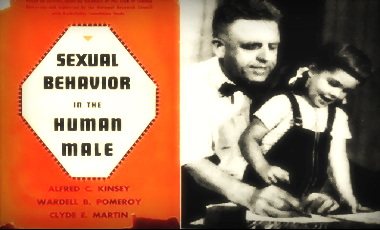
[p.34>] Halfway through the twentieth century, Indiana University professor Alfred Kinsey launched what was perhaps the first salvo in the Sexual Revolution. The Kinsey Reports hit postwar America like a sucker punch. Claiming that more people than America was willing to admit engaged in premarital sex, homosexuality, adultery, and various other frowned-upon pursuits, 1948’s Sexual Behavior in the Human Male and 1953’s Sexual Behavior in the Human Female revolutionized American law, culture, education, and a host of other areas. Critics of the best-sellers, the media informed America, were to Kinsey what the Church was to Galileo. Kinsey, after all, was a “scientist.”

[….]

Partisans and detractors agree that Kinsey changed the world. While time obscures his name, Kinsey’s spirit looms large in a world much more indulgent of unsettling sexual behavior:

  • A March 2000 state-funded conference in Massachusetts instructed high school students how to engage in a sexual practice called “fisting” and dispensed bandages for “when the sex got really rough.”4
  • Videos aired by MTV after school, by performers like Christina Aguilera and Britney Spears, increasingly resemble soft-core porn on late-night pay television.
  • [p.35>] In 2003, Rolling Stone explored the homosexual subculture of “bug chasers” and “gift givers.” The labels refer to gays who actively seek HIV, and the men who grant their wish. One bug chaser, who ironically volunteered as an AIDS educator, explained, “I think it turns the other guy on to know that I’m still negative and that they’re bringing me into their brotherhood. That gets me off, too.” The moment he is infected, he confessed, will be “the most erotic thing I can imagine.”5 The piece seems to have exaggerated the popularity of such pursuits, but this sensationalism didn’t negate the fact that something this sick actually occurs.
  • Some institutions have begun constructing third bathrooms for transgender people. The Massachusetts Bay Transit Authority, for instance, doled out $8,000 to build a bathroom for a single employee.6
  • A Florida group hosts a nudist camp for children, featuring such activities as a naked talent show and eating s’mores nude around a campfire.7
  • After tying up and gagging a blindfolded classmate, a San Francisco Art Institute student performed a class project with him in front of students, two professors, and security. This is how the “artist” described the outdoor event: “I engaged in oral sex with him and he engaged in oral sex with me. I had given him an enema, and I had taken a shit and stuffed it in his ass. That goes on, he shits all over me, I shit in him.”8

Post-Kinseyan America is very different from pre-Kinseyan America. The Indiana University professor set into motion radical societal changes. No less a sexual revolutionary than Hugh Hefner, founder of Playboy, has labeled himself “Kinsey’s pamphleteer.”9 Though it is too simplistic to pin the blame or credit for any social trend on one person, Alfred Kinsey has had extraordinary influence.

[….]

[p.36>] A “SECOND DARWIN”?

Born in Hoboken, New Jersey, to middle-class parents on June 23, 1894, Alfred Charles Kinsey was the first of three children. From the age of ten onward, Kinsey grew up in the more suburban South Orange, where, biographer James Jones notes, “he did not make a single close friend.”10 As peers played, Kinsey spent most of his early years indoors as a result of a heart condition and bouts with rickets, measles, typhoid, chicken pox, and rheumatic fever. His bookish nature denied him opportunities to develop normal relationships. He was the only boy in his high school class not to play at least one varsity sport.

Kinsey excelled in academics, however. His high school yearbook’s “class prophecy” predicted that Kinsey, the class valedictorian, would become the “second Darwin.”11 At elite Bowdoin College, he was one of two students to graduate magna cum laude. Kinsey went on to do graduate work in biology at Harvard, where he came under the sway of Dean William Morton Wheeler. “Thanks to Wheeler’s influence,” Jones observes, “Kinsey left Boston believing that biologists should become social engineers, shaping public policy and altering private attitudes on a variety of issues, ranging from eugenics, to private morality.”12

Yet Kinsey’s metamorphosis had come long before he had set foot on the Cambridge, Massachusetts, campus. From an early age, the superficially austere Kinsey had begun to engage in a variety of bizarre activities. “For a boy like Kinsey, a righteous boy whose sense of self-worth depended upon rigid self-control, nothing needed to be kept more hidden than the fact that he masturbated and that he did so with a foreign object inserted up his penis,” Jones writes. “By late adolescence, his masochism was well advanced. He had progressed beyond straws and was inserting a brush back up his penis, a practice he would continue for life, at times changing the instrument of self-torture, but never the point of attack.”13 Rather than control his destructive behavior, Kinsey projected his perversions upon society through “science.”

[p.37>] Kinsey picked up another peculiar habit in these years. After earning honors as one of America’s first Eagle Scouts, Kinsey devoted an unnatural amount of time to mentoring boys. He taught Sunday school, served as a counselor for the YMCA and the Boy Scouts, and helped start organizations for boys where none existed. At Bowdoin he involved himself in the Brunswick Boys Association.14 At Harvard he helped found a boys’ club at his Methodist church.15 Even as a professor at Indiana University, he left his wife of three years to spend the summer as a camp counselor for boys.16 In total, Kinsey would devote more than ten summers to working at boys’ camps.17 Kinsey compensated for his unrealized boyhood by partaking in male adolescent pursuits well into adulthood.

He quickly accepted a teaching position at Indiana University in 1920 after completing graduate work at Harvard. The new professor of zoology began dating a student, Clara McMillen. After a two-month courtship, he proposed, and six months later they married. At their wedding there was no best man, nor did Kinsey have any family in attendance.18 The academic’s voracious sexual appetites were not so wide as to include much of a taste for women, leaving the marriage unconsummated for months.19

Kinsey’s early years as a professor were marked by his authorship of several lucrative textbooks and by long field trips in remote parts of the country searching for gall wasps. On these trips he would bring along male assistants, who would be startled by Kinsey’s work attire of various stages of undress, as well as his regimented demand for continual bathing by them. “For Kinsey not only ordered his students to bathe; he routinely checked while they were showering, ostensibly to make certain they were complying with his orders,” Jones notes. If this were not strange enough, Kinsey insisted on showering with his students. One befuddled student was left to confess to his diary, “Such a mania for baths I’ve never seen.”20

In the classroom, Jones says, “Kinsey made no effort to conceal his desire to politicize young people.”21 But Kinsey’s primary interest was not the classroom. It was sex. In July 1938 Kinsey collected his first sexual history. He collected thousands more over the next few years, oblivious to the war that had engulfed the world around him. In 1945 he quit teaching entirely to focus exclusively on his research. He released his first report within three years and became one of the most recognizable names on the planet.

 [p.38>] “THE VERY EMBODIMENT OF MIDDLE AMERICAN SQUARE”?

The Kinsey that has been passed on by college texts and popular histories is that of the disinterested scientist whose research is unimpeachable. In David Halberstam’s The Fifties, Kinsey is “prudish,” “old fashioned,” and “the very embodiment of Middle American square.”22 Rutgers University professor William O’Neill praises Kinsey in American High as a “hero of science”; those who pressured the Rockefeller Foundation to cut Kinsey’s funding won “a victory for small mindedness.”23 Paul Johnson’s History of the American People affirms Kinsey’s statistics and explains that his “findings . . . confirmed much other evidence that, even in the 1950s, the Norman Rockwell images no longer told the full story.”24 William Manchester’s Kinsey in The Glory and the Dream is “an objective investigator,” “a stickler for explicit detail,” and a “disciple of truth.” “As a scientist,” Manchester informs readers, “he had naturally played no favorites.”25

But Kinsey, as we know now, was a very different kind of “scientist.” He was a homosexual, a wife-swapper, a sadomasochist, and, some suspect, a pedophile—much more involved in his work than the keepers of the tablets would have us believe.

The real Kinsey lent his wife to other men. His attic served as a personal pornographic movie studio. His fellow researchers, Wardell Pomeroy and Clyde Martin, also acted as his sex partners. One Kinsey researcher bragged about having bedded a dog. Others were committed sadomasochists. The common denominator among the staff at the Institute for Sex Research was a pursuit of sex that was outside of societal conventions.

In large part because of their zeal for abnormal sex, the Kinsey team focused their research on people who deviated from community standards—pimps, prostitutes, homosexuals, and imprisoned sex offenders. Kinsey’s “methodology and sampling technique virtually guaranteed that he would find what he was looking for,” writes Jones.26

Kinsey’s perversion was often self-destructive. For most of his life, he masturbated with a toothbrush inserted in his urethra. At one point, Kinsey crawled into a bathtub, pulled out his pocketknife, and, says Jones, “circumcised himself without benefit of anesthesia.”27 He engaged in auto-asphyxiation while masturbating and pierced his genitals to such an extent that by the end, biographer Jonathan Gathorne-Hardy reveals, there was “nothing left to pierce.”28 Jones describes perhaps the most dis [p.39>] -turbing occurrence, from Kinsey’s final years: “[H]e tied a strong, tight knot around his scrotum with one end of the rope dangling from the pipe overhead. The other end he wrapped around his hand. Then, he climbed up on a chair and jumped off, suspending himself in midair.”29 This particular self-inflicted torture hospitalized Kinsey for weeks and was part of a pattern of behavior that, ironically, had caused impotence for this champion of “sexual freedom.”30

Kinsey’s need for control manifested itself in demands to know the sexual histories of his workers and their families. He regulated the sexual behavior of those on his staff and demanded access to them and, occasionally, their wives. The pressure, recalled one wife, was “sickening.” She “felt like my husband’s career at the Institute depended on it.”31 So great was his dominance that Pomeroy and Martin felt compelled to ask his permission to engage in extramarital affairs. Another Kinsey researcher, Paul Gebhard, was once ordered to cease an affair by his apologetic boss, who normally preferred to order his underlings to have sex, not to stop having it.32 Kinsey’s work environment was more Spahn Ranch than Menlo Park.

Kinsey used a bizarre litmus test for prospective employees and almost without fail hired those with sexual histories falling well outside the mainstream. When one employee, Vincent Nowlis, showed squeamishness toward a sexual case history, Kinsey, Pomeroy, and Martin cornered him in a hotel room. Jones writes, “As near as Nowlis could tell, his boss was offering to provide ‘seductive instruction’ that would involve ‘learning plus pleasure.’” Nowlis explained that his boss’s advances “obviously would involve some kind of sexual activity on my part.” But, he said, “I didn’t see my wife or any desirable partners, shall we say, around, and I wasn’t interested.” The sexual harassment persuaded Nowlis to announce his resignation the following day.33

Jones describes the Indiana University professor as a “secular evangelist,” “a scolding preacher rather than a disinterested scientist,” and a “covert revolutionary” who “used science to lay siege to middle class morality.”34 Kinsey, explains Jones, engaged in “a public crusade for private reasons.”35 At every turn these “private reasons”—perversion and a need to dominate others—permeated his “scientific” work.

[p.40>] QUEER FINDINGS

[….]

[p.42>] This was at a time when he had collected 590 histories, meaning that histories from individuals he knew to be gay constituted about 20 percent of his total sample group.50 There is no specific record of the number of homosexual histories after this point, but we do know that Kinsey continued to track down gay men to interview. Kinsey actively sought out homosexuals by developing key contacts in the urban gay subcultures of Chicago, Philadelphia, St. Louis, and other cities. In New York, for instance, Kinsey stayed at the Astor in Times Square because its street-level bar was a hangout for gays seeking anonymous sex.51 Within the pages of Sexual Behavior in the Human Male, Kinsey candidly admits that “several hundred male prostitutes contributed their histories” to the survey.52

Seeking out homosexuals not only weighted Kinsey’s study toward his predrawn conclusions but provided him sexual liaisons as well. Kinsey was anything but the detached researcher. At times he had sex with subjects he was supposed to be interviewing. For one interview in 1946, Kinsey invited a Dr. Earle Marsh to his hotel room. Jonathan Gathorne-Hardy writes, “While they chatted, Marsh suddenly told him he’d had a fantasy of having sex with him. ‘[I told him] with no idea in mind except to report it.’” Kinsey then turned to Marsh and decreed, “Take off your clothes.” They had sex and would do so every subsequent time they met.53 On some occasions the professor would surreptitiously view others engaging in intercourse.54

Preselecting homosexuals was only part of the equation to bias the results. Kinsey also stacked the sample group with prison inmates. In 1941, for instance, Kinsey visited forty penal farms—more than three times the amount of campuses where he collected histories (an early complaint was that Kinsey focused his interviews too much on students).55 A Kinsey staff member claimed years later that 44 percent of the inmates Kinsey interviewed had had homosexual experiences, while the authors [p.42>] themselves placed the figure in a higher range.56 Whatever the real number, one need not be a sexologist to know that prisons are a breeding ground for homosexual activity and that prisoners normally have rebelled against societal norms not just in their criminal activities. Yet padding the sample group with inmates was not enough. The researchers pursued a particular type of inmate, the sex offender, to skew the survey’s results further. This still was insufficient, as a particular type of sex offender, the most perverse and abnormal, became the focus of interviews. All three of Kinsey’s coauthors have since admitted that their prison histories ignored scientific sampling techniques and focused on the most perverse sex offenders, including those who had practiced incest, rape, and pedophilia. Paul Gebhard—a coauthor of the Female volume, an institute staff member at the time of the Male volume’s release, and later a director of the institute—candidly states that the focus on sexual deviants was quite deliberate: “At the Indiana State Farm we had no plan of sampling—we simply sought out sex offenders and, after a time, avoided the more common types of offense (e.g., statutory rape) and directed our efforts toward the rarer types.”57 Male volume coauthor Wardell Pomeroy concurs: “We went to the [prison] records and got lists of the inmates who were in for various kinds of sex offenses. If the list was short for some offenses—as in incest, for example—we took the history of everybody on it. If it was a long list, as for statutory rape, we might take the history of every fifth or tenth man.”58 A third coauthor, Kinsey’s gardener-turned-colleague Clyde Martin, notes that the institute team sought out sex offenders serving time for “contributing to the delinquency” of minors.59

While it is clear that the institute staff took thousands of inmate histories, it is not known how many made it into the data used for Sexual Behavior in the Human Male. Credible estimates based on remarks by Kinsey and others place the total amount used at around 20 percent to 25 percent.60 Until the institute opens up its files for scholarly examination—provided that the records exist, as they claim—the number of prisoners surveyed can only be estimated.

[….]

AMERICAN MENGELE?

[p.45>] In 1981, Judith Reisman addressed the Fifth World Congress of Sexology in Jerusalem. Her speech accused one of the most respected academics of the twentieth century of complicity in the rape and abuse of children, and of pawning off fraudulent data as legitimate scholarly material. The subject of her earth-shattering talk was Alfred Kinsey. Of Kinsey’s famous reports, Dr. Reisman announced, “such mercantile pseudo-science even [p.46>] -tually defames the entire scholarly community, and tends to implicate us all as popularizers of whatever ‘truth’ is paying dividends at the moment.”76

In Sexual Behavior in the Human Male and Sexual Behavior in the Human Female, Kinsey’s team claimed that children were sexual beings essentially from birth, meaning that even infants were capable of orgasm. Until Reisman came along in 1981, it apparently did not occur to anyone to question publicly how Kinsey and his men came to this conclusion.

Kinsey collected data on at least 317 male children and numerous additional female children. Infants as young as five months old, said Kinsey, achieve “orgasm” after being stimulated from “partners.” Symptoms of sexual climax for young children, claimed Kinsey, often included “sobbing,” “violent cries,” “loss of color,” and an “abundance of tears.” He added that often the child “will fight away from the partner and may make violent attempts to avoid climax.” From all this he deduced that the child derived “definite pleasure” from the situation.77

For a man who gained joy from hanging himself by his testicles, circumcising himself with a pocketknife, and inserting toothbrushes into his urinary tract, the children’s responses might very well have been interpreted as pleasure. For almost everyone else it is clear that the expressions of these babies were not of delight but of extreme terror.

Kinsey’s charts show how an eleven-year-old was supposedly brought to orgasm nineteen times in one hour and how a two-year-old was brought to orgasm eleven times in sixty-five minutes. One unfortunate four-year-old boy was manipulated to “climax” twenty-six times in a twenty-four-hour period by someone Kinsey labeled a scientifically “trained observer.”78 In Kinsey’s sanitized jargon, Reisman pointed out, these unfortunate kids were no longer children—referred to as such on only one occasion—but “individuals” (five references) and “pre-adolescent” (seven references). Their tormentors were not rapists or molesters, but “partners” or “scientifically trained observers.”79

That Kinsey allowed child molesters to dictate whether these children enjoyed being molested speaks volumes not only about his character but about his interest in real science as well. His methods were something akin to relying on tobacco executives to determine the addictiveness of nicotine, or allowing a rapist to discern whether his victim really “wanted” sex.

Dripping from every page of his work on preadolescent sexuality is the notion that sex between children and adults is natural and healthy. Child [p.47>] -adult sexual contacts, Kinsey writes, “had involved considerable affection, and some of the older females in the sample felt that their pre-adolescent experience had contributed favorably to their later socio-sexual development.”80 At another point, he puts the blame of adult-child sexual contact on kids: “Children, out of curiosity, sometimes initiate the manipulation of male genitalia, even before the male has made any exposure.”81 Are children harmed by such contacts? According to Kinsey, yes and no. He writes:

[S]ome 80 per cent of the children had been emotionally upset or frightened by their contacts with adults. A small portion had been seriously disturbed; but in most instances the reported fright was nearer the level that children will show when they see insects, spiders, or other objects against which they have been adversely conditioned. If a child were not culturally conditioned, it is doubtful if it would be disturbed by sexual approaches of the sort which had usually been involved in these histories.82

Kinsey adds that to the extent that a child is damaged after having sexual contact with an adult, the rapist is not to blame; rather, the child is harmed by the “hysteria” created by police, parents, and others.83

How Kinsey obtained his data on children is a point of contention. Current Kinsey Institute director John Bancroft and past director June Reinisch have attested that the data came from a lone pedophile.84 The authors of the Male report claimed that nine scientifically inclined pedophiles observed preadolescent orgasm.85 Kinsey confidant and colleague Paul Gebhard states that the Indiana University researchers got their data from pedophile organizations, sex offenders, and numerous individuals who had volunteered information.86 Someone isn’t telling the truth, but why?

Was Kinsey himself a pedophile?

It is quite possible that Kinsey—who privately condoned child-adult sexual encounters and acted as a longtime counselor for such groups as the Boy Scouts and the YMCA—was a prime “observer” and source of information. The fact that hundreds of children were molested to generate data is not the evidence. Kinsey also bragged of his large collection of early adolescent sperm. “You can only collect early adolescent ejaculate by being pretty close to the adolescent,” Reisman points out. “Early adolescent sperm is not collected by recall.”87 Although there is no direct proof [p.48>] that Kinsey raped any of these children, it is irresponsible not to raise the question. If it wasn’t Kinsey, then who raped hundreds of children in the name of science?

One child rapist Kinsey relied on for “research” was a Mr. Rex King, who, in addition to bedding his grandmother and most other members of his family, had about eight hundred sexual contacts with children. King continued to molest children and report back to the Institute for Sex Research, with the full knowledge of Kinsey, until 1954, after both volumes had been released. “I congratulate you on the research spirit which has led you to collect data over these many years,” Kinsey admiringly wrote to King. “Everything that you’ve accumulated must find its way into scientific channels.”88

Another child molester who assisted Kinsey was a Nazi party official and former Waffen S.S. officer, Fritz von Balluseck. As the Nazi commandant of the Polish town of Jedrzejow, von Balluseck used his position of power to abuse children sexually. He reportedly told the Jewish children under his watch, “It is either the gas chamber or me.”89 They got both. In 1957 von Balluseck was put on trial for murdering a child and was convicted of molesting scores of others long after the war had ended. The West German press reported von Balluseck’s collaboration with Kinsey. One paper noted that von Balluseck had been “encouraged to continue his research” by Kinsey.90 The presiding judge in von Balluseck’s trial said to the defendant, “I got the impression that you got to the children in order to impress Kinsey and to deliver him material.” Von Balluseck responded, “Kinsey himself asked me for that.”91

Kinsey’s child molesters are beyond the reach of justice. Their victims, however, are for the most part still with us and can be helped if they are found. Unfortunately, Indiana University’s Kinsey Institute remains clouded in secrecy. Concerning “interviews” with small girls, Reisman wonders, “If, as the Kinsey team claimed, a parent was always present during the and ‘Uncle Pomeroy’ and the small girl, and if all of the names of every subject is in secret code in the Institute data base, as they claimed, why are these children not traceable?”92
One victim who has come forward is Esther White.[Esther White is not her real name] As a child in 1940s Ohio, she was repeatedly molested by her father. “It was for years,” [p.49>] she said. “He was not physically abusive, maybe psychologically abusive, [treating me] like a slave.”93 Even among child molesters, Esther’s dad was peculiar. He consulted his watch after he finished raping his daughter. He filled out charts and questionnaires. And he apparently shared the fact that he was forcing sex upon his daughter with members of his family and other acquaintances.94

In the mid-1940s, Esther traveled from her home to Columbus, Ohio. She remembers the trip as “a big deal.” In Columbus she met some scientists. One of them was Alfred Kinsey, she says. “There was a meeting between Alfred Kinsey and myself and two other men from the Kinsey Institute, my father, and my grandfather, and my great-grandmother,” she remembers. “I was a child. I didn’t understand any of it.” Kinsey’s connection to her childhood trauma didn’t dawn on her until the early 1990s. “I basically buried it until I heard Judith [Reisman]. . . . I knew I had met Alfred Kinsey, but it didn’t mean anything. He was introduced to me. My grandfather was very proud of knowing him. My grandfather went to Indiana University.”95 Records confirm that the Kinsey team stopped in Columbus to interview young children during that time period.96

When asked if Kinsey’s research was worth it, considering the cost of obtaining such data, current Kinsey Institute president John Bancroft curtly responded, “Consider the cost of remaining ignorant.”97

To that, White quietly responds, “Remaining ignorant would have meant I would have been a virgin when I married my husband. [Kinsey] took away my virginity by brainwashing my father.”98


FOOTNOTES


  1. Will Durant and Ariel Durant, Rousseau and Revolution (New York: MJF Books, 1967), pp. 6, 8, 18.
  2. Paul Johnson, Intellectuals (New York: Harper & Row, 1989), p. 60.
  3. Quoted in Johnson, Intellectuals, p. 74.
  4. “Kids Get Graphic Instruction in Homosexual Sex,” www.massnews.com/ past_issues/2005/5_May?maygsa.htm, accessed on October 13, 2003. [New Link: MASS RESISTANCE]
  5. Gregory A. Freeman, “Bug Chasers: The Men Who Long To Be HIV+,” Rolling Stone, February 6, 2003, pp. 45–48.
  6. Laura Brown, “Transsexual Toilet Costs T $8G,” Boston Herald, June 6, 2000, p. 1.
  7. Katie Zernike, “At Nude Youth Camp, Skin Is Bare but Lust Is Verboten,” New York Times, June 18, 2003, p. 18.
  8. Quoted in Matt Smith, “Public Enema No. 2,” SFWeekly.com, February 23, 2000, available at www.sfweekly.com/issues/2000-02-23/feature.html/1/index.html, accessed on October 13, 2003. [New Link: FREE REPUBLIC]
  9. Quoted in Judith Reisman, “Exposing Pornography’s Addictive, Destructive Effects,” Human Events Online, December 16, 2003. Available at id-2618″>www.humaneventsonline.com/article.php?print-yea&id-2618, accessed on May 1, 2004. [New Link: PDF]
  10. James H. Jones, Alfred C. Kinsey: A Public/Private Life (New York: W. W. Norton, 1997), p. 33.
  11. Jones, Alfred C. Kinsey, p. 32.
  12. Jones, Alfred C. Kinsey, pp. 153–154.
  13. Jones, Alfred C. Kinsey, p. 82.
  14. Jones, Alfred C. Kinsey, pp. 117–118.
  15. Jones, Alfred C. Kinsey, p. 139.
  16. Jones, Alfred C. Kinsey, p. 264.
  17. Jones, Alfred C. Kinsey, p. 155.
  18. Jones, Alfred C. Kinsey, p. 172.
  19. Jones, Alfred C. Kinsey, p. 174.
  20. Quoted in Jones, Alfred C. Kinsey, p. 281.
  21. Jones, Alfred C. Kinsey, p. 189.
  22. David Halberstam, The Fifties (New York: Villard Books, 1993), pp. 272–281.
  23. William O’Neill, American High (New York: The Free Press, 1986), pp. 45, 47.
  24. Paul Johnson, A History of the American People (New York: HarperCollins, 1998), p. 840.
  25. William Manchester, The Glory and the Dream (Boston: Little, Brown, 1974), pp. 477, 478.
  26. Jones, Alfred C. Kinsey, p. 533.
  27. Jones, Alfred C. Kinsey, p. 610.
  28. Jonathan Gathorne-Hardy, Sex the Measure of All Things: A Life of Alfred C. Kinsey (Bloomington, IN: Indiana University Press, 2000), pp. 336, 414.
  29. Jones, Alfred C. Kinsey, p. 739.
  30. Gathorne-Hardy, Sex the Measure of All Things, p. 415.
  31. Jones, Alfred C. Kinsey, p. 607.
  32. Jones, Alfred C. Kinsey, pp. 499, 608.
  33. Jones, Alfred C. Kinsey, p. 491.
  34. Jones, Alfred C. Kinsey, pp. 335, 532, 602.
  35. Jones, Alfred C. Kinsey, p. 397.

[….]

  1. Jones, Alfred C. Kinsey, p. 387.
  2. Gathorne-Hardy, Sex the Measure of All Things, p. 239.
  3. Kinsey et al., Sexual Behavior in the Human Male, p. 216.
  4. Gathorne-Hardy, Sex the Measure of All Things, p. 248.
  5. Gathorne-Hardy, Sex the Measure of All Things, p. 307.
  6. Gathorne-Hardy, Sex the Measure of All Things, p. 189.
  7. Reisman and Eichel, Kinsey, Sex and Fraud, p. 23; A. C. Kinsey, W. B. Pomeroy, C. E. Martin, P. H. Gebhard, Sexual Behavior in the Human Female (Philadelphia: W.B. Saunders, 1953), p. 21.
  8. See Judith Reisman, Kinsey: Crimes & Consequences (Arlington, VA: Institute for Media Education, 1998), p. 94; Reisman and Eichel, Kinsey, Sex and Fraud, p. 22.
  9. Reisman and Eichel, Kinsey, Sex and Fraud, p. 22.
  10. Reisman, Kinsey: Crimes & Consequences, p. 94.
  11. Reisman and Eichel, Kinsey, Sex and Fraud, pp. 22–24. Passage includes the authors’ estimate that 25 percent of the male sample group Kinsey used for his book were inmates, and Kinsey Institute staffer John Gagnon’s opinion that 900–1,000 of the males used for the survey were prisoners.

[….]

  1. Dr. Judith Reisman, “The Scientist as Contributing Agent to Child Sexual Abuse: A Preliminary Consideration of Possible Ethics Violations,” 5th World Congress of Sexology, Jerusalem, Israel, July 23, 1981.
  2. Kinsey et al., Sexual Behavior in the Human Male, p. 161.
  3. Kinsey et al., Sexual Behavior in the Human Male, p. 180.
  4. Reisman, “The Scientist as Contributing Agent to Child Sexual Abuse.”
  5. Kinsey et al., Sexual Behavior in the Human Female, p. 121.
  6. Kinsey et al., Sexual Behavior in the Human Female, p. 120.
  7. Kinsey et al., Sexual Behavior in the Human Female, p. 122.
  8. Kinsey et al., Sexual Behavior in the Human Female, pp. 121–122.
  9. Reisman, Kinsey: Crimes and Consequences, pp. 167, 170.
  10. Kinsey et al., Sexual Behavior in the Human Male, p. 177.
  11. Secret History: Kinsey’s Paedophiles, Yorkshire Television, Channel 4 (October 8, 1998), Producer, Tim Tate.
  12. Reisman quote and information on Kinsey’s adolescent sperm collection appear in E. Michael Jones, Degenerate Moderns: Modernity as Rationalized Sexual Misbehavior (San Francisco: Ignatius, 1993), p. 108.
  13. Kinsey’s Paedophiles, Tim Tate.
  14. Judith Reisman, Kinsey: Crimes and Consequences (Institute for Media Education: Crestwood, Kentucky, 2000), p. 166 (2nd edition).
  15. Quoted in Judith Reisman, Kinsey: Crimes and Consequences (Institute for Media Education: Crestwood, Kentucky, 1998), pp. 165–167.
  16. Quoted in Kinsey’s Paedophiles, Producer, Tim Tate.
  17. Reisman, Kinsey: Crimes and Consequences, p. 162.
  18. Phone interview of “Esther White” by author, August 2, 2000.
  19. Information comes from my phone interview of White on August 2, 2000, as well as the documentary Kinsey’s Paedophiles, Producer, Tim Tate.
  20. Phone interview of Esther White by author, August 2, 2000.
  21. Gathorne-Hardy discusses Kinsey’s work with children in Columbus on pp. 208, 215, 227.
  22. Kinsey’s Paedophiles, Producer, Tim Tate.
  23. Phone interview of Esther White by author, August 2, 2000.

DOCUMENTARIES


Secret History: Kinsey’s Paedophiles (October 8, 1998)

50-minutes long | (Old VHS documentary – played with the audio a ted, sharpened it a bit and decreased the oranges and brightened it… still a small crappy file to use.) This is a Yorkshire Television production for Channel 4, produced and directed by Tim Tate, aired August 10, 1998. The show features interviews with Kinsey team members Paul Gebhard and Clarence Tripp, Kinsey Institute director John Bancroft and several of Kinsey’s biographers.

It is about the controversial research of Alfred Kinsey, an American sexologist who studied human sexuality in the 1940s and 1950s. The documentary reveals that some of his data was based on the sexual abuse of children by pedophiles.

If you would rather watch the larger documentary, one YouTube file is HERE

The Kinsey Syndrome (December, 2009)

2 hours and 45 minutes – This is the final upload I worked long and hard at for a post on Kinsey. This documentary is by far too long, but if you have the time, encyclopedic in its coverage. It was released in December of 2009.

IMDB SUMMARY: Working secretly in his attic, Dr. Kinsey was one of America’s original pornographers. His influence inspired Hugh Hefner to launch Playboy Magazine – the “soft” approach to porn – which in time would escalate the widespread use of pornography through magazines, cable TV and the Internet. In 2006 the California Child Molestation and Sexual Abuse Attorneys reported that: “The number of victims of childhood sexual abuse and molestation grows each year. This horrific crime is directly tied to the growth of pornography on the Internet.”

IMDB SYNOPSIS:

The Kinsey Sydrome shows how “The Kinsey Reports” have been used to change the laws concerning sex crimes in America, resulting in the minimal sentences so often given to rapists and pedophiles. Further explained is how the Kinsey data laid the foundation for sex education – training teachers, psychologists and even Catholic priests in human sexuality. What has been the consequence? And what was Kinsey’s research really based upon?

Working secretly in his attic, Dr. Kinsey was one of America’s original pornographers. His influence inspired Hugh Hefner to launch Playboy Magazine – the “soft” approach to porn – which in time would escalate the widespread use of pornography through magazines, cable TV and the Internet. In 2006 the California Child Molestation & Sexual Abuse Attorneys reported that: “The number of victims of childhood sexual abuse and molestation grows each year. This horrific crime is directly tied to the growth of pornography on the Internet.” Perhaps most disturbing, Alfred Kinsey has been accused of training pedophiles to work with stopwatches and record the responses of children being raped – all in the name of “science”. Among his workers was a Nazi pedophile whose relationship to Kinsey was exposed in a German court. The information from these crimes was then recorded in “Table 34” of Kinsey’s Sexual Behavior in the Human Male. How can lawmakers use such a document to define the moral parameters of our society?

Why has the truth about Kinsey been suppressed for so long? And what can Americans do to make a difference?

AMAZON: PRODUCT DESCRIPTION

The Kinsey Syndrome is a powerful documentary that unfolds the life and influence of Dr. Alfred Kinsey, considered to be the father of the sexual revolution. But did Kinsey liberate America from its prudish view of sex? Or help to unleash the horrors of our present society? This documentary shows how The Kinsey Reports of the 1940’s and 50’s have been used through the 20th and 21st century to change laws concerning sex crimes in America, removing protection from America’s women and children. Further explained is that the Kinsey data laid the foundation for sex education — training teachers, psychologists and even Catholic priests in human sexuality. What has been the consequence for society? And what was Kinsey’s research really based upon? Learn the answers to these and other questions in what MOVIEGUIDE called one of the most important productions of the 21st century.

AMAZON: REVIEW

The Bible tells us to expose the fruitless works of darkness. The documentary THE KINSEY SYNDROME does just that in painstaking detail. Each chapter of this video documentary addresses a different aspect of the work of the pseudo-scientist Alfred Kinsey whose fraudulent data laid the cancerous foundation for sex education, perversion, pedophilia, pornography, and the corruption of our culture. It shows how Kinsey trained pedophiles to work with stop watches to record the responses of children being raped in the name of science. One of the pedophiles was a Nazi in Germany whose relationship to Kinsey was exposed in a German court. This documentary shows how the government attempted to investigate Kinsey and his fallacious research and was thwarted by big foundations and other friends of pornography and sexual corruption. It is incredibly well researched, and it builds its case so carefully that it will change even the most hardened heart and mind and should be seen by every teacher, professor, academic, judge, senator and anyone else in authority. Someone should donate this documentary to every teacher, every judge, every member of congress, and all the officials in government. It is one of the most important productions of the 21st century. It is not for the squeamish, faint of heart or young children, but it is must viewing for every culture warrior, every parent and everyone who is concerned by the direction our society is going. — Dr. Ted Baehr, MOVIEGUIDE

Chris Rufo’s War Against Woke Institutions | John Stossel

Chris Rufo makes some people angry. Why? Because he’s eliminating woke departments at Florida universities, and exposing woke corporate and government trainings. Rufo was once a filmmaker, making documentaries for PBS about things like American poverty. But then his research on poverty connected him with government workers who leaked documents about absurd “woke” training programs. The documents showed that Seattle’s Office of Civil Rights, for example, trained employees to “practice self-talk that affirms … complicity in racism” and to work on “undoing your own whiteness.” Media say Rufo has “invented” a crisis about this kind of thing, and that he’s pushing a “moral panic.” But Rufo has evidence. Watch the video above to see some of it.

S-o-o… It’s Not A Vaccine? (95% Effective?)

Originally posted Mar 13, 2021

UPDATE!

Big Pharma’s Infomercial Star Peter Hotez Is a Total Idiot

The 1st update [a while ago now] is a “jump” to the bottom of the page to hear the “Prager Update”. However, this is a new update that wraps up the main thought of this dated post… enjoy:

The Unseen Crisis: Vaccine Stories You Were Never Told | excerpt. A must see documentary:

See also:

THE DAILY MAIL has something that crossed my path that I needed to comment on a bit:

  • Dr Anthony Fauci cautioned that early COVID-19 vaccines are aimed at preventing symptoms during Yahoo Finance’s All Markets Summit on Monday
  • ‘If the vaccine allows you to prevent initial infection, that would be great,’ he said. ‘[But] the primary endpoint [is] to prevent clinically recognizable disease’  
  • At least four vaccine candidates are currently in late-stage clinical trials  
  • Fauci has said he is cautiously optimistic that a vaccine will arrive by year end
  • But he warned that early vaccines may only be 50 to 60 percent effective

[….]

While the end goal of the vaccines will be to eradicate the virus, Fauci noted that developers are aiming for a simpler goal in the first round of jabs.  

‘The primary thing you want to do is that if people get infected, prevent them from getting sick, and if you prevent them from getting sick, you will ultimately prevent them from getting seriously ill,’ Fauci said at Yahoo Finance’s All Markets Summit. 

‘If the vaccine also allows you to prevent initial infection, that would be great. [But] what I would settle for, and all of my colleagues would settle for, is the primary endpoint to prevent clinically recognizable disease.’ 

THE NEW YORK POST also discusses the issue:

“The chances of it being 98 percent effective is not great,” Fauci, a member of the White House Coronavirus Task Force, said at a Q&A with the Brown University School of Public Health in Rhode Island, according to CNBC.

Instead, Fauci said, scientists are hoping for a vaccine that is 75 percent effective — but even a 50 or 60 percent success rate would be considered a win.

“Which means you must never abandon the public health approach,” explained Fauci, director of the National Institute of Allergy and Infectious Diseases.

Meanwhile, a Gallup poll released on Friday found that more than a third of Americans wouldn’t take a vaccine if it were available today….

GATEWAY PUNDIT then rightfully notes from the above:

  • Crazy Dr. Fauci warned in October that early COVID-19 vaccines will only prevent symptoms from arising – not block infection. Then the early vaccines are NOT vaccines. [GP continues with his thoughts] It also means the “vaccine” is just a scheme by Big Pharma, and the globalist investors, to scam trillions out of the frightened peasants and the states.

So, my thoughts are this… it is literally just another flu-like-shot. Check.

While I have issues with how the high percentages of effectiveness were reached….

Ninety-five people in the study developed Covid-19 with symptoms; of those, 90 had received a placebo and only five Moderna’s vaccine. The findings, from a 30,000-subject trial that is still under way, move the vaccine closer to wide use, because they indicate it is effective at preventing disease that causes symptoms, including severe cases….(WALL STREET JOURNAL)

The only way you could reeaally say 95% effective rate is to have [for example] 200 people, 100 of them got the real vaccine, the other 100 the placebo. All 200 were exposed equally to “The Vid” and then a result is tabulated from that. 

(RPT)

…let us assume for a moment the numbers touted early.

QUESTIONS:

  • Is it 95% effective on 50%?
  • What percentage of the 95% is effective on which part?
  • Eradicating it? or lessening symptoms, but you still get it?
  • Since it is NOT a vaccine, should restrictions (coming at some point considering the crazy level of society) on travel and work be in place?

While the US Constitution and the Bill of Rights may end up preventing government from mandating vaccines for the American people, every day we get more signs that businesses across the country and the world have no such intentions, with CBS 4 in Boston reporting a ‘Covid-19 vaccine passport’ may be required to travel in 2021 just one of the latest stories warning of what awaits us in the year ahead. Spain to keep a registry of ‘vaccine refusers’, sharing it (Italian newspaper) with other EU countries, another indication of what the ‘travel ban’ ahead might look like overseas, we learn that here in America, music venues, sporting events and theaters might soon be ‘off limits’ (Rolling Stone magazine) to those who don’t get the vaccine. And with many employers also requiring ‘the jab’ for their employees (New York Times) hinting at how bad it might soon get for people who work for someone else but don’t want to subjugate themselves to an unproven shot.

I personally think the media and Fauci and other cogs and gears need to be held in contempt of societal norms in using fake stats and fear tactics to strip people of their livelihood and rights. (DOWLOADABLE PDF: “A Scientist’s Plea: The World is Not a Safe Space” via AIER)


UPDATE via PRAGER


PART 1 (3-1-2021)

New Ivermectin Studies Confirm What Is Known

Rumble — Firstly, the best site for this is here (links at top for Hydroxychloroquine as well as Ivermectin): https://c19early.com

Dennis Prager discusses an article in Israel Times about a study regarding Ivermectin …. QUOTE PRAGER REFERRED TO:

….In Germany, apparently Ivermectin use has grown, reports Halgas. He was in touch with a physician group there that treated the elderly at a nursing home.

The mortality rate in nursing homes in that European country (Germany) is about 25% to 30%. After treating about 100 residents with Ivermectin, that rate in one case series apparently went down to about 5%—a huge difference. Of course, this isn’t the result of a formal study but nonetheless represents more real world data points….

  • Randomized Double-Blinded Clinical Trial at Sheba Medical Center: Ivermectin Materially Reduces COVID-19 Viral Shedding (TRIAL SITE NEWS)
  • Sheba Researcher: Antiparasitic Drug Reduces Length of COVID-19 Infection (JERUSALEM POST)

PART 2 (3-8-2021)

Fauci and Walensky Say “Vaccine” Does Not Work

Rumble — Dennis Prager Notes that the two leading media acolytes/revered specialists the Left follows have essentially admitted the vaccines do not work. They are essentially “prophylactics,” that do not work as well as ivermectin does (https://c19ivermectin.com). Rochelle Walensky (CDC Head) and Anthony Fauci basically have admitted this conundrum.

Rubin Report: Gamergate, Feminism, Regressive Left | Sargon of Akkad

Dave Rubin of The Rubin Report talks to Sargon of Akkad (YouTube creator) about Gamergate, feminism, the Regressive Left, and much more.

A SARGON OF AKKAD FLASHBACK!

The reason that slavery isn’t acceptable anywhere in the modern world is because of the British people’s 60-year crusade against it.

  • “The spirit of liberty is so deeply ingrained in our constitution that a slave, the moment he lands in England, is free.” — Sir William Blackstone
  • “As soon as a person set foot on English soil, he or she becomes free.” — Lord Henley
  • “As soon as a negro comes to England he is free.” — Judge Holt

Thomas Sowell and Carol Swain Slinging Red-Pills

This was my YouTube “rabbit hole” yesterday…. and I feel like this is a much better challenge than the cinnamon or Tide Pods type challenges.

Carol Swain get’s tagged in and does some suplexes of truth! My lingering thought is that our graceful God is opening up some young minds to the common grace of truth about history to a young generation as a “parting gift” to a man who has defended truth his whole life. The man is 92… I hope he lives more, but I surely hope after all these years, more and more young black men get red-pilled. I pray so.

These are the main videos watched below…. there are others, but these are the biggies:

  1. Facts About Slavery Never Mentioned In School | Thomas Sowell
  2. The Inconvenient Truth About the Democratic Party | Carol Swain
  3. The Inconvenient Truth About the Republican Party | Carol Swain
  4. The British Crusade Against Slavery | Sargon of Akkad
  5. What Most ‘Experts’ Aren’t Telling You During Black History Month | Larry Elder Show
  6. The Hidden Truth Behind The End Of Slavery | Thomas Sowell
  7. The Bitter Truth About The Arab Slave Trade In Africa | Thomas Sowell
  8. TRUTH about the White Slave Trade | Forgotten History
  9. Thomas Sowell on the Current Black Culture | Thomas Sowell

I do these from oldest to newest  because in some cases, as you go through these people’s YouTube Channels, you can find the 1st time they see one of these… and then follow through their “evolution in thought” [so-to-speak] to inviting others to experience the mind opening they encountered.

FIRST, here is an OG on this topic… a red-pill passed out over a years ago:

Now This Youngster:

(3-WEEKS AGO)

He gets red-pilled at the 11:00 minute mark.

(2 WEEKS AGO)

OTHERS

From Oldest To Latest:

(1-YEAR AGO)

This beautiful young lady is red-pilled at the 8:40 mark where she mentions that “everything we been reacting to…” [all their previous channels videos] …”[this] is [her] wake-up call.”

(8-MONTHS AGO)

(7-MONTHS AGO)

(4-MONTHS AGO)

(4-MONTHS AGO)

(3-MONTHS AGO)

(3-MONTHS AGO)

(3-MONTHS AGO)

(2-MONTHS AGO)

LMAO… at the 14:20 mark the “George Washington” comment is funny!

The 26:00 minute mark is precious to me. These young men, starting out in life talking about — just finding out about “So-Well,” and asking if he has a book. Lol. I love it!

(2-MONTHS AGO)

(2-MONTHS AGO)

(2-MONTHS AGO)

(2-MONTHS AGO)

(2-MONTHS AGO)

(1-MONTH AGO)

(1-MONTH AGO)

(1-MONTH AGO)

(1-MONTH AGO)

(3-WEEKS AGO)

(2-WEEKS AGO)

(5-DAYS AGO)

(2-DAYS AGO)

(1-DAY AGO)

Thomas Sowell Goes Through The History of Slavery

(ORIGINALLY POSTED ON JAN 18, 2015)

  • “…virtually every significant racist in American political history was a Democrat.”

Bruce Bartlett, Wrong on Race: The Democratic Party’s Buried Past (New York, NY: Palgrave MacMillan, 2008), ix;

  • “…not every Democrat was a KKK’er, but every KKK’er was a Democrat.”

Ann Coulter, Mugged: Racial Demagoguery from the Seventies to Obama (New York, NY: Sentinel [Penguin], 2012), 19.

Thomas Sowell’S Full Chapter on the “Real History of Slavery”

ISOLATED and ART ADDED OF THE ABOVE:

History of Slavery, Dixie Crats,
Southern Strategy, Party Switch, etc.


Slavery

The Third Force Act, also known as the KKK or the Civil Rights Act of 1871, empowered President Ulysses S. Grant to use the armed forces to combat those who conspired to deny equal protection of the laws and, if necessary, to suspend habeas corpus to enforce the act. Grant signed the legislation on this day in 1871. After the act’s passage, the president for the first time had the power to suppress state disorders on his own initiative and suspend the right of habeas corpus. Grant did not hesitate to use this authority. (POLITICO)

Terrorist Arm of the Democrats

Southern Strategy/Dixiecrats Switch

1) The Southern Strategy Revisited: Republican Top-Down Advancement in the South, by Joseph A. Aistrup.
2) The Rise of Southern Republicans, by Earl Black and Merle Black.
3) From George Wallace to Newt Gingrich: Race in the Conservative Counterrevolution, 1963-1994, by Dan T. Carter.

4) A Stone of Hope: Prophetic Religion and the Death of Jim Crow, by David L. Chappell.
5) The Emerging Republican Majority, by Kevin Phillips.

A Brief History of the Irish | Thomas Sowell (and More)

(Originally posted on May 2, 2017)

Excerpt from Thomas Sowell “The Economics and Politics of Race: An International Perspective

UPDATED WITH THESE VIDEOS:

Were Irish People the “First Slaves in America”?

WHY WASN’T I TAUGHT THIS?! TRUTH about the Irish – First slaves brought to the Americas