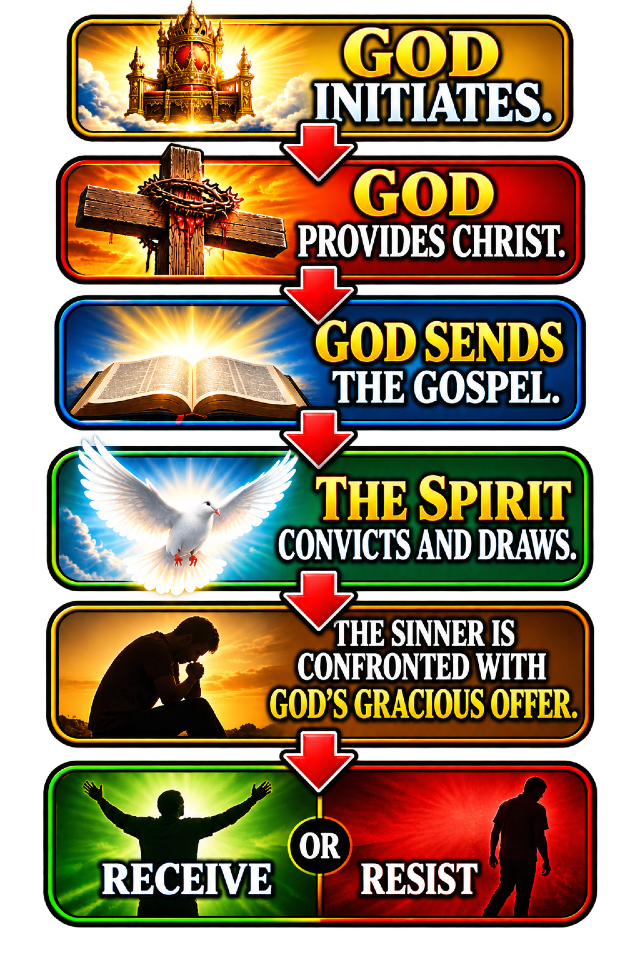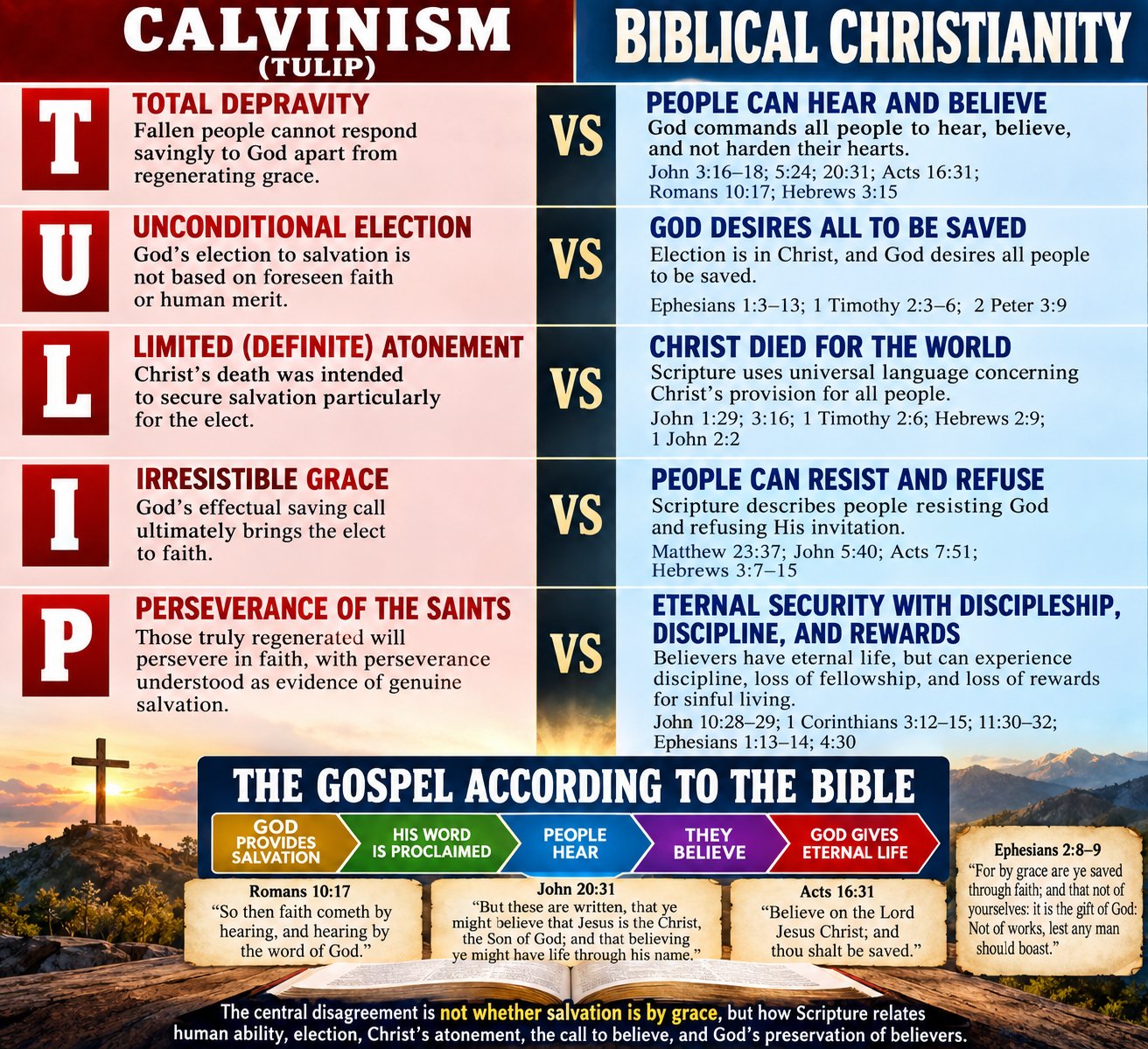
Does the way Jesus teaches prayer fit more naturally with a worldview in which our requests genuinely matter, or with a worldview in which every request and every answer was already unalterably fixed before creation? If every prayer and every answer has already been exhaustively determined, what purpose is served by Jesus spending so much time teaching us how to pray?
The entire SOTERIOLOGY 101 Podcast can be heard HERE. Sot 101’s description:
Again we address the impractical implications of Calvinism. This time by unpacking Wayne Grudem’s teaching about the purpose and function of prayer. If God has determined all things then why pray? Does God really respond to us when we pray or is that just an illusion? Let’s dive in.
QUESTIONER – SANDY:
You were so persuasive, Wayne, a few weeks ago that I have become a happy evangelical Calvinist. And so in my mind, this raises the issue of God’s sovereignty. And I wonder if in that illustration on the board, I’m looking at that and I am visually putting a sort of umbrella of God’s transcendent, eternal, immutable sovereignty over all of that. So that, because otherwise, and maybe it’s just my split pea-sized brain not able to understand what you’re saying, but otherwise it sounds like God is vacillating in His intent and plans in response to whether or not we pray. And I doubt that that’s what you’re saying. So tell me now, as a fellow happy, evangelical Calvinist, how God’s transcendent, eternal, immutable sovereignty fits in all.
GRUDEM:
I think God planned before the foundation of the world, I think God planned that Moses would pray and that he would answer. But Moses didn’t know that. Okay? What Moses knew is he’s supposed to pray. I think God planned before the foundation of the world that Amos would pray and that God would answer. But it was still real. I mean, this intercession of Moses is still real. And if you do not have, because you do not ask, that’s true. And asking you will receive. Knock and it will be open. God didn’t set up the world to work in some way that we have to pray for Him to grant things, but He did. And then, yes. In his secret, unchangeable, eternal plan, yes, I think when I look back on all of it, I’ll say that he planned it, but I don’t know that. What I do know is if I pray, he answers, and if I don’t, he won’t.
The central argument can be summarized as:
If God unconditionally decreed both the prayer and the answer, then the prayer cannot be the real cause of the answer in the ordinary sense.
That’s very close to the objection you heard raised against Grudem.
The Moses Problem
The commentator makes an interesting point: Grudem says Moses didn’t know the eternal decree. But then Moses’ experience of prayer appears to be more realistic than the Calvinist explanation.
Moses believed:
God announced judgment.
Moses interceded.
God relented.
Exodus presents the narrative exactly that way. The Calvinist explanation becomes:
God decreed the announcement.
God decreed the intercession.
God decreed the relenting.
The question then becomes:
Is the biblical narrative showing what really happened, or is it only describing how it appeared from Moses’ perspective?
Where the Lord’s Prayer Comes In
This is where Calvinists prayer understanding connect:
“Give us this day our daily bread.”
On Grudem’s model:
God eternally decreed whether you receive daily bread.
God eternally decreed whether you pray for daily bread.
God eternally decreed the answer.
The Calvinist answer is:
God ordained prayer as the means.
The non-Calvinist answer is:
The language sounds like a genuine petition affecting a genuinely contingent outcome.
The Lord’s Prayer assumes that God is:
Listening.
Caring.
Responding.
Providing.
Forgiving.
Leading.
Delivering.
The entire prayer is relational.
Does the prayer read more naturally as a conversation with a Father who genuinely responds to His children, or as participation in a script whose every line was already fixed before the world began?
Why is the entire prayer structured around requests if requests have no bearing on what occurs? Why teach believers to ask for forgiveness if the granting of forgiveness is already fixed regardless of the request?
THE LORD’S PRAYER
Our Father in heaven,
May Your name be hallowed by those whom You have eternally decreed to hallow it.
May Your kingdom come exactly as You have immutably ordained from before the foundation of the world.
May Your will be done, because it cannot possibly be otherwise.
Give us this day the bread You have already decreed we will receive whether through our asking or not, though You have also decreed that we would ask for it.
Forgive us our debts, because You have already determined from eternity which debts would be forgiven and which sinners would remain under condemnation.
As we forgive our debtors according to the measure of sanctification You have irresistibly produced within us.
Lead us not into the temptations You have eternally ordained for our good and Your glory, though we acknowledge that those temptations cannot fail to occur if You have decreed them.
But deliver us from the evil You have likewise ordained to accomplish Your sovereign purposes.
For Yours is the kingdom, and the power, and the glory, because all things without exception have been decreed by You and come to pass exactly as ordained.
Amen, which You also decreed before the foundation of the world.
GRAPHICS to further elucidate:
Prayer & Calvinism with Ronnie Rogers
Pastor Ronnie Rogers is back with us today to discuss his new book “IF ONLY YOU WOULD ASK: Praying God’s Conditional Promises” This book is a MUST READ for anyone curious, confused, or convinced about Calvinism’s (mistaken) determinism.
R.C. Sproul’s Statement on Predestination (from Chosen by God):
“What predestination means, in its most elementary form, is that our final destination, heaven or hell, is decided by God not only before we get there, but before we are even born. It teaches that our ultimate destiny is in the hands of God. Another way of saying it is this: From all eternity, before we ever live, God decided to save some members of the human race and to let the rest of the human race perish. God made a choice–he chose some individuals to be saved unto everlasting blessedness in heaven and others he chose to pass over, to allow them to follow the consequences of their sins into eternal torment in hell.” (Chosen By God, p.22, emphasis mine)
This is double predestination in practice, even if Sproul calls the active-positive version for reprobation a caricature.
If the elect cannot fail to be saved,
and the reprobate cannot be saved because God withholds the only grace capable of producing faith,
then what practical difference remains between active reprobation and passive reprobation?
Exhaustive Determinism:
Sproul affirms that God ordains whatsoever comes to pass (echoing Westminster):
He knows all things that will happen because he ordains everything that does happen. This is crucial to our understanding of God’s omniscience. He does not know what will happen by virtue of exceedingly good guesswork about future events. He knows it with certainty because he has decreed it.
The Westminster Confession avers: “God from all eternity, did, by the most wise and holy counsel of His own will, freely, and unchangeably ordain whatsoever comes to pass. . . .”
This statement refers to God’s eternal and immutable decretive will. It applies to everything that happens. Does this mean that everything that happens is the will of God? Yes. Augustine qualified this answer by adding the words, “in a certain sense.” That is, God ordains “in some sense” everything that happens. Nothing that takes place is beyond the scope of his sovereign will. The movement of every molecule, the actions of every plant, the falling of every star, the choices of every volitional creature, all of these are subject to his sovereign will. No maverick molecules run loose in the universe, beyond the control of the Creator. If one such molecule existed, it could be the critical fly in the eternal ointment. As one grain of sand in the kidney of Oliver Cromwell changed the course of English history, so one maverick molecule could destroy every promise God has ever made about the outcome of history.
— What Is Reformed Theology, p. 172
Sproul’s view functionally equivalent to Calvin’s broader decretive will, even if he rejects “equal ultimacy” (symmetrical positive-positive reprobation where God actively works sin in the reprobate the same way He works faith in the elect). Sproul’s inconsistency is “too embarrassed to follow Calvinism to its logical extreme” and pleading ignorance/mystery on hard questions (e.g., the fall of Adam/Eve).
Calvin (Institutes 3.21.5): Explicitly symmetric language —
“some are preordained to eternal life, others to eternal damnation… created for one or the other of these ends.”
Sproul: Rejects the symmetrical mode (equal ultimacy / positive-positive) as sub-Calvinist or a caricature that makes God the author of sin. He prefers asymmetric (positive election + negative reprobation/preterition: God passes over the non-elect, leaving them in their sin). Yet critics [like myself] argue this is rhetorical softening — because Sproul still affirms:
God’s decree covers all events.
Reprobation is part of the eternal decree before creation.
The non-elect are chosen to be passed over before birth.
Sproul’s distinctions, while rhetorically softer than Calvin’s, do not ultimately escape the force of double predestination or exhaustive determinism.
… The issue here seems to be how one defines “ordains” or “foreordains.” Calvinists I debate on the internet consistently argue that “ordain” means to decree. I ask them, “Did God decree the Holocaust?” “Did God decree the killing fields of Cambodia?” “Did God decree every act of rape, torture and murder that has ever taken place?” And they say yes! Unbelievable.
What about Calvin on this issue? You deny he was supralapsarian, claiming God’s positive-positive, double-predestination, but excerpts from his writings strongly suggest that was his position. Calvin was quite straightforward on saying God decreed the Fall, writing:
…whence does it happen that Adam’s fall irremediably involved so many peoples, together with their infant offspring, in eternal death unless because it so pleased God?…The decree is dreadful indeed, I confess. Yet no one can deny that God foreknew what end man was to have before he created him, and consequently foreknew because he so ordained by his decree…God not only foresaw the fall of the first man, and in him the ruin of his descendants, but also meted it out in accordance with his own decision.” (Institutes of the Christian Religion, 3.23.7)
That seems to go beyond mere “permission.” He also wrote:
The predestination by which God adopts some to the hope of life, and adjudges others to eternal death, no man who would be thought pious ventures simply to deny….By predestination we mean the eternal decree of God, by which he determined with himself whatever he wished to happen with regard to every man. All are not created on equal terms, but some are preordained to eternal life, others to eternal damnation; and, accordingly, as each has been created for one or other of these ends, we say that he has been predestinated to life or to death (Institutes of the Christian Religion 3.21.5).
We also read:
From this it is easy to conclude how foolish and frail is the support of divine justice afforded by the suggestion that evils come to be not by [God’s] will, but merely by his permission. Of course, so far as they are evils, which men perpetrate with their evil mind, as I shall show in greater detail shortly, I admit that they are not pleasing to God. But it is a quite frivolous refuge to say that God otiosely [= idly] permits them, when Scripture shows Him not only willing but the author of them…Who does not tremble at these judgments with which God works in the hearts of even the wicked whatever He will, rewarding them nonetheless according to desert. Again, it is quite clear from the evidence of Scripture that God works in the hearts of men to incline their will just as he will, whether to good for his mercy’s sake, or to evil according to their merits.” (Concerning the Eternal Predestination of God, 177)
Other famous Calvinists say, for example,
“The Sovereignty of God over all, and his independency, clearly shew, that whatever is done in time is according to his decrees in eternity.” (John Gill, A Body of Doctrinal and Practical Divinity, p. 173)
Or
“As a builder draws his plan before he begins to build, so the great Architect predestined everything before a single creature was called into existence.” (Arthur Pink, The Doctrines of Election and Justification, p.9)
Or
“Surely if God had not willed the fall, He could, and no doubt would, have prevented it; but he did not prevent it: ergo, He willed it. And if He willed it, He certainly decreed it.” (Jerome Zanchius, The Doctrine of Absolute Predestination, p. 88)
So, by claiming supralapsarianism is “anti-Calvinism,” you are dismissing not only prominent Calvinists from the past, but also Calvin himself. …
[T]heological compatibilists [RPT: like Grudem, Sproul, MacArthur, and the like] often make claims and engage in rhetoric that naturally lead people to conclude that God loves them and desires their salvation in ways that are surely misleading to all but those trained in the subtleties of Reformed rhetoric. . . . Such language loses all meaning, not to mention all rhetorical force, when we remember that on compatibilist premises God could determine the impenitent to freely repent, but has chosen instead to determine things in such a way that they freely persist in their sins.
Why No Classical Theist – Let Alone Orthodox Christian – Should Ever Be a Compatibilist (PDF)
God’s refusal to determine the repentance of sinners when it is within his power to do so can be called nothing other than immoral. Damning certain people by withholding something freely given to others is not glorious.
Sproul and Calvin say it is indeed a horrible decree. Sproul’s honesty at this point would be refreshing if his conclusions weren’t so disturbing:
“The nasty problem for the Calvinist [is] . . . . If God can and does choose to insure the salvation of some, why then does he not insure the salvation of all? . . . The only answer I can give to this question is that I don’t know. . . . One thing I do know. If it pleases God to save some and not all, there is nothing wrong with that.” On the contrary, it is the very definition of wrong.” (Fuller Quote)
JOHN 6:44
Steve Lemke
R. C. Sproul argued at great length that John 6:44 (“No one can come to Me unless the Father who sent Me draws him” [HCSB]) does not refer merely to the necessity that God “woo or entice men to Christ,” such that humans can “resist this wooing” and “refuse the enticement.”11 In philosophical language, Sproul said, this wooing is a necessary but not sufficient condition for salvation “because the wooing does not, in fact, guarantee that we will come to Christ.”12 Sproul stated that such an interpretation is “incorrect” and “does violence to the text of Scripture.”13
Instead, Sproul insists, the term “draw” is “a much more forceful concept than to woo” and means “to compel by irresistible superiority.”14 However, in discussing irresistible grace, Sproul tells of a student who, hearing a lecture on predestination by John Gerstner, rejected it. When Gerstner asked the student how he defined Calvinism, the student described it as the perspective that “God forces some people to choose Christ and prevents other people from choosing Christ.” Gerstner then said, “If that is what a Calvinist is, then you can be sure that I am not a Calvinist either.”15What is the difference between compelling “by irresistible superiority” and “forcing” people to do something? Sproul likewise chastised a Presbyterian seminary president for rejecting the Calvinist doctrine that “God brings some people, kicking and screaming against their wills, into the kingdom.” Sproul described this Presbyterian theologian’s view as “a gross misconception of his own church’s theology,” as a “caricature,” and “as far away from Calvinism as one could possibly get.”16 So which way is it? If God compels people with “irresistible superiority,” in what way is it inaccurate to say that God forces people to choose Christ? The Synod of Dort insisted that such attempts at moral persuasion of unsaved persons was wasted time. The irresistibility of God’s grace (and not merely the use of strong moral persuasion) was precisely what the Synod of Dort rejected and the Remonstrants affirmed. While the Remonstrants affirmed that the compelling grace of God persuades the lost to receive Christ as Lord and Savior, the Synod of Dort insisted that this was not going far enough. Note their explicit denial that a person can “resist” God. The language used in the Synod of Dort describes God’s omnipotence as being such that God can “potently and infallibly bend man’s will to faith and conversion.”17
Bending the will of a fallible being by an omnipotent Being powerfully and unfailingly is not merely sweet persuasion. It is forcing one to change one’s mind against one’s will. Calvinists often describe their position as monergism as opposed to synergism. In monergism, God works entirely alone, apart from any human role.18
11. Sproul, Chosen by God, 69–70 (see chap. 1, n. 106). 12. Sproul, 69. 13. Sproul, 69. 14. Sproul, 69. 15. Sproul, 122. 16. Sproul, 122. 17. Dennison, Reformed Confessions, 4:143 (III–IV, Rejection of Errors, par. 8).
John Wagner’s Letter to Sproul
… Let me deal next with the issue of your concept and use of the Greek word helkō, commonly translated “draws” in John 6:44. Even if you reject everything else I write here, please accept this one. You really did not get this right. And Calvinists who have read CBG have passed on this incorrect information. You quoted Kittel’s Theological Dictionary of the New Testament, and claim because that word means “drag” or “compel” in a physical context such as Acts 16:19 and James 2:6, that therefore it means “drag” or “compel” in the spiritual context of John 6:44.
The evidence indicates it doesn’t. I assume you are aware that a Greek word can have more than one meaning. I looked at Kittel and I see for helkō in regard to John (i.e. 6:44, 12:32) it means, “a beneficent ‘drawing of God…of drawing to oneself in love. This usage is distinctively developed by Jn., perhaps with some influence of Gnosticism. Force or magic may be discounted, but not the supernatural element.” The abridged version of Kittel says, “There is no thought here of force or magic. The term figuratively expresses the supernatural power of the love of God or Christ which goes out to all (12:32) but without which no one can come.”
Did you get that? Both summaries dismiss force, which would be consistent with “drag” or “compel” (though I agree that would be accurate when the word is used in a physical context). Just wondering why you didn’t mention that! Let’s put your position to rest with more citations:
BDAG: has helkō in John 6:44 as “draw, attract.”
Analytical Lexicon to the Greek New Testament by William Mounce says helkō means “to draw mentally and morally, John 6:44; 12:32.”
The Hebrew-Greek Key Study Bible by Calvinist Spiro Zodhiates: “Helko is used of Jesus on the cross drawing by love, not force” (Jn. 6:44; 12:32).
A Critical Lexicon and Concordance to the English and Greek New Testament by Ethelbert W. Bullinger, p. 235: Helko means “to draw, esp. implying a certain attraction mentally or morally; also to draw to a certain point.” This source also mentions surō as a word more consistent with how Calvinists interpret helkō. Surō generally implies a violent dragging. This source defines it as “to draw, drag or trail along as a net; esp. with the notion of force and sometimes with violence.”
The Renaissance New Testament by Randolph Yeager, says about helkō:
It does not necessarily involve coercion, though it does involve persuasion and motivation–John 6:44; 12:32…. [Helkō] does not imply coercion in the two places where it is applied to the elect [the two just-mentioned verses]. Swords, fish nets and political prisoners (John 18:10; 21:6, 11: Acts 16:19) may resist, but the element of resistance is not implicit in the word itself….
Greek and English Lexicon of the New Testament by Edward Robinson, say helkō means “to draw by a moral influence, John 6:44, 12:32.”
Please notice that none of these sources indicate that helkō means drag or compel in John 6:44. And your version is especially problematic for John 12:32. Do you believe God drags all men to himself? So it’s kind of funny that the Arminian professor you debated didn’t need to cite some “obscure Greek poet.” The info is clear in many lexicons and similar sources. And by the way, contrary to what you experienced, in the formal 1999 debate I was in against a Calvinist pastor, he repeated your argument on helkō and I nailed him on this point.
And that ties into the issue of the nature of unsaved man. You write, “If a person who is still in the flesh, who is not reborn by the power of the Holy Spirit, can incline or dispose himself to Christ, what good is rebirth?” This is another strawman. Classical Arminians do not believe man can “incline or dispose himself ” all by himself. Arminius wrote strongly of man being depraved and dead and that man needs the heavy convicting and drawing of the Holy Spirit. However, he completely rejected irresistible grace, the biggest oxymoron I can think of. And as for rebirth, that comes after faith, not before.
You slightly acknowledge the idea of prevenient grace and then ask “If so, where” does the Bible teach this concept? Did you even make any effort toward finding an answer for this? Well, John 6:44, which I have proven is not about “dragging,” is one. Furthermore, let’s recall John 16:8, saying that the paraclete “will convict the world of guilt in regard to sin and righteousness and judgment in regard to sin because men do not believe in me.”
The Greek for “convict” is elenchō, and has the connotation of a trial attorney making a legal and moral argument to a jury. In this case, the Holy Spirit conducts that function in the human heart—but not in irresistible manner. Other verses include John 1:9: “The true light that gives light to every man was coming into the world.” Also, John 12:32, in which Christ says, “When I am lifted up from the earth. I will draw (helkō) all men to myself.” But this is also not irresistible.
Describing prevenient grace, Thomas C. Oden writes:
Prevenient grace antecedes human responsiveness so as to prepare the soul for the effective hearing of the redeeming Word. This preceding grace draws persons closer to God, lessens their blindness to divine remedies, strengthens their will to accept revealed truth, and enables repentance. Only when sinners are assisted by prevenient grace can they begin to yield their hearts to cooperation with subsequent forms of grace….
Does scripture teach the concept of prevenient grace? There is no one passage that lays out a systematic definition of it, however, the concept becomes apparent throughout the overall tenor of scripture. Here are some passages that refer to the different aspects of prevenient grace:
Prevenient Grace Draws:
John 6:44 No one can come to me unless the Father who sent me draws him, and I will raise him up at the last day.
John 12:32 And I, if I am lifted up from the earth, will draw all men to Myself. Prevenient Grace is Universal:
Titus 2:11 For the grace of God that brings salvation has appeared to all men. John 1:9 The true light that gives light to every man was coming into the world.
John 16:7-8 But I tell you the truth: It is for your good that I am going away. Unless I go away, the Counselor will not come to you; but if I go, I will send him to you. When he comes, he will convict the world of guilt in regard to sin and righteousness and judgment:
Romans 1:18-19 The wrath of God is being revealed from heaven against all the godlessness and wickedness of men who suppress the truth by their wickedness, since what may be known about God is plain to them, because God has made it plain to them.
Prevenient Grace Convicts the Non-Believer:
Acts 16:14 One of those listening was a woman named Lydia, a dealer in purple cloth from the city of Thyatira, who was a worshiper of God. The Lord opened her heart to respond to Paul’s message.
Acts 16:29-30 The jailer called for lights, rushed in and fell trembling before Paul and Silas. He then brought them out and asked, “Sirs, what must I do to be saved?”
Prevenient Grace Works in Combination with the Hearing of the Word:
Acts 2:37 When the people heard this, they were cut to the heart and said to Peter and the other apostles, “Brothers, what shall we do?”
Romans 10:17 Consequently, faith comes from hearing the message, and the message is heard through the word of Christ.
Prevenient Grace is Given Generously:
Romans 8:32 He who did not spare His own Son, but delivered Him over for us all, how will He not also with Him freely give us all things?
Romans 2:4 Or do you think lightly of the riches of His kindness and tolerance and patience, not knowing that the kindness of God leads you to repentance?
Acts 17:26-27 From one man he made every nation of men, that they should inhabit the whole earth; and he determined the times set for them and the exact places where they should live. God did this so that men would seek him and perhaps reach out for him and find him, though he is not far from each one of us.
Prevenient Grace Can be Rejected:
Matt. 23:37 O Jerusalem, Jerusalem, you who kill the prophets and stone those sent to you, how often I have longed to gather your children together, as a hen gathers her chicks under her wings, but you were not willing.
John 5:34,39,40 Not that I accept human testimony; but I mention it that you may be saved…You diligently study the Scriptures because you think that by them you possess eternal life. These are the Scriptures that testify about me, yet you refuse to come to me to have life.
Acts 7:51 You stiff-necked people, with uncircumcised hearts and ears! You are just like your fathers: You always resist the Holy Spirit!
Heb 4:2 For we also have had the gospel preached to us, just as they did; but the message they heard was of no value to them, because those who heard did not combine it with faith.
Heb 10:29 How much more severely do you think a man deserves to be punished who has trampled the Son of God under foot, who has treated as an unholy thing the blood of the covenant that sanctified him, and who has insulted the Spirit of grace?
Prevenient Grace Results in Saving Grace when it is Accepted:
Ephesians 5:14 For it is light that makes everything visible. This is why it is said: “Wake up, O sleeper, rise from the dead, and Christ will shine on you.”
Ephesians 2:8-9 For it is by grace you have been saved, through faith—and this not from yourselves, it is the gift of God— not by works, so that no one can boast.
There are actually three very good books on this issue of prevenient grace: The Transforming Power of Grace by Thomas C. Oden, Prevenient Grace by W. Brian Shelton, and Streams of Mercy by J. Gregory Crofford. …
BTW, I prefer pastor Rogers understanding vs a straight Arminian:
Within the Non-Calvinist camp, there are at least two nuanced views on how God allows sinners to respond in faith. The first view is the Arminian view — which says that God’s work of grace (prevenient grace) for all people is needed to enable any sinner to freely choose to respond in faith to the Gospel message. The second view is the Provisionist View — which says that the Gospel message itself [see more below] is God’s work of grace so that when it is preached to all people, any sinner can freely choose to respond in faith. The proclamation of the Gospel is powerfully sufficient enough to bring salvation to those who will believe. While the Arminian and the Provisionist each have a different take on why all humans can respond to God’s offer, these two views both affirm the importance of God’s initiative of grace to invite all sinners to salvation. (from the book Grace For All: Understanding God’s Plan of Salvation).
— Michael R. Cariño
The “More Below”
Grace Enablements
Includes but are not limited to: God’s salvific love for all (John 3:16), God’s manifestation of his power so that all may know he is the Sovereign (Isa 45:21–22) and Creator (Rom 1:18–20), which assures that everyone has opportunity to know about him. Christ paying for all sins (John 1:29), conviction of the Holy Spirit (John 16:7–11), working of the Holy Spirit (Heb 6:1–6), enlightening of the Son (John 1:9), God’s teaching (John 6:45), God opening minds and hearts (Luke 24:45; Acts 16:14; 26:17–18;), and the power of the gospel (Rom 1:16), without such redemptive grace, no one seeks or comes to God (Rom 3:11).
Because of these gracious provisions and workings of God, man can choose to seek and find God (Jer 29:13; Acts 17:11–12). Moreover, no one can come to God without God calling (Acts 2:39), drawing (John 6:44), and that God is drawing all individuals (John 12:32). The same Greek word for draw, helkuō, is used in both verses. “About 115 passages condition salvation on believing alone, and about 35 simply on faith.” Other grace enablements may include providential workings in and through other people, situations, and timing or circumstances that are a part of grace to provide an opportunity for every individual to choose to follow Christ.
These are grace enablements in at least three ways; first, they are provided by God’s grace rather than deserved by mankind; second, the necessary components for each and every individual to have a genuine opportunity to believe unto salvation are provided or restored by God; third, they are provided by God without respect to whether the individual will believe or reject, which response God knew in eternity past.
The offer of the gospel is unconditional, but God sovereignly determined to condition the reception of the offer upon grace-enabled faith; therefore, faith is not reflective of a work or virtue of man, but of God’s sovereign plan of salvation by grace through faith (Eph 2:8). This indicates faith is the means to being regenerated and saved, not the reason for being saved. This truth of Scripture does not imply God is held captive to the choice of man, but rather it demonstrates God in eternity coextensively determined to create man with otherwise choice and provide a genuine offer of salvation, which can be accepted by grace-enabled faith or rejected. Additionally, to fulfill this plan, God is not obligated to disseminate the gospel to people he knows have rejected the light he has given them (Rom 1:18–23) and will also reject the gospel; although he may still send the gospel to them.
Sproul continues his thinking is an audio message I have audio of here. In it he says:
Augustine said, I still, in my fallenness, have the ability to choose what I want, but in my heart there’s no desire for God. I have lost any desire for the things of God. If I’m left to myself, the desires of my heart are only wicked continuously. My heart and my soul are dead to the things of God.
I can listen to preaching, I can hear hymns, I can see — I can do all those things and see other people weeping and in ecstasy and all moved by all kinds of religious overtones and consideration.
It leaves me cold.
My heart has calluses on it. It’s recalcitrant.
My neck is stiff.
I’m not moved by anything that has anything to do with God. That’s our natural state. The Bible says that we are dead to the things of God in our fallen condition. Original sin deadens the soul to the things of God.
God so loved the world, He gave His only begotten Son, that whosoever believeth should not perish, but have everlasting life. And I have people quote that to me, to say man is not fallen to such a degree that he’s lost his power to choose Christ, because that verse says that whosoever believeth will not perish, but have everlasting life.
Now, what does that verse teach us about the extent of the fall of man? Absolutely nothing. It doesn’t say who will believe in Christ. All it says is, if you do A, if you believe, you will not perish, and you will have everlasting — you will live forever.
But the question still is left, Why does one person believe and another person not believe?
Augustine said, Now, you’re dead in your sins and trespasses. You don’t have any desire for Christ, and the only way you will ever choose Christ is if God melts your heart, if God softens that stone-cold, recalcitrant heart, if God the Holy Spirit rapes your soul and puts in you a desire for Christ.
That’s what has to happen.
According to Augustine.
And many try to do away with this control of God through what is called “compatibilism”, but as MacArthur notes, this is fictitious in the end:
In order to understand this better theologians have come up with the term “compatibilism” to describe the concurrence of God’s sovereignty and man’s responsibility. Compatibilism is a form of determinism, and it should be noted that this position is no less deterministic than hard determinism.
John Hendryx (John Hendryx is the creator and editor of Monergism . com)
And then this is John MacArthur:
So free will trumps evil on God’s value scale, so God had to allow for the possibility of evil in order to protect the more highly prized autonomy; and He had to protect autonomy to protect Himself from this bad press, being responsible for evil. Humans then must have self-determination, freedom to act. If God acted as the primary cause and humans only as a secondary cause moved by the primary cause, then God being the primary cause is responsible; and people are not free, and therefore God decided and God compelled and God coerced, and God actually overturned human will. Then God is responsible for all the evil and all the divine judgment and the determination of eternal punishment. This is a God that some people just can’t live with; they’ve got to get Him off the hook.
This passage is John MacArthur directly describing (and strongly rejecting) the popular “free will defense” theodicy. He uses it to contrast with his own high Calvinist / compatibilist view of God’s sovereignty. Some AI convo:
Yes. If we define determinism as:
Every human choice is ultimately rendered certain by God’s decree and providential causation, such that no person could ultimately do otherwise than what God ordained,
then John MacArthur is unquestionably on the deterministic side of the spectrum.
The important thing is that MacArthur would almost certainly reject the label “fatalist”, and he would likely prefer “compatibilist” or “Reformed”, but philosophically speaking, compatibilism is a species of determinism. Hendryx is correct on that point.
The key question is:
Does MacArthur believe humans possess libertarian freedom (the ability to choose A or not-A under identical circumstances)?
The answer is no.
The MacArthur Quote You Posted
The fascinating thing about that quotation is that MacArthur is not denying determinism.
He is describing what he believes his opponents fear determinism entails.
Notice the structure:
“If God acted as the primary cause…“
“If God compelled…“
“If God actually overturned human will…“
“Then God is responsible…“
MacArthur is setting up the objection.
The question becomes:
Does MacArthur believe God does these things?
Elsewhere he clearly teaches:
Total inability
Unconditional election
Irresistible grace
Monergistic regeneration
God’s exhaustive sovereignty
Those doctrines require that God determine who will believe.
Compare MacArthur to Sproul
Sproul says:
“The only way you will ever choose Christ is if God melts your heart.”
Then he quotes Augustine:
“God the Holy Spirit rapes your soul and puts in you a desire for Christ.”
Sproul is being more explicit.
MacArthur teaches the same monergistic regeneration, but usually with softer language.
Both affirm:
Fallen man cannot come.
God must first regenerate.
Regeneration guarantees faith.
Those not regenerated remain unable.
That is deterministic in the relevant philosophical sense.
The Real Tell: MacArthur on Election
MacArthur repeatedly teaches:
God chose the elect before creation.
The elect will certainly come.
The non-elect will not come.
Faith itself is a gift from God.
Once those propositions are accepted, the outcome is fixed.
That is why Hendryx says:
“Compatibilism is a form of determinism.”
Because the certainty of the outcome remains intact.
The Important Distinction
A lot of Calvinists hear:
“determinism”
and immediately think:
“atheistic hard determinism.”
But philosophers don’t define determinism that way.
Determinism simply means:
Given the causes and conditions, only one outcome is possible.
MacArthur’s theology appears to satisfy that definition.
Why Your Argument Finds Tension Here
What’s interesting is that the quotation you cited almost sounds like MacArthur is describing your objection:
If God is the primary cause and humans are merely secondary causes moved by Him, then God becomes responsible.
The difficulty is that Calvin, Sproul, Piper, and many Reformed theologians frequently describe God as:
determining wills,
inclining hearts,
ordaining evil events,
governing every detail,
and ensuring outcomes.
So critics ask:
If God determines the desires, determines the will, determines the outcome, and determines who receives regenerating grace, how is He not functioning as the primary determining cause?
That is the exact issue your series has been exploring.
In Short
If by determinism you mean:
Human choices are rendered certain by God’s eternal decree and providential governance, with no ultimate ability to do otherwise,
then:
Calvin = Determinist
Edwards = Determinist
Sproul = Determinist
Piper = Determinist
MacArthur = Determinist
Hendryx explicitly admits compatibilism is determinism
The real debate is not whether these men are deterministic.
The real debate is whether compatibilist determinism can preserve meaningful moral responsibility, justice, and divine goodness.
That’s where the battle shifts from historical theology into philosophy.
Dr. Flowers walks through some very clear quotes from John Calvin which demonstrate he affirmed the heretical doctrine of Equal Ultimacy.
This is an excerpt from Geoffrey D. Robinson’s book, Saved by Grace Through Faith or Saved by Decree? A Biblical and Theological Critique of Calvinist Soteriology (Eugene, OR: Wipf and Stock, 2022), pages 171-184.
g) Double Predestination?
From within a Calvinistic perspective, Sproul is surely correct when he says: “Given that the Bible teaches both election and particularism, we cannot avoid the subject of double predestination. The question then is not if predestination is double, but how it is double.”205
Double predestination, a term mainly relevant to those committed to Calvinism, is the term used by theologians to describe the nature of God’s predestinating work of electing some for salvation and damning the rest. There are two main ways this choosing of God is considered to work. The first, held by consistent Calvinists and mainly found in earlier (post-Reformation) Calvinistic writers, views God as positively choosing those whom he unconditionally elects for salvation and positively choosing those whom he selects for hell. Merely for convenience I will call this form of predestination “symmetric predestination.” In the other form of this doctrine, God positively chooses unconditionally the elect for salvation and the rest he leaves in their sin to take the consequences of unforgiven sin, hell. Again, for convenience, I will call this “asymmetric predestination.”206
John Calvin is a good example of symmetric predestination:
By predestination we mean the eternal decree of God, by which he determined with himself whatever he wished to happen with regard to every man. All are not created on equal terms, but some are preordained to eternal life, others to eternal damnation; and, accordingly, as each has been created for one or the other of these ends, we say that he has been predestined to life or to death.207
The Westminster Confession of 1646 likewise strongly affirms symmetric predestination: “By the decree of God, for the manifestation of his glory, some men and angels are predestinated unto everlasting life; and others foreordained to everlasting death.”208 In more recent times Wright is an example of a proponent of symmetric predestination: “God cannot logically choose some for salvation without at the same time choosing to reject others, even though they are no more sinful. This, of course, is the doctrine of reprobation taught today by all consistent Calvinists.”209 For Lorraine Boettner, “the doctrine of absolute Predestination logically holds that some are foreordained to death as surely as others are foreordained to life. . . . We believe that from all eternity God has intended to leave some of Adam’s posterity in their sins, and that the decisive factor in the life of each is to be found only in God’s will.”210
Much more common among contemporary Calvinists is asymmetric predestination. For such thinkers, symmetric predestination jeopardizes God’s goodness. Sproul is typical: “Reprobation is the flip side of election, the dark side of the matter that raises many concerns. It is the doctrine of reprobation that has prompted the label of `horrible decree: It is one thing to speak of God’s gracious predestination to election, but quite another to speak of God’s decreeing from all eternity that certain unfortunate people are destined for damnation.”211 Grudem too expresses the same reservations about symmetric predestination:
In many ways the doctrine of reprobation is the most difficult of all the teachings of Scripture for us to think about and to accept, because it deals with such horrible and eternal consequences for human beings made in the image of God. The love that God gives us for our fellow human beings and the love that he commands us to have toward our neighbor cause us to recoil against this doctrine, and it is right that we feel such dread in contemplating it.212
Grudem helpfully summarizes the asymmetric predestination position when he says that “reprobation is the sovereign decision of God before creation to pass over some persons, in sorrow deciding not to save them, and to punish them for their sins, and thereby to manifest his justice.”213 While God positively decides who will be saved, he only passes over the rest (the reprobate) who are consequently punished for their sins. Horton echoes the same logic: “God only has to leave us to our own devices in the case of reprobation, but it requires the greatest works of the triune God to save the elect.”214 Bruce Ware argues similarly: “In brief, reprobation is conditional, i.e., based on what sinners have done and deserve, whereas election is unconditional, i.e., based on the unmerited grace and favor of God despite what sinners have done and deserve. . . . None of what has been argued above militates against the fact that God has ordained both evil and good, both sin and obedience, both reprobation and election.”215
Before critiquing the Calvinist’s notion of symmetric predestination and asymmetric predestination, I want to briefly examine a few scriptures appealed to by Calvinists to justify the idea of God predestinating the reprobate.
Proverbs 16:4
“The Lord has made everything for its own purpose, Even the wicked for the day of evil.”
Berkhof in his Systematic Theology cites this verse to justify the all-comprehensiveness of God’s sovereign decree: “The decree includes whatsoever comes to pass in the world . . . whether it be good or evil” and includes the wicked acts of men.216 Superficially, it is easy to see why appeal is made to Prov 16:4 for does it not say that God’s purpose includes the wicked for a day of evil? However, as always, context and genre must be brought to bear to truly understand this (and any other) verse. The first thing to notice is that the saying is a proverb which, by definition, expresses a general truth. And what is the general truth being expressed in this verse (and the preceding verses)? It is that, despite what may appear on the surface, ultimately it is God who rules. In this case, God’s rulership (purpose) includes the punishment of evildoers in the end. “The general meaning is that there are ultimately no loose ends in God’s world: everything will be put to some use and matched with its proper fate. It does not mean that God is the author of evil: James 1:13,17).”217 A good historical example of this proverb is the punishment of Babylon for their iniquity (Jer 25:12) after the king of Babylon’s wickedness has been used by God to punish disobedient Judah (Jer 25:7-9).
Isaiah 45:7
“The One forming light and creating darkness, causing well-being and creating calamity; I am the Lord who does all these.”
Grudem comments on this verse, “Isaiah 45:7, which speaks of God `creating evil, does not say that God himself does evil, but should be understood to mean that God ordained that evil would come about through the willing choices of his creature.”218 However the evil comes about, according to Grudem, God ordains the evil; it must therefore happen because God wills it to happen.
The Hebrew word that Grudem translates as evil has, like all words, a range of meanings.219 The Hebrew Lexicon of Brown et al., for example, cites evil, distress, misery, injury, calamity, adversity.220 In its context this verse underscores God’s sovereignty to confirm his ability to call the Persian King Cyrus (Isa 45:1-4) to effect God’s purpose for ancient exilic Israel, that they be granted permission to return to Jerusalem. The phrase causing well-being and creating calamity is typically assumed by Calvinistic scholars to express God’s all-determining decretal will whereby all that happens in the universe is an outworking of God’s ordaining before the creation of the world—in Grudem’s words, “God ordained that it [the evil] would come about, both in general terms and in specific details.”221 Yet there is nothing in the verse itself that would indicate that such divine actions are the result or consequence of some preordained, detailed plan. The text merely says that God does these things—how or why he does it is not specified. Is there any portion of Scripture that might indicate why God might choose to act in such a way as to bring “calamity”? Yes. The covenant blessings and curses that comprise a very important part of the Mosaic covenant (Lev 26, Deut 28) clearly indicate that God will bring blessings (“causing well-being”) for covenant loyalty by Israel, and God will bring disaster in the form of judgments (“creating calamity”) for covenant disloyalty. Far from the outworking of an unconditional overarching decree that ordains all that unfolds in history, Isa 45:7 is a reminder of what God can do, and has done, in response to human actions and choices. This is simply the kind of God he is; he reacts negatively to human sin whether that sin be the idolatry of ancient Israel, or the wickedness of people who suppress the truth in unrighteousness (Rom 1:18).
Romans 9:18
“So then He has mercy on whom He desires, and He hardens whom He desires.”
Earlier in this chapter when discussing the significance of Rom 9:10-16, we concluded that yes, God does choose unconditionally—but his choosing is not for salvation but for service. God has the right to choose which individuals to call and use in the service of his redemptive purposes for the world. Furthermore, Paul’s argument concerning God’s right to choose how salvation would be applied to the Jews (by grace, not ethnicity [vv. 6-81), and who will play key roles in his redemptive purposes (Isaac, Jacob, Pharaoh [vv. 7-171), extends all the way down to v. 18. Consequently, this verse is to be understood within a context of election to service, not salvation. Calvinists are quite right to see God exercise his sovereign right to choose, but they are mistaken in seeing the choosing in terms of God’s selecting some individuals for salvation and selecting (either directly or indirectly) some individuals for perdition.222
A word about the words mercy and hardens. These words are usually, especially by Calvinists, understood in salvific terms. God has saving mercy on some (the elect) and he hardens others (the reprobate) so that they cannot believe or are left in their unbelief. However, as always, the meaning assigned words is governed by the context,223 and as we have seen, the context here has to do with God’s choosing some for a task of service and rejecting others for that task. “‘Having mercy’ in this context refers not to saving mercy but to the favor of being chosen by God to play some role in the working out of his redemptive purposes (see v. 15). Whether one is conscious of being chosen and used is irrelevant; even whether one is saved or not is irrelevant (see Isa 45:4-5 concerning Cyrus).”224 Similarly with the hardening: because God wanted to use Pharaoh in a negative way, to impede Israel’s exodus from Egypt, God hardened his heart for that specific purpose (v. 17). The hardening of v. 18 expresses God’s providential working at a crucial point in redemptive history, as well as God’s judgment on an individual’s persistent rebellious unbelief. In short, this verse (Rom 9:18) cannot be used to support the Calvinist’s contention regarding God’s unconditional choosing of the elect for salvation, and the reprobate for damnation.
Romans 9:21
“Or does not the potter have a right over the clay, to make from the same lump one vessel for honorable use and another for common use?”
Calvinists tend to see Rom 9:7-29 as a whole, as Paul sustaining his explanation for the implied question behind Rom 9:1-5, namely, why aren’t the Jews being saved in (supposed) fulfillment of Old Testament promises? The Calvinist answer is that God has the right whom to save and whom to not save. Romans 9:21 summarizes that contention. Michael Horton is typical of this perspective: In “Romans 9, God is said to be free to choose and to reject, to save and to harden, `to make out of the same lump one vessel for honorable use and another for dishonorable use (Rom 9:21):” 225
A key to understanding Rom 9:21 is Rom 9:6: “But it is not as though the word of God has failed. For they are not all Israel who are descended fromIsrael.” Fundamental to Paul’s concern for his lost ethnic brethren (fellow Jews) is the idea of two Israels-physical Israel (those descended from Israel/Jacob) and spiritual or true Israel. In vv. 7-18 the focus has been on God’s dealings with physical Israel, his calling the nation to a work of service in the redemptive outworking of God’s salvific purposes for the world. But now in vv. 19-29 the focus shifts to true Israel, those within physical Israel (the one lump of v. 21) who will actually enjoy salvation and be “for honorable use” for God (v. 21), and also be “vessels of mercy” (v. 23). This latter group have always been a remnant within physical Israel (v. 27-29).
As Cottrell notes, “A major part of this section [vv. 19-29] is the fact that the calling and saving of spiritual Israel was all along a part of the very purpose for the existence of ethnic Israel. In other words, it has always been God’s sovereign purpose to distinguish between the two Israels.”226 Bearing this in mind, we can paraphrase and expand the meaning of Rom 9:21 as: “Does not God have a right over the nation of Israel, to make from within the one nation one group that would enjoy salvation and another group that would function as the vehicle of God’s redemptive purposes?” The fact of the two groups is established in vv. 19-29, but the basis upon which God distinguishes between the two is discussed in 9:3o-10:21. The fact of the two groups lies in God’s unconditional intent to call a saved people from within the ethnic nation; the basis of the saved people’s existence is conditional upon an exercise of faith in God. It is clear from the above analysis that Rom 9:21 does not support the idea that God determines whoever will be personally saved or lost.
1 Peter 2:7—8
“This precious value, then, is for you who believe; but for those who disbelieve, `The stone which the builders rejected, this became the very corner stone,’ and, a stone of stumbling and a rock of offense; for they stumble because they are disobedient to the word, and to this doom they were also appointed.”
Grudem, in typical Calvinistic fashion, commenting on the last clause, says: “Amazing as it may seem, even the stumbling and disobedience of unbelievers have been destined by God.”227 John Piper likewise makes it clear that he understands v. 8 to mean that God (pre)destined the unbelievers to not obey the word.228
In order to understand Peter’s teaching here, it is necessary to capture the flow of thought in the larger context. In the passage (1 Pet 2:4-1o) Peter identifies two groups of people. On the one hand are the Christians he is writing to and “who believe” and, on the other hand, “those who disbelieve” (v. 7). Here, as throughout the New Testament, belief in Christ and in God’s word is crucial in demarking the two classes of people. These two groups hold two very different attitudes to Christ. For believers Christ is “a living stone” (v. 4) who is “precious in the sight of God” (v. 4) and recognize Christ as “a precious cornerstone” (v. 6). For unbelievers, however, Christ is “a stone of stumbling and a rock of offense” (v. 8a). The attitude toward Christ is markedly different for the two groups. The believers are “coming to Him as to a living stone” (v. 4) and glory in Christ’s preciousness (vv. 4, 6, 7); in strong contrast, unbelievers reject Christ (vv. 4, 7). As a consequence of the two sharply differing attitudes and approaches to Christ, God’s cornerstone, the two groups experience two sharply contrasting outcomes. Believers are being built up as a spiritual house, offer spiritual sacrifices to God (v. 5), and are not ultimately disappointed (v. 6b). Unbelievers, because of their disobedience to the word (gospel) by contrast, stumble over Christ who, for them, has become “a stone of stumbling and a rock of offense” (v. 8a).
By way of preliminary observation, we may note that even though the Greek does not explicitly make the causal connection between the disobedience of the unbelievers and their stumbling in v. 8 (“they stumble because they are disobedient”) most translators recognize the implied connection and accordingly include it in their translation of v. 8.229 Furthermore, the word doom in the NASB translation of v. 8 above is not in the Greek.230 Unfortunately, the grammatical construction of the phrase “to this they were also appointed” does not resolve the question as to what the disbelievers were appointed.
Because of the textual ambiguity of 1 Peter 2:8, grammatically the passage may be construed either as supporting, or as not supporting, the doctrine of positive reprobation. The matter hinges on the reference assumed for the phrase “to which they were appointed.” Was the appointing to disobedience, or to both stumbling and disobedience, or to stumbling as the consequence of disobedience? All three assumptions have their advocates, and all are admissible grammatically.231
One way to resolve the issue is to examine elsewhere within Peter’s letter whether he hints at God having appointed or destined the unbelief itself. This is easy to answer: nowhere within the letter is such divine action stated.232 On the other hand, are there indications within the rest of the letter that God reacts negatively against unbelief and evil? The answer to this is also clear; there are at least four other passages where God is said to react negatively toward unbelievers. In 1 Pet 3:12 God is said to set his face “against those who do evil.” In 4:5, Peter reminds his readers that the sinful practices of the Gentiles will be held accountable to God on the day of judgment. In 4:18, it is implied that severe judgment awaits “the godless man and the sinner.” Finally, in 5:5, Peter tells his readers that believers are to clothe themselves with humility because “God is opposed to the proud.” So, we may conclude, on the basis of Peter’s teaching in other parts of his letter, that the stumbling referred to in v. 8 is a consequence of the unbeliever’s disobedience toward Christ and the gospel. In short, Yor those who disbelieve . . . the very cornerstone [Christ, has become] . . . a stone of stumbling” (vv. 7, 8).
Finally, the broader biblical witness likewise testifies against God’s being responsible for the soteriological status of the reprobate. Just one scripture will make the point: 1 Tim 2:4: God “desires all men to be saved and to come to the knowledge of the truth.” As Shank comments:
[The fact the] immediate context militates against any assumption of support from i Peter 2:8 for the doctrine of unconditional reprobation is augmented by an evidence that must be regarded as finally decisive: such a doctrine radically contradicts the many explicit, categorical affirmations of Scripture of God’s desire and provision for the salvation of all men. The great body of “universal” passages dictates the rejection of all interpretations (and translations) of 1 Peter 2:8 which, though grammatically allowable, are inadmissible in the light of the context of the whole body of the Holy Scriptures. Any assumption that the appointing was to disobedience or to disobedience and stumbling is in radical contradiction of 1 Timothy 4:10 and its many cognates.233
Joel Green captures the essence of the passage well when he says that “faith and unfaith are matters of human volition, but the consequences of faith and unfaith have been preset.”234
Jude 4
“For certain persons have crept in unnoticed, those who were long beforehand marked out for this condemnation, ungodly persons who turn the grace of our God into licentiousness and deny our only Master and Lord, Jesus Christ.”
Grudem appeals to this verse to justify a doctrine of reprobation: “It is something that we would not want to believe, and would not believe, unless Scripture clearly taught it.”235 Likewise Berkhof appeals to Jude 4 to justify his contention that “reprobation is so clearly taught in Scripture as the opposite of election that we cannot regard it as something purely negative:’ as something only resulting from man’s sin. 236
Since Jude makes reference in this verse to “this condemnation,” but has not yet spoken of any judgment or condemnation,237 the reference must be to condemnations to be described in the following verses. The verb translated as “marked out” in the NASB has as its root form προγράφω (prographō) — literally, “written before.” The NIV translates the word as “written about” Jude’s point is that the condemnation of the ungodly men who were posing a threat to the church(es) to whom Jude was writing was foretold or prophesied. S. L. Bloomfield, cited by Robert Shank, summarizes the point clearly: “The expression [marked out beforehand for this condemnation] does not imply any predestination of the persons, but merely imports that they were long since foretold, and thereby designated, as persons who should suffer.”238 Baukham concurs: “Just such people, Jude claims, were long ago described in prophecy, which also predicted their condemnation by God.”239
Is there justification in Jude’s letter that would reinforce this understanding of v. 4, i.e., the understanding that it is not certain individuals unconditionally elected for damnation as Calvinists hold, but rather a specific type of persons—ungodly persons—to whom God reacts in condemnation as was foretold in previous times? Yes, there is. In the immediately following three verses Jude gives three examples of ungodliness incurring divine judgment: the people of Israel in the wilderness were destroyed for their unbelief (v. 5); angels who strayed from their assigned abodes God has kept in darkness (v. 6); the inhabitants of Sodom and Gomorrah who indulged in immorality God punished with fire (v. 7).
Especially significant is the midrash from Enoch in vv. 14-15:240 “It was also about these men that Enoch, in the seventh generation from Adam, prophesied, saying, `Behold, the Lord came with many thousands of His holy ones, to execute judgment upon all, and to convict all the ungodly of all their ungodly deeds which they have done in an ungodly way, and of all the harsh things which ungodly sinners have spoken against Him.”‘
This is probably a reference to the judgment to be meted out against the ungodly when Christ returns at the end of the age. “The message of Jude’s whole midrash [is] that those who indulge in ungodly conduct, as the false teachers do, are those on whom judgment will fall.”241 The notion of any form of predestinarian language or thought is quite absent from this letter. Jude is simply concerned for the fidelity of his reader’s faith (v. 3) and that they be warned about, and be on guard against, ungodly teachers who would bring true Christians into spiritual harm. Such, says Jude, will one day receive a just condemnation, and in any case were anticipated by earlier spokesmen for God.
By way of reminder, we are considering the doctrine of double predestination, the belief that God predestines some (the elect) to salvation and the rest (the reprobate) to hell. We noted at the beginning of this study that there are two forms in which this double predestination is said to occur. The first, the stronger version, I have called symmetric predestination because there is a fundamental symmetry between God’s positively choosing those whom he saves and those whom he likewise chooses to damn. The weaker form I have labeled asymmetric predestination because, while God positively chooses those whom he saves, he merely bypasses the rest in their sins; the latter group are then considered to be justly condemned for their sins. We then considered six key scriptures often appealed to by Calvinists to justify the idea of reprobation, and have shown how, when due consideration is given to the literary and historical contexts in which these verses sit, there is no basis for reaching the Calvinist’s conclusions; there is no such thing as reprobation in any form. I want now to go on to critique the entire notion of symmetric predestination.
Proponents of symmetric predestination are at least consistent with the Calvinistic view of particular sovereignty and “the eternal decree of God, by which he determined with himself whatever he wished to happen with regard to every man.”242 Wright, commenting on the ninth-century monk Gottschalk’s view on this topic, says, “God cannot logically choose some for salvation without at the same time choosing to reject others. . . . This, of course, is the doctrine of reprobation taught today by all consistent Calvinists.”243 However, such consistency comes at a price—”the dark side of the matter that raises many concerns.”244 Sproul observes that “it is one thing to speak of God’s gracious predestination to election, but quite another to speak of God’s decreeing from all eternity that certain unfortunate people are destined for damnation.”245
Calvin himself acknowledged the idea of symmetric predestination as “dreadful,”246 and Grudem feels that the doctrine of reprobation “deals with such horrible and eternal consequences for human beings made in the image of God” that it causes us “to recoil against this doctrine, and that it is right that we feel such dread in contemplating it. It is something that we would not want to believe . . . [and] causes us to tremble in horror as we think of it.”247 But why would such a doctrine, if truly biblical, cause us to react in this way? How can such a sentiment be maintained in the light of such scriptures as Ps 119:24: “Your testimonies also are my delight; they are my counselors.” Similarly, Ps 119:47-48: “I shall delight in Your commandments, which I love. And I shall lift up my hands to Your commandments, which I love.” Surely, the revelation of God is something that should cause us great delight and joy—not dread and horror!
More seriously, what sort of God is the God who determines the eternal destinies of his human creation by means of symmetric predestination? Recall that according to symmetric predestination God actively had in mind men and women who would never, and indeed could never, find salvation because they were predestined by God before the foundation of the world to be consigned to hell. Furthermore, such a predestination is supposedly for the glory of God.248 How, exactly, is God glorified in unconditionally consigning people to hell? Nowhere in Scripture is God said to be glorified for acting unilaterally and unconditionally in such an evil manner.249 On the contrary, God is glorified when his goodness, wisdom, kindness, and so on is recognized and appreciated. Psalm 86:9-13 illustrates the point:
All nations whom You have made shall come and worship before You, O Lord, And they shall glorify Your name. For You are great and do wondrous deeds; You alone are God. Teach me Your way, O Lord; I will walk in Your truth; Unite my heart to fear Your name. I will give thanks to You, O Lord my God, with all my heart, And will glorify Your name forever. For Your lovingkindness toward me is great, And You have delivered my soul from the depths of Sheol.
Once again, with a doctrine of symmetric predestination, it is difficult to see how God cannot be charged with being the author of evil and sin, given that it is evil and sinful to positively seek the harm of any individual. Grudem is quite right when he says that “the love that God gives us for our fellow human beings and the love that he commands us to have towards our neighbor cause us to recoil against this doctrine.”250 Can it really be the case that what God expects us to do (love our neighbor) he himself is not bound by? We are to love our neighbor, but God can damn them! In sum, while the doctrine of symmetric predestination is quite consistent with Calvinism’s view of divine sovereignty it is quite inconsistent with God’s attributes of love, justice, righteousness, and goodness clearly revealed on virtually every page of Scripture.
If symmetric predestination is consistent with Calvinism’s “eternal plans of God, before the creation of the world, to bring about everything that happens:’ as Grudem states, then asymmetric predestination, the reprobate being those whom God merely bypasses, is quite inconsistent with this view of the outworking of the predestinarian decrees. The question of consistency is not insignificant to my mind. It is incoherent to say on the one hand x is all black and then also x is all white, in other words, to say God decrees everything to the minutest extent and also that men are accountable for their own sin-as though the latter were somehow independent of God’s decree. Within Calvinistic thought, nothing, absolutely nothing, acts or wills independently of what God has decreed and determined will be the case. And so “Calvinists who accept unconditional election and at the same time propose to reject unconditional reprobation are radically inconsistent.”251 Consistency may not be a sufficient condition for a successful argument, but it is most certainly a necessary condition for a coherent argument.252
Crucial to the asymmetric predestination view is the idea of permission, God permitting men to suffer the consequences of their own sin and so, in a sense, reprobate themselves. The appeal of this notion of reprobation to modern Calvinists is quite apparent; it just seems too harsh to believe that God positively chooses some to be predestined for hell.253 It sounds much more reasonable to say God just lets people take the consequences for their own sin which is, of course, condemnation. Calvin roundly rejects this attempt to get God off the hook. Some “recur to the distinction between will and permission, the object being to prove that the wicked perish only by way of permission, but not by the will of God. . . . Nor indeed is there any probability in the thing itself—viz., that man brought death upon himself, merely by the permission, and not by the ordination of God; as if God had not determined what he wished the condition of the chief of his creatures to be.”254 Calvin is right, within a Calvinistic worldview there is no independent will of man operating apart from God’s ordaining, determining, and decreeing. There is nothing to “permit” as though man’s actions and choices were independent of God’s determination. Intrinsic to the notion of permission with respect to symmetric predestination is the idea that God determines some things (who would comprise the elect), and the rest God merely “bypasses” to suffer the consequences of their own choices and actions. In this scenario “reprobation is conditional, i.e., based on what sinners have done and deserve, whereas [Calvinistic] election is unconditional, i.e., based on the unmerited grace and favor of God despite what sinners have done and deserve.”255 But note that “what sinners have done and deserve” is itself ordained by God: “God has ordained both evil and good, both sin and obedience, both reprobation and election.”256 Despite protestations from Calvinists, this way of thinking is simply incoherent, because actually contradictory. Roger Olson, in his thorough discussion of reprobation and in his assessment of Lorain Boettner’s view, echoes my own sentiment above:
Like all Calvinists I am aware of, Boettner claims that the reprobate deserve their punishment (eternal suffering in hell) because they “voluntarily chose to sin.” Ultimately, he leaves this apparent contradiction in the realm of mystery: “Predestination [including reprobation] and free agency are the twin pillars of a great temple, and they meet above the clouds where the human gaze cannot penetrate:’ It seems, however, that this mystery is a blatant contradiction.257
A final point concerning the asymmetric predestination version of predestination concerns its logical status. The notion that God merely bypasses the non-elect and permits them to suffer the consequences of their own sins does not really achieve what the Calvinist hopes it will, namely distance God from direct responsibility for assigning the reprobate to their fate. This is because, within a given pool of humanity, whoever is designated by God to be chosen for salvation is also thereby effectively identified and designated by God to be the non-elect (the reprobate). To determine who the elect will be is to determine who the non-elect will be. George Bryson expresses this logical situation in this way: “Even though most Calvinists will say that the unelect are damned because they deserved to be, the logical implication of Calvinism says otherwise. Since the unelect were not elected to be saved, they were never meant to be regenerated, to believe, to be saved, or to be anything other than totally depraved.”258
________________
Geoffrey D. Robinson, Saved by Grace Through Faith or Saved by Decree? A Biblical and Theological Critique of Calvinist Soteriology (Eugene, OR: Wipf and Stock, 2022), 171-184.
The technical term used to describe those who are not part of the elect is “reprobate:’ And the technical term used to describe symmetric predestination is “preterition:’
Calvin, Institutes, 3.21.5. Several other passages could be cited, as for example this one in 3.21.7: “God by his eternal and immutable counsel determined once for all those whom it was his pleasure one day to admit to salvation and those whom, on the other hand, it was his pleasure to doom to destruction:’
Westminster Confession of Faith, 33.
Wright, No Place for Sovereignty, 21. Notice his use of the term “consistent” here; in this respect I agree with him fully.
Boettner, “Reformed Doctrine of Predestination:’ 96.
Sproul, Reformed Theology, 157.
Grudem, Systematic Theology, 685. For this reason, Grudem feels that “double predestination is not a helpful term because it gives the impression that both election and reprobation are carried out in the same way by God and have no essential differences between them, which is certainly not true:’ Grudem, Systematic Theology, 670.
The NASB translates the word as calamity, the NIV as disaster, the KJV as evil.
Brown, Driver, Briggs, Lexicon of the Old Testament, 948.
Grudem, Systematic Theology, 328, emphasis mine.
Thus, e.g., Murray is mistaken when he says, “The whole argument of the apostle in this section in refutation of the objection that there is unrighteousness in God (vs. 14) is conducted on the premise that salvation is not constrained by the dictates of justice, that it proceeds entirely from the exercise of sovereign mercy.” Murray, Romans, pt. 2, 29, emphasis mine.
“As readers we do not determine the meaning of biblical words; rather, we try to discover what the biblical writer meant when he used a particular word:’ Duvall and Hays, Grasping God’s Word, 163.
224. Cottrell, Romans, 2:102.
Horton, For Calvinism, 57. Cottrell makes the same point when he says that Calvinists “find this doctrine [unconditional election] especially in vv. 19-23, which they see as simply repeating the point of vv. 7-18.” Cottrell, Romans, 2:108.
Cottrell, Romans, 2:107. 227. Grudem, i Peter, 106.
Piper, “Destined to Disobey,” 5/13. Piper uses the ESV for v. 8, which says: “They stumble because they disobey the word, as they were destined to do:’
This would include the NASB, ESV, NIV, NLT, Christian Standard Bible.
A woodenly literal translation v. 8b of the Greek ὁι προσκοπτουσιν τω λογω ἀπειθουντες εἰς ὁ και ἐτεθησαν (hoi proskoptousin tō logō apeithountes eis ho kai, etethēsan) would be close to this: “Who stumble at the word disobeying to which indeed they were appointed.”
Shank, Elect in the Son, 188.
In fact, nowhere within any of Peter’s two letters (other than, allegedly, 1 Pet 2:8b) is there any indication that God is responsible for the unbelief or disobedience or stumbling of the ungodly.
Shank, Elect in the Son, 189, emphasis original.
Green, 1 Peter, 58.
Grudem, Systematic Theology, 685.
Berkhof, Systematic Theology, 116.
The Greek word κριμα (krima), commonly translated as judgment, is used here in v. 4.
Shank, Elect in the Son, 191.
Baukham, Jude, 41.
A midrash is an interpretation of an ancient Jewish text; usually in an Old Testament book, but occasionally, as here, an apocryphal book.
Baukham, Jude, 100.
Calvin, Institutes, 3.21.5.
Wright, No Place for Sovereignty, 21-22, emphasis mine.
Sproul, Reformed Theology, 157.
Sproul, Reformed Theology, 157. Sproul himself considers the doctrine of symmetric predestination sub-Calvinism.
Calvin, Institutes, 3.23.7.
Grudem, Systematic Theology, 685. Grudem himself is a proponent of asymmetric predestination, not symmetric predestination. Grudem, like all Calvinists, holds to the doctrine of reprobation because he believes Scripture teaches it.
Grudem, Systematic Theology, 687, 686. As the Westminster Confession states: “By the decree of God for the manifestation of his glory, some men and angels are predestinated unto everlasting life; and others foreordained to everlasting death:’ Westminster Confession of Faith, 3.3.
It is important to maintain the distinction between, on the one hand, God reacting in judgment to evil people who deserve their judgment and, on the other hand, God unilaterally and unconditionally bringing evil upon certain individuals. The former is quite consistent with both the biblical testimony and moral sense, while the latter is neither.
Grudem, Systematic Theology, 685. 251. Shank, Elect in the Son, 192.
Sometimes the inconsistency is explicitly formulated by Calvinists. Thus, e.g., Calvin speaking of Adam’s sin says this: “Man therefore falls, divine providence so ordaining, but he falls by his own fault.” Calvin, Institutes, 3.23.8.
“The problem for Calvinism is how to relieve God of responsibility for sin and rejection and still retain the thesis of monothetism.” Shank, Elect in the Son, 140. Monothetism is the belief in a single will (God’s will) that determines everything.
Calvin, Institutes, 3.23.8. Sproul appeals to another work of Calvin in which Calvin seems to defend an asymmetric predestination view of reprobation as Sproul himself does. Sproul, Reformed Theology, Calvin was not always consistent in his views.
Ware, “Divine Election,” 54.
Ware, “Divine Election,” 54. This is also why appeal to the justice of God in merely treating the reprobate as they deserve is meaningless.
This is an excerpt from Geoffrey D. Robinson’s book, Saved by Grace Through Faith or Saved by Decree? A Biblical and Theological Critique of Calvinist Soteriology (Eugene, OR: Wipf and Stock, 2022), pages 1-19.
The history outlined below focuses on those aspects of salvation denoted by TULIP. There are other aspects of salvation that will not be included such as justification, sanctification, and adoption into the family of God. While undoubtedly Christians differ on their understanding of these aspects of salvation also, the differences are not pivotal in the same way as TULIP.
The Early Church1
The early church fathers tended to stress the role of human free will in decision-making in general, and in responding to the gospel call specifically. This emphasis was, at least in part, due to the prevailing philosophies and worldviews of the day that emphasized fatalism and absolute, impersonal determinism.2 “For Origen, as for all the early fathers, freedom was vital as the antithesis of fate or necessity.”3
Of course, the early church’s theologians recognized the references to predestination in the Christian Scriptures, especially in Paul’s writings, and understood predestination to salvation to be based on God’s foreknowledge of how people would respond to the gospel call; those who responded favorably (by exercising faith and repenting of their sins) were predestined to salvation. Justin Martyr (d. AD 163) for example, held that “the people foreknown to believe in [Christ] were foreknown to pursue diligently the fear of the Lord.”4 However predestination was understood, there was the general conviction that it would not entail the overruling of human choice in the matter of salvation.
At this early stage of doctrinal development, the view that subsequently came to be known as synergism—the idea that God and man cooperate in the appropriation of God’s gift of salvation—was naturally dominant. Clement of Alexandria (150-215) is a good example:
And as the physician ministers health to those who co-operate with him in order to health, so also God ministers eternal salvation to those who co-operate for the attainment of knowledge and good conduct; and since what the commandments command are in our own power, along with the performance of them, the promise is accomplished.5
This state of affairs was radically changed around 410 when Pelagius, a British monk and Christian moralist who was distressed by the lax moral conditions prevailing at Rome in his day, took offense at a prayer of Augustine, Bishop of Hippo, in which the latter stated: “Give what thou commandest and command what thou wilt.”6 He believed Augustine’s prayer would lead to a resignation to sin. If God’s grace was such that only God could give what God commanded then this raised the question as to the role of man’s responsibility for his behavior in moral affairs. For Pelagius moral responsibility implied moral ability. If Augustine was right, what room was there for human choices and moral responsibility?
Pelagius opposed the sentiment that a given moral responsibility is “too hard and difficult. We cannot do it. We are only human and hindered by the weakness of the flesh.”7 Such an outlook, argued Pelagius, implied God was unaware of the weaknesses of men in giving commands that men could not consistently fulfill. Also, God was not so unjust as to condemn a man for what he could not help.
With respect to the question of human freedom, Pelagius argued that three elements exist: (1) the possibility to make moral decisions (posse in Latin), (2) the will to make moral decisions (velle), and (3) the capacity to effect or realize the moral decision (esse).8 The first (the possibility) may be ascribed to God and associated with man’s creation by God, the other two elements (will and capacity) he attributed to the human agent. Consequently,
man’s praise lies in his willing and doing a good work; or rather this praise belongs both to man and to God who has granted the possibility of willing and working, and who by the help of his grace, ever assists this very possibility. That a man has this possibility of willing and effecting is due to God alone.9
In addition to ascribing to man significant capacity to do the moral good, Pelagius also denied the view concerning the origin of man’s sinfulness, namely original sin.10 “Everything good and everything evil in respect of which we are either worthy of praise or of blame, is done by us, not born with us.”11
Finally, for our purposes here, Pelagius and his disciple Coelestius also taught the following: (1) that a person can be without sin if he chooses, and (2) that unbaptized infants have eternal life.12 (3) God’s grace is manifested (a) in providing a revelation of his will in the Bible and in (b) forgiving those who repent of their sin. (4) Predestination to salvation was based upon God’s foreknowledge (prescience) of those who would respond favorably to God’s grace of forgiveness and thereby be saved.
Through his writings and his interactions with Augustine, Pelagius raised key issues concerning the doctrine of salvation that reverberated down the centuries to this day. The origin and extent of sin, the origin of the soul, the relationship between grace and human moral freedom, the extent of a person’s ability to do moral good, the nature of grace itself, the basis and nature of God’s predestination, and ultimately the nature of divine sovereignty. Most fundamentally, is salvation monergistic (all of God in every respect) or synergistic (aspects uniquely of God and also aspects that require man’s cooperation)?
Augustine strongly opposed Pelagius. Though, in his disputes with the Manichaean sect, Augustine had stressed the role of free will in being the source of evil, later in his disputes with Pelagius Augustine agreed the will was free—but only to do evil, to sin. The will was in fact in bondage to sin. Furthermore, it was in this state from birth.
While a few of the early church fathers had hinted at a connection between Adam and subsequent humanity’s sin, it was Augustine who almost single-handedly synthesized and developed this notion which he called “original sin.”13 Augustine’s strongly negative view of man’s ability to not sin was strongly influenced by his conversion experience. In his book The Confessions Augustine describes his depravity and struggle with sexual sins. This experience convinced him that human nature is so depraved that an unregenerate person is “not able not to sin.”14 Furthermore, Augustine found justification for this understanding of sin in his view of original sin in Rom 5:12-21, where Paul connects Adam’s disobedience with sin, death, and condemnation. The prevailing common practice of baptizing infants was appealed to as further evidence of the devastating effects of the fall on subsequent humanity.15
Through his emphasis on the corporate solidarity between Adam and the rest of humanity, the tragic situation of original sin into which all people are born, the liability to condemnation for all unbaptized persons because of the guilt of Adam that they bear, and the inheritance of a corrupt nature that spells the inevitability of actual sins whenever unbelievers will to act, Augustine both defeated Pelagius and left a legacy of a robust theology of sin.16
Unlike Pelagius, who ascribed the universal sinfulness of humanity subsequent to Adam as being due to living in a fallen world and in following the example of Adam, Augustine attributed universal sinfulness to original sin.
Before leaving Augustine, it is necessary to briefly summarize other key aspects of his soteriology. Given the inherently sinful state in which every person enters the world, Augustine’s teachings inevitably raised the question concerning how any person could be saved. Since total depravity entailed a total inability to do any morally or spiritually good including, of course, a turning to God in response to the call to repent and believe the gospel then salvation would depend exclusively on the grace of God. For Pelagius grace was conceived objectively in terms of God’s undeserved actions for our good —such as revealing himself to mankind, sending his Son, providing a universal call to salvation. For Augustine, however, grace was understood as some kind of internal, subjective force that acted directly upon the will and was infused into the person.17 This understanding of grace was necessitated by his view of original sin as entailing total depravity, which in turn entailed a total inability to do any good, especially the good of responding in repentance and faith to the gospel call. If anyone was to be saved it would be because God would choose to act supernaturally to provide grace that would free the person’s will from its bondage to sin and enable the desired response of repentance and faith. “Unless this damage [to our moral nature due to sin] were overcome by the assistance of grace, no one would turn to holiness; nor would anyone enjoy the peace of righteousness unless the flaw were mended by the operation of grace.”18
Furthermore, Augustine insisted that this grace is irresistible. If God chooses to apply grace then its actions upon the will cannot be thwarted or resisted. “Grace moves the will, but only through a `soft-violence’ that acts in such a way that the will agrees with it.”19
Intrinsic to the strong monergism developed by Augustine are the issues of election, predestination, and perseverance.20 The logic is clear; since no one is capable of responding to the gospel due to sin (both original and personal), then if anyone is to be saved such salvation must require and be due to the initiative of God. God chooses who will be saved unconditionally.21 Since it is obvious that not everyone is saved, then God’s election of individuals is selective. The basis of the choice made by God is a mystery. God is not subject to the charge of injustice because he is under no obligation to save anyone from the consequences of their sin (divine wrath and judgment)—they are merely getting what they deserve. Since God’s choosing is accomplished “before the foundation of the world” then we may rightly term this sovereign electing act of God as predestination. God predestines those who will be saved. “The elect are pulled out of this `mass of condemnation’ which is humanity through a sovereign act of God, who has predestined them for salvation.”22 Finally, since God has determined a fixed number of the elect then their salvation is assured, and that requires that they persevere to the end of their lives. God grants a persevering grace that guarantees the elect continue in their faith.
Unsurprisingly, given the emphasis until Augustine by the church fathers upon the reality of human freedom as opposed to the deterministic tendencies of the gnostics and prevailing religious cults as noted earlier, and the relatively novel teaching concerning the irresistibility of grace and Augustine’s strong predestinarian thrust, his views were not left unchallenged. As Henry Chadwick remarks: “Augustine’s propositions provoked a quick reaction in several quarters.”23 Julian (380-455), bishop of Eclanum, in Italy, insisted Augustine was wrong to view sex negatively (as concupiscence)24 and a contributing factor in the transmission of original sin.25 As Chadwick comments, “Julian thought . . . Augustine had brought his Manachean ways of thinking into the church, was defaming the good handiwork of the Creator under the influence of a hagridden attitude to sex resulting from the adolescent follies described in the Confessions, and was denying St. Paul’s clear teaching that God wills all men to be saved.”26
John Cassian (360-435), a theologian in one of the monasteries in southern Gaul (France), was likewise distressed to hear of Augustine’s strong predestinarian views, coupled with a grace that was irresistible. He was convinced these emphases in Augustine represented “a most disturbing innovation, quite out of line with `orthodoxy’ . . . that body of belief which is held undeviatingly by the universal church.”27 Wand concurs: Cassian “felt considerable difficulty in accepting Augustine’s teaching, and . . . denied that divine grace was irresistible. He asserted that man’s will always remains free.”28Cassian’s soteriology accepted Augustine’s stress on the need for divine grace to assist the will; however, he also agreed with Pelagius that the nature of human freedom was such that the will could choose to either do good or evil, and not as Augustine asserted, that the will could only choose to do evil. This mediating view came to be known as semi-Pelagianism (though it could just as easily have been called semi-Augustinianism).
Despite these voices of dissent, Augustine’s views generally prevailed in the church of his day. In AD 416 two African synods condemned the Pelagians. In AD 418 Emperor Honorius ordered Pelagius to be exiled. However, that same year a council met at Carthage in north Africa to condemn Pelagius’s teachings in favor of Augustine’s views of sin and salvation. Again, a few years later, despite the fact that nineteen bishops refused to sign the document of condemnation, Pelagius’s views were formally anathematized by the Council of Ephesus in AD 431.29
Debate in the church continued beyond AD 432, however. Due to the influence of Cassian and others who took a softer, semi-Pelagian, line, the Synod of Arles condemned certain aspects of Augustine’s theology in AD 473. The offending aspects included Augustine’s denial of the need for the human will to cooperate with God’s grace (synergism), and the destruction of free will.30 The latter was viewed as weakened or warped, but not eliminated.31
Finally, in AD 529 another ecumenical council at Orange opposed the tendency toward semi-Pelagianism evident at Arles. This council was more Augustinian in flavor,32 insisting that even beginning moves toward God followed from God’s grace that enlightened the mind and enabled belief. Grace was prior to faith. (This kind of grace was later to be called prevenient grace.) However, the council also strongly condemned any notion of double predestination—the idea that God not only predetermines those whom he would save, but also predetermines those who would be lost.33
The Medieval Church34
The influence of Augustine’s soteriology on subsequent church history cannot be exaggerated. Erickson sums up Augustine’s impact on subsequent centuries thus: “In the fifth century Augustine developed a synthesis of Platonic philosophy and theology (The City of God) which in many ways dominated theology for more than eight hundred years.”35 Gonzales also notes the tremendous influence Augustine has had on the history of Christian theology: Augustine’s “theology was to such an extent responsive to the needs of human existence as well as to the requirements of the human mind that for centuries, and even to this day, Augustine has been, after Paul, the most influential thinker in the history of Christian thought.”36 Noting the influence of Augustine’s conversion experience on the subsequent history of the doctrine of salvation Gonzales likewise notes that “the overwhelming and dynamic experience set forth in the Confessions is being transformed into an entire system of grace—a process that was perhaps inevitable, but nonetheless unfortunate.”37
As far as the doctrine of salvation is concerned Augustine’s views were reinforced, consolidated, and solidified through the various councils noted above that were convened (often at Augustine’s insistence) in response to the Pelagian controversy.38 The significance of all this is that if Augustine’s soteriology is mistaken and does not in fact accurately represent the biblical data then subsequent outworking of church history is likewise, at least to some extent, mistaken in its doctrine of salvation.
As was to be expected, though Augustine’s views did not become immediately universally accepted, his views ultimately prevailed during most of the medieval period.39 Anselm, Archbishop of Canterbury (10331109), understood sin in conformity with the notions of his day concerning the relationship between a lord and his serfs. To sin is to dishonor God and to fail to give God the honor due to him as protector and provider. Thomas Aquinas (1225-1274), a giant in medieval church history and a key theologian of Roman Catholic theology, viewed sin as a voluntary act by which people choose a perceived good in the created order rather than the ultimate good, God. For Aquinas then, sin is essentially idolatry. Neither God nor Satan can be held responsible for a person sinning. Aquinas distinguished between two types of sin. There is a form of sin in which a person deliberately chooses to turn his back on God as a willful and defiant act; such sins are termed “mortal” and deserve eternal punishment. Venial sins, on the other hand, occur when a person sins but does so without hostility toward God or a desire to permanently turn away from God. This distinction between mortal and venial sins was to play a significant role in subsequent church practices.40
Aquinas followed Augustine on the question of original sin. “Through origin from the first man, sin entered into the world. According to the Catholic faith, we are bound to hold that the first sin of the first man is transmitted to his descendants by way of origin.”41 In keeping with the traditional view of original sin from Augustine onward, Aquinas understood the sin of Adam to entail a loss of original righteousness, with an associated corruption of human nature. Consequently, men’s sins flow from a “disordered” nature stemming all the way back to Adam. Aquinas argued that the “disorder which is in people born of Adam is voluntary, not by their will but the will of their first parent. By the process of generation, Adam moves all who originate from him, even as the soul’s will moves all the members [of the body] to their actions.”42 In other words, just as a hand or foot does not move independently from the soul (the originating source), so a person’s sins today flow from the original originating source, a corrupt nature inherited from Adam.
The relationship between grace and the human will featured also in the medieval theology of conversion. Was the will completely in bondage to sin so that it played no constructive role in the reception of salvation as Augustine taught? Or was the human will free in some sense to choose to accept the gospel call to salvation? If it was free then to what extent, and in what way did it relate to God’s grace in the gospel?
On the topic of predestination, the Gottschalk debate “shows plainly that the issues raised in the Pelagian controversy had not been satisfactorily settled.”43 Gottschalk (808-867), an astute student of Augustine, was a Saxon monk who soon after ordination preached in Italy. His very strong and uncompromising preaching of Augustinian monergism led to him being condemned in AD 848 and even eventually to his imprisonment in AD 849.
His message included the theses (1) that God foreordained both to the kingdom and also to death those whom he willed, (2) that there is absolute certainty of salvation and perdition, (3) that God does not will the salvation of all, (4) that Christ did die only for the elect, and (5) that fallen man has freedom only for evil.44
The controversy created by Gottschalk’s forthright preaching of Augustinianism was unfortunate and showed his detractors in a poor light, but also serves to show how aspects of Augustine’s soteriology—unconditional election, double predestination, limited atonement, total depravity—were not universally accepted by the church. There were always those who felt Augustine went beyond the bounds of Scripture in these formulations.
Anselm sought to harmonize predestination and free will by positing that God ordains directly all good deeds (by his grace working in the elect) and he ordains evil deeds indirectly by permitting the evil to happen. Starting from the premise “that whatever God decrees to happen in the future shall necessarily happen:’ it is “in the sense that it is by permitting the [evil deed] that God is said to be the cause of evils which he does not actually cause.”45
Aquinas related predestination to providence. Essentially, he argued that since salvation was beyond a rational creature’s natural capabilities its only source must be from God. Such supernatural directing (special providence) he called predestination. Conversely, the predestination of the reprobate (the non-elect) occurs when God permits the punishment justly deserved. It is interesting that Aquinas uses the language of permission to soften the harshness of positive predestination of the non-elect to eternal punishment.
Baptism played a prominent role in medieval views about regeneration and conversion. Generally, newly converted adults were baptized and infants of Christian parents within the church were also baptized. In both cases regeneration—the new (spiritual) birth—was associated with the rite. Baptism of infants was needed to remove the effects of original sin.46
Generally, Augustine’s theology dominated the first centuries of Western theologians.47Augustine had made use of Neoplatonic thought in developing his theology and Neoplatonism was the dominant philosophy during most of the medieval period.48 In the thirteenth century a more philosophical approach to theology took place under the influence of Aristotelian philosophy. The main impact of this new thought form was in the area of epistemology—how God could be known—rather than soteriology. The next major church period, the Reformation, however, saw a revival of the conflicts seen earlier between Augustine and Pelagius. It is to that tension we now turn.
The Reformation
The Protestant Reformation is formally dated to the time when the Augustinian monk and theologian Martin Luther (1483-1546) pinned his ninety-five theses listing complaints against the church of his day on the Wittenberg church door in Germany in 1517.49 The primary issue for Luther was the sale of indulgences by the Roman church for the purpose of raising money for the rebuilding of St. Peter’s Basilica in Rome.50 As the flames of the Reformation spread throughout Europe other issues quickly came to prominence. Chief among these was the view that a person was justified (declared not guilty by God) only on the basis of faith in God—justification and salvation was not in any way aided or supplemented with good works. The recovery of this important doctrine together with other biblical ideas such as the priesthood of all believers, the unique authority of the Bible, and salvation as a gift of grace alone became the hallmark of the Reformation and was accepted by all the Reformers.51
However, as a student of Augustine and holding to the prevailing Augustinian view of key aspects of salvation, Luther accepted the monergism of his day with respect to predestination, election, human depravity, and the perseverance of the saints in faith. Due to sin and the resulting total inability of man to do good, faith itself must be a gift from God: “It is up to God alone to give faith contrary to nature, and ability to believe contrary to reason.”52 In fact, the will is in bondage to sin, we can only do evil. Luther likens the human will to a horse ridden either by Christ or the devil: “If God rides it, it wills and goes where God wills. . . . If Satan rides it, it wills and goes where Satan wills; nor can it choose to run to either of the two riders or to seek him out, but the riders themselves contend for the possession and control of it.”53 God elects unconditionally those whom he wills to be saved.54 There is such a thing as a general, outward call to salvation and an inward call which effectually saves the elect. The general call cannot be responded to in faith because of sin.55 The close connection between salvation and the (unconditional, secret) electing work of God naturally tends to raise questions of uncertainty regarding the reality of one’s own salvation. Luther countered this by encouraging believers to assurance of salvation by continuing to trust God’s word.56 He taught that the elect would persevere in faith to the end.57
The great Genevan Reformer John Calvin (1509-1564), like Luther, imbibed deeply of Augustinian soteriology.58 Calvin, like Augustine, held to the doctrine of original sin. The original righteousness of Adam prior to the fall was replaced by “those dire pests, blindness, impotence, vanity, impurity, and unrighteousness [which] involved his [Adam’s] posterity also, and plunged them in the same wretchedness.”59 This resulted in the propagation of a corrupted human nature in all of Adam’s posterity: “We are not corrupted by acquired wickedness, but by an innate corruption from the very womb.”60 Consequently, “before we behold the light of the sun we are in God’s sight defiled and polluted.”61 The will is “enchained as the slave of sin, it cannot make a movement towards goodness, far less steadily pursue it.”62 The elect are those chosen by God unconditionally for salvation. In fact, the saved have been predestined for salvation and the reprobate have been destined for judgment:
As the Lord by the efficacy of his calling accomplishes towards his elect the salvation to which he had by his eternal counsel destined them, so he has judgments against the reprobate, by which he executes his counsel concerning them. . . . The Supreme Disposer then makes way for his own predestination, when depriving those whom he has reprobated of the communication of his light, he leaves them in blindness.63
Thus, Calvin did not shy away from the notion of double predestination; both the saved and the lost were predestined for their respective ends. For Calvin, the predestination of the reprobate is for the glory of God: the reprobate “were raised up by the just but inscrutable judgment of God, to show forth his glory by their condemnation.” And all this is the outworking of an unchangeable and eternal decree of God: “[God’s] immutable decree had once for all doomed them to destruction.”64 Since the sinner cannot believe, then faith itself must be a gift given by God.65
Quite consistently, Calvin (citing Augustine) taught that God’s grace acted continuously to prevent the believer from failing to persevere in the faith: “To meet the infirmity of the human will, and prevent it from failing, how weak soever it might be, divine grace was made to act on it inseparably and uninterruptedly.”66
While Luther’s view on the extent of the atonement was that the work of the cross was intended for the whole world, Calvin’s position has been debated among scholars. However, there can be no doubt that subsequent Calvinism held to a limited atonement—Christ’s death was only intended for the elect.67
In the years following Calvin’s death in AD 1564, a certain hardening of Calvin’s teachings toward a rigorously consistent position developed. This came to be known as Protestant Scholasticism. A pioneer of this more rigorous approach to Augustinian soteriology was the contemporary of Calvin, Peter Martyr Vermigli (1499-1562), who, under the influence of Aristotelian philosophy,
introduced into Reformed theology a methodological approach that would have profound influence on the later development of that theology. Whereas Calvin started from the concrete revelation of God, and always retained an awesome sense of the mystery of God’s will, later Reformed theology tended more and more to proceed from the divine decrees down to particulars in a deductive fashion.68
As during the Pelagian controversy, and for similar reasons, not all agreed with the determinism associated with Calvinism.69 A famous dispute arose between the Dutch theologian Jacobus Arminius (1560-1609) and the Reformed soteriology of his day. Arminius was a pastor of a church in Amsterdam until AD 1603 and then a professor of theology at Leiden until his death. Arminius was very much a thinker in the Reformed tradition in which he had been educated and moved.70 His teacher at Geneva had at one time been Calvin’s son-in-law Theodore Beza.
Arminius’s distinct teaching relative to certain key aspects of Reformed soteriology began soon after he began his teaching position at the University of Leiden in Holland. The occasion that prompted dispute involved the teachings of his colleague at Leiden, Franciscus Gomarus (1563-1641) concerning the doctrine of predestination, specifically the supralapsarianism taught by Gomarus. Supralapsarianism is the view that God decreed not only who would be saved (the elect), but that God also decreed the fall of Adam and Eve and the entrance of sin into the world.71 Arminius thought Gomarus’s view of predestination too detached from a Christ-focused understanding and argued for a doctrine of predestination that was less rationalistic, more christocentric, and which served to edify God’s people. But the distinctive aspect of Arminius’s teaching on this subject was that predestination was not, as Gomarus and the other strict Calvinists taught, unconditional, simply following from God’s decree to save some, but rather was conditional on the foreseen faith of those who would come to believe the gospel.
Gomarus and his followers sought to pressure Leiden University for the removal of all theologians that were of an Arminian persuasion. This in turn prompted a reaction by forty-six pastors who signed a Remonstrance in AD 1610 upholding Arminius’s views. It is easiest to summarize the Arminian perspective by examining the five points of the Remonstrance:
Article #1: Addresses the issue of predestination. It affirms God’s predestination but makes it apply to “those who . . . shall believe on [God’s] son Jesus . . . and shall persevere in this faith.”72 God predestines those to salvation who believe the gospel.
Article #2: The atonement is not limited to the elect only, but rather the Savior “died for all men, and for every man . . . yet so that no one is partaker of this remission [of sins] except the believers.”73
Article #3: With Calvinism, Arminius agreed that human depravity is total in the sense that the human will is so corrupted that, unaided by grace, no one would be saved.
Article #4: God does provide a grace that is prevenient—it goes before and enables the person to believe the gospel. However, unlike Calvinism, this grace is resistible. (Though not stated in this Article #4, Arminianism understands prevenient grace to be universal.)
Article #5: This article addressed the issue of the perseverance of the saints—that those once truly saved cannot fall away from the faith. Unlike Arminius himself who felt that it was indeed possible for a Christian to fall away from the faith, the fifth article did not reach a conclusion on this point and asserted that it “must be the subject of more exact inquiry in the Holy Scriptures before we can teach it with full confidence of our minds.”74
Eventually, and after some political tussle involving the cities of Rotterdam, which was supportive of the Remonstrants, and Amsterdam, which opposed the Remonstrants, and in response to the Remonstrance,75 a synod was called for at Dort in the Netherlands to consider the teaching of Arminianism generally and these articles specifically. It was from Dort that the acrostic TULIP emerged. The synod met from 1618 to 1619 and adopted the classic Calvinist position on these contentious aspects of the doctrine of salvation. Predestination is not based on God’s foreknowledge of those who would respond to the gospel but rather is based unconditionally on God’s sovereign choice. This choice would be put into effect through a grace that was irresistible, and which would inevitably result in faith being granted the elect person. Whereas the Arminians viewed grace as a necessary prerequisite to overcome the effects of human depravity (prevenient grace) and thus make it possible for a believer to choose to respond to the gospel, the synod viewed grace to be irresistible in order to ensure the salvation of the elect. The synod rejected the possibility of a believer falling away and insisted that such a person would persevere to the end. By God’s design the atonement would be limited only to the elect; the death of Christ was not intended for everyone.
The synod members required the Remonstrant ministers at that time to refrain from preaching and conducting other ministerial duties. They agreed to this demand when ministering in state churches, but insisted on the right to continue teaching Arminianism among those churches that met and held to the teachings of the Remonstrants.
Post-Reformational Developments
The broad contours of evangelical soteriology as outlined so far have remained surprisingly constant down the centuries following the Reformation. That is because evangelical Christianity traces its heritage back to the Reformation and with the key stands made back then: sola Scriptura (the Bible alone as a source of divine authority), sola gratia (grace alone as the basis for salvation, not meritorious works), sola fide (by faith alone, not faith plus works). These essentials have not changed for all expressions of evangelical faith. In addition, the key aspects of the doctrine of salvation argued over first by Augustine and the Pelagians, and then by Arminius and scholastic Calvinism have remained surprisingly persistent—right up to the present day. These include predestination, election, the resistibility of grace, the extent of the atonement, and the perseverance of the saints. For this reason, I will only very briefly sketch the development of this doctrine in subsequent church history, slanting the focus toward the people and movements influenced by these aspects of salvation. We will see that, broadly speaking, the two positions, Calvinism and Arminianism, have largely crystallized into denominational movements holding to their respective theologies.
In England, the struggle over Christian expression in the land involved mainly the Protestant / Roman Catholic division, with the form of Protestantism being decidedly Calvinistic. In AD 1534 King Henry VIII proclaimed himself the head of the church in England (not the pope). This was done for personal and political reasons, not religious, and Henry himself remained somewhat sympathetic to Roman Catholicism. Subsequently civil war broke out in England as various monarchies tried to impose either their Catholicism or their (Calvinistic) Protestantism. It was from within this turbulent period of English church history that the Puritans were formed. These Christians were staunch Calvinists and were not happy with the compromise with Rome that the Church of England represented. They sought to “purify” the church. Most of the Puritans sought to work within the Anglican church to reform it. However, a small separatist movement was formed that chose to seek reform exclusively outside the established church. The Separatists, led by Robert Browne (1550-1633), were persecuted and many fled to Holland. Eventually, a small group of these Puritan Separatists (subsequently known as the Pilgrim Fathers) led by John Robinson (1576-1625) emigrated to the New World (America) crossing the Atlantic in the Mayflower in AD 1620. In this manner early American Christian expression was decidedly Calvinistic. Beginning around the 1730s a revival, known as the First Great Awakening, occurred among the nominal Christians at that time. A key figure who played an instrumental role in the early stages of the revival was the Puritan pastor-theologian Jonathan Edwards (1703-1758), who ministered at a Congregational church in Northampton, Massachusetts.
Edwards, in addition to furthering the revival through his preaching and writings, was a highly intellectual Calvinist and his impact on subsequent church history—especially in providing Calvinism with a strong philosophical and theological rationale—cannot be overestimated. Interestingly Edwards, like Augustine, had a dramatic conversion experience which he recounted in his work Personal Narrative (AD 1739). Sainsbury remarks concerning Edwards that he “had an experience which gave him a new awareness of God’s absolute sovereignty, and on his own dependence on God.”76
In addition to a strong sense of God’s sovereignty Edwards also had a keen sense of human depravity and the bondage of the will. “Edwards produced his most important work at Stockbridge on the Freedom of the Will (AD 1754). In it he denies that man is free to choose. This viewpoint fitted with his Calvinistic doctrines of election, predestination and the fallenness of man in every respect.”77
Another significant church figure associated with the First Awakening was the English Anglican priest and outstanding Calvinist outdoor evangelistic preacher George Whitfield (1714-1770). His outdoor preaching alienated him from the Church of England and later he became associated with a Calvinistic form of Methodism. In fact, he founded the English Calvinistic Methodist Connexion, later absorbed into Congregationalism. In addition to preaching in England, Scotland, and Wales, he also visited America (Georgia) on several occasions on evangelistic trips. “Whitfield centered his theology on the old English Puritan themes of original sin, justification by faith and regeneration.”78
Contemporary with Whitfield and Edwards were the Wesley brothers, John (1703-1791) and Charles (1707-1788). Both were members of the Church of England and were heavily involved with the English Revival that occurred in the early 1740s. Charles Wesley is most famous for his many devotional hymns that he wrote—many of which endure to this day. John Wesley, however, had great organizational abilities and spearheaded what initially were called societies—groups of Christians touched by the revival and who tended to meet in one another’s homes for methodical study of the Bible. Later these societies evolved into the Methodist Church.
Unlike Edwards and Whitfield, however, John Wesley strongly opposed the doctrine of unconditional election. Instead, he made election conditional on faith in Christ. Similarly, the reprobate were such because of their refusal to trust Christ for salvation, not because of a supposed unconditional decree of God; “God proceeds according to the known rules of his justice and mercy, but never assigns his sovereignty as the cause why any man is punished with everlasting destruction.”79 Wesley agreed with Augustinians in the idea of original sin-thus all babies are born with a sinful devilish nature and subject to divine condemnation. On this basis Wesley justified infant baptism. The corrupted human nature that follows from Adam’s sin (as well as the guilt of Adam), results inevitably in sinful human acts, and it is for these personal sins that one can be justly punished by God. So Wesley, along with the Calvinists, held to total depravity. To counter the total inability for any good that results from original sin, Wesley taught the idea of prevenient grace. This grace is provided to all men and removes the fatal disablement associated with original sin and thereby enabling the sinner to believe the gospel. Unlike the Calvinist’s irresistible grace, prevenient grace can be resisted and so does not guarantee salvation —it merely removes any impediments to the sinner hearing and responding to the gospel call to be saved. Not surprisingly, Wesley denied the Calvinist view that it is impossible for one of the elect to fail to persevere to the end. Not only was it possible for a true believer to turn his back on God, but also to be reconciled if that person subsequently repents and exercises faith again.80
In the first half of the nineteenth century another revival broke out in America. This time, the Second Great Awakening was more directed toward the saving of the unconverted (as opposed to the convicting of those professing Christian faith). A key figure during this period was the Arminian Congregationalist minister Charles G. Finney (1792-1875). Finney is best known as an innovative revivalist, especially during the years 18 25 -18 3 5 in the New York area.
Finney’s anthropology was more Pelagian than typically Arminian. For example, Finney denied original sin, viewing it as unjust of God to hold subsequent humanity guilty for the sin of Adam. He also denied that human nature was fundamentally corrupted by the fall of Adam into sin. He viewed sin as only an external matter—a willful disobedience to God’s moral law—not an inevitable consequence of an inherited corrupted human nature.
Moral depravity is not then to be accounted for by ascribing it to a nature or constitution sinful in itself. To talk of a sinful nature, or sinful constitution, in the sense of physical sinfulness, is to ascribe sinfulness to the Creator, who is the author of nature. It is to overlook the essential nature of sin, and to make sin a physical virus, instead of a voluntary and responsible choice.81
Finney, while denying that all people would be saved (universal election), denied the Calvinistic view of unconditional election. Rather election was conditioned upon foreseen faith: “The elect were chosen to salvation, upon condition that God foresaw that he could secure their repentance, faith, and final perseverance.”82
While Augustinians83 separated regeneration (the new birth) from conversion (turning to God), arguing that the latter was only possible due to the former because of total human depravity, Finney denied such a separation, viewing both as two sides of the same coin. “The fact that a new heart is the thing done, demonstrates the activity of the subject [God]; and the word regeneration . . . asserts the Divine agency. The same is true of conversion, or the turning of the sinner to God. God is said to turn him, and he is said to turn himself. God draws him, and he follows.”84
Finney held to what is known as the governmental theory of the atonement. In this understanding of the significance of Christ’s death there was not penal substitution, but rather “the atonement is a governmental expedient to sustain law without the execution of its penalty on the sinner.”85 The concern is with the preservation of public order—the sustenance of law. It was public, not retributive justice that mattered—it would not be just for God to punish an innocent person for the crimes of another. In this understanding of the atonement God’s intent in putting forth his Son was not limited to an elect few, but rather to all sinners; Finney held to a universal understanding of the extent of the atonement.
Not surprisingly Finney held to perseverance as conditional on faithful obedience to the end: “Perseverance in obedience to the end of life is also a condition of justification.”86 Apostasy is a real possibility even for the true Christian: “It must be naturally possible for all moral agents to sin at any time. Saints on earth and in heaven can by natural possibility apostatize and fall, and be lost.”87
While the doctrines of sin and salvation developed, especially following the Renaissance and the rise of liberal Protestantism, as far as evangelical theology is concerned the broad contours of the debate between Calvinism and non-Calvinists had been set by the end of the Second Great Awakening noted above. Subsequent American church history has been a history of denominations that are essentially Calvinistic in outlook and those that are more Arminian. Among the former denominations may be listed the Presbyterian, Congregationalist, Lutheran, Episcopalian, and varieties of Reformed churches (Dutch—including the Christian Reformed Church, German, Baptist, and Charismatic). Among the latter would be the United Methodist Church, Wesleyan Church, the Free Methodist Church, Pentecostal churches, Holiness churches (Nazarene, Christian 8r Missionary Alliance, etc.), some Baptist churches (e.g., Free Will Baptist), Christian Churches and Churches of Christ, and the Salvation Army.
Having briefly sketched the historical background to the doctrine of salvation, with a focus on human depravity, election, the extent of the atonement, the role of grace in an individual’s salvation, and the nature of Christian perseverance in the faith, we are now positioned to critically examine both biblically and theologically the Calvinist understanding of these aspects of salvation.
NOTES
The early church period is roughly the time between the apostles and the death of Augustine of Hippo in AD 430.
Stoicism would be an example. Burke writes concerning this worldview: “Fate also plays a key role and underlies the belief in the cyclical character of the natural order, in which each cycle is identical to all the others:’ Burke, “Stoics,” 1055.
Bromiley, Historical Theology,
Cited by Allison, Historical Theology,
Clement of Alexandria, Writings of Clement,
Augustine, Confessions, 29.298.
Henry Bettenson, Documents of the Christian Church,
Bettenson, Documents of the Christian Church,
Original sin is the doctrine that every person born subsequent to Adam and Eve is born with a sinful nature and with the associated (original) guilt before God due to Adam’s sin. This doctrine relies heavily on Paul’s teaching in Rom 5:12-21.
Bettenson, Documents of the Christian Church, 53, emphasis mine.
Bettenson, Documents of the Christian Church,
See Toews, Story of Original Sin.
Allison, Historical Theology, Ridderbos also notes that “in [Augustine’s] own experience he had known the meaning of moral impotence. It seemed to him quite unreal to speak with the Pelagians of a free will and an uncorrupted nature:’ Churches of Galatia, 234. Similarly, Wand, History of the Early Church, 231, also notes the influence of Augustine’s conversion experience upon his view of sin and grace: Augustine “relied upon his own experience of special grace, without which he was sure that he could never have recovered from his evil ways.” Augustine is known for saying that before the fall Adam was able to not sin, Jesus Christ was not able to sin, fallen man is not able to not sin.
Allison, Historical Theology, 232: “The practice of infant baptism for the remission of sins presupposes that infants arrive polluted by sin; since they have committed no actual sin, remission must be for the guilt attaching to a fault in their nature. Therefore, if babies die unbaptized they are damned.”
Allison, Historical Theology,
“Augustine understood grace as a divine power or fluid that is infused into us. For him grace is no longer an attitude on God’s part, but rather the manner in which God acts in us.” Gonzalez, History of Christian Thought, 2:49.
Augustine, Retractions,
Gonzalez, History of Christian Thought, 2:47.
Monergism is the belief that every aspect of salvation originates in, is accomplished and applied by, God alone. That Augustine was a pioneer in this respect is seen in the Calvinist Loraine Boettner when he remarked concerning the early church before Augustine’s day: “The earlier church fathers placed chief emphasis on good works such as faith, repentance, almsgiving, prayers, submission to baptism, etc., as the basis of salvation. They of course taught that salvation was through Christ; yet they assumed that man had full power to accept or reject the gospel. . . . They taught a kind of synergism in which there was a cooperation between grace and free will.” Boettner, “Reformed Doctrine of Predestination:’ 364,432. This coheres with our earlier observation that the early church fathers emphasized the reality of human free will in the role of salvation; Boettner, like all Calvinists, denied the will an ability to freely choose “to accept or reject” the gospel.
There is nothing outside of God that conditions whom God chooses to save. If there were any condition, such as repentance and faith originating as a human response, then God’s choice would be conditioned on such faith and salvation would not be viewed as all of God.
Gonzalez, History of Christian Thought, 2:48.
Chadwick, Early Church, 232.
The inclination and tendency to long for fleshly, often proscribed, appetites.
“The sex instinct is only wrong when used in a way outside the limits laid down by God, and [Augustine] is quite wrong to confuse original sin with concupiscence:’ Chadwick, Early Church, 233.
Chadwick, Early Church, 233.
Wand, History of the Early Church,
Understood as a human capacity to choose either good or evil.
Allison, Historical Theology,
Though Gonzales comments, “The synod itself, while condemning Pelagianism .. . did not adopt more than a diluted form of Augustinianism:’ Gonzales, History of Christian Thought, 2:61.
“Both those who are saved and those who are lost are so predetermined:’ Geisler, “Augustine:’ io6. See also Allison, Historical Theology, 458: “On the doctrine of predestination it was reluctant to embrace Augustine’s theology:’ Bromiley also notes Augustine’s double predestination: “Augustine, in The City of God and the Enchiridion, teaches predestination to both salvation and perdition:’ Historical Theology,
Approximately the time between Augustine’s death in 43o and the beginning of the Reformation in 1517.
Erickson, Christian Theology,
Gonzales, History of Christian Thought, 1:55.
Gonzales, History of Christian Thought, 2:63. Gonzales is here remarking upon the conclusions of the Council of Orange in 529 on the brink of the medieval period. The reference to Augustine’s view of grace on subsequent church history as “unfortunate” is all the more significant since Gonzales himself is quite sympathetic to Augustinian theology.
There was also, to some extent, a softening of rigid Augustinianism during the medieval period associated with leaders such as Pope Gregory the Great (590-604), Peter Abelard (1079-1142), and John Duns Scotus (1266-1308)—all taking a more semi-Pelagian view of the effects of original sin; Adam’s sin weakened human nature but did not fatally corrupt it.
Those who opposed some parts of Augustinian soteriology became known as semi-Pelagians. Though, as Gonzales notes, “the so-called semi-Pelagians were in truth `semi-Augustinians’ who, while rejecting the doctrines of Pelagius and admiring and respecting Augustine, were not willing to follow the Bishop of Hippo to the last consequences of this theology:’ Gonzales, History of Christian Thought, 2:57.
Allison, Historical Theology, I am indebted to Allison for much in this section on medieval soteriology.
Allison, Historical Theology, Note the appeal to church tradition here, not to biblical exegesis or even appeal to a biblical passage.
Cited by Allison, Historical Theology, The idea of a voluntary action on the part of a contemporary person that flows inevitably from the actions of a past event or person seems dubious to me.
Bromiley, Historical Theology,
Bromiley, Historical Theology, Bromiley inadvertently says, “Christ did not die only for the elect.” But in his later elaboration makes it clear that Gottschalk taught limited atonement in keeping with his teacher Augustine. I have omitted the word “not” for clarity. The second point means that the elect can never perish and that the reprobate can never be saved.
Anselm, The Compatibility of God’s Foreknowledge, Predestination, and Grace with Human Freedom 1, 2.2, cited by Allison, Historical Theology, 459.
Infant baptism preceded Augustine and was generally viewed as the initiation rite into the church. Augustine later appealed to the rite to justify his view of original sin—baptism washed away the guilt of Adam’s sin in the newborn.
The Eastern, Greek-speaking church was relatively uninfluenced by Augustine’s teachings in contrast to the Western, Latin-speaking church.
Gonzales, History of Christian Thought, 2:244. The Greek philosopher Plato taught that Forms represent the ideal copies from which realities in the sense world are patterned.
There had been predecessors to Luther in the decades up to 1517. For example, the English scholastic philosopher John Wycliffe (1331-1384) anticipated the central role of the Bible in the Reformation by insisting that the Bible needed to be translated from the Latin to the vernacular so that all people could have access to the word of God.
An indulgence was a declaration by the church that a loved one’s soul would spend less time in purgatory or even be released altogether to heaven.
Luther made a big distinction between grace and law, and gospel and law. Not all followed him in such a radical disjunction.
Cited by Gonzales, History of Christian Thought, 3:45. 5.3.
Gordon Rupp and Watson, Luther and Erasmus,
There is nothing outside of God himself that conditions his choice of whom to save. This is in contrast to the idea of conditional election which holds that salvation is conditioned on faith and that God elects those whom he foresees meets the condition, i.e., believes.
Allison, Historical Theology,
Han notes that “Calvin frequently referred to and quoted Augustine in his writings. Augustine undoubtedly exerted an influence on Calvin’s views and arguments:’ Han, “Investigation into Calvin’s Use of Augustine:’ 1. According to Han, Calvin cites Augustine about 1214 times in Calvin’s Institutes of the Christian Religion.
Calvin, Institutes, 1.5.
Calvin, Institutes, 3.5.
Calvin, Institutes, 24.12.
Calvin, Institutes, 24.14.
Calvin, Institutes, 3.8.
Calvin, Institutes, 3.13.
Allison, Historical Theology,
Gonzales, History of Christian Thought, 3:268.
I am using the term Calvinism here to refer primarily to the theology of Protestant Scholasticism. Determinism is the belief that God determines all events and outcomes.
“By sixteenth century standards, Arminius and the Remonstrants would have been seen as Calvinists by both Catholics and Lutherans:’ Gonzales, History of Christian Thought, 3:286. The Remonstrants were those who sided with Arminius.
This view is in contrast to an alternative Calvinist notion called infralapsarianism, which holds that God decreed who the elect would be but only did so after the fall.
Bettenson, Documents of the Christian Church,
Gonzales, History of Christian Thought, 3:283.
Sainsbury, “Jonathan Edwards,” 438.
Sainsbury, “Jonathan Edwards,” 438. Actually, Edwards didn’t deny man’s freedom outright, merely the freedom to choose either x or y (known as libertarian freedom). In fact, as we shall see later, Edwards developed another form of freedom that was compatible with Calvinism’s determinism.
Sainsbury, “Jonathan Edwards,” 441.
Wesley, Predestination Calmly Considered,
Allison, Historical Theology, 558•
Finney, Moral Depravity, 8.4.
Finney, Election, 4.
That is, those who followed Augustine’s soteriology, including Lutherans and Calvinists and all of Reformed persuasion.
Finney, Election, 4.
Finney, “Atonement:’ line 19.
Finney, Justification,
Finney, Systematic Theology,
________________
Geoffrey D. Robinson, Saved by Grace Through Faith or Saved by Decree? A Biblical and Theological Critique of Calvinist Soteriology (Eugene, OR: Wipf and Stock, 2022), 1-19.
Unveiling of a new mural countering Islam in Northern Ireland:
THE BELOW is a video of a May 2014 sermon titled “There Is But One God” (sometimes referred to with the subtitle “The Sermon That Ministries and Pastors Will Not Be Allowed to Preach in the Future”), preached by Pastor Jim McConnell at Whitewell Metropolitan Tabernacle in Belfast, Northern Ireland.
It is based primarily on 1 Timothy 2:5 (“For there is one God, and one mediator between God and man, the man Christ Jesus”) and strongly affirms classic Christian exclusivism: the one true God is the Father of the Lord Jesus Christ, with Jesus as the only mediator, savior, and ransom who gave Himself for humanity.
The sermon sharply contrasts this with Islam, describing Allah as a “heathen,” “cruel,” and “demon” deity, and calling Islam itself “heathen,” “satanic,” and “a doctrine spawned in hell.” McConnell criticizes the British government (including references to the House of Windsor) for appeasing Muslims financially while Christians face persecution, church burnings, and martyrdom in Muslim lands, citing a specific case of a young convert named Miriam facing public flogging and hanging.
He references Enoch Powell’s warnings about immigration and cultural change, biblical texts on avoiding fellowship with devils, the uniqueness of Christ’s mediation and intercession, and his own 69 years as a believer (at age 77). The message warns that such outspoken Christian teaching may soon be restricted by law in the UK.
The full context and background (including McConnell’s later acquittal on related charges) are discussed in this 2026 blog post: Extra Mural Activity: A New Evil
Ephesians 1:4-5 explained without Exhaustive Divine Determinism (EDD), and free will involvement.
[….]
Whosoever Believes in Christ Will Become Chosen IN CHRIST (Ephesians 1:3-14) | By Dr. Leighton Flowers, Soteriology101
How one comes to be in Christ is by hearing the Gospel and believing, and then you’re marked in Christ. God has destined beforehand that if you are in Christ (i.e. if you believe in Christ), you will be saved.
This analogy really helps people to see it from this vantage point.
If a storm was coming and a messenger was sent from God saying that a huge storm like no other was coming through and everybody was going to perish. God has placed a Fortress in the middle of the city, and anybody who gets into this Fortress will live. Anybody who stays outside The Fortress will surely die.
The storm comes. Everybody who believes the messenger and gets into The Fortress lives, and everybody outside The Fortress dies. So you could rightly say that it was predestined that those people in The Fortress would live, and it was predestined (and determined beforehand) that everybody outside The Fortress would die.
Notice I have not said anything about God destining who would and would not get into The Fortress. Choosing to run to The Fortress, that is your responsibility.
Well, Christ is our Fortress. So the warning is, if you get into Christ through faith, here are the spiritual blessings that he has destined beforehand: (1) he will save you, (2) he will conform you, (3) he will bring you to where he wants you to be in your Christian walk through circumstances in life, and (4) he will let you live a life participating in the Spirit. But it’s your responsibility to put your faith in him, to trust in him.
It so valuable to understand we do hold to a robust teaching of the doctrine of predestination. We believe the doctrine of predestination. Our source of hope is in the fact that I know my adoption is coming because God has predestined for my adoption according to Romans 8:23, and that God has predestined for those who choose to believe in Christ to be adopted. We eagerly await for our adoption and the redemption of our bodies.
So how do I know I am going to be adopted, and will be brought up to the mansion God has prepared for me? I know that because God has predestined beforehand that spiritual blessing for those who put their faith in Christ. So your responsibility is to put your faith in Christ, get into His Fortress, and then you will live. If you remain outside The Fortress then you will surely die but that’s your fault, not because God didn’t really love you, not because you were created from the womb to be destined for destruction, not because God is demonstrating his wrath through you or created you to to be an object of his wrath. Those teachings are just baggage that’s been added on to the teachings of the Church years after the first century. They were not even introduced into the Church until Augustine, in the fifth century, taught these concepts.
And when you begin to just tear that wrong stuff off that baggage that’s been put on to the Scripture, the Gospel is so much more simple it is so clear, it is so beautiful, and yes it maintains God’s sovereignty and his goodness and his grace, and your responsibility in the whole process. Doesn’t it show the love that God has for everyone by giving them the same Fortress to come into.
The people did not build the Fortress themselves by entering it. God provides the Fortress for all the world. You choose to come in that Fortress, or you choose to stay outside where death and destruction are certain.
Unguided processes have never been observed to produce coded information, language, fine-tuned parameters, and complex interdependent machinery built for specific purposes — all working together. Minds do this routinely — because minds act with intention and foresight. When we observe these exact features in nature (ATP Synthase being a clear example), the better explanation, by analogy and inference, is a mind behind them.
This isn’t an argument from complexity alone. It’s an argument from kind — the specific type of thing being explained matches what minds produce, not what chance produces.
A machine with multiple moving parts doing specific work(Hallmark #20) It is a literal rotary motor with rotor, stator, crankshaft, camshaft, driveshaft, and ion channel — all performing specific mechanical work to produce ATP.
Irreducible complexity / interdependent subsystems(Hallmark #4 — Intelligence) At least 5 essential subunits (nucleotide-binding stators, central stalk, rotor ring, ion channel, peripheral stalk) must all be present and functional simultaneously. Remove any one, and the entire system ceases to function.
Fine-tuning and calibrated parameters(Hallmark #6 — Intelligence; Hallmark #4 — Recognition) The number of c-subunits in the rotor ring is precisely calibrated per organism to optimize the proton-to-ATP ratio. The rotor stoichiometry determines energetic efficiency — this is constrained optimization at the nanoscale.
Coded instructional information directing its construction(Hallmarks #6, #7, #8, #9 — Recognition) Every subunit of ATP Synthase is built from DNA-encoded instructions, translated through the genetic code, requiring transcription, translation, and precise protein folding — all information-driven processes.
Energy turbine(Hallmark #17 — Recognition) ATP Synthase is explicitly a proton-driven rotary turbine, generating energy currency (ATP) from ion flow — directly matching this hallmark.
Preprogrammed assembly and delivery of parts to a construction site(Hallmarks #5, #18, #22 — Recognition) Subunits are synthesized in different locations (some in the cytosol, some locally), then specifically imported, trafficked, and assembled at the precise membrane location — a preprogrammed logistics and assembly operation.
Information-directed manufacturing of a 3D artifact from a blueprint(Hallmark #11 — Intelligence) The genome contains the complete blueprint for all 23+ subunits. The cell reads these instructions and constructs the 3D nanomachine 1:1 according to that plan.
Systems of interdependent software and hardware(Hallmark #14 — Recognition) The genetic code (software) directs the ribosome (hardware) to produce ATP Synthase’s protein subunits. The machine itself then operates as hardware governed by the electrochemical logic of the membrane potential.
Constrained optimization / competing design factors(Hallmark #24 — Recognition; Hallmark #10 — Intelligence) ATP Synthase balances speed, efficiency, rotor stoichiometry, membrane curvature, and directional regulation — all simultaneously. It runs near 100% thermodynamic efficiency, a feat no human-engineered motor achieves.
A device that can operate forward and reverse, performing interdependent functions(Hallmark #12 — Intelligence) It synthesizes ATP in one direction and hydrolyzes ATP to pump protons in the other — a reversible, dual-function molecular machine.
Regulatory systems with monitoring and self-modulation(Hallmark #29 — Recognition) Bacterial ATP Synthase has a built-in ratchet mechanism: when ATP is abundant, it switches to proton-pumping mode; when ATP is scarce, it prevents hydrolysis but permits synthesis. Eukaryotic versions include the IF1 inhibitor protein that prevents wasteful reverse operation under ischemic conditions.
Recycling and substrate shuttling systems(Hallmarks #32, #28 — Recognition) The ADP/ATP carrier protein shuttles spent ADP into the mitochondrial matrix and freshly made ATP out — a precisely addressed transport and recycling system essential to ATP Synthase’s function.
Error prevention and quality systems(Hallmark #26 — Recognition) The cell replaces ATP Synthase subunits before they break down, recycles their components into new machines, and maintains quality through continuous renewal — preventive maintenance at the molecular level.
Nanoscale engineering requiring extraordinary know-how(Hallmark #36 — Recognition) Operating at ~10 nanometers, ATP Synthase handles quantum-level proton transfer, precise dimensional tolerances, thermal stability, and torsional elasticity between coupled subunits — exactly the domain described under nanoscale design hallmarks.
An object in nature virtually identical to human-made technology(Hallmark #37 — Recognition) Researchers themselves label its parts: rotor, stator, crankshaft, camshaft, pushrod, turbine, ratchet, brake. These are not metaphors — they are functional descriptions of mechanical analogs. As one source notes, it generates torque comparable to a Mercedes engine at equal dimensions.
A universally conserved system present across all known life(Hallmarks #2, #3 — Intelligence) ATP Synthase is present in bacteria, archaea, chloroplasts, and mitochondria. Its presence in LUCA (the last universal common ancestor) and across all domains of life — with up to 26 independent origins required under evolutionary assumptions — points far more naturally to a single intelligent origin.
Summary statement:
ATP Synthase simultaneously exhibits coded information, fine-tuned parameters, irreducible interdependence, nanoscale precision engineering, a genuine rotary turbine, preprogrammed assembly logistics, bidirectional operation, regulatory self-modulation, and recycling systems — every major category of design hallmark present in a single molecular machine. Unguided processes have never been observed to produce any one of these features from scratch. A mind is the only known cause that routinely produces all of them together.
This is an audio adaptation of the first chapter of my book, Worldviews. A Click Away from Binary Collisions (originally written in 2010). This reading is from Chapter One, and it is titled: “Technology Junkies. How Ideas Travel the Speed of Light”.Here is the companion chapter referenced; you can jump to the footnote by clicking the number, as well as jump back by clicking the footnote number. (Here is the PDF version if you wish)
CHAPTER ONE
Technology Junkies:
How Ideas Travel the Speed of Light
This is an audio adaptation of the first chapter of my book, Worldviews. A Click Away from Binary Collisions. This reading is from Chapter One, and it is titled: “Technology Junkies. How Ideas Travel the Speed of Light”. You will find links to this chapter in the description of this video.
To quote philosopher Mortimer J. Adler, author and co-founding the Great Books of the Western World program:
“I suspect that most of the individuals who have religious faith are content with blind faith. They feel no obligation to understand what they believe. They may even wish not to have their beliefs disturbed by thought. But if God in whom they believe created them with intellectual and rational powers, then those powers impose upon them the duty to understand the creed of their religion. Not to do so is to verge on superstition.”[1]
The importance of knowing, defining, and dissecting worldviews[2] in our electronic age is more important today than ever. The internet brings a myriad of religious and political opinions right into our living rooms daily. What we were able to confront, and if one so desired, to stop at their doorstep, is now with a touch of a button in our living rooms, children’s bedrooms, our cell phones, and the like, routing the old filter of that doorstep. Facebook, MySpace, Twitter, all these words have entered our vocabulary in less than a decade and they offer a plethora of chances to encounter the world as never before.
My children’s interaction with some of these issues as well as interaction with skeptics prompted me to explain what a worldview is in a more in-depth manner and how to begin to dissect other worldviews.
A modern example of the power of ideas and communication occurred during the disputed Iranian presidential election of June 2009. Following widespread allegations of election fraud, massive protests erupted throughout Iran in what became known as the Green Movement. While social media did not create protests, it enabled demonstrators to communicate with one another, share information with the outside world, and challenge the government’s monopoly on information. Writing in Time magazine during the height of the demonstrations, journalist Lev Grossman observed:
Twitter didn’t start the protests in Iran, nor did it make them possible. But there’s no question that it has emboldened the protesters, reinforced their conviction that they are not alone and engaged populations outside Iran in an emotional, immediate way that was never possible before. President Ahmadinejad — who happened to visit Russia on Tuesday — now finds himself in a court of world opinion where even Khrushchev never had to stand trial. Totalitarian governments rule by brute force, and because they control the consensus worldview of those they rule. Tyranny, in other words, is a monologue. But as long as Twitter is up and running, there’s no such thing.[3]
The importance of such venues should be apparent. These sites are not intended to be religiously or politically driven, yet questions of religion and politics inevitably arise within them. The two often prove difficult to separate because a person’s religious convictions frequently shape his or her understanding of morality, human nature, government, and society. Indeed, one of the recurring themes of American history is the close relationship between religious ideas and political thought.
Historian and author David Barton, founder of WallBuilders and a prominent researcher of America’s founding era, notes in his book Original Intent: The Courts, the Constitution, and Religion, that the Northwest Ordinance is widely regarded as one of the four foundational documents of the early American republic, alongside the Articles of Confederation, the Declaration of Independence, and the Constitution.
The creation and passage of the Northwest Ordinance provides a noteworthy example of the role religious philosophy played in early American political thought. One passage of the Ordinance reads:
This Ordinance was used as a basis for many of the state constitutions that followed the founding of our nation. Ohio, for example, drew upon its language when expressing the importance of education as a means of encouraging religion, morality, and good government:
Religion, morality, and knowledge being essentially necessary to the good government and the happiness of mankind, schools and the means of instruction shall forever be encouraged by legislative provision.[4]
One should keep in mind after reading these early state constitutions that the same producers of them and the Northwest Ordinance were also the authors of the First Amendment – the oft-cited phrase “separation of church and state”. You see, one cannot just take the Constitution as a secular document unless they forego the historical weight of the other three fundamental laws (already mentioned), state constitutions, the Founders own writings, and the like. One would not be able to discuss these early documents without discussing religion, likewise, one cannot seem to discuss religious concepts without interjecting political science into the conversation. The two do indeed seem inseparable and driven ultimately by a worldview.
A poignant example of this comes from the Bolshevik Revolution. While this was an atheistic movement with a view of religion as “the opiate of the masses” used by a few powerful people to control said “masses,” the Soviets themselves tried to use religion to “control the masses.” One early attempt by the Bolshevik Revolution to take over the spiritual was through the Renovated Church (also known as the Living Church Movement) which was meant to reinterpret the teachings of Christ and the Apostles towards a Soviet end. During one of the short-lived attempts here by the Soviets, we find this official “statement of faith:”
The Soviet power does not appear as a persecutor of the Church;
The Constitution of the Soviet state provides full religious liberty;
Church people must not see in the Soviet state a power of the anti-Christ;
The Soviet power is the only one which tempts by state methods to realize the ideals of the Kingdom of God;
Capitalism is the “great lie” and a “mortal sin”;
The Soviet government is the world leader toward fraternity, equality, and international peace.[5]
My point here is that even the most “secular state” known in modern history tried actively to use religion to control political outcomes. Again, my point is the two seem inseparable. From the ancient Egyptian and Grecian days until our own, religion is a powerful social force. People realize this often without necessarily realizing this — if that makes sense.
Now, understanding that this book is an intertwining of the two taboos and that this work isn’t merely a “religious” apologetic. Far from it. It would better be viewed as a religio-political apologetic or commentary, meaning that a theistic (i.e., Judeo-Christian-Western) view of nature is assumed which itself incorporates an understanding of Natural Law as a force that must be “reckoned with” when one approaches religious or political questions. This book should be viewed more properly as a polemic for the conservative evangelical view of current affairs.
This polemic examines how a conservative religious person may respond to some of the questions – honestly asked – bombarding us almost daily from friends, co-workers, family, or the media (in all its manifestations). I say “honestly asked” because often people just ask questions to purposefully deflect their own understanding of the topic. Once you give a reasonably well thought out answer, the dishonest interviewer typically will not inculcate this response and consider changing his or her mind based on the new evidence you just gave them, they typically respond with another question. The problem is not with the topic or evidence that is being discussed, the problem might well be that the person in question just doesn’t want to re-think their position, no matter how much evidence he or she finds or is presented with. Let me explain with an example from the book, Classical Apologetics, it reads:
PSYCHOLOGICAL PREJUDICE
But even a sound epistemic system, flawless deductive reasoning, and impeccable inductive procedure does not guarantee a proper conclusion. Emotional bias or antipathy might block the way to the necessary conclusion of the research. That thinkers may obstinately resist a logical verdict is humorously illustrated by John Warwick Montgomery’s modern parable:
Once upon a time (note the mystical cast) there was a man who thought he was dead. His concerned wife and friends sent him to a friendly neighborhood psychiatrist determined to cure him by convincing him of one fact that contradicted his beliefs that he was dead. The fact that the psychiatrist decided to use was the simple truth that dead men do not bleed. He put his patient to work reading medical texts, observing autopsies, etc. After weeks of effort the patient finally said, “All right, all right! You’ve convinced me. Dead men do not bleed.” Whereupon the psychiatrist stuck him in the arm with a needle, and the blood flowed. The man looked down with a contorted, ashen face and cried, “Good Lord! Dead men bleed after all!”
Emotional prejudice is not limited to dull-witted, illiterate, and poorly educated. Philosophers and theologians are not exempt from the vested interests and psychological prejudice that distort logical thinking. The question of the existence of God evokes deep emotional and psychological prejudice. People understand that the question of the existence of God is not one that is of neutral consequence. We understand intuitively, if not in terms of its full rational implication, that the existence of an eternal Creator before whom we are ultimately accountable and responsible is a matter that touches the very core of life.[6]
You see, the Christian-theistic worldview does not just offer answers in religious areas and is silent in the political arena, rather, it forces one to confront popular culture, which often demands political or cultural change. This can cause religious and non-religious people alike to become very intolerant, especially when the topic combines a person’s religious views and that of current affairs. One such confrontation is taking place today in China where the Church is growing by leaps and bounds; on its heels is economic freedom, which typically follows religious freedom – causing a very intolerant response from this Communist based government. David Aikman makes the point that many Chinese have wondered if capitalism is “just a way of doing business, or did it come with concrete ethical and philosophical foundations?” The author continues:
Christianity itself, which had been such a powerful, if not fully understood, ingredient in the global pre-eminence of Western civilization, may be a worldview, even a metaphysic that could guide China’s pathway into the twenty-first century. Perhaps it could provide a lens for Chinese to understand their own history with greater insight than ever before.[7]
The success or failure of economic systems is often tied to the assumptions they make about human nature. In this respect, economics is not merely a discussion about money, markets, or government policy; it is also a discussion about worldview.
Thomas Sowell, one of the most influential economists and social commentators of the modern era, has argued that many political and economic disputes stem from differing views of human nature. In his book A Conflict of Visions: Ideological Origins of Political Struggles, Sowell reduces these competing outlooks to two broad categories: what he calls “the constrained vision” and “the unconstrained vision.”
Quoting Thomas Sowell:
The constrained vision is a tragic vision of the human condition. The unconstrained vision is a moral vision of human intentions, which are viewed as ultimately decisive. The unconstrained vision promotes pursuit of the highest ideals and the best solutions. By contrast, the constrained vision sees the best as the enemy of the good [as] a vain attempt to reach the unattainable being seen as not only futile but often counterproductive, while the same efforts could have produced a more viable and beneficial trade-off. Adam Smith applied this reasoning not only to economics but also to morality and politics: The prudent reformer, according to Smith, will respect “the confirmed habits and prejudices of the people,” and when he cannot establish what is right, “he will not disdain to ameliorate the wrong.” His goal is not to create the ideal but to “establish the best that the people can bear.”[8]
Dr. Sowell goes on to point out that while not “all social thinkers fit this schematic dichotomy…. the conflict of visions is no less real because everyone has not chosen sides or irrevocably committed themselves.” Continuing, he points out:
Despite necessary caveats, it remains an important and remarkable phenomenon that how human nature is conceived at the outset is highly correlated with the whole conception of knowledge, morality, power, time, rationality, war, freedom, and law which defines a social vision…. The dichotomy between constrained and unconstrained visions is based on whether or not inherent limitations of man are among the key elements included in the vision.[9]
Simply put, Sowell is arguing that the way we view human nature will largely determine how we view everything else. If we believe people are fundamentally limited, flawed, and incapable of creating perfect solutions, we will tend to favor institutions and policies that work within those limitations. If, however, we believe human beings can overcome those limitations through reason, education, or social reform, we will tend to pursue more ambitious visions of what society can become.
In other words, before people debate politics, economics, morality, or law, they have already made assumptions about what human beings are. Those assumptions become the foundation upon which everything else is built. Because the Judeo-Christian worldview offers a distinct understanding of human nature—affirming both the value of mankind as image-bearers of God and the reality of humanity’s fallen condition—it naturally influences the social, political, and economic conclusions that follow.
The Judeo-Christian understanding of human nature is key in this respect. If Sowell is correct that our social and political visions arise from our assumptions about mankind, then Christianity’s view of humanity—as both valuable and fallen—will inevitably influence the social, political, and economic conclusions that follow.
You can almost liken the constrained view of man in economics and conservatism as “the Evangelical position.”
Pulitzer Prize winning political commentator, Walter Lippmann (1889-1974), makes the above point well:
At the core of every moral code there is a picture of human nature, a map of the universe, and a version of history.[10]
A free market, then, is typically closely tied with the Christian worldview with its concrete view of the reality of man balanced with love for your neighbor; some Chinese are catching on to this fact of life. While these types of reflections on current Chinese history and past Soviet history weigh in on the religio-political and socio-economic arena of today’s political mêlée, they are not of key importance to our walk with our Savior. True that we are not saved by whom we vote for, as humans, we have very divergent answers to the many areas of our political/economic lives.
The answers proffered by the Judeo-Christian worldview are, however, important to understanding how we should view reality and respond to social issues that come from worldviews. Whether a Christian understands this or not makes this acting in the world based on views of reality no less real because everyone has not chosen sides or irrevocably committed themselves to understanding this. These ideas are key in responding likewise to religious views steeped in philosophical naturalism, new ageism or neo-paganism, post-modernism. Similarly, the New Atheists, whose critiques of religion are less a novel philosophical development than a contemporary restatement of classical Enlightenment secularism.
If, as a believer, many of your answers about life’s big questions match up with naturalistic, post-modernism, new age answers — then a “faith-check” may be in order.
You see. Christ did not claim to be “a” way or put together “a” religious philosophy that merely works well. He, rather, claimed to be the Creator of the space-time continuum, unlike Buddha, Lao Tzu, Zarathustra, Muhammad, Confucius, Guru Nanak Dev, Joseph Smith, Aristotle, and others.
This claim then, if true, is what separates Christian philosophy and the answers it gives from all the rest.
Just as the apostles and apologists of the early church confronted the competing worldviews that influenced the religious, cultural, and social life of their day, so too should we seek to understand the culture around us and respond confidently from the perspective of a Christian worldview. In fact, most of what has been given to Christians as systematized theology or orthodoxy started first as apologetic responses to the surrounding challenges and confrontations to our faith.
In fact, “The primitive church was not characterized by an explicit unity of doctrine; therefore heresy could sometimes claim greater antiquity than orthodoxy” (Pelikan, 70). A defensive stance is often beneficial, both historically as well as currently. A good place to start is by first defining (not necessarily defending) what a worldview is. This attempt herein should cause serious reflection on the issue of “how one views the world.”
WORLDVIEWS… WHAT ARE THEY? DO THEY EVEN MATTER?
Many people today do not realize what a worldview is or how it affects their everyday life. Let us first define in a general sense what a worldview is. The American Heritage Dictionary defines it this way:
The overall perspective from which one sees and interprets the world;
A collection of beliefs about life and the universe held by an individual or a group.
With these broad definitions, one can see that everyone is caught in a web of defining their relation to the universe and the world, even the atheist. However, this generation does not get much beyond this dictionary definition any longer, as this past study shows which Alexander W. Astin discusses.
Before getting to this summation, however, I feel we must first give a little biographical information on the now deceased scholar, Dr. Astin:
He was the Allan M. Cartter Distinguished Professor of Higher Education and Organizational Change, at the University of California, Los Angeles. He was founding director of the Higher Education Research Institute at UCLA. He has served as Director of Research for both the American Council on Education and the National Merit Scholarship Corporation. He was also the founding director of the Cooperative Institutional Research Program, an ongoing national study of some fifteen million students, 300,000 faculty and staff, and 1,800 higher education institutions.
Here is the point I think is important to our discussion here:
Dr. Astin analyzed data from UCLA’s Cooperative Institutional Research Program (CIRP), a longitudinal study that began in 1966 and eventually surveyed hundreds of thousands of students from more than 500 colleges and universities nationwide. One of the most revealing findings involved a dramatic shift in the priorities of incoming college freshmen. During the late 1960s, more than 80 percent of entering students considered “developing a meaningful philosophy of life” to be an essential objective. In other words, many students enter college seeking answers to life’s larger questions and attempting to understand their place in the world.
Over the following decades, however, those priorities changed significantly. By 1996, a record 75.6 percent of incoming freshmen identified “being very well off financially” as an essential life goal, while the importance attached to developing a meaningful philosophy of life had fallen sharply. Subsequent surveys have shown that this trend did not reverse. In fact, by 2019, 84 percent of incoming students identified financial prosperity as a primary objective, while interest in developing a meaningful philosophy of life remained at historically lower levels.[11],[12]
These findings are revealing. They suggest that many students once viewed higher education as a means of wrestling with life’s deepest questions; questions concerning meaning, purpose, truth, and human existence. Increasingly, however, higher education has come to be viewed primarily as a pathway to economic success. Whether this shift represents progress or loss is open to debate, but it clearly demonstrates that fewer students today enter college with the explicit goal of developing a coherent philosophy of life.
Yet the questions themselves have not disappeared. Every person, whether consciously or unconsciously, lives according to certain assumptions about reality, truth, morality, and human purpose. These assumptions form a worldview. The real question is not whether one has a worldview, but whether that worldview can adequately answer life’s most important questions.
“The unexamined life is not worth living” — Socrates
To be clear, a robust worldview should offer answers to these questions about life (The graphic can be enlarged simply by clicking it, it is adapted from the book [see footnote] [13]).
Ravi Zacharias simplifies the above list by stating that a “coherent worldview must be able to satisfactorily answer four questions:
Ravi says that while every major religion makes exclusive claims about truth, “the Christian faith is unique in its ability to answer all four of these questions.”[15]
These questions are the bedrock of any worldview … that holds any weight at least. So, before we go any further, let us define a bit more for clarity purposes what a worldview is.
Norman Geisler has the best working definition that will help guide us through the maze of religious and non-religious worldviews we will encounter in our daily lives. He says:
A Worldview is how one views or interprets reality. The German word is Weltanschauung, meaning a “world and life view,” or “a paradigm.” It is a framework through which or by which one makes sense of the data of life. A worldview makes a world of difference in one’s view of God, origins, evil, human nature, values, and destiny.[16]
Something is missing from this definition though. In it there is no relational comparison to show that merely knowing of one’s worldview doesn’t, “presto,” make it somehow true. The following definition raises the bar a bit more as to what is at stake
Philosopher and author James W. Sire, whose writings helped popularize worldview studies within evangelical Christianity, expands upon Geisler’s definition in his influential book Naming the Elephant: Worldview as a Concept. Sire broadens the discussion beyond mere intellectual beliefs and emphasizes the role of one’s deepest commitments and assumptions. He writes:
A worldview is a commitment, a fundamental orientation of the heart, that can be expressed as a story or in a set of presuppositions (assumptions which may be true, partially true or entirely false) which we hold (consciously or subconsciously, consistently or inconsistently) about the basic constitution of reality, and that provides the foundation on which we live and move and have our well being.[17]
This definition begins at the most fundamental level by asking a crucial question: What constitutes reality? Before one can meaningfully discuss morality, purpose, truth, or destiny, one must first determine what is ultimately real. The reason is simple: our understanding of reality inevitably shapes every other belief we hold. If our foundational assumptions are mistaken, then the conclusions built upon them will likely be flawed as well.
To wit …
IDEAS HAVE CONSEQUENCES
Worldviews are not merely abstract theories discussed in classrooms or debated in books. They shape how people understand reality, and in turn, how they live, act, and respond to the world around them.
Consider the implications of one’s view of reality. If the material world is ultimately illusory, as certain strands of Eastern thought have maintained, then suffering itself may be understood differently than in a worldview that regards the physical world as fully real and human persons as possessing enduring significance. Conversely, if one begins with the conviction that people are real, that suffering is real, and that human beings possess inherent value, then different moral obligations naturally follow.
This is not to suggest that compassion is entirely absent from non-Christian traditions. Rather, it is to recognize that every worldview provides its own foundation for why people should care for others and how they should respond to human need.
The Christian worldview begins with the belief that human beings are created in the image of God and therefore possess intrinsic dignity and worth. Because suffering is understood to be real and because every person bears God’s image, Christians have historically been motivated to establish hospitals, orphanages, schools, charities, and relief organizations. Mother Teresa’s work among the poor and dying in Calcutta provides one well-known example. Her ministry, supported by countless others who shared her convictions, was an outworking of a worldview that viewed every human life as precious and worthy of care.
This is only one example among many. The larger point is that ideas are never merely ideas. What we believe about reality ultimately influences how we live within it, how we treat others, and the kinds of institutions we build.
I wish to illustrate further with some personal dialogue between some aid workers and author Ron Carlson during the Cambodian massacre under Pol Pot and the Khmer Rouge in the mid-70’s (which is known as the “Killing Fields”) and then subsequently by the invasion of the Vietnamese at the end of the that decade. This comes from the book Fast Facts on False Teachings.
While speaking in Thailand, Ron Carlson was invited to visit some refugee camps along the Cambodian border. Over 300,000 refugees were caught in a no-man’s-land along the border. Here in this Buddhist country of Thailand, with Buddhist refugees coming from Cambodia and Laos, there were no Buddhists taking care of their fellow believers. There likewise were no Atheists, Hindus, or Muslims taking care of these people. The only people there, taking care of these 300,000[+] people in this no-man’s land were Christians from Christian mission organizations and Christian relief organizations. One of the men Ron Carlson was with had lived in Thailand for over twenty-years and was heading up a major portion of the relief effort for one of these organizations. Ron asked him: “Why, in a Buddhist country, with Buddhist refugees are there no Buddhists here taking care of their Buddhist brothers?”
Ron says he will never forget the answer to his question:
Ron, have you ever seen what Buddhism does to a nation or a people? Buddha taught that each man is an island unto himself. Buddha said, “if someone is suffering, that is his karma.” You are not to interfere with another person’s karma because he is purging himself through suffering and reincarnation! Buddha said, “You are to be an island unto yourself.” – Ron, the only people that have a reason to be here today taking care of these 300,000 refugees are Christians. It is only Christianity that people have a basis for human value that people are important enough to educate and to care for. For Christians, these people are of ultimate value, created in the image of God, so valuable that Jesus Christ died for each and every one of them. You find that value in no other religion, in no other philosophy, but in Jesus Christ.[18]
The significance of this account is not necessarily that Christians alone have ever engaged in charitable work, nor that members of other faiths have never cared for the suffering. Rather, it highlights a more fundamental question: What is the basis for human value and moral obligation?
The aid worker’s answer was rooted in the Christian worldview. Because human beings are created in the image of God and because Christ died for them, every person possesses intrinsic worth and dignity. From this perspective, caring for the poor, the sick, and the oppressed is not merely an act of compassion but a moral obligation grounded in the very nature of reality.
Whether one finds this explanation persuasive or not, the larger point remains: ideas have consequences. What we believe about God, humanity, suffering, and ultimate reality inevitably shapes the way we respond to the world around us.
I hope the reader can see what is at stake here in the battle of ideas. Joseph R. Farinaccio, author of Faith with Reason: Why Christianity is True, starts out his excellent book discussing this battle:
This is a book about worldviews. Everybody has one, but most individuals never really pay much attention to their own personal philosophy of life. This is a tragedy because there is no state of awareness so fundamental to living life.[19]
Again, “no state of awareness is so fundamental”! Professor of philosophy, Ronald Nash, supports this idea by saying that “intellectual maturity is closely linked with one’s awareness about worldviews” (Nash, 16), which may explain the lack of intellectual maturity with graduate students today. You must understand that,
Again, quoting Mr. Farinaccio
Every subject we think about is filtered through our worldview. The picture of reality we hold in our minds is what we use at the most basic level to answer every question in life. This is especially true of big questions, like those pertaining to man’s origin, ethics, life’s meaning and ultimate destiny. This makes faith central to every aspect of our lives and being. The bigger question, of course, is whether or not the picture of reality we have is actually true.[20]
An illustration that works well to show the divergence of worldviews is one of prescription eyewear.
I am sure you have at some point in your life put on a pair of prescription glasses from a family member or friend that is not meant for your eyesight. The distorted view one gets when putting on these prescription strength glasses is like a worldview.
What one accepts as truth will affect all aspects of one’s life. Another application of this thinking comes from a story told by Norman Geisler and Peter Bocchino:
PROFESSOR: “Miracles are impossible, don’t you know science has disproved them, how could you believe in them [i.e., answered prayer, a man being raised from the dead, Noah’s Ark, and the like].”
STUDENT: “for clarity purposes I wish to get some definitions straight. Would it be fair to say that science is generally defined as ‘the human activity of seeking natural explanations for what we observe in the world around us’?”
PROFESSOR: “Beautifully put, that is the basic definition of science in every text-book I read through my Doctoral journey.”
STUDENT: “Wouldn’t you also say that a good definition of a miracle would be ‘and event in nature caused by something outside of nature’?”
PROFESSOR: “Yes, that would be an acceptable definition of ‘miracle.’”
STUDENT: “But since you do not believe that anything outside of ‘nature’ exists [materialism, dialectical materialism, empiricism, existentialism, naturalism, and humanism – whatever you wish to call it], you are ‘forced’ to conclude that miracles are impossible”[21]
The professor had a worldview that presupposed naturalism, or, materialism, which is defined as, “the philosophical belief that reality is composed solely of matter and that all phenomena can be explained in terms of natural causes.”
This presupposed belief that guided the professor caused him to be unable to even consider a non-natural event as an actual event.
He begged the question.
Therefore, Jesus couldn’t have risen from the grave by definition, ergo, Christianity is false!
As evidenced by circular reasoning that is.
Another way to see this “begging the question” is in the following example[s]:
ONE:
Premise: Since there is no God,
Conclusion: all theistic proofs are invalid.
TWO:
Premise: Since the theistic proofs are invalid,
Conclusion: there is no God.
I hope one can see how a worldview (pair of prescription glasses) can warp a person’s view of the world around them, or in the case above, even the universe and beyond.
A further example of the above comes from an ex-schoolmate of mine (albeit a bit older than me), Brian Flemming, from Village Christian, who produced a documentary: “The God Who Wasn’t There.”[22]
This “documentary” was an amateur attempt to show that Jesus did not exist historically, something very few in the history of skepticism have tried to defend.
In the section entitled “From Village Christian to Village Atheist,” Brian goes back to Village Christian under false pretenses and interviews on camera the then current principal, Dr. Ronald Sipus, as part of his weaving his biographical loss of faith in with his main thesis.
During the interview Brian’s true intentions were exposed when he asked this question of Dr. Sipus: “What hard, scientific evidence do you have that the world works this way?”
Brian’s question rests upon a philosophical assumption that many people in our culture simply take for granted: that only what can be demonstrated through the scientific method should be accepted as true or rationally believed. It is this assumption, rather than Christianity itself, that I would like to examine more carefully.
On the surface many would hear Brian’s query and think it reasonable… however… Mr. Flemming brings some biases and assumptions to the table that once revealed may help the reader to confront similar challenges to their faith.
Recalling the conversation a few pages back with the student and the professor, Brian’s starting point may be the issue, and not his question.
Let us see if we can ferret out [identify] Mr. Flemming’s starting premise with an interview with Dr. Dean Kenyon,[23] assistant professor of biology at San Francisco State University (Emeritus), when he was asked this question:
“What are the general presuppositions that scientists make who study the origin of life?”[24]
Dr. Kenyon responded to this question thus:
“Well, I think there are two general kinds of presuppositions that people can make, one is that life, in fact, did arise naturalistically on the primitive earth by some kind of chemical evolutionary process. The second presupposition would be that life may or may not have arisen by a naturalistic, chemical process. Now, if you have the first presupposition, then the goal of your research is to work out plausible pathways of chemical development to go to the bio-polymers, then to the protocells; and what would be likely pathways that you could demonstrate in the laboratory by simulation experiment. If you have the second presupposition, your still going to be doing experiments, but you’re going to be more open to the possibility that the data, as they [or, it] come[s] in from those studies may actually be suggesting a different explanation of origins altogether.”[25]
What is noteworthy about Kenyon’s response is that he does not assume the answer before examining the evidence. Rather than presupposing that life must have arisen through a purely naturalistic process,[26] he leaves open the possibility that the evidence could point in another direction when he says, “life may or may not have arisen by a naturalistic, chemical process.”
This approach reflects a willingness to follow the evidence wherever it may lead rather than restricting the range of acceptable conclusions beforehand.
Dr. Kenyon, in other words, did not beg the question.
This philosophical issue came to the forefront during the 2005 Kansas Science Standards controversy. The Kansas Board of Education ignited a national debate when it considered a proposal to modify the working definition of science by removing a single word — “natural.” The original drafting commission defined science as:
“Science is the human activity of seeking ‘NATURAL’ explanations for what we observe in the world around us.”
The Kansas board of education drafting committee defined science as,
“Science is the human activity of seeking ‘LOGICAL’ explanations for what we observe in the world around us.”[27]
This simple word change, and the subsequent fervor it caused, illustrates the embedded philosophy in current science.
Returning to Brian Flemming’s question, Dr. Sipus might first have asked Brian to define what he meant by “science” and what kinds of evidence his definition permits. Once that definition was established, a more fundamental question could be raised:
“If science is limited to investigating natural phenomena, and if God is, by definition, a metaphysical reality that transcends nature, then is science even the proper tool by which to evaluate God’s existence? Are you not, in effect, excluding the very possibility of a metaphysical explanation before the investigation begins?”
To illustrate, one could just as easily demand that Brian disprove God’s existence using the scientific method. Yet if science is restricted to the investigation of natural causes and effects, then it is incapable of either proving or disproving a transcendent being. Such a demand would place science in a realm beyond its proper jurisdiction.
The issue, therefore, is not whether science has disproved God. The issue is whether one has defined science in such a way that only naturalistic explanations are allowed from the outset. If so, the conclusion is embedded within the premise.
What Brian’s question appears to assume is not merely a scientific proposition but a philosophical one:
PREMISE 1: Science investigates only natural causes and phenomena.
PREMISE 2: God is not a natural cause or phenomenon, but a metaphysical reality.
CONCLUSION: Therefore, because God falls outside the scope of scientific investigation, science has effectively affirmed His non-existence.
Yet this conclusion does not follow from the premises. At most, the premises establish that God lies beyond the investigative reach of the scientific method. Science has no more disproved God than a metal detector has disproved the existence of mathematics. In both cases, the instrument being employed is incapable of examining the object in question. The real debate, therefore, is not about the existence of God, but whether scientific investigation is the only valid means of acquiring knowledge about reality.
In order for the conclusion to follow logically, it should read:
“Therefore, science is incapable of either proving or disproving God’s existence, since God is posited as a metaphysical reality rather than a natural phenomenon.”
I would argue that God’s existence is metaphysical and therefore not subject to direct scientific investigation. Nevertheless, knowledge of God may be obtained through philosophical reasoning, inferential evidence drawn from the natural world, and sources beyond empirical science, including personal experience and divine revelation.
Bullet pointed they would be:
Philosophy/reason
Natural evidence
Revelation/experience
This discussion highlights a deeper issue: the type of evidence being requested. Brian’s question assumes that all truth claims must be established through the methods of empirical science. Yet many forms of knowledge are acquired through other means.
For example, no one could discover what Napoleon did at the Battle of Austerlitz by placing him in a laboratory and asking him to fight the battle again under identical conditions—with the same soldiers, the same terrain, the same weather, and in the same historical setting. Historical events are not investigated through repeatable experimentation; they are investigated through historical evidence, eyewitness testimony, documents, artifacts, and other records.
As C. S. Lewis observed, “We have not, in fact, proved that science excludes miracles: we have only proved that the question of miracles, like innumerable other questions, excludes laboratory treatment.”[28]
Christianity presents itself primarily as a historical faith. Its central claims are rooted in events that allegedly occurred in space and time. The resurrection of Jesus, for example, is not proposed as a repeatable laboratory experiment but as a historical event. Consequently, the question is not whether the resurrection can be reproduced under controlled scientific conditions, but whether the historical evidence is sufficient to justify belief that it occurred.
So how, then, do we deal with the historic claims of Christianity? Like any other historical event, we go to the historical records. This should not surprise us. Philosophers have long recognized that much of what we know is not discovered through personal observation but through the testimony of others.
As philosopher Tom Morris points out in Philosophy for Dummies,[29] most of our beliefs about the past come from the testimony of reliable sources. None of us witnessed the signing of the Declaration of Independence, the battles of World War II, or countless other historical events. We know about them because we trust the testimony, records, and memories that have been passed down to us.
Likewise, philosopher Robert Audi notes in The Cambridge Dictionary of Philosophy[30] that modern societies depend heavily upon the testimony of others. Because knowledge is gathered, specialized, and communicated by countless individuals, a significant portion of what any person knows is ultimately derived from the reports and testimony of others.
Ted Honderich makes a similar observation in The Oxford Companion to Philosophy.[31] He argues that most of what any individual knows comes from other people—not only our knowledge of history, geography, and science, but even many of the ordinary facts of daily life, including details about our own origins and early years.
In other words, testimony is not some secondary or inferior form of evidence. It is one of the primary ways human beings acquire knowledge. Without it, very little of what we claim to know about the past—or even the present—would remain.
I have used the preceding examples involving naturalistic and atheistic views of reality not to refute those positions directly, but rather to illustrate how profoundly a worldview shapes the questions we ask and the conclusions we are willing to entertain. Some questions are asked in a genuine pursuit of truth; others contain assumptions that predetermine the answer before the investigation even begins.
Once a person adopts a set of foundational presuppositions — whether through careful examination or uncritical acceptance — he or she will inevitably interpret life through that lens. Those assumptions become the framework through which reality is understood, decisions are made, and evidence is evaluated. In this sense, people live out their worldviews, whether those worldviews are logically consistent or not.
As will be argued throughout this work, not all worldviews provide equally adequate explanations of reality. In my judgment, theism offers a more coherent and comprehensive account of the evidence than its competing alternatives and more faithfully adheres to the principles discussed in the chapters that follow.
As Anglican pastor and theologian John Stott explains, “worldviews do not remain mere ideas in the mind; they inevitably manifest themselves in actions that shape the world around us.”[32]Continuing he says:
Every powerful movement has had its philosophy which has gripped the mind, fired the imagination and captured the devotion of its adherents. One has only to think of the Fascist and the Communist manifestos of this century, of Hitler’s Mein Kampf on the one hand and Marx’s Das Kapital and The Thoughts of Chairman Mao on the other.[33]
This points us toward an apparent problem. If, as David Barrett’s research suggests, there are approximately ten thousand religions in the world,[34] where does one even begin?
The answer is found by looking beneath the surface. While thousands of religious traditions exist, many are variations of the same underlying worldview assumptions. By boiling these systems down to their most basic beliefs, the number of distinct worldview options becomes far more manageable and suitable for comparison. This next quote by Francis Schaeffer is a bit long and to the untrained ear may even be confusing. So, after the long quote, I will offer a “layman’s” breakdown:
People have presuppositions, and they will live more consistently on the basis of these presuppositions than even they themselves may realize. By “presuppositions” we mean the basic way an individual looks at life, his basic worldview, the grid through which he sees the world. Presuppositions rest upon that which a person considers to be the truth of what exists. People’s presuppositions lay a grid for all they bring forth into the external world. Their presuppositions also provide the basis for their values and therefore the basis for their decisions. “As a man thinketh, so he is,” is really profound. An individual is not just the product of the forces around him. He has a mind, an inner world. Then, having thought, a person can bring forth actions into the external world and thus influence it. People are apt to look at the outer theater of action, forgetting the actor who ‘lives in the mind’ and who therefore is the true actor in the external world. The inner thought world determines the outward action. Most people catch their presuppositions from their family and surrounding society the way a child catches measles. But people with more understanding realize that their presuppositions should be chosen after a careful consideration of what worldview is true. When all is done, when all the alternatives have been explored, “not many men are in the room” – that is, although worldviews have many variations, there are not many basic worldviews or presuppositions.[35]
In plain English, Schaeffer is saying that what we believe determines how we behave. Our worldview acts like a filter through which we interpret everything around us. It shapes our values, influences our decisions, and ultimately directs our actions. Most people absorb their worldview from the culture around them without much reflection. Schaeffer challenges us instead to examine our assumptions and ask whether they are actually true, because ideas have consequences and those consequences eventually become visible in the way we live.
It can be summed up this way:
What we believe shapes what we value.
What we value influences how we act.
How we act produces consequences.
In short, our worldview shapes our values, our values guide our actions, and our actions ultimately determine the kind of world we help create.
All of this should encourage us to engage life’s deepest questions rather than avoid them. One individual who chose to do exactly that was L. Cohen. A mathematician, researcher, and author, Cohen approached questions of origins with a rigorous analytical mindset. His professional accomplishments included membership in the New York Academy of Sciences and service as an officer of the Archaeological Institute of America.
Bringing his expertise in mathematics and probability to bear on the origins debate, Cohen examined the likelihood of life’s emergence through purely natural processes. In his book Darwin Was Wrong: A Study in Probabilities, he writes:
In a certain sense, the debate transcends the confrontation between evolutionists and creationists. We now have a debate within the scientific community itself; it is a confrontation between scientific objectivity and ingrained prejudice – between logic and emotion – between fact and fiction…. In the final analysis, objective scientific logic has to prevail — no matter what the final result is – no matter how many time-honored idols have to be discarded in the process…. after all, it is not the duty of science to defend the theory of evolution, and stick by it to the bitter end — no matter what illogical and unsupported conclusions it offers… if in the process of impartial scientific logic, they find that creation by outside superintelligence is the solution to our quandary, then let’s cut the umbilical cord that tied us down to Darwin for such a long time. It is choking us and holding us back…. …every single concept advanced by the theory of evolution (and amended thereafter) is imaginary and it is not supported by the scientifically established facts of microbiology, fossils, and mathematical probability concepts. Darwin was wrong…. The theory of evolution may be the worst mistake made in science.[36]
By applying what he regarded as sound logic, scientific inquiry, and mathematical reasoning, Cohen ultimately rejected Darwinian evolution. Whether one agrees with his conclusions or not, his approach illustrates an important principle: worldviews are not formed in a vacuum. They are shaped by foundational assumptions and by the standards of evidence one considers persuasive.
This observation is especially important when engaging people who do not share a Judeo-Christian worldview. While Scripture and personal testimony remain powerful and indispensable components of the Christian faith, they may not serve as a common starting point for those who reject biblical authority altogether. In such cases, meaningful dialogue often begins with principles that both parties recognize and employ, whether consciously or unconsciously.
For this reason, apologetic discussions frequently start with the foundational assumptions that make rational thought possible in the first place. Before one can meaningfully discuss God, morality, science, history, or human nature, there must first be agreement on the basic principles of reasoning. Among the most important of these is the law of non-contradiction.
LAWS OF LOGIC
This law of logic known as the Law of Noncontradiction (LNC) is often referred to as the most important of the first principles, Aristotle makes the point that,
“Every science begins with them and are the foundations upon which all knowledge rests. First principles are the fundamental truths from which inferences are made and on which conclusions are based. They are self-evident, and they can be thought of as both the underlying and the governing principles of a worldview.”[37]
The law of non-contradiction is one of the most important principles of logical thought. In fact, philosopher Manuel Velasquez, in a widely used university-level philosophy textbook, describes it as “the foundation of logical reasoning.”[38] Likewise, philosopher Ted Honderich notes that “any theory that violates this law is, by definition, an inconsistent theory.”[39]
The importance of this principle becomes evident when examining many popular claims that are frequently repeated in contemporary culture. At first hearing, such statements may sound insightful or sophisticated. Yet when subjected to logical analysis, they often collapse under the weight of their own contradictions.
Philosopher Tom Morris illustrates this point with a statement that has become increasingly common in modern discussions of truth:
STATEMENT: “There is no such thing as absolute truth.”
Before deciding whether this claim is true, we should first ask whether it is logically coherent. Ideas, like buildings, rest upon foundations. By examining the first principles upon which a claim is built, we can determine whether the structure can stand. If the foundation is self-contradictory, no amount of rhetoric can save the conclusion.
The first question should be: Is this itself an absolute statement? In other words, is the speaker making an ultimate claim about the nature of truth? If so, the statement is actually asserting what it seeks to deny. It is self-refuting. As Morris points out, “the statement defeats itself because it claims absolutely that there are no absolutes. Rather than offering a coherent position, it violates the law of non-contradiction.”
Other examples follow the same pattern:
“All truth is relative.” (Is that a relative truth?)
“There are no absolutes.” (Are you absolutely sure?)
“It’s true for you but not for me.” (Is that statement true only for you, or for everyone?)
In short, contrary beliefs are possible, but contrary truths are not.
Many will try to reject logic in order to accept mutually contradictory beliefs; often times religious pluralism is the topic with which many try to suppress these universal laws in separating religious claims that are mutually exclusive. Professor Roy Clouser puts into perspective persons that try to minimize differences by throwing logical rules to the wayside:
The program of rejecting logic in order to accept mutually contradictory beliefs is not, however, just a harmless, whimsical hope that somehow logically incompatible beliefs can both be true… it results in nothing less than the destruction of any and every concept we could possess. Even the concept of rejecting the law of non-contradiction depends on assuming and using that law, since without it the concept of rejecting it could neither be thought nor stated.[40]
Dr. Clouser’s point is profound. The law of non-contradiction is not an arbitrary rule invented by philosophers; it is a necessary precondition for rational thought itself. Attempts to deny or circumvent it do not merely create difficulties for a particular argument—they undermine the very possibility of meaningful reasoning. In short, one cannot consistently reject the law of non-contradiction because the very act of rejecting it already presupposes its validity.
Clouser further observes that contradictions can occur at more than one level. Sometimes a statement defeats itself directly. For example, the claim “There is no absolute truth” is self-refuting because it presents itself as an absolute truth while denying that any such truth exists. At other times, a position depends upon assumptions that undermine its own conclusions. Clouser refers to this latter problem as “self-assumptive incoherency.”
It is in this sense that Clouser critiques the position of psychologist and social philosopher Erich Fromm, one of the twentieth century’s most influential humanistic thinkers and the author of numerous works on psychology, religion, and culture. Clouser argues that the assumptions underlying Fromm’s position ultimately contradict the very conclusions he seeks to defend. More broadly, Clouser contends that many theories cannot even be stated without borrowing concepts they officially deny. Claims about truth assume the existence of truth. Arguments against logic assume the validity of logic. Assertions that all reality is purely physical nevertheless rely upon nonphysical concepts such as meaning, truth, and logical inference in order to be understood.
This is precisely why first principles matter. Ideas must be examined not only for their conclusions but also for the assumptions that make those conclusions possible. If the foundational assumptions of a worldview are self-contradictory, then no amount of sincerity, passion, or intellectual sophistication can rescue the conclusions built upon them. A worldview may appear persuasive on the surface, but if its foundations are incoherent, the entire structure is ultimately unstable.
The challenge posed by religious pluralism has not gone unnoticed by contemporary scholars. One of its most prominent defenders was theologian and philosopher of religion John Hick, who argued that the world’s religions are ultimately different responses to the same transcendent reality.
Responding to Hick’s position, British theologian and historian Alister McGrath, a former atheist and one of the leading Christian intellectuals of our time, highlights the self-defeating nature of this approach in his book Passion for Truth: The Intellectual Coherence of Evangelicalism:
The belief that all religions are ultimately expressions of the same transcendent reality is at best illusory and at worst oppressive – illusory because it lacks any substantiating basis and oppressive because it involves the systematic imposition of the agenda of those in positions of intellectual power on the religions and those who adhere to them. The illiberal imposition of this pluralistic metanarrative on religions is ultimately a claim to mastery – both in the sense of having a Nietzschean authority and power to mold material according to one’s will, and in the sense of being able to relativize all the religions by having access to a privileged standpoint.[41]
As McGrath points out, Hick’s position requires him to make an overarching claim about all religions while simultaneously denying that any one religion possesses a uniquely authoritative perspective on religious reality. In Clouser’s terminology, the position is self-assumptively incoherent.
A similar problem appears in the work of anthropologist William Graham Sumner, one of the early advocates of cultural relativism. Sumner argued that “every attempt to win an outside standpoint from which to reduce the whole to an absolute philosophy of truth and right, based on an unalterable principle, is delusion.”[42]
Philosophers Francis Beckwith and Gregory Koukl respond by noting that Sumner’s conclusion requires precisely the kind of privileged standpoint he claims does not exist:
He says that all claims to know objective moral truth are false because we are all imprisoned in our own culture and are incapable of seeing beyond the limits of our own biases. He concludes, therefore, that moral truth is relative to culture and that no objective standard exists. Sumner’s analysis falls victim to the same error committed by religious pluralists who see all religions as equally valid.[43]
The authors continue:
Sumner’s view, however, is self-refuting. In order for him to conclude that all moral claims are an illusion, he must first escape the illusion himself. He must have a full and accurate view of the entire picture … . Such a privileged view is precisely what Sumner denies. Objective assessments are illusions, he claims, but then he offers his own “objective” assessment. It is as if he were saying, “We’re all blind,” and then adds, “but I’ll tell you what the world really looks like.” This is clearly contradictory.[44]
The point is straightforward. One cannot consistently deny the possibility of objective truth while simultaneously claiming to possess objective knowledge about the impossibility of objective truth.
Philosopher Roger Scruton, one of the most influential conservative thinkers of the modern era, captures the absurdity of such positions with his characteristic wit:
“A writer who says that there are no truths, or that all truth is ‘merely negative,’ is asking you not to believe him. So don’t.”[45]
Another example arises from the claim that morality can be fully explained through naturalistic evolutionary processes such as survival and reproduction. Christian philosopher and apologist Paul Copan, who has written extensively on ethics, philosophy of religion, and the rationality of the Christian faith, observes that one effective way to evaluate such claims is to ask whether they remain coherent when applied to themselves.
A couple of years ago, on a plane to Boston I sat next to a rather hard-nosed atheist. He spoke to me in a rather condescending tone, as though belief in God were old-fashioned and quaint — though intriguing. When I talked with him about objective moral values, he maintained that they do not exist. He said, “What we call morality is nothing more than an attempt to survive and reproduce. In fact, all that we do is nothing more than our struggle to survive and reproduce.” I replied, “Does this mean that your atheistic beliefs are nothing more than an attempt to survive and reproduce? If you take this route, then you’ll have to admit that both your atheism and my theism spring from the same underlying instinct to survive and reproduce, and there’s no way to tell which of us is correct — or if we’re both wrong.”[46]
Copan’s response exposes an important difficulty. If every belief is ultimately reducible to biological survival mechanisms, then that explanation applies equally to atheism, theism, science, philosophy, and every other human belief. The skeptic’s position therefore risks undermining its own claim to rational superiority, since the conclusion itself would be the product of the same evolutionary impulses it seeks to explain.
If atheistic evolution is true, then evolution is not primarily concerned with producing true beliefs; it is concerned with producing behaviors that help an organism survive and reproduce. Belief does not necessarily have to be true to be useful. It only has to help keep the organism alive long enough to pass on its genes.
This creates an interesting problem. If our minds are merely the product of a blind, unguided process aimed at survival rather than truth, then why should we trust that our beliefs are generally reliable? Even Charles Darwin worried about this very issue, wondering whether a mind descended from lower animals could be trusted to arrive at truth.
The challenge is this: if our reasoning abilities are the product of a process that values survival over truth, then we have a reason to doubt all of our beliefs—including our belief in atheism and evolution. In other words, the very worldview that explains our minds may also undermine our confidence in those minds.
By contrast, the Christian worldview maintains that human beings were created by a rational God and endowed with minds capable of discovering truth. While human reasoning is not perfect, it is reliable enough to understand the world because it reflects the rationality of the One who created it.
To illustrate the point further, let us assume for the sake of argument that this evolutionary explanation is correct. If survival and reproduction are the ultimate measures of success, then one may legitimately ask which worldview is more advantageous according to that standard. Historically, religious believers tend to marry at higher rates, have larger families, and produce more offspring than their secular counterparts. If reproductive success is the sole criterion by which beliefs are evaluated, then one could argue that religious belief enjoys an evolutionary advantage. Yet few skeptics would be willing to conclude that a belief is true merely because it reproduces more successfully.
The point should be clear. The Christian need not quote Scripture or appeal to special revelation at this stage of the discussion. Often it is enough to examine whether a position remains coherent when its own assumptions are consistently applied. A worldview may sound persuasive until it is asked to live according to its own first principles.
This principle becomes even clearer in the observations of philosopher and educator L. Russ Bush. In his work A Handbook for Christian Philosophy, Bush discusses the importance of examining the assumptions that underlie every worldview. He writes:
… most people assume that something exists. There may be someone, perhaps, who believes that nothing exists, but who would that person be? How could he or she make such an affirmation? Sometimes in studying the history of philosophy, one may come to the conclusion that some of the viewpoints expressed actually lead to that conclusion, but no one ever consciously tries to defend the position that nothing exists. It would be a useless endeavor since there would be no one to convince. Even more significantly, it would be impossible to defend that position since, if it were true, there would be no one to make the defense. So to defend the position that nothing exists seems immediately to be absurd and self-contradictory.[47]
Notice what Bush has done. He has not pitted Christian theism against Hinduism, Buddhism, atheism, or any other competing worldview. Instead, he simply follows a position to its logical conclusion and asks whether it can consistently sustain itself. The contradiction, if present, arises from within the position itself. It is not Christianity versus another worldview; it is the worldview confronting its own assumptions.
Although this chapter has not sought to refute any particular philosophical or religious system in detail, the attentive reader will already have discovered a powerful tool for evaluating competing truth claims. Before asking whether a worldview is attractive, popular, or emotionally satisfying, one should first ask whether it is coherent. Can it live consistently with its own first principles? That question alone eliminates many positions before the debate has scarcely begun.
It mirrors boxing legend Mike Tyson’s famous quip: “Everybody has plans until they get hit for the first time.” Except for the difference being, the skeptic is fighting himself.
APPENDIX A
The below is taken from Wayne Grudem’s book, Politics According to the Bible[48]
QUOTE
PRIVATE PROPERTY
According to the teachings of the Bible, government should both document and protect the ownership of private property in a nation.
The Bible regularly assumes and reinforces a system in which property belongs to individuals, not to the government or to society as a whole.
We see this implied in the Ten Commandments, for example, because the eighth commandment, “You shall not steal” (Exod. 20:15), assumes that human beings will own property that belongs to them individually and not to other people. I should not steal my neighbor’s ox or donkey because it belongs to my neighbor, not to me and not to anyone else.
The tenth commandment makes this more explicit when it prohibits not just stealing but also desiring to steal what belongs to my neighbor:
“You shall not covet your neighbor’s house; you shall not covet your neighbor’s wife, or his male servant, or his female servant, or his ox, or his donkey, or anything that is your neighbor’s” (Exod. 20:17).
The reason I should not “covet” my neighbor’s house or anything else is that these things belong to my neighbor, not to me and not to the community or the nation.
This assumption of private ownership of property, found in this fundamental moral code of the Bible, puts the Bible in direct opposition to the communist system advocated by Karl Marx. Marx said:
“The theory of the Communists may be summed up in the single sentence: abolition of private property.”
One reason why communism is so incredibly dehumanizing is that when private property is abolished, government controls all economic activity. And when government controls all economic activity, it controls what you can buy, where you will live, and what job you will have (and therefore what job you are allowed to train for, and where you go to school), and how much you will earn. It essentially controls all of life, and human liberty is destroyed. Communism enslaves people and destroys human freedom of choice. The entire nation becomes one huge prison. For this reason, it seems to me that communism is the most dehumanizing economic system ever invented by man.
Other passages of Scripture also support the idea that property should belong to individuals, not to “society” or to the government (except for certain property required for proper government purposes, such as government offices, military bases, and streets and highways). The Bible contains many laws concerning punishments for stealing and appropriate restitution for damage of another person’s farm animals or agricultural fields (for example, see Exod. 21:28-36; 22:1-15; Deut. 22:1-4; 23:24-25). Another commandment guaranteed that property boundaries would be protected: “You shall not move your neighbor’s landmark, which the men of old have set, in the inheritance that you will hold in the land that the LORD your God is giving you to possess” (Deut. 19:14). To move the landmark was to move the boundaries of the land and thus to steal land that belonged to one’s neighbor (compare Prov. 22:28; 23:10).
Another guarantee of the ownership of private property was the fact that, even if property was sold to someone else, in the Year of Jubilee it had to return to the family that originally owned it:
It shall be a Jubilee for you, when each of you shall return to his property and each of you shall return to his clan (Lev. 25:10).
This is why the land could not be sold forever: “The land shall not be sold in perpetuity, for the land is mine. For you are strangers and sojourners with me” (Lev. 25:23).
This last verse emphasizes the fact that private property is never viewed in the Bible as an absolute right, because all that people have is ultimately given to them by God, and people are viewed as God’s “stewards” to manage what he has entrusted to their care.
The earth is the LORD’S and the fullness thereof, the world and those who dwell therein (Ps. 24:1; compare Ps. 50:10-12; Hag. 2:8).
Yet the fact remains that, under the overall sovereign lordship of God himself, property is regularly said to belong to individuals, not to the government and not to “society” or the nation as a whole.
When Samuel warned the people about the evils that would be imposed upon them by a king, he emphasized the fact that the monarch, with so much government power, would “take” and “take” and “take” from the people and confiscate things for his own use:
So Samuel told all the words of the LORD to the people who were asking for a king from him. He said, “These will be the ways of the king who will reign over you: he will take your sons and appoint them to his chariots and to be his horsemen and to run before his chariots. And he will appoint for himself commanders of thousands and commanders of fifties, and some to plow his ground and to reap his harvest, and to make his implements of war and the equipment of his chariots. He will take your daughters to be perfumers and cooks and bakers. He will take the best of your fields and vineyards and olive orchards and give them to his servants. He will take the tenth of your grain and of your vineyards and give it to his officers and to his servants. He will take your male servants and female servants and the best of your young men and your donkeys, and put them to his work. He will take the tenth of your flocks, and you shall be his slaves. And in that day you will cry out because of your king, whom you have chosen for yourselves, but the LORD will not answer you in that day” (1 Sam. 8:10-18).
This prediction was tragically fulfilled in the story of the theft of the vineyard of Naboth the Jezreelite by Ahab the wicked king and Jezebel, his even more wicked queen (see 1 Kings 21:1-29). The regular tendency of human governments is to seek to take control of more and more of the property of a nation that God intends to be owned and controlled by private individuals.
APPENDIX B
Below is an excerpt from Mitch Stokes, A Shot of Faith (to the Head):[49]
Even Darwin had some misgivings about the reliability of human beliefs. He wrote, “With me the horrid doubt always arises whether the convictions of man’s mind, which has been developed from the mind of lower animals, are of any value or at all trustworthy. Would any one trust in the convictions of a monkey’s mind, if there are any convictions in such a mind?”
Given unguided evolution, “Darwin’s Doubt” is a reasonable one. Even given unguided or blind evolution, it’s difficult to say how probable it is that creatures—even creatures like us—would ever develop true beliefs. In other words, given the blindness of evolution, and that its ultimate “goal” is merely the survival of the organism (or simply the propagation of its genetic code), a good case can be made that atheists find themselves in a situation very similar to Hume’s.
The Nobel Laureate and physicist Eugene Wigner echoed this sentiment: “Certainly it is hard to believe that our reasoning power was brought, by Darwin’s process of natural selection, to the perfection which it seems to possess.” That is, atheists have a reason to doubt whether evolution would result in cognitive faculties that produce mostly true beliefs. And if so, then they have reason to withhold judgment on the reliability of their cognitive faculties. Like before, as in the case of Humean agnostics, this ignorance would, if atheists are consistent, spread to all of their other beliefs, including atheism and evolution. That is, because there’s no telling whether unguided evolution would fashion our cognitive faculties to produce mostly true beliefs, atheists who believe the standard evolutionary story must reserve judgment about whether any of their beliefs produced by these faculties are true. This includes the belief in the evolutionary story. Believing in unguided evolution comes built in with its very own reason not to believe it.
This will be an unwelcome surprise for atheists. To make things worse, this news comes after the heady intellectual satisfaction that Dawkins claims evolution provided for thoughtful unbelievers. The very story that promised to save atheists from Hume’s agnostic predicament has the same depressing ending.
It’s obviously difficult for us to imagine what the world would be like in such a case where we have the beliefs that we do and yet very few of them are true. This is, in part, because we strongly believe that our beliefs are true (presumably not all of them are, since to err is human—if we knew which of our beliefs were false, they would no longer be our beliefs).
Suppose you’re not convinced that we could survive without reliable belief-forming capabilities, without mostly true beliefs. Then, according to Plantinga, you have all the fixins for a nice argument in favor of God’s existence For perhaps you also think that—given evolution plus atheism—the probability is pretty low that we’d have faculties that produced mostly true beliefs. In other words, your view isn’t “who knows?” On the contrary, you think it’s unlikely that blind evolution has the skill set for manufacturing reliable cognitive mechanisms. And perhaps, like most of us, you think that we actually have reliable cognitive faculties and so actually have mostly true beliefs. If so, then you would be reasonable to conclude that atheism is pretty unlikely. Your argument, then, would go something like this: if atheism is true, then it’s unlikely that most of our beliefs are true; but most of our beliefs are true, therefore atheism is probably false.
Notice something else. The atheist naturally thinks that our belief in God is false. That’s just what atheists do. Nevertheless, most human beings have believed in a god of some sort, or at least in a supernatural realm. But suppose, for argument’s sake, that this widespread belief really is false, and that it merely provides survival benefits for humans, a coping mechanism of sorts. If so, then we would have additional evidence—on the atheist’s own terms—that evolution is more interested in useful beliefs than in true ones. Or, alternatively, if evolution really is concerned with true beliefs, then maybe the widespread belief in God would be a kind of “evolutionary” evidence for his existence.
You’ve got to wonder.
END NOTES
[1] Morimer J. Adler, “A Philosopher’s Religious Faith,” in, Kelly James Clark, ed., Philosophers Who Believe: The Spiritual Journeys of 11 Leading Thinkers (Downers Grove, IL: InterVarsity Press, 1993), 207; Dr. Adler (1902-2001). He was Chairman and Cofounder with Max Weismann of the Center for the Study of The Great Ideas and Editor in Chief of its journal Philosophy is Everybody’s Business, Founder and Director of the Institute for Philosophical Research, Chairman of the Board of Editors of Encyclopedia Britannica, Editor in Chief of the Great Books of the Western World and The Syntopicon: An Index to the Great Ideas, Editor of The Great Ideas Today (all published by Encyclopedia Britannica), Co-Founder and Honorary Trustee of The Aspen Institute, past Instructor at Columbia University, Professor Emeritus at the University of Chicago (1930-52).
[2] “A worldview is that basic set of assumptions that gives meaning to one’s thoughts. A worldview is the set of assumptions that someone has about the way things are, about what things are, about why things are.” L. Russ Bush, A Handbook for Christian Philosophy (Grand Rapids, MI: Zondervan, 1991), 70.
[4] David Barton, Original Intent: The Courts, the Constitution, & Religion, 3rd ed. (Aledo, TX: Wallbuilders Press, 2004), 439 (note #72).
[5] Edgar C. Bundy, How the Communists Use Religion (Wheaton, IL: Church League of America, 1966), 12.
I will put this caveat here; however, it applies to the whole: I will quote authors with whom I do not necessarily agree with. I often quote authors that are: atheists, pagans, fellow Christians, politicos, homosexuals, evolutionists, and the like… merely because I quote an author, this quotation does not mean that I support their work as a whole.
[6] R.C. Sproul, John Gerstner, and Arthur Lindsley, Classical Apologetics: A Rational Defense of the Christian Faith and a Critique of Presuppositional Apologetics (Grand Rapids, MI: Zondervan, 1984), 69-70.
[7] David Aikman, Jesus in Beijing: How Christianity is Transforming and Changing the Global Balance of Power (Washington, D.C.: Regenry, 2003), 16 (emphasis added).
[8] Thomas Sowell, A Conflict of Visions: Ideological Origins of Political Struggles (New York, NY: basic Books, 2007), 27.
[10] Walter lippmann, Public Opinion (New York, NY: Free Press, 1965), 80.
[11] Alexander W. Astin, “The changing American college student: thirty-year trends, 1966-1996,” Review of Higher Education, 21 (2) 1998, 115-135.
[12] M. Kevin Eagan, Ellen Bara Stolzenberg, Adriana Ramirez Suchard, Melissa C. Aragon, Jose Luis Ramirez Suchard, and Cecilia Rios-Aguilar, The American Freshman: Fifty-Year Trends, 1966–2015 (Los Angeles: Higher Education Research Institute, UCLA, 2016), 1–4, 109–111.
[13] Kenneth Richard Samples, A World of Difference: Putting Christian Truth-Claims to the Worldview Test (Grand Rapids, MI: Baker Books, 2007), 21-22; Kenneth Richard Samples, “What in the World is a Worldview?” Connections, Quarter 1 Volume 9, (Number 1 2007), 7. (Graphic is an adaptation from the text.)
[14] Ravi Zacharias, Deliver Us From Evil (Nashville, TN: Word Publishers, 1997), 219–220.
[21] Norman L. Geisler & Peter Bocchino, Unshakeable Foundations: Contemporary Answers to Crucial Questions About the Christian Faith (Minneapolis: Bethany House, 2001), 63-64.
[22] Brian Flemming, The God Who Wasn’t There, DVD (Los Angeles, CA: Beyond Belief Media, 2005).
[23]Dean H. Kenyon (1939– ) is an American biophysicist, author, and Professor Emeritus of Biology at San Francisco State University. He received his B.S. in Physics with honors from the University of Chicago in 1961 and earned a Ph.D. in Biophysics from Stanford University in 1965. Following his doctoral studies, he served as a National Science Foundation Postdoctoral Fellow in Chemical Biodynamics at the University of California, Berkeley, under Nobel laureate Melvin Calvin and also worked as a Research Associate at NASA’s Ames Research Center. In 1966, Kenyon joined the faculty of San Francisco State University, where he taught biology for more than three decades before being named Professor Emeritus in 2001.
Kenyon first gained prominence in origin-of-life research through his co-authorship, with Gary Steinman, of Biochemical Predestination (1969), a work that argued that the chemical properties of amino acids and proteins could have guided the emergence of life. The book became influential in discussions concerning chemical evolution and the origin of biological information.
During the late 1970s, Kenyon began reexamining his views on chemical evolution and eventually became associated with the creation science and intelligent design movements. He later co-authored, with Percival Davis, the widely discussed textbook Of Pandas and People: The Central Question of Biological Origins (1989), one of the earliest works to popularize the term “intelligent design” in discussions of biological origins.
Throughout his career, Kenyon published research in biophysics, photochemistry, molecular evolution, and origin-of-life studies. He also served as a Fellow of the Discovery Institute’s Center for Science and Culture and became a prominent advocate for the view that biological systems exhibit evidence of intelligent causation.
Kenyon’s career places him among the most recognizable figures in twentieth-century debates concerning the origin of life, biological complexity, and the relationship between science, philosophy, and religion.
[24] Dean H. Kenyon, interview in Focus on Darwinism, Focus on Origin Series, DVD, (Colorado Springs, CO: Access Research Network, 2004), around the 12:34 mark.
[26] I will give yet another example that makes my point for me: “Even if all the data point to an intelligent designer, such an hypothesis is excluded from science because it is not naturalistic.” Kansan State University immunologist, Scott Todd, correspondence to Nature, 410 [6752], 30 September, 1999.
[27] Phillip E. Johnson, The Wedge of Truth: Splitting the Foundations of Naturalism (Downers Grove, IL: InterVarsity Press, 2000), 68 (emphasis added).
[28] C. S. Lewis, God in the Dock: Essays on Theology and Ethics (Grand Rapids, MI: William B. Eerdmans, 1970), 134.
[29] Tom Morris, Philosophy for Dummies (Foster City, CA: IDG Books; 1999), 57-58.
[30] Robert Audi, ed. The Cambridge Dictionary of Philosophy, 2nd edition (New York, NY: Cambridge University Press. 1999), 909.
[31] Ted Honderich, ed., The Oxford Companion to Philosophy (New York, NY: Oxford University Press, 1995), 869.
[32] John R. W. Stott. Your Mind Matters: The Place of the Mind in the Christian Life (Downers Grove, Il: InterVarsity Press, 1972), 12.
[34] David B. Barrett, ed., World Christian Encyclopedia: A Comparative Survey of Churches and Religions in the Modern World (New York, NY: Oxford University Press, 2001), 4-8.
[35] Francis A. Schaeffer, How Should We Then Live? The Rise and Decline of Western Thought and Culture (Crossway Books; 1976), 19-20.
[36] I. L. Cohen, Darwin was Wrong: A Study in Probabilities (New York, NY: New Research Publications, 1984), 6-7, 8, 214-215, 209, 210.
[37] Norman L. Geisler & Peter Bocchino, Unshakeable Foundations, 19.
[38] Manuel Velasquez, Philosophy: A Text with Readings (Belmont, CA: Wadsworth, 2001), p. 51.
[39] Ted Honderich, ed., The Oxford Companion to Philosophy, 625.
[40] Roy A. Clouser, The Myth of Religious Neutrality: An Essay on the Hidden Role of Religious Belief in Theories (Notre Dame, IN: Notre Dame Press, 2005), 178 (emphasis added).
[41] Alister E. McGrath, Passion for Truth: The Intellectual Coherence of Evangelicalism (Downers Grove, IL: IVP, 1996), 239.
[42] William Graham Sumner, Folkways (Chicago, IL: Ginn and Company, 1906), in Francis Beckwith and Gregory Koukl, Relativism: Feet Planted firmly in Mid-Air (Grand Rapids, Michigan: Baker Books, 1998), 46-47.
[43] Francis Beckwith and Gregory Koukl, Relativism, 47.
[45]Modern Philosophy (New York, NY: Penguin, 1996), 6. Found in: John Blanchard, Does God Believe in Atheists? (Darlington, England: Evangelical Press, 2000), 172.
[46] Paul Copan, That’s Just Your Interpretation: Responding to Skeptics Who Challenge Your Faith (Grand Rapids, MI: Baker Books/Academic, 2001), 43.
[47] L. Russ Bush, A Handbook for Christian Philosophy, 70.
[48] Wayne Grudem, Politics According to the Bible (Grand Rapids, MI: Zondervan, 2010), 261-263.
[49] Mitch Stokes, A Shot of Faith: To the Head (Nashville, TN: Thomas Nelson, 2012), 44-45.
BIBLIOGRAPHY FOR THIS CHAPTER:
Adler, Mortimer J. “A Philosopher’s Religious Faith.” In Philosophers Who Believe: The Spiritual Journeys of 11 Leading Thinkers, edited by Kelly James Clark. Downers Grove, Illinois: InterVarsity Press, 1993.
Aikman, David. Jesus in Beijing: How Christianity Is Transforming and Changing the Global Balance of Power. Washington, District of Columbia: Regnery Publishing, 2003.
Astin, Alexander W. “The Changing American College Student: Thirty-Year Trends, 1966–1996.” Review of Higher Education 21, no. 2 (1998): 115–135.
Audi, Robert, ed. The Cambridge Dictionary of Philosophy. 2nd ed. New York, New York: Cambridge University Press, 1999.
Barrett, David B., ed. World Christian Encyclopedia: A Comparative Survey of Churches and Religions in the Modern World. New York, New York: Oxford University Press, 2001.
Barton, David. Original Intent: The Courts, the Constitution, and Religion. 3rd ed. Aledo, Texas: WallBuilders Press, 2004.
Beckwith, Francis J., and Gregory Koukl, Relativism: Feet Firmly Planted in Mid-Air (Grand Rapids, MI: Baker Books, 1998).
Boa, Kenneth D., and Robert M. Bowman Jr. Faith Has Its Reasons: An Integrative Approach to Defending Christianity. Colorado Springs, Colorado: NavPress, 2001.
Bloom, Allan. The Closing of the American Mind. New York, New York: Simon & Schuster, 1987.
Flemming, Brian. The God Who Wasn’t There, DVD (Los Angeles, CA: Beyond Belief Media, 2005).
Bundy, Edgar C. How the Communists Use Religion. Wheaton, Illinois: Church League of America, 1966.
Bush, L. Russ. A Handbook for Christian Philosophy. Grand Rapids, Michigan: Zondervan, 1991.
Clark, C. Stephen. Pocket Dictionary of Apologetics and Philosophy of Religion. Downers Grove, Illinois: InterVarsity Press, 2002.
Clark, Kelly James, Richard Lints, and James K. A. Smith, eds. 101 Key Terms in Philosophy and Their Importance for Theology. Louisville, Kentucky: Westminster John Knox Press, 2004.
Clouser, Roy A. The Myth of Religious Neutrality: An Essay on the Hidden Role of Religious Belief in Theories. Notre Dame, Indiana: University of Notre Dame Press, 2005.
Cohen, I. L. Darwin Was Wrong: A Study in Probabilities. New York, New York: New Research Publications, 1984.
D’Souza, Dinesh. What’s So Great About Christianity. Washington, District of Columbia: Regnery Publishing, 2007.
Evans, C. Stephen. Pocket Dictionary of Apologetics and Philosophy of Religion. Downers Grove, Illinois: InterVarsity Press, 2002.
Farinaccio, Joseph R. Faith with Reason: Why Christianity Is True. Pennsville, New Jersey: BookSpecs Publishing, 2002.
Geisler, Norman L. Baker Encyclopedia of Christian Apologetics. Grand Rapids, Michigan: Baker Books, 1999.
Geisler, Norman L., and Peter Bocchino. Unshakable Foundations: Contemporary Answers to Crucial Questions About the Christian Faith. Minneapolis, Minnesota: Bethany House, 2001.
Geisler, Norman L., and Frank Turek. I Don’t Have Enough Faith to Be an Atheist. Wheaton, Illinois: Crossway Books, 2004.
Geisler, Norman L., and William D. Watkins. Worlds Apart: A Handbook on World Views. Eugene, Oregon: Wipf & Stock Publishers, 2003.
Grossman, Lev. “Iran Protests: Twitter, the Medium of the Movement.” Time Magazine, June 17, 2009.
Habermas, Gary R., and Michael R. Licona. The Case for the Resurrection of Jesus. Grand Rapids, Michigan: Kregel Publications, 2004.
Honderich, Ted, ed. The Oxford Companion to Philosophy. New York, New York: Oxford University Press, 1995.
Johnson, Phillip E. The Wedge of Truth: Splitting the Foundations of Naturalism. Downers Grove, Illinois: InterVarsity Press, 2000.
Kenyon, Dean H. interview in Focus on Darwinism, Focus on Origin Series, DVD, (Colorado Springs, CO: Access Research Network, 2004).
Lewis, C. S. God in the Dock: Essays on Theology and Ethics. Grand Rapids, Michigan: Eerdmans, 1970.
Lewis, C. S. Mere Christianity. New York, New York: Macmillan, 1943.
Lippmann, Walter. Public Opinion. New York, New York: Free Press, 1965.
Kevin Eagan, Ellen Bara Stolzenberg, Adriana Ramirez Suchard, Melissa C. Aragon, Jose Luis Ramirez Suchard, and Cecilia Rios-Aguilar, The American Freshman: Fifty-Year Trends, 1966–2015 (Los Angeles: Higher Education Research Institute, UCLA, 2016).
McDowell, Josh, and Sean McDowell. Evidence for the Resurrection. Ventura, California: Regal Books, 2009.
McDowell, Josh, and Sean McDowell. More Than a Carpenter. Revised and Updated Edition. Carol Stream, Illinois: Tyndale House, 2009.
Morey, Robert A. The New Atheism and the Erosion of Freedom. Phillipsburg, New Jersey: Presbyterian and Reformed Publishing, 1986.
Morris, Tom. Philosophy for Dummies. Foster City, California: IDG Books, 1999.
Nash, Ronald H. Worldviews in Conflict: Choosing Christianity in a World of Ideas. Grand Rapids, Michigan: Zondervan, 1992.
Pelikan, Jaroslav. The Emergence of the Catholic Tradition (100–600). Vol. 1. Chicago, Illinois: University of Chicago Press, 1971.
Pojman, Louis P. Philosophy: The Quest for Truth. 5th ed. New York, New York: Oxford University Press, 2002.
Powell, Doug. The Holman Quick Source Guide to Christian Apologetics. Nashville, Tennessee: Holman Reference, 2006.
Reese, William L. Dictionary of Philosophy and Religion: Eastern and Western Thought. Amherst, New York: Humanity Books, 1999.
Sahakian, William S., and Mabel Lewis Sahakian. Ideas of the Great Philosophers. New York, New York: Barnes & Noble, 1966.
Samples, Kenneth Richard. A World of Difference: Putting Christian Truth-Claims to the Worldview Test. Grand Rapids, Michigan: Baker Books, 2007.
Samples, Kenneth Richard. “What in the World Is a Worldview?” Connections 9, no. 1 (2007).
Schaeffer, Francis A. How Should We Then Live? The Rise and Decline of Western Thought and Culture. Wheaton, Illinois: Crossway Books, 1976.
Sire, James W. Naming the Elephant: Worldview as a Concept. Downers Grove, Illinois: InterVarsity Press, 2004.
Sowell, Thomas. A Conflict of Visions: Ideological Origins of Political Struggles. New York, New York: Basic Books, 2007.
Sproul, R. C. The Consequences of Ideas: Understanding the Concepts That Shaped Our World. Wheaton, Illinois: Crossway Books, 2000.
Sproul, R. C., John Gerstner, and Arthur Lindsley. Classical Apologetics: A Rational Defense of the Christian Faith and a Critique of Presuppositional Apologetics. Grand Rapids, Michigan: Zondervan, 1984.
Stark, Rodney. The Victory of Reason: How Christianity Led to Freedom, Capitalism, and Western Success. New York, New York: Random House, 2005.
Stokes, Mitch. A Shot of Faith (to the Head): Be a Confident Believer in an Age of Cranky Atheists. Nashville, Tennessee: Thomas Nelson, 2012.
Stott, John R. W. Your Mind Matters: The Place of the Mind in the Christian Life. Downers Grove, Illinois: InterVarsity Press, 1972.
Tawney, R. H. Religion and the Rise of Capitalism. New Brunswick, New Jersey: Transaction Publishers, 2000.
Velasquez, Manuel. Philosophy: A Text with Readings. Belmont, California: Wadsworth, 2001.
Weaver, Richard M. Ideas Have Consequences. Chicago, Illinois: University of Chicago Press, 1948.
Weber, Max. The Protestant Ethic and the Spirit of Capitalism. Mineola, New York: Dover Publications, 2003.
Woods, Thomas E., Jr. How the Catholic Church Built Western Civilization. Washington, District of Columbia: Regnery Publishing, 2005.
Zacharias, Ravi. Deliver Us From Evil. Nashville, Tennessee: Word Publishing, 1997.
Here are my resources used for this June 2nd Primary Election. I compare, contrast, and then make a decision for friends and family. (Get general voter information here from Cali Gov).
This is the order from my ballot in Newhall, Ca. 91321
Page 1 of 8:
City/Local:
Member of the State Assembly, 40th District: Andreas Farmakalidas United Stets Representative, 27th District: Jason Gibbs
County:
Sheriff: Oscar Martizez Assessor: Jeffrey Prang
Page 2 of 8: (stars are 1 worse to 5 best)
Judge of the Superior Court Office
No. 2: Robert S. Draper (3 stars outta 5)
No. 14: Irene Lee (2 star tie, no good choice)
No. 39: Unopposed No. 60: Unopposed No. 64: Rhonda Haymon (2 stars)
No. 65: Samuel Krause (4 stars)
No. 66: Ben Forer (2 stars)
No. 81: David Walgren (2 stars)
No. 87: Anthony Bayne (4 stars)
Page 3 of 8:
Judge of the Superior Court Office
No. 116: Patrick Connolly (3stars)
No. 131: Troy Slaten (3stars)
No. 141: Unopposed No. 176: Gloria Marin (2 stars)
No. 181: Ryan Dibble (2 star tie, no good choice)
No. 196: Unopposed
County Measure ER
NO
Page 4 of 8 (BLANK)
Pages 5 -7:
State:
Governor: Trump endorsed Steve Hilton Lieutenant Governor: David Fennell Secretary of State: Donald P. (Don) Wagner (5 stars from Restoring the California Dream)
Controller: Herb W. Morgan Treasurer: Jennifer Hawks Attorney General: Michael Gates Insurance Commissioner: Robert Howell
Page 8 of 8:
Member State Bord of Equalization 3rd District: Carlo Basail (SCV Republican Women’s member)
Superintendent of Public Instruction: Sonja Shaw (5 stars from Restoring the California Dream)
John Sedra survived an assassination attempt by the Muslim Brotherhood as a child. Now, he’s warning the Western Church to wake up before it’s too late.
We sit down with John Sedra, Worship and Creative Pastor at Echo Church, for an explosive conversation about faith under fire. John shares the harrowing story of growing up as a Coptic Christian in Egypt, where his father’s ministry led to a targeted hit by the Muslim Brotherhood—an attack thwarted only by a literal miracle. We discuss the stark contrast between the persecuted church in the Middle East and the soft, watered-down Christianity prevalent in the West today.
John doesn’t hold back as he breaks down the history of Islam, the brutal reality of Sharia Law, and the dangerous alliance forming between radical secularists and Islamic extremists. We also dive deep into the modern worship industry, the demonic influence of secular music, and why true believers must channel the courage of Dietrich Bonhoeffer to speak the truth in a dark world. Finally, John shares how Echo Church is helping spark a Gen Z revival in Australia and their upcoming expansion to Florida.
CHAPTERS:
00:00:00 A Warning to America: The Potential Rise of Islam 00:01:21 Growing Up Christian in Egypt: The Reality of Persecution 00:03:09 The Wrist Tattoo Tradition: Protecting Christian Identity 00:04:14 Testimony: Miraculous Protection from the Muslim Brotherhood 00:09:50 Why the West Sees Fewer Miracles: The Unbelief Factor 00:13:56 Identifying the Problem: Islam and Replacement in the West 00:16:30 The History of Islam: Peaceful Preacher to Warlord 00:22:20 Sharia Law vs. Biblical Freedom 00:27:00 Immigration and the Pollution of Christian Culture 00:31:00 The Unholy Alliance: Radical Leftism and Islam 00:37:21 The Birth of Echo Church: Obeying the Call in Sydney 00:43:53 The Power of Music: Why I Deleted My Secular Playlist 00:50:11 The Spiritual Diet: Watching What Enters Your Mind 00:55:53 Worship as Spiritual Warfare: Lesson from Jerusalem 00:59:58 The Hypocrisy of the Modern Worship Industry 01:03:38 Historical Silence: The Church During Nazi Germany 01:06:50 The Lordship Problem: Truly Following the King 01:11:05 Defining a Legacy: Taking Territory Back from Hell
THIS! this is by far the best dissecting of the DNC Autopsy yet… and I doubt there will be better. Why… what had me cracking up is the Clinton comparison. Those who know, know. VIA:
After months of delays, leaks, infighting, and excuses from DNC leadership…we got him. DNC Chair Ken Martin has released the 2024 autopsy. What was supposed to explain Kamala Harris’ crushing defeat instead exposed a party drowning in incompetence, denial, factional warfare, and pure political malpractice.