(JUMP TO THE UPDATE – 7/31/2020) Wow. You have to hear what this painfully-woke Disney writer has to say to white women. ? Ben Shapiro lights it up. [Feminism counts… but not if you are a white female]:
The Left’s view of Intersectionality, Multiculturalism, Equality, and the like does not create unity but causes division. This is why the Left will continue to — as they embrace these ideologies more — to cannibalize themselves. Which conservatives both predict and enjoy to some extent. This, HOWEVER may (may) cause them to blame outside forces and become more violent and irrational. Take for instance the example of a famous Leftist movement of the not-so-distant past, via INTELLECTUAL TAKEOUT:
…I’ve long known of Stalin’s knack for erasing his enemies from Party photos once they had fallen out of his favor, but I recently stumbled on a wonderful visual example of it (see above).
The original photo (top left) was taken at the Fifteenth Leningrad Regional Party Conference in 1924 or 1925. It shows Nikolai Antipov (left), Joseph Stalin, Sergei Kirov (right), and Nikolai Shvernik (far right). Antiopov, who rose to become Deputy Chairman of the Council of People’s Commissars, was the first to fall out of Stalin’s favor. Shvernik vanished next. Readers can see he was airbrushed out of the photo, but Shvernik was lucky. He is the only person in the original photo to survive Stalin, whose enemies often had a penchant for dying unexpectedly. Which brings us to Kirov, a skilled politician and early Bolshevik leader who rose to become the First Secretary of the Communist Party’s powerful Central Committee. Kirov was shot in the neck in 1934 at the office at which he worked (the Smolny Institute). Though Stalin used Kirov’s death to clamp down on party dissidents, historians believe Kirov was killed on Stalin’s orders.
The images, which are now in the Public Domain, are instructive. They reveal at once the terror of the Soviet movement, the casual willingness of its leaders to employ deceit, and the importance the Bolsheviks placed on shaping narratives (regardless of truth).
The lesson? Beware those who employ deceit to shape a false version of history.
“You know, to just be grossly generalistic, you could put half of Trump’s supporters into what I call the basket of deplorables. Right? The racist, sexist, homophobic, xenophobic, Islamaphobic—you name it. And unfortunately there are people like that. And he has lifted them up.”
…they are in some sense removing them from history — or — being taken seriously in conversation. Who would want to discuss the health of the body politic with a racist? You see, the Left perceives certain features of reality based on an emotional “sixth sense” of some kind. This “perceiving” is not necessarily based in reality — for instance, creating a narrative about a President that has nothing to do with reality, making him into an anti-Semite, racist, etc. More on the unity [/sarcasm] of intersectionality:
If you have wondered why there are so many millennials on campus telling people to check their privilege, demanding trigger warnings, calling people out for micro aggressions, and retreating to safe spaces, the Factual Feminist has the answer: Intersectional feminism.
(Editor’s Note: This is called cannibalism… the Left sets up a non-reality [lots of parameters to be an authentic black, Christian, voter, non-racist, etc] that they themselves cannot live up to — but is great as a bludgeoning tool for those they disagree with.)
“Every single one who’s running probably has—this is a racist country, right? Every single one of them has something in their background that doesn’t look good for race,” (WASHINGTON FREE BEACON)
The first part of the audio is the point made by Democrats that people of color or woman are not allowed on the debate stage… but a rich white-man can buy his way on to the stage. The second half of the audio is a montage (linked above at WEASEL ZIPPERS) of Leftist media and commentators attacking Democrats (themselves) for being sexist and racist. Hilarious. What do you do when the other side starts fighting each-other? Stay out of it.
A recent example in the Left vs. Left war comes from a Bernie Sander’s rally (CAUTION: NUDITY):
The topless women protesters at Bernie’s rally have “LET DAIRY DIE” written over their breasts. I’ll go along with this on condition they promise to visit me at breakfast and let me squeeze their mammaries over my cup of coffee. https://t.co/hUKYdHEctH
Imagine being a far-leftist and still not ‘woke’ enough for the mob. That’s pretty much the creators of ‘Hamilton’ right now.
WALL of MOMS
This UPDATE is a story from LEGAL INSURRECTION (July 30th) and discusses what Representative Nadler was just praising… the “Wall of Moms.” (Emphasis added):
Last week, a “wall of moms” made a barrier around the rioters in Portland, OR, to protect them from law enforcement.
But now the rioters turned against the Wall of Moms because of allegations of “anti-Blackness.”
Nothin can satisfy these people.
The white leaders of Wall of Moms decided to step down from their roles and hand over the reins to “women of color.”
The new leaders “include Teressa Raiford, executive director of Don’t Shoot Portland, Demetria Hester and Danialle James.”
But now Don’t Shoot Portland wants people to stop supporting Wall of Moms…..
Hat-Tip to the video above and a commentator’s post on Andy Ngo’s Tweet which brought me to a HOT AIR post on the “Wall of Mom’s” — More from Andy:
I recognize a lot of the so-called “moms” as the same antifa women who dressed in black as recent as a couple days ago. They just put on a yellow shirt now for optics. Most of these people aren’t mothers & many don’t even identify as female. #PortlandRiotspic.twitter.com/UPffcao0fv
GOP-USA has a decent story as well, noting: “Portland Wall of Moms, a group formed in recent weeks and quickly recognized as a staple of nightly downtown protests, was accused publicly Wednesday of “anti-Blackness” by leaders of an existing, Black-led community group.”
Multicultural Nightmares
A girl is legally kidnapped in Santa Clarita by state authorities. The Left’s dogged emphasis on race, class, gender is destroying families, keeping them in poverty, and utterly failing our country’s motto, “out of many, one.” The Left has dumped out the melting pot and keeps us as divided as ever. This story is maddening! Here is the story from our local paper:
Keep in mind the racial science of NAZI Germany were concerned with a 1/16th racial mix… here we see the racial sciences of the Choctaw Nation and the State of California concerned over a 1/64th portion of heritage. Sick! Racist! Leftism!
A PROPHECY/PREDICTION MADE YEARS AGO BY YOURS TRULY
I will post some links and an excerpt from my previous “prophecies” via: July 12, 2013 | July 14, 2013 | and the excerpt from November 10, 2015 — but first, a recent article by Victor Davis Hanson:
…. Berkeley law dean Erwin Chemerinsky kindly invited his own law students to his home for dinner—only to have his hospitality hijacked by pro-Hamas activist students that commandeered a microphone to spout their drivel, leading to a scuffle with his wife. The cry-bully mob offered no exemption to the dean—who in antisemitic fashion was portrayed on campus posters as a veritable IDF vampire. They also seemed indifferent to (or emboldened by?) the fact that Chemerinsky in the past has often offered advice about how to get around statutes prohibiting race-based hiring by not explicitly mentioning the operative agenda of diversity. And of course, in the past he had encouraged more campus protests to combat “racism”.
Most college presidents, many hired under DEI pressures, are now being eaten alive by their own ideologues, shocked that pro-Hamas activists are at heart fascistic and anti-Semitic and, well yes, spout “hate speech”.
So terrified college presidents talk tough, virtue signaling to alumni and donors by issuing “deadlines”, and promising“consequences” —but otherwise usually ending up negotiating and extending or making new deadlines to their campus occupiers. So the pro-Hamas crowd takes over their campuses, and often forces all students either to finish the semester remotely or to have their graduation ceremonies cancelled or abbreviated. And all to the applause of Hamas in Gaza and delight of the mullahs in Iran.
The left in the last 30 years absorbed America’s main institutions and hallmarks. And now from Disney and Anheuser-Busch to the Ivy League to CNN and blue-state big cities, it has more or less destroyed their brands and reputations.
The progressive touch eventually turns everything to dross.
My other thoughts for here is something I have said for quite a while now: “leftism” eats itself. It always has. We have seen socialist groups fight for their agenda to be paramount (thinking of Russian and German historical hegemony that led to many deaths to accomplish this goal… before the end result of the power structure and well-known leaders took power — which caused even more deaths).
Because of the flag issue, already there is talk of the Jefferson Memorial (the founder of the party running around from activist issue-to-issue ~ they do this because they replace the God shaped vacuum with politics)… banning Gone with the Wind (even though a black woman [the first time in our history] won “Best Supporting Actress)… etc.
The hubris of the left can be seen as well in thinking that they [politicians] can control weather (the sun) by legislation. Or changing gender by the stroke of a pen. Pride predates the fall.
[….]
ALL THAT BEING SAID… there is a dangerous aspect to this. As the left eats itself, they have historically looked for scapegoats. Jews and Christians are typically the fall-guy… especially in the 20th and 21st Century.
The left “KNOWS” its goals are well meaning, and so find acknowledgment that they are true and society “NEEDS” them ~ again, based on the “well meaningful’ness.”
“Of all tyrannies, a tyranny exercised for the good of its victims may be the most oppressive. It may be better to live under robber barons than under omnipotent moral busybodies. The robber baron’s cruelty may sometimes sleep, his cupidity may at some point be satiated; but those who torment us for our own good will torment us without end for they do so with the approval of their own conscience. They may be more likely to go to Heaven yet at the same time likelier to make a Hell of earth. Their very kindness stings with intolerable insult. To be ‘cured’ against one’s will and cured of states which we may not regard as disease is to be put on a level of those who have not yet reached the age of reason or those who never will; to be classed with infants, imbeciles, and domestic animals. But to be punished, however severely, because we have deserved it, because ‘ought to have known better,’ is to be treated as a human persons in God’s image.”
C.S. Lewis, God in the Dock (Grand Rapids, MI: W.B. Eerdmans, 2002), 292 (Full text).
So, in the West as these “well-meaning” ideals works themselves out, expect more legal, cultural, and violent expression against those who hold to a historical, conserving theology and expressing this in public life…
artly inspired by a PragerU video and some art/memes by some Facebook compatriots.
John Calvin himself wrote about God passing by certain people and excluding them from the inheritance predestined for His children. That language is precisely what makes the imagery of the Good Samaritan so provocative. Imagine the scene:
A man is dying on the roadside.
Jesus walks toward him.
The man cries for help.
And Jesus says:
“Let’s pass by on the other side.”
That picture is deliberately jarring.
WHY?
Because it is fundamentally contrary to the picture Jesus Himself gave us of mercy.
THE THEOLOGICAL TENSION
There are many arguments against Calvinism that begin with complicated questions about election, predestination, regeneration, or the interpretation of Romans and Ephesians. But there is another way to approach the question—one that goes straight to the character of God:
What does genuine love and mercy look like?
Jesus gave us a remarkably simple answer. In Luke 10, a man is beaten, robbed, stripped, and left half dead on the road from Jerusalem to Jericho. A priest sees him and passes by. A Levite sees him and passes by. But a Samaritan sees him, has compassion on him, approaches him, binds his wounds, provides for him, and makes sure he receives further care.
Jesus then asks which man proved to be the neighbor. The answer was obvious: the one who showed mercy. The point is important because Jesus introduced the parable in response to the question,
“What must I do to inherit eternal life?”
The discussion had centered on loving God with all one’s heart and loving one’s neighbor as oneself. When the lawyer asked, “And who is my neighbor?”, Jesus answered by telling the story of the Good Samaritan. In other words, Jesus didn’t merely define love abstractly. He gave us a picture of what love does when it encounters someone in desperate need.
It doesn’t walk around the other side of the road.
It doesn’t say, “I could help, but I have chosen not to.”
It doesn’t leave the dying man where he is while congratulating itself for having a sovereign reason for doing so.
It stops. It has compassion. It acts. It shows mercy.
That is precisely why the Good Samaritan provides such a powerful theological test.
KEY: The Samaritan isn’t more loving than God
The Samaritan is not the standard above God. He is the example Jesus Himself selected to illustrate what loving one’s neighbor looks like. And that raises a profoundly important question:
Would Jesus command His followers to demonstrate a form of love and mercy that is somehow greater than the love and mercy God Himself possesses?
Soteriology 101 makes a similar argument from 1 Corinthians 13. Paul doesn’t merely tell us that love exists; he describes its character: love is patient, kind, not self-seeking, not easily angered, and persevering. The article argues that Christians are commanded to love even their enemies because this reflects the character of their heavenly Father. If we are called to imitate God in this way, then God’s own love cannot reasonably be portrayed as falling short of the kind of love He commands His children to demonstrate.
Dave Hunt presses the question even further in What Love Is This? His argument is not that Calvinists simply deny that God is loving. RATHER, he argues that Calvinism’s doctrines of unconditional election, reprobation, limited atonement, and irresistible grace create a picture in which God’s saving love and mercy are deliberately restricted to the elect. Hunt points out that Calvinists themselves can speak of God’s love while simultaneously maintaining that God chose not to provide the same saving provision for the non-elect.
That distinction is important. The question isn’t, “Do Calvinists say God is loving?” Of course many Reformed determinists emphatically do. The more penetrating question is:
What does God’s love actually look like toward those whom Reformed theology says God has passed over?
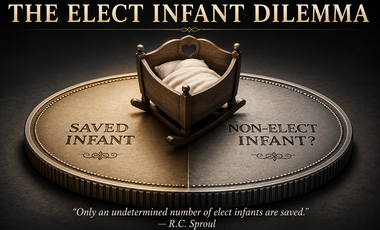
Hunt specifically points to this tension in his discussion of God’s character. He notes that Calvinism can place such overwhelming emphasis upon God’s sovereignty that God’s love, mercy, and grace toward the lost become secondary or restricted to the elect. He even cites R.C. Sproul acknowledging the difficult implication:
“If some people are not elected unto salvation then it would seem that God is not at all that loving toward them.”
Hunt’s objection is that this qualification sits uneasily with the biblical presentation of God’s love as infinite and perfect. And this brings us back to the Good Samaritan.
Jesus doesn’t portray mercy as something that should be extended only to a predetermined class of people. The Samaritan encounters a person in desperate need and responds with compassion. He sees the need, he has mercy, and he acts. So the challenge isn’t that the Calvinist refuses to call God loving. The challenge is whether the kind of love attributed to God within the Reformed/Calvinistic determinist system is consistent with the kind of love Jesus commands us to embody.
If Jesus tells us to love our enemies, show mercy to the unworthy, and come to the aid of those in desperate need because this reflects the character of our heavenly Father, then the question becomes unavoidable:
Would Jesus command His followers to display a broader compassion toward the needy than God Himself displays toward the lost?
That is the tension the Good Samaritan graphic is intended to illustrate.
This isn’t an argument that every Calvinist personally lacks compassion. Obviously, that would be unfair and demonstrably false. Nor does the parable, by itself, settle every question concerning election and salvation.
Rather, it raises a character-of-God question that deserves an answer:
If mercy toward the helpless is one of the clearest demonstrations of goodness that Jesus gives us, how can we understand a theology in which God sovereignly withholds the saving provision from people whom He could save?
That is the heart of the objection.
The Good Samaritan doesn’t ask whether the wounded man belongs to the right ethnic group.
He doesn’t ask whether the man has already demonstrated sufficient worthiness.
He doesn’t investigate whether the man’s future behavior will make the rescue worthwhile.
He sees someone in need—and shows mercy.
The forum article makes precisely this connection, arguing that Jesus’ portrayal of the Samaritan establishes mercy toward the person in need as the exemplary response and then asks whether we can consistently attribute something less than this kind of mercy to God Himself. (Berean Apologetics Ministry). And then comes 1 Corinthians 13… Paul gives us another piece of the puzzle.
If GOD IS LOVE (1 John 4:8), then these aren’t merely instructions for Christians. They tell us something about the character of the God whom Christians are supposed to imitate.
Jesus tells us to love our enemies.
Paul tells us to love without self-interest.
Jesus tells us that the Good Samaritan demonstrates what it means to be a neighbor.
And throughout Scripture, God’s mercy is repeatedly presented as something that extends toward humanity.
So the question becomes unavoidable:
Would Jesus ask His followers to become more compassionate toward their enemies than God is toward His?
That would turn the entire biblical pattern upside down.Soteriology 101 makes this same connection by arguing that Jesus’ command to love enemies is grounded in the character of the Father: believers are to love their enemies “in order that you may be sons of your Father who is in heaven.” (SOTERIOLOGY 101)
This contradistinction is what the graphic is trying to communicate.It isn’t simply saying, “Calvinism is wrong because it sounds mean.” It is presenting a deeper challenge:
What happens when our theological model makes God’s behavior look less compassionate than the behavior Jesus Himself holds up as the supreme example of neighbor-love?
The irony is almost unavoidable. Jesus—the very person Christians confess to be the revelation of God—tells us:
Don’t pass by the suffering person.
Show mercy.
Love your neighbor.
Love your enemy.
Do unto others as you would have them do unto you.
And yet, in the strongest versions of Reformed determinism, God’s sovereign decree is understood as determining that a majority of people will never receive the saving grace given to others—not because they were less needy, but because God chose not to grant it to them.
Increasing his glory in someway, apparently. That is the tension the graphic is meant to expose. And it leads to perhaps the simplest question of all:
Is the Good Samaritan actually more merciful than God?
If the answer is no—and it must be no—then we have to ask whether our doctrine of God is consistent with the very picture of love and mercy Jesus gave us. The Samaritan isn’t the standard by which God is judged.
Jesus is revealing what God is like.
And the God revealed in Jesus is not the one who walks past the wounded man.
HE IS THE ONE WHO STOPS
THE “GOOD NEWS” QUESTION
The Snap, also known as the Decimation and the Blip, was the event in which Thanos snapped his fingers while using the Infinity Gauntlet, resulting in the extermination of half of all life in the universe. (SOURCE)
The gospel is called GOOD NEWS because God has provided salvation through Jesus Christ. The message of the gospel is not merely that salvation exists—it is that God genuinely offers salvation to sinners.
Good News Apologetics summarizes that message by emphasizing that God loves the world, Christ died for us, salvation is available to all, and there is no limitation as to who can be saved. It points to passages such as 1 Timothy 2:4–6, which says that God desires all people to be saved and that Christ gave Himself as a ransom for all. That brings us to a difficult question concerning unconditional election and reprobation.
Where Has the “Good News” Gone?
The question is not whether Reformed Calvinists affirm that God is loving. They do. The deeper question is whether their doctrine of salvation allows the gospel to be genuinely good news for the person hearing it.
George Bryson presses the issue by examining the implications of unconditional election and reprobation. If God has unconditionally determined who will be saved and who will be lost, then the gospel invitation creates a difficult question:
Can the person hearing the gospel actually know that God’s saving provision applies to them?
Bryson argues that the Reformed doctrine of redemption and reprobation creates a division between those for whom salvation is provided and those for whom it is not. This is precisely the question Stephen Marcy raises in his analysis of Calvinist gospel presentations:
God loves you. Christ died for you. Repent and believe in Him. You can be saved.
Those statements sound like good news because they tell the sinner that the salvation accomplished by Christ genuinely applies to them and that they may come to Christ in faith. Marcy points out, however, that this creates a tension with Calvinist doctrines of unconditional election, total inability, limited atonement, and irresistible grace. Under those doctrines, not everyone is included in God’s saving purpose, not everyone can believe, and Christ’s atoning death is understood by many Calvinists as intended specifically for the elect.
That produces a very different message.
The sinner hearing the gospel does not know whether he is one of the people God has chosen to save. He cannot determine his election beforehand. And if he is among the non-elect, the very salvation being proclaimed to him was never intended for him in the saving sense.
So the question becomes unavoidable:
What makes the gospel “good news” if the person hearing it may not be included in the salvation being announced?
Marcy highlights this problem through Calvinist evangelistic language itself. A Calvinist preacher may tell a sinner to repent, trust Christ, and be saved. Yet, according to the underlying Calvinist system, the ability to believe depends upon God’s prior unconditional election and effectual calling. Thus the outward gospel invitation sounds universal while the underlying soteriology makes its saving applicability particular.
The same tension appears in Voddie Baucham’s presentation of the gospel. In his sermon on Romans 9:30–33, Baucham describes the gospel as “news” about what God has done in Christ and emphasizes God’s sovereignty. Marcy’s criticism is that, when Calvinist doctrines such as unconditional election and limited atonement are brought into the equation, the message ceases to function as universally applicable good news.
And that brings us back to the fundamental issue:
THE GOSPEL IS SUPPOSED TO BE GOOD NEWS.
Not merely news that God has predetermined the destinies of humanity.
Not merely news that Christ died for a particular group.
Not merely news that the elect will eventually be regenerated and given faith.
The biblical proclamation is presented as an invitation and promise to sinners: come, believe, repent, receive, and be saved.
That is what makes the message good news.
Graphics Used in video – click to enlarge:
If the hearer cannot know whether Christ’s saving work is intended for him, cannot respond unless he has first been secretly regenerated, and may in fact be one of those whom God has eternally passed over, then the question “Am I included?” is not a peripheral objection. It strikes at the very heart of what the word gospel means.
And this is where the “SNAP 90+%”graphic becomes relevant. The point is not that Calvinism teaches a precise numerical percentage of reprobates—Calvinism does not give us such a statistic. The point is that if the elect are a minority, then the majority of humanity are necessarily outside that saving election.
So the question remains:
If the “good news” of salvation is ultimately only good news for the elect, what makes it good news for everyone else who hears it?
That is the “Good News” question Calvinism has to answer.
This is where the “SNAP 90+%”graphic is intended to make the issue visible. The point isn’t that Calvinism teaches a precise mathematical percentage of reprobates—it doesn’t. The point is the logical consequence of the doctrine:
if the elect are only a minority of humanity, then the majority are passed over.
And that raises the question:
What kind of “good news” is it if Christ’s saving provision was never intended for the totality of humanity?
Jesus’ illustration of the Good Samaritan presents mercy as something radically different. The Samaritan sees the wounded man, has compassion on him, goes to him, tends his wounds, and provides for his recovery. Jesus then commands His hearers: “Go and do likewise.” (Luke 10:37)
The question, then, is not whether Calvinists can affirm that God is loving. They can and do….
In their twisted way….
The deeper question is whether our understanding of God’s love and mercy should look like the Samaritan who sees the helpless and responds with compassion, or whether God’s saving mercy is ultimately restricted to a predetermined group while the rest are passed by.
Calvinism is built on prooftexts. In this episode we will be conducting an experiment to demonstrate why CONTEXT is more important than prooftexts. We will also consider why people become Calvinists in the first place. Get ready to see ULTRA Limited Atonement!
Here is the “Pauline” Systematic:
The Thought Experiment: Inventing Pauline Particularism
J17 Apologetics makes an unusual move in Why CONTEXT Beats Prooftexts! – Episode 24. Rather than simply telling the audience that proof-texting can be misleading, he invents a fictitious theological system and then demonstrates how easily that system can be made to appear biblical when passages are removed from their contexts. He repeatedly interrupts himself to remind the audience that the theology is fake, that he invented it, and that he does not actually believe it. The purpose of the exercise is methodological: it shows what happens when a theological conclusion is established first and biblical passages are then gathered to support it.
He calls his fictional system “Pauline Particularism,” which he also describes as an “ultra limited atonement.” The central proposition is deliberately outrageous, and that outrageousness is part of the demonstration: if a reader can be shown a case for a claim this obviously false, then the problem with proof-texting becomes easier to see.
Jesus Christ died only for Paul.
Obviously, J17 is not arguing that Scripture actually teaches this. Instead, he asks us to imagine someone who genuinely believed it and then constructed a theological case for it using biblical proof texts. The exercise shows how statements that are individually true can be removed from their contexts, linked to other statements, and arranged into an elaborate theological system that appears to have substantial biblical support.
The key to the exercise is that the conclusion comes before the evidence. The fictional theologian begins by deciding that Jesus died only for Paul. He then goes looking through the Bible for passages that contain language that might be made to fit that conclusion. J17 describes this as starting with an idea and then searching Scripture for verses that appear to support it. Once enough verses have been collected, the resulting list can be presented as evidence that the Bible teaches the doctrine.
Building the Case from Isolated Passages
Galatians 2:20 becomes an obvious starting point because Paul says that the Son of God “loved me and gave himself for me.” The fictional theologian can emphasize the word “me”:
Christ loved Paul, Christ gave Himself for Paul, and Paul is therefore the particular object of Christ’s self-giving.
The same verse can then be pressed further through Paul’s statement, “I have been crucified with Christ,” so that the passage begins to sound as though it describes a uniquely Pauline relationship to Christ’s death.
J17 also demonstrates how someone could make the argument sound more authoritative by appealing to Greek. He walks through grammatical features of Galatians 2:20 and shows how Paul’s relationship to the verbs of loving and giving can be emphasized. The grammatical observations themselves do not establish the fictitious doctrine; they show how technical language can give an interpretation an appearance of greater certainty. J17’s point is that Greek does not automatically rescue someone from bad interpretation. A person can understand the grammar and still misunderstand the author’s intention.
The fictional theologian can then move to1 Timothy 1:15, where Paul says that Christ Jesus came into the world to save sinners and identifies himself as the chief of sinners. The reasoning becomes deceptively simple: Jesus came to save sinners; Paul says he is the chief of sinners; therefore, Jesus came to save Paul. Once that conclusion is accepted, the theologian can connect it back to Galatians 2:20 and say that Jesus not only came to save Paul but gave Himself specifically for Paul.
The same approach can be applied to Jesus’ teaching about the lost sheep. Because Jesus speaks of leaving the ninety-nine and going after the one sheep that has gone astray, the fictional theologian can simply identify Paul as the one sheep. Once that identification is assumed, another biblical passage appears to support the theory: Jesus goes after the one, and Paul is the one.
Therefore, the argument goes, Paul’s salvation occupies this unique place in Christ’s saving work. The passage has now been made to serve a conclusion that was already established before the passage was examined.
The argument can continue with Paul’s discussion of the race and the prize in 1 Corinthians 9. Paul says that those who run a race run to obtain a prize, and he speaks about running in such a way as to obtain it. The fictional theologian can then connect this with Paul’s statement in 2 Timothy 4 that he has finished the race and kept the faith. Paul receives the crown of righteousness. Therefore, the argument can be constructed that Paul is the particular person who has been selected to receive the ultimate prize.
When Contradictions Are Reinterpreted by the System
But the same passage also creates a problem. Paul says that the crown is not for him only, but also for all who have loved Christ’s appearing. The fictitious theology therefore has to absorb a statement that appears to broaden the promise beyond Paul. Rather than abandoning the system, the theologian reinterprets or qualifies the contradiction. J17 uses this move to demonstrate an important feature of proof-text systems: once the conclusion becomes the controlling framework, passages that appear to challenge it are given secondary interpretations rather than being allowed to challenge the conclusion itself.
Paul’s unique apostolic calling can then be recruited into the system. Paul is described as a chosen instrument, separated to the gospel, and given a distinctive mission. Those statements are true descriptions of Paul’s ministry, but the fictional theologian can subtly move from Paul has a unique calling to Paul has a unique salvific status. The distinction between Paul’s particular apostolic role and the broader biblical discussion of salvation disappears because the theological system requires it to disappear.
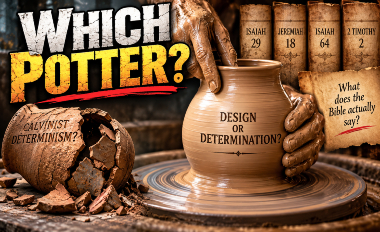
Romans 9 can then be brought into the argument to explain why everyone except Paul is excluded. The fictional theologian appeals to the potter and the clay and the vessels made for honor and dishonor. Paul becomes the vessel of honor, while everyone else becomes a vessel of dishonor. God’s sovereign authority over His creation then becomes the theological explanation for why Paul alone receives salvation. J17 intentionally pushes the language in this direction to show how biblical statements about God’s sovereignty can be incorporated into a completely invented system when the surrounding context is ignored.
At this point, the fictitious theology has become self-reinforcing. Whenever a passage appears to contradict the doctrine, the theologian does not necessarily reconsider the doctrine. Instead, the passage is reclassified, qualified, or interpreted through the already-established system.
In effect, the doctrine has stopped being something derived from Scripture and has become the lens through which Scripture is interpreted.
Why Context, Not Quantity, Tests an Interpretation
That is the critical distinction J17 wants the viewer to recognize. There is nothing inherently wrong with having biblical evidence for a theological position. The problem occurs when a person starts with a theological conclusion and then searches Scripture for isolated statements that can be made to support it. The resulting collection can become extremely persuasive simply because of its size. A person can look at twenty, thirty, or even a hundred references and conclude, “Surely this doctrine must be biblical.”
But the number of references does not answer the more important question:
What does each passage actually mean in its own context?
J17’s fictional Pauline Particularism demonstrates this by producing a surprisingly large collection of apparently supportive texts for an obviously fabricated doctrine. He says that he assembled roughly twenty-five passages and could easily have found more. Once the passages are gathered together, the temptation is to assume that the sheer quantity of biblical material proves the conclusion. But none of the authors of those passages intended to establish the proposition that Jesus died only for Paul. The appearance of support comes from the way the texts have been selected and assembled.
This is why context is so important. A biblical statement cannot be understood merely by extracting its words. We need to know who is speaking, who is being addressed, what circumstances are being discussed, what question or problem the author is addressing, and how the statement fits within the author’s larger argument. The meaning of a sentence is not determined simply by the fact that its individual words can be found somewhere else in support of our preferred theological conclusion.
J17 makes the same point about the original languages. Greek can provide valuable information, but simply knowing Greek does not make an interpretation automatically correct. He illustrates this with an ordinary expression such as “we’re going to go in there and take them out.” The exact same words could mean very different things depending upon whether the speaker is a military operator, a dentist, or a contractor. The words themselves do not tell us what is happening. The context does.
That principle applies just as strongly to biblical Greek. A person can identify the correct vocabulary, grammatical forms, cases, tenses, and syntactical relationships and still miss what the author is actually saying. Grammar tells us important things about the text, but grammar operates within context. As J17 puts it, “Context is more powerful than Greek.”
The Pauline Particularism thought experiment therefore exposes a fundamental weakness in the “pile of proof texts” approach (Phil Bair | Soteriology 101).
Passage
Calvinist use
Contextual observation
Matthew 10:22
“He who endures to the end will be saved” = perseverance of the saints
Examine who is being addressed, the immediate mission/persecution context, and what “saved” means
Luke 21:19
Endurance proves genuine faith
Examine the Olivet context and the relationship between endurance and deliverance
1 Peter 1:5
God guarantees perseverance
Explicitly examine whether the passage establishes that proposition or is being used to interpret Matthew 24:13
Jeremiah 32:40
God guarantees that believers will never turn away
Covenant context and the identity of the people addressed matter
1 John 2:19
Those who leave were never genuinely saved
Examine John’s immediate argument concerning the antichrists/false teachers
John 10:28–29
No true believer can ultimately fall away
Directly discuss what the passage says about Christ’s protection
Philippians 1:6
God completes His work
Examine Paul’s specific context and what “good work” refers to
Jude 24
God keeps believers from stumbling
Distinguish divine preservation from the particular meaning of Matthew 24:13
Does “foreknew” necessarily mean foreordination of individuals, and does the passage itself establish the entire Calvinistic causal chain?
Acts 13:48
Unconditional election / effectual calling
What does Luke mean by “appointed/ordained” and who exactly are the people being described in the immediate context?
Ephesians 1:11
Meticulous divine determinism
Does “works all things according to the counsel of His will” actually establish that God determines every individual human choice?
Romans 8:7–9
Total inability
Does inability to live according to the flesh equal inability to respond to the gospel?
1 Corinthians 2:14
Total inability
Does “the natural person does not accept…” mean the unregenerate person cannot understand/respond to the gospel at all?
Ephesians 2:1–3
Spiritual death / Total Depravity
Does being “dead in trespasses” itself define the mechanics of the sinner’s will?
Romans 3:10–18
Total Depravity
Does Paul’s indictment establish inability to believe, or does it establish universal unrighteousness apart from God’s provision of righteousness by faith?
Imagine someone appearing in a church and announcing that Jesus died only for Paul. Suppose that person then produced a long list of biblical references: Galatians 2:20, 1 Timothy 1:15, Acts 9, 1 Corinthians 9, 2 Timothy 4, Romans 9, Matthew 18, 2 Corinthians 12, and many others.
The natural reaction might be, “That’s an awful lot of Scripture.” The right test is not how many passages have been collected, but whether those passages actually teach the doctrine being attributed to them.
This is ultimately what J17 is attempting to demonstrate with his fictional theology. He is not claiming that Calvinists literally believe Jesus died only for Paul. He is demonstrating that a theological system can be made to look biblical when its conclusion is established first and Scripture is subsequently mined for supporting statements. The warning is aimed at the method, not at a claim that any real group teaches Pauline Particularism.
The Proper Movement from Text to Doctrine
The lesson, then, is not that proof texts are useless. Biblical passages are the foundation of Christian theology. The issue is how those passages are used. Scripture should not merely be searched for words that resemble our doctrinal vocabulary. It should be read as communication from authors who wrote to particular audiences, in particular circumstances, for particular purposes.
J17’s fictitious Pauline Particularism makes the difference visible. If someone can construct an elaborate theological system claiming that Jesus died only for Paul by collecting enough isolated biblical statements, then the mere existence of a large collection of proof texts cannot be considered sufficient evidence that a theological system is true.
The number of proof texts is not the proof; context is the test.
For a quick adult Sunday class handout I made [and taught years back], see my “Five Finger Life Punch.”
What does Jesus mean when He says “he who endures to the end will be saved” in Matthew 24:13?
Much of Scripture has been hijacked by wrong theology due to philosophical presuppositions, seeking to interpret passages from a Western mindset, and attempting to spiritualize or allegorize its meaning. When we understand the passage within the literary genre, cultural context, and surrounding context, we often discover that what we’ve heard doesn’t match with what God’s word actually says.
This is the case with Matthew 24:13, where some teach that if you don’t endure in good works, faith, love, or obedience, then either you lose your eternal life, or you never truly had it. But is that really what Matthew 24:13 means?
This video uncovers the cultural context surrounding Matthew 24:13 and how a Jewish perspective is vital in properly understanding these words of Jesus.
More on this with MacArthur’s take:
Matthew 24:13 — When a System Enters the Flow of the Text
A closer look at John MacArthur’s treatment of
endurance, salvation, and perseverance
Matthew 24:13 in Its Immediate Prophetic Context
This study argues that Matthew 24:13 should first be read within Jesus’ end-times discourse before it is enlisted as a proof text for a broader doctrine of perseverance. The concern is not whether perseverance is biblical, nor whether systematic theology has a legitimate place, but whether this specific verse carries the full theological weight often placed on it. The argument proceeds by examining the verse’s immediate context, the meaning of “saved,” the force of Jesus’ warning, MacArthur’s treatment in both the Study Bible and larger commentary, and the qualified contrast provided by the Bible Knowledge Commentary. That contrast is useful not because BKC agrees with every Free Grace conclusion, but because it shows that a conservative premillennial commentary can read Matthew 24:13 as Tribulation deliverance within the passage’s own prophetic framework.
Matthew 24:13 occurs within Jesus’ response to the disciples’ question about the destruction of the temple, the sign of His coming, and the end of the age (Matt. 24:1–3). The surrounding discourse is unmistakably concerned with events associated with the end: false Christs and deception, wars, famines and earthquakes, persecution, death, betrayal, false prophets, increasing lawlessness, the cooling of love, the abomination of desolation, the Great Tribulation, the coming of the Son of Man, and the gathering of the elect.
Within that flow Jesus says, in Matthew 24:13, that the one who endures to the end will be saved. The statement is direct. The interpretive question is not whether Jesus expects endurance—He plainly does—but what theological conclusions may legitimately be drawn from this statement in its immediate context.
A broader Calvinistic formulation can turn the statement into a larger theological chain: regeneration produces certain perseverance; perseverance demonstrates that regeneration was genuine; and failure to persevere demonstrates that regeneration never occurred. That may be defended from a wider systematic theology, but it is not identical to the proposition stated in Matthew 24:13.
The exegetical issue, then, is one of direction. Is the larger theological system being derived from Matthew 24:13, or is Matthew 24:13 being interpreted through conclusions already established elsewhere in the system? A theologian may argue for the broader doctrine from other passages, but this verse should first be allowed to speak within the argument Jesus is actually making.
What Does “Saved” Mean Here?
By “systematic theology,” this study means the practice of organizing biblical teaching across multiple passages into a coherent doctrinal framework. The issue is not whether that practice is legitimate, but whether the completed framework is allowed to determine the meaning of a passage before the passage has been read in its own literary and historical setting.
The Greek verb sōzō can refer to salvation in the ultimate spiritual sense, but its range can also include deliverance or preservation from danger. Because Jesus is discussing persecution, tribulation, deception, and the culmination of the age, the immediate context matters before the word is automatically assigned a fully developed systematic meaning.
This reading is strengthened by a common Free Grace observation: the verb sōzō does not always mean eternal salvation from condemnation. It can mean to save, preserve, rescue, or deliver from danger, and the context must determine which sense is in view. Since Matthew 24 describes persecution, deception, betrayal, flight, tribulation, and the coming deliverance associated with Christ’s return, the possibility of physical deliverance or preservation should not be dismissed before the context has been allowed to speak.
A related point is the use of “saved” later in the same discourse. In Matthew 24:22, Jesus says that unless those days were cut short, “no flesh” would be saved. That use naturally refers to physical survival through the severe days of tribulation. While verse 13 and verse 22 are not identical statements, their proximity within the same prophetic discourse cautions against assuming that “saved” in verse 13 must automatically mean justification or final entrance into heaven.
The question is not whether Matthew 24:13 can have implications for ultimate salvation. It may. The question is whether the verse itself establishes the additional claims that regeneration necessarily guarantees perseverance and that failure to endure proves regeneration never took place.
The phrase “to the end” should also be read in the discourse itself. Jesus is answering questions about the end of the age, the events that precede His coming, and the climactic period of distress described immediately afterward. On that reading, “the end” need not mean the end of an individual believer’s life; it may refer to the end of the tribulational period in view. This reinforces the need to distinguish endurance through a prophetic crisis from a generalized proof text for lifelong perseverance.
The Bible Knowledge Commentary makes this contextual point with unusual clarity, though its use here should be carefully qualified. Louis A. Barbieri Jr. interprets Matthew 24:9–14 as part of the coming Tribulation and states that those who remain faithful “until the end of that period of time” will be saved, “that is, delivered.” He then distinguishes this from the idea of personal endurance producing eternal salvation, explaining the verse as physical deliverance for those who trust in the Savior during the Tribulation and who will enter the kingdom in physical bodies. This does not make BKC a Free Grace commentary in every respect; it makes BKC a valuable witness to the fact that the immediate prophetic context can control the meaning of “saved” in Matthew 24:13.
That sequence is important:
Tribulation, persecution, endurance, deliverance, and entrance into the earthly kingdom.
It is not the same sequence as regeneration, guaranteed perseverance, evidence of regeneration, and proof of eternal salvation. The issue, again, is not whether the latter doctrine can be argued from other passages, but whether Matthew 24:13 itself establishes that doctrine when read in the flow of Jesus’ discourse.
The Force of the Warning
The warning in Matthew 24 is presented as a real warning. Jesus tells His hearers to beware of deception, remain faithful amid persecution, and endure to the end. If a theological system already defines the perseverance of every genuine believer as infallibly guaranteed, however, the reader must still ask what function the warning has within Jesus’ own argument.
A Calvinist can answer that God uses warnings as the means by which He secures the perseverance He has already ordained. That answer may be internally coherent within the system, but it also illustrates the precise interpretive issue under examination. The warning is no longer being explained only from Matthew 24; it is being explained through a prior doctrine concerning God’s determination of the believer’s perseverance.
The distinction is important. Jesus plainly commands endurance, and BKC also treats faithfulness, watchfulness, and preparedness as meaningful responses of those who trust the Savior during the Tribulation. The further claim that endurance is guaranteed because of prior regeneration, and that eventual failure therefore proves the absence of genuine regeneration, is a theological inference that requires its own exegetical demonstration.
MacArthur’s Study Bible and Larger Commentary: Same Theological Move, Different Presentation
That distinction becomes especially important when evaluating MacArthur, because the question is not whether he recognizes the prophetic setting, but how he connects that setting to the doctrine of perseverance. The comparison with BKC should therefore be framed narrowly: both readings operate within an eschatological framework, but they draw different conclusions from the function of “saved” and “endure” in verse 13.
A more precise assessment of John MacArthur’s treatment is important here. MacArthur does not simply remove Matthew 24:13 from its prophetic setting. Both his Study Bible and his larger commentary understand Matthew 24 within an end-times framework involving Christ’s coming, persecution, deception, apostasy, the Tribulation, the proclamation of the gospel, and the events surrounding the end of the age.
The Study Bible actually preserves that prophetic framework around Matthew 24:13. Its note on verse 10 interprets those who fall away as people who demonstrate that they were never true believers. Its note on verse 13 then explains perseverance through the doctrine that God secures the perseverance of true believers and that those who ultimately fall away prove that they were never truly believers. Most significantly, its note on verse 14 explicitly identifies “the end” with the final birth pains associated with the Great Tribulation.
The larger commentary gives the same theological move a longer contextual runway. MacArthur first establishes that Matthew 24:4–14 describes events associated with Christ’s future coming and the Tribulation. He then treats verses 10–13 under the heading “Defection of False Believers,” explaining the people who fall away as individuals who had an outward identification with Christ but demonstrate by their defection that they never truly belonged to Him.
At verses 12–13, the larger commentary makes the systematic connection especially explicit. MacArthur explains that endurance does not produce salvation but functions as a Spirit-empowered product and proof that a person is already saved. True believers, he argues, will not ultimately renounce Christ because Christ protects them from such defection. Endurance therefore becomes evidence of genuine salvation within his broader doctrine of perseverance.
The difference between the two works is therefore primarily one of presentation, not of basic theological direction. The Study Bible states the systematic conclusion very compactly at verse 13, while the larger commentary develops the prophetic setting more extensively before making the same connection between endurance, genuine salvation, and perseverance.
This distinction matters because the criticism should not be that MacArthur fails to recognize the end-times context. He clearly does. The more precise issue is that, within that recognized end-times context, he interprets Jesus’ statement about enduring to the end through a broader Reformed doctrine of perseverance.
The Bible Knowledge Commentary Provides an Important Contrast
The Bible Knowledge Commentary offers a useful comparison because it explicitly maintains the same prophetic framework while interpreting Matthew 24:13 differently. Barbieri understands Matthew 24:4–14 as describing events associated with the future period preceding Christ’s return, with verses 9–14 describing persecution, deception, apostasy, and increasing wickedness during the Tribulation.
When Barbieri reaches Matthew 24:13, he states that those who remain faithful “until the end of that period of time” will be saved, “that is, delivered.” He then specifically distinguishes this from eternal salvation resulting from human endurance, explaining that the verse refers instead to physical deliverance of those who trust in the Savior during the Tribulation, followed by their entrance into the kingdom in physical bodies.
This interpretation is significant because it demonstrates that recognizing endurance in Matthew 24:13 does not necessarily require interpreting endurance as the Calvinistic doctrine of guaranteed perseverance of the saints. The BKC recognizes the command and necessity of remaining faithful, yet understands the promised “salvation” in the immediate prophetic context as deliverance from the Tribulation and preservation into the Messianic kingdom.
The BKC further states that the primary application of Jesus’ instructions in this section concerns the future generation that will experience the days of the Tribulation, while allowing a secondary application for believers living today. It also adds that the church is not directly in view in these verses. That qualification matters because the argument does not depend on treating Matthew 24:13 as addressed to the church in the same direct way that later epistles are. The primary contextual setting is a future prophetic crisis, while broader application must be drawn carefully by principle rather than assumed as the verse’s immediate doctrinal subject.
Thus, the contrast is instructive. MacArthur reads endurance as evidence of genuine salvation within a broader doctrine of perseverance. The Bible Knowledge Commentary reads endurance through the Tribulation as resulting in physical deliverance and entrance into the earthly kingdom. The difference demonstrates the central question of this study: what does Matthew 24:13 establish from its own context before a broader theological system is brought to bear on the passage?
This comparison also helps keep the critique fair. The point is not that the Bible Knowledge Commentary agrees with every aspect of a Free Grace interpretation or rejects every theological concern MacArthur is trying to protect. Barbieri operates within a conservative premillennial framework, speaks of people being redeemed during the Tribulation, identifies them as believers, and understands later judgment scenes as revealing genuine faith through preparedness, watchfulness, mercy, and faithfulness. The narrower point is stronger: even within that framework, Matthew 24:13 is interpreted as deliverance through the Tribulation rather than as a direct formulation of guaranteed perseverance.
This qualification also prevents an overstatement of the evidence. The BKC can be used to show that a contextual, Tribulation-focused reading of “saved” as delivered is not novel or merely polemical. It should not be used to claim that Barbieri shares the same doctrine of justification, assurance, rewards, or perseverance as every Free Grace writer. Its value is comparative and exegetical:
it demonstrates that the immediate prophetic context can control the meaning of “saved” in Matthew 24:13 even in a commentary that remains conservative, premillennial, and concerned with genuine faith.
Genuine believer → God secures perseverance → believer necessarily endures → endurance demonstrates genuine salvation → those who ultimately fall away were never genuinely believers.
The second formulation is not simply a restatement of the first. It is a theological synthesis that brings Matthew 24:13 together with numerous other passages concerning divine preservation, perseverance, apostasy, and genuine faith. MacArthur cites texts such as 1 Peter 1:5, Jeremiah 32:40, 1 John 2:19, John 10:28–29, Romans 8:38–39, 1 Corinthians 1:8–9, Philippians 1:6, Hebrews 10, Revelation 3, and Jude in developing this argument.
Those passages may be relevant to a broader doctrine of perseverance. But their accumulation also demonstrates that the argument has moved beyond what Matthew 24:13 says by itself. A theological system can take a statement from one passage, connect it with statements from several other passages, and then bring the resulting synthesis back to the original passage as though the entire synthesis were already present there. Consistency with a theological system is not the same thing as demonstrating that the original passage teaches every component of that system.
A Significant Point of Agreement—and a Significant Point of Difference
Interestingly, MacArthur’s treatment actually provides substantial support for the contextual observation that Matthew 24:13 belongs within an end-times setting. His larger commentary explicitly connects the passage with the future Tribulation and the people who will experience that period. The Study Bible likewise connects the surrounding verses with the Great Tribulation and Christ’s return.
The more precise disagreement concerns what is then made to follow from verse 13. MacArthur moves from Jesus’ statement that the one who endures to the end will be saved to a broader conclusion in which endurance functions as evidence of prior genuine salvation and ultimate defection demonstrates that a person was never truly a believer. BKC, while still concerned with genuine faith and redeemed Tribulation believers, does not make verse 13 itself carry that full doctrinal sequence.
That may be a legitimate topic for a broader theological argument. But it should not be confused with the immediate grammatical statement of Matthew 24:13 itself. The question is not whether MacArthur can construct a doctrine of perseverance from Scripture. The question is whether this particular verse establishes that doctrine in the full sense assigned to it.
The Cross-References Reveal the System
The cross-references make the method especially visible. MacArthur appeals to passages such as Matthew 10:22, Luke 21:19, 1 Peter 1:5, Jeremiah 32:40, 1 John 2:19, John 8:31, Matthew 7:23, Matthew 10:32–38, and 2 Timothy 2:12. These texts may be relevant to a broader doctrine of perseverance, but their accumulation shows that the argument has moved beyond the immediate statement of Matthew 24:13.
This is an important distinction for any study of proof texts. The more passages that must be assembled to explain what a single verse supposedly means, the more carefully we should distinguish the meaning of the verse from the theological synthesis built around it.
The Free Grace critique therefore presses the same methodological concern from another angle, and the BKC comparison gives that concern an important qualification. If Matthew 24:13 is read as a Tribulation-context promise of deliverance for those who endure that period, then using it as a direct proof of perseverance of the saints requires an additional interpretive step. At the same time, the argument should not imply that every commentator who reads “saved” as deliverance shares the same doctrine of assurance, rewards, or perseverance. The narrower point is that the verse may still be discussed alongside passages on endurance, reward, faithfulness, and preservation, but it should not be made to bear conclusions that arise only after it has been relocated into a different doctrinal framework.
The literary flow supports that caution. Matthew 24:9–14 describes Tribulation conditions and the need for endurance. Matthew 24:15–26 continues with the abomination of desolation and the Great Tribulation. Matthew 24:27–31 then describes the visible return of the Son of Man and the gathering of the elect. Matthew 25 develops judgment and preparation for the kingdom. Read in that sequence, verse 13 functions naturally within a prophetic argument about enduring through the crisis until Christ’s delivering intervention.
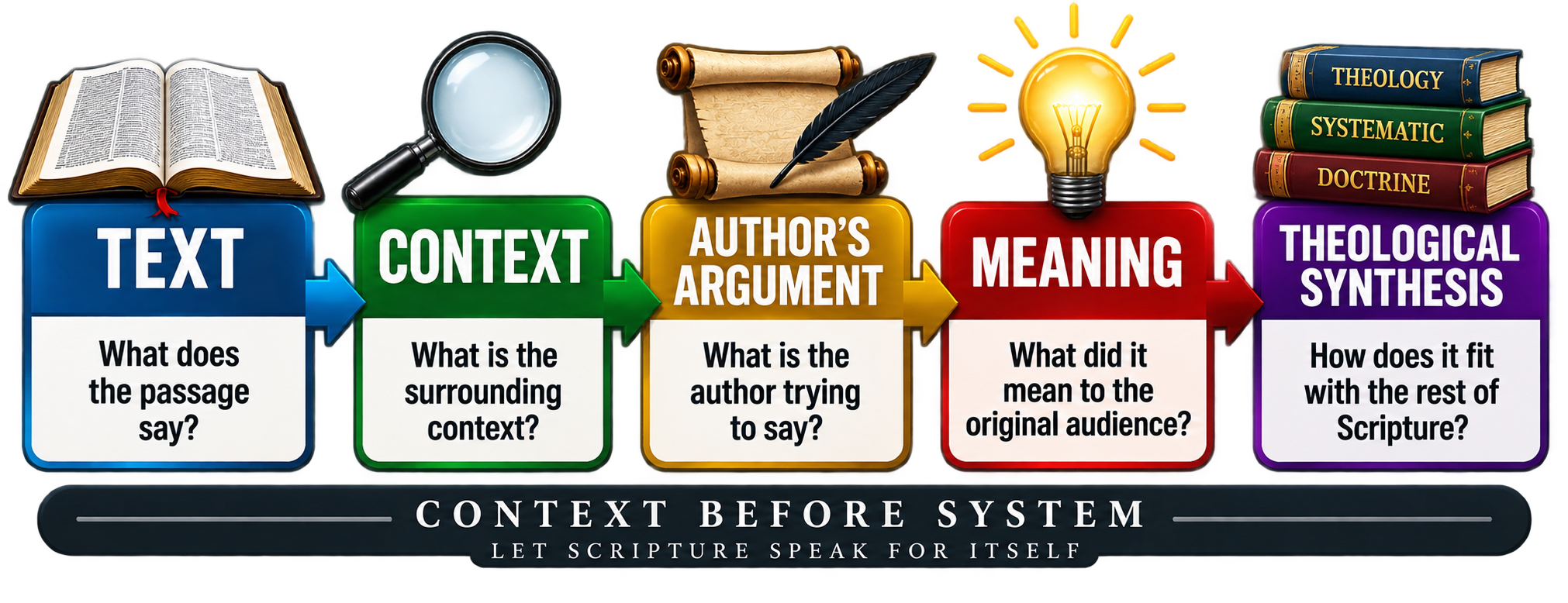
Context Before System
The better starting point is to resist the temptation to ask, “What verse proves perseverance of the saints?” Instead, begin with the passage in front of us. Who is Jesus addressing? What question is He answering? What events does He describe? What does “the end” refer to in this discourse? What does “saved” mean in this setting? How do verses 10–14 function together? What happens immediately afterward in verses 15 and following?
Only after those questions have been answered should we ask how Matthew 24:13 relates to doctrines developed from the rest of Scripture. That order matters because it prevents the theological system from silently becoming the interpretive framework by which the text is defined. It also keeps comparative evidence in its proper place: BKC may support the contextual reading of “saved” as deliverance, while still operating from theological commitments that are not identical to a Free Grace framework.
The principle is simple: establish the meaning and context of the passage before drawing the theological conclusion. Define the terms, examine their usage, follow the author’s argument, and consider the historical and literary setting. Only then should the conclusion be compared with other passages of Scripture. In that order, Scripture controls the system rather than the system controlling the text.
The concern is not that systematic theology exists; it is whether the system is being derived from the text or imported into the interpretation of it.
The result is a more disciplined use of proof texts and a fairer use of secondary sources. Matthew 24:13 can still contribute to a larger discussion of perseverance, but it should do so after its own context has been heard clearly. The Bible Knowledge Commentary helps show that this contextual reading is not merely polemical, but its support must be stated with precision: it confirms a Tribulation-deliverance reading of the verse without requiring agreement on every related doctrinal question. That approach does not weaken doctrine; it strengthens it by requiring theological conclusions to rest on careful reading rather than inherited assumptions.
Primary Sources Used
John MacArthur, commentary on Matthew 24:1–14, in the uploaded PDF “Macarthur – Jesus 2nd coming.pdf,” especially the sections on the background (24:1–3), the birth pains (24:4–14), and “Defection of False Believers” (24:10–13).
John MacArthur, Study Bible notes on Matthew 24:10–15, including the notes on falling away, perseverance, and “the end” in relation to the Great Tribulation.
“A Free Grace Interpretation of Matthew 24:13,” Free Grace Free Speech, January 25, 2026.
Bob Wilkin, “He Who Endures Will Be Saved (Matthew 24:13),” Grace Evangelical Society, November 17, 2020.
Louis A. Barbieri Jr., “Matthew,” in The Bible Knowledge Commentary: An Exposition of the Scriptures, ed. J. F. Walvoord and R. B. Zuck, vol. 2 (Wheaton, IL: Victor Books, 1985), 76–81.
The main argument directly above has focused on Matthew 24:13 and the danger of allowing a broader doctrinal system to determine the meaning of a single text before that text has been read in context. The appendix applies the same method to several other passages commonly used in discussions of perseverance, offering brief contextual checks rather than full exegetical treatments.
Appendix — The “Proof Text” Problem
Quick contextual responses to commonly cited perseverance texts via Phil Bair (The Wilted Flower) and SOTO 101 (Answering Calvinistic Proof Texts | and more: HERE,
The following passages are among the texts commonly brought into discussions of the perseverance of the saints. The point is not that these passages are irrelevant to security, God’s faithfulness, or perseverance. Rather, each passage should first be allowed to make its own contextual claim. A promise of God’s faithfulness is not automatically a statement that apostasy is metaphysically impossible, and a description of present security is not automatically a guarantee of future perseverance.
1. John 5:24 — “Whoever hears … and believes”
“Whoever hears my word and believes … has eternal life.”
The verse gives strong assurance to the person who hears and believes. The Calvinist argument often moves from present possession of eternal life to the conclusion that the person can never subsequently abandon the faith. But the verse itself does not discuss the possibility of later apostasy. Its stated condition is hearing and believing. The text therefore establishes a promise to the believer; the additional claim of guaranteed future perseverance requires support from other passages.
2. John 6:35–37 — “I will never cast out”
“Everyone who comes to me will never be hungry, and the one who believes in me will never be thirsty.”
Jesus gives assurance to those who come to Him and believe. Nothing in the promise says that Christ will cast away a person who genuinely continues to come to Him. The larger discourse must be considered before turning the promise into a proposition about the impossibility of future apostasy. John 6:66 also records disciples who stopped following Jesus, demonstrating that the discourse itself contains a distinction between those who follow and those who depart.
3. Romans 8:35–39 — Nothing can separate us
“Who can separate us from the love of Christ?”
Paul’s list emphasizes external afflictions and hostile forces—trouble, distress, persecution, famine, nakedness, danger, sword, death, life, angels, rulers, things present, things to come, powers, height, depth, and creation. The passage establishes the invincibility of God’s love against external opposition. It does not explicitly address a believer’s own repudiation of Christ. Therefore, the conclusion that the passage proves the impossibility of apostasy goes beyond what the listed obstacles actually address.
4. 1 Peter 1:3–5 — “Kept … through faith”
“You are being guarded by God’s power through faith for a salvation that is ready to be revealed in the last time.”
This is one of the most important texts to examine because it explicitly combines divine preservation with faith. God’s power guards believers, but Peter says this guarding operates “through faith.” The verse therefore strongly affirms God’s active preservation without, by itself, defining preservation as an unconditional mechanism that eliminates the believer’s continuing response.
5. Philippians 1:6 — “He who started a good work”
“He who started a good work in you will carry it on to completion until the day of Christ Jesus.”
Paul expresses confidence in God’s faithfulness toward the Philippians. But the verse is a pastoral expression of confidence within a letter that repeatedly calls believers to continue in faithful obedience. It does not explicitly formulate the proposition that every genuinely regenerated individual is metaphysically incapable of apostasy. That broader doctrine must be established from the whole biblical witness rather than assumed from the promise.
6. Ephesians 1:13–14 — Sealed with the Spirit
“In him you also were sealed with the promised Holy Spirit. He is the down payment of our inheritance…”
The seal signifies God’s ownership and the Spirit’s role as a pledge of the inheritance. That is powerful assurance. But the passage does not use the word “seal” to define a doctrine of inevitable perseverance. The same letter contains exhortations to believers and warns them not to grieve the Holy Spirit (Eph. 4:30). The existence of a divine seal therefore should not be expanded into a conclusion the immediate verse does not state.
7. 1 Corinthians 1:6–8 — “He will sustain you to the end”
“He will also strengthen you to the end, so that you will be blameless in the day of our Lord Jesus Christ.”
This is a significant assurance of God’s faithfulness. But it occurs in a letter that repeatedly warns believers about serious consequences of disobedience and falling. The promise establishes God’s ability and faithfulness to sustain His people; it does not, standing alone, define the precise relationship between divine sustaining grace and a believer’s continuing response.
8. Jeremiah 32:39–40 — “They will not turn away from me”
“I will put the fear of me in their hearts so that they will not turn away from me.”
This is a strong covenant promise concerning God’s work among His covenant people. It is therefore important evidence for divine initiative and preservation. But its covenantal and prophetic setting should be established before it is transformed into a universal proposition about the mechanics of individual regeneration. A promise concerning God’s covenant faithfulness does not automatically settle every question about the possibility of apostasy in every context.
9. John 17:12 — “I guarded them”
“I protected them in your name that you have given me.”
Jesus is speaking specifically about the disciples entrusted to Him. The verse demonstrates Christ’s protective care over those disciples in the context of His earthly ministry and prayer. It should not automatically be generalized into a systematic proposition that every true believer must necessarily persevere. The identity and situation of the persons Jesus is describing matter.
10. Hebrews 13:20–21 — God equips believers
“May the God of peace … equip you with everything good to do his will.”
This benediction celebrates God’s ability to equip His people for faithful living. It is not a technical statement about whether apostasy is possible. Hebrews must be read as a whole, including its repeated warnings about drifting, hardening, and failing to continue. The benediction should therefore be read alongside—not used to erase—the warnings.
11. Hebrews 6:17–19 — “Hope as an anchor”
“We have this hope as an anchor for the soul, firm and secure.”
The imagery emphasizes the reliability of God’s promise and gives believers strong encouragement. It does not itself say that a believer cannot abandon the hope. The same chapter contains the sobering warning of verses 4–6. Consequently, the assurance passage and the warning passage should both be permitted to retain their force rather than allowing one to cancel the other.
SOME OF THE BIGGIES
12. Ephesians 1:3–14 — “Chosen in Him”
“He chose us in him before the foundation of the world … having predestined us to adoption as sons through Jesus Christ.”
Ephesians 1 clearly teaches divine initiative, election, predestination, adoption, redemption, and the believer’s inheritance. The question is not whether Paul speaks about God’s choosing and predestining work, but who was chosen, for what purpose, and how the passage describes participation in those blessings.
The phrase “in Christ” is especially prominent throughout the passage. Paul speaks of believers being blessed “in Christ” (v. 3), chosen “in Him” (v. 4), accepted “in the Beloved” (v. 6), redeemed “in Him” (v. 7), receiving an inheritance “in Him” (v. 11), and finally being “sealed with the promised Holy Spirit” after hearing the gospel and believing in Christ (v. 13).
Verse 4 also states the purpose of the choosing: “that we should be holy and blameless before Him.” The passage therefore clearly connects God’s choice with a specific purpose, but it does not explicitly state the complete theological sequence often inferred from it:
That sequence requires additional theological premises drawn from other passages.
Verse 13 deserves particular attention because Paul explicitly describes the readers’ response in this order:
they heard the gospel, believed in Christ, and were sealed with the Holy Spirit.
Thus, the passage itself gives us a clear hearing believing sealing sequence, while the stronger Calvinistic sequence must be established through a synthesis of this passage with other texts.
The grammatical relationship between “He chose us” and “to be holy and blameless” also raises an important exegetical question:
Is Paul describing individuals being selected for salvation before creation, or is he describing the blessings and destiny of those who are “in Christ”?
The passage itself must be examined carefully before the broader theological system is brought to bear. The key question is therefore not whether Ephesians 1 teaches election. It does. The question is whether Ephesians 1 itself defines that election as unconditional individual election to salvation followed by regeneration and an irresistible call to faith.
13. Romans 9:6–24 — “The Potter and the Clay”
“So then it does not depend on human will or effort but on God who shows mercy.”
Romans 9 is one of the strongest passages cited for unconditional individual election and reprobation. Paul certainly emphasizes God’s sovereignty, His freedom to show mercy, His right to harden, and His authority as the Potter. The question, however, is what problem Paul is actually addressing and what conclusion the potter-and-clay analogy is intended to establish.
Paul begins Romans 9 by expressing profound sorrow over Israel (vv. 1–5). He then immediately explains that “not all who are descended from Israel are Israel” (v. 6), and develops his argument through Isaac and Ishmael, Jacob and Esau, Pharaoh, and finally the potter and the clay. The issue is therefore introduced in the context of God’s covenant purposes, Israel, the Gentiles, and the question of whether God’s promises have failed.
That context matters when Paul reaches the potter-and-clay analogy in verses 20–24. The passage certainly establishes God’s sovereign authority: “Does not the potter have the right over the clay?” But the analogy itself does not explicitly say that God eternally and unconditionally selects particular individuals for salvation while passing over others for reprobation.
The Old Testament background is especially important. Paul is not inventing the potter-and-clay metaphor. Scripture repeatedly uses this imagery to describe God’s sovereign relationship with His creation and with His covenant people. Jeremiah 18 is particularly significant: God sends Jeremiah to observe a potter reshaping a marred vessel and then explicitly applies the illustration to nations. God says that if a nation turns from its evil, He will relent concerning the announced judgment; if a nation turns to evil, He will reconsider the good He had intended.
Other biblical uses of the imagery likewise emphasize God’s authority without automatically establishing the Calvinistic doctrine of unconditional individual salvation or reprobation. Isaiah 29 uses the potter-and-clay imagery in addressing rebellious people who are attempting to hide their works from God. Isaiah 45 uses it in the context of God’s sovereign use of Cyrus for Israel’s deliverance. Isaiah 64 presents Israel collectively as clay in the Potter’s hands while appealing to God for mercy. Paul himself later uses vessel imagery in 2 Timothy 2:20–21, where a person becomes a vessel for honorable use by cleansing himself.
There is therefore an important distinction between what the metaphor clearly establishes and what a theological system may infer from it:
The immediate argument also continues beyond Romans 9. In Romans 9:30–33, Paul contrasts Gentiles who attained righteousness by faith with Israel, which pursued righteousness as though it were by works. Romans 10 then repeatedly places the emphasis on hearing, believing, confessing, and calling upon the Lord, culminating in the statement that “everyone who calls on the name of the Lord will be saved” (10:13). Romans 11 continues the discussion by describing branches being broken off because of unbelief and warning others to continue in faith (11:20–23).
GRACIOUSLY GRAFTED BACK IN:
Thus, Romans 9 certainly establishes God’s sovereignty and freedom in accomplishing His purposes. What remains to be demonstrated is whether Paul is using the potter-and-clay imagery to establish the specific proposition that God unconditionally determines the eternal salvation or destruction of individual people apart from their response to Him.
The key question is therefore not whether Romans 9 teaches divine sovereignty. It unmistakably does. The question is:
whether Romans 9:6–24 itself establishes the Calvinistic doctrine of unconditional individual election and reprobation, or whether that conclusion depends upon importing additional theological premises into Paul’s potter-and-clay analogy.
14. John 6:25–71 — “Drawing, Giving, Coming, and Believing”
“No one can come to me unless the Father who sent me draws him.”
John 6 contains several statements that are central to Calvinistic arguments concerning human inability and irresistible grace. Jesus speaks of those whom the Father gives to Him, those who come to Him, those who believe in Him, and the Father’s drawing. Jesus says that no one can come unless the Father draws him, and that the one who comes will be raised up on the last day.
The important contextual question is what Jesus means by the Father’s drawing. Jesus immediately explains the drawing in terms of being taught by God:
“Everyone who has heard and learned from the Father comes to me” (John 6:45).
The passage therefore clearly teaches divine initiative. But the text does not itself define that drawing as an irresistible inward regeneration given only to a predetermined group of individuals.
This becomes especially important when the surrounding context is considered. Flowers argues that Jesus is addressing an audience of Israelites who had already received extensive revelation through the Law and the prophets but were responding to that revelation with unbelief and grumbling. His reading of John 6:45 connects the Father’s teaching with the broader biblical theme of hearing God’s revealed word and responding to it. He specifically connects this with Romans 10:17:
“faith comes from hearing, and hearing by the word of Christ.”
The Greek verb translated “draw” (helkō) also does not, by itself, settle the question of irresistibility. The same verb appears in John 12:32, where Jesus says, “I will draw all people to myself.”
The parallel does not automatically resolve the interpretation of either passage, but it demonstrates why the meaning of draw must be established from context rather than simply equated with “irresistibly regenerate.”
The larger discourse must also be considered. John 6 includes people who believe, people who object to Jesus’ teaching, and disciples who subsequently turn back and no longer walk with Him (6:66). These observations do not by themselves establish a doctrine of apostasy or disprove Calvinism. They do demonstrate, however, that the chapter contains more contextual material than the isolated statement, “No one can come unless the Father draws him.”
John 6:37–40 also places repeated emphasis on coming and believing: “the one who comes to Me I will never cast out” (v. 37), while verse 40 states, “everyone who looks on the Son and believes in Him should have eternal life.” Thus, the passage simultaneously emphasizes God’s initiative and the human response of coming, looking, hearing, learning, and believing.
The text clearly establishes God’s initiative in bringing people to Christ. The question is whether John 6 itself establishes the additional propositions that this drawing is irresistible, restricted to the elect, and accomplished through regeneration prior to faith. Those conclusions require additional theological argument beyond the mere statement that “the Father draws.”
The key question is therefore not whether John 6 teaches divine drawing. It does. The question is whether Jesus’ explanation of that drawing—hearing, learning, and coming—requires the specifically Calvinistic doctrine of irresistible grace and regeneration preceding faith.
A Closer Look at “I Will Draw All” — John 12:32
John 12:32 deserves particular attention because Jesus uses the same Greek verb for “draw” (helkō) found in John 6:44:
No one can come to me unless the Father who sent me drawshim, and I will raise him up on the last day. (John 6:44)
As for me, if I am lifted upfrom the earth I will drawall people to myself.” (John 12:32)
But John 12 does not present this statement in isolation. Jesus immediately explains that being “lifted up” refers to the manner of His death (12:33). This also recalls Jesus’ earlier comparison between Himself and the bronze serpent Moses lifted up in the wilderness:
“Just as Moses lifted up the snake in the wilderness, so the Son of Man must be lifted up, so that everyone who believes may have eternal life in Him.” — John 3:14–15
The Numbers 21 account is therefore worth considering. God provided a means of deliverance, but the Israelites were told to look at the lifted-up serpent in order to live. The remedy was provided by God; the response of faith was still required. John then presents Christ as the ultimate fulfillment of that imagery: the Son of Man is lifted up, and those who believe in Him receive life.
This does not by itself settle every question surrounding helkō in John 12:32. Nor does the serpent account establish a particular doctrine of prevenient or irresistible grace. But it does place Jesus’ statement within a larger Johannine pattern of divine provision, Christ being lifted up, and a response of faith.
That matters when John 12:32 is compared with John 6:44. If helkō in John 6 is defined as an irresistible saving action given only to the elect, then John 12:32 requires an explanation of why Jesus says that He will draw ALL. Calvinistic interpreters commonly answer that “all” means all kinds of people—Jews and Gentiles—rather than every individual. The presence of Greeks seeking Jesus in the immediate context (12:20–22) provides a contextual basis for that interpretation.
But “all without distinction” is an interpretation of “all”; it is not the literal wording of the verse. The contextual argument must therefore be demonstrated rather than simply assumed.
The same Greek verb appears in both passages. The question is consequently not whether helkō can have different contextual nuances, but what each context requires the word to mean.
Context should determine the meaning of “draw”—not the theological system being used to interpret it.
“Those he foreknew he also predestined to be conformed to the image of his Son … those he predestined, he also called; those he called, he also justified; those he justified, he also glorified.”
Romans 8:28–30 presents one of the most important passages in the discussion because Paul describes a closely connected sequence of God’s activity: those whom God foreknew, He also predestined, called, justified, and glorified. The passage therefore provides a strong statement about God’s purposeful work concerning those who belong to Him.
The crucial questions are what Paul means by “foreknew” and what exactly those people are predestined to. Paul explicitly says they are predestined “to be conformed to the image of his Son.”The text does not explicitly say that God predestined particular individuals to believe, nor does it define foreknew as synonymous with unconditional individual election.
But there is another important contextual consideration:
Romans 8:28–30 should not be detached from the argument that follows in Romans 9–11.
Paul moves from God’s purpose and calling in 8:28–30 to the assurance that nothing can separate His people from His love (8:31–39), and then immediately turns to his anguish over Israel (9:1–5). Richard B. Hays observes that readers who have followed Paul’s argument through the first eight chapters should not be surprised when Paul turns to Israel in Romans 9–11. Hays argues that this section is not “some excursus or appendix peripheral to the letter’s theme,” but “the heart of the matter.” He specifically connects Romans 8:39 with the question Paul confronts concerning Israel.¹
This broader context matters because Romans 9–11 repeatedly develops themes introduced in Romans 8:
God’s purpose, election, calling, mercy, Israel, the Gentiles, and the faithfulness of God’s promises.
Hays describes Romans 9–11 as an extended demonstration that God’s dealings with Israel and the nations are consistent with His past actions and declared purposes. He describes the scriptural connections throughout these chapters as “structural girders, not filigrees.”²
The meaning of “foreknew” therefore deserves careful attention. Interpreters have understood the term in different ways. Frédéric Godet, for example, argues that God’s foreknowledge in Romans 8:29 refers to His foreseeing the faith of those who would believe, while distinguishing that foreknowledge from predestination. He maintains that the object of predestination is glory, not faith itself.³William R. Newell likewise connects Paul’s language of divine foreknowledge with God’s prior “acquaintanceship,” drawing particular attention to Paul’s statement in Romans 11:2 that God “foreknew” His people.⁴
Leighton Flowers, drawing on several interpreters, presents another possible reading: foreknew may carry the sense of formerly or previously known, emphasizing God’s prior relationship or knowledge rather than making the word itself synonymous with unconditional individual election.⁵ Tim Warner’s Last Generation Version of Romans also provides a useful resource for examining Paul’s terminology and argument across Romans rather than treating 8:28–30 as an isolated theological proposition.⁶
The passage itself clearly establishes a remarkable connection between foreknowledge, predestination, calling, justification, and glorification. But it does not, by itself, explain every theological question concerning the nature of foreknowledge, the condition or scope of election, or precisely how calling relates to faith. Those conclusions require interpretation of Romans 8:28–30 within its immediate context and in light of the argument Paul develops through Romans 9–11.
In that sense, Romans 8:28–39 functions almost like a theological table of contents for questions Paul will develop in Romans 9–11. That is an interpretive analogy, not a claim that Paul literally intended the chapter divisions that way.
The text gives us the sequence. The context gives us the questions Paul is addressing. The theological system must still explain what each term means and what the sequence establishes.
Footnotes
Richard B. Hays, Echoes of Scripture in the Letters of Paul (New Haven, CT: Yale University Press, 1989), 63.
Hays, Echoes of Scripture in the Letters of Paul, 64.
Frédéric Godet, Commentary on the Epistle to the Romans, trans. A. Cusin, rev. and ed. Talbot W. Chambers (Grand Rapids, MI: Zondervan Publishing House, 1956), 325–26. Godet discusses Romans 8:29 specifically, arguing that foreknowledge concerns those whom God foresees as believing and that predestination is directed toward glory rather than toward faith itself.
William R. Newell, Romans Verse-by-Verse (Chicago: Moody Press, 1938), 186. Newell discusses Romans 8:29 and connects divine foreknowledge with the idea of prior “acquaintanceship,” specifically bringing Amos 3:2, Romans 11:2, and 1 Peter 1:20 into his discussion.
Leighton Flowers, “Romans 8:28–30: Foreknowledge and Predestination,” Soteriology 101, February 14, 2018. Soteriology 101 article
Tim Warner, The Letter of Paul to the Romans: Last Generation Version, trans. and notes by Tim Warner (rev. September 11, 2026), 20–21. Warner’s notes on Romans 8:28–30 explicitly interpret “foreknew” as referring to those God “knew previously,” connect the term with God’s prior relationship with figures such as Abraham and David, and interpret the predetermination in verse 29 in relation to resurrection.
16. Acts 13:48 — “Appointed to Eternal Life”
“As many as were appointed to eternal life believed.”
Acts 13:48 is one of the shortest and most frequently cited texts in arguments for unconditional election. Read in the traditional rendering, the verse appears to present a straightforward sequence: certain people were appointed to eternal life, and consequently they believed. Calvinistic theology naturally understands this as evidence that God’s prior appointment produces saving faith.
The important question is not simply whether the word “appointed” can describe divine action, but what Luke means by the appointment and how the statement functions within the larger narrative. The immediate context concerns Paul’s preaching in Pisidian Antioch, where Jews, Gentiles, and Gentile God-fearers respond differently to the gospel. The contrast becomes especially important in verses 46–48: some Jews reject the message and “judge yourselves unworthy of eternal life,” while Gentiles rejoice and believe.
The Greek verb tassō can carry the sense of arranging, appointing, assigning, or ordering, and the precise interpretation of its participle in Acts 13:48 has been debated. A 2024 scholarly study specifically reexamines the traditional strongly predestinarian interpretation, arguing that the lexical and discourse evidence does not adequately establish the usual understanding of the passage.
Craig Keener likewise notes that “appointed” can refer to enrollment, while suggesting that the verse may concern God’s plan for the Gentiles. He connects this possibility with Acts 13:17, where Luke has already described God as choosing Israel, and with the immediate contrast between 13:46 and 13:48. Keener also observes that early Jewish thought did not necessarily regard divine predestination and human responsibility as mutually exclusive, and he sees a deliberate tension between God’s sovereignty and human choice in the passage.
This does not mean that Acts 13:48 cannot support a Calvinistic interpretation. It means that the theological conclusion should not simply be smuggled into the English word “appointed.” The interpreter still has to establish what Luke means by the appointment, who is being described, how the statement relates to the Jewish rejection and Gentile response in verses 46–48, and how it fits Luke’s larger presentation of God’s purposes for Israel and the Gentiles.
The question, therefore, is not whether Acts 13:48 speaks of divine appointment. It does. The question is whether the passage itself establishes the full theological proposition of unconditional individual election producing irresistible saving faith—or whether that conclusion requires additional theological premises brought to the text.
17. 1 Corinthians 2:14 — “The Natural Person”
“The natural person does not accept the things of God’s Spirit, because they are foolishness to him; he is not able to understand them because they are spiritually discerned.”
This passage is frequently used to support the doctrine of total inability. The argument is straightforward: the natural person cannot understand spiritual things; therefore the unregenerate person cannot respond positively to the gospel unless God first regenerates him. The verse certainly describes a serious spiritual incapacity and emphasizes the necessity of the Spirit for spiritual discernment.
The contextual question, however, is what kind of inability Paul is describing and what “the things of God’s Spirit” refers to in this particular argument. The immediate context is dominated by the contrast between the wisdom of the world and the wisdom of God. Paul speaks of God’s previously hidden wisdom, now revealed through the Spirit, and explains that these things are spiritually discerned (1 Corinthians 1:18–2:16). The issue is therefore not simply “saved versus unsaved,” but the contrast between human wisdom and God’s revealed wisdom, as well as the distinction between those who are spiritually discerning and those who are not.
The following chapter adds an important contextual consideration. Paul addresses the Corinthians as people who are already “in Christ,” yet describes them as immature and “of the flesh,” unable at that point to receive the deeper instruction he wants to give them (1 Corinthians 3:1–3). This does not mean that psychikos (“natural”) in 2:14 and sarkinos/sarkikos (“fleshly”) in 3:1 are simply interchangeable terms. They are not. Rather, the progression cautions against turning Paul’s discussion of spiritual discernment into a technical definition of every aspect of human ability. The same letter can describe believers as possessing the Spirit while still being unable to receive certain spiritual instruction because of immaturity.
There is also an important distinction between the Spirit’s necessity for understanding spiritual truth and the additional claim that regeneration must precede faith. Paul certainly teaches that God’s wisdom cannot be discovered by human wisdom alone and that spiritual discernment depends upon God’s revelation through the Spirit. But the passage does not explicitly state the complete theological sequence, regeneration → spiritual ability → faith. That sequence requires additional theological argument.
The passage therefore establishes an important truth:
human wisdom is insufficient to comprehend God’s revealed wisdom, and genuine spiritual discernment depends upon the Spirit.
The additional proposition that an unregenerate person is metaphysically incapable of believing the gospel unless regeneration occurs first is a theological conclusion that must be demonstrated rather than simply read into the word “unable.”
The question, then, is not whether 1 Corinthians 2:14 teaches spiritual inability. It does. The question is whether Paul’s particular discussion of spiritual discernment establishes the full Calvinistic doctrine of total inability and regeneration preceding faith.
Returning to Matthew 24:13
This is why the cross-references must not be allowed to determine the meaning of Matthew 24:13 before Matthew 24:13 has been interpreted in its own setting. The surrounding discourse concerns the events leading to Christ’s return, including persecution, deception, tribulation, and the end of the age. The Bible Knowledge Commentary interprets those who endure to the end as being delivered through the Tribulation, specifically describing this as physical deliverance into the kingdom. The verse therefore deserves to be understood in that immediate prophetic framework before it is recruited as a proof text for a broader doctrine of guaranteed perseverance.
The issue is not whether other passages can be assembled into a doctrine of perseverance. The issue is whether the doctrine has first been demonstrated from those passages in their own contexts—and whether that demonstrated doctrine should then be imported into Matthew 24:13.
Source credit: Appendix adapted from ideas associated with Phil Bair, The Wilted TULIP, with additional contextual framing for this study. As well as Answering Calvinistic Proof Texts(with others mentioned above.
A friend on the Effe Bee (Facebook) asked a good question about the premise the graphic you see directly to the right:
There’s some truth to Sproul’s finished statement is there not?
(And for those not in the thick of the theological weeds, it may seem a somewhat tenable position.) So I wanted to share a longer response with him as well as discuss some other recent graphics I have made for the larger audience.
I actually agree with the first half of Sproul’s statement. Salvation is entirely dependent upon God’s grace from beginning to end. Where I disagree is with his definition of that grace.
Sproul says I must first be regenerated by an effectual act of the Spirit before I can believe.
Traditional Baptists and Provisionists say God graciously initiates salvation, provides Christ, gives the gospel, convicts and draws the sinner, and enables the response — but the sinner’s faith is genuinely a response that can be either accepted or resisted.
So the disagreement isn’t whether salvation is of the Lord. It’s whether God’s grace determines the response or graciously enables the response.
This is really dealing with the Calvinist’s twisting of Total Depravity into an ontological form of Total Inability. Dr. Leighton Flowers deals with this in this older video titled “The Biblical use of the term ‘DEAD'”
Which brings me to another graphic I made:
Again, this is ripping a 1st century idiom out of context. It is almost “Cultish” in how it is done. Here Micah Coate explains this idea a little:
Despite Calvinism’s highly acclaimed standard of quality exegesis, the account of Jesus raising Lazarus from the dead is often used as a textual illustration supporting Calvin’s doctrine of Total Depravity. This is a hermeneutical mistake. The student of the Bible should beware when any doctrine, let alone essential doctrine, is supported from a narrative story that lacks any instruction, especially when a particular belief is set against a number of other clear teachings. This reading of Scripture is comparable to the practice of Jehovah’s Witnesses, who pull a number of erroneous doctrines from the poetic books of Proverbs and Ecclesiastes.
This way of using Scripture is one of the characteristics of a cult. Josh McDowell writes that cults often claim that:
. . . the Scriptures are their final source of authority; [however,] we find they [cults] consistently misuse the Scriptures to establish their own peculiar beliefs. This is accomplished chiefly by quoting texts out of context while omitting other passages relevant to the subject.
Calvinist R. C. Sproul actually validates McDowell’s statement, in his book What Is Reformed Theology? In the chapter “Monergistic Regeneration,” Sproul fails to cite a single verse showing that the Bible supports this belief. Instead, Sproul gives the reader a class in Latin and Greek terminology with such words as monergism, synergism, operative grace, and cooperative grace. Instead of making a sound case for monergistic regeneration, all Sproul does is pull a heretical doctrine of salvation from the simple story of Lazarus, saying, “Perhaps a good illustration of Monergistic, life-giving power is the raising of Lazarus from the dead.” Sproul tries to provide a biblical foundation for his peculiar belief at the expense of “quoting texts out of context while omitting other passages relevant to the subject.” Because of this hermeneutical mistake, his example and thoughts on the monergistic resurrection are incorrect.
The usual argument given in defense of Total Depravity lies in a question: Because the Bible depicts man as being dead apart from God, how can he choose to have faith in the Gospel of Jesus on his own? Although many Calvinist authors pose this question as a foundation for their doctrine, it is not logically or biblically sound. By pulling doctrine from the Lazarus account, Calvinists have dug themselves into a mess of unanswerable theological questions.
The Lazarus Problem: When a Narrative Becomes a Doctrine
One of the most familiar Calvinist illustrations of Total Depravity and regeneration is the raising of Lazarus in John 11. The argument is easy to understand: Lazarus was physically dead, therefore he could do nothing to contribute to his resurrection. Jesus alone called him from death to life. R.C. Sproul explicitly uses Lazarus in this way, explaining that regeneration is the sovereign work of the Holy Spirit and comparing the effectual call to Jesus’ command, “Lazarus, come out.”
Sproul then gives the Reformed order of salvation as:
That is an important distinction because Sproul is not merely saying that Lazarus illustrates God’s power to give life. He is using the Lazarus narrative to illustrate a particular doctrine of the order of salvation. According to this system, the sinner is spiritually dead and therefore cannot believe until God first regenerates him. Regeneration produces the faith by which the person believes. Sproul himself contrasts this with the more common evangelical understanding that a person believes in Christ and is then born again, which I picture here:.
JOHN 11:1-40 (CSB)
LAZARUS DIES AT BETHANY
1 Now a man was sick—Lazarus from Bethany, the village of Mary and her sister Martha. 2 Mary was the one who anointed the Lord with perfume and wiped his feet with her hair, and it was her brother Lazarus who was sick. 3 So the sisters sent a message to him: “Lord, the one you love is sick.”
4 When Jesus heard it, he said, “This sickness will not end in death but is for the glory of God, so that the Son of God may be glorified through it.”5 Now Jesus loved Martha, her sister, and Lazarus. 6 So when he heard that he was sick, he stayed two more days in the place where he was. 7 Then after that, he said to the disciples, “Let’s go to Judea again.”
8 “Rabbi,” the disciples told him, “just now the Jews tried to stone you, and you’re going there again?”
9 “Aren’t there twelve hours in a day?” Jesus answered.“If anyone walks during the day, he doesn’t stumble, because he sees the light of this world.10 But if anyone walks during the night, he does stumble, because the light is not in him.”
11 He said this, and then he told them, “Our friend Lazarus has fallen asleep, but I’m on my way to wake him up.”
12 Then the disciples said to him, “Lord, if he has fallen asleep, he will get well.”
13 Jesus, however, was speaking about his death, but they thought he was speaking about natural sleep. 14 So Jesus then told them plainly,“Lazarus has died.15 I’m glad for you that I wasn’t there so that you may believe. But let’s go to him.”
16 Then Thomas (called “Twin”) said to his fellow disciples, “Let’s go too so that we may die with him.”
THE RESURRECTION AND THE LIFE
17 When Jesus arrived, he found that Lazarus had already been in the tomb four days. 18 Bethany was near Jerusalem (less than two miles away). 19 Many of the Jews had come to Martha and Mary to comfort them about their brother. 20 As soon as Martha heard that Jesus was coming, she went to meet him, but Mary remained seated in the house.
21 Then Martha said to Jesus, “Lord, if you had been here, my brother wouldn’t have died. 22 Yet even now I know that whatever you ask from God, God will give you.”
23 “Your brother will rise again,” Jesus told her.
24 Martha said to him, “I know that he will rise again in the resurrection at the last day.”
25 Jesus said to her, “I am the resurrection and the life. The one who believes in me, even if he dies, will live.26 Everyone who lives and believes in me will never die. Do you believe this?”
27 “Yes, Lord,” she told him, “I believe you are the Messiah, the Son of God, who comes into the world.”
JESUS SHARES THE SORROW OF DEATH
28 Having said this, she went back and called her sister Mary, saying in private, “The Teacher is here and is calling for you.”
29 As soon as Mary heard this, she got up quickly and went to him. 30 Jesus had not yet come into the village but was still in the place where Martha had met him. 31 The Jews who were with her in the house consoling her saw that Mary got up quickly and went out. They followed her, supposing that she was going to the tomb to cry there.
32 As soon as Mary came to where Jesus was and saw him, she fell at his feet and told him, “Lord, if you had been here, my brother wouldn’t have died!”
33 When Jesus saw her crying, and the Jews who had come with her crying, he was deeply moved in his spirit and troubled. 34 “Where have you put him?” he asked.
“Lord,” they told him, “come and see.”
35 Jesus wept.
36 So the Jews said, “See how he loved him!” 37 But some of them said, “Couldn’t he who opened the blind man’s eyes also have kept this man from dying?”
THE SEVENTH SIGN: RAISING LAZARUS FROM THE DEAD
38 Then Jesus, deeply moved again, came to the tomb. It was a cave, and a stone was lying against it. 39 “Remove the stone,” Jesus said.
Martha, the dead man’s sister, told him, “Lord, there is already a stench because he has been dead four days.”
40 Jesus said to her, “Didn’t I tell you that if you believed you would see the glory of God?”
In other words, the stated emphasis surrounding the miracle is belief. The miracle is presented as a revelation of Christ’s identity and glory that calls people to faith. That is quite different from using the event as a technical illustration that regeneration must occur before anyone can believe. (SOTERIOLOGY 101)
The problem becomes even more apparent when we recognize that Scripture uses “dead” in several different metaphoric contexts. The material in Calvinism: A Biblical and Theological Critique identifies people as spiritually dead, sick, blind, lovers of darkness, and dead, but argues that Scripture does not require “dead” to mean an inability to repent and believe. It specifically points to Adam and Eve hearing and responding to God after their fall, the prodigal son being described as dead and lost while returning to his father, and Jesus’ statement in John 5:24 concerning the spiritually dead who hear and believe.
That brings us directly to the Prodigal Son. Jesus says of the son, “This son of mine was dead and is alive again; he was lost and is found.”Yet the “dead” son is not portrayed as a motionless corpse. He comes to his senses. He recognizes his condition. He changes his mind. He decides to return. He gets up and goes to his father. Then his father receives him and restores him. The point isn’t that the son saved himself—he didn’t. The father is the one who restores the relationship. But the story certainly doesn’t require us to understand “dead” as meaning incapable of responding.
If you right click with your mouse and “Open Link In New Tab”, that is an expandible graphic.
This is exactly the point made in the Soteriology 101 material. The argument isn’t that “dead doesn’t mean dead.” The argument is that dead is being used idiomatically, and therefore we need to determine what the biblical metaphor means rather than automatically equating spiritual death with a physical corpse. The Prodigal is called “dead/lost” and then “alive/found,” which is presented as an illustration of separation through rebellion rather than innate moral inability. The same article points to Revelation 3, James 1, Romans 7, Ephesians 2, and Colossians 2 as passages that complicate the assumption that “dead” means an inability to respond positively to God. (SOTERIOLOGY 101)
The Colossians passage is particularly interesting. Paul says that believers were “raised up with Him through faith.” The argument drawn from this is that being made alive and faith are not necessarily related in the Calvinist sequence of regeneration faith. Likewise, the broader biblical material repeatedly commands people to repent and believe. Acts 17:30 says that God “commands all people everywhere to repent.” The critique argues that these commands make better sense as genuine calls to sinners who, through God’s gracious enablement, can respond, rather than as commands that only become possible after an irresistible regeneration that God grants to some and withholds from others.
And this is where the “dead men don’t grab” illustration becomes less decisive than it first appears. Of course a literal corpse cannot grab a life preserver. But nobody is claiming that spiritually dead people are physically dead. The question is what spiritual death means. If “dead” automatically means the total inability to respond to God, then that definition needs to be demonstrated from Scripture rather than simply assumed from the Lazarus story. Ronnie Rogers’ formulation is useful here: God’s sufficient call, together with His grace enablement, is sufficient for anyone to receive salvation. He identifies those enablements as including God’s love, the revelation of His power, Christ’s provision, the conviction of the Holy Spirit, God’s teaching, the gospel, and God’s drawing.
There is also a fascinating internal problem with using Lazarus as the complete picture of the unregenerate sinner. Lazarus did absolutely nothing to help Jesus raise him from the dead—but he also did absolutely nothing to resist Jesus. If Lazarus is the perfect picture of the spiritually dead sinner, then the analogy would seem to demonstrate an inability to do anything in response to God, whether positive or negative. Yet Calvinism simultaneously describes the unregenerate person as actively rebelling against God, loving darkness, following sinful desires, and committing acts that displease Him. The Lazarus analogy therefore cannot, by itself, establish all of the conclusions Calvinism wants to draw from it. The narrative demonstrates Christ’s sovereign power over death; it does not explain every aspect of the sinner’s moral response to God’s grace.
DEAD MEN DON’T GRAB — BUT DOES LAZARUS PROVE TOTAL INABILITY?
One of the most common Calvinist arguments for Total Inability appeals to the raising of Lazarus in John 11:
Lazarus was physically dead.
A dead man cannot respond.
Jesus called Lazarus to life.
Therefore, the spiritually dead sinner cannot respond to the Gospel until God first regenerates him.
But there is a fundamental problem with that argument:
John 11 is a narrative about Jesus raising a physically dead man—not a theological explanation of the sinner’s ability or inability to believe.
The text itself tells us what the miracle was intended to reveal. Jesus identifies Himself as “the resurrection and the life” and asks Martha, “Do you believe this?” The miracle functions as a sign pointing people to Christ and His glory.
The question, then, is whether we are justified in taking the details of that physical resurrection and turning them into a systematic doctrine about spiritual inability.
And notice the problem with the methodology. If the Lazarus narrative can be used to establish Total Inability because Lazarus was dead and could not respond until Jesus gave him life, then why couldn’t someone take Matthew 14:30 and construct the opposite doctrine?
Peter was drowning.
Peter recognized his condition.
Peter cried, “Lord, save me!”
Jesus saved him.
Does that narrative establish “Total Ability”?
Obviously not.
And that is the point.
Neither narrative, by itself, establishes a doctrine of spiritual ability or inability. The theological conclusion has to come from the broader teaching of Scripture—not simply from importing a doctrinal system into the details of a narrative.
The issue isn’t whether sinners need God’s grace. They do.
It isn’t whether salvation is God’s work. It is.
It isn’t whether anyone can save himself. He cannot.
The real question is:
Does the biblical metaphor of being “dead in sin” mean a sinner is incapable of responding to God’s gracious revelation until after regeneration—or does it describe humanity’s lost, separated, and rebellious condition while God graciously calls, draws, convicts, and enables people to respond?
That’s the debate.
The Lazarus story demonstrates Christ’s power to give life. It does not establish the entire Calvinistic doctrine of Total Inability. And the new graphic makes the point visually: if we’re going to turn biblical narratives into systematic doctrines by analogy, then consistency would require us to do the same thing with Peter crying out, “Lord, save me!” The question at the bottom is therefore the real issue:
Do either of these narratives establish a doctrine of spiritual ability?
So the real issue isn’t whether God gives life. He does. It isn’t whether salvation is dependent upon God’s grace. It is. And it certainly isn’t whether anyone can save himself. Nobody can. The actual question is much narrower and much more important:
Does “dead in sin” mean that a sinner is incapable of responding to God’s gracious revelation until after regeneration, or does it describe the sinner’s lost, separated, rebellious condition while God’s grace enables him to respond?
That is where the two systems part company.
AGAIN:
The Calvinism: A Biblical and Theological Critique material explicitly frames the distinction as Total Depravity understood as the inability to save oneself versus Total Depravity understood as the inability to repent and believe. To be clear, Calvinists appeal to the doctrine of total depravity to claim that sinners are unable to repent and trust Christ apart from the monergistic work of regeneration.
The distinction is not between believing that humanity is sinful and believing that humanity is not sinful. Both sides affirm the devastating effects of sin and humanity’s absolute dependence upon God’s grace. The real question is what “Total Depravity” means with respect to a person’s response to the gospel. As Adam Harwood explains, the Traditional Statement denies that Adam’s sin resulted in the “incapacitation” of anyone’s free will. It does not claim that sinners can save themselves; rather, it affirms that no sinner can achieve salvation through his own effort and that salvation is received through a response to the Holy Spirit’s drawing through the gospel.
That distinction is critical to the Lazarus argument. Calvinism takes spiritual death to mean that sinners cannot repent and believe until God first regenerates them. The Traditional Baptist position instead understands sinners as genuinely lost and unable to save themselves, while God’s grace calls and enables them to respond. Harwood notes the significance of the Bible’s repeated calls for people to repent and believe: if God calls all people to repent and gives open invitations to respond in faith, the Traditional Statement argues that people must actually be capable of responding. In other words, “dead in sin” does not have to mean “incapable of responding to God’s gracious invitation.” It can describe the sinner’s desperate, lost, and sinful condition while still leaving room for God’s grace to enable a genuine response.
And that is why I think the Lazarus argument deserves much more scrutiny than it usually receives.
Jesus certainly raised Lazarus from the dead.
But Lazarus was not raised to teach us the mechanics of regeneration.
He was raised as a sign revealing who Jesus is, and Jesus explicitly connected the event with belief.
Harwood’s chapter explicitly says the disagreement is not whether salvation is by grace. The Traditional Statement says no sinner is remotely capable of achieving salvation through his own effort. The disagreement is whether God’s grace enables a response or must first regenerate the person so that the response becomes inevitable.
When we take that narrative and make it the foundation for a doctrine that says regeneration must precede faith, we have moved from what the text says to what a theological system wants the text to illustrate. That is precisely the hermeneutical question raised by Micah Coate’s critique:
Are we allowing Scripture to establish the doctrine, or are we taking a narrative and making it carry a doctrine that the narrative itself never teaches?
The issue, then, isn’t whether Lazarus was really dead.
He was.
The issue is whether every spiritually dead person is therefore a spiritual Lazarus—unable to hear, unable to respond, and unable to believe until God first regenerates him.
That conclusion has to come from Scripture. Lazarus doesn’t say it.
You want an example of how a healthy theology uses the Lazarus even? Remember Jesus said:
“This sickness will not end in death but is for the glory of God, so that the Son of God may be glorified through it.”
“I’m glad for you that I wasn’t there so that you may believe.”
“I am the resurrection and the life. The one who believes in me, even if he dies, will live.Everyone who lives and believes in me will never die. Do you believe this?”
“Didn’t I tell you that if you believed you would see the glory of God?”
Here is how the story of Lazarus is used in Professor Harwood’s systematic work:
SIGNS AND MIRACLES
Another means of special revelation attested in Scripture is signs and miracles, which are sometimes called God’s mighty acts or signs and wonders. 18 Signs and miracles were acts of God that occurred outside God’s normative providential care and were meant to testify that God was at work. The Bible is filled with examples of signs and miracles. For example, God intervened to provide children to women such as Sarah, Hannah, and Mary, who otherwise would not have become pregnant. 19 God demonstrated signs through Moses so people would know God had appeared to Moses and was speaking through him (Exod 4:1–9). When Pharaoh refused to listen to Moses despite God’s many signs and wonders, Egypt experienced “mighty acts of judgment” (Exod 7:4).
Signs and wonders characterized the events surrounding Jesus’s conception and birth as well as his public ministry. Mark records an episode that demonstrates a reason for miracles during Jesus’s ministry. While Jesus was teaching in a home crowded with listeners, a paralytic man was lowered through the roof. Jesus declared the man’s sins were forgiven and explained the reason he healed the man was to demonstrate his authority to forgive sin —something only God can do (Mark 2:1–12). This episode of physical healing reveals how the miracle brought more than physical relief and a demonstration of God’s compassion for the individual; the miracle pointed people to a greater truth, that Jesus had the authority to forgive sin. John’s Gospel contains several miracles called “signs” (Grk. sēmeia ), which revealed Jesus’s glory (John 2:11), including turning water to wine (John 2:1–11), healing an official’s son (4:43–54), healing a man at Bethesda (5:1– 15), feeding five thousand (6:1–14), walking on water (6:16–21), restoring a man’s sight (9:1–12), and raising Lazarus (11:1–44). The greatest sign in John’s Gospel, as in the other Gospels, is the resurrection of Jesus from the grave.
[….]
The person and work of Christ can be seen in a variety of ways in John’s Gospel. Jesus is the preexistent and divine Word who became flesh, was rejected by his creation, in whom is life, and who reveals the Father (1:1–18). The Gospel presents eight witnesses to the divinity of Christ: John the Baptist (1:34), the works of Christ (5:36), the Father (v. 37), the Scriptures (v. 39), Christ himself (8:14), the Holy Spirit (15:26), believers (v. 27), and the author of the Gospel (19:35). 15 The seven miracles, also called signs, revealed God’s glory in Jesus and resulted in the disciples trusting him (2:11). The seven signs are changing water into wine (2:1–11), healing the official’s son (4:43–54), healing the man at Bethesda (5:1–15), feeding the five thousand (6:1–14), walking on water (vv. 16–21), healing the man born blind (9:1–12), and raising Lazarus (11:1–44). Jesus identified himself in seven “I am” statements with Yahweh, the covenant name of God: the bread of life (6:35); the light of the world (8:12); the door (10:7); the good shepherd (vv. 11–14); the resurrection and the life (11:25); the way, the truth, and the life (14:6); and the true vine (15:1).
Adam Harwood, Christian Theology: Biblical, Historical, and Systematic (Bellingham, WA: Lexham Academic, 2022), 88–89, 398.
Professor Harwood used the story as Jesus intended it; R.C. Sproul, John MacArthur, James White, and others, did and do not..
More from Professor Flowers book, Drawn by Jesus:
Dead In Sin
Are we born dead like Lazarus, a corpse rotting in the tomb (a link scripture never draws), or are we dead like the Prodigal, a loved one separated due to his own rebellion? Scripture seems to support the latter, not the former (Luke 15:32).
The fact is that the scriptures metaphorically address our condition as a sickness far more than as deadness. (Jer 17:9, 23; Mk 2:17; Lk 5:31; Mt 9:12; Ps 38:3; Is 64:6; etc) And when speaking metaphorically of deadness, it is never described as a morally incapacitated condition from birth due to the Fall, but instead as a condition of being separated from God by our own rebellion.
For instance, the Prodigal was “dead” or “lost” then “alive” or “found,” demonstrating that the term “dead” is idiomatic for “separated by rebellion,” not “innate moral inability” (Luke 15:24). Just as our soul is separated from our body when we die so too sinful humanity is separated from God by his rebellion. Look what scripture teaches,
When tempted, no one should say, “God is tempting me.” For God cannot be tempted by evil, nor does he tempt anyone; but each person is tempted when they are dragged away by their own evil desire and enticed. Then, after desire has conceived, it gives birth to sin; and sin, when it is full-grown, gives birth to death. (James 1 :1 3-1 5)
Are we born “dead,” according to James? Or is death birthed in those who sin after it is “full grown?” What did Paul say?
What shall we say, then? Is the law sinful? Certainly not! Nevertheless, I would not have known what sin was had it not been for the law. For I would not have known what coveting really was if the law had not said, “You shall not covet.” But sin, seizing the opportunity afforded by the commandment, produced in me every kind of coveting. For apart from the law, sin was dead. Once I was alive apart from the law; but when the commandment came, sin sprang to life and I died. I found that the very commandment that was intended to bring life actually brought death. For sin, seizing the opportunity afforded by the commandment, deceived me, and through the commandment, put me to death. (Romans 7:7-11)
Are we born “dead,” according to Paul? Or was it through the commandment, after “sin sprang to life,” that death came? In contrast, the metaphor of illness is quite prevalent throughout the scriptures:
For while we were still weak, at the right time Christ died for the ungodly. (Romans 5:6)
The heart is more deceitful than all else. And is desperately sick; Who can understand it? (Jeremiah 1 7:9)
And hearing this, Jesus said to them, “It is not those who are healthy who need a physician, but those who are sick; I did not come to call the righteous, but sinners. (Mark 2:1 7)
There is no soundness in my flesh because of Your indignation; There is no health in my bones because of my sin. (Psalms 38:3)
For all of us have become like one who is unclean, And all our righteous deeds are like a filthy garment; And all of us wither like a leaf, And our iniquities, like the wind, take us away. (Isaiah 64:6)
We are sick and in need of a Physician. We are cursed and in need of His cure. His life-giving truth is sufficient to accomplish the purpose for which He sent it, “…so that you may believe…and by believing may have life in His name” (John 20:31).
Is Not Able By His Own Strength
Given that we cannot draw our next breath if not by the gracious good pleasure of our Sovereign Lord, I’m not sure how this qualification helps clarify our point of contention. God gives us all we have, including our ability to make choices. In other words, we all affirm that God must enable choice. We do not all agree that such enabling will dictate which choice will be made. As A.W. Tozer so eloquently taught,
God sovereignly decreed that man should be free to exercise moral choice, and man, from the beginning, has fulfilled that decree by making his choice between good and evil. When he chooses to do evil, he does not thereby countervail the sovereign will of God but fulfills it, inasmuch as the eternal decree decided not which choice the man should make but that he should be free to make it. If in His absolute freedom, God has willed to give man limited freedom, who is there to stay His hand or say, “What doest thou?” Man’s will is free because God is sovereign. A God less than sovereign could not bestow moral freedom upon His creatures. He would be afraid to do so.
To Convert Himself
In response to a doctor’s diagnosis, is recognizing your need for a heart transplant and submitting to the doctor’s will to perform the surgery equal to performing the surgery yourself? Of course not. An Ethiopian cannot change his own skin, nor can a leopard change his own spots (Jeremiah 13:23), but that does not even imply that they cannot recognize and submit to this needed change when confronted by the only One who is able to bring about such change.
Or Prepare Himself Thereunto
Can the powerful, Spirit-wrought truth of God’s inspired Word prepare him thereunto? Does one’s ability to resist such preparation and enabling work somehow negate that the work is sufficient to accomplish its given purpose?
Here is a brief rebuttal of the most common proof texts used by Calvinists to support their teaching on “Total Inability.” Much more could be and has been written on each of these texts from the non-Calvinistic perspective, but for the sake of brevity, here is a summary of the rebuttals:
The LORD saw that the wickedness of man was great in the earth, and that every intention of the thoughts of his heart was only evil continually. (Genesis 6:5)
Nothing at all is stated about man’s inability to respond to God’s own revelation. Please read all of Genesis chapter 6 and make a case as to how that supports the Calvinistic premise. Here is just a taste of the context:
The Lord saw how great the wickedness of the human race had become on the earth, and that every inclination of the thoughts of the human heart was only evil all the time. The Lord regretted that he had made human beings on the earth, and his heart was deeply troubled.
As one Calvinist on a recent podcast inquired in response to this passage, “Why didn’t God just elect more people instead of becoming `deeply troubled?'” That is a good question that every Calvinist must deal with when confronted with a text like this. The natural reading simply does not align with deterministic philosophy.
None is righteous, no, not one; no one understands; no one seeks for God. (Romans 3:1O-11)
No one is righteous according to the works of the law. No one is able to attain righteousness by law through works. But how does that prove no one is able to obtain righteousness by grace through faith? In verse 21 of this same chapter, Paul introduces the means for man to obtain righteousness, which is separate from the law. Calvinists seem to think that proof of our inability to earn righteousness through our own works likewise proves our inability to trust in the imputed righteousness of Christ. Proving that the lost cannot seek God does not prove that they are unable to respond to a God who is actively seeking to save the lost.
For the mind that is set on the flesh is hostile to God, for it does not submit to God’s law; indeed, it cannot. Those who are in the flesh cannot please God. You, however, are not in the flesh but in the Spirit, if in fact the Spirit of God dwells in you. Anyone who does not have the Spirit of Christ does not belong to him. (Romans 8:7-9)
Mankind’s inability to submit to God’s law does not prove their inability to trust in Christ, who fulfilled the law for mankind. Mankind’s inability to please God while acting in the flesh does not prove mankind’s inability to respond to the spiritual appeal of God so as to receive His Spirit.
If I warn my rebellious son, saying, “You cannot please me by acting selfishly,” does that suggest the child is unable to heed my warning, humble himself, and repent of acting selfishly? Of course not. It only suggests that as long as my child continues to rebel and act according to his pride, he will not please me.
This verse says nothing of our innate inability to respond to God’s powerful truth and appeal to humble ourselves so as to be reconciled. Each individual has the choice to remain in their fleshly pride or respond to the Spirit’s call to humble themselves. If you choose the former, you cannot please God.
The natural person does not accept the things of the Spirit of God, for they are folly to him, and he is not able to understand them because they are spiritually discerned. (1 Corinthians 2:14)
So, the lost man needs someone to spiritually discern the “deep things of God” (vs. 10), right? What are the means God uses to help us discern spiritual truths? Is not the very epistle that Paul is writing to the carnal believers in Corinth a means for “spiritual discernment?” And since the “brethren” in the Corinthian church are “not able to receive” these same “deep things of God” (1 Corinthians 3:1-3), one would be hard-pressed to suggest that Paul intended to teach that no one is able to understand the simple “milk” of the gospel’s appeal for reconciliation (2 Corinthians 5:20).
Again, this text never suggests that mankind is born unable to respond positively to God’s clearly revealed gospel appeal. It only affirms that the mystery of the gospel must be revealed to us in order for us to understand it, which it has been. As Paul states, “When you read this, you can perceive my insight into the mystery of Christ, which was not made known to the sons of men in other generations as it has now been revealed to his holy apostles and prophets by the Spirit” (Ephesians 3:4).
Neither side of this soteriological debate suggests that lost men can understand the deep spiritual truths of God apart from the means God has chosen to reveal these mysteries. So, the question is whether God’s means of discernment through the apostle’s writings is a sufficient work of discernment that enables those who hear it to understand and respond.
No one can come to me unless the Father who sent me draws him. (John 6:44a)
We all agree with this statement. But what are the means that God draws men to Himself? Even White agrees that God draws them by teaching them. As mentioned earlier, in Romans 10:14-15 Paul asks:
How, then, can they call on the one they have not believed in? And how can they believe in the one of whom they have not heard? And how can they hear without someone preaching to them? And how can anyone preach unless they are sent?
Follow the Order:
God Sends: Who does He send? His apostles, the remnant reserved from Israel to be His inspired messengers (Acts 10:40-41). The rest of the Israelites are being judicially hardened in their rebellion temporarily while Christ is on earth (Romans 11:7; 25). Jesus speaks to them in parables so that they cannot understand and repent (Mark 4:11-12). He does this to ensure the crucifixion that He has predetermined will come to pass (Acts 2:23). It is not until after Christ is lifted up that he sends out His Spirit-filled messengers to preach the gospel to all peoples (Acts 1:8) in order to draw all men to Himself (John 12:3 2).
Apostles Preach: What do they preach? The powerful gospel appeal (Romans 1:16; 10:8; 2 Corinthians 5:20), which is alive, active and able to cut through to the soul of man (Hebrews 4:12). Remember this is the powerful gospel that is being hidden in parables from most of Israel while Christ is on earth in order to prevent them from repenting before the right time (Matthew 13:11; 16:20). Proof that God used persuasive means to convince chosen messengers from Israel to go and proclaim His message is not proof that God uses inward irresistible means to convince preselected hearers to believe their message (John 20:30-31).
Hearers Hear: Who are the hearers? Anyone who is not being judicially hardened, like Israel was at that time. Only those who are being blinded from seeing the light are unable to see the light, and that blinding (judicially hardening) is not a condition from birth but a condition unique to Israel at that time as judgment for their rebellion.
Hearing is how they can believe: As Paul states in the following verses, “faith comes from hearing the message,” which parallels what John taught in John 20:31: “…these are written that you may believe that Jesus is the Messiah, the Son of God and that by believing, you may have life in his name.” The only reason that a hearer would not be enabled to respond to the life-giving truth of God’s appeal is if they are being prevented from seeing, hearing, or understanding the message, a condition of someone being judicially hardened by God (“hidden from their eyes”).
Believing is how they can call: One who has heard the powerful gospel appeal calling us to repentance and faith is able to believe. The believer is able to call on Christ in repentance in order to find forgiveness and life. Mankind must repent in order to live! (Ezekiel 18:32)
The historical context of John 6 must be in view to understand the author’s intention. Jesus is purposefully blinding most Israelites, due to their self-righteous rebellion, from the truth of His identity to prevent their repentance for a time. All the while, He is drawing His preselected apostles and genuine believers from Israel to be the foundation for His church. In other words, in Christ’s audience, there are some who are being judicially hardened from Israel for a good reason (unbelief) and others who are being drawn from Israel for a good reason (belief) in order to ensure God’s purpose in electing Israel would be fulfilled.
Support Drawn from Other Passages In John’s Gospel
And I, if I am lifted up from the earth, will draw all men to Myself. (John 12:32)
The differentiation between the Father’s drawing in John 6 and the Son’s drawing in John 12, as expounded upon earlier, is a significant contextual point that must be considered in this discussion. The emphasis on the Father’s drawing in John 6 highlights the divine action of God inviting and enabling faithful God-fearing individuals to come to Jesus.
On the other hand, in John 12:32, Jesus emphasizes His own agency in drawing all people to Himself, but only after His resurrection. This distinction highlights the harmonious collaboration between the Father and the Son in their work of salvation, underscoring the unity and purpose within the Godhead given at the proper time. By emphasizing His role in drawing people to Himself, Jesus reinforces His divinity and authority as the central figure in the redemptive plan of God, offering all people the means to be reconciled with God through His sacrificial death and resurrection.
Jesus answered them, “I told you, and you do not believe; the works that I do in My Father’s name, these testify of Me. “But you do not believe because you are not of My sheep. “My sheep hear My voice, and I know them, and they follow Me; and I give eternal life to them, and they will never perish; and no one will snatch them out of My hand. “My Father, who has given them to Me, is greater than all; and no one is able to snatch them out of the Father’s hand. “I and the Father are one.” (John 10:25-30)
If we understand “My sheep” to refer to “those I have unconditionally elected for effectual salvation before the foundation of the world,” then this passage might appear to support the Calvinistic doctrine. However, there is nothing in this context to indicate that is what Jesus is referring to by using the analogy of being His “sheep.” The intended audience of Jesus’ words in John 10:26 are Israelites who have become hardened and indifferent to the voice of God. It is because of their refusal to listen and respond to the Father’s voice that they are now unable to recognize and accept the voice of Jesus, who speaks the same truth (John 6:45).
This is not due to an inherent condition from birth that predisposes them to hate and reject God’s appeals for reconciliation, nor is it because God is withholding the necessary grace for them to believe. On the contrary, the Jews had become calloused through persistent unbelief; otherwise, they could have seen, heard, understood, and turned to God for healing (as demonstrated in John 12:39-40 and Acts 28:23-28). Jesus describes their spiritual condition in this context as follows:
You pore over the Scriptures because you think you have eternal life in them, and yet they testify about me. But you are not willing to come to me so that you may have life (John 5:39-40).
It is important to observe the sequence of events here: the Jews chose to reject the Scriptures, resulting in their denial of the opportunity for life. Jesus did not imply, “I have refused to make you alive so that you would be compelled to come to me.” He put the blame solely upon them for their unwillingness to come when they were presented with that opportunity.
During that time, the Jewish people had become stubborn and entrenched in their rebellion, which explains why they were unable to perceive, hear, and respond to their own Messiah. However, those who had not succumbed to this hardening of heart, and instead listened to and learned from the Father (like Cornelius in Acts 10) would believe in the Son and follow Him – recognizing His voice, much like a sheep responds to its shepherd (see also John 6:45).
Prior to Christ’s coming, if someone believed the Father, they would also believe His Son, for the Father and Son are One. Conversely, if one refused to listen to the Father before the incarnation, they would likewise be unresponsive to the teachings of the Son. The followers of the Father (often referred to as “sheep” during that era) also became followers of the Son. Those who rejected the guidance of the Father were not considered among His sheep, and that is why they refused to follow the Son. This clarifies Jesus’ statement to them, “But you do not believe because you are not of my sheep” (John 10:26).
In essence, Jesus is conveying this message: “Because you have chosen not to follow the Father, you will not follow me, His Son, either.” When Jesus says, “You are not my sheep,” He is essentially saying, “You do not align yourself with God, nor have you listened and learned from Him (as referenced in John 6:45). Hence, you will not heed my calling as the Shepherd sent by Him, who represents the very same truth.” This is reflected in the following statement by Jesus:
If God were your Father, you would love Me, because I came from God and I am here. For I didn’t come on my own, but He sent me (John 8:42).
Jesus is not implying, as the Calvinistic doctrine would suggest, that their unbelief stems from both Him and the Father rejecting them and withholding the necessary grace to believe since before the world was established. This notion contradicts Luke 19:41-42, where
Jesus weeps over Israel because they are now unable to see the truth of His identity as their Messiah.
Why would God need to conceal the truth of Christ from those who were born unable to believe? Additionally, why would Jesus urge those who were not His followers to ponder the implications of His miracles if they were utterly incapable of accepting the truth?
If I am not doing my Father’s works, don’t believe me. But if I am doing them and you don’t believe me, believe the works. This way, you will know and understand that the Father is in me and I in the Father (John 10:37-38, emphasis added).
God was not withholding some special grace necessary for them to believe. This notion gives them too much credit and portrays them as victims rather than morally accountable rebellious sinners. They reject a loving God who declares, “all day long I have held out my hands” (Romans 10:21) and “wanted to gather your children together, as a hen gathers her chicks under her wings” (Matthew 23:37; Isaiah 30:15).
I came across this first graphic, and this is the “Calvinist ‘front’ story”… I explain the rest of the story behind the scenes with the second one that follows:
Matthew 24:13 reads – “But the one who endures to the end, he will be saved” (NASB 1995)
Before and after this verse, MacArthur is rightly discussing the topic presented to the Jews. Their survival during the 7-year tribulation and the hunting of them by the anti-Christ. But in this verse he leaves the exegetical study of the Word of God and inserts a 16th century systematic reintroduced by John Calvin of Perseverance of the Saints. The “P” of the acronym, TULIP.
24:13 endures to the end … be saved. Cf. 10:22. The ones who persevere are the same ones who are saved—not the ones whose love grows cold (v. 12). This does not suggest that our perseverance secures our salvation. Scripture everywhere teaches precisely the opposite: God, as part of His saving work, secures our perseverance. True believers “are protected by the power of God through faith for … salvation” (1Pe 1:5). The guarantee of our perseverance is built into the New Covenant promise. God says: “I will put the fear of Me in their hearts so that they will not turn away from Me” (Jer 32:40). Those who do fall away from Christ give conclusive proof that they were never truly believers to begin with (1Jn 2:19). To say that God secures our perseverance is not to say that we are passive in the process, however. He keeps us “through faith” (1Pe 1:5)—our faith. Scripture sometimes calls us to hold fast to our faith (Heb 10:23; Rev 3:11) or warns us against falling away (Heb 10:26–29). Such admonitions do not negate the many promises that true believers will persevere (Jn 10:28, 29; Ro 8:38, 39; 1Co 1:8, 9; Php 1:6). Rather, the warnings and pleas are among the means God uses to secure our perseverance in the faith. Notice that the warnings and the promises often appear side by side. For example, when Jude urges believers, “keep yourselves in the love of God” (Jude 21), he immediately points them to God, “who is able to keep you from stumbling” (Jude 24).
John F. MacArthur Jr., The MacArthur Study Bible: New American Standard Bible. (Nashville, TN: Thomas Nelson Publishers, 2006), Mt 24:13.
This is not exegesis – but eisegesis. In fact, that idea of the Perseverance of the Saints is foreign to the Bible but not even hinted at in this eschatological warning to the Jews. The church will be gone, so it is the Jewish nation and other new Christians during this time that are trying to “persevere” to the end.
Matthew 24 has ZERO to do with this much later dogma. Making it to the end is the end of the 7-years.
The Verse That Changed Augustine—and Shaped Calvinism | Matthew 24:13
These are the notes a fuller version of notes I printed and pasted into my bible at this verse (it is recalling my “Five Finger Life Punch“):
Matthew 24 has ZERO to do with this much later dogma. Making it to the end is the end of the 7-years.
MACARTHUR: Endurance is Spirit-empowered evidence that the person is genuinely saved.
BIBLE: Endurance refers to surviving the Tribulation; “saved” means physical deliverance.
QUESTION: What does Matthew 24:13 itself establish before either theological system is brought to the text?
Matthew 24:13 isn’t discussing this doctrine of perseverance at all; its context concerns endurance through the future Tribulation and physical deliverance.
The question becomes:
“Are we dealing with three separate biblical concepts here—justification, sanctification, and glorification—or are we making sanctification/perseverance a necessary condition for receiving final salvation?”
CONTEXT BEFORE SYSTEM
Don’t start with “What verse proves perseverance of the saints?”
Start with:
Who is Jesus addressing?
What events are being described?
What does “the end” refer to?
What does “saved” mean here?
What does the surrounding passage say?
THEN ASK what theological doctrine, if any, the passage establishes. Remember, don’t interpret verse 13 in isolation; verse 15 immediately tells you what Jesus is talking about—the “abomination of desolation,” Daniel, Judea, fleeing to the mountains, and the coming Tribulation.
FIVE FINGER LIFE PUNCH:
MATTHEW 24:13 — CONTEXT BEFORE SYSTEM
“But the one who endures to the end will be saved.” — Matthew 24:13
Before using Matthew 24:13 as a proof text for the perseverance of the saints, we should first ask what Jesus is discussing. The “Five-Finger Life Punch” emphasizes a simple principle:
Establish the meaning and context of a passage before drawing theological conclusions. Define the terms, examine their usage, consider the surrounding context and historical setting, and follow the evidence where it leads.
MACARTHUR’S INTERPRETATION
John MacArthur understands Matthew 24:13 in connection with perseverance. The one who endures is the same one who is genuinely saved. Perseverance does not earn salvation; rather, God secures the perseverance of genuine believers. Those who ultimately fall away demonstrate that they were never truly believers.
THE CONTEXTUAL QUESTION
But does Matthew 24:13 itself establish that doctrine?
Matthew 24:3 identifies the subject as Jesus’ teaching concerning His coming and “the end of the age.” The surrounding passage speaks of deception, persecution, tribulation, false prophets, the “abomination of desolation,” Judea, fleeing to the mountains, and the coming of the Son of Man.
Most importantly, verse 15 immediately follows verse 13 with the “abomination of desolation” spoken of by Daniel. Jesus then specifically refers to Judea and fleeing to the mountains. Therefore, verse 13 should not be isolated from the larger discourse.
This raises two important questions:
What does “the end” mean in this passage?
What does “saved” mean in this passage?
The contextual argument presented by Andy Woods is that Matthew 24:13 concerns endurance through the future Tribulation and physical deliverance at its conclusion—not the later theological formulation of the perseverance of the saints. His broader interpretation depends upon a dispensational understanding of prophecy, but his basic challenge is worth considering:
What does the immediate context establish before we bring a theological system to the verse?
THREE CONCEPTS TO KEEP DISTINCT
Are justification, sanctification, and glorification three distinct aspects of salvation?
Or are we making sanctification/perseverance a necessary condition for receiving “final salvation”?
That question must be demonstrated from Scripture rather than assumed from a theological system.
JUSTIFICATION God declares the believer righteous through faith in Christ.
SANCTIFICATION The believer’s ongoing growth in holiness and conformity to Christ.
GLORIFICATION The believer’s final transformation and completion of salvation.
The important question for your Matthew 24:13 discussion is:
Is perseverance/endurance simply an aspect or evidence of sanctification, or is it a necessary condition for ultimately receiving “final salvation”?[1]
[1] “Final salvation” is John Piper’s term for the believer’s ultimate salvation at the last judgment—glorification, eternal life, and entrance into God’s kingdom. Piper distinguishes this from initial justification, which he affirms is by faith alone, yet teaches that the believer must persevere in faith and produce sanctifying fruit because, as he puts it, “we are finally saved through sanctification.” Thus, sanctification does not earn justification, but it becomes a necessary condition for final salvation. This raises a significant sola fide question: if faith alone justifies, but persevering faith and sanctifying fruit are necessary to finally receive salvation, in what sense is salvation ultimately by faith alone?
Subtitle: From Theological Determinism to the Antecedents of Human Choice
What Follows
Before turning to Bignon’s book, I want to establish the record from the debate itself. The three clips that follow are brief, but they are important. They show that Bignon repeatedly and explicitly affirms theological determinism, including the statement that “God determines everything that happens.”
With that foundation established, I will then turn to Bignon’s book, Excusing Sinners and Blaming God, to examine how he develops that position in greater detail—particularly his treatment of the antecedent conditions of human choice, divine providence, human desires, and moral responsibility. The question is not simply what Bignon calls his position, but whether his own explanation ultimately resolves—or reinforces—the determinist problem.
(Dinesh D’Souza): Guillaume, if I may, I just want to put that question to you that ended my summary. I’m happy to address all the issues that you raised in your opening remarks. But the first question I asked, because as you know from the sort of Twitter debate, the X debate, there’s so much of you don’t understand, this is not what we believe, this is not what we think. So I want to ask you, as a sort of leading Calvinist and philosopher of Calvinism, this description, this description of strong sovereignty on God’s part that I gave, do you agree with it or not?
(Guillaume Bignon): Well, it’s not just a lump sum, like everything. They have a lot of different things and there’s certainly some things that I would say differently, but let me be very clear. I affirm the theological determinist position. So yes, God determines everything that happens. These are the two views. It’s either that the choices of men are determined by all of those circumstances at the moment of choice or holding them in place, it’s still the case that they could choose one or the other categorically open. These are the two views and there’s [no] shying away, God determines those things.
Evidence: Bignon explicitly identifies himself with the theological determinist position and states plainly, “God determines everything that happens.”
Dinesh D’Souza and Guillaume Bignon, “Calvinism and Pre-Destination,” The Gospel Truth debate, YouTube video, approximately 45:00–46:30.
Debate Evidence #2 — D’Souza Identifies the Antecedent Conditions
(Dinesh D’Souza): Here’s what I want you to admit to, and I hope you will, because I think this is what you believe, that even though God determines our brain states, God determines all our past, our past events, the family we’re born into, the books we read, the influences inside my brain. God determines everything on the inside and therefore my very desires, my preferences, my wishes, including my desire from God, ultimately is determined internally by God himself. Is that true or is that false?
(Guillaume Bignon):Are you asking me again if I affirm theological determinism? Because I understand I have a French accent, but I thought I really repeated this a number of times. I affirm theological determinism.
Evidence: D’Souza explicitly lays out the antecedent conditions he believes follow from Bignon’s theological determinism—past events, family, books, internal influences, brain states, desires, preferences, and wishes. Rather than rejecting the underlying determinist premise, Bignon responds by again appealing to his affirmation of theological determinism.
Dinesh D’Souza and Guillaume Bignon, “Calvinism and Pre-Destination,” The Gospel Truth debate, YouTube video, approximately 1:31:00–1:32:30.
Debate Evidence #3 — Bignon Again Refuses to Retreat from Theological Determinism
(Dinesh D’Souza): But I think I’ve given an accurate picture of what you are saying and I think it would help the debate if you say, Yes, I agree, or No, I’m saying something different about David.
(Guillaume Bignon): There was so much going on here that I don’t agree with all the formulation. I don’t know how much clearer I can be about saying that I affirm theological determinism.
Evidence:When given a direct opportunity either to affirm D’Souza’s characterization or explain that he is saying something fundamentally different, Bignon objects to “all the formulation,” but once again explicitly reaffirms his position: “I affirm theological determinism.”
Dinesh D’Souza and Guillaume Bignon, “Calvinism and Pre-Destination,” The Gospel Truth debate, YouTube video, approximately 2:00–2:30.
EVIDENTIARY PROGRESSION
Evidence #1:
“I affirm the theological determinist position. So yes, God determines everything that happens.”
Evidence #2:
D’Souza identifies what that means for the antecedent conditions of human choice; Bignon does not abandon theological determinism.
Evidence #3:
When challenged to affirm or deny D’Souza’s characterization, Bignon again says, “I affirm theological determinism.”
This gives us a solid video record before we bring the book back into the analysis.
The work is especially relevant to the present argument because Bignon does not avoid the language of determinism. Rather, he seeks to explain how determinism, divine providence, human freedom, and moral responsibility can be coherently held together. The following excerpts examine that argument on Bignon’s own terms, with particular attention to what his account entails when the antecedent conditions leading to human choices are themselves under God’s providential control.
… Let us then examine these active/passive counterfactuals of determinist free will. For any given sinner and sin about which one wants to maintain a language of divine permission in the sense under discussion, Calvinists would have to affirm:
1) If God were to actively intervene, the sinner would not commit the sin
And,
2) If God were to passively refrain from intervening, the sinner would commit the sin.
To establish the coherence of the model at hand, the question to address is this: how can Calvinists affirm those propositions, and more specifically, how could God be said to “passively refrain” from anything, if he is determining even the very choice to sin? To answer this question, let me begin by drawing an important distinction between two different sorts of causal factors that are at play in determining whether or not the sinner will sin. That human decision is influenced by two sorts of such factors: on the one hand are this person’s nature, nurture, life events, and character-formation history, all the way from his conception up until the moment of choice, and on the other hand are all the immediate influencers at that moment of choice: which circumstances he is placed in, and which forces— internal and external, natural and supernatural—are, on that moment, drawing him in different directions to make his choice one way or the other. Note that this conceptual distinction is uncontroversial: these two types of influences are affirmed by all libertarians as well. Only they maintain that all these influences do not collectively determine the choice one way or the other, but they do influence it.418This uncontroversial distinction, then, allows Calvinists to affirm this: God is in full providential control of both sorts of influences, but his so-called “passivity” or “refraining from intervention” can be expressed legitimately with respect to his supernatural influence on the moment of choice. That is a point at which Calvinists can find a very legitimate asymmetry of divine action. If God were to refrain from that active drawing on the moment of choice, then the sinner would sin, because all that would be left within him to express itself in decision-making would be his nature and prior character, which of course Calvinists affirm are corrupted by original sin. Apart from God actively extending his grace to them, fallen sinners sin. “Man without grace can will nothing but evil,” says Martin Luther.419The doctrine of original sin, understood very minimally as entailing that humans have a fallen nature that inclines them uniformly toward sin (no need here for anything stronger like total depravity, original guilt or anything remotely controversial for Christians), explains the truth of one of our two counterfactuals: “If God were to refrain from divine intervention (namely an inner intervention in the form of a positive drawing of grace on the heart of the fallen sinner), the sinner would sin.”
This conclusion is secured for every choice made by persons affected by original sin. Of course, one may raise the question of Adam’s sin, but I shall come back to it later. For now, let us turn to the second counterfactual in the pair, namely “If God were to actively intervene, the sinner would refrain from sinning.” It is all the more easily affirmed by Calvinists in light of their doctrine of so-called “irresistible grace.”420There is according to Calvinists no amount of sinful inclination that divine grace cannot overcome. Philosophically, this comes from their upholding determinism, and it yields exactly the desired theological result: there always exists a type of supernatural drawing available to God, such that if he were to apply it, the sinner would refrain from sinning and would do the right thing instead. This secures the counterfactual at hand, and with it the truth of the active/passive counterfactual pair, thereby justifying the asymmetry at the moment of choice in this specific type of situation, and hence an appropriate language of divine permission in the face of determinism.
NOTES
418.“Of course this should not be taken to mean that freedom is the absence of influences, either external or internal. For someone to act, certain causal conditions are necessary. Rather, it means that these do not determine or necessitate our choices or actions.” Reichenbach, “Reformed View of God,” 69. See also Walls and Dongell, Not a Calvinist, 107.
419. Luther, Bondage of the Will, 318.
420.It might even be that no one but Calvinists can affirm such strong counterfactuals.
Guillaume Bignon, Excusing Sinners and Blaming God: A Calvinist Assessment of Determinism, Moral Responsibility, and Divine Involvement in Evil (Eugene, OR: Pickwick Publications, 2018), 262–63, nn. 418–20 (p. 275).
HIGHLIGHTED QUOTES
Here Bignon acknowledges the very point at issue: God’s involvement does not begin at the moment of choice; on Calvinism, God has already determined the conditions that shaped the sinner and continues to determine what happens at the moment of sin.
“I suppose that one could object that focusing in this way on God’s action at the moment of sin in relative disregard to his prior involvement in the person’s character-building is inappropriate …for Calvinists as they must maintain that God determined both…. The point was not to relieve God from his control of evil, whether in creating sinners or in providentially controlling their sins….On Calvinism, God clearly determines all these things.” —p. 263
And the very next paragraph reinforces the point:
“the sled was initially placed on the track by the very same persons who subsequently piloted it down the track. They are thoroughly causally responsible for its present sliding down the track…” —p. 264
PASSING COMMENTS
The determinist implications of Bignon’s account are evident from his own formulation. He explains that the sinner’s decision is determined by two layers of causal factors: first, “nature, nurture, life events, and character-formation history, all the way from his conception up until the moment of choice”; and second, the immediate circumstances and “forces—internal and external, natural and supernatural” operating at the moment of choice.
This framework is significant because Bignon then states that “God is in full providential control of both sorts of influences.” The choice, therefore, is not presented as arising in isolation. Rather, the person arrives at the moment of decision with a given history, nature, character, set of desires, circumstances, and operative influences already in place—and Bignon maintains that God providentially controls them all.
Bignon then introduces the decisive counterfactual. If God were to intervene with a particular supernatural influence, the sinner would choose differently; if God refrains from that influence, the sinner will sin. On this account, the choice appears to be the inevitable result of the antecedent conditions God has providentially arranged, together with the particular divine influence—or non-influence—God supplies at the moment of choice.
The difficulty, then, is that Bignon’s account appears to generate an internal tension. On the one hand, he insists that Calvinism does not diminish divine control:
“On Calvinism, God clearly determines all these things.”
He also anticipates the objection that it is improper to focus on God’s action at the moment of sin while neglecting God’s prior involvement in forming the person’s character, and he acknowledges that Calvinists “must maintain that God determined both.”
On the other hand, Bignon seeks to preserve a morally significant distinction between God’s “active” intervention and His “passive” refraining, so that the sinner’s sin may still be described as something God merely “permitted.” Yet the relevant features of the case remain comprehensive:
God controls the person’s nature and history, controls the circumstances, controls the internal and external influences, and controls the supernatural influence at the moment of choice.
Given those premises, Bignon attempts to locate the morally relevant distinction in God’s decision either to apply or withhold that final supernatural influence. The problem is that the allegedly “passive” condition under which the sinner sins is itself embedded within a divinely determined causal order. Accordingly, the appeal to passivity does not remove the determination of the choice. It merely distinguishes between which divine determination produces the choice.
For this reason, Bignon’s “passivity” should not be understood as ordinary passivity. If I merely refrain from interfering with another person’s decision, it does not follow that I have determined what that person will do. Bignon’s model, however, is stronger: God has already providentially controlled the entire background that brings the person to the decision, and Bignon states that the sinner would sin if God refrained from the relevant supernatural intervention. In that context, the “refraining” itself becomes consequentially determinative.
Stated differently, if God determines all the antecedent conditions that determine what the sinner will choose, then it is unclear what “permission” can mean other than God’s determination of the sinner’s choice through a different point in the causal chain.
This point does not depend on D’Souza’s characterization of Bignon’s position. The statement “On Calvinism, God clearly determines all these things” is Bignon’s own wording.
KNEE DEEP
Bignon’s Own Words: God Determines the Whole Process
The significance of Bignon’s discussion on pages 258–59 becomes much clearer when it is read alongside what he says later on pages 262–63. Taken together, these passages establish a continuous account of divine determination that begins well before the moment of human choice. This is important because the argument does not require us to reconstruct what Bignon must believe from his affirmation of theological determinism. Bignon himself describes God as determining the antecedent conditions that lead to the choice.
In the burglar analogy, Bignon first explains why the ordinary passer-by is different from God under Calvinism. The passer-by has encountered the burglar but has not participated in creating the person who stands before him.
The action of “permitting” is supposed to feature a “hands-off” attitude, almost a passive disengagement on the part of God. It must be a “refraining” from some sort of intervention, thereby letting, or allowing, the evil action to unfold without stepping in. These concepts are the reason why determinism is thought to be problematic here, because if God determines all things, how can he be “hands-off” anything in the requisite sense?
To answer that question and unpack these notions of passivity, permission, and asymmetry, it is helpful to start with a simple, intuitive, and uncontroversial example, which captures well the sense of permission we are looking for. Suppose that a burglar is climbing up a ladder to break into the window of a 3rd floor apartment, when a passer-by approaches the foot of the ladder and sees him up there, halfway to the top, climbing to break in. At this point, the passer-by has a decision to make.
Among the numerous possibilities open to him, two of them are of special interest for us: on the one hand, he could decide to prevent the burglary, say by pushing down the ladder and tripping the burglar. If he were to do so, the burglary would be prevented. Otherwise, if for whatever reason the passer-by thinks it preferable not to do so (he might find it wrong to send the burglar to a likely hospital bed, or he might be scared by the prospect of a future vengeance, or any good reason one could imagine), he then might decide to refrain from intervening, passively allowing the burglary to occur.
This sort of situation captures very well the intuitions at play when we think of “permission” of evil in the sense relevant for our present purposes. The asymmetry in the passer-by’s action is easy to appreciate here: whether or not the burglary occurs is at this point fully under his control; it is providentially up to him, but depending on which option he chooses, his action will vary in kind: if he decides against the burglary, he will need to actively, intently, perform the positive action of pushing the ladder, thereby preventing the evil at hand. But if he finds it preferable for the burglary to occur, then his control will be a purely passive refraining from any intervention, thereby permitting this evil, knowing that if he were to not intervene, the burglary would occur.
This situation exhibits the sense of asymmetry we are looking for, and I suggest that if theologians are to properly apply permission language to God, it will involve something very much like that.
But of course, some differences between the passer-by and God (especially on Calvinism) immediately come to mind. For one, the passer-by is not involved at all in the burglar’s prior character formation, nor does he actively draw on the burglar’s heart and mind to influence his decision at the moment of choice, whereas on Calvinism, God providentially determines the character and choice of the burglar in the first place, and when it comes to “intervening” or not, though external interventions of the same type as “kicking a ladder” are certainly available to God, the type of intervention Christians typically have in view is an internal intervention, providentially influencing the hearts and minds of persons directly. These points are well taken and I shall discuss what can and cannot carry over when applying these concepts to God.
Nevertheless, there is something that the ladder-kicking passer-by and the burglar tell us about permission and asymmetry in divine providence, and I suggest that it is this: they tell us that proper use of permission language to rescue asymmetry in one’s providential activity rests upon the truth of two important conditional, counterfactual statements that were casually stated above in the discussion of the passer-by. These two statements were as follows:
1) If the passer-by were to actively intervene (by kicking the ladder), the burglar would not commit the crime.
And,
2) If the passer-by were to passively refrain from intervening, the burglar would commit the crime.
Guillaume Bignon, Excusing Sinners and Blaming God: A Calvinist Assessment of Determinism, Moral Responsibility, and Divine Involvement in Evil (Eugene, OR: Pickwick Publications, 2018), 258–59. (Paragraphs split up into smaller sections for ease of reading)
BIGNON’S ROW TO HOE
Bignon specifically says that the passer-by:
“is not involved at all in the burglar’s prior character formation” — Bignon, p. 258
God, however, is fundamentally different within the Calvinist model. Bignon writes:
“whereas on Calvinism, God providentially determines the character and choice of the burglar in the first place” — Bignon, p. 259
He then explains that the divine involvement is not restricted to external circumstances. The intervention Calvinists have in view can be internal, involving God:
“providentially influencing the hearts and minds of persons directly.” — Bignon, p. 259
This is the first important link in the argument. Bignon is not merely saying that God determines what happens after a person has developed a particular character. He explicitly says that God “providentially determines the character and choice” in the first place. The character that precedes the choice is therefore itself within God’s providential determination. That becomes even more significant when Bignon later explains what he means by the influences that lead to a human decision. He divides them into two categories. The first consists of the person’s:
“nature, nurture, life events, and character-formation history, all the way from his conception up until the moment of choice” — Bignon, p. 262
The second consists of the immediate influences present when the choice is actually made:
“which circumstances he is placed in, and which forces—internal and external, natural and supernatural—are, on that moment, drawing him in different directions to make his choice one way or the other.” — Bignon, p. 262
Bignon then makes the crucial statement:
“God is in full providential control of both sorts of influences.” — Bignon, p. 262
That statement is particularly important because it closes off an obvious escape route. One might otherwise argue that although Calvinism says God determines the choice, the various conditions that produced the person who makes that choice remain outside God’s determining activity. But that is not Bignon’s description. He explicitly includes nature, nurture, life events, and character-formation history, extending from conception to the moment of choice, and then says that God is in “full providential control” of those influences.
Bignon even anticipates the objection that his focus on God’s action at the moment of sin might appear to disregard God’s earlier involvement in forming the person. He acknowledges the issue directly:
“one could object that focusing in this way on God’s action at the moment of sin in relative disregard to his prior involvement in the person’s character-building is inappropriate” — Bignon, p. 263
But Bignon does not answer by denying that prior involvement. Quite the opposite. He says Calvinists:
“must maintain that God determined both” — Bignon, p. 263
and then states:
“On Calvinism, God clearly determines all these things.” — Bignon, p. 263
That is a remarkable admission in the context of the argument. Bignon recognizes that God’s involvement cannot simply be restricted to the final moment of choice, because Calvinism maintains that God has already determined the conditions involved in the person’s character-building. His answer is not to retreat from that claim, but to affirm it.
The chronology Bignon gives us is therefore important. There is a prior history—nature, nurture, life events, and character formation. That history produces a particular character and set of inclinations. There are then immediate circumstances and internal and external influences at the moment of choice. And finally there is the choice itself. Bignon places God’s providential determination across this entire sequence.
His own description can therefore be laid out simply:
The important point is that this chain is not something we have constructed by taking Bignon’s premises and extending them beyond what he actually says. Bignon supplies the links himself. He says that God determines everything that comes to pass; he says God providentially determines the person’s character and choice; he says God is in full providential control of the influences extending from conception through character formation and of the immediate influences at the moment of choice; and he explicitly says, “God determined both” and “God clearly determines all these things.”
This becomes especially important for Bignon’s discussion of divine permission. The passer-by analogy works intuitively because the passer-by encounters an already-existing burglar. The passer-by did not create the burglar’s character, did not determine his criminal inclinations, and did not establish the history that brought him to that moment. The passer-by can therefore refrain from intervening without having determined the antecedent conditions that produced the burglary.
But Bignon himself says that the Calvinist case is different. The passer-by:
“is not involved at all in the burglar’s prior character formation” — Bignon, p. 258
whereas:
“on Calvinism, God providentially determines the character and choice of the burglar in the first place.” — Bignon, p. 259
That is precisely where the question of permission becomes more difficult. If God merely encounters an independently formed agent and chooses not to prevent the agent’s action, the distinction between causing and permitting is relatively straightforward. But if God has already providentially determined the agent’s character, has control over the antecedent influences from conception onward, controls the circumstances and immediate influences surrounding the decision, and determines the choice itself, then God’s relationship to the evil cannot be analyzed solely by looking at whether God intervened at the final instant.
In other words, the question cannot simply be, “Did God intervene when the sinner made the choice?” Bignon’s own account requires us to look at what happened BEFOREthe choice. And according to Bignon, God was already providentially determining the relevant conditions.
This is why the pages 258–59 passage is so important to the larger argument. It establishes the antecedent side of the equation, while pages 262–63 make that antecedent control explicit and comprehensive.
Bignon does not merely affirm that God determines the final decision while leaving the development of the person unexplained. He places the person’s character, character-formation history, nature and nurture, life events, circumstances, internal and external influences, and ultimately the choice itself within God’s providential determination.
So the argument does not need to say:
“If Bignon’s theological determinism is true, then God must control the antecedent conditions.”
The stronger—and more defensible—claim is:
Bignon says that God controls the antecedent conditions.
And that is what makes these passages so important. The issue is no longer merely what an opponent says Calvinism logically entails.
THE EVIDENTIARY RECORD COMES FROM
BIGNON’S OWN DESCRIPTION OF CALVINISM.
I am a BIG fan of editorial cartoons/cartoonists and will let these talented people memorialize this solemn day ~ their talent to catch a big-idea in one image is unrivaled. New frames will be added under the GOLD moniker just below. The newer cartoons will be larger than the older ones. The parameters of the old blog did not allow for bigger. [Note: this does not mean the newer cartoons directly below are themselves “new,” it just means that I recently found them… they in fact may be old.]
If there is indeed a social revolution under way, it shouldn’t stop with women’s choice to honor their [own] nature. It must also include a newfound respect for men. It was New York City’s firemen who dared to charge up the stairs of the burning Twin Towers on September 11, 2001. The death tally of New York City’s firefighters was: men 343, women 0. Can anyone honestly say you would have wanted a woman coming to your rescue on that fateful day?
Suzanne Venker & Phyllis Schlafly, The Flipside of Feminism: What Conservative Women Know — and Men Can’t Say (Washington, D.C.: WND Books, 2011), 181-182.
TATTOOS
These are mainly by fireman/port authority guys in remembrance of those lost
BEAMS
Just a few pictures of steel beams and info
You are looking at what some people believe is a miracle.
Two days after the disaster, a construction worker found several perfectly formed crosses planted upright in a pit in the rubble of the heavily damaged 6 World Trade Center.
The large, cross-shaped metal beams just happened to fall that way when one of the towers collapsed. An FBI chaplain who has spent days at ground zero says he has not seen anything like it on the vast site.
As word of the find has spread at ground zero, exhausted and emotionally overwhelmed rescue workers have been flocking to the site to pray and meditate.
“People have a very emotional reaction when they see it,” says the Rev. Carl Bassett, an FBI chaplain. “They are amazed to see something like that in all the disarray. There’s no symmetry to anything down there, except those crosses.”
This is the Ground Zero cross seen Friday, October 4, 2002, in New York. Father Brian Jordan and a group representing construction workers and victims of the World Trade Center are asking the governor to preserve the ground zero cross and use it as part of the eventual memorial that will be erected at Ground Zero.
VIDEOS
From Cox & Forkum’s Site (cartoonists):
In the excellent book Never Forget: An Oral History of September 11, 2001, authors Mitchell Fink and Lois Mathias collected stories from eyewitnesses. Here’s an excerpt from what David Kravette, a Cantor Fitzgerald broker, told the authors about his experience at the World Trade Center:
On the morning of September 11, I was on floor 105, tower 1. I had an 8 a.m. meeting set up with a client. He was bringing by some tech people to do some due diligence on our technology company called E-Speed. I get to work usually around seven, seven-fifteen. At eight, the client called to tell me they were running late. And I said fine. But I reminded him to bring photo ID downstairs. Ever since the last terrorist attack in ’93, the building requires photo ID downstairs. He’s been there before, so he knew the drill. He said, “Fine. No problem.”
At 8:40, I get a phone call from the security desk downstairs, asking me if I’m expecting visitors. I said yes. “Well, they’re here,” they said. “But one of them forgot their ID.”
I’m 105 flights up. The commute to get downstairs takes about five minutes, especially around that time. So I’m annoyed, obviously, because I have to go down now to sign these people in after I just told them to bring ID. I look at this desk assistant across from me, thinking maybe she’ll help out and go down, but she’s on the phone. She’s also about eight months pregnant. She’s a few weeks from maternity leave and she’s on the phone talking to a friend and she’s on a website looking at bassinets and cribs. A very nice girl expecting her first child. So how lazy am I? I decide to go myself. …
… I take these two elevator rides down. I take the elevator from 105 to 78, change, and take the express down to the ground. I got down to the lobby. Our elevator banks actually face the visitors’ gallery. And I started walking over to the visitors’ gallery, I’d say it’s about thirty yards, and they’re standing there waiting for me. And I remember yelling, “Which one of you knuckleheads forgot your ID?”
And as I say this, you hear this really loud screeching sound. I turn around and it’s kind of coming from the elevators. So I run away from it, like ten steps, and look back. And the elevators are free-falling. Then, from the middle elevator bank, not the one I came down on, but from the middle one, a huge fireball explodes in the lobby. This huge fireball is coming right toward me. People got incinerated. And I remember just looking at this thing, not feeling scared, but just sad because I knew I was going to die. But as quickly as it came toward me, it actually sucked back in on itself, and it was gone. It left a lot of smoke and everything was blown out, all the glass and revolving doors leading into the shopping area. All I felt was a big wave of heat come over me, like when you put your face too close to a fireplace. My customer and my general counsel and I just ran out. The three of us ran over the overpass to where the Financial Center is. We went down to where the marina is, where the yachts are. And that’s when we found out what happened, that a plane had hit the building.
I looked up and saw this big gaping hole. I said, “What’s that falling out of the window?”
My general counsel looks at me like I’m nuts. And he says, “That’s people jumping out.” …
Cantor Fitzgerald had four floors in the North Tower — 101, 103, 104, and 105. Nobody got out on those floors. Everyone who was upstairs perished. There were a lot of phone calls to wives and husbands at around nine o’clock saying good-bye, as though they knew they were going to die.
Remembering The Jumpers
On another note, there is an old SNL skit where, coincidentally, John Belushi explains how the Twin Towers will come down via SkyLab:
This Marine joined the Corps to honor his father, who died in the 9/11 attacks. He’s now stationed aboard the USS New York — a ship made with 24 tons of steel from the World Trade Center.
In The Pelagian Captivity of the Church, Sproul presents the historical sequence roughly like this:
Pelagius
denies original sin / human corruption
says grace isn’t necessary for obedience
Augustine responds with total dependence on grace
a “middle ground” develops
Semi-Pelagianism
Semi-Pelagianism says grace is necessary but human beings retain the ability to accept or reject it
the Roman Catholic Church later embraces this position
Arminianism represents essentially the same theological error today.
That’s very explicit in the article. Sproul says Semi-Pelagianism is the “middle ground” between Augustine and Pelagius and describes its “island of righteousness” from which fallen humans can choose to cooperate with grace.
And he repeats essentially the same framework in Willing to Believe. His chapter describes the issue as whether regeneration is monergistic or synergistic and says:
“All forms of semi-Pelagianism” involve synergism in regeneration.
Sproul’s historical framework is quite explicit:
“The classic issue between Augustinian theology and all forms of semi-Pelagianism” is whether regeneration precedes faith or whether a person first believes and is then regenerated. He says, “All forms of semi-Pelagianism assert some sort of synergism in the work of regeneration,” with God’s grace dependent upon human cooperation.
He then says that, according to Semi-Pelagianism, “regeneration is wrought by God, but only in those who have first responded in faith to him.”
[…]
And Sproul ultimately connects this directly to Arminianism, saying that those who believe salvation “ultimately depends on something that we do for ourselves” thereby affirm “a form of semi-Pelagianism.” So this wasn’t an incidental comment in one magazine article. It was part of Sproul’s larger theological framework.
R.C. SPROUL’S HISTORICAL FRAMEWORK:
Pelagianism Semi-Pelagianism Arminianism
R.C. Sproul’s treatment of Pelagianism and Semi-Pelagianism is important because he does not merely use “Semi-Pelagian” as a passing theological label. In Willing to Believe, he presents a historical and theological framework in which Augustinianism stands opposed to Pelagianism and Semi-Pelagianism, with Arminian theology later falling into essentially the same category.
Sproul’s framework is explicit:
“The classic issue between Augustinian theology and all forms of semi-Pelagianism focuses on one aspect of the order of salvation (ordo salutis): What is the relationship between regeneration and faith? Is regeneration a monergistic or synergistic work? Must a person first exercise faith in order to be born again? Or must rebirth occur before a person is able to exercise faith?”¹
Sproul then defines the distinction between monergism and synergism:
“Monergistic regeneration means that regeneration is accomplished by a single actor, God. It means literally a ‘one-working.’ Synergism, on the other hand, refers to a work that involves the action of two or more parties. It is a co-working.”
He immediately makes this a historical claim about Semi-Pelagianism:
“All forms of semi-Pelagianism assert some sort of synergism in the work of regeneration. Usually God’s assisting grace is seen as a necessary ingredient, but it is dependent on human cooperation for its efficacy.”
And he goes further:
“According to semi-Pelagianism regeneration is wrought by God, but only in those who have first responded in faith to him. Faith is seen not as the fruit of regeneration, but as an act of the will cooperating with God’s offer of grace.”²
Thus, Sproul establishes a very definite sequence:
God provides grace man cooperates by believing God regenerates.
His Augustinian/Reformed alternative reverses the order:
God regenerates regeneration produces faith.
Sproul states the latter position just as explicitly:
“The Reformers taught not only that regeneration does precede faith but also that it must precede faith. Because of the moral bondage of the unregenerate sinner, he cannot have faith until he is changed internally by the operative, monergistic work of the Holy Spirit. Faith is regeneration’s fruit, not its cause.”³
From Semi-Pelagianism To Arminianism
Sproul does not leave this framework in the fifth century. He applies it directly to later Arminian theology. Discussing the question of whether salvation ultimately depends upon something human beings do for themselves, Sproul writes that those who answer yes:
“thereby deny man’s utter helplessness in sin, and affirm that a form of semi-Pelagianism is true after all.”⁴
He then describes the Reformed assessment of Arminianism as a return to Rome and a betrayal of the Reformation.⁵ The progression is therefore fairly clear:⁶
This is important because it shows that Sproul is doing more than arguing that Calvinism and Arminianism have different ordo salutis. He is placing the later dispute within a historical narrative that runs from Pelagianism through Semi-Pelagianism to Arminianism, with Augustinianism and the Reformation on the opposing side.
Where the Historical Question Begins
The problem is not that Sproul distinguishes monergism from synergism. That is a legitimate theological distinction, and his argument that Reformed theology understands regeneration as a monergistic work can be evaluated on biblical and systematic-theological grounds.
The historical question is different:
Did the fifth-century Christians later labeled “Semi-Pelagians” actually constitute a coherent theological movement holding the precise position Sproul attributes to them?
And even more fundamentally: Is “Semi-Pelagianism” an appropriate fifth-century historical designation in the first place?
This is where modern historical scholarship complicates Sproul’s presentation.
John Cassian is a particularly useful example. Cassian has traditionally been placed under the Semi-Pelagian label, yet Lauren Pristas’s research argues that Cassian understood salvation as being, from beginning to end, the effect of God’s grace while simultaneously insisting that salvation involves genuine human consent. Pristas therefore concludes that Cassian’s theology “is not Semi-Pelagian.”⁷
That creates an important complication for Sproul’s definition.
If Semi-Pelagianism simply means that human beings cooperate with divine grace, then Cassian may appear to fit the category. But if Cassian can affirm that salvation is entirely the effect of divine grace while also affirming genuine human consent, then the label “Semi-Pelagian” may obscure important distinctions within the actual fifth-century debate.
There is another problem: the terminology itself is much later than the controversy it is commonly used to describe.
The term “Semi-Pelagianism” was not the self-designation of a fifth-century movement. Historical research by Irena Backus and Aza Goudriaan traces the term to the sixteenth century, with its first known use by Theodore Beza around 1556. Initially, Beza used it polemically to describe contemporary Roman Catholic teaching concerning grace and human will; only later was the term applied retrospectively to the fifth-century Massilian controversy.⁸
That does not mean the fifth-century controversy was imaginary. There were genuine disagreements among Augustine, Prosper, Cassian, Faustus of Riez, the monks of Hadrumetum, and others concerning grace, free will, predestination, and the beginning of faith.
The issue is whether we should take the later category “Semi-Pelagianism” and treat it as though it were the name of a clearly defined fifth-century movement whose members all shared Sproul’s theological definition.
That is considerably harder to establish.
The Important Distinction
We therefore need to separate two questions.
I am not arguing that Sproul was wrong to distinguish monergism from synergism. Nor am I arguing that he was wrong that Arminian theology differs from Reformed theology concerning the relationship between regeneration and faith.
Those are theological propositions that can be debated on biblical and systematic-theological grounds. The historical issue is narrower:
Sproul takes a later theological category—“Semi-Pelagianism”—and presents it as though it straightforwardly describes the historical opponents of Augustine, then uses that category as a bridge to characterize Arminianism.
That is a substantially different claim. Sproul’s theological taxonomy may be internally coherent. That does not automatically make his historical taxonomy accurate. And this distinction becomes even more important when we return to Pelagius himself.
Modern examination of Pelagius’s surviving writings has complicated the traditional portrait of him as someone who simply believed human beings could achieve righteousness without divine grace. Pelagius repeatedly spoke of God’s grace and assistance, Christ’s work, the help of the Holy Spirit, baptism, and God’s continuing help. Ali Bonner’s examination of the surviving Pelagian corpus emphasizes precisely these features.⁹
That does not make Pelagius Augustinian. It certainly does not make him Calvinistic.
But it does raise a significant historical question:
If Pelagius himself does not fit the caricature later associated with “Pelagianism,” and if the Christians later labeled “Semi-Pelagians” did not necessarily share a single coherent theological system, how reliable is the traditional historical chain from Pelagius Semi-Pelagianism Arminianism?
That is the question worth investigating.
And this is why Sproul’s Willing to Believe is so useful. He puts his historical framework on the table in unusually clear language. We do not have to infer what he means. He explicitly defines Semi-Pelagianism as synergism in regeneration, contrasts it with Augustinian monergism, and then applies the category to those who believe that human faith precedes regeneration—including Arminians.¹⁰
The question, then, is not simply whether Sproul’s theology is Reformed.
It obviously is.
The more interesting question is whether his history accurately represents the people and controversies to which he applies those categories.
Notes
R. C. Sproul, Willing to Believe: The Controversy over Free Will (Grand Rapids, MI: Baker Books, 1997), 3.
Sproul, Willing to Believe, 3.
Ibid., 3.
Ibid., 4.
Ibid., 4.
Ibid., 5.
Lauren Pristas, The Theological Anthropology of John Cassian (PhD diss., Boston College, 1993), cited in God’s Provision for All: A Defense of God’s Goodness.
Irena Backus and Aza Goudriaan, “‘Semipelagianism’: The Origins of the Term and Its Passage into the History of Heresy,” Journal of Ecclesiastical History 65, no. 1 (2014): 25–46.
Ali Bonner, The Myth of Pelagianism (Oxford: Oxford University Press, 2018), especially her discussion of Pelagius’s surviving writings and his treatment of grace and divine assistance.
Sproul, Willing to Believe, 3–5.
…more below
The TRUTH About Semi-Pelagianism | Leighton Flowers | Calvinism
Many people love to throw around the terms “Pelagianism” and “Semi-Pelagianism”, but many folks have no idea what those terms entail. More often than not, they are effectively a boogeyman and/or straw man to avoid actual, productive discourse. Leighton Flowers explains what the terms mean and why Provisionism does not fit into either category.
To read Dr. Adam Harwood’s article on the topic please go here; To read Dr. David Allen’s article on the topic please go here.
2. The First Problem: Sproul’s Portrait of Pelagius—and the History Behind It
The first major problem with Sproul’s historical framework is his portrayal of Pelagius himself.
In his Chosen by God teaching, reproduced in the Renewing Your Mind broadcast “Everyone Believes This Doctrine,” Sproul explicitly lays out the threefold historical framework he accepts:
He says:
“I didn’t invent this designation, but I agree with it. These are the three major generic types of theology that have influenced church history.”¹
That is important because Sproul is not merely using these terms casually. He is consciously adopting this threefold historical taxonomy.¹
He then describes the fundamental disagreement between Augustine and Pelagius as the question of how necessary God’s grace is for salvation. And his description of Pelagius is exceptionally strong:
“Pelagius was of the opinion that the grace of God assists human beings to be saved, but is in no way necessary.”²
Sproul immediately explains:
“His fundamental assumption was that man in his natural state has within himself the capacity to keep the commandments of God to such a degree as to be redeemed without any help from divine grace.”²
Sproul therefore presents Pelagianism as essentially human ability without a necessary dependence upon divine grace. That is a very significant historical claim.
The problem with that characterization
The question is not whether Pelagius agreed with Augustine.
HE DIDN’T.
Nor is the question whether Pelagius had a different understanding of grace, human ability, original sin, and salvation.
HE CLEARLY DID.
The more precise question is whether Pelagius actually taught what Sproul says he taught: that divine grace was “in no way necessary” and that human beings could be redeemed “without any help from divine grace.” That is where the surviving writings of Pelagius become important.
Ali Bonner’s examination of those writings finds repeated references to God’s grace, God’s help, the Holy Spirit, Christ’s work, baptism, and divine assistance. Her discussion of Pelagius’s On Free Will, for example, points to his acknowledgment of God’s continuing and daily help. That does not make Pelagius Augustinian. But it creates an important distinction:
Pelagius rejected Augustine’s understanding of grace
is one claim.
Pelagius believed God’s grace was unnecessary for salvation
is another.
The second claim requires considerably more scrutiny.
The chronology of Augustine’s own theology also complicates the story
There is another reason the traditional narrative deserves closer examination: the chronology of Augustine’s theology itself.
Ken Wilson, in The Foundation of Augustinian-Calvinism, argues that Augustine’s later deterministic theology did not emerge in its mature form in the 396–397 period, as is commonly associated with Ad Simplicianum. Wilson argues instead that a major theological transition occurred around 412, during Augustine’s developing conflict with the Pelagians. According to Wilson, Augustine’s theology prior to 412 continued to affirm human free choice and election according to God’s foreknowledge, while his later writings increasingly introduced the concepts that would become central to Augustinian predestination and inability.³
Wilson specifically argues that Augustine’s theological shift began during the controversy with Pelagius and included the loss of human free will, inherited damnable guilt, unilateral divine gift of faith, and selective perseverance.³
This is important because it changes the way the historical story can be framed. Instead of simply assuming:
Pelagius challenged Augustine’s already fully developed Augustinian theology
we have to at least consider the possibility that
the Pelagian controversy itself was one of the major catalysts in the development and radicalization of Augustine’s later anthropology.
Wilson goes even further. He argues that Augustine had maintained what Wilson calls the traditional Christian understanding of free choice for roughly twenty-five years before 412, and that Augustine’s later deterministic theology represented a significant departure from his earlier position.⁴
That is Wilson’s thesis, which is important because it demonstrates that the historical development of Augustine’s theology is itself a subject of scholarly dispute.
And that matters because the question before us is not merely:
“Was Augustine right?”
It is also:
“How did Augustine’s understanding of human nature and grace become the dominant Western position?”
Those are two different historical questions.
And the church’s response was not as simple as the traditional narrative suggests
Once we examine the fifth-century controversy itself, the simple story begins to break down. The traditional presentation can sound like this:
But the historical process was considerably more complicated.
Pelagius was vindicated at Diospolis in 415. African bishops continued to oppose Pelagius and Caelestius, and African councils condemned teachings associated with them. Pope Zosimus subsequently reopened the case and initially treated Caelestius’s position favorably. The controversy then escalated until Emperor Honorius intervened in 418.
On April 30, 418, Honorius issued an imperial decree against Pelagius and Caelestius. The Council of Carthage followed with condemnation on May 1, and Pope Zosimus subsequently endorsed the African position through his Epistola tractoria. So the historical progression was not simply: Augustine convinces the church Pelagius loses.
It was:
That does not mean that Augustine simply bypassed the church and imposed his theology by the “Roman sword.” There were genuine councils, bishops, theological arguments, and papal involvement.
But neither should the history be reduced to an uncontested theological consensus.
Imperial authority became an important part of the final settlement.
And Wilson adds another interesting historical observation. He argues that the earliest reactions to what became known as the Pelagian controversy occurred principally in the East and that Eastern bishops—not Augustine—initiated the initial opposition to Pelagianism. He also notes that Eastern theology concerning nature, grace, original sin, and the necessity of grace could agree with Augustine on important points without embracing his later deterministic anthropology.⁵
Again, Wilson’s larger conclusions are his interpretation of the evidence, not something that should simply be treated as settled fact. But the historical point is important:
“Augustine versus Pelagius” does not adequately describe the entire controversy.
There were multiple figures, multiple theological questions, different regional responses, councils, papal decisions, and eventually imperial intervention.
This is where Sproul’s framework needs qualification
Sproul’s theological argument can be evaluated on its own terms:
What is the condition of fallen humanity?
What does grace accomplish?
Can the human will respond to grace?
Does regeneration precede faith?
Those are legitimate theological questions.
But Sproul’s historical taxonomy is another matter.
He presents:
as essentially successive expressions of the same basic theological problem, standing against the Augustinian understanding of grace. Indeed, he explicitly connects the later Remonstrants, Calvinists, and Methodists to this same underlying dispute.⁶ That is precisely where modern historical scholarship raises questions.
The people later classified as “Semi-Pelagians” did not necessarily constitute one unified movement, and the term itself was coined centuries after the fifth-century controversy. Likewise, the surviving writings of Pelagius make it increasingly difficult to sustain the simplest version of the traditional caricature.
And the chronology of Augustine’s own theological development is disputed as well. Wilson argues for a significant transition around 412, while other scholars place Augustine’s decisive shift earlier or interpret the development as more gradual. The important point for our purposes is not that Wilson has settled the question, but that the historical development of Augustinian anthropology is itself contested. Granted, “Sproul didn’t understand Pelagius” is too basic. Rather:
Sproul’s historical account is heavily shaped by the Augustinian/Reformed interpretation of the Pelagian controversy. His theological taxonomy is clear and internally coherent, but modern examination of Pelagius’s surviving writings, the complicated history of the fifth-century controversy, and competing reconstructions of Augustine’s own theological development make his historical construction considerably more difficult to maintain in its traditional form.
And that is really the larger point. Sproul’s theological argument may stand or fall on Scripture and theology. But his historical genealogy should not simply be assumed. It has to be demonstrated.
Notes
R. C. Sproul, “Everyone Believes This Doctrine,” Renewing Your Mind, transcript, p. 2.
Ibid., p. 3.
Ken Wilson, The Foundation of Augustinian-Calvinism (Regula Fidei Press, 2019), pp. 40–42. Wilson argues that Augustine’s major transition toward his later deterministic theology occurred around 412 during his conflict with the Pelagians.
Wilson, The Foundation of Augustinian-Calvinism, pp. 25, 36, 40. Wilson argues that Augustine maintained traditional Christian free-choice theology prior to 412 and that the later transition occurred during the Pelagian controversy.
Wilson, The Foundation of Augustinian-Calvinism, pp. 71–72. Wilson argues that pre-Augustinian Christian authors generally defended free choice against unilateral determinism and that the initial reactions to Pelagianism occurred principally in the East.
R. C. Sproul, “Everyone Believes This Doctrine,” Renewing Your Mind, transcript, p. 4.
3. The Second Problem:
Sproul Turns a Theological Distinction
into a Historical Taxonomy
This is where the issue becomes more complicated. R.C. Sproul’s distinction between monergism and synergism is clear. More importantly, Sproul himself is very clear about what he believes separates the Reformed position from what he calls Semi-Pelagianism.
In Willing to Believe, Sproul frames the issue around the relationship between regeneration and faith:
“The classic issue between Augustinian theology and all forms of semi-Pelagianism focuses on one aspect of the order of salvation (ordo salutis): What is the relationship between regeneration and faith?”¹
He then defines the two alternatives:
“Monergistic regeneration means that regeneration is accomplished by a single actor, God.”¹
By contrast, synergism involves “the action of two or more parties”—a “co-working.”¹ Sproul then makes his historical-theological classification explicit:
“All forms of semi-Pelagianism assert some sort of synergism in the work of regeneration.”¹
For Sproul, the decisive question is therefore not simply whether human beings possess a will, or whether they make genuine choices. The question is whether an unregenerate person can respond to God’s grace in faith before regeneration occurs. Sproul’s answer is no. He says:
“The Reformers taught not only that regeneration does precede faith but also that it must precede faith.”¹
And he explains why:
“Because of the moral bondage of the unregenerate sinner, he cannot have faith until he is changed internally by the operative, monergistic work of the Holy Spirit. Faith is regeneration’s fruit, not its cause.”¹
That gives us a very clear picture of Sproul’s theological system:
Sproul Then Extends This Category to Arminianism
This is particularly important because Sproul does not leave Semi-Pelagianism as a description of an isolated fifth-century controversy.
In the same discussion, Sproul quotes J. I. Packer and O. R. Johnston asking whether salvation is “wholly of God” or whether it “ultimately depend[s] on something that we do for ourselves.” Their conclusion is that those who take the latter position “affirm that a form of semi-Pelagianism is true after all.”¹
Sproul accepts this assessment and connects it directly to Arminian theology. He describes later Reformed opposition to Arminianism as a rejection of the Reformation’s doctrine of sola gratia, even describing Arminianism as, in principle, a “return to Rome” and a “betrayal of the Reformation.”¹
This is not merely a criticism of a contemporary theological alternative. Sproul is presenting a historical continuity:
Sproul summarizes the larger conflict by saying:
“The age-old debate between Pelagianism and Augustinianism is played out in the arena of these issues.”¹
That sentence is important. Sproul is not simply saying, “I disagree with Arminianism.” He is placing the Arminian controversy within what he considers an age-old Pelagian-versus-Augustinian conflict.
Sproul’s Chosen by God Reinforces the Same Framework
This was not an argument Sproul made only in Willing to Believe.
In Chosen by God, he makes essentially the same distinction when discussing the Reformed understanding of predestination. Sproul says that, in the Reformed view, God’s choice precedes man’s choice. God intervenes to bring the elect to saving faith, and the ultimate destiny of the individual is therefore determined by God rather than resting ultimately upon human choice.²
He contrasts this with what he calls the “foreknowledge view”, arguing that if God’s inward call merely accompanies people whom God already knows will respond, then the decisive difference still lies in the human response.²
Likewise, when discussing regeneration and faith, Sproul argues that God’s grace can be resisted in a general sense, but God’s regenerating grace cannot fail to accomplish its purpose. Once God creates spiritual life and gives the person a desire for Christ, the person will choose Christ.³
This is why Sproul prefers the term “effectual grace” to “irresistible grace.”³ His reasoning is internally consistent: If regeneration actually occurs, faith necessarily follows.
Therefore, if faith must occur before regeneration, then faith cannot be the fruit of regeneration. It must instead be the human response that precedes it. For Sproul, that is the fundamental theological error.
Truths We Confess Makes the Same Point
Sproul’s Truths We Confess: A Layman’s Guide to the Westminster Confession of Faith provides another particularly useful example.
There he describes what he calls the “semi-Pelagian position” as the belief that God gives saving or “prevenient” grace to everybody, but that after God has done His part, “the final decision depends on what each individual does with that grace.”⁴
Sproul then asks why one person cooperates with grace while another rejects it. His answer is that, if both received the same grace, the person who responded correctly has ultimately done something the other person did not do.⁴ He therefore argues that the Reformed position gives God the decisive role in salvation, whereas the alternative ultimately leaves the final distinction between the saved and the lost in the human response.⁴
Again, the theological structure is unmistakable:
But Here We Need to Separate Two Different Questions
And this is the point where I think we need to be especially careful.
Sproul’s theological distinction is one question.
Is regeneration monergistic or synergistic? Does regeneration precede faith? Can an unregenerate person respond positively to God’s grace? Does saving faith originate entirely in God’s action, or does the human response constitute a genuine condition that God has chosen to honor?
Those are legitimate theological questions, and Sproul presents a coherent Reformed answer to them.
But Sproul’s historical taxonomy is a different question.
Did the fifth-century Christians later called “Semi-Pelagians” actually constitute a unified movement that held the precise theological position Sproul attributes to them? And even more fundamentally: Is “Semi-Pelagianism” an appropriate name for a fifth-century movement at all?
That is where the historical evidence becomes considerably less tidy.
The problem is not that there were no fifth-century disagreements about grace and free will. There certainly were. The problem is that later historians and theologians grouped a variety of people, texts, and controversies under a single category and then treated that category as though it described a clearly identifiable historical movement.
John Cassian is a particularly useful example. The traditional designation of Cassian as “Semi-Pelagian” has itself been disputed. One study cited in our research describes Cassian’s position as teaching that salvation is, from beginning to end, the effect of God’s grace while simultaneously involving genuine human consent and the rehabilitation of human freedom. The author explicitly concludes that Cassian’s thought is NOT SEMI-PELAGIAN.⁵
That should make us pause.
If “Semi-Pelagianism” simply means human cooperation with divine grace, Cassian appears to fit the category.
But if a Christian can affirm that salvation is entirely dependent upon God’s grace while also affirming genuine human consent, then cooperation by itself cannot establish that someone was historically “Semi-Pelagian.”
RPT BREAK:
This distinction is important because it is easy to confuse human response with human contribution. As discussed in Calvinism’s Conflation | Flowers and Tozer, the non-Calvinist position can affirm that salvation is entirely dependent upon God’s gracious provision while still maintaining that the sinner must personally respond in repentance and faith. In that framework, God provides the atonement, the gospel, the gracious invitation, and the means of salvation; the person’s response does not add merit to Christ’s work or make salvation partly man’s accomplishment.
That is precisely why the mere presence of human cooperation cannot, by itself, establish the historical label “Semi-Pelagian.” The real historical question is what kind of cooperation was being affirmed, and how was that cooperation understood in relation to God’s grace?
The Name Itself Creates Another Historical Problem
The term “Semi-Pelagianism” was not the self-designation of a fifth-century theological movement. It is a later label applied retrospectively to a collection of fifth-and-sixth-century debates. This does not mean that the controversies were invented. It means we have to distinguish between:
the actual fifth-century debates over grace, free will, predestination, and perseverance;
the particular individuals and positions involved in those debates;
the later category called “Semi-Pelagianism”; and
the modern theological system to which that label is sometimes applied.
Those are not necessarily the same thing.
Ali Bonner’s examination of Pelagius’s surviving writings makes the problem even sharper. She argues that there is a “profound disjunction” between the Pelagianism described by Pelagius’s opponents and what can actually be found in Pelagius’s surviving writings.⁶She argues that many of the propositions later associated with “Pelagianism” cannot be demonstrated from Pelagius’s own surviving texts.⁶
Bonner also argues that ideas associated with Pelagius—particularly human freedom and the goodness of human nature—were already widespread in earlier ascetic Christian literature.⁷
Whether one accepts Bonner’s much stronger thesis that “Pelagianism” itself was a historical fiction is another question. Her work is revisionist and has generated substantial scholarly discussion, with some scholars accepting important parts of her critique while questioning aspects of her reconstruction and methodology. But the primary-source evidence is sufficient to establish a more modest point:
So What Exactly Is the Problem With Sproul?
It isn’t that R.C. Sproul didn’t understand Pelagius, it is rather that Sproul was working within a longstanding Augustinian and Reformed interpretation, and his theological argument is quite clear. A more historically defensible criticism is this:
Sproul’s theological distinction between monergism and synergism is clear and internally coherent, but his historical taxonomy treats “Pelagianism” and “Semi-Pelagianism” as though they were straightforward descriptions of identifiable historical movements. Modern examination of the surviving sources makes that historical construction considerably more complicated.
And that distinction matters.
That historical connection has to be demonstrated from the historical evidence.
And that is precisely where the traditional narrative begins to come apart.
Notes
R. C. Sproul, Willing to Believe: The Controversy over Free Will (Grand Rapids, MI: Baker Books, 1997), 35–37.
R. C. Sproul, Chosen by God (Wheaton, IL: Tyndale House, 1986), 136–37.
Sproul, Chosen by God, 120–21.
R. C. Sproul, Truths We Confess: A Layman’s Guide to the Westminster Confession of Faith, discussion of Westminster Confession 3.1–4. ;
Lauren Pristas, discussion of John Cassian, cited in God’s Provision for All: A Defense of God’s Goodness. The source summarizes Pristas as arguing that for Cassian salvation is “from beginning to end” the effect of God’s grace while also involving genuine human consent.
Ali Bonner, The Myth of Pelagianism (Oxford: Oxford University Press, 2018), discussion of Pelagius’s surviving writings and Augustine’s fourteen attributed tenets.
Bonner, The Myth of Pelagianism, discussion of pre-Pelagian ascetic literature and the continuity of its teaching on human nature, free will, and grace.
4. The Third Problem: Human Cooperation with Grace Is Not the Same as Semi-Pelagianism
This is where the distinction becomes especially important.
R.C. Sproul’s definition of Semi-Pelagianism centers on human cooperation in salvation. In Willing to Believe, he describes the classic disagreement between Augustinian theology and what he calls Semi-Pelagianism as a question of whether regeneration precedes or follows faith. For Sproul, the Reformed position is monergistic: God alone acts in regeneration, and regeneration produces faith. Semi-Pelagianism, by contrast, is synergistic: God provides grace, but the human response is involved in bringing about regeneration.¹
That theological distinction is clear enough. The problem comes when synergism itself becomes virtually synonymous with Semi-Pelagianism.
Roger Olson points out that the terms monergism and synergism are broader theological categories. Synergism simply refers to some form of free human participation in salvation; it does not automatically mean Pelagianism or Semi-Pelagianism. Olson explicitly distinguishes heretical synergism from what he calls evangelical synergism. Classical Arminianism, he argues, is synergistic, but it is not Pelagian or Semi-Pelagian because it teaches that God’s prevenient grace precedes every human response toward God.²
That distinction matters.
If Semi-Pelagianism means that fallen human beings can initiate salvation out of their own natural ability, then classical Arminianism does not fit that definition. Olson describes classical Arminianism as affirming that fallen humanity is spiritually helpless and that supernatural grace is necessary even for the first movement of the will toward God. He summarizes the Arminian position this way: God initiates the relationship and enables the person to respond freely; no one can repent, believe, or be saved without the Holy Spirit’s supernatural work.³
In other words, the question cannot simply be:
Does the human being respond?
The more important question is:
Where does the ability to respond come from?
That is a very different question.
Grace Does Not Have to Eliminate Human Response
Jerry Walls makes essentially this distinction in Does God Love Everyone? His model gives God the decisive role in salvation while still treating human faith and cooperation as genuinely significant. He describes God’s actions as the dominant ones: God initiates, regenerates, sanctifies, glorifies, and ultimately secures salvation. At the same time, human free response is a necessary condition for salvation. Walls therefore does not see human response as competing with God’s grace. Rather, God’s gracious initiative makes the human response possible without making that response meaningless.⁴ This is important because it exposes a weakness in a common Reformed argument:
If salvation involves human cooperation, then salvation is no longer entirely of grace.
That conclusion does not necessarily follow. A person can receive something entirely by grace and still be required to respond to it. The response does not thereby become the meritorious cause of the gift.
Chuck Smith’s Calvinism, Arminianism & the Word of God provides a useful evangelical illustration of this distinction. Smith affirms that humanity is fallen, that no one can earn or deserve salvation, and that salvation depends upon God’s grace and the work of the Holy Spirit. Yet he also says that God offers salvation to all and that human beings must accept God’s invitation.
Smith’s position is therefore neither:
“Man saves himself.”
nor:
“Man contributes nothing whatsoever to the response of faith.”
Instead, it is essentially:
God provides the gracious provision; the human being must respond to it.
Whether that theological model is ultimately biblical is a separate question. But it demonstrates why “human cooperation” by itself is insufficient to establish Semi-Pelagianism.
Even Arminian Sources Distinguish the Two
Olson is particularly valuable here because he does not merely defend Arminianism against Calvinist criticism. He traces the distinction historically within the Arminian tradition itself.
He points to theologians such as Richard Watson, William Burton Pope, Thomas Summers, and John Wesley, who strongly affirmed original sin and the necessity of supernatural grace while rejecting Semi-Pelagianism. William Burton Pope, for example, insisted that humanity has no ability to return to God apart from grace and that even cooperation with grace is itself the result of grace.
Olson likewise distinguishes the classical Arminian tradition from later figures whom he considers more properly Semi-Pelagian. He argues that Philip Limborch moved in a Semi-Pelagian direction because his conception of prevenient grace merely assisted remaining human capabilities, whereas Arminius and Wesley understood prevenient grace as a supernatural work of God that enables the fallen person to respond.
That is a significant historical distinction. It means that even within the Arminian tradition, the important question was not simply whether humans cooperate with grace. The question was what grace does to the fallen human will before that cooperation occurs.
This Also Complicates Sproul’s Identification of Arminianism with Semi-Pelagianism
This is where Sproul’s taxonomy becomes especially difficult.
Sproul does not merely use Semi-Pelagianism to describe a fifth-century controversy. He also applies the category to later theological systems. In Willing to Believe, he accepts the argument that if salvation ultimately depends upon something human beings do for themselves, then a form of Semi-Pelagianism has effectively been embraced. He therefore places Arminianism on the synergistic side of the same basic divide.⁵
But Olson specifically challenges this identification.
He notes that Arminianism has repeatedly been equated with Semi-Pelagianism in Reformed literature while ignoring the Arminian doctrine of prevenient grace. He even documents cases in which Calvinist writers treated Arminianism as Semi-Pelagian while failing to engage its explicit teaching that grace precedes and enables the human response.
Olson’s point deserves consideration even if one ultimately rejects his Arminian theology:
If an opponent’s actual doctrine includes supernatural grace preceding and enabling the human response, then calling that doctrine Semi-Pelagian requires more argument than simply pointing to the existence of human response.
And that brings us back to the historical question.
The Category Needs to Be Used Carefully
There is a legitimate theological disagreement between Calvinism and Arminianism concerning the relationship between grace, regeneration, faith, and human freedom. Sproul is perfectly within his rights to argue that his monergistic understanding is the biblical one.
But that theological argument should not be confused with the historical claim that every theology involving human cooperation with grace belongs to the historical category of “Semi-Pelagianism.”
Those are two different propositions.
The first asks:
What does Scripture teach about God’s grace, regeneration, faith, and the human will?
The second asks:
Who in church history actually taught what we now call Semi-Pelagianism, and does that category accurately describe them?
The first is a theological question. The second is a historical question.
And once those questions are separated, Sproul’s argument becomes much more complicated. His monergism-versus-synergism framework is clear and internally coherent, but it does not automatically establish his historical taxonomy.
Human cooperation does not prove Pelagianism.
Human cooperation does not even prove Semi-Pelagianism.
The decisive historical question is what kind of cooperation is being described, and whether that cooperation originates in unaided human ability or in God’s prior grace.
That distinction is crucial—not only for evaluating Arminianism, but also for determining whether the fifth-century Christians later labeled “Semi-Pelagians” actually belonged under that label in the first place.
Notes
R. C. Sproul, Willing to Believe: The Controversy over Free Will (Grand Rapids, MI: Baker Books, 1997), 35–37. Sproul defines the classic issue as the relationship between regeneration and faith and distinguishes monergism from synergism.
Roger E. Olson, Arminian Theology: Myths and Realities (Downers Grove, IL: IVP Academic, 2006). Olson distinguishes heretical Pelagian/Semi-Pelagian synergism from what he calls evangelical synergism.
Olson, Arminian Theology, discussion of prevenient grace. Olson states that God initiates the relationship and enables the person to respond freely and that no person can repent, believe, or be saved without the Spirit’s supernatural support.
Jerry L. Walls, Does God Love Everyone? The Heart of What’s Wrong with Calvinism (Eugene, OR: Cascade Books, 2016). Walls distinguishes God’s decisive role in salvation from the necessity of human free response.
Sproul, Willing to Believe, 36–37.
Roger E. Olson, Arminian Theology, discussion of the historical identification of Arminianism with Semi-Pelagianism and the distinction between classical Arminianism and later developments.
5. There’s an Even Bigger Irony
Sproul makes another statement that deserves closer examination:
“Historically semi-Pelagianism is not called semi-Augustinianism, but semi-Pelagianism.”¹
At first glance, this sounds like a straightforward historical observation. But there is an irony here:
the historical label Sproul is using to explain the movement was not actually a fifth-century label.
The people later classified as “Semi-Pelagians” did not identify themselves by that name. More importantly, the term Semi-Pelagianism did not arise during the fifth-century controversies over Augustine, Pelagius, and the Gallic monks. The terminology arose much later. Irena Backus and Aza Goudriaan trace the origin of the term to sixteenth-century Protestant polemics, identifying Theodore Beza as the first person known to have used the term, around 1556.²
The existence of a later label does not, by itself, demonstrate the existence of the historical system that the label eventually came to describe. Otherwise, we risk reasoning backward:
But that is precisely the historical question that needs to be demonstrated.
The proper question is not simply
what later theologians called these people.
The question is
what the fifth-century theologians actually believed about sin, grace, human freedom, faith, and the beginning of salvation.
This does NOTmean that there was no fifth-century controversy over grace and human freedom. There clearly was. Nor does the later origin of the term prove that the people eventually labeled “Semi-Pelagians” agreed with one another on every point. It means that we need to distinguish the historical people and their writings from the later theological category imposed upon them.
And this is where Sproul’s statement becomes particularly interesting. His argument is that Semi-Pelagianism represents a compromise with Augustinianism because it retains an “island of righteousness” within fallen humanity—a capacity by which the person can “turn,” “change,” “incline,” or “dispose” himself toward grace.¹
But notice what has happened.
📢 The theological definition is being used to justify the historical label, while the historical label is then used to reinforce the theological definition.
That creates a potential circularity. The historical question cannot simply be:
“Why did later theologians call them Semi-Pelagians rather than Semi-Augustinians?”
The more important questions are:
What did the fifth-century theologians actually teach?
Did they believe that fallen humanity could initiate the movement toward God apart from preceding grace?
What did they believe about original sin, prevenient grace, free will, faith, and the beginning of salvation?
And to what extent did these theologians actually constitute a single theological movement?
Those questions have to be answered from the fifth-century sources themselves—not simply from the terminology later applied to them.
The history of the term makes this even more important. Backus and Goudriaan show that the meaning of Semi-Pelagianism itself CHANGED OVER TIME. Beza initially used the term for contemporary opponents. The Formula of Concord used it in 1577 for Lutheran synergists. Then, beginning with the Roman Catholic polemicist Nicholas Sanders in 1571, the term increasingly became associated with the fifth-century Massilian monks. Thus, the familiar historical meaning of Semi-Pelagianism was itself the product of a developing post-Reformation classification.²
That is a significant qualification to the traditional historical storyline. It means we should be careful with a neat progression such as:
because those labels do not necessarily represent three neatly connected historical stages in which one self-conscious movement simply developed into the next.
The terminology came later. The categories were refined later. And the application of those categories to fifth-century figures was itself part of a later theological and historical debate.² This does not settle the theological question in favor of Arminianism, Provisionism, or any other position. Nor does it prove that the fifth-century critics of Augustine were simply “Semi-Augustinians” in every meaningful sense. Those are separate questions.
What it does establish is something much more modest—and much more important for our purposes:
We cannot use the later name “Semi-Pelagianism” as though the name itself proves the existence, unity, or theological content of the historical movement to which it was eventually applied.
Sproul is therefore making two different arguments that need to be separated.
The first can be debated from Scripture and theology.
The second has to be established from history, texts, terminology, and context.
And once we make that distinction, the historical picture becomes considerably more complicated than Sproul’s theological taxonomy suggests.
The irony, then, is not that the fifth-century controversy was imaginary. It is that the very name being used to organize the history is itself a later construction.
And that brings us to the next question:
But Were the So-Called “Semi-Pelagians” Actually Semi-Pelagian?
Footnotes
R. C. Sproul, “The Pelagian Captivity of the Church,” Modern Reformation 10, no. 3 (May/June 2001): 22–29.
Irena Backus and Aza Goudriaan, “‘Semipelagianism’: The Origins of the Term and Its Passage into the History of Heresy,” Journal of Ecclesiastical History 65, no. 1 (2014): 25–46.
6. But Were the So-Called “Semi-Pelagians”
Actually Semi-Pelagian?
Once we recognize that the term Semi-Pelagianism was applied retrospectively, another question becomes unavoidable:
Did the fifth-century theologians later given that label actually hold the theological position that the label came to represent?
The answer is not nearly as simple as the traditional storyline suggests.
There certainly were real fifth-century disagreements over grace, free will, predestination, and the beginning of faith. Augustine’s theology of grace provoked concerns among some Christians in southern Gaul, and figures such as John Cassian, Prosper of Aquitaine, Vincent of Lérins, Faustus of Riez, and the monks associated with Hadrumetum became involved in different ways. The issue, therefore, is not whether there was a controversy.
There was.
The issue is whether these diverse people should be grouped together under a single theological system called Semi-Pelagianism.¹ John Cassian is probably the most important test case.
Cassian has traditionally been presented as the leading representative of the so-called Semi-Pelagians. In the traditional account, he represented a middle position between Pelagius and Augustine: he affirmed the necessity of grace but maintained that the human will must cooperate with that grace. His Conferences, particularly Conference XIII, have therefore frequently been cited as evidence of Semi-Pelagian theology.²
But there is a significant problem with simply equating human cooperation with Semi-Pelagianism.
Lauren Pristas’s study of Cassian reaches a very different conclusion. She argues that, for Cassian, salvation is “from beginning to end, the effect of God’s grace” and that it is therefore fully divine. At the same time, because salvation is the salvation of a rational creature who has sinned through free choice, Cassian maintains that salvation necessarily includes genuine human consent and the restoration of the faculty of free choice.
Pristas’s conclusion is explicit: Cassian’s theology is not Semi-Pelagian.
That distinction is extremely important for our discussion.
Cassian can affirm human cooperation with grace without affirming that human beings independently initiate salvation. Those are not necessarily the same thing.
And that brings us back to the central problem with Sproul’s classification. If Semi-Pelagianism is defined broadly enough to mean any theological system in which human beings cooperate with God’s grace, then Cassian can readily be placed inside the category. But if the defining issue is whether fallen humanity can make the first movement toward God apart from preceding divine grace, then the question becomes much more complicated.
In other words: Human cooperation with grace does not necessarily equal human initiative apart from grace.
That distinction cannot simply be dismissed as a minor technicality. It is precisely the distinction that separates classical Arminian theology from Pelagianism and Semi-Pelagianism as those terms are ordinarily understood by their defenders.
The historical evidence also complicates the idea that the fifth-century “Semi-Pelagians” formed one unified movement. Backus and Goudriaan note that the traditional use of the term can misleadingly suggest that the fifth-century figures formed a coherent movement that consciously identified its teaching with Pelagius. They point out that neither Augustine nor the Capitula of the Council of Orange called such a movement “Semi-Pelagian,” and they highlight scholarship questioning whether there was actually a sustained, unified controversy in fifth-century Gaul corresponding neatly to the later category.³
This is why the word “so-called” is useful here. It does not mean that the people in question held no distinctive views. It means that we should distinguish the historical people from the later classification applied to them.
The problem becomes even clearer when we consider that some of these figures agreed with Augustine on far more than the traditional “middle position” description suggests. The Massilian opponents of Augustine were not simply defenders of Pelagius. They accepted the reality of the Fall and the necessity of divine grace. Their disagreements centered on questions such as the operation of grace, human freedom, predestination, and the beginning of faith.³
This makes the familiar three-step genealogy increasingly difficult to sustain:
The diagram looks neat.
The history is not.
Indeed, Ali Bonner goes considerably further than this. Bonner argues that the very category of “Pelagianism” itself breaks down under close examination and that the later classification of various fifth-century texts and authors creates distinctions that were not necessarily present in the original historical setting. Her thesis is controversial and should not simply be treated as settled scholarship, but it illustrates how seriously some modern historians question the traditional categories themselves.⁴
We therefore need to resist two opposite mistakes. The first mistake would be to say:
“The term was coined later, therefore Semi-Pelagianism never existed.”
That conclusion does not follow. A later label can describe an earlier theological position.
The second mistake is the opposite:
“Later theologians called them Semi-Pelagians, therefore they must have held the later definition of Semi-Pelagianism.”
That conclusion does not follow either. The proper historical method lies between those extremes.
We have to examine the actual writings, arguments, historical circumstances, and relationships among the fifth-century figures and then ask whether the later category accurately describes them.
And this brings us back to the theological distinction established earlier in this article.
Those questions overlap, but they are not identical.
And that is precisely why the charge “Semi-Pelagian” cannot simply be established by pointing to the existence of human cooperation. We have to determine what kind of cooperation was being taught, where the ability to cooperate came from, and whether grace preceded and enabled that response.
That is especially important when evaluating later Arminian theology. Classical Arminian writers such as Arminius and Wesley did not appeal to some surviving “island of righteousness” within fallen humanity as the source of saving faith. They explicitly grounded the sinner’s ability to respond in divine grace. Arminius, for example, described the fallen will as powerless toward spiritual good except as it is “excited by Divine grace.” Wesley likewise emphasized the supernatural and enabling character of prevenient grace.
So we are now in a position to make an important distinction:
Whether one ultimately agrees with that Arminian theology is another matter. But historically and theologically, it cannot simply be dismissed as “Semi-Pelagian” merely because it rejects Reformed monergism.
That is the point at which Sproul’s taxonomy becomes less convincing as a historical genealogy. His monergism-versus-synergism distinction may be a legitimate theological framework for evaluating different doctrines of salvation. But it does not automatically establish that everyone who falls on the synergistic side belongs to the historical category Semi-Pelagianism.
The fifth-century evidence has to be allowed to speak for itself.And when it does, the picture is considerably more complicated than:
Footnotes
Irena Backus and Aza Goudriaan, “‘Semipelagianism’: The Origins of the Term and Its Passage into the History of Heresy,” Journal of Ecclesiastical History 65, no. 1 (2014): 25–46. Backus and Goudriaan note that the traditional designation can suggest a coherent fifth-century movement that consciously identified itself with Pelagius, while also discussing scholarship that questions whether there was a sustained controversy in fifth-century Gaul corresponding neatly to the later category. (Cambridge University Press)
See John Cassian, Conferences, especially Conference XIII, traditionally regarded as important evidence for the position later called Semi-Pelagianism. The traditional identification of Cassian with Semi-Pelagianism, however, has been disputed by modern scholarship.
Backus and Goudriaan, “‘Semipelagianism,’” 25–46. They note that neither Augustine nor the Capitula of the Council of Orange refers to a movement as “Semi-Pelagian,” and they discuss the problems involved in treating the fifth-century Massilians as a single, coherent movement. (Cambridge University Press)
Ali Bonner, The Myth of Pelagianism (Oxford: Oxford University Press, 2018). Bonner argues that the traditional category of Pelagianism itself is historically problematic and that later classifications have sometimes imposed artificial divisions upon what was a broader ascetic movement. Her reconstruction is revisionist and contested, so it should be treated as an argument within the scholarly discussion rather than as settled consensus.
Roger E. Olson, Arminian Theology: Myths and Realities (Downers Grove, IL: IVP Academic, 2006), discussion of Arminius, original sin, prevenient grace, and the distinction between classical Arminianism and Semi-Pelagianism. Arminius’s statement that the fallen will has no spiritual power except those “excited by Divine grace” is reproduced in Olson’s discussion.
Olson, Arminian Theology, discussion of John Wesley’s doctrine of prevenient grace.
From Westminster’s halls of decree To the theological shores of Geneva; We challenge Calvin’s determinism, For the gospel plain and free; First to stand for truth and freedom, And to keep our conscience clean; We defend the grace of Scripture Against deterministic decree.
From Augustine unto Calvin, From Geneva unto Dort; Through Beza, Edwards, Westminster, The decrees have marched forth; From the Puritans to Princeton, From the classroom to the screen; You will find the same old doctrine Wearing theological sheen.
From Edwards to the Modern Pulpit
From the halls of Princeton Seminary To the platforms of today; Through the voices of Sproul and Piper, The message marches on its way; Hodge and Warfield, Bavinck, Grudem, MacArthur and Hendryx too; With the language ever changing, The decree remains in view.
They will speak of willing choices, They will speak of human blame; They will say the will is willing Though the outcome stays the same. Yet we ask the simple question, As the Scriptures we examine: If the choice cannot be otherwise, In what sense is freedom “free”?
The Counter-Determinist Response
Our flag of Scripture’s unfurled From the first page to the last; We will not force the Bible Through the creeds and schools of past; In the plain text of the Scriptures, In the gospel’s gracious call, We proclaim that Christ is offered By God’s saving grace to all.
Here’s a challenge to the doctrine That makes freedom merely seem; For a choice that can’t be otherwise Is not the freedom Scripture means. Let the Calvinists defend it, Let the scholars make their case; We will keep proclaiming Scripture: God’s salvation comes by grace.
The RPT March
From Westminster’s halls of decree To the theological shores of Geneva, From the pulpit to the podcast, We will ask what Scriptures say; Not for Calvin, not for Arminius, Not for creed or system’s scheme— But the Word in its plain reading: “Is that what Scripture means?”
You will find us always standing For the gospel plain and free. You will find us always asking: “Where is that in Scripture please?”
REFERENCES USED FOR THE GRAPHIC
Wayne A. Grudem, Bible Doctrine: Essential Teachings of the Christian Faith (Grand Rapids, MI: Zondervan, 1999), 205.
Ibid., 207.
Ibid., 404.
Ronnie W. Rogers, “Does Calvinism Believe Man Is Free, Determined, or Both?” April 23, 2018. Rogers article
Ronnie W. Rogers, “Compatibilism and Libertarianism: A Summary,” January 15, 2018. Rogers article
Ronnie W. Rogers, “Calvinism’s Compatibilism and the Problem of Choice in Scripture and Life,” November 29, 2021. Rogers article
The problem begins with the salvation appeal itself. The Calvinist tells the unbeliever, “You must believe and repent,” but then explains that the unbeliever cannot believe, cannot repent, and cannot come to Christ unless God first regenerates him. The person is therefore commanded to do what, by the system’s own definition, he is incapable of doing unless God first performs a work in him. The command remains, but the ability to fulfill the command does not.
What happens when an atheist takes Calvinism’s claims about faith, regeneration, and God’s sovereignty to their logical conclusion? In this conversation, an atheist (PineCreek) presses a Calvinist (Eli Ayala) on a simple question: If I cannot believe unless God first changes me, then who is ultimately responsible for my unbelief? Leighton Flowers examines the exchange and explains why he believes this exposes a serious problem with Calvinistic theology—especially when it comes to evangelism and human responsibility. Does Scripture teach that unbelievers are simply waiting for God to make them willing to believe? Or has God genuinely provided what is necessary for people to hear the truth, respond to the gospel, and be reconciled to Him?
This creates a serious tension concerning responsibility. The sinner is held responsible for his unbelief, yet he is told that he cannot overcome that unbelief unless God first gives him the ability to believe. In the exchange above, Derek Murrell from Irresistible Truth initially resists the conclusion that the unbeliever’s condemnation has anything to do with what God did or did not do. Yet when pressed, he acknowledges that the person cannot repent without God, cannot believe without God’s work, and finally agrees with fundementalist Christian turned atheist, Douglas Letkeman’s conclusion:
“every single person in hell today is in hell today… because of what God didn’t do.” His answer? “Correct.”
This is where John Hendryx’s admission becomes particularly important.
Hendryx explains that theologians use “compatibilism” to reconcile God’s sovereignty with human responsibility, but he explicitly acknowledges that “compatibilism is a form of determinism” and is “no less deterministic than hard determinism.” The Calvinist answer, therefore, is not to deny that God determines human choices, but to argue that a person can still be morally responsible for a choice that God has determined him to make. In other words, compatibilism doesn’t solve the determinism problem by denying that human choices are determined; it attempts to reconcile determinism with human responsibility by insisting that a determined choice can still be considered the person’s responsible choice.
And that is precisely where the problem arises. If God determines that one person will believe and another will remain in unbelief—and the latter cannot believe unless God first regenerates him—then what does “responsibility” actually mean? The Calvinist can say the unbeliever willingly rejects Christ, but the deeper question remains: could he have done otherwise without God first giving him the ability to do otherwise? If the answer is no, then simply calling him “responsible” does not explain how responsibility works; it merely asserts it.
John MacArthur, however, shows why that distinction raises a profound problem. He argues that if God is the primary cause and humans are merely secondary causes moved by that primary cause, then the determinism ultimately extends to the secondary cause as well. God is the one who ultimately “decided,” “compelled,” and “coerced” the action. In other words, the human being remains the immediate or secondary cause of the action, but that secondary cause itself is also determined by the primary cause. God remains the ultimate determining cause behind both the action and the secondary cause through which that action occurs.
Put these pieces together, and the tension becomes difficult to escape.
Hendryx acknowledges that compatibilism is determinism.
MacArthur highlights the problem that arises when the primary cause determines the secondary cause.
And the salvation conversation puts that problem into practical terms. The sinner is commanded to believe and repent, yet is told that he cannot believe or repent unless God first regenerates him. If God must provide that ability before the sinner can respond, and God chooses to provide it to some while passing over others, then the one who is passed over remains unable to produce the very response God requires of him.
The issue, then, is not whether Calvinism uses the word “responsibility.” It clearly does. The real question is whether calling a person responsible resolves the problem of his inability. If the sinner cannot believe, cannot repent, and cannot come to Christ unless God first acts upon him, then the decisive difference between the one who believes and the one who remains in unbelief is ultimately the prior work—or lack of work—of God. The sinner may willingly reject Christ, but according to this system, he cannot will himself out of that condition unless God first gives him the ability to do so.
And that brings us back to the most striking moment in the conversation. The conclusion is essentially this:
if God has to do something in me in order for me not to go to hell, and He chooses not to do it, what could I possibly do about it?
When that implication is put directly to Derek Murrell, his answer is simply: “Correct.” At that point, the question is no longer whether man is called responsible. The question is whether the decisive difference between salvation and condemnation ultimately rests in the sinner’s response—or in God’s sovereign determination to give or withhold the ability to respond.
GOSPEL COALITION article summary
One-Paragraph Summary
The article defends the Reformed doctrine of double predestination/reprobation, arguing that God’s eternal decree includes both the unconditional election of some individuals to salvation and the passing over of others, who are ultimately condemned according to divine justice. It appeals particularly to Pharaoh and Romans 9, arguing that God actively hardened Pharaoh and raised him up to display His glory, and that Paul’s “vessels of mercy” and “vessels of wrath” describe God’s sovereign distinction between individuals. The article further argues that reprobation logically follows from unconditional election: if God unconditionally chooses some but not all for salvation, then the others are necessarily excluded from that saving choice. It distinguishes preterition, God’s withholding of saving grace, from predamnation, God’s determination to judge the non-elect according to justice. Although Reformed theology maintains an asymmetry between election and reprobation, the article nevertheless places both salvation and condemnation within God’s eternal sovereign decree rather than treating the damnation of the non-elect as merely something God foreknows or passively permits.
The article is a defense of the Augustinian/Reformed doctrine of reprobation, which teaches that God’s eternal decree concerns not only those whom He chooses to save, but also those whom He does not choose to save. In the author’s formulation, reprobation involves God eternally withholding saving grace from certain individuals and determining to judge them according to divine justice. The author therefore understands reprobation as more than God’s foreknowledge that certain people will reject Him; their exclusion from saving grace and ultimate condemnation fall within God’s sovereign eternal decree.
The article develops this position in three primary ways.
Scripture Teaches Reprobation
The author argues that Scripture directly supports reprobation, with Pharaoh and Romans 9 serving as the principal examples. In the Exodus account, the author rejects the interpretation that God hardened Pharaoh merely as a response to Pharaoh’s prior self-hardening. Instead, the article argues that God announced beforehand that He would harden Pharaoh and raised him up for the purpose of displaying His power and glory.
Romans 9 is presented as the clearest New Testament explanation of this principle. The author interprets Paul’s discussion of the “vessels of mercy” and “vessels of wrath” as teaching that God sovereignly distinguishes between individuals, preparing some for mercy and enduring others who are prepared for destruction. The purpose is ultimately God’s glory: His mercy and grace are displayed toward the elect while His wrath and power are displayed toward those destined for destruction.
Reprobation Logically Follows From Unconditional Election
This is one of the article’s most important arguments.
If salvation depends upon God’s unconditional choice of particular individuals, and God does not choose everyone, then there must necessarily be individuals whom God does not choose for salvation.
The author therefore argues that unconditional election necessarily entails reprobation. Simply calling the position “single predestination”—God predestines some to salvation but does not predestine anyone to condemnation—does not resolve the problem. According to the article, such a view leaves the destiny of the non-elect outside God’s purposeful decree, which the author considers inconsistent with God’s comprehensive sovereignty.
The argument is therefore:
Unconditional election → some are chosen → others are not chosen →
their exclusion from saving grace falls within God’s sovereign decree.
God’s sovereignty extends over salvation and human choices
The article’s argument does not stop with election. It presents God’s sovereignty as extending over everything that comes to pass, including human choices. Consequently, the distinction between those who believe and those who reject Christ ultimately falls under God’s sovereign will.
The doctrine is also presented as spiritually beneficial because it humbles humanity. Rather than viewing humanity as the ultimate reference point, believers are reminded that human beings exist for God’s glory and that God’s purposes, rather than human preferences, determine reality.
The Two Aspects of Reprobation
The article makes an important distinction between two aspects of reprobation:
Preterition — the negative aspect: God eternally chooses not to extend saving grace to particular individuals. The article says this decision is not based on foreseen works, merit, or sin, but on God’s sovereign will.
Predamnation — the positive aspect: God eternally determines to deal with those individuals according to divine justice. Reformed theologians disagree over whether this decree itself is conditioned upon foreseen or actual sin, but the article maintains that the ultimate condemnation of these individuals is included within God’s sovereign purpose.
The article goes further and states that the Augustinian/Reformed tradition agrees that God predestines certain individuals to be justly punished, and that at least some aspect of this reprobation is not based on foreseen sin but on God’s good pleasure, with the purpose of magnifying His justice and grace.
Is This Double Predestination?
In substance, yes. The article is defending a form of double predestination, although it insists that election and reprobation are not perfectly symmetrical. The distinction can be summarized this way:
The author specifically identifies the “asymmetry between election and reprobation” as an important qualification within Reformed theology. Thus, the article is not merely saying that God permits some people to reject Him. Its position is substantially stronger:
God’s eternal decree establishes both who will receive saving grace and who will be passed over, with the non-elect ultimately being condemned according to divine justice.
And the author’s fundamental argument is that this conclusion follows from the combination of unconditional election, God’s exhaustive sovereignty, and the author’s interpretation of passages such as Pharaoh and Romans 9.
R.C. Sproul’s Statement on Predestination (from Chosen by God):
“What predestination means, in its most elementary form, is that our final destination, heaven or hell, is decided by God not only before we get there, but before we are even born. It teaches that our ultimate destiny is in the hands of God. Another way of saying it is this: From all eternity, before we ever live, God decided to save some members of the human race and to let the rest of the human race perish. God made a choice–he chose some individuals to be saved unto everlasting blessedness in heaven and others he chose to pass over, to allow them to follow the consequences of their sins into eternal torment in hell.” (Chosen By God, p.22, emphasis mine)
This is double predestination in practice, even if Sproul calls the active-positive version for reprobation a caricature.
If the elect cannot fail to be saved,
and the reprobate cannot be saved because God withholds the only grace capable of producing faith,
then what practical difference remains between active reprobation and passive reprobation?
Elect infants, dying in infancy, are regenerated, and saved by Christ, through the Spirit, who works when, and where, and how He pleases: so also are all other elect persons who are incapable of being outwardly called by the ministry of the Word.
– Westminster Confession of Faith (WCF) 10.3
“Holy Spirit can save an infant by changing his heart, giving grace, and applying the merit of Christ to him. The Westminster divines certainly believed that babies can be saved. They did not teach that all infants are necessarily saved; rather, they taught that only an undetermined number of elect infants are saved. Obviously, an elect infant is going to be saved, and any saved infant is elect, but the divines did not speculate on which infants those would be.”
– R.C. Sproul, Truths We Confess: A Systematic Exposition of the Westminster Confession of Faith (Sanford, FL: Reformation Trust, 2019), 321.
Sproul conforms his support for the ideas in the WCF:
One of the most important confessions of faith ever penned, particularly in the English-speaking world, is the Westminster Confession of Faith. By the confession’s own statements, no confession written by uninspired authors is to be taken as having supreme authority over the believer. Confessions cannot bind the conscience in the manner that the Word of God can and does. At the same time, though human confessions and creeds are penned by fallible people without the benefit of the inspiration of the Holy Spirit, the profound level of theological and biblical precision manifest in the Westminster Confession of Faith is awe-inspiring. (Ibid., xvii.)
[….]
The Westminster Confession is the most precise and accurate summary of the content of biblical Christianity ever set forth in a creedal form. Creeds such as the Belgic Confession, the Heidelberg Catechism, and the Scots Confession should be highly regarded, but no historic confession surpasses in eloquence, grandeur, and theological accuracy the Westminster Confession of Faith. (Ibid., xix)
Critiquing the matter via CHAT:
The Internal Tension
Sproul writes:
“The Westminster divines certainly believed that babies can be saved. They did not teach that all infants are necessarily saved; rather, they taught that only an undetermined number of elect infants are saved.”
The immediate question is:
If only elect infants are saved, what happens to non-elect infants?
Historically, Westminster does not explicitly answer that question. Critics argue that the silence is revealing. If the Confession intended to teach universal infant salvation, it could have said:
“All infants dying in infancy are saved.”
Instead it says: “Elect infants.” Sproul defends that wording rather than correcting it.
Critique #1: Election Becomes the Ultimate Divider
Sproul affirms:
unconditional election,
total inability,
monergistic regeneration,
and reprobation.
Therefore, infant salvation cannot be based upon:
personal faith,
conscious belief,
repentance,
or moral innocence.
It must ultimately rest on election.
Critics respond:
If election alone determines which infants are saved, then election alone determines which infants are not saved.
Thus the question becomes: Why would God elect some infants and not others?Sproul never provides a clear answer.
Critique #2: Original Guilt Creates the Problem
Sproul consistently taught:
Adam’s guilt is imputed to humanity,
infants are fallen,
infants need Christ’s grace.
Critics agree infants need grace but ask:
Does inherited guilt alone make an infant deserving of eternal punishment?
Many opponents argue Scripture consistently ties judgment to:
knowledge,
personal rebellion,
actual transgression.
Examples often cited:
Deuteronomy 1:39
Isaiah 7:15-16
Jonah 4:11
Romans 4:15
The criticism is:
Sproul imports Augustine’s doctrine of inherited guilt and then must wrestle with implications Augustine himself embraced.
Critique #3: The Moral Character of God
This is probably the most emotionally and philosophically powerful objection.
If:
an infant never consciously sins,
never rejects God,
never suppresses truth,
never commits personal acts of rebellion,
Yet could still be damned, Critics ask:
What meaningful sense of justice remains?
This is where many critics invoke the same concern raised by Juncker regarding determinism:
If moral categories are detached from personal responsibility, words like justice become difficult to understand.
FULLER QUOTE:
“If determinism is true then either God is evil and the author of evil or all talk of good and evil, of praise and blame, of moral responsibility, and of justice is meaningless and incomprehensible with reference to God. That is, if God can cause or determine evil and yet remain good, and if God can punish those who do exactly and only what He has meticulously caused and determined them to do and yet remain just, then we have no idea who God is or what He might or might not do or what Scripture could possibly mean when it calls Him ‘good’ and ‘just.'”
Eternal punishment without personal rebellion appears inconsistent with ordinary moral reasoning and the biblical portrayal of God’s fairness.
Critique #4: Westminster Creates an Unnecessary Problem
Many critics argue Westminster itself created the issue. The Confession says:
“Elect infants.”
Critics ask why not simply say:
“Infants dying in infancy are saved through Christ”?
Mohler, Warfield, and Spurgeon essentially move in that direction. Sproul, however, insists the Westminster divines intentionally did not teach universal infant salvation. Critics argue:
That commitment to confessional precision ends up preserving a theological possibility that Scripture never explicitly teaches.
Critique #5: Sproul’s Loyalty to Westminster
This critique becomes stronger when paired with Sproul’s own statements:
“The Westminster Confession is the most precise and accurate summary of the content of biblical Christianity ever set forth in a creedal form.”
and
“One of the most important confessions of faith ever penned…”
Because Sproul viewed Westminster so highly, critics argue he was reluctant to depart from its language regarding elect infants even when later Reformed theologians moved toward affirming universal infant salvation.
The Strongest One-Sentence Critique
The strongest critique is probably this:
By affirming unconditional election, inherited guilt, and Westminster’s doctrine of “elect infants,” Sproul leaves open the possibility that some infants are not elect and therefore not saved, a conclusion many critics believe is inconsistent with both the justice and goodness of God as revealed in Scripture.
Exhaustive Determinism:
Sproul affirms that God ordains whatsoever comes to pass (echoing Westminster):
He knows all things that will happen because he ordains everything that does happen. This is crucial to our understanding of God’s omniscience. He does not know what will happen by virtue of exceedingly good guesswork about future events. He knows it with certainty because he has decreed it.
The Westminster Confession avers: “God from all eternity, did, by the most wise and holy counsel of His own will, freely, and unchangeably ordain whatsoever comes to pass. . . .”
This statement refers to God’s eternal and immutable decretive will. It applies to everything that happens. Does this mean that everything that happens is the will of God? Yes. Augustine qualified this answer by adding the words, “in a certain sense.” That is, God ordains “in some sense” everything that happens. Nothing that takes place is beyond the scope of his sovereign will. The movement of every molecule, the actions of every plant, the falling of every star, the choices of every volitional creature, all of these are subject to his sovereign will. No maverick molecules run loose in the universe, beyond the control of the Creator. If one such molecule existed, it could be the critical fly in the eternal ointment. As one grain of sand in the kidney of Oliver Cromwell changed the course of English history, so one maverick molecule could destroy every promise God has ever made about the outcome of history.
— What Is Reformed Theology, p. 172
Sproul’s view functionally equivalent to Calvin’s broader decretive will, even if he rejects “equal ultimacy” (symmetrical positive-positive reprobation where God actively works sin in the reprobate the same way He works faith in the elect). Sproul’s inconsistency is “too embarrassed to follow Calvinism to its logical extreme” and pleading ignorance/mystery on hard questions (e.g., the fall of Adam/Eve).
Calvin (Institutes 3.21.5): Explicitly symmetric language —
“some are preordained to eternal life, others to eternal damnation… created for one or the other of these ends.”
Sproul: Rejects the symmetrical mode (equal ultimacy / positive-positive) as sub-Calvinist or a caricature that makes God the author of sin. He prefers asymmetric (positive election + negative reprobation/preterition: God passes over the non-elect, leaving them in their sin). Yet critics [like myself] argue this is rhetorical softening — because Sproul still affirms:
God’s decree covers all events.
Reprobation is part of the eternal decree before creation.
The non-elect are chosen to be passed over before birth.
Sproul’s distinctions, while rhetorically softer than Calvin’s, do not ultimately escape the force of double predestination or exhaustive determinism.
… The issue here seems to be how one defines “ordains” or “foreordains.” Calvinists I debate on the internet consistently argue that “ordain” means to decree. I ask them, “Did God decree the Holocaust?” “Did God decree the killing fields of Cambodia?” “Did God decree every act of rape, torture and murder that has ever taken place?” And they say yes! Unbelievable.
What about Calvin on this issue? You deny he was supralapsarian, claiming God’s positive-positive, double-predestination, but excerpts from his writings strongly suggest that was his position. Calvin was quite straightforward on saying God decreed the Fall, writing:
…whence does it happen that Adam’s fall irremediably involved so many peoples, together with their infant offspring, in eternal death unless because it so pleased God?…The decree is dreadful indeed, I confess. Yet no one can deny that God foreknew what end man was to have before he created him, and consequently foreknew because he so ordained by his decree…God not only foresaw the fall of the first man, and in him the ruin of his descendants, but also meted it out in accordance with his own decision.” (Institutes of the Christian Religion, 3.23.7)
That seems to go beyond mere “permission.” He also wrote:
The predestination by which God adopts some to the hope of life, and adjudges others to eternal death, no man who would be thought pious ventures simply to deny….By predestination we mean the eternal decree of God, by which he determined with himself whatever he wished to happen with regard to every man. All are not created on equal terms, but some are preordained to eternal life, others to eternal damnation; and, accordingly, as each has been created for one or other of these ends, we say that he has been predestinated to life or to death (Institutes of the Christian Religion 3.21.5).
We also read:
From this it is easy to conclude how foolish and frail is the support of divine justice afforded by the suggestion that evils come to be not by [God’s] will, but merely by his permission. Of course, so far as they are evils, which men perpetrate with their evil mind, as I shall show in greater detail shortly, I admit that they are not pleasing to God. But it is a quite frivolous refuge to say that God otiosely [= idly] permits them, when Scripture shows Him not only willing but the author of them…Who does not tremble at these judgments with which God works in the hearts of even the wicked whatever He will, rewarding them nonetheless according to desert. Again, it is quite clear from the evidence of Scripture that God works in the hearts of men to incline their will just as he will, whether to good for his mercy’s sake, or to evil according to their merits.” (Concerning the Eternal Predestination of God, 177)
Other famous Calvinists say, for example,
“The Sovereignty of God over all, and his independency, clearly shew, that whatever is done in time is according to his decrees in eternity.” (John Gill, A Body of Doctrinal and Practical Divinity, p. 173)
Or
“As a builder draws his plan before he begins to build, so the great Architect predestined everything before a single creature was called into existence.” (Arthur Pink, The Doctrines of Election and Justification, p.9)
Or
“Surely if God had not willed the fall, He could, and no doubt would, have prevented it; but he did not prevent it: ergo, He willed it. And if He willed it, He certainly decreed it.” (Jerome Zanchius, The Doctrine of Absolute Predestination, p. 88)
So, by claiming supralapsarianism is “anti-Calvinism,” you are dismissing not only prominent Calvinists from the past, but also Calvin himself. …
[T]heological compatibilists [RPT: like Grudem, Sproul, MacArthur, and the like] often make claims and engage in rhetoric that naturally lead people to conclude that God loves them and desires their salvation in ways that are surely misleading to all but those trained in the subtleties of Reformed rhetoric. . . . Such language loses all meaning, not to mention all rhetorical force, when we remember that on compatibilist premises God could determine the impenitent to freely repent, but has chosen instead to determine things in such a way that they freely persist in their sins.
Why No Classical Theist – Let Alone Orthodox Christian – Should Ever Be a Compatibilist (PDF)
God’s refusal to determine the repentance of sinners when it is within his power to do so can be called nothing other than immoral. Damning certain people by withholding something freely given to others is not glorious.
Sproul and Calvin say it is indeed a horrible decree. Sproul’s honesty at this point would be refreshing if his conclusions weren’t so disturbing:
“The nasty problem for the Calvinist [is] . . . . If God can and does choose to insure the salvation of some, why then does he not insure the salvation of all? . . . The only answer I can give to this question is that I don’t know. . . . One thing I do know. If it pleases God to save some and not all, there is nothing wrong with that.” On the contrary, it is the very definition of wrong.” (Fuller Quote)
Here is Sproul’s chapter 58 from his book, Essential Truths of the Christian Faith, I will add some emphasis:
PREDESTINATION AND REPROBATION
Every coin has a flip side. There is also a flip side to the doctrine of election. Election refers to only one aspect of the broader question of predestination. The other side of the coin is the question of reprobation.
God declared that He loved Jacob but hated Esau. How are we to understand this reference to divine hatred?
Predestination is double. The only way to avoid the doctrine of double predestination is to either affirm that God predestinates everybody to election or that He predestinates no one to either election or reprobation.
Since the Bible clearly teaches predestination to election and denies universal salvation, we must conclude that predestination is double. It includes both election and reprobation. Double predestination is unavoidable if we take Scripture seriously. What is crucial, however, is how double predestination is understood.
Some have viewed double predestination as a matter of equal causation, where God is equally responsible for causing the reprobate not to believe as He is for causing the elect to believe. We call this a positive-positive view of predestination.
The positive-positive view of predestination teaches that God positively and actively intervenes in the lives of the elect to work grace in their hearts and bring them to faith. Likewise, in the case of the reprobates, He works evil in the hearts of the reprobate and actively prevents them from coming to faith. This view has often been called “hyper-Calvinism” because it goes beyond the view of Calvin, Luther, and the other Reformers.
The Reformed view of double predestination follows a positive-negative schema. In the case of the elect, God intervenes to positively and actively work grace in their souls and bring them to saving faith. He unilaterally regenerates the elect and insures their salvation. In the case of the reprobate He does not work evil in them or prevent them from coming to faith. Rather, He passes over them, leaving them to their own sinful devices. In this view there is no symmetry of divine action. God’s activity is asymmetrical between the elect and the reprobate. There is, however, a kind of equal ultimacy. The reprobate, who are passed over by God, are ultimately doomed, and their damnation is as certain and sure as the ultimate salvation of the elect.
The problem is linked to biblical statements such as those regarding God’s hardening of Pharaoh’s heart. That the Bible says God hardened Pharaoh’s heart is beyond dispute. The question remains, how did God harden Pharaoh? Luther argued for a passive rather than an active hardening. That is, God did not create fresh evil in Pharaoh’s heart. There was already enough evil present in Pharaoh’s heart to incline him to resist the will of God at every turn. All God ever has to do to harden anybody is to remove His restraining grace from them and give them over to their own evil impulses. This is precisely what God does to the damned in hell. He abandons them to their own wickedness.
In what sense did God “hate” Esau? Two different explanations are offered to solve this problem. The first explains it by defining hate not as a negative passion directed toward Esau but as simply the absence of redemptive love. That God “loved” Jacob simply means that He made Jacob the recipient of His unmerited grace. He gave Jacob a benefit that Jacob did not deserve. Esau did not receive the same benefit and in that sense was hated by God.
The first explanation sounds a bit like special pleading to get God off the hook for hating somebody. The second explanation gives more strength to the word hate. It says simply that God did in fact hate Esau. Esau was odious in the sight of God. There was nothing in Esau for God to love.
Esau was a vessel fit for destruction and altogether worthy of God’s wrath and holy hatred. Let the reader decide.
Summary
Predestination is double; it has two sides to it.
Some teach that God is equally responsible for election and reprobation. This is characteristic of hyper-Calvinism.
The Reformed view of double predestination reflects a positive-negative schema.
God passively, not actively, hardened Pharaoh’s heart.
God hated Esau in the sense of failing to give him a blessing of grace or in the sense of abhorring him as a vessel fit for destruction.
In other words, as The Encyclopedia of The Reformed Faith (page 144), and later the The Westminster Handbook to Reformed Theology (page 87) clearly says:
The Reformed approach to divine freedom is nowhere more apparent than in the doctrine of the eternal decrees: God freely wills the existence and preservation of the created order and freely determines the eternal destiny of all creatures, solely on the ground of God’s goodness and solely for the sake of God’s ultimate glory. In creation and providence, God encounters no barriers to the exercise of God’s will, and in the work of redemption God acts utterly graciously, apart from any merit belonging to the creature.
[….]
Reformed theology has followed an Augustinian paradigm in its understanding of human freedom…
Donald K. McKim and David F. Wright, eds., Encyclopedia of the Reformed Faith (Louisville, KY: Westminster John Knox Press, 1992), 144,146.
JOHN 6:44
Steve Lemke
R. C. Sproul argued at great length that John 6:44 (“No one can come to Me unless the Father who sent Me draws him” [HCSB]) does not refer merely to the necessity that God “woo or entice men to Christ,” such that humans can “resist this wooing” and “refuse the enticement.”11 In philosophical language, Sproul said, this wooing is a necessary but not sufficient condition for salvation “because the wooing does not, in fact, guarantee that we will come to Christ.”12 Sproul stated that such an interpretation is “incorrect” and “does violence to the text of Scripture.”13
Instead, Sproul insists, the term “draw” is “a much more forceful concept than to woo” and means “to compel by irresistible superiority.”14 However, in discussing irresistible grace, Sproul tells of a student who, hearing a lecture on predestination by John Gerstner, rejected it. When Gerstner asked the student how he defined Calvinism, the student described it as the perspective that “God forces some people to choose Christ and prevents other people from choosing Christ.” Gerstner then said, “If that is what a Calvinist is, then you can be sure that I am not a Calvinist either.”15What is the difference between compelling “by irresistible superiority” and “forcing” people to do something? Sproul likewise chastised a Presbyterian seminary president for rejecting the Calvinist doctrine that “God brings some people, kicking and screaming against their wills, into the kingdom.” Sproul described this Presbyterian theologian’s view as “a gross misconception of his own church’s theology,” as a “caricature,” and “as far away from Calvinism as one could possibly get.”16 So which way is it? If God compels people with “irresistible superiority,” in what way is it inaccurate to say that God forces people to choose Christ? The Synod of Dort insisted that such attempts at moral persuasion of unsaved persons was wasted time. The irresistibility of God’s grace (and not merely the use of strong moral persuasion) was precisely what the Synod of Dort rejected and the Remonstrants affirmed. While the Remonstrants affirmed that the compelling grace of God persuades the lost to receive Christ as Lord and Savior, the Synod of Dort insisted that this was not going far enough. Note their explicit denial that a person can “resist” God. The language used in the Synod of Dort describes God’s omnipotence as being such that God can “potently and infallibly bend man’s will to faith and conversion.”17
Bending the will of a fallible being by an omnipotent Being powerfully and unfailingly is not merely sweet persuasion. It is forcing one to change one’s mind against one’s will. Calvinists often describe their position as monergism as opposed to synergism. In monergism, God works entirely alone, apart from any human role.18
11. Sproul, Chosen by God, 69–70 (see chap. 1, n. 106). 12. Sproul, 69. 13. Sproul, 69. 14. Sproul, 69. 15. Sproul, 122. 16. Sproul, 122. 17. Dennison, Reformed Confessions, 4:143 (III–IV, Rejection of Errors, par. 8).
John Wagner’s Letter to Sproul
… Let me deal next with the issue of your concept and use of the Greek word helkō, commonly translated “draws” in John 6:44. Even if you reject everything else I write here, please accept this one. You really did not get this right. And Calvinists who have read CBG have passed on this incorrect information. You quoted Kittel’s Theological Dictionary of the New Testament, and claim because that word means “drag” or “compel” in a physical context such as Acts 16:19 and James 2:6, that therefore it means “drag” or “compel” in the spiritual context of John 6:44.
The evidence indicates it doesn’t. I assume you are aware that a Greek word can have more than one meaning. I looked at Kittel and I see for helkō in regard to John (i.e. 6:44, 12:32) it means, “a beneficent ‘drawing of God…of drawing to oneself in love. This usage is distinctively developed by Jn., perhaps with some influence of Gnosticism. Force or magic may be discounted, but not the supernatural element.” The abridged version of Kittel says, “There is no thought here of force or magic. The term figuratively expresses the supernatural power of the love of God or Christ which goes out to all (12:32) but without which no one can come.”
Did you get that? Both summaries dismiss force, which would be consistent with “drag” or “compel” (though I agree that would be accurate when the word is used in a physical context). Just wondering why you didn’t mention that! Let’s put your position to rest with more citations:
BDAG: has helkō in John 6:44 as “draw, attract.”
Analytical Lexicon to the Greek New Testament by William Mounce says helkō means “to draw mentally and morally, John 6:44; 12:32.”
The Hebrew-Greek Key Study Bible by Calvinist Spiro Zodhiates: “Helko is used of Jesus on the cross drawing by love, not force” (Jn. 6:44; 12:32).
A Critical Lexicon and Concordance to the English and Greek New Testament by Ethelbert W. Bullinger, p. 235: Helko means “to draw, esp. implying a certain attraction mentally or morally; also to draw to a certain point.” This source also mentions surō as a word more consistent with how Calvinists interpret helkō. Surō generally implies a violent dragging. This source defines it as “to draw, drag or trail along as a net; esp. with the notion of force and sometimes with violence.”
The Renaissance New Testament by Randolph Yeager, says about helkō:
It does not necessarily involve coercion, though it does involve persuasion and motivation–John 6:44; 12:32…. [Helkō] does not imply coercion in the two places where it is applied to the elect [the two just-mentioned verses]. Swords, fish nets and political prisoners (John 18:10; 21:6, 11: Acts 16:19) may resist, but the element of resistance is not implicit in the word itself….
Greek and English Lexicon of the New Testament by Edward Robinson, say helkō means “to draw by a moral influence, John 6:44, 12:32.”
Please notice that none of these sources indicate that helkō means drag or compel in John 6:44. And your version is especially problematic for John 12:32. Do you believe God drags all men to himself? So it’s kind of funny that the Arminian professor you debated didn’t need to cite some “obscure Greek poet.” The info is clear in many lexicons and similar sources. And by the way, contrary to what you experienced, in the formal 1999 debate I was in against a Calvinist pastor, he repeated your argument on helkō and I nailed him on this point.
And that ties into the issue of the nature of unsaved man. You write, “If a person who is still in the flesh, who is not reborn by the power of the Holy Spirit, can incline or dispose himself to Christ, what good is rebirth?” This is another strawman. Classical Arminians do not believe man can “incline or dispose himself ” all by himself. Arminius wrote strongly of man being depraved and dead and that man needs the heavy convicting and drawing of the Holy Spirit. However, he completely rejected irresistible grace, the biggest oxymoron I can think of. And as for rebirth, that comes after faith, not before.
You slightly acknowledge the idea of prevenient grace and then ask “If so, where” does the Bible teach this concept? Did you even make any effort toward finding an answer for this? Well, John 6:44, which I have proven is not about “dragging,” is one. Furthermore, let’s recall John 16:8, saying that the paraclete “will convict the world of guilt in regard to sin and righteousness and judgment in regard to sin because men do not believe in me.”
The Greek for “convict” is elenchō, and has the connotation of a trial attorney making a legal and moral argument to a jury. In this case, the Holy Spirit conducts that function in the human heart—but not in irresistible manner. Other verses include John 1:9: “The true light that gives light to every man was coming into the world.” Also, John 12:32, in which Christ says, “When I am lifted up from the earth. I will draw (helkō) all men to myself.” But this is also not irresistible.
Describing prevenient grace, Thomas C. Oden writes:
Prevenient grace antecedes human responsiveness so as to prepare the soul for the effective hearing of the redeeming Word. This preceding grace draws persons closer to God, lessens their blindness to divine remedies, strengthens their will to accept revealed truth, and enables repentance. Only when sinners are assisted by prevenient grace can they begin to yield their hearts to cooperation with subsequent forms of grace….
Does scripture teach the concept of prevenient grace? There is no one passage that lays out a systematic definition of it, however, the concept becomes apparent throughout the overall tenor of scripture. Here are some passages that refer to the different aspects of prevenient grace:
Prevenient Grace Draws:
John 6:44 No one can come to me unless the Father who sent me draws him, and I will raise him up at the last day.
John 12:32 And I, if I am lifted up from the earth, will draw all men to Myself. Prevenient Grace is Universal:
Titus 2:11 For the grace of God that brings salvation has appeared to all men. John 1:9 The true light that gives light to every man was coming into the world.
John 16:7-8 But I tell you the truth: It is for your good that I am going away. Unless I go away, the Counselor will not come to you; but if I go, I will send him to you. When he comes, he will convict the world of guilt in regard to sin and righteousness and judgment:
Romans 1:18-19 The wrath of God is being revealed from heaven against all the godlessness and wickedness of men who suppress the truth by their wickedness, since what may be known about God is plain to them, because God has made it plain to them.
Prevenient Grace Convicts the Non-Believer:
Acts 16:14 One of those listening was a woman named Lydia, a dealer in purple cloth from the city of Thyatira, who was a worshiper of God. The Lord opened her heart to respond to Paul’s message.
Acts 16:29-30 The jailer called for lights, rushed in and fell trembling before Paul and Silas. He then brought them out and asked, “Sirs, what must I do to be saved?”
Prevenient Grace Works in Combination with the Hearing of the Word:
Acts 2:37 When the people heard this, they were cut to the heart and said to Peter and the other apostles, “Brothers, what shall we do?”
Romans 10:17 Consequently, faith comes from hearing the message, and the message is heard through the word of Christ.
Prevenient Grace is Given Generously:
Romans 8:32 He who did not spare His own Son, but delivered Him over for us all, how will He not also with Him freely give us all things?
Romans 2:4 Or do you think lightly of the riches of His kindness and tolerance and patience, not knowing that the kindness of God leads you to repentance?
Acts 17:26-27 From one man he made every nation of men, that they should inhabit the whole earth; and he determined the times set for them and the exact places where they should live. God did this so that men would seek him and perhaps reach out for him and find him, though he is not far from each one of us.
Prevenient Grace Can be Rejected:
Matt. 23:37 O Jerusalem, Jerusalem, you who kill the prophets and stone those sent to you, how often I have longed to gather your children together, as a hen gathers her chicks under her wings, but you were not willing.
John 5:34,39,40 Not that I accept human testimony; but I mention it that you may be saved…You diligently study the Scriptures because you think that by them you possess eternal life. These are the Scriptures that testify about me, yet you refuse to come to me to have life.
Acts 7:51 You stiff-necked people, with uncircumcised hearts and ears! You are just like your fathers: You always resist the Holy Spirit!
Heb 4:2 For we also have had the gospel preached to us, just as they did; but the message they heard was of no value to them, because those who heard did not combine it with faith.
Heb 10:29 How much more severely do you think a man deserves to be punished who has trampled the Son of God under foot, who has treated as an unholy thing the blood of the covenant that sanctified him, and who has insulted the Spirit of grace?
Prevenient Grace Results in Saving Grace when it is Accepted:
Ephesians 5:14 For it is light that makes everything visible. This is why it is said: “Wake up, O sleeper, rise from the dead, and Christ will shine on you.”
Ephesians 2:8-9 For it is by grace you have been saved, through faith—and this not from yourselves, it is the gift of God— not by works, so that no one can boast.
There are actually three very good books on this issue of prevenient grace: The Transforming Power of Grace by Thomas C. Oden, Prevenient Grace by W. Brian Shelton, and Streams of Mercy by J. Gregory Crofford. …
BTW, I prefer pastor Rogers understanding vs a straight Arminian:
Within the Non-Calvinist camp, there are at least two nuanced views on how God allows sinners to respond in faith. The first view is the Arminian view — which says that God’s work of grace (prevenient grace) for all people is needed to enable any sinner to freely choose to respond in faith to the Gospel message. The second view is the Provisionist View — which says that the Gospel message itself [see more below] is God’s work of grace so that when it is preached to all people, any sinner can freely choose to respond in faith. The proclamation of the Gospel is powerfully sufficient enough to bring salvation to those who will believe. While the Arminian and the Provisionist each have a different take on why all humans can respond to God’s offer, these two views both affirm the importance of God’s initiative of grace to invite all sinners to salvation. (from the book Grace For All: Understanding God’s Plan of Salvation).
— Michael R. Cariño
The “More Below”
Grace Enablements
Includes but are not limited to: God’s salvific love for all (John 3:16), God’s manifestation of his power so that all may know he is the Sovereign (Isa 45:21–22) and Creator (Rom 1:18–20), which assures that everyone has opportunity to know about him. Christ paying for all sins (John 1:29), conviction of the Holy Spirit (John 16:7–11), working of the Holy Spirit (Heb 6:1–6), enlightening of the Son (John 1:9), God’s teaching (John 6:45), God opening minds and hearts (Luke 24:45; Acts 16:14; 26:17–18;), and the power of the gospel (Rom 1:16), without such redemptive grace, no one seeks or comes to God (Rom 3:11).
Because of these gracious provisions and workings of God, man can choose to seek and find God (Jer 29:13; Acts 17:11–12). Moreover, no one can come to God without God calling (Acts 2:39), drawing (John 6:44), and that God is drawing all individuals (John 12:32). The same Greek word for draw, helkuō, is used in both verses. “About 115 passages condition salvation on believing alone, and about 35 simply on faith.” Other grace enablements may include providential workings in and through other people, situations, and timing or circumstances that are a part of grace to provide an opportunity for every individual to choose to follow Christ.
These are grace enablements in at least three ways; first, they are provided by God’s grace rather than deserved by mankind; second, the necessary components for each and every individual to have a genuine opportunity to believe unto salvation are provided or restored by God; third, they are provided by God without respect to whether the individual will believe or reject, which response God knew in eternity past.
The offer of the gospel is unconditional, but God sovereignly determined to condition the reception of the offer upon grace-enabled faith; therefore, faith is not reflective of a work or virtue of man, but of God’s sovereign plan of salvation by grace through faith (Eph 2:8). This indicates faith is the means to being regenerated and saved, not the reason for being saved. This truth of Scripture does not imply God is held captive to the choice of man, but rather it demonstrates God in eternity coextensively determined to create man with otherwise choice and provide a genuine offer of salvation, which can be accepted by grace-enabled faith or rejected. Additionally, to fulfill this plan, God is not obligated to disseminate the gospel to people he knows have rejected the light he has given them (Rom 1:18–23) and will also reject the gospel; although he may still send the gospel to them.
Sproul continues his thinking is an audio message I have audio of here. In it he says:
Augustine said, I still, in my fallenness, have the ability to choose what I want, but in my heart there’s no desire for God. I have lost any desire for the things of God. If I’m left to myself, the desires of my heart are only wicked continuously. My heart and my soul are dead to the things of God.
I can listen to preaching, I can hear hymns, I can see — I can do all those things and see other people weeping and in ecstasy and all moved by all kinds of religious overtones and consideration.
It leaves me cold.
My heart has calluses on it. It’s recalcitrant.
My neck is stiff.
I’m not moved by anything that has anything to do with God. That’s our natural state. The Bible says that we are dead to the things of God in our fallen condition. Original sin deadens the soul to the things of God.
God so loved the world, He gave His only begotten Son, that whosoever believeth should not perish, but have everlasting life. And I have people quote that to me, to say man is not fallen to such a degree that he’s lost his power to choose Christ, because that verse says that whosoever believeth will not perish, but have everlasting life.
Now, what does that verse teach us about the extent of the fall of man? Absolutely nothing. It doesn’t say who will believe in Christ. All it says is, if you do A, if you believe, you will not perish, and you will have everlasting — you will live forever.
But the question still is left, Why does one person believe and another person not believe?
Augustine said, Now, you’re dead in your sins and trespasses. You don’t have any desire for Christ, and the only way you will ever choose Christ is if God melts your heart, if God softens that stone-cold, recalcitrant heart, if God the Holy Spirit rapes your soul and puts in you a desire for Christ.
That’s what has to happen.
According to Augustine.
And many try to do away with this control of God through what is called “compatibilism”, but as MacArthur notes, this is fictitious in the end:
In order to understand this better theologians have come up with the term “compatibilism” to describe the concurrence of God’s sovereignty and man’s responsibility. Compatibilism is a form of determinism, and it should be noted that this position is no less deterministic than hard determinism.
John Hendryx (John Hendryx is the creator and editor of Monergism . com)
And then this is John MacArthur:
So free will trumps evil on God’s value scale, so God had to allow for the possibility of evil in order to protect the more highly prized autonomy; and He had to protect autonomy to protect Himself from this bad press, being responsible for evil. Humans then must have self-determination, freedom to act. If God acted as the primary cause and humans only as a secondary cause moved by the primary cause, then God being the primary cause is responsible; and people are not free, and therefore God decided and God compelled and God coerced, and God actually overturned human will. Then God is responsible for all the evil and all the divine judgment and the determination of eternal punishment. This is a God that some people just can’t live with; they’ve got to get Him off the hook.
This passage is John MacArthur directly describing (and strongly rejecting) the popular “free will defense” theodicy. He uses it to contrast with his own high Calvinist / compatibilist view of God’s sovereignty.
Some AI convo:
Yes. If we define determinism as:
Every human choice is ultimately rendered certain by God’s decree and providential causation, such that no person could ultimately do otherwise than what God ordained,
then John MacArthur is unquestionably on the deterministic side of the spectrum.
The important thing is that MacArthur would almost certainly reject the label “fatalist”, and he would likely prefer “compatibilist” or “Reformed”, but philosophically speaking, compatibilism is a species of determinism. Hendryx is correct on that point.
The key question is:
Does MacArthur believe humans possess libertarian freedom (the ability to choose A or not-A under identical circumstances)?
The answer is no.
The MacArthur Quote You Posted
The fascinating thing about that quotation is that MacArthur is not denying determinism.
He is describing what he believes his opponents fear determinism entails.
Notice the structure:
“If God acted as the primary cause…“
“If God compelled…“
“If God actually overturned human will…“
“Then God is responsible…“
MacArthur is setting up the objection.
The question becomes:
Does MacArthur believe God does these things?
Elsewhere he clearly teaches:
Total inability
Unconditional election
Irresistible grace
Monergistic regeneration
God’s exhaustive sovereignty
Those doctrines require that God determine who will believe.
Compare MacArthur to Sproul
Sproul says:
“The only way you will ever choose Christ is if God melts your heart.”
Then he quotes Augustine:
“God the Holy Spirit rapes your soul and puts in you a desire for Christ.”
Sproul is being more explicit.
MacArthur teaches the same monergistic regeneration, but usually with softer language.
Both affirm:
Fallen man cannot come.
God must first regenerate.
Regeneration guarantees faith.
Those not regenerated remain unable.
That is deterministic in the relevant philosophical sense.
The Real Tell: MacArthur on Election
MacArthur repeatedly teaches:
God chose the elect before creation.
The elect will certainly come.
The non-elect will not come.
Faith itself is a gift from God.
Once those propositions are accepted, the outcome is fixed.
That is why Hendryx says:
“Compatibilism is a form of determinism.”
Because the certainty of the outcome remains intact.
The Important Distinction
A lot of Calvinists hear:
“determinism”
and immediately think:
“atheistic hard determinism.”
But philosophers don’t define determinism that way.
Determinism simply means:
Given the causes and conditions, only one outcome is possible.
MacArthur’s theology appears to satisfy that definition.
Why Your Argument Finds Tension Here
What’s interesting is that the quotation you cited almost sounds like MacArthur is describing your objection:
If God is the primary cause and humans are merely secondary causes moved by Him, then God becomes responsible.
The difficulty is that Calvin, Sproul, Piper, and many Reformed theologians frequently describe God as:
determining wills,
inclining hearts,
ordaining evil events,
governing every detail,
and ensuring outcomes.
So critics ask:
If God determines the desires, determines the will, determines the outcome, and determines who receives regenerating grace, how is He not functioning as the primary determining cause?
That is the exact issue your series has been exploring.
In Short
If by determinism you mean:
Human choices are rendered certain by God’s eternal decree and providential governance, with no ultimate ability to do otherwise,
then:
Calvin = Determinist
Edwards = Determinist
Sproul = Determinist
Piper = Determinist
MacArthur = Determinist
Hendryx explicitly admits compatibilism is determinism
The real debate is not whether these men are deterministic.
The real debate is whether compatibilist determinism can preserve meaningful moral responsibility, justice, and divine goodness.
That’s where the battle shifts from historical theology into philosophy.
This video is long, but has turned into one of my favorites!
Calvinist’s Fatal Flaw: Guilty Babies
Dr. Leighton Flowers plays a clip from Jeremiah Notier, aka The Apologetic Dog, in which he accuses Dr. Flowers of being a “Pelagian” because I do not affirm the concept that all babies are born guilty and deserving of Hell.
GOSPEL COALITION article summary
One-Paragraph Summary
The article defends the Reformed doctrine of double predestination/reprobation, arguing that God’s eternal decree includes both the unconditional election of some individuals to salvation and the passing over of others, who are ultimately condemned according to divine justice. It appeals particularly to Pharaoh and Romans 9, arguing that God actively hardened Pharaoh and raised him up to display His glory, and that Paul’s “vessels of mercy” and “vessels of wrath” describe God’s sovereign distinction between individuals. The article further argues that reprobation logically follows from unconditional election: if God unconditionally chooses some but not all for salvation, then the others are necessarily excluded from that saving choice. It distinguishes preterition, God’s withholding of saving grace, from predamnation, God’s determination to judge the non-elect according to justice. Although Reformed theology maintains an asymmetry between election and reprobation, the article nevertheless places both salvation and condemnation within God’s eternal sovereign decree rather than treating the damnation of the non-elect as merely something God foreknows or passively permits.
The article is a defense of the Augustinian/Reformed doctrine of reprobation, which teaches that God’s eternal decree concerns not only those whom He chooses to save, but also those whom He does not choose to save. In the author’s formulation, reprobation involves God eternally withholding saving grace from certain individuals and determining to judge them according to divine justice. The author therefore understands reprobation as more than God’s foreknowledge that certain people will reject Him; their exclusion from saving grace and ultimate condemnation fall within God’s sovereign eternal decree.
The article develops this position in three primary ways.
Scripture Teaches Reprobation
The author argues that Scripture directly supports reprobation, with Pharaoh and Romans 9 serving as the principal examples. In the Exodus account, the author rejects the interpretation that God hardened Pharaoh merely as a response to Pharaoh’s prior self-hardening. Instead, the article argues that God announced beforehand that He would harden Pharaoh and raised him up for the purpose of displaying His power and glory.
Romans 9 is presented as the clearest New Testament explanation of this principle. The author interprets Paul’s discussion of the “vessels of mercy” and “vessels of wrath” as teaching that God sovereignly distinguishes between individuals, preparing some for mercy and enduring others who are prepared for destruction. The purpose is ultimately God’s glory: His mercy and grace are displayed toward the elect while His wrath and power are displayed toward those destined for destruction.
Reprobation Logically Follows From Unconditional Election
This is one of the article’s most important arguments.
If salvation depends upon God’s unconditional choice of particular individuals, and God does not choose everyone, then there must necessarily be individuals whom God does not choose for salvation.
The author therefore argues that unconditional election necessarily entails reprobation. Simply calling the position “single predestination”—God predestines some to salvation but does not predestine anyone to condemnation—does not resolve the problem. According to the article, such a view leaves the destiny of the non-elect outside God’s purposeful decree, which the author considers inconsistent with God’s comprehensive sovereignty.
The argument is therefore:
Unconditional election → some are chosen → others are not chosen →
their exclusion from saving grace falls within God’s sovereign decree.
God’s sovereignty extends over salvation and human choices
The article’s argument does not stop with election. It presents God’s sovereignty as extending over everything that comes to pass, including human choices. Consequently, the distinction between those who believe and those who reject Christ ultimately falls under God’s sovereign will.
The doctrine is also presented as spiritually beneficial because it humbles humanity. Rather than viewing humanity as the ultimate reference point, believers are reminded that human beings exist for God’s glory and that God’s purposes, rather than human preferences, determine reality.
The Two Aspects of Reprobation
The article makes an important distinction between two aspects of reprobation:
Preterition — the negative aspect: God eternally chooses not to extend saving grace to particular individuals. The article says this decision is not based on foreseen works, merit, or sin, but on God’s sovereign will.
Predamnation — the positive aspect: God eternally determines to deal with those individuals according to divine justice. Reformed theologians disagree over whether this decree itself is conditioned upon foreseen or actual sin, but the article maintains that the ultimate condemnation of these individuals is included within God’s sovereign purpose.
The article goes further and states that the Augustinian/Reformed tradition agrees that God predestines certain individuals to be justly punished, and that at least some aspect of this reprobation is not based on foreseen sin but on God’s good pleasure, with the purpose of magnifying His justice and grace.
Is This Double Predestination?
In substance, yes. The article is defending a form of double predestination, although it insists that election and reprobation are not perfectly symmetrical. The distinction can be summarized this way:
The author specifically identifies the “asymmetry between election and reprobation” as an important qualification within Reformed theology. Thus, the article is not merely saying that God permits some people to reject Him. Its position is substantially stronger:
God’s eternal decree establishes both who will receive saving grace and who will be passed over, with the non-elect ultimately being condemned according to divine justice.
And the author’s fundamental argument is that this conclusion follows from the combination of unconditional election, God’s exhaustive sovereignty, and the author’s interpretation of passages such as Pharaoh and Romans 9.
BABIES DESTINED TO HELL
Mind you, I am not the biggest fan of Faith On Fire, but once in a while there is really good stuff. It is 10-minutes long, here is his description:
Christianity is under attack more today than ever, and a big part of that attack comes from Calvinists. Did God create billons of people that God never wanted? Calvinism teaches that God did exactly. Calvinists want people to believe that the God of the Bible has predestined billions of people to hell before they were ever born. They think God has kept any hope of salvation from most people on purpose for His own glory and so God can demonstrate His wrath on them because God ordained and decreed their eternal punishment before the foundation of the world. They believe God reserves salvation for only some preselected elect people who are saved unconditionally by God’s grace.
According to Calvinism, Satan wants all people to join him in hell and the lake of fire, and they think God wants only most people to join Satan in hell and the lake of fire, and Satan doesn’t even have much of anything to do with any of it because it was all meticulously and divinely determined by God before Creation anyway.
TULIP or the 5 points of Calvinism are doctrines of salvation unique and distinctive to Calvinism, not Biblical Christianity. Those Calvinistic doctrines are from Satan and I expose the implications of them and the dangerous errors of that theology.
KINDA THE SUMMARY OF THE ABOVE [added to by RPT]
The Argument
Heaven is infinitely better than earthly life. If a person dies in infancy and is therefore guaranteed eternal joy with God, then death produces an infinitely greater outcome than continued earthly existence. If that same child survives, however, the outcome is no longer certain. The child may eventually believe and be saved—or reject Christ and be lost.
On the assumption that all infants who die are saved, death in infancy cannot result in hell. The theological premise establishes a guaranteed positive eternal outcome. The child loses earthly life, but does not lose salvation. Indeed, the child is removed from the possibility of later rejecting Christ and experiencing eternal condemnation.
Continued life therefore introduces a risk that did not previously exist. The infant who dies remains within the category of guaranteed salvation. The infant who survives eventually becomes a morally accountable person whose eternal destiny, under the same theological system, is no longer universally guaranteed. Poverty, abuse, family circumstances, unbelieving parents, cultural influences, and personal rejection of the gospel can all become factors in that person’s earthly and spiritual history.
This creates an uncomfortable asymmetry. If universal infant salvation is true, then preserving an infant’s earthly life simultaneously preserves the possibility of that person’s eternal salvation and the possibility of eternal loss. Death removes the second possibility entirely. Thus, within the stated theological premises, earthly life is not an unqualified spiritual benefit; it is also an exposure to the possibility of damnation.
The argument cannot simply appeal to the value of earthly life without addressing the theological premise. If the decisive consideration is that every human life must be preserved because earthly life is intrinsically preferable to death, then that principle needs to be reconciled with the claim that death in infancy results in guaranteed eternal happiness. Likewise, saying that humans must never interfere with God’s timing does not by itself resolve the underlying question: Why is death unquestionably tragic if the death of an infant guarantees the very heavenly outcome that the believer regards as infinitely superior to earthly existence?
The same reasoning raises a broader question about moral consistency. If the theological argument works because infants who die are guaranteed salvation, one must explain why that principle stops at infancy. If accountability is the relevant dividing line, then the argument necessarily raises questions about children who have not yet reached that threshold. If the argument does not extend beyond infancy, then the theological basis for making infancy the decisive boundary must be identified.
The central A→B problem is therefore this:
A: Every infant who dies is guaranteed eternal salvation.
B: Continued earthly life introduces the possibility that the child will eventually reject Christ and be eternally lost.
Question: Why should earthly preservation be treated as an unequivocal spiritual good when, according to A and B, preserving earthly life also preserves the possibility of eternal damnation?
The force of the argument is not that abortion is thereby proven morally permissible. Rather, it exposes a tension within the theological premises themselves. If universal infant salvation is asserted, then the believer must explain why preventing the loss of earthly life is necessarily more important than preventing the possibility of eternal loss. Simply saying that earthly life is valuable does not answer the theological question; it changes the question from
“What happens eternally to this child?”
to
“Is earthly life intrinsically valuable even when it introduces the possibility of eternal damnation?”
Romans 9:20 (The Premise): The top header notes that Romans 9:20 quotes one of these Old Testament passages (“But who are you, a human being, to talk back to God? ‘Shall what is formed say to the one who formed it, “Why did you make me like this?”‘”).
Isaiah 29:16: Described as “The one Paul quotes. The clay denies its maker sees.” In context, this verse rebukes those who try to hide their plans from the Lord, acting as if the clay has more knowledge than the potter.
Isaiah 45:9: Described as “God frees a Gentile. Cyrus, for Israel’s rescue.” This passage warns against arguing with one’s Creator, set against the backdrop of God sovereignly choosing Cyrus (a pagan king) to liberate Israel.
2 Timothy 2:21: Described as “Paul’s own potter. The vessel purges itself.” This verse emphasizes human responsibility, stating that if a person cleanses themselves from dishonorable things, they will become a vessel instrument for noble purposes.
Jeremiah 18: Described as “Marred and remade. He relents when the nation turns.” This passage shows that the potter reshapes the clay based on its response, illustrating that God alters His planned judgment if a nation repents.
Isaiah 64:8: Described as “The clay calls him Father, asks mercy, and is heard.” A communal prayer of confession acknowledging God as the potter and Father, pleading for Him not to remain angry forever.
Job 10:9: Described as “The clay pleads its case. Job is called blameless.” Job remembers that God molded him like clay and questions why he is facing such intense, seemingly unprovoked suffering.
Paul did not invent the potter in Romans 9. He quoted it. Five words straight from Isaiah 29:16.
Isaiah 29
The clay there is hiding its works and saying:
“Who seeth us?” — Isaiah 29:15
Paul is answering a man who ducked behind God’s power to escape his own guilt.
Then read the rest.
Jeremiah 18
The vessel is marred and remade, and God says why:
“If that nation… turn from their evil, I will repent of the evil.” — Jeremiah 18:8
Isaiah 64
The clay calls the potter Father and asks mercy.
It is not rebuked.
Paul’s Own Potter — 2 Timothy 2
How does a vessel become a vessel of honour?
“If a man therefore purge himself.” — 2 Timothy 2:21
Every potter in Scripture relents, frees, listens, or is purged by the man himself.
Not one shapes a vessel for the fire and gives the clay no say.
Not even Paul’s.
And a Helpful Resource on the Potter-and-Clay Metaphor (HERE)
Israel Steinmetz’s article, “Salvation by Design or Determination? Re-examining the Potter-and-Clay Metaphor,” takes a fresh look at Romans 9 by asking an important question: What did Paul mean by the potter-and-clay imagery, and where did that imagery come from? Steinmetz argues that Paul was not inventing a new metaphor but drawing heavily from the Old Testament, particularly Isaiah 29, Isaiah 45, Isaiah 64, and Jeremiah 18.
One of the article’s strongest points is its treatment of Isaiah 29:16, the passage behind Paul’s statement in Romans 9:20. Isaiah 29 is not presenting clay as an utterly passive object with no moral responsibility. The surrounding context concerns people attempting to hide their works from God and questioning God’s knowledge of them. The passage ultimately moves toward repentance and restoration. Steinmetz therefore argues that the potter-and-clay metaphor emphasizes God’s design and authority, but not the deterministic conclusion that God unconditionally determines the eternal destiny of passive individuals.
The discussion of Jeremiah 18 is even more explicit. God sends Jeremiah to watch a potter reshape a marred vessel and then applies the illustration to Israel. God says that if a nation turns from its evil, He will relent concerning the judgment He announced; likewise, if a nation turns to evil, He will reconsider the good He had intended for it. Steinmetz sees this as demonstrating that the biblical potter metaphor involves a dynamic relationship between God and His creatures, rather than a picture of God mechanically determining an unchangeable outcome.
Steinmetz also brings the discussion back to Paul himself, pointing to 2 Timothy 2:20–21, where Paul describes vessels and then says that the person who cleanses himself becomes “an instrument for special purposes.” This reinforces the article’s larger argument: when the Old Testament background and Paul’s own usage are considered together, the potter-and-clay imagery does not require the Calvinistic concept of human beings as passive clay whose eternal destinies are unconditionally determined by God.
The article ultimately argues that “the point of the potter-and-clay metaphor is design, not determination.” That’s particularly relevant to the argument in this post because it challenges the assumption that Romans 9 can be interpreted independently of the Old Testament passages Paul is invoking.
Recommended reading: Israel Steinmetz, “Salvation by Design or Determination? Re-examining the Potter-and-Clay Metaphor,” Firebrand Magazine, August 13, 2024.
Charles Edward White’s “Does God Call All the Shots?” challenges the Calvinist interpretation of Romans 9 by arguing that Paul’s discussion must be understood within the larger context of Romans 9–11 and the Old Testament passages Paul draws upon. White argues that Romans 9 is primarily dealing with God’s purposes concerning Israel, the Gentiles, faith, and unbelief—not teaching that God unconditionally determines the eternal destiny of every individual.
White also examines Paul’s use of Jacob and Esau, Pharaoh, and the potter-and-clay imagery. His treatment of the potter is particularly relevant here. He argues that the Old Testament passages behind Romans 9—including Isaiah 29, Isaiah 45, Isaiah 64, and Jeremiah 18—do not portray human beings as passive lumps of clay whose eternal destinies are unconditionally determined by God. Instead, they repeatedly portray God as sovereign while also responding to human actions. White even points to Paul’s own use of vessel imagery in 2 Timothy 2:21, where a person becomes a vessel for honorable use by cleansing himself.
White’s argument therefore provides a direct challenge to the common Calvinist assumption that Romans 9’s potter-and-clay imagery necessarily teaches exhaustive divine determinism. His larger point is that God’s sovereignty does not require human beings to be passive or morally irrelevant participants in His dealings with them.