All Calvinists, whether they be Presbyterian or Reformed, Primitive Baptist or Sovereign Grace Baptist; all Calvinists, whether they be premillennial or amillennial, dispensational or covenant theologist; all Calvinists, whether they go by the name or not; all Calvinists have one thing in common: God, by a sovereign, eternal decree, has determined before the foundation of the world who shall be saved and who shall be lost. To obscure the real issue, a vocabulary has been invented to confuse and confound the Christian. The arguments about supralapsarianism and infralapsarianism, total depravity and total inability, reprobation and preterition, synergism and monergism, free will and free agency, common grace and special grace, general calling and effectual calling, perseverance and preservation, and the sovereignty of God are all immaterial.
Laurence M. Vance, The Other Side of Calvinism (Pensacola, FL: Vance Publications, 1991), 35.
Is Calvinism the faith of the early church, handed down in an unbroken line from the apostles? This video looks at what the church fathers before Augustine actually taught about free will and grace.
It first gives the Reformed historical narrative its full weight: Augustine of Hippo, Calvin’s systematization, the Synod of Dort and the appeal to Romans 9 and Ephesians 1. It then asks what came before Augustine’s late anti-Pelagian writings. Justin Martyr, writing around 150 AD, held that divine foreknowledge is not causation. Irenaeus of Lyon, around 180 AD in Against Heresies, made human freedom central to his answer to the Gnostics and asked why the apostle gave counsel if choice was not real. Origen rejected Stoic determinism, with an honest note on his condemned ideas, and John Chrysostom read Matthew 23:37 as real grief over real unwillingness. The video credits Augustine’s insight that grace is wholly unmerited, explains how the Pelagian controversy narrowed the earlier consensus, and notes that the Eastern Church never followed him there. It closes with John Wesley, who read these fathers in Greek and Latin and saw himself as recovering an older stream. Why is this history so rarely taught?
THE QUESTION CALVINISM DOES NOT WANT TO ANSWER
Calvinism is often presented as the recovery of historic Christianity: the doctrines of grace, the faith of the Reformers, the theology of Augustine, and ultimately the teaching of the apostles. That is an impressive historical claim. It is also a claim that must be tested against the historical record—not protected from examination by invoking the authority of later theologians.
The question is not whether the early Christians were Arminians, Provisionists, or Traditional Baptists. Those labels belong to later controversies. The question is whether the Christians nearest to the apostles taught that human beings are responsible agents who can respond to God’s commands, resist His appeals, obey or disobey, and exercise genuine choice in matters of faith—or whether they taught the deterministic system now represented by TULIP.
Here, the disputed determinism concerns saving faith: whether an unconditional decree fixes who will receive effectual grace, whether that grace makes their response certain, and whether those passed over lack the ability to respond. The historical test is not whether the fathers used later theological labels, but whether their accounts of faith and human responsibility support those specific claims.
The evidence presents Calvinism with a serious problem. The earliest Christian writers repeatedly defend human freedom and moral responsibility against systems that made human destiny fixed by nature, fate, or an overriding necessity. Irenaeus is especially important. He was not a medieval critic of Calvinism. He was a second-century bishop who had heard Polycarp, who had known the Apostle John. His testimony stands near the very beginning of the post-apostolic record.
Any Calvinist claim to the early church as a historical inheritance must deal honestly with what these writers actually said. A historical argument cannot simply leap from Paul to Augustine and from Augustine to Calvin, then treat those connections as proof that the whole history of Christianity has always taught TULIP. That would be selective memory, not a demonstration of continuity. The claim must be tested against the intervening witnesses.
JOHN, POLYCARP, AND IRENAEUS: A WITNESS CLOSE TO THE APOSTLES
Irenaeus’s connection to the apostolic generation is not an invented chain of internet apologetics. In his letter to Florinus, preserved by Eusebius in Ecclesiastical History 5.20, Irenaeus recalls hearing Polycarp speak. He describes Polycarp’s association with John and others who had seen the Lord. Irenaeus remembered Polycarp’s teaching, appearance, manner of life, and public accounts of his dealings with those who had known Christ.
This historical witness does not begin and end with Irenaeus. Norman Geisler, in Appendix One of Chosen but Free, documents the testimony of twenty prominent Christian thinkers spanning the early centuries of the church and extending through the medieval period. His list includes Justin Martyr (AD 100–165), Irenaeus (AD 130–200), Athenagoras of Athens, Theophilus of Antioch, Tatian of Syria, Bardaisan of Syria, Clement of Alexandria, Tertullian, Novatian of Rome, Origen, Methodius, Archelaus, Arnobius of Sicca, Cyril of Jerusalem, Gregory of Nyssa, Jerome, John Chrysostom, and even the earlier writings of Augustine, followed by Anselm and Thomas Aquinas. Geisler’s central observation is that, with the exception of Augustine’s later theological development, virtually all these major thinkers affirmed that human beings possess the power of contrary free choice, even in their fallen condition. This is not an isolated theological opinion from one second-century bishop. It represents a substantial historical testimony extending across generations of Christian thought. The question Calvinists must answer is straightforward: if unconditional election, irresistible grace, and the inability of fallen humanity to respond to God’s gracious appeal are the unmistakable teachings of the apostles, why is this such a difficult position to establish among the very Christian thinkers who lived closest to the apostolic generation?
The challenge is direct: when a second-century writer, standing in this historical line, explicitly says that the human will remains in a person’s own power with respect to faith, why should a much later system be allowed to redefine the terms and tell us that the early church really meant something else?

IRENAEUS AGAINST COERCION: HUMAN FREEDOM IS NOT A SIDE ISSUE
In Against Heresies IV.37, Irenaeus argues that God made human beings free agents. God does not compel obedience. Human beings possess the capacity to obey or disobey, and this freedom makes commands, warnings, praise, blame, reward, and judgment morally meaningful.
The point becomes unmistakable in IV.37.5. Irenaeus says:
“All such expressions demonstrate that man is in his own power with respect to faith.”
This is not a vague statement about choosing what to eat or where to live. He specifically includes faith. The statement directly challenges the claim that fallen people are incapable of believing unless they have first been regenerated by an irresistible act that cannot be resisted.
(IV.37–41) Irenaeus is explaining why God created human beings with the capacity for choice, why obedience must be voluntary rather than coerced, why people are accountable for their actions, and why God’s dealings with humanity are just. He does not deny that humanity is fallen. He does not teach sinless human nature or salvation by unaided human achievement. He argues that sin does not turn human beings into puppets or erase their moral agency.
That distinction matters. Calvinist polemic often tries to force every non-Calvinist account of human response into the category of Pelagianism or semi-Pelagianism. Irenaeus will not fit that caricature. He can affirm humanity’s need for God, the reality of sin, and divine grace while also insisting that the human will is not coerced and that faith involves genuine human response.
The Calvinist interpreter has work to do here. It is not enough to say that Irenaeus believed in “free will” in some generic sense and then quietly redefine that freedom as compatibilist willingness under an exhaustive decree. Irenaeus’s argument is about meaningful alternatives, non-coercion, and responsibility. If his language is to be made compatible with TULIP, that compatibility must be demonstrated from his context—not merely asserted after the fact.
THE ENEMIES IRENAEUS OPPOSED: GNOSTIC FATALISM AND STOIC FATE
Irenaeus was not debating a modern five-point confession. He was confronting the religious and philosophical systems of his own world. Against Heresies attacks Gnostic teachers who divided humanity into classes and assigned different spiritual conditions and destinies to people. In some of these systems, a person’s nature determined what that person could become. Irenaeus regarded such schemes as incompatible with the Creator’s justice and with the moral responsibility taught in Scripture.
Despite the fluidity of the religious mix of the early churches, we do know that gnosticism was the overriding issue facing the Christian community during the first four centuries of our era. Opposition to gnostic thought and practice occupies a great deal of the Pauline corpus; there are anti-gnostic themes in the Johannine literature and perhaps even in the Revelation.” By the end of the first century, the attack on gnosticism had been escalated by Ignatius (d. ca. 110), bishop of Antioch; Justin Martyr (ca. 100—ca. 165); and especially by Irenaeus (ca. 130—ca. 200), bishop of Lyons. The polemic was sustained by Tertullian of Carthage (ca. 160—ca. 220), the Roman theologian; Hippolytus (ca. 170—ca. 236); Origen of Alexandria (ca. 185—ca. 254); and many others. It would seem either that the gnostics posed a grave threat to Christianity or else that the Fathers were suffering from a pathological obsession, for this question to have absorbed so much of their considerable talents and energies.
Irenaeus, the gnostic fighter par excellence, records that “a multitude of Gnostics have sprung up, and have been manifested like mushrooms growing out of the ground.” The image is that of numerous fungi suddenly and rootlessly materializing on virgin soil. Irenaeus gives himself to the defense of that unprepared ground, the Church.
Philip J. Lee, Against the Protestant Gnostics (New York: Oxford University Press, 1987), 5.
Stoic philosophy presented a different challenge through its account of fate and the ordered necessity of events. Early Christian writers had to explain how divine foreknowledge could coexist with genuine human responsibility, without reducing human choices to fate. Justin Martyr, Tatian, and others addressed this problem. Their recurring concern was that foreknowledge must not be confused with coercion or causal determination.
We should not collapse Gnosticism, Stoicism, Augustinian theology, and Calvinism into one identical system. They are not identical, and similarity is not proof of direct borrowing. The sharper—and more defensible—charge is this: the early church fought against deterministic accounts of human destiny because they believed such accounts damaged the doctrines of God’s justice and human accountability.
 Later Augustinian and Calvinist formulations must be tested against the very objections those early Christians raised.
The question is not whether Calvinists use the word “Gnostic.” The question is whether their system reintroduces, in a Christianized form, the kind of fixed spiritual destinies and determined outcomes that early Christian writers rejected. When a theology says that God unconditionally selects some for saving grace, withholds that grace from the rest, and ensures that the selected cannot finally resist, the resemblance deserves examination. Calling the system “the doctrines of grace” does not answer the historical or moral question.
THE WIDER PRE-AUGUSTINIAN WITNESS
Irenaeus is the centerpiece, but he is not the only early witness worth hearing. Justin Martyr argues that foreknowledge does not abolish human choice. Tatian rejects fate and speaks of the freedom of human and angelic agents. Clement of Alexandria connects moral responsibility and faith with genuine human response. Tertullian argues against making God the author of human wrongdoing. Origen explicitly resists philosophical determinism and defends human freedom.
These writers do not form a modern denominational statement, and they do not agree on every question. It would be careless to call them all Provisionists or Arminians. But it is equally careless—and historically indefensible—to pretend that the early church simply taught the later Reformed system. Their repeated insistence on human agency, responsibility, and the distinction between foreknowledge and fate is a substantial obstacle to claims that TULIP was the uncontested apostolic position.

See more HERE regarding the graph
The resources gathered for this project help establish the breadth of the question. Norman Geisler’s Chosen but Free, especially Appendix One, assembles statements from a range of historical Christian writers. David Bercot’s Will the Real Heretics Please Stand Up raises the question of who is better positioned to understand the apostles: those close to the apostolic generation or later theological interpreters. Ken Wilson’s The Foundation of Augustinian-Calvinism and A Defense of Free Grace Theology examine the development of Augustinian soteriology. Ken Johnson’s The Gnostic Origins of Calvinism supplies additional material and claims to investigate concerning Irenaeus, Gnostic thought, and later determinist theology.
These secondary authors are research guides, not substitutes for primary sources. Their quotations and historical conclusions must be checked against the fathers themselves. But the combined research points toward a question that Calvinist histories often minimize:
- why does the early record so frequently defend the very human freedom that later deterministic systems must qualify, redefine, or deny?
AUGUSTINE: A MAJOR TURN IN THE WESTERN STORY
One aspect of Augustine’s understanding of grace needs further comment. As human beings were incapable of saving themselves, and as God gave his gift of grace to some (but not all), it followed that God had “preselected” those who would be saved. Developing hints of this idea to be found in the New Testament, Augustine developed a doctrine of predestination. The term “predestination” refers to God’s original or eternal decision to save some, and not others. It was this aspect of Augustine’s thought which many of his contemporaries, not to mention his successors, found unacceptable. It need hardly be said that there is no direct equivalent in Pelagius’s thought.
Alister E. McGrath, Historical Theology: An Introduction to the History of Christian Thought (Malden, MA: Wiley & Sons LTD, 2013), 34.
The argument becomes especially important when the discussion reaches Augustine. Augustine was a towering figure, but he was not the apostle John, and his theology is not identical with the testimony of the second-century church. His views developed over time, particularly during his controversy with Pelagius and his followers.
Dave Hunt, in What Love Is This? Calvinism’s Misrepresentation of God, presses this point forcefully. Hunt argues that Augustine earlier affirmed free will and God’s desire for the salvation of all, but later adopted a much more restrictive account of grace, election, and the will. Hunt points to Augustine’s earlier statements on foreknowledge and free choice, including Augustine’s argument that God’s infallible foreknowledge does not compel human beings or cancel their willing. Hunt contrasts those statements with Augustine’s later doctrines of the elect, the massa perditionis, and grace given effectually to some while withheld from others.
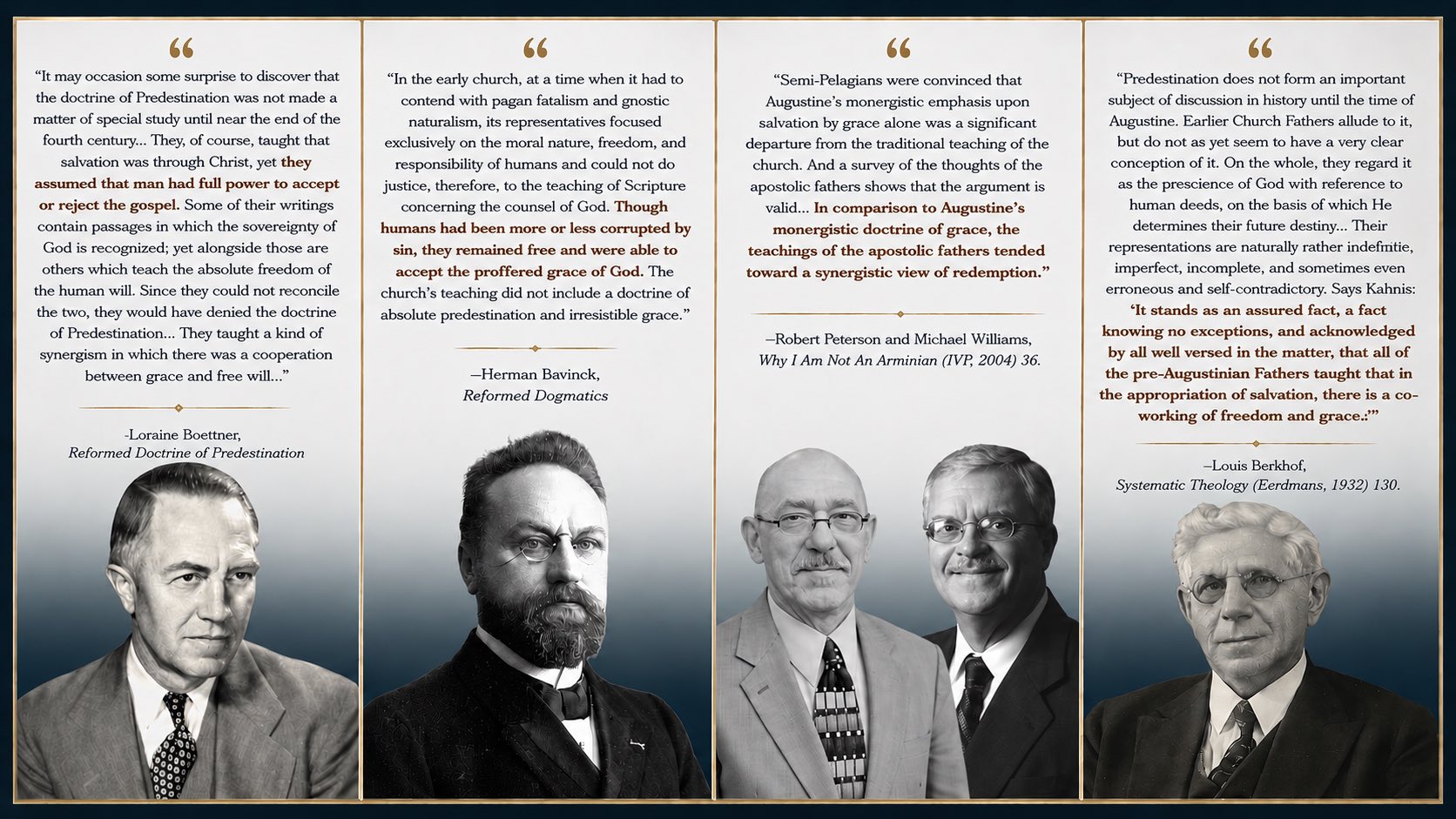
That development deserves serious attention. The issue is not whether Augustine was intelligent, influential, or sincere. The issue is whether his later anti-Pelagian conclusions represent the faith delivered by the apostles—or a major theological development shaped by a particular controversy. If the first three centuries repeatedly emphasize human freedom and responsibility, then the burden is on those who make Augustine’s later position the measuring rod for Christian orthodoxy.
A necessary historical distinction must be made:
Augustine did formally reject Manichaeism and embraced Nicene Christianity, but that conversion does not mean his former religious commitments ceased to influence his theological development. In fact, substantial scholarship argues that his Manichaean background remained critically important to the formation of his later theology. Ken Wilson argues that Augustine’s post-412 theological developments involved the adoption of deterministic interpretations of Scripture previously advanced by his Manichaean opponents, including interpretations concerning human inability, divine election, and inherited condemnation.

Jason BeDuhn, while rejecting the claim that Augustine simply remained a Manichaean, reaches a significant related conclusion: Augustine appropriated particular Manichaean insights, detached them from their original religious system, and incorporated them into his developing Christian theology. BeDuhn specifically identifies the fragmentedness and disability of the human will and the necessity of divine grace among the concepts that may represent direct borrowings from Manichaeism. Consequently, the historical question is not whether Augustine formally abandoned Manichaeism—he did—but whether elements of its theological framework subsequently reappeared, transformed and incorporated into his influential Christian teachings. The evidence presented by Wilson and BeDuhn makes that question impossible to dismiss merely by pointing to Augustine’s conversion.
Hunt’s central challenge is moral as well as exegetical:
- what kind of love is being attributed to God if He sincerely commands all to repent, invites all to come, and declares His desire that people be saved, while the theological system says He has withheld from many the only grace by which they could respond?
What kind of justice condemns people for failing to do what, by the system’s own definition, they were never enabled to do? Those questions cannot be dismissed as emotional objections. They go to the character of the God being proclaimed.
CALVIN: AUGUSTINE’S AUTHORITY BECOMES A SYSTEM
John Calvin did not invent every element of the theology later called Calvinism. He drew extensively on Augustine, cited him repeatedly in the Institutes, and treated him as a major authority on predestination and grace. Hunt documents this dependence with examples from Calvin’s own writings. Calvin invokes Augustine when defending predestination, reprobation, and the claim that God’s decree cannot be resisted.
The historical line is therefore not simply “the apostles taught TULIP, and Calvin recovered it.” A more accurate line of inquiry is:
- the early fathers debated freedom and fate;
- Augustine developed a distinctive and increasingly restrictive account of grace and predestination (see Appendix A);
- Calvin drew heavily on Augustine and systematized those themes in the Reformation era;
- and the five points were later formalized in response to the Remonstrants at the Synod of Dort.
That chronology matters. The acronym TULIP is not found in the New Testament, nor was it a confession written by the apostles or Irenaeus. The five-point formulation emerged in a later controversy. Its defenders must establish that its doctrines are biblical and apostolic; they cannot establish that simply by pointing to Augustine’s influence on Calvin or Calvin’s influence on later Reformed confessions.
Hunt’s critique in What Love Is This? is especially sharp on the consequences of the system. If total depravity means inability to believe, unconditional election selects some and passes over others, limited atonement restricts Christ’s saving intent to the elect, irresistible grace ensures the elect’s response, and perseverance guarantees their final salvation, then what becomes of the repeated biblical invitations to all people? What becomes of God’s stated desire that all come to repentance? What becomes of the sincerity of the gospel offer to those whom the system says cannot respond and for whom Christ did not die?
Calvinists have answers to these questions, usually involving distinctions between God’s revealed and decretive wills, compatibilist freedom, and the difference between external calling and effectual calling. But naming those distinctions is not the same as resolving the contradiction. The question remains whether the system preserves the plain force of the biblical invitations—or redefines them so that “all,” “world,” “whoever,” and “any” repeatedly mean only the elect, or mean something less than their ordinary force.
THE FIVE POINTS UNDER CROSS-EXAMINATION
See APPENDIX B
TOTAL DEPRAVITY: All Christians who take sin seriously affirm that humanity is fallen and cannot save itself. The dispute is whether depravity entails an absolute inability to respond to God’s gracious initiative. Irenaeus’s statement that a person is in his own power with respect to faith is a direct challenge to that added conclusion. Sin is real; so is accountability. One does not prove inability merely by repeating that sinners are spiritually dead.
UNCONDITIONAL ELECTION: The issue is whether God chose particular individuals for salvation without reference to foreknown faith, and whether that choice necessarily entails passing over the rest. Hunt argues that Scripture’s election language is repeatedly connected to foreknowledge and to blessings and purposes in Christ, not a secret decree assigning some individuals to heaven and others to hell. Irenaeus’s appeal to foreknowledge and responsible choice must be faced, not waved away.
LIMITED ATONEMENT: If Christ did not die for the non-elect, then the universal language of the New Testament must be qualified. The gospel preacher cannot straightforwardly tell every hearer, “Christ died for you,” if he believes Christ’s atoning death was never intended for that hearer. Hunt presses the point: a restricted atonement sits uneasily beside the biblical presentation of Christ as Savior of the world and the provision made for all.
IRRESISTIBLE GRACE: If saving grace cannot be resisted by the elect, and the non-elect are never given the grace necessary to believe, then the biblical warnings against resisting God and the repeated calls to repent require explanation. Irenaeus’s insistence that God does not compel obedience and that human beings are responsible for their response is directly relevant.
PERSEVERANCE: The question is not whether God keeps His people. The question is whether the doctrine is being used to make the entire response of faith, the continuance in faith, and the final outcome the inevitable result of an irresistible decree in a way that empties biblical warnings and exhortations of their ordinary force. The texts must be allowed to speak before the system decides what they are permitted to mean.
Challenging the Historical Narrative: Was the Early Church Calvinistic?
Here’s a question worth asking the next time someone suggests that rejecting Calvinism means rejecting the historic Christian faith:
What did the Christians who lived before Augustine actually believe about human freedom, faith, grace, and election?
The historical record deserves a much broader examination than simply tracing a line from the Apostle Paul to Augustine, then to Luther and Calvin.
Consider some of the witnesses:
- Justin Martyr (c. AD 150): Argued that divine foreknowledge and human freedom are compatible, and that human beings are accountable for their choices.
- Irenaeus of Lyons (c. AD 180): Made genuine human freedom central to his argument against heretical teachings. He explicitly included faith in his discussion of human freedom, writing that “man is in his own power with respect to faith” (Against Heresies IV.37.5).
- Origen (c. AD 230): Defended meaningful human agency and challenged philosophical determinism.
- John Chrysostom (c. AD 400): Interpreted Christ’s lament over Jerusalem in Matthew 23:37 as expressing a genuine desire to gather those who were unwilling to come.
These were not sixteenth-century Reformers or seventeenth-century Arminians. They were Christian writers addressing these questions centuries before those theological systems existed.
Their writings demonstrate that human freedom, accountability, and the ability to respond to God’s invitations were established subjects of early Christian theology.

The Augustinian Turning Point
Augustine deserves his place in Christian history. His contributions to the doctrines of grace, sin, and salvation were enormous. His insistence that salvation is entirely dependent upon God’s grace remains an essential consideration in any serious theological discussion.
But his mature writings on predestination, inherited sin, and irresistible grace emerged in a particular historical setting, especially during his controversy with Pelagius in the early fifth century.
The question is whether Augustine’s later formulations represent the uncontested position of the preceding Christian centuries.
The Eastern Christian tradition, in particular, developed a substantially different understanding of original sin, human freedom, and the relationship between grace and the human will. Nor did all Western theologians simply adopt Augustine’s strongest conclusions.
This is an important distinction:
- Augustine’s influence on subsequent Western theology should not be confused with proof that every aspect of his mature soteriology represented the universal teaching of the earliest church.
The History We Need to Read
There is another question worth considering. If the historical discussion of Christian soteriology begins primarily with Augustine, what happens to the three centuries of Christian writing that preceded him?
Which church fathers receive attention? Which passages are emphasized? Which theological disagreements are explained? And which earlier voices are overlooked when the history of Christian salvation is presented?
Historical narratives inevitably influence how people understand theological orthodoxy. If someone is repeatedly told that Calvinism represents the historic Christian consensus, that claim deserves to be examined against the writings of the earliest Christian generations.We should not dismiss church history. We should read more of it.
We should not force Justin Martyr, Irenaeus, Origen, or Chrysostom into modern theological categories. But neither should we ignore their writings when evaluating claims about the historical origins of Calvinist theology.
The fathers are still there. Their writings have not disappeared. And their testimony deserves to be heard.
The question is not whether every early Christian writer agreed with modern Provisionism, Arminianism, or Traditional Baptist theology. They did not formulate those systems. The question is whether the historical evidence supports the assertion that Calvinism represents the original, uncontested understanding of Christian salvation.
That is a much larger historical question than simply asking whether Augustine agreed with Calvin.
THE HISTORICAL BURDEN OF PROOF
Calvinists often tell non-Calvinists that rejecting TULIP means rejecting historic Christianity. That claim reverses the burden of proof. The early Christian writings must be examined before a later system is declared the historic standard. A second-century witness connected to Polycarp and John cannot be dismissed simply because his language is inconvenient to a seventeenth-century confession or a modern Reformed system.
If Irenaeus’s teaching is incompatible with key claims of TULIP, Calvinists must do one of two things. They must show, from Irenaeus’s own context, that his statements about freedom and faith are compatible with their doctrines; or they must acknowledge that Irenaeus did not teach their system and explain why a later theological development should override this early witness. What they cannot honestly do is claim Irenaeus as an uncomplicated Calvinist while ignoring his explicit argument that human beings are in their own power with respect to faith.
And if the wider pre-Augustinian record points in the same direction, the problem becomes larger. The claim that Calvinism is simply apostolic Christianity in its purest form becomes historically untenable unless the evidence is addressed. Later influence is not proof of earlier consensus. A doctrine does not become apostolic because Augustine adopted it, Calvin systematized it, or the Reformed tradition institutionalized it.
CONCLUSION: THE FATHERS CANNOT BE ERASED
This is not a plea for ecumenical silence. It is a demand for historical honesty and biblical accountability on three connected questions. Historically, a theology that makes faith impossible until an irresistible act of regeneration must confront the early Christian witness to human responsibility with respect to faith. Exegetically and morally, a theology that portrays God as withholding saving grace from people He commands to repent, then condemning them for unbelief, must explain how that account preserves His justice and the sincerity of His invitation. And a theology that makes every event—including sin—part of an exhaustive decree must explain how God is not thereby made the ultimate determiner of the evil He forbids. These are the questions the argument requires the later system to answer.
Irenaeus is not a decorative name to place in a historical timeline. He is a witness. He heard Polycarp. Polycarp was connected to John. Irenaeus fought systems that assigned fixed spiritual destinies and undermined moral responsibility. In the very course of defending the faith, he argued that God created human beings with genuine agency and that their response to Him was not coerced.
The later Augustinian and Calvinist systems must answer that witness. They must also answer Justin, Tatian, Clement, Tertullian, and Origen where their writings defend freedom and responsibility. They cannot claim the fathers when convenient and dismiss them when inconvenient.
Before Augustine. Before Calvin. Before Dort. Before TULIP.
The early church was already confronting determinism
—and Irenaeus’s words remain a challenge to anyone who
claims that the deterministic conclusions of later theology
are simply what the apostles taught.
The question for Calvinism is not whether it can construct a sophisticated explanation of these historical facts. It is whether that explanation is faithful to Scripture and honest about the historical record. The fathers are still there. Their writings have not disappeared. And no later system has the authority to make them say the opposite of what they wrote.
RESEARCH BASE AND IMPORTANT DISTINCTIONS
Primary sources to foreground: Irenaeus, Against Heresies IV.37–41; Irenaeus’s letter to Florinus as preserved in Eusebius, Ecclesiastical History 5.20; Justin Martyr, First Apology; Tatian, Address to the Greeks; and the relevant writings of Clement, Tertullian, and Origen. Verify every quotation against a reliable translation and retain the immediate context.
Secondary resources supplied for this project: Dave Hunt, What Love Is This? Calvinism’s Misrepresentation of God; Ken Wilson, The Foundation of Augustinian-Calvinism; Ken Johnson, The Gnostic Origins of Calvinism; Norman Geisler, Chosen but Free, especially Appendix One; David Bercot, Will the Real Heretics Please Stand Up; and A Defense of Free Grace Theology, including the pages and appendix previously identified.
This essay deliberately advances a forceful critique, but it distinguishes doctrinal resemblance from historical dependence. It does not claim that Augustine or Calvin simply copied Gnostic or Stoic systems. It argues that later determinist formulations must answer the early church’s explicit opposition to fatalism, fixed spiritual destinies, coercion, and the denial of meaningful human responsibility.
Bibliography
Primary Sources: Early Christianity and the Church Fathers
Augustine. The Confessions. Translated by Henry Chadwick. Oxford: Oxford University Press, 1991.
Augustine. The City of God against the Pagans. Edited and translated by R. W. Dyson. Cambridge: Cambridge University Press, 1998.
Clement of Alexandria. The Stromata. In Ante-Nicene Fathers, edited by Alexander Roberts and James Donaldson. Peabody, MA: Hendrickson Publishers, 1994.
Eusebius. The Church History. Translated by Paul L. Maier. Grand Rapids: Kregel Publications, 1999.
Irenaeus. Against Heresies. In Ante-Nicene Fathers, edited by Alexander Roberts and James Donaldson. Peabody, MA: Hendrickson Publishers, 1994.
———. “Letter to Florinus.” In Eusebius, The Church History, Book 5, chapter 20.
Justin Martyr. The First Apology. In Ante-Nicene Fathers, edited by Alexander Roberts and James Donaldson. Peabody, MA: Hendrickson Publishers, 1994.
Origen. On First Principles. Translated by G. W. Butterworth. Gloucester, MA: Peter Smith, 1973.
Polycarp. The Epistle of Polycarp to the Philippians. In Ante-Nicene Fathers, edited by Alexander Roberts and James Donaldson. Peabody, MA: Hendrickson Publishers, 1994.
Tatian. Address to the Greeks. In Ante-Nicene Fathers, edited by Alexander Roberts and James Donaldson. Peabody, MA: Hendrickson Publishers, 1994.
Tertullian. Against Marcion. In Ante-Nicene Fathers, edited by Alexander Roberts and James Donaldson. Peabody, MA: Hendrickson Publishers, 1994.
———. A Treatise on the Soul. In Ante-Nicene Fathers, edited by Alexander Roberts and James Donaldson. Peabody, MA: Hendrickson Publishers, 1994.
Modern Books and Theological Studies
Anderson, David R., Fred Chay, Joseph Dillow, J. Paul Tanner, and Ken Wilson. A Defense of Free Grace Theology: With Respect to Saving Faith, Perseverance, and Assurance. Grace Theology Press, 2017.
Bercot, David W. Will the Real Heretics Please Stand Up: A New Look at Today’s Evangelical Church in the Light of Early Christianity. 3rd ed. Amberson, PA: Scroll Publishing Company, 1999.
Coate, Micah. A Cultish Side of Calvinism. Innovo Publishing, 2011.
Geisler, Norman L. Chosen but Free: A Balanced View of God’s Sovereignty and Free Will. 3rd ed., revised and expanded. Minneapolis: Bethany House, 2010.
Hunt, Dave. What Love Is This? Calvinism’s Misrepresentation of God. 4th ed. Bend, OR: The Berean Call, 2018.
Johnson, Ken. The Gnostic Origins of Calvinism. 2013.
Robinson, Geoffrey D. Saved by Grace through Faith or Saved by Decree? A Biblical and Theological Critique of Calvinist Soteriology. Eugene, OR: Wipf & Stock, 2022.
Wilson, Kenneth M. Augustine’s Conversion from Traditional Free Choice to “Non-free Free Will”: A Comprehensive Methodology. Studien und Texte zu Antike und Christentum 111. Tübingen: Mohr Siebeck, 2018.
———. The Foundation of Augustinian-Calvinism. Montgomery, TX: Regula Fidei Press, 2019.
Edited Volumes and Additional Theological Critiques
Allen, David L., and Steve W. Lemke, eds. Calvinism: A Biblical and Theological Critique. Nashville: B&H Academic, 2022.
———, eds. Whosoever Will: A Biblical-Theological Critique of Five-Point Calvinism. Nashville: B&H Publishing Group, 2010.
APPENDIX A
This is a summary I am zeroing in on of a book review, found HERE.
Byard Bennett, review of Jason David BeDuhn, Augustine’s Manichaean Dilemma, 2: Making a “Catholic” Self, 388–401 C.E. (Philadelphia: University of Pennsylvania Press, 2013), Augustinian Studies 45, no. 2 (2014): 300–305.
One of the most significant findings in Jason David BeDuhn’s historical study, as summarized by Byard Bennett, is the documented change in Augustine’s understanding of the human will. Bennett explains that Augustine’s earlier Christian position explicitly defended free will, maintaining that moral responsibility required genuine human freedom and that impairment of rational control was temporary and remediable. However, following his engagement with Manichaean arguments, particularly those raised by Fortunatus in 392, and his subsequent interaction with Tyconius’s interpretation of Paul, Augustine’s position changed. Bennett identifies the shift with remarkable clarity:
“Augustine’s earlier free will position had understood the will as a will to do good. Following Tyconius, Augustine now saw the will as a will to depend on God” (302).
Augustine increasingly portrayed the fallen will as internally divided, weakened, and unable to accomplish good without effective divine intervention. The consequences were substantial. As Bennett explains, conversion was no longer understood as the product of effective human agency, as Augustine’s earlier position had maintained; rather, conversion became the beginning of such agency (304). This is a documented theological development in Augustine’s own thinking. The later Augustinian emphasis on human inability and the efficacy of divine grace should therefore not be casually projected backward as though it had always been Augustine’s position.
Bennett describes Augustine’s earlier Christian position as a direct rejection of the Manichaean explanation of human sinfulness.
Augustine maintained that:
- There was no inherently evil nature compelling people to sin.
- Actions performed under necessity could not properly be considered sinful.
- Every rational being possessed free will.
- Moral responsibility—and therefore guilt—required free will.
- The impairment of rational control was temporary and remediable, arising from habits developed through negligence and disordered bodily desires.
Bennett’s description is particularly significant:
“Only where one possesses free will can moral responsibility (and hence, sinfulness) exist.” (p. 301)
This is not a minor qualification. Augustine’s earlier defense of moral responsibility rested upon the existence of genuine human freedom.
The turning point: Augustine’s encounter with Fortunatus in 392
Bennett identifies Augustine’s debate with the Manichaean Fortunatus in 392 as an important turning point. Fortunatus challenged Augustine’s free-will defense by appealing to Paul’s descriptions of human conflict and inability, particularly:
- Romans 7
- Ephesians 2
These passages forced Augustine to reconsider whether his earlier understanding of free will adequately explained humanity’s spiritual condition. Bennett writes that Fortunatus’s arguments led Augustine to study these disputed Pauline passages more closely.
Augustine began reconsidering the relationship between human inability, sin, and grace.
The shift: From a will to do good to a will dependent upon God
This is arguably the most important sentence in the entire review:
“Augustine’s earlier free will position had understood the will as a will to do good. Following Tyconius, Augustine now saw the will as a will to depend on God.” (p. 302)
Consider the difference:
| Earlier Augustine | Developing Augustine |
|---|---|
| The will possesses genuine freedom. | The will is fundamentally impaired. |
| The will can choose to do good. | The will must depend upon God to do good. |
| Moral responsibility requires free will. | Human inability becomes central to explaining the need for grace. |
| Impaired rational control is temporary and remediable. | Sin exercises an internal coercive influence over the fallen will. |
This is a substantial theological development, not merely a change in terminology.
The developing doctrine of inability
Bennett then describes Augustine’s increasingly negative assessment of the pre-conversion human will. On page 303, Augustine’s developing position portrays sensual desire (concupiscence) as:
- An irrational internal compulsion.
- A coercive power that subverts rational autonomy.
- An indwelling power of sin.
- A force that undermines the individual’s ability to will rightly.
Bennett makes another important observation:
Augustine’s model of the individual’s pre-conversion life “more nearly resembled the view held by the Manichaeans than that held by the earlier Catholic commentators on Paul’s letters.” (p. 303)
Augustine did not adopt the Manichaean explanation of two competing natures. Instead, he increasingly described the human will itself as divided, corrupted, and weakened.
The resulting position: Grace creates faith
The review then describes the implications of this developing understanding. Bennett explains that Augustine’s later position increasingly emphasized that:
- The fallen human being cannot independently accomplish what is good.
- The human soul is radically dependent upon divine grace.
- Grace creates faith.
- The human response follows God’s effective call.
- Conversion is no longer the consequence of effective human agency; it becomes the beginning of such agency.
Bennett’s wording is particularly direct:
“Conversion is therefore not a product and consequence of effective human agency (as Augustine’s earlier freewill position had contended); conversion is instead the beginning of such agency.” (p. 304)
That sentence explicitly contrasts Augustine’s earlier and developing positions.
BOTTOM LINE: This review of the book documents the change in the will’s perceived capacity; it documents the resulting change in the understanding of conversion and grace. Together, they make a much stronger historical argument than simply saying Augustine was influenced by Manichaeism.
APPENDIX B
This is an excerpt of a book found HERE. PDF also.
 MAJOR POINTS – TULIP

Ken Johnson, The Gnostic Origins of Calvinism (CreateSpace Independent Publishing Platform, 2013), pages 34–63 of thePDF.
As we said, Calvinism consists of five major points which can be remembered using the acronym TULIP. Calvinism says we are Totally depraved, meaning we could not accept God’s gift of salvation even if we wanted to. God must Unconditionally elect those He wants saved because we cannot do anything to be saved. God Limited the atonement to only those few He wanted to save. All the rest He consigned to hell. None of those He wants to be saved can refuse their salvation, because God uses an Irresistible grace. That being the case, God forces the Perseverance of the saints, making sure they cannot lose their salvation. In addition to these there are minor points: Calvinistic Foreknowledge and Calvinistic Predestination.
In contrast, Arminianism teaches that everyone is born with a sin nature, but each has the free will to accept or reject Christ as their Savior. Salvation is available to all on the condition that each accepts Christ as his Savior. The Atonement of salvation is open to all, so that “whosoever will” may be saved. The Atonement is not limited to a select few. God draws all individuals to salvation by grace, but grace can be resisted by free will.
Some Arminian denominations teach that you can lose your salvation and other Arminian denominations teach you cannot. But even those who believe you cannot lose your salvation base it on God’s love for us, not His predestination, as Calvinists and Gnostics do.
The extreme forms of Calvinism and Arminianism are Universalism (the belief that everyone will eventually be saved) and Pelagianism. [Irenaeus, Against Heresies 1.27]
Being a Calvinist does not make you a non-Christian heretic. It simply shows that part of your doctrine is not perfect. It should be noted that to be a Calvinist you must accept all five points of Calvinism, or that doctrine falls apart. Some denominations state they are partial Calvinists, but in reality they simply redefine two or three points and accept the rest as Arminian theology. With this in mind, we need to look at the five major and three minor points of Calvinism and its related theology and compare them to the Bible and what the ancient church fathers taught.
Total Depravity
Calvinist Definition WRONG
Each man is so totally depraved that he could not accept the gift of salvation God would give him because he has no free will to do so. Therefore, God simply decreed before the creation of man that some individuals would be saved. God then intervenes in their lives to force them to be saved. He decrees all the others will spend eternity in hell.
One argument is that Colossians 2 and Ephesians 2 state we are dead in trespasses and sin. The Calvinist will argue that the dead cannot make decisions. But if we look at the context, it says that we are all “dead men walking,” so to speak. We all have sinned, and if God did not intervene, we would all parish.
Arminian Definition CORRECT
Each man is totally deprived in the sense that he cannot do anything to bring about his own salvation. But when God reveals Himself to that person, he has the ability, or free will, to accept the free gift of salvation God is offering him. Those who refuse the gift will spend eternity in hell.
Pelagian Definition WRONG
If you allow yourself to become corrupted by sin, you could become totally depraved, incapable of ever being saved.
BIBLICAL POSITION
First John teaches all mankind is born with a sin nature. If you deny that, you are deceived. If you think you were not born with a sin nature and that you have been sinless all your life and do not need a savior, you are calling God a liar.
“If we say that we have no sin, we deceive ourselves, and the truth is not in us. If we confess our sins, He is faithful and just to forgive us our sins, and to cleanse us from all unrighteousness. If we say that we have not sinned, we make Him a liar, and His word is not in us.” 1 John 1:8-10
Paul says in Romans 3 that no one born is righteous or even tries to seek after God. Everyone has sinned (because of their sin nature) and is on their way to hell because of it.
“As it is written, there is none righteous, no, not one: There is none that understandeth, there is none that seeketh after God. They are all gone out of the way, they are together become unprofitable; there is none that doeth good, no, not one.” Romans 3:10-12
“For all have sinned, and come short of the glory of God” Romans 3:23
This is sometimes called total depravity or total inability. But can a person accept the free gift of salvation by just believing in Jesus, or is that impossible for them as well?
“For God so loved the world, that He gave His only begotten Son, that whosoever believeth in Him should not perish, but have everlasting life.” John 3:16
Calvinists state that accepting a free gift would be a work, which amounts to a works salvation and not by God’s grace. But Paul says accepting a free gift is not a work, instead it is simply belief.
“But to him that worketh not, but believeth on him that justifieth the ungodly, his faith is counted for righteousness.” Romans 4:5
So we are depraved in the sense that we can do nothing to save ourselves, but we are free to believe and accept God’s gift of salvation.
“ … through His name whosoever believeth in Him shall receive remission of sins.” Acts 10:43
“And this is the will of Him that sent Me, that everyone which seeth the Son, and believeth on Him, may have everlasting life: and I will raise him up at the last day.” John 6:40
Quotes of the Ancient Church Fathers
Justin Martyr, AD 165
Second Apology 7 – Man acts by his own free will and not by fate.
Dialogue 88 – Men and angels have free will. The human race from Adam had fallen under the power of death and the guile of the serpent, so that each one of us has committed personal transgression.
Dialogue 102 – He created both angels and men free to do that which is righteous, and He appointed periods of time during which He knew it would be good for them to have the exercise of free will; and because He likewise knew it would be good, He made general and particular judgments; each one’s freedom of will, however, being guarded.
Dialogue 141 – God created men and angels free to do righteousness; possessing reason, that they may know by whom they are created, and through whom they, not existing formerly, do now exist; and with a law that they should be judged by Him, if they do anything contrary to right reason: and of ourselves we, men and angels, shall be convicted of having acted sinfully, unless we repent beforehand. But if the word of God foretells that some angels and men shall be certainly punished, it did so because it foreknew that they would be unchangeably wicked, but not because God had created them so.
Tatian, AD 165
Greeks 7 – Jesus created men and angels with free will. Jesus had foreknowledge of what free agents would do. There is no such thing as fate.
Greeks 9 – Demons invented the concept of fate with astrology to enslave man into worshiping them.
Greeks 11 – Our free will enslaved us to sin [Rom. 7], but we can choose to follow righteousness now.
Irenaeus, AD 177
Against Heresies 4.29 – God only blinds the minds of those who chose not to believe and have already rejected him. In Romans [1], those who would not retain God in their knowledge He gave them over to a reprobate mind. In 2 Thessalonians [2], strong delusion is sent to believe the lie. God knows the number of those who will not believe, since He foreknows all things, has given them over to unbelief. God has foreknowledge of all things.
Against Heresies 4.37 – God made man a free agent from the beginning. This is the ancient law of human liberty, for there is no coercion with God. In man, as well as in angels, He has placed the power of choice. The Gnostic teaching that some men are born good, and others are born bad, is wrong. Everyone has the power to reject the Gospel. God has free will and we do, too, because we are made in His image. God preserved the will of man free and under his own control. We will be brought to perfection in the resurrection. Romans [8] refers to the church being predestined to be conformed to the image of Christ.
Against Heresies 4.39 – Man has the ability to distinguish good from evil. He has the power by his own free will to perform God’s commandments. This is taught in Romans [2]. God does not compel people to salvation, so those who have apostatized have done so through their own fault. God allows them to blind themselves.
Clement of Alexandria, AD 192
Stromata 2.3 – Christians teach saving faith is a gift that starts with God and is accepted by free choice.
Stromata 2.4 – The ability to freely choose salvation is a gift [started by] God, but true faith produces repentance.
Stromata 5.3 – Faith is the rational assent of the soul exercising free will.
Tertullian, AD 190-210
Marcion 2.5 – Man has free will.
Minucius Felix, AD 210
36 – The mind of man is free from birth and remains free throughout his life.
Origen, AD 230
Against Celsus 4:70 – Man has free will.
Mathetes AD 130
Epistle to Diognetus 7 – Jesus, who is God come in the flesh, came to persuade, not compel us, to salvation because violence has no part in the character of God.
Unconditional Election
Calvinist Definition WRONG
Man’s election unto salvation is unconditional because he is incapable of accepting God’s free gift. If he was able to accept or decline the gift, the gift would be on the condition that man accepted it.
Arminian Definition CORRECT
Man’s election to salvation is conditional based on the condition that he accept the free gift from God by using his free will to believe. Accepting a gift is not a work.
Pelagian Definition WRONG
Man’s election unto salvation is conditional. It is based on the condition that he not sin in this life and accept Jesus as Savior.
BIBLICAL POSITION
Those who are saved are not saved by their own merit.
“Not by works of righteousness which we have done, but according to His mercy He saved us, by the washing of regeneration, and renewing of the Holy Ghost;” Titus 3:5
“Who hath saved us, and called us with an holy calling, not according to our works, but according to His own purpose and grace, which was given us in Christ Jesus before the world began,” 2 Timothy 1:9
In other words, there is nothing we can do to start, help, or finish the process of salvation. Salvation is not connected to any work or good deed we could do. It is entirely by God’s grace.
“Who will have all men to be saved, and to come unto the knowledge of the truth.” 1 Timothy 2:4
“The Lord is not slack concerning His promise, as some men count slackness; but is longsuffering to us-ward, not willing that any should perish, but that all should come to repentance.” 2 Peter 3:9
We are elect through belief.
“But we are bound to give thanks always to God for you, brethren beloved of the Lord, because God hath from the beginning chosen you to salvation through sanctification of the Spirit and belief of the truth:” 2 Thessalonians 2:13
“Elect according to the foreknowledge of God the Father, through sanctification of the Spirit, unto obedience and sprinkling of the blood of Jesus Christ: Grace unto you, and peace, be multiplied.” 1 Peter 1:2
“Wherefore the rather, brethren, give diligence to make your calling and election sure: for if ye do these things, ye shall never fall” 2 Peter 1:10
You must watch yourself carefully to make your election real. This shows us a conditional election. You are part of the elect on the condition that you make it a sure thing. You do that by exercising your free will and accepting the gift God’s wants to give you.
Paul said belief is not a work.
“But to him that worketh not, but believeth on Him that justifieth the ungodly, his faith is counted for righteousness.” Romans 4:5
“No man can come to Me, except the Father which hath sent Me draw him: and I will raise him up at the last day.” John 6:44
“And when the Gentiles heard this, they were glad, and glorified the word of the Lord: and as many as were ordained to eternal life believed.” Acts 13:48
“For whom He did foreknow, He also did predestinate to be conformed to the image of His Son, that He might be the firstborn among many brethren.” Romans 8:29
“Blessed be the God and Father of our Lord Jesus Christ, who hath blessed us with all spiritual blessings in heavenly places in Christ: according as He hath chosen us in Him before the foundation of the world, that we should be holy and without blame before Him in love: having predestinated us unto the adoption of children by Jesus Christ to Himself, according to the good pleasure of His will” Ephesians 1:3-5
We need to guard ourselves because salvation is based on belief.
“Take heed, brethren, lest there be in any of you an evil heart of unbelief, in departing from the living God.” Hebrews 3:12
“Seeing therefore it remaineth that some must enter therein, and they to whom it was first preached entered not in because of unbelief:” Hebrews 4:6
“Let us labour therefore to enter into that rest, lest any man fall after the same example of unbelief.” Hebrews 4:11
Quotes of the Ancient Church Fathers
Justin Martyr, AD 165
Second Apology 7 – Man acts by his own free will and not by fate.
Dialogue 88 – Men and angels have free will. The human race, from Adam forward, has fallen under the power of death and the guile of the serpent, so that each one of us has committed personal transgression.
Dialogue 102 – He created both angels and men free to do that which is righteous, and He appointed periods of time during which He knew it would be good for them to have the exercise of free will; and because He likewise knew it would be good, He made general and particular judgments; each one’s freedom of will, however, being guarded.
Dialogue 141 – God created men and angels free to do righteousness; possessing reason, that they may know by whom they are created, and through whom they, not existing formerly, do now exist; and with a law that they should be judged by Him, if they do anything contrary to right reason: and of ourselves, we, men and angels, shall be convicted of having acted sinfully, unless we repent beforehand. But if the word of God foretells that some angels and men shall be certainly punished, it did so because it foreknew that they would be unchangeably wicked, but not because God had created them so.
Tatian, AD 165
Greeks 7 – Jesus created men and angels with free will. Jesus had foreknowledge of what free agents would do. There is no such thing as fate.
Greeks 9 – Demons invented the concept of fate with astrology to enslave man into worshiping them.
Greeks 11 – Our free will enslaved us to sin. [Rom 7] but we can choose to follow righteousness now.
Irenaeus, AD 177
Against Heresies 4.29 – God only blinds the minds of those who chose not to believe and have already rejected Him. In Romans [1], those who would not retain God in their knowledge He gave over to a reprobate mind. In 2 Thessalonians [2], strong delusion is sent to believe the lie. God knows the number of those who will not believe, since He foreknows all things, and has given them over to unbelief. God has foreknowledge of all things.
Against Heresies 4.37 – God made man a free agent from the beginning. This is the ancient law of human liberty, for there is no coercion with God. In man, as well as in angels, He has placed the power of choice. The Gnostic teaching that some men are born good, and others are born bad, is wrong. Everyone has the power to reject the gospel. God has free will and we do, too, because we are made in His image. God preserved the will of man free and under his own control. We will be brought to perfection in the resurrection. Romans [8] refers to the church being predestined to be conformed to the image of Christ.
Against Heresies 4.39 – Man has the ability to distinguish good from evil. He has the power by his own free will to perform God’s commandments. This is taught in Romans [2]. God does not compel people to salvation, so those who have apostatized have done so through their own fault. God allows them to blind themselves.
Clement of Alexandria, AD 192
Stromata 2.3 – Christians teach saving faith is a gift that starts with God and is accepted by free choice.
Stromata 2.4 – The ability to freely choose salvation is a gift [started by] God, but true faith produces repentance.
Stromata 5.3 – Faith is the rational assent of the soul exercising free will.
Stromata 5.12 – The Holy Spirit opens the minds of believers.
Stromata 7.2 – Jesus persuades, but never compels us to salvation.
Tertullian, AD 190-210
Marcion 2.5 – Man has free will.
Marcion 2.23 – It is not the mark of a good God to condemn beforehand persons who have not yet deserved condemnation. Who is so faultless among men, that God could always have him in His choice, and never be able to reject him? Or who, on the other hand, is so void of any good work, that God could reject him forever, and never be able to choose him?
Minucius Felix, AD 210
36 – The mind of man is free from birth and remains free throughout his life.
Origen, AD 230
Against Celsus 4:70 – Man has free will.
Against Celsus 7.50 – Jesus’ sacrifice was for newborn infants also, since no one is born free from sin.
Limited Atonement
Calvinist Definition WRONG
Jesus’ work on the cross atoned for the sins of only a select few. All the others have no chance to be saved and are predestined for hell.
Arminian Definition CORRECT
Jesus’ work on the cross atoned for the sins of all mankind. Those who reject Him have no chance to be saved and are eternally lost.
Pelagian Definition WRONG
Jesus’ work on the cross atoned for the sins of all mankind. This covers the sin nature and unintentional sins. You must pay for willful sins.
BIBLICAL POSITION
Jesus’ death on the cross paid for the sins of the whole world, not just a select few. This atonement is not limited. Peter says it is a heresy to state that the Lord did not die for all men. It is not His “good pleasure” to send anyone to hell.
“For I have no pleasure in the death of him that dieth, saith the Lord GOD: wherefore turn yourselves, and live ye.” Ezekiel 18:32
“For this is good and acceptable in the sight of God our Saviour; Who will have all men to be saved, and to come unto the knowledge of the truth.” 1 Timothy 2:3-4
“For there is one God, and one mediator between God and men, the man Christ Jesus; Who gave Himself a ransom for all, to be testified in due time.” 1 Timothy 2:5-6
“But we see Jesus, who was made a little lower than the angels for the suffering of death, crowned with glory and honour; that He by the grace of God should taste death for every man.” Hebrews 2:9
“And He is the propitiation for our sins: and not for ours only, but also for the sins of the whole world.” 1 John 2:2
“But there were false prophets also among the people, even as there shall be false teachers among you, who privily shall bring in damnable heresies, even denying the Lord that bought them, and bring upon themselves swift destruction.” 2 Peter 2:1
“To wit, that God was in Christ, reconciling the world unto Himself, not imputing their trespasses unto them; and hath committed unto us the word of reconciliation.” 2 Corinthians 5:19
“And we have seen and do testify that the Father sent the Son to be the Saviour of the world.” 1 John 4:14
“For God so loved the world, that He gave His only begotten Son, that whosoever believeth in Him should not perish, but have everlasting life. For God sent not His Son into the world to condemn the world; but that the world through Him might be saved.” John 3:16-17
“For whosoever shall call upon the name of the Lord shall be saved.” Romans 10:13 KJV
Please notice Paul’s comment in Romans 3. Salvation is to all that believe because all have sinned. Either salvation is obtainable to every single person for all have sinned, or, if Calvinism is true, salvation is to all the elect. Then only the elect have sinned. So the ones God condemns to hell are sinless?
“But now the righteousness of God without the law is manifested, being witnessed by the law and the prophets; even the righteousness of God which is by faith of Jesus Christ unto all and upon all them that believe: for there is no difference: For all have sinned, and come short of the glory of God” Romans 3:2123
Assurance
Calvinism teaches that some are predestined for salvation and others to hell and that outcome cannot be changed. If this were true, no one would know if he or she were saved until after death. That’s a scary thought; however, John says there is a way you can know for sure.
“These things have I written unto you that believe on the name of the Son of God; that ye may know that ye have eternal life, and that ye may believe on the name of the Son of God.” 1 John 5:13
Quotes of the Ancient Church Fathers
Justin Martyr, AD 165
Second Apology 7 – Man acts by his own free will and not by fate.
Tatian, AD 165
Greeks 7 – Jesus created men and angels with free will. Jesus had foreknowledge of what free agents would do. There is no such thing as fate.
Irenaeus, AD 177
Against Heresies 4.37 – God made man a free agent from the beginning. This is the ancient law of human liberty, for there is no coercion with God. In man, as well as in angels, He has placed the power of choice. The Gnostic teaching that some men are born good, and others are born bad, is wrong. Everyone has the power to reject the gospel. God has free will and we do, too, because we are made in His image. God preserved the will of man free and under his own control. We will be brought to perfection in the resurrection. Romans [8] refers to the church being predestined to be conformed to the image of Christ.
Irresistible Grace
Calvinist Definition WRONG
God will draw only those whom He elects for salvation with an irresistible grace. There is no way they can refuse. Those whom He refuses to draw are those whom He has chosen to unelect, or destined for hell, because if He did draw them they would all be saved and that would not please Him.
Arminian Definition CORRECT
God’s grace is resistible. God draws everyone by His grace. Those who respond will be granted eternal life and those who willfully choose not to respond to God’s free gift will be damned.
Pelagian Definition WRONG
God does not need any kind of grace to draw people. Each individual can come to the conclusion on their own and accept salvation.
BIBLICAL POSITION
The Holy Spirit draws men to Himself with grace.
“No man can come to Me, except the Father which hath sent Me draw him: and I will raise him up at the last day.” John 6:44
“All that the Father giveth Me shall come to Me; and him that cometh to Me I will in no wise cast out… And this is the Father’s will which hath sent Me, that of all which He hath given Me I should lose nothing, but should raise it up again at the last day.” John 6:37, 39
But this drawing can be resisted.
“O Jerusalem, Jerusalem, the one who kills the prophets and stones those who are sent to her! How often I wanted to gather your children together, as a hen gathers her chicks under her wings, but you were not willing!” Matthew 23:37 NKJV
If the Calvinists were right, no one would know who the elect were and who they were not. But the apostle John states believers can know for sure that they are saved.
“These things I have written to you who believe in the name of the Son of God, that you may know that you have eternal life, and that you may continue to believe in the name of the Son of God.” 1 John 5:13 NKJV
It is Satan who takes away the Word from the minds of the people so they would not accept Christ by believing the gospel and become saved. It is not God who forces this to happen. God’s grace is resistible.
“Those by the way side are they that hear; then cometh the devil, and taketh away the word out of their hearts, lest they should believe and be saved.” Luke 8:12
If grace cannot be resisted and God only selects a few, how can whole houses be saved just by believing?
“And they said, Believe on the Lord Jesus Christ, and thou shalt be saved, and thy house.” Acts 16:31
Anyone who believes will be saved.
“That if thou shalt confess with thy mouth the Lord Jesus, and shalt believe in thine heart that God hath raised Him from the dead, thou shalt be saved. For with the heart man believeth unto righteousness; and with the mouth confession is made unto salvation.” Romans 10:9-10
We are sealed by the Holy Spirit after we confess and believe. Belief starts the process; it is not a result of being forced into regeneration.
“In whom ye also trusted, after that ye heard the word of truth, the gospel of your salvation: in whom also after that ye believed, ye were sealed with that Holy Spirit of promise,” Ephesians 1:13
Quotes of the Ancient Church Fathers
“Man has the ability to distinguish good from evil. He has the power by his own free will to perform God’s commandments. This is taught in Romans [chapter 2]. God does not compel people to salvation, so those who have apostatized have done so through their own fault. God allows them to blind themselves.” Irenaeus, Against Heresies 4.39
“The ability to freely choose salvation is a gift given by God. True faith produces repentance.” Clement of Alexandria, Stromata 2.4
Perseverance of the Saints
Calvinist Definition WRONG
The elect will persevere in Calvinism and doing good works. However, some of the unelect will confess Calvinism and do good works also. Therefore, no one can know for sure if they are truly saved in this life. We have to wait and see.
Arminian Definition CORRECT
Every single person who truly believes the gospel message and accepts Jesus Christ as their Lord and Savior will be saved.
Pelagian Definition WRONG
Anyone who is careful to never sin is assured eternal life. Those who have sinned will not know for sure until the resurrection.
Gnostic Definition WRONG
Certain individuals who have a spirit that is a direct creation or emanation of a god or goddess have eternal life abiding in them. They always have had, and always will have, eternal life.
We are secure in the salvation given to us in Christ Jesus. We cannot accidently lose it. We do not have to wait and see if we will obtain it. We have it right now. John says:
“These things have I written unto you that believe on the name of the Son of God; that ye may know that ye have eternal life, and that ye may believe on the name of the Son of God.” 1 John 5:13
The question then remains: how do we distinguish between those who are truly saved and those who just think they are? The Calvinist usually says it is by the fact that they endorse Calvinism and continue doing some form of good works. This is called the perseverance of the saints, which they get from Ephesians:
“Praying always with all prayer and supplication in the Spirit, and watching thereunto with all perseverance and supplication for all saints” Ephesians 6:18
But wait. There are good and bad people predestined for hell, and both godly and evil people predestined for heaven, according to the Calvinistic doctrine of unconditional election. So if Calvinism is true, there is no way anyone can know for sure he is saved. It’s very odd that Calvinists can state that it’s all by God’s grace, not by any works of man that we are saved. And yet they state we are the elect based on our good works!
Scripturally, we can know for sure we are saved:
“These things have I written unto you that believe on the name of the Son of God; that ye may know that ye have eternal life, and that ye may believe on the name of the Son of God.” 1 John 5:13
And we can tell we are saved by:
“But he that shall endure unto the end, the same shall be saved.” Matthew 24:13
Everyone who continues to believe Jesus Christ is Lord and Savior currently has, and is guaranteed to continue to have, eternal life. It’s by God’s grace and your exercising your free will.
“Abide in Me, and I in you. As the branch cannot bear fruit of itself, except it abide in the vine; no more can ye, except ye abide in Me.” John 15:4
Eternal Security
Some have erroneously thought that the Calvinistic doctrine of the Perseverance of the Saints is the same doctrine as the eternal security of the believer. This is the idea that a true believer cannot lose their salvation. While Calvinists must believe this because if a person cannot do anything about his salvation, and God chooses to force a person to be saved, then obviously you cannot do anything about losing it, either.
The non-Calvinists denominations are divided on the issue of whether or not people can lose their salvation. Compare the Baptists and the Holiness groups below.
BAPTIST DENOMINATIONS: no believer can walk away from being a member of the body of Christ and is therefore eternally secure in his or her salvation.
HOLINESS DENOMINATIONS: each believer can walk away from being a member of the body of Christ and can therefore loose his or her salvation.
Both groups are non-Calvinists and both agree that no one is decreed to be saved based on anything other than God’s foreknowledge of who would accept the free gift of salvation and become a part of the body of Christ.
“Even so faith, if it hath not works, is dead, being alone. Yea, a man may say, Thou hast faith, and I have works: shew me thy faith without thy works, and I will shew thee my faith by my works.” James 2:17-18
James is saying a true believer who has eternal life abiding in him will show it by good works, which are defined as continuing to believe that Jesus is Lord and continuing to follow His commands.
“Moreover, brethren, I declare unto you the gospel which I preached unto you, which also ye have received, and wherein ye stand; by which also ye are saved, if ye keep in memory what I preached unto you, unless ye have believed in vain.” 1 Corinthians 15:1-2 KJV
Neo-Calvinists
Today there are groups of what is being termed Neo-Calvinists, who no longer teach that holiness and good works mark those who are saved, but they are saved because they say so and there is no need to practice a lifestyle of holiness to prove they are the elect. These people are often heard using curse words from the pulpit and admitting they indulge in sinful acts without remorse. This is the same result the predestination theology had among the Gnostic cults.
Quotes of the Ancient Church Fathers
Ignatius, 30-107 AD
Ephesians 14 – No man truly making a profession of faith sins; nor does he that possesses love, hate anyone. The tree is made manifest by its fruit; so those that profess themselves to be Christians shall be recognized by their conduct. For there is not now a demand for mere profession, but that a man be found continuing in the power of faith to the end.
Tertullian, AD 200
Valintians 1.29 – [Valentinus taught] some are not predestined to be saved, but predestined for hell, but the rest might be saved through works.
Valintians 1.30 – [Valentinus taught] those predestined for salvation do not need to practice good works.
Minor Points
These are points that should be considered in dealing with Calvinism but are not part of the main five doctrines of TULIP. I think knowing about these will help in any debates that Calvinists might bring up.
Predestination
Calvinist Definition WRONG
Certain individuals are predestined for salvation, based solely on God’s good pleasure. All others are damned to an eternal hell based solely on that same good pleasure of God.
Gnostic Definition WRONG
Certain individuals are predestined for salvation based solely on the fact that they are an emanation of a god or goddess. All others who are not a special creation of a god or goddess with a piece of that god or goddess in them, are destined to spend eternity in hell.
Arminian Definition CORRECT
The body of Christ as a whole is predestined to be conformed to the image of Christ. Each person who uses his free will to accept the free gift of salvation (which God draws him to by His grace and by the power of the Holy Spirit) will be saved, becoming a part of that predestined body of Christ.
Pelagian Definition WRONG
Since God is not willing that any perish and He has predestined the body of Christ to be saved, it follows then that all men are already members of the body of Christ. Hence every person that has ever lived is saved.
BIBLICAL POSITION
The Bible does use the word predestination; but, we need to define what the word means and not read into the text what is not there. The Calvinistic definition of predestination differs slightly from the Gnostic definition of predestination and a great deal from the Arminian / biblical definition of predestination.
The biblical position is that those who choose to accept Jesus as their Lord and Savior obtain salvation. In Romans, Paul teaches that in some sense God foreordained or predestined them to be saved. This predestination was based on God’s foreknowledge. See the chapter on foreknowledge for a complete definition. Here are the verses in Scripture that used the Greek word, proorizō, for predestination. I have underlined the words the KJV translates the Greek word as “predestinated” or “ordained.”
“For whom He did foreknow, He also did predestinate to be conformed to the image of His Son, that He might be the firstborn among many brethren. Moreover whom He did predestinate, them He also called: and whom He called, them He also justified: and whom He justified, them He also glorified.” Romans 8:29-30 KJV
Having predestinated us unto the adoption of children by Jesus Christ to Himself, according to the good pleasure of His will, Ephesians 1:5
In whom also we have obtained an inheritance, being predestinated according to the purpose of Him who worketh all things after the counsel of His own will: Ephesians 1:11
But we speak the wisdom of God in a mystery, even the hidden wisdom, which God ordained before the world unto our glory: 1 Corinthians 2:7
The ancient church fathers called this Gnostic / Calvinistic concept of being sealed for salvation or damnation before you were even born, “fate.”
Quotes of the Ancient Church Fathers
Justin Martyr, AD 165
Second Apology 7 – Man acts by his own free will and not by fate.
Dialogue 141 –But if the word of God foretells that some angels and men shall be certainly punished, it did so because it foreknew that they would be unchangeably wicked, but not because God had created them so.
Irenaeus, AD 177
Against Heresies 4.39 – Man has the ability to distinguish good from evil. God does not compel people to salvation, so those who have apostatized have done so through their own fault. God allows them to blind themselves.
Tatian, AD 165
Greeks 7 – Jesus created men and angels with free will. Jesus had foreknowledge of what free agents would do. There is no such thing as fate.
Mathetes AD 130
Epistle to Diognetus 7 – Jesus, who is God come in the flesh, came to persuade, not compel us, to salvation because violence has no part in the character of God.
Foreknowledge
Calvinist Definition WRONG
God foreknew those few He wished to pick to save and give eternal life to, and those He wished to send to hell.
Arminian Definition CORRECT
God knows what will happen in the future, including each person’s choice to become a believer or to reject the gift of salvation. All believers, the whole body of Christ, will be saved. All the followers of other religions will not be saved.
BIBLICAL POSITION
God elects some to salvation based on His foreknowledge.
“For whom He did foreknow, He also did predestinate to be conformed to the image of His Son, that He might be the firstborn among many brethren. Moreover whom He did predestinate, them He also called: and whom He called, them He also justified: and whom He justified, them He also glorified. What shall we then say to these things? If God be for us, who can be against us?” Romans 8:29-31
“And when the Gentiles heard this, they were glad, and glorified the word of the Lord: and as many as were ordained to eternal life believed.” Acts 13:48
Calvinists argue that individuals, not the body of Christ, are predestined for salvation. In order to do this they must redefine “foreknowledge” to mean not knowledge of a future “event” but intimate knowledge of a “person.” That would be the only way to prove that God does not elect people based on the “event,” the moment they accepted Jesus as their Savior. Calvinists say these individuals have no choice in the matter.
If it can be demonstrated that the first century church and secular society before, during, and after the first century used the word “foreknowledge” to mean the knowledge of a future event, and never used it in any other way, then Calvinism falls apart. Look at these Scriptures and you will see God in His foreknowledge predestined the body of Christ to salvation.
“God hath not cast away His people which He foreknew.” Romans 11:2
“Forasmuch as ye know that ye were not redeemed with corruptible things, as silver and gold, from your vain conversation received by tradition from your fathers; but with the precious blood of Christ, as of a lamb without blemish and without spot: Who verily was foreordained before the foundation of the world, but was manifest in these last times for you, who by Him do believe in God, that raised Him up from the dead, and gave Him glory; that your faith and hope might be in God.” 1 Peter 1:18-21
“Blessed be the God and Father of our Lord Jesus Christ, who hath blessed us with all spiritual blessings in heavenly places in Christ: according as He hath chosen us in Him before the foundation of the world, that we should be holy and without blame before Him in love: having predestinated us unto the adoption of children by Jesus Christ to Himself, according to the good pleasure of His will, to the praise of the glory of His grace, wherein He hath made us accepted in the beloved.” Ephesians 1:3-6
“Peter, an apostle of Jesus Christ, to the strangers scattered throughout Pontus, Galatia, Cappadocia, Asia, and Bithynia, elect according to the foreknowledge of God the Father, through sanctification of the Spirit, unto obedience and sprinkling of the blood of Jesus Christ: Grace unto you, and peace, be multiplied.” 1 Peter 1:1-2
Calvinism bases its whole concept of foreknowledge on one verse in Scripture: Acts 2:23.
“Him, being delivered by the determinate counsel and foreknowledge of God, ye have taken, and by wicked hands have crucified and slain:” Acts 2:23
The Greek of this passage is vague enough to mean either Jesus was delivered by the “council and foreknowledge” or by the “council which is the foreknowledge” of God. You will constantly hear Calvinists quote this verse and state that it proved beyond a shadow of a doubt that the word “foreknowledge” never referred to God or a prophet knowing an “event,” but knowing a “person.”
The Bible is full of examples of prophets predicting events like earthquakes, so foreknowledge is God knowing everything, including events and people. The following quotes from the ancient church fathers prove they believed God had foreknowledge of both people and events.
Quotes of the Ancient Church Fathers
Clement of Rome, AD 90
1 Clement 44 – Our apostles also knew, through our Lord Jesus Christ, that there would be strife on account of the office of the Episcopate. For this reason, therefore, inasmuch as they had obtained a perfect foreknowledge of this, they appointed those [ministers] already mentioned, and afterwards gave instructions, that when these should fall asleep, other approved men should succeed them in their ministry.
Justin Martyr, AD165
Dialogue with Trypho 35 – So that, in consequence of these events, we know that Jesus foreknew what would happen after Him, as well as in consequence of many other events which He foretold would befall those who believed on and confessed Him, the Christ.
Dialogue with Trypho 42 – I can demonstrate that they were types, and symbols, and declarations of those things which would happen to Christ, of those who it was foreknown were to believe in Him, and of those things which would also be done by Christ Himself. Dialogue with Trypho 70 – The people foreknown to believe in Him were foreknown to pursue diligently the fear of the Lord.
Dialogue with Trypho 82 – We know that He foreknew all that would happen to us after His resurrection.
Irenaeus, AD 177
Against Heresies 2.32.1 – [Christians] have foreknowledge of things to come: they see visions, and utter prophetic expressions.
Against Heresies 4.29 – God only blinds the minds of those who chose not to believe and have already rejected Him. In Romans [1], those who would not retain God in their knowledge He gave them over to a reprobate mind. In 2 Thessalonians [2], strong delusion is sent to them so they will believe the lie. God knows the number of those who will not believe, since He foreknows all things, and has given them over to unbelief. God has foreknowledge of all things.
Tatian, AD 166
Greeks 7 – Jesus created men and angels with free will. Jesus had foreknowledge of what free agents would do. There is no such thing as fate.
Clement of Alexandria, AD 190
Instructor 9 – [Jesus shows] His divinity in His foreknowledge of what would take place.
Stromata 12 – Again, prophecy is foreknowledge; and knowledge, the understanding of prophecy; being the knowledge of those things known before by the Lord who reveals all things.
Stromata 6:8 – The disciple of wisdom foreknows signs and omens, and the issues of seasons and of times.
Origen, AD 240
Of First Principles 3:13 – [God] knows the secret things of the heart, and foreknows the future.