The video I clipped will follow the summary. After the video is the full transcript of the clip I excerpted. Enjoy:
Summary of Each Speaker’s Main Points
James White
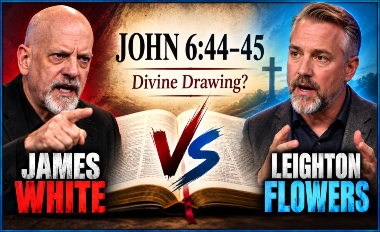
James White argues that John 6:44–45 describes an effectual work of God in which the Father draws people to Christ by causing them to hear and learn from Him. White connects the statements in verses 44 and 45: those whom the Father draws are the same people who hear and learn from the Father, come to Christ, and are raised up on the last day. He therefore understands the drawing in John 6 as something ultimately accomplished by God rather than something that merely makes salvation possible.
White also argues that appeals to John 12:32—where Jesus says that He will draw “all men” to Himself—create a problem for interpretations that understand “all” as every individual without exception while also making the drawing in John 6 effectual. If everyone is drawn in exactly the same effectual sense, White argues, universalism would follow. He therefore treats the distinction between John 6 and John 12 as important to his argument against non-Calvinist interpretations.
A major part of White’s argument concerns John 6:45: “they shall all be taught by God.” He asks Flowers to consider what would happen to his theology if the hearing and learning described in the passage were the result of God’s effective action—if God Himself causes the individual to hear and learn. White treats Flowers’ answer—that if this were true, the five points of Calvinism would follow—as an admission that the passage supports his position.
White therefore presents the exchange as evidence that Flowers effectively conceded the crucial point during the debate.
Leighton Flowers
Leighton Flowers argues that White is answering an argument that Flowers is not actually making. Flowers maintains that his interpretation of John 6 does not require the Father to be drawing every individual at that point in Jesus’ ministry. Instead, he understands the Father as drawing those Israelites who had listened to and learned from God through Moses and the prophets to the Son. The immediate context, in Flowers’ interpretation, concerns the remnant of Israel being brought to Christ.
Flowers then distinguishes John 6 from John 12. He argues that John 12:32 describes a later stage in salvation history, after the Son is lifted up. At that point Jesus says He will draw “all men” to Himself. Flowers understands this as the expansion of God’s redemptive work beyond Israel to the nations, rather than as a statement that every individual will inevitably be saved. He therefore rejects White’s claim that his interpretation necessarily leads to universalism.
Flowers also rejects the assumption that being taught or drawn by God means being irresistibly regenerated. He argues that God’s teaching can be genuine and powerful while remaining resistible. His teacher analogy illustrates the point: a teacher can sincerely teach students and desire that they learn, while some students nevertheless refuse to listen. In such a case, the student’s refusal does not demonstrate that the teacher secretly intended only certain students to learn.
Flowers’ argument therefore challenges a crucial Calvinist inference:
God teaches → therefore God effectually causes the person to believe.
Flowers accepts the first proposition but rejects the necessity of the second.
Flowers also appeals to Jesus’ use of parables. He argues that Jesus sometimes deliberately concealed truth from people who otherwise could hear, understand, and turn. Flowers sees this as significant because, if Calvinism is correct that unregenerate people are incapable of believing until they are first regenerated, then Jesus would not need to conceal the truth from them in order to prevent their belief. He could simply leave them unregenerated.
Flowers instead interprets the parables and the hardening of Israel as part of God’s redemptive-historical purpose leading to the crucifixion.
This leads Flowers into Romans 9–11. He argues that the hardening of Israel should not automatically be interpreted as evidence that particular individuals were eternally reprobated from birth. He points to Romans 11:23, where those who were cut off because of unbelief can be grafted back in if they do not remain in unbelief. Flowers therefore understands the hardening as judicial and connected to God’s larger redemptive plan involving Israel, the Gentiles, the crucifixion, and the eventual possibility of Israel’s restoration.
Finally, Flowers rejects White’s characterization of their debate exchange as a concession. Flowers argues that White’s question was conditional:
if White’s interpretation were true, then Calvinism would follow.
Flowers’ response acknowledged the logical consequence of White’s premise without conceding that the premise itself was true.
In Flowers’ view, that premise—the claim that God effectually causes the hearing and learning in John 6—is precisely the issue being debated.
Flowers therefore accuses White of treating a disputed interpretation as though it had already been established and then claiming victory based on the hypothetical consequences of that interpretation.
The Central Disagreement
At the deepest level, the disagreement is not simply over whether God draws people to Christ. Both men affirm divine drawing and divine teaching.
The disagreement is over what kind of drawing John 6 describes and what must be inferred from God’s teaching.
White’s argument can be represented roughly as:
Father draws → Father teaches → person hears and learns → person comes to Christ → person is raised
White understands this sequence as effectual and ultimately grounded in God’s sovereign action.
Flowers’ argument is closer to:
Father teaches/draws → people are genuinely confronted with God’s revelation → some respond and some resist → those who respond come to Christ
while also arguing that the particular drawing in John 6 has a specific redemptive-historical focus on Israel and should not simply be equated with the universal drawing described in John 12.
That distinction is what White’s universalism objection, according to Flowers, fails to address.
The central issue, therefore, is not simply whether Flowers believes in divine drawing or divine initiative. He does. His objection is to the additional inference that divine teaching or drawing must necessarily be effectual in the Calvinistic sense—that God’s act of drawing necessarily produces regeneration, faith, and perseverance in the individual being drawn.
In other words, Flowers is challenging the logical bridge between God’s sovereign initiative and an irresistible human response. His argument is that the former does not automatically establish the latter.
Source Note: The transcript excerpts discussed above are from my video, “James White’s Ignorance On Display – Subverting Truth,” which reproduces commentary and clips from Leighton Flowers’ Soteriology 101 video, “James White’s Repeated Errors Exposed | Leighton Flowers | Soteriology 101.”
A lot is being discussed about the theology of salvation and the Calvinist doctrine of limited atonement, which I disagree with.
So I want to answer one argument that I think the Calvinists falsely attribute to those of us who have a Provisionist view.
The Calvinist posits that if salvation requires faith, then faith must be a human contribution and therefore salvation is partly earned. In other words, acceptance is a work.
That argument assumes saving faith is like consideration in a contract, something of value exchanged for a promise. So if God promises salvation in response to faith, then faith must be the payment or consideration that completes the bargain.
But that’s the wrong view of faith. It confuses consideration or bargain for exchange with a conditional gift.
Imagine I offer you a gift and say, it’s yours. Come and receive it.
When you accept the gift, you aren’t purchasing it. You’re not providing any value. You’re not earning it.
I provided the gift. I paid the entire cost. I freely offered it. Your acceptance does not make me indebted to you. It simply means you receive what I have already provided.
Importantly, accepting is necessary to receive the gift because I’m not forcing it upon you against your will or knowledge.
A conditional gift is the biblical model of salvation. Christ paid the full price. Human beings contribute no merit, no righteousness, no works, no value, no payment toward salvation.
But God does condition our receiving that gift upon repentance and faith. And Scripture clearly distinguishes faith from works. 5 says, To the one who does not work but believes, his faith is counted as righteousness.
Faith is not a payment exchanged for salvation. It’s not a contribution that makes salvation possible. Faith is the empty hand that receives what God has graciously provided.
The gift is entirely God’s. The provision is entirely Christ’s. And accepting a gift does not mean you earned it.
So faith does not give man grounds for boasting. It gives God all the glory because salvation is freely offered, fully paid for, and received by faith alone through Christ alone in mercy and grace alone.
I will include Jenna’s video below/right
James White
Anyway, so these are some of the questions that I posted. So here’s Leighton Flowers pops in. And I don’t remember, I saw it yesterday. Jenna Ellis had tagged me and said, would you care to comment? And I couldn’t see what I was supposed to comment to because I had them blocked and nothing came up on my screen. I tried scrolling down, nothing happened. And so I’m sort of like, well, I’d be happy to do it. And while we’re at it, how about you respond to the question I asked you, which she will not do.
Leighton Flowers
I think she’s already responded to your answer and then later posted mine because she found out you blocked me. So again, facts.
James White
She will not do. There’s no reason to try to seek to engage her. She’s not an honest interlocutor. She’s just not. She’s turned out to be pretty wild. No two ways about it.
Leighton Flowers
Oh, the irony. Jenna is more kind and compassionate and loving towards people than you will ever hope to be, Dr. White. Sorry, again, to the man arguments, or in this case, to the woman arguments. Nothing to do with what Jenna wrote or what I wrote, but what does he have to do? He has to talk down to his opponent. He can’t be respectful. He can’t be kind. He can’t be nice to him. He’s got to talk down to him.
James White
So I found this today. And so here is the great Leighton Flowers. Now again, I was gonna play this, but I posted it three times yesterday on my X feed, so if you wanna see it, someone, thank you, whoever did it, pulled a clip from the debate with Leighton Flowers, that this is where James White won the debate with Leighton Flowers.
During the cross-examination, John 6:45, he always jumps John 6:45. He always ends up talking about it. 45 right there. And I’m pressing him and I say, okay, the one hearing, the one learning from the Father comes to me. I will raise him up on the last day. In context, that’s what the drawing is. You have to be drawn by the Father. If you’re drawn by the Father, you’re raised up by the Son.
So everybody jumps to John chapter 12, totally different context and that leads to universalism. They don’t care ’cause they don’t debate universalists. They only hate Calvinism, so they don’t care if they’re completely open to refutation from another perspective, they’re never gonna deal with those people anyway, so they don’t even think about it.
Leighton Flowers
None of that applies to my position or Dinesh’s position that he posted, or Jenna’s position that she posted, or John Lennox’s position, or none of what he just said refutes any one of those positions. Why? Because if you understand what we’re saying about John chapter 6, we’re saying that the Father is drawing those who’ve listened and learned from Moses, those who’ve listened and learned from the Father, that he’s drawing them to his Son at this point in time. He’s not drawing everyone to himself because John 12:32 wouldn’t exist if he was, because he says it’s not until the Son is lifted up that I will draw all men to myself.
So he’s not drawing all men to himself yet. And you can even say that’s all without distinction, not all without exception. So, okay, so he’s not drawing both Jews and Gentiles yet. Okay. So you have to acknowledge that in John 6, Jesus is not drawing all people to himself. What does that mean? The Father is drawing, Hebrews chapter 1. Read it. In days gone by, the Father drew, taught all people through the prophets. But in these current days, we are taught by the Son. There’s a shift that’s taking place. And so you’ve got the Father drawing whom? The people of Israel, the remnant of Israel, to believe in his Son so that he will raise them up in the last day.
We agree with that language, that grammatical thing. You can even make drawing irresistible if you want in that reading. And I don’t believe that drawing has to be interpreted or should be understood as irresistible because it’s simply referring to exactly what White admitted in his own book. The means of drawing is the teaching of God, that he’s the one who teaches. People can resist his teaching. They can refuse his teaching. They can accept it or refuse it. Common understanding of all teachers. Everybody knows that a teacher may be a great teacher, the best teacher that ever existed, but there may be some students who refuse to listen. And we blame the student for not learning, not the teacher or the intentions of the teacher as if the teacher doesn’t really want all the students to learn.
We blame the student for refusing to learn or not listening or closing their ears with their eyes. We don’t blame the teacher, okay? i.e., the teacher really doesn’t want it, secretly has a secret will, teaches all of them, but I only want some of them to really learn—all these kinds of nonsensical caveats and conclusions that Calvinists try to insert into the text. And so if you understand our position with regard to chapter 6 and chapter 12, you recognize that it’s not until he’s raised up that he draws all men to himself.
You see Mark 9:9, for example, they come down from the Mount of Transfiguration. He says, don’t tell anybody about this yet. Not until the Son of Man is lifted up. Then you can tell them because telling them would be a means of drawing. Preaching to them the gospel would be a means of drawing, and I don’t want you doing that yet. Why doesn’t he want them to do that? Same reason he said, I teach them in parables. Those on the inside, I tell them the truth. Those on the outside, I don’t. I teach them only in parables, lest they see, hear, understand, and turn, and I would heal them. He doesn’t want them to come yet. Why? Because then they’re not going to crucify him.
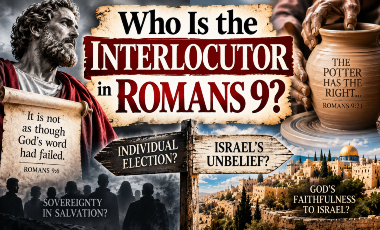
In order to accomplish the crucifixion, he’s using parabolic language. He’s giving them a spirit of stupor. He’s hardening them in their rebellion, speaking of the Jewish people, in order to get to Calvary. This is the interlocutor in Romans chapter 9 who’s crying out with him, why am I still to be blamed? Same interlocutor in chapter 3. Why are you to blame us? If our unrighteousness brings about your redemptive plan for good, your righteousness, why are we still to be blamed? Paul answers it in chapter 3 and he answers it more fully in chapters 9, 10, and 11.
And his conclusion’s not, well, some are reprobates from birth and cut off from birth. No, he says they’re cut off because of their unbelief, chapter 11, verse 23. He even says that he holds that hope that his ministry to the Gentiles will provoke them to envy so that they too will see the error of their ways and be grafted back in, leave their unbelief so as to be grafted back in. Does that sound like a reprobate who has no hope? Of course not, because that’s not who Paul is addressing.
In chapters 9, 10, and 11, he’s addressing the people of Israel who’ve grown calloused and hardened, who have now been cut off in their unbelief, judicially hardened by God, sent a spirit of stupor, being spoken to in parabolic language by their own Messiah, so as to ensure the crucifixion, so as to ensure the resurrection and the engrafting of the Gentile nations. When you understand that, none of what White’s saying right here, all of it just goes right past. This is why you say people are talking past each other. He’s not engaging the point of our contention. He’s jumping over to John chapter 12 and saying, well, see if those who are drawn are certainly raised up and Jesus draws all people without exception over in chapter 12, then that means everybody without exception is gonna be saved, and so you get universalism, so ha ha ha, we must be right. And he doesn’t even consider that the drawing is by the Father of those of the remnant of Israel being drawn to Jesus to be raised up for the purpose of bringing redemption to the world.
He doesn’t even consider that as an option, so he doesn’t even address it as an option, so therefore he never actually answers the argument of his opponents. He talks right past them. Now he thinks he’s got it figured out. He thinks he’s answering the typical Arminian response because some Arminians maybe go there. Maybe some Arminian responses do focus more on a different explanation of John chapter 6 or 12 or those kinds of things. But he’s certainly not engaging with mine or with what Jenna posted or with what Dinesh posted because we all take the same exact approach that Lennox took, that Michael Brown took, and that Steve Gregg took. Still White doesn’t either get it or he’s being deceptive. Ignorance or deception, you decide.
James White
So we had gotten to John 6:45 and I said, so if the phraseology is used there, and I suppose what I need to do here is, oh, I can’t do it because I have this maxed out and you can’t put two of those on top of each other, but I can do this just for a moment. I will get rid of it here in a second.
But right here in John 6:45, it is written in the prophets, and they shall all be taught by God. So, everyone hearing, and then mathon is going to be drawing its syntactical relationship from akousas. Everyone hearing and learning from the Father is coming to me.
So I said to Leighton, I said, if these are descriptive of divine power being exercised, if this is something that God effectuates, he causes people to hear, he causes people to learn, what would that do to your system? And his answer was, it would mean that the five points of Calvinism are true.
And so they put that question and answer together with my closing statement where I said, did you hear what he just said? Because that’s exactly what this is. This is the description of what being drawn in verse 44 is. That’s why everyone who’s drawn is raised up in the last day. That’s why every one of you that quoted John chapter 12 and said everybody’s drawn, we need to be universalists.
Leighton Flowers
See what I mean? Notice the tautology. He basically asked if I’m right, am I right? And I said, well, yes, if you’re right, you’re right. But I don’t believe you’re right. And you don’t believe me. Let’s go to the receipts. Okay.
James White
All who are taught by God, all who are, who hear from the father, all who learn from the father, that’s provided in scripture and being described by Jesus. What if that were that, what would that do to your theological understanding of this text?
Leighton Flowers
If that were true, then your presupposition TULIP would be true. And I don’t think your presupposition is true. I believe they actually have the responsibility, the ability to respond to the teaching of God.
James White
They can deny it or they can accept it.
Leighton Flowers
Everybody heard that, right? So he claims that is ultimately what ensured that he won the debate. Okay. So he basically says that if this teaching is effectual, then am I right? And obviously if he believes the teaching is effectual, meaning it has an effectual result in the belief of the elect, which is what he’s asking, then am I right? And I’m basically saying, yeah, obviously that’s the debate. That’s the very point up for debate, whether that’s what this is teaching or not.
And he claims that that’s why he won the debate, despite the fact that most people who watched it, according to 1,400 votes, said that I won the debate. No, he still says, oh, I won the debate because Leighton admitted that if I’m right, I’m right. Again, this is the level of argumentation, folks, of the best scholar, at least that’s confronting provisionism. This is the highest level of argumentation you’re getting from them so far.
This is why I thank God for James White. Every time he does these kinds of broadcasts, I think any person with an iota of logical ability can see through some of these lower-level arguments. And they’re just, at least if they’re not already swallowed hook, line and sinker Kool-Aid drinkers, I think they can see this. And so a lot of the people who come to him because of a lot of the other arguments that he’s arguing with the King James Version only or the Trinity or other things he’s doing, they’ll get introduced to this Calvinism stuff and they’ll begin to hear him and they’ll be going to go, that doesn’t make any sense.
I know this is happening because I have people come all the time, like the guy commenting earlier, that come to me through James White because they like what he’s doing on all these other subjects. But when he comes to Calvinism, he just goes off the rails. And he starts making really bad logical conclusions and really poor argumentation and starts attacking his opponents in unfair ways and making ad hominem remarks about them and all these kinds of other things that we’ve seen from White.
And they begin to go, I just get so turned off by the way he’s approaching provisionists and Arminians that I begin to look at provisionism and Arminianism and see whether it’s really right or not. And then I begin to go, oh yeah, that doesn’t make any sense. And so that’s, again, another reason I really love the fact that James White confronts us. He does a lot to push people towards provisionism. So thank you, James White, for that.
James White
Which means you are not handling scripture accurately and correctly. And the thing that’s bothering me the most about X right now is you don’t seem to care. You don’t seem to care. Hey, if it allows me to deny Calvinism, I don’t care what the universalists say. That is.
Leighton Flowers
Again, nothing about universalism has anything to do with John chapter 12 or how we would understand it.
Nathan’s right, Jesus’ reason for speaking in parables refutes Calvinism because if they needed to be regenerated, then Jesus could have spoken plainly and just not regenerated them. Exactly. It’s one of the things that led me out of Calvinism was that very point. Why would he need to use parables to keep them from belief if they can’t believe without being regenerated first?
This is what I mean when I talk about “early” and “late” Spurgeon.
When Spurgeon was a young pastor, taking over the now-famous New Park Street Chapel at just 19 years old, he could speak about Calvinism with remarkable certainty. At 22, he famously said:
“Calvinism is the gospel, and nothing else.”
Two years later, at 24, he could say:
“A mutable god may be the god for the Arminian—he is not the god for me.”
But something changed as Spurgeon grew older.
As he matured in his faith, spent years shepherding a congregation, and rubbed shoulders with actual people in the pews, his language became considerably more nuanced. He didn’t simply abandon Calvinism, but he became increasingly unwilling to force every biblical text into a theological system.
At 28, he put it this way:
“There is some truth in Calvinism and some in Arminianism, and he who would hold the whole Truth of God must neither be cramped by the one system nor bound by the other, but take Truth wherever he can find it in the Bible.”
That is a significant change from the young Spurgeon who could confidently declare, “Calvinism is the gospel, and nothing else.”
And Spurgeon continued moving in this direction.
“Preaching Like an Arminian, but Sleeping as a Calvinist”
By 1876, at the age of 42, Spurgeon reflected on the long-running debate between Calvinists and Arminians and acknowledged that both sides had captured important truths—and that both sides had also fallen into error.
He wrote:
“There has long been a great doctrinal discussion between the Calvinists and the Arminians upon many important points. I am myself persuaded that the Calvinist alone is right upon some points, and the Arminian alone is right upon others. There is a great deal of truth in the positive side of both systems, and a great deal of error in the negative side of both.”
Then he made the point even more plainly:
“If I was asked, ‘Why is a man damned?’ I should answer as an Arminian answers, ‘He destroys himself.’”
This is the Spurgeon I have in mind when I distinguish between early and late Spurgeon. The one who said in an 1863 sermon The Minister’s Stock-Taking contains language that sounds remarkably different from his 1858 rhetoric:
“Do I hear some one say, ‘Why, that is Arminianism!’ Precisely so.”
The older Spurgeon was still unmistakably Calvinistic in many respects, but he was increasingly uncomfortable with the idea that every biblical statement had to conform neatly to either the Calvinist or Arminian system.
“An Arminian Calvinist or a Calvinistic Arminian”
By 1881, Spurgeon was 47 years old, and his position had become even more explicit.
He had been called both “an Arminian Calvinist” and “a Calvinistic Arminian”—and, rather remarkably, he didn’t seem particularly bothered by either label.
Instead, his concern was whether his theology remained faithful to Scripture.
“What a host of revised versions we have! Everybody has one of his own. Certain texts which will not fit into our system must be planed and cut down. Have you ever seen the hard work that some Brethren have to shape a Scripture to their mind? One text is not Calvinistic, it looks rather Arminian—of course it cannot be so and, therefore, they twist and tug to get it right. As for our Arminian Brethren, it is wonderful to see how they hammer away at the 9th Chapter of Romans—steam-hammers and screw-jacks are nothing to their appliances for getting rid of Election from that chapter! We have all been guilty of racking Scripture, more or less, and it will be well to have done with the evil, forever! We had far better be inconsistent with ourselves than with the Inspired Word of God.”
And then Spurgeon gives us the key to understanding the whole progression:
“I have been called an Arminian Calvinist or a Calvinistic Arminian and I am quite content so long as I can keep close to my Bible. I desire to preach what I find in this Book whether I find it in anybody else’s book or not.”
That, to me, is the crucial distinction.
The question isn’t whether Spurgeon remained a Calvinist. Clearly, much of his theology remained deeply Calvinistic. The more interesting question is whether the later Spurgeon was willing to let Scripture challenge the boundaries of his theological system.
And by his own words, the answer appears to be yes.
He would rather be “inconsistent” with his theological system than inconsistent with the inspired Word of God.
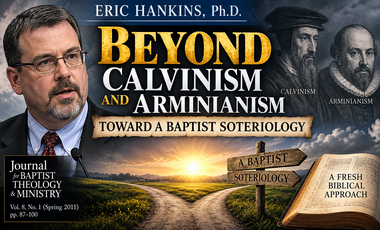
Eric Hankins, “Beyond Calvinism and Arminianism: Toward a Baptist Soteriology,”
Journal for Baptist Theology and Ministry 8, no. 1 (Spring 2011): 87–100.
Beyond Calvinism And Arminianism Toward A Baptist Soteriology (PDF)
Eric Hankins, Ph.D.
Dr. Hankins is the Pastor of First Baptist Church in Oxford, Mississippi.
The Claim
After four hundred years, Calvinism and Arminianism remain at an impasse. The strengths and weaknesses of both systems are well-documented, and their proponents vociferously aver each system’s mutual exclusivity. This paper is based on the observation that these two theological programs have had sufficient time to demonstrate their superiority over the other and have failed to do so. The time has come, therefore, to look beyond them for a paradigm that gives a better account of the biblical and theological data. Indeed, the stalemate itself is related not so much to the unique features of each system but to a set of erroneous presuppositions upon which both are constructed. As the fault lines in these foundational concepts are exposed, it will become clear that the Baptist vision for soteriology, which has always resisted absolute fidelity to either system, has been the correct instinct all along. Baptist theology must be willing to articulate this vision in a compelling and comprehensive manner.
The following four presuppositions shared by Calvinism and Arminianism demonstrate the degree to which a new approach to soteriology is needed. One presupposition is primarily biblical, one is primarily philosophical, one is primarily theological, and one is primarily anthropological, although each is intertwined with the others. Having established the need for a new approach to soteriology and the Baptist vision for such an approach, the paper will conclude with a brief description of a way forward.
The Biblical Presupposition:
Individual Election
The idea that God, in eternity past, elected certain individuals to salvation is a fundamental tenet of Calvinism and Arminianism. The interpretation of this biblical concept needs to be revised. Quite simply, when the Bible speaks of election in the context of God’s saving action, it is always referring to corporate election, God’s decision to have a people for Himself. When the election of individuals is raised in Scripture, it is always election to a purpose or calling within Gods plans for His people as a whole. In the OT, the writers understood election to be God’s choice of Israel, yet they also clearly taught that the benefits of corporate election could only be experienced by the individual Israelite (or the particular generation of Israelites) who responded faithfully to the covenant that had been offered to the whole nation.[1] This trajectory within the OT is unassailable. It is reinforced in the intertestamental literature and is the basis for the way election is treated in the NT.[2] The Bible, therefore, does not speak of God’s choice of certain individuals and not others for salvation.[3] When the Bible does speak of the salvation of individuals, its central concept is “faith,” never “election.”
Take away individual election, and the key components of Calvinism and Arminianism disappear.[4] God does not elect individuals to salvation on the basis of His hidden councils, nor does He elect them on the basis of His foreknowledge of their future faith. Simply put, God does not “elect” individuals to salvation. He has elected an eschatological people whom He has determined to have for Himself. This group will be populated by individuals who have responded in faith to the gracious, free offer of the gospel. The group, “the Elect,” is comprised of individuals who are “saved by faith,” not “saved by election.” This being the case, there is no longer any need for the theological maneuvering required to explain how God elects individuals without respect to their response (which evacuates the biblical concept of “faith” of all its meaning) or how He elects individuals based on foreseen faith (which evacuates the biblical concept of “election” of all its meaning).
Asserting that “individual election” should be abandoned is striking, to say the least. It is the foundation on which evangelical soteriology is often constructed.[5] It is painful to consider the enormous investment of time and energy that has been spent trying to reconcile how God chooses individuals and, at the same time, how individuals choose God, only to discover that the whole endeavor has been based on a misreading of Scripture. Nevertheless, most Baptists have never felt fully comfortable with either Calvinist or Arminian understandings of election because neither comport well with the whole counsel of God. The reason is clear. The Scriptures lead to the conclusion that Augustine, Calvin, and Arminius were simply wrong in their construction of individual election. Baptists have never been theologically or confessionally committed to these august theologians, and the time has come to move beyond them.
The Philosophical Presupposition:
The “Problem” of Determinism and Free-Will
Like Calvinism and Arminianism, the 2,500-year-old debate concerning the “problem” of determinism and free-will has also reached an impasse. This is because absolute causal determinism is untenable.[6] Put simply, the “problem” is not a problem because the paradigm for causation in the Western philosophical tradition is wrong. The whole of reality cannot be explained in terms of uni-directional causation from a single first-principle. The universe does not work that way. Causation is complex, hierarchical, and interdependent. God sits sovereignly and non-contingently atop a hierarchy that owes its existence to the functioning of the levels below it, levels that include the fully operational free-will of humans.[7] Opposing God’s sovereign guidance of the universe and the operation of free-will within that universe is a false dichotomy based on reductionistic metaphysical assumptions. God has made a free and sovereign decision to have a universe in which human free-will plays a decisive role. Human agency is one force among many that God has created to accomplish His cosmic purposes.
Free-will plays a unique role within God’s purposes for the universe because it is the unique power of human beings freely to enter into and maintain covenant relationships, especially a covenant relationship with God. This makes human willing fundamentally moral. Under certain circumstances, God, in His freedom, contravenes free-will, just as He is free to contravene any other force in nature, but this is not His normal modus operandi. Because God is God, He knows all of the free acts of humans from eternity, but this knowledge does not cause these acts nor does it make Him responsible for them. Moreover, the existence of these acts in no way impinges upon either His freedom or His ability to bring about His ultimate purposes. The ability of humans “to do otherwise” does not call God’s sovereignty into question; it actually establishes and ratifies His sovereignty over the particular universe that was His good pleasure to create. Opposing free-will and sovereignty is, from a philosophical perspective, nonsensical.[8]
Calvinism’s desire to protect God’s divine status from the infringement of human free-will by denying it completely or reducing it to some form of “soft-determinism”[9] is unnecessary. God’s corporate elective purposes are accomplished by individual free acts of faith. Arminianism’s need to inject ideas such as God’s election of individuals based on their future free acts is also a move designed to maintain both a strong view of God’s sovereignty and the free choice of individuals. Unfortunately, this move is made at the expense of any regular understanding of biblical election, which is unilateral. God does not choose Israel because He knows she will choose Him in return. He chooses her even though He knows that her history will be one of rebellion and failure. Moreover, Arminianism’s desire to protect the inviolability of free-will to the degree that God cannot keep His promise to seal a believer’s free response fails to take seriously the totality of the biblical concept of faith.
Many Baptists have tended to opt for what they think is a “compatibilist” understanding of determinism and free-will in salvation: God chooses individuals unconditionally, and individuals choose God by faith.[10] Unfortunately, compatibilism demands a deterministic view of both God and free-will with which those same Baptists would be very uncomfortable. What these Baptists really want to say is that a “determinist” view of God is compatible with a “libertarian” view of free-will, but this is philosophically impermissible. Another typical strategy of Baptists, at this point, is to appeal to “mystery” or “paradox:” We don’t know how God chooses individuals, and, at the same time, individuals choose God. But, like other complex doctrines such as the Trinity or the hypostatic union, it is still true. To say, however, that God chooses individuals unconditionally and that He does not choose individuals unconditionally is not to affirm a mystery; it is to assert a logical contradiction. Baptists need to abandon the language of compatibilism and “mystery,” which do not adequately reflect what they believe about God and salvation, and embrace the concept that a robust (soft-) libertarian free-will is the actualization of God’s sovereign direction of His universe.
The Theological Presupposition:
Federal Theology
Both Arminians and Calvinists assume a “Covenant of Works” between Adam and God in the Garden of Eden, even though there is no biblical basis for such.[11]The Covenant of Works, they assert, was a deal God made with Adam whereby Adam would be rewarded with eternal life if he could remain morally perfect through a probationary period. Failure would bring about guilt and “spiritual death,” which includes the loss of his capacity for a good will toward God. Adam’s success or failure, in turn, would be credited to his posterity. This “Federal Theology” imputes Adam’s guilt and total depravity to every human.[12] In Calvinism, actual guilt and total depravity are the plight of every person. Free-will with respect to salvation is, by definition, impossible, and with it, the possibility of a free response to God’s offer of covenant through the gospel. The only hope for salvation for any individual is the elective activity of God. In Calvinist soteriology, election is privileged above faith because regeneration must be prior to conversion. In Arminianism, the effects of Federal Theology and the Covenant of Works must be countermanded by further speculative adjustments like “prevenient grace” and election based on “foreseen faith,” a faith which is only possible because prevenient grace overcomes the depravity and guilt of the whole human race due to Adam’s failure. All this strays far beyond the biblical data. Such speculation does not emerge from clear inferences from the Bible, but is actually a priori argumentation designed to buttress Augustine, not Paul.
God’s gracious action in Christ is not “Plan B,” a “Covenant of Grace,” executed in response to Adam’s failure at “Plan A,” the “Covenant of Works.” The pre-existent Son has always been the center-point of creation and covenant. Adam was not created and placed in the Garden for the purpose of demonstrating moral perfection through his own efforts.[13]
This original “works righteousness” was read into the Garden by Pelagius and assumed by Augustine. Adam was not being called to moral perfection; he was being called into world-changing covenant relationship. The command not to eat of the tree was simply a negative construal of God’s offer for Adam to know Him and be satisfied in Him and His plan alone. It was a specific instantiation of the covenant offered to Adam and Eve in Gen. 1:26-28: In a blessed relationship with God, they were to be fruitful, multiply, fill the earth, subdue it, and rule over it.[14]In the Garden, Adam was being asked to do what Noah, Abraham, Moses, Israel, David, and, ultimately, everyone would be asked to do: trust and accept the gracious covenant offer of God in Christ for the purpose of bringing the created order to its intended conclusion. Adam and Eve were to respond to God in faith. The sensual temptation of the fruit itself came after the temptation to question God’s character and His covenant plan. It was in Adam’s rejection of God’s covenant offer that he failed to be moral. In Christ, God re-offers the covenant through successive renewals, culminating in His final offer of the gospel revealed in the life, death, and resurrection of the Incarnate Son. Adam was asked to believe God and bless the whole world, as were Noah, Abraham, Israel, David, and ultimately Christ, who succeeded where all others failed. His victory is extended to all those who put their faith in Him, just like Abraham, the father of the faithful did.[15] Covenant in Christ by faith is not “Plan B;” it is the point of the Bible.
Once again, speculation such as a Covenant of Works, Federal Theology, prevenient grace, etc. are little more than theological “fudge factors” designed to make the Augustinian synthesis work. They do not emerge from the biblical text but are a priori arguments pressed into the service of a fifth century Catholic bishop, not the authors of the Scriptures, and Baptists have never been comfortable with them. These adjustments mitigate the centrality, power, and immediacy of the biblical concept of “covenant” which has, at its heart, God’s desire for a relationship with His people through a real response of faith to the gospel of Jesus Christ. This is the nexus of Baptist soteriology.
The Anthropological Presupposition:
Total Depravity
The Scriptures clearly affirm that all people are sinners. Because of sin, humans are in a disastrous state, unable to alter the trajectory of their rebellion against God, unable to clear their debt of sin against Him, unable to work their way back to Him through their best efforts. This situation is one of their own creating and for which they are ultimately responsible.[16]
About these realities, there is little debate in evangelical theology. What is at issue is what being a sinner means when it comes to responding to God’s offer of covenant relationship through the power of the gospel.
Both Calvinism and Arminianism affirm that the Fall resulted in “total depravity,” the complete incapacitation of humanity’s free response to God’s gracious offer of covenant relationship.[17]In Calvinism, the only remedies for this state-of-affairs are the “doctrines of grace” in which the free response of individuals is not decisive. For Arminianism, total depravity, which is purely speculative, is corrected by prevenient grace, which is even more speculative, and makes total depravity ultimately meaningless because God never allows it to have any effect on any person.
Nothing in Scripture indicates that humans have been rendered “totally depraved” through Adam’s sin. Genesis 3 gives an extensive account of the consequences of Adam’s sin, but nowhere is there the idea that Adam or his progeny lost the ability to respond to God in faith, a condition which then required some sort of restoration by regeneration or prevenient grace. In fact, just the opposite appears to be the case. The story of God’s relationship with humankind is fraught with frustration, sadness, and wrath on God’s part, not because humans are incapable of a faith response, but because they are capable of it, yet reject God’s offer of covenant relationship anyway. To be sure, they are not capable of responding in faith without God’s special revelation of Himself through Christ and His Spirit’s drawing. Any morally responsible person, however, who encounters the gospel in the power of the Spirit (even though he has a will so damaged by sin that he is incapable of having a relationship with God without the gospel) is able to respond to that “well-meant offer.”
Therefore, the time has come once again for Baptists to reject another dichotomy mediated by the Calvinist/Arminian debate: monergism and synergism. Monergism insists that salvation is all of God. Monergists conclude that faith emerging from a decision within the will of the believer is a “work” that makes salvation meritorious, but this idea demands a theologically objectionable determinism. As a technical theological concept, synergism[18] still operates off of a framework that views sovereignty and free-will as problematic, often forcing too fine a distinction between “what God does” and “what man does.” Synergism tends to put “faith” in the category of performance, rather than an attitude of surrender. This has led some Arminian theology into over-speculation concerning the nature of the act of faith, psychologizing and sensationalizing the “moment of decision,” so that one’s experience becomes the basis of his assurance. Synergism also tends to demand further acts in order to receive further blessing and opens the door to the possibility that, if a person fails to act faithfully subsequent to the experience of salvation, God will cease to save.
Baptists must get off of this grid.[19]We have preferred terms like “trust,” “surrender,” and “relationship” to “monergism” or “synergism” when we reflect on God’s offer and our response. These terms secure the affirmation both that individuals can do nothing to save themselves, yet their salvation cannot occur against their wills or without a response of faith that belongs to them alone.
The Baptist Vision
So, what would a biblically-sound, Christ-centered, grace-filled soteriology look like without appeals to individual election, determinism, Federal Theology, or total depravity? What would it look like if it were free from the presuppositions of Calvinism and Arminianism? It would look exactly like what most Baptists have believed instinctively all along. Baptists have consistently resisted the impulse to embrace completely either Calvinism or Arminianism. We simply posit that we are “neither.”[20]The basis for this resistance to the two systems is our aversion to theological speculation beyond the clear sense of Scripture and our willingness to go our own way when Scripture and conscience demand. The way forward is basically backward, a massive simplification, a walking out of the convoluted labyrinth that evangelical soteriology has become in the debate between Calvinism and Arminianism. It is a move not dissimilar to the basic impulse of Luther at the birth of the Reformation, which was to reject the Medieval scholasticism that had turned the gloriously simple gospel of grace into its absolute antithesis. For Luther, the solution was to start over with the Scriptures (and Augustine), no matter what the implications. Baptists need to apply the Reformation principles of sola scriptura and semper reformanda to Luther himself. Augustine’s soteriology and the bulwark constructed subsequently to defend it must be removed.
Baptists believe in the clarity and simplicity of the Bible. We search in vain for decrees, a Covenants of Works, the distinction between a “general call” and an “effectual call,” hidden wills, and prevenient grace. We react with consternation to the ideas that God regenerates before He converts, that He hates sinners, that reprobation without respect to a response of faith brings Him the greatest glory, or that the truly converted can lose their salvation. Baptists have felt free to agree with certain emphases within Calvinism and Arminianism, while rejecting those that offend our commitments to the possibility of salvation for all and to the eternal security of that salvation based exclusively on faith in the covenant promises of God. The free offer of an eternal, life-changing covenant with the Father through the Son by the Spirit to all sinners by the free exercise of personal faith alone has been the simple, non-speculative but inviolable core of Baptist soteriological belief and practice. Baptist soteriology (specifically including the doctrines of the sovereign, elective purposes of God, the sinfulness of all humans, the substitutionary atonement of Christ, salvation by grace alone through faith alone, and the security of the believer) is not in jeopardy and does not need to be reinforced by Calvinism or Arminianism. It can be successfully taught, maintained, and defended without resorting to either system.
It has been typical of Baptists to believe that anyone who reaches the point of moral responsibility has the capacity to respond to the gospel. While all persons are radically sinful and totally unable to save themselves, their ability to “choose otherwise” defines human existence, including the ability to respond to the gospel in faith or reject it in rebellion. God initiates the process; He imbues it with His Spirit’s enabling. When people respond in faith, God acts according to His promises to seal that relationship for eternity, welding the will of the believer to His own, setting the believer free by His sovereign embrace. Our assurance of salvation comes not from a “sense” that we are elect or from our persistence in holy living. Assurance comes from the simple, surrendered faith that God keeps every one of His promises in Christ Jesus.
Baptists’ historical insistence on believer’s baptism is a solid indicator of our soteriological instinct. Historically, neither Calvinism nor Arminianism had a correct word for infant baptism because both were burdened with the justification for total depravity, original sin, and individual election. For many Arminians (like those in the Wesleyan tradition), infant baptism functions with reference to original sin and prevenient grace and plays a role in the faith that God “foresees.”[21]For many Calvinists, infant baptism has become an extremely odd vehicle by which they deal with the fate of infants, an issue that is illustrative of the fundamental inadequacy of the system. If Calvinism is true, then its own logic demands that at least some infants who die before reaching the point of moral responsibility spend eternity in hell.[22] By and large, Calvinists do not want to say this and will go to great lengths to avoid doing so.[23] Covenant Theology and infant baptism have been the preferred method for assuring (at least Christian) parents that they can believe in original guilt and total depravity and still know that their children who die in infancy will be with them in heaven. While Baptist Calvinists and Arminians do not allow for infant baptism, the fact that their systems allow for and even advocate it is telling.
Prevenient grace and Covenant Theology have never played a role in Baptist theology. This frees us to deal biblically with the issue of infant baptism: it is simply a popular vestige of Roman Catholic sacramentalism that the Magisterial Reformers did not have either the courage or theological acuity to address. Privileging election necessarily diminishes the significance of the individual response of faith for salvation, thus creating room for infant baptism and its theological justification. But with faith as the proper center of Baptist soteriology, infant baptism has never made any sense. Our distinctive understanding of the ordinance of baptism celebrates the centrality of the individual’s actual response of faith to the free offer of the gospel.
Finally, Baptists’ historic passion for evangelism and missions is underdetermined by Calvinism and Arminianism. For Calvinism, if the decision about who is saved and who is not has already been made by God, then the actual sharing of the gospel with the lost does not matter. The vast majority of Calvinists strenuously object to this charge, employing a variety of tactics to obviate what is, unfortunately, the only logical conclusion of their system. Saying that God elects the “means” of salvation as well as the individuals who are saved demands a determinism that is theologically unacceptable and philosophically unsustainable. Insisting that evangelism is still necessary because it “glorifies God” and demonstrates obedience to the Scriptures is simply a variation of that same determinism. The historical struggles of Calvinism with doctrinal and attitudinal opposition to missions and the “promiscuous preaching of the gospel” is evidence of the weakness of their system. Insisting on a “well-meant offer” while at the same time insisting that not all are able to respond is not the affirmation of a “mystery;” it is stubborn fidelity to a logical contradiction. For Arminianism, if election is based on foreseen faith, then it must be assumed that every person will receive enough of the gospel to trust or reject Christ. We know that billions still have not heard the gospel. This privileges the effort of the faith-capacity of people over the power of the gospel alone to save. If all people have the ability to figure out some form of faith in Christ, why worry overmuch about evangelism? It is this sort of weakness that lends itself to the frequent liberal trend in Arminianism.
Baptist anthropology affirms that, because of personal sinfulness, no one is capable of coming to faith in Christ without the proclamation of the gospel in the power of the Spirit. While there are certainly unique instances of individuals receiving the gospel through dreams and non-human proclamation, this is not God’s normal manner of working and those instances of salvation still require both a proclamation of Jesus as Lord and a response of faith. Baptists believe that the proclamation of the gospel is necessary for a faith response to Christ. Those who do not hear will not be saved. Everyone who does hear has the opportunity to respond to Christ in faith or persist in unbelief. This is the only proper biblical motivation for the urgent proclamation of the gospel. Baptists have excelled in evangelism and missions because we believe it really matters.
It is safe to say that Federal Theology, Eternal Decrees, Covenants of Works, Grace, and Redemption, and prevenient grace have played essentially no major role in the expansion of the Baptist witness, especially among Southern Baptists, from the late nineteenth through the late twentieth centuries. This is not because ordinary Baptists are unintelligent or simplistic in their beliefs; it is because ordinary Baptists have played a significant role in the direction of denominational identity, and they have been serious about what the Bible plainly does and does not say. In the older Baptist confessions and in the writings of older Baptist heroes like Spurgeon, Fuller, and Carey, echoes of the doctrinal speculation above can be heard, but they sit uncomfortably with the strong affirmations of the opportunity of everyone to respond in faith to the preaching of the gospel and the inability of any believer to fall away. In the Baptist Faith and Message, such problematic speculation disappears completely.[24] Baptists have known that these things were unnecessary for the articulation of God’s unstoppable plan to redeem the whole world through the bold proclamation of salvation in Christ alone by faith alone. From the beginning, the work of Christ in creation and redemption for the purpose of covenant relationship with humankind has always been the center of the biblical narrative. There is no need for an alternate metanarrative of secret decrees and hidden covenants to sort out the history of redemption. The plot of God’s purpose for humankind can be found right on the surface of the text from Genesis 1 to Revelation 22, all summed up succinctly in John 3:16.[25]
Without committing to either Calvinism or Arminianism, Baptists have evangelized millions, planted thousands of churches, and reached literally around the globe the with life-changing, world-changing message of salvation by grace through faith. When either system has come to the forefront in debate or dispute, the outcome has rarely been positive for kingdom work through us. Baptists have been well-served by a simpler, less-speculative, less metaphysical approach to soteriology. As we move into a new millennium, a more constructive, positive statement of our soteriology based on this heritage of simplicity and faith-focus will sharpen us as to what is essential to the message and motivation of the gospel for all who stand in desperate need of it.
A Baptist Soteriology
So, what would a soteriology based on the Baptist vision look like? The four presuppositions discussed above, indeed, provide a sound framework upon which the Baptist vision could be set. Around the core biblical principle of faith, the philosophical principle of God’s purpose for human free-will, the theological principle of “covenant in Christ alone,” and the anthropological principle of the sinfulness and salvability of every person could be arranged. It is interesting that, in actual practice, these key concepts are identical with the emphases in the most widely used personal evangelism tools in Baptist life. F.A.I.T.H. Evangelism, Continuing Witness Training, Evangelism Explosion, The Four Spiritual Laws, and Share Jesus without Fear all highlight (1) faith in Christ, unpacking such faith as (2) the absolute necessity of a personal, individual response of repentance and trust, (3) an entry into God’s holy and loving, eternal purposes in the person and work of Christ alone, and (4) available for anyone who will admit his radical sinfulness and inability to save himself.[26]In none of these gospel presentations is there even a hint of the issues of election, determinism, Federal Theology, or total depravity. In such gospel witness, the principle of lex orandi, lex credendi is a helpful reminder that our actual evangelistic practices are crucial indicators of what we truly believe about soteriology.
The Biblical Presupposition:
Individual Faith
The central biblical presupposition for a Baptist soteriology is, therefore, “faith” (Eph. 2.89). “Election” is a term that belongs properly in the Doctrine of God. Faith captures the fundamentally relational nature of NT soteriology. “Justification by faith,” which lies at the center of Protestant soteriological identity, speaks of the initiating and sustaining activity of God in bringing an individual into right relationship with Himself and the necessity of the individual’s response for God’s justifying work to be actualized in his life. While the totality of justification has numerous aspects (past, present, future, spiritual, physical, individual, moral, social, ecclesiological, cosmic, etc.), it does not happen without personal faith. Faith has a variety of nuances as well, but, ultimately, it is an act of the will that belongs to the believer. It is not a “gift” God gives to some and not others. When we call people to salvation, we emphasize the biblical concept of faith, not election.
The Philosophical Presupposition:
The Freedom of God and the Free-Will of People
The manner in which biblical faith functions in creation is this: God sovereignly and freely made a universe in which the free-will of humans plays a decisive role in His ultimate purposes for that universe (Rom. 10:9-10). Without free-will, there is no mechanism for the defeat of sin and evil, no mechanism for covenant relationship, no mechanism for a world-changing, world-completing partnership between God and His people. For Baptists, faith has never been something that occurs without our willing. We deny that people’s eternal destinies have been fixed without respect to a free-response of repentance and faith. We preach that the decision of each individual is both possible and necessary for salvation.
The Theological Presupposition:
Covenant in Christ
In a Baptist soteriology, Christ is the central object of belief. He is believed as the mediator of covenant relationship, the full expression of the kingdom of God, eternal life, God’s ultimate purpose for everyone and for the cosmos (John 3:16). We have no interest in a series of extra-biblical covenants created to bolster a soteriology that does not take seriously the necessity of personal faith as an expression of free-will. In our preaching, we do not burden people with the calculus of covenants of works, grace, and redemption. We do not invite people to believe in Calvinism or Arminianism. We offer Christ alone, the only hope of Adam, Noah, Abraham, the Patriarchs, Moses, David, Israel, and the whole of humankind. His perfect life, substitutionary death, and victorious resurrection comprise the object of confession and belief that is sufficient to save (John 14:6, Rom. 10.9-10).
The Anthropological Presupposition:
The Sinfulness and Salvability of Everyone
Finally, the anthropological presupposition is that no one can save himself, but anyone can be saved (Rom. 3:23). No person ever takes the first step toward God. Humankind’s history is broken; its destiny is death; it’s context darkness; its reality is rebellion. This sinfulness has put us out of fellowship with God and under the verdict of eternal separation (Rom. 6.23). Through the person and work of Christ, which is proclaimed through the gospel, God reaches out His hand of “first love,” providing a ground of salvation to which any one can respond in faith. If people do not hear and respond to this gospel, they will not be saved. So, we preach the gospel broadly, regularly, and passionately. We offer an invitation every time we preach because we believe every unbeliever, no matter how sinful and broken, can respond, and no matter how moral and self-righteous, must respond (Rev. 3:20).
These four pillars are the super-structure of the soteriology that has driven Baptist preaching, evangelism, and missions. It is the basis for life in Christ and the way of discipleship. Into this matrix, the totality of biblical soteriological language can be fed, but no other single concept can be allowed to dominate doctrinal development to such a degree that one or more of these emphases are abandoned or effectively neutralized. From these fixed-points of Baptist soteriology, such issues as the effects of the Fall, the order of salvation in its various dimensions, and other important implications can be discussed in full. In this construction, election is an important but tangential and transitional concept, connecting the borders of soteriology, ecclesiology, eschatology, and theology proper. Faith, however, must stand at the center of Baptist soteriology, so that we might proclaim to all with firm conviction: “Believe on the name of the Lord Jesus Christ, and you will be saved” (Acts 16:31).
FOOTNOTES
[1]See, for instance, Deut. 29:14-21. Israel is reaffirming the covenant promised to the patriarchs and to future generations. However, if there is an individual man or woman who boasts, “I have peace with God though I walk in the stubbornness of my heart,” the Lord will “single him out” from the people for destruction (vv. 18-21, NASB). Although the covenant is for the whole community, the individual must respond in faith in order to benefit from those corporate covenant promises.
[2]Critics of the corporate view of election will quickly raise Rom. 8:29-30 and 9-11 (among others) in defense of their position, but the pre-temporal election of individuals is not Paul’s purpose there. Rom. 8:29-30 is setting up Paul’s point in chapters 9-11 about two groups: Jews and Gentiles. The end of Romans 8 crescendos with the greatness of salvation in Christ. Verses 29-30 articulate God’s actions toward His people from beginning to end in order to bring about His ultimate “purpose” (28): God knew He was going to have a people; He determined to bring them into existence in Christ; He actualized that people in history through His call; He justified them by faith; He has determined to bring them into resurrection glory. In light of this incredible plan to have this kind of people for Himself, Paul is heartbroken at the beginning of Romans 9 that his Jewish brothers have responded to the gospel with unbelief. The Jews appear to be “out,” and the Gentiles appear to be “in.” But God works in unexpected ways. Jews are “out” now so that the Gentiles can come “in.” But the Gentiles coming “in” will ultimately cause the Jews to come “in” at the proper time. That is why Paul will continue to preach the gospel to Jews as a part of his mission to the whole world, looking forward to the response of a remnant by faith. One thing is certain: Romans 9-11 is not teaching the election of some individuals and the reprobation of others without respect to their genuine response of faith. Ephesians 1:4, 5, and 11 function in Ephesians 2 the same way that Rom. 8:29-30 functions in Romans 9-11.
[3]See William W. Klein, The New Chosen People: A Corporate View of Election (Eugene, OR: Wipf and Stock, 2001), 257–63 for an extended exegetical analysis of all the relevant biblical data concerning the concept of “corporate election.” Klein argues that there is not a single verse or overarching tendency in the Scriptures in support of the idea that God chooses certain individuals for salvation.
[4]Indeed, if “individual election” is what the writers of the NT meant, then Calvinism and Arminianism really are the only options, and Baptists should pick one and move on to other matters. It is significant that we have been unwilling to do so.
[5]For example, if individual election to salvation were removed from Millard Erickson’s massive systematic theology, there would be essentially nothing left in his chapters on “God’s Plan” and those in the whole section on “Salvation.” See Millard J. Erickson, Christian Theology, 2d ed. (Grand Rapids: Baker, 1998).
[6] Kenneth Keathley, Salvation and Sovereignty: A Molinist Approach (Nashville: B&H Academic, 2010), 93–99.
[7]Nancey Murphy, “Introduction and Overview,” in Downward Causation and the Neurobiology of Free Will, ed. Nancey Murphy, George F. R. Ellis, and Timothy O’Connor (Berlin: Springer-Verlag, 2009), 2–3.
I change up footnote 8 a bit. I add the fuller quote from Lewis as well as a bit of a summary of it
[8] C. S. Lewis, Yours, Jack: Spiritual Directions from C. S. Lewis, ed. Paul Ford (New York: HarperCollins, 2008), 186. Lewis provides a helpful perspective on the traditional debate between divine sovereignty and human freedom. He writes:
“All that Calvinist question—Free-Will and Predestination, is to my mind undiscussable, insoluble. Of course (say us) if a man repents God will accept him. Ah yes, (say they) but the fact of his repenting shows that God has already moved him to do so. This at any rate leaves us with the fact that in any concrete case the question never arrives as a practical one. But I suspect it is really a meaningless question. The difference between Freedom and Necessity is fairly clear on the bodily level: we know the difference between making our teeth chatter on purpose and just finding them chattering with cold. It begins to be less clear when we talk of human love (leaving out the erotic kind). ‘Do I like him because I choose or because I must?’—there are cases where this has an answer, but others where it seems to me to mean nothing. When we carry it up to relations between God and Man, has the distinction perhaps become nonsensical? After all, when we are most free, it is only with a freedom God has given us: and when our will is most influenced by Grace, it is still our will. And if what our will does is not ‘voluntary,’ and if ‘voluntary’ does not mean ‘free,’ what are we talking about? I’d leave it all alone. Blessings.”
RPT SUMMARY: Lewis is not attempting here to construct a systematic doctrine of free will or to resolve the Calvinist-Arminian controversy. Rather, his point is that the categories of “freedom” and “necessity,” while relatively clear when applied to physical actions, become increasingly difficult to apply to human willing and ultimately to the relationship between God and humanity. Divine influence upon the human will does not necessarily make the resulting action something other than the person’s own voluntary action; indeed, Lewis insists that even when the will is most influenced by grace, “it is still our will.” Thus, the attempt to force divine grace and human freedom into a simple opposition between “necessity” and “freedom” may itself rest upon a category mistake.
This observation is consistent with Lewis’s broader treatment of divine goodness and human wickedness in The Problem of Pain. In chapter 3, “Divine Goodness,” Lewis argues that God’s goodness cannot be defined as merely the human notion of kindness or as something wholly unrelated to the moral categories available to human beings. God’s goodness is greater and more complete than ours, but it is not its opposite. He therefore maintains that God’s purposes may involve painful correction and transformation without ceasing to be expressions of divine love. In chapter 4, “Human Wickedness,” Lewis grounds the need for such divine correction in humanity’s misuse of free will: human beings have “used [their] free will to become very bad,” and the Christian message begins with the recognition that humanity requires moral and spiritual healing.
This makes Lewis’s language in Yours, Jack especially significant. Lewis himself says he “suspect[s]” that the question is “meaningless” and asks whether the distinction between freedom and necessity has “perhaps become nonsensical.” The qualified language is important. He is not making an unqualified declaration that the Calvinist-Arminian debate is meaningless, nor is he presenting a systematic argument for libertarian free will. Rather, he is questioning whether the philosophical categories being used are adequate to describe the relationship between God’s grace and a genuinely willing human response. His larger theology in The Problem of Pain nevertheless treats human beings as morally responsible agents who have genuinely misused their freedom and therefore genuinely require transformation. Divine influence and human willing are consequently not presented as simple opposites. Lewis provides philosophical support for distinguishing God’s gracious influence from coercion, without necessarily settling the larger question of exactly how divine sovereignty and human freedom relate
[9]“Soft-determinism” is the view that humans are free to do what they desire most, but they are not free to choose what they desire. Since, “the good” is off the table as an object of desire (because of the Fall), “evil” is the only option left, and therefore, humans always “choose” to do evil because they cannot do otherwise. “Soft-libertarianism” (mentioned below) is the view that human freedom, while limited in many aspects by environment and prior choices, is still characterized by the ability, often at crucial moments, to choose between two live options for which the agent is responsible. For a more full discussion, see Keathley, Salvation and Sovereignty, 63–79.
[10]This often expressed in the old saw that “Whosoever will may come” is written over the entry into heaven, but, once inside, the verse over the door reads, “you did not choose Me, but I have chosen you.”
[11]William J. Dumbrell, Covenant and Creation: A Theology of Old Testament Covenants (Eugene, OR: Wipf and Stock, 2009), 44–6, Reprint.
[12]The principle text for Federal Theology is Rom. 5.12-21, but the evidence within this text and its place within the argument of Romans speaks against such an interpretation. The strict parallelism between Adam and “all” demands a strict parallelism between Christ and “all,” necessitating universalism, which is not possible theologically and not the point exegetically. Paul’s focus in the passage is clearly on physical death and eternal life, not the imputation of Adam’s guilt to all people (the same is true for Eph. 2:1-7 and 1 Cor. 15:20-28). Paul’s point: Adam’s sin brought in the condemnation of death for all people. All people demonstrate that they deserve such condemnation by their own sin. Christ, the sinless one, has overthrown that condemnation by receiving it undeservedly into Himself, which is the ultimate act of obedience, and rising again. All who ratify Christ’s obedient life, death, and resurrection with their faith in Him will have eternal life.
[13] This is not to say that perfect obedience was not the standard; it was just not the point. True obedience is the expression of covenant faithfulness and utter dependence on God.
[14]Eugene H. Merrill, Everlasting Dominion: A Theology of the Old Testament (Nashville: Broadman and Holman, 2006), 17.
[15]In Gal. 3:8, Paul states quite clearly and without any need for further explanation that “The Scripture, foreseeing that God would justify the Gentiles by faith, preached the gospel beforehand to Abraham saying, ‘ALL THE NATIONS OF THE EARTH WILL BE BLESSED IN YOU.’” This single covenant in Christ is also in view in 1 Cor. 10:4: “. . . and all [Israel] drank the same spiritual drink, for they were drinking from a spiritual rock which followed them; and the rock was Christ.”
[16] Paul’s point in Rom. 1-3, the locus classicus of human sinfulness, is not that people cannot respond to God, but that they will not, even though the results lead to their utter ruin.
[17]Ephesians 2:1 and 5 are frequently cited in support of this view, with a focus on the phrase “dead in your trespasses.” “Dead” here is taken to mean “spiritually” dead, utterly unresponsive to spiritual things. This reading, however, does not work exegetically. Paul’s point in 2.1-7 is that Jews and Gentiles alike were in the same sorry situation and in need of the resurrected and ascended Christ. If Paul means that everyone was “spiritually” dead, then he must also mean that everyone was made “spiritually” alive “with Him.” Does this mean that Jesus was, at some point, incapable of a response to God? Is Paul’s point that Jesus is now “spiritually” alive, responsive to God? Are we now “spiritually” raised and seated with Him in heavenly places? What could this possibly mean? Clearly, Paul is speaking eschatologically here: “Before we trusted Christ our destiny was the condemnation of death. Our behavior confirmed that we were deserving of that sentence. But now our destiny is bound up with His destiny so that ‘in ages to come’ the inclusion of sinners like us will put God’s unbelievable grace on display. How did we come to belong to Christ? By faith.” Paul’s point is not that we are incapable of faith without “regeneration.” His point is that Christ has made a way for those deserving of death to have eternal life, no matter what their ethnicity or level of religious effort. Moreover, if Paul thought that Adam’s sin resulted in spiritual death/total depravity for everyone else, how could he write in Rom. 7:9: “I was once alive apart from the Law”?
[18]“Synergism,” to be sure, would be the category to which the soteriological viewpoint of this paper belongs, if we persist in using these categories, because monergism, in the true sense of the term, in untenable. Unfortunately, this word has theological associations that Baptists reject. Synergism is often considered to be the functional equivalent of semi-Pelagianism, which throws the whole discussion back into abstruse arguments about “operative” and “cooperative” grace, “general” and “effectual” calling, facere quod in se est, etc. forcing us to approach soteriology from Augustinian and medieval Roman Catholic categories rather than biblical ones. Monergism and synergism have simply outlived their usefulness.
[19]See Keathley, Salvation and Sovereignty, 101–8. After thoroughly dismantling the determinism of Calvinism, Keathley, a Baptist theologian, still wants to retain the term “monergism,” qualifying it with his assertion that people can still refuse God’s grace. But if one’s refusal matters, then salvation is not monergistic. Any Calvinist worth his salt would agree. Persisting in the use of the term “monergism” and in defending the logically contradictory concept that “what man does matters and what man does doesn’t matter” is unhelpful.
[20]Malcolm yarnell, Neither Calvinists Nor Arminians but Baptists, White Paper 36 (Ft. Worth, TX: Center for Theological Research, 2010), 7.
[21]The question remains, however, concerning how God foresees faith in the child that dies in infancy. Now God is making decisions based on possibilities rather than actualities, which is extremely problematic. In Arminian traditions that do not practice infant baptism, the tendency toward belief in baptismal regeneration or subsequent Spirit-baptism over-emphasizes human effort in the understanding of free-will over against God’s sovereignty.
[22]Adam Harwood, The Spiritual Condition of Infants: A Biblical-Historical Survey and Systematic Proposal (Eugene, OR: Wipf and Stock, 2011), 23.
[23]R. Albert Mohler, Jr. and Daniel L. Akin, “The Salvation of the ‘Little Ones:’ Do Infants Who Die Go to Heaven?” [article on-line]; June 16, 2009 AlbertMohler.com; Mohler and Akin’s argument is that all infants who die are elect. It is an astounding display of a priori reasoning that runs like this: Since Calvinism is true and since we don’t want to say that some infants go to hell, all infants who die must be elect (even though there is no biblical basis for such a claim).
[24]Malcolm yarnell, “The TULIP of Calvinism in Light of History and the Baptist Faith and Message,” SBC Life, April 2006.
[25] Jerry Vines, “Sermon on John 3:16,” in Whosoever Will, ed. David L. Allen and Steve W. Lemke (Nashville: B&H Academic, 2010), 13–15.
[26] The scriptural basis for each soteriological presupposition discussed below is drawn from the scripture references most common to these gospel presentations.
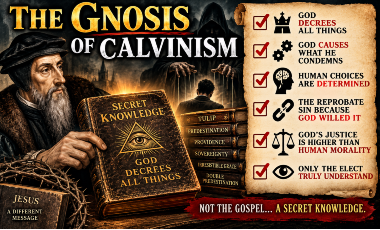
Gnostic ideas were rejected by the early church, but a particular Gnostic-like conception of predestination later re-entered Christian theology through Augustine. Some Gnostic systems, particularly the Valentinian Gnostics, incorporated a form of predestination in which certain people possessed a spiritual nature destined for salvation while others were destined for destruction. The elect were understood to possess a spiritual seed and a special gnosis—a divinely given knowledge associated with their spiritual nature and necessary for salvation. In this scheme, salvation was not ultimately dependent upon human choice or moral effort, but upon God awakening and enlightening those who were already destined for salvation. Indeed, one description of Valentinian teaching states that “the elect are saved by knowing that they are saved.”
The early church rejected these teachings, defending God’s good creation, human moral responsibility, the genuine incarnation of Christ, and the bodily resurrection. Early Christian writers specifically opposed the idea that some people were given the capacity to believe while others were excluded from salvation by nature or divine determination. The Gnostic conception of salvation thus involved not merely a predetermined destiny, but a divinely determined distinction between those capable of receiving saving knowledge and those who were incapable of doing so.
Centuries later, however, elements resembling this Valentinian Gnostic conception of predetermined salvation, spiritual inability, and divinely bestowed enlightenment reappeared in Augustine’s theology during his controversy with Pelagius. Ken Johnson argues that Augustine adapted the Valentinian concept of predestination, replacing the Gnostic idea of an inherently incorruptible spiritual nature with the claim that God sovereignly ordained certain Christians for salvation because humanity was totally depraved and unable to respond on its own. Johnson consequently identifies this development with Augustine’s formulation of predestination, total depravity, and bondage of the will.
The parallel becomes especially striking when compared with later Calvinistic theology. Reformed theologians likewise argue that fallen humanity is incapable of coming to Christ without a prior work of divine grace: regeneration precedes faith, God changes [irresistibly] the sinner’s heart and disposition, and the elect are thereby given [forced] the ability and desire to respond to Christ. The theological vocabulary is different, and Augustine was not simply reproducing Valentinian Gnosticism; nevertheless, the structural similarity is difficult to overlook: a predetermined elect, human inability, divine intervention, an inward transformation, and only then the capacity to believe and embrace salvation.
BIBLIOGRAPHY
Kenneth M. Wilson, The Foundation of Augustinian-Calvinism (Montgomery, TX: Regula Fidei Press, 2019);
George L. Bryson, The Dark Side of Calvinism: The Calvinist Caste System (Santa Ana, CA: Calvary Chapel Publishing, 2004);
Ken Johnson, The Gnostic Origins of Calvinism (2013).
However, according to Reformed determinism, the Ninevites who repented had already been effectually called, unconditionally, before creation. Jonah’s message was therefore not the ultimate cause distinguishing those who repented from those who did not. It was the ordained means, but the decisive cause was God’s prior, irresistible determination. In that sense the story becomes a kind of “cosmic lottery”—not because Calvinists would describe election that way, but because the decisive distinction was settled unconditionally before anyone in Nineveh ever heard Jonah’s voice.
In that framework, God sent a messenger to overcome His own withholding of the grace necessary for those people to respond. Jonah’s preaching did not make repentance possible; it was the predetermined instrument through which God brought the predetermined elect to a predetermined response. The narrative reads like a genuine warning followed by a genuine human response. The deterministic system underneath it says the decisive question had already been answered before Nineveh heard Jonah at all.
Calvary is muted in a similar way by this sixteenth-century dogma. The message of the cross becomes secondary to the “lottery.” The cross may be proclaimed, the gospel may be preached, and sinners may be called to repent and believe—but the decisive question of who will actually receive the grace necessary to do so was, on this view, settled unconditionally before creation.
If that is so, then even Calvary begins to look less like God’s gracious provision genuinely offered to sinners and more like the historical means by which an already-determined number of sinners are brought to an already-determined salvation.
The same pattern appears in the flood. Noah preached, yet God effectually chose only eight and passed over the rest. And according to the determinist framework articulated by Piper, Sproul, Hendryx, and others, even the evil committed by those who were judged falls within God’s exhaustive determination—after which God judges them for those very acts.
The warnings appeared real. The preaching seemed genuine. The repentance was essentially orchestrated. The judgment was redundant. For if the entire outcome had already been unconditionally determined before creation, what could the warning ultimately change? What could the preaching ultimately alter? What could the sinner ultimately do otherwise? Beneath it all, according to the system, the decisive outcomes had already been unconditionally settled.
If theistic determinism is true in the way these Calvinist determinists describe it, then the apparent contingency of those events is illusory—not because Jonah’s preaching was imaginary, or because Nineveh’s repentance did not happen, but because the warning, the response, and the outcome could never have been otherwise. Those who would repent had already been unconditionally selected to repent. Those passed over had been denied the grace necessary to do otherwise.
The biblical drama remains on the stage, but the determinist script has already written every line: every response, every refusal, every act of evil, every repentant person, and every judgment.
It is a sad result when a theological system makes Scripture’s genuine calls to repentance functionally secondary to a decree that, before creation, supposedly determined who would receive the grace necessary to respond—and who would be passed over.
TRANSCRIPT 2:
The Cosmic Lottery
This is a rough outline to a chapter I will add to my digital book as I revamp the already written chapters. This chapter will essentially detail the pitfalls of determinism, whether secular/atheistic, or theistic.
In other words, were Enoch, Lot, Noah, Abraham, Jacob, Rahab, Ruth, David, and the rest of the Old Testament saints effectually regenerated by a supernatural work of the Holy Spirit so as to decisively cause them to believe the truth God had revealed to them?
If we are going to interpret John 6 as addressing an overarching ontological reality of fallen humanity—namely, that fallen men cannot believe divine truth unless they are first regenerated—then it seems difficult to avoid that conclusion. The Old Testament saints were fallen human beings just as we are. If regeneration was an absolute prerequisite for believing God’s revealed truth, then they too must have been supernaturally regenerated in order to believe.
This leads directly into the Reformed doctrine of effectual calling. The elect whom God effectually calls will respond positively, while those whom He does not effectually call will not. Regeneration is God’s work, and the sinner’s response is ultimately the inevitable result of God’s prior work within the elect.
But this raises the obvious question: Why doesn’t God effectually call everyone?
Romans 9 is commonly brought forward as the answer. Election is God’s sovereign prerogative; He has mercy upon whom He has mercy. His decision does not ultimately rest upon anything found in the individual. The human being therefore has no grounds for questioning God’s sovereign choice any more than he has grounds for questioning why God saved Noah and his family from the Flood while allowing the rest of humanity to perish, or why He chooses to eternally punish sinners.
But notice what happens when this principle is carried through the biblical narrative.
The question is no longer merely whether God saves. The question becomes what ultimately distinguishes the person who responds in faith from the person who does not.
If regeneration and effectual calling are the decisive causes of saving faith, then the sinner’s response cannot ultimately be the distinguishing factor. Those who believe do so because God effectually called them. Those who do not believe do so because they were not effectually called.
The decisive distinction therefore exists prior to the response itself.
And that brings us to Nineveh.
The Ninevites heard Jonah’s preaching, repented, and were spared. The narrative presents Jonah’s proclamation as a genuine warning and the Ninevites’ repentance as a genuine human response. But according to Reformed determinism, those Ninevites who repented had already been effectually called, unconditionally, before creation. Jonah’s message was therefore not the ultimate cause distinguishing those who repented from those who did not. It was the ordained means, but the decisive cause was God’s prior, irresistible determination.
In that sense, the story becomes a kind of “cosmic lottery”—not because Calvinists would describe election that way, but because the decisive distinction was settled unconditionally before anyone in Nineveh ever heard Jonah’s voice.
God sent a messenger to overcome His own withholding of the grace necessary for those people to respond. Jonah’s preaching did not make repentance possible; it was the predetermined instrument through which God brought the predetermined elect to a predetermined response.
The narrative reads like a genuine warning followed by a genuine human response. The deterministic system underneath it says that the decisive question had already been answered before Nineveh heard Jonah at all.
And this is precisely where the problem becomes difficult to escape.
If God could have effectually called the others but chose not to, then the difference between those who repented and those who did not ultimately lies not in the message, not in the warning, and not in something the individuals themselves did. It lies in God’s unconditional determination concerning them.
The same logic reaches all the way to Calvary.
Calvary is muted in a similar way by this sixteenth-century dogma. The message of the cross becomes secondary to the “lottery.” The cross may be proclaimed, the gospel may be preached, and sinners may be called to repent and believe—but the decisive question of who will actually receive the grace necessary to do so was, on this view, settled unconditionally before creation.
If that is so, then even Calvary begins to look less like God’s gracious provision genuinely offered to sinners and more like the historical means by which an already-determined number of sinners are brought to an already-determined salvation.
The cross remains absolutely necessary within the system. The preaching of the gospel remains necessary. Faith remains necessary. Repentance remains necessary. But none of these, in themselves, effect the decisive stirring of the soul that results in saving faith. The Word may be preached, the warning may be heard, and the sinner may be commanded to repent and believe, but the decisive work must first occur through regeneration. The irresistible and effectual work of God must make the person spiritually alive before that person can respond savingly.
And this creates a striking tension with the way Scripture portrays the power of God’s Word. The Word is described as living and active, sharper than any two-edged sword, piercing to the division of soul and spirit and discerning the thoughts and intentions of the heart. Yet within the deterministic framework, the preached Word itself cannot ultimately account for why one sinner responds while another does not. The same gospel may be heard by two equally fallen sinners, yet only one responds because only one has first been effectually regenerated.
The decisive distinction, therefore, is not ultimately found in the Word that both heard, nor in the warning that both received, nor in the command to repent that confronted both of them. It is found in the prior work of God within one and not the other.
The gospel is therefore proclaimed universally, but the grace that makes the proclamation effectual is distributed according to an unconditional decree. The Word is preached to all, but only those whom God has first regenerated are given the ability to respond savingly.
The result is that the historical preaching of the Word becomes the ordained instrument through which a prior decree is executed. The message appears to confront the sinner with a genuine possibility, yet the decisive question of whether that message will produce saving faith has already been settled before the sinner ever hears it.
The Word speaks in time.
The decree settled the response before time.
And this brings us to Noah.
Noah certainly was not the worst preacher in history. In fact, within the biblical account, his preaching was accompanied by a remarkable testimony of righteousness and obedience. Yet if the Reformed doctrine of effectual calling is correct, Noah’s lack of converts cannot ultimately be attributed to a failure of preaching technique, persuasion, clarity, or faithfulness.
The root cause of the people’s rejection was not ultimately found in Noah’s preaching, nor even in their own independent response to it. According to the determinist framework, God had determined not to effectually call them and not to grant them the regenerating grace necessary to respond positively to Noah’s message.
Conversely, the reason Noah and his family believed and were preserved was ultimately because God had determined to save them and effectually brought about the response necessary to that end. Thus, the decisive distinction between those who accepted God’s warning and those who rejected it was established by God’s prior determination.
In that sense, Noah was essentially 100 percent effective in accomplishing the purpose God had actually decreed for his preaching. Those whom God determined to save were saved; those whom He determined to pass over remained in their unbelief. Noah’s preaching did not fail to accomplish God’s predetermined purpose. Rather, within the system, the ultimate success or failure of his preaching was determined by God’s prior decision concerning the people who heard it.
This means that the people who perished were not ultimately lost because Noah’s message was insufficiently powerful. They were lost because, according to the doctrine, God had not determined to give them the effectual grace that would cause them to accept the message. The same preaching that was ordained to produce faith in the elect was ordained to leave the non-elect in their unbelief.
And that exposes the same difficulty we encountered with Nineveh. If God alone determines who receives the grace necessary to respond, then the apparent success or failure of the preacher is ultimately secondary. Jonah could preach and Nineveh could repent because God had determined to effectually call those Ninevites. Noah could preach for years and see no mass repentance because God had not determined to effectually call the people who perished.
The warnings appeared real. The preaching seemed genuine. The repentance was essentially orchestrated. The judgment was redundant—not in the sense that the ordained means had no purpose, but in the sense that the ultimate outcome could not possibly have been altered by the response of those involved.
For if the entire outcome had already been unconditionally determined before creation, what could the warning ultimately change?
What could the preaching ultimately alter?
What could the sinner ultimately do otherwise?
The Reformed answer is that God uses means to accomplish His predetermined ends. The warning accomplishes its predetermined purpose. The preaching accomplishes its predetermined purpose. The repentance accomplishes its predetermined purpose. The judgment accomplishes its predetermined purpose.
But that answer only reinforces the underlying problem.
Everything that happens is the means God predetermined to bring about what He had already predetermined would happen.
If theistic determinism is true in the way these Calvinist determinists describe it, then the apparent contingency of these events is ultimately illusory—not because Jonah’s preaching was imaginary, or because Nineveh’s repentance did not happen, or because Noah’s preaching was meaningless, but because the decisive outcomes could never have been otherwise.
Those who would repent had already been unconditionally selected to repent.
Those passed over had been denied the grace necessary to do otherwise.
The biblical drama remains on the stage, but the determinist script has already written every line: every response, every refusal, every act of evil, every repentant person, and every judgment.
And this brings us back to the original problem.
If regeneration is required before a fallen person can believe God’s revealed truth, and if regeneration is granted only to those unconditionally elected by God, then the ultimate distinction between the believer and the unbeliever is not found in the response to God’s revelation. It is found in the prior decree that determines who will receive the grace necessary to respond.
That makes Jonah’s warning genuine—but not genuinely decisive.
It makes Nineveh’s repentance real—but predetermined.
It makes Noah’s preaching real—but unable to alter the predetermined division between those saved and those destroyed.
And it makes the proclamation of the gospel universal in its announcement while the saving grace necessary to respond remains particular in its distribution.
The sinner is commanded to repent, but whether he receives the grace necessary to repent has already been unconditionally decided.
He is commanded to believe, but whether he receives the grace necessary to believe has already been unconditionally decided.
He hears the gospel, but the decisive question of whether the gospel will result in faith has already been answered.
That is the theological mechanism behind what I am calling the “Cosmic Lottery.”
Not chance.
Not randomness.
Not an accusation that Calvinists believe salvation is arbitrary in the ordinary sense of the word.
Rather, it is the unavoidable appearance produced when the decisive distinction between two equally fallen people is located in an unconditional divine choice made before either person existed.
One hears and believes.
Another hears and does not believe.
But beneath both responses, the determinist says, God had already decided who would receive the effectual grace that guarantees the first response and who would be passed over.
The outcome therefore appears to unfold through history, but the decisive distinction was established before history began.
The warning appears to open a genuine possibility.
The preaching appears to confront the hearer with a genuine choice.
The gospel appears to summon the sinner to a genuine response.
Yet beneath the system, the outcome has already been settled.
The biblical drama unfolds in time.
The decree settled it before time.
It is a sad result when a theological system makes Scripture’s genuine calls to repentance functionally secondary to a decree that, before creation, supposedly determined who would receive the grace necessary to respond—and who would be passed over.
The problem, then, is not that Jonah preached so well that Nineveh repented, or that Noah somehow preached poorly so that those who heard him failed to respond. Nor is the problem that God sovereignly saves; we all believe that. The root of the problem is what happens when that sovereignty is defined as an unconditional determination that decisively causes one person to respond while withholding the grace necessary for another to do so.
Again, the problem is the claim that God’s sovereign determination has already rendered the ultimate human response certain before the person ever encounters the revealed truth.
And if that is the case, then the question is unavoidable:
When Jonah stood outside Nineveh and cried, “Yet forty days, and Nineveh shall be overthrown,” was Nineveh genuinely being called to repent—or was Jonah merely announcing the historical means by which a predetermined group of elect Ninevites would inevitably respond?
The audio at the start from Jeff Durbin is bad… so one has to put up with it a little when the initial audio is played. But the same arguments against atheistic determinism can be used against Augustinian/Calvinistic [theistic] determinism:
Dr. Braxton Hunter, President of Trinity Seminary and host of Trinity Radio, joins Dr. Flowers to talk about how the main arguments against naturalistic determinism can apply against theistic determinism, as held by Compatibilistic Calvinists. They demonstrate this by engaging a clip from Apologia Studios with Jeff Durbin which references a quote from Calvinistic apologist, Greg Bahnsen.
Justin Brierley drives this point home in his article:
…Atheist Determinism
Calvinistic Christians have more in common with many atheists than they may realize. Determinism has also become a very popular philosophy among their godless counterparts. For some time, prominent voices in atheist circles have also been announcing that the notion of free will is past its sellby date.
Popular atheist author Sam Harris wrote a book titled Free will (Free Press) which, drawing on research in neuroscience, argued that our innate sense of freedom is merely an illusion foisted on us by nature. None of us is actually in control of what we do. So far so Calvinist. But rather than believing God has predestined us, atheists like Harris say the universe is responsible.
Atheist determinism springs from a ‘materialist’ worldview. All that exists is the ‘material’ stuff of the universe. Everything about us and the world we live in can ultimately be explained by the physics of atoms, electrons, quarks and neutrons, interacting according to the predictable regularity of natural laws.
Think of it like this: the skill of the snooker player is in predicting as accurately as possible how the balls will ricochet off each other in order to find the pockets on the table. But, theoretically, if a snooker player lined up their very first shot with perfect precision and perfect force, they could clear the table in one shot. The universe is like that, but on a much bigger scale.
Every single physical event, from the movements of electrons to the orbits of the planets, follows predictable laws of cause and effect. Therefore, the way the universe is now is a direct result of the way it was when it first began. If you rewound the clock by 13 billion years to the exact same physical state of affairs, things would roll out in exactly the same way they already have.
But, in such a universe, the idea that we have any measure of free will evaporates. Every aspect of our existence was predestined by a cosmos blindly following the laws of cause and effect. …
You cannot have LOVE with people made into dolls with a pull string that say, “I love you.” This is evidence that Calvinists/”Reformed” make Calvary useless.
Here is a favored adapted combination of mine:
One of the most intriguing aspects mentioned by Ravi Zacharias of a lecture he attended entitled “Determinism – Is Man a Slave or the Master of His Fate,” given by Stephen Hawking, who is the Lucasian Professor of Mathematics at Cambridge, Isaac Newton’s chair, was this admission by Dr. Hawking’s, was Hawking’s admission that if “we are the random products of chance, and hence, not free, or whether God had designed these laws within which we are free.”[1] In other words, do we have the ability to make choices, or do we simply follow a chemical reaction induced by millions of mutational collisions of free atoms? Michael Polyni mentions that this “reduction of the world to its atomic elements acting blindly in terms of equilibrations of forces,” a belief that has prevailed “since the birth of modern science, has made any sort of teleological view of the cosmos seem unscientific…. [to] the contemporary mind.”[2]
[1] Ravi Zacharias, The Real Face of Atheism (Grand Rapids, MI: Baker Books, 2004), 118, 119.
[2] Michael Polanyi and Harry Prosch, Meaning (Chicago, IL: Chicago university Press, 1977), 162.
This is one of the biggest reasons I [about half-a-year-ago] have rejected the 5-Points of Calvinism. Which is, determinism. I have written, posted, and debated this with atheists for years on the WWW., and when I saw that people like Al Mohler refute the atheist versions of this but does not apply the same thinking to his position — my apologetic bug was brought alive. Here is the video that started this rabbit trail:
The subversion of moral responsibility is one of the most significant developments of recent decades. Though this subversion was originally philosophical, more recent efforts have been based in biology and psychology. Various theorists have argued that our decisions and actions are determined by genetics, environmental factors, or other forces. Now, Scientific American is out with a report on a study linking determinism and moral responsibility.
The diverse theories of determinism propose that our choices and decisions are not an exercise of the will, but simply the inevitable outcome of factors outside our control. As Scientific American explains, determinists argue that “everything that happens is determined by what happened before — our actions are inevitable consequences of the events leading up to the action.”
In other words, free will doesn’t exist. Used in this sense, free will means the exercise of authentic moral choice and agency. We choose to take one action rather than the other, and must then take responsibility for that choice.
This link between moral choice and moral responsibility is virtually instinctive to humans. As a matter of fact, it is basic to our understanding of what it means to be human. We hold each other responsible for actions and choices. But if all of our choices are illusory — and everything is merely the “inevitable consequence” of something beyond our control, moral responsibility is an exercise in delusion.
Scientific American reports on a study performed by psychologists Kathleen Vohs and Jonathan Schooler. The psychologists found that individuals who were told that their moral choices were determined, rather than free, were also more likely to cheat on an experimental examination.
As Shaun Nichols reports:
The Western conception idea of free will seems bound up with our sense of moral responsibility, guilt for misdeads and pride in accomplishment. We hold ourselves responsible precisely when we think that our actions come from free will. In this light, it’s not surprising that people behave less morally as they become skeptical of free will. Further, the Vohs and Schooler result fits with the idea that people will behave less responsibly if they regard their actions as beyond their control. If I think that there’s no point in trying to be good, then I’m less likely to try.
Even if giving up on free will does have these deleterious effects, one might wonder how far they go. One question is whether the effects extend across the moral domain. Cheating in a psychology experiment doesn’t seem too terrible. Presumably the experiment didn’t also lead to a rash of criminal activity among those who read the anti-free will passage. Our moral revulsion at killing and hurting others is likely too strong to be dismantled by reflections about determinism. It might well turn out that other kinds of immoral behavior, like cheating in school, would be affected by the rejection of free will, however.
There are limitations to this kind of research, of course, but the report is both revealing and unsurprising. If we are not responsible for our actions, they why would people do the right thing? The most immediate result of such thinking is the subversion of moral accountability.
Of course, this pattern of thought also renders human existence irrational. How can we understand ourselves, our children, our spouses, our friends, or our neighbors if moral responsibility is undermined by determinism. Our legal system would completely collapse, as would the entire experience of relating to other human beings.
Shaun Nichols explains that “the Western conception of free will seems bound up with our sense of moral responsibility.” That “Western conception” is a product of the Christian inheritance and the biblical worldview. The Bible clearly presents human beings as morally responsible. Christians of virtually all theological traditions — including Reformed theology, Arminianism, and Catholicism — affirm moral and spiritual responsibility and the authenticity of the experience of choice.
As a matter of fact, this capacity and accountability is rooted in the biblical concept of the imago Dei — the image of God. Our Creator made us as moral creatures and planted within us the capacity of conscience. All this refutes the concept of moral determinism.
In its most modern forms, determinism is a product of naturalism — the belief that everything must be explained in purely natural terms. Naturalism explains the human mind (including the experience of moral choice) as a matter of chemical reactions in the brain, and nothing more.
Determinism is implied by naturalism and relieves human beings of moral responsibility. There is no moral revolt against the Creator, no Fall, and no need for the Gospel. This subversion of moral responsibility is both a delusion and a trap. And, as the Scientific American report indicates, even those who say they believe in moral determinism are unable to live consistently with this assumption. We know we are responsible.
SOME QUOTES CONNECTING THIS IDEA MORE
ATHEISTS:
THEISTS:
If Mohler applies that to his own theological determinism, he would have to reject it.
MORE:
RIGHT CLICK AND “OPEN LINK IN NEW TAB” TO GET BIGGEST VERSION
THERE IS NO GOSPEL IN TULIP
In other words, a person accepts Christ’s death and Resurrection as secondary to being ELECTED.
Here is more on this via this excerpt of an article and short video:
Calvinist:“That is why Christ said that you must be born again in order to even see the kingdom of God. The new nature must come before faith. God making us willing is not mind control in the sense that you describe it but giving us a new nature and a new mind. Of course the analogy isn’t perfect but it does illustrate the fact that we can be made to love without it being against our will.”
Me: “No it doesn’t. If we were God haters that wanted nothing to do with Christ prior to His irresistible act of “giving us a new heart” that “makes us willing”, then it was certainly “against our will” because our will was to hate and reject God prior to His irresistible working in us. It would be like a man meeting a girl at a bar and the girl doesn’t like him and wants nothing to do with him. In fact, she finds him repulsive. So the man slips a pill in her drink that removes her inhibitions and causes her to begin to find him attractive, even to the point of “making her willing” to sleep with him. Now if this incident was brought before the court, would the court say that the man is not liable for violating the woman against her will, since the pill he put in her drink “made her willing”? Of course not. Nobody would say that she freely chose to be with the man under such circumstances, and no one would say that her will was not violated.”
“As distasteful as this illustration might be, it illustrates the exact same principle behind your claims that while God “makes us willing” this making us willing by “giving us a new heart” is not a violation of the person’s will. Instead of dropping a pill into our drink, God drops a “new heart” into our God hating chest. The only difference would be that in your view of how God works, the “effects” of the “drug” would never wear off. But that doesn’t change the fact that a person’s will has been obviously violated in the process.”
“It really is pretty simple. If God’s working faith into us is not resistible, but irresistible, then it certainly violates freedom and the will. That is so obvious, it shouldn’t even need to be pointed out. If you want to say that God irresistibly brings sinners to faith and love and devotion to Him (by irresistibly removing their “hate God heart” and putting in a “love God heart”) because you think the Bible teaches that, then fine. But trying to then claim that God does this in such a way that we freely come to him in such a way that our wills are not violated is clearly incoherent. You can’t have it both ways. Sorry.”
Dr. Leighton Flowers talk about martyrs who stood against the Calvinists of their day and what happened to them.
The essential element in order to be categorized as a ‘Gnostic’ is the belief that a rival evil god created the evil cosmos composed of physical matter.[26] Gnostics were cosmic dualists, meaning that everything composed of physical matter was evil and everything non-physical (spiritual) was good. Humans are born evil because they possess a physical body. Therefore humans are damned at birth. Valentinus, a Gnostic, taught God offered the message of salvation to every human equally; however, only the predetermined elect were empowered by god to accept that invitation.[27]The Gnostic god unilaterally restored right reason to the helplessly corrupted human will through a gift to the mind (Corp. Herm.4.4; 6,68.36; 6,69.31–32; DH.5.3). When divine grace implanted that spiritual seed then the elects’ salvation was compelled by their new “free will” by their own “free choice.” The scholar Gilles Quispel articulated this Gnostic Valentinian separation of the elect (“predestined not to fall into foolishness”) from the damned evil nature of the majority of humanity (Treat. Res.46).[28] “All works are predestined, discipline and abstinence effect nothing, and the elect are saved by knowing that they are saved.”[29]
In contrast, the lλικοi (persons of earthly matter) were hopelessly damned from birth.[30] The Gnostic portrayal of Pharaoh as a ruined nature incapable of salvation precipitated Origen’s famous rebuttal (Princ.3.1.8) in defending free choice against Gnostic Divine Unilateral Predetermination of Individuals’ Eternal Destinies (DUPIED). Several Gnostic texts in the Nag Hammadi Library describe God’s command to be saved or God’s sole prerogative to save only some. This is a DUPIED requirement.
It is God’s business to save whom he wants; it is the business of the god-loving man to beseech God to save everyone. (Sentences of Sextus [Pythagoreanl, 373–374)
When the Gnostic god gave (forced) what he commanded, then he could command whatever he willed (humans would obey without fail).
Present a command to us to see Thee, so that we may be saved. Knowledge of Thee, it is the salvation of us all! Present a command! When Thou dost command, we have been saved. (The Three Steles of Seth, 125; cf. The Teaching of Silvanus, 114–115).[31]
“Only because the supreme God, in His infinite mercifulness and inscrutable will, at a certain moment decided to turn Himself towards the potential Gnostic, can he effectively convert himself.”[32] The Gnostic god must regenerate a person before that person is able to believe. Also in Gnosticism both ‘free will’ and ‘forced grace’ are taught simultaneously. Unfortunately, only the elect were given a healed ‘free will’ to accept this salvation offered to “everyone” (but offered unequally, cf. Hippolytus, Haer.5.14.1).
Jewish, Christian, and pagan philosophers alike unanimously denounced Gnostic Divine Unilateral Predetermination of Individuals’ Eternal Destinies (DUPIED) because it robbed humans of free choice, self-determination, and the universal opportunity for salvation.[33] Irenaeus of Lyons (ca.180) argued against Gnostic determinism, comparing their view to Stoic determinism (Adv. haer.1.6.2; 2.29.1–31; 2.14.4).[34]Clement of Alexandria refuted the Gnostic Basilides’ followers who claimed faith itself was a gift of God, with some persons being incapable of belief because they did not receive that ‘natural’ gift of faith (Strom.2.3–4). Clement claimed Gnostics used scripture (such as Romans 11) to prove their determinism (Exc. Theod. 56.3–27).[35] The premier church historian, Chadwick, summarized the early Christian response to Gnosticism:
For in rejecting the Gnostic way the Christians thereby rejected as inauthentic adulteration and corruption any theology of pure revelation teaching salvation by an arbitrary predestination of the elect and the total depravity of the lost, and possessing no criteria of rational judgment.[36]
Ken Wilson, The Foundation of Augustinian-Calvinism (Regula Fidei Press, 2019), 11–14.
FOOTNOTES
Mark Edwards, Catholicity and Heresy in the Early Church (Farnham: Ashgate, 2009), 1; found in Porphyry’s title to Enn. 2.9.
Albrecht Dihle, The Theory of Will in Classical Antiquity (Berkeley, CA: University of California Press, 1982), 151–154; Ev. Ver. 11, 30–31; Corp. Herm. 1.26. The elect were πνευματικοί (spiritual ones) possessing Light particles required for salvation from ignorance.
Gilles Quispel, “The Original Doctrine of Valentine,” Vigiliae Christianae 1 (1947): 43–73.
Mark Edwards, Culture and Philosophy in the Age of Plotinus (London: Duckworth, 2006), 152.
Karen King, What is Gnosticism? (Cambridge: Belknap Press of Harvard University Press, 2003), 205; but see Wilson, Augustine’s Conversion, 13–15.
Note the similarity between this phrase from the Gnostic The Three Steles of Seth and Augustine’s famous line in his Confessions 10.31, to which Pelagius reacted as being a non-Christian concept: “Oh Lord, command what you will and give what you command.”
Giovanni Filoramo, “The Transformation of the Inner Self in Gnostic and Hermetic Texts,” in Jan Assmann and Guy G. Stroumsa, eds., Transformations of the Inner Self in Ancient Religions (Leiden: Brill, 1999), 139.
Dihle (1982), 152.
Jens Holzhausen, “Valentinus and Valentinians,” in Wouter Hanegraaff, ed., Dictionary of Gnosis and Western Esotericism, vol. 2 (Leiden: Brill, 2005), 1150–1154; cf. Origen’s Comm. Ev. Jo., fr. 46 (John 8:44a).
Jeffrey Bingham, “Irenaeus Reads Romans 8: Resurrection and Renovation,” in Kathy Gaca and Laurence Welborn, eds., Early Patristic Readings of Romans in Romans Through History and Culture Series (London: T&T Clark, 2005), 124.
Henry Chadwick, Early Christian Thought and the Classical Tradition (Oxford: Clarendon Press, 1966), 9.
This next excerpt [in full] comes by way of Apologetics Vaughn and shows the “intriguing similarities between the two”, that is, Calvinism and Gnosticism:
Gnosticism and Calvinism are two distinct theological systems with different origins and core tenets. However, despite their differences, there are some intriguing similarities between the two that warrant exploration. These similarities primarily revolve around the concepts of election, dualism, knowledge, and limited atonement.
Election and Predestination:
Both Gnosticism and Calvinism emphasize the concept of election, where a select group is chosen for salvation. In Gnosticism, this election is based on possessing special knowledge (gnosis) or belonging to a spiritual elite. Gnostics believe that only those with this esoteric knowledge can transcend the material world and achieve salvation. Similarly, Calvinism upholds the doctrine of predestination, where God has sovereignly chosen a select few for salvation before the foundation of the world. While the basis for election differs between the two systems (knowledge vs. divine decree), the concept of a predetermined group destined for salvation is a common thread.
Dualism:
Gnosticism is inherently dualistic, positing a stark separation between the material world (seen as evil or flawed) and the spiritual realm (seen as pure and good). This dualistic worldview leads Gnostics to view the material world with contempt and to seek escape from its clutches through spiritual enlightenment. While Calvinism does not embrace the same level of dualism as Gnosticism, it does emphasize the depravity of human nature and the fallenness of the world, contrasting it with the holiness and sovereignty of God. This emphasis on the separation between the divine and the human, and the inherent sinfulness of humanity, can be seen as a point of convergence with Gnostic thought.
Knowledge:
Gnosticism places a high value on esoteric knowledge (gnosis) as the key to salvation. This knowledge is not readily available to everyone but is reserved for a select few who are deemed worthy. Similarly, while Calvinism does not rely on secret knowledge, it does emphasize the importance of understanding and accepting the doctrines of grace and the sovereignty of God. This emphasis on theological knowledge as a crucial component of faith can be seen as a parallel with Gnostic thought, where knowledge plays a central role in achieving salvation.
Limited Atonement:
Calvinism teaches the doctrine of limited atonement, which posits that Christ’s death on the cross was only intended for the elect. This exclusivity resonates with the Gnostic notion that salvation is only accessible to a select few who possess the necessary spiritual knowledge or insight. Both systems, in their own way, limit the scope of salvation to a chosen group, whether that group is defined by knowledge or divine decree.
Additional Similarities:
Beyond these core similarities, there are other potential points of convergence between Gnosticism and Calvinism. Both systems can be interpreted as promoting a hierarchical view of salvation, where some individuals are seen as more spiritually advanced or favored than others. Both systems also place a strong emphasis on the sovereignty of God (or a higher power) in determining the fate of individuals.
It is important to note that these similarities should not be overstated. Gnosticism and Calvinism are distinct theological systems with significant differences in their understanding of God, creation, and salvation. However, exploring the similarities between these two systems can shed light on the complex and multifaceted nature of religious beliefs and practices.
….When Calvinists are pressed on the obvious implication that SHOULD implies COULD, they appeal to the demands of the law, which is like appealing to my demands for the children to get to the top of the stairs without touching anything. I didn’t make that demand with the expectation of my children actually doing it, after all it is impossible. I made the demand to help them realize they could not do it without my help.
So too, God did not send the law with the expectation that we could actually fulfill its demands. That is not the purpose of the law. According the scripture, “No one will be declared righteous in God’s sight by the works of the law; rather, through the law we become conscious of our sin” (Rom. 3:20).
The law is a “tutor” who points us to our need for Christ (Gal. 3:24). The law was never sent for the purpose of being fulfilled by mankind, just as the stair-climbing activity was never intended to be completed by my kids. It was a “tutoring” lesson to teach my children that they must rely on someone else, a useless activity indeed if they are somehow incapable of coming to that realization or admitting their need for help.
If my kids are as completely incapable of understanding their need for help in getting to the top of stairs as they are in getting to top of the stairs without help, then why would I bother with the activity in the first place? Likewise, if mankind is as completely incapable of trusting in the One who fulfilled the law as they are in fulfilling the law themselves, then what is the point in sending an insufficient tutor to teach them a lesson they cannot learn?
The argument that SHOULD implies COULD remains virtually unanswered by the Calvinist who appeals to the law as their example. That is, unless they can demonstrate that it actually was God’s intention for us to fulfill the law’s demand in order to attain righteousness. After all, to conclude that man cannot fulfill the purpose of the law’s demands begs the question, because it presumes man cannot fulfill the purpose of the law by believing in the One who fulfilled it’s demands.
Basic common sense tells us that if one ought to do something, he can do it. This is especially true if one is punished for his failure to do that which is expected. In 2 Thessalonians 2:10, Paul says of the unrighteous, “They perish because they did not accept the love of the truth in order to be saved.” And in John 12:48, Jesus said, “There is a judge for the one who rejects me and does not accept my words; the very words I have spoken will condemn them at the last day.”
Scripture never once says that we will perish because of Adam’s sin. But over and over again it says that we will each be held accountable for our response to the clear the revelation of God. According to Paul, all men stand “without excuse” (Rom. 1:20), yet Calvinistic doctrine gives mankind the best excuse imaginable:
Judge: “Why did you remain in unbelief?” Reprobate: “I was born hated and rejected by my God who sealed me in unbelief from the time I was born until the time I died due to the sin of another.”
Can you think of any better excuse than that? I cannot.
As a point of order, I wish to note that while Lordship Salvation is called heresy by some (myself included), this does not mean that teaching a false doctrine mean one is unsaved. It just means they are gravely mistaken on said doctrine.
In an excellent start to an article, we see 12 quotes by leading pastors and teachers on the topic:
A. The problem:
On the one hand there are those who insist that salvation is God’s gift and that trust in Christ is the only requirement for salvation. On the other hand, there are respected pastors and theologians who teach that unless an individual submits also to the Lordship of Christ at the moment of salvation, he is not really saved.
B. The positions:
Salvation by grace through faith alone:
Curtis Hutson in his book, Salvation Crystal Clear, has a chapter entitled “Lordship Salvation, A Perversion of the Gospel.” He begins with the following warning: “Lordship salvation is an unscriptural teaching regarding the doctrine of salvation and is confusing to Christians.” Hutson calls Lordship salvation another gospel which contradicts the teaching of salvation by grace through faith” (p. 302).
Charles Ryrie cautions that “To teach that Christ must be Lord of life in order to be Savior is to confuse certain aspects of discipleship and confuses the gospel of the Grace of God with the works of men.” (Balancing the Christian Life, p. 178).
Lewis Chafer writes that Lordship salvation is a seemingly pious but subtle error that in addition to believing in Christ “the unsaved must dedicate themselves to the will of God” (Systematic Theology, III, 384).
Zane Hodges clearly distinguishes between salvation and discipleship. Eternal life is free. Discipleship is immeasurably hard. The former is attained by faith alone; the latter by a faith that works (The Hungry Inherit. p. 114, underscore in the original).
Lordship Salvation:
J. I. Packer rejects the idea that all men “have to do is to trust Christ as sin bearer . . . they must also deny themselves and enthrone him as their Lord.” (Evangelism and the Sovereignty of God, p. 89).
Walter J. Chantry says that salvation without Lordship is impossible: “Practical acknowledgment of Jesus’ Lordship, yielding to His rule by following, is the very fibre of saving faith. It is only those who ‘confess with the mouth the Lord Jesus’ (Romans 10:9) that shall be saved . . . Without obedience, you shall not see life! Unless you bow to Christ’s sceptre, you will not receive the benefits of Christ’s sacrifice.” (Today’s Gospel Authentic or Synthetic? p. 60, underscore in the original). His words concerning those who preach simple faith in Christ are very strong: “This heretical and soul-destroying practice is the logical conclusion of a system that thinks little of God, preaches no law, calls for no repentance, waters down faith to ‘accepting a gift,’ and never mentions bowing to Christ’s rule or bearing a cross.” (p. 68).
John R. Stott suggests “that it is as unbiblical as it is unrealistic to divorce the Lordship from the Saviorhood of Jesus Christ” (Eternity, Sept. 1959, p. 37).
A. W. Tozer labels the view of salvation by grace alone a notable heresy and a false teaching (I Call It Heresy! p. 9,19).
James Montgomery Boice calls the concept of salvation through faith alone A defective theology. This kind of faith is directed to one who is a false Christ (“The Meaning of Discipleship”, Moody Monthly, Feb. 1986, p. 34, 36).
John MacArthur champions Lordship salvation in his recent book, The Gospel According to Jesus. He attacks dispensationalists in general and Chafer, Hodges, and Ryrie in particular for “wrongly dividing the Word of Truth” (p. 197). “No one can come to Christ on any other term” than full commitment (p. 197). In his book, The Parables of the Kingdom, MacArthur writes that “there is a transaction made to purchase salvation, but it’s not with money or good works. The transaction is this: You give up all you have for all He has” (p. 108). How does one receive salvation? “You give up all that you are and receive all that He is . . . A person becomes saved when he is willing to abandon everything he has to affirm, that Christ is the Lord of his life” (p. 109). Even in our Regular Baptist circles, Lordship salvation has become an issue.
John Baylo equates the saviorhood of Christ with His Lordship. He holds that “saving faith properly understood always involves trusting Christ with one’s life. . . confidence in Christ to both save and manage one’s life . . . superficial faith never saved anyone” (Baptist Bulletin, February, 1987, p. 7).
Being a Christian means following an invitation. Being a disciple means forsaking all. To confuse these two aspects of the Christian life is to confound the grace of God and the works of man, to ignore the difference between salvation and sanctification. The gospel of grace is Scriptural. The Gospel that adds the works of man to salvation is a counterfeit Gospel.
I just wish to note that the same people that talk to me about the “Reformation” [read here: new Calvinists] upholding the SOLAS is full of it. And is why I say TULIP rejects the SOLAS…. all of TULIP.
Lordship Salvation (“perseverance”) inserts a myriad of works related issues into the mix. So much so, J.VERN called it a heresy!
BTW, I became aware of the J. Vern video because of this presentation over at the BIBLE PLACE. However, this presentation by the Bible Place is the one that showed me how people get the kingdom age mixed up. It is longer, s be prepared to settle in:
RPT’s SCREED: The Gospel is good news. Lordship Salvation is not.
Vernon McGee, Charles Ryrie, and Chuck Smith all raised serious objections to Lordship Salvation, viewing it as a departure from the simplicity of the Gospel. Likewise, the modern neo-Calvinist emphasis on “perseverance” can place such an emphasis on continued obedience and performance that it begins to resemble the very works-based righteousness that Protestants traditionally criticize in Roman Catholicism.
Calvinists often speak of repentance primarily as turning from sin. But in the preaching of Jesus and the Apostles, repentance is fundamentally a turning of the mind and heart toward God—to turn away from whatever is keeping a person from believing the Gospel and trusting in Christ. If an atheist, for example, believes that evolution rules out the existence of God, he must repent of that unbelief and turn to Christ in faith. He must turn from the thing that is keeping him from believing and receive the gift of God accomplished for us at Calvary.
This does not mean that repentance from sin is unimportant, nor does it mean that a Christian who sins cannot come to Christ, confess that sin, and ask for forgiveness. Christians still sin, and Scripture repeatedly calls believers to repentance and confession. The issue is whether repentance from individual sins should be made a condition or basis of salvation itself. We do not have to successfully turn from every sin before we can come to Christ. We come to Christ because we recognize our need for Him and trust in what He has accomplished for us.
Once a person believes in Christ, his sins are placed upon Christ, who bore them on his behalf. But if our continued repentance from sin becomes part of what determines whether we remain saved, then assurance ultimately becomes tied to our own performance. Sin in a believer’s life can interfere with his or her fellowship with the Savior, but that is precisely why we have a Mediator. Rather than hiding from Christ because of our shame, we should bring our sin and struggles before Him. We do not need to hide in the garden and attempt to cover our shame with our own efforts. Christ has already provided the covering.
The Arminian can then say that a person’s failure to continue in repentance has caused him to lose his salvation, while the Calvinist can say that the same failure proves that the person was never truly saved in the first place. The two systems reach different conclusions, but both can end up making the believer’s continued performance central to determining the reality of his salvation.
Consider the rich young ruler as an example. Jesus told him to give up his wealth and follow Him. His wealth had become an obstacle between him and Christ, and he could not bring himself to turn from that obstacle and follow Jesus. The point is not that every person must literally give away all of his possessions to be saved. Rather, the account illustrates that something can stand between a person and faith in Christ. Repentance, in this sense, is turning away from the obstacle and turning toward Christ in faith.
The Gospel is not, “Clean yourself up, stop sinning, and then come to Christ.” The Gospel is that Christ has done for us what we could never do for ourselves. We turn to Him in faith, trusting in His finished work rather than our own. Repentance is not a work we perform to make ourselves worthy of salvation; it is the turning of the sinner toward the One who saves.
Another quote to make the point is this one:
It may even be said that Lordship Salvation throws a veil of obscurity over the entire New Testament revelation. In the process, the marvelous truth of justification by faith, apart from works, recedes into shadows not unlike those which darkened the days before the Reformation. What replaces this doctrine is a kind of faith/works synthesis which differs only insignificantly from official Roman Catholic dogma.
Zane C. Hodges, Absolutely Free: A Biblical Reply to Lordship Salvation (Corinth, TX: Grace Evangelical Society, 2014)
Pastor Andy Woods brought up a paper my Dr. Minirth? Here it is for the reader.
From what I hear through the grapevine (I live a stones throw away from Masters College and live in a town where everyone knows or went to at some point [church goers at least] to Grace Community) John MacArthur became frustrated with his congregation early in his career. He went on a sabbatical and got into the writings of the Puritans. This is where he started to align with the 5-points and his Lordship Salvation idea. And he obfuscated the Christians birthright.
And so, Johnny Mac brought that uncertainty of the Puritan’s salvation into his fold. More on the Puritans here:
This video examines why the doctrine of Calvinistic predestination—particularly double predestination and reprobation—has repeatedly produced intense disagreement within the Christian church. The discussion asks an important historical question: if these doctrines were foundational teachings of the apostles and earliest Christians, why do we find so little evidence of the kind of intense intra-Christian controversy surrounding them before Augustine?
The video looks particularly at Augustine’s role in the development of theological determinism, including his earlier association with Manichaeism and Neoplatonism, and the later development of his views on predestination. It also considers the historical evidence concerning the early church fathers and their opposition to deterministic ideas associated with Gnosticism and other movements.
The discussion then turns to the modern Calvinist debate and the striking divisions that arise when these doctrines are introduced into churches. Are these disagreements simply evidence that the doctrines are difficult truths that Christians must accept by faith, or do they indicate that something fundamentally different from the teaching of the earliest church has been introduced? The video also examines the problem of “double-speak”—the attempt to hold apparently contradictory propositions together by appealing to God’s mysterious or supposedly different logic.
Ultimately, the video asks viewers to consider a larger question: If Calvinistic determinism was truly a foundational doctrine of Christianity, why is its historical emergence and subsequent divisiveness so pronounced? Rather than simply telling the viewer what to believe, the goal is to examine the historical and theological claims and encourage the viewer to “report, you decide.”
2) The earliest Christian scholars did not teach “Calvinistic” doctrines.
If Jesus really was teaching TULIP theology so clearly in John chapter 6, as White likes to emphasize, why on earth don’t we see any of these theological concepts expounded upon or even mentioned in the earliest Christian writings? Instead, we have a preponderance of teachings from the early church, which rebut the conclusions that Calvinists have drawn from this and other passages. A widely-accepted notion among biblical scholars and historians is that doctrines obtained from those who were present at the time they were created are more likely to be accurate. In contrast, the likelihood of errors in doctrine increases as one moves further away from the original sources.
Irenaeus (ca. 130-202) was a martyr and influential figure in the early development of Christian theology. He was a student of Poly-carp, who was a disciple of John. In 180 AD, Irenaeus wrote a book called “Against Heresies,” specifically addressing ideas that would later be associated with Calvinistic Theology. These “heresies” being addressed denied free will, as can be seen in the following summaries:
Men are possessed of free will and endowed with the faculty of making a choice. It is not true, therefore, that some are by nature good and others bad.
This expression [of our Lord], How often would I have gathered your children together, and you would not, Matthew 23:37 set forth the ancient law of human liberty, because God made man a free [agent] from the beginning, possessing his own power, even as he does his own soul, to obey the behests (ad utendum senten-tia) of God voluntarily, and not by compulsion of God. For there is no coercion with God, but a good will [towards us] is present with Him continually. And therefore does He give good counsel to all. And in man, as well as in angels, He has placed the power of choice (for angels are rational beings) so that those who had yielded obedience might justly possess what is good, given indeed by God, but preserved by themselves. On the other hand, they who have not obeyed shall, with justice, be not found in possession of the good, and shall receive condign punishment: for God did kindly bestow on them what was good, but they themselves did not diligently keep it, nor deem it something precious, but poured contempt upon His super-eminent goodness. Rejecting therefore the good, and as it were spuing it out, they shall all deservedly incur the just judgment of God, which also the Apostle Paul testifies in his Epistle to the Romans, where he says, But do you despise the riches of His goodness, and patience, and long-suffering, being ignorant that the goodness of God leads you to repentance? But according to your hardness and impenitent heart, you store to yourself wrath against the day of wrath and the revelation of the righteous judgment of God. But glory and honour, he says, to everyone that does good. God, therefore, has given that which is good, as the apostle tells us in this Epistle, and they who work it shall receive glory and honour, because they have done that which is good when they had it in their power not to do it; but those who do it not shall receive the just judgment of God, because they did not work good when they had it in their power so to do.
But if some had been made by nature bad, and others good, these latter would not be deserving of praise for being good, for such were they created; nor would the former be reprehensible, for thus they were made [originally]. But since all men are of the same nature, able both to hold fast and to do what is good; and, on the other hand, having also the power to cast it from them and not to do it — some do justly receive praise even among men who are under the control of good laws (and much more from God), and obtain deserved testimony of their choice of good in general, and of persevering therein; but the others are blamed, and receive a just condemnation, because of their rejection of what is fair and good. And therefore the prophets used to exhort men to what was good, to act justly and to work righteousness, as I have so largely demonstrated, because it is in our power so to do, and because by excessive negligence we might become forgetful, and thus stand in need of that good counsel which the good God has given us to know by means of the prophets.43
Justin Martyr, who lived from c. 100/114AD to c. 162/168 AD was a prominent early Christian apologist who defended the faith. He courageously faced martyrdom through beheading. His writings are significant as they are the earliest surviving examples of substantial Christian apologia. He taught:
Man acts by his own free will and not by fate. We have learned from the prophets, and we hold it to be true, that punishments, chastisements, and rewards are rendered according to the merit of each man’s actions. Otherwise, if all things happen by fate, then nothing is in our own power, for if it be predestined that one man be good and another man evil, then the first is not deserving of praise or the other to be blamed. Unless humans have the power to avoid evil and choose good by free choice, they are not accountable for their actions-whatever they may be….
For neither would a man be worthy of reward or praise if he did not of himself choose the good but was merely created for that end. Likewise, if a man were evil, he would not deserve punishment since he was not evil of himself, being unable to do anything else than what he was made for.
But that you may not have a pretext for saying that Christ must have been crucified, and that those who transgressed must have been among your nation, and that the matter could not have been otherwise, I said briefly by anticipation, that God, wishing men and angels to follow His will, resolved to create them free to do righteousness; possessing reason, that they may know by whom they are created, and through whom they, not existing formerly, do now exist; and with a law that they should be judged by Him, if they do anything contrary to right reason: and of ourselves we, men and angels, shall be convicted of having acted sinfully unless we repent beforehand. But if the word of God foretells that some angels and men shall be certainly punished, it did so because it foreknew that they would be unchangeably wicked, but not because God had created them so.44
Clement of Alexandria, known to have lived from c. 150 to c. 215 AD, was an important figure in early Christianity. He was an influential Christian theologian and philosopher who sought to integrate Greek philosophy with Christian teachings. Despite living in turbulent times, Clement remained devoted to defending and promoting the Christian faith. His written works, which have survived to this day, provide valuable insights into the early development of Christian thought, making Clement of Alexandria a notable figure in early Christian apologetics. He wrote:
A man by himself working and toiling at freedom from sinful desires achieves nothing. But if he plainly shows himself to be very eager and earnest about this, he attains it by the addition of the power of God. God works together with willing souls. But if the person abandons his eagerness, the spirit of God is also restrained. To save the unwilling is the act of one using compulsion, but to save the willing, that of one showing grace.
Neither praise nor condemnation, neither rewards nor punishments, are right if the soul does not have the power of choice and avoidance if evil is involuntary.
I could have provided more examples from early church leaders, but the point has been established. To address any concerns about selectively quoting to support my view, let’s consider the viewpoints of unbiased sources like Loraine Boettner, a well-known Calvinist, on the beliefs of early church leaders. Boettner acknowledges that the early church fathers did not endorse the doctrine of predestination:
It may occasion some surprise to discover that the doctrine of Predestination was not made a matter of special study until near the end of the fourth century… They, of course, taught that salvation was through Christ, yet they assumed that man had full power to accept or reject the gospel. Some of their writings contain passages in which the sovereignty of God is recognized; yet alongside those are others which teach the absolute freedom of the human will. Since they could not reconcile the two, they would have denied the doctrine of Predestination… They taught a kind of synergism in which there was a cooperation between grace and free will…45
Regarding what we now call the doctrine of predestination, Boettner went on to say, “This cardinal truth of Christianity was first clearly seen by Augustine…” Augustine lived from 354 – 430 A.D., well after the church fathers quoted above. However, Boett-ner was not alone in his findings. In 1882, James Morrison wrote in The Extent of Atonement about an English Bishop, John Davenant (1572-1641), who was a Calvinist present at the Synod of Dort in 1618. Bishop Davenant wrote:
It may be truly said before Augustine and Pelagius that there was no question concerning the death of Christ, whether it was to be extended to all mankind or to be confined only to the elect. For the Fathers…not a word (that I know of) occurs among them of the exclusion of any persons by the decree of God. They agree that it is actually beneficial to those only who believe, yet everywhere confess that Christ died on behalf of all mankind…
Augustine died in AD 429, and up to his time, at least, there is not the slightest evidence that any Christian ever dreamed of a propitiation for the elect alone. Even after him, the doctrine of limited propitiation was but slowly propagated, and for long but partially received.46
Herman Bavinck, another well-respected Calvinistic scholar, came to virtually the same conclusion:
In the early church, at a time when it had to contend with pagan fatalism and gnostic naturalism, its representatives focused exclusively on the moral nature, freedom, and responsibility of humans and could not do justice, therefore, to the teaching of Scripture concerning the counsel of God. Though humans had been more or less corrupted by sin, they remained free and were able to accept the proffered grace of God. The church’s teaching did not include a doctrine of absolute predestination and irresistible grace.47
In their book titled “Why I Am Not An Arminian,” two Calvinistic professors of theology at Covenant Theological Seminary, Robert Peterson and Michael Williams, reflect on the same basic historical fact:
The Semi-Pelagians were convinced that Augustine’s monergistic emphasis upon salvation by grace alone represented a significant departure from the traditional teaching of the church. And a survey of the thoughts of the apostolic fathers shows that the argument is valid… In comparison to Augustine’s monergistic doctrine of grace, the teachings of the apostolic fathers tended toward a synergistic view of redemption.48
Louis Berkhof, who was both President of Calvin Seminary and a professor of Systematic Theology, affirms this “assured fact, a fact knowing no exceptions, and acknowledge by all well versed in the matter:”
Predestination does not form an important subject of discussion in history until the time of Augustine. Earlier Church Fathers allude to it, but do not as yet seem to have a very clear conception of it. On the whole, they regard it as the prescience of God with reference to human deeds, on the basis of which He determines their future destiny… Their representations are naturally rather indefinite, imperfect, incomplete, and sometimes even erroneous and self-contradictory. Says Kahnis: “It stands as an assured fact, a fact knowing no exceptions, and acknowledged by all well versed in the matter, that all of the pre-Augustinian Fathers taught that in the appropriation of salvation, there is a co-working of freedom and grace.” 49
Berkhof goes on to admit that “they [the early church scholars] do not hold to an entire corruption of the human will, and consequently adhere to the synergistic theory of regeneration…” In other words, he admits there were no “monergists” before Augustine.50
John Calvin himself even admitted that Augustine was the only early source he could find to validate his views:
Moreover, although the Greek Fathers, above others, and especially Chrysostom, have exceeded due bounds in extolling the powers of the human will, yet all ancient theologians, with the exception of Augustine, are so confused, vacillating, and contradictory on this subject, that no certainty can be obtained from their writings.51
I suspect that the reason Calvin singled out his frustration with John Chrysostom (347-407) is probably because Chrysostom linked the Calvinistic interpretation of passages like John 6:44 to their Gnostic origin when he wrote:
No man can come unto Me, except the Father which has sent Me draw Him. The Manichaeans spring upon these words, saying that nothing lies in our own power, yet the expression shows that we are masters of our will.52
Augustine was a Manichaean for about a decade of his life before converting to Christianity, so many scholars throughout the ages have suspected that this might have been one significant influence explaining why Augustine’s teachings “represented a significant departure from the traditional teaching of the church,” as acknowledged by “all well versed in the matter.”53
And we cannot downplay the amount of influence Augustine had, especially on the Calvinistic form of Christianity. R.C. Sproul, a highly esteemed Calvinistic theologian, wrote:
It has been said that all of Western theology is a footnote to the work of Augustine. This is because no other writer, with the exception of the biblical authors, has had more influence on Christendom. When Martin Luther and John Calvin were accused of teaching new doctrine, they pointed to Augustine as an example of one who had taught the things they were teaching.54
On this point, James Leo Garrett, a prominent Baptist theologian and scholar, aptly noted:
From Augustine of Hippo to the twentieth century, Western Christianity has tended to interpret the doctrine of election from the perspective of and with regard to individual human beings. During those same centuries the doctrine has been far less emphasized and seldom ever controversial in Eastern Orthodoxy. Is it possible that Augustine and later Calvin, with the help of many others, contributed to a hyper-individualization of this doctrine that was hardly warranted by Romans 9-11, Eph. 1, and I Peter 2? Is it not true that the major emphasis in both testaments falls upon an elect people—Israel (OT) and disciples or church (NT)?55
Considering that even Calvinists discourage the teaching of TULIP to skeptical non-believers and the fact that the Christian church in its first 400 years did not interpret the Bible from a Calvinistic perspective, it seems highly improbable that Jesus intended to introduce this complex and controversial soteriological systematic to a group of grumbling unbelieving Israelites who were superficial followers looking for a free meal.
Leighton C. Flowers, Drawn by Jesus: A Biblical Defense of God’s Provision for All and a Rebuttal of James White’s Book “Drawn by the Father” on John 6:35–45 (Trinity Academic Press, 2024), 63–77.
40.Calvinism is generally known by its unwavering commitment to the soteriology (doctrine of salvation) most popularly represented by the acronym “TULIP” (Total depravity, Unconditional election, Limited atonement, Irresistiblegrace, and Perseverance of the saints), also referenced as “five points.” Some Calvinists call themselves “four pointers” (Amyrauldians), because they reject Limited atonement. Others, like White, add additional letters, such as “S” for “sovereignty” which is redefined to mean “theistic determinism,” making the acronym “STULIP.”
41. In a casual poll on X, I posed the question to Calvinists: “Should you teach TULIP to a crowd of unbelievers.” The overwhelming response was, no. Here are a few replies that best represent the consensus: “No. Secondary matters are secondary.” “No need to get into the deeper things of God, given that they reject milk.” “This is why we sit down and talk to people and find out who they are and where they are. Any system of doctrine is a guard rail. This is not be to preached or evangelized.”
42.On a Dividing Line program titled “Radio Free Geneva: Atheists, William Lane Craig, Warren McGrew,” White responded to a discussion between an Atheist (PineCreekDoug) and a Calvinistic Christian (Derek Murrell) saying, “…there’s no reason to be discussing the sovereign grace of God and things like that with someone who just doesn’t even believe…” accessed online [by RPT 8/27/2026]
43. Irenaeus, Against Heresies, accessed online [by RPT 8/27/2026] (NEW ADVENT)
44Justin Martyr, The First Apology (chapter 43), accessed online [by RPT 8/27/2026] (NEW ADVENT).
46.David Allen, The Synod of Dort and the Extent of the Atonement, accessed online [by RPT 8/27/2026] (DR. DAVID ALLEN)
47. Herman Bavinck, Reformed Dogmatics, ed. John Bolt, trans. John Vriend, vol. 2, God and Creation (Grand Rapids: Baker, 2004), 348. He references Justin Martyr, Irenaeus, and Tertullian among the ante-Nicene fathers, and John of Damascus among the later Eastern teachers.
48. Robert Peterson and Michael Williams, Why I Am Not an Arminian (IVP, 2004) 36.
50. The categories of “monergism” versus “synergism” were created by Calvinists in order to reframe the discussion over the role of God and man in the process of salvation which is based on a fallacy of conflation. More on this topic can be found here: “Calvinism’s Conflation” (SOTO 101); and “Calvinism’s Conflation | Flowers and Tozer” (RELIGIO-POLITICAL TALK)
51. John Calvin, Institutes, book 2, chapter 2, section 4
52.John Chrysostom, Homily 46 on the Gospel of John, accessed online [by RPT 8/27/2026] (NEW ADVENT)
53.For more on this topic see: Ken Wilson, The Foundation of Augustinian-Calvinism (Mohr Siebeck, 2019).
54. Quote taken from a recommendation for The Works of Saint Augustine: The Confessions. Accessed online [by RPT 8/27/2026] (THE OLD GUYS)
55.James Leo Garrett Jr., Systematic Theology: Biblical Historical, and Evangelical, vol. 2 (Grand Rapids: Eerdmans, 1995), 500
This stuff is striking a chord with me. Why, part of this year+ journey I left a church where this “two face” theology is preached from the pulpit and something different is discussed behind doors (adult classes and men’s and women’s groups). My past pastor said this:
“Make a choice. Choose this day. In fact, you can choose one of the… He’s not saying that he’s happy if you choose the pagan gods, but he says, in fact, pick one of the pagan gods. Do you know that something that God is extremely kind and gracious to us and that he gave us free will? Did you know that? He didn’t force a relationship on us. He gave us free will. Do you remember what he gave Adam and Eve? Free will. You can make a choice. I’m not gonna force it. Hey, you choose, yeah, you, make the choice.”
When I asked an elder if this pastor really believed this statement he made regarding free will from the pulpit, I got an honest answer of “No.” And when discussing the issue the night before I turned in my letter of leaving to the church, this was said via another pastor:
A feature of some cultic groups is that they say one thing publicly but internally believe something totally different. Many organizations call themselves Christians when in fact they deny the fundamentals of the faith. . . . One therefore must be on the alert for the organizations that advertise themselves as “Christians” but whose internal teachings disagree with Scripture.
And part of the reason for this “secrecy” is that is is not good news, it is a “dreadful decree”.
Although we cannot know the true intentions of John Calvin’s pursuit in evangelism, for several reasons it seems unlikely that he aimed only to proclaim salvation in Christ. First, his theological view clearly makes evangelism ultimately useless. Second, cult leaders usually seek their own desires, as opposed to the desires of God as revealed in Scripture. Third, John Calvin knew that his missionaries were not spreading good news to anyone whom God would not save. In fact, as Reformation historian Diarmaid MacCulloch writes, “Calvin was perfectly aware that the determinism of predestination was ‘dreadful indeed’ to humanity.”[22]* In fact, his missionaries were spreading nothing but bad news to almost all of those who were supposedly not of the elect. According to MacCulloch, “The most discordant noises came from Basel, where one anonymous pamphlet with bitter sarcasm described the Genevan Church as proclaiming ‘its good news with flames.”[23]
[….]
(4) Why Calvinism’s gospel and other cult theologies are dishonestly presented
When I share the gospel message, either from the pulpit or one-on-one, I have nothing to hide or water down about my beliefs and theology. This may sound very basic, but it must be noted. If I were a people pleaser, I would be tempted to overlook those parts of my theology that might offend a potential believer. Certain aspects of the gospel’s good news, like “personal sin” and “divine judgment,” are not merely a part of understanding one’s need for God’s grace but are imperative to receiving it. Thus, although the prospective convert might not welcome the true notion of his rebellion before God (i.e., his sin) and a time of God’s future judgment, I withhold nothing and keep no secrets in laying out the full gospel.
This is not the case with Mormonism and Jehovah’s Witnesses. This is also not the case with the gospel according to Calvinism. George Bryson writes:
Some Calvinists are not only less than totally up-front, but they are not even being altogether honest with the non-Calvinists whom they are targeting. In the promotion of doctrine, what is held back or not expressed (relative to those doctrines) can be very misleading.[33]
Bryson contends that “some Calvinists do not want non-Calvinists to know the full implications of Calvinism until after they have become committed Calvinists.”[34] It should not be hard to figure out the reasons why a “potential” convert might not want to know intimately the core doctrines of Calvinism from the beginning.
If the forbearer of the Calvinist gospel message cannot or will not be upfront and direct about the doctrines pertaining to salvation (in public or private life), the skeptic must seriously consider why. Furthermore, we should wonder whether Jesus Himself was hiding some important aspects of His messages. Was He withholding the doctrine of double predestination when He called everyone to come and receive the Bread of Life? Did He expect the crowds to understand that when He said “all” or “world” what He really meant was “some” and “elect”? Did He assume that His followers would understand that “grace” could have multiple definitions? Did Jesus expect His apostles to understand that their efforts to evangelize would be ultimately futile? Indeed, Chuck Smith asks, “Why would the God of all truth, who speaks so sternly against lying, send His servants out to promote such a lie?”[35]
Yet, some Calvinists today seem guilty of being dishonest in presenting their particular gospel. One Reformed Southern Baptist pastor, in an article entitled “Instructions for Local Church Reformation,” advises other Calvinist pastors:
Choose a few men who are sincere, teachable and spiritually minded and spend time with them in study and prayer. They will help you to reform. . . . In the pulpit, don’t use theological language that is not found in the Bible. Avoid terms such as Calvinism, reformed, doctrines of grace, particular redemption, etc. Most people will not know what you are talking about. Many that do will become inflamed against you.[36]
We read about dishonesty concerning the gospel early in church history. Certain men came down from Jerusalem teaching the brethren that unless they were “circumcised according to the custom of Moses,” they could “not be saved” (Acts 15:1, NKJV).[37] Because of this threat to the gospel message, the apostles gathered and directly faced the problem. The main reason the apostles opposed this teaching was because of its false message of salvation, which added “works” to the free grace of God and limited those who could be saved to those who were circumcised. Similarly, Calvinism limits salvation to “the elect.” “Certain men” (Calvinists) are teaching the brethren that some people can “not be saved” at all.
Like Paul, the Christian is called to confront those who are “not straightforward about the truth of the gospel.”[38] In Galatians chapter 2, Paul confronted Peter about his hypocrisy. Although the gospel was commanded to be taken to all of humanity, Peter would fellowship only with the Gentiles in the absence of the Jewish elite. Thus, while Peter believed the gospel was for the Gentiles as well as the Jews, his actions differed from his beliefs. He witnessed mainly to the Jewish people who came from Jerusalem. When Paul noticed Peter compromising the truth of the gospel, he said, “Now when Peter had come to Antioch, I withstood him to his face, because he was to be blamed; . . . But when I saw that they were not straightforward about the gospel, I said to Peter before them all . . .”[39] (Galatians 2:11–14, NKJV). Paul then brings Peter’s hypocrisy into the light.
Likewise, those who herald Calvinism today do not practice what they preach. While on the outside, Calvinists claim that their gospel is for all people, their doctrines clearly declare otherwise. To win the minds of those around them, their doctrine of limited atonement is not openly addressed. Calvinists, as with all cultists, are not straightforward about their message. If they were straightforward, there would be no need for Calvin expositors like Pink, White, and Sproul to malign the intended meanings of simple words like “world”; there would be no need for Calvinist teachers to make unfounded distinctions in words like “love,” “grace,” and “calling”; and there would be no need to change the TULIP labels. The following example illustrates how far from straightforward a Calvinist can be.
I recently watched an episode of a sitcom, in which the manager of a paper resale office was offered a promotion in the company, but only if he laid off several of his employees. The manager, though close friends with many of his employees, agreed to take the new position. Not knowing their fate, his staff anxiously sought his decision. When he came out of his office, he said, “I have good news and bad news. I’ll tell you the bad news first. A lot of you will lose your job here or be forced to relocate to Sweden.” At this, the employees were distraught and saddened. But their regional manager was quick to try and raise their spirits by finishing, “And now the good news—I was offered to be head manager over all of the U.K.” As he looked for approval among his employees, they offered him none. After a minute of silence, one of the employees pointed out the stupidity of his ex-manager: “That’s not good news. All you have is bad news and irrelevant news. We’ve just lost our jobs so you could be promoted, and you think we should be happy for you?”[40]
Likewise, the gospel of Calvinism looks into the faces of people whom their god has doomed to eternal fire and expects a joyful response to their fate. In Luke 2:10, the angel of the Lord announces the true gospel of Christ as “good tidings of great joy which will be to all people.” Is one to believe that this angel from God held the same unreasonable logic of the new U.K. branch manager? Did the angel really think that the unfortunate souls would find the news of their damnation as “good tidings and great joy?”
These types of contradictions that plague Calvin’s TULIP make for a confusing and inconsistent theology. Why does it maintain such contradictions? Is it because Christians would not swallow Calvinism if it were not watered down? Is it because Calvinism’s “unveiled” gospel would turn potential new converts away instead of winning them over? Why unbelievers, let alone Christians, would be repulsed by Calvinism’s deterministic form of Christianity should be no surprise, for it must bear a certain fruit in the lives of its followers.
Micah Coate, A Cultish Side of Calvinism (Innovo Publishing, 2011), 263, 267–71.
* Calvin was perfectly aware that the determinism of divine predestination was ‘dreadful indeed’ to humanity. Moreover, like most believers in predestination (Luther and Augustine included), he felt that only a minority would be saved – it was not Calvin but Augustine in one of his savage late anti-Pelagian works who observed that God had arranged this in order to give the elect all the more reason to be grateful for their elect status.38 Calvin was not prepared to put a figure on the proportion of the saved, varying his estimates for artistic effect from his habitual estimate of one in a hundred to one in twenty, or even one in five in more generous moods. He was also very wary of saying that people could be certain of their own election, let alone identify others among the elect.
Diarmaid MacCulloch, The Reformation: A History (New York: Penguin Books, 2005), 244.
FOOTNOTES:
[22]MacCulloch, The Reformation, 244.
[23]Ibid., 245.
[….]
[33]George Bryson, The Dark Side of Calvinism: The Calvinist Caste System (Santa Ana, CA: Calvary Chapel Publishing, 2004), 23.
[34]Ibid., 22.
[35]Smith, Foreword to The Dark Side of Calvinism.
“If God sovereignly determines who will be saved and who will be damned, why does He still find fault?”
The alternative reading:
“If my rebellion and unrighteousness are being used by God to accomplish His redemptive purposes, why am I still being blamed?”
For years, Romans 9 has been used to support Calvinism’s most controversial doctrines—unconditional election, reprobation, and double predestination. But what if you’ve been reading it all wrong? In this eye-opening breakdown, we unpack the true identity of the interlocutor in Romans 9—hint: it’s not a 21st-century Arminian or Provisionist. It’s a hardened first-century Israelite rebelling against God’s redemptive plan. Discover how Paul uses the potter and clay analogy, not to teach predestined damnation, but to reveal God’s sovereign right to use Israel’s rebellion to bring salvation to the Gentiles.
00:00 – All are sinful, but all are responsible 00:45 – Who is the interlocutor in Romans 9? 02:00 – Calvinism and the potter-clay analogy 04:00 – Israel’s hardening: self-inflicted, not decreed 05:25 – Echoes of Romans 3: The same objector returns 07:00 – Sovereignty doesn’t require control 09:00 – Cross-reference: 2 Timothy 2 and Jeremiah 18 11:00 – You can cleanse yourself and be used for good 13:00 – God uses rebellion, but doesn’t cause it 14:30 – Why Calvinism’s reading of Romans 9 falls apart
Who Is the Interlocutor in Romans 9?
One of the most important—and often overlooked—questions in the debate over Romans 9 is the identity of Paul’s interlocutor: the person Paul anticipates objecting to what he has just said.
The answer matters because the identity of the objector determines what Paul’s response is actually addressing. If the interlocutor is objecting to God’s unconditional election and reprobation of individuals, then Romans 9 can be read as Paul’s answer to the familiar Calvinist objection:
If God determines who will be saved and who will be damned, why does He still find fault?
But if the interlocutor is someone else, then Paul may be answering an entirely different question.
The Calvinist Reading
The traditional Calvinist interpretation understands Paul’s argument roughly this way:
Paul declares that God has mercy on whom He wills and hardens whom He wills. The interlocutor then objects: “Then why does God still find fault? For who can resist His will?”
Under this reading, the objection is essentially:
“If God sovereignly determines who will receive saving grace and who will not, and no one can resist His sovereign will, how can God justly blame those who remain unbelieving?”
Paul’s answer is then understood as a response to that objection:
“Who are you, O man, to answer back to God?”
In other words, the Calvinist interpretation sees Paul anticipating the very objection that Provisionists, Arminians, and other non-Calvinists raise against unconditional election and reprobation today.
But there is a significant problem with that interpretation: the identity of the objector cannot simply be assumed. It must be established from the context.
If the Calvinist begins by assuming that Paul’s interlocutor is objecting to individual election and reprobation and then uses Paul’s response to prove individual election and reprobation, the argument becomes circular.
It is question begging. The very thing that must first be demonstrated—what Paul is talking about—has already been assumed.
What Problem Is Paul Actually Addressing?
Romans 9 does not begin with a philosophical discussion about free will, determinism, or individual predestination. It begins with Israel.
Paul expresses profound sorrow over his fellow Israelites. He even says that he could wish himself accursed and cut off from Christ for the sake of his fellow Jews. He then lists Israel’s extraordinary privileges: adoption, glory, covenants, the giving of the Law, worship, promises, the patriarchs, and ultimately the Messiah.
That immediately raises the central question Paul is attempting to answer:
If Israel was God’s covenant people and had received all these promises, why are so many Israelites rejecting their own Messiah? Has God’s promise failed?
Paul’s answer begins with a crucial statement:
“It is not as though God’s word had failed.”
That statement provides an important lens through which the rest of Romans 9–11 can be understood. The issue is not simply, “Who goes to heaven and who goes to hell?” The larger issue is whether God’s promises and purposes concerning Israel have failed because so many Israelites have rejected Christ.
The argument presented in The Potter’s Promise therefore understands Romans 9–11 as addressing God’s faithfulness to His promises despite Israel’s unfaithfulness. God’s purposes will stand even when the people through whom He intended to accomplish those purposes prove unfaithful.
So Who Is the Interlocutor?
On this reading, Paul’s interlocutor is essentially a hardened, self-righteous Israelite within the context of Paul’s discussion of Israel.
The person is not necessarily a hypothetical first-century equivalent of a modern Arminian saying, “If God unconditionally elects some people and reprobates others, then how can He blame them?”
Instead, the objection is connected to God’s use of Israel’s rebellion to accomplish His purposes:
“If my unrighteousness and rebellion are being used by God to accomplish His purposes, why am I still being blamed?”
This becomes particularly significant when Romans 9:19 is compared with the earlier objection in Romans 3:1–7. In Romans 3, Paul anticipates essentially the same kind of objection:
“If our unrighteousness brings out God’s righteousness more clearly, what shall we say? That God is unjust in bringing His wrath on us?”
The objector’s reasoning is straightforward:
If my unrighteousness ultimately serves to demonstrate God’s righteousness, why should God judge me for it?
Romans 9:19 then presents a remarkably similar question:
“Why does he still find fault? For who can resist his will?”
The connection suggests that Paul is dealing with a recurring objection from within the same larger argument—not necessarily introducing an entirely new philosophical objection about individual predestination.
The Potter, the Clay, and Israel
This also changes how the imagery of the potter and the clay is understood.
The potter imagery has its background in Jeremiah 18, where God explicitly applies the potter analogy to Israel: “Can I not do with you, Israel, as this potter does?”
Israel is the clay in the Potter’s hands. The Potter has sovereign authority over His covenant people and can reshape, judge, or use them according to His purposes.
That makes the immediate context of Romans 9 especially important. The question is not merely whether God possesses sovereignty over individual human beings. Of course He does. The question is what He is sovereignly doing in this particular passage.
The argument is that God is sovereignly working through Israel’s history to accomplish His redemptive plan. Israel’s failure does not cause God’s promise to fail.
Pharaoh Is Part of the Same Argument
This is also why Pharaoh is significant. The argument does not treat Pharaoh primarily as an example of God arbitrarily selecting an individual for eternal damnation. Instead, Pharaoh functions as a paradigm for what God is doing with Israel.
God raised Pharaoh up so that His power would be demonstrated and His name proclaimed throughout the earth. In the same way, God can use even an unfaithful and rebellious people to accomplish His larger redemptive purpose.
Thus, when Paul says: “Therefore God has mercy on whom He wants to have mercy, and He hardens whom He wants to harden,” the argument does not necessarily concern God’s arbitrary determination of the eternal destiny of individuals.
Rather, God’s sovereignty includes His right to determine how particular people and groups will be used within His redemptive purposes.
That distinction is critical.
God’s “mercy” and “hardening” can concern a person’s role in God’s historical and redemptive plan without automatically meaning that the person has been unconditionally predestined to heaven or hell.
Hardening Is Not the Same Thing as Being Born Reprobate
There is another important distinction.
The hardened Israelites described in this argument are not portrayed as people who were born judicially hardened. Rather, they had already become hardened through rebellion, unbelief, and resistance to God. God then judicially hardened them for a particular purpose.
That distinction becomes particularly important when Romans 9 is read together with Romans 11. Paul says that Israel was cut off because of unbelief, but he also holds out the possibility that those who were cut off could be grafted in again if they did not continue in unbelief.
That is a very different picture from an eternally reprobated individual who was unconditionally passed over before birth with no possibility of salvation. The hardened Israelites remain objects of Paul’s hope. They can be provoked to jealousy, turn from unbelief, and be grafted back into God’s people. That continuing possibility of restoration is highly significant for understanding the nature of the hardening in Romans 9.
Romans 9 Cannot Be Separated From Romans 10 and 11
This is perhaps the most important contextual point.
Romans 9 cannot simply be lifted out of Romans 9–11 and treated as an isolated proof text for unconditional individual election.
Paul’s discussion continues into Romans 10, where he expresses his heart’s desire and prayer to God for Israel—that they may be saved. He then describes Israel as having stumbled through unbelief while the Gentiles are being brought into God’s righteousness through faith.
Romans 11 continues the same story. Israel’s rejection is not the end of the story. The branches that were broken off because of unbelief can be grafted in again. The overarching picture, then, is of God’s sovereign plan moving forward despite Israel’s unbelief, not God’s arbitrary creation of two classes of human beings—those unconditionally destined for salvation and those unconditionally destined for destruction.
The Two Interpretations
CLICK TO ENLARGE
The difference can therefore be summarized very simply. The Calvinist reading:
“If God sovereignly determines who will be saved and who will be damned, why does He still find fault?”
The alternative reading:
“If my rebellion and unrighteousness are being used by God to accomplish His redemptive purposes, why am I still being blamed?”
Those are two fundamentally different objections.
And consequently, Paul’s response—
“Who are you, O man, to answer back to God?”
—takes on a different meaning depending upon which objection is actually being presented.
If the Calvinist interpretation is correct, Romans 9 is a powerful answer to the charge that God’s sovereign election and reprobation are unjust.
But if the alternative interpretation is correct, Romans 9 is not Paul defending Calvinistic reprobation at all.
Paul is explaining how God’s sovereign purposes concerning Israel remain intact despite Israel’s rebellion, how God can use even hardened vessels to accomplish His purposes, and how His covenant promises ultimately extend beyond ethnic Israel to include believing Gentiles.
That makes the identity of the interlocutor absolutely critical. The question is therefore not merely: “Does Romans 9 teach God’s sovereignty?”
It unquestionably does. The more important question is:
“What is the objection Paul is answering, and what exactly is the sovereign activity of God that the objector believes is unjust?”
Until that question is answered from the context, using Romans 9 as Paul’s definitive answer to the Calvinist doctrine of unconditional election and reprobation risks putting a theological question into Paul’s mouth that he may not actually be answering.