Calvinism’s Conflation | Flowers and Tozer

Dr. Leighton Flowers discusses the unnecessary issue of doublethink on the Calvinistic system. (The full video is HERE.)

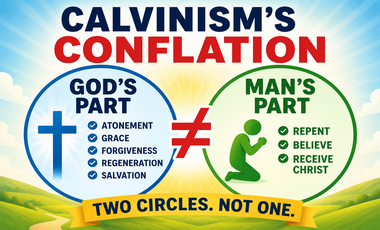
This first graphic is from Leighton Flowers discussion of the circles in the following article:

THE CONFLATION OF THE CALVINIST

In my reading of a book critique (written by Calvinistic scholar Broughton Knox in reply to an Arminian scholar Howard Marshall) I happened upon another prime example of the Calvinistic conflation that we have discussed a number of times. Knox wrote:

“The Pelagian mind is inclined to ascribe, shall we say, 5% to God and 95% to man, the semi-Pelagian 50%-50%, while the evangelical Arminian, such as our writer, 95% to God and 5% to man. Yet, after all, it is this last 5% which makes the difference between heaven and hell, so that man is, in the end, his own saviour.”

I must ask this vital question: What exactly are these percentages representing? We (non-Calvinistic “pelagians”) are ascribing 95% OF WHAT to God?

95% of man’s desires?

95% of man’s sin?

95% of man’s choices?

95% of Christ’s provision of atonement?

95% of salvation?

95% of WHAT!?!

It seems to me that in the well-meant effort of the Calvinist to ascribe all good things to God they have unintentionally also ascribed all bad things to Him. So, while the Calvinist seems most concerned with making sure mankind takes no credit for their salvation, the non-Calvinist seems more concerned with a recognizably good and Holy God. I suspect both men have a noble purpose in their pursuits, but as with most disputes the balance is somewhere in the middle.

But this balance cannot be seen in dividing vaguely defined percentages of what is to be ascribed to God and to man. Salvation is 100% of God. Merely affirming the responsibility of mankind to accept and/or reject God’s appeals for reconciliation does not in any way affect that percentage.

Only when a Calvinist, like Knox in the quote above, conflates man’s choice to humbly repent in faith with God’s choice to save whosoever does so are these types of dilemmas created. In other words, Calvinists have created a dilemma by conflating two choices as if they were one and calling them both “salvation.”

For instance, the prodigal son’s choice to return home is distinct from the father’s choice to redeem him once he arrives. To treat those two distinct choices as if they were one in the same [i.e. under the meticulous control of the father] creates an unnecessary dilemma.

Likewise, a sinner’s choice to repent in response to God’s appeals for reconciliation is distinct from God’s choice to provide those means of reconciliation through Christ’s blood. Thus, God is always the decisive cause of who He saves and the means by which He saves them. And mankind is the decisive cause of his own sin and his choice to repent of it. Only by conflating these two distinct choices is the Calvinistic dilemma really a dilemma at all.

God is 100% responsible for his choices.

Man is 100% responsible for his choices.

There is no dilemma here.

These next two “circle graphs” are based on chapter two (God’s Part and Man’s)of A.W. Tozer’s book, “Paths to Power.” The only difference between the two is one is basic, the one that follows chapter two is the same, but jazzed up. And if you are not picking up what Tozer is laying down, he is calling out [in the future] the Pipers, MacArthurs, Sprouls, etc.; as well as concurrent authors like A.W. Pink.

Here is chapter two (also, the PDF):

Failure to distinguish the part of God from the part of man in salvation has prevented countless seekers from finding peace, and left whole sections of the Church of Christ powerless for long periods of time.

Let it be boldly stated that there are some things which only God can do, and for us to attempt to do them is to waste our efforts; and there are other things Which only man can do, and for us to ask God to do them is to waste our prayers. It is vain for us to try to do the work which can only be done by sovereign grace; it is equally vain for us to implore God to do what has been commanded by sovereign authority.

Among the things which only God can do, of first importance to us is the work of redemption. Atonement was accomplished in that holy place where none but a divine Saviour could come. That glorious work owes nothing to the effort of any man; the best of Adam’s race could add nothing there. It was all of God, and man could simply have no part.

Redemption is an objective fact. It is a work potentially saving, wrought for man, but done independent of and exterior to the individual. Christ’s work on Calvary made atonement for every man, but it did not save any man.

Salvation is personal. It is redemption made effective toward the individual. Salvation is the work of God in the heart, made possible by the work of God on the Cross. Both the once-done work of redemption and the many-times-multiplied work of salvation are in the class of things which only God can do. No man can forgive his own sins; no man can regenerate his own heart; no man can declare himself justified and clean. All this is the work of God in man, flowing out of the work which Christ has already done for man. Universal atonement makes salvation universally available, but it does not make it universally effective toward the individual.

If atonement was made for all men, why are not all saved? The answer is that before redemption becomes effective toward the individual man there is an act which that man must do. That act is not one of merit, but of condition. And it is an act of eternal importance to us because its non-fulfillment prevents us from receiving the effective work of Christ in personal salvation. This act of appropriating salvation is one which only man can do.

The orthodoxy of our day is afraid to face this truth. We have been schooled in the doctrine of grace, and we fear to state things so baldly lest we rob grace of its glory and detract from the finished work of Christ. But it is a mistake to speak softly on a subject so vital to the soul. We should get the distinction clear and then be as bold as the truth compels us to be. We need not fear that we shall steal away the glory of God by honoring the truth He Himself has revealed. Failure to distinguish God’s part from man’s has resulted in mental confusion and moral inaction among Christians. Assurance and power require that we know and do the truth as revealed to us in the Sacred Word.

In the things-which-God-cannot-do category is this: God cannot do our repenting for us. In our efforts to magnify grace we have so preached the truth as to convey the impression that repentance is a work of God. This is a grave mistake, and one which is taking a frightful toll among Christians everywhere. God has commanded all men to repent. It is a work which only they can do. It is morally impossible for one person to repent for another. Even Christ could not do this. He could die for us, but He cannot do our repenting for us.

God in His mercy may “incline” us to repent and by His inworking Spirit assist us to repent; but before we can be saved we must of our own free will repent toward God and believe in Jesus Christ. This the Bible plainly teaches; this experience abundantly supports. Repentance involves moral reformation. The wrong practices are on man’s part, and only man can correct them. Lying, for instance, is an act of man and one for which he must accept full responsibility. When he repents he will quit lying. God will not quit for him; he will quit for himself.

When stated thus frankly everything seems obvious enough, and we may wonder how reasonable persons could expect someone else to relieve them of their personal obligation to repent. In practice, however, and under the pressure of strong religious emotion, things are not so plain as one might suppose. The fact is, the “all has been done, you can do nothing” emphasis has caused no end of confusion among seekers everywhere. People are told they must surely perish because of what they are, not because of what they do; what they do does not enter into the picture at all. And furthermore, they can do nothing in the direction of salvation; even to suggest such a thing is to offend God: is not the horrible example of Cain enough to prove that? So, they are tossed helplessly between the first Adam and the last Adam. One did their sinning for them and the other has done everything else. Thus, the nerve of their moral life is cut and they sink back in despair, afraid to move lest they be guilty of sinful self-effort. At the same time they are deeply troubled with the knowledge that there is something seriously wrong with their religious lives. The remedy is to see clearly that men are not lost because of what someone did thousands of years ago; they are lost because they sin individually and in person. We will never be judged for Adam’s sin, but for our own. For our own sins we are and must remain fully responsible until they have been brought for disposition to the Cross of Jesus. The idea that we can delegate repentance is an erroneous inference drawn from the doctrine of grace wrongly presented and imperfectly understood.

Another thing God cannot do: He cannot believe for us. Faith is a gift of God, to be sure, but whether or not we shall act upon that faith lies altogether within our own power. We may or we may not, as we choose. True belief requires that we change our attitude toward God. It means that we not only acknowledge His trustworthiness but go on to trust His promises and obey His commandments. That is Bible faith; anything less is self-deception. Where God is the object of faith He cannot be the subject also. The repentant sinner is the subject, and as such he must put his faith in Christ as his Saviour. This he must do for himself. God may help him, He may wait long and be patient, but He can never take his place and do the act for him.

The day when it is once more understood that God will not be responsible for our sin and unbelief will be a glad one for the Church of Christ. The realization that we are personally responsible for our individual sins may be a shock to our hearts, but it will clear the air and remove the uncertainty. Returning sinners waste their time begging God to perform the very acts He has sternly commanded them to do. He will not argue with them; He will simply leave them to their disappointment. Unbelief is a great sin; or more accurately stated, it is an evidence of sins unconfessed. Repent and believe is the order. Faith will follow repentance, and salvation will be the outcome.

Any interpretation of free grace which relieves the sinner of responsibility to repent is not of God nor in accordance with revealed truth. Nor is God responsible to help us to repent. He owes us nothing but justice. The only man who actually gets his just deserts is the man who dies in sin and goes unblessed to judgment. All others are objects of unearned mercy. To wait for God to help us to repent, or to believe that He is morally obliged to do so, is to misunderstand the whole plan of salvation.

Just what has all this to do with the lack of power in our churches? Very much indeed. Millions begin their religious lives without understanding their moral duty to God. They try to believe without having first repented. They try to have faith without intending to bring their lives into moral conformity with the will of God. Consequently, they are not clear about anything. They are full of doubts and hidden perplexities. They are secretly disappointed with their lives, and are for the most part joyless and without enthusiasm. It is hard to extract much delight from uncertainty.

There is no use exhorting such would-be Christians to seek power; no use talking to them about the surrendered life. They simply cannot understand it. They listen to the sermon and then go their way, waiting in vain for God to do the things He has commanded them to do. Until this is corrected we can hope for very little power in our churches.

  • Within the Non-Calvinist camp, there are at least two nuanced views on how God allows sinners to respond in faith. The first view is the Arminian view — which says that God’s work of grace (prevenient grace) for all people is needed to enable any sinner to freely choose to respond in faith to the Gospel message. The second view is the Provisionist View — which says that the Gospel message itself [see more below]  is God’s work of grace so that when it is preached to all people, any sinner can freely choose to respond in faith. The proclamation of the Gospel is powerfully sufficient enough to bring salvation to those who will believe. While the Arminian and the Provisionist each have a different take on why all humans can respond to God’s offer, these two views both affirm the importance of God’s initiative of grace to invite all sinners to salvation. (from the book Grace For All: Understanding God’s Plan of Salvation).

Michael R. Cariño

The “More Below”

Grace Enablements

Includes but are not limited to: God’s salvific love for all (John 3:16), God’s manifestation of his power so that all may know he is the Sovereign (Isa 45:21–22) and Creator (Rom 1:18–20), which assures that everyone has opportunity to know about him. Christ paying for all sins (John 1:29), conviction of the Holy Spirit (John 16:7–11), working of the Holy Spirit (Heb 6:1–6), enlightening of the Son (John 1:9), God’s teaching (John 6:45), God opening minds and hearts (Luke 24:45; Acts 16:14; 26:17–18;), and the power of the gospel (Rom 1:16), without such redemptive grace, no one seeks or comes to God (Rom 3:11).

Because of these gracious provisions and workings of God, man can choose to seek and find God (Jer 29:13; Acts 17:11–12). Moreover, no one can come to God without God calling (Acts 2:39), drawing (John 6:44), and that God is drawing all individuals (John 12:32). The same Greek word for draw, helkuō, is used in both verses. “About 115 passages condition salvation on believing alone, and about 35 simply on faith.” Other grace enablements may include providential workings in and through other people, situations, and timing or circumstances that are a part of grace to provide an opportunity for every individual to choose to follow Christ.

These are grace enablements in at least three ways; first, they are provided by God’s grace rather than deserved by mankind; second, the necessary components for each and every individual to have a genuine opportunity to believe unto salvation are provided or restored by God; third, they are provided by God without respect to whether the individual will believe or reject, which response God knew in eternity past.

The offer of the gospel is unconditional, but God sovereignly determined to condition the reception of the offer upon grace-enabled faith; therefore, faith is not reflective of a work or virtue of man, but of God’s sovereign plan of salvation by grace through faith (Eph 2:8). This indicates faith is the means to being regenerated and saved, not the reason for being saved. This truth of Scripture does not imply God is held captive to the choice of man, but rather it demonstrates God in eternity coextensively determined to create man with otherwise choice and provide a genuine offer of salvation, which can be accepted by grace-enabled faith or rejected. Additionally, to fulfill this plan, God is not obligated to disseminate the gospel to people he knows have rejected the light he has given them (Rom 1:18–23) and will also reject the gospel; although he may still send the gospel to them.
FAULTY DOCTRINE (Hippity Hoppity) Faith Distorted

Originally posted April of 2013, UPDATED (1/15/2026) with Calvinist distortions.
JUMP TO UPDATE

I am including this here because in my now closing in on a year of studies, I clearly saw this “faith distortion” a few months ago. So I am including this video with my Facebook description here:

This was awesome to hear — listened to today (1-14-2026). I made this point in my small group, which was: having been raised in the Word Faith/”name it and claim it” type Christianity, I noticed that Calvinist’s adopt a view of faith that is the same, when describing their opponents. That is, “Faith in your faith”, to wit:

  • Many of the WOFM’s doctrines are linked directly to the mistaken concept that faith is a literal substance, “a power force a tangible force a conductive force.”

— According to Kenneth E. Hagin, faith in one’s own faith is the secret to getting every desire of the heart.

This delapitated/false view of faith is what Calvinists think all non-Calvinists express. And that is a wrong supposition, or view of what faith is. It is a straw man. I was happy to hear that connection I thought of from Doc Flowers.

SOTO 101’s full episode

Originally posted April of 2013, UPDATED (2/8/2024) with the NET Bible and commentary at the end.

Here is a quick 101 on the history of the Word Faith via GOT QUESTIONS:

The Word of Faith movement grew out of the Pentecostal movement in the late 20th century. Its founder was E. W. Kenyon, who studied the metaphysical New Thought teachings of Phineas Quimby. Mind science (where “name it and claim it” originated) was combined with Pentecostalism, resulting in a peculiar mix of orthodox Christianity and mysticism. Kenneth Hagin, in turn, studied under E. W. Kenyon and made the Word of Faith movement what it is today. Although individual teachings range from completely heretical to completely ridiculous, what follows is the basic theology most Word of Faith teachers align themselves with.

At the heart of the Word of Faith movement is the belief in the “force of faith.” It is believed words can be used to manipulate the faith-force, and thus actually create what they believe Scripture promises (health and wealth). Laws supposedly governing the faith-force are said to operate independently of God’s sovereign will and that God Himself is subject to these laws. This is nothing short of idolatry, turning our faith—and by extension ourselves—into god.

From here, its theology just strays further and further from Scripture: it claims that God created human beings in His literal, physical image as little gods. Before the fall, humans had the potential to call things into existence by using the faith-force. After the fall, humans took on Satan’s nature and lost the ability to call things into existence. In order to correct this situation, Jesus Christ gave up His divinity and became a man, died spiritually, took Satan’s nature upon Himself, went to hell, was born again, and rose from the dead with God’s nature. After this, Jesus sent the Holy Spirit to replicate the Incarnation in believers so they could become little gods as God had originally intended.

Following the natural progression of these teachings, as little gods we again have the ability to manipulate the faith-force and become prosperous in all areas of life. Illness, sin, and failure are the result of a lack of faith, and are remedied by confession—claiming God’s promises for oneself into existence. Simply put, the Word of Faith movement exalts man to god-status and reduces God to man-status. Needless to say, this is a false representation of what Christianity is all about. Obviously, Word of Faith teaching does not take into account what is found in Scripture. Personal revelation, not Scripture, is highly relied upon in order to come up with such absurd beliefs, which is just one more proof of its heretical nature.

[….]

The Word of Faith movement is deceiving countless people, causing them to grasp after a way of life and faith that is not biblical. At its core is the same lie Satan has been telling since the Garden: “You shall be as God” (Genesis 3:5). Sadly, those who buy into the Word of Faith movement are still listening to him. Our hope is in the Lord, not in our own words, not even in our own faith (Psalm 33:20-22). Our faith comes from God in the first place (Ephesians 2:8Hebrews 12:2) and is not something we create for ourselves. So, be wary of the Word of Faith movement and any church that aligns itself with Word of Faith teachings.

Here is an example of one verse striped of context via the Word Faith movement:

Geisler & Rhodes opine:

JOSHUA 1:8—Is this verse a key to financial prosperity, as Word-Faith teachers suggest?

MISINTERPRETATION: Joshua 1:8 says, “This book of the law shall not depart from your mouth, but you shall meditate on it day and night, so that you may be careful to do according to all that is written in it; for then you will make your way prosperous, and then you will have suc­cess” (NASB). Word-Faith teachers say this verse is a key to financial pros­perity.

CORRECTING THE MISINTERPRETATION: Word-Faith teach­ers are reading a meaning into this verse that is not there. The context of this verse is military, not financial. In fact, finances are nowhere in sight in this entire chapter of Joshua.

In the conquest of the Promised Land, God promised Joshua that his military efforts would prosper if he maintained his commitment to meditate upon and obey God’s Word. The prospering also no doubt includes the full outworking of the land promises that were given uncon­ditionally by God in the Abrahamic Covenant (Gen. 12:1-3). Later, just before his death, Joshua urged the people to continue living in sub­mission to the Scriptures (Josh. 23:6).

What a healthy view of this Joshua verse is this:

… Sometimes we misunderstand what it means, ‘to succeed’ or ‘to prosper’ which has given rise to a prosperity teaching which places the emphasis on temporal, worldly prosperity rather than eternal spiritual wealth. God may choose to bestow worldly wealth on His children or He may permit the alternative, but the goods and chattel of this world are passing away, and like Paul we need to be content in all things.

What is important, is to know the Word of God, to trust the Word of God, and to apply the Word of God in every circumstance of life, knowing that to do so will lead to success in the Christian life; for all things work together for good to those that love the Lord and trust His Word.

We should read, mark, learn, and inwardly digest the Word of the Lord. We should study God’s Book of instruction, particularly those passages that relate specifically to the Church, and we should continually feed on His Word in our hearts by faith with thanksgiving.

We should meditate on His Word, memorize His Word, trust His Word, and love His Word, and we should be sure to obey His Word and apply His Word in our daily lives, for in so doing we will certainly prosper and succeed in all we do, to His praise and glory….

Or s the NET BIBLE rewords a bit:

1:8 This law scroll must not leave your lips! You must memorize it day and night so you can carefully obey all that is written in it. Then you will prosper and be successful.

1:9 I repeat, be strong and brave! Don’t be afraid and don’t panic, for I, the LORD your God, am with you in all you do.”


Biblical Studies Press, The NET Bible First Edition; Bible. English. NET Bible.; The NET Bible (Biblical Studies Press, 2005), Jos 1:7–9.

A decent extended commentary can be found here to help separate the wheat from the Chaff, as competing theologies fight over interpreting verses:

1:6–9. The second half of God’s speech also begins with two imperatives (“Be strong and courageous”), though these two are effectively synonyms. These imperatives follow logically from the promise of verse 5—if no one could resist Joshua, then there was no basis for fear. Instead, as leader he was to distribute the land that God had sworn to give to their ancestors (adapting phrasing found five times in Deuteronomy). The land is thus simultaneously God’s gift and something to be claimed and allotted. Verse 7 provides a more specific focus for Joshua: He was to be strong and very courageous in carefully observing all the instruction (תּוֹרָה) that God had given through Moses. This was not simply a set of facts to be known but rather a life that was to be lived—and living this life would take effort. Drawing on the common metaphor of life as a journey, the idea is that Joshua should stay on the path that this instruction provides rather than take alternative routes, for this is the means by which he would succeed. This success is related to the task that God had given Joshua, so walking faithfully in the Mosaic instruction was the means by which Joshua could lead the people into the land that God had promised.

Joshua was to meditate (הָגָה) on this instruction. The verb, with a similar promise of success, also occurs in Ps 1:2 and means something like “growl” or “mutter.” This verbal element is more apparent in Ps 2:1, where it is translated “plot.” It is difficult to match this word to a single English verb since “meditate” is often thought of as a silent activity. That the instruction was to be in Joshua’s “mouth” is an idiom that goes naturally with the verb. Thus, he would continue reflecting on its meaning, with such reflection being verbal. This relates to the fact that reading in the ancient world meant reading aloud. In the same way, reflection on it was verbal. But what matters in particular is that Joshua’s life was to be shaped by faithfulness to God’s instruction. At this stage in the book we might think of this as unproblematic, but as the ensuing chapters unfold it becomes clear that Joshua would need to wrestle with the intent of the instruction in order to determine how it was to be applied in a range of circumstances. This would require seeing the instruction as guidance for situations that would be faced rather than as a comprehensive set of rules that could simply be applied. Joshua would need a deep knowledge of God’s instruction, which meant both knowing its content and reflecting on how it could be applied. Therefore, it could not depart from his mouth, because only by continued recitation/meditation could he both know it and understand how to apply it. Psalm 1 then broadens out this possibility for all believers.

God’s speech then concludes with a reminder of the command to be strong and courageous so that Joshua would understand there is no place for fear because Yahweh would go with him. Joshua could succeed and lead his people to success when he understood that his role as a leader was to journey with God, know God’s instruction, and shape his life by it. Success here does not mean something financial but to receive the things that God is giving. We might perhaps think of “success” as flourishing in the life God has prepared—which is the way it is developed in Psalm 1. Here, that flourishing would be military, as Israel received the land God gave.


David G. Firth, JOSHUA, ed. T. Desmond Alexander, Thomas R. Schreiner, and Andreas J. Köstenberger, Evangelical Biblical Theology Commentary (Bellingham, WA: Lexham Press, 2021), 72–74.

This from CROSS WISE (2011) explaining a bit about the above:

In light of another Calvary Chapel pastor making an appearance on TBN’s Praise-the-Lord program, I thought it apropos to share a tape in my collection of how a Bible believer should behave when invited onto TBN or any of the other errant “Christian” networks. What sort of message is communicated when a solid Bible teacher shares the platform with heretics and does not bring reproof? Certainly it gives the impression that the guest endorses the teaching of the hosts and /or founder of the Christian network.

Some argue that if they can’t go on TBN due to its corruption, then they couldn’t show up on ABC, NBC or CBS either. They don’t understand the distinction between being salt and light to the unsaved world and practicing biblical separation from so-called Christians who are spreading false teaching against Jesus Christ. To the unsaved, we can use their media to spread the Gospel, but to the errant brother we are to bring correction and divide if they do not stop their false teaching. For a proof-text consider 1 Corinthians 5:11:

But actually, I wrote to you not to associate with any so-called a brother if he is an immoral person, or covetous, or ban idolater, or a reviler, or a drunkard, or a swindler—not even to eat with such a one. (NASB)

When Calvary Chapel Albuquerque’s pastor Skip Heitzig went on TBN last week acting like he and his host Phil Munsey were old friends, it was a shame to the spirit of that passage. Phil Munsey and his brother Steve Munsey are two of the most infamous extortioners in the field of Christian television. Munsey has used new age ideas of paradigm shifts and panentheism to spread his unbiblical dominionist views.

In contrast to the compromisers, the late Walter Martin tried to bring correction the last time he made an appearance on TBN. This video tape has never circulated and has not been available anywhere until now that I have posted it to YouTube.

Back in 1985 my younger sister was Martin’s secretary. She and my older sister and I all regularly attended his weekly Bible study. I used to share my research with him and also with my friend author Dave Hunt. Walter and Dave disagreed on many things regarding their styles of apologetics and discernment. Whenever there was a difference of opinion between the two of them, I usually agreed with Dave.

I had had some discussion with Dr. Martin over Dave’s book, The Seduction of Christianity. Walter had been critical about it on the radio having never read it but based his criticisms upon what his personal editor had told him.

One day my older sister was watching Praise-the-Lord when Hal Lindsey was a guest. He was her pastor at that time. Back then Hal used to challenge the teaching of other TBN regulars and Paul Crouch put up with it. However, that got old with the Crouches and when Hal wouldn’t stop criticizing the Kingdom Now doctrine, he was put on the shelf until he learned to kow-tow to them. When my sister heard Hal bring up Walter’s name in the show, Paul and Jan agreed that he was a brilliant man and Hal said you should have him on some time. They both responded – oh sure we will.

So she informed our little sister who told Walter and Walter told her to call TBN and arrange it which she did. However, the Crouches wouldn’t host him so they got prophecy teacher Doug Clark to do so. My younger sister called me on the day of the taping saying that Walter wanted me to go through Dave Hunt’s book, The Seduction of Christianity and highlight things he would be in agreement with. I was happy to do so for him. He used that information to challenge TBN’s blackballing of Dave Hunt and other whistle-blowers.

I stayed home to work the VCR I didn’t know how to program, while my two sisters attended, one in the green room and one in the audience we had stacked with many friends. Walter gave it to them with both barrels. Not only was the program not replayed at its regular slot, but the tapes were not available when people followed up to request one. Back in those days any Praise-the-Lord program could be bought on audio cassette for a small fee. And both Walter Martin and Doug Clark were never invited back. We had heard years later from Doug Clark that during the interview he kept receiving notes from the stage manager telling him to “shut that guy up” and other nasty notes….

Canon and Sola [not Solo] Scriptura (Α – Ω Ministries)

Today I was joined by Dr. Michael Kruger, President of Reformed Theological Seminary in Charlotte, North Carolina. Dr. Kruger has written numerous books that are high on our “you must read this book” list, such as Canon Revisited and The Question of Canon; he likewise contributed to and edited The Heresy of Orthodoxy and The Early Text of the New Testament. Our visit was prompted by a phone call made by a Lutheran to Catholic Answers Live back on 10/31/13. We played the entire call before the program started, and we played the heart of the call, where the Roman Catholic priest made the key assertions about canon and scriptural authority, during the interview with Dr. Kruger. We covered a wide variety of topics relevant to the canon issue. Truly one of the most useful programs we’ve ever done! Enjoy and learn!

Talked a bit about a few current events at the start (played video from Mars, for example), but the focus today was on sola scriptura, what it means, why it is central, and why I am simply stunned to see men I used to stand shoulder-to-shoulder with using the phrase as a throw-away joke line on Twitter. Please listen and consider well!

After we spent a little time on some positive reports of God’s grace, and then a few minutes on some negative developments of more rebellion and insanity coming out of Disney, we dove into a fully discussion of tradition, the canon, and finally looking at a series of Tweets by Steve Meister on the table of contents of your Bible as a form of “inescapable tradition.”

Response to Hank Hanegraaff

(PART 1) I was pointed this morning to a video of Hank Hanegraaff (joined by Dr. Nathan Jacobs) attacking the doctrine of sola scriptura.  Given I debated Jimmy Akin and Tim Staples (Roman Catholics) on The Bible Answer Man Broadcast decades ago, I felt it necessary (and useful) to begin a response to the claims made.  Nothing new as we have surely addressed all of this in the recent past and literally since the 1990s.  But important as the topic remains central.  I still have nine minutes left to review, and I think another video on the eucharist is due out soon as well.  We will continue the review on Tuesday.

(PART 2) As promised I continued in my response to Hank Hanegraaff’s attack on sola scriptura, finishing up the entire video, dealing with a wide variety of issues.  Important stuff for those looking at or dealing with Eastern Orthodoxy.  May be doing a program again tomorrow.

If you are active in reaching out to our Roman Catholic friends and family members, this is an important program for you. We spent most of our time going deeply into a clip from CA Live on “tradition” in the Bible. Then we played a brief clip from the British Parliament on critical race theory that was real encouraging, and finished off with looking at France’s vain attempt to create a “secular” form of Islam.