God’s Love, Election, and Atonement
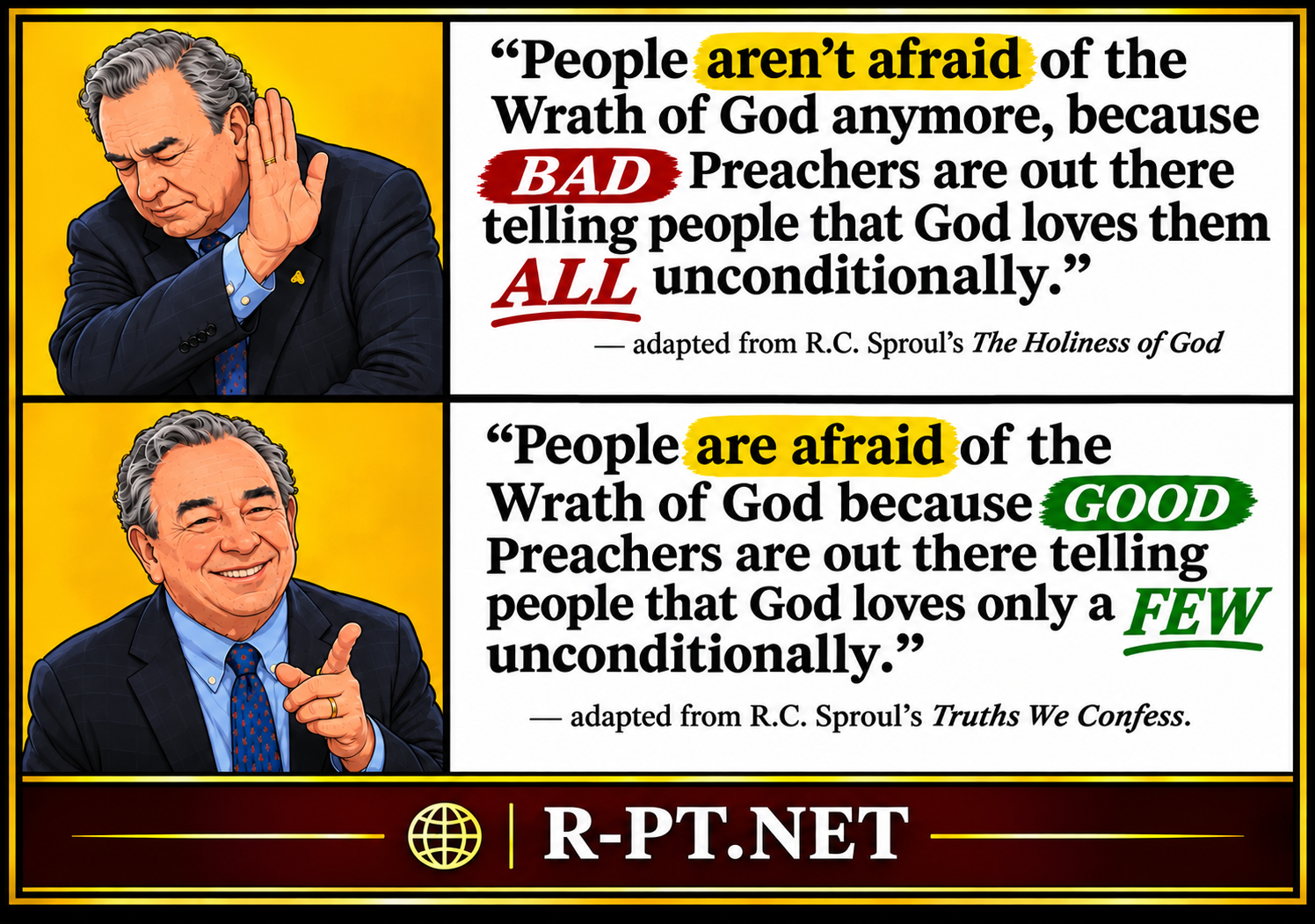
| THE CENTRAL CONTRAST Sproul criticizes preachers who tell people indiscriminately that God loves them unconditionally. But elsewhere he explicitly teaches that God loves the elect unconditionally. The question, then, is whether the logical opposite of the preaching he criticizes becomes the standard for “good” preaching in his own theological framework. In that sense, the argument becomes “Sproul vs. Sproul.” |
1. The Holiness of God (1985)
- “People aren’t afraid of the wrath of God anymore because preachers are out there telling people that God loves them unconditionally.”
— Adapted from R.C. Sproul, The Holiness of God (Wheaton, IL: Tyndale House, 1985), p. 12.
2. Truths We Confess: A Layman’s Guide to the Westminster Confession of Faith
(3-volume combined, 2019)
- “It is true that God loves the elect unconditionally…”
— R.C. Sproul, Truths We Confess: A Layman’s Guide to the Westminster Confession of Faith, p. 452.
- “In the case of the elect, God extends mercy. In the case of the reprobate, He withholds it.”
— R.C. Sproul, Truths We Confess, p. 119.
- “Christ died for the elect—and only for them.”
— R.C. Sproul, Truths We Confess, p. 273.
- Sproul explains that Christ’s intercession is for the elect in a way that He does not intercede for the rest of the world.
— R.C. Sproul, Truths We Confess, discussion of Westminster Confession of Faith 8.8.
3. Essential Truths of the Christian Faith (1992)
Chapter 62 — “Definite Atonement”
- “God loves the whole world, but He does not save the whole world.”
— R.C. Sproul, Essential Truths of the Christian Faith, p. 177, Chapter 62, “Definite Atonement.”
- Sproul teaches that Christ’s atonement was designed and intended only for the elect, and that Christ laid down His life for His sheep.
— R.C. Sproul, Essential Truths of the Christian Faith, pp. 176–177, Chapter 62, “Definite Atonement.”
Chapter 57 — “Predestination and Reprobation”
- Sproul explains that God passes over the non-elect, leaving them in their sin, while the elect receive saving mercy.
— R.C. Sproul, Essential Truths of the Christian Faith, pp. 166–167, Chapter 57, “Predestination and Reprobation.”
- Discussing God’s statement that He loved Jacob but hated Esau, Sproul presents two interpretations: the absence of redemptive love, or actual divine hatred. He describes Esau as a vessel fit for destruction and worthy of God’s wrath and holy hatred, then concludes: “Let the reader decide.”
— R.C. Sproul, Essential Truths of the Christian Faith, p. 167, Chapter 57, “Predestination and Reprobation.”
A Humorous Aside: “He Leaves the Reader to Decide”
Sproul says, “Let the reader decide.” Apparently, the reader gets to choose between two interpretations—but not without divine ordination!
After all, Sproul assures us there isn’t a single maverick molecule loose in the universe. Surely that includes every molecule, every firing neuron, and every chemical process in the reader’s brain while deciding which interpretation to accept.
EVEN THE DECISION TO DECIDE ISN’T OUTSIDE THE DECREE!
Editorial note: The passage from The Holiness of God is identified as an adaptation, not a verbatim quotation. Other quoted wording is presented as quoted in the cited editions; explanatory summaries are not direct quotations.