Here is a summary of the excellent interview about the reasoning that led up to the actions the United States took against Venezuela. This is the link and description of the interview:
Gary Berntsen & Ralph Pezzullo explain how America’s enemies, foreign & domestic, are stealing the Republic. We dissect the controversial involvement of Smartmatic in the U.S. election system and explore the swirling allegations of manipulation and fraud. Our discussion probes deep into electoral malfeasance, questioning the integrity of the very systems that uphold our Republic. Expect a thorough examination of the evidence and sentiments surrounding these topics, drawing connections that extend all the way to Venezuela.
Here is a summary of the above podcast:
Summary of why it needed to be done outside of the ending of a communist regime and the freeing of an oppressed people.
BLUF: Venezuela operates as a hybrid narco-state and influence-operations hub, combining state-directed drug trafficking, transnational organized crime, espionage, and coordinated partnerships with hostile foreign powers, while leveraging covert political and information operations to undermine regional stability and U.S. national security.
Operating a global election-manipulation scheme originating in Venezuela, involving state-owned voting software (Smartmatic and successors), allegedly used to alter elections domestically, across Latin America, in the United States, and globally while defeating audits and concealing source code ownership
Running a state-led narcotics enterprise (Cartel de los Soles), with the Venezuelan military acting as the logistics arm and the president identified as the cartel’s leader
Weaponizing organized crime, including training and deploying gangs such as Tren de Aragua for foreign criminal and insurgent activity, including alleged operations inside the United States
Conducting long-term espionage and infiltration of U.S. diplomatic, intelligence, and political institutions, often in coordination with Cuban intelligence
Collaborating with hostile foreign powers (Cuba, China, Russia, Iran) to expand influence operations, fund destabilization efforts, and undermine U.S. national security
Exploiting U.S. government programs and taxpayer funds, allegedly using USAID-linked and NGO mechanisms to promote Venezuelan-origin election technology abroad
Establishing intelligence and political dominance in the Western Hemisphere, leveraging oil wealth, criminal revenue, and covert influence to shape regional governments
(Just a quick note on the graphic to the right… there is more info linked in the graphic… but this training in the lead up to this assault explains this training exercise accident. They were prepping heavily for this and accidental deaths are bound to happen)
THE AMERICAN SPECTATOR has a wonderful article that notes this has been in the legal making for quite a while
In the wake of the capture of Venezuelan dictator Nicolas Maduro, the United States is now forced to reckon with a record of depravity that is nothing short of a great human scandal. Indeed, the crimes of which Mr. Maduro has been credibly accused boggle the mind.
Maduro’s presence on American soil is the result of years of legal preparation and, according to Saturday’s press conference, months of operational planning. He arrives facing a lengthy federal indictment in the Southern District of New York. The charges are staggering: narco-terrorism conspiracy, cocaine importation conspiracy, and the possession of machine guns and destructive devices. The U.S. government alleges that Maduro functioned as the leader of the “Cartel de los Soles,” effectively converting the Venezuelan state into a criminal enterprise designed to flood American streets with poison while enriching a corrupt elite. He is also accused of stealing American oil and using the proceeds to fund his criminal endeavors and entrench his power.
But as grave as these narco-terrorism charges are, they only scratch the surface of Maduro’s evil. The current U.S. legal framework focuses on drugs and guns because they provide the clearest, most traditional path to a domestic conviction. However, the American people, the Venezuelan people, and indeed the whole world deserve more than a trial about smuggling routes, vessels, and the usual talking points of foreign policy hawks.
Moreover, an inconvenient truth arises for his apologists, both foreign adversaries and domestic stooges: if the Department of Justice is truly committed to the so-called “full wrath of American justice,” it must pursue explicit charges for the crimes against humanity that define Maduro’s tenure. One crime especially demands the sword: the detention and physical and sexual torture of children.
The International Criminal Court has, since 2021, been pursuing a formal investigation into credible reports of systematic torture, sexual violence, and political persecution. Children are among those most affected by these heinous abuses. Following the South American nation’s rigged 2024 election, at least 220 children were forcibly detained. Many were held in adult prisons and subjected to what Amnesty International has dubbed “endless cruelty.”
The UN Independent International Fact-Finding Mission has documented a “policy of repression” that specifically targets the young. Further, the Inter-American Commission on Human Rights alleges Maduro used the apparatus of the state — including legal cover provided by his wife, who has been indicted alongside him — to detain hundreds more children and subject them to unspeakable evil.
According to these reports, Maduro’s forces appear to have sexually tortured children and adolescents as young as 12 years old to extract sham confessions of “terrorism” and “treason.” Their “crime” was nothing more than attending pro-democracy protests with their parents. The methods used to extract these confessions included beatings, forced nudity, and coercive transactional sex from female children in exchange for basic needs. Most horrifyingly, reports from the UN confirm the use of electric shocks on the genitals of minors.
The United States must speak and act with crystalline clarity: the DOJ must immediately expand its charges against Maduro to include these crimes against children. Further, if convicted, Mr. Maduro has quite possibly forfeited his right to life. The same applies to the officials who performed and permitted these hellish acts — officials who, God willing, will also be brought to justice through the might of the American Armed Forces as the transition of power begins.
We are not merely discussing a failed communist experiment or a standard-issue autocrat. We are discussing a regime and a man that has likely systematically engaged in “anthropological murder” — the violent desecration of the human person and a war against the inviolable selfhood of the image-bearers of the Creator. To look upon the ruins of Maduro’s regime and offer only a shrug or sentencing for drug trafficking is to fail the most basic test of a just society. ….
And yes, this “God Tier Trolling” as Eric calls it is to counter the Mamdani speeach of “replac[ing] the frigidity of rugged individualism with the warmth of collectivism.” Audacious collectivism: that’s the Mamdani agenda — as the CITY JOURNAL calls it.
Let me also note that I have already seen the idea online that we are doing this for oil and minerals. I saw this same accusation during Dubya’s Iraq War… what was the actual outcome?
(CNNMoney.com) — “Despite claims by some critics that the Bush administration invaded Iraq to take control of its oil, the first contracts with major oil firms from Iraq’s new government are likely to go not to U.S. companies, but rather to companies from China, India, Vietnam, and Indonesia.” (MY UPDATED POST)
So similar to my post, I doubt you will see forced contracts with Venezuela over oil and mineral rights/purchases. But that aside, AND? So what if we want a free government by democratic process to install a free government… which would then not want to have contracts with the countries that came in and helped keep a dictator who lost the previous “election” and caused chaos while stealing their wealth.
My Gawd Man!
Full Interview: Marco Rubio on Venezuela | Meet the Press
(Originally posted in April of 2015. New media added)
…the Founders hated democracy and left behind a REPUBLIC OF HIERARCHY, not a Democracy of Equality
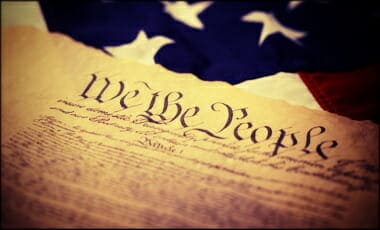
Take note of Article IV, Section 4 of the Constitution reads:
“The United States shall guarantee to every state in this union a republican form of government…”
I tell my kids that we do not have a democracy, but a Democratic REPUBLIC; and I am basing these on the Constitution and the authors (and signers) understanding of it (commonly referred to as “original intent”). Our Founders had an opportunity to establish a democracy in America but chose not to. In fact, they made very clear that we were not – and never to become – a democracy:
James Madison (fourth President, co-author of the Federalist Papers and the “father” of the Constitution) – “Democracies have ever been spectacles of turbulence and contention; have ever been found incompatible with personal security, or the rights of property; and have, in general; been as short in their lives as they have been violent in their deaths.”
John Adams(American political philosopher, first vice President and second President) – “Remember, democracy never lasts long. It soon wastes, exhausts, and murders itself. There never was a democracy yet that did not commit suicide.”
Benjamin Rush (signer of the Declaration) – “A simple democracy… is one of the greatest of evils.”
Fisher Ames (American political thinker and leader of the federalists [he entered Harvard at twelve and graduated by sixteen], author of the House language for the First Amendment) – “A democracy is a volcano which conceals the fiery materials of its own destruction. These will provide an eruption and carry desolation in their way.´ / “The known propensity of a democracy is to licentiousness [excessive license] which the ambitious call, and the ignorant believe to be liberty.”
Governor Morris(signer and penman of the Constitution) – “We have seen the tumult of democracy terminate… as [it has] everywhere terminated, in despotism…. Democracy! Savage and wild. Thou who wouldst bring down the virtous and wise to thy level of folly and guilt.”
John Quincy Adams (sixth President, son of John Adams [see above]) – “The experience of all former ages had shown that of all human governments, democracy was the most unstable, fluctuating and short-lived.”
Noah Webster (American educator and journalist as well as publishing the first dictionary) – “In democracy… there are commonly tumults and disorders….. therefore a pure democracy is generally a very bad government. It is often the most tyrannical government on earth.”
John Witherspoon (signer of the Declaration of Independence) – “Pure democracy cannot subsist long nor be carried far into the departments of state – it is very subject to caprice and the madness of popular rage.”
Zephaniah Swift(author of America’s first legal text) – “It may generally be remarked that the more a government [or state] resembles a pure democracy the more they abound with disorder and confusion.”
Critics have long derided the Electoral College as a fusty relic of a bygone era, an unnecessary institution that one day might undermine democracy by electing a minority president. That day has arrived, assuming Gov. Bush wins the Florida recount as seems likely.
The fact that Bush is poised to become president without a plurality of the vote contravenes neither the letter nor the spirit of the Constitution. The wording of our basic law is clear: The winner in the Electoral College takes office as president. But what of the spirit of our institutions? Are we not a democracy that honors the will of the people? The very question indicates a misunderstanding of our Constitution.
James Madison’s famous Federalist No. 10 makes clear that the Founders fashioned a republic, not a pure democracy. To be sure, they knew that the consent of the governed was the ultimate basis of government, but the Founders denied that such consent could be reduced to simple majority or plurality rule. In fact, nothing could be more alien to the spirit of American constitutionalism than equating democracy will the direct, unrefined will of the people.
Recall the ways our constitution puts limits on any unchecked power, including the arbitrary will of the people. Power at the national level is divided among the three branches, each reflecting a different constituency. Power is divided yet again between the national government and the states. Madison noted that these two-fold divisions — the separation of powers and federalism — provided a “double security” for the rights of the people.
What about the democratic principle of one person, one vote? Isn’t that principle essential to our form of government? The Founders’ handiwork says otherwise. Neither the Senate, nor the Supreme Court, nor the president is elected on the basis of one person, one vote. That’s why a state like Montana, with 883,000 residents, gets the same number of Senators as California, with 33 million people. Consistency would require that if we abolish the Electoral College, we rid ourselves of the Senate as well. Are we ready to do that?
The filtering of the popular will through the Electoral College is an affirmation, rather than a betrayal, of the American republic. Doing away with the Electoral College would breach our fidelity to the spirit of the Constitution, a document expressly written to thwart the excesses of majoritarianism. Nonetheless, such fidelity will strike some as blind adherence to the past. For those skeptics, I would point out two other advantages the Electoral College offers.
First, we must keep in mind the likely effects of direct popular election of the president. We would probably see elections dominated by the most populous regions of the country or by several large metropolitan areas. In the 2000 election, for example, Vice President Gore could have put together a plurality or majority in the Northeast, parts of the Midwest, and California.
The victims in such elections would be those regions too sparsely populated to merit the attention of presidential candidates. Pure democrats would hardly regret that diminished status, but I wonder if a large and diverse nation should write off whole parts of its territory. We should keep in mind the regional conflicts that have plagued large and diverse nations like India, China, and Russia. The Electoral College is a good antidote to the poison of regionalism because it forces presidential candidates to seek support throughout the nation. By making sure no state will be left behind, it provides a measure of coherence to our nation.
Second, the Electoral College makes sure that the states count in presidential elections. As such, it is an important part of our federalist system — a system worth preserving. Historically, federalism is central to our grand constitutional effort to restrain power, but even in our own time we have found that devolving power to the states leads to important policy innovations (welfare reform).
If the Founders had wished to create a pure democracy, they would have done so. Those who now wish to do away with the Electoral College are welcome to amend the Constitution, but if they succeed, they will be taking America further away from its roots as a constitutional republic.
How did the terms “Elector” and “Electoral College” come into usage?
The term “electoral college” does not appear in the Constitution. Article II of the Constitution and the 12th Amendment refer to “electors,” but not to the “electoral college.” In the Federalist Papers (No. 68), Alexander Hamilton refers to the process of selecting the Executive, and refers to “the people of each State (who) shall choose a number of persons as electors,” but he does not use the term “electoral college.”
The founders appropriated the concept of electors from the Holy Roman Empire (962 – 1806). An elector was one of a number of princes of the various German states within the Holy Roman Empire who had a right to participate in the election of the German king (who generally was crowned as emperor). The term “college” (from the Latin collegium), refers to a body of persons that act as a unit, as in the college of cardinals who advise the Pope and vote in papal elections. In the early 1800’s, the term “electoral college” came into general usage as the unofficial designation for the group of citizens selected to cast votes for President and Vice President. It was first written into Federal law in 1845, and today the term appears in 3 U.S.C. section 4, in the section heading and in the text as “college of electors.”…
Hillary Clinton again calls for the Electoral College to be nixed:
Mark Levin does a few second response to this idiocy:
CIVICS 101
“…the possibility that the [Constitutional Republic] in which we live provides us with opportunities for [representation] that… exceed those provided by primitive orders to far fewer people should not be dismissed.”
I wanted to edit/adapt the above HAYEK quote to fit the broader idea that what our Founders created is the most fair to the most people. I will include the larger quote at the end, in context, as, it has nothing to do with what I adapted it to. As I was reading this section of “The Fatal Conceit: The Errors of Socialism,” I thought of the attempt by Democrats to do away with the Electoral College. Which immediately brought to mind that MORE voters will be disenfranchised if it is eliminated. Why? Because the popular vote could be won by almost 4-states alone: California, Texas, Florida, New York. So, let’s take the most recent election as an example:
The Democrat outpaced President-elect Donald Trump by almost 2.9 million votes, with 65,844,954 (48.2%) to his 62,979,879 (46.1%), according to revised and certified final election results from all 50 states and the District of Columbia. (CNN)
In the Electoral College world, the smaller states had a say and 2.9 million voters were “disenfranchised,” so-to-speak. In a direct democracy, which our Founders specifically wrote against, all a candidate would have to do is campaign in about 11-cities to win the election.
Do you understand what the Electoral College is? Or how it works? Or why America uses it to elect its presidents instead of just using a straight popular vote? Author, lawyer and Electoral College expert Tara Ross does, and she explains that to understand the Electoral College is to understand American democracy.
James Madison (fourth President, co-author of the Federalist Papers and the “father” of the Constitution) – “Democracies have ever been spectacles of turbulence and contention; have ever been found incompatible with personal security, or the rights of property; and have, in general; been as short in their lives as they have been violent in their deaths.”
John Adams (American political philosopher, first vice President and second President) – “Remember, democracy never lasts long. It soon wastes, exhausts, and murders itself. There never was a democracy yet that did not commit suicide.”
Benjamin Rush (signer of the Declaration) – “A simple democracy… is one of the greatest of evils.”
Fisher Ames (American political thinker and leader of the federalists [he entered Harvard at twelve and graduated by sixteen], author of the House language for the First Amendment) – “A democracy is a volcano which conceals the fiery materials of its own destruction. These will provide an eruption and carry desolation in their way.´ / “The known propensity of a democracy is to licentiousness [excessive license] which the ambitious call, and the ignorant believe to be liberty.”
Governor Morris (signer and penman of the Constitution) – “We have seen the tumult of democracy terminate… as [it has] everywhere terminated, in despotism…. Democracy! Savage and wild. Thou who wouldst bring down the virtous and wise to thy level of folly and guilt.”
John Quincy Adams (sixth President, son of John Adams [see above]) – “The experience of all former ages had shown that of all human governments, democracy was the most unstable, fluctuating and short-lived.”
Noah Webster (American educator and journalist as well as publishing the first dictionary) – “In democracy… there are commonly tumults and disorders….. therefore a pure democracy is generally a very bad government. It is often the most tyrannical government on earth.”
John Witherspoon (signer of the Declaration of Independence) – “Pure democracy cannot subsist long nor be carried far into the departments of state – it is very subject to caprice and the madness of popular rage.”
Zephaniah Swift (author of America’s first legal text) – “It may generally be remarked that the more a government [or state] resembles a pure democracy the more they abound with disorder and confusion.”
Take note that as well ArticleIV, Section4 of the Constitution reads:
“The United States shall guarantee to every state in this union a republican form of government…“
Right now, there’s a well-organized, below-the-radar effort to render the Electoral College effectively useless. It’s called the National Popular Vote, and it would turn our presidential elections into a majority-rule affair. Would this be good or bad? Author, lawyer, and Electoral College expert Tara Ross explains.
You vote, but then what? Discover how your individual vote contributes to the popular vote and your state’s electoral vote in different ways–and see how votes are counted on both state and national levels.
Critics have long derided the Electoral College as a fusty relic of a bygone era, an unnecessary institution that one day might undermine democracy by electing a minority president. That day has arrived, assuming Gov. Bush wins the Florida recount as seems likely.
The fact that Bush is poised to become president without a plurality of the vote contravenes neither the letter nor the spirit of the Constitution. The wording of our basic law is clear: The winner in the Electoral College takes office as president. But what of the spirit of our institutions? Are we not a democracy that honors the will of the people? The very question indicates a misunderstanding of our Constitution.
James Madison’s famous Federalist No. 10 makes clear that the Founders fashioned a republic, not a pure democracy. To be sure, they knew that the consent of the governed was the ultimate basis of government, but the Founders denied that such consent could be reduced to simple majority or plurality rule. In fact, nothing could be more alien to the spirit of American constitutionalism than equating democracy will the direct, unrefined will of the people.
Recall the ways our constitution puts limits on any unchecked power, including the arbitrary will of the people. Power at the national level is divided among the three branches, each reflecting a different constituency. Power is divided yet again between the national government and the states. Madison noted that these two-fold divisions — the separation of powers and federalism — provided a “double security” for the rights of the people.
What about the democratic principle of one person, one vote? Isn’t that principle essential to our form of government? The Founders’ handiwork says otherwise. Neither the Senate, nor the Supreme Court, nor the president is elected on the basis of one person, one vote. That’s why a state like Montana, with 883,000 residents, gets the same number of Senators as California, with 33 million people. Consistency would require that if we abolish the Electoral College, we rid ourselves of the Senate as well. Are we ready to do that?
The filtering of the popular will through the Electoral College is an affirmation, rather than a betrayal, of the American republic. Doing away with the Electoral College would breach our fidelity to the spirit of the Constitution, a document expressly written to thwart the excesses of majoritarianism. Nonetheless, such fidelity will strike some as blind adherence to the past. For those skeptics, I would point out two other advantages the Electoral College offers.
First, we must keep in mind the likely effects of direct popular election of the president. We would probably see elections dominated by the most populous regions of the country or by several large metropolitan areas. In the 2000 election, for example, Vice President Gore could have put together a plurality or majority in the Northeast, parts of the Midwest, and California.
The victims in such elections would be those regions too sparsely populated to merit the attention of presidential candidates. Pure democrats would hardly regret that diminished status, but I wonder if a large and diverse nation should write off whole parts of its territory. We should keep in mind the regional conflicts that have plagued large and diverse nations like India, China, and Russia. The Electoral College is a good antidote to the poison of regionalism because it forces presidential candidates to seek support throughout the nation. By making sure no state will be left behind, it provides a measure of coherence to our nation.
Second, the Electoral College makes sure that the states count in presidential elections. As such, it is an important part of our federalist system — a system worth preserving. Historically, federalism is central to our grand constitutional effort to restrain power, but even in our own time we have found that devolving power to the states leads to important policy innovations (welfare reform).
If the Founders had wished to create a pure democracy, they would have done so. Those who now wish to do away with the Electoral College are welcome to amend the Constitution, but if they succeed, they will be taking America further away from its roots as a constitutional republic.
How did the terms “Elector” and “Electoral College” come into usage?
The term “electoral college” does not appear in the Constitution. Article II of the Constitution and the 12th Amendment refer to “electors,” but not to the “electoral college.” In the Federalist Papers (No. 68), Alexander Hamilton refers to the process of selecting the Executive, and refers to “the people of each State (who) shall choose a number of persons as electors,” but he does not use the term “electoral college.”
The founders appropriated the concept of electors from the Holy Roman Empire (962 – 1806). An elector was one of a number of princes of the various German states within the Holy Roman Empire who had a right to participate in the election of the German king (who generally was crowned as emperor). The term “college” (from the Latin collegium), refers to a body of persons that act as a unit, as in the college of cardinals who advise the Pope and vote in papal elections. In the early 1800’s, the term “electoral college” came into general usage as the unofficial designation for the group of citizens selected to cast votes for President and Vice President. It was first written into Federal law in 1845, and today the term appears in 3 U.S.C. section 4, in the section heading and in the text as “college of electors.”
How are “Trump haters” different from “Trump critics?” How is the Resistance different from past political movements? What are the long-term implications of its activities? And how are the media involved?
And, how can the Trump “impeachment inquiry” be seen as the latest chapter of the Resistance’s efforts?
This is American Thought Leaders??, and I’m Jan Jekielek.
Today we sit down with Kim Strassel, a member of the Wall Street Journal editorial board and a prominent political commentator. She was the recipient of the Bradley Prize in 2014, and she writes the Journal’s long-running “Potomac Watch” column.
(This was originally posted June of 2016) This is a good small introduction of the influences from the Judeo-Christian faith on the Founding Documents and ethos of our Nation. (Another good read is my letter comparing Locke to Rousseau)
(Video Description) What did the Founding Fathers believe about religion? Were they Christians, or just deists? Did they believe in secularism, or did they want Americans to be religious? Joshua Charles, New York Times bestselling author and researcher at the Museum of the Bible, explains.
“…we have no government, armed with power, capable of contending with human passions, unbridled by morality and religion. Avarice, ambition, revenge and licentiousness would break the strongest cords of our Constitution, as a whale goes through a net. Our Constitution was made only for a moral and religious people. It is wholly inadequate to the government of any other.”
John Adams, first (1789–1797) Vice President of the United States, and the second (1797–1801) President of the United States. Letter to the Officers of the First Brigade of the Third Division of the Militia of Massachusetts, 11 October 1798, in Revolutionary Services and Civil Life of General William Hull (New York, 1848), pp 265-6.
And this great quote and commentary:
And Montesquieu got even more specific when he broke down which Christian religions he believed were better fit for certain governments:
When a religion is introduced and fixed in a state, it is commonly such as is most suitable to the plan of government there established; for those who receive it, and those who are the cause of its being received, have scarcely any other idea of policy than that of the state in which they were born.
When the Christian religion, two centuries ago, became unhappily divided into Catholic and Protestant, the people of the north embraced the Protestant, and those of the south adhered still to the Catholic. The reason is plain: the people of the north have, and will for ever have, a spirit of liberty and independence, which the people of the south have not; and therefore a religion which has no visible head is more agreeable to the independence of the climate than that which has one. In the countries themselves where the Protestant religion became established, the revolutions were made pursuant to the several plans of political government. Luther having great princes on his side would never have been able to make them relish an ecclesiastical authority that had no exterior pre-eminence; while Calvin, having to do with people who lived under republican governments, or with obscure citizens in monarchies, might very well avoid establishing dignities and preferments.
In other words, the Catholic version of Christianity is best for monarchies, while Protestant/Calvin faiths are suited to republics…or so says Montesquieu.
The below if an extended quote from a book that I highly recommend for the beginner if you are truly interested in this endeavor. A list of other resources can be found in my BIBLIOGRAPHY section of a paper for school. I will also include MLA and APA for helping the student to quote. from Joshua Charles book, LIBERTY’S SECRET. Enjoy:
John Eidsmoe, Christianity and the Constitution (Grand Rapids, MI: Baker Book, 1987), 54-61.
[APA] Eidsmoe, J. (1987). Christianity and the Constitution. Grand Rapids, MI: Baker Books.
[MLA] Eidsmoe, John. Christianity and the Constitution. Grand Rapids: Baker Books, 1987. Print.
Charles Louis Joseph de Secondat, the Baron Montesquieu of France (1689-1755), was cited by the founders of this nation more frequently than any other source except the Bible. His best-known work, The Spirit of Laws, distinguished four forms of government: monarchy in which the guiding principle is honor, aristocracy in which the guiding principle is moderation, republican democracy in which the guiding principle is virtue, and despotism in which the guiding principle is fear. His main contribution to the thinking of the founders of this nation was the concept of separation of powers between legislative, executive, and judicial branches of government. This concept is so vital to the American constitutional system.
Because he lived in France and taught in French universities during the time of the philosophes, Montesquieu is sometimes identified as a deist. But he was born a Catholic, and remained a Catholic to his death. He did have some private questions concerning Catholic dogma. Stark suggests that Montesquieu moved closer and closer to Christian orthodoxy as he grew older, noting Montesquieu comment that the establishment of Christianity among the Romans would be an absurdity if it were merely a natural historical event.2 In any event, he received Communion shortly before he died, and he emphatically declared his belief that the elements were the true Body and Blood of Jesus Christ.3
Montesquieu believed all law has its source in God. As he says in the opening of The Spirit of Laws: “God is related to the universe, as Creator and Preserver; the laws by which He created all things are those by which He preserves them.”4These laws apply to the physical world and human beings. Men make their own laws, but these laws must conform to the eternal laws of God.
Particular intelligent beings may have laws of their own making, but they likewise have some which they never made…. Before laws were made, there were relations of possible justice. To say that there is nothing just or unjust but what is commanded or forbidden by positive laws, is the same as saying that before the describing of a circle all the radii were not equal.5
[p.55>]Montesquieu believed man was basically evil and self-centered. His pessimism was due to the fact that he felt intelligent beings do not choose to follow God’s laws:
But the intelligent world is far from being so well governed as the physical. For though the former has also its laws, which of their own nature are invariable, it does not conform to them so exactly as the physical world. This is because, on the one hand, particular intelligent beings are of a finite nature, and consequently liable to error; and on the other, their nature requires them to be free agents. Hence they do not steadily conform to their primitive laws; and even those of their own instituting they frequently infringe….
Man, as a physical being, is like other bodies governed by invariable laws. As an intelligent being, he incessantly transgresses the laws established by God, and changes those of his own instituting. He is left to his private direction, though a limited being, and subject, like all finite intelligences, to ignorance and error: even his imperfect knowledge he loses; and as a sensible creature, he is hurried away by a thousand impetuous passions. Such a being might every instant forget his Creator; God has therefore reminded him of his duty by the laws of religion. Such a being is liable every moment to forget himself; philosophy has provided against this by the laws of morality. Formed to live in society, he might forget his fellow-creatures; legislators have, therefore, by political and civil laws, confined him to his duty.6
He compared Christianity to Islam and declared Christianity superior partly because of the better government it promotes, “a moderate Government is most agreeable to the Christian Religion, and a despotic Government to the Mahommedan”:
The Christian religion, which ordains that men should love each other, would, without doubt, have every nation blest with the best civil, the best political laws; because these, next to this religion, are the greatest good that men can give and receive….
The Christian religion is a stranger to mere despotic power. The mildness so frequently recommended in the gospel is incompatible with the despotic rage with which a prince punishes his subjects, and exercises himself in cruelty….
While the Mahommedan princes incessantly give or receive death, the religion of the Christians renders their princes less timid, and consequently less cruel. The prince confides in his subjects, and the subjects in the prince. How admirable the religion which, while it [p.56>] only seems to have in view the felicity of the other life, continues the happiness of this!7
In addition he explained that “the Catholic Religion is most agreeable to a Monarchy, and the Protestant to a Republic,” because “the people of the north have, and will forever have, a spirit of liberty and independence, which the people of the south have not; and, therefore, a religion which has no visible head is more agreeable to the independence of the climate than that which has one….” This was more true of Calvinist societies than Lutheran societies.8
In his writings, Montesquieu explained the role of religion in fostering values which find expression in civil laws. He pointed out that this is also true in non-Christian societies. He expressed the orthodox conviction that Christianity is a religion revealed by God himself. “In a country so unfortunate as to have a religion that God has not revealed, it is necessary for it to be agreeable to morality; because even a false religion is the best security we can have of the probity of men.“9 Thus, even a false religion can positively affect society if it fosters values which find expression in good laws.
While Montesquieu’s countrymen followed the way of the radical philosophes which ultimately led to destruction, the American founding fathers were receptive to his views. He recognized the value of religion, Christianity in particular, in fostering good laws and good government. Knowing the sinful nature of man, he advocated separation of powers by which power checks power. That was Montesquieu’s main contribution to the thinking of the founders of this nation: the separation of powers between the legislative, executive, and judicial branches of government.
Blackstone
Noted for literary quality and readability as well as for legal and historical scholarship, Sir William Blackstone’s famous Commentaries on the Laws of England are rated as the most famous treatise on common law.
Blackstone (1723-1780) was an English barrister whose talents and inclinations were more suited to teaching law than to practicing law. Harvard Law Professor Duncan Kennedy describes Black-[p.57>]stone’s Commentaries as “an important 18th-century treatise that all legal scholars have heard of but practically no one knows anything about.”10 One reason may be that Blackstone’s God-centered view of law is out of fashion in today’s legal community.
Throughout the latter half of the 1700s and the first half of the 1800s Blackstone’s popularity in America was uneclipsed. It is said that more copies of Blackstone’s Commentaries were sold in America than in England, that his Commentaries were in the offices of every lawyer in the land, that candidates for the bar were routinely examined on Blackstone, that he was cited authoritatively in the courts, and that a quotation from Blackstone settled many a legal argument.11
The founders of the nation read Blackstone with great interest. At least one delegate to the Constitutional Convention, Charles Cotes-worth Pinckney of South Carolina, had been Blackstone’s student at Oxford and was Blackstone’s firm disciple. James Madison wrote in 1821, “I very cheerfully express my approbation of the proposed edition of Blackstone’s Commentaries…”12
The founding fathers drew three major points from Blackstone. The first was his conviction that all law has its source in God. Blackstone wrote about various categories of law, one of which is the law of nature:
Law of Nature. This will of his Maker is called the law of nature. For as God, when He created matter, and endued it with a principle of mobility, established certain rules for the perpetual direction of that motion; so, when He created man, and endued him with free will to conduct himself in all parts of life, He laid down certain immutable laws of human nature, whereby that free will is in some degree regulated and restrained, and gave him also the faculty of reason to discover the purport of those laws.
Considering the Creator only a Being of infinite power, He was able unquestionably to have prescribed whatever laws He pleased to His creature, man, however unjust or severe. But as he is also a Being of infinite wisdom, He has laid down only such laws as were founded in those relations of justice, that existed in the nature of things antecedent to any positive precept. These are the eternal, immutable laws of good and evil, to which the Creator Himself in all his [p.58>] Dispensations conforms; and which He has enabled human reason to discover, so far as they are necessary for the conduct of human actions. Such, among others, are these principles: that we should live honestly, should hurt nobody, and should render to everyone his due; to which three general precepts Justinian has reduced the whole doctrine of law….
This law of nature, being coeval with mankind and dictated by God Himself, is of course superior in obligation to any other. It is binding over all the globe in all countries, and at all times: no human laws are of any validity, if contrary to this…
Blackstone then described revealed law, the law of God as found in the Bible.
Revealed Law. This has given manifold occasion for the interposition of divine providence; which in compassion to the frailty, the imperfection, and the blindness of human reason, hath been pleased, at sundry times and in divers manners, to discover and enforce its laws by an immediate and direct revelation. The doctrines thus delivered we call the revealed or divine law, and they are to be found only in the Holy Scriptures. These precepts, when revealed, are found upon comparison to be really a part of the original law of nature as they tend in all their consequences to man’s felicity. But we are not from thence to conclude that the knowledge of these truths was attainable by reason, in its present corrupted state; since we find that, until they were revealed, they were hid from the wisdom of the ages. As then the moral precepts of this law are indeed of the same original with those of the law of nature, so their intrinsic obligation is of equal strength and perpetuity. Yet undoubtedly the revealed law is of infinitely more authenticity than that moral system, which is framed by ethical writers, and denominated the natural law. Because one is the law of nature, expressly declared so to be by God Himself; the other is only what, by the assistance of human reason, we imagine to be that law. If we could be as certain of the latter as we are of the former, both would have an equal authority; but, till then, they can never be put in any competition together.
Upon these two foundations, the law of nature and the law of revelation, depend all human laws; that is to say, no human law should be suffered to contradict these.13
For the founding fathers, a second significant point in Black-stone’s writings was the role of judges. In Blackstone’s view, judges discover and apply law; they do not “make” law. This closely [p.59>] follows from Blackstone’s underlying view of law as part of the revealed law of God or the law of nature. Judges were not a source of law. There are only three sources of law—general custom, the court precedents which present-day judges are not free to alter; special custom, rights of private parties that had ripened into rights by prescription; and statute law, that which was passed by Parliament. In respect to the latter, the role of the judge is to interpret the will of the legislature, not to substitute his own ideas in their place.14 Blackstone, like Montesquieu, saw three branches of government, but envisioned the legislative as superior to the judiciary.
A third significant point in Blackstone’s Commentaries was his expert systematizing of the common law of England. While this systematizing was needed in England, it was even more necessary in America because America was a new nation that did not have England’s long traditions.
The common law of England is generally founded on biblical principles. The Anglo-Saxon Alfred the Great, for example, started his legal code with a recitation of the Ten Commandments and excerpts from the Mosaic law. There were additions to the Anglo-Saxon law. In the eleventh century Henricus Bracton systematized the common law according to Roman law as revised by the Justinian Code. The result was a Christianized version of the Roman law.
The Jewish interpretation of the Old Testament influenced the commercial law of England and the rest of Europe. Throughout much of the Middle Ages the church prohibited money-lending at interest, based on the interpretation of certain passages of Scripture. The Jews interpreted these Scriptures differently and were willing to lend money at interest. Often the only place one could borrow money was in the Jewish community. Jewish scholars such as Rabbi Moses Ben Maimon (Maimondes) codified the Jewish law and it formed the basis for much of English commercial law.
The canon law of the church and the emphasis on individual rights found in the Viking[p.60>]law from portions of England controlled by Norwegians and Danes also influenced English common law.15 The noblemen who forced King John to sign the Magna Carta in A.D. 1215 came mostly from areas which had been under Viking control. While the Vikings were not Christians until about A.D. 1000, their emphasis on individual rights was consistent with biblical principles.
Although for a time it was popular to belittle Blackstone and his beliefs,16 his views are becoming increasingly valued by legal scholars. One of Blackstone’s former students, Jeremy Bentham, charged that Blackstone was an arch-conservative and an “enemy of reformation.” But, fortunately, Bentham never gained the following in America that he had in England.
The 1986 edition of Encyclopedia Britannica puts it well: “Blackstone’s description of the law as it existed was accurate and comprehensive, and was of great use to those who wished to reform it.”17 The author adds that it is “amusing” (the 1911 edition changes this word to “curious”) that even today Blackstone’s Commentaries “probably express the most profound political convictions of the majority of the English people.”
The common law of England is part of the Christian heritage of America. That so much of it survived the migration to America is due in large part to Sir William Blackstone.
Locke
John Locke (1632-1704) was the British philosopher and political theorist who inspired a generation of Americans to thoughts of independence and the rights of man. His best-known works are his “Essay Concerning Human Understanding” and his two treatises “On Civil Government.”
John Locke was born into a Puritan family, the son of a rural Calvinist lawyer who fought on the side of the Puritans in the English civil war. He was educated at Calvinist institutions and emerged with a Calvinistic world view although he was a bit more moderate than some Calvinists.
Locke, sometimes identified as a deist and freethinker, was actually a staunch and fervent Christian. He placed a higher value[p.61>]on human reason than most orthodox Christians; but he used his powers of reason to arrive at Christian truths. According to his understanding of original sin, children are born neither good nor bad, but rather with a “tabula rosa” or “blank slate” upon which good or bad can be written during life. He wrote a treatise titled “The Reasonableness of Christianity,” in which he attempted to prove the truth of Christianity. Locke believed that if he showed people how logical and reasonable Christianity was, everyone would accept it. He did not realize that most objections to Christianity come from the heart and not the mind.
He was a pious man,18 and always held a high view of Scripture. Locke studied the Bible extensively and wrote paraphrases of St. Paul’s Epistles to the Romans, Corinthians, Galatians, and Ephesians, as well as “An Essay for the Understanding of St. Paul’s Epistles, by consulting St. Paul himself.” These were published after his death. He derived his view of Scripture largely from Richard Hooker’s “On the Laws of Ecclesiastical Polity.” Hooker, an Anglican theologian, took a middle-ground position between the Catholics who placed church tradition on a par with Scripture, and the Puritans who stood for Scripture alone. Hooker argued that where the Scripture is clear, Scripture alone must govern. Where Scripture is unclear, church tradition may be employed to help interpret it; and where both Scripture and church tradition are unclear, or where new circumstances arise, reason may also be employed to apprehend God’s truth.19
Locke frequently cited the Bible in his political writings. In his first treatise on government he cited the Bible eighty times. Forty-two of these citations are from Genesis, mostly chapters 1 and 3. Twenty-two biblical citations appear in his second treatise in which he argued that parents have authority over their children based upon the creation of Adam and Eve and their offspring. He also argued that man has the right to possess property since God gave the earth to Adam and later to Noah. He based the social compact which government is established upon “that Paction which God made with Noah after the Deluge. “(4)20 His basic doctrines of parental authority, private property, and social compact were based on the historical existence of Adam and Noah.
John Locke made two major contributions to the thinking of America’s founding fathers. The first was his doctrine of natural law [p.62>] and natural rights which the founding fathers were acquainted with from other sources but found most clearly expressed in Locke’s writings. He based both of these concepts on Scripture:
Human Laws are measures in respect of Men whose Actions they must direct, albeit such measures they are as have also their higher Rules to be measured by, which Rules are two, the Law of God, and the Law of Nature; so that Laws Human must be made according to the general Laws of Nature, and without contradiction to any positive Law of Scripture, otherwise they are ill made.21
Locke identified the basic natural rights of man as “life, liberty, and property.” This phrase is part of the Fifth and Fourteenth Amendments to the Constitution as well as the Declaration of Independence, where Jefferson expanded “property” to “pursuit of happiness.”
Second, Locke contributed the theory of social compact: the idea that men in a state of nature realize their rights are insecure, and compact together to establish a government and cede to that government certain power so that government may use that power to secure the rest of their rights. The social compact theory is similar to the Calvinist idea of covenant. The social compact theory, like the covenant, allows the government only the power God and/or people delegate. This is the cornerstone of limited government. It finds expression in the Tenth Amendment to the Constitution and in the Declaration of Independence which states that governments exist to secure human rights and “derive their just powers from the consent of the governed.”
References
2)Werner Stark, Montesquieu, Pioneer of the Sociology of Knowledge (Toronto: University of Toronto Press, 1961), pp. 14-16.
3) Robert Shackleton, Montesquieu: A Critical Biography (Oxford: Oxford University Press, 1961), pp. 395-96.
4) Montesquieu, The Spirit of Laws (New York: Hafner, 1949, 1962), 1:1.
5)Ibid., 1:2.
6)Ibid., 1:2-3.
7) Ibid., 24:27-29.
8)Ibid., 26:30-31.
9) Ibid., 24:32.
10)Duncan Kennedy, “The Structure of Blackstone’s Commentaries,” Buffalo Law Review (1979), 28:203-375, 209.
11)Lutz, “Relative Influence of European Writers,” pp. 195-96.
12) Madison, quoted by Verna M. Hall, The Christian History of the Constitution of the United States of America: Christian Self-Government with Union (San Francisco: Foundation for American Christian Education, 1962, 1979), p. 130A.
13) Sir William Blackstone, Commentaries on the Laws of England, quoted by Hall, Christian History of the Constitution, pp. 140-46.
14) Kennedy, “Structure of Blackstone’s Commentaries,” p. 250.
15)Thamar E. Dufwa, The Viking Laws and the Magna Carta: A Study of the Northmen’s Cultural Influence on England and France (New York: Exposition Press, 1963), pp. 32-92. For a general discussion and detailed documentation of the Christian and Jewish influence on the development of English common law, see John Eidsmoe, The Christian Legal Advisor (Grand Rapids: Baker, 1984, 1987), pp. 26-29.
16)“[Blackstone] had only the vaguest possible grasp on the elementary conceptions of law. He evidently regards the law of gravitation, the law of nations, and the law of England, as different examples of the same principle—as rules of action or conduct imposed by a superior power on its subjects. He propounds in terms a fallacy which is perhaps not quite yet expelled from courts of law, viz., that municipal or positive laws derive their validity from their conformity to the so-called law of nature or law of God. ‘No human laws,’ he says, ‘are of any validity or contrary to this”’ (Encyclopedia Britannica, 1896, s.v. “Blackstone, Sir William”; cf. 1911 ed.).
17) Encyclopedia Britannica: Micropedia, 1986, s.v. “Blackstone, Sir William.”
18) Encyclopedia Britannica: Macropaedia: Knowledge in Depth, 1986, s.v. “Locke.”
Dennis Prager concentrates on our Governor thinking he has the right to halt California’s beauty and prosperity! For pseudo science. (This is the last portion of the first hour today, and the beginning of the second hour.) Not only that, but it is turning into a Constitutional battle!
Democrat Governor Gavin Newsom has lost the consent of the governed.A county in Northern California announced it will be reopening its schools, hair salons and restaurants on Friday. Modoc County, a small county of about 9,000 people located in northeastern California will be reopening because it has zero Coronavirus cases. Ned Coe, a cattle rancher and county supervisor said the mental health and economic health of his county is very important and after consulting with health officials, the Board of Supervisors voted to reopen…. (GATEWAY PUNDIT)
The Orange County Sheriff said his department’s intention “is to not take enforcement action on this order. But again, I haven’t seen it yet.” WATCH: ([Twitter]: https://tinyurl.com/ya8n4y99) Other California Sheriffs also announced they will not be enforcing Newsom’s unconstitutional order. “As Sheriff, I am the protector of constitutional rights in Humboldt County,” Sheriff William Honsal said, “and if an order is issued that I believe violates our constitutional rights, I will not enforce it.”…. (GATEWAY PUNDIT)
“Federalist No. 10 is an essay written by James Madison as the tenth of The Federalist Papers: a series of essays initiated by Alexander Hamilton arguing for the ratification of the United States Constitution. Published on November 22, 1787 under the name ‘Publius’, Federalist No. 10 is among the most highly regarded of all American political writings” (WIKI).
Mark Davis filled in for Dennis Prager, and when he does, the Constitutional guidelines are typically discussed. (See my previous upload of Mark “Roe v Wade and States Rights Explained“) In this segment[s], he takes a call from a challenger and opines more on his previous statements.
(Via MARK LEVIN) The appointment of Robert Mueller violates the constitution, which means every subpoena, indictment, and plea bargain should be null and void. On his radio show, Levin said every person under a subpoena, or indictment, or has a case against them via Muller should walk into their respective Federal Court Building and make this case before a Federal Judge. While Mark said he is the first to promote this… he is not in fact the first.
H/T to Northwestern Law School Professor Steven Calabresi, who raised many of these points, and more, with me and a few other friends and colleagues over the weekend, in a well-researched opinion he shared with us. He deserves great credit.
BUT LEVIN wasn’t the first to promote this idea. Lionel is working from a previous article — mind you, Lionel is a conspiracy guy, so is ZERO-HEDGE, but the issue is one of settled Constitutional law in 1988:
Here is LIONEL’s description of the above:
Lionel reviews noted jurist Steven Calabresi’s thesis that Robert Mueller’s investigation has crossed the legal line, explaining that it’s unconstitutional under Morrison vs Olson. Mr. Mueller’s investigation has crossed a constitutional line, for reasons the U.S. Supreme Court made clear in the 1988 case Morrison v. Olson. That case is best known for Justice Antonin Scalia’s powerful lone dissent arguing that the post-Watergate independent counsel statute was unconstitutional. But Chief Justice William Rehnquist’s opinion for the court, while upholding the statute, set forth limits that the Mueller investigation has exceeded.
At issue is the Constitution’s Appointments Clause, which provides that “principal officers” must be appointed by the president with the Senate’s consent. Rehnquist wrote that independent counsel Alexia Morrison qualified as an “inferior officer,” not subject to the appointment process, because her office was “limited in jurisdiction” to “certain federal officials suspected of certain serious federal crimes.”
Mr. Mueller, in contrast, is investigating a large number of people and has already charged defendants with many different kinds of crimes, including – as in Mr. Manafort’s case – ones unrelated to any collaboration between the Trump campaign and Russia. That’s too much power for an inferior officer to have. Only a principal officer, such as a U.S. attorney, can behave the way Mr. Mueller is behaving. Mr. Mueller is much more powerful today than any of the 96 U.S. attorneys. He is behaving like a principal officer.
Judge T.S. Ellis has expressed skepticism about the scope of special counsel Robert Mueller’s investigation. “What we don’t want in this country is… anyone with unfettered power,” Judge Ellis, who is to preside over the trial of former Trump campaign manager Paul Manafort, told prosecutor Deputy Solicitor General Michael Dreeben May 4. “So it’s unlikely you’re going to persuade me that the special prosecutor has unlimited powers.”
Judge Ellis is right to be skeptical. Mr. Mueller’s investigation has crossed a constitutional line, for reasons the U.S. Supreme Court made clear in the 1988 case Morrison v. Olson. That case is best known for Justice Antonin Scalia’s powerful lone dissent arguing that the post-Watergate independent counsel statute was unconstitutional. But Chief Justice William Rehnquist’s opinion for the court, while upholding the statute, set forth limits that the Mueller investigation has exceeded.
At issue is the Constitution’s Appointments Clause, which provides that “principal officers” must be appointed by the president with the Senate’s consent. Rehnquist wrote that independent counsel Alexia Morrison qualified as an “inferior officer,” not subject to the appointment process, because her office was “limited in jurisdiction” to “certain federal officials suspected of certain serious federal crimes.”
Mr. Mueller, in contrast, is investigating a large number of people and has already charged defendants with many different kinds of crimes, including – as in Mr. Manafort’s case – ones unrelated to any collaboration between the Trump campaign and Russia. That’s too much power for an inferior officer to have. Only a principal officer, such as a U.S. attorney, can behave the way Mr. Mueller is behaving. Mr. Mueller is much more powerful today than any of the 96 U.S. attorneys. He is behaving like a principal officer.
Rehnquist’s majority opinion has never been overturned. In Edmund v. U.S. and in Free Enterprise Fund v. Public Company Oversight Board, the justices said that an officer cannot be inferior unless he has a boss – as Mr. Mueller does in Deputy Attorney General Rod Rosenstein, who appointed him. But that’s not a sufficient condition. As a principal officer, Mr. Rosenstein could legally have brought all the indictments Mr. Mueller has. But he may not delegate that authority to Mr. Mueller, any more than President Trump could delegate his veto power to Mr. Rosenstein.
Mark Levin delves into the insane ideas from the Party I find the most in common with (the GOP) that somehow Congress can legislate or Mandate that Trump not fire Mueller. This is evidence that some well-known names in the Republican Party have no idea about our Founding document or passion to adhere to It’s clear enumerated guiding lines of separation of powers. Levin also delineates clear investigatory lines regarding Trey Gowdy’s assertion regarding Mueller’s mandate. Classic Levin!
Below are two positions taken by a left leaning columnist and a right leaning columnist that essentially say the same thing. SOMETHING, mind you, Dennis tapped into some time ago in his article entitled, “AMERICA’S SECOND CIVIL WAR.” Here are the other two articles mentioned in these audios:
Before beginning I just wish to say that California is working against the clear Constitutional mandates that the Federal government controls and protects its borders… and the Trump administration is working against the Constitution in its trying to fight against California’s legalization of marijuana. NOTE! If you are for the state of California choosing to legalize pot, but against the state defining marriage as between one-man and one-woman… you are a confused individual who makes choices on emotion and not Constitutional foresight/understanding. When Walsh and Prager discuss “arresting California lawmakers,” in my minds eye the legal standing ta do this is Article IV, Section 4 of the Constitution — which reads:
“The United States shall guarantee to every state in this union a republican form of government…“
I have been warning about this for years in regard to The Golden State… California is setting itself and our country up for a world of hurt.
NEW YORK TIMES:
AMERICAN GREATNESS:
* Michael Walsh is a journalist, author, and screenwriter. He was for 16 years the music critic of Time Magazine. His works include the novels, “As Time Goes By,” “And All the Saints” (winner, 2004 American Book Award for fiction) and the “Devlin” series of thrillers; as well as the recent nonfiction bestseller, “The Devil’s Pleasure Palace.” A sequel, “The Fiery Angel,” is scheduled to appear in 2018.
That’s what happens when you order a tall drip instead of a whipped, half-caf, blended, soy, mocha frappicino, blended chocolate burst!!! they brought this on themselves – Facebook Friend
Joking aside, one should know at the outset, that I agree with the coffee shop owner. He should be able to serve whom he wants and whom he does not. I posted elsewhere that if he puts up a sign saying,
“No One Allowed But Gay Middle-Aged Men In Borat Bathing Suits.”
He has that right – dammit! JUST LIKE a Christian business owner can deny service celebrating same-sex marriages. This should only be used as an example of Leftist hypocrisy, but people should be ready to provide FREEDOM to counter this. I will expand on this more with media and examples… this post may be long.
RED STATE notes the following about this incident:
…I don’t think I need to point out the hypocrisy here. When Indiana Pizza shop Memories Pizza merely said they couldn’t cater a gay wedding to the wrong journalist looking for a head to hunt, they were threatened, vandalized, and harassed to no end. When Colorado baker Jack Phillips refused to bake a cake for a gay wedding ceremony, politicians tried to force him into reeducation programs, and called him a Nazi.
However, this is hardly getting a blip. It’s certainly not getting the same media attention Phillips or Memories Pizza did. This coffee shop owner will never be forced into reeducation programs, or have to go to battle within the Supreme Court to preserve his right to refuse service to people.
Apparently, if you fall into a protected group, you can be as bigoted and intolerant as you please, while demanding everyone else straight up applaud you for so much as breathing out of your right nostril.
GAY PATRIOT wryly notes this about Red States post:
My favorite part is when he threatens to sodomize his boyfriend in front of them. The LGBT activists used to claim it wasn’t about buttsex, but this guy seems pretty sure… it’s about buttsex
BTW, no one would sit and watch a straight couple do the same.
In a past post of mine — “Gary Johnson Is a Cake Fascist” — an example used to compare equal application of the law (a Constitutional ideal) of Bruce Springsteen cancelling his tour in North Carolina :
Springsteen explained his decision in a lengthy statement to fans.
“As you, my fans, know I’m scheduled to play in Greensboro, North Carolina this Sunday. As we also know, North Carolina has just passed HB2, which the media are referring to as the ‘bathroom’ law. HB2 – known officially as the Public Facilities Privacy and Security Act – dictates which bathrooms transgender people are permitted to use. Just as important, the law also attacks the rights of LGBT citizens to sue when their human rights are violated in the workplace. No other group of North Carolinians faces such a burden. To my mind, it’s an attempt by people who cannot stand the progress our country has made in recognizing the human rights of all of our citizens to overturn that progress. Right now, there are many groups, businesses, and individuals in North Carolina working to oppose and overcome these negative developments.”
The rocker added he felt it was not the right time for him and the E Street Band to perform in North Carolina.
GAY PATRIOTnoted years back that Springsteen should be forced to perform in that state, using the understanding of Leftists, Christian apologist FRANK TUREK agrees:
…When Bruce Springsteen refuses to do a concert in North Carolina for moral reasons he’s a hero to the liberals and the media, which are the same thing.
Imagine what would have happened if Bruce had a wedding band that refused to perform at a gay wedding? He’d go from hero to zero!
Yet, when a conservative band, florist, or photographer refuses to work at a gay wedding for moral or religious reasons, the left and the media bully those folks mercilessly as intolerant bigots. And they do so while claiming to be against bullying and for “tolerance”! (As Ryan Anderson pointed out, if it wasn’t for double standards, liberals would have no standards.)
In America, a gay T-shirt maker should not be forced to print up anti-gay marriage T-shirts. And a Christian or Muslim photographer should not be forced to photograph a gay wedding.
If Bruce has the right to deny service, so does everyone.
One person i know succinctly posted this:
The free market is the great equalizer of inequities while protecting freedom at the same time.
This idea is what Barry Goldwater was running on. Freedom. Here Dennis Prager comes to the realization that his position on Goldwaters “anti-Civil Rights Act” platform was wrong all these years:
The thinking that special rights apply to different groups of people are what totalitarian regimes proffer. Here is an example of freedom being diminished, really a backfiring of Leftist ideals on the Gay Left.
Gay Patriot writes about a recent logical conclusion of the Gay Left and their wanting to force private businesses to participate in gay wedding celebrations. With all the BIG government laws their is surely an aspect of backfire involved… I mean, the BIGGER government gets, the smaller the individual is:
A Denver bar has been cited by the state’s Division of Civil Rights for discrimination because it refused to let a gay man dressed in drag enter. The bar is the Denver Wrangler, and despite what its name might suggest, it is not some Country Western joint. It is, in fact, a gay bar. So the state has determined that a gay bar has discriminated against a gay person
Wha-a-a-a-a-a….?
Gay Patriot proceeds to explain the bars target audience, what in the gay lifestyle apparently are called “bears”?
… [the bar] caters to a gay subculture known as “Bears,” which are bisexual or gay males which tend to place importance on presenting a hypermasculine image and often shun interaction with men who exhibit effeminacy. This is evident from the pictures and statements made by employees regarding the “Bear” culture of the club and several links on the Respondent’s webpage referencing “Bear” clubs … .”
That’s right… a taxpayer-paid Government employee investigated and found out about the Bear subculture and interviewed bar patrons to find out what that was.
So, Gay Fascist Left, you wanted the Government in the business of policing businesses and their clientele, and now a bear bar is being cited for twink-discrimination.
Well done.
Indeed, if wanting to strip one’s self of individual rights and freedoms… well done. But some gays “GET IT” and fight for freedom!
Even the “supposed” Libertarian candidate wants the state large enough to force, fine, and run out of business citizens acting according to their conscience. Here is the debate portion that showed Gary Johnson was a Leftist and not a Libertarian:
I even called into the Michael Medved Show to challenge Gary Johnson on this debate:
The REAL march toward freedom was realized in this GREAT EXAMPLE of these two freedom loving lesbians fighting against the LEFT in oprotecting the freedoms of a Christian T-Shirt company owner:
Gay Patriot shot me over to The Blaze’s article on this… good stuff, and I LOVE these two ladies.
[Kathy Trautvetter and Diane DiGeloromo, a lesbian couple who own and operate BMP T-shirts, a New Jersey-based printing company, sat down with Glenn Beck Thursday night to explain why they are standing up for an embattled Christian printer who refused to make shirts for a gay pride festival.]
[….]
The lesbian couple are standing up for Christian t-shirt maker Blaine Adamson, who refused to print shirts for a gay pride festival because it compromised his values. Adamson has come under attack for his stance, but this couple supports him. The story is a microcosm for what should be happening in America as we navigate the way the world is changing.
“As a business owner, it struck a chord with me when I read the story, because I know how hard it is to build a business. You put your blood and your sweat and your tears into every bit of it. When I put myself in his place, I immediately felt like if that were to happen to us, I couldn’t create or print anti-gay T-shirts, you know, for a group. I couldn’t do it,” Kathy explained.
Diane added, “We feel this really isn’t a gay or straight issue. This is a human issue. No one really should be forced to do something against what they believe in. It’s as simple as that, and we feel likewise. If we were approached by an organization such as the Westboro Baptist Church, I highly doubt we would be doing business with them.”“Everybody votes with their dollars, you know?” Kathy said. “And why you would want to go with somebody who doesn’t agree with you, [when] there’s others who do agree with you, that’s who I want to do business with.”
Nice. If only all gay people were so tolerant and open-minded.
So ~ to be clear ~ we use this as an example of the Left being hypocrites, but offer a way that increases people’s freedom.
“The larger the government gets, the smaller the person gets. The smaller the government gets, the larger the individual gets.”
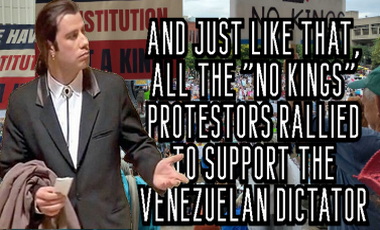

 (Just a quick note on the graphic to the right… there is more info linked in the graphic… but this training in the lead up to this assault explains this training exercise accident. They were prepping heavily for this and accidental deaths are bound to happen)