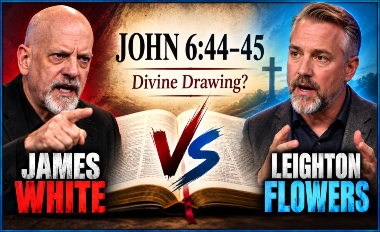
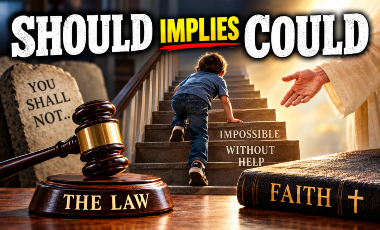
John 15:16 says, “You did not choose me, but I chose you…” Does this teach the the doctrine of divine election? Albert Mohler says yes, but James White says no. Who is correct. Let’s discuss… (More at Election According to Jesus)
Here is the Calvinist/TULIP/Reformed reading
John 15:14–19 — The “Calvinized” Reading
What happens when we take Jesus’ words to His disciples and read them as though He were directly explaining the Calvinistic doctrine of unconditional individual election to a modern Reformed believer?
14 “You are my friends if you do what I command you.”
[MODERN REFORMED BELIEVER]: I am one of Christ’s elect, and my obedience demonstrates that I am truly regenerated and therefore one of His genuine believers.
15 “I do not call you servants anymore, because a servant doesn’t know what his master is doing. I have called you friends, because I have made known to you everything I have heard from my Father.”
[MODERN REFORMED BELIEVER]: Jesus has revealed the truth to me because I am one of God’s elect. His saving revelation has been effectually given to me because God has chosen me.
16 “You did not choose me, but I chose you. I appointed you to go and produce fruit and that your fruit should remain…”
[MODERN REFORMED BELIEVER]: “I did not choose Christ. Christ unconditionally chose me for salvation before I was born. His sovereign choice preceded my faith, and His effectual calling ensured that I would believe.”
17 “This is what I command you: Love one another.”
[MODERN REFORMED BELIEVER]: My obedience and love for other believers are evidence that I am genuinely elect. If I persevere in faith and obedience, I demonstrate that I was truly regenerated.
18 “If the world hates you, understand that it hated me before it hated you.”
[MODERN REFORMED BELIEVER]: The world hates me because I am one of God’s elect and therefore belong to Christ rather than to the world.
19 “If you were of the world, the world would love you as its own. However, because you are not of the world, but I have chosen you out of it, the world hates you.”
[MODERN REFORMED BELIEVER]: “Jesus chose me out of the world because I am one of the individuals God unconditionally elected to salvation rather than one of those whom He passed over.”
Responding to the Calvinist Reading
The Calvinist reading of John 15:16 begins with something absolutely true: Jesus chose His disciples. The problem is what is then inferred from that statement. Jesus says,
“You did not choose Me, but I chose you. I appointed you to go and produce fruit and that your fruit should remain.”
The Calvinist interpretation often moves from “I chose you” to “God unconditionally chose you for salvation,” and then from “I appointed you” to “God effectually called you.”
But those additional theological conclusions are not actually stated in the passage. The immediate context tells us what Jesus’ choice involved: He chose and appointed these disciples to go, bear fruit, remain faithful, love one another, and serve as His witnesses in the world. In fact, just three verses later Jesus explains this choice by saying, “because I have chosen you out of the world,” in the context of warning these same disciples that the world will hate and persecute them. The question is therefore not whether there is divine election in John 15:16—there clearly is—but what Jesus elected these people to do. A sound hermeneutic requires us to let the context answer that question before importing a systematic-theological definition of election into the text.
This is where hermeneutics becomes especially important. The principles of definition, usage, context, historical setting, logic, unity, and inference remind us that a conclusion may be true in a larger theological system without being the meaning of a particular verse. See my Five-Finger Life Punch that simply puts the matter thus:
biblical hermeneutics seeks to recover the meaning communicated to the original hearers, while exegesis draws meaning out of the text rather than reading our presuppositions into it.
John 15 is Jesus speaking to His disciples on the eve of His crucifixion, preparing them for continued obedience, fruitfulness, persecution, and witness. John 17 continues this same distinction: Jesus specifically prays for those given to Him and entrusted with His word, and then distinguishes them from those who will subsequently believe through their message. The apostles have a unique role as Christ’s appointed witnesses.
Therefore, when a modern Reformed believer reads “You did not choose Me” as “you were unable to choose Christ,” “I chose you” as “I unconditionally elected you to salvation,” and “I appointed you” as “I effectually called you,” he has moved beyond what John 15:16 actually says.
The issue is not whether God chooses; the issue is whether we have allowed the text to define what His choosing means, or whether we have made the Calvinistic system define it for us.
That is precisely the difference between exegesis and eisegesis.
Exegesis – (Gk. explanation) Critical exposition or explanation of the meaning of a scriptural passage in the context of the whole Bible. The reader of Scripture studies the word meanings and grammar of the text to discern what… was communicated, drawing the meaning out of the text rather than reading what he wants into the text (eisegesis).
Eisegesis – is the process of interpreting a text or portion of text in such a way that it introduces one’s own presuppositions, agendas, and/or biases into and onto the text.
[….]
Who was the writer?
To whom were they writing?
Is the choice of words, wording, or word order significant in this particular passage?
What is the cultural, historical context?
What was the author’s original intended meaning?
How did the author’s contemporaries understand him?
Why did he say it that way?
[….]
3) Rule of Context: Avoid using words out of context. Context must define terms and how words are used.
Many a passage of Scripture will not be understood at all without the help afforded by the context; for many a sentence derives all its point and force from the connection in which it stands. (Biblical Hermeneutics, Terry. M. S.. p. 117. 1896.)
[Bible words] must be understood according to the requirements of the context. (Thayer’s Greek English Lexicon of the New Testament, p. 97.)
Every word you read must be understood in the light of the words that come before and after it. (How to Make Sense, Flesch, Rudolph, p. 51, Harper & Brothers. 1959.)
[Bible words] when used out of context . . . can prove almost anything. [Some interpreters] twist them . . . from a natural to a non?natural sense. (Irenaeus, second century church father, quoted in Inspiration and Interpretation, p. 50, Eerdmans Pub. Co., 1957.)
The meaning must be gathered from the context. (Encyclopedia Britannica, Interpretation of Documents. V. 8, p. 912. 1959.)
This is a slightly truncated version of a Faith On Fire video. I am not always a fan of his style, or hyperbole… but this was good.
BIBLIOGRAPHY:
RPT. “A Short Study on Ways to Approach Scripture That Create Sound Doctrine.” Religio-Political Talk. Accessed October 4, 2026. Religio-Political Talk
RPT. Five-Finger Life Punch. Religio-Political Talk, August 2023. Five-Finger Life Punch
Myers, Jeremy. “John 15:16—‘You Did Not Choose Me, but I Chose You.’” Redeeming God. Redeeming God
“John 15:16—‘You Did Not Choose Me, but I Chose You.’” Answering Calvinism. Answering Calvinism
BIBLICAL PASSAGES REFERENCED
The argument also draws substantially on John 6:70; John 13:18; John 15:1–27; John 17:6–20; Acts 10:39–43; Romans 3:1–2; Ephesians 3:1–12; and Genesis 12:1–3.
Calvinism is built on prooftexts. In this episode we will be conducting an experiment to demonstrate why CONTEXT is more important than prooftexts. We will also consider why people become Calvinists in the first place. Get ready to see ULTRA Limited Atonement!
Here is the “Pauline” Systematic:
The Thought Experiment: Inventing Pauline Particularism
J17 Apologetics makes an unusual move in Why CONTEXT Beats Prooftexts! – Episode 24. Rather than simply telling the audience that proof-texting can be misleading, he invents a fictitious theological system and then demonstrates how easily that system can be made to appear biblical when passages are removed from their contexts. He repeatedly interrupts himself to remind the audience that the theology is fake, that he invented it, and that he does not actually believe it. The purpose of the exercise is methodological: it shows what happens when a theological conclusion is established first and biblical passages are then gathered to support it.
He calls his fictional system “Pauline Particularism,” which he also describes as an “ultra limited atonement.” The central proposition is deliberately outrageous, and that outrageousness is part of the demonstration: if a reader can be shown a case for a claim this obviously false, then the problem with proof-texting becomes easier to see.
Jesus Christ died only for Paul.
Obviously, J17 is not arguing that Scripture actually teaches this. Instead, he asks us to imagine someone who genuinely believed it and then constructed a theological case for it using biblical proof texts. The exercise shows how statements that are individually true can be removed from their contexts, linked to other statements, and arranged into an elaborate theological system that appears to have substantial biblical support.
The key to the exercise is that the conclusion comes before the evidence. The fictional theologian begins by deciding that Jesus died only for Paul. He then goes looking through the Bible for passages that contain language that might be made to fit that conclusion. J17 describes this as starting with an idea and then searching Scripture for verses that appear to support it. Once enough verses have been collected, the resulting list can be presented as evidence that the Bible teaches the doctrine.
Building the Case from Isolated Passages
Galatians 2:20 becomes an obvious starting point because Paul says that the Son of God “loved me and gave himself for me.” The fictional theologian can emphasize the word “me”:
Christ loved Paul, Christ gave Himself for Paul, and Paul is therefore the particular object of Christ’s self-giving.
The same verse can then be pressed further through Paul’s statement, “I have been crucified with Christ,” so that the passage begins to sound as though it describes a uniquely Pauline relationship to Christ’s death.
J17 also demonstrates how someone could make the argument sound more authoritative by appealing to Greek. He walks through grammatical features of Galatians 2:20 and shows how Paul’s relationship to the verbs of loving and giving can be emphasized. The grammatical observations themselves do not establish the fictitious doctrine; they show how technical language can give an interpretation an appearance of greater certainty. J17’s point is that Greek does not automatically rescue someone from bad interpretation. A person can understand the grammar and still misunderstand the author’s intention.
The fictional theologian can then move to1 Timothy 1:15, where Paul says that Christ Jesus came into the world to save sinners and identifies himself as the chief of sinners. The reasoning becomes deceptively simple: Jesus came to save sinners; Paul says he is the chief of sinners; therefore, Jesus came to save Paul. Once that conclusion is accepted, the theologian can connect it back to Galatians 2:20 and say that Jesus not only came to save Paul but gave Himself specifically for Paul.
The same approach can be applied to Jesus’ teaching about the lost sheep. Because Jesus speaks of leaving the ninety-nine and going after the one sheep that has gone astray, the fictional theologian can simply identify Paul as the one sheep. Once that identification is assumed, another biblical passage appears to support the theory: Jesus goes after the one, and Paul is the one.
Therefore, the argument goes, Paul’s salvation occupies this unique place in Christ’s saving work. The passage has now been made to serve a conclusion that was already established before the passage was examined.
The argument can continue with Paul’s discussion of the race and the prize in 1 Corinthians 9. Paul says that those who run a race run to obtain a prize, and he speaks about running in such a way as to obtain it. The fictional theologian can then connect this with Paul’s statement in 2 Timothy 4 that he has finished the race and kept the faith. Paul receives the crown of righteousness. Therefore, the argument can be constructed that Paul is the particular person who has been selected to receive the ultimate prize.
When Contradictions Are Reinterpreted by the System
But the same passage also creates a problem. Paul says that the crown is not for him only, but also for all who have loved Christ’s appearing. The fictitious theology therefore has to absorb a statement that appears to broaden the promise beyond Paul. Rather than abandoning the system, the theologian reinterprets or qualifies the contradiction. J17 uses this move to demonstrate an important feature of proof-text systems: once the conclusion becomes the controlling framework, passages that appear to challenge it are given secondary interpretations rather than being allowed to challenge the conclusion itself.
Paul’s unique apostolic calling can then be recruited into the system. Paul is described as a chosen instrument, separated to the gospel, and given a distinctive mission. Those statements are true descriptions of Paul’s ministry, but the fictional theologian can subtly move from Paul has a unique calling to Paul has a unique salvific status. The distinction between Paul’s particular apostolic role and the broader biblical discussion of salvation disappears because the theological system requires it to disappear.
Romans 9 can then be brought into the argument to explain why everyone except Paul is excluded. The fictional theologian appeals to the potter and the clay and the vessels made for honor and dishonor. Paul becomes the vessel of honor, while everyone else becomes a vessel of dishonor. God’s sovereign authority over His creation then becomes the theological explanation for why Paul alone receives salvation. J17 intentionally pushes the language in this direction to show how biblical statements about God’s sovereignty can be incorporated into a completely invented system when the surrounding context is ignored.
At this point, the fictitious theology has become self-reinforcing. Whenever a passage appears to contradict the doctrine, the theologian does not necessarily reconsider the doctrine. Instead, the passage is reclassified, qualified, or interpreted through the already-established system.
In effect, the doctrine has stopped being something derived from Scripture and has become the lens through which Scripture is interpreted.
Why Context, Not Quantity, Tests an Interpretation
That is the critical distinction J17 wants the viewer to recognize. There is nothing inherently wrong with having biblical evidence for a theological position. The problem occurs when a person starts with a theological conclusion and then searches Scripture for isolated statements that can be made to support it. The resulting collection can become extremely persuasive simply because of its size. A person can look at twenty, thirty, or even a hundred references and conclude, “Surely this doctrine must be biblical.”
But the number of references does not answer the more important question:
What does each passage actually mean in its own context?
J17’s fictional Pauline Particularism demonstrates this by producing a surprisingly large collection of apparently supportive texts for an obviously fabricated doctrine. He says that he assembled roughly twenty-five passages and could easily have found more. Once the passages are gathered together, the temptation is to assume that the sheer quantity of biblical material proves the conclusion. But none of the authors of those passages intended to establish the proposition that Jesus died only for Paul. The appearance of support comes from the way the texts have been selected and assembled.
This is why context is so important. A biblical statement cannot be understood merely by extracting its words. We need to know who is speaking, who is being addressed, what circumstances are being discussed, what question or problem the author is addressing, and how the statement fits within the author’s larger argument. The meaning of a sentence is not determined simply by the fact that its individual words can be found somewhere else in support of our preferred theological conclusion.
J17 makes the same point about the original languages. Greek can provide valuable information, but simply knowing Greek does not make an interpretation automatically correct. He illustrates this with an ordinary expression such as “we’re going to go in there and take them out.” The exact same words could mean very different things depending upon whether the speaker is a military operator, a dentist, or a contractor. The words themselves do not tell us what is happening. The context does.
That principle applies just as strongly to biblical Greek. A person can identify the correct vocabulary, grammatical forms, cases, tenses, and syntactical relationships and still miss what the author is actually saying. Grammar tells us important things about the text, but grammar operates within context. As J17 puts it, “Context is more powerful than Greek.”
The Pauline Particularism thought experiment therefore exposes a fundamental weakness in the “pile of proof texts” approach (Phil Bair | Soteriology 101).
Passage
Calvinist use
Contextual observation
Matthew 10:22
“He who endures to the end will be saved” = perseverance of the saints
Examine who is being addressed, the immediate mission/persecution context, and what “saved” means
Luke 21:19
Endurance proves genuine faith
Examine the Olivet context and the relationship between endurance and deliverance
1 Peter 1:5
God guarantees perseverance
Explicitly examine whether the passage establishes that proposition or is being used to interpret Matthew 24:13
Jeremiah 32:40
God guarantees that believers will never turn away
Covenant context and the identity of the people addressed matter
1 John 2:19
Those who leave were never genuinely saved
Examine John’s immediate argument concerning the antichrists/false teachers
John 10:28–29
No true believer can ultimately fall away
Directly discuss what the passage says about Christ’s protection
Philippians 1:6
God completes His work
Examine Paul’s specific context and what “good work” refers to
Jude 24
God keeps believers from stumbling
Distinguish divine preservation from the particular meaning of Matthew 24:13
Does “foreknew” necessarily mean foreordination of individuals, and does the passage itself establish the entire Calvinistic causal chain?
Acts 13:48
Unconditional election / effectual calling
What does Luke mean by “appointed/ordained” and who exactly are the people being described in the immediate context?
Ephesians 1:11
Meticulous divine determinism
Does “works all things according to the counsel of His will” actually establish that God determines every individual human choice?
Romans 8:7–9
Total inability
Does inability to live according to the flesh equal inability to respond to the gospel?
1 Corinthians 2:14
Total inability
Does “the natural person does not accept…” mean the unregenerate person cannot understand/respond to the gospel at all?
Ephesians 2:1–3
Spiritual death / Total Depravity
Does being “dead in trespasses” itself define the mechanics of the sinner’s will?
Romans 3:10–18
Total Depravity
Does Paul’s indictment establish inability to believe, or does it establish universal unrighteousness apart from God’s provision of righteousness by faith?
Imagine someone appearing in a church and announcing that Jesus died only for Paul. Suppose that person then produced a long list of biblical references: Galatians 2:20, 1 Timothy 1:15, Acts 9, 1 Corinthians 9, 2 Timothy 4, Romans 9, Matthew 18, 2 Corinthians 12, and many others.
The natural reaction might be, “That’s an awful lot of Scripture.” The right test is not how many passages have been collected, but whether those passages actually teach the doctrine being attributed to them.
This is ultimately what J17 is attempting to demonstrate with his fictional theology. He is not claiming that Calvinists literally believe Jesus died only for Paul. He is demonstrating that a theological system can be made to look biblical when its conclusion is established first and Scripture is subsequently mined for supporting statements. The warning is aimed at the method, not at a claim that any real group teaches Pauline Particularism.
The Proper Movement from Text to Doctrine
The lesson, then, is not that proof texts are useless. Biblical passages are the foundation of Christian theology. The issue is how those passages are used. Scripture should not merely be searched for words that resemble our doctrinal vocabulary. It should be read as communication from authors who wrote to particular audiences, in particular circumstances, for particular purposes.
J17’s fictitious Pauline Particularism makes the difference visible. If someone can construct an elaborate theological system claiming that Jesus died only for Paul by collecting enough isolated biblical statements, then the mere existence of a large collection of proof texts cannot be considered sufficient evidence that a theological system is true.
The number of proof texts is not the proof; context is the test.
For a quick adult Sunday class handout I made [and taught years back], see my “Five Finger Life Punch.”
What does Jesus mean when He says “he who endures to the end will be saved” in Matthew 24:13?
Much of Scripture has been hijacked by wrong theology due to philosophical presuppositions, seeking to interpret passages from a Western mindset, and attempting to spiritualize or allegorize its meaning. When we understand the passage within the literary genre, cultural context, and surrounding context, we often discover that what we’ve heard doesn’t match with what God’s word actually says.
This is the case with Matthew 24:13, where some teach that if you don’t endure in good works, faith, love, or obedience, then either you lose your eternal life, or you never truly had it. But is that really what Matthew 24:13 means?
This video uncovers the cultural context surrounding Matthew 24:13 and how a Jewish perspective is vital in properly understanding these words of Jesus.
More on this with MacArthur’s take:
Matthew 24:13 — When a System Enters the Flow of the Text
A closer look at John MacArthur’s treatment of
endurance, salvation, and perseverance
Matthew 24:13 in Its Immediate Prophetic Context
This study argues that Matthew 24:13 should first be read within Jesus’ end-times discourse before it is enlisted as a proof text for a broader doctrine of perseverance. The concern is not whether perseverance is biblical, nor whether systematic theology has a legitimate place, but whether this specific verse carries the full theological weight often placed on it. The argument proceeds by examining the verse’s immediate context, the meaning of “saved,” the force of Jesus’ warning, MacArthur’s treatment in both the Study Bible and larger commentary, and the qualified contrast provided by the Bible Knowledge Commentary. That contrast is useful not because BKC agrees with every Free Grace conclusion, but because it shows that a conservative premillennial commentary can read Matthew 24:13 as Tribulation deliverance within the passage’s own prophetic framework.
Matthew 24:13 occurs within Jesus’ response to the disciples’ question about the destruction of the temple, the sign of His coming, and the end of the age (Matt. 24:1–3). The surrounding discourse is unmistakably concerned with events associated with the end: false Christs and deception, wars, famines and earthquakes, persecution, death, betrayal, false prophets, increasing lawlessness, the cooling of love, the abomination of desolation, the Great Tribulation, the coming of the Son of Man, and the gathering of the elect.
Within that flow Jesus says, in Matthew 24:13, that the one who endures to the end will be saved. The statement is direct. The interpretive question is not whether Jesus expects endurance—He plainly does—but what theological conclusions may legitimately be drawn from this statement in its immediate context.
A broader Calvinistic formulation can turn the statement into a larger theological chain: regeneration produces certain perseverance; perseverance demonstrates that regeneration was genuine; and failure to persevere demonstrates that regeneration never occurred. That may be defended from a wider systematic theology, but it is not identical to the proposition stated in Matthew 24:13.
The exegetical issue, then, is one of direction. Is the larger theological system being derived from Matthew 24:13, or is Matthew 24:13 being interpreted through conclusions already established elsewhere in the system? A theologian may argue for the broader doctrine from other passages, but this verse should first be allowed to speak within the argument Jesus is actually making.
What Does “Saved” Mean Here?
By “systematic theology,” this study means the practice of organizing biblical teaching across multiple passages into a coherent doctrinal framework. The issue is not whether that practice is legitimate, but whether the completed framework is allowed to determine the meaning of a passage before the passage has been read in its own literary and historical setting.
The Greek verb sōzō can refer to salvation in the ultimate spiritual sense, but its range can also include deliverance or preservation from danger. Because Jesus is discussing persecution, tribulation, deception, and the culmination of the age, the immediate context matters before the word is automatically assigned a fully developed systematic meaning.
This reading is strengthened by a common Free Grace observation: the verb sōzō does not always mean eternal salvation from condemnation. It can mean to save, preserve, rescue, or deliver from danger, and the context must determine which sense is in view. Since Matthew 24 describes persecution, deception, betrayal, flight, tribulation, and the coming deliverance associated with Christ’s return, the possibility of physical deliverance or preservation should not be dismissed before the context has been allowed to speak.
A related point is the use of “saved” later in the same discourse. In Matthew 24:22, Jesus says that unless those days were cut short, “no flesh” would be saved. That use naturally refers to physical survival through the severe days of tribulation. While verse 13 and verse 22 are not identical statements, their proximity within the same prophetic discourse cautions against assuming that “saved” in verse 13 must automatically mean justification or final entrance into heaven.
The question is not whether Matthew 24:13 can have implications for ultimate salvation. It may. The question is whether the verse itself establishes the additional claims that regeneration necessarily guarantees perseverance and that failure to endure proves regeneration never took place.
The phrase “to the end” should also be read in the discourse itself. Jesus is answering questions about the end of the age, the events that precede His coming, and the climactic period of distress described immediately afterward. On that reading, “the end” need not mean the end of an individual believer’s life; it may refer to the end of the tribulational period in view. This reinforces the need to distinguish endurance through a prophetic crisis from a generalized proof text for lifelong perseverance.
The Bible Knowledge Commentary makes this contextual point with unusual clarity, though its use here should be carefully qualified. Louis A. Barbieri Jr. interprets Matthew 24:9–14 as part of the coming Tribulation and states that those who remain faithful “until the end of that period of time” will be saved, “that is, delivered.” He then distinguishes this from the idea of personal endurance producing eternal salvation, explaining the verse as physical deliverance for those who trust in the Savior during the Tribulation and who will enter the kingdom in physical bodies. This does not make BKC a Free Grace commentary in every respect; it makes BKC a valuable witness to the fact that the immediate prophetic context can control the meaning of “saved” in Matthew 24:13.
That sequence is important:
Tribulation, persecution, endurance, deliverance, and entrance into the earthly kingdom.
It is not the same sequence as regeneration, guaranteed perseverance, evidence of regeneration, and proof of eternal salvation. The issue, again, is not whether the latter doctrine can be argued from other passages, but whether Matthew 24:13 itself establishes that doctrine when read in the flow of Jesus’ discourse.
The Force of the Warning
The warning in Matthew 24 is presented as a real warning. Jesus tells His hearers to beware of deception, remain faithful amid persecution, and endure to the end. If a theological system already defines the perseverance of every genuine believer as infallibly guaranteed, however, the reader must still ask what function the warning has within Jesus’ own argument.
A Calvinist can answer that God uses warnings as the means by which He secures the perseverance He has already ordained. That answer may be internally coherent within the system, but it also illustrates the precise interpretive issue under examination. The warning is no longer being explained only from Matthew 24; it is being explained through a prior doctrine concerning God’s determination of the believer’s perseverance.
The distinction is important. Jesus plainly commands endurance, and BKC also treats faithfulness, watchfulness, and preparedness as meaningful responses of those who trust the Savior during the Tribulation. The further claim that endurance is guaranteed because of prior regeneration, and that eventual failure therefore proves the absence of genuine regeneration, is a theological inference that requires its own exegetical demonstration.
MacArthur’s Study Bible and Larger Commentary: Same Theological Move, Different Presentation
That distinction becomes especially important when evaluating MacArthur, because the question is not whether he recognizes the prophetic setting, but how he connects that setting to the doctrine of perseverance. The comparison with BKC should therefore be framed narrowly: both readings operate within an eschatological framework, but they draw different conclusions from the function of “saved” and “endure” in verse 13.
A more precise assessment of John MacArthur’s treatment is important here. MacArthur does not simply remove Matthew 24:13 from its prophetic setting. Both his Study Bible and his larger commentary understand Matthew 24 within an end-times framework involving Christ’s coming, persecution, deception, apostasy, the Tribulation, the proclamation of the gospel, and the events surrounding the end of the age.
The Study Bible actually preserves that prophetic framework around Matthew 24:13. Its note on verse 10 interprets those who fall away as people who demonstrate that they were never true believers. Its note on verse 13 then explains perseverance through the doctrine that God secures the perseverance of true believers and that those who ultimately fall away prove that they were never truly believers. Most significantly, its note on verse 14 explicitly identifies “the end” with the final birth pains associated with the Great Tribulation.
The larger commentary gives the same theological move a longer contextual runway. MacArthur first establishes that Matthew 24:4–14 describes events associated with Christ’s future coming and the Tribulation. He then treats verses 10–13 under the heading “Defection of False Believers,” explaining the people who fall away as individuals who had an outward identification with Christ but demonstrate by their defection that they never truly belonged to Him.
At verses 12–13, the larger commentary makes the systematic connection especially explicit. MacArthur explains that endurance does not produce salvation but functions as a Spirit-empowered product and proof that a person is already saved. True believers, he argues, will not ultimately renounce Christ because Christ protects them from such defection. Endurance therefore becomes evidence of genuine salvation within his broader doctrine of perseverance.
The difference between the two works is therefore primarily one of presentation, not of basic theological direction. The Study Bible states the systematic conclusion very compactly at verse 13, while the larger commentary develops the prophetic setting more extensively before making the same connection between endurance, genuine salvation, and perseverance.
This distinction matters because the criticism should not be that MacArthur fails to recognize the end-times context. He clearly does. The more precise issue is that, within that recognized end-times context, he interprets Jesus’ statement about enduring to the end through a broader Reformed doctrine of perseverance.
The Bible Knowledge Commentary Provides an Important Contrast
The Bible Knowledge Commentary offers a useful comparison because it explicitly maintains the same prophetic framework while interpreting Matthew 24:13 differently. Barbieri understands Matthew 24:4–14 as describing events associated with the future period preceding Christ’s return, with verses 9–14 describing persecution, deception, apostasy, and increasing wickedness during the Tribulation.
When Barbieri reaches Matthew 24:13, he states that those who remain faithful “until the end of that period of time” will be saved, “that is, delivered.” He then specifically distinguishes this from eternal salvation resulting from human endurance, explaining that the verse refers instead to physical deliverance of those who trust in the Savior during the Tribulation, followed by their entrance into the kingdom in physical bodies.
This interpretation is significant because it demonstrates that recognizing endurance in Matthew 24:13 does not necessarily require interpreting endurance as the Calvinistic doctrine of guaranteed perseverance of the saints. The BKC recognizes the command and necessity of remaining faithful, yet understands the promised “salvation” in the immediate prophetic context as deliverance from the Tribulation and preservation into the Messianic kingdom.
The BKC further states that the primary application of Jesus’ instructions in this section concerns the future generation that will experience the days of the Tribulation, while allowing a secondary application for believers living today. It also adds that the church is not directly in view in these verses. That qualification matters because the argument does not depend on treating Matthew 24:13 as addressed to the church in the same direct way that later epistles are. The primary contextual setting is a future prophetic crisis, while broader application must be drawn carefully by principle rather than assumed as the verse’s immediate doctrinal subject.
Thus, the contrast is instructive. MacArthur reads endurance as evidence of genuine salvation within a broader doctrine of perseverance. The Bible Knowledge Commentary reads endurance through the Tribulation as resulting in physical deliverance and entrance into the earthly kingdom. The difference demonstrates the central question of this study: what does Matthew 24:13 establish from its own context before a broader theological system is brought to bear on the passage?
This comparison also helps keep the critique fair. The point is not that the Bible Knowledge Commentary agrees with every aspect of a Free Grace interpretation or rejects every theological concern MacArthur is trying to protect. Barbieri operates within a conservative premillennial framework, speaks of people being redeemed during the Tribulation, identifies them as believers, and understands later judgment scenes as revealing genuine faith through preparedness, watchfulness, mercy, and faithfulness. The narrower point is stronger: even within that framework, Matthew 24:13 is interpreted as deliverance through the Tribulation rather than as a direct formulation of guaranteed perseverance.
This qualification also prevents an overstatement of the evidence. The BKC can be used to show that a contextual, Tribulation-focused reading of “saved” as delivered is not novel or merely polemical. It should not be used to claim that Barbieri shares the same doctrine of justification, assurance, rewards, or perseverance as every Free Grace writer. Its value is comparative and exegetical:
it demonstrates that the immediate prophetic context can control the meaning of “saved” in Matthew 24:13 even in a commentary that remains conservative, premillennial, and concerned with genuine faith.
Genuine believer → God secures perseverance → believer necessarily endures → endurance demonstrates genuine salvation → those who ultimately fall away were never genuinely believers.
The second formulation is not simply a restatement of the first. It is a theological synthesis that brings Matthew 24:13 together with numerous other passages concerning divine preservation, perseverance, apostasy, and genuine faith. MacArthur cites texts such as 1 Peter 1:5, Jeremiah 32:40, 1 John 2:19, John 10:28–29, Romans 8:38–39, 1 Corinthians 1:8–9, Philippians 1:6, Hebrews 10, Revelation 3, and Jude in developing this argument.
Those passages may be relevant to a broader doctrine of perseverance. But their accumulation also demonstrates that the argument has moved beyond what Matthew 24:13 says by itself. A theological system can take a statement from one passage, connect it with statements from several other passages, and then bring the resulting synthesis back to the original passage as though the entire synthesis were already present there. Consistency with a theological system is not the same thing as demonstrating that the original passage teaches every component of that system.
A Significant Point of Agreement—and a Significant Point of Difference
Interestingly, MacArthur’s treatment actually provides substantial support for the contextual observation that Matthew 24:13 belongs within an end-times setting. His larger commentary explicitly connects the passage with the future Tribulation and the people who will experience that period. The Study Bible likewise connects the surrounding verses with the Great Tribulation and Christ’s return.
The more precise disagreement concerns what is then made to follow from verse 13. MacArthur moves from Jesus’ statement that the one who endures to the end will be saved to a broader conclusion in which endurance functions as evidence of prior genuine salvation and ultimate defection demonstrates that a person was never truly a believer. BKC, while still concerned with genuine faith and redeemed Tribulation believers, does not make verse 13 itself carry that full doctrinal sequence.
That may be a legitimate topic for a broader theological argument. But it should not be confused with the immediate grammatical statement of Matthew 24:13 itself. The question is not whether MacArthur can construct a doctrine of perseverance from Scripture. The question is whether this particular verse establishes that doctrine in the full sense assigned to it.
The Cross-References Reveal the System
The cross-references make the method especially visible. MacArthur appeals to passages such as Matthew 10:22, Luke 21:19, 1 Peter 1:5, Jeremiah 32:40, 1 John 2:19, John 8:31, Matthew 7:23, Matthew 10:32–38, and 2 Timothy 2:12. These texts may be relevant to a broader doctrine of perseverance, but their accumulation shows that the argument has moved beyond the immediate statement of Matthew 24:13.
This is an important distinction for any study of proof texts. The more passages that must be assembled to explain what a single verse supposedly means, the more carefully we should distinguish the meaning of the verse from the theological synthesis built around it.
The Free Grace critique therefore presses the same methodological concern from another angle, and the BKC comparison gives that concern an important qualification. If Matthew 24:13 is read as a Tribulation-context promise of deliverance for those who endure that period, then using it as a direct proof of perseverance of the saints requires an additional interpretive step. At the same time, the argument should not imply that every commentator who reads “saved” as deliverance shares the same doctrine of assurance, rewards, or perseverance. The narrower point is that the verse may still be discussed alongside passages on endurance, reward, faithfulness, and preservation, but it should not be made to bear conclusions that arise only after it has been relocated into a different doctrinal framework.
The literary flow supports that caution. Matthew 24:9–14 describes Tribulation conditions and the need for endurance. Matthew 24:15–26 continues with the abomination of desolation and the Great Tribulation. Matthew 24:27–31 then describes the visible return of the Son of Man and the gathering of the elect. Matthew 25 develops judgment and preparation for the kingdom. Read in that sequence, verse 13 functions naturally within a prophetic argument about enduring through the crisis until Christ’s delivering intervention.
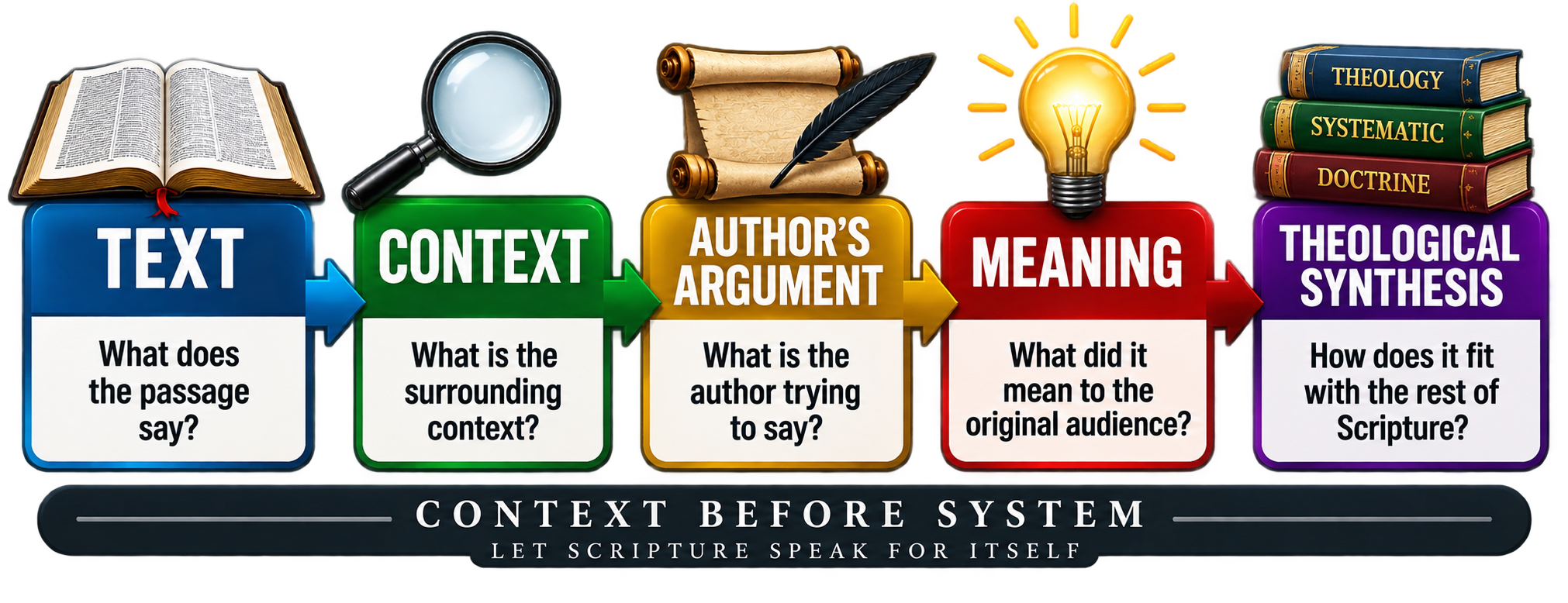
Context Before System
The better starting point is to resist the temptation to ask, “What verse proves perseverance of the saints?” Instead, begin with the passage in front of us. Who is Jesus addressing? What question is He answering? What events does He describe? What does “the end” refer to in this discourse? What does “saved” mean in this setting? How do verses 10–14 function together? What happens immediately afterward in verses 15 and following?
Only after those questions have been answered should we ask how Matthew 24:13 relates to doctrines developed from the rest of Scripture. That order matters because it prevents the theological system from silently becoming the interpretive framework by which the text is defined. It also keeps comparative evidence in its proper place: BKC may support the contextual reading of “saved” as deliverance, while still operating from theological commitments that are not identical to a Free Grace framework.
The principle is simple: establish the meaning and context of the passage before drawing the theological conclusion. Define the terms, examine their usage, follow the author’s argument, and consider the historical and literary setting. Only then should the conclusion be compared with other passages of Scripture. In that order, Scripture controls the system rather than the system controlling the text.
The concern is not that systematic theology exists; it is whether the system is being derived from the text or imported into the interpretation of it.
The result is a more disciplined use of proof texts and a fairer use of secondary sources. Matthew 24:13 can still contribute to a larger discussion of perseverance, but it should do so after its own context has been heard clearly. The Bible Knowledge Commentary helps show that this contextual reading is not merely polemical, but its support must be stated with precision: it confirms a Tribulation-deliverance reading of the verse without requiring agreement on every related doctrinal question. That approach does not weaken doctrine; it strengthens it by requiring theological conclusions to rest on careful reading rather than inherited assumptions.
Primary Sources Used
John MacArthur, commentary on Matthew 24:1–14, in the uploaded PDF “Macarthur – Jesus 2nd coming.pdf,” especially the sections on the background (24:1–3), the birth pains (24:4–14), and “Defection of False Believers” (24:10–13).
John MacArthur, Study Bible notes on Matthew 24:10–15, including the notes on falling away, perseverance, and “the end” in relation to the Great Tribulation.
“A Free Grace Interpretation of Matthew 24:13,” Free Grace Free Speech, January 25, 2026.
Bob Wilkin, “He Who Endures Will Be Saved (Matthew 24:13),” Grace Evangelical Society, November 17, 2020.
Louis A. Barbieri Jr., “Matthew,” in The Bible Knowledge Commentary: An Exposition of the Scriptures, ed. J. F. Walvoord and R. B. Zuck, vol. 2 (Wheaton, IL: Victor Books, 1985), 76–81.
The main argument directly above has focused on Matthew 24:13 and the danger of allowing a broader doctrinal system to determine the meaning of a single text before that text has been read in context. The appendix applies the same method to several other passages commonly used in discussions of perseverance, offering brief contextual checks rather than full exegetical treatments.
Appendix — The “Proof Text” Problem
Quick contextual responses to commonly cited perseverance texts via Phil Bair (The Wilted Flower) and SOTO 101 (Answering Calvinistic Proof Texts | and more: HERE,
The following passages are among the texts commonly brought into discussions of the perseverance of the saints. The point is not that these passages are irrelevant to security, God’s faithfulness, or perseverance. Rather, each passage should first be allowed to make its own contextual claim. A promise of God’s faithfulness is not automatically a statement that apostasy is metaphysically impossible, and a description of present security is not automatically a guarantee of future perseverance.
1. John 5:24 — “Whoever hears … and believes”
“Whoever hears my word and believes … has eternal life.”
The verse gives strong assurance to the person who hears and believes. The Calvinist argument often moves from present possession of eternal life to the conclusion that the person can never subsequently abandon the faith. But the verse itself does not discuss the possibility of later apostasy. Its stated condition is hearing and believing. The text therefore establishes a promise to the believer; the additional claim of guaranteed future perseverance requires support from other passages.
2. John 6:35–37 — “I will never cast out”
“Everyone who comes to me will never be hungry, and the one who believes in me will never be thirsty.”
Jesus gives assurance to those who come to Him and believe. Nothing in the promise says that Christ will cast away a person who genuinely continues to come to Him. The larger discourse must be considered before turning the promise into a proposition about the impossibility of future apostasy. John 6:66 also records disciples who stopped following Jesus, demonstrating that the discourse itself contains a distinction between those who follow and those who depart.
3. Romans 8:35–39 — Nothing can separate us
“Who can separate us from the love of Christ?”
Paul’s list emphasizes external afflictions and hostile forces—trouble, distress, persecution, famine, nakedness, danger, sword, death, life, angels, rulers, things present, things to come, powers, height, depth, and creation. The passage establishes the invincibility of God’s love against external opposition. It does not explicitly address a believer’s own repudiation of Christ. Therefore, the conclusion that the passage proves the impossibility of apostasy goes beyond what the listed obstacles actually address.
4. 1 Peter 1:3–5 — “Kept … through faith”
“You are being guarded by God’s power through faith for a salvation that is ready to be revealed in the last time.”
This is one of the most important texts to examine because it explicitly combines divine preservation with faith. God’s power guards believers, but Peter says this guarding operates “through faith.” The verse therefore strongly affirms God’s active preservation without, by itself, defining preservation as an unconditional mechanism that eliminates the believer’s continuing response.
5. Philippians 1:6 — “He who started a good work”
“He who started a good work in you will carry it on to completion until the day of Christ Jesus.”
Paul expresses confidence in God’s faithfulness toward the Philippians. But the verse is a pastoral expression of confidence within a letter that repeatedly calls believers to continue in faithful obedience. It does not explicitly formulate the proposition that every genuinely regenerated individual is metaphysically incapable of apostasy. That broader doctrine must be established from the whole biblical witness rather than assumed from the promise.
6. Ephesians 1:13–14 — Sealed with the Spirit
“In him you also were sealed with the promised Holy Spirit. He is the down payment of our inheritance…”
The seal signifies God’s ownership and the Spirit’s role as a pledge of the inheritance. That is powerful assurance. But the passage does not use the word “seal” to define a doctrine of inevitable perseverance. The same letter contains exhortations to believers and warns them not to grieve the Holy Spirit (Eph. 4:30). The existence of a divine seal therefore should not be expanded into a conclusion the immediate verse does not state.
7. 1 Corinthians 1:6–8 — “He will sustain you to the end”
“He will also strengthen you to the end, so that you will be blameless in the day of our Lord Jesus Christ.”
This is a significant assurance of God’s faithfulness. But it occurs in a letter that repeatedly warns believers about serious consequences of disobedience and falling. The promise establishes God’s ability and faithfulness to sustain His people; it does not, standing alone, define the precise relationship between divine sustaining grace and a believer’s continuing response.
8. Jeremiah 32:39–40 — “They will not turn away from me”
“I will put the fear of me in their hearts so that they will not turn away from me.”
This is a strong covenant promise concerning God’s work among His covenant people. It is therefore important evidence for divine initiative and preservation. But its covenantal and prophetic setting should be established before it is transformed into a universal proposition about the mechanics of individual regeneration. A promise concerning God’s covenant faithfulness does not automatically settle every question about the possibility of apostasy in every context.
9. John 17:12 — “I guarded them”
“I protected them in your name that you have given me.”
Jesus is speaking specifically about the disciples entrusted to Him. The verse demonstrates Christ’s protective care over those disciples in the context of His earthly ministry and prayer. It should not automatically be generalized into a systematic proposition that every true believer must necessarily persevere. The identity and situation of the persons Jesus is describing matter.
10. Hebrews 13:20–21 — God equips believers
“May the God of peace … equip you with everything good to do his will.”
This benediction celebrates God’s ability to equip His people for faithful living. It is not a technical statement about whether apostasy is possible. Hebrews must be read as a whole, including its repeated warnings about drifting, hardening, and failing to continue. The benediction should therefore be read alongside—not used to erase—the warnings.
11. Hebrews 6:17–19 — “Hope as an anchor”
“We have this hope as an anchor for the soul, firm and secure.”
The imagery emphasizes the reliability of God’s promise and gives believers strong encouragement. It does not itself say that a believer cannot abandon the hope. The same chapter contains the sobering warning of verses 4–6. Consequently, the assurance passage and the warning passage should both be permitted to retain their force rather than allowing one to cancel the other.
SOME OF THE BIGGIES
12. Ephesians 1:3–14 — “Chosen in Him”
“He chose us in him before the foundation of the world … having predestined us to adoption as sons through Jesus Christ.”
Ephesians 1 clearly teaches divine initiative, election, predestination, adoption, redemption, and the believer’s inheritance. The question is not whether Paul speaks about God’s choosing and predestining work, but who was chosen, for what purpose, and how the passage describes participation in those blessings.
The phrase “in Christ” is especially prominent throughout the passage. Paul speaks of believers being blessed “in Christ” (v. 3), chosen “in Him” (v. 4), accepted “in the Beloved” (v. 6), redeemed “in Him” (v. 7), receiving an inheritance “in Him” (v. 11), and finally being “sealed with the promised Holy Spirit” after hearing the gospel and believing in Christ (v. 13).
Verse 4 also states the purpose of the choosing: “that we should be holy and blameless before Him.” The passage therefore clearly connects God’s choice with a specific purpose, but it does not explicitly state the complete theological sequence often inferred from it:
That sequence requires additional theological premises drawn from other passages.
Verse 13 deserves particular attention because Paul explicitly describes the readers’ response in this order:
they heard the gospel, believed in Christ, and were sealed with the Holy Spirit.
Thus, the passage itself gives us a clear hearing believing sealing sequence, while the stronger Calvinistic sequence must be established through a synthesis of this passage with other texts.
The grammatical relationship between “He chose us” and “to be holy and blameless” also raises an important exegetical question:
Is Paul describing individuals being selected for salvation before creation, or is he describing the blessings and destiny of those who are “in Christ”?
The passage itself must be examined carefully before the broader theological system is brought to bear. The key question is therefore not whether Ephesians 1 teaches election. It does. The question is whether Ephesians 1 itself defines that election as unconditional individual election to salvation followed by regeneration and an irresistible call to faith.
13. Romans 9:6–24 — “The Potter and the Clay”
“So then it does not depend on human will or effort but on God who shows mercy.”
Romans 9 is one of the strongest passages cited for unconditional individual election and reprobation. Paul certainly emphasizes God’s sovereignty, His freedom to show mercy, His right to harden, and His authority as the Potter. The question, however, is what problem Paul is actually addressing and what conclusion the potter-and-clay analogy is intended to establish.
Paul begins Romans 9 by expressing profound sorrow over Israel (vv. 1–5). He then immediately explains that “not all who are descended from Israel are Israel” (v. 6), and develops his argument through Isaac and Ishmael, Jacob and Esau, Pharaoh, and finally the potter and the clay. The issue is therefore introduced in the context of God’s covenant purposes, Israel, the Gentiles, and the question of whether God’s promises have failed.
That context matters when Paul reaches the potter-and-clay analogy in verses 20–24. The passage certainly establishes God’s sovereign authority: “Does not the potter have the right over the clay?” But the analogy itself does not explicitly say that God eternally and unconditionally selects particular individuals for salvation while passing over others for reprobation.
The Old Testament background is especially important. Paul is not inventing the potter-and-clay metaphor. Scripture repeatedly uses this imagery to describe God’s sovereign relationship with His creation and with His covenant people. Jeremiah 18 is particularly significant: God sends Jeremiah to observe a potter reshaping a marred vessel and then explicitly applies the illustration to nations. God says that if a nation turns from its evil, He will relent concerning the announced judgment; if a nation turns to evil, He will reconsider the good He had intended.
Other biblical uses of the imagery likewise emphasize God’s authority without automatically establishing the Calvinistic doctrine of unconditional individual salvation or reprobation. Isaiah 29 uses the potter-and-clay imagery in addressing rebellious people who are attempting to hide their works from God. Isaiah 45 uses it in the context of God’s sovereign use of Cyrus for Israel’s deliverance. Isaiah 64 presents Israel collectively as clay in the Potter’s hands while appealing to God for mercy. Paul himself later uses vessel imagery in 2 Timothy 2:20–21, where a person becomes a vessel for honorable use by cleansing himself.
There is therefore an important distinction between what the metaphor clearly establishes and what a theological system may infer from it:
The immediate argument also continues beyond Romans 9. In Romans 9:30–33, Paul contrasts Gentiles who attained righteousness by faith with Israel, which pursued righteousness as though it were by works. Romans 10 then repeatedly places the emphasis on hearing, believing, confessing, and calling upon the Lord, culminating in the statement that “everyone who calls on the name of the Lord will be saved” (10:13). Romans 11 continues the discussion by describing branches being broken off because of unbelief and warning others to continue in faith (11:20–23).
GRACIOUSLY GRAFTED BACK IN:
Thus, Romans 9 certainly establishes God’s sovereignty and freedom in accomplishing His purposes. What remains to be demonstrated is whether Paul is using the potter-and-clay imagery to establish the specific proposition that God unconditionally determines the eternal salvation or destruction of individual people apart from their response to Him.
The key question is therefore not whether Romans 9 teaches divine sovereignty. It unmistakably does. The question is:
whether Romans 9:6–24 itself establishes the Calvinistic doctrine of unconditional individual election and reprobation, or whether that conclusion depends upon importing additional theological premises into Paul’s potter-and-clay analogy.
14. John 6:25–71 — “Drawing, Giving, Coming, and Believing”
“No one can come to me unless the Father who sent me draws him.”
John 6 contains several statements that are central to Calvinistic arguments concerning human inability and irresistible grace. Jesus speaks of those whom the Father gives to Him, those who come to Him, those who believe in Him, and the Father’s drawing. Jesus says that no one can come unless the Father draws him, and that the one who comes will be raised up on the last day.
The important contextual question is what Jesus means by the Father’s drawing. Jesus immediately explains the drawing in terms of being taught by God:
“Everyone who has heard and learned from the Father comes to me” (John 6:45).
The passage therefore clearly teaches divine initiative. But the text does not itself define that drawing as an irresistible inward regeneration given only to a predetermined group of individuals.
This becomes especially important when the surrounding context is considered. Flowers argues that Jesus is addressing an audience of Israelites who had already received extensive revelation through the Law and the prophets but were responding to that revelation with unbelief and grumbling. His reading of John 6:45 connects the Father’s teaching with the broader biblical theme of hearing God’s revealed word and responding to it. He specifically connects this with Romans 10:17:
“faith comes from hearing, and hearing by the word of Christ.”
The Greek verb translated “draw” (helkō) also does not, by itself, settle the question of irresistibility. The same verb appears in John 12:32, where Jesus says, “I will draw all people to myself.”
The parallel does not automatically resolve the interpretation of either passage, but it demonstrates why the meaning of draw must be established from context rather than simply equated with “irresistibly regenerate.”
The larger discourse must also be considered. John 6 includes people who believe, people who object to Jesus’ teaching, and disciples who subsequently turn back and no longer walk with Him (6:66). These observations do not by themselves establish a doctrine of apostasy or disprove Calvinism. They do demonstrate, however, that the chapter contains more contextual material than the isolated statement, “No one can come unless the Father draws him.”
John 6:37–40 also places repeated emphasis on coming and believing: “the one who comes to Me I will never cast out” (v. 37), while verse 40 states, “everyone who looks on the Son and believes in Him should have eternal life.” Thus, the passage simultaneously emphasizes God’s initiative and the human response of coming, looking, hearing, learning, and believing.
The text clearly establishes God’s initiative in bringing people to Christ. The question is whether John 6 itself establishes the additional propositions that this drawing is irresistible, restricted to the elect, and accomplished through regeneration prior to faith. Those conclusions require additional theological argument beyond the mere statement that “the Father draws.”
The key question is therefore not whether John 6 teaches divine drawing. It does. The question is whether Jesus’ explanation of that drawing—hearing, learning, and coming—requires the specifically Calvinistic doctrine of irresistible grace and regeneration preceding faith.
A Closer Look at “I Will Draw All” — John 12:32
John 12:32 deserves particular attention because Jesus uses the same Greek verb for “draw” (helkō) found in John 6:44:
No one can come to me unless the Father who sent me drawshim, and I will raise him up on the last day. (John 6:44)
As for me, if I am lifted upfrom the earth I will drawall people to myself.” (John 12:32)
But John 12 does not present this statement in isolation. Jesus immediately explains that being “lifted up” refers to the manner of His death (12:33). This also recalls Jesus’ earlier comparison between Himself and the bronze serpent Moses lifted up in the wilderness:
“Just as Moses lifted up the snake in the wilderness, so the Son of Man must be lifted up, so that everyone who believes may have eternal life in Him.” — John 3:14–15
The Numbers 21 account is therefore worth considering. God provided a means of deliverance, but the Israelites were told to look at the lifted-up serpent in order to live. The remedy was provided by God; the response of faith was still required. John then presents Christ as the ultimate fulfillment of that imagery: the Son of Man is lifted up, and those who believe in Him receive life.
This does not by itself settle every question surrounding helkō in John 12:32. Nor does the serpent account establish a particular doctrine of prevenient or irresistible grace. But it does place Jesus’ statement within a larger Johannine pattern of divine provision, Christ being lifted up, and a response of faith.
That matters when John 12:32 is compared with John 6:44. If helkō in John 6 is defined as an irresistible saving action given only to the elect, then John 12:32 requires an explanation of why Jesus says that He will draw ALL. Calvinistic interpreters commonly answer that “all” means all kinds of people—Jews and Gentiles—rather than every individual. The presence of Greeks seeking Jesus in the immediate context (12:20–22) provides a contextual basis for that interpretation.
But “all without distinction” is an interpretation of “all”; it is not the literal wording of the verse. The contextual argument must therefore be demonstrated rather than simply assumed.
The same Greek verb appears in both passages. The question is consequently not whether helkō can have different contextual nuances, but what each context requires the word to mean.
Context should determine the meaning of “draw”—not the theological system being used to interpret it.
“Those he foreknew he also predestined to be conformed to the image of his Son … those he predestined, he also called; those he called, he also justified; those he justified, he also glorified.”
Romans 8:28–30 presents one of the most important passages in the discussion because Paul describes a closely connected sequence of God’s activity: those whom God foreknew, He also predestined, called, justified, and glorified. The passage therefore provides a strong statement about God’s purposeful work concerning those who belong to Him.
The crucial questions are what Paul means by “foreknew” and what exactly those people are predestined to. Paul explicitly says they are predestined “to be conformed to the image of his Son.”The text does not explicitly say that God predestined particular individuals to believe, nor does it define foreknew as synonymous with unconditional individual election.
But there is another important contextual consideration:
Romans 8:28–30 should not be detached from the argument that follows in Romans 9–11.
Paul moves from God’s purpose and calling in 8:28–30 to the assurance that nothing can separate His people from His love (8:31–39), and then immediately turns to his anguish over Israel (9:1–5). Richard B. Hays observes that readers who have followed Paul’s argument through the first eight chapters should not be surprised when Paul turns to Israel in Romans 9–11. Hays argues that this section is not “some excursus or appendix peripheral to the letter’s theme,” but “the heart of the matter.” He specifically connects Romans 8:39 with the question Paul confronts concerning Israel.¹
This broader context matters because Romans 9–11 repeatedly develops themes introduced in Romans 8:
God’s purpose, election, calling, mercy, Israel, the Gentiles, and the faithfulness of God’s promises.
Hays describes Romans 9–11 as an extended demonstration that God’s dealings with Israel and the nations are consistent with His past actions and declared purposes. He describes the scriptural connections throughout these chapters as “structural girders, not filigrees.”²
The meaning of “foreknew” therefore deserves careful attention. Interpreters have understood the term in different ways. Frédéric Godet, for example, argues that God’s foreknowledge in Romans 8:29 refers to His foreseeing the faith of those who would believe, while distinguishing that foreknowledge from predestination. He maintains that the object of predestination is glory, not faith itself.³William R. Newell likewise connects Paul’s language of divine foreknowledge with God’s prior “acquaintanceship,” drawing particular attention to Paul’s statement in Romans 11:2 that God “foreknew” His people.⁴
Leighton Flowers, drawing on several interpreters, presents another possible reading: foreknew may carry the sense of formerly or previously known, emphasizing God’s prior relationship or knowledge rather than making the word itself synonymous with unconditional individual election.⁵ Tim Warner’s Last Generation Version of Romans also provides a useful resource for examining Paul’s terminology and argument across Romans rather than treating 8:28–30 as an isolated theological proposition.⁶
The passage itself clearly establishes a remarkable connection between foreknowledge, predestination, calling, justification, and glorification. But it does not, by itself, explain every theological question concerning the nature of foreknowledge, the condition or scope of election, or precisely how calling relates to faith. Those conclusions require interpretation of Romans 8:28–30 within its immediate context and in light of the argument Paul develops through Romans 9–11.
In that sense, Romans 8:28–39 functions almost like a theological table of contents for questions Paul will develop in Romans 9–11. That is an interpretive analogy, not a claim that Paul literally intended the chapter divisions that way.
The text gives us the sequence. The context gives us the questions Paul is addressing. The theological system must still explain what each term means and what the sequence establishes.
Footnotes
Richard B. Hays, Echoes of Scripture in the Letters of Paul (New Haven, CT: Yale University Press, 1989), 63.
Hays, Echoes of Scripture in the Letters of Paul, 64.
Frédéric Godet, Commentary on the Epistle to the Romans, trans. A. Cusin, rev. and ed. Talbot W. Chambers (Grand Rapids, MI: Zondervan Publishing House, 1956), 325–26. Godet discusses Romans 8:29 specifically, arguing that foreknowledge concerns those whom God foresees as believing and that predestination is directed toward glory rather than toward faith itself.
William R. Newell, Romans Verse-by-Verse (Chicago: Moody Press, 1938), 186. Newell discusses Romans 8:29 and connects divine foreknowledge with the idea of prior “acquaintanceship,” specifically bringing Amos 3:2, Romans 11:2, and 1 Peter 1:20 into his discussion.
Leighton Flowers, “Romans 8:28–30: Foreknowledge and Predestination,” Soteriology 101, February 14, 2018. Soteriology 101 article
Tim Warner, The Letter of Paul to the Romans: Last Generation Version, trans. and notes by Tim Warner (rev. September 11, 2026), 20–21. Warner’s notes on Romans 8:28–30 explicitly interpret “foreknew” as referring to those God “knew previously,” connect the term with God’s prior relationship with figures such as Abraham and David, and interpret the predetermination in verse 29 in relation to resurrection.
16. Acts 13:48 — “Appointed to Eternal Life”
“As many as were appointed to eternal life believed.”
Acts 13:48 is one of the shortest and most frequently cited texts in arguments for unconditional election. Read in the traditional rendering, the verse appears to present a straightforward sequence: certain people were appointed to eternal life, and consequently they believed. Calvinistic theology naturally understands this as evidence that God’s prior appointment produces saving faith.
The important question is not simply whether the word “appointed” can describe divine action, but what Luke means by the appointment and how the statement functions within the larger narrative. The immediate context concerns Paul’s preaching in Pisidian Antioch, where Jews, Gentiles, and Gentile God-fearers respond differently to the gospel. The contrast becomes especially important in verses 46–48: some Jews reject the message and “judge yourselves unworthy of eternal life,” while Gentiles rejoice and believe.
The Greek verb tassō can carry the sense of arranging, appointing, assigning, or ordering, and the precise interpretation of its participle in Acts 13:48 has been debated. A 2024 scholarly study specifically reexamines the traditional strongly predestinarian interpretation, arguing that the lexical and discourse evidence does not adequately establish the usual understanding of the passage.
Craig Keener likewise notes that “appointed” can refer to enrollment, while suggesting that the verse may concern God’s plan for the Gentiles. He connects this possibility with Acts 13:17, where Luke has already described God as choosing Israel, and with the immediate contrast between 13:46 and 13:48. Keener also observes that early Jewish thought did not necessarily regard divine predestination and human responsibility as mutually exclusive, and he sees a deliberate tension between God’s sovereignty and human choice in the passage.
This does not mean that Acts 13:48 cannot support a Calvinistic interpretation. It means that the theological conclusion should not simply be smuggled into the English word “appointed.” The interpreter still has to establish what Luke means by the appointment, who is being described, how the statement relates to the Jewish rejection and Gentile response in verses 46–48, and how it fits Luke’s larger presentation of God’s purposes for Israel and the Gentiles.
The question, therefore, is not whether Acts 13:48 speaks of divine appointment. It does. The question is whether the passage itself establishes the full theological proposition of unconditional individual election producing irresistible saving faith—or whether that conclusion requires additional theological premises brought to the text.
17. 1 Corinthians 2:14 — “The Natural Person”
“The natural person does not accept the things of God’s Spirit, because they are foolishness to him; he is not able to understand them because they are spiritually discerned.”
This passage is frequently used to support the doctrine of total inability. The argument is straightforward: the natural person cannot understand spiritual things; therefore the unregenerate person cannot respond positively to the gospel unless God first regenerates him. The verse certainly describes a serious spiritual incapacity and emphasizes the necessity of the Spirit for spiritual discernment.
The contextual question, however, is what kind of inability Paul is describing and what “the things of God’s Spirit” refers to in this particular argument. The immediate context is dominated by the contrast between the wisdom of the world and the wisdom of God. Paul speaks of God’s previously hidden wisdom, now revealed through the Spirit, and explains that these things are spiritually discerned (1 Corinthians 1:18–2:16). The issue is therefore not simply “saved versus unsaved,” but the contrast between human wisdom and God’s revealed wisdom, as well as the distinction between those who are spiritually discerning and those who are not.
The following chapter adds an important contextual consideration. Paul addresses the Corinthians as people who are already “in Christ,” yet describes them as immature and “of the flesh,” unable at that point to receive the deeper instruction he wants to give them (1 Corinthians 3:1–3). This does not mean that psychikos (“natural”) in 2:14 and sarkinos/sarkikos (“fleshly”) in 3:1 are simply interchangeable terms. They are not. Rather, the progression cautions against turning Paul’s discussion of spiritual discernment into a technical definition of every aspect of human ability. The same letter can describe believers as possessing the Spirit while still being unable to receive certain spiritual instruction because of immaturity.
There is also an important distinction between the Spirit’s necessity for understanding spiritual truth and the additional claim that regeneration must precede faith. Paul certainly teaches that God’s wisdom cannot be discovered by human wisdom alone and that spiritual discernment depends upon God’s revelation through the Spirit. But the passage does not explicitly state the complete theological sequence, regeneration → spiritual ability → faith. That sequence requires additional theological argument.
The passage therefore establishes an important truth:
human wisdom is insufficient to comprehend God’s revealed wisdom, and genuine spiritual discernment depends upon the Spirit.
The additional proposition that an unregenerate person is metaphysically incapable of believing the gospel unless regeneration occurs first is a theological conclusion that must be demonstrated rather than simply read into the word “unable.”
The question, then, is not whether 1 Corinthians 2:14 teaches spiritual inability. It does. The question is whether Paul’s particular discussion of spiritual discernment establishes the full Calvinistic doctrine of total inability and regeneration preceding faith.
Returning to Matthew 24:13
This is why the cross-references must not be allowed to determine the meaning of Matthew 24:13 before Matthew 24:13 has been interpreted in its own setting. The surrounding discourse concerns the events leading to Christ’s return, including persecution, deception, tribulation, and the end of the age. The Bible Knowledge Commentary interprets those who endure to the end as being delivered through the Tribulation, specifically describing this as physical deliverance into the kingdom. The verse therefore deserves to be understood in that immediate prophetic framework before it is recruited as a proof text for a broader doctrine of guaranteed perseverance.
The issue is not whether other passages can be assembled into a doctrine of perseverance. The issue is whether the doctrine has first been demonstrated from those passages in their own contexts—and whether that demonstrated doctrine should then be imported into Matthew 24:13.
Source credit: Appendix adapted from ideas associated with Phil Bair, The Wilted TULIP, with additional contextual framing for this study. As well as Answering Calvinistic Proof Texts(with others mentioned above.
A friend on the Effe Bee (Facebook) asked a good question about the premise the graphic you see directly to the right:
There’s some truth to Sproul’s finished statement is there not?
(And for those not in the thick of the theological weeds, it may seem a somewhat tenable position.) So I wanted to share a longer response with him as well as discuss some other recent graphics I have made for the larger audience.
I actually agree with the first half of Sproul’s statement. Salvation is entirely dependent upon God’s grace from beginning to end. Where I disagree is with his definition of that grace.
Sproul says I must first be regenerated by an effectual act of the Spirit before I can believe.
Traditional Baptists and Provisionists say God graciously initiates salvation, provides Christ, gives the gospel, convicts and draws the sinner, and enables the response — but the sinner’s faith is genuinely a response that can be either accepted or resisted.
So the disagreement isn’t whether salvation is of the Lord. It’s whether God’s grace determines the response or graciously enables the response.
This is really dealing with the Calvinist’s twisting of Total Depravity into an ontological form of Total Inability. Dr. Leighton Flowers deals with this in this older video titled “The Biblical use of the term ‘DEAD'”
Which brings me to another graphic I made:
Again, this is ripping a 1st century idiom out of context. It is almost “Cultish” in how it is done. Here Micah Coate explains this idea a little:
Despite Calvinism’s highly acclaimed standard of quality exegesis, the account of Jesus raising Lazarus from the dead is often used as a textual illustration supporting Calvin’s doctrine of Total Depravity. This is a hermeneutical mistake. The student of the Bible should beware when any doctrine, let alone essential doctrine, is supported from a narrative story that lacks any instruction, especially when a particular belief is set against a number of other clear teachings. This reading of Scripture is comparable to the practice of Jehovah’s Witnesses, who pull a number of erroneous doctrines from the poetic books of Proverbs and Ecclesiastes.
This way of using Scripture is one of the characteristics of a cult. Josh McDowell writes that cults often claim that:
. . . the Scriptures are their final source of authority; [however,] we find they [cults] consistently misuse the Scriptures to establish their own peculiar beliefs. This is accomplished chiefly by quoting texts out of context while omitting other passages relevant to the subject.
Calvinist R. C. Sproul actually validates McDowell’s statement, in his book What Is Reformed Theology? In the chapter “Monergistic Regeneration,” Sproul fails to cite a single verse showing that the Bible supports this belief. Instead, Sproul gives the reader a class in Latin and Greek terminology with such words as monergism, synergism, operative grace, and cooperative grace. Instead of making a sound case for monergistic regeneration, all Sproul does is pull a heretical doctrine of salvation from the simple story of Lazarus, saying, “Perhaps a good illustration of Monergistic, life-giving power is the raising of Lazarus from the dead.” Sproul tries to provide a biblical foundation for his peculiar belief at the expense of “quoting texts out of context while omitting other passages relevant to the subject.” Because of this hermeneutical mistake, his example and thoughts on the monergistic resurrection are incorrect.
The usual argument given in defense of Total Depravity lies in a question: Because the Bible depicts man as being dead apart from God, how can he choose to have faith in the Gospel of Jesus on his own? Although many Calvinist authors pose this question as a foundation for their doctrine, it is not logically or biblically sound. By pulling doctrine from the Lazarus account, Calvinists have dug themselves into a mess of unanswerable theological questions.
The Lazarus Problem: When a Narrative Becomes a Doctrine
One of the most familiar Calvinist illustrations of Total Depravity and regeneration is the raising of Lazarus in John 11. The argument is easy to understand: Lazarus was physically dead, therefore he could do nothing to contribute to his resurrection. Jesus alone called him from death to life. R.C. Sproul explicitly uses Lazarus in this way, explaining that regeneration is the sovereign work of the Holy Spirit and comparing the effectual call to Jesus’ command, “Lazarus, come out.”
Sproul then gives the Reformed order of salvation as:
That is an important distinction because Sproul is not merely saying that Lazarus illustrates God’s power to give life. He is using the Lazarus narrative to illustrate a particular doctrine of the order of salvation. According to this system, the sinner is spiritually dead and therefore cannot believe until God first regenerates him. Regeneration produces the faith by which the person believes. Sproul himself contrasts this with the more common evangelical understanding that a person believes in Christ and is then born again, which I picture here:.
JOHN 11:1-40 (CSB)
LAZARUS DIES AT BETHANY
1 Now a man was sick—Lazarus from Bethany, the village of Mary and her sister Martha. 2 Mary was the one who anointed the Lord with perfume and wiped his feet with her hair, and it was her brother Lazarus who was sick. 3 So the sisters sent a message to him: “Lord, the one you love is sick.”
4 When Jesus heard it, he said, “This sickness will not end in death but is for the glory of God, so that the Son of God may be glorified through it.”5 Now Jesus loved Martha, her sister, and Lazarus. 6 So when he heard that he was sick, he stayed two more days in the place where he was. 7 Then after that, he said to the disciples, “Let’s go to Judea again.”
8 “Rabbi,” the disciples told him, “just now the Jews tried to stone you, and you’re going there again?”
9 “Aren’t there twelve hours in a day?” Jesus answered.“If anyone walks during the day, he doesn’t stumble, because he sees the light of this world.10 But if anyone walks during the night, he does stumble, because the light is not in him.”
11 He said this, and then he told them, “Our friend Lazarus has fallen asleep, but I’m on my way to wake him up.”
12 Then the disciples said to him, “Lord, if he has fallen asleep, he will get well.”
13 Jesus, however, was speaking about his death, but they thought he was speaking about natural sleep. 14 So Jesus then told them plainly,“Lazarus has died.15 I’m glad for you that I wasn’t there so that you may believe. But let’s go to him.”
16 Then Thomas (called “Twin”) said to his fellow disciples, “Let’s go too so that we may die with him.”
THE RESURRECTION AND THE LIFE
17 When Jesus arrived, he found that Lazarus had already been in the tomb four days. 18 Bethany was near Jerusalem (less than two miles away). 19 Many of the Jews had come to Martha and Mary to comfort them about their brother. 20 As soon as Martha heard that Jesus was coming, she went to meet him, but Mary remained seated in the house.
21 Then Martha said to Jesus, “Lord, if you had been here, my brother wouldn’t have died. 22 Yet even now I know that whatever you ask from God, God will give you.”
23 “Your brother will rise again,” Jesus told her.
24 Martha said to him, “I know that he will rise again in the resurrection at the last day.”
25 Jesus said to her, “I am the resurrection and the life. The one who believes in me, even if he dies, will live.26 Everyone who lives and believes in me will never die. Do you believe this?”
27 “Yes, Lord,” she told him, “I believe you are the Messiah, the Son of God, who comes into the world.”
JESUS SHARES THE SORROW OF DEATH
28 Having said this, she went back and called her sister Mary, saying in private, “The Teacher is here and is calling for you.”
29 As soon as Mary heard this, she got up quickly and went to him. 30 Jesus had not yet come into the village but was still in the place where Martha had met him. 31 The Jews who were with her in the house consoling her saw that Mary got up quickly and went out. They followed her, supposing that she was going to the tomb to cry there.
32 As soon as Mary came to where Jesus was and saw him, she fell at his feet and told him, “Lord, if you had been here, my brother wouldn’t have died!”
33 When Jesus saw her crying, and the Jews who had come with her crying, he was deeply moved in his spirit and troubled. 34 “Where have you put him?” he asked.
“Lord,” they told him, “come and see.”
35 Jesus wept.
36 So the Jews said, “See how he loved him!” 37 But some of them said, “Couldn’t he who opened the blind man’s eyes also have kept this man from dying?”
THE SEVENTH SIGN: RAISING LAZARUS FROM THE DEAD
38 Then Jesus, deeply moved again, came to the tomb. It was a cave, and a stone was lying against it. 39 “Remove the stone,” Jesus said.
Martha, the dead man’s sister, told him, “Lord, there is already a stench because he has been dead four days.”
40 Jesus said to her, “Didn’t I tell you that if you believed you would see the glory of God?”
In other words, the stated emphasis surrounding the miracle is belief. The miracle is presented as a revelation of Christ’s identity and glory that calls people to faith. That is quite different from using the event as a technical illustration that regeneration must occur before anyone can believe. (SOTERIOLOGY 101)
The problem becomes even more apparent when we recognize that Scripture uses “dead” in several different metaphoric contexts. The material in Calvinism: A Biblical and Theological Critique identifies people as spiritually dead, sick, blind, lovers of darkness, and dead, but argues that Scripture does not require “dead” to mean an inability to repent and believe. It specifically points to Adam and Eve hearing and responding to God after their fall, the prodigal son being described as dead and lost while returning to his father, and Jesus’ statement in John 5:24 concerning the spiritually dead who hear and believe.
That brings us directly to the Prodigal Son. Jesus says of the son, “This son of mine was dead and is alive again; he was lost and is found.”Yet the “dead” son is not portrayed as a motionless corpse. He comes to his senses. He recognizes his condition. He changes his mind. He decides to return. He gets up and goes to his father. Then his father receives him and restores him. The point isn’t that the son saved himself—he didn’t. The father is the one who restores the relationship. But the story certainly doesn’t require us to understand “dead” as meaning incapable of responding.
If you right click with your mouse and “Open Link In New Tab”, that is an expandible graphic.
This is exactly the point made in the Soteriology 101 material. The argument isn’t that “dead doesn’t mean dead.” The argument is that dead is being used idiomatically, and therefore we need to determine what the biblical metaphor means rather than automatically equating spiritual death with a physical corpse. The Prodigal is called “dead/lost” and then “alive/found,” which is presented as an illustration of separation through rebellion rather than innate moral inability. The same article points to Revelation 3, James 1, Romans 7, Ephesians 2, and Colossians 2 as passages that complicate the assumption that “dead” means an inability to respond positively to God. (SOTERIOLOGY 101)
The Colossians passage is particularly interesting. Paul says that believers were “raised up with Him through faith.” The argument drawn from this is that being made alive and faith are not necessarily related in the Calvinist sequence of regeneration faith. Likewise, the broader biblical material repeatedly commands people to repent and believe. Acts 17:30 says that God “commands all people everywhere to repent.” The critique argues that these commands make better sense as genuine calls to sinners who, through God’s gracious enablement, can respond, rather than as commands that only become possible after an irresistible regeneration that God grants to some and withholds from others.
And this is where the “dead men don’t grab” illustration becomes less decisive than it first appears. Of course a literal corpse cannot grab a life preserver. But nobody is claiming that spiritually dead people are physically dead. The question is what spiritual death means. If “dead” automatically means the total inability to respond to God, then that definition needs to be demonstrated from Scripture rather than simply assumed from the Lazarus story. Ronnie Rogers’ formulation is useful here: God’s sufficient call, together with His grace enablement, is sufficient for anyone to receive salvation. He identifies those enablements as including God’s love, the revelation of His power, Christ’s provision, the conviction of the Holy Spirit, God’s teaching, the gospel, and God’s drawing.
There is also a fascinating internal problem with using Lazarus as the complete picture of the unregenerate sinner. Lazarus did absolutely nothing to help Jesus raise him from the dead—but he also did absolutely nothing to resist Jesus. If Lazarus is the perfect picture of the spiritually dead sinner, then the analogy would seem to demonstrate an inability to do anything in response to God, whether positive or negative. Yet Calvinism simultaneously describes the unregenerate person as actively rebelling against God, loving darkness, following sinful desires, and committing acts that displease Him. The Lazarus analogy therefore cannot, by itself, establish all of the conclusions Calvinism wants to draw from it. The narrative demonstrates Christ’s sovereign power over death; it does not explain every aspect of the sinner’s moral response to God’s grace.
DEAD MEN DON’T GRAB — BUT DOES LAZARUS PROVE TOTAL INABILITY?
One of the most common Calvinist arguments for Total Inability appeals to the raising of Lazarus in John 11:
Lazarus was physically dead.
A dead man cannot respond.
Jesus called Lazarus to life.
Therefore, the spiritually dead sinner cannot respond to the Gospel until God first regenerates him.
But there is a fundamental problem with that argument:
John 11 is a narrative about Jesus raising a physically dead man—not a theological explanation of the sinner’s ability or inability to believe.
The text itself tells us what the miracle was intended to reveal. Jesus identifies Himself as “the resurrection and the life” and asks Martha, “Do you believe this?” The miracle functions as a sign pointing people to Christ and His glory.
The question, then, is whether we are justified in taking the details of that physical resurrection and turning them into a systematic doctrine about spiritual inability.
And notice the problem with the methodology. If the Lazarus narrative can be used to establish Total Inability because Lazarus was dead and could not respond until Jesus gave him life, then why couldn’t someone take Matthew 14:30 and construct the opposite doctrine?
Peter was drowning.
Peter recognized his condition.
Peter cried, “Lord, save me!”
Jesus saved him.
Does that narrative establish “Total Ability”?
Obviously not.
And that is the point.
Neither narrative, by itself, establishes a doctrine of spiritual ability or inability. The theological conclusion has to come from the broader teaching of Scripture—not simply from importing a doctrinal system into the details of a narrative.
The issue isn’t whether sinners need God’s grace. They do.
It isn’t whether salvation is God’s work. It is.
It isn’t whether anyone can save himself. He cannot.
The real question is:
Does the biblical metaphor of being “dead in sin” mean a sinner is incapable of responding to God’s gracious revelation until after regeneration—or does it describe humanity’s lost, separated, and rebellious condition while God graciously calls, draws, convicts, and enables people to respond?
That’s the debate.
The Lazarus story demonstrates Christ’s power to give life. It does not establish the entire Calvinistic doctrine of Total Inability. And the new graphic makes the point visually: if we’re going to turn biblical narratives into systematic doctrines by analogy, then consistency would require us to do the same thing with Peter crying out, “Lord, save me!” The question at the bottom is therefore the real issue:
Do either of these narratives establish a doctrine of spiritual ability?
So the real issue isn’t whether God gives life. He does. It isn’t whether salvation is dependent upon God’s grace. It is. And it certainly isn’t whether anyone can save himself. Nobody can. The actual question is much narrower and much more important:
Does “dead in sin” mean that a sinner is incapable of responding to God’s gracious revelation until after regeneration, or does it describe the sinner’s lost, separated, rebellious condition while God’s grace enables him to respond?
That is where the two systems part company.
AGAIN:
The Calvinism: A Biblical and Theological Critique material explicitly frames the distinction as Total Depravity understood as the inability to save oneself versus Total Depravity understood as the inability to repent and believe. To be clear, Calvinists appeal to the doctrine of total depravity to claim that sinners are unable to repent and trust Christ apart from the monergistic work of regeneration.
The distinction is not between believing that humanity is sinful and believing that humanity is not sinful. Both sides affirm the devastating effects of sin and humanity’s absolute dependence upon God’s grace. The real question is what “Total Depravity” means with respect to a person’s response to the gospel. As Adam Harwood explains, the Traditional Statement denies that Adam’s sin resulted in the “incapacitation” of anyone’s free will. It does not claim that sinners can save themselves; rather, it affirms that no sinner can achieve salvation through his own effort and that salvation is received through a response to the Holy Spirit’s drawing through the gospel.
That distinction is critical to the Lazarus argument. Calvinism takes spiritual death to mean that sinners cannot repent and believe until God first regenerates them. The Traditional Baptist position instead understands sinners as genuinely lost and unable to save themselves, while God’s grace calls and enables them to respond. Harwood notes the significance of the Bible’s repeated calls for people to repent and believe: if God calls all people to repent and gives open invitations to respond in faith, the Traditional Statement argues that people must actually be capable of responding. In other words, “dead in sin” does not have to mean “incapable of responding to God’s gracious invitation.” It can describe the sinner’s desperate, lost, and sinful condition while still leaving room for God’s grace to enable a genuine response.
And that is why I think the Lazarus argument deserves much more scrutiny than it usually receives.
Jesus certainly raised Lazarus from the dead.
But Lazarus was not raised to teach us the mechanics of regeneration.
He was raised as a sign revealing who Jesus is, and Jesus explicitly connected the event with belief.
Harwood’s chapter explicitly says the disagreement is not whether salvation is by grace. The Traditional Statement says no sinner is remotely capable of achieving salvation through his own effort. The disagreement is whether God’s grace enables a response or must first regenerate the person so that the response becomes inevitable.
When we take that narrative and make it the foundation for a doctrine that says regeneration must precede faith, we have moved from what the text says to what a theological system wants the text to illustrate. That is precisely the hermeneutical question raised by Micah Coate’s critique:
Are we allowing Scripture to establish the doctrine, or are we taking a narrative and making it carry a doctrine that the narrative itself never teaches?
The issue, then, isn’t whether Lazarus was really dead.
He was.
The issue is whether every spiritually dead person is therefore a spiritual Lazarus—unable to hear, unable to respond, and unable to believe until God first regenerates him.
That conclusion has to come from Scripture. Lazarus doesn’t say it.
You want an example of how a healthy theology uses the Lazarus even? Remember Jesus said:
“This sickness will not end in death but is for the glory of God, so that the Son of God may be glorified through it.”
“I’m glad for you that I wasn’t there so that you may believe.”
“I am the resurrection and the life. The one who believes in me, even if he dies, will live.Everyone who lives and believes in me will never die. Do you believe this?”
“Didn’t I tell you that if you believed you would see the glory of God?”
Here is how the story of Lazarus is used in Professor Harwood’s systematic work:
SIGNS AND MIRACLES
Another means of special revelation attested in Scripture is signs and miracles, which are sometimes called God’s mighty acts or signs and wonders. 18 Signs and miracles were acts of God that occurred outside God’s normative providential care and were meant to testify that God was at work. The Bible is filled with examples of signs and miracles. For example, God intervened to provide children to women such as Sarah, Hannah, and Mary, who otherwise would not have become pregnant. 19 God demonstrated signs through Moses so people would know God had appeared to Moses and was speaking through him (Exod 4:1–9). When Pharaoh refused to listen to Moses despite God’s many signs and wonders, Egypt experienced “mighty acts of judgment” (Exod 7:4).
Signs and wonders characterized the events surrounding Jesus’s conception and birth as well as his public ministry. Mark records an episode that demonstrates a reason for miracles during Jesus’s ministry. While Jesus was teaching in a home crowded with listeners, a paralytic man was lowered through the roof. Jesus declared the man’s sins were forgiven and explained the reason he healed the man was to demonstrate his authority to forgive sin —something only God can do (Mark 2:1–12). This episode of physical healing reveals how the miracle brought more than physical relief and a demonstration of God’s compassion for the individual; the miracle pointed people to a greater truth, that Jesus had the authority to forgive sin. John’s Gospel contains several miracles called “signs” (Grk. sēmeia ), which revealed Jesus’s glory (John 2:11), including turning water to wine (John 2:1–11), healing an official’s son (4:43–54), healing a man at Bethesda (5:1– 15), feeding five thousand (6:1–14), walking on water (6:16–21), restoring a man’s sight (9:1–12), and raising Lazarus (11:1–44). The greatest sign in John’s Gospel, as in the other Gospels, is the resurrection of Jesus from the grave.
[….]
The person and work of Christ can be seen in a variety of ways in John’s Gospel. Jesus is the preexistent and divine Word who became flesh, was rejected by his creation, in whom is life, and who reveals the Father (1:1–18). The Gospel presents eight witnesses to the divinity of Christ: John the Baptist (1:34), the works of Christ (5:36), the Father (v. 37), the Scriptures (v. 39), Christ himself (8:14), the Holy Spirit (15:26), believers (v. 27), and the author of the Gospel (19:35). 15 The seven miracles, also called signs, revealed God’s glory in Jesus and resulted in the disciples trusting him (2:11). The seven signs are changing water into wine (2:1–11), healing the official’s son (4:43–54), healing the man at Bethesda (5:1–15), feeding the five thousand (6:1–14), walking on water (vv. 16–21), healing the man born blind (9:1–12), and raising Lazarus (11:1–44). Jesus identified himself in seven “I am” statements with Yahweh, the covenant name of God: the bread of life (6:35); the light of the world (8:12); the door (10:7); the good shepherd (vv. 11–14); the resurrection and the life (11:25); the way, the truth, and the life (14:6); and the true vine (15:1).
Adam Harwood, Christian Theology: Biblical, Historical, and Systematic (Bellingham, WA: Lexham Academic, 2022), 88–89, 398.
Professor Harwood used the story as Jesus intended it; R.C. Sproul, John MacArthur, James White, and others, did and do not..
More from Professor Flowers book, Drawn by Jesus:
Dead In Sin
Are we born dead like Lazarus, a corpse rotting in the tomb (a link scripture never draws), or are we dead like the Prodigal, a loved one separated due to his own rebellion? Scripture seems to support the latter, not the former (Luke 15:32).
The fact is that the scriptures metaphorically address our condition as a sickness far more than as deadness. (Jer 17:9, 23; Mk 2:17; Lk 5:31; Mt 9:12; Ps 38:3; Is 64:6; etc) And when speaking metaphorically of deadness, it is never described as a morally incapacitated condition from birth due to the Fall, but instead as a condition of being separated from God by our own rebellion.
For instance, the Prodigal was “dead” or “lost” then “alive” or “found,” demonstrating that the term “dead” is idiomatic for “separated by rebellion,” not “innate moral inability” (Luke 15:24). Just as our soul is separated from our body when we die so too sinful humanity is separated from God by his rebellion. Look what scripture teaches,
When tempted, no one should say, “God is tempting me.” For God cannot be tempted by evil, nor does he tempt anyone; but each person is tempted when they are dragged away by their own evil desire and enticed. Then, after desire has conceived, it gives birth to sin; and sin, when it is full-grown, gives birth to death. (James 1 :1 3-1 5)
Are we born “dead,” according to James? Or is death birthed in those who sin after it is “full grown?” What did Paul say?
What shall we say, then? Is the law sinful? Certainly not! Nevertheless, I would not have known what sin was had it not been for the law. For I would not have known what coveting really was if the law had not said, “You shall not covet.” But sin, seizing the opportunity afforded by the commandment, produced in me every kind of coveting. For apart from the law, sin was dead. Once I was alive apart from the law; but when the commandment came, sin sprang to life and I died. I found that the very commandment that was intended to bring life actually brought death. For sin, seizing the opportunity afforded by the commandment, deceived me, and through the commandment, put me to death. (Romans 7:7-11)
Are we born “dead,” according to Paul? Or was it through the commandment, after “sin sprang to life,” that death came? In contrast, the metaphor of illness is quite prevalent throughout the scriptures:
For while we were still weak, at the right time Christ died for the ungodly. (Romans 5:6)
The heart is more deceitful than all else. And is desperately sick; Who can understand it? (Jeremiah 1 7:9)
And hearing this, Jesus said to them, “It is not those who are healthy who need a physician, but those who are sick; I did not come to call the righteous, but sinners. (Mark 2:1 7)
There is no soundness in my flesh because of Your indignation; There is no health in my bones because of my sin. (Psalms 38:3)
For all of us have become like one who is unclean, And all our righteous deeds are like a filthy garment; And all of us wither like a leaf, And our iniquities, like the wind, take us away. (Isaiah 64:6)
We are sick and in need of a Physician. We are cursed and in need of His cure. His life-giving truth is sufficient to accomplish the purpose for which He sent it, “…so that you may believe…and by believing may have life in His name” (John 20:31).
Is Not Able By His Own Strength
Given that we cannot draw our next breath if not by the gracious good pleasure of our Sovereign Lord, I’m not sure how this qualification helps clarify our point of contention. God gives us all we have, including our ability to make choices. In other words, we all affirm that God must enable choice. We do not all agree that such enabling will dictate which choice will be made. As A.W. Tozer so eloquently taught,
God sovereignly decreed that man should be free to exercise moral choice, and man, from the beginning, has fulfilled that decree by making his choice between good and evil. When he chooses to do evil, he does not thereby countervail the sovereign will of God but fulfills it, inasmuch as the eternal decree decided not which choice the man should make but that he should be free to make it. If in His absolute freedom, God has willed to give man limited freedom, who is there to stay His hand or say, “What doest thou?” Man’s will is free because God is sovereign. A God less than sovereign could not bestow moral freedom upon His creatures. He would be afraid to do so.
To Convert Himself
In response to a doctor’s diagnosis, is recognizing your need for a heart transplant and submitting to the doctor’s will to perform the surgery equal to performing the surgery yourself? Of course not. An Ethiopian cannot change his own skin, nor can a leopard change his own spots (Jeremiah 13:23), but that does not even imply that they cannot recognize and submit to this needed change when confronted by the only One who is able to bring about such change.
Or Prepare Himself Thereunto
Can the powerful, Spirit-wrought truth of God’s inspired Word prepare him thereunto? Does one’s ability to resist such preparation and enabling work somehow negate that the work is sufficient to accomplish its given purpose?
Here is a brief rebuttal of the most common proof texts used by Calvinists to support their teaching on “Total Inability.” Much more could be and has been written on each of these texts from the non-Calvinistic perspective, but for the sake of brevity, here is a summary of the rebuttals:
The LORD saw that the wickedness of man was great in the earth, and that every intention of the thoughts of his heart was only evil continually. (Genesis 6:5)
Nothing at all is stated about man’s inability to respond to God’s own revelation. Please read all of Genesis chapter 6 and make a case as to how that supports the Calvinistic premise. Here is just a taste of the context:
The Lord saw how great the wickedness of the human race had become on the earth, and that every inclination of the thoughts of the human heart was only evil all the time. The Lord regretted that he had made human beings on the earth, and his heart was deeply troubled.
As one Calvinist on a recent podcast inquired in response to this passage, “Why didn’t God just elect more people instead of becoming `deeply troubled?'” That is a good question that every Calvinist must deal with when confronted with a text like this. The natural reading simply does not align with deterministic philosophy.
None is righteous, no, not one; no one understands; no one seeks for God. (Romans 3:1O-11)
No one is righteous according to the works of the law. No one is able to attain righteousness by law through works. But how does that prove no one is able to obtain righteousness by grace through faith? In verse 21 of this same chapter, Paul introduces the means for man to obtain righteousness, which is separate from the law. Calvinists seem to think that proof of our inability to earn righteousness through our own works likewise proves our inability to trust in the imputed righteousness of Christ. Proving that the lost cannot seek God does not prove that they are unable to respond to a God who is actively seeking to save the lost.
For the mind that is set on the flesh is hostile to God, for it does not submit to God’s law; indeed, it cannot. Those who are in the flesh cannot please God. You, however, are not in the flesh but in the Spirit, if in fact the Spirit of God dwells in you. Anyone who does not have the Spirit of Christ does not belong to him. (Romans 8:7-9)
Mankind’s inability to submit to God’s law does not prove their inability to trust in Christ, who fulfilled the law for mankind. Mankind’s inability to please God while acting in the flesh does not prove mankind’s inability to respond to the spiritual appeal of God so as to receive His Spirit.
If I warn my rebellious son, saying, “You cannot please me by acting selfishly,” does that suggest the child is unable to heed my warning, humble himself, and repent of acting selfishly? Of course not. It only suggests that as long as my child continues to rebel and act according to his pride, he will not please me.
This verse says nothing of our innate inability to respond to God’s powerful truth and appeal to humble ourselves so as to be reconciled. Each individual has the choice to remain in their fleshly pride or respond to the Spirit’s call to humble themselves. If you choose the former, you cannot please God.
The natural person does not accept the things of the Spirit of God, for they are folly to him, and he is not able to understand them because they are spiritually discerned. (1 Corinthians 2:14)
So, the lost man needs someone to spiritually discern the “deep things of God” (vs. 10), right? What are the means God uses to help us discern spiritual truths? Is not the very epistle that Paul is writing to the carnal believers in Corinth a means for “spiritual discernment?” And since the “brethren” in the Corinthian church are “not able to receive” these same “deep things of God” (1 Corinthians 3:1-3), one would be hard-pressed to suggest that Paul intended to teach that no one is able to understand the simple “milk” of the gospel’s appeal for reconciliation (2 Corinthians 5:20).
Again, this text never suggests that mankind is born unable to respond positively to God’s clearly revealed gospel appeal. It only affirms that the mystery of the gospel must be revealed to us in order for us to understand it, which it has been. As Paul states, “When you read this, you can perceive my insight into the mystery of Christ, which was not made known to the sons of men in other generations as it has now been revealed to his holy apostles and prophets by the Spirit” (Ephesians 3:4).
Neither side of this soteriological debate suggests that lost men can understand the deep spiritual truths of God apart from the means God has chosen to reveal these mysteries. So, the question is whether God’s means of discernment through the apostle’s writings is a sufficient work of discernment that enables those who hear it to understand and respond.
No one can come to me unless the Father who sent me draws him. (John 6:44a)
We all agree with this statement. But what are the means that God draws men to Himself? Even White agrees that God draws them by teaching them. As mentioned earlier, in Romans 10:14-15 Paul asks:
How, then, can they call on the one they have not believed in? And how can they believe in the one of whom they have not heard? And how can they hear without someone preaching to them? And how can anyone preach unless they are sent?
Follow the Order:
God Sends: Who does He send? His apostles, the remnant reserved from Israel to be His inspired messengers (Acts 10:40-41). The rest of the Israelites are being judicially hardened in their rebellion temporarily while Christ is on earth (Romans 11:7; 25). Jesus speaks to them in parables so that they cannot understand and repent (Mark 4:11-12). He does this to ensure the crucifixion that He has predetermined will come to pass (Acts 2:23). It is not until after Christ is lifted up that he sends out His Spirit-filled messengers to preach the gospel to all peoples (Acts 1:8) in order to draw all men to Himself (John 12:3 2).
Apostles Preach: What do they preach? The powerful gospel appeal (Romans 1:16; 10:8; 2 Corinthians 5:20), which is alive, active and able to cut through to the soul of man (Hebrews 4:12). Remember this is the powerful gospel that is being hidden in parables from most of Israel while Christ is on earth in order to prevent them from repenting before the right time (Matthew 13:11; 16:20). Proof that God used persuasive means to convince chosen messengers from Israel to go and proclaim His message is not proof that God uses inward irresistible means to convince preselected hearers to believe their message (John 20:30-31).
Hearers Hear: Who are the hearers? Anyone who is not being judicially hardened, like Israel was at that time. Only those who are being blinded from seeing the light are unable to see the light, and that blinding (judicially hardening) is not a condition from birth but a condition unique to Israel at that time as judgment for their rebellion.
Hearing is how they can believe: As Paul states in the following verses, “faith comes from hearing the message,” which parallels what John taught in John 20:31: “…these are written that you may believe that Jesus is the Messiah, the Son of God and that by believing, you may have life in his name.” The only reason that a hearer would not be enabled to respond to the life-giving truth of God’s appeal is if they are being prevented from seeing, hearing, or understanding the message, a condition of someone being judicially hardened by God (“hidden from their eyes”).
Believing is how they can call: One who has heard the powerful gospel appeal calling us to repentance and faith is able to believe. The believer is able to call on Christ in repentance in order to find forgiveness and life. Mankind must repent in order to live! (Ezekiel 18:32)
The historical context of John 6 must be in view to understand the author’s intention. Jesus is purposefully blinding most Israelites, due to their self-righteous rebellion, from the truth of His identity to prevent their repentance for a time. All the while, He is drawing His preselected apostles and genuine believers from Israel to be the foundation for His church. In other words, in Christ’s audience, there are some who are being judicially hardened from Israel for a good reason (unbelief) and others who are being drawn from Israel for a good reason (belief) in order to ensure God’s purpose in electing Israel would be fulfilled.
Support Drawn from Other Passages In John’s Gospel
And I, if I am lifted up from the earth, will draw all men to Myself. (John 12:32)
The differentiation between the Father’s drawing in John 6 and the Son’s drawing in John 12, as expounded upon earlier, is a significant contextual point that must be considered in this discussion. The emphasis on the Father’s drawing in John 6 highlights the divine action of God inviting and enabling faithful God-fearing individuals to come to Jesus.
On the other hand, in John 12:32, Jesus emphasizes His own agency in drawing all people to Himself, but only after His resurrection. This distinction highlights the harmonious collaboration between the Father and the Son in their work of salvation, underscoring the unity and purpose within the Godhead given at the proper time. By emphasizing His role in drawing people to Himself, Jesus reinforces His divinity and authority as the central figure in the redemptive plan of God, offering all people the means to be reconciled with God through His sacrificial death and resurrection.
Jesus answered them, “I told you, and you do not believe; the works that I do in My Father’s name, these testify of Me. “But you do not believe because you are not of My sheep. “My sheep hear My voice, and I know them, and they follow Me; and I give eternal life to them, and they will never perish; and no one will snatch them out of My hand. “My Father, who has given them to Me, is greater than all; and no one is able to snatch them out of the Father’s hand. “I and the Father are one.” (John 10:25-30)
If we understand “My sheep” to refer to “those I have unconditionally elected for effectual salvation before the foundation of the world,” then this passage might appear to support the Calvinistic doctrine. However, there is nothing in this context to indicate that is what Jesus is referring to by using the analogy of being His “sheep.” The intended audience of Jesus’ words in John 10:26 are Israelites who have become hardened and indifferent to the voice of God. It is because of their refusal to listen and respond to the Father’s voice that they are now unable to recognize and accept the voice of Jesus, who speaks the same truth (John 6:45).
This is not due to an inherent condition from birth that predisposes them to hate and reject God’s appeals for reconciliation, nor is it because God is withholding the necessary grace for them to believe. On the contrary, the Jews had become calloused through persistent unbelief; otherwise, they could have seen, heard, understood, and turned to God for healing (as demonstrated in John 12:39-40 and Acts 28:23-28). Jesus describes their spiritual condition in this context as follows:
You pore over the Scriptures because you think you have eternal life in them, and yet they testify about me. But you are not willing to come to me so that you may have life (John 5:39-40).
It is important to observe the sequence of events here: the Jews chose to reject the Scriptures, resulting in their denial of the opportunity for life. Jesus did not imply, “I have refused to make you alive so that you would be compelled to come to me.” He put the blame solely upon them for their unwillingness to come when they were presented with that opportunity.
During that time, the Jewish people had become stubborn and entrenched in their rebellion, which explains why they were unable to perceive, hear, and respond to their own Messiah. However, those who had not succumbed to this hardening of heart, and instead listened to and learned from the Father (like Cornelius in Acts 10) would believe in the Son and follow Him – recognizing His voice, much like a sheep responds to its shepherd (see also John 6:45).
Prior to Christ’s coming, if someone believed the Father, they would also believe His Son, for the Father and Son are One. Conversely, if one refused to listen to the Father before the incarnation, they would likewise be unresponsive to the teachings of the Son. The followers of the Father (often referred to as “sheep” during that era) also became followers of the Son. Those who rejected the guidance of the Father were not considered among His sheep, and that is why they refused to follow the Son. This clarifies Jesus’ statement to them, “But you do not believe because you are not of my sheep” (John 10:26).
In essence, Jesus is conveying this message: “Because you have chosen not to follow the Father, you will not follow me, His Son, either.” When Jesus says, “You are not my sheep,” He is essentially saying, “You do not align yourself with God, nor have you listened and learned from Him (as referenced in John 6:45). Hence, you will not heed my calling as the Shepherd sent by Him, who represents the very same truth.” This is reflected in the following statement by Jesus:
If God were your Father, you would love Me, because I came from God and I am here. For I didn’t come on my own, but He sent me (John 8:42).
Jesus is not implying, as the Calvinistic doctrine would suggest, that their unbelief stems from both Him and the Father rejecting them and withholding the necessary grace to believe since before the world was established. This notion contradicts Luke 19:41-42, where
Jesus weeps over Israel because they are now unable to see the truth of His identity as their Messiah.
Why would God need to conceal the truth of Christ from those who were born unable to believe? Additionally, why would Jesus urge those who were not His followers to ponder the implications of His miracles if they were utterly incapable of accepting the truth?
If I am not doing my Father’s works, don’t believe me. But if I am doing them and you don’t believe me, believe the works. This way, you will know and understand that the Father is in me and I in the Father (John 10:37-38, emphasis added).
God was not withholding some special grace necessary for them to believe. This notion gives them too much credit and portrays them as victims rather than morally accountable rebellious sinners. They reject a loving God who declares, “all day long I have held out my hands” (Romans 10:21) and “wanted to gather your children together, as a hen gathers her chicks under her wings” (Matthew 23:37; Isaiah 30:15).
I came across this first graphic, and this is the “Calvinist ‘front’ story”… I explain the rest of the story behind the scenes with the second one that follows:
The video I clipped will follow the summary. After the video is the full transcript of the clip I excerpted. Enjoy:
Summary of Each Speaker’s Main Points
James White
James White argues that John 6:44–45 describes an effectual work of God in which the Father draws people to Christ by causing them to hear and learn from Him. White connects the statements in verses 44 and 45: those whom the Father draws are the same people who hear and learn from the Father, come to Christ, and are raised up on the last day. He therefore understands the drawing in John 6 as something ultimately accomplished by God rather than something that merely makes salvation possible.
White also argues that appeals to John 12:32—where Jesus says that He will draw “all men” to Himself—create a problem for interpretations that understand “all” as every individual without exception while also making the drawing in John 6 effectual. If everyone is drawn in exactly the same effectual sense, White argues, universalism would follow. He therefore treats the distinction between John 6 and John 12 as important to his argument against non-Calvinist interpretations.
A major part of White’s argument concerns John 6:45: “they shall all be taught by God.” He asks Flowers to consider what would happen to his theology if the hearing and learning described in the passage were the result of God’s effective action—if God Himself causes the individual to hear and learn. White treats Flowers’ answer—that if this were true, the five points of Calvinism would follow—as an admission that the passage supports his position.
White therefore presents the exchange as evidence that Flowers effectively conceded the crucial point during the debate.
Leighton Flowers
Leighton Flowers argues that White is answering an argument that Flowers is not actually making. Flowers maintains that his interpretation of John 6 does not require the Father to be drawing every individual at that point in Jesus’ ministry. Instead, he understands the Father as drawing those Israelites who had listened to and learned from God through Moses and the prophets to the Son. The immediate context, in Flowers’ interpretation, concerns the remnant of Israel being brought to Christ.
Flowers then distinguishes John 6 from John 12. He argues that John 12:32 describes a later stage in salvation history, after the Son is lifted up. At that point Jesus says He will draw “all men” to Himself. Flowers understands this as the expansion of God’s redemptive work beyond Israel to the nations, rather than as a statement that every individual will inevitably be saved. He therefore rejects White’s claim that his interpretation necessarily leads to universalism.
Flowers also rejects the assumption that being taught or drawn by God means being irresistibly regenerated. He argues that God’s teaching can be genuine and powerful while remaining resistible. His teacher analogy illustrates the point: a teacher can sincerely teach students and desire that they learn, while some students nevertheless refuse to listen. In such a case, the student’s refusal does not demonstrate that the teacher secretly intended only certain students to learn.
Flowers’ argument therefore challenges a crucial Calvinist inference:
God teaches → therefore God effectually causes the person to believe.
Flowers accepts the first proposition but rejects the necessity of the second.
Flowers also appeals to Jesus’ use of parables. He argues that Jesus sometimes deliberately concealed truth from people who otherwise could hear, understand, and turn. Flowers sees this as significant because, if Calvinism is correct that unregenerate people are incapable of believing until they are first regenerated, then Jesus would not need to conceal the truth from them in order to prevent their belief. He could simply leave them unregenerated.
Flowers instead interprets the parables and the hardening of Israel as part of God’s redemptive-historical purpose leading to the crucifixion.
This leads Flowers into Romans 9–11. He argues that the hardening of Israel should not automatically be interpreted as evidence that particular individuals were eternally reprobated from birth. He points to Romans 11:23, where those who were cut off because of unbelief can be grafted back in if they do not remain in unbelief. Flowers therefore understands the hardening as judicial and connected to God’s larger redemptive plan involving Israel, the Gentiles, the crucifixion, and the eventual possibility of Israel’s restoration.
Finally, Flowers rejects White’s characterization of their debate exchange as a concession. Flowers argues that White’s question was conditional:
if White’s interpretation were true, then Calvinism would follow.
Flowers’ response acknowledged the logical consequence of White’s premise without conceding that the premise itself was true.
In Flowers’ view, that premise—the claim that God effectually causes the hearing and learning in John 6—is precisely the issue being debated.
Flowers therefore accuses White of treating a disputed interpretation as though it had already been established and then claiming victory based on the hypothetical consequences of that interpretation.
The Central Disagreement
At the deepest level, the disagreement is not simply over whether God draws people to Christ. Both men affirm divine drawing and divine teaching.
The disagreement is over what kind of drawing John 6 describes and what must be inferred from God’s teaching.
White’s argument can be represented roughly as:
Father draws → Father teaches → person hears and learns → person comes to Christ → person is raised
White understands this sequence as effectual and ultimately grounded in God’s sovereign action.
Flowers’ argument is closer to:
Father teaches/draws → people are genuinely confronted with God’s revelation → some respond and some resist → those who respond come to Christ
while also arguing that the particular drawing in John 6 has a specific redemptive-historical focus on Israel and should not simply be equated with the universal drawing described in John 12.
That distinction is what White’s universalism objection, according to Flowers, fails to address.
The central issue, therefore, is not simply whether Flowers believes in divine drawing or divine initiative. He does. His objection is to the additional inference that divine teaching or drawing must necessarily be effectual in the Calvinistic sense—that God’s act of drawing necessarily produces regeneration, faith, and perseverance in the individual being drawn.
In other words, Flowers is challenging the logical bridge between God’s sovereign initiative and an irresistible human response. His argument is that the former does not automatically establish the latter.
Source Note: The transcript excerpts discussed above are from my video, “James White’s Ignorance On Display – Subverting Truth,” which reproduces commentary and clips from Leighton Flowers’ Soteriology 101 video, “James White’s Repeated Errors Exposed | Leighton Flowers | Soteriology 101.”
A lot is being discussed about the theology of salvation and the Calvinist doctrine of limited atonement, which I disagree with.
So I want to answer one argument that I think the Calvinists falsely attribute to those of us who have a Provisionist view.
The Calvinist posits that if salvation requires faith, then faith must be a human contribution and therefore salvation is partly earned. In other words, acceptance is a work.
That argument assumes saving faith is like consideration in a contract, something of value exchanged for a promise. So if God promises salvation in response to faith, then faith must be the payment or consideration that completes the bargain.
But that’s the wrong view of faith. It confuses consideration or bargain for exchange with a conditional gift.
Imagine I offer you a gift and say, it’s yours. Come and receive it.
When you accept the gift, you aren’t purchasing it. You’re not providing any value. You’re not earning it.
I provided the gift. I paid the entire cost. I freely offered it. Your acceptance does not make me indebted to you. It simply means you receive what I have already provided.
Importantly, accepting is necessary to receive the gift because I’m not forcing it upon you against your will or knowledge.
A conditional gift is the biblical model of salvation. Christ paid the full price. Human beings contribute no merit, no righteousness, no works, no value, no payment toward salvation.
But God does condition our receiving that gift upon repentance and faith. And Scripture clearly distinguishes faith from works. 5 says, To the one who does not work but believes, his faith is counted as righteousness.
Faith is not a payment exchanged for salvation. It’s not a contribution that makes salvation possible. Faith is the empty hand that receives what God has graciously provided.
The gift is entirely God’s. The provision is entirely Christ’s. And accepting a gift does not mean you earned it.
So faith does not give man grounds for boasting. It gives God all the glory because salvation is freely offered, fully paid for, and received by faith alone through Christ alone in mercy and grace alone.
I will include Jenna’s video below/right
James White
Anyway, so these are some of the questions that I posted. So here’s Leighton Flowers pops in. And I don’t remember, I saw it yesterday. Jenna Ellis had tagged me and said, would you care to comment? And I couldn’t see what I was supposed to comment to because I had them blocked and nothing came up on my screen. I tried scrolling down, nothing happened. And so I’m sort of like, well, I’d be happy to do it. And while we’re at it, how about you respond to the question I asked you, which she will not do.
Leighton Flowers
I think she’s already responded to your answer and then later posted mine because she found out you blocked me. So again, facts.
James White
She will not do. There’s no reason to try to seek to engage her. She’s not an honest interlocutor. She’s just not. She’s turned out to be pretty wild. No two ways about it.
Leighton Flowers
Oh, the irony. Jenna is more kind and compassionate and loving towards people than you will ever hope to be, Dr. White. Sorry, again, to the man arguments, or in this case, to the woman arguments. Nothing to do with what Jenna wrote or what I wrote, but what does he have to do? He has to talk down to his opponent. He can’t be respectful. He can’t be kind. He can’t be nice to him. He’s got to talk down to him.
James White
So I found this today. And so here is the great Leighton Flowers. Now again, I was gonna play this, but I posted it three times yesterday on my X feed, so if you wanna see it, someone, thank you, whoever did it, pulled a clip from the debate with Leighton Flowers, that this is where James White won the debate with Leighton Flowers.
During the cross-examination, John 6:45, he always jumps John 6:45. He always ends up talking about it. 45 right there. And I’m pressing him and I say, okay, the one hearing, the one learning from the Father comes to me. I will raise him up on the last day. In context, that’s what the drawing is. You have to be drawn by the Father. If you’re drawn by the Father, you’re raised up by the Son.
So everybody jumps to John chapter 12, totally different context and that leads to universalism. They don’t care ’cause they don’t debate universalists. They only hate Calvinism, so they don’t care if they’re completely open to refutation from another perspective, they’re never gonna deal with those people anyway, so they don’t even think about it.
Leighton Flowers
None of that applies to my position or Dinesh’s position that he posted, or Jenna’s position that she posted, or John Lennox’s position, or none of what he just said refutes any one of those positions. Why? Because if you understand what we’re saying about John chapter 6, we’re saying that the Father is drawing those who’ve listened and learned from Moses, those who’ve listened and learned from the Father, that he’s drawing them to his Son at this point in time. He’s not drawing everyone to himself because John 12:32 wouldn’t exist if he was, because he says it’s not until the Son is lifted up that I will draw all men to myself.
So he’s not drawing all men to himself yet. And you can even say that’s all without distinction, not all without exception. So, okay, so he’s not drawing both Jews and Gentiles yet. Okay. So you have to acknowledge that in John 6, Jesus is not drawing all people to himself. What does that mean? The Father is drawing, Hebrews chapter 1. Read it. In days gone by, the Father drew, taught all people through the prophets. But in these current days, we are taught by the Son. There’s a shift that’s taking place. And so you’ve got the Father drawing whom? The people of Israel, the remnant of Israel, to believe in his Son so that he will raise them up in the last day.
We agree with that language, that grammatical thing. You can even make drawing irresistible if you want in that reading. And I don’t believe that drawing has to be interpreted or should be understood as irresistible because it’s simply referring to exactly what White admitted in his own book. The means of drawing is the teaching of God, that he’s the one who teaches. People can resist his teaching. They can refuse his teaching. They can accept it or refuse it. Common understanding of all teachers. Everybody knows that a teacher may be a great teacher, the best teacher that ever existed, but there may be some students who refuse to listen. And we blame the student for not learning, not the teacher or the intentions of the teacher as if the teacher doesn’t really want all the students to learn.
We blame the student for refusing to learn or not listening or closing their ears with their eyes. We don’t blame the teacher, okay? i.e., the teacher really doesn’t want it, secretly has a secret will, teaches all of them, but I only want some of them to really learn—all these kinds of nonsensical caveats and conclusions that Calvinists try to insert into the text. And so if you understand our position with regard to chapter 6 and chapter 12, you recognize that it’s not until he’s raised up that he draws all men to himself.
You see Mark 9:9, for example, they come down from the Mount of Transfiguration. He says, don’t tell anybody about this yet. Not until the Son of Man is lifted up. Then you can tell them because telling them would be a means of drawing. Preaching to them the gospel would be a means of drawing, and I don’t want you doing that yet. Why doesn’t he want them to do that? Same reason he said, I teach them in parables. Those on the inside, I tell them the truth. Those on the outside, I don’t. I teach them only in parables, lest they see, hear, understand, and turn, and I would heal them. He doesn’t want them to come yet. Why? Because then they’re not going to crucify him.
In order to accomplish the crucifixion, he’s using parabolic language. He’s giving them a spirit of stupor. He’s hardening them in their rebellion, speaking of the Jewish people, in order to get to Calvary. This is the interlocutor in Romans chapter 9 who’s crying out with him, why am I still to be blamed? Same interlocutor in chapter 3. Why are you to blame us? If our unrighteousness brings about your redemptive plan for good, your righteousness, why are we still to be blamed? Paul answers it in chapter 3 and he answers it more fully in chapters 9, 10, and 11.
And his conclusion’s not, well, some are reprobates from birth and cut off from birth. No, he says they’re cut off because of their unbelief, chapter 11, verse 23. He even says that he holds that hope that his ministry to the Gentiles will provoke them to envy so that they too will see the error of their ways and be grafted back in, leave their unbelief so as to be grafted back in. Does that sound like a reprobate who has no hope? Of course not, because that’s not who Paul is addressing.
In chapters 9, 10, and 11, he’s addressing the people of Israel who’ve grown calloused and hardened, who have now been cut off in their unbelief, judicially hardened by God, sent a spirit of stupor, being spoken to in parabolic language by their own Messiah, so as to ensure the crucifixion, so as to ensure the resurrection and the engrafting of the Gentile nations. When you understand that, none of what White’s saying right here, all of it just goes right past. This is why you say people are talking past each other. He’s not engaging the point of our contention. He’s jumping over to John chapter 12 and saying, well, see if those who are drawn are certainly raised up and Jesus draws all people without exception over in chapter 12, then that means everybody without exception is gonna be saved, and so you get universalism, so ha ha ha, we must be right. And he doesn’t even consider that the drawing is by the Father of those of the remnant of Israel being drawn to Jesus to be raised up for the purpose of bringing redemption to the world.
He doesn’t even consider that as an option, so he doesn’t even address it as an option, so therefore he never actually answers the argument of his opponents. He talks right past them. Now he thinks he’s got it figured out. He thinks he’s answering the typical Arminian response because some Arminians maybe go there. Maybe some Arminian responses do focus more on a different explanation of John chapter 6 or 12 or those kinds of things. But he’s certainly not engaging with mine or with what Jenna posted or with what Dinesh posted because we all take the same exact approach that Lennox took, that Michael Brown took, and that Steve Gregg took. Still White doesn’t either get it or he’s being deceptive. Ignorance or deception, you decide.
James White
So we had gotten to John 6:45 and I said, so if the phraseology is used there, and I suppose what I need to do here is, oh, I can’t do it because I have this maxed out and you can’t put two of those on top of each other, but I can do this just for a moment. I will get rid of it here in a second.
But right here in John 6:45, it is written in the prophets, and they shall all be taught by God. So, everyone hearing, and then mathon is going to be drawing its syntactical relationship from akousas. Everyone hearing and learning from the Father is coming to me.
So I said to Leighton, I said, if these are descriptive of divine power being exercised, if this is something that God effectuates, he causes people to hear, he causes people to learn, what would that do to your system? And his answer was, it would mean that the five points of Calvinism are true.
And so they put that question and answer together with my closing statement where I said, did you hear what he just said? Because that’s exactly what this is. This is the description of what being drawn in verse 44 is. That’s why everyone who’s drawn is raised up in the last day. That’s why every one of you that quoted John chapter 12 and said everybody’s drawn, we need to be universalists.
Leighton Flowers
See what I mean? Notice the tautology. He basically asked if I’m right, am I right? And I said, well, yes, if you’re right, you’re right. But I don’t believe you’re right. And you don’t believe me. Let’s go to the receipts. Okay.
James White
All who are taught by God, all who are, who hear from the father, all who learn from the father, that’s provided in scripture and being described by Jesus. What if that were that, what would that do to your theological understanding of this text?
Leighton Flowers
If that were true, then your presupposition TULIP would be true. And I don’t think your presupposition is true. I believe they actually have the responsibility, the ability to respond to the teaching of God.
James White
They can deny it or they can accept it.
Leighton Flowers
Everybody heard that, right? So he claims that is ultimately what ensured that he won the debate. Okay. So he basically says that if this teaching is effectual, then am I right? And obviously if he believes the teaching is effectual, meaning it has an effectual result in the belief of the elect, which is what he’s asking, then am I right? And I’m basically saying, yeah, obviously that’s the debate. That’s the very point up for debate, whether that’s what this is teaching or not.
And he claims that that’s why he won the debate, despite the fact that most people who watched it, according to 1,400 votes, said that I won the debate. No, he still says, oh, I won the debate because Leighton admitted that if I’m right, I’m right. Again, this is the level of argumentation, folks, of the best scholar, at least that’s confronting provisionism. This is the highest level of argumentation you’re getting from them so far.
This is why I thank God for James White. Every time he does these kinds of broadcasts, I think any person with an iota of logical ability can see through some of these lower-level arguments. And they’re just, at least if they’re not already swallowed hook, line and sinker Kool-Aid drinkers, I think they can see this. And so a lot of the people who come to him because of a lot of the other arguments that he’s arguing with the King James Version only or the Trinity or other things he’s doing, they’ll get introduced to this Calvinism stuff and they’ll begin to hear him and they’ll be going to go, that doesn’t make any sense.
I know this is happening because I have people come all the time, like the guy commenting earlier, that come to me through James White because they like what he’s doing on all these other subjects. But when he comes to Calvinism, he just goes off the rails. And he starts making really bad logical conclusions and really poor argumentation and starts attacking his opponents in unfair ways and making ad hominem remarks about them and all these kinds of other things that we’ve seen from White.
And they begin to go, I just get so turned off by the way he’s approaching provisionists and Arminians that I begin to look at provisionism and Arminianism and see whether it’s really right or not. And then I begin to go, oh yeah, that doesn’t make any sense. And so that’s, again, another reason I really love the fact that James White confronts us. He does a lot to push people towards provisionism. So thank you, James White, for that.
James White
Which means you are not handling scripture accurately and correctly. And the thing that’s bothering me the most about X right now is you don’t seem to care. You don’t seem to care. Hey, if it allows me to deny Calvinism, I don’t care what the universalists say. That is.
Leighton Flowers
Again, nothing about universalism has anything to do with John chapter 12 or how we would understand it.
Nathan’s right, Jesus’ reason for speaking in parables refutes Calvinism because if they needed to be regenerated, then Jesus could have spoken plainly and just not regenerated them. Exactly. It’s one of the things that led me out of Calvinism was that very point. Why would he need to use parables to keep them from belief if they can’t believe without being regenerated first?
….When Calvinists are pressed on the obvious implication that SHOULD implies COULD, they appeal to the demands of the law, which is like appealing to my demands for the children to get to the top of the stairs without touching anything. I didn’t make that demand with the expectation of my children actually doing it, after all it is impossible. I made the demand to help them realize they could not do it without my help.
So too, God did not send the law with the expectation that we could actually fulfill its demands. That is not the purpose of the law. According the scripture, “No one will be declared righteous in God’s sight by the works of the law; rather, through the law we become conscious of our sin” (Rom. 3:20).
The law is a “tutor” who points us to our need for Christ (Gal. 3:24). The law was never sent for the purpose of being fulfilled by mankind, just as the stair-climbing activity was never intended to be completed by my kids. It was a “tutoring” lesson to teach my children that they must rely on someone else, a useless activity indeed if they are somehow incapable of coming to that realization or admitting their need for help.
If my kids are as completely incapable of understanding their need for help in getting to the top of stairs as they are in getting to top of the stairs without help, then why would I bother with the activity in the first place? Likewise, if mankind is as completely incapable of trusting in the One who fulfilled the law as they are in fulfilling the law themselves, then what is the point in sending an insufficient tutor to teach them a lesson they cannot learn?
The argument that SHOULD implies COULD remains virtually unanswered by the Calvinist who appeals to the law as their example. That is, unless they can demonstrate that it actually was God’s intention for us to fulfill the law’s demand in order to attain righteousness. After all, to conclude that man cannot fulfill the purpose of the law’s demands begs the question, because it presumes man cannot fulfill the purpose of the law by believing in the One who fulfilled it’s demands.
Basic common sense tells us that if one ought to do something, he can do it. This is especially true if one is punished for his failure to do that which is expected. In 2 Thessalonians 2:10, Paul says of the unrighteous, “They perish because they did not accept the love of the truth in order to be saved.” And in John 12:48, Jesus said, “There is a judge for the one who rejects me and does not accept my words; the very words I have spoken will condemn them at the last day.”
Scripture never once says that we will perish because of Adam’s sin. But over and over again it says that we will each be held accountable for our response to the clear the revelation of God. According to Paul, all men stand “without excuse” (Rom. 1:20), yet Calvinistic doctrine gives mankind the best excuse imaginable:
Judge: “Why did you remain in unbelief?” Reprobate: “I was born hated and rejected by my God who sealed me in unbelief from the time I was born until the time I died due to the sin of another.”
Can you think of any better excuse than that? I cannot.
(Updated with some graphics) A definition from that fits Calvinism via the Stanford Encyclopedia of Philosophy and the current understanding of reformed theologies …. “Reformed” theologies:
I hate using “Reformed” because many Reformers (like Philip Melanchthon and Balthasar Hubmaier as some examples) thought differently than the “Pipers,” MacArthur’s,” and “Calvins” of their time and today. So Calvinism is a better term: John MacArthur was a “Calvinist Baptist,” not a “Reformed Baptist.” Understand the difference with a distinction? — RPT
Fatalism is the thesis that human acts occur by necessity and hence are unfree. Theological fatalism is the thesis that infallible foreknowledge of a human act makes the act necessary and hence unfree. If there is a being who knows the entire future infallibly, then no human act is free.
Fatalism seems to be entailed by infallible foreknowledge by the following informal line of reasoning:
For any future act you will perform, if some being infallibly believed in the past that the act would occur, there is nothing you can do now about the fact that he believed what he believed since nobody has any control over past events; nor can you make him mistaken in his belief, given that he is infallible. Therefore, there is nothing you can do now about the fact that he believed in a way that cannot be mistaken that you would do what you will do. But if so, you cannot do otherwise than what he believed you would do. And if you cannot do otherwise, you will not perform the act freely.
The same argument can be applied to any infallibly foreknown act of any human being. If there is a being who infallibly knows everything that will happen in the future, no human being has any control over the future.
This theological fatalist argument creates a dilemma for anyone who thinks it important to maintain both (1) there is a deity who infallibly knows the entire future, and (2) human beings have free will in the strong sense usually called libertarian. But it has also fascinated many who have not shared either of these commitments, because taking the argument’s full measure requires rethinking some of the most fundamental questions in philosophy, especially ones concerning time, truth, and modality. Those philosophers who think there is a way to consistently maintain both (1) and (2) are called compatibilists about infallible foreknowledge and human free will. Compatibilists must either identify a false premise in the argument for theological fatalism or show that the conclusion does not follow from the premises.
Another recent example that came across my desk (earbuds at work). Dr. Theodore Zachariades stating that God wills [causes, not just permits] a man to be unfaithful to his wife in his comment on becoming a Calvinist via Ephesians 1.
God works all things after the Council of His will. Even keeping those kings who want to commit adultery from committing so! And when He wants to, he orders those to commit adultery when he wants to! (Video)
Now that that is out of the way, on to the videos…
I isolated the Piper quote from the video that follows it:
QUESTION: Has God predetermined every tiny detail in the universe, such as dust particles in the air? And then I should add here, including all our besetting sins.
PIPER RESPONDS: Yes, which means yes, every horrible thing and every sinful thing is ultimately governed by God and. That’s a problem, but the center of the solution to the problem is a choice. You have to make about the cross
(BTW, more on Piper can be found in this excellent journal article title (PDF), “I Believe In Divine Sovereignty,” by Thomas H. McCall)
Here are some of the comments on the original SOTERIOLOGY 101 video on their YouTube Channel [below]:
God determines every single thing even dust but you have to make the decision about the cross What????
So Calvinism teaches , “God commands you to obey, but has SECRETLY predestined you to DISOBEY, so He can burn you forever because you were a reprobate ‘before you were born, or had done anything either good or bad’.”
Piper who doesn’t believe in free will choice says “the solution to the problem is a CHOICE you have to make about a cross” 😂😂 how anyone can listen to this incoherent nonsense I’ll never know.
Piper: ” the center of the solution is a choice YOU have to make about the cross”? Does he mean I make a choice? Or God determines what choice I make??
If God is determining what man wants to do then also blinding and hardening doesn’t Jesus refute that reasoning when talking about how a kingdom divided against itself cannot stand? Matt. 12:25,26
Piper didn’t look like he wholeheartedly believed what he was saying.
Dr. Leighton Flowers, Director of Evangelism and Apologetics for Texas Baptists, confronts the Calvinist’s appeal to the Crucifixion as their proof that God predetermines all moral evil, specifically playing off John Piper’s use of Acts 4:27-28 as justification for his deterministic interpretation of the Bible.
…When we object to the concept of divine determinism (God’s sovereign work to bring about all things whatsoever that come to pass) and you appeal to the crucifixion as your proof that God brings about all moral evil, are you saying that God is sovereignly working so as to redeem the very sins He sovereignly worked to bring about? Is Calvary just about God cleaning up His own mess — redeeming His own determinations?
Appealing to God’s sovereign work to ensure the redemption of sin so as to prove that God sovereignly works to bring about all the sin that was redeemed is a self-defeating argument. It would be tantamount to arguing that because a police department set up a sting operation to catch a notorious drug dealer, that the police department is responsible for every single intention and action of all drug dealers at all times. Proof that the police department worked in secretive ways to hide their identities, use evil intentions, and work out the circumstances in such a way that the drug dealer would do what they wanted him to do (sell drugs) at that particular moment in time does not suggest that the police are in anyway responsible for all that drug dealer has done or ever will do. We celebrate and reward the actions of this police department because they are working to stop the drug activity, not because they are secretly causing all of it so as to stop some of it. Teaching that God brings about all sin based on how He brought about Calvary is like teaching that the police officer brings about every drug deal based on how he brought about one sting operation.
Yes, at times the scriptures do speak of God “hardening” men’s hearts (Ex. 7; Rm. 9), blinding them with a “spirit of stupor” (Rm. 11:8) and delaying their healing by use of parabolic language (Mk. 4:11-12, 34; Matt. 16:20), and He always does so for a redemptive good. But the reason such passages stand out so distinctly from the rest of scripture is because of their uniqueness. If God worked this way in every instance these texts would make no sense. After all, what is there for God to harden, provoke, or restrain if not the autonomous will of creatures?
If everything is under the meticulous control of God’s sovereign work what is left to permit and/or restrain except that which He is already controlling? Is God merely restraining something that He previously determined? Why blind eyes from seeing something the were “naturally” predetermined not to see? Why put a parabolic blind fold on a corpse-like dead sinner incapable of seeing spiritual truth? These are questions many Calvinists seem unwilling to entertain at any depth.
FULL PIPER TRANSCRIPT:
Q:Has God predetermined every tiny detail in the universe, such as dust particles in the air and all of our besetting sins?
A.Yes.
There’s a great quote from Spurgeon about dust motes. You may not even know what a dust mote is, but when I get up in the morning in my room, there’s a window to the side of the bed, and a beam of light will be shining through it at certain times of the year when I get it.
Now when I look through the dark I see nothing. But when I look through the beam I see the dust in the room. It’s flying around, and I say, “I’m breathing that stuff!?” Yes, you are. And Spurgeon says that every one of those particles is keeping its position and moving through the air by God’s appointment.
Now the reason I believe that is because the Bible says, “The dice are thrown in the lap, and every decision is from the Lord” (Proverbs 16:33). Proverbs 16 has a bunch of these verses in it.
Why would he choose “the die is cast into the lap”? It’s because he’s trying to think of the most random thing he could think of. And he says that. So randomness is not random to God.
God is not the least taxed by keeping every sub-nuclear particle in its place. I used to say electrons, but now there’s something smaller than electrons. Everything in the middle of the molecule moving, and the electrons—he’s got them all in orbit, just like he has the planets in orbit.
So the macro-world and micro-world are all managed by God. Which means, Yes, every horrible thing and every sinful thing is ultimately governed by God.
That’s a problem, but the center of the solution is a choice you have to make about the cross. This is what has centered me, anyway: When you go to Acts 4:27-28 and you read that Herod and Pontius Pilate and the Gentiles and the Jews were all gathered together to do what God’s hand and God’s plan had predestined to take place in the killing of Jesus, you have God’s plan and hand predestining the most horrible sins ever committed.
Pilate’s choices, the soldiers’ cruel mockery, the piercing of his side, the cries, “Crucify him! Crucify him!”—these few hours in history were the climax of the worst wickedness that has ever been performed on the planet or ever will be. And God planned it so that we might be saved from those sins.
In other words, what the devil did in unleashing all of that was commit suicide. And I pray that when you contemplate believing in a sovereign God who governs the dust motes, the waves (including tsunamis)—when you contemplate believing in a totally sovereign God, I pray that you will center it right on the cross. Because you’ll go crazy otherwise. You will!
These things have driven people mad. But it won’t drive you mad if you say, “He loves me. And he governed the most wicked thing that ever happened in the world, the crucifixion of my Savior and my God.” If you stay right there and then just work out from there as far as your mind can handle, then you’ll be safe. Your mind will be safe and your heart will be safe, because you’ll be kept humble.
People get very arrogant with these kinds of doctrines. They can use them to club people. But if you stay with the cross, you won’t.
Just one more thing on this. This is right off my front burner, because a lot of us at Bethlehem are reading through Acts. We just read in chapter 2 where Peter said in the sermon to the people who had killed Jesus, “You acted in ignorance”—he didn’t forgive them for that; he said they have to repent—”You acted in ignorance, but God fulfilled what he had promised by the prophets, that the Christ must suffer.” What that said to me, again, was that these people didn’t know what they were doing, but God knew what he was doing.
So the crucifixion of his Son was, quoting Isaiah 53:10, the bruising by the Father of the Son. Therefore the worst sin that was ever committed was ordained by God. And the answer is yes. He controls everything, and he does it for his glory and our good.
I sent a friend the video of Dr. Theodore Zachariades stating that God wills [causes, not just permits] a man to be unfaithful to his wife.
God works all things after the Council of His will. Even keeping those kings who want to commit adultery from committing so! And when He wants to, he orders those to commit adultery when he wants to! (Video)
My friend dismissed this person as a hyper-Calvinist. But as the video below notes, using his definition of a “hyper Calvinist,” A.W. Pink, John Piper, Jeff Durbin, James White, and many-many more, would thus be considered the same. Because of the age restriction, the video must be watch on YouTube, link in pic.
When I asked him: “Question RW, is Piper, Calvin, White and Durbin hyper-Calvinists?” He simply replied “Fishing Bait.” But this is an interesting phenomena… and after decades of encountering Mormons and J-Dubs, the disconnect is the same. I get links and not actualizing on statements made when challenged. When shown a person who follows to the end the logical conclusion of theistic determinism found in Calvinism, the person who is the Calvinist is dismissed as a “hyper-Calvinist” by their fellow Calvinist’s if they are challenged. When that label is then applied rightly to others for the same reason — meaning, using RW’s definition of what a hyper-Calvinist is — then all these others have said worse; and would be by definition, hyper-Calvinists.
Two quick examples. 1st John Calvin, then, John Piper:
John CALVIN:
… how foolish and frail is the support of divine justice afforded by the suggestion that evils come to be, not by His will but by His permission. . . . It is a quite frivolous refuge to say that God otiosely permits them, when Scripture shows Him not only willing, but the author of them. . . . Who does not tremble at these judgments with which God works in the hearts of even the wicked whatever He will, rewarding them nonetheless according to desert? Again it is quite clear from the evidence of Scripture that God works in the hearts of men to incline their wills just as he will, whether to good for His mercy’s sake, or to evil according to their merits.
John Calvin, “The Eternal Predestination of God,” 10:11
John Piper:
Ephesians 1:11 goes even further by declaring that God in Christ
“works all things according to the counsel of his will.” Here the Greek word for “works” is energeø, which indicates that God not merely carries all of the universe’s objects and events to their appointed ends but that he actually brings about all things in accordance with his will. In other words, it isn’t just that God manages to turn the evil aspects of our world to good for those who love him; it is rather that he himself brings about these evil aspects for his glory (see Ex. 9:13-16; John 9:3) and his people’s good (see Heb. 12:3-11; James 1:2-4). This includes—as incredible and as unacceptable as it may currently seem—God’s having even brought about the Nazis’ brutality at Birkenau and Auschwitz as well as the terrible killings of Dennis Rader and even the sexual abuse of a young child: “The LORD has made everything for its own purpose, even the wicked for the day of evil” (Prov. 16:4, NASB ).14 “When times are good, be happy; but when times are bad, consider: God has made the one as well as the other” (Eccl. 7:14, NIV).
John Piper and Justin Taylor, eds., Suffering and the Sovereignty of God (Wheaton, IL: Crossway Books, 2006), 42. (FULLER QUOTE VIA THIS PDF)
Martin Luther at the time of the Reformation. In his book The Bondage of the Will, written in response to Erasmus’ essay On Free Will, Luther said:
[The] omnipotence and foreknowledge of God, I repeat, utterly destroy the doctrine of “free-will”… Doubtless it gives the greatest possible offence to common sense or natural reason, that God, Who is proclaimed as being full of mercy and goodness, and so on, should of His own mere will abandon, harden and damn men, as though He delighted in the sins and great eternal torments of such poor wretches. It seems an iniquitous, cruel, intolerable thought to think of God; and it is this that has been such a stumbling block to so many great men down through the ages. And who would not stumble at it? I have stumbled at it myself more than once, down to the deepest pit of despair, so that I wished I had never been made a man. (That was before I knew how health-giving that despair was, and how close to grace.)
In this passage Luther seems to be aware that there is a deep moral problem with aspects of his view… [RPT:before redefining “grace” that is – almost like what is, is.]
In a reference in that above book is this paper: “I Believe In Divine Sovereignty,” by Thomas H. McCall in Trinity Journal (TRINJ 29:2 [Fall 2008]), 209-210. Of which I excerpt:
… He [John Piper] works long and hard to illustrate this [theistic determinism] from Rom 9:1-23, which he concludes is about the purposes of God being preserved “by means of the predestination of individuals to their respective eternal destines.”11 And we are not to think that God is righteous in spite of such action—instead we are to see that God is righteous because of this action, for the “heart of Paul’s defense” is this: “in choosing unconditionally those on whom he will have mercy and those whom he will harden God is not unrighteous, for in this ‘electing purpose’ he is acting out of a full allegiance to his name and esteem of his glory.”12
This all-determining action of God notably includes predestination and election, but it extends far beyond—it extends to everything. God determines all events that occur in the universe, including all demonic and satanic action.13 As Mark R. Talbot puts it, God creates, sends, instigates, and moves others to do evil, because “nothing that exists or occurs falls outside God’s ordaining will.”14 Talbot makes the point with relentless and unmistakable clarity:
Nothing, including no evil person or thing or event or deed. God’s foreordination is the ultimate reason why everything comes about, including the existence of all evil persons and things and the occurrence of any evil acts or events.15
Make no mistake: “when even the worst of evils befall us, they do not ultimately come from anywhere other than God’s hand.”16 …
NOTES:
11.John Piper, The Justification of God: An Exegetical and Theological Study of Romans 9:1-23 (Grand Rapids: Baker, 1993), 218, cf. 56-73.
12. Ibid., 219.
13.On this see John Piper, “Suffering and the Sovereignty of God: Ten Aspects of God’s Sovereignty Over Satan and Satan’s Hand in It,” in Suffering and the Sovereignty of God, 19-30. Piper here uses the rather confusing (given his determinism) language of “permission.” By my lights, what he means when he says that God “permits” something is this (a) God determines it to occur and then (b) does not act so as to override his previous ordination. Regarding talk of “permission,” I think that John Calvin’s approach is more consistent, [….] see John Calvin, Institutes of the Christian Religion I.xviii.1, and John S. Feinberg, No One Like Him: The Doctrine of God (Wheaton: Crossway, 2001), 696.
14. Mark R. Talbot, “‘All the Good That Is Ours in Christ: Seeing God’s Gracious Hand in the Hurts Others Do to Us,” in Suffering and the Sovereignty of God, 43 (41-43), emphasis original.
15.Ibid., 43-44.
16. lbid., 47.
Dave Hunt is right to say that Calvin uses unbiblical positions in dealing with this Augustinian determinism:
There is yet another question that troubles many: If man is free to choose between options, would that not in itself deny both God’s sovereigntyand His foreknowledge? Luther claimed that this question was the very heart of the Reformation and of the gospel itself. In fact, Luther dogmatically insisted that it was impossible for God to foreknow the future and for man at the same time to be a free agent to act as he wills.
Believing firmly in God’s foreknowledge, Luther wrote an entire book titled The Bondage of the Will, to prove that the very idea of man’s free will is a fallacy and an illusion. Several reasons have already been given as to why Luther was wrong on this point, and that issue will be dealt with further in the next chapter.
Though Calvin took so much from Augustine, like Luther he also rejected the Augustinian belief that God could foreknow the future, while at the same time man could have a free will. According to Calvin, foreknowledge leaves no room whatsoever for free will, because foreknowledge is the same as predestination:
If God merely foresaw human events, and did not also arrange and dispose of them at his pleasure, there might be room for agitating the question [of free will] … but since he foresees the things which are to happen, simply because he has decreed them, they are so to happen, it is vain to debate about prescience. …
If this frigid fiction [of free will] is received, where will be the omnipotence of God, by which, according to his secret counsel on which everything depends, he rules over all? (Calvin, Institutes, III: xxiii, 6–7.)
Calvin repeatedly uses such unbiblical and utterly fallacious reasoning.
The Calvinist assumes a contradiction between sovereignty and free will that doesn’t exist. The fact that God is able to allow man freedom of choice, while still effecting His purposes unhindered, is all the more glorifying to His sovereign wisdom, power, and foreknowledge.
In order to understand this better theologians have come up with the term “compatibilism” to describe the concurrence of God’s sovereignty and man’s responsibility. Compatibilism is a form of determinism and it should be noted that this position is no less deterministic than hard determinism. — John Hendryx (John Hendryx is the creator and editor of Monergism.com | SEE: “We are not Determinists!” for more)
Here is A.W. Tozer’s take of the above:
Here is my view: God sovereignlydecreed that man should be free to exercise moral choice, and man from the beginning has fulfilled that decree by making his choice between good and evil. When he chooses to do evil, he does not thereby countervail the sovereign will of God but fulfills it, inasmuch as the eternal decree decided not which choice the man should make but that he should be free to make it. If in His absolute freedom God has willed to give man limited freedom, who is there to stay His hand or say, What doest thou? Mans will is free because God is sovereign. A God less than sovereign could not bestow moral freedom upon His creatures. He would be afraid to do so.
One of the single strongest philosophical critiques of exhaustive Calvinistic determinism is that it isn’t merely, “God ordaining evil.” That’s been debated for centuries. It’s that once every thought, desire, temptation, deception, warning, and response is exhaustively decreed, enormous portions of Scripture become functionally redundant.
Glen Shellrude makes this point from dozens of New Testament angles—not just Satan, but exhortations, warnings, prayer, false teaching, perseverance, church discipline, evangelism, and moral responsibility.
The Redundancy Problem in Exhaustive Calvinistic Determinism
The Redundancy Argument (TRA)
Theological determinism, as commonly defined within Reformed theology, is the belief that God unconditionally decreed every event in history. The Stanford Encyclopedia of Philosophy summarizes the position as the view that God determines every event that occurs in the history of the world, whether described as His decree, providential control, or efficacious will. Under this understanding, nothing—including every human decision, temptation, belief, unbelief, deception, repentance, or act of faith—could ever occur differently than God eternally ordained.
This creates what may be called the Redundancy Problem. If mankind is already born morally incapable of responding positively to God’s revelation apart from irresistible grace, then many of Scripture’s mechanisms for explaining unbelief become strangely unnecessary. Why does Satan need to blind minds already born incapable of seeing? Why would God judicially harden people who are supposedly already hardened by nature? Why speak in parables to conceal truth from those who could never understand it anyway? Why send strong delusion upon people who were already unable to believe? These biblical actions make perfect sense as judicial acts against previously resistible rebels, but they appear redundant if Total Inability already guarantees the identical outcome.
The redundancy extends far beyond Satan. Throughout the New Testament believers are warned against false teachers, exhorted to persevere, commanded to resist temptation, urged to pray, rebuked for sin, corrected for doctrinal error, and called to repentance. Yet under exhaustive theological determinism, God not only ordains every warning but also ordains every false doctrine, every deception, every act of apostasy, every sinful choice, and every response to those warnings. As Glen Shellrude observes, if theological determinism is consistently applied, God choreographs both the rise of heresy and the degree to which believers either resist or embrace it. Likewise, God ordains every act of obedience and every act of disobedience, every success and every failure, rendering many of Scripture’s exhortations and warnings functionally descriptive of God’s decree rather than genuine appeals capable of being either accepted or rejected.
The issue is not merely philosophical—it is exegetical. Scripture repeatedly portrays Satan as actively blinding unbelievers (2 Corinthians 4:4), false teachers as genuinely deceiving the church, and believers as capable of resisting deception through faithful perseverance. Those realities fit naturally within a framework in which people are accountable moral agents who may either receive or suppress God’s revelation. However, if every thought, temptation, deception, rejection, and response has already been immutably determined by divine decree, then Satan’s blinding activity, warnings against apostasy, calls to repentance, and commands to resist error appear to accomplish nothing that had not already been guaranteed from eternity. In that sense, Satan becomes less a genuine adversary than an unnecessary middleman carrying out a script whose outcome could never have been otherwise.
The result is that Scripture’s repeated appeals to “hear,” “repent,” “believe,” “beware,” “stand firm,” “do not be deceived,” and “choose” lose much of their ordinary force. The biblical narrative consistently presents these as meaningful appeals directed toward responsible hearers, whereas exhaustive theological determinism necessarily understands them as elements within an already settled decree. The irony is striking: the very worldview intended to magnify God’s sovereignty can unintentionally render many of Scripture’s warnings, explanations, and even Satan’s own ministry logically redundant.
The Redundancy Argument Against Exhaustive Theological Determinism
P1
If every human thought, desire, temptation, deception, belief, and response is exhaustively determined by God’s eternal decree, then no secondary means can alter or further secure the predetermined outcome.
P2
Scripture presents secondary means—Satan’s blinding, judicial hardening, parables concealing truth, warnings against apostasy, false teachers, exhortations, rebukes, and calls to repentance—as genuine means affecting people’s responses.
P3
If those responses are already exhaustively determined and cannot occur otherwise, these secondary means do not function to change or secure any outcome that was not already guaranteed.
Conclusion
Therefore, under exhaustive theological determinism, many of Scripture’s stated means—including Satan’s blinding ministry—become functionally redundant.
Satan is Exhibit A in a much larger pattern. The same logic applies to:
Satan blinding minds.
God hardening hearts.
Jesus speaking in parables to conceal truth.
Warnings against false teachers.
Commands to repent.
Calls to believe.
Exhortations to persevere.
Church discipline.
Appeals to resist temptation.
This broader framing also aligns well with the point Glen Shellrude develops:
if exhaustive determinism is assumed, many New Testament warnings and appeals become difficult to understand as genuine means of influencing human response because the responses are already fixed by decree.
QUOTE:
Warnings to Believers
Related to the above point are the frequent warnings in the New Testament about embracing erroneous teaching. Jesus warns about false prophets (e.g., Matt. 7:15-20), Paul warns the Philippian church about the dangers of both Judaizers and libertines (Phil. 3:221), and the Colossian church about a theology that is somewhat difficult to reconstruct precisely (Col. 2:16-23). In his letter to the Galatians he rebukes Christians for embracing a Judaizing theology, and in the Johannine epistles, John rebukes those who embrace a theology that again is difficult to reconstruct precisely. When read within the framework of theological determinism, the conclusion is that God choreographed all the details of these heretical theologies as well as the extent to which believers would resist or embrace false teaching or realign themselves with truth when they stumbled.
In Rev. 14:9-13 believers are warned not to compromise when persecuted. Those who fail to heed this warning and deny their faith will come under eschatological judgment, while those who remain faithful to the point of death will “rest from their labor” (i.e. will experience eschatological salvation). Elsewhere Revelation explicitly states that God extends the grace that will enable believers to remain faithful in a tribulation context (e.g., Rev. 7:18; 11:1-2). Revelation 14:9-13 assumes that believers can exercise their grace-empowered libertarian freedom by choosing either to defend their faith or to deny it. However, based on Calvinist assumptions, God is the one who decided “before the foundation of the world” how each believer would choose.
In a similar vein, philosophical determinism (atheism/evolutionary paradigms). In what follows — quote’wise — if this is true fore secular forms of determinism, then so to it applies to THEISTIC DETERMINISM:
Atheists reject evidence as illusory…
Why?
Because they “have to.”
Donald C. Abel in his book, Fifty Readings in Philosophy, asks us to imagine for a moment that you walking along and come to a fork in the road. One street is called Divinity Avenue, the other Oxford Street. Assuming you have to walk down one of them, there is a confrontation of choice. Continuing he says,
Now, I ask you seriously to suppose that this ambiguity of my choice is real; and then to make the impossible hypothesis that the choice is made twice over, and each time falls on a different street. In other words, imagine that I first walk through Divinity Avenue, and then imagine that the powers governing the universe annihilate ten minutes of time with all that it contained, and set me back at the door of this hall just as I was before the choice was made. Imagine then that, everything else being the same, I now make a different choice and traverse Oxford Street. You, as passive spectators, look on and see the two alternative universes; one of them with me walking through Divinity Avenue in it, the other with the same me walking through Oxford Street. Now, if you are determinists, you believe one of these universes eternally impossible, because of the intrinsic irrationality or accidentality somewhere involved in it. However, looking outwardly at these universes, can you say which is the impossible and accidental one, and which the rational and necessary one?
Donald C. Abel, Fifty Readings in Philosophy (New York, NY: McGraw-Hill, 1994), 296.
“He thus acknowledged the need for any theory to allow that humans have genuine freedom to recognize the truth. He (again, correctly) saw that if all thought, belief, feeling, and choice are determined (i.e., forced on humans by outside conditions) then so is the determinists’ acceptance of the theory of determinism forced on them by those same conditions. In that case they could never claim to know their theory is true since the theory making that claim would be self-referentially incoherent. In other words, the theory requires that no belief is ever a free judgment made on the basis of experience or reason, but is always a compulsion over which the believer has no control.”
Roy A. Clouser, The Myth of Religious Neutrality: An Essay on the Hidden Role of Religious Belief in Theories (Notre Dame, IN: Notre Dame University Press, 2005), 174.
The implications of strict naturalism are grim or even counterintuitive. For example, Bertrand Russell affirmed that any philosophy hoping to stand must ultimately take for granted the (naturalistic) picture of unguided causes and accidental collocations of atoms and must be built on the “firm foundation of unyielding despair.” When it comes to naturalism’s implications for morality, naturalist Kai Nielsen contends that reason can’t bring us to morality; this picture ”is not a pleasant one,” and that reflecting on it ”depresses me.” When it comes to consciousness, naturalist Daniel Dennett considers it an illusion- -something fellow-atheist Thomas Nagel finds utterly confused:
You may well ask how consciousness can be an illusion, since every illusion is itself a conscious experience …. So it cannot appear to me that I am conscious though I am not … the reality of my own consciousness is the one thing I cannot be deluded about …. The view [of Dennett] is so unnatural that it is hard to convey …. Dennett asks us to turn our backs on what is glaringly obvious. … And he asks us to do this because the reality of such phenomena is incompatible with the scientific materialism that in his view sets the outer bounds of reality. He is, in Aristotle’s words, ”maintaining a thesis at all costs.”
Jaegwon Kim acknowledges the stark picture painted by the naturalistic brush. Naturalism is ”imperialistic; it demands ‘full coverage’ … and exacts a terribly high ontological price.”
Paul Copan and Charles Taliaferro (editors), The Naturalness of Belief: New Essays on Theism’s Rationality (New York, NY: Lexington Books, 2019), viii
I could go on, but you get the point. To fashion the issue for you to see, Jaegwon Kim could have said:
Theistic determinism is ”imperialistic; it demands ‘full coverage’ … and exacts a terribly high ontological price.” (added for emphasis)
What is this price? Here is just one example… God vs. God:
Here is a Facebook post I recently posted:
“What is there for God to harden, provoke, or restrain if not the autonomous will of creatures?”
If God knows the future because He planned the future [Sproul, Piper, MacArthur, etc.], when God hardens, provokes, or restraines…. is He working against Himself?
If the “T” of TULIP [total depravity] is a reality, wouldn’t hardening, provoking, or restraining someone be the same thing as digging up bodies in a cemetery and putting blindfolds on the rotting cadavers?
In other words, does He plan the abuse of a child just to redeem that act in some way to bring glory to Himself? Is Satan superfluous?
Are all the prescriptions in the Bible making God out to be duplicitous – since he has planned our actions thru determinitive means?
You could not argue that “evil” is really “evil.” Eastern philosophies run into the same problems as the atheist’s/evolutionist’s I just noted above. The Calvinist runs into the same issue. And it is a distortion of Christianity (T.U.L.I.P.):
(Eph 1:11) “works all things according to the counsel of his will.” Here the Greek word for “works” is 𝑒𝑛𝑒𝑟𝑔𝑒ø, which indicates that God not merely carries all of the universe’s objects and events to their appointed ends but that he actually 𝑏𝑟𝑖𝑛𝑔𝑠 𝑎𝑏𝑜𝑢𝑡 all things in accordance with his will. In other words, it isn’t just that God manages to turn the evil aspects of our world to good for those who love him; it is rather that he himself brings about these evil aspects for his glory (see Ex. 9:13-16; John 9:3) and his people’s good (see Heb. 12:3-11; James 1:2-4). This includes—as incredible and as unacceptable as it may currently seem—God’s having even brought about the Nazis’ brutality at Birkenau and Auschwitz as well as the terrible killings of Dennis Rader and even the sexual abuse of a young child: “The LORD has made everything for its own purpose, even the wicked for the day of evil” (Prov. 16:4, NASB ).14 “When times are good, be happy; but when times are bad, consider: God has made the one as well as the other” (Eccl. 7:14, NIV).
John Piper and Justin Taylor, eds., Suffering and the Sovereignty of God (Wheaton, IL: Crossway Books, 2006), 42.
Or…
Is it more like Tozer notes — which lowers man’s position by making him/her responsible to God’s law; and keeps God’s holiness and glory intact as He truly redeems or judges such actions (is He judging Himself in Calvinism? Working against His own will? Secretly?)
TOZER:
God sovereignly decreed that man should be free to exercise moral choice, and man from the beginning has fulfilled that decree by making his choice between good and evil. When he chooses to do evil, he does not thereby countervail the sovereign will of God but fulfills it, inasmuch as the eternal decree decided not which choice the man should make but that he should be free to make it. If in His absolute freedom God has willed to give man limited freedom, who is there to stay His hand or say, ‘What doest thou?’ Man’s will is free because God is sovereign. A God less than sovereign could not bestow moral freedom upon His creatures. He would be afraid to do so.
There is an analogy of two chess players. As you walk up on one professional chess player, he is sitting on one side of the bench, and at the end of his move he gets up walks to the other side, sits down, thinks a moment and makes his move. This process is repeated until the game is over and the chess player wins.
Guaranteed.
When you ask him why he is playing chess alone, he says to ensure his victory. Or as Piper notes in his book astonished by God: “…the reason God knows the future is because he plans the future and accomplishes it.”
You wouldn’t think too highly of his skills, would you? As you walk down the road a bit further, you come across another chess master. This time however, there is a line of players, world famous chess players, lined up as far as the eye could see. As you watched, the one chess player was handily beating every player that sat before him. Player after player.
With whom would you be more impressed with?
And it is this perceived contradiction that leads Calvinists to a polluting of God’s character, which A.W. Tozer tackles in his book, Knowledge of the Holy. Here is a excerpt…. I changed a couple words to read better:
… While a complete explanation of the origin of sin eludes us, there are a few things we do know. In His sovereignwisdom God has permitted evil to exist in carefully restricted areas of His creation, a kind of fugitive outlaw whose activities are temporary and limited in scope. In doing this God has acted according to His infinite wisdom and goodness. More than that no one knows at present; and more than that no one needs to know. The name of God is sufficient guarantee of the perfection of His works.
Another real problem created by the doctrine of the divine sovereigntyhas to do with the will of man. If God rules His universe by His sovereigndecrees, how is it possible for man to exercise free choice? And if he cannot exercise freedom of choice, how can he be held responsible for his conduct? Is he not a mere puppet whose actions are determined by a behind-the-scenes God who pulls the strings as it pleases Him?
The attempt to answer these questions has divided the Christian church neatly into two camps which have borne the names of two distinguished theologians, Jacobus Arminius and John Calvin. Most Christians are content to get into one camp or the other and deny either sovereigntyto God or free will to man. It appears possible, however, to reconcile these two positions without doing violence to either, although the effort that follows may prove deficient to partisans of one camp or the other.
Here is my view: God sovereignlydecreed that man should be free to exercise moral choice, and man from the beginning has fulfilled that decree by making his choice between good and evil. When he chooses to do evil, he does not thereby countervail the sovereignwill of God but fulfills it, inasmuch as the eternal decree decided not which choice the man should make but that he should be free to make it. If in His absolute freedom God has willed to give man limited freedom, who is there to stay His hand or say, What doest thou? Mans will is free because God is sovereign. A God less than sovereigncould not bestow moral freedom upon His creatures. He would be afraid to do so.
Perhaps a homely illustration might help us to understand. An ocean liner leaves New York bound for Liverpool. Its destination has been determined by proper authorities. Nothing can change it. This is at least a faint picture of sovereignty.
On board the liner are several scores of passengers. These are not in chains, neither are their activities determined for them by decree. They are completely free to move about as they will. They eat, sleep, play, lounge about on the deck, read, talk, altogether as they please; but all the while the great liner is carrying them steadily onward toward a predetermined port.
Both freedom and sovereigntyare present here and they do not contradict each other. So it is, I believe, with mans freedom and the sovereigntyof God. The mighty liner of Gods sovereigndesign keeps its steady course over the sea of history. God moves undisturbed and unhindered toward the fulfilment of those eternal purposes which He purposed in Christ Jesus before the world began. We do not know all that is included in those purposes, but enough has been disclosed to furnish us with a broad outline of things to come and to give us good hope and firm assurance of future well-being.
We know that God will fulfil every promise made to the prophets; we know that sinners will some day be cleansed out of the earth; we know that a ransomed company will enter into the joy of God and that the righteous will shine forth in the kingdom of their Father; we know that Gods perfections will yet receive universal acclamation, that all created intelligences will own Jesus Christ Lord to the glory of God the Father, that the present imperfect order will be done away, and a new heaven and a new earth be established forever.
Toward all this God is moving with infinite wisdom and perfect precision of action. No one can dissuade Him from His purposes; nothing turn Him aside from His plans. Since He is omniscient, there can be no unforeseen circumstances, no accidents. As He is sovereign, there can be no countermanded orders, no breakdown in authority; and as He is omninpotent, there can be no want of power to achieve His chosen ends. God is sufficient unto Himself for all these things.
In the meanwhile things are not as smooth as this quick outline might suggest. The mystery of iniquity doth already work. Within the broad field of Gods sovereign, permissive will the deadly conflict of good with evil continues with increasing fury. God will yet have His way in the whirlwind and the storm, but the storm and the whirlwind are here, and as responsible beings we must make our choice in the present moral situation.
Certain things have been decreed by the free determination of God, and one of these is the law of choice and consequences. God has decreed that all who willingly commit themselves to His Son Jesus Christ in the obedience of faith shall receive eternal life and become sons of God. He has also decreed that all who love darkness and continue in rebellion against the high authority of heaven shall remain in a state of spiritual alienation and suffer eternal death at last.
Reducing the whole matter to individual terms, we arrive at some vital and highly personal conclusions. In the moral conflict now raging around us whoever is on Gods side is on the winning side and cannot lose; whoever is on the other side is on the losing side and cannot win. Here there is no chance, no gamble. There is freedom to choose which side we shall be on but no freedom to negotiate the results of the choice once it is made. By the mercy of God we may repent a wrong choice and alter the consequences by making a new and right choice. Beyond that we cannot go.
The whole matter of moral choice centers around Jesus Christ. Christ stated it plainly: He that is not with me is against me, and No man cometh unto the Father, but by me. The gospel message embodies three distinct elements: an announcement, a command, and a call. It announces the good news of redemption accomplished in mercy; it commands all men everywhere to repent and it calls all men to surrender to the terms of grace by believing on Jesus Christ as Lord and Saviour.
We must all choose whether we will obey the gospel or turn away in unbelief and reject its authority. Our choice is our own, but the consequences of the choice have already been determined by the sovereignwill of God, and from this there is no appeal.
Gavin Ortlund Defends Calvinist Assurance—Does It Work?
This is a clip from a longer youtube reaction video to @TruthUnites‘ defense of Calvinism. For the full reaction click here: In this video Tim and Josh (with guest Phil) discuss Gavin Ortlund’s defense of the Calvinist position on assurance and how… some things just don’t add up.
Here is the Calvinist doctrine Temporal Grace, as taught by John Calvin:
temporal faith
“Let no one think that those [who] fall away…were of the predestined, called according to the purpose and truly sons of the promise. For those who appear to live piously may be called sons of God; but since they will eventually live impiously and die in that impiety, God does not call them sons in His foreknowledge. There are sons of God who do not yet appear so to us, but now do so to God; and there are those who, on account of some arrogated or temporal grace, are called so by us, but are not so to God.” (Concerning the Eternal Predestination of God, p.66, emphasis mine)
And,
“Experience shows that the reprobate are sometimes affected in a way so similar to the elect that even in their own judgment there is no difference between them. Hence, it is not strange, that by the Apostle a taste of heavenly gifts, and by Christ himself a temporary faith is ascribed to them. Not that they truly perceive the power of spiritual grace and the sure light of faith; but the Lord, the better to convict them, and leave them without excuse, instills into their minds such a sense of goodness as can be felt without the Spirit of adoption …. there is a great resemblance and affinity between the elect of God and those who are impressed for a time with a fading faith …. Still it is correctly said, that the reprobate believe God to be propitious to them, inasmuch as they accept the gift of reconciliation, though confusedly and without due discernment; not that they are partakers of the same faith or regeneration with the children of God; but because, under a covering of hypocrisy they seem to have a principle of faith in common with them. Nor do I even deny that God illumines their mind to this extent …. there is nothing inconsistent in this with the fact of his enlightening some with a present sense of grace, which afterwards proves evanescent.” (3.2.11, Institutes, emphasis mine)
Calvin adds:
“Yet sometimes He also causes those whom he illumines only for a time to partake of it; then He justly forsakes them on account of their ungratefulness and strikes them with even greater blindness.” (Institutes of Christian Religion, 3.24.8, emphasis mine)
Therefore, by “some arrogated or temporal grace,” God “illumines only for a time” the alleged non-elect in order to overcome his Total Inability and thus temporarily think that he was “of the predestined.” Realize that Calvin taught the doctrine of Temporal Grace because he needed to plug a hole in his theology, such as how to explain passages such as Matthew 7:21-23, where the perishing, that is, those who are being condemned to Hell, had performed miraculous things that spiritually dead people are not supposed to be able to do, according to the Calvinistic doctrine of Total Inability. Calvin’s answer for such instances was a temporary grace.
John Calvin again:
“Whoever has sinned, I shall delete him from the book of life. … But the meaning is simple: those are deleted from the book of life who, considered for a time to be children of God, afterwards depart to their own place, as Peter truly says about Judas (Acts 1:16). But John testifies that these never were of us (1 Jn 2:19), for if they had been, they would not have gone out from us. What John expresses briefly is set forth in more detail by Ezekiel (13:9): They will not be in the secret of My people, nor written in the catalogue of Israel. The same solution applies to Moses and Paul, desiring to be deleted from the book of life (Ex 32:32; Rom 9:3): carried away with the vehemence of their grief, they prefer to perish, if possible, rather than that the Church of God, numerous as it then was, should perish. When Christ bids His disciples rejoice because their names are written in heaven (Lk 10:20), He signifies a perpetual blessing of which they will never be deprived. In a word, Christ clearly and briefly reconciles both meanings, when He says: Every tree which My Father has not planted will be rooted up (Mt 15:13). For even the reprobate take root in appearance, and yet they are not planted by the hand of God.” (Concerning the Eternal Predestination of God, pp.151-152, emphasis mine)
John Calvin comments on Hebrews 6:4-6:
“…God certainly bestows His Spirit of regeneration only on the elect, and that they are distinguished from the reprobate in the fact that they are re-made in His image, and they receive the earnest of the Spirit in the hope of an inheritance to come, and by the same Spirit the Gospel is sealed in their hearts. But I do not see that this is any reason why He should not touch the reprobate with a taste of His grace, or illumine their minds with some glimmerings of His light, or affect them with some sense of His goodness, or to some extent engrave His Word in their hearts. Otherwise where would be that passing faith which Marks mentions (4.17)? Therefore there is some knowledge in the reprobate, which later vanishes away either because it drives its roots less deep than it ought to, or because it is choked and withers away.” (Calvin’s New Testament Commentaries: Hebrews and I and II Peter, p.76, emphasis mine)
Calvinist, Mark Talbot:
“Now of course, nothing, that I, nor anyone else, can say can guarantee that anyone will continue to believe. Faith is a gift of God that we cannot produce.” (Sin and Suffering in Calvin’s World, emphasis mine)
In other words, the fact that you believe today is no guarantee that you will still believe tomorrow, or the next day, or the day after. You can only hope for the best, that your ordained fate is better than others, and that your grace is not a temporary grace, here today and gone tomorrow. Mark Talbot explicitly offers no illusion for your hope of tomorrow. There is nothing that you can do, but hope for the best. It’s completely out of your hands and completely in God’s hands. If you should find yourself an unbeliever tomorrow, your gift has run out.
One member of The Society of Evangelical Arminians:
“The Calvinist’s assurance is obliterated by the fact that God ordains the illusory salvation of the seemingly-saved folks. This makes them a special sub-set of the damned. In Calvinism, God glorifies Himself by damning the ‘eternally reprobate.’ But the seemingly-saved folks have the unique privilege of ‘glorifying’ God in their earthly lives, by appearing to be saved on their way to Hell. Because God has pre-ordained this, there is nothing any apparently saved person can do. God has ordained the illusion! Of course, this brings up another question: Why is the God (who is Himself truth) ordaining such an illusion? How can God be truthful if He unconditionally pre-ordains illusions? And what kind of God could or would ordain such an illusion for the sake of His glory?” (SEA, emphasis mine)
One member of The Society of Evangelical Arminians:
“For every person who has ever followed Jesus and then forsaken his name, we have to conclude that God ordained that said person would be eternally damned, but on their way to being damned, God ordains the illusion of redemption in Christ, in that they would come to know Jesus, exhibit kingdom fruit, and then apostatize, all for the sake of divine glory.” (emphasis mine)
QUESTION: If there is a Temporal Grace, then how do Calvinists know whether this will some day apply to them?
ANSWER: If they stop persevering, then that is how they know, according to Calvinist, Erwin Lutzer.
Calvinist, Erwin Lutzer:
“Historic Calvinism stresses the ‘perseverance of the saints,’ namely that true believers never fall away, and if they do, it is not for long. If a person fails to continue in the faith, he is giving proof that he was never saved.” (The Doctrines That Divide, p.231, emphasis mine)
Arminian, Robert Shank:
“In other words, the only real evidence of election is perseverance, and our only assurance of the certainty of persevering is—to persevere!” (Elect in the Son, p.214, emphasis mine)
Dave Hunt:
“It is Calvinism that in effect offers salvation by works because it looks to works for assurance of salvation. Biblically, assurance comes by faith in the promise of eternal life in Christ made by ‘God, who cannot lie…before the world began’ (Titus 1:2).” (Debating Calvinism, p.416, emphasis mine)
QUESTION: How do Calvinists know if they are of the Calvinistically elect?
This is why the Puritan’s never slept well in the security of their salvation. Pastor Andy Woods notes this in a truncated presentation:
Although there can be some abuse from Free Grace types, I thought this quick post illuminates Pastor Woods comments:
… You may remember that the Puritans were English Protestants in the 16th and 17th centuries who believed the English Reformation hadn’t gone far enough. They objected to Roman Catholic influences in the Church of England and wanted a purer church with purer doctrine (hence the name “Puritan”). Thus, they separated to form independent or dissenting congregations, with many fleeing to Holland and then to New England looking for religious freedom (at least for themselves, if not for others).
As Grenz explains, the Puritans were concerned with “the quest for certainty of personal election” (Grenz, Revisioning Evangelical Theology, p. 23). They wanted to be sure that they were saved. Why was that? Why did that become an area of particular doubt for them?
Simply put, it was due to the doubts created by their Calvinism:
“This movement developed a new kind of piety in response to anxieties produced by the Calvinist doctrine of election, which in Puritanism made the problem of assurance of salvation existentially central. In contrast to medieval paradigms, Calvinism couched the question of personal salvation in terms of God’s mysterious election. While this theology protected divine sovereignty, it offered no clear criteria whereby a believer could be assured of elect status” (Revisioning, p. 39).
As Grenz explains, many tried to ground their certainty of being elect in outward behavior, which had the opposite effect:
“As helpful as they may be, in the end no sincerity of profession of faith, no degree of faithful attendance at the sacraments, no accumulation of outward evidences of sanctified living could suffice as marks of election” (Grenz, Revisioning, p. 39).
Since looking at outward behavior didn’t give them the assurance they sought, the Puritans looked for inward evidence. Grenz continues:
“the Puritans did devise one definitive mark of election: the inward experience of God’s saving grace. The attendant emphasis on conversion that this move engendered led eventually—at least in devotional literature—to an emphasis on a subjective mark of salvation, the inner, conscious experience of the new birth. Assurance of elect status, therefore, became the product of a believer’s ability to narrate a testimony to a personal conversion experience” (Grenz, Revisioning, p. 39).
This emphasis on having a “new birth” conversion experience became one of the central features of preaching during the Great Awakenings in America. Men like John Wesley (representing Arminians) and George Whitfield (representing Calvinists) emphasized the necessity of conversion and having “the New Birth.” People who had that experience during the revival meetings began to distinguish themselves from people who hadn’t, leading to the question, “Are you really saved?” ….
In discussing this with Grok and Chat-GPT, I got a hybrid breakdown of two sources:
The “P” of TULIP
Calvinism’s doctrine of the Perseverance of the Saints does not ultimately provide the confident assurance of salvation that many assume it does. While Calvinism teaches that all of God’s elect will persevere to the end, assurance is often grounded not merely in faith in Christ but in the believer’s ability to demonstrate a lifetime of continuing faith, obedience, and holiness. Since only those who endure to the end are proven to be truly elect, the believer is left asking not simply, “Do I believe in Christ?” but also, “Will my faith ultimately prove genuine?”
According to these critics, this creates a built-in tension within the Calvinist system. If those who fall away are explained as never having been truly saved, then every professing Christian must consider whether his own faith might eventually prove to be temporary or spurious. Rather than resting entirely upon Christ’s finished work and His promises, assurance becomes linked to future perseverance that has not yet occurred.
The concern is reflected in several recurring themes:
Assurance is tied to visible perseverance, holiness, and good works rather than resting solely on God’s promises to believers.
Numerous Calvinist theologians, including John Calvin, John Murray, A.W. Pink, and others, stress that present faith is not sufficient unless one continues faithfully to the end.
Calvin’s doctrine of “temporary faith” or “evanescent grace” introduces the possibility that someone may appear converted for years and still not be among the elect.
Apostasy is interpreted as evidence that a person was never truly saved, causing believers to question whether their own faith is genuine.
Personal testimonies such as R.C. Sproul’s famous struggle with the question, “What if you are not one of the redeemed?” are cited as examples of the doubt this system can produce.
Biblical examples such as David, Peter, Solomon, and the carnal Corinthians are presented as evidence that true believers can fail seriously without proving themselves lost.
For these reasons, critics argue that Calvinism’s doctrine of perseverance functions less as a doctrine of assurance and more as a doctrine of ongoing self-examination. The believer’s focus can shift from Christ’s completed work to the search for evidences of election within his own life. In their view, the result is a form of assurance mixed with uncertainty, because the final proof of genuine salvation is not known until life’s race has been completed.
Thus, both sources conclude that Calvinism’s “P” in TULIP, though intended to safeguard eternal security, ultimately undermines it. Instead of offering believers settled confidence in Christ’s promise of eternal life, it replaces assurance with an ongoing test of endurance, leaving many to wonder whether they possess saving faith at all. True assurance, they contend, is found not in examining whether one has persevered enough, but in trusting Christ’s promise that all who believe in Him have eternal life here and now.
Dr. Leighton Flowers walks through a recent sermon entitled, “The Most Hated Christian Doctrine” by Dr. John MacArthur.
Faith Alone Thru Christ Alone
Flowers agrees with MacArthur that humanity is sinful and in need of grace, but argues that Calvinism wrongly transforms human rebellion into God-decreed inability, thereby undermining genuine responsibility, the universal offer of the gospel, and the biblical teaching that people receive life by believing rather than believe because they have already been given life.
The below video is Dr. Leighton Flowers’ response to John MacArthur’s sermon “The Most Hated Christian Doctrine.” While Flowers agrees with MacArthur that humanity is deeply sinful and incapable of saving itself, he argues that MacArthur goes beyond biblical depravity and imports the Calvinistic doctrine of Total Inability—the belief that people are born unable to respond positively to God’s revelation unless first regenerated by irresistible grace. Throughout the discussion, Flowers repeatedly distinguishes between people being unwilling because of rebellion and people being unable because of an innate condition decreed by God. He contends that passages such as John 5, John 6, John 8, Acts 28, and John 12 are addressing hardened, rebellious Israelites who became calloused through persistent rejection of God’s revelation, not describing the universal condition of every person from birth. According to Flowers, Calvinists mistakenly turn judicial hardening passages into proof texts for a doctrine of universal moral inability.
The larger theme of the video is the defense of human responsibility and the sufficiency of God’s revelation. Flowers argues that Calvinism ultimately makes unbelief trace back to God’s decree rather than to the sinner’s own rejection of truth. He repeatedly challenges MacArthur’s claim that unbelievers “cannot believe” by asking whether such inability is self-inflicted through rebellion or divinely determined from birth. Flowers maintains that God’s grace genuinely enables all people to respond to the gospel, that faith is not a meritorious work but a response to God’s gracious initiative, and that salvation remains entirely by grace even though individuals are responsible for whether they trust Christ. The video therefore centers on a fundamental disagreement: Calvinism teaches that people need new life in order to come to Christ, whereas Flowers argues that Scripture consistently presents people as coming to Christ in order to receive life.
Ultimately, as I see it, God is a deceiver in Calvinistic theology.
God the Cause
To bolster my point and not just make blanket statements, Dr. Theodore Zachariades shows that God wills [causes, not just permits] a man to be unfaithful to his wife.
God works all things after the Council of His will. Even keeping those kings who want to commit adultery from committing so! And when He wants to, he orders those to commit adultery when he wants to! (Video)
He gets that from John Calvin:
… how foolish and frail is the support of divine justice afforded by the suggestion that evils come to be, not by His will but by His permission. . . . It is a quite frivolous refuge to say that God otiosely permits them, when Scripture shows Him not only willing, but the author of them. . . . Who does not tremble at these judgments with which God works in the hearts of even the wicked whatever He will, rewarding them nonetheless according to desert? Again it is quite clear from the evidence of Scripture that God works in the hearts of men to incline their wills just as he will, whether to good for His mercy’s sake, or to evil according to their merits.
John Calvin, “The Eternal Predestination of God,” 10:11
John Piper:
Ephesians 1:11 goes even further by declaring that God in Christ
“works all things according to the counsel of his will.” Here the Greek word for “works” is energeø, which indicates that God not merely carries all of the universe’s objects and events to their appointed ends but that he actually brings about all things in accordance with his will. In other words, it isn’t just that God manages to turn the evil aspects of our world to good for those who love him; it is rather that he himself brings about these evil aspects for his glory (see Ex. 9:13-16; John 9:3) and his people’s good (see Heb. 12:3-11; James 1:2-4). This includes—as incredible and as unacceptable as it may currently seem—God’s having even brought about the Nazis’ brutality at Birkenau and Auschwitz as well as the terrible killings of Dennis Rader and even the sexual abuse of a young child: “The LORD has made everything for its own purpose, even the wicked for the day of evil” (Prov. 16:4, NASB ).14 “When times are good, be happy; but when times are bad, consider: God has made the one as well as the other” (Eccl. 7:14, NIV).
John Piper and Justin Taylor, eds., Suffering and the Sovereignty of God (Wheaton, IL: Crossway Books, 2006), 42. (FULLER QUOTE VIA THIS PDF)
MEMEVANGELIST (Facebook) just posted this doozy of a meme that I want to unpack here. I will post the original and then my updated version with some explanation.
Here is the original.
And here is some explanation for those not picking up what was shared.
The meme is trying to compress several Calvinist debates into one short point, so it’s pretty difficult to follow unless you know the background.
Here’s what it is getting at.
The First Issue: Unconditional Election vs. Assurance
Calvinism teaches:
God chose the elect before creation.
The elect will certainly be saved.
The non-elect will certainly be lost.
Election is unconditional (not based on foreseen faith).
The immediate question becomes:
“How do I know I’m one of the elect?”
That question has haunted Calvinism from Calvin onward.
The Second Issue: Evanescent Grace
The meme references “Evanescent Grace.”
This is a concept Calvin discussed. Calvin observed that some people:
appear converted,
appear faithful,
appear regenerated,
appear to persevere,
… and yet ultimately fall away.
So Calvin argued that some people experience something that resembles saving grace but is not actually saving grace.
In the Institutes he describes temporary believers who receive impressions of grace that later vanish.
Hence: Evanescent Grace
“Temporary grace.”
“Vanishing grace.”
“A faith that looks real but isn’t.”
The Problem Created
If Calvin is correct, then:
strong faith is not proof you’re elect,
assurance is not proof you’re elect,
perseverance today is not proof you’re elect,
because a person under “evanescent grace” can appear identical to a true believer for years.
So the question becomes:
How can anyone know they are elect before the end?
What the Meme Is Really Asking
The meme’s logic is:
Election is unconditional.
The elect are certainly saved.
Some non-elect people may temporarily look saved.
Therefore certainty of salvation cannot prove election.
Therefore how do I know I am elect?
That is the “question that drives us, Neo.”
Here is my remake:
Again,
“If temporary believers can look exactly like true believers, then how is anyone supposed to know they are elect before they die?” — The Assurance Problem in Calvinism
That’s really what the meme is trying to highlight: not election itself, but the tension between unconditional election and assurance of salvation when Calvin’s doctrine of evanescent grace is taken seriously.
CALVARY DISAPPEARS INTO A COSMIC LOTTERY OF ELECTION.
Does the way Jesus teaches prayer fit more naturally with a worldview in which our requests genuinely matter, or with a worldview in which every request and every answer was already unalterably fixed before creation? If every prayer and every answer has already been exhaustively determined, what purpose is served by Jesus spending so much time teaching us how to pray?
The entire SOTERIOLOGY 101 Podcast can be heard HERE. Sot 101’s description:
Again we address the impractical implications of Calvinism. This time by unpacking Wayne Grudem’s teaching about the purpose and function of prayer. If God has determined all things then why pray? Does God really respond to us when we pray or is that just an illusion? Let’s dive in.
QUESTIONER – SANDY:
You were so persuasive, Wayne, a few weeks ago that I have become a happy evangelical Calvinist. And so in my mind, this raises the issue of God’s sovereignty. And I wonder if in that illustration on the board, I’m looking at that and I am visually putting a sort of umbrella of God’s transcendent, eternal, immutable sovereignty over all of that. So that, because otherwise, and maybe it’s just my split pea-sized brain not able to understand what you’re saying, but otherwise it sounds like God is vacillating in His intent and plans in response to whether or not we pray. And I doubt that that’s what you’re saying. So tell me now, as a fellow happy, evangelical Calvinist, how God’s transcendent, eternal, immutable sovereignty fits in all.
GRUDEM:
I think God planned before the foundation of the world, I think God planned that Moses would pray and that he would answer. But Moses didn’t know that. Okay? What Moses knew is he’s supposed to pray. I think God planned before the foundation of the world that Amos would pray and that God would answer. But it was still real. I mean, this intercession of Moses is still real. And if you do not have, because you do not ask, that’s true. And asking you will receive. Knock and it will be open. God didn’t set up the world to work in some way that we have to pray for Him to grant things, but He did. And then, yes. In his secret, unchangeable, eternal plan, yes, I think when I look back on all of it, I’ll say that he planned it, but I don’t know that. What I do know is if I pray, he answers, and if I don’t, he won’t.
The central argument can be summarized as:
If God unconditionally decreed both the prayer and the answer, then the prayer cannot be the real cause of the answer in the ordinary sense.
That’s very close to the objection you heard raised against Grudem.
The Moses Problem (Exodus 32)
The commentator makes an interesting point: Grudem says Moses didn’t know the eternal decree. But then Moses’ experience of prayer appears to be more realistic than the Calvinist explanation.
Moses believed:
God announced judgment.
Moses interceded.
God relented.
Exodus presents the narrative exactly that way. The Calvinist explanation becomes:
God decreed the announcement.
God decreed the intercession.
God decreed the relenting.
The question then becomes:
Is the biblical narrative showing what really happened, or is it only describing how it appeared from Moses’ perspective?
Where the Lord’s Prayer Comes In
This is where Calvinists prayer understanding connect:
“Give us this day our daily bread.”
On Grudem’s model:
God eternally decreed whether you receive daily bread.
God eternally decreed whether you pray for daily bread.
God eternally decreed the answer.
The Calvinist answer is:
God ordained prayer as the means.
The non-Calvinist answer is:
The language sounds like a genuine petition affecting a genuinely contingent outcome.
The Lord’s Prayer assumes that God is:
Listening.
Caring.
Responding.
Providing.
Forgiving.
Leading.
Delivering.
The entire prayer is relational.
Does the prayer read more naturally as a conversation with a Father who genuinely responds to His children, or as participation in a script whose every line was already fixed before the world began?
Why is the entire prayer structured around requests if requests have no bearing on what occurs? Why teach believers to ask for forgiveness if the granting of forgiveness is already fixed regardless of the request?
THE LORD’S PRAYER
Our Father in heaven,
May Your name be hallowed by those whom You have eternally decreed to hallow it.
May Your kingdom come exactly as You have immutably ordained from before the foundation of the world.
May Your will be done, because it cannot possibly be otherwise.
Give us this day the bread You have already decreed we will receive whether through our asking or not, though You have also decreed that we would ask for it.
Forgive us our debts, because You have already determined from eternity which debts would be forgiven and which sinners would remain under condemnation.
As we forgive our debtors according to the measure of sanctification You have irresistibly produced within us.
Lead us not into the temptations You have eternally ordained for our good and Your glory, though we acknowledge that those temptations cannot fail to occur if You have decreed them.
But deliver us from the evil You have likewise ordained to accomplish Your sovereign purposes.
For Yours is the kingdom, and the power, and the glory, because all things without exception have been decreed by You and come to pass exactly as ordained.
Amen, which You also decreed before the foundation of the world.
GRAPHICS to further elucidate:
Prayer & Calvinism with Ronnie Rogers
Pastor Ronnie Rogers is back with us today to discuss his new book “IF ONLY YOU WOULD ASK: Praying God’s Conditional Promises” This book is a MUST READ for anyone curious, confused, or convinced about Calvinism’s (mistaken) determinism.
It is hard for me to sit quiet and hear person’s I adore talk about the gospel and salvation, and they put meaning behind these ideas/words when ultimately they reject these meanings. One of the [many] reasons I reject TULIP [theistic determinism] is because IT rejects the sufficiency of the living Word of God (the Gospel), as well as Calvary (the lynchpin to the Gospel).
The Gospel of God vs. The Gospel of Calvinism (Ronnie Rogers)
…. Calvinists may respond that they believe the gospel is the “power of God to everyone who believes.” By which they seem to mean, when you believe, you will experience the power of God, and that is true for everyone who believes. But, hidden in this explanation is that while this is trivially true, it is not an actualizable truth as it stands (that the listener can benefit from or by simple faith) without UE, IG, and SR, so one can and will believe, all of which is reserved for the elect and withheld from the non-elect.
As it stands in Scripture, the gospel is portrayed and understood by those who hear it to be sufficiently imbued by God’s power to save the most wretched of sinners if they only believe. Therefore, I beseech Calvinists to be more forthcoming in their gospel encounters with the lost about the other Calvinist requirements, by telling the listener what else must happen before they can believe and experience the power of the gospel—that is, the whole nature of the gospel according to Calvinism. Please fully explain to those who reject the gospel why they did so according to Calvinism. Do not let them leave with a false notion that it was because they rejected the gospel when they should have, and could have, accepted it. It was not just an act of the grace-enabled will, as they think and Scripture testifies.
The biblical gospel is simple and clear (John 3:16; 1 Cor 15:1–4). Anyone can believe and be saved by simply believing this revelation—the gospel—in which resides the power of God almighty to overcome any and all obstacles to salvation by faith. Calvinists should be equally clear about their quite different full understanding of the gospel of Christ. As Calvinists, please tell those whom you evangelize that belief in the gospel is the effect of God’s eternal and unconditional election, the internal efficacious call of God reserved for only the elect, and the renewing pre-faith work of God (regeneration or some form of renewal) of some, rather than what it is in Scripture and the minds of most, if not all, that hear the good news; that believing the gospel is the activating event that results in salvation and all that entails. Contrary to the biblical simple gospel, Calvinism’s gospel should only be shared in a way that listeners understand the gospel is not good news for everyone, and its real good news is that if you accept it, you can know you are one of the elect.
Therefore, according to Calvinism, hearing and believing in the gospel is not the sufficient call to move sinners from being a lost hell-bound sinner to being a child of God by faith. That requires the person to be elected in eternity past, a recipient of the internal efficacious call, and selectively regenerated by God. All of that empowers one to respond positively to the external call of the gospel, without which the gospel is incapable of doing anything except confirming the irreversible state of the damned.
Any veneer of Calvinism that even suggests, or leaves the listener thinking they have a choice to believe or not believe the gospel, is deception, because only after those monergistic renewal works can one truly believe the gospel unto salvation. Moreover, believing the gospel is not the turning point in a person’s eternal destination; it is actually the conduit that brings the truth to a person whose turning point in their life was being unconditionally elected in eternity past, from which believing the gospel is a result. Calvinism undermines the intelligibility of God so that the message derived from a normal reading of Scripture in light of Calvinism makes God appear indecipherable unless one possesses the Calvinist code. …..
Is God’s Word Enough?
Billy Wendeln, of the Bible Brodown is back to talk about God’s witness of Himself to the world and what the Bible teaches us about the sufficiency of the Divine revelation made known to all people.
FREE THINKING MINISTRIES discussed if “Calvinism a Different Gospel?“, to which they discussed the lowering of God’s
… Notable Calvinist scholar, Matthew J. Hart, is clear: “Calvinists . . . are theological determinists. They hold that God causes every contingent event, either directly . . . or indirectly.” Since human thoughts and states of belief are contingent events, this means that God, according to Calvinistic determinism, causes each and every thought and belief, including all of our false and evil beliefs. In his work titled The Providence of God, Paul Helm — who many consider to be the world’s leading Calvinist philosopher — explains where our thoughts come from according to his Calvinistic view:
“Not only is every atom and molecule, every thought and desire, kept in being by God, but every twist and turn of each of these is under the direct control of God. He has not, as far as we know, delegated that control to anyone else.”
If these scholars are correct in their assessment of Calvinism (that Calvinism entails exhaustive determinism), then I contend that Calvinism — the view that God determines all things about humanity — promotes the following incorrect views:
1- A low view of God.
As I’ve explained elsewhere, if exhaustive divine determinism is true, then God is a deity of deception and an untrustworthy source of theological beliefs.
2- A low view of God’s word.
Based on the transfer of trust principle, if God is an untrustworthy source of theological beliefs, then why should we trust a book authored by a deity of deception that is full of theological statements you are supposed to believe? If God is untrustworthy, so is a book he inspired. Thus, appealing to Bible verses or to the original Greek does nothing to escape this presupposed false and low view of God and His word.
3- A low view of man.
Man does not have the ability to reason free from antecedent conditions which are sufficient to necessitate all of his thoughts and beliefs. Man is nothing but a caused cause or a passive cog (a puppet) who is always tethered to prior deterministic forces.
Thus, on this view, man does not have the active power to infer better beliefs in a deliberative circumstance. He is merely a passive cog who is determined (by something or someone else) to believe truth or to believe falsities.
4- A low view of sin.
The definition of sin is to “miss the mark.” However, there is no missing the mark if God determines all things about humanity. Everyone always hits the mark perfectly — exactly as God determined.
5- A low view of the gospel.
This, in my opinion, is the deal-breaker. Calvinism is a low view of the gospel. The gospel literally means “the good news.” Here’s how Christianity has traditionally understood this “good news” with the help of the G.O.S.P.E.L. acronym:
G – God–a perfect being–created all people to be in an eternal loving relationship with Him (that is the objective purpose of life – this is why humanity exist).(Psalm 100:3)
O – Our sins (emphasis on “our”) infect us and separate us from God (like oil and water, necessary perfection and infection do not mix). (Romans 3:23)
S – Sins cannot be removed by good deeds (there’s nothing we as infected people can do about it – we need a miracle). (Isaiah 64:6)
P – Paying the price for sin, Jesus died and rose again (this is that miracle – Jesus paid it all). (Romans 5:8)
E – Everyone who freely trusts in Christ alone – and has not rejected His offer of love and grace – has eternal life (John 3:16).
L – Life with Jesus starts now and lasts forever (to infinity . . . and beyond). (John 10:28)
But Calvinism literally preaches a different gospel. Consider Paul’s words in Galatians 1: 6-8:
“I am astonished that you are so quickly deserting him who called you in the grace of Christ and are turning to a different gospel— not that there is another one, but there are some who trouble you and want to distort the gospel of Christ. But even if we or an angel from heaven should preach to you a gospel contrary to the one we preached to you, let him be accursed.”
Here’s the Calvinist’s different G.O.S.P.E.L.*:
G* – God created a few people to be with him. Most people were created for the specific purpose of eternal suffering in Hell.
Right off the bat, we see that this is not the Gospel message that has been preached in Scripture or through the history of the Christian Church. At the least, it’s a radically different message than what most Christians have had in mind over the past 2,000 years when sharing the good news.
It gets worse . . .
O* – Our separation from God is caused and determined by God.
Let that sink in!
S* – Sins are illusory.
As noted above, no one ever misses the mark (the definition of sin), but everyone does exactly what God determines us to do. Every arrow hits the bulls eye.
P* – Paying the price for what God caused and determined all people to do, Jesus died and rose again.
At least Calvinists and non-Calvinist Christians all affirm the historical resurrection (but so do Mormons).
E* – Everyone who God determines to go to heaven goes to heaven; everyone else (the majority of humanity) is determined to suffer in the fires of hell.
Unless, of course, the Calvinist affirms universalism and argue that allpeople are given irresistible grace and determined to go to heaven. Calvinists can also affirm annihilationism and contend that eternal separation from God is still determined by God (so the problem still remains), but there is no eternal conscious suffering. Both views are typically rejected by most Calvinists.
L* – Life in hell lasts forever.
Does this sound like “good news”? No, in fact, it’s horrible news to the vast majority of humanity. Calvinism is not the message of Christianity. It is a distorted understanding of the gospel that ought to be rejected by Christ followers. ….
If Calvinists, Molinists, and Arminians are all Christians, why does Tim Stratton spend so much time arguing about free will, divine providence, and salvation? The answer might make some angry or uncomfortable. But if we are committed to truth, we should have an open dialogue and respectful conversations. Stratton believes that Calvinism contains within itself several problems that must be addressed. He agues that Calvinism presents us with a low view of God, a low view of God’s word, and a low view of the Gospel! (To name a few.) Because of this and other reasons, it is reasonable to conclude that Calvinism presents a different Gospel, which we ought to vehemently reject.
I wanted to separate out two CS Lewis chapters I quote from in my first (May 2025) dealing with the topic at hand. I wanted to let Lewis’ insights burn in the mind of the believer. I will add stuff after the Lewis excerpts, one being a quote from a book recommended from the “lectern” by a pastor at a church I am in the process of leaving… and I wonder what Lewis would have thought if he had read this — more than he already intimates below. [But read the Lewis excerpts before even reading the quote, Lewis stands on his own. I will add the short quote AFTER the focus of one of the 20th century’s apologetic giants thoughts.] I include the full audio chapter at the end of each partial “print” excerpt.
CS LEWIS had a huge influence on my apologetic life. The quotes are from his The Problem of Pain, chapters 3 and 4:
“Divine Goodness”
Any consideration of the goodness of God at once threatens us with the following dilemma.
On the one hand, if God is wiser than we His judgement must differ from ours on many things, and not least on good and evil. What seems to us good may therefore not be good in His eyes, and what seems to us evil may not be evil.
On the other hand, if God’s moral judgement differs from ours so that our ‘black’ may be His ‘white’, we can mean nothing by calling Him good; for to say ‘God is good’, while asserting that His goodness is wholly other than ours, is really only to say ‘God is we know not what’. And an utterly unknown quality in God cannot give us moral grounds for loving or obeying Him. If He is not (in our sense) ‘good’ we shall obey, if at all, only through fear—and should be equally ready to obey an omnipotent Fiend. The doctrine of Total Depravity— when the consequence is drawn that, since we are totally depraved, our idea of good is worth simply nothing— may thus turn Christianity into a form of devil-worship.
The escape from this dilemma depends on observing what happens, in human relations, when the man of inferior moral standards enters the society of those who are better and wiser than he and gradually learns to accept their standards—a process which, as it happens, I can describe fairly accurately, since I have undergone it. When I came first to the University I was as nearly without a moral conscience as a boy could be. Some faint distaste for cruelty and for meanness about money was my utmost reach—of chastity, truthfulness, and self-sacrifice I thought as a baboon thinks of classical music. By the mercy of God I fell among a set of young men (none of them, by the way, Christians) who were sufficiently close to me in intellect and imagination to secure immediate intimacy, but who knew, and tried to obey, the moral law. Thus their judgement of good and evil was very different from mine. Now what happens in such a case is not in the least like being asked to treat as ‘white’ what was hitherto called black. The new moral judgements never enter the mind as mere reversals (though they do reverse them) of previous judgements but ‘as lords that are certainly expected’. You can have no doubt in which direction you are moving: they are more like good than the little shreds of good you already had, but are, in a sense, continuous with them. But the great test is that the recognition of the new standards is accompanied with the sense of shame and guilt: one is conscious of having blundered into society that one is unfit for. It is in the light of such experiences that we must consider the goodness of God. Beyond all doubt, His idea of ‘goodness’ differs from ours; but you need have no fear that, as you approach it, you will be asked simply to reverse your moral standards. When the relevant difference between the Divine ethics and your own appears to you, you will not, in fact, be in any doubt that the change demanded of you is in the direction you already call ‘better’. The Divine ‘goodness’ differs from ours, but it is not sheerly different: it differs from ours not as white from black but as a perfect circle from a child’s first attempt to draw a wheel. But when the child has learned to draw, it will know that the circle it then makes is what it was trying to make from the very beginning.
This doctrine is presupposed in Scripture. Christ calls men to repent—a call which would be meaningless if God’s standards were sheerly different from that which they already knew and failed to practise. He appeals to our existing moral judgement—‘Why even of yourselves judge ye not what is right?’ (Luke 12:57) God in the Old Testament expostulates with men on the basis of their own conceptions of gratitude, fidelity, and fair play: and puts Himself, as it were, at the bar before His own creatures—‘What iniquity have your fathers found in me, that they are gone far from me?’ (Jeremiah 2:5.) …
CS Lewis | The Problem of Pain (Chapter 3)
“Human Wickedness”
…A recovery of the old sense of sin is essential to Christianity. Christ takes it for granted that men are bad. Until we really feel this assumption of His to be true, though we are part of the world He came to save, we are not part of the audience to whom His words are addressed. We lack the first condition for understanding what He is talking about. And when men attempt to be Christians without this preliminary consciousness of sin, the result is almost bound to be a certain resentment against God as to one always inexplicably angry. Most of us have at times felt a secret sympathy with the dying farmer who replied to the Vicar’s dissertation on repentance by asking ‘What harm have I ever done Him?’ There is the real rub. The worst we have done to God is to leave Him alone—why can’t He return the compliment? Why not live and let live? What call has He, of all beings, to be ‘angry’? It’s easy for Him to be good!
Now at the moment when a man feels real guilt— moments too rare in our lives—all these blasphemies vanish away. Much, we may feel, can be excused to human infirmities: but not this—this incredibly mean and ugly action which none of our friends would have done, which even such a thorough-going little rotter as X would have been ashamed of, which we would not for the world allow to be published. At such a moment we really do know that our character, as revealed in this action, is, and ought to be, hateful to all good men, and, if there are powers above man, to them. A God who did not regard this with unappeasable distaste would not be a good being. We cannot even wish for such a God—it is like wishing that every nose in the universe were abolished, that smell of hay or roses or the sea should never again delight any creature, because our own breath happens to stink.
When we merely say that we are bad, the ‘wrath’ of God seems a barbarous doctrine; as soon as we perceive our badness, it appears inevitable, a mere corollary from God’s goodness. To keep ever before us the insight derived from such a moment as I have been describing, to learn to detect the same real inexcusable corruption under more and more of its complex disguises, is therefore indispensable to a real understanding of the Christian faith. This is not, of course, a new doctrine. I am attempting nothing very splendid in this chapter. I am merely trying to get my reader (and, still more, myself) over a pons asi-norum—to take the first step out of fools’ paradise and utter illusion. But the illusion has grown, in modern times, so strong, that I must add a few considerations tending to make the reality less incredible.
We are deceived by looking on the outside of things. We suppose ourselves to be roughly not much worse than Y, whom all acknowledge for a decent sort of person, and certainly (though we should not claim it out loud) better than the abominable X. Even on the superficial level we are probably deceived about this. Don’t be too sure that your friends think you as good as Y. The very fact that you selected him for the comparison is suspicious: he is probably head and shoulders above you and your circle. But let us suppose that Y and yourself both appear ‘not bad’. How far Y’s appearance is deceptive, is between Y and God. His may not be deceptive: you know that yours is.
Does this seem to you a mere trick, because I could say the same to Y and so to every man in turn? But that is just the point. Every man, not very holy or very arrogant, has to ‘live up to’ the outward appearance of other men: he knows there is that within him which falls far below even his most careless public behaviour, even his loosest talk. In an instant of time—while your friend hesitates for a word—what things pass through your mind? We have never told the whole truth. We may confess ugly facts— the meanest cowardice or the shabbiest and most prosaic impurity—but the tone is false. The very act of confess-ing—an infinitesimally hypocritical glance—a dash of humour—all this contrives to dissociate the facts from your very self. No one could guess how familiar and, in a sense, congenial to your soul these things were, how much of a piece with all the rest: down there, in the dreaming inner warmth, they struck no such discordant note, were not nearly so odd and detachable from the rest of you, as they seem when they are turned into words. We imply, and often believe, that habitual vices are exceptional single acts, and make the opposite mistake about our virtues—like the bad tennis player who calls his normal form his ‘bad days’ and mistakes his rare successes for his normal. I do not think it is our fault that we cannot tell the real truth about ourselves; the persistent, life-long, inner murmur of spite, jealousy, prurience, greed and self-complacence, simply will not go into words. But the important thing is that we should not mistake our inevitably limited utterances for a full account of the worst that is inside.
A reaction—in itself wholesome—is now going on against purely private or domestic conceptions of morality, a reawakening of the social We feel ourselves to be involved in an iniquitous social system and to share a corporate guilt. This is very true: but the enemy can exploit even truths to our deception. Beware lest you are making use of the idea of corporate guilt to distract your attention from those humdrum, old-fashioned guilts of your own which have nothing to do with ‘the system’ and which can be dealt with without waiting for the millennium. For corporate guilt perhaps cannot be, and certainly is not, felt with the same force as personal guilt. For most of us, as we now are, this conception is a mere excuse for evading the real issue. When we have really learned to know our individual corruption, then indeed we can go on to think of the corporate guilt and can hardly think of it too much. But we must learn to walk before we run.
We have a strange illusion that mere time cancels sin. I have heard others, and I have heard myself, recounting cruelties and falsehoods committed in boyhood as if they were no concern of the present speaker’s, and even with laughter. But mere time does nothing either to the fact or to the guilt of a sin. The guilt is washed out not by time but by repentance and the blood of Christ: if we have repented these early sins we should remember the price of our forgiveness and be humble. As for the fact of a sin, is it probable that anything cancels it? All times are eternally present to God. Is it not at least possible that along some one line of His multi-dimensional eternity He sees you forever in the nursery pulling the wings off a fly, forever toadying, lying, and lusting as a schoolboy, forever in that moment of cowardice or insolence as a subaltern? It may be that salvation consists not in the cancelling of these eternal moments but in the perfected humanity that bears the shame forever, rejoicing in the occasion which it furnished to God’s compassion and glad that it should be common knowledge to the universe. Perhaps in that eternal moment St Peter—he will forgive me if I am wrong— forever denies his Master. If so, it would indeed be true that the joys of Heaven are for most of us, in our present condition, ‘an acquired taste’—and certain ways of life may render the taste impossible of acquisition. Perhaps the lost are those who dare not go to such a public Of course I do not know that this is true; but I think the possibility is worth keeping in mind.
We must guard against the feeling that there is ‘safety in numbers’. It is natural to feel that if all men are as bad as the Christians say, then badness must be very excusable. If all the boys plough in the examination, surely the papers must have been too hard? And so the masters at that school feel till they learn that there are other schools where ninety per cent of the boys passed on the same papers. Then they begin to suspect that the fault did not lie with the examiners. Again, many of us have had the experience of living in some local pocket of human soci-ety—some particular school, college, regiment or profession where the tone was bad. And inside that pocket certain actions were regarded as merely normal (‘Everyone does it’) and certain others as impracticably virtuous and Quixotic. But when we emerged from that bad society we made the horrible discovery that in the outer world our ‘normal’ was the kind of thing that no decent person ever dreamed of doing, and our ‘Quixotic’ was taken for granted as the minimum standard of decency. What had seemed to us morbid and fantastic scruples so long as we were in the ‘pocket’ now turned out to be the only moments of sanity we there enjoyed. It is wise to face the possibility that the whole human race (being a small thing in the universe) is, in fact, just such a local pocket of evil—an isolated bad school or regiment inside which minimum decency passes for heroic virtue and utter corruption for pardonable imperfection. But is there any evidence—except Christian doctrine itself—that this is so? I am afraid there is. In the first place, there are those odd people among us who do not accept the local standard, who demonstrate the alarming truth that a quite different behaviour is, in fact, possible. Worse still, there is the fact that these people, even when separated widely in space and time, have a suspicious knack of agreeing with one another in the main—almost as if they were in touch with some larger public opinion outside the pocket. What is common to Zarathustra, Jeremiah, Socrates, Gautama, Christ1 and Marcus Aurelius, is something pretty substantial. Thirdly, we find in ourselves even now a theoretical approval of this behaviour which no one practises. Even inside the pocket we do not say that justice, mercy, fortitude, and temperance are of no value, but only that the local custom is as just, brave, temperate and merciful as can reasonably be expected. It begins to look as if the neglected school rules even inside this bad school were connected with some larger world—and that when the term ends we might find ourselves facing the public opinion of that larger world. But the worst of all is this: we cannot help seeing that only the degree of virtue which we now regard as impracticable can possibly save our race from disaster even on this planet. The standard which seems to have come into the ‘pocket’ from outside, turns out to be terribly relevant to conditions inside the pocket—so relevant that a consistent practice of virtue by the human race even for ten years would fill the earth from pole to pole with peace, plenty, health, merriment, and heartsease, and that nothing else will. It may be the custom, down here, to treat the regimental rules as a dead letter or a counsel of perfection: but even now, everyone who stops to think can see that when we meet the enemy this neglect is going to cost every man of us his life. It is then that we shall envy the ‘morbid’ person, the ‘pedant’ or ‘enthusiast’ who really has taught his company to shoot and dig in and spare their water bottles.
[….]
This chapter will have been misunderstood if anyone describes it as a reinstatement of the doctrine of Total Depravity. I disbelieve that doctrine, partly on the logical ground that if our depravity were total we should not know ourselves to be depraved, and partly because experience shows us much goodness in human nature. Nor am I recommending universal gloom. The emotion of shame has been valued not as an emotion but because of the insight to which it leads. I think that insight should be permanent in each man’s mind: but whether the painful emotions that attend it should also be encouraged, is a technical problem of spiritual direction on which, as a layman, I have little call to speak. My own idea, for what it is worth, is that all sadness which is not either arising from the repentance of a concrete sin and hastening towards concrete amendment or restitution, or else arising from pity and hastening to active assistance, is simply bad; and I think we all sin by needlessly disobeying the apostolic injunction to ‘rejoice’ as much as by anything else. Humility, after the first shock, is a cheerful virtue: it is the high-minded unbeliever, desperately trying in the teeth of repeated disillusions to retain his ‘faith in human nature’, who is really sad. I have been aiming at an intellectual, not an emotional, effect: I have been trying to make the reader believe that we actually are, at present, creatures whose character must be, in some respects, a horror to God, as it is, when we really see it, a horror to ourselves. This I believe to be a fact: and I notice that the holier a man is, the more fully he is aware of that fact. Perhaps you have imagined that this humility in the saints is a pious illusion at which God smiles. That is a most dangerous error. It is theoretically dangerous, because it makes you identify a virtue (i.e., a perfection) with an illusion (i.e., an imperfection), which must be nonsense. It is practically dangerous because it encourages a man to mistake his first insights into his own corruption for the first beginnings of a halo round his own silly head. No, depend upon it; when the saints say that they—even they—are vile, they are recording truth with scientific accuracy.
CS Lewis | The Problem of Pain (Chapter 4)
THE STONE IN THE SHOE:
This was a book recommended in a men’s group, and this comes from my copy… it is repeated below as well in the excerpt from SOTERIOLOGY 101:
Ephesians 1:11 goes even further by declaring that God in Christ
“works all things according to the counsel of his will.” Here the Greek word for “works” is energeø, which indicates that God not merely carries all of the universe’s objects and events to their appointed ends but that he actually brings about all things in accordance with his will. In other words, it isn’t just that God manages to turn the evil aspects of our world to good for those who love him; it is rather that he himself brings about these evil aspects for his glory (see Ex. 9:13-16; John 9:3) and his people’s good (see Heb. 12:3-11; James 1:2-4). This includes—as incredible and as unacceptable as it may currently seem—God’s having even brought about the Nazis’ brutality at Birkenau and Auschwitz as well as the terrible killings of Dennis Rader and even the sexual abuse of a young child: “The LORD has made everything for its own purpose, even the wicked for the day of evil” (Prov. 16:4, NASB ).14 “When times are good, be happy; but when times are bad, consider: God has made the one as well as the other” (Eccl. 7:14, NIV).
Mark Talbot, in John Piper and Justin Taylor, eds., Suffering and the Sovereignty of God (Wheaton, IL: Crossway Books, 2006), 42.
This entire article is well worth the read… and I understand Calvinists do not even allow free will even in secondary cause (see short video embedded in my introduction to a letter which includes John Hendryx and John MacArthur)
Here is the short excerpt from the longer article, keep in mind “that our ‘black’ may be His ‘white’,”
I recently came upon this question in my twitter feed. In case it isn’t obvious, my answer to this shocking question is unapologetically, “HELL NO!” And I mean that quite literally. Hell, the place were creatures go who “BRING ABOUT” such atrocities, screams what should be the obvious answer: NO! Our perfectly HOLY God does not bring about the sins for which people suffer for in Hell!
However, as obvious as the answer to this question may seem, John Piper, and other notable Calvinistic scholars, teach a highly controversial perspective:
“God . . . brings about all things in accordance with his will. In other words, it isn’t just that God manages to turn the evil aspects of our world to good for those who love him; it is rather that he himself brings about these evil aspects for his glory (see Ex. 9:13-16; John 9:3) and his people’s good (see Heb. 12:3-11; James 1:2-4). This includes—as incredible and as unacceptable as it may currently seem—God’s having even brought about the Nazis’ brutality at Birkenau and Auschwitz as well as the terrible killings of Dennis Rader and even the sexual abuse of a young child…”
(Video Link) — Mark R. Talbot, “’All the Good That Is Ours in Christ’: Seeing God’s Gracious Hand in the Hurts Others Do to Us,” in John Piper and Justin Taylor (eds.), Suffering and the Sovereignty of God (Wheaton: Crossway, 2006), 31-77 (quote from p. 42).
So, look at the two different beliefs side by side:
Traditionalism affirms that God works to redeem man’s morally evil choices and bring about good from the heinous consequences of those autonomous choices. God is seen as most glorious because of His redemptive grace in overcoming evil.
Calvinism, according to Piper, affirms that God “isn’t just managing to turn the evil aspects of our world to good; it is rather that He Himself brings about these evil aspects for His glory.” God, according to this perspective, is seen as most glorious for His power and control of the evil itself.
So, is God bringing about the very moral evil that He works to redeem?
[….]
I’ll allow John MacArthur, another notable Calvinistic pastor, bring some much needed balance to this approach:
If God is sovereign, is He responsible for evil?
No. Scripture says that when God finished His creation, He saw everything and declared it “very good” (Genesis 1:31). Many Scriptures affirm that God is not the author of evil: “God cannot be tempted by evil, and He Himself does not tempt anyone” (James 1:13). “God is light, and in Him there is no darkness at all” (1 John 1:5). “God is not the author of confusion” (1 Corinthians 14:33)—and if that is true, He cannot in any way be the author of evil.
Occasionally someone will quote Isaiah 45:7 (KJV) and claim it proves God made evil as a part of His creation: “I form the light, and create darkness: I make peace, and create evil: I the Lord do all these things.”
But the New American Standard Bible gives the sense of Isaiah 45:6-7 more clearly: “There is no one besides Me. I am the Lord, and there is no other, the One forming light and creating darkness, causing well-being and creating calamity; I am the Lord who does all these.” In other words, God devises calamity as a judgment for the wicked. But in no sense is He the author of evil. …
Romans 5:12 says that death entered the world because of sin. Death, pain, disease, stress, exhaustion, calamity, and all the bad things that happen came as a result of the entrance of sin into the universe (see Genesis 3:14-24). All those evil effects of sin continue to work in the world and will be with us as long as sin is.
First Corinthians 10:13 promises us that God will not permit a greater trial than we can bear. And James 1:13 tells us that God will not tempt us with evil.
God is certainly sovereign over evil. There’s a sense in which it is proper even to say that evil is part of His eternal decree. He planned for it. It did not take Him by surprise. It is not an interruption of His eternal plan. He declared the end from the beginning, and He is still working all things for His good pleasure (Isaiah 46:9-10).
But God’s role with regard to evil is never as its author. He simply permits evil agents to work, then overrules evil for His own wise and holy ends. Ultimately He is able to make all things-including all the fruits of all the evil of all time-work together for a greater good (Romans 8:28). – John MacArthur
Please re-read that last paragraph that I emboldened. He says, “He simply permits evil agents to work, then overrules evil for His own wise and holy ends,” while Piper’s article says the opposite, “God isn’t just managing to turn the evil aspects of our world to good; it is rather that He Himself brings about these evil aspects for His glory.” So, which is it? Is God bringing about evil or simply permitting it?
In another must read article, and why I consider myself a Baptist, but not in the Al Mohler sense, is this one which — again — should be read in full. Here is the short clip via BAPTIST NEWS:
… “This is excruciatingly troubling to me,” the user commented.
So to the Calvinists Pamela Butler 10 years old Rollerblading Kidnapped by Keith Nelson Taken to a wooded area Tortured for hours including electrocution Raped Strangled to death Please tell me how this is NOT a tragedy.
Then along came R.C. Sproul Jr. in an attempt to do just that.
Without offering a single word of empathy or lament, Sproul Jr. started in: “The closest the world has ever come to a tragedy is when a man, who had never sinned, was tortured to death. Do you believe God ordained that event?”
When the X poster asked how the Crucifixion of Jesus “remotely compares to the event I described,” Sproul Jr. added: “No, it does not remotely compare. Because in one instance a little girl received the judgment from God she had earned. In the other a perfect man received the judgment I earn. So you are OK with saying God ordained the torment of Jesus but not a sinner?”
From there, Sproul Jr. boasted of being “an orthodox theologian who affirms the doctrine of original sin,” attacked the original poster for using “an emotional appeal that denies what the Bible clearly teaches about our sin,” and demanded that the person “submit to what the Bible plainly teaches.”
He concluded, “If the girl is not a believer, she received justice from God.”
While Sproul Jr.’s words are horrifyingly shocking to anyone who has even a hint of human decency about them, they are indeed the logical outflow of the power- and violence-obsessed gospel prevalent among conservative evangelical Calvinists today. There’s a link between the pop-Calvinist’s obsession with power over women and their indifference to violence against women. And when we begin to probe, we’ll discover the connection in their gospel.
[….]
‘Meaningful rape’
Lest we think this intellectualized indifference toward the rape and murder of 10-year-old girls is a unique manifestation of the internal rot of the Sprouls, it’s actually one of the skeletons in the closet of the conservative evangelical Calvinist world that has come to dominate much of the conservative Reformed Baptist and Pentecostal worlds today.
In a debate on The Bible Answer Man, the Calvinist apologist James White was asked, “When a child is raped, is God responsible? And did he decree that rape?”
White answered, “If he didn’t, then that rape is an element of meaningless evil that has no purpose.” And when pressed further, he doubled down, asserting, “Yes. Because if not, then it’s meaningless and purposeless.”
While talking with a woman about people who have been gang raped, Jeff Durbin said, “God actually has a morally sufficient reason for all the evil he plans. … He actually decrees all things.”
In Suffering and the Sovereignty of God, which was edited by John Piper, Mark Talbot argued: “It isn’t just that God manages to turn the evil aspects of our world to good for those that love him; it is rather that he himself brings about these evil aspects. … This includes God’s having even brought about the Nazi’s brutality at Birkenau and Auschwitz as well as the terrible killings of Dennis Nadar and even the sexual abuse of a young child.”
Vincent Cheung wrote: “Scripture teaches that God’s will determines everything. Nothing exists or happens without God, not merely permitting, but actively willing it to exist or happen.”
John Piper tried to make sense of it by saying: “God disapproves of some of what he ordains to happen. That is, he forbids some of the things he brings about.”
In other words, Sproul Jr.’s indifference toward rape and murder isn’t simply the rantings of a drunk driver who goes on websites designed to facilitate adultery. It’s part of what mainstream conservative evangelical Calvinist leaders across the board celebrate today as good news.
I have a collection of quotes related to this here.
Okay, here’s a super simple, dumbed-down explanation of the two articles from Soteriology101 (written by Leighton Flowers, who strongly disagrees with Calvinism). I’ll explain them like I’m talking to a friend who knows nothing about theology debates.
What the articles are basically about
These two posts are part of a series called “The Hunt for a Hyper-Calvinist.” The author is on a mission to find a real “hyper-Calvinist” — someone who believes in Calvinism (a view that says God controls everything about who gets saved, and humans can’t choose it on their own) but takes it to an extreme level. The author says he’s hunting because Calvinists keep blaming problems in their theology on these mysterious “hyper” people, but he thinks they don’t actually exist.
In plain terms: The author is saying, “Calvinists say ‘That’s not real Calvinism — that’s hyper-Calvinism!’ whenever someone points out weird or tough parts of their beliefs. But where are these hyper people? Show me one!”
Part 1: The Hunt Begins (April 9, 2020)
The author looks at popular Calvinist writers (like Tim Challies and Phil Johnson) who list what “hyper-Calvinism” supposedly means. Things like:
Not telling everyone the gospel is for them.
Saying it’s not everyone’s duty to believe and repent.
Denying that God really loves or offers grace to people who aren’t chosen for salvation.
These writers say hyper-Calvinists go too far and hurt evangelism (spreading the gospel) because they think only the “chosen” ones can believe anyway.
But the author points out: No one calls themselves a hyper-Calvinist. There are no churches, books, or famous people proudly saying “I’m hyper!” When critics name possible examples (like some old theologians or small groups like Primitive Baptists), those people usually say “We’re just being true Calvinists.”
His big takeaway: “Hyper-Calvinism” seems like a made-up boogeyman. Calvinists use the label to push away criticism and avoid talking about the hard logical problems in their own normal beliefs (like: If God already decided everything, why bother preaching to everyone?).
He ends by saying the hunt continues — he’s still looking for a real one.
Part 2: Still Hunting (April 16, 2020)
This one keeps going and looks at another big Calvinist teacher (Michael Horton from Ligonier Ministries).
Horton writes an article defending Calvinism against critics who say it makes God the author (cause) of sin/evil or makes the gospel call fake/insincere.
Horton says: “No, that’s not us — that’s a misunderstanding or maybe those hyper-Calvinists over there.”
But again, he doesn’t name any actual hyper-Calvinists or give examples. He just quotes official Calvinist documents (like the Canons of Dort or Westminster Confession) and says “We already answered this.”
The author calls this out as more dodging:
Calvinists invent fancy word categories (like “outward call” vs. “inward call”) to explain why it’s okay to invite everyone to believe even though only some are chosen to respond.
They say tough questions are just “mysteries” we can’t figure out.
But the author says these are tricks to avoid admitting the logic leads to problems (e.g., if God controls everything, how is the gospel offer genuine? How isn’t God behind evil?).
He points to popular Calvinists like John Piper who say God really does control everything (including bad stuff), which sounds a lot like what critics call “hyper.”
Bottom line from both parts: The author thinks “hyper-Calvinism” is mostly a fake target Calvinists point to so they don’t have to defend the full, consistent version of their own theology. No real hyper-Calvinists show up when you actually look — it’s just a way to say “That’s not us!” without fixing the issues critics raise.
In super short: These articles are the author saying, “Calvinists, stop blaming imaginary extremists. Face the hard questions about your beliefs head-on.” He’s basically trolling the idea that there’s some wild fringe group causing all the problems.
The two articles from Soteriology101.com (a site that critiques Calvinism from a non-Calvinist perspective) are basically one long argument split into two parts. The author is saying that the label “Hyper-Calvinist” is mostly a made-up boogeyman that Calvinists use to dodge real criticisms of their own theology.
Here’s a super simple, dumbed-down breakdown of what each part is saying:
Part 1: “The Hunt for a Hyper-Calvinist – Part 1”
The author claims nobody actually is a “Hyper-Calvinist” in real life — there are no churches, no famous leaders, no confessions of faith, and nobody calls themselves that. It’s like hunting for a unicorn.
Calvinists (people who believe in TULIP — Total depravity, Unconditional election, Limited atonement, Irresistible grace, Perseverance of the saints) sometimes get accused of making evangelism (sharing the gospel) pointless. Why bother telling everyone to believe if God already decided who gets saved?
When critics point that out, many Calvinists say, “Oh, that’s not real Calvinism — that’s Hyper-Calvinism!” Then they define Hyper-Calvinism as going “too far” — things like:
Saying God doesn’t really love everyone or offer salvation to everyone.
Refusing to tell non-believers they should repent and believe (because only the “elect” can).
Denying “common grace” (God’s general kindness to all people).
Not bothering to evangelize at all.
The author says: Those extreme ideas are actually just the logical end of regular Calvinism. If God sovereignly decides everything (including who believes), then the “normal” Calvinist position already weakens the reason to plead with everyone to believe. But instead of admitting the doctrine has that problem, Calvinists blame a fictional “hyper” version and say “we’re not like those guys.”
In short: The “hyper-Calvinist” label is a way for Calvinists to avoid dealing with the tough implications of their own beliefs.
Part 2: “The Hunt for a Hyper-Calvinist – Part 2”
This part looks at a specific article by a well-known Calvinist theologian (Michael Horton) that tries to explain the difference between regular Calvinism and Hyper-Calvinism.
Horton lists some “bad” ideas (like God being the author of sin, or the gospel offer being fake/insincere to the non-elect) and blames them on Hyper-Calvinists.
The author says: Horton never names any actual Hyper-Calvinists. He just attributes the problematic conclusions to this invisible group, then defends “real” Calvinism with complicated explanations like “mystery,” “compatibilism,” or special categories (e.g., the gospel is “sufficient for all, efficient for the elect”).
The author argues these are just word games and dodges. They don’t really solve the logical problems — they just hide them behind “it’s a mystery” or redefine terms.
Again: The real issue is with Calvinism itself (e.g., if God controls everything meticulously, how is the gospel offer genuine to people He never planned to save?). Instead of facing that head-on, Calvinists keep pointing at an imaginary extreme version.
Overall message of both parts combined: The author is basically saying: “Stop blaming ‘Hyper-Calvinists’ for the weird or hard-to-defend parts of Calvinism. Those aren’t separate people — they’re just what happens when you take Calvinist ideas all the way without adding extra explanations or ‘mysteries’ to soften them. The hunt for a real Hyper-Calvinist is endless because they don’t exist; it’s a distraction from the actual debate.”
Denies that the gospel call applies to all who hear OR
Denies that faith is the duty of every sinner OR
Denies that the gospel makes any “offer” of Christ, salvation or mercy to the non-elect (or denies that the offer of divine mercy is free and universal) OR
Denies that there is such a thing as “common grace” OR
Denies that God has any sort of love for the non-elect
#4 I think is a obfuscation of language. All mankind receives “common grace,” AND, all mankind is offered a real choice of “salvific grace.” These people who see God’s attributes in nature prior to the Cross, or even after the cross but where the Gospel had not reached yet. But TULIP denies the ability of man has any option to respond positively to the evidences of God. In other words, God wholly chooses who will be saved. Others like Piper apply that singularity to all aspects of man’s abilities.