This file combines the two quote collections originally supplied, removes repeated passages, and adds further well-known Reformed / Calvinist statements that God decrees or ordains evil events (including the fall and particular sins) while usually denying that God is himself the sinner.
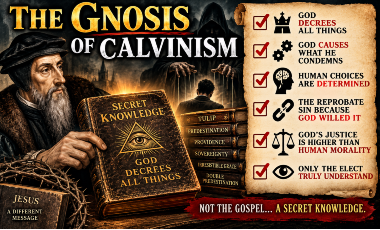
Most writers in the “classic Reformed” line use this pair: (1) God unchangeably ordains whatsoever comes to pass, including sinful acts; (2) the sinfulness of the act is from the creature, not from God as author. Vincent Cheung is included as the far edge of the same logic; his “author of sin” wording is rejected by most Westminster/Ligonier/Piper writers.
Scripture texts most often cited in this debate: Acts 2:23; 4:27–28; Ephesians 1:11; Isaiah 45:7; Amos 3:6; Lamentations 3:37–38; Genesis 50:20; Romans 9.
I. Confessional standards
Westminster Confession of Faith (1646)
“God from all eternity did, by the most wise and holy counsel of His own will, freely, and unchangeably ordain whatsoever comes to pass: yet so, as thereby neither is God the author of sin, nor is violence offered to the will of the creatures, nor is the liberty or contingency of second causes taken away, but rather established.”
WCF 3.1.
“The almighty power, unsearchable wisdom, and infinite goodness of God so far manifest themselves in His providence, that it extendeth itself even to the first fall, and all other sins of angels and men; and that not by a bare permission, but such as hath joined with it a most wise and powerful bounding, and otherwise ordering and governing of them, in a manifold dispensation, to His own holy ends; yet so, as the sinfulness thereof proceedeth only from the creature, and not from God, who, being most holy and righteous, neither is, nor can be, the author or approver of sin.”
WCF 5.4. The 1689 Baptist Confession uses the same structure.
“By the decree of God, for the manifestation of His glory, some men and angels are predestinated unto everlasting life, and others foreordained to everlasting death.”
WCF 3.3.
“The rest of mankind God was pleased, according to the unsearchable counsel of His own will … to pass by; and to ordain them to dishonour and wrath, for their sin, to the praise of His glorious justice.”
WCF 3.7.
Canons of Dort
Reprobation, on the Dort account, is not a bare foresight of unbelief. God leaves some in their fall and ordains them to condemnation for their sin, while unbelief itself is not outside the decree. See First Head of Doctrine, articles 6 and 15, and the Rejection of Errors.
Canons of Dort I.6, I.15 and Rejection of Errors under the First Head.
II. Authors, A–Z
Boettner, Loraine
“In the same manner and to an infinitely greater extent God controls our actions so that they are certain although we act freely.” […] “Even the sinful acts of men are included in this plan.”
Usually cited from The Reformed Doctrine of Predestination.
“Even the fall of Adam, and through him the fall of the race, was not by chance or accident, but was so ordained in the secret counsels of God.”
The Reformed Doctrine of Predestination.
Calvin, John
“Hence we maintain that, by his providence, not heaven and earth and inanimate creatures only, but also the counsels and wills of men are so governed as to move exactly in the course which he has destined.”
Institutes 1.16.8.
“Men do nothing save at the secret instigation of God, and do not discuss and deliberate on anything but what he has previously decreed with himself, and brings to pass by his secret direction.”
Institutes 1.18.1.
“The hand of God rules the interior affections no less than it superintends external actions; nor would God have effected by the hand of man what he decreed, unless he worked in their hearts to make them will before they acted.”
Concerning the Eternal Predestination of God, trans. J. K. S. Reid, p. 175f.
“… how foolish and frail is the support of divine justice afforded by the suggestion that evils come to be, not by His will but by His permission. … It is a quite frivolous refuge to say that God otiosely permits them, when Scripture shows Him not only willing, but the author of them. … Who does not tremble at these judgments with which God works in the hearts of even the wicked whatever He will, rewarding them nonetheless according to desert? Again it is quite clear from the evidence of Scripture that God works in the hearts of men to incline their wills just as he will, whether to good for His mercy’s sake, or to evil according to their merits.”
The Eternal Predestination of God 10:11.
“From these statements of the inspired word … it is, I think, sufficiently clear that God works in the hearts of men to incline their wills whithersoever He wills, whether to good deeds according to His mercy, or to evil after their own deserts; His own judgment being sometimes manifest, sometimes secret, but always righteous.”
Concerning the Eternal Predestination of God.
“Does God control even the evil wills of evil men? Calvin’s answer, in accord with Scripture, was ‘yes.’ Just as God controlled the rebellion of Pharaoh (Ex. 9:12), the cursing of Shimei (2 Sam. 16:10), and the rage of the Jerusalem crowds (Acts 2:23), so He controls even the will of all wicked men.”
The Secret Providence of God, ed. Paul Helm, trans. Keith Goad (Wheaton: Crossway, 2010), 79–80.
Note: The last block is Helm/Goad framing Calvin, not a continuous Calvin paragraph.
Cheung, Vincent
“God must be the author of evil, or evil could never have come about. God must be the author of sin, or sin could never have happened.”
“God the Author” (vincentcheung.com, 2009).
“When someone alleges that my view of divine sovereignty makes God the author of sin, my reaction is ‘So what?’ … The truth is that, whether or not God is the author of sin, there is no biblical or rational problem with him being the author of sin.”
The Author of Sin (2014), p. 4.
“God controls everything that exists and everything that happens. There is not one thing that exists or that happens that he has not decreed and caused—not even a single thought in the mind of man. Since this is true, it follows that God has decreed and caused the existence of evil. … In fact, when it comes to ontology, ‘God’s permission’ is an unintelligible term.”
The Author of Sin, p. 61.
Note: Cheung is the blunt edge of decree-theology. Most Westminster, Ligonier, and Piper writers reject calling God “the author of sin.”
Clark, Gordon H.
“I wish very frankly and pointedly to assert that if a man gets drunk and shoots his family, it was the will of God that he should do so. … In Ephesians 1:11, Paul tells us that God works all things, not some things only, after the counsel of his own will.”
Religion, Reason and Revelation (Nutley, N.J.: Craig Press, 1961), 221.
Edwards, Jonathan
“That we should say that God has decreed every action of men, yea, every action that is sinful, and every circumstance of those actions; that he predetermines that they shall be in every respect as they afterwards are; that he determines that there shall be such actions, and just so sinful as they are; and yet that God does not decree the actions that are sinful, as sin, but decrees them as good,—all of this is really consistent.”
Concerning the Divine Decrees in General, and Election in Particular.
If by “the author of sin” is meant the sinner, the agent, or doer of a wicked thing, Edwards says it would be “a reproach and blasphemy” to call God the author of sin, and he “utterly deny[s]” it in that sense. If it only means that God so disposes the state of events that sin, if permitted, “will most certainly and infallibly follow,” he does not deny the substance, though he dislikes the phrase.
Freedom of the Will / related discussions; often quoted via Piper.
“So evil is necessary, in order to the highest happiness of the creature, and the completeness of that communication of God, for which he made the world; because the creature’s happiness consists in the knowledge of God, and the sense of his love.”
Cited in John Piper, “Is God Less Glorious Because He Ordained That Evil Be?” (1998).
Frame, John M.
“The Reformed agree that God knows what would happen under all conditions, but they reject the notion that this knowledge is ever ultimately based on man’s autonomous decisions. Human decisions, they argue, are themselves the effects of God’s eternal decrees.”
“Scientia Media,” Evangelical Dictionary of Theology, 2nd ed., ed. Walter A. Elwell (Grand Rapids: Baker Academic, 2001), 1075.
Grudem, Wayne
God “brings about evil deeds through the willing actions of moral creatures. Moreover, Scripture never blames God for evil or shows God as taking pleasure in evil, and Scripture never excuses human beings for the wrong they do.”
Systematic Theology, discussion of God and evil (standard Grudem wording as commonly cited).
Hendryx, John
“In order to understand this better theologians have come up with the term ‘compatibilism’ to describe the concurrence of God’s sovereignty and man’s responsibility. Compatibilism is a form of determinism and it should be noted that this position is no less deterministic than hard determinism.”
Monergism.com. Related piece: “We are not Determinists!”
Hodge, A. A.
“God having from eternity absolutely decreed whatsoever comes to pass … he ALSO continually controls and directs the actions of all his creatures thus preserved, so that while he never violates the law of their several natures, he yet infallibly causes all actions and events singular and universal to occur according to the eternal and immutable plan embraced in his decree.”
“God’s decree ‘foreordains whatsoever comes to pass’; there was no event in the womb of the future, the futurition of which was not made certain to God by it.”
Outlines of Theology / systematic material.
Note: The paste’s line “If God’s plan doesn’t determine free human actions…” was a gloss and is omitted.
Hodge, Charles
“The decrees of God are certainly efficacious, that is, they render certain the occurrence of what He decrees. Whatever God foreordains, must certainly come to pass. The distinction between the efficient (or efficacious) and the permissive decrees of God, although important, has no relation to the certainty of events. All events embraced in the purpose of God are equally certain, whether He has determined to bring them to pass by his own power, or simply to permit their occurrence through the agency of his creatures.” […] “It was no less certain from eternity that Satan would tempt our first parents, and that they would fall, than that God would send his Son to die for sinners.”
“The doctrine of the Bible is, that all events, whether necessary or contingent, good or sinful, are included in the purpose of God, and that their futurition or actual occurrence is rendered absolutely certain.”
Systematic Theology, sections on the decrees.
Luther, Martin
“[The] omnipotence and foreknowledge of God, I repeat, utterly destroy the doctrine of ‘free-will’… Doubtless it gives the greatest possible offence to common sense or natural reason, that God, Who is proclaimed as being full of mercy and goodness, and so on, should of His own mere will abandon, harden and damn men, as though He delighted in the sins and great eternal torments of such poor wretches. It seems an iniquitous, cruel, intolerable thought to think of God; and it is this that has been such a stumbling block to so many great men down through the ages. And who would not stumble at it? I have stumbled at it myself more than once, down to the deepest pit of despair, so that I wished I had never been made a man. (That was before I knew how health-giving that despair was, and how close to grace.)”
The Bondage of the Will (1525).
Note: Luther is the Reformation source of this line, not a later “five-point” Calvinist. Editorial bullets from Collection 2 are omitted.
MacArthur, John
“He controls everything. He’s in complete control of evil.” […] “The devil is God’s devil; he’s totally controlled by God.” […] “Every single movement, as R. C. said, of every molecule is controlled by God, and a whole lot of it is evil.” […] “There’s not one molecule in the universe that’s out of line with His purposes.”
Grace to You.
“Then God is responsible for all the evil and all the divine judgment and the determination of eternal punishment. This is a God that some people just can’t live with; they’ve got to get Him off the hook.”
Grace to You (video).
Note: The second block describes the free-will theodicy MacArthur is rejecting.
Owen, John
On the fall: the tree, the serpent, and the taking of the fruit were not a bare permission. “Sovereign” here “means more than mere permission. God is not the author of sin, but neither is ‘allow’ the best explanation for it all. … it was all decreed.”
Discussion of Communion with God, as summarized in The Cripplegate, “John Owen on Why God Decreed the Fall” (2013).
Note: Owen’s own prose in Communion with God speaks of a “design in Christ” lodged from eternity after describing the fall’s ruin; the word “decreed” in the summary is the interpreter’s.
Palmer, Edwin H.
“All things that happen in all the world at any time and in all history … come to pass because God ordained them. Even sin—the fall of the devil from heaven, the fall of Adam, and every evil thought, word, and deed in all of history … is included in the eternal decree of our holy God.” […] “Sin is not only foreknown by God, it is also foreordained by God.”
The Five Points of Calvinism, 2nd ed. (Grand Rapids: Baker, 1999), pp. 24–25, 82.
Pink, A. W.
“Plainly it was God’s will that sin should enter this world, otherwise it would not have entered, for nothing happens except what God has eternally decreed. Moreover, there was more than a simple permission, for God only permits things that fulfill His purpose.” […] “Not only did God have a perfect foreknowledge of the outcome of Adam’s trial; not only did His omniscient eye see Adam eating of the forbidden fruit, but He decreed beforehand that he should do so.”
The Sovereignty of God.
Piper, John
“God so disposes all things … so that in accordance with moral necessity all men make only those choices ordained by God from all eternity.” […] “In this way He ultimately determines all acts of volition (though not all in the same way) and yet holds man accountable only for those acts which they want most to do.”
Desiring God (page/URL not in the original paste).
“Somehow, we must confess both that God has a role in bringing evil about, and that in doing so he is holy and blameless.” […] “God does bring sins about, but always for his own good purposes. So in bringing sin to pass he does not himself commit sin.”
Desiring God writing on God and evil.
“Is God less glorious because he ordained that evil be? … no, just the opposite. God is more glorious for having conceived and created and governed a world like this with all its evil. The effort to absolve him by denying his foreknowledge of sin … or by denying his control of sin … is fatal.”
John Piper, “Is God Less Glorious Because He Ordained That Evil Be?” (1998).
Shedd, W. G. T.
“In Pauline conception, predestination, or foreordination, covers and includes both the holiness that is to be rewarded with life, and the sin that is to be punished with death. The holiness of the elect is predestinated, and the sin of the non-elect likewise.” […] “the perdition of Judas was as much foreordained and free from chance, as the conversion of Saul.”
Calvinism: Mixed and Pure (Monergism reprint, 2020), 78, 34.
Sproul, R. C., Jr.
“God wills all things that come to pass.” […] “God desired for man to fall into sin.” […] “I am not accusing God of sinning; I am suggesting that God created sin.”
Almighty Over All (Grand Rapids: Baker, 1999), p. 54.
Note: R. C. Sproul Jr., not R. C. Sproul Sr.
Talbot, Mark
“Ephesians 1:11 goes even further by declaring that God in Christ ‘works all things according to the counsel of his will.’ Here the Greek word for ‘works’ is energeō, which indicates that God not merely carries all of the universe’s objects and events to their appointed ends but that he actually brings about all things in accordance with his will. In other words, it isn’t just that God manages to turn the evil aspects of our world to good for those who love him; it is rather that he himself brings about these evil aspects for his glory … This includes—as incredible and as unacceptable as it may currently seem—God’s having even brought about the Nazis’ brutality at Birkenau and Auschwitz as well as the terrible killings of Dennis Rader and even the sexual abuse of a young child.”
In John Piper and Justin Taylor, eds., Suffering and the Sovereignty of God (Wheaton: Crossway, 2006), 42.
Turretin, Francis
God is not the “true and proper cause” of sin; yet the fall stands under the decree so that it is certain. Secondary literature regularly pairs Turretin’s Institutes of Elenctic Theology on this point with Edwards.
Institutes of Elenctic Theology 1:611 (as cited in discussions of Edwards and the fall).
Zachariades, Theodore
“God works all things after the Council of His will. Even keeping those kings who want to commit adultery from committing so! And when He wants to, he orders those to commit adultery when he wants to!”
Video (title/date not in the paste). “Council” almost certainly = “counsel.”
Zanchius, Jerome
“Surely, if God had not willed the fall, He could, and no doubt would, have prevented it; but He did not prevent it: ergo He willed it. And if He willed it, He certainly decreed it.”
The Doctrine of Absolute Predestination, ch. II, sec. II, par. 4.
This is from a debate [of sorts] from X… really they are a series of snipes from INTJ68, So I will post his challenge, my response…. it’ll be choppy, but that is the nature of the WWW – I just want to get it on here to keep.
INTJ68 responded with this… proof texts, not dissimilar to J-Dubs proving Jehovah is Unitarian, and “disproving” the Trinity, or Mormons “showing” the Trinity is three completely separate God’s, all born through sexual acts:
I responded that these “proof” texts have been responded to, giving three examples [one mine]:
This is where John Hendryx’s admission becomes particularly important…. (From a post of mine I will link after the two videos)
Hendryx explains that theologians use “compatibilism” to reconcile God’s sovereignty with human responsibility, but he explicitly acknowledges that “compatibilism is a form of determinism” and is “no less deterministic than hard determinism.” The Calvinist answer, therefore, is not to deny that God determines human choices, but to argue that a person can still be morally responsible for a choice that God has determined him to make. In other words, compatibilism doesn’t solve the determinism problem by denying that human choices are determined; it attempts to reconcile determinism with human responsibility by insisting that a determined choice can still be considered the person’s responsible choice.
And that is precisely where the problem arises. If God determines that one person will believe and another will remain in unbelief—and the latter cannot believe unless God first regenerates him—then what does “responsibility” actually mean? The Calvinist can say the unbeliever willingly rejects Christ, but the deeper question remains: could he have done otherwise without God first giving him the ability to do otherwise? If the answer is no, then simply calling him “responsible” does not explain how responsibility works; it merely asserts it.
…continued…
The founder of Monergism .com says that “compatibilism is a form of determinism” and is “no less deterministic than hard determinism.”
John MacArthur, however, shows why that distinction raises a profound problem. He argues that if God is the primary cause and humans are merely secondary causes moved by that primary cause, then the determinism ultimately extends to the secondary cause as well. God is the one who ultimately “decided,” “compelled,” and “coerced” the action. In other words, the human being remains the immediate or secondary cause of the action, but that secondary cause itself is also determined by the primary cause. God remains the ultimate determining cause behind both the action and the secondary cause through which that action occurs.
You miss-define sovereignty to mean that God exhaustively controls everything. So does all the “Reformed” Baptist and Calvinists I listed in a previous post.
INTJ68
I Respond:
Also, did God decree and ordain me to believe in Provisionism?
“The hand of God rules the interior affections no less than it superintends external actions; nor would God have effected by the hand of man what he decreed, unless he worked in their hearts to make them will before they acted.” — John Calvin, Concerning the Eternal Predestination of God, tr. J. K. S. Reid, p.175f
If God determines all things—including the interior affections and thoughts that precede our actions—then He determined the chain of thoughts, desires, experiences, and circumstances by which I came to believe Provisionism. As Calvin put it, God “worked in [our] hearts to make [us] will before [we] acted.”
So my belief in Provisionism is, on your own system, part of that determined chain. Why, then, mock me for believing what your theology says God determined me to believe? Before you call my theology “trash,” explain why your system requires God to determine the very thoughts and convictions you are condemning me for having.
INTJ68 said “Lol, you people always do the meme.” and then posted a meme. I did note he started this all essentially with a trash can meme.
I Respond:
Sorry Charlie, you are fighting the Paul Washers of your heretical faith
JOHN CALVIN
“… how foolish and frail is the support of divine justice afforded by the suggestion that evils come to be, not by His will but by His permission. … It is a quite frivolous refuge to say that God otiosely permits them, when Scripture shows Him not only willing, but the author of them. … Who does not tremble at these judgments with which God works in the hearts of even the wicked whatever He will, rewarding them nonetheless according to desert? Again it is quite clear from the evidence of Scripture that God works in the hearts of men to incline their wills just as he will, whether to good for His mercy’s sake, or to evil according to their merits.”
— The Eternal Predestination of God 10:11.
GORDON H. CLARK
“I wish very frankly and pointedly to assert that if a man gets drunk and shoots his family, it was the will of God that he should do so. … In Ephesians 1:11, Paul tells us that God works all things, not some things only, after the counsel of his own will.”
“The Reformed agree that God knows what would happen under all conditions, but they reject the notion that this knowledge is ever ultimately based on man’s autonomous decisions. Human decisions, they argue, are themselves the effects of God’s eternal decrees.”
— “Scientia Media,” Evangelical Dictionary of Theology, 2nd ed., ed. Walter A. Elwell (Grand Rapids: Baker Academic, 2001), 1075.
JOHN PIPER
“God so disposes all things … so that in accordance with moral necessity all men make only those choices ordained by God from all eternity.” […] “In this way He ultimately determines all acts of volition (though not all in the same way) and yet holds man accountable only for those acts which they want most to do.”
“Ephesians 1:11 goes even further by declaring that God in Christ ‘works all things according to the counsel of his will.’ Here the Greek word for ‘works’ is energeō, which indicates that God not merely carries all of the universe’s objects and events to their appointed ends but that he actually brings about all things in accordance with his will. In other words, it isn’t just that God manages to turn the evil aspects of our world to good for those who love him; it is rather that he himself brings about these evil aspects for his glory … This includes—as incredible and as unacceptable as it may currently seem—God’s having even brought about the Nazis’ brutality at Birkenau and Auschwitz as well as the terrible killings of Dennis Rader and even the sexual abuse of a young child.”
— In John Piper and Justin Taylor, eds., Suffering and the Sovereignty of God (Wheaton: Crossway, 2006), 42.
How bout Macarthur, Sproul, Piper and others. I grant that some “say” compatibilism, but people are not thinking to the logical conclusion of it. What is free will compatible with? Theistic determinism? That crumbles un the law of non-contradiction. Sproul teaches double predestination…. so where is the “compatiblism” in that. You are fighting not me, but ….
John Calvin, Theodore Beza, William Perkins, Francis Turretin, Amandus Polanus, Girolamo Zanchi, John Owen, Thomas Goodwin, Stephen Charnock, Jonathan Edwards, A. A. Hodge, Charles Hodge, B. B. Warfield, R. L. Dabney, William G. T. Shedd, Herman Bavinck, Abraham Kuyper, Louis Berkhof, Cornelius Van Til, Gordon H. Clark, R. C. Sproul, John Piper, John MacArthur, J. I. Packer, James Montgomery Boice, Sinclair Ferguson, R. C. Sproul Jr., Michael Horton, Wayne Grudem, Thomas Schreiner, Albert Mohler, Paul Washer, James White
INTJ68
I Respond:
Thank you for proving my point. Took a while to get here. Notice what is happening here. Paul Washer says we are ‘free to will,’ but only according to our nature—and then says our fallen nature guarantees evil until God gives us a new heart. That’s not an explanation of libertarian free will; it’s an explanation of compatibilist freedom. The real question isn’t whether we voluntarily do what we want. The question is whether we could have done otherwise. If my nature determines what I will want, and God must first change that nature before I can choose Christ, then saying ‘you’re free to will’ doesn’t establish libertarian freedom—it simply redefines freedom so that determinism can still be called free will.
If the fallen man is genuinely free to choose Christ, why does he need God to give him a new heart before he can choose Christ? But if he cannot choose Christ until God changes his nature, then what exactly was his ‘free will’ doing in the first place?
Pelagius did not actually believe that—well, not quite. Of the fourteen charges brought against him, he accepted only half of one.
“So you deny original sin? Then you’re a Pelagian.”
That charge has been around for a long time. Luther, for example, attacked Zwingli’s view of original sin as Pelagian. But Zwingli did not simply deny that Adam’s fall affected the rest of humanity. He taught that Adam’s sin left humanity with an inherited condition of corruption, misery, bondage, and death; what he rejected was the idea that Adam’s guilt itself was personally imputed to his descendants.
That is what makes Ali Bonner’s historical analysis so useful. “Pelagianism” was not the name of a neat, clearly defined theological system into which everyone who disagreed with Augustine could be placed. Bonner argues that the category was shaped through controversy, and that the historical record is much messier than the formula “deny original sin = Pelagian” suggests. Pelagius himself believed that Adam’s sin affected his descendants, even though he rejected Augustine’s account of inherited original sin. A different view of Adam, original sin, or inherited guilt, then, does not by itself make someone a Pelagian.
A useful comparison is the label “trickle-down economics.” It became a standard way to describe—and criticize—Reagan-era economic policy, though Reagan did not use the phrase to define his own program. His administration spoke instead about cutting tax rates, encouraging growth, and supply-side economics. Nor did the broader idea begin with Reagan. JFK also pushed for major tax cuts, arguing that “tax rates are too high” and that stronger economic growth would ultimately increase revenue. He is also remembered for the line, “a rising tide lifts all boats.”
Of course, the point is not that Pelagianism and “trickle-down economics” are the same kind of thing. The comparison is about how quickly a polemical label can take the place of describing what someone actually believes.
So before calling someone a Pelagian, it is worth asking whether that person actually holds Pelagius’s theology—or merely has a different account of how Adam’s sin is transmitted and what its consequences are.
That is all I feel like cataloging here. Gotta go prep for the work week.
R.C. Sproul’s Statement on Predestination (from Chosen by God):
“What predestination means, in its most elementary form, is that our final destination, heaven or hell, is decided by God not only before we get there, but before we are even born. It teaches that our ultimate destiny is in the hands of God. Another way of saying it is this: From all eternity, before we ever live, God decided to save some members of the human race and to let the rest of the human race perish. God made a choice–he chose some individuals to be saved unto everlasting blessedness in heaven and others he chose to pass over, to allow them to follow the consequences of their sins into eternal torment in hell.” (Chosen By God, p.22, emphasis mine)
This is double predestination in practice, even if Sproul calls the active-positive version for reprobation a caricature.
If the elect cannot fail to be saved,
and the reprobate cannot be saved because God withholds the only grace capable of producing faith,
then what practical difference remains between active reprobation and passive reprobation?
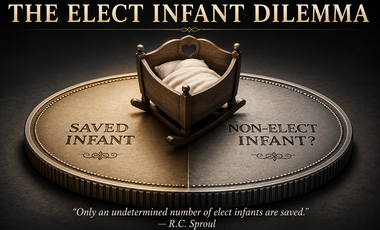
Elect infants, dying in infancy, are regenerated, and saved by Christ, through the Spirit, who works when, and where, and how He pleases: so also are all other elect persons who are incapable of being outwardly called by the ministry of the Word.
– Westminster Confession of Faith (WCF) 10.3
“Holy Spirit can save an infant by changing his heart, giving grace, and applying the merit of Christ to him. The Westminster divines certainly believed that babies can be saved. They did not teach that all infants are necessarily saved; rather, they taught that only an undetermined number of elect infants are saved. Obviously, an elect infant is going to be saved, and any saved infant is elect, but the divines did not speculate on which infants those would be.”
– R.C. Sproul, Truths We Confess: A Systematic Exposition of the Westminster Confession of Faith (Sanford, FL: Reformation Trust, 2019), 321.
Sproul conforms his support for the ideas in the WCF:
One of the most important confessions of faith ever penned, particularly in the English-speaking world, is the Westminster Confession of Faith. By the confession’s own statements, no confession written by uninspired authors is to be taken as having supreme authority over the believer. Confessions cannot bind the conscience in the manner that the Word of God can and does. At the same time, though human confessions and creeds are penned by fallible people without the benefit of the inspiration of the Holy Spirit, the profound level of theological and biblical precision manifest in the Westminster Confession of Faith is awe-inspiring. (Ibid., xvii.)
[….]
The Westminster Confession is the most precise and accurate summary of the content of biblical Christianity ever set forth in a creedal form. Creeds such as the Belgic Confession, the Heidelberg Catechism, and the Scots Confession should be highly regarded, but no historic confession surpasses in eloquence, grandeur, and theological accuracy the Westminster Confession of Faith. (Ibid., xix)
Critiquing the matter via CHAT:
The Internal Tension
Sproul writes:
“The Westminster divines certainly believed that babies can be saved. They did not teach that all infants are necessarily saved; rather, they taught that only an undetermined number of elect infants are saved.”
The immediate question is:
If only elect infants are saved, what happens to non-elect infants?
Historically, Westminster does not explicitly answer that question. Critics argue that the silence is revealing. If the Confession intended to teach universal infant salvation, it could have said:
“All infants dying in infancy are saved.”
Instead it says: “Elect infants.” Sproul defends that wording rather than correcting it.
Critique #1: Election Becomes the Ultimate Divider
Sproul affirms:
unconditional election,
total inability,
monergistic regeneration,
and reprobation.
Therefore, infant salvation cannot be based upon:
personal faith,
conscious belief,
repentance,
or moral innocence.
It must ultimately rest on election.
Critics respond:
If election alone determines which infants are saved, then election alone determines which infants are not saved.
Thus the question becomes: Why would God elect some infants and not others?Sproul never provides a clear answer.
Critique #2: Original Guilt Creates the Problem
Sproul consistently taught:
Adam’s guilt is imputed to humanity,
infants are fallen,
infants need Christ’s grace.
Critics agree infants need grace but ask:
Does inherited guilt alone make an infant deserving of eternal punishment?
Many opponents argue Scripture consistently ties judgment to:
knowledge,
personal rebellion,
actual transgression.
Examples often cited:
Deuteronomy 1:39
Isaiah 7:15-16
Jonah 4:11
Romans 4:15
The criticism is:
Sproul imports Augustine’s doctrine of inherited guilt and then must wrestle with implications Augustine himself embraced.
Critique #3: The Moral Character of God
This is probably the most emotionally and philosophically powerful objection.
If:
an infant never consciously sins,
never rejects God,
never suppresses truth,
never commits personal acts of rebellion,
Yet could still be damned, Critics ask:
What meaningful sense of justice remains?
This is where many critics invoke the same concern raised by Juncker regarding determinism:
If moral categories are detached from personal responsibility, words like justice become difficult to understand.
FULLER QUOTE:
“If determinism is true then either God is evil and the author of evil or all talk of good and evil, of praise and blame, of moral responsibility, and of justice is meaningless and incomprehensible with reference to God. That is, if God can cause or determine evil and yet remain good, and if God can punish those who do exactly and only what He has meticulously caused and determined them to do and yet remain just, then we have no idea who God is or what He might or might not do or what Scripture could possibly mean when it calls Him ‘good’ and ‘just.'”
Eternal punishment without personal rebellion appears inconsistent with ordinary moral reasoning and the biblical portrayal of God’s fairness.
Critique #4: Westminster Creates an Unnecessary Problem
Many critics argue Westminster itself created the issue. The Confession says:
“Elect infants.”
Critics ask why not simply say:
“Infants dying in infancy are saved through Christ”?
Mohler, Warfield, and Spurgeon essentially move in that direction. Sproul, however, insists the Westminster divines intentionally did not teach universal infant salvation. Critics argue:
That commitment to confessional precision ends up preserving a theological possibility that Scripture never explicitly teaches.
Critique #5: Sproul’s Loyalty to Westminster
This critique becomes stronger when paired with Sproul’s own statements:
“The Westminster Confession is the most precise and accurate summary of the content of biblical Christianity ever set forth in a creedal form.”
and
“One of the most important confessions of faith ever penned…”
Because Sproul viewed Westminster so highly, critics argue he was reluctant to depart from its language regarding elect infants even when later Reformed theologians moved toward affirming universal infant salvation.
The Strongest One-Sentence Critique
The strongest critique is probably this:
By affirming unconditional election, inherited guilt, and Westminster’s doctrine of “elect infants,” Sproul leaves open the possibility that some infants are not elect and therefore not saved, a conclusion many critics believe is inconsistent with both the justice and goodness of God as revealed in Scripture.
Exhaustive Determinism:
Sproul affirms that God ordains whatsoever comes to pass (echoing Westminster):
He knows all things that will happen because he ordains everything that does happen. This is crucial to our understanding of God’s omniscience. He does not know what will happen by virtue of exceedingly good guesswork about future events. He knows it with certainty because he has decreed it.
The Westminster Confession avers: “God from all eternity, did, by the most wise and holy counsel of His own will, freely, and unchangeably ordain whatsoever comes to pass. . . .”
This statement refers to God’s eternal and immutable decretive will. It applies to everything that happens. Does this mean that everything that happens is the will of God? Yes. Augustine qualified this answer by adding the words, “in a certain sense.” That is, God ordains “in some sense” everything that happens. Nothing that takes place is beyond the scope of his sovereign will. The movement of every molecule, the actions of every plant, the falling of every star, the choices of every volitional creature, all of these are subject to his sovereign will. No maverick molecules run loose in the universe, beyond the control of the Creator. If one such molecule existed, it could be the critical fly in the eternal ointment. As one grain of sand in the kidney of Oliver Cromwell changed the course of English history, so one maverick molecule could destroy every promise God has ever made about the outcome of history.
— What Is Reformed Theology, p. 172
Sproul’s view functionally equivalent to Calvin’s broader decretive will, even if he rejects “equal ultimacy” (symmetrical positive-positive reprobation where God actively works sin in the reprobate the same way He works faith in the elect). Sproul’s inconsistency is “too embarrassed to follow Calvinism to its logical extreme” and pleading ignorance/mystery on hard questions (e.g., the fall of Adam/Eve).
Calvin (Institutes 3.21.5): Explicitly symmetric language —
“some are preordained to eternal life, others to eternal damnation… created for one or the other of these ends.”
Sproul: Rejects the symmetrical mode (equal ultimacy / positive-positive) as sub-Calvinist or a caricature that makes God the author of sin. He prefers asymmetric (positive election + negative reprobation/preterition: God passes over the non-elect, leaving them in their sin). Yet critics [like myself] argue this is rhetorical softening — because Sproul still affirms:
God’s decree covers all events.
Reprobation is part of the eternal decree before creation.
The non-elect are chosen to be passed over before birth.
Sproul’s distinctions, while rhetorically softer than Calvin’s, do not ultimately escape the force of double predestination or exhaustive determinism.
… The issue here seems to be how one defines “ordains” or “foreordains.” Calvinists I debate on the internet consistently argue that “ordain” means to decree. I ask them, “Did God decree the Holocaust?” “Did God decree the killing fields of Cambodia?” “Did God decree every act of rape, torture and murder that has ever taken place?” And they say yes! Unbelievable.
What about Calvin on this issue? You deny he was supralapsarian, claiming God’s positive-positive, double-predestination, but excerpts from his writings strongly suggest that was his position. Calvin was quite straightforward on saying God decreed the Fall, writing:
…whence does it happen that Adam’s fall irremediably involved so many peoples, together with their infant offspring, in eternal death unless because it so pleased God?…The decree is dreadful indeed, I confess. Yet no one can deny that God foreknew what end man was to have before he created him, and consequently foreknew because he so ordained by his decree…God not only foresaw the fall of the first man, and in him the ruin of his descendants, but also meted it out in accordance with his own decision.” (Institutes of the Christian Religion, 3.23.7)
That seems to go beyond mere “permission.” He also wrote:
The predestination by which God adopts some to the hope of life, and adjudges others to eternal death, no man who would be thought pious ventures simply to deny….By predestination we mean the eternal decree of God, by which he determined with himself whatever he wished to happen with regard to every man. All are not created on equal terms, but some are preordained to eternal life, others to eternal damnation; and, accordingly, as each has been created for one or other of these ends, we say that he has been predestinated to life or to death (Institutes of the Christian Religion 3.21.5).
We also read:
From this it is easy to conclude how foolish and frail is the support of divine justice afforded by the suggestion that evils come to be not by [God’s] will, but merely by his permission. Of course, so far as they are evils, which men perpetrate with their evil mind, as I shall show in greater detail shortly, I admit that they are not pleasing to God. But it is a quite frivolous refuge to say that God otiosely [= idly] permits them, when Scripture shows Him not only willing but the author of them…Who does not tremble at these judgments with which God works in the hearts of even the wicked whatever He will, rewarding them nonetheless according to desert. Again, it is quite clear from the evidence of Scripture that God works in the hearts of men to incline their will just as he will, whether to good for his mercy’s sake, or to evil according to their merits.” (Concerning the Eternal Predestination of God, 177)
Other famous Calvinists say, for example,
“The Sovereignty of God over all, and his independency, clearly shew, that whatever is done in time is according to his decrees in eternity.” (John Gill, A Body of Doctrinal and Practical Divinity, p. 173)
Or
“As a builder draws his plan before he begins to build, so the great Architect predestined everything before a single creature was called into existence.” (Arthur Pink, The Doctrines of Election and Justification, p.9)
Or
“Surely if God had not willed the fall, He could, and no doubt would, have prevented it; but he did not prevent it: ergo, He willed it. And if He willed it, He certainly decreed it.” (Jerome Zanchius, The Doctrine of Absolute Predestination, p. 88)
So, by claiming supralapsarianism is “anti-Calvinism,” you are dismissing not only prominent Calvinists from the past, but also Calvin himself. …
[T]heological compatibilists [RPT: like Grudem, Sproul, MacArthur, and the like] often make claims and engage in rhetoric that naturally lead people to conclude that God loves them and desires their salvation in ways that are surely misleading to all but those trained in the subtleties of Reformed rhetoric. . . . Such language loses all meaning, not to mention all rhetorical force, when we remember that on compatibilist premises God could determine the impenitent to freely repent, but has chosen instead to determine things in such a way that they freely persist in their sins.
Why No Classical Theist – Let Alone Orthodox Christian – Should Ever Be a Compatibilist (PDF)
God’s refusal to determine the repentance of sinners when it is within his power to do so can be called nothing other than immoral. Damning certain people by withholding something freely given to others is not glorious.
Sproul and Calvin say it is indeed a horrible decree. Sproul’s honesty at this point would be refreshing if his conclusions weren’t so disturbing:
“The nasty problem for the Calvinist [is] . . . . If God can and does choose to insure the salvation of some, why then does he not insure the salvation of all? . . . The only answer I can give to this question is that I don’t know. . . . One thing I do know. If it pleases God to save some and not all, there is nothing wrong with that.” On the contrary, it is the very definition of wrong.” (Fuller Quote)
Here is Sproul’s chapter 58 from his book, Essential Truths of the Christian Faith, I will add some emphasis:
PREDESTINATION AND REPROBATION
Every coin has a flip side. There is also a flip side to the doctrine of election. Election refers to only one aspect of the broader question of predestination. The other side of the coin is the question of reprobation.
God declared that He loved Jacob but hated Esau. How are we to understand this reference to divine hatred?
Predestination is double. The only way to avoid the doctrine of double predestination is to either affirm that God predestinates everybody to election or that He predestinates no one to either election or reprobation.
Since the Bible clearly teaches predestination to election and denies universal salvation, we must conclude that predestination is double. It includes both election and reprobation. Double predestination is unavoidable if we take Scripture seriously. What is crucial, however, is how double predestination is understood.
Some have viewed double predestination as a matter of equal causation, where God is equally responsible for causing the reprobate not to believe as He is for causing the elect to believe. We call this a positive-positive view of predestination.
The positive-positive view of predestination teaches that God positively and actively intervenes in the lives of the elect to work grace in their hearts and bring them to faith. Likewise, in the case of the reprobates, He works evil in the hearts of the reprobate and actively prevents them from coming to faith. This view has often been called “hyper-Calvinism” because it goes beyond the view of Calvin, Luther, and the other Reformers.
The Reformed view of double predestination follows a positive-negative schema. In the case of the elect, God intervenes to positively and actively work grace in their souls and bring them to saving faith. He unilaterally regenerates the elect and insures their salvation. In the case of the reprobate He does not work evil in them or prevent them from coming to faith. Rather, He passes over them, leaving them to their own sinful devices. In this view there is no symmetry of divine action. God’s activity is asymmetrical between the elect and the reprobate. There is, however, a kind of equal ultimacy. The reprobate, who are passed over by God, are ultimately doomed, and their damnation is as certain and sure as the ultimate salvation of the elect.
The problem is linked to biblical statements such as those regarding God’s hardening of Pharaoh’s heart. That the Bible says God hardened Pharaoh’s heart is beyond dispute. The question remains, how did God harden Pharaoh? Luther argued for a passive rather than an active hardening. That is, God did not create fresh evil in Pharaoh’s heart. There was already enough evil present in Pharaoh’s heart to incline him to resist the will of God at every turn. All God ever has to do to harden anybody is to remove His restraining grace from them and give them over to their own evil impulses. This is precisely what God does to the damned in hell. He abandons them to their own wickedness.
In what sense did God “hate” Esau? Two different explanations are offered to solve this problem. The first explains it by defining hate not as a negative passion directed toward Esau but as simply the absence of redemptive love. That God “loved” Jacob simply means that He made Jacob the recipient of His unmerited grace. He gave Jacob a benefit that Jacob did not deserve. Esau did not receive the same benefit and in that sense was hated by God.
The first explanation sounds a bit like special pleading to get God off the hook for hating somebody. The second explanation gives more strength to the word hate. It says simply that God did in fact hate Esau. Esau was odious in the sight of God. There was nothing in Esau for God to love.
Esau was a vessel fit for destruction and altogether worthy of God’s wrath and holy hatred. Let the reader decide.
Summary
Predestination is double; it has two sides to it.
Some teach that God is equally responsible for election and reprobation. This is characteristic of hyper-Calvinism.
The Reformed view of double predestination reflects a positive-negative schema.
God passively, not actively, hardened Pharaoh’s heart.
God hated Esau in the sense of failing to give him a blessing of grace or in the sense of abhorring him as a vessel fit for destruction.
In other words, as The Encyclopedia of The Reformed Faith (page 144), and later the The Westminster Handbook to Reformed Theology (page 87) clearly says:
The Reformed approach to divine freedom is nowhere more apparent than in the doctrine of the eternal decrees: God freely wills the existence and preservation of the created order and freely determines the eternal destiny of all creatures, solely on the ground of God’s goodness and solely for the sake of God’s ultimate glory. In creation and providence, God encounters no barriers to the exercise of God’s will, and in the work of redemption God acts utterly graciously, apart from any merit belonging to the creature.
[….]
Reformed theology has followed an Augustinian paradigm in its understanding of human freedom…
Donald K. McKim and David F. Wright, eds., Encyclopedia of the Reformed Faith (Louisville, KY: Westminster John Knox Press, 1992), 144,146.
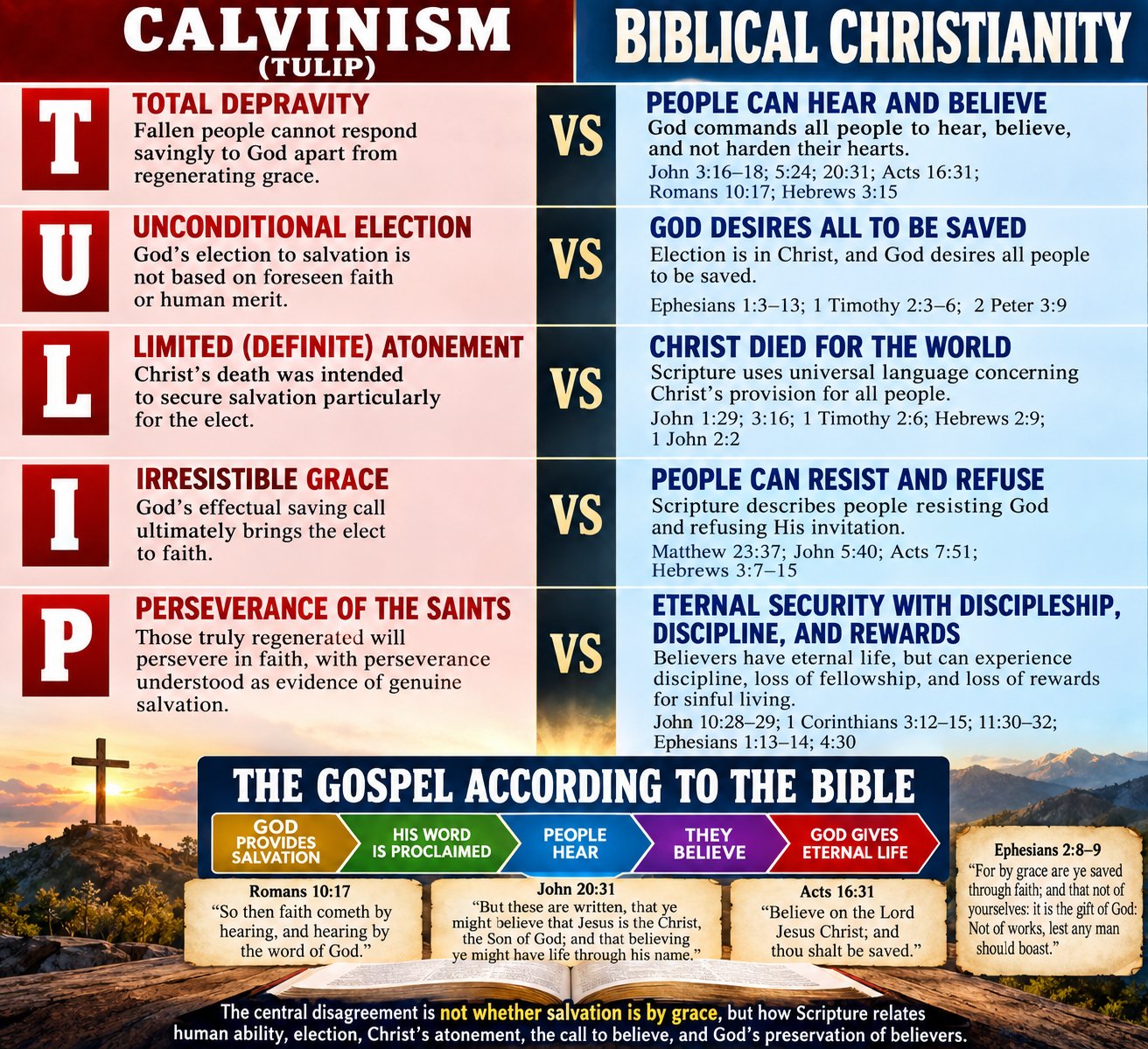
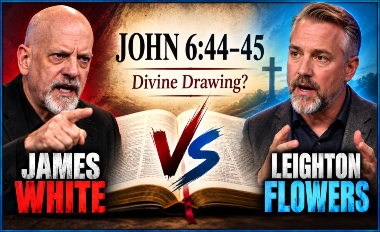
JOHN 6:44
Steve Lemke
R. C. Sproul argued at great length that John 6:44 (“No one can come to Me unless the Father who sent Me draws him” [HCSB]) does not refer merely to the necessity that God “woo or entice men to Christ,” such that humans can “resist this wooing” and “refuse the enticement.”11 In philosophical language, Sproul said, this wooing is a necessary but not sufficient condition for salvation “because the wooing does not, in fact, guarantee that we will come to Christ.”12 Sproul stated that such an interpretation is “incorrect” and “does violence to the text of Scripture.”13
Instead, Sproul insists, the term “draw” is “a much more forceful concept than to woo” and means “to compel by irresistible superiority.”14 However, in discussing irresistible grace, Sproul tells of a student who, hearing a lecture on predestination by John Gerstner, rejected it. When Gerstner asked the student how he defined Calvinism, the student described it as the perspective that “God forces some people to choose Christ and prevents other people from choosing Christ.” Gerstner then said, “If that is what a Calvinist is, then you can be sure that I am not a Calvinist either.”15What is the difference between compelling “by irresistible superiority” and “forcing” people to do something? Sproul likewise chastised a Presbyterian seminary president for rejecting the Calvinist doctrine that “God brings some people, kicking and screaming against their wills, into the kingdom.” Sproul described this Presbyterian theologian’s view as “a gross misconception of his own church’s theology,” as a “caricature,” and “as far away from Calvinism as one could possibly get.”16 So which way is it? If God compels people with “irresistible superiority,” in what way is it inaccurate to say that God forces people to choose Christ? The Synod of Dort insisted that such attempts at moral persuasion of unsaved persons was wasted time. The irresistibility of God’s grace (and not merely the use of strong moral persuasion) was precisely what the Synod of Dort rejected and the Remonstrants affirmed. While the Remonstrants affirmed that the compelling grace of God persuades the lost to receive Christ as Lord and Savior, the Synod of Dort insisted that this was not going far enough. Note their explicit denial that a person can “resist” God. The language used in the Synod of Dort describes God’s omnipotence as being such that God can “potently and infallibly bend man’s will to faith and conversion.”17
Bending the will of a fallible being by an omnipotent Being powerfully and unfailingly is not merely sweet persuasion. It is forcing one to change one’s mind against one’s will. Calvinists often describe their position as monergism as opposed to synergism. In monergism, God works entirely alone, apart from any human role.18
11. Sproul, Chosen by God, 69–70 (see chap. 1, n. 106). 12. Sproul, 69. 13. Sproul, 69. 14. Sproul, 69. 15. Sproul, 122. 16. Sproul, 122. 17. Dennison, Reformed Confessions, 4:143 (III–IV, Rejection of Errors, par. 8).
John Wagner’s Letter to Sproul
… Let me deal next with the issue of your concept and use of the Greek word helkō, commonly translated “draws” in John 6:44. Even if you reject everything else I write here, please accept this one. You really did not get this right. And Calvinists who have read CBG have passed on this incorrect information. You quoted Kittel’s Theological Dictionary of the New Testament, and claim because that word means “drag” or “compel” in a physical context such as Acts 16:19 and James 2:6, that therefore it means “drag” or “compel” in the spiritual context of John 6:44.
The evidence indicates it doesn’t. I assume you are aware that a Greek word can have more than one meaning. I looked at Kittel and I see for helkō in regard to John (i.e. 6:44, 12:32) it means, “a beneficent ‘drawing of God…of drawing to oneself in love. This usage is distinctively developed by Jn., perhaps with some influence of Gnosticism. Force or magic may be discounted, but not the supernatural element.” The abridged version of Kittel says, “There is no thought here of force or magic. The term figuratively expresses the supernatural power of the love of God or Christ which goes out to all (12:32) but without which no one can come.”
Did you get that? Both summaries dismiss force, which would be consistent with “drag” or “compel” (though I agree that would be accurate when the word is used in a physical context). Just wondering why you didn’t mention that! Let’s put your position to rest with more citations:
BDAG: has helkō in John 6:44 as “draw, attract.”
Analytical Lexicon to the Greek New Testament by William Mounce says helkō means “to draw mentally and morally, John 6:44; 12:32.”
The Hebrew-Greek Key Study Bible by Calvinist Spiro Zodhiates: “Helko is used of Jesus on the cross drawing by love, not force” (Jn. 6:44; 12:32).
A Critical Lexicon and Concordance to the English and Greek New Testament by Ethelbert W. Bullinger, p. 235: Helko means “to draw, esp. implying a certain attraction mentally or morally; also to draw to a certain point.” This source also mentions surō as a word more consistent with how Calvinists interpret helkō. Surō generally implies a violent dragging. This source defines it as “to draw, drag or trail along as a net; esp. with the notion of force and sometimes with violence.”
The Renaissance New Testament by Randolph Yeager, says about helkō:
It does not necessarily involve coercion, though it does involve persuasion and motivation–John 6:44; 12:32…. [Helkō] does not imply coercion in the two places where it is applied to the elect [the two just-mentioned verses]. Swords, fish nets and political prisoners (John 18:10; 21:6, 11: Acts 16:19) may resist, but the element of resistance is not implicit in the word itself….
Greek and English Lexicon of the New Testament by Edward Robinson, say helkō means “to draw by a moral influence, John 6:44, 12:32.”
Please notice that none of these sources indicate that helkō means drag or compel in John 6:44. And your version is especially problematic for John 12:32. Do you believe God drags all men to himself? So it’s kind of funny that the Arminian professor you debated didn’t need to cite some “obscure Greek poet.” The info is clear in many lexicons and similar sources. And by the way, contrary to what you experienced, in the formal 1999 debate I was in against a Calvinist pastor, he repeated your argument on helkō and I nailed him on this point.
And that ties into the issue of the nature of unsaved man. You write, “If a person who is still in the flesh, who is not reborn by the power of the Holy Spirit, can incline or dispose himself to Christ, what good is rebirth?” This is another strawman. Classical Arminians do not believe man can “incline or dispose himself ” all by himself. Arminius wrote strongly of man being depraved and dead and that man needs the heavy convicting and drawing of the Holy Spirit. However, he completely rejected irresistible grace, the biggest oxymoron I can think of. And as for rebirth, that comes after faith, not before.
You slightly acknowledge the idea of prevenient grace and then ask “If so, where” does the Bible teach this concept? Did you even make any effort toward finding an answer for this? Well, John 6:44, which I have proven is not about “dragging,” is one. Furthermore, let’s recall John 16:8, saying that the paraclete “will convict the world of guilt in regard to sin and righteousness and judgment in regard to sin because men do not believe in me.”
The Greek for “convict” is elenchō, and has the connotation of a trial attorney making a legal and moral argument to a jury. In this case, the Holy Spirit conducts that function in the human heart—but not in irresistible manner. Other verses include John 1:9: “The true light that gives light to every man was coming into the world.” Also, John 12:32, in which Christ says, “When I am lifted up from the earth. I will draw (helkō) all men to myself.” But this is also not irresistible.
Describing prevenient grace, Thomas C. Oden writes:
Prevenient grace antecedes human responsiveness so as to prepare the soul for the effective hearing of the redeeming Word. This preceding grace draws persons closer to God, lessens their blindness to divine remedies, strengthens their will to accept revealed truth, and enables repentance. Only when sinners are assisted by prevenient grace can they begin to yield their hearts to cooperation with subsequent forms of grace….
Does scripture teach the concept of prevenient grace? There is no one passage that lays out a systematic definition of it, however, the concept becomes apparent throughout the overall tenor of scripture. Here are some passages that refer to the different aspects of prevenient grace:
Prevenient Grace Draws:
John 6:44 No one can come to me unless the Father who sent me draws him, and I will raise him up at the last day.
John 12:32 And I, if I am lifted up from the earth, will draw all men to Myself. Prevenient Grace is Universal:
Titus 2:11 For the grace of God that brings salvation has appeared to all men. John 1:9 The true light that gives light to every man was coming into the world.
John 16:7-8 But I tell you the truth: It is for your good that I am going away. Unless I go away, the Counselor will not come to you; but if I go, I will send him to you. When he comes, he will convict the world of guilt in regard to sin and righteousness and judgment:
Romans 1:18-19 The wrath of God is being revealed from heaven against all the godlessness and wickedness of men who suppress the truth by their wickedness, since what may be known about God is plain to them, because God has made it plain to them.
Prevenient Grace Convicts the Non-Believer:
Acts 16:14 One of those listening was a woman named Lydia, a dealer in purple cloth from the city of Thyatira, who was a worshiper of God. The Lord opened her heart to respond to Paul’s message.
Acts 16:29-30 The jailer called for lights, rushed in and fell trembling before Paul and Silas. He then brought them out and asked, “Sirs, what must I do to be saved?”
Prevenient Grace Works in Combination with the Hearing of the Word:
Acts 2:37 When the people heard this, they were cut to the heart and said to Peter and the other apostles, “Brothers, what shall we do?”
Romans 10:17 Consequently, faith comes from hearing the message, and the message is heard through the word of Christ.
Prevenient Grace is Given Generously:
Romans 8:32 He who did not spare His own Son, but delivered Him over for us all, how will He not also with Him freely give us all things?
Romans 2:4 Or do you think lightly of the riches of His kindness and tolerance and patience, not knowing that the kindness of God leads you to repentance?
Acts 17:26-27 From one man he made every nation of men, that they should inhabit the whole earth; and he determined the times set for them and the exact places where they should live. God did this so that men would seek him and perhaps reach out for him and find him, though he is not far from each one of us.
Prevenient Grace Can be Rejected:
Matt. 23:37 O Jerusalem, Jerusalem, you who kill the prophets and stone those sent to you, how often I have longed to gather your children together, as a hen gathers her chicks under her wings, but you were not willing.
John 5:34,39,40 Not that I accept human testimony; but I mention it that you may be saved…You diligently study the Scriptures because you think that by them you possess eternal life. These are the Scriptures that testify about me, yet you refuse to come to me to have life.
Acts 7:51 You stiff-necked people, with uncircumcised hearts and ears! You are just like your fathers: You always resist the Holy Spirit!
Heb 4:2 For we also have had the gospel preached to us, just as they did; but the message they heard was of no value to them, because those who heard did not combine it with faith.
Heb 10:29 How much more severely do you think a man deserves to be punished who has trampled the Son of God under foot, who has treated as an unholy thing the blood of the covenant that sanctified him, and who has insulted the Spirit of grace?
Prevenient Grace Results in Saving Grace when it is Accepted:
Ephesians 5:14 For it is light that makes everything visible. This is why it is said: “Wake up, O sleeper, rise from the dead, and Christ will shine on you.”
Ephesians 2:8-9 For it is by grace you have been saved, through faith—and this not from yourselves, it is the gift of God— not by works, so that no one can boast.
There are actually three very good books on this issue of prevenient grace: The Transforming Power of Grace by Thomas C. Oden, Prevenient Grace by W. Brian Shelton, and Streams of Mercy by J. Gregory Crofford. …
BTW, I prefer pastor Rogers understanding vs a straight Arminian:
Within the Non-Calvinist camp, there are at least two nuanced views on how God allows sinners to respond in faith. The first view is the Arminian view — which says that God’s work of grace (prevenient grace) for all people is needed to enable any sinner to freely choose to respond in faith to the Gospel message. The second view is the Provisionist View — which says that the Gospel message itself [see more below] is God’s work of grace so that when it is preached to all people, any sinner can freely choose to respond in faith. The proclamation of the Gospel is powerfully sufficient enough to bring salvation to those who will believe. While the Arminian and the Provisionist each have a different take on why all humans can respond to God’s offer, these two views both affirm the importance of God’s initiative of grace to invite all sinners to salvation. (from the book Grace For All: Understanding God’s Plan of Salvation).
— Michael R. Cariño
The “More Below”
Grace Enablements
Includes but are not limited to: God’s salvific love for all (John 3:16), God’s manifestation of his power so that all may know he is the Sovereign (Isa 45:21–22) and Creator (Rom 1:18–20), which assures that everyone has opportunity to know about him. Christ paying for all sins (John 1:29), conviction of the Holy Spirit (John 16:7–11), working of the Holy Spirit (Heb 6:1–6), enlightening of the Son (John 1:9), God’s teaching (John 6:45), God opening minds and hearts (Luke 24:45; Acts 16:14; 26:17–18;), and the power of the gospel (Rom 1:16), without such redemptive grace, no one seeks or comes to God (Rom 3:11).
Because of these gracious provisions and workings of God, man can choose to seek and find God (Jer 29:13; Acts 17:11–12). Moreover, no one can come to God without God calling (Acts 2:39), drawing (John 6:44), and that God is drawing all individuals (John 12:32). The same Greek word for draw, helkuō, is used in both verses. “About 115 passages condition salvation on believing alone, and about 35 simply on faith.” Other grace enablements may include providential workings in and through other people, situations, and timing or circumstances that are a part of grace to provide an opportunity for every individual to choose to follow Christ.
These are grace enablements in at least three ways; first, they are provided by God’s grace rather than deserved by mankind; second, the necessary components for each and every individual to have a genuine opportunity to believe unto salvation are provided or restored by God; third, they are provided by God without respect to whether the individual will believe or reject, which response God knew in eternity past.
The offer of the gospel is unconditional, but God sovereignly determined to condition the reception of the offer upon grace-enabled faith; therefore, faith is not reflective of a work or virtue of man, but of God’s sovereign plan of salvation by grace through faith (Eph 2:8). This indicates faith is the means to being regenerated and saved, not the reason for being saved. This truth of Scripture does not imply God is held captive to the choice of man, but rather it demonstrates God in eternity coextensively determined to create man with otherwise choice and provide a genuine offer of salvation, which can be accepted by grace-enabled faith or rejected. Additionally, to fulfill this plan, God is not obligated to disseminate the gospel to people he knows have rejected the light he has given them (Rom 1:18–23) and will also reject the gospel; although he may still send the gospel to them.
Sproul continues his thinking is an audio message I have audio of here. In it he says:
Augustine said, I still, in my fallenness, have the ability to choose what I want, but in my heart there’s no desire for God. I have lost any desire for the things of God. If I’m left to myself, the desires of my heart are only wicked continuously. My heart and my soul are dead to the things of God.
I can listen to preaching, I can hear hymns, I can see — I can do all those things and see other people weeping and in ecstasy and all moved by all kinds of religious overtones and consideration.
It leaves me cold.
My heart has calluses on it. It’s recalcitrant.
My neck is stiff.
I’m not moved by anything that has anything to do with God. That’s our natural state. The Bible says that we are dead to the things of God in our fallen condition. Original sin deadens the soul to the things of God.
God so loved the world, He gave His only begotten Son, that whosoever believeth should not perish, but have everlasting life. And I have people quote that to me, to say man is not fallen to such a degree that he’s lost his power to choose Christ, because that verse says that whosoever believeth will not perish, but have everlasting life.
Now, what does that verse teach us about the extent of the fall of man? Absolutely nothing. It doesn’t say who will believe in Christ. All it says is, if you do A, if you believe, you will not perish, and you will have everlasting — you will live forever.
But the question still is left, Why does one person believe and another person not believe?
Augustine said, Now, you’re dead in your sins and trespasses. You don’t have any desire for Christ, and the only way you will ever choose Christ is if God melts your heart, if God softens that stone-cold, recalcitrant heart, if God the Holy Spirit rapes your soul and puts in you a desire for Christ.
That’s what has to happen.
According to Augustine.
And many try to do away with this control of God through what is called “compatibilism”, but as MacArthur notes, this is fictitious in the end:
In order to understand this better theologians have come up with the term “compatibilism” to describe the concurrence of God’s sovereignty and man’s responsibility. Compatibilism is a form of determinism, and it should be noted that this position is no less deterministic than hard determinism.
John Hendryx (John Hendryx is the creator and editor of Monergism . com)
And then this is John MacArthur:
So free will trumps evil on God’s value scale, so God had to allow for the possibility of evil in order to protect the more highly prized autonomy; and He had to protect autonomy to protect Himself from this bad press, being responsible for evil. Humans then must have self-determination, freedom to act. If God acted as the primary cause and humans only as a secondary cause moved by the primary cause, then God being the primary cause is responsible; and people are not free, and therefore God decided and God compelled and God coerced, and God actually overturned human will. Then God is responsible for all the evil and all the divine judgment and the determination of eternal punishment. This is a God that some people just can’t live with; they’ve got to get Him off the hook.
This passage is John MacArthur directly describing (and strongly rejecting) the popular “free will defense” theodicy. He uses it to contrast with his own high Calvinist / compatibilist view of God’s sovereignty.
Some AI convo:
Yes. If we define determinism as:
Every human choice is ultimately rendered certain by God’s decree and providential causation, such that no person could ultimately do otherwise than what God ordained,
then John MacArthur is unquestionably on the deterministic side of the spectrum.
The important thing is that MacArthur would almost certainly reject the label “fatalist”, and he would likely prefer “compatibilist” or “Reformed”, but philosophically speaking, compatibilism is a species of determinism. Hendryx is correct on that point.
The key question is:
Does MacArthur believe humans possess libertarian freedom (the ability to choose A or not-A under identical circumstances)?
The answer is no.
The MacArthur Quote You Posted
The fascinating thing about that quotation is that MacArthur is not denying determinism.
He is describing what he believes his opponents fear determinism entails.
Notice the structure:
“If God acted as the primary cause…“
“If God compelled…“
“If God actually overturned human will…“
“Then God is responsible…“
MacArthur is setting up the objection.
The question becomes:
Does MacArthur believe God does these things?
Elsewhere he clearly teaches:
Total inability
Unconditional election
Irresistible grace
Monergistic regeneration
God’s exhaustive sovereignty
Those doctrines require that God determine who will believe.
Compare MacArthur to Sproul
Sproul says:
“The only way you will ever choose Christ is if God melts your heart.”
Then he quotes Augustine:
“God the Holy Spirit rapes your soul and puts in you a desire for Christ.”
Sproul is being more explicit.
MacArthur teaches the same monergistic regeneration, but usually with softer language.
Both affirm:
Fallen man cannot come.
God must first regenerate.
Regeneration guarantees faith.
Those not regenerated remain unable.
That is deterministic in the relevant philosophical sense.
The Real Tell: MacArthur on Election
MacArthur repeatedly teaches:
God chose the elect before creation.
The elect will certainly come.
The non-elect will not come.
Faith itself is a gift from God.
Once those propositions are accepted, the outcome is fixed.
That is why Hendryx says:
“Compatibilism is a form of determinism.”
Because the certainty of the outcome remains intact.
The Important Distinction
A lot of Calvinists hear:
“determinism”
and immediately think:
“atheistic hard determinism.”
But philosophers don’t define determinism that way.
Determinism simply means:
Given the causes and conditions, only one outcome is possible.
MacArthur’s theology appears to satisfy that definition.
Why Your Argument Finds Tension Here
What’s interesting is that the quotation you cited almost sounds like MacArthur is describing your objection:
If God is the primary cause and humans are merely secondary causes moved by Him, then God becomes responsible.
The difficulty is that Calvin, Sproul, Piper, and many Reformed theologians frequently describe God as:
determining wills,
inclining hearts,
ordaining evil events,
governing every detail,
and ensuring outcomes.
So critics ask:
If God determines the desires, determines the will, determines the outcome, and determines who receives regenerating grace, how is He not functioning as the primary determining cause?
That is the exact issue your series has been exploring.
In Short
If by determinism you mean:
Human choices are rendered certain by God’s eternal decree and providential governance, with no ultimate ability to do otherwise,
then:
Calvin = Determinist
Edwards = Determinist
Sproul = Determinist
Piper = Determinist
MacArthur = Determinist
Hendryx explicitly admits compatibilism is determinism
The real debate is not whether these men are deterministic.
The real debate is whether compatibilist determinism can preserve meaningful moral responsibility, justice, and divine goodness.
That’s where the battle shifts from historical theology into philosophy.
This video is long, but has turned into one of my favorites!
Calvinist’s Fatal Flaw: Guilty Babies
Dr. Leighton Flowers plays a clip from Jeremiah Notier, aka The Apologetic Dog, in which he accuses Dr. Flowers of being a “Pelagian” because I do not affirm the concept that all babies are born guilty and deserving of Hell.
GOSPEL COALITION article summary
One-Paragraph Summary
The article defends the Reformed doctrine of double predestination/reprobation, arguing that God’s eternal decree includes both the unconditional election of some individuals to salvation and the passing over of others, who are ultimately condemned according to divine justice. It appeals particularly to Pharaoh and Romans 9, arguing that God actively hardened Pharaoh and raised him up to display His glory, and that Paul’s “vessels of mercy” and “vessels of wrath” describe God’s sovereign distinction between individuals. The article further argues that reprobation logically follows from unconditional election: if God unconditionally chooses some but not all for salvation, then the others are necessarily excluded from that saving choice. It distinguishes preterition, God’s withholding of saving grace, from predamnation, God’s determination to judge the non-elect according to justice. Although Reformed theology maintains an asymmetry between election and reprobation, the article nevertheless places both salvation and condemnation within God’s eternal sovereign decree rather than treating the damnation of the non-elect as merely something God foreknows or passively permits.
The article is a defense of the Augustinian/Reformed doctrine of reprobation, which teaches that God’s eternal decree concerns not only those whom He chooses to save, but also those whom He does not choose to save. In the author’s formulation, reprobation involves God eternally withholding saving grace from certain individuals and determining to judge them according to divine justice. The author therefore understands reprobation as more than God’s foreknowledge that certain people will reject Him; their exclusion from saving grace and ultimate condemnation fall within God’s sovereign eternal decree.
The article develops this position in three primary ways.
Scripture Teaches Reprobation
The author argues that Scripture directly supports reprobation, with Pharaoh and Romans 9 serving as the principal examples. In the Exodus account, the author rejects the interpretation that God hardened Pharaoh merely as a response to Pharaoh’s prior self-hardening. Instead, the article argues that God announced beforehand that He would harden Pharaoh and raised him up for the purpose of displaying His power and glory.
Romans 9 is presented as the clearest New Testament explanation of this principle. The author interprets Paul’s discussion of the “vessels of mercy” and “vessels of wrath” as teaching that God sovereignly distinguishes between individuals, preparing some for mercy and enduring others who are prepared for destruction. The purpose is ultimately God’s glory: His mercy and grace are displayed toward the elect while His wrath and power are displayed toward those destined for destruction.
Reprobation Logically Follows From Unconditional Election
This is one of the article’s most important arguments.
If salvation depends upon God’s unconditional choice of particular individuals, and God does not choose everyone, then there must necessarily be individuals whom God does not choose for salvation.
The author therefore argues that unconditional election necessarily entails reprobation. Simply calling the position “single predestination”—God predestines some to salvation but does not predestine anyone to condemnation—does not resolve the problem. According to the article, such a view leaves the destiny of the non-elect outside God’s purposeful decree, which the author considers inconsistent with God’s comprehensive sovereignty.
The argument is therefore:
Unconditional election → some are chosen → others are not chosen →
their exclusion from saving grace falls within God’s sovereign decree.
God’s sovereignty extends over salvation and human choices
The article’s argument does not stop with election. It presents God’s sovereignty as extending over everything that comes to pass, including human choices. Consequently, the distinction between those who believe and those who reject Christ ultimately falls under God’s sovereign will.
The doctrine is also presented as spiritually beneficial because it humbles humanity. Rather than viewing humanity as the ultimate reference point, believers are reminded that human beings exist for God’s glory and that God’s purposes, rather than human preferences, determine reality.
The Two Aspects of Reprobation
The article makes an important distinction between two aspects of reprobation:
Preterition — the negative aspect: God eternally chooses not to extend saving grace to particular individuals. The article says this decision is not based on foreseen works, merit, or sin, but on God’s sovereign will.
Predamnation — the positive aspect: God eternally determines to deal with those individuals according to divine justice. Reformed theologians disagree over whether this decree itself is conditioned upon foreseen or actual sin, but the article maintains that the ultimate condemnation of these individuals is included within God’s sovereign purpose.
The article goes further and states that the Augustinian/Reformed tradition agrees that God predestines certain individuals to be justly punished, and that at least some aspect of this reprobation is not based on foreseen sin but on God’s good pleasure, with the purpose of magnifying His justice and grace.
Is This Double Predestination?
In substance, yes. The article is defending a form of double predestination, although it insists that election and reprobation are not perfectly symmetrical. The distinction can be summarized this way:
The author specifically identifies the “asymmetry between election and reprobation” as an important qualification within Reformed theology. Thus, the article is not merely saying that God permits some people to reject Him. Its position is substantially stronger:
God’s eternal decree establishes both who will receive saving grace and who will be passed over, with the non-elect ultimately being condemned according to divine justice.
And the author’s fundamental argument is that this conclusion follows from the combination of unconditional election, God’s exhaustive sovereignty, and the author’s interpretation of passages such as Pharaoh and Romans 9.
BABIES DESTINED TO HELL
Mind you, I am not the biggest fan of Faith On Fire, but once in a while there is really good stuff. It is 10-minutes long, here is his description:
Christianity is under attack more today than ever, and a big part of that attack comes from Calvinists. Did God create billons of people that God never wanted? Calvinism teaches that God did exactly. Calvinists want people to believe that the God of the Bible has predestined billions of people to hell before they were ever born. They think God has kept any hope of salvation from most people on purpose for His own glory and so God can demonstrate His wrath on them because God ordained and decreed their eternal punishment before the foundation of the world. They believe God reserves salvation for only some preselected elect people who are saved unconditionally by God’s grace.
According to Calvinism, Satan wants all people to join him in hell and the lake of fire, and they think God wants only most people to join Satan in hell and the lake of fire, and Satan doesn’t even have much of anything to do with any of it because it was all meticulously and divinely determined by God before Creation anyway.
TULIP or the 5 points of Calvinism are doctrines of salvation unique and distinctive to Calvinism, not Biblical Christianity. Those Calvinistic doctrines are from Satan and I expose the implications of them and the dangerous errors of that theology.
KINDA THE SUMMARY OF THE ABOVE [added to by RPT]
The Argument
Heaven is infinitely better than earthly life. If a person dies in infancy and is therefore guaranteed eternal joy with God, then death produces an infinitely greater outcome than continued earthly existence. If that same child survives, however, the outcome is no longer certain. The child may eventually believe and be saved—or reject Christ and be lost.
On the assumption that all infants who die are saved, death in infancy cannot result in hell. The theological premise establishes a guaranteed positive eternal outcome. The child loses earthly life, but does not lose salvation. Indeed, the child is removed from the possibility of later rejecting Christ and experiencing eternal condemnation.
Continued life therefore introduces a risk that did not previously exist. The infant who dies remains within the category of guaranteed salvation. The infant who survives eventually becomes a morally accountable person whose eternal destiny, under the same theological system, is no longer universally guaranteed. Poverty, abuse, family circumstances, unbelieving parents, cultural influences, and personal rejection of the gospel can all become factors in that person’s earthly and spiritual history.
This creates an uncomfortable asymmetry. If universal infant salvation is true, then preserving an infant’s earthly life simultaneously preserves the possibility of that person’s eternal salvation and the possibility of eternal loss. Death removes the second possibility entirely. Thus, within the stated theological premises, earthly life is not an unqualified spiritual benefit; it is also an exposure to the possibility of damnation.
The argument cannot simply appeal to the value of earthly life without addressing the theological premise. If the decisive consideration is that every human life must be preserved because earthly life is intrinsically preferable to death, then that principle needs to be reconciled with the claim that death in infancy results in guaranteed eternal happiness. Likewise, saying that humans must never interfere with God’s timing does not by itself resolve the underlying question: Why is death unquestionably tragic if the death of an infant guarantees the very heavenly outcome that the believer regards as infinitely superior to earthly existence?
The same reasoning raises a broader question about moral consistency. If the theological argument works because infants who die are guaranteed salvation, one must explain why that principle stops at infancy. If accountability is the relevant dividing line, then the argument necessarily raises questions about children who have not yet reached that threshold. If the argument does not extend beyond infancy, then the theological basis for making infancy the decisive boundary must be identified.
The central A→B problem is therefore this:
A: Every infant who dies is guaranteed eternal salvation.
B: Continued earthly life introduces the possibility that the child will eventually reject Christ and be eternally lost.
Question: Why should earthly preservation be treated as an unequivocal spiritual good when, according to A and B, preserving earthly life also preserves the possibility of eternal damnation?
The force of the argument is not that abortion is thereby proven morally permissible. Rather, it exposes a tension within the theological premises themselves. If universal infant salvation is asserted, then the believer must explain why preventing the loss of earthly life is necessarily more important than preventing the possibility of eternal loss. Simply saying that earthly life is valuable does not answer the theological question; it changes the question from
“What happens eternally to this child?”
to
“Is earthly life intrinsically valuable even when it introduces the possibility of eternal damnation?”
Romans 9:20 (The Premise): The top header notes that Romans 9:20 quotes one of these Old Testament passages (“But who are you, a human being, to talk back to God? ‘Shall what is formed say to the one who formed it, “Why did you make me like this?”‘”).
Isaiah 29:16: Described as “The one Paul quotes. The clay denies its maker sees.” In context, this verse rebukes those who try to hide their plans from the Lord, acting as if the clay has more knowledge than the potter.
Isaiah 45:9: Described as “God frees a Gentile. Cyrus, for Israel’s rescue.” This passage warns against arguing with one’s Creator, set against the backdrop of God sovereignly choosing Cyrus (a pagan king) to liberate Israel.
2 Timothy 2:21: Described as “Paul’s own potter. The vessel purges itself.” This verse emphasizes human responsibility, stating that if a person cleanses themselves from dishonorable things, they will become a vessel instrument for noble purposes.
Jeremiah 18: Described as “Marred and remade. He relents when the nation turns.” This passage shows that the potter reshapes the clay based on its response, illustrating that God alters His planned judgment if a nation repents.
Isaiah 64:8: Described as “The clay calls him Father, asks mercy, and is heard.” A communal prayer of confession acknowledging God as the potter and Father, pleading for Him not to remain angry forever.
Job 10:9: Described as “The clay pleads its case. Job is called blameless.” Job remembers that God molded him like clay and questions why he is facing such intense, seemingly unprovoked suffering.
Paul did not invent the potter in Romans 9. He quoted it. Five words straight from Isaiah 29:16.
Isaiah 29
The clay there is hiding its works and saying:
“Who seeth us?” — Isaiah 29:15
Paul is answering a man who ducked behind God’s power to escape his own guilt.
Then read the rest.
Jeremiah 18
The vessel is marred and remade, and God says why:
“If that nation… turn from their evil, I will repent of the evil.” — Jeremiah 18:8
Isaiah 64
The clay calls the potter Father and asks mercy.
It is not rebuked.
Paul’s Own Potter — 2 Timothy 2
How does a vessel become a vessel of honour?
“If a man therefore purge himself.” — 2 Timothy 2:21
Every potter in Scripture relents, frees, listens, or is purged by the man himself.
Not one shapes a vessel for the fire and gives the clay no say.
Not even Paul’s.
And a Helpful Resource on the Potter-and-Clay Metaphor (HERE)
Israel Steinmetz’s article, “Salvation by Design or Determination? Re-examining the Potter-and-Clay Metaphor,” takes a fresh look at Romans 9 by asking an important question: What did Paul mean by the potter-and-clay imagery, and where did that imagery come from? Steinmetz argues that Paul was not inventing a new metaphor but drawing heavily from the Old Testament, particularly Isaiah 29, Isaiah 45, Isaiah 64, and Jeremiah 18.
One of the article’s strongest points is its treatment of Isaiah 29:16, the passage behind Paul’s statement in Romans 9:20. Isaiah 29 is not presenting clay as an utterly passive object with no moral responsibility. The surrounding context concerns people attempting to hide their works from God and questioning God’s knowledge of them. The passage ultimately moves toward repentance and restoration. Steinmetz therefore argues that the potter-and-clay metaphor emphasizes God’s design and authority, but not the deterministic conclusion that God unconditionally determines the eternal destiny of passive individuals.
The discussion of Jeremiah 18 is even more explicit. God sends Jeremiah to watch a potter reshape a marred vessel and then applies the illustration to Israel. God says that if a nation turns from its evil, He will relent concerning the judgment He announced; likewise, if a nation turns to evil, He will reconsider the good He had intended for it. Steinmetz sees this as demonstrating that the biblical potter metaphor involves a dynamic relationship between God and His creatures, rather than a picture of God mechanically determining an unchangeable outcome.
Steinmetz also brings the discussion back to Paul himself, pointing to 2 Timothy 2:20–21, where Paul describes vessels and then says that the person who cleanses himself becomes “an instrument for special purposes.” This reinforces the article’s larger argument: when the Old Testament background and Paul’s own usage are considered together, the potter-and-clay imagery does not require the Calvinistic concept of human beings as passive clay whose eternal destinies are unconditionally determined by God.
The article ultimately argues that “the point of the potter-and-clay metaphor is design, not determination.” That’s particularly relevant to the argument in this post because it challenges the assumption that Romans 9 can be interpreted independently of the Old Testament passages Paul is invoking.
Recommended reading: Israel Steinmetz, “Salvation by Design or Determination? Re-examining the Potter-and-Clay Metaphor,” Firebrand Magazine, August 13, 2024.
Charles Edward White’s “Does God Call All the Shots?” challenges the Calvinist interpretation of Romans 9 by arguing that Paul’s discussion must be understood within the larger context of Romans 9–11 and the Old Testament passages Paul draws upon. White argues that Romans 9 is primarily dealing with God’s purposes concerning Israel, the Gentiles, faith, and unbelief—not teaching that God unconditionally determines the eternal destiny of every individual.
White also examines Paul’s use of Jacob and Esau, Pharaoh, and the potter-and-clay imagery. His treatment of the potter is particularly relevant here. He argues that the Old Testament passages behind Romans 9—including Isaiah 29, Isaiah 45, Isaiah 64, and Jeremiah 18—do not portray human beings as passive lumps of clay whose eternal destinies are unconditionally determined by God. Instead, they repeatedly portray God as sovereign while also responding to human actions. White even points to Paul’s own use of vessel imagery in 2 Timothy 2:21, where a person becomes a vessel for honorable use by cleansing himself.
White’s argument therefore provides a direct challenge to the common Calvinist assumption that Romans 9’s potter-and-clay imagery necessarily teaches exhaustive divine determinism. His larger point is that God’s sovereignty does not require human beings to be passive or morally irrelevant participants in His dealings with them.
The video I clipped will follow the summary. After the video is the full transcript of the clip I excerpted. Enjoy:
Summary of Each Speaker’s Main Points
James White
James White argues that John 6:44–45 describes an effectual work of God in which the Father draws people to Christ by causing them to hear and learn from Him. White connects the statements in verses 44 and 45: those whom the Father draws are the same people who hear and learn from the Father, come to Christ, and are raised up on the last day. He therefore understands the drawing in John 6 as something ultimately accomplished by God rather than something that merely makes salvation possible.
White also argues that appeals to John 12:32—where Jesus says that He will draw “all men” to Himself—create a problem for interpretations that understand “all” as every individual without exception while also making the drawing in John 6 effectual. If everyone is drawn in exactly the same effectual sense, White argues, universalism would follow. He therefore treats the distinction between John 6 and John 12 as important to his argument against non-Calvinist interpretations.
A major part of White’s argument concerns John 6:45: “they shall all be taught by God.” He asks Flowers to consider what would happen to his theology if the hearing and learning described in the passage were the result of God’s effective action—if God Himself causes the individual to hear and learn. White treats Flowers’ answer—that if this were true, the five points of Calvinism would follow—as an admission that the passage supports his position.
White therefore presents the exchange as evidence that Flowers effectively conceded the crucial point during the debate.
Leighton Flowers
Leighton Flowers argues that White is answering an argument that Flowers is not actually making. Flowers maintains that his interpretation of John 6 does not require the Father to be drawing every individual at that point in Jesus’ ministry. Instead, he understands the Father as drawing those Israelites who had listened to and learned from God through Moses and the prophets to the Son. The immediate context, in Flowers’ interpretation, concerns the remnant of Israel being brought to Christ.
Flowers then distinguishes John 6 from John 12. He argues that John 12:32 describes a later stage in salvation history, after the Son is lifted up. At that point Jesus says He will draw “all men” to Himself. Flowers understands this as the expansion of God’s redemptive work beyond Israel to the nations, rather than as a statement that every individual will inevitably be saved. He therefore rejects White’s claim that his interpretation necessarily leads to universalism.
Flowers also rejects the assumption that being taught or drawn by God means being irresistibly regenerated. He argues that God’s teaching can be genuine and powerful while remaining resistible. His teacher analogy illustrates the point: a teacher can sincerely teach students and desire that they learn, while some students nevertheless refuse to listen. In such a case, the student’s refusal does not demonstrate that the teacher secretly intended only certain students to learn.
Flowers’ argument therefore challenges a crucial Calvinist inference:
God teaches → therefore God effectually causes the person to believe.
Flowers accepts the first proposition but rejects the necessity of the second.
Flowers also appeals to Jesus’ use of parables. He argues that Jesus sometimes deliberately concealed truth from people who otherwise could hear, understand, and turn. Flowers sees this as significant because, if Calvinism is correct that unregenerate people are incapable of believing until they are first regenerated, then Jesus would not need to conceal the truth from them in order to prevent their belief. He could simply leave them unregenerated.
Flowers instead interprets the parables and the hardening of Israel as part of God’s redemptive-historical purpose leading to the crucifixion.
This leads Flowers into Romans 9–11. He argues that the hardening of Israel should not automatically be interpreted as evidence that particular individuals were eternally reprobated from birth. He points to Romans 11:23, where those who were cut off because of unbelief can be grafted back in if they do not remain in unbelief. Flowers therefore understands the hardening as judicial and connected to God’s larger redemptive plan involving Israel, the Gentiles, the crucifixion, and the eventual possibility of Israel’s restoration.
Finally, Flowers rejects White’s characterization of their debate exchange as a concession. Flowers argues that White’s question was conditional:
if White’s interpretation were true, then Calvinism would follow.
Flowers’ response acknowledged the logical consequence of White’s premise without conceding that the premise itself was true.
In Flowers’ view, that premise—the claim that God effectually causes the hearing and learning in John 6—is precisely the issue being debated.
Flowers therefore accuses White of treating a disputed interpretation as though it had already been established and then claiming victory based on the hypothetical consequences of that interpretation.
The Central Disagreement
At the deepest level, the disagreement is not simply over whether God draws people to Christ. Both men affirm divine drawing and divine teaching.
The disagreement is over what kind of drawing John 6 describes and what must be inferred from God’s teaching.
White’s argument can be represented roughly as:
Father draws → Father teaches → person hears and learns → person comes to Christ → person is raised
White understands this sequence as effectual and ultimately grounded in God’s sovereign action.
Flowers’ argument is closer to:
Father teaches/draws → people are genuinely confronted with God’s revelation → some respond and some resist → those who respond come to Christ
while also arguing that the particular drawing in John 6 has a specific redemptive-historical focus on Israel and should not simply be equated with the universal drawing described in John 12.
That distinction is what White’s universalism objection, according to Flowers, fails to address.
The central issue, therefore, is not simply whether Flowers believes in divine drawing or divine initiative. He does. His objection is to the additional inference that divine teaching or drawing must necessarily be effectual in the Calvinistic sense—that God’s act of drawing necessarily produces regeneration, faith, and perseverance in the individual being drawn.
In other words, Flowers is challenging the logical bridge between God’s sovereign initiative and an irresistible human response. His argument is that the former does not automatically establish the latter.
Source Note: The transcript excerpts discussed above are from my video, “James White’s Ignorance On Display – Subverting Truth,” which reproduces commentary and clips from Leighton Flowers’ Soteriology 101 video, “James White’s Repeated Errors Exposed | Leighton Flowers | Soteriology 101.”
A lot is being discussed about the theology of salvation and the Calvinist doctrine of limited atonement, which I disagree with.
So I want to answer one argument that I think the Calvinists falsely attribute to those of us who have a Provisionist view.
The Calvinist posits that if salvation requires faith, then faith must be a human contribution and therefore salvation is partly earned. In other words, acceptance is a work.
That argument assumes saving faith is like consideration in a contract, something of value exchanged for a promise. So if God promises salvation in response to faith, then faith must be the payment or consideration that completes the bargain.
But that’s the wrong view of faith. It confuses consideration or bargain for exchange with a conditional gift.
Imagine I offer you a gift and say, it’s yours. Come and receive it.
When you accept the gift, you aren’t purchasing it. You’re not providing any value. You’re not earning it.
I provided the gift. I paid the entire cost. I freely offered it. Your acceptance does not make me indebted to you. It simply means you receive what I have already provided.
Importantly, accepting is necessary to receive the gift because I’m not forcing it upon you against your will or knowledge.
A conditional gift is the biblical model of salvation. Christ paid the full price. Human beings contribute no merit, no righteousness, no works, no value, no payment toward salvation.
But God does condition our receiving that gift upon repentance and faith. And Scripture clearly distinguishes faith from works. 5 says, To the one who does not work but believes, his faith is counted as righteousness.
Faith is not a payment exchanged for salvation. It’s not a contribution that makes salvation possible. Faith is the empty hand that receives what God has graciously provided.
The gift is entirely God’s. The provision is entirely Christ’s. And accepting a gift does not mean you earned it.
So faith does not give man grounds for boasting. It gives God all the glory because salvation is freely offered, fully paid for, and received by faith alone through Christ alone in mercy and grace alone.
I will include Jenna’s video below/right
James White
Anyway, so these are some of the questions that I posted. So here’s Leighton Flowers pops in. And I don’t remember, I saw it yesterday. Jenna Ellis had tagged me and said, would you care to comment? And I couldn’t see what I was supposed to comment to because I had them blocked and nothing came up on my screen. I tried scrolling down, nothing happened. And so I’m sort of like, well, I’d be happy to do it. And while we’re at it, how about you respond to the question I asked you, which she will not do.
Leighton Flowers
I think she’s already responded to your answer and then later posted mine because she found out you blocked me. So again, facts.
James White
She will not do. There’s no reason to try to seek to engage her. She’s not an honest interlocutor. She’s just not. She’s turned out to be pretty wild. No two ways about it.
Leighton Flowers
Oh, the irony. Jenna is more kind and compassionate and loving towards people than you will ever hope to be, Dr. White. Sorry, again, to the man arguments, or in this case, to the woman arguments. Nothing to do with what Jenna wrote or what I wrote, but what does he have to do? He has to talk down to his opponent. He can’t be respectful. He can’t be kind. He can’t be nice to him. He’s got to talk down to him.
James White
So I found this today. And so here is the great Leighton Flowers. Now again, I was gonna play this, but I posted it three times yesterday on my X feed, so if you wanna see it, someone, thank you, whoever did it, pulled a clip from the debate with Leighton Flowers, that this is where James White won the debate with Leighton Flowers.
During the cross-examination, John 6:45, he always jumps John 6:45. He always ends up talking about it. 45 right there. And I’m pressing him and I say, okay, the one hearing, the one learning from the Father comes to me. I will raise him up on the last day. In context, that’s what the drawing is. You have to be drawn by the Father. If you’re drawn by the Father, you’re raised up by the Son.
So everybody jumps to John chapter 12, totally different context and that leads to universalism. They don’t care ’cause they don’t debate universalists. They only hate Calvinism, so they don’t care if they’re completely open to refutation from another perspective, they’re never gonna deal with those people anyway, so they don’t even think about it.
Leighton Flowers
None of that applies to my position or Dinesh’s position that he posted, or Jenna’s position that she posted, or John Lennox’s position, or none of what he just said refutes any one of those positions. Why? Because if you understand what we’re saying about John chapter 6, we’re saying that the Father is drawing those who’ve listened and learned from Moses, those who’ve listened and learned from the Father, that he’s drawing them to his Son at this point in time. He’s not drawing everyone to himself because John 12:32 wouldn’t exist if he was, because he says it’s not until the Son is lifted up that I will draw all men to myself.
So he’s not drawing all men to himself yet. And you can even say that’s all without distinction, not all without exception. So, okay, so he’s not drawing both Jews and Gentiles yet. Okay. So you have to acknowledge that in John 6, Jesus is not drawing all people to himself. What does that mean? The Father is drawing, Hebrews chapter 1. Read it. In days gone by, the Father drew, taught all people through the prophets. But in these current days, we are taught by the Son. There’s a shift that’s taking place. And so you’ve got the Father drawing whom? The people of Israel, the remnant of Israel, to believe in his Son so that he will raise them up in the last day.
We agree with that language, that grammatical thing. You can even make drawing irresistible if you want in that reading. And I don’t believe that drawing has to be interpreted or should be understood as irresistible because it’s simply referring to exactly what White admitted in his own book. The means of drawing is the teaching of God, that he’s the one who teaches. People can resist his teaching. They can refuse his teaching. They can accept it or refuse it. Common understanding of all teachers. Everybody knows that a teacher may be a great teacher, the best teacher that ever existed, but there may be some students who refuse to listen. And we blame the student for not learning, not the teacher or the intentions of the teacher as if the teacher doesn’t really want all the students to learn.
We blame the student for refusing to learn or not listening or closing their ears with their eyes. We don’t blame the teacher, okay? i.e., the teacher really doesn’t want it, secretly has a secret will, teaches all of them, but I only want some of them to really learn—all these kinds of nonsensical caveats and conclusions that Calvinists try to insert into the text. And so if you understand our position with regard to chapter 6 and chapter 12, you recognize that it’s not until he’s raised up that he draws all men to himself.
You see Mark 9:9, for example, they come down from the Mount of Transfiguration. He says, don’t tell anybody about this yet. Not until the Son of Man is lifted up. Then you can tell them because telling them would be a means of drawing. Preaching to them the gospel would be a means of drawing, and I don’t want you doing that yet. Why doesn’t he want them to do that? Same reason he said, I teach them in parables. Those on the inside, I tell them the truth. Those on the outside, I don’t. I teach them only in parables, lest they see, hear, understand, and turn, and I would heal them. He doesn’t want them to come yet. Why? Because then they’re not going to crucify him.
In order to accomplish the crucifixion, he’s using parabolic language. He’s giving them a spirit of stupor. He’s hardening them in their rebellion, speaking of the Jewish people, in order to get to Calvary. This is the interlocutor in Romans chapter 9 who’s crying out with him, why am I still to be blamed? Same interlocutor in chapter 3. Why are you to blame us? If our unrighteousness brings about your redemptive plan for good, your righteousness, why are we still to be blamed? Paul answers it in chapter 3 and he answers it more fully in chapters 9, 10, and 11.
And his conclusion’s not, well, some are reprobates from birth and cut off from birth. No, he says they’re cut off because of their unbelief, chapter 11, verse 23. He even says that he holds that hope that his ministry to the Gentiles will provoke them to envy so that they too will see the error of their ways and be grafted back in, leave their unbelief so as to be grafted back in. Does that sound like a reprobate who has no hope? Of course not, because that’s not who Paul is addressing.
In chapters 9, 10, and 11, he’s addressing the people of Israel who’ve grown calloused and hardened, who have now been cut off in their unbelief, judicially hardened by God, sent a spirit of stupor, being spoken to in parabolic language by their own Messiah, so as to ensure the crucifixion, so as to ensure the resurrection and the engrafting of the Gentile nations. When you understand that, none of what White’s saying right here, all of it just goes right past. This is why you say people are talking past each other. He’s not engaging the point of our contention. He’s jumping over to John chapter 12 and saying, well, see if those who are drawn are certainly raised up and Jesus draws all people without exception over in chapter 12, then that means everybody without exception is gonna be saved, and so you get universalism, so ha ha ha, we must be right. And he doesn’t even consider that the drawing is by the Father of those of the remnant of Israel being drawn to Jesus to be raised up for the purpose of bringing redemption to the world.
He doesn’t even consider that as an option, so he doesn’t even address it as an option, so therefore he never actually answers the argument of his opponents. He talks right past them. Now he thinks he’s got it figured out. He thinks he’s answering the typical Arminian response because some Arminians maybe go there. Maybe some Arminian responses do focus more on a different explanation of John chapter 6 or 12 or those kinds of things. But he’s certainly not engaging with mine or with what Jenna posted or with what Dinesh posted because we all take the same exact approach that Lennox took, that Michael Brown took, and that Steve Gregg took. Still White doesn’t either get it or he’s being deceptive. Ignorance or deception, you decide.
James White
So we had gotten to John 6:45 and I said, so if the phraseology is used there, and I suppose what I need to do here is, oh, I can’t do it because I have this maxed out and you can’t put two of those on top of each other, but I can do this just for a moment. I will get rid of it here in a second.
But right here in John 6:45, it is written in the prophets, and they shall all be taught by God. So, everyone hearing, and then mathon is going to be drawing its syntactical relationship from akousas. Everyone hearing and learning from the Father is coming to me.
So I said to Leighton, I said, if these are descriptive of divine power being exercised, if this is something that God effectuates, he causes people to hear, he causes people to learn, what would that do to your system? And his answer was, it would mean that the five points of Calvinism are true.
And so they put that question and answer together with my closing statement where I said, did you hear what he just said? Because that’s exactly what this is. This is the description of what being drawn in verse 44 is. That’s why everyone who’s drawn is raised up in the last day. That’s why every one of you that quoted John chapter 12 and said everybody’s drawn, we need to be universalists.
Leighton Flowers
See what I mean? Notice the tautology. He basically asked if I’m right, am I right? And I said, well, yes, if you’re right, you’re right. But I don’t believe you’re right. And you don’t believe me. Let’s go to the receipts. Okay.
James White
All who are taught by God, all who are, who hear from the father, all who learn from the father, that’s provided in scripture and being described by Jesus. What if that were that, what would that do to your theological understanding of this text?
Leighton Flowers
If that were true, then your presupposition TULIP would be true. And I don’t think your presupposition is true. I believe they actually have the responsibility, the ability to respond to the teaching of God.
James White
They can deny it or they can accept it.
Leighton Flowers
Everybody heard that, right? So he claims that is ultimately what ensured that he won the debate. Okay. So he basically says that if this teaching is effectual, then am I right? And obviously if he believes the teaching is effectual, meaning it has an effectual result in the belief of the elect, which is what he’s asking, then am I right? And I’m basically saying, yeah, obviously that’s the debate. That’s the very point up for debate, whether that’s what this is teaching or not.
And he claims that that’s why he won the debate, despite the fact that most people who watched it, according to 1,400 votes, said that I won the debate. No, he still says, oh, I won the debate because Leighton admitted that if I’m right, I’m right. Again, this is the level of argumentation, folks, of the best scholar, at least that’s confronting provisionism. This is the highest level of argumentation you’re getting from them so far.
This is why I thank God for James White. Every time he does these kinds of broadcasts, I think any person with an iota of logical ability can see through some of these lower-level arguments. And they’re just, at least if they’re not already swallowed hook, line and sinker Kool-Aid drinkers, I think they can see this. And so a lot of the people who come to him because of a lot of the other arguments that he’s arguing with the King James Version only or the Trinity or other things he’s doing, they’ll get introduced to this Calvinism stuff and they’ll begin to hear him and they’ll be going to go, that doesn’t make any sense.
I know this is happening because I have people come all the time, like the guy commenting earlier, that come to me through James White because they like what he’s doing on all these other subjects. But when he comes to Calvinism, he just goes off the rails. And he starts making really bad logical conclusions and really poor argumentation and starts attacking his opponents in unfair ways and making ad hominem remarks about them and all these kinds of other things that we’ve seen from White.
And they begin to go, I just get so turned off by the way he’s approaching provisionists and Arminians that I begin to look at provisionism and Arminianism and see whether it’s really right or not. And then I begin to go, oh yeah, that doesn’t make any sense. And so that’s, again, another reason I really love the fact that James White confronts us. He does a lot to push people towards provisionism. So thank you, James White, for that.
James White
Which means you are not handling scripture accurately and correctly. And the thing that’s bothering me the most about X right now is you don’t seem to care. You don’t seem to care. Hey, if it allows me to deny Calvinism, I don’t care what the universalists say. That is.
Leighton Flowers
Again, nothing about universalism has anything to do with John chapter 12 or how we would understand it.
Nathan’s right, Jesus’ reason for speaking in parables refutes Calvinism because if they needed to be regenerated, then Jesus could have spoken plainly and just not regenerated them. Exactly. It’s one of the things that led me out of Calvinism was that very point. Why would he need to use parables to keep them from belief if they can’t believe without being regenerated first?
This is what I mean when I talk about “early” and “late” Spurgeon.
When Spurgeon was a young pastor, taking over the now-famous New Park Street Chapel at just 19 years old, he could speak about Calvinism with remarkable certainty. At 22, he famously said:
“Calvinism is the gospel, and nothing else.”
Two years later, at 24, he could say:
“A mutable god may be the god for the Arminian—he is not the god for me.”
But something changed as Spurgeon grew older.
As he matured in his faith, spent years shepherding a congregation, and rubbed shoulders with actual people in the pews, his language became considerably more nuanced. He didn’t simply abandon Calvinism, but he became increasingly unwilling to force every biblical text into a theological system.
At 28, he put it this way:
“There is some truth in Calvinism and some in Arminianism, and he who would hold the whole Truth of God must neither be cramped by the one system nor bound by the other, but take Truth wherever he can find it in the Bible.”
That is a significant change from the young Spurgeon who could confidently declare, “Calvinism is the gospel, and nothing else.”
And Spurgeon continued moving in this direction.
“Preaching Like an Arminian, but Sleeping as a Calvinist”
By 1876, at the age of 42, Spurgeon reflected on the long-running debate between Calvinists and Arminians and acknowledged that both sides had captured important truths—and that both sides had also fallen into error.
He wrote:
“There has long been a great doctrinal discussion between the Calvinists and the Arminians upon many important points. I am myself persuaded that the Calvinist alone is right upon some points, and the Arminian alone is right upon others. There is a great deal of truth in the positive side of both systems, and a great deal of error in the negative side of both.”
Then he made the point even more plainly:
“If I was asked, ‘Why is a man damned?’ I should answer as an Arminian answers, ‘He destroys himself.’”
This is the Spurgeon I have in mind when I distinguish between early and late Spurgeon. The one who said in an 1863 sermon The Minister’s Stock-Taking contains language that sounds remarkably different from his 1858 rhetoric:
“Do I hear some one say, ‘Why, that is Arminianism!’ Precisely so.”
The older Spurgeon was still unmistakably Calvinistic in many respects, but he was increasingly uncomfortable with the idea that every biblical statement had to conform neatly to either the Calvinist or Arminian system.
“An Arminian Calvinist or a Calvinistic Arminian”
By 1881, Spurgeon was 47 years old, and his position had become even more explicit.
He had been called both “an Arminian Calvinist” and “a Calvinistic Arminian”—and, rather remarkably, he didn’t seem particularly bothered by either label.
Instead, his concern was whether his theology remained faithful to Scripture.
“What a host of revised versions we have! Everybody has one of his own. Certain texts which will not fit into our system must be planed and cut down. Have you ever seen the hard work that some Brethren have to shape a Scripture to their mind? One text is not Calvinistic, it looks rather Arminian—of course it cannot be so and, therefore, they twist and tug to get it right. As for our Arminian Brethren, it is wonderful to see how they hammer away at the 9th Chapter of Romans—steam-hammers and screw-jacks are nothing to their appliances for getting rid of Election from that chapter! We have all been guilty of racking Scripture, more or less, and it will be well to have done with the evil, forever! We had far better be inconsistent with ourselves than with the Inspired Word of God.”
And then Spurgeon gives us the key to understanding the whole progression:
“I have been called an Arminian Calvinist or a Calvinistic Arminian and I am quite content so long as I can keep close to my Bible. I desire to preach what I find in this Book whether I find it in anybody else’s book or not.”
That, to me, is the crucial distinction.
The question isn’t whether Spurgeon remained a Calvinist. Clearly, much of his theology remained deeply Calvinistic. The more interesting question is whether the later Spurgeon was willing to let Scripture challenge the boundaries of his theological system.
And by his own words, the answer appears to be yes.
He would rather be “inconsistent” with his theological system than inconsistent with the inspired Word of God.
Eric Hankins, “Beyond Calvinism and Arminianism: Toward a Baptist Soteriology,”
Journal for Baptist Theology and Ministry 8, no. 1 (Spring 2011): 87–100.
Beyond Calvinism And Arminianism Toward A Baptist Soteriology (PDF)
Eric Hankins, Ph.D.
Dr. Hankins is the Pastor of First Baptist Church in Oxford, Mississippi.
The Claim
After four hundred years, Calvinism and Arminianism remain at an impasse. The strengths and weaknesses of both systems are well-documented, and their proponents vociferously aver each system’s mutual exclusivity. This paper is based on the observation that these two theological programs have had sufficient time to demonstrate their superiority over the other and have failed to do so. The time has come, therefore, to look beyond them for a paradigm that gives a better account of the biblical and theological data. Indeed, the stalemate itself is related not so much to the unique features of each system but to a set of erroneous presuppositions upon which both are constructed. As the fault lines in these foundational concepts are exposed, it will become clear that the Baptist vision for soteriology, which has always resisted absolute fidelity to either system, has been the correct instinct all along. Baptist theology must be willing to articulate this vision in a compelling and comprehensive manner.
The following four presuppositions shared by Calvinism and Arminianism demonstrate the degree to which a new approach to soteriology is needed. One presupposition is primarily biblical, one is primarily philosophical, one is primarily theological, and one is primarily anthropological, although each is intertwined with the others. Having established the need for a new approach to soteriology and the Baptist vision for such an approach, the paper will conclude with a brief description of a way forward.
The Biblical Presupposition:
Individual Election
The idea that God, in eternity past, elected certain individuals to salvation is a fundamental tenet of Calvinism and Arminianism. The interpretation of this biblical concept needs to be revised. Quite simply, when the Bible speaks of election in the context of God’s saving action, it is always referring to corporate election, God’s decision to have a people for Himself. When the election of individuals is raised in Scripture, it is always election to a purpose or calling within Gods plans for His people as a whole. In the OT, the writers understood election to be God’s choice of Israel, yet they also clearly taught that the benefits of corporate election could only be experienced by the individual Israelite (or the particular generation of Israelites) who responded faithfully to the covenant that had been offered to the whole nation.[1] This trajectory within the OT is unassailable. It is reinforced in the intertestamental literature and is the basis for the way election is treated in the NT.[2] The Bible, therefore, does not speak of God’s choice of certain individuals and not others for salvation.[3] When the Bible does speak of the salvation of individuals, its central concept is “faith,” never “election.”
Take away individual election, and the key components of Calvinism and Arminianism disappear.[4] God does not elect individuals to salvation on the basis of His hidden councils, nor does He elect them on the basis of His foreknowledge of their future faith. Simply put, God does not “elect” individuals to salvation. He has elected an eschatological people whom He has determined to have for Himself. This group will be populated by individuals who have responded in faith to the gracious, free offer of the gospel. The group, “the Elect,” is comprised of individuals who are “saved by faith,” not “saved by election.” This being the case, there is no longer any need for the theological maneuvering required to explain how God elects individuals without respect to their response (which evacuates the biblical concept of “faith” of all its meaning) or how He elects individuals based on foreseen faith (which evacuates the biblical concept of “election” of all its meaning).
Asserting that “individual election” should be abandoned is striking, to say the least. It is the foundation on which evangelical soteriology is often constructed.[5] It is painful to consider the enormous investment of time and energy that has been spent trying to reconcile how God chooses individuals and, at the same time, how individuals choose God, only to discover that the whole endeavor has been based on a misreading of Scripture. Nevertheless, most Baptists have never felt fully comfortable with either Calvinist or Arminian understandings of election because neither comport well with the whole counsel of God. The reason is clear. The Scriptures lead to the conclusion that Augustine, Calvin, and Arminius were simply wrong in their construction of individual election. Baptists have never been theologically or confessionally committed to these august theologians, and the time has come to move beyond them.
The Philosophical Presupposition:
The “Problem” of Determinism and Free-Will
Like Calvinism and Arminianism, the 2,500-year-old debate concerning the “problem” of determinism and free-will has also reached an impasse. This is because absolute causal determinism is untenable.[6] Put simply, the “problem” is not a problem because the paradigm for causation in the Western philosophical tradition is wrong. The whole of reality cannot be explained in terms of uni-directional causation from a single first-principle. The universe does not work that way. Causation is complex, hierarchical, and interdependent. God sits sovereignly and non-contingently atop a hierarchy that owes its existence to the functioning of the levels below it, levels that include the fully operational free-will of humans.[7] Opposing God’s sovereign guidance of the universe and the operation of free-will within that universe is a false dichotomy based on reductionistic metaphysical assumptions. God has made a free and sovereign decision to have a universe in which human free-will plays a decisive role. Human agency is one force among many that God has created to accomplish His cosmic purposes.
Free-will plays a unique role within God’s purposes for the universe because it is the unique power of human beings freely to enter into and maintain covenant relationships, especially a covenant relationship with God. This makes human willing fundamentally moral. Under certain circumstances, God, in His freedom, contravenes free-will, just as He is free to contravene any other force in nature, but this is not His normal modus operandi. Because God is God, He knows all of the free acts of humans from eternity, but this knowledge does not cause these acts nor does it make Him responsible for them. Moreover, the existence of these acts in no way impinges upon either His freedom or His ability to bring about His ultimate purposes. The ability of humans “to do otherwise” does not call God’s sovereignty into question; it actually establishes and ratifies His sovereignty over the particular universe that was His good pleasure to create. Opposing free-will and sovereignty is, from a philosophical perspective, nonsensical.[8]
Calvinism’s desire to protect God’s divine status from the infringement of human free-will by denying it completely or reducing it to some form of “soft-determinism”[9] is unnecessary. God’s corporate elective purposes are accomplished by individual free acts of faith. Arminianism’s need to inject ideas such as God’s election of individuals based on their future free acts is also a move designed to maintain both a strong view of God’s sovereignty and the free choice of individuals. Unfortunately, this move is made at the expense of any regular understanding of biblical election, which is unilateral. God does not choose Israel because He knows she will choose Him in return. He chooses her even though He knows that her history will be one of rebellion and failure. Moreover, Arminianism’s desire to protect the inviolability of free-will to the degree that God cannot keep His promise to seal a believer’s free response fails to take seriously the totality of the biblical concept of faith.
Many Baptists have tended to opt for what they think is a “compatibilist” understanding of determinism and free-will in salvation: God chooses individuals unconditionally, and individuals choose God by faith.[10] Unfortunately, compatibilism demands a deterministic view of both God and free-will with which those same Baptists would be very uncomfortable. What these Baptists really want to say is that a “determinist” view of God is compatible with a “libertarian” view of free-will, but this is philosophically impermissible. Another typical strategy of Baptists, at this point, is to appeal to “mystery” or “paradox:” We don’t know how God chooses individuals, and, at the same time, individuals choose God. But, like other complex doctrines such as the Trinity or the hypostatic union, it is still true. To say, however, that God chooses individuals unconditionally and that He does not choose individuals unconditionally is not to affirm a mystery; it is to assert a logical contradiction. Baptists need to abandon the language of compatibilism and “mystery,” which do not adequately reflect what they believe about God and salvation, and embrace the concept that a robust (soft-) libertarian free-will is the actualization of God’s sovereign direction of His universe.
The Theological Presupposition:
Federal Theology
Both Arminians and Calvinists assume a “Covenant of Works” between Adam and God in the Garden of Eden, even though there is no biblical basis for such.[11]The Covenant of Works, they assert, was a deal God made with Adam whereby Adam would be rewarded with eternal life if he could remain morally perfect through a probationary period. Failure would bring about guilt and “spiritual death,” which includes the loss of his capacity for a good will toward God. Adam’s success or failure, in turn, would be credited to his posterity. This “Federal Theology” imputes Adam’s guilt and total depravity to every human.[12] In Calvinism, actual guilt and total depravity are the plight of every person. Free-will with respect to salvation is, by definition, impossible, and with it, the possibility of a free response to God’s offer of covenant through the gospel. The only hope for salvation for any individual is the elective activity of God. In Calvinist soteriology, election is privileged above faith because regeneration must be prior to conversion. In Arminianism, the effects of Federal Theology and the Covenant of Works must be countermanded by further speculative adjustments like “prevenient grace” and election based on “foreseen faith,” a faith which is only possible because prevenient grace overcomes the depravity and guilt of the whole human race due to Adam’s failure. All this strays far beyond the biblical data. Such speculation does not emerge from clear inferences from the Bible, but is actually a priori argumentation designed to buttress Augustine, not Paul.
God’s gracious action in Christ is not “Plan B,” a “Covenant of Grace,” executed in response to Adam’s failure at “Plan A,” the “Covenant of Works.” The pre-existent Son has always been the center-point of creation and covenant. Adam was not created and placed in the Garden for the purpose of demonstrating moral perfection through his own efforts.[13]
This original “works righteousness” was read into the Garden by Pelagius and assumed by Augustine. Adam was not being called to moral perfection; he was being called into world-changing covenant relationship. The command not to eat of the tree was simply a negative construal of God’s offer for Adam to know Him and be satisfied in Him and His plan alone. It was a specific instantiation of the covenant offered to Adam and Eve in Gen. 1:26-28: In a blessed relationship with God, they were to be fruitful, multiply, fill the earth, subdue it, and rule over it.[14]In the Garden, Adam was being asked to do what Noah, Abraham, Moses, Israel, David, and, ultimately, everyone would be asked to do: trust and accept the gracious covenant offer of God in Christ for the purpose of bringing the created order to its intended conclusion. Adam and Eve were to respond to God in faith. The sensual temptation of the fruit itself came after the temptation to question God’s character and His covenant plan. It was in Adam’s rejection of God’s covenant offer that he failed to be moral. In Christ, God re-offers the covenant through successive renewals, culminating in His final offer of the gospel revealed in the life, death, and resurrection of the Incarnate Son. Adam was asked to believe God and bless the whole world, as were Noah, Abraham, Israel, David, and ultimately Christ, who succeeded where all others failed. His victory is extended to all those who put their faith in Him, just like Abraham, the father of the faithful did.[15] Covenant in Christ by faith is not “Plan B;” it is the point of the Bible.
Once again, speculation such as a Covenant of Works, Federal Theology, prevenient grace, etc. are little more than theological “fudge factors” designed to make the Augustinian synthesis work. They do not emerge from the biblical text but are a priori arguments pressed into the service of a fifth century Catholic bishop, not the authors of the Scriptures, and Baptists have never been comfortable with them. These adjustments mitigate the centrality, power, and immediacy of the biblical concept of “covenant” which has, at its heart, God’s desire for a relationship with His people through a real response of faith to the gospel of Jesus Christ. This is the nexus of Baptist soteriology.
The Anthropological Presupposition:
Total Depravity
The Scriptures clearly affirm that all people are sinners. Because of sin, humans are in a disastrous state, unable to alter the trajectory of their rebellion against God, unable to clear their debt of sin against Him, unable to work their way back to Him through their best efforts. This situation is one of their own creating and for which they are ultimately responsible.[16]
About these realities, there is little debate in evangelical theology. What is at issue is what being a sinner means when it comes to responding to God’s offer of covenant relationship through the power of the gospel.
Both Calvinism and Arminianism affirm that the Fall resulted in “total depravity,” the complete incapacitation of humanity’s free response to God’s gracious offer of covenant relationship.[17]In Calvinism, the only remedies for this state-of-affairs are the “doctrines of grace” in which the free response of individuals is not decisive. For Arminianism, total depravity, which is purely speculative, is corrected by prevenient grace, which is even more speculative, and makes total depravity ultimately meaningless because God never allows it to have any effect on any person.
Nothing in Scripture indicates that humans have been rendered “totally depraved” through Adam’s sin. Genesis 3 gives an extensive account of the consequences of Adam’s sin, but nowhere is there the idea that Adam or his progeny lost the ability to respond to God in faith, a condition which then required some sort of restoration by regeneration or prevenient grace. In fact, just the opposite appears to be the case. The story of God’s relationship with humankind is fraught with frustration, sadness, and wrath on God’s part, not because humans are incapable of a faith response, but because they are capable of it, yet reject God’s offer of covenant relationship anyway. To be sure, they are not capable of responding in faith without God’s special revelation of Himself through Christ and His Spirit’s drawing. Any morally responsible person, however, who encounters the gospel in the power of the Spirit (even though he has a will so damaged by sin that he is incapable of having a relationship with God without the gospel) is able to respond to that “well-meant offer.”
Therefore, the time has come once again for Baptists to reject another dichotomy mediated by the Calvinist/Arminian debate: monergism and synergism. Monergism insists that salvation is all of God. Monergists conclude that faith emerging from a decision within the will of the believer is a “work” that makes salvation meritorious, but this idea demands a theologically objectionable determinism. As a technical theological concept, synergism[18] still operates off of a framework that views sovereignty and free-will as problematic, often forcing too fine a distinction between “what God does” and “what man does.” Synergism tends to put “faith” in the category of performance, rather than an attitude of surrender. This has led some Arminian theology into over-speculation concerning the nature of the act of faith, psychologizing and sensationalizing the “moment of decision,” so that one’s experience becomes the basis of his assurance. Synergism also tends to demand further acts in order to receive further blessing and opens the door to the possibility that, if a person fails to act faithfully subsequent to the experience of salvation, God will cease to save.
Baptists must get off of this grid.[19]We have preferred terms like “trust,” “surrender,” and “relationship” to “monergism” or “synergism” when we reflect on God’s offer and our response. These terms secure the affirmation both that individuals can do nothing to save themselves, yet their salvation cannot occur against their wills or without a response of faith that belongs to them alone.
The Baptist Vision
So, what would a biblically-sound, Christ-centered, grace-filled soteriology look like without appeals to individual election, determinism, Federal Theology, or total depravity? What would it look like if it were free from the presuppositions of Calvinism and Arminianism? It would look exactly like what most Baptists have believed instinctively all along. Baptists have consistently resisted the impulse to embrace completely either Calvinism or Arminianism. We simply posit that we are “neither.”[20]The basis for this resistance to the two systems is our aversion to theological speculation beyond the clear sense of Scripture and our willingness to go our own way when Scripture and conscience demand. The way forward is basically backward, a massive simplification, a walking out of the convoluted labyrinth that evangelical soteriology has become in the debate between Calvinism and Arminianism. It is a move not dissimilar to the basic impulse of Luther at the birth of the Reformation, which was to reject the Medieval scholasticism that had turned the gloriously simple gospel of grace into its absolute antithesis. For Luther, the solution was to start over with the Scriptures (and Augustine), no matter what the implications. Baptists need to apply the Reformation principles of sola scriptura and semper reformanda to Luther himself. Augustine’s soteriology and the bulwark constructed subsequently to defend it must be removed.
Baptists believe in the clarity and simplicity of the Bible. We search in vain for decrees, a Covenants of Works, the distinction between a “general call” and an “effectual call,” hidden wills, and prevenient grace. We react with consternation to the ideas that God regenerates before He converts, that He hates sinners, that reprobation without respect to a response of faith brings Him the greatest glory, or that the truly converted can lose their salvation. Baptists have felt free to agree with certain emphases within Calvinism and Arminianism, while rejecting those that offend our commitments to the possibility of salvation for all and to the eternal security of that salvation based exclusively on faith in the covenant promises of God. The free offer of an eternal, life-changing covenant with the Father through the Son by the Spirit to all sinners by the free exercise of personal faith alone has been the simple, non-speculative but inviolable core of Baptist soteriological belief and practice. Baptist soteriology (specifically including the doctrines of the sovereign, elective purposes of God, the sinfulness of all humans, the substitutionary atonement of Christ, salvation by grace alone through faith alone, and the security of the believer) is not in jeopardy and does not need to be reinforced by Calvinism or Arminianism. It can be successfully taught, maintained, and defended without resorting to either system.
It has been typical of Baptists to believe that anyone who reaches the point of moral responsibility has the capacity to respond to the gospel. While all persons are radically sinful and totally unable to save themselves, their ability to “choose otherwise” defines human existence, including the ability to respond to the gospel in faith or reject it in rebellion. God initiates the process; He imbues it with His Spirit’s enabling. When people respond in faith, God acts according to His promises to seal that relationship for eternity, welding the will of the believer to His own, setting the believer free by His sovereign embrace. Our assurance of salvation comes not from a “sense” that we are elect or from our persistence in holy living. Assurance comes from the simple, surrendered faith that God keeps every one of His promises in Christ Jesus.
Baptists’ historical insistence on believer’s baptism is a solid indicator of our soteriological instinct. Historically, neither Calvinism nor Arminianism had a correct word for infant baptism because both were burdened with the justification for total depravity, original sin, and individual election. For many Arminians (like those in the Wesleyan tradition), infant baptism functions with reference to original sin and prevenient grace and plays a role in the faith that God “foresees.”[21]For many Calvinists, infant baptism has become an extremely odd vehicle by which they deal with the fate of infants, an issue that is illustrative of the fundamental inadequacy of the system. If Calvinism is true, then its own logic demands that at least some infants who die before reaching the point of moral responsibility spend eternity in hell.[22] By and large, Calvinists do not want to say this and will go to great lengths to avoid doing so.[23] Covenant Theology and infant baptism have been the preferred method for assuring (at least Christian) parents that they can believe in original guilt and total depravity and still know that their children who die in infancy will be with them in heaven. While Baptist Calvinists and Arminians do not allow for infant baptism, the fact that their systems allow for and even advocate it is telling.
Prevenient grace and Covenant Theology have never played a role in Baptist theology. This frees us to deal biblically with the issue of infant baptism: it is simply a popular vestige of Roman Catholic sacramentalism that the Magisterial Reformers did not have either the courage or theological acuity to address. Privileging election necessarily diminishes the significance of the individual response of faith for salvation, thus creating room for infant baptism and its theological justification. But with faith as the proper center of Baptist soteriology, infant baptism has never made any sense. Our distinctive understanding of the ordinance of baptism celebrates the centrality of the individual’s actual response of faith to the free offer of the gospel.
Finally, Baptists’ historic passion for evangelism and missions is underdetermined by Calvinism and Arminianism. For Calvinism, if the decision about who is saved and who is not has already been made by God, then the actual sharing of the gospel with the lost does not matter. The vast majority of Calvinists strenuously object to this charge, employing a variety of tactics to obviate what is, unfortunately, the only logical conclusion of their system. Saying that God elects the “means” of salvation as well as the individuals who are saved demands a determinism that is theologically unacceptable and philosophically unsustainable. Insisting that evangelism is still necessary because it “glorifies God” and demonstrates obedience to the Scriptures is simply a variation of that same determinism. The historical struggles of Calvinism with doctrinal and attitudinal opposition to missions and the “promiscuous preaching of the gospel” is evidence of the weakness of their system. Insisting on a “well-meant offer” while at the same time insisting that not all are able to respond is not the affirmation of a “mystery;” it is stubborn fidelity to a logical contradiction. For Arminianism, if election is based on foreseen faith, then it must be assumed that every person will receive enough of the gospel to trust or reject Christ. We know that billions still have not heard the gospel. This privileges the effort of the faith-capacity of people over the power of the gospel alone to save. If all people have the ability to figure out some form of faith in Christ, why worry overmuch about evangelism? It is this sort of weakness that lends itself to the frequent liberal trend in Arminianism.
Baptist anthropology affirms that, because of personal sinfulness, no one is capable of coming to faith in Christ without the proclamation of the gospel in the power of the Spirit. While there are certainly unique instances of individuals receiving the gospel through dreams and non-human proclamation, this is not God’s normal manner of working and those instances of salvation still require both a proclamation of Jesus as Lord and a response of faith. Baptists believe that the proclamation of the gospel is necessary for a faith response to Christ. Those who do not hear will not be saved. Everyone who does hear has the opportunity to respond to Christ in faith or persist in unbelief. This is the only proper biblical motivation for the urgent proclamation of the gospel. Baptists have excelled in evangelism and missions because we believe it really matters.
It is safe to say that Federal Theology, Eternal Decrees, Covenants of Works, Grace, and Redemption, and prevenient grace have played essentially no major role in the expansion of the Baptist witness, especially among Southern Baptists, from the late nineteenth through the late twentieth centuries. This is not because ordinary Baptists are unintelligent or simplistic in their beliefs; it is because ordinary Baptists have played a significant role in the direction of denominational identity, and they have been serious about what the Bible plainly does and does not say. In the older Baptist confessions and in the writings of older Baptist heroes like Spurgeon, Fuller, and Carey, echoes of the doctrinal speculation above can be heard, but they sit uncomfortably with the strong affirmations of the opportunity of everyone to respond in faith to the preaching of the gospel and the inability of any believer to fall away. In the Baptist Faith and Message, such problematic speculation disappears completely.[24] Baptists have known that these things were unnecessary for the articulation of God’s unstoppable plan to redeem the whole world through the bold proclamation of salvation in Christ alone by faith alone. From the beginning, the work of Christ in creation and redemption for the purpose of covenant relationship with humankind has always been the center of the biblical narrative. There is no need for an alternate metanarrative of secret decrees and hidden covenants to sort out the history of redemption. The plot of God’s purpose for humankind can be found right on the surface of the text from Genesis 1 to Revelation 22, all summed up succinctly in John 3:16.[25]
Without committing to either Calvinism or Arminianism, Baptists have evangelized millions, planted thousands of churches, and reached literally around the globe the with life-changing, world-changing message of salvation by grace through faith. When either system has come to the forefront in debate or dispute, the outcome has rarely been positive for kingdom work through us. Baptists have been well-served by a simpler, less-speculative, less metaphysical approach to soteriology. As we move into a new millennium, a more constructive, positive statement of our soteriology based on this heritage of simplicity and faith-focus will sharpen us as to what is essential to the message and motivation of the gospel for all who stand in desperate need of it.
A Baptist Soteriology
So, what would a soteriology based on the Baptist vision look like? The four presuppositions discussed above, indeed, provide a sound framework upon which the Baptist vision could be set. Around the core biblical principle of faith, the philosophical principle of God’s purpose for human free-will, the theological principle of “covenant in Christ alone,” and the anthropological principle of the sinfulness and salvability of every person could be arranged. It is interesting that, in actual practice, these key concepts are identical with the emphases in the most widely used personal evangelism tools in Baptist life. F.A.I.T.H. Evangelism, Continuing Witness Training, Evangelism Explosion, The Four Spiritual Laws, and Share Jesus without Fear all highlight (1) faith in Christ, unpacking such faith as (2) the absolute necessity of a personal, individual response of repentance and trust, (3) an entry into God’s holy and loving, eternal purposes in the person and work of Christ alone, and (4) available for anyone who will admit his radical sinfulness and inability to save himself.[26]In none of these gospel presentations is there even a hint of the issues of election, determinism, Federal Theology, or total depravity. In such gospel witness, the principle of lex orandi, lex credendi is a helpful reminder that our actual evangelistic practices are crucial indicators of what we truly believe about soteriology.
The Biblical Presupposition:
Individual Faith
The central biblical presupposition for a Baptist soteriology is, therefore, “faith” (Eph. 2.89). “Election” is a term that belongs properly in the Doctrine of God. Faith captures the fundamentally relational nature of NT soteriology. “Justification by faith,” which lies at the center of Protestant soteriological identity, speaks of the initiating and sustaining activity of God in bringing an individual into right relationship with Himself and the necessity of the individual’s response for God’s justifying work to be actualized in his life. While the totality of justification has numerous aspects (past, present, future, spiritual, physical, individual, moral, social, ecclesiological, cosmic, etc.), it does not happen without personal faith. Faith has a variety of nuances as well, but, ultimately, it is an act of the will that belongs to the believer. It is not a “gift” God gives to some and not others. When we call people to salvation, we emphasize the biblical concept of faith, not election.
The Philosophical Presupposition:
The Freedom of God and the Free-Will of People
The manner in which biblical faith functions in creation is this: God sovereignly and freely made a universe in which the free-will of humans plays a decisive role in His ultimate purposes for that universe (Rom. 10:9-10). Without free-will, there is no mechanism for the defeat of sin and evil, no mechanism for covenant relationship, no mechanism for a world-changing, world-completing partnership between God and His people. For Baptists, faith has never been something that occurs without our willing. We deny that people’s eternal destinies have been fixed without respect to a free-response of repentance and faith. We preach that the decision of each individual is both possible and necessary for salvation.
The Theological Presupposition:
Covenant in Christ
In a Baptist soteriology, Christ is the central object of belief. He is believed as the mediator of covenant relationship, the full expression of the kingdom of God, eternal life, God’s ultimate purpose for everyone and for the cosmos (John 3:16). We have no interest in a series of extra-biblical covenants created to bolster a soteriology that does not take seriously the necessity of personal faith as an expression of free-will. In our preaching, we do not burden people with the calculus of covenants of works, grace, and redemption. We do not invite people to believe in Calvinism or Arminianism. We offer Christ alone, the only hope of Adam, Noah, Abraham, the Patriarchs, Moses, David, Israel, and the whole of humankind. His perfect life, substitutionary death, and victorious resurrection comprise the object of confession and belief that is sufficient to save (John 14:6, Rom. 10.9-10).
The Anthropological Presupposition:
The Sinfulness and Salvability of Everyone
Finally, the anthropological presupposition is that no one can save himself, but anyone can be saved (Rom. 3:23). No person ever takes the first step toward God. Humankind’s history is broken; its destiny is death; it’s context darkness; its reality is rebellion. This sinfulness has put us out of fellowship with God and under the verdict of eternal separation (Rom. 6.23). Through the person and work of Christ, which is proclaimed through the gospel, God reaches out His hand of “first love,” providing a ground of salvation to which any one can respond in faith. If people do not hear and respond to this gospel, they will not be saved. So, we preach the gospel broadly, regularly, and passionately. We offer an invitation every time we preach because we believe every unbeliever, no matter how sinful and broken, can respond, and no matter how moral and self-righteous, must respond (Rev. 3:20).
These four pillars are the super-structure of the soteriology that has driven Baptist preaching, evangelism, and missions. It is the basis for life in Christ and the way of discipleship. Into this matrix, the totality of biblical soteriological language can be fed, but no other single concept can be allowed to dominate doctrinal development to such a degree that one or more of these emphases are abandoned or effectively neutralized. From these fixed-points of Baptist soteriology, such issues as the effects of the Fall, the order of salvation in its various dimensions, and other important implications can be discussed in full. In this construction, election is an important but tangential and transitional concept, connecting the borders of soteriology, ecclesiology, eschatology, and theology proper. Faith, however, must stand at the center of Baptist soteriology, so that we might proclaim to all with firm conviction: “Believe on the name of the Lord Jesus Christ, and you will be saved” (Acts 16:31).
FOOTNOTES
[1]See, for instance, Deut. 29:14-21. Israel is reaffirming the covenant promised to the patriarchs and to future generations. However, if there is an individual man or woman who boasts, “I have peace with God though I walk in the stubbornness of my heart,” the Lord will “single him out” from the people for destruction (vv. 18-21, NASB). Although the covenant is for the whole community, the individual must respond in faith in order to benefit from those corporate covenant promises.
[2]Critics of the corporate view of election will quickly raise Rom. 8:29-30 and 9-11 (among others) in defense of their position, but the pre-temporal election of individuals is not Paul’s purpose there. Rom. 8:29-30 is setting up Paul’s point in chapters 9-11 about two groups: Jews and Gentiles. The end of Romans 8 crescendos with the greatness of salvation in Christ. Verses 29-30 articulate God’s actions toward His people from beginning to end in order to bring about His ultimate “purpose” (28): God knew He was going to have a people; He determined to bring them into existence in Christ; He actualized that people in history through His call; He justified them by faith; He has determined to bring them into resurrection glory. In light of this incredible plan to have this kind of people for Himself, Paul is heartbroken at the beginning of Romans 9 that his Jewish brothers have responded to the gospel with unbelief. The Jews appear to be “out,” and the Gentiles appear to be “in.” But God works in unexpected ways. Jews are “out” now so that the Gentiles can come “in.” But the Gentiles coming “in” will ultimately cause the Jews to come “in” at the proper time. That is why Paul will continue to preach the gospel to Jews as a part of his mission to the whole world, looking forward to the response of a remnant by faith. One thing is certain: Romans 9-11 is not teaching the election of some individuals and the reprobation of others without respect to their genuine response of faith. Ephesians 1:4, 5, and 11 function in Ephesians 2 the same way that Rom. 8:29-30 functions in Romans 9-11.
[3]See William W. Klein, The New Chosen People: A Corporate View of Election (Eugene, OR: Wipf and Stock, 2001), 257–63 for an extended exegetical analysis of all the relevant biblical data concerning the concept of “corporate election.” Klein argues that there is not a single verse or overarching tendency in the Scriptures in support of the idea that God chooses certain individuals for salvation.
[4]Indeed, if “individual election” is what the writers of the NT meant, then Calvinism and Arminianism really are the only options, and Baptists should pick one and move on to other matters. It is significant that we have been unwilling to do so.
[5]For example, if individual election to salvation were removed from Millard Erickson’s massive systematic theology, there would be essentially nothing left in his chapters on “God’s Plan” and those in the whole section on “Salvation.” See Millard J. Erickson, Christian Theology, 2d ed. (Grand Rapids: Baker, 1998).
[6] Kenneth Keathley, Salvation and Sovereignty: A Molinist Approach (Nashville: B&H Academic, 2010), 93–99.
[7]Nancey Murphy, “Introduction and Overview,” in Downward Causation and the Neurobiology of Free Will, ed. Nancey Murphy, George F. R. Ellis, and Timothy O’Connor (Berlin: Springer-Verlag, 2009), 2–3.
I change up footnote 8 a bit. I add the fuller quote from Lewis as well as a bit of a summary of it
[8] C. S. Lewis, Yours, Jack: Spiritual Directions from C. S. Lewis, ed. Paul Ford (New York: HarperCollins, 2008), 186. Lewis provides a helpful perspective on the traditional debate between divine sovereignty and human freedom. He writes:
“All that Calvinist question—Free-Will and Predestination, is to my mind undiscussable, insoluble. Of course (say us) if a man repents God will accept him. Ah yes, (say they) but the fact of his repenting shows that God has already moved him to do so. This at any rate leaves us with the fact that in any concrete case the question never arrives as a practical one. But I suspect it is really a meaningless question. The difference between Freedom and Necessity is fairly clear on the bodily level: we know the difference between making our teeth chatter on purpose and just finding them chattering with cold. It begins to be less clear when we talk of human love (leaving out the erotic kind). ‘Do I like him because I choose or because I must?’—there are cases where this has an answer, but others where it seems to me to mean nothing. When we carry it up to relations between God and Man, has the distinction perhaps become nonsensical? After all, when we are most free, it is only with a freedom God has given us: and when our will is most influenced by Grace, it is still our will. And if what our will does is not ‘voluntary,’ and if ‘voluntary’ does not mean ‘free,’ what are we talking about? I’d leave it all alone. Blessings.”
RPT SUMMARY: Lewis is not attempting here to construct a systematic doctrine of free will or to resolve the Calvinist-Arminian controversy. Rather, his point is that the categories of “freedom” and “necessity,” while relatively clear when applied to physical actions, become increasingly difficult to apply to human willing and ultimately to the relationship between God and humanity. Divine influence upon the human will does not necessarily make the resulting action something other than the person’s own voluntary action; indeed, Lewis insists that even when the will is most influenced by grace, “it is still our will.” Thus, the attempt to force divine grace and human freedom into a simple opposition between “necessity” and “freedom” may itself rest upon a category mistake.
This observation is consistent with Lewis’s broader treatment of divine goodness and human wickedness in The Problem of Pain. In chapter 3, “Divine Goodness,” Lewis argues that God’s goodness cannot be defined as merely the human notion of kindness or as something wholly unrelated to the moral categories available to human beings. God’s goodness is greater and more complete than ours, but it is not its opposite. He therefore maintains that God’s purposes may involve painful correction and transformation without ceasing to be expressions of divine love. In chapter 4, “Human Wickedness,” Lewis grounds the need for such divine correction in humanity’s misuse of free will: human beings have “used [their] free will to become very bad,” and the Christian message begins with the recognition that humanity requires moral and spiritual healing.
This makes Lewis’s language in Yours, Jack especially significant. Lewis himself says he “suspect[s]” that the question is “meaningless” and asks whether the distinction between freedom and necessity has “perhaps become nonsensical.” The qualified language is important. He is not making an unqualified declaration that the Calvinist-Arminian debate is meaningless, nor is he presenting a systematic argument for libertarian free will. Rather, he is questioning whether the philosophical categories being used are adequate to describe the relationship between God’s grace and a genuinely willing human response. His larger theology in The Problem of Pain nevertheless treats human beings as morally responsible agents who have genuinely misused their freedom and therefore genuinely require transformation. Divine influence and human willing are consequently not presented as simple opposites. Lewis provides philosophical support for distinguishing God’s gracious influence from coercion, without necessarily settling the larger question of exactly how divine sovereignty and human freedom relate
[9]“Soft-determinism” is the view that humans are free to do what they desire most, but they are not free to choose what they desire. Since, “the good” is off the table as an object of desire (because of the Fall), “evil” is the only option left, and therefore, humans always “choose” to do evil because they cannot do otherwise. “Soft-libertarianism” (mentioned below) is the view that human freedom, while limited in many aspects by environment and prior choices, is still characterized by the ability, often at crucial moments, to choose between two live options for which the agent is responsible. For a more full discussion, see Keathley, Salvation and Sovereignty, 63–79.
[10]This often expressed in the old saw that “Whosoever will may come” is written over the entry into heaven, but, once inside, the verse over the door reads, “you did not choose Me, but I have chosen you.”
[11]William J. Dumbrell, Covenant and Creation: A Theology of Old Testament Covenants (Eugene, OR: Wipf and Stock, 2009), 44–6, Reprint.
[12]The principle text for Federal Theology is Rom. 5.12-21, but the evidence within this text and its place within the argument of Romans speaks against such an interpretation. The strict parallelism between Adam and “all” demands a strict parallelism between Christ and “all,” necessitating universalism, which is not possible theologically and not the point exegetically. Paul’s focus in the passage is clearly on physical death and eternal life, not the imputation of Adam’s guilt to all people (the same is true for Eph. 2:1-7 and 1 Cor. 15:20-28). Paul’s point: Adam’s sin brought in the condemnation of death for all people. All people demonstrate that they deserve such condemnation by their own sin. Christ, the sinless one, has overthrown that condemnation by receiving it undeservedly into Himself, which is the ultimate act of obedience, and rising again. All who ratify Christ’s obedient life, death, and resurrection with their faith in Him will have eternal life.
[13] This is not to say that perfect obedience was not the standard; it was just not the point. True obedience is the expression of covenant faithfulness and utter dependence on God.
[14]Eugene H. Merrill, Everlasting Dominion: A Theology of the Old Testament (Nashville: Broadman and Holman, 2006), 17.
[15]In Gal. 3:8, Paul states quite clearly and without any need for further explanation that “The Scripture, foreseeing that God would justify the Gentiles by faith, preached the gospel beforehand to Abraham saying, ‘ALL THE NATIONS OF THE EARTH WILL BE BLESSED IN YOU.’” This single covenant in Christ is also in view in 1 Cor. 10:4: “. . . and all [Israel] drank the same spiritual drink, for they were drinking from a spiritual rock which followed them; and the rock was Christ.”
[16] Paul’s point in Rom. 1-3, the locus classicus of human sinfulness, is not that people cannot respond to God, but that they will not, even though the results lead to their utter ruin.
[17]Ephesians 2:1 and 5 are frequently cited in support of this view, with a focus on the phrase “dead in your trespasses.” “Dead” here is taken to mean “spiritually” dead, utterly unresponsive to spiritual things. This reading, however, does not work exegetically. Paul’s point in 2.1-7 is that Jews and Gentiles alike were in the same sorry situation and in need of the resurrected and ascended Christ. If Paul means that everyone was “spiritually” dead, then he must also mean that everyone was made “spiritually” alive “with Him.” Does this mean that Jesus was, at some point, incapable of a response to God? Is Paul’s point that Jesus is now “spiritually” alive, responsive to God? Are we now “spiritually” raised and seated with Him in heavenly places? What could this possibly mean? Clearly, Paul is speaking eschatologically here: “Before we trusted Christ our destiny was the condemnation of death. Our behavior confirmed that we were deserving of that sentence. But now our destiny is bound up with His destiny so that ‘in ages to come’ the inclusion of sinners like us will put God’s unbelievable grace on display. How did we come to belong to Christ? By faith.” Paul’s point is not that we are incapable of faith without “regeneration.” His point is that Christ has made a way for those deserving of death to have eternal life, no matter what their ethnicity or level of religious effort. Moreover, if Paul thought that Adam’s sin resulted in spiritual death/total depravity for everyone else, how could he write in Rom. 7:9: “I was once alive apart from the Law”?
[18]“Synergism,” to be sure, would be the category to which the soteriological viewpoint of this paper belongs, if we persist in using these categories, because monergism, in the true sense of the term, in untenable. Unfortunately, this word has theological associations that Baptists reject. Synergism is often considered to be the functional equivalent of semi-Pelagianism, which throws the whole discussion back into abstruse arguments about “operative” and “cooperative” grace, “general” and “effectual” calling, facere quod in se est, etc. forcing us to approach soteriology from Augustinian and medieval Roman Catholic categories rather than biblical ones. Monergism and synergism have simply outlived their usefulness.
[19]See Keathley, Salvation and Sovereignty, 101–8. After thoroughly dismantling the determinism of Calvinism, Keathley, a Baptist theologian, still wants to retain the term “monergism,” qualifying it with his assertion that people can still refuse God’s grace. But if one’s refusal matters, then salvation is not monergistic. Any Calvinist worth his salt would agree. Persisting in the use of the term “monergism” and in defending the logically contradictory concept that “what man does matters and what man does doesn’t matter” is unhelpful.
[20]Malcolm yarnell, Neither Calvinists Nor Arminians but Baptists, White Paper 36 (Ft. Worth, TX: Center for Theological Research, 2010), 7.
[21]The question remains, however, concerning how God foresees faith in the child that dies in infancy. Now God is making decisions based on possibilities rather than actualities, which is extremely problematic. In Arminian traditions that do not practice infant baptism, the tendency toward belief in baptismal regeneration or subsequent Spirit-baptism over-emphasizes human effort in the understanding of free-will over against God’s sovereignty.
[22]Adam Harwood, The Spiritual Condition of Infants: A Biblical-Historical Survey and Systematic Proposal (Eugene, OR: Wipf and Stock, 2011), 23.
[23]R. Albert Mohler, Jr. and Daniel L. Akin, “The Salvation of the ‘Little Ones:’ Do Infants Who Die Go to Heaven?” [article on-line]; June 16, 2009 AlbertMohler.com; Mohler and Akin’s argument is that all infants who die are elect. It is an astounding display of a priori reasoning that runs like this: Since Calvinism is true and since we don’t want to say that some infants go to hell, all infants who die must be elect (even though there is no biblical basis for such a claim).
[24]Malcolm yarnell, “The TULIP of Calvinism in Light of History and the Baptist Faith and Message,” SBC Life, April 2006.
[25] Jerry Vines, “Sermon on John 3:16,” in Whosoever Will, ed. David L. Allen and Steve W. Lemke (Nashville: B&H Academic, 2010), 13–15.
[26] The scriptural basis for each soteriological presupposition discussed below is drawn from the scripture references most common to these gospel presentations.
The essential element in order to be categorized as a ‘Gnostic’ is the belief that a rival evil god created the evil cosmos composed of physical matter.[26] Gnostics were cosmic dualists, meaning that everything composed of physical matter was evil and everything non-physical (spiritual) was good. Humans are born evil because they possess a physical body. Therefore humans are damned at birth. Valentinus, a Gnostic, taught God offered the message of salvation to every human equally; however, only the predetermined elect were empowered by god to accept that invitation.[27]The Gnostic god unilaterally restored right reason to the helplessly corrupted human will through a gift to the mind (Corp. Herm.4.4; 6,68.36; 6,69.31–32; DH.5.3). When divine grace implanted that spiritual seed then the elects’ salvation was compelled by their new “free will” by their own “free choice.” The scholar Gilles Quispel articulated this Gnostic Valentinian separation of the elect (“predestined not to fall into foolishness”) from the damned evil nature of the majority of humanity (Treat. Res.46).[28] “All works are predestined, discipline and abstinence effect nothing, and the elect are saved by knowing that they are saved.”[29]
In contrast, the lλικοi (persons of earthly matter) were hopelessly damned from birth.[30] The Gnostic portrayal of Pharaoh as a ruined nature incapable of salvation precipitated Origen’s famous rebuttal (Princ.3.1.8) in defending free choice against Gnostic Divine Unilateral Predetermination of Individuals’ Eternal Destinies (DUPIED). Several Gnostic texts in the Nag Hammadi Library describe God’s command to be saved or God’s sole prerogative to save only some. This is a DUPIED requirement.
It is God’s business to save whom he wants; it is the business of the god-loving man to beseech God to save everyone. (Sentences of Sextus [Pythagoreanl, 373–374)
When the Gnostic god gave (forced) what he commanded, then he could command whatever he willed (humans would obey without fail).
Present a command to us to see Thee, so that we may be saved. Knowledge of Thee, it is the salvation of us all! Present a command! When Thou dost command, we have been saved. (The Three Steles of Seth, 125; cf. The Teaching of Silvanus, 114–115).[31]
“Only because the supreme God, in His infinite mercifulness and inscrutable will, at a certain moment decided to turn Himself towards the potential Gnostic, can he effectively convert himself.”[32] The Gnostic god must regenerate a person before that person is able to believe. Also in Gnosticism both ‘free will’ and ‘forced grace’ are taught simultaneously. Unfortunately, only the elect were given a healed ‘free will’ to accept this salvation offered to “everyone” (but offered unequally, cf. Hippolytus, Haer.5.14.1).
Jewish, Christian, and pagan philosophers alike unanimously denounced Gnostic Divine Unilateral Predetermination of Individuals’ Eternal Destinies (DUPIED) because it robbed humans of free choice, self-determination, and the universal opportunity for salvation.[33] Irenaeus of Lyons (ca.180) argued against Gnostic determinism, comparing their view to Stoic determinism (Adv. haer.1.6.2; 2.29.1–31; 2.14.4).[34]Clement of Alexandria refuted the Gnostic Basilides’ followers who claimed faith itself was a gift of God, with some persons being incapable of belief because they did not receive that ‘natural’ gift of faith (Strom.2.3–4). Clement claimed Gnostics used scripture (such as Romans 11) to prove their determinism (Exc. Theod. 56.3–27).[35] The premier church historian, Chadwick, summarized the early Christian response to Gnosticism:
For in rejecting the Gnostic way the Christians thereby rejected as inauthentic adulteration and corruption any theology of pure revelation teaching salvation by an arbitrary predestination of the elect and the total depravity of the lost, and possessing no criteria of rational judgment.[36]
Ken Wilson, The Foundation of Augustinian-Calvinism (Regula Fidei Press, 2019), 11–14.
FOOTNOTES
Mark Edwards, Catholicity and Heresy in the Early Church (Farnham: Ashgate, 2009), 1; found in Porphyry’s title to Enn. 2.9.
Albrecht Dihle, The Theory of Will in Classical Antiquity (Berkeley, CA: University of California Press, 1982), 151–154; Ev. Ver. 11, 30–31; Corp. Herm. 1.26. The elect were πνευματικοί (spiritual ones) possessing Light particles required for salvation from ignorance.
Gilles Quispel, “The Original Doctrine of Valentine,” Vigiliae Christianae 1 (1947): 43–73.
Mark Edwards, Culture and Philosophy in the Age of Plotinus (London: Duckworth, 2006), 152.
Karen King, What is Gnosticism? (Cambridge: Belknap Press of Harvard University Press, 2003), 205; but see Wilson, Augustine’s Conversion, 13–15.
Note the similarity between this phrase from the Gnostic The Three Steles of Seth and Augustine’s famous line in his Confessions 10.31, to which Pelagius reacted as being a non-Christian concept: “Oh Lord, command what you will and give what you command.”
Giovanni Filoramo, “The Transformation of the Inner Self in Gnostic and Hermetic Texts,” in Jan Assmann and Guy G. Stroumsa, eds., Transformations of the Inner Self in Ancient Religions (Leiden: Brill, 1999), 139.
Dihle (1982), 152.
Jens Holzhausen, “Valentinus and Valentinians,” in Wouter Hanegraaff, ed., Dictionary of Gnosis and Western Esotericism, vol. 2 (Leiden: Brill, 2005), 1150–1154; cf. Origen’s Comm. Ev. Jo., fr. 46 (John 8:44a).
Jeffrey Bingham, “Irenaeus Reads Romans 8: Resurrection and Renovation,” in Kathy Gaca and Laurence Welborn, eds., Early Patristic Readings of Romans in Romans Through History and Culture Series (London: T&T Clark, 2005), 124.
Henry Chadwick, Early Christian Thought and the Classical Tradition (Oxford: Clarendon Press, 1966), 9.
This next excerpt [in full] comes by way of Apologetics Vaughn and shows the “intriguing similarities between the two”, that is, Calvinism and Gnosticism:
Gnosticism and Calvinism are two distinct theological systems with different origins and core tenets. However, despite their differences, there are some intriguing similarities between the two that warrant exploration. These similarities primarily revolve around the concepts of election, dualism, knowledge, and limited atonement.
Election and Predestination:
Both Gnosticism and Calvinism emphasize the concept of election, where a select group is chosen for salvation. In Gnosticism, this election is based on possessing special knowledge (gnosis) or belonging to a spiritual elite. Gnostics believe that only those with this esoteric knowledge can transcend the material world and achieve salvation. Similarly, Calvinism upholds the doctrine of predestination, where God has sovereignly chosen a select few for salvation before the foundation of the world. While the basis for election differs between the two systems (knowledge vs. divine decree), the concept of a predetermined group destined for salvation is a common thread.
Dualism:
Gnosticism is inherently dualistic, positing a stark separation between the material world (seen as evil or flawed) and the spiritual realm (seen as pure and good). This dualistic worldview leads Gnostics to view the material world with contempt and to seek escape from its clutches through spiritual enlightenment. While Calvinism does not embrace the same level of dualism as Gnosticism, it does emphasize the depravity of human nature and the fallenness of the world, contrasting it with the holiness and sovereignty of God. This emphasis on the separation between the divine and the human, and the inherent sinfulness of humanity, can be seen as a point of convergence with Gnostic thought.
Knowledge:
Gnosticism places a high value on esoteric knowledge (gnosis) as the key to salvation. This knowledge is not readily available to everyone but is reserved for a select few who are deemed worthy. Similarly, while Calvinism does not rely on secret knowledge, it does emphasize the importance of understanding and accepting the doctrines of grace and the sovereignty of God. This emphasis on theological knowledge as a crucial component of faith can be seen as a parallel with Gnostic thought, where knowledge plays a central role in achieving salvation.
Limited Atonement:
Calvinism teaches the doctrine of limited atonement, which posits that Christ’s death on the cross was only intended for the elect. This exclusivity resonates with the Gnostic notion that salvation is only accessible to a select few who possess the necessary spiritual knowledge or insight. Both systems, in their own way, limit the scope of salvation to a chosen group, whether that group is defined by knowledge or divine decree.
Additional Similarities:
Beyond these core similarities, there are other potential points of convergence between Gnosticism and Calvinism. Both systems can be interpreted as promoting a hierarchical view of salvation, where some individuals are seen as more spiritually advanced or favored than others. Both systems also place a strong emphasis on the sovereignty of God (or a higher power) in determining the fate of individuals.
It is important to note that these similarities should not be overstated. Gnosticism and Calvinism are distinct theological systems with significant differences in their understanding of God, creation, and salvation. However, exploring the similarities between these two systems can shed light on the complex and multifaceted nature of religious beliefs and practices.
“If God sovereignly determines who will be saved and who will be damned, why does He still find fault?”
The alternative reading:
“If my rebellion and unrighteousness are being used by God to accomplish His redemptive purposes, why am I still being blamed?”
For years, Romans 9 has been used to support Calvinism’s most controversial doctrines—unconditional election, reprobation, and double predestination. But what if you’ve been reading it all wrong? In this eye-opening breakdown, we unpack the true identity of the interlocutor in Romans 9—hint: it’s not a 21st-century Arminian or Provisionist. It’s a hardened first-century Israelite rebelling against God’s redemptive plan. Discover how Paul uses the potter and clay analogy, not to teach predestined damnation, but to reveal God’s sovereign right to use Israel’s rebellion to bring salvation to the Gentiles.
00:00 – All are sinful, but all are responsible 00:45 – Who is the interlocutor in Romans 9? 02:00 – Calvinism and the potter-clay analogy 04:00 – Israel’s hardening: self-inflicted, not decreed 05:25 – Echoes of Romans 3: The same objector returns 07:00 – Sovereignty doesn’t require control 09:00 – Cross-reference: 2 Timothy 2 and Jeremiah 18 11:00 – You can cleanse yourself and be used for good 13:00 – God uses rebellion, but doesn’t cause it 14:30 – Why Calvinism’s reading of Romans 9 falls apart
Who Is the Interlocutor in Romans 9?
One of the most important—and often overlooked—questions in the debate over Romans 9 is the identity of Paul’s interlocutor: the person Paul anticipates objecting to what he has just said.
The answer matters because the identity of the objector determines what Paul’s response is actually addressing. If the interlocutor is objecting to God’s unconditional election and reprobation of individuals, then Romans 9 can be read as Paul’s answer to the familiar Calvinist objection:
If God determines who will be saved and who will be damned, why does He still find fault?
But if the interlocutor is someone else, then Paul may be answering an entirely different question.
The Calvinist Reading
The traditional Calvinist interpretation understands Paul’s argument roughly this way:
Paul declares that God has mercy on whom He wills and hardens whom He wills. The interlocutor then objects: “Then why does God still find fault? For who can resist His will?”
Under this reading, the objection is essentially:
“If God sovereignly determines who will receive saving grace and who will not, and no one can resist His sovereign will, how can God justly blame those who remain unbelieving?”
Paul’s answer is then understood as a response to that objection:
“Who are you, O man, to answer back to God?”
In other words, the Calvinist interpretation sees Paul anticipating the very objection that Provisionists, Arminians, and other non-Calvinists raise against unconditional election and reprobation today.
But there is a significant problem with that interpretation: the identity of the objector cannot simply be assumed. It must be established from the context.
If the Calvinist begins by assuming that Paul’s interlocutor is objecting to individual election and reprobation and then uses Paul’s response to prove individual election and reprobation, the argument becomes circular.
It is question begging. The very thing that must first be demonstrated—what Paul is talking about—has already been assumed.
What Problem Is Paul Actually Addressing?
Romans 9 does not begin with a philosophical discussion about free will, determinism, or individual predestination. It begins with Israel.
Paul expresses profound sorrow over his fellow Israelites. He even says that he could wish himself accursed and cut off from Christ for the sake of his fellow Jews. He then lists Israel’s extraordinary privileges: adoption, glory, covenants, the giving of the Law, worship, promises, the patriarchs, and ultimately the Messiah.
That immediately raises the central question Paul is attempting to answer:
If Israel was God’s covenant people and had received all these promises, why are so many Israelites rejecting their own Messiah? Has God’s promise failed?
Paul’s answer begins with a crucial statement:
“It is not as though God’s word had failed.”
That statement provides an important lens through which the rest of Romans 9–11 can be understood. The issue is not simply, “Who goes to heaven and who goes to hell?” The larger issue is whether God’s promises and purposes concerning Israel have failed because so many Israelites have rejected Christ.
The argument presented in The Potter’s Promise therefore understands Romans 9–11 as addressing God’s faithfulness to His promises despite Israel’s unfaithfulness. God’s purposes will stand even when the people through whom He intended to accomplish those purposes prove unfaithful.
So Who Is the Interlocutor?
On this reading, Paul’s interlocutor is essentially a hardened, self-righteous Israelite within the context of Paul’s discussion of Israel.
The person is not necessarily a hypothetical first-century equivalent of a modern Arminian saying, “If God unconditionally elects some people and reprobates others, then how can He blame them?”
Instead, the objection is connected to God’s use of Israel’s rebellion to accomplish His purposes:
“If my unrighteousness and rebellion are being used by God to accomplish His purposes, why am I still being blamed?”
This becomes particularly significant when Romans 9:19 is compared with the earlier objection in Romans 3:1–7. In Romans 3, Paul anticipates essentially the same kind of objection:
“If our unrighteousness brings out God’s righteousness more clearly, what shall we say? That God is unjust in bringing His wrath on us?”
The objector’s reasoning is straightforward:
If my unrighteousness ultimately serves to demonstrate God’s righteousness, why should God judge me for it?
Romans 9:19 then presents a remarkably similar question:
“Why does he still find fault? For who can resist his will?”
The connection suggests that Paul is dealing with a recurring objection from within the same larger argument—not necessarily introducing an entirely new philosophical objection about individual predestination.
The Potter, the Clay, and Israel
This also changes how the imagery of the potter and the clay is understood.
The potter imagery has its background in Jeremiah 18, where God explicitly applies the potter analogy to Israel: “Can I not do with you, Israel, as this potter does?”
Israel is the clay in the Potter’s hands. The Potter has sovereign authority over His covenant people and can reshape, judge, or use them according to His purposes.
That makes the immediate context of Romans 9 especially important. The question is not merely whether God possesses sovereignty over individual human beings. Of course He does. The question is what He is sovereignly doing in this particular passage.
The argument is that God is sovereignly working through Israel’s history to accomplish His redemptive plan. Israel’s failure does not cause God’s promise to fail.
Pharaoh Is Part of the Same Argument
This is also why Pharaoh is significant. The argument does not treat Pharaoh primarily as an example of God arbitrarily selecting an individual for eternal damnation. Instead, Pharaoh functions as a paradigm for what God is doing with Israel.
God raised Pharaoh up so that His power would be demonstrated and His name proclaimed throughout the earth. In the same way, God can use even an unfaithful and rebellious people to accomplish His larger redemptive purpose.
Thus, when Paul says: “Therefore God has mercy on whom He wants to have mercy, and He hardens whom He wants to harden,” the argument does not necessarily concern God’s arbitrary determination of the eternal destiny of individuals.
Rather, God’s sovereignty includes His right to determine how particular people and groups will be used within His redemptive purposes.
That distinction is critical.
God’s “mercy” and “hardening” can concern a person’s role in God’s historical and redemptive plan without automatically meaning that the person has been unconditionally predestined to heaven or hell.
Hardening Is Not the Same Thing as Being Born Reprobate
There is another important distinction.
The hardened Israelites described in this argument are not portrayed as people who were born judicially hardened. Rather, they had already become hardened through rebellion, unbelief, and resistance to God. God then judicially hardened them for a particular purpose.
That distinction becomes particularly important when Romans 9 is read together with Romans 11. Paul says that Israel was cut off because of unbelief, but he also holds out the possibility that those who were cut off could be grafted in again if they did not continue in unbelief.
That is a very different picture from an eternally reprobated individual who was unconditionally passed over before birth with no possibility of salvation. The hardened Israelites remain objects of Paul’s hope. They can be provoked to jealousy, turn from unbelief, and be grafted back into God’s people. That continuing possibility of restoration is highly significant for understanding the nature of the hardening in Romans 9.
Romans 9 Cannot Be Separated From Romans 10 and 11
This is perhaps the most important contextual point.
Romans 9 cannot simply be lifted out of Romans 9–11 and treated as an isolated proof text for unconditional individual election.
Paul’s discussion continues into Romans 10, where he expresses his heart’s desire and prayer to God for Israel—that they may be saved. He then describes Israel as having stumbled through unbelief while the Gentiles are being brought into God’s righteousness through faith.
Romans 11 continues the same story. Israel’s rejection is not the end of the story. The branches that were broken off because of unbelief can be grafted in again. The overarching picture, then, is of God’s sovereign plan moving forward despite Israel’s unbelief, not God’s arbitrary creation of two classes of human beings—those unconditionally destined for salvation and those unconditionally destined for destruction.
The Two Interpretations
CLICK TO ENLARGE
The difference can therefore be summarized very simply. The Calvinist reading:
“If God sovereignly determines who will be saved and who will be damned, why does He still find fault?”
The alternative reading:
“If my rebellion and unrighteousness are being used by God to accomplish His redemptive purposes, why am I still being blamed?”
Those are two fundamentally different objections.
And consequently, Paul’s response—
“Who are you, O man, to answer back to God?”
—takes on a different meaning depending upon which objection is actually being presented.
If the Calvinist interpretation is correct, Romans 9 is a powerful answer to the charge that God’s sovereign election and reprobation are unjust.
But if the alternative interpretation is correct, Romans 9 is not Paul defending Calvinistic reprobation at all.
Paul is explaining how God’s sovereign purposes concerning Israel remain intact despite Israel’s rebellion, how God can use even hardened vessels to accomplish His purposes, and how His covenant promises ultimately extend beyond ethnic Israel to include believing Gentiles.
That makes the identity of the interlocutor absolutely critical. The question is therefore not merely: “Does Romans 9 teach God’s sovereignty?”
It unquestionably does. The more important question is:
“What is the objection Paul is answering, and what exactly is the sovereign activity of God that the objector believes is unjust?”
Until that question is answered from the context, using Romans 9 as Paul’s definitive answer to the Calvinist doctrine of unconditional election and reprobation risks putting a theological question into Paul’s mouth that he may not actually be answering.
Soteriology 101 responds to the bees nest being poked:
Dinesh D’Souza, a popular author, filmmaker, and podcast host, has recently confronted the Calvinistic doctrine of Predestination and has received some very vitriolic rebuttals from the online Calvinistic community, including (as you may suspect) from James White. Many on X seem to think that anyone who doesn’t agree with Calvinism just cannot understand it.
Partial transcript from the above:
…So just because we argue that God does love everyone in the world and provides for everyone in the world, therefore we are somehow saying that God must love everyone in the world and provide salvation to everyone in the world—that’s just a fallacy. Okay? You’ll see these kinds of fallacies repeated over and over and over again.
Once you do this long enough, like I have, you start spotting it immediately. It takes a little while sometimes to see through the smoke screens and the fallacies, but they’re basically the same things repeated ad nauseam by the different Calvinists online again and again and again. And the more you engage it, the more you’ll begin to recognize it and be able to call it out for what it is.
And so basically what he’s saying is, because Dinesh argues that God does provide salvation for all people, therefore God owes salvation to all people. And that’s never what Dinesh argues. Okay?
What he’s ultimately arguing is that if mankind can’t respond positively, then why are they held responsible for not responding positively? And Calvinists don’t have an answer to that. That’s where they appeal to mystery. That’s where they just say, “Hmm, we don’t know.”
At least that’s what Calvin said, as we’ve quoted here many times. Let me put it back up on the screen for you, just for those that are tuning in for the first time, because I know this stuff with Dinesh is bringing in a lot of new audience.
So let me read from John Calvin what he says about this:
“How it was ordained by the foreknowledge and decree of God what man’s future was, without God being implicated as an associate in the fault, as the approver or author of transgressions, is clearly a secret so much excelling the insight of the human mind that I’m not ashamed to confess ignorance. Daily I so meditate on these mysteries of his judgments that curiosity to know anything more does not attract me.”
What is John Calvin saying?
“I don’t know how God is not implicated as the associate in the fault. I don’t know how he’s not the author and the approver of transgression.”
In other words, I don’t know how God’s good. I really don’t know how God’s good.
Really, that’s what he’s saying.
I, guys, would much rather appeal to the mystery of man’s capriciousness than to the character of God. For goodness’ sake, folks, we cannot appeal to mystery as to whether God’s good or not.
This is why C. S. Lewis argued that you can make God ultimately an all-powerful demon by saying his black is our white and our white is his black, and making these kinds of arguments that say, “Well, I don’t know how he’s good. We just believe that he is,” even though he’s responsible for sin and rape and the Holocaust and all these horrible, bad things by decreeing them to come to pass.
And this is the fault line of the entire Calvinistic system: that God’s holding men responsible for things they have ultimately no control over.
That’s the basic fault line of the entire Calvinistic system. And Dinesh is poking them in the sore spot. What’s that? How does God justly hold people responsible for things they have absolutely no control over? And they have absolutely no control over whether they’re elect or reprobate.
No control over that. They have absolutely no control over whether they can believe the gospel or not.
Absolutely no control over that. They have absolutely no control over whether they are born guilty of sin or not. They’re just born guilty of sin because Adam fell, representing them in the garden.
Universal guilt for the sin of Adam is the instead of the imputed guilt through your actual choice to sin, and imputed righteousness through faith, as we would understand Romans 5—imputation of guilt and righteousness based upon your actual choices, and the age of accountability, and all the things that we argue from the text of Scripture. Look at Soteriology 101 if you want to look for those defenses.
Instead of arguing that, they just argue basically, “You’re born guilty for what Adam did. You cannot choose to believe and follow the provisions of God and come when He calls you and acts like He really wants you to come,” at least because He sends the gospel to all people, calling all people. You can’t want to do that because of the nature you were born with.
You didn’t have any control of the nature you were born with. You’re born a reprobate if you’re on the covenant system. And what Dinesh is going, “How can you possibly blame these people for that?”
This is something that I wasn’t able to share this screen, but this is something I wrote on Twitter a long time ago. I said, according to Calvinism, everyone who ends up in hell is one born rejected by God. They’re non-elect.
That’s what rejected. They’re basically passed over. So on Calvinism, they’re all born rejected by God, unable to believe. Everyone who ends up in hell, born rejected by God, not elect, born unable to believe the gospel—total inability—born guilty for someone else’s sins, that Adam’s sin. They’re born original—that’s original guilt—and they are born without any means of atonement, limited atonement. That’s just true.
Everyone who ends up in hell, those four facts are just truisms on Calvinism: they’re born non-elect, rejected by God, passed over by God, with total inability; unable to believe the gospel because of a nature they were born with; guilty for someone else’s sin, original guilt; and without an atonement provided for them.
How are they not merely pitied as helpless victims rather than justly rebuked and punished as if they had any control of the way they were born?
If Calvinism is true, there is no good reason to not just feel sorry for the unbelievers and the reprobates.
And there certainly doesn’t seem to be any justification for punishing them for all of eternity for something they had absolutely no control over.
The central problem is that W. G. T. Shedd [(1820–1894) was a prominent 19th-century American Presbyterian theologian and professor, best known for his rigorous defense of Reformed theology and divine sovereignty] attempts to hold together exhaustive divine determination and a genuinely self-determining human will without first showing that those claims are logically compatible in the same respect.
This critique is therefore directed first at Shedd’s formulation and only secondarily at Calvinism insofar as Calvinistic compatibilism supplies the framework that creates the tension.
“The Westminster Standards, in common with the Calvinistic creeds generally, begin with affirming the universal sovereignty of God over his entire universe: over heaven, earth, and hell; and comprehend all beings and all events under his dominion. Nothing comes to pass contrary to his decree. Nothing happens by chance. Even moral evil, which he abhors and forbids, occurs by ‘the determinate counsel and foreknowledge of God;’ and yet occurs through the agency of the unforced and self-determining will of man as the efficient.”[1]
Shedd is therefore making three claims:
A. Nothing happens contrary to God’s decree.
B. God’s decree encompasses even moral evil.
C. Moral evil nevertheless occurs through the “unforced and self-determining will of man.”
And this is where the law of non-contradiction becomes relevant.
The law of non-contradiction is one of the foundational principles of rational thought. As Ted Honderich’s Oxford Companion to Philosophy explains, “a theory in which this law fails…is an inconsistent theory.”[2]Manuel Velasquez likewise describes the law as “the foundation of logical reasoning.”[3]
William S. Sahakian and Mabel Lewis Sahakian make the implication especially clear when discussing contradictory premises. They explain that when an argument contains premises that contradict one another, “one premise cancels out the other.” It may be possible for one proposition or the other to be true, but contradictory propositions cannot be true simultaneously.[4]
J.P. Moreland makes this principle especially useful by showing how a proposition can also undermine itself. As he puts it, “When a statement fails to satisfy itself (i.e., to conform to its own criteria of validity or acceptability), it is self-refuting…,” in other words, “A” cannot be both “non-A” and “A” at the same time.[5] His examples include statements such as “I cannot say a word in English” when spoken in English, “I do not exist,” and “there are no truths.” In each case, the statement defeats itself because its truth would require the very thing it denies.
This distinction is important because the problem under consideration is not merely that Shedd’s formulation is difficult to understand. The question is whether the propositions themselves are logically compatible.
The appeal to mystery cannot resolve the issue unless the relevant terms are first stabilized: “determines” must identify the factor that makes one outcome certain rather than merely foreknown, “self-determining” must clarify whether the will ultimately settles between alternatives, “ultimate determiner” must distinguish the immediate agent from the decisive causal source, and “permission” must explain whether God merely allows an outcome or decrees the conditions that render it certain.
That principle matters here.
The question is not whether we can place Shedd’s statements together in the same paragraph. Obviously, we can. The question is whether they can all be true in the same sense at the same time.
If “self-determining” means that the human will genuinely determines which choice it will make, then God’s exhaustive decree cannot simultaneously be the determining cause of that same choice. But if God’s decree determines which choice the person will inevitably make, then the person may be the immediate agent of that choice, but calling his will “self-determining” becomes problematic.
So consider the two propositions at the heart of Shedd’s formulation:
God’s decree determines that this particular human action will occur.
And:
The human will is itself self-determining with respect to this particular action.
If “self-determining” means only that the person acts voluntarily according to desire, Shedd may be describing compatibilist freedom; if it means that the person could ultimately determine otherwise under the same conditions, he is invoking libertarian freedom, and the two uses cannot be treated as interchangeable.
The person can be the immediate agent who chooses and can act willingly without external compulsion, but agency and voluntariness do not by themselves establish that the will is the ultimate determiner of the action.
That distinction brings us to the real philosophical question:
Could the person have determined otherwise?
If God’s decree has made one particular outcome certain, then the important question isn’t merely whether the person wanted to do it. The question is whether he possessed the genuine ability to determine an alternative outcome.
And that is why simply calling the will “unforced” does not settle the question. Nor does calling it “self-determining.” Those terms themselves require definition. If “unforced” merely means that nobody externally coerced the person, there is no contradiction in saying that he acted willingly.
But if “self-determining” means that the person’s will ultimately determined which of genuinely available alternatives would occur, then exhaustive divine determination presents a serious logical problem.
The issue, then, is not whether God can know something we do not understand. The issue is whether two mutually exclusive descriptions of the same human choice can both be true in the same sense.
Mystery, Contradiction, and the Limits of the Calvinist Reconciliation
It is important at the outset to distinguish between a mystery and a contradiction. Christianity unquestionably contains truths whose full explanation exceeds human comprehension. The existence of mystery, therefore, is not itself problematic. The more precise question is whether an appeal to mystery acknowledges the limits of human understanding concerning truths revealed in Scripture, or whether it is being employed to reconcile propositions that are themselves incompatible.
This framework now applies directly to the Calvinist appeal to mystery. Wayne Grudem recognizes that Christianity contains truths that exceed full human comprehension, but he also insists that Scripture does not require belief in contradiction.
But it should also be said that Scripture does not ask us to believe in a contradiction. A contradiction would be “There is one God and there is not one God,” or “God is three persons and God is not three persons,” or even (which is similar to the previous statement) “God is three persons and God is one person.” But to say that “God is three persons and there is one God” is not a contradiction.[6]
The significance of Grudem’s observation is not that mystery is illegitimate, but that mystery cannot simply be invoked as a substitute for theological coherence. Doctrine may transcend our comprehension without being contradictory.
Rogers advances the argument by moving the issue from general logical coherence to the source of the alleged mystery: if the difficulty arises only after Calvinistic premises are added, then the burden rests on those premises rather than on biblical mystery itself.
This distinction is especially significant in William G. T. Shedd’s treatment of the origin of sin. Shedd acknowledges that the relationship between God’s permissive decree and the entrance of sin presents an “inscrutable mystery.”
Yet Rogers argues that the mystery arises precisely because Calvinism combines divine determinism with compatibilism. Within compatibilism, the creature freely acts according to his strongest desire, but that desire itself is determined by antecedent conditions. Consequently, the creature’s choice is free in the compatibilist sense while, given the identical antecedent conditions, he could not actually have chosen otherwise.
Compatibilism is therefore not an escape from determinism but a particular account of freedom within determinism. John Hendryx explicitly acknowledges that “compatibilism is a form of determinism,” adding that it is “no less deterministic than hard determinism,” so the key question becomes whether responsibility and voluntariness are enough to justify calling the will self-determining.
MacArthur sharpens the causal issue by framing God as the primary cause and human beings as secondary causes “moved by the primary cause.” Even if MacArthur rejects the conclusion that God is morally responsible for evil, his formulation confirms the analytical question: can a will moved by a determining primary cause also be called the ultimate determiner of its own choice?
This creates a significant difficulty for Shedd’s appeal to divine permission. Shedd can distinguish God’s permission from direct efficiency and can affirm that the creature freely apostatized. But if God sovereignly established the nature and antecedent conditions from which the creature’s desires necessarily arose, then describing the fall as something God merely permitted does not by itself explain how the fall was not also encompassed within the determinative structure of God’s decree. Rogers therefore observes that Shedd’s language concerning the unfallen will possessing the power to remain holy, while simultaneously acknowledging that its apostasy became certain through a permissive decree, exposes rather than resolves the underlying tension. Shedd himself concludes that the manner in which a non-efficient permissive decree makes the fall certain is an “inscrutable mystery.”[7]
The same pattern becomes even more conspicuous when the issue moves from the origin of sin to God’s salvific will.
Here the testimony of David Engelsma is particularly significant precisely because Engelsma is not attempting to soften the implications of historic Calvinism. He states:
“That God is gracious only to some in predestination, but gracious to all in the gospel, and that God wills only some to be saved in predestination but wills all to be saved by the gospel, is flat, irreconcilable contradiction. It is not paradox, but contradiction. I speak reverently: God Himself cannot reconcile these teachings.”[8]
Engelsma then makes an observation that is particularly important to the common appeal to the Trinity as an analogy for this problem. The Trinity is mysterious, but it is not contradictory, because God is one in being and three in persons—not one and three in the same respect. That distinction is crucial. The Christian does not say:
God is one person and three persons.
Nor does he say:
God is one being and three beings.
The apparent numerical conflict disappears because the predicates are being asserted in different respects.
Consequently, to call every difficult Calvinistic reconciliation a “mystery” does not establish that the reconciliation is legitimate. One must first demonstrate that the propositions are compatible.
Indeed, Engelsma goes further. He rejects the attempt to resolve the difficulty through an appeal to different kinds of grace:
“There is no relief for the sheer contradiction … in the doctrine of ‘common grace,’ as though the grace of predestination were a different kind of grace from that revealed in the gospel.”
His argument is that the gospel offer itself is presented as saving grace directed toward those who hear it. If predestination simultaneously teaches that God has eternally determined that only some will receive saving grace, then the distinction between God’s grace in the gospel and God’s grace in predestination cannot simply be introduced as a terminological escape hatch.
And this is where Engelsma becomes especially valuable for our treatment of Shedd. The question is no longer merely:
Can we understand how these things work?
It becomes:
Are the things being asserted actually compatible?
That is a much more fundamental question.
Rogers then shows that the same pattern recurs across Calvinist treatments of compatibilism, the origin of sin, unconditional election, reprobation, the two wills of God, and the “good-faith offer.” Each mechanism—compatibilistic freedom, permissive decree, two wills, hypothetical otherwise-choice, and finally “mystery”—must be evaluated by whether it clarifies the propositions or merely relocates the contradiction.
Importantly, Rogers does not argue that every Calvinist who employs such language is intentionally deceptive. He explicitly says his use of “double talk” is not a charge of malicious intent. Rather, he uses the expression for language that obscures or elides the determinative implications of the system, allowing Calvinists to speak of genuine human choice, divine universal desire, or God’s hatred of sin in ways that may sound libertarian or non-deterministic while the underlying theological definitions remain compatibilistic and decretal.
Thus the issue with Shedd’s appeal to “inscrutable mystery” should not be caricatured as an objection to mystery itself. The issue is whether mystery has actually explained anything. If Shedd’s premises entail that God could have created a world without sin, that God determined the conditions under which the creature would freely choose sin, and that the creature could not have chosen otherwise given those same conditions, then calling the relationship between God’s decree and the certain occurrence of sin an “inscrutable mystery” does not remove those entailments. It merely marks the point at which the system can no longer provide an account that satisfies its own competing assertions.
And that brings us to the crucial distinction:
A mystery tells us that we do not know how two truths that Scripture teaches fit together. A contradiction occurs when two propositions cannot both be true in the same respect and at the same time. The former is a limitation upon our knowledge; the latter is a problem in the propositions themselves.
Consequently, the appeal to mystery must come after the compatibility of the propositions has been established, not before.
The issue, therefore, is not whether Christianity contains mysteries; it unquestionably does.
Nor is the issue whether finite human beings can comprehend every truth concerning the infinite God; they cannot.
The issue is whether “mystery” is being used to acknowledge the limits of human knowledge concerning what Scripture reveals, or to protect a theological deduction from the consequences that follow from its own premises.
A mystery may transcend comprehension without violating coherence. But when propositions asserted in the same respect cannot be reconciled, calling the resulting contradiction a “mystery” does not resolve it. It merely gives the contradiction a theological name.
We should not call something a “mystery” merely because we have not yet demonstrated that the propositions are compatible. Before mystery can be invoked, the terms must first be shown to be logically coherent.
That is the point at which Shedd’s formulation deserves scrutiny: unless he can define divine determination, human self-determination, and divine permission in non-equivocal terms, the appeal to mystery does not answer the logical objection but marks the place where the system has stopped explaining itself.
[1] W. G. T. Shedd, Calvinism: Mixed and Pure: A Defence of the Westminster Standards (1893), 37.
[2] Ted Honderich, ed., The Oxford Companion to Philosophy (New York: Oxford University Press, 1995), 625.
[3] Manuel Velasquez, Philosophy: A Text with Readings (Belmont, CA: Wadsworth, 2001), 51.
[4] William S. Sahakian and Mabel Lewis Sahakian, Ideas of the Great Philosophers (New York: Barnes & Noble, 1966), 23, under “Contradictory Premises.”
Contradictory Premises – Self-Contradictions are necessarily false; consequently, when an argument contains premises which contradict each other, no conclusion is possible. Any conclusion would involve the fallacy of contradictory premises; that is, it would constitute a self-contradiction. When contradictory premises are present in an argument, one premise cancels out the other. It is possible for one or the other of the two premises to be true, but not for both to be simultaneously true. Note the contradictory premises in the following questions: “If God is all-powerful, can he put himself out of existence, then come to life with twice the power he had originally?” “Can God make a stone so heavy that he cannot lift it?” “Can God make a round square?” “What would happen if an irresistible force met an immovable object?” (page 23)
[5] J. P. Moreland, Scaling the Secular City: A Defense of Christianity (Grand Rapids, MI: Baker Book House, 1987), 92.
[6] Wayne Grudem, Bible Doctrine: Essential Teachings of the Christian Faith (Grand Rapids, MI: Zondervan, 1999), 168.
[7] Ronnie W. Rogers, Does God Love All or Some? Comparing Biblical Extensivism and Calvinism’s Exclusivism (Eugene, OR: Wipf & Stock, 2019), 54–60.
[8] David J. Engelsma, “Is the Denial of the ‘Well-Meant Offer’ Hyper-Calvinism?,” Protestant Reformed Theological Journal 23, no. 2 (April 1990): 60. (Fuller quote from this “high Calvinist”):
It is part of our defence of the denial of the offer that we take the offensive against the offer. We charge that the offer involves a Calvinist in sheer contradiction. That God is gracious only to some in predestination, but gracious to all in the gospel, and that God wills only some to be saved in predestination but wills all to be saved by the gospel, is flat, irreconcilable contradiction. It is not paradox, but contradiction. I speak reverently: God Himself cannot reconcile these teachings. Nor is there any similarity between this contradiction and the truth of the Trinity that surpasses our understanding. The truth of the Trinity is not contradictory, for it holds that God is one in being and three in persons, not, therefore, one and three in the very same respects.
There is no relief for the sheer contradiction in which the offer involves a Calvinist in the doctrine of “common grace,” as though the grace of predestination were a different kind of grace from that revealed in the gospel. For the offer exactly teaches that the grace of God for all is grace shown in the preaching of the gospel. This grace is not some non-saving favour directed towards a prosperous earthly life, but saving grace, the grace of God in His dear Son, a grace that desires eternal salvation for all who hear the gospel. The offer proposes universal saving grace—precisely that which is denied by predestination.
Nor is there any relief from this absolute, intolerable contradiction in a distinction between God’s hidden will and God’s revealed will. This is attempted as some kind of explanation and mitigation of the contradiction: The desire to save all (of the offer) is God’s revealed will; the will to save only some (of predestination) is His hidden will. But this effort to relieve the tension of the contradiction in which the offer involves Calvinists gets us nowhere. For one thing, the will of God to save only some and not all is not hidden, but revealed. It is found on every page of Scripture. It is Jesus’ teaching in Matthew 22:14: God has eternally chosen only some (“few”) to be saved, in distinction from the others (“many”). For another thing, the distinction leaves us right where we were before the distinction was invented: God has two, diametrically opposite, conflicting wills.
Such teaching is destructive of truth and fatal to knowledge of truth. Such teaching thrusts confusion and strife into the very being of God: Does God, or does He not, desire every human to be saved? Is God, or is He not, in His own being, gracious in Jesus to every human? I make bold to suggest that the god of the offer had a very peculiar way of displaying his grace to all and of carrying out his will to save all in the time of the old covenant, when he showed his word unto Jacob, but did not deal so with any nation (cf. Psalm 147:19-20). Is it presumptuous humbly to request of the offer-god worshipped by professing Calvinists that he make up his mind between the alternatives of the offer (the will to save all) and of predestination (the will to damn some)?
Yes, this is from the church I attend. A wonderful place to attend, but definitely Calvinistic. This is a newer pastor, and I must say, even though I vehemently disagree, at least he is preaching honestly. Another pastor months before preached a sermon where he quoted Joshua 24:15 and said:
“Make a choice. Choose this day. In fact, you can choose one of the… He’s not saying that he’s happy if you choose the pagan gods, but he says, in fact, pick one of the pagan gods. Do you know that something that God is extremely kind and gracious to us and that he gave us free will? Did you know that? He didn’t force a relationship on us. He gave us free will. Do you remember what he gave Adam and Eve? Free will. You can make a choice. I’m not gonna force it. Hey, you choose, yeah, you, make the choice.”
When I asked an elder if this pastor really believed this statement he made regarding free will from the pulpit, I got an honest answer of “No.”
So I love the almost Provisionist preaching and call to come to God in faith — but this is not what is REALLYbelieved as these pastors overlay TULIP on to their understanding of Biblical text. I struggle with the good that can come from the “alter call” type preaching of the “Armininian style” while they sleep as a Calvinist. That being said, it is a duplicitous preaching like they make God out to be by overlaying a 16th century philosophy onto God. A Jaundiced view at best. AND, I can truly appreciate the rawness of the logical outcomes being honestly preached from the pulpit. Although even this pastor does not follow his own thinking to their ends without hemming and hawing with a myriad of qualifiers and nuances.
Here is my FACEBOOK comments on this sermon:
So, in the past I have praised good sermons from my church… if I do that, should I at times not critique [as publicly] a bad one? I will be clipping the main idea of it from the video for my site [like I have uploaded some clips from the good ones], but that is in the future tense. I am thankful, however, that this pastor was so forthright, and didn’t hide behind the “preaching as an Arminian, sleep as a Calvinist” idea.
Honest preaching is laudable. This was essentially the sermon:
(a)God decrees and ordains all evil for His glory (b) God saves us from the evil He decreed and ordained…. for His glory.
In other words, while this pastor didn’t follow his sermon to its logical conclusion, it is essentially God saving us from Himself. So, all the pain and suffering mentioned in stories and text… are all God caused. Remember, this pastor chose AW Pink’s book for the last Monday men’s service series. [It could have been more in the pastorate choosing Pink’s book, as far as I know — because I do not actually know how these books are approved.] Pink is a hyper Calvinist, like this Pastor publicly is.
All I was thinking was,
“well, people who don’t get the raw [5-point, Calvinist] truth from other pastors are hearing it now.”
On the flip side of that “positive”, the new people on the “faith fence” — which only makes sense to those of the non-Calvinist soteriological bent — may have wrote off Crossroads as their home. Or worse yet, wrote off God.
Which in this pastor’s view, was also ordained.
The same pastor here eisegetes into Scripture a 16th century doctrine not understood as being the Bible before Calvin popularized it via his doctrinal hero:
The reason I added the SNL skit was to note that right when the sermon was starting to state some good position or truth, it was dashed shortly after by the “doctrines of grace.”
UPDATED CONVO
In another example, after a wonderful, Gospel oriented presentation by a senior pastor at the men’s Monday night class, I was perplexed. I thought I was crazy in fact. I was just about to tender my separation letter to the elders, pastors, and peeps at church. So I asked a question in text of the pastor (again, no names):
Ouch. That confirmed and upset me a bit. Did you catch it? This pastor admits that in order to convert people with the Gospel message, he withholds parts of his systematic because it would interfere with his evangelism.
Um… yeah it would.
But again, it is duplicitous in nature, as stated earlier.
This illustration [via NotWilliangThatAny] is aiming to reflect a real tension in Calvinist theology, not exaggerate it. It takes the idea of election and shows it visually in terms of proportion. One petal represents the elect, while many “nots” represent those passed over. The focus is on how small the number of the elect might be compared to everyone else.
First, this connects to limited atonement. In this view, Christ’s death is effective only for the elect, not for every individual. Passages like John 10:26, “you do not believe because you are not among my sheep,” and John 17:9, “I am not praying for the world but for those whom you have given me,” are often used to support this. The illustration reflects that by showing a small number who are truly loved in a saving sense, and many who are not.
Second, it ties to unconditional election and reprobation. God chooses some to receive mercy while others are passed over. Romans 9:13 says, “Jacob I loved, but Esau I hated,” and Romans 9:22 speaks of “vessels of wrath prepared for destruction.” The many “nots” in the image visually represent this larger group who are not chosen, emphasizing the imbalance.
Third, it reflects the idea that salvific love is not universal. While Calvinists affirm that God shows a kind of general love or kindness to all (Matthew 5:45), His saving love is reserved for a specific people. The illustration presses on that distinction by asking what it means in practice. If most people are not recipients of that saving love, then the experience of humanity is largely outside of it.
This leads to a key question. If Scripture says God “so loved the world” (John 3:16) and desires “all people to be saved” (1 Timothy 2:4), how should we understand the scope of His love?Does the picture of a few loved and many not align with the overall tone and message of the Bible, or should we rethink how we define God’s saving love?
Transcript With More Commentary:
A Recent Sermon Maligning God’s Character Holiness – TRANSCRIPT
Now before we jump into this, I do want to take a few moments to give us some context. I think it’s important sometimes, if you just pluck a passage out of a book, to take some time to give the book a little bit of context. So I want to do that this morning, just give you a couple of things to put in your mind.
We’re going to go to seminary for the next few minutes. Some of you are saying, “Pastor, I am in my seventh level of eggnog hangover. You’re asking me to think.” Let me give you a couple of points we can hang our thoughts on.
Number one, I want you to note God’s providential rule. Look there at verse 16:
“Then Herod, when he saw that he had been tricked by the wise man, became furious, and he sent and killed all the male children in Bethlehem and in all the region who were two years old or under, according to the time that he had ascertained from the wise men.”
This man was so obsessed with himself, so obsessed with his rule, he wouldn’t suffer a single person to have his rule, to have his power. He’d kill whole swaths of people to make sure.
Now, this was a small village. Bethlehem was a tiny village back then. Most scholars believed he put to death about 20 or 30 young boys. And you may say, “Well, they got nothing on America. We killed millions of them.”
He killed 20 or 30 out of a very small village. The village was smaller than the people in this room. Can you imagine this room if suddenly we all discovered every one of your boys two years younger were dead, were killed? Wouldn’t that be awful?
Can you imagine them being pulled away from the mothers clinging on to their boys as they took the boys and executed them? A sad, terrible thought. This man, his rage made this happen. His tyranny made this happen.
It may come as a surprise to you, maybe not, but this existence, this universe, I mentioned a moment ago, this world is a history of tragedy. I know I’m speaking in generalizations. I know there’s lots of joy and lots of happiness and family, especially this time of year.
But again, prior to really the modern era, we didn’t have ways of hiding all the difficulty and hardship. We didn’t have sanitized institutions that sort of hid that away from us. We didn’t develop communities full of cops and firemen where there’s lots of safety and joy and peace.
No, everyone was exposed to everything. Most people who died of old age died in the home with their family members. So most people would have seen death for most of history in most cultures.
Let me point this out. When all those inventions came, democracy and capitalism and all the things that raised our standard of life and hid away some of the darker things of this world, did this world become less tragic?
Not at all.
The twentieth century, by every measure, both percentage and numerically, was the bloodiest century of all.
We live in a world of tragedy. We live in a world of darkness. And as believers, we’re forced to reconcile these two realities: that God is sovereign, God is in charge of everything, God is controlling the universe, but there remains this curse on the universe.
This is a difficulty for us. And we see this difficulty all the way to the point to our greatest difficulty, which is death, right? We face death just like these boys did.
How do a lot of people cope with this curse?
Well, some people just try to remain ignorant, right? I do this sometimes. I read news for a few weeks and I just get sick of it. I’m just tired of bad news and I just turn it off and turn that tap off and ignore it for a few days. Because it’s just so sad. It’s so tragic. It seems like there’s just an ever-ending flow of sin and depravity. I get tired of it.
So a lot of us, you stick your head in the sand. Ignorance is bliss. We just try to ignore what’s going on around us.
Second, a lot of people medicate, right? Whether they medicate through the bottle or through prescribed drugs or newly legal drugs or whatever, they try to find a way to escape it mentally. Again, it’s sort of like ignorance; it’s just getting away from it, ignoring it, trying to find a new way to deal with it.
And of course, another way that people deal with it is they just indulge. They say, “Well, this world’s such a terrible place. I might as well just give in to my carnal desires. If I can’t beat them, join them. Might as well just be as depraved as the rest of this world here.”
Well, we as believers have a different hope. We believe that any evil, no matter how dark, no matter how horrifying, no matter how deadly, any evil is not merely allowed, not merely permitted, but purposed and ordained by our God so that He can display His power, His beauty, His joy in the midst of it.
It’s so He can display His love, His mercy. It’s so He can have something that He can save us from.
And Herod, when he saw that he had been tricked by the wise man, became furious. And he sent and killed all the male children in Bethlehem and in all that region who were two years old or under.
The saddest song of all time, by my estimation, is in fact a Christmas song, likely from the 1300s. We know it as “Coventry Carol.” You may not recognize the title, but if you heard the very haunting, ominous tune, it has what’s called the Picardy Third.
Don’t get too excited; I’m not going to sing it for you. Don’t want your ears to bleed.
This sad song probably was written, the educated guess, it was written after the bubonic plague had swept through a small village and, of course, killed a number of people, but notably killed all the children from a certain age and younger.
And that’s when the bard, when he could hear the weeping of the mothers in the homes, he picked up his pen, so to speak, and wrote this song, “Coventry Carol.”
THE BEEPS ARE GOING BACK INTO THE SERMON AND REMINDING THE LISTENER WHAT GOD SOVEREIGNLY BROUGHT ABOUT – AS A REMINDER OF HOW JON UNDERMINED HIS OWN POSITION AND STATEMENTS.
[beep]
Now I want you to understand something. I don’t think that these fellows, the Maccabeans, were always faithful Yahweh followers who put their hope in the Messiah. In fact, we know it’s true by some of the things they did.
Indeed, one of the things that they did is sort of in a Muslim way, they would go around and convert people at the point of a sword.
[beep]
Herod the Great, when he wasn’t building, he was killing. And he killed anybody he thought would come in his way of ruling and having power. He started with his in-laws. He killed his father-in-law and mother-in-law.
Some of you fellows are saying, “Well, I can understand, you know, but sometimes you can get in a situation where…” He went on to kill several other in-laws. He killed some cousins, and then he discovered for some reason his wife didn’t like him anymore, so he killed her.
He thought he was done killing, and then he realized his oldest son was coming of age and he was pretty bright and articulate, so he killed him as well.
This man was a psychopath, at the very least, probably demon-possessed.
[beep]
But Matthew repeats it to say that this curse that we live under, this tragedy, this tyranny is about to be reversed.
Here is a Rebuttal of sorts… first with this reminder: One of the quotes used here is from a book recommended at a men’s group at my old church. Can you guess why I moved on and caution others of this unhealthy doctrine? VIDEO DESCRIPTION:
Calvinism Limits God’s Holiness and Omnipotence
Does Calvinism’s doctrine of exhaustive divine determinism actually magnify God’s sovereignty—or does it create serious problems for God’s holiness, omnipotence, and human responsibility?
In this presentation, prominent Calvinists—including John Piper, J.I. Packer, Edwin Palmer, Gordon Clark, R.C. Sproul, and John Calvin himself—are allowed to speak for themselves about God’s decree, sin, human choices, and the events that come to pass.
If God has eternally determined everything that happens, including sinful actions, what does that mean for God’s relationship to evil? And does God really need to determine every human choice in order to remain sovereign?
The argument presented here is simple: a God who can allow genuine human rebellion and still accomplish everything He intends is not less sovereign—but more sovereign.
RESPONSE
When Sovereignty Becomes the Explanation for Evil
What makes this sermon particularly troubling is not simply that the pastor believes in a strong doctrine of divine sovereignty. Christians should believe that God is sovereign. The problem is the definition of sovereignty being employed. The pastor tells his congregation that God is “in charge of everything” and “controlling the universe,” but then makes the crucial assertion that any evil—no matter how dark, horrifying, or deadly—is “not merely allowed, not merely permitted, but purposed and ordained by our God.”
That is a very different claim from saying that God permits evil, restrains evil, works through evil, or sovereignly brings good out of evil. He explicitly rejects those lesser formulations and insists upon divine purpose and ordination of evil itself.
That becomes especially disturbing because of how he has already described Herod. Herod’s rage “made this happen.” His tyranny “made this happen.” He was obsessed with power, murdered his family members, murdered his own wife and son, and was described as a psychopath. The pastor wants us to see Herod’s actions as genuinely wicked and genuinely attributable to Herod.
But if the murders of Bethlehem were themselves eternally and infallibly purposed and ordained by God, then the sermon owes us an explanation of what God’s sovereignty means in relation to Herod’s wickedness. Herod certainly intended evil—but under exhaustive divine determinism, God had already determined that Herod would have that intention, would make those decisions, would perform those murders, and that those particular children would die. The creature is then condemned for carrying out what the decree made certain would occur.
This is precisely why the distinction between permission and ordination matters so much. If God permits Herod to murder, God has not thereby become the moral author of Herod’s murderous decision. God can judge Herod for an act that God permitted while simultaneously overruling that act for His own purposes. But if God specifically ordained the murderous act itself—if the event could not possibly have occurred otherwise because God eternally decreed that it occur—then the theological problem becomes considerably more serious. The question is no longer merely, “Can God use evil for good?” Of course He can. The question becomes, “Why must the evil itself be included within God’s determining decree in order for God to be sovereign?”
And the answer cannot simply be, “Because otherwise God would not be sovereign.” That assumes the very definition that needs to be demonstrated. A God who must causally determine every human decision in order to remain sovereign is not necessarily a God with a larger view of sovereignty. One could argue that it is actually a smaller view of God:
a God who must determine every movement in order to guarantee His purposes.
A greater sovereignty is possible—the God who can permit genuine rebellion, allow creatures to act contrary to His moral desires, and still guarantee that no rebellion can ultimately frustrate His purposes. In that framework, God does not lose control when Herod sins. Herod is genuinely responsible for Herod’s evil, while God remains fully capable of accomplishing His purposes through and despite it.
This is especially important in light of the theological material being promoted within the church. You mentioned that the church sold books by John Piper that present an extremely strong view of God’s relationship to evil, and that this pastor had the men studying A. W. Pink’s The Sovereignty of God. That matters because Pink does not merely teach a generic doctrine that God is sovereign.
He explicitly argues that God decreed the Fall and that God “foreordained all its fruits and activities.” He describes God as having “foreordained all the activities of evil” and says that wicked creatures can do nothing except what God’s eternal counsel has determined. Pink even argues that saying God merely permits evil is insufficient to account for the biblical facts; he insists that God’s hand and counsel determined what wicked people would do.
So the pastor’s language in this sermon should not be treated as an isolated slip of the tongue. When someone steeped in that theological tradition tells his congregation that evil is not merely permitted but “purposed and ordained” by God, there is a very specific theological meaning available to that statement. It is the same theological trajectory in which God’s exhaustive decree encompasses not merely the existence of evil but the particular acts through which evil occurs.
That is why the statement deserves to be challenged rather than softened into the harmless proposition that “God can bring good out of bad circumstances.”
And this is where the sermon begins to undermine its own moral force. The pastor spends considerable time asking the congregation to recoil from Herod. He wants us to feel the horror of mothers having their children ripped away and executed. He wants us to recognize Herod’s rage and tyranny as the cause of the tragedy. He wants us to understand that Herod was a wicked man who killed people because he wanted power. All of that makes perfect moral sense. But then he tells us that every evil is ultimately purposed and ordained by God. If that statement is meant in the exhaustive Calvinistic sense, then Herod’s evil was not merely something God knew would happen and permitted. It was something God had eternally incorporated into His decree.
That produces an uncomfortable asymmetry. Herod cannot escape responsibility because he acted according to his own wicked desires. But God, according to the same system, determined that Herod would possess those wicked desires, determined that he would exercise them, determined the particular murders that would result, and determined that those particular children would die. The standard Calvinist answer is that God and Herod had different intentions:
Herod intended evil, while God intended a righteous purpose.
But that distinction does not answer the deeper question. It explains why Herod’s motive was evil, but it does not explain why God had to eternally determine that the evil action occur at all.
This is where the doctrine begins to put pressure on God’s holiness. The biblical God does not need to be the determiner of sin in order to remain sovereign over sinners. James does not tell us merely that God does not personally commit sin. He gives us a categorical statement about God’s relationship to evil:
“God cannot be tempted by evil, nor does He Himself tempt anyone.”
The concern is God’s character. God is holy. Evil is contrary to His nature. Sin is something God judges, hates, and ultimately destroys. We therefore ought to be very cautious about constructing a doctrine of sovereignty that requires us to say that every sinful action was eternally and infallibly determined by God.
There is an important distinction between saying
“God ordained that Christ would redeem the world through the evil actions of wicked men”
and saying
“God ordained every evil action because every evil action was part of His exhaustive decree.”
The first can be seen clearly in the biblical story of the Crucifixion: wicked men genuinely intended evil, while God brought about redemption through what they did. But once the principle is universalized to every evil act, the moral problem becomes much larger. Why stop at the Crucifixion? If every evil is equally “purposed and ordained,” then Herod’s murders, genocide, rape, torture, betrayal, child abuse, and every other horror become part of the same exhaustive decree.
And this is where some formulations of high Calvinism become particularly difficult to defend morally. Pink himself argues that God’s decree extends to “all the activities of evil.” He argues that even the evil actions of Judas and the crucifiers were decreed by God, while simultaneously maintaining that their evil intentions made them guilty. That distinction may preserve a formal doctrine of creaturely culpability, but it does not remove the question of why a holy God had to determine the evil act itself.
The other sermon you provided actually offers a better way to frame God’s greatness. It argues that Scripture presents a world filled with human actions that are “totally antithetical to the desires of a thrice holy God” while God nevertheless remains sovereign.
The point is profound:
God’s sovereignty is not measured by how much evil He determines, but by how completely He can accomplish His purposes without having to become the determiner of evil.
The same sermon argues that God can allow billions of human volitions to occur while still bringing all things together for good and holding people responsible for the choices they make.
That presents a much more compelling picture of divine power. God does not need to micromanage every human decision to remain God. He does not need to decree Herod’s murderous rage in order to guarantee the safety of Christ. He does not need to cause every evil in order to redeem some evil. He can permit rebellion without being threatened by rebellion. He can allow creatures to genuinely resist His moral will without surrendering His ultimate purpose. He can take what Joseph’s brothers meant for evil and turn it toward good without making God the author of their hatred. He can take the greatest act of human wickedness—the murder of His Son—and turn it into the greatest act of redemption in history.
That is not a smaller sovereignty. It is arguably a far greater one.
And this is ultimately why I think your “beeps” in the sermon are important. You were not merely interrupting him to disagree with Calvinism. You were forcing the listener to remember his own words.
First he tells us that Herod’s rage made this happen. Herod’s tyranny made this happen.
Then he tells us that every evil is not merely permitted but purposed and ordained by God.
The listener needs to hold those statements together and ask whether they actually fit.
If the pastor means that God sovereignly permitted Herod’s evil, restrained its extent, and used it to accomplish His redemptive purposes, then there is no fundamental problem. But if he means what the high-Calvinist tradition he was teaching means—that God eternally and infallibly determined that Herod would perform those murders—then the sermon has a serious theological problem. It is asking the congregation to condemn as evil something that, according to its own doctrine, God first determined would necessarily occur.
And that is precisely where I would sharpen the criticism:
the issue is not whether God is sovereign enough to overcome evil. The issue is whether we must redefine God’s sovereignty so that He becomes the determiner of every evil we subsequently condemn.
If that is what sovereignty means, then the doctrine has not magnified God’s holiness and power. It has made God’s relationship to evil unnecessarily—and dangerously—close.