This is from a debate [of sorts] from X… really they are a series of snipes from INTJ68, So I will post his challenge, my response…. it’ll be choppy, but that is the nature of the WWW – I just want to get it on here to keep.
It started with this being posted on Dinesh D’Souza’s X:
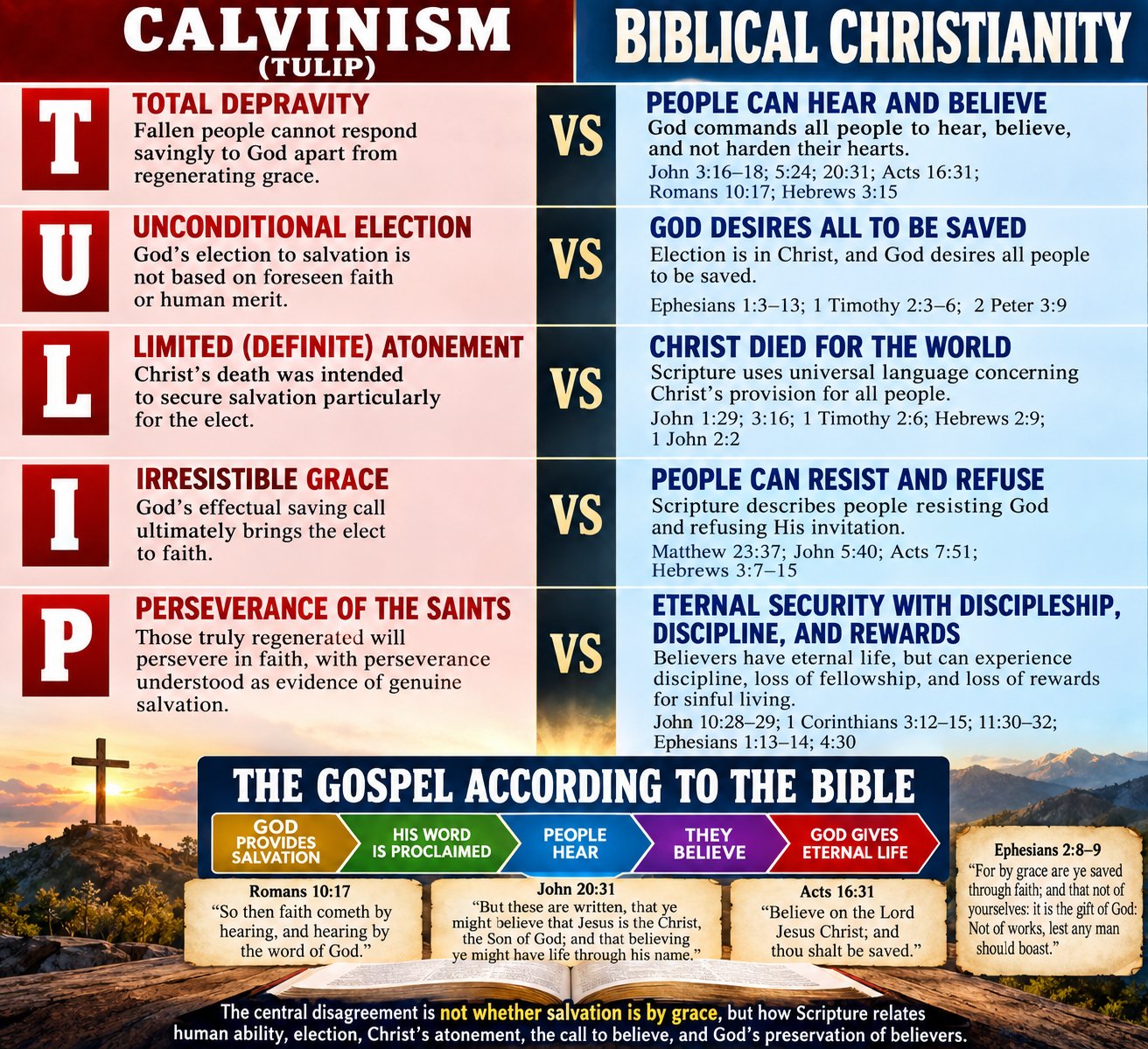
INTJ68 responded with this… proof texts, not dissimilar to J-Dubs proving Jehovah is Unitarian, and “disproving” the Trinity, or Mormons “showing” the Trinity is three completely separate God’s, all born through sexual acts:

I responded that these “proof” texts have been responded to, giving three examples [one mine]:
- I have responses to that list here: The “Pauline Particularism” Thought Experiment (+ JohnnyMac)
- So does Phil Bair at “The Wilted Tulip“
- And Soteriology 101: Answering Calvinistic Proof Texts
Just to name a few.
INTJ68 responded with clarity… LOL. He said this followed by the meme: “Nobody cares. Your team is a theology trash can of heresy.”

Kinda funny, I like the “Flowers” dig. So I responded in kind: “Lol. You care enough to grab a meme? Lol.”


Again, INTJ68
 I Respond:
This is where John Hendryx’s admission becomes particularly important…. (From a post of mine I will link after the two videos)
Hendryx explains that theologians use “compatibilism” to reconcile God’s sovereignty with human responsibility, but he explicitly acknowledges that “compatibilism is a form of determinism” and is “no less deterministic than hard determinism.” The Calvinist answer, therefore, is not to deny that God determines human choices, but to argue that a person can still be morally responsible for a choice that God has determined him to make. In other words, compatibilism doesn’t solve the determinism problem by denying that human choices are determined; it attempts to reconcile determinism with human responsibility by insisting that a determined choice can still be considered the person’s responsible choice.
And that is precisely where the problem arises. If God determines that one person will believe and another will remain in unbelief—and the latter cannot believe unless God first regenerates him—then what does “responsibility” actually mean? The Calvinist can say the unbeliever willingly rejects Christ, but the deeper question remains: could he have done otherwise without God first giving him the ability to do otherwise? If the answer is no, then simply calling him “responsible” does not explain how responsibility works; it merely asserts it.
…continued…
The founder of Monergism .com says that “compatibilism is a form of determinism” and is “no less deterministic than hard determinism.”
John MacArthur, however, shows why that distinction raises a profound problem. He argues that if God is the primary cause and humans are merely secondary causes moved by that primary cause, then the determinism ultimately extends to the secondary cause as well. God is the one who ultimately “decided,” “compelled,” and “coerced” the action. In other words, the human being remains the immediate or secondary cause of the action, but that secondary cause itself is also determined by the primary cause. God remains the ultimate determining cause behind both the action and the secondary cause through which that action occurs.
You miss-define sovereignty to mean that God exhaustively controls everything. So does all the “Reformed” Baptist and Calvinists I listed in a previous post.
INTJ68

I Respond:
Also, did God decree and ordain me to believe in Provisionism?
- “The hand of God rules the interior affections no less than it superintends external actions; nor would God have effected by the hand of man what he decreed, unless he worked in their hearts to make them will before they acted.” — John Calvin, Concerning the Eternal Predestination of God, tr. J. K. S. Reid, p.175f
If God determines all things—including the interior affections and thoughts that precede our actions—then He determined the chain of thoughts, desires, experiences, and circumstances by which I came to believe Provisionism. As Calvin put it, God “worked in [our] hearts to make [us] will before [we] acted.”
So my belief in Provisionism is, on your own system, part of that determined chain. Why, then, mock me for believing what your theology says God determined me to believe? Before you call my theology “trash,” explain why your system requires God to determine the very thoughts and convictions you are condemning me for having.

INTJ68 said “Lol, you people always do the meme.” and then posted a meme. I did note he started this all essentially with a trash can meme.
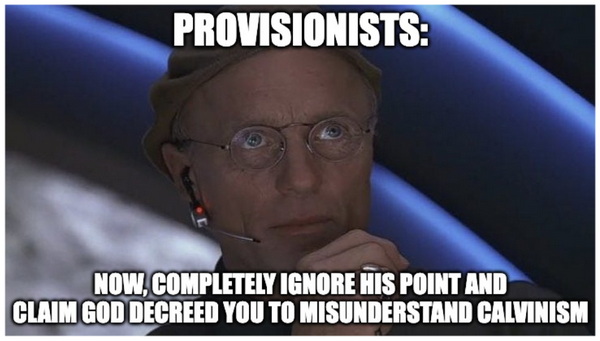
I Respond:
Sorry Charlie, you are fighting the Paul Washers of your heretical faith
JOHN CALVIN
“… how foolish and frail is the support of divine justice afforded by the suggestion that evils come to be, not by His will but by His permission. … It is a quite frivolous refuge to say that God otiosely permits them, when Scripture shows Him not only willing, but the author of them. … Who does not tremble at these judgments with which God works in the hearts of even the wicked whatever He will, rewarding them nonetheless according to desert? Again it is quite clear from the evidence of Scripture that God works in the hearts of men to incline their wills just as he will, whether to good for His mercy’s sake, or to evil according to their merits.”
— The Eternal Predestination of God 10:11.
GORDON H. CLARK
“I wish very frankly and pointedly to assert that if a man gets drunk and shoots his family, it was the will of God that he should do so. … In Ephesians 1:11, Paul tells us that God works all things, not some things only, after the counsel of his own will.”
— Religion, Reason and Revelation (Nutley, N.J.: Craig Press, 1961), 221.
JOHN M. FRAME
“The Reformed agree that God knows what would happen under all conditions, but they reject the notion that this knowledge is ever ultimately based on man’s autonomous decisions. Human decisions, they argue, are themselves the effects of God’s eternal decrees.”
— “Scientia Media,” Evangelical Dictionary of Theology, 2nd ed., ed. Walter A. Elwell (Grand Rapids: Baker Academic, 2001), 1075.
JOHN PIPER
“God so disposes all things … so that in accordance with moral necessity all men make only those choices ordained by God from all eternity.” […] “In this way He ultimately determines all acts of volition (though not all in the same way) and yet holds man accountable only for those acts which they want most to do.”
MARK TALBOT
“Ephesians 1:11 goes even further by declaring that God in Christ ‘works all things according to the counsel of his will.’ Here the Greek word for ‘works’ is energeō, which indicates that God not merely carries all of the universe’s objects and events to their appointed ends but that he actually brings about all things in accordance with his will. In other words, it isn’t just that God manages to turn the evil aspects of our world to good for those who love him; it is rather that he himself brings about these evil aspects for his glory … This includes—as incredible and as unacceptable as it may currently seem—God’s having even brought about the Nazis’ brutality at Birkenau and Auschwitz as well as the terrible killings of Dennis Rader and even the sexual abuse of a young child.”
— In John Piper and Justin Taylor, eds., Suffering and the Sovereignty of God (Wheaton: Crossway, 2006), 42.
How bout Macarthur, Sproul, Piper and others. I grant that some “say” compatibilism, but people are not thinking to the logical conclusion of it. What is free will compatible with? Theistic determinism? That crumbles un the law of non-contradiction. Sproul teaches double predestination…. so where is the “compatiblism” in that. You are fighting not me, but ….
John Calvin, Theodore Beza, William Perkins, Francis Turretin, Amandus Polanus, Girolamo Zanchi, John Owen, Thomas Goodwin, Stephen Charnock, Jonathan Edwards, A. A. Hodge, Charles Hodge, B. B. Warfield, R. L. Dabney, William G. T. Shedd, Herman Bavinck, Abraham Kuyper, Louis Berkhof, Cornelius Van Til, Gordon H. Clark, R. C. Sproul, John Piper, John MacArthur, J. I. Packer, James Montgomery Boice, Sinclair Ferguson, R. C. Sproul Jr., Michael Horton, Wayne Grudem, Thomas Schreiner, Albert Mohler, Paul Washer, James White
INTJ68

I Respond:
Thank you for proving my point. Took a while to get here. Notice what is happening here. Paul Washer says we are ‘free to will,’ but only according to our nature—and then says our fallen nature guarantees evil until God gives us a new heart. That’s not an explanation of libertarian free will; it’s an explanation of compatibilist freedom. The real question isn’t whether we voluntarily do what we want. The question is whether we could have done otherwise. If my nature determines what I will want, and God must first change that nature before I can choose Christ, then saying ‘you’re free to will’ doesn’t establish libertarian freedom—it simply redefines freedom so that determinism can still be called free will.
If the fallen man is genuinely free to choose Christ, why does he need God to give him a new heart before he can choose Christ? But if he cannot choose Christ until God changes his nature, then what exactly was his ‘free will’ doing in the first place?
FREE THINKING MINISTRIES: Free Will, Calvinism, & Romans 9

Another quick drive by continuing the above:

I respond:
It was the first 380 years of the church…. Augustinian Determinism VS. The Early Church (Updated)


And another dumb dig:

I respond:
Pelagius did not actually believe that—well, not quite. Of the fourteen charges brought against him, he accepted only half of one.
“So you deny original sin? Then you’re a Pelagian.”
That charge has been around for a long time. Luther, for example, attacked Zwingli’s view of original sin as Pelagian. But Zwingli did not simply deny that Adam’s fall affected the rest of humanity. He taught that Adam’s sin left humanity with an inherited condition of corruption, misery, bondage, and death; what he rejected was the idea that Adam’s guilt itself was personally imputed to his descendants.
That is what makes Ali Bonner’s historical analysis so useful. “Pelagianism” was not the name of a neat, clearly defined theological system into which everyone who disagreed with Augustine could be placed. Bonner argues that the category was shaped through controversy, and that the historical record is much messier than the formula “deny original sin = Pelagian” suggests. Pelagius himself believed that Adam’s sin affected his descendants, even though he rejected Augustine’s account of inherited original sin. A different view of Adam, original sin, or inherited guilt, then, does not by itself make someone a Pelagian.
A useful comparison is the label “trickle-down economics.” It became a standard way to describe—and criticize—Reagan-era economic policy, though Reagan did not use the phrase to define his own program. His administration spoke instead about cutting tax rates, encouraging growth, and supply-side economics. Nor did the broader idea begin with Reagan. JFK also pushed for major tax cuts, arguing that “tax rates are too high” and that stronger economic growth would ultimately increase revenue. He is also remembered for the line, “a rising tide lifts all boats.”
Of course, the point is not that Pelagianism and “trickle-down economics” are the same kind of thing. The comparison is about how quickly a polemical label can take the place of describing what someone actually believes.
So before calling someone a Pelagian, it is worth asking whether that person actually holds Pelagius’s theology—or merely has a different account of how Adam’s sin is transmitted and what its consequences are.

That is all I feel like cataloging here. Gotta go prep for the work week.