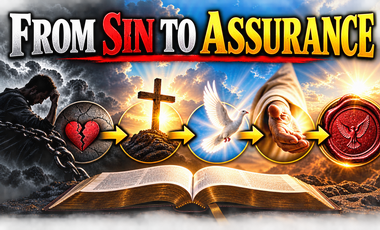
I got a challenge to this graphic I made (which was a response to this one)… the graphic is first, then the polite challenge:

M.M. has another response version to the Calvinist one to view as well.
Here are the questions:
- If mankind is not depraved from birth to adulthood then are we to say we are neutral creatures?
- So election depends on who comes forward rather those who are selected for salvation?
- Would this make Christ atonement a failure we do know that not everyone will be saved yet the atonement were meant for everyone? Cuz the purpose of Christ death is to save and if someone didnt come forward for salvation so what Christ paid is gone to waste?
- So Holy Spirit is reduced to a persons free will decision to overcome it rather than accept it? What if corruption has been acquired and formed in someones life from child to adulthood that it leeches to them on how they think and act, so it means they have lost all hope?
- So if Faith is not a gift but rather a response out of free will then we are the ones whos maintaining our Salvation? right? So free will plays a big part of whether or not we will be saved at the end of the day cuz the moment we fail on exercising our faith we are doomed? So we are ought to be perfect in order for us to be deemed worthy of salvation?
So lets deal with these a little, if only to post to fill space on RPT.
1) IF MANKIND IS NOT DEPRAVED FROM BIRTH TO ADULTHOOD
THEN ARE WE TO SAY WE ARE NEUTRAL CREATURES?
The Provisionist/Traditional Baptist position in your sources is not:
“Humans are born morally neutral and therefore don’t really need grace.”
It is:
Humans are born into a sinful condition, inherit a nature and environment inclined toward sin, inevitably sin, and desperately need God’s grace—but they are not born guilty of Adam’s personal sin or rendered incapable of responding to God’s gracious gospel.
In Anyone Can Be Saved (Article 2: The Sinfulness of Man) his distinction is explicitly stated:
humanity inherits “a nature and environment inclined toward sin,” and every morally capable person sins, but Adam’s sin does not itself incapacitate someone’s will or make that person guilty before personally sinning. (Article 2 from the Journal for Baptist Theology and Ministry [JBTM] Volume 9 number 2 [Fall 2012])
That gives you a useful three-category distinction:
Calvinism:

Neutralism/Pelagianism:

Provisionist/Traditional Baptist position:

That’s why the Provisionism graphic says:
“Humanity Is Sinful and Lost, Yet God’s Grace Enables a Genuine Response.”
That’s the important middle position.
And Saved by Grace through Faith or Saved by Decree? makes essentially the same argument: Robinson distinguishes depravity from the Calvinistic claim of total inability, arguing that people can be deeply corrupted without that corruption making gospel response metaphysically impossible. So the answer to the first challenge is:
“No. We aren’t saying man is neutral. We’re saying sinful does not mean incapable of responding to God’s grace.”
2) SO ELECTION DEPENDS ON WHO COMES FORWARD
RATHER THOSE WHO ARE SELECTED FOR SALVATION?
This is probably the most important clarification to address. The answer is this, and it is simple [like the Gospel]:
God’s grace establishes the condition of salvation; faith does not earn election.
The Anyone Can Be Saved statement describes election as God’s eternal plan “in Christ” to have a people who are His by repentance and faith. It specifically rejects the idea that God predestines some individuals to salvation and others to condemnation irrespective of their response. AW Tozer says that “God’s sovereign decree establishes the destination and the conditions, without requiring God to decree which individual will make the choice.”
Robinson makes the same distinction in his discussion of Ephesians 1:
believers are chosen in Christ, and he argues that the New Testament presents election to salvation as involving union with Christ through faith and repentance. Saved by Grace through Faith or…
So saying that “Man chooses himself for salvation” is the wrong way to frame it.
That’s too strong and makes the objection easy. It should be stated as:
God chooses the terms of salvation; man does not choose the terms. God graciously provides Christ, the atonement, the gospel and the call to repent and believe. The sinner responds to that provision. Chafer notes, about 115 passages condition salvation on believing alone, and another 35 simply on faith.
Faith isn’t competing with God’s sovereignty. Faith is the condition God established for receiving His gracious provision.
Faith does not earn salvation; it receives the salvation God has graciously provided.
And that’s why Ephesians 2:8–9 is so important: the response of faith doesn’t become a meritorious work simply because it is genuinely exercised by the person. The Anyone Can Be Saved statement explicitly says grace takes the initiative and that faith is not a meritorious work earning salvation.
Article Four: The Grace of God
We affirm that grace is God’s generous decision to provide salvation for any person by taking all of the initiative in providing atonement, in freely offering the gospel in the power of the Holy Spirit, and in uniting the believer to Christ through the Holy Spirit by faith.
We deny that grace negates the necessity of a free response of faith or that it cannot be resisted. We deny that the response of faith is in any way a meritorious work that earns salvation.
Ezra 9:8; Proverbs 3:34; Zechariah 12:10; Matthew 19:16–30, 23:37; Luke 10:1–12; Acts 15:11; 20:24; Romans 3:24, 27–28; 5:6, 8, 15–21; Galatians 1:6; 2:21; 5; Ephesians 2:8–10; Philippians 3:2–9; Colossians 2:13–17; Hebrews 4:16; 9:28; 1 John 4:19.
3) IF CHRIST DIED FOR EVERYONE BUT NOT EVERYONE IS SAVED,
DID CHRIST’S ATONEMENT FAIL?
This objection confuses “Provision” with “application.” The atonement can be:
Universal in provision
without being
universal in application.
That’s exactly the distinction Robinson makes.
He argues that the objective work of the cross is universal while its saving benefits are received by the individual through faith. Therefore, the fact that not everyone is saved does not mean Christ’s death failed. Saved by Grace through Faith or…
In Anyone Can Be Saved the authors are even more explicit. Article 3 says Christ’s sacrifice is the effective sacrifice for the sins of every person, while denying that the atonement automatically results in salvation without repentance and faith. It also explicitly denies that Christ died only for those who will ultimately be saved.
So:
Did Christ die for people who reject Him?
YES.
Does that mean those people are automatically saved?
No.
Does their rejection make Christ’s sacrifice defective?
No.
The cross accomplished what God intended it to accomplish: a sufficient and universal provision of redemption, which is savingly appropriated through faith.
Think of the distinction:

Faith simply receives what Christ provided. That’s why the objection: “What Christ paid is gone to waste” … doesn’t follow.
The cross isn’t a transaction in which Christ failed to save someone because that person rejected the benefit.
4) ISN’T THE HOLY SPIRIT REDUCED TO SOMEONE’S FREE WILL OVERCOMING HIM?
No. And this is where “resistible grace” is often badly characterized. Provisionist’s do not present the sinner as standing there with equal power to God and saying:
“My free will is stronger than the Holy Spirit!”
That’s not the argument.
The Anyone Can Be Saved statement actually describes grace as God taking all the initiative:
God provides the atonement, freely offers the gospel through the Holy Spirit, and unites the believer to Christ through the Spirit by faith. [adapted from — Anyone Can Be Saved, Article 4: “The Grace of God”]
It then specifically denies that grace cannot be resisted. THAT’S a radically different picture from:
“Man overpowers God.”
Rather:
God initiates.

God provides Christ.
God sends the gospel.
The Spirit convicts and draws.
The sinner is confronted with God’s gracious offer.
The sinner may receive or resist.
Robinson similarly describes God’s drawing, gospel proclamation, Christ’s cross and the Spirit’s conviction of the world as expressions of God’s grace available to everyone, while explicitly arguing that such grace can be resisted. Pastor Rogers puts it thus via an older post:
- Within the Non-Calvinist camp, there are at least two nuanced views on how God allows sinners to respond in faith. The first view is the Arminian view — which says that God’s work of grace (prevenient grace) for all people is needed to enable any sinner to freely choose to respond in faith to the Gospel message. The second view is the Provisionist View — which says that the Gospel message itself [see more below] is God’s work of grace so that when it is preached to all people, any sinner can freely choose to respond in faith. The proclamation of the Gospel is powerfully sufficient enough to bring salvation to those who will believe. While the Arminian and the Provisionist each have a different take on why all humans can respond to God’s offer, these two views both affirm the importance of God’s initiative of grace to invite all sinners to salvation. (from the book Grace For All: Understanding God’s Plan of Salvation).
— Michael R. Cariño
The “More Below”
Grace Enablements
Includes but are not limited to: God’s salvific love for all (John 3:16), God’s manifestation of his power so that all may know he is the Sovereign (Isa 45:21–22) and Creator (Rom 1:18–20), which assures that everyone has opportunity to know about him. Christ paying for all sins (John 1:29), conviction of the Holy Spirit (John 16:7–11), working of the Holy Spirit (Heb 6:1–6), enlightening of the Son (John 1:9), God’s teaching (John 6:45), God opening minds and hearts (Luke 24:45; Acts 16:14; 26:17–18;), and the power of the Gospel (Rom 1:16), without such redemptive grace, no one seeks or comes to God (Rom 3:11).
Because of these gracious provisions and workings of God, man can choose to seek and find God (Jer 29:13; Acts 17:11–12). Moreover, no one can come to God without God calling (Acts 2:39), drawing (John 6:44), and that God is drawing all individuals (John 12:32). The same Greek word for draw, helkuō, is used in both verses. “About 115 passages condition salvation on believing alone, and about 35 simply on faith.” Other grace enablements may include providential workings in and through other people, situations, and timing or circumstances that are a part of grace to provide an opportunity for every individual to choose to follow Christ.
These are grace enablements in at least three ways; first, they are provided by God’s grace rather than deserved by mankind; second, the necessary components for each and every individual to have a genuine opportunity to believe unto salvation are provided or restored by God; third, they are provided by God without respect to whether the individual will believe or reject, which response God knew in eternity past.
The offer of the Gospel is unconditional, but God sovereignly determined to condition the reception of the offer upon grace-enabled faith; therefore, faith is not reflective of a work or virtue of man, but of God’s sovereign plan of salvation by grace through faith (Eph 2:8). This indicates faith is the means to being regenerated and saved, not the reason for being saved. This truth of Scripture does not imply God is held captive to the choice of man, but rather it demonstrates God in eternity coextensively determined to create man with otherwise choice and provide a genuine offer of salvation, which can be accepted by grace-enabled faith or rejected. Additionally, to fulfill this plan, God is not obligated to disseminate the Gospel to people he knows have rejected the light he has given them (Rom 1:18–23) and will also reject the Gospel; although he may still send the Gospel to them.
So the question: “What if corruption has formed in someone’s life from childhood to adulthood?” — actually reinforces the need for grace.
The answer isn’t:
“People don’t need grace because they’re basically good.”
It is:
“They desperately need grace precisely because they are deeply corrupted.”
The disagreement is over whether that corruption means:

And there’s an important logical point:
Influence ≠ inability.
A person’s upbringing, habits, addictions, worldview, family, trauma, culture, desires, etc. can profoundly influence how he responds without establishing that he possesses zero capacity to respond to God’s revelation and grace.
So grace can be resisted… but our next dealing is with: assurance / security / apostasy / perseverance.
Those are related, but they’re actually two different questions:
- Question A: Can a person resist God’s gracious call before salvation?
- Question B: Once a person believes, what guarantees his salvation and what is the basis of assurance?
5) IF FAITH IS A RESPONSE, AREN’T WE MAINTAINING SALVATION?
This is the strongest objection rhetorically—but it also sneaks in another false equation: Human response = human merit.
It doesn’t follow.
Grace provides salvation; faith receives it.
And it specifically denies that the response of faith is a meritorious work. When Calvinists say “total depravity,” does that mean man cannot believe the gospel, or does it merely mean man cannot do anything meritorious enough to earn God’s favor?
We might raise a question at this point as to whether to understand total depravity as the lack of ability to believe (have faith) or just as the lack of ability to do something like perform a meritorious work that would obtain God’s favor. It is suggested here that the Dortian Calvinist position is both internally logically invalid and externally contradictory as it relates to the requirement to believe in Christ as the only means through which one might receive eternal life as a gift. Faith, not human works, is biblically the means through which regeneration is received from the Spirit. It is never said to be the inevitable ensuing result of such regeneration. We are not called on to be regenerated in order to believe, but we are obliged to believe as a condition for regeneration unto eternal life to take place. A life lived by faith after regeneration defines who are the overcomers in the realm of Christian life and demonstrates spiritual growth toward maturity.
A. Strong inability
The sinner cannot believe in Christ without first being regenerated.
B. Merit inability
The sinner cannot earn salvation through good works, but can nevertheless respond to God’s gracious offer in faith.
So: Faith, not human works, is biblically the means through which regeneration is received from the Spirit.

The end of that very long sentence in Ephesians says:
- In him you also were sealed with the promised Holy Spirit when you heard the word of truth, the gospel of your salvation, and when you believed. 14 The Holy Spirit is the down payment of our inheritance, until the redemption of the possession, to the praise of his glory.
HEARD THE GOSPEL  BELIEVED IN CHRIST SEALED WITH THE HOLY SPIRIT
THE SPIRIT IS THE GUARANTEE OF OUR INHERITANCE
The basis of assurance isn’t:
“I know I’m saved because I have successfully demonstrated sufficient perseverance.”
Rather, Paul points believers to God’s action and promise:
He seals the believer with His Spirit, and the Spirit is the guarantee of the inheritance.
And there’s an important grammatical detail, Ephesians 1:13 says:
“having believed, you were sealed…”
The Greek participle pisteusantes (“having believed”) precedes esphragisthēte (“you were sealed”). So the text naturally presents believing sealing, rather than requiring us to insert a prior regeneration faith sequence into the passage. Then verse 14 describes the Spirit as:
“the guarantee [arrabōn] of our inheritance…”
That word carries the idea of a pledge, deposit, or down payment guaranteeing what is to come.
And “if I stumble, I’m doomed” is not the position. This is another important distinction.
There is a huge difference between:
“I sinned.”
and
“I deliberately and finally renounce Christ and abandon the faith.”
Robinson specifically describes apostasy in the latter terms. He says the issue isn’t accidentally “losing” salvation, but a willful, deliberate decision to abandon or renounce the faith.
The crucial question in the case of apostasy concerns whether a true believer in Christ can at some point in their lives forsake their faith, or fall from grace. A common but unhelpful term is “lose one’s salvation.” The problem with this way of stating the issue is that it is too close to being something that happens accidentally—similar to “I lost my glasses.” But here we are not talking about something in the Christian’s life that happens accidentally, but rather is a willful, deliberate decision and choice to abandon or renounce the faith. To the question as to whether a Christian can fall from grace in a final sense, typically at least three different answers have been given. The Calvinist says no; the non-Calvinist says yes; and a third position says, “Theoretically Yes, but in practice, No” (hypothetical apostasy). — Oops – I Thought I Was a Four Point Calvinist
So the challenger’s formulation:
“the moment we fail on exercising our faith we are doomed”
doesn’t accurately represent the position.
It turns apostasy into ordinary Christian failure.
But the New Testament itself distinguishes falling into sin from abandoning Christ.
Its Article 9 of Anyone Can Be Saved, says that when a person responds in faith, God promises to complete the process of salvation into eternity. It describes justification, sanctification by the indwelling Spirit, and glorification—and explicitly says the Holy Spirit-sealed relationship cannot be broken.
Article Nine: The Security of the Believer
We affirm that when a person responds in faith to the gospel, God promises to complete the process of salvation in the believer into eternity. This process begins with justification, whereby the sinner is immediately acquitted of all sin and granted peace with God; continues in sanctification, whereby the saved are progressively conformed to the image of Christ by the indwelling Holy Spirit; and concludes in glorification, whereby the saint enjoys life with Christ in heaven forever.
We deny that this Holy Spirit-sealed relationship can ever be broken. We deny even the possibility of apostasy.
John 10:28–29; 14:1–4; Romans 3:21–26; 8:29–30, 35–39; 2 Corinthians 4:17; Ephesians 1:13–14; Philippians 1:6; 3:12; Colossians 1:21–22; 2 Timothy 1:12; Hebrews 13:5; James 1:12; 1 John 2:19; 3:2; 5:13–15; Jude 24–25.
Here are the Journal articles published on the position, full PDFs linked in pictures:


So Traditional Southern Baptist/Provisionist thought isn’t necessarily identical to an Arminian “you can lose salvation every time you stumble” position.
“I know I am saved because I have believed Christ’s promise; my assurance rests on God’s testimony and Christ’s finished work, not on successfully measuring my future perseverance.” — Pastor Andy Woods
This is someone who can be said walked away from the faith:
SO TO RECAP
- Sinfulness doesn’t require total inability. We can be thoroughly sinful without being incapable of responding to God’s gracious revelation.
- Conditional election doesn’t mean man earns election. God determines the condition—repentance and faith—and salvation remains entirely God’s gracious provision.
- Universal atonement doesn’t require universal salvation. Christ’s death provides salvation for all, while its saving benefits are received only by those who believe.
- Resistible grace doesn’t mean man overpowers the Holy Spirit. God initiates, draws, convicts, reveals, and provides; the sinner can nevertheless resist that gracious work.
- Faith isn’t a meritorious work. Trusting Christ doesn’t make Christ’s work unnecessary; faith is the means by which the sinner receives what Christ accomplished—and assurance rests on God’s promise and Christ’s finished work, not on successfully measuring future performance.
These are my rough notes to a Bible study I am still in with people from a church I left due to the increase in Calvinism from the shadows to the forefront. You will find a lot about “assurance of faith” vs. the “perseverance” many have in mind. This does not mean I settle the question, but it may add thinking to your understanding of our position.
BOTTOM LINE: