Reformational Determinism Undermines the Christian Witness

See my:

The problem begins with the salvation appeal itself. The Calvinist tells the unbeliever, “You must believe and repent,” but then explains that the unbeliever cannot believe, cannot repent, and cannot come to Christ unless God first regenerates him. The person is therefore commanded to do what, by the system’s own definition, he is incapable of doing unless God first performs a work in him. The command remains, but the ability to fulfill the command does not.

This creates a serious tension concerning responsibility. The sinner is held responsible for his unbelief, yet he is told that he cannot overcome that unbelief unless God first gives him the ability to believe. In the exchange above, Derek Murrell from Irresistible Truth initially resists the conclusion that the unbeliever’s condemnation has anything to do with what God did or did not do. Yet when pressed, he acknowledges that the person cannot repent without God, cannot believe without God’s work, and finally agrees with fundementalist Christian turned atheist, Douglas Letkeman’s conclusion:

  • “every single person in hell today is in hell today because of what God didn’t do.” His answer? “Correct.”

This is where John Hendryx’s admission becomes particularly important.

Hendryx explains that theologians use “compatibilism” to reconcile God’s sovereignty with human responsibility, but he explicitly acknowledges that “compatibilism is a form of determinism” and is “no less deterministic than hard determinism.” The Calvinist answer, therefore, is not to deny that God determines human choices, but to argue that a person can still be morally responsible for a choice that God has determined him to make. In other words, compatibilism doesn’t solve the determinism problem by denying that human choices are determined; it attempts to reconcile determinism with human responsibility by insisting that a determined choice can still be considered the person’s responsible choice.

And that is precisely where the problem arises. If God determines that one person will believe and another will remain in unbelief—and the latter cannot believe unless God first regenerates him—then what does “responsibility” actually mean? The Calvinist can say the unbeliever willingly rejects Christ, but the deeper question remains: could he have done otherwise without God first giving him the ability to do otherwise? If the answer is no, then simply calling him “responsible” does not explain how responsibility works; it merely asserts it.

John MacArthur, however, shows why that distinction raises a profound problem. He argues that if God is the primary cause and humans are merely secondary causes moved by that primary cause, then the determinism ultimately extends to the secondary cause as well. God is the one who ultimately “decided,” “compelled,” and “coerced” the action. In other words, the human being remains the immediate or secondary cause of the action, but that secondary cause itself is also determined by the primary cause. God remains the ultimate determining cause behind both the action and the secondary cause through which that action occurs.

Put these pieces together, and the tension becomes difficult to escape.

Hendryx acknowledges that compatibilism is determinism.

MacArthur highlights the problem that arises when the primary cause determines the secondary cause.

And the salvation conversation puts that problem into practical terms. The sinner is commanded to believe and repent, yet is told that he cannot believe or repent unless God first regenerates him. If God must provide that ability before the sinner can respond, and God chooses to provide it to some while passing over others, then the one who is passed over remains unable to produce the very response God requires of him.

The issue, then, is not whether Calvinism uses the word “responsibility.” It clearly does. The real question is whether calling a person responsible resolves the problem of his inability. If the sinner cannot believe, cannot repent, and cannot come to Christ unless God first acts upon him, then the decisive difference between the one who believes and the one who remains in unbelief is ultimately the prior work—or lack of work—of God. The sinner may willingly reject Christ, but according to this system, he cannot will himself out of that condition unless God first gives him the ability to do so.

And that brings us back to the most striking moment in the conversation. The conclusion is essentially this:

  • if God has to do something in me in order for me not to go to hell, and He chooses not to do it, what could I possibly do about it?

When that implication is put directly to Derek Murrell, his answer is simply: “Correct.” At that point, the question is no longer whether man is called responsible. The question is whether the decisive difference between salvation and condemnation ultimately rests in the sinner’s response—or in God’s sovereign determination to give or withhold the ability to respond.


GOSPEL COALITION article summary


One-Paragraph Summary

The article defends the Reformed doctrine of double predestination/reprobation, arguing that God’s eternal decree includes both the unconditional election of some individuals to salvation and the passing over of others, who are ultimately condemned according to divine justice. It appeals particularly to Pharaoh and Romans 9, arguing that God actively hardened Pharaoh and raised him up to display His glory, and that Paul’s “vessels of mercy” and “vessels of wrath” describe God’s sovereign distinction between individuals. The article further argues that reprobation logically follows from unconditional election: if God unconditionally chooses some but not all for salvation, then the others are necessarily excluded from that saving choice. It distinguishes preterition, God’s withholding of saving grace, from predamnation, God’s determination to judge the non-elect according to justice. Although Reformed theology maintains an asymmetry between election and reprobation, the article nevertheless places both salvation and condemnation within God’s eternal sovereign decree rather than treating the damnation of the non-elect as merely something God foreknows or passively permits.

SUMMARY OF THE GOSPEL COALITION ARTICLE: “THE DOCTRINE OF REPROBATION

The article is a defense of the Augustinian/Reformed doctrine of reprobation, which teaches that God’s eternal decree concerns not only those whom He chooses to save, but also those whom He does not choose to save. In the author’s formulation, reprobation involves God eternally withholding saving grace from certain individuals and determining to judge them according to divine justice. The author therefore understands reprobation as more than God’s foreknowledge that certain people will reject Him; their exclusion from saving grace and ultimate condemnation fall within God’s sovereign eternal decree.

The article develops this position in three primary ways.

Scripture Teaches Reprobation

The author argues that Scripture directly supports reprobation, with Pharaoh and Romans 9 serving as the principal examples. In the Exodus account, the author rejects the interpretation that God hardened Pharaoh merely as a response to Pharaoh’s prior self-hardening. Instead, the article argues that God announced beforehand that He would harden Pharaoh and raised him up for the purpose of displaying His power and glory.

Romans 9 is presented as the clearest New Testament explanation of this principle. The author interprets Paul’s discussion of the “vessels of mercy” and “vessels of wrath” as teaching that God sovereignly distinguishes between individuals, preparing some for mercy and enduring others who are prepared for destruction. The purpose is ultimately God’s glory: His mercy and grace are displayed toward the elect while His wrath and power are displayed toward those destined for destruction.

Reprobation Logically Follows From Unconditional Election

This is one of the article’s most important arguments.

If salvation depends upon God’s unconditional choice of particular individuals, and God does not choose everyone, then there must necessarily be individuals whom God does not choose for salvation.

The author therefore argues that unconditional election necessarily entails reprobation. Simply calling the position “single predestination”—God predestines some to salvation but does not predestine anyone to condemnation—does not resolve the problem. According to the article, such a view leaves the destiny of the non-elect outside God’s purposeful decree, which the author considers inconsistent with God’s comprehensive sovereignty.

The argument is therefore:

Unconditional election → some are chosen → others are not chosen →
their exclusion from saving grace falls within God’s sovereign decree.

God’s sovereignty extends over salvation and human choices

The article’s argument does not stop with election. It presents God’s sovereignty as extending over everything that comes to pass, including human choices. Consequently, the distinction between those who believe and those who reject Christ ultimately falls under God’s sovereign will.

The doctrine is also presented as spiritually beneficial because it humbles humanity. Rather than viewing humanity as the ultimate reference point, believers are reminded that human beings exist for God’s glory and that God’s purposes, rather than human preferences, determine reality.

The Two Aspects of Reprobation

The article makes an important distinction between two aspects of reprobation:

Preterition — the negative aspect:
God eternally chooses not to extend saving grace to particular individuals. The article says this decision is not based on foreseen works, merit, or sin, but on God’s sovereign will.

Predamnation — the positive aspect:
God eternally determines to deal with those individuals according to divine justice. Reformed theologians disagree over whether this decree itself is conditioned upon foreseen or actual sin, but the article maintains that the ultimate condemnation of these individuals is included within God’s sovereign purpose.

The article goes further and states that the Augustinian/Reformed tradition agrees that God predestines certain individuals to be justly punished, and that at least some aspect of this reprobation is not based on foreseen sin but on God’s good pleasure, with the purpose of magnifying His justice and grace.

Is This Double Predestination?

In substance, yes. The article is defending a form of double predestination, although it insists that election and reprobation are not perfectly symmetrical. The distinction can be summarized this way:

The author specifically identifies the “asymmetry between election and reprobation” as an important qualification within Reformed theology. Thus, the article is not merely saying that God permits some people to reject Him. Its position is substantially stronger:

  • God’s eternal decree establishes both who will receive saving grace and who will be passed over, with the non-elect ultimately being condemned according to divine justice.

And the author’s fundamental argument is that this conclusion follows from the combination of unconditional election, God’s exhaustive sovereignty, and the author’s interpretation of passages such as Pharaoh and Romans 9.

Sproul’s View of Double Predestination (Logical Consequences)

Jump to the UPDATE inspired by the GOSPEL COALITION.

R.C. Sproul’s Statement on Predestination (from Chosen by God):

What predestination means, in its most elementary form, is that our final destination, heaven or hell, is decided by God not only before we get there, but before we are even born. It teaches that our ultimate destiny is in the hands of God. Another way of saying it is this: From all eternity, before we ever live, God decided to save some members of the human race and to let the rest of the human race perish. God made a choice–he chose some individuals to be saved unto everlasting blessedness in heaven and others he chose to pass over, to allow them to follow the consequences of their sins into eternal torment in hell.” (Chosen By God, p.22, emphasis mine)

This is double predestination in practice, even if Sproul calls the active-positive version for reprobation a caricature.

  • If the elect cannot fail to be saved,
  • and the reprobate cannot be saved because God withholds the only grace capable of producing faith,
  • then what practical difference remains between active reprobation and passive reprobation?

Elect infants, dying in infancy, are regenerated, and saved by Christ, through the Spirit, who works when, and where, and how He pleases: so also are all other elect persons who are incapable of being outwardly called by the ministry of the Word.

Westminster Confession of Faith (WCF) 10.3

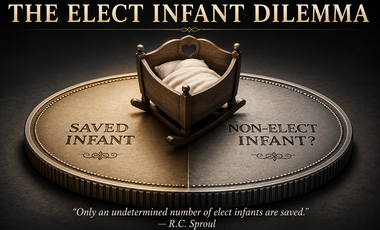
“Holy Spirit can save an infant by changing his heart, giving grace, and applying the merit of Christ to him. The Westminster divines certainly believed that babies can be saved. They did not teach that all infants are necessarily saved; rather, they taught that only an undetermined number of elect infants are saved. Obviously, an elect infant is going to be saved, and any saved infant is elect, but the divines did not speculate on which infants those would be.”

– R.C. Sproul, Truths We Confess: A Systematic Exposition of the Westminster Confession of Faith (Sanford, FL: Reformation Trust, 2019), 321.


Sproul conforms his support for the ideas in the WCF:

One of the most important confessions of faith ever penned, particularly in the English-speaking world, is the Westminster Confession of Faith. By the confession’s own statements, no confession written by uninspired authors is to be taken as having supreme authority over the believer. Confessions cannot bind the conscience in the manner that the Word of God can and does. At the same time, though human confessions and creeds are penned by fallible people without the benefit of the inspiration of the Holy Spirit, the profound level of theological and biblical precision manifest in the Westminster Confession of Faith is awe-inspiring. (Ibid., xvii.)

[….]

The Westminster Confession is the most precise and accurate summary of the content of biblical Christianity ever set forth in a creedal form. Creeds such as the Belgic Confession, the Heidelberg Catechism, and the Scots Confession should be highly regarded, but no historic confession surpasses in eloquence, grandeur, and theological accuracy the Westminster Confession of Faith. (Ibid., xix)


Critiquing the matter via CHAT:

The Internal Tension

Sproul writes:

“The Westminster divines certainly believed that babies can be saved. They did not teach that all infants are necessarily saved; rather, they taught that only an undetermined number of elect infants are saved.”

The immediate question is:

If only elect infants are saved, what happens to non-elect infants?

Historically, Westminster does not explicitly answer that question. Critics argue that the silence is revealing. If the Confession intended to teach universal infant salvation, it could have said:

“All infants dying in infancy are saved.”

Instead it says: “Elect infants.” Sproul defends that wording rather than correcting it.

Critique #1: Election Becomes the Ultimate Divider

Sproul affirms:

  • unconditional election,
  • total inability,
  • monergistic regeneration,
  • and reprobation.

Therefore, infant salvation cannot be based upon:

  • personal faith,
  • conscious belief,
  • repentance,
  • or moral innocence.

It must ultimately rest on election.

Critics respond:

If election alone determines which infants are saved, then election alone determines which infants are not saved.

Thus the question becomes: Why would God elect some infants and not others? Sproul never provides a clear answer.

Critique #2: Original Guilt Creates the Problem

Sproul consistently taught:

  • Adam’s guilt is imputed to humanity,
  • infants are fallen,
  • infants need Christ’s grace.

Critics agree infants need grace but ask:

Does inherited guilt alone make an infant deserving of eternal punishment?

Many opponents argue Scripture consistently ties judgment to:

  • knowledge,
  • personal rebellion,
  • actual transgression.

Examples often cited:

  • Deuteronomy 1:39
  • Isaiah 7:15-16
  • Jonah 4:11
  • Romans 4:15

The criticism is:

Sproul imports Augustine’s doctrine of inherited guilt and then must wrestle with implications Augustine himself embraced.

Critique #3: The Moral Character of God

This is probably the most emotionally and philosophically powerful objection.

If:

  • an infant never consciously sins,
  • never rejects God,
  • never suppresses truth,
  • never commits personal acts of rebellion,

Yet could still be damned, Critics ask:

What meaningful sense of justice remains?

This is where many critics invoke the same concern raised by Juncker regarding determinism:

If moral categories are detached from personal responsibility, words like justice become difficult to understand.

FULLER QUOTE:

“If determinism is true then either God is evil and the author of evil or all talk of good and evil, of praise and blame, of moral responsibility, and of justice is meaningless and incomprehensible with reference to God. That is, if God can cause or determine evil and yet remain good, and if God can punish those who do exactly and only what He has meticulously caused and determined them to do and yet remain just, then we have no idea who God is or what He might or might not do or what Scripture could possibly mean when it calls Him ‘good’ and ‘just.'”

— Günther H. Juncker, “The Dilemma of Theistic Determinism

The objection becomes:

Eternal punishment without personal rebellion appears inconsistent with ordinary moral reasoning and the biblical portrayal of God’s fairness.

Critique #4: Westminster Creates an Unnecessary Problem

Many critics argue Westminster itself created the issue. The Confession says:

“Elect infants.”

Critics ask why not simply say:

“Infants dying in infancy are saved through Christ”?

Mohler, Warfield, and Spurgeon essentially move in that direction. Sproul, however, insists the Westminster divines intentionally did not teach universal infant salvation. Critics argue:

That commitment to confessional precision ends up preserving a theological possibility that Scripture never explicitly teaches.

Critique #5: Sproul’s Loyalty to Westminster

This critique becomes stronger when paired with Sproul’s own statements:

“The Westminster Confession is the most precise and accurate summary of the content of biblical Christianity ever set forth in a creedal form.”

and

“One of the most important confessions of faith ever penned…”

Because Sproul viewed Westminster so highly, critics argue he was reluctant to depart from its language regarding elect infants even when later Reformed theologians moved toward affirming universal infant salvation.

The Strongest One-Sentence Critique

The strongest critique is probably this:

By affirming unconditional election, inherited guilt, and Westminster’s doctrine of “elect infants,” Sproul leaves open the possibility that some infants are not elect and therefore not saved, a conclusion many critics believe is inconsistent with both the justice and goodness of God as revealed in Scripture.

Exhaustive Determinism:

Sproul affirms that God ordains whatsoever comes to pass (echoing Westminster):

He knows all things that will happen because he ordains everything that does happen. This is crucial to our understanding of God’s omniscience. He does not know what will happen by virtue of exceedingly good guesswork about future events. He knows it with certainty because he has decreed it.

The Westminster Confession avers: “God from all eternity, did, by the most wise and holy counsel of His own will, freely, and unchangeably ordain whatsoever comes to pass. . . .

This statement refers to God’s eternal and immutable decretive will. It applies to everything that happens. Does this mean that everything that happens is the will of God? Yes. Augustine qualified this answer by adding the words, “in a certain sense.” That is, God ordains “in some sense” everything that happens. Nothing that takes place is beyond the scope of his sovereign will. The movement of every molecule, the actions of every plant, the falling of every star, the choices of every volitional creature, all of these are subject to his sovereign will. No maverick molecules run loose in the universe, beyond the control of the Creator. If one such molecule existed, it could be the critical fly in the eternal ointment. As one grain of sand in the kidney of Oliver Cromwell changed the course of English history, so one maverick molecule could destroy every promise God has ever made about the outcome of history.

What Is Reformed Theology, p. 172

Sproul’s view functionally equivalent to Calvin’s broader decretive will, even if he rejects “equal ultimacy” (symmetrical positive-positive reprobation where God actively works sin in the reprobate the same way He works faith in the elect). Sproul’s inconsistency is “too embarrassed to follow Calvinism to its logical extreme” and pleading ignorance/mystery on hard questions (e.g., the fall of Adam/Eve).

Calvin (Institutes 3.21.5): Explicitly symmetric language —

“some are preordained to eternal life, others to eternal damnation… created for one or the other of these ends.”

Sproul: Rejects the symmetrical mode (equal ultimacy / positive-positive) as sub-Calvinist or a caricature that makes God the author of sin. He prefers asymmetric (positive election + negative reprobation/preterition: God passes over the non-elect, leaving them in their sin). Yet critics [like myself] argue this is rhetorical softening — because Sproul still affirms:

  • God’s decree covers all events.
  • Reprobation is part of the eternal decree before creation.
  • The non-elect are chosen to be passed over before birth.

Sproul’s distinctions, while rhetorically softer than Calvin’s, do not ultimately escape the force of double predestination or exhaustive determinism.

… The issue here seems to be how one defines “ordains” or “foreordains.” Calvinists I debate on the internet consistently argue that “ordain” means to decree. I ask them, “Did God decree the Holocaust?” “Did God decree the killing fields of Cambodia?” “Did God decree every act of rape, torture and murder that has ever taken place?” And they say yes! Unbelievable.

What about Calvin on this issue? You deny he was supralapsarian, claiming God’s positive-positive, double-predestination, but excerpts from his writings strongly suggest that was his position. Calvin was quite straightforward on saying God decreed the Fall, writing:

whence does it happen that Adam’s fall irremediably involved so many peoples, together with their infant offspring, in eternal death unless because it so pleased God?…The decree is dreadful indeed, I confess. Yet no one can deny that God foreknew what end man was to have before he created him, and consequently foreknew because he so ordained by his decree…God not only foresaw the fall of the first man, and in him the ruin of his descendants, but also meted it out in accordance with his own decision.” (Institutes of the Christian Religion, 3.23.7)

That seems to go beyond mere “permission.” He also wrote:

The predestination by which God adopts some to the hope of life, and adjudges others to eternal death, no man who would be thought pious ventures simply to deny….By predestination we mean the eternal decree of God, by which he determined with himself whatever he wished to happen with regard to every man. All are not created on equal terms, but some are preordained to eternal life, others to eternal damnation; and, accordingly, as each has been created for one or other of these ends, we say that he has been predestinated to life or to death (Institutes of the Christian Religion 3.21.5).

We also read:

From this it is easy to conclude how foolish and frail is the support of divine justice afforded by the suggestion that evils come to be not by [God’s] will, but merely by his permission. Of course, so far as they are evils, which men perpetrate with their evil mind, as I shall show in greater detail shortly, I admit that they are not pleasing to God. But it is a quite frivolous refuge to say that God otiosely [= idly] permits them, when Scripture shows Him not only willing but the author of them…Who does not tremble at these judgments with which God works in the hearts of even the wicked whatever He will, rewarding them nonetheless according to desert. Again, it is quite clear from the evidence of Scripture that God works in the hearts of men to incline their will just as he will, whether to good for his mercy’s sake, or to evil according to their merits.” (Concerning the Eternal Predestination of God, 177)

Other famous Calvinists say, for example,

“The Sovereignty of God over all, and his independency, clearly shew, that whatever is done in time is according to his decrees in eternity.” (John Gill, A Body of Doctrinal and Practical Divinity, p. 173)

Or

“As a builder draws his plan before he begins to build, so the great Architect predestined everything before a single creature was called into existence.” (Arthur Pink, The Doctrines of Election and Justification, p.9)

Or

“Surely if God had not willed the fall, He could, and no doubt would, have prevented it; but he did not prevent it: ergo, He willed it. And if He willed it, He certainly decreed it.” (Jerome Zanchius, The Doctrine of Absolute Predestination, p. 88)

So, by claiming supralapsarianism is “anti-Calvinism,” you are dismissing not only prominent Calvinists from the past, but also Calvin himself. …

(JOHN WAGNER letter to R.C. SPROUL)

Jerry Walls’s observation at this point is apt:

    • [T]heological compatibilists [RPT: like Grudem, Sproul, MacArthur, and the like] often make claims and engage in rhetoric that naturally lead people to conclude that God loves them and desires their salvation in ways that are surely misleading to all but those trained in the subtleties of Reformed rhetoric. . . . Such language loses all meaning, not to mention all rhetorical force, when we remember that on compatibilist premises God could determine the impenitent to freely repent, but has chosen instead to determine things in such a way that they freely persist in their sins.

Why No Classical Theist – Let Alone Orthodox Christian – Should Ever Be a Compatibilist (PDF)

God’s refusal to determine the repentance of sinners when it is within his power to do so can be called nothing other than immoral. Damning certain people by withholding something freely given to others is not glorious.

MORE: Is Double Predestination and Active Reprobation, Equal Ultimacy? (good critique of Sproul)

Sproul and Calvin say it is indeed a horrible decree. Sproul’s honesty at this point would be refreshing if his conclusions weren’t so disturbing:

  • “The nasty problem for the Calvinist [is] . . . . If God can and does choose to insure the salvation of some, why then does he not insure the salvation of all? . . . The only answer I can give to this question is that I don’t know. . . . One thing I do know. If it pleases God to save some and not all, there is nothing wrong with that.” On the contrary, it is the very definition of wrong.” (Fuller Quote)

Here is Sproul’s chapter 58 from his book, Essential Truths of the Christian Faith, I will add some emphasis:

PREDESTINATION AND REPROBATION

Every coin has a flip side. There is also a flip side to the doctrine of election. Election refers to only one aspect of the broader question of predestination. The other side of the coin is the question of reprobation.

God declared that He loved Jacob but hated Esau. How are we to understand this reference to divine hatred?

Predestination is double. The only way to avoid the doctrine of double predestination is to either affirm that God predestinates everybody to election or that He predestinates no one to either election or reprobation.

Since the Bible clearly teaches predestination to election and denies universal salvation, we must conclude that predestination is double. It includes both election and reprobation. Double predestination is unavoidable if we take Scripture seriously. What is crucial, however, is how double predestination is understood.

Some have viewed double predestination as a matter of equal causation, where God is equally responsible for causing the reprobate not to believe as He is for causing the elect to believe. We call this a positive-positive view of predestination.

The positive-positive view of predestination teaches that God positively and actively intervenes in the lives of the elect to work grace in their hearts and bring them to faith. Likewise, in the case of the reprobates, He works evil in the hearts of the reprobate and actively prevents them from coming to faith. This view has often been called “hyper-Calvinism” because it goes beyond the view of Calvin, Luther, and the other Reformers.

The Reformed view of double predestination follows a positive-negative schema. In the case of the elect, God intervenes to positively and actively work grace in their souls and bring them to saving faith. He unilaterally regenerates the elect and insures their salvation. In the case of the reprobate He does not work evil in them or prevent them from coming to faith. Rather, He passes over them, leaving them to their own sinful devices. In this view there is no symmetry of divine action. God’s activity is asymmetrical between the elect and the reprobate. There is, however, a kind of equal ultimacy. The reprobate, who are passed over by God, are ultimately doomed, and their damnation is as certain and sure as the ultimate salvation of the elect.

The problem is linked to biblical statements such as those regarding God’s hardening of Pharaoh’s heart. That the Bible says God hardened Pharaoh’s heart is beyond dispute. The question remains, how did God harden Pharaoh? Luther argued for a passive rather than an active hardening. That is, God did not create fresh evil in Pharaoh’s heart. There was already enough evil present in Pharaoh’s heart to incline him to resist the will of God at every turn. All God ever has to do to harden anybody is to remove His restraining grace from them and give them over to their own evil impulses. This is precisely what God does to the damned in hell. He abandons them to their own wickedness.

In what sense did God “hate” Esau? Two different explanations are offered to solve this problem. The first explains it by defining hate not as a negative passion directed toward Esau but as simply the absence of redemptive love. That God “loved” Jacob simply means that He made Jacob the recipient of His unmerited grace. He gave Jacob a benefit that Jacob did not deserve. Esau did not receive the same benefit and in that sense was hated by God.

The first explanation sounds a bit like special pleading to get God off the hook for hating somebody. The second explanation gives more strength to the word hate. It says simply that God did in fact hate Esau. Esau was odious in the sight of God. There was nothing in Esau for God to love.

Esau was a vessel fit for destruction and altogether worthy of God’s wrath and holy hatred. Let the reader decide.

Summary

  1. Predestination is double; it has two sides to it.
  2. Some teach that God is equally responsible for election and reprobation. This is characteristic of hyper-Calvinism.
  3. The Reformed view of double predestination reflects a positive-negative schema.
  4. God passively, not actively, hardened Pharaoh’s heart.
  5. God hated Esau in the sense of failing to give him a blessing of grace or in the sense of abhorring him as a vessel fit for destruction.

Biblical passages for reflection:

Exodus 7:1-5
Proverbs 16:4
Romans 9
Ephesians 1:3-6
Jude 1:4

In other words, as The Encyclopedia of The Reformed Faith (page 144), and later the The Westminster Handbook to Reformed Theology (page 87) clearly says:

The Reformed approach to divine freedom is nowhere more apparent than in the doc­trine of the eternal decrees: God freely wills the existence and preservation of the created order and freely determines the eternal destiny of all creatures, solely on the ground of God’s goodness and solely for the sake of God’s ultimate glory. In creation and providence, God encounters no barriers to the exercise of God’s will, and in the work of redemp­tion God acts utterly graciously, apart from any merit belonging to the creature.

[….]

Reformed theology has followed an Augustinian paradigm in its under­standing of human freedom

Donald K. McKim and David F. Wright, eds., Encyclopedia of the Reformed Faith (Louisville, KY: Westminster John Knox Press, 1992), 144,146.

JOHN 6:44

Steve Lemke

R. C. Sproul argued at great length that John 6:44 (“No one can come to Me unless the Father who sent Me draws him” [HCSB]) does not refer merely to the necessity that God “woo or entice men to Christ,” such that humans can “resist this wooing” and “refuse the enticement.”11 In philosophical language, Sproul said, this wooing is a necessary but not sufficient condition for salvation “because the wooing does not, in fact, guarantee that we will come to Christ.”12 Sproul stated that such an interpretation is “incorrect” and “does violence to the text of Scripture.”13

Instead, Sproul insists, the term “draw” is “a much more forceful concept than to woo” and means “to compel by irresistible superiority.”14 However, in discussing irresistible grace, Sproul tells of a student who, hearing a lecture on predestination by John Gerstner, rejected it. When Gerstner asked the student how he defined Calvinism, the student described it as the perspective that “God forces some people to choose Christ and prevents other people from choosing Christ.” Gerstner then said, “If that is what a Calvinist is, then you can be sure that I am not a Calvinist either.”15 What is the difference between compelling “by irresistible superiority” and “forcing” people to do something? Sproul likewise chastised a Presbyterian seminary president for rejecting the Calvinist doctrine that “God brings some people, kicking and screaming against their wills, into the kingdom.” Sproul described this Presbyterian theologian’s view as “a gross misconception of his own church’s theology,” as a “caricature,” and “as far away from Calvinism as one could possibly get.”16 So which way is it? If God compels people with “irresistible superiority,” in what way is it inaccurate to say that God forces people to choose Christ? The Synod of Dort insisted that such attempts at moral persuasion of unsaved persons was wasted time. The irresistibility of God’s grace (and not merely the use of strong moral persuasion) was precisely what the Synod of Dort rejected and the Remonstrants affirmed. While the Remonstrants affirmed that the compelling grace of God persuades the lost to receive Christ as Lord and Savior, the Synod of Dort insisted that this was not going far enough. Note their explicit denial that a person can “resist” God. The language used in the Synod of Dort describes God’s omnipotence as being such that God can “potently and infallibly bend man’s will to faith and conversion.”17

Bending the will of a fallible being by an omnipotent Being powerfully and unfailingly is not merely sweet persuasion. It is forcing one to change one’s mind against one’s will. Calvinists often describe their position as monergism as opposed to synergism. In monergism, God works entirely alone, apart from any human role.18

11. Sproul, Chosen by God, 69–70 (see chap. 1, n. 106).
12. Sproul, 69.
13. Sproul, 69.
14. Sproul, 69.
15. Sproul, 122.
16. Sproul, 122.
17. Dennison, Reformed Confessions, 4:143 (III–IV, Rejection of Errors, par. 8).

John Wagner’s Letter to Sproul

Let me deal next with the issue of your concept and use of the Greek word helkō, commonly translated “draws” in John 6:44. Even if you reject everything else I write here, please accept this one. You really did not get this right. And Calvinists who have read CBG have passed on this incorrect information. You quoted Kittel’s Theological Dictionary of the New Testament, and claim because that word means “drag” or “compel” in a physical context such as Acts 16:19 and James 2:6, that therefore it means “drag” or “compel” in the spiritual context of John 6:44.

The evidence indicates it doesn’t. I assume you are aware that a Greek word can have more than one meaning. I looked at Kittel and I see for helkō in regard to John (i.e. 6:44, 12:32) it means, “a beneficent ‘drawing of God…of drawing to oneself in love. This usage is distinctively developed by Jn., perhaps with some influence of Gnosticism. Force or magic may be discounted, but not the supernatural element.” The abridged version of Kittel says, “There is no thought here of force or magic. The term figuratively expresses the supernatural power of the love of God or Christ which goes out to all (12:32) but without which no one can come.”

Did you get that? Both summaries dismiss force, which would be consistent with “drag” or “compel” (though I agree that would be accurate when the word is used in a physical context). Just wondering why you didn’t mention that! Let’s put your position to rest with more citations:

  1. BDAG: has helkō in John 6:44 as “draw, attract.”
  2. Analytical Lexicon to the Greek New Testament by William Mounce says helkō means “to draw mentally and morally, John 6:44; 12:32.”
  3. The Hebrew-Greek Key Study Bible by Calvinist Spiro Zodhiates: “Helko is used of Jesus on the cross drawing by love, not force” (Jn. 6:44; 12:32).
  4. A Critical Lexicon and Concordance to the English and Greek New Testament by Ethelbert W. Bullinger, p. 235: Helko means “to draw, esp. implying a certain attraction mentally or morally; also to draw to a certain point.” This source also mentions surō as a word more consistent with how Calvinists interpret helkō. Surō generally implies a violent dragging. This source defines it as “to draw, drag or trail along as a net; esp. with the notion of force and sometimes with violence.”
  5. The Renaissance New Testament by Randolph Yeager, says about helkō:

It does not necessarily involve coercion, though it does involve persuasion and motivation–John 6:44; 12:32…. [Helkō] does not imply coercion in the two places where it is applied to the elect [the two just-mentioned verses]. Swords, fish nets and political prisoners (John 18:10; 21:6, 11: Acts 16:19) may resist, but the element of resistance is not implicit in the word itself….

  1. Greek and English Lexicon of the New Testament by Edward Robinson, say helkō means “to draw by a moral influence, John 6:44, 12:32.”

Please notice that none of these sources indicate that helkō means drag or compel in John 6:44. And your version is especially problematic for John 12:32. Do you believe God drags all men to himself? So it’s kind of funny that the Arminian professor you debated didn’t need to cite some “obscure Greek poet.” The info is clear in many lexicons and similar sources. And by the way, contrary to what you experienced, in the formal 1999 debate I was in against a Calvinist pastor, he repeated your argument on helkō and I nailed him on this point.

And that ties into the issue of the nature of unsaved man. You write, “If a person who is still in the flesh, who is not reborn by the power of the Holy Spirit, can incline or dispose himself to Christ, what good is rebirth?” This is another strawman. Classical Arminians do not believe man can “incline or dispose himself ” all by himself. Arminius wrote strongly of man being depraved and dead and that man needs the heavy convicting and drawing of the Holy Spirit. However, he completely rejected irresistible grace, the biggest oxymoron I can think of. And as for rebirth, that comes after faith, not before.

You slightly acknowledge the idea of prevenient grace and then ask “If so, where” does the Bible teach this concept? Did you even make any effort toward finding an answer for this? Well, John 6:44, which I have proven is not about “dragging,” is one. Furthermore, let’s recall John 16:8, saying that the paraclete “will convict the world of guilt in regard to sin and righteousness and judgment in regard to sin because men do not believe in me.”

The Greek for “convict” is elenchō, and has the connotation of a trial attorney making a legal and moral argument to a jury. In this case, the Holy Spirit conducts that function in the human heart—but not in irresistible manner. Other verses include John 1:9: “The true light that gives light to every man was coming into the world.” Also, John 12:32, in which Christ says, “When I am lifted up from the earth. I will draw (helkō) all men to myself.” But this is also not irresistible.

Describing prevenient grace, Thomas C. Oden writes:

Prevenient grace antecedes human responsiveness so as to prepare the soul for the effective hearing of the redeeming Word. This preceding grace draws persons closer to God, lessens their blindness to divine remedies, strengthens their will to accept revealed truth, and enables repentance. Only when sinners are assisted by prevenient grace can they begin to yield their hearts to cooperation with subsequent forms of grace….

Does scripture teach the concept of prevenient grace? There is no one passage that lays out a systematic definition of it, however, the concept becomes apparent throughout the overall tenor of scripture. Here are some passages that refer to the different aspects of prevenient grace:

Prevenient Grace Draws:

John 6:44 No one can come to me unless the Father who sent me draws him, and I will raise him up at the last day.

John 12:32 And I, if I am lifted up from the earth, will draw all men to Myself. Prevenient Grace is Universal:

Titus 2:11 For the grace of God that brings salvation has appeared to all men. John 1:9 The true light that gives light to every man was coming into the world.

John 16:7-8 But I tell you the truth: It is for your good that I am going away. Unless I go away, the Counselor will not come to you; but if I go, I will send him to you. When he comes, he will convict the world of guilt in regard to sin and righteousness and judgment:

Romans 1:18-19 The wrath of God is being revealed from heaven against all the godlessness and wickedness of men who suppress the truth by their wickedness, since what may be known about God is plain to them, because God has made it plain to them.

Prevenient Grace Convicts the Non-Believer:

Acts 16:14 One of those listening was a woman named Lydia, a dealer in purple cloth from the city of Thyatira, who was a worshiper of God. The Lord opened her heart to respond to Paul’s message.

Acts 16:29-30 The jailer called for lights, rushed in and fell trembling before Paul and Silas. He then brought them out and asked, “Sirs, what must I do to be saved?”

Prevenient Grace Works in Combination with the Hearing of the Word:

Acts 2:37 When the people heard this, they were cut to the heart and said to Peter and the other apostles, “Brothers, what shall we do?”

Romans 10:17 Consequently, faith comes from hearing the message, and the message is heard through the word of Christ.

Prevenient Grace is Given Generously:

Romans 8:32 He who did not spare His own Son, but delivered Him over for us all, how will He not also with Him freely give us all things?

Romans 2:4 Or do you think lightly of the riches of His kindness and tolerance and patience, not knowing that the kindness of God leads you to repentance?

Acts 17:26-27 From one man he made every nation of men, that they should inhabit the whole earth; and he determined the times set for them and the exact places where they should live. God did this so that men would seek him and perhaps reach out for him and find him, though he is not far from each one of us.

Prevenient Grace Can be Rejected:

Matt. 23:37 O Jerusalem, Jerusalem, you who kill the prophets and stone those sent to you, how often I have longed to gather your children together, as a hen gathers her chicks under her wings, but you were not willing.

John 5:34,39,40 Not that I accept human testimony; but I mention it that you may be saved…You diligently study the Scriptures because you think that by them you possess eternal life. These are the Scriptures that testify about me, yet you refuse to come to me to have life.

Acts 7:51 You stiff-necked people, with uncircumcised hearts and ears! You are just like your fathers: You always resist the Holy Spirit!

Heb 4:2 For we also have had the gospel preached to us, just as they did; but the message they heard was of no value to them, because those who heard did not combine it with faith.

Heb 10:29 How much more severely do you think a man deserves to be punished who has trampled the Son of God under foot, who has treated as an unholy thing the blood of the covenant that sanctified him, and who has insulted the Spirit of grace?

Prevenient Grace Results in Saving Grace when it is Accepted:

Ephesians 5:14 For it is light that makes everything visible. This is why it is said: “Wake up, O sleeper, rise from the dead, and Christ will shine on you.”

Ephesians 2:8-9 For it is by grace you have been saved, through faith—and this not from yourselves, it is the gift of God— not by works, so that no one can boast.

There are actually three very good books on this issue of prevenient grace: The Transforming Power of Grace by Thomas C. Oden, Prevenient Grace by W. Brian Shelton, and Streams of Mercy by J. Gregory Crofford.

BTW, I prefer pastor Rogers understanding vs a straight Arminian:

  • Within the Non-Calvinist camp, there are at least two nuanced views on how God allows sinners to respond in faith. The first view is the Arminian view — which says that God’s work of grace (prevenient grace) for all people is needed to enable any sinner to freely choose to respond in faith to the Gospel message. The second view is the Provisionist View — which says that the Gospel message itself [see more below]  is God’s work of grace so that when it is preached to all people, any sinner can freely choose to respond in faith. The proclamation of the Gospel is powerfully sufficient enough to bring salvation to those who will believe. While the Arminian and the Provisionist each have a different take on why all humans can respond to God’s offer, these two views both affirm the importance of God’s initiative of grace to invite all sinners to salvation. (from the book Grace For All: Understanding God’s Plan of Salvation).

Michael R. Cariño

The “More Below”

Grace Enablements

Includes but are not limited to: God’s salvific love for all (John 3:16), God’s manifestation of his power so that all may know he is the Sovereign (Isa 45:21–22) and Creator (Rom 1:18–20), which assures that everyone has opportunity to know about him. Christ paying for all sins (John 1:29), conviction of the Holy Spirit (John 16:7–11), working of the Holy Spirit (Heb 6:1–6), enlightening of the Son (John 1:9), God’s teaching (John 6:45), God opening minds and hearts (Luke 24:45; Acts 16:14; 26:17–18;), and the power of the gospel (Rom 1:16), without such redemptive grace, no one seeks or comes to God (Rom 3:11).

Because of these gracious provisions and workings of God, man can choose to seek and find God (Jer 29:13; Acts 17:11–12). Moreover, no one can come to God without God calling (Acts 2:39), drawing (John 6:44), and that God is drawing all individuals (John 12:32). The same Greek word for draw, helkuō, is used in both verses. “About 115 passages condition salvation on believing alone, and about 35 simply on faith.” Other grace enablements may include providential workings in and through other people, situations, and timing or circumstances that are a part of grace to provide an opportunity for every individual to choose to follow Christ.

These are grace enablements in at least three ways; first, they are provided by God’s grace rather than deserved by mankind; second, the necessary components for each and every individual to have a genuine opportunity to believe unto salvation are provided or restored by God; third, they are provided by God without respect to whether the individual will believe or reject, which response God knew in eternity past.

The offer of the gospel is unconditional, but God sovereignly determined to condition the reception of the offer upon grace-enabled faith; therefore, faith is not reflective of a work or virtue of man, but of God’s sovereign plan of salvation by grace through faith (Eph 2:8). This indicates faith is the means to being regenerated and saved, not the reason for being saved. This truth of Scripture does not imply God is held captive to the choice of man, but rather it demonstrates God in eternity coextensively determined to create man with otherwise choice and provide a genuine offer of salvation, which can be accepted by grace-enabled faith or rejected. Additionally, to fulfill this plan, God is not obligated to disseminate the gospel to people he knows have rejected the light he has given them (Rom 1:18–23) and will also reject the gospel; although he may still send the gospel to them.

Sproul continues his thinking is an audio message I have audio of here. In it he says:

Augustine said, I still, in my fallenness, have the ability to choose what I want, but in my heart there’s no desire for God. I have lost any desire for the things of God. If I’m left to myself, the desires of my heart are only wicked continuously. My heart and my soul are dead to the things of God.

I can listen to preaching, I can hear hymns, I can see — I can do all those things and see other people weeping and in ecstasy and all moved by all kinds of religious overtones and consideration.

It leaves me cold.

My heart has calluses on it. It’s recalcitrant.

My neck is stiff.

I’m not moved by anything that has anything to do with God. That’s our natural state. The Bible says that we are dead to the things of God in our fallen condition. Original sin deadens the soul to the things of God.

God so loved the world, He gave His only begotten Son, that whosoever believeth should not perish, but have everlasting life. And I have people quote that to me, to say man is not fallen to such a degree that he’s lost his power to choose Christ, because that verse says that whosoever believeth will not perish, but have everlasting life.

Now, what does that verse teach us about the extent of the fall of man? Absolutely nothing. It doesn’t say who will believe in Christ. All it says is, if you do A, if you believe, you will not perish, and you will have everlasting — you will live forever.

But the question still is left, Why does one person believe and another person not believe?

Augustine said, Now, you’re dead in your sins and trespasses. You don’t have any desire for Christ, and the only way you will ever choose Christ is if God melts your heart, if God softens that stone-cold, recalcitrant heart, if God the Holy Spirit rapes your soul and puts in you a desire for Christ.

That’s what has to happen.

According to Augustine.

And many try to do away with this control of God through what is called “compatibilism”, but as MacArthur notes, this is fictitious in the end:


In order to understand this better theologians have come up with the term “compatibilism” to describe the concurrence of God’s sovereignty and man’s responsibility. Compatibilism is a form of determinism, and it should be noted that this position is no less deterministic than hard determinism.

John Hendryx (John Hendryx is the creator and editor of Monergism . com)

And then this is John MacArthur:

So free will trumps evil on God’s value scale, so God had to allow for the possibility of evil in order to protect the more highly prized autonomy; and He had to protect autonomy to protect Himself from this bad press, being responsible for evil. Humans then must have self-determination, freedom to act. If God acted as the primary cause and humans only as a secondary cause moved by the primary cause, then God being the primary cause is responsible; and people are not free, and therefore God decided and God compelled and God coerced, and God actually overturned human will. Then God is responsible for all the evil and all the divine judgment and the determination of eternal punishment. This is a God that some people just can’t live with; they’ve got to get Him off the hook.

(See video to add to the above and Grace To You)

This passage is John MacArthur directly describing (and strongly rejecting) the popular “free will defense” theodicy. He uses it to contrast with his own high Calvinist / compatibilist view of God’s sovereignty.

Some AI convo:

Yes. If we define determinism as:

Every human choice is ultimately rendered certain by God’s decree and providential causation, such that no person could ultimately do otherwise than what God ordained,

then John MacArthur is unquestionably on the deterministic side of the spectrum.

The important thing is that MacArthur would almost certainly reject the label “fatalist”, and he would likely prefer “compatibilist” or “Reformed”, but philosophically speaking, compatibilism is a species of determinism. Hendryx is correct on that point.

The key question is:

Does MacArthur believe humans possess libertarian freedom (the ability to choose A or not-A under identical circumstances)?

The answer is no.


The MacArthur Quote You Posted

The fascinating thing about that quotation is that MacArthur is not denying determinism.

He is describing what he believes his opponents fear determinism entails.

Notice the structure:

“If God acted as the primary cause

“If God compelled

“If God actually overturned human will

“Then God is responsible

MacArthur is setting up the objection.

The question becomes:

Does MacArthur believe God does these things?

Elsewhere he clearly teaches:

  • Total inability
  • Unconditional election
  • Irresistible grace
  • Monergistic regeneration
  • God’s exhaustive sovereignty

Those doctrines require that God determine who will believe.


Compare MacArthur to Sproul

Sproul says:

“The only way you will ever choose Christ is if God melts your heart.”

Then he quotes Augustine:

“God the Holy Spirit rapes your soul and puts in you a desire for Christ.”

Sproul is being more explicit.

MacArthur teaches the same monergistic regeneration, but usually with softer language.

Both affirm:

  • Fallen man cannot come.
  • God must first regenerate.
  • Regeneration guarantees faith.
  • Those not regenerated remain unable.

That is deterministic in the relevant philosophical sense.


The Real Tell: MacArthur on Election

MacArthur repeatedly teaches:

  • God chose the elect before creation.
  • The elect will certainly come.
  • The non-elect will not come.
  • Faith itself is a gift from God.

Once those propositions are accepted, the outcome is fixed.

That is why Hendryx says:

“Compatibilism is a form of determinism.”

Because the certainty of the outcome remains intact.


The Important Distinction

A lot of Calvinists hear:

“determinism”

and immediately think:

“atheistic hard determinism.”

But philosophers don’t define determinism that way.

Determinism simply means:

Given the causes and conditions, only one outcome is possible.

MacArthur’s theology appears to satisfy that definition.


Why Your Argument Finds Tension Here

What’s interesting is that the quotation you cited almost sounds like MacArthur is describing your objection:

If God is the primary cause and humans are merely secondary causes moved by Him, then God becomes responsible.

The difficulty is that Calvin, Sproul, Piper, and many Reformed theologians frequently describe God as:

  • determining wills,
  • inclining hearts,
  • ordaining evil events,
  • governing every detail,
  • and ensuring outcomes.

So critics ask:

If God determines the desires, determines the will, determines the outcome, and determines who receives regenerating grace, how is He not functioning as the primary determining cause?

That is the exact issue your series has been exploring.


In Short

If by determinism you mean:

Human choices are rendered certain by God’s eternal decree and providential governance, with no ultimate ability to do otherwise,

then:

  • Calvin = Determinist
  • Edwards = Determinist
  • Sproul = Determinist
  • Piper = Determinist
  • MacArthur = Determinist
  • Hendryx explicitly admits compatibilism is determinism

The real debate is not whether these men are deterministic.

The real debate is whether compatibilist determinism can preserve meaningful moral responsibility, justice, and divine goodness.

That’s where the battle shifts from historical theology into philosophy.

This video is long, but has turned into one of my favorites!

Calvinist’s Fatal Flaw: Guilty Babies

Dr. Leighton Flowers plays a clip from Jeremiah Notier, aka The Apologetic Dog, in which he accuses Dr. Flowers of being a “Pelagian” because I do not affirm the concept that all babies are born guilty and deserving of Hell.


GOSPEL COALITION article summary


One-Paragraph Summary

The article defends the Reformed doctrine of double predestination/reprobation, arguing that God’s eternal decree includes both the unconditional election of some individuals to salvation and the passing over of others, who are ultimately condemned according to divine justice. It appeals particularly to Pharaoh and Romans 9, arguing that God actively hardened Pharaoh and raised him up to display His glory, and that Paul’s “vessels of mercy” and “vessels of wrath” describe God’s sovereign distinction between individuals. The article further argues that reprobation logically follows from unconditional election: if God unconditionally chooses some but not all for salvation, then the others are necessarily excluded from that saving choice. It distinguishes preterition, God’s withholding of saving grace, from predamnation, God’s determination to judge the non-elect according to justice. Although Reformed theology maintains an asymmetry between election and reprobation, the article nevertheless places both salvation and condemnation within God’s eternal sovereign decree rather than treating the damnation of the non-elect as merely something God foreknows or passively permits.

SUMMARY OF THE GOSPEL COALITION ARTICLE: “THE DOCTRINE OF REPROBATION

The article is a defense of the Augustinian/Reformed doctrine of reprobation, which teaches that God’s eternal decree concerns not only those whom He chooses to save, but also those whom He does not choose to save. In the author’s formulation, reprobation involves God eternally withholding saving grace from certain individuals and determining to judge them according to divine justice. The author therefore understands reprobation as more than God’s foreknowledge that certain people will reject Him; their exclusion from saving grace and ultimate condemnation fall within God’s sovereign eternal decree.

The article develops this position in three primary ways.

Scripture Teaches Reprobation

The author argues that Scripture directly supports reprobation, with Pharaoh and Romans 9 serving as the principal examples. In the Exodus account, the author rejects the interpretation that God hardened Pharaoh merely as a response to Pharaoh’s prior self-hardening. Instead, the article argues that God announced beforehand that He would harden Pharaoh and raised him up for the purpose of displaying His power and glory.

Romans 9 is presented as the clearest New Testament explanation of this principle. The author interprets Paul’s discussion of the “vessels of mercy” and “vessels of wrath” as teaching that God sovereignly distinguishes between individuals, preparing some for mercy and enduring others who are prepared for destruction. The purpose is ultimately God’s glory: His mercy and grace are displayed toward the elect while His wrath and power are displayed toward those destined for destruction.

Reprobation Logically Follows From Unconditional Election

This is one of the article’s most important arguments.

If salvation depends upon God’s unconditional choice of particular individuals, and God does not choose everyone, then there must necessarily be individuals whom God does not choose for salvation.

The author therefore argues that unconditional election necessarily entails reprobation. Simply calling the position “single predestination”—God predestines some to salvation but does not predestine anyone to condemnation—does not resolve the problem. According to the article, such a view leaves the destiny of the non-elect outside God’s purposeful decree, which the author considers inconsistent with God’s comprehensive sovereignty.

The argument is therefore:

Unconditional election → some are chosen → others are not chosen →
their exclusion from saving grace falls within God’s sovereign decree.

God’s sovereignty extends over salvation and human choices

The article’s argument does not stop with election. It presents God’s sovereignty as extending over everything that comes to pass, including human choices. Consequently, the distinction between those who believe and those who reject Christ ultimately falls under God’s sovereign will.

The doctrine is also presented as spiritually beneficial because it humbles humanity. Rather than viewing humanity as the ultimate reference point, believers are reminded that human beings exist for God’s glory and that God’s purposes, rather than human preferences, determine reality.

The Two Aspects of Reprobation

The article makes an important distinction between two aspects of reprobation:

Preterition — the negative aspect:
God eternally chooses not to extend saving grace to particular individuals. The article says this decision is not based on foreseen works, merit, or sin, but on God’s sovereign will.

Predamnation — the positive aspect:
God eternally determines to deal with those individuals according to divine justice. Reformed theologians disagree over whether this decree itself is conditioned upon foreseen or actual sin, but the article maintains that the ultimate condemnation of these individuals is included within God’s sovereign purpose.

The article goes further and states that the Augustinian/Reformed tradition agrees that God predestines certain individuals to be justly punished, and that at least some aspect of this reprobation is not based on foreseen sin but on God’s good pleasure, with the purpose of magnifying His justice and grace.

Is This Double Predestination?

In substance, yes. The article is defending a form of double predestination, although it insists that election and reprobation are not perfectly symmetrical. The distinction can be summarized this way:

The author specifically identifies the “asymmetry between election and reprobation” as an important qualification within Reformed theology. Thus, the article is not merely saying that God permits some people to reject Him. Its position is substantially stronger:

  • God’s eternal decree establishes both who will receive saving grace and who will be passed over, with the non-elect ultimately being condemned according to divine justice.

And the author’s fundamental argument is that this conclusion follows from the combination of unconditional election, God’s exhaustive sovereignty, and the author’s interpretation of passages such as Pharaoh and Romans 9.


BABIES DESTINED TO HELL


Mind you, I am not the biggest fan of Faith On Fire, but once in a while there is really good stuff. It is 10-minutes long, here is his description:

Christianity is under attack more today than ever, and a big part of that attack comes from Calvinists. Did God create billons of people that God never wanted? Calvinism teaches that God did exactly. Calvinists want people to believe that the God of the Bible has predestined billions of people to hell before they were ever born. They think God has kept any hope of salvation from most people on purpose for His own glory and so God can demonstrate His wrath on them because God ordained and decreed their eternal punishment before the foundation of the world. They believe God reserves salvation for only some preselected elect people who are saved unconditionally by God’s grace.

According to Calvinism, Satan wants all people to join him in hell and the lake of fire, and they think God wants only most people to join Satan in hell and the lake of fire, and Satan doesn’t even have much of anything to do with any of it because it was all meticulously and divinely determined by God before Creation anyway.

TULIP or the 5 points of Calvinism are doctrines of salvation unique and distinctive to Calvinism, not Biblical Christianity. Those Calvinistic doctrines are from Satan and I expose the implications of them and the dangerous errors of that theology.

KINDA THE SUMMARY OF THE ABOVE [added to by RPT]

The Argument

  1. Heaven is infinitely better than earthly life.
    If a person dies in infancy and is therefore guaranteed eternal joy with God, then death produces an infinitely greater outcome than continued earthly existence. If that same child survives, however, the outcome is no longer certain. The child may eventually believe and be saved—or reject Christ and be lost.
  2. On the assumption that all infants who die are saved, death in infancy cannot result in hell.
    The theological premise establishes a guaranteed positive eternal outcome. The child loses earthly life, but does not lose salvation. Indeed, the child is removed from the possibility of later rejecting Christ and experiencing eternal condemnation.
  3. Continued life therefore introduces a risk that did not previously exist.
    The infant who dies remains within the category of guaranteed salvation. The infant who survives eventually becomes a morally accountable person whose eternal destiny, under the same theological system, is no longer universally guaranteed. Poverty, abuse, family circumstances, unbelieving parents, cultural influences, and personal rejection of the gospel can all become factors in that person’s earthly and spiritual history.
  4. This creates an uncomfortable asymmetry.
    If universal infant salvation is true, then preserving an infant’s earthly life simultaneously preserves the possibility of that person’s eternal salvation and the possibility of eternal loss. Death removes the second possibility entirely. Thus, within the stated theological premises, earthly life is not an unqualified spiritual benefit; it is also an exposure to the possibility of damnation.
  5. The argument cannot simply appeal to the value of earthly life without addressing the theological premise.
    If the decisive consideration is that every human life must be preserved because earthly life is intrinsically preferable to death, then that principle needs to be reconciled with the claim that death in infancy results in guaranteed eternal happiness. Likewise, saying that humans must never interfere with God’s timing does not by itself resolve the underlying question: Why is death unquestionably tragic if the death of an infant guarantees the very heavenly outcome that the believer regards as infinitely superior to earthly existence?
  6. The same reasoning raises a broader question about moral consistency.
    If the theological argument works because infants who die are guaranteed salvation, one must explain why that principle stops at infancy. If accountability is the relevant dividing line, then the argument necessarily raises questions about children who have not yet reached that threshold. If the argument does not extend beyond infancy, then the theological basis for making infancy the decisive boundary must be identified.

The central A→B problem is therefore this:

A: Every infant who dies is guaranteed eternal salvation.

B: Continued earthly life introduces the possibility that the child will eventually reject Christ and be eternally lost.

Question: Why should earthly preservation be treated as an unequivocal spiritual good when, according to A and B, preserving earthly life also preserves the possibility of eternal damnation?

The force of the argument is not that abortion is thereby proven morally permissible. Rather, it exposes a tension within the theological premises themselves. If universal infant salvation is asserted, then the believer must explain why preventing the loss of earthly life is necessarily more important than preventing the possibility of eternal loss. Simply saying that earthly life is valuable does not answer the theological question; it changes the question from

“What happens eternally to this child?”

to

“Is earthly life intrinsically valuable even when it introduces the possibility of eternal damnation?”

JAMES WHITE:

Jonah’s ‘Irresistible Message’ vs. Noah’s ‘Passed Over’ Preaching

TRANSCRIPT 1:

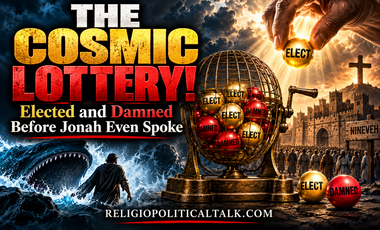
However, according to Reformed determinism, the Ninevites who repented had already been effectually called, unconditionally, before creation. Jonah’s message was therefore not the ultimate cause distinguishing those who repented from those who did not. It was the ordained means, but the decisive cause was God’s prior, irresistible determination. In that sense the story becomes a kind of “cosmic lottery”—not because Calvinists would describe election that way, but because the decisive distinction was settled unconditionally before anyone in Nineveh ever heard Jonah’s voice.

In that framework, God sent a messenger to overcome His own withholding of the grace necessary for those people to respond. Jonah’s preaching did not make repentance possible; it was the predetermined instrument through which God brought the predetermined elect to a predetermined response. The narrative reads like a genuine warning followed by a genuine human response. The deterministic system underneath it says the decisive question had already been answered before Nineveh heard Jonah at all.

Calvary is muted in a similar way by this sixteenth-century dogma. The message of the cross becomes secondary to the “lottery.” The cross may be proclaimed, the gospel may be preached, and sinners may be called to repent and believe—but the decisive question of who will actually receive the grace necessary to do so was, on this view, settled unconditionally before creation.

If that is so, then even Calvary begins to look less like God’s gracious provision genuinely offered to sinners and more like the historical means by which an already-determined number of sinners are brought to an already-determined salvation.

The same pattern appears in the flood. Noah preached, yet God effectually chose only eight and passed over the rest. And according to the determinist framework articulated by Piper, Sproul, Hendryx, and others, even the evil committed by those who were judged falls within God’s exhaustive determination—after which God judges them for those very acts.

The warnings appeared real. The preaching seemed genuine. The repentance was essentially orchestrated. The judgment was redundant. For if the entire outcome had already been unconditionally determined before creation, what could the warning ultimately change? What could the preaching ultimately alter? What could the sinner ultimately do otherwise? Beneath it all, according to the system, the decisive outcomes had already been unconditionally settled.

If theistic determinism is true in the way these Calvinist determinists describe it, then the apparent contingency of those events is illusory—not because Jonah’s preaching was imaginary, or because Nineveh’s repentance did not happen, but because the warning, the response, and the outcome could never have been otherwise. Those who would repent had already been unconditionally selected to repent. Those passed over had been denied the grace necessary to do otherwise.

The biblical drama remains on the stage, but the determinist script has already written every line: every response, every refusal, every act of evil, every repentant person, and every judgment.

It is a sad result when a theological system makes Scripture’s genuine calls to repentance functionally secondary to a decree that, before creation, supposedly determined who would receive the grace necessary to respond—and who would be passed over.

TRANSCRIPT 2:

The Cosmic Lottery

  • This is a rough outline to a chapter I will add to my digital book as I revamp the already written chapters. This chapter will essentially detail the pitfalls of determinism, whether secular/atheistic, or theistic.

In other words, were Enoch, Lot, Noah, Abraham, Jacob, Rahab, Ruth, David, and the rest of the Old Testament saints effectually regenerated by a supernatural work of the Holy Spirit so as to decisively cause them to believe the truth God had revealed to them?

If we are going to interpret John 6 as addressing an overarching ontological reality of fallen humanity—namely, that fallen men cannot believe divine truth unless they are first regenerated—then it seems difficult to avoid that conclusion. The Old Testament saints were fallen human beings just as we are. If regeneration was an absolute prerequisite for believing God’s revealed truth, then they too must have been supernaturally regenerated in order to believe.

This leads directly into the Reformed doctrine of effectual calling. The elect whom God effectually calls will respond positively, while those whom He does not effectually call will not. Regeneration is God’s work, and the sinner’s response is ultimately the inevitable result of God’s prior work within the elect.

But this raises the obvious question: Why doesn’t God effectually call everyone?

Romans 9 is commonly brought forward as the answer. Election is God’s sovereign prerogative; He has mercy upon whom He has mercy. His decision does not ultimately rest upon anything found in the individual. The human being therefore has no grounds for questioning God’s sovereign choice any more than he has grounds for questioning why God saved Noah and his family from the Flood while allowing the rest of humanity to perish, or why He chooses to eternally punish sinners.

But notice what happens when this principle is carried through the biblical narrative.

The question is no longer merely whether God saves. The question becomes what ultimately distinguishes the person who responds in faith from the person who does not.

If regeneration and effectual calling are the decisive causes of saving faith, then the sinner’s response cannot ultimately be the distinguishing factor. Those who believe do so because God effectually called them. Those who do not believe do so because they were not effectually called.

The decisive distinction therefore exists prior to the response itself.

And that brings us to Nineveh.

The Ninevites heard Jonah’s preaching, repented, and were spared. The narrative presents Jonah’s proclamation as a genuine warning and the Ninevites’ repentance as a genuine human response. But according to Reformed determinism, those Ninevites who repented had already been effectually called, unconditionally, before creation. Jonah’s message was therefore not the ultimate cause distinguishing those who repented from those who did not. It was the ordained means, but the decisive cause was God’s prior, irresistible determination.

In that sense, the story becomes a kind of “cosmic lottery”—not because Calvinists would describe election that way, but because the decisive distinction was settled unconditionally before anyone in Nineveh ever heard Jonah’s voice.

God sent a messenger to overcome His own withholding of the grace necessary for those people to respond. Jonah’s preaching did not make repentance possible; it was the predetermined instrument through which God brought the predetermined elect to a predetermined response.

The narrative reads like a genuine warning followed by a genuine human response. The deterministic system underneath it says that the decisive question had already been answered before Nineveh heard Jonah at all.

And this is precisely where the problem becomes difficult to escape.

If God could have effectually called the others but chose not to, then the difference between those who repented and those who did not ultimately lies not in the message, not in the warning, and not in something the individuals themselves did. It lies in God’s unconditional determination concerning them.

The same logic reaches all the way to Calvary.

Calvary is muted in a similar way by this sixteenth-century dogma. The message of the cross becomes secondary to the “lottery.” The cross may be proclaimed, the gospel may be preached, and sinners may be called to repent and believe—but the decisive question of who will actually receive the grace necessary to do so was, on this view, settled unconditionally before creation.

If that is so, then even Calvary begins to look less like God’s gracious provision genuinely offered to sinners and more like the historical means by which an already-determined number of sinners are brought to an already-determined salvation.

The cross remains absolutely necessary within the system. The preaching of the gospel remains necessary. Faith remains necessary. Repentance remains necessary. But none of these, in themselves, effect the decisive stirring of the soul that results in saving faith. The Word may be preached, the warning may be heard, and the sinner may be commanded to repent and believe, but the decisive work must first occur through regeneration. The irresistible and effectual work of God must make the person spiritually alive before that person can respond savingly.

And this creates a striking tension with the way Scripture portrays the power of God’s Word. The Word is described as living and active, sharper than any two-edged sword, piercing to the division of soul and spirit and discerning the thoughts and intentions of the heart. Yet within the deterministic framework, the preached Word itself cannot ultimately account for why one sinner responds while another does not. The same gospel may be heard by two equally fallen sinners, yet only one responds because only one has first been effectually regenerated.

The decisive distinction, therefore, is not ultimately found in the Word that both heard, nor in the warning that both received, nor in the command to repent that confronted both of them. It is found in the prior work of God within one and not the other.

The gospel is therefore proclaimed universally, but the grace that makes the proclamation effectual is distributed according to an unconditional decree. The Word is preached to all, but only those whom God has first regenerated are given the ability to respond savingly.

The result is that the historical preaching of the Word becomes the ordained instrument through which a prior decree is executed. The message appears to confront the sinner with a genuine possibility, yet the decisive question of whether that message will produce saving faith has already been settled before the sinner ever hears it.

The Word speaks in time.

The decree settled the response before time.

And this brings us to Noah.

Noah certainly was not the worst preacher in history. In fact, within the biblical account, his preaching was accompanied by a remarkable testimony of righteousness and obedience. Yet if the Reformed doctrine of effectual calling is correct, Noah’s lack of converts cannot ultimately be attributed to a failure of preaching technique, persuasion, clarity, or faithfulness.

The root cause of the people’s rejection was not ultimately found in Noah’s preaching, nor even in their own independent response to it. According to the determinist framework, God had determined not to effectually call them and not to grant them the regenerating grace necessary to respond positively to Noah’s message.

Conversely, the reason Noah and his family believed and were preserved was ultimately because God had determined to save them and effectually brought about the response necessary to that end. Thus, the decisive distinction between those who accepted God’s warning and those who rejected it was established by God’s prior determination.

In that sense, Noah was essentially 100 percent effective in accomplishing the purpose God had actually decreed for his preaching. Those whom God determined to save were saved; those whom He determined to pass over remained in their unbelief. Noah’s preaching did not fail to accomplish God’s predetermined purpose. Rather, within the system, the ultimate success or failure of his preaching was determined by God’s prior decision concerning the people who heard it.

This means that the people who perished were not ultimately lost because Noah’s message was insufficiently powerful. They were lost because, according to the doctrine, God had not determined to give them the effectual grace that would cause them to accept the message. The same preaching that was ordained to produce faith in the elect was ordained to leave the non-elect in their unbelief.

And that exposes the same difficulty we encountered with Nineveh. If God alone determines who receives the grace necessary to respond, then the apparent success or failure of the preacher is ultimately secondary. Jonah could preach and Nineveh could repent because God had determined to effectually call those Ninevites. Noah could preach for years and see no mass repentance because God had not determined to effectually call the people who perished.

The warnings appeared real. The preaching seemed genuine. The repentance was essentially orchestrated. The judgment was redundant—not in the sense that the ordained means had no purpose, but in the sense that the ultimate outcome could not possibly have been altered by the response of those involved.

For if the entire outcome had already been unconditionally determined before creation, what could the warning ultimately change?

What could the preaching ultimately alter?

What could the sinner ultimately do otherwise?

The Reformed answer is that God uses means to accomplish His predetermined ends. The warning accomplishes its predetermined purpose. The preaching accomplishes its predetermined purpose. The repentance accomplishes its predetermined purpose. The judgment accomplishes its predetermined purpose.

But that answer only reinforces the underlying problem.

Everything that happens is the means God predetermined to bring about what He had already predetermined would happen.

If theistic determinism is true in the way these Calvinist determinists describe it, then the apparent contingency of these events is ultimately illusory—not because Jonah’s preaching was imaginary, or because Nineveh’s repentance did not happen, or because Noah’s preaching was meaningless, but because the decisive outcomes could never have been otherwise.

Those who would repent had already been unconditionally selected to repent.

Those passed over had been denied the grace necessary to do otherwise.

The biblical drama remains on the stage, but the determinist script has already written every line: every response, every refusal, every act of evil, every repentant person, and every judgment.

And this brings us back to the original problem.

If regeneration is required before a fallen person can believe God’s revealed truth, and if regeneration is granted only to those unconditionally elected by God, then the ultimate distinction between the believer and the unbeliever is not found in the response to God’s revelation. It is found in the prior decree that determines who will receive the grace necessary to respond.

That makes Jonah’s warning genuine—but not genuinely decisive.

It makes Nineveh’s repentance real—but predetermined.

It makes Noah’s preaching real—but unable to alter the predetermined division between those saved and those destroyed.

And it makes the proclamation of the gospel universal in its announcement while the saving grace necessary to respond remains particular in its distribution.

The sinner is commanded to repent, but whether he receives the grace necessary to repent has already been unconditionally decided.

He is commanded to believe, but whether he receives the grace necessary to believe has already been unconditionally decided.

He hears the gospel, but the decisive question of whether the gospel will result in faith has already been answered.

That is the theological mechanism behind what I am calling the “Cosmic Lottery.”

Not chance.

Not randomness.

Not an accusation that Calvinists believe salvation is arbitrary in the ordinary sense of the word.

Rather, it is the unavoidable appearance produced when the decisive distinction between two equally fallen people is located in an unconditional divine choice made before either person existed.

One hears and believes.

Another hears and does not believe.

But beneath both responses, the determinist says, God had already decided who would receive the effectual grace that guarantees the first response and who would be passed over.

The outcome therefore appears to unfold through history, but the decisive distinction was established before history began.

The warning appears to open a genuine possibility.

The preaching appears to confront the hearer with a genuine choice.

The gospel appears to summon the sinner to a genuine response.

Yet beneath the system, the outcome has already been settled.

The biblical drama unfolds in time.

The decree settled it before time.

It is a sad result when a theological system makes Scripture’s genuine calls to repentance functionally secondary to a decree that, before creation, supposedly determined who would receive the grace necessary to respond—and who would be passed over.

The problem, then, is not that Jonah preached so well that Nineveh repented, or that Noah somehow preached poorly so that those who heard him failed to respond. Nor is the problem that God sovereignly saves; we all believe that. The root of the problem is what happens when that sovereignty is defined as an unconditional determination that decisively causes one person to respond while withholding the grace necessary for another to do so.

Again, the problem is the claim that God’s sovereign determination has already rendered the ultimate human response certain before the person ever encounters the revealed truth.

And if that is the case, then the question is unavoidable:

When Jonah stood outside Nineveh and cried, “Yet forty days, and Nineveh shall be overthrown,” was Nineveh genuinely being called to repent—or was Jonah merely announcing the historical means by which a predetermined group of elect Ninevites would inevitably respond?

That is the question the doctrine must answer.

And that is where the Cosmic Lottery begins.


Why Both Atheists and Christians Need to Believe in Free Will

Originally posted December 2025

The audio at the start from Jeff Durbin is bad… so one has to put up with it a little when the initial audio is played. But the same arguments against atheistic determinism can be used against Augustinian/Calvinistic [theistic] determinism:

Dr. Braxton Hunter, President of Trinity Seminary and host of Trinity Radio, joins Dr. Flowers to talk about how the main arguments against naturalistic determinism can apply against theistic determinism, as held by Compatibilistic Calvinists. They demonstrate this by engaging a clip from Apologia Studios with Jeff Durbin which references a quote from Calvinistic apologist, Greg Bahnsen.

 Justin Brierley drives this point home in his article:

Atheist Determinism 

Calvinistic Christians have more in common with many atheists than they may realize. Determinism has also become a very popular philosophy among their godless counterparts. For some time, prominent voices in atheist circles have also been announcing that the notion of free will is past its sellby date.

Popular atheist author Sam Harris wrote a book titled Free will (Free Press) which, drawing on research in neuroscience, argued that our innate sense of freedom is merely an illusion foisted on us by nature. None of us is actually in control of what we do. So far so Calvinist. But rather than believing God has predestined us, atheists like Harris say the universe is responsible.

Atheist determinism springs from a ‘materialist’ worldview. All that exists is the ‘material’ stuff of the universe. Everything about us and the world we live in can ultimately be explained by the physics of atoms, electrons, quarks and neutrons, interacting according to the predictable regularity of natural laws.

Think of it like this: the skill of the snooker player is in predicting as accurately as possible how the balls will ricochet off each other in order to find the pockets on the table. But, theoretically, if a snooker player lined up their very first shot with perfect precision and perfect force, they could clear the table in one shot. The universe is like that, but on a much bigger scale.

Every single physical event, from the movements of electrons to the orbits of the planets, follows predictable laws of cause and effect. Therefore, the way the universe is now is a direct result of the way it was when it first began. If you rewound the clock by 13 billion years to the exact same physical state of affairs, things would roll out in exactly the same way they already have.

But, in such a universe, the idea that we have any measure of free will evaporates. Every aspect of our existence was predestined by a cosmos blindly following the laws of cause and effect.

READ IT ALL: “Why Both Atheists and Christians Need to Believe in Free Will

You cannot have LOVE with people made into dolls with a pull string that say, “I love you.” This is evidence that Calvinists/”Reformed” make Calvary useless.

Here is a favored adapted combination of mine:

One of the most intriguing aspects mentioned by Ravi Zacharias of a lecture he attended entitled “Determinism – Is Man a Slave or the Master of His Fate,” given by Stephen Hawking, who is the Lucasian Professor of Mathematics at Cambridge, Isaac Newton’s chair, was this admission by Dr. Hawking’s, was Hawking’s admission that if “we are the random products of chance, and hence, not free, or whether God had designed these laws within which we are free.”[1] In other words, do we have the ability to make choices, or do we simply follow a chemical reaction induced by millions of mutational collisions of free atoms? Michael Polyni mentions that this “reduction of the world to its atomic elements acting blindly in terms of equilibrations of forces,” a belief that has prevailed “since the birth of modern science, has made any sort of teleological view of the cosmos seem unscientific…. [to] the contemporary mind.”[2]

[1] Ravi Zacharias, The Real Face of Atheism (Grand Rapids, MI: Baker Books, 2004), 118, 119.

[2] Michael Polanyi and Harry Prosch, Meaning (Chicago, IL: Chicago university Press, 1977), 162.

This is one of the biggest reasons I [about half-a-year-ago] have rejected the 5-Points of Calvinism. Which is, determinism. I have written, posted, and debated this with atheists for years on the WWW., and when I saw that people like Al Mohler refute the atheist versions of this but does not apply the same thinking to his position — my apologetic bug was brought alive. Here is the video that started this rabbit trail:

Here is the full Al Mohler article: “So . . . Why Did I Write This? The Delusion of Determinism

The subversion of moral responsibility is one of the most significant developments of recent decades. Though this subversion was originally philosophical, more recent efforts have been based in biology and psychology. Various theorists have argued that our decisions and actions are determined by genetics, environmental factors, or other forces. Now, Scientific American is out with a report on a study linking determinism and moral responsibility.

The diverse theories of determinism propose that our choices and decisions are not an exercise of the will, but simply the inevitable outcome of factors outside our control. As Scientific American explains, determinists argue that “everything that happens is determined by what happened before — our actions are inevitable consequences of the events leading up to the action.”

In other words, free will doesn’t exist. Used in this sense, free will means the exercise of authentic moral choice and agency. We choose to take one action rather than the other, and must then take responsibility for that choice.

This link between moral choice and moral responsibility is virtually instinctive to humans. As a matter of fact, it is basic to our understanding of what it means to be human. We hold each other responsible for actions and choices. But if all of our choices are illusory — and everything is merely the “inevitable consequence” of something beyond our control, moral responsibility is an exercise in delusion.

Scientific American reports on a study performed by psychologists Kathleen Vohs and Jonathan Schooler. The psychologists found that individuals who were told that their moral choices were determined, rather than free, were also more likely to cheat on an experimental examination.

As Shaun Nichols reports:

The Western conception idea of free will seems bound up with our sense of moral responsibility, guilt for misdeads and pride in accomplishment. We hold ourselves responsible precisely when we think that our actions come from free will. In this light, it’s not surprising that people behave less morally as they become skeptical of free will. Further, the Vohs and Schooler result fits with the idea that people will behave less responsibly if they regard their actions as beyond their control. If I think that there’s no point in trying to be good, then I’m less likely to try.

Even if giving up on free will does have these deleterious effects, one might wonder how far they go. One question is whether the effects extend across the moral domain. Cheating in a psychology experiment doesn’t seem too terrible. Presumably the experiment didn’t also lead to a rash of criminal activity among those who read the anti-free will passage. Our moral revulsion at killing and hurting others is likely too strong to be dismantled by reflections about determinism. It might well turn out that other kinds of immoral behavior, like cheating in school, would be affected by the rejection of free will, however.

There are limitations to this kind of research, of course, but the report is both revealing and unsurprising. If we are not responsible for our actions, they why would people do the right thing? The most immediate result of such thinking is the subversion of moral accountability.

Of course, this pattern of thought also renders human existence irrational. How can we understand ourselves, our children, our spouses, our friends, or our neighbors if moral responsibility is undermined by determinism. Our legal system would completely collapse, as would the entire experience of relating to other human beings.

Shaun Nichols explains that “the Western conception of free will seems bound up with our sense of moral responsibility.” That “Western conception” is a product of the Christian inheritance and the biblical worldview. The Bible clearly presents human beings as morally responsible. Christians of virtually all theological traditions — including Reformed theology, Arminianism, and Catholicism — affirm moral and spiritual responsibility and the authenticity of the experience of choice.

As a matter of fact, this capacity and accountability is rooted in the biblical concept of the imago Dei — the image of God. Our Creator made us as moral creatures and planted within us the capacity of conscience. All this refutes the concept of moral determinism.

In its most modern forms, determinism is a product of naturalism — the belief that everything must be explained in purely natural terms. Naturalism explains the human mind (including the experience of moral choice) as a matter of chemical reactions in the brain, and nothing more.

Determinism is implied by naturalism and relieves human beings of moral responsibility. There is no moral revolt against the Creator, no Fall, and no need for the Gospel. This subversion of moral responsibility is both a delusion and a trap. And, as the Scientific American report indicates, even those who say they believe in moral determinism are unable to live consistently with this assumption. We know we are responsible.

SOME QUOTES CONNECTING THIS IDEA MORE

ATHEISTS:

THEISTS:

If Mohler applies that to his own theological determinism, he would have to reject it.

MORE:

RIGHT CLICK AND “OPEN LINK IN NEW TAB” TO GET BIGGEST VERSION

THERE IS NO GOSPEL IN TULIP

In other words, a person accepts Christ’s death and Resurrection as secondary to being ELECTED.

Here is more on this via this excerpt of an article and short video:

ARMINIAN PERSPECTIVE:

Calvinist: “That is why Christ said that you must be born again in order to even see the kingdom of God. The new nature must come before faith. God making us willing is not mind control in the sense that you describe it but giving us a new nature and a new mind. Of course the analogy isn’t perfect but it does illustrate the fact that we can be made to love without it being against our will.”

Me: “No it doesn’t. If we were God haters that wanted nothing to do with Christ prior to His irresistible act of “giving us a new heart” that “makes us willing”, then it was certainly “against our will” because our will was to hate and reject God prior to His irresistible working in us. It would be like a man meeting a girl at a bar and the girl doesn’t like him and wants nothing to do with him. In fact, she finds him repulsive. So the man slips a pill in her drink that removes her inhibitions and causes her to begin to find him attractive, even to the point of “making her willing” to sleep with him. Now if this incident was brought before the court, would the court say that the man is not liable for violating the woman against her will, since the pill he put in her drink “made her willing”? Of course not. Nobody would say that she freely chose to be with the man under such circumstances, and no one would say that her will was not violated.”

“As distasteful as this illustration might be, it illustrates the exact same principle behind your claims that while God “makes us willing” this making us willing by “giving us a new heart” is not a violation of the person’s will. Instead of dropping a pill into our drink, God drops a “new heart” into our God hating chest. The only difference would be that in your view of how God works, the “effects” of the “drug” would never wear off. But that doesn’t change the fact that a person’s will has been obviously violated in the process.”

“It really is pretty simple. If God’s working faith into us is not resistible, but irresistible, then it certainly violates freedom and the will. That is so obvious, it shouldn’t even need to be pointed out. If you want to say that God irresistibly brings sinners to faith and love and devotion to Him (by irresistibly removing their “hate God heart” and putting in a “love God heart”) because you think the Bible teaches that, then fine. But trying to then claim that God does this in such a way that we freely come to him in such a way that our wills are not violated is clearly incoherent. You can’t have it both ways. Sorry.”

Dr. Leighton Flowers talk about martyrs who stood against the Calvinists of their day and what happened to them.

Calvinist’s Hiding Their Dreadful Decree Behind the Good News

This video examines why the doctrine of Calvinistic predestination—particularly double predestination and reprobation—has repeatedly produced intense disagreement within the Christian church. The discussion asks an important historical question: if these doctrines were foundational teachings of the apostles and earliest Christians, why do we find so little evidence of the kind of intense intra-Christian controversy surrounding them before Augustine?

The video looks particularly at Augustine’s role in the development of theological determinism, including his earlier association with Manichaeism and Neoplatonism, and the later development of his views on predestination. It also considers the historical evidence concerning the early church fathers and their opposition to deterministic ideas associated with Gnosticism and other movements.

The discussion then turns to the modern Calvinist debate and the striking divisions that arise when these doctrines are introduced into churches. Are these disagreements simply evidence that the doctrines are difficult truths that Christians must accept by faith, or do they indicate that something fundamentally different from the teaching of the earliest church has been introduced? The video also examines the problem of “double-speak”—the attempt to hold apparently contradictory propositions together by appealing to God’s mysterious or supposedly different logic.

Ultimately, the video asks viewers to consider a larger question: If Calvinistic determinism was truly a foundational doctrine of Christianity, why is its historical emergence and subsequent divisiveness so pronounced? Rather than simply telling the viewer what to believe, the goal is to examine the historical and theological claims and encourage the viewer to “report, you decide.”

PARTIAL TRANSCRIPT OF THE ABOVE PDF 

2) The earliest Christian scholars did not teach “Calvinistic” doc­trines.

If Jesus really was teaching TULIP theology so clearly in John chapter 6, as White likes to emphasize, why on earth don’t we see any of these theological concepts expounded upon or even mentioned in the earliest Christian writings? Instead, we have a preponderance of teachings from the early church, which rebut the conclusions that Calvinists have drawn from this and other passages. A widely-accepted notion among biblical scholars and historians is that doc­trines obtained from those who were present at the time they were created are more likely to be accurate. In contrast, the likelihood of errors in doctrine increases as one moves further away from the ori­ginal sources.

Irenaeus (ca. 130-202) was a martyr and influential figure in the early development of Christian theology. He was a student of Poly-carp, who was a disciple of John. In 180 AD, Irenaeus wrote a book called “Against Heresies,” specifically addressing ideas that would later be associated with Calvinistic Theology. These “heresies” being addressed denied free will, as can be seen in the following summar­ies:

Men are possessed of free will and endowed with the faculty of making a choice. It is not true, therefore, that some are by nature good and others bad.

This expression [of our Lord], How often would I have gathered your children together, and you would not, Matthew 23:37 set forth the ancient law of human liberty, because God made man a free [agent] from the beginning, possessing his own power, even as he does his own soul, to obey the behests (ad utendum senten-tia) of God voluntarily, and not by compulsion of God. For there is no coercion with God, but a good will [towards us] is present with Him continually. And therefore does He give good counsel to all. And in man, as well as in angels, He has placed the power of choice (for angels are rational beings) so that those who had yielded obedience might justly possess what is good, given indeed by God, but preserved by themselves. On the other hand, they who have not obeyed shall, with justice, be not found in possession of the good, and shall receive condign punishment: for God did kindly bestow on them what was good, but they themselves did not diligently keep it, nor deem it something precious, but poured contempt upon His super-eminent goodness. Rejecting therefore the good, and as it were spuing it out, they shall all deservedly incur the just judgment of God, which also the Apostle Paul testi­fies in his Epistle to the Romans, where he says, But do you des­pise the riches of His goodness, and patience, and long-suffering, being ignorant that the goodness of God leads you to repentance? But according to your hardness and impenitent heart, you store to yourself wrath against the day of wrath and the revelation of the righteous judgment of God. But glory and honour, he says, to everyone that does good. God, therefore, has given that which is good, as the apostle tells us in this Epistle, and they who work it shall receive glory and honour, because they have done that which is good when they had it in their power not to do it; but those who do it not shall receive the just judgment of God, because they did not work good when they had it in their power so to do.

But if some had been made by nature bad, and others good, these latter would not be deserving of praise for being good, for such were they created; nor would the former be reprehensible, for thus they were made [originally]. But since all men are of the same nature, able both to hold fast and to do what is good; and, on the other hand, having also the power to cast it from them and not to do it — some do justly receive praise even among men who are under the control of good laws (and much more from God), and obtain deserved testimony of their choice of good in general, and of persevering therein; but the others are blamed, and receive a just condemnation, because of their rejection of what is fair and good. And therefore the prophets used to exhort men to what was good, to act justly and to work righteousness, as I have so largely demonstrated, because it is in our power so to do, and because by excessive negligence we might become forgetful, and thus stand in need of that good counsel which the good God has given us to know by means of the prophets.43

Justin Martyr, who lived from c. 100/114AD to c. 162/168 AD was a prominent early Christian apologist who defended the faith. He courageously faced martyrdom through beheading. His writings are significant as they are the earliest surviving examples of substantial Christian apologia. He taught:

Man acts by his own free will and not by fate. We have learned from the prophets, and we hold it to be true, that punishments, chastisements, and rewards are rendered according to the merit of each man’s actions. Otherwise, if all things happen by fate, then nothing is in our own power, for if it be predestined that one man be good and another man evil, then the first is not deserving of praise or the other to be blamed. Unless humans have the power to avoid evil and choose good by free choice, they are not accountable for their actions-whatever they may be….

For neither would a man be worthy of reward or praise if he did not of himself choose the good but was merely created for that end. Likewise, if a man were evil, he would not deserve punish­ment since he was not evil of himself, being unable to do any­thing else than what he was made for.

But that you may not have a pretext for saying that Christ must have been crucified, and that those who transgressed must have been among your nation, and that the matter could not have been otherwise, I said briefly by anticipation, that God, wishing men and angels to follow His will, resolved to create them free to do righteousness; possessing reason, that they may know by whom they are created, and through whom they, not existing formerly, do now exist; and with a law that they should be judged by Him, if they do anything contrary to right reason: and of ourselves we, men and angels, shall be con­victed of having acted sinfully unless we repent beforehand. But if the word of God foretells that some angels and men shall be certainly punished, it did so because it foreknew that they would be unchangeably wicked, but not because God had created them so.44

Clement of Alexandria, known to have lived from c. 150 to c. 215 AD, was an important figure in early Christianity. He was an influ­ential Christian theologian and philosopher who sought to integrate Greek philosophy with Christian teachings. Despite living in turbu­lent times, Clement remained devoted to defending and promoting the Christian faith. His written works, which have survived to this day, provide valuable insights into the early development of Christian thought, making Clement of Alexandria a notable figure in early Christian apologetics. He wrote:

A man by himself working and toiling at freedom from sinful desires achieves nothing. But if he plainly shows himself to be very eager and earnest about this, he attains it by the add­ition of the power of God. God works together with willing soul­s. But if the person abandons his eagerness, the spirit of God is also restrained. To save the unwilling is the act of one using com­pulsion, but to save the willing, that of one showing grace.

Neither praise nor condemnation, neither rewards nor pun­ishments, are right if the soul does not have the power of choice and avoidance if evil is involuntary.

I could have provided more examples from early church leaders, but the point has been established. To address any concerns about selectively quoting to support my view, let’s consider the viewpoints of unbiased sources like Loraine Boettner, a well-known Calvinist, on the beliefs of early church leaders. Boettner acknowledges that the early church fathers did not endorse the doctrine of predestination:

It may occasion some surprise to discover that the doctrine of Predestination was not made a matter of special study un­til near the end of the fourth century They, of course, taught that salvation was through Christ, yet they assumed that man had full power to accept or reject the gospel. Some of their writings contain passages in which the sovereignty of God is rec­ognized; yet alongside those are others which teach the absolute freedom of the human will. Since they could not reconcile the two, they would have denied the doctrine of Predestination They taught a kind of synergism in which there was a cooper­ation between grace and free will45

Regarding what we now call the doctrine of predestination, Boettner went on to say, “This cardinal truth of Christianity was first clearly seen by Augustine…” Augustine lived from 354 – 430 A.D., well after the church fathers quoted above. However, Boett-ner was not alone in his findings. In 1882, James Morrison wrote in The Extent of Atonement about an English Bishop, John Davenant (1572-1641), who was a Calvinist present at the Synod of Dort in 1618. Bishop Davenant wrote:

It may be truly said before Augustine and Pelagius that there was no question concerning the death of Christ, whether it was to be extended to all mankind or to be confined only to the elect. For the Fathers…not a word (that I know of) occurs among them of the exclusion of any persons by the decree of God. They agree that it is actually beneficial to those only who believe, yet every­where confess that Christ died on behalf of all mankind…

Augustine died in AD 429, and up to his time, at least, there is not the slightest evidence that any Christian ever dreamed of a propitiation for the elect alone. Even after him, the doctrine of limited propitiation was but slowly propagated, and for long but partially received.46

Herman Bavinck, another well-respected Calvinistic scholar, came to virtually the same conclusion:

In the early church, at a time when it had to contend with pagan fatalism and gnostic naturalism, its representatives focused ex­clusively on the moral nature, freedom, and responsibility of hu­mans and could not do justice, therefore, to the teaching of Scrip­ture concerning the counsel of God. Though humans had been more or less corrupted by sin, they remained free and were able to accept the proffered grace of God. The church’s teaching did not include a doctrine of absolute predestination and irresistible grace.47

In their book titled “Why I Am Not An Arminian,” two Calvinis­tic professors of theology at Covenant Theological Seminary, Robert Peterson and Michael Williams, reflect on the same basic historical fact:

The Semi-Pelagians were convinced that Augustine’s monergistic emphasis upon salvation by grace alone represented a signifi­cant departure from the traditional teaching of the church. And a survey of the thoughts of the apostolic fathers shows that the argument is valid… In comparison to Augustine’s monergistic doctrine of grace, the teachings of the apostolic fathers tended to­ward a synergistic view of redemption.48

Louis Berkhof, who was both President of Calvin Seminary and a professor of Systematic Theology, affirms this “assured fact, a fact knowing no exceptions, and acknowledge by all well versed in the matter:”

Predestination does not form an important subject of discussion in history until the time of Augustine. Earlier Church Fathers al­lude to it, but do not as yet seem to have a very clear conception of it. On the whole, they regard it as the prescience of God with reference to human deeds, on the basis of which He determines their future destiny… Their representations are naturally rather indefinite, imperfect, incomplete, and sometimes even erroneous and self-contradictory. Says Kahnis: “It stands as an assured fact, a fact knowing no exceptions, and acknowledged by all well versed in the matter, that all of the pre-Augustinian Fathers taught that in the appropriation of salvation, there is a co-work­ing of freedom and grace.” 49

Berkhof goes on to admit that “they [the early church scholars] do not hold to an entire corruption of the human will, and consequently adhere to the synergistic theory of regeneration…” In other words, he admits there were no “monergists” before Augustine.50

John Calvin himself even admitted that Augustine was the only early source he could find to validate his views:

Moreover, although the Greek Fathers, above others, and espe­cially Chrysostom, have exceeded due bounds in extolling the powers of the human will, yet all ancient theologians, with the exception of Augustine, are so confused, vacillating, and contra­dictory on this subject, that no certainty can be obtained from their writings.51

I suspect that the reason Calvin singled out his frustration with John Chrysostom (347-407) is probably because Chrysostom linked the Calvinistic interpretation of passages like John 6:44 to their Gnos­tic origin when he wrote:

No man can come unto Me, except the Father which has sent Me draw Him. The Manichaeans spring upon these words, saying that nothing lies in our own power, yet the expression shows that we are masters of our will.52

Augustine was a Manichaean for about a decade of his life before converting to Christianity, so many scholars throughout the ages have suspected that this might have been one significant influence explaining why Augustine’s teachings “represented a significant de­parture from the traditional teaching of the church,” as acknow­ledged by “all well versed in the matter.”53

And we cannot downplay the amount of influence Augustine had, especially on the Calvinistic form of Christianity. R.C. Sproul, a highly esteemed Calvinistic theologian, wrote:

It has been said that all of Western theology is a footnote to the work of Augustine. This is because no other writer, with the ex­ception of the biblical authors, has had more influence on Chris­tendom. When Martin Luther and John Calvin were accused of teaching new doctrine, they pointed to Augustine as an example of one who had taught the things they were teaching.54

On this point, James Leo Garrett, a prominent Baptist theologian and scholar, aptly noted:

From Augustine of Hippo to the twentieth century, Western Christianity has tended to interpret the doctrine of election from the perspective of and with regard to individual human beings. During those same centuries the doctrine has been far less em­phasized and seldom ever controversial in Eastern Orthodoxy. Is it possible that Augustine and later Calvin, with the help of many others, contributed to a hyper-individualization of this doctrine that was hardly warranted by Romans 9-11, Eph. 1, and I Peter 2? Is it not true that the major emphasis in both testaments falls upon an elect people—Israel (OT) and disciples or church (NT)?55

Considering that even Calvinists discourage the teaching of TULIP to skeptical non-believers and the fact that the Christian church in its first 400 years did not interpret the Bible from a Calvin­istic perspective, it seems highly improbable that Jesus intended to introduce this complex and controversial soteriological systematic to a group of grumbling unbelieving Israelites who were superficial fol­lowers looking for a free meal.


Leighton C. Flowers, Drawn by Jesus: A Biblical Defense of God’s Provision for All and a Rebuttal of James White’s Book “Drawn by the Father” on John 6:35–45 (Trinity Academic Press, 2024), 63–77.

SEE ALSO: Did the Early Church Fathers teach Calvinistic Doctrines?

FOOTNOTES:

40. Calvinism is generally known by its unwavering commitment to the soteriology (doctrine of salvation) most popularly represented by the acronym “TULIP” (Total depravity, Unconditional election, Limited atonement, Irresistiblegrace, and Perseverance of the saints), also referenced as “five points.” Some Cal­vinists call themselves “four pointers” (Amyrauldians), because they reject Limited atonement. Others, like White, add additional letters, such as “S” for “sovereignty” which is redefined to mean “theistic determinism,” making the acronym “STULIP.”

41. In a casual poll on X, I posed the question to Calvinists: “Should you teach TULIP to a crowd of unbelievers.” The overwhelming response was, no. Here are a few replies that best represent the consensus: “No. Secondary matters are second­ary.” “No need to get into the deeper things of God, given that they reject milk.” “This is why we sit down and talk to people and find out who they are and where they are. Any system of doctrine is a guard rail. This is not be to preached or evangelized.”

42. On a Dividing Line program titled “Radio Free Geneva: Atheists, William Lane Craig, Warren McGrew,” White responded to a discussion between an Atheist (PineCreekDoug) and a Calvinistic Christian (Derek Murrell) saying, “…there’s no reason to be discussing the sovereign grace of God and things like that with some­one who just doesn’t even believe…”  accessed online [by RPT 8/27/2026] 

43. Irenaeus, Against Heresies, accessed online [by RPT 8/27/2026] (NEW ADVENT)

44 Justin Martyr, The First Apology (chapter 43), accessed online [by RPT 8/27/2026] (NEW ADVENT).

45. Loraine Boettner, Reformed Doctrine of Predestination, accessed online [by RPT 8/27/2026] (MONERGISM)

46. David Allen, The Synod of Dort and the Extent of the Atonement, accessed online [by RPT 8/27/2026] (DR. DAVID ALLEN)

47. Herman Bavinck, Reformed Dogmatics, ed. John Bolt, trans. John Vriend, vol. 2, God and Creation (Grand Rapids: Baker, 2004), 348. He references Justin Mar­tyr, Irenaeus, and Tertullian among the ante-Nicene fathers, and John of Damascus among the later Eastern teachers.

48. Robert Peterson and Michael Williams, Why I Am Not an Arminian (IVP, 2004) 36.

49. Louis Berkhof, Systematic Theology (Eerdmans, 1932) 130.

50. The categories of “monergism” versus “synergism” were created by Calvin­ists in order to reframe the discussion over the role of God and man in the process of salvation which is based on a fallacy of conflation. More on this topic can be found here: “Calvinism’s Conflation” (SOTO 101); and “Calvinism’s Conflation | Flowers and Tozer” (RELIGIO-POLITICAL TALK)

51. John Calvin, Institutes, book 2, chapter 2, section 4

52. John Chrysostom, Homily 46 on the Gospel of John, accessed online [by RPT 8/27/2026] (NEW ADVENT)

53. For more on this topic see: Ken Wilson, The Foundation of Augustinian-Calvinism (Mohr Siebeck, 2019).

54. Quote taken from a recommendation for The Works of Saint Augustine: The Confessions. Accessed online [by RPT 8/27/2026] (THE OLD GUYS)

55. James Leo Garrett Jr., Systematic Theology: Biblical Historical, and Evangel­ical, vol. 2 (Grand Rapids: Eerdmans, 1995), 500

This stuff is striking a chord with me. Why, part of this year+ journey I left a church where this “two face” theology is preached from the pulpit and something different is discussed behind doors (adult classes and men’s and women’s groups). My past pastor said this:

  • “Make a choice. Choose this day. In fact, you can choose one of the… He’s not saying that he’s happy if you choose the pagan gods, but he says, in fact, pick one of the pagan gods. Do you know that something that God is extremely kind and gracious to us and that he gave us free will? Did you know that? He didn’t force a relationship on us. He gave us free will. Do you remember what he gave Adam and Eve? Free will. You can make a choice. I’m not gonna force it. Hey, you choose, yeah, you, make the choice.”

When I asked an elder if this pastor really believed this statement he made regarding free will from the pulpit, I got an honest answer of “No.” And when discussing the issue the night before I turned in my letter of leaving to the church, this was said via another pastor:

Interestingly enough Josh McDowell’s warning rang very true to me. He writes:

  • A feature of some cultic groups is that they say one thing publicly but internally believe something totally different. Many organizations call themselves Christians when in fact they deny the fundamentals of the faith. . . . One therefore must be on the alert for the organizations that advertise themselves as “Christians” but whose internal teachings disagree with Scripture.

And part of the reason for this “secrecy” is that is is not good news, it is a “dreadful decree”.

Although we cannot know the true intentions of John Calvin’s pursuit in evangelism, for several reasons it seems unlikely that he aimed only to proclaim salvation in Christ. First, his theological view clearly makes evangelism ultimately useless. Second, cult leaders usually seek their own desires, as opposed to the desires of God as revealed in Scripture. Third, John Calvin knew that his missionaries were not spreading good news to anyone whom God would not save. In fact, as Reformation historian Diarmaid MacCulloch writes, “Calvin was perfectly aware that the determinism of predestination was ‘dreadful indeed’ to humanity.”[22]* In fact, his missionaries were spreading nothing but bad news to almost all of those who were supposedly not of the elect. According to MacCulloch, “The most discordant noises came from Basel, where one anonymous pamphlet with bitter sarcasm described the Genevan Church as proclaiming ‘its good news with flames.”[23]

[….]

(4) Why Calvinism’s gospel and other cult theologies are dishonestly presented

When I share the gospel message, either from the pulpit or one-on-one, I have nothing to hide or water down about my beliefs and theology. This may sound very basic, but it must be noted. If I were a people pleaser, I would be tempted to overlook those parts of my theology that might offend a potential believer. Certain aspects of the gospel’s good news, like “personal sin” and “divine judgment,” are not merely a part of understanding one’s need for God’s grace but are imperative to receiving it. Thus, although the prospective convert might not welcome the true notion of his rebellion before God (i.e., his sin) and a time of God’s future judgment, I withhold nothing and keep no secrets in laying out the full gospel.

This is not the case with Mormonism and Jehovah’s Witnesses. This is also not the case with the gospel according to Calvinism. George Bryson writes:

Some Calvinists are not only less than totally up-front, but they are not even being altogether honest with the non-Calvinists whom they are targeting. In the promotion of doctrine, what is held back or not expressed (relative to those doctrines) can be very misleading.[33]

Bryson contends that “some Calvinists do not want non-Calvinists to know the full implications of Calvinism until after they have become committed Calvinists.”[34] It should not be hard to figure out the reasons why a “potential” convert might not want to know intimately the core doctrines of Calvinism from the beginning.

If the forbearer of the Calvinist gospel message cannot or will not be upfront and direct about the doctrines pertaining to salvation (in public or private life), the skeptic must seriously consider why. Furthermore, we should wonder whether Jesus Himself was hiding some important aspects of His messages. Was He withholding the doctrine of double predestination when He called everyone to come and receive the Bread of Life? Did He expect the crowds to understand that when He said “all” or “world” what He really meant was “some” and “elect”? Did He assume that His followers would understand that “grace” could have multiple definitions? Did Jesus expect His apostles to understand that their efforts to evangelize would be ultimately futile? Indeed, Chuck Smith asks, “Why would the God of all truth, who speaks so sternly against lying, send His servants out to promote such a lie?”[35]

Yet, some Calvinists today seem guilty of being dishonest in presenting their particular gospel. One Reformed Southern Baptist pastor, in an article entitled “Instructions for Local Church Reformation,” advises other Calvinist pastors:

Choose a few men who are sincere, teachable and spiritually minded and spend time with them in study and prayer. They will help you to reform. . . . In the pulpit, don’t use theological language that is not found in the Bible. Avoid terms such as Calvinism, reformed, doctrines of grace, particular redemption, etc. Most people will not know what you are talking about. Many that do will become inflamed against you.[36]

We read about dishonesty concerning the gospel early in church history. Certain men came down from Jerusalem teaching the brethren that unless they were “circumcised according to the custom of Moses,” they could “not be saved” (Acts 15:1, NKJV).[37] Because of this threat to the gospel message, the apostles gathered and directly faced the problem. The main reason the apostles opposed this teaching was because of its false message of salvation, which added “works” to the free grace of God and limited those who could be saved to those who were circumcised. Similarly, Calvinism limits salvation to “the elect.” “Certain men” (Calvinists) are teaching the brethren that some people can “not be saved” at all.

Like Paul, the Christian is called to confront those who are “not straightforward about the truth of the gospel.”[38] In Galatians chapter 2, Paul confronted Peter about his hypocrisy. Although the gospel was commanded to be taken to all of humanity, Peter would fellowship only with the Gentiles in the absence of the Jewish elite. Thus, while Peter believed the gospel was for the Gentiles as well as the Jews, his actions differed from his beliefs. He witnessed mainly to the Jewish people who came from Jerusalem. When Paul noticed Peter compromising the truth of the gospel, he said, “Now when Peter had come to Antioch, I withstood him to his face, because he was to be blamed; . . . But when I saw that they were not straightforward about the gospel, I said to Peter before them all . . .”[39] (Galatians 2:11–14, NKJV). Paul then brings Peter’s hypocrisy into the light.

Likewise, those who herald Calvinism today do not practice what they preach. While on the outside, Calvinists claim that their gospel is for all people, their doctrines clearly declare otherwise. To win the minds of those around them, their doctrine of limited atonement is not openly addressed. Calvinists, as with all cultists, are not straightforward about their message. If they were straightforward, there would be no need for Calvin expositors like Pink, White, and Sproul to malign the intended meanings of simple words like “world”; there would be no need for Calvinist teachers to make unfounded distinctions in words like “love,” “grace,” and “calling”; and there would be no need to change the TULIP labels. The following example illustrates how far from straightforward a Calvinist can be.

I recently watched an episode of a sitcom, in which the manager of a paper resale office was offered a promotion in the company, but only if he laid off several of his employees. The manager, though close friends with many of his employees, agreed to take the new position. Not knowing their fate, his staff anxiously sought his decision. When he came out of his office, he said, “I have good news and bad news. I’ll tell you the bad news first. A lot of you will lose your job here or be forced to relocate to Sweden.” At this, the employees were distraught and saddened. But their regional manager was quick to try and raise their spirits by finishing, “And now the good news—I was offered to be head manager over all of the U.K.” As he looked for approval among his employees, they offered him none. After a minute of silence, one of the employees pointed out the stupidity of his ex-manager: “That’s not good news. All you have is bad news and irrelevant news. We’ve just lost our jobs so you could be promoted, and you think we should be happy for you?”[40]

Likewise, the gospel of Calvinism looks into the faces of people whom their god has doomed to eternal fire and expects a joyful response to their fate. In Luke 2:10, the angel of the Lord announces the true gospel of Christ as “good tidings of great joy which will be to all people.” Is one to believe that this angel from God held the same unreasonable logic of the new U.K. branch manager? Did the angel really think that the unfortunate souls would find the news of their damnation as “good tidings and great joy?”

These types of contradictions that plague Calvin’s TULIP make for a confusing and inconsistent theology. Why does it maintain such contradictions? Is it because Christians would not swallow Calvinism if it were not watered down? Is it because Calvinism’s “unveiled” gospel would turn potential new converts away instead of winning them over? Why unbelievers, let alone Christians, would be repulsed by Calvinism’s deterministic form of Christianity should be no surprise, for it must bear a certain fruit in the lives of its followers.


Micah Coate, A Cultish Side of Calvinism (Innovo Publishing, 2011), 263, 267–71.

* Calvin was perfectly aware that the determinism of divine predestination was ‘dreadful indeed’ to humanity. Moreover, like most believers in predestination (Luther and Augustine included), he felt that only a minority would be saved – it was not Calvin but Augustine in one of his savage late anti-Pelagian works who observed that God had arranged this in order to give the elect all the more reason to be grateful for their elect status.38 Calvin was not prepared to put a figure on the proportion of the saved, varying his estimates for artistic effect from his habitual estimate of one in a hundred to one in twenty, or even one in five in more generous moods. He was also very wary of saying that people could be certain of their own election, let alone identify others among the elect.

Diarmaid MacCulloch, The Reformation: A History (New York: Penguin Books, 2005), 244.

FOOTNOTES:

[22] MacCulloch, The Reformation, 244.

[23] Ibid., 245.

[….]

[33] George Bryson, The Dark Side of Calvinism: The Calvinist Caste System (Santa Ana, CA: Calvary Chapel Publishing, 2004), 23.

[34] Ibid., 22.

[35] Smith, Foreword to The Dark Side of Calvinism.

[36] Ernest C. Reisinger and D. Matthew Allen, A Quiet Revolution: A Chronicle of Beginnings of Reformation in the Southern Baptist Convention [online]; accessed by RPT 8/27/2026             

[37] NKJV, Acts 15:1.

[38] NKJV, Galatians 2:14.

[39] NKJV, Galatians 2:11–14.

[40] Ricky Gervais, The Office, Season 1, Disc 2, Episode 6 (BBC Amazon Prime Video)


Divine Sovereignty and Human Freedom (Shedd vs. Laws of Logic)

The Logical Problem (PDF for download)

The central problem is that W. G. T. Shedd [(1820–1894) was a prominent 19th-century American Presbyterian theologian and professor, best known for his rigorous defense of Reformed theology and divine sovereignty] attempts to hold together exhaustive divine determination and a genuinely self-determining human will without first showing that those claims are logically compatible in the same respect.

This critique is therefore directed first at Shedd’s formulation and only secondarily at Calvinism insofar as Calvinistic compatibilism supplies the framework that creates the tension.

“The Westminster Standards, in common with the Calvinistic creeds generally, begin with affirming the universal sovereignty of God over his entire universe: over heaven, earth, and hell; and comprehend all beings and all events under his dominion. Nothing comes to pass contrary to his decree. Nothing happens by chance. Even moral evil, which he abhors and forbids, occurs by ‘the determinate counsel and foreknowledge of God;’ and yet occurs through the agency of the unforced and self-determining will of man as the efficient.”[1]

Shedd is therefore making three claims:

  • A. Nothing happens contrary to God’s decree.
  • B. God’s decree encompasses even moral evil.
  • C. Moral evil nevertheless occurs through the “unforced and self-determining will of man.”

And this is where the law of non-contradiction becomes relevant.

The law of non-contradiction is one of the foundational principles of rational thought. As Ted Honderich’s Oxford Companion to Philosophy explains, “a theory in which this law fails…is an inconsistent theory.”[2] Manuel Velasquez likewise describes the law as “the foundation of logical reasoning.”[3]

William S. Sahakian and Mabel Lewis Sahakian make the implication especially clear when discussing contradictory premises. They explain that when an argument contains premises that contradict one another, “one premise cancels out the other.” It may be possible for one proposition or the other to be true, but contradictory propositions cannot be true simultaneously.[4]

J.P. Moreland makes this principle especially useful by showing how a proposition can also undermine itself. As he puts it, “When a statement fails to satisfy itself (i.e., to conform to its own criteria of validity or acceptability), it is self-refuting…,” in other words, “A” cannot be both “non-A” and “A” at the same time.[5] His examples include statements such as “I cannot say a word in English” when spoken in English, “I do not exist,” and “there are no truths.” In each case, the statement defeats itself because its truth would require the very thing it denies.

This distinction is important because the problem under consideration is not merely that Shedd’s formulation is difficult to understand. The question is whether the propositions themselves are logically compatible.

The appeal to mystery cannot resolve the issue unless the relevant terms are first stabilized: “determines” must identify the factor that makes one outcome certain rather than merely foreknown, “self-determining” must clarify whether the will ultimately settles between alternatives, “ultimate determiner” must distinguish the immediate agent from the decisive causal source, and “permission” must explain whether God merely allows an outcome or decrees the conditions that render it certain.

That principle matters here.

The question is not whether we can place Shedd’s statements together in the same paragraph. Obviously, we can. The question is whether they can all be true in the same sense at the same time.

If “self-determining” means that the human will genuinely determines which choice it will make, then God’s exhaustive decree cannot simultaneously be the determining cause of that same choice. But if God’s decree determines which choice the person will inevitably make, then the person may be the immediate agent of that choice, but calling his will “self-determining” becomes problematic.

So consider the two propositions at the heart of Shedd’s formulation:

God’s decree determines that this particular human action will occur.

And:

The human will is itself self-determining with respect to this particular action.

If “self-determining” means only that the person acts voluntarily according to desire, Shedd may be describing compatibilist freedom; if it means that the person could ultimately determine otherwise under the same conditions, he is invoking libertarian freedom, and the two uses cannot be treated as interchangeable.

The person can be the immediate agent who chooses and can act willingly without external compulsion, but agency and voluntariness do not by themselves establish that the will is the ultimate determiner of the action.

That distinction brings us to the real philosophical question:

  • Could the person have determined otherwise?

If God’s decree has made one particular outcome certain, then the important question isn’t merely whether the person wanted to do it. The question is whether he possessed the genuine ability to determine an alternative outcome.

And that is why simply calling the will “unforced” does not settle the question. Nor does calling it “self-determining.” Those terms themselves require definition. If “unforced” merely means that nobody externally coerced the person, there is no contradiction in saying that he acted willingly.

But if “self-determining” means that the person’s will ultimately determined which of genuinely available alternatives would occur, then exhaustive divine determination presents a serious logical problem.

The issue, then, is not whether God can know something we do not understand. The issue is whether two mutually exclusive descriptions of the same human choice can both be true in the same sense.

Mystery, Contradiction, and the Limits of the Calvinist Reconciliation

It is important at the outset to distinguish between a mystery and a contradiction. Christianity unquestionably contains truths whose full explanation exceeds human comprehension. The existence of mystery, therefore, is not itself problematic. The more precise question is whether an appeal to mystery acknowledges the limits of human understanding concerning truths revealed in Scripture, or whether it is being employed to reconcile propositions that are themselves incompatible.

This framework now applies directly to the Calvinist appeal to mystery. Wayne Grudem recognizes that Christianity contains truths that exceed full human comprehension, but he also insists that Scripture does not require belief in contradiction.

But it should also be said that Scripture does not ask us to believe in a contradiction. A contradiction would be “There is one God and there is not one God,” or “God is three persons and God is not three persons,” or even (which is similar to the previous statement) “God is three persons and God is one person.” But to say that “God is three persons and there is one God” is not a contradiction.[6]

The significance of Grudem’s observation is not that mystery is illegitimate, but that mystery cannot simply be invoked as a substitute for theological coherence. Doctrine may transcend our comprehension without being contradictory.

Rogers advances the argument by moving the issue from general logical coherence to the source of the alleged mystery: if the difficulty arises only after Calvinistic premises are added, then the burden rests on those premises rather than on biblical mystery itself.

This distinction is especially significant in William G. T. Shedd’s treatment of the origin of sin. Shedd acknowledges that the relationship between God’s permissive decree and the entrance of sin presents an “inscrutable mystery.”

Yet Rogers argues that the mystery arises precisely because Calvinism combines divine determinism with compatibilism. Within compatibilism, the creature freely acts according to his strongest desire, but that desire itself is determined by antecedent conditions. Consequently, the creature’s choice is free in the compatibilist sense while, given the identical antecedent conditions, he could not actually have chosen otherwise.

Compatibilism is therefore not an escape from determinism but a particular account of freedom within determinism. John Hendryx explicitly acknowledges that “compatibilism is a form of determinism,” adding that it is “no less deterministic than hard determinism,” so the key question becomes whether responsibility and voluntariness are enough to justify calling the will self-determining.

MacArthur sharpens the causal issue by framing God as the primary cause and human beings as secondary causes “moved by the primary cause.” Even if MacArthur rejects the conclusion that God is morally responsible for evil, his formulation confirms the analytical question: can a will moved by a determining primary cause also be called the ultimate determiner of its own choice?

This creates a significant difficulty for Shedd’s appeal to divine permission. Shedd can distinguish God’s permission from direct efficiency and can affirm that the creature freely apostatized. But if God sovereignly established the nature and antecedent conditions from which the creature’s desires necessarily arose, then describing the fall as something God merely permitted does not by itself explain how the fall was not also encompassed within the determinative structure of God’s decree. Rogers therefore observes that Shedd’s language concerning the unfallen will possessing the power to remain holy, while simultaneously acknowledging that its apostasy became certain through a permissive decree, exposes rather than resolves the underlying tension. Shedd himself concludes that the manner in which a non-efficient permissive decree makes the fall certain is an “inscrutable mystery.”[7]

The same pattern becomes even more conspicuous when the issue moves from the origin of sin to God’s salvific will.

Here the testimony of David Engelsma is particularly significant precisely because Engelsma is not attempting to soften the implications of historic Calvinism. He states:

“That God is gracious only to some in predestination, but gracious to all in the gospel, and that God wills only some to be saved in predestination but wills all to be saved by the gospel, is flat, irreconcilable contradiction. It is not paradox, but contradiction. I speak reverently: God Himself cannot reconcile these teachings.”[8]

Engelsma then makes an observation that is particularly important to the common appeal to the Trinity as an analogy for this problem. The Trinity is mysterious, but it is not contradictory, because God is one in being and three in persons—not one and three in the same respect. That distinction is crucial. The Christian does not say:

  • God is one person and three persons.

Nor does he say:

  • God is one being and three beings.

The apparent numerical conflict disappears because the predicates are being asserted in different respects.

Consequently, to call every difficult Calvinistic reconciliation a “mystery” does not establish that the reconciliation is legitimate. One must first demonstrate that the propositions are compatible.

Indeed, Engelsma goes further. He rejects the attempt to resolve the difficulty through an appeal to different kinds of grace:

“There is no relief for the sheer contradiction … in the doctrine of ‘common grace,’ as though the grace of predestination were a different kind of grace from that revealed in the gospel.”

His argument is that the gospel offer itself is presented as saving grace directed toward those who hear it. If predestination simultaneously teaches that God has eternally determined that only some will receive saving grace, then the distinction between God’s grace in the gospel and God’s grace in predestination cannot simply be introduced as a terminological escape hatch.

And this is where Engelsma becomes especially valuable for our treatment of Shedd. The question is no longer merely:

  • Can we understand how these things work?

It becomes:

  • Are the things being asserted actually compatible?

That is a much more fundamental question.

Rogers then shows that the same pattern recurs across Calvinist treatments of compatibilism, the origin of sin, unconditional election, reprobation, the two wills of God, and the “good-faith offer.” Each mechanism—compatibilistic freedom, permissive decree, two wills, hypothetical otherwise-choice, and finally “mystery”—must be evaluated by whether it clarifies the propositions or merely relocates the contradiction.

Importantly, Rogers does not argue that every Calvinist who employs such language is intentionally deceptive. He explicitly says his use of “double talk” is not a charge of malicious intent. Rather, he uses the expression for language that obscures or elides the determinative implications of the system, allowing Calvinists to speak of genuine human choice, divine universal desire, or God’s hatred of sin in ways that may sound libertarian or non-deterministic while the underlying theological definitions remain compatibilistic and decretal.

Thus the issue with Shedd’s appeal to “inscrutable mystery” should not be caricatured as an objection to mystery itself. The issue is whether mystery has actually explained anything. If Shedd’s premises entail that God could have created a world without sin, that God determined the conditions under which the creature would freely choose sin, and that the creature could not have chosen otherwise given those same conditions, then calling the relationship between God’s decree and the certain occurrence of sin an “inscrutable mystery” does not remove those entailments. It merely marks the point at which the system can no longer provide an account that satisfies its own competing assertions.

And that brings us to the crucial distinction:

A mystery tells us that we do not know how two truths that Scripture teaches fit together. A contradiction occurs when two propositions cannot both be true in the same respect and at the same time. The former is a limitation upon our knowledge; the latter is a problem in the propositions themselves.

Consequently, the appeal to mystery must come after the compatibility of the propositions has been established, not before.

The issue, therefore, is not whether Christianity contains mysteries; it unquestionably does.

Nor is the issue whether finite human beings can comprehend every truth concerning the infinite God; they cannot.

The issue is whether “mystery” is being used to acknowledge the limits of human knowledge concerning what Scripture reveals, or to protect a theological deduction from the consequences that follow from its own premises.

A mystery may transcend comprehension without violating coherence. But when propositions asserted in the same respect cannot be reconciled, calling the resulting contradiction a “mystery” does not resolve it. It merely gives the contradiction a theological name.

We should not call something a “mystery” merely because we have not yet demonstrated that the propositions are compatible. Before mystery can be invoked, the terms must first be shown to be logically coherent.

That is the point at which Shedd’s formulation deserves scrutiny: unless he can define divine determination, human self-determination, and divine permission in non-equivocal terms, the appeal to mystery does not answer the logical objection but marks the place where the system has stopped explaining itself.

[1] W. G. T. Shedd, Calvinism: Mixed and Pure: A Defence of the Westminster Standards (1893), 37.

[2] Ted Honderich, ed., The Oxford Companion to Philosophy (New York: Oxford University Press, 1995), 625.

[3] Manuel Velasquez, Philosophy: A Text with Readings (Belmont, CA: Wadsworth, 2001), 51.

[4] William S. Sahakian and Mabel Lewis Sahakian, Ideas of the Great Philosophers (New York: Barnes & Noble, 1966), 23, under “Contradictory Premises.”

Contradictory Premises – Self-Contradictions are necessarily false; consequently, when an argument contains premises which contradict each other, no conclusion is possible. Any conclusion would involve the fallacy of contradictory premises; that is, it would constitute a self-contradiction. When contradictory premises are present in an argument, one premise cancels out the other. It is possible for one or the other of the two premises to be true, but not for both to be simultaneously true. Note the contradictory premises in the following questions: “If God is all-powerful, can he put himself out of existence, then come to life with twice the power he had originally?” “Can God make a stone so heavy that he cannot lift it?” “Can God make a round square?” “What would happen if an irresistible force met an immovable object?” (page 23)

[5] J. P. Moreland, Scaling the Secular City: A Defense of Christianity (Grand Rapids, MI: Baker Book House, 1987), 92.

[6] Wayne Grudem, Bible Doctrine: Essential Teachings of the Christian Faith (Grand Rapids, MI: Zondervan, 1999), 168.

[7] Ronnie W. Rogers, Does God Love All or Some? Comparing Biblical Extensivism and Calvinism’s Exclusivism (Eugene, OR: Wipf & Stock, 2019), 54–60.

[8] David J. Engelsma, “Is the Denial of the ‘Well-Meant Offer’ Hyper-Calvinism?,” Protestant Reformed Theological Journal 23, no. 2 (April 1990): 60. (Fuller quote from this “high Calvinist”):

It is part of our defence of the denial of the offer that we take the offensive against the offer. We charge that the offer involves a Calvinist in sheer contradiction. That God is gracious only to some in predestination, but gracious to all in the gospel, and that God wills only some to be saved in predestination but wills all to be saved by the gospel, is flat, irreconcilable contradiction. It is not paradox, but contradiction. I speak reverently: God Himself cannot reconcile these teachings. Nor is there any similarity between this contradiction and the truth of the Trinity that surpasses our understanding. The truth of the Trinity is not contradictory, for it holds that God is one in being and three in persons, not, therefore, one and three in the very same respects.

There is no relief for the sheer contradiction in which the offer involves a Calvinist in the doctrine of “common grace,” as though the grace of predestination were a different kind of grace from that revealed in the gospel. For the offer exactly teaches that the grace of God for all is grace shown in the preaching of the gospel. This grace is not some non-saving favour directed towards a prosperous earthly life, but saving grace, the grace of God in His dear Son, a grace that desires eternal salvation for all who hear the gospel. The offer proposes universal saving grace—precisely that which is denied by predestination.

Nor is there any relief from this absolute, intolerable contradiction in a distinction between God’s hidden will and God’s revealed will. This is attempted as some kind of explanation and mitigation of the contradiction: The desire to save all (of the offer) is God’s revealed will; the will to save only some (of predestination) is His hidden will. But this effort to relieve the tension of the contradiction in which the offer involves Calvinists gets us nowhere. For one thing, the will of God to save only some and not all is not hidden, but revealed. It is found on every page of Scripture. It is Jesus’ teaching in Matthew 22:14: God has eternally chosen only some (“few”) to be saved, in distinction from the others (“many”). For another thing, the distinction leaves us right where we were before the distinction was invented: God has two, diametrically opposite, conflicting wills.

Such teaching is destructive of truth and fatal to knowledge of truth. Such teaching thrusts confusion and strife into the very being of God: Does God, or does He not, desire every human to be saved? Is God, or is He not, in His own being, gracious in Jesus to every human? I make bold to suggest that the god of the offer had a very peculiar way of displaying his grace to all and of carrying out his will to save all in the time of the old covenant, when he showed his word unto Jacob, but did not deal so with any nation (cf. Psalm 147:19-20). Is it presumptuous humbly to request of the offer-god worshipped by professing Calvinists that he make up his mind between the alternatives of the offer (the will to save all) and of predestination (the will to damn some)?

A Recent Sermon Maligning God’s Character/Holiness

Originally posted January 1st, 2026 – Updated Today

My visual video response:

TRANSCRIPT AT THE END – JUMP TO IT

Yes, this is from the church I attend. A wonderful place to attend, but definitely Calvinistic. This is a newer pastor, and I must say, even though I vehemently disagree, at least he is preaching honestly. Another pastor months before preached a sermon where he quoted Joshua 24:15 and said:

  • “Make a choice. Choose this day. In fact, you can choose one of the… He’s not saying that he’s happy if you choose the pagan gods, but he says, in fact, pick one of the pagan gods. Do you know that something that God is extremely kind and gracious to us and that he gave us free will? Did you know that? He didn’t force a relationship on us. He gave us free will. Do you remember what he gave Adam and Eve? Free will. You can make a choice. I’m not gonna force it. Hey, you choose, yeah, you, make the choice.”

When I asked an elder if this pastor really believed this statement he made regarding free will from the pulpit, I got an honest answer of “No.”

So I love the almost Provisionist preaching and call to come to God in faith — but this is not what is REALLY believed as these pastors overlay TULIP on to their understanding of Biblical text. I struggle with the good that can come from the “alter call” type preaching of the “Armininian style” while they sleep as a Calvinist. That being said, it is a duplicitous preaching like they make God out to be by overlaying a 16th century philosophy onto God. A Jaundiced view at best. AND, I can truly appreciate the rawness of the logical outcomes being honestly preached from the pulpit. Although even this pastor does not follow his own thinking to their ends without hemming and hawing with a myriad of qualifiers and nuances.

Here is my FACEBOOK comments on this sermon:

So, in the past I have praised good sermons from my church… if I do that, should I at times not critique [as publicly] a bad one? I will be clipping the main idea of it from the video for my site [like I have uploaded some clips from the good ones], but that is in the future tense. I am thankful, however, that this pastor was so forthright, and didn’t hide behind the “preaching as an Arminian, sleep as a Calvinist” idea.

Honest preaching is laudable. This was essentially the sermon:

(a) God decrees and ordains all evil for His glory
(b) God saves us from the evil He decreed and ordained…. for His glory.

In other words, while this pastor didn’t follow his sermon to its logical conclusion, it is essentially God saving us from Himself. So, all the pain and suffering mentioned in stories and text are all God caused. Remember, this pastor chose AW Pink’s book for the last Monday men’s service series. [It could have been more in the pastorate choosing Pink’s book, as far as I know — because I do not actually know how these books are approved.] Pink is a hyper Calvinist, like this Pastor publicly is.

All I was thinking was,

  • “well, people who don’t get the raw [5-point, Calvinist] truth from other pastors are hearing it now.”

On the flip side of that “positive”, the new people on the “faith fence” — which only makes sense to those of the non-Calvinist soteriological bent — may have wrote off Crossroads as their home. Or worse yet, wrote off God.

Which in this pastor’s view, was also ordained.

The same pastor here eisegetes into Scripture a 16th century doctrine not understood as being the Bible before Calvin popularized it via his doctrinal hero:

  • The reason I added the SNL skit was to note that right when the sermon was starting to state some good position or truth, it was dashed shortly after by the “doctrines of grace.”

UPDATED CONVO

In another example, after a wonderful, Gospel oriented presentation by a senior pastor at the men’s Monday night class, I was perplexed. I thought I was crazy in fact. I was just about to tender my separation letter to the elders, pastors, and peeps at church. So I asked a question in text of the pastor (again, no names):

Ouch. That confirmed and upset me a bit. Did you catch it? This pastor admits that in order to convert people with the Gospel message, he withholds parts of his systematic because it would interfere with his evangelism.

Um… yeah it would.

But again, it is duplicitous in nature, as stated earlier.

How?

There is no Gospel in Calvinism.

See also: “Logical Ends of TULIP (No Rebellious Creatures)

This illustration [via NotWilliangThatAny] is aiming to reflect a real tension in Calvinist theology, not exaggerate it. It takes the idea of election and shows it visually in terms of proportion. One petal represents the elect, while many “nots” represent those passed over. The focus is on how small the number of the elect might be compared to everyone else.

First, this connects to limited atonement. In this view, Christ’s death is effective only for the elect, not for every individual. Passages like John 10:26, “you do not believe because you are not among my sheep,” and John 17:9, “I am not praying for the world but for those whom you have given me,” are often used to support this. The illustration reflects that by showing a small number who are truly loved in a saving sense, and many who are not.

Second, it ties to unconditional election and reprobation. God chooses some to receive mercy while others are passed over. Romans 9:13 says, “Jacob I loved, but Esau I hated,” and Romans 9:22 speaks of “vessels of wrath prepared for destruction.” The many “nots” in the image visually represent this larger group who are not chosen, emphasizing the imbalance.

Third, it reflects the idea that salvific love is not universal. While Calvinists affirm that God shows a kind of general love or kindness to all (Matthew 5:45), His saving love is reserved for a specific people. The illustration presses on that distinction by asking what it means in practice. If most people are not recipients of that saving love, then the experience of humanity is largely outside of it.

This leads to a key question. If Scripture says God “so loved the world” (John 3:16) and desires “all people to be saved” (1 Timothy 2:4), how should we understand the scope of His love? Does the picture of a few loved and many not align with the overall tone and message of the Bible, or should we rethink how we define God’s saving love?


Transcript With More Commentary:


A Recent Sermon Maligning God’s Character Holiness – TRANSCRIPT

Now before we jump into this, I do want to take a few moments to give us some context. I think it’s important sometimes, if you just pluck a passage out of a book, to take some time to give the book a little bit of context. So I want to do that this morning, just give you a couple of things to put in your mind.

We’re going to go to seminary for the next few minutes. Some of you are saying, “Pastor, I am in my seventh level of eggnog hangover. You’re asking me to think.” Let me give you a couple of points we can hang our thoughts on.

Number one, I want you to note God’s providential rule. Look there at verse 16:

“Then Herod, when he saw that he had been tricked by the wise man, became furious, and he sent and killed all the male children in Bethlehem and in all the region who were two years old or under, according to the time that he had ascertained from the wise men.”

This man was so obsessed with himself, so obsessed with his rule, he wouldn’t suffer a single person to have his rule, to have his power. He’d kill whole swaths of people to make sure.

Now, this was a small village. Bethlehem was a tiny village back then. Most scholars believed he put to death about 20 or 30 young boys. And you may say, “Well, they got nothing on America. We killed millions of them.”

He killed 20 or 30 out of a very small village. The village was smaller than the people in this room. Can you imagine this room if suddenly we all discovered every one of your boys two years younger were dead, were killed? Wouldn’t that be awful?

Can you imagine them being pulled away from the mothers clinging on to their boys as they took the boys and executed them? A sad, terrible thought. This man, his rage made this happen. His tyranny made this happen.

It may come as a surprise to you, maybe not, but this existence, this universe, I mentioned a moment ago, this world is a history of tragedy. I know I’m speaking in generalizations. I know there’s lots of joy and lots of happiness and family, especially this time of year.

But again, prior to really the modern era, we didn’t have ways of hiding all the difficulty and hardship. We didn’t have sanitized institutions that sort of hid that away from us. We didn’t develop communities full of cops and firemen where there’s lots of safety and joy and peace.

No, everyone was exposed to everything. Most people who died of old age died in the home with their family members. So most people would have seen death for most of history in most cultures.

Let me point this out. When all those inventions came, democracy and capitalism and all the things that raised our standard of life and hid away some of the darker things of this world, did this world become less tragic?

Not at all.

The twentieth century, by every measure, both percentage and numerically, was the bloodiest century of all.

We live in a world of tragedy. We live in a world of darkness. And as believers, we’re forced to reconcile these two realities: that God is sovereign, God is in charge of everything, God is controlling the universe, but there remains this curse on the universe.

This is a difficulty for us. And we see this difficulty all the way to the point to our greatest difficulty, which is death, right? We face death just like these boys did.

How do a lot of people cope with this curse?

Well, some people just try to remain ignorant, right? I do this sometimes. I read news for a few weeks and I just get sick of it. I’m just tired of bad news and I just turn it off and turn that tap off and ignore it for a few days. Because it’s just so sad. It’s so tragic. It seems like there’s just an ever-ending flow of sin and depravity. I get tired of it.

So a lot of us, you stick your head in the sand. Ignorance is bliss. We just try to ignore what’s going on around us.

Second, a lot of people medicate, right? Whether they medicate through the bottle or through prescribed drugs or newly legal drugs or whatever, they try to find a way to escape it mentally. Again, it’s sort of like ignorance; it’s just getting away from it, ignoring it, trying to find a new way to deal with it.

And of course, another way that people deal with it is they just indulge. They say, “Well, this world’s such a terrible place. I might as well just give in to my carnal desires. If I can’t beat them, join them. Might as well just be as depraved as the rest of this world here.”

Well, we as believers have a different hope. We believe that any evil, no matter how dark, no matter how horrifying, no matter how deadly, any evil is not merely allowed, not merely permitted, but purposed and ordained by our God so that He can display His power, His beauty, His joy in the midst of it.

It’s so He can display His love, His mercy. It’s so He can have something that He can save us from.

And Herod, when he saw that he had been tricked by the wise man, became furious. And he sent and killed all the male children in Bethlehem and in all that region who were two years old or under.

The saddest song of all time, by my estimation, is in fact a Christmas song, likely from the 1300s. We know it as “Coventry Carol.” You may not recognize the title, but if you heard the very haunting, ominous tune, it has what’s called the Picardy Third.

Don’t get too excited; I’m not going to sing it for you. Don’t want your ears to bleed.

This sad song probably was written, the educated guess, it was written after the bubonic plague had swept through a small village and, of course, killed a number of people, but notably killed all the children from a certain age and younger.

And that’s when the bard, when he could hear the weeping of the mothers in the homes, he picked up his pen, so to speak, and wrote this song, “Coventry Carol.”

THE BEEPS ARE GOING BACK INTO THE SERMON AND REMINDING
THE LISTENER WHAT GOD SOVEREIGNLY BROUGHT ABOUT
– AS A REMINDER OF HOW JON UNDERMINED HIS OWN POSITION AND STATEMENTS.

[beep]

Now I want you to understand something. I don’t think that these fellows, the Maccabeans, were always faithful Yahweh followers who put their hope in the Messiah. In fact, we know it’s true by some of the things they did.

Indeed, one of the things that they did is sort of in a Muslim way, they would go around and convert people at the point of a sword.

[beep]

Herod the Great, when he wasn’t building, he was killing. And he killed anybody he thought would come in his way of ruling and having power. He started with his in-laws. He killed his father-in-law and mother-in-law.

Some of you fellows are saying, “Well, I can understand, you know, but sometimes you can get in a situation where…” He went on to kill several other in-laws. He killed some cousins, and then he discovered for some reason his wife didn’t like him anymore, so he killed her.

He thought he was done killing, and then he realized his oldest son was coming of age and he was pretty bright and articulate, so he killed him as well.

This man was a psychopath, at the very least, probably demon-possessed.

[beep]

But Matthew repeats it to say that this curse that we live under, this tragedy, this tyranny is about to be reversed.

Here is a Rebuttal of sorts… first with this reminder: One of the quotes used here is from a book recommended at a men’s group at my old church. Can you guess why I moved on and caution others of this unhealthy doctrine? VIDEO DESCRIPTION:

Calvinism Limits God’s Holiness and Omnipotence

Does Calvinism’s doctrine of exhaustive divine determinism actually magnify God’s sovereignty—or does it create serious problems for God’s holiness, omnipotence, and human responsibility?

In this presentation, prominent Calvinists—including John Piper, J.I. Packer, Edwin Palmer, Gordon Clark, R.C. Sproul, and John Calvin himself—are allowed to speak for themselves about God’s decree, sin, human choices, and the events that come to pass.

If God has eternally determined everything that happens, including sinful actions, what does that mean for God’s relationship to evil? And does God really need to determine every human choice in order to remain sovereign?

The argument presented here is simple: a God who can allow genuine human rebellion and still accomplish everything He intends is not less sovereign—but more sovereign.


RESPONSE


When Sovereignty Becomes the Explanation for Evil

What makes this sermon particularly troubling is not simply that the pastor believes in a strong doctrine of divine sovereignty. Christians should believe that God is sovereign. The problem is the definition of sovereignty being employed. The pastor tells his congregation that God is “in charge of everything” and “controlling the universe,” but then makes the crucial assertion that any evil—no matter how dark, horrifying, or deadly—is “not merely allowed, not merely permitted, but purposed and ordained by our God.”

That is a very different claim from saying that God permits evil, restrains evil, works through evil, or sovereignly brings good out of evil. He explicitly rejects those lesser formulations and insists upon divine purpose and ordination of evil itself.

That becomes especially disturbing because of how he has already described Herod. Herod’s rage “made this happen.” His tyranny “made this happen.” He was obsessed with power, murdered his family members, murdered his own wife and son, and was described as a psychopath. The pastor wants us to see Herod’s actions as genuinely wicked and genuinely attributable to Herod.

But if the murders of Bethlehem were themselves eternally and infallibly purposed and ordained by God, then the sermon owes us an explanation of what God’s sovereignty means in relation to Herod’s wickedness. Herod certainly intended evil—but under exhaustive divine determinism, God had already determined that Herod would have that intention, would make those decisions, would perform those murders, and that those particular children would die. The creature is then condemned for carrying out what the decree made certain would occur.

This is precisely why the distinction between permission and ordination matters so much. If God permits Herod to murder, God has not thereby become the moral author of Herod’s murderous decision. God can judge Herod for an act that God permitted while simultaneously overruling that act for His own purposes. But if God specifically ordained the murderous act itself—if the event could not possibly have occurred otherwise because God eternally decreed that it occur—then the theological problem becomes considerably more serious. The question is no longer merely, “Can God use evil for good?” Of course He can. The question becomes, “Why must the evil itself be included within God’s determining decree in order for God to be sovereign?”

And the answer cannot simply be, “Because otherwise God would not be sovereign.” That assumes the very definition that needs to be demonstrated. A God who must causally determine every human decision in order to remain sovereign is not necessarily a God with a larger view of sovereignty. One could argue that it is actually a smaller view of God:

  • a God who must determine every movement in order to guarantee His purposes.

A greater sovereignty is possible—the God who can permit genuine rebellion, allow creatures to act contrary to His moral desires, and still guarantee that no rebellion can ultimately frustrate His purposes. In that framework, God does not lose control when Herod sins. Herod is genuinely responsible for Herod’s evil, while God remains fully capable of accomplishing His purposes through and despite it.

This is especially important in light of the theological material being promoted within the church. You mentioned that the church sold books by John Piper that present an extremely strong view of God’s relationship to evil, and that this pastor had the men studying A. W. Pink’s The Sovereignty of God. That matters because Pink does not merely teach a generic doctrine that God is sovereign.

He explicitly argues that God decreed the Fall and that God “foreordained all its fruits and activities.” He describes God as having “foreordained all the activities of evil” and says that wicked creatures can do nothing except what God’s eternal counsel has determined. Pink even argues that saying God merely permits evil is insufficient to account for the biblical facts; he insists that God’s hand and counsel determined what wicked people would do.

So the pastor’s language in this sermon should not be treated as an isolated slip of the tongue. When someone steeped in that theological tradition tells his congregation that evil is not merely permitted but “purposed and ordained” by God, there is a very specific theological meaning available to that statement. It is the same theological trajectory in which God’s exhaustive decree encompasses not merely the existence of evil but the particular acts through which evil occurs.

That is why the statement deserves to be challenged rather than softened into the harmless proposition that “God can bring good out of bad circumstances.”

And this is where the sermon begins to undermine its own moral force. The pastor spends considerable time asking the congregation to recoil from Herod. He wants us to feel the horror of mothers having their children ripped away and executed. He wants us to recognize Herod’s rage and tyranny as the cause of the tragedy. He wants us to understand that Herod was a wicked man who killed people because he wanted power. All of that makes perfect moral sense. But then he tells us that every evil is ultimately purposed and ordained by God. If that statement is meant in the exhaustive Calvinistic sense, then Herod’s evil was not merely something God knew would happen and permitted. It was something God had eternally incorporated into His decree.

That produces an uncomfortable asymmetry. Herod cannot escape responsibility because he acted according to his own wicked desires. But God, according to the same system, determined that Herod would possess those wicked desires, determined that he would exercise them, determined the particular murders that would result, and determined that those particular children would die. The standard Calvinist answer is that God and Herod had different intentions:

  • Herod intended evil, while God intended a righteous purpose.

But that distinction does not answer the deeper question. It explains why Herod’s motive was evil, but it does not explain why God had to eternally determine that the evil action occur at all.

This is where the doctrine begins to put pressure on God’s holiness. The biblical God does not need to be the determiner of sin in order to remain sovereign over sinners. James does not tell us merely that God does not personally commit sin. He gives us a categorical statement about God’s relationship to evil:

  • “God cannot be tempted by evil, nor does He Himself tempt anyone.”

The concern is God’s character. God is holy. Evil is contrary to His nature. Sin is something God judges, hates, and ultimately destroys. We therefore ought to be very cautious about constructing a doctrine of sovereignty that requires us to say that every sinful action was eternally and infallibly determined by God.

There is an important distinction between saying

  • “God ordained that Christ would redeem the world through the evil actions of wicked men”

and saying

  • “God ordained every evil action because every evil action was part of His exhaustive decree.”

The first can be seen clearly in the biblical story of the Crucifixion: wicked men genuinely intended evil, while God brought about redemption through what they did. But once the principle is universalized to every evil act, the moral problem becomes much larger. Why stop at the Crucifixion? If every evil is equally “purposed and ordained,” then Herod’s murders, genocide, rape, torture, betrayal, child abuse, and every other horror become part of the same exhaustive decree.

And this is where some formulations of high Calvinism become particularly difficult to defend morally. Pink himself argues that God’s decree extends to “all the activities of evil.” He argues that even the evil actions of Judas and the crucifiers were decreed by God, while simultaneously maintaining that their evil intentions made them guilty. That distinction may preserve a formal doctrine of creaturely culpability, but it does not remove the question of why a holy God had to determine the evil act itself.

The other sermon you provided actually offers a better way to frame God’s greatness. It argues that Scripture presents a world filled with human actions that are “totally antithetical to the desires of a thrice holy God” while God nevertheless remains sovereign.

The point is profound:

  • God’s sovereignty is not measured by how much evil He determines, but by how completely He can accomplish His purposes without having to become the determiner of evil.

The same sermon argues that God can allow billions of human volitions to occur while still bringing all things together for good and holding people responsible for the choices they make.

That presents a much more compelling picture of divine power. God does not need to micromanage every human decision to remain God. He does not need to decree Herod’s murderous rage in order to guarantee the safety of Christ. He does not need to cause every evil in order to redeem some evil. He can permit rebellion without being threatened by rebellion. He can allow creatures to genuinely resist His moral will without surrendering His ultimate purpose. He can take what Joseph’s brothers meant for evil and turn it toward good without making God the author of their hatred. He can take the greatest act of human wickedness—the murder of His Son—and turn it into the greatest act of redemption in history.

That is not a smaller sovereignty. It is arguably a far greater one.

And this is ultimately why I think your “beeps” in the sermon are important. You were not merely interrupting him to disagree with Calvinism. You were forcing the listener to remember his own words.

  1. First he tells us that Herod’s rage made this happen. Herod’s tyranny made this happen.
  2. Then he tells us that every evil is not merely permitted but purposed and ordained by God.

The listener needs to hold those statements together and ask whether they actually fit.

If the pastor means that God sovereignly permitted Herod’s evil, restrained its extent, and used it to accomplish His redemptive purposes, then there is no fundamental problem. But if he means what the high-Calvinist tradition he was teaching means—that God eternally and infallibly determined that Herod would perform those murders—then the sermon has a serious theological problem. It is asking the congregation to condemn as evil something that, according to its own doctrine, God first determined would necessarily occur.

And that is precisely where I would sharpen the criticism:

  • the issue is not whether God is sovereign enough to overcome evil. The issue is whether we must redefine God’s sovereignty so that He becomes the determiner of every evil we subsequently condemn.

If that is what sovereignty means, then the doctrine has not magnified God’s holiness and power. It has made God’s relationship to evil unnecessarily—and dangerously—close.

Calvinism’s God Is Too Small | Planes and Boats Edition

Right Click and “open link in new tab” for Largest Version

A. W. Pink

“God not only knew the end from the beginning, but He planned, fixed, predestinated everything from the beginning. And, as cause stands to effect, so God’s purpose is the ground of His prescience.” (Teaching Resources International)

DUMMY DIALECT: “God knows the future because God planned the future.”

— Source: Teaching Resources International

Source: A. W. Pink, The Attributes of God, chapter 4, “The Foreknowledge of God.”

Loraine Boettner 

“Foreordination in general cannot rest on foreknowledge; for only that which is certain can be foreknown, and only that which is predetermined can be certain. […] and God foreknows only because He has pre-determined. His foreknowledge is but a transcript of His will as to what shall come to pass in the future, and the course which the world takes under His providential control is but the execution of His all-embracing plan.” (Christian Classics Ethereal Library)

DUMMY DIALECT: “God knows what will happen because God has already decided what will happen.”

— Source: The Reformed Doctrine of Predestination, p. 99 (PDF of Chapter)

James White — debate with A. K. Richardson

“Okay. How many free choices of human beings do you think were involved from the time of Adam downward to the cross that could bring about that exact—the exact people—the high priests, the Romans, Pilate, Herod? I can’t imagine [the] hundreds of millions and literally billions of free choices, and yet their result was fixed. How does that not demonstrate that God’s decree does in fact determine the actions of mankind in time?”

DUMMY DIALECT: “God has to determine the choices in order to guarantee the outcome.”

AK RESPONDS:

Well, first of all, nothing’s too hard for God. I mean, billions and zillions and bajillions of free will choices seems like a lot to us. [….] So I don’t know that, all these millions and millions of free will choices seems like a lot to us, but it doesn’t to God. I don’t think he does.

— Source: James White / A. K. Richardson debate | RPT’s RUMBLE

I want to compare this to my post dealing with my memorized routine when Mormons come to my door. Here is the summary of this presentation:

When Mormon missionaries come to the door, I begin by establishing from Mormon teaching that Heavenly Father is an exalted being who exists within an eternally existing cosmos. I then work through the implications: matter, space, time, intelligences, and the governing laws of reality are not ultimately created by God but precede or exist independently of him. Consequently, laws governing things such as gravity, biology, mathematics, morality, and logic impose themselves upon Mormon deity rather than being realities that God Himself ultimately authored. In this framework, God is therefore not the ultimate, self-existent Creator standing above and sustaining all reality, but a powerful being who exists and operates within a larger, preexisting reality. The punchline of the routine is that the Mormon concept of God is ultimately finite, contingent, and constrained by the very cosmic order in which he exists—in other words, “your God is too small.”

Similarly, I believe Calvinism falls into the same man-made trap.

The Calvinist conception of divine sovereignty raises a different kind of limitation. If God’s sovereignty is defined as the exhaustive determination of everything that comes to pass, then God’s purposes are guaranteed by determining the very thoughts, desires, decisions, and actions through which those purposes are accomplished. As the Good News Apologetics chapter argues, Calvinist determinism makes God the cause of every historical event down to its smallest details, including human attitudes, beliefs, desires, decisions, and actions; in this framework, divine sovereignty effectively becomes theistic determinism.

James White’s argument illustrates the practical implication: if the crucifixion was fixed from eternity, how could billions of genuinely free human choices possibly produce that exact outcome? His answer is that God’s decree “does in fact determine the actions of mankind in time.” In other words, God guarantees the victory by controlling the entire chessboard.

But is determining every move really necessary for an omnipotent God to accomplish His purposes? A greater conception of sovereignty allows God to give His creatures genuine freedom—including the freedom to sin, rebel, resist, and make choices God does not approve—while remaining completely capable of accomplishing His ultimate purposes through and even in spite of those choices. The Good News Apologetics chapter makes this distinction explicitly, arguing that biblical sovereignty does not require God to predetermine everything, but can include God sovereignly establishing the boundaries of creation while granting human beings substantial self-determination.

A.W. Tozer captures this understanding particularly well:

God can sovereignly decree that man be free to make moral choices without decreeing which choices he will make. When man chooses evil, he has not thwarted God’s sovereign will, because God’s decree was not that man choose a particular action, but that man be genuinely free to choose.

As Tozer puts it,

“Man’s will is free because God is sovereign. A God less than sovereign could not bestow moral freedom upon His creatures.”

In other words, genuine human freedom is not evidence that God has surrendered control; it can actually be evidence of a greater sovereignty—one in which God is confident enough in His own power to permit His creatures to make real choices without having to determine those choices Himself.

Tozer’s ocean-liner illustration makes the distinction even clearer. The ship has a predetermined destination, yet the passengers aboard it are not robots whose every movement has been programmed. They can eat, sleep, talk, read, walk the deck, or do countless other things as they please, while the ship continues steadily toward its appointed destination. Tozer’s point is that freedom and sovereignty do not contradict one another. God’s sovereign purposes can establish the ultimate destination without requiring Him to predetermine every action of every passenger along the way.

This provides a striking contrast to the deterministic model: the deterministic God guarantees the destination by controlling the passengers; the sovereign God described by Tozer guarantees the destination while allowing the passengers genuine freedom along the journey.

This is precisely the point of Leighton Flowers’ chess analogy.

One chess master guarantees victory by controlling both sides of the board; the other allows his opponents to make genuinely free moves and nevertheless defeats every opponent because he is simply better at the game. Both arrive at victory, but only one demonstrates the ability to remain sovereign in the presence of genuine opposition. Flowers’ point is that God’s victory over evil does not have to come from controlling or manipulating every evil action that occurs. God can permit evil choices while possessing the wisdom, power, and goodness to overcome them, redirect their consequences, and ultimately accomplish His purposes. The question, then, is not whether God can guarantee His victory, but why He would have to determine every move in order to do so.

A God who must control the board to win demonstrates control; a God who can allow genuine freedom and still unfailingly accomplish His purposes demonstrates something far greater—omnipotence. The first says, in effect,

“I must determine the moves so that I can guarantee the outcome.”

The second says,

“Make your moves. I am still God.”

The first guarantees victory by eliminating the possibility of genuine opposition; the second demonstrates that genuine opposition cannot ultimately threaten God’s purposes. The greater display of sovereignty is not God’s inability to lose because He controls every move, but God’s ability to permit real freedom, endure real rebellion, confront real evil, and still bring His sovereign purposes to pass.

As Tozer’s ocean liner illustrates, the destination can be certain without every passenger’s movement being predetermined. And as Flowers’ chess master illustrates, victory can be certain without controlling the opponent’s hand. That is not a diminished sovereignty. It is sovereignty confident enough to let creation move freely while God remains completely capable of bringing history exactly where He intends it to go.

In a sense the Determinist states:

“If God doesn’t determine every move, He might not accomplish His purposes.”

To which the reply is:

“Why would an omnipotent God need to control the moves of His creatures in order to accomplish His purposes?”

The Flight

Imagine that you decide to take a trip. You call a travel agent and say, “I’d like to book a flight.” The first question the agent asks is simple: “What is your destination?”

“Where are you going?”

You tell the agent your destination, because a trip has to have somewhere it’s going. The destination is the terminus—the point toward which the journey is headed. Whether you’re traveling by airplane, train, or ship, the travel agent needs to know where you’re ultimately going.

Now suppose the agent tells you, “Your destination has already been decided. Your ticket has been booked, your destination has been fixed, and your arrival point has been established before you ever began the journey.”

That’s essentially the basic idea behind the word predestination. Destination tells us where we’re going; predestination means that the destination has been determined beforehand. In the theological sense, the ultimate destinations are heaven and hell. According to the Calvinist understanding, God determined those destinations before we were born—even before the creation of the world. From eternity, God decided to save some people unto everlasting blessedness and to pass over others, allowing them to perish in their sins.

But now consider something important about the analogy: knowing and fixing the destination does not, by itself, tell us everything that happens during the journey.

You board the airplane. You take your seat. Someone else gets up and walks to the restroom. Another passenger reads a book. Someone talks to the person beside him. Another passenger sleeps through the flight. Someone orders a drink. Someone decides to look out the window. Hundreds of individual decisions and movements occur during the flight, yet the plane continues toward its destination.

The destination remains fixed.

The passengers are still moving.

The question is whether the certainty of the destination requires the determination of every movement made by every passenger along the way.

That is where the analogy becomes important for the debate over divine sovereignty and human freedom. Does God have to determine every human thought, desire, decision, and action in order to guarantee His ultimate purposes? Or is God sufficiently sovereign, wise, and powerful to establish His purposes while allowing His creatures genuine freedom along the journey?

A predetermined destination does not necessarily imply a predetermined journey.

ADAPTED FROM:

  • R. C. Sproul, Chosen by God (Wheaton, IL: Tyndale House Publishers, 1986; rev. ed. 1997/2011), chap. 2, “Predestination and the Sovereignty of God,” p 22.
  • R.C. Sproul, “All Christians Believe in Predestination: The Classic Collection with R.C. Sproul,” YouTube, approximately 11:55–14:15, accessed August 15, 2026.

This will be our bridge Tozer’s ocean liner and Flowers’ chessboard.

The Sailing

Tozer’s ocean liner makes the distinction even clearer: the ship has a predetermined destination, but the passengers are not predetermined. They are free to move about the ship as they please, while the ship continues steadily toward its appointed port.

Imagine two ships sitting in the harbor. Both ships represent Christ. Both are headed toward the same ultimate destination: the blessings God has prepared for those who are “in Christ”—holiness and blamelessness, adoption into God’s family, redemption and forgiveness, an inheritance, and the fulfillment of God’s purpose. The question isn’t whether God provides the ship or whether the destination is ultimately in His hands. The question is who determines which passengers actually board.

In the Calvinist understanding, God chooses the passengers before the voyage ever begins. The passenger does not ultimately determine whether he will board; God has chosen him for salvation and effectually calls him. That calling changes the person’s heart and desires so that he willingly comes to Christ. So the Calvinist can rightly say, “Nobody is forced into heaven against his will.” The person boards willingly—but his willingness itself is the result of God’s prior determining work. God chooses the passenger, God changes the passenger’s disposition, and the passenger then willingly boards. The elect cannot finally refuse the call because God’s grace ensures that they will come.

In the Provisionist understanding, God provides the ship and announces the destination to everyone. Christ is the provision of salvation, and God genuinely invites people to come. His grace precedes the response and enables sinners to respond to the Gospel, but God does not determine which individuals will exercise that response. The person can genuinely say yes—or genuinely say no. Those who trust Christ board the ship and are thereby found “in Christ.” Those who reject the invitation remain outside. The destination and all the blessings belonging to those in Christ are God’s provision; entering into that relationship occurs through faith.

That means the disagreement is not really “forced boarding versus voluntary boarding.” Both sides say the believer boards willingly. The deeper question is: Who determined the willingness? Calvinism says God determined the person who would board and, through effectual calling, ensured that person’s willing response. Provisionism says God graciously enables the response and genuinely invites all, but leaves the decision itself undetermined. In one model, God determines the passenger and guarantees the boarding; in the other, God provides the ship and guarantees that His purposes are not threatened by the passenger’s choice.

And this brings us back to the larger question of sovereignty. If God must determine which passengers will board in order to guarantee His ultimate purposes, then God’s sovereignty is expressed through controlling the passenger. But if God can provide Christ to all, genuinely allow people to accept or reject Him, and still accomplish everything He has purposed, then His sovereignty is expressed through His ability to remain completely sovereign without determining the passenger’s choice.

The question becomes: Does an omnipotent God need to determine every person’s decision in order to accomplish His purposes—or is He powerful enough to let people make real choices and still bring His ship safely into port?

Well?

THE TOWER

Previous Posts:

Pastor Cucuzza on Election, Foreknowledge, and Predestination

Correcting the “Reformed” Interpretation of Ephesians 2:8-9 (+)

Ephesians 1:4-5 explained without Exhaustive Divine Determinism (EDD), and free will involvement.

[….]

Whosoever Believes in Christ Will Become Chosen IN CHRIST (Ephesians 1:3-14) | By Dr. Leighton Flowers, Soteriology101

How one comes to be in Christ is by hearing the Gospel and believing, and then you’re marked in Christ. God has destined beforehand that if you are in Christ (i.e. if you believe in Christ), you will be saved.

This analogy really helps people to see it from this vantage point.

If a storm was coming and a messenger was sent from God saying that a huge storm like no other was coming through and everybody was going to perish. God has placed a Fortress in the middle of the city, and anybody who gets into this Fortress will live. Anybody who stays outside The Fortress will surely die.

The storm comes. Everybody who believes the messenger and gets into The Fortress lives, and everybody outside The Fortress dies. So you could rightly say that it was predestined that those people in The Fortress would live, and it was predestined (and determined beforehand) that everybody outside The Fortress would die.

Notice I have not said anything about God destining who would and would not get into The Fortress. Choosing to run to The Fortress, that is your responsibility.

Well, Christ is our Fortress. So the warning is, if you get into Christ through faith, here are the spiritual blessings that he has destined beforehand: (1) he will save you, (2) he will conform you, (3) he will bring you to where he wants you to be in your Christian walk through circumstances in life, and (4) he will let you live a life participating in the Spirit. But it’s your responsibility to put your faith in him, to trust in him.

It so valuable to understand we do hold to a robust teaching of the doctrine of predestination. We believe the doctrine of predestination. Our source of hope is in the fact that I know my adoption is coming because God has predestined for my adoption according to Romans 8:23, and that God has predestined for those who choose to believe in Christ to be adopted. We eagerly await for our adoption and the redemption of our bodies.

So how do I know I am going to be adopted, and will be brought up to the mansion God has prepared for me? I know that because God has predestined beforehand that spiritual blessing for those who put their faith in Christ. So your responsibility is to put your faith in Christ, get into His Fortress, and then you will live. If you remain outside The Fortress then you will surely die but that’s your fault, not because God didn’t really love you, not because you were created from the womb to be destined for destruction, not because God is demonstrating his wrath through you or created you to to be an object of his wrath. Those teachings are just baggage that’s been added on to the teachings of the Church years after the first century. They were not even introduced into the Church until Augustine, in the fifth century, taught these concepts.

And when you begin to just tear that wrong stuff off that baggage that’s been put on to the Scripture, the Gospel is so much more simple it is so clear, it is so beautiful, and yes it maintains God’s sovereignty and his goodness and his grace, and your responsibility in the whole process. Doesn’t it show the love that God has for everyone by giving them the same Fortress to come into.

The people did not build the Fortress themselves by entering it. God provides the Fortress for all the world. You choose to come in that Fortress, or you choose to stay outside where death and destruction are certain.

Quick Hits | Deuteronomy 30 – Jeremiah 32 – Isaiah 45

Not the best referenced or researched…. QUICK Facebook convo.

Francis A. threw down some “proof texts” for theistic determinism that I will work through. Here is what he said, not to me, but another:

  • … We can go to Deuteronomy 30 Jeremiah 32 Isaiah 45 the bible screams it [determinism/Calvinism] lol

DEUTERONOMY 30

Deuteronomy 30:6 certainly teaches God’s gracious work in the heart:

“the LORD your God will circumcise your heart.”

Calvin himself understood this as a work of spiritual renewal and regeneration.

The Provisionist response is “God doesn’t change hearts,” rather, the question is whether this verse establishes the additional Calvinist claim that regeneration must occur first and irresistibly produce faith.

Even the immediate context complicates that conclusion. Verses 1–2 speak of Israel returning to the LORD, and verse 10 again speaks of turning to Him with all the heart and soul.

This is where Chris Craig’s discussion, “Monergistic Circumcision? Is That Really a Thing?”, is helpful. He points attention to the larger biblical context of “heart circumcision.” Deuteronomy 10:16 actually commands Israel,

“Circumcise therefore the foreskin of your heart, and be no longer stubborn.”

Jeremiah 4:4 similarly calls people to circumcise their hearts. That does not mean humans regenerate themselves; it demonstrates that Scripture can speak simultaneously of God’s gracious work and a genuine human response. The tension is also recognized in the Bible.org treatment of Deuteronomy 30:6, which notes that God performs the circumcision here while Israel is commanded to perform the spiritual act elsewhere.

Leighton Flowers makes a similar contextual point in “Is Faith an Effectual Gift?”. The issue isn’t whether God’s grace is necessary—it absolutely is. Rather, Deuteronomy 30 does not explicitly present the Calvinistic sequence of regeneration → repentance → faith.

In fact, immediately after verse 6, Moses says, “And you shall again obey the LORD” (v. 8), and then speaks of turning to the LORD “with all your heart and with all your soul” (v. 10).  Finally, verses 11–14 deserve serious attention:

“this commandment…is not too difficult for you,”

And

“the word is very near you, in your mouth and in your heart, so that you can do it.”

Whatever one concludes about regeneration, Moses is not presenting God’s revealed command as something people are constitutionally incapable of responding to until an irresistible regeneration occurs.

Thus, Deuteronomy 30:6 demonstrates God’s gracious initiative; it does not, by itself, establish Calvinism’s deterministic order of regeneration preceding faith. The real disagreement remains what God’s grace accomplishes: does grace change the will first so that faith becomes inevitable, or does grace overcome our inability by enabling a genuine response?

JEREMIAH 32

Jeremiah 31:33 and 32:39–40 are sometimes presented as proof that God must unilaterally regenerate the sinner before the sinner can respond: God writes His law on their hearts, gives them “one heart and one way,” and puts His fear in their hearts so that they will not depart from Him. But Daniel Whitby directly challenges that inference in his Refuting Arguments for Irresistible Grace. He first points out that these promises concern the whole house of Israel and Judah, rather than being explicitly restricted to a secretly elected subset. He then argues that promises made to a corporate people cannot simply be turned into proof that God’s work upon individuals is necessarily irresistible. (Daniel Whitby, “Refuting Arguments for Irresistible Grace (Part 3),” Society of Evangelical Arminians)

  1. Daniel Whitby: Refuting Arguments for Irresistible Grace (Part 1)
  2. Daniel Whitby: Arguments against Irresistible Grace (Part 2)
  3. Daniel Whitby: Refuting Arguments for Irresistible Grace (Part 3)

Whitby’s deeper point is that God’s gracious action does not imply human passivity. Scripture repeatedly commands people to do what God also promises to accomplish: God promises to circumcise the heart, yet commands people to circumcise their hearts; He promises to turn and restore His people, yet repeatedly calls them to turn to Him. Whitby therefore argues that when Scripture says God “gives” something that He also commands people to exercise, the exercise of the human faculty is still involved. Applied to Jeremiah 31–32, God’s promise to write His law and put His fear in their hearts demonstrates God’s gracious initiative and assistance, but it does not establish the Calvinist claim that the sinner is purely passive or that God’s grace must irresistibly produce faith. As Whitby puts it elsewhere in the same discussion, God’s calls to spiritually dead people to “hear,” “turn,” and “live” are not meaningless commands to do something that God alone can perform. (Daniel Whitby, “Refuting Arguments for Irresistible Grace (Part 3),” Society of Evangelical Arminians)

ISAIAH 45

The Calvinist reading of Isaiah 45:22 generally depends upon making a distinction that the verse itself does not make. God declares, “Look unto me, and be ye saved, all the ends of the earth: for I am God, and there is none else.” Calvinism can acknowledge that this is a genuine universal proclamation while distinguishing it from the effectual call—the inward work supposedly given only to the elect. In that framework, the command to “look” is the outward call, while only those whom God has already determined to save receive the inward, irresistible grace that enables them actually to do so. The difficulty is that Isaiah does not say, “Look unto me if I have first regenerated you,” nor does he introduce two different kinds of saving calls. The text simply presents God as the source of salvation and calls “all the ends of the earth” to look to Him.

This creates an important exegetical question for the Calvinist interpretation: Where does Isaiah 45:22 teach the additional step of pre-faith regeneration followed by an irresistible response? The Calvinist system supplies that sequence, but the verse itself supplies only the divine invitation and the promised salvation: “Look… and be saved.” Indeed, Calvin himself acknowledged the breadth of the invitation, describing Isaiah 45:22 as God inviting “all without exception” to come to Him. The Provisionist objection, therefore, is not that God lacks sovereignty or that sinners can save themselves. It is that God’s sovereign grace can genuinely enable the commanded response without determining that response irresistibly. Isaiah says God saves; it says God calls; it tells people to look. The Calvinist must demonstrate from the text—not merely import from the theological system—why that call must be understood as an ineffectual outward call for most people and an irresistible regenerating call for a select few.

Does Calvinism Leave Room For Genuine Choice (video added)

IS “PASSING OVER” AN ACTIVE CHOICE BY GOD?

Within the Calvinist system itself:

It is a sovereign decision that is part of God’s eternal decree, but Reformed theologians deliberately describe it as passive / negative rather than active in the same way election is active.

ELECTION
Equels
God positively acts (chooses, regenerates, grants faith).

PASSING OVER / REPROBATION
Equels
God withholds that positive action and leaves the person in their fallen state.

So Calvinists say it is not “as active” as election.

I disagree, under exhaustive sovereignty, the decision not to elect is still a deliberate, decisive choice by God. Calling it “passing over” changes the verb but does not remove the determination. In that sense, yes — it is still an active choice of the decree, even if executed by omission.

IS COMPATIBILISM DETERMINISTIC?

Yes.

Compatibilism is a form of determinism (specifically soft determinism). It affirms that every event, including every human choice, is determined by prior causes (ultimately God’s decree). It simply defines “freedom” as acting according to one’s own desires/nature without external coercion. John Hendryx’s statement is accurate: compatibilism is no less deterministic than hard determinism; the difference lies only in whether that determinism is considered compatible with moral responsibility.

Bottom line in the MacArthur / Reformed framework:

  • God’s decree determines both the salvation of the elect and the non-salvation of the reprobate. The elect are saved by God’s active, effectual intervention; the non-elect are left in their sin by God’s sovereign decision to pass them over. Compatibilism is the philosophical tool that allows Calvinists to call both outcomes determined while still affirming that people make real, responsible choices according to their natures.

“Does calvinism leave room for genuine choice?” but “If exhaustive divine determinism determines our beliefs and reasoning, what grounds do we have for trusting the theological conclusions we reach—including Calvinism itself?”

JOHNNY MAC’s TRANSCRIPT

You say, well, in a world of multiple religions, how can there only be two choices? Because you either choose the way that leads to heaven or you choose a way that does not. And while there may be varieties of that, it’s the same thing. It ends up in the same place. There really are only two religions in the world. There is the religion of human achievement, and that’s all religion in the world that offers heaven for good works, morality, religious ceremonies, rituals. On the other hand, there’s the religion of divine accomplishment which offers heaven to those who admit there is nothing they can do to earn it. One comes the way of works and flesh and merit and ceremony and ritual and ends up in hell, whatever its label. And the true way is by faith and grace and the Holy Spirit. The first way involves what we do and the true way involves what God did.

The Free-Thinking Argument is especially useful here because it explicitly applies the problem to exhaustive divine determinism. (PDF)

MacArthur’s distinction between the “religion of human achievement” and the “religion of divine accomplishment” sounds compelling, but it creates a problem for his own theology. No one who believes salvation is by grace through faith is claiming that a person’s decision to trust Christ is a meritorious contribution to Christ’s saving work.

  • Faith does not compete with divine accomplishment.
  • Christ accomplishes salvation;
  • faith receives what Christ has accomplished.

The person who trusts Christ is not saying, “I helped save myself.” He is saying, “I could not save myself; I am trusting the One who did.” To equate the exercise of faith with “human achievement” is therefore a category error. The disagreement is not over whether salvation is God’s accomplishment. It is over whether God must first determine the individual’s response in order for that response to be genuine faith.

The deeper problem arises when MacArthur’s “two religions” argument is placed alongside his Calvinistic doctrine of sovereign determination. If God unconditionally determines who will be saved, and effectually gives the elect the faith and repentance necessary for salvation, then the elect do not independently determine that outcome. Their faith is the result of God’s prior determination, not the cause of it. But the same logic necessarily applies to those who remain lost. If God sovereignly chooses not to give them that saving grace—what Calvinists call “passing over”—then their unbelief and eventual condemnation are likewise the inevitable result of God’s sovereign decision.

Calling one side “active election” and the other “passive passing over” does not remove the divine determination from the second side. It changes the description of how God brings about the two outcomes, but it does not change the fact that both outcomes are ultimately grounded in God’s decree. As George Bryson documents, even the Reformed distinction between a “positive” decree and a “negative” decree leaves reprobation ultimately connected to the divine decree.

This makes MacArthur’s “Make your choice” language particularly difficult. The issue is not whether people make choices—they obviously do. The issue is whether they ultimately determine which choice they will make. Calvinistic compatibilism answers that the person makes a real choice, but that choice is itself determined by God’s sovereign decree and the person’s God-determined nature and desires. That may be called “freedom” within a compatibilist framework, but it is not self-determination in the ordinary sense. And this is where MacArthur’s own argument about evil becomes relevant. MacArthur has argued that if God is the primary cause and human beings are merely secondary causes “moved by the primary cause,” then people are not free and God would be responsible for their actions. Yet in his soteriology, God’s sovereign determination of the human will is precisely what guarantees the saving response of the elect.

If divine determination of the will destroys meaningful freedom when explaining evil, why does that same determination preserve meaningful freedom when explaining salvation?

There is an even deeper epistemological problem. If exhaustive divine determinism means that God determines not merely what we choose, but our desires, thoughts, evaluations, judgments, and beliefs, then the problem extends beyond salvation and free will to our ability to know that our beliefs are true in the first place. Timothy Stratton and J. P. Moreland’s “Free-Thinking Argument” specifically defines exhaustive divine determinism as the view that God necessitates all events, including human “desires, thoughts, intuitions, beliefs, actions, behaviors, evaluations, and judgments.”

They argue that if our beliefs are exhaustively determined, and we know that human beings sometimes believe false things, then we have a serious epistemic problem: if something or someone else determines us to affirm a falsehood, what gives us confidence that we could have arrived at a better or true belief in the same circumstances?

That raises a devastating question for theological determinism: If God determines every belief, including false theological beliefs held by Christians, how do I know that my belief that Calvinism is true is not simply another belief God has determined me to hold? I cannot appeal to my reasoning process as an independent check if God also determined the reasoning process, the premises I find persuasive, the conclusions I draw, and even my confidence that I have reasoned correctly.

The Free-Thinking Argument presses precisely this concern: under exhaustive determinism, if something or someone else determines our thoughts, there is no obvious basis for claiming epistemic responsibility for those thoughts; and if our cognitive faculties are not reliably aimed at truth, our conclusions—including our conclusions about determinism—are themselves subject to rational doubt.

Under Calvinistic determinism, the problem extends beyond our choices to our theological beliefs themselves. If God exhaustively determines every thought, desire, judgment, and belief, then He necessarily determines not only true theological beliefs but also the false theological beliefs people hold. A Calvinist who rejects the Trinity, misunderstands Scripture, embraces Islam, or simply arrives at a false interpretation of a biblical passage does so because God sovereignly determined the cognitive circumstances and beliefs that led him there.

The obvious epistemological question follows: if God determines both true and false beliefs, what makes my belief that Calvinism is true trustworthy? I may sincerely believe that I have arrived at Calvinism through careful exegesis and sound reasoning—but if God also determined my reasoning, premises, intuitions, and conclusion, sincerity and rational confidence cannot by themselves demonstrate that my conclusion is actually true. The problem is not that truth ceases to exist; it is that exhaustive determinism seems to undermine our ability to know that our determined beliefs correspond to it.

This is the concern I have explored elsewhere in “If God Determines Every Belief, Why Trust Yours?”: exhaustive divine determinism does not necessarily deny that objective truth exists, but it raises the question of how a determined creature can reliably distinguish truth from divinely determined error.

That brings us back to MacArthur’s “two religions.” Within his system, the elect are sovereignly determined to receive divine accomplishment, while the reprobate are sovereignly determined to remain without it. One person believes because God sovereignly grants the necessary grace; another remains unbelieving because God sovereignly passes him over. And if God also determines the beliefs and reasoning processes by which we arrive at our theological conclusions, then even the Calvinist who concludes, “Calvinism is true because Scripture teaches it,” must acknowledge that his interpretation of Scripture is itself the product of the same divine determination.

The question therefore becomes unavoidable: What makes his conclusion a genuine discovery of truth rather than simply the belief God determined him to hold?

This is why the issue cannot be dismissed by saying, “But people still make choices.” Of course they do. A determined person can experience deliberation, make choices, form beliefs, and sincerely believe he has reasoned correctly. The question is whether he is the ultimate rational agent directing that process or merely the endpoint of a causal chain he did not originate. Stratton and Moreland describe the alternatives starkly: are we genuinely responsible agents “steering the ship,” or are we passive passengers waiting to see where the antecedent causal chain takes us?

If MacArthur wants to insist that human beings possess genuine self-determination because otherwise God becomes responsible for their evil, then he needs to explain why that same self-determination disappears when discussing salvation, while the resulting determination of beliefs and choices somehow remains sufficient for genuine epistemic responsibility.

So the problem with MacArthur’s two-religion illustration is not that it distinguishes works from grace. We [non-Calvinists] agree with that distinction. The problem is that his illustration presents salvation as though two genuinely available alternatives stand before the individual—“human achievement” or “divine accomplishment”—while his theological determinism ultimately makes the individual’s choice itself the product of God’s prior determination. The non-Calvinist does not believe that trusting Christ earns salvation, contributes merit to the cross, or makes Christ’s accomplishment possible.

We believe Christ accomplished salvation and that the sinner is genuinely called to trust Him. Faith receives; it does not merit. And unlike exhaustive determinism, this preserves something essential not only to moral responsibility but to rational responsibility: the human being is an active agent capable of responding to reasons, evaluating evidence, rejecting error, and genuinely trusting the truth rather than merely being determined to believe whatever God has decreed him to believe.

BOTTOM LINE:

MacArthur says there are “two religions,” but exhaustive Calvinistic determinism ultimately leaves us with only one determining power: God. There may be two religious outcomes, two paths, and two destinations, but there are not two ultimately autonomous alternatives. God determines who believes, what they believe, which path they take, and where they finally arrive. The apparent dualism disappears. There aren’t two competing religions ultimately determining human destiny. There is one sovereign decree determining two outcomes.

JOHNNY MAC’s TRANSCRIPT 2.0

You say, “In a world of multiple religions, how can there only be two choices?” Because ultimately there are only two destinations: heaven or hell. There may be thousands of religious labels and countless variations, but every person will end up on one of those two paths.

There really are only two religions in the world. There is the religion of human achievement—every system that looks to works, morality, religious ceremonies, rituals, merit, or human effort as the basis for acceptance with God. That is the way of the flesh, and it ends in condemnation, whatever name the religion bears.

On the other hand, there is the religion of divine accomplishment. Salvation is entirely God’s work. The elect do not contribute anything to their salvation; God chose them before the foundation of the world, regenerated them, granted them faith and repentance, and brought them irresistibly to Christ. Their believing is not what ultimately distinguishes them from the unbelieving; God’s sovereign choice does. Their faith is the result of God’s saving determination, not the determining cause of it.

And that means the two paths are not ultimately two independently available choices that determine one’s eternal destiny. The elect believe because God sovereignly determined to save them and effectually gave them the grace to believe. The non-elect do not believe because God did not choose to give them that saving grace. He “passes them over,” leaving them in their fallen condition. Thus, one person arrives at heaven because God sovereignly determined to give him saving grace, while another arrives at hell because God sovereignly determined not to give him that grace.

So the first way involves what God has determined to leave the sinner to, while the true way involves what God has sovereignly determined to accomplish. The decisive difference is not ultimately the sinner’s choice; it is God’s decree. The sinner certainly chooses, but even that choice is the result of the nature, desires, and grace God sovereignly determined for him.

Therefore, when I say, “Make your choice,” I do not mean that the sinner possesses an autonomous ability to determine which eternal destiny he will choose. I mean that God has sovereignly ordained both the destination and the means by which each person will arrive there. The elect will choose Christ because God determined to give them the grace to choose Christ; the reprobate will reject Christ because God determined to pass them over.

There are therefore two roads—but within exhaustive divine determinism, God ultimately determines who walks each road.

If God determines the belief, the reasoning, and the moral judgment by which I conclude that God is good, what makes that conclusion trustworthy?

In putting together this post the CS LEWIS illumination from his The Problem of Pain and my posts on it

CS Lewis: Our White Being God’s Black

Lewis’s point becomes especially relevant when applied to exhaustive theological determinism. If God determines not only what we choose, but also what we believe, how we reason, what we judge, and even what we call “good,” then God necessarily determines both true and false theological conclusions. If our moral and rational faculties are sufficiently corrupted that we cannot trust them, while God simultaneously determines the beliefs we arrive at through those faculties, what independent basis do we have for knowing that our conception of God’s goodness is actually good—or that our theology is actually true? We don’t need human judgment to be infallible, but we do need it to be sufficiently connected to truth that we can recognize when we are wrong.

This is where Lewis’s argument cuts against the claim that God’s morality can simply be “beyond” ours. If “God is good” could mean that God calls good what we rightly recognize as evil, then the statement “God is good” becomes practically meaningless; we could just as easily obey an omnipotent fiend. Lewis is not arguing for human moral autonomy—he allows that our moral judgments can be corrected and brought into greater conformity with God’s. His point is that God’s goodness transcends our moral understanding without becoming its opposite or becoming unintelligible. Likewise, if Calvinistic determinism makes God the ultimate determiner of our reasoning, beliefs, and moral judgments, then the Calvinist needs to explain what makes his determined conclusion about God’s goodness—and his theology generally—trustworthy. Otherwise, both “God is good” and “Calvinism is true” risk becoming assertions without a meaningful epistemic standard by which we can know either one is actually true.

John Piper’s Theistic “Dust Particle” Determinism (Soto 101)

(Updated with some graphics) A definition from that fits Calvinism via the Stanford Encyclopedia of Philosophy and the current understanding of reformed theologies …. “Reformed” theologies:

  • I hate using “Reformed” because many Reformers (like Philip Melanchthon and Balthasar Hubmaier as some examples) thought differently than the “Pipers,” MacArthur’s,” and “Calvins” of their time and today. So Calvinism is a better term: John MacArthur was a “Calvinist Baptist,” not a “Reformed Baptist.” Understand the difference with a distinction? — RPT

Foreknowledge and Free Will (Stanford Encyclopedia of Philosophy)

Fatalism is the thesis that human acts occur by necessity and hence are unfree. Theological fatalism is the thesis that infallible foreknowledge of a human act makes the act necessary and hence unfree. If there is a being who knows the entire future infallibly, then no human act is free.

Fatalism seems to be entailed by infallible foreknowledge by the following informal line of reasoning:

For any future act you will perform, if some being infallibly believed in the past that the act would occur, there is nothing you can do now about the fact that he believed what he believed since nobody has any control over past events; nor can you make him mistaken in his belief, given that he is infallible. Therefore, there is nothing you can do now about the fact that he believed in a way that cannot be mistaken that you would do what you will do. But if so, you cannot do otherwise than what he believed you would do. And if you cannot do otherwise, you will not perform the act freely.

The same argument can be applied to any infallibly foreknown act of any human being. If there is a being who infallibly knows everything that will happen in the future, no human being has any control over the future.

This theological fatalist argument creates a dilemma for anyone who thinks it important to maintain both (1) there is a deity who infallibly knows the entire future, and (2) human beings have free will in the strong sense usually called libertarian. But it has also fascinated many who have not shared either of these commitments, because taking the argument’s full measure requires rethinking some of the most fundamental questions in philosophy, especially ones concerning time, truth, and modality. Those philosophers who think there is a way to consistently maintain both (1) and (2) are called compatibilists about infallible foreknowledge and human free will. Compatibilists must either identify a false premise in the argument for theological fatalism or show that the conclusion does not follow from the premises. 

Another recent example that came across my desk (earbuds at work). Dr. Theodore Zachariades stating that God wills [causes, not just permits] a man to be unfaithful to his wife in his comment on becoming a Calvinist via Ephesians 1.

  • God works all things after the Council of His will. Even keeping those kings who want to commit adultery from committing so! And when He wants to, he orders those to commit adultery when he wants to! (Video)

Now that that is out of the way, on to the videos…

I isolated the Piper quote from the video that follows it:

QUESTION: Has God predetermined every tiny detail in the universe, such as dust particles in the air? And then I should add here, including all our besetting sins.

PIPER RESPONDS: Yes, which means yes, every horrible thing and every sinful thing is ultimately governed by God and. That’s a problem, but the center of the solution to the problem is a choice. You have to make about the cross

(BTW, more on Piper can be found in this excellent journal article title (PDF), “I Believe In Divine Sovereignty,” by Thomas H. McCall)

JUMP TO tull transcript at bottom.

Here are some of the comments on the original SOTERIOLOGY 101 video on their YouTube Channel [below]:

  • God determines every single thing even dust but you have to make the decision about the cross What????
  • So Calvinism teaches , “God commands you to obey, but has SECRETLY predestined you to DISOBEY, so He can burn you forever because you were a reprobate ‘before you were born, or had done anything either good or bad’.”
  • Piper who doesn’t believe in free will choice says “the solution to the problem is a CHOICE you have to make about a cross” 😂😂 how anyone can listen to this incoherent nonsense I’ll never know.
  • Piper: ” the center of the solution is a choice YOU have to make about the cross”? Does he mean I make a choice? Or God determines what choice I make??
  • If God is determining what man wants to do then also blinding and hardening doesn’t Jesus refute that reasoning when talking about how a kingdom divided against itself cannot stand? Matt. 12:25,26
  • Piper didn’t look like he wholeheartedly believed what he was saying.

Dr. Leighton Flowers, Director of Evangelism and Apologetics for Texas Baptists, confronts the Calvinist’s appeal to the Crucifixion as their proof that God predetermines all moral evil, specifically playing off John Piper’s use of Acts 4:27-28 as justification for his deterministic interpretation of the Bible.

Here is the descriptive story told at SOTO 101:

When we object to the concept of divine determinism (God’s sovereign work to bring about all things whatsoever that come to pass) and you appeal to the crucifixion as your proof that God brings about all moral evil, are you saying that God is sovereignly working so as to redeem the very sins He sovereignly worked to bring about? Is Calvary just about God cleaning up His own mess — redeeming His own determinations?

Appealing to God’s sovereign work to ensure the redemption of sin so as to prove that God sovereignly works to bring about all the sin that was redeemed is a self-defeating argument. It would be tantamount to arguing that because a police department set up a sting operation to catch a notorious drug dealer, that the police department is responsible for every single intention and action of all drug dealers at all times. Proof that the police department worked in secretive ways to hide their identities, use evil intentions, and work out the circumstances in such a way that the drug dealer would do what they wanted him to do (sell drugs) at that particular moment in time does not suggest that the police are in anyway responsible for all that drug dealer has done or ever will do. We celebrate and reward the actions of this police department because they are working to stop the drug activity, not because they are secretly causing all of it so as to stop some of it. Teaching that God brings about all sin based on how He brought about Calvary is like teaching that the police officer brings about every drug deal based on how he brought about one sting operation.

Yes, at times the scriptures do speak of God “hardening” men’s hearts (Ex. 7; Rm. 9), blinding them with a “spirit of stupor” (Rm. 11:8) and delaying their healing by use of parabolic language (Mk. 4:11-12, 34; Matt. 16:20), and He always does so for a redemptive good. But the reason such passages stand out so distinctly from the rest of scripture is because of their uniqueness. If God worked this way in every instance these texts would make no sense. After all, what is there for God to harden, provoke, or restrain if not the autonomous will of creatures?

If everything is under the meticulous control of God’s sovereign work what is left to permit and/or restrain except that which He is already controlling? Is God merely restraining something that He previously determined? Why blind eyes from seeing something the were “naturally” predetermined not to see? Why put a parabolic blind fold on a corpse-like dead sinner incapable of seeing spiritual truth? These are questions many Calvinists seem unwilling to entertain at any depth.

FULL PIPER TRANSCRIPT:

Q: Has God predetermined every tiny detail in the universe, such as dust particles in the air and all of our besetting sins?

A. Yes.

There’s a great quote from Spurgeon about dust motes. You may not even know what a dust mote is, but when I get up in the morning in my room, there’s a window to the side of the bed, and a beam of light will be shining through it at certain times of the year when I get it.

Now when I look through the dark I see nothing. But when I look through the beam I see the dust in the room. It’s flying around, and I say, “I’m breathing that stuff!?” Yes, you are. And Spurgeon says that every one of those particles is keeping its position and moving through the air by God’s appointment.

Now the reason I believe that is because the Bible says, “The dice are thrown in the lap, and every decision is from the Lord” (Proverbs 16:33). Proverbs 16 has a bunch of these verses in it.

Why would he choose “the die is cast into the lap”? It’s because he’s trying to think of the most random thing he could think of. And he says that. So randomness is not random to God.

God is not the least taxed by keeping every sub-nuclear particle in its place. I used to say electrons, but now there’s something smaller than electrons. Everything in the middle of the molecule moving, and the electrons—he’s got them all in orbit, just like he has the planets in orbit.

So the macro-world and micro-world are all managed by God. Which means, Yes, every horrible thing and every sinful thing is ultimately governed by God.

That’s a problem, but the center of the solution is a choice you have to make about the cross. This is what has centered me, anyway: When you go to Acts 4:27-28 and you read that Herod and Pontius Pilate and the Gentiles and the Jews were all gathered together to do what God’s hand and God’s plan had predestined to take place in the killing of Jesus, you have God’s plan and hand predestining the most horrible sins ever committed.

Pilate’s choices, the soldiers’ cruel mockery, the piercing of his side, the cries, “Crucify him! Crucify him!”—these few hours in history were the climax of the worst wickedness that has ever been performed on the planet or ever will be. And God planned it so that we might be saved from those sins.

In other words, what the devil did in unleashing all of that was commit suicide. And I pray that when you contemplate believing in a sovereign God who governs the dust motes, the waves (including tsunamis)—when you contemplate believing in a totally sovereign God, I pray that you will center it right on the cross. Because you’ll go crazy otherwise. You will!

These things have driven people mad. But it won’t drive you mad if you say, “He loves me. And he governed the most wicked thing that ever happened in the world, the crucifixion of my Savior and my God.” If you stay right there and then just work out from there as far as your mind can handle, then you’ll be safe. Your mind will be safe and your heart will be safe, because you’ll be kept humble.

People get very arrogant with these kinds of doctrines. They can use them to club people. But if you stay with the cross, you won’t.

Just one more thing on this. This is right off my front burner, because a lot of us at Bethlehem are reading through Acts. We just read in chapter 2 where Peter said in the sermon to the people who had killed Jesus, “You acted in ignorance”—he didn’t forgive them for that; he said they have to repent—”You acted in ignorance, but God fulfilled what he had promised by the prophets, that the Christ must suffer.” What that said to me, again, was that these people didn’t know what they were doing, but God knew what he was doing.

So the crucifixion of his Son was, quoting Isaiah 53:10, the bruising by the Father of the Son. Therefore the worst sin that was ever committed was ordained by God. And the answer is yes. He controls everything, and he does it for his glory and our good.

Calvinism Undermines the Gospel

It is almost demonic. How do you say that Calvary, Christ’s finished work, the Word of God, and the Gospel shared with people is useless, non effective…. without saying it? This is how:

  • Calvinism assumes that without the intervention of God no one will ever want Christ. Left to themselves, no one will ever choose Christ.

— R.C. Sproul (Chosen By God, p. 34)