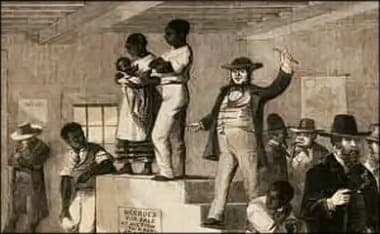
First, just to note… this part of American history is rotten to the core. But I still feel the Democratic Party that committed these crimes are just as rotten to the core. Also worthy to keep in mind I am focusing [in these quotes] primarily on the economics of slavery.
For my oldest
(Click the title to jump)
- Thomas Sowell, Black Rednecks and White Liberals (San Francisco, CA: Encounter Books, 2005), 157-159.
- Thomas Sowell, The Thomas Sowell Reader (New York, NY: Basic Books, 2011), 245-247.
- Dinesh D’Souza, America: Imagine a World Without Her (New Jersey, NJ: Regnery, 2014), 24-26.
- Thomas Sowell, Economic Facts and Fallacies (New York, NY: Basic Books, 2008), 160-166.
- Paul Johnson, A History of the American People (New York, NY: Harper Perenial, 1997), 3-9.
- Walter E. Williams, Race & Economics: How Much Can Be Blamed On Discrimination? (Stanford, CA: Hoover Institution Press, 2011), 15-27, 29.
- In Text Citation Examples – APA, MLA, Chicago
[p. 157>] Economics
Those who think of slavery in economic terms often assume that it is a means by which a society, or at least its non-slave population, becomes richer. Some have even claimed that the industrial revolution in Western civilization was based on the profits extracted from the exploitation of slaves. Rather than rehash a large and controversial literature on this issue, we may instead look at the economic condition of countries or regions that used vast numbers of slaves in the past. Both in Brazil and in the United States—the countries with the two largest slave populations in the Western Hemisphere—the end of slavery found the regions in which slaves had been concentrated poorer than other regions of these same countries. For the United States, a case could be made that this was due to the Civil War, which did so much damage to the South, but no such explanation would apply to Brazil, which fought no civil war over this issue. Moreover, even in the United States, the South lagged behind the North in many ways even before the Civil War.
Although slavery in Europe died out before it was abolished in the Western Hemisphere, as late as 1776 slavery had not yet died out all across the continent when Adam Smith wrote in The Wealth of Nations that it still existed in some eastern regions. But, even then, Eastern Europe was much poorer than Western Europe. The slavery of North Africa and the Middle East, over the centuries, took more slaves from sub-Saharan Africa than the Western Hemisphere did (in addition to large imports of slaves from Eastern Europe and Southern Europe to the Moslem countries of North [p. 158>] Africa and the Middle East). But these remained largely poor countries until the discovery and extraction of their vast oil deposits.
In many parts of the non-Western world, slaves were sources of domestic amenities and means of displaying wealth with an impressive retinue, rather than sources of wealth. Often they were a drain on the wealth already possessed. According to a scholarly study of slavery in China, the slaves there “did not generate any surplus; they consumed it. Another study concluded: “The Middle East and the Arab world rarely used slaves for productive activities. Even though some slaveowners—those whose slaves produced commercial crops or other saleable products—received wealth from the fruits of the unpaid labor of these slaves, that is very different from saying that the society as a whole, or even its non-slave population as a whole, ended up wealthier than it would have been in the absence of slavery.
Not only in societies where slaves were more often consumers than producers of wealth, but even in societies where commercial slavery was predominant, this did not automatically translate into enduring wealth. Unlike a frugal capitalist class, such as created the industrial revolution, even commercial slaveowners in the American antebellum South tended to spend lavishly, often ending up in debt or even losing their plantations to foreclosures by creditors. However, even if British slaveowners had saved and invested all of their profits from slavery, it would have amounted to less than two percent of British domestic investment.
In the United States, it is doubtful whether the profits of slavery would have covered the enormous costs of the Civil War—a war that was fought over the immediate issue of secession, but the reason for the secession was to safeguard slavery from the growing anti-slavery sentiment outside the South, symbolized by the election of Abraham Lincoln. Brazil, which imported several times as many slaves as the United States, and perhaps consumed more slaves than any other nation in history, was nevertheless still a relatively undeveloped country when slavery ended there in 1888, and its subsequent economic development was largely the work of immigrants from Europe and Japan.
In short, even though some individual slaveowners grew rich and some family fortunes were founded on the exploitation of [p. 159>] slaves, that is very different from saying that the whole society, or even its non-slave population as a whole, was more economically advanced than it would have been in the absence of slavery. What this means is that, whether employed as domestic servants or producing crops or other goods, millions suffered exploitation and dehumanization for no higher purpose than the transient aggrandizement of slaveowners.
Thomas Sowell, Black Rednecks and White Liberals (San Francisco, CA: Encounter Books, 2005), 157-159.
[APA] Sowell, T. (2005). Black Rednecks and White Liberals. San Francisco, CA: Basic Books.
[MLA] Sowell, Thomas. Black Rednecks and White Liberals. San Francisco: Basic Books, 2005. Print.
[Chicago] Sowell, Thomas. Black Rednecks and White Liberals. San Francisco: Basic Books, 2005.
Slavery
[p.245>] One of the many sad signs of our times is that people are not only playing
the race card, they are playing the slavery card, which is supposedly the biggest trump of all. At the so-called “million man march” in Washington, poet Maya Angelou rang all the changes on slavery, at a rally billed as forward-looking and as being about black independence rather than white guilt. Meanwhile, best-selling author Dinesh D’Souza was being denounced in the media for having said that slavery was not a racist institution.
First of all, anyone familiar with the history of slavery around the world knows that its origins go back thousands of years and that slaves and slaveowners were very often of the same race. Those who are ignorant of all this, or who think of slavery in the United States as if it were the only slavery, go ballistic when anyone tells them that this institution was not based on race.
Blacks were not enslaved because they were black, but because they were available at the time. Whites enslaved other whites in Europe for centuries before the first black slave was brought to the Western Hemisphere.
Only late in history were human beings even capable of crossing an ocean to get millions of other human beings of a different race. In the thousands of years before that, not only did Europeans enslave other Europeans, Asians enslaved other Asians, Africans enslaved other Africans, and the native peoples of the Western Hemisphere enslaved other native peoples of the Western Hemisphere.
D’Souza was right. Slavery was not about race. The fact that his critics are ignorant of history is their problem.
What was peculiar about the American situation was not just that slaves and slaveowners were of different races, but that slavery contradicted the whole philosophy of freedom on which the society was founded. If all men were created equal, as the Declaration of Independence said, then blacks had to be depicted as less than men.
While the antebellum South produced a huge volume of apologetic literature trying to justify slavery on racist grounds, no such justification was [p. 246>] considered necessary in vast reaches of the world and over vast expanses of time. In most parts of the world, people saw nothing wrong with slavery.
Strange as that seems to us today, a hundred years ago only Western civilization saw anything wrong with slavery. And two hundred years ago, only a minority in the West thought it was wrong.
Africans, Arabs, Asians and others not only maintained slavery long after it was abolished throughout the Western Hemisphere, they resisted all attempts of the West to stamp out slavery in their lands during the age of imperialism. Only the fact that the West had greater firepower and more economic and political clout enabled them to impose the abolition of slavery, as they imposed other Western ideas, on the non-Western world.
Those who talk about slavery as if it were just the enslavement of blacks by whites ignore not only how widespread this institution was and how far back in history it went, they also ignore how recently slavery continued to exist outside of Western civilization.
While slavery was destroyed in the West during the nineteenth century, the struggle to end slavery elsewhere continued well into the twentieth century— and pockets of slavery still exist to this moment in Africa. But there is scarcely a peep about it from black “leaders” in America who thunder about slavery in the past.
If slavery were the real issue, then slavery among flesh-and-blood human beings alive today would arouse far more outcry than past slavery among people who are long dead. The difference is that past slavery can be cashed in for political benefits today, while slavery in North Africa only distracts from these political goals. Worse yet, talking about slavery in Africa would undermine the whole picture of unique white guilt requiring unending reparations.
While the Western world was just as guilty as other civilizations when it came to enslaving people for thousands of years, it was unique only in finally deciding that the whole institution was immoral and should be ended. But this conclusion was by no means universal even in the Western world, however obvious it may seem to us today.
Thousands of free blacks owned slaves in the antebellum South. And, years after the Emancipation Proclamation in the United States, whites as [p. 247>] well as blacks were still being bought and sold as slaves in North Africa and the Middle East.
Anyone who wants reparations based on history will have to gerrymander history very carefully. Otherwise, practically everybody would owe reparations to practically everybody else.
Thomas Sowell, The Thomas Sowell Reader (New York, NY: Basic Books, 2011), 245-247.
[APA] Sowell, T. (2011). The Thomas Sowell Reader. New York, NY: Basic Books.
[MLA] Sowell, Thomas. The Thomas Sowell Reader. New York: Basic Books, 2011. Print.
[Chicago] Sowell, Thomas. The Thomas Sowell Reader. New York: Basic Books, 2011.
[p. 24>] Let’s begin with Tocqueville, who observes at the outset that America is a nation unlike any other. It has produced what Tocqueville terms “a distinct species of mankind.” Tocqueville here identifies what will later be called American exceptionalism. For Tocqueville, Americans are unique because they are equal. This controversial assertion of the Declaration—that all men are created equal—Tocqueville finds to be a simple description of American reality. Americans, he writes, have internalized the democratic principle of equality. They refuse to regard one another as superior and inferior. They don’t bow and scrape in the way that people in other countries—notably in France—are known to do. In America, unlike in Europe, there are no “peasants,” only farmers. In America, there are employees but no “servants.” And today America may be the only country where we call a waiter “sir” as if he were a knight.
Equality for Tocqueville is social, not economic. Competition, he writes, produces unequal outcomes on the basis of merit. “Natural inequality will soon make way for itself and wealth will pass into the hands of the most capable.” But this is justified because wealth is [p. 25>] earned and not stolen. Tocqueville is especially struck by the fact that rich people in America were once poor. He notes, with some disapproval, that Americans have an “inordinate” love of money. Yet he cannot help being impressed in observing among Americans the restless energy of personal striving and economic competition. “Choose any American at random and he should be a man of burning desires, enterprising, adventurous, and above all an innovator.” What makes success possible, he writes, is the striving of the ordinary man. The ordinary man may be vulgar and have a limited education, but he has practical intelligence and a burning desire to succeed. “Before him lies a boundless continent and he urges onward as if time pressed and he was afraid of finding no room for his exertions.” Tocqueville observes what he terms a “double migration”: restless Europeans coming to the East Coast of America, while restless Americans move west from the Atlantic toward the Pacific Ocean. Tocqueville foresees that this ambitious, energetic people will expand the borders of the country and ultimately become a great nation. “It is the most extraordinary sight I have ever seen in my life. These lands which are as yet nothing but one immense wood will become one of the richest and most powerful countries in the world.”
There is one exception to the rule of the enterprising and hardworking American. At one point, Tocqueville stands on the Ohio-Kentucky border. He looks north and south and is startled by the contrast. He contrasts “industrious Ohio” with “idle Kentucky.” While Ohio displays all the signs of work and well-maintained houses and fields, Kentucky is inhabited “by a people without energy, without ardor, without a spirit of enterprise.” Since the climate and conditions on both sides of the border are virtually identical, what accounts for the difference? Tocqueville concludes that it is slavery. Slavery provides no incentive for slaves to work, since they don’t get to keep the product of their labor. But neither does slavery encourage [p. 26>] masters to work, because slaves do the work for them. Remarkably slavery is bad for masters and slaves: it degrades work, so less work is done.
Dinesh D’Souza, America: Imagine a World Without Her (New Jersey, NJ: Regnery, 2014), 24-26.
[APA] D’Souza, D. (2014). America: Imagine a World Without Her. New Jersey, NJ: Regnery.
[MLA] D’Souza, Dinesh. America: Imagine a World Without Her. New Jersey: Regnery, 2014. Print.
[Chicago] D’Souza, Dinesh. America: Imagine a World Without Her. New Jersey: Regnery, 2014.
[p. 160>] Slavery
In addition to its own evils during its own time, slavery has generated fallacies that endure into our time, confusing many issues today. The distinguished historian Daniel J. Boorstin said something that was well known to many scholars, but utterly unknown to many among the general public, when he pointed out that, with the mass transportation of Africans in bondage to the Western Hemisphere, “Now for the first time in Western history, the status of slave coincided with a difference of race.”
For centuries before, Europeans had enslaved other Europeans, Asians had enslaved other Asians and Africans had enslaved other Africans. Only [p. 161>] in the modern era was there both the wealth and the technology to organize the mass transportation of people across an ocean, either as slaves or as free immigrants. Nor were Europeans the only ones to transport masses of enslaved human beings from one continent to another. North Africa’s Barbary Coast pirates alone captured and enslaved at least a million Europeans from 1500 to 1800, carrying more Europeans into bondage in North Africa than there were Africans brought in bondage to the United States and the American colonies from which it was formed. Moreover, Europeans were still being bought and sold in the slave markets of the Islamic world, decades after blacks were freed in the United States.
Slavery was a virtually universal institution in countries around the world and for thousands of years of recorded history. Indeed, archaeological evidence suggests that human beings learned to enslave other human beings before they learned to write. One of the many fallacies about slavery— that it was based on race— is sustained by the simple but pervasive practice of focusing exclusively on the enslavement of Africans by Europeans, as if this were something unique, rather than part of a much larger worldwide human tragedy. Racism grew out of African slavery, especially in the United States, but slavery preceded racism by thousands of years. Europeans enslaved other Europeans for centuries before the first African was brought in bondage to the Western Hemisphere.
The brutal reality is that vulnerable people were usually taken advantage of wherever it was feasible to take advantage of them, regardless of what race or color they were. The rise of nation states put armies and navies around some people but it was not equally possible to establish nation states in all parts of the world, partly because of geography. Where large populations had no army or navy to protect them, they fell prey to enslavers, whether in Africa, Asia or along unguarded stretches of European coastlines where Barbary pirates made raids, usually around the Mediterranean but sometimes as far away as England or Iceland. The enormous concentration of writings and of the media in general on slavery in the Western Hemisphere, or in the United States in particular, creates a false picture which makes it difficult to understand even the history of slavery in the United States.
[p. 162>] While slavery was readily accepted as a fact of life all around the world for centuries on end, there was never a time when slavery could get that kind of universal acceptance in the United States, founded on a principle of freedom, with which slavery was in such obvious and irreconcilable contradiction. Slavery was under ideological attack from the first draft of the Declaration of Independence and a number of Northern states banned slavery in the years immediately following independence. Even in the South, the ideology of freedom was not wholly without effect, as tens of thousands of slaves were voluntarily set free after Americans gained their own freedom from England.
Most Southern slaveowners, however, were determined to hold on to their slaves and, for that, some defense was necessary against the ideology of freedom and the widespread criticisms of slavery that were its corollary. Racism became that defense. Such a defense was unnecessary in unfree societies, such as that of Brazil, which imported more slaves than the United States but developed no such virulent levels of racism as that of the American South. Outside Western civilization, no defense of slavery was necessary, as non-Western societies saw nothing wrong with it. Nor was there any serious challenge to slavery in Western civilization prior to the eighteenth century.
Racism became a justification of slavery in a society where it could not be justified otherwise— and centuries of racism did not suddenly vanish with the abolition of the slavery that gave rise to it. But the direction of causation was the direct opposite of what is assumed by those who depict the enslavement of Africans as being a result of racism. Nevertheless, racism became one of the enduring legacies of slavery. How much of it continues to endure and in what strength today is something that can be examined and debated. But many other things that are considered to be legacies of slavery can be tested empirically, rather than being accepted as foregone conclusions.
[p. 163>] The Black Family
Some of the most basic beliefs and assumptions about the black family are demonstrably fallacious. For example, it has been widely believed that black family names were the names of the slave masters who owned particular families. Such beliefs led a number of American blacks, during the 1960s especially, to repudiate those names as a legacy of slavery and give themselves new names— most famously boxing champion Cassius Clay renaming himself Muhammad Ali.
Family names were in fact forbidden to blacks enslaved in the United States, as family names were forbidden to other people in lowly positions in various other times and places— slaves in China and parts of the Middle East, for example, and it was 1870 before common people in Japan were authorized to use surnames. In Western civilization, ordinary people began to have surnames in the Middle Ages. In many places and times, family names were considered necessary and appropriate only for the elite, who moved in wider circles— both geographically and socially— and whose families’ prestige was important to take with them. Slaves in the United States secretly gave themselves surnames in order to maintain a sense of family but they did not use those surnames around whites. Years after emancipation, blacks born during the era of slavery remained reluctant to tell white people their full names.
The “slave names” fallacy is false not only because whites did not give slaves surnames but also because the names that blacks gave themselves were not simply the names of whoever owned them. During the era of slavery, it was common to choose other names. Otherwise, if all the families belonging to a given slave owner took his name, that would defeat the purpose of creating separate family identities. Ironically, when some blacks in the twentieth century began repudiating what they called “slave names,” they often took Arabic names, even though Arabs over the centuries had enslaved more Africans than Europeans had.
A fallacy with more substantial implications is that the current fatherless families so prevalent among contemporary blacks are a “legacy of slavery,” where families were not recognized. As with other social problems [p. 164>] attributed to a “legacy of slavery,” this ignores the fact that the problem has become much worse among generations of blacks far removed from slavery than among generations closer to the era of slavery. Most black children were raised in two-parent homes, even under slavery, and for generations thereafter. Freed blacks married, and marriage rates among blacks were slightly higher than among whites in the early twentieth century. Blacks also had slightly higher rates of labor force participation than whites in every census from 1890 to 1950.
While 31 percent of black children were born to unmarried women in the early 1930s, that proportion rose to 77 percent by the early 1990s. If unwed childbirth was “a legacy of slavery,” why was it so much less common among blacks who were two generations closer to the era of slavery? One sign of the breakdown of the nuclear family among blacks was that, by 1993, more than a million black children were being raised by their grandparents, about two-thirds as many as among whites, even though there are several times as many whites as blacks in the population of the United States.
When tragic retrogressions in all these respects became painfully apparent in the second half of the twentieth century, a “legacy of slavery” became a false explanation widely used, thereby avoiding confronting contemporary factors in contemporary problems.
These retrogressions were not only dramatic in themselves, they had major impacts on other important individual and social results. For example, while most black children were still being raised in two-parent families as late as 1970, only one third were by 1995. Moreover, much social pathology is highly correlated with the absence of a father, both among blacks and whites, but the magnitude of the problem is greater among blacks because fathers are missing more often in black families. While, in the late twentieth century, an absolute majority of those black families with no husband present lived in poverty, more than four-fifths of black husband-wife families did not. From 1994 on into the twenty-first century, the poverty rate among black husband-wife families was below 10 percent.
It is obviously not simply the act of getting married which drastically reduces the poverty rate among blacks, or among other groups, but the [p. 165>] values and behavior patterns which lead to marriage and which have a wider impact on many other things.
Culture
As already noted, races can differ for reasons that are not racial, because people inherit cultures as well as genes. So long as one generation raises the next, it could hardly be otherwise. Many of the social or cultural differences between American blacks and American whites nationwide today were in antebellum times pointed out as differences between white Southerners and white Northerners. These include ways of talking, rates of crime and violence, children born out of wedlock, educational attainment, and economic initiative or lack thereof.
While only about one-third of the antebellum white population of the United States lived in the South, at least 90 percent of American blacks lived in the South on into the twentieth century. In short, the great majority of blacks lived in a region with a culture that proved to be less productive and less peaceful for its inhabitants in general. Moreover, opportunities to move beyond that culture were more restricted for blacks.
While that culture was regional, both blacks and whites took the Southern culture with them when they moved out of the South. As one small but significant example, when the movement for creating public schools swept across the United States in the 1830s and 1840s, not only was that movement more successful in creating public schools in the North than in the South, those parts of Northern states like Ohio, Indiana and Illinois that were settled by white Southerners were the slowest to establish public schools.
The legacy of the Southern culture is more readily documented in the behavior of later generations than is the legacy of slavery, which some distinguished nineteenth century writers said explained the behavior of antebellum Southern whites, and which later writers said explained the behavior of blacks. In reality, the regional culture of the South existed in particular regions of Britain in centuries past, regions where people destined [p. 166>] to settle in the American South exhibited the same behavior patterns before they immigrated to the South. They were called “crackers” and “rednecks” before they crossed the Atlantic— and before they ever saw a slave. As a well-known Southern historian said, “We do not live in the past, but the past in us.”
Educational and intellectual performance is a readily documented area where the persistence of culture can be tested. As late as the First World War, white soldiers from various Southern states scored lower on mental tests than black soldiers from various Northern states. Not only did black soldiers have the advantage of better schools in the North, they also had an opportunity for the Southern culture to begin to erode in their new surroundings. Over the years, much has been made of the fact that blacks score lower than whites nationwide on mental tests. From this, some observers have concluded that this is due to a racial difference and others have concluded that this is due to some deficiency or bias in the tests. But neither explanation would account for white Southerners’ mental test scores in the First World War.
Whatever the sources of the lower educational or intellectual attainments among blacks, there are major economic and social consequences of such differences. For many years, blacks received a lesser quantity and lower quality of education in the Southern schools that most attended. But, even after the quantity gap was eliminated by the late twentieth century, the qualitative gap remained large. The test scores of black seventeen-year-olds in a variety of academic subjects were the same as the scores of whites several years younger. That is obviously not a basis for expecting equal results in an economy increasingly dependent on mental skills.
Thomas Sowell, Economic Facts and Fallacies (New York, NY: Basic Books, 2008), 160-166.
[APA] Sowell, T. (2008). Economic Facts and Fallacies. New York, NY: Basic Books.
[MLA] Sowell, Thomas. Economic Facts and Fallacies. New York: Basic Books, 2008. Print.
[Chicago] Sowell, Thomas. Economic Facts and Fallacies. New York: Basic Books, 2008.
[p. 3>] The creation of the United States of America is the greatest of all human adventures. No other national story holds such tremendous lessons, for the American people themselves and for the rest of mankind. It now spans four centuries and, as we enter the new millennium, we need to retell it, for if we can learn these lessons and build upon them, the whole of humanity will benefit in the new age which is now opening. American history raises three fundamental questions. First, can a nation rise above the injustices of its origins and, by its moral purpose and performance, atone for them? All nations are born in war, conquest, and crime, usually concealed by the obscurity of a distant past. The United States, from its earliest colonial times, won its title—deeds in the full blaze of recorded history, and the stains on them are there for all to see and censure: the dispossession of an indigenous people, and the securing of self—sufficiency through the sweat and pain of an enslaved race. In the judgmental scales of history, such grievous wrongs must be balanced by the erection of a society dedicated to justice and fairness. Has the United States done this? Has it expiated its organic sins? The second question provides the key to the first. In the process of nation—building, can ideals and altruism—the desire to build the perfect community—be mixed successfully with acquisitiveness and ambition, without which no dynamic society can be built at all? Have the Americans got the mixture right? Have they forged a nation where righteousness has the edge over the needful self—interest? Thirdly, the Americans originally aimed to build another—worldly `City on a Hill,’ but found themselves designing a republic of the people, to be a model for the entire planet. Have they made good their audacious claims? Have they indeed proved exemplars for humanity? And will they continue to be so in the new millennium?
We must never forget that the settlement of what is now the United States was only part of a larger enterprise. And this was the work of the best and the brightest of the entire European continent. They were greedy. As Christopher Columbus said, men crossed the Atlantic primarily in search of gold. But they were also idealists. These adventurous young men thought they could transform the world for the better. Europe was too small for them—for their energies, their ambitions, and [p. 4>] their visions. In the 11th, 12th, and 13th centuries, they had gone east, seeking to reChristianize the Holy Land and its surroundings, and also to acquire land there. The mixture of religious zeal, personal ambition—not to say cupidity—and lust for adventure which inspired generations of Crusaders was the prototype for the enterprise of the Americas.
In the east, however, Christian expansion was blocked by the stiffening resistance of the Moslem world, and eventually by the expansive militarism of the Ottoman Turks. Frustrated there, Christian youth spent its ambitious energies at home: in France, in the extermination of heresy, and the acquisition of confiscated property; in the Iberian Peninsula, in the reconquest of territory held by Islam since the 8th century, a process finally completed in the 1490s with the destruction of the Moslem kingdom of Granada, and the expulsion, or forcible conversion, of the last Moors in Spain. It is no coincidence that this decade, which marked the homogenization of western Europe as a Christian entity and unity, also saw the first successful efforts to carry Europe, and Christianity, into the western hemisphere. As one task ended, another was undertaken in earnest.
The Portuguese, a predominantly seagoing people, were the first to begin the new enterprise, early in the 15th century. In 1415, the year the English King Henry V destroyed the French army at Agincourt, Portuguese adventurers took Ceuta, on the north African coast, and turned it into a trading depot. Then they pushed southwest into the Atlantic, occupying in turn Madeira, Cape Verde, and the Azores, turning all of them into colonies of the Portuguese crown. The Portuguese adventurers were excited by these discoveries: they felt, already, that they were bringing into existence a new world, though the phrase itself did not pass into common currency until 1494. These early settlers believed they were beginning civilization afresh: the first boy and girl born on Madeira were christened Adam and Eve. But almost immediately came the Fall, which in time was to envelop the entire Atlantic. In Europe itself, the slave—system of antiquity had been virtually extinguished by the rise of Christian society. In the 1440s, exploring the African coast from their newly acquired islands, the Portuguese rediscovered slavery as a working commercial institution. Slavery had always existed in Africa, where it was operated extensively by local rulers, often with the assistance of Arab traders. Slaves were captives, outsiders, people who had lost tribal status; once enslaved, they became exchangeable commodities, indeed an important form of currency.
[p. 5>] The Portuguese entered the slave—trade in the mid—15th century, took it over and, in the process, transformed it into something more impersonal, and horrible, than it had been either in antiquity or medieval Africa. The new Portuguese colony of Madeira became the center of a sugar industry, which soon made itself the largest supplier for western Europe. The first sugar— mill, worked by slaves, was erected in Madeira in 1452. This cash—industry was so successful that the Portuguese soon began laying out fields for sugar—cane on the Biafran Islands, off the African coast. An island off Cap Blanco in Mauretania became a slave—depot. From there, when the trade was in its infancy, several hundred slaves a year were shipped to Lisbon. As the sugar industry expanded, slaves began to be numbered in thousands: by 1550, some 50,000 African slaves had been imported into Sao Tome alone, which likewise became a slave entrepot. These profitable activities were conducted, under the aegis of the Portuguese crown, by a mixed collection of Christians from all over Europe—Spanish, Normans, and Flemish, as well as Portuguese, and Italians from the Aegean and the Levant. Being energetic, single young males, they mated with whatever women they could find, and sometimes married them. Their mixed progeny, mulattos, proved less susceptible than pure—bred Europeans to yellow fever and malaria, and so flourished. Neither Europeans nor mulattos could live on the African coast itself. But they multiplied in the Cape Verde Islands, 300 miles off the West African coast. The mulatto trading—class in Cape Verde were known as Lancados. Speaking both Creole and the native languages, and practicing Christianity spiced with paganism, they ran the European end of the slave—trade, just as Arabs ran the African end.
This new—style slave—trade was quickly characterized by the scale and intensity with which it was conducted, and by the cash nexus which linked African and Arab suppliers, Portuguese and Lancado traders, and the purchasers. The slave—markets were huge. The slaves were overwhelmingly male, employed in large—scale agriculture and mining. There was little attempt to acculturalize them and they were treated as body—units of varying quality, mere commodities. At Sao Tome in particular this modern pattern of slavery took shape. The Portuguese were soon selling African slaves to the Spanish, who, following the example in Madeira, occupied the Canaries and began to grow cane and mill sugar there too. By the time exploration and colonization spread from the islands across the Atlantic, the slave—system was already in place.
In moving out into the Atlantic islands, the Portuguese discovered [p. 6>] the basic meteorological fact about the North Atlantic, which forms an ocean weather—basin of its own. There were strong currents running clockwise, especially in the summer. These are assisted by northeast trade winds in the south, westerlies in the north. So seafarers went out in a southwest direction, and returned to Europe in a northeasterly one. Using this weather system, the Spanish landed on the Canaries and occupied them. The indigenous Guanches were either sold as slaves in mainland Spain, or converted and turned into farm—labourers by their mainly Castilian conquerors. Profiting from the experience of the Canaries in using the North Atlantic weather system, Christopher Columbus made landfall in the western hemisphere in 1492. His venture was characteristic of the internationalism of the American enterprise. He operated from the Spanish city of Seville but he came from Genoa and he was by nationality a citizen of the Republic of Venice, which then ran an island empire in the Eastern Mediterranean. The finance for his transatlantic expedition was provided by himself and other Genoa merchants in Seville, and topped up by the Spanish Queen Isabella, who had seized quantities of cash when her troops occupied Granada earlier in the year.
The Spanish did not find American colonization easy. The first island—town Columbus founded, which he called Isabella, failed completely. He then ran out of money and the crown took over. The first successful settlement took place in 1502, when Nicolas de Ovando landed in Santo Domingo with thirty ships and no fewer than 2,500 men. This was a deliberate colonizing enterprise, using the experience Spain had acquired in its reconquista, and based on a network of towns copied from the model of New Castile in Spain itself. That in turn had been based on the bastides of medieval France, themselves derived from Roman colony—towns, an improved version of Greek models going back to the beginning of the first millennium BC. So the system was very ancient. The first move, once a beachhead or harbour had been secured, was for an official called the adelantana to pace out the streetgrid.6 Apart from forts, the first substantial building was the church. Clerics, especially from the orders of friars, the Dominicans and Franciscans, played a major part in the colonizing process, and as early as 1512 the first bishopric in the New World was founded. Nine years before, the crown had established a Casa de la Contracion in Seville, as headquarters of the entire transatlantic effort, and considerable state funds were poured into the venture. By 1520 at least 10,000 Spanishspeaking Europeans were living on the island of Hispaniola in the [p. 7>] Caribbean, food was being grown regularly and a definite pattern of trade with Europeans had been established.
The year before, Hernando Cortes had broken into the American mainland by assaulting the ancient civilization of Mexico. The expansion was astonishingly rapid, the fastest in the history of mankind, comparable in speed with and far more exacting in thoroughness and permanency than the conquests of Alexander the Great. In a sense, the new empire of Spain superimposed itself on the old one of the Aztecs rather as Rome had absorbed the Greek colonies.8 Within a few years, the Spaniards were 1,000 miles north of Mexico City, the vast new grid—town which Cortes built on the ruins of the old Aztec capital, Tenochtitlan.
This incursion from Europe brought huge changes in the demography, the flora and fauna, and the economics of the Americas. Just as the Europeans were vulnerable to yellow fever, so the indigenous Indians were at the mercy of smallpox, which the Europeans brought with them. Europeans had learned to cope with it over many generations but it remained extraordinarily infectious and to the Indians it almost invariably proved fatal. We do not know with any certainty how many people lived in the Americas before the Europeans came. North of what is now the Mexican border, the Indians were sparse and tribal, still at the hunter—gatherer stage in many cases, and engaged in perpetual inter—tribal warfare, though some tribes grew corn in addition to hunting and lived part of the year in villages—perhaps one million of them, all told. Further south there were far more advanced societies, and two great empires, the Aztecs in Mexico and the Incas in Peru. In central and south America, the total population was about 20 million. Within a few decades, conquest and the disease it brought had reduced the Indians to 2 million, or even less. Hence, very early in the conquest, African slaves were in demand to supply labor. In addition to smallpox, the Europeans imported a host of welcome novelties: wheat and barley, and the ploughs to make it possible to grow them; sugarcanes and vineyards; above all, a variety of livestock. The American Indians had failed to domesticate any fauna except dogs, alpacas and llamas. The Europeans brought in cattle, including oxen for ploughing, horses, mules, donkeys, sheep, pigs and poultry. Almost from the start, horses of high quality, as well as first—class mules and donkeys, were successfully bred in the Americas. The Spanish were the only west Europeans with experience of running large herds of cattle on horseback, and this became an outstanding feature of the New World, where [p. 8>] enormous ranches were soon supplying cattle for food and mules for work in great quantities for the mining districts.
The Spaniards, hearts hardened in the long struggle to expel the Moors, were ruthless in handling the Indians. But they were persistent in the way they set about colonizing vast areas. The English, when they followed them into the New World, noted both characteristics. John Hooker, one Elizabethan commentator, regarded the Spanish as morally inferior `because with all cruel inhumanity … they subdued a naked and yielding people, whom they sought for gain and not for any religion or plantation of a commonwealth, did most cruelly tyrannize and against the course of all human nature did scorch and roast them to death, as by their own histories doth appear.’ At the same time the English admired `the industry, the travails of the Spaniard, their exceeding charge in furnishing so many ships … their continual supplies to further their attempts and their active and undaunted spirits in executing matters of that quality and difficulty, and lastly their constant resolution of plantation.”
With the Spanish established in the Americas, it was inevitable that the Portuguese would follow them. Portugal, vulnerable to invasion by Spain, was careful to keep its overseas relations with its larger neighbor on a strictly legal basis. As early as 1479 Spain and Portugal signed an agreement regulating their respective spheres of trade outside European waters. The papacy, consulted, drew an imaginary longitudinal line running a hundred leagues west of the Azores: west of it was Spanish, east of it Portuguese. The award was made permanent between the two powers by the Treaty of Tordesillas in 1494, which drew the lines 370 leagues west of Cape Verde. This gave the Portuguese a gigantic segment of South America, including most of what is now modern Brazil. They knew of this coast at least from 1500 when a Portuguese squadron, on its way to the Indian Ocean, pushed into the Atlantic to avoid headwinds and, to its surprise, struck land which lay east of the treaty line and clearly was not Africa. But their resources were too committed to exploring the African coast and the routes to Asia and the East Indies, where they were already opening posts, to invest in the Americas. Their first colony in Brazil was not planted till 1532, where it was done on the model of their Atlantic island possessions, the crown appointing `captains,’ who invested in land—grants called donatorios. Most of this first wave failed, and it was not until the Portuguese transported the sugar—plantation system, based on slavery, from Cape Verde and the Biafran Islands, to the part of Brazil they called Pernambuco, [p. 9>] that profits were made and settlers dug themselves in. The real development of Brazil on a large scale began only in 1549, when the crown made a large investment, sent over 1,000 colonists and appointed Martin Alfonso de Sousa governor—general with wide powers. Thereafter progress was rapid and irreversible, a massive sugar industry grew up across the Atlantic, and during the last quarter of the 16th century Brazil became the largest slave—importing center in the world, and remained so. Over 300 years, Brazil absorbed more African slaves than anywhere else and became, as it were, an Afro—American territory. Throughout the 16th century the Portuguese had a virtual monopoly of the Atlantic slave trade. By 1600 nearly 300,000 African slaves had been transported by sea to plantations—25,000 to Madeira, 50,000 to Europe, 75,000 to Cape Sao Tome, and the rest to America. By this date, indeed, four out of five slaves were heading for the New World.”
It is important to appreciate that this system of plantation slavery, organized by the Portuguese and patronized by the Spanish for their mines as well as their sugar—fields, had been in place, expanding steadily, long before other European powers got a footing in the New World. But the prodigious fortunes made by the Spanish from mining American silver, and by both Spanish and Portuguese in the sugar trade, attracted adventurers from all over Europe…
Paul Johnson, A History of the American People (New York, NY: Harper Perenial, 1997), 3-9.
[APA] Johnson, P. (1997). A History of the American People. New York, NY: Harper Perenial.
[MLA] Johnson, Paul. A History of the American People. New York: Harper Perenial. 1997. Print.
[Chicago] Johnson, Paul. A History of the American People. New York: Harper Perenial, 1997.
[p. 15>] Early Black Economic Achievement
The portrayal of blacks as helpless victims of slavery and later gross discrimination has become part of the popular wisdom. But the facts of the matter do not square with that portrayal.
Despite the brutal and oppressive nature of slavery, slaves did not quietly acquiesce. Many found ways to lessen slavery’s hardships and attain a measure of independence. During colonial days, slaves learned skills and found that they could earn a measure of independence by servicing ships as rope makers, coopers, and shipwrights. Some entered more skilled trades, such as silversmithing, gold beating, and cabinetmaking.
Typically, slaves turned over a portion of their earnings to their owners in exchange for de facto freedom. This practice, called self-hire, generated criticism. “As early as 1733-34, a Charles Town, South Carolina, grand jury criticized slaveholders for allowing their slaves ‘to work out by the Week,’ and ‘bring in a certain Hire’ which was not only Contrary to a Law subsisting, but a Great Inlet to Idleness, Drunkenness and other Enormities!’ Later, a group of Virginia planters said, “Many persons have suffered their slaves to go about to hire themselves and pay their masters for their hire,’ and as a result ‘certain’ slaves lived free from their master’s control.” “Two ambitious Charles Town bricklayers, Tony and Primus, who spent their days building a church under the supervision of their master, secretly rented themselves to local builders at night and on weekends.”
[p. 16>] Many slaves exhibited great entrepreneurial spirit despite their handicaps. Even slave women were often found growing and selling produce in the South Carolina and Georgia Low Country. After putting in a day’s work, some slaves were allowed to raise their own crops and livestock. These efforts allowed them to gain a presence in much of the marketing network on the streets and docks of port cities. Ultimately, the South Carolina General Assembly passed a law requiring that slave-grown crops and livestock be sold only to the master. However, the law was very difficult to enforce, particularly among blacks who had gained knowledge of the marketplace. Market activity by slaves was so great that North Carolina whites mounted a campaign to stop slave “dealing and Trafficking” altogether. In 1741, that state passed a law prohibiting slaves from buying, selling, trading, or bartering “any Commodities whatsoever” or to raise hogs, cattle, or horses “on any Pretense whatsoever.”
During the colonial period, some slaves bought their freedom and acquired property. In Virginia’s Northampton County, 44 out of 100 blacks had gained their freedom by 1664, and some had become landowners. During the late eighteenth century, blacks could boast of owning land. James Pendarvis owned 3,250 acres in St. Paul’s Parish in the Charleston District of South Carolina. Pendarvis also possessed 113 slaves. Cabinetmaker John Gough owned several buildings in Charleston and others in the coastal South. During the late eighteenth and early nineteenth centuries, free blacks in Charleston had established themselves as relatively independent from an economic standpoint. As early as 1819, they comprised thirty types of workers, including ten tailors, eleven carpenters, twenty-two seamstresses, six shoemakers, and one hotel owner. Thirty years later, there were fifty types, including fifty carpenters, forty-three tailors, nine shoemakers, and twenty-one butchers.
New Orleans had the largest population of free blacks in the Deep South. Though they could not vote, they enjoyed more rights than blacks in other parts of the South—such as the right to travel freely and to testify in court against white people. “They owned some $2 million worth of property and dominated skilled crafts like bricklaying, cigar making, carpentry, and shoe making.” New Orleans blacks also created privately supported benevolent societies, schools, and orphanages to assist their impoverished brethren.
[p. 17>] Black entrepreneurs in New Orleans owned small businesses like liquor, grocery, and general stores capitalized with a few hundred dollars. There were also some larger businesses, for example, grocers like Francis Snaer, A. Blandin, and G. N. Ducroix, each of whom was worth over $10,000 ($209,000 in today’s currency). One of the best-known black businesses was owned by Cecee Macarty, who inherited $12,000 and parlayed it into a business worth $155,000 at the time of her death in 1845. Another was Thorny Lafon, who started out with a small dry-goods store and later became a real estate dealer, amassing a fortune valued over $400,000 ($8 million today) by the time he died. Black control of the cigar industry enabled men like Lucien Mansion and Georges Alces to own sizable factories, with Alces hiring as many as 200 men. Twenty-two black men listed themselves as factory owners in the New Orleans registry of free Negroes, though it is likely that most of these were one-man shops.
Pierre A. D. Casenave, an immigrant from Santo Domingo, was among New Orleans’ more notable businessmen. Having inherited $10,000, as a result of being a confidential clerk of a white merchant-philanthropist, Casenave was in the “commission” business by 1853. By 1857, he was worth $30,000 to $40,000, and he had built an undertaking business, catering mostly to whites, that was worth $2 million in today’s dollars.
Most free blacks in New Orleans were unskilled laborers. Males were employed on steamboats and as dockworkers and domestic servants, while females found work largely as domestic servants or washwomen. However, the ratio of skilled to unskilled workers among blacks was greater than among Irish and German workers. Indeed, free blacks dominated certain skilled crafts. According to J. D. B. DeBow, director of the 1850 census, in New Orleans that year there were 355 carpenters, 325 masons, 156 cigar makers, ninety-two shoemakers, sixty-one clerks, fifty-two mechanics, forty-three coopers, forty-one barbers, thirty-nine carmen, and twenty-eight painters.
In addition, there were free Negro blacksmiths (fifteen), butchers (eighteen), cabinetmakers (nineteen), cooks (twenty-five), overseers (eleven), ship carpenters (six), stewards (nine), and upholsterers (eight).” Robert C. Reinders, a historian, says that DeBow may have exaggerated the data to show that New Orleans had more skilled blacks than elsewhere; however, other evidence points to free-black prominence in skilled trades—for [p. 18>] example, 540 skilled blacks signing a register to stay in the state between 1842 and 1861. Plus, travelers spoke of “Negro artisans being served by Irish waiters and free Negro masons with Irish hod carriers:’ A few black skilled workers were relatively prosperous. Peter Howard, a porter, and C. Cruisin, an engraver, were each worth between $10,000 and $20,000. A. Tescault, a bricklayer, owned personal and real property valued at nearly $40,000.
By the end of the antebellum era, there was considerable property ownership among slaves in both the Upper and Lower South. Many amassed their resources through the “task” (or “hiring-out”) system. In Richmond and Petersburg, Virginia, slaves worked in tobacco factories and earned $150 to $200 a year, plus all expenses. By 1850, slave hiring was common in hemp manufacturing and in the textile and tobacco industries. In Richmond, 62 percent of the male slave force was hired; in Lynchburg, 52 percent, in Norfolk, more than 50 percent, and in Louisville, 24 percent. Across the entire South, at least 100,000 slaves were hired out each year.
Self-hiring was another practice with a long tradition. It benefited both the slave and slave owner. The latter did not have to pay for the slave’s lodging and clothing. Slaves, although obligated to pay their masters a monthly or yearly fee, could keep for themselves what they earned above that amount. Frederick Douglass explained that while employed as a Baltimore ship’s caulker, “I was to be allowed all my time; to make bargains for work; to find my own employment, and collect my own wages; and in return for this liberty, I was to pay him [Douglass’ master] three dollars at the end of each week, and to board and clothe myself, and buy my own calking [sic] tools.” Self-hire, Douglass noted, was “another step in my career toward freedom:’
Not every self-hire slave fared so well. Some were offered the prospect of buying themselves only to see the terms of the contract change. Slaves who earned larger sums than originally expected were required to pay the extra money to the master. Sometimes slaves who made agreements with their masters to pay a certain price for their freedom were sold shortly before the final payment was due.
So intense was the drive to earn money that some slaves were willing to work all day in the fields, then steal away under cover of darkness to work for wages, returning to the fields the next morning. Catahoula Parish (Louisiana) plantation owner John Liddell sought legal action, telling his [p. 19>] lawyer, “I request that you would forthwith proceed to prosecute John S. Sullivan of Troy, Parish of Catahoula, for Hiring four of my Negro men, secretly, and without my knowledge or permission, at midnight on the 12th of August last 1849 (or between midnight and day).”
So common was the practice of self-hire that historians have described the people so employed as “Quasi-Free Negroes” or “Slaves Without Masters:’ In 1802, a French visitor to New Orleans noticed “a great many loose negroes about:’ Officials in Savannah, Mobile, Charleston, and other cities talked about “nominal slaves,” “quasi f.n. [free Negroes],” and “virtually free negroes,” who were seemingly oblivious to any law or regulation. In the Upper South—Baltimore, Washington, Norfolk, Louisville, Richmond, and Lexington, Virginia, for example—large numbers of quasi-free slaves contracted with white builders as skilled carpenters, coopers, and mechanics, while the less skilled worked as servants, hack drivers, and barbers. The quasi-free individuals, more entrepreneurial, established market stalls where they traded fish, produce, and other goods with plantation slaves and sold various commodities to whites. Historian Ira Berlin said, in describing the pre-staple crop period in the Low Country of South Carolina, “The autonomy of the isolated cow pen and the freedom of movement of stock raising allowed made a mockery of the total dominance that chattel bondage implied.”
William Rosoe operated a small pleasure boat on the Chesapeake Bay. Ned Hyman, a North Carolina slave, amassed an estate “consisting of Lands chiefly, Live Stock, Negroes and money worth between $5,000 and $6,000 listed in his free Negro wife’s name:’ Whites in his neighborhood said “he was a remarkable, uncommon Negro” and was “remarkably industrious, frugal & prudent…. In a word, his character as fair and as good—for honesty, truth, industry, humility, sobriety & fidelity—as any they (your memoralists) have ever seen or hear of:’
Thomas David, a slave, owned a construction business in Bennettsville, South Carolina, where he built houses as well as “several larger buildings.” He hired laborers, many of whom were slaves themselves, and taught them the necessary skills. This practice of slaves entering the market and competing successfully with whites became so prevalent that a group of the latter in New Hanover County, North Carolina, petitioned the state legislature to ban the practice. But despite statutes to the contrary, slaves continued to work as mechanics (as such workers were then called), contracting on [p. 20>] their own “sometimes less than one half the rate that a regular bred white Mechanic could afford to do it.”
In Tennessee, it was illegal for a slave to practice medicine; however, “Doctor Jack” did so with “great & unparalleled success,” even though he was forced to give a sizable portion of his earnings to his owner, William Macon. After Macon died, Doctor Jack set up his practice in Nashville. Patients thought so much of his services that they appealed to the state legislature: “The undersigned citizens of Tennessee respectfully petition the Honourable Legislature of the State to repeal, amend or so modify the Act of 1831, chap. 103, S [ect]. 3, which prohibits Slaves from practicing medicine, as to exempt from its operation a Slave named Jack…”
Women were also found among slave entrepreneurs. They established stalls and small stores selling various products. They managed modest businesses as seamstresses, laundresses, and weavers. A Maryland slave recalled, “After my father was sold, my master gave my mother permission to work for herself, provided she gave him one half [of the profits].” She ran two businesses, a coffee shop at an army garrison, and a secondhand store selling trousers, shoes, caps, and other items. Despite protests by poor whites, she “made quite a respectable living.”
With the increasing number of self-hire and quasi-free blacks came many complaints and attempts at restricting their economic activities. In 1826, Georgia prohibited blacks from trading “any quantity or amount whatever of cotton, tobacco, wheat, rye, oats, corn, rice or poultry or any other articles, except such as are known to be usually manufactured or vended by slaves.” Tennessee applied similar restrictions to livestock. Virginia enacted legislation whereby an individual who bought or received any commodity from a slave would be given thirty-nine lashes “well laid on” or fined four times the value of the commodity.
Similar measures were enacted elsewhere. In addition to statutes against trading with slaves, there were laws governing master-slave relationships. North Carolina decreed in 1831 that a master who allowed a slave to “go at large as a freeman, exercising his or her own discre[t]ion in the employment of his or her time… shall be fined in the discretion of the court” In 1835, the North Carolina General Assembly enacted a measure “for the better regulation of the slave labourers in the town and Port of Wilmington…. That if any slave shall hereafter be permitted to go at large, and make his own contracts to work, and labour in said town, by [p. 21>] consent, and with the knowledge of his or her owner or master, the owner of the said slave shall forfeit and pay one hundred dollars . . . said slave shall receive such punishment as said commissioners or town magistrate shall think proper to direct to be inflicted, not exceeding twenty-five lashes.”
Similar statutes were enacted in most slave states. In the 1830s, a South. Carolina court of appeals ruled as follows: “if the owner without a formal act of emancipation permit his slave to go at large and to exercise all the rights and enjoy all the privileges of a free person of color, the slave becomes liable to seizure as a derelict”
A New Orleans newspaper, the Daily Picayune, complained that hired-out slaves had the liberty “to engage in business on their own account, to live according to the suggestions of their own fancy, to be idle or industrious, as the inclination for one or the other prevailed, provided only the monthly wages are regularly gained.” In 1855, Memphis’ Daily Appeal demanded the strengthening of an ordinance prohibiting slaves from hiring themselves out without a permit. One citizen complained that “to permit the negro to hire his own time sends a slave to ruin as property, debauches a slave, and makes him a strolling agent of discontent, disorder, and immorality among our slave population.”
Much of the restrictive legislation was prompted or justified by the charge that some slaves were trafficking in stolen goods. But there was also concern that the self-hired and quasi-free would undermine the slavery system itself by breeding discontent and rebellion among slaves in general. Despite all the legal prohibitions, the self-hire and quasi-free practices prospered and expanded. Some slave owners who had sired children felt that, although they might not set those offspring free, they would allow them to be quasi-free and to own property. Other owners considered it simply sound policy to permit slaves a degree of freedom as a reward for good work. Even owners with a strong ideological commitment to the institution of slavery found it profitable to permit self-hire, particularly for their most talented and trusted bondsmen.
By the 1840s and ’50s, many masters were earning good returns on slaves who found employment in Baltimore, Nashville, St. Louis, Savannah, Charleston, and New Orleans. In 1856, white builders in Smithfield, North Carolina, complained that they were being underbid by quasi-free blacks in the construction of houses and boats, and criticized white contractors who pursued such hiring practices. Whites in the Sumter District [p. 22>] of South Carolina protested that “The law in relation to Slaves hiring their own time is not enforced with sufficient promptness and efficiency as to accomplish the object designed by its enactment.”
The fact that self-hire became such a large part of slavery simply reflects the economics of the matter. Faced with fluctuating demands for the labor of slaves, it sometimes made sense for owners to let a slave hire himself out rather than to sit idle, in return for securing a portion of his outside earnings. Slaves favored hiring out because it gave them a measure of freedom; it also provided some income to purchase goods that would be otherwise unattainable.
Free Blacks in the North
Free blacks played a significant economic role in northern cities. In 1838, a pamphlet titled ‘A Register of Trades of Colored People in the City of Philadelphia and Districts” listed fifty-seven different occupations totaling 656 persons: bakers (eight), blacksmiths (twenty-three), brass founders (three), cabinetmakers and carpenters (fifteen), confectioners (five), and tanners (thirty-one). Black females engaged in businesses were also included in the register: dressmakers and tailoresses (eighty-one), dyers and scourers (four), and cloth fullers and glass/papermakers (two each).
Philadelphia was home to several very prosperous black businesses. Stephen Smith and William Whipper had one of the largest wood and coal yards in the city. As an example of the size of their business, they had, in 1849, “several thousand bushels of coal, 250,000 feet of lumber, 22 merchantmen cars running between Philadelphia and Baltimore, and $9,000 worth of stock in the Columbia bridge:’ At his death, Smith left an estate worth $150,000; he had earlier given an equal amount to establish the Home for the Aged and Infirm Colored Persons in Philadelphia and had also donated the ground for the Mount Olive Cemetery for Colored People.
Another prosperous enterprise among early Philadelphia blacks was sail-making. Nineteen black sail-making businesses were recorded in the 1838 Register. James Forten (1766-1841), the most prominent of them, employed forty black and white workers in his factory in 1829. Stephen Smith was another black entrepreneur, a lumber merchant who was [p. 23>] grossing $100,000 annually in sales by the 1850s. By 1854, Smith’s net worth was estimated at $500,000, earning him a credit entry as the “King of the Darkies w. 100m. [with $100,000]”‘
Blacks dominated Philadelphia’s catering business. Peter Augustine and Thomas Dorsey were the most prominent among them. Both men earned worldwide fame for their art, with Augustine often sending his terrapin as far away as Paris. Robert Bogle was a waiter who conceived of the catering idea in Philadelphia by contracting formal dinners for those who entertained in their homes. Nicolas Biddle, a leading Philadelphia financier and president of the Bank of United States, honored him by writing an “Ode to Ogle [sic].” Philadelphia blacks “…owned fifteen meeting houses and burial grounds adjacent, and one public hall.” Their real estate holdings were estimated at $600,000 ($12 million today) and their personal property at more than $677,000.” Henry and Sarah Gordon, two other black caterers, became so prosperous that they were able to contribute $66,000 to the Home for the Aged and Infirm Colored Persons.
Blacks made their business presence felt in other northern cities as well. In 1769, ex-slave Emmanuel established Providence, Rhode Island’s first oyster-and-ale house. In New York, Thomas Downing operated a successful restaurant to serve his Wall Street clientele before facing competition from two other blacks, George Bell and George Alexander, who opened similar establishments nearby. In 1865, Boston’s leading catering establishment was owned and operated by a black. Thomas Dalton, also of Boston, was the proprietor of a prosperous clothing store valued at a half-million dollars at the time of his death. John Jones of Chicago, who owned one of the city’s leading tailoring establishments, left behind a fortune of $100,000.
Most blacks of course labored at low-skilled tasks. They nonetheless encountered opposition from whites. When the two races competed, or threatened to do so, violence often resulted. A commission looking into the causes of the 1834 Philadelphia riot, concluded as follows:
An opinion prevails, especially among white laborers, that certain portions of our community, prefer to employ colored people, whenever they can be had, to the employing of white people; and in consequence of this preference, many whites, who are able and willing to work, are left [p. 24>] without employment, while colored people are provided with work, and enabled comfortably to maintain their families; thus many white laborers, anxious for employment, are kept idle and indigent. Whoever mixed in the crowds and groups, at the late riots, must so often have heard those complaints, as to convince them, that . . . they… stimulated many of the most active among the rioters.
Racism and the fear of similar violence prompted New York City authorities to refuse licenses to black carmen and porters, warning, “it would bring them into collision with white men of the same calling, and they would get their horses and carts ‘dumped’ into the dock and themselves abused and beaten.”
The growth of the black labor force, augmented by emancipated and fugitive slaves, also contributed to white fears of black competition. In 1834, a group of Connecticut petitioners declared:
The white man cannot labor upon equal terms with the negro. Those who have just emerged from the state of barbarism or slavery have few artificial wants. Regardless of the decencies of life, and improvement of the future, the black can afford to offer his services at lower prices than the white man.
The petitioners warned the legislature that if entry restrictions were not adopted, the (white) sons of Connecticut would be soon driven from the state by black porters, truckmen, sawyers, mechanics, and laborers of every description.
For their part, blacks soon faced increased competition from the nearly five million Irish, German, and Scandinavian immigrants who reached our shores between 1830 and 1860. Poverty-stricken Irish crowded into shantytowns and sought any kind of employment, regardless of pay and work conditions. One black observer wrote:
These impoverished and destitute beings, transported from transatlantic shores are crowding themselves into every place of business and of labor, and driving the poor colored American citizen out. Along the wharves, where the colored man once done the whole business of shipping and [p. 25>] unshipping—in stores where his services were once rendered, and in families where the chief places were filled by him, in all these situations there are substituted foreigners or white Americans.
Irish immigrants did not immediately replace black workers, because employers initially preferred black “humility” to Irish “turbulence?’ “Help Wanted” ads often read like this one in the New York Herald of May 13, 1853: “A Cook, Washer and Ironer: who perfectly understands her business; any color or country except Irish?’ The New York Daily Sun (May 11, 1853) carried: “Woman Wanted—To do general housework… English, Scotch, Welsh, German, or any country or color will answer except Irish?’ The New York Daily Tribune, on May 14, 1852, advertised: “Coachman Wanted—A Man who understands the care of horses and is willing to make himself generally useful, on a small place six miles from the city. A colored man preferred. No Irish need apply?’
Indicative of racial preferences was the fact that, in 1853, black waiters in New York earned more than their white counterparts: $16 per month compared to $12. To increase their bargaining power and to dupe their white counterparts out of jobs, black waiters tricked them into striking for $18 a day. When the strike ended, only the best white waiters were retained; the rest were replaced by blacks.
The mid-nineteenth century saw the early growth of the labor union movement. As I will discuss in more detail in a later chapter, the new unions directed considerable hostility at blacks and often excluded them from membership. When New York longshoremen struck in 1855 against wage cuts, black workers replaced them and violent clashes ensued. The Frederick Douglass Paper expressed little sympathy for white strikers: “[C]olored men can feel no obligation to hold out in a ‘strike’ with the whites, as the latter have never recognized them.”
Abolitionist William Lloyd Garrison and many of his followers had similarly little sympathy with white attempts to form labor unions. They felt that employer desire for profit would override racial preferences. Garrison declared, “Place two mechanics by the side of each other, one colored and one white, he who works the cheapest and the best will get the most custom. In making a bargain, the color of the man will never be consulted?’ Demonstrating an economic understanding that’s lost on [p. 26>] many of today’s black advocates, abolitionists urged blacks to underbid white workers rather than to combine with them. New England Magazine remarked:
After all the voice of interest is louder, and speaks more to the purpose, than reason or philanthropy. When a black merchant shall sell his goods cheaper than his white neighbor, he will have the most customers…. When a black mechanic shall work cheaper and better than a white one, he will be more frequently employed.
During this period, black leadership exhibited a vision not often observed today, namely, lowering the price of goods or services is one of the most effective tools to compete. At a black convention in 1848, it was declared, “To be dependent is to be degraded. Men may pity us, but they cannot respect us.” Black conventions repeatedly called upon blacks to learn agricultural and mechanical pursuits, to form joint-stock companies, mutual savings banks, and county associations in order to pool resources to purchase land and capital. In 1853, Frederick Douglass warned, “Learn trades or starve!”
Many blacks absorbed the lessons of competition. Virginia’s Robert Gordon sold slack (fine screenings of coal) from his white father’s coal yard, making what was then a small fortune of $15,000. By 1846, Gordon had purchased his freedom and moved to Cincinnati, where he invested those earnings in a coal yard and built a private dock on the waterfront. White competitors tried to run him out of business through ruthless price-cutting. Gordon cleverly responded by hiring fair-complexioned mulattos to purchase coal from price-cutting competitors, then used that coal to fill his own customers’ orders. Gordon retired in 1865, invested his profits in real estate, and eventually passed his fortune to his daughter.
While still a slave, Frank McWorter set up a saltpeter factory in Kentucky’s Pulaski County at the start of the War of 1812. After the war, he expanded his factory to meet the growing demand for gunpowder by westward-bound settlers. As a result of his enterprise, McWorter purchased his wife’s freedom in 1817 and his own in 1819 for a total cost of $1,600.
Born a slave in Kentucky, Junius G. Graves went to Kansas in 1879. He worked on a farm for forty cents a day and by 1884 had amassed the sum of $2,200. Six years later, he owned 500 acres of land valued at $100,000.
[p. 27>] “Because of his success in producing a-greater-than-average-yield of potatoes per acre and because of his being the largest individual grower of potatoes, he was called ‘The Negro Potato King:”
Other examples of nineteenth-century black enterprise abound: William W. Browne founded the first black bank in Virginia; H. C. Haynes invented the Haynes Razor Strop in Chicago; A. C. Howard manufactured shoe polish (7,200 boxes per day) in Chicago.
[….]
[p. 29>] The relative color blindness of the market accounts for much of the hostility towards it. Markets have a notorious lack of respect for privilege, race, and class structures. White customers patronized black-owned businesses because their prices were lower or their product quality or service better. Whites hired black skilled and unskilled labor because their wages were lower or they made superior employees.
Walter E. Williams, Race & Economics: How Much Can Be Blamed On Discrimination? (Stanford, CA: Hoover Institution Press, 2011), 15-27, 29.
[APA] Williams, W.E. (2011). Race & Economics: How Much Can Be Blamed On Discrimination? Stanford, CA: Hoover Institution Press.
[MLA] Williams, Walter E. Race & Economics: How Much Can Be Blamed On Discrimination? Stanford: Hoover Institution Press, 2011. Print.
[Chicago] Williams, Walter E. Race & Economics: How Much Can Be Blamed On Discrimination? Stanford: Hoover Institution Press, 2011.
IN TEXT CITATIONS PER STYLE
Short quotations
If you are directly quoting from a work, you will need to include the author, year of publication, and the page number for the reference (preceded by “p.”). Introduce the quotation with a signal phrase that includes the author’s last name followed by the date of publication in parentheses.
According to Jones (1998), “Students often had difficulty using APA style, especially when it was their first time” (p. 199).
Jones (1998) found “students often had difficulty using APA style” (p. 199); what implications does this have for teachers?
If the author is not named in a signal phrase, place the author’s last name, the year of publication, and the page number in parentheses after the quotation.
She stated, “Students often had difficulty using APA style” (Jones, 1998, p. 199), but she did not offer an explanation as to why.
Long quotations
Place direct quotations that are 40 words, or longer, in a free-standing block of typewritten lines, and omit quotation marks. Start the quotation on a new line, indented 1/2 inch from the left margin, i.e., in the same place you would begin a new paragraph. Type the entire quotation on the new margin, and indent the first line of any subsequent paragraph within the quotation 1/2 inch from the new margin. Maintain double-spacing throughout. The parenthetical citation should come after the closing punctuation mark.
Jones’s (1998) study found the following:
Students often had difficulty using APA style, especially when it was their first time citing sources. This difficulty could be attributed to the fact that many students failed to purchase a style manual or to ask their teacher for help. (p. 199)
[….]
More Than One Work by the Same Author
If you are citing more than one work by the same author, include enough information so that your reader can differentiate between them. For instance, if you have used two studies by the same authors (from different years), you simply need to include their dates of publication:
(Jones, Crick, & Waxson, 1989); (Jones, Crick, & Waxson, 1998)
or, if you are citing both at once:
(Jones, Crick, & Waxson, 1989, 1998)
If you are citing more than one work from the same year, use the suffixes “a,” “b,” “c” etc., so that your reader can differentiate between them (these suffixes will correspond to the order of entries in your references page):
(Jones, Crick, & Waxson, 1999a); (Jones, Crick, & Waxson, 1999b)
Multiple Authors Cited Together
Order the authors in alphabetical order by last name. Semicolons are used to differentiate between the entries:
(Heckels, 1996; Jones, 1998; Stolotsky, 1992)
In-text citations: Author-page style
MLA format follows the author-page method of in-text citation. This means that the author’s last name and the page number(s) from which the quotation or paraphrase is taken must appear in the text, and a complete reference should appear on your Works Cited page. The author’s name may appear either in the sentence itself or in parentheses following the quotation or paraphrase, but the page number(s) should always appear in the parentheses, not in the text of your sentence. For example:
Wordsworth stated that Romantic poetry was marked by a “spontaneous overflow of powerful feelings” (263).
Romantic poetry is characterized by the “spontaneous overflow of powerful feelings” (Wordsworth 263).
Wordsworth extensively explored the role of emotion in the creative process (263).
Both citations in the examples above, (263) and (Wordsworth 263), tell readers that the information in the sentence can be located on page 263 of a work by an author named Wordsworth. If readers want more information about this source, they can turn to the Works Cited page, where, under the name of Wordsworth, they would find the following information:
Wordsworth, William. Lyrical Ballads. London: Oxford UP, 1967. Print.
[….]
Citing two books by the same author:
Murray states that writing is “a process” that “varies with our thinking style” (Write to Learn 6). Additionally, Murray argues that the purpose of writing is to “carry ideas and information from the mind of one person into the mind of another” (A Writer Teaches Writing 3).
Additionally, if the author’s name is not mentioned in the sentence, you would format your citation with the author’s name followed by a comma, followed by a shortened title of the work, followed, when appropriate, by page numbers:
Visual studies, because it is such a new discipline, may be “too easy” (Elkins, “Visual Studies” 63).
[….]
In-text Citations
When citing two different books by the same author in the body of the text, include the author’s last name, then a comma and then the first word or several words of the title of the book in quotation marks followed by the page number. For example, if you were citing two books by John Smith, you might do the following: It’s important to recognize your strengths and talents. Knowing what you are good at is what moves you from “mediocre to masterful” (Smith, “Passions” 45). Ultimately, your success is based on how you feel about what you’re doing. Studies show that those who are passionately invested in their work make three times more money than those who dread their work (Smith, “Work Week” 75).
An exerpt from a sentence in the text of a paper written using the author-date would look like this:
While some assert that the essential qualities a politician must possess are, “passion, a feeling of responsibility, and a sense of proportion” (Weber 1946, 33), others think that …