Is the press trustworthy? Can we believe what reporters and journalists tell us? Judith Miller, Pulitzer Prize-winning former reporter for the New York Times, explains why Americans’ trust in the news media has fallen, and why that matters.
Author: Papa Giorgio


Julie Borowski Declares War on Mosquitos
Mosquitoes carry deadly diseases like malaria and Zika virus. Why won’t the government legalize the pesticide DDT?
- This Bill Gates Infographic Reveals The World’s Deadliest Animal — And It’s Not Even A Close Race
- Cases of Zika Virus Disease in the United States
- Zika outbreak: What you need to know
- Pregnant Women in Brazil Are Scared of Zika and Unsure What to Do About It
- Possible Association Between Zika Virus Infection and Microcephaly — Brazil, 2015
- Obama Administration Health Director: Brazil Successfully Used DDT to End Zika Virus in Past
- Will the EPA Cause a Zika Pandemic?
- Rachel Carson’s Deadly Fantasies
- What the World Needs Now Is DDT
- When Politics Kills: DDT and the Malaria story
- Should DDT Be Used to Combat Malaria?
- Malaria mapMalaria kills 1,200 children a day: UNICEF

Save The Day Celebrity Video… PARODIES
I will post the celebrities original video asking people to vote for Hillary Clinton… I will then follow that up by some spoofs on YouTube (Caution, some of these spoofs have ROUGH LANGUAGE):
PARODIES
BEST
LANGUAGE WARNING
AMATEUR
BE WARNED, VOLUME LEVEL ISSUES (teens)

Hurricane Matthew ~ Overhyped

Via DR. ROY SPENCER:
Today marks 4,001 days since the last major hurricane (Wilma in 2005) made landfall in the United States. A major hurricane (Category 3 to 5) has maximum sustained winds of at least 111 mph, and “landfall” means the center of the hurricane eye crosses the coastline.
This morning it looks like Matthew will probably not make landfall along the northeast coast of Florida. Even if it does, its intensity is forecast to fall below Cat 3 strength this evening. The National Hurricane Center reported at 7 a.m. EDT that Cape Canaveral in the western eyewall of Matthew experienced a wind gust of 107 mph.
(And pleeeze stop pestering me about The Storm Formerly Known as Hurricane Sandy, it was Category 1 at landfall. Ike was Cat 2.)
While coastal residents grow weary of “false alarms” when it comes to hurricane warnings, the National Weather Service has little choice when it comes to warning of severe weather events like tornadoes and hurricanes. Because of forecast uncertainty, the other option (under-warning) would inevitably lead to a catastrophic event that was not warned.
This would be unacceptable to the public. Most of us who live in “tornado alley” have experienced dozens if not hundreds of tornado warnings without ever seeing an actual tornado. I would wager that hurricane conditions are, on average, experienced a small fraction of the time that hurricane warnings are issued for any given location….
[….]
Seldom does an actual anemometer (wind measuring device) on a tower measure anything close to what is reported as the maximum sustained winds. This is because there aren’t many anemometers with good exposure and the chances of the small patch of highest winds hitting an instrumented tower are pretty small. It also raises the legitimate question of whether maximum sustained winds should be focused on so much when hurricane intensity is reported. Media hype also exaggerates the problem. Even if the maximum sustained wind estimate was totally accurate, the area affected by it is typically quite small, yet most of the warned population is under the impression they, personally, are going to experience such extreme conditions….
WATTS UP WITH THAT also includes the report from the National Hurricane Center:
Still no landfall for #Matthew, remains Cat 3 storm
So far, Florida has been lucky. While the storm remains dangerous, it seems it has continued just off the coast, and has begun the first steps towards a northeast turn. NHC’s 9AM EST reports had this to say:
…EYEWALL OF DANGEROUS HURRICANE MATTHEW HUGGING THE COAST OF
CENTRAL FLORIDA…
SUMMARY OF 800 AM EDT…1200 UTC…INFORMATION
———————————————-
LOCATION…28.9N 80.3W
ABOUT 35 MI…55 KM NNE OF CAPE CANAVERAL FLORIDA
ABOUT 45 MI…75 KM ESE OF DAYTONA BEACH FLORIDA
MAXIMUM SUSTAINED WINDS…120 MPH…195 KM/H
PRESENT MOVEMENT…NNW OR 330 DEGREES AT 13 MPH…20 KM/H
MINIMUM CENTRAL PRESSURE…944 MB…27.86 INCHES
DISCUSSION AND 48-HOUR OUTLOOK
——————————
At 800 AM EDT (1200 UTC), the eye of Hurricane Matthew was located near latitude 28.9 North, longitude 80.3 West. Matthew is moving toward the north-northwest near 13 mph (20 km/h), and this general motion is expected to continue today. A turn toward the north is expected tonight or Saturday. On the forecast track, the center of Matthew will be moving near or over the east coast of the Florida peninsula through tonight, and near or over the coasts of Georgia and South Carolina on Saturday. Maximum sustained winds are near 120 mph (195 km/h) with higher gusts. Matthew is a category 3 hurricane on the Saffir-Simpson Hurricane Wind Scale. Although weakening is forecast during the next 48 hours, Matthew is expected to be a category 3 hurricane as it moves near the coast of Florida today. Hurricane-force winds extend outward up to 60 miles (95 km) from the center, and tropical-storm-force winds extend outward up to 185 miles (295 km). Cape Canaveral recently reported and wind gust to 97 mph (155 km/h), and Daytona Beach reported a wind gust of 67 mph (110 km/h)……………

3-Important Calls Regarding “Leftism” |Dennis Prager|
The topic on callers minds Friday was mainly “Leftism.” And as clearly and articulately as possible, Prager explains, clarifies, while standing firm in his convictions that “Leftism” is ruining his beloved country. He refers to the call from Caracas, Venezuela, which can be found after he talks about Jamie Foxx’s foolishness — here
Without further adieu…
- For more clear thinking like this from Dennis Prager… I invite you to visit: http://www.dennisprager.com/ ~ see also: http://www.prageruniversity.com/
- Donate to these two wonderful causes: https://www.prageru.com/donate | and | https://home.isi.org/donors

“You and Everyone You Know Are Dead” ~ Shep Smith
Two things, it looks like Shep is standing underneath a giant man-part… secondly, his scare tactics are very humorous!
Here are the BLAZE BOYS talking about Shep and others hyperbole:

Paganism On FULL Display In Magneto
I bet the Demons are having a field day with this guy! Is he secretly hoping for the fall of Israel? Who knows, but I would guess he is not very conservative in his views.
- Third annual tattoo convention is taking place over two days in Tel Aviv;
- Among attendees is Magneto, from Berlin, whose entire face is covered in inkings, including his eyeballs.

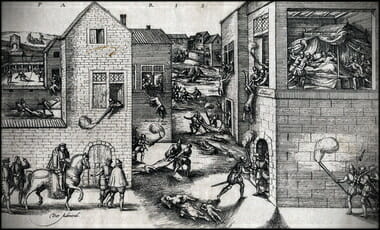
Religious Wars | Huguenots v. Catholics (1562-1598)

Preparation for the St. Bartholomew’s Day Massacre (During the Fourth War, 1868) ~ Painting by Kārlis Hūns
See more on “war,” here:
- Causes of Wars;
- The Spanish Inquisition Was Bad, and Yes, Mostly Secular;
- The Crusades vs. The Three Caliphates (Moral Equivalence).
Couple things to keep in mind as you read. Firstly, while this is an example of a “religious war, most wars are not:
(CAUSES OF WARS) A recent comprehensive compilation of the history of human warfare, Encyclopedia of Wars by Charles Phillips and Alan Axelrod documents 1763 wars, of which 123 have been classified to involve a religious conflict. So, what atheists have considered to be ‘most’ really amounts to less than 7% of all wars. It is interesting to note that 66 of these wars (more than 50%) involved Islam, which did not even exist as a religion for the first 3,000 years of recorded human warfare. Even the Seven Years’ War, widely recognized to be “religious” in motivation, noting that the warring factions were not necessarily split along confessional lines as much as along secular interests. Even the Seven Years’ War, widely recognized to be “religious” in motivation, noting that the warring factions were not necessarily split along confessional lines as much as along secular interests. And the Thirty Years’ War cannot be viewed as “religious” in that you should find certain aspects if this were the case….
[….]
(STAND TO REASON) Not only were students able to demonstrate the paucity of evidence for this claim, but we helped them discover that the facts of history show the opposite: religion is the cause of a very small minority of wars. Phillips and Axelrod’s three-volumeEncyclopedia of Wars lays out the simple facts. In 5 millennia worth of wars—1,763 total—only 123 (or about 7%) were religious in nature (according to author Vox Day in the book The Irrational Atheist). If you remove the 66 wars waged in the name of Islam, it cuts the number down to a little more than 3%. A second [6-volume] scholarly source, The Encyclopedia of War edited by Gordon Martel, confirms this data, concluding that only 6% of the wars listed in its pages can be labelled religious wars. Thirdly, William Cavanaugh’s book, The Myth of Religious Violence, exposes the “wars of religion” claim. And finally, a recent report (2014) from the Institute for Economics and Peace further debunks this myth.
- Alan Axelrod & Charles Phillips, Encyclopedia of Wars, 3 volumes (New York, NY: Facts on File, 2005);
- The General History of the Late War (Volume 3); Containing It’s Rise, Progress, and Event, in Europe, Asia, Africa, and America (No Publisher [see here], date of publication was from about 1765-1766), 110;
- William T. Cavanaugh, The Myth of Religious Violence (New York, NY: Oxford University Press, 2009).
- Gordon Martel, The Encyclopedia of War, 5 Volumes (New Jersey, NJ: Wiley, 2012).
The other thing to keep in mind, “religious wars” is often over-used by atheists… one honest atheist notes the following:
Atheists often claim that religion fuels aggressive wars, both because it exacerbates antagonisms between opponents and also because it gives aggressors confidence by making them feel as if they have God on their side. Lots of wars certainly look as if they are motivated by religion. Just think about conflicts in Northern Ireland, the Middle East, the Balkans, the Asian subcontinent, Indonesia, and various parts of Africa. However, none of these wars is exclusively religious. They always involve political, economic, and ethnic disputes as well. That makes it hard to specify how much [of a] role, if any, religion itself had in causing any particular war. Defenders of religion argue that religious language is misused to justify what warmongers wanted to do independently of religion. This hypothesis might seem implausible to some, but it is hard to refute, partly because we do not have enough data points, and there is so much variation among wars.
- Walter Sinnott-Armstrong, Morality Without God? (New York, NY: Oxford University Press, 2009), 33-34.
And just before getting to the larger excerpt, maybe a small primer about this event is in order via CHRISTIANITY.COM (see more at CHRISTIANITY TODAY):
In France, following the Reformation, Calvinists known as Huguenots sprang up in large numbers. The Roman Catholic establishment persecuted them. Manipulated by French political leaders, the Huguenots rose to defend their rights. Their behavior and methods in turn outraged Catholics. War ravaged France. Although fewer in numbers than their foes, the Huguenots fought so fiercely they managed to extract concessions which allowed them to build churches and manage affairs in cities where they had majorities. But the bloodshed imprinted lasting animosity between Protestants and the Catholic majority.
Out of this smoldering hatred flared up one of the most regrettable events of church history. On August 22, 1572 an attempt was made in Paris to assassinate Huguenot leader and French patriot Coligny. Wounded, he returned home to recover. Accounts disagree as to what happened next and who was responsible. Late on this day, August 23, 1572, armed men, led by the Guises, broke into Coligny’s apartment, overcame the fierce resistance of his guards and killed him. Coligny’s death was the signal for a general butchery of the Huguenots. This atrocity is known to history as the St. Bartholomew’s Day Massacre because it lasted well into that saint’s day.
Catholics slaughtered Huguenots in cold blood into the morning of the 24th in Paris and for days in outlying regions. As many as 70,000 perished. The rest fled to fortified cities and fought back. Their movement became known as La Cause (The Cause) and pitted them against The Holy League (La Sainte Ligue). Brutal fighting raged across the French kingdom.
Charles IX publicly claimed he had ordered the massacre. Certainly the Paris constabulary were warned in advance to prepare for disturbances. Many historians have seen the plot as the work of Catherine de Medici, who felt her power threatened. Possibly Charles, by taking credit, was trying to reap a political benefit from the gruesome event. If so, he won no plaudits outside Catholic regions. Pope Gregory XIII struck a special medallion to commemorate the “holy” act but most other European reaction was horrified. Charles himself suffered psychological agonies from the affair.
The Massacre of St. Bartholomew was not the end of the matter. When the Protestant Henry of Navarre converted to Catholicism in order to become king, he granted his Huguenot compatriots a number of rights under the Edict of Nantes. These rights were gradually eroded, more Huguenot revolts occurred and, finally, 400,000 fled the country into voluntary exile under Louis XIV.
These people were part of the influence (among others) in early America and Canada:
- Following the revocation of the Edict of Nantes, there occurred the greatest migration of peoples in the history of the world. More than 600,000 went to Holland, Belgique, England, Ireland, Austria, Russia, South and North America. The largest numbers came to Canada and the American Colonies; and of this number, the largest came to New England and New Netherlands. (HISTORY BOX)
Here is an excerpt from the Encyclopedia of War on the “Religious War” #’s 1-9:
- Alan Axelrod & Charles Phillips, Encyclopedia of Wars, Vol II (New York, NY: Facts On File, 2005), 931-936.
Huguenots Fight To Survive
 On March 1, 1562, supporters of the Catholic duke Francois de Guise (1519-63) killed a congregation of Protestants at Vassy. This massacre was instigated by the granting of limited toleration to the Protestants by Catherine de’ Medici (1519-85), the queen mother who took control of the throne at the death of King Francis II (154460). The Catholics, under Francois de Guise, the Constable de Montmorency (Anne, duc de Montmorency; 14931567), and Prince Antoine de Bourbon (1518-62), king of Navarre, and the Protestants, under Louis I de Bourbon, prince of Conde (1530-69), and Comte Gaspard de Col-igny (1519-72), admiral of France, were soon pitted against each other in a battle known as the First War of Religion. Louis de Conde and Gaspard de Coligny ordered the Huguenots to seize Orleans to retaliate for the Vassy massacre and called on all Protestants in France to rebel. In September 1562, the English sent John Dudley (fl. 16th century) of Warwick to help the Huguenots, and his force captured Le Havre. About one month later, the Catholics defeated Rouen, a Protestant stronghold. One of the leaders of the Catholic movement, Antoine de Bourbon, was killed during the attack. The Huguenots continued to rise in rebellion, and in December 15,000 Protestants under Conde and Coligny marched north to join the English troops at Le Havre. En route, they encountered about 19,000 Catholics at Dreux. The Catholics under Guise were victorious, but one of their leaders, Montmorency, was captured, as was the Protestant leader Conde. On February 18, 1563, Guise was killed while besieging Orleans. Peace was finally secured in March when Montmorency and Conde, both prisoners since the Battle of Dreux, negotiated a settlement at the request of Queen. Catherine. The Peace of Amboise stipulated a degree of tolerance. The opposing sides then combined forces to push the English from Le Havre, which fell on July 28, 1563.
 The Peace of Amboise (July 28, 1563), which stipulated a greater degree of tolerance between the Catholics and the Huguenots in France, ended the First WAR OF RELIGION. However, peace lasted only four years. On September 29, 1567, the Huguenots under Louis de Bourbon, prince de Conde (1530-69), and Comte Gaspard de Coligny (1519-72) tried to capture the royal family at Meaux. Although they were unsuccessful, other Protestant bands threatened Paris and captured Orleans, Assent, Vienne, Valence, Nimes, Montpellier, and Montaubon. At the Battle of St. Denis, a force of 16,000 men under Constable de Montmorency (Anne, duc de Montmorency; 1493-1567), attacked Conde’s small army of 3,500. Despite the long odds, the Huguenots managed to remain on the field for several hours. Montmorency, aged 74, was killed during the fray. This war ended on March 23, 1568, with the Peace of Longjumeau by which the Huguenots gained substantial concessions from Queen Catherine de’ Medici (1519-85).
 The Third War of Religion broke out on August 18, 1568, when Catholics attempted to capture Louis de Bourbon, prince de Conde (1530-69), and Comte Gaspard de Coligny (1519-72), the primary Protestant leaders. The Royalist Catholics continued to suppress Protestantism. Sporadic fighting occurred throughout the Loire Valley for the remainder of 1568. In March 1569, the Royalists under Marshal Gaspard de Tavannes (1509-73) engaged in battle with Condes forces in the region between Angouleme and Cognac. Later in March, Tavanne crossed the Charente River near Chateauneuf and soundly defeated the Huguenots at the Battle of Jarmac. Although Conde was captured and murdered, Coligny managed to withdraw a portion of the Protestant army in good order. About three months later, help for the Huguenots arrived in the form of 13,000 German Protestant reinforcements. This enlarged force laid siege to Poitiers. Then on August 24, 1569, Col-igny sent Comte Gabriel de Montgomery (c. 1530-74) to Orthez, where he repulsed a Royalist invasion of French-held Navarre and defeated Catholic forces arranged against him. Royalist marshal Tavanne then relieved Poitiers and forced Coligny to raise the siege. The major battle of the Third War of Religion occurred on October 3, 1569, at Moncontour. The Royalists, aided by a force of Swiss sympathizers, forced the Huguenot cavalry off the field and then crushed the Huguenot infantry. The Huguenots lost about 8,000, whereas Royalist losses numbered about 1,000. The following year, however, Coligny marched his Huguenot forces through central France from April through June and began threatening Paris. These actions forced the Peace of St. Germain, which granted many religious freedoms to the Protestants.
 A massacre of 3,000 Protestants and their leader Louis de Bourbon, prince of Conde (1530-69), precipitated the outbreak of the Fourth War of Religion between Catholics and Protestants in France. After the massacre of St. Bartholomew’s Eve in Paris, August 24, 1572, Prince Henry IV of Navarre (1553-1610) took charge of the Protestant forces. Marked primarily by a long siege of La Rochelle by Royalist forces under another Prince Henry, the younger brother of Charles IX (1550-74), this Fourth War of Religion resulted in the Protestants’ gaining military control over most of southwest France. However, at least 3,000 more Huguenots were massacred in the provinces before the war ended.
The St. Bartholomew’s Day Massacre outraged even Catholic moderates, who, seeking to counter the extremes of the Catholic Royalists, formed a new political party, the Politiques, to negotiate with the Protestants and establish peace and national unity.
 Protestants and Catholics in France had been fighting sporadically since 1562 in the First War of RELIGION, the Second War of RELIGION, the Third War of RELIGION, and the Fourth War of RELIGION when violence again erupted in 1575. In the most important action of this war, Henry, duc de Guise (1555-88), led the Catholic Royalists to victory at the Battle of Dorman. Aligned against Guise, however, were not only the Protestants under Henry IV of Navarre (1553-1610) but also the Politiques, moderate Catholics who wanted the king to make peace with the Protestants and restore national unity. Henry III (1551-89) was not wholeheartedly in support of Guise, and he offered pledges of more religious freedom to the Protestants at the Peace of Mousieur, signed on May 5,1576. Guise refused to accept the terms of the peace and began negotiating with Philip II (1527-98) of Spain to organize a Holy League and secure Spain’s help in capturing the French throne.
 The Sixth War of Religion between the Catholics and Protestants in France included only one campaign and was settled by the Peace of Bergerac of 1577. During this period, Henry III (1551-89) tried to persuade the Holy League, formed in 1576 by Catholic leader Henry, duke de Guise (1555-88), and Philip II (1527-98) of Spain, to support an attack on the Protestants. Henry succeeded in subduing the Protestants but wavered in his determination to carry out the terms of the Peace of Bergerac.
[….]
The Seventh War of Religion in 1580, also known as the “Lovers’ War,” had little to do with hostilities between the Catholics and Protestants. Instead fighting was instigated by the actions of Margaret, the promiscuous wife of Henry IV of Navarre (1553-1610). Over the next five years, Catholics, Protestants, and the moderate Politiques (see RELIGION, FOURTH WAR OF; RELIGION, FIFTH WAR OF) all engaged in intrigue in their attempts to name a successor to the childless Henry III. Although Henry of Navarre was next in line by direct heredity, the Holy League maneuvered to ensure that Henry, duc de Guise, would gain the throne after the reign of Charles de Bourbon (1566-1612), proposed as the successor to Henry III.

Battle of Coutas (October 20th, 1587 ~ During the Eight War)
 The Eighth War of Religion, also known as the “War of the Three Henrys,” pitted the Royalist Henry III (1551-89), Henry of Navarre (1553-1610), and Henry de Guise (1555-88) against each other in a struggle over succession to the French throne. The war began when Henry III withdrew many of the concessions he had granted to the Protestants during his reign. At the Battle of Coutras on October 20, 1587, the army of Henry of Navarre, 1,500 cavalry and 5,000 infantry, smashed the Royalist cavalry-1,700 lancers—and 7,000 infantry. More than 3,000 Royalists were killed; Protestant deaths totaled 200. Especially effective against the Royalist was the massed fire of the Protestant arquebuses, primitive muskets.
Despite the Protestant victory at Coutras, the Catholics under Henry of Guise prevailed at Vimoy and Auneau and checked the advance of a German army marching into the Loire Valley to aid to Protestants. Henry’s next victory was in Paris, where he forced the king to capitulate in May 1588. In subsequent intrigues, Henry de Guise and his brother Cardinal Louis I de Guise (1527-78) were assassinated. Fleeing the Catholics’ rage over the murders, Henry Ill sought refuge with Protestant leader Henry of Navarre. The king failed to find permanent safety and was assassinated, stabbed to death, by a Catholic monk on August 2, 1589. On his deathbed, the king named Henry of Navarre his successor. The Catholics refused to acknowledge him king, insisting instead that Cardinal Charles de Bourbon (1566-1612) was the rightful ruler of France. This conflict sparked the NINTH WAR OF RELIGION.
 The naming of Henry of Navarre (1553-1610) as successor to the French throne sparked the final War of Religion between Protestant Huguenots and Catholics in France. Insisting that Charles, duke de Bourbon (1566-1612), was the rightful successor to Henry III (1551-89), the Catholics enlisted the aid of the Spanish. Charles, duke of Mayenne (1554-1611), the younger brother of Henry of Guise (1555-88), led the Catholic efforts.
At the Battle of Argues on September 21,1589, Henry of Navarre (1553-1660) ambushed Mayenne’s army of 24,000 French Catholic and Spanish soldiers. Having lost 600 men, Mayenne withdrew to Amiens, while the victorious Navarre, whose casualties numbered 200 killed or wounded, rushed toward Paris.
A Catholic garrison near Paris repulsed Navarre’s advance on November 1, 1589. Not to be daunted in his quest for the throne, Henry withdrew but promptly proclaimed himself Henry IV and established a temporary capital at Tours.
Henry of Navarre won another important battle at Ivry on March 14, matching 11,000 troops against Mayenne’s 19,000. Mayenne lost 3,800 killed, whereas Navarre suffered only 500 casualties.
Civil war continued unabated. Between May and August 1590, Paris was reduced to near starvation during Navarre’s siege of the city. Maneuvers continued, especially in northern France until May 1592; however, in July 1593 Henry of Navarre reunited most of the French populace by declaring his return to the Catholic faith. His army then turned to counter a threat of invasion by Spain and the French Catholics allied with Mayenne.
On March 21, 1594, Henry of Navarre entered Paris in triumph and over the next few years battled the invading Spanish: at Fontaine-Francaise on June 9, 1596, at Calais on April 9, 1596, and at Amiens on September 17, 1596. No further major campaigns ensued.
On April 13, 1598, Henry of Navarre ended the decades of violence between the Catholics and the Protestants by issuing the Edict of Nantes, whereby he granted religious freedom to the Protestants. Then on May 2, 1598, the war with Spain ended with the Treaty of Vervins, whereby Spain recognized Henry as king of France. The next major conflict between the Catholics and Protestants in France occurred 27 years later when the Protestants rose in revolt in 1625 and the English joined their cause in the ANGLO-FRENCH WAR (1627-1628).
➤ Further reading: R. J. Knecht, The French Civil Wars, 1562-1598 (New York: Pearson Education, 2000); R. J. Knecht and Mabel Segun, French Wars of Religion (New York: Addison-Wesley Longman, 1996).


BOOM! Jake Tapper Lands a Knockout Punch
First, let’s set this up with the video the rest of the post will be about:
Let us look a bit deeper at who Macklemore is… really is:
In 2014, Rolling Stone reported outrage after Macklemore appeared to promote anti-Jewish hate:
Macklemore Accused of Anti-Semitism After Wearing Questionable Costume
Rapper faces criticism after performing with oversized nose, bowl-cut wig and Hasidic-looking beard
Yet, other than the few examples like Tapper, where is the journalistic outrage against Obama for inviting this man to the White House?
Here is more about the issue with this rapper… via NEWSBUSTERS… brought up by CNN’s Jake Tapper:

Caller of Color Challenges The Sage On Police Shootings
Larry Elder takes a caller challenge/disagreement on the difference of lethal and non-lethal force in regards to police shooting black perpetrators versus white perpetrators. After the call the segment ends, and so I pick up “The Sage’s” response in the next segment. Good stuff! Old stats BUT he proffers the info from the Harvard study a bit more in-depth, and it really seals his case well.
Here are the two articles he references:
➤ Surprising New Evidence Shows Bias in Police Use of Force but Not in Shootings (NYTs)
➤ The real racial bias: Cops more willing to shoot whites than blacks, research finds (WTs)

Jamie Foxx “Hearts” Socialism (Plus: Caller From Caracas)
Dennis Prager first read from an AP story about Jamie Foxx visiting the death hole known as Venezuela (see the Free Republic post). Later in the show he actually gets a call from Caracas, Venezuela. I teared up a bit during the call, as did Prager apparently. Good stuff Maynard!
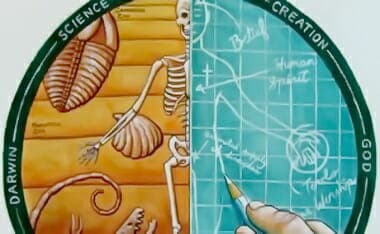
Peter Enns Fall from Grace | Theistic Evolution
Here is an excerpt from a book that was a very enjoyable read. Part of the reason is due to some of the worldview points he John Otis makes. In fact, a book quoted from (footnote #319) is a favorite political read from many years ago. (As an aside, here is a CHRISTIANITY TODAY article on Peter Enns firing) Take note as well that I do not agree with everything Otis makes a career on or writes on. If one is looking for a SOUND work that is good as well on the subject, see Refuting Compromise, just keep in mind that while this touches on theistic evolutionary theology and science, it also deals with gap theory as proposed by Hugh Ross.
One should keep in mind, while maybe theologically standing against theistic evolution — adamantly — note that many fine Christians have been theistic evolutionists. See a short video under the debate excerpt in a supplement for a men’s group I was in, titled: An Ironman Supplement ~ Thin Nothing:
While theistic evolution is almost at complete odds with the Gospel message, we should understand that the union between man-and-God is the acceptance of Jesus, not these particulars.
There have been great men of God who have been theistic evolutionists… this does not mean we have to be. (See video to the right, and I wish to thank Darren for keeping the tendency to judge unrighteously in check).
…. In any case, enjoy the chapter.
- John M. Otis, Theistic Evolution: A Sinful Compromise (Triumphant Publications Ministry [self-published], 2013), 250-262
Peter Enns: Where Theistic Evolution Can Lead
Peter Enns is the last person that I will analyze simply because he probably best typifies what can happen once one begins the downward spiral on adopting an evolutionary view to Scripture. This does not mean that all theistic evolutionists will end up theologically where Enns has, but it does show how one can easily end up with views purported by Enns. I would say that Enns’ views are the logical outcome of an evolutionary perspective, and the result when one views science as the best interpreter of Scripture.
Peter Enns was professor of Old Testament for 14 years at Westminster Seminary, Philadelphia up to his dismissal in 2008. Controversy arose over his 2005 book titled Inspiration and Incarnation. And that book is not as abrasive in certain ways as this book written by Enns last year, 2012, titled The Evolution of Adam: What the Bible Does and Does not Say About Human Origins.
Westminster Seminary President Lillback told students about the board’s decision to dismiss him:
We have students who have read it say it has liberated them. We have other students that say it’s crushing their faith and removing them from their hope. We have churches that are considering it, and two Presbyteries have said they will not send students to study under Professor Enns here.296
It is most grievous to see such division in the visible church. Some hail Enns’ ideas as liberating and others as crushing. There is something very, very wrong with this picture. With Enns’ publication of The Evolution of Adam, some have argued that this book definitively shows that Westminster’s decision of dismissal was fully justified. I would concur with that sentiment for sure.
What’s so bad about Enns’ book is that it is the consistent and logical outcome of a theistic evolutionary perspective. Now this does not mean that everyone who adopts a theistic evolutionist interpretation of Genesis ends up where Enns has.
I will not give as many quotes as I did with Jack Collins even though Enns is far more explicit and open in his views. As one will see, Enns is very straight forward. For example, he says:
A literal reading of the Genesis creation stories does not fit with what we know of the past. The scientific data does not allow it, and modern biblical scholarship places Genesis in its ancient Near Eastern cultural context.297 (Emphasis mine)
If the following comment by Enns is any indication of his views of Biblical inspiration, then one can understand why he was dismissed from Westminster Seminary. In Part 2 of his book titled “Understanding Paul’s Adam,” we learn what he thinks.
Enns states:
The conversation between Christianity and evolution would be far less stressful for some if it were not for the prominent role that Adam plays in two of Paul’s Letters, specifically Romans 5:12-21 and I Corinthians 15:20-58.
In these passages, Paul seems to regard Adam as the first human being and ancestor of everyone who ever lived. This is a particularly vital point in Romans, where Paul regards Adam’s disobedience as the cause of universal sin and death from which humanity is redeemed through the obedience of Christ.298
Enns continues:
It is understandable why, for a good number of Christians, the matter of a historical Adam is absolutely settled, and the scientific and archaeological data- however convincing and significant they might be otherwise – are either dismissed or refrained to be compatible with Paul’s understanding of human origins.299
So, it is evident that for Enns science and archaeology are more convincing than us poor misguided people who think Paul got it right because the Holy Spirit inspired the apostle. I suppose the Holy Spirit needs to check in with the latest scientific data to be sure of things before the living God inspired men who were mistaken. I am being facetious of course.
While saying that Paul’s view of Adam and Christ is central to Christian theology, Enns is critical of those who insist that science and archaeology must “fall in line” for all those, “who look to Scripture as the final authority on theological matters…”300
Wow! Shame on us for wanting science and archaeology to fall in line with Scripture and shame on us who look to the Scripture as the final authority. I am being facetious again.
I do not want to go into specifics on the New Perspective on Paul Theology, but Enns has adopted this view. Enns states:
Paul is not doing “straight exegesis” of the Adam story. Rather, he subordinates that story to the present, higher reality of the risen Son of God, expressing himself with the hermeneutical conventions of the time.301
One of the dominant views of the New Perspective on Paul Theology is that Paul’s theology is not so much about explaining justification by faith alone like Martin Luther understood it, but Paul’s case is simply to show that Jews and Gentiles together make up the people of God.
While true in one sense about Jews and Gentiles being in the church, the New Perspective on Paul approach has a twist to it.
Enns goes on to say this about Paul’s view of Romans 5:
Adam read as “the first human,” supports Paul’s argument about the universal plight and remedy of humanity, but it is not a necessary component for that argument. In other words, attributing the cause of universal sin and death to a historical Adam is not necessary for the gospel of Jesus Christ to be a fully historical solution to that problem. (Italics is Enns)
Without question, evolution requires us to revisit how the bible thinks of human origins.302
One could ask Peter Enns, “Then why did God the Father send God the Son to be incarnated into this world? I suppose the apostle Matthew got it wrong also when in Matthew 1:21, Matthew records the angel instructing Joseph to call the virgin conceived son as “Jesus,” for He will save His people from their sins.
From Peter Enns’ perspective, the Apostle Paul got it wrong in I Corinthians 15:21-22 which says, “For since by a man came death, by a man also came the resurrection of the dead. For as in Adam all die, so also in Christ all shall be made alive.”
In questioning the consequences of Adam’s sin in Genesis 2 and 3, Enns says:
If Adam’s disobedience lies at the root of universal sin and death, why does the OT never once refer to Adam in this way?
Adam in Chronicles seems to be a positive figure, the first of many, not the cause of sin and death, although I admit that is more an argument from silence in Chronicles.300 (Emphasis mine)
If one recalls from the chapter on Ron Choong, this is his view about Adam not being the source of sin and death.
What does Enns believe about Cain? He says:
The picture drawn for us is that Cain is fully capable of making a different choice, not that his sin is due to an inescapable sinful inheritance… Adam’s disobedience is not presented as having any causal link to Cain’s.304
What about Noah? Enns says that Noah, being called a righteous man, demonstrates that at least in Noah there was no original sin linked back to Adam. Enns says:
If Adam were the cause of universal sinfulness, the description of Noah is puzzling. If Adam’s disobedience is the ultimate cause of this near universal wickedness, one can only wonder why, at this crucial juncture in the story, that is not spelled out or at least hinted at.
If Adam’s causal role were such a central teaching of the OT, we wonder why the OT writers do not return to this point again and again.
Rather than attribute to Adam a causal role, however, the recurring focus in the OT is on Israel’s choice whether or not to obey God’s law — the very choice given to both Adam and Cain.305
It is quite clear that Peter Enns does not agree with the notion of original sin. In fact, much of Enns’ views here are outright the same as the heretic Pelagius with whom Augustine did battle in the 5″ Century. R.C. Sproul has an excellent book titled Willing To Believe: The Controversy over Free-will. In this book, Sproul identifies 18 premises of Pelagius’s views. Sadly, Enns’ views constitute several of these premises. Enns, sensitive that some think he is Pelagian, says, “I am not trying to advocate some form of Pelagianism…I read the Adam story not as a universal story to explain human sinfulness at all but as a proto-Israel story.”306
Regardless of what he says, Enns is a Pelagian. Enns views the story of Adam and Eve as simply a wisdom story that depicts Israel’s exile. Israel’s failure to follow Proverb’s path of wisdom is what the Adam story is all about, he says:
We get a glimpse at why certain men at Westminster Seminary were upset with Enns. Enns discusses the Apostle Paul’s views compared with ancient cosmology.
Enns states:
My aim is simply to observe that Paul (and other biblical writers) shared assumptions about physical reality with his fellow ancient Hellenistic Jews…
Many Christian readers will conclude, correctly that a doctrine of inspiration does not require “guarding” the biblical authors from saying things that reflect a faulty ancient cosmology.
But when we allow the Bible to lead us in our thinking on inspiration, we are compelled to leave room for the ancient writers to reflect and even incorporate their ancient, mistaken cosmologies into their scriptural reflections.307 (Emphasis mine)
Just when one thinks that it cannot get any worse, Enns says:
But does this mean that Paul’s assumption about this one aspect of physical reality- human origins- necessarily displays a unique level of scientific accuracy? Just as with any other of his assumptions and views of physical reality, the inspired status of Paul’s writings does not mean that his view on human origins determines what is allowable for contemporary Christians to conclude.
I do not grant, however, that the gospel is actually at stake in the question of whether what Paul assumed about Adam as the progenitor of humanity is scientifically true.308 (Emphasis mine)
Oh well, theistic evolutionist Peter Enns has Paul in error. Even inspired Paul must bow to the sacred altar of Darwinism.
Enns continues in his assault on inspired Paul:
When viewed in the context of the larger Jewish world of which Paul was a part, his interpretation is one among several, with nothing to commend it as being necessarily more faithful to the original.309
Peter Enns gives us his understanding of the federal headship of Adam as a theistic evolutionist. He says:
We do not reflect Paul’s thinking when we say, for example, that Adam need not be the first created human but can be understood as a representative “head” of humanity. Such a head could have been a hominid chosen by God somewhere in the evolutionary process, whose actions were taken by God as representative of all other hominids living at the time and would ever come to exist. In other words, the act of this “Adam” has affected the entire human race not because all humans are necessarily descended from him but because God chose to hold all humans as accountable for this one act.310
Enns may not see that there is a problem with this next statement, but I hope my listener does when he says:
Admitting the historical and scientific problems with Paul’s Adam does not mean in the least that the gospel message is therefore undermined. A literal Adam may not be the first man and cause of sin and death, as Paul understood it, but what remains of Paul’s theology are three core elements of the gospel.
Even without a first man, death and sin are still the universal realities that mark the human condition.311
In another swipe at the doctrine of original sin, Enns states:
…The notion of “original sin” where Adam’s disobedience is the cause of a universal state of sin, does not find clear – if any – biblical support.
The fact that Paul draws an analogy between Adam and Christ, however, does not mean that we are required to consider them as characters of equal historical standing.3I2
Imagine. Just because Paul believes something you’re not required to believe it, and Paul got it wrong about Adam being the first man, so you do not need to believe him either.
Peter Enns concludes his book by saying the following:
One cannot read Genesis literally- meaning as a literally accurate description of physical, historical reality- in view of the state of scientific knowledge today and our knowledge of ancient Near Eastern stories of origins.313 (Emphasis mine)
In his conclusion, we who hold to a traditional understanding of creation are the dangerous ones according to Enns:
Literalism is not just an outdated curiosity or an object of jesting. It can be dangerous. A responsible view of the biblical stories must account for the scientific and archaeological facts, not dismiss them, ignore them, or- as in some cases, manipulate them.314
So, when having our devotions, are we to be sure that we have beside us pagan origin stories and Darwin’s Origin of Species and his book Descent of Man to be sure we understand the Bible correctly?
I think it is appropriate to conclude a review of Enns’ book by demonstrating how Enns has logically arrived to his Thesis 9.
A true rapproachment between evolution and Christianity requires a synthesis, not simply adding evolution to existing theological formulations.
Evolution is a serious challenge to how Christians have traditionally understood at least three central issues of the faith: the origin of humanity, of sin, and of death… sin and death are universal realities, the Christian tradition has generally attributed the cause to Adam. But evolution removes that cause as Paul understood it and thus leaves open the questions of where sin and death have come from. More than that, the very nature of what sin is and why people die is turned on its head. Some characteristics that Christians have thought of as sinful – for example, in an evolutionary scheme the aggression and dominance associated with “survival of the fittest” and sexual promiscuity to perpetuate one’s gene pool – are understood as means of ensuring survival. Likewise, death is not the enemy to be defeated … death is not the unnatural state introduced by a disobedient couple in a primordial garden. Actually, it is the means that promotes the continued evolution of life on this planet and even ensures workable population numbers. Death may hurt, but it is evolution’s ally.315
… Evolution is not an add-on to Christianity; it demands synthesis because it forces serious intellectual engagement with some important issues. Such a synthesis requires a willingness to rethink one’s own convictions in light of new data.316 (Emphasis mine)
Right here is where it logically ends up. Peter Enns has understood the essence of evolutionary thought. Surely Enns is not advocating an amoral society where we can do whatever we want if it advances our perceived betterment, but that is what he actually said. Enns did say that we need to rethink our former convictions about sexual promiscuity. Part of the evolutionary process is to ensure the best gene pool. Does this mean we can practice immorality? This is what he implied.
Enns says that we should not view death as some sort of enemy. It’s a natural thing in the struggle for life. Death is a means by which workable populations are ensured.
Well, Peter Enns is in good company with some who have and are practicing various forms of eugenics (population control). Sir Julian Huxley, as I pointed out in an earlier chapter, was a great champion of Eugenics, and he had no qualms about being sexually promiscuous, even asking his wife to engage in “open marriage.”
Margaret Sanger, the founder of Planned Parenthood, was an avid evolutionist and advocate of Eugenics. She stressed the necessity of using birth control, even abortion, to control the numbers of the unfit in various populations. She boldly proclaimed that birth control was the only viable way to improve the human race.317 How much different is Sanger’s view on sexuality than what Enns has stated? Sanger once wrote:
The lower down in the scale of human development we go the less sexual control we find. It is said the aboriginal Australian, the lowest known species of the human family, just a step higher than the chimpanzee in brain development, has so little sexual control that police authority alone prevents him from obtaining sexual satisfaction on the streets. According to one writer, the rapist has just enough brain development to raise him above the animal, but like the animal, when in heat, knows no law except nature, which impels him to procreate, whatever the result.318
Sanger was a huge fan of Malthus on population, just like Darwin. Sanger advocated euthanasia, segregation in work camps, sterilization and abortion.319 As her organization grew, Sanger set up more clinics in the communities of other “dysgenic races” — such as Blacks and Hispanics. Sanger turned her attention to “Negroes” in 1929 and opened another clinic in Harlem in 1930. Sanger, “in alliance with eugenicists, and through initiatives such as the Negro Project… exploited black stereotypes in order to reduce the fertility of African Americans.” The all-white staff and the sign identifying the clinic as a “research bureau” raised the suspicions of the black community. They feared that the clinic’s actual goal was to “experiment on and sterilize black people.” Their fears were not unfounded: Sanger once addressed the women’s branch of the Klu Klux Klan in Silver Lake, New Jersey, and received a “dozen invitations to speak to similar groups.” Flynn claims that she was on good terms with other racist organizations.320
Margaret Sanger’s view of eugenics is most telling when she said:
I have no doubt that if natural checks were allowed to operate right through the human as they do in the animal world, a better result would follow. Among the brutes, the weaker are driven to the wall, the diseased fall out in the race of life. The old brutes, when feeble or sickly, are killed. If men insisted that those who were sickly should be allowed to die without help of medicine or science, if those who are weak were put upon one side and crushed, if those who were old and useless were killed, if those who were not capable of providing food for themselves were allowed to starve, if all this were done, the struggle for existence among men would be as real as it is among brutes and would doubtless result in the production of a higher race of men.321
Peter Enns’ view in his Thesis 9 may seem very radical to many of us, but it has been consistently practiced in the past by other avid evolutionists.
Peter Enns has a blogsite titled Peter Enns “Rethinking Biblical Christianity”. On April 5, 2012, he titled his blog – “You and I Have a Different God, I Think.”
I’ve been watching the Adam and evolution debates . . . on line, in social media, and in print. I think I am beginning to see more clearly what accounts for the deeply held, visceral, differences of opinion about whether Adam was the first man or whether Adam is a story.
The reason for the differences is not simply that people have different theological systems or different ways of reading the Bible. A more fundamental difference lies at the root of these (and other) differences.
I think we have a different God.
And the Gospel certainly does not teach me that God is up there, at a distance, guiding the production of a diverse and rich biblical canon that nevertheless contains a single finely-tuned system of theology that he expects his people to be obsessed with “getting right” (and lash out at those who do not agree).
Would it be safe to say that Peter Enns is a heretic? I think the answer is obvious. Enns’ views are part of the theological monstrosity that results when we open Pandora’s evolutionary box.
Footnotes
296 Taken from Sarah Pulliam. “Westminster Theological Suspension“ Christianity Today. April 1. 2008. Found at http://www.christianitytoday.comict/2008/aprilweb-only/114-24.0.html.
297 Peter Enns, The Evolution of Adam: What the Bible Does and Does not Say about Human Origins, (Grand Rapids, MI: Brazos Press, 2012), p. 79.
298 Ibid.
299 Enns, p. 80.
300 Ibid.
301 Ibid., p. 81.
302 Enns, p. 82.
303 Ibid., pp. 82-83.
304 Enns, pp. 85-86.
305 Ibid., pp. 86-87.
306 Ibid., p. 91.
307 Enns, pp. 94-95.
308 Ibid., p. 95.
309 Enns, p. 98.
310 Ibid., p. 120.
311 Ibid., pp. 123-124.
312 Enns, p. 125.
313 Ibid., p. 137.
314 Ibid.. p. 138.
315 Enns, p 147.
317 Jerry Bergman, “Birth control leader Margaret Sanger: Darwinist, racist and eugenicist” who cites Engelman, P., Foreword to Margaret Sanger’s The Pivot of Civilization, Humanity Books, Amherst, NY, pp. 9-29. 2003; p. 9.
318 Ibid., who cites M. H. Sanger, What Every Girl Should Know, Belvedere Publishers, New York, p. 40, 1980. A reprint of the original 1920 edition.
319 Ibid., who cites D. J. Flynn, Intellectual Morons: How Ideology Makes Smart People Fall for Stupid Ideas, Crown Forum, New York, 2004, ref. 13, p. 150.
320 Ibid., quoting both Sanger and D.J. Flynn.
321 Bergman, who cites M. H. Sanger, Margaret Sanger: An Autobiography, Norton, New York, ref 14, p. 160.