Alex Sorin DEBOONK’s Total Depravity (TULIP, Part One)

Calvinism is cooked. The top Calvinist apologists consistently blunder online. They don’t even debate Calvinism anymore. When they do, they get pwned by Orthodox Christians like ‪@JayDyer‬ and ‪@PatristicFaith‬, or by open theists like ‪@IdolKiller‬.

Since Calvinist apologetics are falling apart online, I figured I’d try to help speed along the process by adding some of my own gasoline to the fire with a series deboonking the TULIP doctrines. Starting with today’s episode on the doctrine of total depravity, we’re going letter-by-letter through TULIP to show why those doctrines can’t withstand even basic scrutiny.

In doing so, my hope is to help bring the truth of the one, holy, catholic, and apostolic Orthodox Church to all. Glory to God for all things.

Chapters:

0:00 Introduction
1:01 Neo-Calvinists have lost it
2:11 They’re running
4:09 Roadmap
4:59 What is TD?
9:59 TD violates the Bible
11:09 Not vipers in diapers
12:50 Bible presupposes synergy
14:43 Incoherent epistemology
16:40 Impossible Christology
18:38 Orthodox anthropology
19:51 Psalm 51:5
21:01 Ephesians 2
21:40 Romans 5:12
23:25 Conclusion

How To Pray Like An Honest Calvinist | IDOL KILLER (+RPT)

The 2nd video is Idol Killer’s original, the first is my reimagining it:

Praying Like A Consistent Calvinist | Adapted from Idol Killer >>> I rejiggered it into a better order [IMHO], added some graphics/quotes, and uploaded it a second time finding an edit error on my part.

Not for the faint of heart!

Somewhere outside the city of Geneva, on Earth 1689, it happened that a Calvinist Theologian was praying, and when he had finished, one of his disciples said to him, “Pastor, teach us to pray, just as John also taught his disciples.” and he said to them:

“Oh Sovereign God, whom from all eternity, freely and unchangeably ordained whatsoever comes to pass, I thank you I know you bring about all things in accordance with your will, I know the evils of this world have NOT arisen by your mere permission, (or as a result of your patient call to repentance), but that YOU yourself bring about all evils for your glory and good pleasure,…

I thank you for bringing evil into the world. I thank you for the brutality at Birkenau and at Auschwitz.

I thank you for the terrible killings of Dennis Rader.

I thank you for the brutality of war, and the countless widows and orphans it creates. I thank you for the perverse abuse of young children. I know these evil men were perfectly obeying your Sovereign will.

I thank you. I see your gracious hand in the hurts others do to me, (like the Ford Focus that cut me off at the light this afternoon).

I thank you. I thank you for my wife, and the abuse she inflicts upon our children while I’m away from the home. I know you did this to build mine and my children’s character. I thank you that its only been bruises and bloody noses. I know you saw fit to have my boss fire me from my job, during the holiday season, just as I know it was your Sovereign will that he hire Stephanie this past Spring and that we have an affair.

I thank you for giving me an irresistible desire for red heads. Above all, I know it was your Sovereign hand keeping my wife ignorant of our illicit love making, (during our lunch break at the motel six).

I thank you. I know that it was your perfect will that my neighbor got drunk and took his own life this morning, just as it was your perfect will that I was distracted on my cell phone and backed the car over his son last week.

I thank you. I know you’ve regenerated me and elected me unto salvation, and while I’m unsure about my wife and children’s eternal destiny, I thank you. Please bless this food to the nourishment of our bodies and bless the hands that prepared it, or don’t. Whatever your Sovereign will is. Thank you, and amen!”

The Origin of Evil… Calvinist’s Say God, Same as the Atheist

CLICK TO ENLARGE

(Below Video Description) Dr. Leighton Flowers plays clips from Drs. James White, RC Sproul and John Piper on the question of the origin of moral evil so as to compare and contrast the various perspectives and the apparent inconsistencies of the Calvinistic worldview.

See my other posts on this topic:

William Lane Craig discusses [below] being a “consistent Calvinist” vs. an “inconsistent Calvinism”

Is the Calvinist God the Author of Evil? w/ William Lane Craig Dr. William Lane Craig explains why he believes that Calvinism is forced to conclude that God is the author of evil.

The below is from my “Challenges To Strict 5-Point Calvinism | Tozer/Winger/Geisler/Lewis


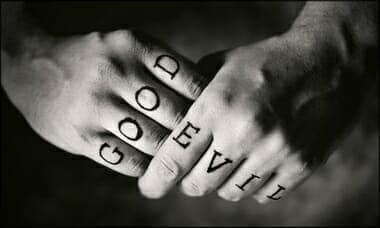
“Divine Goodness”

Any consideration of the goodness of God at once threat­ens us with the following dilemma.

On the one hand, if God is wiser than we His judge­ment must differ from ours on many things, and not least on good and evil. What seems to us good may therefore not be good in His eyes, and what seems to us evil may not be evil.

On the other hand, if God’s moral judgement differs from ours so that our ‘black’ may be His ‘white’, we can mean nothing by calling Him good; for to say ‘God is good’, while asserting that His goodness is wholly other than ours, is really only to say ‘God is we know not what’. And an utterly unknown quality in God cannot give us moral grounds for loving or obeying Him. If He is not (in our sense) ‘good’ we shall obey, if at all, only through fear—and should be equally ready to obey an omnipotent Fiend. The doctrine of Total Depravity— when the consequence is drawn that, since we are totally depraved, our idea of good is worth simply nothing— may thus turn Christianity into a form of devil-worship.

The escape from this dilemma depends on observing what happens, in human relations, when the man of infe­rior moral standards enters the society of those who are better and wiser than he and gradually learns to accept their standards—a process which, as it happens, I can describe fairly accurately, since I have undergone it. When I came first to the University I was as nearly with­out a moral conscience as a boy could be. Some faint dis­taste for cruelty and for meanness about money was my utmost reach—of chastity, truthfulness, and self-sacrifice I thought as a baboon thinks of classical music. By the mercy of God I fell among a set of young men (none of them, by the way, Christians) who were sufficiently close to me in intellect and imagination to secure immediate intimacy, but who knew, and tried to obey, the moral law. Thus their judgement of good and evil was very different from mine. Now what happens in such a case is not in the least like being asked to treat as ‘white’ what was hitherto called black. The new moral judgements never enter the mind as mere reversals (though they do reverse them) of previous judgements but ‘as lords that are certainly expected’. You can have no doubt in which direction you are moving: they are more like good than the little shreds of good you already had, but are, in a sense, continuous with them. But the great test is that the recognition of the new standards is accompanied with the sense of shame and guilt: one is conscious of having blundered into soci­ety that one is unfit for. It is in the light of such experi­ences that we must consider the goodness of God. Beyond all doubt, His idea of ‘goodness’ differs from ours; but you need have no fear that, as you approach it, you will be asked simply to reverse your moral standards. When the relevant difference between the Divine ethics and your own appears to you, you will not, in fact, be in any doubt that the change demanded of you is in the direction you already call ‘better’. The Divine ‘goodness’ differs from ours, but it is not sheerly different: it differs from ours not as white from black but as a perfect circle from a child’s first attempt to draw a wheel. But when the child has learned to draw, it will know that the circle it then makes is what it was trying to make from the very beginning.

This doctrine is presupposed in Scripture. Christ calls men to repent—a call which would be meaningless if God’s standards were sheerly different from that which they already knew and failed to practise. He appeals to our existing moral judgement—‘Why even of yourselves judge ye not what is right?’ (Luke 12:57) God in the Old Testament expostulates with men on the basis of their own concep­tions of gratitude, fidelity, and fair play: and puts Himself, as it were, at the bar before His own creatures—‘What iniquity have your fathers found in me, that they are gone far from me?’ (Jeremiah 2:5.)


CS Lewis | The Problem of Pain (Chapter 3)

“Human Wickedness”

A recovery of the old sense of sin is essential to Christianity. Christ takes it for granted that men are bad. Until we really feel this assumption of His to be true, though we are part of the world He came to save, we are not part of the audience to whom His words are addressed. We lack the first condition for understanding what He is talking about. And when men attempt to be Christians without this preliminary consciousness of sin, the result is almost bound to be a certain resentment against God as to one always inexplicably angry. Most of us have at times felt a secret sympathy with the dying farmer who replied to the Vicar’s dissertation on repentance by asking ‘What harm have I ever done Him?’ There is the real rub. The worst we have done to God is to leave Him alone—why can’t He return the compliment? Why not live and let live? What call has He, of all beings, to be ‘angry’? It’s easy for Him to be good!

Now at the moment when a man feels real guilt— moments too rare in our lives—all these blasphemies vanish away. Much, we may feel, can be excused to human infirmities: but not this—this incredibly mean and ugly action which none of our friends would have done, which even such a thorough-going little rotter as X would have been ashamed of, which we would not for the world allow to be published. At such a moment we really do know that our character, as revealed in this action, is, and ought to be, hateful to all good men, and, if there are powers above man, to them. A God who did not regard this with unappeasable distaste would not be a good being. We cannot even wish for such a God—it is like wishing that every nose in the universe were abol­ished, that smell of hay or roses or the sea should never again delight any creature, because our own breath hap­pens to stink.

When we merely say that we are bad, the ‘wrath’ of God seems a barbarous doctrine; as soon as we perceive our badness, it appears inevitable, a mere corollary from God’s goodness. To keep ever before us the insight derived from such a moment as I have been describing, to learn to detect the same real inexcusable corruption under more and more of its complex disguises, is therefore indis­pensable to a real understanding of the Christian faith. This is not, of course, a new doctrine. I am attempting nothing very splendid in this chapter. I am merely trying to get my reader (and, still more, myself) over a pons asi-norum—to take the first step out of fools’ paradise and utter illusion. But the illusion has grown, in modern times, so strong, that I must add a few considerations tending to make the reality less incredible.

  1. We are deceived by looking on the outside of things. We suppose ourselves to be roughly not much worse than Y, whom all acknowledge for a decent sort of person, and certainly (though we should not claim it out loud) better than the abominable X. Even on the superficial level we are probably deceived about this. Don’t be too sure that your friends think you as good as Y. The very fact that you selected him for the comparison is suspicious: he is prob­ably head and shoulders above you and your circle. But let us suppose that Y and yourself both appear ‘not bad’. How far Y’s appearance is deceptive, is between Y and God. His may not be deceptive: you know that yours is.

Does this seem to you a mere trick, because I could say the same to Y and so to every man in turn? But that is just the point. Every man, not very holy or very arrogant, has to ‘live up to’ the outward appearance of other men: he knows there is that within him which falls far below even his most careless public behaviour, even his loosest talk. In an instant of time—while your friend hesitates for a word—what things pass through your mind? We have never told the whole truth. We may confess ugly facts— the meanest cowardice or the shabbiest and most prosaic impurity—but the tone is false. The very act of confess-ing—an infinitesimally hypocritical glance—a dash of humour—all this contrives to dissociate the facts from your very self. No one could guess how familiar and, in a sense, congenial to your soul these things were, how much of a piece with all the rest: down there, in the dreaming inner warmth, they struck no such discordant note, were not nearly so odd and detachable from the rest of you, as they seem when they are turned into words. We imply, and often believe, that habitual vices are excep­tional single acts, and make the opposite mistake about our virtues—like the bad tennis player who calls his nor­mal form his ‘bad days’ and mistakes his rare successes for his normal. I do not think it is our fault that we cannot tell the real truth about ourselves; the persistent, life-long, inner murmur of spite, jealousy, prurience, greed and self-complacence, simply will not go into words. But the  important thing is that we should not mistake our inevitably limited utterances for a full account of the worst that is inside.

  1. A reaction—in itself wholesome—is now going on against purely private or domestic conceptions of moral­ity, a reawakening of the social We feel our­selves to be involved in an iniquitous social system and to share a corporate guilt. This is very true: but the enemy can exploit even truths to our deception. Beware lest you are making use of the idea of corporate guilt to distract your attention from those humdrum, old-fashioned guilts of your own which have nothing to do with ‘the system’ and which can be dealt with without waiting for the mil­lennium. For corporate guilt perhaps cannot be, and cer­tainly is not, felt with the same force as personal guilt. For most of us, as we now are, this conception is a mere excuse for evading the real issue. When we have really learned to know our individual corruption, then indeed we can go on to think of the corporate guilt and can hardly think of it too much. But we must learn to walk before we run.
  2. We have a strange illusion that mere time cancels sin. I have heard others, and I have heard myself, recounting cruelties and falsehoods committed in boyhood as if they were no concern of the present speaker’s, and even with laughter. But mere time does nothing either to the fact or to the guilt of a sin. The guilt is washed out not by time but by repentance and the blood of Christ: if we have repented these early sins we should remember the price of our forgiveness and be humble. As for the fact of a sin, is it probable that anything cancels it? All times are eternally present to God. Is it not at least possible that along some one line of His multi-dimensional eternity He sees you forever in the nursery pulling the wings off a fly, forever toadying, lying, and lusting as a schoolboy, forever in that moment of cowardice or insolence as a subaltern? It may be that salvation consists not in the cancelling of these eternal moments but in the perfected humanity that bears the shame forever, rejoicing in the occasion which it fur­nished to God’s compassion and glad that it should be common knowledge to the universe. Perhaps in that eter­nal moment St Peter—he will forgive me if I am wrong— forever denies his Master. If so, it would indeed be true that the joys of Heaven are for most of us, in our present condition, ‘an acquired taste’—and certain ways of life may render the taste impossible of acquisition. Perhaps the lost are those who dare not go to such a public Of course I do not know that this is true; but I think the possibility is worth keeping in mind.
  3. We must guard against the feeling that there is ‘safety in numbers’. It is natural to feel that if all men are as bad as the Christians say, then badness must be very excus­able. If all the boys plough in the examination, surely the papers must have been too hard? And so the masters at that school feel till they learn that there are other schools where ninety per cent of the boys passed on the same papers. Then they begin to suspect that the fault did not lie with the examiners. Again, many of us have had the experience of living in some local pocket of human soci-ety—some particular school, college, regiment or profes­sion where the tone was bad. And inside that pocket certain actions were regarded as merely normal (‘Every­one does it’) and certain others as impracticably virtuous and Quixotic. But when we emerged from that bad soci­ety we made the horrible discovery that in the outer world our ‘normal’ was the kind of thing that no decent person ever dreamed of doing, and our ‘Quixotic’ was taken for granted as the minimum standard of decency. What had seemed to us morbid and fantastic scruples so long as we were in the ‘pocket’ now turned out to be the only moments of sanity we there enjoyed. It is wise to face the possibility that the whole human race (being a small thing in the universe) is, in fact, just such a local pocket of evil—an isolated bad school or regiment inside which minimum decency passes for heroic virtue and utter corruption for pardonable imperfection. But is there any evidence—except Christian doctrine itself—that this is so? I am afraid there is. In the first place, there are those odd people among us who do not accept the local stan­dard, who demonstrate the alarming truth that a quite dif­ferent behaviour is, in fact, possible. Worse still, there is the fact that these people, even when separated widely in space and time, have a suspicious knack of agreeing with one another in the main—almost as if they were in touch with some larger public opinion outside the pocket. What is common to Zarathustra, Jeremiah, Socrates, Gautama, Christ1 and Marcus Aurelius, is something pretty sub­stantial. Thirdly, we find in ourselves even now a theoret­ical approval of this behaviour which no one practises. Even inside the pocket we do not say that justice, mercy, fortitude, and temperance are of no value, but only that the local custom is as just, brave, temperate and merciful as can reasonably be expected. It begins to look as if the neglected school rules even inside this bad school were connected with some larger world—and that when the term ends we might find ourselves facing the public opin­ion of that larger world. But the worst of all is this: we cannot help seeing that only the degree of virtue which we now regard as impracticable can possibly save our race from disaster even on this planet. The standard which seems to have come into the ‘pocket’ from outside, turns out to be terribly relevant to conditions inside the pocket—so relevant that a consistent practice of virtue by the human race even for ten years would fill the earth from pole to pole with peace, plenty, health, merriment, and heartsease, and that nothing else will. It may be the custom, down here, to treat the regimental rules as a dead letter or a counsel of perfection: but even now, everyone who stops to think can see that when we meet the enemy this neglect is going to cost every man of us his life. It is then that we shall envy the ‘morbid’ person, the ‘pedant’ or ‘enthusiast’ who really has taught his company to shoot and dig in and spare their water bottles.

[….]

This chapter will have been misunderstood if anyone describes it as a reinstatement of the doctrine of Total Depravity. I disbelieve that doctrine, partly on the logical ground that if our depravity were total we should not know ourselves to be depraved, and partly because experience shows us much goodness in human nature. Nor am I recommending universal gloom. The emotion of shame has been valued not as an emotion but because of the insight to which it leads. I think that insight should be permanent in each man’s mind: but whether the painful emotions that attend it should also be encouraged, is a technical problem of spiritual direction on which, as a layman, I have little call to speak. My own idea, for what it is worth, is that all sadness which is not either arising from the repentance of a concrete sin and hastening towards concrete amendment or restitution, or else arising from pity and hastening to active assistance, is simply bad; and I think we all sin by needlessly disobeying the apostolic injunction to ‘rejoice’ as much as by anything else. Humility, after the first shock, is a cheerful virtue: it is the high-minded unbeliever, desperately trying in the teeth of repeated disillusions to retain his ‘faith in human nature’, who is really sad. I have been aiming at an intellectual, not an emotional, effect: I have been trying to make the reader believe that we actually are, at present, creatures whose character must be, in some respects, a horror to God, as it is, when we really see it, a horror to ourselves. This I believe to be a fact: and I notice that the holier a man is, the more fully he is aware of that fact. Perhaps you have imagined that this humility in the saints is a pious illusion at which God smiles. That is a most dangerous error. It is theoretically dangerous, because it makes you identify a virtue (i.e., a perfection) with an illusion (i.e., an imperfection), which must be nonsense. It is practically dangerous because it encourages a man to mistake his first insights into his own corruption for the first beginnings of a halo round his own silly head. No, depend upon it; when the saints say that they—even they—are vile, they are recording truth with scientific accuracy.


CS Lewis | The Problem of Pain (Chapter 4)

FAULTY DOCTRINE (Hippity Hoppity) Faith Distorted

Originally posted April of 2013, UPDATED (1/15/2026) with Calvinist distortions.

I am including this here because in my now closing in on a year of studies, I clearly saw this “faith distortion” a few months ago. So I am including this video with my Facebook description here:

This was awesome to hear — listened to today (1-14-2026). I made this point in my small group, which was: having been raised in the Word Faith/”name it and claim it” type Christianity, I noticed that Calvinist’s adopt a view of faith that is the same, when describing their opponents. That is, “Faith in your faith”, to wit:

  • Many of the WOFM’s doctrines are linked directly to the mistaken concept that faith is a literal substance, “a power force a tangible force a conductive force.”

— According to Kenneth E. Hagin, faith in one’s own faith is the secret to getting every desire of the heart.

This delapitated/false view of faith is what Calvinists think all non-Calvinists express. And that is a wrong supposition, or view of what faith is. It is a straw man. I was happy to hear that connection I thought of from Doc Flowers.

SOTO 101’s full episode

Originally posted April of 2013, UPDATED (2/8/2024) with the NET Bible and commentary at the end.

Here is a quick 101 on the history of the Word Faith via GOT QUESTIONS:

The Word of Faith movement grew out of the Pentecostal movement in the late 20th century. Its founder was E. W. Kenyon, who studied the metaphysical New Thought teachings of Phineas Quimby. Mind science (where “name it and claim it” originated) was combined with Pentecostalism, resulting in a peculiar mix of orthodox Christianity and mysticism. Kenneth Hagin, in turn, studied under E. W. Kenyon and made the Word of Faith movement what it is today. Although individual teachings range from completely heretical to completely ridiculous, what follows is the basic theology most Word of Faith teachers align themselves with.

At the heart of the Word of Faith movement is the belief in the “force of faith.” It is believed words can be used to manipulate the faith-force, and thus actually create what they believe Scripture promises (health and wealth). Laws supposedly governing the faith-force are said to operate independently of God’s sovereign will and that God Himself is subject to these laws. This is nothing short of idolatry, turning our faith—and by extension ourselves—into god.

From here, its theology just strays further and further from Scripture: it claims that God created human beings in His literal, physical image as little gods. Before the fall, humans had the potential to call things into existence by using the faith-force. After the fall, humans took on Satan’s nature and lost the ability to call things into existence. In order to correct this situation, Jesus Christ gave up His divinity and became a man, died spiritually, took Satan’s nature upon Himself, went to hell, was born again, and rose from the dead with God’s nature. After this, Jesus sent the Holy Spirit to replicate the Incarnation in believers so they could become little gods as God had originally intended.

Following the natural progression of these teachings, as little gods we again have the ability to manipulate the faith-force and become prosperous in all areas of life. Illness, sin, and failure are the result of a lack of faith, and are remedied by confession—claiming God’s promises for oneself into existence. Simply put, the Word of Faith movement exalts man to god-status and reduces God to man-status. Needless to say, this is a false representation of what Christianity is all about. Obviously, Word of Faith teaching does not take into account what is found in Scripture. Personal revelation, not Scripture, is highly relied upon in order to come up with such absurd beliefs, which is just one more proof of its heretical nature.

[….]

The Word of Faith movement is deceiving countless people, causing them to grasp after a way of life and faith that is not biblical. At its core is the same lie Satan has been telling since the Garden: “You shall be as God” (Genesis 3:5). Sadly, those who buy into the Word of Faith movement are still listening to him. Our hope is in the Lord, not in our own words, not even in our own faith (Psalm 33:20-22). Our faith comes from God in the first place (Ephesians 2:8Hebrews 12:2) and is not something we create for ourselves. So, be wary of the Word of Faith movement and any church that aligns itself with Word of Faith teachings.

Here is an example of one verse striped of context via the Word Faith movement:

Geisler & Rhodes opine:

JOSHUA 1:8—Is this verse a key to financial prosperity, as Word-Faith teachers suggest?

MISINTERPRETATION: Joshua 1:8 says, “This book of the law shall not depart from your mouth, but you shall meditate on it day and night, so that you may be careful to do according to all that is written in it; for then you will make your way prosperous, and then you will have suc­cess” (NASB). Word-Faith teachers say this verse is a key to financial pros­perity.

CORRECTING THE MISINTERPRETATION: Word-Faith teach­ers are reading a meaning into this verse that is not there. The context of this verse is military, not financial. In fact, finances are nowhere in sight in this entire chapter of Joshua.

In the conquest of the Promised Land, God promised Joshua that his military efforts would prosper if he maintained his commitment to meditate upon and obey God’s Word. The prospering also no doubt includes the full outworking of the land promises that were given uncon­ditionally by God in the Abrahamic Covenant (Gen. 12:1-3). Later, just before his death, Joshua urged the people to continue living in sub­mission to the Scriptures (Josh. 23:6).

What a healthy view of this Joshua verse is this:

… Sometimes we misunderstand what it means, ‘to succeed’ or ‘to prosper’ which has given rise to a prosperity teaching which places the emphasis on temporal, worldly prosperity rather than eternal spiritual wealth. God may choose to bestow worldly wealth on His children or He may permit the alternative, but the goods and chattel of this world are passing away, and like Paul we need to be content in all things.

What is important, is to know the Word of God, to trust the Word of God, and to apply the Word of God in every circumstance of life, knowing that to do so will lead to success in the Christian life; for all things work together for good to those that love the Lord and trust His Word.

We should read, mark, learn, and inwardly digest the Word of the Lord. We should study God’s Book of instruction, particularly those passages that relate specifically to the Church, and we should continually feed on His Word in our hearts by faith with thanksgiving.

We should meditate on His Word, memorize His Word, trust His Word, and love His Word, and we should be sure to obey His Word and apply His Word in our daily lives, for in so doing we will certainly prosper and succeed in all we do, to His praise and glory….

Or s the NET BIBLE rewords a bit:

1:8 This law scroll must not leave your lips! You must memorize it day and night so you can carefully obey all that is written in it. Then you will prosper and be successful.

1:9 I repeat, be strong and brave! Don’t be afraid and don’t panic, for I, the LORD your God, am with you in all you do.”


Biblical Studies Press, The NET Bible First Edition; Bible. English. NET Bible.; The NET Bible (Biblical Studies Press, 2005), Jos 1:7–9.

A decent extended commentary can be found here to help separate the wheat from the Chaff, as competing theologies fight over interpreting verses:

1:6–9. The second half of God’s speech also begins with two imperatives (“Be strong and courageous”), though these two are effectively synonyms. These imperatives follow logically from the promise of verse 5—if no one could resist Joshua, then there was no basis for fear. Instead, as leader he was to distribute the land that God had sworn to give to their ancestors (adapting phrasing found five times in Deuteronomy). The land is thus simultaneously God’s gift and something to be claimed and allotted. Verse 7 provides a more specific focus for Joshua: He was to be strong and very courageous in carefully observing all the instruction (תּוֹרָה) that God had given through Moses. This was not simply a set of facts to be known but rather a life that was to be lived—and living this life would take effort. Drawing on the common metaphor of life as a journey, the idea is that Joshua should stay on the path that this instruction provides rather than take alternative routes, for this is the means by which he would succeed. This success is related to the task that God had given Joshua, so walking faithfully in the Mosaic instruction was the means by which Joshua could lead the people into the land that God had promised.

Joshua was to meditate (הָגָה) on this instruction. The verb, with a similar promise of success, also occurs in Ps 1:2 and means something like “growl” or “mutter.” This verbal element is more apparent in Ps 2:1, where it is translated “plot.” It is difficult to match this word to a single English verb since “meditate” is often thought of as a silent activity. That the instruction was to be in Joshua’s “mouth” is an idiom that goes naturally with the verb. Thus, he would continue reflecting on its meaning, with such reflection being verbal. This relates to the fact that reading in the ancient world meant reading aloud. In the same way, reflection on it was verbal. But what matters in particular is that Joshua’s life was to be shaped by faithfulness to God’s instruction. At this stage in the book we might think of this as unproblematic, but as the ensuing chapters unfold it becomes clear that Joshua would need to wrestle with the intent of the instruction in order to determine how it was to be applied in a range of circumstances. This would require seeing the instruction as guidance for situations that would be faced rather than as a comprehensive set of rules that could simply be applied. Joshua would need a deep knowledge of God’s instruction, which meant both knowing its content and reflecting on how it could be applied. Therefore, it could not depart from his mouth, because only by continued recitation/meditation could he both know it and understand how to apply it. Psalm 1 then broadens out this possibility for all believers.

God’s speech then concludes with a reminder of the command to be strong and courageous so that Joshua would understand there is no place for fear because Yahweh would go with him. Joshua could succeed and lead his people to success when he understood that his role as a leader was to journey with God, know God’s instruction, and shape his life by it. Success here does not mean something financial but to receive the things that God is giving. We might perhaps think of “success” as flourishing in the life God has prepared—which is the way it is developed in Psalm 1. Here, that flourishing would be military, as Israel received the land God gave.


David G. Firth, JOSHUA, ed. T. Desmond Alexander, Thomas R. Schreiner, and Andreas J. Köstenberger, Evangelical Biblical Theology Commentary (Bellingham, WA: Lexham Press, 2021), 72–74.

This from CROSS WISE (2011) explaining a bit about the above:

In light of another Calvary Chapel pastor making an appearance on TBN’s Praise-the-Lord program, I thought it apropos to share a tape in my collection of how a Bible believer should behave when invited onto TBN or any of the other errant “Christian” networks. What sort of message is communicated when a solid Bible teacher shares the platform with heretics and does not bring reproof? Certainly it gives the impression that the guest endorses the teaching of the hosts and /or founder of the Christian network.

Some argue that if they can’t go on TBN due to its corruption, then they couldn’t show up on ABC, NBC or CBS either. They don’t understand the distinction between being salt and light to the unsaved world and practicing biblical separation from so-called Christians who are spreading false teaching against Jesus Christ. To the unsaved, we can use their media to spread the Gospel, but to the errant brother we are to bring correction and divide if they do not stop their false teaching. For a proof-text consider 1 Corinthians 5:11:

But actually, I wrote to you not to associate with any so-called a brother if he is an immoral person, or covetous, or ban idolater, or a reviler, or a drunkard, or a swindler—not even to eat with such a one. (NASB)

When Calvary Chapel Albuquerque’s pastor Skip Heitzig went on TBN last week acting like he and his host Phil Munsey were old friends, it was a shame to the spirit of that passage. Phil Munsey and his brother Steve Munsey are two of the most infamous extortioners in the field of Christian television. Munsey has used new age ideas of paradigm shifts and panentheism to spread his unbiblical dominionist views.

In contrast to the compromisers, the late Walter Martin tried to bring correction the last time he made an appearance on TBN. This video tape has never circulated and has not been available anywhere until now that I have posted it to YouTube.

Back in 1985 my younger sister was Martin’s secretary. She and my older sister and I all regularly attended his weekly Bible study. I used to share my research with him and also with my friend author Dave Hunt. Walter and Dave disagreed on many things regarding their styles of apologetics and discernment. Whenever there was a difference of opinion between the two of them, I usually agreed with Dave.

I had had some discussion with Dr. Martin over Dave’s book, The Seduction of Christianity. Walter had been critical about it on the radio having never read it but based his criticisms upon what his personal editor had told him.

One day my older sister was watching Praise-the-Lord when Hal Lindsey was a guest. He was her pastor at that time. Back then Hal used to challenge the teaching of other TBN regulars and Paul Crouch put up with it. However, that got old with the Crouches and when Hal wouldn’t stop criticizing the Kingdom Now doctrine, he was put on the shelf until he learned to kow-tow to them. When my sister heard Hal bring up Walter’s name in the show, Paul and Jan agreed that he was a brilliant man and Hal said you should have him on some time. They both responded – oh sure we will.

So she informed our little sister who told Walter and Walter told her to call TBN and arrange it which she did. However, the Crouches wouldn’t host him so they got prophecy teacher Doug Clark to do so. My younger sister called me on the day of the taping saying that Walter wanted me to go through Dave Hunt’s book, The Seduction of Christianity and highlight things he would be in agreement with. I was happy to do so for him. He used that information to challenge TBN’s blackballing of Dave Hunt and other whistle-blowers.

I stayed home to work the VCR I didn’t know how to program, while my two sisters attended, one in the green room and one in the audience we had stacked with many friends. Walter gave it to them with both barrels. Not only was the program not replayed at its regular slot, but the tapes were not available when people followed up to request one. Back in those days any Praise-the-Lord program could be bought on audio cassette for a small fee. And both Walter Martin and Doug Clark were never invited back. We had heard years later from Doug Clark that during the interview he kept receiving notes from the stage manager telling him to “shut that guy up” and other nasty notes….

The “Connective Tissue” Between Islam and Calvinism

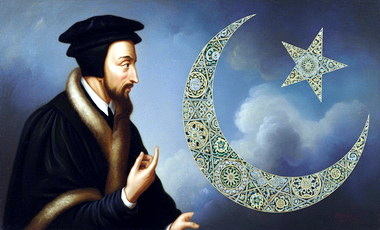
In my [I guess now, 4-month study of the Augustinian influenced [Gnostic] Calvinism, I kept coming back to the connections with Islam’s “god” as a close comparison to Calvin’s “god”.

So I have found a couple videos I liked on the matter that expanded this connection that came to my mind. Enjoy

(Video Description) Is God the author and the cause of sin? Does God ordain and decree evil and wickedness? Is infant damnation real? We will look at several of these claims from Calvinists and show their similarities to statements made from Mohammed and Islam. John Edwards, Augustus Toplady, James White, John Piper, Justin Peters, RC Sproul, Theodore Zachariades, Gordon Clark, Edwin Palmer, G3, Scott Aniol, Ephesians 1:11, Proverbs 16:4, God’s sovereignty, Satan’s influence, biblical responsibility, Westminster confessions, Council of Dort.

There are other videos out there as well, many make some good points — but I wouldn’t recommend them as a whole. Consistent Calvinist has a decent video however. But I liked this video as it sent me searching for PDFs and text type sources… which will follow. (BTW, I assume the voices in this video are A.I. voices):

(Video Description) John Calvin’s theology exhibits a significant alignment with Islamic doctrine. The analysis focuses on shared tenets such as the denial of free will, the doctrine of double predestination, and the assertion that God ordains sin. By comparing Calvin’s Institutes of the Christian Religion with the Quran and the writings of Islamic scholars, both theological systems emphasise God’s absolute sovereignty to the extent that it overrides human agency and traditional notions of divine justice. This Islamic basis undermines core biblical teachings regarding God’s nature and human responsibility.

A recommended read is what follows:

Islam and Calvinism: An Uncomfortable Comparison

Determinism

The sovereignty of Allah in Islam and God in Calvinism is absolutely deterministic. They are the author of every action, word, and thought, including sin and evil. Moreover, they predetermined before time everything that shall occur in time including who will be given the gift of faith and eternal life, and who will not and be condemned to eternal death.

Calvinist church historian Phillip Schaff writes:

Calvinismstarts with a double decree of predestination, which antedates and is the divine program of human history. This program includes the successive stages of the creation of man, a universal fall and condemnation of the human race, a partial redemption and salvation: all for the glory of God and the display of His attributes of mercy and justice. History is only the execution of the original design(History of the Christian Church 8.4.114).

Note that Schaff does not shy away from affirming that God Himself decreed the fall of man, and is therefore the author of sin!

The same view was affirmed by Calvin:

By predestination we mean the eternal decree of God, by which he determined with himself whatever he wished to happen with regard to every man. All are not created on equal terms, but some are preordained to eternal life, others to eternal damnation; and, accordingly, as each has been created for one or other of those ends, we say that he has been predestined to life or death (Institutes, 3.21.5).

Islam teaches the same doctrine as Calvinism. According to Islam, Allah is absolutely deterministic. As Caner and Caner write:

One of the foundational doctrines of Islam is the absolute sovereignty, to the point of determinism, of Allah. Allah knows everything, determines everything, decrees everything, and orders everything. Allah is even the cause of evil (Unveiling Islam, p. 109).

It follows that Allah predestines all who will be saved and all who will be eternally damned. Of those who cannot be saved, Surah 2:6-7 states:

It is the same to them whether you warn them or do not warn them; they will not believe. Allah has set a seal on their hearts and on their hearing. And on their eyes is a veil; Great is the chastisement they [incur].

Fatalism

It follows that Calvinism and Islam are both inherently fatalistic. In Calvinism, the sovereign God elects those who will be saved and rejects all others, as seen repeatedly in Calvin’s writings:

some are preordained to eternal life, others to eternal damnation; and, accordingly, as each has been created for one or other of those ends, we say that he has been predestined to life or death (Institutes, 3.21.5).

[God] arranges all things by his sovereign counsel, in such a way that individuals are born, who are doomed from the womb to certain death(Institutes, 3.23.6).

In the same way, Allah leads astray whom he wills, and saves whom he wills (Surah 14:4):

Allah is exalted and pleased as he sends people to hell: this is the fatalistic claim of Islam. Fatalism is a belief that events are fixed in advance for all time in such a manner that human beings are powerless to change them. In this case, Allah will send to heaven whomever he pleases, and send to hell whomever he pleases (Unveiling Islampp. 31-32).

An old joke tells of a Calvinist who fell down the stairs, got up, and said, “Thank God that’s over!” Interestingly, Caner and Caner recount from their Islamic childhood:

Our father used to say, “If you fall and break your leg, say, ‘Allah wills it,’ because he caused it to happen” (Unveiling Islam, p. 109).

The Love of God

Perhaps the most fundamental of all aspects of God’s character is love. “He who does not love does not know God, for God is love” (1 John 4:8). “For God so loved the world” (John 3:16) “God demonstrates His own love toward us” (Rom 5:8). These are just a few of the numerous Biblical texts which affirm the universal, sacrificial, eternal, personal, and unconditional love of God for all mankind. No character of God is more central to the message of the gospel. The incarnation and substitutionary atonement shout it. Everything in God’s saving action toward mankind declares it. But what do we see in Islam and Calvinism?

Love De-Emphasized

In Islam, Allah is virtually devoid of love. Caner and Caner list 99 names of Allah, and only one includes a reference to love (and this only to those who are “his own”). They write:

When Allah is discussed within the Islamic community, the absence of intimacy, atonement, and omnibenevolence becomes apparent. In all the terms and titles of Allah, one does not encounter terms of intimacy. . . Even the most faithful and devout Muslim refers to Allah only as servant to master; Allah is a distant sovereign (Unveiling Islam, p. 117).

But what do we find in Calvinism? God’s sovereignty—His power and holiness—are emphasized at the expense of His love. Dave Hunt observes:

But where is God’s love? Not once in the nearly thirteen hundred pages of his Institutes does Calvin extol God’s love for mankind. This one-sided emphasis reveals Calvinism’s primary defect: the unbiblical limitations it places upon God’s most glorious attribute. . . Something is radically amiss at the very foundation of this unbiblical doctrine (Debating Calvinism, p. 47).

Limited Love

As we look closer, we find reasons for this muting of God’s love in Islam and Calvinism. For example, Calvin’s God and Islam’s Allah are both bereft of unconditional love for everyone.

Allah’s heart is set against the infidel (kafir). He has no love for the unbeliever, nor is it the task of the Muslim to “evangelize” the unbelieving world (Unveiling Islam, p. 118).

Caner and Caner note, “This is why so many Muslims quickly disown children who have converted to another religion, especially Christianity. Why love them when almighty Allah will never love them?” (Unveiling Islam, p. 33).

But is this any different than Calvinism? Dave Hunt puts it bluntly:

Never forget that the ultimate aim of Calvinism…is to prove that God does not love everyone, is not merciful to all, and is pleased to damn billions. If that is the God of the Bible, Calvinism is true. If that is not the God of the Bible, who “is love” (1 John 4:8), Calvinism is false. The central issue is God’s love and character in relation to mankind, as presented in Scripture (Debating Calvinism, p. 21).

Conditional Love

While Calvinists (but not Muslims) would object to the idea their God has a conditional love, that is the effect of their doctrine.

This doctrine is openly announced in Islam: “Allah loves not transgressors” (Qur’an 2:190). “For [Allah] loves not any ungrateful sinner” (Qur’an 2:276). “For Allah loves not those who do wrong” (Qur’an 3:57). “For Allah loves not the arrogant, the vainglorious” (Qur’an 4:36).

Within Calvinism, God’s love is declared to be unconditional because He has given it “unconditionally”—i.e., not in response to anything we do. But whether or not one is actually loved in this “salvific” way is ultimately determined by what we do. This fact is enshrined by the last of the Five Points of Calvinism, i.e., the Perseverance of the Saints. Since all who are saved will inevitably persevere in living a faithful life, God’s saving love, in the end, is determined by our works.

Notably, as is always the result with synergism (i.e., salvation by faith and works), no amount of good works can give you assurance of salvation.

Insecure Love

It is impossible in Calvinism and Islam to know that you are loved by God. While Calvinists proclaim their belief in eternal security, what they mean is if you are really saved (which you cannot know with absolute certainty until you die), then you will never lose your salvation. But how can you know that? Based on your works. However, the threat of falling into some sin, and thus finding out that you were never really saved in the first place, is a possibility hanging over the head of every Calvinist.

Similarly, and blatantly, Islam teaches this same doctrine:

The Qur’an hints that the believer in Allah can be confident of his or her eternal destiny, but there is no guarantee, even for the most righteous. . . In Islam, the answer to the question, “What must I do to go to heaven?” is “mysterious and complex. . . Islamic tradition argues that the guarantee ofheaven is as impossible to find as a chaste virgin and pure speech. Consequently, the devoutMuslim makes every effort to please Allah and thereby obtain heaven. But fate (kismet) in the hands of the all-powerful Allah will decide the outcome (Unveiling Islam, p. 144).

Clearly, the love of God is at best compromised in both Islam and Calvinism.

READ IT ALL


This next piece is a clip from a Facebook Post… Here is the title of this post

“Calvinism Is Just Islam Repackaged”

Comparing the Calvinist God and the God of Islam

At first glance, Calvinism and Islam may seem vastly different due to their theological and cultural contexts. However, when examining the portrayal of God in Calvinist theology and Islamic theology, striking similarities emerge. Both traditions emphasize God’s absolute sovereignty, but in ways that challenge concepts of divine love, justice, and human freedom as revealed in the Bible. Here is a comparison of the Calvinist God and the God of Islam:

  1. Absolute Sovereignty and Determinism

Calvinist God:

  • Calvinism teaches that God’s sovereignty means He unconditionally decrees all events, including human actions, sin, and salvation. This leads to the doctrine of double predestination, where some are chosen for salvation and others are predestined for damnation, entirely apart from human free will.

Islamic God (Allah):

  • In Islam, Allah’s sovereignty is also absolute and deterministic. The Quran states that Allah guides whom He wills and leads astray whom He wills (Surah 14:4, Surah 16:93). Human actions, both good and evil, are believed to occur because Allah has willed them.

Comparison:

Both the Calvinist God and Allah are depicted as sovereign in ways that minimize or negate genuine human free will. This deterministic framework portrays God as the ultimate cause of sin and unbelief, raising serious questions about divine justice and human accountability.

  1. Justice and Predestination

Calvinist God:

  • According to Calvinism, God’s justice allows Him to predestine some to eternal damnation without any consideration of their actions or choices. This is often defended as a “mystery” of God’s will, though it conflicts with the notion of a just and impartial God.

Islamic God (Allah):

  • In Islam, Allah is described as just but is not bound by human notions of justice. Allah may forgive or punish as He pleases, and there is no guarantee of salvation even for the most devout believer. Salvation depends entirely on Allah’s arbitrary will.

Comparison:

In both systems, God’s justice is portrayed as inscrutable or arbitrary, leading to a sense of fear and uncertainty. The Calvinist doctrine of reprobation and the Islamic belief in Allah’s arbitrary judgment both suggest a God whose actions are beyond moral comprehension.

  1. Love and Mercy

Calvinist God:

  • Calvinism teaches that God’s love is limited to the elect. Christ’s atonement is “limited” and applies only to those predestined for salvation. The reprobate, by contrast, are excluded from God’s saving love and are created solely to demonstrate His wrath.

Islamic God (Allah):

  • In Islam, Allah is described as merciful (Ar-Rahman, Ar-Rahim), but His mercy is conditional. Allah does not love sinners or unbelievers (Surah 3:31-32). His mercy is reserved for those who obey Him and follow His commands.

Comparison:

Both the Calvinist God and Allah show love and mercy only to a select group—either the elect in Calvinism or the obedient in Islam. This stands in stark contrast to the biblical God, who loves all people and desires the salvation of everyone (1 Timothy 2:4, John 3:16).

  1. Human Freedom and Responsibility

Calvinist God:

  • Human free will is effectively denied in Calvinism. People are bound by their sinful nature and cannot choose God unless they are regenerated first. Even their “choices” are ultimately determined by God’s eternal decree.

Islamic God (Allah):

  • In Islam, humans have limited free will, but their actions are ultimately determined by Allah’s will. The Quran repeatedly emphasizes that Allah guides or leads astray whomever He wills (Surah 6:125).

Comparison:

In both systems, human freedom is subordinated to divine sovereignty, resulting in a deterministic worldview. This undermines the biblical teaching that humans are created in the image of God with the capacity to freely love and respond to Him (Genesis 1:27, Deuteronomy 30:19).

[….]

Conclusion: The Biblical God Is Distinct

While the Calvinist God and the God of Islam share similarities in their emphasis on sovereignty and determinism, they both fall short of the biblical portrayal of God. The God of the Bible is sovereign, but His sovereignty is expressed through love, justice, and respect for human freedom. He desires the salvation of all, offers grace universally, and seeks a personal relationship with every human being.

The biblical God is not arbitrary or partial but perfectly just, merciful, and relational. His love is unconditional, and His gospel is genuinely good news for all people. This is the God revealed in Jesus Christ, who came to save the world, not just a select few (John 3:17).

Just an additional thought on Calvinism by this wonderful sermon that includes an excellent analogous story showing how absurd Calvinistic Reformed thinking is.

The Absurdity of Reformed Theology

Nov. 6, 2022, Adult Sunday School at Truth Baptist Church. 2 Peter 3:9 “The Lord is not slack concerning his promise, as some men count slackness; but is longsuffering to us-ward, not willing that any should perish, but that all should come to repentance.”

“For He says to Moses” | Biblical Mercy

For He says to Moses, “I will have mercy on whomever I will have mercy, and I will have compassion on whomever I will have compassion.”

Dr. Leighton Flowers confronts Dr. James White’s faulty critique of Dr. William Lane Craig (and other non-Calvinists).

This is a condensed critique. To see the longer video going through each of Dr. White’s points go here: • What about those who never hear about Jesus?

Often we hear the objection that God is not obligated to have mercy on anyone. That’s true. However, the fact that God is not obligated to be merciful towards all people is what makes the display of His mercy to all people so amazingly gracious and abundantly glorious. That God does what He is not obligated to do for no other reason than He desires to be merciful to all is glorious.

Anyone suggesting this display of mercy isn’t genuine (or that’s it’s just an outward/external “prescriptive” will of God, but that His real secret desire is only to show mercy to a preselected few) is diminishing the abundance of His mercy and the glory of His grace extended to every person.

Also, I think sometimes there is an assumption that mercy is weakness. But that could not be further from the truth. Mercy can only be handed down by someone in a place of judgement over another. If it is not within my power to pass condemnation on someone, then it is also not within my power to have mercy on them. Mercy is an expression of power, not of weakness.

“The Lord is gracious and compassionate, slow to anger and rich in love. The Lord is good to all; he has compassion on all he has made.” -Ps 145:8-9

“For God has bound everyone over to disobedience so that he may have mercy on them all.” -Rom 11:32

Some more from SOTO 101:

V.  WHY GOD IS JUST IN SHOWING MERCY TO UNFAITHFUL ISRAELITES TO ACCOMPLISH HIS PROMISE IN BRINGING THE WORD (14-16)

  • Does God’s choosing to bless one descendant over another descendant make God unrighteous? What shall we say then? Is there unrighteousness with God? Certainly not!

The descendants of Abraham in Paul’s day had two false perceptions:

Every descendant deserves the benefit of bringing God’s Word. However, the truth is that God has only selected a remnant through whom to bring His Word.

Every descendant deserves eternal life on the basis of their being of Israel. However, no one is saved based on nationality but only upon grace through faith. Those nations, and the individuals therein, who oppose God’s Word remain under the curse (hatred), as illustrated by Edom (direct descendants of Isaac himself).

There is no unrighteousness with God for choosing some descendants for a noble cause and not others, nor is it unjust to condemn a descendant of Abraham who stands in opposition to the Word of God.

  • For He says to Moses, “I will have mercy on whomever I will have mercy, and I will have compassion on whomever I will have compassion.”

Paul’s reference to Moses’ encounter with God in Exodus 32-33 gives a perfect historical example of when God was merciful to Israel when they deserved to be destroyed for their unfaithfulness (worshipping a golden calf).

This example also parallels Moses’ self-sacrificial Christ-like love for Israel as reflected by Paul in the opening verses of this chapter… “forgive their sin—and if not blot me out…” (Ex. 32:31-32).

Certainly God may choose to save whosoever He is pleased to save (scripture teaches He chooses to save those who humble themselves and repent in faith – 1 Pt. 5:5-6), but this passage is in reference to God showing mercy to unfaithful Israel so as to fulfill His original promise through them even though they deserve condemnation.

  • So then it is not of him who wills, nor of him who runs, but of God who shows mercy.

“It” refers to the fulfillment of God’s promise to bring His Word despite Israel’s unfaithfulness (Rom. 3:3-4).

The promise depends on our merciful God, not on the faithfulness (“willing and running”) of Abraham or his descendants.

Abraham “willed and ran” in the flesh to produce a son through Hagar (who Paul used symbolically to represent the covenant of law and works, Gal. 4:24).

God, by his mercy, provided Isaac through the free woman, Sarah (who Paul used symbolically to represent the covenant of grace by faith in the call of God, Gal. 4:21-26).

VI.  WHY GOD IS JUST TO HARDEN UNFAITHFUL ISRAELITES TO ACCOMPLISH HIS PROMISE IN BRINGING THE WORD (17-18)

  • For the Scripture says to Pharaoh, “For this very purpose I have raised you up, that I may show My power in you, and that My name may be declared in all the earth.”

In the same way God hardened the already rebellious will of Pharaoh in order to accomplish the first Passover, so too God hardened the already rebellious wills of Israelites to accomplish the real Passover.

God’s power and goodness was displayed in mercy-ing unfaithful Israelites in the day of Moses and in hardening the unfaithful Israelites in the day of the Messiah.

  • Therefore He has mercy on whom He wills, and whom He wills He hardens.

Sometimes God will fulfill His promises by showing Israelites mercy, but His Word will never fail.

Sometimes God will fulfill His promises by hardening Israelites, but His Word will never fail.

Note: Those judicially hardened or cut off are not born in this condition, but have “grown hardened” over years of rebellion (Acts 28:27), they are cut off for unbelief (11:20) and the hope of the apostle is that they may be grafted back in and saved (11:11-32).

VII.  IF THE ISRAELITES’ UNRIGHTEOUSNESS ACCOMPLISHES GOD’S PROMISE TO BRING HIS WORD, WHY ARE THEY TO BLAME? (19-21)

  • “You will say to me then, “Why does He still find fault? For who has resisted His will? But indeed, O man, who are you to reply against God?”

You (an Israelite hardened to accomplish God’s promise) will say to me (an Israelite shown mercy to accomplish God’s promise), why are we to blame if God’s will is being fulfilled?

As the apostle already indicated in 3:5, this is a man-made argument that reveals a heart that has become calloused in its rebellion, otherwise they might see, hear, understand and repent (Acts 17:30; 28:27).

  • “Will the thing formed say to him who formed it, “Why have you made me like this?” Does not the potter have power over the clay, from the same lump to make one vessel for honor and another for dishonor?”

The lump of hardened clay represents Israel who is had grown calloused in rebellion (Acts 28:27) and who are now being remolded into two kinds of vessels:

Those unfaithful Israelites remolded, by means of signs from the incarnate Messiah Himself, to bring the Word.

Those unfaithful Israelites remolded, by means of judicially hardening, to accomplish the ignoble purpose of bringing redemption on the cross and the grafting in of the Gentiles (yet they still may be saved, Rom. 11:11-32).

Romans 9 explained. This video is very relevant in today’s world as we see believers departing from the faith while only the chosen ones will be able to stand by God and God will also provide and have mercey on them. God is able to raise leaders and kings so His Name is exalted among the nations. just like He did with the Pharaoh.

Romans 9:21-23 says, “Has the potter no right over the clay, to make out of the same lump one vessel for honorable use and another for dishonorable use? What if God, desiring to show his wrath and to make known his power, has endured with much patience vessels of wrath prepared for destruction, in order to make known the riches of his glory for vessels of mercy, which he has prepared beforehand for glory…”

RC Sproul, a notable Calvinist, interprets this to mean that God creates some people for salvation and the rest for damnation, but is that what the Apostle Paul really had in mind? Let’s explore!

~ R.C. SPROUL PLAYLIST ~


Is God the “devil” Behind Satan? | Sovereign Puppeteer (Updated)

I sent a friend the video of Dr. Theodore Zachariades stating that God wills [causes, not just permits] a man to be unfaithful to his wife.

  • God works all things after the Council of His will. Even keeping those kings who want to commit adultery from committing so! And when He wants to, he orders those to commit adultery when he wants to! (Video)

My friend dismissed this person as a hyper-Calvinist. But as the video below notes, using his definition of a “hyper Calvinist,” A.W. Pink, John Piper, Jeff Durbin, James White, and many-many more, would thus be considered the same. Because of the age restriction, the video must be watch on YouTube, link in pic.

When I asked him: “Question RW, is Piper, Calvin, White and Durbin hyper-Calvinists?” He simply replied “Fishing Bait.” But this is an interesting phenomena… and after decades of encountering Mormons and J-Dubs, the disconnect is the same. I get links and not actualizing on statements made when challenged. When shown a person who follows to the end the logical conclusion of theistic determinism found in Calvinism, the person who is the Calvinist is dismissed as a “hyper-Calvinist” by their fellow Calvinist’s if they are challenged. When that label is then applied rightly to others for the same reason — meaning, using RW’s definition of what a hyper-Calvinist is — then all these others have said worse; and would be by definition, hyper-Calvinists.

Two quick examples. 1st John Calvin, then, John Piper:

John CALVIN:

how foolish and frail is the support of divine justice afforded by the suggestion that evils come to be, not by His will but by His permission. . . . It is a quite frivolous refuge to say that God otiosely permits them, when Scripture shows Him not only willing, but the author of them. . . . Who does not tremble at these judgments with which God works in the hearts of even the wicked whatever He will, rewarding them nonetheless according to desert? Again it is quite clear from the evidence of Scripture that God works in the hearts of men to incline their wills just as he will, whether to good for His mercy’s sake, or to evil according to their merits.

John Calvin, “The Eternal Predestination of God,” 10:11

John Piper:

Ephesians 1:11 goes even further by declaring that God in Christ

“works all things according to the counsel of his will.” Here the Greek word for “works” is energeø, which indicates that God not merely carries all of the universe’s objects and events to their appointed ends but that he actually brings about all things in accordance with his will. In other words, it isn’t just that God manages to turn the evil aspects of our world to good for those who love him; it is rather that he himself brings about these evil aspects for his glory (see Ex. 9:13-16; John 9:3) and his people’s good (see Heb. 12:3-11; James 1:2-4). This includes—as incredible and as unacceptable as it may currently seem—God’s having even brought about the Nazis’ brutality at Birkenau and Auschwitz as well as the terrible killings of Dennis Rader and even the sexual abuse of a young child: “The LORD has made everything for its own purpose, even the wicked for the day of evil” (Prov. 16:4, NASB ).14 “When times are good, be happy; but when times are bad, consider: God has made the one as well as the other” (Eccl. 7:14, NIV).

John Piper and Justin Taylor, eds., Suffering and the Sovereignty of God (Wheaton, IL: Crossway Books, 2006), 42. (FULLER QUOTE VIA THIS PDF)

John Lennox notes in his wonderful book,  Determined to Believe? The Sovereignty of God, Freedom, Faith, and Human Responsibility,” that Martin Luther struggled with the consequences of this form of thought:

Martin Luther at the time of the Reformation. In his book The Bondage of the Will, written in response to Erasmus’ essay On Free Will, Luther said:

[The] omnipotence and foreknowledge of God, I repeat, utterly destroy the doctrine of “free-will” Doubtless it gives the greatest possible offence to common sense or natural reason, that God, Who is proclaimed as being full of mercy and goodness, and so on, should of His own mere will abandon, harden and damn men, as though He delighted in the sins and great eternal torments of such poor wretches. It seems an iniquitous, cruel, intolerable thought to think of God; and it is this that has been such a stumbling block to so many great men down through the ages. And who would not stumble at it? I have stumbled at it myself more than once, down to the deepest pit of despair, so that I wished I had never been made a man. (That was before I knew how health-giving that despair was, and how close to grace.)

In this passage Luther seems to be aware that there is a deep moral problem with aspects of his view [RPT: before redefining “grace” that is – almost like what is, is.]

Calvinism’s [T.U.L.I.P.] Logical Conclusion Displayed

In a reference in that above book is this paper:I Believe In Divine Sovereignty,” by Thomas H. McCall in Trinity Journal (TRINJ 29:2 [Fall 2008]), 209-210. Of which I excerpt:

He [John Piper] works long and hard to illustrate this [theistic determinism] from Rom 9:1-23, which he concludes is about the purposes of God being preserved “by means of the predestination of individuals to their respective eternal destines.”11 And we are not to think that God is righteous in spite of such action—instead we are to see that God is righteous because of this action, for the “heart of Paul’s defense” is this: “in choosing unconditionally those on whom he will have mercy and those whom he will harden God is not unrighteous, for in this ‘electing purpose’ he is acting out of a full allegiance to his name and esteem of his glory.12

This all-determining action of God notably includes predestination and election, but it extends far beyond—it extends to everything. God determines all events that occur in the universe, including all demonic and satanic action.13 As Mark R. Talbot puts it, God creates, sends, instigates, and moves others to do evil, because “nothing that exists or occurs falls outside God’s ordaining will.”14 Talbot makes the point with relentless and unmistakable clarity:

Nothing, including no evil person or thing or event or deed. God’s foreordination is the ultimate reason why everything comes about, including the existence of all evil persons and things and the occurrence of any evil acts or events.15

Make no mistake: “when even the worst of evils befall us, they do not ultimately come from anywhere other than God’s hand.”16

NOTES:

11. John Piper, The Justification of God: An Exegetical and Theological Study of Romans 9:1-23 (Grand Rapids: Baker, 1993), 218, cf. 56-73.

12. Ibid., 219.

13. On this see John Piper, “Suffering and the Sovereignty of God: Ten Aspects of God’s Sovereignty Over Satan and Satan’s Hand in It,” in Suffering and the Sovereignty of God, 19-30. Piper here uses the rather confusing (given his determinism) language of “permission.” By my lights, what he means when he says that God “permits” something is this (a) God determines it to occur and then (b) does not act so as to override his previous ordination. Regarding talk of “permission,” I think that John Calvin’s approach is more consistent, [….]  see John Calvin, Institutes of the Christian Religion I.xviii.1, and John S. Feinberg, No One Like Him: The Doctrine of God (Wheaton: Crossway, 2001), 696.

14. Mark R. Talbot, “‘All the Good That Is Ours in Christ: Seeing God’s Gracious Hand in the Hurts Others Do to Us,” in Suffering and the Sovereignty of God, 43 (41-43), emphasis original.

15. Ibid., 43-44.

16. lbid., 47.

Dave Hunt is right to say that Calvin uses unbiblical positions in dealing with this Augustinian determinism:

There is yet another question that troubles many: If man is free to choose between options, would that not in itself deny both God’s sovereignty and His foreknowledge? Luther claimed that this question was the very heart of the Reformation and of the gospel itself. In fact, Luther dogmatically insisted that it was impossible for God to foreknow the future and for man at the same time to be a free agent to act as he wills.

Believing firmly in God’s foreknowledge, Luther wrote an entire book titled The Bondage of the Will, to prove that the very idea of man’s free will is a fallacy and an illusion. Several reasons have already been given as to why Luther was wrong on this point, and that issue will be dealt with further in the next chapter.

Though Calvin took so much from Augustine, like Luther he also rejected the Augustinian belief that God could foreknow the future, while at the same time man could have a free will. According to Calvin, foreknowledge leaves no room whatsoever for free will, because foreknowledge is the same as predestination:

If God merely foresaw human events, and did not also arrange and dispose of them at his pleasure, there might be room for agitating the question [of free will] but since he foresees the things which are to happen, simply because he has decreed them, they are so to happen, it is vain to debate about prescience. …

If this frigid fiction [of free will] is received, where will be the omnipotence of God, by which, according to his secret counsel on which everything depends, he rules over all? (Calvin, Institutes, III: xxiii, 6–7.)

Calvin repeatedly uses such unbiblical and utterly fallacious reasoning.

The Calvinist assumes a contradiction between sovereignty and free will that doesn’t exist. The fact that God is able to allow man freedom of choice, while still effecting His purposes unhindered, is all the more glorifying to His sovereign wisdom, power, and foreknowledge.

And one last point on this via MONERGISM.COM:

  • In order to understand this better theologians have come up with the term “compatibilism” to describe the concurrence of God’s sovereignty and man’s responsibility. Compatibilism is a form of determinism and it should be noted that this position is no less deterministic than hard determinism. — John Hendryx (John Hendryx is the creator and editor of Monergism.com | SEE: “We are not Determinists!” for more)

Here is A.W. Tozer’s take of the above:

  • Here is my view: God sovereignly decreed that man should be free to exercise moral choice, and man from the beginning has fulfilled that decree by making his choice between good and evil. When he chooses to do evil, he does not thereby countervail the sovereign will of God but fulfills it, inasmuch as the eternal decree decided not which choice the man should make but that he should be free to make it. If in His absolute freedom God has willed to give man limited freedom, who is there to stay His hand or say, What doest thou? Mans will is free because God is sovereign. A God less than sovereign could not bestow moral freedom upon His creatures. He would be afraid to do so.

Tozer is saying that the Calvinist God is too small. Something I run through with Mormon Elders if they decide to come into my home to discuss further their “mission.” In a similar vein, philosophical determinism (atheism/evolutionary paradigms). In what follows — quote’wise — if this is true fore secular forms of determinism, then so to it applies to THEISTIC DETERMINISM:

Atheists reject evidence as illusory…

Why?

Because they “have to.”

Donald C. Abel in his book, Fifty Readings in Philosophy, asks us to imagine for a moment that you walking along and come to a fork in the road. One street is called Divinity Avenue, the other Oxford Street. Assuming you have to walk down one of them, there is a confrontation of choice.  Continuing he says,

  • Now, I ask you seriously to suppose that this ambiguity of my choice is real; and then to make the impossible hypothesis that the choice is made twice over, and each time falls on a different street. In other words, imagine that I first walk through Divinity Avenue, and then imagine that the powers governing the universe annihilate ten minutes of time with all that it contained, and set me back at the door of this hall just as I was before the choice was made. Imagine then that, everything else being the same, I now make a different choice and traverse Oxford Street. You, as passive spectators, look on and see the two alternative universes; one of them with me walking through Divinity Avenue in it, the other with the same me walking through Oxford Street. Now, if you are determinists, you believe one of these universes eternally impossible, because of the intrinsic irrationality or accidentality somewhere involved in it. However, looking outwardly at these universes, can you say which is the impossible and accidental one, and which the rational and necessary one?

Donald C. Abel, Fifty Readings in Philosophy (New York, NY: McGraw-Hill, 1994), 296.

  • “He thus acknowledged the need for any theory to allow that humans have genuine freedom to recognize the truth. He (again, correctly) saw that if all thought, belief, feeling, and choice are determined (i.e., forced on humans by outside conditions) then so is the determinists’ acceptance of the theory of determinism forced on them by those same conditions. In that case they could never claim to know their theory is true since the theory making that claim would be self-referentially incoherent. In other words, the theory requires that no belief is ever a free judgment made on the basis of experience or reason, but is always a compulsion over which the believer has no control.”

Roy A. Clouser, The Myth of Religious Neutrality: An Essay on the Hidden Role of Religious Belief in Theories (Notre Dame, IN: Notre Dame University Press, 2005), 174.

The implications of strict naturalism are grim or even counterintuitive. For example, Bertrand Russell affirmed that any philosophy hoping to stand must ultimately take for granted the (naturalistic) picture of unguided causes and accidental collocations of atoms and must be built on the “firm foundation of unyielding despair.” When it comes to naturalism’s implications for morality, naturalist Kai Nielsen contends that reason can’t bring us to morality; this picture ”is not a pleasant one,” and that reflecting on it ”depresses me.” When it comes to consciousness, naturalist Daniel Dennett considers it an illusion- -something fellow-atheist Thomas Nagel finds utterly confused:

  • You may well ask how consciousness can be an illusion, since every illusion is itself a conscious experience …. So it cannot appear to me that I am conscious though I am not the reality of my own consciousness is the one thing I cannot be deluded about …. The view [of Dennett] is so unnatural that it is hard to convey …. Dennett asks us to turn our backs on what is glaringly obvious. … And he asks us to do this because the reality of such phenomena is incompatible with the scientific materialism that in his view sets the outer bounds of reality. He is, in Aristotle’s words, ”maintaining a thesis at all costs.”

Jaegwon Kim acknowledges the stark picture painted by the naturalistic brush. Naturalism is ”imperialistic; it demands ‘full coverage’ … and exacts a terribly high ontological price.”

Paul Copan and Charles Taliaferro (editors), The Naturalness of Belief: New Essays on Theism’s Rationality (New York, NY: Lexington Books, 2019), viii

I could go on, but you get the point. To fashion the issue for you to see, Jaegwon Kim could have said:

  • Theistic determinism is ”imperialistic; it demands ‘full coverage’ and exacts a terribly high ontological price.” (added for emphasis) 

What is this price? Here is just one example… God vs. God:

Here is a Facebook post I recently posted:

  • “What is there for God to harden, provoke, or restrain if not the autonomous will of creatures?”

If God knows the future because He planned the future [Sproul, Piper, MacArthur, etc.], when God hardens, provokes, or restraines…. is He working against Himself?

If the “T” of TULIP [total depravity] is a reality, wouldn’t hardening, provoking, or restraining someone be the same thing as digging up bodies in a cemetery and putting blindfolds on the rotting cadavers?

In other words, does He plan the abuse of a child just to redeem that act in some way to bring glory to Himself? Is Satan superfluous?

Are all the prescriptions in the Bible making God out to be duplicitous – since he has planned our actions thru determinitive means?

You could not argue that “evil” is really “evil.” Eastern philosophies run into the same problems as the atheist’s/evolutionist’s I just noted above. The Calvinist runs into the same issue. And it is a distortion of Christianity (T.U.L.I.P.):

(Eph 1:11) “works all things according to the counsel of his will.” Here the Greek word for “works” is 𝑒𝑛𝑒𝑟𝑔𝑒ø, which indicates that God not merely carries all of the universe’s objects and events to their appointed ends but that he actually 𝑏𝑟𝑖𝑛𝑔𝑠 𝑎𝑏𝑜𝑢𝑡 all things in accordance with his will. In other words, it isn’t just that God manages to turn the evil aspects of our world to good for those who love him; it is rather that he himself brings about these evil aspects for his glory (see Ex. 9:13-16; John 9:3) and his people’s good (see Heb. 12:3-11; James 1:2-4). This includes—as incredible and as unacceptable as it may currently seem—God’s having even brought about the Nazis’ brutality at Birkenau and Auschwitz as well as the terrible killings of Dennis Rader and even the sexual abuse of a young child: “The LORD has made everything for its own purpose, even the wicked for the day of evil” (Prov. 16:4, NASB ).14 “When times are good, be happy; but when times are bad, consider: God has made the one as well as the other” (Eccl. 7:14, NIV).

John Piper and Justin Taylor, eds., Suffering and the Sovereignty of God (Wheaton, IL: Crossway Books, 2006), 42.

Or…

Is it more like Tozer notes — which lowers man’s position by making him/her responsible to God’s law; and keeps God’s holiness and glory intact as He truly redeems or judges such actions (is He judging Himself in Calvinism? Working against His own will? Secretly?)

TOZER:

God sovereignly decreed that man should be free to exercise moral choice, and man from the beginning has fulfilled that decree by making his choice between good and evil. When he chooses to do evil, he does not thereby countervail the sovereign will of God but fulfills it, inasmuch as the eternal decree decided not which choice the man should make but that he should be free to make it. If in His absolute freedom God has willed to give man limited freedom, who is there to stay His hand or say, ‘What doest thou?’ Man’s will is free because God is sovereign. A God less than sovereign could not bestow moral freedom upon His creatures. He would be afraid to do so.

There is an analogy of two chess players. As you walk up on one professional chess player, he is sitting on one side of the bench, and at the end of his move he gets up walks to the other side, sits down, thinks a moment and makes his move. This process is repeated until the game is over and the chess player wins.

Guaranteed.

When you ask him why he is playing chess alone, he says to ensure his victory. Or as Piper notes in his book astonished by God: “…the reason God knows the future is because he plans the future and accomplishes it.”

You wouldn’t think too highly of his skills, would you? As you walk down the road a bit further, you come across another chess master. This time however, there is a line of players, world famous chess players, lined up as far as the eye could see. As you watched, the one chess player was handily beating every player that sat before him. Player after player.

With whom would you be more impressed with?

And it is this perceived contradiction that leads Calvinists to a polluting of God’s character, which A.W. Tozer tackles in his book, Knowledge of the Holy. Here is a excerpt…. I changed a couple words to read better:

While a complete explanation of the origin of sin eludes us, there are a few things we do know. In His sovereign wisdom God has permitted evil to exist in carefully restricted areas of His creation, a kind of fugitive outlaw whose activities are temporary and limited in scope. In doing this God has acted according to His infinite wisdom and goodness. More than that no one knows at present; and more than that no one needs to know. The name of God is sufficient guarantee of the perfection of His works.

Another real problem created by the doctrine of the divine sovereignty has to do with the will of man. If God rules His universe by His sovereign decrees, how is it possible for man to exercise free choice? And if he cannot exercise freedom of choice, how can he be held responsible for his conduct? Is he not a mere puppet whose actions are determined by a behind-the-scenes God who pulls the strings as it pleases Him?

The attempt to answer these questions has divided the Christian church neatly into two camps which have borne the names of two distinguished theologians, Jacobus Arminius and John Calvin. Most Christians are content to get into one camp or the other and deny either sovereignty to God or free will to man. It appears possible, however, to reconcile these two positions without doing violence to either, although the effort that follows may prove deficient to partisans of one camp or the other.

Here is my view: God sovereignly decreed that man should be free to exercise moral choice, and man from the beginning has fulfilled that decree by making his choice between good and evil. When he chooses to do evil, he does not thereby countervail the sovereign will of God but fulfills it, inasmuch as the eternal decree decided not which choice the man should make but that he should be free to make it. If in His absolute freedom God has willed to give man limited freedom, who is there to stay His hand or say, What doest thou? Mans will is free because God is sovereign. A God less than sovereign could not bestow moral freedom upon His creatures. He would be afraid to do so.

Perhaps a homely illustration might help us to understand. An ocean liner leaves New York bound for Liverpool. Its destination has been determined by proper authorities. Nothing can change it. This is at least a faint picture of sovereignty.

On board the liner are several scores of passengers. These are not in chains, neither are their activities determined for them by decree. They are completely free to move about as they will. They eat, sleep, play, lounge about on the deck, read, talk, altogether as they please; but all the while the great liner is carrying them steadily onward toward a predetermined port.

Both freedom and sovereignty are present here and they do not contradict each other. So it is, I believe, with mans freedom and the sovereignty of God. The mighty liner of Gods sovereign design keeps its steady course over the sea of history. God moves undisturbed and unhindered toward the fulfilment of those eternal purposes which He purposed in Christ Jesus before the world began. We do not know all that is included in those purposes, but enough has been disclosed to furnish us with a broad outline of things to come and to give us good hope and firm assurance of future well-being.

We know that God will fulfil every promise made to the prophets; we know that sinners will some day be cleansed out of the earth; we know that a ransomed company will enter into the joy of God and that the righteous will shine forth in the kingdom of their Father; we know that Gods perfections will yet receive universal acclamation, that all created intelligences will own Jesus Christ Lord to the glory of God the Father, that the present imperfect order will be done away, and a new heaven and a new earth be established forever.

Toward all this God is moving with infinite wisdom and perfect precision of action. No one can dissuade Him from His purposes; nothing turn Him aside from His plans. Since He is omniscient, there can be no unforeseen circumstances, no accidents. As He is sovereign, there can be no countermanded orders, no breakdown in authority; and as He is omninpotent, there can be no want of power to achieve His chosen ends. God is sufficient unto Himself for all these things.

In the meanwhile things are not as smooth as this quick outline might suggest. The mystery of iniquity doth already work. Within the broad field of Gods sovereign, permissive will the deadly conflict of good with evil continues with increasing fury. God will yet have His way in the whirlwind and the storm, but the storm and the whirlwind are here, and as responsible beings we must make our choice in the present moral situation.

Certain things have been decreed by the free determination of God, and one of these is the law of choice and consequences. God has decreed that all who willingly commit themselves to His Son Jesus Christ in the obedience of faith shall receive eternal life and become sons of God. He has also decreed that all who love darkness and continue in rebellion against the high authority of heaven shall remain in a state of spiritual alienation and suffer eternal death at last.

Reducing the whole matter to individual terms, we arrive at some vital and highly personal conclusions. In the moral conflict now raging around us whoever is on Gods side is on the winning side and cannot lose; whoever is on the other side is on the losing side and cannot win. Here there is no chance, no gamble. There is freedom to choose which side we shall be on but no freedom to negotiate the results of the choice once it is made. By the mercy of God we may repent a wrong choice and alter the consequences by making a new and right choice. Beyond that we cannot go.

The whole matter of moral choice centers around Jesus Christ. Christ stated it plainly: He that is not with me is against me, and No man cometh unto the Father, but by me. The gospel message embodies three distinct elements: an announcement, a command, and a call. It announces the good news of redemption accomplished in mercy; it commands all men everywhere to repent and it calls all men to surrender to the terms of grace by believing on Jesus Christ as Lord and Saviour.

We must all choose whether we will obey the gospel or turn away in unbelief and reject its authority. Our choice is our own, but the consequences of the choice have already been determined by the sovereign will of God, and from this there is no appeal.

Augustinian Determinism VS. The Early Church (Updated)

I updated this post with some more early church father “stuff.” Feel free to jump to the excerpt/graph and additional info. Jump to my other posts so far on the topic of Calvinism:

To go to all my posts on Calvinism and related issues, click the graphic to the right.

Enjoy the rest

Ken Wilson Rebuts James White

Description from the above video on SOTERIOLOGY 101’s YouTube:

Dr. Leighton Flowers welcomes back Dr. Ken Wilson to defend his Oxford Thesis from over 15 hours of mostly fallacious and unfounded attacks by Dr. James White of Alpha and Omega Ministries.

The Common Misconceptions in this Debate So Far:

  1. Wilson’s argument rests on Manicheanism and Augustinianism being the same worldview: This is untrue. It is not at all unreasonable to suggest that just one aspect of Manicheanism (i.e. its adherence to theistic determinism) might have influenced Augustine’s interpretation of the scripture.
  2. Wilson is saying Augustinianism is untrue because of its similarities with Manicheanism: This is inaccurate. It is possible for false worldviews to adhere to some aspects of truth, therefore proving that Calvinism has some link to Manicheanism doesn’t prove Calvinism is false. Wilson is saying Augustinianism is not rooted or founded in the early church writings therefore it most likely originated from other gnostic, neoplatonic and Manichean roots, which brings into question its validity as the correct interpretive grid.
  3. Wilson is arguing Augustinianism imports Manicheanism into Christianity because it uses similar words: This is also untrue. Just because Mani spoke of “the elect” and Calvinists also emphasize “the elect” does not mean they are necessarily linked, or even have the same definitions. Wilson is not attempting to argue that all aspects or jargon of the Manichean worldview are linked to the all aspects or jargon within the Calvinistic worldview. Wilson is only looking at the one common point of connection, namely deterministic philosophy, which was first introduced by Augustine, a former Manichean.
  4. James White’s criticism has accurately portrayed Wilson’s arguments and showed Wilson’s bias: This is demonstrably untrue as will be shown in this video and in many of the articles posted at www.soteriology101.com.
  5. If it can be proven that Wilson held to preconception of the ECFs and Augustine’s beliefs before doing his research, then his subsequent research is invalid: Again this is false. Even if it could be proven beyond all reasonable doubt that Wilson firmly believed the ECFs denied TULIP theology and that Augustine was the first to introduce it, this does not make his findings invalid. One would still need to demonstrate that Wilson’s bias lead to poor research.

Here are quotes from Reformed historians who validate the foundational claims of Wilson’s work:

Herman Bavinck:

  • In the early church, at a time when it had to contend with pagan fatalism and gnostic naturalism, its representatives focused exclusively on the moral nature, freedom, and responsibility of humans and could not do justice, therefore, to the teaching of Scripture concerning the counsel of God. Though humans had been more or less corrupted by sin, they remained free and were able to accept the proffered grace of God. The church’s teaching did not include a doctrine of absolute predestination and irresistible grace.

Loraine Boettner:

  • “It may occasion some surprise to discover that the doctrine of Predestination was not made a matter of special study until near the end of the fourth century….They of course taught that salvation was through Christ; yet they assumed that man had full power to accept or reject the gospel. Some of their writings contain passages in which the sovereignty of God is recognized; yet along side of those are others which teach the absolute freedom of the human will. Since they could not reconcile the two they would have denied the doctrine of PredestinationThey taught a kind of synergism in which there was a co-operation between grace and free  this cardinal truth of Christianity was first clearly seen by Augustine

Robert Peterson and Michael Williams of Covenant Theological Seminary:

  • “The Semi-Pelagians were convinced that Augustine’s monergistic emphasis upon salvation by grace alone represented a significant departure from the traditional teaching of the church. And a survey of the thought of the apostolic father’s shows that the argument is validIn comparison to Augustine’s monergistic doctrine of grace, the teachings of the apostolic fathers tended toward a synergistic view of redemption” (36).

Louis Berkhof [in The History of Christian Doctrines]:

  • “Their representations are naturally rather indefinite, imperfect, and incomplete, and sometimes even erroneous and self-contradictory. Says Kahnis: “It stands as an assured fact, a fact knowing no exceptions, and acknowledged by all well versed in the matter, that all of the pre-Augustinian Fathers taught that in the appropriation of salvation there is a co-working of freedom and grace.”

Berkhof goes on to admit that “they do not hold to an entire corruption of the human will, and consequently adhere to the synergistic theory of regeneration” (130).

In other words, despite White’s assertions to the contrary, there were no “monergists” before Augustine.

An additional — fuller quote of Loraine Boettner from above:

  • “It may occasion some surprise to discover that the doctrine of Predestination was not made a matter of special study until near the end of the fourth century. The earlier church fathers placed chief emphasis on good works such as faith, repentance, almsgiving, prayers, submission to baptism, etc., as the basis of salvation. They of course taught that salvation was through Christ; yet they assumed that man had full power to accept or reject the Gospel. Some of their writings contain passages in which the sovereignty of God is recognized; yet along side of those are others which teach the absolute freedom of the human will. Since they could not reconcile the two they would have denied the doctrine of Predestination and perhaps also that of God’s absolute Foreknowledge. They taught a kind of synergism in which there was a co-operation between grace and free will. It was hard for man to give up the idea that he could work out his own salvation. But at last, as a result of a long, slow process, he came to the great truth that salvation is a sovereign gift which has been bestowed irrespective of merit; that it was fixed in eternity; and that God is the author in all of its stages. This cardinal truth of Christianity was first clearly seen by Augustine, the great Spirit-filled theologian of the West. In his doctrines of sin and grace, he went far beyond the earlier theologians, taught an unconditional election of grace, and restricted the purposes of redemption to the definite circle of the elect.” — from Loraine Boettner’s “Calvinism in History”

Here is chapter two from Ken Wilson’s book, “The Foundation of Augustinian-Calvinism” (PDF as well)

Here is a good review of the book via the South African Theological Seminary.

See also my first post commenting on this issue.


Chapter 2

Early Christian Authors 95–400 CE


Early Christian authors unanimously taught relational divine eternal predetermination. God elected persons to salvation based upon foreknowledge of their faith (predestination). These Christians vigorously opposed the unilateral determinism of Stoic Providence, Gnosticism, and Manichaeism.[48] So early Christians taught predestination,[49] but refuted Divine Unilateral Predetermination of Individuals’ Eternal Destinies (unilateral determinism). This unilateral determinism can be identified in ancient Iranian religion, then chronologically in the Qumranites, Gnosticism, Neoplatonism, and Manichaeism. “Christian” heretics such as Basilides who taught God unilaterally bestowed the gift of faith to only some persons (and withheld that salvific gift to others) were condemned. Of the eighty-four pre-Augustinian authors studied from 95–430 CE, over fifty addressed this topic. All of these early Christian authors championed traditional free choice and relational predestination against pagan and heretical Divine Unilateral Predetermination of Individuals’ Eternal Destinies.[50]

This can only be understood and appreciated by reading comprehensively through the sizeable number of works by these authors. Some persons triumphantly cite ancient Christian authors claiming they believe Augustine’s deterministic interpretations of scripture, but without reading the entire context or without understanding the way in which words were being used.[51] I am not aware of any Patristics (early church fathers) scholar who would or could make a claim that even one Christian author prior to Augustine taught Divine Unilateral Predetermination of Individuals’ Eternal Destinies (DUPIED, i.e., non-relational determinism unrelated to foreknowledge of human choices).

I. Apostolic Fathers and Apologists 95–180 CE

Most of these works do not directly address God’s sovereignty or free will.[52] The Epistle of Barnabas (100–120 CE) admits the corruption of human nature (Barn.16.7) but only physical death (not spiritual) results from Adam’s fall. Personal sins cause a wicked heart (Barn.12.5). Divine foreknowledge of human choices allowed the Jews to make choices and remain within God’s plan, resulting in their own self-determination (Barn.3.6). God’s justice is connected with human responsibility (Barn.5.4). Therefore, God’s foreknowledge of human choices should affect God’s actions regarding salvation.

In The Epistle of Diognetus (120–170 CE) God does not compel anyone. Instead, God foreknows choices by which he correspondingly chooses his responses to humans. Meecham writes of Diogn.10.1–11.8, “Free-will is implied in his capacity to become ‘a new man’ (ii,I), and in God’s attitude of appeal rather than compulsion (vii, 4).”[53] Aristides (ca.125–170 CE) taught newborns enter the world without sin or guilt: only personal sin incurs punishment.[54]

II. Justin Martyr and Tatian

The first author to write more specifically on divine sovereignty and human free will is Justin Martyr (ca.155 CE). Erwin Goodenough explained:

Justin everywhere is positive in his assertion that the results of the struggle are fairly to be imputed to the blame of each individual. The Stoic determinism he indignantly rejects. Unless man is himself responsible for his ethical conduct, the entire ethical scheme of the universe collapses, and with it the very existence of God himself.[55]

Commenting on Dial.140.4 and 141.2, Barnard concurred, saying God “foreknows everything—not because events are necessary, nor because he has decreed that men shall act as they do or be what they are; but foreseeing all events he ordains reward or punishment accordingly.”[56] After considering 1 Apol.28 and 43, Chadwick also agreed. “Justin’s insistence on freedom and responsibility as God’s gift to man and his criticism of Stoic fatalism and of all moral relativism are so frequently repeated that it is safe to assume that here he saw a distinctively Christian emphasis requiring special stress.”[57] Similarly, Barnard wrote: “Justin, in spite of his failure to grasp the corporate nature of sin, was no Pelagian blindly believing in man’s innate power to elevate himself. All was due, he says, to the Incarnation of the Son of God.”[58]

Tatian (ca.165) taught that free choice for good was available to every person. “Since all men have free will, all men therefore have the potential to turn to God to achieve salvation.”[59] This remains true even though Adam’s fall enslaved humans to sin (Or.11.2). The fall is reversed through a personal choice to receive God’s gift in Christ (Or.15.4). Free choice was the basis of God’s rewards and punishments for both angels and humans (Or.7.1–2).

II. Theophilus, Athenagoras, and Melito

Theophilus (ca.180), all creation sinned in Adam and received the punishment of physical decay, not eternal death or total inability (Autol.2.17). Theophilus’ insistence upon a free choice response to God (Autol.2.27) occurs following his longer discussion of the primeval state in the Garden and subsequent fall of Adam. Christianity’s gracious God provides even fallen Adam with opportunity for repentance and confession (Autol.2.26). Theophilus exhorts Christians to overcome sin through their residual free choice (Autol.1.2, 1.7).

Athenagoras (ca.170 CE) believed infants were innocent and therefore could not be judged and used them as a proof for a bodily resurrection prior to judgment (De resurr.14). For God’s punishment to be just, free choice stands paramount. Why?—because God created both angels and persons with free choice for the purpose of assuming responsibility for their own actions (De resurr.24.4–5)[60] Humans and angels can live virtuously or viciously: “This, says Athenagoras, is a matter of free choice, a free will given the creature by the creator.”[61] Without free choice, the punishment or rewarding of both humans and angels would be unjust.

In Peri Pascha 326–388, Melito (ca.175 CE) possibly surpassed any extant Christian author in an extended description depicting the devastation of Adam’s fall.[62] The scholar Lynn Cohick explained: “The homilist leaves no doubt in the reader’s mind that humans have degenerated from a pristine state in the garden of Eden, where they were morally innocent, to a level of complete and utter perversion.”[63] Despite this profound depravity, all persons remain capable of believing in Christ through their own God-given free choice. No special grace is needed. A cause and effect relationship exists between human free choice and God’s response (P.P.739–744). “There is no suggestion that sinfulness is itself communicated to Adam’s progeny as in later Augustinian teaching.”[64]

B. Christian Authors 180–250 CE

I. Irenaeus of Lyons

Irenaeus of Lyons (ca.185) wrote primarily against Gnostic deterministic salvation in his famous work Adversus Haereses. “One position fundamental to Irenaeus is that man should come to moral good by the action of his own moral will, and not spontaneously and by nature.”[65] Physical death for the human race from Adam’s sin was not so much a punishment as God’s gracious gift to prevent humans from living eternally in a perpetual state of struggling with sin (Adv. haer.3.35.2).

Irenaeus championed humanity’s free will for four reasons: (1) to refute Gnostic Divine Unilateral Predetermination of Individuals’ Eternal Destinies, (2) because humanity’s persisting imago Dei (image of God within humans) demands a persisting free will, (3) scriptural commands demand free will for legitimacy, and (4) God’s justice becomes impugned without free will (genuine, not Stoic “non-free free will”). These were non-negotiable “apostolic doctrines.” Scholars Wingren and Donovan both identify Irenaeus’ conception of the imago Dei as freedom of choice itself. As Donovan relates: “This strong affirmation of human liberty is at the same time a clear rejection of the Gnostic notion of predetermined natures.”[66]

Andia clarified that God’s justice requires free choice since Irenaeus believed God’s providence created all persons equally.[67] In refuting Gnostic determinism (Divine Unilateral Predetermination of Individuals’ Eternal Destinies), Irenaeus argues that God determines persons’ eternal destinies through foreknowledge of the free choices of persons (Adv. haer.2.29.1; 4.37.2–5; 4.29.1–2; 3.12.2,5,11; 3.32.1; 4.14, 4.34.1, 4.61.2). Irenaeus attacked both Stoicism and Gnostic heresies because DUPIED made salvation by faith superfluous, and made Christ’s incarnation unnecessary.[68] Irenaeus taught God’s predestination. This was based on God’s foreknowledge of human choices without God constraining the human will as in Gnostic determinism.[69]

Irenaeus denied that any event could ever occur outside of God’s sovereignty (Adv. haer.2.5.4), but simultaneously emphasized residual human free choice to receive God’s gift, which only then results in regeneration. “The essential principle in the concept of freedom appears first in Christ’s status as the sovereign Lord, because for Irenaeus man’s freedom is, strangely enough, a direct expression of God’s omnipotence, so direct in fact, that a diminution of man’s freedom automatically involves a corresponding diminution of God’s omnipotence.”[70] Although he exalted God’s sovereignty, it was not (erroneously) defined as God receiving everything he desires.[71] The scholar Denis Minns correctly states, “Irenaeus would insist as vigorously as Augustine that nothing could be achieved without grace. But he would have been appalled at the thought that God would offer grace to some and withhold it from others.”[72]

II. Clement of Alexandria and Tertullian

Clement of Alexandria (ca.190) strongly defends a residual human free choice after Adam (Strom.1.1; cf. 4.24, 5.14). Divine foreknowledge determines divine election (Strom.1.18; 6.14). Clement understood that God calls all (lläv1ωv iοίvuv àvOρdrnωv)—every human, not a few of every kind of human —whereas, “the called” are those who respond. He believed that if God exercised Divine Unilateral Predetermination of Individuals’ Eternal Destinies (as the Marcionites and Gnostics believed), then he would not be the just and good Christian God but the heretical God of Marcion (Strom.5.1).

Clement refuted the followers of the Gnostic Marcion who believed initial faith was God’s gift. Why?—it robbed humans of free choice (Strom.2.3–4; cf. Strom.4.11, Quis dives Salvetur 10). Yet Clement does not believe free choice saves persons as a human work (cf. John 1:13). He teaches God must first draw and call every human to himself, since all have the greatest need for the power of divine grace (Strom.5.1). God does not initiate a mystical (i.e., Neoplatonic) inward draw to each of his elect. Instead, the Father previously revealed himself and drew every human through Old Testament scripture, but now reveals himself and draws all humanity equally to himself through Christ and the New Testament (cf. John 12:32; Strom.7.1–2).[73]

Tertullian (ca.205) wrote that despite a corrupted nature, humans possess a residual capacity to accept God’s gift based upon the good divine image (the “proper nature”) still resident within every human (De anima 22). Every person retains the capacity to believe. He refuted Gnosticism’s discriminatory deterministic salvation (Val.29). God remains sovereign while he permits good and evil, because he foreknows what will occur by human free choice (Cult. fem.2.10). Humans can and should respond to God by using their God-given innate imago Dei free choice. Therefore, Tertullian did not approve of an “innocent” infant being baptized before responding personally to God’s gift of grace through hearing and believing the gospel (De baptismo 18). He believed that children should await baptism until they are old enough to personally believe in Christ.

III. Origen of Alexandria

Origen (ca.185–254) advances scriptural arguments for free choice that fill the third book of De principiis (P. Arch.3.1.6). “This also is definite in the teaching of the Church, every rational soul is possessed of free-will and volition” that can choose the good (Princ., Pref.5). God does not coerce humans or directly influence individuals but instead only invites. Why?—because God desires willing lovers. Just as Paul asked Philemon to voluntarily (κατὰ Eκοuσιοv) act in goodness (Phlm. 1.14), so God desires uncoerced lovers (Hom. Jer.20.2). Origen explains how God hardens Pharaoh’s heart. God sends divine signs/events that Pharaoh rejects and hardens his own heart. God’s hardening is indirect. “Now these passages are sufficient of themselves to trouble the multitude, as if man were not possessed of free will, but as if it were God who saves and destroys whom he will” (Princ. 3.1.7). Origen distinguishes between God’s temporal blessings and eternal destinies in Romans 9–11, rejecting the Gnostic eternal salvation view from these chapters.

Initial faith is human faith, not a divine gift. “The apostles, once understanding that faith which is only human cannot be perfected unless that which comes from God should be added to it, they say to the Savior, ‘Increase our faith.'” (Com.Rom.4.5.3). God desires to give the inheritance of the promises not as something due from debt but through grace. Origen says that the inheritance from God is granted to those who believe, not as the debt of a wage but as a gift of [human] faith (Com.Rom.4.5.1).[74]

Election is based upon divine foreknowledge. “For the Creator makes vessels of honor and vessels of dishonor, not from the beginning according to His foreknowledge, since He does not pre-condemn or pre-justify according to it; but (He makes) those into vessels of honor who purged themselves, and those into vessels of dishonor who allowed themselves to remain unpurged” (P.Arch.3.1.21). Origen does not refute divine foreknowledge resulting in election but refutes the philosophical view of foreknowledge as necessarily causative, which Celsus taught:

Celsus imagines that an event, predicted through foreknowledge, comes to pass because it was predicted; but we do not grant this, maintaining that he who foretold it was not the cause of its happening, because he foretold it would happen; but the future event itself, which would have taken place though not predicted, afforded the occasion to him, who was endowed with foreknowledge, of foretelling its occurrence (C.Cels.2.20).

Origen explains the Christian interpretation of Rom 9:16.[75] The Gnostic and heretical deterministic interpretations render God’s words superfluous, and invalidate Paul’s chastisements and approbations to Christians. Nevertheless, the human desire/will is insufficient to accomplish salvation, so Christians must rely upon God’s grace (P. Arch.3.1.18). Origen does not minimize the innate human sin principle that incites persons to sin. Rather, he chastises immature Christians who blame their sins on the devil instead of their own passions (Princ.3.2.1–2; P. Arch.3.1.15).

IV. Cyprian and Novatian

Cyprian (d.254 CE) taught God stands sovereign (Treat.3.19; 5.56.8; 12.80). Yet, God rewards or punishes based upon his foreknowledge of human choices and responses (Treat.7.17, 19; Ep.59.2). Humans retain free choice despite Adam’s sin (Treat.7.17, 19).[76] “That the liberty of believing or of not believing is placed in freedom of choice” (Treat.12.52). Jesus utilized persuasion, not force (Treat.9.6). Obedience resulting in martyrdom should arise from free choice, not necessity (Treat. 7.18), especially since imitating Christ restores God’s likeness.

Novatian (ca.250 CE) teaches a personal responsibility for sin instead of guilt from Adam, because a person who is pre-determined due to (even fallen) nature cannot be held liable. Only a willful decision can incur guilt (De cib. Jud.3). Lactantius (ca.315 CE) taught Adam’s fall produced only physical death (not eternal death) through the loss of God’s perpetually gifted immortality (Inst.2.13), as Williams correctly identified.[77] Yet, mortality in a corrupted human body predisposed the human race to sin (Inst.6.13). God loves every person equally, offers immortality equally to each person, and every human is capable of responding to God’s offer—without divine intervention (Div.inst.5.15) “God, who is the guide of that way, denies immortality to no human being” but offers salvation equally to every person (Div.inst.6.3). Humanity must contend with its propensity to sin, but the corrupted nature provides no excuse since free choice persists (Inst.2.15; 4.24; 4.25; 5.1). He consistently teaches Christian free choice (Inst.5.10, 13, 14).

C. Christian Authors 250–400 CE

I. Hilary of Poitiers

Hilary (d.368 CE) referred to John 1:12–13 as God’s offer of salvation that is equally offered to everyone. “They who do receive Him by virtue of their faith advance to be sons of God, being born not of the embrace of the flesh nor of the conception of the blood nor of bodily desire, but of God […] the Divine gift is offered to all, it is no heredity inevitably imprinted but a prize awarded to willing choice” (Trin.1.10–11). Human nature has a propensity to evil (Trin.3.21; Hom. Psa.1.4) that is located in the physical body (Hom. Psa.1.13). Human free choice elicits the divine gift, yet the divine birth (through faith) belongs solely to God. A human ‘will’ cannot create the birth (Trin.12.56) yet that birth occurs through human faith.

II. The Cappadocians

Gregory of Nazianzus (ca.329–389 CE) writes frequently of the “fall of sin” from Adam (Or.1; 33.9; 40.7), including the evil consequence of that original sin (Or.45.12). “We were detained in bondage by the Evil One, sold under sin, and receiving pleasure in exchange for wickedness” (Or.45.22). Salvation (not faith) is God’s gift. “We call it the Gift, because it is given to us in return for nothing on our part” (Or.40.4). “This, indeed, was the will of Supreme Goodness, to make the good even our own, not only because it was sown in our nature, but because cultivated by our own choice, and by the motions of our free will to act in either direction.” (Or.2.17). “Our soul is self-determining and independent, choosing as it will with sovereignty over itself that which is pleasing to it” (Ref.Conf. Eun.139). Children are born blameless (Ep.206). God is sovereign, and Christ died for all humankind, including the ‘non-elect.’ (Or.45.26; cf. Or.38.14). Nevertheless, in matters of personal salvation, God limits himself, allowing humans free choice (Or.32.25, 45.8).

Basil of Caesarea (ca.330–379 CE) believed humans do not inherit sin or evil, but choose to sin resulting in death. We control our own actions, proved by God’s payment and punishment (Hom. Hex.2.4). He promotes God’s sovereignty over human temporal (not eternal) destinies, including our time of death by “God who ordains our lots” (Ep.269) yet he refutes micromanaging Stoic Providence (Ep.151). God empowers human faith for great works because mere human effort cannot accomplish divine good (Ep.260.9). Basil allowed no place for either Chaldean astrological fatalism (Hom. Hex.6.5; Ep.236), or Divine Unilateral Predetermination of Individuals’ Eternal Destinies. Righteous judgment resulting in reward and punishment demands Christian traditional free choice. In contrast, any concept of inevitable evil in humans necessarily destroys Christian hope (Hom. Hex.6.7) because all humans have an innate natural reason with the ability to do good and avoid evil (Hom. Hex.8.5; cf. Ep.260.7). Basil refuted a dozen heresies, but reserved his strongest denunciation for the one teaching determinism—”the detestable Manichaean heresy” (Hom. Hex.2.4).

Gregory of Nyssa (ca.335–395 CE) pervasively teaches a post-Adamic congenital weakness, inclined to evil and in slavery to sin but without guilt (C. Eun.1.1; 3.2–3; 3.8; De opificio hom.193; Cat. mag.6, 35; Ep.18; Ref. conf. Eun.; Dial. anim. et res., etc.). Each person’s alienation from God occurs through personal sin and vice, not Adam’s sin (C. Eun.3.10). Despite an inherited tendency to evil, the divine image within humans retains goodness, just as Tertullian and others had taught (Opif. hom.164; cf. Ep.3.17).[78] Humanity’s ruin and inability to achieve eternal life by self-effort demanded God initiate the rescue through Christ (Ref. conf. Eun.418–20). But Gregory refutes the idea of a human nature so corrupted that it would render an individual incapable of a genuine choice to receive God’s readily available gift of grace offered to everyone equally.

By appealing to the justice of God’s recompenses, Gregory refutes those [e.g., Manichaeans] who believe humans are born sinful and thus culpable (De anim.120). The choice for salvation belongs to humans, apart from God’s manipulation, coercion, or unilateral intervention (C. Eun.3.1.116–18; cf. Adv. Mac. spir. sancto 105–6; De virginitate 12.2–3). Gregory upholds Christian [not Stoic] divine sovereignty (Ref. conf. Eun. 169; cf. 126–27; Opif. hom.185).

III. Methodius, Theodore, and Ambrose

Methodius (d.312 CE) believed all humans retain genuine free will even after Adam’s fall since Christian free choice was necessary for God to be just in rewarding the good and punishing the wicked (Symp.8.16; P G 18:168d). He championed traditional Christian free choice in a major work against Gnostic determinism (Peri tou autexousiou, 73–77).[79] Cyril of Jerusalem (ca.348–386 CE) taught humans enter this world sinless (Cat.4.19) and God’s foreknowledge of human responses determines the divine choosing of them for service (Cat.1.3).

Theodore of Mopsuestia (ca.350–428 CE) defended traditional original sin against Manichaean damnable inherited guilt (Adv. def. orig. pecc.), so that, “Man’s freedom takes the first step, which is afterwards made effective by God … [with] the will of each man as being absolutely free and unbiased and able to choose either good or evil.”[80] Humans retain the ability to choose good and evil (Comm. Ioh.5.19).

Ambrose of Milan (d.397 CE) baptized Augustine in Milan on Easter in 387 CE. He taught traditional (not Augustinian) original sin (De fide 5.5, 8, 60; Exc. Satyri 2.6; cf. 1.4). Ambrose believed slavery to sin [the sin propensity] was inherited, but this was not literal sin that produced personal culpability and damnation (De Abrah.2.79). The scholar Paul Blowers noted, “Ambrosiaster (Rom.5:12ff) and Ambrose (Enar.in Ps.38.29) … both authors concluded that individuals were ultimately accountable only for their own sins.”[81]

Ambrose emphasized God predestined individuals based upon his foreknowledge of the future, concerning which God was omniscient (Ep.57; De fide 2.11, 97). God compels no one, but patiently waits for a human response in order that He may provide grace, preferring pity over punishment (Paen.1.5). He insisted upon residual free choice and views an increase in a person’s faith (not initial faith) as a divine gift given in response to faithfulness. (Paen.1.48; Ep.41.6).

D. Conclusion

Not even one early church father writing from 95–430 CE—despite abundant acknowledgement of inherited human depravity—considered Adam’s fall to have erased human free choice to independently respond to God’s gracious invitation.[82] God did not give initial faith as a gift. Humans could do nothing to save themselves—only God’s grace could save. Total inability to do God’s good works without God’s grace did not mean inability to believe in Christ and prepare for baptism. No Christian author embraced deterministic Divine Unilateral Predetermination of Individuals’ Eternal Destinies (DUPIED): all who considered it rejected DUPIED as an erroneous pagan Stoic or Neoplatonic philosophy, or a Gnostic or Manichaean heresy, unbefitting Christianity’s gracious relational God. God’s gift was salvation by divine grace through human faith (cf. Eph. 2:8), not a unilateral initial faith gift, as the Gnostics and Manichaean heretics were claiming. Early Christian literature could be distinguished from Gnostic and Manichaean literature by this essential element.

In a seemingly rare theological unanimity over hundreds of years and throughout the entire Mediterranean world, a Christian regula fidei (rule of faith) of free choice (advocated by Origen as the rule of faith) combated the Divine Unilateral Predetermination of Individuals’ Eternal Destinies espoused in Stoicism’s “non-free free will” and Gnosticism’s divine gift of infused initial faith into a “dead will.” The loving Christian God allowed humans to exercise their God-given free will.

Graph
Click To Enlarge

Footnotes
Abbreviations from Ken Wilsons Augustine Book (PDF)

[48] Sarah Stroumsa and Guy. G. Stroumsa, “Anti-Manichaean Polemics in Late Antiquity and under Early Islam,” HTR 81 (1988): 48.

[49] Wallace wrongly claims, “In spite of the numerous New Testament references to predestination, patristic writers, especially the Greek fathers, tended to ignore the theme before Augustine of Hippo. This was probably partly the result of the early church’s struggle with the fatalistic determinism of the Gnostics”; Dewey Wallace, Jr. “Free Will and Predestination: An Overview,” in Lindsay Jones, ed. The Encyclopedia of Religion. 2nd edn., vol.5. (Farmington Hills, MI: Macmillan Reference USA, 2005), 3203. He obviously had not read Irenaeus and other early authors. For a cogent refutation of this absurd claim, see in the same volume C.T. McIntire (2005), “Free Will and Predestination: Christian Concepts,” vol.5, 3207.

[50] Wilson, Augustine’s Conversion, Appendix III, 307–309.

[51] Wilson, Augustine’s Conversion, 41–94, and see other comments in the work revealing how this occurs.

[52] For The Shepherd of Hermas and other works not covered here see Wilson, Augustine’s Conversion, 41–50.

[53] Henry Meecham, The Epistle to Diognetus: The Greek Text (Manchester: Manchester University Press, 1949), 29–30.

[54] Harold Forshey, “The doctrine of the fall and original sin in the second century,” Restoration Quarterly 3 (1959): 1122, “But in this instance the doctrinal presupposition shows through clearly—a child comes into the world with a tabula rasa.

[55] Erwin Goodenough, The Theology of Justin Martyr (Jena: Verlag Frommannsche Buchhandlung, 1923), 219.

[56] Leslie Barnard, Justin Martyr: His Life and Thought (Cambridge: Cambridge University Press, 1967), 78.

[57] Henry Chadwick, “Justin Martyr’s Defence of Christianity,” Bulletin of the John Rylands Library 47.2 (1965): 284; cf., 291–292.

[58] Barnard (1967), 156.

[59] Emily Hunt, Christianity in the Second Century: The Case of Tatian (New York, NY: Routledge, 2003), 49.

[60] Bernard Pouderon, Athénagore d’Athênes, philosophie chrétien (Paris: Beauchesne, 1989), 177– 178. Pouderon highlighted this requisite for God’s law and justice: “La liberté humaine se tire de la notion de responsabilité: ‘L’homme est responsable (lllóöικοc) en tant qu’ensemble, de toutes ses actions’ (D.R.XVIII, 4).” “Human freedom results from the concept of responsibility: ‘Man is generally responsible (lllóöικοc) for all his actions.'” (my translation)

[61] David Rankin, Athenagoras: Philosopher and Theologian. Surrey: Ashgate, 2009), 180.

[62] Stuart Hall, Melito of Sardis: On Pascha and Fragments in Henry Chadwick, ed. Oxford Early Christian Texts (Oxford: Oxford University Press, 1978), xvi, where The Petition To Antonius “is now universally regarded as inauthentic.”

[63] Lynn Cohick, The Peri Pascha Attributed to Melito of Sardis: Setting, Purpose, and Sources (Providence, RI: Brown Judaic Studies, 2000), 115.

[64] Hall (1978), xlii.

[65] John Lawson, The Biblical Theology of Saint Irenaeus (London: The Epworth Press, 1948), 203.

[66] Gustaf Wingren, Man and the Incarnation, trans. by Ross Mackenzie (Lund: C.W.K. Gleerup, 1947; repr., London: Oliver and Boyd, 1959), 36; Mary Ann Donovan, “Alive to the Glory of God: A Key Insight in St. Irenaeus,” TS 49 (1988): 291 citing Adv. haer.4.37.

[67] Ysabel de Andia, Homo vivens: incorruptibilité et divinisation de l’homme selon Irénée de Lyons (Paris: Études Augustiniennes, 1986), 131.

[68] E.P. Meijering, “Irenaeus’ relation to philosophy in the light of his concept of free will,” in E.P. Meijering, ed. God Being History: Studies in Patristic Philosophy (Amsterdam: North Holland Publishing, 1975), 23.

[69] James Beaven, An Account of the Life and Times of S. Irenaeus (London: Gilbert and Rivington, 1841), 165–166; F. Montgomery Hitchcock, Irenaeus of Lugdunum: A Study of His Teaching (Cambridge: Cambridge University Press, 1914), 260; Wingren (1947; repr., 1959), 35–36.

[70] Wingren (1947; repr., 1959), 35–36.

[71] Explained later when discussing Augustine’s later specific sovereignty view.

[72] Denis Minns, Irenaeus (Washington, DC: Georgetown University Press, 1994), 136.

[73] Modern commentaries on this gospel rarely connect God’s drawing as being through scripture and Christ (John 6:44–45; 5.38–47; 8.19, 31, 47; 12.32). Cf. 1 Pet. 2.2.

[74] This serves as an excellent example of a passage removed from its context by which some persons erroneously attempt to prove an early church father taught faith was God’s gift.

[75] Rom. 9:16, “So it depends not upon man’s will or exertion, but upon God’s mercy.”

[76] For a refutation of Cyprian as teaching Augustine’s inherited guilt unto damnation see Wilson, Augustine’s Conversion, 77–82.

[77] Norman Williams, The Ideas of the Fall and Original Sin from the Bampton Lectures, Oxford University, 1924 (London: Longmans, Green and Co., 1927), 297.

[78] C. Eunomium 24 (on the soul’s ability to see Christ) is probably post-baptismal.

[79] Patrologia orientalis 22:797–801. Cf. Roberta Franchi, Metodio di Olimpo: Il libero arbitrio (Milano: Paoline, 2015).

[80] Henry Wace, A Dictionary of Christian Biography and Literature to the End of the Sixth Century A.D., with an Account of the Principal Sects and Heresies (London: Murray, 1911), “Theodore, III.B.f.” This suggests Macarius was incorrect when he assumed that this work by Theodore was anti-Augustinian. It is defending traditional freedom of choice versus eternal damnation by inherited sin from being born physically, a Manichaean doctrine. The quotation is from Reginald Moxon, The Doctrine of Sin (London: George Allen and Unwin, 1922), 40.

[81] Paul Blowers, “Original Sin,” in Everett Ferguson, ed. Encyclopedia of Early Christianity. 2nd edn. (New York, NY: Routledge, 1999), 839–840.

In discussion with a friend who seemed like he did not watch the below video, I noted:

Calvinistic historian, Loraine Boettner, concedes that the concept of individual effectual election to salvation “was first clearly seen by Augustine” in the fifth century. John Calvin admits that his theology was first clearly seen in Augustine. Many reformers stood against many of these ideas… the scholar/Greek reader of the bunch, Phillipe Melanchthon, as well. Others were killed, like my homeboy Hubmaier.  

We know currently – not standing in heaven after we pass, by Scripture  –  that God has allowed His prevenient grace to work thru Scripture [sharper than any two-edged sword] to change minds.

For the word of God is living and effective and sharper than any double-edged sword, penetrating as far as the separation of soul and spirit, joints and marrow. It is able to judge the thoughts and intentions of the heart.

In the 5-point system God chooses wholly who believes and who does not. In other words, I do not believe God chose before creation who would be saved and who would not. It would be like the evil guy in the Incredibles – Omnidroid – who made the evil robots to destroy them in order to look like the good guy. When people realize the 5-points do this to the God of the Bible [Augustinianism], they understand how shallow the God of those points are.

Dr. Leighton Flowers, Director of Evangelism and Apologetics for Texas Baptists, gives a history lesson on the soteriological influence of Augustine and the Reformers in contrast to the Earlier church leaders and apologists. For more on Dr Ken Wilson’s work: Did the Early Church Fathers teach “Calvinism?”

There has been an attempt to respond to this, however, as you will see some misquoting is going on

Dr. Leighton Flowers, Director of Evangelism and Apologetics for Texas Baptists, is joined by Dr. Ken Wilson to discuss the history of Determinism in the church.

Dr. Leighton Flowers, Director of Evangelism and Apologetics for Texas Baptists, answers a listener submitted question about whether Calvinism is a form of Gnosticism.

UPDATED:

David L. Allen & Steve W. Lemke (gen editors), Calvinism: A Biblical and Theological Critique (Nashville, TN: B&H Academic, 2022), 220-221, 225-226. From Kenneth Wilson’s chapter titled, “Calvinism is Augustinianism.”

  • Acronym below you need to know, DUPED: Divine Unilateral Predetermination of Eternal Destinies (unconditional election)

Gnostics and Manichaeans Abused Christian
Scriptures to Prove Determinism

Gnostics and Manichaeans usurped Christian Scriptures to argue for their deterministic theologies. They were able to interpret certain passages through their own deterministic lenses and discover their own doctrines (eisegesis). Irenaeus (ca. AD 180) warned Christians about these heretical misuses of Scripture by Gnostics in his major book Against All Heresies.

Gnostics/Manichaeans had cited Rom 9:18–31 to prove DUPED (Divine Unilateral Predetermination of Eternal Destinies | unconditional election) with humans having no choice (Augustine, De Genesi ad litteram, 11.10–12 and Origen, Peri Archon, 3.1.21). Gnostics taught that divine foreknowledge proved pagan absolute determinism (Origen, Contra Celsum, 2.20; Philocalia, 23.7). They used Phil 2:13 to teach God gifted the “good will” only to the unilaterally chosen elect, resulting in salvation (Peri Archon, 3.1.20). The Valentinian Gnostics taught divine determinism without human free choice by using Romans 11 in a Stoic interpretation of sovereignty (Clement, Excerpta ex Theodoto, 56.3–27).[20]

The Manichaeans appealed to John 6:44–45 and 14:6. “No one can come to me unless the Father who sent me draws him” (6:44) proved DUPED devoid of human choice/will (Contra litteras Petiliani, 2.185–186; Contra Fortunatum Manichaeum, 3; Ibid., 16–22). Manichaeans used Psalm 51:5 to prove all humans were damned at birth due to Adam’s sin (that Augustine refuted in Contra litteras Petiliani, 2.232). The 1 John 2:2 text had been used to argue Christ died only for the elect (Origen, Commentarii in evangelium Iohannis, 6.59; Commentarii Romanos, 3.8.13). Fortunatus the Manichaean cited Eph 2:3, 8–10 to support meticulous providence. Since spiritually dead persons cannot respond positively, God must unilaterally choose only the elect in rigid determinism by infusing faith (Contra Fortunatum Manichaeum, 14–21). Augustine, however, following the lead of all prior Christian authors, refuted the fatalistic determinism of Fortunatus and these Manichaean abuses of Scripture for twenty-five years. But, as we will now discover, he later reverted to his prior Manichaean deterministic interpretations [his later 18 years].

[….]

Thus, Augustine abandoned the unanimous consensus of the earlier Christian view and reverted to his Gnostic-Manichaean deterministic interpretations of Christian Scripture in AD 412. This can be best visualized by examining the following chart that compares the different interpretations of key Scripture passages by early Christians, Gnostic-Manichaeans, and Augustinian-Calvinists.

Gnostics and Manichaeans had used these same Christian Scriptures (listed above) for centuries to promote their unilateral determinism. Before Augustine, orthodox Christians had refuted heretical Gnostic and Manichaean DUPED and “interpreted proorizō [election] as depending upon proginoskō (foreknow)—those whom God foreknew would believe he decided upon beforehand to save. Their chief concern was to combat the concept of fatalism and affirm that humans are free to do what is righteous.”31

Augustine’s move toward DUPED was recognized by his peers, so he was accused of reverting to his prior Manichaean theology.32 But as a splendid rhetorician, Augustine defended himself brilliantly by creating a subtle distinction. He modified Gnostic/Manichaean “created human corrupt nature” (producing damnation) into a Christianized “fallen human corrupt nature” in Adam with inherited guilt (producing damnation; Nupt. et conc.2.16). Augustine’s novel nuanced “fallen” nature borrowed a key Gnostic/Manichaean and Neoplatonic doctrine: humans have total inability to respond to God until divinely awakened from spiritual death.

Furthermore, to avoid violating centuries of unanimous Christian teaching, Augustine had to redefine the Christian meaning of free will. He concluded God must micromanage and manipulate the circumstances that guarantee a person would “freely” respond to the invitation of God’s calling to eternal life.33 This should be compared to placing a mouse in a maze, then opening and closing doors so the mouse could “freely” reach the cheese. (In Christian theology that emphasized free will, all doors remained open for the maze traveler to choose his or her own path.) Augustine’s redefined free will was Stoic “non-free free will.” A millennium later, Calvinists would label this divine manipulation of the human free will by the term irresistible grace (God forcing a person to “love” him).

FOOTNOTES

[20] Jeffrey Bingham, “Irenaeus Reads Romans 8: Resurrection and Renovation,” in Early Patristic Readings of Romans, Romans Through History and Culture Series, ed. Kathy L. Gaca and L. L. Welborn (London: T&T Clark, 2005), 114–32.

[….]

[31] Carl Thomas McIntire, “Free Will and Predestination: Christian Concepts,” in The Encyclopedia of Religion, 15 vols., ed. Lindsay Jones, 2nd ed. (Farmington Hills, MI: Macmillan Reference USA, 2005), 5:3206–9.

[32] C. Jul. imp.1.52. His ordination as a bishop was blocked and almost prevented due to his prior Manichaeism. See Jason D. BeDuhn, “Augustine Accused: Megalius, Manichaeism, and the Inception of the Confessions,” Journal of Early Christian Studies 17, no. 1 (2009): 85–124; and Henry Chadwick, “Self-Justification in Augustine’s Confessions,” English Historical Review 178 (2003): 1168. As in the chart above, see Augustine’s Manichaean interpretations of Romans 9–11 (Pecc. merit.29–31, Spir. et litt.50, 60, 66; Nupt.2.31–32, C. du ep. Pelag.2.15, Enchir.98, C. Jul. 3.37,4.15, Corrept. 28); Eph 2:8–10 (Spir. et litt.56, C. du ep. Pelag., Enchir.31, Praed.12); John 14:6 and 6:44, 65 (C. du ep. Pelag.1.7, Grat.3–4,10); and Phil 2:13 (Spir. et litt.42, Grat. Chr.1.6, C. Jul.3.37, 4.15, Grat.32, 38).

[33] Patout Burns, “From Persuasion to Predestination: Augustine on Freedom in Rational Creatures,” in In Dominico Eloquio—In Lordly Eloquence: Essays on Patristic Exegesis in Honour of Robert Louis Wilken, ed. Paul M. Blowers, Angela R. Christman, David G. Hunter, and Robin D. Young (Grand Rapids: Eerdmans, 2002), 307.

James White and Jeff Durbin’s Horrendous 5-Point View of God

James White and Jeff Durbin exemplify just how 5-point Calvinism can destroy a good apologetic. It allows for an easy refutation of a Mormon apologist to show the God of Christianity is an evil god.

This defining sovereignty as some “determinism” creates a god more in line with a Muslim view of god than a Judeo-Christian view. 5-Pointers admit infants are created for destruction in Calvinism:

  • “We may rest assured that God would never have suffered any infants to be slain except those who were already damned and predestined for eternal death.” — John Calvin

The same in ISLAM: Babies CAN Go To HELL In Islam | Not only that, but we are more moral than the god of Calvinism or Islam.

In other words, the god of Calvinism is, as Lewis aptly notes, this thinking “may thus turn Christianity into a form of devil-worship.” Yup:

Any consideration of the goodness of God at once threat­ens us with the following dilemma.

On the one hand, if God is wiser than we His judge­ment must differ from ours on many things, and not least on good and evil. What seems to us good may therefore not be good in His eyes, and what seems to us evil may not be evil.

On the other hand, if God’s moral judgement differs from ours so that our ‘black’ may be His ‘white’, we can mean nothing by calling Him good; for to say ‘God is good’, while asserting that His goodness is wholly other than ours, is really only to say ‘God is we know not what’. And an utterly unknown quality in God cannot give us moral grounds for loving or obeying Him. If He is not (in our sense) ‘good’ we shall obey, if at all, only through fear—and should be equally ready to obey an omnipotent Fiend. The doctrine of Total Depravity— when the consequence is drawn that, since we are totally depraved, our idea of good is worth simply nothing— may thus turn Christianity into a form of devil-worship.

The escape from this dilemma depends on observing what happens, in human relations, when the man of infe­rior moral standards enters the society of those who are better and wiser than he and gradually learns to accept their standards—a process which, as it happens, I can describe fairly accurately, since I have undergone it. When I came first to the University I was as nearly with­out a moral conscience as a boy could be. Some faint dis­taste for cruelty and for meanness about money was my utmost reach—of chastity, truthfulness, and self-sacrifice I thought as a baboon thinks of classical music. By the mercy of God I fell among a set of young men (none of them, by the way, Christians) who were sufficiently close to me in intellect and imagination to secure immediate intimacy, but who knew, and tried to obey, the moral law. Thus their judgement of good and evil was very different from mine. Now what happens in such a case is not in the least like being asked to treat as ‘white’ what was hitherto called black. The new moral judgements never enter the mind as mere reversals (though they do reverse them) of previous judgements but ‘as lords that are certainly expected’. You can have no doubt in which direction you are moving: they are more like good than the little shreds of good you already had, but are, in a sense, continuous with them. But the great test is that the recognition of the new standards is accompanied with the sense of shame and guilt: one is conscious of having blundered into soci­ety that one is unfit for. It is in the light of such experi­ences that we must consider the goodness of God. Beyond all doubt, His idea of ‘goodness’ differs from ours; but you need have no fear that, as you approach it, you will be asked simply to reverse your moral standards. When the relevant difference between the Divine ethics and your own appears to you, you will not, in fact, be in any doubt that the change demanded of you is in the direction you already call ‘better’. The Divine ‘goodness’ differs from ours, but it is not sheerly different: it differs from ours not as white from black but as a perfect circle from a child’s first attempt to draw a wheel. But when the child has learned to draw, it will know that the circle it then makes is what it was trying to make from the very beginning.

SEE MORE IN MY POST TITLED:

Challenges To Strict 5-Point Calvinism | Tozer/Winger/Geisler/Lewis

Children and Depravity – Two Shorts

(Left video) 5-minutes plus; (Right video) 15-minutes plus

(See more about who introduced such “determinism into the church in a previous post, HERE)

As I am studying this, I wonder if a few of the Reformers borrowed the fatalism of Allah. At any rate, you can watch James and Jeff (and other Calvinistic theologians/pastors, but not always stated as clearly) say that the god of the Bible authored sex trafficking and the Holocaust. Bravo to the Mormon in slapping these two down. Mormons are easy to discuss issues with… unless you posit a god thru the rose colored lenses of the Calvinistic systematic. [See my using lower case for “god” — the Calvinistic god is too small. Like the Mormon god… not the God of the Bible] BTW, these are all arguments a healthy view of a theistic God used against philosophical naturalism – atheism.

Observe How Calvinistic Determinism Undermines Christian Apologetics

Dr. Leighton Flowers interacts with a recent video where a young Mormon picks apart the Calvinistic determinism of James White and Jeff Durbin making their perspective seem completely irrational and untenable. Theistic determinism is an unnecessary burden that some Christians have adopted making it virtually impossible to rationally defend scriptural truths against the false teaching of groups like Mormons. Theology will drive your methodology and one’s apologetic suffers when they adopt a deterministic theology, as witnessed in this video. (Full Video Here)

John Calvin, for which the systematic is named, explains more ~ via an excerpt from The Potter’s Promise: A Biblical Defense of Traditional Soteriology:

If you do not already know what Calvinism is all about, I recommend that you study the teachings of Calvinists themselves and keep in mind that not all Calvinists are the same.[2] Learn from my mistake, you should always study the opposition’s viewpoint for yourself.

Back when I was a Calvinist, I had so saturated myself with Calvinistic preachers and authors that the only thing I knew of the opposing views was what they told me. Thus, I had been led to believe the only real alternative to Calvinism was this strange concept of God “looking through the corridors of time to elect those He foresees would choose Him.” Notable Calvinistic teachers almost always paint non-Calvinistic scholars as holding to this perspective. Once I realized I had been misled on this point, I was more open to consider other interpretations objectively. So, just as it is only fair to learn Calvinism from actual Calvinists, it is also only fair to learn Traditionalism from a Southern Baptist Traditionalist.[3]

With this in mind, here is a direct quote from John Calvin which most clearly reveals the Traditionalist’s major point of contention with our Calvinistic brethren:

“By predestination we mean the eternal decree of God, by which He determined with Himself whatever He wished to happen with regard to every man. All are not created on equal terms, but some are preordained to eternal life, others to eternal damnation; and, accordingly, as each has been created for one or other of those ends, we say that he has been predestined to life or death…[4] Some are predestined to salvation, others to damnation… Regarding the lost: it was His good pleasure to doom to destruction… Since the disposition of all things is in the hands of God and He can give life or death at His pleasure, He dispenses and ordains by His judgment that some, from their mother’s womb, are destined irrevocably to eternal death in order to glorify His name in their perdition… All are not created on equal terms, but some are predestined to eternal life, others to eternal damnation…”[5]

The very thought of a creator making human beings, with real conscious feelings and emotions, for the sole purpose of pouring out His everlasting wrath so as to manifest His glory leaves even Calvinists pondering.[6]

The “dreadfulness” of such a decree may accomplish some measure of terror filled “thankfulness” in the hearts of those who happen to be rescued from this unthinkable fate, but no one can objectively claim that they are not on some level troubled by such a doctrine.[7] If the Scripture clearly teaches us to adopt these doctrines and the emotional abhorrence that typically follows, then we certainly must submit ourselves to it. However, suppose that was not the intention of the biblical authors at all? Think of what damage such interpretations impose upon the church and the believer’s view of God if the “dreadfulness” of these doctrines are simply untrue.

[….]

John Calvin forthrightly reveals where his own systematic leads:

“A distinction has been invented between doing and permitting, because to many it seemed altogether inexplicable how Satan and all the wicked are so under the hand and authority of God, that He directs their malice to whatever end He pleases, and employs their iniquities to execute His judgments…

How foolish and frail is the support of divine justice afforded by the suggestion that evils come to be, not by His will but by His permission… It is a quite frivolous refuge to say that God otiosely permits them, when Scripture shows Him not only willing, but the author of them… Who does not tremble at these judgments with which God works in the hearts of even the wicked whatever He will, rewarding them nonetheless according to desert? Again it is quite clear from the evidence of Scripture that God works in the hearts of men to incline their wills just as He will, whether to good for His mercy’s sake, or to evil according to their merits.”[32]  

Many modern day Calvinists would not go so far as to candidly admit what John Calvin does in the quote above. Yet, can the Calvinistic systematic avoid the necessity of this logical end? Their namesake does not think so.

FOOTNOTES:

[2] Examples of other points where Calvinists simply do not agree among themselves: (1) Atonement: Phil Johnson, President of Grace to You ministries, writes, “But second, don’t imagine that there is just one view for the Limited Atonement position and another view for the Unlimited Atonement position. As if there are two polar opposites here and they compete against each other. This is not really an either/or position even among Calvinists. And in fact, historically, the most intense debates about Limited Atonement have come over the past 400 years, they’ve all been intramural debates between Calvinists, among Calvinists… There are at least six possible Calvinists’ interpretations of it [Scripture]…” Phil Johnson, The Nature of the Atonement: Why and for Whom did Christ die? Quote taken from: http://www.bible-bb.com/files/MAC/SC03-1027.htm; [date accessed: 4/2/15] (2) God’s Love for All, see John MacArthur, Does God Love the World? (3) Lapsarian Controversy (4) God’s genuine desire for all to be saved (5) The “order salutis” (the temporal vs. logical order).

[3] Non-Calvinistic Southern Baptists have been using the term “Traditionalist” to describe the most commonly held Southern Baptist view of salvation taught by leaders over the last one hundred years or so. In 2012, a document was produced to better articulate the scholarly non-Calvinistic soteriology of Southern Baptists, whose primary author was Eric Hankins, and was entitled A Statement of the Traditional Southern Baptist Understanding of God’s Plan of Salvation. The word “traditional” was again used for the basic Baptist view of non-Calvinists. This term has never been meant to suggest that all Southern Baptists have been non-Calvinistic because it is clear there have been two clear streams of soteriology throughout Baptist history. […]

[4] John Calvin, Institutes of the Christian Religion, trans. Henry Beveridge (Grand Rapids: Christian Classics Ethereal Library, 2002), sec. 5, 1030–1031.

[5] Gilbert VanOrder, Jr. Calvinism’s Conflicts: An Examination of the Problems in Reformed Theology (Lulu Publishers, 2013), 99.

[6] John Calvin, pg. 124: “How it was ordained by the foreknowledge and decree of God what man’s future was without God being implicated as associate in the fault as the author or approver of transgression, is clearly a secret so much excelling the insight of the human mind, that I am not ashamed to confess ignorance…. I daily so meditate on these mysteries of his judgments that curiosity to know anything more does not attract me.”

[7] John Calvin himself admitted the dreadfulness of this teaching: “Again I ask: whence does it happen that Adam’s fall irremediably involved so many peoples, together with their infant offspring, in eternal death unless because it so pleased God? Here their tongues, otherwise so loquacious, must become mute. The decree is dreadful indeed, I confess. Yet no one can deny that God foreknew what end man was to have before he created him, and consequently foreknew because he so ordained by His decree.” Quote taken from: http://postbarthian.com/2014/05/31/john-calvin-confessed-double-prede-stination-horrible-dreadful-decree/; [date accessed: 3/25/15]

[….]

[32] John Calvin, The Eternal Predestination of God; 10:11, [emphasis added.]

4-more examples of this evil god:

THEODORE ZACHARIADES

CONSISTENT CALVINIST

JOHN PIPER

CALVINISM ON RAVI’S FALL


Challenges To Strict 5-Point Calvinism | Tozer/Winger/Geisler/Lewis

This post will include lengthy excerpts combined with media… so buckle up buttercup!

  • Let him, therefore, who would beware of such unbelief, always bear in mind, that there is no random power, or agency, or motion in the creatures, who are so governed by the secret counsel of God, that nothing happens but what he has knowingly and willingly decreed. – John Calvin

I reject this strict interpretation by Calvin… Tozer reopens this “knowingly and willingly decreed” to a slightly different understanding that I see is a better fit to this mystery God has unveiled.

This first audio is from A.W. Tozer regarding God’s sovereignty. I also include a partial excerpt from his book, The Knowledge of the Holy: The Attributes of God. Their Meaning in the Christian Life, chapter 22 ~ “The Sovereignty of God” ~ of which the entire chapter is here.

Here is that partial chapter excerpt.

I changed a couple words as can not reads better as cannot:

While a complete explanation of the origin of sin eludes us, there are a few things we do know. In His sovereign wisdom God has permitted evil to exist in carefully restricted areas of His creation, a kind of fugitive outlaw whose activities are temporary and limited in scope. In doing this God has acted according to His infinite wisdom and goodness. More than that no one knows at present; and more than that no one needs to know. The name of God is sufficient guarantee of the perfection of His works.

Another real problem created by the doctrine of the divine sovereignty has to do with the will of man. If God rules His universe by His sovereign decrees, how is it possible for man to exercise free choice? And if he cannot exercise freedom of choice, how can he be held responsible for his conduct? Is he not a mere puppet whose actions are determined by a behind-the-scenes God who pulls the strings as it pleases Him?

The attempt to answer these questions has divided the Christian church neatly into two camps which have borne the names of two distinguished theologians, Jacobus Arminius and John Calvin. Most Christians are content to get into one camp or the other and deny either sovereignty to God or free will to man. It appears possible, however, to reconcile these two positions without doing violence to either, although the effort that follows may prove deficient to partisans of one camp or the other.

Here is my view: God sovereignly decreed that man should be free to exercise moral choice, and man from the beginning has fulfilled that decree by making his choice between good and evil. When he chooses to do evil, he does not thereby countervail the sovereign will of God but fulfills it, inasmuch as the eternal decree decided not which choice the man should make but that he should be free to make it. If in His absolute freedom God has willed to give man limited freedom, who is there to stay His hand or say, What doest thou? Mans will is free because God is sovereign. A God less than sovereign could not bestow moral freedom upon His creatures. He would be afraid to do so.

Perhaps a homely illustration might help us to understand. An ocean liner leaves New York bound for Liverpool. Its destination has been determined by proper authorities. Nothing can change it. This is at least a faint picture of sovereignty.

On board the liner are several scores of passengers. These are not in chains, neither are their activities determined for them by decree. They are completely free to move about as they will. They eat, sleep, play, lounge about on the deck, read, talk, altogether as they please; but all the while the great liner is carrying them steadily onward toward a predetermined port.

Both freedom and sovereignty are present here and they do not contradict each other. So it is, I believe, with mans freedom and the sovereignty of God. The mighty liner of Gods sovereign design keeps its steady course over the sea of history. God moves undisturbed and unhindered toward the fulfilment of those eternal purposes which He purposed in Christ Jesus before the world began. We do not know all that is included in those purposes, but enough has been disclosed to furnish us with a broad outline of things to come and to give us good hope and firm assurance of future well-being.

We know that God will fulfil every promise made to the prophets; we know that sinners will some day be cleansed out of the earth; we know that a ransomed company will enter into the joy of God and that the righteous will shine forth in the kingdom of their Father; we know that Gods perfections will yet receive universal acclamation, that all created intelligences will own Jesus Christ Lord to the glory of God the Father, that the present imperfect order will be done away, and a new heaven and a new earth be established forever.

Toward all this God is moving with infinite wisdom and perfect precision of action. No one can dissuade Him from His purposes; nothing turn Him aside from His plans. Since He is omniscient, there can be no unforeseen circumstances, no accidents. As He is sovereign, there can be no countermanded orders, no breakdown in authority; and as He is omninpotent, there can be no want of power to achieve His chosen ends. God is sufficient unto Himself for all these things.

In the meanwhile things are not as smooth as this quick outline might suggest. The mystery of iniquity doth already work. Within the broad field of Gods sovereign, permissive will the deadly conflict of good with evil continues with increasing fury. God will yet have His way in the whirlwind and the storm, but the storm and the whirlwind are here, and as responsible beings we must make our choice in the present moral situation.

Certain things have been decreed by the free determination of God, and one of these is the law of choice and consequences. God has decreed that all who willingly commit themselves to His Son Jesus Christ in the obedience of faith shall receive eternal life and become sons of God. He has also decreed that all who love darkness and continue in rebellion against the high authority of heaven shall remain in a state of spiritual alienation and suffer eternal death at last.

Reducing the whole matter to individual terms, we arrive at some vital and highly personal conclusions. In the moral conflict now raging around us whoever is on Gods side is on the winning side and cannot lose; whoever is on the other side is on the losing side and cannot win. Here there is no chance, no gamble. There is freedom to choose which side we shall be on but no freedom to negotiate the results of the choice once it is made. By the mercy of God we may repent a wrong choice and alter the consequences by making a new and right choice. Beyond that we cannot go.

The whole matter of moral choice centers around Jesus Christ. Christ stated it plainly: He that is not with me is against me, and No man cometh unto the Father, but by me. The gospel message embodies three distinct elements: an announcement, a command, and a call. It announces the good news of redemption accomplished in mercy; it commands all men everywhere to repent and it calls all men to surrender to the terms of grace by believing on Jesus Christ as Lord and Saviour.

We must all choose whether we will obey the gospel or turn away in unbelief and reject its authority. Our choice is our own, but the consequences of the choice have already been determined by the sovereign will of God, and from this there is no appeal.

Here is the excellent first question [of twenty] Mike was attempting to get to get through, which then prompted me to go thru a bunch of his videos. I will include links to those below the video I grabbed the response to that first question from:

Why God Hardens Hearts: Romans 9:17-24 (YouTube) – This topic is what, many years ago led me to come up with the idea that as God [in His perfect justice] and Man [in his freedom to rebel] working in a mystery together led to the eventual hardening of Pharoah’s heart. God’s perfect sovereignty and man’s limited freedom will culminate in God’s will/plan/glory being executed perfectly.

AND THIS IS A MYSTERY

Our freedoms — as such, and God’s sovereignty. Working in tandem. One of many mysteries involving an infinite Being: the Judeo/Christian God, YHWH.

  • “But I will harden Pharaoh’s heart and multiply my signs and wonders in the land of Egypt.”  – Exodus 7:3
  • “But the LORD hardened Pharaoh’s heart and he did not listen to them, as the LORD had told Moses.” – Exodus 9:12
  • “Then the Lord said to Moses, ‘Go to Pharaoh, for I have hardened his heart and the heart of his servants, that I may show these signs of mine among them.’” – Exodus 10:1
  • “I will harden Pharaoh’s heart so that he will pursue them. Then I will receive glory by means of Pharaoh and all his army, and the Egyptians will know that I am the LORD.” So the Israelites did this.” – Exodus 14:4
  • “The LORD hardened the heart of Pharaoh king of Egypt, and he pursued the Israelites, who were going out defiantly.” – Exodus 14:8

— combined with Romans 1:18-25:

For God’s wrath is revealed from heaven against all godlessness and unrighteousness of people who by their unrighteousness suppress the truth, since what can be known about God is evident among them, because God has shown it to them. For his invisible attributes, that is, his eternal power and divine nature, have been clearly seen since the creation of the world, being understood through what he has made. As a result, people are without excuse. For though they knew God, they did not glorify him as God or show gratitude. Instead, their thinking became worthless, and their senseless hearts were darkened. Claiming to be wise, they became fools and exchanged the glory of the immortal God for images resembling mortal man, birds, four-footed animals, and reptiles.

Therefore God delivered them over in the desires of their hearts to sexual impurity, so that their bodies were degraded among themselves. They exchanged the truth of God for a lie, and worshiped and served what has been created instead of the Creator, who is praised forever. Amen.

A good dealing with the order of the verbs in these and other passages of the hardening of Pharoah’s heart is HERE (it is a must read in my opinion, even though it is long). The author is more on the hard-Armenian side of the aisle, but nonetheless his treatment of the issue is one I made years ago. I believe both the strict 5-pointer and the Arminian over-step their bound like we try to relegate the Trinity to water/ice/steam. We all misuse language in trying to describe the God who saved us, and we will continue in this failure/endeavor in our discussions. Thankfully the Holy Spirit is the giver of real Truth by pointing us to Jesus for the Glory of the Father:

fundamentally, the way we know Christianity to be true is by the self-authenticating witness of God’s Holy Spirit. Now what do I mean by that? I mean that the experience of the Holy Spirit is veridical and unmistakable (though not necessarily irresistible or indubitable) for him who has it; that such a person does not need supplementary arguments or evidence in order to know and to know with confidence that he is in fact experiencing the Spirit of God; that such experience does not function in this case as a premise in any argument from religious experience to God, but rather is the immediate experiencing of God himself; that in certain contexts the experience of the Holy Spirit will imply the apprehension of certain truths of the Christian religion, such as “God exists,” “I am condemned by God,” “I am reconciled to God,” “Christ lives in me,” and so forth; that such an experience Provides one not only with a subjective assurance of Christianity’s truth, but with objective knowledge of that truth; and that arguments and evidence incompatible with that truth are overwhelmed by the experience of the Holy Spirit for him who attends fully to it.

William Lane Craig, Reasonable Faith: Christian Truth and Apologetics, 3rd ed. (Wheaton, IL: Crossway Books, 2008), 43

Other Mike Winger YouTube discussions are…

BTW, there are many debates I have watched on this topic by James White. I highly recommend Dr. White and his ministry, they have had a huge apologetic influence on me over the years.

I also use thinking over the years to note this idea of God’s sovereignty and foreknowledge in my life in a two page testimony I use this graphic in:

Another influential apologetics “coach” in my life was Dr. Norman Geisler. Here is a presentation I uploaded for this post:

CS LEWIS was another huge influence on my apologetic life. I noted in his book, The Problem of Pain, this part from chapter 3 and 4,

“Divine Goodness”

Any consideration of the goodness of God at once threat­ens us with the following dilemma.

On the one hand, if God is wiser than we His judge­ment must differ from ours on many things, and not least on good and evil. What seems to us good may therefore not be good in His eyes, and what seems to us evil may not be evil.

On the other hand, if God’s moral judgement differs from ours so that our ‘black’ may be His ‘white’, we can mean nothing by calling Him good; for to say ‘God is good’, while asserting that His goodness is wholly other than ours, is really only to say ‘God is we know not what’. And an utterly unknown quality in God cannot give us moral grounds for loving or obeying Him. If He is not (in our sense) ‘good’ we shall obey, if at all, only through fear—and should be equally ready to obey an omnipotent Fiend. The doctrine of Total Depravity— when the consequence is drawn that, since we are totally depraved, our idea of good is worth simply nothing— may thus turn Christianity into a form of devil-worship.

The escape from this dilemma depends on observing what happens, in human relations, when the man of infe­rior moral standards enters the society of those who are better and wiser than he and gradually learns to accept their standards—a process which, as it happens, I can describe fairly accurately, since I have undergone it. When I came first to the University I was as nearly with­out a moral conscience as a boy could be. Some faint dis­taste for cruelty and for meanness about money was my utmost reach—of chastity, truthfulness, and self-sacrifice I thought as a baboon thinks of classical music. By the mercy of God I fell among a set of young men (none of them, by the way, Christians) who were sufficiently close to me in intellect and imagination to secure immediate intimacy, but who knew, and tried to obey, the moral law. Thus their judgement of good and evil was very different from mine. Now what happens in such a case is not in the least like being asked to treat as ‘white’ what was hitherto called black. The new moral judgements never enter the mind as mere reversals (though they do reverse them) of previous judgements but ‘as lords that are certainly expected’. You can have no doubt in which direction you are moving: they are more like good than the little shreds of good you already had, but are, in a sense, continuous with them. But the great test is that the recognition of the new standards is accompanied with the sense of shame and guilt: one is conscious of having blundered into soci­ety that one is unfit for. It is in the light of such experi­ences that we must consider the goodness of God. Beyond all doubt, His idea of ‘goodness’ differs from ours; but you need have no fear that, as you approach it, you will be asked simply to reverse your moral standards. When the relevant difference between the Divine ethics and your own appears to you, you will not, in fact, be in any doubt that the change demanded of you is in the direction you already call ‘better’. The Divine ‘goodness’ differs from ours, but it is not sheerly different: it differs from ours not as white from black but as a perfect circle from a child’s first attempt to draw a wheel. But when the child has learned to draw, it will know that the circle it then makes is what it was trying to make from the very beginning.

This doctrine is presupposed in Scripture. Christ calls men to repent—a call which would be meaningless if God’s standards were sheerly different from that which they already knew and failed to practise. He appeals to our existing moral judgement—‘Why even of yourselves judge ye not what is right?’ (Luke 12:57) God in the Old Testament expostulates with men on the basis of their own concep­tions of gratitude, fidelity, and fair play: and puts Himself, as it were, at the bar before His own creatures—‘What iniquity have your fathers found in me, that they are gone far from me?’ (Jeremiah 2:5.)


CS Lewis | The Problem of Pain (Chapter 3)

“Human Wickedness”

A recovery of the old sense of sin is essential to Christianity. Christ takes it for granted that men are bad. Until we really feel this assumption of His to be true, though we are part of the world He came to save, we are not part of the audience to whom His words are addressed. We lack the first condition for understanding what He is talking about. And when men attempt to be Christians without this preliminary consciousness of sin, the result is almost bound to be a certain resentment against God as to one always inexplicably angry. Most of us have at times felt a secret sympathy with the dying farmer who replied to the Vicar’s dissertation on repentance by asking ‘What harm have I ever done Him?’ There is the real rub. The worst we have done to God is to leave Him alone—why can’t He return the compliment? Why not live and let live? What call has He, of all beings, to be ‘angry’? It’s easy for Him to be good!

Now at the moment when a man feels real guilt— moments too rare in our lives—all these blasphemies vanish away. Much, we may feel, can be excused to human infirmities: but not this—this incredibly mean and ugly action which none of our friends would have done, which even such a thorough-going little rotter as X would have been ashamed of, which we would not for the world allow to be published. At such a moment we really do know that our character, as revealed in this action, is, and ought to be, hateful to all good men, and, if there are powers above man, to them. A God who did not regard this with unappeasable distaste would not be a good being. We cannot even wish for such a God—it is like wishing that every nose in the universe were abol­ished, that smell of hay or roses or the sea should never again delight any creature, because our own breath hap­pens to stink.

When we merely say that we are bad, the ‘wrath’ of God seems a barbarous doctrine; as soon as we perceive our badness, it appears inevitable, a mere corollary from God’s goodness. To keep ever before us the insight derived from such a moment as I have been describing, to learn to detect the same real inexcusable corruption under more and more of its complex disguises, is therefore indis­pensable to a real understanding of the Christian faith. This is not, of course, a new doctrine. I am attempting nothing very splendid in this chapter. I am merely trying to get my reader (and, still more, myself) over a pons asi-norum—to take the first step out of fools’ paradise and utter illusion. But the illusion has grown, in modern times, so strong, that I must add a few considerations tending to make the reality less incredible.

  1. We are deceived by looking on the outside of things. We suppose ourselves to be roughly not much worse than Y, whom all acknowledge for a decent sort of person, and certainly (though we should not claim it out loud) better than the abominable X. Even on the superficial level we are probably deceived about this. Don’t be too sure that your friends think you as good as Y. The very fact that you selected him for the comparison is suspicious: he is prob­ably head and shoulders above you and your circle. But let us suppose that Y and yourself both appear ‘not bad’. How far Y’s appearance is deceptive, is between Y and God. His may not be deceptive: you know that yours is.

Does this seem to you a mere trick, because I could say the same to Y and so to every man in turn? But that is just the point. Every man, not very holy or very arrogant, has to ‘live up to’ the outward appearance of other men: he knows there is that within him which falls far below even his most careless public behaviour, even his loosest talk. In an instant of time—while your friend hesitates for a word—what things pass through your mind? We have never told the whole truth. We may confess ugly facts— the meanest cowardice or the shabbiest and most prosaic impurity—but the tone is false. The very act of confess-ing—an infinitesimally hypocritical glance—a dash of humour—all this contrives to dissociate the facts from your very self. No one could guess how familiar and, in a sense, congenial to your soul these things were, how much of a piece with all the rest: down there, in the dreaming inner warmth, they struck no such discordant note, were not nearly so odd and detachable from the rest of you, as they seem when they are turned into words. We imply, and often believe, that habitual vices are excep­tional single acts, and make the opposite mistake about our virtues—like the bad tennis player who calls his nor­mal form his ‘bad days’ and mistakes his rare successes for his normal. I do not think it is our fault that we cannot tell the real truth about ourselves; the persistent, life-long, inner murmur of spite, jealousy, prurience, greed and self-complacence, simply will not go into words. But the  important thing is that we should not mistake our inevitably limited utterances for a full account of the worst that is inside.

  1. A reaction—in itself wholesome—is now going on against purely private or domestic conceptions of moral­ity, a reawakening of the social We feel our­selves to be involved in an iniquitous social system and to share a corporate guilt. This is very true: but the enemy can exploit even truths to our deception. Beware lest you are making use of the idea of corporate guilt to distract your attention from those humdrum, old-fashioned guilts of your own which have nothing to do with ‘the system’ and which can be dealt with without waiting for the mil­lennium. For corporate guilt perhaps cannot be, and cer­tainly is not, felt with the same force as personal guilt. For most of us, as we now are, this conception is a mere excuse for evading the real issue. When we have really learned to know our individual corruption, then indeed we can go on to think of the corporate guilt and can hardly think of it too much. But we must learn to walk before we run.
  2. We have a strange illusion that mere time cancels sin. I have heard others, and I have heard myself, recounting cruelties and falsehoods committed in boyhood as if they were no concern of the present speaker’s, and even with laughter. But mere time does nothing either to the fact or to the guilt of a sin. The guilt is washed out not by time but by repentance and the blood of Christ: if we have repented these early sins we should remember the price of our forgiveness and be humble. As for the fact of a sin, is it probable that anything cancels it? All times are eternally present to God. Is it not at least possible that along some one line of His multi-dimensional eternity He sees you forever in the nursery pulling the wings off a fly, forever toadying, lying, and lusting as a schoolboy, forever in that moment of cowardice or insolence as a subaltern? It may be that salvation consists not in the cancelling of these eternal moments but in the perfected humanity that bears the shame forever, rejoicing in the occasion which it fur­nished to God’s compassion and glad that it should be common knowledge to the universe. Perhaps in that eter­nal moment St Peter—he will forgive me if I am wrong— forever denies his Master. If so, it would indeed be true that the joys of Heaven are for most of us, in our present condition, ‘an acquired taste’—and certain ways of life may render the taste impossible of acquisition. Perhaps the lost are those who dare not go to such a public Of course I do not know that this is true; but I think the possibility is worth keeping in mind.
  3. We must guard against the feeling that there is ‘safety in numbers’. It is natural to feel that if all men are as bad as the Christians say, then badness must be very excus­able. If all the boys plough in the examination, surely the papers must have been too hard? And so the masters at that school feel till they learn that there are other schools where ninety per cent of the boys passed on the same papers. Then they begin to suspect that the fault did not lie with the examiners. Again, many of us have had the experience of living in some local pocket of human soci-ety—some particular school, college, regiment or profes­sion where the tone was bad. And inside that pocket certain actions were regarded as merely normal (‘Every­one does it’) and certain others as impracticably virtuous and Quixotic. But when we emerged from that bad soci­ety we made the horrible discovery that in the outer world our ‘normal’ was the kind of thing that no decent person ever dreamed of doing, and our ‘Quixotic’ was taken for granted as the minimum standard of decency. What had seemed to us morbid and fantastic scruples so long as we were in the ‘pocket’ now turned out to be the only moments of sanity we there enjoyed. It is wise to face the possibility that the whole human race (being a small thing in the universe) is, in fact, just such a local pocket of evil—an isolated bad school or regiment inside which minimum decency passes for heroic virtue and utter corruption for pardonable imperfection. But is there any evidence—except Christian doctrine itself—that this is so? I am afraid there is. In the first place, there are those odd people among us who do not accept the local stan­dard, who demonstrate the alarming truth that a quite dif­ferent behaviour is, in fact, possible. Worse still, there is the fact that these people, even when separated widely in space and time, have a suspicious knack of agreeing with one another in the main—almost as if they were in touch with some larger public opinion outside the pocket. What is common to Zarathustra, Jeremiah, Socrates, Gautama, Christ1 and Marcus Aurelius, is something pretty sub­stantial. Thirdly, we find in ourselves even now a theoret­ical approval of this behaviour which no one practises. Even inside the pocket we do not say that justice, mercy, fortitude, and temperance are of no value, but only that the local custom is as just, brave, temperate and merciful as can reasonably be expected. It begins to look as if the neglected school rules even inside this bad school were connected with some larger world—and that when the term ends we might find ourselves facing the public opin­ion of that larger world. But the worst of all is this: we cannot help seeing that only the degree of virtue which we now regard as impracticable can possibly save our race from disaster even on this planet. The standard which seems to have come into the ‘pocket’ from outside, turns out to be terribly relevant to conditions inside the pocket—so relevant that a consistent practice of virtue by the human race even for ten years would fill the earth from pole to pole with peace, plenty, health, merriment, and heartsease, and that nothing else will. It may be the custom, down here, to treat the regimental rules as a dead letter or a counsel of perfection: but even now, everyone who stops to think can see that when we meet the enemy this neglect is going to cost every man of us his life. It is then that we shall envy the ‘morbid’ person, the ‘pedant’ or ‘enthusiast’ who really has taught his company to shoot and dig in and spare their water bottles.

[….]

This chapter will have been misunderstood if anyone describes it as a reinstatement of the doctrine of Total Depravity. I disbelieve that doctrine, partly on the logical ground that if our depravity were total we should not know ourselves to be depraved, and partly because experience shows us much goodness in human nature. Nor am I recommending universal gloom. The emotion of shame has been valued not as an emotion but because of the insight to which it leads. I think that insight should be permanent in each man’s mind: but whether the painful emotions that attend it should also be encouraged, is a technical problem of spiritual direction on which, as a layman, I have little call to speak. My own idea, for what it is worth, is that all sadness which is not either arising from the repentance of a concrete sin and hastening towards concrete amendment or restitution, or else arising from pity and hastening to active assistance, is simply bad; and I think we all sin by needlessly disobeying the apostolic injunction to ‘rejoice’ as much as by anything else. Humility, after the first shock, is a cheerful virtue: it is the high-minded unbeliever, desperately trying in the teeth of repeated disillusions to retain his ‘faith in human nature’, who is really sad. I have been aiming at an intellectual, not an emotional, effect: I have been trying to make the reader believe that we actually are, at present, creatures whose character must be, in some respects, a horror to God, as it is, when we really see it, a horror to ourselves. This I believe to be a fact: and I notice that the holier a man is, the more fully he is aware of that fact. Perhaps you have imagined that this humility in the saints is a pious illusion at which God smiles. That is a most dangerous error. It is theoretically dangerous, because it makes you identify a virtue (i.e., a perfection) with an illusion (i.e., an imperfection), which must be nonsense. It is practically dangerous because it encourages a man to mistake his first insights into his own corruption for the first beginnings of a halo round his own silly head. No, depend upon it; when the saints say that they—even they—are vile, they are recording truth with scientific accuracy.


CS Lewis | The Problem of Pain (Chapter 4)

Needless to say I have been privy to this debate since the 80’s.

I like to say I am a Baptist except for dress and drink… but a Baptist nonetheless. I am not a 1689 Confession type Baptist. I have always joked that I am a 3.5 Calvinist when I read Norman Geisler, and a 4.5 Calvinist when I read James White.

No more.

This next part comes from a post about preaching the Gospel to ourselves. And in the middle of this post I have the following. And THE REASON I put that there was to note that a majority of Calvinists give lip play to a distinction between “total” and “utter” depravity, but many use language and ideas to the “utter” end of the spectrum.

A TEACHING BREAK

A spiritually dead person, then, is in need of spiritual life from God. But he does exist, and he can know and choose. His faculties that make up the image of God are not absent; they are simply incapable of initiating or attaining their own salvation. Like a drowning person, a fallen person can reach out and accept the lifeline even though he cannot make it to safety on his own.

The below is from Geisler’s book, Chosen but Free:

Sproul has a wonderful ministry, and he [Sproul] has asked ~ rhetorically ~ how: anyone could be involved in believing in the value of human worth and at the same time believing in TOTAL depravity? He responds:

The very fact that Calvinists take sin so seriously is because they take the value of human beings so seriously. It is because man was made in the image of God, called to mirror and reflect God’s holiness, that we have the distinction of being the image-bearers of God.

But what does ‘total depravity’ mean? Total depravity means simply this: that sin affects every aspect of our human existence: our minds, our wills and our bodies are affected by sin. Every dimension of our personality suffers at some point from the weight of sin that has infected the human race.

So the argument is nuanced and deep.

Thus I split the horns and end up tweaking some of the 5-points, and getting rid of others.

Again:

  • Let him, therefore, who would beware of such unbelief, always bear in mind, that there is no random power, or agency, or motion in the creatures, who are so governed by the secret counsel of God, that nothing happens but what he has knowingly and willingly decreed. – John Calvin

I do not take that as Gospel Truth, in other words. The following graph serves as a good comparison between the two (larger here):


Prager Makes A Common Mistake In Regards To Jesus’ Divinity

Originally posted July 2014 ~ small facelift today

Listening to the Dennis Prager Show the other day, Dennis said two things that caught my attention. They are:

a) he likened Jesus to other Messianic figures;
b) he said the Gospel of John was the only place Jesus called himself “Divine,” God.

I combine the Dennis Prager audio, a similar statement by Bart Ehrman, and then Josh McDowell’s rebuttal. To be clear of what is below.

  1. First, that Jesus refers to himself as Deity (GOD) in the Gospel of Mark;
  2. Second, how did ancient rabbi’s view Isaiah 53;
  3. Then I show Jesus referenced himself as Diety in Matthew, Mark, and Luke.

While I deal with two points, the third (Psalm 110) deals both with Jesus being different than past Jewish Messiah’s, as well as showing Prager’s statement about the Gospel of John to be wrong.

So lets deal with this two fold then. I will deal with “B” first, as it is a short response, needing only one example to show Prager’s assumption to be wrong (and remember, he loves truth for truths sake). He seemingly accepts the typical attribution to the age of the books by modern Biblical critics because he accepts their premise that John is the only book Jesus claims divinity. Then, using the attributed idea that Mark is the oldest book and is itself from “Q” material, any claims of Divinity in it should be THAT MUCH MORE powerful (early).

Verses Josh Goes Over: Mark 2:1-12 & Mark 14:60-64

So, that short, succinct, recapping of a challenge I the university class room by a professor is just one example to show a clear claim to Divinity by Jesus in another Gospel other than John.

Now to the larger response, “A.” Jesus is not, was, not, like any other Jewsish pseudo Messiah, He, yes He, is much different. Why? Because he alone has fulfilled the Messianic prophecies in Scripture.

Isaiah 53

The first thing that came to mind about this comment from Prager is how Jewish people/culture have changed the book of Isaiah over time to mean something different than the earlier Rabbis believed. Here, we get into some reading, I will of course put some video to it as well… but a serious subject requires a bit of reading, and I was impacted by Chuck Smith’s and Mark Eastman’s work on the subject, “The Search for Messiah,” of which the following is from…. again, it is long (13-pages to be exact).

This post is meant for the serious student, or Dennis Prager:

In the book of Isaiah there are a group of passages called “The Suffering Servant Songs.” These four vignettes are found in Isaiah 42:1-7; Isaiah 49:1-6; Isaiah 50:4-9; Isaiah 52:13-53:12. We will focus on the fourth suffering servant song since it is the most disputed portion of Isaiah.[1]

“Behold, My Servant shall deal prudently, He shall be exalted and extolled and be very high. Just as many were astonished at you, so His visage was marred more than any man, and His form more than the sons of men; So shall He sprinkle many nations. Kings shall shut their mouths at Him; for what had not been told them they shall see, and what they had not heard they shall consider. Who has believed our report? And to whom has the arm of the LORD been revealed? For He shall grow up before Him as a tender plant, and as a root out of dry ground. He has no form or comeliness; and when we see Him, there is no beauty that we should desire Him. He is despised and rejected by men, a man of sorrows and acquainted with grief. And we hid, as it were, our faces from Him; He was despised, and we did not esteem him. Surely He has borne our griefs and carried our sorrows; yet we esteemed Him stricken, smitten by God, and afflicted. But He was wounded for our transgressions, He was bruised for our iniquities; the chastisement for our peace was upon Him, and by His stripes we are healed. All we like sheep have gone astray; we have turned, every one, to his own way; and the LORD has laid on him the iniquity of us all. He was oppressed and he was afflicted, yet he opened not his mouth; he was led as a lamb to the slaughter, and as a sheep before its shearers is silent, so he opened not his mouth. He was taken from prison and from judgment, and who will declare his generation? For he was cut off from the land of the living; for the transgressions of My people he was stricken. And they made his grave with the wicked; but with the rich at his death, because he had done no violence, nor was any deceit in his mouth. Yet it pleased the LORD to bruise him; he has put him to grief. When You make his soul an offering for sin, he shall see his seed, he shall prolong his days, and the pleasure of the LORD shall prosper in his hand. He shall see the travail of his soul, and be satisfied. By his knowledge My righteous servant shall justify many, for lie shall bear their iniquities. Therefore, I will divide him a portion with the great, and he shall divide the spoil with the strong, because he poured out his soul unto death, and he was numbered with the transgressors, and lie bore the sin of many, and made intercession for the transgressors.”

From the time of the development of the written Talmud (200-500 C.E.) this portion of scripture was believed to be Messianic. In fact, it was not until the eleventh century C.E. that it was seriously proposed otherwise. At that time Rabbi Rashi began to interpret the suffering servant in these passages as reference to the nation of Israel.[2]

One of the oldest translations of the Hebrew scriptures is known as the Targums. These are Aramaic translations of very ancient Hebrew manuscripts that also, included commentary on the scriptures. They were translated in the first or second century B.C.E. In the Targum of Isaiah, we read this incredible quote regarding the suffering servant in Isaiah 53:

“Behold, My servant the Messiah shall prosper; he shall be exalted and great and very powerful. The Righteous One shall grow up before him, lo, like sprouting plants; and like a tree that sends its roots by the water-courses, so shall the exploits of the holy one multiply in the land which was desperate for him. His appearance shall not be a profane appearance, nor shall the awe of an ignorant person, but his countenance shall radiate with holiness, so that all who see him shall become wise through him. All of us were scattered like sheep… but it is the will of God to pardon the sins of all of us on his account…Then I will apportion unto him the spoil of great nations… because he was ready to suffer martyrdom that the rebellious he might subjugate to the Torah. And he might seek pardon for the sins of many.”[3]

According to this commentary, the Messiah would suffer martyrdom, he would be, “The Righteous One” and would provide a way for God to forgive our sins. This forgiveness would be accomplished, not because of our goodness, but on account of the righteousness of Messiah. As we shall see, this is the very message of Jesus as recorded in the New Testament!

A reading from a Yom Kippur and Rosh Hashanah prayer book contains this passage:

“Our righteous anointed is departed from us: horror has seized us, and we have none to justify us. He has borne the yoke of our iniquities, and our transgression, and is wounded because of our transgression. He bears our sins on his shoulders, that we may find pardon for our iniquities. We shall be healed by his wound, at the time that the eternal will create the Messiah as a new creature. 0 bring him up from the circle of the earth. Raise him up from Seir, to assemble us the second time on mount Lebanon, by the hand of Yinon.”[4][5]

In this beautiful prayer, a commentary on Isaiah 53, we discover several of the ancient beliefs on the mission of God’s righteous Messiah:

1) He would apparently depart after an initial appearance: “Our righteous anointed is departed.”

2) The Messiah would be the one who justifies the people:[6] “Horror has seized us, and we have none to justify us.”

3) The Messiah would be wounded because of our transgressions and would take upon himself the yoke or punishment of our iniquities.[7] 

“He has borne the yoke of our iniquities, and our transgression, and is wounded because of our transgression.”

4) By his wound we would be healed when he reappears as a “new creature.”

“We shall be healed by his wound, at the time that the eternal will create the Messiah as a new creature.”

In the Babylonian Talmud there are a number of commentaries on the suffering servant in Isaiah 53. In a discussion of the suffering inflicted upon this servant we find the following statement:

“This teaches us that God will burden the Messiah with commandments and sufferings as with millstones.”[8]

In another chapter of Sanhedrin we find a discussion on the name of the Messiah. In this remarkable portion of the Talmud we read:

“There is a whole discussion in the Talmud about Messiah’s name. The several discussants suggested various names and cited scriptural references in support of these names. The disciples of the school of Rabbi Yehuda Ha’ Nasi said ‘The sick one is his name,’ for it is written, ‘Surely he has borne our sicknesses and carried our sorrows and pains, yet we considered him stricken, smitten, and afflicted of God.'”[9]

In the Midrash we again find reference to the “Suffering Servant” of Isaiah 53. In characteristic fashion we read one rabbi quoting another in a discussion of the Messiah’s suffering:

“Rabbi Huna in the name of Rabbi Acha says: ‘The sufferings are divided into three parts: one for David and the fathers, one for our own generation, and one for the King Messiah, and this is what is written, `He was wounded for our transgressions.”‘[10]

In a portion of the Midrash, called the Haggadah (a portion which expounds on the non-legal parts of Scripture) in the tractate Pesiqta Rabbati[11] we read an interesting discussion of the suffering of the Messiah:

“And the Holy One made an agreement with the Messiah and said to him, ‘The sins of those which are forgiven for your sake will cause you to be put under an iron yoke, and they will make you like this calf whose eyes are dim, and they will choke your spirit under the yoke, and on account of their sins your tongue shall cleave to your mouth. Are you willing to do this?’ Said Messiah before the Holy One: ‘Perhaps this agony will last many years?’ And the Holy One said to him: ‘By your life and by the life of my head, one week only have I decreed for you; but if your soul is grieved I shall destroy them even now.’ But the Messiah said to him: ‘Sovereign of the world, with the gladness of my soul and the joy of my heart I take it upon me, on condition that not one of Israel shall perish, and not only those alone should be saved who are in my days, but also those who are hid in the dust; and not only should the dead of my own time be saved, but all the dead from the first man until now; also, the unborn and those whom thou bast intended to create. Thus I agree, and on this condition I will take it upon myself.'” (Pesiqta Rabbati. chapter 36)

Another section of chapter 37, Pesiqta Rabbati, says the following:

“The Patriarchs will one day rise again in the month of Nisan and will say to the Messiah: ‘Ephraim, our righteous Messiah, although we are your ancestors, you are nevertheless greater than we, for you have borne the sins of our children, as it is written: `Surely he has borne our diseases and carried our sorrows; yet we regarded him stricken, smitten of God, and afflicted. But he was wounded for our sins, bruised for our iniquities, upon him was the chastisement that makes us well, and through his wounds we are healed.’[12] Heavy oppressions have been imposed upon you, as it is written: ‘As a result of oppression and judgment he was taken away[13]; but in his day, who considered that he was torn from the land of the living because of the transgressions of my people?’ You have been a laughing stock and a derision among the peoples of the world, and because of you they jeered at Israel, as it is written, You have dwelt in darkness and in gloominess, and your eyes have not seen light, your skin was cleaving to your bones, and your body withered like wood. Your eyes became hollow from fasting, and your strength was dried-up like a potsherd, as it is written.[14] All this happened because of the sins of our children, as it is written: ‘And Jehovah laid on him the iniquities of us all.’ ” (Isaiah 53:6)

In these fascinating portions of the Midrash we see language which closely parallels Psalm 22.[15] he writer specifically ties together the sufferings of the pierced servant in Psalm 22 (tongue shall cleave to your mouth… dried up like a potsherd) with the servant in Isaiah 53, whose sufferings provide a way for the children of Israel to be saved. The fact that the writer of this portion of the Midrash would tie the sufferings of the servant in Psalm 22 (the pierced one) and Isaiah 53, the despised and rejected one, is nothing less than astonishing. Clearly at least some of the rabbis of the ancient Midrashim believed that the Messiah would suffer and that the sufferings found in Psalm 22 and Isaiah 53 belong to the same person.

In the eleventh century C.E. the rabbinical interpretation of Isaiah 52-53 began to change. Rabbi Rashi, a well-respected member of the Midrashim, began to interpret this portion of scripture as a reference to the sufferings of the nation of Israel. However, even after this interpretation took root, there remained many dissenters who still held onto its original, Messianic view.

In the fourteenth century Rabbi Moshe Cohen Crispin, a strong adherent to the ancient opinion, stated that applying the suffering servant of Isaiah 53 to the nation of Israel:

“distort[s] the verses of their natural meaning…As then it seemed to me that the doors of the literal interpretation [of Isaiah 53] were shut in their face, and that ‘they wearied themselves to find the entrance’, having forsaken the knowledge of our Teachers, and inclined after the ‘stubbornness of their own hearts’ and of their own opinion, I am pleased to interpret it, in accordance with the teaching of our Rabbis, of the King Messiah, and will be careful, so far as I am able, to adhere to the literal sense: thus possibly, I shall be free from the forced and farfetched interpretations of which others have been guilty. This prophecy was delivered by Isaiah at the divine command for the purpose of making known to us something about the nature of the future Messiah, who is to come and to deliver Israel,”[16]

Rabbi Isaac Abrabanel (143 7-1508), a member of the Midrashim, made the following remarkable declaration regarding the suffering servant of Isaiah 53:

“The first question is to ascertain to whom this prophecy refers, for the learned among the Nazarenes expound it of the man who was crucified in Jerusalem at the end of the Second Temple, and, who according to them, was the Son of God and took flesh in the virgin’s womb, as is stated in their writings. Jonathan ben Uzziel interprets it in the Targum of the future Messiah; and this is also the opinion of our learned men in the majority of their Midrashim.”[17]

Two centuries later we find the comments of another member of the Midrashim, Rabbi Elijah De Vidas, a Cabalistic scholar in sixteenth century. In his comments of Isaiah 53 we read:

“The meaning of ‘He was wounded for our transgressions, bruised for our iniquities,’ is, that since the Messiah bears our iniquities, which produce the effect of his being bruised, it follows that who so will not admit that the Messiah thus suffers for our iniquities must endure and suffer them for himself.”[18]

We have also the writings of the sixteenth century Rabbi Moshe el Sheikh, who declares in his work “Commentaries of the Earlier Prophets,” regarding the suffering servant in Isaiah 53:

“Our rabbis with one voice accept and affirm the opinion that the prophet is speaking of the King Messiah, and we shall ourselves also adhere to the same view.”[19]

These remarkable references from the ancient rabbis leave no doubt that the suffering servant in Isaiah 52:13­53:12 was indeed believed to be the Messiah. Even more remarkable is the fact that the suffering servant of Isaiah is connected with the suffering servant of Psalm 22. Finally, we find the ancient rabbis claiming that the suffering and death of the Messiah would have the effect of freeing us from our sins. This is in complete agreement with the Christian concept of the Messiah!

Even without these ancient references, there are several other reasons why the suffering servant in Isaiah 53 could not be the nation of Israel.

First, the suffering servant is an innocent person without sin:

“And they made his grave with the wicked; but with the rich at his death, because he had done no violence, nor was any deceit in his mouth.” Isaiah 53:9

Israel has an admittedly sinful past; the Hebrew scriptures even admit this fact. Psalm 14:2-3 says:

“There is none that does good, no not one.”

I Kings 8:46 says:

“…for there is no one who does not sin.”

Ecclesiastes 7:20 says:

“For there is not a just man on earth who does good and does not sin.”

Secondly, the suffering servant of Isaiah 53 suffers on account of the sins of others.

“Surely he has borne our griefs and carried our sorrows; yet we esteemed him stricken, smitten by God, and afflicted. But he was wounded for our transgressions, he was bruised for our iniquities; the chastisement of our peace was upon him, and by his stripes we are healed. All we like sheep have gone astray; we have turned, every one, to his own way; and the LORD has laid on him the iniquity of us all.” (Isaiah 53:4)

Thirdly, the suffering servant of Isaiah 53 is willing to suffer.

“He was oppressed and he was afflicted, yet he opened not his mouth; he was led as a lamb to the slaughter, and as a sheep before its shearers is silent, so he opened not his mouth.” (Isaiah 53:7)

In the entire history of their nation, the Jews have never suffered willingly.

Finally, the suffering servant’s end was death.

“Therefore I will divide him a portion with the great, and he shall divide the spoil with the strong, because he poured out his soul unto death, and he was numbered with the transgressors, and lie bore the sin of many, and made intercession for the transgressors.” (Isaiah 53:12)

The nation of Israel has suffered much, but she has never died. In fact, the nation of Israel was re-gathered back into the land after nearly 1900 years of world-wide dispersion, an event unprecedented in world history.

“Let Israel now say; Many a time they have afflicted me from my youth; Yet they have not prevailed against me.” (Psalm 129:1)

Finally, listen to the words of nineteenth century Jewish scholar Herz Homberg;

“This prophecy is disconnected with what precedes it. According to the opinion of Rashi and lbn Ezra, it relates to Israel at the end of their captivity; the term `servant’ and the use of the singular number referring to the individual members of the nation. But if so, what can be the meaning of the passage, ‘He was wounded for our transgressions?’, etc.? Who was `wounded?’ Who are the ‘transgressors’ Who `carried’ the sickness and ‘bare’ the pains? And where are the sick? Are they not the same as those who are ‘smitten’ and who ‘bear?’ And if ‘each turned to his own way’, upon whom did ‘the Lord lay the iniquity of them all?’ The Ga’on, Rabbi Sa’adyah, explains the whole Parashah of Jeremiah: and there are indeed numerous parts of Scripture in which we can trace a great resemblance to what befell Jeremiah while persecuted by the false prophets. But the commencement of the prophecy, ‘He shall be high and exalted and lofty exceedingly’, and similarly the words ‘with the mighty he shall divide the spoil’, will not admit of being applied to him. The fact is that it refers to the King Messiah, who will come in the latter days, when it will be the Lord’s good pleasure to redeem Israel from among the different nations of the earth…and even the Israelites themselves will only regard him as `one of the vain fellows’, believing none of the announcements which will be made by him in God’s name, but being contumacious against him, and averring that all the reproaches and persecutions which fall to his lot are sent from heaven, for that he is ‘smitten of God’ for his own sin. For they will not at first perceive that whatever he underwent was in consequence of their own transgression, the Lord having chosen him to be a trespass-offering, like the scapegoat which bore all the iniquities of the house of Israel. Being, however, himself aware that through his pains and revilings the promised redemption will eventually come at the appointed time, he will endure with a willing soul, neither complaining nor opening his mouth in the siege and distress wherewith the enemies of Israel will oppress him (as is pointed out from the passage here in the Haggadah).”[20]

Here we have in the clearest term possible the belief that the prophet was speaking of King Messiah. Furthermore, Homberg states that the Messiah, when he comes, will be rejected “as one of the vain fellows, believing none of the announcements which will be made by him in God’s name.” Finally, he sees the rejection and death of the Messiah accomplishing the role of the trespass-offering for the sins of the people. The Messiah suffers not because of the sins of himself, but on account of the sins of the people. Through Messiah’s suffering and death “the promised redemption will eventually come!”

As we will see, in his understanding of Isaiah 53, Herzog has pointed out the very heart of the Christian message!


FOOTNOTES


[1] Messianically applied in Targum of Jonathan, written between first and second century C.E.

[2] See The Messianic Hope, Arthur Kac.

[3] See comments on Isaiah 53 in Edersheim, The Life and Times of Jesus the Messiah, Appendix IX.

[4] Yinon is one of the ancient rabbinical names of the Messiah.

[5] See The Messianic Hope, Arthur Kac, The Chapter of the Suffering Servant.

[6] To justify is to make one acceptable and righteous in the sight of God.

[7] i.e. Our individual sins.

[8] Talmud, Sanhedrin 93b .

[9] Talmud, Sanhedrin 98b.

[10] The Life and Times of Jesus the Messiah, Alfred Edersheim, Appendix IX.

[11] Compiled in the ninth century, but based on writings from Talmudic times from 200 B.C.E.- 400 C.E.

[12] A reference to Isaiah 53.

[13] A reference to the death of the Messiah.

[14] A reference to Psalm 22:15-16.

[15] In fact, there is no other portion of scripture that parallels the language in Pesiqta Rabbati chapter 37 as closely as does Psalm 22.

[16] A Commentary of Rabbi Mosheh Kohen Ibn Crispin of Cordova. For a detailed discussion of this reference see The Fifty Third Chapter of Isaiah According to Jewish Interpreters, preface pg. x, S.R. Driver, A.D. Neubauer, KTAV Publishing House, Inc., New York, 1969.

[17]The Messianic Hope“, by Arthur Kac, pg. 75.

[18] ibid, pg. 76.

[19] ibid, pg. 76.

[20] From the exposition of the entire Old Testament, called Korem, by Herz Homberg (Wein, 1818). 

Mark Eastman and Chuck Smith, The Search for Messiah ([Co-Published] Fountain Valley, CA: Joy Publishing, 1996; Costa Mesa, CA: Word for Today, 1996), 16-28.
Dr. Erez Soref – The Messiah Is The Purpose Of The Torah

Psalm 110:1-7 ~David’s Son and David’s Lord

THE PRIESTLY KING

A psalm of David.

1 This is the declaration of the Lord to my Lord:

“Sit at my right hand

until I make your enemies your footstool.”

2 The Lord will extend your mighty scepter from Zion.

rule over your surrounding enemies.

3 Your people will volunteer

on your day of battle.

In holy splendor, from the womb of the dawn,

the dew of your youth belongs to you.

4 The Lord has sworn an oath and will not take it back:

“You are a priest forever

according to the pattern of Melchizedek.”

5 The Lord is at your right hand;

he will crush kings on the day of his anger.

6 He will judge the nations, heaping up corpses;

he will crush leaders over the entire world.

7 He will drink from the brook by the road;

therefore, he will lift up his head.

In Matthew 22:41-46 (Mark 12:35-37; Luke 20:41-44), citing Psalm 110, Jesus said, “How is it then that David, speaking by the Spirit, calls him ‘Lord’ [Messiah]?” Jesus stumped his skeptical Jewish questioners by presenting then with a dilemma that blew their own neat calculations about the Messiah “Lord”(as he did in Ps. 110), when the Scriptures also say the Messiah would be the “Son of David” (which they do in 2 Samuel 7:12.)? The only answer is that the Messiah must be both a man (David’s son or offspring) AND God (David’s Lord). Jesus is claiming to be both God and human, at the same time!

Here is the Matthew 22 verses:

41While the Pharisees were together, Jesus questioned them, 42 “What do you think about the Messiah? Whose Son is He?” “David’s,” they told Him. He asked them, “How is it then that David, inspired by the Spirit, calls Him ‘Lord’:

The Lord declared to my Lord,
‘Sit at My right hand
until I put Your enemies under Your feet’?

“If David calls Him ‘Lord,’ how then can the Messiah be his Son?” No one was able to answer Him at all, and from that day no one dared to question Him anymore.

It is bullet pointed thus:

  • Double-question by Jesus (42a)
  • Answer by Pharisees (42b)
  • Second double-question by Jesus (43–45)
  • Silence (46)

Richard B. Gardner, Matthew, Believers Church Bible Commentary (Scottdale, PA: Herald Press, 1991), 329.

MATTHEW HENRY notes the importance of this verse as a call to reflect on WHO Jesus is:

22:41-46 When Christ baffled his enemies, he asked what thoughts they had of the promised Messiah? How he could be the Son of David and yet his Lord? He quotes Ps 110:1. If the Christ was to be a mere man, who would not exist till many ages after David’s death, how could his forefather call him Lord? The Pharisees could not answer it. Nor can any solve the difficulty except he allows the Messiah to be the Son of God, and David’s Lord equally with the Father. He took upon him human nature, and so became God manifested in the flesh; in this sense he is the Son of man and the Son of David. It behoves us above all things seriously to inquire, What think we of Christ? Is he altogether glorious in our eyes, and precious to our hearts? May Christ be our joy, our confidence, our all. May we daily be made more like to him, and more devoted to his service.

Walter A. Elwell also notes that Only a person who recognizes Jesus as both God and man could understand and answer the question of verse 45.”

Jesus is truly the son of David (1:1–17), but not merely so. For he is preeminently the Son of God (16:16) and thus David’s Lord. As Jesus now reveals, the Old Testament itself (Ps. 110) witnesses to Messiah’s deity, to both the distinction of person and the identity of being between God the Father (“the Lord”) and God the Son (“my Lord”). The Pharisees do not acknowledge Jesus’ messiahship, much less his deity. Only a person who recognizes Jesus as both God and man could understand and answer the question of verse 45.

Walter A. Elwell, Evangelical Commentary on the Bible, vol. 3, Baker Reference Library (Grand Rapids, MI: Baker Book House, 1995), Mt 22:41.

See also Hebrew University professor Israel Knohl’s supposed discrepancy with this idea and Jesus’ genealogy, HERE. Also, a great excoriation of this Psalm comes via The Rosh Pina Project, and, while it is a longer article, his opening is worth the posting here:

This is the most quoted Psalm in the New Testament (about one-third of quotes from the Tanach come from this Psalm.) For example Psalm 110:4 in Hebrews 5:6, 10; 6:20; 7:3, 11, 15, 17, 21, 24, 28). Words about sitting at God’s right hand are echoed in Mark 14:62, Acts 2:34ƒ and Hebrews 10:12ƒ.

Psalm 110 is also a very disputed psalm. There was a time when few did not consider this a Messianic Psalm, today the few are those that continue to affirm the Messianic nature of this Psalm.

Modern Liberal scholars who presume that foretelling prophecy does not exist approach this text with a bias. They say it must all speak of a contemporary situation from the time of the writer. There is some truth to the fact that this must have meant something at its time of writing. But, there is implicit in this a failure to accept the essential futuristic foretelling aspect that defines prophetic writing as prophecy.

The fact that the Psalm starts with נְאֻ֤ם יְהוָ֨ה “ne’um Adonai“, a classic prophetic phrase, firmly fixes the prophetic nature of this Psalm.

Since the Rosh Pina Project is down, see JESUS PLUS NOTHING’s post

Should The Book of Enoch Be Considered Part of the Canon?

Why this post? I was in a conversation that took a turn to Enoch as a proof text for a theological viewpoint. I will include a section from it that gets to why I cobbled together the post following this dialogue excerpt. First, as I pickup the convo, STACY M. said that history and Scriptures were “scrubbed by Rome.” Keep that in mind as you travel through this convo:

RPT: So, explain [please], what have you “dug and found” that history has scrubbed?


Stacy M: Eye witness accounts to the armies in the sky. Evidence of highly advanced, free energy architecture. Evidence of the sun not giving it’s light for a whole year, as prophesied in Enoch. There’s so much to find.


RPT: Sounds a bit “New Age’ish” [….] especially with Enoch being mentioned. Do you have a book or article you would recommend?


Stacy M: Enoch isn’t “new age.” ? It was removed from the canon because it contains truths that go against the “Jesus is your savior” narrative constructed by Rome.

One channel that has lots of amazing research is The Unexpected Cosmology on YouTube. While I don’t agree with him wholly, he does deep dive extensively.


COMMENT ON REFERENCED RESOURCE: an unorthodox, almost cultic
reservoir of odd, far-fetched, flat earther, and wild eschatological stuff.


RPT: What is your evidence it was removed with a narrative constructed by Rome?


Stacy M: My evidence Enoch is removed by Rome is its not in any modern Bible.


RPT: That is a bit of circular reasoning. Like, red is the color red. Or, to put into a bullet point:

  • A is true, because B is true
  • B is true, because A is true

So, you may not know WHY the Old Testament canon is the way the Bible shows it today. I isolated and PDF’ed a section on this and uploaded it to my website to read online or download (and print out if that is easier). That is a better place to start than circular reasoning.


Stacy M: I know “why” the Canon is as it isYahushua took the whole house of Israel with Him at the destruction of the temple. All that was left was corruption.


RPT: Okay. So no answer is your answer. Just out of curiosity, if you were to join with others who think like you do what is your religious group called?


Stacy M: There IS an answer. You just haven’t looked into it. Maybe start seeking. I gave you one resource. I prefer to jump off at HEARING the wordnot trying to make the word fit into today.

I’m of no religion.


RPT:  “I’m of no religion” meetings must be lonely.

ERGO . . . .

Should Enoch be included in the Bible? How old is Enoch? Is there any truth in this book?

See my PDF excerpt take from EVIDENCE THAT DEMANDS A VERDICT for how the Old Testament Canon was compiled. In a good post by CHRISTIAN QUESTIONS we see this short description:

The Book of Enoch was never considered authentic by the Jewish rabbis, and it was never included in the Hebrew Scriptures’ canon. There are twenty Book of Enoch manuscripts in the Dead Sea Scrolls, but all are in Aramaic, not Hebrew. Thus, they are not part of the Hebrew Old Testament. We have far less early manuscripts for the Book of Enoch than we do for the recognized canon. For comparison, we have a thousand manuscripts for each of the four Gospels, 500 for the book of Acts and the Epistles and several hundred for the book of Revelation. This indicates Enoch was not as acclaimed as the books deemed to be inspired. Throughout the Gospel Age, it was never up for consideration to be part of the Bible, including in the Catholic or Greek Orthodox Bibles.

[….]

The rules of canonicity were the general recognition of certain practical ideals, described in three principles:

  1. The writings had to be authored by a recognized prophet, apostle or someone associated with them.
  2. The writings could not contradict previously-accepted books of Scripture.
  3. The writings had to be widely accepted by the church and its leaders as inspired of God.

The Book of Enoch Would be Included In This List by James White

TRANSCRIPT of the ABOVE:

And so as we examined this issue this evening, my thesis will be very straightforward.

The Apocryphal books, including Tobit, Judith, the Maccabees, Sirach, along with the additions to the canonical books like Baruch, Bell and the Dragon and the Epistle to Jeremiah. Whatever it might be, they are not inspired Scripture. These books were not accepted as Canonical scripture, by the Jews, to whom the oracles of God had been committed as the apostle Paul says in Romans chapter 3 verse 2.

SCRIPTURE BREAK ~ ROMANS 3:1-2

(NCV) So, do Jews have anything that other people do not have? [….] The most important thing is this: God trusted the Jews with his teachings.

(CSB) So what advantage does the Jew have? [….] First, they were entrusted with the very words of God.

(SDNT) What then is the advantage of the Jew? [….] First indeed, that they were entrusted with the oracles of God. {Samuel Davidson, The New Testament: Translated from the Critical Text of Von Tischendorf [PDF, takes a bit to load]}

(MESSAGE) So what difference does it make who’s a Jew and who isn’t, who has been trained in God’s ways and who hasn’t? As it turns out, it makes a lot of difference—but not the difference so many have assumed. First, there’s the matter of being put in charge of writing down and caring for God’s revelation, these Holy Scriptures.

They were not a part of the books laid up in the temple and considered Holy, in Palestine, or anywhere else for that matter.

The books themselves refute the claim of their own canonical standing, either by containing clear and irreconcilable contradictions and historical errors, or by themselves making reference to the already closed canon of the Old Testament.

Likewise, the Lord Jesus and the Apostles, though surely aware — as we have seen — of these books and their contents, never once cite them with the authoritative phrases:

“it is written”

“thus saith the Lord”

All the typical phrases that are used to identify Scripture, which they do with the Old Testament books.

Nor do we find any evidence of disagreement on the extent of the cannon between the Lord and the Apostles and their Jewish opponents, for example, in the gospel narrative.

[BREAK]

We have what’s called a BARAITA. A Baraita is an ancient tradition. Many of these traditions go well beyond the time of the New Testament, even into the Intertestamental period. It is these writings which shed so much light upon the customs of the Jews that we see in the Gospels.

And there you have a listing given to us [of]19 books in the Old Testament, excluding the books of the law, which were of course five: 19 + 5 is 24 — and we consistently find one of two numbers in Jewish sources: 22 or 24.  And they’re not actually two different numbers. It depends on whether you, for example, attach lamentations, Jeremiah, how you count the books in that way.

Both numbers represent the same canon found in Protestant Bibles today, and this is found in a Baraita, an ancient tradition going back even before the time the New Testament.

Josephus, an excellent resource, Josephus the historian, refers to the practice that they had where they would “lay up scrolls of the Scriptures in the Temple.” And he makes reference to this; for example, a number of places in Antiquities [Dr. White goes through the reference list too quick] that they would lay these Scriptures up in the Temple. The Apocryphal books were never laid up in the Temple.

Why would they be treated differently by the Jews themselves?

We also read, for example, if as the tannaitic literature maintains, not just the law and the prophets, but also the Hagiographa, that is, the writings belong[ing] to the temple collection, those kept within the temple and by the end of the temple period had belonged to it for such a long time that it was no longer permitted even to bring in fresh copies of the books, let alone copies of fresh books. How can this be reconciled with the current beliefs that the Hagiographer were not formally recognized as canonical until the Senate of Jamnia held after the Temple had been destroyed.

Here, Roger Beckwith has fine work, The Old Testament Canon of the New Testament Church, demonstrates that the idea that the canon was still open and unknown at this time is simply against the factual evidence that we see in this particular situation.

Josephus again, in Against Apion 1:7, gives the number of books as 22. He specifically rejects those books written after Malachi. That is, the Apocryphal books. There is no reason to believe that Josephus’ cannon is recent. That is, as most believe today, he is referring to a cannon that had been in place for 300 years.

[BREAK]

Now time precludes our investing much more time in another important area relevant to our subject, that being the fact that the Apocryphal books simply do not measure up as Scripture regarding their historical errors.

The Book of Judith, for example, is a mishmash of historical errors so obvious, and so extreme, that defenders of its canonicity have been forced to say it is actually an allegory, or something along those lines; but there’s no evidence of this.

Likewise, you do not find canonical Scripture asking the readers to forgive the book of its shortfalls as you do in Second Maccabees chapter 15.

But what about Jamnia?  

What about this alleged closing of the Canon?

Well, actually, Jamnia was merely a Jewish college or academy founded by Rabbi Yohanan ben Zakkai. The date of the session may have been as early as AD 75 or as late as AD 117 as regards to the disputed books, the discussion was confined to the question of whether Ecclesiastes and the Song of Psalms, and possibly just Ecclesiastes alone, made the hands unclean.

When you would touch the scrolls of Scripture, it would make your hands unclean because they were Holy. That is, were they divinely inspired? That’s all that was discussed there. There was no discussion about the Apocryphal books being canonical because the Jews had not ever viewed them in that way.

And what about Jesus and the apostles? Well, as Beckwith says, “the undeniable truth is that the New Testament, by contrast with the early fathers and by contrast with its own practice in relation to the books of the Hebrew Bible, never actually quotes from or ascribes authority to any of the Apocrypha.”

Did they know of those books?

Of course they knew of those books.

But remember, they knew of a lot of books. Paul quoted from Pagan philosophers. Jude quotes from the Pseudepigrapha. That doesn’t mean they accepted those books as canonical, but they had read those books and were aware. Of their existence.

SEE ALSO:

BIBLE ASK goes over some of the issues with the Book of Enoch pretty well for a short clip to get the larger point across.

…. The book was not accepted in the canon of Holy books because of its flawed doctrines that don’t line up with Biblical truths. Here are some of the errors it contains:

The Book of Enoch claims that a demon named Gadreel led Eve astray. This demon later introduced weaponry to mankind. But the Bible states that the angel Satan is the one that used the serpent to deceive Eve in the Garden of Eden (Ezekiel 28:13).

Further, the Book of Enoch presents the story of how 200 angels, or Watchers, rebelled against heaven. Then, these fallen angels descended to the plains of earth, married human wives, and fathered the Nephilim. The union of these angles with women produced 450-feet tall giants (chapter 7:12-15).

These fallen angels asked Enoch to plead on their behalf with God after He announced their final judgement. However, this teaching is not scriptural. Jesus clearly taught that angels do not marry. We find this in Mark 12:25: “For when they shall rise from the dead, they neither marry, nor are given in marriage; but are as the angels which are in heaven.”

Also, the first chapter of the book, which claims to have been written before the flood, describes summer and winter. However, the Bible says that the seasons came after the flood: “And in the second month, on the seven and twentieth day of the month, was the earth dried… While the earth remaineth, seedtime and harvest, and cold and heat, and summer and winter, and day and night shall not cease” (Genesis 8:14 & 22). Before the flood the earth was watered by dew (Genesis 2:6).

[….]

The Book of Enoch was examined and tested by Bible scholars, who determined that it was not inspired or written by Enoch. As a result, this book was not included in the Holy Canon. It appears that the book was authored by someone else after the flood. Most Christian Churches exclude the Book of Enoch from the Bible. Yet, in spite of the evidence against its inspiration, some early Christian groups, like the Ethiopian Orthodox Church, still accept sections or all of 1 Enoch as inspired.

Ending with Inspiring Philosophy like I started.