If the Bible Implies “Should,” It Means You “Could”

The full Soteriology 101 Video is Here:

Should Implies Could” — via Soteriology 101

….When Calvinists are pressed on the obvious implication that SHOULD implies COULD, they appeal to the demands of the law, which is like appealing to my demands for the children to get to the top of the stairs without touching anything. I didn’t make that demand with the expectation of my children actually doing it, after all it is impossible. I made the demand to help them realize they could not do it without my help.

So too, God did not send the law with the expectation that we could actually fulfill its demands. That is not the purpose of the law. According the scripture, “No one will be declared righteous in God’s sight by the works of the law; rather, through the law we become conscious of our sin” (Rom. 3:20).

The law is a “tutor” who points us to our need for Christ (Gal. 3:24). The law was never sent for the purpose of being fulfilled by mankind, just as the stair-climbing activity was never intended to be completed by my kids. It was a “tutoring” lesson to teach my children that they must rely on someone else, a useless activity indeed if they are somehow incapable of coming to that realization or admitting their need for help.

If my kids are as completely incapable of understanding their need for help in getting to the top of stairs as they are in getting to top of the stairs without help, then why would I bother with the activity in the first place? Likewise, if mankind is as completely incapable of trusting in the One who fulfilled the law as they are in fulfilling the law themselves, then what is the point in sending an insufficient tutor to teach them a lesson they cannot learn?

The argument that SHOULD implies COULD remains virtually unanswered by the Calvinist who appeals to the law as their example. That is, unless they can demonstrate that it actually was God’s intention for us to fulfill the law’s demand in order to attain righteousness. After all, to conclude that man cannot fulfill the purpose of the law’s demands begs the question, because it presumes man cannot fulfill the purpose of the law by believing in the One who fulfilled it’s demands.

Basic common sense tells us that if one ought to do something, he can do it. This is especially true if one is punished for his failure to do that which is expected. In 2 Thessalonians 2:10, Paul says of the unrighteous, “They perish because they did not accept the love of the truth in order to be saved.” And in John 12:48, Jesus said, “There is a judge for the one who rejects me and does not accept my words; the very words I have spoken will condemn them at the last day.”

Scripture never once says that we will perish because of Adam’s sin. But over and over again it says that we will each be held accountable for our response to the clear the revelation of God.  According to Paul, all men stand “without excuse” (Rom. 1:20), yet Calvinistic doctrine gives mankind the best excuse imaginable:

Judge: “Why did you remain in unbelief?”
Reprobate: “I was born hated and rejected by my God who sealed me in unbelief from the time I was born until the time I died due to the sin of another.”

Can you think of any better excuse than that?  I cannot.

Calvinist’s Hiding Their Dreadful Decree Behind the Good News

This video examines why the doctrine of Calvinistic predestination—particularly double predestination and reprobation—has repeatedly produced intense disagreement within the Christian church. The discussion asks an important historical question: if these doctrines were foundational teachings of the apostles and earliest Christians, why do we find so little evidence of the kind of intense intra-Christian controversy surrounding them before Augustine?

The video looks particularly at Augustine’s role in the development of theological determinism, including his earlier association with Manichaeism and Neoplatonism, and the later development of his views on predestination. It also considers the historical evidence concerning the early church fathers and their opposition to deterministic ideas associated with Gnosticism and other movements.

The discussion then turns to the modern Calvinist debate and the striking divisions that arise when these doctrines are introduced into churches. Are these disagreements simply evidence that the doctrines are difficult truths that Christians must accept by faith, or do they indicate that something fundamentally different from the teaching of the earliest church has been introduced? The video also examines the problem of “double-speak”—the attempt to hold apparently contradictory propositions together by appealing to God’s mysterious or supposedly different logic.

Ultimately, the video asks viewers to consider a larger question: If Calvinistic determinism was truly a foundational doctrine of Christianity, why is its historical emergence and subsequent divisiveness so pronounced? Rather than simply telling the viewer what to believe, the goal is to examine the historical and theological claims and encourage the viewer to “report, you decide.”

PARTIAL TRANSCRIPT OF THE ABOVE PDF 

2) The earliest Christian scholars did not teach “Calvinistic” doc­trines.

If Jesus really was teaching TULIP theology so clearly in John chapter 6, as White likes to emphasize, why on earth don’t we see any of these theological concepts expounded upon or even mentioned in the earliest Christian writings? Instead, we have a preponderance of teachings from the early church, which rebut the conclusions that Calvinists have drawn from this and other passages. A widely-accepted notion among biblical scholars and historians is that doc­trines obtained from those who were present at the time they were created are more likely to be accurate. In contrast, the likelihood of errors in doctrine increases as one moves further away from the ori­ginal sources.

Irenaeus (ca. 130-202) was a martyr and influential figure in the early development of Christian theology. He was a student of Poly-carp, who was a disciple of John. In 180 AD, Irenaeus wrote a book called “Against Heresies,” specifically addressing ideas that would later be associated with Calvinistic Theology. These “heresies” being addressed denied free will, as can be seen in the following summar­ies:

Men are possessed of free will and endowed with the faculty of making a choice. It is not true, therefore, that some are by nature good and others bad.

This expression [of our Lord], How often would I have gathered your children together, and you would not, Matthew 23:37 set forth the ancient law of human liberty, because God made man a free [agent] from the beginning, possessing his own power, even as he does his own soul, to obey the behests (ad utendum senten-tia) of God voluntarily, and not by compulsion of God. For there is no coercion with God, but a good will [towards us] is present with Him continually. And therefore does He give good counsel to all. And in man, as well as in angels, He has placed the power of choice (for angels are rational beings) so that those who had yielded obedience might justly possess what is good, given indeed by God, but preserved by themselves. On the other hand, they who have not obeyed shall, with justice, be not found in possession of the good, and shall receive condign punishment: for God did kindly bestow on them what was good, but they themselves did not diligently keep it, nor deem it something precious, but poured contempt upon His super-eminent goodness. Rejecting therefore the good, and as it were spuing it out, they shall all deservedly incur the just judgment of God, which also the Apostle Paul testi­fies in his Epistle to the Romans, where he says, But do you des­pise the riches of His goodness, and patience, and long-suffering, being ignorant that the goodness of God leads you to repentance? But according to your hardness and impenitent heart, you store to yourself wrath against the day of wrath and the revelation of the righteous judgment of God. But glory and honour, he says, to everyone that does good. God, therefore, has given that which is good, as the apostle tells us in this Epistle, and they who work it shall receive glory and honour, because they have done that which is good when they had it in their power not to do it; but those who do it not shall receive the just judgment of God, because they did not work good when they had it in their power so to do.

But if some had been made by nature bad, and others good, these latter would not be deserving of praise for being good, for such were they created; nor would the former be reprehensible, for thus they were made [originally]. But since all men are of the same nature, able both to hold fast and to do what is good; and, on the other hand, having also the power to cast it from them and not to do it — some do justly receive praise even among men who are under the control of good laws (and much more from God), and obtain deserved testimony of their choice of good in general, and of persevering therein; but the others are blamed, and receive a just condemnation, because of their rejection of what is fair and good. And therefore the prophets used to exhort men to what was good, to act justly and to work righteousness, as I have so largely demonstrated, because it is in our power so to do, and because by excessive negligence we might become forgetful, and thus stand in need of that good counsel which the good God has given us to know by means of the prophets.43

Justin Martyr, who lived from c. 100/114AD to c. 162/168 AD was a prominent early Christian apologist who defended the faith. He courageously faced martyrdom through beheading. His writings are significant as they are the earliest surviving examples of substantial Christian apologia. He taught:

Man acts by his own free will and not by fate. We have learned from the prophets, and we hold it to be true, that punishments, chastisements, and rewards are rendered according to the merit of each man’s actions. Otherwise, if all things happen by fate, then nothing is in our own power, for if it be predestined that one man be good and another man evil, then the first is not deserving of praise or the other to be blamed. Unless humans have the power to avoid evil and choose good by free choice, they are not accountable for their actions-whatever they may be….

For neither would a man be worthy of reward or praise if he did not of himself choose the good but was merely created for that end. Likewise, if a man were evil, he would not deserve punish­ment since he was not evil of himself, being unable to do any­thing else than what he was made for.

But that you may not have a pretext for saying that Christ must have been crucified, and that those who transgressed must have been among your nation, and that the matter could not have been otherwise, I said briefly by anticipation, that God, wishing men and angels to follow His will, resolved to create them free to do righteousness; possessing reason, that they may know by whom they are created, and through whom they, not existing formerly, do now exist; and with a law that they should be judged by Him, if they do anything contrary to right reason: and of ourselves we, men and angels, shall be con­victed of having acted sinfully unless we repent beforehand. But if the word of God foretells that some angels and men shall be certainly punished, it did so because it foreknew that they would be unchangeably wicked, but not because God had created them so.44

Clement of Alexandria, known to have lived from c. 150 to c. 215 AD, was an important figure in early Christianity. He was an influ­ential Christian theologian and philosopher who sought to integrate Greek philosophy with Christian teachings. Despite living in turbu­lent times, Clement remained devoted to defending and promoting the Christian faith. His written works, which have survived to this day, provide valuable insights into the early development of Christian thought, making Clement of Alexandria a notable figure in early Christian apologetics. He wrote:

A man by himself working and toiling at freedom from sinful desires achieves nothing. But if he plainly shows himself to be very eager and earnest about this, he attains it by the add­ition of the power of God. God works together with willing soul­s. But if the person abandons his eagerness, the spirit of God is also restrained. To save the unwilling is the act of one using com­pulsion, but to save the willing, that of one showing grace.

Neither praise nor condemnation, neither rewards nor pun­ishments, are right if the soul does not have the power of choice and avoidance if evil is involuntary.

I could have provided more examples from early church leaders, but the point has been established. To address any concerns about selectively quoting to support my view, let’s consider the viewpoints of unbiased sources like Loraine Boettner, a well-known Calvinist, on the beliefs of early church leaders. Boettner acknowledges that the early church fathers did not endorse the doctrine of predestination:

It may occasion some surprise to discover that the doctrine of Predestination was not made a matter of special study un­til near the end of the fourth century They, of course, taught that salvation was through Christ, yet they assumed that man had full power to accept or reject the gospel. Some of their writings contain passages in which the sovereignty of God is rec­ognized; yet alongside those are others which teach the absolute freedom of the human will. Since they could not reconcile the two, they would have denied the doctrine of Predestination They taught a kind of synergism in which there was a cooper­ation between grace and free will45

Regarding what we now call the doctrine of predestination, Boettner went on to say, “This cardinal truth of Christianity was first clearly seen by Augustine…” Augustine lived from 354 – 430 A.D., well after the church fathers quoted above. However, Boett-ner was not alone in his findings. In 1882, James Morrison wrote in The Extent of Atonement about an English Bishop, John Davenant (1572-1641), who was a Calvinist present at the Synod of Dort in 1618. Bishop Davenant wrote:

It may be truly said before Augustine and Pelagius that there was no question concerning the death of Christ, whether it was to be extended to all mankind or to be confined only to the elect. For the Fathers…not a word (that I know of) occurs among them of the exclusion of any persons by the decree of God. They agree that it is actually beneficial to those only who believe, yet every­where confess that Christ died on behalf of all mankind…

Augustine died in AD 429, and up to his time, at least, there is not the slightest evidence that any Christian ever dreamed of a propitiation for the elect alone. Even after him, the doctrine of limited propitiation was but slowly propagated, and for long but partially received.46

Herman Bavinck, another well-respected Calvinistic scholar, came to virtually the same conclusion:

In the early church, at a time when it had to contend with pagan fatalism and gnostic naturalism, its representatives focused ex­clusively on the moral nature, freedom, and responsibility of hu­mans and could not do justice, therefore, to the teaching of Scrip­ture concerning the counsel of God. Though humans had been more or less corrupted by sin, they remained free and were able to accept the proffered grace of God. The church’s teaching did not include a doctrine of absolute predestination and irresistible grace.47

In their book titled “Why I Am Not An Arminian,” two Calvinis­tic professors of theology at Covenant Theological Seminary, Robert Peterson and Michael Williams, reflect on the same basic historical fact:

The Semi-Pelagians were convinced that Augustine’s monergistic emphasis upon salvation by grace alone represented a signifi­cant departure from the traditional teaching of the church. And a survey of the thoughts of the apostolic fathers shows that the argument is valid… In comparison to Augustine’s monergistic doctrine of grace, the teachings of the apostolic fathers tended to­ward a synergistic view of redemption.48

Louis Berkhof, who was both President of Calvin Seminary and a professor of Systematic Theology, affirms this “assured fact, a fact knowing no exceptions, and acknowledge by all well versed in the matter:”

Predestination does not form an important subject of discussion in history until the time of Augustine. Earlier Church Fathers al­lude to it, but do not as yet seem to have a very clear conception of it. On the whole, they regard it as the prescience of God with reference to human deeds, on the basis of which He determines their future destiny… Their representations are naturally rather indefinite, imperfect, incomplete, and sometimes even erroneous and self-contradictory. Says Kahnis: “It stands as an assured fact, a fact knowing no exceptions, and acknowledged by all well versed in the matter, that all of the pre-Augustinian Fathers taught that in the appropriation of salvation, there is a co-work­ing of freedom and grace.” 49

Berkhof goes on to admit that “they [the early church scholars] do not hold to an entire corruption of the human will, and consequently adhere to the synergistic theory of regeneration…” In other words, he admits there were no “monergists” before Augustine.50

John Calvin himself even admitted that Augustine was the only early source he could find to validate his views:

Moreover, although the Greek Fathers, above others, and espe­cially Chrysostom, have exceeded due bounds in extolling the powers of the human will, yet all ancient theologians, with the exception of Augustine, are so confused, vacillating, and contra­dictory on this subject, that no certainty can be obtained from their writings.51

I suspect that the reason Calvin singled out his frustration with John Chrysostom (347-407) is probably because Chrysostom linked the Calvinistic interpretation of passages like John 6:44 to their Gnos­tic origin when he wrote:

No man can come unto Me, except the Father which has sent Me draw Him. The Manichaeans spring upon these words, saying that nothing lies in our own power, yet the expression shows that we are masters of our will.52

Augustine was a Manichaean for about a decade of his life before converting to Christianity, so many scholars throughout the ages have suspected that this might have been one significant influence explaining why Augustine’s teachings “represented a significant de­parture from the traditional teaching of the church,” as acknow­ledged by “all well versed in the matter.”53

And we cannot downplay the amount of influence Augustine had, especially on the Calvinistic form of Christianity. R.C. Sproul, a highly esteemed Calvinistic theologian, wrote:

It has been said that all of Western theology is a footnote to the work of Augustine. This is because no other writer, with the ex­ception of the biblical authors, has had more influence on Chris­tendom. When Martin Luther and John Calvin were accused of teaching new doctrine, they pointed to Augustine as an example of one who had taught the things they were teaching.54

On this point, James Leo Garrett, a prominent Baptist theologian and scholar, aptly noted:

From Augustine of Hippo to the twentieth century, Western Christianity has tended to interpret the doctrine of election from the perspective of and with regard to individual human beings. During those same centuries the doctrine has been far less em­phasized and seldom ever controversial in Eastern Orthodoxy. Is it possible that Augustine and later Calvin, with the help of many others, contributed to a hyper-individualization of this doctrine that was hardly warranted by Romans 9-11, Eph. 1, and I Peter 2? Is it not true that the major emphasis in both testaments falls upon an elect people—Israel (OT) and disciples or church (NT)?55

Considering that even Calvinists discourage the teaching of TULIP to skeptical non-believers and the fact that the Christian church in its first 400 years did not interpret the Bible from a Calvin­istic perspective, it seems highly improbable that Jesus intended to introduce this complex and controversial soteriological systematic to a group of grumbling unbelieving Israelites who were superficial fol­lowers looking for a free meal.


Leighton C. Flowers, Drawn by Jesus: A Biblical Defense of God’s Provision for All and a Rebuttal of James White’s Book “Drawn by the Father” on John 6:35–45 (Trinity Academic Press, 2024), 63–77.

SEE ALSO: Did the Early Church Fathers teach Calvinistic Doctrines?

FOOTNOTES:

40. Calvinism is generally known by its unwavering commitment to the soteriology (doctrine of salvation) most popularly represented by the acronym “TULIP” (Total depravity, Unconditional election, Limited atonement, Irresistiblegrace, and Perseverance of the saints), also referenced as “five points.” Some Cal­vinists call themselves “four pointers” (Amyrauldians), because they reject Limited atonement. Others, like White, add additional letters, such as “S” for “sovereignty” which is redefined to mean “theistic determinism,” making the acronym “STULIP.”

41. In a casual poll on X, I posed the question to Calvinists: “Should you teach TULIP to a crowd of unbelievers.” The overwhelming response was, no. Here are a few replies that best represent the consensus: “No. Secondary matters are second­ary.” “No need to get into the deeper things of God, given that they reject milk.” “This is why we sit down and talk to people and find out who they are and where they are. Any system of doctrine is a guard rail. This is not be to preached or evangelized.”

42. On a Dividing Line program titled “Radio Free Geneva: Atheists, William Lane Craig, Warren McGrew,” White responded to a discussion between an Atheist (PineCreekDoug) and a Calvinistic Christian (Derek Murrell) saying, “…there’s no reason to be discussing the sovereign grace of God and things like that with some­one who just doesn’t even believe…”  accessed online [by RPT 8/27/2026] 

43. Irenaeus, Against Heresies, accessed online [by RPT 8/27/2026] (NEW ADVENT)

44 Justin Martyr, The First Apology (chapter 43), accessed online [by RPT 8/27/2026] (NEW ADVENT).

45. Loraine Boettner, Reformed Doctrine of Predestination, accessed online [by RPT 8/27/2026] (MONERGISM)

46. David Allen, The Synod of Dort and the Extent of the Atonement, accessed online [by RPT 8/27/2026] (DR. DAVID ALLEN)

47. Herman Bavinck, Reformed Dogmatics, ed. John Bolt, trans. John Vriend, vol. 2, God and Creation (Grand Rapids: Baker, 2004), 348. He references Justin Mar­tyr, Irenaeus, and Tertullian among the ante-Nicene fathers, and John of Damascus among the later Eastern teachers.

48. Robert Peterson and Michael Williams, Why I Am Not an Arminian (IVP, 2004) 36.

49. Louis Berkhof, Systematic Theology (Eerdmans, 1932) 130.

50. The categories of “monergism” versus “synergism” were created by Calvin­ists in order to reframe the discussion over the role of God and man in the process of salvation which is based on a fallacy of conflation. More on this topic can be found here: “Calvinism’s Conflation” (SOTO 101); and “Calvinism’s Conflation | Flowers and Tozer” (RELIGIO-POLITICAL TALK)

51. John Calvin, Institutes, book 2, chapter 2, section 4

52. John Chrysostom, Homily 46 on the Gospel of John, accessed online [by RPT 8/27/2026] (NEW ADVENT)

53. For more on this topic see: Ken Wilson, The Foundation of Augustinian-Calvinism (Mohr Siebeck, 2019).

54. Quote taken from a recommendation for The Works of Saint Augustine: The Confessions. Accessed online [by RPT 8/27/2026] (THE OLD GUYS)

55. James Leo Garrett Jr., Systematic Theology: Biblical Historical, and Evangel­ical, vol. 2 (Grand Rapids: Eerdmans, 1995), 500

This stuff is striking a chord with me. Why, part of this year+ journey I left a church where this “two face” theology is preached from the pulpit and something different is discussed behind doors (adult classes and men’s and women’s groups). My past pastor said this:

  • “Make a choice. Choose this day. In fact, you can choose one of the… He’s not saying that he’s happy if you choose the pagan gods, but he says, in fact, pick one of the pagan gods. Do you know that something that God is extremely kind and gracious to us and that he gave us free will? Did you know that? He didn’t force a relationship on us. He gave us free will. Do you remember what he gave Adam and Eve? Free will. You can make a choice. I’m not gonna force it. Hey, you choose, yeah, you, make the choice.”

When I asked an elder if this pastor really believed this statement he made regarding free will from the pulpit, I got an honest answer of “No.” And when discussing the issue the night before I turned in my letter of leaving to the church, this was said via another pastor:

Interestingly enough Josh McDowell’s warning rang very true to me. He writes:

  • A feature of some cultic groups is that they say one thing publicly but internally believe something totally different. Many organizations call themselves Christians when in fact they deny the fundamentals of the faith. . . . One therefore must be on the alert for the organizations that advertise themselves as “Christians” but whose internal teachings disagree with Scripture.

And part of the reason for this “secrecy” is that is is not good news, it is a “dreadful decree”.

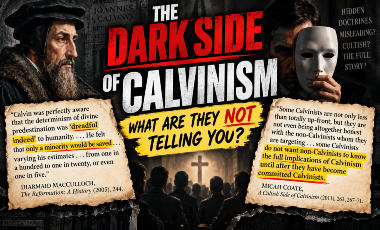
Although we cannot know the true intentions of John Calvin’s pursuit in evangelism, for several reasons it seems unlikely that he aimed only to proclaim salvation in Christ. First, his theological view clearly makes evangelism ultimately useless. Second, cult leaders usually seek their own desires, as opposed to the desires of God as revealed in Scripture. Third, John Calvin knew that his missionaries were not spreading good news to anyone whom God would not save. In fact, as Reformation historian Diarmaid MacCulloch writes, “Calvin was perfectly aware that the determinism of predestination was ‘dreadful indeed’ to humanity.”[22]* In fact, his missionaries were spreading nothing but bad news to almost all of those who were supposedly not of the elect. According to MacCulloch, “The most discordant noises came from Basel, where one anonymous pamphlet with bitter sarcasm described the Genevan Church as proclaiming ‘its good news with flames.”[23]

[….]

(4) Why Calvinism’s gospel and other cult theologies are dishonestly presented

When I share the gospel message, either from the pulpit or one-on-one, I have nothing to hide or water down about my beliefs and theology. This may sound very basic, but it must be noted. If I were a people pleaser, I would be tempted to overlook those parts of my theology that might offend a potential believer. Certain aspects of the gospel’s good news, like “personal sin” and “divine judgment,” are not merely a part of understanding one’s need for God’s grace but are imperative to receiving it. Thus, although the prospective convert might not welcome the true notion of his rebellion before God (i.e., his sin) and a time of God’s future judgment, I withhold nothing and keep no secrets in laying out the full gospel.

This is not the case with Mormonism and Jehovah’s Witnesses. This is also not the case with the gospel according to Calvinism. George Bryson writes:

Some Calvinists are not only less than totally up-front, but they are not even being altogether honest with the non-Calvinists whom they are targeting. In the promotion of doctrine, what is held back or not expressed (relative to those doctrines) can be very misleading.[33]

Bryson contends that “some Calvinists do not want non-Calvinists to know the full implications of Calvinism until after they have become committed Calvinists.”[34] It should not be hard to figure out the reasons why a “potential” convert might not want to know intimately the core doctrines of Calvinism from the beginning.

If the forbearer of the Calvinist gospel message cannot or will not be upfront and direct about the doctrines pertaining to salvation (in public or private life), the skeptic must seriously consider why. Furthermore, we should wonder whether Jesus Himself was hiding some important aspects of His messages. Was He withholding the doctrine of double predestination when He called everyone to come and receive the Bread of Life? Did He expect the crowds to understand that when He said “all” or “world” what He really meant was “some” and “elect”? Did He assume that His followers would understand that “grace” could have multiple definitions? Did Jesus expect His apostles to understand that their efforts to evangelize would be ultimately futile? Indeed, Chuck Smith asks, “Why would the God of all truth, who speaks so sternly against lying, send His servants out to promote such a lie?”[35]

Yet, some Calvinists today seem guilty of being dishonest in presenting their particular gospel. One Reformed Southern Baptist pastor, in an article entitled “Instructions for Local Church Reformation,” advises other Calvinist pastors:

Choose a few men who are sincere, teachable and spiritually minded and spend time with them in study and prayer. They will help you to reform. . . . In the pulpit, don’t use theological language that is not found in the Bible. Avoid terms such as Calvinism, reformed, doctrines of grace, particular redemption, etc. Most people will not know what you are talking about. Many that do will become inflamed against you.[36]

We read about dishonesty concerning the gospel early in church history. Certain men came down from Jerusalem teaching the brethren that unless they were “circumcised according to the custom of Moses,” they could “not be saved” (Acts 15:1, NKJV).[37] Because of this threat to the gospel message, the apostles gathered and directly faced the problem. The main reason the apostles opposed this teaching was because of its false message of salvation, which added “works” to the free grace of God and limited those who could be saved to those who were circumcised. Similarly, Calvinism limits salvation to “the elect.” “Certain men” (Calvinists) are teaching the brethren that some people can “not be saved” at all.

Like Paul, the Christian is called to confront those who are “not straightforward about the truth of the gospel.”[38] In Galatians chapter 2, Paul confronted Peter about his hypocrisy. Although the gospel was commanded to be taken to all of humanity, Peter would fellowship only with the Gentiles in the absence of the Jewish elite. Thus, while Peter believed the gospel was for the Gentiles as well as the Jews, his actions differed from his beliefs. He witnessed mainly to the Jewish people who came from Jerusalem. When Paul noticed Peter compromising the truth of the gospel, he said, “Now when Peter had come to Antioch, I withstood him to his face, because he was to be blamed; . . . But when I saw that they were not straightforward about the gospel, I said to Peter before them all . . .”[39] (Galatians 2:11–14, NKJV). Paul then brings Peter’s hypocrisy into the light.

Likewise, those who herald Calvinism today do not practice what they preach. While on the outside, Calvinists claim that their gospel is for all people, their doctrines clearly declare otherwise. To win the minds of those around them, their doctrine of limited atonement is not openly addressed. Calvinists, as with all cultists, are not straightforward about their message. If they were straightforward, there would be no need for Calvin expositors like Pink, White, and Sproul to malign the intended meanings of simple words like “world”; there would be no need for Calvinist teachers to make unfounded distinctions in words like “love,” “grace,” and “calling”; and there would be no need to change the TULIP labels. The following example illustrates how far from straightforward a Calvinist can be.

I recently watched an episode of a sitcom, in which the manager of a paper resale office was offered a promotion in the company, but only if he laid off several of his employees. The manager, though close friends with many of his employees, agreed to take the new position. Not knowing their fate, his staff anxiously sought his decision. When he came out of his office, he said, “I have good news and bad news. I’ll tell you the bad news first. A lot of you will lose your job here or be forced to relocate to Sweden.” At this, the employees were distraught and saddened. But their regional manager was quick to try and raise their spirits by finishing, “And now the good news—I was offered to be head manager over all of the U.K.” As he looked for approval among his employees, they offered him none. After a minute of silence, one of the employees pointed out the stupidity of his ex-manager: “That’s not good news. All you have is bad news and irrelevant news. We’ve just lost our jobs so you could be promoted, and you think we should be happy for you?”[40]

Likewise, the gospel of Calvinism looks into the faces of people whom their god has doomed to eternal fire and expects a joyful response to their fate. In Luke 2:10, the angel of the Lord announces the true gospel of Christ as “good tidings of great joy which will be to all people.” Is one to believe that this angel from God held the same unreasonable logic of the new U.K. branch manager? Did the angel really think that the unfortunate souls would find the news of their damnation as “good tidings and great joy?”

These types of contradictions that plague Calvin’s TULIP make for a confusing and inconsistent theology. Why does it maintain such contradictions? Is it because Christians would not swallow Calvinism if it were not watered down? Is it because Calvinism’s “unveiled” gospel would turn potential new converts away instead of winning them over? Why unbelievers, let alone Christians, would be repulsed by Calvinism’s deterministic form of Christianity should be no surprise, for it must bear a certain fruit in the lives of its followers.


Micah Coate, A Cultish Side of Calvinism (Innovo Publishing, 2011), 263, 267–71.

* Calvin was perfectly aware that the determinism of divine predestination was ‘dreadful indeed’ to humanity. Moreover, like most believers in predestination (Luther and Augustine included), he felt that only a minority would be saved – it was not Calvin but Augustine in one of his savage late anti-Pelagian works who observed that God had arranged this in order to give the elect all the more reason to be grateful for their elect status.38 Calvin was not prepared to put a figure on the proportion of the saved, varying his estimates for artistic effect from his habitual estimate of one in a hundred to one in twenty, or even one in five in more generous moods. He was also very wary of saying that people could be certain of their own election, let alone identify others among the elect.

Diarmaid MacCulloch, The Reformation: A History (New York: Penguin Books, 2005), 244.

FOOTNOTES:

[22] MacCulloch, The Reformation, 244.

[23] Ibid., 245.

[….]

[33] George Bryson, The Dark Side of Calvinism: The Calvinist Caste System (Santa Ana, CA: Calvary Chapel Publishing, 2004), 23.

[34] Ibid., 22.

[35] Smith, Foreword to The Dark Side of Calvinism.

[36] Ernest C. Reisinger and D. Matthew Allen, A Quiet Revolution: A Chronicle of Beginnings of Reformation in the Southern Baptist Convention [online]; accessed by RPT 8/27/2026             

[37] NKJV, Acts 15:1.

[38] NKJV, Galatians 2:14.

[39] NKJV, Galatians 2:11–14.

[40] Ricky Gervais, The Office, Season 1, Disc 2, Episode 6 (BBC Amazon Prime Video)


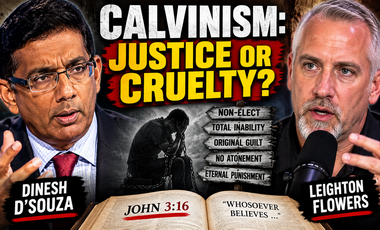
Dinesh D’Souza: If They Cannot Believe, Why Blame Them?

Soteriology 101 responds to the bees nest being poked:

Dinesh D’Souza, a popular author, filmmaker, and podcast host, has recently confronted the Calvinistic doctrine of Predestination and has received some very vitriolic rebuttals from the online Calvinistic community, including (as you may suspect) from James White. Many on X seem to think that anyone who doesn’t agree with Calvinism just cannot understand it.

Partial transcript from the above:

So just because we argue that God does love everyone in the world and provides for everyone in the world, therefore we are somehow saying that God must love everyone in the world and provide salvation to everyone in the world—that’s just a fallacy. Okay? You’ll see these kinds of fallacies repeated over and over and over again.

Once you do this long enough, like I have, you start spotting it immediately. It takes a little while sometimes to see through the smoke screens and the fallacies, but they’re basically the same things repeated ad nauseam by the different Calvinists online again and again and again. And the more you engage it, the more you’ll begin to recognize it and be able to call it out for what it is.

And so basically what he’s saying is, because Dinesh argues that God does provide salvation for all people, therefore God owes salvation to all people. And that’s never what Dinesh argues. Okay?

What he’s ultimately arguing is that if mankind can’t respond positively, then why are they held responsible for not responding positively? And Calvinists don’t have an answer to that. That’s where they appeal to mystery. That’s where they just say, “Hmm, we don’t know.”

At least that’s what Calvin said, as we’ve quoted here many times. Let me put it back up on the screen for you, just for those that are tuning in for the first time, because I know this stuff with Dinesh is bringing in a lot of new audience.

So let me read from John Calvin what he says about this:

“How it was ordained by the foreknowledge and decree of God what man’s future was, without God being implicated as an associate in the fault, as the approver or author of transgressions, is clearly a secret so much excelling the insight of the human mind that I’m not ashamed to confess ignorance. Daily I so meditate on these mysteries of his judgments that curiosity to know anything more does not attract me.”

What is John Calvin saying?

  • “I don’t know how God is not implicated as the associate in the fault. I don’t know how he’s not the author and the approver of transgression.”

In other words, I don’t know how God’s good. I really don’t know how God’s good.

Really, that’s what he’s saying.

I, guys, would much rather appeal to the mystery of man’s capriciousness than to the character of God. For goodness’ sake, folks, we cannot appeal to mystery as to whether God’s good or not.

This is why C. S. Lewis argued that you can make God ultimately an all-powerful demon by saying his black is our white and our white is his black, and making these kinds of arguments that say, “Well, I don’t know how he’s good. We just believe that he is,” even though he’s responsible for sin and rape and the Holocaust and all these horrible, bad things by decreeing them to come to pass.

And this is the fault line of the entire Calvinistic system: that God’s holding men responsible for things they have ultimately no control over.

That’s the basic fault line of the entire Calvinistic system. And Dinesh is poking them in the sore spot. What’s that? How does God justly hold people responsible for things they have absolutely no control over? And they have absolutely no control over whether they’re elect or reprobate.

No control over that. They have absolutely no control over whether they can believe the gospel or not.

Absolutely no control over that. They have absolutely no control over whether they are born guilty of sin or not. They’re just born guilty of sin because Adam fell, representing them in the garden.

Universal guilt for the sin of Adam is the instead of the imputed guilt through your actual choice to sin, and imputed righteousness through faith, as we would understand Romans 5—imputation of guilt and righteousness based upon your actual choices, and the age of accountability, and all the things that we argue from the text of Scripture. Look at Soteriology 101 if you want to look for those defenses.

Instead of arguing that, they just argue basically, “You’re born guilty for what Adam did. You cannot choose to believe and follow the provisions of God and come when He calls you and acts like He really wants you to come,” at least because He sends the gospel to all people, calling all people. You can’t want to do that because of the nature you were born with.

You didn’t have any control of the nature you were born with. You’re born a reprobate if you’re on the covenant system. And what Dinesh is going, “How can you possibly blame these people for that?”

This is something that I wasn’t able to share this screen, but this is something I wrote on Twitter a long time ago. I said, according to Calvinism, everyone who ends up in hell is one born rejected by God. They’re non-elect.

That’s what rejected. They’re basically passed over. So on Calvinism, they’re all born rejected by God, unable to believe. Everyone who ends up in hell, born rejected by God, not elect, born unable to believe the gospel—total inability—born guilty for someone else’s sins, that Adam’s sin. They’re born original—that’s original guilt—and they are born without any means of atonement, limited atonement. That’s just true.

Everyone who ends up in hell, those four facts are just truisms on Calvinism: they’re born non-elect, rejected by God, passed over by God, with total inability; unable to believe the gospel because of a nature they were born with; guilty for someone else’s sin, original guilt; and without an atonement provided for them.

How are they not merely pitied as helpless victims rather than justly rebuked and punished as if they had any control of the way they were born?

If Calvinism is true, there is no good reason to not just feel sorry for the unbelievers and the reprobates.

And there certainly doesn’t seem to be any justification for punishing them for all of eternity for something they had absolutely no control over.

That’s what Dinesh keeps pushing on….

Columbus Day vs. National Indigenous People’s Day

UPDATED SOME MEDIA (11/27/2025)

Jump to the Black Hills


Christopher Columbus

The Left’s Public Enemy #1


Michael Knowles explains the difference between leftist lies and reality, and why Christopher Columbus is the Left’s public enemy #1


An Indigenous Peoples’ Day

Monkey Wrench


On June 23, 1865, in what was the last land battle of the war, Confederate Brigadier General and Cherokee Chief, Stand Watie, finally surrendered his predominantly Cherokee, Oklahoma Indian force to the Union. He was the last Confederate General “standing.”

  • That same month, Watie’s command surprised a group of soldiers that included troops from the 79th U.S. Colored Infantry who were cutting hay for livestock at the fort. Instead of accepting the surrender of the African Americans, the Confederates killed 40 of them. Such exploits earned Watie promotion to brigadier general… (HISTORY BUFF)

Mayan and Aztec “Terrorism”


UPDATE!

  • (ABOVE) A stone Tzompantli (skull rack) found during the excavations of Templo Mayor (Great Temple) in Tenochtitlan. New research has found the ‘skull towers’ which used real human heads were just a small part of a massive display of skulls known as Huey Tzompantli.

The DAILY MAIL informs us of the utter devastation of human sacrifice the Aztecs “enjoyed” — and why the cartels are the way they are. They are really a death cult version (Santa Muerte [watch your volume, video starts playing automatically at link]) of this early history:

In 2015 archaeologists from Mexico’s National Institute of Anthropology and History (INAH) found a gruesome ‘trophy rack’ near the site of the Templo Mayor, one of the main temples in the Aztec capital Tenochtitlan, which later became Mexico City.

Now, they say the find was just the tip of the iceberg, and that the ‘skull tower’ was just a small part of a massive display of skulls known as Huey Tzompantli that was the size of a basketball court.

The new research is slowly uncovering the vast scale of the human sacrifices, performed to honor the gods.

According to the new research detailed in Science,  captives were first taken to the city’s Templo Mayor, or great temple, where priests removed their still-beating hearts.

The bodies were then decapitated and priests removed the skin and muscle from the corpses’ heads.

Large holes were carved into the sides of the skulls, allowing them to be placed onto a large wooden pole.

They were then placed in Tenochtitlan’s tzompantli, an enormous rack of skulls built in front of the Templo Mayor, a pyramid with two temples on top.

[….]

Some Spanish conquistadors wrote about the tzompantli and its towers, estimating that the rack alone contained 130,000 skulls.

The skull edifices were mentioned by Andres de Tapia, a Spanish soldier who accompanied Cortes in the 1521 conquest of Mexico..

In his account of the campaign, de Tapia said he counted tens of thousands of skulls at what became known as the Huey Tzompantli….

(CLICK TO ENLARGE)

(The Below Was Posted Oct, 2017)

This is a combining of three previous posts to make it easier for those looking for refutation to the Left’s understanding of Columbus Day. Another resource is this excellent video.

A multicultural approach to the conquest of Mexico usually does not investigate the tragedy of the collision between 16th-century imperial Spain and the Aztec Empire. More often it renders the conquest as melodrama between a mostly noble indigenous people slaughtered by a mostly toxic European Christian culture, acting true to its imperialistic and colonialist traditions and values.

In other words, there is little attention given to Aztec imperialism, colonialism, slavery, human sacrifice, and cannibalism, but rather a great deal of emphasis on Aztec sophisticated time-reckoning, monumental building skills, and social stratification. To explain the miraculous defeat of the huge Mexican empire by a few rag-tag, greedy conquistadors, discussion would not entail the innate savagery of the Aztecs that drove neighboring indigenous tribes to ally themselves with Cortés. 

(VICTOR DAVIS HANSON)

The following conglomeration of responses to two separate persons in a LONGER VIDEO where some Native-Americans express their “dislike” of Christopher Columbus.

Subjects dealt with are:

  • Christopher Columbus being the “first terrorist” on the America’s;
  • That land possession was something brought by Westerners;
  • or that Columbus “came to America” at all!

  • Michael Harner, in his 1977 article The Enigma of Aztec Sacrifice, estimates the number of persons sacrificed in central Mexico in the 15th century as high as 250,000 per year. Fernando de Alva Cortés Ixtlilxochitl, a Mexica descendant and the author of Codex Ixtlilxochitl, estimated that one in five children of the Mexica subjects was killed annually. Victor Davis Hanson argues that a claim by Don Carlos Zumárraga of 20,000 per annum is “more plausible.”…. (Hanson, who accepts the 80,000+ estimate, also notes that it exceeded “the daily murder record at either Auschwitz or Dachau.”) (WIKI)

So the above video show that Christopher Columbus, the Spaniards, nor even Hitler reached the amount of terrorism on people quite like the pre-Colombian indigenous people of the Americas. Here is a small portion from a paper I wrote detailing some of this, followed by an excerpt from a site detailing some of this:

Literature from the Mesoamerica is so very rich and full of the traditions of the people there that it is a welcome challenge to add this flavoring into the classroom. From a historical view Latin literature can be very effective in showing how a culture is influenced over time by another. The Spanish influence on Mesoamerica is still to this day incredibly prevalent; much like the English fingerprint is on North America. The terms should almost be B.S., before Spain, and A.S., after Spain. Norton makes the point in fact that “[m]any of the folktales from Mexico, South and Central America, and southwestern part of the United States reflect a blending of cultures” (Norton et al, 2001, p. 146).

Who could not write of the clash of civilizations represented in the men of Cortez and Montezuma? Unfortunately much of this historical fiction is more fictionalized than history. An exemplary text used to illustrate this in the classroom would be Montezuma’s Daughter by Rider Haggard (1980), originally written in 1894. The myth had already started that the Spaniards were merely there for gold, and killed for it exclusively. While there is a place for literature to express cultural mores and values, even going so far as comforting people away from their homeland, it should still apply to history somewhat. Norton mentions that the “choices of materials to be read and discussed may reflect… moral messages” (Norton, p. 3). Some in the teaching profession can use Latino literature to paint history with broad strokes, thus passing moral messages on to the classroom, guiding, influencing them.

Rarely does one hear in the social studies class, literature class, or history class that Cortez’s small band of men (even with horses) couldn’t have defeated Montezuma’s large army, unless that is, there were defectors. Why would people want to defect from the Aztec culture and join with foreigners? Montezuma had this peculiar habit of taking areas over, grabbing the young men from said area, bringing them back to a temple and while still alive cut their hearts out and throw their bodies down the altar steps (rotten.com, used 4-14-06). This caused many to join the forces of Cortez, making him a more formidable force resulting in forcefully bringing to a halt Aztec pagan sacrifice and setting up Christian icons instead. Incan and Mayan cultures sacrificed humans as well, sometimes 200 children at once.

A lot of this history is bypassed with much of the Mesoamerica literature in the search for national pride and identity. Pride and prejudice is a great conversation to have unfolded by Latino literature, or any of the multicultural writings. Tribal conflicts, territorial rights, or wanting to become a “doctor instead of a bullfighter” are all topics that Western children can relate to, learn essential values from, or see history from a different perspective….

(For references, see my paper, “LATINO LITERATURE“)

The first time I ran into information noting the incredibly evil culture, and how it was ultimately defeated (showing, absolute greed can still have VERY positive aspects to it), was a post on ROTTEN.COM

The funny thing about Montezuma isn’t really that he was a deranged,despotic, cannabilistic, pedophiliac practitioner of human sacrifice with legendary diarrhea.

Well, OK, that is pretty funny. But the really funny thing is how many towns, high schools and rotary clubs are named after the guy. There’s Montezuma, Iowa; Montezuma, Georgia; Montezuma, Kansas; Montezuma, New York; Montezuma Castle National Park in Arizona; Montezuma, Costa Rica; Montezuma, New Mexico The list goes on and on and on.

What were these people thinking? Do they want you to think their town is full of cannibals? Are they proud of their explosive diarrhea? What was the runner-up name for the town? Hitler, New Mexico? Torquemada? Georgia? De Sade? Kansas?

Montezuma was the emperor of the Aztecs in the 16th century — right about the time that the good times were coming to an end. (Montezuma is the Anglicized version of the Spanish Moctezuma, which is a Spaniardized version of one of those seemingly unpronounceable Aztec names.)

While the coming of the White Man provides a convenient scapegoat for Aztec apologists, the fact is that Montezuma was not a barrel of laughs even before Cortez dropped the Conquistadors in his lap.

Montezuma was a conquering king, who frequently waged war against his neighbors in a pretty successful effort to expand his empire. He kept the gods on his side with a regular regimen of human sacrifice. While the Aztecs had a long history of ritualistic human sacrifice, the art had never known a patron like Montezuma.

At the time, such sacrifices were performed with ritual daggers atop the Aztec pyramids. According to some accounts, Montezuma sacrificed tens of thousands of prisoners at a time, which is a good trick considering each one had to be individually killed.

A 1590 account detailed the procedure: “The usual method of sacrifice was to open the victim’s chest, pull out his heart while he was still alive, and then knock the man down, rolling him down the temple steps, which were awash with blood.” It wasn’t the most efficient procedure. Who knows what Montezuma could have accomplished with a gas chamber, a guillotine, or a submachine gun?

Apparently the gods were appreciative of all this bloodshed, because Montezuma apparently had a pretty good run, annexing several nearby kingdoms and allegedly running a virtual police state with an iron fist….


let’s move to Columbus and the charge of genocide. The historical Columbus was a Christian explorer. Howard Zinn makes it sound like Columbus came looking for nothing but gold, but Columbus was equally driven by a spirit of exploration and adventure. When we read Columbus’s diaries we see that his motives were complex: he wanted to get rich by discovering new trade routes, but he also wanted to find the Garden of Eden, which he believed was an actual undiscovered place. Of course Columbus didn’t come looking for America; he didn’t know that the American continent existed. Since the Muslims controlled the trade routes of the Arabian Sea, he was looking for a new way to the Far East. Specifically he was looking for India, and that’s why he called the native peoples “Indians.” It is easy to laugh at Columbus’s naïveté, except that he wasn’t entirely wrong. Anthropological research has established that the native people of the Americas did originally come from Asia. Most likely they came across the Bering Strait before the continents drifted apart.

We know that, as a consequence of contact with Columbus and the Europeans who came after him, the native population in the Americas plummeted. By some estimates, more than 80 percent of the Indians perished. This is the basis for the charge of genocide. But there was no genocide. Millions of Indians died as a result of diseases they contracted from their exposure to the white man: smallpox, measles, cholera, and typhus. There is one isolated allega­tion of Sir Jeffrey Amherst (whose name graces Amherst College) approving a strategy to vanquish a hostile Indian tribe by giving the Indians smallpox-infected blankets. Even here, however, it’s not clear the scheme was actually carried out. As historian William McNeill documents in Plagues and Peoples, the white man generally transmit­ted his diseases to the Indians without knowing it, and the Indians died in large numbers because they had not developed immunities to those diseases. This is tragedy on a grand scale, but it is not geno­cide, because genocide implies an intention to wipe out a people. McNeill points out that Europeans themselves had contracted lethal diseases, including the pneumonic and the bubonic plagues, from Mongol invaders from the Asian steppes. The Europeans didn’t have immunities, and during the “Black Death” of the fourteenth century one-third of the population of Europe was wiped out. But no one calls these plagues genocide, because they weren’t.

It’s true that Columbus developed strong prejudices about the native peoples he first encountered—he was prejudiced in favor of them. He praised the intelligence, generosity, and lack of guile among the Tainos, contrasting these qualities with Spanish vices. Subsequent explorers such as Pedro Alvares Cabral, Amerigo Ves­pucci (from whom we get the name “America”), and Walter Raleigh registered similar positive impressions. So where did Europeans get the idea that Indians were “savages”? Actually, they got it from their experience with the Indians. While the Indians Columbus met on his first voyage were hospitable and friendly, on subsequent voyages Columbus was horrified to discover that a number of sailors he had left behind had been killed and possibly eaten by the cannibalistic Arawaks.

When Bernal Diaz arrived in Mexico with the swashbuckling army of Hernán Cortes, he and his fellow Spaniards saw things they had never seen before. Indeed they witnessed one of the most gruesome spectacles ever seen, something akin to what American soldiers saw after World War II when they entered the Nazi con­centration camps. As Diaz describes the Aztecs, in an account generally corroborated by modern scholars, “They strike open the wretched Indian’s chest with flint knives and hastily tear out the palpitating heart which, with the blood, they present to the idols in whose name they have performed the sacrifice. Then they cut off the arms, thighs and head, eating the arms and thighs at their ceremonial banquets.” Huge numbers of Indians—typically cap­tives in war—were sacrificed, sometimes hundreds in a single day. Yet in a comic attempt to diminish the cruelty of the Aztecs, How­ard Zinn remarks that their mass murder “did not erase a certain innocence” and he accuses Cortes of nefarious conduct “turning Aztec against Aztec.”

If the Aztecs of Mexico seemed especially bloodthirsty, they were rivaled by the Incas of South America who also erected sacrificial mounds on which they performed elaborate rites of human sacrifice, so that their altars were drenched with blood, bones were strewn everywhere, and priests collapsed from exhaustion from stabbing their victims.

Even while Europeans were startled and appalled at such blood­thirstiness, there was a countercurrent of admiration for what Euro­peans saw as the Indians’ better qualities. Starting with Columbus and continuing through the next few centuries, native Indians were regarded as “noble savages.” They were admired for their dignity stoicism, and bravery. In reality, the native Indians probably had these qualities in the same proportion as human beings elsewhere on the planet. The idealization of them as “noble savages” seems to be a projection of European fantasies about primitive innocence onto the natives. We too—and especially modern progressives-have the same fantasies. Unlike us, however, the Spanish were forced to confront the reality of Aztec and Inca behavior. Today we have an appreciation for the achievements of Aztec and Inca culture, such as its social organization and temple architecture; but we cannot fault the Spanish for being “distracted” by the mass murder they witnessed. Not all the European hostility to the Indians was the result of irrational prejudice.

While the Spanish conquistadores were surprised to see humans sacrificed in droves, they were not shocked to witness slavery, the subjugation of women, or brutal treatment of war captives—these were familiar enough practices from their own culture. Moreover, in conquering the Indians, and establishing alien rule over them, the Spanish were doing to the Indians nothing more than the Indians had done to each other. So from the point of view of the native Indian people, one empire, that of Spain, replaced another, that of the Aztecs. Did life for the native Indian get worse? It’s very hard to say. The ordinary Indian might now have a higher risk of disease, but he certainly had a lower risk of finding himself under the lurid glare of the obsidian knife.

What, then, distinguished the Spanish from the Indians? The Peruvian writer and Nobel laureate Mario Vargas Llosa offers an arresting answer. The conquistadores who came to the Americas, he concedes, were “semi-literate, implacable and greedy.” They were clearly believers in the conquest ethic—land is yours if you can take it. Yet these semi-literate greedy swordsmen, without knowing it, also brought with them something new to the Americas. They brought with them the ideas of Western civilization, from Athenian rationalism to Judeo-Christian ideas of human brotherhood to more modern conceptions of self-government, human rights, and property rights. Some of these ideas were nascent and newly developing even in the West. Nevertheless, they were there, and without intending to do so, the conquistadors brought them to the Americas.

To appreciate what Vargas Llosa is saying, consider an astonishing series of events that took place in Spain in the early sixteenth century. At the urging of a group of Spanish clergy, the king of Spain called a halt to Spanish expansion in the Americas, pending the resolution of the question of whether American Indians had souls and could be justly enslaved. This seems odd, and even appalling, to us today, but we should not miss its significance. Historian Lewis Hanke writes that never before or since has a powerful emperor “ordered his conquests to cease until it was decided if they were just.” The king’s actions were in response to petitions by a group of Spanish priests, led by Bartolomé de las Casas. Las Casas defended the Indians in a famous debate held at Valladolid in Spain. On the other side was an Aristotelian scholar, Juan Sepulveda, who relied on Aristotle’s concept of the “natural slave” to argue that Indians were inferior and therefore could be subjugated. Las Casas coun­tered that Indians were human beings with the same dignity and spiritual nature as the Spanish. Today Las Casas is portrayed as a heroic eccentric, but his basic position prevailed at Valladolid. It was endorsed by the pope, who declared in his bull Sublimns Deus, “Indians… are by no means to be deprived of their liberty or the possessions of their property… nor should they be in any way enslaved; should the contrary happen it shall be null and of no effect.” Papal bulls and even royal edicts were largely ignored thou­sands of miles away—there were no effective mechanisms of enforce­ment. The conquest ethic prevailed. Even so, over time the principles of Valladolid and Sublimus Deus provided the moral foundation for the enfranchisement of Indians. Indians could themselves appeal to Western ideas of equality, dignity, and property rights in order to resist subjugation, enforce treaties, and get some of their land back….

[….]

The white men who settled America didn’t come as foreign invad­ers; they came as settlers. Unlike the Spanish, who ruled Mexico from afar, the English families who arrived in America left everything behind and staked their lives on the new world. In other words, they came as immigrants. We can say, of course, that immigration doesn’t confer any privileges, and just because you come here to settle doesn’t mean you have a right to the land that is here, but then that logic would also apply to the Indians.

DINESH D’SOUZA, America: Imagine a World Without Her (Washington, DC: Regnery, 2014), 93-97, 98.

On June 23, 1865, in what was the last land battle of the war, Confederate Brigadier General and Cherokee Chief, Stand Watie, finally surrendered his predominantly Cherokee, Oklahoma Indian force to the Union. He was the last Confederate General “standing.”

  • That same month, Watie’s command surprised a group of soldiers that included troops from the 79th U.S. Colored Infantry who were cutting hay for livestock at the fort. Instead of accepting the surrender of the African Americans, the Confederates killed 40 of them. Such exploits earned Watie promotion to brigadier general(HISTORY BUFF)

One should see my stuff on the topics as well:

THE FEDERALIST has this excellent article that should be read in full:

…..“Long before the white European knew a North American continent existed, Indians of the Northern Plains were massacring entire villages,” says George Franklin Feldman in the book Cannibalism, Headhunting and Human Sacrifice in North America: A History Forgotten.” “And not just killed, but mutilated. Hands and feet were cut off, each body’s head was scalped, the remains were left scattered around the village, which was burned.”

Less Pocahontas and More Blood Sacrifice

When thinking of pre-Columbian America, forget what you’ve seen in the Disney movies. Think “slavery, cannibalism and mass human sacrifice.” From the Aztecs to the Iroquois, that was life among the indigenous peoples before Columbus arrived.

For all the talk from the angry and indigenous about European slavery, it turns out that pre-Columbian America was virtually one huge slave camp. According to “Slavery and Native Americans in British North America and the United States: 1600 to 1865,” by Tony Seybert, “Most Native American tribal groups practiced some form of slavery before the European introduction of African slavery into North America.”

“Enslaved warriors sometimes endured mutilation or torture that could end in death as part of a grief ritual for relatives slain in battle. Some Indians cut off one foot of their captives to keep them from running away.”

Things changed when the Europeans arrived, however: “Indians found that British settlers… eagerly purchased or captured Indians to use as forced labor. More and more, Indians began selling war captives to whites.”

That’s right: Pocahontas and her pals were slave traders. If you were an Indian lucky enough to be sold to a European slave master, that turned out to be a good thing, relatively speaking. At least you didn’t end up in a scene from “Indiana Jones And The Temple of Doom.”

Ritual human sacrifice was widespread in the Americas. The Incas, for example, practiced ritual human sacrifice to appease their gods, either executing captive warriors or “their own specially raised, perfectly formed children,” according to Kim MacQuarrie, author of “The Last Days of the Incas.”

The Aztecs, on the other hand, were more into the “volume, volume, VOLUME” approach to ritual human slaughter. At the re-consecration of the Great Pyramid of Tenochtitlan in 1487, the Aztecs performed a mass human sacrifice of an estimated 80,000 enslaved captives in four days.

Also Widespread Torture and Cannibalism

According to an eyewitness account of “indigenous peoples” at work—in this case, the Iroquois in 1642, as observed by the Rev. Father Barthelemy Vimont’s “The Jesuit Relations”—captives had their fingers cut off, were forced to set each other on fire, had their skinned stripped off and, in one captured warrior’s case, “the torture continued throughout the night, building to a fervor, finally ending at sunrise by cutting his scalp open, forcing sand into the wound, and dragging his mutilated body around the camp. When they had finished, the Iroquois carved up and ate parts of his body.”

Shocked? Don’t be. Cannibalism was also fairly common in the New World before (and after) Columbus arrived. According to numerous sources, the name “Mohawk” comes from the Algonquin for “flesh eaters.” Anthropologist Marvin Harris, author of “Cannibals and Kings,” reports that the Aztecs viewed their prisoners as “marching meat.”

The native peoples also had an odd obsession with heads. Scalping was a common practice among many tribes, while some like the Jivaro in the Andes were feared for their head-hunting, shrinking their victims’ heads to the size of an orange. Even sports involved severed heads. If you were lucky enough to survive a game of the wildly popular Meso-American ball (losers were often dispatched to paradise), your trophy could include an actual human head.

There Are No Pure Peoples in History

Slavery, torture, and cannibalism—tell me why we’re celebrating “Indigenous People’s Day” again? And we’re getting rid of Columbus Day to protest—what? The fact that one group of slavery-practicing violent people conquered another group of violent, blood-thirsty slavers? That’s a precis of the history of the Americas before Columbus arrived.

This has always been the fatal flaw of the Left’s politics of race guilt: Name the race that’s not “guilty”? Racism, violence, and conquest are part of the human condition, not the European one….


Goodbye Columbus?


AMERICAN GREATNESS has this article I excerpt from:

…. As Mary Grabar has pointed out in her scathing critique of Zinn, his chapter on Columbus was plagiarized from Columbus: His Enterprise: Exploding the Myth, a book for high schoolers, first published in 1976 by Hans Koning. As she and others, including Robert Royal and Armando Simon, observe, contemporary accounts contradict the portrait of Columbus painted by the likes of Koning and Zinn. He, like most men, was imperfect but far from the moral monster described by these modern leftist writers.

As noted above, the attack on Columbus mirrors the broader assault on the United States, which portrays America as irredeemably racist and the indigenous peoples of the Americas as innocent victims of Western crimes, in particular, genocide. Indoctrinated by the likes of Zinn, the pushers of “1619 Project,” and their ilk, many young people believe that slavery was invented by the United States. Of course, when the United States declared its independence in 1776, slavery was a world-wide phenomenon. African states, such as the Kingdom of Dahomey and the Ashanti Empire of Western Africa were slaveholders themselves and sold other Africans into the Atlantic slave trade. Although the Declaration of Independence did not end slavery at once, it made the abolition of slavery a moral and political imperative.

The flip side of the denigration of Columbus and the United States is the claim that the native peoples of America were peaceful and innocent victims of white greed and violence. The fact is that the Indians did the same things to other Indians the white man is accused of having done to the Indians.

They fought over land and hunting grounds. They fought over trade with the British and the French. The Iroquois, who allied themselves with the British during the colonial period, fought a war of extermination against the Huron, who allied themselves with the French. For accounts of the interactions of the Europeans, Americans, and the various Indian tribes, read Francis Parkman and James Axtell.

Atrocities by one tribe against another were a matter of course. Many of the tribes practiced ritual torture. An observer provided an account of Iroquois warriors burning Huron captives. As the flames consumed them, the Huron sang a song. “It was a very sad song,” the observer noted.

We rightly condemn the forcible removal of the Cherokee from the American Southeast. But the Cherokee were in the Southeast because they had been driven there earlier by the Sioux. The Black Hills became “sacred” to the Lakota only after they had driven earlier tribes away.

As two fine books, Comanche Empire and Empire of the Summer Moon, illustrate, the Comanche were major geopolitical players in North America, helping to shape the policies of first Spain, then Mexico and the United States. Indeed, the main reason that Spain and Mexico invited Anglo settlers into Texas was to provide a buffer against Comanche raids into Mexico.

To point out the behavior of the Indians is not to excuse any crimes and atrocities committed against them by whites but to place those actions in historical context….


THE BIGGIE!

Did the United States Practice Genocide

Against Native-Americans?


(Originally Posted March of 2015 — Updated Today – July 5th, 2021)

ALSO SEE:

SOME PREVIOUS POSTS ON THE NATIVE-AMERICAN MANTRAS:

    1. (Editor’s note: A recent federal bill memorializing as a National Historic Trail what has come to be known as the Cherokee Indian Trail of Tears is based on false history, argues William R. Higginbotham. In this article, the Texas-based writer delves into the historic record and concludes that about 840 Indians not the 4,000 figure commonly accepted died in the 1837-38 trek west; that the government-financed march was conducted by the Indians themselves; and that the phrase “Trail of Tears” was a label that was added 70 years later under questionable circumstances.) The problem with some of our accounts of history is that they have been manipulated to fit conclusions not borne out by facts. Nothing could be more intellectually dishonest. This is about a vivid case in point.

As you read this, keep in mind this is not a polemic saying these United States were in the right in all their dealings with the American Indian. What I am saying is that when looking at history, one needs to do so in full, and not in part.

The book mentioned in the above video is PLAGUES AND PEOPLES, by William H. McNeill. Here is the video description of the above:

  • Here is a quick blurb by Dinesh D’Souza discussing the genocide claim against the American Indian by Settlers. Much like the Black Plague killing an “up-to” estimated 60% of the European population, so to a LARGE percentage (some say 90%) died of contact with traders whom the Native-Populations had no immunities to. Just like when Western traders came into contact with the Asian continent. We don’t say this was an Asian genocide perpetrated on Westerners. Just like we do not say this (well, rational people) of Native-American contact with the West.

“Kill every buffalo you can,” he said; “every buffalo dead is an Indian gone.” ~ Colonel Richard Irving Dodge (1827 – June 16, 1895), United States Army.

I came across the above quote that got me thinking — due to the source… a left leaning website — that the quote was connected to a more complicated history than just simply “genocide” against Native-Americans (N-A from now on). Which the website was implying the quote meant. (BTW, if you are like my wife and can do without all my pomp-and-circumstance and want the bottom line ~ read this quote.) The original hat-tip came from a conservative website Gateway Pundit, referencing a call for Buffalo [New York] to change it’s racist name. (I know, EVERYTHING is racist nowadays.)

One of the graphics Gateway used in his story was this one, note the quote by Col. Dodge:

As I continued my search… this quote from Col. Dodge showed up quite a bit. So I did a Google book search, found some promising books that would lead to the origins of the quote. I subsequently ordered used versions (pictured below).

The American West book led me ultimately to two online resources: one a book from 1911 (the original source of the quote by Col. Dodge used in many resources), Sir William Butler: An Autobiography (London, England: Constable And Company Ltd., 1911); the other resource was an article in the official Journal of the Western History Association entitled, The Frontier Army and the Destruction of the Buffalo: 1865-1883

In these four resources as well as previous posts, I will unravel a fuller picture of the history/ethos behind such a statement. FIRST, however, here is the fuller quote as remembered by Gen. Butler:

At North Platte we found a distinguished officer of the army in command, Colonel Dodge, one of the foremost frontier men of his time, and the descendant of officers who had prepared the road for the army of settlement in the West. He was a mighty hunter too, and had killed every variety of big game from the Rocky Mountains to the Missouri. We told him of the week’s hunting we had had on the Platte prairies. More than thirty buffalo bulls had been shot by us, and I could not but feel some qualms of conscience at the thought of the destruction of so much animal life ; but Colonel Dodge held different views. “Kill every buffalo you can,” he said; “every buffalo dead is an Indian gone.” It sounded hard then, and it seems hard now ; but seven years after this time I crossed by railway from California to New York, and looking out at this same Platte valley I saw it a-smilin’ plain of farms, waving crops, and neat homesteads. The hungry crowd from overcharged Europe had surged into settlement over the old buffalo pastures of the Platte. ‘ Blessed are the meek, for they shall inherit the earth.’ It was right. These Crows, Cheyennes, Sioux, and Blackfeet Indians were no doubt splendid hunters, and fierce raiders, and crafty foemen, but no man could say they were meek.

[Lieut. General The Rt. Hon, G.G.B.] Sir W. F. Butler, Sir William Butler: An Autobiography (London, England: Constable And Company Ltd., 1911), 97.

When I read this fuller quote something stood out: “splendid hunters,” “fierce raiders,” “crafty foemen” [an enemy in war], and “‘not’ meek.” This brought to mind a previous discussion with a person on Facebook about the same issue. Daniel made a similar point that was one-sided… as if the American Indians were angels. I made the following historical point:

One of the most brutal raids of the American Revolution, a Loyalist-Iroquois coalition massacred more than 200 unsuspecting Patriot militiamen. Having raided and scorched dozens of frontier towns in upstate New York and Pennsylvania, the British arrived in Wyoming Valley, Pennsylvania, on July 3rd. The Patriots, inexperienced and outnumbered, were ambushed and subsequently routed following a forty-five minute close combat battle. As the Patriot line crumbled, the Iroquois began brutally hunting down survivors. Only sixty Americans survived to see another day, and only five were taken prisoner. Fleeing soldiers who had surrendered, were tortured to death by Loyalists and Iroquois. It was reported that 227 Patriot scalps were collected. Dozens of bodies were found on the line of retreat, which were all buried in a common grave. In retaliation, the Sullivan Expedition, commissioned by General George Washington, systematically destroyed at least forty Iroquois villages throughout upstate New York, in 1779. Another gruesome massacre would take place against the Continental Army at Cherry Valley. 

This is an important distinction coming up, and is worthy to note. There were massacres from both sides… this is the most basic understanding of this period (“boiling” it down). Now, reports of the massacres of prisoners at Wyoming and atrocities at Cherry Valley enraged the American public.

Did you catch that Daniel? Were the Iroquois ever “enraged” over it’s own actions? Were the French? Understanding history and the ethical foundations of the people involved is key to grasping these very complicated things well.

(Battle of Wyoming 1778)

Another point I pushed with Daniel in this discussion was that after the War of Independence, the Revolutionary War that is, the relationship between the people in this fledgling nation and the American Indian changed dramatically. You see, the Big Five (Five Nation League), the biggest Indian nations, ALL sided with the British.

CHEROKEES and CREEKS (among other TRIBES) in the southern interior and most IROQUOIS nations in the northern interior provided crucial support to the British war effort. With remarkably few exceptions, N-A support for the British was close to universal.

[….]

The MOHAWK chief THAYENDANEGEA (known to Anglo-Americans as JOSEPH BRANT) was the most important Iroquois leader in the Revolutionary Era. He convinced four of the six Iroquois nations to join him in an alliance with the British and was instrumental in leading combined Indian, British, and Loyalist forces on punishing raids in western New York and Pennsylvania in 1778 and 1779. These were countered by a devastating Patriot campaign into Iroquois country that was explicitly directed by General Washington to both engage warriors in battle and to destroy all Indian towns and crops so as to limit the military threat posed by the Indian-British alliance.

When British General John Burgoyne marched from Canada to Albany,

some of the Native American warriors he enlisted began killing settlers.

When the news of Jane McCrea’s murder reached major cities,

many young Americans enlisted to fight.

In spite of significant Native American aid to the British, the European treaty negotiations that concluded the war in 1783 had no native representatives. Although Ohio and Iroquois Indians had not surrendered nor suffered a final military defeat, the United States claimed that its victory over the British meant a victory over Indians as well. Not surprisingly, due to their lack of representation during treaty negotiations, Native Americans received very poor treatment in the diplomatic arrangements. The British retained their North American holdings north and west of the Great Lakes, but granted the new American republic all land between the Appalachian Mountains and the Mississippi River. In fact, this region was largely unsettled by whites and mostly inhabited by Native Americans. As a Wea Indian complained about the failed military alliance with the British, “In endeavoring to assist you it seems we have wrought our own ruin.” Even groups like the ONEIDA, one of the Iroquois nations that allied with the Americans, were forced to give up TRADITIONAL LANDS with other native groups.

(Revolutionary Limits: Native Americans)

This was an interesting dynamic when we beat the British and the Big Five. While the British warriors were sent-a-packin’, the American Indian combatants stayed. This was a tough situation, to say the least. History is tough.

Continuing.

Similarly, the near extinction of the Buffalo had many reasons and participants from both sides. In Settler and the N-A side participated in their demise. These American Indians were NOT angels. When trading routes and goods started to be established, we find that greed and power are a universal trait in all people of the world. The Beaver Wars exemplified just how non-angelic these American Indians were:

When the Mohawks attacked Metacomet instead of supporting him, they were motivated by self-interest. Casting themselves in the role of powerful intermediaries between neighboring Indians and the English colonies, the Mohawks and the other tribes of the Five Nation League of the Iroquois sought to place themselves in a dom­inant position.

European trade goods first began to reach the peoples of the Five Nations through indirect means as early as the mid-fifteenth century. In many Iroquois graves dating to that period archaeologists find brass, iron, and glass items. Their first direct ac­cess to these valuable goods came when Dutch traders established posts along the Hudson River in the 1610s. But the Iroquois had a problem. The best source of beaver pelts came from colder climes to the north. To supply themselves with the means to trade, the Mohawks, Cayugas, Onondagas, Oneidas, and Senecas thus began to raid their northern neighbors, plundering their stores of furs and bringing the pelts south to trade with the Dutch. These raids began a long series of seventeenth-century con­flicts known as the Beaver Wars in which warriors of the Five Nations attacked other Indian peoples as far west as the Illinois country, making themselves into the most powerful Indian confederacy on the North American continent.

But the Beaver Wars were spurred by another factor besides economics. Imported European diseases had hit the Iroquois hard. By the 1640s the population of the Five Nations had been cut nearly in half. Warfare against their neighbors not only gave the Iroquois access to the great fur grounds of the northern Great Lakes but offered the opportunity to take captives.

The Iroquois directed their most furious attacks against the Hurons, allies of the French. [The Hurons were one of the more peaceful tribes] unlike “So far as I can divine,” one Jesuit missionary wrote, “it is the design of the Iroquois to capture all the Hurons, if it is possible; to put the chiefs and great part of the nation to death, and with the rest to form one nation and one country.” In 1647 and 1648 the Mohawks and Senecas massed a brutal attack against the Hurons, de­stroying both Indian towns and Jesuit missionary stations. The Iroquois suffered enormous losses, but they inflicted even greater ones on the Hurons, and they so de­moralized their enemies that those who were not killed or captured dispersed and fled westward. Hundreds of Hurons were marched south to the Seneca and Mohawk towns and were adopted into the villages.

Robert V. Hine and John Mack Faracher, The American West: A New Interpretive History (New Haven, CT, 2000), 67-69.

And in a very recent article (July 4th, 2021), the POST MILLENNIAL counters a bit NPR’s attack on history in this regard:

The Ojibway were a loose confederation of states which, at their peak, had a massive extension throughout North America. They roughly paralleled the Celts in ancient times, preferring to merge peacefully with neighboring civilizations.

Most historians would agree indeed that they were very different from the Iroquois, who at the time were allied with the British Crown, and were very warlike and absolutely feared for their prowess on the battlefield by Europeans and other Indigenous cultures alike.

Choctaws, Chicasaws, Cherokee, Creeks, Mohawks, Iroquois, and Seminoles to name just a few that were in states of war with each-other in some fashion before-and-after the white-man every step foot on the continent.

Here for instance are the killing, scalping, putting into slavery those captured ~ FIGHT over the Black Hills (via: America: Imagine the World Without Her)

Black Hills, S. Dakota:

  • 1700s – early 1800s Kiowa early
  • 1800s – 1840 Cheyenne/Arapaho
  • 1850s – 1877 Lakota Sioux
  • 1878 – present U.S. government

All of these transitions were violent.

I asked GROK about the war over the Black Hills:

  • The Lakota (Sioux) acquired the Black Hills, which include the site of Mount Rushmore, through conquest and displacement of other Indigenous tribes during their westward migration in the 18th century. They specifically conquered the Cheyenne in 1776 to take control of the territory. Prior to the Cheyenne, the area had been inhabited by tribes including the Arikara (arriving around AD 1500), as well as the Crow, Kiowa, and Arapaho at various points.

Now, however, as the Beaver Wars exemplified… there was a larger “monetary” benefit to these raids, land grabs, and the like.

To wit, *JUST LIKE* with the buffalo.

Here is what I mean.

While there was a concerted effort to get American Indians to become less nomadic (and thus less liable to be: “fierce raiders,” “crafty foemen” [an enemy in war], and “‘not’ meek”), the Indians THEMSELVES played a large roll in this “de-nomaditisation”! American Indians THEMSELVES sought to make a buck off of these new techniques of leather making (see especially the second large quote below):

Until 1871 the fur buffalo robe was the main marketable item, the leather being a far more limited commodity. Leather was used by the British Army in the Crimean War (1854-1856), but only after 1871 did an English firm provide a mass market for the buffalo hides. Previously, when the robes were the main item of value, commercial hunting was confined mainly to the winter when the fur was thick, but with leather as the mass product, the buffalo hunter could kill with profit all year round (Vestal, 1952, 40). The railroads, too, were glad to have the busi­ness. Their progress westward had been stopped by the long depression of the 1870s; with almost no traffic, carrying buffalo meat, hides, and bones to eastern markets was a valued business opportunity. Merchants and freighters welcomed the business that came from buffalo hunting (Vestal, 1952, 38).

Hardly had the market for buffalo hides become widely known than the panic of 1873 began which lasted for five years. During those years most of the buffalo on the southern plains were destroyed [Vestal, 1952, 451]. In 1871 the buffalo were estimated in the millions. Many of the hunters entered the profession expecting it to prove a life work and despaired of killing off more than the annual increase of the herd. Hunters encamped by water holes and rivers where the animals came to drink, built watch fires at night so that the slaughter could go on for twenty-four hours a day [Vestal, 1952, 46].

For maximum efficiency some hunters used the Big Fifty, a gun pro­duced by Sharps to the hunter’s specifications, made to load and fire eight times a minute (Sandoz, 1954, 97; Vestal, 1952, 41). “In a brief two years (1873-1875), where there had been myriads of buffalo, there were only myriads of rotting carcasses. The air was filled with the sicken­ing stench of death. . . .” [Vestal, 1952, 46].

The meat rotted, the bones remained, and then they, too, became a source of commercial profit. They were used in making fertilizer or in making bone china. They brought good prices. A man driving to town to trade would fill his wagon bed with bones and sell them on Front Street, Dodge City (Kansas). There were bones piled up as high as a man’s head, extending all along the track for many yards awaiting shipment. Many of the settlers managed to keep going by selling bones when drought and depression again struck the plains and destroyed their corn crop (Vestal, 1952, 50), before wheat had become a major crop of the area. One bone-buying firm estimated that over seven years (1884-1891) they bought the bones of approximately 5,950,000 buffalo skeletons. This firm was only one of many (Sandoz, 1954, 358).

Eleanor Burke Leacock and Nancy Oestreich Lurie, North American Indians In Historical Perspective (Prospect Heights, IL: Waveland Press, 1971), 219-220.

Supply-and-demand. This doesn’t make the near extinction an ideal goal… but it opened up the Plains for a large movement of settlers. AS WELL AS pointing out that the real push for Buffalo hides was profit during a slow times after the Civil War; not “genocide. Nor was the goal “death” of N-A’s, directly. Indirectly, anything subsidized writ-large is known to cause death in greater numbers.[icon name=”arrow-circle-o-down” class=””] In similar fashion, authors Hine and Faracher make the same historical statement:

Plains Indians had long hunted the buffalo, and the level of their hunting greatly increased with the development of the equestrian Indian tradition in the eighteenth century. From a peak of perhaps thirty million, the number of buffalo had declined to perhaps ten million by the mid-nineteenth century, partly as a result of commercial over-hunting by Indians, but also because of environmental competition from growing herds of wild horses and the spread of bovine diseases introduced by cattle crossing with settlers on the Overland Trail. By overgrazing, cutting timber, and fouling water sources, overland migrants also contributed significantly to the degeneration of habitats crucial for the health and survival of the buffalo. The confluence of these factors created a crisis for buffalo-hunting Indians by the 1860s. Tribal spokesmen protested the practice of hunters who killed for robes, leaving the meat to rot on the plains. “Has the white man become a child,” the Comanche chief Santana complained to an army officer in 1867, “that he should recklessly kill and not eat?” But it was less a case of childish whim than cynical guile. “Kill every buffalo you can!” Colonel Richard Dodge urged a sport hunter in 1867. “Every buffalo dead is an Indian gone.”

The extension of railroad lines onto the Great Plains and the development in 1870 of a technique for converting buffalo hide into commercial leather sealed the buf­falo’s fate. Lured by the profits to be made in hides, swarms of hunters invaded western Kansas. Using a high-powered rifle, a skilled hunter could kill dozens of animals in an afternoon. And unlike the hunter of buffalo robes, who was limited to taking his catch in the winter when the coat was thick, hide hunting was a year-round business. General Philip Sheridan applauded their work. “They are destroying the Indians’ commissary,” he declared. “Let them kill, skin, and sell until the buffaloes are ex terminated.” As the buffalo hunters did their work, Indians also accelerated their kills, attempting to capture their share of the market. At the Santa Fe depot in Dodge City mountainous stacks of buffalo hides awaited shipment to eastern tanneries. Historians estimate that in the five years between 1870 and 1875 five or six million buffalo died on the southern plains, wiping out the southern herds. The war on the animals then shifted to the northern plains, following the advancing tracks of the Northern Pacific. “If I could learn that every Buffalo in the northern herd were killed I would be glad,” Sheridan declared in 1881. “Since the destruction of the southern herd . . . the Indians in that section have given us no trouble.” His hopes were soon fulfilled. “It was in the summer of my twentieth year (1883),” the Sioux holy man Black Elk later testified, that “the last of the bison herds was slaughtered by the Wa-sichus,” the Lakota term for white men. With the exception of a small wild herd in northern Alberta and a few remnant individuals preserved by sentimental ranch-men like Charlie Goodnight, the North American buffalo had been destroyed. “The Wasichus did not kill them to eat,” said Black Elk incredulously. “They killed them for the metal that makes them crazy, and they took only the hides to sell. . . . And when there was nothing left but heaps of bones, the Wasichus came and gathered up even the bones and sold them.” This shameful campaign of extinction remains un­matched in the American annals of nature’s conquest.

Robert V. Hine and John Mack Faracher, The American West: A New Interpretive History (New Haven, CT, 2000), 317-318.

One needs to also keep in historical perspective that yes, these buffalo killed were done so primarily for their skin. And a lot of waste was involved. But even the Plains Indians are no angels in “waste.”

For instance, I wrote a response to an in-class assignment to my sons elementary class lesson about HOW the Settlers treated the New World versus how the Indians treated it. Here is a quote from that post:

From James Fenimore Cooper to Dances with Wolves and Disney’s Pocahontas, American Indians have been mythologized as noble beings with a “spiritual, sacred attitude towards land and animals, not a practical utilitarian one.”[16] Small children are taught that the Plains Indians never wasted any part of the buffalo. They grow up certain that the Indians lived as one with nature, and that white European settlers were the rapists who destroyed it.

In The Ecological Indian: Myth and History, Shepard Krech III, an anthropologist at Brown University, strips away the myth to show that American Indians behaved pretty much like everyone else. When times were bad they used the whole buffalo. When times were good, “whole herds” of buffalo might be killed only for their tongues or their fetuses.[17] Although American Indians adapted to their environment and were intimately familiar with it, they had no qualms about shaping it to their needs.

Indians set fires to promote the growth of grasses and make land more productive for the game and plants that they preferred. Sometimes fire was used carefully. Sometimes it was not. Along with the evidence that Indians used fire to improve habitat are abundant descriptions of carelessly started fires that destroyed all plant life and entire buffalo herds.[18]

Nor were American Indians particularly interested in conserving resources for the future. In the East, they practiced slash and burn agriculture. When soils became infertile, wood for fuel was exhausted, and game depleted, whole villages moved.[19] The Cherokee, along with the other Indians who participated in the Southern deerskin trade, helped decimate white-tailed deer populations.[20] Cherokee mythology believed that deer that were killed in a hunt were reanimated.

In all, contemporary accounts suggest that many Indians treated game as an inexhaustible resource. Despite vague hints in the historical records that some Crees may have tried to conserve beaver populations by allocating hunting territories and sparing young animals, Krech concludes that it was “market forces in combination with the Hudchild’s Bay Company policies [which actively promoted conservation]” that “led to the eventual recovery of beaver populations.”[21]

Those who blame European settlers for genocide because they introduced microbes that ravaged native populations might as well call the Mongols genocidal for creating the plague reservoirs that led to the Black Death in Europe.[22] Microbes travel with their hosts. Trade, desired by Indians as well as whites, created the pathways for disease.


[16]Shepard Krech III, The Ecological Indian: Myth and History, W.W. Norton & Company; New York: NY (1999), p. 22.

[17] Ibid., p. 135.

[18] Ibid., p. 119.

[19] Ibid., p. 76.

[20] Ibid., p. 171.

[21] Ibid., p. 188.

[22] For a discussion of the effect of the Mongol invasions and their effect on European epidemiology see, William H. McNeill, Plagues and Peoples, Doubleday; New York, NY (1977)

You see… when history is looked at in total and not in isolation, a theme comes out. Man is fallen. All men. Indians, Aborigines, Africans, Native-Americans, etc, etc. For history to be twisted, it needs to be viewed in isolation from other parts. History is not pretty, and the good things that come from it should be lauded… because they are rare. And this is not a polemic saying these United States were in the right in all their dealings with N-As. Reading through pages 176-184 in The American West book is heartbreaking. Moving whole groups of people by force has awful consequences, period. In this graphic from page 179 of the aforementioned book shows the undertaking started in this respect ~ even keeping in mind most fought against us in the Revolution. It doesn’t mean innocent men, women, and children were affected:

Alternatively, it is tough to argue that genocide or racism was involved as well. For instance, Colonel Dodge could be said to hate the Buffalo more than Indians. An insightful quote is this one, and, can be argued to be “speciesism” more strongly if Indian genocide is argued from his earlier solitary quote, via the official Journal of the Western History Association:

Lieutenant Colonel Dodge, who fancied himself a bona fide sportsman, regarded buffalo as “the most unwieldy, sluggish, and stupid of all plains animals.” To the hunter on foot, buffalo were by no means difficult to kill in large numbers. “If not alarmed at sight or smell of a foe,” wrote Dodge, “he will stand stupidly gazing at his companions in their death throes until the whole herd is shot down.” To be sure, Dodge regarded buffalo hunting on horseback as exciting and dangerous. But though chasing buffalo was thrilling to the novice, Dodge thought that “frequent repetition is like eating quail on toast every day for a month–monotonous.”

The Frontier Army and the Destruction of the Buffalo: 1865-1883 Author(s): David D. Smits Source: The Western Historical Quarterly, Vol. 25, No. 3 (Autumn, 1994), pp. 325-326; Published by: Western Historical Quarterly, Utah State University on behalf of the The Western History Association.

As Christians we look at all history as providential, run by a “higher hand.” In doing research for this subject something stood out to me.

And it is the idea that God works to make Good out of horrible.

Referring back to the quote above with the Iroquois would battle other tribes for dominance and control, those they didn’t kill and scalp, they would “adopt. Makes slaves, but these slaves would become part of their new found tribe. I will pick up where I left off in that quote:

Hundreds of Hurons were marched south to the Seneca and Mohawk towns and were adopted into the villages. Many of these Hurons were Christians, and they were the first to introduce Eu­ropean religion among the Five Nations. So dependent were the Iroquois on keep­ing their adoptees happy that eventually they were forced to invite Jesuits into their homeland to minister to these Christian Hurons, thus giving the missionaries an op­portunity to work among the Five Nations. Experiencing the same disruption and cultural trauma that had made the Hurons vulnerable to the Jesuit appeal, many Iro­quois converted to Catholicism. Rates of conversion were especially high among the Mohawks—the people most directly affected by their contact with European traders on the Hudson River. By the 1660s there were strong factions of pro-French Chris­tians in all the Iroquois towns of the Five Nations.

WOW! God is good. I also wish to note an early “Republican” American Indian I came across in that 1911 autobiography of In General Butler where he recalls one Native American being pressured by the Canadian government to go live on a reserve as saying this… and note, this Indian sounds like a Tea Partier!

“Why should I go into one place?” he used to ask the Hudson Bay officer and Mr. Dickens. “Do I not see all the Indians who go into one place die off faster than ever they died by the guns and knives of the Blackfeet! Are they not all starving?” They would tell him then that he was old, and that that was the reason why the Canadian Government wished him to be easy and comfortable on a reserve. To which Big Bear would reply, “It is true that I am old, but I have fed myself for seventy years. I can still hunt and feed myself, and I will stay in the open country till I die; then, when I am dead, you can put me into some one place if you like.” 

[Lieut. General The Rt. Hon, G.G.B.] Sir W. F. Butler, Sir William Butler: An Autobiography (London, England: Constable And Company Ltd., 1911), 258. [back]

He understood what many years later C.S. Lewis and then The Gipper stated:

“Of all tyrannies, a tyranny exercised for the good of its victims may be the most oppressive. It may be better to live under robber barons than under omnipotent moral busybodies. The robber baron’s cruelty may sometimes sleep, his cupidity may at some point be satiated; but those who torment us for our own good will torment us without end for they do so with the approval of their own conscience.” ~ C. S. Lewis, God in the Dock, p. 292.


Also, it must be kept in mind that Republicans rejected the bills and legislation leading to the Trail of Tears. The Democrats were the one’s who put forward legislation to remove by force Native Americans from their land and move them to Federal land for subsistence off the State. Here is a smaller excerpt for a great chapter via D’Souza:

Back to our story. Eventually the Jackson Democrats found a small faction of Cherokee who were willing, in exchange for bribes, to sign a removal agreement. This was called the Treaty of New Echota. The leaders of this group were the true Uncle Toms. They were not the recognized leaders of the Cherokee, and more than fifteen thousand Cherokee—led by Ross—signed a petition of protest. Ignoring their pleas, the U.S. government gave the Cherokee two years to migrate voluntarily.

The deadline of 1838 came and went, and most Cherokee had not moved. The Democrats at this point did not hesitate to use force. Those who refused to move were compelled. “The soldiers cleared out one farm at a time, one valley at a time,” Inskeep writes. “Approaching a house, the troops would surround it so that no one would escape, then order out the occupants with no more than they could carry.”

Native Indians unable to travel were rounded up in internment camps, a policy reminiscent of the Japanese internments that a later Democratic administration would enforce during World War II. Reports differ about how bad conditions in the camps were; what no one disputes is that around four thousand Indians died from malnourishment and disease. The Trail of Tears has gone down in American history as cruel and infamous. It certainly was, although its actual perpetrator was not “America” but rather the Jackson Democrats.

The Trail of Tears occurred after Jackson had left the presidency. He was by this time back at his plantation, the Hermitage. His handpicked successor, Martin Van Buren, was president. Yet Van Buren was only continuing the policies of his mentor. From a safe distance, Jackson approvingly watched his Democratic Party carry out his handiwork.

For Jackson, the Trail of Tears represented the culmination of his lifelong efforts. Far from being a disaster, this ugly chapter in U.S. history was one of the original “achievements” of the newly formed Democratic Party. Moreover, the way the Jackson Democrats treated the Indians was not an aberration. Rather, it was only the beginning of a long subsequent Democratic Party history of dispossession, cruelty, bigotry, and theft.

Dinesh D’Souza, Hillary’s America: The Secret History of the Democratic Party (Washington, D.C.: Regnery Publishing, 2016), 63-64.