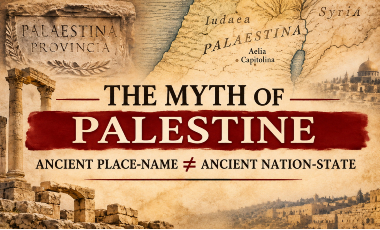
A recent missionary came to speak at the church I belong to. While I did not hear much of the presentation, I heard enough to make my historical antenna go up. Unfortunately, that particular presentation was not recorded. But Sameer’s ideas are expressed here:
- “A Pastoral Appeal to Church Leaders in America from a Palestinian Pastor” (YOUTUBE)
My appeal would be to truth, and to history. Not to a fictitious idea know as Palestine.
First though, before sounding harsh, I would just like to note that Pastor Dabit may have some nuances I am not aware of or views that align closer with mine. I do not know, and my “not knowing” is worth knowing. Heh. This being said, many view “Palestine” as a real, historical country, and not a larger area, like North America being used to select out a people called “North Americans” and founding a country by that name.
See my previous May 3, 2017 post on this, “Are Palestinians Indigenous to ‘Palestine’?” Something I have been noting since March 29, 2010 on my old blog.
Here is an example of what I mean, via THE TIMES OF ISRAEL:
The thrust of the Palestinian legal case today is that Palestine is a centuries-old geopolitical entity whose residents are entitled to statehood as a matter of international law. But that has not always been the Palestinians’ legal position.
Immediately following World War I and continuing through most of the British Mandate period (1922-1948), Palestinian lawyers and witnesses argued repeatedly before various tribunals that there was no such place as “Palestine.” Instead, they claimed the area known colloquially as “Palestine” was in fact part of Syria, or “southern Syria” to be precise. Following the Israeli War of Independence, the Palestinians changed course and pledged their loyalty to Jordan.
It seems unthinkable that any Palestinian lawyer or legal scholar would argue today that Palestine is part of Syria or Jordan, but those were the predominant Palestinian legal positions from the end of World War I until the Six Day War.
For example, in November 1918 a Palestinian Arab group filed a petition with the French Commissariat in Jerusalem “begging that Palestine might be formally included in Syria.”
In February 1919 the Arab Delegation from Palestine to the Versailles Peace Conference submitted a formal petition urging that rather than be recognized as an independent state, Palestine should be deemed part of and merged into Syria. The petition said, “We consider Palestine as part of Arabic Syria as it has never been separated from it at any time. We are connected with it by national, religious, linguistic, natural, economical and geographic bonds . . . In view of the above we desire that our distinct Southern Syria or Palestine should not be separated from the Independent Arabic Syrian Government.”
The Arab legal argument that there was no such political entity as “Palestine” continued after the League of Nations awarded the Palestine Mandate to Britain in 1922. For example, in 1925 Jamal Effendi-Husseini, a prominent Palestinian Arab, challenged a decision of British High Commissioner Sir Herbert Samuel allowing local postage stamps to bear an inscription in Hebrew identifying the country as “Palestine E.I.” (Palestine Eretz Israel).
Husseini’s lawyer, Auni Bey Abdul Hadi, argued to the court that “Palestine” was “not an Arab word.” Auni Bey insisted the correct name of the country was “Southern Syria.” “Palestine,” he argued, had no separate existence and was in fact part of Syria.
Following the Hebron Massacre in late August 1929, the British Government convened an inquiry commission under the leadership of Sir Walter Shaw. A witness for the Arab side, Saleem Farah, testified under oath on November 27, 1929 that prior to World War I, Palestine was never regarded as a separate political entity.
The Grand Mufti of Jerusalem, Haj Amin al Husseini, also testified before the Shaw Commission. The Mufti conceded in his testimony that the League of Nations Mandate for Palestine granted political rights in Palestine to the Jews, but not to the Arabs.
Many other prominent Arabs also argued Palestine should have been regarded as part of Syria. George Antonius, author of the acclaimed book “The Arab Awakening,” testified before the Palestine Royal Commission (the Peel Commission) on January 18, 1937 in Jerusalem. Antonius spent a considerable portion of his testimony arguing Palestine had always been part of Syria. He noted “Palestine has always been an integral part of Syria and that what was common to Syria was common to Palestine.”
Following the Israeli War of Independence, the Palestinians declared their allegiance to King Abdullah I of Jordan at the Jericho Conference in December 1950. Abdullah invoked the resolutions adopted at the conference as the legal basis for Jordan’s annexation of the West Bank.

Not a lot of people are aware of this history. There is no country in antiquity or currently someone can point to and say, “look, here is Palestine.”
It is a fictitious label.
In a book I read many years ago, “Myths and Facts: A Guide to the Arab-Israeli Conflict,” I was enlightened to the fact that the history is different than a professor from a university would typically share. To wit… in the book, “The Arab Case for Israel,” by Hussain Abdul-Hussain, he noted this:
In my college years, I accepted the Arab narrative on Palestine. The story was clear—there was an Arab state called Palestine. The British, hypnotized by Jews who used money and media to control the world from behind the scenes, took Palestine from the Ottomans, allowed Jews to immigrate, and tipped the military scales in favor of the Zionists, who violently displaced the native Arabs in order to build the exclusivist State of Israel. To right this wrong, Arabs had to battle Israel in every way possible—war or peace—to take back what was theirs.
And this is what most people believe. Chapter one (PDF) of “Myths and Facts,” is summed up thus:
Chapter One of Myths and Facts, “Israel’s Roots,” argues that the Jewish people have a longstanding historical, religious, and political connection to the land of Israel, predating modern Zionism by thousands of years. Bard challenges claims that Palestine was historically an exclusively Arab country, that Palestinians descend directly from the ancient Canaanites, and that Zionism was simply a form of Western colonialism. He traces Jewish communities in the region, discusses the Balfour Declaration and League of Nations Mandate, and argues that Jewish immigration helped develop the land. He also contends that a distinct Palestinian national movement emerged largely in the twentieth century and that Britain had not explicitly promised Palestine to the Arabs. Overall, the chapter presents the historical and legal case for Jewish national claims while disputing competing narratives about the origins of Palestinian identity and statehood.
To continue with this understanding is a portion of an interview between Dinesh D’Souza and Mosab Hassan Yousef. Yousef is an American author and former militant who defected to Israel in 1997 and who’s father is the a co-founder of the Palestinian Islamist organization Hamas.
So, when I say, truth should be on the forefront of this conversation,” is, because people who continue the idea of “Palestine” as a country are helping the terrorists in their goal. Whether they realize it or not. Useful Idiots in other words.
Useful idiot
The term “useful idiot,” commonly but incorrectly attributed to Vladimir Lenin, emerged in twentieth-century political discourse to describe individuals who unwittingly advance the interests of an ideological movement. Although no authenticated evidence establishes that Lenin or Stalin coined the expression, the concept became closely associated with communist propaganda and the exploitation of sympathetic Western intellectuals and political activists.
Another point I wish to note which I caught in the interview of the video I link to the interview of Sameer Dabit, is when he said: “They’re not the same people when it comes to the state of Israel as a political nation, to the Israel as those in scripture.” I will give him the benefit of the doubt to say that the political portion of modern Israel is different than the historical one. But he could also be refereeing to crazy thinking like Candace Owens and the Frankists.
So, while I do not know, I will respond with a break-out of Dr. Vlach’s article titled: “Modern Israel and Israel in the Bible: Clarifying the Relationship”
Are Modern Israel and Biblical Israel Really Different People?
There is an important distinction to make here. The modern State of Israel, established in 1948, is not politically or religiously identical to ancient biblical Israel. It is a modern state with contemporary institutions, secular and religious citizens, and a political system very different from the government established under the Mosaic covenant.
But that does not mean the Jewish people of today are unrelated to the Israel of Scripture.
As Dr. Michael J. Vlach explains in “Modern Israel and Israel in the Bible: Clarifying the Relationship,” Israel’s identity did not disappear during centuries of exile and dispersion. The Jewish people continued to exist as an identifiable ethnic and historical community, maintaining their religious traditions, language, cultural identity, and connection to their ancestral homeland.
Vlach makes an important distinction: the establishment of the modern State of Israel did not create a new people or recreate an extinct nation. Rather, it restored political sovereignty to a people whose identity had endured throughout the centuries.
Nor does Israel’s present unbelief invalidate that historical continuity. Scripture repeatedly describes Israel as a nation that experienced periods of widespread disobedience and unbelief without ceasing to be Israel. Paul makes this distinction particularly clear in Romans 9–11, where he acknowledges Israel’s unbelief while continuing to recognize the nation’s covenant history and future significance.
Consequently, it is perfectly reasonable to distinguish the modern Israeli government from ancient biblical Israel. What is not reasonable is to use that political distinction to suggest that the Jewish people living in Israel today are somehow a different people from the descendants of biblical Israel.
The modern state and the biblical nation are not identical political entities. But the historical people are connected.
That distinction matters. Criticism of Israeli government policies is legitimate and does not require denying Jewish historical continuity. Likewise, recognizing Palestinian suffering and the historical presence of Palestinian Christians does not require denying the Jewish people’s historical connection to the land.
Some quick historical hits for the reader not connected to Sameer’s views:
- Israel is not a “settler-colonial” state. It was established as a national liberation movement for the Jewish people, who have had a continuous presence in what is now Israel for thousands of years. The Zionist movement successfully fought against both Ottoman and British colonialism and established a vibrant democracy in place of tyrannical colonialist rule.
- Israel has not denied the Palestinian people statehood. Israel accepted the two-state solution proposed by the UN in 1947–1948, but the Palestinian leadership rejected statehood because it opposed the establishment of any nation-state for the Jewish people, regardless of size. Since 1967, Palestinians have refused to accept resolutions that would have resulted in a Palestinian state on more than 90 percent of the West Bank and the entire Gaza Strip.
- Israel did not cause the Palestinian refugee problem. Had the Arab states not attacked the new state of Israel in 1948, there would have been no “nakba” and no Palestinian refugees. There would have been a two-state solution in which the Jewish state had a Jewish majority and the Arab state had an Arab majority. Palestinian leaders have exacerbated the problem by creating refugee camps, rather than integrating their fellow Arabs, the way Israel integrated a similar number of Jewish refugees from Arab countries. The United Nations has contributed to the refugee problem by establishing a special agency, UNRWA, that is dedicated to maintaining these camps and the status quo of their residents as “refugees.”
Here are some PDFs resources that go deeper. What follows, chapter extracts and a small book:
- MYTHS AND FACTS – Palestinian History (Chapter One)
- The Myth of Ancient Palestine (Chapter Two)
- The Ten Big Anti-Israel Lies_ And How to Refute Them with Truth
Some resources used:
Sources and References
- “Back When Palestinians Insisted There’s No Such Place as Palestine,” The Times of Israel, https://blogs.timesofisrael.com/back-when-palestinians-insisted-theres-no-such-place-as-palestine/.
- Mitchell G. Bard, “Israel’s Roots,” chap. 1 in Myths and Facts: A Guide to the Arab-Israeli Conflict (American-Israeli Cooperative Enterprise, 2017), 11–24.
- Alan Dershowitz, The Ten Big Anti-Israel Lies: And How to Refute Them with Truth (Skyhorse Publishing, 2024).
- Hussain Abdul-Hussain, “The Myth of Ancient Palestine,” chap. 2 in The Arab Case for Israel: And Other Essays from a Distant Conflict (Wicked Son, 2026).
- David Ben-Basat, “How Misleading Info Leads to False Claims of a Historic ‘Palestinian State,’” The Jerusalem Post, December 14, 2024, https://www.jpost.com/opinion/article-833263.