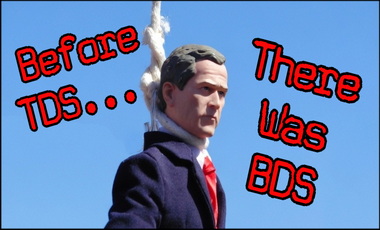
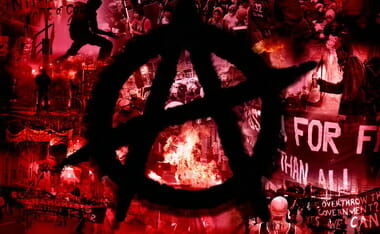
This post was originally posted here Feb 2011 with the title: “What You Are not Seeing On Mainstream News Shows-Some Carry Signs Likening Republicans to Hitler and Nazis.” I found the videos again, and re-uploaded the graphics. I added an article as well.
Democrats rhetoric has changed zero-percent since President Ford (full archived article). Democrats have called Republicans racist and Nazis for 62 years. I saw some signs at the SCV No Kings protest showing Trump to be the same. Just like Bush. Just like Romney…. on and on. TO WIT:
….. Let’s start with former Sen. Barry Goldwater (R-AZ) and his acceptance speech at the Republican National Convention in 1964. Over 50 years before Trump decided to run for president, celebrities, journalists, politicians, and other politicos warned that the GOP presidential nominee was an extreme fascist who would cause considerable harm to the country. Goldwater, who served as a pilot during World War II, was likened to Nazis and fascists for promoting conservatism during his presidential campaign.
For example, the then-Democratic governor of California, Edmund Gerland “Pat” Brown, remarked about Goldwater’s acceptance speech, claiming it “had the stench of fascism. All we needed to hear was Heil Hitler.” It should be noted that Goldwater served as a pilot in the military during WWII. Brown didn’t have any military service at all.
Other comments about Goldwater included a scathing rebuke from civil rights leader Dr. Martin Luther King Jr.
“We see dangerous signs of Hitlerism in the Goldwater campaign,” King said.
Baseball legend Jackie Robinson, who broke Major League Baseball’s color barrier, said of Goldwater’s speech, “I would say that I now believe I know how it felt to be a Jew in Hitler’s Germany.”
The then-mayor of San Francisco, the city where the 1964 Republican National Convention was held, said the GOP “had Mein Kampf as their political bible.”
The despicable comments continued the following election in 1968. Then-Vice President Hubert Humphrey, and Democratic nominee for president, remarked about the election, “If the British had not fought in 1940, Hitler would have been in London, and if Democrats do not fight in 1968, Nixon will be in the White House.”
Former President Richard Nixon won the election, but the Hitler, Nazi, and fascist comparisons never stopped. For example, in 1970, a political poster featured an image of Adolf Hitler, wearing a Nazi armband, holding a mask of Nixon.
Meanwhile, a news article from October 1972, available for viewing on the CIA’s website, referred to “Nixon’s Nazis” as part of commentary criticizing Nixon. Then there is a photograph from October 1973 of someone wearing a Nixon mask with a crown, giving the Nazi salute.
Gerald Ford followed Nixon as president and as a Republican who was called a fascist. In 1974, a member of the American Civil Liberties Union criticized Ford for his lack of punitive action against Nixon.
“If [President] Ford’s principle had been the rule in Nuremberg,” he said, “the Nazi leaders would have been let off, and only the people, who carried out their schemes, would have been tried,” the ACLU said at the time.
Additionally, in the Gerald Ford Library Museum, a document describes an interaction with a woman in 1975 in which Ford was harassed and repeatedly called a “fascist” and a “fascist pig.”
Surely, over a decade of accusations and allegations of fascism never coming to fruition would stop Democrats from calling Republicans Nazis, fascists, or comparing them to Hitler, right?
Wrong.
Former President Ronald Reagan was the next target in the Democrats’ line of unsubstantiated accusations of fascism.
Rep. William Clay (D-MO) stated that Reagan wanted to “replace the Bill of Rights with fascist precepts lifted verbatim from Mein Kampf.”
The Los Angeles Times cartoonist Paul Conrad drew a panel depicting Reagan plotting a fascist putsch in a darkened Munich beer hall. Harry Stein (later a conservative convert) wrote in Esquire that the voters who supported Reagan were comparable to the “good Germans” in “Hitler’s Germany.”
American Enterprise Institute scholar Steven Hayward highlighted another incident in which the intelligentsia and academia also contributed to the Reagan fascist comparisons when John Roth, a Holocaust scholar from the Claremont Colleges, commented about Reagan’s election:
“I could not help remembering how 40 years ago economic turmoil had conspired with Nazi nationalism and militarism — all intensified by Germany’s defeat in World War I—to send the world reeling into catastrophe. … It is not entirely mistaken to contemplate our postelection state with fear and trembling.”
Former President George W. Bush might have been the Republican politician who faced the harshest and most vile criticism before Trump. Bush was regularly called every dirty name in the book, from racist to Nazi to fascist to war criminal. There are many examples of linking Bush to Hitler, Nazis, and fascists.
In 2012, Sen. Mitt Romney (R-UT), the same Romney so many Democrats love today, was also linked to Nazis and fascism. One delegate from Kansas (at the time) said Romney was a habitual liar and likened him to Hitler “while criticizing the accuracy of Romney’s campaign talking points.”
A chairman of the California Democratic Party compared then-vice presidential candidate (and eventual former Speaker of the House) Paul Ryan, again, the same Ryan loved by many Democrats today, to Nazi filmmaker and propagandist Joseph Goebbels.
Does any of this sound familiar? It should. It is the same line of attacks Democrats have used against Trump. …..
The below is just a reminder of some of the anti-war marches, the May Day marches, and the anti-Bush, anti-American, anti-Semitic, anti-capitalist liberals/Democrats of years past (most of these pics come from Zombie Time):
I wanted to separate out two CS Lewis chapters I quote from in my first (May 2025) dealing with the topic at hand. I wanted to let Lewis’ insights burn in the mind of the believer. I will add stuff after the Lewis excerpts, one being a quote from a book recommended from the “lectern” by a pastor at a church I am in the process of leaving… and I wonder what Lewis would have thought if he had read this — more than he already intimates below. [But read the Lewis excerpts before even reading the quote, Lewis stands on his own. I will add the short quote AFTER the focus of one of the 20th century’s apologetic giants thoughts.] I include the full audio chapter at the end of each partial “print” excerpt.
CS LEWIS had a huge influence on my apologetic life. The quotes are from his The Problem of Pain, chapters 3 and 4:
“Divine Goodness”
Any consideration of the goodness of God at once threatens us with the following dilemma.
On the one hand, if God is wiser than we His judgement must differ from ours on many things, and not least on good and evil. What seems to us good may therefore not be good in His eyes, and what seems to us evil may not be evil.
On the other hand, if God’s moral judgement differs from ours so that our ‘black’ may be His ‘white’, we can mean nothing by calling Him good; for to say ‘God is good’, while asserting that His goodness is wholly other than ours, is really only to say ‘God is we know not what’. And an utterly unknown quality in God cannot give us moral grounds for loving or obeying Him. If He is not (in our sense) ‘good’ we shall obey, if at all, only through fear—and should be equally ready to obey an omnipotent Fiend. The doctrine of Total Depravity— when the consequence is drawn that, since we are totally depraved, our idea of good is worth simply nothing— may thus turn Christianity into a form of devil-worship.
The escape from this dilemma depends on observing what happens, in human relations, when the man of inferior moral standards enters the society of those who are better and wiser than he and gradually learns to accept their standards—a process which, as it happens, I can describe fairly accurately, since I have undergone it. When I came first to the University I was as nearly without a moral conscience as a boy could be. Some faint distaste for cruelty and for meanness about money was my utmost reach—of chastity, truthfulness, and self-sacrifice I thought as a baboon thinks of classical music. By the mercy of God I fell among a set of young men (none of them, by the way, Christians) who were sufficiently close to me in intellect and imagination to secure immediate intimacy, but who knew, and tried to obey, the moral law. Thus their judgement of good and evil was very different from mine. Now what happens in such a case is not in the least like being asked to treat as ‘white’ what was hitherto called black. The new moral judgements never enter the mind as mere reversals (though they do reverse them) of previous judgements but ‘as lords that are certainly expected’. You can have no doubt in which direction you are moving: they are more like good than the little shreds of good you already had, but are, in a sense, continuous with them. But the great test is that the recognition of the new standards is accompanied with the sense of shame and guilt: one is conscious of having blundered into society that one is unfit for. It is in the light of such experiences that we must consider the goodness of God. Beyond all doubt, His idea of ‘goodness’ differs from ours; but you need have no fear that, as you approach it, you will be asked simply to reverse your moral standards. When the relevant difference between the Divine ethics and your own appears to you, you will not, in fact, be in any doubt that the change demanded of you is in the direction you already call ‘better’. The Divine ‘goodness’ differs from ours, but it is not sheerly different: it differs from ours not as white from black but as a perfect circle from a child’s first attempt to draw a wheel. But when the child has learned to draw, it will know that the circle it then makes is what it was trying to make from the very beginning.
This doctrine is presupposed in Scripture. Christ calls men to repent—a call which would be meaningless if God’s standards were sheerly different from that which they already knew and failed to practise. He appeals to our existing moral judgement—‘Why even of yourselves judge ye not what is right?’ (Luke 12:57) God in the Old Testament expostulates with men on the basis of their own conceptions of gratitude, fidelity, and fair play: and puts Himself, as it were, at the bar before His own creatures—‘What iniquity have your fathers found in me, that they are gone far from me?’ (Jeremiah 2:5.) …
CS Lewis | The Problem of Pain (Chapter 3)
“Human Wickedness”
…A recovery of the old sense of sin is essential to Christianity. Christ takes it for granted that men are bad. Until we really feel this assumption of His to be true, though we are part of the world He came to save, we are not part of the audience to whom His words are addressed. We lack the first condition for understanding what He is talking about. And when men attempt to be Christians without this preliminary consciousness of sin, the result is almost bound to be a certain resentment against God as to one always inexplicably angry. Most of us have at times felt a secret sympathy with the dying farmer who replied to the Vicar’s dissertation on repentance by asking ‘What harm have I ever done Him?’ There is the real rub. The worst we have done to God is to leave Him alone—why can’t He return the compliment? Why not live and let live? What call has He, of all beings, to be ‘angry’? It’s easy for Him to be good!
Now at the moment when a man feels real guilt— moments too rare in our lives—all these blasphemies vanish away. Much, we may feel, can be excused to human infirmities: but not this—this incredibly mean and ugly action which none of our friends would have done, which even such a thorough-going little rotter as X would have been ashamed of, which we would not for the world allow to be published. At such a moment we really do know that our character, as revealed in this action, is, and ought to be, hateful to all good men, and, if there are powers above man, to them. A God who did not regard this with unappeasable distaste would not be a good being. We cannot even wish for such a God—it is like wishing that every nose in the universe were abolished, that smell of hay or roses or the sea should never again delight any creature, because our own breath happens to stink.
When we merely say that we are bad, the ‘wrath’ of God seems a barbarous doctrine; as soon as we perceive our badness, it appears inevitable, a mere corollary from God’s goodness. To keep ever before us the insight derived from such a moment as I have been describing, to learn to detect the same real inexcusable corruption under more and more of its complex disguises, is therefore indispensable to a real understanding of the Christian faith. This is not, of course, a new doctrine. I am attempting nothing very splendid in this chapter. I am merely trying to get my reader (and, still more, myself) over a pons asi-norum—to take the first step out of fools’ paradise and utter illusion. But the illusion has grown, in modern times, so strong, that I must add a few considerations tending to make the reality less incredible.
We are deceived by looking on the outside of things. We suppose ourselves to be roughly not much worse than Y, whom all acknowledge for a decent sort of person, and certainly (though we should not claim it out loud) better than the abominable X. Even on the superficial level we are probably deceived about this. Don’t be too sure that your friends think you as good as Y. The very fact that you selected him for the comparison is suspicious: he is probably head and shoulders above you and your circle. But let us suppose that Y and yourself both appear ‘not bad’. How far Y’s appearance is deceptive, is between Y and God. His may not be deceptive: you know that yours is.
Does this seem to you a mere trick, because I could say the same to Y and so to every man in turn? But that is just the point. Every man, not very holy or very arrogant, has to ‘live up to’ the outward appearance of other men: he knows there is that within him which falls far below even his most careless public behaviour, even his loosest talk. In an instant of time—while your friend hesitates for a word—what things pass through your mind? We have never told the whole truth. We may confess ugly facts— the meanest cowardice or the shabbiest and most prosaic impurity—but the tone is false. The very act of confess-ing—an infinitesimally hypocritical glance—a dash of humour—all this contrives to dissociate the facts from your very self. No one could guess how familiar and, in a sense, congenial to your soul these things were, how much of a piece with all the rest: down there, in the dreaming inner warmth, they struck no such discordant note, were not nearly so odd and detachable from the rest of you, as they seem when they are turned into words. We imply, and often believe, that habitual vices are exceptional single acts, and make the opposite mistake about our virtues—like the bad tennis player who calls his normal form his ‘bad days’ and mistakes his rare successes for his normal. I do not think it is our fault that we cannot tell the real truth about ourselves; the persistent, life-long, inner murmur of spite, jealousy, prurience, greed and self-complacence, simply will not go into words. But the important thing is that we should not mistake our inevitably limited utterances for a full account of the worst that is inside.
A reaction—in itself wholesome—is now going on against purely private or domestic conceptions of morality, a reawakening of the social We feel ourselves to be involved in an iniquitous social system and to share a corporate guilt. This is very true: but the enemy can exploit even truths to our deception. Beware lest you are making use of the idea of corporate guilt to distract your attention from those humdrum, old-fashioned guilts of your own which have nothing to do with ‘the system’ and which can be dealt with without waiting for the millennium. For corporate guilt perhaps cannot be, and certainly is not, felt with the same force as personal guilt. For most of us, as we now are, this conception is a mere excuse for evading the real issue. When we have really learned to know our individual corruption, then indeed we can go on to think of the corporate guilt and can hardly think of it too much. But we must learn to walk before we run.
We have a strange illusion that mere time cancels sin. I have heard others, and I have heard myself, recounting cruelties and falsehoods committed in boyhood as if they were no concern of the present speaker’s, and even with laughter. But mere time does nothing either to the fact or to the guilt of a sin. The guilt is washed out not by time but by repentance and the blood of Christ: if we have repented these early sins we should remember the price of our forgiveness and be humble. As for the fact of a sin, is it probable that anything cancels it? All times are eternally present to God. Is it not at least possible that along some one line of His multi-dimensional eternity He sees you forever in the nursery pulling the wings off a fly, forever toadying, lying, and lusting as a schoolboy, forever in that moment of cowardice or insolence as a subaltern? It may be that salvation consists not in the cancelling of these eternal moments but in the perfected humanity that bears the shame forever, rejoicing in the occasion which it furnished to God’s compassion and glad that it should be common knowledge to the universe. Perhaps in that eternal moment St Peter—he will forgive me if I am wrong— forever denies his Master. If so, it would indeed be true that the joys of Heaven are for most of us, in our present condition, ‘an acquired taste’—and certain ways of life may render the taste impossible of acquisition. Perhaps the lost are those who dare not go to such a public Of course I do not know that this is true; but I think the possibility is worth keeping in mind.
We must guard against the feeling that there is ‘safety in numbers’. It is natural to feel that if all men are as bad as the Christians say, then badness must be very excusable. If all the boys plough in the examination, surely the papers must have been too hard? And so the masters at that school feel till they learn that there are other schools where ninety per cent of the boys passed on the same papers. Then they begin to suspect that the fault did not lie with the examiners. Again, many of us have had the experience of living in some local pocket of human soci-ety—some particular school, college, regiment or profession where the tone was bad. And inside that pocket certain actions were regarded as merely normal (‘Everyone does it’) and certain others as impracticably virtuous and Quixotic. But when we emerged from that bad society we made the horrible discovery that in the outer world our ‘normal’ was the kind of thing that no decent person ever dreamed of doing, and our ‘Quixotic’ was taken for granted as the minimum standard of decency. What had seemed to us morbid and fantastic scruples so long as we were in the ‘pocket’ now turned out to be the only moments of sanity we there enjoyed. It is wise to face the possibility that the whole human race (being a small thing in the universe) is, in fact, just such a local pocket of evil—an isolated bad school or regiment inside which minimum decency passes for heroic virtue and utter corruption for pardonable imperfection. But is there any evidence—except Christian doctrine itself—that this is so? I am afraid there is. In the first place, there are those odd people among us who do not accept the local standard, who demonstrate the alarming truth that a quite different behaviour is, in fact, possible. Worse still, there is the fact that these people, even when separated widely in space and time, have a suspicious knack of agreeing with one another in the main—almost as if they were in touch with some larger public opinion outside the pocket. What is common to Zarathustra, Jeremiah, Socrates, Gautama, Christ1 and Marcus Aurelius, is something pretty substantial. Thirdly, we find in ourselves even now a theoretical approval of this behaviour which no one practises. Even inside the pocket we do not say that justice, mercy, fortitude, and temperance are of no value, but only that the local custom is as just, brave, temperate and merciful as can reasonably be expected. It begins to look as if the neglected school rules even inside this bad school were connected with some larger world—and that when the term ends we might find ourselves facing the public opinion of that larger world. But the worst of all is this: we cannot help seeing that only the degree of virtue which we now regard as impracticable can possibly save our race from disaster even on this planet. The standard which seems to have come into the ‘pocket’ from outside, turns out to be terribly relevant to conditions inside the pocket—so relevant that a consistent practice of virtue by the human race even for ten years would fill the earth from pole to pole with peace, plenty, health, merriment, and heartsease, and that nothing else will. It may be the custom, down here, to treat the regimental rules as a dead letter or a counsel of perfection: but even now, everyone who stops to think can see that when we meet the enemy this neglect is going to cost every man of us his life. It is then that we shall envy the ‘morbid’ person, the ‘pedant’ or ‘enthusiast’ who really has taught his company to shoot and dig in and spare their water bottles.
[….]
This chapter will have been misunderstood if anyone describes it as a reinstatement of the doctrine of Total Depravity. I disbelieve that doctrine, partly on the logical ground that if our depravity were total we should not know ourselves to be depraved, and partly because experience shows us much goodness in human nature. Nor am I recommending universal gloom. The emotion of shame has been valued not as an emotion but because of the insight to which it leads. I think that insight should be permanent in each man’s mind: but whether the painful emotions that attend it should also be encouraged, is a technical problem of spiritual direction on which, as a layman, I have little call to speak. My own idea, for what it is worth, is that all sadness which is not either arising from the repentance of a concrete sin and hastening towards concrete amendment or restitution, or else arising from pity and hastening to active assistance, is simply bad; and I think we all sin by needlessly disobeying the apostolic injunction to ‘rejoice’ as much as by anything else. Humility, after the first shock, is a cheerful virtue: it is the high-minded unbeliever, desperately trying in the teeth of repeated disillusions to retain his ‘faith in human nature’, who is really sad. I have been aiming at an intellectual, not an emotional, effect: I have been trying to make the reader believe that we actually are, at present, creatures whose character must be, in some respects, a horror to God, as it is, when we really see it, a horror to ourselves. This I believe to be a fact: and I notice that the holier a man is, the more fully he is aware of that fact. Perhaps you have imagined that this humility in the saints is a pious illusion at which God smiles. That is a most dangerous error. It is theoretically dangerous, because it makes you identify a virtue (i.e., a perfection) with an illusion (i.e., an imperfection), which must be nonsense. It is practically dangerous because it encourages a man to mistake his first insights into his own corruption for the first beginnings of a halo round his own silly head. No, depend upon it; when the saints say that they—even they—are vile, they are recording truth with scientific accuracy.
CS Lewis | The Problem of Pain (Chapter 4)
THE STONE IN THE SHOE:
This was a book recommended in a men’s group, and this comes from my copy… it is repeated below as well in the excerpt from SOTERIOLOGY 101:
Ephesians 1:11 goes even further by declaring that God in Christ
“works all things according to the counsel of his will.” Here the Greek word for “works” is energeø, which indicates that God not merely carries all of the universe’s objects and events to their appointed ends but that he actually brings about all things in accordance with his will. In other words, it isn’t just that God manages to turn the evil aspects of our world to good for those who love him; it is rather that he himself brings about these evil aspects for his glory (see Ex. 9:13-16; John 9:3) and his people’s good (see Heb. 12:3-11; James 1:2-4). This includes—as incredible and as unacceptable as it may currently seem—God’s having even brought about the Nazis’ brutality at Birkenau and Auschwitz as well as the terrible killings of Dennis Rader and even the sexual abuse of a young child: “The LORD has made everything for its own purpose, even the wicked for the day of evil” (Prov. 16:4, NASB ).14 “When times are good, be happy; but when times are bad, consider: God has made the one as well as the other” (Eccl. 7:14, NIV).
Mark Talbot, in John Piper and Justin Taylor, eds., Suffering and the Sovereignty of God (Wheaton, IL: Crossway Books, 2006), 42.
This entire article is well worth the read… and I understand Calvinists do not even allow free will even in secondary cause (see short video embedded in my introduction to a letter which includes John Hendryx and John MacArthur)
Here is the short excerpt from the longer article, keep in mind “that our ‘black’ may be His ‘white’,”
I recently came upon this question in my twitter feed. In case it isn’t obvious, my answer to this shocking question is unapologetically, “HELL NO!” And I mean that quite literally. Hell, the place were creatures go who “BRING ABOUT” such atrocities, screams what should be the obvious answer: NO! Our perfectly HOLY God does not bring about the sins for which people suffer for in Hell!
However, as obvious as the answer to this question may seem, John Piper, and other notable Calvinistic scholars, teach a highly controversial perspective:
“God . . . brings about all things in accordance with his will. In other words, it isn’t just that God manages to turn the evil aspects of our world to good for those who love him; it is rather that he himself brings about these evil aspects for his glory (see Ex. 9:13-16; John 9:3) and his people’s good (see Heb. 12:3-11; James 1:2-4). This includes—as incredible and as unacceptable as it may currently seem—God’s having even brought about the Nazis’ brutality at Birkenau and Auschwitz as well as the terrible killings of Dennis Rader and even the sexual abuse of a young child…”
(Video Link) — Mark R. Talbot, “’All the Good That Is Ours in Christ’: Seeing God’s Gracious Hand in the Hurts Others Do to Us,” in John Piper and Justin Taylor (eds.), Suffering and the Sovereignty of God (Wheaton: Crossway, 2006), 31-77 (quote from p. 42).
So, look at the two different beliefs side by side:
Traditionalism affirms that God works to redeem man’s morally evil choices and bring about good from the heinous consequences of those autonomous choices. God is seen as most glorious because of His redemptive grace in overcoming evil.
Calvinism, according to Piper, affirms that God “isn’t just managing to turn the evil aspects of our world to good; it is rather that He Himself brings about these evil aspects for His glory.” God, according to this perspective, is seen as most glorious for His power and control of the evil itself.
So, is God bringing about the very moral evil that He works to redeem?
[….]
I’ll allow John MacArthur, another notable Calvinistic pastor, bring some much needed balance to this approach:
If God is sovereign, is He responsible for evil?
No. Scripture says that when God finished His creation, He saw everything and declared it “very good” (Genesis 1:31). Many Scriptures affirm that God is not the author of evil: “God cannot be tempted by evil, and He Himself does not tempt anyone” (James 1:13). “God is light, and in Him there is no darkness at all” (1 John 1:5). “God is not the author of confusion” (1 Corinthians 14:33)—and if that is true, He cannot in any way be the author of evil.
Occasionally someone will quote Isaiah 45:7 (KJV) and claim it proves God made evil as a part of His creation: “I form the light, and create darkness: I make peace, and create evil: I the Lord do all these things.”
But the New American Standard Bible gives the sense of Isaiah 45:6-7 more clearly: “There is no one besides Me. I am the Lord, and there is no other, the One forming light and creating darkness, causing well-being and creating calamity; I am the Lord who does all these.” In other words, God devises calamity as a judgment for the wicked. But in no sense is He the author of evil. …
Romans 5:12 says that death entered the world because of sin. Death, pain, disease, stress, exhaustion, calamity, and all the bad things that happen came as a result of the entrance of sin into the universe (see Genesis 3:14-24). All those evil effects of sin continue to work in the world and will be with us as long as sin is.
First Corinthians 10:13 promises us that God will not permit a greater trial than we can bear. And James 1:13 tells us that God will not tempt us with evil.
God is certainly sovereign over evil. There’s a sense in which it is proper even to say that evil is part of His eternal decree. He planned for it. It did not take Him by surprise. It is not an interruption of His eternal plan. He declared the end from the beginning, and He is still working all things for His good pleasure (Isaiah 46:9-10).
But God’s role with regard to evil is never as its author. He simply permits evil agents to work, then overrules evil for His own wise and holy ends. Ultimately He is able to make all things-including all the fruits of all the evil of all time-work together for a greater good (Romans 8:28). – John MacArthur
Please re-read that last paragraph that I emboldened. He says, “He simply permits evil agents to work, then overrules evil for His own wise and holy ends,” while Piper’s article says the opposite, “God isn’t just managing to turn the evil aspects of our world to good; it is rather that He Himself brings about these evil aspects for His glory.” So, which is it? Is God bringing about evil or simply permitting it?
In another must read article, and why I consider myself a Baptist, but not in the Al Mohler sense, is this one which — again — should be read in full. Here is the short clip via BAPTIST NEWS:
… “This is excruciatingly troubling to me,” the user commented.
So to the Calvinists Pamela Butler 10 years old Rollerblading Kidnapped by Keith Nelson Taken to a wooded area Tortured for hours including electrocution Raped Strangled to death Please tell me how this is NOT a tragedy.
Then along came R.C. Sproul Jr. in an attempt to do just that.
Without offering a single word of empathy or lament, Sproul Jr. started in: “The closest the world has ever come to a tragedy is when a man, who had never sinned, was tortured to death. Do you believe God ordained that event?”
When the X poster asked how the Crucifixion of Jesus “remotely compares to the event I described,” Sproul Jr. added: “No, it does not remotely compare. Because in one instance a little girl received the judgment from God she had earned. In the other a perfect man received the judgment I earn. So you are OK with saying God ordained the torment of Jesus but not a sinner?”
From there, Sproul Jr. boasted of being “an orthodox theologian who affirms the doctrine of original sin,” attacked the original poster for using “an emotional appeal that denies what the Bible clearly teaches about our sin,” and demanded that the person “submit to what the Bible plainly teaches.”
He concluded, “If the girl is not a believer, she received justice from God.”
While Sproul Jr.’s words are horrifyingly shocking to anyone who has even a hint of human decency about them, they are indeed the logical outflow of the power- and violence-obsessed gospel prevalent among conservative evangelical Calvinists today. There’s a link between the pop-Calvinist’s obsession with power over women and their indifference to violence against women. And when we begin to probe, we’ll discover the connection in their gospel.
[….]
‘Meaningful rape’
Lest we think this intellectualized indifference toward the rape and murder of 10-year-old girls is a unique manifestation of the internal rot of the Sprouls, it’s actually one of the skeletons in the closet of the conservative evangelical Calvinist world that has come to dominate much of the conservative Reformed Baptist and Pentecostal worlds today.
In a debate on The Bible Answer Man, the Calvinist apologist James White was asked, “When a child is raped, is God responsible? And did he decree that rape?”
White answered, “If he didn’t, then that rape is an element of meaningless evil that has no purpose.” And when pressed further, he doubled down, asserting, “Yes. Because if not, then it’s meaningless and purposeless.”
While talking with a woman about people who have been gang raped, Jeff Durbin said, “God actually has a morally sufficient reason for all the evil he plans. … He actually decrees all things.”
In Suffering and the Sovereignty of God, which was edited by John Piper, Mark Talbot argued: “It isn’t just that God manages to turn the evil aspects of our world to good for those that love him; it is rather that he himself brings about these evil aspects. … This includes God’s having even brought about the Nazi’s brutality at Birkenau and Auschwitz as well as the terrible killings of Dennis Nadar and even the sexual abuse of a young child.”
Vincent Cheung wrote: “Scripture teaches that God’s will determines everything. Nothing exists or happens without God, not merely permitting, but actively willing it to exist or happen.”
John Piper tried to make sense of it by saying: “God disapproves of some of what he ordains to happen. That is, he forbids some of the things he brings about.”
In other words, Sproul Jr.’s indifference toward rape and murder isn’t simply the rantings of a drunk driver who goes on websites designed to facilitate adultery. It’s part of what mainstream conservative evangelical Calvinist leaders across the board celebrate today as good news.
I have a collection of quotes related to this here.
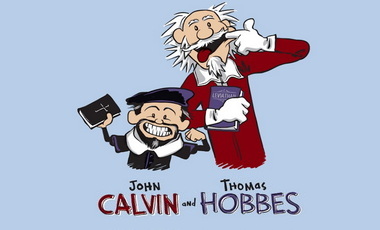
These are some counter Calvinist graphics I liked that are not my creation. I may have tweaked them a bit in “sightly more realism vs. drawn” or changed a sentence… but they are not changes at all or much. As usual…
Click any graphic to enlarge I will add to these over time
Just jump on a bus and head down to Florida where you belong, okay? Get out of town. Get out of town. Because you don’t represent our values. You are not New Yorkers. — Kathy Hochul
2026
TRANSCRIPT
And being conscious of the fact that I need people who are high net worth to support the generous social programs that we want to have in our state.
Right now, there are some patriotic millionaires who stepped up.
OK, cut me the checks.
I mean, just if you want to be supportive, but maybe the first step should be go down to Palm Beach and see who you can bring back home because our tax base has been eroded.
So, I philosophically don’t have a problem.
It is like I have to look at the fact that we are in competition with other states who have less of a tax burden on their corporations and their individuals.
And I would say remote work changed everything.
There are people who could only work in an office in Manhattan and work in New York State, and they were captives to our state.
They were going to stay. We saw that that’s not the case.
I mean, you know, Wall Street businesses looking at Texas. They’re not going there because they have a nicer governor, I know that for sure.
But they’re going there because of the tax rate.
We have to be smart about this. But we can fund what we want to fund with what we already are taking
“Don’t be afraid to abandon a point of doctrine that the Bible opposes. Don’t be afraid to go to the *No Opinion* option on a topic the Bible does not address. Don’t be afraid to fight or leave, as God directs, any church or Christian fellowship group that is drawing you away from the Bible as it draws you closer to its members, doctrinal statement, or literature.”
I made this more generic, under advisement that I took to heart. While I shared the letter with many (elders, friends, etc.) so they would know why I disappeared. I am making the public letter less specific.
I love the men I became friends with, most of the teaching… but the stated goals and positions from the pulpit are not really believed. There is “double-talk” going on.
All [A] are [B] but in such a way that some [A] are not [B]
It’s the whole “preach as an Arminian and sleep like a Calvinist” thingy. Even Spurgeon softened on this a bit later in his life*. I did use the initials, but there are 1,500 to 2,000 churches with them.
I love the guys I sit with, but the other day I had to keep my thoughts to myself when they were speaking about the deleterious FX of Satan. I felt like David Attenborough narrating a scene in his calm British accent:
“Look at these fine specimens, many not realizing the redundancy of what they are saying regarding the horned one. Through first causes and secondary causes God has already made it impossible at all — video below — to respond to the Gospel. Following to their logical ends a systematized thought is not being taught here… it is as if they think Satan can go to a grave sight and dig up corpses and place blind folds on them.” (2 Corinthians 4:4 – Hat-Tip to Doc Flowers for the graveyard analogy.)
So while I have had a few people genuinely and heart filled try and talk me out of leaving, I would go bonkers trying to respect conversation and not draw it to logical, reasonable ends.
Just to note, I am not Arminian
* This is what I mean by early or late Spurgeon. When he was a young pastor taking over the now famous Park Street Chapel at 19 he would say stuff like, “Calvinism is the gospel, and nothing else.” [22 years old], or, “A mutable god may be the god for the Arminian—he is not the god for me.” [24 years old]. Later in life, as he matured in his faith, he softened a bit.
At age 28, after having been a shepherd of a flock and rubbing shoulder with people in his congregation for a while, he changed a bit, saying this:
There is some truth in Calvinism and some in Arminianism, and he who would hold the whole Truth of God must neither be cramped by the one system nor bound by the other, but take Truth wherever he can find it in the Bible.
When he was 42 in 1876, he noted the long history of “preaching like an Arminian but sleeping as a Calvinist”:
There has long been a great doctrinal discussion between the Calvinists and the Arminians upon many important points. I am myself persuaded that the Calvinist alone is right upon some points, and the Arminian alone is right upon others. There is a great deal of truth in the positive side of both systems, and a great deal of error in the negative side of both. If I was asked, “Why is a man damned?” I should answer as an Arminian answers, “He destroys himself.”
Finally, by 1881, when Spurgeon is now 47 years old, he says that he has been called “an Arminian Calvinist or a Calvinistic Arminian” and he does not seem to mind either label:
What a host of revised versions we have! Everybody has one of his own. Certain texts which will not fit into our system must be planed and cut down. Have you ever seen the hard work that some Brethren have to shape a Scripture to their mind? One text is not Calvinistic, it looks rather Arminian—of course it cannot be so and, therefore, they twist and tug to get it right. As for our Arminian Brethren, it is wonderful to see how they hammer away at the 9th Chapter of Romans—steam-hammers and screw-jacks are nothing to their appliances for getting rid of Election from that chapter! We have all been guilty of racking Scripture, more or less, and it will be well to have done with the evil, forever! We had far better be inconsistent with ourselves than with the Inspired Word of God.
I have been called an Arminian Calvinist or a Calvinistic Arminian and I am quite content so long as I can keep close to my Bible. I desire to preach what I find in this Book whether I find it in anybody else’s book or not.
From Cage-stage to “Arminian Calvinist or a Calvinistic Arminian”: Charles Spurgeon’s theological journey (BEYOND CALVINISM)
Dear Church Family,
After much prayer, study, and reflection, I want to share something personal with you. I have decided to begin attending another church whose theological direction more closely aligns with my own convictions—particularly in the area of soteriology.
This has not been a quick or emotional decision. CCC has been home to me for many years, through different seasons, buildings, friendships, and growth. I am deeply grateful for the pastors, elders, and members who have invested in my life. Many of my most meaningful conversations, lessons, and spiritual milestones have happened here. I care deeply for this church and its people, and I will always value the time I’ve spent among you.
More specifically, I hold to the conviction that God genuinely desires all people to be saved (1 Timothy 2:4; 2 Peter 3:9), that Christ’s atonement is sufficient for and sincerely offered to all (John 3:16–17), and that individuals are truly responsible for accepting or rejecting the gospel (John 1:12; Romans 10:9–13). I understand these invitations as reflecting a real capacity to respond—not merely an outward call accompanied only by an inward, effectual call for some.
In wrestling through these matters, I have reflected on the distinction often made between God’s revealed will—what He commands and expresses in Scripture—and His decretive or secret will—what He ordains in His eternal purposes. My concern is that when emphasis shifts too heavily toward the hidden decree of God, it can overshadow the plain force of His revealed invitations and commands. The universal call of the gospel can begin to feel less like a genuine appeal to all and more like a formal proclamation intended only for those already determined to respond.
For me, it is essential to maintain that the gospel call truly applies to all who hear it, that faith in Jesus’ promises is the responsibility of every sinner, that Christ is sincerely offered to all without qualification, that God displays real common grace toward the world, and that His love extends in a meaningful way even to those who ultimately reject Him. While I am not suggesting that CCC embraces what is commonly labeled hyper-Calvinism, I do find myself increasingly concerned when theological formulations appear to narrow the scope of the gospel’s free and universal offer.
[One caveat I would make today, I would say that Exhaustive Divine Determinism is a sign of hyper-Calvinism, and the books and ideas discussed from the pulpit and personal discussions with pastors would place Crossroad’s in the “hyper” camp.]
While I affirm God’s sovereignty in salvation, I do not believe Scripture teaches that God unconditionally determines who will believe and who will not, nor that His decree stands as the ultimate explanation for unbelief. As A.W. Tozer eloquently states:
Here is my view: God sovereignly decreed that man should be free to exercise moral choice, and man from the beginning has fulfilled that decree by making his choice between good and evil. When he chooses to do evil, he does not thereby countervail the sovereign will of God but fulfills it, inasmuch as the eternal decree decided not which choice the man should make but that he should be free to make it. If in His absolute freedom God has willed to give man limited freedom, who is there to stay His hand or say, What doest thou? Mans will is free because God is sovereign. A God less than sovereign could not bestow moral freedom upon His creatures. He would be afraid to do so.
I struggle with formulations that make divine determinism the governing framework—particularly when they risk portraying God as causally ordaining evil (1, 2, 3) or withholding saving grace from those whom He commands to repent.
Additionally, I am persuaded that assurance of salvation ultimately rests in Christ’s finished work and the promise of the gospel, rather than primarily in evaluating the consistency or degree of one’s perseverance. Good works are the fruit of genuine faith, but they are not the foundation of our confidence before God.
I want to say clearly: this decision is not about questioning anyone’s faith, sincerity, or love for the Lord. Faithful believers have long differed on these matters, and I do not doubt that God is at work wherever the gospel is proclaimed. My departure is not a declaration that others are unbiblical or insincere. Rather, it is an acknowledgment that convictions about the character of God and the nature of the gospel are not peripheral—they shape how we preach, invite, disciple, and offer hope.
One of the moments that clarified this for me was realizing that I hesitated to invite an unbelieving young man to CCC —not because of the people here, whom I love, but because I felt I might need to explain or reconcile theological distinctions that, in my understanding, complicate the straightforward and universal nature of the gospel invitation in Scripture. That tension made me recognize it would be more honest and spiritually healthy for me to worship and serve in a church where my convictions are fully aligned with the pulpit, and where I can invite others with complete clarity and confidence.
Please know this decision comes with affection, not frustration. I am thankful for the friendships we’ve built and the ways we’ve sharpened one another. I have no desire for division—only integrity in following my conscience as I seek to grow in Christ.
I leave with gratitude and with prayers for continued faithfulness, unity, and fruitfulness at CCC. I hope our relationships will continue, even as I worship elsewhere.
Virginia Democrats are under fire after a violent illegal immigrant with more than 40 arrests allegedly murdered a Fairfax County mother, and then tried to shift blame to Donald Trump and ICE. This breakdown exposes the sanctuary-style policies, judicial warrant deception, ICE detainer fight, and shocking media silence surrounding Stephanie Minter’s death. A devastating look at immigration enforcement, crime, and political accountability in Virginia. (More at TOWNHALL)
…. Emails obtained by FOX DC showed the Fairfax County Police Department (FCPD) warned Fairfax County Commonwealth’s Attorney Steve Descano’s office about Jalloh on at least three occasions, but no action was taken to remove him from the country.
In an email to Fairfax County Chief Deputy Commonwealth’s Attorney Jenna Sands, a Fairfax County police major said he wanted to bring Jalloh’s release to her attention because he “is one of the repeat (and violent) offenders” they had previously discussed.
“I wanted to get your background on why he is out so soon and ask if his prior suspended sentence (of I believe 5 years) was pursued by your office? Unfortunately, based on MTV Station’s numerous dealings with him, it is not a question of if, but rather when he will maliciously wound (or worse) again. My role of keeping the public safe, prompts me to follow up on his status,” the major wrote.
In another email discussing a bond alert from August 2025, a FCPD employee told Assistant Police Chief Brooke Wright that Jalloh had more than 100 incidents with FCPD resulting in multiple charges spanning from theft to violent crimes, according to the outlet.
“JALLOH’s offenses began with domestic violence incidents and escalated to assaulting other victims and threats with weapons (knives),” the employee wrote in the email. “He has been involved in multiple stabbing incidents with victims identifying him as the offender in these cases. This year JALLOH has been the offender in a malicious wounding where he stabbed a man in May 2025, in which he received a bond on July 31, 2025 — three weeks later, this incident occurred where he assaulted an older male and stomped his head into the ground.”
The employee added a list of Jalloh’s criminal history to the email, which included:
2023: Possession of a schedule three substance (guilty) — Original charge: possession of a schedule one or two substance
2023: Malicious wounding (nolle prossed)
2023: Malicious wounding (guilty) — Sentenced to seven years, with five years suspended to probation
2023: Stealing property from a person (nolle prossed)
2024: Petit larceny (nolle prossed)
2024: Trespassing (nolle prossed)
2024: Petit larceny (nolle prossed)
2024: Disorderly conduct (nolle prossed)
2024: Malicious wounding (nolle prossed)
2024: Failure to appear in court (dismissed)
2025: Malicious wounding
[….]
The email also said police had a record of 178 incidents, citing Jalloh as a known shoplifter and noting he “is often intoxicated/high and located w/narcotics on his person.”
“DANGER This individual has a long history of stabbing community members and is currently on probation for doing that very thing,” the officer wrote. “He has shown a blatant disregard for human life and is a danger to the community.”
In a statement to Fox News Digital, Fairfax County Police Chief Kevin Davis said his department “respect[s] the criminal justice system and the distinct roles and responsibilities of each entity within it.”
“In previous cases involving this defendant, our officers and detectives conducted thorough investigations, made lawful arrests, and presented evidence for prosecution,” Davis wrote. “The court outcomes are in no way related to any shortcomings associated with the FCPD. This defendant must be held accountable for his actions. We remain committed to our role to ensure that happens.” ….
John Calvin is unabashed in his defense of his views and says, “Many professing a desire to defend the Deity from an invidious charge admit the doctrine of election, but deny that any one is reprobated. This they do ignorantly, and childishly, since there could be no election without this opposite reprobation. God is said to set apart those whom he adopts for salvation. It were most absurd to say, that he admits others fortuitously, or that they by their industry acquire what election alone confers on a few. Those, therefore, whom God passes by he reprobates, and that for no other cause but because he is pleased to exclude them from the inheritance which he predestines to his children”[1]
As I have maintained, all Calvinists, arguments to the contrary notwithstanding, inevitably believe in double predestination, but most shy from the forthrightness of Calvin. They either believe that God actively predestined some to hell, as Calvin does, or He did so by choosing not to offer what surely would have delivered them from hell to heaven, i.e. selective regeneration. Calvin refers to this cold inescapable reality as “his incomprehensible counsel,” i.e. mystery.[2] I find this to be another disquieting reality of Calvinism.
All of the euphemizing in the world will not purge Calvinism of the harsh reality that people are saved because God desired for them to be, and people are in hell for the same reason. This is true even if some Calvinists continue to resist admitting it because according to Calvinism, if God pleased, not only could everyone have been saved, but they would in fact have been saved, which is disquieting reality.
Calvinism asks us to believe that God chose eternal torment for the vast majority of His creation (Matthew 7:13-14). They want us to rejoice in a God who desires and chooses for the vast majority of his creation to go to hell when He could have redeemed them. That is indeed God according to Calvinism, but not the Scripture. Where is the plethora of Scripture where God expresses His desire for the vast majority of His creation to perish in eternal torment, and this with equal clarity and abundance as those Scriptures that declare His indefatigable, sacrificial love and desire that all repent and be saved? I suggest that they do not exist and for good reason.
[1] John Calvin, Institutes of the Christian Religion, Book 3, Chapter 23, pages 225-226. [2]John Calvin, Institutes of the Christian Religion, Book 3, Chapter 23, page 226.
Ezekiel 33:11 ESV
Say to them, As I live, declares the Lord God, I have no pleasure in the death of the wicked, but that the wicked turn from his way and live; turn back, turn back from your evil ways, for why will you die, O house of Israel?
Ezekiel 18:23 ESV
Have I any pleasure in the death of the wicked, declares the Lord God, and not rather that he should turn from his way and live?
Ezekiel 18:32 ESV
For I have no pleasure in the death of anyone, declares the Lord God; so turn, and live.”
RC SPROUL
What predestination means, in its most elementary form, is that our final destination, heaven or hell, is decided by God not only before we get there, but before we are even born. It teaches that our ultimate destiny is in the hands of God. Another way of saying it is this: From all eternity, before we ever live, God decided to save some members of the human race and to let the rest of the human race perish. God made a choice—he chose some individuals to be saved unto everlasting blessedness in heaven and others he chose to pass over, to allow them to follow the consequences of their sins into eternal torment in hell.
R.C. Sproul,Chosen By God (Wheaton, IL: Tyndale House Publishers, 1986), 22.
“The nasty problem for the Calvinist [is]… If God can and does choose to insure the salvation of some, why then does he not insure the salvation of all? [35]
[….]
The only answer I can give to this question is that I don’t know. I have no idea why God saves some but not all. I don’t doubt for a moment that God has the power to save all but I know that he does not choose to save all I don’t know why.
One thing I do know. If it pleases God to save some and not all there is nothing wrong with that. God is not under obligation to save anybody If he chooses to save some, that in no way obligates him to save the rest. Again the Bible insists that it is God’s divine prerogative to have mercy upon whom he will have mercy. [37]
R.C. Sproul, Chosen By God: Know God’s Perfect Plan for His Glory and His Children (Wheaton, IL: Tyndal House Publishers, 1986), 35,37.
Sproul’s hyperbole doesn’t save him from who puts the “mother” in hell. To wit:
ERIC HANKINS
Does Romans 9 teach Calvinistic Reprobation? Guest Dr. Eric Hankins
Eric Hankins, PhD joins Dr. Flowers to discuss Dr. Hankins article recently published at the Journal for Baptist Theology and Ministry from New Orleans Baptist Theological Seminary,
There are two places you can read the article being discussed below. One is the PDF extracted piece by Pastor Hankins from the Journal for Baptist Theology and Ministry (spring 2018) volume 15, number 1, HERE. Or the reproduction of it over at Soteriology 101, HERE.
WAYNE GRUDEM
“reprobation,” the decision of God to pass over those who will not be saved, and to punish them for their sins. As will be explained below, election and reprobation are different in several important respects, and it is important to distinguish these so that we do not think wrongly about God or his activity.
The term predestination is also frequently used in this discussion. In this textbook, and in Reformed theology generally, predestination is a broader term and includes the two aspects of election (for believers) and reprobation (for unbelievers). However, the term double predestination is not a helpful term because it gives the impression that both election and reprobation are carried out in the same way by God and have no essential differences between them, which is certainly not true. Therefore, the term double predestination is not generally used by Reformed theologians, though it is sometimes used to refer to Reformed teaching by those who criticize it. The term double predestination will not be used in this book to refer to election and reprobation, since it blurs the distinctions between them and does not give an accurate indication of what is actually being taught. [670]
[….]
When we understand election as God’s sovereign choice of some persons to be saved, then there is necessarily another aspect of that choice, namely, God’s sovereign decision to pass over others and not to save them. This decision of God in eternity past is called reprobation. Reprobation is the sovereign decision of God before creation to pass over some persons, in sorrow deciding not to save them, and to punish them for their sins, and thereby to manifest his justice.
In many ways the doctrine of reprobation is the most difficult of all the teachings of Scripture for us to think about and to accept, because it deals with such horrible and eternal consequences for human beings made in the image of God. The love that God gives us for our fellow human beings and the love that he commands us to have toward our neighbor cause us to recoil against this doctrine, and it is right that we feel such dread in contemplating it.
[….]
In spite of the fact that we recoil against this doctrine, we must be careful of our attitude toward God and toward these passages of Scripture. We must never begin to wish that the Bible was written in another way, or that it did not contain these verses.
Moreover, if we are convinced that these verses teach reprobation, then we are obligated both to believe it and accept it as fair and just of God, even though it still causes us to tremble in horror as we think of it. [684-685]
Wayne Grudem, Systematic Theology: An Introduction to Bible Doctrine (Leicester LE17GP, Great Britain: Inter-Varsity Press, 1994; and, Grand Rapids, MI: Zondervan Publishing House, 1994), 670, 684-685.
LORAINE BOETTNER
REPROBATION
The doctrine of absolute Predestination of course logically holds that some are foreordained to death as truly as others are foreordained to life. The very terms “elect” and “election” imply the terms “non-elect” and “reprobation.” When some are chosen out others are left not chosen. The high privileges and glorious destiny of the former are not shared with the latter. This, too, is of God. We believe that from all eternity God has intended to leave some of Adam’s posterity in their sins, and that the decisive factor in the life of each is to be found only in God’s will. As Mozley has said, the whole race after the fall was “one mass of perdition,” and “it pleased God of His sovereign mercy to rescue some and to leave others where they were; to raise some to glory, giving them such grace as necessarily qualified them for it, and abandon the rest, from whom He withheld such grace, to eternal punishments.”50
The chief difficulty with the doctrine of Election of course arises in regard to the unsaved; and the Scriptures have given us no extended explanation of their state. Since the mission of Jesus in the world was to save the world rather than to judge it, this side of the matter is less dwelt upon.
In all of the Reformed creeds in which the doctrine of Reprobation is dealt with at all it is treated as an essential part of the doctrine of Predestination. The Westminster Confession, after stating the doctrine of election, adds: “The rest of mankind, God was pleased, according to the inscrutable counsel of His own will, whereby He extendeth or withholdeth mercy as He pleaseth, for the glory of His sovereign power over His creatures, to pass by, and to ordain them to dishonor and wrath for their sin, to the praise of His glorious justice.”51
Those who hold the doctrine of Election but deny that of Reprobation can lay but little claim to consistency. To affirm the former while denying the latter makes the decree of predestination an illogical and lop-sided decree. The creed which states the former but denies the latter will resemble a wounded eagle attempting to fly with but one wing. In the interests of a “mild Calvinism” some have been inclined to give up the doctrine of Reprobation, and this term (in itself a very innocent term) has been the entering wedge for harmful attacks upon Calvinism pure and simple. “Mild Calvinism” is synonymous with sickly Calvinism, and sickness, if not cured, is the beginning of the end.
Comments by Calvin, Luther, and Warfield
Calvin did not hesitate to base the reprobation of the lost, as well as the election of the saved, on the eternal purpose of God. We have already quoted him to the effect that “not all men are created with a similar destiny but eternal life is foreordained for some, and eternal damnation for others. Every man, therefore, being created for one or the other of these ends, we say, he is predestinated either to life or to death.” And again he says, “There can be no election without its opposite, reprobation.”52That the latter raises problems which are not easy to solve, he readily admits, but advocates it as the only intelligent and Scriptural explanation of the facts.
Luther also as certainly as Calvin attributes the eternal perdition of the wicked, as well as the eternal salvation of the righteous, to the plan of God. “This mightily offends our rational nature,” he says, “that God should, of His own mere unbiased will, leave some men to themselves, harden them and condemn them; but He gives abundant demonstration, and does continually, that this is really the case; namely, that the sole cause why some are saved, and others perish, proceeds from His willing the salvation of the former, and the perdition of the latter, according to that of St. Paul, ‘He hath mercy on whom He will have mercy, and whom He will He hardeneth.”‘ And again, “It may seem absurd to human wisdom that God should harden, blind, and deliver up some men to a reprobate sense; that He should first deliver them over to evil, and condemn them for that evil; but the believing, spiritual man sees no absurdity at all in this; knowing that God would be never a whit less good, even though He should destroy all men.” He then goes on to say that this must not be understood to mean that God finds men good, wise, obedient, and makes them evil, foolish, and obdurate, but that they are already depraved and fallen and that those who are not regenerated, instead of becoming better under the divine commands and influences, only react to become worse. In reference to Romans IX, X, XI, Luther says that “all things whatever arise from and depend upon the Divine appointment, whereby it was preordained who should receive the word of life and who should disbelieve it, who should be delivered from their sins and who should be hardened in them, who should be justified and who condemned.”53
“The Biblical writers,” says Dr. Warfield, “are as far as possible from obscuring the doctrine of election because of any seemingly unpleasant corollaries that flow from it. On the contrary, they expressly draw the corollaries which have often been so designated, and make them a part of their explicit teaching. Their doctrine of election, they are free to tell us, for example, does certainly involve a corresponding doctrine of preterition. The very term adopted in the New Testament to express it—eklegomai, which, as Meyer justly says (Ephesians 1:4), ‘always has, and must of logical necessity have, a reference to others to whom the chosen would, without the ekloga, still belong’—embodies a declaration of the fact that in their election others are passed by and left without the gift of salvation; the whole presentation of the doctrine is such as either to imply or openly to assert, on its very emergence, the removal of the elect by the pure grace of God, not merely from a state of condemnation, but out of the company of the condemned—a company on whom the grace of God has no saving effect, and who are therefore left without hope in their sins; and the positive just reprobation of the impenitent for their sins is repeatedly explicitly taught in sharp contrast with the gratuitous salvation of the elect despite their sins.”54
And again he says: “The difficulty which is felt by some in following the apostle’s argument here (Romans 11 f), we may suspect, has its roots in part in a shrinking from what appears to them an arbitrary assignment of men to diverse destinies without consideration of their desert. Certainly St. Paul as explicitly affirms the sovereignty of reprobation as election,—if these twin ideas are, indeed, separable even in thought; if he represents God as sovereignly loving Jacob, he represents Him equally as sovereignly hating Esau; if he declares that He has mercy on whom He will, He equally declares that He hardens whom He will. Doubtless the difficulty often felt here is, in part, an outgrowth of an insufficient realization of St. Paul’s basal conception of the state of men at large as condemned sinners before an angry God. It is with a world of lost sinners that he represents God as dealing; and out of that world building up a Kingdom of Grace. Were not all men sinners, there might still be an election, as sovereign as now; and there being an election, there would still be as sovereign a rejection; but the rejection would not be a rejection to punishment, to destruction, to eternal death, but to some other destiny consonant to the state in which those passed by should be left. It is not indeed, then, because men are sinners that men are left unelected; election is free, and its obverse of rejection must be equally free; but it is solely because men are sinners that what they are left to is destruction. And it is in this universalism of ruin rather than in a universalism of salvation that St. Paul really roots his theodicy. When all deserve death it is a marvel of pure grace that any receive life; and who shall gainsay the right of Him who shows this miraculous mercy, to have mercy on whom He will, and whom He will to harden?”55
NOTES
The Augustinian Doctrine of Predestination, p. 297.
Ch. III: Sec. 7
Institutes, Book III, Ch. 23.
In Praefat, and Epist. ad Rom., quoted by Zanchius, Predestination, p. 92.
B.B. Warfield, Biblical Doctrines, art. Predestination, p. 64.
Biblical Doctrines. p. 54.
Loraine Boettner, The Reformed Doctrine of Predestination (Phillipsburg, NJ: Presbyterian and Reformed Publishing Co., 1932), 104-108.
Kenneth Keathley
Worse yet, the hidden/revealed wills approach appears to make God out to be hypocritical, which is a fifth problem. God universally offers a salvation that He has no intention for all to receive. Reformed soteriology teaches that the gospel is offered to all, but efficacious grace is given only to the elect.46The limits of salvation are set by the sovereign and secret choice of God. Numerous times—through the prophets, the Savior, and the apostles—God publicly reveals a desire for Israel’s salvation while secretly seeing to it they will not repent. Calvin, citing Augustine, states that since we do not know who is elect and who is reprobate we should desire the salvation of all.47Shank retorts, “But why? If this be not God’s desire, why should it be Calvin’s? Why does Calvin wish to be more gracious than God?”48
Which brings us to a sixth and fundamental objection to the hidden/revealed wills paradigm: it fails to face the very problems it was intended to address. It avoids the very dilemma decretal theology creates. Peterson, in his defense of the Reformed position on God’s two wills, states, “God does not save all sinners, for ultimately he does not intend to save all of them. The gift of faith is necessary for salvation, yet for reasons beyond our ken, the gift of faith has not been given to all.”49But then he concludes, “While God commands all to repent and takes no delight in the death of the sinner, all are not saved because it is not God’s intention to give his redeeming grace to all.”50I must be candid and confess that to me the last quote makes no sense.
Let us remember that there is no disagreement about human responsibility. Molinists, Calvinists, Arminians, and all other orthodox Christians agree that the lost are lost because of their own sin. But that is not the question at hand. The question is not, “Why are the lost lost?” but “Why aren’t the lost saved?” The nasty, awful, “deep-dark-dirty-little-secret” of Calvinism is that it teaches there is one and only one answer to the second question, and it is that God does not want them saved.51Molinism is sometimes accused of having similar problems,52but Reformed theology has the distinction of making this difficulty the foundational cornerstone for its understanding of salvation.
NOTES
See T. R. Schreiner and B. A. Ware, “Introduction” in The Grace of God, the Bondage of the Will, 12. They affirm that efficacious grace is given only to the elect: “Our understanding of God’s saving grace is very different. We contend that Scripture does not teach that all people receive grace in equal measure, even though such a democratic notion is attractive today. What Scripture teaches is that God’s saving grace is set only upon some, namely, those whom, in his great love, he elected long ago to save, and that this grace is necessarily effective in turning them to belief.”
J. Calvin, Institutes of the Christian Religion (Philadelphia: Westminster, [1559] 1960), 3.23.14.
R. Shank, Elect in the Son (Minneapolis: Bethany House, 1989), 166.
R. Peterson and M. Williams, Why I Am Not an Arminian (Downers Grove, IL: InterVarsity, 2004), 130.
Ibid.
Both the point and the phrase come from Walls and Dongell, Why I Am Not a Calvinist, 186–87. Cf. Daane, The Freedom of God, 184. Both Dort and Westminster warn about preaching decretal theology publicly. Many thoughtful Calvinists concede that the moral and logical problems with the doctrine of reprobation are irresolvable. See P. Jewett, Election and Predestination (Grand Rapids: Eerdmans, 1985), 76–77, 99–100; and T. R. Schreiner, “Does Scripture Teach Prevenient Grace in the Wesleyan Sense?” in Schreiner and Ware, The Grace of God, the Bondage of the Will, 381–82.
See J. Walls, “Is Molinism as Bad as Calvinism?” Faith and Philosophy 7 (1990):85–98.
Kenneth Keathley, Salvation and the Sovereignty: A Molinist Approach (Nashville, TN: B&H Publishing Group, 2010), 57-58.
ADAM HARWOOD
A widely—though not universally—accepted view in Protestant theological literature is that God determines all things, including the salvation and reprobation of individuals.3 For example, Millard Erickson begins his chapter on predestination with this statement: “Predestination is God’s choice of persons for eternal life or eternal death.”4 Robert Letham writes, “Predestination refers to God’s ordaining this or that immutably from eternity.” Letham adds, “Election is that aspect of predestination that relates to those whom God ordains to salvation in Christ.”5 Alan Cairns refers to predestination in both wide and narrow senses. In a wide sense, predestination refers to God’s foreordaining of all things; in a narrow sense, it refers to God selecting some individuals for salvation and others for reprobation.6 This widely accepted understanding of predestination and election can be traced to Augustine.
One of Augustine’s final writings was the short work titled A Treatise on the Predestination of the Saints.7 The African bishop wrote it in 428 or 429 to warn Prosper and Hilary against Pelagian views.8 Augustine argues that the Lord prepares the will of the elect for faith, and only some people are elected to salvation, which is an act of God’s mercy. Faith is a gift given to only some people, and only some are called by God to be believers. Those elected are called in order to believe. Augustine explains, “He chose them that they might choose Him.”9 Augustine’s views established a grid for understanding predestination and election that has significantly influenced subsequent interpreters. The Calvinist-Arminian tradition adopted his interpretation (though it modified it at certain points), while others (such as the Eastern Orthodox Church) rejected it. Other Christian groups are composed of some who accept his view and others who reject it.10 Though some Christians affirm a version of Augustinian predestination, the view has never gained a consensus in the church.11 [580-581]
[….]
Although Augustinian predestination has influenced many Christian interpreters, Paul is addressing in Romans 9 the temporal rejection and hardening of Israel, not the eternal fate of individuals. 62 The hardening of Israel should be interpreted as God rejecting his people for a period of time to bring in the gentiles rather than God’s precreation choice to condemn certain individuals.63 Reprobation (the view that God decides before creation, whether actively or passively, to condemn certain individuals) was not Paul’s intended meaning in Romans 9 but Augustine’s innovation.64[602-603]
NOTES
3 Election, defined as God’s choice of certain individuals for salvation, is either presupposed or explicitly taught in most of the recent Protestant theological literature. See, e.g., Wayne Grudem, Systematic Theology: An Introduction to Biblical Doctrine , 2nd ed. (Grand Rapids: Zondervan Academic, 2020), 816–41 ; Katherine Sonderdegger, “Election ,” in The Oxford Handbook of Systematic Theology , ed. John Webster, Kathryn Tanner, and Iain Torrance (Oxford: Oxford University Press, 2007), 105–20 ; Michael Horton, The Christian Faith: A Systematic Theology for Pilgrims on the Way (Grand Rapids: Zondervan, 2011), 309–23 ; Millard J. Erickson, Christian Theology , 3rd ed. (Grand Rapids: Baker Academic, 2013), 841–59 ; John M. Frame, Systematic Theology: An Introduction to Christian Belief (Phillipsburg, NJ: P&R, 2013), 163–64 , 206–30 ; Kenneth Keathley, “The Work of God: Salvation ,” in A Theology for the Church , rev. ed., ed. Daniel L. Akin (Nashville: B&H Academic, 2014), 557–70 ; and Robert Letham, Systematic Theology (Wheaton, IL: Crossway, 2019), 405–39 . A notable exception is Stanley J. Grenz, Theology for the Community of God (Grand Rapids: Eerdmans, 2000), 448–60. He summarizes the Calvinist-Arminian position but prefers Pannenberg’s approach of considering God’s plans for the future rather than past decrees. See also James Leo Garrett Jr., Systematic Theology: Biblical, Historical and Evangelical (Grand Rapids: Eerdmans, 1995), 2:453–54. He wonders whether Augustine and Calvin’s views have “contributed to a hyper-individualization of this doctrine.”
6 Alan Cairns, Dictionary of Theological Terms (Greenville, SC: Ambassador Emerald International, 2002), 335–36: “In the widest sense, predestination ‘is the theological doctrine … that from eternity God has foreordained all things which come to pass’ (Boettner). In this sense it is synonymous with God’s decree. However, it is most frequently used in a narrower sense, ‘as designating only the counsel of God concerning fallen men, including the sovereign election of some and the most righteous reprobation of the rest’ (A. A. Hodge). In this sense, predestination is in two parts, election and reprobation (see Westminster Confession, chap. 3, sec. 3, 7).”
7 Augustine, A Treatise on the Predestination of the Saints.
8 For more on Augustine’s views of grace and predestination, see J. N. D. Kelly, Early Christian Doctrines, rev. ed. (New York: HarperCollins, 1978), 366–69. For Augustine’s shift from prioritizing human free will in salvation to prioritizing God’s sovereign choice in election, see David Roach, “From Free Choice to God’s Choice: Augustine’s Exegesis of Romans 9 ,” Evangelical Quarterly 80.2 (2008): 129–41 ; Eric L. Jenkins, Free to Say No?: Free Will in Augustine’s Evolving Doctrines of Grace and Election (Eugene, OR: Wipf & Stock, 2012) ; and Kenneth M. Wilson, Augustine’s Conversion from Traditional Free Choice to “Non-free Free Will ,” Studien und Texte zu Antike und Christentum 111 (Tübingen: Mohr Siebeck, 2018).
9 Augustine, Treatise on the Predestination 10–11, 16, 32, 34 ( NPNF 1 5:515).
10 My own theological tradition is composed of some who affirm Augustinian predestination, others who reject it, and still others who suspend judgment on the matter. See E. Ray Clendenen and Brad J. Waggoner, eds., Calvinism: A Southern Baptist Dialogue (Nashville: B&H Academic, 2008) , for a collection of essays representing the two major sides of that discussion from within the same convention of churches. The Abstract of Principles (1858) defines election according to Augustinian predestination, but the BFM (2000) is ambiguous. According to Daniel L. Akin, “the nature and basis of election is not defined” in the confession. Akin, “Article V: God’s Purpose of Grace ,” in Baptist Faith and Message 2000: Critical Issues in America’s Largest Protestant Denomination , ed. Douglas K. Blount and Joseph D. Woodell (Lanham, MD: Rowman & Littlefield, 2007), 46.
11 Thomas C. Oden, Classic Christianity: A Systematic Theology (New York: HarperOne, 2009), 182–83 , “However great Augustine may have been, his views of predestination were never fully received and often modified, so those particular views can hardly be regarded as having received the consent necessary for being viewed as ancient ecumenical consensual tradition.”
[….]
62 For commentators who argue that Paul is not addressing the eternal fate of individuals in Rom 9, see N. T. Wright, The Climax of the Covenant: Christ and the Law in Pauline Theology (Edinburgh: T & T Clark, 1992), 238–39 ; Joseph A. Fitzmyer, Romans: A New Translation with Introduction and Commentary , AB 33 (New York: Doubleday, 1993), 563 ; Brendan Byrne, Romans , Sacra Pagina 6 (Collegeville, MN: Liturgical, 1996), 299 ; Luke T. Johnson, Reading Romans (New York: Crossroad, 1997), 140 ; Witherington with Hyatt, Paul’s Letter to the Romans , 246–59 ; and Brian J. Abasciano’s three volumes in the Library of New Testament Studies: Paul’s Use of the Old Testament in Romans 9.1–9: An Intertextual and Theological Exegesis (London: T&T Clark, 2005) ; Paul’s Use of the Old Testament in Romans 9:10–18: An Intertextual and Theological Exegesis (London: T&T Clark, 2011) ; and Paul’s Use of the Old Testament in Romans 9:19–24: An Intertextual and Theological Exegesis (London: T&T Clark, forthcoming) . For commentators who argue that Paul is addressing unconditional election to salvation in Rom 9, see Schreiner, “Does Romans 9 Teach,” 89–106; Schreiner, Romans, 2nd ed., BECNT (Grand Rapids: Baker Academic, 2018), 460–529; Douglas J. Moo, The Epistle to the Romans, NICNT (Grand Rapids: Eerdmans, 1996); and John Piper, The Justification of God: An Exegetical and Theological Study of Romans 9:1–23, 2nd ed. (Grand Rapids: Baker, 1993).
63 The temporary hardening of Israel (Rom 9–11) was for gentile salvation (11:25). See Matthew W. Bates, Salvation by Allegiance Alone (Grand Rapids: Baker Academic, 2017), 106.
64 See Eric Hankins, “Romans 9 and the Calvinist Doctrine of Reprobation,” JBTM 15.1 (Spring 2018): 62–74.
Adam Harwood, Christian Theology: Biblical, Historical, and Systematic (Bellingham, WA: Lexham Academic, 2022), 580-581, 602-603.
For his chapters 23 and 24, you can read them here:
Originally posted February 2013. I almost deleted it, but chose to save it with some updated media.
A Critique of God-Talk in “Anarchast Ep. 55 with Kelly Diamond” I do some of the critique in the video itself. As well as below. When a pastoral minded/professor friend submits his short critique I will post it along with the below on my blog and edit in the link here. Now to some commentary:
The prostitute mentioned in the video that Jesus hung out with changed, Jesus didn’t judge her because in His presence she felt the grace and justice (Law and Gospel) of God and knew she was loved first and repented, changed. Jesus didn’t “hang” with non-repentant people. He spoke often about them (the Pharisees for instance). The thief on the Cross, likewise, repented. Jesus conversed with him, and not the other unrepentent criminal. (CS Lewis says hell is locked from the inside — freedom of choice played out in the macro at Calvary.) Jesus spoke A LOT about hell (or, judgment). He also created the structure and model of discipleship, or, organized religion if you will. Not saying that religion…
The Founders and the documents they created defined “religion” differently than many do today… they meant Christian denominations (see some excerpts of rough drafts of the 1st Amendment as an example).
…is not corruptible, of course it is. That is the Gospel message, man is corrupt (Romans 3:10), but this is also weighed against the Holy Spirit’s continual influence bringing to fruit the prophecy that the powers of hell will not conquer the Church (Matthew 16:18).
However, this is a big leap of logic to say anarchy will assist in this venture of incorruptibility. In the church or in man. If one reads Sowell’s “Conflict of Visions,” it is almost a primer in the Christian view of fallen stature of mankind and economics.
Golden Rule in Islam?
Also note that while Muslims say there is a “golden rule” in Islam, this is not really the case:
And from it I link to this question to a Christian apologist (Ravi Zacharias) at Michigan University by a Muslim student. And Ravi explains how Jesus raised the stakes on the “Golden Rule.”
An example from Eastern Philosophy of the difference of the “golden rule.” In the “wu-wei” principle we find the meaning of this “golden rule” of Taoism, which is essentially to “do nothing,” or, to “cease.” While there is a “Golden Rule” of sorts, one of my professors points out that that the perfect individual in most Eastern philosophies are “placid, self-contented and indifferent toward all people and all things…”
So while having some of the semantics that seem familiar to the Western thinker, the ideal position behind treating someone as you would wish to be treated as has a completely different meaning than Christianity gives it. And what was done in the above video was conflating two wholly separate ideas of the Golden Rule into one Western (Judeo-Christian influenced) meta-narrative. Something many anthropology professors do at our “higher” educational institutions: conflate, then add a meta-narrative — all while bemoaning the West culture while defining all others using it. Self-serving AND self-defeating.
The woman in the video, just after the non-sequitur comparison of the unrepentant homosexual to a crowd booing an idea not well defined — as, somehow a litmus test for heaven/salvation — does admit after her confused soliloquy that she “doesn’t get it.” I agree! She does not “get it.” Not to mention that she makes LARGE sweeping life decisions and conclusions based on a poultry of evidence and understanding, which does not endear me well to anarchy. Something also based on little evidence and understanding.
Now, I asked a friend to comment quickly on the above, this is his addition, and his comments brought to mind a quote from Malcome Muggeridge, which follows his comments.
If there is no transcendent code by which society orders itself, and under which it flourishes, then a non-transcendent code will be chosen which denies that our creational identity is the image of God. This is closely tied to the great question which shaped western history: “how shall evil be restrained?” History is a relentless teacher of its inattentive students–fallen man must be controlled, if not by the Bible, then it will be by the bayonet.
These comments, like I said, brought to mind those of Muggeridge:
“If God is ‘dead,’ somebody is going to have to take his place. It will be megalomania or erotomania, the drive for power or the drive for pleasure, the clenched fist or the phallus, Hitler or Hugh Heffner.” (One Source)
I will also point out the woman being interviewed in the video, Kelly Diamond, has some very self-refuting beliefs. For instance. In Israel you have a moderately free market, and many Palestinians, Arabs as well as Israelis participate in it as well as being elected to the Knesset. This is information often not included in pro-Palestinian, anti-Semitic views.
To be clear, no such diversity of Jews is in any Palestinian or Arab governments in the Middle-East. What we have ACTUALLY seen in areas given to the Palestinians are theocratic terrorist groups come in with a religiously radical socialist form of sharia law guided political models of governing.
Why am I pointing this out? Because on Kelly Diamond’s Facebook you see many anti-Semitic groups supported and comments. [BTW, since this last time visited, she has locked her Facebook, I should have taken snapshots. Bummer.]
Anyhew…
She shows a dire lack of knowledge on what Zionism “IS,” and merely takes the line of thinking these many radical theocrats do.
In episode 55 of Anarchast, these are the bullet points they include:
The logical conclusion of minimal government philosophy is Anarchism
The Free State Project
Statism as a religion
The skewed message of Jesus
The hypocrisy of most Christians
What she does not realize is that our Constitutional form of government (although warped over time with regulation) is closest to freedom. Created mainly by Christians:
“Statism as Religion.” The interviewer, Kelly, and most anarchists believe that more government is antithetical to freedom. So why would she support the most extreme forms of governance? It boggles the mind. And this confusion is rife in the anarchy movement.
Dennis Prager comments on this (right).
In one forum the question is posed, “Anarchy vs. Dictatorship? Which would you prefer IF you had to choose? Why?” Kelly responded, very firmly: “Anarchy!!!!!”
Then why would she support theocratic terrorists who want to implement a dictatorship (more government, less freedom) of sorts?
Okay, here’s a super simple, dumbed-down explanation of the two articles from Soteriology101 (written by Leighton Flowers, who strongly disagrees with Calvinism). I’ll explain them like I’m talking to a friend who knows nothing about theology debates.
What the articles are basically about
These two posts are part of a series called “The Hunt for a Hyper-Calvinist.” The author is on a mission to find a real “hyper-Calvinist” — someone who believes in Calvinism (a view that says God controls everything about who gets saved, and humans can’t choose it on their own) but takes it to an extreme level. The author says he’s hunting because Calvinists keep blaming problems in their theology on these mysterious “hyper” people, but he thinks they don’t actually exist.
In plain terms: The author is saying, “Calvinists say ‘That’s not real Calvinism — that’s hyper-Calvinism!’ whenever someone points out weird or tough parts of their beliefs. But where are these hyper people? Show me one!”
Part 1: The Hunt Begins (April 9, 2020)
The author looks at popular Calvinist writers (like Tim Challies and Phil Johnson) who list what “hyper-Calvinism” supposedly means. Things like:
Not telling everyone the gospel is for them.
Saying it’s not everyone’s duty to believe and repent.
Denying that God really loves or offers grace to people who aren’t chosen for salvation.
These writers say hyper-Calvinists go too far and hurt evangelism (spreading the gospel) because they think only the “chosen” ones can believe anyway.
But the author points out: No one calls themselves a hyper-Calvinist. There are no churches, books, or famous people proudly saying “I’m hyper!” When critics name possible examples (like some old theologians or small groups like Primitive Baptists), those people usually say “We’re just being true Calvinists.”
His big takeaway: “Hyper-Calvinism” seems like a made-up boogeyman. Calvinists use the label to push away criticism and avoid talking about the hard logical problems in their own normal beliefs (like: If God already decided everything, why bother preaching to everyone?).
He ends by saying the hunt continues — he’s still looking for a real one.
Part 2: Still Hunting (April 16, 2020)
This one keeps going and looks at another big Calvinist teacher (Michael Horton from Ligonier Ministries).
Horton writes an article defending Calvinism against critics who say it makes God the author (cause) of sin/evil or makes the gospel call fake/insincere.
Horton says: “No, that’s not us — that’s a misunderstanding or maybe those hyper-Calvinists over there.”
But again, he doesn’t name any actual hyper-Calvinists or give examples. He just quotes official Calvinist documents (like the Canons of Dort or Westminster Confession) and says “We already answered this.”
The author calls this out as more dodging:
Calvinists invent fancy word categories (like “outward call” vs. “inward call”) to explain why it’s okay to invite everyone to believe even though only some are chosen to respond.
They say tough questions are just “mysteries” we can’t figure out.
But the author says these are tricks to avoid admitting the logic leads to problems (e.g., if God controls everything, how is the gospel offer genuine? How isn’t God behind evil?).
He points to popular Calvinists like John Piper who say God really does control everything (including bad stuff), which sounds a lot like what critics call “hyper.”
Bottom line from both parts: The author thinks “hyper-Calvinism” is mostly a fake target Calvinists point to so they don’t have to defend the full, consistent version of their own theology. No real hyper-Calvinists show up when you actually look — it’s just a way to say “That’s not us!” without fixing the issues critics raise.
In super short: These articles are the author saying, “Calvinists, stop blaming imaginary extremists. Face the hard questions about your beliefs head-on.” He’s basically trolling the idea that there’s some wild fringe group causing all the problems.
The two articles from Soteriology101.com (a site that critiques Calvinism from a non-Calvinist perspective) are basically one long argument split into two parts. The author is saying that the label “Hyper-Calvinist” is mostly a made-up boogeyman that Calvinists use to dodge real criticisms of their own theology.
Here’s a super simple, dumbed-down breakdown of what each part is saying:
Part 1: “The Hunt for a Hyper-Calvinist – Part 1”
The author claims nobody actually is a “Hyper-Calvinist” in real life — there are no churches, no famous leaders, no confessions of faith, and nobody calls themselves that. It’s like hunting for a unicorn.
Calvinists (people who believe in TULIP — Total depravity, Unconditional election, Limited atonement, Irresistible grace, Perseverance of the saints) sometimes get accused of making evangelism (sharing the gospel) pointless. Why bother telling everyone to believe if God already decided who gets saved?
When critics point that out, many Calvinists say, “Oh, that’s not real Calvinism — that’s Hyper-Calvinism!” Then they define Hyper-Calvinism as going “too far” — things like:
Saying God doesn’t really love everyone or offer salvation to everyone.
Refusing to tell non-believers they should repent and believe (because only the “elect” can).
Denying “common grace” (God’s general kindness to all people).
Not bothering to evangelize at all.
The author says: Those extreme ideas are actually just the logical end of regular Calvinism. If God sovereignly decides everything (including who believes), then the “normal” Calvinist position already weakens the reason to plead with everyone to believe. But instead of admitting the doctrine has that problem, Calvinists blame a fictional “hyper” version and say “we’re not like those guys.”
In short: The “hyper-Calvinist” label is a way for Calvinists to avoid dealing with the tough implications of their own beliefs.
Part 2: “The Hunt for a Hyper-Calvinist – Part 2”
This part looks at a specific article by a well-known Calvinist theologian (Michael Horton) that tries to explain the difference between regular Calvinism and Hyper-Calvinism.
Horton lists some “bad” ideas (like God being the author of sin, or the gospel offer being fake/insincere to the non-elect) and blames them on Hyper-Calvinists.
The author says: Horton never names any actual Hyper-Calvinists. He just attributes the problematic conclusions to this invisible group, then defends “real” Calvinism with complicated explanations like “mystery,” “compatibilism,” or special categories (e.g., the gospel is “sufficient for all, efficient for the elect”).
The author argues these are just word games and dodges. They don’t really solve the logical problems — they just hide them behind “it’s a mystery” or redefine terms.
Again: The real issue is with Calvinism itself (e.g., if God controls everything meticulously, how is the gospel offer genuine to people He never planned to save?). Instead of facing that head-on, Calvinists keep pointing at an imaginary extreme version.
Overall message of both parts combined: The author is basically saying: “Stop blaming ‘Hyper-Calvinists’ for the weird or hard-to-defend parts of Calvinism. Those aren’t separate people — they’re just what happens when you take Calvinist ideas all the way without adding extra explanations or ‘mysteries’ to soften them. The hunt for a real Hyper-Calvinist is endless because they don’t exist; it’s a distraction from the actual debate.”
Denies that the gospel call applies to all who hear OR
Denies that faith is the duty of every sinner OR
Denies that the gospel makes any “offer” of Christ, salvation or mercy to the non-elect (or denies that the offer of divine mercy is free and universal) OR
Denies that there is such a thing as “common grace” OR
Denies that God has any sort of love for the non-elect
#4 I think is a obfuscation of language. All mankind receives “common grace,” AND, all mankind is offered a real choice of “salvific grace.” These people who see God’s attributes in nature prior to the Cross, or even after the cross but where the Gospel had not reached yet. But TULIP denies the ability of man has any option to respond positively to the evidences of God. In other words, God wholly chooses who will be saved. Others like Piper apply that singularity to all aspects of man’s abilities.
“In the sixty-four-page order, Judge Jeff Weill not only calls for a new election but also finds evidence of fraud and criminal activity, in how absentee ballots were handled, how votes were counted, and the actions by some at the polling place,” local news reports.
The race in question – a Democratic primary – occurred in Ward 1 or Aberdeen, Mississippi for the position of alderman between candidates Robert Devaull and Nicholas Holliday.
The judge’s ruling revealed that sixty-six of eighty-four absentee ballots – nearly 79 percent – cast in the June runoff were fraudulent.
Notary Dallas Jones, responsible for authorizing the fraudulent ballots, testified that she notarized “about 30 something ballots” at one house alone.
The investigation also found that 83 regular ballots were counted without being initialed by election workers.
“The court is of the opinion there is probable cause that several individuals involved in the disturbances during election day at the polling precinct ‘willfully and corruptly violated’ one or more of the above criminal statutes,” court filings state. ……
Attorney General Gurbir S. Grewal today announced that Paterson City Councilmen Michael Jackson (D)and Alex Mendez(D) have been indicted by a state grand jury on charges of election fraud and other offenses related to the May 12, 2020 special election in the City of Paterson.
Jackson, 49, who is First Ward councilman, and Mendez, 45, who is Third Ward councilman, were initially charged by complaint summons on June 25, 2020, along with Shelim Khalique, 52, of Wayne, N.J., and Abu Razyen, 23, of Prospect Park, N.J. The original charges filed by complaint against Khalique and Razyen remain pending. All four men are charged with criminal conduct involving mail-in ballots during the election….
[….]
Jackson and Mendez were charged by the state grand jury in separate indictments, Jackson on Feb. 17 and Mendez on Feb. 24. They are charged with the following crimes:
Election Fraud (2nd Degree)
Fraud in Casting Mail-In Vote (3rd Degree)
Unauthorized Possession of Ballots (3rd Degree)
Tampering With Public Records or Information (3rd Degree)
Falsifying or Tampering with Records (4th Degree)
Mendez is also charged with False Registration or Transfer (3rd Degree) and Attempted False Registration or Transfer (3rd Degree).
Justice of the Peace Tomas Ramirez is accused of ballot harvesting at assisted living centers in the 2018 primary election.
A south Texas justice of the peace was arrested along with three other individuals who face 150 charges of voter fraud altogether.
Medina County Justice of the Peace Tomas Ramirez was arrested on Feb. 11 and is charged on one count of organized election fraud, one count of “assisting voter voting ballot by mail,” and 17 counts of unlawful possession of a ballot or ballot envelope, KABB reports.
Leonor Rivas Garza, Eva Ann Martinez and Mary Balderrama were also arrested….
Raquel Rodriguez was arrested in San Antonio, police told KSAT 12.
Texas Attorney General Ken Paxton’s office announced in a press release that Rodriguez is being charged with “election fraud, illegal voting, unlawfully assisting people voting by mail, and unlawfully possessing an official ballot.”
“Many continue to claim that there’s no such thing as election fraud,” Paxton said. “We’ve always known that such a claim is false and misleading, and today we have additional hard evidence. This is a victory for election integrity and a strong signal that anyone who attempts to defraud the people of Texas, deprive them of their vote, or undermine the integrity of elections will be brought to justice.”
Last fall, Project Veritas released video footage that appeared to show Rodriguez convincing an older woman to vote for a Democrat and helping her change her ballot. Rodriguez also appeared to admit on video that candidates were paying her to deliver votes for them……
As the days continue to pass since the 2020 election, there have been numerous stories of election meddling and voter fraud. The most recent story involves a social worker who took it upon herself to submit over 134 ballots for residents who were ineligible to vote in the first place.
The social worker in question is Kelly Reagan Brunner who used to work at the Mexia State supported living facility. According to the Texas Attorney General Ken Paxton, Fraud United received a tip that Brunner might be participating in election fraud. At the facility she worked at, Brunner would attend to the needs of her patients, with majority of them struggling with mental disabilities.
Releasing a statement, Paxton said, “Under Texas law, only a parent, spouse or child who is a qualified voter of the county may act as an agent in registering a person to vote, after being appointed to do so by that person. None of the SSLC patients gave effective consent to be registered, and a number of them have been declared totally mentally incapacitated by a court, thereby making them ineligible to vote in Texas.”
According to the report, over 67 residents were registered to vote and even cast a ballot with the help from the lifelong Democrat Brunner. For her act of election meddling, Brunner can face up to 10 years in prison for her participation if found guilty…..
A 2020 UPDATEto continue the point that most voter fraud comes from the Left. The first story is from THE WASHINGTON TIMES:
A Democratic city clerk in Michigan who had been honored by the state party for her work was charged this week with multiple felonies related to charges of altering absentee ballots.
Sherikia Hawkins was arraigned Monday in Southfield, Michigan, on six counts related to the 2018 election including forging public documents and misconduct in office and was released on $15,000 bond, according to National Review Online.
“The alleged misconduct was discovered after the Oakland County Clerk’s Office noticed that 193 voter files had been changed to reflect that the voters failed to include a valid signature or return date, when all of the implicated voters had in fact included both items. The county clerk’s office later discovered the original voter files in the trash at the election-division office,” National Review wrote…..
This second story comes from GATEWAY PUNDIT, and involves multiple years of fraud on our electoral system:
The Justice Department on Thursday announced charges against a Philadelphia election official for “fraudulently” stuffing ballot boxes to help Democrat candidates in the 2014, 2015, and 2016 primary elections.
Domenick J. DeMuro, 73, of Philadelphia, PA, a former Judge of Elections for the 39th Ward, 36th Division in South Philadelphia, has been charged and has pled guilty to a two-count Information charging (1) conspiracy to deprive Philadelphia voters of their civil rights by fraudulently stuffing the ballot boxes for specific Democraticcandidates in the 2014, 2015, and 2016 primary elections, and (2) a violation of the Travel Act, which forbids the use of any facility in interstate commerce (here, a cell phone) with the intent to promote certain illegal activity (here, bribery), US Attorney William M. McSwain announced on Thursday.
DeMuro admitted in his guilty plea that he was actually paid by an unnamed political consultant to illegally add votes for certain Democrat candidates….
First, Brenda Snipes, the Democrat elections supervisor of Broward County (put in office by Jeb Bush who now has seen enough evidence of either her incompetence or criminality to say she should be replaced) has been reprimanded by the courts before this most recent spout of “guilty’s” by the courts (NATIONAL REVIEW):
…On Friday, a court in Broward County found that Snipes was guilty of violating both Florida’s public-records laws and the state’s constitution by failing to provide mandatory updates to the public, and it ordered the immediate release of the missing information. As that ruling was coming down, Snipes’s office was laying out more lawsuit bait. According to the Miami Herald, an election worker found bags of “uncounted early ballots” in the Broward County office — ballots whose provenance could not be established. Snipes, meanwhile, was busy mixing together rejected provisional ballots and accepted provisional ballots, processing them all together. She justified her decision to add these provisional ballots to the official tally on the grounds that it would be better to include some illegal votes than to nix the legal ones with which, by her own incompetence, they had been blended.
Such behavior is by no means out of character. This year alone, Snipes has been reprimanded by the courts twice: once, in May, for illegally destroying ballots during the 2016 Democratic primary, in violation of both state and federal law; and again, in August, for illegally opening mail-in ballots in secret. How long, we wonder, does it take to establish a pattern?
[….]
It should be clear by now that Broward County has a systemic problem with its management of elections. (Guess which county was at the heart of the 2000 Florida recount?) 2018 is the 18th year in a row in which its elections commission has been headed up by an arrogant bungler (in the best case), and yet voters in the county keep reelecting those bunglers every two years. On present evidence, if Brenda Snipes is to be removed from her role, it will once again be because the governor cries “Enough.” When Ron DeSantis takes office in January, he should fire Snipes. And when he has done that, he should insist that Broward County take a good, hard look in the mirror, the better to ask how long it wishes to remain a den of blustery incompetence, or worse.
Now to Florida state-wide issues:
Jake Sanders, a Democratic consultant in the Treasure Coast who saw the email, told the USA TODAY NETWORK – Florida that he warned party staffers about the legality of using an altered form, but was ignored. “I warned FDP staff members of the questionable legal status of altering a state form and misleading people their vote would be counted before the court case played out,” Sanders said. “And coordinated campaign leadership told them to keep pushing it that, ‘We are exhausting every possibility.'” (LEGAL INSURRECTION)
Florida Democrats urged voters to submit absentee ballots after Election Day, using an official form that had been altered to make it look like they were doing so within the legal deadline, hoping a judge would later allow the votes.
That attempt to add Democratic votes, which critics say is possible election fraud, was reported Thursday morning by Ana Ceballos of the Naples Daily News, who notes the scheme has already been reported to federal prosecutors.
Ceballos reported:
A day after Florida’s election left top state races too close to call, a Democratic party leader directed staffers and volunteers to share altered election forms with voters to fix signature problems on absentee ballots after the state’s deadline.
The altered forms surfaced in Broward, Santa Rosa, Citrus and Okaloosa counties and were reported to federal prosecutors to review for possible election fraud as Florida counties complete a required recount in three top races.
But an email obtained by the USA TODAY NETWORK-Florida shows that Florida Democrats were organizing a broader statewide effort beyond those counties to give voters the altered forms to fix improper absentee ballots after the Nov. 5 deadline. Democratic party leaders provided staffers with copies of a form, known as a “cure affidavit,” that had been modified to include an inaccurate Nov. 8 deadline.
One Palm Beach Democrat said in an interview the idea was to have voters fix and submit as many absentee ballots as possible with the altered forms in hopes of later including them in vote totals if a judge ruled such ballots were allowed.
Election Day was November 6….. [except for Democrats that is]…
USA TODAY notes a widespread issue in Florida where more than a few DEMOCRAT election personnel had to be involved. And they First, Brenda Snipes, the have email proof to boot:
TALLAHASSEE – A Democratic party official in Florida directed aides to share altered election forms with voters in an effort to fix ballot signature problems a day after polls closed in the key swing state, an email obtained by the USA TODAY NETWORK shows.
The email shows a Democratic party leader provided staff with altered copies of a state form that were modified to give the impression that voters had more time to correct signature problems with mailed-in ballots than they actually had under state law.
The altered forms, which turned up in four counties in the state, appear to be an effort to increase the number of Democratic ballots counted in the state’s hotly contested races for governor and Senate, election experts said….
(POWERLINE also notes the issues in the original article above. [Also, POWERLINEnotes a snag from yesterday {11-18-2018} in the Broward County recount]) POLITICO, notes that the Democrats are LAWYERING up because of the above:
…After saying earlier in the week that the state officials were trying “divert attention” away from the Department of State, which is part of Gov. Rick Scott’s administration, the Democrats on Friday took a different approach: They lawyered up.
“Upon receiving notice of the allegations that the form was incorrect, FDP took immediate steps, including hiring an independent investigator to review the issues at hand,” attorney Mark Herron said in a statement provided by a party spokeswoman. “As soon as we know the results of the investigation we will advise you.”
Herron went to CNN to break the news Friday morning, one week after the vote-by-mail “cure affidavits” were sent to U.S. Attorneys Christopher P. Canova of the Northern District of Florida, Maria Chapa Lopez of the Middle District of Florida and Ariana Fajardo Orshan of the Southern District of Florida.
Information related to whose mail ballots were rejected is public information. It’s not uncommon for political parties or outside groups to use that information to reach out to voters who had a mail ballot rejected to encourage them to fix the issues. In most cases, the problem is because a voter did not sign the ballot.
To cure a mail-in ballot, voters needed to submit an affidavit on Nov. 5, the day before Election Day. But the altered version changed the date to Nov. 8, the deadline to cure issues with provisional ballots. It’s unclear if any voters availed themselves of the altered affidavit produced by party operatives.
Under state law governing “fraudulent practices,” it’s a third-degree felony to “knowingly and willfully … make or use any false document, knowing the same to contain any false, fictitious, or fraudulent statement or entry” connected to the Department of State. While the fraud statute is not contained in the state’s election code, it relates to the 2018 election because the affidavit in question concerned the elections division, which falls under the Department of State.
[….]
Democratic Party Vice Chairman Alan Clendenin, who lost a bitter chairmanship fight to the party’s current chairwoman, Terrie Rizzo, said that top party leaders — including Rizzo and Executive Director Juan Peñalos — were not involved in the decision to alter the documents.
“It was mid-level and it was a bunch of [D e m o c r a t] go-getters and young people who wanted to make a difference and didn’t realize this is a major political party and this is not how you get things done,” Clendenin said in an interview…
(CONSERVATIVE TREEHOUSE) FLORIDA – […] On Saturday, the volunteers started sorting about 22,000 undervotes and overvotes in the contentious contest for Florida Commissioner of Agriculture. That came to a grinding halt when lawyers found thousands of overlapping ballots which clearly showed a vote in the agriculture race but were fuzzy in the Senate race. (read more)
Members of an organized voter fraud ring have been arrested and indicted on charges they targeted and, in one case stole, the votes of elderly voters on the city’s north side.
Four people were arrested — Leticia Sanchez, Leticia Sanchez Tepichin, Maria Solis and Laura Parra — after being indicted on 30 felony counts of voter fraud, according to a statement from the Texas Attorney General’s Office.
These people allegedly were paid to target older voters on the north side “in a scheme to generate a large number of mail ballots and then harvest those ballots for specific candidates in 2016,” the statement read.
Leticia Sanchez, 57, of Haltom City, faces 17 counts. She is accused of marking a voter’s ballot without his consent in March 2016, and altering and submitting applications in January and February 2016 to request ballots by mail for the Democratic Partyfor 2016 elections for 13 people who had made no such requests. She is also accused of providing forged signatures for three people on applications.
The University of Wisconsin was caught on camera this week handing out voter ID cards to foreign nationals. This is just one university in the Midwest — What about all of the other liberal indoctrination centers across the US today?
…When the university introduced the cards in 2016, Chancellor Rebecca Blank claimed, “For those non-Wisconsin students who are U.S. citizens but who don’t have a passport, the university will provide a voter ID card that complies with state law.”
However, as MacIver News discovered, the university makes no attempt to confirm students are U.S. citizens before providing them with voter ID cards.
After receiving the letter and ID card, students still need to officially register before they can vote. The university warns students they have to be 18 and a US citizen to vote.
The university’s process follows the letter of the law, but its casualness is cause for concern…
2016 (Older Post)
12 Staffers At Dem-Linked Group Charged With Voter Fraud
Local prosecutors in Marion County, Indiana, charged 12 employees of a Democratic-linked voter recruitment organization of submitting fraudulent voter registration applications prior to the 2016 election.
According to the Associated Press, prosecutors say that 11 temporary canvassers working for the Indiana Voter Registration Project made and sent in an unknown number of fake voter applications. The canvassers’ supervisor, Holiday Burke, was charged as well.
The organization, the AP reported, is managed by Patriot Majority USA a group with strong ties to Democratic Party, including former President Bill Clinton and former Senate Minority Leader Harry Reid, as well as labor unions.…
Veritas has been the leading investigators into voter fraud for the past five years. Here is a compilation of our investigations and evidence that voter fraud IS real:
(BREITBART)Hans von Spakovsky, manager of the Election Law Reform Initiative and senior legal fellow at the Heritage Foundation, joined SiriusXM host Alex Marlow on Friday’s Breitbart News Daily to discuss voter fraud concerns in the 2016 election.
“The biggest fear I have right now is that people who aren’t U.S. citizens are going to illegally vote in the election,” said von Spakovsky, who has experience working at the Justice Department on election issues. “We know for a fact, from all kinds of different reports we’ve had and cases, that there are non-citizens registered and voting all over the country.”
“You probably saw, within the last couple of weeks, a report out of Virginia that showed that there were more than a thousand non-citizens in just eight counties. There’s another 125 counties in the state,” he observed. “And Virginia, as you know, has been considered a purple state. Nobody knows which way it would go.”
Marlow agreed, citing current polling data that shows a tightening race in Virginia and many other states, making it quite possible that voter fraud could affect the five or six electoral votes that decide the 2016 race….
Quite a score for Project Veritas. The difficulty in creating an effective sting video, I’d guess, is that the prominence of the target and their willingness to speak candidly to strangers are usually inversely proportional. A minor bureaucrat might be willing to chatter about what he knows of voter fraud, but you know what the spin will be afterward — “he’s a nobody, he knows nothing, he was talking out of his ass to impress someone who seemed interested in his work.” Alan Schulkin’s not a nobody. New York City has only 10 commissioners on the Board of Elections, two from each borough. He’s the Democratic commissioner from Manhattan. He knows what he’s talking about, and he’s confirming every right-wing suspicion about voter fraud. Yes, voters get bused around to vote multiple times (by local pols, he implies); yes, of course it’s irresponsible not to require something as simple as a state-issued ID to vote; yes, even some voters who do have IDs are suspect because the state doesn’t rigorously demand proof of identity when applying for the ID card. The guy goes so far as to admit that Democratic corruption on voting has made him question his party affiliation.
O’Keefe showed impressive restraint in holding the clip as long as he did. He says it was recorded last December; it’s being released now, obviously, for maximum electoral effect. (And I’d guess there’s more to come.)….
“Al Franken May Have Won His Senate Seat Through Voter Fraud” (U.S. News)
Here is a new story out of the many to add to the dust-bin of the TRULY DEPLORABLE:
The left continues to insist that voter fraud is a myth, specifically that “voter fraud is very rare, voter impersonation is nearly non-existent,” and that “most allegations of fraud turn out to be baseless.”
Part of the support system for that insistence comes from the press, where reports of election fraud routinely get ignored or downplayed.
One particularly egregious example of this has to do with Democrat Andrew Spieles in Virginia. A local paper reported on September 15 that Spieles has admitted to turning in voter registrations for 19 dead people in Virginia. As far as I can tell, it took two weeks for anyone in the national press to give the story any attention — and no other national press outlet has.
The original story about fraudulent registrations appeared in James Madison University’s student newspaper, The Breeze, which would not name the person involved “to avoid connecting the accused student with any campus organizations.”
Translation: Spieles, as we’ll see later, is a Young Democrat on campus, and the paper didn’t want to embarrass that group. One doubts that they would have been so accommodating to a conservative or Republican organization.
[….]
The Harrisonburg, Virginia Daily News Record, which is a subscription site, picked up the story and did name Spieles, but not in the small portion of reporter Tony Brown’s dispatch the paper made publicly available online:
Student Admits To Fraud: Voter Applications Filed For Dead People
HARRISONBURG — Authorities say a James Madison University student confessed that he acted on his own for nonpolitical personal reasons when he filed voter registration applications in the names of dead people, not on behalf of the voter registration organization he worked for.
But two sources close to the FBI and Harrisonburg Police Department investigation said Thursday that agents are continuing to carefully examine all applications turned in since February by the HarrisonburgVotes registration-drive organization, “just to be thorough.”
[….]
That was the modus operandi of the old ACORN, which did token work in housing tax assistance as a cover for its primary mission of corrupting the voting system until O’Keefe’s heroic videos in 2009 led to its shutdown. (This author is fully aware that local outfits and operations doing what ACORN once did are still present in many metro areas throughout the country.)
Given that the left is far more interested in compromising the integrity of the voting process to increase “access” than in ensuring that there are adequate controls in the system, any action relating to submitting false voter registrations has to be considered “political” in some sense….
Although I contend earnestly that the bulk (not all, but most) of the voter-fraud is Democratic, so what. If it were a majority Republican the the Democrat should want to join the Republicans in having people present an ID when they receive their ballot. Dennis Prager Makes this point to a caller:
The above below is about Chicagoland’s voting fraud machine.
The Right Planet [now defunct] notes this article having [a then] this most recent update on voter fraud (10-26-2014)… and… can you guess which Party is involved? If you guessed Democratic you guessed right.
Police arrested Connecticut state Rep. Christina “Tita” Ayala (D-Bridgeport) Friday on 19 voting fraud charges. The Chief State’s Attorney’s Office said in a press release that Ayala allegedly voted in local and state elections in districts where she does not reside.
Ayala also allegedly fabricated evidence to investigators with the state Election Enforcement Commission, providing an inaccurate address to justify her voting in a district where she doesn’t actually live, according to an arrest warrant affidavit.
The voter fraud charges come after the Elections Enforcement Commission referred the case to the Office of the Chief State’s Attorney and recommended criminal charges in 2013.
This is the real reason Democrats fund (with American tax money) voter I.D. in other countries, but not our own. The machine they have built depends on this fraud. At Right Planet’slink there is a nice list of voter fraud stories to make the point well — that Democratic ground work IS fraudulent.
An Arizona county party official said he saw a man stuffing “hundreds” of ballots into the ballot box and later told a local news outlet the entire incident was caught on surveillance video.
“A person wearing a Citizens for a Better Arizona T-shirt dropped a large box of hundreds of early ballots on the table and started stuffing the ballot box as I watched in amazement,” said A.J. LaFaro, chairman of the Maricopa County Republican Party…
…LaFaro said it all happened as he was working with the elections staff during early ballots processing. The team in charge of processing the ballots got “way ahead” so the information systems coordinator convened an extended lunch period from 11:30- 1:00 p.m.
It was between 12:54 and 1:04 that LaFaro said he was seated at one of the cubicles, heard a loud thud and turned around to see the man who he claims was caught on tape stuffing “hundreds” of ballots. LaFaro described the man as a “vulgar, disrespectful, violent thug” with “no respect for our laws.” He said he would have followed the man to his car to get his tag number but “feared for [his] life.”
“America used to be a nation of laws where one person had one vote,” LaFaro said, the Daily Independent reported. ”I’m sad to say not anymore.”
From the NY Times, Jan. 14, “Texas Vote-Buying Case Casts Glare on Tradition of Election Day Goads”:
In this Rio Grande Valley town of trailer parks and weedy lots eight miles from the Mexico border, people call them runners or politiqueras — the campaign workers who use their network of relatives and friends to deliver votes for their candidates. They travel around town with binders stuffed with the names and addresses of registered voters, driving residents to and from the polls and urging those they bump into at the grocery store to support their candidates.
Despite rumors that some politiqueras went over the line in encouraging voters, the tradition continued in Donna and other border towns and cities, and campaigns for nearly every local office or seat have paid politiqueras to turn out the vote in contested races.
After the arrests, politiqueras have become a tricky issue for many of the elected officials in the Rio Grande Valley. Some officials are reluctant to discuss their past involvement with politiqueras, or they say their campaign managers were responsible for hiring them. Other politiqueras have been accused of various forms of voter fraud over the years.
— including acquiring and filling out the mail-in ballots of elderly or disabled voters
— but the arrests were one of the first times that politiqueras were accused of paying cash directly to voters. (Emphasis added.)
Last year, Sonia Leticia Solis, a politiquera in the Rio Grande Valley city of Brownsville, pleaded guilty to voting more than once in a 2012 primary runoff, by obtaining mail-in ballots using forged absentee-voter applications and casting five votes. (Emphasis added.)
Three women working as politiqueras in the 2012 elections in Donna were arrested by F.B.I. agents in December and accused of giving residents cash, drugs, beer and cigarettes in exchange for their votes. Ms. Gonzalez, Ms. Escamilla and the third woman, Diana Castaneda, said the candidates and their campaign managers would give them the cash and instruct them to use it to pay voters in the 2012 primary and general elections, the F.B.I. said in court documents. (Emphasis added.)
The three women worked for several candidates running for seats on the board of the Donna Independent School District, though court documents do not identify any candidates or campaign managers.
Did you catch that? Paying cash for voters in the “2012… general election.” That would be Obama voters, and voters for Democrat congressional candidates.
When it comes to vote fraudsters, “most of them are women” but 100% of them are Democrats
As a silly update in correcting the above graphic, I had GROK play with the cartoon (click to enlarge if you wish):
There is a wonderful book on the subject, “The Dead Always Vote Democrat: But Our Troops Don’t Get to Vote,” worth reading by a military man who experienced voter fraud by not having his vote counted… but dead people’s are counted? Below are some examples of voter fraud and guess who the culprits are?
D E M O C R A T S
Just a few examples from the RNLA — all are Democrats or vote Democrat:
1)LITTLE ROCK, Ark. (AP) – A Democratic state legislator from east Arkansas, his father and two campaign workers pleaded guilty Wednesday to conspiracy to commit election fraud after federal prosecutors said the lawmaker’s campaign bribed absentee voters and destroyed ballots in a special election last year.
2)Four more Democrats arrested for Voter Fraud in Indiana. Prosecutors in South Bend, Ind., filed charges Monday against four St. Joseph County Democratic officials and deputies as part of a multiple-felony case involving the alleged forging of Democratic presidential primary petitions in the 2008 election, which put then-candidates Barack Obama and Hillary Clinton on the Indiana ballot.
3)A local Florida station invented an unprecedented way to check for voter fraud: jury excusal forms. NBC2 compiled a list of jury excusals based on not being a citizen of the United States and compared it to a list of registered voters in two counties. They discovered almost 100 illegally registered voters, many of whom had voted multiple times. “I vote every year,” one woman told NBC2, despite the fact that she is not a US citizen. The woman had told the court that she couldn’t serve on a jury because she wasn’t a US citizen, but she doesn’t seem to have a problem voting like one.
4)8 Arrested for Absentee Voter Fraud in Madison County, Florida. I am not sure how I missed this one, but here is one to add to the growing list of individuals arrested for actual voter fraud- meaning they voted more than once in an given election. The NAACP is up in arms over the arrests saying the FBI is some how suppressing minority voters by arresting and charging minorities for actually illegally voting:
Tina Johnson was arrested on 10 counts of fraud in connection with casting a vote, and two counts of absentee ballots and voting violations.
Johnson Jr. was charged with 11 counts of fraud in connection with casting votes, as well as corruptly influencing voting, and perjury by false written declaration.
Williams was charged with 17 counts of neglect of duty and corrupt practices for allowing the distribution of these absentee ballots.
Shalonda Michaelle Brinson, 36, nine counts of fraud in connection with casting a vote
Judy Ann Crumitie, 51, four counts of fraud in connection with casting a vote
Laverne V. Haynes, 57, two counts of fraud in connection with casting a vote, two counts of perjury by false written declaration
Ora Bell Rivers, 41, seven counts of fraud in connection with casting a vote, three counts of perjury by false written declaration
Raven Simona Williams, 20, two counts of fraud in connection with casting a vote, two counts of perjury by false written declaration
5) 7 Democrats Arrested in New York for actual Voter Fraud via Absentee Ballots. 4 Plead Guilty while the other 3 opt for a trial. The group forged signatures on applications for absentee ballots and on the ballots themselves in a 2009 primary of the Working Families Party, which was affiliated with now-defunct community group ACORN. Voters whose signatures were forged expressed outrage to Fox. “I feel extremely violated,” said Brian Suozzo. In November 2009, Democratic operative Anthony DeFiglio told New York State police investigators that faking absentee ballots was a commonplace and accepted practice in political circles, all intended to swing an election.
6)12 Democratshave been Charged in Georgia for Absentee Ballot Voter Fraud. Case in point: November 23, 2011 – 12 people have been charged in Georgia for voter fraud as they used absentee ballots to skew an in election in Georgia. The 12 people charged are ALL with the Democrat Party. The defendants include some workers in the voter registrar’s office and some school board members. They are Angela Bryant, April Proctor, Brenda Monds, Debra Denard, Lula Smart, Kechia Harrison, Robert Denard, Sandra Cody, Elizabeth Thomas, Linda Troutman, Latashia Head, and Nancy Denard.
7)NAACP Executive Sentence to 10 Years in Prison for Voting for Obama 10 Times in 2008. While NAACP President Benjamin Jealous lashed out at new state laws requiring photo ID for voting, an NAACP executive sits in prison, sentenced for carrying out a massive voter fraud scheme. In April 2011, a Tunica County, Miss., jury convicted NAACP official Lessadolla Sowers on 10 counts of fraudulently casting absentee ballots. Sowers received a five-year prison term for each of the 10 counts…..
8)4 Wake County, North Carolina Democratshave Admitted to Voting for Obama TWICE Each in 2008. Four Wake County, North Carolina, Democrats have admitted to voter fraud charges, according to local news reports.
9)Daytona Beach City DemocratCommissioner and his Campaign Manager arrested for Absentee Ballot Voter Fraud. Daytona Beach City Commissioner DemocratDerrick Henry and his campaign manager, Genesis Robinson, were arrested Wednesday, charged with committing absentee ballot fraud during Henry’s 2010 re-election campaign, the Volusia County Sheriff’s Office said.
10)Consider the case of Lafayette Keaton. Keaton not only voted (Democrat) for a dead person in Oregon, he voted for his dead son. Making Keaton’s fraud easier was Oregon’s vote by mail scheme, which has opened up gaping holes in the integrity of elections. The incident in Oregon just scratches the surface of the problem.
11)Marlborough City Council candidate pleads not guilty in voter fraud case; allegedly submitted absentee voter application for dead man. A former candidate for Marlborough City Council was arraigned today on voter fraud charges for allegedly handing in an absentee ballot application at City Hall for a man who had died earlier in the year, Middlesex County prosecutors said today. Mark Evangelous, 51, 0f Marlborough faces charges of forgery, uttering, and violating absentee voting laws, District Attorney Gerard T. Leone Jr.’s office said.
THE LIST GOES ON, but I am sure if these were Republicans doing this, my answer would be the SAME as the Democratic examples above. WE NEED VOTER I.D. OF SOME SORT (*megaphone* and some sort of *echo* effect to make the point).
It is no secret that members of our military services, veterans, and retired military personnel vote heavily Republican. It is also no secret that the party of choice among prison inmates, convicted felons, and parolees is the Democrat Party. (Birds of a feather…?) As for me, I’ll take our guys and they can have theirs. (AIM)
BONUS AUDIO
Larry Elder was inundated with calls about a story on the Drudge Report about a possible 3-million non-citizen voters voting. Many of whom would have voted for the Democrat in any race, in this case, Hillary. So “the Sage” brought in John Fund, author of “Who’s Counting?: How Fraudsters and Bureaucrats Put Your Vote at Risk“, to discuss the issue.
Fund brings some knowledge to the matter and notes we really do not know the number, but the few studies done show that it is enough people to make a difference in close state races.
Keep in mind , much of this isn’t nefarious by the persons themselves. The people standing out in front of Wal-Mart or other businesses often get paid per signature. So in one case the person asked three women walking by if they are registered to vote. The woman that could speak English noted that her companions were not citizens and could’t vote.
The person taking signatures said that wasn’t true and explained that the law [falsely] allows them to vote. The woman then filled out forms for her friends.
But again, when voter fraud happens — whether planned or mistaken — almost all of it happens to benefit the Democrats:
Virginia Gov. Terry McAuliffe Unleashes 200,000 Felons To Vote (RPT)
John Fund revisits this topic from an earlier interview (YouTube). He and his co-author of the book, “Who’s Counting,” wrote an article in the WALL STREET JOURNAL that prompted another interview on the Dennis Prager Show.
This audio has great info on Al Franken! (Isolated Here)
This was originally posted in November of 2016 (Fixed the media in the post)
The White House put out a Fact Sheet entitled “U.S. Support for Strengthening Democratic Institutions, Rule of Law, and Human Rights in Sub-Saharan Africa.” One of the first items highlighted by the White House is a $53 million program in Kenya that helps young people “obtain National identification cards, a prerequisite to voter registration.” (WEEKLY STANDARD)
Civil society and independent media play a critical role in any vibrant democracy. Across sub-Saharan Africa, the United States supports efforts to ensure civil society organizations and independent media can organize, advocate, and raise awareness with governments and the private sector to improve political processes, transparency, and government performance. Examples include:
In Kenya, the $53 million Yes Youth Can program empowers nearly one million Kenyan youth to use their voices for advocacy in national and local policy-making, while also creating economic opportunities. In advance of Kenya’s March 2013 general elections, Yes Youth Can’s “My ID My Life” campaign helped 500,000 youth obtain National identification cards, a prerequisite to voter registration, and carried out a successful nationwide campaign with Kenyan civic organizations to elicit peace pledges from all presidential aspirants.
….Likening Republican policies aimed at preserving voter integrity in states from Florida to California to poll taxes and literacy tests of the Jim Crow era proves Democrats are desperate. Obama’s tax-and-spend agenda stinks on ice. So his segregation mudslingers—in this case, Clinton—must rely on shopworn clichés that stir racial animus to fire up his left-wing base.
Are Clinton and Shultz insinuating that minorities, college students and the elderly are all born Democrats, that they are more likely to vote for Democratic candidates than Republican candidates? Is this what Democratic elites think of their constituents? Do Democrats believe blacks and Latinos, old people and youngsters, are too stupid to acquire a photo I.D. by next November?
Moreover, decrying all Republicans as racists is a Democrat article of faith. But why dredge up Jim Crow?
In 1832, the phrase “Jim Crow” was born. By 1900, every former Confederate state (including Wyoming, Missouri, Ohio, Utah, Kentucky, Kansas and Oklahoma) had enacted “Jim Crow” laws prohibiting everything from interracial marriage to racially integrated public school systems. These state laws served to place blacks back on a virtual plantation. Similar to the “Black Codes” that came before them, Jim Crow laws were numerous. However, one denominator codified their sound support in Southern states: They all resulted from Democratic legislators of the “Solid South.”
When Bill Clinton was 18, his future vice president’s father, Sen. Al Gore Sr., was locked arm-in-arm with other segregationist Democrats to kill the Civil Rights act of 1964. Clinton’s “mentor” and “friend,” klansman J. William Fulbright, joined the Dixiecrats, an ultra-segregationist wing of Democratic lawmakers, in filibustering the Civil Rights Act of 1957 and in killing the 1965 Voting Rights Act.
Clinton, now 64, in his dotage, probably forgot (or was too embarrassed) to mention to the far-Left crowd of youngsters that his party is the party of segregation. Or as Congressman Jessie Jackson Jr. (D.-Ill.) explained in an interview with Fox News contributor Angela McGlowan in her book Bamboozled:
“There is no doubt that the Democratic Party is the party of the Confederacy, historically, that the Democratic Party’s flag is the Confederate flag. It was our party’s flag. That Jefferson Davis was a Democrat, that Stonewall Jackson strongly identified with the Democratic Party, that secessionists in the South saw themselves as Democrats and were Democrats. That so much of the Democratic Party’s history, since it is our nation’s oldest political party, has its roots in slavery.”
How did the same Jim Crow Democrats who fought tooth-and-nail with segregationists to keep blacks on a virtual plantation become the party that now wins 95% of the black vote? Republicans passed Civil Rights laws, Democrats wrote revisionist history.
Nevertheless, deception—what all warfare is based on, according to ancient Chinese military strategist Sun Tzu, won’t work with independents. Obama’s reelection strategy of slander and defaming all conservatives and Republicans as racists won’t win him that all-important center.
While a progressive advocacy group has used the death of former South African President Nelson Mandela to advocate against voter ID laws, a picture of Mandela has surfaced that indicates the former president might not have agreed.
Friday, One Wisconsin Now issued a statement calling on Wisconsin Republicans to “honor” Mandela by stopping their “attacks on the right to vote for legal voters in the state of Wisconsin.” Those “attacks” are attempts to implement a voter identification requirement.
Media Trackers, first highlighted the discrepancy Friday, noting that election officials in South Africa require an ID both to register to vote and to vote.
“That constitution allows for and supports a rigorous election integrity process far more stringent than anything GOP lawmakers have proposed in Wisconsin,” Media Trackers notes.
To make matters worse for One Wisconsin, a picture of Mandela from 1998 finds the former political prisoner attending a rally at the start of the African National Congress 1999 election campaign wearing a T-shirt with the instructions: “Get an ID. Register. Vote.”