Dr. Leighton Flowers, Director of Evangelism and Apologetics for Texas Baptists, responds to John MacArthur’s position that Non-Calvinists aid in their salvation by having faith in Christ.
Dr. Leighton Flowers, Director of Evangelism and Apologetics for Texas Baptists, responds to John MacArthur’s position that Non-Calvinists aid in their salvation by having faith in Christ.
Calvinism is cooked. The top Calvinist apologists consistently blunder online. They don’t even debate Calvinism anymore. When they do, they get pwned by Orthodox Christians like @JayDyer and @PatristicFaith, or by open theists like @IdolKiller.
Since Calvinist apologetics are falling apart online, I figured I’d try to help speed along the process by adding some of my own gasoline to the fire with a series deboonking the TULIP doctrines. Starting with today’s episode on the doctrine of total depravity, we’re going letter-by-letter through TULIP to show why those doctrines can’t withstand even basic scrutiny.
In doing so, my hope is to help bring the truth of the one, holy, catholic, and apostolic Orthodox Church to all. Glory to God for all things.
Chapters:
0:00 Introduction
1:01 Neo-Calvinists have lost it
2:11 They’re running
4:09 Roadmap
4:59 What is TD?
9:59 TD violates the Bible
11:09 Not vipers in diapers
12:50 Bible presupposes synergy
14:43 Incoherent epistemology
16:40 Impossible Christology
18:38 Orthodox anthropology
19:51 Psalm 51:5
21:01 Ephesians 2
21:40 Romans 5:12
23:25 Conclusion

BTW, this is challenging what I assumed as well. Just to be clear. WSJ ARTICLE — ARCHIVED: “The Real Epstein ‘Ring’ — The disgraced financier’s ex-pals enjoyed his parties and vast network,” by Barton Swaim
The ECONOMIC TIMES has a video showing the similar conclusions, but since they are an anti-Trump org…. they loved showing the debunked picture of Trump with blocked out faces of girls to “engender the opposite” when people watch their video.
Here is the full article unlocked:
The Jeffrey Epstein files were supposed to uncover the financier’s sex-trafficking and blackmail operation. They haven’t, for the excellent reason that there was no such operation.
Its nonexistence is, ironically, the main thing to emerge so far from the document dump. In the latest tranche, released late last month, is a memo from FBI investigators declaring that they found no evidence in Epstein’s residences and bank accounts of a trafficking ring or of “sex videos” supposedly used for blackmail. This finding has the force of cogency, contradicting as it does the earlier conspiratorial claims of Attorney General Pam Bondi and FBI Director Kash Patel. Justice Department honchos, in other words, wanted to uncover a trafficking ring. Their investigators had to tell them the bad news.
Another revealing document—this one highlighted by the independent journalist Michael Tracey—is an 86-page memo from December 2019 by prosecutors with the Southern District of New York. The memo, intended to marshal evidence against Epstein’s associates, noted that Virginia Giuffre, the accuser primarily responsible for stories of a sex-slave and blackmail ring, was in fact a fabulist and totally unreliable as a courtroom witness.
That Epstein’s crimes were confined to himself and a few enablers, chiefly Ghislaine Maxwell, was intolerable to influencers and politicos determined to attribute all bad things to the dark workings of cabals. Tucker Carlson conjectured that Epstein worked with the Mossad to blackmail its enemies. A coterie of radicals in the House, including Thomas Massie (R., Ky.), Ro Khanna (D., Calif.) and Jamie Raskin (D., Md.), relentlessly speculate that Epstein serviced the rich and powerful in odious ways. These exhibitionists have yet to receive any criticism from the anti-“misinformation” crowd.
Congress, in an act of cravenness whose consequences will last decades, mandated the release of these documents—and for nakedly political reasons. Democrats were certain President Trump would show up as an Epstein “client,” and Republicans hoped to remind the public of Bill Clinton’s lechery.
Alas for Mr. Trump’s enemies, the latest tranche of documents casts doubt on the idea that he ever cavorted with Epstein and his harem. An FBI document memorializes a 2006 conversation in which Mr. Trump phoned the Palm Beach, Fla., police chief to say he knew about Epstein’s and Ms. Maxwell’s behavior and thought it vile. He was once around Epstein when teenage girls showed up, he recalled to the police chief, and he “got the hell out of there.”
The press purports to think the salient fact here is that Mr. Trump in 2019 claimed he knew nothing about Epstein’s creepy actions. But the salient point is that Mr. Trump in 2006 volunteered his view to the cops that Epstein’s behavior revolted him and is thus unlikely to have participated in it.
Mr. Clinton, though not unscathed by the files, doesn’t seem to have been a “client” whom Epstein could blackmail. He took four overseas trips on Epstein’s jet in 2002 and 2003, each credibly said to be about philanthropic work (the stops were all in Africa—not the Virgin Islands). That’s before Epstein’s 2006 indictment in Palm Beach for soliciting a minor. Among the released files are several undated photos, by appearances from the early 2000s, of Mr. Clinton with Epstein and a variety of celebrities and unidentified women, the latter’s faces redacted.
There was, in the end, no sex-slave ring, no blackmail operation, no cameras recording dalliances for later use, no client list. Just a deeply sick and rich predator with a few enablers.
Yet there was a ring of sorts—a circle of well-connected, wealthy and politically liberal men who looked past Epstein’s taste in girls and remained on friendly terms with this charming, lavishly generous and intellectually conversant epicure. Revilers of Epstein’s pals draw a fine distinction between those who continued to associate with him after the ’08 conviction and those who didn’t. I’m not convinced that’s all-important.
They all knew—just as everybody in Hollywood knew what Harvey Weinstein was up to, claims of ignorance notwithstanding. Some of Epstein’s former pals, now protesting that their dealings with him were “limited”—word of the year—may have accepted carnal favors, though perhaps not criminal ones. Many only enjoyed the parties, business opportunities and social connections.
For America’s liberal VIPs in media, tech and politics, the moment demands self-reflection. The big-timers humiliated by association with Epstein—like the guys disgraced by MeToo allegations—almost all held conventional liberal opinions and gave lavishly to liberal causes and Democratic candidates. Don’t pretend you haven’t noticed.
Today’s liberals spend a lot of energy discoursing on the American right’s pathologies, often justly. But it ought to bother them that 20 years ago the man they loathe most took a look at Jeffrey Epstein’s conduct and got the hell out of there.
At EXAMINING CALVINISM you can read responses in this post to: James White, R.C. Sproul, Robert A. Peterson and Michael D. Williams,
… Some Calvinists have wrongly concluded that the non-Calvinist seeks to downplay the sovereignty of God and highlight the autonomy of man, when in reality we seek to maintain the right biblical understanding of man’s autonomy so as to better highlight the sovereignty, love and holiness of God.
Does God’s sovereignty terminate at the point of being able to create
autonomous beings who seek their own purposes?
Does God’s sovereignty terminate at the point of being able to offer
such beings an independent choice He does not determine?
If God must meticulously decree every thought, word and deed ever conceived in order to remain “sovereign,” then that wouldn’t say much for divine sovereignty. In contrast to Calvinism, God exhibits being all-wise, all-knowing and all-powerful when He governs without any strings attached. The contrasting Calvinist conception of divine sovereignty would make God out to be pretty mediocre.
All of scripture supports God’s “sovereignty.” The controversy is over how Calvinists try to redefine sovereignty to mean exhaustive, philosophical determinism, and the way that is accomplished is by citing the biblical word, “predestination.” However, the fact that God predestines some things does not necessarily mean that God predestines everything. Moreover, it is critical to correctly understand the manner in which God predestines things. For instance, God predestined to redeem good from evil, but that doesn’t necessarily mean He caused the evil He redeems.
God is the ultimate cause of everything that exists, meaning that without Him, nothing can come to pass, and this is something that all theists can affirm, so long as one incorporates a truly meaningful definition of divine permission, in which in addition to God’s own determinations, He also permits independent agents who possess autonomy of reason to conduct their own libertarianly free choices. The problem in Calvinism, however, is that divine permission is reduced to a matter of God allowing people to do what He exhaustively and meticulously rendered certain and necessary, thus spoiling the aforementioned definition of permission.
God is in control of all things, though He is not all-controlling. Calvinists, however, believe in a type of divine sovereignty which requires that God exhaustively predetermine everything that ever comes to pass, including every person’s thoughts, intentions and actions, for all eternity, including sinful thoughts, intentions and actions, thus drawing a sharp rebuke from non-Calvinists. This is what Calvinists term “predestination,” though the Bible does not teach predestination in such a way. Moreover, such a notion has historically drawn the criticism of being a form of Christian fatalism. Nonetheless, from the Calvinist perspective, an exhaustive eternal decree is necessary for God to truly be in control and to truly be omnipotent. It should be pointed out, however, that the Bible never talks about any such eternal decree. What Calvinists are referring to is just a systemic, doctrinal perspective, rather than something that is firmly taught in Scripture. A decree is simply something that God declares to be, and so if God declares for mankind to have free-will, which is what non-Calvinists hold to, then that’s what God decreed. For instance, non-Calvinists believe that God has decreed, not which choices that we will make, but rather that we would be free in making them. That’s a doctrinal perspective. So when we make free choices, it is understood that we are not countervailing the will of God, but rather we are acting in accordance with the ability God has granted.
Speaking frankly, Calvinistic determinism would mean that God cannot handle free-will, and it would gut all creation of true life. It would render God as a marionette, pulling the strings of dead things. It would be a worthless and humiliating endeavor for a truly glorious, all-powerful, all-knowing and all-wise God. …
Voddie Baucham on Sovereignty
Dr. Leighton Flowers responds to a short snippet from Dr. Voddie Baucham on the sovereignty of God
Ronnie W. Rogers, Reflections of a Disenchanted Calvinist,
CPHT 1, Sovereignty of God (PDF)
Sovereignty of God
The means of this grace enablement include but are not limited to: Gods’ salvific love for all (John 3:16), God’s manifestation of His power so that all may know He is the Sovereign (Isaiah 45:21-22) and Creator (Romans 1:18-20), which assures that everyone has opportunity to know about Him. Christ paying for all sins (John 1:29), conviction of the Holy Spirit (John 16:7-11), working ofthe Holy Spirit (Hebrews 6:1-6), enlightening of the Son ( John 1:9), God’s teaching ( John 6:45), God opening hearts (Acts 16:14), and the power of the gospel (Romans 1:16), without such redemptive grace, no one seeks or comes to God (Romans 3:11). Further, I believe that man, because of these gracious provisions and workings of God, can choose to seek and find God (Jeremiah 29:13; Acts 17:11-12). Moreover, no one can come to God without God drawing (John 6:44), and that God is drawing all men, individuals (John 12:32). The same Greek word for draw, helkuo, is used in both verses. “About 115 passages condition salvation on believing alone, and about 35 simply on faith.”5 Other grace enablements may include providential workings in and through other people, situations, and timing or circumstances that are a part of grace to provide an opportunity for every individual to choose to follow Christ.
I also affirm that the permissive will of God is a part of His decretive will that permitted sin to enter the world and, for a time, continue.6 Holiness is always God’s standard and therefore sin is never God’s perfect, immediate or ultimate desire for His creation or man, but within His sovereign decretive will, He has purposefully permitted it. He commands man to obey, but permits him the freedom to disobey. The choice to disobey God’s commands results in man suffering the consequences of such choice. Thus, with regard to salvation, God desires that all come to salvation (2 Peter 3:9). Accordingly, He enables man to be able to be saved, and thereby permits man to freely choose to believe the gospel or to reject His grace and love and die in his sins. Without question, God’s permissive will does not preclude Him from ever intervening in the decision-making process of man if His purposes so require; however, neither does it necessitate that it be done in order to maintain sovereignty as long as He sovereignly chose to act in that particular way.
I further affirm that God’s full character and attributes, not just His sovereignty or justice, are to be considered when speaking of Him and His plans. This includes His infinity, justice, mercy, compassion, love, grace and power, which He possesses perfectly and infinitely. God is the sum of perfection. Lewis Sperry Chafer notes concerning this balance, “He is free to dispose of His creation as He will; but His will… is wholly guided by the true and benevolent features of His Person ….The attributes of God form an interwoven and interdependent communion of facts and forces which harmonize in the Person of God. An omission or slighting of any of these, or any disproportionate emphasis upon any one of them cannot but lead to fundamental error of immeasurable magnitude.”7
Moreover, I affirm that all of God’s attributes are more accurately reflected by accepting the truths of Scripture, which declare that salvation is provided and genuinely offered to everyone by God, and everyone can by “grace through faith” receive salvation, rather than by accepting the teaching of Calvinism that God only actually offers salvation to some because only that particular some can actually believe; those are the ones He monergistically causes to believe by changing their nature against their will. Calvinism teaches that regeneration is monergistic—God alone—and man has no part in it. After regeneration there becomes a synergistic relationship between God and man, and man exercises faith because he cannot choose to do otherwise. This is a disquieting reality.
Lastly, while some things about God are indeed a mystery because either they are not fully disclosed by God or understood by man or both (Deuteronomy 29:29), this is quite different than mysteries generated by Calvinism’s overemphasis upon certain attributes or concepts like justice or predestination and defining sovereignty to necessarily preclude real free choice. Actually, the Calvinist’s persistent mention of the sovereignty of God tells us nothing about the biblical loyalty of Calvinism since all believers with any biblical fidelity and understanding of God believe in His sovereignty. Further, disavowal of the Calvinist’s definition of sovereignty is not a denial or undermining of the sovereignty of God, but it is what it is, a denial of Calvinism’s definition.
Calvinism asks us to believe that God chose eternal torment for the vast majority of His creation (Matthew 7: 1 3 —14). They want us to rejoice in a God who desires and chose for the vast majority of his creation to go to hell when He could have redeemed them. That is indeed God according to Calvinism, but not the God Scripture. This is a disquieting reality. Where is the plethora of Scripture where God expresses His desire for the vast majority of His creation to perish in eternal torment and this with equal clarity and abundance as those Scriptures that declare His indefatigable, sacrificial love and desire that all repent and be saved? I suggest that they do not exist and for good reason.
Monergism means that salvation is “[God’s] work alone”11, which is based upon the Calvinistic view that salvation depends upon God’s unconditional election to regenerate some prior to and quite apart from anything, even faith. However, if there is nothing that is a part of salvation and no one can do anything, even by the grace of God, to facilitate faith and thereby salvation, then why did Paul reason from the Scriptures in order to prove that Jesus was the Messiah? (e.g., Acts 17:2-4). Why did he attempt to “persuade men”? (2 Corinthians 5:11). Why did he beg people to be “reconciled to God”? (2 Corinthians 5:20). Why did God reconcile the “world”? (2 Corinthians 5:19). Why was Paul able to reason with the Jews concerning Christ, persuading some while others “would not believe”? (Acts 28:24). Notice it was not that they could not believe, but they would not believe. Why would Paul believe and say, “I have become all things to all men, that I may by all means save some”? (1 Corinthians 9:22).
To respond, as Calvinists do, that God has established the means to salvation, and therefore this may be the means of salvation, which in reality according to monergism has no real effect upon conversion, is just simply not what is presented in the Scripture. The picture in Scripture is that these things do have an actual part in salvation. They play a part, as does faith, by the grace and plan of God. To say that Paul was doing and saying this all out of mere obedience, all the while knowing that the people to whom he reasoned and pleaded may be the ones who could not hear or respond any more than a blind person could see you wink, is not the picture that is presented ever so clearly Scripture. Nor is it the implication of most Calvinists’ messages on Paul’s behavior. This is a disquieting reality.
Moreover, according to monergism, if they ever did respond, it would have nothing to do with anything Paul or the respondent had done, which is obviously contrary to Paul’s words (1 Corinthians 10:33; 1 Thessalonians 2:16). Although Calvinists talk, at times, as though what we do matters in a person’s salvation, it is actually absolutely disallowed by their monergistic view of salvation. I do grant that the Calvinist can be disobedient to God’s process, but this disobedience neither hinders nor facilitates salvation—according to monergism.
Man’s passiveness is stated explicitly in The Westminster Confession. “This effectual call [to salvation] is of God’s free and special grace alone, not from anything at all foreseen in man, who is altogether passive therein, until, being quickened and renewed by the Holy Spirit, he is thereby enabled to answer this call, and to embrace the grace offered and conveyed by it.”12 (italics added) I add to this the clarification that he is not only enabled, but according to Calvinism, he is enabled against his will, and not only enabled to believe but made to only be able to believe rather than choose between believing and not believing. I maintain that God indeed has foreknowledge, even of the future, contingent, freewill choices of men and women, which is an indispensible part of His decrees and predestination. That is to say, contrary to Calvinism, He gave free will, paid everything necessary for the salvation of all, sent the call out to receive by faith, provided grace enablements and predestined to salvation those who would receive and respond to His grace.
Further, I disaffirm that the key to God’s sovereignty is causation, as the Calvinists seem to believe. Their definition of sovereignty is actually a product of defining sovereignty, as well as viewing Scriptures relating to sovereignty, through the Calvinist grid. Moreover, I disaffirm that it is possible for a Calvinist to demonstrate how an unfettered decision by God to give man the ability to have a real free choice undermines sovereignty. Finally, I disaffirm the legitimacy of using mystery to serve as a satisfactory alternative to the biblical balance of sovereignty and human responsibility and/or that the response “it is a mystery” is a satisfactory answer to the dilemma caused by the Calvinist teaching of selective regeneration preceding and necessarily resulting in faith. This is a disquieting reality.
Here is the dilemma caused by selective regeneration. If God monergistically selects to regenerate some and not to regenerate others, and all whom He regenerates will necessarily believe, and none whom He does not choose to regenerate can believe, then God is necessarily the one deciding to send the vast majority of sinners to hell. In other words, according to Calvinism’s monergism, everything necessary to save one sinner—God choosing to regenerate prior to faith—is sufficient to save all sinners. The only thing lacking is God choosing to regenerate certain sinners. Therefore, it is an inescapable reality, based on Calvinism, that people are in hell because God sovereignly chose not to regenerate them. God is the sole determiner that certain lost people cannot be saved and therefore must perish in hell. This is a disquieting reality. I maintain that the portrait of God painted by Calvinism is not the picture painted by Scripture.
When I have presented this reality to Calvinists, I am told not to take logic too far—i.e., it is a mystery. Of course they use logic all of the time. While I do agree with the Calvinists’ assertion that God would be just if He sent everyone to hell because everyone is a sinner, and it is grace if He chooses to redeem one; I disagree that this truth in any way answers this dilemma of Calvinism or satisfies the boundless, matchless, and majestic grace, love, and mercy of God presented throughout the Scripture.
It is rather perplexing to see how a Calvinist can sign the Baptist Faith and Message because it says of God, “He is fatherly in His attitude toward all men.”13 Since Calvinism teaches that God actively elected to withhold salvation from most of the lost people of the world, it seems fair to ask in what way is that fatherly. In other words, He chose to pass them by, thereby predestining them irrevocably to eternal torment, which action, according to Calvinism, pleased Him. To say they deserve it, or that God is just, misses the point. For the dilemma is not regarding their just due, but rather what kind of father is God, knowing that He could have exercised selective regeneration through irresistible grace and delivered them from such fate. This indisputably transmogrifies the affectionate and endearing word “fatherly” into something that is horrifyingly dreadful.
《《 《《 FOOTNOTES 》》》》
5. Lewis Sperry Chafer, Systematic Theology, vol. VII, Doctrinal Summarization, (Dallas, TX: Dallas Seminary Press, 1948), 273-274.
6. I am using permissive for that which God decreed to command but not compel. Theologians often distinguish this from God’s decretive will with the term perceptive. Lewis Sperry Chafer, Systematic Theology, vol. I, Prolegomena, Bibliology, Theology Proper, (Dallas, TX: Dallas Seminary Press, 1947), 209.
7. Chafer, Systematic Theology. vol. I, 223. This citation is not intended to indicate Chafer’s endorsement of my overall position, but rather to note the need for balance in handling the attributes of God, which I do not think Calvinists do.
8. Norman Geisler, Systematic Theology, vol. 3, Sin, Salvation (Minneapolis, Minn.: Bethany House, 2004), 192.
9. The Westminster Confession of Faith, A.D. 1646, chapter X, sections 1 and 2, found online at The Center for Reformed Theology and Apologetics.
10. Either actively as Hyper-Calvinism and some other Calvinists maintain or passively as other Calvinists maintain.
11. Geisler, Systematic Theology, vol. 3, 192.
12. The Westminster Confession of Faith (1646), Chapter X, Section II.
13. The Baptist Faith and Message, 2000, II, A, (accessed 6/6/11).
Interview with Pastor Ronnie Rogers (1hr and 20-minutes)
This first audio is from A.W. Tozer regarding God’s sovereignty. I also include a partial excerpt from his book, The Knowledge of the Holy: The Attributes of God. Their Meaning in the Christian Life, chapter 22 ~ “The Sovereignty of God” ~ of which the entire chapter is here.
Here is that partial chapter excerpt.
I changed a couple words as can not reads better as cannot:
… While a complete explanation of the origin of sin eludes us, there are a few things we do know. In His sovereign wisdom God has permitted evil to exist in carefully restricted areas of His creation, a kind of fugitive outlaw whose activities are temporary and limited in scope. In doing this God has acted according to His infinite wisdom and goodness. More than that no one knows at present; and more than that no one needs to know. The name of God is sufficient guarantee of the perfection of His works.
Another real problem created by the doctrine of the divine sovereignty has to do with the will of man. If God rules His universe by His sovereign decrees, how is it possible for man to exercise free choice? And if he cannot exercise freedom of choice, how can he be held responsible for his conduct? Is he not a mere puppet whose actions are determined by a behind-the-scenes God who pulls the strings as it pleases Him?
The attempt to answer these questions has divided the Christian church neatly into two camps which have borne the names of two distinguished theologians, Jacobus Arminius and John Calvin. Most Christians are content to get into one camp or the other and deny either sovereignty to God or free will to man. It appears possible, however, to reconcile these two positions without doing violence to either, although the effort that follows may prove deficient to partisans of one camp or the other.
Here is my view: God sovereignly decreed that man should be free to exercise moral choice, and man from the beginning has fulfilled that decree by making his choice between good and evil. When he chooses to do evil, he does not thereby countervail the sovereign will of God but fulfills it, inasmuch as the eternal decree decided not which choice the man should make but that he should be free to make it. If in His absolute freedom God has willed to give man limited freedom, who is there to stay His hand or say, What doest thou? Mans will is free because God is sovereign. A God less than sovereign could not bestow moral freedom upon His creatures. He would be afraid to do so.
Perhaps a homely illustration might help us to understand. An ocean liner leaves New York bound for Liverpool. Its destination has been determined by proper authorities. Nothing can change it. This is at least a faint picture of sovereignty.
On board the liner are several scores of passengers. These are not in chains, neither are their activities determined for them by decree. They are completely free to move about as they will. They eat, sleep, play, lounge about on the deck, read, talk, altogether as they please; but all the while the great liner is carrying them steadily onward toward a predetermined port.
Both freedom and sovereignty are present here and they do not contradict each other. So it is, I believe, with mans freedom and the sovereignty of God. The mighty liner of Gods sovereign design keeps its steady course over the sea of history. God moves undisturbed and unhindered toward the fulfilment of those eternal purposes which He purposed in Christ Jesus before the world began. We do not know all that is included in those purposes, but enough has been disclosed to furnish us with a broad outline of things to come and to give us good hope and firm assurance of future well-being.
We know that God will fulfil every promise made to the prophets; we know that sinners will some day be cleansed out of the earth; we know that a ransomed company will enter into the joy of God and that the righteous will shine forth in the kingdom of their Father; we know that Gods perfections will yet receive universal acclamation, that all created intelligences will own Jesus Christ Lord to the glory of God the Father, that the present imperfect order will be done away, and a new heaven and a new earth be established forever.
Toward all this God is moving with infinite wisdom and perfect precision of action. No one can dissuade Him from His purposes; nothing turn Him aside from His plans. Since He is omniscient, there can be no unforeseen circumstances, no accidents. As He is sovereign, there can be no countermanded orders, no breakdown in authority; and as He is omninpotent, there can be no want of power to achieve His chosen ends. God is sufficient unto Himself for all these things.
In the meanwhile things are not as smooth as this quick outline might suggest. The mystery of iniquity doth already work. Within the broad field of Gods sovereign, permissive will the deadly conflict of good with evil continues with increasing fury. God will yet have His way in the whirlwind and the storm, but the storm and the whirlwind are here, and as responsible beings we must make our choice in the present moral situation.
Certain things have been decreed by the free determination of God, and one of these is the law of choice and consequences. God has decreed that all who willingly commit themselves to His Son Jesus Christ in the obedience of faith shall receive eternal life and become sons of God. He has also decreed that all who love darkness and continue in rebellion against the high authority of heaven shall remain in a state of spiritual alienation and suffer eternal death at last.
Reducing the whole matter to individual terms, we arrive at some vital and highly personal conclusions. In the moral conflict now raging around us whoever is on Gods side is on the winning side and cannot lose; whoever is on the other side is on the losing side and cannot win. Here there is no chance, no gamble. There is freedom to choose which side we shall be on but no freedom to negotiate the results of the choice once it is made. By the mercy of God we may repent a wrong choice and alter the consequences by making a new and right choice. Beyond that we cannot go.
The whole matter of moral choice centers around Jesus Christ. Christ stated it plainly: He that is not with me is against me, and No man cometh unto the Father, but by me. The gospel message embodies three distinct elements: an announcement, a command, and a call. It announces the good news of redemption accomplished in mercy; it commands all men everywhere to repent and it calls all men to surrender to the terms of grace by believing on Jesus Christ as Lord and Saviour.
We must all choose whether we will obey the gospel or turn away in unbelief and reject its authority. Our choice is our own, but the consequences of the choice have already been determined by the sovereign will of God, and from this there is no appeal.
A.W. Tozer, The Knowledge of the Holy: The Attributes of God
(San Francisco, CA: HarperCollins, 1961), 110-111.

(A video that Warren McGrew made was mentioned in this video, I will embed that as well.)
Why did John Piper become a Calvinist?
Dr. Leighton Flowers | Soteriology 101
Dr. Leighton Flowers welcomes back Warren McGrew, the Idol Killer, to discuss a presentation by John Piper who is recounting his conversion into Calvinism
Responding to Calvinists on Total Depravity
A few months back, @chrisharris9710 took to his YouTube channel to refute the claims Idol Killer made in our series refuting Original Sin and Total Depravity – specifically episode 2 & the Undercutting Defeater. In the process, Pastor Harris bravely took on the leading voices in Reformed Theology today and heroically swept aside the historical Reformed articulations of Total Depravity across various Confessions. Though, one has to wonder what his fellow Calvinists will think of his claims that entail John MacArthur of @gracetoyou Steven Lawson of @ligonier and others don’t rightly understand Calvinism.

(Updated links in the pictures, posted here Aug of 2010)
From a Debate on Deism (originally posted October 2007 — imported from RPT-Blogspot). This debate had to have taken place in early 2000’s. But, as it defines and argues a position often misunderstood, it makes it to PG’s Best. Enjoy: 
Ahhh, Countess, what an honor it is that we meet again. Your name evokes wild pictures of moonlit nights from the pages of the Scarlet Pimpernel. I will indulge a further response from you, as your last post seemed contradictory. My question was simple, it was:
You [Countess] responded in kind that:
“No, miracles would, logically, not be possible. In a straight-line explanation, God created the universe, and the laws of the universe are the boundaries of the possible. In theory, God could, as the creator of the universe, violate those laws; however, there is no evidence that he has ever done this.”
I need to clarify; I didn’t ask “if miracles were actual” (i.e., miracles have actually occurred). I simply asked if they are possible. Let me give some more ways of looking at it, since you brought up the fact of actuality, then I will return to your statement that I chose to display above.
I believe – reading your opening statement above – that you would fall under category B. I say this because you even admitted that God could, theoretically, “violate” these laws. This seems an anathema to deists, who view these laws of nature as not descriptive, but prescriptive. Let me quote C. S. Lewis on this matter for the sake of clarity in defining what these laws of nature do, and don’t do:
But if God comes to work miracles, He comes “like a thief in the night.” Miracle is, from the point of view of the scientist, a form of doctoring, tampering, (if you like) cheating. It introduces a new factor into the situation, namely supernatural force, which the scientist had not reckoned on. He calculates what will happen, or what must have happened on a past occasion, in the belief that the situation, at that point of space and time, is or was A. but if supernatural force has been added, then the situation really is or was AB. And no one knows better than the scientist that AB cannot yield the same result as A. The necessary truth of the laws, far from making it impossible that miracles should occur, makes it certain that if the Supernatural is operating they must occur. For if the natural situation by itself, and the natural situation plus something else, yielded only the same result, it would be then that we should be faced with a lawless and unsystematic universe. The better you know that two and two make four, the better you know that two and three don’t.
(C.S. Lewis, Miracles, pp. 92-93)
This is what I have come across in deism, is a belief that if God would “violate” (I am highlighting that word for a reason) His laws of nature that He set up, we would live in a “lawless and unsystematic universe” (to quote Lewis). However, let us continue with his remarks:
This perhaps helps to make a little clearer what the laws of Nature really are. We are in the habit of talking as if they caused events to happen; but they have never caused any event at all. The laws of motion do not set billiard balls moving: they analyze the motion after something else (say, a man with a cue, or a lurch of the liner, or, perhaps, supernatural power) has provided it. They produce no events: they state the pattern to which every event – if only it can be induced to happen – must conform, just as the rules of arithmetic state the pattern to which all transactions with money must conform – if only you can get hold of any money. Thus in one sense the laws of Nature cover the whole field of space and time; in another, what they leave out is precisely the whole real universe – the incessant torrent of actual events which makes up true history. That must come from somewhere else. To think the laws can produce it is like thinking that you can create real money by simply doing sums. For every law, in the last resort, says “if you have A, then you will get B.” But first catch you’re a: the laws won’t do it for you.
It is therefore inaccurate to define a miracle as something that breaks the laws of Nature. It doesn’t. If I knock out my pipe I alter the position of a great many atoms: in the long run, and to an infinitesimal degree, of all the atoms there are. Nature digests or assimilates this event with perfect ease and harmonizes it in a twinkling with all other events. It is more bit of raw material for the laws to apply to, and they apply. I have simply thrown one event into the general cataract of events and it finds itself at home there and conforms to all events. If God annihilates or creates of deflects a unit of matter He has created a new situation at that point. Immediately all Nature domiciles this new situation, makes it at home in her realm, adapts all other events to it. It finds itself conforming to all the laws. If God creates a miraculous spermatozoon in the body of a virgin, it does not proceed to break [violate] any laws. The laws at once take it over. Nature is ready. Pregnancy follows, according to all normal laws, and nine months later a child is born…. Miraculous wine will intoxicate…. The divine art of miracle is not an art of suspending the pattern to which events conform but of feeding new events into that pattern. It does not violate the law’s provisio, “If A, then B”: it says, “But this time instead of A, A2,” and Nature, speaking through all her laws, replies, “Then B2” and naturalizes the immigrant, as she well knows how. She is an accomplished hostess.
A miracle is emphatically not an event without cause or without results. Its cause is the activity of God: its result follows according to Natural law. In a forward direction (i.e., during the time which follows its occurrence) it is interlocked with all Nature just like any other event. Its peculiarity is that it is not in that way interlocked backwards, interlocked with the previous history of Nature. And this is just what some people find intolerable. The reason they find it intolerable is that they start by taking Nature to be the whole of reality.
(C. S. Lewis was quoted from his book Miracles, chpt. 8, “Miracles and the Laws of Nature”, pp. 94-96)

This is the case with deism. They presuppose that God created “Nature to be the whole of reality.” a miracle doesn’t “violate” any law, simply, that law will predict what should happen once a miracle event happened.
I got a wee bit ahead of myself here, but I wanted to make sure that you understood that a proper understanding of the laws of Nature in no way restrict miracles, and that any further use of violate by me (and you) should encapsulate this definition. And all I was asking at this point was if miracles were possible. As one writer wrote of Deism:
“A being who could [as deists believe] bring the universe into existence from nothing could certainly perform lesser miracles if He chose to do so. A God who created water could part it or make it possible for a person to walk on it. The immediate multiplication of loaves of bread and fish would be no problem to a God who created matter and life in the first place. A virgin birth or even a physical resurrection from the dead would be minor miracles in comparison to the miracle of creating the universe from nothing [as deists believe]. It seems self-defeating to admit a great miracle like creation and then to deny the possibility of lesser miracles.”
(Baker Encyclopedia of Christian Apologetics, by Norman L. Geisler, p. 189.)
I will conclude with a mock conversation from the book Answers for Atheists, Agnostics, and Other Thoughtful Skeptics: Dialogues About Christian Faith and Life. This conclusion is only meant to elucidate in laymen’s terms (laymanize) what C. S. Lewis has already said. Enjoy:
The very next day Dave was at Jim’s door again. Now he was more eager than ever to talk.
See Countess, you — by default — believe something to be outside the universe, and that this God actually did the greatest miracle of all time… that is, “creating the universe with laws and motion with mankind as its goal.” If that isn’t a miracle, then what is?



John MacArthur Tells Us There Is No Free Will
God controls first as well as secondary causes… in the determinism that has infected the Christian church. This idea is extra Biblical, brought in by Augustinian gnosis and ramped up by Calvin.
Neoplatonism (ca. AD 250) had invented this crucial theodicy by appealing to the inscrutable secret counsels of God, who is fair by definition, regardless of whatever apparent evils he desires and ordains. Prior Christians had never required this implausible and disingenuous attempt at a defense for their God.
Page 235 of “Calvinism: A Biblical and Theological Critique” (excerpt here)
I asked GROK the following:
Can you dumb this down like we are discussion this over coffee…
John Calvin, The Eternal Predestination of God, 10:11
Here is GROK’s input:
Alright, let’s grab that coffee and talk this through like normal people—no big theology words unless we have to, and I’ll explain them right away.
So John Calvin (the 1500s guy who shaped a lot of Protestant thinking) is basically saying: “Look, some people try to defend God by saying He doesn’t want evil stuff to happen—He just kinda allows it or ‘permits’ it, like He’s hands-off. But that’s weak sauce, in Calvin’s view. He thinks the Bible shows God is way more involved: God actually wills (decides and makes happen) even the bad things, and in some sense He’s behind them as their ultimate ‘author’ or source.”
He calls the “God just permits it” idea a flimsy excuse (“frivolous refuge”) because Scripture (in his reading) pictures God actively steering everything—including hardening hearts, inclining people’s wills toward evil when they deserve it, and using wicked people to carry out His judgments.
The key bits:
In coffee terms: Imagine you’re watching a movie where the director not only lets the villain do villainous things but actually scripts and directs every move the villain makes—down to the thoughts in their head. The villain is still 100% guilty and evil for choosing/doing it, but nothing happened outside the director’s plan. Calvin’s saying God is that ultimate Director over everything, including the evil plot twists. The “He just permitted it” line feels like downplaying how in control the Director really is.
This ties into his bigger idea of predestination: God has already decided from eternity who gets saved (by His mercy) and who doesn’t (left to their deserved fate), and He sovereignly shapes everything—including sins—to bring that about.
A lot of people (then and now) hear this and go “Whoa, that makes God sound like the author of evil!” Calvin would push back hard: No, because the evil comes from the person’s wicked heart and desires (they really want it, they’re not robots forced against their will). God just sovereignly uses and directs it for His purposes, without being tainted by it Himself. But yeah—he’s not shy about saying God is behind it all, not merely watching from the sidelines.
Modern Calvinists sometimes soften this a bit (they talk more about “permission” but insist it’s not “bare” or passive permission—God ordains what He permits). But Calvin himself? In this passage, he’s pretty blunt:
Heavy stuff over coffee, right? Makes you wonder about free will, justice, and how a good God runs a world with so much darkness. What’s your take—does that framing help, or does it still feel off?
In a wonderful article, I excerpt a long clip from the end of it:
(from GOOD NEWS APOLOGETICS)
…. Predestination refers to what God will surely do for the believer once that choice is made. Believers are predestined to adoption, sanctification, salvation, and eternal life. Unbelievers are predestined to alienation from God, eternal death, and hell. God has not predestined or predetermined the “obedience of faith” for certain unconditionally elected individuals and the “love of darkness,” “rebellion,” “spiritual alienation,” and “eternal death” for all others. No doubt, the Bible teaches that there are special divine predeterminations regarding God’s plans and purposes for the world, especially concerning salvation history. God is personal. Therefore, we would expect God to act personally in his world with creatures made in his image. These divine predeterminations apply in special ways to certain individuals and groups. These individuals are divinely appointed to certain tasks, as in the case of Jesus himself, to be the Christ, our Savior. The nation of Israel was established by God through the revelation of Himself to Abraham, Isaac, and Jacob (i.e., Israel) and therefore “chosen” by God to fulfill a certain role in salvation history. Israel is spoken of as God’s “chosen people,” and yet the group was obviously comprised of individuals with free moral agency. The church also is comprised of individuals designated as “a chosen race, a royal priesthood, a holy nation, a people for his own possession…” (1 Pet. 2:9) because they believe in God and Christ as the way of salvation. These believers are referred to in terminology corresponding to the descriptions used of Israel in the Old Testament. The relationship God had with Israel, of which Abraham’s faith is paradigmatic, is now applied to Gentiles who are of the faith of Abraham. Only now Christ has come, and New Testament believers live on this side of an unfolding salvation history. Therefore, these New Testament believers – both Jew and Gentile – are now among “the elect” by virtue of being “in Christ” by faith; a faith like that of Abraham, exercised freely upon hearing from God (OT) or the gospel message (NT). These believers, spoken of in language reminiscent of Israel’s status in the Old Testament, were once “not a people, but now you are God’s people; once you had not received mercy, but now you have received mercy.” (I Pet. 2:10) Sinners are among “the elect” because they believe in Christ who is the Chosen One, that is, as they “come to him, a living stone rejected by men but in the sight of God chosen and precious…” (1 Pet. 2:4).
The point is that Scripture testifies to the fact that divine sovereignty cannot mean that God predetermined the minutest details of all human thought and action, along with each person’s eternal destiny, which lands us in an inevitable and nonsensical theistic determinism. This is not the biblical meaning of “election” or “predestination.” We know this by virtue of the logical and moral incoherence of the Calvinist interpretations. An objective, rational, moral assessment of Scripture and human history, from the past to the present, makes evident that theistic determinism is false. Rather than looking through the lens of theistic determinism, we can see that God’s purposes are realized through his divine actions in relation to submissive and cooperative persons as well as through indifferent or hostile persons. All that occurs is not decreed to happen as it does by the will of God and therefore caused by God, for this would logically indict God as the author and doer of evil. Rather, certain actions and events occur by the free decisions of human beings, especially evil doings. But God is still sovereign. He can incorporate what he sees fit into his ultimate plans and purposes for the world and mankind by either his direct intervention and spiritual activity and influence, or his final judgment. But the believer has this promise – “And we know that in all things God works for the good of those who love him, who have been called according to his purpose.” (Rom. 8:28, NIV). Those who love him are those who put their faith in God and Christ as savior when they heard the call of the message of “good news.” Those “called according to his purpose” refer to all those who, having heard the “good news” of Jesus Christ, believed it, and have received eternal life. All this was the result of God’s purpose to save mankind in Christ. It has been God’s purpose to save sinners by sending Christ to die and bring this good news to all from the very beginning (Gen. 3:15). And this salvation is for everyone. “For God has bound everyone over to disobedience so that he may have mercy on them all.” (Rom. 11:32, NIV)
In addition, God will also bring about a final conquering of all his enemies. Not all things are good, and God is not responsible for evil acts. Therefore, God has not ordained “whatsoever comes to pass” as stated in the Westminster Confession of Faith. This is evident in that at Christ’s second coming, he will judge, punish, and rectify evil and injustice. Again, to believe that God predetermined and is the ultimate cause of the evil he will one day judge and punish would be nonsense. Furthermore, it impugns the character of God.
The point to note is that divine sovereignty, election, predestination, and foreknowledge do not require theistic determinism. The scriptures everywhere affirm both God’s sovereignty and substantial, meaningful human freedom and responsibility. Therefore, God’s sovereignty, biblically defined, cannot be understood as divine determinism but rather should be understood as God’s personal and authoritative involvement in human affairs and his creation. The scope of divine providence certainly extends to the minutest details regarding his care and concern for his creatures, especially believers. But divine providence is not divine determinism. Providence includes God’s ability to intervene in the affairs of this world and on behalf of believers as he wills. It includes his ability to employ actions that are evil and wrong to serve his purposes (Gen. 50:15-31). This certainly is the biblical testimony regarding divine sovereignty and providence. If there is “mystery” to be had, it lies here. It does not lie in accepting what we know to be incoherent, inconsistent, and contradictory interpretations of the Bible. That is just to ignore the God-given rules of logic and our moral intuitions in one’s hermeneutic. Hence, biblical sovereignty and providence cannot be defined as the universal divine causal determinism of Calvinism. Therefore, Calvinism is untenable and a misinterpretation of Scripture. It is to be rejected.
Conclusions
We have seen that the Calvinists’ interpretation of the eternal divine decree and God’s sovereignty amounts to a universal divine causal determinism. Hopefully, you may have begun to grasp the negative logical and moral implications of this theistic determinism. In a world that is predetermined by God down to the minutest details, which includes everyone’s thoughts, beliefs, desires, and actions, what happens to human freedom, decision-making, and choices? What happens to personal moral responsibility, culpability, judgment, and justice? And what do we do with the fact that everyone’s eternal destiny is already decided unilaterally by God himself and has absolutely nothing to do with you, me, or anyone else? What do human beings become in a world in which God predetermined every detail? Robots? Puppets? These analogies are appropriate. Furthermore, who is among the elect, and who is among the non-elect, remains unknown to us. The Calvinist will respond that, regardless of these problematic implications, we need to accept these Calvinist tenets because the Bible teaches them.
But how do we know the Bible teaches them, especially when they do not square with the fact that the Bible overwhelmingly testifies to a contingent reality and human responsibility? How do we know this is what the Bible teaches when theistic determinism wreaks logical and moral havoc with other things that this same Bible clearly teaches, especially regarding the definition of the gospel as “good news,” the nature of faith, and God’s character as loving and just? Where has the gospel gone? You may also be asking, if God is the sole agent and cause of everything that occurs, doesn’t that make him the source and doer of all evil? If not, why not? Moreover, if you cannot know that God loves you, desires that you be saved, and has provided for your salvation, how does that influence your relationship to God and the meaning and purpose of life? These questions are profound and therefore need answers. Calvinists need to answer them. We will deal with them in due course.
Having reviewed the Reformed Calvinist doctrines, we can conclude that Calvinism amounts to a theistic determinism. That theistic determinism, by virtue of being a determinism, is contrary to Scripture. As such, Calvinism is unbiblical.
How Calvinists Get God’s Sovereignty Wrong
Leighton Flowers | Calvinism | Soteriology 101
Calvinists love to talk about God’s sovereignty, but do they define sovereignty correctly? Calvinists typically choose to define sovereignty as meticulous determinism, i.e. that God controls and/or brings about everything that happens…including all evil. Check out the full video here:  Calvinism is Determinism
Of course there is a fatal flaw involved in this thinking, one “I” point out here in this post on Al Mohler… however, the flaw, in short, is this:
The following is with a Hat-Tip to Brian H.W. — adding to a thought I had:
Religio-Political Talk (RPT), Here’s enough that should get Calvinists to rethink! Unfortunately too many are now too heavily invested in defending it, their pride keeps them from rejecting it.
Those who call themselves “Calvinist” – On which of the following do you DISAGREE with Calvin… and why label yourself after the name of a fallible man? Would Jesus want you to?
1) “… experience shows that the reprobate are sometimes affected in a way so similar to the elect, that even in their own judgment there is no difference between them. … a taste of heavenly gifts, … a temporary faith, is ascribed to them. Not that they truly perceive the power of spiritual grace and the sure light of faith; but the Lord, the better to convict them, and leave them without excuse, instills into their minds such a sense of his goodness as can be felt without the Spirit of adoption.” (Institutes – 3.2.11)
2) “The repentance which is here ascribed to God does not properly belong to him…. The same reasoning, and remark, applies to what follows, that God was affected with grief. Certainly God is not sorrowful or sad; but remains forever like himself in his celestial and happy repose….” (Comm. Gen 6:6)
3) In his letter to the church in Poitiers, #389 SLW6 – “…papers and books of his Castalion [former reformer in Geneva with Calvin], in which an attempt was made to impugn our doctrine touching predestination, have been condemned with a prohibition to publish them 👉on pain of death👈…. that indeed the least we can expect is that the Seigneurs, to whom have been entrusted the sword and authority, should not permit the faith in which they are instructed to be lightly spoken of in their own city. “
4) “…he arranges all things by his sovereign counsel, in such a way that individuals are born, who are 👉doomed from the womb👈 to certain death and are to glorify him by their destruction.” (Institutes – 3.23.6) And – “We say, then, that Scripture clearly proves this much, that God by his eternal and immutable counsel determined once for all those whom it was his pleasure one day to admit to salvation, and those whom, on the other hand, it was 👉his pleasure to doom👈 to destruction.” Calvin, ICR, 3.21.7
5) “…any description which we receive of him must be lowered to our capacity in order to be intelligible. And the mode of lowering is 👉to represent him not as he really is👈, but as we conceive of him.” (Institutes – 1.17.13)
6) “The observation with which I opened this discussion, I now repeat at its close: that no one will ever attempt to disprove the doctrine which I have set forth herein, but he who may imagine himself to be 👉wiser than the Spirit of God👈.” (Eternal Predestination of God, trans. Cole, p. 170, the translation by Reid says – “… no one can disprove…”, p.162)
AN EXCERPT FROM:
Calvinism: A Biblical and Theological Critique,
by David L. Allen (Editor), Steve W Lemke (Editor),
CHAPTER 6 by Ken Wilson — pages 230-237.
The Fatal Error of Calvinists
A Critique of Augustine’s Reversion to Pagan Concepts
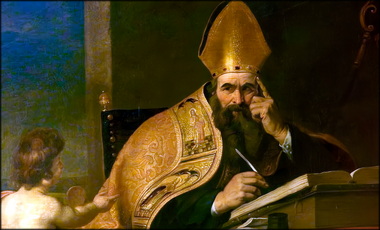
When he redefined Christian terms and concepts, Augustine misrepresented earlier Christian authors. Lewis Ayres politely noted, “Augustine was an attentive reader of his forebears, but one whose interpretations of them were frequently very much his own.”44 As a result, Luther and Calvin mistakenly believed that Augustine was merely teaching what all of the earlier church fathers had taught.45 But in fact, Augustine himself admitted that he had tried but failed to continue in the Christian doctrine of free will of the first four centuries. He consistently utilized the same Christian terms but inserted new meanings into those terms.46 Roger Haight wrote, “Grace for Augustine was delight in the good, a new form of liberty that required an internal modification of the human will. No one [Christian] prior to Augustine had really asserted anything like this need for an inner working of God within human freedom.”47 Augustine redefined free will, utilizing Stoic concepts, deformed original sin with Manichaean dualism, and mutilated faith into a divine gift to match Gnostic and Manichaean unilateral election.48 Augustinian scholar Eugene TeSelle noted:
Augustine always reacted vigorously to the suggestion that he taught what amounted to a doctrine of fate. Now it is undeniable that he did hold to something like what is usually meant by fate. . . . To him fate meant something precise: the doctrine that external occurrences, bodily actions, even thoughts and decisions are determined by the position of the heavenly bodies [C. dua ep Pel., II,6,12] or more broadly, universal material determinism [C. dua ep Pel. II, 6,12; De Civ. Dei. IV.33, V.1,8].49
Augustine said if anyone “calls the will of God or the power of God itself by the name of fate, let him keep his opinion but correct his language” (C. dua ep. Pel.1.2.4). Over a thousand years later, Augustine’s novel and syncretistic reinterpretations of Christian Scripture (TULIP) would be faithfully replicated by Calvin and his followers.
Similarly, modern Calvinists (such as the contributing authors of Whomever He Wills) vehemently defend their theology using Scripture. But they refuse to admit their own interpretations are based on the pagan philosophies and Manichaean religion deeply imbedded into their current syncretistic scriptural interpretations by Augustine.50 God as micromanager of the universe (Stoic sovereignty) stands foremost and paramount: total depravity (Manichaean) follows logically from it (using the same pagan arguments).51 For Calvinists like Andrew Davis, “Romans 9:11–13 is the mortal wound for conditional election.”52 This replicates the “biblical” arguments by Gnostics and Manichaeans for unconditional election (determinism); but all pre-Augustinian Christian writings opposed this pagan doctrine. Thomas Schreiner claimed all Christians will inevitably persevere. This assumes the perfect divine gift of faith unilaterally infused by (the Gnostic/Manichaean) God cannot fail, because ultimate salvation requires perseverance—faith plus works (i.e., not our own but fruit God produces, per Augustine). This includes Schreiner’s appeal to Phil 1:6, repeating Augustine’s tortured interpretation.53 Bruce Ware’s chapter on the compatibility of determinism and freedom could have been argued by a Stoic or Manichaean who was familiar with Scripture. His argument for compatibility was unnecessary in pre-Augustinian Christian theology.54 Likewise, Stephen Wellum repeated Augustine’s appeal to “mystery” that was not required until his Stoic god unilaterally desired, predetermined, and ordained all things, including monstrous evils (such as genocide, rape, torture, and child sacrifice).55 Matthew Barrett’s “The Scriptural Affirmation of Monergism” would have shocked all pre-Augustinian Christians, while making the ancient monergistic Manichaeans proud.56
For Calvinists, the only reasonable theological choice must be Calvinism, since in Arminianism, “God is robbed of his glory at the expense of demanding libertarian freedom.”57 This false disjunction (limited to two poor choices of Calvinism and Arminianism) ignores the centuries of unanimous pre-Augustinian Christian theology on human free will and God’s general sovereignty. Calvinism’s God is puny. Calvinism limits God’s sovereignty.
Calvinists must either ignore these facts or attempt to marginalize them. The vast majority of Christianity—Catholics, Orthodox, Protestants, and other Christian groups—have been unsuccessful in using these facts to convince Calvinists of their errors. We cannot seem to break through the resilient barrier of indoctrinated self-deception to reach adherents of modern Calvinism. In Calvinism, tradition has triumphed over truth.
Conclusion
Augustine of Hippo subverted Christian theology in AD 412 by incorporating his prior Stoic view of meticulous providence and his prior Manichaean doctrine of Divine Unilateral Predetermination of Eternal Destinies (DUPED). All prior Christians had fought against Stoic meticulous providence and Gnostic/Manichaean DUPED. They taught the Christian God is relational and exercises general (not specific) sovereignty for the purpose of allowing human freedom. The Christian God chooses persons for salvation based upon his foreknowledge of their free choices. Augustine reverted to his Manichaean deterministic interpretations of Scripture when attempting to explain infant baptism against the Pelagians. For twenty-five years he had refuted those interpretations as heresy.
After AD 411, Augustine’s final eighteen years of theology was DUPED as the Manicheans had claimed—monergistic, to the glory of Augustine’s new inscrutable sovereign God who creates then damns innocent babies to hell.58 He confessed, “I cannot find a satisfactory and worthy explanation— because I can’t find one, not because there isn’t one” (Serm.294.7). After 1,600 years, no philosopher or theologian has found a “satisfactory and worthy explanation” to salvage Augustine’s syncretism of pagan ideas into Christianity that damns innocent babies to hell. It will forever remain a “mystery.”
Cicero (ca. 50 BC), one of Augustine’s favorite authors, had argued for the in-compatibility between divine omniscience and human free will. Augustine’s final answer was to claim that divine foreknowledge of the future occurs only through God’s unilateral predetermination and ordaining of every event, both good and evil (Civ.5). By this move he departed from all prior Christian teaching and syncretized a concept common in Stoicism: “God foreordains human wills.”59 The Stoic scholar John Rist concluded that Augustine’s novel Christian determinism produced “a theology which fails to do justice to his own theory of God’s love.”60 In contrast, Jerome succeeded in refuting the Pelagians without adopting the extremes of Augustinianism (Against the Pelagians 3) and retained the traditional Christian beliefs in God’s general sovereignty, grace, and free will.61
Harry Wolfson, historian and philosopher at Harvard University’s Judaic Studies Center, concluded, “Augustine’s doctrine of grace is only a Christianization of the Stoic doctrine of fate.”62 Because of Augustine’s AD 412 reversion to pagan ideas, the exalted justice of the relational Christian God (used to combat pagan philosophies and heresies) was instantly transformed into inscrutable theology—deformed theology. Augustine overtly wrote of God’s predestination of the ones he purposefully created for damnation in eternal torment (“double predestination”; Nat. orig.1.14, Civ.14.26, 15.1; Serm.229S, Serm.260D.1; An.et or.4.16).63 Augustine borrowed his prior Neoplatonic inscrutable mystery as his defense for this horrendous divine injustice (Serm.D.29.10 and Serm.294.7). Neoplatonism (ca. AD 250) had invented this crucial theodicy by appealing to the inscrutable secret counsels of God, who is fair by definition, regardless of whatever apparent evils he desires and ordains. Prior Christians had never required this implausible and disingenuous attempt at a defense for their God.
Modern Calvinists teach Augustine’s theology. Calvinists appeal to the same deterministic interpretations of the same Scripture passages taught by Manichaeans. Calvinism’s historical foundation is dangerously unstable. Its foundation relies on the Manichaean interpretations of Scripture by a single man in the ancient church who rejected three hundred years of unanimous church teaching of free will, a teaching that had refuted Stoic and Gnostic/Manichaean determinism. This man was indoctrinated for decades in extremely deterministic pagan philosophies and heretical Manichaeism. Augustine admitted he changed his theology regarding free will: he abandoned the Christian rule of faith regarding free choice. “In the solution of this question I struggled in behalf of free choice of the will, but the grace of God won out” (Retr.2.1).
But the grace that “won out” was not Christian grace: it was Manichaean grace. According to Augustine (Conf.7.5), he only escaped the philosophical prison of Manichaean DUPED by accepting Christian free choice. This freed him from viewing God as punishing unjustly. But ironically, after finally escaping, Augustine’s later “inscrutable justice” of Christianized pagan DUPED reimprisoned both himself and his followers.
In contrast, the prior nearly unanimous Christian teaching (that God offers his grace to every human equally) persisted throughout the Patristic period into the eighth century with John of Damascus (d. ca. AD 760): “We ought to understand that while God knows all things beforehand, yet He does not predetermine all things. . . . So that predetermination is the work of the divine command based on foreknowledge” (Exp. fid.44). Eleonore Stump astutely concluded, “Unless Augustine is willing to accept that God’s giving of grace is responsive to something in human beings, even if that something is not good or worthy of merit, I don’t see how he can be saved from the imputation of theological determinism with all its infelicitous consequences.”64
A willingness to return to the universal Christian theology that God gives grace as a response to human choice would never come for Augustine. The famous rhetorician never looked back in his resolve to win his debate against the Pelagians at all costs. William Frend explained, “Augustine could not concede a single point to his adversaries and this was his undoing.”65 Augustine died eighteen years after reverting to his pagan monergistic determinism, still trusting in his self-crafted syncretistic theology.
As we observed in the introduction, Calvinists address the blatant absence of their theology in the pre-Augustinian centuries in one of two possible ways. The less scholarly Calvinists invent proto-Calvinists among early Christian authors. Scholarly Calvinists claim Augustine was the first theologian since the apostle Paul to interpret Scripture correctly. Benjamin Warfield opined Augustine’s “doctrine was not new” but was lost for four centuries between the time the apostle Paul wrote it and Augustine “ recovered” it for the church (the Calvinist Gap Theory).66 These scholars appear oblivious to the enormous chasm separating Paul from Augustine. This formidable chasm is Augustine’s Stoicism, Neoplatonism, and Manichaeism. It separates Paul from Augustine by hundreds of years and thousands of miles. Calvinists attempt to bridge this insurmountable gap by using the “hermeneutical” lens of Augustine’s Manichaeism to reinterpret Pauline (and other) Scriptures within their own paradigm.
Calvinism’s alleged “biblical foundation” rests on Augustine’s deterministic interpretations of Scripture from his decade of Gnostic/Manichaean training (John 6:44–66; 14:6; Rom 9–11; Eph 2:1–3, 8–9; Phil 2:13; etc.). Such a dangerous foundation requires a precarious “faith” in Augustine’s “Sovereign God,” caricatured through syncretism with Stoic and Neoplatonic philosophy and the heretical Manichaean religion.67 He baptized his prior pagan philosophies and religion into Christianity, resulting in an unrecognizable doctrinal conglomeration. Calvinism is Augustinianism. Augustinianism is Christian theology scrambled with Gnostic/Manichaean theology and Stoic/Neoplatonic philosophy. As John Rist concluded, Augustinianism is “Ancient [pagan] Thought Baptized.”68
Nevertheless, these serious syncretistic errors did not make Augustine a heretic or a non-Christian. Augustine still embraced the essential doctrines of the Christian faith. Modern Calvinists also embrace the major tenets of Christianity regarding Jesus Christ as God in the flesh and Savior from sin. Despite their divergent views (sovereignty, total depravity/inability, and DUPED determinism) imported from Augustine’s paganism, Calvinists remain Christian brothers and sisters worthy of respect, love, and fellowship —contrary to the opinion of one extreme evangelical sect.69 In this anti-Christian period of history, Christians of all persuasions must be unified, despite our internal disagreements.
NOTES
44 Lewis Ayres, Augustine and the Trinity (Cambridge: Cambridge University Press, 2010), 86.
45 See Martin Luther, “To George Spalatin—Wittenberg, October 19, 1516,” in Luther’s Works, 48:23 (see chap. 5, n. 13); Luther, “Lectures on Romans: Glosses and Scholia,” in Luther’s Works, vol. 25; Calvin, Institutes, trans. Battles, 1:158–59 (I.xiii.29) (see chap. 4, n. 85); Harry Wolfson, Religious Philosophy: A Group of Essays (Cambridge, MA: Belknap Press of Harvard University Press, 1961), 158– 76, in which he explained the centuries-old traditional Judeo-Christian understanding of free will (despite the sinful inclination) that persisted until the “later Augustine” introduced Stoic ideas into Judeo-Christian theology, and especially Augustine’s misunderstanding of concupiscentia in his Latin translation of Wisdom of Solomon 8:21.
46 This included the terms original sin, grace, predestination, free will, and so forth. “For example, in the early patristic writers we find references to the origin of sin, to a fall, and to the inheritance of sin, but what is meant is often different from the meaning given to those terms in the later classical tradition influenced by Augustine.” Tatha Wiley, Original Sin: Origins, Developments, Contemporary Meanings (New York: Paulist Press, 2002), 53; italics in the original; Ralph Mathiesen, “For Specialists Only: The Reception of Augustine and His Teachings in the Fifth Century Gaul” in Collectanea Augustina: Presbyter Factus Sum, ed. Joseph Lienhard, Earl Muller, and Roland Teske (New York: Peter Lang, 1993), 30–31; Rebecca Weaver, s.v. “Predestination,” in Encyclopedia of Early Christianity, 2nd ed., ed. Everett Ferguson (New York: Garland, 1998): “The now centuries-old characterization of the human being as capable of free choice and thus accountable at the last judgment had been retained, but the meaning of its elements had been considerably altered”; Peter J. Leithart, “Review of Adam, Eve, and the Serpent” by Elaine Pagels, Westminster Theological Seminary Journal 51, no. 1 (Spring 1989): 186. “Augustine’s concept of free will certainly differs from that of earlier theologians.”
47 Roger Haight, The Experience of Language of Grace (New York: Paulist, 1979), 36.
48 In Stoicism, fate controls every minute occurrence in the universe (Cicero, Div.1, 125–26), and although a person has no possibility of actuating an opportunity, “free will” remains solely by definition (Cicero, Fat.12–15). See Margaret Reesor, “Fate and Possibility in Early Stoic Philosophy,” Phoenix 19, no. 4 (1965): 285–97, esp. 201; Stoics, “took elaborate precautions to protect their system from rigid determinism.” Neoplatonists did the same.
49 TeSelle, Augustine the Theologian, 313; emphasis in the original.
50 Barrett and Nettles, Whomever He Wills (see intro., n. 22).
51 Steven Lawson, “Our Sovereign Savior,” 3–15; and Mark DeVine, “Total Depravity,” 16–36, in Whomever He Wills.
52 Andrew Davis, “Unconditional Election: A Biblical and God-Glorifying Doctrine,” in Whomever He Wills, 51.
53 Thomas Schreiner, “Promises of Preservation and Exhortations to Persevere,” in Whomever He Wills, 188–211, esp. 192. His “biblical” arguments all rest on those pagan assumptions inherited from Augustine. Distinguishing works as necessary fruit for final salvation but not the basis of it mimics Roman Catholicism’s theology. Calvinists merely replace (Faith + Works ➡ Salvation) with (Faith ➡ Works ➡ Salvation). Neither Roman Catholics nor Calvinists believe in faith alone for salvation—both require good works.
54 Bruce Ware, “The Compatibility of Determinism and Human Freedom,” in Whomever He Wills, 212–30. There was no Christian tension between general sovereignty and free will for centuries before Augustine; Fergusson, s.v. “Predestination,” Oxford Companion.
55 Stephen Wellum, “God’s Sovereignty over Evil,” in Barrett and Nettles, Whomever He Wills, 256.
56 Barrett, “Monergism,” 120–87 (see intro., n. 22).
57 Barrett and Nettles, introduction to Whomever He Wills, xxvi.
58 See Augustine, Serm.294.7: “Here too I like to exclaim with Paul, Oh the depths of the riches! (Rom 11:33). Unbaptized infants go to damnation; they are like the apostles’ words, after all: From one to condemnation (Rom 5:16). I cannot find a satisfactory and worthy explanation . . . [he cited all of Rom 11:33–36].” See The Works of Saint Augustine, III/8, 196n8, with Hill’s comments: “Babies who die unbaptized therefore go to hell. . . . It is precisely this assumption that renders his whole argument weak, and his conclusion highly questionable.”
59 Christopher Kirwan, Augustine, The Arguments of the Philosophers (New York: Routledge, 1989), 98–103.
60 John Rist, Augustine: Ancient Thought Baptized (Cambridge: Cambridge University Press, 1994), 307.
61 See Vít Hušek, “Human Freedom According to the Earliest Latin Commentaries on Paul’s Letters,” Studia Patristica 44 (2010): 385–90.
62 Harry Wolfson, Religious Philosophy: A Group of Essays (Cambridge, MA: Belknap Press of Harvard University Press, 1961), 176. See also Michael Frede and Halszka Osmolska, A Free Will: Origins of the Notion in Ancient Thought (Berkley, CA: University of California Press, 2011), especially 153–174, “Chapter Nine—Augustine: A Radically New Notion of a Free Will?”
63 Gerard O’Daly, “Predestination and Freedom in Augustine’s Ethics,” in The Philosophy in Christianity, ed. Godfrey Vesey (Cambridge: Cambridge University Press, 1989), 90.
64 Eleonore Stump, “Augustine on Free Will,” in The Cambridge Companion to Augustine, ed. Eleonore Stump and Norman Kretzmann (Cambridge: Cambridge University Press, 2001), 124–147 at 142.
65 William H. C. Frend, “Doctrine of Man in the Early Church: An Historical Approach,” Modern Churchman 45, no. 3 (1955): 227.
66 Warfield, Tertullian and Augustine, 129.
67 Wilson, Foundation of Augustinian-Calvinism, 97–103. Translated into Spanish—Fundación del Calvinismo Agustiniano; into German—War Augustin der erste Calvinist?; and into Portuguese —Fundamento do Calvinismo-Agostiniano.
68 See note 60. Rist’s focus was pagan Stoicism.
69 Some Christian groups can press anti-Calvinism too far, so much that they themselves violate the limits of historical orthodoxy. See, e.g., Kenneth Wilson, Heresy of the Grace Evangelical Society: Become a Christian without Faith in Jesus as God and Savior (Montgomery, TX: Regula Fidei Press, 2020). Bob Wilkin and his Grace Evangelical Society teach “assurance is of the essence of saving faith.” Calvinists cannot have assurance of their own eternal security because Calvinists teach perseverance in faith and works until physical death is required for final salvation. Therefore, Calvinists are not Christians. This GES heresy requires absolute assurance in Jesus’s promise of personal eternal security to become a Christian, yet does not require faith in Jesus as God and Savior.
 Here is an excerpt from page 77 of Ronnie Rogers book, “Reflections of a Disenchanted Calvinist.”
Pastor Ronnie Rogers
Jesus continually called on people to believe so that they would not die in their sins. “Therefore I said to you that you will die in your sins; for unless you believe that I am He, you will die in your sins” (John 8:24). The obvious conclusion to draw from this statement is that they need to believe and can believe in order not to die in their sins; rather than the Calvinist secret that while it is true, that if one does not believe he will die in his sins, the other truth is that Jesus is telling them what to do but knows they cannot unless they are the elect; therefore, Calvinism transmogrifies this merciful plea into an academic recitation. This is a disquieting reality.
As far as the Scripture is concerned, it is very clear that faith and believing come first and the new birth follows. The Scripture is replete, lucid, and compelling in teaching that the order is faith prior to regeneration, and faith is a gift that God endowed man with in creation not in selective regeneration; moreover, God is working in order to give men and women a real chance to trust Him unto salvation (John 16:8). Salvation is offered as a free gift (Romans 6:23) to all who are in need of forgiveness (Romans 5:15, 18), and people are summoned to act upon the offer by accepting the gift by—grace-enabled—faith (John 1:12). “Never does the Bible say, ‘Be saved in order to believe; instead, repeatedly, it commands, ‘Believe in order to be saved.'”80
80. Geisler, Systematic Theology, vol. 3, 129

Here is an extended section from Geisler’s Systematic (PDF):
Professor Norman Geisler
Loss of Fellowship
Not only did Adam lose his relationship with God, he also lost his fellowship with Him. Adam no longer wanted to talk with his Creator but instead hid from Him in the Garden. John reminds us:
If we claim to have fellowship with him yet walk in the darkness, we lie and do not live by the truth. But if we walk in the light, as he is in the light, we have fellowship with one another, and the blood of Jesus, his Son, purifies us from all sin. (1 John 1:6–7)
The Effects of Sin on Relationship With Other Human Beings
Along with the loss of relationship (and fellowship) with God, the relationship between Adam and other people was also disturbed; sin has a horizontal as well as vertical effect, which is evident in two events that followed.
First, Adam blamed Eve for his situation. Responding to God’s questioning about the forbidden fruit, he said, “The woman you put here with me—she gave me some fruit from the tree, and I ate it” (Gen. 3:12).
Second, sibling relationship was disrupted by sin when, because of anger, Cain killed his brother Abel (Gen. 4:1–8).
The Effects of Sin on Relationship With the Environment
Adam’s sin affected his relationship with God, other human beings, and the environment. Before the Fall, Adam and Eve were told to “subdue” the earth (Gen. 1:28); they were to “work” and “take care of” the Garden (Gen. 2:15), not destroy it; to rule over it, not ruin it; to cultivate it, not pollute it.
However, after the Fall, Adam’s connection with his environment was disrupted. Thorns and thistles appeared. He had to work by the sweat of his brow. Death became a fact of life. Indeed, everything, because of his sin, was put under bondage. Paul writes:
The creation was subjected to frustration, not by its own choice, but by the will of the one who subjected it, in hope that the creation itself will be liberated from its bondage to decay and brought into the glorious freedom of the children of God. (Rom. 8:20–21)
The Volitional Effects of Adam’s Sin
In addition to Adam’s sin affecting his relationship with God, other human beings, and the environment, it also had an effect on his will.
Free Will Before the Fall
The power of free choice is part of humankind having been created in the image of God (Gen. 1:27). Adam and Eve were commanded to multiply their kind (1:28) and to refrain from eating the forbidden fruit (2:16–17). Both of these responsibilities imply the ability to respond. As noted above, the fact that they ought to do these things implied that they could do them.
The text narrates their choice, saying, “She took some and ate it. She also gave some to her husband, who was with her, and he ate it” (Gen. 3:6). God’s condemnation of their actions makes it evident that they were morally free to choose (Gen. 3:11, 13).
The New Testament references to Adam’s action make it plain that he made a free choice for which he was responsible. Again, Romans 5 calls it “sin” (v. 16); a “trespass” (v. 15); and “disobedience” (v. 19). First Timothy 2:14 (RSV) refers to Eve as a “transgressor,” pointedly implying culpability.
Free Will After the Fall
Even after Adam sinned and became spiritually “dead”22 (Gen. 2:17; cf. Eph. 2:1) and thus, a sinner because of “[his] sinful nature” (Eph. 2:3), he was not so completely depraved that it was impossible for him to hear the voice of God or make a free response: “The LORD God called to the man, ‘Where are you?’ He answered, ‘I heard you in the garden, and I was afraid because I was naked; so I Fhid’ ” (Gen. 3:9–10).23 As already noted, God’s image in Adam was effaced but not erased by the Fall; it was corrupted (damaged) but not eliminated (annihilated). Indeed, the image of God (which includes free will) is still in human beings—this is why the murder or cursing of anyone, Christian or non-Christian, is sin, “for in the image of God has God made man” (Gen. 9:6).24
Fallen Descendants of Adam Have Free Will
Both Scripture and good reason inform us that depraved human beings have the power of free will. The Bible says that fallen humans are ignorant, depraved, and slaves of sin—all involving choice. Peter speaks of depraved ignorance as being “willingly” ignorant (2 Peter 3:5 KJV). Paul teaches that unsaved people perceive the truth, but they willfully “suppress” it (Rom. 1:18–19),25 so that they are, as a result, “without excuse” (v. 20). He adds, “Don’t you know that when you offer your selves to someone to obey him as slaves, you are slaves to the one whom you obey?” (Rom. 6:16). Even our spiritual blindness is a result of the choice not to believe.
With respect to initiating or attaining salvation, both Martin Luther and John Calvin were right—fallen humans are not free with regard to “things above.”26 Salvation is received by a free act of faith (John 1:12; Eph. 2:8–9), yet it does not find its source in our will but in God (John 1:13; Rom. 9:16). With respect to the freedom of accepting God’s gift of salvation, the Bible is clear: fallen beings have the ability to so do, since God’s Word repeatedly calls upon us to receive salvation by exercising our faith (cf. Acts 16:31; 17:30; 20:21).
Thus, the free will of fallen human beings is both “horizontal” (social) with respect to this world and “vertical” (spiritual) with respect to God. The horizontal freedom is evident, for instance, in our choice of a mate: “If her husband dies, she is free to marry anyone she wishes, but he must belong to the Lord” (1 Cor. 7:39). This freedom is described as having “no constraint,” a freedom where one has “authority over his own will” and where one “has decided this in his own heart” (v. 37 NASB). This is also described in an act of giving “entirely on their own” (2 Cor. 8:3) as well as being “spontaneous and not forced” (Philem. 14).
The vertical freedom to believe is everywhere implied in the gospel call (e.g., cf. John 3:16; Acts 16:31; 17:30). That is, humans are offered salvation as a gift (Rom. 6:23) and called upon to believe it and accept it (John 1:12). Never does the Bible say, “Be saved in order to believe”; instead, repeatedly, it commands,
“Believe in order to be saved.”27 Peter describes what is meant by free choice in saying that it is “not under compulsion” but “voluntarily” (1 Peter 5:2 NASB). Paul depicts the nature of freedom as an act where one “purposed in his heart” and does not act “under compulsion” (2 Cor. 9:7 NASB). In Philemon 14 he also says that choice is an act of “consent” and should “not be … by compulsion, but of your own free will” (NASB).
Unsaved people have a free choice regarding the reception or rejection of God’s gift of salvation (Rom. 6:23). Jesus lamented the state of those who rejected Him: “O Jerusalem, Jerusalem … how often I have longed to gather your children together, as a hen gathers her chicks under her wings, but you were not willing” (Matt. 23:37). John affirmed, “All who received him [Christ], to those who believed in his name, he gave the right to become children of God” (John 1:12). Indeed, as we have frequently observed, God desires that all unsaved people will change their mind (i.e., repent), for “he is patient with you, not wanting anyone to perish, but everyone to come to repentance” (2 Peter 3:9).
Like the alternatives of life and death that Moses gave to Israel, God says, “Choose life” (cf. Deut. 30:19). Joshua said to his people: “Choose for yourselves this day whom you will serve” (Josh. 24:15). God sets morally and spiritually responsible alternatives before human beings, leaving the choice and responsibility to them. Jesus said to the unbelievers of His day: “If you do not believe that I am … you will indeed die in your sins” (John 8:24), which implies they could have and should have believed.
Over and over, “belief” is declared to be something we are accountable to embrace: “We believe and know that you are the Holy One of God” (John 6:69); “Who is he, sir?… Tell me so that I may believe in him” (John 9:36); “Then the man said, ‘Lord, I believe,’ and he worshiped him” (John 9:38); “Jesus answered, ‘I did tell you, but you do not believe’ ” (John 10:25). This is why Jesus said, “Whoever believes in [me] is not condemned, but whoever does not believe stands condemned already because he has not believed in the name of God’s one and only Son” (John 3:18).
NOTES
22 Again, spiritual death in the Bible does not mean “annihilation” but “separation”: “Your iniquities have separated you from your God” (Isa. 59:2). Likewise, the “second death” (Rev. 20:14; cf. 19:20; 20:10) is not permanent non-existence but eternal conscious separation from God.
23 See chapter 4.
24 Note that Genesis 9 is post-Fall; see also James 3:9.
25 That is, they willfully “hold it down.”
26 See Luther, Bondage of the Will, especially 75–76; 126–28; 198; 216; 316–18 and Calvin, Institutes of the Christian Religion, especially 1.1.15; 1.1.18; 1.2.4.
27 See chapters 12 and 16.
Norman L. Geisler, Systematic Theology, Volume Three: Sin, Salvation (Minneapolis, MN: Bethany House Publishers, 2004), 127-130.

Pastor Ronnie Rogers again
The non-Christian can still respond to such things as:
Grace Enablements
Includes but are not limited to: God’s salvific love for all (John 3:16), God’s manifestation of his power so that all may know he is the Sovereign (Isa 45:21–22) and Creator (Rom 1:18–20), which assures that everyone has opportunity to know about him. Christ paying for all sins (John 1:29), conviction of the Holy Spirit (John 16:7–11), working of the Holy Spirit (Heb 6:1–6), enlightening of the Son (John 1:9), God’s teaching (John 6:45), God opening minds and hearts (Luke 24:45; Acts 16:14; 26:17–18;), and the power of the gospel (Rom 1:16), without such redemptive grace, no one seeks or comes to God (Rom 3:11).
Because of these gracious provisions and workings of God, man can choose to seek and find God (Jer 29:13; Acts 17:11–12). Moreover, no one can come to God without God calling (Acts 2:39), drawing (John 6:44), and that God is drawing all individuals (John 12:32). The same Greek word for draw, helkuō, is used in both verses. “About 115 passages condition salvation on believing alone, and about 35 simply on faith.” Other grace enablements may include providential workings in and through other people, situations, and timing or circumstances that are a part of grace to provide an opportunity for every individual to choose to follow Christ.
These are grace enablements in at least three ways; first, they are provided by God’s grace rather than deserved by mankind; second, the necessary components for each and every individual to have a genuine opportunity to believe unto salvation are provided or restored by God; third, they are provided by God without respect to whether the individual will believe or reject, which response God knew in eternity past.
The offer of the gospel is unconditional, but God sovereignly determined to condition the reception of the offer upon grace-enabled faith; therefore, faith is not reflective of a work or virtue of man, but of God’s sovereign plan of salvation by grace through faith (Eph 2:8). This indicates faith is the means to being regenerated and saved, not the reason for being saved. This truth of Scripture does not imply God is held captive to the choice of man, but rather it demonstrates God in eternity coextensively determined to create man with otherwise choice and provide a genuine offer of salvation, which can be accepted by grace-enabled faith or rejected. Additionally, to fulfill this plan, God is not obligated to disseminate the gospel to people he knows have rejected the light he has given them (Rom 1:18–23) and will also reject the gospel; although he may still send the gospel to them.
From the authors glossary in the book
And some Charles C. Ryrie in his book standing against Lordship Salvation:
Charles C. Ryrie
Chapter 11 / IT’S NOT EASY TO BELIEVE
There ought to be a law. A law against a merchant accepting a personal check in payment for anything under twenty dollars.
How often I have waited and waited in line while someone writes a check to pay for six dollars’ worth of groceries or eight dollars’ worth of miscellaneous items.
Why the wait? Simply because it is not easy to believe.
Imagine you are the customer trying to cash the check. You know the check is good. And perhaps even the cashier has received your checks from you earlier and knows you’re good for the amount. It doesn’t matter. The scenario is always the same. “Let me see your driver’s license.” Then she has to punch in the number to be sure your record is clear. All clear. “Let me see a major credit card.” She punches in that number. All clear. At last the clerk initials the check. Now the store believes you. But it wasn’t easy.
We’re only talking about money. And most of the time not a very large amount.
BELIEVING IN JESUS IS NOT EASY
Suppose the issue was not six or eight dollars but eternal life? And suppose I was being told that to have eternal life all I had to do was believe. It would not be easy to believe. Too much is at stake, and the more that is at stake, the harder it is to believe.
When we Christians ask someone to believe in the Lord Jesus Christ, we are asking something very difficult. We are asking the person to believe in someone he or she has never seen. Someone who lived in the very distant past. Someone who has no living eyewitnesses who can vouch for His character and the truth of His words. Someone whose biography was written very long ago and by those who were His friends.
For another reason, we are asking someone to believe in an almost unbelievable concept when we ask him to believe that Christ can forgive his sins. The issue at stake is not the tab at the supermarket or whether someone lived and said this or that. We are asking the person to believe that this unseen individual, Jesus, who lived so long ago, can forgive sins, give eternal life, and guarantee us a home in heaven. And this forgiveness can be given because He died as our substitute. Is this easy?
If one’s faith is mistaken or misplaced, it could be a very costly error. The issue does not concern a few dollars or a few years of life on earth. It concerns eternity. Since all of this is involved in faith, it is not easy to believe.
WE BELIEVE ALL THE TIME
And yet we all do believe in hundreds of ways every day. We believe that everyone at the water company is doing his job well, so we can turn on the tap and drink safely. We believe that the letter we mailed will be delivered. We believe that the skill of engineers and contractors who designed and built the many buildings we walk in and out of will keep them from falling on our heads. And (this one always amazes me) we believe the cashier who tells us, “Your photos will be back in one hour.”
WHAT IS FAITH?
What is faith? Is it merely assent to facts? Does it involve any kind of commitment, particularly the commitment of the years of one’s life on earth? What does it mean when the Bible says that the demons believe and shudder (James 2:19)? How can some people apparently believe and not be saved, while others believe and are saved?
Faith means “confidence, trust, holding something as true.” Certainly, faith must have some content. There must be confidence about something or in someone. To believe in Christ for salvation means to have confidence that He can remove the guilt of sin and give eternal life. It means to believe that He can solve the problem of sin, which is what keeps a person out of heaven.
One can also believe Christ about a multitude of other things, but these are not involved in salvation. A person can believe He is Israel’s Messiah, and He is. One can believe He was born without a human father being involved in the act of conception, and that is true. A person can believe that what Jesus taught while on earth was good, noble, and true, and it was. He can believe Jesus will return to earth, and He will. One can believe Christ is the Judge of all, and He is. A person can believe He is a prophet and a priest, that priesthood being shaped after the order of Melchizedek, and one would be right.
We can believe all those things. You and I also may believe He is able to run our lives—and He surely is able to do that, and He wants to. But these are not the issues of salvation.
The only issue is whether or not you believe that His death paid for all your sin and that by believing in Him you can have forgiveness and eternal life.
Faith has an intellectual facet to it. The essential facts are that Christ died for our sins and rose from the dead (1 Corinthians 15:3–4; Romans 4:25). In addition, faith involves assent or agreement with those facts. One can know the facts of the Gospel and either agree or disagree with them. But faith also involves an act of the will, for we can decide either to obey or to reject God’s command to believe (Acts 16:31). And making whichever choice we do involves our will.
These three aspects of faith are quite standard in theology. For example, Charles Hodge summarized the meaning of faith that is connected with the Gospel this way:
That faith, therefore, which is connected with salvation includes knowledge, that is a perception of the truth and its qualities; assent, or the persuasion of the truth of the object of faith; and trust, or reliance. The exercise, or state of mind expressed by the word faith, as used in the Scriptures, is not mere assent, or mere trust; it is the intelligent perception, reception, and reliance on the truth, as revealed in the Gospel.[1]
Please observe the clear focus of Hodge’s definition. He is defining faith “which is connected with salvation.”
Louis Berkhof, a Reformed theologian like Hodge, included the same three elements in faith: (1) an intellectual element (notitia) or knowledge; (2) an emotional element (assensus) or assent to the truth; and (3) a volitional element (fiducia) or the involvement of the human will.[2]
In elaborating on the third element in faith—the volitional— Berkhof focused clearly on what that consists of. He wrote: “The third element consists in a personal trust in Christ as Saviour and Lord, including a surrender of the soul as guilty and defiled to Christ, and a reception and appropriation of Christ as the source of pardon and spiritual life.”[3] And further, “The object of special faith, then, is Jesus Christ and the promise of salvation through Him. The special act of faith consists in receiving Christ and resting on Him as He is presented in the gospel.”[4] Berkhof did not speak to the issue of the mastery of Christ over one’s life when discussing these three elements of faith. His third aspect, fiducia, concerned the involvement of the human will in personal trust in the Lord for salvation, not commitment of the years of one’s life to His mastery (contrary to the proponents of lordship salvation).[5]
John Murray, another Reformed theologian, also saw the same three elements in faith: knowledge, conviction, and trust are his words. In further describing trust, he wrote it is
A transference of reliance upon ourselves and all human resources to reliance upon Christ alone for salvation. It is a receiving and resting upon him. It is here that the most characteristic act of faith appears; it is engagement of person to person, the engagement of the sinner as lost to the person of the Saviour able and willing to save…. Faith is trust in a person, the person of Christ, the Son of God and Saviour of the lost. It is entrustment of ourselves to him. It is not simply believing him; it is believing in him and on him.[6]
MORE THAN FACTS
From these suggested descriptions of faith, it is obvious that faith involves more than the knowledge of facts. The facts must be there or faith is empty. But even assent, however genuine, must be accompanied by an act of the will to trust in the truth that one has come to know and assented to.
Hodge’s use of the word trust may be particularly appropriate today, for the words believe and faith sometimes seem to be watered down so that they convey little more than knowing facts. Trust, however, implies reliance, commitment, and confidence in the objects or truths that one is trusting. An element of commitment must be present in trusting Christ for salvation, but it is commitment to Him, His promise, and His ability to give eternal life to those who believe.
The object of faith or trust is the Lord Jesus Christ, however little or much one may know about Him. The issue about which we trust Him is His ability to forgive our sins and take us to heaven. And because He is the Lord God, there is an element in bowing before Him and acknowledging Him as a most superior person when one trusts Him for salvation.
BELIEF THAT DOES NOT SAVE
But is there not a kind of faith that does not save? Do not the demons exhibit such faith? In James 2:19 we are told that the demons believe and shudder. What is it that demons believe? The first part of the verse answers that question. They believe in one God. They are monotheists. And they shudder because they know that this God will someday judge them. They will not have the option of being judged by some other god who might overlook their sins, since there exists only one true God. James does not say what else they believe. In this verse, the only thing we are told is that they believe in one God. Thus this verse that is often quoted to show that some creatures can believe but not be saved is irrelevant to the issue of salvation, for it says only that demons are monotheists.
Nevertheless, it is true that some people can believe and not be saved. King Agrippa apparently believed the facts that confirmed that Jesus of Nazareth was the promised Savior (Acts 26:27). But he refused to receive Jesus and His salvation.
What makes the difference between those who believe and are not saved and those who believe and are saved? Apparently those who believe and are not saved know the facts of the Gospel and may even give assent to its truthfulness, but they are unwilling to trust the Savior for their personal salvation. Knowledge and assent without being willing to trust cannot in themselves save.
The New Testament always says that salvation is through faith, not because of faith (Ephesians 2:8). Faith is the channel through which we receive God’s gift of forgiveness and eternal life. God has arranged it so that no one can ever boast, not even about his faith.
Normally the New Testament word for believe is used with the preposition that means “in” (John 3:16), indicating reliance or confidence or trust in the object of the faith. Sometimes the word believe is followed by a preposition that means “upon,” emphasizing laying hold on the object of faith (Romans 9:33). Sometimes it is followed by a clause that explains the content of faith (Romans 10:9, 11).
Does the New Testament use other words interchangeably with believe? Yes, it does. Receive is one (John 1:12); call is another (Romans 10:13). Confess is one (Romans 10:9; Hebrews 4:14); ask is another (John 4:10). Come is one (Revelation 22:17); take is another (Revelation 22:17).The person who asks or confesses or calls or receives or comes or takes, believes.
Of course, when one believes he commits to God. Commits what? His eternal destiny. That’s the issue, not the years of his life on earth. Certainly when one believes he bows to a superior person, to the most superior person in all the universe. So superior that He can remove sin.
But it is not easy to believe that someone whom neither you nor any other living person has ever seen did something nearly two thousand years ago that can take away sin and make you acceptable before a holy God. But it is believing that brings eternal life.
Charles C. Ryrie, So Great Salvation: What It Means to Believe In Jesus Christ (Wheaton, IL: Victor Books, 1989), 115-123.
NOTES
[1] Charles Hodge, Commentary on the Epistle to the Romans (Grand Rapids: Eerdmans, 1967), 29.
[2] Louis Berkhof, Systematic Theology (Grand Rapids: Eerdmans, 1941), 503–5.
[3] Ibid., 505.
[4] Ibid., 506.
[5] John MacArthur, The Gospel According to Jesus (Grand Rapids: Zondervan, 1988), 173.
[6] John Murray, Redemption—Accomplished and Applied (Grand Rapids: Eerdmans, 1965), 138.
This is an update to the above
after conversation broke out over this post.
While we are discussing Calvinism… I was recently discussing faith with a Calvinist, and they mentioned that even the Demons believe, quoting James 2:19. I want to mention here that my friend was reading too much into this verse. First a video I shared with him and then some commentary to elucidate others:
James 2:19 Observation
Transcript below video:
People often misinterpret and misuse James chapter 2 verse 19 in an attempt to discredit and disprove salvation through faith alone. Here’s why that falls flat on its face. Number one, the word of God is explicitly clear that salvation is by grace through faith alone. The question was put forth in Acts chapter 16, verse 30, and the answer was given in verse 31 of the same chapter. Sirs, what must I do to be saved? And they said, Believe on the Lord Jesus Christ, and thou shalt be saved, and thy house.
And brought them out and said, Sirs, what must I do to be saved? And they said, Believe on the Lord Jesus Christ, and thou shalt be saved in thy house.
Secondly, James chapter 2, verse 19 does not say, The devils believe on the Lord Jesus Christ. Is that what it said? The devils trust in Jesus Christ alone for their salvation. The devils believe that Jesus Christ died for their sins, was buried, and rose again the third day. No, it says, Thou believest that there is one God, thou doest well. The devils also believe and tremble. The devils also believe what? That there is one God. That’s what the Bible says the devils believe. Believing that there is one God saves no one. The Jews believe that there is one God. The Muslims believe that there is one God. What must I do to be saved? Believe that there is one God? No, the devils believe that. What must I do to be saved? Believe on the Lord Jesus Christ and now shall be saved. So this verse is often quoted to discredit and disprove salvation through faith alone. It doesn’t say that the devils believe on the Lord Jesus Christ. It says that the devils believe that there is one God. Believing that there is one God will not save you. You must believe on the Lord Jesus Christ.
Forasmuch then as the children are partakers of flesh and blood, he also himself likewise took part of the same, that through death he might destroy him that had the power of death. that is, the devil, and deliver them who through fear of death were all their lifetime subject to bondage. For verily he took not on him the nature of angels, but he took on him the seed of Abraham. Wherefore in all things it behooved him to be made like unto his brethren, that he might be a merciful and faithful high priest in things pertaining to God, to make reconciliation for the sins of the people.
Thirdly, Jesus did not die for devils. I’ll say that again. Jesus did not die for devils. The Word of God says He is the Savior of all men. Not all devils, not all angels. Jesus did not die for angels. The Word of God says He tasted death for every, watch this, every man. So the third reason why this application makes absolutely no sense is that Jesus did not die for devils. Jesus does not offer salvation to devils. Salvation is offered to mankind and mankind alone.
This was one of my first videos I came across about 3-months ago by this guy. Good find on my part. I also enjoy this commentary on the verse via
The Bible Knowledge Commentary:
2:19. It may be well to include even verse 19 as part of the respondent’s argument: You believe that there is one God. Good! Even the demons believe that—and shudder. If so, he may be a typical Gentile believer who attacked the creedal belief of monotheism accepted by all Jews. He was saying, to “believe” in one God may be good so far as it goes, but it does not go far enough. The demons do that. In fact not only do they believe (the same verb, pisteuō); they even “shudder,” or “bristle up” (phrissousin, an onomatopoeic verb used only here in the NT). The “belief” in one God may not be “trust” in that God. Unless it is “trust,” it is not true faith and will not be evidenced in good works.
In other words the respondent is saying, “Faith is not the key; what counts is works.” Thus the respondent has gone too far. James did not say that works are essential to faith, or that faith is unimportant. His argument was that works are evidence of faith.
Other writers understand this passage to mean that James (v. 18b) challenged the “someone” to show his faith without deeds—the point being that it cannot be done! James, however, said that faith can be demonstrated (only) by what one does (v. 18c). The demons’ “belief” in God is inadequate. Such a so-called but unreal faith is obviously unaccompanied by deeds on their parts.
2:20. James did not launch into a lengthy refutation of the respondent. The apostle simply addressed him forcefully, You foolish man, and returned to his original argument that faith without deeds is useless (argē, “lazy, idle, negligent”). The adjective “foolish” (kene) is usually translated “vain,” “empty,” or “hollow” (cf. mataios, “worthless, fruitless, useless,” in 1:26). Flimsy faith is dead; so are empty, faithless works. James’ argument is not pro-works/anti-faith or pro-faith/anti-works. He has simply said that genuine faith is accompanied by good works. Spiritual works are the evidence, not the energizer, of sincere faith
Ronald Blue, “James,” in The Bible Knowledge Commentary: An Exposition of the Scriptures, ed. J. F. Walvoord and R. B. Zuck, vol. 2 (Wheaton, IL: Victor Books, 1985), 826.
James emphasizes that acceptance of a creed is not enough to save a person. In another great commentary on James, we see the main idea being fleshed out by James regarding the “testing”
Beacon Bible Expositions
3. James now turns to two Old Testament illustrations. They are drawn from opposite realms of experience and stand in sharp contrast to each other. Yet both show clearly the need for holding together true faith and loving obedience.
a. The faith of Abraham, 21-24. No name meant more to a Jew than the name of Abraham. Abraham was universally respected as the father of the nation. His willingness to offer his son Isaac was a clear example of the reflex action of works as the fruit of faith, and faith as made perfect by works (21-23).
This two-way relationship between faith and obedience is of great practical importance. Faith leads to obedience. But obedience in turn strengthens faith. “If any man will do his will, he shall know of the doctrine, whether it be of God, or whether I speak of myself,” said Jesus (John 7:17). Augustine wrote, “The Word of God belongs to those who obey it.” Both understanding and faith depend upon obedience.
There are indeed real intellectual problems in the Christian faith. Yet in many cases, the root of the problem is “not with the Apostles’ Creed but with the Ten Commandments.” Disobedience creates doubt. Obedience dissolves doubt.
James does not dispute the record of Gen. 15:6 or the application Paul made of the same truth in Rom. 4:1-3: “Abraham believed God, and it was counted unto him for righteousness.” He simply points out that a faith lacking in obedience is not faith at all. The only way the scripture can say that Abraham believed God and was counted righteous is that Abraham’s faith was both genuine and full. Justification is not by a truncated faith that has no obedience in it. Justification is by a faith that works (24). Paul says this also in Gal. 5:6.
b. The faith of Rahab, 25-26. The second illustration of faith is Rahab, the Canaanite woman who hid Israel’s two spies (Joshua 2). Some have thought to soften the meaning of the term harlot as applied to Rahab (Josh. 2:1) on the ground that the same term may mean simply “innkeeper.” But the word James uses (pome) admits of no softening. It means a prostitute, an immoral woman.
The faith of Abraham, the seeking pilgrim from Ur, was the faith that finds truth and righteousness through obedience. The faith of Rahab, the prostitute, was the faith that redeems and lifts the fallen. How complete was that redemption is testified to by Matthew in his genealogy of Jesus (Matt. 1:5-6). A man of the tribe of Judah by the name of Salmon married Rahab. They had a son named Boaz (Ruth 4:21-22; Matt. 2:5). Boaz married Ruth, the Moabitess widow. Their son Obed was the father of Jesse and the grandfather of King David, from whose line of descent came Jesus the Messiah.
James concludes his discussion with an analogy already introduced in vv. 17 and 20: For as the body without the spirit is dead, so faith without works is dead also (26). A religion of externals is a ghost, spirit without body. But a subjective faith without loving obedience to the will of God is a corpse. The one is futile. The other is empty. What our day demands, as has every day, is full-orbed faith expressing itself in love and obedience.
W.T. Purkiser, Beacon Bible Expositions: Hebrews, James, Peter – Volume 11 (Kansas City, MO: Beacon Hill Press Of Kansas City, 1974) cf., James 2:14-26
Note, this section can be paired with my response to an atheist author’s position on faith: What Is Faith? Is It Blind? Or Is It Trustworthy?
The 2nd video is Idol Killer’s original, the first is my reimagining it:
Praying Like A Consistent Calvinist | Adapted from Idol Killer >>> I rejiggered it into a better order [IMHO], added some graphics/quotes, and uploaded it a second time finding an edit error on my part.
Not for the faint of heart!
Somewhere outside the city of Geneva, on Earth 1689, it happened that a Calvinist Theologian was praying, and when he had finished, one of his disciples said to him, “Pastor, teach us to pray, just as John also taught his disciples.” and he said to them:
“Oh Sovereign God, whom from all eternity, freely and unchangeably ordained whatsoever comes to pass, I thank you… I know you bring about all things in accordance with your will,… I know the evils of this world have NOT arisen by your mere permission, (or as a result of your patient call to repentance), but that YOU yourself bring about all evils for your glory and good pleasure,…
I thank you for bringing evil into the world. I thank you for the brutality at Birkenau and at Auschwitz.
I thank you for the terrible killings of Dennis Rader.
I thank you for the brutality of war, and the countless widows and orphans it creates. I thank you for the perverse abuse of young children. I know these evil men were perfectly obeying your Sovereign will.
I thank you. I see your gracious hand in the hurts others do to me, (like the Ford Focus that cut me off at the light this afternoon).
I thank you. I thank you for my wife, and the abuse she inflicts upon our children while I’m away from the home. I know you did this to build mine and my children’s character. I thank you that its only been bruises and bloody noses. I know you saw fit to have my boss fire me from my job, during the holiday season, just as I know it was your Sovereign will that he hire Stephanie this past Spring and that we have an affair.
I thank you for giving me an irresistible desire for red heads. Above all, I know it was your Sovereign hand keeping my wife ignorant of our illicit love making, (during our lunch break at the motel six).
I thank you. I know that it was your perfect will that my neighbor got drunk and took his own life this morning, just as it was your perfect will that I was distracted on my cell phone and backed the car over his son last week.
I thank you. I know you’ve regenerated me and elected me unto salvation, and while I’m unsure about my wife and children’s eternal destiny, I thank you. Please bless this food to the nourishment of our bodies and bless the hands that prepared it, or don’t. Whatever your Sovereign will is. Thank you, and amen!”

A [cyber] acquaintance wrote this as a way of introducing the video on Facebook:
Before anyone writes one more comment on either side of this issue, please do one thing:
Watch this short video in its entirety.
Not a clip. Not a reaction. The whole thing.
This is one of the clearest, most legally informed analyses I’ve seen so far–offered by a man who lives in Minnesota, understands MN law, and refuses to reduce complex realities to simple slogans.
A few key takeaways (without spoilers):
Whether you lean left or right, emotional or analytical, pro-ICE or or anti-ICE–this video will challenge lazy thinking on all sides.
If you still disagree after watching it fully, fine. But at least we’ll be arguing from the same factual and legal framework instead of trading slogans.
The Pretti Case Exposes a Dangerous Lie
Everyone keeps repeating the same two claims about the Pretti shooting:
“He had a right to carry.”
“He had a right to film.”
Both statements are true.
And both are meaningless without context.
So even if this turns out to be a mistake to 1 degree or another, it likely won’t turn out to be a crime committed by the officers involved. And that’s because that’s the way it should be, because these officers and all officers must make split-second decisions in chaotic circumstances, which are created by the subjects they interact with.
Their decision to fire would never have been made if Preddy had maintained appropriate distance, not charged forward, complied with lawful orders, stopped resisting, and not maintained A threatening posture. He made those choices, which led to the officers making theirs.
So, the conversation becomes dishonest if it only asks, did Pretty have the right to do X? Instead of asking, did Pretty act in a way that someone with those rights is expected to act under the law? Because rights without responsibility aren’t liberty. They’re licensed for chaos.
— Walter Hudson (Video: “The Pretti Case Exposes a Dangerous Lie”)
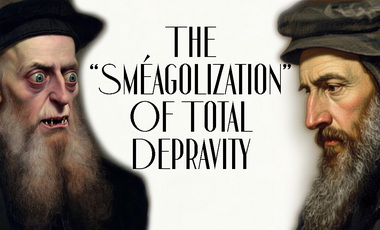
What you will find below:
The long debate [which I won’t replicate here] from Soteriology 101 Discussion’s Facebook Page, is over — essentially — this portion of Leighton Flower’s’ book, “Drawn by Jesus.” BUT FIRST, what I will reproduce is the extent of the debate summed up in these two back-n-forths:
ROGER H. responds to Jason R.
[Jason R said] “This is a clear logical impasse you are confronted with…“
What is the logical impasse? A person is born with no ability to choose God. This requires that the person be regenerated. Once regenerated, a person can desire God and can choose God.
[Jason R said] “and there is no compatibilism that can harmonize this faulty logic.”
Once a person is regenerated, he has new desires. He can choose according to his greatest desire.
I don’t see a problem.
JASON R. responds to ROGER H.
it is fascinating to observe how you see no problem with the fact that God ultimately judges the majority of humanity for not receiving Christ when He determined that they never could do so in the first place. You seem content to accept that God can judge someone for their sin of non-repentance even though they have no way of repenting. This is blatantly unjust. You admit that God necessarily has to regenerate someone so that they can believe which equates to conceding that man cannot choose God unless God first chooses and changes them. Man is born into a hopeless state of inability and you cannot see a problem with God judging and condemning man for this inability when he has no way of escaping its pre-determined inevitabilities. I have never heard a sound defense against this Achilles heel of Calvinism… only concessions such as yours.
 The entire discussion is enlightening, as it is a real working out of the issue. But this is the portion that Roger H. started out with, mistakenly saying it was from chapter 3:
Chapter 5
The Calvinistic Presupposition of Total Inability
A presupposition is “a thing tacitly assumed beforehand at the beginning of a line of argument.”23 We all have presuppositions. Some of them are right, but others are wrong. Wrong presuppositions brought to a passage can influence people to draw erroneous conclusions about the meaning of the text in question. This is why objectively evaluating our presuppositions is so important when any passage is in dispute between well-intending brethren.
Your theological opponents have every right to challenge your presuppositions. After all, wrong presuppositions lead to bad exegesis. And assuming your presuppositions are correct is just a fallacious game of question-begging. Unfortunately, this has been James White’s bread and butter. When non-Calvinists have challenged one of his presuppositions in the past, he accuses us of either “changing the topic,” “running off to other scriptures,” or “doing improper exegesis.” This is ironic, given that proper exegesis requires biblically correct presuppositions.
Calvinism’s underlying premise is that God decreed for all people since the Fall to be born morally unable to believe what He Himself teaches, so unless you were unconditionally chosen before you were born and irresistibly regenerated into a new creation by a supernatural intervening work of God, you will never be morally capable of believing in Him.24 Needless to say, that premise will greatly influence how you understand the Bible regardless of the hermeneutical methodologies, grammatical nuances, contextual considerations, or semantic word studies. A wrong premise skews everything and, therefore, must be evaluated objectively prior to getting into the other pertinent matters. So, let’s start by looking at these three major presuppositions White brings into John 6 based primarily upon his Calvinistic interpretation of Paul.25
Total Inability26
The entire sixth chapter in White’s book on the topic, titled “Human Inability,” sets out to establish this doctrine. Based on his interpretation of other scripture, White presupposes that God decreed for all people (since the Fall) to be born unable to believe His own teachings, but God still punishes all who do not believe. Therefore, when White reads John 6 through those presuppositional lenses, he understands the phrase “no one can come” to mean that the natural condition of everyone from birth is such that they cannot understand and believe what God teaches.27 For instance, White wrote,
In response to the crowd’s disbelief, Jesus also gives forth a clear explanation of their inability to understand and their inability to come to Him as the one and only source of spiritual life.
Notice that White assumes that the reason the crowds cannot come to Christ is due to a universal inherent condition in which they were born, something God Himself decreed and the individuals had absolutely no control over. In other words, in White’s view, the crowd remains in unbelief because they were born inherently blinded to divinely revealed truth, and God has not intervened to irresistibly change their inherent “default” condition. This is the root of what is known as theistic determinism, a primarily philosophical commitment to the idea that God unchangeably brings to pass (or determines) every meticulous detail, including all moral evil.28
NOTES
23 Oxford Languages Online Dictionary (Oxford University Press)
24 This represents the T,U and I of the Calvinistic TULIP, which will be explored further in the following pages.
25 White wrote, “When the doctrine of election is discussed, most people think immediately of the discussions provided by the Apostle Paul in such great passages as Romans 8-9 and Ephesians 1.” James R. White, The Sovereign Grace of God (New York: Great Christian Books, 2003), 68.
26 White wrote, “Some Reformed writers like others names for this doctrine. One of the best alternatives is `total inability.” Ibid., 48.
27 White wrote, “[Man] is utterly… incapable of coming to Christ, incapable of accepting and understanding spiritual things…” Ibid., 59. Given that White also affirms the 1689 London Baptist Confession of Faith, we know that he affirms God’s universal exhaustive decree of whatsoever comes to pass, which must necessarily include mankind’s innate “default” inability to believe.
28 White wrote, “God’s knowledge of the future is related to His role as Creator —He knows the future because He ordained the future! The course of the future is certain because God created it.” Ibid., 68. Vicens wrote, “We might, for instance, take Feinberg’s definition of an `unconditional’ decree as one `based on nothing outside of God that move[s] Him to choose one thing or another’ (2001, p. 527) and then characterize theological determinism as the view that God unconditionally decrees every event that occurs in the history of the world. Such a view would exclude the possibility that God merely permits some events which He foresees will happen in some circumstances but which He does not Himself determine.” Leigh Vicens, Theological Determinism (Internet Encyclopedia of Philosophy: A Peer-Reviewed Academic Resource) accessed online on 12/19/2023. [RPT: 1/29/2026]
Leighton [Charles] Flowers, Drawn By Jesus (Trinity Academic Press, 2024), 47-49.


ROMANS 3:11
A common verse I hear from my fellow believers is “…there is no one who understands; there is no one who seeks God.” – Romans 3:11
SOTERIOLOGY 101 posts combined are from:
In an effort to demonstrate that all people have fallen short of the glory of God and broken His law, Paul quotes from Psalm 14:2-3, which says:
“The Lord looks down from heaven on all mankind to see if there are any who understand, any who seek God. All have turned away, all have become corrupt; there is no one who does good, not even one.”
There are basically two theological approaches for interpreting this passage:
(1) Calvinistic Approach: Apart from a Divine irresistible work of regeneration (by which God changes a chosen individual’s nature and desires), mankind cannot willingly seek to know, understand, or follow God.
(2) Non-Calvinistic (Traditionalist) Approach: Apart from God’s gracious initiative in bringing His Son, the Holy Spirit, and the inspired gospel appeal, no one can merit salvation or consistently seek to obey God in a way that will attain his own righteousness.
The contrast between these two perspectives can be illustrated by this simple question: Does proof that I am incapable of calling the president on the telephone also prove that I am incapable of answering the telephone if the president were to call me? Of course not, yet that is essentially the principle a Calvinist is assuming in their theological approach to this text.
Calvinists read this text to mean that our lack of initiative somehow proves our inability to respond positively to His initiative. They presume that God’s work in sending His Son, the Holy Spirit, and the inspired gospel, calling for all to be reconciled through faith in Christ, is insufficient to enable the lost to respond in faith. But the text simply never says this.
In Romans chapter 3:10-20 the apostle is seeking to prove that no one can attain righteousness by means of the law. But in verse 21 he shifts to reveal a righteousness that can be obtained by means of grace through faith in Christ.
Calvinists seem to think that because mankind is unable to attain righteousness by means of the law that they must equally be unable to obtain righteousness by means of grace through faith in Christ. This, however, is never established anywhere in the pages of Scripture.
Of course, we all can affirm that no one is righteous with regard to the demands of the law. But there have been many throughout the pages of Scripture who have been declared righteous by means of grace through faith.
Calvinists wrongly assume that because mankind is unable to fully keep the demands of the law that they are equally unable to admit their inability to keep those demands and trust in the One who has. Again, this is simply never established in the Bible. HERE>
THE “HERE>” EXCERPT
… If I told my son to clean up his room it would strongly imply that I believed it was within his abilities to do so, especially if I punished him for failure to do so. No decent parent would tell their two day old infant to clean up a mess and then punish them for not doing so. Such an action would expose the parent as insane or completely immoral.
This is basic common sense, but is it applicable to how God deals with humanity? Is the implication in scripture of “you should” mean that “you could?” I think we can all agree that “ought” strongly implies moral ability for all practical purposes, but is that a biblical reality? Sometimes the Bible defies our practical sensibilities and turns our reality up on its ear. Is that the case here? Do God’s expressions of what we SHOULD do imply that we actually COULD do it.[1]
Could the “Rich Young Ruler” have willingly given up his wealth to follow Christ as Zacchaeus does in the very next chapter? Or was Zacchaeus granted an ability that was withheld from the Rich Young Ruler? (Note: I’m speaking of man’s moral/spiritual abilities to repent in faith, not their physical ability or mental assent, so please don’t try to rebut this article with the all too often “catch all” phrase of, “He is able but not willing.”)
Calvinists would agree with the Traditionalists that both Zacchaeus and Rich Young Ruler SHOULD have given up everything to follow Christ, but only the Traditionalist maintains that both of them COULD have willingly done so.
Why do Calvinists insist that COULD doesn’t imply SHOULD when it comes to the Biblical revelation?
Dr. Wayne Grudem, a Calvinistic scholar, explains the issue in this manner:
“Advocates of the Arminian position draw attention to the frequency of the free offer of the gospel in the New Testament. They would say that these invitations to people to repent and come to Christ for salvation, if bona fide, must imply the ability to respond to them. Thus, all people without exception have the ability to respond, not just those who have been sovereignly given that ability by God in a special way.” [2]
Grudem, like John Hendryx of mongerism.com, rebuts this perspective by making arguments such as:
“What the Scriptures say we ‘ought’ to do does not necessarily imply what we ‘can’ do. The Ten Commandments, likewise, speak of what we ought to do but they do not imply that we have the moral ability to carry them out. The law of God was given so that we would be stripped of having any hope from ourselves. Even faith itself is a divine command that we cannot fulfill without the application of God’s regenerative grace by the Holy Spirit.”[3]
Are you following the Calvinistic argument? Here it is put very simply:
If the fallacy in this argument is not obvious to you, please allow me to explain in this way:
Back when my kids were younger we did a family activity that our church had suggested. I stood at the top of the stairs with my four children at the bottom.
I said to them, “Here are the rules. You must get from the bottom of the stairs to the top of the stairs without touching any of the railing, the wall or even the stairs. Ready, go!”
My kids looked at me and then each other and then back at their mother. With bewilderment in their eyes, they immediately began to whine and complain saying, “Dad, that is impossible!”
I told them to stop whining and figure it out.
The youngest stood at the bottom and started trying to jump, slamming himself into the steps over and over. The more creative one of the bunch began looking for tools to help build some kind of contraption. Another set down on the floor while loudly declaring, “This is just stupid, no one can do that!”
Finally, in exasperation one of the kids yelled out, “Dad, why don’t you just help us?” I raised my eyebrows as if to give them a clue that they may be on the right track. The eldest caught on quickly.
“Can you help us dad?” he shouted.
I replied quietly, “No one even asked me.”
“Can you carry us up the stairs?” he asked.
“I will if you ask me,” I said.
And one by one, I carried each child to the top after they simply asked.
Then, we sat down and talked about salvation. We talked about how it is impossible for us to get to heaven by our own efforts, but if we ask Christ for help then He will carry us. It was a great visual lesson of God’s grace in contrast with man’s works.
But suppose that my children’s inability to get to the top the stairs also meant they were incapable of asking me for help. Imagine how this story would’ve played out if it was impossible for my children not only to get to the top of the stairs but equally impossible for them to recognize that inability and request help when it was offered.
This illustrates the mistake of Calvinism. Let’s go back to their fallacy above as it relates to my story:
Do you see the problem now? The whole purpose of presenting my kids with that dilemma was to help them to discover their need for help. To suggest that they cannot realize their need and ask for help on the basis that they cannot get to the top of stairs completely undermines the very purpose of the giving them that dilemma. ….
George C. Scott Explains Calvinism
A scene from the 1979 movie Hardcore, in which an old Calvinist elder goes to find his runaway daughter in the porn underbelly of Los Angeles. This scene with George C. Scott inspired Richard Mouw’s book “Calvinism in the Las Vegas Airport.” HEADS UP: there’s some saucy language. And the rest of the film is what you’d expect from a movie about the porn industry in the 70’s.
And here is that promised chapter:
DISHENCHANTED CALVINIST
Chapter 9, GRACE (PDF)
Further, I affirm that the ability of man to accept or to resist God’s genuine offer of salvation is a part of God’s plan and redounds to His glory; moreover, this genuine offer of the gospel is more than “a good faith offer” as taught by the Calvinist. It is an actual offer from God through His chosen medium, which can be accepted by faith or rejected unto damnation. Finally, this includes the reality that God has given the gift of repentance, and that the clear call of Scripture is for everyone everywhere (Acts 17:30) to repent and be saved, which implies that those called upon to repent can, by the grace of God, repent (Matthew 3:2, 4:17, 11:20; Mark 6:12; Luke 5:32, 13:3, 13:5, 24:47; Acts 2:38, 3:19, 5:31, 11:18, 20:21, 26:20; Romans 2:4; 2 Peter 3:9).
Jesus pronounced woe upon all the people of Chorazin and Bethsaida because they did not repent, obviously indicating He believed they had the capacity to repent (see Matthew 11:21). The book of Revelation leaves believers stunned that unregenerate people refuse to repent even when they are suffering from the wrath of God (see Revelation 9:20-21, 16:9, 11). Acts 17:30 reminds us that the call of God to repent is for everyone. Paul said, “and with all the deception of wickedness for those who perish, because they did not receive the love of the truth so as to be saved” (2 Thessalonians 2:10). The implication obviously means that they could have received the love of the truth and been saved.
In like manner, Stephen preached, “You men who are stiff-necked and uncircumcised in heart and ears are always resisting the Holy Spirit; you are doing just as your fathers did”(Acts 7:51). The writer of Hebrews said of those who draw back unto destruction, “How much severer punishment do you think he will deserve who has trampled underfoot the Son of God, and has regarded as unclean the blood of the covenant by which he was sanctified, and has insulted the Spirit of grace”? (Hebrews 10:29, italics added). In Noah’s day, God said, “My Spirit shall not strive with man forever” (Genesis 6:3), clearly implying that He was then. Also why did God bring judgment upon leaders and Jews so they could not hear and see and return if that in fact was their state already? (Isaiah 6:9-10 and Matthew 13:10-17).
Lastly, I affirm the biblical doctrines of grace. Calvinists refer to their beliefs as “The Doctrines of Grace,” which is fine, but it actually does not tell us much. That is to say, the doctrines of any Biblicist are all “doctrines of Grace.” There simply are no other kinds. It is similar to the Calvinist’s continual reference to the sovereignty of God. It tells us nothing since all believers with any biblical fidelity and understanding of God believe in His sovereignty. Further, disavowal of the Calvinist’s definition of the doctrines of grace and sovereignty is not a denial or undermining of the doctrines of grace or the sovereignty of God, but it is what it is, a denial of Calvinism’s definition.
Piper says also, “The doctrine of irresistible grace means that God is sovereign and can overcome all resistance when he wills.”” I would note that the Calvinist, as well as Piper’s position, is actually stronger than this in that, not only does the doctrine of irresistible grace mean that God can overcome, but it actually means He will or must. Further, I disaffirm that all verses that say, teach, or imply that man can resist are merely reiterating the position of compatibilism—sure they resist salvation because that is all, according to their nature, that they can do. Moreover, I disaffirm that an offer of salvation through proclamation of the gospel by anyone who views salvation through the grid of Calvinism constitutes a real offer of salvation from God if it can be resisted; because according to Calvinism and compatibilism the real offer of salvation, in any meaningful sense to the person, cannot be resisted because the real offer of salvation from God always results in regeneration. This is a disquieting reality. An example of my point is, in what sense can a person be said to be offered a job if it is impossible for him to accept it, and not only is there no intent to actually give it to him, but in reality there was a predetermined unalterable decision by the CEO not to give it to him; this is in spite of the personnel manager’s sincerity in offering the job. The answer seems obvious, NONE!
Let me elucidate this further. Calvinists seek to emphasize the positive of irresistible grace, e.g., God saves some unworthy sinners who otherwise would perish in hell. But the dark side of irresistible grace is that although the “good faith offer” of a Calvinist seems to exonerate him from being guilty of making an artificial offer of salvation (as long as he is careful not to say specifically to someone things like “God loves you or God cares about you or God wants you to go to heaven”) to sinners who cannot, according to Calvinism, really repent, believe, and be saved, because the Calvinist can never be sure who God has selected to regenerate. However, even if the Calvinist is vindicated, it does not exonerate God from using language, commands, parables, etc., which clearly picture God as wanting all to be saved even though, according to Calvinism, He is the sole determiner and only reason they cannot be saved. Therefore, Calvinism’s irresistible grace makes God the sole determiner of who goes to heaven and who goes to hell because He could have saved everyone. This truth is dramatically contrary to the picture of God and His offer of salvation as drawn in Scripture, a disquieting reality.
We all seek to emphasize what we deem to be the positives of our message or position. However, it is morally incumbent upon every messenger to quest for full disclosure and to shun any appearance of obscuring the negative or harsher teachings of our position. The Calvinist emphasis that irresistible grace assures salvation for some, while minimizing the truth that irresistible grace just as assuredly and irrevocably destines some to eternal torment in hell, reminds me of the Darwinist obsession with the beauty of natural selection’s determination that the strong and healthy survive, while they seldom with the same clarity and enthusiasm speak of the dark side of natural selection that requires the brutal and merciless elimination of the weak.
Consequently, the insurmountable obstacle to irresistible grace determining who receives eternal salvation—besides the fact that it is not taught in Scripture—is that it puts God the Father, the Lord Jesus, and the Holy Spirit in the position of appearing to offer deliverance from the wrath to come to all who cry for mercy while, actually, God has no intention of doing so. For, according to Calvinism, He predetermined, contrary to what the gospel and the Scriptures say, to offer salvation to only a few. In other words, it makes God the CEO who allows, yea commands, and says He wants all to be hired, but He has in reality predetermined long ago that they cannot ever be hired even though his personnel managers continue to offer jobs to them. This is a disquieting reality. In order to sustain the idea of irresistible grace, it appears that we must turn common language upon its head, take the obvious and simple meaning of language as seen in Scripture and used in everyday life, and subject it to biblically unnecessary restrictions and meanings, which is one of the pervasive problems in Calvinism. This is a disquieting reality.
For example, Christ felt love for the rich young ruler and out of that love told him how to receive salvation, but the young man refused; after which Jesus noted how difficult it was for a rich person to “enter the kingdom of heaven.” The passage clearly indicates that the young man could have been saved if he had chosen to follow Christ, and part of the reason that he chose not to follow Christ was that he was rich (Mark 10:21-23). From the standpoint of Calvinism, whether he was rich or poor had no bearing on whether he would come or not because the draw is irresistible. Christ’s encounter with this young man also demonstrates that Christ loves the lost and loves them enough to tell them how to have eternal life. By every normal meaning, those words meant he could have received salvation at that time had he chosen to believe. The idea of a “good faith offer” may relieve the human Calvinist of malicious deception, but it cannot be so of Jesus or the Trinity. The statement that “all things are possible with God” is exactly my point and in no way proves Calvinism true, but is actually contrary to their system. This is a disquieting reality. Therefore, I absolutely disaffirm that the Scripture teaches or logic demands that God’s sovereignty is undermined or minimized when He grants the opportunity to resist His genuine offer of salvation because He sovereignly chose to grant that choice.
Finally, I disaffirm that the doctrine of irresistible grace applied to some in salvation is what the Scriptures teach, or that it is consistent with what God reveals about Himself. The truth is that God revealed Himself in Scripture as actually loving the world—human race—so much that He sent His own Son to die for them (John 3:16), thereby providing for their salvation. And any human can receive this salvation if he will obey God’s command and repent and believe, which he can do by God’s grace. I do not believe that God offers what cannot be accepted or what He has no intention of providing. Nor do I believe that God condemns people for rejecting what He predetermined that they could not accept.
NOTES
