INTRODUCTION TO BIBLICAL THEOLOGY
DEFINITION
The term biblical theology can be used in different ways. Although the usage adopted in this volume focuses on a special method of theological study, it should be understood that the term is widely used to refer to a movement that is basically antagonistic to evangelical faith. This negative usage is here considered and discarded before the legitimate meaning of biblical theology is discussed.
First of all, then, this expression is used to describe the biblical theology movement. This was an outgrowth of liberalism and neo-orthodoxy. It began with the publication of Walther Eichrodt’s first volume of Old Testament theology in 1933 and ended with the publication of von Rad’s second volume of Old Testament theology in 1960. Brevard Childs suggests the movement experienced its demise in May 1963 with the publication of John A. T. Robinson’s Honest To God.
The movement initially was a reaction to liberalism and sought a return to an exegetical study of the Scriptures, particularly emphasizing a study of biblical words. Kittel’s monumental ten-volume Theological Dictionary of the New Testament is an outgrowth of that. As a movement, however, it never separated itself from its liberal underpinnings; it retained the historical-critical methodology. For example, in studying the gospels, adherents of the biblical theology movement applied the historical-critical methodology in attempting to discover which of the words attributed to Christ were actually spoken by Him.
While the movement recognized the weak message of liberalism of the eighteenth and nineteenth centuries, it retained the liberal presuppositions concerning the Bible. Adherents held to the neo-orthodox view of revelation, taught evolution as a theory of origins, and emphasized the human aspect of the Bible rather than the divine. As a result, the movement was self-defeating. It was impossible to do a serious, exegetical study of the Scriptures while at the same time denying the authority of the Scriptures.
A second way in which the term biblical theology is used is for that methodology that takes its material in an historically oriented manner from the Old and New Testaments and arrives at a theology. It is exegetical in nature, drawing its material from the Bible as opposed to a philosophical understanding of theology; it stresses the historical circumstances in which doctrines were propounded; it examines the theology within a given period of history (as in Noahic or Abrahamic eras) or of an individual writer (as Pauline or Johannine writings).
Biblical theology in the above-defined sense may be called “that branch of theological science which deals systematically with the historically conditioned progress of the self-revelation of God as deposited in the Bible.”
Several elements are important to observe in this definition:
SYSTEMATIZATION
Biblical theology investigates the periods of history in which God has revealed Himself or the doctrinal emphases of the different biblical writers are set forth in a systematic fashion. Biblical theology, while presented in a systematized form, is distinct from systematic theology that assimilates truth from the entire Bible and from outside the Scriptures in systematizing biblical doctrine. Biblical theology is narrower. It concentrates on the emphasis of a given period of history as in the Old Testament or on the explicit teaching of a particular writer as in the New Testament.
HISTORY
Biblical theology pays attention to the important historical circumstances in which the biblical doctrines were given. What can be learned from the Old Testament era of revelation? What were the circumstances in the writing of Matthew or John? What were the circumstances of the addressees of the letter to the Hebrews? These are important questions that help resolve the doctrinal emphasis of a particular period or of a specific writer.
PROGRESS OF REVELATION
An orthodox doctrine that evangelicals have long held is the belief in progressive revelation; God did not reveal all truth about Himself at one time but revealed Himself “piecemeal,” portion by portion to different people throughout history (cf. Heb. 1:1). Biblical theology traces that progress of revelation, noting the revelation concerning Himself that God has given in a particular era or through a particular writer. Hence, God’s self-disclosure was not as advanced to Noah and Abraham as it was to Isaiah. An earlier book of the New Testament, such as James, reflects a more primitive view of the church than books written later, such as the pastoral epistles.
BIBLICAL IN NATURE
In contrast to systematic theology, which draws its information about God from any and every source, biblical theology has a narrower focus, drawing its information from the Bible (and from historical information that expands or clarifies the historical events of the Bible). Biblical theology thus is exegetical in nature, examining the doctrines in the various periods of history or examining the words and statements of a particular writer. This enables the student to determine the self-disclosure of God at a given period of history.
RELATION TO OTHER DISCIPLINES
EXEGETICAL STUDIES
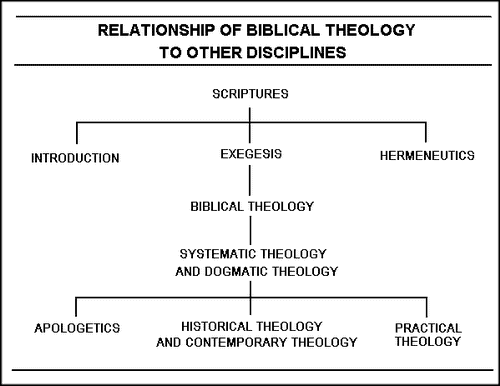
Biblical theology has a direct relationship to exegesis (“to explain; to interpret”), inasmuch as biblical theology is the result of exegesis. Exegesis lies at the foundation of biblical theology. Exegesis calls for an analysis of the biblical text according to the literal-grammatical-historical methodology. (1) The passage under consideration should be studied according to the normal meaning of language. How is the word or statement normally understood? (2) The passage should be studied according to the rules of grammar; exegesis demands an examination of the nouns, verbs, prepositions, etc., for a proper understanding of the passage. (3) The passage should be studied in its historical context. What were the political, social, and particularly the cultural circumstances surrounding it? Biblical theology does not end with exegesis, but it must begin there. The theologian must be hermeneutically exacting in analyzing the text to properly understand what Matthew, Paul, or John wrote.
INTRODUCTORY STUDIES
Although it is not the purpose of biblical theology to provide a detailed discussion of introductory matters, some discussion is essential since interpretive solutions are sometimes directly related to introductory studies. Introduction determines issues like authorship, date, addressees, and occasion and purpose for writing. For example, the dating of the book of Hebrews is significant in that it relates to the extent of the suffering of the audience to whom the book is written. Persecution became severe after the burning of Rome in A.D. 64. Even more critical is the issue of the addressees in Hebrews. If the audience is understood to be unbelievers, the book will be studied in one fashion; if the audience is understood to be Hebrew Christians the book will be understood differently. By way of other examples, the audience of Matthew, Mark, and Luke also determines how these writers are evaluated. For example, Matthew’s theological viewpoint ought to be understood from the standpoint of having been written to a Jewish audience. The theological viewpoint of the writer is clearly related to introductory issues.
SYSTEMATIC THEOLOGY STUDIES
There are both similarities and differences between biblical and systematic theology. Both are rooted in the analysis of Scripture, although systematic theology also seeks truth from sources outside the Bible. In noting the relationship of these two theologies, numerous distinctions can be observed. (1) Biblical theology is preliminary to systematic theology; exegesis leads to biblical theology which in turn leads to systematic theology. (2) Biblical theology seeks to determine what the biblical writers said concerning a theological issue, whereas systematic theology also explains why something is true, adding a philosophical viewpoint. (3) While biblical theology provides the viewpoint of the biblical writer, systematic theology gives a doctrinal discussion from a contemporary viewpoint. (4) Biblical theology analyzes the material of a particular writer or period of history, whereas systematic theology investigates all materials both biblical and extra-biblical that relate to a particular doctrinal matter.
(CLICK TO ENLARGE IN SEPARATE WINDOW, CLICK AGAIN TO ENLARGE MORE)

METHODOLOGY
Biblical theology of the Old Testament is best understood when examining the Old Testament for a “center” or unifying principle. Many different proposals have been suggested concerning a unifying theme of the Old Testament. Walter Kaiser has suggested “promise” as the unifying theme; Elmer Martens suggests “God’s design” as the focal point; whereas Eugene Merrill suggests “kingdom” as the underlying theme of the Old Testament. Whatever theme is emphasized, biblical theology of the Old Testament should be able to see the unfolding of that theme in the different periods of the Old Testament (progressive revelation). (See further discussion of methodology under “Introduction to Old Testament Theology,” chap. 2.
Since the writing of the New Testament books probably encompassed less than fifty years, biblical theology of the New Testament must concern itself with the viewpoint of the different New Testament authors. Thus, the biblical theology of the New Testament is studied according to Pauline theology, Petrine theology, Johannine theology, and so forth. This study evaluates what particular doctrines the writers of the New Testament emphasized and how they developed those doctrines. (See further discussion of methodology under “Introduction to New Testament Theology,” chap. 9
IMPORTANCE
SHOWS HISTORICAL DEVELOPMENT OF DOCTRINE
Biblical theology is important in that it prevents the study of doctrine apart from its historical context. In the study of systematic theology it is entirely possible to ignore the historical context of doctrinal truth; biblical theology serves to avert that problem by paying attention to the historical milieu in which the doctrine was given.
SHOWS EMPHASIS OF THE WRITER
Biblical theology reveals the doctrinal teaching of a particular writer or during an entire period. In that sense, biblical theology systematizes the Scriptures pertinent to a writer or period and determines the major teaching or doctrinal focus of the writer or period of time. It enables the student to determine what was emphasized during the Abrahamic era or what was emphasized by the apostle John, providing a different perspective from that normally attained through the study of systematic theology.
SHOWS HUMAN ELEMENT IN INSPIRATION
While it is true that the Bible is verbally inspired and inerrant, it is also true that the writers of Scripture each wrote according to their distinctive style. Biblical theology emphasizes the human factor in the writing of Scripture (but not to the exclusion of inspiration). Thus biblical theology is intent on discovering what John or Paul taught or what was emphasized during a period of Old Testament history. Biblical theology “points up the individual backgrounds, interest, and style of the authors. Biblical Theology emphasizes the part that the writers had in the composition of the Word of God, while, of course, building on the divine superintendence of the writings.”
Paul P. Enns, The Moody Handbook of Theology (Chicago, IL: Moody Press, 1989), xv–24.