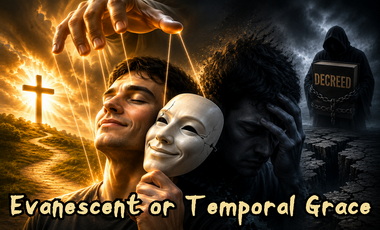
Evanescent or Temporal Grace | Deity of Deception

Gavin Ortlund Defends Calvinist Assurance—Does It Work?

  • This is a clip from a longer youtube reaction video to ‪@TruthUnites‬‘ defense of Calvinism. For the full reaction click here:     In this video Tim and Josh (with guest Phil) discuss Gavin Ortlund’s defense of the Calvinist position on assurance and how… some things just don’t add up.

Here is the Calvinist doctrine Temporal Grace, as taught by John Calvin:

temporal faith

“Let no one think that those [who] fall awaywere of the predestined, called according to the purpose and truly sons of the promise. For those who appear to live piously may be called sons of God; but since they will eventually live impiously and die in that impiety, God does not call them sons in His foreknowledge. There are sons of God who do not yet appear so to us, but now do so to God; and there are those who, on account of some arrogated or temporal grace, are called so by us, but are not so to God.” (Concerning the Eternal Predestination of God, p.66, emphasis mine)

And,

“Experience shows that the reprobate are sometimes affected in a way so similar to the elect that even in their own judgment there is no difference between them. Hence, it is not strange, that by the Apostle a taste of heavenly gifts, and by Christ himself a temporary faith is ascribed to them. Not that they truly perceive the power of spiritual grace and the sure light of faith; but the Lord, the better to convict them, and leave them without excuse, instills into their minds such a sense of goodness as can be felt without the Spirit of adoption …. there is a great resemblance and affinity between the elect of God and those who are impressed for a time with a fading faith …. Still it is correctly said, that the reprobate believe God to be propitious to them, inasmuch as they accept the gift of reconciliation, though confusedly and without due discernment; not that they are partakers of the same faith or regeneration with the children of God; but because, under a covering of hypocrisy they seem to have a principle of faith in common with them. Nor do I even deny that God illumines their mind to this extent …. there is nothing inconsistent in this with the fact of his enlightening some with a present sense of grace, which afterwards proves evanescent.” (3.2.11, Institutes, emphasis mine)

Calvin adds: 

“Yet sometimes He also causes those whom he illumines only for a time to partake of it; then He justly forsakes them on account of their ungratefulness and strikes them with even greater blindness.” (Institutes of Christian Religion, 3.24.8, emphasis mine)

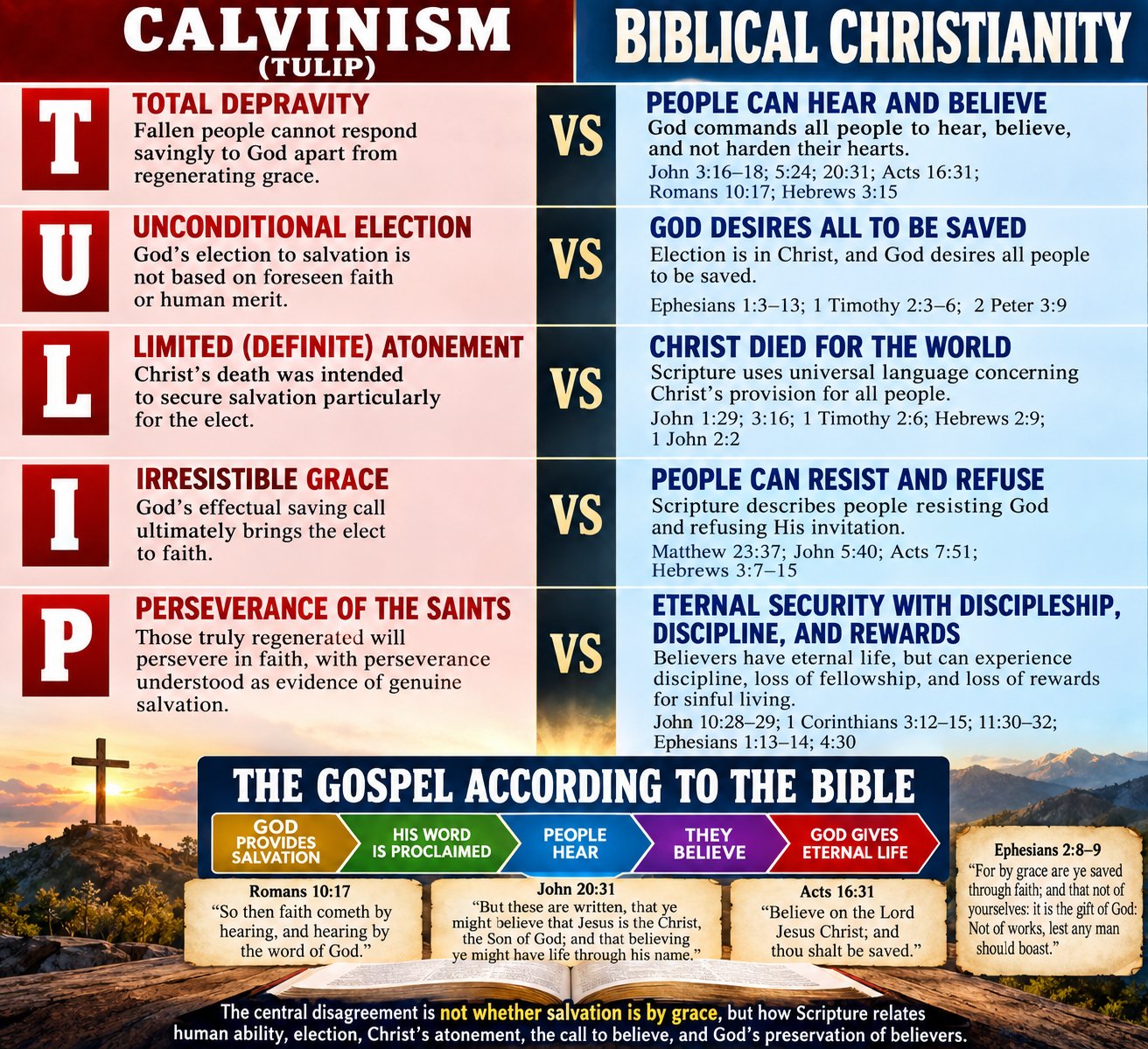
Therefore, by “some arrogated or temporal grace,” God “illumines only for a time” the alleged non-elect in order to overcome his Total Inability and thus temporarily think that he was “of the predestined.” Realize that Calvin taught the doctrine of Temporal Grace because he needed to plug a hole in his theology, such as how to explain passages such as Matthew 7:21-23, where the perishing, that is, those who are being condemned to Hell, had performed miraculous things that spiritually dead people are not supposed to be able to do, according to the Calvinistic doctrine of Total Inability. Calvin’s answer for such instances was a temporary grace. 

John Calvin again:

“Whoever has sinned, I shall delete him from the book of life. … But the meaning is simple: those are deleted from the book of life who, considered for a time to be children of God, afterwards depart to their own place, as Peter truly says about Judas (Acts 1:16). But John testifies that these never were of us (1 Jn 2:19), for if they had been, they would not have gone out from us. What John expresses briefly is set forth in more detail by Ezekiel (13:9): They will not be in the secret of My people, nor written in the catalogue of Israel. The same solution applies to Moses and Paul, desiring to be deleted from the book of life (Ex 32:32; Rom 9:3): carried away with the vehemence of their grief, they prefer to perish, if possible, rather than that the Church of God, numerous as it then was, should perish. When Christ bids His disciples rejoice because their names are written in heaven (Lk 10:20), He signifies a perpetual blessing of which they will never be deprived. In a word, Christ clearly and briefly reconciles both meanings, when He says: Every tree which My Father has not planted will be rooted up (Mt 15:13). For even the reprobate take root in appearance, and yet they are not planted by the hand of God.” (Concerning the Eternal Predestination of God, pp.151-152, emphasis mine) 

John Calvin comments on Hebrews 6:4-6: 

God certainly bestows His Spirit of regeneration only on the elect, and that they are distinguished from the reprobate in the fact that they are re-made in His image, and they receive the earnest of the Spirit in the hope of an inheritance to come, and by the same Spirit the Gospel is sealed in their hearts. But I do not see that this is any reason why He should not touch the reprobate with a taste of His grace, or illumine their minds with some glimmerings of His light, or affect them with some sense of His goodness, or to some extent engrave His Word in their hearts. Otherwise where would be that passing faith which Marks mentions (4.17)? Therefore there is some knowledge in the reprobate, which later vanishes away either because it drives its roots less deep than it ought to, or because it is choked and withers away.” (Calvin’s New Testament Commentaries: Hebrews and I and II Peter, p.76, emphasis mine) 

Calvinist, Mark Talbot: 

“Now of course, nothing, that I, nor anyone else, can say can guarantee that anyone will continue to believe. Faith is a gift of God that we cannot produce.”  (Sin and Suffering in Calvin’s World, emphasis mine)

In other words, the fact that you believe today is no guarantee that you will still believe tomorrow, or the next day, or the day after. You can only hope for the best, that your ordained fate is better than others, and that your grace is not a temporary grace, here today and gone tomorrow. Mark Talbot explicitly offers no illusion for your hope of tomorrow. There is nothing that you can do, but hope for the best. It’s completely out of your hands and completely in God’s hands. If you should find yourself an unbeliever tomorrow, your gift has run out.

One member of The Society of Evangelical Arminians: 

“The Calvinist’s assurance is obliterated by the fact that God ordains the illusory salvation of the seemingly-saved folks. This makes them a special sub-set of the damned. In Calvinism, God glorifies Himself by damning the ‘eternally reprobate.’ But the seemingly-saved folks have the unique privilege of ‘glorifying’ God in their earthly lives, by appearing to be saved on their way to Hell. Because God has pre-ordained this, there is nothing any apparently saved person can do. God has ordained the illusion! Of course, this brings up another question: Why is the God (who is Himself truth) ordaining such an illusion? How can God be truthful if He unconditionally pre-ordains illusions? And what kind of God could or would ordain such an illusion for the sake of His glory?” (SEA, emphasis mine)

One member of The Society of Evangelical Arminians: 

“For every person who has ever followed Jesus and then forsaken his name, we have to conclude that God ordained that said person would be eternally damned, but on their way to being damned, God ordains the illusion of redemption in Christ, in that they would come to know Jesusexhibit kingdom fruit, and then apostatize, all for the sake of divine glory.” (emphasis mine)

​QUESTION: If there is a Temporal Grace, then how do Calvinists know whether this will some day apply to them?

ANSWER: If they stop persevering, then that is how they know, according to Calvinist, Erwin Lutzer. 

Calvinist, Erwin Lutzer: 

“Historic Calvinism stresses the ‘perseverance of the saints,’ namely that true believers never fall away, and if they do, it is not for long. If a person fails to continue in the faith, he is giving proof that he was never saved.” (The Doctrines That Divide, p.231, emphasis mine)

Arminian, Robert Shank: 

“In other words, the only real evidence of election is perseverance, and our only assurance of the certainty of persevering is—to persevere!” (Elect in the Son, p.214, emphasis mine)

Dave Hunt: 

“It is Calvinism that in effect offers salvation by works because it looks to works for assurance of salvation. Biblically, assurance comes by faith in the promise of eternal life in Christ made by ‘God, who cannot lie…before the world began’ (Titus 1:2).” (Debating Calvinism, p.416, emphasis mine)

QUESTION: How do Calvinists know if they are of the Calvinistically elect?

ANSWER: They presume it. …..

Read the rest at:

What is Evanescent Grace? 

| and |

Calvinist Complaints: Arminianism teaches “Conditional Security”)

The Puritan’s Died Fearful

This is why the Puritan’s never slept well in the security of their salvation. Pastor Andy Woods notes this in a truncated presentation:

Although there can be some abuse from Free Grace types, I thought this quick post illuminates Pastor Woods comments:

You may remember that the Puritans were English Protestants in the 16th and 17th centuries who believed the English Reformation hadn’t gone far enough. They objected to Roman Catholic influences in the Church of England and wanted a purer church with purer doctrine (hence the name “Puritan”). Thus, they separated to form independent or dissenting congregations, with many fleeing to Holland and then to New England looking for religious freedom (at least for themselves, if not for others).

As Grenz explains, the Puritans were concerned with “the quest for certainty of personal election” (Grenz, Revisioning Evangelical Theology, p. 23). They wanted to be sure that they were saved. Why was that? Why did that become an area of particular doubt for them?

Simply put, it was due to the doubts created by their Calvinism:

“This movement developed a new kind of piety in response to anxieties produced by the Calvinist doctrine of election, which in Puritanism made the problem of assurance of salvation existentially central. In contrast to medieval paradigms, Calvinism couched the question of personal salvation in terms of God’s mysterious election. While this theology protected divine sovereignty, it offered no clear criteria whereby a believer could be assured of elect status” (Revisioning, p. 39).

As Grenz explains, many tried to ground their certainty of being elect in outward behavior, which had the opposite effect:

“As helpful as they may be, in the end no sincerity of profession of faith, no degree of faithful attendance at the sacraments, no accumulation of outward evidences of sanctified living could suffice as marks of election” (Grenz, Revisioning, p. 39).

Since looking at outward behavior didn’t give them the assurance they sought, the Puritans looked for inward evidence. Grenz continues:

“the Puritans did devise one definitive mark of election: the inward experience of God’s saving grace. The attendant emphasis on conversion that this move engendered led eventually—at least in devotional literature—to an emphasis on a subjective mark of salvation, the inner, conscious experience of the new birth. Assurance of elect status, therefore, became the product of a believer’s ability to narrate a testimony to a personal conversion experience” (Grenz, Revisioning, p. 39).

This emphasis on having a “new birth” conversion experience became one of the central features of preaching during the Great Awakenings in America. Men like John Wesley (representing Arminians) and George Whitfield (representing Calvinists) emphasized the necessity of conversion and having “the New Birth.” People who had that experience during the revival meetings began to distinguish themselves from people who hadn’t, leading to the question, “Are you really saved?” ….

How Did Assurance Become a Debate?

In discussing this with Grok and Chat-GPT, I got a hybrid breakdown of two sources:

The “P” of TULIP

Calvinism’s doctrine of the Perseverance of the Saints does not ultimately provide the confident assurance of salvation that many assume it does. While Calvinism teaches that all of God’s elect will persevere to the end, assurance is often grounded not merely in faith in Christ but in the believer’s ability to demonstrate a lifetime of continuing faith, obedience, and holiness. Since only those who endure to the end are proven to be truly elect, the believer is left asking not simply, “Do I believe in Christ?” but also, “Will my faith ultimately prove genuine?”

According to these critics, this creates a built-in tension within the Calvinist system. If those who fall away are explained as never having been truly saved, then every professing Christian must consider whether his own faith might eventually prove to be temporary or spurious. Rather than resting entirely upon Christ’s finished work and His promises, assurance becomes linked to future perseverance that has not yet occurred.

The concern is reflected in several recurring themes:

  • Assurance is tied to visible perseverance, holiness, and good works rather than resting solely on God’s promises to believers.
  • Numerous Calvinist theologians, including John Calvin, John Murray, A.W. Pink, and others, stress that present faith is not sufficient unless one continues faithfully to the end.
  • Calvin’s doctrine of “temporary faith” or “evanescent grace” introduces the possibility that someone may appear converted for years and still not be among the elect.
  • Apostasy is interpreted as evidence that a person was never truly saved, causing believers to question whether their own faith is genuine.
  • Personal testimonies such as R.C. Sproul’s famous struggle with the question, “What if you are not one of the redeemed?” are cited as examples of the doubt this system can produce.
  • Biblical examples such as David, Peter, Solomon, and the carnal Corinthians are presented as evidence that true believers can fail seriously without proving themselves lost.

For these reasons, critics argue that Calvinism’s doctrine of perseverance functions less as a doctrine of assurance and more as a doctrine of ongoing self-examination. The believer’s focus can shift from Christ’s completed work to the search for evidences of election within his own life. In their view, the result is a form of assurance mixed with uncertainty, because the final proof of genuine salvation is not known until life’s race has been completed.

Thus, both sources conclude that Calvinism’s “P” in TULIP, though intended to safeguard eternal security, ultimately undermines it. Instead of offering believers settled confidence in Christ’s promise of eternal life, it replaces assurance with an ongoing test of endurance, leaving many to wonder whether they possess saving faith at all. True assurance, they contend, is found not in examining whether one has persevered enough, but in trusting Christ’s promise that all who believe in Him have eternal life here and now.

Dr. Leighton Flowers walks through a recent sermon entitled, “The Most Hated Christian Doctrine” by Dr. John MacArthur.

Faith Alone Thru Christ Alone

  • Flowers agrees with MacArthur that humanity is sinful and in need of grace, but argues that Calvinism wrongly transforms human rebellion into God-decreed inability, thereby undermining genuine responsibility, the universal offer of the gospel, and the biblical teaching that people receive life by believing rather than believe because they have already been given life.

The below video is Dr. Leighton Flowers’ response to John MacArthur’s sermon “The Most Hated Christian Doctrine.” While Flowers agrees with MacArthur that humanity is deeply sinful and incapable of saving itself, he argues that MacArthur goes beyond biblical depravity and imports the Calvinistic doctrine of Total Inability—the belief that people are born unable to respond positively to God’s revelation unless first regenerated by irresistible grace. Throughout the discussion, Flowers repeatedly distinguishes between people being unwilling because of rebellion and people being unable because of an innate condition decreed by God. He contends that passages such as John 5, John 6, John 8, Acts 28, and John 12 are addressing hardened, rebellious Israelites who became calloused through persistent rejection of God’s revelation, not describing the universal condition of every person from birth. According to Flowers, Calvinists mistakenly turn judicial hardening passages into proof texts for a doctrine of universal moral inability.

The larger theme of the video is the defense of human responsibility and the sufficiency of God’s revelation. Flowers argues that Calvinism ultimately makes unbelief trace back to God’s decree rather than to the sinner’s own rejection of truth. He repeatedly challenges MacArthur’s claim that unbelievers “cannot believe” by asking whether such inability is self-inflicted through rebellion or divinely determined from birth. Flowers maintains that God’s grace genuinely enables all people to respond to the gospel, that faith is not a meritorious work but a response to God’s gracious initiative, and that salvation remains entirely by grace even though individuals are responsible for whether they trust Christ. The video therefore centers on a fundamental disagreement: Calvinism teaches that people need new life in order to come to Christ, whereas Flowers argues that Scripture consistently presents people as coming to Christ in order to receive life.

Ultimately, as I see it, God is a deceiver in Calvinistic theology.

God the Cause

To bolster my point and not just make blanket statements, Dr. Theodore Zachariades shows that God wills [causes, not just permits] a man to be unfaithful to his wife.

  • God works all things after the Council of His will. Even keeping those kings who want to commit adultery from committing so! And when He wants to, he orders those to commit adultery when he wants to! (Video)

He gets that from John Calvin:

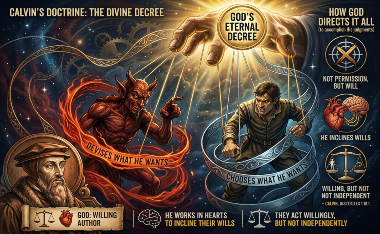
… how foolish and frail is the support of divine justice afforded by the suggestion that evils come to be, not by His will but by His permission. . . . It is a quite frivolous refuge to say that God otiosely permits them, when Scripture shows Him not only willing, but the author of them. . . . Who does not tremble at these judgments with which God works in the hearts of even the wicked whatever He will, rewarding them nonetheless according to desert? Again it is quite clear from the evidence of Scripture that God works in the hearts of men to incline their wills just as he will, whether to good for His mercy’s sake, or to evil according to their merits.

John Calvin, “The Eternal Predestination of God,” 10:11

John Piper:

Ephesians 1:11 goes even further by declaring that God in Christ

“works all things according to the counsel of his will.” Here the Greek word for “works” is energeø, which indicates that God not merely carries all of the universe’s objects and events to their appointed ends but that he actually brings about all things in accordance with his will. In other words, it isn’t just that God manages to turn the evil aspects of our world to good for those who love him; it is rather that he himself brings about these evil aspects for his glory (see Ex. 9:13-16; John 9:3) and his people’s good (see Heb. 12:3-11; James 1:2-4). This includes—as incredible and as unacceptable as it may currently seem—God’s having even brought about the Nazis’ brutality at Birkenau and Auschwitz as well as the terrible killings of Dennis Rader and even the sexual abuse of a young child: “The LORD has made everything for its own purpose, even the wicked for the day of evil” (Prov. 16:4, NASB ).14 “When times are good, be happy; but when times are bad, consider: God has made the one as well as the other” (Eccl. 7:14, NIV).

John Piper and Justin Taylor, eds., Suffering and the Sovereignty of God (Wheaton, IL: Crossway Books, 2006), 42. (FULLER QUOTE VIA THIS PDF)

More at my: Is God the “devil” Behind Satan? | Sovereign Puppeteer | and | Is Divine Determinism a Different Gospel?

Double Predestination | Geoffrey D. Robinson

This is an excerpt from Geoffrey D. Robinson’s book, Saved by Grace Through Faith or Saved by Decree? A Biblical and Theological Critique of Calvinist Soteriology (Eugene, OR: Wipf and Stock, 2022), pages 171-184.

g) Double Predestination?

From within a Calvinistic perspective, Sproul is surely correct when he says: “Given that the Bible teaches both election and particularism, we cannot avoid the subject of double predestination. The question then is not if predestination is double, but how it is double.”205

Double predestination, a term mainly relevant to those committed to Calvinism, is the term used by theologians to describe the nature of God’s predestinating work of electing some for salvation and damning the rest. There are two main ways this choosing of God is considered to work. The first, held by consistent Calvinists and mainly found in earlier (post-Reformation) Calvinistic writers, views God as positively choosing those whom he unconditionally elects for salvation and positively choosing those whom he selects for hell. Merely for convenience I will call this form of predestination “symmetric predestination.” In the other form of this doctrine, God positively chooses unconditionally the elect for salvation and the rest he leaves in their sin to take the consequences of unforgiven sin, hell. Again, for convenience, I will call this “asymmetric predestination.”206

John Calvin is a good example of symmetric predestination:

By predestination we mean the eternal decree of God, by which he determined with himself whatever he wished to happen with regard to every man. All are not created on equal terms, but some are preordained to eternal life, others to eternal damnation; and, accordingly, as each has been created for one or the other of these ends, we say that he has been predestined to life or to death.207

The Westminster Confession of 1646 likewise strongly affirms symmetric predestination: “By the decree of God, for the manifestation of his glory, some men and angels are predestinated unto everlasting life; and others foreordained to everlasting death.”208 In more recent times Wright is an example of a proponent of symmetric predestination: “God cannot logically choose some for salvation without at the same time choosing to reject others, even though they are no more sinful. This, of course, is the doctrine of reprobation taught today by all consistent Calvinists.”209 For Lorraine Boettner, “the doctrine of absolute Predestination logically holds that some are foreordained to death as surely as others are foreordained to life. . . . We believe that from all eternity God has intended to leave some of Adam’s posterity in their sins, and that the decisive factor in the life of each is to be found only in God’s will.”210

Much more common among contemporary Calvinists is asymmetric predestination. For such thinkers, symmetric predestination jeopardizes God’s goodness. Sproul is typical: “Reprobation is the flip side of election, the dark side of the matter that raises many concerns. It is the doctrine of reprobation that has prompted the label of `horrible decree: It is one thing to speak of God’s gracious predestination to election, but quite another to speak of God’s decreeing from all eternity that certain unfortunate people are destined for damnation.”211 Grudem too expresses the same reservations about symmetric predestination:

In many ways the doctrine of reprobation is the most difficult of all the teachings of Scripture for us to think about and to accept, because it deals with such horrible and eternal consequences for human beings made in the image of God. The love that God gives us for our fellow human beings and the love that he commands us to have toward our neighbor cause us to recoil against this doctrine, and it is right that we feel such dread in contemplating it.212

Grudem helpfully summarizes the asymmetric predestination position when he says that “reprobation is the sovereign decision of God before creation to pass over some persons, in sorrow deciding not to save them, and to punish them for their sins, and thereby to manifest his justice.”213 While God positively decides who will be saved, he only passes over the rest (the reprobate) who are consequently punished for their sins. Horton echoes the same logic: “God only has to leave us to our own devices in the case of reprobation, but it requires the greatest works of the triune God to save the elect.”214 Bruce Ware argues similarly: “In brief, reprobation is conditional, i.e., based on what sinners have done and deserve, whereas election is unconditional, i.e., based on the unmerited grace and favor of God despite what sinners have done and deserve. . . . None of what has been argued above militates against the fact that God has ordained both evil and good, both sin and obedience, both reprobation and election.”215

Before critiquing the Calvinist’s notion of symmetric predestination and asymmetric predestination, I want to briefly examine a few scriptures appealed to by Calvinists to justify the idea of God predestinating the reprobate.

Proverbs 16:4

“The Lord has made everything for its own purpose, Even the wicked for the day of evil.”

Berkhof in his Systematic Theology cites this verse to justify the all-comprehensiveness of God’s sovereign decree: “The decree includes whatsoever comes to pass in the world . . . whether it be good or evil” and includes the wicked acts of men.216 Superficially, it is easy to see why appeal is made to Prov 16:4 for does it not say that God’s purpose includes the wicked for a day of evil? However, as always, context and genre must be brought to bear to truly understand this (and any other) verse. The first thing to notice is that the saying is a proverb which, by definition, expresses a general truth. And what is the general truth being expressed in this verse (and the preceding verses)? It is that, despite what may appear on the surface, ultimately it is God who rules. In this case, God’s rulership (purpose) includes the punishment of evildoers in the end. “The general meaning is that there are ultimately no loose ends in God’s world: everything will be put to some use and matched with its proper fate. It does not mean that God is the author of evil: James 1:13,17).”217 A good historical example of this proverb is the punishment of Babylon for their iniquity (Jer 25:12) after the king of Babylon’s wickedness has been used by God to punish disobedient Judah (Jer 25:7-9).

Isaiah 45:7

“The One forming light and creating darkness, causing well-being and creating calamity; I am the Lord who does all these.”

Grudem comments on this verse, “Isaiah 45:7, which speaks of God `creating evil, does not say that God himself does evil, but should be understood to mean that God ordained that evil would come about through the willing choices of his creature.”218 However the evil comes about, according to Grudem, God ordains the evil; it must therefore happen because God wills it to happen.

The Hebrew word that Grudem translates as evil has, like all words, a range of meanings.219 The Hebrew Lexicon of Brown et al., for example, cites evil, distress, misery, injury, calamity, adversity.220 In its context this verse underscores God’s sovereignty to confirm his ability to call the Persian King Cyrus (Isa 45:1-4) to effect God’s purpose for ancient exilic Israel, that they be granted permission to return to Jerusalem. The phrase causing well-being and creating calamity is typically assumed by Calvinistic scholars to express God’s all-determining decretal will whereby all that happens in the universe is an outworking of God’s ordaining before the creation of the world—in Grudem’s words, “God ordained that it [the evil] would come about, both in general terms and in specific details.”221 Yet there is nothing in the verse itself that would indicate that such divine actions are the result or consequence of some preordained, detailed plan. The text merely says that God does these things—how or why he does it is not specified. Is there any portion of Scripture that might indicate why God might choose to act in such a way as to bring “calamity”? Yes. The covenant blessings and curses that comprise a very important part of the Mosaic covenant (Lev 26, Deut 28) clearly indicate that God will bring blessings (“causing well-being”) for covenant loyalty by Israel, and God will bring disaster in the form of judgments (“creating calamity”) for covenant disloyalty. Far from the outworking of an unconditional overarching decree that ordains all that unfolds in history, Isa 45:7 is a reminder of what God can do, and has done, in response to human actions and choices. This is simply the kind of God he is; he reacts negatively to human sin whether that sin be the idolatry of ancient Israel, or the wickedness of people who suppress the truth in unrighteousness (Rom 1:18).

Romans 9:18

“So then He has mercy on whom He desires, and He hardens whom He desires.”

Earlier in this chapter when discussing the significance of Rom 9:10-16, we concluded that yes, God does choose unconditionally—but his choosing is not for salvation but for service. God has the right to choose which individuals to call and use in the service of his redemptive purposes for the world. Furthermore, Paul’s argument concerning God’s right to choose how salvation would be applied to the Jews (by grace, not ethnicity [vv. 6-81), and who will play key roles in his redemptive purposes (Isaac, Jacob, Pharaoh [vv. 7-171), extends all the way down to v. 18. Consequently, this verse is to be understood within a context of election to service, not salvation. Calvinists are quite right to see God exercise his sovereign right to choose, but they are mistaken in seeing the choosing in terms of God’s selecting some individuals for salvation and selecting (either directly or indirectly) some individuals for perdition.222

A word about the words mercy and hardens. These words are usually, especially by Calvinists, understood in salvific terms. God has saving mercy on some (the elect) and he hardens others (the reprobate) so that they cannot believe or are left in their unbelief. However, as always, the meaning assigned words is governed by the context,223 and as we have seen, the context here has to do with God’s choosing some for a task of service and rejecting others for that task. “‘Having mercy’ in this context refers not to saving mercy but to the favor of being chosen by God to play some role in the working out of his redemptive purposes (see v. 15). Whether one is conscious of being chosen and used is irrelevant; even whether one is saved or not is irrelevant (see Isa 45:4-5 concerning Cyrus).”224 Similarly with the hardening: because God wanted to use Pharaoh in a negative way, to impede Israel’s exodus from Egypt, God hardened his heart for that specific purpose (v. 17). The hardening of v. 18 expresses God’s providential working at a crucial point in redemptive history, as well as God’s judgment on an individual’s persistent rebellious unbelief. In short, this verse (Rom 9:18) cannot be used to support the Calvinist’s contention regarding God’s unconditional choosing of the elect for salvation, and the reprobate for damnation.

Romans 9:21

“Or does not the potter have a right over the clay, to make from the same lump one vessel for honorable use and another for common use?”

Calvinists tend to see Rom 9:7-29 as a whole, as Paul sustaining his explanation for the implied question behind Rom 9:1-5, namely, why aren’t the Jews being saved in (supposed) fulfillment of Old Testament promises? The Calvinist answer is that God has the right whom to save and whom to not save. Romans 9:21 summarizes that contention. Michael Horton is typical of this perspective: In “Romans 9, God is said to be free to choose and to reject, to save and to harden, `to make out of the same lump one vessel for honorable use and another for dishonorable use (Rom 9:21):” 225

A key to understanding Rom 9:21 is Rom 9:6: “But it is not as though the word of God has failed. For they are not all Israel who are descended from Israel.” Fundamental to Paul’s concern for his lost ethnic brethren (fellow Jews) is the idea of two Israels-physical Israel (those descended from Israel/Jacob) and spiritual or true Israel. In vv. 7-18 the focus has been on God’s dealings with physical Israel, his calling the nation to a work of service in the redemptive outworking of God’s salvific purposes for the world. But now in vv. 19-29 the focus shifts to true Israel, those within physical Israel (the one lump of v. 21) who will actually enjoy salvation and be “for honorable use” for God (v. 21), and also be “vessels of mercy” (v. 23). This latter group have always been a remnant within physical Israel (v. 27-29).

As Cottrell notes, “A major part of this section [vv. 19-29] is the fact that the calling and saving of spiritual Israel was all along a part of the very purpose for the existence of ethnic Israel. In other words, it has always been God’s sovereign purpose to distinguish between the two Israels.”226 Bearing this in mind, we can paraphrase and expand the meaning of Rom 9:21 as: “Does not God have a right over the nation of Israel, to make from within the one nation one group that would enjoy salvation and another group that would function as the vehicle of God’s redemptive purposes?” The fact of the two groups is established in vv. 19-29, but the basis upon which God distinguishes between the two is discussed in 9:3o-10:21. The fact of the two groups lies in God’s unconditional intent to call a saved people from within the ethnic nation; the basis of the saved people’s existence is conditional upon an exercise of faith in God. It is clear from the above analysis that Rom 9:21 does not support the idea that God determines whoever will be personally saved or lost.

1 Peter 2:7—8

“This precious value, then, is for you who believe; but for those who disbelieve, `The stone which the builders rejected, this became the very corner stone,’ and, a stone of stumbling and a rock of offense; for they stumble because they are disobedient to the word, and to this doom they were also appointed.”

Grudem, in typical Calvinistic fashion, commenting on the last clause, says: “Amazing as it may seem, even the stumbling and disobedience of unbelievers have been destined by God.”227 John Piper likewise makes it clear that he understands v. 8 to mean that God (pre)destined the unbelievers to not obey the word.228

In order to understand Peter’s teaching here, it is necessary to capture the flow of thought in the larger context. In the passage (1 Pet 2:4-1o) Peter identifies two groups of people. On the one hand are the Christians he is writing to and “who believe” and, on the other hand, “those who disbelieve” (v. 7). Here, as throughout the New Testament, belief in Christ and in God’s word is crucial in demarking the two classes of people. These two groups hold two very different attitudes to Christ. For believers Christ is “a living stone” (v. 4) who is “precious in the sight of God” (v. 4) and recognize Christ as “a precious cornerstone” (v. 6). For unbelievers, however, Christ is “a stone of stumbling and a rock of offense” (v. 8a). The attitude toward Christ is markedly different for the two groups. The believers are “coming to Him as to a living stone” (v. 4) and glory in Christ’s preciousness (vv. 4, 6, 7); in strong contrast, unbelievers reject Christ (vv. 4, 7). As a consequence of the two sharply differing attitudes and approaches to Christ, God’s cornerstone, the two groups experience two sharply contrasting outcomes. Believers are being built up as a spiritual house, offer spiritual sacrifices to God (v. 5), and are not ultimately disappointed (v. 6b). Unbelievers, because of their disobedience to the word (gospel) by contrast, stumble over Christ who, for them, has become “a stone of stumbling and a rock of offense” (v. 8a).

By way of preliminary observation, we may note that even though the Greek does not explicitly make the causal connection between the disobedience of the unbelievers and their stumbling in v. 8 (“they stumble because they are disobedient”) most translators recognize the implied connection and accordingly include it in their translation of v. 8.229 Furthermore, the word doom in the NASB translation of v. 8 above is not in the Greek.230 Unfortunately, the grammatical construction of the phrase “to this they were also appointed” does not resolve the question as to what the disbelievers were appointed.

Because of the textual ambiguity of 1 Peter 2:8, grammatically the passage may be construed either as supporting, or as not supporting, the doctrine of positive reprobation. The matter hinges on the reference assumed for the phrase “to which they were appointed.” Was the appointing to disobedience, or to both stumbling and disobedience, or to stumbling as the consequence of disobedience? All three assumptions have their advocates, and all are admissible grammatically.231

One way to resolve the issue is to examine elsewhere within Peter’s letter whether he hints at God having appointed or destined the unbelief itself. This is easy to answer: nowhere within the letter is such divine action stated.232 On the other hand, are there indications within the rest of the letter that God reacts negatively against unbelief and evil? The answer to this is also clear; there are at least four other passages where God is said to react negatively toward unbelievers. In 1 Pet 3:12 God is said to set his face “against those who do evil.” In 4:5, Peter reminds his readers that the sinful practices of the Gentiles will be held accountable to God on the day of judgment. In 4:18, it is implied that severe judgment awaits “the godless man and the sinner.” Finally, in 5:5, Peter tells his readers that believers are to clothe themselves with humility because “God is opposed to the proud.” So, we may conclude, on the basis of Peter’s teaching in other parts of his letter, that the stumbling referred to in v. 8 is a consequence of the unbeliever’s disobedience toward Christ and the gospel. In short, Yor those who disbelieve . . . the very cornerstone [Christ, has become] . . . a stone of stumbling” (vv. 7, 8).

Finally, the broader biblical witness likewise testifies against God’s being responsible for the soteriological status of the reprobate. Just one scripture will make the point: 1 Tim 2:4: God “desires all men to be saved and to come to the knowledge of the truth.” As Shank comments:

[The fact the] immediate context militates against any assumption of support from i Peter 2:8 for the doctrine of unconditional reprobation is augmented by an evidence that must be regarded as finally decisive: such a doctrine radically contradicts the many explicit, categorical affirmations of Scripture of God’s desire and provision for the salvation of all men. The great body of “universal” passages dictates the rejection of all interpretations (and translations) of 1 Peter 2:8 which, though grammatically allowable, are inadmissible in the light of the context of the whole body of the Holy Scriptures. Any assumption that the appointing was to disobedience or to disobedience and stumbling is in radical contradiction of 1 Timothy 4:10 and its many cognates.233

Joel Green captures the essence of the passage well when he says that “faith and unfaith are matters of human volition, but the consequences of faith and unfaith have been preset.”234

Jude 4

“For certain persons have crept in unnoticed, those who were long beforehand marked out for this condemnation, ungodly persons who turn the grace of our God into licentiousness and deny our only Master and Lord, Jesus Christ.”

Grudem appeals to this verse to justify a doctrine of reprobation: “It is something that we would not want to believe, and would not believe, unless Scripture clearly taught it.”235 Likewise Berkhof appeals to Jude 4 to justify his contention that “reprobation is so clearly taught in Scripture as the opposite of election that we cannot regard it as something purely negative:’ as something only resulting from man’s sin. 236

Since Jude makes reference in this verse to “this condemnation,” but has not yet spoken of any judgment or condemnation,237 the reference must be to condemnations to be described in the following verses. The verb translated as “marked out” in the NASB has as its root form προγράφω (prographō) — literally, “written before.” The NIV translates the word as “written about” Jude’s point is that the condemnation of the ungodly men who were posing a threat to the church(es) to whom Jude was writing was foretold or prophesied. S. L. Bloomfield, cited by Robert Shank, summarizes the point clearly: “The expression [marked out beforehand for this condemnation] does not imply any predestination of the persons, but merely imports that they were long since foretold, and thereby designated, as persons who should suffer.”238 Baukham concurs: “Just such people, Jude claims, were long ago described in prophecy, which also predicted their condemnation by God.”239

Is there justification in Jude’s letter that would reinforce this understanding of v. 4, i.e., the understanding that it is not certain individuals unconditionally elected for damnation as Calvinists hold, but rather a specific type of persons—ungodly persons—to whom God reacts in condemnation as was foretold in previous times? Yes, there is. In the immediately following three verses Jude gives three examples of ungodliness incurring divine judgment: the people of Israel in the wilderness were destroyed for their unbelief (v. 5); angels who strayed from their assigned abodes God has kept in darkness (v. 6); the inhabitants of Sodom and Gomorrah who indulged in immorality God punished with fire (v. 7).

Especially significant is the midrash from Enoch in vv. 14-15:240 “It was also about these men that Enoch, in the seventh generation from Adam, prophesied, saying, `Behold, the Lord came with many thousands of His holy ones, to execute judgment upon all, and to convict all the ungodly of all their ungodly deeds which they have done in an ungodly way, and of all the harsh things which ungodly sinners have spoken against Him.”‘

This is probably a reference to the judgment to be meted out against the ungodly when Christ returns at the end of the age. “The message of Jude’s whole midrash [is] that those who indulge in ungodly conduct, as the false teachers do, are those on whom judgment will fall.”241 The notion of any form of predestinarian language or thought is quite absent from this letter. Jude is simply concerned for the fidelity of his reader’s faith (v. 3) and that they be warned about, and be on guard against, ungodly teachers who would bring true Christians into spiritual harm. Such, says Jude, will one day receive a just condemnation, and in any case were anticipated by earlier spokesmen for God.

By way of reminder, we are considering the doctrine of double predestination, the belief that God predestines some (the elect) to salvation and the rest (the reprobate) to hell. We noted at the beginning of this study that there are two forms in which this double predestination is said to occur. The first, the stronger version, I have called symmetric predestination because there is a fundamental symmetry between God’s positively choosing those whom he saves and those whom he likewise chooses to damn. The weaker form I have labeled asymmetric predestination because, while God positively chooses those whom he saves, he merely bypasses the rest in their sins; the latter group are then considered to be justly condemned for their sins. We then considered six key scriptures often appealed to by Calvinists to justify the idea of reprobation, and have shown how, when due consideration is given to the literary and historical contexts in which these verses sit, there is no basis for reaching the Calvinist’s conclusions; there is no such thing as reprobation in any form. I want now to go on to critique the entire notion of symmetric predestination.

Proponents of symmetric predestination are at least consistent with the Calvinistic view of particular sovereignty and “the eternal decree of God, by which he determined with himself whatever he wished to happen with regard to every man.”242 Wright, commenting on the ninth-century monk Gottschalk’s view on this topic, says, “God cannot logically choose some for salvation without at the same time choosing to reject others. . . . This, of course, is the doctrine of reprobation taught today by all consistent Calvinists.”243 However, such consistency comes at a price—”the dark side of the matter that raises many concerns.”244 Sproul observes that “it is one thing to speak of God’s gracious predestination to election, but quite another to speak of God’s decreeing from all eternity that certain unfortunate people are destined for damnation.”245

Calvin himself acknowledged the idea of symmetric predestination as “dreadful,”246 and Grudem feels that the doctrine of reprobation “deals with such horrible and eternal consequences for human beings made in the image of God” that it causes us “to recoil against this doctrine, and that it is right that we feel such dread in contemplating it. It is something that we would not want to believe . . . [and] causes us to tremble in horror as we think of it.”247 But why would such a doctrine, if truly biblical, cause us to react in this way? How can such a sentiment be maintained in the light of such scriptures as Ps 119:24: “Your testimonies also are my delight; they are my counselors.” Similarly, Ps 119:47-48: “I shall delight in Your commandments, which I love. And I shall lift up my hands to Your commandments, which I love.” Surely, the revelation of God is something that should cause us great delight and joy—not dread and horror!

More seriously, what sort of God is the God who determines the eternal destinies of his human creation by means of symmetric predestination? Recall that according to symmetric predestination God actively had in mind men and women who would never, and indeed could never, find salvation because they were predestined by God before the foundation of the world to be consigned to hell. Furthermore, such a predestination is supposedly for the glory of God.248 How, exactly, is God glorified in unconditionally consigning people to hell? Nowhere in Scripture is God said to be glorified for acting unilaterally and unconditionally in such an evil manner.249 On the contrary, God is glorified when his goodness, wisdom, kindness, and so on is recognized and appreciated. Psalm 86:9-13 illustrates the point:

All nations whom You have made shall come and worship before You, O Lord, And they shall glorify Your name. For You are great and do wondrous deeds; You alone are God. Teach me Your way, O Lord; I will walk in Your truth; Unite my heart to fear Your name. I will give thanks to You, O Lord my God, with all my heart, And will glorify Your name forever. For Your lovingkindness toward me is great, And You have delivered my soul from the depths of Sheol.

Once again, with a doctrine of symmetric predestination, it is difficult to see how God cannot be charged with being the author of evil and sin, given that it is evil and sinful to positively seek the harm of any individual. Grudem is quite right when he says that “the love that God gives us for our fellow human beings and the love that he commands us to have towards our neighbor cause us to recoil against this doctrine.”250 Can it really be the case that what God expects us to do (love our neighbor) he himself is not bound by? We are to love our neighbor, but God can damn them! In sum, while the doctrine of symmetric predestination is quite consistent with Calvinism’s view of divine sovereignty it is quite inconsistent with God’s attributes of love, justice, righteousness, and goodness clearly revealed on virtually every page of Scripture.

If symmetric predestination is consistent with Calvinism’s “eternal plans of God, before the creation of the world, to bring about everything that happens:’ as Grudem states, then asymmetric predestination, the reprobate being those whom God merely bypasses, is quite inconsistent with this view of the outworking of the predestinarian decrees. The question of consistency is not insignificant to my mind. It is incoherent to say on the one hand x is all black and then also x is all white, in other words, to say God decrees everything to the minutest extent and also that men are accountable for their own sin-as though the latter were somehow independent of God’s decree. Within Calvinistic thought, nothing, absolutely nothing, acts or wills independently of what God has decreed and determined will be the case. And so “Calvinists who accept unconditional election and at the same time propose to reject unconditional reprobation are radically inconsistent.”251 Consistency may not be a sufficient condition for a successful argument, but it is most certainly a necessary condition for a coherent argument.252

Crucial to the asymmetric predestination view is the idea of permission, God permitting men to suffer the consequences of their own sin and so, in a sense, reprobate themselves. The appeal of this notion of reprobation to modern Calvinists is quite apparent; it just seems too harsh to believe that God positively chooses some to be predestined for hell.253 It sounds much more reasonable to say God just lets people take the consequences for their own sin which is, of course, condemnation. Calvin roundly rejects this attempt to get God off the hook. Some “recur to the distinction between will and permission, the object being to prove that the wicked perish only by way of permission, but not by the will of God. . . . Nor indeed is there any probability in the thing itself—viz., that man brought death upon himself, merely by the permission, and not by the ordination of God; as if God had not determined what he wished the condition of the chief of his creatures to be.”254 Calvin is right, within a Calvinistic worldview there is no independent will of man operating apart from God’s ordaining, determining, and decreeing. There is nothing to “permit” as though man’s actions and choices were independent of God’s determination. Intrinsic to the notion of permission with respect to symmetric predestination is the idea that God determines some things (who would comprise the elect), and the rest God merely “bypasses” to suffer the consequences of their own choices and actions. In this scenario “reprobation is conditional, i.e., based on what sinners have done and deserve, whereas [Calvinistic] election is unconditional, i.e., based on the unmerited grace and favor of God despite what sinners have done and deserve.”255 But note that “what sinners have done and deserve” is itself ordained by God: “God has ordained both evil and good, both sin and obedience, both reprobation and election.”256 Despite protestations from Calvinists, this way of thinking is simply incoherent, because actually contradictory. Roger Olson, in his thorough discussion of reprobation and in his assessment of Lorain Boettner’s view, echoes my own sentiment above:

Like all Calvinists I am aware of, Boettner claims that the reprobate deserve their punishment (eternal suffering in hell) because they “voluntarily chose to sin.” Ultimately, he leaves this apparent contradiction in the realm of mystery: “Predestination [including reprobation] and free agency are the twin pillars of a great temple, and they meet above the clouds where the human gaze cannot penetrate:’ It seems, however, that this mystery is a blatant contradiction.257

A final point concerning the asymmetric predestination version of predestination concerns its logical status. The notion that God merely bypasses the non-elect and permits them to suffer the consequences of their own sins does not really achieve what the Calvinist hopes it will, namely distance God from direct responsibility for assigning the reprobate to their fate. This is because, within a given pool of humanity, whoever is designated by God to be chosen for salvation is also thereby effectively identified and designated by God to be the non-elect (the reprobate). To determine who the elect will be is to determine who the non-elect will be. George Bryson expresses this logical situation in this way: “Even though most Calvinists will say that the unelect are damned because they deserved to be, the logical implication of Calvinism says otherwise. Since the unelect were not elected to be saved, they were never meant to be regenerated, to believe, to be saved, or to be anything other than totally depraved.”258

________________

Geoffrey D. Robinson, Saved by Grace Through Faith or Saved by Decree? A Biblical and Theological Critique of Calvinist Soteriology (Eugene, OR: Wipf and Stock, 2022), 171-184.

NOTES

  1. Sproul, Reformed Theology, 158, emphasis original.
  2. The technical term used to describe those who are not part of the elect is “reprobate:’ And the technical term used to describe symmetric predestination is “preterition:’
  3. Calvin, Institutes, 3.21.5. Several other passages could be cited, as for example this one in 3.21.7: “God by his eternal and immutable counsel determined once for all those whom it was his pleasure one day to admit to salvation and those whom, on the other hand, it was his pleasure to doom to destruction:’
  4. Westminster Confession of Faith, 33.
  5. Wright, No Place for Sovereignty, 21. Notice his use of the term “consistent” here; in this respect I agree with him fully.
  6. Boettner, “Reformed Doctrine of Predestination:’ 96.
  7. Sproul, Reformed Theology, 157.
  8. Grudem, Systematic Theology, 685. For this reason, Grudem feels that “double predestination is not a helpful term because it gives the impression that both election and reprobation are carried out in the same way by God and have no essential differences between them, which is certainly not true:’ Grudem, Systematic Theology, 670.
  9. Grudem, Systematic Theology, 685.
  10. Horton, For Calvinism, 58.
  11. Ware, “Divine Election,” S4, emphasis original.
  12. Berkhof, Systematic Theology, 105.
  13. Kidner, Proverbs, 118.
  14. Grudem, Systematic Theology, 328, emphasis original.
  15. The NASB translates the word as calamity, the NIV as disaster, the KJV as evil.
  16. Brown, Driver, Briggs, Lexicon of the Old Testament, 948.
  17. Grudem, Systematic Theology, 328, emphasis mine.
  18. Thus, e.g., Murray is mistaken when he says, “The whole argument of the apostle in this section in refutation of the objection that there is unrighteousness in God (vs. 14) is conducted on the premise that salvation is not constrained by the dictates of justice, that it proceeds entirely from the exercise of sovereign mercy.” Murray, Romans, pt. 2, 29, emphasis mine.
  19. “As readers we do not determine the meaning of biblical words; rather, we try to discover what the biblical writer meant when he used a particular word:’ Duvall and Hays, Grasping God’s Word, 163.
  20. 224. Cottrell, Romans, 2:102.
  21. Horton, For Calvinism, 57. Cottrell makes the same point when he says that Calvinists “find this doctrine [unconditional election] especially in vv. 19-23, which they see as simply repeating the point of vv. 7-18.” Cottrell, Romans, 2:108.
  22. Cottrell, Romans, 2:107. 227. Grudem, i Peter, 106.
  23. Piper, “Destined to Disobey,” 5/13. Piper uses the ESV for v. 8, which says: “They stumble because they disobey the word, as they were destined to do:’
  24. This would include the NASB, ESV, NIV, NLT, Christian Standard Bible.
  25. A woodenly literal translation v. 8b of the Greek ὁι προσκοπτουσιν τω λογω ἀπειθουντες εἰς ὁ και ἐτεθησαν (hoi proskoptousin tō logō apeithountes eis ho kai, etethēsan) would be close to this: “Who stumble at the word disobeying to which indeed they were appointed.”
  26. Shank, Elect in the Son, 188.
  27. In fact, nowhere within any of Peter’s two letters (other than, allegedly, 1 Pet 2:8b) is there any indication that God is responsible for the unbelief or disobedience or stumbling of the ungodly.
  28. Shank, Elect in the Son, 189, emphasis original.
  29. Green, 1 Peter, 58.
  30. Grudem, Systematic Theology, 685.
  31. Berkhof, Systematic Theology, 116.
  32. The Greek word κριμα (krima), commonly translated as judgment, is used here in v. 4.
  33. Shank, Elect in the Son, 191.
  34. Baukham, Jude, 41.
  35. A midrash is an interpretation of an ancient Jewish text; usually in an Old Testament book, but occasionally, as here, an apocryphal book.
  36. Baukham, Jude, 100.
  37. Calvin, Institutes, 3.21.5.
  38. Wright, No Place for Sovereignty, 21-22, emphasis mine.
  39. Sproul, Reformed Theology, 157.
  40. Sproul, Reformed Theology, 157. Sproul himself considers the doctrine of symmetric predestination sub-Calvinism.
  41. Calvin, Institutes, 3.23.7.
  42. Grudem, Systematic Theology, 685. Grudem himself is a proponent of asymmetric predestination, not symmetric predestination. Grudem, like all Calvinists, holds to the doctrine of reprobation because he believes Scripture teaches it.
  43. Grudem, Systematic Theology, 687, 686. As the Westminster Confession states: “By the decree of God for the manifestation of his glory, some men and angels are predestinated unto everlasting life; and others foreordained to everlasting death:’ Westminster Confession of Faith, 3.3.
  44. It is important to maintain the distinction between, on the one hand, God reacting in judgment to evil people who deserve their judgment and, on the other hand, God unilaterally and unconditionally bringing evil upon certain individuals. The former is quite consistent with both the biblical testimony and moral sense, while the latter is neither.
  45. Grudem, Systematic Theology, 685. 251. Shank, Elect in the Son, 192.
  46. Sometimes the inconsistency is explicitly formulated by Calvinists. Thus, e.g., Calvin speaking of Adam’s sin says this: “Man therefore falls, divine providence so ordaining, but he falls by his own fault.” Calvin, Institutes, 3.23.8.
  47. “The problem for Calvinism is how to relieve God of responsibility for sin and rejection and still retain the thesis of monothetism.” Shank, Elect in the Son, 140. Monothetism is the belief in a single will (God’s will) that determines everything.
  48. Calvin, Institutes, 3.23.8. Sproul appeals to another work of Calvin in which Calvin seems to defend an asymmetric predestination view of reprobation as Sproul himself does. Sproul, Reformed Theology, Calvin was not always consistent in his views.
  49. Ware, “Divine Election,” 54.
  50. Ware, “Divine Election,” 54. This is also why appeal to the justice of God in merely treating the reprobate as they deserve is meaningless.
  51. Olson, Against Calvinism,105, emphasis mine.
  52. Bryson, Five Points, 39, emphasis mine.

The Tale Of A Tower | Leighton Flowers

Previous Posts:

Pastor Cucuzza on Election, Foreknowledge, and Predestination

Correcting the “Reformed” Interpretation of Ephesians 2:8-9 (+)

Ephesians 1:4-5 explained without Exhaustive Divine Determinism (EDD), and free will involvement.

[….]

Whosoever Believes in Christ Will Become Chosen IN CHRIST (Ephesians 1:3-14) | By Dr. Leighton Flowers, Soteriology101

How one comes to be in Christ is by hearing the Gospel and believing, and then you’re marked in Christ. God has destined beforehand that if you are in Christ (i.e. if you believe in Christ), you will be saved.

This analogy really helps people to see it from this vantage point.

If a storm was coming and a messenger was sent from God saying that a huge storm like no other was coming through and everybody was going to perish. God has placed a Fortress in the middle of the city, and anybody who gets into this Fortress will live. Anybody who stays outside The Fortress will surely die.

The storm comes. Everybody who believes the messenger and gets into The Fortress lives, and everybody outside The Fortress dies. So you could rightly say that it was predestined that those people in The Fortress would live, and it was predestined (and determined beforehand) that everybody outside The Fortress would die.

Notice I have not said anything about God destining who would and would not get into The Fortress. Choosing to run to The Fortress, that is your responsibility.

Well, Christ is our Fortress. So the warning is, if you get into Christ through faith, here are the spiritual blessings that he has destined beforehand: (1) he will save you, (2) he will conform you, (3) he will bring you to where he wants you to be in your Christian walk through circumstances in life, and (4) he will let you live a life participating in the Spirit. But it’s your responsibility to put your faith in him, to trust in him.
It so valuable to understand we do hold to a robust teaching of the doctrine of predestination. We believe the doctrine of predestination. Our source of hope is in the fact that I know my adoption is coming because God has predestined for my adoption according to Romans 8:23, and that God has predestined for those who choose to believe in Christ to be adopted. We eagerly await for our adoption and the redemption of our bodies.

So how do I know I am going to be adopted, and will be brought up to the mansion God has prepared for me? I know that because God has predestined beforehand that spiritual blessing for those who put their faith in Christ. So your responsibility is to put your faith in Christ, get into His Fortress, and then you will live. If you remain outside The Fortress then you will surely die but that’s your fault, not because God didn’t really love you, not because you were created from the womb to be destined for destruction, not because God is demonstrating his wrath through you or created you to to be an object of his wrath. Those teachings are just baggage that’s been added on to the teachings of the Church years after the first century. They were not even introduced into the Church until Augustine, in the fifth century, taught these concepts.

And when you begin to just tear that wrong stuff off that baggage that’s been put on to the Scripture, the Gospel is so much more simple it is so clear, it is so beautiful, and yes it maintains God’s sovereignty and his goodness and his grace, and your responsibility in the whole process. Doesn’t it show the love that God has for everyone by giving them the same Fortress to come into.

The people did not build the Fortress themselves by entering it. God provides the Fortress for all the world. You choose to come in that Fortress, or you choose to stay outside where death and destruction are certain.

Deterministic Christianity and Slavery (Calvinist Hands are Dirty)

Well known Calvinist Puritan, Cotton Mather, certainly thought so for any black slave that desired their (unordained) freedom, saying, “And it is pride that tempts slaves to desire the freedom God did not ordain for them.” 

[….]

Moreover should we simply consider it a strange anomaly that Calvinist leaders like Mather, Edwards and Whitefield, who preached God’s determinative decree of all things (which necessarily must include slavery) should then be seen to approve of slavery? Should it really surprise us that Calvinist leaders of the Southern Baptist Convention defended slavery–and did so on Calvinist theological grounds, with telling title defenses like, “Slavery Ordained by God.”   Should it surprise us that white, Afrikaner Calvinists long used their Calvinist theology of unconditional election and God’s meticulous, sovereign predestination of all things as an aid in identifying themselves as God’s special elect in order to justify racial discrimination and eventual apartheid in South Africa?

[….]

Calvinism’s problem is that what God predestines is so closely aligned to what God condones that a Calvinist must step outside his theology to condemn it and redress it. 

Historian and author Douglas Harper explains how Calvinist theology dovetailed with condoning slavery:

“Massachusetts, like many American colonies, had roots in a scrupulous fundamentalist Protestantism. Christianity was no barrier to slave-ownership, however. The Puritans regarded themselves as God’s Elect, and so they had no difficulty with slavery, which had the sanction of the Law of the God of Israel. The Calvinist doctrine of predestination easily supported the Puritans in a position that blacks were a people cursed and condemned by God to serve whites. Cotton Mather told blacks they were the “miserable children of Adam and Noah, “for whom slavery had been ordained as a punishment.”

[….]

Jonathan Edwards and George Whitefield: Slaveholding and Calvinism

This is a post on slavery and Calvinism. The slave trade was not run wholly by Calvinists, however, many more TULIP type adherents than free-will “Baptist” types. Granted, slavery predated Calvin as well as post dated him. Take note as well this post should be combined with my “The ‘Connective Tissue’ Between Islam and Calvinism“.

What follows the graphic is a conversation I had with GROK on the matter. Enjoy.

I ASK:

Did free will Baptist fight against slavery in the United states?

GROK: 

Yes, Free Will Baptists actively fought against slavery in the United States, particularly those in the North (especially New England). They were among the more consistently anti-slavery denominations during the antebellum period.

The Free Will Baptist movement (also called Freewill Baptists), originating in the late 18th century under figures like Benjamin Randall in New Hampshire, emphasized free will theology and often aligned with progressive social causes. Unlike some larger Baptist groups that split over slavery (e.g., Southern Baptists formed partly to defend it), Free Will Baptists in the Northeast took strong abolitionist positions:

  • They spoke out early and openly against slavery, with New England Free Will Baptists at the forefront.
  • Publications like The Morning Star (a prominent Free Will Baptist newspaper) condemned slavery as an evil.
  • In 1835, groups like the Rockingham Quarterly Meeting called for the immediate emancipation of all slaves, citing scripture.
  • Free Will Baptists supported and participated in the anti-slavery movement, including connections to the American Anti-Slavery Society (e.g., a representative signed its founding Declaration of Sentiments in 1833).
  • They had an organized Free Will Baptist Anti-Slavery Society (with reports and activities documented in the 1850s).
  • Prominent figures included African American Free Will Baptist ministers like John W. Lewis, who lectured extensively for abolitionism and the New Hampshire Anti-Slavery Society.
  • Post-Civil War, they founded Storer College in 1867 in Harpers Ferry, West Virginia—the first college established specifically for newly emancipated African Americans.

Their opposition was tied to principles of freedom, equality, and scripture, including early resolutions against racial discrimination in ministry ordination (e.g., in 1827).

That said, the denomination had regional variations—Southern Free Will Baptists (from the Palmer lineage) were influenced by the surrounding culture and the Civil War disrupted unity over slavery. The modern National Association of Free Will Baptists (formed in 1935) unites Northern and Southern streams, but the historical anti-slavery activism was strongest in the North.

Overall, yes—many Free Will Baptists did fight against slavery through preaching, resolutions, publications, societies, and support for abolitionist efforts.

I ASK:

Okay, did the particular (more Calvinistic) Baptists argue for slavery?

GROK: 

Yes, many of the more Calvinistic (“Particular” or “Regular”) Baptists in the antebellum United States—particularly in the South—did argue in favor of slavery, often defending it vigorously as biblically sanctioned and even divinely ordained.

To clarify the terminology: “Particular Baptists” historically referred to those holding to particular atonement (a core Calvinist doctrine, as opposed to general atonement in Arminian views like those of Free Will Baptists). In the American context, especially the South, the dominant Baptist groups aligned with Calvinistic theology (e.g., via the 1689 London Baptist Confession or similar) were often called Regular Baptists or simply the mainline Baptists that formed the Southern Baptist Convention (SBC) in 1845.

The SBC itself emerged primarily over the issue of slavery: Southern Baptists split from the national Triennial Convention when Northern Baptists (more anti-slavery) refused to appoint slaveholding missionaries. Southern leaders explicitly formed the new denomination to protect the right to own slaves without denominational interference.

Key points on their arguments and positions:

  • Prominent Southern Baptist figures, who were generally Calvinistic in theology, actively defended slavery on biblical grounds. They cited passages like Ephesians 6:5–9 (slaves obey masters), Colossians 3:22, 1 Timothy 6:1–2, and the lack of explicit condemnation in the New Testament. They argued the apostles tolerated/regulated slavery without abolishing it, implying it was not inherently sinful.
  • Richard Furman (a leading South Carolina Baptist and Calvinist) wrote a major 1822/1823 exposition defending slavery as scripturally established “by precept and example,” urging the state to suppress anti-slavery views to prevent unrest.
  • Founders of Southern Baptist Theological Seminary (1859)—James P. Boyce, John A. Broadus, Basil Manly Jr., and William Williams—were all slaveholders who collectively owned over 50 people. They defended slavery as compatible with Christianity, sometimes framing it as providential or beneficial.
  • Some associations (e.g., Bethel Baptist Association in Alabama, reflecting Calvinistic theology) described the master-slave relationship as a product of God’s providence.
  • In the broader antebellum South, pro-slavery arguments from Calvinist-leaning clergy emphasized divine sovereignty: if God ordains all things (a Calvinist hallmark), then slavery’s existence must align with His will, not human abolitionist efforts.

This wasn’t universal—some Baptists (North and South) opposed slavery early on, and views evolved—but the dominant, vocal, institutionally powerful wing in the South, which was more consistently Calvinistic, shifted toward strong pro-slavery advocacy by the 1830s–1860s. They portrayed abolitionism as unbiblical, socially disruptive, and contrary to “sound doctrine.”

In contrast, Free Will Baptists (more Arminian/free-will oriented) were among the stronger anti-slavery voices, especially in New England, as we discussed earlier.

The modern SBC has repudiated this history (e.g., 1995 resolution lamenting its founding “in defense of slavery” and later racism), but the antebellum record shows clear, theologically framed arguments for slavery from many Calvinistic Southern Baptists.

And this is really the nail in the coffin, I will highlight the two articles I think are must reads:

With the clear demarcation between those who believe in free will and those that are more deterministic, what information gleaned from these few posts would add to the above premise we are discussing?  

Sorry Grok, adding one more I apologize to make you rewrite the below. Here it is:

GROK:

These sources strengthen and nuance the premise that free-will/Arminian theology tended to foster stronger, earlier opposition to slavery, while deterministic/Calvinistic theology often aligned with acceptance or defense of it—though with important exceptions, complexities, and later shifts.

Key Additions from the Sources

  1. Direct Theological Contrast (Especially the Evangelical Arminians post) This article explicitly frames the issue in terms of the free will vs. determinism divide. It argues:
  • Calvinists (emphasizing God’s sovereignty and predestination) were more prone to view the existing world order—including slavery—as something God ordained for His glory. This could reduce urgency for abolition, as fighting the status quo might seem like resisting divine decree.
  • Arminians (emphasizing God’s love for all, universal atonement, and human value) were more likely to see slavery as incompatible with God’s mercy on every person and the call to freedom in Christ. John Wesley’s writings are cited as a prime example, using Arminian concepts (“Savior of all,” mercy over all) to condemn slavery passionately.

This maps closely onto our discussion: Free Will Baptists (Arminian) vs. many Particular/Regular/Southern Baptists (Calvinistic).

  1. Jonathan Edwards as a Prominent Case Study Edwards (a towering 18th-century Calvinist theologian) owned slaves, did not free them in his will, and defended the institution of domestic slavery (while opposing the transatlantic slave trade). He argued it was not inherently sinful for a “neighbor” to work without wages.
  • Critics in the sources (e.g., the “A Theology in Tension” post) link this directly to his theological determinism: If God meticulously ordains all things, slavery’s existence implies divine permission or purpose, making moral outrage against it harder to sustain logically. Edwards reportedly deleted “slaves” from a sermon on liberty, seeing the full Jubilee (freedom) as not yet arrived.
  • Thabiti Anyabwile’s paper (a Calvinist himself) acknowledges Edwards’ blind spots and aristocratic/hierarchical context but defends core aspects of his theology while lamenting his ethics on slavery. It notes Edwards treated Africans as spiritual equals in some ways (e.g., admitting them to communion) but still upheld the system.

Edwards exemplifies how high Calvinism did not inevitably produce pro-slavery views but often coexisted with them in practice among elites.

  1. Broader Patterns and Exceptions
  • George Whitefield (another major Calvinist revivalist) also supported slavery (e.g., lobbying for it in Georgia).
  • Exceptions noted: Calvinist John Newton became a strong abolitionist; Edwards’ own son (Jonathan Edwards Jr.) opposed slavery; later “New Divinity” Edwardseans advanced anti-slavery ethics using aspects of his theology (e.g., disinterested benevolence and sanctification).
  • The Arminian side had trailblazers like Wesley, Asbury, Wilberforce, and Finney who used free-will/universal love emphases explicitly against slavery.
  1. Nuances That Prevent Oversimplification
  • Cultural/historical context mattered hugely: Slavery was widely accepted in Edwards’ era; full abolitionism emerged later. Many on both sides failed morally.
  • Theology influenced but did not rigidly determine outcomes—social location, economics, and timing played roles. Some Calvinists later led in abolition.
  • The sources highlight that Arminian theology provided stronger motivational resources for viewing every individual as inherently valuable and worthy of freedom.

How This Enhances the Original Premise

It adds concrete historical-theological examples from the 18th century (pre-dating the Baptist splits) showing the pattern held among major figures: Deterministic sovereignty emphases correlated with greater tolerance for the status quo of slavery, while free-will/universal-love emphases correlated with earlier prophetic critique. This aligns with Free Will Baptists’ stronger abolitionism vs. many Southern Calvinistic Baptists’ defenses.

However, it also adds caution: The link is correlational and probabilistic, not absolute. Individual Calvinists could (and did) oppose slavery, often by prioritizing other aspects of their theology or cultural shifts. Edwards’ story shows even “great” theologians had profound blind spots.

Overall, these posts reinforce the theological-demarcation idea you mentioned while enriching it with primary figures and arguments.

RPT’s Views on Calvinism…

(NOTE: All graphics are linked to articles by artist or their website.)

After an entire year of studies so far, many more to go, I have come to the conclusion that Calvinism teaches a different Gospel. In fact, Calvinism destroys the Gospel and makes good news into anything but.

Calvinism: A Different Gospel

Among other things TULIP / Calvinist Reformational thinking distorts or undermines:

The biggest issue however, that got me thinking differently on this issue a year ago was an article by Albert Mohler.

Here is the full Al Mohler article: “So… Why Did I Write This? The Delusion of Determinism

The subversion of moral responsibility is one of the most significant developments of recent decades. Though this subversion was originally philosophical, more recent efforts have been based in biology and psychology. Various theorists have argued that our decisions and actions are determined by genetics, environmental factors, or other forces. Now, Scientific American is out with a report on a study linking determinism and moral responsibility.

The diverse theories of determinism propose that our choices and decisions are not an exercise of the will, but simply the inevitable outcome of factors outside our control. As Scientific American explains, determinists argue that “everything that happens is determined by what happened before — our actions are inevitable consequences of the events leading up to the action.”

In other words, free will doesn’t exist. Used in this sense, free will means the exercise of authentic moral choice and agency. We choose to take one action rather than the other, and must then take responsibility for that choice.

This link between moral choice and moral responsibility is virtually instinctive to humans. As a matter of fact, it is basic to our understanding of what it means to be human. We hold each other responsible for actions and choices. But if all of our choices are illusory — and everything is merely the “inevitable consequence” of something beyond our control, moral responsibility is an exercise in delusion.

Scientific American reports on a study performed by psychologists Kathleen Vohs and Jonathan Schooler. The psychologists found that individuals who were told that their moral choices were determined, rather than free, were also more likely to cheat on an experimental examination.

As Shaun Nichols reports:

The Western conception idea of free will seems bound up with our sense of moral responsibility, guilt for misdeads and pride in accomplishment. We hold ourselves responsible precisely when we think that our actions come from free will. In this light, it’s not surprising that people behave less morally as they become skeptical of free will. Further, the Vohs and Schooler result fits with the idea that people will behave less responsibly if they regard their actions as beyond their control. If I think that there’s no point in trying to be good, then I’m less likely to try.

Even if giving up on free will does have these deleterious effects, one might wonder how far they go. One question is whether the effects extend across the moral domain. Cheating in a psychology experiment doesn’t seem too terrible. Presumably the experiment didn’t also lead to a rash of criminal activity among those who read the anti-free will passage. Our moral revulsion at killing and hurting others is likely too strong to be dismantled by reflections about determinism. It might well turn out that other kinds of immoral behavior, like cheating in school, would be affected by the rejection of free will, however.

There are limitations to this kind of research, of course, but the report is both revealing and unsurprising. If we are not responsible for our actions, they why would people do the right thing? The most immediate result of such thinking is the subversion of moral accountability.

Of course, this pattern of thought also renders human existence irrational. How can we understand ourselves, our children, our spouses, our friends, or our neighbors if moral responsibility is undermined by determinism. Our legal system would completely collapse, as would the entire experience of relating to other human beings.

Shaun Nichols explains that “the Western conception of free will seems bound up with our sense of moral responsibility.” That “Western conception” is a product of the Christian inheritance and the biblical worldview. The Bible clearly presents human beings as morally responsible. Christians of virtually all theological traditions — including Reformed theology, Arminianism, and Catholicism — affirm moral and spiritual responsibility and the authenticity of the experience of choice.

As a matter of fact, this capacity and accountability is rooted in the biblical concept of the imago Dei — the image of God. Our Creator made us as moral creatures and planted within us the capacity of conscience. All this refutes the concept of moral determinism.

In its most modern forms, determinism is a product of naturalism — the belief that everything must be explained in purely natural terms. Naturalism explains the human mind (including the experience of moral choice) as a matter of chemical reactions in the brain, and nothing more.

Determinism is implied by naturalism and relieves human beings of moral responsibility. There is no moral revolt against the Creator, no Fall, and no need for the Gospel. This subversion of moral responsibility is both a delusion and a trap. And, as the Scientific American report indicates, even those who say they believe in moral determinism are unable to live consistently with this assumption. We know we are responsible.

If Mohler applies that to his own theological determinism, he would have to reject it. More here: Why Both Atheists and Christians Need to Believe in Free Will. It is this “Exhaustive Divine Determination [EDD]”, or theistic determinism, that really got me studying the issue. Because Calvinist apologists show the self-refuting nature of it when dissecting atheism, but they do not apply it to their determinism.

The implications of strict naturalism are grim or even counterintuitive. For example, Bertrand Russell affirmed that any philosophy hoping to stand must ultimately take for granted the (naturalistic) picture of unguided causes and accidental collocations of atoms and must be built on the “firm foundation of unyielding despair.” When it comes to naturalism’s implications for morality, naturalist Kai Nielsen contends that reason can’t bring us to morality; this picture ”is not a pleasant one,” and that reflecting on it ”depresses me.” When it comes to consciousness, naturalist Daniel Dennett considers it an illusion- -something fellow-atheist Thomas Nagel finds utterly confused:

  • You may well ask how consciousness can be an illusion, since every illusion is itself a conscious experience …. So it cannot appear to me that I am conscious though I am not … the reality of my own consciousness is the one thing I cannot be deluded about …. The view [of Dennett] is so unnatural that it is hard to convey …. Dennett asks us to turn our backs on what is glaringly obvious. … And he asks us to do this because the reality of such phenomena is incompatible with the scientific materialism that in his view sets the outer bounds of reality. He is, in Aristotle’s words, ”maintaining a thesis at all costs.”

Jaegwon Kim acknowledges the stark picture painted by the naturalistic brush. Naturalism is ”imperialistic; it demands ‘full coverage’ … and exacts a terribly high ontological price.”

Paul Copan and Charles Taliaferro (editors), The Naturalness of Belief: New Essays on Theism’s Rationality (New York, NY: Lexington Books, 2019), viii

Let me restate that last sentence:

  • Jaegwon Kim acknowledges the stark picture painted by the EDD adherent’s brush. EDD is ”imperialistic; it demands ‘full coverage’ … and exacts a terribly high ontological price.”

Yep.

What are some of the imperialism in theistic determinism? Here is one:

And there is more:

Divine Rape | Exhaustive Divine Determinism at It’s “Best”?

The Origin of Evil… Calvinist’s Say God, Same as the Atheist

Is Divine Determinism a Different Gospel?

John Piper’s Theistic “Dust Particle” Determinism (Soto 101)

Is God the “devil” Behind Satan? | Sovereign Puppeteer (Updated)

Logical Ends of TULIP (No Rebellious Creatures)

Calvinism: God Meticulously Controls Everything | even this post

Dumbing Down John Calvin via GROK (Romans Edition)

However, one of the best dealing with the topic can be found in in the book “Calvin’s Desperation: How John Calvin’s Unbiblical Divine Determinism Destroys the Credibility of the Christian Faith

This video and the following chapter deal with another aspect of why this “new Calvinism” [really it’s old] is really a degradation of God’s character and trustworthiness. The below is an excerpt of the end of a longer video found over at IDOL KILLER. Here is that videos description:

Author, speaker, debater and self-confessed trouble-maker Phil Bair joins Idol Killer to discuss how to destroy Christian credibility. We discuss the various ways in which Theistic Determinism destroys God’s righteousness, human knowledge, and helps atheists justifiably reject Christian theism. We note how Theistic Determinism is not only in opposition to the Bible, but any reasonable world view and thus should be rejected.

Here is the chapter Phil Bair mentioned in the above video:

  • To state the problem concisely, anyone who wants to grant God the type of sovereignty proposed by strong Calvinism, which is a causal account of human willing and acting, yet wants to say that the world is not as it should be (sin) is under a particular burden to explain how they can make these claims in conjunction with one another. —Jeremy Evans [245]

I referred earlier to the possibility of whether God can be divided within himself. Calvin is keenly aware of the problem that if God wills that which he condemns, he is indeed a divided being, and worse, is in conflict with himself. Calvin attempts to deal with this objection:

Their first objection—that if nothing happens without the will of God, he must have two contrary wills, decreeing by a secret counsel what he has openly forbidden in his law—is easily disposed of.[246]

How does he “easily dispose of” this objection? Like this:

Still, however, the will of God is not at variance with itself. It undergoes no change. He makes no pretense of not willing what he wills, but while in himself the will is one and undivided, to us it appears manifold, because, from the feebleness of our intellect, we cannot comprehend how, though after a different manner, he wills and wills not the very same thing. Paul terms the calling of the Gentiles a hidden mystery, and shortly after adds, that therein was manifested the manifold wisdom of God (Eph. 3:10). Since, on account of the dullness of our sense, the wisdom of God seems manifold (or, as an old interpreter rendered it, multiform), are we, therefore, to dream of some variation in God, as if he either changed his counsel, or disagreed with himself?[247]

I have observed how Calvin expresses the contradictory postures he attributes to God. For example:

  • It is God’s will that all come to repentance.
  • It is God’s will that not all come to repentance.

The two propositions above are indisputably contradictory. Now, Calvin claims that the will of God is not at variance with itself. His will is “one and undivided.” It only “appears manifold” to us. But Calvin affirms both of the above propositions. Therefore he absolutely affirms that the will of God is at variance with itself despite his prior denial of the idea. The only way it isn’t is to define God’s will differently between the two propositions. Calvin alludes to this when he says, “we cannot comprehend how, though after a different manner, he wills and wills not the very same thing.” Note the phrase “though after a different manner.” The obvious question is, how are the two “wills” different? If they are “after a different manner,” how does Calvin explain the two kinds of will, and how does he support that explanation? He doesn’t. Instead, he takes a hard left turn that we would never expect from a dignified biblical scholar. Since he denies that the will of God is “multiform” or “manifold,” and tells us that this perception on our part is due to the “feebleness of our intellect,” he has to explain how there aren’t multiple wills that “disagree with himself.”

But for the moment let’s give him the benefit of the doubt. Let’s assume that the word “will” means something different between the two sides of the dilemma. What alternate definition of will might we apply to one or the other? Consider the first proposition 1 quoted above. It’s God’s will that all come to repentance. How do we justify the term will? Acts 17:30 is where it comes from. That verse reads:

In the past God overlooked such ignorance, but now he commands all people everywhere to repent.

So God commands all people everywhere to repent. If God commands something, is it not his will that the command is obeyed? Is this not intuitively obvious and clear to reason?

Consider the captain of a sea-going vessel. The captain issues a command for the first mate to set a course for the mainland. It’s the captain’s will that the first mate obey that command. But what if the first mate doesn’t obey? It would be a valid observation that the first mate did not do the will of his captain. Would it ever be the captain’s will that the first mate disobey his command? Not in this sense of the word. The captain has what we could call “sovereignty” over the crew. And in that sense, the word sovereignty means authority.[248] If the first mate disobeys the captain’s will (expressed by his commands), he has rebelled against the captain’s authority, and thus against his sovereignty.

In this case, the captain’s will does not causally determine the decisions and actions of the crew. But if the crew disobeys the captain’s will, there will be consequences. Why? Because the captain has the authority to impose those consequences on the disobedient.

Now consider an inventor who builds a ship and a dozen or so robots having the ability to be its pilots. Now suppose that the inventor puts on a captain’s uniform and issues a verbal command to the robot he designated as the first mate. The robot cannot “obey” the captain’s command. Obedience implies will, something a robot does not have. The robot will simply respond to the captain’s command because the captain programmed the robot in such a way that it will execute the captain’s orders and cannot do otherwise (assuming the captain’s engineering is flawless).

In the second case, the will of the captain is causal rather than authoritative. The robot will execute the captain’s command not because it chooses to obey, but because it is programmed that way. The captain could still be said to have “sovereignty” over the robots, but the meaning of the term would not be the same as it was in the first analogy. In this case, rather than authority or lordship, sovereignty means causality. The will of the captain is now the cause of everything the robots do, and in fact, the cause of everything that happens on the automated ship.

Do either of these definitions of will sound familiar? Recall Calvin’s fundamental axiom: the will of God is the sole determining cause of all things. Which of the definitions of will is he referring to? The second, obviously. Since Calvin, as I have frequently observed, routinely identifies God’s will as the cause of all things, does he have the luxury of using the term “God’s will” in the first sense? If God’s will is something that can be disobeyed, it cannot be causal; it must be authoritative. But Calvin rules this out. If a creature is able to disobey God’s will, only two possibilities exist: either the creature has a functioning will that can cause something (namely, the disobedience), or the creature is only doing what God has programmed it to do. And since for Calvin God’s will is the sole cause of all things, the first option must be discarded. This is because Calvin asks the rhetorical question “are we, therefore, to dream of some variation in God, as if he either changed his counsel, or disagreed with himself?”[249]  To say we could only “dream of” such a variation seals off all exit routes and guarantees there is no “variation” in God’s will.

Where does this leave us? For Calvin, there can only be one kind of God’s will. That would be the causal kind. What does that do to Calvin’s phrase “though after a different manner?” It obliterates it. So he cannot invoke the idea of God’s will working itself out in a “different manner” since for Calvin there is only one species of God’s will: the causal one. This means that for Calvin, the phrase “he wills and wills not the very same thing” cannot be after a different manner but after the same manner, whether he realizes it or can face it or not. What does this mean? It means that Calvin’s conclusion that God “wills and wills not the very same thin, certified indisputable contradiction.

This is the only way Calvin can say that “the will of God is not at varia with itself.” Notice this refers to the “will” (singular) of God, not being variance “with itself” (singular). Calvin believes, and has always believe that there is only one version of God’s will—the causal one. This is the only kind he can deal with. Any other kind introduces the potential condition that God’s will is not the sole cause of all things, and for Cal vi this is too terrifying to conceive. So even the possibility that we could come up with more varieties of God’s will does not solve the problem. if they are not causal, they have to be ruled out. If they are causal, in terms of their outcomes they are ultimately no different from the first variety.

Now Calvin has a serious problem. He denies what he implies in various places: that there is a secret counsel in God’s will that is beyond the reach of human intellect where he wills that which he condemns. There is no such secret counsel. For if indeed the thesis that “the will of God is not at variance with itself” is true, God’s will must be uniform and undivided.

To put it another way, Calvin has two options:

  1. God’s will is at variance with itself. For Calvin affirms both propositions above. They contradict each other, which is the same thing as variance. Yet Calvin denies this So this option doesn’t work.
  2. God’s will is not at variance with itself, which means that the two contradictory propositions must both be true at the same time and in the same way. For Calvin has no choice but to affirm that it is God’s will that all come to repentance (because the Word of God, namely, Acts 17:30, compels him to affirm this), and in the same way it’s God’s will that not all come to repentance (because according to Calvin God causally determines certain specific individuals of his choosing not to repent, and thus defy his will that they must). It’s God’s will that men must not commit murder, but it’s God’s will that certain men commit murder so as to carry out God’s purposes.[250]

The first option is unreasonable and unacceptable. Why? Because it would mean Calvin is wrong when he says God’s will is not at variance with itself. Calvin can’t admit he’s wrong here or his entire deterministic narrative collapses.

This means Calvin must accept the second option. (There is no third option because of the law of excluded middle.) But accepting the second option means affirming various pairs of propositions that contradict each other. As soon as he writes the words “God’s will is not at variance with itself when he wills and wills not the very same thing,” he is suddenly painfully aware that he has fallen into a trap of his own making. How does he deal with this logical train wreck?

It doesn’t take long to realize that at this point, Calvin has become desperate. He has no choice but to accept a glaring contradiction he can’t pretend isn’t there. His entire ideology has led up to this climax, even though he deals with it in the middle of his Institutes. That doesn’t matter. Two opposing locomotives of thought have been carrying him along the tracks of his thinking and brought him to a point where their hundreds of tons of steel are now fiercely racing toward each other at breakneck speed on the same track. This impending calamity haunts Calvin, knowing that what he is looking at is like the nightmare of an unstoppable force meeting an immovable object. Sooner or later there will be a violent earth-shaking collision. It is only a matter of time.

There is an episode in the original Star Trek series (1966) where Mr. Spock, the champion of logic who has completely suppressed all emotion and passion, finds himself in an impossible situation. He is the pilot of a shuttle craft that has just lifted off to escape a hostile planet. They are in orbit—for now. There is a small handful of passengers On board, all of which know they are doomed. For you see, the ship’s fuel supply is almost gone, the orbit is decaying, and help is nowhere in sight. The situation is hopeless. So Spock makes a decision that defies logic, and the members of the crew are stunned at his irrationality. He jettisons the fuel and ignites it, causing a long luminous trail of burning plasma shooting out of the rear of the shuttle craft. Now they are out of fuel—completely. The shuttle plunges into the atmosphere and begins to incinerate. The cabin fills with toxic smoke and the occupants are choking on it. The dialogue at that moment goes like this:

Doctor McCoy: It may be the last action you’ll ever take, Mister Spock, but it was all human.

Spock: Totally illogical. There was no chance.

McCoy: That’s exactly what I mean.

At the last minute, they are transported out of the shuttle craft and aboard the Enterprise just in the nick of time, where Captain Kirk eventually queries Mr. Spock on the rationale behind his decision:

Kirk: I don’t understand all this, and maybe you can explain, logically of course. When you jettisoned the fuel and ignited it, you knew there was virtually no chance of being seen, and yet you did it anyhow. And that would seem to me to be an act of desperation.

Spock: Quite correct, Captain.

Kirk: Now we all know, and I’m sure the doctor would agree with me, that desperation is a highly emotional state of mind. How does your well-known logic explain that?

Spock: Quite simply, Captain. I examined the problem from all angles, and it was plainly hopeless. Logic informed me that under the circumstances, the only possible action would have to be one of desperation. Logical decision, logically arrived at.

Kirk: Aha. You mean you reasoned that it was time for an emotional outburst.

Spock: Well, I wouldn’t put it in exactly those terms, Captain, but those are essentially the facts.

Kirk: You’re not going to admit that for the first time in your life you committed a purely human, emotional act?

Spock: No, sir.

Kirk: Mr. Spock, you’re a stubborn man.

Spock: Yes, sir.[251]

When you combine desperation with stubbornness, it does not end well. You make decisions that baffle your colleagues (or should), and those who see clearly what is really going on lose all remaining respect they ever had for you. In the Star Trek story, the shuttle craft crew is rescued just before their time runs out. There is no such happy ending for Calvin, who will stubbornly cling to his deterministic ideology until it blasts him into catastrophic rational oblivion. His orbit is definitely decaying, and there is no chance of a rescue. He will never give up his self-inflicted deterministic ruin, because he sincerely believes that to do so will rupture his faulty concept of God’s sovereignty.

Calvin is projecting his own insecurity on God himself, and God does not come off very well as a result. Calvin cannot live with the damage he thinks human libertarian free will inflicts on God’s sovereignty. But neither can he live with the loss of God’s righteousness. He therefore denies that God’s goodness dies of a thousand cuts from how he directly perpetrates the multitudes of evil choices and actions of man. But the only way to deny this is to abandon rationality itself and push the issue into the obfuscating obscurity of the “secret counsel” of God. Calvin must either divide God’s will in two, or divide God’s mind in two. Those are the only choices left, and the first one is unthinkable since it incinerates The Precious: Calvin’s unrelenting deterministic worldview. The following is the ultimate expression of Calvin’s overwhelming desperation:

Nay, when we cannot comprehend how God can will that to be done which he forbids us to do, let us call to mind our imbecility, and remember that the light in which he dwells is not without cause termed inaccessible (1 Tim. 6:16), because shrouded in darkness.[252]

This is the point where the two locomotives of God’s will have their ear-bleeding crash. How can God will (i.e. cause) to be done that which he forbids us to do? Multiple scholars and thinkers have attempted to reconcile these contradictory trains of thought, and many still believe this is possible. But Calvin knew beyond any doubt that they couldn’t. If they could, he would not have had to resort to his irrational desperate maneuver of running away[253] and hiding behind “our imbecility.” This is the only option left, and no one knows this better than Calvin.

As I have already said, there are some “reformed” theologians who will tell us that the solution to the problem is quite simple: there are two aspects of God’s will—his decretive will and his preceptive (or prescriptive) will. But if this was such an obvious and simple solution, why didn’t Calvin ultimately invoke it? It would have saved him one horrific train wreck. As we saw before, Calvin tried, but knew it doesn’t work, which is why he had to resort to such desperate measures. If it worked, he would have adopted it as his grand solution, and presto: problem solved. After all, appealing to two aspects of God’s will is quite easy, and presumably removes the necessity to drag our “imbecility” into the formula to solve the problem. But no. Lest we forget, he, like the preponderance of the “reformed” theologians following in his footsteps, is a determinist. There is nothing more central and all-encompassing in his theology than exhaustive divine determinism. It looms over the entire landscape of his thinking like a solar eclipse. If there’s such a thing as man’s libertarian free will, it has the capacity to be causal, and Calvin loses his mind. The appeal to mystery, which is ultimately what Calvin did, and ultimately what his disciples who truly understand the dilemma do, would not be necessary if the contradiction was not real. Since it is unquestionably real, the “solution” mentioned above is no solution at all. It’s nothing more than a theological game all self-respecting theologians should refuse to play.

To review and recap to settle the matter once and for all, if there’s a separate aspect of God’s will one could call preceptive or prescriptive (as opposed to decretive), the possibility that man could obey it or disobey it based on his own volition suddenly appears on the radar, and Calvin has no choice but to hunt it down and torpedo it. Why? Because it introduces additional causality, and therefore blunts God’s causal sovereignty in the caverns of Calvin’s calculus. Even if a case could be made for the “preceptive” will of God, it must also be causal in order to satisfy the demands of determinism. If it’s not causal, but something that can be obeyed or disobeyed by free agents other than God, something could be “left to fortune” and the world “moves at random,” which causes Calvin’s head to explode. It must therefore be sacrificed to the pagan god EDD, lest it get in the way of Calvin’s desperate maneuver and what

subsequently has become a tragically deformed theology.

That Calvin himself ultimately rejected the possibility that there actually are two species of God’s will is decisively settled by reference to his commentary on Matthew:

if it be objected, that it is absurd to suppose the existence of two wills in God, I reply, we fully believe that his will is simple and one; but as our minds do not fathom the deep abyss of secret election, in accommodation to the capacity of our weakness, the will of God is exhibited to us in two ways.[254]

This excerpt from Calvin’s commentary puts the final seal on the issue: God’s will is “simple and one.” It is not divided, and this ontological split of God’s will into two different halves is a myth. It only seems to us that there are “two wills in God.” It is the same will “exhibited to us in two ways” because “our minds do not fathom the deep abyss of secret election” (a restatement of his never-ending fallacy of begging the question).

But suppose we ignore for the moment Calvin’s indisputable affirmation that God’s will is unquestionably simple and one, and that the concept of two versions of God’s will is a fable. If the preceptive will of God is not causal, the decretive will of God, as I stated earlier, still remains the sole determining cause of all things, including the fact of man’s disobedience to God’s moral and soteriological imperatives. In other words, God’s decretive will is directly and unalterably causing man’s disobedience to his “preceptive will,” removing man from the whole equation entirely. So again, adding an additional species of God’s will changes nothing. And if the preceptive will is causal, we are right back where we started—the entire effort to differentiate between the two is futile, and the rational dilemma remains. Therefore the paltry attempt to split God’s will in half like this is a dead end. Calvin would rather take the option of trashing reason than allow his deterministic ideology to disintegrate as he stares down the barrel of a devastating contradiction.

But how valid is this option? Recall my earlier treatment of the cognitive barrier. We saw that the border between God’s intellect and man’s does not lie along the contours of the laws of logic, but between the limits of man’s comprehension and God’s infinite wisdom. But what Calvin is attempting here is to say that God can reconcile a hard logical contradiction behind the curtain of his “inaccessible” intellect ‑- inaccessible because it is “shrouded in darkness.”[255] This means that Calvin rejects the idea that the cognitive barrier is not located where the laws of logic prevail. He thinks logic is the very locus of the cognitive barrier. Beyond the barrier, God can violate the laws of logic to his heart’s content, expressing the agenda of his dark irrational alter ego lurking somewhere in the godhead, ready to burst into the light whenever some confused theologian somewhere feels the need to embrace abject imbecility.

If we recall the discussion of what happens if God or creation can vitiate rationality, I said there was a reason for bringing it up. If there is a part of God’s mind that can circumvent the laws of logic, the door is open to all sorts of contradictions of the central principles of the nature of reality, the relationship between God and creation, and the reliability of revelation. By embracing the concept of God’s dual mental cavities where one is rational and the other is anti-rational, Calvin has opened this door, and released a panoply of disasters from which there is no recovery. Once this door is open, it can never be closed. The entire superstructure of Christian theism completely breaks down.

Most criminals are desperate, and Calvin’s desperation has driven him to commit the perfect rational crime. He breaks the laws of logic by affirming two contradictory propositions, and demands that God cover for him—giving him a bullet-proof alibi: we puny humans are just too stupid to understand how these contradictory propositions can all be true. But God is so brilliant that he can resolve the unresolvable conundrum on Calvin’s behalf. And since the solution God is expected to provide to bail Calvin out of logic jail is allegedly beyond the cognitive barrier, Calvin doesn’t even have to explain how it works. It’s God’s problem now—if you have an objection, talk to him. Of course, if you do, based on Calvin’s misplacement of the boundaries of the cognitive barrier, no one can guarantee which of the divine schizophrenic personalities you’ll be addressing. In this context, Calvin has just removed himself from the category of serious biblical scholar and his move toward a disappointing form of anti-intellectualism is complete.

But desperate times call for desperate measures. I have seen a similar pattern where some theologians (who consider themselves “reformed”) embrace a bewildering array of irrational and mutually contradictory positions that reveal a disturbing trend that is emblematic of a growing contempt for sound philosophical principles within the orbit of hermeneutics and exegesis. What the Body of Christ needs right now is a renewed recognition that the Word of God is never philosophically inept, the protests of certain anti-philosophical debating opponents notwithstanding. / would strongly suggest that there are some aspects of what is called “reformed” theology that are in dire need of reform. To take what is irrational and correct its incoherent errors is one of the highest expressions of reform we can achieve. I must also restate the fundamental principle I articulated earlier in this volume: anything that violates basic rationality by affirming two contradictory propositions is automatically at war with God’s divine Logos.

In his book The God Who Is There, Francis Schaeffer defends his fundamental thesis that the current gap between the generations is caused by a shift in the concept of truth.[256] Prior to the advent of the gap, almost everyone in our society remained loyal to the law of non-contradiction: that A cannot be non-A at the same time in the same way. But since then, the concept of truth has undergone a fundamental transformation. This is partly due to the influence of the dialectic methodology[257] for arriving at what’s true and false—an approach that finds its roots in the ideas of German philosopher GWF Hegel. Hegel influenced Karl Marx, who influenced the West—and especially the modern-day West—to the point where truth and rationality have become so severely weakened that they have almost reached the point of extinction.

On its face, it is difficult to comprehend the widespread popularity of John Calvin’s incoherent deterministic philosophy. I believe the deterioration of the concept of truth in the West that Schaeffer articulated could be a significant part of the answer. How else can we account for the propensity of so many people of faith to swallow the self‑

contradictory sophistry of Calvinism? If truth is no longer truth in the classical sense, the abandonment of the very categories of true and false is not far behind. I am not suggesting that Calvin was influenced by this shift—it occurred long after he departed this vale of tears. He didn’t accept his contradictions because of the modern erosion of the concept of truth. He accepted them for a different reason: misguided as he was, he sincerely believed God could clean up his reckless logical wet spill with divine brute force and mystery. But this recent emergence of postmodernism could easily be part of the reason why his self-contradictory doctrines find so much sympathy in today’s world. For Calvin, to squander the rules of inference grounded in the divine mind can be justified by appealing to the “secret counsel” of God—which here means cheating while no one is looking. For too many souls in our century, it’s not even called cheating any more.

FOOTNOTES

[245] Jeremy A. Evans, Whosoever Will, 266.

[246] Calvin, Institutes, Book 1, Chapter 18, Section 3, Paragraph 2.

[247] Ibid.

[248] Or lordship.

[249] Calvin, Institutes, Book 1, Chapter 18, Section 3, Paragraph 2.

[250] There may be a temptation to challenge this narrative by saying God occasionally commands his people to kill other human beings within the context of God’s judgment against them. But this is not an example of murder. It is therefore irrelevant to the present discussion.

[251] Star Trek, The Galileo Seven (1967).

[252] Calvin, Institutes, Book 1, Chapter 18, Section 3, Paragraph 2, emphasis mine.

[253] Calvin’s maneuver is a sad reminder of the strategy of the cowardly knights in Monty Python and the Holy Grail: “RUN AWAY!”

[254] John Calvin, Commentary on Matthew, 631.

[255] And all along we’ve been led to believe that God is light, and in him there is no darkness at all (1 John 1:5).

[256] Francis Schaeffer, The Cod Who Is There, 33.

[257] The Socratic Method is often referred to in the literature as the “dialectic method.” This is not what I am referring to here.

Calvinism makes the Word of God null and void through this determinism:


I worked with CHATGPT to redesign this next “Calvinist Toon”

This next section is from Ronnie W. Rogers, Reflections of a Disenchanted Calvinist: The Disquieting Realities of Calvinism (Bloomington, IL: WestBow Press, 2016), 86-97. [Chpt 13, “Preaching of the Gospel” | PDF]

As a pastor, I am intensely concerned with what is included in preaching of the gospel. I realize that all Christians are concerned, and rightly so, but because I do this week in and week out, it is of utmost importance not only to understand the gospel, but to articulate the gospel message in such a way that it clearly reflects what the Scripture teaches and what I believe. I offer the following to elucidate my understanding of the call to preach the gospel.

  1. I affirm the mandate to preach the gospel to everyone (John 6:44, 12:32; Revelation 22:17); that “God was well-pleased through the foolishness of the message preached to save those who believe” (1 Corinthians 1:21). Further, I affirm that the proclamation of the gospel that appeals to the heart and mind in persuasiveness, aided by divine enablements of grace, may result in salvation for anyone who hears.

The means of this grace enablement include but are not limited to: Gods’ salvific love for all (John 3:16), God’s manifestation of His power so that all may know He is the Sovereign (Isaiah 45:21-22) and Creator (Romans 1:18-20), which assures that everyone has opportunity to know about Him. Christ paying for all sins (John 1:29), conviction of the Holy Spirit (John 16:7-11), working of the Holy Spirit (Hebrews 6:1-6), enlightening of the Son (John 1:9), God’s teaching (John 6:4S), God opening hearts (Acts 16:14), and the power of the gospel (Romans 1:16), without such redemptive grace, no one seeks or comes to God (Romans 3:11). Further, I believe that man, because of these gracious provisions and workings of God, can choose to seek and find God (Jeremiah 29:13; Acts 17:11-12). Moreover, no one can come to God without God drawing (John 6:44), and that God is drawing all men, individuals (John 12:32). The same Greek word for draw, helkuo, is used in both verses.” About 115 passages condition salvation on believing alone, and about 35 simply on faith.”[96]Other grace enablements may include providential workings in and through other people, situations, and timing or circumstances that are a part of grace to provide an opportunity for every individual to choose to follow Christ.

John Piper asked the question, “What message would missionaries rather take than the message: Be glad in God! Rejoice in God! Sing for joy in God! …God loves to exalt himself by showing mercy to sinners.”[97] My answer to this question, the truth that when anyone hears this glorious message, is that same someone has a chance, by the grace and mercy of God, to receive the truth of the message by faith. Further, without opportunity for all sinners to accept, that message should be changed to say, “some can be glad in God if He predestined you” or “God loves to exalt Himself by showing mercy to some sinners.” This is the actual message of Calvinism, a disquieting reality, and I would appreciate their due diligence always to make that clear.

I affirm that a truly good faith offer seems to necessitate a willingness to tell a person that Christ died for them. For example, Paul said to the Corinthians, “For I delivered to you as of first importance what I also received, that Christ died for our sins according to the Scriptures” (1 Corinthians 15:1-3). Thus, he told them Christ died for “our” sins when they were lost. Peter preached to the Jews saying, “For you first, God raised up His Servant and sent Him to bless you by turning every one of you from your wicked ways” (Acts 3:26). The blessing is the “turning every one of you from your wicked ways,” i.e. salvation. Notice that the blessing is not corporate—Israel—but for “every one” who turns from wickedness, which clearly implies that they can and should. In addition, our Lord said concerning His blood, “And in the same way He took the cup after they had eaten, saying, ‘This cup which is poured out for you is the new covenant in My blood” (Luke 22:20, italics added). When He said that, Judas was sitting there, verse 21.

Commenting on Acts 3:26, John MacArthur says, “All the rich blessings of salvation and all the covenant promises were available. Peter’s hearers could only obtain them, however, by turning from their wicked ways. Repentance was the key that unlocked everything. Peter had clearly shown that the claims of Jesus were consistent with Old Testament prophecy, so that it was a compelling case for his hearers to respond in repentance and belief Tragically, most of Peter’s audience refused to repent. Like their fathers before them, they hardened their hearts and failed to enter God’s rest (Hebrews 3:8; 4:3). As a result, within the lifetime of many in the audience the nation would be destroyed. And those who refused to turn from their sins would find themselves ‘cast out into the outer darkness’ (Matthew 8:12), where they will `pay the penalty of eternal destruction, away from the presence of the Lord and from the glory of His power’ (2 Thessalonians 1:9). Such a fate awaits all those in every age and place who refuse to repent and receive God’s gracious offer of salvation in Jesus Christ.”[98] (italics added)

Now I unconditionally agree with MacArthur’s explanation of this verse; however, his Calvinism turns the otherwise precise interpretation of this verse into double-talk. His comments give every appearance that he believes that, as this Scripture clearly teaches, “All the rich blessings of Salvation…were available” and these could and should repent, but they did not because “[they] refused to repent …. [and] they hardened their hearts.” He deems their refusal to be a tragedy.

From a non-Calvinist interpretation, it is indeed an eternal tragedy, but from a Calvinist perspective, it is not. Because according to Calvinism’s unconditional election, irresistible selective regeneration, and monergistic salvation, their non-repentance was exactly what God desired and predetermined that they could only do; they will spend eternity in torment, as He also desired. They will serve as predetermined monuments of His wrath. Furthermore, they did not refuse to repent, in any sense of being able to have chosen to do otherwise. As an incontrovertible fact of Calvinism, they did the only thing they could do; thereby proving they were not the elect. Moreover, everyone of God’s elect who heard this was selectively regenerated against his will so that he would unavoidably believe in the Messiah. From his Calvinism, there can be nothing tragic about this event, for everything went according to God’s plan, a disquieting reality, whereas, from a non-Calvinist perspective, it is tragic indeed, and heart wrenchingly so. For they have truly rejected “the rich blessings of salvation” which God had made available through grace-enabled faith.

  1. I disaffirm that while I am commanded to preach the power of the gospel—the good news—to the entire world, God has predetermined to make that power unavailable to the entire audience of the message and has limited it to only those chosen by God apart from faith (Acts 16:31­32, Romans 10:13). It seems that the message to the Philippian jailer, if Paul were a Calvinist, should have been, “Believe on the Lord Jesus Christ, which is the only thing you can do if you have been selected and the one thing you cannot do if you have not been selectively regenerated; consequently, while belief is necessary for salvation, it is not for you to worry about; you should worry about things you can do something about.” Apart from mere obedience and process, the underlying message of Calvinism allows no room for urgency or passionate and emotional pleading either toward or with the unsaved to repent, because all who are predestined to repent will and those who are not cannot repent, i.e., irresistible grace. This is a disquieting reality.

Calvinism is not devoid of passion for seeing the lost come to Christ. Nevertheless, if logic prevails, it is only a vertical passion. That is to say, it is a passion to carry out the mandate of God, to be used by God to gather His elect. It cannot be a Holy Spirit led horizontal passion, which is a burden, love and hurt for all of the lost of the world, or even each particular individual, to come to know Christ. For God, according to Calvinism, does not even have such passion. A consistent Calvinist’s passion is not actually toward the individual but always toward God, which some Calvinists would revel in as vindicating Calvinism; however, that is only true if the Scripture supports such, and I do not think it does. Further, if Calvinism is true, unless the Calvinist knows that God has truly drawn him to one of His elect—which seems impossible to objectively know—the Calvinist needs to refuse to give in to horizontal passion because it can only be mere human sentiment or satanic influence, both of which would actually be contrary to God’s passion.

Paul clearly had a vertical passion for God, but equally clear was his horizontal passion for the lost. He said, “I am telling the truth in Christ, I am not lying, my conscience testifies with me in the Holy Spirit, that I have great sorrow and unceasing grief in my heart. For I could wish that I myself were accursed, separated from Christ for the sake of my brethren, my kinsmen according to the flesh, who are Israelites” (Romans 9:1-4a).

Paul’s passion for his fellow Jews who were rejecting Christ and therefore headed for hell was inconsolable. Although he knew that he could not relinquish his salvation, and even if he did that would not cause others to receive salvation, he did actually love them so deeply and hurt so profoundly for them that he would have surrendered his own salvation and home in heaven for an eternity in the hollows of hell for their sake. This is truly the love of God ( John 3:16) and of Jesus who died willingly for all (John 1:29). Paul’s love for his lost countrymen was of the sacrificial quality that is seen in God who loved the fallen and rebellious human race and therefore, “He who did not spare His own Son, but delivered Him over for us all (Romans 8:32). It is seen in Jesus “who gave Himself as a ransom for all” (1 Timothy 2:6), and therefore sacrificed everything that was rightfully His for this same undeserving humanity. And it is seen in Paul in that he would willingly give up the greatest love and future ever known for his countrymen.

This kind of passion and desire for the lost is exceedingly convicting and constantly challenges me to unreservedly disdain and resist excusing my own jejune love for the lost. Of course, if God has elected only some of the Jews for whom Paul so passionately grieved, then Paul’s passion and burden seem at best nothing more than a misdirected human sentimentalism that is quite contrary to the heart and love of God; possibly even the sin of arrogance. For how can Paul be led by the Holy Spirit who, according to Calvinism, cares not one whit about the final destiny of some of those Paul is so deeply concerned about.

Calvinism’s passion cannot logically, being consistent with Calvinism, be toward the lost in the same way as the simple reading of the Scripture conveys God’s, Christ’s, Paul’s or others’ passion toward all, each person, the lost of the world. If a Calvinist is so disposed, it is an inconsistency with Calvinism rather than a corollary of Calvinism. This is a disquieting reality. As a Calvinist, I would have denied—double-talked my way out of—the truthfulness of this conclusion, but as a disenchanted Calvinist, its undeniableness is indubitable.

This is not to say that Calvinists do not claim to be justified in having passion for the lost and a sense of urgency in reaching them. Regarding God’s secret will to deliver some by unconditional election, J.I. Packer says, “But this does not help us to determine the nature of the evangelistic task, nor does it affect our duty to evangelize universally and indiscriminately. The doctrine of God’s sovereignty in grace has no bearing on these things.” [99] (italics added)

The proposition that either God loves every individual and grace enables each person with an opportunity to receive forgiveness or that God only loves some enough to unconditionally elect them to salvation and loves the rest of the world to hell, and then saying that this has “no bearing” on evangelism is the apotheosis of double-talk. Furthermore, “indiscriminately” intimating or telling people that God loves them and desires for them to be saved is not a message sanctioned by God, according to Calvinism, since He does not so love everyone. They may well seek to justify their doing so, but they cannot claim that God is leading them to do so.

With regard to urgency, Packer says, “the belief that God is sovereign in grace does not affect the urgency of evangelism …. And we who are Christ’s are sent to tell them of the One—the only One—who can save them from perishing. Is not their need urgent? …. If you knew that a man was asleep in a blazing building, you would think it a matter of urgency to try and get to him, and wake him up, and bring him out. The world is full of people who are unaware that they stand under the wrath of God: is it not similarly a matter of urgency that we should go to them, and try to arouse them, and show them the way of escape?”[100]

My heart is truly saddened each time I read such double-talk. First, if truth prevails, the Calvinist must not only tell the lost that Christ is the only One who can save them from perishing, but also the devastating news that the “only One” may have been more pleased to damn them to hell—time will tell, i.e. que sera sera. Second, I agree that their need is urgent, perilously so, and that it is the good and loving thing to rescue sleeping men from blazing buildings, and analogically to arouse the lost who stand under the wrath of God by showing them the way of escape. However, that is not the gospel of Calvinism because according to Calvinism, God does not love everyone that much. How can the Calvinist be so deluded, or believe we are so credulous, to believe that he can love more than God? All the Calvinist can honestly say is, here is the way of escape for some and the rest must burn. It is indeed odd and misleading for Calvinists to attribute a greater passion to themselves for rescuing people who are perishing than they claim for God.

Packer argues that their being the non-elect “should make no difference in our actions. In the first place, it is always wrong to abstain from doing good for fear that it might not be appreciated …. our calling as Christians is not to love God’s elect, and them only, but to love our neighbor, irrespective of whether he is elect or not. Now, the nature of love is to do good and to relieve need. If, then, our neighbor is unconverted, we are to show love to him as best we can by seeking to share with him the good news without which he must needs perish.”[101] (italics added) That there are non-elect and elect must make a difference in actions if one is going to be led by the Holy Spirit who does not love everyone enough to offer salvation that can be accepted by all. I agree “the nature of love is to do good and to relieve need.” However, the Calvinist cannot claim that it is showing our unconverted neighbors love to share the gospel since God, who is love, does not and actually withholds the very love and deliverance some of our neighbors need. Moreover, the Calvinist gospel is definitely not good news to the non-elect, and no amount of double-talk can make it so, a disquieting reality.

He further claims, “The belief that God is sovereign in grace does not affect the genuineness of the gospel invitations, or the truth of the gospel promises. Whatever we may believe about election, and, for that matter, about the extent of the atonement, the fact remains that God in the gospel really does offer Christ and promise justification and life to ‘whosoever will’. `Whosoever shall call upon the name of the Lord shall be saved.”[102] Actually God, according to Calvinism, does not offer Christ and a genuine promise of justification and life to whosoever because only some whosoevers can actually believe. Moreover, in what meaningful sense can an offer that has been sovereignly predetermined to be absolutely unavailable to some who hear be touted as real and genuine? To do so is to egregiously transmogrify those words into the bafflegab of all bafflegab; therefore, to the non-elect, it is neither a genuine or real offer, but rather a crushing illusion and a disquieting reality.

Piper says, “The doctrine of irresistible grace means that God is sovereign and can overcome all resistance when he wills.”[103] It is vitally important to recognize that the Calvinist, as well as Piper’s position, is actually stronger than this with regard to salvation. Their position is that not only does the doctrine of irresistible grace mean that God can overcome, but it actually means He will or must. And later in the same document Piper says, “Irresistible grace never implies that God forces us to believe against our will ….On the contrary, irresistible grace is compatible with preaching and witnessing that tries to persuade people to do what is reasonable and what will accord with their own best interests.”[104] With all due respect to Piper, this is the very kind of obfuscating verbal gymnastics that causes such confusion about the harsh realities of Calvinism. This is a disquieting reality.

Of course, technically speaking, Piper is correct. God does not force faith upon anyone, and I have never contended that Calvinism teaches that He does. However, He does in fact, according to the doctrine of irresistible grace, invincibly impose a new nature upon the elect against their will by means of “irresistible grace” so they will necessarily choose to believe. Furthermore, persuasion, prayers, preaching, etc., have nothing to do with assuring, aiding or impeding the imposition of a new nature because it is a sovereign monergistic act of God, irrespective of anything done by humans or angels. The Calvinist’s response that what they do is a part of the process, or obedience, does not change the nature of the irresistible imposition of a new nature. Steve Lemke comments, “The Synod of Dort insisted that such attempts at moral persuasion of unsaved persons was wasted time.”[105]

When Calvinists respond that witnessing, praying, persuasion, etc., are a part of the process of God bringing people to salvation, they do not mean the same thing as a disenchanted or non-Calvinist saying that God uses such because we mean that they are actual substantive and integral parts of enabling grace. In contrast, according to Calvinism’s soteriology, nothing contributes one whit to the change of the elect’s nature except the monergistic, selective, irresistible, regenerative act of God. Therefore, as far as the process for what leads up to that act, God could have replaced whatever did happen with having His chosen Calvinists to recite the code of Hammurabi in tongues backwards or the national anthem of Bangladesh in Swahili, because nothing actually substantively matters except unconditional election, followed by irresistible grace in selective regeneration. That is a disquieting reality.

I am well aware of the answers to this by Calvinism, but is it not a little disingenuous to proclaim the message without telling the listeners the all too often undisclosed truth of Calvinism? If I preached to the jailer and said Paul’s words, underlying that message would be the truth that the jailer, or any jailer who heard the message, should and could repent, and that is what I believe Paul clearly believed and meant. However, if a Calvinist said it, the underlying message would be that “although I told you to believe you can’t until you are regenerated and if you are regenerated you will believe” and that is a quite different gospel.[106] This is a disquieting reality.

Again, my concern here has nothing to do with whether someone believes it is a good faith offer on the part of the Calvinist, but whether the person hearing it has a real chance to be saved or not. That is to say, if all of the Scriptures that seem to indicate God really wants everyone to be saved and has provided for that possibility are what they appear to be, and if Calvinists really believe what they say, which is that He really does not want everyone saved because according to irresistible grace, if He did, they would be; they should make sure their message makes that clear because it is an extraordinarily important and an indispensable component of their belief and message. Thus, I am satisfied that Calvinists may possibly make a good faith offer because they do not know who the elect are, and that is not my concern here. I am concerned with the idea that some believe that claim exonerates God from appearing to make a real offer because He does know. Therefore, while it is crucial that my offer of the gospel is in good faith, it is infinitely more vital that God’s offer of the gospel is one of good faith as well.

I further disaffirm that God wants the gospel presented to all, and calls on all to repent, but has no intention of those offers of the gospel being real chances for salvation except for some.[107] I believe we should replace the term general call with the more biblically coherent term sufficient call. The sufficient call, along with God’s grace enablement, is sufficient for anyone and everyone to receive salvation. The sufficient call is simply the proclamation of the good news to the world. It is the call of God on men and women everywhere to heed the call to repent and believe the gospel before it is everlasting too late (Acts 17:30-31). It is the call of the Great Commission (Matthew 28:18-20). It is the message preached by Jesus and His disciples (Mark 6:12, 8:35; Luke 3:18, 4:18; Acts 8:12, 8:37, 13:32, 13:38-40, 16:10, 21:28; Romans 1:16, 10:8; Revelation 22:17). Whereas, the efficacious call is received after the sufficient call is heeded, resulting in regeneration and consummating in salvation for those whom God foreknew, predestined, called, justified, and glorifies (Romans 8:28-30).

The means of this grace enablement include but are not limited to: Gods’ salvific love for all (John 3:16), God’s manifestation of His power so that all may know He is the Sovereign (Isaiah 45:21-22) and Creator (Romans 1:18-20), which assures that everyone has opportunity to know about Him. Christ paying for all sins (John 1:29), conviction of the Holy Spirit (John 16:7-11), working of the Holy Spirit (Hebrews 6:1-6), enlightening of the Son (John 1:9), God’s teaching ( John 6:45), God opening hearts (Acts 16:14), and the power of the gospel (Romans 1:16), without such redemptive grace, no one seeks or comes to God (Romans 3:11). Further, I believe that man, because of these gracious provisions and workings of God, can choose to seek and find God (Jeremiah 29:13; Acts 17:11-12). Moreover, no one can come to God without God drawing (John 6:44), and that God is drawing all men, individuals (John 12:32). The same Greek word for draw, helkuo, is used in both verses.” About 115 passages condition salvation on believing alone, and about 35 simply on faith.”[108] Other grace enablements may include providential workings in and through other people, situations, and timing or circumstances that are a part of grace to provide an opportunity for every individual to choose to follow Christ.

Those whom God foreknew would, once graciously enabled to exercise faith or not exercise faith in Christ, trust His salvation message, quite unlike Adam did in the garden, receive the efficacious call that consummates His gracious and genuine offer of salvation. That God foreknows and predestines those whom He foreknows “to be conformed to the image of His Son” is not a point of contention. Neither is the reality that God efficaciously calls those He predestined to “be conformed to the image of His Son” by sanctification, justification, and glorification because salvation requires not only enabling grace, but also sustaining and completing grace. The point of disagreement with my Calvinist friends is whether foreknowledge means, “to know beforehand” or “determine”. I believe that the evidence points to it meaning to know beforehand rather than to determine beforehand. Further, to use verses such as Romans 8:28 or 1 Corinthians 1:24 in order to prove that the effectual call of God is as the Calvinist explains it is to read into the text more than is warranted. They simply assume their answer rather than prove it.

Thus, in contradistinction to Calvinism, I maintain that God made salvation available to everyone through His grace enablements via the sufficient call of the gospel. As a result, because of God’s grace enablements, anyone can accept by faith the sufficient call or reject it. If a person accepts the sufficient call, he receives the efficacious call that consummates salvation. Therefore, the efficacious call is the consummation of salvation for all who believe rather than the initiation in order for some to believe. God sovereignly determined the order and purpose of the two calls. Consequently, being predestined to salvation is not a requirement for receiving the sufficient call of the gospel; it is a requirement for receiving the efficient call of the gospel.

I also disaffirm that the whole mission enterprise is merely obedience, an endeavor that has no real effect upon anyone’s opportunity to receive or reject the gospel and salvation. This disaffirmation is in direct contrast with Calvinism because from a Calvinist view, it does not matter if anyone ever witnesses—beyond being merely a part of the salvific process or only an act of obedience. Moreover, I disaffirm that the Calvinist’s answer that preaching the gospel is the means by which God saves is either satisfactory or adequate if, as the Calvinist believes, salvation is monergistic, and prior to monergistic regeneration, any and every appeal to the heart and mind is meaningless to the person addressed by the Calvinist. Regeneration is an act totally against the person’s will, mind and heart regardless of what he hears or has not heard. This is a disquieting reality.

The Calvinist is right to say that a person is not forced to trust God against his will because according to the doctrine of “irresistible grace”, along with a compatibilist view of free will, God changes the nature of a person by regenerating him, and the changed person then freely chooses to believe in Christ. However, the irresistible change of the nature via regeneration, which results in the free exercise of faith, is an act that is invincibly forced upon the unsaved. Thus, since regeneration is a part of salvation, and according to Calvinism, regeneration is imposed against the will of the unsaved prior to faith; Calvinists err in saying or implying that salvation is by faith alone. This is a disquieting reality. This is a subtle but crucial distinction in understanding how Calvinists feel free to say that a person freely exercises faith in Christ even though he is also irresistibly drawn. When these two essential components of Calvinism’s salvific process are fully understood, the heraldic sign “saved by faith” becomes tarnished. This is a disquieting reality.

I disaffirm that any person cannot repent, or by the grace of God, answer the call of the gospel, which is in fact the ultimate meaning of Calvinism because Calvinists believe that prior to regeneration a person cannot repent and after regeneration they cannot not repent. Further, I disaffirm that preaching out of mere obedience to God is the picture presented in Scripture, where Jesus (Matthew 23:37-39) and Paul (Acts 17:4, 18:4, 18:13; 2 Corinthians 5:11) passionately sought to persuade and were emotional because they spoke to people who would not repent or might not repent. Their passionate appeals seem disingenuous if they actually knew certain ones could come and they would, and certain ones could not come and they would not, and nothing could ever change that or even affect it in the most infinitesimal degree. Moreover, I disaffirm that it is an escapable reality of Calvinism that God must desire those who go to hell to be in hell because everyone He regenerates is saved from hell and the ones He chooses not to regenerate must go to hell. This is a disquieting reality. I wish they would preach this more often so that it could be compared to the quite contrary picture of God in the Scripture.

Why don’t all true Calvinists regularly stand in the pulpit and celebrate their doctrine that selective regeneration precedes faith by saying repeatedly to those who are listening that you cannot be saved unless God regenerates you: if He does you will be saved, if He doesn’t you will not, and nothing can change that or add to it? To preach repent and believe in any way that steers one away from the aforementioned truth of Calvinism is, at best misleading, and at times even deceptive because people cannot believe prior to regeneration and if they are regenerated, they will believe. This is a disquieting reality.

The Calvinist may answer, “We preach believe and repent because we are commanded to.” I would agree, but God also commands us to “speak the truth in love.” Therefore, Calvinists should tell everything they really believe and guard against misleading people to think that Christ loves all of them and they can really receive salvation. They should at least do this as fiercely as they guard their understanding of God’s sovereignty or the TULIP. Some Calvinists do this, and I appreciate and respect them for doing so. I am not referring to them. That the Scripture says to preach the gospel is true, but it does not affirm irresistible grace or the experience of the new birth prior to exercising faith.

FOOTNOTES

[96] Chafer, Systematic Theology, vol. VII, 273-274.

[97] Piper, Let the Nations Be Glad, 33.

[98] John MacArthur, Acts (Chicago: Moody Press, 1994, c1996), 123.

[99] J.I Packer, Evangelism and the Sovereignty of God (Downers Grove, IL., InterVarsity Press, 1961), 97.

[100] Ibid., 98-99.

[101] Ibid., 99.

[102] Ibid., 100.

[103] J. Piper and the Bethlehem Baptist Church staff, “What We Believe About the Five Points of Calvinism,” as quoted in Allen and Lemke, Whosoever Will, 112. [RPT: the full fifth chapter is here for an excellent read.]

[104] Ibid.

[105] Allen and Lemke, Whosoever Will, 113.

[106] I am not making a reference to Galatians 1:6, nor implying heresy in the Calvinist message. I simply mean that some can be saved and some cannot, in contrast with the message that everyone can be saved by faith, is a very different message.

[107] Thomas R. Edgar has written an extensive article on this issue which is worth reading: THE MEANING OF PROGINWSKW (“FOREKNOWLEDGE”). Found at Chafer Theological Seminary | and at Evangelical Arminians | as well as RPT.

[108] Chafer, Systematic Theology, vol. VII, 273-274.

Calvinism: A Different Gospel

It is hard for me to sit quiet and hear person’s I adore talk about the gospel and salvation, and they put meaning behind these ideas/words when ultimately they reject these meanings. One of the [many] reasons I reject TULIP [theistic determinism] is because IT rejects the sufficiency of the living Word of God (the Gospel), as well as Calvary (the lynchpin to the Gospel).

The Gospel of God vs. The Gospel of Calvinism (Ronnie Rogers)

…. Calvinists may respond that they believe the gospel is the “power of God to everyone who believes.” By which they seem to mean, when you believe, you will experience the power of God, and that is true for everyone who believes. But, hidden in this explanation is that while this is trivially true, it is not an actualizable truth as it stands (that the listener can benefit from or by simple faith) without UE, IG, and SR, so one can and will believe, all of which is reserved for the elect and withheld from the non-elect.

As it stands in Scripture, the gospel is portrayed and understood by those who hear it to be sufficiently imbued by God’s power to save the most wretched of sinners if they only believe. Therefore, I beseech Calvinists to be more forthcoming in their gospel encounters with the lost about the other Calvinist requirements, by telling the listener what else must happen before they can believe and experience the power of the gospel—that is, the whole nature of the gospel according to Calvinism. Please fully explain to those who reject the gospel why they did so according to Calvinism. Do not let them leave with a false notion that it was because they rejected the gospel when they should have, and could have, accepted it. It was not just an act of the grace-enabled will, as they think and Scripture testifies.

The biblical gospel is simple and clear (John 3:16; 1 Cor 15:1–4). Anyone can believe and be saved by simply believing this revelation—the gospel—in which resides the power of God almighty to overcome any and all obstacles to salvation by faith. Calvinists should be equally clear about their quite different full understanding of the gospel of Christ. As Calvinists, please tell those whom you evangelize that belief in the gospel is the effect of God’s eternal and unconditional election, the internal efficacious call of God reserved for only the elect, and the renewing pre-faith work of God (regeneration or some form of renewal) of some, rather than what it is in Scripture and the minds of most, if not all, that hear the good news; that believing the gospel is the activating event that results in salvation and all that entails. Contrary to the biblical simple gospel, Calvinism’s gospel should only be shared in a way that listeners understand the gospel is not good news for everyone, and its real good news is that if you accept it, you can know you are one of the elect.

Therefore, according to Calvinism, hearing and believing in the gospel is not the sufficient call to move sinners from being a lost hell-bound sinner to being a child of God by faith. That requires the person to be elected in eternity past, a recipient of the internal efficacious call, and selectively regenerated by God. All of that empowers one to respond positively to the external call of the gospel, without which the gospel is incapable of doing anything except confirming the irreversible state of the damned.

Any veneer of Calvinism that even suggests, or leaves the listener thinking they have a choice to believe or not believe the gospel, is deception, because only after those monergistic renewal works can one truly believe the gospel unto salvation. Moreover, believing the gospel is not the turning point in a person’s eternal destination; it is actually the conduit that brings the truth to a person whose turning point in their life was being unconditionally elected in eternity past, from which believing the gospel is a result. Calvinism undermines the intelligibility of God so that the message derived from a normal reading of Scripture in light of Calvinism makes God appear indecipherable unless one possesses the Calvinist code. …..

Is God’s Word Enough?

Billy Wendeln, of the Bible Brodown is back to talk about God’s witness of Himself to the world and what the Bible teaches us about the sufficiency of the Divine revelation made known to all people.

FREE THINKING MINISTRIES discussed if “Calvinism a Different Gospel?“, to which they discussed the lowering of God’s

… Notable Calvinist scholar, Matthew J. Hart, is clear: “Calvinists . . . are theological determinists. They hold that God causes every contingent event, either directly . . . or indirectly.” Since human thoughts and states of belief are contingent events, this means that God, according to Calvinistic determinism, causes each and every thought and belief, including all of our false and evil beliefs. In his work titled The Providence of God, Paul Helm — who many consider to be the world’s leading Calvinist philosopher — explains where our thoughts come from according to his Calvinistic view:

  • “Not only is every atom and molecule, every thought and desire, kept in being by God, but every twist and turn of each of these is under the direct control of God. He has not, as far as we know, delegated that control to anyone else.”

If these scholars are correct in their assessment of Calvinism (that Calvinism entails exhaustive determinism), then I contend that Calvinism — the view that God determines all things about humanity — promotes the following incorrect views:

1- A low view of God.

As I’ve explained elsewhere, if exhaustive divine determinism is true, then God is a deity of deception and an untrustworthy source of theological beliefs. 

2- A low view of God’s word.

Based on the transfer of trust principle, if God is an untrustworthy source of theological beliefs, then why should we trust a book authored by a deity of deception that is full of theological statements you are supposed to believe?  If God is untrustworthy, so is a book he inspired. Thus, appealing to Bible verses or to the original Greek does nothing to escape this presupposed false and low view of God and His word. 

3- A low view of man.

Man does not have the ability to reason free from antecedent conditions which are sufficient to necessitate all of his thoughts and beliefs. Man is nothing but a caused cause or a passive cog (a puppet) who is always tethered to prior deterministic forces. 

Thus, on this view, man does not have the active power to infer better beliefs in a deliberative circumstance. He is merely a passive cog who is determined (by something or someone else) to believe truth or to believe falsities.  

4- A low view of sin.

The definition of sin is to “miss the mark.” However, there is no missing the mark if God determines all things about humanity. Everyone always hits the mark perfectly — exactly as God determined. 

5- A low view of the gospel.

This, in my opinion, is the deal-breaker. Calvinism is a low view of the gospel. The gospel literally means “the good news.” Here’s how Christianity has traditionally understood this “good news” with the help of the G.O.S.P.E.L. acronym:

G – God–a perfect being–created all people to be in an eternal loving relationship with Him (that is the objective purpose of life – this is why humanity exist).(Psalm 100:3)

O – Our sins (emphasis on “our”) infect us and separate us from God (like oil and water, necessary perfection and infection do not mix). (Romans 3:23)

S – Sins cannot be removed by good deeds (there’s nothing we as infected people can do about it – we need a miracle). (Isaiah 64:6)

P – Paying the price for sin, Jesus died and rose again (this is that miracle – Jesus paid it all). (Romans 5:8)

E – Everyone who freely trusts in Christ alone – and has not rejected His offer of love and grace – has eternal life (John 3:16).

L – Life with Jesus starts now and lasts forever (to infinity . . . and beyond). (John 10:28)

But Calvinism literally preaches a different gospel. Consider Paul’s words in Galatians 1: 6-8:

  • “I am astonished that you are so quickly deserting him who called you in the grace of Christ and are turning to a different gospel— not that there is another one, but there are some who trouble you and want to distort the gospel of Christ. But even if we or an angel from heaven should preach to you a gospel contrary to the one we preached to you, let him be accursed.”

Here’s the Calvinist’s different G.O.S.P.E.L.*:

G* – God created a few people to be with him. Most people were created for the specific purpose of eternal suffering in Hell.

Right off the bat, we see that this is not the Gospel message that has been preached in Scripture or through the history of the Christian Church. At the least, it’s a radically different message than what most Christians have had in mind over the past 2,000 years when sharing the good news.

It gets worse . . .

O* – Our separation from God is caused and determined by God.

Let that sink in! 

S* – Sins are illusory.

As noted above, no one ever misses the mark (the definition of sin), but everyone does exactly what God determines us to do. Every arrow hits the bulls eye. 

P* – Paying the price for what God caused and determined all people to do, Jesus died and rose again.

At least Calvinists and non-Calvinist Christians all affirm the historical resurrection (but so do Mormons). 

E* – Everyone who God determines to go to heaven goes to heaven; everyone else (the majority of humanity) is determined to suffer in the fires of hell.

Unless, of course, the Calvinist affirms universalism and argue that allpeople are given irresistible grace and determined to go to heaven. Calvinists can also affirm annihilationism and contend that eternal separation from God is still determined by God (so the problem still remains), but there is no eternal conscious suffering. Both views are typically rejected by most Calvinists. 

L* – Life in hell lasts forever.

Does this sound like “good news”? No, in fact, it’s horrible news to the vast majority of humanity. Calvinism is not the message of Christianity. It is a distorted understanding of the gospel that ought to be rejected by Christ followers. ….

(READ MORE VIA FTM!)

Calvinism: A Different Gospel

If Calvinists, Molinists, and Arminians are all Christians, why does Tim Stratton spend so much time arguing about free will, divine providence, and salvation? The answer might make some angry or uncomfortable. But if we are committed to truth, we should have an open dialogue and respectful conversations. Stratton believes that Calvinism contains within itself several problems that must be addressed. He agues that Calvinism presents us with a low view of God, a low view of God’s word, and a low view of the Gospel! (To name a few.) Because of this and other reasons, it is reasonable to conclude that Calvinism presents a different Gospel, which we ought to vehemently reject.


Calvinism’s Reading Rainbow | John 3:36

John 3:36 (CSB):

  • The one who believes in the Son has eternal life, but the one who rejects the Son will not see life; instead, the wrath of God remains on him.”

How could this be rewritten using the Calvinist TULIP philosophy overlaid to it (3-versions):

  • The one whom God, in His sovereign and unconditional election, has irresistibly drawn out of total depravity by His effectual grace—causing him to believe in the Son—has eternal life; but the one whom God has justly passed over, for whom Christ’s atonement was never intended, and who therefore remains dead in sins and rejects the Son, will not see life; instead, the wrath of God abides on him forever, for he was never chosen to persevere.
  • “The one whom God has sovereignly chosen and irresistibly drawn to believe in the Son has eternal life. But the one God has not chosen rejects the Son and remains under God’s wrath, for he was never given new life.”
  • “Those elected by God and irresistibly caused to believe in the Son receive eternal life. Those passed over by God reject the Son and stay under His abiding wrath.”

Looping in R.C. Spoul’s and John MacArthur’s “programmed to believe lies” and can “never choose good”

  • “The one whom God has sovereignly elected and irresistibly caused to believe in the Son has eternal life [primary cause]. But the one God has passed over—decreeing his total depravity, programming him to love sin and believe lies so that he can never choose good [secondary cause]—rejects the Son and remains under God’s abiding wrath.”

RC Sproul’s Hyperbole Doesn’t Explain His Reprobation Views

RONNIE W. ROGERS

John Calvin is unabashed in his defense of his views and says, “Many professing a desire to defend the Deity from an invidious charge admit the doctrine of election, but deny that any one is reprobated. This they do ignorantly, and childishly, since there could be no election without this opposite reprobation. God is said to set apart those whom he adopts for salvation. It were most absurd to say, that he admits others fortuitously, or that they by their industry acquire what election alone confers on a few. Those, therefore, whom God passes by he reprobates, and that for no other cause but because he is pleased to exclude them from the inheritance which he predestines to his children”[1]

As I have maintained, all Calvinists, arguments to the contrary notwithstanding, inevitably believe in double predestination, but most shy from the forthrightness of Calvin. They either believe that God actively predestined some to hell, as Calvin does, or He did so by choosing not to offer what surely would have delivered them from hell to heaven, i.e. selective regeneration. Calvin refers to this cold inescapable reality as “his incomprehensible counsel,” i.e. mystery.[2] I find this to be another disquieting reality of Calvinism.

All of the euphemizing in the world will not purge Calvinism of the harsh reality that people are saved because God desired for them to be, and people are in hell for the same reason. This is true even if some Calvinists continue to resist admitting it because according to Calvinism, if God pleased, not only could everyone have been saved, but they would in fact have been saved, which is disquieting reality.

Calvinism asks us to believe that God chose eternal torment for the vast majority of His creation (Matthew 7:13-14). They want us to rejoice in a God who desires and chooses for the vast majority of his creation to go to hell when He could have redeemed them. That is indeed God according to Calvinism, but not the Scripture. Where is the plethora of Scripture where God expresses His desire for the vast majority of His creation to perish in eternal torment, and this with equal clarity and abundance as those Scriptures that declare His indefatigable, sacrificial love and desire that all repent and be saved? I suggest that they do not exist and for good reason.


[1] John Calvin, Institutes of the Christian Religion, Book 3, Chapter 23, pages 225-226.
[2] John Calvin, Institutes of the Christian Religion, Book 3, Chapter 23, page 226.

(Via pastor Ronnie Rogers)

Ezekiel 33:11 ESV
Say to them, As I live, declares the Lord God, I have no pleasure in the death of the wicked, but that the wicked turn from his way and live; turn back, turn back from your evil ways, for why will you die, O house of Israel?

Ezekiel 18:23 ESV
Have I any pleasure in the death of the wicked, declares the Lord God, and not rather that he should turn from his way and live?

Ezekiel 18:32 ESV
For I have no pleasure in the death of anyone, declares the Lord God; so turn, and live.”

RC SPROUL

What predestination means, in its most elementary form, is that our final destination, heaven or hell, is de­cided by God not only before we get there, but before we are even born. It teaches that our ultimate destiny is in the hands of God. Another way of saying it is this: From all eternity, before we ever live, God decided to save some members of the human race and to let the rest of the human race perish. God made a choice—he chose some individuals to be saved unto everlasting blessedness in heaven and others he chose to pass over, to allow them to follow the consequences of their sins into eternal torment in hell.

R.C. Sproul, Chosen By God (Wheaton, IL: Tyndale House Publishers, 1986), 22.

“The nasty problem for the Calvinist [is]… If God can and does choose to insure the salvation of some, why then does he not insure the salvation of all? [35]

[….]

The only answer I can give to this question is that I don’t know. I have no idea why God saves some but not all. I don’t doubt for a moment that God has the power to save all but I know that he does not choose to save all I don’t know why.

One thing I do know. If it pleases God to save some and not all there is nothing wrong with that. God is not under obligation to save anybody If he chooses to save some, that in no way obligates him to save the rest. Again the Bible insists that it is God’s divine prerogative to have mercy upon whom he will have mercy. [37]

R.C. Sproul, Chosen By God: Know God’s Perfect Plan for His Glory and His Children (Wheaton, IL: Tyndal House Publishers, 1986), 35,37.

Sproul’s hyperbole doesn’t save him from who puts the “mother” in hell. To wit:


ERIC HANKINS

Does Romans 9 teach Calvinistic Reprobation? Guest Dr. Eric Hankins

Eric Hankins, PhD joins Dr. Flowers to discuss Dr. Hankins article recently published at the Journal for Baptist Theology and Ministry from New Orleans Baptist Theological Seminary,

  • There are two places you can read the article being discussed below. One is the PDF extracted piece by Pastor Hankins from the Journal for Baptist Theology and Ministry (spring 2018) volume 15, number 1, HERE. Or the reproduction of it over at Soteriology 101, HERE.

WAYNE GRUDEM

“reprobation,” the decision of God to pass over those who will not be saved, and to punish them for their sins. As will be explained below, election and reprobation are different in several important respects, and it is important to distinguish these so that we do not think wrongly about God or his activity.

The term predestination is also frequently used in this discussion. In this textbook, and in Reformed theology generally, predestination is a broader term and includes the two aspects of election (for believers) and reprobation (for unbelievers). However, the term double predestination is not a helpful term because it gives the impression that both election and reprobation are carried out in the same way by God and have no essential differences between them, which is certainly not true. Therefore, the term double predestination is not generally used by Reformed theologians, though it is sometimes used to refer to Reformed teaching by those who criticize it. The term double predestination will not be used in this book to refer to election and reprobation, since it blurs the distinctions between them and does not give an accurate indication of what is actually being taught. [670]

[….]

When we understand election as God’s sovereign choice of some persons to be saved, then there is necessarily another aspect of that choice, namely, God’s sovereign decision to pass over others and not to save them. This decision of God in eternity past is called reprobation. Reprobation is the sovereign decision of God before creation to pass over some persons, in sorrow deciding not to save them, and to punish them for their sins, and thereby to manifest his justice.

In many ways the doctrine of reprobation is the most difficult of all the teachings of Scripture for us to think about and to accept, because it deals with such horrible and eternal consequences for human beings made in the image of God. The love that God gives us for our fellow human beings and the love that he commands us to have toward our neighbor cause us to recoil against this doctrine, and it is right that we feel such dread in contemplating it.

[….]

In spite of the fact that we recoil against this doctrine, we must be careful of our attitude toward God and toward these passages of Scripture. We must never begin to wish that the Bible was written in another way, or that it did not contain these verses.

Moreover, if we are convinced that these verses teach reprobation, then we are obligated both to believe it and accept it as fair and just of God, even though it still causes us to tremble in horror as we think of it. [684-685]

Wayne Grudem, Systematic Theology: An Introduction to Bible Doctrine (Leicester LE17GP, Great Britain: Inter-Varsity Press, 1994; and, Grand Rapids, MI: Zondervan Publishing House, 1994), 670, 684-685.

LORAINE BOETTNER

REPROBATION

The doctrine of absolute Predestination of course logically holds that some are foreordained to death as truly as others are foreordained to life. The very terms “elect” and “election” imply the terms “non-elect” and “reprobation.” When some are chosen out others are left not chosen. The high privileges and glorious destiny of the former are not shared with the latter. This, too, is of God. We believe that from all eternity God has intended to leave some of Adam’s posterity in their sins, and that the decisive factor in the life of each is to be found only in God’s will. As Mozley has said, the whole race after the fall was “one mass of perdition,” and “it pleased God of His sovereign mercy to rescue some and to leave others where they were; to raise some to glory, giving them such grace as necessarily qualified them for it, and abandon the rest, from whom He withheld such grace, to eternal punishments.”50

The chief difficulty with the doctrine of Election of course arises in regard to the unsaved; and the Scriptures have given us no extended explanation of their state. Since the mission of Jesus in the world was to save the world rather than to judge it, this side of the matter is less dwelt upon.

In all of the Reformed creeds in which the doctrine of Reprobation is dealt with at all it is treated as an essential part of the doctrine of Predestination. The Westminster Confession, after stating the doctrine of election, adds: “The rest of mankind, God was pleased, according to the inscrutable counsel of His own will, whereby He extendeth or withholdeth mercy as He pleaseth, for the glory of His sovereign power over His creatures, to pass by, and to ordain them to dishonor and wrath for their sin, to the praise of His glorious justice.”51

Those who hold the doctrine of Election but deny that of Reprobation can lay but little claim to consistency. To affirm the former while denying the latter makes the decree of predestination an illogical and lop-sided decree. The creed which states the former but denies the latter will resemble a wounded eagle attempting to fly with but one wing. In the interests of a “mild Calvinism” some have been inclined to give up the doctrine of Reprobation, and this term (in itself a very innocent term) has been the entering wedge for harmful attacks upon Calvinism pure and simple. “Mild Calvinism” is synonymous with sickly Calvinism, and sickness, if not cured, is the beginning of the end.

Comments by Calvin, Luther, and Warfield

Calvin did not hesitate to base the reprobation of the lost, as well as the election of the saved, on the eternal purpose of God. We have already quoted him to the effect that “not all men are created with a similar destiny but eternal life is foreordained for some, and eternal damnation for others. Every man, therefore, being created for one or the other of these ends, we say, he is predestinated either to life or to death.” And again he says, “There can be no election without its opposite, reprobation.”52 That the latter raises problems which are not easy to solve, he readily admits, but advocates it as the only intelligent and Scriptural explanation of the facts.

Luther also as certainly as Calvin attributes the eternal perdition of the wicked, as well as the eternal salvation of the righteous, to the plan of God. “This mightily offends our rational nature,” he says, “that God should, of His own mere unbiased will, leave some men to themselves, harden them and condemn them; but He gives abundant demonstration, and does continually, that this is really the case; namely, that the sole cause why some are saved, and others perish, proceeds from His willing the salvation of the former, and the perdition of the latter, according to that of St. Paul, ‘He hath mercy on whom He will have mercy, and whom He will He hardeneth.”‘ And again, “It may seem absurd to human wisdom that God should harden, blind, and deliver up some men to a reprobate sense; that He should first deliver them over to evil, and condemn them for that evil; but the believing, spiritual man sees no absurdity at all in this; knowing that God would be never a whit less good, even though He should destroy all men.” He then goes on to say that this must not be understood to mean that God finds men good, wise, obedient, and makes them evil, foolish, and obdurate, but that they are already depraved and fallen and that those who are not regenerated, instead of becoming better under the divine commands and influences, only react to become worse. In reference to Romans IX, X, XI, Luther says that “all things whatever arise from and depend upon the Divine appointment, whereby it was preordained who should receive the word of life and who should disbelieve it, who should be delivered from their sins and who should be hardened in them, who should be justified and who condemned.”53

“The Biblical writers,” says Dr. Warfield, “are as far as possible from obscuring the doctrine of election because of any seemingly unpleasant corollaries that flow from it. On the contrary, they expressly draw the corollaries which have often been so designated, and make them a part of their explicit teaching. Their doctrine of election, they are free to tell us, for example, does certainly involve a corresponding doctrine of preterition. The very term adopted in the New Testament to express it—eklegomai, which, as Meyer justly says (Ephesians 1:4), ‘always has, and must of logical necessity have, a reference to others to whom the chosen would, without the ekloga, still belong’—embodies a declaration of the fact that in their election others are passed by and left without the gift of salvation; the whole presentation of the doctrine is such as either to imply or openly to assert, on its very emergence, the removal of the elect by the pure grace of God, not merely from a state of condemnation, but out of the company of the condemned—a company on whom the grace of God has no saving effect, and who are therefore left without hope in their sins; and the positive just reprobation of the impenitent for their sins is repeatedly explicitly taught in sharp contrast with the gratuitous salvation of the elect despite their sins.”54

And again he says: “The difficulty which is felt by some in following the apostle’s argument here (Romans 11 f), we may suspect, has its roots in part in a shrinking from what appears to them an arbitrary assignment of men to diverse destinies without consideration of their desert. Certainly St. Paul as explicitly affirms the sovereignty of reprobation as election,—if these twin ideas are, indeed, separable even in thought; if he represents God as sovereignly loving Jacob, he represents Him equally as sovereignly hating Esau; if he declares that He has mercy on whom He will, He equally declares that He hardens whom He will. Doubtless the difficulty often felt here is, in part, an outgrowth of an insufficient realization of St. Paul’s basal conception of the state of men at large as condemned sinners before an angry God. It is with a world of lost sinners that he represents God as dealing; and out of that world building up a Kingdom of Grace. Were not all men sinners, there might still be an election, as sovereign as now; and there being an election, there would still be as sovereign a rejection; but the rejection would not be a rejection to punishment, to destruction, to eternal death, but to some other destiny consonant to the state in which those passed by should be left. It is not indeed, then, because men are sinners that men are left unelected; election is free, and its obverse of rejection must be equally free; but it is solely because men are sinners that what they are left to is destruction. And it is in this universalism of ruin rather than in a universalism of salvation that St. Paul really roots his theodicy. When all deserve death it is a marvel of pure grace that any receive life; and who shall gainsay the right of Him who shows this miraculous mercy, to have mercy on whom He will, and whom He will to harden?”55

NOTES

  1. The Augustinian Doctrine of Predestination, p. 297.
  2. Ch. III: Sec. 7
  3. Institutes, Book III, Ch. 23.
  4. In Praefat, and Epist. ad Rom., quoted by Zanchius, Predestination, p. 92.
  5. B.B. Warfield, Biblical Doctrines, art. Predestination, p. 64.
  6. Biblical Doctrines. p. 54.

Loraine Boettner, The Reformed Doctrine of Predestination (Phillipsburg, NJ: Presbyterian and Reformed Publishing Co., 1932), 104-108.

Kenneth Keathley

Worse yet, the hidden/revealed wills approach appears to make God out to be hypocritical, which is a fifth problem. God universally offers a salvation that He has no intention for all to receive. Reformed soteriology teaches that the gospel is offered to all, but efficacious grace is given only to the elect.46 The limits of salvation are set by the sovereign and secret choice of God. Numerous times—through the prophets, the Savior, and the apostles—God publicly reveals a desire for Israel’s salvation while secretly seeing to it they will not repent. Calvin, citing Augustine, states that since we do not know who is elect and who is reprobate we should desire the salvation of all.47 Shank retorts, “But why? If this be not God’s desire, why should it be Calvin’s? Why does Calvin wish to be more gracious than God?”48

Which brings us to a sixth and fundamental objection to the hidden/revealed wills paradigm: it fails to face the very problems it was intended to address. It avoids the very dilemma decretal theology creates. Peterson, in his defense of the Reformed position on God’s two wills, states, “God does not save all sinners, for ultimately he does not intend to save all of them. The gift of faith is necessary for salvation, yet for reasons beyond our ken, the gift of faith has not been given to all.”49 But then he concludes, “While God commands all to repent and takes no delight in the death of the sinner, all are not saved because it is not God’s intention to give his redeeming grace to all.”50 I must be candid and confess that to me the last quote makes no sense.

Let us remember that there is no disagreement about human responsibility. Molinists, Calvinists, Arminians, and all other orthodox Christians agree that the lost are lost because of their own sin. But that is not the question at hand. The question is not, “Why are the lost lost?” but “Why aren’t the lost saved?” The nasty, awful, “deep-dark-dirty-little-secret” of Calvinism is that it teaches there is one and only one answer to the second question, and it is that God does not want them saved.51 Molinism is sometimes accused of having similar problems,52 but Reformed theology has the distinction of making this difficulty the foundational cornerstone for its understanding of salvation.

NOTES

  1. See T. R. Schreiner and B. A. Ware, “Introduction” in The Grace of God, the Bondage of the Will, 12. They affirm that efficacious grace is given only to the elect: “Our understanding of God’s saving grace is very different. We contend that Scripture does not teach that all people receive grace in equal measure, even though such a democratic notion is attractive today. What Scripture teaches is that God’s saving grace is set only upon some, namely, those whom, in his great love, he elected long ago to save, and that this grace is necessarily effective in turning them to belief.”
  2. J. Calvin, Institutes of the Christian Religion (Philadelphia: Westminster, [1559] 1960), 3.23.14.
  3. R. Shank, Elect in the Son (Minneapolis: Bethany House, 1989), 166.
  4. R. Peterson and M. Williams, Why I Am Not an Arminian (Downers Grove, IL: InterVarsity, 2004), 130.
  5. Ibid.
  6. Both the point and the phrase come from Walls and Dongell, Why I Am Not a Calvinist, 186–87. Cf. Daane, The Freedom of God, 184. Both Dort and Westminster warn about preaching decretal theology publicly. Many thoughtful Calvinists concede that the moral and logical problems with the doctrine of reprobation are irresolvable. See P. Jewett, Election and Predestination (Grand Rapids: Eerdmans, 1985), 76–77, 99–100; and T. R. Schreiner, “Does Scripture Teach Prevenient Grace in the Wesleyan Sense?” in Schreiner and Ware, The Grace of God, the Bondage of the Will, 381–82.
  7. See J. Walls, “Is Molinism as Bad as Calvinism?” Faith and Philosophy 7 (1990):85–98.

Kenneth Keathley, Salvation and the Sovereignty: A Molinist Approach (Nashville, TN: B&H Publishing Group, 2010), 57-58.

ADAM HARWOOD

A widely—though not universally—accepted view in Protestant theological literature is that God determines all things, including the salvation and reprobation of individuals. 3 For example, Millard Erickson begins his chapter on predestination with this statement: “Predestination is God’s choice of persons for eternal life or eternal death.” 4 Robert Letham writes, “Predestination refers to God’s ordaining this or that immutably from eternity.” Letham adds, “Election is that aspect of predestination that relates to those whom God ordains to salvation in Christ.” 5 Alan Cairns refers to predestination in both wide and narrow senses. In a wide sense, predestination refers to God’s foreordaining of all things; in a narrow sense, it refers to God selecting some individuals for salvation and others for reprobation. 6 This widely accepted understanding of predestination and election can be traced to Augustine.

One of Augustine’s final writings was the short work titled A Treatise on the Predestination of the Saints. 7 The African bishop wrote it in 428 or 429 to warn Prosper and Hilary against Pelagian views. 8 Augustine argues that the Lord prepares the will of the elect for faith, and only some people are elected to salvation, which is an act of God’s mercy. Faith is a gift given to only some people, and only some are called by God to be believers. Those elected are called in order to believe. Augustine explains, “He chose them that they might choose Him.” 9 Augustine’s views established a grid for understanding predestination and election that has significantly influenced subsequent interpreters. The Calvinist-Arminian tradition adopted his interpretation (though it modified it at certain points), while others (such as the Eastern Orthodox Church) rejected it. Other Christian groups are composed of some who accept his view and others who reject it. 10 Though some Christians affirm a version of Augustinian predestination, the view has never gained a consensus in the church.11 [580-581]

[….]

Although Augustinian predestination has influenced many Christian interpreters, Paul is addressing in Romans 9 the temporal rejection and hardening of Israel, not the eternal fate of individuals. 62 The hardening of Israel should be interpreted as God rejecting his people for a period of time to bring in the gentiles rather than God’s precreation choice to condemn certain individuals. 63 Reprobation (the view that God decides before creation, whether actively or passively, to condemn certain individuals) was not Paul’s intended meaning in Romans 9 but Augustine’s innovation. 64 [602-603]

NOTES

3 Election, defined as God’s choice of certain individuals for salvation, is either presupposed or explicitly taught in most of the recent Protestant theological literature. See, e.g., Wayne Grudem, Systematic Theology: An Introduction to Biblical Doctrine , 2nd ed. (Grand Rapids: Zondervan Academic, 2020), 816–41 ; Katherine Sonderdegger, “Election ,” in The Oxford Handbook of Systematic Theology , ed. John Webster, Kathryn Tanner, and Iain Torrance (Oxford: Oxford University Press, 2007), 105–20 ; Michael Horton, The Christian Faith: A Systematic Theology for Pilgrims on the Way (Grand Rapids: Zondervan, 2011), 309–23 ; Millard J. Erickson, Christian Theology , 3rd ed. (Grand Rapids: Baker Academic, 2013), 841–59 ; John M. Frame, Systematic Theology: An Introduction to Christian Belief (Phillipsburg, NJ: P&R, 2013), 163–64 , 206–30 ; Kenneth Keathley, “The Work of God: Salvation ,” in A Theology for the Church , rev. ed., ed. Daniel L. Akin (Nashville: B&H Academic, 2014), 557–70 ; and Robert Letham, Systematic Theology (Wheaton, IL: Crossway, 2019), 405–39 . A notable exception is Stanley J. Grenz, Theology for the Community of God (Grand Rapids: Eerdmans, 2000), 448–60. He summarizes the Calvinist-Arminian position but prefers Pannenberg’s approach of considering God’s plans for the future rather than past decrees. See also James Leo Garrett Jr., Systematic Theology: Biblical, Historical and Evangelical (Grand Rapids: Eerdmans, 1995), 2:453–54. He wonders whether Augustine and Calvin’s views have “contributed to a hyper-individualization of this doctrine.”

4 Erickson, Christian Theology, 841.

5 Letham, Systematic Theology, 173–74 (emphasis original).

6 Alan Cairns, Dictionary of Theological Terms (Greenville, SC: Ambassador Emerald International, 2002), 335–36: “In the widest sense, predestination ‘is the theological doctrine … that from eternity God has foreordained all things which come to pass’ (Boettner). In this sense it is synonymous with God’s decree. However, it is most frequently used in a narrower sense, ‘as designating only the counsel of God concerning fallen men, including the sovereign election of some and the most righteous reprobation of the rest’ (A. A. Hodge). In this sense, predestination is in two parts, election and reprobation (see Westminster Confession, chap. 3, sec. 3, 7).”

7 Augustine, A Treatise on the Predestination of the Saints.

8 For more on Augustine’s views of grace and predestination, see J. N. D. Kelly, Early Christian Doctrines, rev. ed. (New York: HarperCollins, 1978), 366–69. For Augustine’s shift from prioritizing human free will in salvation to prioritizing God’s sovereign choice in election, see David Roach, “From Free Choice to God’s Choice: Augustine’s Exegesis of Romans 9 ,” Evangelical Quarterly 80.2 (2008): 129–41 ; Eric L. Jenkins, Free to Say No?: Free Will in Augustine’s Evolving Doctrines of Grace and Election (Eugene, OR: Wipf & Stock, 2012) ; and Kenneth M. Wilson, Augustine’s Conversion from Traditional Free Choice to “Non-free Free Will ,” Studien und Texte zu Antike und Christentum 111 (Tübingen: Mohr Siebeck, 2018).

9 Augustine, Treatise on the Predestination 10–11, 16, 32, 34 ( NPNF 1 5:515).

10 My own theological tradition is composed of some who affirm Augustinian predestination, others who reject it, and still others who suspend judgment on the matter. See E. Ray Clendenen and Brad J. Waggoner, eds., Calvinism: A Southern Baptist Dialogue (Nashville: B&H Academic, 2008) , for a collection of essays representing the two major sides of that discussion from within the same convention of churches. The Abstract of Principles (1858) defines election according to Augustinian predestination, but the BFM (2000) is ambiguous. According to Daniel L. Akin, “the nature and basis of election is not defined” in the confession. Akin, “Article V: God’s Purpose of Grace ,” in Baptist Faith and Message 2000: Critical Issues in America’s Largest Protestant Denomination , ed. Douglas K. Blount and Joseph D. Woodell (Lanham, MD: Rowman & Littlefield, 2007), 46.

11 Thomas C. Oden, Classic Christianity: A Systematic Theology (New York: HarperOne, 2009), 182–83 , “However great Augustine may have been, his views of predestination were never fully received and often modified, so those particular views can hardly be regarded as having received the consent necessary for being viewed as ancient ecumenical consensual tradition.”

[….]

62 For commentators who argue that Paul is not addressing the eternal fate of individuals in Rom 9, see N. T. Wright, The Climax of the Covenant: Christ and the Law in Pauline Theology (Edinburgh: T & T Clark, 1992), 238–39 ; Joseph A. Fitzmyer, Romans: A New Translation with Introduction and Commentary , AB 33 (New York: Doubleday, 1993), 563 ; Brendan Byrne, Romans , Sacra Pagina 6 (Collegeville, MN: Liturgical, 1996), 299 ; Luke T. Johnson, Reading Romans (New York: Crossroad, 1997), 140 ; Witherington with Hyatt, Paul’s Letter to the Romans , 246–59 ; and Brian J. Abasciano’s three volumes in the Library of New Testament Studies: Paul’s Use of the Old Testament in Romans 9.1–9: An Intertextual and Theological Exegesis (London: T&T Clark, 2005) ; Paul’s Use of the Old Testament in Romans 9:10–18: An Intertextual and Theological Exegesis (London: T&T Clark, 2011) ; and Paul’s Use of the Old Testament in Romans 9:19–24: An Intertextual and Theological Exegesis (London: T&T Clark, forthcoming) . For commentators who argue that Paul is addressing unconditional election to salvation in Rom 9, see Schreiner, “Does Romans 9 Teach,” 89–106; Schreiner, Romans, 2nd ed., BECNT (Grand Rapids: Baker Academic, 2018), 460–529; Douglas J. Moo, The Epistle to the Romans, NICNT (Grand Rapids: Eerdmans, 1996); and John Piper, The Justification of God: An Exegetical and Theological Study of Romans 9:1–23, 2nd ed. (Grand Rapids: Baker, 1993).

63 The temporary hardening of Israel (Rom 9–11) was for gentile salvation (11:25). See Matthew W. Bates, Salvation by Allegiance Alone (Grand Rapids: Baker Academic, 2017), 106.

64 See Eric Hankins, “Romans 9 and the Calvinist Doctrine of Reprobation,” JBTM 15.1 (Spring 2018): 62–74.

Adam Harwood, Christian Theology: Biblical, Historical, and Systematic (Bellingham, WA: Lexham Academic, 2022), 580-581, 602-603.

For his chapters 23 and 24, you can read them here:

Alex Sorin DEBOONK’s Total Depravity (TULIP, Part One)

Calvinism is cooked. The top Calvinist apologists consistently blunder online. They don’t even debate Calvinism anymore. When they do, they get pwned by Orthodox Christians like ‪@JayDyer‬ and ‪@PatristicFaith‬, or by open theists like ‪@IdolKiller‬.

Since Calvinist apologetics are falling apart online, I figured I’d try to help speed along the process by adding some of my own gasoline to the fire with a series deboonking the TULIP doctrines. Starting with today’s episode on the doctrine of total depravity, we’re going letter-by-letter through TULIP to show why those doctrines can’t withstand even basic scrutiny.

In doing so, my hope is to help bring the truth of the one, holy, catholic, and apostolic Orthodox Church to all. Glory to God for all things.

Chapters:

0:00 Introduction
1:01 Neo-Calvinists have lost it
2:11 They’re running
4:09 Roadmap
4:59 What is TD?
9:59 TD violates the Bible
11:09 Not vipers in diapers
12:50 Bible presupposes synergy
14:43 Incoherent epistemology
16:40 Impossible Christology
18:38 Orthodox anthropology
19:51 Psalm 51:5
21:01 Ephesians 2
21:40 Romans 5:12
23:25 Conclusion

The Fatal Error of Calvinists | Augustine

AN EXCERPT FROM:

Calvinism: A Biblical and Theological Critique,
by David L. Allen (Editor), Steve W Lemke (Editor),
CHAPTER 6 by Ken Wilson — pages 230-237.


The Fatal Error of Calvinists


A Critique of Augustine’s Reversion to Pagan Concepts

When he redefined Christian terms and concepts, Augustine misrepresented earlier Christian authors. Lewis Ayres politely noted, “Augustine was an attentive reader of his forebears, but one whose interpretations of them were frequently very much his own.”44 As a result, Luther and Calvin mistakenly believed that Augustine was merely teaching what all of the earlier church fathers had taught.45 But in fact, Augustine himself admitted that he had tried but failed to continue in the Christian doctrine of free will of the first four centuries. He consistently utilized the same Christian terms but inserted new meanings into those terms.46 Roger Haight wrote, “Grace for Augustine was delight in the good, a new form of liberty that required an internal modification of the human will. No one [Christian] prior to Augustine had really asserted anything like this need for an inner working of God within human freedom.”47 Augustine redefined free will, utilizing Stoic concepts, deformed original sin with Manichaean dualism, and mutilated faith into a divine gift to match Gnostic and Manichaean unilateral election.48 Augustinian scholar Eugene TeSelle noted:

Augustine always reacted vigorously to the suggestion that he taught what amounted to a doctrine of fate. Now it is undeniable that he did hold to something like what is usually meant by fate. . . . To him fate meant something precise: the doctrine that external occurrences, bodily actions, even thoughts and decisions are determined by the position of the heavenly bodies [C. dua ep Pel., II,6,12] or more broadly, universal material determinism [C. dua ep Pel. II, 6,12; De Civ. Dei. IV.33, V.1,8].49

Augustine said if anyone “calls the will of God or the power of God itself by the name of fate, let him keep his opinion but correct his language” (C. dua ep. Pel.1.2.4). Over a thousand years later, Augustine’s novel and syncretistic reinterpretations of Christian Scripture (TULIP) would be faithfully replicated by Calvin and his followers.

Similarly, modern Calvinists (such as the contributing authors of Whomever He Wills) vehemently defend their theology using Scripture. But they refuse to admit their own interpretations are based on the pagan philosophies and Manichaean religion deeply imbedded into their current syncretistic scriptural interpretations by Augustine.50 God as micromanager of the universe (Stoic sovereignty) stands foremost and paramount: total depravity (Manichaean) follows logically from it (using the same pagan arguments).51 For Calvinists like Andrew Davis, “Romans 9:11–13 is the mortal wound for conditional election.”52 This replicates the “biblical” arguments by Gnostics and Manichaeans for unconditional election (determinism); but all pre-Augustinian Christian writings opposed this pagan doctrine. Thomas Schreiner claimed all Christians will inevitably persevere. This assumes the perfect divine gift of faith unilaterally infused by (the Gnostic/Manichaean) God cannot fail, because ultimate salvation requires perseverance—faith plus works (i.e., not our own but fruit God produces, per Augustine). This includes Schreiner’s appeal to Phil 1:6, repeating Augustine’s tortured interpretation.53 Bruce Ware’s chapter on the compatibility of determinism and freedom could have been argued by a Stoic or Manichaean who was familiar with Scripture. His argument for compatibility was unnecessary in pre-Augustinian Christian theology.54 Likewise, Stephen Wellum repeated Augustine’s appeal to “mystery” that was not required until his Stoic god unilaterally desired, predetermined, and ordained all things, including monstrous evils (such as genocide, rape, torture, and child sacrifice).55 Matthew Barrett’s “The Scriptural Affirmation of Monergism” would have shocked all pre-Augustinian Christians, while making the ancient monergistic Manichaeans proud.56

For Calvinists, the only reasonable theological choice must be Calvinism, since in Arminianism, “God is robbed of his glory at the expense of demanding libertarian freedom.”57 This false disjunction (limited to two poor choices of Calvinism and Arminianism) ignores the centuries of unanimous pre-Augustinian Christian theology on human free will and God’s general sovereignty. Calvinism’s God is puny. Calvinism limits God’s sovereignty.

Calvinists must either ignore these facts or attempt to marginalize them. The vast majority of Christianity—Catholics, Orthodox, Protestants, and other Christian groups—have been unsuccessful in using these facts to convince Calvinists of their errors. We cannot seem to break through the resilient barrier of indoctrinated self-deception to reach adherents of modern Calvinism. In Calvinism, tradition has triumphed over truth.

Conclusion

Augustine of Hippo subverted Christian theology in AD 412 by incorporating his prior Stoic view of meticulous providence and his prior Manichaean doctrine of Divine Unilateral Predetermination of Eternal Destinies (DUPED). All prior Christians had fought against Stoic meticulous providence and Gnostic/Manichaean DUPED. They taught the Christian God is relational and exercises general (not specific) sovereignty for the purpose of allowing human freedom. The Christian God chooses persons for salvation based upon his foreknowledge of their free choices. Augustine reverted to his Manichaean deterministic interpretations of Scripture when attempting to explain infant baptism against the Pelagians. For twenty-five years he had refuted those interpretations as heresy.

After AD 411, Augustine’s final eighteen years of theology was DUPED as the Manicheans had claimed—monergistic, to the glory of Augustine’s new inscrutable sovereign God who creates then damns innocent babies to hell.58 He confessed, “I cannot find a satisfactory and worthy explanation— because I can’t find one, not because there isn’t one” (Serm.294.7). After 1,600 years, no philosopher or theologian has found a “satisfactory and worthy explanation” to salvage Augustine’s syncretism of pagan ideas into Christianity that damns innocent babies to hell. It will forever remain a “mystery.”

Cicero (ca. 50 BC), one of Augustine’s favorite authors, had argued for the in-compatibility between divine omniscience and human free will. Augustine’s final answer was to claim that divine foreknowledge of the future occurs only through God’s unilateral predetermination and ordaining of every event, both good and evil (Civ.5). By this move he departed from all prior Christian teaching and syncretized a concept common in Stoicism: “God foreordains human wills.”59 The Stoic scholar John Rist concluded that Augustine’s novel Christian determinism produced “a theology which fails to do justice to his own theory of God’s love.”60 In contrast, Jerome succeeded in refuting the Pelagians without adopting the extremes of Augustinianism (Against the Pelagians 3) and retained the traditional Christian beliefs in God’s general sovereignty, grace, and free will.61

Harry Wolfson, historian and philosopher at Harvard University’s Judaic Studies Center, concluded, “Augustine’s doctrine of grace is only a Christianization of the Stoic doctrine of fate.”62 Because of Augustine’s AD 412 reversion to pagan ideas, the exalted justice of the relational Christian God (used to combat pagan philosophies and heresies) was instantly transformed into inscrutable theology—deformed theology. Augustine overtly wrote of God’s predestination of the ones he purposefully created for damnation in eternal torment (“double predestination”; Nat. orig.1.14, Civ.14.26, 15.1; Serm.229S, Serm.260D.1; An.et or.4.16).63 Augustine borrowed his prior Neoplatonic inscrutable mystery as his defense for this horrendous divine injustice (Serm.D.29.10 and Serm.294.7). Neoplatonism (ca. AD 250) had invented this crucial theodicy by appealing to the inscrutable secret counsels of God, who is fair by definition, regardless of whatever apparent evils he desires and ordains. Prior Christians had never required this implausible and disingenuous attempt at a defense for their God.

Modern Calvinists teach Augustine’s theology. Calvinists appeal to the same deterministic interpretations of the same Scripture passages taught by Manichaeans. Calvinism’s historical foundation is dangerously unstable. Its foundation relies on the Manichaean interpretations of Scripture by a single man in the ancient church who rejected three hundred years of unanimous church teaching of free will, a teaching that had refuted Stoic and Gnostic/Manichaean determinism. This man was indoctrinated for decades in extremely deterministic pagan philosophies and heretical Manichaeism. Augustine admitted he changed his theology regarding free will: he abandoned the Christian rule of faith regarding free choice. “In the solution of this question I struggled in behalf of free choice of the will, but the grace of God won out” (Retr.2.1).

But the grace that “won out” was not Christian grace: it was Manichaean grace. According to Augustine (Conf.7.5), he only escaped the philosophical prison of Manichaean DUPED by accepting Christian free choice. This freed him from viewing God as punishing unjustly. But ironically, after finally escaping, Augustine’s later “inscrutable justice” of Christianized pagan DUPED reimprisoned both himself and his followers.

In contrast, the prior nearly unanimous Christian teaching (that God offers his grace to every human equally) persisted throughout the Patristic period into the eighth century with John of Damascus (d. ca. AD 760): “We ought to understand that while God knows all things beforehand, yet He does not predetermine all things. . . . So that predetermination is the work of the divine command based on foreknowledge” (Exp. fid.44). Eleonore Stump astutely concluded, “Unless Augustine is willing to accept that God’s giving of grace is responsive to something in human beings, even if that something is not good or worthy of merit, I don’t see how he can be saved from the imputation of theological determinism with all its infelicitous consequences.”64

A willingness to return to the universal Christian theology that God gives grace as a response to human choice would never come for Augustine. The famous rhetorician never looked back in his resolve to win his debate against the Pelagians at all costs. William Frend explained, “Augustine could not concede a single point to his adversaries and this was his undoing.”65 Augustine died eighteen years after reverting to his pagan monergistic determinism, still trusting in his self-crafted syncretistic theology.

As we observed in the introduction, Calvinists address the blatant absence of their theology in the pre-Augustinian centuries in one of two possible ways. The less scholarly Calvinists invent proto-Calvinists among early Christian authors. Scholarly Calvinists claim Augustine was the first theologian since the apostle Paul to interpret Scripture correctly. Benjamin Warfield opined Augustine’s “doctrine was not new” but was lost for four centuries between the time the apostle Paul wrote it and Augustine “ recovered” it for the church (the Calvinist Gap Theory).66 These scholars appear oblivious to the enormous chasm separating Paul from Augustine. This formidable chasm is Augustine’s Stoicism, Neoplatonism, and Manichaeism. It separates Paul from Augustine by hundreds of years and thousands of miles. Calvinists attempt to bridge this insurmountable gap by using the “hermeneutical” lens of Augustine’s Manichaeism to reinterpret Pauline (and other) Scriptures within their own paradigm.

Calvinism’s alleged “biblical foundation” rests on Augustine’s deterministic interpretations of Scripture from his decade of Gnostic/Manichaean training (John 6:44–66; 14:6; Rom 9–11; Eph 2:1–3, 8–9; Phil 2:13; etc.). Such a dangerous foundation requires a precarious “faith” in Augustine’s “Sovereign God,” caricatured through syncretism with Stoic and Neoplatonic philosophy and the heretical Manichaean religion.67 He baptized his prior pagan philosophies and religion into Christianity, resulting in an unrecognizable doctrinal conglomeration. Calvinism is Augustinianism. Augustinianism is Christian theology scrambled with Gnostic/Manichaean theology and Stoic/Neoplatonic philosophy. As John Rist concluded, Augustinianism is “Ancient [pagan] Thought Baptized.”68

Nevertheless, these serious syncretistic errors did not make Augustine a heretic or a non-Christian. Augustine still embraced the essential doctrines of the Christian faith. Modern Calvinists also embrace the major tenets of Christianity regarding Jesus Christ as God in the flesh and Savior from sin. Despite their divergent views (sovereignty, total depravity/inability, and DUPED determinism) imported from Augustine’s paganism, Calvinists remain Christian brothers and sisters worthy of respect, love, and fellowship —contrary to the opinion of one extreme evangelical sect.69 In this anti-Christian period of history, Christians of all persuasions must be unified, despite our internal disagreements.

NOTES

44 Lewis Ayres, Augustine and the Trinity (Cambridge: Cambridge University Press, 2010), 86.

45 See Martin Luther, “To George Spalatin—Wittenberg, October 19, 1516,” in Luther’s Works, 48:23 (see chap. 5, n. 13); Luther, “Lectures on Romans: Glosses and Scholia,” in Luther’s Works, vol. 25; Calvin, Institutes, trans. Battles, 1:158–59 (I.xiii.29) (see chap. 4, n. 85); Harry Wolfson, Religious Philosophy: A Group of Essays (Cambridge, MA: Belknap Press of Harvard University Press, 1961), 158– 76, in which he explained the centuries-old traditional Judeo-Christian understanding of free will (despite the sinful inclination) that persisted until the “later Augustine” introduced Stoic ideas into Judeo-Christian theology, and especially Augustine’s misunderstanding of concupiscentia in his Latin translation of Wisdom of Solomon 8:21.

46 This included the terms original sin, grace, predestination, free will, and so forth. “For example, in the early patristic writers we find references to the origin of sin, to a fall, and to the inheritance of sin, but what is meant is often different from the meaning given to those terms in the later classical tradition influenced by Augustine.” Tatha Wiley, Original Sin: Origins, Developments, Contemporary Meanings (New York: Paulist Press, 2002), 53; italics in the original; Ralph Mathiesen, “For Specialists Only: The Reception of Augustine and His Teachings in the Fifth Century Gaul” in Collectanea Augustina: Presbyter Factus Sum, ed. Joseph Lienhard, Earl Muller, and Roland Teske (New York: Peter Lang, 1993), 30–31; Rebecca Weaver, s.v. “Predestination,” in Encyclopedia of Early Christianity, 2nd ed., ed. Everett Ferguson (New York: Garland, 1998): “The now centuries-old characterization of the human being as capable of free choice and thus accountable at the last judgment had been retained, but the meaning of its elements had been considerably altered”; Peter J. Leithart, “Review of Adam, Eve, and the Serpent” by Elaine Pagels, Westminster Theological Seminary Journal 51, no. 1 (Spring 1989): 186. “Augustine’s concept of free will certainly differs from that of earlier theologians.”

47 Roger Haight, The Experience of Language of Grace (New York: Paulist, 1979), 36.

48 In Stoicism, fate controls every minute occurrence in the universe (Cicero, Div.1, 125–26), and although a person has no possibility of actuating an opportunity, “free will” remains solely by definition (Cicero, Fat.12–15). See Margaret Reesor, “Fate and Possibility in Early Stoic Philosophy,” Phoenix 19, no. 4 (1965): 285–97, esp. 201; Stoics, “took elaborate precautions to protect their system from rigid determinism.” Neoplatonists did the same.

49 TeSelle, Augustine the Theologian, 313; emphasis in the original.

50 Barrett and Nettles, Whomever He Wills (see intro., n. 22).

51 Steven Lawson, “Our Sovereign Savior,” 3–15; and Mark DeVine, “Total Depravity,” 16–36, in Whomever He Wills.

52 Andrew Davis, “Unconditional Election: A Biblical and God-Glorifying Doctrine,” in Whomever He Wills, 51.

53 Thomas Schreiner, “Promises of Preservation and Exhortations to Persevere,” in Whomever He Wills, 188–211, esp. 192. His “biblical” arguments all rest on those pagan assumptions inherited from Augustine. Distinguishing works as necessary fruit for final salvation but not the basis of it mimics Roman Catholicism’s theology. Calvinists merely replace (Faith + Works ➡ Salvation) with (Faith ➡ Works ➡ Salvation). Neither Roman Catholics nor Calvinists believe in faith alone for salvation—both require good works.

54 Bruce Ware, “The Compatibility of Determinism and Human Freedom,” in Whomever He Wills, 212–30. There was no Christian tension between general sovereignty and free will for centuries before Augustine; Fergusson, s.v. “Predestination,” Oxford Companion.

55 Stephen Wellum, “God’s Sovereignty over Evil,” in Barrett and Nettles, Whomever He Wills, 256.

56 Barrett, “Monergism,” 120–87 (see intro., n. 22).

57 Barrett and Nettles, introduction to Whomever He Wills, xxvi.

58 See Augustine, Serm.294.7: “Here too I like to exclaim with Paul, Oh the depths of the riches! (Rom 11:33). Unbaptized infants go to damnation; they are like the apostles’ words, after all: From one to condemnation (Rom 5:16). I cannot find a satisfactory and worthy explanation . . . [he cited all of Rom 11:33–36].” See The Works of Saint Augustine, III/8, 196n8, with Hill’s comments: “Babies who die unbaptized therefore go to hell. . . . It is precisely this assumption that renders his whole argument weak, and his conclusion highly questionable.”

59 Christopher Kirwan, Augustine, The Arguments of the Philosophers (New York: Routledge, 1989), 98–103.

60 John Rist, Augustine: Ancient Thought Baptized (Cambridge: Cambridge University Press, 1994), 307.

61 See Vít Hušek, “Human Freedom According to the Earliest Latin Commentaries on Paul’s Letters,” Studia Patristica 44 (2010): 385–90.

62 Harry Wolfson, Religious Philosophy: A Group of Essays (Cambridge, MA: Belknap Press of Harvard University Press, 1961), 176. See also Michael Frede and Halszka Osmolska, A Free Will: Origins of the Notion in Ancient Thought (Berkley, CA: University of California Press, 2011), especially 153–174, “Chapter Nine—Augustine: A Radically New Notion of a Free Will?”

63 Gerard O’Daly, “Predestination and Freedom in Augustine’s Ethics,” in The Philosophy in Christianity, ed. Godfrey Vesey (Cambridge: Cambridge University Press, 1989), 90.

64 Eleonore Stump, “Augustine on Free Will,” in The Cambridge Companion to Augustine, ed. Eleonore Stump and Norman Kretzmann (Cambridge: Cambridge University Press, 2001), 124–147 at 142.

65 William H. C. Frend, “Doctrine of Man in the Early Church: An Historical Approach,” Modern Churchman 45, no. 3 (1955): 227.

66 Warfield, Tertullian and Augustine, 129.

67 Wilson, Foundation of Augustinian-Calvinism, 97–103. Translated into Spanish—Fundación del Calvinismo Agustiniano; into German—War Augustin der erste Calvinist?; and into Portuguese —Fundamento do Calvinismo-Agostiniano.

68 See note 60. Rist’s focus was pagan Stoicism.

69 Some Christian groups can press anti-Calvinism too far, so much that they themselves violate the limits of historical orthodoxy. See, e.g., Kenneth Wilson, Heresy of the Grace Evangelical Society: Become a Christian without Faith in Jesus as God and Savior (Montgomery, TX: Regula Fidei Press, 2020). Bob Wilkin and his Grace Evangelical Society teach “assurance is of the essence of saving faith.” Calvinists cannot have assurance of their own eternal security because Calvinists teach perseverance in faith and works until physical death is required for final salvation. Therefore, Calvinists are not Christians. This GES heresy requires absolute assurance in Jesus’s promise of personal eternal security to become a Christian, yet does not require faith in Jesus as God and Savior.

Never does the Bible say, ‘Be saved in order to believe’ | Geisler

Jump to James 2:19

Here is an excerpt from page 77 of Ronnie Rogers book, “Reflections of a Disenchanted Calvinist.”

Pastor Ronnie Rogers

Jesus continually called on people to believe so that they would not die in their sins. “Therefore I said to you that you will die in your sins; for unless you believe that I am He, you will die in your sins” (John 8:24). The obvious conclusion to draw from this statement is that they need to believe and can believe in order not to die in their sins; rather than the Calvinist secret that while it is true, that if one does not believe he will die in his sins, the other truth is that Jesus is telling them what to do but knows they cannot unless they are the elect; therefore, Calvinism transmogrifies this merciful plea into an academic recitation. This is a disquieting reality.

As far as the Scripture is concerned, it is very clear that faith and believing come first and the new birth follows. The Scripture is replete, lucid, and compelling in teaching that the order is faith prior to regeneration, and faith is a gift that God endowed man with in creation not in selective regeneration; moreover, God is working in order to give men and women a real chance to trust Him unto salvation (John 16:8). Salvation is offered as a free gift (Romans 6:23) to all who are in need of forgiveness (Romans 5:15, 18), and people are summoned to act upon the offer by accepting the gift by—grace-enabled—faith (John 1:12). “Never does the Bible say, ‘Be saved in order to believe; instead, repeatedly, it commands, ‘Believe in order to be saved.'”80

80. Geisler, Systematic Theology, vol. 3, 129

Here is an extended section from Geisler’s Systematic (PDF):

Professor Norman Geisler

Loss of Fellowship

Not only did Adam lose his relationship with God, he also lost his fellowship with Him. Adam no longer wanted to talk with his Creator but instead hid from Him in the Garden. John reminds us:

If we claim to have fellowship with him yet walk in the darkness, we lie and do not live by the truth. But if we walk in the light, as he is in the light, we have fellowship with one another, and the blood of Jesus, his Son, purifies us from all sin. (1 John 1:6–7)

The Effects of Sin on Relationship With Other Human Beings

Along with the loss of relationship (and fellowship) with God, the relationship between Adam and other people was also disturbed; sin has a horizontal as well as vertical effect, which is evident in two events that followed.

First, Adam blamed Eve for his situation. Responding to God’s questioning about the forbidden fruit, he said, “The woman you put here with me—she gave me some fruit from the tree, and I ate it” (Gen. 3:12).

Second, sibling relationship was disrupted by sin when, because of anger, Cain killed his brother Abel (Gen. 4:1–8).

The Effects of Sin on Relationship With the Environment

Adam’s sin affected his relationship with God, other human beings, and the environment. Before the Fall, Adam and Eve were told to “subdue” the earth (Gen. 1:28); they were to “work” and “take care of” the Garden (Gen. 2:15), not destroy it; to rule over it, not ruin it; to cultivate it, not pollute it.

However, after the Fall, Adam’s connection with his environment was disrupted. Thorns and thistles appeared. He had to work by the sweat of his brow. Death became a fact of life. Indeed, everything, because of his sin, was put under bondage. Paul writes:

The creation was subjected to frustration, not by its own choice, but by the will of the one who subjected it, in hope that the creation itself will be liberated from its bondage to decay and brought into the glorious freedom of the children of God. (Rom. 8:20–21)

The Volitional Effects of Adam’s Sin

In addition to Adam’s sin affecting his relationship with God, other human beings, and the environment, it also had an effect on his will.

Free Will Before the Fall

The power of free choice is part of humankind having been created in the image of God (Gen. 1:27). Adam and Eve were commanded to multiply their kind (1:28) and to refrain from eating the forbidden fruit (2:16–17). Both of these responsibilities imply the ability to respond. As noted above, the fact that they ought to do these things implied that they could do them.

The text narrates their choice, saying, “She took some and ate it. She also gave some to her husband, who was with her, and he ate it” (Gen. 3:6). God’s condemnation of their actions makes it evident that they were morally free to choose (Gen. 3:11, 13).

The New Testament references to Adam’s action make it plain that he made a free choice for which he was responsible. Again, Romans 5 calls it “sin” (v. 16); a “trespass” (v. 15); and “disobedience” (v. 19). First Timothy 2:14 (RSV) refers to Eve as a “transgressor,” pointedly implying culpability.

Free Will After the Fall

Even after Adam sinned and became spiritually “dead”22 (Gen. 2:17; cf. Eph. 2:1) and thus, a sinner because of “[his] sinful nature” (Eph. 2:3), he was not so completely depraved that it was impossible for him to hear the voice of God or make a free response: “The LORD God called to the man, ‘Where are you?’ He answered, ‘I heard you in the garden, and I was afraid because I was naked; so I Fhid’ ” (Gen. 3:9–10).23 As already noted, God’s image in Adam was effaced but not erased by the Fall; it was corrupted (damaged) but not eliminated (annihilated). Indeed, the image of God (which includes free will) is still in human beings—this is why the murder or cursing of anyone, Christian or non-Christian, is sin, “for in the image of God has God made man” (Gen. 9:6).24

Fallen Descendants of Adam Have Free Will

Both Scripture and good reason inform us that depraved human beings have the power of free will. The Bible says that fallen humans are ignorant, depraved, and slaves of sin—all involving choice. Peter speaks of depraved ignorance as being “willingly” ignorant (2 Peter 3:5 KJV). Paul teaches that unsaved people perceive the truth, but they willfully “suppress” it (Rom. 1:18–19),25 so that they are, as a result, “without excuse” (v. 20). He adds, “Don’t you know that when you offer your selves to someone to obey him as slaves, you are slaves to the one whom you obey?” (Rom. 6:16). Even our spiritual blindness is a result of the choice not to believe.

With respect to initiating or attaining salvation, both Martin Luther and John Calvin were right—fallen humans are not free with regard to “things above.”26 Salvation is received by a free act of faith (John 1:12; Eph. 2:8–9), yet it does not find its source in our will but in God (John 1:13; Rom. 9:16). With respect to the freedom of accepting God’s gift of salvation, the Bible is clear: fallen beings have the ability to so do, since God’s Word repeatedly calls upon us to receive salvation by exercising our faith (cf. Acts 16:31; 17:30; 20:21).

Thus, the free will of fallen human beings is both “horizontal” (social) with respect to this world and “vertical” (spiritual) with respect to God. The horizontal freedom is evident, for instance, in our choice of a mate: “If her husband dies, she is free to marry anyone she wishes, but he must belong to the Lord” (1 Cor. 7:39). This freedom is described as having “no constraint,” a freedom where one has “authority over his own will” and where one “has decided this in his own heart” (v. 37 NASB). This is also described in an act of giving “entirely on their own” (2 Cor. 8:3) as well as being “spontaneous and not forced” (Philem. 14).

The vertical freedom to believe is everywhere implied in the gospel call (e.g., cf. John 3:16; Acts 16:31; 17:30). That is, humans are offered salvation as a gift (Rom. 6:23) and called upon to believe it and accept it (John 1:12). Never does the Bible say, “Be saved in order to believe”; instead, repeatedly, it commands,

“Believe in order to be saved.”27 Peter describes what is meant by free choice in saying that it is “not under compulsion” but “voluntarily” (1 Peter 5:2 NASB). Paul depicts the nature of freedom as an act where one “purposed in his heart” and does not act “under compulsion” (2 Cor. 9:7 NASB). In Philemon 14 he also says that choice is an act of “consent” and should “not be … by compulsion, but of your own free will” (NASB).

Unsaved people have a free choice regarding the reception or rejection of God’s gift of salvation (Rom. 6:23). Jesus lamented the state of those who rejected Him: “O Jerusalem, Jerusalem … how often I have longed to gather your children together, as a hen gathers her chicks under her wings, but you were not willing” (Matt. 23:37). John affirmed, “All who received him [Christ], to those who believed in his name, he gave the right to become children of God” (John 1:12). Indeed, as we have frequently observed, God desires that all unsaved people will change their mind (i.e., repent), for “he is patient with you, not wanting anyone to perish, but everyone to come to repentance” (2 Peter 3:9).

Like the alternatives of life and death that Moses gave to Israel, God says, “Choose life” (cf. Deut. 30:19). Joshua said to his people: “Choose for yourselves this day whom you will serve” (Josh. 24:15). God sets morally and spiritually responsible alternatives before human beings, leaving the choice and responsibility to them. Jesus said to the unbelievers of His day: “If you do not believe that I am … you will indeed die in your sins” (John 8:24), which implies they could have and should have believed.

Over and over, “belief” is declared to be something we are accountable to embrace: “We believe and know that you are the Holy One of God” (John 6:69); “Who is he, sir?… Tell me so that I may believe in him” (John 9:36); “Then the man said, ‘Lord, I believe,’ and he worshiped him” (John 9:38); “Jesus answered, ‘I did tell you, but you do not believe’ ” (John 10:25). This is why Jesus said, “Whoever believes in [me] is not condemned, but whoever does not believe stands condemned already because he has not believed in the name of God’s one and only Son” (John 3:18).

NOTES

22 Again, spiritual death in the Bible does not mean “annihilation” but “separation”: “Your iniquities have separated you from your God” (Isa. 59:2). Likewise, the “second death” (Rev. 20:14; cf. 19:20; 20:10) is not permanent non-existence but eternal conscious separation from God.

23 See chapter 4.

24 Note that Genesis 9 is post-Fall; see also James 3:9.

25 That is, they willfully “hold it down.”

26 See Luther, Bondage of the Will, especially 75–76; 126–28; 198; 216; 316–18 and Calvin, Institutes of the Christian Religion, especially 1.1.15; 1.1.18; 1.2.4.

27 See chapters 12 and 16.

Norman L. Geisler, Systematic Theology, Volume Three: Sin, Salvation (Minneapolis, MN: Bethany House Publishers, 2004), 127-130.

Pastor Ronnie Rogers again

The non-Christian can still respond to such things as:

Grace Enablements

Includes but are not limited to: God’s salvific love for all (John 3:16), God’s manifestation of his power so that all may know he is the Sovereign (Isa 45:21–22) and Creator (Rom 1:18–20), which assures that everyone has opportunity to know about him. Christ paying for all sins (John 1:29), conviction of the Holy Spirit (John 16:7–11), working of the Holy Spirit (Heb 6:1–6), enlightening of the Son (John 1:9), God’s teaching (John 6:45), God opening minds and hearts (Luke 24:45; Acts 16:14; 26:17–18;), and the power of the gospel (Rom 1:16), without such redemptive grace, no one seeks or comes to God (Rom 3:11).

Because of these gracious provisions and workings of God, man can choose to seek and find God (Jer 29:13; Acts 17:11–12). Moreover, no one can come to God without God calling (Acts 2:39), drawing (John 6:44), and that God is drawing all individuals (John 12:32). The same Greek word for draw, helkuō, is used in both verses. “About 115 passages condition salvation on believing alone, and about 35 simply on faith.” Other grace enablements may include providential workings in and through other people, situations, and timing or circumstances that are a part of grace to provide an opportunity for every individual to choose to follow Christ.

These are grace enablements in at least three ways; first, they are provided by God’s grace rather than deserved by mankind; second, the necessary components for each and every individual to have a genuine opportunity to believe unto salvation are provided or restored by God; third, they are provided by God without respect to whether the individual will believe or reject, which response God knew in eternity past.

The offer of the gospel is unconditional, but God sovereignly determined to condition the reception of the offer upon grace-enabled faith; therefore, faith is not reflective of a work or virtue of man, but of God’s sovereign plan of salvation by grace through faith (Eph 2:8). This indicates faith is the means to being regenerated and saved, not the reason for being saved. This truth of Scripture does not imply God is held captive to the choice of man, but rather it demonstrates God in eternity coextensively determined to create man with otherwise choice and provide a genuine offer of salvation, which can be accepted by grace-enabled faith or rejected. Additionally, to fulfill this plan, God is not obligated to disseminate the gospel to people he knows have rejected the light he has given them (Rom 1:18–23) and will also reject the gospel; although he may still send the gospel to them.

From the authors glossary in the book

And some Charles C. Ryrie in his book standing against Lordship Salvation:

Charles C. Ryrie

Chapter 11 / IT’S NOT EASY TO BELIEVE

There ought to be a law. A law against a merchant accepting a personal check in payment for anything under twenty dollars.

How often I have waited and waited in line while someone writes a check to pay for six dollars’ worth of groceries or eight dollars’ worth of miscellaneous items.

Why the wait? Simply because it is not easy to believe.

Imagine you are the customer trying to cash the check. You know the check is good. And perhaps even the cashier has received your checks from you earlier and knows you’re good for the amount. It doesn’t matter. The scenario is always the same. “Let me see your driver’s license.” Then she has to punch in the number to be sure your record is clear. All clear. “Let me see a major credit card.” She punches in that number. All clear. At last the clerk initials the check. Now the store believes you. But it wasn’t easy.

We’re only talking about money. And most of the time not a very large amount.

BELIEVING IN JESUS IS NOT EASY

Suppose the issue was not six or eight dollars but eternal life? And suppose I was being told that to have eternal life all I had to do was believe. It would not be easy to believe. Too much is at stake, and the more that is at stake, the harder it is to believe.

When we Christians ask someone to believe in the Lord Jesus Christ, we are asking something very difficult. We are asking the person to believe in someone he or she has never seen. Someone who lived in the very distant past. Someone who has no living eyewitnesses who can vouch for His character and the truth of His words. Someone whose biography was written very long ago and by those who were His friends.

For another reason, we are asking someone to believe in an almost unbelievable concept when we ask him to believe that Christ can forgive his sins. The issue at stake is not the tab at the supermarket or whether someone lived and said this or that. We are asking the person to believe that this unseen individual, Jesus, who lived so long ago, can forgive sins, give eternal life, and guarantee us a home in heaven. And this forgiveness can be given because He died as our substitute. Is this easy?

If one’s faith is mistaken or misplaced, it could be a very costly error. The issue does not concern a few dollars or a few years of life on earth. It concerns eternity. Since all of this is involved in faith, it is not easy to believe.

WE BELIEVE ALL THE TIME

And yet we all do believe in hundreds of ways every day. We believe that everyone at the water company is doing his job well, so we can turn on the tap and drink safely. We believe that the letter we mailed will be delivered. We believe that the skill of engineers and contractors who designed and built the many buildings we walk in and out of will keep them from falling on our heads. And (this one always amazes me) we believe the cashier who tells us, “Your photos will be back in one hour.”

WHAT IS FAITH?

What is faith? Is it merely assent to facts? Does it involve any kind of commitment, particularly the commitment of the years of one’s life on earth? What does it mean when the Bible says that the demons believe and shudder (James 2:19)? How can some people apparently believe and not be saved, while others believe and are saved?

Faith means “confidence, trust, holding something as true.” Certainly, faith must have some content. There must be confidence about something or in someone. To believe in Christ for salvation means to have confidence that He can remove the guilt of sin and give eternal life. It means to believe that He can solve the problem of sin, which is what keeps a person out of heaven.

One can also believe Christ about a multitude of other things, but these are not involved in salvation. A person can believe He is Israel’s Messiah, and He is. One can believe He was born without a human father being involved in the act of conception, and that is true. A person can believe that what Jesus taught while on earth was good, noble, and true, and it was. He can believe Jesus will return to earth, and He will. One can believe Christ is the Judge of all, and He is. A person can believe He is a prophet and a priest, that priesthood being shaped after the order of Melchizedek, and one would be right.

We can believe all those things. You and I also may believe He is able to run our lives—and He surely is able to do that, and He wants to. But these are not the issues of salvation.

The only issue is whether or not you believe that His death paid for all your sin and that by believing in Him you can have forgiveness and eternal life.

Faith has an intellectual facet to it. The essential facts are that Christ died for our sins and rose from the dead (1 Corinthians 15:3–4; Romans 4:25). In addition, faith involves assent or agreement with those facts. One can know the facts of the Gospel and either agree or disagree with them. But faith also involves an act of the will, for we can decide either to obey or to reject God’s command to believe (Acts 16:31). And making whichever choice we do involves our will.

These three aspects of faith are quite standard in theology. For example, Charles Hodge summarized the meaning of faith that is connected with the Gospel this way:

That faith, therefore, which is connected with salvation includes knowledge, that is a perception of the truth and its qualities; assent, or the persuasion of the truth of the object of faith; and trust, or reliance. The exercise, or state of mind expressed by the word faith, as used in the Scriptures, is not mere assent, or mere trust; it is the intelligent perception, reception, and reliance on the truth, as revealed in the Gospel.[1]

Please observe the clear focus of Hodge’s definition. He is defining faith “which is connected with salvation.”

Louis Berkhof, a Reformed theologian like Hodge, included the same three elements in faith: (1) an intellectual element (notitia) or knowledge; (2) an emotional element (assensus) or assent to the truth; and (3) a volitional element (fiducia) or the involvement of the human will.[2]

In elaborating on the third element in faith—the volitional— Berkhof focused clearly on what that consists of. He wrote: “The third element consists in a personal trust in Christ as Saviour and Lord, including a surrender of the soul as guilty and defiled to Christ, and a reception and appropriation of Christ as the source of pardon and spiritual life.”[3] And further, “The object of special faith, then, is Jesus Christ and the promise of salvation through Him. The special act of faith consists in receiving Christ and resting on Him as He is presented in the gospel.”[4] Berkhof did not speak to the issue of the mastery of Christ over one’s life when discussing these three elements of faith. His third aspect, fiducia, concerned the involvement of the human will in personal trust in the Lord for salvation, not commitment of the years of one’s life to His mastery (contrary to the proponents of lordship salvation).[5]

John Murray, another Reformed theologian, also saw the same three elements in faith: knowledge, conviction, and trust are his words. In further describing trust, he wrote it is

A transference of reliance upon ourselves and all human resources to reliance upon Christ alone for salvation. It is a receiving and resting upon him. It is here that the most characteristic act of faith appears; it is engagement of person to person, the engagement of the sinner as lost to the person of the Saviour able and willing to save…. Faith is trust in a person, the person of Christ, the Son of God and Saviour of the lost. It is entrustment of ourselves to him. It is not simply believing him; it is believing in him and on him.[6]

MORE THAN FACTS

From these suggested descriptions of faith, it is obvious that faith involves more than the knowledge of facts. The facts must be there or faith is empty. But even assent, however genuine, must be accompanied by an act of the will to trust in the truth that one has come to know and assented to.

Hodge’s use of the word trust may be particularly appropriate today, for the words believe and faith sometimes seem to be watered down so that they convey little more than knowing facts. Trust, however, implies reliance, commitment, and confidence in the objects or truths that one is trusting. An element of commitment must be present in trusting Christ for salvation, but it is commitment to Him, His promise, and His ability to give eternal life to those who believe.

The object of faith or trust is the Lord Jesus Christ, however little or much one may know about Him. The issue about which we trust Him is His ability to forgive our sins and take us to heaven. And because He is the Lord God, there is an element in bowing before Him and acknowledging Him as a most superior person when one trusts Him for salvation.

BELIEF THAT DOES NOT SAVE

But is there not a kind of faith that does not save? Do not the demons exhibit such faith? In James 2:19 we are told that the demons believe and shudder. What is it that demons believe? The first part of the verse answers that question. They believe in one God. They are monotheists. And they shudder because they know that this God will someday judge them. They will not have the option of being judged by some other god who might overlook their sins, since there exists only one true God. James does not say what else they believe. In this verse, the only thing we are told is that they believe in one God. Thus this verse that is often quoted to show that some creatures can believe but not be saved is irrelevant to the issue of salvation, for it says only that demons are monotheists.

Nevertheless, it is true that some people can believe and not be saved. King Agrippa apparently believed the facts that confirmed that Jesus of Nazareth was the promised Savior (Acts 26:27). But he refused to receive Jesus and His salvation.

What makes the difference between those who believe and are not saved and those who believe and are saved? Apparently those who believe and are not saved know the facts of the Gospel and may even give assent to its truthfulness, but they are unwilling to trust the Savior for their personal salvation. Knowledge and assent without being willing to trust cannot in themselves save.

The New Testament always says that salvation is through faith, not because of faith (Ephesians 2:8). Faith is the channel through which we receive God’s gift of forgiveness and eternal life. God has arranged it so that no one can ever boast, not even about his faith.

Normally the New Testament word for believe is used with the preposition that means “in” (John 3:16), indicating reliance or confidence or trust in the object of the faith. Sometimes the word believe is followed by a preposition that means “upon,” emphasizing laying hold on the object of faith (Romans 9:33). Sometimes it is followed by a clause that explains the content of faith (Romans 10:9, 11).

Does the New Testament use other words interchangeably with believe? Yes, it does. Receive is one (John 1:12); call is another (Romans 10:13). Confess is one (Romans 10:9; Hebrews 4:14); ask is another (John 4:10). Come is one (Revelation 22:17); take is another (Revelation 22:17).The person who asks or confesses or calls or receives or comes or takes, believes.

Of course, when one believes he commits to God. Commits what? His eternal destiny. That’s the issue, not the years of his life on earth. Certainly when one believes he bows to a superior person, to the most superior person in all the universe. So superior that He can remove sin.

But it is not easy to believe that someone whom neither you nor any other living person has ever seen did something nearly two thousand years ago that can take away sin and make you acceptable before a holy God. But it is believing that brings eternal life.

Charles C. Ryrie, So Great Salvation: What It Means to Believe In Jesus Christ (Wheaton, IL: Victor Books, 1989), 115-123.

NOTES

[1] Charles Hodge, Commentary on the Epistle to the Romans (Grand Rapids: Eerdmans, 1967), 29.

[2] Louis Berkhof, Systematic Theology (Grand Rapids: Eerdmans, 1941), 503–5.

[3] Ibid., 505.

[4] Ibid., 506.

[5] John MacArthur, The Gospel According to Jesus (Grand Rapids: Zondervan, 1988), 173.

[6] John Murray, Redemption—Accomplished and Applied (Grand Rapids: Eerdmans, 1965), 138.

This is an update to the above
after conversation broke out over this post.

While we are discussing Calvinism… I was recently discussing faith with a Calvinist, and they mentioned that even the Demons believe, quoting James 2:19. I want to mention here that my friend was reading too much into this verse. First a video I shared with him and then some commentary to elucidate others:

James 2:19 Observation

Transcript below video:

  • Thou believest that there is one God, thou doest well. The devils also believe and tremble.

People often misinterpret and misuse James chapter 2 verse 19 in an attempt to discredit and disprove salvation through faith alone. Here’s why that falls flat on its face. Number one, the word of God is explicitly clear that salvation is by grace through faith alone. The question was put forth in Acts chapter 16, verse 30, and the answer was given in verse 31 of the same chapter. Sirs, what must I do to be saved? And they said, Believe on the Lord Jesus Christ, and thou shalt be saved, and thy house.

And brought them out and said, Sirs, what must I do to be saved? And they said, Believe on the Lord Jesus Christ, and thou shalt be saved in thy house.

Secondly, James chapter 2, verse 19 does not say, The devils believe on the Lord Jesus Christ. Is that what it said? The devils trust in Jesus Christ alone for their salvation. The devils believe that Jesus Christ died for their sins, was buried, and rose again the third day. No, it says, Thou believest that there is one God, thou doest well. The devils also believe and tremble. The devils also believe what? That there is one God. That’s what the Bible says the devils believe. Believing that there is one God saves no one. The Jews believe that there is one God. The Muslims believe that there is one God. What must I do to be saved? Believe that there is one God? No, the devils believe that. What must I do to be saved? Believe on the Lord Jesus Christ and now shall be saved. So this verse is often quoted to discredit and disprove salvation through faith alone. It doesn’t say that the devils believe on the Lord Jesus Christ. It says that the devils believe that there is one God. Believing that there is one God will not save you. You must believe on the Lord Jesus Christ.

Forasmuch then as the children are partakers of flesh and blood, he also himself likewise took part of the same, that through death he might destroy him that had the power of death. that is, the devil, and deliver them who through fear of death were all their lifetime subject to bondage. For verily he took not on him the nature of angels, but he took on him the seed of Abraham. Wherefore in all things it behooved him to be made like unto his brethren, that he might be a merciful and faithful high priest in things pertaining to God, to make reconciliation for the sins of the people.

Thirdly, Jesus did not die for devils. I’ll say that again. Jesus did not die for devils. The Word of God says He is the Savior of all men. Not all devils, not all angels. Jesus did not die for angels. The Word of God says He tasted death for every, watch this, every man. So the third reason why this application makes absolutely no sense is that Jesus did not die for devils. Jesus does not offer salvation to devils. Salvation is offered to mankind and mankind alone.

This was one of my first videos I came across about 3-months ago by this guy. Good find on my part. I also enjoy this commentary on the verse via

The Bible Knowledge Commentary:

2:19. It may be well to include even verse 19 as part of the respondent’s argument: You believe that there is one God. Good! Even the demons believe that—and shudder. If so, he may be a typical Gentile believer who attacked the creedal belief of monotheism accepted by all Jews. He was saying, to “believe” in one God may be good so far as it goes, but it does not go far enough. The demons do that. In fact not only do they believe (the same verb, pisteuō); they even “shudder,” or “bristle up” (phrissousin, an onomatopoeic verb used only here in the NT). The “belief” in one God may not be “trust” in that God. Unless it is “trust,” it is not true faith and will not be evidenced in good works.

In other words the respondent is saying, “Faith is not the key; what counts is works.” Thus the respondent has gone too far. James did not say that works are essential to faith, or that faith is unimportant. His argument was that works are evidence of faith.

Other writers understand this passage to mean that James (v. 18b) challenged the “someone” to show his faith without deeds—the point being that it cannot be done! James, however, said that faith can be demonstrated (only) by what one does (v. 18c). The demons’ “belief” in God is inadequate. Such a so-called but unreal faith is obviously unaccompanied by deeds on their parts.

2:20. James did not launch into a lengthy refutation of the respondent. The apostle simply addressed him forcefully, You foolish man, and returned to his original argument that faith without deeds is useless (argē, “lazy, idle, negligent”). The adjective “foolish” (kene) is usually translated “vain,” “empty,” or “hollow” (cf. mataios, “worthless, fruitless, useless,” in 1:26). Flimsy faith is dead; so are empty, faithless works. James’ argument is not pro-works/anti-faith or pro-faith/anti-works. He has simply said that genuine faith is accompanied by good works. Spiritual works are the evidence, not the energizer, of sincere faith

Ronald Blue, “James,” in The Bible Knowledge Commentary: An Exposition of the Scriptures, ed. J. F. Walvoord and R. B. Zuck, vol. 2 (Wheaton, IL: Victor Books, 1985), 826.

James emphasizes that acceptance of a creed is not enough to save a person. In another great commentary on James, we see the main idea being fleshed out by James regarding the “testing”

Beacon Bible Expositions

3. James now turns to two Old Testament illustrations. They are drawn from opposite realms of experience and stand in sharp contrast to each other. Yet both show clearly the need for holding together true faith and loving obedience.

a. The faith of Abraham, 21-24. No name meant more to a Jew than the name of Abraham. Abraham was universally respected as the father of the nation. His willingness to offer his son Isaac was a clear example of the reflex action of works as the fruit of faith, and faith as made perfect by works (21-23).

This two-way relationship between faith and obedience is of great practical importance. Faith leads to obedience. But obedience in turn strengthens faith. “If any man will do his will, he shall know of the doctrine, whether it be of God, or whether I speak of myself,” said Jesus (John 7:17). Augustine wrote, “The Word of God belongs to those who obey it.” Both understanding and faith depend upon obedience.

There are indeed real intellectual problems in the Christian faith. Yet in many cases, the root of the problem is “not with the Apostles’ Creed but with the Ten Commandments.” Disobedience creates doubt. Obedience dissolves doubt.

James does not dispute the record of Gen. 15:6 or the application Paul made of the same truth in Rom. 4:1-3: “Abraham believed God, and it was counted unto him for righteousness.” He simply points out that a faith lacking in obedience is not faith at all. The only way the scripture can say that Abraham believed God and was counted righteous is that Abraham’s faith was both genuine and full. Justification is not by a truncated faith that has no obedience in it. Justification is by a faith that works (24). Paul says this also in Gal. 5:6.

b. The faith of Rahab, 25-26. The second illustration of faith is Rahab, the Canaanite woman who hid Israel’s two spies (Joshua 2). Some have thought to soften the meaning of the term harlot as applied to Rahab (Josh. 2:1) on the ground that the same term may mean simply “innkeeper.” But the word James uses (pome) admits of no softening. It means a prostitute, an immoral woman.

The faith of Abraham, the seeking pilgrim from Ur, was the faith that finds truth and righteousness through obedience. The faith of Rahab, the prostitute, was the faith that redeems and lifts the fallen. How complete was that redemption is testified to by Matthew in his genealogy of Jesus (Matt. 1:5-6). A man of the tribe of Judah by the name of Salmon married Rahab. They had a son named Boaz (Ruth 4:21-22; Matt. 2:5). Boaz married Ruth, the Moabitess widow. Their son Obed was the father of Jesse and the grandfather of King David, from whose line of descent came Jesus the Messiah.

James concludes his discussion with an analogy already introduced in vv. 17 and 20: For as the body without the spirit is dead, so faith without works is dead also (26). A religion of externals is a ghost, spirit without body. But a subjective faith without loving obedience to the will of God is a corpse. The one is futile. The other is empty. What our day demands, as has every day, is full-orbed faith expressing itself in love and obedience.

W.T. Purkiser, Beacon Bible Expositions: Hebrews, James, PeterVolume 11 (Kansas City, MO: Beacon Hill Press Of Kansas City, 1974) cf., James 2:14-26

Note, this section can be paired with my response to an atheist author’s position on faith: What Is Faith? Is It Blind? Or Is It Trustworthy?

How To Pray Like An Honest Calvinist | IDOL KILLER (+RPT)

The 2nd video is Idol Killer’s original, the first is my reimagining it:

Praying Like A Consistent Calvinist | Adapted from Idol Killer >>> I rejiggered it into a better order [IMHO], added some graphics/quotes, and uploaded it a second time finding an edit error on my part.

Not for the faint of heart!

Somewhere outside the city of Geneva, on Earth 1689, it happened that a Calvinist Theologian was praying, and when he had finished, one of his disciples said to him, “Pastor, teach us to pray, just as John also taught his disciples.” and he said to them:

“Oh Sovereign God, whom from all eternity, freely and unchangeably ordained whatsoever comes to pass, I thank you I know you bring about all things in accordance with your will, I know the evils of this world have NOT arisen by your mere permission, (or as a result of your patient call to repentance), but that YOU yourself bring about all evils for your glory and good pleasure,…

I thank you for bringing evil into the world. I thank you for the brutality at Birkenau and at Auschwitz.

I thank you for the terrible killings of Dennis Rader.

I thank you for the brutality of war, and the countless widows and orphans it creates. I thank you for the perverse abuse of young children. I know these evil men were perfectly obeying your Sovereign will.

I thank you. I see your gracious hand in the hurts others do to me, (like the Ford Focus that cut me off at the light this afternoon).

I thank you. I thank you for my wife, and the abuse she inflicts upon our children while I’m away from the home. I know you did this to build mine and my children’s character. I thank you that its only been bruises and bloody noses. I know you saw fit to have my boss fire me from my job, during the holiday season, just as I know it was your Sovereign will that he hire Stephanie this past Spring and that we have an affair.

I thank you for giving me an irresistible desire for red heads. Above all, I know it was your Sovereign hand keeping my wife ignorant of our illicit love making, (during our lunch break at the motel six).

I thank you. I know that it was your perfect will that my neighbor got drunk and took his own life this morning, just as it was your perfect will that I was distracted on my cell phone and backed the car over his son last week.

I thank you. I know you’ve regenerated me and elected me unto salvation, and while I’m unsure about my wife and children’s eternal destiny, I thank you. Please bless this food to the nourishment of our bodies and bless the hands that prepared it, or don’t. Whatever your Sovereign will is. Thank you, and amen!”