Exegetical Study of Romans 8:28-39 (Dr. Flowers & Dr. Lennox)

See also : “Pastor Gary Hamrick Preaches Through Romans 9-11

Study of Romans 8:28 Thru 8:39

Pages 81-98. The Potter’s Promise: A Biblical Defense of Traditional Soteriology 

Due to the overwhelming popularity of this passage when it comes to the defense of Calvinistic soteriology, I feel it is necessary to provide a verse by verse exegetical commentary from a traditional non-Calvinistic perspective.

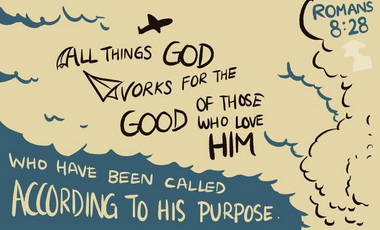
Romans 8:28

And we know that in all things God works for the good of those who love Him, who have been called according to His purpose.

The Greek verb oida (“we know”) is a perfect active indicative form of the verb, which may simply refer to knowledge gained by observance or remembrance of the past. This is paralleled earlier in verse 22 (using the same Greek verb tense of oida) when speaking about their observation of creation “groaning as in the pains of child birth right up to the present time.”

Paul seems to be saying “we have observed” and “therefore we know.” The context and grammar appear to indicate a reference not to an intuitive knowledge of Paul’s readers, but to that which comes from observation of the past, or a remembrance.[73]

Paul means that believers know, from observation of God’s past dealings with those who love Him, that he has a mysterious way of working things out for the greatest good. By observing the stories of the saints of old —those called to accomplish His redemptive purposes—believers can rest in knowledge of this truth. God can take whatever evil may come our way and redeem it for good. Believers can know this because God has been doing it for generations.

Paul does not say that his readers should intuitively know how God works things out for those who love Him in the present. He is saying believers know what is true of God by observing what He has done in the past for those who have loved Him. The New Testament saints have a great cloud of witnesses that have gone before them (Heb. 12:1), giving evidence of God’s trustworthiness toward all who enter into a covenant with Him.

A simple survey of the verses leading up to this point reveals that Paul is reflecting on the problem of the evil and suffering in our world since the beginning:

Rom. 8:20-22: “For the creation was subjected to futility, not willingly, but because of Him who subjected it, in hope that the creation itself also will be set free from its slavery to corruption into the freedom of the glory of the children of God. For we know that the whole creation groans and suffers the pains of childbirth together until now.”

N.T. Wright comments on Rom. 8:28–30, saying in part:

  • “[This passage] is a sharp, close-up, compressed telling of the story of Israel, as the chosen people, whose identity and destiny is then brought into sharp focus on Jesus. Jesus, in a sense, is the one ‘chosen One.’ But, then that identity is shared with all of those who are ‘in Christ.’ And he [Paul] is not talking primarily there about salvation. He is talking primarily about the way God is healing the whole creation. There is a danger here. What has happened in so many theological circles over the years is that people have come to the text assuming that it is really saying how we are to get to heaven, and what is the mechanism and how does that work. And if you do that, interestingly, many exegetes will more or less skip over Romans 8:18–27, which is about the renewing of creation.”[74]

In verses 28 and 29 the focus shifts to providing comfort for those in suffering by reminding them to observe God’s dealings with others who loved God throughout history. Notice that this truth is not applicable to everyone. The passage is specifically an observation of those who “love God,” or as Wright notes, “those who are in Christ.”

The point is not that God causes everything for a good purpose, but that God redeems occurrences of evil for a good purpose in the lives of those who love Him. Therefore, it would be inaccurate to use this passage to support the concept of divine meticulous determinism of all things.[75] Again, God does not cause occurrences of evil for His purposes; instead, He redeems moral evil for a good purpose. Traditionalists would typically agree with what John MacArthur, a Calvinistic pastor, wrote on this point:

  • “But God’s role with regard to evil is never as its author. He simply permits evil agents to work, then overrules evil for His own wise and holy ends. Ultimately He is able to make all things—including all the fruits of all the evil of all time—work together for a greater good.”[76]

The focus of the apostle’s observation is on the saints of old, those from the elect nation of Israel who were called to fulfill God’s plan to redeem His creation from its groans and sufferings. This passage does not mean that the truth being revealed is not applicable to those of other nations. Rather, it means that what is proven to be true of God by observing His dealings with those called out from Israel throughout history must also be true of anyone who comes to follow and love the God of Israel.

Consider this analogy: Suppose a new pastor is called to a church. The staff members are nervous about his leadership style and how they might be treated, but a letter of reference which reflects on his past relationships might ease their fears. The pastor’s reference might say something like, I have observed this pastor’s dealings with the staff members he knew before, and he has always worked to lovingly support anyone who gets behind the vision and direction of the church. By reflecting on the pastor’s history, the new staff can know what to expect in their future dealings with him. So too, Paul gives a divine reference by reflecting on the trustworthiness of God in His dealings with the saints of old so as to ensure his readers of what they may expect of Him.

Romans 8:29

For those God foreknew He also predestined to be conformed to the image of His Son, that He might be the firstborn among many brothers and sisters.

Here the apostle reveals his focus on the saints of old, “those God foreknew.” Paul seeks to provide evidence of his claim in verse 28 by reflecting on God’s faithfulness to His chosen nation, those beloved who were known before. Paul provides a reference of sorts to ease the fears of those who are now coming to faith. This point continues to be the apostle’s focus for the next three chapters.

Much debate centers on the meaning of the word proginōskō (“to know beforehand”).[77] Many popular authors fail to recognize all the available options for consideration. For example, John Piper lists only two options for interpreting this verse:

Option #1: God foresaw our self-determined faith. We remain the decisive cause of our salvation. God responds to our decision to believe.

Option #2: God chose us—not on the basis of foreseen faith, but on the basis of nothing in us. He called us, and the call itself creates the faith for which it calls.[78]

Piper overlooks the most basic meaning of this word, which is “to know beforehand” or to have known in the past. The same Greek word is used by Peter and Paul in the following passages,

2 Pet. 3:17: “Therefore, dear friends, since you have been forewarned, be on your guard so that you may not be carried away by the error of the lawless and fall from your secure position.”

Acts 26:4–5: “The Jewish people all know the way I have lived ever since I was a child, from the beginning of my life in my own country, and also in Jerusalem. They have known me for a long time and can testify, if they are willing, that I conformed to the strictest sect of our religion, living as a Pharisee.”

Clearly, this word can be understood simply as knowing someone or something in the past, as in those known previously (i.e. the saints of old). Non-Calvinistic scholars, Roger Forster and Paul Marston, convincingly argue,

  • “God ‘foreknew them’ or ‘knew them of old’ thus it does not mean that God entered in some former time into a relationship with the Israelites of today, it means that he entered a (two-way) relationship with the Israel that existed in early Old Testament times, and he regards the present Israelites as integral with it.”[79]

If Paul intended to use the word proginōskō in this sense, then he meant simply that because we have seen how God worked all things to the good for those whom He knew before, we know that He will do the same for those who love and are called by Him now.

Some Calvinists contend that the word foreknew is equivalent to fore-loved. That use of the word generally fits this interpretation since the Israelites of the past who loved God certainly would have been loved by God before (i.e. fore-loved). Of course, the Calvinistic interpretation differs because they insist this passage is about God unconditionally setting His “effectual” salvific love upon certain individuals before the foundation of the world. Calvinists go to great lengths to show that God did not merely foresee the behavior and choices of the elect by looking down the corridors of time. Rather, God knew them intimately and set His effectual love on them before the foundation of the world.[80]

This argument might address the classical Arminian approach (Piper’s first option),[81] but it fails to rebut the approach being advocated here. Fore-loved is a viable and even likely meaning of the term proginōskō, yet it does not clarify who might be the intended target of that divine love.

Was Paul intending to introduce for the first time in this epistle a particular group of people out of the mass of humanity who were unconditionally elected to be effectually saved before the world began? Or, was he simply referencing those from the past whom God had known and faithfully cared for throughout the generations?

Romans 8:29b states “He (God) also predestined to become conformed to the image of His Son.” Who was “predestined” and to what ends were they predestined, according to this passage? Remember the point of the apostle leading up to this verse. He began speaking about the futility and suffering that has come into this world due to the fall of humanity into sin (vv. 20–22). In verse 28-29a, Paul provides comfort to lovers of God in his audience by reminding them of God’s trustworthiness for those who have loved Him throughout the generations.

Paul reminds his readers that God will redeem the suffering and evil for a good purpose in their lives just as he has done in the lives of those known before and loved throughout the previous generations. It is these whom God previously knew (Israelites whom loved God in the past) who were predestined to be conformed into the image of Christ so as to make the way for His coming.

God planned to accomplish salvation for those who were previously known and loved (i.e. Abraham, Moses, David, etc) by conforming them into the image of the One who would come to purchase their redemption. This is the ultimate example of God causing “all things to work for the good” of those saints of old who loved God. Paul is saying that God brings about the redemption of their souls and He will do the same for whoever loves Him. N. T. Wright states,

  • “Here is the note of hope which has been sounded by implication so often since it was introduced in 5:2: hope for the renewal of all creation, in a great act of liberation for which the exodus from Egypt was simply an early type. As a result, all that Israel hoped for, all that it based its hope on, is true of those who are in Christ.”[82]

Romans 8:29c states “that He (the Son) might be the firstborn among many brothers and sisters.” Consider the fact that he is speaking about what Christ might be, which strongly implies that Paul still has the saints of old in focus here. Why would Paul speak of future generations being conformed to the image of Christ so that He “might be the firstborn among many brothers and sisters” if He were already the firstborn prior to this discourse?

  • The term prōtotokos (“firstborn”) can simply refer to the one who is first to be born in a family, which carries much significance in the Jewish culture (Luke 2:7). Typically, the birthright given to the firstborn son signified a place of preeminence, by which he would receive the father’s inheritance and blessing. For instance, Psalm 89:20, 27 states, “I have found David my servant; with my sacred oil I have anointed him. . . And I will appoint him to be my firstborn, the most exalted of the kings of the earth.” David, who was the last one born in his family, was called by God the firstborn. David was given a place of preeminence.[83]

The term firstborn also speaks of Christ’s preexistence as the eternal Creator.[84] God created the world through Christ and redeemed the world through Christ (John 1:3, 10; Heb. 1:2–4). The former speaks of His eternal nature and the latter of His temporal role as the redeemer of the world.

Yet, even when speaking of our preexistent Lord, the biblical authors addressed Him as “becoming” or “fulfilling” His role as our Messiah within the temporal world. For example, the Psalmist writes, “And I will appoint Him to be my firstborn, the most exalted of the kings of the earth” (Ps. 89:27). For the Old Testament saints, the firstborn Savior was the expected One that was yet to come. From their view, the long-awaited Messiah was the future hope, not a past and completed reality.

In contrast to the Old Testament saints, a modern-day preacher would not teach that we are being conformed to Christ’s image so that Jesus might be the firstborn among many brethren, because we know Him to already be the firstborn of many brethren. Our being conformed into Christ’s image today has nothing to do with the future coming of Christ’s birth, whereas the saints of old were part of His very lineage. It is through the life of men like Abraham, Isaac, Jacob, David, and many other saints of old that Christ is brought into this world “that He might be the firstborn among many brothers and sisters (Rom. 8:29c).”

Paul is reflecting on God’s redemptive purpose being accomplished through those who loved God in former generations. That redemptive purpose included bringing the Messiah into this world through Israel (Rom. 9:4-5), or those Israelites set apart for that noble purpose (Rom. 9:21). This was God’s predestined plan of redemption, which was brought to pass through those who loved God and were called according to His purpose. Tim Warner describes this purpose,

“Paul was not referring to some prior knowledge in the mind of God before creation. Nor was He speaking about predetermining their fate. He was referring to those whom God knew personally and intimately, men like Abraham and David.

The term ‘foreknew’ does not mean to have knowledge of someone before they were conceived. The verb προεγνω is the word for ‘know’ (in an intimate sense) with the preposition προ (before) prefixed to it. It refers to having an intimate relationship with someone in the past… Literally, we could render Rom. 8:29 as follows: ‘For those God formerly knew intimately, He previously determined them to be conformed to the image of His Son.’

The individual saints of old, with whom God had a personal relationship, were predestined by Him to be conformed to the image of Christ. That is, God predetermined to bring their salvation to completion by the sacrifice of Christ on their behalf.” [85]

Likewise, William R. Newell, a colleague of D.L. Moody and a notable teacher at the Bible Moody College, explained that God “had acquaintanceship” with the Israelites of the past. So, it was not “mere Divine pre-knowledge” of certain individuals, but a real intimate “pre-acquaintanceship.”[86]

Romans 8:30

And those He predestined, He also called; those He called, He also justified; those He justified, He also glorified.

Notice the apostle’s use of the past tense in this verse. If Paul intended to speak about the future salvation of every elect individual, then why would he use these past tense verbs? When writing these words, Paul and his readers had not yet been glorified, so there is no explicit reason to use the past tense. Thus, there is no reason to assume Paul has in mind the future glorification of all believers.

The past tense suggests that Paul is referring to former generations of those who have loved God and were called to fulfill His redemptive purpose. They were known in the past generations and predestined by God to be made in the very image of the One to come, “the firstborn among many brothers and sisters,” which is something already completed in the past through the working of God in former generations. These are the individuals whom God called, justified, and who now, even as Paul was writing these words, are already glorified in the presence of God.

If indeed Paul was referencing the saints formerly known and loved by God, he would have communicated the certainty of their being justified, sanctified and finally glorified in a way that some might describe as a “golden chain of redemption.”[87] To presume, however, that Paul’s unbroken chain of past tense verbs is not in reference to people of the past is a linguistic stretch. [88]

Calvinists must explain away the use of the past tense verbs in order to maintain their interpretation of Paul’s intent. For instance, The Bible Knowledge Commentary, a Calvinistic source, provides this explanation, “Glorified is in the past tense because this final step is so certain that in God’s eyes it is as good as done.”[89] 

Calvinists must interpret Paul’s use of the past tense (aorist indicative) as meaning “it is as good as done” because it was predestined. But this is a very rare usage in the original language and the immediate context does not clearly support a Calvinistic rendering.

We must take into account Paul’s usage of the same term earlier in the chapter as a future hope for believers. Romans 8:17:

“Now if we are children, then we are heirs—heirs of God and co-heirs with Christ, if indeed we share in His sufferings in order that we may also share in His glory” (emphasis added).

Paul does not speak of glorification as a past and completed action in reference to the believers in his day. Rather, he seems to qualify their being glorified upon the condition that they persevere through the suffering that is to come. If it is “as good as done” due to God’s predetermination, then why would Paul make such a qualification and use the future tense of the same verb? Further, Paul speaks of the eager expectation of the glorification that is to come in verses 22–25:

“We know that the whole creation has been groaning as in the pains of childbirth right up to the present time. Not only so, but we ourselves, who have the firstfruits of the Spirit, groan inwardly as we wait eagerly for our adoption to sonship, the redemption of our bodies. For in this hope we were saved. But hope that is seen is no hope at all. Who hopes for what they already have? But if we hope for what we do not yet have, we wait for it patiently” (emphasis added).

Is the reader to believe that Paul shifts from speaking of glorification as a future hope for those who persevere, to speaking of it as a past and already-completed act for those who have not yet been glorified? Or, could it simply be that Paul has the Old Testament saints in view as he makes his case for the trustworthiness of God throughout all generations? The latter seems to be the most basic understanding of the apostle’s words in their context.

This interpretation may seem foreign to some Western readers because of the philosophical and theological baggage that has been attached to the concept of divine foreknowledge over the years, but to the first century reader the simple concept of proginōskō, understood as “previously known,” would have been far more likely. In fact, if one can objectively back away from their presuppositions and approach this passage with fresh eyes, I believe they will discover the utter simplicity and clarity of this perspective.

Instead of introducing a complex concept of divine prescience, unconditional election, and effectual salvation never once clearly expounded upon in the Scriptures, could it be that Paul may intend simply to communicate that those who were previously loved and known by God were also predestined to be conformed to the image of the One to come? Paul seems to be giving a brief history lesson of what God had done in former generations as a reference for God’s trustworthiness for all who come to Him in faith. Wright explains it this way:

  • “The creation is not god, but it is designed to be flooded with God: The Spirit will liberate the whole creation. Underneath all this, of course, remains Christology: the purpose was that the Messiah ‘might be the firstborn among many siblings’ (8.29). Paul is careful not to say, or imply, that the privileges of Israel are simply ‘transferred to the church,’ even though, for him, the church means Jews-and-gentiles-together in Christ. Rather, the destiny of Israel has devolved, entirely appropriately within the Jewish scheme, upon the Messiah. All that the new family inherit, they inherit in Him.”[90]  

Those who object to the suggestion that Paul’s use of the term proginōskō is limited to the beloved of Israel’s past should consider the apostle’s use of the same word just three chapters later, Rom. 10:21-11:2a:

“But concerning Israel he says, ‘All day long I have held out my hands to a disobedient and obstinate people.’ I ask then: Did God reject His people? By no means! I am an Israelite myself, a descendant of Abraham, from the tribe of Benjamin. God did not reject His people, whom he foreknew” (emphasis added).

Notice that Paul uses the term proginōskō in reference to God’s intimate relationship with the faithful Israelites of old. Paul continues to make his case, Rom. 11:2b-4:

“Don’t you know what Scripture says in the passage about Elijah—how he appealed to God against Israel: ‘Lord, they have killed your prophets and torn down your altars; I am the only one left, and they are trying to kill me?’ And what was God’s answer to him? ‘I have reserved for myself seven thousand who have not bowed the knee to Baal.’”

Elijah and those who refused to bow a knee were among the ones who were previously known (foreknown/fore-loved) by God. To foreknow refers to God’s intimate relationship with people who loved Him in the past (like Abraham in Rom. 4:22–5:5). Nothing in this or any other text supports the concept of God in eternity past preselecting certain individuals out of the mass of humanity for effectual salvation. It would be difficult to substantiate this meaning of the term foreknow in reference to the Israelites who were in covenant with God. It is best interpreted in reference to those known by God in former times. William Lane Craig explains,

  • “In certain cases, proginōskō and prooraō mean simply that one has known or seen (someone or something) previously. For example, in Acts 26:5 Paul states that the Jews had previously known for a long time the strictness of his life a Pharisee, and in Acts 21:29 Luke mentions that the Jews had previously seen (prooraō) Trophimus in Paul’s company. This sense is probably operative in Romans 11:2 as well, where Paul states of apostate Israel that ‘God has not rejected His people whom He foreknew [proginōskō],’ that is, whom He had previously known in an intimate way.”[91]  

Romans 8:31–39

Returning to the analogy above, the pastor had former staff members whom he intimately knew and loved. The new staff would be comforted to know of the pastor’s prior relationships. Likewise, those being grafted into covenant with the God of Israel for the first time (i.e. the Gentiles) would be thrilled to learn of God’s faithfulness to those He formerly knew and loved (i.e. men like Abraham and David, etc.). What can the readers say in response to these teachings of Paul about God’s faithfulness toward the saints of old?

That is the very question the apostle poses in Rom. 8:31a as he transitions to the application of His message,

“What, then, shall we say in response to these things?”

This interpretation is consistent with the view that present-day saints who love God and are called according to His purposes (vs. 28) have nothing to fear, for…

“If God is for us, who can be against us?” (vs. 31b).

God, who gave up His Son, justifies, intercedes, and places His undying love upon all who love Him and are called according to His purposes (vv. 32–39).

The objector in Paul’s mind asks: Paul, you have made a good case regarding God’s faithfulness to the Israelites in the past, but what about the Israelites today? Have God’s promises for Israel failed? Why are the Israelites today refusing to accept their own Messiah? The apostle attempts to answer these questions in Romans 9 and following.

NOTES:

[73] Johannes P. Louw and Eugene A. Nida, Lexicon of the New Testament: Based on Semantic Domains, Second Edition (New York: United Bible Societies, 1989), 29.6.

[74] N.T. Wright in a question and answer session at Oklahoma Christian University on April 1, 2014. Samuel Selvin, “Dr. N. T. Wright on predestination,”

[75] This is also true of Eph. 1:11, which is often misapplied to support the idea of meticulous determinism.

[76] John MacArthur, “Is God Responsible for Evil?” Grace To You Ministries web page. Quote taken from: http://www.gty.org/ resources /articles/A189/is-god-responsible-for-evil; [date accessed: 5/19/15]

[76] The definition of progin-osk-o is from The Lexham Analytical Lexicon to the Greek New Testament (Bellingham, WA: Logos Bible Software, 2011), 30.100.

[77] John Piper, Sermon: “Foreknown by God,”

[78] Roger T. Forster and V. Paul Marston, God’s Strategy in Human History (Wheaton: Tyndale, 1973), 179–90.

[79] John Murray, The Epistle to the Romans, Volume I (Grand Rapids, MI: Eerdmans Publishing, 1959), 316-318.

[80] Frederic Godet’s commentary on Romans 8:29, inquires: “In what respect did God thus foreknow them?” and answers that they were “foreknown as sure to fulfill the conditions of salvation, viz. faith; so: foreknown as His by faith.” The word “foreknew” is thus understood by Godet, a classical Arminian, to mean that God knew beforehand which sinners would believe, and on the basis of this knowledge He predestined them unto salvation. Frederic Godet, Commentary on the Epistle to the Romans (New York: Messrs Clark, 1880), 325.

[81] N.T. Wright, Pauline Theology, Volume III, ed. David M. Hay & E. Elizabeth Johnson (Minneapolis: Fortress, 1995), 30–67.

[82] James D. G. Dunn, Romans 1-8, Word Biblical Commentary, David A. Hubbard and Glenn W. Barker, vol. 38a (Dallas: Word, 1988), 1: 484.

[83] Theologian Bernard Ramm noted that “It has been standard teaching in historic Christology that the Logos, the Son, existed before the incarnation. That the Son so existed before the incarnation has been called the pre-existence of Christ.” Bernard Ramm, An Evangelical Christology: Ecumenic and Historic (Vancouver, BC: Regent College Publishing, 1993) 47.

[84] Tim Warner, PFRS Commentary on Romans, Pristine Faith Restoration Society. 

[85] William R. Newell, Romans Verse-by-Verse,” Christian Classics Ethereal Library,” 1938.

[86] Some Calvinistic scholars describe this as the unbreakable “golden chain of redemption” meant to communicate the unchangeable plan of God to irrevocably justify, sanctify and glorify those He elected before the world began.

[87] Greek scholars teach that while the aorist indicative can be used to describe an event that is not yet past as though it were already completed, this usage is “not at all common.” Daniel B. Wallace, Greek Grammar Beyond the Basics (Grand Rapids, MI: Zondervan Publishing, 1997) 564.

[88] John F. Walvoord and Roy B. Zuck, eds. The Bible Knowledge Commentary (Dallas: Victor Books, 1983), 474.

[89] “And all this is viewed as past; because, starting from the past decree of ‘predestination to be conformed to the image of God’s Son’ of which the other steps are but the successive unfoldings—all is beheld as one entire, eternally completed salvation.” Jamieson-Fausset-Brown Bible Commentary, “Romans 8.”

[90] Wright, Pauline Theology, 20.

[91] William Lane Craig, The Only Wise God: The Compatibility of Divine Foreknowledge and Human Freedom (Grand Rapids: Baker, 1987), 31–32.

Leighton Flowers, The Potter’s Promise: A Biblical Defense of Traditional Soteriology (Trinity Academic Press, 2017), 81-98.

Here are some thoughts via John Lennox’s wonderful book,  “Determined to Believe? The Sovereignty of God, Freedom, Faith, and Human Responsibility,”

God is the Creator – there would not be a universe or human beings without him. God is the sovereign upholder of the universe – none of its history is outside his control. Christ is the Saviour and Redeemer – apart from him there would be no salvation.

Furthermore, we have seen that God’s initiative is expressed in Scripture in terms like election, foreknowledge, predestination, and calling, all of which occur together at the climax of one of the major sections of the letter to the Romans in chapter 8. By this stage Paul has already argued universal human guilt and the consequent need of salvation. He has explained that salvation is by faith in Christ and not of works. He has developed the theme of human responsibility to live a holy life in the power of God’s Holy Spirit. He has described the inner battle against our human nature (the flesh) that we all experience as we seek to walk after the Spirit.

The inner battle is not the only battle, however. Paul himself was no stranger to suffering – he had lived with persecution for many years. And so in Romans 8 Paul addresses suffering directly. He describes the provision that God has made for him and his fellow believers to remain firm in their faith when the winds of adversity blow. Here is the wonderful passage in full:

I consider that our present sufferings are not worth comparing with the glory that will be revealed in us. The creation waits in eager expectation for the sons of God to be revealed. For the creation was subjected to frustration, not by its own choice, but by the will of the one who subjected it, in hope that the creation itself will be liberated from its bondage to decay and brought into the glorious freedom of the children of God.

We know that the whole creation has been groaning as in the pains of childbirth right up to the present time. Not only so, but we ourselves, who have the firstfruits of the Spirit, groan inwardly as we wait eagerly for our adoption as sons, the redemption of our bodies. For in this hope we were saved. But hope that is seen is no hope at all. Who hopes for what he already has? But if we hope for what we do not yet have, we wait for it patiently.

In the same way, the Spirit helps us in our weakness. We do not know what we ought to pray for, but the Spirit himself intercedes for us with groans that words cannot express. And he who searches our hearts knows the mind of the Spirit, because the Spirit intercedes for the saints in accordance with God’s will.

And we know that in all things God works for the good of those who love him, who have been called according to his purpose. For those God foreknew he also predestined to be conformed to the likeness of his Son, that he might be the firstborn among many brothers. And those he predestined, he also called; those he called, he also justified; those he justified, he also glorified.

What, then, shall we say in response to this? If God is for us, who can be against us? He who did not spare his own Son, but gave him up for us all – how will he not also, along with him, graciously give us all things? Who will bring any charge against those whom God has chosen? It is God who justifies. Who is he that condemns? Christ Jesus, who died – more than that, who was raised to life – is at the right hand of God and is also interceding for us. Who shall separate us from the love of Christ? Shall trouble or hardship or persecution or famine or nakedness or danger or sword? As it is written:

“For your sake we face death all day long;
we are considered as sheep to be slaughtered.”

No, in all these things we are more than conquerors through him who loved us. For I am convinced that neither death nor life, neither angels nor demons, neither the present nor the future, nor any powers, neither height nor depth, nor anything else in all creation, will be able to separate us from the love of God that is in Christ Jesus our Lord.

(Romans 8:18–39.)

In all of Scripture this is one of the most magnificent statements of the love of God in taking the initiative to provide salvation in all of its aspects, so that nothing whatsoever can separate us from his love for us in Christ Jesus – not even death itself. I have emphasised the passage that is relevant to our discussion. In the context of suffering, weakness, and uncertainty, we are to know that God is working in all things for the good of those who love him. Paul describes them as those who have been called according to his purpose. What that grand purpose is, he is about to explain. But not before he gives another description of believers as those whom God foreknew, which (as we have seen) does not imply that God caused or forced them to do anything in advance. It is a great encouragement to believers under pressure to know that they have experienced the call of God; God has known them, and knows all about them – and he has a purpose for them. What is that purpose? He has predestined them to be conformed to the image of his Son.

Under the pressure of an assumed paradigm it is all too easy to read into this that Paul is saying that God has predestined them to be believers, and then using this statement to buttress theistic determinism. However, Paul is saying something completely different: that God has predestined those who are believers to be conformed to the image of his Son. That is, he plans to confer unimaginable dignity upon believers. As creatures of God they were made in the image of God. But now that they have put their faith in Christ and received his salvation, a destiny of almost indescribable glory awaits them. In his love for them God has determined that they should be like his Son. The sheer wonder of this purpose now defines the illimitable nature of God’s grace and glory. In one sense, God could have predestined us to anything glorious that he willed, but he has chosen this ultimate accolade. The objective is that the Lord Jesus should be the firstborn (first to be glorified and also first in rank) among many brothers.

This is God’s staggeringly gracious goal. Achieving it involves all of God’s provision in the gospel that Paul has been expounding up to this point – calling, justification by faith, and glorification. It is the sheer glory of the achievement that calls forth Paul’s triumphant and confident conclusion – If God is for us, who can be against us?

Arising directly from these glorious thoughts, however, there comes a question that deeply disturbs and concerns the apostle. In light of such a magnificent and gracious message, how is it that his fellow Israelites, Paul’s own kith and kin, mainly reject such a wonderfully gracious message and deny that Jesus is the Messiah, the Son of God? Paul’s pain is palpable as he explains:

I speak the truth in Christ – I am not lying, my conscience confirms it in the Holy Spirit – I have great sorrow and unceasing anguish in my heart. For I could wish that I myself were cursed and cut off from Christ for the sake of my brothers, those of my own race, the people of Israel. Theirs is the adoption as sons; theirs the divine glory, the covenants, the receiving of the law, the temple worship and the promises. Theirs are the patriarchs, and from them is traced the human ancestry of Christ, who is God over all, for ever praised! Amen.

(Romans 9:1–5.)

Paul faces an apparent contradiction. His nation of Israel by and large rejected Christ, who was also their own flesh and blood, even though as a nation they were uniquely privileged. God had adopted them as his people – as his sons, even, those who inherit the family assets; he had visited them in his glory at Sinai, and in the tabernacle, given them the covenants, the law, and the worship programme of the temple; he had lavished his promises on them. Not only that, it was God who had given them the patriarchs, from whom the ancestry of the Messiah would be traced – the Messiah who is none less than God himself. And they don’t believe in him!

This was no new issue for Paul. He faced it many times as he sought to persuade men and women of the truth of the Christian message. For instance, he held lectures in the synagogue at Thessalonica on three sabbath days:

As his custom was, Paul went in to the synagogue, and on three Sabbath days he reasoned with them from the Scriptures, explaining and proving that the Christ had to suffer and rise from the dead. “This Jesus I am proclaiming to you is the Christ,” he said.

(Acts 17:2–3.)

One can easily imagine some intelligent Jew saying, “That was a very interesting talk, Paul, and I find it impressive that a rabbi with your undoubtedly high qualifications, having studied under Gamaliel, is prepared to argue in this way. However, what bothers me is that you seem to be on your own in this. Or am I mistaken? Can you tell me of any other senior rabbis who believe that your interpretations are correct?”

And Paul might reply, “Well there’s Nicodemus, and Joseph of Arimathea, both on the Sanhedrin Council in Jerusalem.”

“Is that all? If what you say is true – and I admit I was moved by it – surely one might expect the majority of the Jewish thinkers to accept it? After all, on the basis of our Scriptures you are claiming that Jesus is the Messiah expected by our nation, yet the experts in the interpretation of those Scriptures don’t agree with you. Surely you can see why I am puzzled!”

Paul could see it, and it affected him deeply. He got the same question from Gentiles as well. “If something is really authentically Jewish, the Jews should be the first to accept it. And yet most of them reject it. How can that be?”

Paul was heartbroken about the situation and desperately wanted to do something about it. It threatened to become a serious stumbling block in the way of people taking the gospel seriously. As he writes in chapter 8, how can he believe that nothing shall separate us from the love of God, when it appears to many that something has separated Israel from God? How can Israel have lost her way so dramatically?

So Paul writes Romans 9–11 in order to show that, far from being an objection to the Christian message, what has happened historically with Israel, in their rejection of the Lord Jesus, in fact confirms the truth of it.

At this point some interpreters of Scripture argue that the ultimate answer to this question is given by Paul in his letter to the Galatians. There he abolishes all distinctions between Jews and non-Jews in his famous statement, that in Christ there is neither Jew nor Greek(Galatians 3:28). Surely this means (it is argued) that all the promises given to Israel in the Old Testament are now to be understood as fulfilled in the church. Hence God has not cast off his people, since “his people” now equates to “the church” which is alive and thriving.

However, Paul’s statement in Galatians is not relevant to his problem in Romans. In Galatians 3:21–29 Paul is discussing the basis of salvation, and he stresses that it is the same for everyone, whatever their ethnicity, social status, or gender – Jew, Greek, slave, free, man, woman. That common basis is faith in Christ alone. Paul is not talking there about the question of roles in history or in the world, which for obvious reasons might well be different for each of these groups. To deduce from these verses that, now that Christ has come, there is absolutely no difference between the roles of Jews and Gentiles, would be as absurd as saying that, since Christ has come, there is absolutely no difference between the roles of slave and free or between the roles of male and female. Their roles can remain the same without prejudice to their status in Christ.

By contrast Paul’s concern in Romans 9–11 is not the basis of the gospel but why it is that the very nation that was privileged by God to be the vehicle of his revelation to the world now mainly rejects the gospel of the Messiah. That is the problem he has to address, and it is so complex that he takes three chapters to do it.

The first main argument is based on the fact that not all ethnic Israelites are the genuine people of God. His discussion involves considering the sovereignty of God in history regarding the role of different individuals and the nations descended from them.

The second main argument is that Israel’s unbelief is culpable. God has made every provision for them. Paul goes through every excuse that might be raised to let Israel off the hook and concludes in each case that they are responsible for their unbelief.

The third main argument concentrates on the fact that there are some Israelites, like Paul, who do believe in Jesus. Indeed, all through history there has been a “remnant” of true believers within Israel, whose number has at times been underestimated. Paul then discusses the historical roles that Israel and then the Gentiles have had in witnessing for God in the world, and concludes with the glorious hope for his nation that one day “all Israel will be saved”. Paul is in no doubt that there remains a role for his nation in the future, but not until they come to faith in Jesus as Messiah.

Is God the “devil” Behind Satan? | Sovereign Puppeteer (Updated)

I sent a friend the video of Dr. Theodore Zachariades stating that God wills [causes, not just permits] a man to be unfaithful to his wife.

  • God works all things after the Council of His will. Even keeping those kings who want to commit adultery from committing so! And when He wants to, he orders those to commit adultery when he wants to! (Video)

My friend dismissed this person as a hyper-Calvinist. But as the video below notes, using his definition of a “hyper Calvinist,” A.W. Pink, John Piper, Jeff Durbin, James White, and many-many more, would thus be considered the same. Because of the age restriction, the video must be watch on YouTube, link in pic.

When I asked him: “Question RW, is Piper, Calvin, White and Durbin hyper-Calvinists?” He simply replied “Fishing Bait.” But this is an interesting phenomena… and after decades of encountering Mormons and J-Dubs, the disconnect is the same. I get links and not actualizing on statements made when challenged. When shown a person who follows to the end the logical conclusion of theistic determinism found in Calvinism, the person who is the Calvinist is dismissed as a “hyper-Calvinist” by their fellow Calvinist’s if they are challenged. When that label is then applied rightly to others for the same reason — meaning, using RW’s definition of what a hyper-Calvinist is — then all these others have said worse; and would be by definition, hyper-Calvinists.

Two quick examples. 1st John Calvin, then, John Piper:

John CALVIN:

how foolish and frail is the support of divine justice afforded by the suggestion that evils come to be, not by His will but by His permission. . . . It is a quite frivolous refuge to say that God otiosely permits them, when Scripture shows Him not only willing, but the author of them. . . . Who does not tremble at these judgments with which God works in the hearts of even the wicked whatever He will, rewarding them nonetheless according to desert? Again it is quite clear from the evidence of Scripture that God works in the hearts of men to incline their wills just as he will, whether to good for His mercy’s sake, or to evil according to their merits.

John Calvin, “The Eternal Predestination of God,” 10:11

John Piper:

Ephesians 1:11 goes even further by declaring that God in Christ

“works all things according to the counsel of his will.” Here the Greek word for “works” is energeø, which indicates that God not merely carries all of the universe’s objects and events to their appointed ends but that he actually brings about all things in accordance with his will. In other words, it isn’t just that God manages to turn the evil aspects of our world to good for those who love him; it is rather that he himself brings about these evil aspects for his glory (see Ex. 9:13-16; John 9:3) and his people’s good (see Heb. 12:3-11; James 1:2-4). This includes—as incredible and as unacceptable as it may currently seem—God’s having even brought about the Nazis’ brutality at Birkenau and Auschwitz as well as the terrible killings of Dennis Rader and even the sexual abuse of a young child: “The LORD has made everything for its own purpose, even the wicked for the day of evil” (Prov. 16:4, NASB ).14 “When times are good, be happy; but when times are bad, consider: God has made the one as well as the other” (Eccl. 7:14, NIV).

John Piper and Justin Taylor, eds., Suffering and the Sovereignty of God (Wheaton, IL: Crossway Books, 2006), 42. (FULLER QUOTE VIA THIS PDF)

John Lennox notes in his wonderful book,  Determined to Believe? The Sovereignty of God, Freedom, Faith, and Human Responsibility,” that Martin Luther struggled with the consequences of this form of thought:

Martin Luther at the time of the Reformation. In his book The Bondage of the Will, written in response to Erasmus’ essay On Free Will, Luther said:

[The] omnipotence and foreknowledge of God, I repeat, utterly destroy the doctrine of “free-will” Doubtless it gives the greatest possible offence to common sense or natural reason, that God, Who is proclaimed as being full of mercy and goodness, and so on, should of His own mere will abandon, harden and damn men, as though He delighted in the sins and great eternal torments of such poor wretches. It seems an iniquitous, cruel, intolerable thought to think of God; and it is this that has been such a stumbling block to so many great men down through the ages. And who would not stumble at it? I have stumbled at it myself more than once, down to the deepest pit of despair, so that I wished I had never been made a man. (That was before I knew how health-giving that despair was, and how close to grace.)

In this passage Luther seems to be aware that there is a deep moral problem with aspects of his view [RPT: before redefining “grace” that is – almost like what is, is.]

Calvinism’s [T.U.L.I.P.] Logical Conclusion Displayed

In a reference in that above book is this paper:I Believe In Divine Sovereignty,” by Thomas H. McCall in Trinity Journal (TRINJ 29:2 [Fall 2008]), 209-210. Of which I excerpt:

He [John Piper] works long and hard to illustrate this [theistic determinism] from Rom 9:1-23, which he concludes is about the purposes of God being preserved “by means of the predestination of individuals to their respective eternal destines.”11 And we are not to think that God is righteous in spite of such action—instead we are to see that God is righteous because of this action, for the “heart of Paul’s defense” is this: “in choosing unconditionally those on whom he will have mercy and those whom he will harden God is not unrighteous, for in this ‘electing purpose’ he is acting out of a full allegiance to his name and esteem of his glory.12

This all-determining action of God notably includes predestination and election, but it extends far beyond—it extends to everything. God determines all events that occur in the universe, including all demonic and satanic action.13 As Mark R. Talbot puts it, God creates, sends, instigates, and moves others to do evil, because “nothing that exists or occurs falls outside God’s ordaining will.”14 Talbot makes the point with relentless and unmistakable clarity:

Nothing, including no evil person or thing or event or deed. God’s foreordination is the ultimate reason why everything comes about, including the existence of all evil persons and things and the occurrence of any evil acts or events.15

Make no mistake: “when even the worst of evils befall us, they do not ultimately come from anywhere other than God’s hand.”16

NOTES:

11. John Piper, The Justification of God: An Exegetical and Theological Study of Romans 9:1-23 (Grand Rapids: Baker, 1993), 218, cf. 56-73.

12. Ibid., 219.

13. On this see John Piper, “Suffering and the Sovereignty of God: Ten Aspects of God’s Sovereignty Over Satan and Satan’s Hand in It,” in Suffering and the Sovereignty of God, 19-30. Piper here uses the rather confusing (given his determinism) language of “permission.” By my lights, what he means when he says that God “permits” something is this (a) God determines it to occur and then (b) does not act so as to override his previous ordination. Regarding talk of “permission,” I think that John Calvin’s approach is more consistent, [….]  see John Calvin, Institutes of the Christian Religion I.xviii.1, and John S. Feinberg, No One Like Him: The Doctrine of God (Wheaton: Crossway, 2001), 696.

14. Mark R. Talbot, “‘All the Good That Is Ours in Christ: Seeing God’s Gracious Hand in the Hurts Others Do to Us,” in Suffering and the Sovereignty of God, 43 (41-43), emphasis original.

15. Ibid., 43-44.

16. lbid., 47.

Dave Hunt is right to say that Calvin uses unbiblical positions in dealing with this Augustinian determinism:

There is yet another question that troubles many: If man is free to choose between options, would that not in itself deny both God’s sovereignty and His foreknowledge? Luther claimed that this question was the very heart of the Reformation and of the gospel itself. In fact, Luther dogmatically insisted that it was impossible for God to foreknow the future and for man at the same time to be a free agent to act as he wills.

Believing firmly in God’s foreknowledge, Luther wrote an entire book titled The Bondage of the Will, to prove that the very idea of man’s free will is a fallacy and an illusion. Several reasons have already been given as to why Luther was wrong on this point, and that issue will be dealt with further in the next chapter.

Though Calvin took so much from Augustine, like Luther he also rejected the Augustinian belief that God could foreknow the future, while at the same time man could have a free will. According to Calvin, foreknowledge leaves no room whatsoever for free will, because foreknowledge is the same as predestination:

If God merely foresaw human events, and did not also arrange and dispose of them at his pleasure, there might be room for agitating the question [of free will] but since he foresees the things which are to happen, simply because he has decreed them, they are so to happen, it is vain to debate about prescience. …

If this frigid fiction [of free will] is received, where will be the omnipotence of God, by which, according to his secret counsel on which everything depends, he rules over all? (Calvin, Institutes, III: xxiii, 6–7.)

Calvin repeatedly uses such unbiblical and utterly fallacious reasoning.

The Calvinist assumes a contradiction between sovereignty and free will that doesn’t exist. The fact that God is able to allow man freedom of choice, while still effecting His purposes unhindered, is all the more glorifying to His sovereign wisdom, power, and foreknowledge.

And one last point on this via MONERGISM.COM:

  • In order to understand this better theologians have come up with the term “compatibilism” to describe the concurrence of God’s sovereignty and man’s responsibility. Compatibilism is a form of determinism and it should be noted that this position is no less deterministic than hard determinism. — John Hendryx (John Hendryx is the creator and editor of Monergism.com | SEE: “We are not Determinists!” for more)

Here is A.W. Tozer’s take of the above:

  • Here is my view: God sovereignly decreed that man should be free to exercise moral choice, and man from the beginning has fulfilled that decree by making his choice between good and evil. When he chooses to do evil, he does not thereby countervail the sovereign will of God but fulfills it, inasmuch as the eternal decree decided not which choice the man should make but that he should be free to make it. If in His absolute freedom God has willed to give man limited freedom, who is there to stay His hand or say, What doest thou? Mans will is free because God is sovereign. A God less than sovereign could not bestow moral freedom upon His creatures. He would be afraid to do so.

Tozer is saying that the Calvinist God is too small. Something I run through with Mormon Elders if they decide to come into my home to discuss further their “mission.” In a similar vein, philosophical determinism (atheism/evolutionary paradigms). In what follows — quote’wise — if this is true fore secular forms of determinism, then so to it applies to THEISTIC DETERMINISM:

Atheists reject evidence as illusory…

Why?

Because they “have to.”

Donald C. Abel in his book, Fifty Readings in Philosophy, asks us to imagine for a moment that you walking along and come to a fork in the road. One street is called Divinity Avenue, the other Oxford Street. Assuming you have to walk down one of them, there is a confrontation of choice.  Continuing he says,

  • Now, I ask you seriously to suppose that this ambiguity of my choice is real; and then to make the impossible hypothesis that the choice is made twice over, and each time falls on a different street. In other words, imagine that I first walk through Divinity Avenue, and then imagine that the powers governing the universe annihilate ten minutes of time with all that it contained, and set me back at the door of this hall just as I was before the choice was made. Imagine then that, everything else being the same, I now make a different choice and traverse Oxford Street. You, as passive spectators, look on and see the two alternative universes; one of them with me walking through Divinity Avenue in it, the other with the same me walking through Oxford Street. Now, if you are determinists, you believe one of these universes eternally impossible, because of the intrinsic irrationality or accidentality somewhere involved in it. However, looking outwardly at these universes, can you say which is the impossible and accidental one, and which the rational and necessary one?

Donald C. Abel, Fifty Readings in Philosophy (New York, NY: McGraw-Hill, 1994), 296.

  • “He thus acknowledged the need for any theory to allow that humans have genuine freedom to recognize the truth. He (again, correctly) saw that if all thought, belief, feeling, and choice are determined (i.e., forced on humans by outside conditions) then so is the determinists’ acceptance of the theory of determinism forced on them by those same conditions. In that case they could never claim to know their theory is true since the theory making that claim would be self-referentially incoherent. In other words, the theory requires that no belief is ever a free judgment made on the basis of experience or reason, but is always a compulsion over which the believer has no control.”

Roy A. Clouser, The Myth of Religious Neutrality: An Essay on the Hidden Role of Religious Belief in Theories (Notre Dame, IN: Notre Dame University Press, 2005), 174.

The implications of strict naturalism are grim or even counterintuitive. For example, Bertrand Russell affirmed that any philosophy hoping to stand must ultimately take for granted the (naturalistic) picture of unguided causes and accidental collocations of atoms and must be built on the “firm foundation of unyielding despair.” When it comes to naturalism’s implications for morality, naturalist Kai Nielsen contends that reason can’t bring us to morality; this picture ”is not a pleasant one,” and that reflecting on it ”depresses me.” When it comes to consciousness, naturalist Daniel Dennett considers it an illusion- -something fellow-atheist Thomas Nagel finds utterly confused:

  • You may well ask how consciousness can be an illusion, since every illusion is itself a conscious experience …. So it cannot appear to me that I am conscious though I am not the reality of my own consciousness is the one thing I cannot be deluded about …. The view [of Dennett] is so unnatural that it is hard to convey …. Dennett asks us to turn our backs on what is glaringly obvious. … And he asks us to do this because the reality of such phenomena is incompatible with the scientific materialism that in his view sets the outer bounds of reality. He is, in Aristotle’s words, ”maintaining a thesis at all costs.”

Jaegwon Kim acknowledges the stark picture painted by the naturalistic brush. Naturalism is ”imperialistic; it demands ‘full coverage’ … and exacts a terribly high ontological price.”

Paul Copan and Charles Taliaferro (editors), The Naturalness of Belief: New Essays on Theism’s Rationality (New York, NY: Lexington Books, 2019), viii

I could go on, but you get the point. To fashion the issue for you to see, Jaegwon Kim could have said:

  • Theistic determinism is ”imperialistic; it demands ‘full coverage’ and exacts a terribly high ontological price.” (added for emphasis) 

What is this price? Here is just one example… God vs. God:

Here is a Facebook post I recently posted:

  • “What is there for God to harden, provoke, or restrain if not the autonomous will of creatures?”

If God knows the future because He planned the future [Sproul, Piper, MacArthur, etc.], when God hardens, provokes, or restraines…. is He working against Himself?

If the “T” of TULIP [total depravity] is a reality, wouldn’t hardening, provoking, or restraining someone be the same thing as digging up bodies in a cemetery and putting blindfolds on the rotting cadavers?

In other words, does He plan the abuse of a child just to redeem that act in some way to bring glory to Himself? Is Satan superfluous?

Are all the prescriptions in the Bible making God out to be duplicitous – since he has planned our actions thru determinitive means?

You could not argue that “evil” is really “evil.” Eastern philosophies run into the same problems as the atheist’s/evolutionist’s I just noted above. The Calvinist runs into the same issue. And it is a distortion of Christianity (T.U.L.I.P.):

(Eph 1:11) “works all things according to the counsel of his will.” Here the Greek word for “works” is 𝑒𝑛𝑒𝑟𝑔𝑒ø, which indicates that God not merely carries all of the universe’s objects and events to their appointed ends but that he actually 𝑏𝑟𝑖𝑛𝑔𝑠 𝑎𝑏𝑜𝑢𝑡 all things in accordance with his will. In other words, it isn’t just that God manages to turn the evil aspects of our world to good for those who love him; it is rather that he himself brings about these evil aspects for his glory (see Ex. 9:13-16; John 9:3) and his people’s good (see Heb. 12:3-11; James 1:2-4). This includes—as incredible and as unacceptable as it may currently seem—God’s having even brought about the Nazis’ brutality at Birkenau and Auschwitz as well as the terrible killings of Dennis Rader and even the sexual abuse of a young child: “The LORD has made everything for its own purpose, even the wicked for the day of evil” (Prov. 16:4, NASB ).14 “When times are good, be happy; but when times are bad, consider: God has made the one as well as the other” (Eccl. 7:14, NIV).

John Piper and Justin Taylor, eds., Suffering and the Sovereignty of God (Wheaton, IL: Crossway Books, 2006), 42.

Or…

Is it more like Tozer notes — which lowers man’s position by making him/her responsible to God’s law; and keeps God’s holiness and glory intact as He truly redeems or judges such actions (is He judging Himself in Calvinism? Working against His own will? Secretly?)

TOZER:

God sovereignly decreed that man should be free to exercise moral choice, and man from the beginning has fulfilled that decree by making his choice between good and evil. When he chooses to do evil, he does not thereby countervail the sovereign will of God but fulfills it, inasmuch as the eternal decree decided not which choice the man should make but that he should be free to make it. If in His absolute freedom God has willed to give man limited freedom, who is there to stay His hand or say, ‘What doest thou?’ Man’s will is free because God is sovereign. A God less than sovereign could not bestow moral freedom upon His creatures. He would be afraid to do so.

There is an analogy of two chess players. As you walk up on one professional chess player, he is sitting on one side of the bench, and at the end of his move he gets up walks to the other side, sits down, thinks a moment and makes his move. This process is repeated until the game is over and the chess player wins.

Guaranteed.

When you ask him why he is playing chess alone, he says to ensure his victory. Or as Piper notes in his book astonished by God: “…the reason God knows the future is because he plans the future and accomplishes it.”

You wouldn’t think too highly of his skills, would you? As you walk down the road a bit further, you come across another chess master. This time however, there is a line of players, world famous chess players, lined up as far as the eye could see. As you watched, the one chess player was handily beating every player that sat before him. Player after player.

With whom would you be more impressed with?

And it is this perceived contradiction that leads Calvinists to a polluting of God’s character, which A.W. Tozer tackles in his book, Knowledge of the Holy. Here is a excerpt…. I changed a couple words to read better:

While a complete explanation of the origin of sin eludes us, there are a few things we do know. In His sovereign wisdom God has permitted evil to exist in carefully restricted areas of His creation, a kind of fugitive outlaw whose activities are temporary and limited in scope. In doing this God has acted according to His infinite wisdom and goodness. More than that no one knows at present; and more than that no one needs to know. The name of God is sufficient guarantee of the perfection of His works.

Another real problem created by the doctrine of the divine sovereignty has to do with the will of man. If God rules His universe by His sovereign decrees, how is it possible for man to exercise free choice? And if he cannot exercise freedom of choice, how can he be held responsible for his conduct? Is he not a mere puppet whose actions are determined by a behind-the-scenes God who pulls the strings as it pleases Him?

The attempt to answer these questions has divided the Christian church neatly into two camps which have borne the names of two distinguished theologians, Jacobus Arminius and John Calvin. Most Christians are content to get into one camp or the other and deny either sovereignty to God or free will to man. It appears possible, however, to reconcile these two positions without doing violence to either, although the effort that follows may prove deficient to partisans of one camp or the other.

Here is my view: God sovereignly decreed that man should be free to exercise moral choice, and man from the beginning has fulfilled that decree by making his choice between good and evil. When he chooses to do evil, he does not thereby countervail the sovereign will of God but fulfills it, inasmuch as the eternal decree decided not which choice the man should make but that he should be free to make it. If in His absolute freedom God has willed to give man limited freedom, who is there to stay His hand or say, What doest thou? Mans will is free because God is sovereign. A God less than sovereign could not bestow moral freedom upon His creatures. He would be afraid to do so.

Perhaps a homely illustration might help us to understand. An ocean liner leaves New York bound for Liverpool. Its destination has been determined by proper authorities. Nothing can change it. This is at least a faint picture of sovereignty.

On board the liner are several scores of passengers. These are not in chains, neither are their activities determined for them by decree. They are completely free to move about as they will. They eat, sleep, play, lounge about on the deck, read, talk, altogether as they please; but all the while the great liner is carrying them steadily onward toward a predetermined port.

Both freedom and sovereignty are present here and they do not contradict each other. So it is, I believe, with mans freedom and the sovereignty of God. The mighty liner of Gods sovereign design keeps its steady course over the sea of history. God moves undisturbed and unhindered toward the fulfilment of those eternal purposes which He purposed in Christ Jesus before the world began. We do not know all that is included in those purposes, but enough has been disclosed to furnish us with a broad outline of things to come and to give us good hope and firm assurance of future well-being.

We know that God will fulfil every promise made to the prophets; we know that sinners will some day be cleansed out of the earth; we know that a ransomed company will enter into the joy of God and that the righteous will shine forth in the kingdom of their Father; we know that Gods perfections will yet receive universal acclamation, that all created intelligences will own Jesus Christ Lord to the glory of God the Father, that the present imperfect order will be done away, and a new heaven and a new earth be established forever.

Toward all this God is moving with infinite wisdom and perfect precision of action. No one can dissuade Him from His purposes; nothing turn Him aside from His plans. Since He is omniscient, there can be no unforeseen circumstances, no accidents. As He is sovereign, there can be no countermanded orders, no breakdown in authority; and as He is omninpotent, there can be no want of power to achieve His chosen ends. God is sufficient unto Himself for all these things.

In the meanwhile things are not as smooth as this quick outline might suggest. The mystery of iniquity doth already work. Within the broad field of Gods sovereign, permissive will the deadly conflict of good with evil continues with increasing fury. God will yet have His way in the whirlwind and the storm, but the storm and the whirlwind are here, and as responsible beings we must make our choice in the present moral situation.

Certain things have been decreed by the free determination of God, and one of these is the law of choice and consequences. God has decreed that all who willingly commit themselves to His Son Jesus Christ in the obedience of faith shall receive eternal life and become sons of God. He has also decreed that all who love darkness and continue in rebellion against the high authority of heaven shall remain in a state of spiritual alienation and suffer eternal death at last.

Reducing the whole matter to individual terms, we arrive at some vital and highly personal conclusions. In the moral conflict now raging around us whoever is on Gods side is on the winning side and cannot lose; whoever is on the other side is on the losing side and cannot win. Here there is no chance, no gamble. There is freedom to choose which side we shall be on but no freedom to negotiate the results of the choice once it is made. By the mercy of God we may repent a wrong choice and alter the consequences by making a new and right choice. Beyond that we cannot go.

The whole matter of moral choice centers around Jesus Christ. Christ stated it plainly: He that is not with me is against me, and No man cometh unto the Father, but by me. The gospel message embodies three distinct elements: an announcement, a command, and a call. It announces the good news of redemption accomplished in mercy; it commands all men everywhere to repent and it calls all men to surrender to the terms of grace by believing on Jesus Christ as Lord and Saviour.

We must all choose whether we will obey the gospel or turn away in unbelief and reject its authority. Our choice is our own, but the consequences of the choice have already been determined by the sovereign will of God, and from this there is no appeal.

Against the Tide: The Story of John Lennox

We live in a post-modern world that denies any existence of intelligent design or A Creator of the universe that has also created human beings in His likeness. Throughout history man hasn’t been able to answer the questions of who put us here, why do we die, and what happens when we die. The God of The Bible has inserted himself into human history and given us the answers many are looking for.

Love Is Illusory (Wolpert | Sizer/Ammi | Provine | + Lennox)

UPDATED w/Dawkins & Greg Bahnsen at the end.

“‘You’, your joys and your sorrows, your memories and ambitions, your sense of personal identity and free will, are in fact no more than the behavior of a vast assembly of nerve cells and their associated molecules.”

Francis Crick, The Astonishing Hypothesis: The Scientific Search for the Soul (New York, NY: Schribner, 1995), 3.

In this short montage I start out with Lewis Wolpert on the “Unthinkable” program with Justin Brierley. According to evolution, love is reducible entirely to natural causes. I add a response I love from a cyber friend (Ken Ammi) via his debate in March 2010 with Michael Sizer (see my upload of just this part). And of course I add Provine for good measure.

  • …love better coheres within the Christian, mind-first, conception of reality—where love has role, meaning and place in a universe created by a God who is love. (THE GOSPEL COALITION)

Here is a short snippet from John Lennox’s book, Determined to Believe? The Sovereignty of God, Freedom, Faith, and Human Responsibility

Free will and love

Another capacity that would be impossible without free will is the capacity to love. The existentialist writer Jean-Paul Sartre captured this idea well:

The man who wants to be loved does not desire the enslavement of the beloved. He is not bent on becoming the object of passion which flows forth mechanically. He does not want to possess an automaton, and if we want to humiliate him, we need try to only persuade him that the beloved’s passion is the result of a psychological determinism. The lover will then feel that both his love and his being are cheapenedIf the beloved is transformed into an automaton, the lover finds himself alone.7

The endowment of men and women with free will inevitably implies the possibility that they might use that free will to choose evil, and to reject love, even the love of God. Hence we must consider some necessary implications of human free will for the structure of nature. If the free will and free choice that God gave to human beings were intended to be genuine, that very fact necessitated that nature should possess a certain degree of autonomy.

C.S. Lewis puts it this way:

People often talk as if nothing were easier than for two naked minds to “meet” or to become aware of each other. But I see no possibility of their doing so except in a common medium which forms their “external world” or environment What we need for human society is exactly what we have – a neutral something, neither you nor I, which we can both manipulate so as to make signs to each other. I can talk to you because we can both set up sound waves in the common air between us.8

Lewis then points out that this and other neutral fields – matter, in other words – must have a certain fixed nature, a certain autonomy as Lewis calls it. Suppose the contrary were the case. Imagine, for example, that the world was structured in such a way that a beam of wood remained hard and strong when used in the construction of a house, but it became as soft as grass when I hit my neighbour with it. Or if the air refused to carry lies and insults. Indeed, says Lewis:

If the principle were carried to its logical conclusion evil thoughts would be impossible, for the cerebral matter which we use in our thinking would refuse its task when we attempted to frame them. All matter in the neighbourhood of a wicked man would be liable to undergo unpredictable alterations.9

The result would be, of course, that real freedom of human will and choice would be negated.

Nature, then, must have a certain autonomy, in order that there can be a society of beings with free will, able to make real moral decisions for good or evil, and to carry them out in practice. The potential of evil thought and act to produce evil effects cannot be annulled without simultaneously removing the necessary condition for free will to function. This is a moral universe.

So far, so good, but what lies behind all of this? How does this universe come to be a moral universe; and if we are to be free within it, what are the basic conditions for achieving that freedom?


7 J-P. Sartre, Being and Nothingness, New York, Pocket Books, 1984, p. 478.

8 C.S. Lewis, The Problem of Pain, London, HarperCollins, 2002, p. 18.

9 Ibib., p. 21.

Naturalism is self-defeating Richard Dawkins vs. Greg Bahnsen

Evolution Cannot Account for: Logic, Reasoning, Love, Truth, or Justice

(Recently Updated – Originally Posted 12-2015)

(H/T ~ Debunking Atheists)

One of the most deep thinkers of the Founding Fathers, John Adams, noted that even “liberty” ~you know, one of the ideals impregnating our Founding Documents~ would be groundless if naturalism were true [among other things]:

Atheism—pure, unadulterated atheism…. The universe was matter only, and eternal Spirit was a word without a meaning. Liberty was a word without a meaning. There was no liberty in the universe; liberty was a word void of sense. Every thought, word, passion, sentiment, feeling, all motion and action was necessary [determinism]. All beings and attributes were of eternal necessity; conscience, morality, were all nothing but fate. This was their creed, and this was to perfect human nature, and convert the earth into a paradise of pleasure Why, then, should we abhor the word “God,” and fall in love with the word “fate”? We know there exists energy and intellect enough to produce such a world as this, which is a sublime and beautiful one, and a very benevolent one, notwithstanding all our snarling; and a happy one, if it is not made otherwise by our own fault.

(See more context)

Ever hear an atheist say he’s a freethinker? Well, if atheism is true, an atheist, cannot be free nor would his thinking make any real sense. Frank Turek explains.

  • If my mental processes are determined wholly by the motions of atoms in my brain, I have no reason to suppose that my beliefs are true…and hence I have no reason for supposing my brain to be composed of atoms. (J.B.S. Haldane)

These are some of my favorite quotes and dealing with “naturalism” and their logical end-result, consequences, or logical conclusions. Merely a combining of MANY quotes and a “not-so-few” videos.

If you read the threads of several of the blog entries on this site, you will see both atheists and Christians charging one another with committing “logical fallacies.”  The assumption both sides are making is that there is this objective realm of reason out there that: 1) we all have access to; 2) tells us the truth about the real world; and 3) is something we ought to use correctly if we want to know the truth. I think those are good assumptions.  My question for the atheists is how do you justify these assumptions if there is no God?

If atheistic materialism is true, it seems to me that reason itself is impossible. For if mental processes are nothing but chemical reactions in the brain, then there is no reason to believe that anything is true (including the theory of materialism). Chemicals can’t evaluate whether or not a theory is true. Chemicals don’t reason, they react.

This is ironic because atheists– who often claim to be champions of truth and reason– have made truth and reason impossible by their theory of materialism. So even when atheists are right about something, their worldview gives us no reason to believe them because reason itself is impossible in a world governed only by chemical and physical forces.

Not only is reason impossible in an atheistic world, but the typical atheist assertion that we should rely on reason alone cannot be justified. Why not? Because reason actually requires faith. As J. Budziszewski points out in his book What We Can’t Not Know, “The motto ‘Reason Alone!’ is nonsense anyway. Reason itself presupposes faith. Why? Because a defense of reason by reason is circular, therefore worthless. Our only guarantee that human reason works is God who made it.“

Let’s unpack Budziszewski‘s point by considering the source of reason. Our ability to reason can come from one of only two sources: either our ability to reason arose from preexisting intelligence or it did not, in which case it arose from mindless matter. The atheists/Darwinists/materialists believe, by faith, that our minds arose from mindless matter without intelligent intervention. I say “by faith” because it contradicts all scientific observation, which demonstrates that an effect cannot be greater than its cause. You can’t give what you haven’t got, yet atheists believe that dead, unintelligent matter has produced itself into intelligent life. This is like believing that the Library of Congress resulted from an explosion in a printing shop.

I think it makes much more sense to believe that the human mind is made in the image of the Great Mind– God. In other words, our minds can apprehend truth and can reason about reality because they were built by the Architect of truth, reality, and reason itself.

So I have two questions for atheists:  1) What is the source of this immaterial reality known as reason that we are all presupposing, utilizing in our discussions, and accusing one other of violating on occasion?; and 2) If there is no God and we are nothing but chemicals, why should we trust anything we think, including the thought that there is no God?

(Cross Examined)

Let’s consider a basic question: Why does the natural world make any sense to begin with? Albert Einstein once remarked that the most incomprehensible thing about the universe is that it is comprehensible. Why should we be able to grasp the beauty, elegance, and complexity of our universe?

Einstein understood a basic truth about science, namely, that it relies upon certain philosophical assumptions about the natural world. These assumptions include the existence of an external world that is orderly and rational, and the trustworthiness of our minds to grasp that world. Science cannot proceed apart from these assumptions, even though they cannot be independently proven. Oxford professor John C. Lennox asks a penetrating question, “At the heart of all science lies the conviction that the universe is orderly. Without this deep conviction science would not be possible. So we are entitled to ask: Where does the conviction come from?”” Why is the world orderly? And why do our minds comprehend this order?

Toward the end of The God Delusion, Dawkins admits that since we are the product of natural selection, our senses cannot be fully trusted. After all, according to Darwinian evolution, our senses have been formed to aid survival, not necessarily to deliver true belief. Since a human being has been cobbled together through the blind process of natural selection acting on random mutation, says Dawkins, it’s unlikely that our views of the world are completely true. Outspoken philosopher of neuro-science Patricia Churchland agrees:

The principle chore of brains is to get the body parts where they should be in order that the organism may survive. Improvements in sensorimotor control confer an evolutionary advantage: a fancier style of representing [the world] is advantageous so long as it… enhances the organism’s chances for survival. Truth, whatever that is, takes the hindmost.

Dawkins is on the right track to suggest that naturalism should lead people to be skeptical about trusting their senses. Dawkins just doesn’t take his skepticism far enough. In Miracles, C. S. Lewis points out that knowledge depends upon the reliability of our mental faculties. If human reasoning is not trustworthy, then no scientific conclusions can be considered true or false. In fact, we couldn’t have any knowledge about the world, period. Our senses must be reliable to acquire knowledge of the world, and our reasoning faculties must be reliable to process the acquired knowledge. But this raises a particularly thorny dilemma for atheism. If the mind has developed through the blind, irrational, and material process of Darwinian evolution, then why should we trust it at all? Why should we believe that the human brain—the outcome of an accidental process—actually puts us in touch with reality? Science cannot be used as an answer to this question, because science itself relies upon these very assumptions.

Even Charles Darwin was aware of this problem: “The horrid doubt always arises whether the convictions of man’s mind, which has developed from the mind of the lower animals, are of any value or at all trustworthy. Would anyone trust the conviction of a monkey’s mind, if there are any convictions in such a mind?” If Darwinian evolution is true, we should distrust the cognitive faculties that make science possible.

Sean McDowell and Jonathan Morrow, Is God Just a Human Invention? And Seventeen Other Questions Raised by the New Atheists (Grand Rapids, MI: Kregel Publications, 2010), 37-38.

Here is a detailing of the above in a book I recently read:

“There is no need for God,” Atkins declared. “Everything in the world can be understood without needing to evoke a God. You have to accept that’s one possible view to take about the world.”

“Sure, that’s possible,” Craig admitted. “But—”

[Interrupting] “Do you deny that science can account for everything?” challenged Atkins.

“Yes, I do deny that science can account for everything,” said Craig.

“So what can’t it account for?” demanded Atkins.

“I think that there are a good number of things that cannot be scientifically proven, but that we’re all rational to accept,” Craig began.

[Interrupting] “Such as?”

“Let me list five,” Craig continued. “[First,] logical and mathematical truths cannot be proven by science. Science presupposes logic and math so that to try to prove them by science would be arguing in a circle. [Second,] metaphysical truths like there are other minds other than my own, or that the external world is real, or that the past was not created five minutes ago with the appearance of age are rational beliefs that cannot be scientifically proven. [Third,] ethical beliefs about statements of value are not accessible by the scientific method. You can’t show by science that the Nazi scientists in the camps did anything evil as opposed to the scientists in Western democracies. [Fourth,] aesthetic judgments cannot be accessed by the scientific method because the beautiful, like the good, cannot be scientifically proven. And finally, most remarkably, would be science itself. Science cannot be justified by the scientific method, since it is permeated with unprovable assumptions. For example, the special theory of relativity—the whole theory hinges on the assumption that the speed of light is constant in a one-way direction between any two points, A and B, but that strictly cannot be proven. We simply have to assume that in order to hold to the theory!”

Feeling vindicated, Buckley peered over at Atkins and cracked, “So put that in your pipe and smoke it.”


Frank Turek, Stealing from God (Colorado Springs, CO: NavPress, 2014), 162-163.

….Darwin thought that, had the circumstances for reproductive fitness been different, then the deliverances of conscience might have been radically different. “If… men were reared under precisely the same conditions as hive-bees, there can hardly be a doubt that our unmarried females would, like the worker-bees, think it a sacred duty to kill  their brothers, and mothers would strive to kill their fertile daughters, and no one would think of interfering” (Darwin, Descent, 82). As it happens, we weren’t “reared” after the manner of hive bees, and so we have widespread and strong beliefs about the sanctity of human life and its implications for how we should treat our siblings and our offspring.

But this strongly suggests that we would have had whatever beliefs were ultimately fitness producing given the circumstances of survival. Given the background belief of naturalism, there appears to be no plausible Darwinian reason for thinking that the fitness-producing predispositions that set the parameters for moral reflection have anything whatsoever to do with the truth of the resulting moral beliefs. One might be able to make a case for thinking that having true beliefs about, say, the predatory behaviors of tigers would, when combined with the understandable desire not to be eaten, be fitness producing. But the account would be far from straightforward in the case of moral beliefs.” And so the Darwinian explanation undercuts whatever reason the naturalist might have had for thinking that any of our moral beliefs is true. The result is moral skepticism.

If our pretheoretical moral convictions are largely the product of natural selection, as Darwin’s theory implies, then the moral theories we find plausible are an indirect result of that same evolutionary process. How, after all, do we come to settle upon a proposed moral theory and its principles as being true? What methodology is available to us?


Paul Copan and William Lane Craig, eds., Contending With Christianity’s Critics: Answering the New Atheists & Other Objections (Nashville, TN: B&H Publishing, 2009), 70.

See also my post on logical conclusions in meta-ethics and evil (like rape), HERE:

if evolution were true, then there would be selection only for survival advantage; and there would be no reason to suppose that this would necessarily include rationality. After a talk on the Christian roots of science in Canada, 2010, one atheopathic* philosophy professor argued that natural selection really would select for logic and rationality. I responded by pointing out that under his worldview, theistic religion is another thing that ‘evolved’, and this is something he regards as irrational. So under his own worldview he believes that natural selection can select powerfully for irrationality, after all. English doctor and insightful social commentator Theodore Dalrymple (who is a non-theist himself) shows up the problem in a refutation of New Atheist Daniel Dennett:

Dennett argues that religion is explicable in evolutionary terms—for example, by our inborn human propensity, at one time valuable for our survival on the African savannahs, to attribute animate agency to threatening events.

For Dennett, to prove the biological origin of belief in God is to show its irrationality, to break its spell. But of course it is a necessary part of the argument that all possible human beliefs, including belief in evolution, must be explicable in precisely the same way; or else why single out religion for this treatment? Either we test ideas according to arguments in their favour, independent of their origins, thus making the argument from evolution irrelevant, or all possible beliefs come under the same suspicion of being only evolutionary adaptations—and thus biologically contingent rather than true or false. We find ourselves facing a version of the paradox of the Cretan liar: all beliefs, including this one, are the products of evolution, and all beliefs that are products of evolution cannot be known to be true.

Jonathan D. Sarfati, The Genesis Account: A Theological, Historical, And Scientific Commentary On Genesis 1-11 (Powder Springs, GA: Creation Book Publishers, 2015), 259-259.

* Atheopath or Atheopathy: “Leading misotheist [“hatred of God” or “hatred of the gods”] Richard Dawkins [one can insert many names here] often calls theistic religion a ‘virus of the mind’, which would make it a kind of disease or pathology, and parents who teach it to their kids are, in Dawkins’ view, supposedly practising mental child abuse. But the sorts of criteria Dawkins applies makes one wonder whether his own fanatical antitheism itself could be a mental pathology—hence, ‘atheopath’.” (Taken from the Creation.com article, “The biblical roots of modern science,” by Jonathan Sarfati [published: 19 May 2012] ~ comments in the “[ ]” are mine.)

Even Darwin had some misgivings about the reliability of human beliefs. He wrote, “With me the horrid doubt always arises whether the convictions of man’s mind, which has been developed from the mind of lower animals, are of any value or at all trustworthy. Would any one trust in the convictions of a monkey’s mind, if there are any convictions in such a mind?”

Given unguided evolution, “Darwin’s Doubt” is a reasonable one. Even given unguided or blind evolution, it’s difficult to say how probable it is that creatures—even creatures like us—would ever develop true beliefs. In other words, given the blindness of evolution, and that its ultimate “goal” is merely the survival of the organism (or simply the propagation of its genetic code), a good case can be made that atheists find themselves in a situation very similar to Hume’s.

The Nobel Laureate and physicist Eugene Wigner echoed this sentiment: “Certainly it is hard to believe that our reasoning power was brought, by Darwin’s process of natural selection, to the perfection which it seems to possess.” That is, atheists have a reason to doubt whether evolution would result in cognitive faculties that produce mostly true beliefs. And if so, then they have reason to withhold judgment on the reliability of their cognitive faculties. Like before, as in the case of Humean agnostics, this ignorance would, if atheists are consistent, spread to all of their other beliefs, including atheism and evolution. That is, because there’s no telling whether unguided evolution would fashion our cognitive faculties to produce mostly true beliefs, atheists who believe the standard evolutionary story must reserve judgment about whether any of their beliefs produced by these faculties are true. This includes the belief in the evolutionary story. Believing in unguided evolution comes built in with its very own reason not to believe it.

This will be an unwelcome surprise for atheists. To make things worse, this news comes after the heady intellectual satisfaction that Dawkins claims evolution provided for thoughtful unbelievers. The very story that promised to save atheists from Hume’s agnostic predicament has the same depressing ending.

It’s obviously difficult for us to imagine what the world would be like in such a case where we have the beliefs that we do and yet very few of them are true. This is, in part, because we strongly believe that our beliefs are true (presumably not all of them are, since to err is human—if we knew which of our beliefs were false, they would no longer be our beliefs).

Suppose you’re not convinced that we could survive without reliable belief-forming capabilities, without mostly true beliefs. Then, according to Plantinga, you have all the fixins for a nice argument in favor of God’s existence For perhaps you also think that—given evolution plus atheism—the probability is pretty low that we’d have faculties that produced mostly true beliefs. In other words, your view isn’t “who knows?” On the contrary, you think it’s unlikely that blind evolution has the skill set for manufacturing reliable cognitive mechanisms. And perhaps, like most of us, you think that we actually have reliable cognitive faculties and so actually have mostly true beliefs. If so, then you would be reasonable to conclude that atheism is pretty unlikely. Your argument, then, would go something like this: if atheism is true, then it’s unlikely that most of our beliefs are true; but most of our beliefs are true, therefore atheism is probably false.

Notice something else. The atheist naturally thinks that our belief in God is false. That’s just what atheists do. Nevertheless, most human beings have believed in a god of some sort, or at least in a supernatural realm. But suppose, for argument’s sake, that this widespread belief really is false, and that it merely provides survival benefits for humans, a coping mechanism of sorts. If so, then we would have additional evidence—on the atheist’s own terms—that evolution is more interested in useful beliefs than in true ones. Or, alternatively, if evolution really is concerned with true beliefs, then maybe the widespread belief in God would be a kind of “evolutionary” evidence for his existence.

You’ve got to wonder.

Mitch Stokes, A Shot of Faith (to the Head): Be a Confident Believer in an Age of Cranky Atheists (Nashville, TN: Thomas Nelson, 2012), 44-45.

  • “Relativists aren’t interested in finding truth but in preserving their own autonomy. This isn’t a logical argument against relativism, of course. I’m just trying to point out that the true(!) basis for relativism is ultimately rooted in its motivation rather than in any good reasons or persuasive arguments.” — Paul Copan

This childish rejection of God in light of the evidence provided through the Book of Nature comes way of True Free Thinker, and shows the juvenile manner in which evidence is rejected in lieu of the ego:

Lewis Wolpert simplistic dismissal of any and all intelligent design and creationism discoveries as “There is no evidence for them at all” is no less than an intellectual embarrassment and that he insists that “They must be kept out of science lessons” shows why he is the vice-president of an Atheist activism group.

And his dismissal of God is just as unimpressive, “There is absolutely no evidence for the existence of God.”

But what scientific, evidence based, academic, scholarly reasons does Wolpert himself offer for having become an Atheist?:

I stopped believing in God when I was 15 or 16 because he didn’t give me what I asked for. [1]

Keith Ward asked Wolpert, “What sort of evidence would count for you? Would it have to be scientific evidence of some sort?” to which the reply was, “Well, no… I think I read somewhere: If he turned the pond on Hamstead Heath into good champagne, it would be quite impressive”[2]. And yet, the historical record is that Jesus turned water into wine and that is still not good enough, is it?

[My addition: no it isn’t, some people like champaigne and not wine]

Lewis Wolpert also stated, “I used to pray but I gave it up because when I asked God to help me find my cricket bat, he didn’t help.” Thus, Justin Brieley stated, “Right, and that was enough for you to prove that God did not exist” to which Wolpert replied, “Well, yes. I just gave it up completely.”[3]

[1] Lewis Wolpert, “The Hard Cell,” Third Way, March 2007 AD, p. 17

[2] Ibid., p. 16

[3] From an interview on the Unbelievable show titled, What Does Science Tell Us About God?

…read more…

(For the above audio) Well respected [in evolutionary circles] University College London Professor (Emeritus) of Cell and Developmental Biology answers this, and explains that most people want more. And indeed, the Judeo-Christian God is the only answer to this conundrum. You can see how the answer to the problem actually resonates and responds to the truth of human need.

In other words, if naturalistic evolution is true, reductionism is also in play. Then we are determined by the chemical make-up, firing of synapses, and whole of historical events leading up to us controlling our actions. So one could ask in all seriousness, “how much does love weigh?”

It is a cold world, unbelief.

What is love? Here are two possibilities:

1) chemical reactions in your brain perceived as feelings of loyalty toward a single co-parent for the purpose of rearing a child together, at least until it’s weaned
2) the ultimate good, a reflection of the image of God upon humanity

Arguments often arise by using the same words to mean different things. One worldview (Christianity) views love as the ultimate good in the material world and beyond.

Let’s look at how love is viewed by two different worldviews: Christianity and naturalism.

On Christianity, love is ultimately:

a) the state of affairs existing prior to the creation of the universe, flowing between the Father and the Son via the Holy Spirit, the vehicle of love
b) the highest good
c) the ultimate goal, an act of worship.

On naturalism, love is ultimately:

a) the evolutionary mechanism to ensure the survival of children and the propagation of our species
b) a nice concept, something to distract you from the depressing thought of a meaningless existence
c) an amusing illusion

Your worldview will shape how you understand the concept of love…

…read more…

I wish to start out with an excerpt from a chapter in my book where I use two scholarly works that use Darwinian naturalism as a guide to their ethic:

  • Dale Peterson and Richard Wrangham, Demonic Males: Apes and the Origins of Human Violence (New York, NY: Houghton Mifflin Harcourt Publishing, 1997).
  • Randy Thornhill and Craig T. Palmer, A Natural History of Rape: Biological Bases of Sexual Coercion (Cambridge: MIT Press, 2000).

My incorporation of these works into my book (quote):

“Lest one think this line of thinking is insane, that is: sexual acts are something from our evolutionary past and advantageous; rape is said to not be a pathology but an evolutionary adaptation – a strategy for maximizing reproductive success….. The first concept that one must understand is that these authors do not view nature alone as imposing a moral “oughtness” into the situation of survival of the fittest. They view rape, for instance, in its historical evolutionary context as neither right nor wrong ethically. Rape, is neither moral nor immoral vis-à-vis evolutionary lines of thought, even if ingrained in us from our evolutionary paths of survival. Did you catch that? Even if a rape occurs today, it is neither moral nor immoral, it is merely currently taboo. The biological, amoral, justification of rape is made often times as a survival mechanism bringing up the net “survival status” of a species, usually fraught with examples of homosexual worms, lesbian seagulls, and the like.”

(pp. 7-9 of  Roman-Epicurean-ism-Natural-Law-and-Homosexuality)

Now, hear from other atheist and evolutionary apologists themselves in regard to the matter:

Richard Dawkins

(h/t: TrueFreeThinker) – A Statement Made by an atheist at the Atheist and Agnostic Society:

Some atheists do believe in ethical absolutes, some don’t. My answer is a bit more complicated — I don’t believe that there are any axiological claims which are absolutely true, except within the context of one person’s opinion.

That is, beauty is in the eye of the beholder, and so are ethics. So, why is Adolf Hitler wrong? Because he murdered millions, and his only justification, even if it were valid, was based on things which he should have known were factually wrong. Why is it wrong to do that? Because I said so. Unless you actually disagree with me — unless you want to say that Adolf Hitler was right — I’m not sure I have more to say.

[side note] You may also be aware that Richard Dawkins stated,

I asked an obvious question: “As we speak of this shifting zeitgeist, how are we to determine who’s right? If we do not acknowledge some sort of external [standard], what is to prevent us from saying that the Muslim [extremists] aren’t right?”

“Yes, absolutely fascinating.” His response was immediate. “What’s to prevent us from saying Hitler wasn’t right? I mean, that is a genuinely difficult question. But whatever [defines morality], it’s not the Bible. If it was, we’d be stoning people for breaking the Sabbath.”

I was stupefied. He had readily conceded that his own philosophical position did not offer a rational basis for moral judgments. His intellectual honesty was refreshing, if somewhat disturbing on this point….

Stated during an interview with Larry Taunton, “Richard Dawkins: The Atheist Evangelist,” by Faith Magazine, Issue Number 18, December 2007 (copyright; 2007-2008)

Lewis Wolpert

From the video description:

Atheists Trying to Have Their Cake and Eat It Too on Morality. This video shows that when an atheist denies objective morality they also affirm moral good and evil without the thought of any contradiction or inconsistency on their part.

Dan Barker

This is from the video Description for the Dan Barker video below:

The atheist’s animal-level view of “morality” is completely skewed by dint of its lack of objectivity. In fact, the atheist makes up his own personal version of “morals” as he goes along, and this video provides an eye-opening example of this bizarre phenomenon of the atheist’s crippled psyche:

During this debate, the atheist stated that he believed rape was morally acceptable, then he actually stated that he would rape a little girl and then kill himself — you have just got to hear his psychotic words with your own ears to believe it!

He then stammered and stumbled through a series of ridiculously lame excuses for his shameful lack of any type of moral compass.

To the utter amazement of his opponent and all present in the audience, the gruesomely amoral atheist even goes so far as to actually crack a sick little joke on the subject of SERIAL CHILD-RAPE!

:::shudders:::

Meanwhile, the Christian in the video gracefully and heroically realizes the clearly objective moral values that unquestionably come to humanity by God’s grace, and yet are far beyond the lower animal’s and the atheist’s tenuous mental grasp. Be sure to keep watching until the very end so that you can hear the Christian’s final word — it’s a real knuckle-duster!

Atheist dogma™ not only fails to provide a stable platform for objective human morality for its adherent — it precludes him even the possibility. It’s this very intellectual inability to apprehend any objective moral values that leads such believers in atheist dogma™ as Hitler, Stalin, Mao, and Dahmer to commit their horrific atheistic atrocities.

Any believer in atheist dogma™, given sufficient power, would take the exact same course of action that Hitler did, without a moment’s hesitation.

Note as well that evolutionary naturalism has very dogmatic implication, IF — that is — the honest atheist/evolutionist follow the matter to their logical conclusions, via the ineffable Dr. Provine:

William Provine

Atheist and staunch evolutionist Dr. William Provine (who is often quoted by Richard Dawkins) admits what life has in stored if Darwinism is true. The quote comes from his debate here with Dr. Phillip E. Johnson at Stanford University, April 30, 1994.

“We must ask first whether the theory of evolution by natural selection is scientific or pseudoscientific …. Taking the first part of the theory, that evolution has occurred, it says that the history of life is a single process of species-splitting and progression. This process must be unique and unrepeatable, like the history of England. This part of the theory is therefore a historical theory, about unique events, and unique events are, by definition, not part of science, for they are unrepeatable and so not subject to test.”

Colin Patterson [1978] (Dr. Patterson was Senior Principal Scientific Officer of the Paleontology Department of the British Museum of Natural History in London.)

People think evolution is “science proper.” It is not, it is both a historical science and a [philosophical] presupposition in its “neo-Darwinian” form. The presupposition that removes it from “science proper and moves it into “scientism” is explained by an atheist philosopher:

If science really is permanently committed to methodological naturalism – the philosophical position that restricts all explanations in science to naturalistic explanations – it follows that the aim of science is not generating true theories. Instead, the aim of science would be something like: generating the best theories that can be formulated subject to the restriction that the theories are naturalistic. More and more evidence could come in suggesting that a supernatural being exists, but scientific theories wouldn’t be allowed to acknowledge that possibility.

Bradley Monton, author of Seeking God in Science: An Atheist Defends Intelligent Design ~ Apologetics315 h/t

In other words, the guy most credited in getting us to the moon used science to get us there, but was a young earth creationist. His view on “origins” (origin science) is separate from his working science. Two categories.

Likewise one of the most celebrated pediatric surgeons in the world, whom a movie was made after, “Gifted Hands,” is a young earth creationist. And the inventor of the MRI, a machine that diagnosed my M.S., is also a young earth creationist.

Evolutionary Darwinism is first and foremost an “historical science” that has many presuppositions that precede it, making it a metaphysical belief, a philosophy, as virulent anti-creationist philosopher of science, Michael Ruse explains:

Evolution is promoted by its practitioners as more than mere science. Evolution is promulgated as an ideology, a secular religion—a full-fledged alternative to Christianity, with meaning and morality. . . . Evolution is a religion. This was true of evolution in the beginning, and it is true of evolution still today.

Michael Ruse, “Saving Darwinism from the Darwinians,” National Post (May 13, 2000), p. B-3. (Via ICR)

The stronger must dominate and not mate with the weaker, which would signify the sacrifice of its own higher nature. Only the born weakling can look upon this principle as cruel, and if he does so it is merely because he is of a feebler nature and narrower mind; for if such a law [natural selection] did not direct the process of evolution then the higher development of organic life would not be conceivable at all…. If Nature does not wish that weaker individuals should mate with the stronger, she wishes even less that a superior race should intermingle with an inferior one; because in such a case all her efforts, throughout hundreds of thousands of years, to establish an evolutionary higher stage of being, may thus be rendered futile.

Adolf Hitler, Mein Kampf, translator/annotator, James Murphy [New York: Hurst and Blackett, 1942], pp. 161-162. Found in: Norman L. Geisler & Peter Bocchino, Unshakable Foundations: Contemporary Answers to Crucial Questions About the Christian Faith [Minneapolis: Bethany House, 2001], 206.

He thus acknowledged the need for any theory to allow that humans have genuine freedom to recognize the truth. He (again, correctly) saw that if all thought, belief, feeling, and choice are determined (i.e., forced on humans by outside conditions) then so is the determinists’ acceptance of the theory of determinism forced on them by those same conditions. In that case they could never claim to know their theory is true since the theory making that claim would be self-referentially incoherent. In other words, the theory requires that no belief is ever a free judgment made on the basis of experience or reason, but is always a compulsion over which the believer has no control.

Roy A. Clouser, The Myth of Religious Neutrality: An Essay on the Hidden Role of Religious Belief in Theories (Notre Dame, IN: Notre Dame University Press, 2005), 174.

If what he says is true, he says it merely as the result of his heredity and environment, and nothing else. He does not hold his determinist views because they are true, but because he has such-and-such stimuli; that is, not because the structure of the structure of the universe is such-and-such but only because the configuration of only part of the universe, together with the structure of the determinist’s brain, is such as to produce that result…. They [determinists – I would posit any philosophical naturalist] want to be considered as rational agents arguing with other rational agents; they want their beliefs to be construed as beliefs, and subjected to rational assessment; and they want to secure the rational assent of those they argue with, not a brainwashed repetition of acquiescent pattern. Consistent determinists should regard it as all one whether they induce conformity to their doctrines by auditory stimuli or a suitable injection of hallucinogens: but in practice they show a welcome reluctance to get out their syringes, which does equal credit to their humanity and discredit to their views. Determinism, therefore, cannot be true, because if it was, we should not take the determinists’ arguments as being really arguments, but as being only conditioned reflexes. Their statements should not be regarded as really claiming to be true, but only as seeking to cause us to respond in some way desired by them.

J. R. Lucas, The Freedom of the Will (New York: NY: Oxford University Press, 1970), 114, 115.

video erased

One of the most intriguing aspects mentioned by Ravi Zacharias of a lecture he attended entitled Determinism – Is Man a Slave or the Master of His Fate, given by Stephen Hawking, who is the Lucasian Professor of Mathematics at Cambridge, Isaac Newton’s chair, was this admission by Dr. Hawking’s, was Hawking’s admission that if “we are the random products of chance, and hence, not free, or whether God had designed these laws within which we are free.”[1] In other words, do we have the ability to make choices, or do we simply follow a chemical reaction induced by millions of mutational collisions of free atoms?[2] Michael Polyni mentions that this “reduction of the world to its atomic elements acting blindly in terms of equilibrations of forces,” a belief that has prevailed “since the birth of modern science, has made any sort of teleological view of the cosmos seem unscientific…. [to] the contemporary mind.”[3]

[1] Ravi Zacharias, The Real Face of Atheism (Grand Rapids, MI: Baker Books, 2004), 118, 119.
[2] My own summation.
[3] Michael Polanyi and Harry Prosch, Meaning (Chicago, IL: Chicago university Press, 1977), 162.

What merit would attach to moral virtue if the acts that form such habitual tendencies and dispositions were not acts of free choice on the part of the individual who was in the process of acquiring moral virtue? Persons of vicious moral character would have their characters formed in a manner no different from the way in which the character of a morally virtuous person was formed—by acts entirely determined, and that could not have been otherwise by freedom of choice.

Mortimer J. Adler, Ten Philosophical Mistakes (New York, NY: Touchstone, 1985), 154.

If we were free persons, with faculties which we might carelessly use or wilfully misuse, the fact might be explained; but the pre-established harmony excludes this supposition. And since our faculties lead us into error, when shall we trust them? Which of the many opinions they have produced is really true? By hypothesis, they all ought to be true, but, as they contradict one another, all cannot be true. How, then, distinguish between the true and the false? By taking a vote? That cannot be, for, as determined, we have not the power to take a vote. Shall we reach the truth by reasoning? This we might do, if reasoning were a self-poised, self verifying process; but this it cannot be in a deterministic system. Reasoning implies the power to control one’s thoughts, to resist the processes of association, to suspend judgment until the transparent order of reason has been readied. It implies freedom, therefore. In a mind which is controlled by its states, instead of controlling them, there is no reasoning, but only a succession of one state upon another. There is no deduction from grounds, but only production by causes. No belief has any logical advantage over any other, for logic is no longer possible.

Borden P Bowne, Metaphysics: A Study In First Principles (originally published in 1882; London: Sampson Low, Searle & Rivington, 2005), 105.

“Everything I have said and done in these last years is relativism by intuition…. If relativism signifies contempt for fixed categories and men who claim to be bearers of an objective, immortal truth… then there is nothing more relativistic than fascistic attitudes and activity…. From the fact that all ideologies are of equal value, that all ideologies are mere fictions, the modern relativist infers that everybody has the right to create for himself his own ideology and to attempt to enforce it with all the energy of which he is capable.”

Mussolini, Diuturna (1924) pp. 374-77, quoted in A Refutation of Moral Relativism: Interviews with an Absolutist (Ignatius Press; 1999), by Peter Kreeft, p. 18

Multiverse ~ RIP Science (Updated)

(Originally posted in 2016 — UPDATED) What’s a greater leap of faith: God or the Multiverse? What’s the multiverse? Brian Keating, Professor of Physics at the University of California, San Diego, explains in this video.

Here are a couple of great articles to read on the “Multiverse” and the war on science, ala cultural atheism — I love Denyse O’Leary’s title of the first article excerpted:

THE MULTIVERSE: WHERE EVERYTHING TURNS OUT TO BE TRUE, EXCEPT PHILOSOPHY AND RELIGION

Perhaps we shouldn’t be surprised by the multiverse’s ready acceptance. David Berlinski observes, “The idea that everything is really true somewhere has been current in every college classroom for at least fifty years.”

But as orthodoxy? New Scientist told us in 2009:

Until recently, many were reluctant to accept this idea of the “multiverse”, or were even belligerent towards it. However, recent progress in both cosmology and string theory is bringing about a major shift in thinking. Gone is the grudging acceptance or outright loathing of the multiverse. Instead, physicists are starting to look at ways of working with it, and maybe even trying to prove its existence.

Maybe even trying to prove its existence? Yes because, remember, evidence is now superfluous. Methodological naturalism produced the Copernican Principle, which is an axiom. It axiomatically accounts for our universe’s apparent fine tuning by postulating — without the need for evidence — an infinity of flops. And cosmologists’ acceptance makes the multiverse orthodoxy.

[….]

…Ian Sample, science writer for Britain’s Guardian, asked Hawking in 2011, “What is the value in knowing ‘Why are we here?'” Hawking replied:

The universe is governed by science. But science tells us that we can’t solve the equations, directly in the abstract. We need to use the effective theory of Darwinian natural selection of those Societies most likely to survive. We assign them a higher value.

Sample had no idea what Hawking meant. But we can discern this much: Philosophy and religion may not matter, but Darwin does.

How far has the multiverse penetrated our culture? Tegmark observes, “Parallel universes are now all the rage, cropping up in books, movies and even jokes.” Indeed, multiverse models can hardly be invented fast enough, with or without science. Cosmologist Andrei Linde has commented that a scenario that is “very popular among journalists” has remained rather unpopular among scientists. In short, popular science culture needs that scenario.

Multiverse cosmologists look out on a bright future, freed from the demands of evidence. Leonard Susskind writes, “I would bet that at the turn of the 22nd century philosophers and physicists will look nostalgically at the present and recall a golden age in which the narrow provincial 20th century concept of the universe gave way to a bigger better [multiverse] … of mind-boggling proportions.” Physicists Alejandro Jenkins and Gilad Perez say their computer program shows that “universes with different physical laws might still be habitable.” And reviewing theoretical physicist Lawrence Krauss’s Universe From Nothing (2012), science writer Michael Brooks notes that the multiverse puts laws of physics “beyond science — for now, at least.” Before methodological naturalism really sank in, undemonstrable universes, not the laws of physics, were beyond science….

John Lennox, William Lane Craig, JP Moreland

THE WAR ON FALSIFIABILITY IN SCIENCE CONTINUES

War on science? Well, we hear about it more often than we see it. People—particularly naturalist atheists involved with progressive causes, who are flogging up some unverifiable thesis—are prone to claiming that their opponents are creationists (whether they are or not, in any meaningful sense), or else some other type of warriors against science.

There is, as it happens, an assault on the science concept of falsifiability as explained at PBS:

Does Science Need Falsifiablity?

Meanwhile, cosmologists have found themselves at a similar impasse. We live in a universe that is, by some estimations, too good to be true. The fundamental constants of nature and the cosmological constant, which drives the accelerating expansion of the universe, seem “fine-tuned” to allow galaxies and stars to form. As Anil Ananthaswamy wrote elsewhere on this blog, “Tweak the charge on an electron, for instance, or change the strength of the gravitational force or the strong nuclear force just a smidgen, and the universe would look very different, and likely be lifeless.”

Why do these numbers, which are essential features of the universe and cannot be derived from more fundamental quantities, appear to conspire for our comfort?

In fact, you can reason your way to the “multiverse” in at least four different ways, according to MIT physicist Max Tegmark’s accounting. The tricky part is testing the idea. You can’t send or receive messages from neighboring universes, and most formulations of multiverse theory don’t make any testable predictions. Yet the theory provides a neat solution to the fine-tuning problem. Must we throw it out because it fails the falsifiability test?

“It would be completely non-scientific to ignore that possibility just because it doesn’t conform with some preexisting philosophical prejudices,” says Sean Carroll, a physicist at Caltech, who called for the “retirement” of the falsifiability principle in a controversial essay for Edge last year. Falsifiability is “just a simple motto that non-philosophically-trained scientists have latched onto,” argues Carroll. He also bristles at the notion that this viewpoint can be summed up as “elegance will suffice,” as Ellis put it in a stinging Nature comment written with cosmologist Joe Silk.

[….]

“I think falsifiability is not a perfect criterion, but it’s much less pernicious than what’s being served up by the ‘post-empirical’ faction,” says Frank Wilczek, a physicist at MIT. “Falsifiability is too impatient, in some sense,” putting immediate demands on theories that are not yet mature enough to meet them. “It’s an important discipline, but if it is applied too rigorously and too early, it can be stifling.”

BLUEPRINT FOR SCIENCE WITHOUT EVIDENCE

Sarah Scoles at the Smithsonian Magazine on the multiverse:

Astronomers are arguing about whether they can trust this untested—and potentially untestable—idea

Detailing the objections of those who want evidence, she then explains,

Other scientists say that the definitions of “evidence” and “proof” need an upgrade. Richard Dawid of the Munich Center for Mathematical Philosophy believes scientists could support their hypotheses, like the multiverse—without actually finding physical support. He laid out his ideas in a book called String Theory and the Scientific Method. Inside is a kind of rubric, called “Non-Empirical Theory Assessment,” that is like a science-fair judging sheet for professional physicists. If a theory fulfills three criteria, it is probably true.

First, if scientists have tried, and failed, to come up with an alternative theory that explains a phenomenon well, that counts as evidence in favor of the original theory. Second, if a theory keeps seeming like a better idea the more you study it, that’s another plus-one. And if a line of thought produced a theory that evidence later supported, chances are it will again.

Radin Dardashti, also of the Munich Center for Mathematical Philosophy, thinks Dawid is straddling the right track. “The most basic idea undergirding all of this is that if we have a theory that seems like it works, and we have come up with nothing that works better, chances are our idea is right,” he says.

But, historically, that undergirding has often collapsed, and scientists haven’t been able to see the obvious alternatives to dogmatic ideas. For example, the Sun, in its rising and setting, seems to go around Earth. People, therefore, long thought that our star orbited the Earth. More.

With so many people rethinking evolution, the Darwinians could use a theory that doesn’t require physical support too.

Smug Lawrence Krauss taken back to school by physicist David Gross.


Are Miracles Even Possible? David Hume

Here is Hume’s basic premise:

“And certainly, there’s no doubt about it, that in the past, and I think also in the present, for many evolutionists, evolution has functioned as something with elements which are, let us say, akin to being a secular religion … And it seems to me very clear that at some very basic level, evolution as a scientific theory makes a commitment to a kind of naturalism, namely, that at some level one is going to exclude miracles and these sorts of things come what may.”

~ Ruse, Michael. (1993) “Nonliteralist Antievolution” AAAS Symposium: “The New Antievolutionism,” February 13, 1993, Boston, MA

Video Description Resources:

Are Miracles even possible events in the natural world? Theists claim miracles have happened, but is there any reason to think they could even occur? This video answers these questions.

Sources:

  • An Enquiry Concerning Human Understanding – David Hume (Article)
  • Lecture 12: Does God Really Act? (Video)
  • The Blackwell Companion to Natural Theology (Book)

Chapter 9 – Kai-Man Kwan
Chapter 11 – Timothy and Lydia McGrew

  • Miracles – CS Lewis (Book)
  • Hume’s Abject Failure – John Earman (Book)
  • Summa Contra Gentiles – Thomas Aquinas (Books)
  • John Lennox – Science And Miracles (Video)
  • Divine Action – Keith Ward (Book)
  • Philosophical Foundations for a Christian Worldview – JP Moreland & William Lane Craig (Book)
  • Interdisciplinary Perspectives on Cosmology and Biological Evolution – Hilary D. Regan and Mark Worthing (Book)

If science is based on the law of causality then do miracles get in the way? Scientist and philosopher John Lennox explores this question, which was made popular by David Hume.

Some quotes:

Professor: “Miracles are impossible Sean, don’t you know science has disproven them, how could you believe in them [i.e., answered prayer, a man being raised from the dead, etc.].”

Student: “for clarity purposes I wish to get some definitions straight.  Would it be fair to say that science is generally defined as ‘the human activity of seeking natural explanations for what we observe in the world around us’?”

Professor: “Beautifully put, that is the basic definition of science in every text-book I read through my Doctoral journey.”

Student: “Wouldn’t you also say that a good definition of a miracle would be ‘and event in nature caused by something outside of nature’?”

Professor: “Yes, that would be an acceptable definition of ‘miracle.’”

Student: “But since you do not believe that anything outside of nature exists [materialism, dialectical materialism, empiricism, existentialism, naturalism, and humanism – whatever you wish to call it], you are ‘forced’ to conclude that miracles are impossible”

Norman L. Geisler & Peter Bocchino, Unshakable Foundations: Contemporary Answers to Crucial Questions about the Christian Faith (Minneapolis, MN: Bethany House, 2001), 63-64.

Christians claim that the birth, death, resurrection and ascension of Jesus Christ is the central chapter of world history. How do you measure such a one-off event? The writer, C.S. Lewis develops a reliable test: Does this “Grand Miracle” fit in with the rest of the Author’s other work – Nature itself?

The first Red Herring is this. Any day you may hear a man (and not necessarily a disbeliever in God) say of some alleged miracle, “No. Of course I don’t believe that. We know it is contrary to the laws of Nature. People could believe it in olden times because they didn’t know the laws of Nature. We know now that it is a scientific impossibility.”

By the “laws of Nature” such a man means, I think, the observed course of Nature. If he means anything more than that he is not the plain man I take him for but a philosophic Naturalist and will be dealt with in the next chapter. The man I have in view believes that mere experience (and specially those artificially contrived experiences which we call Experiments) can tell us what regularly happens in Nature. And he finks that what we have discovered excludes the possibility of Miracle. This is a confusion of mind.

Granted that miracles can occur, it is, of course, for experience to say whether one has done so on any given occasion. But mere experience, even if prolonged for a million years, cannot tell us whether the thing is possible. Experiment finds out what regularly happens in Nature: the norm or rule to which she works. Those who believe in miracles are not denying that there is such a norm or rule: they are only saying that it can be suspended. A miracle is by definition an exception.

[….]

The idea that the progress of science has somehow altered this question is closely bound up with the idea that people “in olden times” believed in them “because they didn’t know the laws of Nature.” Thus you will hear people say, “The early Christians believed that Christ was the son of a virgin, but we know that this is a scientific impossibility.” Such people seem to have an idea that belief in miracles arose at a period when men were so ignorant of the cause of nature that they did not perceive a miracle to be contrary to it. A moment’s thought shows this to be nonsense: and the story of the Virgin Birth is a particularly striking example. When St. Joseph discovered that his fiancee was going to have a baby, he not unnaturally decided to repudiate her. Why? Because he knew just as well as any modern gynaecologist that in the ordinary course of nature women do not have babies unless they have lain with men. No doubt the modern gynaecologist knows several things about birth and begetting which St. Joseph did not know. But those things do not concern the main point—that a virgin birth is contrary to the course of nature. And St. Joseph obviously knew that. In any sense in which it is true to say now, “The thing is scientifically impossible,” he would have said the same: the thing always was, and was always known to be, impossible unless the regular processes of nature were, in this particular case, being over-ruled or supplemented by something from beyond nature. When St. Joseph finally accepted the view that his fiancee’s pregnancy was due not to unchastity but to a miracle, he accepted the miracle as something contrary to the known order of nature. All records

[….]

It is therefore inaccurate to define a miracle as something that breaks the laws of Nature. It doesn’t. If I knock out my pipe I alter the position of a great many atoms: in the long run, and to an infinitesimal degree, of all the atoms there are. Nature digests or assimilates this event with perfect ease and harmonises it in a twinkling with all other events. It is one more bit of raw material for the laws to apply to, and they apply. I have simply thrown one event into the general cataract of events and it finds itself at home there and conforms to all other events. If God annihilates or creates or deflects a unit of matter He has created a new situation at that point. Immediately all Nature domiciles this new situation, makes it at home in her realm, adapts all other events to it. It finds itself conforming to all the laws. If God creates a miraculous spermatozoon in the body of a virgin, it does not proceed to break any laws. The laws at once take it over. Nature is ready. Pregnancy follows, according to all the normal laws, and nine months later a child is born. We see every day that physical nature is not in the least incommoded by the daily inrush of events from biological nature or from psychological nature. If events ever come from beyond Nature altogether, she will be no more incommoded by them. Be sure she will rush to the point where she is invaded, as the defensive forces rush to a cut in our finger, and there hasten to accommodate the newcomer. The moment it enters her realm it obeys all her laws. Miraculous wine will intoxicate, miraculous conception will lead to pregnancy, inspired books will suffer all the ordinary processes of textual corruption, miraculous bread will be digested. The divine art of miracle is not an art of suspending the pattern to which events conform but of feeding new events into that pattern.

[….]

A miracle is emphatically not an event without cause or without results. Its cause is the activity of God: its results follow according to Natural law. In the forward direction (i.e. during the time which follows its occurrence) it is interlocked with all Nature just like any other event. Its peculiarity is that it is not in that way interlocked backwards, interlocked with the previous history of Nature. And this is just what some people find intolerable. The reason they find it intolerable is that they start by taking Nature to be the whole of reality. And they are sure that all reality must be interrelated and consistent. I agree with them. But I think they have mistaken a partial system within reality, namely Nature, for the whole.

CS Lewis, Miracles (New York, NY: Touchstone Publishers, 1996), 62-63, 64-65, 80-81, 81-82.

STREAMING IN FROM SPACE, light reaches the human eye and deposits its information on the stippled surface of the retina. Directly thereafter I see the great lawn of Golden Gate Park; a young woman, nose ring twitching; a panting puppy; a rose bush; and beyond, a file of cars moving sedately toward the western sun. A three-dimensional world has been conveyed to a two-dimensional surface and then reconveyed to a three-dimension image.

This familiar miracle suggests, if anything does, the relevance of al­gorithms to the actual accomplishments of the mind; indeed, the trans­formation of dimensions is precisely the kind of activity that might be brought under the control of a formal program, a system of rules cued to the circumstances of vision as it takes place in a creature with two matched but somewhat asymmetrical eyes. David Marr, for example, provides (in Vision, 1982) an extraordinary account of the complex transformations undertaken in the mind’s cockpit in order to allow the eyes to see things stereoptically.

[.…]

CHANCE ALONE,” THE NOBEL Prize-winning chemist Jacques Monod once wrote, “is at the source of every innovation, of all creation in Me biosphere. Pure chance, absolutely free but blind, is at the very root of  the stupendous edifice of creation.”

The sentiment expressed by these words has come to vex evolution­ary biologists. “This belief,” Richard Dawkins writes, “that Darwinian evolution is ‘random,’ is not merely false. It is the exact opposite of the truth.” But Monod is right and Dawkins wrong. Chance lies at the beat­ing heart of evolutionary theory, just as it lies at the beating heart of thermodynamics.

It is the second law of thermodynamics that holds dominion over the temporal organization of the universe, and what the law has to say we find verified by ordinary experience at every turn. Things fall apart. Energy, like talent, tends to squander itself. Liquids go from hot to luke­warm. And so does love. Disorder and despair overwhelm the human enterprise, filling our rooms and our lives with clutter. Decay is unyield­ing. Things go from bad to worse. And overall, they go only from bad to worse.

These grim certainties the second law abbreviates in the solemn and awful declaration that the entropy of the universe is tending toward a maximum. The final state in which entropy is maximized is simply more likely than any other state. The disintegration of my face reflects nothing more compelling than the odds. Sheer dumb luck.

But if things fall apart, they also come together. Life appears to offer at least a temporary rebuke to the second law of thermodynamics. Al­though biologists are unanimous in arguing that evolution has no goal, fixed from the first, it remains true nonetheless that living creatures have organized themselves into ever more elaborate and flexible structures. If their complexity is increasing, the entropy that surrounds them is de­creasing. Whatever the universe-as-a-whole may be doing-time fusing incomprehensibly with space, the great stars exploding indignantly—bi­ologically things have gone from bad to better, the show organized, or so it would seem, as a counterexample to the prevailing winds of fate.

How so? The question has historically been the pivot on which the assumption of religious belief has turned. How so? “God said: ‘Let the waters swarm with swarms of living creatures, and let fowl fly above the earth in the open firmament of heaven.”‘ That is how so. And who on the basis of experience would be inclined to disagree? The structures of life are complex, and complex structures get made in this, the purely human world, only by a process of deliberate design. An act of intelligence is required to bring even a thimble into being; why should the artifacts of life be different?

Darwin’s theory of evolution rejects this counsel of experience and intuition. Instead, the theory forges, at least in spirit, a perverse connection with the second law itself, arguing that precisely the same force that explains one turn of the cosmic wheel explains another: sheer dumb luck.

If the universe is for reasons of sheer dumb luck committed ulti­mately to a state of cosmic listlessness, it is also by sheer dumb luck that life first emerged on earth, the chemicals in the pre-biotic seas or soup illuminated and then invigorated by a fateful flash of lightning. It is again by sheer dumb luck that the first self-reproducing systems were created. The dense and ropy chains of RNA—they were created by sheer dumb luck, and sheer dumb luck drove the primitive chemicals of life to form a living cell. It is sheer dumb luck that alters the genetic message so that, from infernal nonsense, meaning for a moment emerges; and sheer dumb luck again that endows life with its opportunities, the space of pos­sibilities over which natural selection plays, sheer dumb luck creating the mammalian eye and the marsupial pouch, sheer dumb luck again en­dowing the elephant’s sensitive nose with nerves and the orchid’s trans­lucent petal with blush.

Amazing. Sheer dumb luck.

David Berlinski, The Deniable Darwin & Other Essays (Seattle, WA: Discovery Institute Press, 2009), 37, 47-49.

Philosophical Naturalism and the Modern Worldview

The second modern factor that has contributed to the widespread understanding that religious belief is private, practical, and relative, and need not be related to truth and reason is the widespread acceptance of philosophical naturalism as an expression of scientism. Philosophical naturalism is the idea that reality is exhausted by the spatio-temporal world of physical entities that we can investigate in the natural sciences. The natural causal Fabric of physical reality within the boundaries of space and time is all there is, was, or ever will be. The supernatural doesn’t exist except, perhaps, as a belief in people’s minds. On this view, religious beliefs are simply ways of looking at things in our search for meaning and purpose; they are not ideas that correspond to a mind-independent reality.

Philosophical naturalism is an expression of an epistemology (i.e., a theory of knowledge and justified or warranted belief) known as scientism. Scientism is the view that the natural sciencesare the very paradigm of truth and rationality. If something does not square with currently well-established beliefs, if it is not within the domain of entities appropriate for scientific investigation, or if it is not amenable to scientific methodology then it is not true or rational. Everything outside of science is a matter of mere belief and subjective opinion, of which rational assessment is impossible. Applied to the question of the historical origins of Christianity, scientism implies that since we live in the modern scientific world where the sun is the center of the solar system, the wireless is available for our use, and the atoms power has been harnessed, we can no longer believe in a biblical worldview with its miracles, demons, and supernatural realities.

Obviously, it is impossible in the brief space of an introduction to critique adequately scientism and naturalism. Still, a few cursory remarks need to be expressed.

(1) Scientism is simply false for three reasons. (a) It is self-refining, i.e., it falsifies itself. Why? Scientism is itself a statement of philosophy about knowledge and science; it is not a statement ofscience itself. Moreover, it is a statement of philosophy that amounts to the claim that no statements outside scientific ones, including scientism itself (because it is a statement of philosophy), can be true or supported by rational considerations. (b) Science itself rests on a number of assumptions: the existence of a theory-independent external world, the orderly nature of the external world, the existence of truth and the reliability of our senses and rational faculties to gather truth about the world in a trustworthy manner, the laws of logic and the truths of mathematics, the adequacy of language (including mathematical language) to describe the external world, the uniformity of nature, and soon. Now, each one of these assumptions is philosophical in nature. The task of stating, criticizing, and defending the assumptions of sci­ence rests in the field of philosophy. Scientism fails to leave room for these philosophical tasks and, thus, shows itself to be a foe and not a friend of science. (c) There are many things we know in religion, ethics, logic, mathematics, history, art, literature, and so on that are simply not matters of science. For exam­ple, we all know that two is an even number, that Napoleon lived, that torturing babies for fun is wrong, that if A is larger than B and B is larger than C, then A is larger than C, and so on. None of these items of knowledge are scientific in nature, and scientism is falsified by their reality.

(2) Philosophical naturalism is false as well. For one thing, philosophical naturalism rules out the existence of a number of things that do, in fact, exist. And while we cannot defend their existence here, suffice it to say that, currently, a number of intellectuals have offered convincing arguments for the reality of universals and other abstract objects such as numbers, the laws of logic, values, the soul and its various mental states (including the first person point of view), other minds, libertarian or full-blown freedom of the will, and so on. None of these items can be classified as mere physical objects totally within the causal fabric of the natural spatio-temporal universe. In fact, it is not an exaggeration to say that there is not a single issue of importance to human beings that is solely a matter of scientific investigation or that can be satisfactorily treated by philosophical naturalists.

(3) Philosophical naturalism fails to explain adequately the fact that there are a number of arguments and pieces of evidence that make belief in God more reasonable than disbelief. Some of this evidence actually comes from science: the fact that the universe had a beginning based on the Big Bang theory and the second law of thermodynamics, the existence of biological information in DNA that is closely analogous to intelligent language and that cannot arise from the accidental collisions of physical entities according to laws of nature, the reality of the mental and of free will according to a number of emerging psychological theories of the self, the delicate fine-tuning of the universe, and so on.”

Like it or not, a significant and growing number of scientists, historians of science, and philosophers of science see more scientific evidence now for a personal creator and designer than was available fifty years ago. In light of this evidence, it is false and naive to claim that modern science has made belief in the supernatural unreasonable. Such a view can be called ostrich naturalism—a position that requires its advocate to keep his or her head in the sand and not to acknowledge real advances in science. The plain truth is that science itself makes no statements about all of reality anyway, nor does science itself offer any support for philosophical naturalism. What does support philosophical naturalism are the ideological claims of naturalists themselves regarding what science ought to say if we assume philosophical naturalism to begin with.

In sum, it matters much that our religious beliefs are both true and reasonable. Moreover, there simply are no sufficient reasons for not believing in the supernatural, and there are in fact a number of good reasons (including but going beyond scientific ones) for believing in the supernatural. As we have said, space considerations do not permit us to defend this last claim here. But we will list some sources in the bibliography that adequately justify this claim. If you are an honest inquirer about the truth of religion, moral and intellectual integrity unite in placing a duty on you to read these works as a sincere seeker of the truth. It is well past time to rest content with the politically correct, unjustified assertions of scientism and philosophical naturalism. University libraries are filled with books that show the weaknesses of these views, and the fellows of the Jesus Seminar show virtually no indication that they have so much as interacted with the arguments they contain, much less have they refuted their claims.

Regarding Jesus of Nazareth, all of this means the following: Prior to inves­tigating the historical evidence about his life, deeds, sayings, and significance, there is no good reason to bring to the evidence a prior commitment to naturalism. As later chapters will show, such a commitment is Procrustean in that it often forces the evidence of history to fit an unjustified anti-supernatural bias. But when the evidence is evaluated on its own terms, and when such an evaluation is combined with the rigorous case for supernatural theism already available in the literature, then the claims of historic, orthodox Christianity can be reasonably judged to be true.

Michael J. Wilkins, ed., Jesus Under Fire: Modern Scholarship Reinvents the Historical Jesus (Grand Rapids, MI: Zondervan, 1996), 8-10.

FOLLOWING SUPERNATURALISM MAKES THE SCIENTIST’S TASK TOO EASY

Here’s the first of Pennock’s arguments against methodological naturalism that I’ll consider:

  • allowing appeal to supernatural powers in science would make the scientist’s task too easy, because one would always be able to call upon the gods for quick theoretical assistance…. Indeed, all empirical investigation beyond the purely descriptive could cease, for scientists would have a ready-made answer for everything.

This argument strikes me as unfair. Consider a particular empirical phenomenon, like a chemical reaction, and imagine that scientists are trying to figure out why the reaction happened. Pennock would say that scientists who allow appeal to supernatural powers would have a ready-made answer: God did it. While it may be that that’s the only true explanation that can be given, a good scientist-including a good theistic scientist—would wonder whether there’s more to be said. Even if God were ultimately the cause of the reaction, one would still wonder if the proximate cause is a result of the chemicals that went into the reaction, and a good scientist—even a good theistic scientist—would investigate whether such a naturalistic account could be given.

To drive the point home, an analogy might be helpful. With the advent of quantum mechanics, scientists have become comfortable with indeterministic events. For example, when asked why a particular radioactive atom decayed at the exact time that it did, most physicists would say that there’s no reason it decayed at that particular time; it was just an indeterministic event!’ One could imagine an opponent of indeterminism giving an argument that’s analogous to Pennock’s:

  • allowing appeal to indeterministic processes in science would make the scientist’s task too easy, because one would always be able to call upon chance for quick theoretical assistance…. Indeed, all empirical investigation beyond the purely descriptive could cease, for scientists would have a ready-made answer for everything.

It is certainly possible that, for every event that happens, scientists could simply say “that’s the result of an indeterministic chancy process; there’s no further explanation for why the event happened that way.” But this would clearly be doing bad science: just because the option of appealing to indeterminism is there, it doesn’t follow that the option should always be used. The same holds for the option of appealing to supernatural powers.

As further evidence against Pennock, it’s worth pointing out that prominent scientists in the past have appealed to supernatural powers, without using them as a ready-made answer for everything. Newton is a good example of this—he is a devout theist, in addition to being a great scientist, and he thinks that God sometimes intervenes in the world. Pennock falsely implies that this is not the case:

  • God may have underwritten the active principles that govern the world described in [Newton’s] Principia and the Opticks, but He did not interrupt any of the equations or regularities therein. Johnson and other creationists who want to dismiss methodological naturalism would do well to consult Newton’s own rules of reasoning….

But in fact, Newton does not endorse methodological naturalism. In his Opticks, Newton claims that God sometimes intervenes in the world. Specifically, Newton thinks that, according to his laws of motion, the orbits of planets in our solar system are not stable over long periods of time, and his solution to this problem is to postulate that God occasionally adjusts the motions of the planets so as to ensure the continued stability of their orbits. Here’s a relevant passage from Newton. (It’s not completely obvious that Newton is saying that God will intervene but my interpretation is the standard one.)

  • God in the Beginning form’d Matter in solid, massy, hard, impenetrable, moveable Particles … it became him who created them to set them in order. And if he did so, it’s unphilosophical to seek for any other Origin of the World, or to pretend that it might arise out of a Chaos by the mere Laws of Nature; though being once form’d, it may continue by those Laws for many Ages. For while Comets move in very excentrick Orbs in all manner of Positions, blind Fate could never make all the Planets move one and the same way in Orbs concentrick, some inconsiderable Irregularities excepted, which may have risen from the mutual Actions of Comets and Planets upon one another, and which will be apt to increase, till this System wants a Reformation…. [God is] able by his Will to move the Bodies within his boundless uniform Sensorium, and thereby to form and reform the Parts of the Universe….

A scientist who writes this way does not sound like a scientist who is following methodological naturalism.

It’s worth noting that some contemporaries of Newton took issue with his view of God occasionally intervening in the universe. For example, Leibniz writes:

  • Sir Isaac Newton and his followers also have a very odd opinion concerning the work of God. According to them, God Almighty needs to wind up his watch from time to time; otherwise it would cease to move. He had not, it seems, sufficient foresight to make it a perpetual motion.”

Note, though, that Leibniz also thought that God intervened in the world:

  • I hold that when God works miracles, he does not do it in order to supply the wants of nature, but those of grace.

Later investigation revealed that in fact planetary orbits are more stable than Newton thought, so Newton’s appeal to supernatural powers wasn’t needed. But the key point is that Newton is willing to appeal to supernatural powers, without using the appeal to supernatural powers as a ready-made answer for everything.

Pennock says that “Without the binding assumption of uninterruptible natural law there would be absolute chaos in the scientific worldview.” Newton’s own approach to physics provides a good counterexample to this—Newton is a leading contributor to the scientific worldview, and yet he does not bind himself by the assumption of uninterruptible natural law.

Bradley Monton, Seeking God in Science: An Atheist Defends Intelligent Design, (Peterborough, Ontario [Canada]: Broadview Press, 2009), 62-64.

Science and Intelligent Design Defined

This is a good working definition for Intelligent Design via New World Encyclopedia:

Intelligent design (ID) is the view that it is possible to infer from empirical evidence that “certain features of the universe and of living things are best explained by an intelligent cause, not an undirected process such as natural selection” [1] Intelligent design cannot be inferred from complexity alone, since complex patterns often happen by chance. ID focuses on just those sorts of complex patterns that in human experience are produced by a mind that conceives and executes a plan. According to adherents, intelligent design can be detected in the natural laws and structure of the cosmos; it also can be detected in at least some features of living things.

Greater clarity on the topic may be gained from a discussion of what ID is not considered to be by its leading theorists. Intelligent design generally is not defined the same as creationism, with proponents maintaining that ID relies on scientific evidence rather than on Scripture or religious doctrines. ID makes no claims about biblical chronology, and technically a person does not have to believe in God to infer intelligent design in nature. As a theory, ID also does not specify the identity or nature of the designer, so it is not the same as natural theology, which reasons from nature to the existence and attributes of God. ID does not claim that all species of living things were created in their present forms, and it does not claim to provide a complete account of the history of the universe or of living things.

ID also is not considered by its theorists to be an “argument from ignorance”; that is, intelligent design is not to be inferred simply on the basis that the cause of something is unknown (any more than a person accused of willful intent can be convicted without evidence). According to various adherents, ID does not claim that design must be optimal; something may be intelligently designed even if it is flawed (as are many objects made by humans).

ID may be considered to consist only of the minimal assertion that it is possible to infer from empirical evidence that some features of the natural world are best explained by an intelligent agent. It conflicts with views claiming that there is no real design in the cosmos (e.g., materialistic philosophy) or in living things (e.g., Darwinian evolution) or that design, though real, is undetectable (e.g., some forms of theistic evolution). Because of such conflicts, ID has generated considerable controversy.

[1] Discovery Institute, Center for Science and Culture, Questions about Intelligent Design: What is the theory of intelligent design? Retrieved March 18, 2007.