Yes, Arab Muslims Are Racist As “_ _ _ _”!

(CAUTION – GRAPHIC) Racism in the Arab world is….

Slavery and the Arab culture are intimately intwined. And many, when they hear these facts for the first time, are visibly shaken.

The video of the Palestinian-American gal may be fake? But I have not seen anything to show that… and … the Left is this dumb and unaware of their statements.

But the racism that Muslims have towards blacks are real. This is what she said about her trip with some black to the West Bank:

  • A Palestinian-American took her Black friends to the West Bank to volunteer. Palestinians called them “monkeys” and “slaves” during the trip. When they complained, she defended it, saying that they should just accept the abuse. (See TWITCHY for more)

Robert Spencer noted this in a short paragraph:

  • “Arab communities are still fighting remnants of anti-Blackness. Last month, a number of Arab celebrities in the Middle East donned blackface in a failed and grotesque attempt to support George Floyd and the Black Lives Matter movement. Blackface originated in the U.S., but it is still used as a caricature in Arab film and television. In countries such as Lebanon, an employment framework known as the ‘kafala’ system ties the livelihoods of African, Afro-Arab, Asian and other migrant domestic workers to an Arab sponsor — a system that critics call modern-day slavery. In everyday life, some people still use violent language to label Black people as slaves, and beauty businesses still promote skin-bleaching products.” — Rowaida Abdelaziz, “Arab and Muslim Communities Need To Talk About Anti-Blackness,” Huffington Post, July 3, 2020

AMERICAN THINKER has a good portion of their post in response, below:

The Muslim Arab world also got its “cut” of black African slaves. Indeed, the internal Islamic slave trade in black Africans equaled or even exceeded the Transatlantic Slave Trade, with 10 to 15 million Africans kidnapped from Africa and sent into Muslim territories from North Africa to the Middle East to Turkey and the Balkans.

The slave trade only ended in the early 20th century. This contrasts with the Transatlantic passage, which was shut down 100 years before, and American slavery, which ended half a century before in a welter of blood, as hundreds of thousands of white Americans fought to end the immoral scourge on their land.

Despite the millions of blacks who were sucked into the Arab and Muslim world, few left behind descendants. ChatGPT even volunteered to explain to me how castration caused the difference between the internal Muslim slave trade and the Transatlantic Slave Trade:

…the contrast between the Atlantic slave trade and the Islamic/Ottoman slave trade on this point [castration] is striking, and it helps explain why African-descended populations remain large in the Americas but are relatively small in the Middle East today.

1. Castration in the Islamic World

  • In the Ottoman Empire and other Muslim regions, many black male slaves were castrated, especially if they were destined for harems or high-trust roles.
  • Mortality was extremely high: anywhere from 50–90% of boys died from the procedure.
  • This meant:
    • Few African males left descendants.
    • Enslaved Africans were not “self-reproducing” populations; constant new imports from Africa were required.
    • Even though millions of Africans were trafficked into the Islamic world over centuries, their genetic and cultural impact was muted because few lineages survived.

2. The Atlantic Slave Trade (Europeans → Americas)

  • In contrast, European traders and plantation owners in the Americas did not generally castrate enslaved men.
  • Enslaved Africans were used primarily for agricultural labor, and plantation owners had a strong economic incentive to allow them to reproduce — because children of enslaved women were also enslaved, creating a self-reproducing slave population.
  • Over time, this produced large, permanent African-descended populations in Brazil, the Caribbean, and North America.
  • Example: The U.S. slave population grew from roughly 400,000 imports to 4 million enslaved people by 1860, due largely to natural reproduction.

3. Demographic Consequences

  • Americas: Today, there are hundreds of millions of people of African descent across North and South America and the Caribbean.
  • Middle East / Ottoman legacy regions: Despite centuries of slave imports (comparable in scale), only small communities of Afro-descended peoples remain — e.g., the Afro-Turks, the Zanj in southern Iraq, Afro-Iranians, Afro-Saudis, and the Sidis of India/Pakistan.
  • The relative scarcity is largely due to:
    • Castration of male slaves,
    • Social marginalization,
    • And cultural assimilation over generations.

This Muslim Arab disdain for blacks, including black Muslims, has not diminished over the centuries, with Sudan as Exhibit A. During the Second Sudanese Civil War (1983-2005), the Muslim Arabs in the north didn’t stop at slaughtering black Christians. When they were done, they turned their attention to slaughtering black Muslims. This slaughter blurred into the Darfur Genocide (2003 to the present), which saw the Arab Janjaweed troops ruthlessly exterminate non-Arab (i.e., black) civilians. ….


Is Grace Available to All? MacArthur, Sproul and Duncan Say No

Is Grace Available to All?

RC Sproul, John MacArthur and Ligon Duncan say NO, saving grace is not available to all, but is that what the Bible teaches? Dr. Flowers explores this question by engaging a Q&A video produced by Reformation Institute

Grace vs Calvinism

Dr. Leighton Flowers, Director of Evangelism and Apologetics for Texas Baptists, plays an open line question on a call in radio program (Moody Radio) with Dr. Michael Rydelnik. A grandmother by the name of Grace calls in to ask why she should pray for her grandbabies if Calvinism is true…


When JohnnyMac Taught the Gospel (1972 John MacArthur)

Dr. Leighton Flowers plays a clip from a 1972 John MacArthur sermon on the hardening of the heart to contrast it with the claims of Calvinistic doctrine.

To listen to Leighton’s presentation on the Nature of man, go here: “The Nature of Man: Fallen, Hardened and Judicially Hardened

Logical Ends of TULIP (No Rebellious Creatures)

If determinism is true then either God is evil and the author of evil or all talk of good and evil, of praise and blame, of moral responsibility, and of justice is meaningless and incomprehensible with reference to God. That is, if God can cause or determine evil and yet remain good, and if God can punish those who do exactly and only what He has meticulously caused and determined them to do and yet remain just, then we have no idea who God is or what He might or might not do or what Scripture could possibly mean when it calls Him “good” and “just.” (Günther H. Juncker, “The Dilemma of Theistic Determinism”)

JUMP TO:

So, on my Facebook, I posted the following statement:

This actually garnered some attention, some of which I will note below, as, it led to me unfriending someone [PETER DH] because he refused to engage in conversation. Part of the reason he refused was surely a pride issue. Showing that there was no self reflection on his own narcissistic tendencies. [I am using specific language here that will become apparent as you read along.]

However, first I feel I must explain the above. Here is an adapted response to a friend, TODD, whom I would wish to emulate in conversation, unlike PETER.

I do not think people understand, or should I say, follow TULIP to it’s logical end. Calvin did, and Piper and many others have. While they use [warp] language to try and skirt the issue, they would rather bring God’s nature low and introduce not mysteries into theology, but philosophical contradictions. So, God ends up being the author of evil and man has no accountability. He can do no other. Why… not because of mother nature – that would be GAIA paganism. Our nature is because of God [in Calvinism/TULIP]. Romans says we have no excuse… this seems like the perfect one to me.

Again, I honestly do not think ppl understand TULIP. Nor do I think they understand my quoting of Calvin and others. They all think salvation [and damnation] are 100% God’s choice, and 0% mans [as in humankind]. Calvin even taught that Adam and Eve did not have free will. So, Piper, White, Calvin, etc., etc. say that. Not me. I am merely passing on how founders and theologians define it. Again, Wayne Grudem doesn’t even think we pray real – free – prayers.

💥Total Depravity: Sin controls every part of man. He is spiritually dead and blind, and unable to obey, believe, or repent. He continually sins, for his nature is completely evil. We do not believe in mother nature. [adapted from MacArthur] This condition of man is by God’s design.
💥Unconditional Election: God chose the elect solely on the basis of his free grace, not anything in them. He has a special love for the elect. God left the rest to be damned for their sins. [ALSO TRUE: Unconditional Reprobation – which is counter to God’s holiness.]
💥Irresistible Grace: Saving grace is irresistible, for the Holy Spirit is invincible and intervenes in man’s heart. He sovereignly gives the new birth, faith, and repentance to the elect. PPL have to be ontologically changed [given a new heart] first in order to say, “I had a bad heart” [They cannot -on Calvinism’s account- ask for one.]

This is why Calvinism has created second category of many ideas that muddy the water of the simple Gospel: Calvinism requires..

  • 2 types of love expressed by God
  • 2 types of grace via God
  • 2 callings from God
  • 2 wills of God
  • ETC

“Not one drop of rain falls without God’s sure command.”  (Calvin)

“God by his secret bridle so holds and governs (persons) that they cannot move even one of their fingers without it accomplishing the work of God much more than their own.” (Calvin)

In order to understand this better, theologians have come up with the term “compatibilism” to describe the concurrence of God’s sovereignty and man’s responsibility. Compatibilism is a form of determinism and it should be noted that this position is no less deterministic than hard determinism. — John Hendryx

John Hendryx is the creator and editor of Monergism . com). This quote from an article at Hendryx’s site was sent from Phil Johnson to Leighton Flowers during a back n forth on Twitter.

Viewing man from a compatibilist perspective means that while fallen man freely chooses to sin, he cannot freely choose to believe in the Gospel unless God gives him a new nature and past that assures he will “freely choose” to exercise faith in Christ; however, in either state, man cannot choose to do other than he did choose because while freely choosing, he has no salvific choice.

It is God’s choice, call, and changing a person to say yes, irresistibly. So, there is no “offer,” there is only force – for the believer and for the damned.

Now, the person I responded to regarding this, someone different that PETER DH, is someone who can feel obliged to disagree, respond, challenge, and the like. Knowing we are still both lovers of Christ — we just disagree with each others theology [and philosophy] of soteriology…. and the working out of God’s character via TULIP.

I myself believe like article three of the Baptist Faith and Message creed says (pic to the right).

Unlike PETER DH, who came in accusing me of anti-Christian, Marxist, Narcissism and the persecution of the saints… Todd is much better at exchanges, and honestly, I wish to be more like him in such conversations. Todd is gracious and honest, and I am proud to know him — even if only what I term as a “cyber friend” — and battle crazy Leftists with him.

As an example of the crazy shit PETER DH said:

  • Stop persecuting Christians for faith in Jesus Christ alone. And be honest about yourself; you are no Christian but a narcissist who believes himself superior to everyone else.

And to some extent, the Bible calls everyone, especially those born again, to battle one’s pride. So he is partially right about that. But as you will see, PETER’s broad claims show how many in the “Reformed” tradition think they are elect-elect. Saying they are “humbled by the Doctrines of Grace, but are in fact scared to death [not all] to look down the “corridors of time” and bring statements to their logical conclusions.

Because, if theistic determinism is true, then thought and choice are mere illusions. Al Mohler speaks to this a bit in this article that I excerpt:

The diverse theories of determinism propose that our choices and decisions are not an exercise of the will, but simply the inevitable outcome of factors outside our control. As Scientific American explains, determinists argue that “everything that happens is determined by what happened before — our actions are inevitable consequences of the events leading up to the action.”

In other words, free will doesn’t exist. Used in this sense, free will means the exercise of authentic moral choice and agency. We choose to take one action rather than the other, and must then take responsibility for that choice.

This link between moral choice and moral responsibility is virtually instinctive to humans. As a matter of fact, it is basic to our understanding of what it means to be human. We hold each other responsible for actions and choices. But if all of our choices are illusory — and everything is merely the “inevitable consequence” of something beyond our control, moral responsibility is an exercise in delusion.

(I found this article via a SOTERIOLOGY 101 video)

This is why books like “Anyone Can Be Saved” are written, to protect the Gospel message of Good News! I agree with the back cover description that says: “that any person who hears the gospel can be saved” – Amen and Amen! [a scan of my copy is to the right]:

  • Anyone Can Be Saved articulates a biblical-theological explanation of the doctrine of salvation in light of the rise of Calvinistic theology among Southern Baptist churches in the United States. Ten scholars, pastors, and leaders advocate for the ten articles of the Traditional Statement by appealing to Scripture, the Baptist Faith and Message, and a variety of biblical, theological, and philosophical writings. Although many books address the doctrine of salvation, these authors consciously set aside the Calvinist-Arminian presuppositions that have framed this discussion in western theol­ogy for centuries. The contributors are unified in their conviction that any person who hears the gospel can be saved, a view that was found among earlier Baptists as well as other Christian groups today. This book is not meant to be the final word on Southern Baptist soteriology, but is offered as a peaceable contribution to the wider conversation on the doctrine of salvation.

In a post on the issue of “theistic determinism” and freedom to choose Why Both Atheists and Christians Need to Believe in Free Will and a post years before the realization of the same deterministic contradictions within TULIP, I posted this long refutation of quotes and media of atheistic determinism: Evolution Cannot Account for: Logic, Reasoning, Love, Truth, or Justice

Here are some quotes that apply as well to Calvinism and “Reformed” thinking as well as the atheist, all of these are challenges “godly determined outcomes” in Calvinism:

Atheism—pure, unadulterated atheism…. The universe was matter only, and eternal Spirit was a word without a meaning. Liberty was a word without a meaning. There was no liberty in the universe; liberty was a word void of sense. Every thought, word, passion, sentiment, feeling, all motion and action was necessary [determinism]. All beings and attributes were of eternal necessity; conscience, morality, were all nothing but fate. This was their creed, and this was to perfect human nature, and convert the earth into a paradise of pleasure… Why, then, should we abhor the word “God,” and fall in love with the word “fate”? We know there exists energy and intellect enough to produce such a world as this, which is a sublime and beautiful one, and a very benevolent one, notwithstanding all our snarling; and a happy one, if it is not made otherwise by our own fault.

(See more context)

Here is Frank Turek in his book “Stealing from God: Why Atheists Need God to Make Their Case” showing how determinism collapses:

If what he says is true, he says it merely as the result of his heredity and environment, and nothing else. He does not hold his determinist views because they are true, but because he has such-and-such stimuli; that is, not because the structure of the structure of the universe is such-and-such but only because the configuration of only part of the universe, together with the structure of the determinist’s brain, is such as to produce that result…. They [determinists – I would posit any philosophical naturalist] want to be considered as rational agents arguing with other rational agents; they want their beliefs to be construed as beliefs, and subjected to rational assessment; and they want to secure the rational assent of those they argue with, not a brainwashed repetition of acquiescent pattern. Consistent determinists should regard it as all one whether they induce conformity to their doctrines by auditory stimuli or a suitable injection of hallucinogens: but in practice they show a welcome reluctance to get out their syringes, which does equal credit to their humanity and discredit to their views. Determinism, therefore, cannot be true, because if it was, we should not take the determinists’ arguments as being really arguments, but as being only conditioned reflexes. Their statements should not be regarded as really claiming to be true, but only as seeking to cause us to respond in some way desired by them.

J. R. Lucas, The Freedom of the Will (New York: NY: Oxford University Press, 1970), 114, 115.

One of the most intriguing aspects mentioned by Ravi Zacharias of a lecture he attended entitled Determinism – Is Man a Slave or the Master of His Fate, given by Stephen Hawking, who is the Lucasian Professor of Mathematics at Cambridge, Isaac Newton’s chair, was this admission by Dr. Hawking’s, was Hawking’s admission that if “we are the random products of chance, and hence, not free, or whether God had designed these laws within which we are free.”[1]In other words, do we have the ability to make choices, or do we simply follow a chemical reaction induced by millions of mutational collisions of free atoms?[2] Michael Polyni mentions that this “reduction of the world to its atomic elements acting blindly in terms of equilibrations of forces,” a belief that has prevailed “since the birth of modern science, has made any sort of teleological view of the cosmos seem unscientific…. [to] the contemporary mind.”[3]

[1] Ravi Zacharias, The Real Face of Atheism (Grand Rapids, MI: Baker Books, 2004), 118, 119.
[2] My own summation.
[3] Michael Polanyi and Harry Prosch, Meaning (Chicago, IL: Chicago university Press, 1977), 162.

What merit would attach to moral virtue if the acts that form such habitual tendencies and dispositions were not acts of free choice on the part of the individual who was in the process of acquiring moral virtue? Persons of vicious moral character would have their characters formed in a manner no different from the way in which the character of a morally virtuous person was formed—by acts entirely determined, and that could not have been otherwise by freedom of choice.

Mortimer J. Adler, Ten Philosophical Mistakes (New York, NY: Touchstone, 1985), 154.

If we were free persons, with faculties which we might carelessly use or willfully misuse, the fact might be explained; but the pre-established harmony excludes this supposition. And since our faculties lead us into error, when shall we trust them? Which of the many opinions they have produced is really true? By hypothesis, they all ought to be true, but, as they contradict one another, all cannot be true. How, then, distinguish between the true and the false? By taking a vote? That cannot be, for, as determined, we have not the power to take a vote. Shall we reach the truth by reasoning? This we might do, if reasoning were a self-poised, self verifying process; but this it cannot be in a deterministic system. Reasoning implies the power to control one’s thoughts, to resist the processes of association, to suspend judgment until the transparent order of reason has been readied. It implies freedom, therefore. In a mind which is controlled by its states, instead of controlling them, there is no reasoning, but only a succession of one state upon another. There is no deduction from grounds, but only production by causes. No belief has any logical advantage over any other, for logic is no longer possible.

Borden P Bowne, Metaphysics: A Study In First Principles (originally published in 1882; London: Sampson Low, Searle & Rivington, 2005), 105.

How do leaders like Piper see God’s determining power that controls mankind? Here is a snippet from a book he was co-editor on:

Ephesians 1:11 goes even further by declaring that God in Christ

“works all things according to the counsel of his will.” Here the Greek word for “works” is energeø, which indicates that God not merely carries all of the universe’s objects and events to their appointed ends but that he actually brings about all things in accordance with his will. In other words, it isn’t just that God manages to turn the evil aspects of our world to good for those who love him; it is rather that he himself brings about these evil aspects for his glory (see Ex. 9:13-16; John 9:3) and his people’s good (see Heb. 12:3-11; James 1:2-4). This includes—as incredible and as unacceptable as it may currently seem—God’s having even brought about the Nazis’ brutality at Birkenau and Auschwitz as well as the terrible killings of Dennis Rader and even the sexual abuse of a young child: “The LORD has made everything for its own purpose, even the wicked for the day of evil” (Prov. 16:4, NASB ).14 “When times are good, be happy; but when times are bad, consider: God has made the one as well as the other” (Eccl. 7:14, NIV).

John Piper and Justin Taylor, eds., Suffering and the Sovereignty of God (Wheaton, IL: Crossway Books, 2006), 42.

And in an article and debate found at Premier Christianity, we read:

Losing love and justice 

Reflection on the subject has led me to agree with Ward. The compatibilist view seems (to quote Kant) a “wretched subterfuge”. Our free will is not truly free if determinism is still the bottom line.

There are major problems created by both Christian and atheist determinism. Firstly, there are two major casualties when we dispense with free will in the Calvinist framework. Love and justice.

Love is only truly love when freely given and freely received.

We are familiar with the fairy tale of the enchantress who puts the prince under a spell to make him ‘love’ her. But we know it’s not really love – it’s a delusion. Being manipulated in such a way is the opposite of love. By the same token, if God has pre-contrived our every desire so that we had no other option but to love our wife, love our children and to love him, then we are acting as little more than robots.

Likewise, any meaningful sense of justice is also lost under the deterministic view of God.

Can the person who commits a heinous offence be judged guilty of a crime if they were bound to act in such a way by the divine decree of God? Indeed, it could be argued that God himself is more culpable than they are. Equally, how can those God has predestined to hell be considered guilty of rejecting him, if they had no option to choose him?

Atheist determinists must face exactly the same problems and questions as their Calvinist counterparts. The truth is, it’s difficult to ground love, justice or any of the values that make life meaningful in a purely material universe. As Bertrand Russell, one of the 20th Century’s most renowned atheists, wrote: “Man is the product of causes which had no prevision of the end they were achieving…his origin, his growth, his hopes and fears, his loves and his beliefs, are but the outcome of accidental collocations of atoms.”

Cheery stuff. But the problem is even worse for atheist determinists than they realise. For, in such an accidental universe, how can they even trust in their own choice to be an atheist?

Losing reason

Most atheists I know pride themselves on the use of reason and evidence in their arguments against God. But, in a purely naturalistic worldview, all that’s really happening at a fundamental level is a variety of atoms bumping into other atoms, triggering electrochemical responses in the brain. What’s more, because the universe runs on the deterministic principle of cause and effect, all of those collisions were predetermined in the distant past. You and your beliefs are the product of a long chain of inevitable physical events.

So when you come to the conclusion that there is no God, that’s just the way your brain happens to end up fizzing. And when I claim that there is a God, that’s just the way my brain fizzes. But the atoms aren’t doing any reasoning. It’s all just a series of physical events – snooker balls bouncing off each other. They aren’t the least bit interested in the truth or falsity of the thoughts they are producing.

As CS Lewis wrote: “If minds are wholly dependent on brains, and brains on biochemistry, and biochemistry (in the long run) on the meaningless flux of the atoms, I cannot understand how the thought of those minds should have any more significance than the sound of the wind in the trees.”

(READ IT ALL)

I have more in another post, but this excerpt of CS LEWIS is needed here, and it deals with the opening quote at the “tippy-top” of the post from Günther H. Juncker:

“Divine Goodness”

Any consideration of the goodness of God at once threat­ens us with the following dilemma.

On the one hand, if God is wiser than we His judge­ment must differ from ours on many things, and not least on good and evil. What seems to us good may therefore not be good in His eyes, and what seems to us evil may not be evil.

On the other hand, if God’s moral judgement differs from ours so that our ‘black’ may be His ‘white’, we can mean nothing by calling Him good; for to say ‘God is good’, while asserting that His goodness is wholly other than ours, is really only to say ‘God is we know not what’. And an utterly unknown quality in God cannot give us moral grounds for loving or obeying Him. If He is not (in our sense) ‘good’ we shall obey, if at all, only through fear—and should be equally ready to obey an omnipotent Fiend. The doctrine of Total Depravity— when the consequence is drawn that, since we are totally depraved, our idea of good is worth simply nothing— may thus turn Christianity into a form of devil-worship.

The escape from this dilemma depends on observing what happens, in human relations, when the man of infe­rior moral standards enters the society of those who are better and wiser than he and gradually learns to accept their standards—a process which, as it happens, I can describe fairly accurately, since I have undergone it. When I came first to the University I was as nearly with­out a moral conscience as a boy could be. Some faint dis­taste for cruelty and for meanness about money was my utmost reach—of chastity, truthfulness, and self-sacrifice I thought as a baboon thinks of classical music. By the mercy of God I fell among a set of young men (none of them, by the way, Christians) who were sufficiently close to me in intellect and imagination to secure immediate intimacy, but who knew, and tried to obey, the moral law. Thus their judgement of good and evil was very different from mine. Now what happens in such a case is not in the least like being asked to treat as ‘white’ what was hitherto called black. The new moral judgements never enter the mind as mere reversals (though they do reverse them) of previous judgements but ‘as lords that are certainly expected’. You can have no doubt in which direction you are moving: they are more like good than the little shreds of good you already had, but are, in a sense, continuous with them. But the great test is that the recognition of the new standards is accompanied with the sense of shame and guilt: one is conscious of having blundered into soci­ety that one is unfit for. It is in the light of such experi­ences that we must consider the goodness of God. Beyond all doubt, His idea of ‘goodness’ differs from ours; but you need have no fear that, as you approach it, you will be asked simply to reverse your moral standards. When the relevant difference between the Divine ethics and your own appears to you, you will not, in fact, be in any doubt that the change demanded of you is in the direction you already call ‘better’. The Divine ‘goodness’ differs from ours, but it is not sheerly different: it differs from ours not as white from black but as a perfect circle from a child’s first attempt to draw a wheel. But when the child has learned to draw, it will know that the circle it then makes is what it was trying to make from the very beginning.

This doctrine is presupposed in Scripture. Christ calls men to repent—a call which would be meaningless if God’s standards were sheerly different from that which they already knew and failed to practise. He appeals to our existing moral judgement—‘Why even of yourselves judge ye not what is right?’ (Luke 12:57) God in the Old Testament expostulates with men on the basis of their own concep­tions of gratitude, fidelity, and fair play: and puts Himself, as it were, at the bar before His own creatures—‘What iniquity have your fathers found in me, that they are gone far from me?’ (Jeremiah 2:5.)


CS Lewis | The Problem of Pain (Chapter 3)

What a horrible view of God if Calvinism is true. And it is this “if God’s moral judgement differs from ours so that our ‘black’ may be His ‘white’, we can mean nothing by calling Him good”, and this is the bottom line. It is not an antinomy to be accepted and inserted into Biblical truth. It is a lie from the pit of hell. AGAIN!

  • If determinism is true then either God is evil and the author of evil or all talk of good and evil, of praise and blame, of moral responsibility, and of justice is meaningless and incomprehensible with reference to God. That is, if God can cause or determine evil and yet remain good, and if God can punish those who do exactly and only what He has meticulously caused and determined them to do and yet remain just, then we have no idea who God is or what He might or might not do or what Scripture could possibly mean when it calls Him “good” and “just.” (Günther H. Juncker, “The Dilemma of Theistic Determinism”)

Okay, back to this:

Here is how the conversation started with a friend (click to enlarge), I removed last names for privacy:

Now let’s shift gears to PETER and his train wreck of a response[s]. I am going to be lazy and just have picture of the discussion:

In the matter of a few minutes, PETER managed to post many comments on on other parts of my Facebook wall. This one almost every Christian could say “amen” to, but PETER has the rose colored glasses of Augustinian semi-Gnosticism in view here, so it is tainted to say the least:

However, I wanted to start with the comment I have the red arrow pointing to, because this was a test [in my mind] to see what kind of man I was dealing with. Someone who was honest and humble enough to admit when he was wrong – and so someone worth engaging with? Or was he like the prideful, not willing to admit when in error and correct it. I found out:

At this point PETER [I can only assume] saw the date of the publication of the above and the below source I quoted from. Why? because this was the next “timeline” out of his keyboard — at the bottom of this run:

This is when I knew I was dealing with someone note willing to pause and reassess his plain statement of the origin of the word. So I pressed a bit more…

So I made the point stronger, called out PETER to once again retract his statement, whether he was ignorant of the facts, or so blinded by his worldview (semi-Gnosticism) that his pride was narcissistically holding his tongue hostage. right after the above I posted this as well as part of the above:

He never showed any form of humility and acquiesced to the evidence. His election via Unconditional Election and Irresistible Grace seemingly didn’t move the pendulum on the “T” in TULIP… at all. So I opted to unfriend him rather than he continuing to lie on my FB wall. What was/is the final outcome of the whole “debacle”? I will let PETER DH take us out:

  • Sean, You are not a Christian. Quit bothering people with anti-social behavior. This is bizarre.

There you have it, the elect-of-the-elect — able to sit in for God and read the heart of man.


APPENDIX


Todd (BTW, a rejection of TULIP is not a rejection of the 5-SOLAS. Just to be clear… it is in fact freeing faith [by faith alone] from deterministic principles. Piper says he literally cried for three days after realizing the implication of this idea. Sproul says it is a dreadful doctrine and was brough kicking into its paradigm. Calvin himself says “The decree is dreadful indeed, I confess.” – as a reminder, the GOSPEL is Good News)

This is a better explanation. God created us to respond to His calling – through nature [natural revelation], and special revelation [the Gospel call from Scripture, preachers, reading it, hearing it, etc.].

  • How then shall they call on him in whom they have not believed? and how shall they believe in him whom they have not heard? and how shall they hear without a preacher? (Romans 10:14)

The story [not mine] of a person climbing an infinite rope to salvation, after tiring and saying “I cannot go on any longer” he is told to “let go and trust Jesus.” In reformed and Calvinistic presuppositions, even letting go is a work towards salvation. It is as if a guy in shark infested waters, almost drowning with said sharks nipping at his heels is thrown a life preserver that happens to catch him perfectly and he is drug to a boat. That person would never say “look how I saved myself.”

So salvation is 100% a work of God, but we are created to respond. TULIP says we cannot even do that. That makes God’s freedom/sovereignty a slave to gnosis as introduced [church history] by Augustine, a 10-year treasurer and member of Manny’s branch of Gnosticism. The Manichaeans represent the Persian branch of Gnosticism, and they taught both determinism and total depravity. However, their determinism was based upon dualistic mythology. (Hans Jonas, The Gnostic Religion [Beacon Press, 1958], 227.)

✂️ John Calvin admits that his theology was first clearly seen in Augustine. How did Augustine arrive at his views on election and predestination, which were not consistent with the churches teaching for the first 300 years? It should be noted that Augustine was himself a Gnostic Manichaean for nearly a decade before converting to Catholicism. Calvin wrote, “Augustine is so wholly with me, that if I wished to write a confession of my faith, I could do so with all fullness and satisfaction to myself out of his writings.” John Calvin, “A Treatise on the Eternal Predestination of God.”

✂️ Loraine Boettner, writes: “It may occasion some surprise to discover that the doctrine of Predestination was not made a matter of special study until near the end of the fourth century. The earlier church fathers placed chief emphasis on good works such as faith, repentance, almsgiving, prayers, submission to baptism, etc., as the basis of salvation. They of course taught that salvation was through Christ; yet they assumed that man had full power to accept or reject the Gospel. Some of their writings contain passages in which the sovereignty of God is recognized; yet along side of those are others which teach the absolute freedom of the human will. Since they could not reconcile the two they would have denied the doctrine of Predestination and perhaps also that of God’s absolute Foreknowledge. They taught a kind of synergism in which there was a co-operation between grace and free will. It was hard for man to give up the idea that he could work out his own salvation. But at last, as a result of a long, slow process, he came to the great truth that salvation is a sovereign gift which has been bestowed irrespective of merit; that it was fixed in eternity; and that God is the author in all of its stages. This cardinal truth of Christianity was first clearly seen by Augustine, the great Spirit-filled theologian of the West. In his doctrines of sin and grace, he went far beyond the earlier theologians, taught an unconditional election of grace, and restricted the purposes of redemption to the definite circle of the elect.”

I [as do all non-Calvinist Christians] believe in predestination, but not unto salvation. Once saved by the living message of the word that can cut between soul and body, we look forward to the predestined/fulfilled promise of our Savior: “Not only that, but we ourselves who have the Spirit [born again already] as the firstfruits—we also groan within ourselves, eagerly waiting for adoption, the redemption of our bodies.” (Romans 8 ) “In him you also were sealed with the promised Holy Spirit when you heard the word of truth, the gospel of your salvation, and when you believed. The Holy Spirit is the down payment of our inheritance, until the redemption of the possession, to the praise of his glory.” (Ephesians 1:13). Think of all the analogies of Paul and a race:

1 Corinthians 9:24-27:

The Apostle Paul uses the metaphor of a race to emphasize the need for self-discipline and purpose in the Christian life. He writes, “Do you not know that in a race all the runners run, but only one receives the prize? Run in such a way as to take the prize. Everyone who competes in the games trains with strict discipline. They do it for a crown that is perishable, but we do it for a crown that is imperishable. Therefore, I do not run aimlessly; I do not fight like I am beating the air. No, I discipline my body and make it my slave, so that after I have preached to others, I myself will not be disqualified.”

Hebrews 12:1-2:

The author of Hebrews encourages believers to persevere in their spiritual race by looking to Jesus as the ultimate example. “Therefore, since we are surrounded by such a great cloud of witnesses, let us throw off every encumbrance and the sin that so easily entangles, and let us run with endurance the race set out for us. Let us fix our eyes on Jesus, the author and perfecter of our faith, who for the joy set before Him endured the cross, scorning its shame, and sat down at the right hand of the throne of God.”

Philippians 3:12-14:

Paul expresses his personal commitment to pressing on toward the goal of knowing Christ fully. “Not that I have already obtained all this, or have already been perfected, but I press on to take hold of that for which Christ Jesus took hold of me. Brothers, I do not consider myself yet to have taken hold of it. But one thing I do: Forgetting what is behind and straining toward what is ahead, I press on toward the goal to win the prize of God’s heavenly calling in Christ Jesus.”

All races have a finish line, an end goal. That is what is predestined. Believers “wait eagerly for our adoption as sons, the redemption of our bodies” (Romans 8:23). The full revelation of the believer’s adoption is freedom from the corruption present in the world. Being a member of God’s family includes the ultimate privilege of being like him (1 John 3:2) and being conformed to the glorious body of Christ (Philippians 3:21). This is part of the promised inheritance for all God’s children (Romans 8:16-17; Ephesians 1:13).

Exegetical Study of Romans 8:28-39 (Dr. Flowers & Dr. Lennox)

See also : “Pastor Gary Hamrick Preaches Through Romans 9-11

Study of Romans 8:28 Thru 8:39

Pages 81-98. The Potter’s Promise: A Biblical Defense of Traditional Soteriology 

Due to the overwhelming popularity of this passage when it comes to the defense of Calvinistic soteriology, I feel it is necessary to provide a verse by verse exegetical commentary from a traditional non-Calvinistic perspective.

Romans 8:28

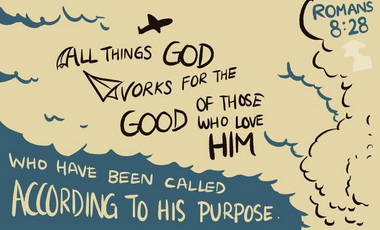
And we know that in all things God works for the good of those who love Him, who have been called according to His purpose.

The Greek verb oida (“we know”) is a perfect active indicative form of the verb, which may simply refer to knowledge gained by observance or remembrance of the past. This is paralleled earlier in verse 22 (using the same Greek verb tense of oida) when speaking about their observation of creation “groaning as in the pains of child birth right up to the present time.”

Paul seems to be saying “we have observed” and “therefore we know.” The context and grammar appear to indicate a reference not to an intuitive knowledge of Paul’s readers, but to that which comes from observation of the past, or a remembrance.[73]

Paul means that believers know, from observation of God’s past dealings with those who love Him, that he has a mysterious way of working things out for the greatest good. By observing the stories of the saints of old —those called to accomplish His redemptive purposes—believers can rest in knowledge of this truth. God can take whatever evil may come our way and redeem it for good. Believers can know this because God has been doing it for generations.

Paul does not say that his readers should intuitively know how God works things out for those who love Him in the present. He is saying believers know what is true of God by observing what He has done in the past for those who have loved Him. The New Testament saints have a great cloud of witnesses that have gone before them (Heb. 12:1), giving evidence of God’s trustworthiness toward all who enter into a covenant with Him.

A simple survey of the verses leading up to this point reveals that Paul is reflecting on the problem of the evil and suffering in our world since the beginning:

Rom. 8:20-22: “For the creation was subjected to futility, not willingly, but because of Him who subjected it, in hope that the creation itself also will be set free from its slavery to corruption into the freedom of the glory of the children of God. For we know that the whole creation groans and suffers the pains of childbirth together until now.”

N.T. Wright comments on Rom. 8:28–30, saying in part:

  • “[This passage] is a sharp, close-up, compressed telling of the story of Israel, as the chosen people, whose identity and destiny is then brought into sharp focus on Jesus. Jesus, in a sense, is the one ‘chosen One.’ But, then that identity is shared with all of those who are ‘in Christ.’ And he [Paul] is not talking primarily there about salvation. He is talking primarily about the way God is healing the whole creation. There is a danger here. What has happened in so many theological circles over the years is that people have come to the text assuming that it is really saying how we are to get to heaven, and what is the mechanism and how does that work. And if you do that, interestingly, many exegetes will more or less skip over Romans 8:18–27, which is about the renewing of creation.”[74]

In verses 28 and 29 the focus shifts to providing comfort for those in suffering by reminding them to observe God’s dealings with others who loved God throughout history. Notice that this truth is not applicable to everyone. The passage is specifically an observation of those who “love God,” or as Wright notes, “those who are in Christ.”

The point is not that God causes everything for a good purpose, but that God redeems occurrences of evil for a good purpose in the lives of those who love Him. Therefore, it would be inaccurate to use this passage to support the concept of divine meticulous determinism of all things.[75] Again, God does not cause occurrences of evil for His purposes; instead, He redeems moral evil for a good purpose. Traditionalists would typically agree with what John MacArthur, a Calvinistic pastor, wrote on this point:

  • “But God’s role with regard to evil is never as its author. He simply permits evil agents to work, then overrules evil for His own wise and holy ends. Ultimately He is able to make all things—including all the fruits of all the evil of all time—work together for a greater good.”[76]

The focus of the apostle’s observation is on the saints of old, those from the elect nation of Israel who were called to fulfill God’s plan to redeem His creation from its groans and sufferings. This passage does not mean that the truth being revealed is not applicable to those of other nations. Rather, it means that what is proven to be true of God by observing His dealings with those called out from Israel throughout history must also be true of anyone who comes to follow and love the God of Israel.

Consider this analogy: Suppose a new pastor is called to a church. The staff members are nervous about his leadership style and how they might be treated, but a letter of reference which reflects on his past relationships might ease their fears. The pastor’s reference might say something like, I have observed this pastor’s dealings with the staff members he knew before, and he has always worked to lovingly support anyone who gets behind the vision and direction of the church. By reflecting on the pastor’s history, the new staff can know what to expect in their future dealings with him. So too, Paul gives a divine reference by reflecting on the trustworthiness of God in His dealings with the saints of old so as to ensure his readers of what they may expect of Him.

Romans 8:29

For those God foreknew He also predestined to be conformed to the image of His Son, that He might be the firstborn among many brothers and sisters.

Here the apostle reveals his focus on the saints of old, “those God foreknew.” Paul seeks to provide evidence of his claim in verse 28 by reflecting on God’s faithfulness to His chosen nation, those beloved who were known before. Paul provides a reference of sorts to ease the fears of those who are now coming to faith. This point continues to be the apostle’s focus for the next three chapters.

Much debate centers on the meaning of the word proginōskō (“to know beforehand”).[77] Many popular authors fail to recognize all the available options for consideration. For example, John Piper lists only two options for interpreting this verse:

Option #1: God foresaw our self-determined faith. We remain the decisive cause of our salvation. God responds to our decision to believe.

Option #2: God chose us—not on the basis of foreseen faith, but on the basis of nothing in us. He called us, and the call itself creates the faith for which it calls.[78]

Piper overlooks the most basic meaning of this word, which is “to know beforehand” or to have known in the past. The same Greek word is used by Peter and Paul in the following passages,

2 Pet. 3:17: “Therefore, dear friends, since you have been forewarned, be on your guard so that you may not be carried away by the error of the lawless and fall from your secure position.”

Acts 26:4–5: “The Jewish people all know the way I have lived ever since I was a child, from the beginning of my life in my own country, and also in Jerusalem. They have known me for a long time and can testify, if they are willing, that I conformed to the strictest sect of our religion, living as a Pharisee.”

Clearly, this word can be understood simply as knowing someone or something in the past, as in those known previously (i.e. the saints of old). Non-Calvinistic scholars, Roger Forster and Paul Marston, convincingly argue,

  • “God ‘foreknew them’ or ‘knew them of old’ thus it does not mean that God entered in some former time into a relationship with the Israelites of today, it means that he entered a (two-way) relationship with the Israel that existed in early Old Testament times, and he regards the present Israelites as integral with it.”[79]

If Paul intended to use the word proginōskō in this sense, then he meant simply that because we have seen how God worked all things to the good for those whom He knew before, we know that He will do the same for those who love and are called by Him now.

Some Calvinists contend that the word foreknew is equivalent to fore-loved. That use of the word generally fits this interpretation since the Israelites of the past who loved God certainly would have been loved by God before (i.e. fore-loved). Of course, the Calvinistic interpretation differs because they insist this passage is about God unconditionally setting His “effectual” salvific love upon certain individuals before the foundation of the world. Calvinists go to great lengths to show that God did not merely foresee the behavior and choices of the elect by looking down the corridors of time. Rather, God knew them intimately and set His effectual love on them before the foundation of the world.[80]

This argument might address the classical Arminian approach (Piper’s first option),[81] but it fails to rebut the approach being advocated here. Fore-loved is a viable and even likely meaning of the term proginōskō, yet it does not clarify who might be the intended target of that divine love.

Was Paul intending to introduce for the first time in this epistle a particular group of people out of the mass of humanity who were unconditionally elected to be effectually saved before the world began? Or, was he simply referencing those from the past whom God had known and faithfully cared for throughout the generations?

Romans 8:29b states “He (God) also predestined to become conformed to the image of His Son.” Who was “predestined” and to what ends were they predestined, according to this passage? Remember the point of the apostle leading up to this verse. He began speaking about the futility and suffering that has come into this world due to the fall of humanity into sin (vv. 20–22). In verse 28-29a, Paul provides comfort to lovers of God in his audience by reminding them of God’s trustworthiness for those who have loved Him throughout the generations.

Paul reminds his readers that God will redeem the suffering and evil for a good purpose in their lives just as he has done in the lives of those known before and loved throughout the previous generations. It is these whom God previously knew (Israelites whom loved God in the past) who were predestined to be conformed into the image of Christ so as to make the way for His coming.

God planned to accomplish salvation for those who were previously known and loved (i.e. Abraham, Moses, David, etc) by conforming them into the image of the One who would come to purchase their redemption. This is the ultimate example of God causing “all things to work for the good” of those saints of old who loved God. Paul is saying that God brings about the redemption of their souls and He will do the same for whoever loves Him. N. T. Wright states,

  • “Here is the note of hope which has been sounded by implication so often since it was introduced in 5:2: hope for the renewal of all creation, in a great act of liberation for which the exodus from Egypt was simply an early type. As a result, all that Israel hoped for, all that it based its hope on, is true of those who are in Christ.”[82]

Romans 8:29c states “that He (the Son) might be the firstborn among many brothers and sisters.” Consider the fact that he is speaking about what Christ might be, which strongly implies that Paul still has the saints of old in focus here. Why would Paul speak of future generations being conformed to the image of Christ so that He “might be the firstborn among many brothers and sisters” if He were already the firstborn prior to this discourse?

  • The term prōtotokos (“firstborn”) can simply refer to the one who is first to be born in a family, which carries much significance in the Jewish culture (Luke 2:7). Typically, the birthright given to the firstborn son signified a place of preeminence, by which he would receive the father’s inheritance and blessing. For instance, Psalm 89:20, 27 states, “I have found David my servant; with my sacred oil I have anointed him. . . And I will appoint him to be my firstborn, the most exalted of the kings of the earth.” David, who was the last one born in his family, was called by God the firstborn. David was given a place of preeminence.[83]

The term firstborn also speaks of Christ’s preexistence as the eternal Creator.[84] God created the world through Christ and redeemed the world through Christ (John 1:3, 10; Heb. 1:2–4). The former speaks of His eternal nature and the latter of His temporal role as the redeemer of the world.

Yet, even when speaking of our preexistent Lord, the biblical authors addressed Him as “becoming” or “fulfilling” His role as our Messiah within the temporal world. For example, the Psalmist writes, “And I will appoint Him to be my firstborn, the most exalted of the kings of the earth” (Ps. 89:27). For the Old Testament saints, the firstborn Savior was the expected One that was yet to come. From their view, the long-awaited Messiah was the future hope, not a past and completed reality.

In contrast to the Old Testament saints, a modern-day preacher would not teach that we are being conformed to Christ’s image so that Jesus might be the firstborn among many brethren, because we know Him to already be the firstborn of many brethren. Our being conformed into Christ’s image today has nothing to do with the future coming of Christ’s birth, whereas the saints of old were part of His very lineage. It is through the life of men like Abraham, Isaac, Jacob, David, and many other saints of old that Christ is brought into this world “that He might be the firstborn among many brothers and sisters (Rom. 8:29c).”

Paul is reflecting on God’s redemptive purpose being accomplished through those who loved God in former generations. That redemptive purpose included bringing the Messiah into this world through Israel (Rom. 9:4-5), or those Israelites set apart for that noble purpose (Rom. 9:21). This was God’s predestined plan of redemption, which was brought to pass through those who loved God and were called according to His purpose. Tim Warner describes this purpose,

“Paul was not referring to some prior knowledge in the mind of God before creation. Nor was He speaking about predetermining their fate. He was referring to those whom God knew personally and intimately, men like Abraham and David.

The term ‘foreknew’ does not mean to have knowledge of someone before they were conceived. The verb προεγνω is the word for ‘know’ (in an intimate sense) with the preposition προ (before) prefixed to it. It refers to having an intimate relationship with someone in the past… Literally, we could render Rom. 8:29 as follows: ‘For those God formerly knew intimately, He previously determined them to be conformed to the image of His Son.’

The individual saints of old, with whom God had a personal relationship, were predestined by Him to be conformed to the image of Christ. That is, God predetermined to bring their salvation to completion by the sacrifice of Christ on their behalf.” [85]

Likewise, William R. Newell, a colleague of D.L. Moody and a notable teacher at the Bible Moody College, explained that God “had acquaintanceship” with the Israelites of the past. So, it was not “mere Divine pre-knowledge” of certain individuals, but a real intimate “pre-acquaintanceship.”[86]

Romans 8:30

And those He predestined, He also called; those He called, He also justified; those He justified, He also glorified.

Notice the apostle’s use of the past tense in this verse. If Paul intended to speak about the future salvation of every elect individual, then why would he use these past tense verbs? When writing these words, Paul and his readers had not yet been glorified, so there is no explicit reason to use the past tense. Thus, there is no reason to assume Paul has in mind the future glorification of all believers.

The past tense suggests that Paul is referring to former generations of those who have loved God and were called to fulfill His redemptive purpose. They were known in the past generations and predestined by God to be made in the very image of the One to come, “the firstborn among many brothers and sisters,” which is something already completed in the past through the working of God in former generations. These are the individuals whom God called, justified, and who now, even as Paul was writing these words, are already glorified in the presence of God.

If indeed Paul was referencing the saints formerly known and loved by God, he would have communicated the certainty of their being justified, sanctified and finally glorified in a way that some might describe as a “golden chain of redemption.”[87] To presume, however, that Paul’s unbroken chain of past tense verbs is not in reference to people of the past is a linguistic stretch. [88]

Calvinists must explain away the use of the past tense verbs in order to maintain their interpretation of Paul’s intent. For instance, The Bible Knowledge Commentary, a Calvinistic source, provides this explanation, “Glorified is in the past tense because this final step is so certain that in God’s eyes it is as good as done.”[89] 

Calvinists must interpret Paul’s use of the past tense (aorist indicative) as meaning “it is as good as done” because it was predestined. But this is a very rare usage in the original language and the immediate context does not clearly support a Calvinistic rendering.

We must take into account Paul’s usage of the same term earlier in the chapter as a future hope for believers. Romans 8:17:

“Now if we are children, then we are heirs—heirs of God and co-heirs with Christ, if indeed we share in His sufferings in order that we may also share in His glory” (emphasis added).

Paul does not speak of glorification as a past and completed action in reference to the believers in his day. Rather, he seems to qualify their being glorified upon the condition that they persevere through the suffering that is to come. If it is “as good as done” due to God’s predetermination, then why would Paul make such a qualification and use the future tense of the same verb? Further, Paul speaks of the eager expectation of the glorification that is to come in verses 22–25:

“We know that the whole creation has been groaning as in the pains of childbirth right up to the present time. Not only so, but we ourselves, who have the firstfruits of the Spirit, groan inwardly as we wait eagerly for our adoption to sonship, the redemption of our bodies. For in this hope we were saved. But hope that is seen is no hope at all. Who hopes for what they already have? But if we hope for what we do not yet have, we wait for it patiently” (emphasis added).

Is the reader to believe that Paul shifts from speaking of glorification as a future hope for those who persevere, to speaking of it as a past and already-completed act for those who have not yet been glorified? Or, could it simply be that Paul has the Old Testament saints in view as he makes his case for the trustworthiness of God throughout all generations? The latter seems to be the most basic understanding of the apostle’s words in their context.

This interpretation may seem foreign to some Western readers because of the philosophical and theological baggage that has been attached to the concept of divine foreknowledge over the years, but to the first century reader the simple concept of proginōskō, understood as “previously known,” would have been far more likely. In fact, if one can objectively back away from their presuppositions and approach this passage with fresh eyes, I believe they will discover the utter simplicity and clarity of this perspective.

Instead of introducing a complex concept of divine prescience, unconditional election, and effectual salvation never once clearly expounded upon in the Scriptures, could it be that Paul may intend simply to communicate that those who were previously loved and known by God were also predestined to be conformed to the image of the One to come? Paul seems to be giving a brief history lesson of what God had done in former generations as a reference for God’s trustworthiness for all who come to Him in faith. Wright explains it this way:

  • “The creation is not god, but it is designed to be flooded with God: The Spirit will liberate the whole creation. Underneath all this, of course, remains Christology: the purpose was that the Messiah ‘might be the firstborn among many siblings’ (8.29). Paul is careful not to say, or imply, that the privileges of Israel are simply ‘transferred to the church,’ even though, for him, the church means Jews-and-gentiles-together in Christ. Rather, the destiny of Israel has devolved, entirely appropriately within the Jewish scheme, upon the Messiah. All that the new family inherit, they inherit in Him.”[90]  

Those who object to the suggestion that Paul’s use of the term proginōskō is limited to the beloved of Israel’s past should consider the apostle’s use of the same word just three chapters later, Rom. 10:21-11:2a:

“But concerning Israel he says, ‘All day long I have held out my hands to a disobedient and obstinate people.’ I ask then: Did God reject His people? By no means! I am an Israelite myself, a descendant of Abraham, from the tribe of Benjamin. God did not reject His people, whom he foreknew” (emphasis added).

Notice that Paul uses the term proginōskō in reference to God’s intimate relationship with the faithful Israelites of old. Paul continues to make his case, Rom. 11:2b-4:

“Don’t you know what Scripture says in the passage about Elijah—how he appealed to God against Israel: ‘Lord, they have killed your prophets and torn down your altars; I am the only one left, and they are trying to kill me?’ And what was God’s answer to him? ‘I have reserved for myself seven thousand who have not bowed the knee to Baal.’”

Elijah and those who refused to bow a knee were among the ones who were previously known (foreknown/fore-loved) by God. To foreknow refers to God’s intimate relationship with people who loved Him in the past (like Abraham in Rom. 4:22–5:5). Nothing in this or any other text supports the concept of God in eternity past preselecting certain individuals out of the mass of humanity for effectual salvation. It would be difficult to substantiate this meaning of the term foreknow in reference to the Israelites who were in covenant with God. It is best interpreted in reference to those known by God in former times. William Lane Craig explains,

  • “In certain cases, proginōskō and prooraō mean simply that one has known or seen (someone or something) previously. For example, in Acts 26:5 Paul states that the Jews had previously known for a long time the strictness of his life a Pharisee, and in Acts 21:29 Luke mentions that the Jews had previously seen (prooraō) Trophimus in Paul’s company. This sense is probably operative in Romans 11:2 as well, where Paul states of apostate Israel that ‘God has not rejected His people whom He foreknew [proginōskō],’ that is, whom He had previously known in an intimate way.”[91]  

Romans 8:31–39

Returning to the analogy above, the pastor had former staff members whom he intimately knew and loved. The new staff would be comforted to know of the pastor’s prior relationships. Likewise, those being grafted into covenant with the God of Israel for the first time (i.e. the Gentiles) would be thrilled to learn of God’s faithfulness to those He formerly knew and loved (i.e. men like Abraham and David, etc.). What can the readers say in response to these teachings of Paul about God’s faithfulness toward the saints of old?

That is the very question the apostle poses in Rom. 8:31a as he transitions to the application of His message,

“What, then, shall we say in response to these things?”

This interpretation is consistent with the view that present-day saints who love God and are called according to His purposes (vs. 28) have nothing to fear, for…

“If God is for us, who can be against us?” (vs. 31b).

God, who gave up His Son, justifies, intercedes, and places His undying love upon all who love Him and are called according to His purposes (vv. 32–39).

The objector in Paul’s mind asks: Paul, you have made a good case regarding God’s faithfulness to the Israelites in the past, but what about the Israelites today? Have God’s promises for Israel failed? Why are the Israelites today refusing to accept their own Messiah? The apostle attempts to answer these questions in Romans 9 and following.

NOTES:

[73] Johannes P. Louw and Eugene A. Nida, Lexicon of the New Testament: Based on Semantic Domains, Second Edition (New York: United Bible Societies, 1989), 29.6.

[74] N.T. Wright in a question and answer session at Oklahoma Christian University on April 1, 2014. Samuel Selvin, “Dr. N. T. Wright on predestination,”

[75] This is also true of Eph. 1:11, which is often misapplied to support the idea of meticulous determinism.

[76] John MacArthur, “Is God Responsible for Evil?” Grace To You Ministries web page. Quote taken from: http://www.gty.org/ resources /articles/A189/is-god-responsible-for-evil; [date accessed: 5/19/15]

[76] The definition of progin-osk-o is from The Lexham Analytical Lexicon to the Greek New Testament (Bellingham, WA: Logos Bible Software, 2011), 30.100.

[77] John Piper, Sermon: “Foreknown by God,”

[78] Roger T. Forster and V. Paul Marston, God’s Strategy in Human History (Wheaton: Tyndale, 1973), 179–90.

[79] John Murray, The Epistle to the Romans, Volume I (Grand Rapids, MI: Eerdmans Publishing, 1959), 316-318.

[80] Frederic Godet’s commentary on Romans 8:29, inquires: “In what respect did God thus foreknow them?” and answers that they were “foreknown as sure to fulfill the conditions of salvation, viz. faith; so: foreknown as His by faith.” The word “foreknew” is thus understood by Godet, a classical Arminian, to mean that God knew beforehand which sinners would believe, and on the basis of this knowledge He predestined them unto salvation. Frederic Godet, Commentary on the Epistle to the Romans (New York: Messrs Clark, 1880), 325.

[81] N.T. Wright, Pauline Theology, Volume III, ed. David M. Hay & E. Elizabeth Johnson (Minneapolis: Fortress, 1995), 30–67.

[82] James D. G. Dunn, Romans 1-8, Word Biblical Commentary, David A. Hubbard and Glenn W. Barker, vol. 38a (Dallas: Word, 1988), 1: 484.

[83] Theologian Bernard Ramm noted that “It has been standard teaching in historic Christology that the Logos, the Son, existed before the incarnation. That the Son so existed before the incarnation has been called the pre-existence of Christ.” Bernard Ramm, An Evangelical Christology: Ecumenic and Historic (Vancouver, BC: Regent College Publishing, 1993) 47.

[84] Tim Warner, PFRS Commentary on Romans, Pristine Faith Restoration Society. 

[85] William R. Newell, Romans Verse-by-Verse,” Christian Classics Ethereal Library,” 1938.

[86] Some Calvinistic scholars describe this as the unbreakable “golden chain of redemption” meant to communicate the unchangeable plan of God to irrevocably justify, sanctify and glorify those He elected before the world began.

[87] Greek scholars teach that while the aorist indicative can be used to describe an event that is not yet past as though it were already completed, this usage is “not at all common.” Daniel B. Wallace, Greek Grammar Beyond the Basics (Grand Rapids, MI: Zondervan Publishing, 1997) 564.

[88] John F. Walvoord and Roy B. Zuck, eds. The Bible Knowledge Commentary (Dallas: Victor Books, 1983), 474.

[89] “And all this is viewed as past; because, starting from the past decree of ‘predestination to be conformed to the image of God’s Son’ of which the other steps are but the successive unfoldings—all is beheld as one entire, eternally completed salvation.” Jamieson-Fausset-Brown Bible Commentary, “Romans 8.”

[90] Wright, Pauline Theology, 20.

[91] William Lane Craig, The Only Wise God: The Compatibility of Divine Foreknowledge and Human Freedom (Grand Rapids: Baker, 1987), 31–32.

Leighton Flowers, The Potter’s Promise: A Biblical Defense of Traditional Soteriology (Trinity Academic Press, 2017), 81-98.

Here are some thoughts via John Lennox’s wonderful book,  “Determined to Believe? The Sovereignty of God, Freedom, Faith, and Human Responsibility,”

God is the Creator – there would not be a universe or human beings without him. God is the sovereign upholder of the universe – none of its history is outside his control. Christ is the Saviour and Redeemer – apart from him there would be no salvation.

Furthermore, we have seen that God’s initiative is expressed in Scripture in terms like election, foreknowledge, predestination, and calling, all of which occur together at the climax of one of the major sections of the letter to the Romans in chapter 8. By this stage Paul has already argued universal human guilt and the consequent need of salvation. He has explained that salvation is by faith in Christ and not of works. He has developed the theme of human responsibility to live a holy life in the power of God’s Holy Spirit. He has described the inner battle against our human nature (the flesh) that we all experience as we seek to walk after the Spirit.

The inner battle is not the only battle, however. Paul himself was no stranger to suffering – he had lived with persecution for many years. And so in Romans 8 Paul addresses suffering directly. He describes the provision that God has made for him and his fellow believers to remain firm in their faith when the winds of adversity blow. Here is the wonderful passage in full:

I consider that our present sufferings are not worth comparing with the glory that will be revealed in us. The creation waits in eager expectation for the sons of God to be revealed. For the creation was subjected to frustration, not by its own choice, but by the will of the one who subjected it, in hope that the creation itself will be liberated from its bondage to decay and brought into the glorious freedom of the children of God.

We know that the whole creation has been groaning as in the pains of childbirth right up to the present time. Not only so, but we ourselves, who have the firstfruits of the Spirit, groan inwardly as we wait eagerly for our adoption as sons, the redemption of our bodies. For in this hope we were saved. But hope that is seen is no hope at all. Who hopes for what he already has? But if we hope for what we do not yet have, we wait for it patiently.

In the same way, the Spirit helps us in our weakness. We do not know what we ought to pray for, but the Spirit himself intercedes for us with groans that words cannot express. And he who searches our hearts knows the mind of the Spirit, because the Spirit intercedes for the saints in accordance with God’s will.

And we know that in all things God works for the good of those who love him, who have been called according to his purpose. For those God foreknew he also predestined to be conformed to the likeness of his Son, that he might be the firstborn among many brothers. And those he predestined, he also called; those he called, he also justified; those he justified, he also glorified.

What, then, shall we say in response to this? If God is for us, who can be against us? He who did not spare his own Son, but gave him up for us all – how will he not also, along with him, graciously give us all things? Who will bring any charge against those whom God has chosen? It is God who justifies. Who is he that condemns? Christ Jesus, who died – more than that, who was raised to life – is at the right hand of God and is also interceding for us. Who shall separate us from the love of Christ? Shall trouble or hardship or persecution or famine or nakedness or danger or sword? As it is written:

“For your sake we face death all day long;
we are considered as sheep to be slaughtered.”

No, in all these things we are more than conquerors through him who loved us. For I am convinced that neither death nor life, neither angels nor demons, neither the present nor the future, nor any powers, neither height nor depth, nor anything else in all creation, will be able to separate us from the love of God that is in Christ Jesus our Lord.

(Romans 8:18–39.)

In all of Scripture this is one of the most magnificent statements of the love of God in taking the initiative to provide salvation in all of its aspects, so that nothing whatsoever can separate us from his love for us in Christ Jesus – not even death itself. I have emphasised the passage that is relevant to our discussion. In the context of suffering, weakness, and uncertainty, we are to know that God is working in all things for the good of those who love him. Paul describes them as those who have been called according to his purpose. What that grand purpose is, he is about to explain. But not before he gives another description of believers as those whom God foreknew, which (as we have seen) does not imply that God caused or forced them to do anything in advance. It is a great encouragement to believers under pressure to know that they have experienced the call of God; God has known them, and knows all about them – and he has a purpose for them. What is that purpose? He has predestined them to be conformed to the image of his Son.

Under the pressure of an assumed paradigm it is all too easy to read into this that Paul is saying that God has predestined them to be believers, and then using this statement to buttress theistic determinism. However, Paul is saying something completely different: that God has predestined those who are believers to be conformed to the image of his Son. That is, he plans to confer unimaginable dignity upon believers. As creatures of God they were made in the image of God. But now that they have put their faith in Christ and received his salvation, a destiny of almost indescribable glory awaits them. In his love for them God has determined that they should be like his Son. The sheer wonder of this purpose now defines the illimitable nature of God’s grace and glory. In one sense, God could have predestined us to anything glorious that he willed, but he has chosen this ultimate accolade. The objective is that the Lord Jesus should be the firstborn (first to be glorified and also first in rank) among many brothers.

This is God’s staggeringly gracious goal. Achieving it involves all of God’s provision in the gospel that Paul has been expounding up to this point – calling, justification by faith, and glorification. It is the sheer glory of the achievement that calls forth Paul’s triumphant and confident conclusion – If God is for us, who can be against us?

Arising directly from these glorious thoughts, however, there comes a question that deeply disturbs and concerns the apostle. In light of such a magnificent and gracious message, how is it that his fellow Israelites, Paul’s own kith and kin, mainly reject such a wonderfully gracious message and deny that Jesus is the Messiah, the Son of God? Paul’s pain is palpable as he explains:

I speak the truth in Christ – I am not lying, my conscience confirms it in the Holy Spirit – I have great sorrow and unceasing anguish in my heart. For I could wish that I myself were cursed and cut off from Christ for the sake of my brothers, those of my own race, the people of Israel. Theirs is the adoption as sons; theirs the divine glory, the covenants, the receiving of the law, the temple worship and the promises. Theirs are the patriarchs, and from them is traced the human ancestry of Christ, who is God over all, for ever praised! Amen.

(Romans 9:1–5.)

Paul faces an apparent contradiction. His nation of Israel by and large rejected Christ, who was also their own flesh and blood, even though as a nation they were uniquely privileged. God had adopted them as his people – as his sons, even, those who inherit the family assets; he had visited them in his glory at Sinai, and in the tabernacle, given them the covenants, the law, and the worship programme of the temple; he had lavished his promises on them. Not only that, it was God who had given them the patriarchs, from whom the ancestry of the Messiah would be traced – the Messiah who is none less than God himself. And they don’t believe in him!

This was no new issue for Paul. He faced it many times as he sought to persuade men and women of the truth of the Christian message. For instance, he held lectures in the synagogue at Thessalonica on three sabbath days:

As his custom was, Paul went in to the synagogue, and on three Sabbath days he reasoned with them from the Scriptures, explaining and proving that the Christ had to suffer and rise from the dead. “This Jesus I am proclaiming to you is the Christ,” he said.

(Acts 17:2–3.)

One can easily imagine some intelligent Jew saying, “That was a very interesting talk, Paul, and I find it impressive that a rabbi with your undoubtedly high qualifications, having studied under Gamaliel, is prepared to argue in this way. However, what bothers me is that you seem to be on your own in this. Or am I mistaken? Can you tell me of any other senior rabbis who believe that your interpretations are correct?”

And Paul might reply, “Well there’s Nicodemus, and Joseph of Arimathea, both on the Sanhedrin Council in Jerusalem.”

“Is that all? If what you say is true – and I admit I was moved by it – surely one might expect the majority of the Jewish thinkers to accept it? After all, on the basis of our Scriptures you are claiming that Jesus is the Messiah expected by our nation, yet the experts in the interpretation of those Scriptures don’t agree with you. Surely you can see why I am puzzled!”

Paul could see it, and it affected him deeply. He got the same question from Gentiles as well. “If something is really authentically Jewish, the Jews should be the first to accept it. And yet most of them reject it. How can that be?”

Paul was heartbroken about the situation and desperately wanted to do something about it. It threatened to become a serious stumbling block in the way of people taking the gospel seriously. As he writes in chapter 8, how can he believe that nothing shall separate us from the love of God, when it appears to many that something has separated Israel from God? How can Israel have lost her way so dramatically?

So Paul writes Romans 9–11 in order to show that, far from being an objection to the Christian message, what has happened historically with Israel, in their rejection of the Lord Jesus, in fact confirms the truth of it.

At this point some interpreters of Scripture argue that the ultimate answer to this question is given by Paul in his letter to the Galatians. There he abolishes all distinctions between Jews and non-Jews in his famous statement, that in Christ there is neither Jew nor Greek(Galatians 3:28). Surely this means (it is argued) that all the promises given to Israel in the Old Testament are now to be understood as fulfilled in the church. Hence God has not cast off his people, since “his people” now equates to “the church” which is alive and thriving.

However, Paul’s statement in Galatians is not relevant to his problem in Romans. In Galatians 3:21–29 Paul is discussing the basis of salvation, and he stresses that it is the same for everyone, whatever their ethnicity, social status, or gender – Jew, Greek, slave, free, man, woman. That common basis is faith in Christ alone. Paul is not talking there about the question of roles in history or in the world, which for obvious reasons might well be different for each of these groups. To deduce from these verses that, now that Christ has come, there is absolutely no difference between the roles of Jews and Gentiles, would be as absurd as saying that, since Christ has come, there is absolutely no difference between the roles of slave and free or between the roles of male and female. Their roles can remain the same without prejudice to their status in Christ.

By contrast Paul’s concern in Romans 9–11 is not the basis of the gospel but why it is that the very nation that was privileged by God to be the vehicle of his revelation to the world now mainly rejects the gospel of the Messiah. That is the problem he has to address, and it is so complex that he takes three chapters to do it.

The first main argument is based on the fact that not all ethnic Israelites are the genuine people of God. His discussion involves considering the sovereignty of God in history regarding the role of different individuals and the nations descended from them.

The second main argument is that Israel’s unbelief is culpable. God has made every provision for them. Paul goes through every excuse that might be raised to let Israel off the hook and concludes in each case that they are responsible for their unbelief.

The third main argument concentrates on the fact that there are some Israelites, like Paul, who do believe in Jesus. Indeed, all through history there has been a “remnant” of true believers within Israel, whose number has at times been underestimated. Paul then discusses the historical roles that Israel and then the Gentiles have had in witnessing for God in the world, and concludes with the glorious hope for his nation that one day “all Israel will be saved”. Paul is in no doubt that there remains a role for his nation in the future, but not until they come to faith in Jesus as Messiah.

“For He says to Moses” | Biblical Mercy

For He says to Moses, “I will have mercy on whomever I will have mercy, and I will have compassion on whomever I will have compassion.”

Dr. Leighton Flowers confronts Dr. James White’s faulty critique of Dr. William Lane Craig (and other non-Calvinists).

This is a condensed critique. To see the longer video going through each of Dr. White’s points go here: • What about those who never hear about Jesus?

Often we hear the objection that God is not obligated to have mercy on anyone. That’s true. However, the fact that God is not obligated to be merciful towards all people is what makes the display of His mercy to all people so amazingly gracious and abundantly glorious. That God does what He is not obligated to do for no other reason than He desires to be merciful to all is glorious.

Anyone suggesting this display of mercy isn’t genuine (or that’s it’s just an outward/external “prescriptive” will of God, but that His real secret desire is only to show mercy to a preselected few) is diminishing the abundance of His mercy and the glory of His grace extended to every person.

Also, I think sometimes there is an assumption that mercy is weakness. But that could not be further from the truth. Mercy can only be handed down by someone in a place of judgement over another. If it is not within my power to pass condemnation on someone, then it is also not within my power to have mercy on them. Mercy is an expression of power, not of weakness.

“The Lord is gracious and compassionate, slow to anger and rich in love. The Lord is good to all; he has compassion on all he has made.” -Ps 145:8-9

“For God has bound everyone over to disobedience so that he may have mercy on them all.” -Rom 11:32

Some more from SOTO 101:

V.  WHY GOD IS JUST IN SHOWING MERCY TO UNFAITHFUL ISRAELITES TO ACCOMPLISH HIS PROMISE IN BRINGING THE WORD (14-16)

  • Does God’s choosing to bless one descendant over another descendant make God unrighteous? What shall we say then? Is there unrighteousness with God? Certainly not!

The descendants of Abraham in Paul’s day had two false perceptions:

Every descendant deserves the benefit of bringing God’s Word. However, the truth is that God has only selected a remnant through whom to bring His Word.

Every descendant deserves eternal life on the basis of their being of Israel. However, no one is saved based on nationality but only upon grace through faith. Those nations, and the individuals therein, who oppose God’s Word remain under the curse (hatred), as illustrated by Edom (direct descendants of Isaac himself).

There is no unrighteousness with God for choosing some descendants for a noble cause and not others, nor is it unjust to condemn a descendant of Abraham who stands in opposition to the Word of God.

  • For He says to Moses, “I will have mercy on whomever I will have mercy, and I will have compassion on whomever I will have compassion.”

Paul’s reference to Moses’ encounter with God in Exodus 32-33 gives a perfect historical example of when God was merciful to Israel when they deserved to be destroyed for their unfaithfulness (worshipping a golden calf).

This example also parallels Moses’ self-sacrificial Christ-like love for Israel as reflected by Paul in the opening verses of this chapter… “forgive their sin—and if not blot me out…” (Ex. 32:31-32).

Certainly God may choose to save whosoever He is pleased to save (scripture teaches He chooses to save those who humble themselves and repent in faith – 1 Pt. 5:5-6), but this passage is in reference to God showing mercy to unfaithful Israel so as to fulfill His original promise through them even though they deserve condemnation.

  • So then it is not of him who wills, nor of him who runs, but of God who shows mercy.

“It” refers to the fulfillment of God’s promise to bring His Word despite Israel’s unfaithfulness (Rom. 3:3-4).

The promise depends on our merciful God, not on the faithfulness (“willing and running”) of Abraham or his descendants.

Abraham “willed and ran” in the flesh to produce a son through Hagar (who Paul used symbolically to represent the covenant of law and works, Gal. 4:24).

God, by his mercy, provided Isaac through the free woman, Sarah (who Paul used symbolically to represent the covenant of grace by faith in the call of God, Gal. 4:21-26).

VI.  WHY GOD IS JUST TO HARDEN UNFAITHFUL ISRAELITES TO ACCOMPLISH HIS PROMISE IN BRINGING THE WORD (17-18)

  • For the Scripture says to Pharaoh, “For this very purpose I have raised you up, that I may show My power in you, and that My name may be declared in all the earth.”

In the same way God hardened the already rebellious will of Pharaoh in order to accomplish the first Passover, so too God hardened the already rebellious wills of Israelites to accomplish the real Passover.

God’s power and goodness was displayed in mercy-ing unfaithful Israelites in the day of Moses and in hardening the unfaithful Israelites in the day of the Messiah.

  • Therefore He has mercy on whom He wills, and whom He wills He hardens.

Sometimes God will fulfill His promises by showing Israelites mercy, but His Word will never fail.

Sometimes God will fulfill His promises by hardening Israelites, but His Word will never fail.

Note: Those judicially hardened or cut off are not born in this condition, but have “grown hardened” over years of rebellion (Acts 28:27), they are cut off for unbelief (11:20) and the hope of the apostle is that they may be grafted back in and saved (11:11-32).

VII.  IF THE ISRAELITES’ UNRIGHTEOUSNESS ACCOMPLISHES GOD’S PROMISE TO BRING HIS WORD, WHY ARE THEY TO BLAME? (19-21)

  • “You will say to me then, “Why does He still find fault? For who has resisted His will? But indeed, O man, who are you to reply against God?”

You (an Israelite hardened to accomplish God’s promise) will say to me (an Israelite shown mercy to accomplish God’s promise), why are we to blame if God’s will is being fulfilled?

As the apostle already indicated in 3:5, this is a man-made argument that reveals a heart that has become calloused in its rebellion, otherwise they might see, hear, understand and repent (Acts 17:30; 28:27).

  • “Will the thing formed say to him who formed it, “Why have you made me like this?” Does not the potter have power over the clay, from the same lump to make one vessel for honor and another for dishonor?”

The lump of hardened clay represents Israel who is had grown calloused in rebellion (Acts 28:27) and who are now being remolded into two kinds of vessels:

Those unfaithful Israelites remolded, by means of signs from the incarnate Messiah Himself, to bring the Word.

Those unfaithful Israelites remolded, by means of judicially hardening, to accomplish the ignoble purpose of bringing redemption on the cross and the grafting in of the Gentiles (yet they still may be saved, Rom. 11:11-32).

Romans 9 explained. This video is very relevant in today’s world as we see believers departing from the faith while only the chosen ones will be able to stand by God and God will also provide and have mercey on them. God is able to raise leaders and kings so His Name is exalted among the nations. just like He did with the Pharaoh.

Romans 9:21-23 says, “Has the potter no right over the clay, to make out of the same lump one vessel for honorable use and another for dishonorable use? What if God, desiring to show his wrath and to make known his power, has endured with much patience vessels of wrath prepared for destruction, in order to make known the riches of his glory for vessels of mercy, which he has prepared beforehand for glory…”

RC Sproul, a notable Calvinist, interprets this to mean that God creates some people for salvation and the rest for damnation, but is that what the Apostle Paul really had in mind? Let’s explore!

~ R.C. SPROUL PLAYLIST ~


Is God the “devil” Behind Satan? | Sovereign Puppeteer (Updated)

I sent a friend the video of Dr. Theodore Zachariades stating that God wills [causes, not just permits] a man to be unfaithful to his wife.

  • God works all things after the Council of His will. Even keeping those kings who want to commit adultery from committing so! And when He wants to, he orders those to commit adultery when he wants to! (Video)

My friend dismissed this person as a hyper-Calvinist. But as the video below notes, using his definition of a “hyper Calvinist,” A.W. Pink, John Piper, Jeff Durbin, James White, and many-many more, would thus be considered the same. Because of the age restriction, the video must be watch on YouTube, link in pic.

When I asked him: “Question RW, is Piper, Calvin, White and Durbin hyper-Calvinists?” He simply replied “Fishing Bait.” But this is an interesting phenomena… and after decades of encountering Mormons and J-Dubs, the disconnect is the same. I get links and not actualizing on statements made when challenged. When shown a person who follows to the end the logical conclusion of theistic determinism found in Calvinism, the person who is the Calvinist is dismissed as a “hyper-Calvinist” by their fellow Calvinist’s if they are challenged. When that label is then applied rightly to others for the same reason — meaning, using RW’s definition of what a hyper-Calvinist is — then all these others have said worse; and would be by definition, hyper-Calvinists.

Two quick examples. 1st John Calvin, then, John Piper:

John CALVIN:

how foolish and frail is the support of divine justice afforded by the suggestion that evils come to be, not by His will but by His permission. . . . It is a quite frivolous refuge to say that God otiosely permits them, when Scripture shows Him not only willing, but the author of them. . . . Who does not tremble at these judgments with which God works in the hearts of even the wicked whatever He will, rewarding them nonetheless according to desert? Again it is quite clear from the evidence of Scripture that God works in the hearts of men to incline their wills just as he will, whether to good for His mercy’s sake, or to evil according to their merits.

John Calvin, “The Eternal Predestination of God,” 10:11

John Piper:

Ephesians 1:11 goes even further by declaring that God in Christ

“works all things according to the counsel of his will.” Here the Greek word for “works” is energeø, which indicates that God not merely carries all of the universe’s objects and events to their appointed ends but that he actually brings about all things in accordance with his will. In other words, it isn’t just that God manages to turn the evil aspects of our world to good for those who love him; it is rather that he himself brings about these evil aspects for his glory (see Ex. 9:13-16; John 9:3) and his people’s good (see Heb. 12:3-11; James 1:2-4). This includes—as incredible and as unacceptable as it may currently seem—God’s having even brought about the Nazis’ brutality at Birkenau and Auschwitz as well as the terrible killings of Dennis Rader and even the sexual abuse of a young child: “The LORD has made everything for its own purpose, even the wicked for the day of evil” (Prov. 16:4, NASB ).14 “When times are good, be happy; but when times are bad, consider: God has made the one as well as the other” (Eccl. 7:14, NIV).

John Piper and Justin Taylor, eds., Suffering and the Sovereignty of God (Wheaton, IL: Crossway Books, 2006), 42. (FULLER QUOTE VIA THIS PDF)

John Lennox notes in his wonderful book,  Determined to Believe? The Sovereignty of God, Freedom, Faith, and Human Responsibility,” that Martin Luther struggled with the consequences of this form of thought:

Martin Luther at the time of the Reformation. In his book The Bondage of the Will, written in response to Erasmus’ essay On Free Will, Luther said:

[The] omnipotence and foreknowledge of God, I repeat, utterly destroy the doctrine of “free-will” Doubtless it gives the greatest possible offence to common sense or natural reason, that God, Who is proclaimed as being full of mercy and goodness, and so on, should of His own mere will abandon, harden and damn men, as though He delighted in the sins and great eternal torments of such poor wretches. It seems an iniquitous, cruel, intolerable thought to think of God; and it is this that has been such a stumbling block to so many great men down through the ages. And who would not stumble at it? I have stumbled at it myself more than once, down to the deepest pit of despair, so that I wished I had never been made a man. (That was before I knew how health-giving that despair was, and how close to grace.)

In this passage Luther seems to be aware that there is a deep moral problem with aspects of his view [RPT: before redefining “grace” that is – almost like what is, is.]

Calvinism’s [T.U.L.I.P.] Logical Conclusion Displayed

In a reference in that above book is this paper:I Believe In Divine Sovereignty,” by Thomas H. McCall in Trinity Journal (TRINJ 29:2 [Fall 2008]), 209-210. Of which I excerpt:

He [John Piper] works long and hard to illustrate this [theistic determinism] from Rom 9:1-23, which he concludes is about the purposes of God being preserved “by means of the predestination of individuals to their respective eternal destines.”11 And we are not to think that God is righteous in spite of such action—instead we are to see that God is righteous because of this action, for the “heart of Paul’s defense” is this: “in choosing unconditionally those on whom he will have mercy and those whom he will harden God is not unrighteous, for in this ‘electing purpose’ he is acting out of a full allegiance to his name and esteem of his glory.12

This all-determining action of God notably includes predestination and election, but it extends far beyond—it extends to everything. God determines all events that occur in the universe, including all demonic and satanic action.13 As Mark R. Talbot puts it, God creates, sends, instigates, and moves others to do evil, because “nothing that exists or occurs falls outside God’s ordaining will.”14 Talbot makes the point with relentless and unmistakable clarity:

Nothing, including no evil person or thing or event or deed. God’s foreordination is the ultimate reason why everything comes about, including the existence of all evil persons and things and the occurrence of any evil acts or events.15

Make no mistake: “when even the worst of evils befall us, they do not ultimately come from anywhere other than God’s hand.”16

NOTES:

11. John Piper, The Justification of God: An Exegetical and Theological Study of Romans 9:1-23 (Grand Rapids: Baker, 1993), 218, cf. 56-73.

12. Ibid., 219.

13. On this see John Piper, “Suffering and the Sovereignty of God: Ten Aspects of God’s Sovereignty Over Satan and Satan’s Hand in It,” in Suffering and the Sovereignty of God, 19-30. Piper here uses the rather confusing (given his determinism) language of “permission.” By my lights, what he means when he says that God “permits” something is this (a) God determines it to occur and then (b) does not act so as to override his previous ordination. Regarding talk of “permission,” I think that John Calvin’s approach is more consistent, [….]  see John Calvin, Institutes of the Christian Religion I.xviii.1, and John S. Feinberg, No One Like Him: The Doctrine of God (Wheaton: Crossway, 2001), 696.

14. Mark R. Talbot, “‘All the Good That Is Ours in Christ: Seeing God’s Gracious Hand in the Hurts Others Do to Us,” in Suffering and the Sovereignty of God, 43 (41-43), emphasis original.

15. Ibid., 43-44.

16. lbid., 47.

Dave Hunt is right to say that Calvin uses unbiblical positions in dealing with this Augustinian determinism:

There is yet another question that troubles many: If man is free to choose between options, would that not in itself deny both God’s sovereignty and His foreknowledge? Luther claimed that this question was the very heart of the Reformation and of the gospel itself. In fact, Luther dogmatically insisted that it was impossible for God to foreknow the future and for man at the same time to be a free agent to act as he wills.

Believing firmly in God’s foreknowledge, Luther wrote an entire book titled The Bondage of the Will, to prove that the very idea of man’s free will is a fallacy and an illusion. Several reasons have already been given as to why Luther was wrong on this point, and that issue will be dealt with further in the next chapter.

Though Calvin took so much from Augustine, like Luther he also rejected the Augustinian belief that God could foreknow the future, while at the same time man could have a free will. According to Calvin, foreknowledge leaves no room whatsoever for free will, because foreknowledge is the same as predestination:

If God merely foresaw human events, and did not also arrange and dispose of them at his pleasure, there might be room for agitating the question [of free will] but since he foresees the things which are to happen, simply because he has decreed them, they are so to happen, it is vain to debate about prescience. …

If this frigid fiction [of free will] is received, where will be the omnipotence of God, by which, according to his secret counsel on which everything depends, he rules over all? (Calvin, Institutes, III: xxiii, 6–7.)

Calvin repeatedly uses such unbiblical and utterly fallacious reasoning.

The Calvinist assumes a contradiction between sovereignty and free will that doesn’t exist. The fact that God is able to allow man freedom of choice, while still effecting His purposes unhindered, is all the more glorifying to His sovereign wisdom, power, and foreknowledge.

And one last point on this via MONERGISM.COM:

  • In order to understand this better theologians have come up with the term “compatibilism” to describe the concurrence of God’s sovereignty and man’s responsibility. Compatibilism is a form of determinism and it should be noted that this position is no less deterministic than hard determinism. — John Hendryx (John Hendryx is the creator and editor of Monergism.com | SEE: “We are not Determinists!” for more)

Here is A.W. Tozer’s take of the above:

  • Here is my view: God sovereignly decreed that man should be free to exercise moral choice, and man from the beginning has fulfilled that decree by making his choice between good and evil. When he chooses to do evil, he does not thereby countervail the sovereign will of God but fulfills it, inasmuch as the eternal decree decided not which choice the man should make but that he should be free to make it. If in His absolute freedom God has willed to give man limited freedom, who is there to stay His hand or say, What doest thou? Mans will is free because God is sovereign. A God less than sovereign could not bestow moral freedom upon His creatures. He would be afraid to do so.

Tozer is saying that the Calvinist God is too small. Something I run through with Mormon Elders if they decide to come into my home to discuss further their “mission.” In a similar vein, philosophical determinism (atheism/evolutionary paradigms). In what follows — quote’wise — if this is true fore secular forms of determinism, then so to it applies to THEISTIC DETERMINISM:

Atheists reject evidence as illusory…

Why?

Because they “have to.”

Donald C. Abel in his book, Fifty Readings in Philosophy, asks us to imagine for a moment that you walking along and come to a fork in the road. One street is called Divinity Avenue, the other Oxford Street. Assuming you have to walk down one of them, there is a confrontation of choice.  Continuing he says,

  • Now, I ask you seriously to suppose that this ambiguity of my choice is real; and then to make the impossible hypothesis that the choice is made twice over, and each time falls on a different street. In other words, imagine that I first walk through Divinity Avenue, and then imagine that the powers governing the universe annihilate ten minutes of time with all that it contained, and set me back at the door of this hall just as I was before the choice was made. Imagine then that, everything else being the same, I now make a different choice and traverse Oxford Street. You, as passive spectators, look on and see the two alternative universes; one of them with me walking through Divinity Avenue in it, the other with the same me walking through Oxford Street. Now, if you are determinists, you believe one of these universes eternally impossible, because of the intrinsic irrationality or accidentality somewhere involved in it. However, looking outwardly at these universes, can you say which is the impossible and accidental one, and which the rational and necessary one?

Donald C. Abel, Fifty Readings in Philosophy (New York, NY: McGraw-Hill, 1994), 296.

  • “He thus acknowledged the need for any theory to allow that humans have genuine freedom to recognize the truth. He (again, correctly) saw that if all thought, belief, feeling, and choice are determined (i.e., forced on humans by outside conditions) then so is the determinists’ acceptance of the theory of determinism forced on them by those same conditions. In that case they could never claim to know their theory is true since the theory making that claim would be self-referentially incoherent. In other words, the theory requires that no belief is ever a free judgment made on the basis of experience or reason, but is always a compulsion over which the believer has no control.”

Roy A. Clouser, The Myth of Religious Neutrality: An Essay on the Hidden Role of Religious Belief in Theories (Notre Dame, IN: Notre Dame University Press, 2005), 174.

The implications of strict naturalism are grim or even counterintuitive. For example, Bertrand Russell affirmed that any philosophy hoping to stand must ultimately take for granted the (naturalistic) picture of unguided causes and accidental collocations of atoms and must be built on the “firm foundation of unyielding despair.” When it comes to naturalism’s implications for morality, naturalist Kai Nielsen contends that reason can’t bring us to morality; this picture ”is not a pleasant one,” and that reflecting on it ”depresses me.” When it comes to consciousness, naturalist Daniel Dennett considers it an illusion- -something fellow-atheist Thomas Nagel finds utterly confused:

  • You may well ask how consciousness can be an illusion, since every illusion is itself a conscious experience …. So it cannot appear to me that I am conscious though I am not the reality of my own consciousness is the one thing I cannot be deluded about …. The view [of Dennett] is so unnatural that it is hard to convey …. Dennett asks us to turn our backs on what is glaringly obvious. … And he asks us to do this because the reality of such phenomena is incompatible with the scientific materialism that in his view sets the outer bounds of reality. He is, in Aristotle’s words, ”maintaining a thesis at all costs.”

Jaegwon Kim acknowledges the stark picture painted by the naturalistic brush. Naturalism is ”imperialistic; it demands ‘full coverage’ … and exacts a terribly high ontological price.”

Paul Copan and Charles Taliaferro (editors), The Naturalness of Belief: New Essays on Theism’s Rationality (New York, NY: Lexington Books, 2019), viii

I could go on, but you get the point. To fashion the issue for you to see, Jaegwon Kim could have said:

  • Theistic determinism is ”imperialistic; it demands ‘full coverage’ and exacts a terribly high ontological price.” (added for emphasis) 

What is this price? Here is just one example… God vs. God:

Here is a Facebook post I recently posted:

  • “What is there for God to harden, provoke, or restrain if not the autonomous will of creatures?”

If God knows the future because He planned the future [Sproul, Piper, MacArthur, etc.], when God hardens, provokes, or restraines…. is He working against Himself?

If the “T” of TULIP [total depravity] is a reality, wouldn’t hardening, provoking, or restraining someone be the same thing as digging up bodies in a cemetery and putting blindfolds on the rotting cadavers?

In other words, does He plan the abuse of a child just to redeem that act in some way to bring glory to Himself? Is Satan superfluous?

Are all the prescriptions in the Bible making God out to be duplicitous – since he has planned our actions thru determinitive means?

You could not argue that “evil” is really “evil.” Eastern philosophies run into the same problems as the atheist’s/evolutionist’s I just noted above. The Calvinist runs into the same issue. And it is a distortion of Christianity (T.U.L.I.P.):

(Eph 1:11) “works all things according to the counsel of his will.” Here the Greek word for “works” is 𝑒𝑛𝑒𝑟𝑔𝑒ø, which indicates that God not merely carries all of the universe’s objects and events to their appointed ends but that he actually 𝑏𝑟𝑖𝑛𝑔𝑠 𝑎𝑏𝑜𝑢𝑡 all things in accordance with his will. In other words, it isn’t just that God manages to turn the evil aspects of our world to good for those who love him; it is rather that he himself brings about these evil aspects for his glory (see Ex. 9:13-16; John 9:3) and his people’s good (see Heb. 12:3-11; James 1:2-4). This includes—as incredible and as unacceptable as it may currently seem—God’s having even brought about the Nazis’ brutality at Birkenau and Auschwitz as well as the terrible killings of Dennis Rader and even the sexual abuse of a young child: “The LORD has made everything for its own purpose, even the wicked for the day of evil” (Prov. 16:4, NASB ).14 “When times are good, be happy; but when times are bad, consider: God has made the one as well as the other” (Eccl. 7:14, NIV).

John Piper and Justin Taylor, eds., Suffering and the Sovereignty of God (Wheaton, IL: Crossway Books, 2006), 42.

Or…

Is it more like Tozer notes — which lowers man’s position by making him/her responsible to God’s law; and keeps God’s holiness and glory intact as He truly redeems or judges such actions (is He judging Himself in Calvinism? Working against His own will? Secretly?)

TOZER:

God sovereignly decreed that man should be free to exercise moral choice, and man from the beginning has fulfilled that decree by making his choice between good and evil. When he chooses to do evil, he does not thereby countervail the sovereign will of God but fulfills it, inasmuch as the eternal decree decided not which choice the man should make but that he should be free to make it. If in His absolute freedom God has willed to give man limited freedom, who is there to stay His hand or say, ‘What doest thou?’ Man’s will is free because God is sovereign. A God less than sovereign could not bestow moral freedom upon His creatures. He would be afraid to do so.

There is an analogy of two chess players. As you walk up on one professional chess player, he is sitting on one side of the bench, and at the end of his move he gets up walks to the other side, sits down, thinks a moment and makes his move. This process is repeated until the game is over and the chess player wins.

Guaranteed.

When you ask him why he is playing chess alone, he says to ensure his victory. Or as Piper notes in his book astonished by God: “…the reason God knows the future is because he plans the future and accomplishes it.”

You wouldn’t think too highly of his skills, would you? As you walk down the road a bit further, you come across another chess master. This time however, there is a line of players, world famous chess players, lined up as far as the eye could see. As you watched, the one chess player was handily beating every player that sat before him. Player after player.

With whom would you be more impressed with?

And it is this perceived contradiction that leads Calvinists to a polluting of God’s character, which A.W. Tozer tackles in his book, Knowledge of the Holy. Here is a excerpt…. I changed a couple words to read better:

While a complete explanation of the origin of sin eludes us, there are a few things we do know. In His sovereign wisdom God has permitted evil to exist in carefully restricted areas of His creation, a kind of fugitive outlaw whose activities are temporary and limited in scope. In doing this God has acted according to His infinite wisdom and goodness. More than that no one knows at present; and more than that no one needs to know. The name of God is sufficient guarantee of the perfection of His works.

Another real problem created by the doctrine of the divine sovereignty has to do with the will of man. If God rules His universe by His sovereign decrees, how is it possible for man to exercise free choice? And if he cannot exercise freedom of choice, how can he be held responsible for his conduct? Is he not a mere puppet whose actions are determined by a behind-the-scenes God who pulls the strings as it pleases Him?

The attempt to answer these questions has divided the Christian church neatly into two camps which have borne the names of two distinguished theologians, Jacobus Arminius and John Calvin. Most Christians are content to get into one camp or the other and deny either sovereignty to God or free will to man. It appears possible, however, to reconcile these two positions without doing violence to either, although the effort that follows may prove deficient to partisans of one camp or the other.

Here is my view: God sovereignly decreed that man should be free to exercise moral choice, and man from the beginning has fulfilled that decree by making his choice between good and evil. When he chooses to do evil, he does not thereby countervail the sovereign will of God but fulfills it, inasmuch as the eternal decree decided not which choice the man should make but that he should be free to make it. If in His absolute freedom God has willed to give man limited freedom, who is there to stay His hand or say, What doest thou? Mans will is free because God is sovereign. A God less than sovereign could not bestow moral freedom upon His creatures. He would be afraid to do so.

Perhaps a homely illustration might help us to understand. An ocean liner leaves New York bound for Liverpool. Its destination has been determined by proper authorities. Nothing can change it. This is at least a faint picture of sovereignty.

On board the liner are several scores of passengers. These are not in chains, neither are their activities determined for them by decree. They are completely free to move about as they will. They eat, sleep, play, lounge about on the deck, read, talk, altogether as they please; but all the while the great liner is carrying them steadily onward toward a predetermined port.

Both freedom and sovereignty are present here and they do not contradict each other. So it is, I believe, with mans freedom and the sovereignty of God. The mighty liner of Gods sovereign design keeps its steady course over the sea of history. God moves undisturbed and unhindered toward the fulfilment of those eternal purposes which He purposed in Christ Jesus before the world began. We do not know all that is included in those purposes, but enough has been disclosed to furnish us with a broad outline of things to come and to give us good hope and firm assurance of future well-being.

We know that God will fulfil every promise made to the prophets; we know that sinners will some day be cleansed out of the earth; we know that a ransomed company will enter into the joy of God and that the righteous will shine forth in the kingdom of their Father; we know that Gods perfections will yet receive universal acclamation, that all created intelligences will own Jesus Christ Lord to the glory of God the Father, that the present imperfect order will be done away, and a new heaven and a new earth be established forever.

Toward all this God is moving with infinite wisdom and perfect precision of action. No one can dissuade Him from His purposes; nothing turn Him aside from His plans. Since He is omniscient, there can be no unforeseen circumstances, no accidents. As He is sovereign, there can be no countermanded orders, no breakdown in authority; and as He is omninpotent, there can be no want of power to achieve His chosen ends. God is sufficient unto Himself for all these things.

In the meanwhile things are not as smooth as this quick outline might suggest. The mystery of iniquity doth already work. Within the broad field of Gods sovereign, permissive will the deadly conflict of good with evil continues with increasing fury. God will yet have His way in the whirlwind and the storm, but the storm and the whirlwind are here, and as responsible beings we must make our choice in the present moral situation.

Certain things have been decreed by the free determination of God, and one of these is the law of choice and consequences. God has decreed that all who willingly commit themselves to His Son Jesus Christ in the obedience of faith shall receive eternal life and become sons of God. He has also decreed that all who love darkness and continue in rebellion against the high authority of heaven shall remain in a state of spiritual alienation and suffer eternal death at last.

Reducing the whole matter to individual terms, we arrive at some vital and highly personal conclusions. In the moral conflict now raging around us whoever is on Gods side is on the winning side and cannot lose; whoever is on the other side is on the losing side and cannot win. Here there is no chance, no gamble. There is freedom to choose which side we shall be on but no freedom to negotiate the results of the choice once it is made. By the mercy of God we may repent a wrong choice and alter the consequences by making a new and right choice. Beyond that we cannot go.

The whole matter of moral choice centers around Jesus Christ. Christ stated it plainly: He that is not with me is against me, and No man cometh unto the Father, but by me. The gospel message embodies three distinct elements: an announcement, a command, and a call. It announces the good news of redemption accomplished in mercy; it commands all men everywhere to repent and it calls all men to surrender to the terms of grace by believing on Jesus Christ as Lord and Saviour.

We must all choose whether we will obey the gospel or turn away in unbelief and reject its authority. Our choice is our own, but the consequences of the choice have already been determined by the sovereign will of God, and from this there is no appeal.

Trump/Epstein: MSM vs. RigoStaRR

I love this guy: Twi-X | Facebook. Hands down — great work on the simplifying of tough “media narratives” exploded with truth. Here’s a couple of his videos:

ONE


TWO

Calvinism’s Tyrannical Bent | Dave Hunt (PLUS: Closet Calvinists?)

This post is going to be a bit long, as if that is abnormal. (I am including an entire chapter from WHAT LOVE IS THIS? as you proceed… like I said, long.) For the record, I am not an Arminian, their view of prevenient grace is too Calvinistic for me. I added a few graphics to drive these excellent points home that Jerry Walls made in his larger presentation.

“Perhaps Christ died for you.”

“Maybe God so loved you.”

“Christ shed His blood for you, perhaps.”

“Salvation has been provided for you, maybe.”

“Possibly God commendeth His love toward you.”

“Hopefully He’s the propitiation for your sins.”

“There is a possibility that Christ died as your Substitute.”

“I bring you good news, maybe.”

“It’s possible that Christ died for you. If you get saved then we know that He did die for you, but if you continue to reject Him then He did not die for you.”

“Christ died for you only if you believe that Christ died for you (thus proving you are elect), but if you do not believe this and if you continue in your unbelief until the day you die, then Christ did not die for you.”

Here is Dave Hunt discussing the issue in a larger lecture: Why Baptist’s would import Calvinism into the pulpit and put up with it is the theme of the topic.

Here is chapter 5 from Hunt’s book

5

Irresistibly Imposed “Christianity”

Arguably, one of Satan’s cleverest and most effective strategies was to delude the Emperor Constantine with a false conversion. Accounts differ, but whether this came about through a vision or a dream as recounted by Eusebius and Lactantius,1 Constantine saw a “cross” in the sky and heard a “voice” proclaiming (by some accounts the words were inscribed on the cross), “In this sign thou shalt conquer.” In the prior year the god Apollo had also promised him victory.

Constantine’s edicts of toleration gave every man “a right to choose his religion according to the dictates of his own conscience and honest conviction, without compulsion and interference from the government.” 2 Schaff views Constantine’s conversion as a wonderful advance for Christianity: “The church ascends the throne of the Caesars under the banner of the cross, and gives new vigor and lustre to the hoary empire of Rome. 3 In fact, that “conversion” began the corruption of the church and its marriage to the world. 4

How could a true follower of the Christ whose kingdom is not of this world and whose servants do not wage war proceed to wage war in His name, and under the banner of His cross to conquer with the sword? Of course, the Crusaders did the same, slaughtering both Muslims and Jews to retake the “holy land” under Pope Urban II’s pledge (matching Muhammad’s and the Qur’an’s promise to Muslims) of full forgiveness of sins for those who died in this holy war (Muslim jihad). But it was all very Augustinian. The City of God had to be defended!

From Constantine To Augustine

As Durant and other historians have pointed out, Constantine never renounced his loyalty to the pagan gods. He abolished neither the Altar of Victory in the Senate nor the Vestal Virgins who tended the sacred fire of the goddess Vesta. The Sun-god, not Christ, continued to be honored on the imperial coins. In spite of the “cross” (actually the cross of the god Mithras) on his shields and military banners, Constantine had a medallion created honoring the Sun for the “liberation” of Rome; and when he prescribed a day of rest it was again in the name of the Sun-god (“the day celebrated by the veneration of the Sun” 5 ) and not the Son of God. 6 Durant reminds us that throughout his “Christian” life Constantine used pagan as well as Christian rites and continued to rely upon “pagan magic formulas to protect crops and heal disease.”7

That Constantine murdered those who might have had a claim to his throne, including his son Crispus, a nephew and brother-in-law, is further evidence that his “conversion” was, as many historians agree, a clever political maneuver to unite the empire. Historian Philip Hughes, himself a Catholic priest, reminds us, “in his manners he [Constantine] remained, to the end, very much the Pagan of his early life. His furious tempers, the cruelty which, once aroused, spared not the lives even of his wife and son, are … an unpleasing witness to the imperfection of his conversion.” 8

It was not long after the new tolerance that Constantine found himself faced with a problem he had never anticipated: division within the Christian church to which he had given freedom. As we noted in the last chapter, it came to a head in North Africa with the Donatists, who, concerned for purity of the faith, separated from the Catholic churches, rejected their ordinances and insisted upon rebaptizing clergy who had repented after having denied the faith during the persecutions which arose when the Emperor Diocletian demanded that he be worshiped as a god. 9 After years of futile efforts to reestablish unity through discussion, pleadings, councils and decrees, Constantine finally resorted to force. Frend puts it well:

In the spring of 317 he [Constantine] followed up his decision by publishing a “most severe” edict against the Donatists, confiscating their property and exiling their leaders. Within four years, the universal freedom of conscience proclaimed at Milan had been abrogated, and the state had become a persecutor once more, only this time in favor of Christian orthodoxy ….

[The Donatists] neither understood nor cared about Constantine’s conversion. For them it was a case of the Devil insisting that “Christ was a lover of unity” …. In their view, the fundamental hostility of the state toward the church had not been altered. 10

In his own day and way, Augustine followed Constantine’s lead in his treatment of the Donatists, who were still a thorn in the side of the Roman Church. “While Augustine and the Catholics emphasized the unity of the Church, the Donatists insisted upon the purity of the Church and rebaptized all those who came to them from the Catholics – considering the Catholics corrupt.”11 Constantine had been “relentless [as would Augustine and his disciple Calvin be] in his pursuit of `heretics’ [forbidding] those outside of the Catholic church to assemble … and confiscated their property … the very things Christians had endured themselves were now being practiced in the name of Christianity.” 12

As a good Catholic enjoying the blessing of the Emperor and believing in the state church Constantine had established, Augustine persecuted and even sanctioned the killing of the Donatists and other schismatics, as we have already seen. Gibbon tells us that the severe measures against the Donatists “obtained the warmest approbation of St. Augustine [and thereby] great numbers of the Donatists were reconciled to [forced back into] the Catholic Church.” 13 Of Augustine it has been well said that “the very greatness of his name has been the means of perpetuating the grossest errors which he himself propagated. More than anyone else, Augustine has encouraged the pernicious doctrine of salvation through the sacraments of an organized earthly Church, which brought with it priestcraft with all the evil and miseries that has entailed down through the centuries.” 14

From Augustine To Calvin

There is no question that John Calvin had a great zeal for God and His Word. As we have already seen, however, there was a serious defect in his understanding of true Christianity. In many ways which colored his perspective until his death, he still viewed the church of Christ through Roman Catholic eyes. One of those ways was his acceptance of the church as Constantine had molded it and Augustine had cemented it: a partner of the state, with the state enforcing orthodoxy (as the state church defined it) upon all its citizens. Based upon this misunderstanding, Calvin applied his legal training and natural brilliance to the development of a system of Christianity based upon an extreme view of God’s sovereignty which by the sheer force of its logic would compel kings and all mankind to conform all affairs to righteousness. Indeed, in partnership with the church, kings and other civil rulers would enforce Calvinistic Christianity.

Calvin has impossibly been called both an amillennialist and postmillenialist. Of those who believed in a thousand-year reign of Christ upon earth, Calvin said their “fiction is too puerile to need or to deserve refutation.” 15 As far as Calvin was concerned, Christ’s kingdom began with His advent upon earth and had been in process ever since. Rejecting the literal future reign of Christ upon the earth through His Second Coming to establish his earthly kingdom upon David’s throne in Jerusalem, Calvin felt obliged to establish the kingdom by his own efforts in Christ’s absence.

The Bible makes it clear that one must be “born again” even to “see the kingdom of God” (John 3:3) and that “flesh and blood cannot inherit the kingdom of God” (1 Corinthians 15:50). Ignoring this biblical truth and following Augustine’s error, Calvin determined (along with Guillaume Farel) to establish a beachhead for the kingdom of God on earth in Geneva, Switzerland. His first attempt there ended with his expulsion from that city. Boettner acknowledges, “Due to an attempt of Calvin and Farel to enforce a too severe system of discipline in Geneva, it became necessary for them to leave the city temporarily.” 16

Three years later, however, facing Catholic opposition from within and the threat of armed intervention by Roman Catholics from without, Geneva’s city council decided that they needed Calvin’s strong measures and invited him back. This time he succeeded in imposing his religion upon Geneva’s citizens with an iron hand. His first act was to hand the city council his Ecclesiastical Ordinances, which were adopted November 20, 1561. Stefan Zweig tells us:

One of the most momentous experiments of all time began when this lean and harsh man entered the Cornavian Gate [of Geneva]. A State [the walled citystate of Geneva] was to be converted into a rigid mechanism; innumerable souls, people with countless feelings and thoughts, were to be compacted into an all-embracing and unique system. This was the first attempt made in Europe to impose a uniform subordination upon an entire populace.

With systematic thoroughness, Calvin set to work for the realization of his plan to convert Geneva into the first Kingdom of God on earth. It was to be a community without corruption, disorder, vice or sin; it was to be the New Jerusalem, a centre from which the salvation of the world would radiate … the whole of his life was devoted to the service of this one idea. 17

Tyranny in Geneva

Perhaps Calvin thought he was God’s instrument to force Irresistible Grace (a key doctrine in Calvinism) upon the citizens of Geneva, Switzerland, even upon those who proved their unworthiness by resisting to the death. He unquestionably did his best to be irresistible in imposing “righteousness,” but what he imposed and the manner in which he imposed it was far from grace and the teachings and example of Christ.

Many of those who profess a “Reformed” faith today, especially those known as Reconstructionists such as the late Rousas J. Rushdoony, Gary North, Jay Grimstead and others (including organizations such as the Coalition on Revival), take Calvin’s Geneva as their model and thus hope to Christianize the United States and then the world. Many Christian activists of looser attachment to Calvin hope in their own way, through protest marches and the organizing of large enough voting blocks, to force an ungodly American citizenry into godly living. No one ever worked so hard at attempting to do this and for so long a time as Calvin. Durant reports:

To regulate lay conduct a system of domiciliary visits was established and questioned the occupants on all phases of their lives …. The allowable color and quantity of clothing, and the number of dishes permissible at a meal, were specified by law. Jewelry and lace were frowned upon. A woman was jailed for arranging her hair to an immoral height ….

Censorship of the press was taken over from Catholic and secular precedents and enlarged: books of immoral tendency were banned …. To speak disrespectfully of Calvin or the clergy was a crime. A first violation of these ordinances was punished with a reprimand, further violation with fines, persistent violation with imprisonment or banishment. Fornication was to be punished with exile or drowning; adultery, blasphemy, or idolatry, with death . . . a child was beheaded for striking its parents. In the years 1558-59 there were 414 prosecutions for moral offenses; between 1542 and 1564 there were seventy-six banishments and fifty-eight executions; the total population of Geneva was then about 20,000.18

Certainly, much of Calvin’s unusual zeal could not have come from the Holy Spirit’s guidance but rather from his powerful personality and extreme view of God’s sovereignty that denied all power of choice to man. Thus “grace” had to be irresistibly imposed. This was evident in the unbiblical manner in which he attempted to inflict his understanding of godliness upon the citizens of Geneva. In contrast to the humility, mercy, love, compassion and longsuffering of Christ, whom he loved and tried to serve, Calvin exerted authority much like the papacy which he now despised. Ironically, in spite of opposing the tyranny of the papacy, Calvin wielded the same unbiblical authoritarianism in attempting to enforce godliness upon ungodly people. Moreover, he criticized other Protestant leaders for not doing the same:

Seeing that the defenders of the Papacy are so bitter and bold in behalf of their superstitions, that in their atrocious fury they shed the blood of the innocent, it should shame Christian magistrates that in the protection of certain truth, they are entirely destitute of spirit. 19

Calvin’s defenders turn a blind eye to the facts when they attempt to exonerate him by blaming events in Geneva on the civil authorities. In the face of so much evidence to the contrary, Boettner even insists that “Calvin was the first of the Reformers to demand complete separation between Church and State.” 20 In fact, Calvin not only established ecclesiastical law but he codified the civil legislation. 21 He held the civil authorities responsible to “foster and maintain the external worship of God, to defend sound doctrine and the condition of the church” 22 and to see that “no idolatry, no blasphemy against God’s name, no calumnies against his truth, nor other offenses to religion break out and be disseminated among the people [but] to prevent the true religion from being with impunity openly violated and polluted by public blasphemy.” 23

Calvin used the civil arm to impose his peculiar doctrines upon the citizens of Geneva and to enforce them. Zweig, who pored over the official records of the City Council for Calvin’s day, tells us, “There is hardly a day, in the records of the settings of the Town Council, in which we do not find the remark: `Better consult Master Calvin about this.’ 24 Za Pike reminds us that Calvin was given a “consultant’s chair” in every meeting of the city authorities and “when he was sick the authorities would come to his house for their sessions.” 25 Rather than diminishing with time, Calvin’s power only grew. John McNeil, a Calvinist, admits that “in Calvin’s latter years, and under his influence, the laws of Geneva became more detailed and more stringent.” 26

Don’t Cross Dr. Calvin!

With dictatorial control over the populace (“he ruled as few sovereigns have done” 27), Calvin imposed his brand of Christianity upon the citizenry with floggings, imprisonments, banishments and burnings at the stake. Calvin has been called “the Protestant Pope” and “the Genevese dictator” who “would tolerate in Geneva the opinions of only one person, his own.” 28 Concerning the adoption in Geneva of a confession of faith that was made mandatory for all citizens, the historian Philip Schaff comments:

It was a glaring inconsistency that those who had just shaken off the yoke of popery as an intolerable burden, should subject their conscience and intellect to a human creed; in other words, substitute for the old Roman popery a modern Protestant popery.” 29

Durant says that “Calvin held power as the head of this consistory; from 1541 till his death in 1564, his voice was the most influential in Geneva.” 30 Vance reminds us that

Calvin was involved in every conceivable aspect of city life: safety regulations to protect children, laws against recruiting mercenaries, new inventions, the introduction of cloth manufacturing, and even dentistry. He was consulted not only on all important state affairs, but on the supervision of the markets and assistance for the poor. 31

Most of these were laudable efforts, but matters of faith were legislated as well. A confession of faith drawn up by Calvin was made mandatory for all citizens. It was a crime for anyone to disagree with this Protestant pope. Durant comments:

All the claims of the popes for the supremacy of the church over the state were renewed by Calvin for his church …. [Calvin] was as thorough as any pope in rejecting individualism of belief; this greatest legislator of Protestantism completely repudiated that principle of private judgment with which the new religion had begun …. In Genevathose who could not accept it would have to seek other habitats. Persistent absence from Protestant [Calvinist] services, or continued refusal to take the Eucharist was a punishable offense.

Heresy again became [under Calvin as under Augustine]treason to the state, and was to be punished with deathin one year, on the advice of the Consistory, fourteen alleged witches were sent to the stake on the charge that they had persuaded Satan to afflict Geneva with plague. 32

Calvin was again following in the footsteps of Augustine, who had enforced “unity through common participation in the Sacraments . . . .33 A medical doctor named Jerome Bolsec dared to disagree with Calvin’s doctrine of predestination. He was arrested for saying that “those who posit an eternal decree in God by which he has ordained some to life and the rest to death make of Him a tyrant, and in fact an idol, as the pagans made of Jupiter.” 34 Bolsec was arrested and banished from Geneva with the warning that if he ever returned he would be flogged. 35 John Trolliet, a city notary, criticized Calvin’s view of predestination for “making God the author of sin.” 36 In fact, the charge was true, as Calvin’s own writings clearly state. The court decreed that “thenceforward no one should dare to speak against this book [Institutes] and its doctrine.” 37 So much for the freedom of conscience which had been promised would replace the popes’ intolerable oppression!

Calvin’s power was so great that it was tantamount to treason against the state to oppose him. A citizen named Jacques Gruet was arrested on suspicion of having placed a placard on Calvin’s pulpit which read in part, “Gross hypocrite … ! After people have suffered long, they avenge themselves …. Take care that you are not served like M. Verle [who had been killed] . . . .38

Gruet was tortured twice daily in a manner similar to which Rome, rightly condemned by the Reformers for doing so, tortured the victims of her inquisitions who were accused of daring to disagree with her dogmas. The use of torture for extracting “confessions” was approved by Calvin. 39 After thirty days of severe suffering, Gruet finally confessed-whether truthfully, or in desperation to end the torture, no one knows. On July 16, 1547, “half dead, he was tied to a stake, his feet were nailed to it. and his head was cut off.” 40

Good Intentions Gone Astray

No one has ever been as successful as John Calvin at totalitarian imposition of “godliness” upon a whole society. And therefore no one has proved as clearly as he that coercion cannot succeed because it can never change the hearts of men. Calvin’s theology as laid out in his Institutes denied that unregenerate man could choose to believe and obey God. Apparently he was ignorant of the commonsense fact that genuine choice is essential if man is to love and obey God or show love and real compassion to his fellows. By his determined efforts to make Geneva’s citizens obey, Calvin disproved his own theories of Unconditional Election and Irresistible Grace. What he did prove, seemingly, by years of totalitarian and surely ungodly force, was the first of Calvinism’s Five Points, Total Depravity. Try as he might, there were many whom he simply could not persuade to live as he decreed, no matter how severe the penalty for failing to do so. He did succeed in creating many hypocrites who outwardly conformed to the law so long as the authorities were looking, but in their hearts longed for and practiced, when possible, the same old sins of the past.

Yes, there were reports from visitors that “cursing and swearing, unchastity, sacrilege, adultery, and impure living” such as were found elsewhere were absent from Geneva. 41 John Knox, of course, was enthusiastic. He called Geneva “the most perfect school of Christ that ever was in the earth since the days of the Apostles.” 42 A visiting Lutheran minister, who thought Calvin’s coercion was commendable, wrote in 1610, “When I was in Geneva I observed something great which I shall remember and desire as long as I live.” He praised the “weekly investigations into the conduct, and even the smallest transgressions, of the citizens” and concluded, “If it were not for the difference of religion, I would have been chained to Geneva forever.” 43 Difference of religion? Yes, Calvinism was not Lutheranism, although both persecuted the Anabaptists. Protestantism involved several rival factions to say nothing of millions of true Christians who had never given allegiance to Rome and thus had not come out of her as “Protestants.” These believers had been martyred by Roman Catholics at the instigations of various popes for a thousand years before Luther and Calvin were born. Thus today’s representation of Calvinism as “Reformation theology” that supposedly revived true Christianity is grossly inaccurate. Calvinists have, in fact, hijacked the Reformation.

Admirers of John Calvin cite favorable stories as proof of the godly influence he and his theories exerted in changing a godless society into one that honored God. His methods, however, far from Christlike, could not be justified by any results. Nor could Calvin’s means, as we have already noted, be justified by the fact that torture, imprisonment and execution had been employed by Luther and the popes and other Roman Catholic clergy to force their religious views upon those under their power. A true follower of Christ is not to be conformed to this world but in his behavior is to follow Christ’s example.

Calvin’s followers boast that he was the greatest of exegetes and followed Scripture meticulously both in formulating his theology and in guiding his life. Supposedly, Calvin “was willing to break sharply with tradition where it was contrary to the Word of God.” 44 At the same time, he is defended with the excuse that he was only conforming to the traditions long established by Rome which began with Constantine. Scott says, “In the early years of the Reformation, censorship of manners and morals remained a settled, accepted part of existing, ancient police regulations not only in Geneva, but in all Europe.” 45 This is true. Such curbs discouraged rebellious attempts to leave one’s “class,” etc. But that was not Christianity as taught and exemplified by Christ and His apostles.

There is no way to defend Calvin’s conduct from Scripture. Yes, he was loving and caring toward those who agreed with him. Yes, he expended himself and shortened his life through visiting the sick, caring for the flock and preaching continually. But in his treatment of those who disagreed with him he was anything but a Christian.

The Hopelessness Of Imposed “Godliness”

Sadly, upon looking a bit more closely we find that in spite of threats and torture, Calvin’s Geneva was not as righteous a city as the selected optimistic stories seem to indicate. The surviving records of the Council of Geneva unveil a city more similar to the rest of the world than Calvin’s admirers would like to admit. These documents reveal “a high percentage of illegitimate children, abandoned infants, forced marriages, and sentences of death.” 46 The stepdaughter and son-in-law of Calvin were among the many condemned for adultery. 47 Calvin had done his best, but at his death he felt that he had failed. Certainly he had not been able to produce among sinners, by the irresistible grace he sought to impose upon them, the ideal society – Augustine’s City of God – which he had envisioned when he wrote Institutes.

Some critics have falsely accused Calvinists of teaching that totally depraved man is incapable of responding to God. That is not exactly their position. They believe that the unsaved can and do respond to God but only in unbelief, rebellion and opposition. White explains: “Unregenerate men who are enemies of God most assuredly respond to God: in a universally negative fashion.” 48 That being the case, by his own theory, Calvin’s efforts at Geneva were doomed before they began! Speaking for all Calvinists, R.C. Sproul explains that according to the “Reformed view of predestination before a person can choose Christ … he must be born again” 49 by a sovereign act of God. How could Calvin be sure that God had done this work in the hearts of all in Geneva? If God had not predestined every citizen of Geneva to salvation, then Calvin was wrong in trying to force them into a Christian mold. Yet coercion even by force was an integral part of the system as practiced by Calvin himself and his immediate successors.

Do Calvinists today approve of such conduct? It’s doubtful. Then is it not probable that the Calvinism which produced such tyranny was also wrong in other respects?

How many of the “elect” were there in Geneva? As Jay Adams points out, no one, not even Calvin, could know. Calvinism has no explanation for how the elect could have been identified with certainty among the hypocrites who acted as though they were among the elect by behaving themselves, but did so only out of fear of the consequences. No matter how hard Calvin tried, if God had not elected every citizen in Geneva to salvation (and He apparently had not), then evil would still persist – though not as blatantly as in other cities of that day.

One wonders why Calvin, while insisting upon the doctrine of Total Depravity, didn’t realize the hopelessness of trying to impose godliness upon the totally depraved citizens of Geneva. One wonders also, considering Calvin’s abysmal record of failure, why today’s Reconstructionists who hold to the same dogma nevertheless believe they will be able to impose righteous living upon entire nations – or why evangelicals continue to praise Calvin, the oppressor of Geneva.

Servetus: The Arch Heretic

Born Miguel Serveto in Villanova in 1511, the man known to the world as Michael Servetus “discovered the pulmonary circulation of the blood – the passage of the blood from the right chamber of the heart along the pulmonary artery to and through the lungs, its purification there by aeration, and its return via the pulmonary vein to the left chamber of the heart.” He was in some ways “a bit more insane than the average of his time,” announcing the end of the world in which “the Archangel Michael would lead a holy war against both the papal and Genevese Antichrists.” 50

There is no question that he was a rank heretic whose ravings about Christ reflected a combination of Islam and Judaism, both of which intrigued him. He was, however, right about some things: that God does not predestine souls to hell and that God is love. His otherwise outrageous ideas might have passed unnoticed had he not published them and attempted to force them upon Calvin and his fellow ministers in Geneva with aggressive, contemptuous and blasphemous railings. That Servetus titled one of his published works The Restitution of Christianity could only be taken as an intentional personal affront by the author of the Institutes of the Christian Religion.

Servetus’s persistence is seen in the fact that he wrote at least thirty letters to Calvin, an attention which must have irritated the recipient greatly. On February 13, 1546, Calvin wrote to Farel, “Servetus has just sent me a long volume of his ravings. If I consent he will come here, but I will not give my word, for should he come, if my authority is of any avail, I will not suffer him to get out alive.” 51 Servetus made the mistake of passing through Geneva seven years later on his way to Naples and was recognized when he attended church (possibly out of fear of arrest for nonattendance) by someone who saw through his disguise and notified Calvin, who in turn ordered his arrest.

The Torture And Burning Of Servetus

Early in the trial, which lasted two months, Calvin wrote to Farel, “I hope that sentence of death will be passed upon him.” 52 To understand Calvin, we need to consider that if the God one believes in predestines billions of the “totally depraved” to a burning hell (all of whom He could rescue), then to burn at the stake an obviously totally depraved heretic would seem quite mild and easily justifiable. That logic, however, seems somehow to escape many of today’s evangelical Christians who admire the man and call themselves Calvinists.

The indictment, drawn up by Calvin the lawyer, contained thirty-eight charges (including rejection both of the Trinity and infant baptism) supported by quotations from Servetus’s writings. Calvin personally appeared in court as the accuser and as “chief witness for the prosecution.” 53 Calvin’s reports of the trial matched Servetus’s railings with such un-Christian epithets as “the dirty dog wiped his snout the perfidious scamp soils each page with impious ravings,” etc. 54 The Council consulted the other churches of Protestant Switzerland, and six weeks later their reply was received: Servetus should be condemned but not executed. Nevertheless, under Calvin’s leadership, He was sentenced to death on two counts of heresy: Unitarianism and rejection of infant baptism. Durant writes:

He asked to be beheaded rather than burned; Calvin was inclined to support this plea, but the aged Farel reproved him for such tolerance; and the Council voted that Servetus should be burned alive.

The sentence was carried out the next morning, October 17, 1553…. On the way [to the burning] Farel importuned Servetus to earn divine mercy by confessing the crime of heresy; according to Farel the condemned man replied, “I am not guilty, I have not merited death”; and he besought God to pardon his accusers. He was fastened to a stake by iron chains, and his last book was bound to his side. When the flames reached his face he shrieked with agony. After half an hour of burning he died. 55

The Failure Of Attempted Exonerations

Many attempts have been made by his modern followers to exonerate Calvin for the unconscionably cruel death of Michael Servetus. It is said that Calvin visited him in prison and pleaded with him to recant. Calvin’s willingness for Servetus to be beheaded rather than burned at the stake was not necessarily motivated by kindness, however, but was an attempt to transfer the responsibility from himself to the civil authority. Beheading was the penalty for civil crimes; burning at the stake was for heresy. The charges, however, were clearly theological rather than civil and brought by Calvin himself.

There is no question that the civil authority only acted at the behest of the church. According to the laws of Geneva, Servetus, as a traveler passing through, not a citizen and not being guilty of any crime within the city, should have been expelled from the city, not executed. It was only his heresy which doomed him – and only because Calvin pressed the charges. Calvin did exactly what his view of God required in keeping with what he had written to Farel seven years before. Here again, over Calvin’s shoulder, we see the long shadow of Augustine. To justify his actions, Calvin borrowed the same perverted interpretation of Luke 14:23 which Augustine had used. Frend said, “Seldom have gospel words been given so unexpected a meaning.” 56 Farrar writes:

To him [AugustineI are due above all the bitter spirit of theological hatred and persecution. His writings became the Bible of the Inquisition. His name was adduced – and could there be a more terrible Nemesis on his errors? – to justify the murder of Servetus. 57

There was wide acclaim from Catholics and Protestants alike for the burning of Servetus. The Inquisition in Vienne burned him in effigy. Melanchthon wrote Calvin a letter in which he called the burning “a pious and memorable example to all posterity” and gave “thanks to the Son of God” for the just “punishment of this blasphemous man.” Others, however, disagreed; and Calvin became the target of criticism.

Calvin’s Self-Justifications

Some critics argued that burning Servetus would only encourage the Roman Catholics of France to do the same to the Huguenots (70,000 would be slaughtered in one night in 1572). Stung by such opposition, in February 1554, Calvin published a broadside aimed at his critics: Defensio orthodoxae fidei de sacra Trinitate contra prodigiosos errores Michaelis Serveti. He argued that all who oppose God’s truth are worse than murderers because murder merely kills the body whereas heresy damns the soul for eternity (was that worse than predestination by God to eternal damnation?) and that God had explicitly instructed Christians to kill heretics and even to smite with the sword any city that abandoned the true faith:

Whoever shall maintain that wrong is done to heretics and blasphemers in punishing them [with death] makes himself an accomplice in their crime … it is God who speaks, and it is clear what law He would have kept in the Church even to the end of the world … so that we spare not kin nor blood of any, and forget all humanity when the matter is to combat for His glory. 58

Historian R. Tudor Jones declares that this tract, which Calvin wrote in defense of the burning of Michael Servetus, “is Calvin at his most chilling … as frightening in its way as Luther’s tract against the rebellious peasants.” 59 Eight years later Calvin was still defending himself against criticism and still advocating the burning of heretics. In a 1561 letter to the Marquis de Poet, high chamberlain to the King of Navarre, Calvin advises sternly:

… do not fail to rid the country of those zealous scoundrels who stir up the people to revolt against us. Such monsters should be exterminated, as I have exterminated Michael Servetus the Spaniard. 60

A year later (just two years before his own death), Calvin again justifies Servetus’s death, while at the same time acknowledging that he was responsible: “And what crime was it of mine if our Council at my exhortation . . . took vengeance upon his execrable blasphemies?” (Emphasis added.) 61 Much further documentation could be presented to expose the partisan bias of Calvinists who persist in offering one excuse after another for their hero. No wonder that even such a staunch Calvinist as William Cunningham writes:

There can be no doubt that Calvin beforehand, at the time, and after the event, explicitly approved and defended the putting him [Servetus] to death, and assumed the responsibility of the transaction. 62

Does The Christian Life Conform To Culture?

Today Calvin’s supporters complain, “No Christian leader has ever been so often condemned by so many. And the usual grounds for condemnation are the execution of Servetus and the doctrine of predestination.” 63 In fact, Servetus was only one of many such victims of Calvinism put into practice. Calvin is defended with the plea that such dealings were common practice and that he should be judged by the standard of his time. Do Calvin’s defenders really mean that “new creatures in Christ Jesus” are to rise no higher than the conventions of their culture and moment in history?

God’s sovereignty in controlling and causing everything that occurs is the very heart of Calvinism as conceived and taught by Calvin himself. Staunch Calvinist C. Gregg Singer declares that “the secret grandeur of Calvin’s theology lies in his grasp of the biblical teaching of the sovereignty of God.” 64 Could Calvin truly have believed that he was God’s instrument chosen from past eternity to coerce, torture and kill in forcing Geneva’s citizens into behavior that God had predestined for them? How else could he have justified his actions?

Calvin has been acclaimed as a godly example, one who based his theology and actions upon Scripture alone. We have seen that his actions were in fact unbiblical in the extreme but were consistent with his theology. Is not that fact sufficient reason to question Calvinism itself and to examine it carefully from Scripture? That the Pope and Luther joined in unholy alliances with civil rulers to imprison, flog, torture, and kill dissenters in the name of Christ is no excuse for Calvin having done so also. Do his modern defenders really believe that Calvin’s conduct conformed to Scripture? Is it not possible that some of his theology was just as unscriptural as the principles which drove his conduct? William Jones declares:

And with respect to Calvin, it is manifest, that the leading, and to me at least, the most hateful feature in all the multiform character of popery adhered to him through life – I mean the spirit of persecution. 65

Is not Christ alone the standard for His followers? And is He not always the same, unchanged by time or culture? How can the popes be condemned (and rightly so) for the evil they did under the banner of the Cross while excusing Calvin for doing much the same, though on a smaller scale? Calvin’s conduct day after day and year after year was the very antithesis of what it would have been had he truly been led of the Spirit of God. We cannot escape drawing that conclusion from God’s Word. The following are just two passages among many that condemn Calvin:

But the wisdom that is from above is first pure, then peaceable, gentle, and easy to be intreated, full of mercy and good fruits, without partiality, and without hypocrisy. (James 3:17)

He that saith he abideth in him [Christ] ought himself also so to walk, even as he [Christ] walked. (I John 2:6)

One wonders why so many of today’s Christian leaders who call themselves Calvinists are so quick to laud a man who was so far removed from the biblical exemplar reflected above.

FOOTNOTES:

1 W.H.C. Frend, The Rise of Christianity (Fortress Press, 1984), 482.

2 Philip Schaff, History of the Christian Church (Charles Scribner’s Sons, 1910; Wm. B. Eerdmans Publishing Company, reprint 1959),11:72-73.

3 Ibid.

4 FE Bruce, Lightin the West, Bk. III of The Spreading Flame (Wm. B. Eerdmans Publishing Co., 1956), 11-13.

5 Codex Theodosianus, (July 3, AX. 321), XVI:8.1.

6 Frend, op. cit., 484.

7 Will Durant, “Caesar and Christ,” Pt. III of The Story of Civilization (Simon and Schuster, 1950), 656.

8 Philip Hughes, A History of the Church (London, 1934), 1:198.

9 E.H. Broadbent, The Pilgrim Church (Gospel Folio Press, reprint 1999), 38-39.

10 Frend, op. cit., 492.

11 John Laurence Mosheim, An Ecclesiastical History, Ancient and Modern, trans. Archibald MacLaine (Applegate and Co., 1854), 101; and many other historians.

12 Laurence M. Vance, The Other Side of Calvinism (Vance Publications, Pensacola FL, rev. ed. 1999), 45.

13 Edward Gibbon, The Decline and Fall of the Roman Empire (Modern Library, n.d.), 2:233.

14 John W. Kennedy, The Torch of the Testimony (Christian Books Publishing House, 1963), 68.

15 John Calvin, Institutes of the Christian Religion, trans. Henry Beveridge (Wm. B. Eerdmans Publishing Company, 1998 ed.), III: xxv, 5

16 Loraine Boettner, The Reformed Doctrine of Predestination (Presbyterian and Reformed Publishing Co., 1932), 408.

17 Stefan Zweig, Eden Paul and Cedar Paul, trans.,Erasmus: The Right to Heresy (Cassell and Company, 1936), 207-208; cited in Henry R. Pike, The Other Side of John Calvin (Head to Heart, n.d.), 21-22.

18 Durant, op. cit., 474.

19 George Park Fisher, The Reformation (Scribner, Armstrong and Co., 1873), 224.

20 Boettner, op. cit., 410.

21 Ronald S. Wallace, Calvin, Geneva, and the Reformation (Baker Book House, 1990), 29.

22 Calvin, op. cit., IV:xx,2.

23 Op. cit., IV:xx,3.

24 Zweig, op. cit., 217.

25 Pike, op. cit., 26.

26 John T. McNeil, The History and Character of Calvinism (Oxford University Press, 1966), 189.

27 Williston Walker, John Calvin: The Organizer of Reformed Protestantism (Schocken Books, 1969), 259.

28 Op. cit., 107.

29 Schaff, op. cit., 8:357.

30 Durant, op. cit., VI:473.

31 Vance, op. cit., 85.

32  Durant, op. cit., 465.

33 Frend, op. cit., 669.

34 The Register of the Company of Pastors of Geneva in the Time of Calvin, trans. and ed. Philip E. Hughes (Wm. B. Eerdmans Publishing Co., 1966), 137-38; cited in Vance, op. cit., 84.

35 Schaff, op. cit., 8:618.

36 G.R. Potter and M. Greengrass, John Calvin (St. Martin’s Press, 1983), 92-93.

37 Register of Geneva, op. cit., cited in Vance, op. cit., 201.

38 Schaff, op. cit., 502.

39 Fisher, op. cit., 222.

40 J.M. Robertson, Short History of Freethought (London, 1914),1:443-44.

41 Schaff, op. cit., 644.

42 Bard Thompson, Humanists and Reformers: A History of the Renaissance and Reformation (Wm. B. Eerdmans Publishing Co., 1996), 501.

43 Schaff, op. cit., 519.

44 C. Gregg Singer, John Calvin: His Roots and Fruits (A Press, 1989), 19.

45 Otto Scott, The Great Christian Revolution (The Reformer Library, 1994), 46.

46 Charles Beard, The Reformation of the Sixteenth Century in Relation to Modern Thought and Knowledge (London, 1885), 353; also see Edwin Muir, John Knox (London, 1920), 108.

47 Preserved Smith, The Age of the Reformation (New York, 1920), 174.

48 James R. White, The Potter’s Freedom (Calvary Press Publishing, 2000), 98.

49 R.C. Sproul, Chosen by God (Tyndale House Publishers, Inc., 1986), 72.

50 Durant, op. cit., VIA81.

51 Roland P Bainton, Hunted Heretic: The Life of Michael Servetus (Boston: The Beacon Press, 1953), 144; cited in Durant, op. cit., VI:481. See also John Calvin, The Letters of John Calvin (The Banner of Truth Trust, 1980), 159.

52 John Calvin, dated August 20, 1553; quoted in Letters, op. cit.

53 Wallace, op. cit., 77.

54 Durant, op. cit., VIA83.

55 Op. cit., 484.

56 Frend, op. cit., 672.

57 Frederic W. Farrar, History of Interpretation (E.P Dutton and Co., 1886), 235-38.

58 J.W. Allen, History of Political Thought in the Sixteenth Century (London, 1951), 87.

59 R. Tudor Jones, The Great Reformation (Inter-Varsity Press, n.d.), 140.

60 John Calvin to the Marquis de Poet, in The Works of Voltaire (E.R. Dumont, 1901), 4:89; quoted in Vance, op. cit., 95, who gives two other sources for this quote.

61 Schaff, op. cit., 8:690-91.

62 William Cunningham, The Reformers and the Theology of the Reformation (The Banner of Truth Trust, 1967), 316-17.

63 Scott, op. cit., 100.

64 Singer, op. cit., 32.

65 William Jones, The History of the Christian Church (Church History Research and Archives, 5th ed. 1983), 2:238.


Pastor Gary Hamrick Preaches Through Romans 9-11

This is the churches “hello page,” and they are part of Calvary Chapel. This section of a longer sermon series is the best I have heard romans preached.

PART 1 | Are the Jewish people God’s “chosen people”? And if so, why have most Jews not accepted Jesus as Messiah? Has the Church “replaced” Israel in terms of promises God made to her that now belong to the Church? Pastor Gary answers these and other questions in today’s study from Romans 9-11. In these three chapters, Paul addresses the subject of Israel and the Jewish people and how they fit into God’s redemptive plan.

PART 2 | Does God predetermine some people to go to Heaven and others to go to Hell? Did Jesus die only for the Elect (those whom God decided to save)? Does man have a free will to choose Jesus, or is that God’s choice? Pastor Gary answers these questions and more in today’s teaching on predestination and election.

The Baptist Faith and Message (2000)

Here is the “Baptist Faith and Message 2000” Statement that I can really adhere to as how I have thought about these issues — I just never put them into well ordered thought like this. The first picture will bring you to the website where they have linked sections or a downloadable PDF of it. I will include two journal article as well of some deeper thinkers on each of the sections. These will all be linked of course: