Once I heard the name, that he was a convert to Islam, and that he beheaded a person… I knew. But almost immediately from the time I posted this, I got flack to “slow down” in my judgment. Not. I stuck to my guns, and was proven correct. Here are some of the “red-flags” that show his religious belief played a vital role in his behavior. I just wished he had followed the example of the man tattooed on his chest, Jesus, rather than Islam’s founder, Muhammad.
—————————
Alton Nolen’s Facebook Page Depicted Beheading a Month Before Release from Probation (http://tinyurl.com/l2ekqpe);
Oklahoma Beheading Suspect’s Facebook Page Features Image of Militants, Religious Rants (http://tinyurl.com/q2lclhn).
—————————
Dennis Prager discusses MSNBC’s coverage of this story and shows how vapid these people are. For more clear thinking like this from Dennis Prager… I invite you to visit: http://www.dennisprager.com/
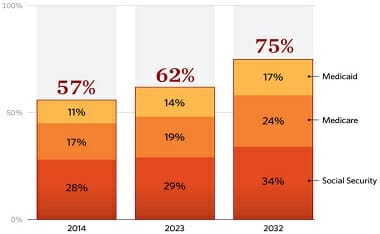
Everyone complains about America’s debt, and rightly so, but how do we get out of it? As Cato’s Michael Tanner explains, spending on entitlement programs — Social Security, Medicare and Medicaid — has exploded in recent decades. We must slow their growth or they will soon swallow the entire federal budget. In five minutes, learn how America can preserve these programs and get out of debt.
(Video Description) “How To Be a Real Skeptic” ~ Mitch Stokes, PhD. Mitch Stokes, professor at New Saint Andrews College, gives a talk on skepticism at Collegiate Reformed Fellowship’s weekly meeting.
Can there be dueling theories for the same observable evidence? Can BOTH be true? In this smaller portion of his larger talk (http://tinyurl.com/jwm3lcd), Dr. Stokes explains with a story of two theories that at the time were equally true.
BTW: This fuller presentation is applicable not only to religious, or origin type debates, but especially to the current flap over global warming, or climate change… or, er… climate disruption. Whatever its called.
Opinions are bountiful, testing one’s opinions in today’s age? Not so much.
I will explain the issues I have with John’s latest article, and as usual, you can click it to enlarge the above. In this latest opinion slurry, John asks questions that I doubt he even has one single book by a leading philosopher/theologian/scientist from either the Intelligent Design camp or creation positions to search for how Christianity answers these questions. For instance, my favorite treatise to introduce people to ideas expressed above in a broad sense, “Unshakable Foundations: Contemporary Answers to Crucial Questions about the Christian Faith.” Or a more in-depth treatise of the same, “I Don’t Have Enough Faith to Be an Atheist.” Or one more specific to his questions, “The Case For A Creator: A Journalist Investigates Scientific Evidence That Points Toward God.” All are readable, and all answer his questions in a way that a mature seeker to these answers would do if seeking to inform one’s own opinion.
One of the queries proffered above is this one: “Of course, that interpretation invites the question, who or what created God.” I wonder if John has actually spent the time finding an answer to this position that has surely passed his lip many times in conversation. I do have a POWER POINT that deals with this in a very layman-like manner. Also, a more in-depth treatise of it as well HERE. But in a short conversation I had with another gentleman, I responded briefly this way — showing that this has been squarely dealt with many hundreds of years ago:
Tim, you asked:
“What created God? Who created the thing that created the thing that created the thing that created God? It’s an infinite regression.”
Again, “What created God.”
You are basically saying that:
“if everything needs a cause, then so does God, in which case he would not be God. And if God does not need a cause, then neither does the world. But if the world needs no cause then there is no God. Hence, whether everything needs a cause or does not need a cause, there is no God.”
Did I sum up the “gist” of the matter? (Who made God, in other words.)
The criticism, “if everything needs a cause, then there must be an infinite regress” is built on a misconception of the principle of causality. Or better, it is a confusion of the principle of existential causality and the principle of sufficient reason. The latter affirms that everything needs a cause.
That it would seem, as atheists observe, leads to a contradiction of God being his own cause.
Aquinas dealt with this long ago. He held that only finite, changing, dependent beings need a cause. This does not lead to a contradictory self-caused being but to a non-contradictory un-caused Being. For if only finite beings need a cause then one arrives at a nonfinite (i.e. infinite) being that does not need a cause. Hence, from Aquinas’ principle of causality the series would legitimately stop at the first, un-caused Cause of all finite beings.
If one is confused in regards to the above: here is a response geared towards 5th grader; and one geared towards adults. John’s article[s] surely exemplify philosopher Mortimer Adler’s point about formulating good questions based on coherent starting point:
Mortimer J. Adler rightly points out that while many Christians are quick in responding to the conclusions in an argument often times the Christian is unaware that the point of departure is not in the conclusion, but in the starting premise, the foundational assumptions.
This “point of departure” is answered two separate times by Christian philosopher Dr. William Lane Craig ~ in less than 2-minutes in each case. I mention the time factor because it seems Mr. Huizum hasn’t even taken 2-minutes to get an answer to his “point of departure”:
WILLIAM LANE CRAIG: Who Made God
John states that searching for answers to his questions in the article is “vital” in “‘knowing’ the truth.” That is fine, and he is right, it is an important question that from the Greeks to us has been a grand Western tradition. But even 1,000’s of years ago the Greeks thought it important enough to debate “how” even to ask the question properly. All that aside however, my last point that needs to be made in one that undermines John’s presuppositions. In John’s closing statement, he says this:
If science is right, there is no need for the existence of a supernatural being, which would in turn terminate all religions on earth and consequently a lot of insane wars.
In a previous installmentI respond to John also writing that “Atheism has been aided by scientific discoveries and rigorous questioning.” In the much longer response I quote two agnostics as saying this;
✪ “The essential element in the astronomical and biblical accounts of Genesis is the same; the chain of events leading to man commenced suddenly and sharply, at a definite moment in time, in a flash of light and energy…. The Hubble Law is one of the great discoveries in science; it is one of the main supports of the scientific story of Genesis.”
~ Robert Jastrow: American astronomer and physicist. Founding director of NASA’s Goddard Institute for Space Studies, he is the director of the Mount Wilson Institute and Hale Solar Laboratory. He is also the author of Red Giants and White Dwarfs (1967) and God and the Astronomers (2nd ed., 2000).
✪ “Certainly there was something that set it all off. Certainly, if you are religious, I can’t think of a better theory of the origin of the universe to match with Genesis.”
~ Robert Wilson: is an American astronomer, 1978 Nobel laureate in physics, who with Arno Allan Penzias discovered in 1964 the cosmic microwave background radiation (CMB)…. While working on a new type of antenna at Bell Labs in Holmdel Township, New Jersey, they found a source of noise in the atmosphere that they could not explain. After removing all potential sources of noise, including pigeon droppings on the antenna, the noise was finally identified as CMB, which served as important corroboration of the Big Bang theory.
So John seems to be making the same misguided statements, maybe based on his misunderstanding of the weight of the logical conclusions found in a “non-God” universe, where truth cannot be known. Or not spending 2-minutes to see where his starting premise may be errant, and so his conclusions even worse. In other words, questions seeking a truthful response or statement of fact are impossible considering Johns epistemology (“the branch of philosophy concerned with questions about knowledge and belief and related issues such as justification and truth”).
To which I end with a call for John to internalize if he can even ask what he has in this column and others and expect to find an answer to his “probing” [sophomoric] questions:
Even Darwin had some misgivings about the reliability of human beliefs. He wrote, “With me the horrid doubt always arises whether the convictions of man’s mind, which has been developed from the mind of lower animals, are of any value or at all trustworthy. Would any one trust in the convictions of a monkey’s mind, if there are any convictions in such a mind?”
Given unguided evolution, “Darwin’s Doubt” is a reasonable one. Even given unguided or blind evolution, it’s difficult to say how probable it is that creatures—even creatures like us—would ever develop true beliefs. In other words, given the blindness of evolution, and that its ultimate “goal” is merely the survival of the organism (or simply the propagation of its genetic code), a good case can be made that atheists find themselves in a situation very similar to Hume’s.
The Nobel Laureate and physicist Eugene Wigner echoed this sentiment: “Certainly it is hard to believe that our reasoning power was brought, by Darwin’s process of natural selection, to the perfection which it seems to possess.” That is, atheists have a reason to doubt whether evolution would result in cognitive faculties that produce mostly true beliefs. And if so, then they have reason to withhold judgment on the reliability of their cognitive faculties. Like before, as in the case of Humean agnostics, this ignorance would, if atheists are consistent, spread to all of their other beliefs, including atheism and evolution. That is, because there’s no telling whether unguided evolution would fashion our cognitive faculties to produce mostly true beliefs, atheists who believe the standard evolutionary story must reserve judgment about whether any of their beliefs produced by these faculties are true. This includes the belief in the evolutionary story. Believing in unguided evolution comes built in with its very own reason not to believe it.
This will be an unwelcome surprise for atheists. To make things worse, this news comes after the heady intellectual satisfaction that Dawkins claims evolution provided for thoughtful unbelievers. The very story that promised to save atheists from Hume’s agnostic predicament has the same depressing ending.
It’s obviously difficult for us to imagine what the world would be like in such a case where we have the beliefs that we do and yet very few of them are true. This is, in part, because we strongly believe that our beliefs are true (presumably not all of them are, since to err is human—if we knew which of our beliefs were false, they would no longer be our beliefs).
Suppose you’re not convinced that we could survive without reliable belief-forming capabilities, without mostly true beliefs. Then, according to Plantinga, you have all the fixins for a nice argument in favor of God’s existence For perhaps you also think that—given evolution plus atheism—the probability is pretty low that we’d have faculties that produced mostly true beliefs. In other words, your view isn’t “who knows?” On the contrary, you think it’s unlikely that blind evolution has the skill set for manufacturing reliable cognitive mechanisms. And perhaps, like most of us, you think that we actually have reliable cognitive faculties and so actually have mostly true beliefs. If so, then you would be reasonable to conclude that atheism is pretty unlikely. Your argument, then, would go something like this: if atheism is true, then it’s unlikely that most of our beliefs are true; but most of our beliefs are true, therefore atheism is probably false.
Notice something else. The atheist naturally thinks that our belief in God is false. That’s just what atheists do. Nevertheless, most human beings have believed in a god of some sort, or at least in a supernatural realm. But suppose, for argument’s sake, that this widespread belief really is false, and that it merely provides survival benefits for humans, a coping mechanism of sorts. If so, then we would have additional evidence—on the atheist’s own terms—that evolution is more interested in useful beliefs than in true ones. Or, alternatively, if evolution really is concerned with true beliefs, then maybe the widespread belief in God would be a kind of “evolutionary” evidence for his existence.
Current liberal dogma that gender is fluid and mutable rather than innate in every cell in our bodies has been very liberating for some. For example, it has freed Fallon Fox to become a highly effective MMA fighter. All he had to do was subject himself to grotesque sexual mutilation and then declare himself to be a woman:
Transgender mixed martial arts (MMA) competitor Fallon Fox is facing new criticisms after breaking the eye socket of his last opponent. …
Fox defeated Tamikka Brents by TKO at 2:17 of the first round of their match. In addition to the damaged orbital bone that required seven staples, Brents received a concussion. In a post-fight interview this week, she told Whoa TV that “I’ve never felt so overpowered ever in my life.”
“I’ve fought a lot of women and have never felt the strength that I felt in a fight as I did that night.”
That’s because men are stronger than women, regardless of what ideology is in fashion.
Fox’s gender controversy is not new. In March 2013, after a 39-second knockout victory, it was revealed that Fox had not told the MMA community about his sex-change operation, which took place in 2006. That bout was the fifth straight first-round victory for the then-37-year old Fox, including his three amateur bouts, and his second victory as a professional fighter.
A video of the Brents fight taken by a ringside fan shows Fox throwing several powerful knees to the face and torso of Brents at the start of the match, who pulled guard to protect herself. Soon, Brents turned her back to avoid damage, where she took approximately 45 seconds of elbow and fist strikes – many blocked by her hands and arms – before the referee stopped the fight.
If you are twisted enough to feel like doing that to a woman, then maybe a sex change operation is the right move for you.
House Republicans and Democrats started Friday morning’s debate over whether to defund last year’s healthcare law, and as part of this debate sparred over whether members should be allowed to call that law “ObamaCare.”
After two House Republicans called it “ObamaCare,” Rep. Debbie Wasserman Schultz (D-Fla.) asked the chairman whether these “disparaging” remarks should be allowed on the House floor.
“That is a disparaging reference to the president of the United States; it is meant as a disparaging reference to the president of the United States, and it is clearly in violation of the House rules against that,” she said.
I’ve found myself referring to the health care reform law in different ways depending on the context or mood of the post I’m writing. Sometimes, it’s appropriate to use the legal name of the bill, but as James Joyner pointed out a couple months ago, that’s as much a product of political propaganda as the term Obamacare is:
Patient Protection and Affordable Care Act is a great example of propagandistic bill naming. What heartless bastard could oppose protecting patients? And who doesn’t want care to be affordable? That the act in question will provide very little in the way of protection and even less to ensure affordability, though, makes it a rather silly name. And PPACA doesn’t exactly roll off the tongue as an acronym or initialism.
ObamaCare, by contrast, is short, memorable, and nonjudgmental. It has a nice parallelism with Medicare, a very popular program with similar goals, and correctly identifies the president who pushed it through Congress. And, even as one who opposed Obama’s election and the passage of this act, the term “ObamaCare” doesn’t conjure up negative imagery.
Indeed. Besides, who could think that “ObamaCare” is disparaging? It’s got “Obama” and “Care” in there….
House Republicans and Democrats started Friday morning’s debate over whether to defund last year’s healthcare law, and as part of this debate sparred over whether members should be allowed to call that law “ObamaCare.”
After two House Republicans called it “ObamaCare,” Rep. Debbie Wasserman Schultz (D-Fla.) asked the chairman whether these “disparaging” remarks should be allowed on the House floor.
“That is a disparaging reference to the president of the United States; it is meant as a disparaging reference to the president of the United States, and it is clearly in violation of the House rules against that,” she said.
Because Wasserman Schultz only asked if it would be appropriate to curb the use of the term “ObamaCare,” the chairman said he would not rule on a hypothetical. But he did urge members to “refrain from engaging in personalities or descriptions about personalities in general.”
The indirect warning had no effect on Republicans. Rep. Denny Rehberg (Mont.), who sponsored the amendment to defund the law, said he refers to it as ObamaCare and said, “You would think he wants his name attached to his signature legislation.
“So we call it what it is,” he continued. “It is ObamaCare. It’s a travesty. It is big government. It is not controlling healthcare costs, and it needs to be repealed and today we’re going to try to defund it to the best of our ability. And if we’re not successful this time, we’re going to try again and again and again until we either have a Senate that’s willing to pass it or a president that understands that we cannot do this to the American people.”
Rep. Steve King (R-Iowa) followed Rehberg, and within minutes also called the law “ObamaCare.”
Dennis Prager reads from another New York Times column about how the Left views nature. How does the Left view nature Papa Giorgio? Through a kaleidoscope of “crazy.”
Dr. Nadine Unger, in her column (http://tinyurl.com/l9ds4ql), basically tells all those kids planting trees that they are murderers.
Well… maybe Miss Unger didn’t, but they did: “At one point, the march [in NY] briefly came to a halt, as demonstrators held a moment silence for what they described as victims of the climate crisis” (http://tinyurl.com/m9jmnk7). I guess elementary student are now on the same level as Pol-Pot, Mao, and Stalin? Following conclusions to their logical end.
President Clinton said that women make .73 cents on every man’s dollar. He used this as a campaign issue to try and smear Republicans. Kerry said that women make .76 cents on every man’s dollar, and likewise used this stat as a political smear. The question then is this, are these two persons correct?
YES! If you compare all men to all women, then yes, there is a disparage. This stat doesn’t take into account a few things. It doesn’t consider the fact that women tend to choose the humanities when entering college and men seem to choose the hard sciences. So by choice women tend to choose professions that pay less. Not only that, when you compare Oranges to Oranges, you get something much different than expected, or that we would expect from the liberal side of things. If a woman and a man have had the same level of education and have been on the same job for an equal amount of time, the woman makes $1,005 while a man makes $1,000, a difference of $5 dollars every thousand dollars a man earns.
So part of the problem — exemplified by this article in the NYT’s by a woman Medical Doctor — is the amount of time put into the career versus a male counterpart:
…But the productivity of the doctors currently practicing is also an important factor. About 30 percent of doctors in the United States are female, and women received 48 percent of the medical degrees awarded in 2010. But their productivity doesn’t match that of men. In a 2006 survey by the American Medical Association and the Association of American Medical Colleges, even full-time female doctors reported working on average 4.5 fewer hours each week and seeing fewer patients than their male colleagues. The American Academy of Pediatrics estimates that 71 percent of female pediatricians take extended leave at some point — five times higher than the percentage for male pediatricians.
This gap is especially problematic because women are more likely to go into primary care fields — where the doctor shortage is most pronounced — than men are. Today 53 percent of family practice residents, 63 percent of pediatric residents and nearly 80 percent of obstetrics and gynecology residents are female. In the low-income areas that lack primary and prenatal care, there are more emergency room visits, more preventable hospitalizations and more patients who die of treatable conditions. Foreign doctors emigrate to the United States to help fill these positions, but this drains their native countries of desperately needed medical care.
If medical training were available in infinite supply, it wouldn’t matter how many doctors worked part time or quit, because there would always be new graduates to fill their spots. But medical schools can only afford to accept a fraction of the students who apply…
Continuing with the medical profession example, the L.A. Times [partly] correctly pointed out that many women look for these lower paying jobs because they allow for greater (family rearing) flexibility:
…The answer, they speculate, is that women are choosing lower-paying jobs on purpose because they offer greater flexibility in hours and are generally more family-friendly. The researchers acknowledge they don’t have the data to prove that this is the case, but the data they do have is consistent with this theory.
If so, they say, that would be a victory for women (and even men.) Studies show that many doctors are burned out and would rather take jobs that allow them to have a good quality of life. Now — thanks in large part to the growing ranks of female doctors — such jobs are available. They just come with lower salaries.
“Instead of being penalized because of their gender, female physicians may be seeking out employment arrangements that compensate them in other — nonfinancial — ways, and more employers may be beginning to offer such arrangements,” the researchers wrote….
…..Thomas Sowell is the most well written on this subject. In fact, in his book, Economic Facts and Fallacies, he devotes a whole chapter to this topic. In one area he points the following out, and keep in mind that in most countries mining or other hard-labor jobs are much more the norm than in America:
…various countries’ economies, there are still particular industries today where considerable physical strength remains a requirement. Women are obviously not as likely to work in such fields as men are— and some of these are fields with jobs that pay more than the national average. While women have been 74 percent of what the U.S. Census Bureau classifies as “clerical and kindred workers,” they have been less than 5 percent of “transport equipment operatives.” In other words, women are far more likely to be sitting behind a desk than to be sitting behind the steering wheel of an eighteen-wheel truck. Women are also less than 4 percent of the workers in “construction, extraction, and maintenance.” They are less than 3 percent of construction workers or loggers, less than 2 percent of roofers or masons and less than one percent of the mechanics and technicians who service heavy vehicles arid mobile equipment.
Such occupational distributions have obvious economic implications, since miners earn nearly double the income of office clerks when both work full-time and year-round 20 There is still a premium paid for workers doing heavy physical work, as well as for hazardous work, which often overlaps work requiring physical strength. While men are 54 percent of the labor force, they are 92 percent of the job-related deaths.
He goes on to point out that this volunteerism of choices continues onto Ph.D.s,
Given the asymmetrical effects of career obsolescence on women and men, it is hardly surprising that women tend to work in fields with lower rates of obsolescence— as teachers and librarians, for example, rather than as computer engineers or tax accountants. Even as the proportion of women receiving Ph.D.s rose dramatically from the 1970s on, male-female differences in the fields of specialization remained large. As of 2005, for example, women received more than 60 percent of the doctorates in education but less than 20 percent of the doctorates in engineering.
He then goes on to point out that do to life choices based on being close to family [kids], and choices made around work and family:
The most important reason why women earn less than men is not that they are paid less for doing the very same work but that they are distributed differently among jobs and have fewer hours and less continuity in the labor force. Among college-educated, never-married individuals with no children who worked fill-time and were from 40 to 64 years old— that is, beyond the child-bearing years— men averaged $40,000 a year in income, while women averaged $47,000.30 But, despite the fact that women in this category earned more than men in the same category, gross income differences in favor of men continue to reflect differences in work patterns between the sexes, so that women and men are not in the same categories to the same extent.
Even women who have graduated from top-level universities like Harvard and Yale have not worked full-time, or worked at all, to the same extent that male graduates of these same institutions have. Among Yale alumni in their forties, “only 56 percent of the women still worked, compared with 90 percent of the men,” according to the New York Times. It was much the same story at Harvard:
A 2001 survey of Harvard Business School graduates found that 31 percent of the women from the classes of 1981, 1985 and 1991 who answered the survey worked only part time or on contract, and another 31 percent did not work at all, levels strikingly similar to the percentages of the Yale students interviewed who predicted they would stay at home or work part time in their 30’s and 40’s.
In fact, as of a few years ago, women make more of the enrollment statistics in college, but will, through life choices, spend less time on the job that they went to school for than their male counterparts. All this brings me full circle to a great article that updates the above via the Wall Street Journal. They point out that much of the emphasis on this are by special interest groups that want to fix the problem — in my mind’s eye — with outdated thinking that no longer fits the evidence. In a recent VIRAL article found at The Atlantic Monthly “Why Women Still Can’t Have It All,” Anne-Marie Slaughter talks about the talent businesses lose due to their inflexibility of allowing women to juggle family and work via a work schedule that doesn’t force an “either-or” schedule on them. BECAUSE when forced into an either-or situation, women choose family. Its in their nature. Here she talks a bit about her column:
Mona Charen, a favorite author of mine, columnist, and part of the Clare Booth Luce Institute (a conservative policy institute for women), comments on Slaughter’s article in her’s, “Grow up: Life Has Trade-offs,” by agreeing with her that women were sold a lie. Both in the prevailing view by the left that counters women’s nature as well as statistical lies:
…Even with a supportive husband who was willing to “take on the lion’s share of parenting … (while) I was in Washington,” she found that she didn’t want to be away from her two teenaged sons, particularly when one was having trouble in school.
“Want” is the critical word here. Slaughter made a choice, as adults do. She writes, “I realized that I didn’t just need to go home. Deep down, I wanted to go home. I wanted to be able to spend time with my children in the last few years that they are likely to live at home, crucial years for their development into responsible, productive, happy, and caring adults.”
Slaughter’s wants mirror those of other women (high-earning and otherwise). A 2007 Pew survey found that among working mothers with children 17 and younger, fully 79 percent said that they would prefer part-time (60 percent) or zero (19 percent) work outside the home. Only 21 percent said they would choose full-time employment while their children were young. This was down from 32 percent who preferred to work full time in 1997.
Despite endless repetition by Democrats and feminists, the idea that women earn less than men for the same work is fiction. Single women without children earn just as much, and sometimes more, than comparably qualified young men. Women earn less (over their whole careers) because they choose to. And they choose to because they place more value on child rearing than on money or status.
A better feminist would applaud women for this and stress the incomparable contribution mothers make to society. Instead, feminists define progress as the “first” woman this or that and the degree to which a woman’s life parallels a man’s. Feminists have been missing what’s best about womanhood for decades…
Tuesday is Equal Pay Day—so dubbed by the National Committee for Pay Equity, which represents feminist groups including the National Organization for Women, Feminist Majority, the National Council of Women’s Organizations and others. The day falls on April 12 because, according to feminist logic, women have to work that far into a calendar year before they earn what men already earned the year before.
In years past, feminist leaders marked the occasion by rallying outside the U.S. Capitol to decry the pernicious wage gap and call for government action to address systematic discrimination against women. This year will be relatively quiet. Perhaps feminists feel awkward protesting a liberal-dominated government—or perhaps they know that the recent economic downturn has exposed as ridiculous their claims that our economy is ruled by a sexist patriarchy.
The unemployment rate is consistently higher among men than among women. The Bureau of Labor Statistics reports that 9.3% of men over the age of 16 are currently out of work. The figure for women is 8.3%. Unemployment fell for both sexes over the past year, but labor force participation (the percentage of working age people employed) also dropped. The participation rate fell more among men (to 70.4% today from 71.4% in March 2010) than women (to 58.3% from 58.8%). That means much of the improvement in unemployment numbers comes from discouraged workers—particularly male ones—giving up their job searches entirely.
Men have been hit harder by this recession because they tend to work in fields like construction, manufacturing and trucking, which are disproportionately affected by bad economic conditions. Women cluster in more insulated occupations, such as teaching, health care and service industries.
Yet if you can accept that the job choices of men and women lead to different unemployment rates, then you shouldn’t be surprised by other differences—like differences in average pay.
Feminist hand-wringing about the wage gap relies on the assumption that the differences in average earnings stem from discrimination. Thus the mantra that women make only 77% of what men earn for equal work. But even a cursory review of the data proves this assumption false.
The Department of Labor’s Time Use survey shows that full-time working women spend an average of 8.01 hours per day on the job, compared to 8.75 hours for full-time working men. One would expect that someone who works 9% more would also earn more. This one fact alone accounts for more than a third of the wage gap.
Choice of occupation also plays an important role in earnings. While feminists suggest that women are coerced into lower-paying job sectors, most women know that something else is often at work. Women gravitate toward jobs with fewer risks, more comfortable conditions, regular hours, more personal fulfillment and greater flexibility. Simply put, many women—not all, but enough to have a big impact on the statistics—are willing to trade higher pay for other desirable job characteristics.
Men, by contrast, often take on jobs that involve physical labor, outdoor work, overnight shifts and dangerous conditions (which is also why men suffer the overwhelming majority of injuries and deaths at the workplace). They put up with these unpleasant factors so that they can earn more.
Recent studies have shown that the wage gap shrinks—or even reverses—when relevant factors are taken into account and comparisons are made between men and women in similar circumstances. In a 2010 study of single, childless urban workers between the ages of 22 and 30, the research firm Reach Advisors found that women earned an average of 8% more than their male counterparts. Given that women are outpacing men in educational attainment, and that our economy is increasingly geared toward knowledge-based jobs, it makes sense that women’s earnings are going up compared to men’s.
In a response to a reader in a previous blogpost on this subject, I pointed out that there are physiological differences between the sexes that are undeniable and that promote women making choices to pause a career and build a home life. Here is my response:
You should know that there is a hard wired difference between men and women, whether by evolutionary means or creative means. A most recent example is what wakes the sexes at night:
Psychologist Dr David Lewis said: ‘There is nothing more likely to leave you feeling drained and depressed than disturbed sleep, especially when this happens over several nights.
A graphic explaining the different sounds which will wake men and women
‘As this unique study shows while some sounds, for instance your partner coughing or snoring beside you, disturb men and women equally, other noises such as a howling wind cause men to be more disturbed than women.
‘Women are more likely to be disturbed by a crying baby.
‘These differing sensitivities may represent evolutionary differences that make women sensitive to sounds associated with a potential threat to their children while men are more finely tuned to disturbances posing a possible threat to the whole family.’
I could call my husband lazy, sexist and insensitive but his failure to hear a crying child while he’s sleeping might not be his fault at all. Researchers have actually found that women are hard-wired to wake up to the sound of a sobbing baby. A 2009 study by the British Mindlab sleeping lab found that a baby’s crying is the number one sound most likely to rouse a woman and didn’t even factor into the male top 10. Men were more likely to wake to the sounds of a car alarm, howling wind, or a buzzing fly.
This difference is what the market responds to. The fact that women typically WANT to be at home with their family MORE than the man… AND, women typically CHOOSE jobs that pay less. But free markets is not what the left is about, egalitarianism is.