Best “Cease And Desist ” Order Ever – Budweiser

Hilarious! This is from THE DAILY CALLER:

Budweiser sent Modist Brewing in Minnesota what might be the coolest cease and desist letter in the history of America.

ESPN’s Darren Rovell tweeted out a video of a man dressed in medieval attire reading off a clever cease and desist letter about Modist Brewing’s new beer, which appears inspired by the famous Bud Light commercials.

“AWESOME: Minnesota craft brewer @ModistBrewing created a ‘Dilly Dilly’ beer, so Bud Light responded by sending a medieval town-crier to respond,” Rovell tweeted Sunday night.

The Left Implodes Over A Weak Tax Plan (UPDATED)

GAY PATRIOT [now, sadly, defunct] comments on the main idea that the Left are a bunch of babies with almost zero understanding of anything economic:

The tax “reform” bill the US Senate passed last night is pretty lame, actually. It keeps the current ridiculous progressive structure of seven separate tax rates. (The House reduced it to four, and the correct number ought to be one.) Susan Collins was bought off by retaining the mortgage interest deduction on vacation homes for millionaires. Freeloaders at the lower income brackets still pay nada. Some high income progressives from blue states are whining because some of their state and local taxes are no longer deductible. Sucks that you progressives in high tax blue states forgot to elect any Republican senators. 

There has also been a lot of howling from the “suddenly we’re concerned about the debt” progressive left that the bill will add $1.5 Trillion to the National Debt over ten years. That figure represents less than 3% of Government expenditures in that time period. Cut Government spending 3% (I’m sure we can get by on 97% of the Government). Problem solved.

It’s a lame bill. Really, the best part of the Senate Bill passing has been watching the histrionic meltdown on the Progressive Left. (But even that gets a little boring considering the progressive left has a histrionic meltdown at literally everything Donald Trump does.)

America died tonight. Economic suicide adopted to feed the insatiable greed of donors, who have been refusing to dole out $ to GOP until they got their tax cuts. Voters fooled by propaganda and tribal hatred. Millenials: move away if you can. USA is over. We killed it. – Kurt “Tentacle Pron” Eichenwald

The Republican Party is the enemy of the American people. The Senate just passed the Trump Tax Increase, 1:50am, enriching the 1% & concentrating wealth in the hands of the few. Capitalism & Fascism. The coup is underway. Make no mistake about it. EVERYONE OFF THE BENCH! 11/6/18! – Michael “I was relevant for a while in 2003” Moore

“While you slept last night Trump’s pedophile-coding GOP broke into your house and raped your children and their future in favor of the Republican’s biggest donors. They groped you too taking your Medicare, social security and Medicaid with them.” – Frank “No I’m Not a Drama Queen at All” Schaeffer

Is there any going back after this #TaxBillScam? To America? Does it matter now if Trump is impeached? There’s no America now. Not the one we knew. Sorry, feeling real despair this morning. – Patton “Who?” Oswalt

Oh, Patti, don’t feel so bad. There are lots of other countries you can move to. Have you considered Mexico? No Republicans there. Strict gun control, too. The Government is very progressive, taxes are very progressive, and economic activated is highly regulated. It’s a lot like California, come to think of it. But with fewer Mexicans……..

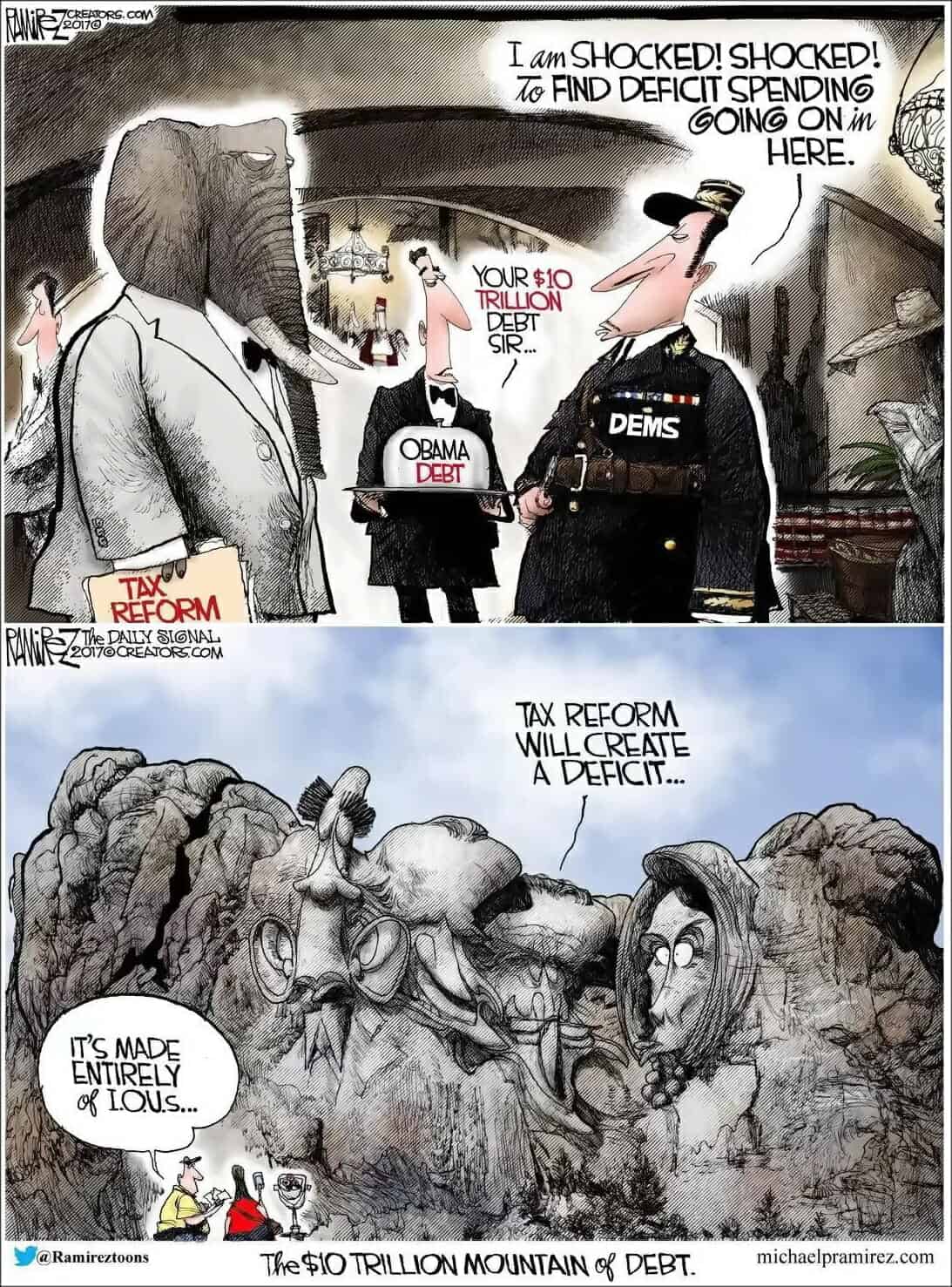
POWERLINE opines well with two RAMIREZ TOONS:

  • It is comical to see Democrats feigning outrage over the claim (likely false) that the GOP tax reform plan will add to the national debt. Talk about a head-snapping about face! Where was the Dems’ concern about debt when the Obama administration ran up $10 trillion of it?

UPDATE FROM GAYPATRIOT

….A remarkable thing happened over the weekend; Democrats rediscovered their concern about the national debt, state’s rights, and voter fraud.

The same Democrats who had no problem helping Barack Obama double the national debt to a mind-blowing $20 Trillion have attacked the Republican Senate’s limpwrist “tax reform” bill claiming it will add $1.5 Trillion to the national debt over ten years.

$1.5 Trillion represents less than 3% of Government spending over the next ten years. If that’s a problem, then, by all means, cut spending by 3%.

Democrats are also  suddenly hollering about “state’s rights” because Congress is looking to make concealed carry licenses valid across state lines; like driver’s licenses. (And, yes, most states require training and a background check before a concealed carry license is issued.) The Democrats have suddenly taken a position analogous to claiming Rosa Parks only had the right to sit in the front of the bus while she was in Alabama…..


Zero Sum Myth

See Also: “Why Capitalism Works“

Capitalism, the exchange of markets did this:

  • Since Deng Xiaoping began instituting market reforms in the late 1970s, China has been among the most rapidly growing economies in the world, regularly exceeding 10 percent GDP growth annually. This growth has led to a substantial increase in real living standards and a marked decline in poverty. Between 1981 and 2008, the proportion of China’s population living on less than $1.25/day is estimated to have fallen from 85% to 13.1%, meaning that roughly 600 million people were taken out of poverty.

Wealth and Wealth Creation IS NOT a zero sum game!

The Zero-Sum Game Myth

There are three kinds of games: win-lose, lose-lose, and win-win. Win-lose games, like basketball, are sometimes called “zero-sum games.” When the Celtics and the Bulls compete, if the Celtics are up, then the Bulls are down, and vice versa. The scales balance. It’s a zero-sum.

Besides lose-lose games, which most of us avoid, there are positive-sum or win-win games. In these games, some players may end up better off than others, but everyone ends up at least the same if not better off than they were at the beginning.

Millions of people think that free trade is a dog-eat-dog competition, where winners always create losers. This is the zero-sum game myth, which leads many to think that the government should somehow redistribute wealth. While some competition is a part of any economy, of course, an exchange that is free on both sides, in which no one is forced or tricked into participating, is a win-win game. When I pay my barber $18 for a haircut, I value the haircut more than the $18. My barber values the $18 more than the time and effort it took her to cut my hair. We’re both better off. Win-win….

Forbes:

…This leads nicely into the third point: wealth is not a zero sum game. This is economist jargon meaning everyone can win. Look again at the chart Gary Burtless put together. You will note that all segments of American society saw their incomes rise except the top one percent. If we had the data to do the chart again through 2014, we would see that everybody had higher incomes than fifteen years ago.

And this win-win idea is not just in terms of income. In a capitalist society, people get rich by making somebody else better off. J. K. Rowling became one of the richest women in the world by writing the Harry Potter series of books. All the people who bought the books believed that the books were worth more than the sale price otherwise they would not have bought it. Thus, J.K. Rowling wins and all her readers win. Both sides of a voluntary transaction are made better off. As long as government coercion is not involved, when you see someone getting rich, you know a lot of people are being made happy….

HIV-Positive School Aide Sexually Assaulted 42 Kids…

…National Media Silent!

CNS-NEWS discusses the almost blackout status of this via an influential media source… television:

  • FoxNews.com, CNN.com (CNN Wire), CBSNews.com, NBCWashington.com, and WashingtonPost.com posted stories online about the case, as did some other local and state media. To date, however, no national news network — ABC, CBS, NBC — has covered the story in its evening or morning broadcasts, based on a search of the Nexis news database.

GAY PATRIOT notes “THIS WOULD HAVE BEEN NATIONAL NEWS IF HE WERE A ROMAN CATHOLIC PRIEST.”

All of Bell’s victims reportedly were boys. 

Previous to the excerpt above, CNS-NEWS noted some other aspects of this abuse:

….As the summer progressed and police uncovered more evidence, the criminal counts rose. As of late October, Bell was charged with 206 counts. These include 22 counts of sexual abuse of a minor, 19 counts of second-degree sex offense, 7 counts of third-degree sex offense, and 97 counts of child pornography.

Bell allegedly victimized 42 juveniles, forcing them to engage in sexual acts and filming them during these acts. The victims were between the ages of 11 and 17 and the crimes occurred between May 2015 and June 2017. Twenty-eight of those kids have been identified but 14 have not been identified. Some of the crimes occurred in Bell’s home but many of them took place on school premises, according to the local media that have reported on the case, WTOP and WJLA (ABC 7)…. 

In other news, a well-known Republican was convicted of (he pleaded guilty to essentially) sexually abusing 4-boys:

(CNN) Former House Speaker Dennis Hastert sexually abused at least four boys when he coached wrestling at a high school in Illinois decades ago, federal prosecutors said.

In documents released Friday, prosecutors detailed stunning allegations against Hastert, the longest-running Republican speaker of the House….

….Accuser allegedly paid off… Massages, sex acts alleged…

Today’s Sensitivity Training Lesson: LGGBDTTTIQQAAPP

(SNOPES says the above is mostly true, BTW)

Gather ’round children! The Canadian Elementary Teachers Federation of Ontario has some super interesting new information for you! First, we’re going to learn a new acronym. Can you say, “LGGBDTTTIQQAAPP?” Let’s try it to the tune of “Old MacDonald!” Everyone sing along! Next, we’ll learn what these letters mean. Are you ready?

L — Lesbian (everyone knows what this is, right?)
G — Gay (and I’m sure I don’t need to explain this to you smarties!)
G — Genderqueer Now this one is new. So let’s make sure we all understand what this means. “Genderqueer; denoting or relating to a person who does not subscribe to conventional gender distinctions but identifies with neither, both, or a combination of male and female genders.” That’s easy, isn’t it, kids? Basically, this is a person who has no idea who or what xey are, okay?
B — Bisexual (That’s self-explanatory, isn’t it?)
D — Demisexual Oh boy! Another new one! Let’s get out the ever-expanding queer dictionary to figure it out! “A demisexual is a person who does not experience sexual attraction unless they form a strong emotional connection with someone.” This used to be known as monogamous love. But now we throw the word “sexual” on it to make it attractive to the kids. Got it?
T — Transgender (You all know all about this one! These are boys or girls who dress up like the opposite sex and want everyone to pretend not to notice!)
T — Transexual (You are familiar with these people too! Same as above, only they’ve gone through irreversible surgery to remove healthy body parts because feelings. Let them in your bathroom. Everything is fine.)
T — Two-Spirit Oh my goodness! How exciting! It’s another category no one on earth has ever heard of! This one is complicated, dear ones. For sure you have to be a Native American. And smoking a lot of peyotes could only help to understand what the heck a two-spirit is. It appears to be a third gender not yet discovered by science and only found in the Native American community by gender studies majors who take adventure vacations and hang out in sweat lodges.
I — Intersex (This is that very rare condition that we used to call hermaphrodite, where a child is born with both sex organs of male and female. It is very rare, as in, hardly ever happens. It is a birth defect.)

We are just motoring through all these new terms and if you need a snack to recharge, choose something high protein! We are going to need those brains functioning at peak capacity for this one!

Q — Queer Just when you thought you couldn’t use the word “queer” because it’s an insult, think again! It’s back! Queer is an umbrella term designed to describe all people who aren’t normies. I think. It’s hard to tell. These things do change on an almost daily basis.
Q — Questioning is a term used for people who are still deciding where they are going to fall on this list. It seems contradictory to the “born that way” theory—to have a bunch of people still questioning their sexuality—but the LGBTQWTF brigade says it’s fine, so rest assured, there’s nothing to question about questioning.
A — Asexual people have no interest in sex. This also used to be known as people who are married with kids. See the classic TV show “Married with Children” for an example.
A — Allies are people who virtue signal constantly on Twitter about supporting their LGBTQWTF friends and family. These people aren’t gay, queer, or even questioning! They’re simply shielding themselves from the gaystappo squads who come around looking for people who aren’t properly broadcasting their approval of the queer agenda. Be an ally, children… if you know what’s good for you!
P — Pansexual is just a more confusing way to say bisexual. There really is no difference, only we pretend there is so we can use a word that reminds us of Greek mythology and it sounds more interesting than bisexual, which is so last decade.
P — Polyamorous people are basically leftover hippies who miss communes. Or hardcore Mormons. Either way, they are people who like to have more than one partner, sometimes at the same time.

Now that we’ve finished our lesson for today, children, it’s time for questions! What’s that? Why are there no furries on the list?

AAAARRRRGHHHH!!! The discrimination is rampant! Get the markers! Add a letter! Print new flyers!

(PJ MEDIA)

Make It A #BlackXmas

Michael Medved interviews Dr. Melina Abdullah, a professor at California State University-Los Angeles (CSU-LA) who is also a national Black Lives Matter (BLM) leader. Her racism is very apparent in this interview. She is a converted Muslim, is a Marxist, and really, an anti-American.

THE DAILY WIRE has more:

….Abdullah, who descends from a family of Marxist organizers, made the comments on her weekly KPFK radio show called “Beautiful Struggle,” which features songs like “5 Million Ways to Kill a CEO” as bumper music. She was joined by Dr. Anthony Ratcliff, also a professor at CSU-LA, who organized BLM’s first youth activist camp last summer.

“Black Lives Matter and other organizations build a strong critique and understanding of racism and white supremacy and sexism and homophobia, transphobia, but we have to have as much hatred or vitriol against capitalism,” Ratcliff said. “Until we start to see capitalism just as nefarious as white supremacy, we will always be struggling.”

BLM launched a Black Xmas website on Saturday which calls for “no spending with White corporations” through New Year’s Day, encouraging supporters to donate to allied, black-led community groups or black-owned businesses instead…..


UPDATED w/2-COMMENTS


Two comments from my LIVELEAK I thought worth sharing:

I am white just for the record.

I agree with a lot she said.

Blacks should invest in their own neighborhoods.

I’ve always found it strange that the local 7/11 is run by an Asian in most black neighborhoods.

Her condemnation of Wal-Mart is a little under informed.

From district managers, store managers, assistant managers department managers people of color are very common.

Some guy waving around a realistic looking pellet gun got shot.

You don’t blame the gun you blame the man with the gun.

If you walk into a New York trading company and don’t see a lot of black faces that’s discrimination.

If you walk into an NFL locker room and don’t see a lot of white faces that’s talent.

Double standard double standard double standard.

The black community needs leadership, encouragement, and talent.

It doesn’t need blame the white guy. If they’d get over that I can get on with it.

Here is a “here-here” of sorts:

Well said. It’s not like there aren’t examples from the past…Harlem at its height was not a ghetto, and Greenwood in Tulsa Oklahoma was known as “Wallstreet” before whites burned it down in 1921. It was the wealthiest black community in the US. I’m sure black multimillionaire sport stars and celebrities give tons to colleges and universities for black scholarships, but I never hear of them giving money to start up grocery stores or pharmacies or 7/11’s in black communities.

Code-Talkers Honored… Sorta? (LOL)

This segment had me cracking up in traffic this morning

The Trump administration is clueless about this Democrat apparently. Jackson was the author of the trail-of-tears, he broke every treaty with the American Indians, etc., etc. (read D’Souza’s book, “The secret history of the Democratic Party“)

Hillary and Obama Embolden Modern Slavery In Libya

John and Ken discuss Hillary Clinton’s and Barack Obama’s actions in Libya creating modern day slave bazaars. Obviously what happened in the vacuum was Islam was just given space to apply the Quran. Take note that the five nations in this article are Muslim: “Top 5 African Countries Where Slavery Is Still Uncontrolled.”

✦ CNN – video: Migrants being sold as slaves in Libya
✦ African migrants seeking Europe sold as ‘slaves’ for $200

Slavery and the Bible – Dennis Prager

On the Ultimate Issues Hour, Dennis Prager speaks about his upcoming book to be published and the topic of “Slavery and the Bible.” Previously I uploaded a shorter dealing with this topic, here: “Prager Deals with Three Misconceptions Obama & Liberals Have of the Bible“

Steven Crowder and Ben Shapiro Discuss “Net Neutrality”

WIRED MAGAZINE had a great article back in 2015… here are three of the many points it makes:

….”That Won’t Work”

Will the new order affect the woman’s ability to Skype with her son in Turkey? No. Will it affect her broadband bill? Yes.

Unfortunately, regulating net neutrality under Title II will almost certainly raise your broadband bill. A range of state and local fees apply only to common-carrier telecommunications services—which is what the FCC just made your broadband internet service.

Wheeler’s approach creates a host of other problems. Most important, it allows the FCC to regulate not just your (hated) broadband provider, but also your favorite internet services.

You were sold a bill of goods when activists told you net neutrality was all about protecting “the next Facebook” from evil ISPs. Think about it: If you’re “the next Facebook,” who do you think is more worried about you? Your ISP, or Facebook itself? If the problem is between Facebook and its potential challengers, hamstringing ISPs is an awfully roundabout way of dealing with it. Especially because we already have a regulatory apparatus to deal with issues related to competition: antitrust laws.

But consider this irony: Now that ISPs are regulated under Title II as common carriers, the Federal Trade Commission can’t enforce its consumer protection laws against them anymore.

That doesn’t mean there won’t be antitrust enforcement, but we did just hobble our most significant and experienced consumer protection authority. That seems like a mistake if we’re enacting rules that purport to protect consumers.

“To Solve a Problem That Doesn’t Exist”

One would think that after a decade of debate there would be a strong economic case for net neutrality. But there isn’t. According to Commissioner O’Rielly—one of the few people who’s actually read the order—“[t]here is not a shred of evidence [in the order] that any aspect of this structure is necessary.” The record leading up to last week’s vote contained evidence of only five instances in the history of the internet where ISPs may have thwarted content providers’ access to end-users, none of which required heavy-handed net neutrality rules to address.

The world in which internet innovators have to ask permission to operate is imaginary. Or it was, until Wheeler regulated it into existence.

The new catch-all provision may well apply to internet companies that now think they’re not subject to the rules. Title II (which, recall, is the basis for the catch-all) applies to all “telecommunications services”—not just ISPs. Now, every time an internet service might be deemed to transmit a communication (think WhatsApp, Snapchat, Twitter…), it either has to take its chances or ask the FCC in advance to advise it on its likely regulatory treatment.

That’s right—this new regime, which credits itself with preserving “permissionless innovation,” just put a bullet in its head. It puts innovators on notice, and ensures that the FCC has the authority (if it holds up in court) to enforce its vague rule against whatever it finds objectionable.

And no matter how many times this Chairman tells you that for now the rules won’t apply to internet service X, he can’t guarantee that they won’t next year (or next month). And he certainly can’t make that guarantee for the FCC’s next chairman.

One of life’s unfortunate certainties, as predictable as death and taxes, is this: regulators regulate. It would be crazy to think the FCC adopted these rules and will just to let them lie fallow if tomorrow’s internet boogeyman is a non-ISP company.

Even staunch net neutrality supporters like EFF worry about the breadth of the FCC’s new “general conduct” standard. Couple that with language that invites complaints and class action lawsuits, and suddenly a regulation claimed to ensure “just and reasonable” conduct becomes a rent-seeking free-for-all.

But surely ISPs have it in for Netflix, right? Actually, Comcast is the only ISP (out of the literally thousands that are now regulated under Title II) that competes with Netflix. And the evidence shows that the problems allegedly arising from that competition were caused by Netflix, not Comcast. Did we really just enact 300 pages of legally questionable, enormously costly, transformative rules just to help Netflix in a trivial commercial spat?

“Using Legal Authority the FCC Doesn’t Have”

For last week’s “victory” to stand, the FCC must win in court on all (or nearly all) of a host of difficult legal questions.

Most obviously, the rules will be challenged as “arbitrary and capricious” under Supreme Court precedent that makes clear that agencies may not adopt rules that “run[] counter to the evidence before the agency,” or are simply implausible.

Last year, the Supreme Court took the EPA to task for “tailoring” provisions from the Environmental Protection Act to rewrite an outdated statute. The FCC’s effort to do the same thing with Title II will likely fall prey to the same result……

Read the five more critiques of Net Neutrality at THE DAILY WIRE:

1. The instances of ISPs slowing down or blocking data to favor certain sites over others are few and far between. Ian Tuttle notes at National Review that when the FCC first attempted net neutrality regulations in 2010, they were only able to “cite just four examples of anticompetitive behavior, all relatively minor.” Cell phone networks, which are not subject to net neutrality-esque regulations, don’t engage in such anticompetitive behavior.

There’s a reason for this: such behavior doesn’t cut it in a free market. As Ben Shapiro wrote in 2014, “Consumers would dump those ISPs in favor of others” if those ISPs slowed down or blocked data as favoritism toward certain sites.

“Competition ensures that companies do not have the leverage to discriminate against particular websites,” Shapiro added.

There has never been an urgent need for net neutrality regulations.

[…..]

6. It’s crony capitalism in favor of web giants like Facebook and Google. That’s why they support net neutrality, since it targets their competitors.

Slavery and the Bible ~ A Response by J. Warner Wallace

Updated Nov 28, 2017 (Originally posted June 20, 2014)

D. Instructions for slaves (6:1–2). Paul gives instructions to Christian slaves in the situation in which they find themselves. He does not defend the institution (see 1 Cor. 7:21; Philem. 15–17) but gives general principles and specific instructions for living in that situation as Christians. Full respect, good service, and a proper attitude should be given to masters. Even slavery does not invalidate Paul’s principles concerning work. Poor work and a poor attitude will give cause for non-Christians to speak evil of God and the teachings of Christianity. Some Christian slaves apparently concluded that because they and their masters were brothers (spiritually equal and in the same “family”) that therefore they could act in a familiar and disrespectful way. Paul argues that Christian slaves should give even better service since they serve believers whom they love.

George W. III Knight, “1-2 Timothy/Titus,” in Evangelical Commentary on the Bible, vol. 3, Baker Reference Library (Grand Rapids, MI: Baker Book House, 1995), 1108.

(More commentaries at the end)

Previously I attributed this audio to Jonathan Morrow. A viewer corrected me that this was J. Warner Wallace. I will include, still, the previous links to Jonathan’s works below, as they are still great resources to indulge in.

(From video description)

This was an audio I mistakenly attributed to Jonathan Morrow, but in fact (thanks to a compatriot) this is J. Warner Wallace:

★ http://coldcasechristianity.com/
★ http://pleaseconvinceme.com/
★ http://www.str.org/

Detective Wallace rightly places over the matrix of the question the time-stamp in which the text was written, and the context it was written, and whom the text was written for… assuming these persons culture and surroundings and their practices. Not a 21st century understanding of slavery and the American experience.

Jonathan Morrow is the founder of Think Christianly. He is the author of:

Jonathan also contributed several articles to the Apologetics Study Bible for Students. He graduated with an M.Div. and an M.A. in philosophy of religion and ethics from Talbot School of Theology where he is pursuing a D.Min in engaging mind and culture.

Here is Dennis Prager also responding to the issue in his “patented” way (take note that the last audio below is a full show of Prager dealing with slavery):

DENNY BURK has a great article that gets to the point, seven points exactly… I will post a clip of two of the body of his thinking:

2. The Bible Often Condemns the Means by Which Slaves Were Taken as Slaves.

In the first century, slavery wasn’t race-based like it was in the American South. People were taken as slaves through a number of means: warfare, piracy, highway robbery, infant exposure, and punishment of criminals. In all of this, there was always prevalent the issue of kidnapping people in order to enslave them. What does the Bible say about kidnapping?

In 1 Timothy 1:10, the apostle Paul says that kidnapping or man-stealing is against God’s law. Most interpreters recognize that this man-stealing was for the purpose of slavery. That is why the ESV has it as “enslavers” and the NIV as “slave traders.”Certainly, the background for Paul’s command is the Old Testament law:

Exodus 21:16 “Whoever steals a man and sells him, and anyone found in possession of him, shall be put to death” (ESV).

Who is to be put to death? The one who takes the man and the one who holds him. This is significant because some people have made the case that while the Bible does condemn slave-trading it does not condemn slave-holding (e.g., Douglas Wilson, Black and Tan, 56). If this view were correct, there would not necessarily have been any moral problem with Christians owning slaves in the American South during and before the Civil War.

But Exodus 21:16 says that both the kidnapping and the enslavement are punishable by death. And this is the background for Paul’s own thinking about the matter in 1 Timothy. The entire system of Southern slavery was based on kidnapping people from Africa. The slave-traders stuffed these Africans into ship holds where they suffered and died by the thousands. That slave-trade was an abomination. And it is fallacious to suggest that the slave-holders are not morally implicated in the slave-trade. You cannot defend those who participated in the slave trade, nor can you defend those slave owners who created the market for man-stealing.

So the Bible definitely condemns the means by which slaves were taken as slaves—especially kidnapping, which was punishable by death.

3. The New Testament forbids Christians from coercive violence against slaves.

Ephesians 6:9 “Masters, do the same to them, and stop your threatening, knowing that he who is both their Master and yours is in heaven, and that there is no partiality with him.”

Yes, there were Christian slave owners in the New Testament. But no, they were not allowed to threaten their slaves with violence. And obviously, if they weren’t allowed to threaten with violence, they weren’t allowed to actually do violence against their slaves. It may have been allowable under Roman law for a master to abuse or even kill his slave. But it was not allowable under God’s law to do such things. You might call that slavery in some sense, but what kind of slavery is it that doesn’t allow the master to coerce his slave through violence? It’s certainly not Roman slavery. It’s certainly not like slavery in the American South. This is something so different one wonders if you can call it slavery at all.

4. The New Testament commands Christians to treat slaves like brothers.

When Paul wrote to the slave-owner Philemon about his run-away slave Onesimus, Paul told Philemon to receive Onesimus “no longer as a slave, but more than a slave, a beloved brother… If then you regard me a partner, accept him as you would me” (Phlm 16-17).

What kind of slavery is it that tells a master to give up threatening and to treat his slaves like his brother? Again, it’s not Roman slavery. It’s nothing like slavery in the American South. So the Bible isn’t endorsing either one of those. This is something else entirely. And that is why slavery cannot continue where the Kingdom of God holds sway. The Bible completely undermines all the defining features of slavery: kidnapping, coercive violence, treating people like property rather like brothers created in the image of God.

[….]

7. The Bible condemns racism.

As I mentioned earlier, slavery in the New Testament was not race-based. But slavery in the American South was. The Bible forbids treating someone else as less than human because of their race. God created man in his own image—all men—not just white ones or black ones or red ones or yellow ones. Because of that, every person—not just some people—every person has inherent dignity and worth as image-bearers of almighty God. For this reason, the diversity of races is not an evil to be abolished but a glory to be celebrated. God intends to gather worshipers for Himself from every “tribe and tongue and people and nation” (Rev 5:9). And we know that in Christ “there is no distinction between Greek and Jew, circumcised and uncircumcised, barbarian, Scythian, slave and freeman, but Christ is all, and in all” (Col 3:11).

So no, the Bible does not endorse slavery nor the evils inherent in slavery. On the contrary, it abolishes them in the name of Jesus. The gospel of Jesus Christ does not command us to take up arms in violent revolution to abolish slavery. It does, however, introduce a new kingdom in the world that will one day overthrow all unjust authorities. And we are called as the church to be an outpost of that coming kingdom. And wherever the church goes, slavery must flee because the Kingdom of Christ will not abide unjust authorities.

When the critics assail scripture, they often make confident assertions about things they know very little about (1 Tim. 1:7). In this case, when they rail against the Bible’s alleged endorsement of slavery, they are misrepresenting what the Bible actually teaches. Every word of God is pure and good and wise and right and good for us–including what it says to us about those under the yoke.

“Your word is very pure,
Therefore Your servant loves it.” –Psalm 119:140

Likewise, a great article by APOLOGETIC PRESS notes the following…

TAKING PAUL’S TEACHING TO ITS LOGICAL CONCLUSION

Over time, with the spread of Christianity (cf. Acts 19:10,26; 21:20) and with increasing numbers of slave masters becoming Christians, the physical lives of many slaves would have improved dramatically. As slave owners with honest and good hearts learned (1) to love the Lord with all their heart, soul, mind, and strength, and (2) to love their neighbors (including their slaves) as themselves (Matthew 22:36-40), they would give up “threatening” (Ephesians 6:9). As Christian slave owners contemplated treating others how they want to be treated (Matthew 7:12), they would give their slaves “what is just and fair,” knowing that they, too, had a Master in heaven (Colossians 4:1). As slave owners submitted to Christ, they would be transformed by the Gospel, learning to be “kindly affectionate” to everyone (Romans 12:2,10), including all those who served them. In short, far from endorsing sinful slavery, Paul’s teachings, taken to their logical conclusion, would eventually lead truth-seeking masters and government officials to help bring an end to any kind of cruel, sinful captivity.

For an extensive and in-depth writing on this, see Kyle Butt’s article, “Defending the Bible’s Position on Slavery,” originally in Reason & Revelation, 25[6]:41-47.

On the Ultimate Issues Hour, Dennis Prager speaks about his upcoming book to be published and the topic of “Slavery and the Bible.”


COMMENTARIES


Slaves in the Church 6:1–2a

Slaves comprised a third group of persons in the household of God who needed instruction. In the Roman world a small percentage of people were very rich. Persons serving in the Roman Senate and the equestrians made up the privileged classes of people and numbered less than 1 percent of the population (Bell: 187). Most persons were patrons or clients. Patrons provided for the well-being of clients by providing jobs, food, shelter, and so forth. In some wealthy households, even some of the slaves had clients, who hoped that they would influence their owner to secure favors for them (Bell: 192). Slavery was not limited to poor persons in Roman society, nor was it based on race. Roman law did not formally recognize slave marriages. Slaves were considered property. David A. de Silva suggests that fully 25 percent of the Roman population were slaves (de Silva: 141), while another writer thinks that slaves may have constituted a majority in society (Collins: 152).

Persons became slaves if their country was conquered by another country. Criminals, persons who defaulted on their debts, and those born into slave families were all considered slaves in the first century. Some slaves served in high levels of administration, while others worked in domestic and fieldwork. Though Aristotle defined a slave as a “living tool” (Nicomachean Ethics 8.11; de Silva: 142), Stoics and Christians recognized the humanness of slaves (Bell: 194).

Paul’s instructions on slaves connect to those regarding widows and elders in the church through the use of the term honor. In the Pauline mission, slaves became Christians and participated in the household of God. A Christian slave owner could go to the worship service in his household and see his slave(s) in the gathering. The slave may even be leading worship. On the one hand, Christian slaves needed instruction on how to conduct themselves in a social and cultural context with its own expectations about what slaves could or could not do. On the other hand, the church understood that freedom in Christ meant that the slave was a brother or sister in the congregation (Gal 3:28). Therefore the church had to learn how to live out its life of freedom and faithfulness to Christ in the midst of a culture that generally treated slaves poorly. The church could withdraw from society, or it could simply accommodate itself to society, both of which would destroy its life and mission.

Paul instructs Christian slaves about how they should live in two kinds of settings within the larger culture. First, he instructs slaves who have non-Christian masters (6:1). Second, he instructs slaves who have Christian masters (6:2). With both, Paul is concerned about the mission of the church (6:1b, 2b; Titus 2:10b) [Contextualizing the Gospel, p. 339]. As with widows (1 Tim 5:7, 14–15) and elders (5:20), the behavior of Christian slaves has a direct effect upon the mission of the church (6:1b). Paul’s teaching on slaves here in 1 Timothy 6:1–2 is similar to other NT household codes (Eph 6:5–9; Col 3:22–4:1; 1 Pet 2:18–25), with two major exceptions. First, in 1 Timothy, Christian masters are not told how to treat slaves (Verner: 140–41). And second, a major distinction is made between the way slaves treat non-Christian masters and Christian masters. This distinction is significant because the religion of the master of the household often determined the religion of the whole household, including the slaves.

Let all who are under the yoke of slavery regard their masters as worthy of all honor (6:1a). The phrase under the yoke of slavery refers to Christians who live under the power and rule of a master. It is the normal phrase used for being under a tyrant, or in slavery, and calls attention to its burdensome character (I. H. Marshall 1999: 629). The exhortation to attribute honor to a non-Christian master indicates that Christian slaves who have found freedom in Christ likely want to be free of their masters. If slaves show disrespect and even rebel against their masters, their attitude becomes diametrically opposed to the social practice of the day. To prevent major conflict within that social and cultural context, slaves are exhorted to show respect to their masters. Disrespect to masters will bring disrepute upon the church and clash with the commonly accepted cultural practice.

Respect toward non-Christian masters is emphasized with a purpose clause: so that the name of God and the teaching may not be blasphemed (6:1b). Respect and honor may lead some masters to Christ. In words reminiscent of Romans 12:21, “Do not be overcome by evil, but overcome evil with good,” Paul exhorts Christian slaves to align their attitude toward masters with the mission of the church. Paul considers the success of the gospel to hold more importance than the immediate abolition of slavery in Roman society, for if the gospel reaches many in Roman society, slavery itself will eventually be abolished. A similar statement in Titus 2:10 says that slaves are to live in submission to their masters so that in everything they may be an ornament to the doctrine of God our Savior. Lack of submission can bring the Christian message into disrepute, while submission to non-Christian masters enhances it (Bassler 1996: 104). Since God desires that everyone be saved (1 Tim 2:4), Paul apparently thinks it best not to be too disruptive of Roman society or to bring slander upon the church. Instead, Paul believes the mission of the church should lead the way. As more citizens became Christians, the institution of slavery may be eliminated. The church at Ephesus cannot afford a reputation that denies Christian teaching and blasphemes the name of God.

Next, Paul addresses slaves who have Christian masters (6:2). The Christian slave and the Christian master are brothers (NIV) and sisters in Christ. Does this mean that the master-slave relationship should also change? Paul says that those who have believing masters must not be disrespectful to them (6:2a). The term be disrespectful means to hold or show contempt toward another. Some Christian slaves think that since both master and slave are fellow members in the church family, they no longer need to be subordinate to their masters (Verner: 143). The Christian gospel was a radical leveler in Greco-Roman society, and communities of faith were hard-pressed to negotiate the implications of the gospel in terms of social roles. The fact that a slaveholder was a Christian could not become an excuse for the slave to take advantage of the master’s religion to further one’s own cause. On the contrary, the slave should offer willing service all the more, since servanthood brings a benefit. Paul argues from the lesser to the greater by saying the slave must serve them all the more. Even the master who is a Christian is still the master, and the slave is still the slave. Moreover, the service of an obedient slave results in a benefit. The word benefit means good deed, benefit, service, or benefit of service. Knight indicates that this term was used in the first century to describe the actions of one in authority who was a benefactor toward one under him (Knight 1992: 247). Thus a Christian slave’s willing service for a Christian master bestows good on the master. The master in response returns that good to the slave by providing a good living for the slave.

Paul has deliberately picked up the language of honor and shame common in the ancient world (1 Tim 6:1–2) [Honor and Shame, p. 354]. But he reverses it. In the ancient world only masters could be benefactors. Masters as benefactors are worthy of honor (Johnson 2001: 290). But here Paul places the slave in the position of being the benefactor! A slave’s service represents a position of strength and brings honor not only to the master, but also to the name of God and the Christian teaching. By slaves treating the master as beloved, both master and slaves can be brothers and sisters together in Christ and enjoy life together in the church. Both master and slaves exercise what it means to serve a higher authority (i.e., Christ) and become slaves of Christ. This Christian attitude greatly enhanced the Christian mission within Roman society with its cultural and social stratification, while also giving the church freedom to live as Christians.

Paul M. Zehr, 1 & 2 Timothy, Titus, Believers Church Bible Commentary (Scottdale, PA; Waterloo, ON: Herald Press, 2010), 119–122.

6:1–2. Slavery was widespread in the pre-Christian era. By the time of Christ, treatment of slaves had greatly improved.

Romans freed slaves in great numbers in the first century, not only for humanitarian reasons, but also because the freeborn citizenship was declining and thus there were fewer to serve in the military. Only a freed slave could serve in the military.

The church of Ephesus over which Timothy was ministering had slaves and masters as members. Paul wouldn’t give these instructions otherwise.

The expression under the yoke may suggest that slavery in that day was a difficult situation in which many owners viewed their slaves as little more than cattle.

Paul doesn’t instruct bondservants (slaves) to seek to escape. Rather, he tells them to count their own masters worthy of all honor. They were to do this whether the master was worthy of such honor or not.

The reason was so that the name of God and His doctrine may not be blasphemed. God’s name and His doctrine are put in a bad light when slaves fail serve wholeheartedly. Wholehearted service, however, exalts God’s name and His doctrine.

It’s easy to see how Christian slaves who have believing masters might despise their masters because they are brethren. They might expect preferential treatment, or even outright release (see Philemon).

Yet slaves were not to have such a narrow world view. This life is all about pleasing God (cf. Eph 6:5–9; Col 3:22–4:1; and 1 Pet 2:18–21).

Robert N. Wilkin, “The First Epistle of Paul the Apostle to Timothy,” in The Grace New Testament Commentary, ed. Robert N. Wilkin (Denton, TX: Grace Evangelical Society, 2010), 985.

6:1, 2 The Ephesian believers may have been struggling to maintain a biblical work ethic in the world of slavery, so these verses form Paul’s instruction on that subject. Essentially, first century slaves resembled the indentured servants of the American colonial period. In many cases, slaves were better off than day-laborers, since much of their food, clothing, and shelter was provided. The system of slavery served as the economic structure in the Roman world, and the master-slave relationship closely parallels the twentieth-century employer-employee relationship. For more on slaves, see Introduction to Philemon: Background and Setting.

6:1 under the yoke. A colloquial expression describing submissive service under another’s authority, not necessarily describing an abusive relationship (cf. Mt 11:28–30). slaves. They are people who are in submission to another. It carries no negative connotation and is often positive when used in connection with the Lord serving the Father (Php 2:7), and believers serving God (1Pe 2:16), the Lord (Ro 1:1; Gal 1:10; 2Ti 2:24; Jas 1:1), non-Christians (1Co 9:19), and other believers (Gal 5:13). masters. The Gr. word for “master,” while giving us the Eng. word “despot,” does not carry a negative connotation. Instead, it refers to one with absolute and unrestricted authority. all honor. This translates into diligent and faithful labor for one’s employer. See notes on Eph 6:5–9; Col 3:22–25. our doctrine. The revelation of God summed up in the gospel. How believers act while under the authority of another affects how people view the message of salvation Christians proclaim (see notes on Tit 2:5–14). Displaying a proper attitude of submission and respect, and performing quality work, help make the gospel message believable (Mt 5:48).

6:2 believers as their masters. The tendency might be to assume one’s equality in Christ with a Christian master, and disdain the authority related to work roles. On the contrary, working for a Christian should produce more loyal and diligent service out of love for the brethren. preach. Lit. “to call to one’s side.” The particular emphasis here is on a strong urging, directing, and insisting on following the principles for correct behavior in the workplace.

John F. MacArthur Jr., The MacArthur Study Bible: New American Standard Bible. (Nashville, TN: Thomas Nelson Publishers, 2006), 1 Ti 5:25–6:2.

D. Bondservants and Masters (6:1, 2)

6:1 The conduct of slaves is now brought before us. They are spoken of as bondservants who are under the yoke, that is, the yoke of slavery. The apostle, first of all, speaks to slaves who have unsaved masters. Should slaves in such a case act insolently toward their masters? Should they rebel or run away? Should they do as little work as possible? On the contrary, they should count their own masters worthy of all honor. This means that they should give them due respect, work obediently and faithfully, and in general seek to be a help rather than a hindrance. The great motive for such diligent service is that the testimony for Christ is involved. If a Christian slave were to act rudely or rebelliously, then the master would blaspheme the name of God and the Christian faith. He would conclude that believers were a worthless lot.

The history of the early church reveals that Christian slaves generally commanded a higher price on the slave market than unbelievers. If a master knew that a certain slave on the auction block was a Christian, he would generally be willing to pay more for that slave, since he knew that the slave would serve him faithfully and well. This is high tribute to the Christian faith.

This verse reminds us that no matter how low a person’s position may be on the social scale, yet he has every opportunity for witnessing for Christ and bringing glory to His name.

It has often been pointed out that the institution of slavery is not openly condemned in the NT. However, as the teachings of Christianity have spread, the abuses of slavery have been abolished.

Every true believer should realize that he is a bondslave of Jesus Christ. He has been bought with a price; he no longer belongs to himself. Jesus Christ owns him—spirit, soul, and body, and deserves the very best he has.

6:2 This verse deals with slaves who have believing masters. Doubtless there would be a very great temptation for such slaves to despise their masters. It is not at all unlikely that when the local church met together on Lord’s Day evening for the breaking of bread (Acts 20:7), there would be Christian masters and Christian slaves seated around the table—all brethren in Christ Jesus. But the slaves were not, on this account, to think that the social distinctions of life were thereby abolished. Just because a master was a Christian did not mean that the slave did not owe him honor and service. The fact that the master was both a believer and a beloved brother should influence the slave to serve him faithfully.

Christian masters are here spoken of not only as faithful (believers) and beloved, but also as those who are benefited. This is generally taken to mean that they, too, are sharers in the blessing of salvation. However, the words might also be understood to mean that since both slaves and masters are interested in doing good, they should serve together, each trying to help the other.

The words teach and exhort these things doubtless refer to the preceding instructions to Christian slaves. The present-day application would be, of course, to the employer-employee relationship.

William MacDonald, Believer’s Bible Commentary: Old and New Testaments, ed. Arthur Farstad (Nashville: Thomas Nelson, 1995), 2098–2099.

D. Concerning Slaves And Masters (6:1–2).

6:1. Under normal circumstances slaves and masters had no associations outside the institution of slavery. With the advent of the gospel, however, these two groups found themselves thrown together in the congregation in new ways, creating problems the apostles were forced to address repeatedly (cf. 1 Cor. 7:20–24; Gal. 3:28; Eph. 6:5–9; Col. 3:22–25; Phile.; 1 Peter 2:13–25). Paul’s instructions here correspond entirely with what is taught elsewhere in the New Testament on the subject, with one major exception: in this passage he addresses only slaves. Usually his exhortations to submit to authority were immediately buttressed by warning masters against abusing their authority (cf. Eph. 6:5–9; Col. 3:22–4:1).

The matter of the uses and abuses of authority is first and foremost a problem of attitude. Thus Paul wrote repeatedly of how slaves and masters should see themselves and one another. Here he wrote that slaves are to view their masters as worthy of full respect (timēs, “honor”). The same word is used of God in 1 Timothy 1:17 and 6:16, and of elders in 5:17. Such honor or respect should be granted lest God’s reputation and the Christian faith (hē didaskalia, “the teaching”; cf. 1:10; 4:1, 6, 13, 16; 5:17) be slandered (lit., “be blasphemed”). Social goals should always be subordinate to spiritual values.

6:2. Paul’s thought here is totally foreign to the world, and can be fully appreciated only by those who view their lives through the eyes of Jesus Christ (cf. Mark 10:42–45). Christian slaves whose masters are also believers should redouble rather than reduce their service. This should stem purely from the realization that the one who is receiving the benefits is a beloved brother or sister in Christ. The attitude undergirding this instruction is complete nonsense to anyone who does not understand the Lord Jesus, but it is the genius of Christlikeness and the ultimate source of all meaning and joy in life to those who have eyes to see (cf. John 13:4–17; 15:9–14). Thus Timothy was commanded once again to teach and urge … these things on the congregation (cf. 1 Tim. 4:6, 11; 5:7).

A. Duane Litfin, “1 Timothy,” in The Bible Knowledge Commentary: An Exposition of the Scriptures, ed. J. F. Walvoord and R. B. Zuck, vol. 2 (Wheaton, IL: Victor Books, 1985), 745.

Witness In The Workplace (6:1–2)

Paul is not endorsing slavery in these verses. Rather, he is addressing a reality that existed at that time. Slavery was common in the Roman Empire and many of the people who became Christians would have been slaves.

What were they to do now that they were free in Christ? They were to act in a way that would bring glory to Christ ‘so that God’s name and our teaching may not be slandered’ (v. 1, NIV). They would do so by showing respect to their masters. It seems that some slaves in Christian households had become disrespectful to their masters and this had resulted in a bad witness. So Paul corrects it by telling Timothy to teach them to work even harder ‘because those who benefit from their service are believers, and dear to them’ (v. 2, NIV).

These principles apply to the workplace in the modern world. Christians should make sure that they are not ‘too heavenly minded to be of any earthly use’. We may have had the opportunity to tell our colleagues and employers the good news, but if we are lazy and unreliable, we will undermine the message we have communicated. We must also be careful not to take advantage of a Christian boss and expect favouritism from him or her. Instead, we should work even harder than we would for someone who is not a believer. This will be a great encouragement to that boss and help his or her own witness in the workplace.

Simon J. Robinson, Opening up 1 Timothy, Opening Up Commentary (Leominster: Day One Publications, 2004), 94–95.