Author: Papa Giorgio


Trey Gowdy Grills Jonathan Gruber ~ Truth 1/Gruber 0
“The pervasiveness of your quotes is so much that it has to be more than that. It has to be more than an episodic mistake that you made,” Gowdy grilled. He went on, “What did you mean when you said you wish that you had been able to be transparent, but you’d rather have the law than not?”
“Arson And Looting Are ‘Not Violence'” ~ Melissa Harris-Perry
American Thinker has this commentary on the above:
Obviously, Professor Harris-Perry has never known anyone who has poured his or her life into starting and keeping open a business, such as a beauty supply store or cell phone outlet. The endless hours and sacrifice of family life necessary to make a business work through thick and thin constitute the very essence of a person’s life, and the loss of a business to arsonists and looters constitute an attack on that person’s life. When he or she loses the business, part of that person’s life is lost, too.
But how would she know that? She would have had to talk to such people and listened sympathetically to their stories. She would have had to understand that meeting a payroll when sales are down, or shoplifters have overwhelmed the retail margin, means sacrificing other important things, selling off precious possessions so that employees can be paid, or working a second job on the graveyard shift to put food on the table when the business is failing.
I would wager a substantial amount of money that Harris-Perry considers herself a caring and compassionate woman. But progressives have a way of dehumanizing people with whom they disagree, and regarding people who actually seek to create and maintain a business as exploiters, and therefore subhuman.
She is Al Sharpton with a PhD.
How bout when a cop-hating liberal progressive honky is punched in the face for trying to protect property? Via Gateway Pundit:
Democrats Heavily Partisan Report Gets Keelhauled By CIA

(ABC) Six former Directors and Deputy Directors of the CIA fired back at the Senate Intelligence Committee with a vehemence almost never seen in the intelligence world.
The former CIA leaders — including George Tenet, Porter Goss and Michael Hayden — blasted the Senate report as “one-sided and marred with errors” and called it “a poorly done and partisan attack on the agency that has done the most to protect America after the 9/11 attacks.”
Their 2,500-word rebuttal was posted as an op-ed on the Wall Street Journal website once the report was released. The former intel chiefs are also launching their own website to respond to the attacks on CIA’s post-9/11 activities.
Via CIA Saves Lives website:
….We, as former senior officers of the Central Intelligence Agency, created this website to present documents that conclusively demonstrate that the program was: authorized by the President, overseen by the National Security Council, and deemed legal by the Attorney General of the United States on multiple occasions. None of those officials were interviewed either. None. CIA relied on their policy and legal judgments. We deceived no one. You will not find this truth in the Majority Report.
Absent from the report is any discussion of the context the United States faced after 9/11. This was a time we had solid evidence that al Qaida was planning a second wave of attacks against the U.S.; we had certain knowledge that bin Laden had met with Pakistani nuclear scientists and wanted nuclear weapons; we had reports that nuclear weapons were being smuggled into New York City; and we had hard evidence that al Qaida was trying to manufacture anthrax. It felt like a “ticking time bomb” every single day.
In this atmosphere, time was of the essence. We had a deep responsibility to do everything within the law to stop another attack. We clearly understood that, even with legal and policy approvals, our decisions would be questioned years later. But we also understood that we would be morally culpable for the deaths of fellow citizens if we failed to gain information that could stop the next attacks.
The report defies credulity by saying that the interrogation program did not produce any intelligence value. In fact, the program led to the capture of senior al Qaida leaders, including helping to find Usama bin Ladin, and resulted in operations that led to the disruption of terrorist plots that saved thousands of American and allied lives…
This from the Wall Street Journal in regards to that last emphasized sentence:
…First, its claim that the CIA’s interrogation program was ineffective in producing intelligence that helped us disrupt, capture, or kill terrorists is just not accurate. The program was invaluable in three critical ways:
• It led to the capture of senior al Qaeda operatives, thereby removing them from the battlefield.
• It led to the disruption of terrorist plots and prevented mass casualty attacks, saving American and Allied lives.
• It added enormously to what we knew about al Qaeda as an organization and therefore informed our approaches on how best to attack, thwart and degrade it.
A powerful example of the interrogation program’s importance is the information obtained from Abu Zubaydah, a senior al Qaeda operative, and from Khalid Sheikh Muhammed, known as KSM, the 9/11 mastermind. We are convinced that both would not have talked absent the interrogation program.
Information provided by Zubaydah through the interrogation program led to the capture in 2002 of KSM associate and post-9/11 plotter Ramzi Bin al-Shibh. Information from both Zubaydah and al-Shibh led us to KSM. KSM then led us to Riduan Isamuddin, aka Hambali, East Asia’s chief al Qaeda ally and the perpetrator of the 2002 Bali bombing in Indonesia—in which more than 200 people perished.
The removal of these senior al Qaeda operatives saved thousands of lives because it ended their plotting. KSM, alone, was working on multiple plots when he was captured.
Here’s an example of how the interrogation program actually worked to disrupt terrorist plotting. Without revealing to KSM that Hambali had been captured, we asked him who might take over in the event that Hambali was no longer around. KSM pointed to Hambali’s brother Rusman Gunawan. We then found Gunawan, and information from him resulted in the takedown of a 17-member Southeast Asian cell that Gunawan had recruited for a “second wave,” 9/11-style attack on the U.S. West Coast, in all likelihood using aircraft again to attack buildings. Had that attack occurred, the nightmare of 9/11 would have been repeated.
Once they had become compliant due to the interrogation program, both Abu Zubaydah and KSM turned out to be invaluable sources on the al Qaeda organization. We went back to them multiple times to gain insight into the group. More than one quarter of the nearly 1,700 footnotes in the highly regarded 9/11 Commission Report in 2004 and a significant share of the intelligence in the 2007 National Intelligence Estimate on al Qaeda came from detainees in the program, in particular Zubaydah and KSM….

Some Statistics About Race and Police Shootings (Will Update w/New Info)
These have been some stats going around as of late… but there were some unanswered issues in my mind dealing with them. First, read these stats via TruthRevolt, and then we will continue with my issues:
…O’Reilly slammed Dyson’s claim and laid out data refuting the volatile assertion:
- Police killings of blacks down 70% in last 50 years
- In 2012, 123 blacks were killed by police with a gun
- In 2012, 326 whites were killed with a gun
(Center on Juvenile and Criminal Justice, CDC)
- In 2013, blacks committed 5,375 murders
- In 2013, whites committed 4,396 murders
- Whites are 63% of the population blacks are 13%
(FBI, Census Bureau)
O’Reilly took these statistics to mean that “anyone thinking clearly can see that the homicide rate among blacks is way out of proportion.” O’Reilly asserted that the disparity of homicide rates explained the “police intrusion into black precincts.”…
Take note as well that police killings of blacks are down 70% in last 50 years. A worthy statistic indeed.
Here are my questions, and they have to do with the 123 stat. That is a total, and how many of that 2012 stat is “unarmed” suspects, and who were SHOT, some were tazed. I have found 18-unarmed suspects being killed, but some of those are while being tazed ~ for instance: Raymond Luther Allen was arrested 20 times by the Galveston police and once by DPS between 1994 and 2010 on charges that included unlawfully carrying a weapon, assault, evading arrest and drug possession. He died two days after being tazed in order to be handcuffed while resisting arrest. I have been trying to find his toxicology results to no avail.
Some of these 18 in one year were killed by non-police officers~ for instance: Dante Price was shot by security guards, not police. So this answers some of my following questions:
- How many black officers shot and killed black suspects;
- How many of these were unarmed;
- How many officers were killed by unarmed suspects;
- How many of these by their own gun;
- How many “unarmed” suspects total have been killed.
The NAACP has a list of 76 unarmed black men and women who have been killed since 1999-2014. Of which my 18-came from in the above discussion. Breitbart has this stat regarding the death of officers by unarmed suspects, and keep in mind Michael “the Gentle Giant” Brown had already wrestled for the gun in Officer Wilson’s patrol car — a shot even being fired during the felony struggle:
The recurrent expression of outrage by critics and the mainstream media about the use of deadly force by police officers against unarmed individuals fails to recognize that since 2000 at least 57 suspects have taken officers’ weapons and murdered the police officer with it.
[….]
While statistics for officers murdered with their own weapons are difficult to research, we know from the Los Angeles Police Protection League, the FBI and www.odmp.org that between 2000-10, at least 51 officers were killed by alleged perpetrators who used the officer’s own gun. Four officers were killed in 2011, one officer was killed in 2013. Moreover, so far in 2014, it has been confirmed that Johnson City (New York) Police Officer David Smith was murdered in March with his own weapon. Smith had served in the police department for over 18 years.
In Smith’s case, according to the Officers Down Memorial Page report, before he was able to exit his patrol car or radio for help, the alleged assailant was able to disarm Officer Smith and shoot him while he was still in the patrol car….
Another stat that I believed spanned the 2010-to-2012 year period is this:
- Black officers account for a little more than 10 percent of all fatal police shootings. Of those they kill, though, 78 percent were black.
- White officers, given their great numbers in so many of the country’s police departments, are well represented in all categories of police killings. White officers killed 91 percent of the whites who died at the hands of police. And they were responsible for 68 percent of the people of color killed.
About fifty black folks are struck by lightning each year. The next question from the Left would be, “is God racist?”

This Day Choose Life (*GRAPHIC* Not Intended For All Audiences)
Cecile Richards, Planned Parenthood Director, said she knows of no one surviving an abortion:
…UM…
Death Follows Liberalism
“I think we have deluded ourselves into believing that people don’t know that abortion is killing. So any pretense that abortion is not killing is a signal of our ambivalence, a signal that we cannot say yes, it kills a [baby].”
~ Faye Wattleton, former president of U.S. Planned Parenthood
Below are some GRAPHIC images and videos. Near the bottom is a filmed partial-birth abortion. To be clear, this needs to be seen, but if you are not the person to handle this, then this is not the post for you
Life Follows God
“…that I have set before you life and death, blessing and curse. Choose life so that… your children may live”
~ Deuteronomy 30:19
The first part of this post is an import from my old blog and is a post about a conversation with a young gal in and area we called the “pit,” the specialty cheese, wine, and meat section of my old employer — Whole Foods. What took place was a glowing example of many years of work by the left-leaning establishment that is often called “higher education,” which has turned out a zombie of non-thought who would rather use the seven words in Dennis Prager’s article. Like, “what about the mentally ill or deformed kids in the womb, shouldn’t the woman have the choice to abort them?” Even at my friends site you will often here a horror story about a child not having health-care and then the label, “[you] Bush doesn’t care about the children.” These are non-statements. There is no critical thinking involved.
When talking about abortion, for instance in our “pit,” I hear some position stated and then I merely respond, “that’s fine, but that doesn’t deal with whether the ‘fetus’ is a life or not.” Then I hear some grand tail about a women’s choice, and I respond, “that’s great, but that doesn’t deal with the issue of whether the ‘fetus’ is a life or not.” That is the question. Then the “you’ll never know what it is like” line comes out, referring to me being a man, ergo, I cannot have as valid an input on the matter, to which I responded/respond with examples of people who do have the personal capability to respond. Like Norma McCorvey, who was “Jane Roe” in Roe v. Wade (1973), she wrote a book that is pictured here (as well as a DVD).
I brought up Gianna Jessen, who was herself a survivor of an abortion, her story (and book) are very compelling, and often, when young university minds are being steeped in feminist philosophies, rarely is there ever time taken to study or reflect on the other side of the issue, as I was told after I asked a this question, “so at 24-years old you have looked at both sides of the issue and all the evidence and arguments and have concluded that you are right and there is no evidence left to compel you,” the response was “yep!”
A great 40-minute video can be found here. This presentation is rational, well thought out, and rarely responded to by the Left. Another personage that I typically bring up is Bernard Nathanson, who,
…as a younger man, he had been strongly pro-choice, and he performed an abortion on a woman who had become pregnant by him. He later gained national attention by then becoming one of the founding members of the National Association for the Repeal of Abortion Laws, now known as NARAL Pro-Choice America. He worked with Betty Friedan and others for the legalization of abortion in the United States. Their efforts essentially succeeded with the Roe v Wade decision. He was also for a time the director of the Center for Reproductive and Sexual Health (CRASH), New York’s largest abortion clinic. Nathanson has written that he was responsible for over 75,000 abortions throughout his pro-choice career.
He likewise wrote a book. Is he someone who would have some valuable input on the matter? Of course, his sex has nothing to do with it… unless you’re sexist. Dr. Nathanson is best known for his “Silent Scream” video (it is very dated), where a baby is shown being aborted via ultrasound images. What the video details is as the abortion procedure gets under way, the baby starts to literally scream, except there is no air to carry the cries of agony and pain. The entire video is linked above, but I will show the poignant part here. CAUTION, this video to the right is GRAPHIC as well, as it is ending a perfectly viable life… unless you are pro-choice, then this is just like any other operation — like removing your appendix, or tonsils.
I doubt the person in conversation with me has done much in the way of reading and contemplating this issue much beyond what she deems to be liberating feminist theory rebuffing the patriarchy. People who are protecting their emotional belief very rarely go out and pick up a book like Defending Life: A Moral and Legal Case Against Abortion Choice, by Francis Beckwith. Which is too bad.
(The above Facebook video is via THE FEDERALIST)
I mentioned Kathy Ireland and her appearance on Bill Maher’s show, Politically Incorrect, where she responded to a question (from a discussion a few years back):
Kathy Ireland, many years ago, was on Bill Mahers Politically Incorrect and the discussion that ensued shows the frailty of the liberal/relativistic position:
Bill Maher: Kathy, why do you oppose a women’s right to choose
Kathy Ireland: Bill, when my husband was going to medical school I underwent a transformation. Because I used to be in favor of abortion. But I noticed when I was reading through some of his medical teaching books, that according to a law in science known as the law of biogenesis, every living thing reproduces after it own kind. That means dog produce dogs, cats produce cats, humans produce humans. If we want to know what something is we simply ask what are its parents. If we know what the parents are, we know what the thing in question is. And I reasoned from that because human parents can only produce human offspring, unborn human fetuses could be nothing but human beings, because the law of biogenesis rules out every other alternative. And I concluded therefore that because human fetuses were part of our family, we should not harm them without justification.
Bill Maher: Well Kathy, that’s just your opinion!
In October 2002, Kathy Ireland made a compelling argument against abortion on the Fox News Channel’s Hannity and Colmes political debate show. Alan Colmes described Ireland’s opinions as religious, but Ireland said that her views on abortion do not stem from faith. She asserted that even atheists could realize that abortion is wrong. Kathy told Alan that her belief is founded in science and technology, which she says, “has come a long way since Roe vs. Wade.”
Ireland also defended her values as being pro-women, stating, “We need to support these women who are in crisis pregnancy situations.” She claimed that because scientific evidence proves that abortion is murder, “I have no choice but to defend the most vulnerable among us.”
Here I will again link to Dennis Prager’s article that bears on this whole discussion and hashing it out rationally and responsibly instead of using invectives to rebuff some perceived sexism or racism or some other label.
A lot of progressive liberals do not know what they mandate as legal often times, in our day and age many have to see video to know what Obama fought against banning and Clinton legalized as one of his first actions as President. One woman saw the video without realizing what she saw (this GRAPHIC video will be at the end) and describes her emotions.

1997: Obama opposed bill preventing partial-birth abortion
In 1997, Obama voted in the Illinois Senate against SB 230, a bill designed to prevent partial-birth abortions. In the US Senate, Obama has consistently voted to expand embryonic stem cell research. He has voted against requiring minors who get out-of-state abortions to notify their parents. The National Abortion Rights Action League (NARAL) gives Obama a 100% score on his pro-choice voting record in the Senate for 2005, 2006, and 2007.
Obama opposed legislation protecting born-alive failed abortions
Obama has consistently refused to support legislation that would define an infant who survives a late-term induced-labor abortion as a human being with the right to live. He insists that no restriction must ever be placed on the right of a mother to decide to abort her child.
On March 30, 2001, Obama was the only Illinois senator who rose to speak against a bill that would have protected babies who survived late term labor-induced abortion. Obama rose to object that if the bill passed, and a nine-month-old fetus survived a late-term labor-induced abortion was deemed to be a person who had a right to live, then the law would “forbid abortions to take place.” Obama further explained the equal protection clause of the Fourteenth Amendment does not allow somebody to kill a child, so if the law deemed a child who survived a late-term labor-induced abortion had a right to live, “then this would be an anti-abortion statute.”
…Within the next year and half, the claims above were bluntly discredited by abortion providers:
- Ronald Fitzsimmons, the executive director of the National Coalition of Abortion Providers, told the New York Times and American Medical News that he “lied through [his] teeth” when he appeared on Nightline because he was afraid that the truth would erode public support for abortion. Disowning his previous statements, he stated that partial-birth abortions are “primarily done on healthy women and healthy fetuses….”
- Two doctors at a New Jersey abortion clinic spoke with a North Jersey newspaper under condition of anonymity. Both independently stated that their clinic was performing roughly 1,500 partial-birth abortions per year, most of which are elective and not for medical reasons….
Again, here is the video… if you cannot handle a GRAPHIC MEDICAL PROCEDURE ending a HUMAN’s life that most Democrats want to legalize, then do not watch what it means to be a part of the PARTY OF DEATH! The first video is merely a presentation of the procedure in a medical class, the second is the procedure in real life.
The reader may want to familiarize themselves with Planned Parenthood and their founder, Margaret Sanger.
Fox News Sunday Interviews Rush Limbaugh
This is Limbaugh’s most important point, and it deals with the idea that “the bigger the government the smaller the individual is.”
New York Mayor Bill De Blasio vs. Reality!
My Take Eric Garner
What you don’t see in the Eric Garner video of his arrest:
Black female Sgt. was in charge of the arrest. She could have told the men taking him down to taze him (which still could have given him a heart-attack, BTW ~ that’s what killed him, a heart-attack).
They originally asked him to move down the street — away from the business that sells cigarettes lawfully. (And yes, I think the exorbitant taxes on cigarettes in NY is ridiculous… if you think it is too — QUIT VOTING DEMOCRAT!).
[In other words, Mr. Garner wouldn’t have been there in the first place if fiscal conservatives were voted into office there. He might have been in jail — and not home for Christmas — for a 32nd criminal code violation on his already 31 priors and resisting arrest, record.]
The video we are all familiar with is the very end of the incident… it doesn’t show the previous 13-M i N u T e S.
Do you see why the grand-jury maybe decided not to indite? They have 25 (I think) grand jury members on a grand jury in NY and need only 12 of them to say “yes” to indictment. They couldn’t get even twelve. This will all be public soon, but I wonder if ANY wanted to indite?
(Out of all Mr. Garner’s bad choices, one can see that his worst choice has most likely put him in a place worse than that choke hold. Sad. #UnrepentantLife)
Via Jason Riley (Wall Street Journal):

We now know that Michael Brown was much more of a menace than a martyr, but that won’t stop liberals from pushing an anti-police narrative that harms the black poor in the name of helping them.
The black teen in Ferguson, Mo., robbed a store, attacked a white police officer and was shot dead while resisting arrest. That was the conclusion of a St. Louis County grand jury that brought no charges against the officer after considering all the physical evidence, along with eyewitness accounts from blacks in the vicinity of the confrontation.
Not that any amount of evidence would have stopped the hooligans in Ferguson Monday night who were determined use Brown’s death as a pretext for more bad behavior. Nor will evidence thwart liberals who are bent on making excuses for black criminality and pretending that police shootings are responsible for America’s high black body count.
According to the FBI, homicide is the leading cause of death among young black men, who are 10 times more likely than their white counterparts to be murdered. And while you’d never know it watching MSNBC, the police are not to blame. Blacks are just 13% of the population but responsible for a majority of all murders in the U.S., and more than 90% of black murder victims are killed by other blacks. Liberals like to point out that most whites are killed by other whites, too. That’s true but beside the point given that the white crime rate is so much lower than the black rate.
Blacks commit violent crimes at 7 to 10 times the rate that whites do. The fact that their victims tend to be of the same race suggests that young black men in the ghetto live in danger of being shot by each other, not cops. Nor is this a function of “over-policing” certain neighborhoods to juice black arrest rates. Research has long shown that the rate at which blacks are arrested is nearly identical to the rate at which crime victims identify blacks as their assailants. The police are in these communities because that’s where the emergency calls originate, and they spend much of their time trying to stop residents of the same race from harming one another.
Former New York Mayor Rudy Giuliani pointed this out recently on “Meet the Press” in a debate with sociologist Michael Eric Dyson. “What about the poor black child that is killed by another black child? Why aren’t you protesting that?” Mr. Giuliani asked.
“Those people go to jail,” Mr. Dyson responded. “I do protest it. I’m a minister. They go to jail.”
Mr. Dyson might want to try protesting a little harder. Chicago had 507 murders in 2012, only 26% of which were solved. “To put it another way: About three-quarters of the people who killed someone in Chicago in 2012 have gotten away with murder—so far, at least,” Chicago Magazine noted. Mr. Dyson and others on the left are not oblivious to this black pathology, but they are at pains even to acknowledge it, let alone make it a focus. Instead, liberals spend their time spotlighting white racism, real or imagined, and touting it as an all-purpose explanation for bad black outcomes.
Ferguson helps further that agenda in ways that Chicago does not. Hence, the left posits that the Michael Brown shooting is the norm, even though the data show that it’s the exception. And if black criminal behavior is a response to white racism, how is it that black crime rates were lower in the 1940s and 1950s, when black poverty was higher, racial discrimination was rampant and legal, and the country was more than a half-century away from twice electing a black president?
Racial profiling and tensions between the police and poor black communities are real problems, but these are effects rather than causes, and they can’t be addressed without also addressing the extraordinarily high rates of black criminal behavior—yet such discussion remains taboo. Blacks who bring it up are sell-outs. Whites who mention it are racists. (Mr. Dyson accused Mr. Giuliani of “white supremacy.”) But so long as young black men are responsible for an outsize portion of violent crime, they will be viewed suspiciously by law enforcement and fellow citizens of all races….

INGLORIOUS AMBASSADORS ~ Jon Stewart

“Hands Up, Don’t Shoot” ~ Founding A Movement on Lies


Some Good Commentary By Good Black Men — Role Models
Also, see Zo’s commentary: The Mike Brown Outrage Is About As Genuine as a Stolen Hair Extension
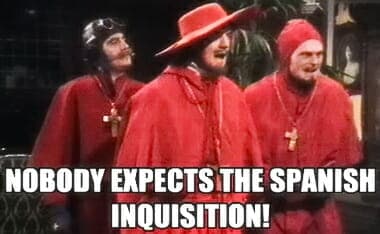
The Spanish Inquisition Was Bad, and Yes, Mostly Secular
This post is to just get on record some numbers about the Spanish Inquisition. A good summary is this one via Strange Notions, take note of the last bullet point:
• The Inquisition was originally welcomed to bring order to Europe because states saw an attack on the state’s faith as an attack on the state as well.
• The Inquisition technically had jurisdiction only over those professing to be Christians.
• The courts of the Inquisition were extremely fair compared to their secular counterparts at the time.
• The Inquisition was responsible for less than 100 witch-hunt deaths, and was the first judicial body to denounce the trials in Europe.
• Though torture was commonly used in all the courts of Europe at the time, the Inquisition used torture very infrequently.
• During the 350 years of the Spanish Inquisition, between 3,000-5,000* people were sentenced to death (about 1 per month).
• The Church executed no one.
[….]
In recent years, however, the Vatican opened up its secret archives for historical investigation. Inquisition records that were made by and for the Inquisition were allowed to be researched for the first time in history. Since then, the above facts have been generally discoverable in modern history books (whether Catholic or not). Corrected Inquisition history can be found in sources such as Inquisition by Edward Peters and The Spanish Inquisition: An Historical Revision by Henry Kamen. Comparative secular documentaries include The Myth of the Spanish Inquisition (BBC) and the more sensationalistic The Spanish Inquisition (History Channel).
(*See Kamen death totals below.)
Okay, the Catholic Church didn’t suppress science from Galileo, they didn’t kill him either, he died of old age. And in 350 years of the Spanish Inquisition, they killed about 3,000-to-5,000 people people due to it. here is this better understood history used in a debate between atheist
The above will play into another aspect of this story as well… that is, this was largely a secular movement. Continuing. The years in which the Inquisition was extremely active was between 1480 and 1530. Henry Kamen estimates about 2,000 executed, based on the documentation of the autos-da-fé, the great majority being conversos of Jewish origin. He offers striking statistics: 91.6% of those judged in Valencia between 1484 and 1530 and 99.3% of those judged in Barcelona between 1484 and 1505 were of Jewish origin. (WIKI, and Kamen’s book).
Here is Kamen’s commentary on the death toll:
In Castile the incidence of executions was probably higher. In the auto de fe at Ciudad Real on 23 February 1484, thirty people were burnt alive and forty in effigy; in the auto at Valladolid on 5 January 1492, thirty-two were burnt alive. The executions were, however, sporadic and concentrated only in the early years. In rounded terms, it is likely that over three-quarters of all those who perished under the Inquisition in the three centuries of its existence, did so in the first half-century. Lack of documentation, however, makes it impossible to arrive at totally reliable figures. One good estimate, based on documentation of the autos de fe, is that 250 people were burnt in person in the Toledo tribunal between 1485 and 1501 . Since this tribunal and that of Seville and Jaen were among the few in Castile to have had an intense level of activity, it would not be improbable to suggest a figure five times higher, around one thousand persons, as a rough total for those executed in the tribunals of Castile in the early period. Taking into account all the tribunals of Spain up to about 1530, it is unlikely that more than two thousand people were executed for heresy by the Inquisition.
Henry Kamen, The Spanish Inquisition: A Historical Revision (London, England: Yale University Press, 1997), 59-60.
Dennis Prager Comments on “Religious Violence” Via Prager’s “Masters Program.” (DAILY WIRE)
This is KEY!
Using Kamen’s numbers, about 6[-] people were killed a year by the Spanish Inquisition over its 350-year long stretch. If you use the high numbers, you get about 14[+] people killed a year. Below is Dinesh D’Souza referencing this information in a debate with an atheist
Secularism More Dangerous!
The Bible does not teach the horrible practices that some have committed in its name. It is true that it’s possible that religion can produce evil, and generally when we look closer at the details it produces evil because the individual people [Christians] are actually living in rejection of the tenets of Christianity and a rejection of the God that they are supposed to be following. So it [religion] can produce evil, but the historical fact is that outright rejection of God and institutionalizing of atheism (non-religious practices) actually does produce evil on incredible levels. We’re talking about tens of millions of people as a result of the rejection of God. For example: the Inquisitions, Crusades, Salem Witch Trials killed about anywhere from 40,000 to 80,000 persons combined (World Book Encyclopedia and Encyclopedia Americana), and the church is liable for the unjustified murder of about (taking the high number here) 300,000-women over about a 300 year period. A blight on Christianity? Certainly. Something wrong? Dismally wrong. A tragedy? Of course. Millions and millions of people killed? No. The numbers are tragic, but pale in comparison to the statistics of what non-religious criminals have committed); the Chinese regime of Mao Tse Tung, 60 million [+] dead (1945-1965), Stalin and Khrushchev, 66 million dead (USSR 1917-1959), Khmer Rouge (Cambodia 1975-1979) and Pol Pot, one-third of the populations dead, etc, etc. The difference here is that these non-God movements are merely living out their worldview, the struggle for power, survival of the fittest and all that, no evolutionary/naturalistic natural law is being violated in other words (as non-theists reduce everything to natural law — materialism). However, and this is key, when people have misused the Christian religion for personal gain, they are in direct violation to what Christ taught, as well as Natural Law.
A condensing of Gregory Koukl’s, “The Real Murderers: Atheism or Christianity?”
A recent comprehensive compilation of the history of human warfare, Encyclopedia of Wars by Charles Phillips and Alan Axelrod documents 1763 wars, of which 123 have been classified to involve a religious conflict. So, what atheists have considered to be ‘most’ really amounts to less than 7% of all wars. It is interesting to note that 66 of these wars (more than 50%) involved Islam, which did not even exist as a religion for the first 3,000 years of recorded human warfare. [That means that 2.6% of all wars fought are split up between Christianity, Buddhism, Hinduism, and the like.]
Even the Seven Years’ War, widely recognized to be “religious” in motivation, noting that the warring factions were not necessarily split along confessional lines as much as along secular interests. And the Thirty Years’ War cannot be viewed as “religious” either…read more
Dennis Prager makes a point that one of the common traits with the mass shooters is that they are never regular church goers. They are more likely to be secular… not taking into account the Judeo-Christian concept of God and the ethics that follow such a belief.
Not only that, the inquisition was largely secular. Ahhh, too bad history has a way of proving pop-theories of history and peoples use of misconception to tarnish the church when it was mainly secular authorities that did these horrible acts.wrong:
“The Inquisition had a secular character, although the crime was heresy. Inquisitors did not have to be clerics, but they did have to be lawyers. The investigation was rule-based and carefully kept in check. And most significantly, historians have declared fraudulent a supposed Inquisition document claiming the genocide of millions of heretics…. But the grand myth of thought control by sinister fiends has been debunked by the archival evidence….. he approach is purely historical, and therefore does not delve into ecclesial issues surrounding religious freedom. But perhaps this is proper. Because the crime was heresy, the Church is implicated, but the facts show it was a secular event……
…Sixtus IV promulgated a new bull categorically prohibiting the Inquisition’s extension to Aragon, affirming that,
▼ many true and faithful Christians, because of the testimony of enemies, rivals, slaves and other low people—and still less appropriate—without tests of any kind, have been locked up in secular prisons, tortured and condemned like relapsed heretics, deprived of their goods and properties, and given over to the secular arm to be executed, at great danger to their souls, giving a pernicious example and causing scandal to many.
In 1482 the pope was still trying to maintain control over the Inquisition and to gain acceptance for his own attitude towards the New Christians, which was generally more moderate than that of the Inquisition and the local rulers….
(Two different sources: Catholic Education Resource Center, and, Wiki [which is well referenced for further review].)
All this is to note the idea that skeptics have a distorted view of history precisely BECAUSE this view fits their presupposition that the “Church” (Christianity) is bad. Keep in mind it was still bad, Kamen notes right after the toll numbers: “The final death toll may have been smaller than historians once believed, but the overall impact was certainly devastating for the cultural minorities most directly affected.” We must keep in mind many were displaced and peoples faith were shaken as well as honed in trial and tribulation.
This is merely a side note and has nothing to do with the Spanish Inquisition as much as merely pointing out another time in history that is often overblown. Sensationalized in the aspect that mob mentality will quickly spread rumors and innuendo and act on IT rather than truth (ahem, Furguson), as was the case for the beginning of the Frech Revolution… which was opportunism taken by radicals in that society.
Dennis Prager interviews Ann Coulter in regards to her new book, Demonic: How the Liberal Mob Is Endangering America. Ann points out a fact that I wasn’t aware of in regards to the mob mentality that set the standard for the French Revolution. Much like the misunderstanding in regards to the Crusades, the witch trials, and the like, numbers are not the forte of the left… nor is putting into context meaning behind them.
For more clear thinking like this from Dennis Prager… I invite you to join Pragertopia: http://www.dennisprager.com/