Has Jim Carrey Come To Know Jesus Christ As Savior? (No)

Carrey has struggled with depression, and in the past has said (among other things),

  • “I’m a Buddhist, I’m a Christian, I’m a Muslim, I’m whatever you want me to be. It all comes down to the same thing. You’re in a loving place or you’re in an unloving place, if you’re with me right now you cannot be unhappy, it’s not possible.”

But what about this more recent video? Has he encountered Christ? Or is he speaking from a Buddhist perspective? (I say he is speaking as a Buddhist.) His claim about suffering leading to salvation (grace) is very Biblical (see here). Here is Jim discussing the issue at HOMEBOY INDUSTRIES:

BTW, Father Gregory Boyle could be a fan of THOMAS MERTON… another “taboo” in my mind’s eye.

Jim Carrey was raised a Catholic. He later switched to Presbyterian and attended church in early 1990s. He has been connected to Kabbala, Scientology, Christianity, and Transcendentalism.

But Jim Carrey has been opaque about his religious beliefs. Recently he has spoken about God and faith. In particular, he focused on forgiveness. Demonstrated by a speech he gave at HomeBoy Industries, a rehabilitation program for convicted felons. The speech has been seen 184,000 times.

He mentioned God, but his message was about forgiving oneself in order to be able to have a full life. He does not preach nor mention a particular denomination while giving the speech. He also talked about God in a short video he made about painting. He mentions searching for God and how it influences his art.

This led to several groups claiming that he was clearly demonstrating a deep faith in Christianity. But let’s not get carried away. He has mentioned Jesus as an inspirational figure, but he has also used Buddha and the works of Eckhart Tolle, a famous New Age philosophy as significant figures in his personal and spiritual journey. “I’m a Buddhist, I’m a Muslim, I’m a Christian. I’m whatever you want me to be. It all comes down to the same thing.”

[….]

He mentioned God, but his message was about forgiving oneself in order to be able to have a full life. He does not preach nor mention a particular denomination while giving the speech. He also talked about God in a short video he made about painting. He mentions searching for God and how it influences his art.

This led to several groups claiming that he was clearly demonstrating a deep faith in Christianity. But let’s not get carried away. He has mentioned Jesus as an inspirational figure, but he has also used Buddha and the works of Eckhart Tolle, a famous New Age philosophy as significant figures in his personal and spiritual journey. “I’m a Buddhist, I’m a Muslim, I’m a Christian. I’m whatever you want me to be. It all comes down to the same thing.”

It empowers groups to claim to have an A-list celebrity as a member. It creates visibility and appeals to a particular faith. But an individual’s faith is a deeply personal issue. We should not put labels on someone because it is convenient. It disregards their understanding and does not properly acknowledge an understanding. Respect for an individual is what Jim Carrey speaks about. Shouldn’t we listen a little better?

(WORLD RELIGION NEWS)

Here is more of Jim Carry trying to convince one mind through his mind that no mind’s exist”

Jim Carrey explains to the tee the Buddhist philosophy as proposed by ALAN WATTS in this following explanation of the above:

The Metaphysical Assumptions of the “Scientific Method”

In a recent online conversation someone just assumed the knowability of science and the universe without knowledge of the history behind such an assumption. After posting the statement and my quick response, I will include other longer excerpts from a few sources both explaining this a bit more and defending the challenges to these assumptions, such as “this makes ‘science’ too easy.”

Enjoy:

Sean said this:

➤ What do you mean justify it? How do I justify that we assume nature is uniform? Because that’s how it has been so far, and it shows no signs of changing.

A great response would have been that he is ASSUMING arguments from theism in this regard:

Indeed, there are certain philosophical presuppositions that must be assumed in order for science to be considered an effective, worthy endeavor:

The external world is real and knowable.
Nature itself is not divine. It is an object worthy of study, not worship.
The universe is orderly. There is uniformity in nature that allows us to observe past phenomena and to understand and predict future occurrences.
Our minds and senses are capable of accurately observing and understanding the world.
Language and mathematics can accurately describe the external world that we observe.

(Via Explore God)

The atheist or Eastern worldview could not have advanced science under their worldviews auspices… and these assumptions from the Judeo-Christian faith are what made scientific advancement flourish so well in the West.

NOT TO MENTION that the falsely defined attributes of Quantum Mechanics to undermine logic are shown false in that we can know many things not only in logic but also in science… thanks to healthy presuppositions.

And in another article by Explore God, we have this [again] short summation that is explained further below it:

Modern science depends on some key assumptions derived from Christianity:

  • Belief in the rationality of the universe. Scientists believed the universe was orderly and uniform because it was created by a God who was rational and ordered.
  • Belief that mankind was created in the image of God. Since God is rational, man is rational and able to reason. Since man exists in an orderly universe, he is able to trust his senses, employ his reason, and understand the world.

Science begins with the conviction that the universe is knowable, that it is ordered, that sensory perceptions can be trusted, and that reason and rationality correspond to reality.

Here are the promised ~ longer ~ explanations to the above and how such assumptions were the foundations of Christian theology and it’s influence of the scientific revolution [this is also related to the myth behind “Islam’s Golden Age“]. The first study is by Dr. Henry Schaefer, who is [past?] Professor of Chemistry at the University of Georgia…

  • and a prolific scholar with over 750 scientific publications to his credit. In this lecture, presented at the University of California at Santa Barbara, Schaefer confronts the assertion that one cannot believe in God and be a credible scientist. He starts by showing that the theistic worldview of Bacon, Kepler, Pascal, Boyle, Newton, Faraday and Maxwell was instrumental in the rise of modern science. He goes on to name many modern scientists and Nobel prize winners, including Charles Coulson, John Suppe, Charles Townes, Arther Schawlow, Alan Sandage, Donald Page, R. David Cole and Francis Collins, whose religious faith is an integral part of who they are as scientists. The video concludes with an exclusive interview with Dr. Schaefer where he discusses why a Christian worldview is more compatible with the findings of modern cosmology than a purely naturalistic and materialistic worldview. (www.arn.org)


~MORE RESOURCES~


On this episode of ID the Future, host David Boze examines the plight of Dr. Daniel Shechtman, recent winner of the Nobel Prize in Chemistry for his discovery of quasicrystals, who had previously suffered much rejection and ridicule for threatening the consensus of the scientific establishment. Listen in and consider the parallels between Shechtman’s once-heretical science and the modern-day rejection and scorn of the ID movement.

Has Modern Science Become Dysfunctional?

WASHINGTON, DC – March 27, 2012 — The recent explosion in the number of retractions in scientific journals is just the tip of the iceberg and a symptom of a greater dysfunction that has been evolving the world of biomedical research say the editors-in-chief of two prominent journals in a presentation before a committee of the National Academy of Sciences (NAS) today.

“Incentives have evolved over the decades to encourage some behaviors that are detrimental to good science,” says Ferric Fang, editor-in-chief of the journal Infection and Immunity, a publication of the American Society for Microbiology (ASM), who is speaking today at the meeting of the Committee of Science, Technology, and Law of the NAS along with Arturo Casadevall, editor-in-chief of mBio®, the ASM’s online, open-access journal.

In the past decade the number of retraction notices for scientific journals has increased more than 10-fold while the number of journals articles published has only increased by 44%.  While retractions still represent a very small percentage of the total, the increase is still disturbing because it undermines society’s confidence in scientific results and on public policy decisions that are based on those results, says Casadevall.  Some of the retractions are due to simple error but many are a result of misconduct including falsification of data and plagiarism.

More concerning, say the editors, is that this trend may be a symptom of a growing dysfunction in the biomedical sciences, one that needs to be addressed soon.   At the heart of the problem is an economic incentive system fueling a hypercompetitive environment that is fostering poor scientific practices, including frank misconduct.

The root of the problem is a lack of sufficient resources to sustain the current enterprise.  Too many researchers are competing for too little funding, creating a survival-of-the-fittest, winner-take-all environment where researchers increasingly feel pressure to publish, especially in high-prestige journals.

“The surest ticket to getting a grant or job is getting published in a high profile journal,” says Fang.  “This is an unhealthy belief that can lead a scientist to engage in sensationalism and sometimes even dishonest behavior to salvage their career.”

Funding is just one aspect of a very complex problem Casadevall and Fang see growing in the biomedical sciences.  In a series of editorials in the journal Infection and Immunity they describe their views in detail, arguing that science is not as healthy as it could be or as it needs to be to effectively address the challenges facing humanity in the 21st century.

“Incentives in the current system place scientists under tremendous stress, discourage cooperation, encourage poor scientific practices and deter new talent from entering the field,” they write.  “It is time for a discussion of how the scientific enterprise can be reformed to become more effective and robust.”

The answers, they write, must come not only from within the scientific community but from society as a whole that has helped create the current incentive structure that is fostering the dysfunction.  In the editorials they outline a series of recommended reforms including methodological, cultural and structural changes.

“In the end, it is not the number of high-impact-factor papers, prizes or grant dollars that matters most, but the joys of discovery and the innumerable contributions both large and small that one makes through contact with other scientists,” they write.  “Only science can provide solutions to many of the most urgent needs of contemporary society.  A conversation on how to reform science should begin now.”

Here are two short videos by MIT nuclear scientist, Ian Huthinson (PDF Bio) discussing scientism:

(Above videos) What is science? And how can we bring the answer to bear on the question of whether science and faith are at war with each other? Ian Hutchinson, professor at MIT and author of “Monopolizing Knowledge,” shares his take at The Veritas Forum.

Faith in science?

So, we’re told, liberals trust science more than conservatives do. The implication — freely peddled in much news coverage — is that conservatives are either dumber or more politicized than liberals. This fits in neatly with a narrative established in screeds like Chris Mooney’s 2005 book, “The Republican War Against Science.” The only problem is it’s not true.

Consider an interesting new study by Gordon Gauchat, a postdoctoral fellow in sociology at the University of North Carolina-Chapel Hill. The folks at Inside Higher Ed summarized it this way: “Just over 34 percent of conservatives had confidence in science as an institution in 2010, representing a long-term decline from 48 percent in 1974, according to a paper being published today in American Sociological Review.” The report also noted that in 1974 conservatives were likelier to trust science than were liberals.

So what does that mean?

Gauchat points out, correctly, that you can’t lay the blame at the feet of biblical creationists and anti-evolutionists, who were no less common in 1974. Nor is sheer ignorance responsible, as the decline in trust rose with education. Instead, he suggests that it’s the increasing use of science as ammunition for big-government schemes that has led to more skepticism.

There’s probably something to that, but if you read the actual paper something else becomes clear. Despite the language in the coverage, it’s not science as a method that people are losing confidence in; it’s scientists and the institutions that purport to speak for them.

Gauchat’s paper was based on annual responses in the General Social Survey, which asks people: “I am going to name some institutions in this country. As far as the people running these institutions are concerned, would you say you have a great deal of confidence, only some confidence, or hardly any confidence at all in them?” One institution mentioned was “the scientific community.”

So when fewer people answered “a great deal” and more answered “hardly any” with regard to “the scientific community,” they were demonstrating more skepticism not toward science but toward the people running scientific institutions.

With this in mind, a rise in skepticism isn’t such a surprise. Public skepticism has grown toward most institutions over the last several decades, and with good reason, as a seemingly endless series of scandals and episodes of dishonesty have illustrated.

In fact, given that Americans have grown broadly more skeptical of institutions in general, it’s not surprising that conservatives are more skeptical of scientific institutions than they were almost 40 years ago. What’s surprising is that liberals have grown less skeptical over the same period. (Perhaps because scientific institutions have been telling them things they want to hear?)

Regardless, while one should trust science as a method — honestly done, science remains the best way at getting to the truth on a wide range of factual matters — there’s no particular reason why one should trust scientists and especially no particular reason why one should trust the people running scientific institutions, who often aren’t scientists themselves.

In fact, the very core of the scientific method is supposed to be skepticism. We accept arguments not because they come from people in authority but because they can be proven correct — in independent experiments by independent experimenters. If you make a claim that can’t be proven false in an independent experiment, you’re not really making a scientific claim at all.

And saying, “trust us,” while denouncing skeptics as — horror of horrors — “skeptics” doesn’t count as science, either, even if it comes from someone with a doctorate and a lab coat.

After a century of destructive and false scientific fads — ranging from eugenics to Paul Ehrlich’s “population bomb” scaremongering, among many others — the American public could probably do with more skepticism, not less.

If scientists want to be trusted, perhaps they should try harder to make sure that those who claim to speak for science are, you know, trustworthy. Just a thought.


~EXCERPTS~


  • J.P. Moreland and William Lane Criag, Philosophical Foundations for a Christian Worldview (Downers Grove, IL: IVP Academic, 2003), 346-350.

SCIENTISM

Scientism, expressed in the quotation by Rescher at the beginning of the chap­ter, is the view that science is the very paradigm of truth and rationality. If something does not square with currently well-established scientific beliefs, if it is not within the domain of entities appropriate for scientific investigation, or if it is not amenable to scientific methodology, then it is not true or rational. Ev erything outside of science is a matter of mere belief and subjective opinion, of which rational assessment is impossible. Science, exclusively and ideally, is our model of intellectual excellence.

Actually, there are two forms of scientism: strong scientism and weak scient­ism. Strong scientism is the view that some proposition or theory is true and/or rational to believe if and only if it is a scientific proposition or theory; that is, if and only if it is a well-established scientific proposition or theory that, in turn, de­pends on its having been successfully formed, tested and used according to appro­priate scientific methodology. There are no truths apart from scientific truths, and even if there were, there would be no reason whatever to believe them.

Advocates of weak scientism allow for the existence of truths apart from science and are even willing to grant that they can have some minimal, positive rationality status without the support of science. But advocates of weak scient­ism still hold that science is the most valuable, most serious and most authorita­tive sector of human learning. Every other intellectual activity is inferior to science. Further, there are virtually no limits to science. There is no field into which scientific research cannot shed light. To the degree that some issue or be­lief outside science can be given scientific support or can be reduced to science, to that degree the issue or belief becomes rationally acceptable. Thus we have an intellectual and perhaps even a moral obligation to try to use science to solve problems in other fields that, heretofore, have been untouched by scien­tific methodology. For example, we should try to solve problems about the mind by the methods of neurophysiology and computer science.

Note that advocates of weak scientism are not merely claiming that, for ex­ample, belief that the universe had a beginning, supported by good philosophi­cal and theological arguments, gains extra support if that belief also has good scientific arguments for it. This claim is relatively uncontroversial because, usu­ally, if some belief has a few good supporting arguments and later gains more good supporting arguments, then this will increase the rationality of the belief in question. But this is not what weak scientism implies, because this point cuts both ways. For it will equally be the case that good philosophical and theologi­cal arguments for a beginning of the universe will increase the rationality of such a belief initially supported only by scientific arguments. Advocates of weak scientism are claiming that fields outside science gain if they are given scientific support and not vice versa.

If either strong or weak scientism is true, this would have drastic implications for the integration of science and theology. If strong scientism is true, then the­ology is not a cognitive enterprise at all and there is no such thing as theological knowledge. If weak scientism is true, then the conversation between theology and science will be a monologue with theology listening to science and waiting for science to give it support. For thinking Christians, either of these alterna­tives is unacceptable. What, then, should we say about scientism?

Note first that strong scientism is self-refuting (see chap. 2 for a treatment of self-refutation). Strong scientism is not itself a proposition of science, but a sec­ond-order proposition of philosophy about science to the effect that only scien­tific propositions are true and/or rational to believe. And strong scientism is itself offered as a true, rationally justified position to believe. Now, propositions that are self-refuting (e.g., There are no truths) are not such that they just hap­pen to be false but could have been true. Self-refuting propositions are neces­sarily false, that is, it is not possible for them to be true. What this means is that, among other things, no amount of scientific progress in the future will have the slightest effect on making strong scientism more acceptable.

There are two more problems that count equally against strong and weak sci­entism. First, scientism (in both forms) does not adequately allow for the task of stating and defending the necessary presuppositions for science itself to be prac­ticed (assuming scientific realism). Thus scientism shows itself to be a foe and not a friend of science.

Science cannot be practiced in thin air. In fact, science itself presupposes a number of substantive philosophical theses which must be assumed if science is even going to get off the runway. Now each of these assumptions has been chal­lenged, and the task of stating and defending these assumptions is one of the tasks of philosophy. The conclusions of science cannot be more certain than the presuppositions it rests on and uses to reach those conclusions.

Strong scientism rules out these presuppositions altogether because neither the presuppositions themselves nor their defense are scientific matters. Weak scientism misconstrues their strength in its view that scientific propositions have greater epistemic authority than those of other fields like philosophy. This would mean that the conclusions of science are more certain than the philo­sophical presuppositions used to justify and reach those conclusions, and that is absurd. In this regard, the following statement by John Kekes strikes at the heart of weak scientism:

A successful argument for science being the paradigm of rationality must be based on the demonstration that the presuppositions of science are preferable to other presuppositions. That demonstration requires showing that science, relying on these presuppositions, is better at solving some problems and achieving some ide­als than its competitors. But showing that cannot be the task of science. It is, in fact, one task of philosophy. Thus the enterprise of justifying the presuppositions of science by showing that with their help science is the best way of solving cer­tain problems and achieving some ideals is a necessary precondition of the justifi­cation of science. Hence philosophy, and not science, is a stronger candidate for being the very paradigm of rationality.[1]

Here is a list of some of the philosophical presuppositions of science: (1) the existence of a theory-independent, external world; (2) the orderly nature of the external world; (3) the knowability of the external world; (4) the existence of truth; (5) the laws of logic; (6) the reliability of our cognitive and sensory facul­ties to serve as truth gatherers and as a source of justified beliefs in our intellec­tual environment; (7) the adequacy of language to describe the world; (8) the existence of values used in science (e.g., “test theories fairly and report test re­sults honestly”); (9) the uniformity of nature and induction; (10) the existence of numbers.

Most of these assumptions are easy to understand and, in any case, are dis­cussed in more detail in other parts of this book. It may be helpful, however, to say a word about (9) and (10). Regarding (9), scientists make inductive infer­ences from past or examined cases of some phenomenon (e.g., “All observed emeralds are green”) to all cases, examined and unexamined, past and future, of that phenomenon (e.g., “All emeralds whatever are green”). The problem of induction is the problem of justifying such inferences. It is usually associated with David Hume. Here is his statement of it:

It is impossible, therefore, that any arguments from experience can prove this re­semblance of the past to the future, since all these arguments are founded on the supposition of that resemblance. Let the course of things be allowed hitherto ever so regular, that alone, without some new argument or inference, proves not that for the future it will continue so. In vain do you pretend to have learned the na­ture of bodies from your past experience. Their secret nature, and consequently, all their effects and influence, may change without any change in their sensible qualities. This happens sometimes, and with regard to some objects. Why may it not happen always, and with regard to all objects? What logic, what process of ar­gument secures you against this supposition? My practice, you say, refutes my doubts. But you mistake the purport of my question. As an agent, I am quite sat­isfied in the point; but as a philosopher who has some share of curiosity, I will not say skepticism, I want to learn the foundation of this inference.[2]

We cannot look here at various attempts to solve the problem of induction ex­cept to note that inductive inferences assume what has been called the unifor­mity of nature: The future will resemble the past. And the uniformity of nature principle is one of the philosophical assumptions of science.

Regarding (10) (the existence of numbers), in general, if we accept as true a proposition like The ball on the table is red, we thereby are committed to the ex­istence of certain things, e.g., a specific ball and the property of being red. Now science uses mathematical language much of the time and such usage seems to presuppose that mathematical language is true. This, in turn, seems to presup­pose the existence of mathematical objects (e.g., numbers) that are truly de­scribed by those propositions. For example, the proposition Two is an even number seems to commit us to the existence of an entity, the number two (whatever our analysis of numbers turns out to be), which has the property of being even. The same theory of truth used outside of mathematics (the corre­spondence theory) applies within mathematics as well. Now the debate about the existence and nature of numbers is a philosophical one, and thus stating the debate and defending the existence of numbers is another philosophical task presuppositional to science.

There is a second problem that counts equally against strong and weak sci­entism: the existence of true and rationally justified beliefs outside of science. The simple fact is that true, rationally justified beliefs exist in a host of fields outside of science. Many of the issues in this book fall in that category. Strong scientism does not allow for this fact and therefore should be rejected as an in­adequate account of our intellectual enterprise.

Moreover, some propositions believed outside science (e.g., Red is a color, Torturing babies for fun is wrong, I am now thinking about science) are better jus­tified than some believed within science (e.g., Evolution takes place through a se­ries of very small steps). It is not hard to believe that many of our currently held scientific beliefs will and should be revised or abandoned in one hundred years, but it would be hard to see how the same could be said of the extrascientific propositions just cited. Weak scientism does not account for this fact. In fact, weak scientism, in its attempt to reduce all issues to scientific ones, often has a distorting effect on an intellectual issue. Arguably, this is the case in current at­tempts to make the existence and nature of mind a scientific problem.

In sum, scientism in both forms is inadequate. There are domains of knowl­edge outside and independent of science, and while we have not shown this here, theology is one of those domains. How, then, should the domains of sci­ence and theology be integrated? To this question we now turn.


[1] John Kekes, Tic Nature of Philosophy (Totowa, N.J.: Rowman & Littlefield, 1980), p. 158.

[2] David Hume, An Inquiry Concerning Human Understanding (1748; Indianapolis: Bobbs-Merrill, 1965), pp. 51-52 (sec­tion 4.2 in the original).

This example comes from Lambert Dolphin’s online library and is an article entitled, “Christianity and the Birth of Science,” by Michael Bumbulis, Ph.D. The actual article is much larger, but this is a great example of the assumptions assumed by the scientific revolution:

a. A belief in an “only God.” This belief had two major implications. Only a lofty and vigorous monotheism could instill a sense that there existed a being so powerful that He created ALL there is to create. Pagan gods were too often seen as PART of nature. The birth of science needed a God bigger than that. Secondly, this God was a personal God with a will. Just as He willed certain moral laws, He could be perceived as willing laws of nature. In fact, this type of assumption/perspective actually turned into an apologetic argument, where theologians and scientists would argue the laws of nature implied a Lawgiver. Whether or not the argument if valid is irrelevant. I’m simply highlighting how the medieval mind would easily see it from the opposite angle – a Lawgiver implied laws in creation. Pagan gods were simply not seen as Lawgivers.

b. A belief in a rational God. This belief has a major implication. A rational God would create a rational creation, a creation that would turn out to be ultimately intelligible. Thus, all one had to do was uncover what was there waiting to be uncovered. One didn’t have to worry that such searching would be in vain. No one worried about a deceiving god. Or a creation that was ultimately an illusion.

c. A belief that the Universe was created ex nihilo. This belief had several major implications.

i. If the universe was created, it is not eternal. Thus, it was also not necessary. Since it need not exist, there must be a reason why it exists. Furthermore, since it could have existed in another form, there must be reasons why it existed in the form that it does. A contingent universe arouses curiosity. A necessary universe does not.

If a Christian is curious about Creation and God’s reasons for creating what He created, the obvious place to start is by studying Genesis. Whether or not one interprets Genesis as metaphor, myth, or history, one big truth arises from this account – ALL is creation. That is, the earth and the bird are every bit creation as the stars and the sun. It’s this type of insight which enabled folks like Buridan (see below) to describe heavenly motions in terms of terrestial motions. It’s hard for us modern folks to appreciate how radical it was to describe the movement of the heavens as being like a man jumping or a smith’s wheel turning. But this was a crucial step. And it was a crucial step that helped to get around Aristotle’s philosophy.

ii. It is true that the Bible doesn’t clearly distinguish between the natural and the spiritual. But some type of distinction is assumed, otherwise, the miraculous would be meaningless. The distinction the Bible makes is between the Creation and the transcendent Creator. And this is a distinction which was very important to the birth of modern science. Pagans made no such distinction. A tree would never be studied because a tree was a divine representation! And Eastern religions could care less about the tree, as it was either an illusion or a distraction. But in Christianity, the tree was desacralized. Thus, it could be studied. And since it was made by a rational Creator, a Creator who instructed us to “subdue the earth,” the impetus was there to study the tree. Why? Because it didn’t necessarily exist. It was made and thus need not exist. Thus, to understand the tree, one couldn’t deduce its existence from first principles, one had to actually “take it apart” and figure out how it worked. And since God was rational, it was thought that the tree would ultimately be intelligible.

This distinction between Creation and God was essential to science. For it is this very distinction that is behind what we now call the “natural” and the “spiritual” (anyone who can see this relationship will clearly see how science is indebted to Christianity). That is, if you simply remove God from the picture, Creation becomes the Natural. And God is over there in the “Spiritual.” But this distinction was not commonly found among the worlds religions. Their views were inherently monistic and pantheistic. As Francis Bacon would write:

“For as all works do shew forth the power and skill of the workman, and not his image; so it is of the works of God; which do shew the omnipotency and wisdom of the maker, but not his image; and therefore therein the heathen opinion differeth from sacred truth; for they supposed the world to be the image of God, and man to be an extract or compendious image of the world.” Bacon would add that this pantheistic view resulted in “the greatest arrest and prejudice of further discovery.”

iii. Another simple implication is that a creation implies an act of creating. This would be an important point of speculation for medieval philosophers, and their speculations would turn out to be important in the birth of modern science.

d. If you are going to think God’s thoughts after Him (as Kepler said), you’d better have reasons for believing this could be done. Part of this reason stemmed from the belief in a rational God. But also important was the belief that man was created in the image of God. This belief enabled folks to trust their own reason, as their ability to reason was not only viewed as a gift from God, but it was also a way in which humankind reflected God. Furthermore, the Incarnation was also probably relevant. For if God became man, then maybe the chasm between Man and God wasn’t so huge. So maybe it wasn’t so absurd to think God’s thoughts after Him. After all, a Muslim would never dare to “think God’s thoughts after Him,” as God was viewed to be totally different from humankind.

e. Almost all cultures throughout history have had a cyclical cosmology. This makes sense. We live on a spinning globe which is in turn spinning around the sun, and this produces natural cycles on earth. And its these cycles that led to a cyclical cosmology (just as appearances also led to Geocentrism). But this cyclical view is not fertile ground for science. Science entails the notion of progress, a belief that we can progress towards a state where we understand nature. The Christians inherited from the Jews a sense that was most “unnatural,” a sense that stemmed from revelation – cosmology is linear. That is, God created and works through history. For example, His delivery of the Israelites from Egypt would never happen again, so it must be retold. The Christians inherited this spirit. Their history became as follows: Creation – the Fall – the coming of Messiah- the death of Messiah – the birth of the Church – the return of Messiah. It was a linear view where history was progressing towards a goal. This linear thinking was important to science. Why? Intellectuals from cyclical world views tend to think “there’s nothing new.” Instead of looking for something new, they look to the wisdom of ancients who represent a Golden Age. But the Christian could say, “Hey, maybe the ancients didn’t know everything. Maybe there is something new to be learned, something that has NEVER been known before.” And to find this new material, they need look no further than Creation, for the Author of the Bible (who shows his intentions in linear fashion) is also the Author of Nature.

To see the importance of linear thinking, consider how cyclical thinking stunted the birth of science in Greece. Let’s consider one of the greatest Greek philosophers, Aristotle. Aristotle attempted to explain the world in typical Greek fashion. Aristotle postulated a law (in “On the Heavens”) which stated that the rate of at which falling bodies speed toward the center of the earth, or its surface for that matter, was determined by their weight. Aristotle said that if two bodies were dropped from the same height, the one with twice the weight as the other would reach the ground twice as fast as the lighter one. This law was simply accepted. And how odd this is! Any construction worker would have observed that this was not true. Anyone could have tested Aristotle’s claim with a very simple experiment -climb a house and drop two objects of differing weight. But no Greek ever seemed curious enough to simply test this claim! Why was this? Why were they so blind to such basic science?

Well, we have to understand Greek cosmology. For them, the universe existed as an eternal cycle of birth-life-death-rebirth. This cyclical view of nature prevented the birth of science. For one thing, the notion of an eternal universe went hand-in-hand with the notion of a necessary universe. Aristotelian physics was simply taken to be necessarily true and known through introspection. It seems intuitively obvious that heavier objects would fall faster than lighter objects. But the Greek mind never thought to test it. And what a simple test it is! Furthermore, the cyclical view of nature eliminates the perspective of progress. And without the belief in progress, there is no need to look further once you think you have it all figured out. Aristotle endorsed, in a manner-of-fact way, the idea of eternal cycles. One way he did this was to make reference to cultural history. He explicitly stated that inventions familiar to his contemporaries had been invented in innumerable times before. But he did add that the comfort provided by the technical brand of those inventions available in his time represented the highest level they are capable of providing. This attitude also hindered science. If reality exists as a series of eternal cycles, the tendency is to think either one is at the bottom, and a hopeless, inward perspective develops, or one is at the top (as Aristotle thought), and complacency develops. Greek success with mathematics, coupled to their cosmogony, led them to think they could deduce reality and questioning those deductions by silly experiments was unthought of.

Unfortunately for Christendom, Greek philosophy was merged with Christian theology. And this, more than anything else, is what caused the birth of modern science to be delayed. The break with Aristotle stemmed from Christian theologians who questioned Aristotle’s self- evident truth of the eternal universe. Their theology taught otherwise, that the universe was created ex nihilo. This teaching was formally and solemnly declared in 1214 as the Fourth Lateran Council (although is was debated a long time prior). The declaration essentially stated the truth of our finite creation, but said we could only know this from revelation. This declaration freed Christian thinkers as they began to reinterpret the world simply by assuming as fact the temporality and contingency of the universe.

[I often think Christians fail to realize that Big Bang cosmology represents a very powerful confirmation of their Christian faith. Every world view (including atheism) other than that shaped by Judaism and Christianity has proclaimed the Universe is eternal. In the thirteenth and fourteenth century, Christian philosophers took the bold step in denying that matter and time was eternal, something taught by all the great Pagan and Muslim philosophers. Yet they acknowledged that their denial could not be proven true, that it stemmed solely from their faith. And modern science has now corroborated their position!]

f. Finally, the Christian religion did indeed place emphasis on moral behavior and a concern for Truth. Both of these are important to science. Science is, after all, an attempt to uncover the Truth about the world. Science is committed to the notion of objective truth, truth that exists apart from individual belief. Since Christianity placed emphasis on this type of truth (in contrast to many forms of paganism), this religious attitude could easily be extended to the physical world. As for moral behavior, science depends on truthful reporting and honest experiments.

In addition to all these consensus assumptions, there is one more relevant point. Not only did the Bible provide a consensus on some basic assumptions about the world, assumptions important for the birth of science, but the very perspective about the book was important. God was viewed as the Author of the Book and the Book spoke of Truth. But for these Christians, God was also the Author of Nature. Yet, Nature was simply another book written by God in another code. The early scientists often used the metaphor about the *book* of nature. Seeing Nature as a *book* meant there were intelligible truths that could be uncovered with study. This whole attitude was already placed inside these men by their Christian religion’s attitude toward the Bible. For them, Nature wasn’t an illusion, Nature wasn’t evil, Nature wasn’t the playground of a myriad of gods or fairies, Nature wasn’t simply “matter and space.” Nature was a Book! And it was a book with containing new material from the Author of the Good Book. So uncovering new truths, uncovering God’s thoughts, was actually a religious endeavor!

Many of the founders of modern science were in fact amateur theologians. And their theology constituted important background belief for their endeavors. Let us consider two examples, Kepler and Pasteur.

Arno Penzias (1978 winner of the Nobel Prize in physics and co-discoverer of the cosmic background radiation) makes a very interesting point concerning Johannes Kepler. Speaking about the scientific goal to find the simplest answer possible (a philosophical principle which of course stems from a Christian theologian -see below), Penzias says:

“That really goes back to the triumph, not of Copernicus, but really the triumph of Kepler. That’s because, after all, the notion of epicycles and so forth goes back to days when scientists were swapping opinions. All this went along until we had a true believer and this was Kepler. Kepler, after all, was the Old Testament Christian. Right? He really believed in God the Lawgiver. And so he demanded that the same God who spoke in single words and created the universe is not going to have a universe with 35 epicycles in it. And he said there’s got to be something simpler and more powerful. Now he was lucky or maybe there was something deeper, but Kepler’s faith was rewarded with his laws of nature. And so from that day on, it’s been an awful struggle, but over long centuries, we find that very simple laws of nature actually do apply. And so that expectation is still with scientists. And it comes essentially from Kepler, and Kepler got it out of his belief in the Bible, as far as I can tell. This passionate belief turned out to be right. And he gave us his laws of motion, the first real laws of nature we ever had. And so nature turned out to redeem the expectations he had based on his faith. And scientists have adopted Kepler’s faith, without the cause.”

The other example concerns Louis Pasteur, a devout Christian who nailed down the germ theory. In this case, we can see the clear contribution of his Christian theology. Pasteur lived in a time when belief in spontaneous generation still persisted. Many biologists in his day believed microbes could spontaneously appear from chemicals and this was thought to be the cause of illness. This disagreed with Pasteur’s religious beliefs and theological beliefs involving Creation, so he set out to prove it false. And he succeeded with some clever experiments that are still taught in modern biology texts. Since Pasteur proved that microbes didn’t spontaneously appear from previous chemical states, he argued that illness must be caused by the transfer of microbes from one person the the next. Pasteur’s views and work influenced another Christian scientist/physician at the time, Joseph Lister, who then developed antiseptic surgery. So like it or not, the germ theory and modern surgery owe a great deal to the theological motivations that led to the rejection of spontaneous generation.

  • David S. Dockery and Gregory Alan Thornbury, eds., Shaping a Christian Worldview: The Foundation of Christian Higher Education (Nashville, TN: B&H Academic, 2002), 131, 137-138.

…If science is the modern way to knowledge, let us review how science works. Science begins with the assumption that the universe is knowable, regular, predictable, and uniform. This is an assumption that cannot be confirmed by the scientific method. If the universe were capricious, the scientific way of knowing would not work. A traditional view of science is that scientists go about their business in an objective, empirical, and rational manner.’° The view was proposed by Francis Bacon (1561-1626) in Novum Organum (1620)…

[….]

When one considers the history of modern science and its contributions to knowledge, one sees that there were many areas of the ancient world that could have been home to our modern way of knowing. The ancient Greeks provided many concepts that are important to our modern way of knowing: observation (Aristotle), theory (Plato), mathematics (Pythagoras), astronomy (Ptolemy), and technology (Archimedes). The ancient Chinese made great discoveries: gunpowder, the compass, papermaking, the rocket, silk production, and accurate astronomy records. Yet neither culture was where modern science developed. Why? Science begins with the assumption that the universe is know­able, regular, predictable, and uniform. To the ancient Greeks, the capricious behavior of gods and goddesses made nature unpredictable. The ancient Chinese were never convinced that humans could understand the divine code that rules nature. Modern science developed in a culture that had a window that saw the universe as knowable, regular, predictable, and uniform. The Christian faith provided such a window.

The Christian belief in a Creator provided the basis for the assumption that the universe was really there and had value. Such an idea would be antithetical to a worldview such as Buddhism. The Christian faith provided the basis for the assumption that nature could be studied since it was a creation of God, not a god itself who might retaliate against too much probing or curiosity. The Christian view of God as a moral lawgiver also encouraged them to look for natural laws. The Christian faith in an eternal and omnipresent God led to the assumption that any natural laws would be uniform throughout the universe. Thus, the Christian faith had provided a window that saw the universe as knowable, regular, predictable, and uniform.

Experimental science was encouraged by the belief in cre­ation ex nihilo. The concept of creation ex nihilo meant that God was not constrained by preexisting matter since he created the universe out of nothing. Thus, rational deduction will not provide the details of the universe; one must actually do the observations. Christian belief in the Fall of mankind in the garden of Eden encouraged Christian scientists to develop technology to help alleviate the destructive effects of the Fall. To the Christian, the faith in a Creator God presented nature as another avenue for discovering information about God. As Francis Bacon stated in 1605:

Our saviour saith, “You err, not knowing the scrip­tures, nor the power of God”; laying before us two books or volumes to study, if we will be secured from error; first the scriptures, revealing the will of God, and then the creatures expressing the power; whereof the latter is a key unto the former: not only opening our understanding to conceive the true sense of the scrip­tures, by the general notions of reason and rules of speech; but chiefly opening our belief, in drawing us into a due meditation of the omnipotency of God, which is chiefly signed and engraven upon his works.

Thus, faith encouraged the study of nature.

  • Bradley Monton, Seeking God in Science: An Atheist Defends Intelligent Design, (Peterborough, Ontario [Canada]: Broadview Press, 2009), 62-64.

FOLLOWING SUPERNATURALISM MAKES THE SCIENTIST’S TASK TOO EASY

Here’s the first of Pennock’s arguments against methodological naturalism that I’ll consider:

allowing appeal to supernatural powers in science would make the scientist’s task too easy, because one would always be able to call upon the gods for quick theoretical assistance…. Indeed, all empirical investigation beyond the purely descriptive could cease, for scientists would have a ready-made answer for everything.

This argument strikes me as unfair. Consider a particular empirical phenomenon, like a chemical reaction, and imagine that scientists are trying to figure out why the reaction happened. Pennock would say that scientists who allow appeal to supernatural powers would have a ready-made answer: God did it. While it may be that that’s the only true explanation that can be given, a good scientist-including a good theistic scientist—would wonder whether there’s more to be said. Even if God were ultimately the cause of the reaction, one would still wonder if the proximate cause is a result of the chemicals that went into the reaction, and a good scientist—even a good theistic scientist—would investigate whether such a naturalistic account could be given.

To drive the point home, an analogy might be helpful. With the advent of quantum mechanics, scientists have become comfortable with indeterministic events. For example, when asked why a particular radioactive atom decayed at the exact time that it did, most physicists would say that there’s no reason it decayed at that particular time; it was just an indeterministic event!’ One could imagine an opponent of indeterminism giving an argument that’s analogous to Pennock’s:

allowing appeal to indeterministic processes in science would make the scientist’s task too easy, because one would always be able to call upon chance for quick theoretical assistance…. Indeed, all empirical investigation beyond the purely descriptive could cease, for scientists would have a ready-made answer for everything.

It is certainly possible that, for every event that happens, scientists could simply say “that’s the result of an indeterministic chancy process; there’s no further explanation for why the event happened that way.” But this would clearly be doing bad science: just because the option of appealing to indeterminism is there, it doesn’t follow that the option should always be used. The same holds for the option of appealing to supernatural powers.

As further evidence against Pennock, it’s worth pointing out that prominent scientists in the past have appealed to supernatural powers, without using them as a ready-made answer for everything. Newton is a good example of this—he is a devout theist, in addition to being a great scientist, and he thinks that God sometimes intervenes in the world. Pennock falsely implies that this is not the case:

God may have underwritten the active principles that govern the world described in [Newton’s] Principia and the Opticks, but He did not interrupt any of the equations or regularities therein. Johnson and other creationists who want to dismiss methodological naturalism would do well to consult Newton’s own rules of reasoning….

But in fact, Newton does not endorse methodological naturalism. In his Opticks, Newton claims that God sometimes intervenes in the world. Specifically, Newton thinks that, according to his laws of motion, the orbits of planets in our solar system are not stable over long periods of time, and his solution to this problem is to postulate that God occasionally adjusts the motions of the planets so as to ensure the continued stability of their orbits. Here’s a relevant passage from Newton. (It’s not completely obvious that Newton is saying that God will intervene but my interpretation is the standard one.)

God in the Beginning form’d Matter in solid, massy, hard, impenetrable, moveable Particles … it became him who created them to set them in order. And if he did so, it’s unphilosophical to seek for any other Origin of the World, or to pretend that it might arise out of a Chaos by the mere Laws of Nature; though being once form’d, it may continue by those Laws for many Ages. For while Comets move in very excentrick Orbs in all manner of Positions, blind Fate could never make all the Planets move one and the same way in Orbs concentrick, some inconsiderable Irregularities excepted, which may have risen from the mutual Actions of Comets and Planets upon one another, and which will be apt to increase, till this System wants a Reformation…. [God is] able by his Will to move the Bodies within his boundless uniform Sensorium, and thereby to form and reform the Parts of the Universe….

A scientist who writes this way does not sound like a scientist who is following methodological naturalism.

It’s worth noting that some contemporaries of Newton took issue with his view of God occasionally intervening in the universe. For example, Leibniz writes:

Sir Isaac Newton and his followers also have a very odd opinion concerning the work of God. According to them, God Almighty needs to wind up his watch from time to time; otherwise it would cease to move. He had not, it seems, sufficient foresight to make it a perpetual motion.”

Note, though, that Leibniz also thought that God intervened in the world:

I hold that when God works miracles, he does not do it in order to supply the wants of nature, but those of grace.

Later investigation revealed that in fact planetary orbits are more stable than Newton thought, so Newton’s appeal to supernatural powers wasn’t needed. But the key point is that Newton is willing to appeal to supernatural powers, without using the appeal to supernatural powers as a ready-made answer for everything.

Pennock says that “Without the binding assumption of uninterruptible natural law there would be absolute chaos in the scientific worldview.” Newton’s own approach to physics provides a good counterexample to this—Newton is a leading contributor to the scientific worldview, and yet he does not bind himself by the assumption of uninterruptible natural law.

Man With The Golden Arm ~ Eliminating Chance Statistically

REFORMATTED

This is a large excerpt from a book worth reading in total, The Design Inference, by William Dembski. It is a classic in I.D. literature, whether you are a skeptic of Intelligent Design, or not:

1.2 THE MAN WITH THE GOLDEN ARM

[p. 9>] 

Even if we can’t ascertain the precise causal story underlying an event, we often have probabilistic information that enables us to rule out ways of explaining the event. This ruling out of explanatory options is what the design inference is all about. The design inference does not by itself deliver an intelligent agent. But as a logical apparatus for sifting our explanatory options, the design inference rules out explanations incompatible with intelligent agency (such as chance). The design inference appears widely, and is memorably illustrated in the following example (New York Times, 23 July 1985, p. B1):

TRENTON, July 22 — The New Jersey Supreme Court today caught up with the “man with the golden arm:’ Nicholas Caputo, the Essex County Clerk and a Democrat who has conducted drawings for decades that have given Democrats the top ballot line in the county 40 out of 41 times.

[p. 10>]

Mary V. Mochary, the Republican Senate candidate, and county Republi­can officials filed a suit after Mr. Caputo pulled the Democrat’s name again last year.

The election is over — Mrs. Mochary lost — and the point is moot. But the court noted that the chances of picking the same name 40 out of 41 times were less than I in 50 billion. It said that “confronted with these odds, few persons of reason will accept the explanation of blind chance.”

And, while the court said it was not accusing Mr. Caputo of anything, it said it believed that election officials have a duty to strengthen public confidence in the election process after such a string of “coincidences.”

The court suggested — but did not order — changes in the way Mr. Caputo conducts the drawings to stem “further loss of public confidence in the integrity of the electoral process.”

Justice Robert L. Clifford, while concurring with the 6-to-0 ruling, said the guidelines should have been ordered instead of suggested.

Nicholas Caputo was brought before the New Jersey Supreme Court because the Republican party filed suit against him, claim­ing Caputo had consistently rigged the ballot lines in the New Jersey county where he was county clerk. It is common knowledge that first position on a ballot increases one’s chances of winning an election (other things being equal, voters are more likely to vote for the first person on a ballot than the rest). Since in every instance but one Caputo positioned the Democrats first on the ballot line, the Republicans ar­gued that in selecting the order of ballots Caputo had intentionally favored his own Democratic party. In short, the Republicans claimed Caputo cheated.

The question, then, before the New Jersey Supreme Court was, Did Caputo actually rig the order of ballots, or was it without malice and forethought that Caputo assigned the Democrats first place forty out of forty-one times? Since Caputo denied wrongdoing, and since he conducted the drawing of ballots so that witnesses were unable to observe how he actually did draw the ballots (this was brought out in a portion of the article omitted in the preceding quote), determining whether Caputo did in fact rig the order of ballots becomes a matter of evaluating the circumstantial evidence connected with this case. How, then, is this evidence to be evaluated?

In trying to explain the remarkable coincidence of Nicholas Caputo selecting the Democrats forty out of forty-one times to head the ballot line, the court faced three explanatory options:

[p. 11>]

Regularity: Unknown to Caputo, he was not employing a reliable random process to determine ballot order. Caputo was like some­one who thinks a fair coin is being flipped when in fact it’s a double-headed coin. Just as flipping a double-headed coin is going to yield a long string of heads, so Caputo, using his faulty method for ballot selection, generated a long string of Democrats coming out on top. An unknown regularity controlled Caputo’s ballot line selections.

Chance: In selecting the order of political parties on the state ballot, Caputo employed a reliable random process that did not favor one political party over another. The fact that the Democrats came out on top forty out of forty-one times was simply a fluke. It occurred by chance.

Agency: Caputo, acting as a fully conscious intelligent agent and intending to aid his own political party, purposely rigged the ballot line selections to keep the Democrats coming out on top. In short, Caputo cheated.

The first option — that Caputo chose poorly his procedure for selecting ballot lines, so that instead of genuinely randomizing the ballot order, it just kept putting the Democrats on top — was not taken seriously by the court. The court could dismiss this option outright because Caputo claimed to be using an urn model to select ballot Iines. Thus, in a portion of the New York Times article not quoted, Caputo claimed to have placed capsules designating the various political parties running in New Jersey into a container, and then swished them around. Since urn models are among the most reliable randomization techniques available, there was no reason for the court to suspect that Caputo’s randomization procedure was at fault. The key question, therefore, was whether Caputo actually put this procedure into practice when he made the ballot line selections, or whether he purposely circumvented this procedure to keep the Democrats coming out on top. And since Caputo’s actual drawing of the cap­sules was obscured to witnesses, it was this question the court had to answer.

With the regularity explanation at least for the moment bracketed, the court next decided to dispense with the chance explanation. Hav­ing noted that the chance of picking the same political party 40 out of 41 times was less than 1 in 50 billion, the court concluded that…

[p. 12>]

“confronted with these odds, few persons of reason will accept the explanation of blind chance.” Now this certainly seems right. Nev­ertheless, a bit more needs to be said. As we saw in Section 1.1, exceeding improbability is by itself not enough to preclude an event from happening by chance. Whenever I am dealt a bridge hand, I par­ticipate in an exceedingly improbable event. Whenever I play darts, the precise position where the darts land represents an exceedingly improbable configuration. In fact, just about anything that happens is exceedingly improbable once we factor in all the other ways what actually happened might have happened. The problem, then, does not reside simply in an event being improbable.

All the same, in the absence of a causal story detailing what happened, improbability remains a crucial ingredient in eliminating chance. For suppose that Caputo actually was cheating right from the beginning of his career as Essex County clerk. Suppose further that the one exception in Caputo’s career as “the man with the golden arm” —that is, the one case where Caputo placed the Democrats second on the ballot line — did not occur till after his third time selecting ballot lines. Thus, for the first three ballot line selections of Caputo’s career the Democrats all came out on top, and they came out on top precisely because Caputo intended it that way. Simply on the basis of three bal­lot line selections, and without direct evidence of Caputo’s cheating, an outside observer would be in no position to decide whether Caputo was cheating or selecting the ballots honestly.

With only three ballot line selections, the probabilities are too large to reliably eliminate chance. The probability of randomly selecting the Democrats to come out on top given that their only competi­tion is the Republicans is in this case 1 in 8 (here p equals 0.125; compare this with the p-value computed by the court, which equals 0.00000000002). Because three Democrats in a row could eas­ily happen by chance, we would be acting in bad faith if we did not give Caputo the benefit of the doubt in the face of such large probabilities. Small probabilities are therefore a necessary condi­tion for eliminating chance, even though they are not a sufficient condition.

What, then, besides small probabilities do we need for evidence that Caputo cheated? As we saw in Section 1.1, the event in question needs to conform to a pattern. Not just any pattern will do, however. Some patterns successfully eliminate chance while others do not.

[p. 13>]

Consider the case of an archer. Suppose an archer stands fifty meters from a large wall with bow and arrow in hand. The wall, let us say, is sufficiently large that the archer cannot help but hit it. Now suppose every time the archer shoots an arrow at the wall, she paints a target around the arrow, so that the arrow is positioned squarely in the bull’s-eye. What can be concluded from this scenario? Absolutely nothing about the archer’s ability as an archer. The fact that the archer is in each instance squarely hitting the bull’s-eye is utterly bogus. Yes, she is matching a pattern; but it is a pattern she fixes only after the arrow has been shot and its position located. The pattern is thus purely ad hoc.

But suppose instead that the archer paints a fixed target on the wall and then shoots at it. Suppose she shoots 100 arrows, and each time hits a perfect bull’s-eye. What can be concluded from this second scenario? In the words of the New Jersey Supreme Court, “confronted with these odds, few persons of reason will accept the explanation of blind chance.” Indeed, confronted with this second scenario we infer that here is a world-class archer.

The difference between the first and the second scenario is that the pattern in the first is purely ad hoc, whereas the pattern in the second is not. Thus, only in the second scenario are we warranted eliminat­ing chance. Let me emphasize that for now I am only spotlighting a distinction without explicating it. I shall in due course explicate the distinction between “good” and “bad” patterns — those that respec­tively do and don’t permit us to eliminate chance (see Chapter 5). But for now I am simply trying to make the distinction between good and bad patterns appear plausible. In Section 1.1 we called the good pat­terns specifications and the bad patterns fabrications. Specifications are the non-ad hoc patterns that can legitimately be used to eliminate chance and warrant a design inference. Fabrications are the ad hoc patterns that cannot legitimately be used to eliminate chance.

Thus, when the archer first paints a fixed target and thereafter shoots at it, she specifies hitting a bull’s-eye. When in fact she repeatedly hits the bull’s-eye, we are warranted attributing her success not to beginner’s luck, but to her skill as an archer. On the other hand, when the archer paints a target around the arrow only after each shot, squarely positioning each arrow in the bull’s-eye, she fabri­cates hitting the bull’s-eye. Thus, even though she repeatedly hits the…

[p. 14>]

bull’s-eye, we are not warranted attributing her “success” in hitting the bull’s-eye to anything other than luck. In the latter scenario, her skill as an archer thus remains an open question.2 (jump)

How do these considerations apply to Nicholas Caputo? By se­lecting the Democrats to head the ballot forty out of forty-one times, Caputo appears to have participated in an event of probability less than 1 in 50 billion (p = 0.00000000002). Yet as we have noted, events of exceedingly small probability happen all the time. Hence by itself Caputo’s participation in an event of probability less than 1 in 50 billion is no cause for alarm. The crucial question is whether this event is also specified — does this event follow a non-ad hoc pattern so that we can legitimately eliminate chance?

Now there is a very simple way to avoid ad hoc patterns and gen­erate specifications, and that is by designating an event prior to its occurrence — C. S. Peirce (1883 [1955], pp. 207-10) referred to this type of specification as a predesignation. In the archer example, by painting the bull’s-eye before taking aim, the archer specifies in ad­vance where the arrows are to land. Because the pattern is set prior to the event, the objection of ad-hocness or fabrication is effectively blocked.

In the Caputo case, however, the pattern is discovered after the event: only after we witness an extended series of ballot line selec­tions do we notice a suspicious pattern. Though discovered after the fact, this pattern is not a fabrication. Patterns given prior to an event, or Peirce’s predesignations, constitute but a proper subset of the pat­terns that legitimately eliminate chance. The important thing about a pattern is not when it was identified, but whether in a certain well-defined sense it is independent of an event. We refer to this relation of independence as detachability, and say that a pattern is detachable just in case it satisfies this relation.

[p. 15>]

Detachability distinguishes specifications from fabrications. Al­though a precise account of detachability will have to wait until Chapter 5, the basic intuition underlying detachability is this: Given an event, would we be able to formulate a pattern describing it if we had no knowledge which event occurred? Here is the idea. An event has occurred. A pattern describing the event is given. The event is one from a range of possible events. if all we knew was the range of possible events without any specifics about which event actually occurred, could we still formulate the pattern describing the event? If so, the pattern is detachable from the event.

To illustrate detachability in the Caputo case, consider two pos­sible courses Nicholas Caputo’s career as Essex County clerk might have taken (for simplicity assume no third-party candidates were ever involved, so that all elections were between Democrats and Republi­cans). In the one case — and for the sake of argument let us suppose this is what actually happened — Caputo chose the Democrats over the Republicans forty out of forty-one times in the following order:

(A)  DDDDDDDDDDDDDDDDDDDDDDRDDDDDDDDDDDDDDDDDD

Thus, the initial twenty-two times Caputo chose the Democrats to head the ballot line, then the twenty-third time he chose the Republi­cans, after which for the remaining times he chose the Democrats.

In the second possible course Caputo’s career as county clerk might have taken, suppose Caputo once again had forty-one occasions on which to select the order of ballots, but this time that he chose both Democrats and Republicans to head the ballot pretty evenly, let us say in the following order

(B)   DRRDRDRRDDDRDRDDRDRRDRRDRRRDRRRDRDDDRDRDD

In this instance the Democrats came out on top only twenty times. and the Republicans twenty-one times.

Sequences (A) and (B) are both patterns and describe possible ways Caputo might have selected ballot orders in his years as Essex County clerk. (A) and (B) are therefore patterns describing possible events. Now the question detachability asks is whether (A) and (B) could have been formulated without our knowing which event occurred. For (A) the answer is yes, but for (B) the answer is no. (A) is therefore detachable whereas (B) is not.

[p. 16>]

How is this distinction justified? To formulate (B) I just one mo­ment ago flipped a coin forty-one times, recording “D” for Democrat whenever I observed heads and “R” for Republican whenever I ob­served tails. On the other hand, to formulate (A) I simply recorded “D” forty times and then interspersed a single “R.” Now consider a human subject S confronted with sequences (A) and (B). S comes to these sequences with considerable background knowledge which, we may suppose, includes the following:

(1) Nicholas Caputo is a Democrat.
(2) Nicholas Caputo would like to see the Democrats appear first on the ballot since having the first place on the ballot line signifi­cantly boosts one’s chances of winning an election.

(3) Nicholas Caputo, as election commissioner of Essex County, has full control over who appears first on the ballots in Essex County.
(4) Election commissioners in the past have been guilty of all manner of fraud, including unfair assignments of ballot lines.
(5) If Caputo were assigning ballot lines fairly, then both Democrats and Republicans should receive priority roughly the same number of times.

Given this background knowledge S is in a position to formulate various “cheating patterns” by which Caputo might attempt to give the Democrats first place on the ballot. The most blatant cheat is of course to assign the Democrats first place all the time. Next most blatant is to assign the Republicans first place just once (as in (A) — there are 41 ways to assign the Republicans first place just once). Slightly less blatant — though still blatant — is to assign the Republicans first place exactly two times (there are 820 ways to assign the Republicans first place exactly two times). This line of reasoning can be extended by throwing the Republicans a few additional sops. The point is, given S’s background knowledge, S is easily able (possibly with the aid of a personal computer) to formulate ways Caputo could cheat, one of which would surely include (A).

Contrast this now with (B). Since (B) was generated by a sequence of coin tosses, (B) represents one of two trillion or so possible ways Caputo might legitimately have chosen ballot orders. True, in this respect probabilities do not distinguish (A) from (B) since all such sequences of Ds and Rs of length 41 have the same small probability of occurring by chance, namely 1 in 241, or approximately 1 in two…

[p. 17>]

trillion. But S is a finite agent whose background knowledge enables S to formulate only a tiny fraction of all the possible sequences of Ds and Rs of length 41. Unlike (A), (B) is not among them. Confronted with (B), S will scrutinize it, try to discover a pattern that isn’t ad hoc, and thus seek to uncover evidence that (B) resulted from something other than chance. But given S’s background knowledge, nothing about (B) suggests an explanation other than chance. Indeed, since the relative frequency of Democrats to Republicans actually favors Republicans (twenty-one Rs versus twenty Ds), the Nicholas Caputo responsible for (B) is hardly “the man with the golden arm.” Thus, while (A) is detachable, (B) is not.

But can one be absolutely certain (B) is not detachable? No, one cannot. There is a fundamental asymmetry between detachability and its negation, call it nondetachability. In practice one can decisively demonstrate that a pattern is detachable from an event, but not that a pattern is incapable of being detached from an event. A failure to establish detachability always leaves open the possibility that detachability might still be demonstrated at some later date.

To illustrate this point, suppose I walk down a dirt road and find some stones lying about. The configuration of stones says nothing to me. Given my background knowledge I can discover no pattern in this configuration that I could have formulated on my own without actually seeing the stones lying about as they do. I cannot detach the pattern of stones from the configuration they assume. I therefore have no reason to attribute the configuration to anything other than chance. But suppose next an astronomer travels this same road and looks at the same stones only to find that the configuration precisely matches some highly complex constellation. Given the astronomer’s background knowledge, this pattern now becomes detachable. The astronomer will therefore have grounds for thinking that the stones were intentionally arranged to match the constellation.

Detachability must always be relativized to a subject and a subject’s background knowledge. Whether one can detach a pattern from an event depends on one’s background knowledge coming to the event. Often one’s background knowledge is insufficient to detach a pattern from an event. Consider, for instance, the case of cryptographers trying to break a cryptosystem. Until they break the cryptosystem, the strings of characters they record from listening to their enemy’s communications will seem random, and for all the cryptographers know…

[p. 18>]

might just be gibberish. Only after the cryptographers have broken the cryptosystem and discovered the key for decrypting their enemy’s communications will they discern the detachable pattern present in the communications they have been monitoring (cf. Section 1.6).

Is it, then, strictly because our background knowledge and abil­ities are limited that some patterns fail to be detachable? Would. for instance, an infinitely powerful computational device be capa­ble of detaching any pattern whatsoever? Regardless whether some super-being possesses an unlimited capacity to detach patterns, as a practical matter we humans find ourselves with plenty of patterns we cannot detach. Whether all patterns are detachable in some grand metaphysical sense, therefore, has no bearing on the practical prob­lem whether a certain pattern is detachable given certain limited back­ground knowledge. Finite rational agents like ourselves can formulate only a very few detachable patterns. For instance, of all the possible ways we might flip a coin a thousand times, we can make explicit only a minuscule proportion. It follows that a human subject will be unable to specify any but a very tiny fraction of these possible coin flips. In general, the patterns we can know to be detachable are quite limited.(jump)

Let us now wrap up the Caputo example. Confronted with Nicholas Caputo assigning the Democrats the top ballot line forty out of forty-one times, the New Jersey Supreme Court first rejected the regularity explanation, and then rejected the chance explanation (“confronted with these odds, few persons of reason will accept the explanation of blind chance”). Left with no other option, the court therefore accepted the agency explanation, inferred Caputo was cheating, and threw him in prison.

Well, not quite. The court did refuse to attribute Caputo’s golden arm to either regularity or chance. Yet when it came to giving a positive explanation of Caputo’s golden arm, the court waffled. To be sure, the court knew something was amiss. For the Democrats to get the top ballot line in Caputo’s county forty out of forty-one times, especially…

[p. 19>]

with Caputo solely responsible for ballot line selections, something had to be fishy. Nevertheless, the New Jersey Supreme Court was unwilling explicitly to charge Caputo with corruption. Of the six judges, Justice Robert L. Clifford was the most suspicious of Caputo, wanting to order Caputo to institute new guidelines for selecting ballot lines. The actual ruling, however, simply suggested that Caputo institute new guidelines in the interest of “public confidence in the integrity of the electoral process.” The court therefore stopped short of charging Caputo with dishonesty.

Did Caputo cheat? Certainly this is the best explanation of Caputo’s golden arm. Nonetheless, the court stopped short of convicting Ca­puto. Why? The court had no clear mandate for dealing with highly improbable ballot line selections. Such mandates exist in other legal settings, as with discrimination laws that prevent employers from at­tributing to the luck of the draw their failure to hire sufficiently many women or minorities. But in the absence of such a mandate the court needed an exact causal story of how Caputo cheated if the suit against him was to succeed. And since Caputo managed to obscure how he selected the ballot lines, no such causal story was forthcoming. The court therefore went as far as it could.

Implicit throughout the court’s deliberations was the design infer­ence. The court wanted to determine whether Caputo cheated. Lack­ing a causal story of how Caputo selected the ballot lines, the court was left with circumstantial evidence. Given this evidence, the court immediately ruled out regularity. What’s more, from the specified im­probability of selecting the Democrats forty out of forty-one times, the court also ruled out chance.

These two moves — ruling out regularity, and then ruling out chance — constitute the design inference. The conception of design that emerges from the design inference is therefore eliminative, as­serting of an event what it is not, not what it is. To attribute an event to design is to say that regularity and chance have been ruled out. Refer­ring Caputo’s ballot line selections to design is therefore not identical with referring it to agency. To be sure, design renders agency plau­sible. But as the negation of regularity and chance, design is a mode of explanation logically preliminary to agency. Certainly agency (in this case cheating) best explains Caputo’s ballot line selections. But no one was privy to Caputo’s ballot line selections. In the absence of…

[p. 20>]

an exact causal story, the New Jersey Supreme Court therefore went as far as it could in the Caputo case.(jump)

[….]

[p. 22>]

1.4 FORENSIC SCIENCE AND DETECTION

Forensic scientists, detectives, lawyers, and insurance fraud investiga­tors cannot do without the design inference. Something as common as a forensic scientist placing someone at the scene of a crime by match­ing fingerprints requires a design inference. Indeed, there is no logical or genetic impossibility preventing two individuals from sharing the same fingerprints. Rather, our best understanding of fingerprints and the way they are distributed in the human population is that they are, with very high probability, unique to individuals. And so, whenever the fingerprints of an individual match those found at the scene of a crime, we conclude that the individual was indeed at the scene of the crime.

The forensic scientist’s stock of design inferences is continually increasing. Consider the following headline: “DNA Tests Becoming Elementary in Solving Crimes.” The lead article went on to describe…

[p. 23>]

the type of reasoning employed by forensic scientists in DNA testing. As the following excerpt makes clear, all the key features of the design inference described in Sections 1.1 and 1.2 are present in DNA testing (The Times — Princeton-Metro, N.J., 23 May 1994, p. A 1):

TRENTON — A state police DNA testing program is expected to be ready in the fall, and prosecutors and police are eagerly looking forward to taking full advantage of a technology that has dramatically boosted the success rate of rape prosecutions across the country.

Mercer County Prosecutor Maryann Bielamowicz called the effect of DNA testing on rape cases “definitely a revolution. It’s the most exciting development in my career in our ability to prosecute.”

She remembered a recent case of a young man arrested for a series of three sexual assaults. The suspect had little prior criminal history, but the crimes were brutal knifepoint attacks in which the assailant broke in through a window, then tied up and terrorized his victims.

“Based on a DNA test in one of those assaults he pleaded guilty to all three. He got 60 years. He’ll have to serve 271/2 before parole. That’s pretty good evidence, she said.

All three women identified the young man. But what really intimidated the suspect into agreeing to such a rotten deal were the enormous odds —one in several million — that someone other than he left semen containing the particular genetic markers found in the DNA test. Similar numbers are intimidating many others into foregoing trials, said the prosecutor.6 (jump)

Not just forensic science, but the whole field of detection is in­conceivable without the design inference. Indeed, the mystery genre would be dead without it.7 (jump) When in the movie Double Indemnity Edward G. Robinson (“the insurance claims man”) puts it together that Barbara Stanwyck’s husband did not die an accidental death by falling off a train, but instead was murdered by Stanwyck to…

[p. 24>]

collect on a life insurance policy, the design inference is decisive. Why hadn’t Stanwyck’s husband made use of his life insurance pol­icy earlier to pay off on a previously sustained injury, for the pol­icy did have such a provision? Why should he die just two weeks after taking out the policy? Why did he happen to die on a train, thereby requiring the insurance company to pay double the usual in­demnity (hence the title of the movie)? How could he have broken his neck falling off a train when at the time of the fall, the train could not have been moving faster than 15 m.p.h.? And who would seriously consider committing suicide by jumping off a train mov­ing only 15 m.p.h.? Too many pieces coalescing too neatly made the explanations of accidental death and suicide insupportable. Thus, at one point Edward G. Robinson exclaims, “The pieces all fit together like a watch!” Suffice it to say, in the movie Barbara Stanwyck and her accomplice/lover Fred MacMurray did indeed kill Stanwyck’s husband.

Whenever there is a mystery, it is the design inference that elicits the crucial insight needed to solve the mystery. The dawning recog­nition that a trusted companion has all along been deceiving you (cf. Notorious); the suspicion that someone is alive after all, even though the most obvious indicators point to the person having died (cf. The Third Man); and the realization that a string of seemingly accidental deaths were carefully planned (cf. Coma) all derive from design in­ferences. At the heart of these inferences is a convergence of small probabilities and specifications, a convergence that cannot properly be explained by appealing to chance.


Notes


2) The archer example introduces a tripartite distinction that will be implicit throughout our study of chance elimination arguments: a reference class of possible events (e.g.. the arrow hitting the wall at some unspecified place): a pattern that restricts the reference class of possible events (e.g.. a target on the wall); and the precise event that has occurred (e.g., the arrow hitting the wall at some precise location). In a chance elimination argument, the reference class, the pattern, and the event are always inseparably linked, with the pattern mediating between the event and the reference class, helping to decide whether the event really is due to chance. Throughout this monograph we shall refer to patterns and events as such, but refer to reference classes by way of the chance hypotheses that characterize them (cf. Section 5.2). (back)

3) This conclusion is consistent with algorithmic information theory, which regards a sequence of numbers as nonrandom to the degree that it is compressible. Since compressibility within algorithmic information theory constitutes but a special case of detachability, and since most sequences are incompressible, the detachable sequences are indeed quite limited. See Kolmogorov (1965), Chaitin (1966). and van Lambalgen (1989). See also Section 1.7 (back)

4) Legal scholars continue to debate the proper application of probabilistic reasoning to legal problems. Larry Tribe (1971), for instance, views the application of Bayes’s theorem within the context of a trial as fundamentally unsound. Michael Finkelstein takes the opposite view (see Finkelstein, 1978, p. 288 ff.). Still, there appears no getting rid of the design inference in the law. Cases of bid-rigging (Finkelstein and Levin, 1990, p. 64), price-fixing (Finkelstein and Levenbach, 1986, pp. 79-106), and collusion often cannot be detected save by means of a design inference. (back)

[….]

6) It’s worth mentioning that at the time of this writing, the accuracy and usefulness of DNA testing is still a matter for debate. As a New York Times (23 August 1994, p. A10) article concerned with the currently ongoing 0..1. Simpson case remarks. “there is wide disagree­ment among scientific experts about the accuracy and usefulness of DNA testing and they emphasize that only those tests performed under the best of circumstances are valuable?’ My interest, however, in this matter is not with the ultimate fate of DNA testing, but with the logic that underlies it, a logic that hinges on the design inference. (back)

7) Cf. David Lehman’s (1989, p. 20) notion of “retrospective prophecy” as applied to the detective-fiction genre: “If mind-reading. backward-reasoning investigators of crimes —sleuths like Dupin or Sherlock Holmes — resemble prophets, it’s in the visionary rather than the vatic sense. It’s not that they see into the future; on the contrary. they’re not even looking that way. But reflecting on the clues left behind by the past, they see patterns where the rest of us see only random signs. They reveal and make intelligible what otherwise would be dark.” The design inference is the key that unlocks the patterns that “the rest of us see only Iasi random signs.” (back)

William A. Dembski, The Design Inference: Estimating Chance Through Small Probabilities (Cambridge, United Kingdom: Cambridge Press, 1998), 9-20, 22-24.

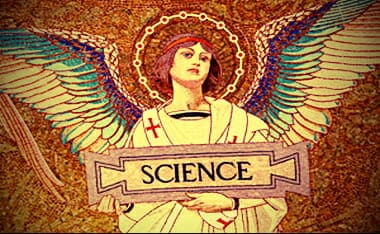
Career Ending Humor (Monty Python)

POWERLINE has an excellent post about making jokes and today’s PC-culture:

Monty Python fans may remember the long sketch about the “lethal joke” that was so funny you would die from laughter, and which was weaponized for battlefield use in World War II… [below/right]…The sketch culminates in the worldwide banning of jokes of mass destruction through the Geneva Convention, but it seems the University of Oregon takes the idea seriously. Get a load of this story:

British conductor sacked by US music festival after ‘innocent’ joke with his African-American friend was labelled racist

An acclaimed British conductor has been fired from a prestigious American music festival after a seemingly innocent joke he made to a black friend was labelled racist.

Matthew Halls was removed as artistic director of the Oregon Bach Festival following an incident in which he imitated a southern American accent while talking to his longstanding friend, the African-American classical singer Reginald Mobley.

It is understood a white woman who overheard the joke reported it to officials at the University of Oregon, which runs the festival, claiming it amounted to a racial slur.

Shortly after Halls, who has worked with orchestras and opera houses across Europe and the US, was told by a university official his four year contract, which was to have run until 2020, was being terminated………..

(Read It All)

Dinosaur Syndrome: Big Hearts, Small Brains

Senator Rand Paul gives a passionate speech about how congress should send money to Hurricane Harvey survivors but shouldn’t increase the debt to pay for it. Paul makes the case that the US should stop sending money to foreign countries before we pay for our problems. Paul believes Congress continually votes with their hearts and not their heads.

Dr. Lawrence Kruass Caught Lying (+Krauthammer)

Originally Posted November 2013

The second part is the ongoing debate between Dr. William Lane Craig and Dr. Lawrence Krauss. This ends the debate — effectively — any discussion of Craig’s use of the BGV Theorum. Two places to go to read the dialogue of this debate ending in full — which shows Dr. Krauss to be intentionally misrepresenting Dr. Vilenkin’s work. The first place to go is of course one of the principle players site, Dr. Craig (above and below):

The second place to go has a good summary and bullet point addition to the above, and where I found this nugget… which shows Dr. Kruass apparently wanted to hide what he knew was, a) a trouncing of himself in a public debate (yes, Dr. Craig is that good), b) willfully trying to hide his willful miss-characterization of Dr. Vilenkin’s work, or c), both.

  • (Via Wintery Knight) ~ “UPDATE: Dr. Craig reports that Dr. Krauss refused to let the organizers live-stream the three Australia debates, as well as refusing to let the Australian Broadcasting Corporation live-broadcast the three debates.”

Wow. As an ex-con, and someone who has raised boys that are actively wanting to be in law enforcement ~ (the oldest is part way done getting into the Sheriff’s … although he may be going active duty soon if they accept him into EOD, versus if he is going to stay in the airwing of the Corp as a reservist) ~ I know intimately what covering up a lie looks like. Dr. Krauss fits the criteria — fidgeting with which drink he is going to choose while Dr. Craig responds, to his mannerisms setting up the email, to his trying not to have the debate go public — he is truly “busted”!

(The description for the video below) In a mention of his interview with Charles Krauthammer, Dennis Prager revisits the insanity of recent positions within atheistic cosmology. The astrophysicist Dennis Prager refers to, Lawrence Krauss, who was recently shown to be dishonest in a public forum on this very issue

Child Abuse – Child Changes Mind On Sex Change (UPDATED)

See my page on TRANSGENDERISM where many change their mind after receiving counseling.

The DAILY CALLER has more:

…..Gender dysphoria is considered by the American Psychiatric Association (APA) to be a “mental disorder,” while the World Health Organization (WHO) recognizes it as a “mental illness.”

“You wish you could just change everything about you, you just see any girl and you say I’d kill to be like that,” Mitchell says in the interview.

Mitchell received support from his mother to begin transitioning, and after taking hormones, he began to grow breasts.

“In the beginning of 2017, teachers at school began to refer to him as a girl which triggered Mitchell to question if he had made the right decision,” the independent added.

After reflecting on the decision to become a girl, Mitchell decided that he no longer wanted to be a girl.

“I began to realize I was actually comfortable in my body. Every day I just felt better,” Mitchell said.

Mitchell has stopped taking female hormones as he attempts to go back to being a boy and is expected to have surgery to remove the breasts he grew during his time as a girl.

GAY PATRIOT chimes in as only VtheK can:

Maybe the caring adults in this kid’s life should have sought out mental health resources to help learn to love and accept his physical body. Gender dysphoria is, after all, a condition of the mind, not the body.

Especially among children, whom adults don’t trust to make any serious life choices unless there is a sexual proclivity attached to them. Adults don’t trust children to take an Ibuprofen tablet when they have a headache; but they are allowed unrestricted access to abortions and body altering hormones.

Transgenderism, uniquely among identity disorders, is treated by indulging the delusions of the person that their body is something other than it really is. We don’t treat people who feel they should be disabled by disabling them. We don’t treat anorexic people by helping them starve. We don’t treat people who think they’re Joan of Arc by burning them at the stake.

I think the  reason… the reason no one will admit to… is because unlike those other disorders, transgenderism is considered sexy and kinky. I have no proof, it’s just a feeling. Progressives identify with transsexuals because it seems like a kinky fetish. They’re into that.

And there are real world consequences to treating transgender dysmorphia like a disorder of the body instead of the mind. Suicide rates among post-operative transgendered people attest to this. But the point is, progressive societies are less concerned with helping people with body identity disorders than they are about feeling good about their feelings… and getting turned on.

A DACA Run (5-Uploads Via My YouTube)

White House Press Conference – DACA Question — A reporter tries to get a definitive response on a complicated issue. The BEST advice to Dreamers? Don’t rob a liquor store.

One person commented via my YouTube:

  • Giorgio is on FIRE today. thanks for bringing us this content

Your welcome.

Lisa Kennedy Montgomery (just “Kennedy”) is asked about the “Constitutionality” of DACA on Fox News’ show, “Outnumbered.” Her answer was short and to the point.

John and Ken bring some sanity to the issue of DACA and show the insanity of California politician on the matter.

In the 9-6-17 “Briefing,” Dr. Mohler explains the differences between “dumb and Constitutional,” and, “right and not Constitutional.” Jonathan Turley’s article that Attorney General Jeff Sessions quotes is his testimony before Congress (PDF). For more on Reagan and his dealing on this same issue, listen to this upload of Larry Elder discussing the Latino/Hispanic vote:

Dennis Prager discusses what Trump did versus the media’s view of the issue. As usual, the Leftist media is hyperventilating.

Voddie Baucham On The Gospel Centered Marriage

A couple friends and I are going though Voddie Baucham’s book, and we added some media to the mix. I wanted to post the sermon from the 2012 Shepherd’s Conference that we watched. And to give you a taste of how wide and diverse the Body is… one of us has been married for 22-years (not easy though!), another is getting married soon, and the other is divorced and working through being a father and preparing for a real relationship in the future. WE ALL are all student’s of our Lord, and are being challenged and learning from Voddie’s work, a fellow lover of our Lord.

Here are some quotes from the Reformers that were stolen from THE CHRISTIAN BRIDE RESOURCE (no posts since 2013). Take note this should be combined with this post, “The Office of Marriage,” enjoy:

Martin Luther, Preaching on Marriage

“How I dread preaching on the estate of marriage! I am reluctant to do it because I am afraid if I once get really involved in the subject it will make a lot of work for me and for others. … I would much prefer neither to look into the matter nor to hear of it. But timidity is no help in an emergency; I must proceed. I must try to instruct poor bewildered consciences, and take up the matter boldly….

In order that we may not proceed as blindly, but rather conduct ourselves in a Christian manner, hold fast first of all to this, that man and woman are the work of God. Keep a tight rein on your heart and your lips; do not criticize His work, or call that evil which He himself has called good. He knows better than you yourself what is good and to your benefit, as he says in Genesis 1 [2:18], “It is not good that the man should be alone; I will make him a helper fit for him.” There you see that He calls the woman good, a helper. If you deem it otherwise, it is certainly your own fault, you neither understand nor believe God’s word and work. See, with this statement of God one stops the mouths of all those who criticise and censure marriage.

For this reason young men should be on their guard when they read pagan books and hear the common complaints about marriage, lest they inhale poison. For the estate of marriage does not set well with the devil, because it is God’s good will and work. This is why the devil has contrived to have so much shouted and written in the world against the institution of marriage, to frighten men away from this godly life and entangle them in a web of fornication and secret sins. Indeed, it seems to me that even Solomon, although he amply censures evil women, was speaking against just such blasphemers when he said in Proverbs 18 [:22], “He who finds a wife finds a good thing, and obtains favour from the Lord.” What is this good thing and this favour? Let us see.

The world says of marriage, “Brief is the joy, lasting the bitterness.” Let them say what they please; what God wills and creates is bound to be a laughingstock to them. The kind of joy and pleasure they have outside of wedlock they will be most acutely aware of, I suspect, in their consciences. To recognise the estate of marriage is something quite different from merely being married. He who is married but does not recognise the estate of marriage cannot continue in wedlock without bitterness, drudgery, and anguish; he will inevitably complain and blaspheme like the pagans and blind, irrational men. But he who recognises the estate of marriage will find therein delight, love, and joy without end; as Solomon says, “He who finds a wife finds a good thing,” etc.

Now the ones who recognise the estate of marriage are those who firmly believe that God himself instituted it, brought husband and wife together, and ordained that they should beget children and care for them. For this they have God’s word, Genesis 1 [:28], and they can be certain that he does not lie. They can therefore also be certain that the estate of marriage and everything that goes with it in the way of conduct, works, and suffering is pleasing to God. Now tell me, how can the heart have greater good, joy, and delight than in God, when one is certain that his estate, conduct, and work is pleasing to God?

Now observe that when that clever harlot, our natural reason (which the pagans followed in trying to be most clever), takes a look at married life, she turns up her nose and says, “Alas, must I rock the baby, wash its diapers, make its bed, smell its stench, stay up nights with it, take care of it when it cries, heal its rashes and sores, and on top of that care for my wife, provide for her, labour at my trade, take care of this and take care of that, do this and do that, endure this and endure that, and whatever else of bitterness and drudgery married life involves? What, should I make such a prisoner of myself? O you poor, wretched fellow, have you taken a wife? Fie, fie upon such wretchedness and bitterness! It is better to remain free and lead a peaceful, carefree life; I will become a priest or a nun and compel my children to do likewise.”

What then does Christian faith say to this? It opens its eyes, looks upon all these insignificant, distasteful, and despised duties in the Spirit, and is aware that they are all adorned with divine approval as with the costliest gold and jewels. It says, “O God, because I am certain that thou hast created me as a man and hast from my body begotten this child, I also know for a certainty that it meets with thy perfect pleasure. I confess to thee that I am not worthy to rock the little babe or wash its diapers. or to be entrusted with the care of the child and its mother. How is it that I, without any merit, have come to this distinction of being certain that I am serving thy creature and thy most precious will? O how gladly will I do so, though the duties should be even more insignificant and despised. Neither frost nor heat, neither drudgery nor labour, will distress or dissuade me, for I am certain that it is thus pleasing in thy sight.”

A wife too should regard her duties in the same light, as she suckles the child, rocks and bathes it, and cares for it in other ways; and as she busies herself with other duties and renders help and obedience to her husband. These are truly golden and noble works. This is also how to comfort and encourage a woman in the pangs of childbirth, not by repeating St Margaret legends and other silly old wives’ tales, but by speaking thus, “Dear Grete, remember that you are a woman, and that this work of God in you is pleasing to him. Trust joyfully in his will, and let him have his way with you. Work with all your might to bring forth the child. Should it mean your death, then depart happily, for you will die in a noble deed and in subservience to God. If you were not a woman you should now wish to be one for the sake of this very work alone, that you might thus gloriously suffer and even die in the performance of God’s work and will. For here you have the word of God, who so created you and implanted within you this extremity.” Tell me, is not this indeed (as Solomon says) “to obtain favour from the Lord,” even in the midst of such extremity?”

John Calvin’s Writing on Marrying and Marriage

(On what he looked for in a wife…)

“Always keep in mind what I seek to find in her, for I am none of those insane lovers who embrace also the vices of those with whom they are in love, where they are smitten at first with a fine figure. This is the only beauty that allures me: if she is chaste, if not too fussy or fastidious, if economical, if patient, if there is hope that she will be interested in my health.”

(In a letter to a new convert…)

I might wish that you were a little more sparing in your approval of celibacy. (Please pardon my naivete, in that I do not hesitate to tell you freely what I do not like.)

I see that your advice is not without a reasonable basis. Those who are involved in marriage are less free for the Lord’s work, and it is expedient for those who want to consecrate themselves altogether to the Lord to be free of this hindrance. Then too, continence itself lends not a little dignity to the holy ministry. Lastly, you do not use pressure or tyranny to force celibacy upon those who hold ecclesiastical office, but you counsel with them simply and convince them of what you judge to be in the best interests of the church.

And yet, although I confess that marriage brings with it many different impediments, and that it is desirable for the servants of Christ to be free of these, nevertheless I do no concede that the impediments are of a sort to call them away from their duty. I would argue, on the contrary, that celibacy has its own disadvantages, and that these are considerable and not all of one type. I am not speaking yet of the difficulty of sexual continence. I say that celibate men are distracted by no slighter and fewer distractions than married men

John Knox

“Brethren, you are ordained of God to rule your own houses in his true fear, and according to his word. Within your houses, I say, in some cases, you are bishops and kings; your wife, children, servants, and family are your bishopric and charge. Of you it shall be required how carefully and diligently you have instructed them in God’s true knowledge, how you have studied to plant virtue in them, and [to] repress vice. And therefore I say, you must make them partakers in reading, exhorting, and in making common prayers, which I would in every house were used once a day at least.”

Martin Bucer

“Now the proper and ultimate end of marriage is not copulation, or childrenbut the full and proper and main end of marriage is the communicating of all duties both divine and human, each to other with utmost benevolence and affection.”

[….]

“There should be the most intimate unity in marriage in accord with its divine institution.”

[….]

“Therefore, let Christians be mindful of the purpose of the institution of marriage, and let them remember that to regard for any reason as unlawful what is commended by God’s voice as good—as indeed we read that marriage is so commended—is to impugn the goodness of God.”

[….]

“Let us notice here also the commendation of the wonderful dignity of marriage: God is its author, and he it is who unites those who come together in marriage. What way of life, what regimen of the holiest of monks and nuns enjoys such an encomium? Therefore, let husbands and wives nourish their confidence on this truth, that God has joined them together. Though they complain when any adversity befalls them, he cannot possibly abandon them in the estate in which he himself has placed them, provided they depend upon him. Moreover, let them nourish also their love on this truth, for if God has joined them together in such a way that they become one person and cleave to each other after leaving their parents, the husband should obviously be happy with whatever wife the Lord has assigned him, and love her as his own flesh. The wife in turn must honor her husband for the Lord’s sake, whatever kind of man he may be, because God has given him to her. Each of them, indeed, ought not to doubt that whatever he or she does for the other partner is done for the Lord.”

BTW, I love how Voddie expresses early that a) he is speaking of the “ideal,” and b) no one is living the ideal. BUT, that doesn’t mean we do not strive towards it. Scripture says we are to “run with patience (endurance, persistence) the race set before us, looking unto Jesus the Author and Finisher of our faith… For consider Him that endured… lest ye be wearied and faint in your minds” (Hebrews 12:1-3).

The DAILY SIGNAL has this summary:

….In the same way Scripture commands us to love God and love others as we love ourselves, perhaps marriage can be thought of as an act to love God and others, and to grow ourselves.

Talk to any happily married couple, and they will tell you marriage has humbled them, highlighted their weaknesses, and expanded their capacity to love. In short, marriage has forced them to grow as people. And couples in healthy marriages often express a deep joy that they have found in having a companion to walk through the highs and lows of life with.

Marriage is a gift to the betterment of self. 

But marriage viewed only as a means to make you and your spouse happier and healthier is like Leonardo da Vinci painting the body of the Mona Lisa without the face: It’s beautiful, but incomplete. 

Studies, such as those reported by the National Library of Medicine, find that married men are less likely to commit crime when married to women without a criminal record, and children who have two parents, whether biological or adopted, are less likely to live in poverty and are more likely to reach higher levels of education and occupational attainment.

Marriage even decreases alcohol use, according to studies

Marriage gives individuals something to live for that is bigger than self-fulfillment, and that in turn benefits society, aka “others.” It’s no stretch to say a marriage boom across America would do more to reduce crime, end child poverty, and raise living standards than any government program ever could. 

The full picture of the purpose of marriage can only be completed in light of God and Christ’s sacrifice on the cross. Even if one is not a believer in God, the following may still prove helpful to understanding why marriage is so important to faith-filled communities across the world. 

Scripture refers to the Church, those who believe in and follow Jesus, as Christ’s “bride.” Marriage between a man and woman on Earth is intended to be a reflection of Christ’s love and commitment to His bride, the Church. 

As the book of Ephesians advises, “And walk in love, as Christ loved us and gave himself up for us, a fragrant offering and sacrifice to God.”….

A good BIBLE.ORG lesson is this one: “Faith to Run the Christian Marathon” — remember, a race has a goal. Jesus life and finished work is our ideal, our goal, so train well (1 Corinthians 9:24-27).

BIBLICAL WOMANHOOD

BIBLICAL MANHOOD