….Men, women, rich, poor, black and white—all fought and made sacrifices for the principles and aspirations that this flag represents. After the last major battle of the American Revolution, Congress deepened the flag’s meaning by defining red, white and blue.
“White signifies purity and innocence. Red hardiness and valor and Blue … signifies vigilance perseverance and justice,” the Journal of the Continental Congress recorded on June 20, 1782.
Why didn’t Congress define the colors when they first adopted the flag in 1777? They didn’t really know what the colors meant at the start of the United States. By the end of the revolution, they knew what those colors meant because they understood the cost of freedom.
They knew that a free African-American named Peter Salem lived for the red stripe of valor when he risked his life at Bunker Hill to take out the British major responsible for the first British shots of the war. Because of Salem’s story, more Africans were freed and fought. Salem fought for four years and Africans made up about four percent of the Continental Army.
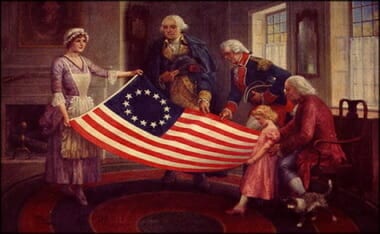
They knew that the flag’s maker, Betsy Ross, was an antislavery Quaker. Her second husband, Joseph Ashburn, was thrown into a British prison for “piracy, treason and rebellion against His Majesty on the high seas.” Representing the white stripe’s pure motive of loyalty, he died because he pledged allegiance to the flag of unity that his wife first sewed.
They knew that a slave named James Armistead represented the color blue because his vigilance as a spy led to America’s victory in the final battle at Yorktown in 1781. Without Armistead’s intelligence as a servant to British General Cornwallis, General Lafayette would not have been able to notify Washington that seizing Yorktown was possible. When Amistead became a free man, he changed his name to James Lafayette.
Yes, it’s unfortunately true that slavery existed when America was founded. It’s unfortunately true that freedom was not equally applied after the American Revolution, with only states in the North abolishing slavery over our nation’s initial years and first decades. It is unfortunately true that the quest for freedom and civil rights for all has been a long, hard-fought battle.
It’s also true that America did not change the design of its flag after slavery was abolished. Why? The nation’s leaders after the Civil War did not see a need to alter the flag’s appearance because they outlawed slavery under it. The American flag—the Union flag—was the victor in the Civil War. Except for adding stars each time a state enters the Union, our flag has not changed since the Betsy Ross flag.
The flag’s meaning of unity has not changed. The values of the colors—valor, hardiness, purity, innocence, justice, perseverance, and vigilance—have not changed. The flag has been enhanced and made more brilliant as we have expanded and deepened the meaning of unity and freedom. That is something to celebrate, not denigrate like Nike by refusing to sell a shoe featuring the first flag of the United States of America.