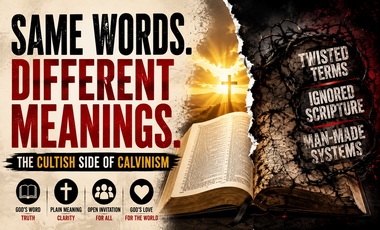
How the Cults Redefine Biblical Terms

i wanted to start with a large excerpt from Walter Martin’s Kingdom of the Cults (6th edition) to get the main idea across… I was reading Micah Coate’s book, “The Cultish Side of Calvinism, and he had some great sections of a chapter that are incredibly important. But first, Walter Martin:

The Riddle of Semantics

The problem of semantics has always played an important part in human affairs, for by its use or abuse, whichever the case may be, entire churches, thrones, and even governments for that matter, have been erected, sustained, or overthrown. The late George Orwell’s stirring novel 1984, in which he points out that the redefinition of common political terms can lead to slavery when it is allowed to pass unchallenged by a lethargic populace, is a classic illustration of the dangers of perverted semantics. It should be of no particular surprise to any student of world history that trick terminology is a powerful propaganda weapon. The communist dictatorship of China, which even the Russian theorists rejected as incalculably brutal and inept, dares to call itself the People’s Republic of China. As history testifies, the people have very little, if any, say in the actual operation of communism, and if democracy is to be understood as the rule of the people, the Chinese communists have canonized the greatest misnomer of all time!

Both the Chinese communists and the Russians have paid a terrible price for not defining terminology, and for listening to the siren song of Marxism without carefully studying and analyzing the atheistic collectivism through which the music came.

Applying this analogy to the field of cults, it is at once evident that a distinct parallel exists between the two systems. For cultism, like communism, plays a type of hypnotic music upon a semantic harp of terminological deception. And there are many who historically have followed these strains down the broad road to spiritual eternal judgment. There is a common denominator then, and it is inextricably connected with language and the precise definition of terminology. It is what we might call the key to understanding cultism.Precisely how to utilize the key that will help unlock the jargon of cult semantics is best illustrated by the following facts, drawn from over thirty years of research and practical fieldwork with cultists of every variety.

The average non-Christian cult owes its very existence to the fact that it has utilized the terminology of Christianity, has borrowed liberally from the Bible (almost always out of context), and sprinkled its format with evangelical clichés and terms wherever possible or advantageous. Up to now this has been a highly successful attempt to represent their respective systems of thought as “Christian.”

On encountering a cultist, then, always remember that you are dealing with a person who is familiar with Christian terminology, and who has carefully redefined it to fit the system of thought he or she now embraces.

A concrete example of a redefinition of terms can be illustrated in the case of almost any of the Gnostic cult systems that emphasize healing and hold in common a pantheistic concept of God (Christian Science, New Thought, Unity, Christ Unity Science, Metaphysics, Religious Science, Divine Science).

In the course of numerous contacts with this type of cultist, the author has had many opportunities to see the semantic maze in full operation, and it is awesome to behold. Such a cult adherent will begin talking at length about God and Christ. He will speak especially about love, tolerance, forgiveness, the Sermon on the Mount, and, as always, the out-of-context perversion of James’s “faith without works is dead.”

It should be noted that hardly ever in their discourses will such cultists discuss the essential problem of evil, the existence of personal sin, or the necessity of the substitutionary atonement of Christ as the sole means of salvation from sin, through the agency of divine grace and the exercise of faith. In fact, they conscientiously avoid such distasteful subjects like the proverbial plague and discuss them only with great reluctance. Of course, there are exceptions to this rule, but on the average it is safe to assume that reticence will characterize any exploration of these touchy issues. Both Christian Science and Unity talk of God as Trinity; but their real concept of God is a pantheistic abstraction (Life, Truth, and Love constitute the triune divine principles—Christian Science).

The historic doctrine of the Trinity is seldom, if ever, considered without careful redefinition. If the reader consults the Metaphysical Bible Dictionary, published by the Unity School of Christianity, he will see the masterpiece of redefinition for himself. For in this particular volume, Unity has redefined exhaustively many of the cardinal terms of biblical theology, much as Mary Baker Eddy did in her Glossary of Terms in the book Science and Health With Key to the Scriptures. The reader will be positively amazed to find what has happened to biblical history, the person of Adam, the concept of human sin, spiritual depravity, and eternal judgment. One thing, however, will emerge very clearly from this study: Unity may use the terminology of the Bible, but by no stretch of the imagination can the redefinition be equated with the thing itself.

Another confusing aspect of non-Christian cultists’ approach to semantics is the manner in which they will surprise the Christian with voluminous quotations from no less authority than the Bible, and give the appearance of agreeing with nearly every statement the Christian makes in attempting to evangelize the cultist. Such stock phrases as “We believe that way too; we agree on this point” or the more familiar: “Mrs. Eddy, Mr. or Mrs. Fillmore, Mr. Evans, Dr. Buchman, Joseph Smith, or Brigham Young says exactly the same thing; we are completely in agreement.” All such tactics based upon the juggling of terms usually have the effect of frustrating the average Christian, for he is unable to put his finger on what he knows is error, and is repeatedly tantalized by seeming agreement which, as he knows, does not exist. He is therefore often forced into silence because he is unaware of what the cultist is actually doing. Often, even though he may be aware of this in a limited sense, he hesitates to plunge into a discussion for fear of ridicule because of an inadequate background or a lack of biblical information.

The solution to this perplexing problem is far from simple. The Christian must realize that for every biblical or doctrinal term he mentions, a redefinition light flashes on in the mind of the cultist, and a lightning-fast redefinition is accomplished. Realizing that the cultist will apparently agree with the doctrine under discussion while firmly disagreeing in reality with the historical and biblical concept, the Christian is on his way to dealing effectively with cult terminology. This amazing operation of terminological redefinition works very much like a word association test in psychology.

It is simple for a cultist to spiritualize and redefine the clear meaning of biblical texts and teachings so as to be in apparent harmony with the historic Christian faith. However, such a harmony is at best a surface agreement, based upon double meanings of words that cannot stand the test of biblical context, grammar, or sound exegesis. Language is, to be sure, a complex subject; all are agreed on this. But one thing is beyond dispute, and that is that in context words mean just what they say. Either we admit this or we must be prepared to surrender all the accomplishments of grammar and scholastic progress and return to writing on cave walls with charcoal sticks in the tradition of our alleged stone-age ancestors. To illustrate this point more sharply, the experience of everyday life points out the absurdity of terminological redefinitions in every way of life.

An attorney who is retained by his client must know the laws that govern trial procedure, cross-examination, and evidence. But above all else he must believe in the innocence of his client. A client who tells his attorney that he is guilty of a misdemeanor but not a felony is using the vocabulary of law. But if his attorney finds out that his client has perverted that vocabulary so that the terms are interchangeable, he will either refuse to defend him or will clarify the terminology before the court, because by definition a misdemeanor is a misdemeanor and a felony is a felony. A man who says he stole only ninety dollars (petty theft), but who really means that it was ninety dollars more or less, and in reality knows that it was in excess of five hundred dollars (grand theft), is playing a game that the law will not tolerate. He will most certainly be punished for such perversions of standard legal terms. In the realm of medicine, a doctor who announces that he will perform an open-heart operation, then proceeds in the presence of his colleagues to remove the gall bladder, and then attempts to defend his action by the claim that open-heart surgery actually means removal of the gall bladder in his vocabulary, could not practice medicine for long! Open- heart surgery is delicate repair of the heart muscle. Removal of the gall bladder is, by definition, surgery of another type. In law and in medicine, therefore, terms are what they are by definition. On the business and professional level this also holds true. But to the cultists words do not always mean what they have always meant by definition in specific context. And just as the American Bar Association will not tolerate confusion of terminology in the trial of cases, and as the American Medical Association will not tolerate redefinition of terminology in diagnostic and surgical medicine, so also the Church of Jesus Christ has every right not to tolerate the gross perversions and redefinitions of historical, biblical terminology simply to accommodate a culture and a society that cannot tolerate an absolute standard or criterion of truth, even if it be revealed by God in His Word and through the true witness of His Spirit.

The major cult systems, then, change the definition of historical terms without a quibble. They answer the objections of Christian theologians with the meaningless phrase, “You interpret it your way and I’ll interpret it mine. Let’s be broad-minded. After all, one interpretation is as good as another.”

A quick survey of how cults redefine Christian terminology illustrates this important observation:

Click to enlarger

Is it any wonder, then, that orthodox Christians feel called upon to openly denounce such perversions of clearly defined and historically accepted biblical terminology, and claim that the cults have no rights—scholastically, biblically, or linguistically—to redefine biblical terms as they do?

We ought never to forget for one moment that things are what they are by definition. Any geometric figure whose circumference is 2πr is by definition circular. Any two figures whose congruency can be determined by the application of angle-side-angle, side-angle-side, or side-side-side is, by definition, a triangle. To expand this, we might point out that any formula that expresses hydrogen to be in two parts and oxygen to be in one is water, and hydrogen to be in two parts, sulfur in one part, and oxygen in four parts is sulfuric acid. H2O can never be H2SO4. Nor can the Atonement become at-one-ment as the theology of the Gnostic cults (Christian Science, Unity, New Thought) explains it. It simply cannot be, if language means anything.

To spiritualize texts and doctrines or attempt to explain them away on the basis of the nebulous word interpretation is scholastic dishonesty, and it is not uncommonly found in leading cult literature. Cultists are destined to find out that the power of Christianity is not in its terminology but in the relationship of the individual to the historic Christ of revelation. The divine-human encounter must take place. One must become a new creation in Christ Jesus, and the emptying of Christian terminology of all its historic meanings serves only the purpose of confusion and can never vitiate the force of the Gospel, which is the Person of the Savior performing the historic function of redeeming the sinner by grace.

The Christ of Scripture is an eternal, divine personality who cannot be dismissed by a flip of the cultist’s redefinition switch, regardless of how deftly it is done. The average Christian will do well to remember the basic conflict of terminology that he is certain to encounter when dealing with cultists of practically every variety.

Summary

Whenever a Christian encounters a cultist, certain primary thoughts must be paramount in his mind: (1) he must strive to direct the conversation to the problem of terminology and maneuver the cult adherent into a position where he must define his usage of terms and his authority, if any, for

drastic, unbiblical redefinitions, which are certain to emerge; (2) the Christian must then compare these “definitions” with the various contexts of the verses upon which the cultist draws support of his doctrinal interpretations; (3) he must define the words interpretation and historic orthodoxy, and standard doctrinal phrases such as the new birth, atonement, context, exegesis, eternal judgment, etc., so that no misunderstanding will exist when these things come under discussion, as they inevitably will; (4) the Christian must attempt to lead the cultist to a review of the importance of properly defining terms for all important doctrines involved, particularly the doctrine of personal redemption from sin, which most cult systems define in a markedly unbiblical manner; (5) it is the responsibility of the Christian to present a clear testimony of his own regenerative experience with Jesus Christ in terminology that has been carefully clarified regarding the necessity of such regeneration on the part of the cultist in the light of the certain reality of God’s inevitable justice. It may be necessary also, in the course of discussing terminology and its dishonest recasting by cult systems, to resort to occasional polemic utterances. In such cases, the Christian should be certain that they are tempered with patience and love, so that the cultist appreciates that such tactics are motivated by one’s personal concern for his eternal welfare, and not just to “win the argument.”

Let it never be forgotten that cultists are experts at lifting texts out of their respective contexts without proper concern for the laws of language or the established principles of biblical interpretation. There are those of whom Peter warns us, who “wrest . . . scriptures, unto their own destruction” (2 Peter 3:16). This is an accurate picture of the kingdom of the cults in the realm of terminology.

Looking back over the picture of cult semantics, the following facts emerge:

  1. The average cultist knows his own terminology very thoroughly. He also has a historic knowledge of Christian usage and is therefore prepared to discuss many areas of Christian theology intelligently.
  2. The well-trained cultist will carefully avoid definition of terms concerning cardinal doctrines such as the Trinity, the Deity of Christ, the Atonement, the Bodily Resurrection of our Lord, the process of salvation by grace and justification by faith. If pressed in these areas, he will redefine the terms to fit the semantic framework of orthodoxy unless he is forced to define his terms explicitly.
  3. The informed Christian must seek for a point of departure, preferably the authority of the Scriptures, which can become a powerful and useful tool in the hands of the Christian, if properly exercised.
  4. The concerned Christian worker must familiarize himself to some extent with the terminology of the major cult systems if he is to enjoy any measure of success in understanding the cultist’s mind when bearing a witness for Christ.

We have stressed heavily the issue of terminology and a proper definition of terms throughout this entire chapter. It will not have been wasted effort if the reader has come to realize its importance, and will be guided accordingly when approaching the language barrier, which is an extremely formidable obstacle both to evangelizing cultists and to giving a systematic and effective defense of the Christian faith against their perversions.

As an armchair apologist and reading these ideas in the first edition… it made an impact on me. So much so that it is now a basis I incorporate into my understanding of how Calvinist “Reformed” ideology goes astray. In one of the best books I have read yet, there is some great apologetic themes in his critique of Calvinists changing terms that should be simply understood.

I will introduce each excerpt.

Section Introduction — “His Writing”

In this opening section, Coate examines the formative role of John Calvin’s writings—particularly the Institutes of the Christian Religion—in the development and interpretation of Calvinist theology. He argues that Calvin’s writings became more than historical works of theology: they became a framework through which Scripture was subsequently read and understood. Coate traces Calvin’s intellectual influences, his use of Augustine and earlier Reformers, and the continuing influence of Calvin’s commentary traditions, including the Geneva Bible and later Reformed study materials. His central concern is whether a theological system can remain genuinely Scripture-driven when the writings and interpretations of its principal theologian become the lens through which Scripture itself is interpreted.

The question Coate ultimately puts before the reader is simple:

  • Are we allowing Scripture to determine our theology, or are we allowing a theological system to determine how we read Scripture?

His Writing

Calvin goes on from the original Protestant experience of conversion to build a system, to extrapolate, to raise all the dark questions and give without flinching the dark answers.[1]  

—C. S. Lewis, on Calvin’s Institutes

Cult leaders rarely lead without their own writings. Mary Baker Eddie penned her Science and Health with Key to the Scriptures; Joseph Smith wrote The Book of Mormon; Ron Hubbard, Dianetics: The Modern Science of Mental Health; and John Calvin has his famed Institutes. Out of all his writings and commentaries, which by his own words were subordinate to his Institutes, no other writing has so “determined the course of history and changed the face of Europe” as have Calvin’s Institutes.[2] So influential are the Institutes that comparing them to other cultish writings might at first seem absurd.

To refresh our memory, John Calvin was eight years old when Martin Luther penned his Ninety-Five Theses in 1517. Born in one of the most tumultuous times in church history, John Calvin grew up in the midst of heavy Roman Catholic influence. Although Calvin officially broke allegiance to the Catholic Church at the age of twenty-five, a majority of his education had been completed under its authority. He studied at the University of Paris and later studied law at the University of Orleans. He wrote the first edition of his Institutes of the Christian Religion in 1536 at the age of twenty-seven. Because Calvin was so young, some scholars question his credibility. Dave Hunt states that the Institutes:

. . . could not possibly have come from a deep and fully developed evangelical understanding of Scripture. Instead, they came from an energetic enthusiasm of a recent law graduate and a fervent study of philosophy and religion, a young genius devoted to Augustine and a newly adopted cause.[3]

Version 1.0.0

It is also important to note that five years after writing the Institutes, the Genevan authorities asked Calvin to draft the Ecclesiastical Ordinances, an outline of church structure and doctrine. “Calvin borrowed Bucer’s assertion that the New Testament indicated four functions of ministry: pastors, doctors, elders, and deacons [but] was himself never ordained as priest or minister in any Church.” Nevertheless, he classified himself as a doctor. “Together the pastors and the senior doctors, who were obviously close to them in ministry, notably Calvin himself, formed a company of Pastors.” [4]

Although people have said that Calvin gave Protestantism its first systemized theology, it can hardly be said that he was the sole mind in formulating it. Calvin was well-read in the works of Reformers before him, and he relied heavily upon Bucer and Luther. However, he referred to no other theologian more than Augustine of Hippo, who is quoted in Calvin’s Institutes over 400 times. Spurgeon, acknowledging Calvin’s use of Augustine’s works, observes, “Perhaps Calvin himself derived it [sotereological system] mainly from the writings of Augustine,” and affirms that “Augustine obtained his views, without doubt, through the Spirit of God, from the diligent studies of the writings of Paul, and Paul received them from the Holy Ghost, from Jesus Christ.”[5]  

If Augustine “without doubt” received his views from the Holy Spirit and Calvin heavily received his views from Augustine, then one could nearly conclude that the Institutes of John Calvin are divinely inspired. Many Calvinists seem to have concluded just that. From the Institutes, Calvinism draws its doctrine, interpretation of Scripture, systemized theology, and distorted view of God. Claiming to be a Calvinist is nothing less than trusting that the Institutes are unparalleled in defining “true” Christianity. After the Institute’s twenty-three years of revisions, it was finally finished in 1559, just five years before Calvin’s death on May 27, 1564.

In most cults, the leader’s writings and doctrines determine the followers’ involvement with and interpretation of the Bible. Instead of plain Scripture leading to doctrine, doctrine leads the interpretation of Scripture. Although we will look at this in more depth in the next chapter, here are two examples: Those who follow The Book of Mormon consider it to be the fullness of the gospel. Thus, they deem it as more authoritative than the Bible itself. Those who follow the doctrines of Charles Taze Russell consider any translation of the Bible other than the New World to be incorrect. Cult members also interpret the Bible to fit the theology of their leader. For example, the audience of Mary Baker Eddie’s Key to the Scriptures interprets the Scripture from a very mystical, nonliteral perspective. The same can be said of Jehovah’s Witnesses and Mormons. Likewise, when Calvinists read the Scriptures, they usually do so in the light of John Calvin’s Institutes, confirming the words of Kent R. Rieske:

Calvinists hold John Calvin in such a high esteem that his writings and teachings are studied and quoted in preference to Scripture. His teachings are used by Calvinists to interpret Scripture rather than the sound doctrine of using Scripture to interpret Scripture.[6]  

In Calvin hotbeds, the Institutes is referred to as often as the Bible, and is even studied in the same manner. Latter-day Saints are educated in the book of Mormon just as students at Calvin Theological Seminary in Grand Rapids, Michigan, can take classes on Calvin’s Institutes and commentaries. Brigham Young founded the Mormon Brigham Young College (BYC) in Logan, Utah, on July 24, 1877, just two years after he founded Brigham Young Academy (Brigham Young University from 1903) in Provo, Utah. In the Mormon schools, students learn theology and read the Scriptures as interpreted by Joseph Smith, just as students in both Calvin Seminary and Calvin College learn the Bible as interpreted by John Calvin. At one school, Joseph Smith is highly esteemed; in the other, John Calvin is greatly revered.

Other than his Institutes, John Calvin offered much commentary in the marginal notes of the Geneva Bible. When England was ruled under Queen Mary I, many Protestant scholars escaped her persecution to Geneva. The city of Geneva was ruled by John Calvin who we know lead both church and civil matters. The Geneva Bible was partially printed in England in 1575 and fully printed a year later. There were over 150 editions made. With John Knox collaborating with Calvin in the new Bible, a law was passed in Scotland in 1579 requiring all houses to purchase a copy if financially possible. The commentary in the Bible’s margins was prized by Calvinists but was not liked by the Church of England nor King James, who later commissioned the “Authorized Version” or King James Version to replace it in 1611. Until the English Civil War, the Geneva Bible was widespread among all Puritans and Calvinists.

Kent Rieske astutely notes the apparent “need” for the Geneva Bible to be full of Calvin’s commentary. He writes, “Calvin’s theology could not be ascertained by the typical student of the Bible without the external study of Calvin’s Institutes . . . Calvin wrote commentary notes in the margin of the Bible to be used as the interpretation of the Scripture.”[7] Although soundly translated from Greek and Hebrew, the marginal notes of the Geneva Bible made it what is was. To its credit, the Geneva Bible was in fact the first “‘Study Bible,’ with extensive commentary notes in the margins.”[8] With Calvin’s commentaries included in its 1599 edition, the Geneva Bible was “the most complete study aide for Biblical scholars and students” at that time; the “extensive collection” of commentary was not a trivial part of the new Bible, for it is still considered the “greatest distinction of the Geneva Bible.”[9] Calvin’s notes comprise nearly 300,000 words, or nearly one-third the length of the Bible itself, and they are justifiably considered “the most complete source of Protestant religious thought available.”[10] As a result, the Geneva Bible became:

. . . the most widely read and influential English Bible of the 16th and 17th centuries. It was continually printed from 1560 to 1644 in over 200 different editions. It was the Bible of choice for many of the greatest writers, thinkers, and historical figures of the Reformation era. [11]

With men such as William Shakespeare, John Milton, John Bunyan, and Oliver Cromwell using the Geneva Bible, we can again see why Calvinism has had a strong foothold on theology.

Despite the wide acceptance of the Geneva Bible, its place in history was relatively short. Although the Geneva translation was accurate, the “not so marginal” notes of John Calvin so angered the Catholic Church, namely King James of England, that it was promptly replaced by the widely known 1611 King James translation, which was published without commentary. From then on, the Geneva Bible has gone mostly unnoticed in Christianity. And now that Calvinism is making a comeback, the new Reformation Study Bible[12] has recently appeared on the scene. Although it uses both the New King James Version and English Standard Version translations, it is full of marginal notes written by leading Calvinists.

One could rightly argue that this fact is unimportant, since most of today’s Calvinists are not even familiar with the Geneva Bible. However, although many Calvinists might not use either the new Reformation Study Bible or old Geneva Bible or hold them in the same light that past Calvinists have, the readers are indeed affected by their adherence to Calvin’s biblical interpretation. This point is made clear by a conversation I had recently with a Jehovah’s Witness as my truck was being fixed. We briefly discussed the New World Translation. (This purposely mistranslated Bible was proved in a court of law to have mangled the original language of the Bible for the intent of substantiating unorthodox views of Jesus and other biblical doctrines that accompany salvation). He was quick to mention that he reads all translations of the Bible. Regardless of this fact, the damage has already been done for him. Whenever this man had read other translations, his views of God, which are based on ideas by Charles Taze Russell, twisted his interpretation of even correctly translated verses that reveal the deity of Jesus.

Ultimately, no matter what translation of the Bible the man may read, his unorthodox views of Jesus will remain unchanged, because he holds to Russell’s teachings. The same can be said of the Mormon. Mormons read orthodox translations of the Bible. Yet, the unorthodoxy from Joseph Smith’s writings has horribly corrupted the sound interpretation found in other Bibles. Likewise, the Key to the Scriptures and Watchtower magazines can pervert the minds of readers and obscure their vision of plain scriptural truth.

This is true for many Calvinists today. They might not have a clue that the footnotes in the Geneva Bibles are unorthodox, but they still understand John 3:16 to mean something other than that Christ died for all of humanity. When one professes to be a Calvinist or a Reformed Christian, the damage has already been done. Calvinists align themselves with John Calvin’s beliefs and his interpretation of selective salvation. They align themselves with all his writings and footnotes—both the orthodox and the unorthodox.

Collin Hansen has recently noted that John Calvin, “appear[s] not to be a major figure among the latest generation to claim the theology he made famous.”[13] How can one not acknowledge John Calvin in Calvinism? Despite the claims from most cultists that they hold their leader’s writings as merely being equal to the Bible, in practice, the Bible usually takes a back seat. The Book of Mormon is blatantly tagged as “the fullness of the gospel.” Ellen G. White, the Seventh-day Adventists’ prophetess, claims that she writes not her own ideas but “what God has opened before me in vision.”[14] Although most Calvinists would never be so bold as to say that the Institutes are as authoritative as Scripture, the outcome of their biblical theology suggests otherwise. As with Joseph Smith, Charles Russell, Ellen White, Mary Eddie, and many other cult leaders, John Calvin’s writings have radically changed the way his followers interpret the Bible.

NOTES

  1. C.S. Lewis, Quote 139, “Calvin, John,” taken from the Introduction to English Literature in the Sixteenth Century, para. 61, p. 42, in The Quotable Lewis, ed. Wayne Martindale and Jerry Root (Wheaton, IL: Tyndale House Publishers, 1898), 83.
  2. Alister McGrath, A Life of John Calvin (Oxford: Basil Blackwell, 1990), xiii, 209.
  3. Hunt, What Love Is This?
  4. MacCulloch, The Reformation, 238.
  5. Charles H. Spurgeon, message delivered at the opening ceremony of the inaugural ceremonies for the new Metropolitan Tabernacle, in “Expositions of the Doctrines of Grace,” sermons 385-388 of The Spurgeon Archive [online]; accessed 28 January 2010; available from; Internet.
  6. Rieske, “Calvinism.”
  7. Rieske, “Calvinism.”
  8. Greatsite Marketing website, [online]; accessed 23 December 2010;
  9. “1599 Geneva Bible,” Introduction from L. L. Brown Publishing [online]; accessed 25 June 2010; available from website, Link.
  10. Ibid.
  11. Ibid.
  12. “Widely considered one of the best tools available for Bible study and previously only available in the New King James translation, The Reformation Study Bible has been updated to the readable and accurate English Standard Version (ESV). This foundational resource was created by more than fifty scholars and features thousands of in-depth study notes, 96 theological articles, 19 in-text maps, colored maps, and 12 charts to help you understand the Bible better.” [online]; accessed 23 December 2010; (LINK)
  13. Hansen, “Young, Restless, Reformed.”
  14. Ellen G. White, Testimonies for the Church Volume 5, 67 [online]; accessed 2 February 2010; all volumes.

Section Introduction — “Its Twisting of Scripture”

In this section, Coate shifts from the influence of Calvin’s writings to the more specific question of how Scripture is interpreted through a theological system. He argues that the central problem is not necessarily a new translation of the Bible, but the reinterpretation of biblical words, passages, contexts, and even study notes to make them conform to established Calvinist doctrines. Coate compares this approach with other examples of religious movements interpreting Scripture through the lens of their own authorities, then focuses on Calvinist treatments of passages concerning “world,” “all,” “whosoever,” human freedom, God’s desire for salvation, and the atonement.

A recurring theme throughout the section is redefinition: Coate argues that when a biblical passage appears to conflict with TULIP theology, the solution is sometimes found not by changing the doctrine, but by changing the way the biblical language is understood. He summarizes the concern through Norman Geisler’s description of theological “doublespeak” and Kent Rieske’s claim that Calvinism redefines biblical terminology and applies passages in ways that conform them to Calvin’s theological system.

The central question Coate raises in this section is therefore:

  • Are we allowing Scripture to interpret Scripture, or are theological conclusions being used to determine what Scripture is allowed to mean?

Its Twisting of Scripture

    • The fact is, the cults are notorious Scripture-twisters. When dealing with cults, one must keep in mind that they are always built not upon what the Bible teaches but upon what the founders or leaders of the respective cults say the Bible teaches.[1]

—Norman L. Geisler and Ron Rhodes

    • I am deeply troubled over the Reformed version of grace because through it, the precious and scriptural truths concerning grace are so maligned.[2]

—George Bryson

Manipulation of Scripture in order to construe a certain meaning that was not or could not be intended for the reader is the hallmark of a cult. The “Bible Answer Man,” Hank Hanegraaff, writes, “The first mark of a cult is its manipulation of Scripture. The Bible is twisted to fit the leader or group’s interpretation.”[3] Nothing has done more damage in Christianity than the use of unorthodox hermeneutics. As an example, there has been no more flagrant forgery of Scripture than the New World Translation of the Bible. Jehovah’s Witnesses claim that this so-called Bible was translated by Greek, Aramaic, and Hebrew scholars and theologians. However, not only did the purported translators lie about having an education in Greek and Hebrew, the entire translation committee was sponsored solely by Jehovah’s Witnesses and composed by members of the Watchtower Bible and Tract Society.

Because Jehovah’s Witnesses do not believe that Jesus Christ was God, verses from the Bible that reveal His being more than a man or an angel, were altered to support their heretical belief. Correct words were purposely omitted and false words were intentionally added in order to change an essential doctrine of the Bible— namely, that Jesus is God. Here are some examples of their twisting of Scripture.

The New World Translation (NWT) has exchanged the truth for a lie. In the NWT, Zechariah 12:10 reads, “They will look upon the one whom they have pierced.” Here the Hebrew “. . . look upon me whom they have pierced”—in which God is the speaker—has been altered in order to avoid the implication that the one who is to be pierced (on the cross) is God Himself.

Again, because the cult teaches that Jesus was a created being rather than the Creator God, Colossians 1:15–17 in the NWT reads:

He is the image of the invisible God, the firstborn of all creation; because by means of him all [other] things were created in the heavens and upon the earth, the things visible and the things invisible, no matter whether they are thrones or lordships or governments or authorities. All [other] things have been created through him and for him. Also, he is before all [other] things and by means of him all [other] things were made to exist.[4] 

The word “other” has been inserted several times to avoid the deity of Jesus. The first edition of the NWT was printed without brackets.

The NWT version of Hebrews 1:8 reads: “God is your throne forever.”[5] Despite that the translation makes no grammatical or logical sense, it continues to be used in place of the correct translation, which is, “Your throne, O God, is forever.”[6] Again, the text was altered because the original statement is referring to the Christ.

The most famous of the Watchtower mistranslations is found in John 1:1, where one letter, the article “a,” is slipped into the passage with huge theological consequences. The NWT translates John 1:1 as, “In the beginning was the Word, and the Word was with God, and the Word was a god.”[7] The correct translation is, “. . . and the Word was God.” The distorted translation of the NWT implies that Jesus was merely an angelic or supernatural being rather than God Himself.

Although the Watchtower Bible and Tract Society has been proven guilty of lies and perjury in an American court of law (March 17, 1913, Russell v. Ross) the incorrect renditions have not been retracted. Because the Jehovah’s Witnesses use the NWT as their scriptures they are continually misled and intellectually compromised, believing unbiblical doctrine. The NWT is a “translation” of the Bible written to fit a particular group’s beliefs by means of deception through the manipulation of God’s revealed words.

Since Mormons adhere to The Book of Mormon more than the Bible, a need to distort the Bible’s message is less essential. When essential contradictions are found between The Book of Mormon and the Bible, Mormons look to The Book of Mormon as their ultimate authority. Therefore, the need for Mormons to alter biblical doctrines is not as great as for Jehovah’s Witnesses, whose doctrine is supposedly derived directly from the Bible itself. Because Jehovah’s Witnesses do not have the option to claim another source of authority, they must make their peculiar doctrine seem as sound as possible. Mormons, nevertheless, do their fair share of mangling Scripture in hopes of passing their theology off as orthodox.

Because the founders of Mormonism were polygamists, Mormon doctrine concludes that a man should practice polygamy in order to enter the highest heaven.[8] This doctrine supposedly came from Joseph Smith’s “revelation.” Today, polygamy is still practiced among various sects of Mormonism even in light of the Bible’s denouncing of it. Mormon theology has purposefully misconstrued many biblical verses showing God’s tolerance of the practice in the Old Testament, for He clearly commanded His people not to “multiply wives” in Exodus 20:14–17. Other like verses include Deuteronomy 17:17; 1 Kings 11:1; and Matthew 19:9. There are also a number of other verses referring to the folly of practicing polygamy that are either ignored or twisted to confuse their intended purpose.

The Catholic Answers Web site also notes the Mormons’ misinterpretation of God’s Word. Concerning Ezekiel 37 they write:

Mormons neglect the plain sense of the words and ignore their true interpretation, given by God—in the very same chapter. The text makes clear, this is a prophecy of national reunification, not about the appearance of hidden scriptures. The Hebrew term translated as “stick” (aits) is never used anywhere in the Old Testament to mean “book,” “scroll,” “writing” or anything similar. It is variously translated as “wood” or “branch,” “timber,” or “tree.” Needless to say, the Book of Mormon was allegedly written on metal plates, not scrolls or sticks.

Only Mormonism can manage to mistake “timber” for “scrolls” and “nations” for “metal plates.”[9]

Mormons also teach that God the Father has a physical body. They pull the doctrine from Genesis 1:26–27, in which God says, “Let Us make man in Our image” (NKJV). From this statement, Mormons conclude that God has a body.[10] This idea contradicts what Jesus says, “God is Spirit, and those who worship Him must worship in spirit and truth”[11] (John 4:24, NKJV). Jesus also points out that “a spirit has not flesh and bones” (Luke 24:39, NKJV).[12] Mormons choose to disregard any verse that clearly counters their doctrine. More verses distorted or ignored by Mormons about the nature of God include Numbers 23:19; Isaiah 45:12; Hosea 11:9; and Romans 1:22–23.

Likewise, unorthodox “Word Faith” leaders like Kenneth Hagin, Kenneth Copeland, Paul Crouch, and Benny Hinn also misconstrue Genesis 1:26–27. They teach that according to these verses, God’s followers are themselves “little gods.”[13] Although this belief is held at different levels of intensity by Word Faith followers, it is an unbiblical doctrine needing correction. The complete and “purest” meaning of Genesis 1:26–27 can indeed be argued and debated (as with many other verses), but its interpretation cannot fly in the face of other parts of Scripture if it is to be true. The two errant doctrines teaching that Christians are little gods and that God the Father has a physical body arise from poorly interpreted verses and discount others verses relevant to the subject. Despite claiming a biblical foundation for these doctrines, both Mormon and Word Faith teachers set themselves clearly against biblical orthodoxy.

John Calvin’s practice of manipulating Scripture is obvious to those who have taken a careful look at his theology. Although the majority of his commentaries are accurate, he was not afraid to change the words and meanings of certain verses in order to make his particular interpretation work. Historian Diarmaid MacCulloch writes:

Like the mainstream tradition of Judaism, he [Calvin] felt that imagery in relation to the divine was best restricted to words, where it could be extravagant or as startling as he pleased: in one sermon on Deuteronomy preached in 1555–6, for instance, he radically adapted some words of Jesus in order to compare God’s coming in flesh in the birth of Jesus Christ to a hen stooping down to the ground.[14]  

As we remember the words of historian James P. Byrd, Jr. when he states what Roger Williams thought of Calvin’s poor interpretive skills concerning ecclesiastical government over civil affairs, we see the validity of Williams’ claim. Byrd writes, “Williams revered Calvin’s theological genius and considered him a great man, but he attacked Calvin’s biblical interpretation, calling it a dangerous perversion that turned the Holy Word into a bloody instrument of persecution.”[15]

We will see many examples of how Calvin and his followers have misinterpreted portions of Scripture for the sake of TULIP. Calvinists have not invented their own religious books, as have the Mormons, nor have they created a new translation of the Bible, as have the Jehovah’s Witnesses, but they have taken a step in that direction. Although the Geneva Bible was once banned by King James of the Catholic Church, Thomas Nelson Publishing began printing the New Geneva Study Bible, or the Reformation Study Bible (RSB) in 1995 with the English Standard Version (ESV). Leading Calvinist R. C. Sproul gives the introduction, titled “Reformation Truth,” to the RSB with its explanations of Scripture. The Christian must ask: can absolute biblical truth be reformed? Sure, it can . . . but only into something less than absolute biblical truth. Look how clearly we can see this in the following attempts of the Reformation Study Bible to do away with the biblical doctrine of man’s free will and God’s offer of salvation to the whole world.

The ESV correctly translates John 3:16 as, “For God so loved the world, that he gave his only Son, that whoever believes in him should not perish but have eternal life.” However, under the guise of “Reformation Truth,” the RSB footnote interprets the verse to mean something quite different:

Some have insisted that God sent Jesus to die for the purpose of bringing salvation to everyone without exception, but only as a possibility . . . The point made by the “world” is that Christ’s saving work is not limited to one time or place but applies to the elect from all over the world.[16]

Again, knowing that the message of John 3:16 does away with Calvin’s third point of TULIP, Calvinists twist the Scripture at all cost. Leading Calvinist James White says that “whosoever believeth on him should not perish” actually means “in order that everyone believing on him should not perish.”[17] With the addition of a few words, White defends Calvinism by saying that the elect alone believe and thus Christ died for them only. How does this differ from the Jehovah’s Witnesses’ practice of adding words to the text and thereby changing its meaning?

The twisting of Scripture in the Reformation Study Bible is no less devious than that of the New World Translation. Orthodox Christian leaders often speak against Jehovah’s Witnesses for their new interpretation of the Bible while remaining silent regarding Calvinists, who also add words to scriptural texts in order to support their false claims.

First Timothy 2 speaks of God’s concern for all men and women of all classes. We are commanded to pray, intercede for, and give thanks for all people. In the RSB, 1 Timothy 2:1 reads, “First of all, then, I urge that supplications, prayers, and thanksgivings be made for all people . . .” (ESV). Here, however, a footnote appears, explaining that “all people” really does not “mean ‘every human being’ but rather ‘all types of people,’ whatever their station of life” (RSB).[18]

In verse 1 Timothy 2:3–4, Paul continues his thought: “. . . God our Savior, who desires all people to be saved and to come to the knowledge of the truth” (ESV). Once again, the RSB attempts to “reform” this truth in its footnote:

. . . who desires all people to be saved. This does not mean that God sovereignly wills every human being to be saved . . . It may refer to God’s general benevolence in taking no delight in the death of the wicked, or to God’s desire that all types be saved (i.e., God does not choose His elect from any single group).[19]

With many verses contradicting TULIP theology within the English Standard Version, the RSB must rely on its footnotes to provide some connection between the actual text and its Calvinistic ideas and undertones.

Another example of the Reformation Study Bible’s mutilation of the intended meaning of the Word is in 2 Corinthians 5:14. The ESV reads, “For the love of Christ controls us, because we have concluded this: that one has died for all, therefore all have died.” Without reading into the verse’s meaning, we understand that Christ is the “one” who “died” literally “for all.” If Christ died for all, then all—not some—have died. Because this Scripture affirms what the five points of Calvinism deny, the footnote in the RSB reads, “The ones He died for are the same as the ‘all’ who ‘died’ with Him as a result of His death . . .”[20] No. The verse does not say nor give any indication that the ones for whom He died are the “ones who died with Him.” The verse clearly reads that the “one,” who is Christ, “has died for all.” Christ has died for all, regardless of whether or not we who have placed faith in Him undergo the salvific process of dying “with Him as a result of His death.”

This kind of biblical interpretation illuminates Kent R. Rieske’s radical statement that, “Calvinists have typically taught from the margin notes in the Calvinist’s Geneva Bible in preference to the Scriptural text.”[21] Although Calvinists would vehemently disagree, the few examples above show that when a verse clearly contradicts a doctrine of TULIP, it is usually supplemented by a footnote misinterpreting the verse to fit the doctrine. Like most cults, when confronted with scriptural truth that affirms what they deny, the followers are led by the founder’s interpretation.

Biblical footnotes can be very useful, but they can only be trusted when Scripture is interpreting Scripture. Did the above footnotes from the Reformation Study Bible sound like Scripture was being used to interpret Scripture or like Calvin’s TULIP was being used to interpret Scripture? We will answer this question in more detail later.

Many Calvinists praise John Calvin in an unhealthy and unbalanced way, heralding him as the apostle Paul’s “faithful interpreter.”[22] By this selective mentality, a Reformed conscience can be held captive by Calvin’s radical and unorthodox interpretations. Josh McDowell claims that one of the key characteristics of a cult is its offering “new interpretations of the Scripture.” He states, “Some cults make no claim to know truth or extra-biblical revelation, but believe they alone have the key to interpreting the mysteries in the Bible.”[23] Let’s stop here and note that a great mystery found within the Bible is how man’s free will and God’s sovereignty work together. But Calvinism claims to have the answer! This theological system does away with the mystery by doing away with man’s free will. Calvinists believe that, “they alone have the key to interpreting the mysteries in the Bible.”[24]  Reformed Theology, as Calvinist W. Robert Godfrey asserts, even has a “Reformed interpretation of Romans.”[25] Godfrey assumes that non-Reformed churches likely “miss the real meaning of the Word of God,” as well as “the real need of the un-churched—namely, the gospel of the grace of Jesus Christ.” He then concludes that, “To find that real meaning, we must turn from stories to a system.”[26]

Also note that Calvinism has cleverly interpreted the mysteries of the Bible without claiming (as most cults do) to have “new truth” or “extra-biblical revelation.” Instead, as McDowell states:

The scriptures are their only acknowledged source of authority, but . . . are interpreted unreasonably and in a way different from that of orthodox Christianity. They testify that the historic beliefs and interpretations of Scripture are based upon a misunderstanding of the Bible or were pagan in origin.[27]  

Is it a coincidence that leading Calvinists claim that the traditional doctrines of orthodox Christianity are at odds with TULIP theology? Since Calvinists believe that their interpretation is the “true gospel” message (coming on the scene 1500 years after the birth of Christianity), every Christian doctrine before their time must have been somewhat unorthodox. Could this be true?

Were the doctrines of the free will of man, God’s desire for all men to be saved, and Christ’s universal offer of atonement merely man-made teachings, having their roots in humanistic tradition rather than Scripture?

Leading Calvinist James Whites believes that:

If we derive our beliefs from the Bible (rather than assuming them as a tradition . . . ), we will conclude that the phrase, “God is love” does not mean that God has the same kind and level of love for all things, including for each and every single individual human being.[28] [Italics mine.]

He continues:

Surely it is part of the modern evangelical tradition to say, “God loves you and has a wonderful plan for your life,” but providing a meaningful biblical basis for this assertion is significantly more difficult. Unfortunately, most are never challenged to think through their traditions.[29] [Italics mine.]

Though the Bible-believing Christian should be challenged to think through traditions, to say that God’s love for humanity stems from tradition rather than “biblical truth” is simply ludicrous—but then again, so are most twisted interpretations of the Bible. Mormons defend their trust in The Book of Mormon by asserting that the Bible has been corrupted, whereas Calvinists defend their trust in TULIP theology by asserting that the mainstream understanding of God’s universal offer of salvation is a man­made tradition and a “denial of biblical truth.”

McDowell concludes that cults reinterpret the Bible:

. . . usually out of context, to justify the peculiar doctrines of a cult. Without an objective and reasonable way to understand what the Bible teaches, the cult member is at the whims of the cult leader.[30]

Again, we see a perfect example of this through John Calvin’s attempt to justify one of his peculiar doctrines concerning his strict ecclesiastical rule over Geneva. Concerning Jesus’ parable of the weeds in Matthew 13, American historian James P. Byrd, Jr. states:

Above all, Calvin believed that the parable of the weeds contained valuable instruction on church discipline. . . . Calvin’s argument that the parable had to do with church discipline rested on his belief that the field signified the church. This presented an embarrassing dilemma because, as Jesus himself explained, “the field is the world (Matt 13:38).” Calvin’s exegesis of the parable therefore seemed to contradict the explanation that Christ gave to his disciples. In treating this delicate problem, Calvin argued that although Christ called the field the world, he intended “to apply” the field “to the Church, about which, after all, he was speaking,”. . . Calvin solved the apparent conflict by not taking literally Jesus’ interpretation of the field as the world. Calvin claimed that Jesus “transfers by synecdoche to the world what is more apt a part of it.” Jesus did not mean that the field was the world itself, but rather the church that existed within the world.[31]

James Byrd concludes that “Calvin rejected a simple reading of the Christ’s interpretation of the field as the world, preferring instead a figural interpretation at this crucial juncture in the parable.”[32] Therefore, Calvin arrogantly altered the actual meaning of Jesus’ words in this parable because they posed a threat to his conscience and his systematic approach to understanding the Bible.

Apart from changing the definitions of biblical words, the main aspect of twisting Scripture is taking a verse out of its immediate context, placing it in a different area of Scripture, and then using it to uphold a false doctrine. Sometimes this is done innocently and sometimes not. As we have seen before, the account of Jesus raising Lazarus from the dead has been used a number of times by Calvinists to support their false doctrine of Total Depravity, as well as other doctrines in TULIP. We also see an example of this in James White’s book, Debating Calvinism. White uses Ezekiel 37:1– 14 to support “man’s inability” to come to Christ. However, Ezekiel 37 narrates a one-time event, experienced by one man, that took place in the Old Covenant, and it is meant to point to the future restoration of the nation and people of Israel. But White moves this passage from its context and places it as central to the salvation of all New Covenant believers, in order to support the belief that regeneration somehow precedes faith.

In responding to James White’s book, The Potter’s Freedom (a refutation of Geisler’s book, Chosen but Free), Norman Geisler states:

“Another technique employed by PF [Potter’s Freedom] to further its position is to redefine terms that cover the harsh reality of a biblically, morally, and rationally indefensible view.”[33] [italics mine]

Geisler also says:

A similar problem emerges when PF [Potter’s Freedom] employs a kind of theological doublespeak to forward its view. For example, it affirms that fallen humans can will, but yet they have no will (192); that grace is irresistible, but yet it is not coercive (161); that depraved humans are dead but are alive enough to hear and reject the gospel (101); that God does not force anyone, but He regenerates them contrary to their will (200). [34]

Calvinists have not produced a whole new book to support their theology as did the Mormons. They need only to explain away those verses that contradict TULIP. As Geisler states above, this is done by redefining terms and theological doublespeak. Kent Rieske also explains how this is accomplished:

Calvinism consists of theological doctrines which use words found in the Bible. However, Calvinism consistently redefines those words, takes them out of context, applies the doctrines inappropriately, exaggerates the meaning of the words to the extreme, or in some other way distorts the Word of God to match the theology written by John Calvin in his book, Institutes of the Christian Religion.[35]

While an orthodox Christian can easily point out the flaws found within the New World Translation, the theology of Calvinism is not so blatantly twisted since there is not a Calvinistic translation of the Bible. In dissecting Calvinism’s TULIP, one must point to the ill interpreted as opposed to ill translated verses. In either case, both pose serious problems with similar consequences. Using twisted footnotes, words, and contexts are all ways to pull unintended meanings from the Bible.

And yet it is under an intellectual guise of spiritual fervency that Calvinism shows just how it’s done.

NOTES

  1. Geisler and Rhodes, Correcting the Cults, 18.
  2. Bryson, The Dark Side of Calvinism, 30.
  3. Hanegraaff, “What Are Some Common Marks of a Cult?”
  4. New World Translation of the Holy Scriptures (NWT) (New York: Watch Tower Bible and Tract Society of Pennsylvania, 1961).
  5. NWT, Hebrews 1:8.
  6. NKJV, Hebrews 1:8.
  7. NWT, John 1:1.
  8. Smith, Introduction to The Book of Mormon.
  9. Isaiah Bennett, Catholic Answers (San Diego, CA, 1979-2008) [online]; accessed 5 July 2006; available from [Best I could find]
  10. Smith, The Book of Mormon, Doctrine and Covenants 130:3.
  11. NKJV, John 4:24.
  12. NKJV, Luke 24:39.
  13. Geisler and Rhodes, Correcting the Cults, 21.
  14. MacCulloch, The Reformation, 249.
  15. Byrd, The Challenges of Roger Williams, 190.
  16. C. Sproul, ed., The Reformation Study Bible (RSB), (Orlando, FL: Ligonier Ministries, 2005) p. 1,514.
  17. James White, “Blinded By Tradition: An Open Letter to Dave Hunt Regarding His Newly Published Attack Upon the Reformation, What Love Is This? Calvin’s Misrepresentation of God” [online]; accessed 13 July 2007; (Link).
  18. RSB Footnote, p. 1,752.
  19. RSB Footnote, p. 1,752.
  20. RSB Footnote, p. 1,679.
  21. Rieske, “Calvinism.”
  22. Godfrey, An Unexpected Journey, p. 60
  23. McDowell, Handbook of Today’s Religions, 20.
  24. Ibid.
  25. Godfrey, An Unexpected Journey, 26.
  26. Ibid., 36.
  27. McDowell, Handbook of Today’s Religions, 21.
  28. White, in Debating Calvinism, p. 268.
  29. , 265.
  30. McDowell, Handbook of Today’s Religions, 21.
  31. Byrd, The Challenges of Roger Williams, 94–95; Byrd quotes
  32. Matthew 13:38 and Calvin, Harmony of the Gospels, Vol. 2 of Calvin’s Commentaries, 75.
  33. Ibid., 261.
  34. Geisler, Chosen but Free, p. 261.
  35. Ibid.
  36. Rieske, “Calvinism.”

Section Introduction — “Its Ignoring of Scripture”

In this section, Coate moves from the problem of twisting or redefining Scripture to the related problem of selectively ignoring Scripture. His argument is that a theological system can appear consistent when it focuses on the passages that support its conclusions while minimizing, excluding, or reinterpreting passages that create tension with those conclusions. He uses examples from several religious movements before applying the same principle to Calvinism, particularly concerning God’s sovereignty, human freedom, and God’s desire for all people to be saved.

Coate’s central concern is that Scripture must be considered as a whole rather than selectively. He argues that affirming God’s sovereignty does not require ignoring passages concerning human responsibility or God’s universal saving desire. Likewise, affirming human freedom or a universal offer of salvation should not require ignoring passages concerning God’s sovereignty and election.

The section therefore builds on the previous one: where the preceding section examines the reinterpretation of difficult passages, this section examines what happens when passages are simply left out of the theological equation. Coate ultimately argues that both practices can produce the same result—allowing a theological system to determine which biblical data receive controlling weight.

The question Coate places before the reader is:

  • Are we allowing the whole counsel of Scripture to shape our theology, or are we constructing our theology from selected passages and then finding ways to deal with everything else?

Its Ignoring of Scripture

When certain Scripture is ignored, the most ridiculous teachings can easily fool the novice and usher in a tidal wave of theological confusion. Although this practice varies among cults, it is indeed found to some degree in every cult. Radical cults with more glaringly unorthodox doctrines disregard hosts of passages, whereas more conservative cults may choose to overlook only the few passages that obstruct their beliefs. Either way, ignoring parts of Scripture to any degree has huge theological consequences for the cult’s followers.

A tragic example of a cult that excluded a vast majority of Scripture, despite claiming to have a biblical foundation, was the “Children or God” or “The Family” cult. The biblical “foundation” this cult claimed was from Matthew 4:19, in which Jesus says, “Follow me, and I will make you fishers of men.” Yet in the hands of Children of God leader David Berg, Matthew 4:19 was bizarrely twisted into a justification of religious prostitution. This cult formed in 1974 and ended in 1987 (partially due to the AIDS scare). In David’s theology, being a fisher of men was the call for women to win converts by sexual attraction. These women were called “hookers for Jesus” and their offspring were sadly referred to as “Jesus Babies.” Prostitution was widely used as a means for “converts” or solicitors to donate or raise money for the cult. David’s foul “teaching” of the Scriptures were so perverted they insult and degrade common sense. Yet, internal records of the Children of God indicate that over 223,000 people or “fish” took the bait. These naïve people believed the lie and were sexually loved between 1978 and 1988.[1] The point is made: any doctrine, no matter how absurd, can amass a large cult following by claiming biblical roots and godly motives when Scripture is picked apart and discarded.

A fundamental difference between orthodox Christianity and Calvinism is that one holds two truths equally whereas the other holds one truth to the detriment of the other. The non-Calvinist does not rail against the truth that God is completely sovereign. The Calvinist, however, would have you believe that if you accept that God is sovereign, you cannot also believe that man has a free will. Orthodox Christians hold both to be true.

Think of it this way: If I were to debate a Calvinist, I would never deny the scriptural fact that God is completely sovereign. My opponent could go through a plethora of verses revealing that God is sovereign over creation and has an elect people. I would not argue or debate with these. We are not discussing whether or not God is sovereign. That is a biblical fact. But because the Calvinist ignores the biblical truth that man has a free will and that God offers salvation to all men, he must do one of two things when handling the Bible. Like a typical cultist, he must either falsely interpret any verses that testify to whatever he does not believe in, or more simply, to ignore those portions of Scripture altogether. Again, while the orthodox Christian should hold both truths in equality, Calvinists hold one truth—God’s sovereignty—over the other— man’s free will.

If I were trying to persuade you to believe that God is not sovereign and that there is no such thing as the elect, I would have to ignore that part of Scripture that teaches otherwise. I would only teach and focus on those passages that support my theology—and that would be absurd. Could I make a case that man has free will and that God desires to save all men, without regard to God’s sovereign elect? Of course . . . as long as I ignore the part of Scripture about God’s sovereign elect. Could the Calvinist make a case that God is sovereign and that He has an elect, without regard to man’s free will and God’s desire to save all men? Of course . . . as long as he ignores the part of Scripture about man’s free will.

To ignore means to refuse to notice or pay attention to somebody or something. The word stems from the Latin word ignorant, which means “to not know” or “to be without knowledge.”[2] But to ignore is different than simply not knowing. To ignore is purposefully to disregard. I might understand the reasoning behind Calvinistic theology if its followers withheld those scriptural texts that teach man’s free will and God’s universal offer of salvation to mankind. But no Scripture is withheld from the Calvinist, and they are accountable for purposefully ignoring parts of Scripture.

Dave Hunt argues, in his response to James White’s defense of “man’s inability”:

To support Calvinism’s denial of human ability and responsibility, White gives a few favorite proof texts while ignoring a plethora of passages that present the other side. He offers inferences but not one Scripture that clearly states that unregenerate man is unable to believe the gospel.[3]

In his book, Problems with Evangelical Theology, Ben Witherington notes this particular problem within Calvinism (especially among those who like to debate). He states, “It is perfectly possible to argue consistently and logically about something, but draw the circle of argumentation too narrowly, and so wrongly exclude some of the most important data.”[4] Excluding Scripture, or “important data,” is precisely the error of all cults. In order to practice prostitution and fulfill his own lusts, David Berg paid no attention to the parts of Scripture that deals with sexual purity, monogamy, and marital faithfulness. To uphold his book and writings, Joseph Smith disregarded the part of the Bible that condemned adding to it or subtracting from it. He upheld his book as the “fullness of the gospel” anyway, caring nothing for the words of Paul written to the Galatian believers: “But even if we, or an angel from heaven, preach any other gospel to you than what we have preached to you, let him be accursed” (Galatians 1:8, NKJV).[5] Likewise, in holding their belief that the apostle Peter was never married (being the supposed first pope), Catholics close their eyes to Matthew 8:14, “Now when Jesus had come into Peter’s house, He saw his wife’s mother lying sick with a fever.” In believing Jesus to be less than God, Jehovah’s Witnesses choose not to take into account that Jesus “is the image of the invisible God . . . For by Him all things were created . . . All things were created through Him and for Him. And He is before all things, and in Him all things consist” (Colossians 1:15– 17, NKJV).[6] Lastly, to believe that man has no free will and that God does not desire all to be saved, Calvinism simply glosses over verses like John 3:16, “For God so loved the world that He gave His only begotten Son, that whoever believes in Him should not perish but have everlasting life,” and 1 Timothy 2:3–4, “For this is good and acceptable in the sight of God our Savior, who desires all men to be saved and to come to the knowledge of the truth” (NKJV). While very few cults would ever admit to purposefully ignoring certain verses, some attempt to get around any verse that appears to threaten the validity of their doctrines by simply redefining the meanings of words. This maneuver is not easy to detect and usually misleads those not familiar with the details of the passage at hand. We see this clearly in Calvinism.

NOTES

  1. http://www.xfamily.org/index.php/Main_Page; Under “Flirty Fishing” (CAUTION: The article under ‘Flirty Fishing’ contains explicit text and/or images that some may find disturbing or offensive.), [online]; accessed 25 June, 2007; Internet. Found it in GROKEPEDIA
  2. Webster’s New World Dictionary, s.v. “Ignorant”.
  3. Hunt, in Debating Calvinism, 75.
  4. Witherington, The Problem with Evangelical Theology, 5.
  5. NKJV, Galatians 2:8.
  6. NKJV, Colossians 1:15 – 17.

Section Introduction — “Its Twisted Terminology”

This is the section where Coate brings the preceding arguments together most directly: theological systems can preserve familiar biblical vocabulary while assigning that vocabulary meanings that serve the system itself. He argues that this makes theological disagreement especially difficult, because two people can use the same words—grace, calling, election, foreknowledge, atonement, world, love, and others—while actually communicating different concepts.

Coate begins with the broader principle that terminology matters. He draws on Hank Hanegraaff, George Bryson, Walter Martin, and others to argue that using orthodox Christian words does not necessarily establish orthodox definitions. He then applies that concern specifically to Calvinist theology, examining distinctions such as external and internal calling, general and particular election, foreknowledge as “forelove,” common and regenerating grace, and various descriptions of the atonement.

The centerpiece of the section is Coate’s examination of words such as “world” and “love.” He argues that the theological significance of these words becomes especially apparent when their ordinary contextual meanings create difficulties for limited atonement or particular redemption. He therefore examines how writers such as A. W. Pink interpret passages containing world and how Calvinist explanations of God’s love distinguish between kinds of divine love.

Coate closes by returning to a principle emphasized by Hanegraaff:

  • biblical interpretation should follow the basic rules of language rather than assuming that ordinary words acquire hidden meanings whenever a theological system requires them to do so.

The central question of this section is perhaps the simplest—and the most important:

  • When two theological systems use the same biblical words, are they actually talking about the same things?

Its Twisted Terminology

[Cults] manipulate the Scriptures to fit their own beliefs. Although they may claim to serve Jesus Christ, and may even use the same terminology orthodox Christians use, their definitions are vastly different.[1]  

—Hank Hanegraaff

Monergism can, however, be defined unscripturally—as it is in Reformed Theology. The same can be said for just about any theological term. In the wrong hands, an otherwise good term can be used to convey a bad concept. So it is with monergism in the hands of a Calvinist.[2]

—George Bryson

Having a proper understanding of a cult’s terminology is paramount in differentiating the orthodox from the unorthodox. The novice might ask:

How does the Latter-day Saint differ from me? They believe that we all need God’s grace, and that we are all sinners. They believe in the Holy Spirit and in the work of Jesus on the cross and redemption.

The key words in the statements above are God, grace, sinners, Holy Spirit, Jesus, and forgiveness. Jonathan Rowe, a critic of Mormonism writes, “There is a lot of Christian terminology on the official [Mormon] website, but upon examination, you come to understand that though the terms are familiar, the meanings of those terms are foreign and heretical.”[3]

Although cults use Christian words, their definitions of them are far from orthodox. Some examples include the following:

The orthodox Christian believes in one God. The Mormon believes in many gods. The orthodox Christian believes that Jesus is the Son of God and Creator of all. Jehovah’s Witnesses believe Jesus was created and that He is not God. The orthodox Christian believes that sin is disobedience to God. Christian Science believes that sin is an illusion and merely an err in humanity. The orthodox Christian believes that salvation is reconciliation to God by Jesus’ death and resurrection. The New Age follower believes that salvation is being one with the universe. The orthodox Christian believes that God desires all of mankind to be saved. The Calvinist must logically believe that God desires a majority of mankind not to be saved but eternally punished in Hell.

In a frustrating argument with a Calvinist, in which no progress was made, Josh McDowell’s warning rang very true to me. He writes:

A feature of some cultic groups is that they say one thing publicly but internally believe something totally different. Many organizations call themselves Christians when in fact they deny the fundamentals of the faith. . . . One therefore must be on the alert for the organizations that advertise themselves as “Christians” but whose internal teachings disagree with Scripture.[4]

Cult leaders form new meanings of passages by redefining the words of the text. When faced with Scripture that seemed contradictory to his own teachings, John Calvin did just that. In his commentary on 1 Timothy 2:1–4, Calvin wrote that the modifier “all” men “doesn’t mean all men but all kinds and races of men.”[5] Dave Hunt writes, “Calvin’s audacity in changing the meaning of Scripture is breathtaking.”[6] He also writes, “For turning all men into all kinds and races of men and ‘princes and foreign nations’ in order to accommodate their system of theology, Calvinists will answer to God.”[7]

In his classic Kingdom of the Cults, Walter Martin challenges the Christian to tolerate absolutely no confusion of Christian terminology. He writes:

And just as the American Bar Association will not tolerate confusion of terminology in the trial of cases, and as the American Medical Association will not tolerate redefinition of terminology of diagnostic and surgical medicine, so also the church of Jesus Christ has every right to not tolerate the gross perversions and redefinitions of historical and Biblical terminology simply to accommodate a culture and a society that cannot tolerate an absolute standard or criterion of truth, even if it is revealed by God in his Word and through the true Witness of His Holy Spirit.[8]

In order to argue effectively and dialogue with a Calvinist, one must know his language. Calvinists often refer to the term regenerational grace (a term nowhere found in the Bible). As we have seen earlier, the terms total depravity of man, and the fall also take on new meanings with the Calvinist, as do the words, grace, atonement, mankind, and race. Concerning the word “grace,” George Bryson notes that, “It cannot be reasonably denied that Calvinists hold to a distinctive definition of grace.”[9] It is when we correctly understand how the Calvinist uses these terms that the playing field of argumentation will be even.

Not only do biblical words referring to salvation have different meanings as Calvinist terminology but the invention of new words and ideas seems to have no end. For example, Sproul’s What Is Reformed Theology? contains numerous terms in both categories, including monergism, synergism, operative grace, cooperative grace, prescient view, external call, internal call, effectual calling, ordo salutis, (order of salvation), pelagianism, semi-pelagianism, moral inability, moral ability, double predestination, reprobation, active decree, antinomianism, civil virtue, common grace, condign merit, congruous merit, consubstantiation, dynamic monarchianism, determinism, decretive will, general revelation, infralapsarianism, modalism, neo-platonism, passive decree, permissive will, pluralism, perceptive will, radical corruption, and utter depravity.[10] Thankfully, he includes a “Glossary of Foreign Terms.”[11] Although some of these words have the potential to clarify biblical theology, some do just the opposite. Again, in order to defend TULIP rather than the message of the Bible, Calvinists have been forced to invent new terms and redefine others. The Bible clearly reveals that God desires all to be saved and thus, calls all to repentance. But because Calvinists hold that God only calls those who will believe, they make a distinction regarding the word “call.” As Sproul says, “In Theology, we distinguish between two kinds of divine calling: the external call and the internal call.”[12] Only the theology of Calvinism and other Christian cults make such distinctions about vital biblical words pertaining to salvation. The Bible does not identify an “internal” and “external” calling, but simply a “calling.” Because the Scriptures were not written only for biblical scholars, the obvious and intended meaning of this “calling” and other words like it, are intended to be straightforward, with no double or hidden meanings.

John Calvin himself redefined the word “election.” Diarmaid MacCulloch explains Calvin’s interpretation of the “elect” within both the Old and New Testament:

Israel was the Old Testament equivalent of the true Church; it had been a covenanted, chosen nation. Everyone in Israel was elect: they enjoyed a “general election.” But not all Israelites followed God’s commandments . . .[13]

Calvin wrote, “We must now add a second, more limited degree of election . . . when from the same race of Abraham God rejected some but showed that he kept others among his sons by cherishing them in the Church.”[14] Yet the Bible does not speak of a “general election” or a “more limited degree of election.” While these terms are not even mentioned in Scripture, John Calvin and his followers have taken the liberty not to only invent them but to establish doctrine on their foundation, as well.

Because many non-Calvinists believe that the doctrine of election is based upon God’s foreknowledge of who will choose to receive Jesus, leading Calvinists have boldly changed the meaning of “foreknew” in Romans 8:28 (“For those whom He foreknew He also predestined . . .”). Steele, Thomas, and Quinn write in their book The Five Points of Calvinism that, “The word ‘foreknew’ as used here is thus understood to be equivalent to ‘foreloved’— those who were the objects of God’s love He marked out for salvation.”[15] This is what Calvinists believe.

This concept of adjusting definitions is also found with the salvific word “grace.” To accurately define the word “grace” in all of its multifaceted relations to mankind and the world is impossible. Nevertheless, Calvinists have meddled with the word to make distinctions like operative grace, cooperative grace, regenerational grace, and common grace, in order to promote Calvin’s TULIP. Titus 2:11 says, “For the grace of God that brings salvation has appeared to all men . . .” But because this verse and many like it give the idea that God desires all to be saved and has extended His grace to everyone, the word “grace” undergoes a butchering, or in the words of a Calvinist, a “distinction.” George Bryson understands how Calvinists define grace differently than does the Bible, writing, “It cannot be reasonably denied that Calvinists hold to a distinctive definition of grace . . . I am deeply troubled over the Reformed version of grace because through it, the precious and scriptural truths concerning grace are so maligned.”[16] Once again, since Titus 2:11 reads that the “grace of God has appeared to all men,” the Calvinist is compelled to interpret “grace” as meaning common grace, as opposed to regenerational grace. “Common grace” does not lead to salvation and can be resisted, whereas “the grace of regeneration is irresistible.”[17] Again, these words do not appear in Scripture and are not even used consistently by major defenders of Calvinism. Ephesians 2:8 reads that grace is essential to one’s salvation: “For by grace you have been saved through faith.” Calvinism totally distorts this idea by redefining the word “grace.”

Several more words in Calvinism’s dictionary have been born from mere speculative philosophy, such as double predestination and reprobation. Sproul uses twisted and invented terminology both to defend and “sugar coat” the true doctrines of Calvinism. He even goes so far as to label himself not as a Calvinist but as a Reformed theologian. Richard Mouw, however, remains faithful to his Calvinist label, saying that such labels “serve us well when they are informative, when they tell us something important about the person who chooses to use a specific label.”[18] R. C. Sproul, however, seems to shy away from traditional Calvinistic names. Thus, he titled his book: What Is Reformed Theology? not What Is Calvinism? Inside, he goes further in renaming the Five Points of Calvinism “The Five Points of Reformed Theology.” He continues in this vein by revising the name of each point. Total Depravity is changed to “Humanity’s Radical Corruption”; Unconditional Election is “God’s Sovereign Choice”; and Irresistible Grace is the “Spirit’s Effective Call.” No longer is Christ’s atonement “limited” (lest the word “limited” suggest that Jesus died only for a few)—Sproul calls it Purposeful. One specific doctrine in Calvinism that has undergone many different name changes is Limited Atonement. Whether referred to as “limited,” “specific,” “particular,” “effective,” or “definite and personal,” calling Limited Atonement by other names “can never change the fact of what it really is.”[19]

Kent R. Rieske has also noted Calvinism’s modification of words and ideas:

John Calvin defined important doctrinal Bible words differently than the orthodox and historic Christian interpretation. These erroneous definitions are needed to give logical support to Calvin’s blasphemous doctrines. This technique is typical of cults such as Mormons who hold Joseph Smith in high esteem and base their doctrines on his writings. Calvinists are so indoctrinated with these false definitions that they cannot understand the opposition to their doctrines. Naturally Calvinists believe the false doctrines of John Calvin because they believe the false definitions of major doctrinal words.[20]

No other word in the history of Calvinism has been so maligned as the word “world.” How this word is interpreted determines whether Jesus’ atonement was limited or not, and ultimately whether TULIP blooms or dies. Calvinist author Duane Spencer says, “Much of what we think about the atoning death of Christ will be tempered by what we understand the simple word world to mean.”[21] At least he acknowledges that the word is indeed “simple,” but ironically, in the hands of a Calvinist, it is anything but simple. The word, instead, takes on several mysteriously incorrect and inconsistent meanings. In examining the theological weight of this word, Vance rightly states that “everything hinges on the meaning of the word world.”[22] The following verses give light to the fact that the standard meaning of the word “world” poses a great threat to the doctrine of Limited Atonement and TULIP as a whole.

John 1:29: “The next day John saw Jesus coming toward him, and said, ‘Behold! The Lamb of God who takes away the sin of the world.’”

John 3:16: “For God so loved the world that He gave His only begotten Son, that whoever believes in Him should not perish but have everlasting life.”

John 4:42: “Then they said to the woman, ‘Now we believe, not because of what you said, for we ourselves have heard Him and we know that this is indeed the Christ, the Savior of the world.’”

John 6:33: “For the bread of God is He Who comes down from Heaven and gives life to the world.”

John 6:51: “I am the living bread which came down from Heaven. If anyone eats of this bread, he will live forever; and the bread that I shall give is My flesh, which I shall give for the life of the world.”

John 12:47: “. . . for I did not come to judge the world but to save the world.”

1 John 2:2: “And He Himself is the propitiation for our sins, and not for ours only but also for the whole world.”

2 Corinthians 5:19: “. . . God was in Christ, reconciling the world to Himself . . .”

1 John 4:14: “And we have seen and testify that the Father has sent the Son as Savior of the world.”

In order to remain faithful to TULIP theology, the Calvinist must reinterpret what the word “world” really means.

A.W. Pink, a popular expositor for Calvinism, goes to great lengths to avoid the plain truth of John 1:29 (see above). He changes the meanings of two words in the text: “‘Sin,’ here signifies guilt (condemnation) as in Hebrews 9:26; and ‘the world,’ refers to the world of believers.”[23] The word “sin” in this verse actually has no abnormal implication of guilt or condemnation in the original language and has no connection at all to Hebrews 9:26. Furthermore, saying that “the world” refers to the “world of the elect” is completely speculative and fundamentally changes the meaning of the word, verse, and message of the Bible.

In the example below, the word “world” is again interpreted by the Calvinist as the world of the godly.

In response to John 4:42 (see above), Pink proclaims, “This does not mean that Christ is the Saviour of the human race, but is a general term used in contradistinction from Israel, including all believing Gentiles scattered throughout the earth.”[24]

Another example of how “world” equates to the world of believers is found in the Calvinist’s most feared verse in all the Bible:

1 John 2:2 (see above). Regarding this verse, Pink explains:

. . .when John says, “He is the propitiation for our sins” he can only mean for the sins of Jewish believers. . . . when John added, “And not for ours only, but also for the whole world,” he signified that Christ was the propitiation for the sins of the Gentile believers too, for, as previously shown, “the world” is a term contrasted from Israel.[25]

Similarly, regarding John 6:33 (see above), Pink again writes, “The ‘world’ here does not include the whole human race . . . It is the ‘world’ of believers who are here in view.” [26]

According to Pink’s interpretations, Christ came for the elect only. Christ Himself said, however, that He had come for the sick and sinful, as opposed to the healthy and righteous: “When Jesus heard it, He said to them, ‘Those who are well have no need of a physician, but those who are sick. I did not come to call the righteous, but sinners, to repentance’” (Mark 2:17, NKJV).

After studying the eighty appearances of the word “world” in the Gospel of John, Vance emphatically concluded: “Not only does the word ‘world’ never denote the elect, it is unequivocally demeaned and condemned by God.”[27] In fact, the word “world” was written over two hundred times in the New Testament and never does it denote or even vaguely imply God’s elect.

The other most misused and incriminating word in Calvinist theology is the word “love.” Recognizing this, Dave Hunt based the title of his book on the question Calvinists have yet to adequately answer: What Love Is This? Calvinism defenders, Doug VanderMeulin and Steve Watkins, have tried to answer the question by confronting Dave Hunt on the grounds that his book inaccurately portrays Calvinism. Though after a two-hour discussion, Doug and Steve might have clarified some nonessentials of their faith, they only solidified the vital claims of Mr. Hunt’s book. When Dave Hunt asked, “Does God love those that he has predestined from eternity past to eternal doom?”[28] They replied, “Yes, He loves them . . . with an ‘agape’ love.”[29] To this, Hunt replied, “And that is why I titled my book, What Love Is This?[30]

George Bryson also acknowledges the Calvinistic redefinition of the word “love,” stating, “Even those Calvinists who believe God loves all people have redefined that love, in their thinking and theology, to exclude any kind of saving grace for some of the people they say God loves.” [31] We find this to be true in how Calvinists such as Doug VanderMeulin and Steve Watkins justify the assertion that God does indeed love the people He has predestined to eternal doom by giving the definition of “love” a new meaning. Although the Greek language has four words for different kinds of love, not one of them hints of a love that is “salvific” in nature.[32] Not even eros, the most fleshly sort of love, would justify the act of forcing someone to suffer eternal punishment. The kind of love prescribed in Calvinism is well summarized by Hunt: “I’m going to shoot you guys, I’m going to torture you, I’m going to shoot you, but I want to show some love towards you and some mercy towards you, so I’m going to give you a good meal.”[33] 

Norman Geisler has also identified how Calvinist leader James White redefines certain verses in his book The Potter’s Freedom:

Yet PF [Potter’s Freedom] repeatedly reads “some men” into passages that clearly and emphatically say “all men” (140, 142). It insists against the context that 2 Peter 3:9 (where God desires that all men be saved) is not speaking about salvation (146–147) . . . It distorts the word “saves” to “saves himself” (64), and so on. . . . PF [Potter’s Freedom] is permeated with logical fallacies and reveals an inadequate comprehension of the unjustified theological and philosophical underpinnings of extreme Calvinism. . . . PF futilely attempts to make the implausible sound plausible and the unbiblical seem biblical.[34]

Geisler provides another example of problematic Calvinist terminology:

From the time of the later Augustine this text [1 Timothy 2:3–4] has been manhandled by extreme Calvinists. Spurgeon summarizes their attempts to avoid the obvious. He said here is how “our older Calvinistic friends deal with this text. ‘All men,’ say they—‘that is, some men’: as if the Holy Ghost could not have said ‘some men’ if he had meant some men. ‘All men,’ say they; that is, ‘some of all sorts of men’; as if the Lord could not have said ‘All sorts of men’ if he had meant that. The Holy Ghost by the apostle has written ‘all men,’ and unquestionably he means all men.’[35]  

Similarly,

Of this and like passages John Owen [also] offers the dubious view that “all” does not mean “all” here.[36]

In his book, The Apocalypse Code, Hank Hanegraaff writes about how unorthodox views of the Bible can stem from changing the meanings of simple words. He prefaces his argument by stating that we should “interpret the Bible in accordance with the basic rules of language.”[37] He then writes:

Suppose I told my children, “I don’t want you to touch this gingerbread cake, because we are going to have dinner soon!” They wouldn’t need an advanced degree in English from Yale to understand that by “this” I meant this gingerbread cake—not that gingerbread cake, as in a gingerbread cake that would be baked for their twenty-first birthday. Nor are they the least bit confused about the meaning of the “you,” which in context refers to them, not to children of a future generation. “Soon” is equally unambiguous. To say we were going to have dinner “soon” could possibly mean dinner in the distant future. When it comes to interpreting scripture, we should not suppose that the rules of grammar mysteriously change.[38]

Calvinists would do well to reconsider the core tenets of their theology in light of Hanegraaff’s advice. Let’s again ponder closely the words of Walter Martin on the danger of twisting the Bible’s words:

And just as the American Bar Association will not tolerate confusion of terminology in the trial of cases, and as the American Medical Association will not tolerate redefinition of terminology of diagnostic and surgical medicine, so also the church of Jesus Christ has every right to not tolerate the gross perversions and redefinitions of historical and Biblical terminology . . .[39]

Despite Calvinism’s historical and biblical appearance of intellectual orthodoxy, its insistence on maintaining the doctrines of TULIP has led it perilously close to “the kingdom of the cults.”

Most Christians would say that Calvinism is simply a Christian theology based upon John Calvin’s teachings. In my explanation of the five points, I argued that Calvinism is a Christian but cultlike theology that strips humanity of free will. Although descriptions may vary, the essential philosophy of Calvinistic religion has a name—fatalism. As George Bryson writes:

For all practical purposes, Calvinism amounts to Theistic Fatalism. A theist believes in a personal God. A fatalist believes the future (especially regarding the destiny of individuals) is fixed. A Theistic Fatalist believes that a personal God unconditionally determines where individuals go when they die, that is, whether they go to heaven or hell. . . When I say that Calvinism amounts to Theistic Fatalism or that it has a dark side, it is not for the purpose of offending Calvinists, though some will no doubt take offense at my use of these words. I use the label Theistic Fatalism because it perfectly describes Reformed Theology. I use the words dark side, because Calvinism has, as a central tenet, a very dark and disturbing distinctive.[40]

Lawrence Vance, as well, deduces the following:

Although Calvinists go out of their way to distance themselves from fatalism, they are in essence teaching the same thing. When a philosopher believes “what is to be will be” it is called determinism. When a stoic believes “what is to be will be” it is called fate. When a Muslim believes “what is to be will be” it is called fatalism. But when a Calvinist believes “what is to be will be” it is called predestination.[41]

Geisler likewise states that “there is no real difference . . . between the extreme Calvinists and fatalistic Islam,”[42] concluding that:

. . . some Calvinists reject this “double-predestination” in favor of God simply “passing over” the non-elect, but even they must admit that the result is the same: since God did not give them the desire to be saved “they are condemned to eternal misery.”[43]

NOTES

  1. Hanegraaff, “What Are Some Common Marks of a Cult?”
  2. Bryson, The Dark Side of Calvinism, 352.
  3. (This link was dead, so I tracked down the article and PDF’ed it.)
  4. McDowell, Handbook of Today’s Religions, 22-23.
  5. Calvin, Commentary, 1 Timothy 2:3–4, also noted in, [online] accessed 2 February 2010; available from Internet Link.
  6. Hunt, in Debating Calvinism, 316.
  7. Ibid., 317.
  8. Martin, The Kingdom of the Cults, 31.
  9. Bryson, The Dark Side of Calvinism, 28.
  10. Sproul, What Is Reformed Theology?
  11. Ibid., 225.
  12. Ibid., 143.
  13. MacCulloch, The Reformation, 244.
  14. John Calvin, Institutes, vol. 2, ed. John Thomas McNeill (Westminster Press, Louisville Kentucky, 1960, Reprinted in 2006), p. 929.
  15. Steele, Thomas, and Quinn, The Five Points of Calvinism
  16. Bryson, The Dark Side of Calvinism, 28-30.
  17. Sproul, What Is Reformed Theology?
  18. Mouw, Calvinism in the Las Vegas Airport, 18–19.
  19. Vance, The Other Side of Calvinism, 407.
  20. Rieske, “Calvinism.”
  21. Duane E. Spencer, Duane E., TULIP, The Five Points of Calvinism in the Light of Scripture (Grand Rapids: Baker Books, 1979), 46.
  22. Vance, The Other Side of Calvinism, 435.
  23. W. Pink, Exposition of the Gospel of John, Volume One, John 1–7, (Grand Rapids: Zondervan, 1945), 59.
  24. Ibid., 225.
  25. Arthur W. Pink, The Sovereignty of God (I. C. Herenedeen, 1930; Grand Rapids: Baker Books, 1984), 259.
  26. Ibid., 325.
  27. Vance, The Other Side of Calvinism, 435.
  28. Dave Hunt, Conversation on Calvinism (Bend, OR: The Berean Call, 2002) [CD-ROM].
  29. Ibid.
  30. Ibid.
  31. Bryson, The Dark Side of Calvinism, 26.
  32. Hunt, Conversation on Calvinism.
  33. Ibid.
  34. Geisler, Chosen but Free, p. 262–63.
  35. ,Ibid. 210; Footnote 19: Cited by Murray, Spurgeon v. Hyper-Calvinism, 150–151.
  36. Ibid., 211.
  37. Hanegraaff, Hank, The Apocalypse Code (Nashville: Thomas Nelson, Nashville, 2007), 72.
  38. Ibid., 72.
  39. Martin, The Kingdom of the Cults, 31.
  40. Bryson, The Dark Side of Calvinism, 21–22.
  41. Vance, The Other Side of Calvinism, 278.

Section Introduction — “The Calvinist Redefinition of Biblical Language”

This section brings together the terminology Coate examines throughout The Cultish Side of Calvinism and presents it in a more systematic way. Rather than focusing on a single disputed passage, the comparison looks at a broad range of biblical terms and theological concepts—including all, world, whosoever, love, sovereignty, grace, call, election, foreknew, predestination, regeneration, faith, repentance, free will, atonement, propitiation, perseverance, warning, monergism, synergism, common grace, effectual grace, gospel, and exegesis. The purpose is to show how the same biblical vocabulary can take on substantially different meanings within competing theological systems.

The chart is intentionally framed as “Biblical Term / Concept,” “Calvinistic Change / Redefinition as Characterized by the Sources,” and “Biblical / Traditional Reading.” It therefore does not claim that every Calvinist uses every term in exactly the same way. Rather, it identifies recurring definitions, distinctions, and theological usages presented in the sources and contrasts them with the readings argued for by the non-Calvinist sources.

One of the most important patterns is that the issue is not limited to individual words such as “all” or “world.” The same interpretive question extends into larger theological concepts: sovereignty and determinism, grace and regeneration, calling and effectual calling, election and individual selection, foreknowledge and forelove, faith and regeneration, atonement and particular redemption, and perseverance and the interpretation of apostasy warnings.

The chart should therefore be read as a comparative theological vocabulary guide, not as a claim that the English words themselves have only one possible meaning. Context matters. The central question is whether a particular meaning is being drawn from the biblical text and its context—or supplied by a theological system and then brought back to the text.

In short:

  • before debating a doctrine, we need to make sure we are using the same dictionary.
BIBLICAL TERM / CONCEPT CALVINISTIC CHANGE / REDEFINITION AS CHARACTERIZED BY THE SOURCES BIBLICAL / TRADITIONAL READING
All “All” may be restricted to all kinds, classes, or races of people, or to all of the elect, rather than every person under discussion. All means the whole of the group or persons specified by the context. The word itself does not inherently mean “all kinds” or “the elect.”
World “World” can mean the world of the elect, believing Gentiles, or people from every nation rather than humanity generally. World ordinarily refers to the world, humanity, or created order. Its precise scope is determined by context; it does not inherently mean “the elect.”
Whosoever “Whosoever” can effectively become whoever among the elect believes. Whosoever means whoever responds to the stated condition—such as whoever believes. The invitation is genuinely open to anyone who responds.
Love God does not love all people in the same way. His saving love is particularly directed toward the elect; whatever love, mercy, or benevolence He shows toward the non-elect does not entail an intention to save them. God’s love is genuine, benevolent, and not inherently restricted to the elect. Scripture presents God as loving the world, showing mercy and kindness broadly, and desiring the salvation of all rather than limiting His saving concern to a predetermined few.
Sovereignty God’s sovereignty is understood as exhaustive determinism: God has decreed everything that comes to pass, including human decisions and sinful actions. Sovereignty means God’s supreme authority, kingship, and rule. God is sovereign without the word itself meaning that He determines every human choice.
Grace Grace is narrowed into effectual / regenerating grace—God’s sovereign action toward the elect that regenerates them and guarantees their salvation. Grace is God’s unmerited favor and gracious provision. It is proclaimed through the gospel and genuinely offered to humanity.
Call A distinction is made between an external / general call and an internal / effectual call, with only the latter actually bringing the elect to salvation. Call is God’s summons through the gospel, genuinely extended to those who hear it and calling them to respond.
Election Election becomes unconditional individual selection: God chooses particular individuals for salvation before they believe and passes over others. Election means God’s choosing. Scripture speaks of God choosing people and peoples for particular purposes—including Israel and the church. The context determines whether a passage concerns individuals, a people, or a purpose.
Foreknew “Foreknew” is understood essentially as “foreloved”—God’s prior choice or love of particular individuals whom He marks out for salvation. Foreknew means to know beforehand or previously know. Its theological implications must be determined by the passage rather than automatically equating foreknowledge with predestination.
Predestination Predestination becomes God’s eternal determination of the individual destinies of the elect and, in many formulations, the corresponding reprobation of others. Predestination means determining beforehand. Scripture associates it particularly with the destiny and purpose of believers in Christ, such as conformity to Christ and adoption.
Regeneration The new birth is placed before faith, becoming the divine act that makes faith possible. Regeneration / new birth is the spiritual rebirth associated with conversion to Christ. The sources argue that Scripture does not require an unconscious regeneration to occur before a person can believe.
Faith Faith becomes a special supernatural gift given to the elect after regeneration, rather than the human response of believing the gospel. Faith is believing or trusting in Christ and the gospel—the human response to what God has revealed and offered.
Repentance Repentance is understood as a grace or gift irresistibly produced in the elect as the result of regeneration. Repentance is a genuine turning from sin toward God. Scripture commands people to repent and presents repentance as a genuine response to God’s summons.
Sin Sin is understood as an inherited condition so comprehensive that humanity is unable to respond positively to God apart from prior regeneration. Sin is rebellion, disobedience, and transgression against God—something human beings actually commit and for which they are morally responsible.
Dead / Dead in sin “Dead in sin” is interpreted as absolute spiritual inability: the sinner cannot respond to God in faith unless first regenerated. “Dead in sin” describes profound spiritual alienation and enslavement to sin; the term does not by itself establish absolute inability to respond to God’s gracious initiative.
Free Will Human libertarian freedom is rejected; human choices are understood as determined by God’s decree while remaining morally responsible. Free will / choice means that human beings genuinely make choices and are accountable for those choices. Genuine choice does not mean that humans save themselves by works.
Works “Works salvation” may be applied to any doctrine in which a human response or choice has a meaningful role in receiving salvation. Works are human deeds. Salvation is not earned by works, but a response of faith is therefore not automatically equivalent to earning salvation.
Salvation Salvation is narrowed to the elect and organized through a system of justification, regeneration, and sanctification in which the decisive saving act occurs before faith. Salvation is God’s rescue and reconciliation of sinners through Christ, received through faith.
Atonement Christ’s atonement becomes limited / definite / particular / effectual, with its saving intention specifically directed toward securing salvation for the elect. Atonement is Christ’s sacrificial provision for sin. The sources argue that Scripture presents Christ’s provision as extending to all humanity, with its saving benefits received through faith.
Propitiation Passages saying Christ is the propitiation for the “whole world” are restricted to the elect throughout the world. Propitiation refers to Christ’s sacrifice dealing with sin and satisfying God’s righteous judgment. “Whole world” should not automatically be converted into “the elect.”
Righteousness Imputed righteousness is understood as Christ’s righteousness being credited to the believer as the basis of justification. Righteousness concerns conformity to what is right before God. Justification involves God declaring the believer righteous on the basis of Christ.
Sanctification Sanctification is understood as an inevitable progressive work in the elect, with continuing sin expected throughout the Christian life. Sanctification is being set apart to God and growing in holiness through obedience to Him.
Holiness Holiness is understood as compatible with the continuing presence and inevitability of sin in the believer. Holiness means separation from sin and dedication to God; believers are repeatedly commanded to pursue it.
Perseverance “Perseverance of the saints” means that everyone truly regenerated will inevitably persevere to the end; ultimate apostasy demonstrates that a person was never genuinely saved. Perseverance describes continuing faithfully in Christ. Biblical warnings concerning falling away are treated as genuine warnings rather than automatically hypothetical descriptions.
Fall Away / Depart from the Faith Passages describing falling away or departing from the faith are interpreted to mean that the person was never truly saved. “Fall away,” “depart,” and similar expressions should be understood according to their immediate context rather than automatically supplied with “was never saved.”
If Biblical conditional statements may be interpreted as hypothetical descriptions rather than genuine conditions or possibilities. If ordinarily introduces a condition or possibility; its precise force is determined by context.
Warning Biblical warnings to believers can be understood as means God uses to preserve the elect rather than as genuine warnings concerning the danger they describe. Warning is a genuine admonition to avoid a stated danger; the warning should not be emptied of its apparent force.
Justice Divine justice is understood as compatible with God determining a person’s actions and eternal destiny while still holding that person responsible for those actions. Justice means judging rightly and impartially according to what a person does and is responsible for.
Reprobation Reprobation is a theological category describing God’s eternal decision to pass over some individuals and consign them to condemnation. Scripture clearly speaks of judgment and condemnation; whether Scripture teaches an eternal individual decree of reprobation in the specifically Calvinistic sense is a separate theological question.
Double Predestination God eternally determines both the salvation of the elect and the condemnation of the non-elect. The Bible teaches predestination, election, judgment, and condemnation; whether these constitute the Calvinistic doctrine of symmetrical “double predestination” is a separate theological question.
Monergism Salvation is understood as God alone acting, with the human response contributing nothing to the saving process, even as a genuine response. Salvation is entirely dependent upon God’s grace, while Scripture nevertheless calls people to believe, repent, receive Christ, and respond to the gospel.
Synergism Human cooperation with God is treated as compromising divine sovereignty or turning salvation into human works. Cooperation does not necessarily mean earning salvation. Scripture can command a genuine human response while salvation remains entirely dependent upon God’s grace.
Sovereign “Sovereign” becomes virtually synonymous with deterministic control of every event and human decision. Sovereign means supreme ruler—one who possesses supreme authority and the right to govern.
Common Grace “Common grace” becomes a special theological category explaining God’s goodness toward all people while reserving saving / regenerating grace for the elect. Scripture speaks of God’s goodness and grace toward humanity. Whether “common grace” and “saving grace” constitute fundamentally different kinds of grace is a theological distinction rather than a definition inherent in the word “grace.”
Effectual / Irresistible Grace Grace becomes God’s irresistible regeneration of the elect, guaranteeing their response and salvation. Grace is God’s unmerited favor. The gospel calls people to respond, and the sources argue that Scripture portrays people as capable of resisting God’s gracious appeal.
Gospel The gospel invitation can function primarily as the means by which those already determined to be elect are brought to faith rather than as a genuine offer of salvation to everyone who hears. The gospel is the good news of Christ’s death and resurrection and the means by which people are called to believe and be saved.
Evangelism Evangelism becomes the means by which the already-determined elect are brought to faith, while the evangelist does not know who those elect are. Evangelism is genuinely proclaiming the gospel so that people may hear, believe, repent, and be saved.
Context Context can be invoked within a theological system to interpret difficult passages in accordance with established Calvinistic conclusions. Context means interpreting a word or passage according to its surrounding literary, historical, grammatical, and theological setting.
Exegesis Exegesis can become the process of extracting a predetermined Calvinistic conclusion from the biblical text rather than allowing the text to determine the conclusion. Exegesis means drawing the meaning out of the text rather than importing a theological conclusion into it.
Hermeneutics A theological system can establish interpretive principles that consistently produce Calvinistic readings of disputed passages. Hermeneutics is the principles and practice used to interpret Scripture.
Pelagian The term can be used broadly as a label for those who reject Calvinistic doctrines of human inability, unconditional election, or irresistible grace. Pelagian properly refers to the specific theological position associated with Pelagius. Rejecting Calvinism does not automatically make someone Pelagian.
Calvinism Calvinism may be presented as synonymous with biblical Christianity or the gospel itself. Calvinism is a particular historical theological system within Christianity; it is not itself a synonym for Christianity or the gospel.
Reformed “Reformed” can function as a broader theological designation for the Calvinistic system. Reformed is a historical designation associated with the Protestant Reformation and a family of theological traditions; it is not itself a biblical synonym for “Christian.”

Resources for the above

  • Walter MartinThe Kingdom of the Cults, 6th ed.
  • Micah CoateA Cultish Side of Calvinism
  • Leighton FlowersThe Potter’s Promise: A Biblical Defense of Traditional Soteriology
  • Leighton FlowersDrawn by Jesus: A Biblical Defense of God’s Provision for All
  • “Language and Calvinism” — supplied PDF/article
  • Kerrigan SkellyThe Calvinism Dictionary (Official)
  • Brian’s NotebookThe Code Words of Calvinism
  • “Calvinism is Stupid: Redefining Words — Exposing the Calvinist Playbook — Part #1” — YouTube video/transcript
  • “War of the Words: How Calvinism Quietly Redefines Theological Terms” — YouTube video/transcript

God’s Holiness, the LDS, and the Ontological Argument

(My paper on how the Mormon “god” is not big enough is titled “Infinitely Finite: Mormon Materialism” – PDF) Here is an update via Tim Stratton on this older post [December 2023]. I am only carving out the beginning of his post over at FREE THINKING MINISTRIES, Enjoy the update!

UPDATE

Step One: The Ontological Argument

Let’s begin with one of the most discussed arguments in philosophy of religion: the Ontological Argument.

Here is a standard version based on the laws and rules of modal logic:

The Ontological Argument

  1. It is possible that a Maximally Great Being exists.
  2. If it is possible that a Maximally Great Being exists, then it exists in some possible world.
  3. If a Maximally Great Being exists in some possible world, then it exists in every possible world.
  4. If a Maximally Great Being exists in every possible world, then it exists in the actual world.
  5. If a Maximally Great Being exists in the actual world, then a Maximally Great Being exists.
  6. Therefore, a Maximally Great Being exists.

This isn’t some philosophical Jedi mind trick—it’s a logically deductive argument based on the laws of logic, the rules of reason, and the rules of modal logic. So, if the premises are true, the conclusion must follow. If it’s even possible for a maximally great being (the definition of God) to exist, then God must exist.

(For a fuller explanation of these premises, see Chapter 16 in the forthcoming second edition of Human Freedom, Divine Knowledge, and Mere Molinism.)

In Plain English

Here’s what that means in everyday language:

If it’s even possible that a maximally perfect, all-powerful (omnipotent), all-knowing (omniscient), perfectly good and loving (omnibenevolent) being exists…

Then that being wouldn’t be limited, temporary, dependent, or contingent upon anything else. It would exist necessarily—meaning: It cannot fail to exist.

And if such a being exists necessarily, then: It doesn’t just exist in our minds—it exists in reality.

Why This Matters for the LDS View

The LDS view of God does not affirm a maximally great being in this sense.

Instead, it teaches:

  • The being we refer to as “God” (along with each and every one of us) was once not a god, but still a necessarily existing imperfect “intelligence”
  • This “intelligence” somehow progressed to divinity (and is now a contingently existing deity)
  • All humans can also become gods (exalted beings in the celestial realm)
  • There is an infinite past chain of divine beings

That creates a serious philosophical problem:

  • There is no ultimate, necessary foundation
  • Only an infinite regress of dependent beings

But an infinite regress of contingent beings does not explain reality. It postpones the question (infinitely)—it doesn’t answer it. It never answers it! It continually and endlessly sweeps the problem under the rug or kicks the can down the road.

So at a deeper level, the LDS view—while perhaps easier to understand—does not “make more sense”—at least if we are discussing logical sense.

The LDS view fails to provide a final explanation at all.

(READ IT ALL)

[/unupdate]

Just thought of this today. I have dealt with in the past the “sinfulness” of “god,” in Mormon theology. See my main post on the issue just updated with PDF inks to resources and video to help explain this fact of LDS theology — as well as GOD NEVER SINNED website.

And in conversation as to whether Jehovah’s Witnesses AND Mormons are Christian “denomination’s.” (Not an official denomination like Lutheran or Baptist, rather, should they be considered as part of the Christian faith in their essence.) Here is some of my responses — if they make sense:

Mark is closer in thinking J-Dubs are a “christian” theological cult…. they AT LEAST posit Jehovah as the Creator of the space-time continuum. Creation ex nihilo. Mormons believe Heavenly Father was born [through sexual congress] into this cosmos…. and thus, natural laws impose laws of nature on these gods. In fact, there was no time material did not exist apart from these spirits, and then men, and then exalted men. After my routine with Mormons, I always end with, your “god” is too small.

[….]

Jeff, I guess the easiest way to categorize this in a quip like fashion is to say Jehovah’s Witnesses could incorporate the Ontological Argument into their understanding/apologetic. However, the LDS cannot use that philosophical apologetic. The Mormons cannot be included or acclimated into the theistic understanding of the Judeo-Christian God. YHWH. The I AM. And is not Holy, Holy, Holy. In Mormon theology there is nothing “maximal” about their “god”

The Ontological Argument

BONUS via …

Dictionary of the Later New Testament and Its Developments

2. The Old Testament Background

2.1. The Fundamental Character of God. The starting point for an understanding of these words in the NT and other early Christian writings is the OT. The OT writers reiterate that the Lord God is holy (Lev 19:2; 21:8; Josh 24:19; Ps 22:3; Is 57:15, passim)—“holy” being the fundamental characteristic of God under which all other characteristics are subsumed—and that humans are sinful (Gen 18:20; 1 Kings 8:46; Ps 51:3; Eccles 7:20, passim).

As holy, God is transcendent above, different from, opposite to, Wholly Other (Otto, 6, 25), separate from sin and sinful people (Is 6:1–9; 55:8, 9; cf. Ex 19:20–24; Num 18:3; Heb 7:26). Sinful people, who have become so by their own choice against God (Gen 2:16, 17; 3:1–7; cf. Rom 5:12), are thereby alienated from God and powerless in that they are incapable of closing the chasm that exists between themselves and God, between the holy and the unholy (Is 50:1; 59:1, 2). God, the Holy, is also the “I am, the One who is” (Ex 3:14): God is Life. For people to be separated from God because of their sin is for them to be separated from Life. Those who were made for the purpose of living (cf. Gen 1:26) are faced with its opposite—death (Ezek 18:4).

2.2. The Actions of God. God, however, did what humans could not do. The holiness of God cannot be described merely as a state of being indicative of what God is, but also as purposeful, salvific action indicative of what God plans and carries out. The OT viewed God as transcendent in that he was distinct from sinful humans but not remote or indifferent to them (Snaith, 47). God took the initiative to make the unholy holy, to make the alien a friend, to reconcile sinners to himself (see Salvation).

An example of this is when God the holy One took the initiative to reveal himself to Israel at Sinai and to call this people out from among other nations into a special personal relationship with himself through covenant, law and sacrifice (Ex 20, 24:1–8; Lev 16). Thus, it was God who made Israel a priestly kingdom and a holy nation (Ex 19:6; Deut 7:6), a people that must preserve its distinctiveness by pursuing a way of life different from that practiced by other peoples (Deut 7:5–6; see Levine, 256), a people fit for the service of God and dedicated to do his will, a light to the nations around them (Is 49:6).

Because of God’s special relation to parts of his creation it was possible even for things to be called holy—holy only in the strict sense that they were different from the profane—wholly given over to divine purposes: the ground around a burning bush (Ex 3:5), Jerusalem (Is 48:2), the temple (Is 64:10), the Sabbath (Ex 16:23), priestly garments (Ex 31:10), and so on.

2.3. The Ethical Response to God. The OT meaning of “holy/holiness,” however, is not exhausted with such ideas as “separate from,” “dedicated to,” “sacred” and the like, although these may have been the primary meanings of the words. There are also ethical and moral meanings attached to them. Again such meanings find their origin in the nature of God, for the nature of God is the determining factor that gives meaning to everything (2.1 above). Leviticus 19:1–18 clearly illustrates the moral side of God’s holiness. Here it becomes clear that to be holy as God is holy is not simply to be pure and righteous, but to act toward others with purity and goodness, with truthfulness and honesty, with generosity, justice and love, particularly toward the poor and those who are in no position to help themselves (see esp. Lev 19:9–10, 14). Religion and ethics, the sacred and moral, belong together in the OT; relationship to the Lord God of the OT demands an ethical/moral response. God’s people must not only be like God but also act like God.

3. The Idea of the Holy in the New Testament and Apostolic Fathers

The meaning of the words holy and holiness, although expanded in the literature under study, is squarely based on the writings of the OT. The primary meaning of holy as “separate from” is to be found in the actions of Paul and others who engaged in purification/sanctification rites (hagnizō, hagnismos) by which they ceremoniously separated themselves from the profane so as to be considered fit to enter the sacred precincts of the house of a holy God (Acts 21:24, 26; 24:18; cf. Num 6:5, 13–18; see Douglas, passim; also Barn. 8.1; 15.1, 3, 6–7). That narrow but fundamental meaning of “holy” is nevertheless inadequate to interpret all the texts that treat this concept.

3.1. The Holiness of God. In our early Christian writings “the holiness of God the Father is everywhere presumedthough seldom stated” (Procksch, 101). Nevertheless it is stated: God’s name, the very essence of his person, is holy (Did. 10.2; 1 Clem. 64). Making use of the vocabulary of Leviticus, especially the Holiness Code in Leviticus 19–26, Peter tells those to whom he writes that it is incumbent upon them to be holy as God is holy (hagios, 1 Pet 1:15–16; cf. Lev 19:2; see Selwyn).

The writer of Hebrews explains the disciplinary action of God as his creative work in human lives so that they may share in his holiness (hagiotēs, Heb 12:10). Once again the trisagion (see Liturgical Elements) is sung to God (cf. Is 6:3), this time by the four living creatures of the Seer’s vision—hagios, hagios, hagios (holy, holy, holy). They acclaim that God is holy to the ultimate degree and as such is the Almighty, the Pantokratōr, the one who is, who was and who is to come, eternal and omnipotent, transcendent, Wholly Other (Rev 4:8; see also 1 Clem. 34.6; 59.3). Those who were victorious over the beast sang, “Great and amazing are your deeds, Lord God the Almighty!For you alone are holy” (hosios [hagios] Rev 15:3–4; 1 Clem. 59.3), and the angel of the waters, “You are just, O Holy One” (ho hosios, Rev 16:5). The martyrs, asking for vengeance upon those who slaughtered them for serving God, address God as “Sovereign Lord, holy and true (ho hagios kai alēthinos),” because they know that God, as holy, stands apart from and opposed to sin and evil and that he alone is able to administer justice and judge rightly (Rev 6:10).

God as holy is to be feared (cf. Ps 89:7; 99:3; 111:9); he is a consuming fire (Heb 12:29). He owns the right to judge and to take vengeance (cf. Deut 32:35). But in the NT and other early Christian writings God takes no delight in banishing sinners from him. He delights instead in making them holy, in creating a people fit for his presence, in bringing them close to himself and in giving them sacred work to do (cf. Is 6:1–8). As a consequence God sends his good news (see Gospel) out into the world so that sinful people may “turn from darkness to light and from the power of Satan to God, so that they may receive forgiveness of sins and a place among those who are sanctified [hēgiasmenoi],” i.e., among those who have been made holy and have been set apart to God (Acts 26:18; cf. 20:32). It is important to note here that the expression “those who are sanctified” is a passive participle (from hagiazō, make holy, consecrate, sanctify) that has been termed a “divine passive.” That is, God is the agent of the action. He has taken the initiative not to destroy sinners but to make them holy (cf. Herm. Vis. 3.9.1).

It is God’s will that sinful people be made holy (Heb 10:10). But it was costly for God to realize this wish. Under the old covenant sinners were made holy on the basis of animals being properly sacrificed year after year in their behalf (Lev 16)—tentatively made holy (cf. Rom 3:25; Heb 10:4). Under the new covenant sinners are made holy or sanctified (hēgiasmenoi/hagiazomenous) by a much more profound act—the conscious, deliberate choice of Jesus Christ, God’s Son, radically to obey his Father and offer his body in death as a single sacrifice for sins forever (Heb 10:5–10, 12, 14, 29; cf. Phil 2:8; Diogn. 9.2; see Death of Christ). The blood of Jesus (an expression that refers to the self-determined action of Jesus to die on behalf of sinful human beings) is that by which sinful persons are made holy. The explicit purpose of his suffering and death was that the unclean might become clean, that he might make unholy people holy (hagiasē, Heb 13:12; see also 9:13; 1 Clem. 32.4; 59.3; Barn. 5.1).

In the writings under consideration, as in the OT, places and things as well as persons can be considered holy. Thus the temple is called “the holy place” (Acts 6:13; 21:28). The two tents of the tabernacle are referred to as “the holy place” (hagia, Heb 9:1) and “the Holy of Holies” (hagia hagiōn, Heb 9:3; see also 9:1, 12, 24, 25; 10:19; 13:11). The mountain on which Jesus was transfigured is designated as “the holy [hagios] mountain” (2 Pet 1:18; cf. Barn. 11.3). The Christian faith is termed “the most holy [hagiōtatē faith” (Jude 20). Jerusalem is called “the holy [hagian] city” (Rev 11:2; 21:2, 10; 22:11, 19). Presbyters are holy (Ign. Magn. 3.1), the Eucharist is holy (Did. 9.5), the church is holy (Herm. Vis. 1.1.6; Mart. Pol. presc.), prophets are holy (Acts 3:21; 2 Pet 3:2), angels are holy (Acts 10:22; cf. Jude 14; Rev 14:10; 1 Clem. 39:7; Herm. Sim. 5.4.4; Herm. Vis. 5.5.3).

3.2. The Holiness of Jesus Christ. The NT describes Jesus as holy, a person set apart to God, anointed by him (Acts 4:27; see Anointing), dedicated to God and designated as his unique instrument to carry out his predestined plan in the world (Acts 4:28). But holy is also used of Jesus as it is used of God the Father.

The early church understood Psalm 16:10, said to be written by David and about David, to have had its fulfillment in the resurrected Jesus—“You will not let your Holy [hosion] One experience corruption” (Acts 2:27; 13:35). Peter referred to Jesus as “the Holy [ton hagion] and Righteous One” (Acts 3:14), seemingly in the moral sense of innocent since he linked the word so closely with the anarthrous dikaion (“righteous”—ton hagion kai dikaion; cf. Lk 23:47 and see Conzelmann, 28). In a later sermon Peter speaks of Jesus as God’s “holy [hagion] servant/son” (pais, Acts 4:27; 30).

But the NT and early Fathers say more than this about Jesus. He is the one who makes others holy (ho hagiazōn, Heb 2:11; 13:12), who consecrates them to God and his service that they might be admitted into his presence (cf. Procksch, 89–97). “Jesus is here [in Heb 2:11] exercising a divine function since, according to the OT, it is God who consecrates” (Montefiore, 62; cf. Ex 31:13; Lev 20:8; 21:15; 22:9, 16, 32; Ezek 20:12; 37:28; but see Attridge, 88 n. 107).

Borrowing the language of Isaiah 8:12–13 Peter calls upon Christians to “sanctify [hagiasate] Christ as Lord” (1 Pet 3:15). They are to acknowledge that he is holy (cf. Is 29:23; Ezek 20:41; Ecclus 36:4, Mt 6:9)—holy in the sense that God is holy—for as J. N. D. Kelly has remarked, this verse “has a bearing on 1 Peter’s Christology.… [As] in ii,3 the title ‘the Lord’, which in the Hebrew original denotes God, is unhesitatingly attributed to Christ” (Kelly, 142; see Christology; 1 Peter).

“The Holy One,” a frequent name of God in the OT (2 Kings 19:22; Ps 71:22; 78:41; Is 1:4, passim), appears also in 1 John 2:20 (“you have been anointed by the Holy One [tou hagiou]).” Although there is debate over whether this expression refers to God the Father or to Jesus Christ, in light of the context and especially in light of 2:27–28 it seems more likely that it is a title given to Jesus (see also Diogn. 9.2).

In his vision the Seer reads a letter addressed to the church at Philadelphia. It begins, “These are the words of the Holy One” (ho hagios, Rev 4:7). From the context of this letter (see Rev 2:18; 3:1) this Holy One is none other than the crucified, dead and risen Christ, the one who was and is and will forever be (Rev 1:17–18; cf. Rev 4:8; Diogn. 9.2). These writers want everyone to understand that Jesus is holy in the sense that God is holy—“holy [hosios, a word chosen to emphasize the moral dimension of holiness], blameless, undefiled, separated from sinners, and exalted above the heavens” (Heb 7:26). In naming him “the Holy One” they claim for him the title of deity.

Gerald F. Hawthorne, “Holy, Holiness,” in Dictionary of the Later New Testament and Its Developments, ed. Ralph P. Martin and Peter H. Davids (Downers Grove, IL: InterVarsity Press, 1997), 485–488.


The Mormon “god” Is Captive To The Cosmos

(I just reedited an old [already edited] fix I uploaded to my [now nixed] Vimeo account. In this version I play with the audio more via LALAL.AI, and added subtitles via CHECKSUB.)

This original video can be found on YouTube, HERE.

(Video Description) Shannon asked me at the 2 minute mark: “Could it be possible that God was also saved, and also became a new creature, and therefore was fully capable of becoming a god?” August 29, 2019, at the BYU vs Utah game

(GOD NEVER SINNED) Multiple women that I spoke to from the anti-vax group promoted conspiracy theories. The last conversation of the night I have was, no joke, with a flat-earther who supposed we hadn’t landed on the moon. I encouraged her to read my article, “Christians, Don’t Waste Your Life on Conspiracy Theories

  • Joseph Smith said, “We have imagined and supposed that God was God from all eternity.  I will refute that idea and take the veil away…. God Himself was once as we are now, and is an exalted man”” (Teachings of the Prophet Joseph Smith, p. 345-346).
  • Brigham Young said “It appears ridiculous to the world, under their darkened and erroneous traditions, that God has once been a finite being” (Desert News, November 16, 1859, page 290).
  • Lorenzo Snow‘s famous quip: “As man is, God once was; and as God is, man may become.” 

I have pointed out the “sin” aspect of this since reading a book titled, “The Mormon Concept of God: A Philosophical Analysis (Studies in American Religion),”  by Francis J. Beckwith and Stephen E. Parrish. But Aaron Shafovaloff’s description of a “regional god,” a “most high god over a region of the cosmos” is a great added description to make a point with a Mormon.

Below is a portion of my chapter on the matter

I will add one thing, if I were to update that chapter today, I would shy away from … or, rather, add to the dialectical materialism aspect of the end and include the pantheistic connections as well, as part 2 of this Stanford article notes.  The main point being that the Christian/Jewish understanding of the world and nature and gods/God are wholly rejected in LDS philosophy.


INFINITELY FINITE:
MORMON MATERIALISM


I had a Saturday off and was watching my nephews as well as my boys (not watching as much as making sure serious injury did not occur as oft happens with young boys); my wife was off shopping at Sam’s Club and Wal-Mart. Just prior to her getting back my nephews were picked up (not by child protective services, by their mother) and I came out to help unload the car when my wife pulled up. As I was doing so she asked who the guys with name tags on their shirts and ties were that go door to door.

Wondering why after almost twenty years of discussing such matters and having hundreds of books on both Mormon’s and Jehovah’s Witnesses lining our walls she would be asking such a question, I responded, “Mormon elders.”  She responded, “Well, they just walked around the corner of our building.” Giddy, I started gathering my thoughts just in case they came to our door. I had compiled a new “routine” to use with Mormons that I thought would be an effective dismantling of their worldview and make them hunger for the truth.  Sure enough, as I was carrying in a heavier item I could see through our kitchen window two clean cut guys come to the door. I directed their attention through the screen of the opened kitchen window by telling them I would be with them in a moment. I gave the wife a glance and she gave me that “go get’em Tiger” “look” that Spiderman gets from M.J.

After inviting them in, getting settled, with some small talk and the ritual offering of something for them to drink, they asked if I had any questions for them.  I said, “I do in fact have a question, and the question stems from the previous election year and the exchange between Mike Huckabee and Mitt Romney (via the media) who were both running for the Republican nomination.” They were quick to say that the church does not support any one candidate, that they are politically neutral.  After their disclaimer I continued, “in an off-cuff remark to a reporter, Mike Huckabee mentioned that Mitt Romney and Mormons believe that Jesus and Lucifer are literal brothers. When Mitt Romney heard about this comment from Huckabee, he responded that this is a canard used by people against the church” (rough quote).

  • “So, my question is this gentlemen, maybe you can answer it, are Lucifer and Jesus brothers?”[1]

I got a decidedly more open answer than I expected, but they fell short of getting to the point I was fishing for, which is: that Heavenly Father (whom they consider God) and one of his wives had celestial sex in order to produce children whom relate to each other as siblings, making us all at least half-brothers and sisters (as there are many wives/goddesses in the Mormon heaven), and this god and goddesses were themselves conceived in much the same way.[2]One author makes the point that due to this heavenly progeny we are all children of these beings, so “Jesus, Joseph Smith, Noah, Adam, John the Baptist…. Lucifer, who would become the Devil (a.k.a. Satan), Napoleon, George Washington, Joseph Smith, Louis Armstrong, Donny and Marie Osmond, Senator Orrin Hatch, U.S. President George W. Bush, and everyone else who has ever lived on this planet”[3] are siblings.

I retrieved off of one of my bookshelves a manual meant for  preparing young Mormons for marriage in the temple on a seminary level.  It is entitled, Achieving Celestial Marriage.[4] (HERE IS THE DOWNLOADABLE PDF.) Reading from this should be short and sweet; all you are doing is making sure they understand the church’s stance on the issue, thus, clearing up any misconceived ideas on their part.

“If you gentlemen will indulge me, I want to read from the church’s own understanding of this topic,” I then typically show them that this manual is indeed printed and published by the church, and then I read:

“By definition, exaltation includes the ability to procreate the family unit throughout eternity. This our Father in heaven has power to do. His marriage partner is our mother in heaven. We are their spirit children, born to them in the bonds of celestial marriage.”[5]

Continuing, I read just the headings and subheadings of the next sections:

  • GOD WAS ONCE A MORTAL MAN
    • (1-2) He Lived on an Earth like Our Own
    • (1-3) He Experienced Conditions Similar to Our Own and Advanced Step by Step
  • GOD IS NOW AN EXALTED MAN WITH POWERS OF ETERNAL INCREASE
    • (1-4) Our Father in Heaven Lives in an Exalted Marriage Relationship
    • (1-5) We Are Literal Children of God, Part of His Family Unit

This quick and simple reading from their own church’s seminary level publication gets us both on the same page quickly.[6] I do not argue this point with them, I merely move on with this assumption in mind, that their god at some point in the finite past did not exist in bodily form (at all actually) — was born in a heaven similar to ours, born again on the earth, and was exalted into the position he is in now.  In other words, at one point in the finite past, Heavenly Father did not exist as we know him today.  It is from this premise I continue without missing a beat.  “So, according to official church doctrine, Mormon theologians, and Mormon apologists, there is an infinite regress of gods being born and giving birth to other gods. So ‘Heavenly Father’ himself was given birth to in a similar fashion we were, and that father of your ‘heavenly father,’ in turn had a father as well.  So in a sense there is a great grandfather god, and so on as you regress backward into time.”  Again, this is not a point to argue, if they try, just point to the manual and say you are going off of official Mormon understanding of the issue, and then continue.

Make the point next then, that this differs from the historic, theistic understanding of God.[7] In the Judeo-Christian understanding of creation, even the space-time continuum was created.[8] The Mormon concept has gods being born into an already established, eternally, existing space with an already eternally existing form of matter.  In other words, natural laws, moral laws, mathematical parameters and concepts, spatial components, logic, and the like, must have pre-dated Heavenly Father (the Mormon god of this world). The eye, kidney, inner ear, were not created like the Christian understands that God created them.  The Christian has in mind that God created DNA and its accompanying RNA, the coccyx, brain, epidermis, the ability to pro-create, when He spoke Adam and Eve into existence.  Prior to that these “items,” if I can flippantly refer to them as such, did not exist.

In Mormon theology, on the other hand, DNA pre-dated Heavenly Father, and in fact, he only passes on these as traits to his offspring as they were passed on to him by his father in a sexual act with other goddesses.  These forces, the laws of biogenesis, inheritance, gravity, math, moral laws, all impose onto these gods then.[9] The God in Christianity is above these.  Actually, the God of the Judeo-Christian reality authored or is the genesis of these concepts; the god in Mormonism is in a sense secondary to these forces or laws imposing upon him in some fashion.[10] Author and pastor Mike Robinson adeptly points this out when he writes:

The Latter-day Saint god lacks eternal omniscience, aseity, supremacy, sovereignty, and omnipotence…. The god of Mormonism does not need to exist for the intelligibility of human experience. He cannot supply the transcendental conditions that are needed for the laws of logic, love, and morality. Van Til contended that “the general precedes the particular” in our reality. This implies that the particular exalted man of Mormon theology cannot supply the general and universal realities that must be, for the necessary and unavoidable transcendental conditions listed above. A restricted and fixed exalted man cannot be the indispensable foundation for the unity of experience and knowledge.[11]

As we will see, even the potentiality of all of us becoming gods is connected to the primordial “sea” — if you will, of “souls” which Mormons refer to as our preexistence — that when used in connection with the birth of these spirit children allow them to be able to become gods in exaltation.  This makes these gods, however, dependent on something that is either co-eternal or preexistent to their godhood being conferred on them; or, alternatively, their godhood being realized.  This again makes the Mormon gods secondary and dependent on that which precedes them or is co-eternal with them.[12]

Here we will step away from the general conversational points one can make with these young Mormon missionaries and get into the knitty gritty for the readers edification, if we haven’t already done so.  We will pick up the more general talking point in a bit.  James Talmage, Mormon Apostle and theologian, in his very important Mormon text, Articles of Faith, says the following:

The Father and The Son: A Doctrinal Exposition by The First Presidency and The Twelve — The scriptures plainly and repeatedly affirm that God is the Creator of the earth and the heavens and all things that in them are. In the sense so expressed, the Creator is an Organizer. God created the earth as an organized sphere; but He certainly did not create, in the sense of bringing into primal existence, the ultimate elements of the materials of which the earth consists, for “the elements are eternal (D. & C. 93:33)[13]

What are these infinite properties that pre-date and in some sense coexist eternally in some form with these gods from which they derive their “eternality” from?  Richard Abanes points out some of these ideas in his exhaustive history of the Mormon Church:

there is a “limitless” amount of cosmic spirit matter known as “intelligence,” out of which Elohim and Heavenly Mother made countless spirit babies via celestial sex.  Their ethereal unions somehow siphoned off portions of that great ocean of cosmic “intelligence” and clothed each of these portions with a spirit body. The resulting offspring not only bore their image, but had resident within them the potential for godhood, an attribute of Heavenly Father and Mother…. Countless souls, say LDS leaders, have already attained godhood. Orson Pratt theorized: “If we should take a million of worlds like this and number their particles, we should find that there are more Gods than there are particles of matter in those worlds.”i Brigham Young, much less willing to calculate the number of gods, admitted: “How many Gods there are, I do not know. But there never was a time when there were not Gods.”ii These teachings inspired the popular Mormons couplet: “As man is, God once was; as God is, man may become.”iii[14]

To make this point further, Francis Beckwith mentions that “[s]ince [g]od the Father of Mormonism was himself organized (or spirit-birthed) by his [g]od, who himself is the offspring of yet another [g]od, and so on ad infinitum, Mormon theology therefore implies that the [g]od over this world is a contingent being[15] in an infinite lineage of gods.”[16]  Concurring, Mormon theologian B. H. Roberts, a member of the First Council of Seventy, writes:

Not even God may place himself beyond the boundary of space: nor on the outside of duration. Nor is it conceivable to human thought he can create space, or annihilate matter. These are things that limit even God’s omnipotence. What then, is meant by the ascription of the attribute of Omnipotence to God? Simply that all that may or can be done by power conditioned by other eternal existences—duration, space, matter, truth, justice—God can do. But even he may not act out of harmony with the other eternal existences which condition or limit him.[17]

This is very important, because it makes the god Mormons here on this world worship contingent on other beings and parameters for his being and godhood, which has deep ethical consequences:

Hence, when a Mormon says that god is omnipresent he is asserting that god’s influence, power, and knowledge is all-pervasive, but that the focal point of God’s being (that is, his body) exists at a particular place in time and space. Because the Mormons do not believe that the universe is contingent upon God to sustain its continued existence,[18] there is no need for the Mormons to defend the classical view of omnipresence…. Since God Himself came into being as God (although he existed in some state eternally), He cannot be the source and sanction of values. He Himself obeys laws and affirmed values for whose existence he is not responsible.[19]

However, this gets beyond even the debate between Christian theology and Mormon theology, as we will soon see.  Returning now to the conversation a bit. I often ask these Mormon elders, if the conversation allows, “why they think that whenever an atheist debates the issue of God in a university setting or formal debate, they never debate against the Mormon concept of god?”  Of course they do not know because this question is rarely — if ever — posed to them.  “I will tell you,” continuing, “It is because the atheist would be arguing against himself.”  This always gets inquisitive looks and they always will ask why this is.

“Let me explain why this is,” and so I continued. I mentioned that when a person who is a lifelong atheist is born here on earth, matter (atoms, quarks, dirt, water, air, etc) doesn’t then begin to exist at the same time they are conceived; matter predated the birth of any person here on earth. The earth, the stars, and the like were here long before the not too hypothetical 45-year old atheist. Not only that, but natural laws such as the law of gravity, the laws of motion were also before this person being born and so, this person is subject to them, and in fact, lives under their sway and effects on the entire cosmos.  In the same way when Heavenly Father was birthed in his heaven first by his “godley” parents he was born into an environment that worked with laws in place, even granting he was born with a “spiritual body.”  (Here one may grant that in the Mormon heaven the laws may be a bit different than here on earth — hypothetically speaking — but that laws had to be in place nonetheless, even genetic parameters [DNA, amino acids, etc] were in place and that this god was subject to them, much like the “gods” of Grecian lore, even being controlled by wild emotions.)  So here are two important definitions to express to these young men in some form or fashion:

Heavenly Father

Born into an environment that imposes forces on him that are both older than him and because of there (these laws) imposing forces on him (gravity, causality, entropywhatever) while he has to live in a body that can only take up that space where he is, is, well, more powerful than he.

Atheist

Born into an environment that imposes forces on him that are both older than him and because of their (these laws) imposing on him (gravity, causality, entropywhatever) while he has to live in a body that can only take up that space where he is, is, well, more powerful than he.

Again I point to the classical Judeo-Christian theistic thinking on matters such as these: God created even the laws of the weak and strong nuclear force and the like, matter, energy, even the space-time were brought into existence at some point in the finite past by my God. I will right about now mention that this little presentation I just gave them is what I like to call “the ‘your god is too small’ presentation.”

FOOTNOTES

[1] This has become my standard opener in steering these young men down the “rabbit-trail,” so-to-speak.  Often times they are not aware of the whole dynamic of their own faith, theology, and all that it entails.

[2] John Ankerberg and John Weldon, What Do Mormons Really Believe? (Eugene, OR: Harvest House, 2002), 54-59

[3] Richard Abanes, One Nation Under Gods: A History of the Mormon Church (New York, NY: Four Walls Eight Windows, 2002), 285.

[4] (Salt Lake City, UT: Church Educational System Department of Seminaries and Institutes of Religion, 1998), 129.  I WILL ATTACH THIS ENTIRE PAGE IN THE APPENDIX.

[5] Ibid.

[6] Usually I make this point – that Heavenly Father was a mortal man – early in the conversation, and, will revisit this idea of Heavenly Father being a man born into a world of his own by stating the argument another way.  I will point out that it is possible that their god owned a gas station, worked at a grocery store as a clerk, went to college, or, even like myself, could have been convicted of crimes and done jail time before becoming “exalted.”

[7] A definition here is warranted:

Theism is the worldview that an infinite, personal God created the universe and miraculously intervenes in it from time to time…. God is both transcendent over the universe and immanent in it. The three great theistic religions are Judaism, Islam, and Christianity…. The World Was Created Ex Nihilo. [In-other-words] The world is not eternal. It came into existence by God’s fiat (decree). Its existence is totally contingent and dependent. The universe was not created from pre-existing material (ex materia), as in materialism, nor was it made out of God’s essence (ex Deo), as in pantheism. It was brought into existence by God, but from nothing.

Norman L. Geisler, Baker Encyclopedia of Christian Apologetics (Grand Rapids: Baker Books, 1999), 722-723.

[8] Another short definition of this “before time” concept:

Time and space are creations of God that began at the Big Bang. If you go back beyond the beginning of time itself, there is simply eternity.  By that, I mean eternity in the sense of timelessness.  God, the eternal, is timeless in his being.  God did not endure through an infinite amount of time up to the moment of creation; that would be absurd.  God transcends time.  He’s beyond time.  Once God creates the universe, he could enter time, but that’s a different topic altogether.

Lee Strobel, The Case for a Creator: A Journalist Investigates Scientific Evidence that Points Towards God (Grand Rapids, MI: Zondervan, 2004), 104.

[9] Francis J. Beckwith, Carl Mosser, and Paul Owen, gen.ed. The New Mormon Challenge: Responding to the Latest Defenses of a Fast-Growing Movement (Grand Rapids, MI: Zondervan, 2002), 148.

[10] Ibid., 223

[11] Presuppositional Apologetics Examines Mormonism: How Van Til’s Apologetic Refutes Mormon Theology (Denver, CO: Outskirts Press, 2007), 71-72.

[12] This idea of derivative or dependent  deity in polytheism is explained by professor Roy Clouser:

In many polytheistic traditions there are ac­counts of how the gods came into existence. This means that the divinity of such gods is clearly regarded as derived and secondary as compared to what­ever is divine in the sense of having unconditional reality and accounts for their origins (from now on I will call this the status of being divine per se). Take, for example, the account of the gods of ancient Greece as found in Hesiod and Homer. In Hesiod’s account, the natural world in an undifferentiated state is what just is; it exists unconditionally and gave rise to everything else after it generated a gap between the earth and the heavens he called Chaos. Following that initial change, all other specific forms of existence were generated includ­ing the gods. According to Homer the primordial reality was Okeanos, a vast expanse of watery stuff from which arose all else including the gods. Despite their differences, then, both accounts agree that the gods are dependent on a more basic reality so the gods are themselves derivative realities. This is why no one of them — nor all of them together — could be called “creator” in the sense that God is in Genesis. Moreover, the gods are not only secondary divini­ties because of their optic dependency upon something else that is divine per se. They are also secondary in the noetic sense, since the beliefs about them depend upon the belief in Okeanos or Chaos. For no individual being could be believed to be a god — that is, a being with more divine power than humans possess — unless it was already believed that there is a per se divine source of all other things which confers varying degrees of power upon them.  The same is true of the myths of ancient Babylonia. In them, too, the gods acquire their divine status and power derivatively.

    • For according to them, the origin of all things was the primeval watery chaos, represented by the pair Apsu and Tiamat…. With them the cosmogenic theogony begins.

The Myth of Religious Neutrality: An Essay on the Hidden Role of Religious Belief in Theories (Notre Dame, IN: Uviversity of Notre Dame Press, 2005), 17-18 (emphasis added).

[13] James E. Talmage, A Study of the Articles of Faith (Salt Lake City, UT: The Church of Jesus Christ of Latter-day Saints, 1959) 465-466. (Emphasis added.)

[14] Richard Abanes, One Nation Under Gods, 285, 286-287.

i Orson Pratt, February 18, 1855, Journal of Discourses (Liverpool, F.D. Richards, 1855; lithographed reprint of original edition, 1966), vol. 2, 345. In The Seer, Pratt wrote: “We were begotten by our Father in Heaven; the person of our Father in Heaven was begotten on a previous heavenly world by His Father; and again He was begotten by a still more ancient Father, and so on, from generation to generation, from one heavenly world to another still more ancient, until our minds are wearied and lost in the multiplicity of generations and successive worlds, and as a last resort, we wonder in our minds, how far back the genealogy extends, and how the first world was formed, and the first Father was begotten” (Orson Pratt, “The Pre-Existence of Man,” The Seer, September 1853, vol. 1, no. 9, 132; cf. Orson Pratt, “The Pre-Existence of Man,” The Seer, February, 1853, vol. I, no. 2, 23-24).

ii Brigham Young, October 8, 1859, Journal of Discourses (Liverpool: Amass Lyman, 1860; lithographed reprint of original edition, 1966), vol. 7, 333.

iii Lorenzo Snow, MS, vol. 54, 404. Quoted in Hunter, 105-106.

These footnotes for the quotes within the quote are taken from One Nation Under Gods, 577.

[15] Concept of contingent being:

Contingent beings have their explanation or sufficient reason in something other than themselves. A contingent being is anything that depends on something else for its existence.

Ronald H. Nash, Faith & Reason: Searching for a Rational Faith (Grand Rapids, MI: Zondervan, 1988), 127.

[16] The New Mormon Challenge, 224.

[17] B.H. Roberts, Seventy’s Course in Theology: Third and Fourth Year (Salt Lake City, UT: Caxton Press, 1910), 4:70; quoted in The New Mormon Challenge, 225:

[B.H. Roberts] added that “even [God] may not act out of harmony with the other external existences [such as duration, space, matter, truth, justice] which condition or limit him. “ Mormon theologian John Widtsoe maintains that belief in creation out of nothing does nothing but cause confusion: “Much inconsistency of thought has come from the notion that things may be derived from an immaterial state, that is, from nothingness.”  In addition to this assertion, Widtsoe asserts that God cannot create matter [out of nothing] nor can he destroy it: “God, possessing the supreme intelligence of the universe, can cause energy in accomplishing his ends, but create it, or destroy it, he cannot.”  The sum of matter and energy, whatever their form, always remains the same.

The New Mormon Challenge, 104.

[18] The Bible has a different view on this ,matter, let’s read from Colossians 1:16-17, first from the NASB, then from the Message Bible:

For by Him all things were created, both in the heavens and on earth, visible and invisible, whether thrones or dominions or rulers or authorities—all things have been created through Him and for Him.  He is before all things, and in Him all things hold together.

New American Standard Bible: 1995 Update (LaHabra, CA: The Lockman Foundation, 1995)

We look at this Son and see the God who cannot be seen. We look at this Son and see God’s original purpose in everything created. For everything, absolutely everything, above and below, visible and invisible, rank after rank after rank of angels—everything got started in him and finds its purpose in him. He was there before any of it came into existence and holds it all together right up to this moment. And when it comes to the church, he organizes and holds it together, like a head does a body.

Eugene H Peterson, The Message: The Bible in Contemporary Language (Colorado Springs, CO: NavPress, 2002).

[19] Francis J. Beckwith and Stephen E. Parrish, The Mormon Concept of God: A Philosophical Analysis (Lewiston, NY: Edwin Mellen Press, 1991), 43, 44. (Emphasis added.)

How Polygamy Hurts Society, Hurts Men, and Hurts Women

(Originally posted December 2013 – Media Fixed)

How Polygamy Hurts Society

by Making Girls/Women Chattel,

and Stopping Boys from Turning

into Healthy, Productive Men

Where Does Liberty Spring From?

…“Monogamy seems to direct male motivations in ways that create lower crime rates, greater wealth (GDP) per capita and better outcomes for children,” Henrich concludes. But what’s more surprising than his conclusions is his speculation that monogamy is at the root of democracy and equality.”…. ~ Canadian scholar Joseph Henrich

In talking to a few people, I have noticed that they simply assume that polygamy is a valid lifestyle… that no harm, when compared to the ideal of one-man-and-one-woman in a marriage raising children. They do not know any history and why empires and countries have devolved in the past, nor do they follow logical arguments to their conclusions. (Here is the TinyURL for this post: http://tinyurl.com/k3o247o)

For instance, I had a conversation with a man I know (he is a man, but speaks on topics of importance as a boy) who simply stated, “I see no problem with it [being legalized], it doesn’t harm me personally.” He then asked what would “harm him.

A liberal society might, then, find it prudent to ignore homosexuality. It might well deem it unwise to peer into private bedrooms. However, this is not the issue before us. Today the demand is that homosexuality be endorsed and promoted with the full power of the law. This would require us to abandon the standard of nature, the one standard that can teach us the difference between freedom and slavery, between right and wrong…. (Read More)…. In Reynolds v. United States (1878) the Court rejected the Mormons’ free exercise argument on the grounds that even though “Congress was deprived of all legislative power over mere opinion,… [it] was left free to reach actions [such as polygamy] which were in violation of social duties or subversive to the public good.” What the Court meant by this is that certain institutions and ways of life, such as marriage and the family, are essential to the preservation of civil society. (Read More)

I made multiple points throughout the conversation that many things he does “harms him” that he would not think do. For instance, he knows people personally affected by legislating laws via a vote towards a specific party. He knows two people, personally, that he works with that because of Obamacare lost their policies. One can afford to pay substantially more for his new coverage (thus, having less capital to invest in the company), and the other cannot afford a new policy. The point being that any change in legislation (small or large) has direct consequences to many.

Let us say that single-motherhood brought on by the father walking out on his responsibility and is rewarded for this action by being subsidized for his choice (see Thomas Sowell’s classic 1980 debate about the dynamics of welfare with Pennsylvania Secretary of Welfare, Helen O’Banion). Now, we KNOW the many consequences of fatherless homes (crime, delinquency, drug use, not finishing education, etc), even Obama admits this… higher tax rates and land taxes are incurred to pay for the jails, these persons also creating at a higher rate fatherless homes, and the like. Our co-worker in the shop had his biological father killed at an ATM… any bets on the murderers family structure? The statistics are on my side. So the question becomes this: “which of the two should government support in order to have a society that is best for the safety, well being, productivity, of its citizens?”

Another legislative act talked about in the shop after this conversation about polygamy took place, are politicians listening to environmental activists and legislating the regular light-bulb illegal. In January it will be officially against the law to sell most forms of the standard — incandescent — light-bulb (BREITBART).  The idea is that if we use higher efficiency bulbs we will “save the planet” from those evil* fossil fuel emissions. (*I picture blood dripping from the word as well as evil laughter off in the distance somewhere.)

The problem? In every bulb that researchers tested they found that the protective coating around the light creating ‘phosphor’ was cracked, allowing dangerous ultraviolet rays to escape (RPT). You got it… through legislation, the power of government has made many people, in their own homes mind you, at a far greater risk for skin-cancer. A risk that this Irish-man knows all too well. What sounded good and altruistic, “saving the planet,” ironically has deadly consequences.

The question[s] coming from this event that made my home more dangerous is this: “Is a government big enough to tell me, the consumer, what light-bulb I can-and-cannot buy… is this good for liberty, or bad for liberty?”; “Is this a threat to or a bolstering of  this experiment in freedom and self-governance the Founders started?”

“Of all tyrannies, a tyranny exercised for the good of its victims may be the most oppressive. It may be better to live under robber barons than under omnipotent moral busybodies. The robber baron’s cruelty may sometimes sleep, his cupidity may at some point be satiated; but those who torment us for our own good will torment us without end for they do so with the approval of their own conscience.” — CS Lewis

“The nine most terrifying words in the English language are, ‘I’m from the government and I’m here to help’.” — Ronald Reagan

I pointed out as well that society, while not outlawing same-sex relationships (see quote to the right), should not raise these relationships to the status of the ideal, that is, heterosexual, monogamous, marriages. Whether you believe in evolution or creation… the best environment for children to be raised is the hetero one[all things being equal]. This doesn’t mean there are not great single or gay parents… but there is an ideal that we know works… and was honed throughout mankind’s time on earth (naturally or Divinely inspired). We know. for instance, that polygamy increases “crime, prostitution and anti-social behavior. Greater inequality between men and women. Less parental investment in children. And, a general driving down of the age of marriage for all women” (Canadian study used in court, quoted more further below).

So the question becomes this: “which of the two should government support in order to have a society that is best for the safety, well being, productivity, of its citizens?” In other words, when society puts its stamp of approval on something, making other forms of “marriage” equal in worth to society as the hetero one, is that a net benefit to the health of society, or a net detraction from it?

I made a few points as found in my Cumalative Case against same-sex marriage which likewise apply to polygamy. In other words, we can see some detrimental aspects to relationships that are “less than” the ideal, and the results have different effects on society.

The conservative asks three questions the liberal, as we will see, does not ask:

1) compared to what?
2) at what cost?

3) what hard-evidence do you have?

I mentioned statistics of the jail population being from a less than ideal family structure, the jealousies in polygamous marriages and broken families. I asked as well if he (this person I know) knew about what philosophical/family structures the liberty he enjoys came from. After all this, I think he missed the point, because he told me, “this is MY belief… you can’t laugh [fault me] at my beliefs.” And the point is this:

A person may think polygamy (or other legislative rulings/laws) do not affect them, but when given evidence on how it can or does effect them AND the people involved — more negatively than the traditional family structure… you cannot then substitute your opinion in the place of facts. Society should support that structure that is best to raise children in, period. Same-sex “marriages,” single-motherhood/fatherhood, show devolution when compared to [everything being equal] the nuclear family structure.

Honesty is sometimes the best policy. One could say have said, “you know what, I never heard that before, let me think this over.” Or one can even say, “You are right… it does affect me, and it harms specifically the people involved… I don’t care.” So my friend should really have said this entering into to adults talking about a recent ruling in our United States:

“I see no problem with it [being legalized], it doesn’t harm me personally… and no matter what evidence you can show me of how the less than ideal family structure [traditional marriage] causes more incarceration, drug use, torn families, stresses on liberty, and the like… I am firm in ‘my opinion that opinion‘ trumps reality. MY reality IS fact. I do not wish to participate in possibly being wrong on a position [based only in my immediate understanding with no input from history, social scientists, statistics, or the like], or being mature enough to enter adulthood by taking in previously unknown evidence and testing it against my opinion, thus evolving or changing/challenging my previously held [actually — newly found] position based on evidence or differing points of conclusions based on others knowledge of history, social scientists, statistics, the cults, or the like.”

Or, put another way: “These are my unfounded, unassailable thoughts that I am sharing with you.” To engage in this type of conversation with a person who holds to this form of firm-absolutism is more a commentary on said person than the topic brought up in the shop.

...Politically Correct Emoting

Political correctness is the invention of Western intellectuals who feel guilty about the universal triumph of Western values and economic prosperity…. “In the long run of history, political correctness will be seen as an aberration in Western thought. The product of the uniquely unchallenged position of the West and unrivalled affluence, the comparative decline of the West compared to the East is likely to spell its demise. Finally, Western minds may be free again to reason rather than just emote, to pursue objective truth rather than subjective virtue.” — The Retreat of Reason, page 87

A person who practices this way of thinking is like a child telling the group of adults they like chocolate cake (or turtles). It is a form of emoting oneself to others. To which I would simply respond,

“thank-you for sharing [emote, act-out] your unassailable position with us, but please, in the future abstain from adult conversation.”

Alternatively, if you do wish to emote, be prepared to not be taken seriously, ignored… or even derided a bit.

What advice do I have? Cut down on video games and pick up a goddamn book! “…growing into a mature man with a stature measured by Christ’s fullness. Then we will no longer be little children, tossed by the waves and blown around by every wind of pop-culture and shallow thinking…” (Ephesians 4;14, PapaG’s version).

An adult would formulate Sowell’s questions something like this:

1) How do polygamous marriages compare to traditional marriages?
2) What are the costs incurred by such choices? Are there any harmful effects to the

a.) persons involved as well as to the
b.) society and
c.) societies founding principles that have given us the freedoms we currently enjoy?

Is there a loss of or a gain in freedom in this indigenous structure? Are young girls more or less protected from predators or exploitation or used to gain affluence?
3) I have come to a firm conclusion on a subject I just heard of, HOW have I come to my conclusion? Is this new to mankind, or have past cultures practiced this? What were their outcomes?

The above is just an example of where Stage-Two thinking can get you.

This thinking ~ thank God! ~ is the keystone to a healthy/well-balanced faith that is separate from but that interacts and can even change the culture it finds itself in (link in pic).

Lets see if we can shed some light on the history behind many freedoms assumed or freedoms not realized today, under-girded by the family structure via this “ethos” we speak of, Christianity:

Paul, who often gets a bad rap for his perceived low view of women, considered at least twelve women coworkers in his ministry.* Paul clearly had a high view of women: “There is neither Jew nor Greek, slave nor free, male nor female, for you are all one in Christ Jesus.” The earliest Christians recited these remarkable, countercultural words as a baptismal confession. Widows, far from being abandoned, were cared for, and older women were given a place of honor. In light of all of this, is it any wonder “the ancient sources and modern historians agree that primary conversion to Christianity was far more prevalent among females than males”?

In recent history, Christians were responsible for the banning of three despicable practices inflicted upon women around the world. Christian missionaries pressured the Chinese government to abolish foot binding in 1912. This practice was done for the sole reason of pleasing men— “it made a woman with her feet bound in an arch walk tiptoe and sway seductively.” In 1829 the English outlawed the Indian practice of suttee, in which widows were burned alive on the funeral pyres of their husbands, because of Christianity’s teaching regarding widows and women. Finally, Western countries influenced by a Christian view of women and sexuality have condemned clitoridectomy (female genital mutilation), a gruesome practice that is still common in Muslim countries in Africa and the Middle East.

AGAIN:

  • “But what’s more surprising than his conclusions is his speculation that monogamy is at the root of democracy and equality” — Canadian scholar Joseph Henrich

Sean McDowell and Jonathan Morrow, Is God Just a Human Invention? And Seventeen Other Questions Raised by the New Atheists (Grand Rapids, MI: Kregel Publications, 2010), 230-231.

Historian Alvin Schmidt points out how the spread of Christianity and Christian influence on government was primarily responsible for outlawing infanticide, child abandonment, and abortion in the Roman Empire (in AD 374); outlawing the brutal battles-to-the-death in which thousands of gladiators had died (in 404); outlawing the cruel punishment of branding the faces of criminals (in 315); instituting prison reforms such as the segregating of male and female prisoners (by 361); stopping the practice of human sacrifice among the Irish, the Prussians, and the Lithuanians as well as among other nations; outlawing pedophilia; granting of property rights and other protections to women; banning polygamy (which is still practiced in some Muslim nations today); prohibiting the burning alive of widows in India (in 1829); outlawing the painful and crippling practice of binding young women’s feet in China (in 1912); persuading government officials to begin a system of public schools in Germany (in the sixteenth century); and advancing the idea of compulsory education of all children in a number of European countries.

During the history of the church, Christians have had a decisive influence in opposing and often abolishing slavery in the Roman Empire, in Ireland, and in most of Europe (though Schmidt frankly notes that a minority of “erring” Christian teachers have supported slavery in various centuries). In England, William Wilberforce, a devout Christian, led the successful effort to abolish the slave trade and then slavery itself throughout the British Empire by 1840.

In the United States, though there were vocal defenders of slavery among Christians in the South, they were vastly outnumbered by the many Christians who were ardent abolitionists, speaking, writing, and agitating constantly for the abolition of slavery in the United States. Schmidt notes that two-thirds of the American abolitionists in the mid-1830s were Christian clergymen, and he gives numerous examples of the strong Christian commitment of several of the most influential of the antislavery crusaders, including Elijah Lovejoy (the first abolitionist martyr), Lyman Beecher, Edward Beecher, Harriet Beecher Stowe (author of Uncle Tom’s Cabin), Charles Finney, Charles T. Torrey, Theodore Weld, William Lloyd Garrison, “and others too numerous to mention.” The American civil rights movement that resulted in the outlawing of racial segregation and discrimination was led by Martin Luther King Jr., a Christian pastor, and supported by many Christian churches and groups.

There was also strong influence from Christian ideas and influential Christians in the formulation of the Magna Carta in England (1215) and of the Declaration of Independence (1776) and the Constitution (1787) in the United States. These are three of the most significant documents in the history of governments on the earth, and all three show the marks of significant Christian influence in the foundational ideas of how governments should function.

Wayne Grudem, Politics According to the Bible [Grand Rapids, MI: Zondervan, 2010], 49-50.

From My Book:

Social commentator and radio show host, Dennis Prager, takes note that males tend to be “rule oriented.” The implication being that Western culture is heavily influenced in the Judeo-Christian standards of moral code — this, he says, is ironic… that, in the name of feminism women are attempting to emasculate the God of Western religious morality.  “For if their goal is achieved, it is women who will suffer most from lawless males.”[1]  This is seen in the history of pagan cultures and their tendency to crumble under the weight of licentiousness and the lowly place women had in it.  Christianity raised women out of these “pagan cultures in which polygamy, arranged marriages, and oppression of women predominated, the church promoted the idea of monogamous marriage by free consent of both spouses.”[2]

[1] Dennis Prager, Think a Second Time (New York, NY: Regan Books, 1995), 249.
[2] Harold Berman, Law and Revolution: The Formation of the Western Tradition (Cambridge, MA: Harvard University Press,  1983), 226.


So…

…what [if any] are the negative affects of polygamy on society? Are there any secular, progressive, arguments against it? We will explore this a bit here as the main topic of this post. To wit, the later point is the first I wish to deal with right now… and it shows a lack of asking the above three questions any conservatively minded libertarian would. Take note that equality is the guiding force in this short — honest — look by a group of decidedly progressive persons:

That’s right. Trying to argue against something as arbitrary as a number (e.g., marriage is between two people) once you have argued against a clear delineation that nature has honed, such as gender… is useless. Gay Patriot eruditely explains that is one, then the other (take note the emphasized portion near the end):

Commenter Richard Bell notes the following: Judge Cites Same-Sex Marriage in Declaring Polygamy Ban Unconstitutional.

Interestingly, the judge’s 91-page opinion cites a series of legal precedents that have gradually redefined marriage, and limited the ability of the state to define it. Almost as though there had been some kind of negative gradient, and the law had been gravitationally drawn to the lower end of the gradient as a result of the lack of adhesion on that gradient.

(Breitbart) In his 91-page opinion in Brown v. Buhman, on Dec. 13, U.S. District Judge Clark Waddoups struck down Utah’s law making polygamy a crime. In so doing, he may have opened Pandora’s Box.

As a condition for becoming a state in 1896, Congress required Utah to outlaw polygamy, which is marriage between three or more persons. This case involved a family of fundamentalist offshoots of nineteenth-century Mormonism. The Church of Jesus Christ of Latter-Day Saints disavowed polygamy in 1890, and again in 1904, but some splinter groups continue the practice.

Waddoups’ opinion would not only cover such groups, however, but also Muslims or anyone else who claims a right—religious or otherwise—to have multiple-person marriages. He notes that the Supreme Court ruled against polygamy in its 1878 case Reynolds v. U.S., but said he cannot simply rest upon that decision “without seriously addressing the much developed constitutional jurisprudence that now protects individuals from the criminal consequences intended by legislatures to apply to certain personal choices.” (read more)

Since marriage is no longer about creating a stable environment for children, and has become (and this mainly the fault of heterosexual liberals) about personal fulfillment, validation, and access to social benefits, there literally is no constraint on how much more broadly it can be redefined.

Take note that religious freedom IS enumerated specifically in the Constitution, whereas… marriage between same genders and multiple partners is not. Why mention this? Because in order to get “equality” as the progressive left sees it, religious positions will need to be expunged. In doing so, one ends without liberty, freedom, and the like.

The American Trinity:

“Socialism values equality more than liberty” ~ Prager

Here you find agreement between people who you would assume would be at odds with each-other, but share a love for both:

tradition of [all] cultures (“tradition means giving a vote to most obscure of all classes, our ancestors. It is the democracy of the dead” ~ G.K. Chesterton) [even Grecian thinkers argued for heterosexual unions];
what made societies collapse in the past (our Founders were students of history);
and what is the best ideal for our experiment in freedom.

This next great commentary comes from two people who you would never think would be in such agreement… a conservative evangelical apologist, and a libertarian gay-man. The commentary is about a different case, but is similar in many ways. Here is conservative apologist, Frank Turek, making a point about a similar case:

  • imagine a homosexual videographer being forced to video a speech that a conservative makes against homosexual behavior and same sex marriage. Should that homosexual videographer be forced to do so? Of course not! Then why Elane Photography?….

Now, here is the libertarian, conservative, guy[s] I know who blogs — GayPatriot:

  • it’s a bad law, a law that violates natural human rights to freedom of association and to freely-chosen work. It is not good for gays; picture a gay photographer being required by law to serve the wedding of some social conservative whom he or she despises.”

Again, if “for ‘a’,” it must be applied to “b.” What comes from this ILLIBERAL EGALITARIANISM  is a TOTALITARIAN view that all must think alike. But lets get to some of the harms this does to our society. Lets start with a well-known Canadian [gay] sociologist who is against raising same-sex marriage to that of equal status of heterosexual marriage. I am not here arguing against same-sex marriage, I do that elsewhere… but we are taking Paul Nathanson’s premise and applying it to polygamy:

One of the most respected Canadian sociologist/scholar/homosexual, Paul Nathanson, writes that there are at least five functions that marriage serves–things that every culture must do in order to survive and thrive. They are:

1. Foster the bonding between men and women
2. Foster the birth and rearing of children
3. Foster the bonding between men and children
4. Foster some form of healthy masculine identity
5. Foster the transformation of adolescents into sexually responsible adults

Note that Nathanson considers these points critical to the continued survival of any culture. He continues “Because heterosexuality is directly related to both reproduction and survival, … every human societ[y] has had to promote it actively . … Heterosexuality is always fostered by a cultural norm” that limits marriage to unions of men and women. He adds that people “are wrong in assuming that any society can do without it.”

…read more…

Polygamy, likewise, breaks down this OH-SO-IMPORTANT aspect that is crucial to a healthy society.

Unmentioned Boys:

This is from the documentary “Banking on Heaven: Polygamy in Heartland of the American West,” and is a small portion that talks about the harm of polygamy to boys. We know of the harm to women and girls… but this aspect is often not realized. Boys who have no fathers because the men need less boys to get more wives.

We know about the damages to women in these polygamous families (see some resources below), but these family structures have consequences for men as well. This “trickle up” negative affect, then, brings us to this larger question involved in this “rubber stamp of approval” by society on “less than” the ideal:

“is polygamy good or bad for the liberty, freedom [and the like], for the following generations?”

There are many resources showing the deleterious effects of polygamy on men and women. Two resources not pictured in my resources are Sons of Perdition (which is a digital download and follows the lives of three boys) and a movie (YouTube) from a ministry I highly recommend, Sacred Groves. What is pictured above are:

  1. Escape, by Carolyn Jessop;
  2. Stolen Innocence: My Story of Growing Up in a Polygamous Sect, Becoming a Teenage Bride, and Breaking Free of Warren Jeffs, by Elissa Wall;
  3. Shattered Dreams: My Life as a Polygamist’s Wife, by Irene Spencer

And DVD’s: Lifting the Veil of Poplygamy; ABC News Primetime Escaping Polygamy; and, Banking on Heaven.

Girls As Chattel | Polygamy’s Consequences

(For the above video) This is a combination of excerpts, both audio and video from the following sources:

  • NPR: Talk of the Nation | “’Sons Of Perdition,’ Exiles From Jeffs’ Church”  (June 24, 2010)
  • LAW & CRIME | Sexy Darling: Polygamist Cult Leader Allegedly Had Phone Sex with Underage Wives in Jail (March 8, 2023)
  • LAW & CRIME | Polygamist Cult ‘Prophet’ Faces Kidnapping Charges for Towing Underage Girls in Trailer with Wives (February 1, 2023)

Here is a great interview with a woman who was in a polygamous community for many years, it is long, but to understand why something is or may be bad to society’s “net goals,” one needs to spend time reading, watching, reflecting, and the like (see more interviews of people personally impacted by polygamy and the cults, here):

In a recent dealing with this in our neighbor to the north, well known Canadian scholar Joseph Henrich pointed out the following facts about this “net benefit” in regards to the traditional understanding of hetero marriages involving one-man-and-one-woman:

POLYGAMY IS HARMFUL TO SOCIETY, SCHOLAR FINDS

Increased crime, prostitution and anti-social behaviour. Greater inequality between men and women. Less parental investment in children. And, a general driving down of the age of marriage for all women.

These are some of the harms of polygamy (or more correctly, polygyny, since it is almost always men marrying more than once) that are outlined in a 45-page research paper by noted Canadian scholar Joseph Henrich, filed Friday in B.C. Supreme Court.

Henrich is uniquely qualified to look at polygamy’s harm. He’s a member of the departments of economics, psychology and anthropology at the University of British Columbia and holds the Canada Research Chair in Culture, Cognition and Coevolution.

But he’d never really thought about it until this year when Craig Jones approached him. Jones is the lead lawyer in the B.C. government’s constitutional reference case, which will be heard in November by B.C. Supreme Court Chief Justice Robert Bauman.

[….]

Another social harm that Henrich says is consistent regardless of whether researchers use data from 19th-century Mormon communities or contemporary African societies is that children from polygynous families have considerably lower survival rates. It seems polygynous men, rather than investing in their offspring, use their money to add wives.

“Monogamy seems to direct male motivations in ways that create lower crime rates, greater wealth (GDP) per capita and better outcomes for children,” Henrich concludes.

But what’s more surprising than his conclusions is his speculation that monogamy is at the root of democracy and equality.

He argues that as the idea of monogamy spread through Europe during the 15th century, king and peasant alike had the same rules and the idea of equality gained a foothold — at least among men.

With reduced competition for women, men began loosening their tight control over wives and daughters.

And with fewer unmarried men, the pool of soldiers that had previously been harnessed by warring rulers was reduced.

Even though this compelling argument goes far beyond the scope of the trial, it may make it even harder for polygamy’s advocates to convince the judge that its practice is benign.

…read more… (ORTHODOX CHRISTIANITY | VANCOUVER SUN)

When the above debate was happening in Canada, our radio talk-shows here in the states discussed the matter in-depth. Here is one such show from Michael Medved on the topic This is either from 2009 or 2011’ish:

How Many “First” Visions?

(Video added 1/2023 – Imported here 4/2014 [originally posted HERE 12/2007])

(above) Joseph Smith’s Handwritten Account of His Vision in His Diary

Ronald Said (an old debate many yearn ago):

“And about what Joseph Smith believed, he SAW the Father and Jesus Christ, at the same time. He saw that they had bodies like ours, except glorified….To say that Joseph Smith believed that God, Jesus, and the Holy Ghost were the same is laughable, at best.”

Well, I will quote again the latter part of your comment for clarity, “To say that Joseph Smith believed that God, Jesus, and the Holy Ghost were the same is laughable, at best.”, unfortunately you are laughing at the Book of Mormon. I added nothing to this book, or took anything out. So when you laugh, you’re laughing at the Church of Jesus Christ of Latter-day Saints.

Secondly, the “vision” that defines for you who God (and his subsequent nature) is commonly referred to as the First Vision, is very important to LDS theology. And separates it from historical Christianity. The First Vision sets up the following, and thus Smith’s

  1. Prophetic authority,
  2. Teaching concerning the nature of God, and
  3. Condemnation of historical Christian beliefs is all dependent upon the credibility of this first vision account.

I would invite anyone who can examine evidence and delineate between what is truth and what is false [who were reading this real-time exchange… slightly edited for readability]. However, this invitation excludes Ronald because he already knows it to be true… how? Due to a feeling he received in his chest when he prayed over the book of Mormon. His only criterion is a sensation, which, if allowed or caused by a fallen angel, Ronald would have no recourse in testing this phenomenon.

Keep in mind that the Mormon Church believes in a form of tri-theism. In other words, the Father has a body of flesh and is a completely separate being than from Christ. Christ has his own body and was in fact born (by sexual union) by heavenly mother in heaven (the Planet Kolob) ~ [could you imagine Joseph Smith and L. Ron Hubbard teaming up!?]. If Christ was not born, Heavenly Father would still be God, they are separate – corporeal – beings. And the Holy Ghost is a God as well, but has a spirit body, still quite discernible. I presume much like Casper the Friendly Ghost’s body. [For more info, see my 4 Trinity Posts on page 3]

The First Vision

Smith’s official account of this pivotal event was published in Times and Seasons in 1842, twenty-two years after the episode allegedly took place. This account is now published in the Pearle of Great Price, and is accepted as Scripture by Mormons. However, Mormon authorities suppressed at least three additional earlier accounts of the first vision, all by Smith, because they contradicted the “official” story. And the official first vision was not published until 1840.

For example, the earliest account we now posses, from 1832, varies in key details from the official 1842 version. There are discrepancies in Smith’s age, in the message given and the number of divine personages in the vision. There are also details added, such as the presence of an evil power, Smith’s reason for seeking the Lord, and the existence of a revival. All this lends serious doubt to the credibility of the official account.

Consider for instance, the divine persons in the revelation. In this version (1832) only “Jesus” appears. What happened to God the Father? The first handwritten account of Joseph Smith does not even mention the existence of the Father – who plays so crucial a role in the official version.

It is absolutely impossible for us to believe that Joseph Smith would not have mentioned the Father if he had actually appeared…. We feel that the only reasonable explanation for the Father not being mentioned in the account that was suppressed is that Joseph Smith did not see God the Father, and that he made up this part of the story after the writing of the first manuscript. This, of course, throws a shadow of doubt upon the whole story.

Consider yet another of Smith’s accounts written between 1835 and 1836. In this case there is no mention of God or Christ at all – only many spirits who “testified” of Jesus. But here again, the authority of the account – and of Mormonism’s “divine origin” – is called into question. No longer is it God and Jesus telling Joseph Smith to begin a new church because all the others are abominations; it is now only a group of nebulous “spirits.” why should anyone accept the word of a fifteen-year-old boy claimed he talked with some unidentified spirits? Even if he did, why should anyone trust such spirits in the first place? If my fifteen-year-old boy claimed he saw a vision of God or Jesus giving him divine authority, why should Mormons believe him?

So what do we have?

We now have three different handwritten manuscripts of the first vision. They are all written by Joseph Smith or his scribes and yet every one of them is different. The first vision account says there was only one personage. The second account says there were many, and the third says there were two.

The LDS Church accepts the one with two personages. If I were to accept one, it would be the first account. It was written six or seven years closer to the event. Also, this account, which mentions only one personage (Jesus), is the only account in Joseph Smith’s own handwriting (his diary).

In fact, as Fawn Brodie explains:

The description of the vision was first published by Orson Pratt in his Remarkable Visions in 1840, twenty years after it was supposed to have occurred. Between 1820 and 1840 Joseph’s friends were writing long panegyrics; his enemies were defaming him in an unceasing stream of affidavits and pamphlets, and Joseph himself was dictating several volumes of Bible-flavored prose. But no one in this long period even intimidated that he had heard the story of the two gods. At least, no such intimidation has survived in print or manuscript…. The first published Mormon history, begun with Joseph’s collaboration in 1834 by Oliver Cowdery, ignored it altogether… Joseph’s own description of the first vision was not published until 1842, twenty-two years after the memorable event….

If something happened that spring morning in 1820, it passed totally unnoticed in Joseph’s hometown, and apparently did not even fix itself in the minds of members of his own family. The awesome vision he described in later years may have been the elaboration of some half-remembered dream [keep in mind his first account in his diary] stimulated by the early revival excitement and reinforced by the rich folklore of visions circulating in his neighborhood. Or it may have been sheer invention, created some time after 1834 when the need arose for a magnificent tradition to cancel out the stories of his fortune-telling and money-digging.

So no one besides Joseph Smith in his diary even mentioned this vision for twenty years!? Unlike the resurrection report of Jesus, we have papyri dating to A.D. 55, Dead Sea scroll illusion dating to A.D. 49, and early creeds and catacomb writings dating to A.D. 44. These all describe the resurrection (as well as the belief that Jesus was God almighty). These are all based on earlier beliefs, so we can get the date even closer. But the point is this; such an event is well remembered and talked about. For the most important foundation for the origin of the Mormon Church to not even be mentioned in the throes of massive copying and writing seems to be the most serious objection to the vision being valid.

And, like I have shown, the Mormon Church has made sweeping changes to the Book of Mormon and Doctrines and Covenants, as well as other important Church writings. So it wouldn’t surprise me if they massively tampered with the official account of the first vision as well. This all shows that the foundation for the existence of the Mormon Church is called into question. But that’s okay Ronald, you can grasp onto that “burning in the bosom,” cause it’s all you got buddy.

Bill McKeever: The Historical Approach

000000000000

The Cults, Language, Revelation, and Secularism (1999)

I dug this gem out of my Microsoft Word due to a conversation on my Facebook. I was planning on going a different direction but after I found this from about 1999 via a debate in a forum on what is still SPACE BATTLES… it was late 99 or early 2000 that I cut my teeth on the Internet via Space Battles. I kept most of my debates from the 4 or so years I was on the forums there… at least my responses. This is one of those early debates — the main point here is that secularism is a religion. (I may add some media when I see fit):


SKEPTIC, YOU SAID:

  • I don’t know how you can say Jimmy Jones and the Branch Davidians weren’t believers in absolutism and God.

This is easy to say.  Both rejected the God of the Bible, period.  They were not Christians, period.  They were cults who had sex with multiple partners and were power hungry and changed meanings of plain and clear scripture to get their way.  This is important, because when anyone deals with a cult member, they need to realize that there is a language barrier.  For instance, when a Mormon says he or she believes in Jesus, is this the same Jesus Christianity has preached for 2,000 years?  How a bout the Jehovah’s Witness when they say they believe in Jesus?

JESUS

Mormons believe that Jesus is not God, but a god, they are polytheists.  They believe that Jesus was born first in heaven in a spiritual body via sexual relations between “Heavenly Father” (God in Mormon terms) and one of his many wives.  Lucifer also was a son born by “God” sticking his dingy in one of his wives.  By the way, God was once a man like us, and now resides on the planet Kolob (according to the Pearle of Great Price – one of many added Mormon scripture).  And be sure that all mentioned here have to take away, change, or add scripture to get their theology to work – just like Hitler and his cronies.

(SEE ALSO: “MORMON GLOSSARY: WORDS HAVE MEANING“)

Jehovah’s Witness’s believe that Jesus was the first created being, that is, Michael the Archangel.  Jehovah (God) then created all things THROUGH Michael the Archangel.  When Michael came to earth in bodily form he was known as Jesus.  And now is not Jesus any longer, but once again under the name and title Michael the Archangel, the first-born.

Jesus, according to the historic Christian faith is God, the creator of everything in heaven and on earth.  He is not bound by time-space; for unlike the two before mentioned perversions of plain scripture, Jesus is the Creator of the space-time continuum.  He is God Almighty.

SALVATION

Both Jehovah’s Witness’ and Mormons believe that the sacrifices given on the cross by “Jesus” was only in remission of Adam’s original sin, opening the way for these sincere persons to “work” their way into heaven or “salvation.”  Jehovah’s Witness’s believe that 100 hundred hours a week of going door-to-door or standing in front of donut shops handing out booklets will one of the many rules sufficient enough to allow them to be resurrected here on earth to live forever more (only 144,000 get to go to heaven).  Mormons don’t drink caffeine, cuss, marry in the temple, wear special undergarments, tithe, all in the hopes of making to the “best” heaven.

Christianity teaches that we can do nothing to please God, all our good works are like leaves in the wind, they blow away.  Salvation is a gift that only can be fulfilled by an immutable, perfect, gift… man can never attain this in his finite state.  Salvation is through Christ alone. This is one of the many proofs that Christianity is divine, that is, if this were a man-made religion, man would have made it conquerable.  So like Mormonism and Jehovah’s Witness’ religious construct of lists of items to do for salvation to be attainable, Christianity has no such list.  If man had made Christianity, there would be something we could do to please God for our salvation, in fact, we cannot.  Christianity is unconquerable by man.  (sorry, back to the point).

So when a Jehovah’s Witness or Mormon come to your door and say, “we believe in Jesus,” or, “we believe in salvation,” and, “we are followers of Christ, therefore we are the true Christians,” you can break through the fog by understanding what is meant by terms used.

(From a debate with a J-Dub):

The main problem is that the Watchtower gives ALL truth that is to be believed by the Jehovah’s Witness. I will show an example, and I quote the founder, Charles Taze Russell:

If the six volumes of SCRIPTURE STUDIES are practically the Bible, topically arranged with Bible proof texts given, we might not improperly name the volumes THE BIBLE IN AN ARRANGED FORM. That is to say, they are not mere comments on the Bible, but they are practically the Bible itself….

Furthermore, not only do we find that people cannot see the divine plan in studying the Bible by itself, but we see, also, that if anyone lays the SCRIPTURE STUDIES aside, even after he has used them, after he has become familiar with them, after he has read them for ten years – if he then lays them aside and ignores them and goes to the Bible alone, though he has understood the Bible for ten years, our experience shows that within two years he goes into darkness. on the other hand, if he had merely read the SCRIPTURE STUDIES with their references, and not read a page of the Bible, as such, he would be in the light at the end of two years, because he would have the light of the Scriptures.

Even if you’ve read the Scripture Studies for ten years, and you lay them aside and read the Bible for two years alone, you enter into darkness?!

This is a revealing quote.

It shows how brainwashed Jehovah’s Witnesses are to the fact that the ruling council and president of the Watchtower Society dispense nothing but truth and reality while the rest of humanity who points out the misquotes and misrepresentations are shunned as devils (almost literally).

I will go out on a limb here and say, “if the devil were to create a religious group that undermines the true message in the Bible, would the devil require someone to read the Bible by itselfor would the devil want to add something to it that would interpret everything within?”

Same goes for our current discussion.

When Hitler uses the words Christians, Jesus, church, and the like, you know he had changed the Biblical absolutes to fits his relativistic pantheism/paganism that we know he believed.  If Hitler came to our door today passing out tracts talking of Jesus’ non-Jewish heritage and that he was going to finish what Jesus couldn’t, namely the extermination of the Jews, then we would know that this is not Christianity, not absolutes, but fascism at it most perverted.  Remember what a philosophy major once said:

  • “Everything I have said and done in these last years is relativism by intuition….  If relativism signifies contempt for fixed categories and men who claim to be bearers of an objective, immortal truth then there is nothing more relativistic than fascistic attitudes and activity….  From the fact that all ideologies are of equal value, that all ideologies are mere fictions, the modern relativist infers that everybody has the right to create for himself his own ideology and to attempt to enforce it with all the energy of which he is capable” — Mussolini

Mussolini, Diuturna (1924) pp. 374-77, quoted in A Refutation of Moral Relativism: Interviews with an Absolutist (Ignatius Press; 1999), by Peter Kreeft, p. 18.

This is what Hitler did, Mussolini, Joseph Smith, Charles Taze Russell, Jim Jones, David Koresh, and all others who relativize God’s plainly stated truth to fit their particular needs or situation.  And in doing so, they must change, reject, or add to the Bible or the historic Christian faith in order to do so.

SKEPTIC, WHEN YOU SAID:

  • That I agree with! Claiming a personal revelation can hid a host of evils. But it seems like the religious are more likely to do that then a humanist….  I am also arguing that a humanist who believes he contains within himself the ultimate determination of what is moral, would not do the things that these people did without, at least, the recognition that he is being evil. These nazis, Branch Davidians, terrorists, and kool aid killers are all more dangerous because they believe they are doing good.

I almost fell out of my chair.  The Communists killed many, many millions believing they were doing good?  God revealing this is not mandated by Mao is it?  Special revelation isn’t only from God.  One needs only to read the Humanist Manifesto’s or the Communist Manifesto to see revelation without God.  Huxley called evolution a religion without revelation.  However, there can be revelation in non-belief.  For instance, consider the following excerpt from a letter written by Charles Darwin in 1881:

“I could show fight on natural selection having done and doing more for the progress of civilization than you seem inclined to admit…. The more civilized so-called Caucasian races have beaten the Turkish hollow in the struggle for existence. Looking to the world at no very distant date, what an endless number of the lower races will have been eliminated by the higher civilized races throughout the world.”

Charles Darwin, Life and Letters, I, Letter to W. Graham, July 3, 1881, p. 316; cited in Darwin and the Darwinian Revolution, by Gertrude Himmelfarb (London: Chatto & Windus, 1959), p. 343.

Or:

“At some future period, not very distant as measured by centuries, the civilized races of man will almost certainly exterminate and replace the savage races throughout the world. At the same time the anthropomorphous apes will no doubt be exterminated. The break between man and his nearest allies will then be wider, for it will intervene between man in a more civilized state, as we may hope, even than the Caucasian, and some ape as low as a baboon, instead of as now between the negro or Australian and the gorilla.”

Charles Darwin, The Descent of Man, 2nd ed. (New York: A. L. Burt Co., 1874), p.178.

How a bout this:

“No rational man, cognizant of the facts, believes that the average negro is the equal, still less the superior, of the white man. And if this be true, it is simply incredible that, when all his disabilities are removed, and our prognathous relative has a fair field and no favour, as well as no oppressor, he will be able to compete successfully with his bigger-brained and smaller-jawed rival, in a contest which is to be carried on by thoughts and not by bites. The highest places in the hierarchy of civilization will assuredly not be within the reach of our dusky cousins, though it is by no means necessary that they should be restricted to the lowest. But whatever the position of stable equilibrium into which the laws of social gravitation may bring the negro, all responsibility for the result will henceforward lie between Nature and him. The white man may wash his hands of it, and the Caucasian conscience be void of reproach for evermore. And this, if we look to the bottom of the matter, is the real justification for the abolition policy.”

Thomas Huxley, Lay Sermons, Addresses and Reviews (New York: Appleton, 1871), pp 20-1.

One more before I head to humanism:

“The stronger must dominate and not mate with the weaker, which would signify the sacrifice of its own higher nature.  Only the born weakling can look upon this principle as cruel, and if he does so it is merely because he is of a feebler nature and narrower mind; for if such a law [natural selection] did not direct the process of evolution then the higher development of organic life would not be conceivable at all….  If Nature does not wish that weaker individuals should mate with the stronger, she wishes even less that a superior race should intermingle with an inferior one; because in such a case all her efforts, throughout hundreds of thousands of years, to establish an evolutionary higher stage of being, may thus be rendered futile.”

Adolf Hitler, Mein Kampf, translator/annotator, James Murphy (New York: Hurst and Blackett, 1942), pp. 161-162.

These seem very revelational, just revelations from nature.

John Dewey, signer of the Humanist Manifesto I, says this regarding education:

education is the fundamental method of social progress and reform….  In this way the teacher always is the prophet of the true God and the usherer in of the true kingdom of God.

John Dewey, Education Today, “My Pedagogic Creed,” (New York: G. P. Putnam’s Sons, 1897), p. 15, 17.

You see, John Dewey argues that “scientific” education has made the notion of the supernatural “incredible,” and anticipates “the coming of a fuller and deeper religion” – Humanism.  Dewey viewed public education as the vehicle to promote this “deeper religions.”

We certainly cannot teach religion as an abstract essence.  We have got to teach something as religion, and that means practically some religion….  It is their business to do what they can to prevent all public educational agencies from being employed in ways which inevitably impede the recognition of the spiritual import of science ands  of democracy, and hence of that type of religion which will be the fine flower of the modern spirit’s achievement.

Ibid – 1940 edition.

My point as I continue on here is that men are made for revelation, if God’s is thrown to the wayside, some other revelation will take its place.  Roy Wood Sellers is also a signer of the Humanist Manifesto I, he says:

The center of gravity of religion has been openly changing for some time now from supernaturalism to what may best be called a humanistic naturalism….  There have been many steps forward in the past, for every age must process its own religion, a religion concordant with its knowledge and expressed of its problems and aims….  The coming phase of religion will reflect man’s power over nature and his moral courage in the face of the facts and possibilities of life.  It will be a religion of action and passion, a social religon, a religion of goals and prospects.  It will be a free man’s religion, a religion for an adult and aspiring democracy.

Roy Wood Sellers, The Next Step In Religion (New York: The Macmillan Company, 1918), foreword.

Here Sellers makes the case for atheistic, naturalistic Humanism as the next world religion, or revelation.  Again:

But the humanist’s religion is the religion of one who says yea to life here and now, of one who is self-reliant and fearless, intelligent and creative.  It is the religion of the will to power, of one who is hard on himself and yet joyous in himself.  It is the religion of courage and purpose and transforming energy.  Its motto is, “What hath man not wrought?”  Its goal is the mastery of all things that they may become servants and instrumentalities to man’s spiritual comradeship.  Whatever mixture of magic, fear, ritual and adoration religion may have been in man’s early days, it is now, and henceforth must be, that which concerns man’s nobilities, his discovery of, and loyalty to, the pervasive values of life.  The religious man will now be he who seeks out causes to be loyal to, social mistakes to correct, wounds to heal, achievements to further.  He will be constructive, fearless, loyal, sensitive to the good wherever found, a believer in mankind, a fighter for things worth while….  The religion of human possibilities needs prophets who will grip men’s souls with their description of a society in which the righteousness, wisdom and beauty will reign together….  Loyalty to such an ideal will surely constitute the heart of the humanist’s religion….  If religion is to survive, it must be human and social.  It is they who insists upon a supernatural foundation and object who are its enemies.  Man’s life is spiritual in its own right.  So long as he shall dream of beauty and goodness and truth his life will not lack religion.

Ibid., p. 212, 215-216, 225.

Curtis W. Reese likewise signed the Humanist Manifesto I, he says quite plainly:

Within the liberal churches of America there is a religious movement which has come to be known as Humanism….  There is a large element of faith in all religion.  Christianity has faith in the love of God; and Humanism in man as the measure of values….  Hypotheses, postulates, and assumptions in their proper realm are comparable to faith in the realm of religion.  In this way I speak of the faith of Humanism.

Edited by Curtis W. Reese, Humanist Sermons, preface and “The Faith of Humanism,” (Chicago: Open Court Publishing Company, 1927), p. v, 39, 40

One last quote, as I could go on ad infinitum, another signer was Charles Francis Potter, he plainly states:

[Humanism] is a new type of religion altogether….  Is Humanism a religion?  It is both a religion and a philosophy of culture….  Education is the most powerful ally of humanism, and every American public school is a school of humanism.  What can the theistic Sunday-schools, meeting for an hour once a week, and teaching only a fraction of the children, do to stem the tide of a five-day program of humanistic teaching.

Charles Potter, HUMANISM: A New Religion (New York: Simon and Schuster, 1930), p. 3, 114, 128

You can see that one revelation, say, “God exists,” is replaced with another that says, “God does not exist.”

Here is a quote from the famous 1961 court case, Torcaso v. Watkins:

  • Among religions in this country which do not teach what would generally be considered a belief in the existence of God are Buddhism, Taoism, Ethical Culture, Secular Humanism and others.

See: Washington Ethical Society v. District of Columbia, 101 U.S.App.D.C. 371, 249 F.2d 127; Fellowship of Humanity v. County of Alameda, 153 Cal.App.2d 673, 315 P.2d 394; II Encyclopedia of the Social Sciences 293; 4 Encyclopedia Britannica (1957 ed.) 325-327; 21 id. at 797; Archer, Faiths Men Live By (2d ed. revised by Purinton), 120-138, 254-313; 1961 World Almanac 695, 712; Year Book of American Churches for 1961, at 29, 47.

“Secular Humanism” is official atheism… BTW. It is a religion according to law, and why there are atheist (secular humanist) chaplains in the military.

Humanism is revelation, and just as “absolute” as the other.

  • Paul Kurtz says, “Humanism is a philosophical, religious, and moral point of view.” 
  • Dewey states, “Here are all the elements for a religious faith that shall not be confined to sect, class or race….  It remains to make it explicit and militant.”

Chesterton said,

  • “When a man ceases to believe in God he does not believe in nothing, he believes almost in anything.” 

And so it is.


2021 EXCERPT


This is from APOLOGETIC PRESS:

Humanism is a religion, and the Supreme Court defined it as such in 1961 (Torcaso v. Watkins, 1961; the word “religion” or “religious” occurs 28 times in the first Manifesto, 1933). While the initial Manifesto is specifically religious, the subsequent humanist documents are not. However, the democratic humanism of the Secular Humanist Declaration (1980), and the “planetary” humanism of Kurtz’s Humanist Manifesto 2000, do not contradict the major premises of the first Manifesto.

The initial Manifesto most plainly declares humanism to be a religious enterprise. The very first section (or article) states: “Religious humanists regard the universe as self-existing and not created” (1933, emp. added). Religionists familiar with the goals and practices of secular humanism may be surprised at the high praise of traditional religion in this seminal treatise:

Religions have always been means for realizing the highest values of life. Their end has been accomplished through the interpretation of the total environing situation (theology or world view), the sense of values resulting therefrom (goal or ideal), and the technique (cult) established for realizing the satisfactory life…. [T]hrough all changes religion itself remains constant in its quest for abiding values, an inseparable feature of human life (Humanist, 1933, Preface, parenthetical items in orig.).

So the secularist’s problem is not with religion per se, but with religious beliefs and practices that are antithetical to certain humanist norms and objectives. Secularists reject “salvationism,” which they regard as based on mere “affirmation” (Humanist, 1973). Practically all religion other than humanism falls into the category of religion that humanism would oppose. So, religion must be restructured into a humanist “faith” or belief system.

The first Manifesto unveils the humanists’ desire to reshape modern religion. “The time has come for widespread recognition of the radical changes in religious beliefs throughout the modern world. The time is past for mere revision of traditional values…. Religions the world over are under the necessity of coming to terms with new conditions created by a vastly increased knowledge and experience” (1933, Preface). In a sense, humanists see themselves as saving people from theistic religion: “There is a great danger of a final, and we believe fatal, identification of the word religion with doctrines and methods which have lost their significance and which are powerless to solve the problem of human living in the Twentieth Century…. Religious humanists regard the universe as self-existing and not created” (Preface-Section 1).

Because theistic religion is so “out of date” according to secularists, a mammoth adjustment is in order. Religion of practically every kind must be eliminated or restructured.

Today man’s larger understanding of the universe, his scientific achievements, and deeper appreciation of brotherhood, have created a situation which requires a new statement of the means and purposes of religion. Such a vital, fearless, and frank religion capable of furnishing adequate social goals and personal satisfactions may appear to many people as a complete break with the past. While this age does owe a vast debt to the traditional religions, it is none the less obvious that any religion that can hope to be a synthesizing and dynamic force for today must be shaped for the needs of this age. To establish such a religion is a major necessity of the present. It is a responsibility which rests upon this generation (Humanist, 1933, Preface).

Humanists seem to have as their primary religious activity expunging God from society and the minds of people (see “Humanists Praise,” 2007; “‘Church Polling Place’,” 2006). Only when God is out of the picture may humanists convert all humans to the religion of humanism (and this is precisely what they intend to do; see Ericson, 2006; Lyons and Butt, 2007).

(READ THE REST)

“YHWH” and “Elohim” in LDS and J-DUB Misunderstandings

The LDS Church teaches that “Elohim” properly refers to Heavenly Father, and that “Jehovah” refers to Jesus. While Mormons believe that both Elohim and Jehovah are “united in purpose”, Mormonism claims that “Elohim” and “Jehovah” are actually two separate exalted beings. This is significant, because it would mean that there are actually numerous “gods”—more than just one! But Christians claim that Jehovah (Or Yahweh) and Elohim are the same being, the One True God, who is uncreated and unchanging. Christianity teaches that there only ever has been and will be One Creator God. If Christians are correct, then the notion of eternal progression and exaltation are abominable and idolatrous. The idea that the Father and Son progressed to their current position is a blasphemous claim to the Christian! Therefore, the true nature of Jehovah and Elohim is a significant question! So what does the Bible teach? Does the Bible indicate that Elohim and Jehovah are two different gods “united in purpose”? Or does Scripture teach that Jehovah and Elohim are different names for the same being?

This is an update to an old post from my free blog from many yearn ago. It deals with certain aspects of Mormon’s and Jehovah’s Witness’s understanding of a “bifurcation” (of sorts). Enjoy, I may re-edit this in the weeks coming. This edit is a shortening of the older debate (which itself references an even older discussion. I am thinking this was the late 90’s or early 2000s):

TRINITY

I recommend a book that will assist you in your understanding of Bart Ehrman, it is entitled, Misquoting Truth: A Guide to the Fallacies of Bart Ehrman’s Misquoting Jesus.  Learning possibility aside, you believe that YHWH represents Jesus, and Elohim represents Heavenly Father, right?  I will elucidate with an old debate:

You Jeff, are not arguing against me when I speak of sex in heaven, you are speaking or arguing against personalities further up the LDS-chain of command than yourself (I have posted this before):

Joseph Fielding Smith Jr., Doctrines of Salvation, Vol.2, p.48:

The Father has promised us that through our faithfulness we shall be blessed with the fulness of his kingdom. In other words we will have the privilege of becoming like him. To become like him we must have all the powers of godhood; thus a man and his wife when glorified will have spirit children who eventually will go on an earth like this one we are on and pass through the same kind of experiences, being subject to mortal conditions, and if faithful, then they also will receive the fulness of exaltation and partake of the same blessings. There is no end to this development; it will go on forever. We will become gods and have jurisdiction over worlds, and these worlds will be peopled by our own offspring.  We will have an endless eternity for this.

An endless eternity of celestial sex is what that last sentence meant.  Okay, I will leave you to argue with your ex-president in an LDS book Doctrines of Salvation

How many Jesus’ are there??  Lets do a little Bible study in Genesis.  I will post some scripture from Genesis 18 and 19.  The pink highlights are what we are going to read (pink is for Jehovah’s Witnesses, green is for Mormons I will now have to add a bit of green to these verses as I can use them with LDS).

(CLICK TO ENLARGE)

So again, with your understanding of who Elohim and YHWH is, as before, your theology is less fit for what the bible displays as clearly Trinitarian.  How can Jesus be three people, and then also speak to Himself in heaven while on earth?  I mean, you say YHWH is Jesus, orthodox Christianity says this is one name for God (1x1x1=1), Elohim is another.

No Christian doctrine depends on the longer version of the 1 John:7-8.  It never has, and Ehrman doesn’t reject the Trinity for this verse either.  He does so because he is a philosophical naturalist.  Matthew 28:19-20 states the concept of one God (“in name,” GK singular) expressed in three persons (“of the Father and of the Son and of the Holy Spirit”) just as clearly as those words in 1 John.

According to you Jesus is “a” God, as well as other “persons before Heavenly Father as well as after Heavenly Father.  However, the Old Testament states:

  • “See now that I, I am He, and there is no God besides Me” (Deuteronomy 32:39 NASB)
  • “Before Me there was no God formed, and there will be none after me” (Isaiah 43:10 NASB)
  • “Is there any God besides Me, or is there any other Rock? I know of none” (Isaiah 44:8 NASB)
  • “I am the Lord, and there is no other; besides Me there is no God” (Isaiah 45:5 NASB)

However, Heavenly Father’s parents on another earth may themselves not have achieved exultation, whereas a person who at one time (on another planet in the myriad of Mormon worlds with possible gods that inhabit them) could have owned a brothel, but later was sealed in a temple ceremony and repented of his way may be an even more powerful God than Heavenly Father.  Odd.

Just in case people here do not understand what Bot is doing, he is arguing against one infinite God and arguing for an infinite amount of finite Gods.

DIETY OF CHRIST

According to LDS theology, Jesus did not exist at one point in history at least until Heavenly Father had a bit of foreplay with one of his wives and maybe a martini or two (Brigham Young was the only distributor of alcohol in Utah for some time he’s exulted, right?) and a long night of hot – steamywell, you get the point, Jesus was born.  This is not the belief of any Christian, the apostles, the church fathers, and the like.  Only LDS believe this, not the church even for the first 100 years believed this, as the Scriptures make clear.  Jesus created the space/time continuum, he was not pre-dated by DNA, matter, gods, or the like. 

Heavenly Father didn’t create the eye, or the pancreas, these predate Heavenly Father, and were passed on to him via his parents “sexing it up.”  And the DNA for eyes and pancreas’s were passed to them via an act of sex, and so on ad-infinitum.

Jesus and Heavenly Father were born into a cosmos that enforced its natural laws (both physical and moral) on Jesus and Heavenly Father, whereas these forces were created by God and didn’t pre-date God.  The former is not deity, the later is.

IRR has a good short article where they answer the following:

  • The Hebrew word elohim is grammatically a plural form, and in a couple hundred occurrences in the Old Testament does mean “gods.” However, about 2,600 times elohim functions as a singular noun. We know this for four reasons

Also, LDS struggle with the following a tad:

(CLICK TO ENLARGE)

One of the best books I have read on the topic of the Trinity is by an ex-Oneness Pentecostal, Robert Bowman,

The rest of this book will be concerned with the biblical material relating to the Trinity, considering the arguments advanced by JWs to show that it is unbiblical.

We begin with the biblical teaching that there is one God. The JWs affirm that monotheism is the biblical teaching (p. 12), citing several Scriptures in support (p. 13). And trinitarians could not agree more. There is only one God, and this God is one. The oneness of God is the first plank in the trinitarian platform. For this reason I would agree with the booklet’s argument that the plural form elohim for God in the Old Testament cannot be evidence of the Trinity (pp. 13-14).

The Trinity and the Oneness of God

But two problems need attention. First, JWs claim that the Bible’s affirmations of monotheism mean “that God is one Person—a unique, unpartitioned Being who has no equal” (p. 13). As has already been explained, trinitarians do not regard the three persons as “partitions” of God, or the Son and Spirit as beings outside God yet equal to him. Indeed, if “person” is defined to mean an individual per­sonal being, then trinitarians will agree that in that sense “God is one Person.” Thus, in arguing as if these truths contradicted the Trinity, the JWs show they have mis­construed the doctrine. In fact, that God is one “Person” in this sense does not prove that he is not also three “persons” in the sense meant by trinitarians.

Second, biblical monotheism does not simply mean that the being of the Almighty God is one being. That is true enough, but the Bible also teaches simply that there is one God. The Bible is quite emphatic on this point, repeating it often in both the Old Testament (Deut. 4:35, 39; 32:39; 2 Sam. 22:32; Isa. 37:20; 43:10; 44:6-8; 45:5, 14, 21-22; 46:9) and the New Testament (Rom. 3:30; 16:27; 1 Cor. 8:4, 6; Gal. 3:20; Eph. 4:6; 1 Tim. 1:17; 2:5; James 2:19; Jude 25). And the very meaning of the word monotheism is the belief in one God.

It is therefore important to note that the JWs flatly deny this most basic of biblical teachings. Although they admit that there is only one Almighty God, they claim that there are, in addition to that God, and not counting the many false gods worshiped by idolaters, many creatures rightly recognized in the Bible as “gods” in the sense of “mighty ones” (p. 28). These “gods” include Jesus Christ, angels, human judges, and Satan. The JWs take this position to justify allowing the Bible to call Jesus “a god” without honoring him as Jehovah God.

The question must therefore be asked whether Wit­nesses can escape the charge that they are polytheists (be­lievers in many gods). The usual reply is that while they believe there are many gods, they worship only one God, Jehovah. But this belief is not monotheism, either. The usual term for the belief that there are many gods but only one who is to be worshiped is heno theism.

The more important question, of course, is whether the Bible supports the JWs’ view. The explicit, direct state­ments of the Bible that there is only one God (cited above) cannot fairly be interpreted to mean that there are many gods but only one who is almighty, or only one who is to be worshiped, or only one who is named Jehovah. There is only one Almighty God Jehovah, and he alone is to be worshiped—but the Bible also states flatly that he is the only God.

More precisely, the Bible says that there is only one true God (John 17:3; see also 2 Chron. 15:3; Jer. 10:10; 1 Thess. 1:9; 1 John 5:20), in contrast to all other gods, false gods, who are not gods at all (Deut. 32:21; 1 Sam. 12:21; Ps. 96:5; Isa. 37:19; 41:23-24, 29; Jer. 2:11; 5:7; 16:20; 1 Cor. 8:4; 10:19-20). There are, then, two categories of “gods”: true Gods (of which there is only one, Jehovah) and false gods (of which there are unfortunately many).

The JWs, however, in agreement with most anti­trinitarian groups today that claim to believe in the Bible, cannot agree that there is only one true God, despite the Bible’s saying so in just those words, because then they would have to admit that Jesus is that God. Therefore, they appeal to a few isolated texts in the Bible that they claim honor creatures with the title gods without implying that they are false gods. We must next consider these texts briefly.

Are Angels Gods?

There are two kinds of creatures that the JWs claim are honored as gods in Scripture—angels and men. We begin with angels. The usual prooftext in support of this claim is Psalm 8:5, which the NWT renders, “You also proceeded to make him [man] a little less than godlike ones.” The word translated “godlike ones” here is elohim, the usual word for “God,” but (because plural) also translatable as “gods.” Since Hebrews 2:7 quotes this verse as saying, “You made him a little lower than angels” (NWT), the Witnesses con­clude that Psalm 8:5 is calling angels “gods.”

There are numerous objections to this line of reasoning, only some of which can be mentioned here. First, it is questionable that in its original context elohim in Psalm 8:5 should be understood to refer to angels and translated “gods” or “godlike ones.” This is because in context this psalm is speaking of man’s place in creation in terms that closely parallel Genesis 1. Psalm 8:3 speaks of the creation of the heavens, moon, and stars (cf. Gen. 1:1, 8, 16). Verse 4 asks how God can consider man significant when com­pared with the grandeur of creation. The answer given is that man rules over creation—over the inhabitants of the land, sky, and sea (vv. 6-8; cf. Gen. 1:26-28). What links this question and answer in Psalm 8 is the statement that God made man “a little lower than elohim,” which parallels in thought the Genesis statement that man was created “in the image of elohim,” that is, in the image of God (Gen. 1:26-27). This makes it quite reasonable to conclude that in its own context Psalm 8:5 is meant to be understood as saying that man is a little lower than God, not angels.

If this view is correct, why does Hebrews 2:7 have the word angels rather than God? The simple answer is that the author of Hebrews was quoting from the Septuagint, a Greek translation of the Old Testament prepared by Jewish scholars and in common use in the first century. The fact that the writer of Hebrews quoted the Septuagint does not imply that the Septuagint rendering he quoted was a literal or accurate word-for-word translation of the Hebrew text (after all, “angels” is certainly not a literal translation of “gods”). Rather, Hebrews 2:7 is a paraphrase of Psalm 8:5 that, while introducing a new understanding of it, does not contradict it. Psalm 8 says that the son of man (meaning mankind) was made a little lower than God; Hebrews 2 says that the Son of Man (meaning Christ) was made a little lower than the angels. The psalm speaks of man’s exalted status, while Hebrews speaks of Christ’s temporary hum­bling. Since the angels are, of course, lower than God, and since Christ’s humbled status was that of a man, what Hebrews says does not contradict Psalm 8:5, though it does go beyond it.

It must be admitted that this is not the only way of reading Hebrews 2:7 and Psalm 8:5. It is just possible that Hebrews 2:7 does implicitly understand Psalm 8:5 to be calling angels “gods.” If this were correct, it would not mean that angels were truly gods. It might then be argued that the point of Psalm 8:5 was that man was made just a little lower than the spiritual creatures so often wrongly worshiped by men as gods. This would fit the context of Hebrews 2:7 also, since from Hebrews 1:5 through the end of chapter 2 the author argues for the superiority of the Son over angels. That is, Hebrews might be taken to imply that even God’s angels can be idolized if they are wrongly ex­alted or worshiped as gods (which some early heretics were doing [cf. Col. 2:18]).

Moreover, this interpretation would also fit Hebrews 1:6, which quotes Psalm 97:7 as saying that all of God’s angels should worship the Son. Psalm 97:7 in Hebrew is a com­mand to the “gods” (identified in the immediate context as idols) to worship Jehovah. Thus, Hebrews 1:6 testifies at once both to the fact that angels, if they are considered gods at all, are false gods, and that Jesus Christ is worshiped by angels as Jehovah the true God.

There are other reasons for denying that angels are truly gods in a positive sense. The Bible flatly states that demonic spirits are not gods (1 Cor. 10:20; Gal. 4:8). Since demons are just as much spirits, and presumably are just as much “mighty ones” (though wicked) as the holy angels, it fol­lows that angels cannot be gods by virtue of their being “mighty ones. “

Furthermore, the translation of elohim in Psalm 8:5 as “godlike ones” runs into the problem of contradicting the Bible, which flatly and repeatedly states that none are like God (Exod. 8:10; 9:14; 15:11; 2 Sam. 7:22; 1 Kings 8:23; 1 Chron. 17:20; Ps. 86:8; Isa. 40:18, 25; 44:7; 46:5, 9; Jer. 10:6-7; Mic. 7:18), though creatures may reflect God’s moral qualities (Rom. 8:29; Eph. 4:24; Col. 3:10; 2 Peter 1:4; 1 John 3:2).

Finally, even if angels were gods in some positive sense, that would not explain in what sense Jesus Christ is called “God,” since he is not an angel—he is God’s Son (Heb. 1:4-5); is worshiped by all the angels (Heb. 1:6); is the God who reigns, not a spirit messenger (Heb. 1:7-9); and is the Lord who created everything, not an angel created to serve (Heb. 1:10-13).

Before leaving this question, it should be noted in passing that Satan is called “the god of this age” (2 Cor. 4:4 Niv), but clearly in the sense of a false god, one who is wrongly allowed to usurp the place of the true God in the present age. That is the point of 2 Corinthians 4:4, not that Satan is a mighty one.

Are Mighty Men Gods?

The Witnesses claim that not only mighty angels, but also mighty men, are called “gods” in Scripture in rec­ognition of their might. This claim, however, is open to even more difficult objections than the claim that angels are gods.

The Bible explicitly denies that powerful men, such as kings and dictators and military leaders, are gods (Ezek. 28:2, 9; see also Isa. 31:3; 2 Thess. 2:4). In fact, frequently in Scripture “man” and “God” are used as opposite catego­ries, parallel with “flesh” and “spirit” (Num. 23:19; Isa. 31:3; Hos. 11:9; Matt. 19:26; John 10:33; Acts 12:22; 1 Cor. 14:2). In this light, texts that are alleged to call men “gods” in a positive sense ought to be studied carefully and alterna­tive interpretations followed where context permits.

The usual text cited in this connection, as in the JW booklet, is Psalm 82:6, “I said, you are gods,” which is quoted by Jesus in John 10:34. This verse has commonly been interpreted (by trinitarians as well as antitrinitarians, though with different conclusions drawn) to be calling Isra­elite judges “gods” by virtue of their honorable office of representing God to the people in judgment. Assuming this interpretation to be correct, the verse would not then be saying that judges really are gods in the sense of “mighty ones.” Rather, it would simply be saying that as judges in Israel they represented God. This representative sense of “gods” would then have to be distinguished from a qualita­tive sense, in which creatures are called “gods” as a description of the kind of beings they are.

There are good reasons, however, to think that the Isra­elite judges are being called “gods” not to honor them but to expose them as false gods. This may be seen best by a close reading of the entire psalm.

In Psalm 82:1 Jehovah God is spoken of by the psalmist in the third person: “God takes His stand He judges” (NAss). The psalmist says, “God [elohimi takes his stand in the assembly of God [el]; he judges in the midst of the gods [elohimr (my translation). Here we are confronted with two elohim: God, and the judges, called by the psalmist “gods.”

In verses 2-5 God’s judgment against the Israelite judges is pronounced. They are unjust, show partiality to the wicked, allow the wicked to abuse the poor and helpless, and by their unjust judgment are destroying the founda­tions of life on earth.

Then in verse 6 we read, “I said, ‘You are gods….‘” This is a reference back to the psalmist’s calling the judges “gods” in verse 1: “He judges in the midst of the gods.” The succeeding lines make clear that although the psalmist referred to the wicked judges as “gods,” they were not really gods at all and proved themselves not up to the task of being gods. This is made clear in two ways.

First, the second line of verse 6 adds, “And all of you are sons of the Most High.” What can this mean? The similar expression “sons of God” is used in the Old Testament only of angels (Gen. 6:2, 4; Job 1:6; 2:1), unless one interprets Genesis 6:1-4 to be speaking of a godly line of men. The Israelite judges were neither angels nor godly men. Hosea 1:10 speaks prophetically of Gentiles becoming “sons of the living God,” but this has reference to Gentiles becoming Christians and thus adopted children of God (Rom. 9:26). The judges were not Christians, either. The easiest, if not only, explanation is that they are called “sons of the Most High” in irony. That is, the psalmist calls them “sons of the Most High” not because they really were, but because they thought of themselves as such, and to show up that attitude as ridiculous (see a similar use of irony by Paul in 1 Cor. 4:8). If this is correct, it would imply that they were also called “gods” in irony. Thus the thought would be that these human judges thought of themselves as gods, immortal beings with the power of life and death.

The next lines, in Psalm 82:7, confirm such an inter­pretation: the judges are told that they are ordinary men who will die. The clear implication is that though they seemed to rule over the life and death of their fellow Isra­elites, they were no more gods than anyone else, because—like even the greatest of men—they will die.

Then, in verse 8, the psalmist addresses God in the sec­ond person, “Arise, 0 God, judge the earth!” (NASB). In other words, the judges have proved themselves to be false gods; now let the true God come and judge the world in righteousness.

This way of reading Psalm 82 does not conflict with or undermine Christ’s argument in John 10:34-36. When he says, “If he called them gods, to whom the word of God came” (John 10:35 NASB), nothing in the text demands that the “gods” be anything but false gods. Jesus’ argu­ment may be paraphrased and expanded as follows:

Is it not written in the Law which you call your own, “I said, `You are gods”? The psalmist, whom you regard as one of your own, and yourselves as worthy successors to him, called those wicked judges, against whom the word of God came in judgment, “gods.” And yet the Scripture cannot be broken; it must have some fulfillment. Therefore these worthless judges must have been called “gods” for a reason, to point to some worthy human judge who is rightly called God. Now the Father has witnessed to my holy calling and sent me into the world to fulfill everything he has purposed. That being so, how can you, who claim to follow in the tradition of the psalmist, possibly be justified in rejecting the fulfillment of his words by accusing me of blasphemy for calling myself the Son of God? How can you escape being associated with those wicked judges who judged unjustly by your unjust judgment of me?

By this interpretation, Jesus is saying that what the Isra­elite judges were called in irony and condemnation, he is in reality and in holiness; he does what they could not do and is what they could not be. This kind of positive fulfillment in Christ contrasted with a human failure in the Old Testa­ment occurs elsewhere in the New Testament, notably the contrast between the sinner Adam and the righteous Christ (Rom. 5:12-21; 1 Cor. 15:21-22, 45).

To summarize, the judges called “gods” in Psalm 82 could not have been really gods, because the Bible denies that mighty or authoritative men are gods. If they are called “gods” in a positive sense, it is strictly a figurative expres­sion for their standing in God’s place in judging his people. But more likely they are called “gods” in irony, to expose them as wicked judges who were completely inadequate to the task of exercising divine judgment. However one inter­prets Psalm 82, then, there is no basis for teaching that there are creatures who may be described qualitatively as gods.

We conclude, then, that the biblical statements that there is only one God are not contradicted or modified one bit by the prooftexts cited by JWs to prove that creatures may be honored as gods. There is one Creator, and all else is created; one Eternal, and all else temporal; one Sovereign Lord, and all else undeserving servants; one God, and all else worshipers. Anything else is a denial of biblical monotheism.

Robert M. Bowman, Why You Should Believe In The Trinity: An Answer to Jehovah’s Witnesses (Grand Rapids, MI: Baker Books, 1997), 49-58.

WAYNE GRUDEM:

An In-Depth four-part-series on the Trinity in Christian theology.


Two SCRIBD Papers


A Letter I Wrote A Co-Worker by Papa Giorgio

Apologetics – Trinity Defined by Papa Giorgio

Mormons Change Their Name

In a class at church one of the fellow parishioners mentioned this August 20th show by Albert Mohler where he discusses the official doctrinal change of the Mormon Church. MORMONISM RESEARCH MINISTRY (MRM) notes the difficulty in the change:

….The next morning’s edition of the Deseret News, a daily paper owned by this religious organization, made an interesting point in the front page article with the banner headline reading “A Seismic Shift from Salt Lake City.” It reads:

  • The announcement and style guide raised questions about the future of the names of famous church institutions like the Mormon Tabernacle Choir, LDS Business College and the Mormon Channel…. What will happen to the names of mormon.org, LDS Charities, Mormon Messages, the “Meet the Mormons” movies or LDS Philanthropies? (August 17, 2018, A1).

The journalist reported that church leaders “declined to comment on specifics, pointing to its statement, which added, ‘In the coming months, Church websites and materials will be updated to reflect this direction from President Nelson.’”

As of August 29, 2018, the church’s two main websites (lds.org and mormon.org) as well as “mormonnewsroom.org” have not had their domains changed, an obvious contradiction to the edict. (One would have thought the leaders would have made these format changes before making the big announcement.) At this time, the choir’s name is the same as well as the college and TV channel. Apparently, though, changes will be coming soon. It seems strange that the church would mess with such a recognizable brand name (“Mormon”) that is obviously more familiar to outsiders than the church’s official title. (Can anyone imagine a prospective convert searching on the Internet for “missionaries of The Church of Jesus Christ of Latter-day Saints?” Obviously, not.) Could the leaders have made a terrible mistake similar to what the Coca-Cola leadership did in the mid-1980s when it created “New Coke” and abandoned the traditional formula? The similarities are very similar……

(MORMON RESEARCH MINISTRY)

“Undeniable” Occult Connections in the Mormon Faith

(Originally posted in April of 2014)

Pic above is linked to an in-depth review of the Temple symbols ~ FYI

This is a tough topic to deal with. Mainly because there are many who talk about the same topic who insert many wild-eyed conspiracy stories and points of view that include the New World Order, and many other historical reinterpretations that dilute both the goal and the veracity of the truth of the matter. However, there are many LDS respected, Mormon authors, that have come to the conclusion that Joseph Smith borrowed heavily from Freemasonry, which is really modern day Gnosticism (see #7 in my run-in with actor, Michael Berryman). One video presentation that includes a BYU Professor/Mormon, that speaks about this occultic connection found in Mormonism is the following video:

The Mormon author/professor who is mentioned in the above video, Dr. Quinn, wrote a book that caused a brow-or-two to raise within the Mormon church. His fellow compatriots that is. It is entitled Early Mormonism and the Magic World View. Here is a partial review of the book from MRM:

as far as books on the life of Smith are concerned, probably no volume has stirred more overall controversy than D. Michael Quinn’s 1987 first-edition book entitled Early Mormonism and the Magic World View [hereafter Early Mormonism]. (The only single volume that may have caused even more hand-wringing from LDS apologists is probably Brent Metcalfe’s book entitled New Approaches to the Book of Mormon. It caused such controversy that the reviewers at the Foundation for Ancient Research and Mormon Studies (FARMS) dedicated an entire volume of their series entitled Review of Books on the Book of Mormon to criticize it.)

Quinn is a former professor at LDS Church-owned Brigham Young University who was excommunicated in 1993 for apostasy based on his historical writings. Instead of trying to deny Joseph Smith’s penchant for occultic activities, Quinn—who says he “remains a DNA Mormon“—concluded that Smith’s background truly did involve divining rods, seer stones, a hat to shield his eyes in order to see hidden treasures, amulets, incantations, and rituals to summon spirits. Smith was a magician first class, Quinn believes, but he holds that Mormonism’s founder was also a man of God who used his magical tools to communicate with the Almighty God of this universe.

To say the book caused LDS leadership consternation is truly an understatement. The original volume, which used numerous “subjunctives, qualifiers, and qualified-qualifiers” such as “possibly,” “might,” and “apparently” due to the insistence of his editors who did not want Quinn to lose his church job, went out of print because “escalating publishing costs” made it so that they could not even reissue a paperback version for the 1987 hardcover price. Also, Quinn asked the publisher not to reprint the book until a revised version was ready. Thus, “by the 1990s otherwise-poor college students were paying $100 for a battered copy, while avid collectors shelled out $350 for a ‘mint-condition’ copy of (it)” (p. ix).

As he pointed out on pages ix-x, Quinn’s changes to the revised version were four-fold. One, he switched to endnotes rather than citing within the text, and he dropped a booming bibliography that he claims would have taken 80 pages to print. Second, he added new information. The third change was the addition of material extremely harsh towards his vocal critics—most of whom are LDS scholars—for the abuse he had taken in the previous 11 years. Finally, he wanted to take care of some errors and refine the text.

To read this book will require plenty of time and careful patience. Early Mormonism is not a book to be rushed through. After all, Quinn is famous for his copious endnotes. The book has 685 pages, and 257 of those pages—close to 40 percent of the book!—are endnotes

…read more…

I wish to temporarily step away from the occult connections and temple rites to look simply at the divergent theology of the two faiths, which are Christianity and Mormonism:

  • Jesus of Historic Christianity: Jesus is eternal, there never was a time when He did not exist.He is the creator of the time/space continuum which includes the entire known and unknown universe, all the planets and stars, energy, gravity, natural laws, and the like – all this places him as part of the Trinity.Because of His all-knowing, all-powerful, and all-presence nature, he is rightly called God Almighty.
  • Jesus of the Watchtower (Jehovah’s Witnesses): Michael the Archangel is the first creative act of God, after that God creates everything else through Michael the Archangel.When Michael comes to earth he is known as Jesus Christ, but when back in heaven once again takes his place as Michael the Archangel.
  • Jesus of LDS (Mormons): Jesus was the first begotten son by Heavenly Father and Mother (one of many mothers, but presumably this one is the most important.Polygamy is practiced in the Mormon top-tear heaven), Lucifer was also born of a sexual act in heaven, so Jesus and Satan are literally brothers – as we are all brothers and sisters, albeit most likely half-brother or sister.During the judgment period Elohim, Jesus, and Joseph Smith will judge every Mormon and according to his works.(I say his, because in Mormon theology women are consecrated to a Mormon man, so her salvation depends on his good works.If he does not make it, in heaven she may become one of the many wives of a Mormon male that did make the cut, so-to-speak.) Again, Jesus had to become exalted Himself to also attain the best Heaven so he to can be a god of his own world.This godhood exaltation goes back to infinity in Mormon theology.So Heavenly Father was once a man on a planet much like our, and he too had to attain exultation, he had a father, that father had a father, and so on. (see video below)

As I point out in my chapter on Mormonism, the “god” Mormons worship is too small. Why? Because Jesus is understood to be part of the ETERNAL Holy Trinity, and thus, as God proper, created even the space-time-continuum. Why is this significant? I will explain from an old post that turned into my chapter:

I mentioned the contradistinction between LDS “creation” and historic Christian “creation” theology. I said in Mormon theology Heavenly Father didn’t create the first eye, or kidney, or coccyx and make sure that this information would continue on in the production of offspring with that information encoded in DNA and RNA.I stressed that in Mormon theology when Heavenly Father was born to his parents they had eyes already, because even his parents parents parents had the genetic code physically for eyes, thus passing on (not creating ex nihilo) genetic information from previous generations. The Mormon “God” didn’t create the eye, he merely performed a sexual act which continued his lineage. The historic Christian belief is that God not only created the first eye, liver, toe, and the like, but even spoke time into being as well as the environment and all the genetic machines to make sure this newly developed/created code would continue.

I then brought up something else that crossed my mind a few months back in a discussion on this blog about almost the same issue (really, a debate of sorts… the person finding my blog via comments I left at the Washington Times blog), and that is that matter and gods predated the Heavenly Father of this world. I asked them why they think that whenever an atheist debates the issue of God they never debate against the Mormon concept of God? The newbie was quick (“ooops” number two) to say he didn’t know, I then said, I will tell you. “It is because he would be arguing against himself.”

This time I got an inquisitive look from both of them. “Let me explain why this is,” and so I continued.I mentioned that when a person is born here on earth matter (atoms, quarks, dirt, water, air, etc) doesn’t begin to exist at the same time they are conceived, matter, in fact predated them. The earth, the stars, and the like were here long before the hypothetical 45-year old atheist.Not only that, but natural laws such as the law of gravity, the laws of motion – right then the new guy chimes in with a law (for the life of me I cannot remember what it was, but at this point he is helping me make my case…Classic!) – were also before this person being born and so, this person is subject to them. In the same way when Heavenly Father was birthed in his heaven first by his “Godley” parents he was born into an environment that worked with laws in place, even granting he was born with a spiritual body. I granted that in this heaven the laws may be a bit different — hypothetically speaking — but that laws had to be in place nonetheless, even genetic parameters (DNA, amino acids, etc) were in place and that this God was subject to them, much like the “gods” of Grecian lore, even being controlled by wild emotions.

Heavenly Father
Born into an environment that imposes forces on him that are both older than him and because of their (these laws) imposing forces on him (gravity, causality, entropy, etc) while he has to live in a body that can only take up that space where he is, is, well, more powerful than he.

Atheist
Born into an environment that imposes forces on him that are both older than him and because of their (these laws) imposing on him (gravity, causality, entropy, etc) while he has to live in a body that can only take up that space where he is, is, well, more powerful than he.

Again I pointed out that in classical Judeo-Christian theistic thinking, God created even the laws of the weak and strong nuclear force and the like.Material, energy, even time was brought into existence at some point by my God.I then mentioned that “I was going to use a phrase by someone smarter than I and say that ‘there God is too small’.” At that point the seasoned young man chimed in and said that the church doesn’t teach officially that Heavenly Father was born to parents like us. At which point I got up, walked over to my bookshelf and pulled my copy of “Achieving Celestial Marriage (Student Manual)” off the shelf and brought it over to where I was seated and sat. I turned it over to the back cover and asked them who published the book I was holding. They of course did not what this book was, all they know knew was upon looking at the familiar “The Church of Jesus Christ of Latter-Day Saints” emblem that the book was published by their church – officially. The sinking feeling was tangible.

I turned it over to reveal that this was a manual for couples to read prior to being married in the Temple, an official student manual to be exact. I opened up to page 129 and read the second emboldened title down the page aloud, “GOD WAS ONCE A MORTAL MAN” (capitals in the original), and then I read the next line underneath that that reads as follows, “He Lived on an Earth like Our Own.” The seasoned guy squirmed, the new guy almost right then went to his testimony, where I cut him off quite forcibly by saying I have a testimony of my own, and I gave what I could remember of my paragraph response when they give their testimony:

  • I too have a testimony… I know beyond the shadow of a doubt that Jesus is the Christ and Savior of the world… that He died for my sins and was resurrected. I know that I am saved by grace and not by works and will inherit heaven upon that principle. I also know that God hears and answers prayer. I know all this not only by the feeling I have from the inner witness of the Holy Ghost but by the reliability of God’s Word, the Bible, which declares it to be so. And, I also know that because of my relationship with Christ, Jesus has changed my life and continues to bless me!

thus, beating him to the punch not allowing him to close the discussion (one) and two not letting him feel secure in this all too often used psychology of shabby belief.

Do you understand? One would be better off worshiping information (as found in DNA: adenine, guanine, cytosine, and thymine) rather than “heavenly father.” Information, so-to-speak, is more powerful than the Mormon god. Hell, gravity is as well. Two completely different Gods — the Christian vs. LDS.

Again, to be clear, Mormons are not a Christian sect in the same vein as say, Lutheran, Methodist, Catholic, Evangelical, or the like. Many LDS say they are Christians, but here is a simple example to show that they are waaay off following their conclusions to logical ends.

Imagine if you will, myself walking into a Mormon stake (church) and proclaiming myself a Mormon. To which, when asked/quizzed, I elucidate:

I’m a Mormon but I don’t believe Joseph Smith was a true prophet of God.
I’m a Mormon but I don’t believe that God was once a man or that men can become gods.
I’m a Mormon but I don’t believe the Mormon Church is the only true church or that we need human prophets to guide the church.
I’m a Mormon but I don’t believe the Book of Mormon is the Word of God.
I’m a Mormon but I don’t believe temples are necessary or that couples can be married for eternity.

A knowledgeable Latter-day Saint would defy that such a person was, in fact, a true Mormon. why? Because this person who claims to be Mormon denies the very doctrines that make Mormons what they are. At the same time, however, a Mormon who claims to be Christian denies the very doctrines that make Christians what they are.

Indeed, Mormonism denies or distorts the basic tenants of Biblical Christianity. The two religions are incompatible. The areas of difference include the doctrine of God, the basis for authority, and the idea of salvation for mankind.

Enough said to make it clear we are talking about two separate — completely separate — faiths, we can wade back into the occult aspect of the LDS faith.

A hidden camera was brought into a temple ceremony that collaborates well the following video presentation showing the pre-1990 ceremony (which was replaced heavily with video presentations versus actors). The LDS church’s theology and ceremonies are always in flux, even the “historical” First Vision has been changed many times over.

The hidden camera footage (found here) is interesting because near the end the slits in the fabric wall are explained, and as we shall see in yet another video, these tie into the “magic Mormon underwear.” But first, the classic presentation of some of the temple ceremonies:

Here are a few of the similarities listed between Masonic and LDS temple ceremonies which cause HONEST Mormons to agree with historical evidences of Joseph Smiths involvement with Freemasonry, as well as well as aesthetic comparisons:

1) Masonic Preparation Room
The candidate is ushered into the preparation room where he meets the Junior Deacon and Stewards who divest him of all his clothing except his shirt. He is then handed an old pair of drawers, which he puts on.

Mormon Dressing Room
The initiate is divested of all his clothing, and then directed to the washing and anointing dressing rooms where he eventually puts on a special pair of under garments.

2) Masonic Compass
The candidate then enters, the Senior Deacon at the same time pressing his naked left breast with the point of the compass.

Mormon Compass
The point of the compass is sewn into the left [breast] of the garment.

3) Masonic Square
As the candidate enters, the angle of the square is pressed hard against his naked right breast.

Mormon Square
The square is sewn into the right side of the garment.

4) Masons Washing Ceremony
Master orders the basin of the perfumed water and a clean napkin to be brought to him, and directs candidate to wash his hands, which he does…Master takes a box of perfumed ointment and anoints candidate on his head, eyes, mouth, heart, the tip of his right ear, hand, foot, and says – “You are now, my dear brother, received a member of our society.”

Mormon Washing Ceremony
The initiate is washed, and various organs of his body (head, lips, breast, ears, hand and feet, etc.) are anointed with holy consecrated oil.

5) Masons Presenting New Name To Candidate
“I also present you with a new name; it is CAUTION”

Mormon Temple Worker Presents New Name To Candidate
” I give you a new name which you should always remember, and which you must keep sacred, and never reveal … The name is ____.”

6) Man Representing Adam In Masonic Ceremony
Thrice Puissant Grand Master, representing Father Adam, is stationed in the east. (This occurs in the Knight of the Sun Degree.)

Man Representing Adam In Mormon Ceremony
Elohim — (Turning to the audience) – “This man who is now being operated upon is Michael who helped form the world. When he awakes … he will be known as Adam”

7) Man Representing Deity In Masonic Ceremony
One of the members now personates the Deity, behind the bush, and calls out “Moses! Moses!” (This occurs in the Royal Arch Degree.)

Man Representing God In Mormon Ceremony
A temple worker dressed in white clothing, representing Elohim, comes from behind the curtain.

8) Masons Use A Mallet
He gives a rap with the common gavel or mallet.

Mormons Use A Mallet
One of the temple workers, … gives three raps with a mallet.

Masonic entered apprentice vs. First token of the Aaronic Priesthood

9) Masonic Penalty Sign
Made from the due-guard by dropping the left hand carelessly; at the same time raise the right arm and draw the hand, still open, across the throat, thumb next [to] the throat, and drop the hand perpendicular by the side.

Mormon Penalty Sign
“The Execution of the Penalty is represented by placing the thumb under the left ear, the palm of the hand down, and by drawing the thumb quickly across the throat to the right ear, and dropping the hand to the side.”

10) Masonic Grip
The right hands are joined together as in shaking hands and each sticks his thumb nail into the third joint or upper end of the fore finger.

Mormon Grip
The token is giving by clasping the right hands and placing the joint of the thumb directly over the first knuckle of the hand.

…many more similarities…

Of course, even after all the above, many Mormons will brush aside dealing with these challenging presentations to their theology. And thus reject truth for religious ideology. Faith is even viewed differently in LDS theology than it is in Christianity:

Certain words can mean very different things to different people. For instance, if I say to an atheist, “I have faith in God,” the atheist assumes I mean that my belief in God has nothing to do with evidence. But this isn’t what I mean by faith at all. When I say that I have faith in God, I mean that I place my trust in God based on what I know about him.

William A. Dembski and Michael R. Licona, Evidence for God: 50 Arguments for Faith from the Bible, History, Philosophy, and Science (Grand Rapids, MI: Baker Books, 2010), 38. (emphasis added)

I know God is unchangeable (Hebrews 13:8), cannot tell lies (Hebrews 6:18-19), again, does not lie…

Isaiah 43:10-13; 44:6, 24; 45:5-6, 18-19; 46:9-10

(10) “You are My witnesses” — this is the LORD’s declaration — “and My servant whom I have chosen, so that you may know and believe Me and understand that I am He. No god was formed before Me, and there will be none after Me. (11) I, I am Yahweh, and there is no other Savior but Me. (12) I alone declared, saved, and proclaimed — and not some foreign god among you. So you are My witnesses”— this is the LORD’s declaration— “and I am God. (13) Also, from today on I am He alone, and none can deliver from My hand. I act, and who can reverse it?”

[….]

(6) This is what the Lord, the King of Israel and its Redeemer, the Lord of Hosts, says: I am the first and I am the last. There is no God but Me.

[….]

(24) This is what the LORD, your Redeemer who formed you from the womb, says: I am Yahweh, who made everything; who stretched out the heavens by Myself; who alone spread out the earth;

[….]

(5) I am Yahweh, and there is no other; there is no God but Me. I will strengthen you, though you do not know Me, (6) so that all may know from the rising of the sun to its setting that there is no one but Me. I am Yahweh, and there is no other.

[….]

(18) For this is what the LORD says — God is the Creator of the heavens. He formed the earth and made it. He established it; He did not create it to be empty, but formed it to be inhabited — “I am Yahweh, and there is no other. (19)I have not spoken in secret, somewhere in a land of darkness. I did not say to the descendants of Jacob: Seek Me in a wasteland. I, Yahweh, speak truthfully;…

[….]

(9) Remember what happened long ago, for I am God, and there is no other; I am God, and no one is like Me. (10) I declare the end from the beginning, and from long ago what is not yet done, saying: My plan will take place, and I will do all My will.

Within Mormonism — if you were diligent to follow the above conversation — there is an endless line of gods, many, many gods in fact…. into infinity; that would negate truth being told us from either Elohim or Yahweh. To wit…

I don’t want to get into the further division of “Elohim” and Yayweh” speaking in these texts. While I have dealt with it well, I would suggest for [my] time’s sake, going to CARM’s article entitled, “Jehovah is Elohim.” Needless to say a further complication in LDS theology working out coherently — towards truth — considering it’s own internal suppositions.

I will end with this presentation that is a good — humorously of course… but with an air of warning — connecting the Temple ceremony with the vaunted magic Mormon underwear, is this presentation by John Safran, entitled, “John Safran vs God – Masonic Mormon Underwear Exposed (pardon the pun..)” Here it is, enjoy:

An LDS Workbook for “Celestial Marriage” Explaining gods Attributes

(Originally posted in April of 2014)

This post is intimately tied to my chapter in my book on the Mormon concept thusly the attributes assigned to “god.” It is from a seminary level book all seminary level LDS have to read. Right click and choose “open link in new tab” in order to see it larger. The first three smaller scans are the publishing date and rear/front covers. I also cataloged these as part of my “Conversation Series” because the link to my chapter is partly from an actual conversation I had with two LDS missionaries. (I will also be importing and beefing up my “Mormon” tag.)

The larger pages (below) are the meat of the issue dealt with and specifically referenced (and thus explained) in my chapter in my book, linked directly below. I was just reading veraciously on this topic then and was fine-tunes to respond, so, enjoy the read if you link to my chapter on it:

CLICK TO ENLARGE IN NEW WINDOW

Mormon Glossary (Words Have Meaning)

In any discussion with a Mormon, the following redefinition of biblical/ Christian terms must be kept in mind. Although Mormons themselves may be ignorant of some of the definitions cited below, they represent true Mormon teaching as proven by an evaluation of standard Mormon theo­logical works. (Mainly from John Ankerberg’s and John Weldon’s book, Cult Watch: What You Need To Know About Spiritual Deception)

FIRST, here is a good site where an easy online access to a glossary is found at TRUTH IN LOVE (you may have to sign up [free] to access it), via an adult study at church. Enjoy the below.

  • Christianity: sectarianism; a false and damnable apostate religion.
  • God: “Elohim”; one of innumerable self-progressing bodily deities; for­merly a man, a finite creature. In early Mormon theology, Adam (of the Garden of Eden) was considered by many Mormons as the true earth deity.
  • Jesus Christ: a self-progressing deity (“Jehovah” of the Old Testament) and the first spirit child of “Elohim” and his wife.
  • Holy Ghost: a man with a spiritual body of matter.
  • Trinity: tritheistic; coordinated under general Mormon polytheism; thus the Father, Son, and Holy Ghost are separate deities.
  • The Gospel: Mormon theology.
  • Born-again: water baptism into Mormonism.
  • Immortality: Mormon salvation by grace (limited to the universal resurrec­tion of all men).
  • Atonement: the provision God has supplied for an individual to earn their true salvation “by obedience to the laws and ordinances of the Gospel” (Articles of Faith, 3).
  • True salvationleternal life/redemption: Exaltation to Godhood in the highest part of the celestial kingdom based upon individual good works and personal merit; exaltation incorporates ruling a new world and sexual procreation in order to produce spirit children who will eventually be embodied and inhabit that world, each then having the opportunity to be exalted.
  • The Fall: a spiritual step upward; a blessing permitting the production of physical bodies for preexistent spirits to inhabit and thus have the possibility of attaining their own “exaltation” or Godhood.
  • Death: generally a step upward; death represents the possibility of a form of salvation (if not exaltation) for those who have never heard of Mormon­ism.
  • Heaven: three “kingdoms of glory” comprising various spiritual grada­tions.
  • Hell: generally purgatorial; possibly eternal for a very few (primarily apostate Mormons).
  • Virgin birth: the birth of Christ through a physical sex act between God the Father (the Mormon earth god “Elohim”) and Mary (hence, not a virgin birth).
  • Man: a preexistent spirit with the potential to earn Godhood by obedience to Mormon dictates.
  • Creation: the reorganization of eternal matter.
  • The Scriptures: the Book of Mormon; Doctrine and Covenants; The Pearl of Great Price; and the Bible “as far as it is translated correctly” (Articles of Faith, 8).
  • The Bible: an erring and often unreliable inspired record, properly inter­preted only by Mormons and only in light of Mormon theology.

Compared


MORMONISM

CHRISTIANITY

BIBLE

  • Unreliable
  • Incomplete as it is
  • Adds new revelations to God’s Word
  • Unbiblical theological presupposisitions utilized in interpretation

BIBLE

  • Reliable
  • Complete as it is
  • Rejects new revelations
  • Accepted historical, grammatical prin­ciples utilized in interpretation

GOD

  • Tritheism/polytheistic – Many (polytheistic) Evolving (changing) Material (physical/sexual)
  • Physical (evolved man)/Finite
  • Morally questionable/imperfect (requiring salvation)
  • Organizer of eternal matter
  • Sexual polygamist

GOD

  • Trinity/monotheistic – One (monotheistic) Immutable (unchanging) Immaterial (spirit) Nonsexual
  • Spirit
  • Infinite
  • Eternally Holy
  • Creator of matter from nothing
  • Nonsexual/Celibate

JESUS

  • A god
  • Created (by sexual act)
  • Earned salvation (exaltation to Godhood)
  • Not virgin born
  • Polygamist (married)

JESUS

  • Uncreated God
  • Eternal
  • As eternal God neither salvation nor exaltation was required
  • Virgin born
  • Unmarried

SALVATION

  • By works
  • Denies biblical atonement
  • Possible after death

SALVATION

  • By grace
  • Affirms atonement
  • Impossible after death

DEATH

  • “Purgatorial”
  • three celestial king­doms
  • almost universalistic

DEATH

  • Eternal heaven or hell
  • no purga­tory
  • not universalistic

This is a common comparison I have used over the years:

Jesus of Historic Christianity: Jesus is eternal, there never was a time when He did not exist.  He is the creator of the time/space continuum which includes the entire known and unknown universe, all the planets and stars, energy, gravity, natural laws, and the like – all this places him as part of the Trinity.  Because of His all-knowing, all-powerful, and all-presence nature, he is rightly called God Almighty.

Jesus of the Watchtower (Jehovah’s Witnesses): Michael the Archangel is the first creative act of God, after that God creates everything else through Michael the Archangel.  When Michael comes to earth he is known as Jesus Christ, but when back in heaven once again takes his place as Michael the Archangel.

Jesus of LDS (Mormons): Jesus was the first begotten son by Heavenly Father and Mother (one of many mothers, but presumably this one is the most important.  Polygamy is practiced in the Mormon top-tear heaven), Lucifer was also born of a sexual act in heaven, so Jesus and Satan are literally brothers – as we are all brothers and sisters, albeit most likely half-brother or sister.  During the judgment period Elohim, Jesus, and Joseph Smith will judge every Mormon and according to his works.  (I say his, because in Mormon theology women are consecrated to a Mormon man, so her salvation depends on his good works.  If he does not make it, in heaven she may become one of the many wives of a Mormon male that did make the cut, so-to-speak.)  Again, Jesus had to become exalted Himself to also attain the best Heaven so he to can be a god of his own world.  This godhood exaltation goes back to infinity in Mormon theology.  So Heavenly Father was once a man on a planet much like our, and he too had to attain exultation, he had a father, that father had a father, and so on.

You can see some of this “fleshed out” in my routine I typically follw with Mormon Missionaries that come to my door — as outlined somewhat in my chapter on Mormonism:

Read my chapter discussing Mormon Theology titled:

Infinitely Finite – Mormon Materialism (PDF)


Witnessing to Mormons

BTW, if you can, memorize the following, and after they give you their testimony, you can give them yours:

I too have a testimony… I know beyond the shadow of a doubt that Jesus is the Christ and Savior of the world… that He died for my sins and was resurrected. I know that I am saved by grace and not by works and will inherit heaven upon that principle. I also know that God hears and answers prayer. I know all this not only by the feeling I have from the inner witness of the Holy Ghost but by the reliability of God’s Word, the Bible, which declares it to be so. And, I also know that because of my relationship with Christ, Jesus has changed my life and continues to bless me!

This is the actual footage of an witnessing encounter outside of the Mormon Temple in Mesa, Arizona. If you see one encounter between a Christian and a Mormon we hope it is this. This is took place during Apologia Church’s evangelism outside of the Mormon Easter Pageant. We believe that this footage shows that Mormons and Christians can and should break down the walls between their communities in an effort to talk about the Word of God. Truth matters. Mormons and Christians can in fact have gracious and loving arguments about the truth. This video demonstrates that. For more, go to http://apologiastudios.com.

This is, without question, one of the most heartwarming and powerful conversations we have had outside of the Mormon temple in Mesa, Arizona. This young man has been watching our videos and read our tract. He came to the temple to seek our Jeff to have a conversation. He was struggling with some important questions and some contradictions within Mormonism. This is the actual footage of what took place. If you’ve ever shared a video from Apologia, if you have any Mormon loved ones, or if you care about reaching Mormons with the Biblical Gospel, then, please consider joining us in sharing this footage. We believe it has the potential to help many, many Mormons and Christians. Get more content at http://apologiastudios.com. You can join us in ministry by signing up for All Access. When you do you’ll get access to every radio show, every TV show, every After Show, and Apologia Academy (where you can learn to witness to Mormons yourself). But more importantly, you’ll partner with us in ministry and help to make more content to reach the world with the Gospel.

The above man changed his heart and accepted Christ! I will post the description BELOW the video:

This is a very special video. It’s an actual recording of a conversation between Jeff Durbin and someone who was born and raised in the Church of Jesus Christ of Latter-day Saints. He was also a Mormon missionary. He made contact with us because of our online apologetics content (Thank you to our All Access partners for making that content possible). He has spent a lot of time struggling through issues related to his Mormon faith and he even showed up at the Mormon Easter Pageant to have a conversation with Jeff…

….ABOVE

…Yesterday, he came into our studio and sat down with Jeff to ask a series of questions that both he and Jeff hope will be helpful to Christians and Mormons. We believe that this content can truly bless people and we would be so honored if you joined us in sharing it. Please pray for him and for the large segment of Mormons who are struggling with their faith.