A Worldview/RPT Rant On a Reasonable Zuby Quote

I think the below is applicable to many things. Like masks, mandatory vaccines for colds. etc. But I can also see how the below will be used to counter life and the freedom the Founding Documents of this nation afford. This is to say I like the quote, but can see it being misused as well.

That is the reason for the post — just to counter what I can see others using it for.

So, how does this play out with the Left? [Or, strict Libertarians.] Below I will use some personal experience as well as some legal interpretation and thought experiments – with a dash of religious philosophy to get us started.

WORLDVIEWS IN THE MIX

Before we begin, many who know the site know that I speak with informed knowledge in my Judeo-Christian [theistic] worldview to those of other adopted worldviews [known or unknown] to change hearts and minds. Often people do not know what a worldview is or if they hold one, or that knowing of it even has purpose. Nor do they know that higher education just a couple generations ago thought it educations purpose to instill it. A quote I came across in seminary that I kept discusses this:

Alexander W. Astin dissected a longitudinal study conducted by UCLA started in 1966 for the Review of Higher Education [journal] in which 290,000 students were surveyed from about 500 colleges.  The main question was asked of students why study or learn?  “Seeking to develop ‘a meaningful philosophy of life’” [to develop a meaningful worldview] was ranked “essential” by the majority of entering freshmen.  In 1996 however, 80% of the college students barely recognized the need for “a meaningful philosophy of life” and ranked “being very well off financially” [e.g., to not necessarily develop a meaningful worldview] as paramount. [1 & 2]


[1] Alexander W. Astin, “The changing American college student: thirty year trends, 1966-1996,” Review of Higher Education, 21 (2) 1998, 115-135.

[2] Some of what is here is adapted and with thanks to Dr. Stephen Whatley, Professor of Apologetics & Worldviews at Faith International University… as, they are in his notes from one of his classes.

I wish to highlight the “a meaningful philosophy of life.” This is known as a worldview, or, tools to dissect life and define reality. So the question becomes, what then is a worldview? Why do we need a coherent one?

WORLDVIEW: People have presuppositions, and they will live more consistently based on these presuppositions than even they themselves may realize.  By “presuppositions” we mean the basic way an individual looks at life, his basic worldview, the grid through which he sees the world.  Presuppositions rest upon that which a person considers to be the truth of what exists.  People’s presuppositions lay a grid for all they bring forth into the external world.  Their presuppositions also provide the basis for their values and therefore the basis for their decisions.  “As a man thinketh, so he is,” is profound.  An individual is not just the product of the forces around him.  He has a mind, an inner world.  Then, having thought, a person can bring forth actions into the external world and thus influence it.  People are apt to look at the outer theater of action, forgetting the actor who “lives in the mind” and who therefore is the true actor in the external world.  The inner thought world determines the outward action.  Most people catch their presuppositions from their family and surrounding society the way a child catches measles.  But people with more understanding realize that their presuppositions should be chosen after careful consideration of what worldview is true.  When all is done, when all the alternatives have been explored, “not many men are in the room” — that is, although worldviews have many variations, there are not many basic worldviews or presuppositions.

— Francis A. Schaeffer, How Should We Then Live? The Rise and Decline of Western Thought and Culture (Wheaton: Crossway Books, 1976), 19-20.

So, even if one isn’t necessarily aware they have a worldview, they operate as if they do — borrowing from what they perceive as truths but are often a patchwork of interpretations that if questioned on, the self-refuting nature of these personally held beliefs are easy to dissect and show the person is living incoherently. The American Heritage Dictionary defines “worldview” this way:

1) The overall perspective from which one sees and interprets the world; 2) A collection of beliefs about life and the universe held by an individual or a group.” 

What are these self-refuting aspects people find themselves moving in-between? What are the worldviews? Here are some listed, and really, that first list of seven is it. That is as broad as one can expand the worldview list:

  1. theism
  2. atheism
  3. deism
  4. finite godism
  5. pantheism
  6. panentheism
  7. polytheism[1]

Others still reduce it further: Idealism, naturalism, and theism.[2] C.S Lewis dealt with religious worldviews much the same way, comparing: philosophical naturalism (atheism), pantheism, and theism.[3]


[1] Doug Powell, The Holman Quick Source Guide to Christian Apologetics (Nashville, TN: Holman Publishers, 2006); and Norman L. Geisler and William D. Watkins, Worlds Apart: A Handbook on World Views (Eugene, OR: Wipf and Stock Publishers);

[2] L. Russ Bush, A Handbook for Christian Philosophy (Grand Rapids, MI: Zondervan, 1991).

[3] Mere Christianity (New York, NY: Macmillan Inc, 1943).

Knowing what “rose-colored-glasses” you are wearing and if you are being internally coherent in your dissecting of reality is important because of the cacophony of what is being offered:

Faith Founded on Fact: Essays in Evidential Apologetics (Newburgh, IN: Trinity Press, 1978), 152-153.

Joseph R. Farinaccio, author of “Faith with Reason: Why Christianity is True,” starts out his excellent book pointing a way to this truth that a well-informed public should know some of:

  • This is a book about worldviews. Everybody has one, but most individuals never really pay much attention to their own personal philosophy of life. This is a tragedy because there is no state of awareness so fundamental to living life. — (Pennsville, NJ: BookSpecs Publishing, 2002), 10 (emphasis added).
  • “A worldview is a commitment, a fundamental orientation of the heart, that can be expressed as a story or in a set of presuppositions (assumptions which may be true, partially true or entirely false) which we hold (consciously or subconsciously, consistently or inconsistently) about the basic constitution of reality, and that provides the foundation on which we live and move and have our well being.” — James W. Sire, Naming the Elephant: Worldview as a Concept (Downers Grove, IL: IVP, 2004), 122 (emphasis added).

Is this part of the reason so many today, especially young people, do not have “well-being”?

(More on worldviews can be found in my first chapter of my book titled: “INTRODUCTION: TECHNOLOGY JUNKIES” — PDF | As well as my WORLDVIEW POST on the matter)

The Law of Non Contradiction

I bet many reading this will have used the phrases or ideas below without realizing it was incoherent at best. I link to my chapter above, but here is an excerpt from it to better explain why a person’s worldview should be internally sound:

The law of non-contradiction is one of the most important laws of logical thought, in fact, one textbook author goes so far as to say that this law “is considered the foundation of logical reasoning.”[1]  Another professor of philosophy at University College London says that “a theory in which this law fails…is an inconsistent theory.”[2]  A great example of this inconsistency can be found in the wonderful book Philosophy for Dummies that fully expresses the crux of the point made throughout this work:

  • Statement: There is no such thing as absolute truth.[3]

By applying the law of non-contradiction to this statement, one will be able to tell if this statement is coherent enough to even consider thinking about.  Are you ready?  The first question should be, “is this an absolute statement?”  Is the statement making an ultimate, absolute claim about the nature of truth?  If so, it is actually asserting what it is trying to deny, and so is self-deleting – more simply, it is logically incoherent as a comprehensible position[4] as it is in violation of the law of non-contradiction.  Some other examples are as follows, for clarity’s sake:

“All truth is relative!” (Is that a relative truth?); “There are no absolutes!” (Are you absolutely sure?); “It’s true for you but not for me!” (Is that statement true just for you or is it for everyone?)[5] In short, contrary beliefs are possible, but contrary truths are not possible.[6]

Many will try to reject logic in order to accept mutually contradictory beliefs; often times religious pluralism[7] is the topic with which many try to suppress these universal laws in separating religious claims that are mutually exclusive.  Professor Roy Clouser puts into perspective persons that try to minimize differences by throwing logical rules to the wayside:

The program of rejecting logic in order to accept mutually contradictory beliefs is not, however, just a harmless, whimsical hope that somehow logically incompatible beliefs can both be true… it results in nothing less than the destruction of any and every concept we could possess.  Even the concept of rejecting the law of non-contradiction depends on assuming and using that law, since without it the concept of rejecting it could neither be thought nor stated.[8]

Dr. Clouser then goes on to show how a position of psychologist Erich Fromm is “self-assumptively incoherent.”[9] What professor Clouser is saying is that this is not a game.  Dr. Alister McGrath responds to the religious pluralism of theologian John Hick by showing just how self-defeating this position is:

The belief that all religions are ultimately expressions of the same transcendent reality is at best illusory and at worst oppressive – illusory because it lacks any substantiating basis and oppressive because it involves the systematic imposition of the agenda of those in positions of intellectual power on the religions and those who adhere to them.  The illiberal imposition of this pluralistic metanarrative[10] on religions is ultimately a claim to mastery – both in the sense of having a Nietzschean authority and power to mold material according to one’s will, and in the sense of being able to relativize all the religions by having access to a privileged standpoint.[11]

As professor McGrath points out above, John Hick is applying an absolute religious claim while at the same time saying there are no absolute religious claims to religious reality.  It is self-assumptively incoherent.  Anthropologist William Sumner argues against the logical position when he says that “every attempt to win an outside standpoint from which to reduce the whole to an absolute philosophy of truth and right, based on an unalterable principle, is delusion.”[12]  Authors Francis Beckwith and Gregory Koukl respond to this self-defeating claim by showing that Sumner is making a strong claim here about knowledge:

He says that all claims to know objective moral truth are false because we are all imprisoned in our own cultural and are incapable of seeing beyond the limits of our own biases.  He concludes, therefore, that moral truth is relative to culture and that no objective standard exists.  Sumner’s analysis falls victim to the same error committed by religious pluralists who see all religions as equally valid.[13]

The authors continue:

Sumner’s view, however, is self-refuting.  In order for him to conclude that all moral claims are an illusion, he must first escape the illusion himself.  He must have a full and accurate view of the entire picture….  Such a privileged view is precisely what Sumner denies.  Objective assessments are illusions, he claims, but then he offers his own “objective” assessment.  It is as if he were saying, “We’re all blind,” and then adds, “but I’ll tell you what the world really looks like.” This is clearly contradictory.[14]

Philosopher Roger Scruton drives this point home when he says, “A writer who says that there are no truths, or that all truth is ‘merely negative,’ is asking you not to believe him. So don’t.”[15]


[1] Manuel Velasquez, Philosophy: A Text with Readings (Belmont, CA: Wadsworth, 2001), p. 51.

[2] Ted Honderich, ed., The Oxford Companion to Philosophy (New York, NY: Oxford Univ Press, 1995), p. 625.

[3] Tom Morris, Philosophy for Dummies, 46.

[4] Ibid.

[5] Norman L. Geisler and Frank Turek, I Don’t Have Enough Faith to Be an Atheist (Wheaton, IL: Crossway Books, 2004), 40.

[6] Ibid., 38.

[7] Religious Pluralism – “the belief that every religion is true.  Each religion provides a genuine encounter with the Ultimate.” Norman L. Geisler, Baker Encyclopedia of Apologetics (Grand Rapids, MI: Baker Books, 1999), 598.

[8] Roy A. Clouser, The Myth of Religious Neutrality: An Essay on the Hidden Role of Religious Belief in Theories (Notre Dame, IN: Notre Dame Press, 2005), 178 (emphasis added).

[9] A small snippet for clarity’s sake:

Fromm’s position is also an example of this same dogmatic selectivity. He presents his view as though there are reasons for rejecting the law of non-contradiction, and then argues that his view of the divine (he calls it “ultimate reality”) logically follows from that rejection. He ignores the fact that to make any logical inference — to see that one belief “logically follows from” another — means that the belief which is said to “follow” is required on pain of contradicting oneself. Having denied all basis for any inference, Fromm nevertheless proceeds to infer that reality itself must be an all-encompassing mystical unity which harmonizes all the contradictions which logical thought takes to be real. He then further infers that since human thought cannot help but be contradictory, ultimate reality cannot be known by thought. He gives a summary of the Hindu, Buddhist, and Taoist expressions of this same view, and again infers that accepting their view of the divine requires him to reject the biblical idea of God as a knowable, individual, personal Creator. He then offers still another logical inference when he insists that:

Opposition is a category of man’s mind, not itself an element of reality…. Inasmuch as God represents the ultimate reality, and inasmuch as the human mind perceives reality in contradictions, no positive statement can be made about God.

In this way Fromm ends by adding self-referential incoherency to the contradictions and self-assumptive incoherency already asserted by his theory. For he makes the positive statement about God that no positive statements about God are possible.

Ibid., 178-179. In this excellent work Dr. Clouser shows elsewhere the impact of logic on some major positions of thought:

As an example of the strong sense of this incoherency, take the claim sometimes made by Taoists that “Nothing can be said of the Tao.” Taken without qualification (which is not the way it is intended), this is self-referentially incoherent since to say “Nothing can be said of the Tao” is to say something of the Tao. Thus, when taken in reference to itself, the statement cancels its own truth. As an example of the weak version of self-referential incoherency, take the claim once made by Freud that every belief is a product of the believer’s unconscious emotional needs. If this claim were true, it would have to be true of itself since it is a belief of Freud’s. It therefore requires itself to be nothing more than the product of Freud’s unconscious emotional needs. This would not necessarily make the claim false, but it would mean that even if it were true neither Freud nor anyone else could ever know that it is. The most it would allow anyone to say is that he or she couldn’t help but believe it.  The next criterion says that a theory must not be incompatible with any belief we have to assume for the theory to be true. I will call a theory that violates this rule “self-assumptively incoherent.” As an example of this incoherence, consider the claim made by some philosophers that all things are exclusively physical [atheistic-naturalism]. This has been explained by its advocates to mean that nothing has any property or is governed by any law that is not a physical property or a physical law. But the very sentence expressing this claim, the sentence “All things are exclusively physical,” must be assumed to possess a linguistic meaning. This is not a physical property, but unless the sentence had it, it would not be a sentence; it would be nothing but physical sounds or marks that would not) linguistically signify any meaning whatever and thus could not express any claim — just as a group of pebbles, or clouds, or leaves, fails to signify any meaning or express any claim. Moreover, to assert this exclusivist materialism is the same as claiming it is true, which is another nonphysical property; and the claim that it is true further assumes that its denial would have to be false, which is a relation guaranteed by logical, not physical, laws. (Indeed, any theory which denies the existence of logical laws is instantly and irredeemably self-assumptively incoherent since that very denial is proposed as true in a way that logically excludes its being false.) What this shows is that the claim “All things are exclusively physical” must itself be assumed to have nonphysical properties and be governed by nonphysical laws or it could neither be understood nor be true. Thus, no matter how clever the supporting arguments for this claim may seem, the claim itself is incompatible with assumptions that are required for it to be true. It is therefore self-assumptively incoherent in the strong sense.

Ibid., 84-85 (emphasis added).

[10] Metanarratives, or, Grand Narratives – “big stories, stories of mythic proportions – that claim to be able to account for, explain and subordinate all lesser, little, local, narratives.” Jim Powell, Postmodernism for Beginners (New York, NY: Writers and Readers, 1998), 29.

[11] Alister E. McGrath, Passion for Truth: the Intellectual Coherence of Evangelicalism (Downers Grove, IL: IVP,  1996), 239.

[12] William Graham Sumner, Folkways (Chicago, IL: Ginn and Company, 1906), in Francis Beckwith and Gregory Koukl, Relativism: Feet Planted firmly in Mid-Air (Grand Rapids, Michigan: Baker Books, 1998), 46-47.

[13] Francis Beckwith and Gregory Koukl, Relativism: Feet Planted Firmly in Mid-Air (Grand Rapids, Michigan: Baker Books, 1998), 47.

[14] Ibid., 48

[15] Modern Philosophy (New York, NY: Penguin, 1996), 6.  Found in: John Blanchard, Does God Believe in Atheists? (Darlington, England: Evangelical Press, 2000), 172.

This is part of a larger audio piece on Relativism:

Okay, that should get us all prepped for the next section…

….which is slightly more historical.

THEISM & AMERICA’S FOUNDING

Theism was the basis for our Founding Documents that undergirded our nations birth. For instance the phrase in the Declaration of Independence, “Law of Nature and Nature’s God.” AMERICAN HERITAGE EDUCATION FOUNDATION discusses this phrase a bit, of which I excerpta portion of:

The Declaration of Independence of 1776 tells much about the founding philosophy of the United States of America.  One philosophical principle that the American Founders asserted in the Declaration was the “Law of Nature and Nature’s God.”  This universal moral law served as their moral and legal basis for creating a new, self-governing nation.  One apparent aspect of this law is that it was understood in Western thought and by early Americans to be revealed by God in two ways—in nature and in the Bible—and thus evidences the Bible’s influence in America’s founding document.

The “Law of Nature” is the moral or common sense embedded in man’s heart or conscience (as confirmed in Romans 2:14-15).  It tells one to live honestly, hurt no one, and render to everyone his due.  The law of “Nature’s God” as written in the Bible and spoken by Jesus Christ consists of two great commandments—to love God and love others (as found in Deuteronomy 6:5, Leviticus 19:18, Matthew 7:12, Matthew 22:36-40, Mark 12:28-31, and Luke 10:25-28).  The first commandment, first found in Deuteronomy 6:5, is to “love the Lord your God with all your heart, soul, and strength.”  The second commandment, often referred to as the Golden Rule and first found in Leviticus 19:18, is to “love your neighbor as yourself” or, as expressed by Jesus in Matthew 7:12, to “do to others as you would have them do to you.”  Thus the content for both the natural and written laws is the same.

The law of Nature and God can be traced through the history and writings of Western Civilization.  This principle is found, for example, in medieval European thought.  In his 1265-1274 Summa Theologica, published in 1485, Italian theologian Thomas Aquinas acknowledged a “two-fold” moral law that is both general and specific:

The natural law directs man by way of certain general precepts, common to both the perfect [faithful] and the imperfect [non-faithful]:  wherefore it is one and the same for all.  But the Divine law directs man also in certain particular matters….  Hence the necessity for the Divine law to be twofold.[1]

Aquinas explained that the written law in the Bible was given by God due to the fallibility of human judgment and the perversion of the natural law in the hearts of many.  In the 1300s, medieval Bible scholars referred to the “Law of Nature and God” as a simple way to describe God’s natural and written law, its two expressions.  The phrase presented this law in the same order and timing in which God revealed it to mankind in history—first in creation and then in Holy Scripture.

During the Reformation period, French religious reformer John Calvin affirmed this two-fold moral law in his 1536 Institutes of the Christian Religion, observing, “It is certain that the law of God, which we call the moral law, is no other than a declaration of natural law, and of that conscience which has been engraven by God on the minds of men.”[2]  He further explains, “The very things contained in the two tables [or commandments in the Bible] are…dictated to us by that internal law which…is…written and stamped on every heart.”[3]  Incidentally, Puritan leader John Winthrop, who led a large migration of Calvinist Puritans from England to the American colonies, identified God’s two-fold moral law in his well-known 1630 sermon, A Model of Christian Charity, delivered to the Puritans as they sailed to America.  He taught,

There is likewise a double law by which we are regulated in our conversation one towards another:  …the law of nature and the law of grace, or the moral law and the law of the Gospel….  By the first of these laws, man…is commanded to love his neighbor as himself.  Upon this ground stands all the precepts of the moral law which concerns our dealings with men.[4]

During the Enlightenment period, British philosopher John Locke, who was influential to the Founders, wrote of the “law of God and nature” in his 1689 First Treatise of Civil Government.[5]  This law, he further notes in his 1696 Reasonableness of Christianity, “being everywhere the same, the Eternal Rule of Right, obliges Christians and all men everywhere, and is to all men the standing Law of Works.”[6]  English legal theorist William Blackstone, another oft-cited thinker of the American founding era, recognized the two-fold moral law in his influential 1765-1769 Commentaries on the Laws of England.  This law, he believed, could be known partially by man’s imperfect natural reason and completely by the Bible.  Due to man’s imperfect reason, Blackstone like Aquinas observed, the Bible’s written revelation is necessary:

If our reason were always, as in our first ancestor [Adam] before his transgression, clear and perfect, unruffled by passions, unclouded by prejudice, unimpaired by disease or intemperance, the task [of discerning God’s law and will] would be pleasant and easy.  We should need no other guide but this [reason].  But every man now finds the contrary in his own experience, that his reason is corrupt and his understanding is full of ignorance and error.

This [corruption] has given manifold occasion for the benign interposition of divine providence which, in compassion to the frailty, imperfection, and blindness of human reason, has been pleased, at sundry times and in divers manners, to discover and enforce its laws by an immediate and direct revelation.  The doctrines thus delivered we call the revealed or divine law, and they are to be found only in the holy scriptures.[7]


[1] Thomas Aquinas, The Summa Theologica, trans. Fathers of the English Dominican Province, pt 2/Q 91, Article 5, trans Fathers of the English Dominican Province (Benziger Bros., 1947) in Christian Classics Ethereal Library, ccel.org <https://www.ccel.org/a/aquinas/summa/home.html >.

[2] John Calvin, The Institutes of the Christian Religion, vol. 3, bk. 4, trans. John Allen (Philadelphia, PA:  Philip H. Nicklin, 1816), 534-535.

[3] John Calvin, The Institutes of the Christian Religion:  A New Translation, vol. 1, trans. Henry Beveridge (Edinburgh, Scotland:  Printed for Calvin Translation Society, 1845), 430.

[4] John Winthrop, A Model of Christian Charity, 1630, in Puritan Political Ideas, 1558-1794, ed. Edmund S. Morgan (Indianapolis, IN:  Hackett Publishing, 2003), 75-93.

[5] John Locke, First Treatise of Civil Government, in Two Treatises on Government, bk. 1 (London:  George Routledge and Sons, 1884), 142, 157, 164.

[6] John Locke, The Reasonableness of Christianity, as delivered in the Scriptures, Second Edition (London:  Printed for Awnsham and John Churchil, 1696), 21-22.

[7] William Blackstone, Blackstone’s Commentaries in Five Volumes, ed. George Tucker (Union, NJ:  Lawbook Exchange, 1996, 2008), 41.

The researcher may benefit from my “The Two Books of Faith – Nature and Revelatory“

I also wish to commend to you an article by James N. Anderson (Professor of Theology and Philosophy, at Reformed Theological Seminary, Charlotte) in the Reformed Faith & Practice Journal (Volume 4 Issue 1, May 2019).

Abraham Williams preached a sermon where he drilled down on the idea at an “election day sermon” in Boston Massachusetts’s, New-England, May 26. 1762.

  • “The law of nature (or those rules of behavior which the Nature God has given men, … fit and necessary to the welfare of mankind) is the law and will of the God of nature, which all men are obliged to obey…. The law of nature, which is the Constitution of the God of nature, is universally obliging. It varies not with men’s humors or interests, but is immutable as the relations of things.” 

Amen pastor.

A good resource for resources on this topic is my bibliography in a paper for my class on Reformation Church History in seminary — and I steered the topic to the Reformations influence on America. The paper is titled, “REFORMING AMERICA“ (PDF), the bibliography is from pages 16-19. I commend to the serious reader Mark Noll’s book, “America’s God: From Jonathan Edwards to Abraham Lincoln.“

Moving on from the “do you even worldview bro?” section to the application process.

One area I see the Left saying YES! to Zuby is on Same-Sex Marriage (SSM).

SAME-SEX MARRIAGE

SSM, I argue, flouts Natural Law in many respects, and becomes an utennable special right.

The “potentials” in the male-female union becoming a separate organism is not found in the male-male or female-female sexual union. Nor is this non-potentiality able to be the foundation [pre-exist] for society (“Is Marriage Hetero?”). The ideal environment – whether from Nature or Nature’s God – to rear children, sorry Hillary. Etc. Or religious: “No Religious or Ethical Leader in History Supported SSM” (does wisdom from the past matter?). [I would add until very, very recently.] Even gay men and women oppose SSM being normalized LIKE hetero-marriage: “Another Gay Man That Opposes Same-Sex Marriage #SSM”.

Another Example via Personal Experience.

Many Gays Reject Court Forced Same-Sex Marriage

For some time, a few years back, I and about 10-20 gay men and women… and at times their extended family would meet monthly. All were lovers of the Constitution — what brought us together was the website GAY PATRIOT (gaypatriot[dot]net – now defunct, sadly) and admiration of what Bruce Carroll and other gay writers boldly forged in countering current cultural trends.

Some of these people I met with and have communicated with over the years [friends] held the position that same-sex marriage should not be placed on the same level in society as heterosexual marriage, as, the family pre-dates and is the foundation for society. All, however, held that what is not clearly enumerated in the Constitution for the federal government to do should be left for the states. And thus, they would say each state has the right to define marriage themselves. Speaking out against high-court interference – as they all did about Roe v. Wade. (All were pro-life.)

As an aside, we met once-a-month at either the Sizzler in Hollywood or the Outback in Burbank, exclusively on Mondays. (All coordinated by “GayPatriotWest” – Daniel Blatt). Why? Those two CEOs gave to Mitt Romney’s campaign. And on Mondays because the L.A. City Council asked people not to eat meat on Mondays to help the planet.

A joint hetero [me]/gay [them] “thumb in LA City Councils eye.” Lol.

What I respect are men and women (gay or not) who protect freedom of thought/speech. Like these two-freedom loving lesbian women I post about on my site.

Here is a Christian, conservative, apologist — Frank Turek — making a point (in an article titled: “Freedom: Another Casualty of the Gay Agenda”):

  • “…. Imagine a homosexual videographer being forced to video a speech that a conservative makes against homosexual behavior and same sex marriage. Should homosexual videographers be forced to do so? Of course not! Then why Elane Photography?”

Now, here is a gay “Conservatarian” site, Gay Patriot’s, input (in a post, “New Mexico Gets It Wrong” – now gone in the ether of the WWW):

  • “… it’s a bad law, a law that violates natural human rights to freedom of association and to freely chosen work. It is not good for gays; picture a gay photographer being required by law to serve the wedding of some social conservative whom he or she despises.”

However, I also live in a Constitutional Republic — even if by a thread. So, items not clearly enumerated in the Constitution are reverted to the States to hash out. So, I get an opportunity to vote on items or influence state legislatures to come down on, say, marriage being between a man and a woman. So, as a Conservatarian, what I call a “paleo-liberal,” I get to force my morals on others for lack of a better term. (See my “Where Do Ethics Come From? Atheist Convo | Bonus Material” | and Norman Geisler and Frank Turek’s book, “Legislating Morality: Is It Wise? Is It Legal? Is It Possible?”)

What those freedom loving gay men and women and I have in common is the rejection of Judicial Activism. We all agreed that in California, the H8 bill passed by a slight majority of Californians should have been law defining marriage as between male and female. Why? Because this is what the Constitution in the 10th Amendment clearly stated:

  • The powers not delegated to the United States by the Constitution, nor prohibited by it to the States, are reserved to the States respectively, or to the people.

And that like Roe v. Wade, the courts interfering with the body politic hashing these things out on the state level. This Court interference created more division and lawfare down the road. As well as bad law. Some examples of this rather than just my statement:

Roe v. Wade — which ruled that the U.S. Constitution effectively mandates a nationwide policy of abortion on demand — is one of the most widely criticized Supreme Court decisions in America history.

As Villanova law professor Joseph W. Dellapenna writes,

  • “The opinion [in Roe] is replete with irrelevancies, non-sequiturs, and unsubstantiated assertions. The Court decides matters it disavows any intention of deciding—thereby avoiding any need to defend its conclusion. In the process the opinion simply fails to convince.”

Even many scholars sympathetic to the results of Roe have issued harsh criticisms of its legal reasoning. In the Yale Law Journal, eminent legal scholar John Hart Ely, a supporter of legal abortion, complained that Roe is “bad constitutional law, or rather … it is not constitutional law and gives almost no sense of an obligation to try to be.” He wrote:

  • “What is unusual about Roe is that the liberty involved is accorded … a protection more stringent, I think it is fair to say, than that the present Court accords the freedom of the press explicitly guaranteed by the First Amendment. What is frightening about Roe is that this super-protected right is not inferable from the language of the Constitution, the framers’ thinking respecting the specific problem in issue, any general value derivable from the provisions they included, or the nation’s governmental structure. Nor is it explainable in terms of the unusual political impotence of the group judicially protected vis-a-vis the interests that legislatively prevailed over it. And that, I believe … is a charge that can responsibly be leveled at no other decision of the past twenty years. At times the inferences the Court has drawn from the values the Constitution marks for special protection have been controversial, even shaky, but never before has its sense of an obligation to draw one been so obviously lacking.”

Below are criticisms of Roe from other supporters of legal abortion.

  • “One of the most curious things about Roe is that, behind its own verbal smokescreen, the substantive judgment on which it rests is nowhere to be found.” — Laurence H. Tribe, Harvard law professor
  • “As a matter of constitutional interpretation and judicial method, Roe borders on the indefensible. I say this as someone utterly committed to the right to choose. … Justice Blackmun’s opinion provides essentially no reasoning in support of its holding. And in the … years since Roe’s announcement, no one has produced a convincing defense of Roe on its own terms.” — Edward Lazarus, former clerk to Justice Harry Blackmun
  • “The failure to confront the issue in principled terms leaves the opinion to read like a set of hospital rules and regulations. … Neither historian, nor layman, nor lawyer will be persuaded that all the prescriptions of Justice Blackmun are part of the Constitution.” — Archibald Cox, Harvard law professor, former U.S. Solicitor General
  • “[I]t is time to admit in public that, as an example of the practice of constitutional opinion writing, Roe is a serious disappointment. You will be hard-pressed to find a constitutional law professor, even among those who support the idea of constitutional protection for the right to choose, who will embrace the opinion itself rather than the result. This is not surprising. As a constitutional argument, Roe is barely coherent. The court pulled its fundamental right to choose more or less from the constitutional ether.” — Kermit Roosevelt, University of Pennsylvania law professor
  • “Roe, I believe, would have been more acceptable as a judicial decision if it had not gone beyond a ruling on the extreme statute before the Court. … Heavy-handed judicial intervention was difficult to justify and appears to have provoked, not resolved, conflict.” — Ruth Bader Ginsburg, Associate Justice of the U.S. Supreme Court
  • “In the Court’s first confrontation with the abortion issue, it laid down a set of rules for legislatures to follow. The Court decided too many issues too quickly. The Court should have allowed the democratic processes of the states to adapt and to generate sensible solutions that might not occur to a set of judges.” — Cass Sunstein, University of Chicago law professor
  • “Judges have no special competence, qualifications, or mandate to decide between equally compelling moral claims (as in the abortion controversy). … [C]lear governing constitutional principles … are not present [in Roe].” — Alan Dershowitz, Harvard law professor
  • “[O]verturning [Roe] would be the best thing that could happen to the federal judiciary. … Thirty years after Roe, the finest constitutional minds in the country still have not been able to produce a constitutional justification for striking down restrictions on early-term abortions that is substantially more convincing than Justice Harry Blackmun’s famously artless opinion itself.” — Jeffrey Rosen, legal commentator, George Washington University law professor
  • “Blackmun’s [Supreme Court] papers vindicate every indictment of Roe: invention, overreach, arbitrariness, textual indifference.” — William Saletan, Slate columnist, writing in Legal Affairs
  • “In the years since the decision an enormous body of academic literature has tried to put the right to an abortion on firmer legal ground. But thousands of pages of scholarship notwithstanding, the right to abortion remains constitutionally shaky. … [Roe] is a lousy opinion that disenfranchised millions of conservatives on an issue about which they care deeply.” — Benjamin Wittes, Brookings Institution fellow
  • “Although I am pro-choice, I was taught in law school, and still believe, that Roe v. Wade is a muddle of bad reasoning and an authentic example of judicial overreaching.” — Michael Kinsley, columnist, writing in the Washington Post.

Abortion and Gays… Why Manny Are Pro-Life

Some gay men and women oppose abortion for religious reasons. Other view this as a life issue. Here is an example of what I am thinking of:

“If homosexuality is really genetic, we may soon be able to tell if a fetus is predisposed to homosexuality, in which case many parents might choose to abort it.  Will gay rights activists continue to support abortion rights if this occurs?”

— Dale A. Berryhill, The Liberal Contradiction: How Contemporary Liberalism Violates Its Own Principles and Endangers Its Own Goals (Lafayette, LA:  Vital Issues Press, 1994), 172.

THE BLAZE has a flashback of Ann Coulter saying pretty much the same thing: “The gays have got to be pro-life. As soon as they find the gay gene, guess who the liberal yuppies are gonna start aborting” — yep

Ann Coulter has a penchant for making controversial statements that often lead to snickers, jeers and plenty of other reactionary responses. In an upcoming episode of Logo’s “A List: Dallas,” the well-known conservative pundit told Taylor Garrett, a gay Republican and a cast member on the show, some things about liberals and abortion that will surely get people talking.

The general premise of her words: Gays and lesbians should become pro-life, because liberals may start aborting their unborn gay children once a homosexual gene is discovered.

“The gays have got to be pro-life. As soon as they find the gay gene, guess who the liberal yuppies are gonna start aborting,” she said. Watch her comments, below: ….

“All Gays Should Be Republican” | Ann Coulter Flashback

The rule of nature in this situation would be to always promote and protect innocent life. Once you start deviating from that rule that is the foundation of our Constitution found in the Declaration:

  • We hold these Truths to be self-evident, that all Men are created equal, that they are endowed by their Creator with certain unalienable Rights, that among these are Life, Liberty, and the Pursuit of Happiness

You start to create “special rights,” and these “special rights” are then put under the jurisdiction of politicians and special interest groups. And we all know what happens to the integrity of an issue or topic when that happens. Here is one example:

Feminists, Gays, Abortion and Gendercide | Ezra Levant Flashback

So as much as the quote by Zuby at the outset is a good one in a universe governed by reason and natural law and Nature’s God…. the progressive Left will always destroy what it touches… life and family being two issues exemplified above. So to adopt a quote wrongly is on the easier side of the Left ruining an idea.

From the Boy Scouts to literature, from the arts to universities: the left ruins everything it touches. Dennis Prager explains.

An example of the BOY SCOUTS via PRAGER:

…. Take the Boy Scouts. For generations, the Boy Scouts, founded and preserved by Americans of all political as well as ethnic backgrounds, has helped millions of American boys become good, productive men. The left throughout America — its politicians, its media, its stars, its academics — have ganged up to deprive the Boy Scouts of oxygen. Everywhere possible, the Boy Scouts are vilified and deprived of places to meet.

But while the left works to destroy the Boy Scouts — unless the Boy Scouts adopt the left’s views on openly gay scouts and scout leaders — the left has created nothing comparable to the Boy Scouts. The left tries to destroy one of the greatest institutions ever made for boys, but it has built nothing for boys. There is no ACLU version of the Boy Scouts; there is only the ACLU versus the Boy Scouts.

The same holds true for the greatest character-building institution in American life: Judeo-Christian religions. Once again, the left knows how to destroy. Everywhere possible the left works to inhibit religious institutions and values — from substituting “Happy Holidays” for “Merry Christmas” to removing the tiny cross from the Los Angeles County Seal to arguing that religious people must not bring their values into the political arena.

And, then there is education. Until the left took over American public education in the second half of the 20th century, it was generally excellent — look at the high level of eighth-grade exams from early in the 20th century and you will weep. The more money the left has gotten for education — America now spends more per student than any country in the world — the worse the academic results. And the left has removed God and dress codes from schools — with socially disastrous results.

Of course, it is not entirely accurate to say that the left builds nothing. It has built vast government bureaucracies, MTV, and post-1960s Hollywood, for example. But these are, to say the least, not positive achievements.

In his column this week, Thomas Friedman describes General Motors Corp., as “a giant wealth-destruction machine.” That perfectly describes the left many times over. It is both a wealth-destruction machine and an ennobling-institution destruction machine.

Voddie Baucham On The Gospel Centered Marriage

A couple friends and I are going though Voddie Baucham’s book, and we added some media to the mix. I wanted to post the sermon from the 2012 Shepherd’s Conference that we watched. And to give you a taste of how wide and diverse the Body is… one of us has been married for 22-years (not easy though!), another is getting married soon, and the other is divorced and working through being a father and preparing for a real relationship in the future. WE ALL are all student’s of our Lord, and are being challenged and learning from Voddie’s work, a fellow lover of our Lord.

Here are some quotes from the Reformers that were stolen from THE CHRISTIAN BRIDE RESOURCE (no posts since 2013). Take note this should be combined with this post, “The Office of Marriage,” enjoy:

Martin Luther, Preaching on Marriage

“How I dread preaching on the estate of marriage! I am reluctant to do it because I am afraid if I once get really involved in the subject it will make a lot of work for me and for others. … I would much prefer neither to look into the matter nor to hear of it. But timidity is no help in an emergency; I must proceed. I must try to instruct poor bewildered consciences, and take up the matter boldly….

In order that we may not proceed as blindly, but rather conduct ourselves in a Christian manner, hold fast first of all to this, that man and woman are the work of God. Keep a tight rein on your heart and your lips; do not criticize His work, or call that evil which He himself has called good. He knows better than you yourself what is good and to your benefit, as he says in Genesis 1 [2:18], “It is not good that the man should be alone; I will make him a helper fit for him.” There you see that He calls the woman good, a helper. If you deem it otherwise, it is certainly your own fault, you neither understand nor believe God’s word and work. See, with this statement of God one stops the mouths of all those who criticise and censure marriage.

For this reason young men should be on their guard when they read pagan books and hear the common complaints about marriage, lest they inhale poison. For the estate of marriage does not set well with the devil, because it is God’s good will and work. This is why the devil has contrived to have so much shouted and written in the world against the institution of marriage, to frighten men away from this godly life and entangle them in a web of fornication and secret sins. Indeed, it seems to me that even Solomon, although he amply censures evil women, was speaking against just such blasphemers when he said in Proverbs 18 [:22], “He who finds a wife finds a good thing, and obtains favour from the Lord.” What is this good thing and this favour? Let us see.

The world says of marriage, “Brief is the joy, lasting the bitterness.” Let them say what they please; what God wills and creates is bound to be a laughingstock to them. The kind of joy and pleasure they have outside of wedlock they will be most acutely aware of, I suspect, in their consciences. To recognise the estate of marriage is something quite different from merely being married. He who is married but does not recognise the estate of marriage cannot continue in wedlock without bitterness, drudgery, and anguish; he will inevitably complain and blaspheme like the pagans and blind, irrational men. But he who recognises the estate of marriage will find therein delight, love, and joy without end; as Solomon says, “He who finds a wife finds a good thing,” etc.

Now the ones who recognise the estate of marriage are those who firmly believe that God himself instituted it, brought husband and wife together, and ordained that they should beget children and care for them. For this they have God’s word, Genesis 1 [:28], and they can be certain that he does not lie. They can therefore also be certain that the estate of marriage and everything that goes with it in the way of conduct, works, and suffering is pleasing to God. Now tell me, how can the heart have greater good, joy, and delight than in God, when one is certain that his estate, conduct, and work is pleasing to God?

Now observe that when that clever harlot, our natural reason (which the pagans followed in trying to be most clever), takes a look at married life, she turns up her nose and says, “Alas, must I rock the baby, wash its diapers, make its bed, smell its stench, stay up nights with it, take care of it when it cries, heal its rashes and sores, and on top of that care for my wife, provide for her, labour at my trade, take care of this and take care of that, do this and do that, endure this and endure that, and whatever else of bitterness and drudgery married life involves? What, should I make such a prisoner of myself? O you poor, wretched fellow, have you taken a wife? Fie, fie upon such wretchedness and bitterness! It is better to remain free and lead a peaceful, carefree life; I will become a priest or a nun and compel my children to do likewise.”

What then does Christian faith say to this? It opens its eyes, looks upon all these insignificant, distasteful, and despised duties in the Spirit, and is aware that they are all adorned with divine approval as with the costliest gold and jewels. It says, “O God, because I am certain that thou hast created me as a man and hast from my body begotten this child, I also know for a certainty that it meets with thy perfect pleasure. I confess to thee that I am not worthy to rock the little babe or wash its diapers. or to be entrusted with the care of the child and its mother. How is it that I, without any merit, have come to this distinction of being certain that I am serving thy creature and thy most precious will? O how gladly will I do so, though the duties should be even more insignificant and despised. Neither frost nor heat, neither drudgery nor labour, will distress or dissuade me, for I am certain that it is thus pleasing in thy sight.”

A wife too should regard her duties in the same light, as she suckles the child, rocks and bathes it, and cares for it in other ways; and as she busies herself with other duties and renders help and obedience to her husband. These are truly golden and noble works. This is also how to comfort and encourage a woman in the pangs of childbirth, not by repeating St Margaret legends and other silly old wives’ tales, but by speaking thus, “Dear Grete, remember that you are a woman, and that this work of God in you is pleasing to him. Trust joyfully in his will, and let him have his way with you. Work with all your might to bring forth the child. Should it mean your death, then depart happily, for you will die in a noble deed and in subservience to God. If you were not a woman you should now wish to be one for the sake of this very work alone, that you might thus gloriously suffer and even die in the performance of God’s work and will. For here you have the word of God, who so created you and implanted within you this extremity.” Tell me, is not this indeed (as Solomon says) “to obtain favour from the Lord,” even in the midst of such extremity?”

John Calvin’s Writing on Marrying and Marriage

(On what he looked for in a wife…)

“Always keep in mind what I seek to find in her, for I am none of those insane lovers who embrace also the vices of those with whom they are in love, where they are smitten at first with a fine figure. This is the only beauty that allures me: if she is chaste, if not too fussy or fastidious, if economical, if patient, if there is hope that she will be interested in my health.”

(In a letter to a new convert…)

“…I might wish that you were a little more sparing in your approval of celibacy. (Please pardon my naivete, in that I do not hesitate to tell you freely what I do not like.)

I see that your advice is not without a reasonable basis. Those who are involved in marriage are less free for the Lord’s work, and it is expedient for those who want to consecrate themselves altogether to the Lord to be free of this hindrance. Then too, continence itself lends not a little dignity to the holy ministry. Lastly, you do not use pressure or tyranny to force celibacy upon those who hold ecclesiastical office, but you counsel with them simply and convince them of what you judge to be in the best interests of the church.

And yet, although I confess that marriage brings with it many different impediments, and that it is desirable for the servants of Christ to be free of these, nevertheless I do no concede that the impediments are of a sort to call them away from their duty. I would argue, on the contrary, that celibacy has its own disadvantages, and that these are considerable and not all of one type. I am not speaking yet of the difficulty of sexual continence. I say that celibate men are distracted by no slighter and fewer distractions than married men…“

John Knox

“Brethren, you are ordained of God to rule your own houses in his true fear, and according to his word. Within your houses, I say, in some cases, you are bishops and kings; your wife, children, servants, and family are your bishopric and charge. Of you it shall be required how carefully and diligently you have instructed them in God’s true knowledge, how you have studied to plant virtue in them, and [to] repress vice. And therefore I say, you must make them partakers in reading, exhorting, and in making common prayers, which I would in every house were used once a day at least.”

Martin Bucer

“Now the proper and ultimate end of marriage is not copulation, or children… but the full and proper and main end of marriage is the communicating of all duties both divine and human, each to other with utmost benevolence and affection.”

[….]

“There should be the most intimate unity in marriage in accord with its divine institution.”

[….]

“Therefore, let Christians be mindful of the purpose of the institution of marriage, and let them remember that to regard for any reason as unlawful what is commended by God’s voice as good—as indeed we read that marriage is so commended—is to impugn the goodness of God.”

[….]

“Let us notice here also the commendation of the wonderful dignity of marriage: God is its author, and he it is who unites those who come together in marriage. What way of life, what regimen of the holiest of monks and nuns enjoys such an encomium? Therefore, let husbands and wives nourish their confidence on this truth, that God has joined them together. Though they complain when any adversity befalls them, he cannot possibly abandon them in the estate in which he himself has placed them, provided they depend upon him. Moreover, let them nourish also their love on this truth, for if God has joined them together in such a way that they become one person and cleave to each other after leaving their parents, the husband should obviously be happy with whatever wife the Lord has assigned him, and love her as his own flesh. The wife in turn must honor her husband for the Lord’s sake, whatever kind of man he may be, because God has given him to her. Each of them, indeed, ought not to doubt that whatever he or she does for the other partner is done for the Lord.”

BTW, I love how Voddie expresses early that a) he is speaking of the “ideal,” and b) no one is living the ideal. BUT, that doesn’t mean we do not strive towards it. Scripture says we are to “run with patience (endurance, persistence) the race set before us, looking unto Jesus the Author and Finisher of our faith… For consider Him that endured… lest ye be wearied and faint in your minds” (Hebrews 12:1-3).

The DAILY SIGNAL has this summary:

….In the same way Scripture commands us to love God and love others as we love ourselves, perhaps marriage can be thought of as an act to love God and others, and to grow ourselves.

Talk to any happily married couple, and they will tell you marriage has humbled them, highlighted their weaknesses, and expanded their capacity to love. In short, marriage has forced them to grow as people. And couples in healthy marriages often express a deep joy that they have found in having a companion to walk through the highs and lows of life with.

Marriage is a gift to the betterment of self. 

But marriage viewed only as a means to make you and your spouse happier and healthier is like Leonardo da Vinci painting the body of the Mona Lisa without the face: It’s beautiful, but incomplete. 

Studies, such as those reported by the National Library of Medicine, find that married men are less likely to commit crime when married to women without a criminal record, and children who have two parents, whether biological or adopted, are less likely to live in poverty and are more likely to reach higher levels of education and occupational attainment.

Marriage even decreases alcohol use, according to studies. 

Marriage gives individuals something to live for that is bigger than self-fulfillment, and that in turn benefits society, aka “others.” It’s no stretch to say a marriage boom across America would do more to reduce crime, end child poverty, and raise living standards than any government program ever could. 

The full picture of the purpose of marriage can only be completed in light of God and Christ’s sacrifice on the cross. Even if one is not a believer in God, the following may still prove helpful to understanding why marriage is so important to faith-filled communities across the world. 

Scripture refers to the Church, those who believe in and follow Jesus, as Christ’s “bride.” Marriage between a man and woman on Earth is intended to be a reflection of Christ’s love and commitment to His bride, the Church. 

As the book of Ephesians advises, “And walk in love, as Christ loved us and gave himself up for us, a fragrant offering and sacrifice to God.”….

A good BIBLE.ORG lesson is this one: “Faith to Run the Christian Marathon” — remember, a race has a goal. Jesus life and finished work is our ideal, our goal, so train well (1 Corinthians 9:24-27).

BIBLICAL WOMANHOOD

BIBLICAL MANHOOD

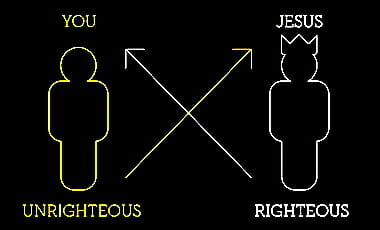
Double Imputation – Better Than A Double Rainbow

THEOPEDIA:

Imputed righteousness is a theological concept directly related to the doctrine of Justification. It is particularly prevalent in the Reformed tradition.

“Justification is that step in salvation in which God declares the believer righteous. Protestant theology has emphasized that this includes the imputation of Christ’s righteousness (crediting it to the believer’s “account”), whereas Roman Catholic theology emphasizes that God justifies in accord with an infused righteousnessmerited by Christ and maintained by the believer’s good works,” (Elwell Evangelical Dictionary). Imputed righteousness therefore means that upon repentance and belief in Christ, individuals are forensically declared righteous. This righteousness is not the believer’s own, rather it is Christ’s own righteousness ‘imputed’ to the believer.

A primary line of argumentation for this doctrine maintains that perfect righteousness or holiness is necessary to be with God. All mankind “fall short of the glory of God” (Rom 3:23) because all their ‘righteousness’ is like filthy rags (Is 64:6) before the throne of God, and so all are “dead in their trespasses and sins” (Eph 2:1), and as a result “will not come into [God’s] light for fear that their evil deeds will be revealed” (John 3:20). All mankind is in this predicament because all are the offspring of Adam and Eve (Rom 5) who originally sinned against God. As a result of Adam’s fall, the world was cursed and sin entered the world. But upon confession of one’s own sin and faith in Christ’s death and resurrection, the sinner is justified and counted as having the righteousness of Christ.

[….]

Imputed righteousness is one of the classic doctrines of Protestantism and traces back through the Reformers – chiefly John Calvin and Martin Luther. These men stood against the Roman Catholic doctrine of infused righteousness where the righteousness of the saints and of Christ is gradually infused to the believer through the sacraments. For the Catholic, infused righteousness either gradually dissipates as the believer takes part in worldly sins or is enhanced by good works. If the believer dies without having the fullness of righteousness, coming in part from the last rites, he or she will temporarily spend time in purgatory until the sinful status is purged from his or her record.

[….]

[….]

Luther and Calvin Responsible for “Christian Terrorists”?

Keep in mind as you read… that there is a growing anti-Christian sentiment on the left. This attack is switching towards even the Reformational view of “saved by grace.” No… I am not kidding:

In the wake of the November 27th shootings at Planned Parenthood, media interest has centered around what the New York Times calls gunman Robert Dear’s “idiosyncratic” religious beliefs. In a 1993 affidavit, Dear’s ex-wife Barbara Micheau described him as someone who “claims to be a Christian and is extremely evangelistic, but does not follow the Bible in his actions…He says that as long as he believes, he will be saved.”

Dear’s vision of grace—salvation through faith alone, independent of moral or immoral action—may well seem distasteful to many Times readers. But is it “idiosyncratic?” Hardly. In fact, the notion that salvation can—and must—be obtained purely by the grace of God and faith in God’s mercy, rather than by anything an individual does (or does not) do, is among the issues at the heart of the division between the Protestant and Catholic Christian traditions. Dear’s actions may seem reprehensible to Christians and non-Christians alike, but his understanding of salvation is very much in keeping with the American evangelical tradition.

[….]

Is there something quintessentially American about this view of sin and grace? Timothy Smith certainly thinks so. It contributed to a wider sense among Christian theologians that a focus on grace—rather than acts—was essential for Christianity’s survival within this new America. As he writes:

“Like the founding fathers of the nation, [early American theologians] were keenly aware of the threat that in a free society the masses of ordinary persons, including the great company of church people, would make their political and economic and social choices in response to greed or the love of power, pleasure, and public esteem. … Grace alone, they believed, could purify the inner springs of character and so make possible the creation of a righteous society; and that grace came in the sanctifying fullness of the Holy Spirit.”

While Dear’s actions may be horrific and aberrant, to dismiss his theology as purely “idiosyncratic” is to overlook a vast body of grace-centered religious language in the American tradition: a tradition that has come to shape the contours of American evangelicalism today.

Robert Lewis Dear, Jr., thought of himself as a Christian, according to his ex-wife.

“He claims to be a Christian and is extremely evangelistic, but does not follow the Bible in his actions,” Barbara Micheau said in a divorce court document, according to the Times.

[This is key]

  • “He says that as long as he believes he will be saved, he can do whatever he pleases.”

(See CNSNews)

I have been in the Evangelical faith for a better part of my life — [dramatic pause] — and I know of no pastor that subscribes to a faith that one can do whatever one pleases and you remain in the faith. Dumb!

The press is portraying the Reformation and it’s understanding of “by grace alone/by faith alone” as a root cancer in people having a religious “stamp of approval” ~ by God no less ~ to commit acts of terrorism… as will be explained in more-depth further below when a major newspaper equates a Messianic Jew to ISIS loving Muslims. This new narrative plays into the hands of the PC crowd and the newer “white priveledge” aspect of the Founding Fathers and WASPs (White Anglo-Saxon Protestant).

TS Elliot WASP

Here, the Red Letters Dialogues delves into the narrative that is now attacking “fundamentalists” in a decent half-hour podcast talking about how the Evangelical Christian is under attack… by the media AND the Pope!

Likewise, at the end of Macho Sauces’s video [below]… Zo makes this point as well, that “somehow us right-wingers with our guns and our Bibles are the real threat”

  • (Video Description) Liberals want you to forget that the real threat is Islamic terrorists… If you remember that, then they’ll have a tougher time passing gun control!

Commenting deeper on this narrative Alfonzo hinted at (the left “blaming” Christians for violence), here are two article I found informative. First, if you want to see how far down the rabbit trail the left goes, read no further than NewsBusters expose:

….Ever since the deadly shooting in San Bernardino, Calif., last Wednesday, several members of the media have tried to spread the blame from the “radicalized” Muslim couple who shot and killed more than a dozen people to other individuals who are “just as bigoted” as the murderers.

One of those people in the media is columnist Linda Stasi of the New York Daily News, who wrote in a Dec. 6 article asserting that the interaction between “two hate-filled, bigoted municipal employees” led to the deaths of “13 innocent people” who were killed in an act of “unspeakable carnage.”

The post’s title read: “San Bernardino Killers Were ISIS-Loving Monsters — But One of Their Victims Was Just as Bigoted.”

The column drew a fiery reaction from Soopermexican of the Right Wing Scoop website, who called Stasi a “foul, disgusting liberal” and branded her column “quite alarming.”

Nevertheless, Stasi stated:

One man spent his free time writing frightening, NRA-loving, hate-filled screeds on Facebook about the other’s religion.

The other man quietly stewed and brewed his bigotry, collecting the kind of arsenal that the Facebook poster would have envied.

“What they didn’t realize,” she stated, “is that except for their different religions, they were in many ways similar men who even had the same job.”

One man, “the Muslim, was a loser who had to travel all the way to Pakistan to get himself an email bride,” Stasi wrote while refusing to add to their fame by “using the killer and his murderous wife’s names.”

[….]

The other man, the victim — Nicholas Thalasinos — was “a radical Born Again Christian/Messianic Jew who also connected with his future wife online and had traveled across the country to meet her,” Stasi noted.

“The killer, however, became half of an ‘Islamic Bonnie and Clyde’” who “deserve every disgusting adjective thrown at them,” she charged. “And more.”

“But the victim is also inaccurately being eulogized as a kind and loving religious man,” Stasi stated.

She continued:

Make no mistake: As disgusting and deservedly dead as the hate-filled fanatical Muslim killers were, Thalasinos was also a hate-filled bigot. Death can’t change that.

But in the U.S., we don’t die for speaking our minds. Or we’re not supposed to anyway.

Referring to Stasi, Soopermexican claimed that “this is just unbelievably foul of her. And it really makes you wonder what she thinks should be done to conservatives who think like he did, if she’s equating him to an evil, murderous ISIS-sympathizing terrorist that the police rightfully shot down in the street like a dog.”

“Now in no way am I saying her free speech should be shut down,” the Right Scoop poster continued. “I want people to see how stupid and wretched liberals are. BUT her point of view should be relegated to the fever swamps of the fringe Internet like Twitter or Tumblr, not legitimized in the pages of a professional publication.”

…read the rest…

Mind you… there are some crazy views on this shooting (and other shootings), but as I see it, the above referenced piece by Linda Stasi of the Daily News is *JUST AS CRAZY* (*Booming Bass-Filled Echo Affect*).

Here is the narrative — in your face! Take note of the pro-life families included in a video about “terrorism”

LIKEWISE, the Left and the Media have gotten their panties in the bunch over what they deem as “Christian Terrorism” in the Robert Lewis Dear. In an EXCELLENT Charisma magazine article, Matt Barber — after going through the percentage of Islamist’s in the Muslim faith and comparing that to the world population — he continues on into the “moral equivalency” of the piece:

…it’s no surprise that there have been nearly 27,500 terrorist attacks worldwide committed by faithful Muslims since 9/11.

There have been zero committed by faithful Christians.

Here’s why.

Muslims, true Muslims, follow the teachings of their dead “prophet” Muhammad, a warring tyrant who, as even the Islamic Quran concedes, was a murderous misogynist and pedophile. Christians, true Christians, follow the very-much-alive Lord Jesus Christ, the God-man, whose teachings are found in the God-breathed Holy Bible.

Muhammad taught, and the Quran stresses, that a central tenet of Islam is to convert, enslave or kill the infidel. An infidel is anyone who is not Muslim or, depending on who’s doing the killing, belongs to a different sect of Islam.

On the other hand, Jesus taught His followers, who are called Christians, to “do to others what you would have them do to you” (see Luke 6:31); that, “You shall not murder” (see Matthew 19:18); and that we are to “love [our] enemies and pray for those who persecute [us]” (see Matthew 5:44). It goes without saying that those who do not follow these teachings are not following Christ.

Indeed, while many may claim to be “Christian,” the word only applies to those who are justified in Christ, spiritually reborn and regenerated through the supernatural work of the Holy Spirit. The true Christian walks in Christ’s steps through faith and obedience.

Terrorism is in direct disobedience to Christ.

Whereas “Muslim extremists,” that is, faithful Muslims, kill people extremely, “Christian extremists,” that is, faithful Christians, love people, including their enemies, extremely.

Islam is Christianity’s photo-negative. While Christianity brings eternal life to those choosing to surrender to Jesus, who alone is “the Way, the Truth and the Life,” Islam brings eternal death to those who surrender to Allah, who is “the best of deceivers” (“[A]nd Allah was deceptive, for Allah is the best of deceivers.” [see Surah 3:54]).

Which brings us to last week’s mass shooting near an abortion slaughterhouse in Colorado Springs, Colorado. Even as the secular left was gleefully screaming, “Christian terrorism!” Garrett Swasey, a pro-life, Christian pastor and police officer, was laying down his life for those inside the very Planned Parenthood he abhorred.

It’s what Christians do.

Still, again, and so our liberal, anti-Christian friends fully understand, Officer Garrett Swasey was a pro-life Christian. Robert Dear, the evil, reclusive, deranged pothead who killed him, is not. Dear murdered three innocent people. He is, by definition, not “pro-life.” Neither is he Christian. He is, much like Planned Parenthood, “pro-death.”

To be sure, pro-life Christians like Officer Swasey agree: Murdering babies is wrong. And murdering the murderers who murder babies is also wrong. Shooting innocent people is evil. Just like dismembering babies and selling their body parts is evil.

No, Robert Dear is no “Christian terrorist.” He may be a terrorist, but he’s not a Christian terrorist. He can’t be. He doesn’t follow Christ. If anything, Robert Dear’s actions are more like those of Planned Parenthood, orthodox Islam and Syed Farook.

Yes, there have been terrorists who call themselves Christian.

But there has never been a Christian terrorist.

The Godfather of Politics notes how the media would portray the well known atheist, Dan Barker, if he were to commit an “act of terrorism:

…Let’s suppose that Mr. Barker decides to commit a terrorist act. How might the headline read?:

“Christian Preacher and Musician Burns Down Gideon Bible Factory.”

Given Mr. Barker’s logic, this would be an appropriate description. But, of course, it wouldn’t be true.

It’s not what a person is on paper that counts; it’s what they actually practice and identify with in their terrorist acts that matter.

Consider Eric Rudolf, the “Olympic Park Bomber,” … Rudolf wrote the following in an undated letter that was published in the July 6, 2005 issue of USA Today:

Many good people continue to send me money and books. Most of them have, of course, an agenda; mostly born-again Christians looking to save my soul. I suppose the assumption is made that because I’m in here I must be a ‘sinner’ in need of salvation, and they would be glad to sell me a ticket to heaven, hawking this salvation like peanuts at a ballgame. I do appreciate their charity, but I could really do without the condescension. They have been so nice I would hate to break it to them that I really prefer Nietzsche to the Bible.”

[emphasis added]

We are ALL sinners, and need God’s Divine Grace → to rule our faith. If that makes me a terrorist… then so be it.

Reformation Day Historical Series by Dr. R.C. Sproul (498 years ago)

See more at Ligonier Ministries

See also: The Luther Decade

LUTHER AND THE LIGHTNING BOLT

MONASTERY AND ROME CRISIS

TOWER EXPERIENCE

BUILDING ST PETER’S

INDULGENCE CONTROVERSY

PROGRESS TO WORMS

ROMAN CATHOLIC VIEW OF JUSTIFICATION ~ Part 1

ROMAN CATHOLIC VIEW OF JUSTIFICATION ~ Part 2

PROSTESTANT VIEW OF JUSTIFICATION

ROME’S OBJECTIONS ANSWERED

Keeping Our Christian Identity Through “Seders”

Walk With Me

This is a topic I taught on at church, and it is a simple way to preach the Gospel to yourself. There are 5 categories:

  1. We are Sinners;
  2. We are Judged for this sin;
  3. We are Forgiven;
    1. Teaching Break (Utter vs Total Depravity/Predestined)
  4. This forgiveness creates a Relational aspect with our God;
  5. Which brings Joy in every situation we face.

In our busy schedules choose a single verse from each section and on Monday study that single verse about our sinful nature. Use an online resource such as Blue Letter Bible to read a commentary on it or Bible Gateway to read a version you haven’t read of the verse. (Or one of your home resources… whatever the case may be.) On Tuesday take a verse on forgiveness (mine, or one that has hit a cord with you over the years). Etc.

By Friday, T.G.I.F. takes on a new meaning. The following week, do the same, but with a different verse. Habits.

WE ARE CALLED TO CHECK IN

A verse that calls us to “check in” so-to-speak, is 2 Corinthians 13:5 ~ I will read from a paraphrase of this verse, however, feel free to click on the link below to see the paraphrase next to my favorite versions:

2Corinthians 13:5’ish

Test yourselves to make sure you are solid in the faith. Don’t drift along taking everything for granted. Give yourselves regular checkups. You need firsthand evidence, not mere hearsay, that Jesus Christ is in you. Test it out. If you fail the test, do something about it. I hope the test won’t show that we have failed. But if it comes to that, we’d rather the test showed our failure than yours. We’re rooting for the truth to win out in you. We couldn’t possibly do otherwise.

We don’t just put up with our limitations; we celebrate them, and then go on to celebrate every strength, every triumph of the truth in you. We pray hard that it will all come together in your lives.

Even one of the greatest Reformers mentioned this “preaching the Gospel to ourselves” aspect of our faith: “We need to hear the Gospel every day, because we forget it every day” ~ Martin Luther.

ALL HAVE SINNED (#1)

  • Proverbs 21:2 ~ “Every way of a man is right in his own eyes, but the LORD weighs the heart.”
  • Proverbs 16:2 ~ “All a man’s ways seem right to him, but the LORD evaluates the motives.”
  • 1 Samuel 16:7 ~ “Man looks at the outward appearance, but the LORD looks at the heart.”

2 things to glean from these:

1. Divine involvement in man’s heart is not limited to kings or priests;

2. A person may think nothing is wrong with his conduct, ahem, but God may.

Here we read a quick insight gleaned from Matthew Henry (Matthew 23:27-28)

The proud heart is very ingenious in putting a fair face upon a foul matter, and in making that appear right to itself which is far from being so, to stop the mouth of conscience. ~ Matthew Henry

How many righteous persons are there?

  • Romans 3:10 ~ “There is no one righteous, not even one.”

Bill Cosby teaches us about this malady we have from the earliest age (and he is a debased sinner as well, in need of a savior):

As an aside. Something that Bill Cosby said above struck a cord with me. He mentioned that the only time a child tells the truth is when they are in pain. So do we ~ often times ~ as adults. Here is the C.S. Lewis quote that came to me when I watched this:

We can rest contentedly in our sins and in our stupidities, and anyone who has watched gluttons shoveling down the most exquisite foods as if they did not know what they were eating, will admit that we can ignore even pleasure. But pain insists upon being attended to. God whispers to us in our pleasures, speaks in our consciences, but shouts in our pains. It is his megaphone to rouse a deaf world.

C.S. Lewis, The Problem of Pain (NY, New York: Touchstone, 1996), 82-83.

Let us take a short historical theology break and read a few points from the 1689 London Baptist Confession:

4 The actual sins that men commit are the fruit of the corrupt nature transmitted to them by our first parents. By reason of this corruption, all men become wholly inclined to all evil; sin disables them. They are utterly indisposed to, and, indeed, rendered opposite to, all that is good. (Matt. 15:19; Rom. 8:7; Col. 1:21; Jas. 1:14.)

5 During this earthly life corrupt nature remains in those who are born of God, that is to say, regenerated. Through Christ it is pardoned and mortified, yet both the corruption itself, and all that issues from it, are truly and properly sin. (Eccles. 7:20; Rom. 7:18,23-25; Gal. 5:17; 1 John 1:8.)

Hank Hanegraaff explains WHAT sin is and is not:

R.C. Sproul, a theologian of report, helps us define what TOTAL and UTTER “depravity” means:

…There is a distinction which I have found to be helpful: total depravity does not mean utter depravity. Utter depravity would mean that every human being is as wicked as it is possible to be, and we know that this is not the case. As much as we sin, we can always contemplate sinning more often, or more grievously than we presently do.

“If only it were all so simple! If only there were evil people somewhere insidiously committing evil deeds, and it was necessary only to separate them from the rest of us and destroy them. But the line dividing good and evil cuts through the heart of every human being. And who is willing to destroy a piece of his own heart?”

― Aleksandr Solzhenitsyn, The Gulag Archipelago 1918–1956

SENTENCED! (#2)

  • Leviticus 5:17 ~ “If someone sins and without knowing it violates any of the Lord’s commands concerning anything prohibited, he bears the consequences of his guilt.”

...GUILT

Modern persons think “guilt” is a matter of feelings;

The Bible treats guilt as a fact.

In the O.T. guilt has three aspects.

(1) There is an act which brings guilt;
(2) There is the condition of guilt which follows the act;
(3) There is punishment appropriate to the act.

In the N.T., guilt is a judicial concept. The Greek word/idea is drawn from the courts, and emphasize liability to punishment. The guilty person has been:

(1) accused;
(2) tried;
(3) and convicted.

Both Testaments view acts which bring guilt as the end result of offenses against God. (See: Heb. 9:11–28 for the legal answer to this predicament)

  • Romans 6:23(a) ~ “For the wages of sin is death….“

This is the summary of the entire chapter. Paul painted the choice in black and white. The choice is ours—sin and death or free grace through Christ and eternal life. It is very similar to the “two ways” of OT wisdom literature (Ps. 1; Prov. 4; 10–19; Matt. 7:13–14).

And, we must always keep in mind that we are judged righteously by our Triune God:

Never put someone to death unless 2 or 3 witnesses:

“But never put a person to death on the testimony of only one witness. There must always be two or three witnesses” (Deuteronomy 17:6); “For anyone who refused to obey the law of Moses was put to death without mercy on the testimony of two or three witnesses” (Hebrews 10:28).

FORGIVEN (#3)

Galatians 2:16-17 (<< link to the HCSB version. Below is the ISV)

“…yet we know that a person is not justified by the works of the law but by the faithfulness of Jesus Christ. We, too, have believed in Christ Jesus so that we might be justified by the faith of Christ and not by the works of the law, for no human being will be justified by the works of the law.” (International Standard Version [ISV])

— According to the text in the ISV, Christ’s faith — not ours — does the justifying. It is His focus of attention, not ours, that does the work. (The “onus” then is put in proper perspective.) As an example from one of my favorite verses, Philippians 1:6:

“I am sure of this, that He who (a) started a good work in you will (b) carry it on to completion until the (c) day of Christ Jesus.”

To be clear:

(a) HE started the Good work [salvation];
(b) He will carry it out;

(c) He will complete it.

It is ALL a work of Christ!

In-other-words, we will join the 24-elders in Revelation in throwing our crowns at Jesus feet, for all the good “WE” did was in actually Him working through us by even creating these… good works in our heart, and the will and drive to do them for His glory:

“There will be no jarring note in Heaven, no whisper of human merit, no claim of a reward for good intentions—but every crown shall be cast at Jesus’ feet and every voice shall join in the ascription, ‘Not unto us, not unto us, but unto Your name be all the glory of the salvation which You have worked out for us from first to last.’” ~ C.H. Spurgeon

The Imperishable Crown (1 Cor 9:24-24) — The Crown of Rejoicing (1 Thess 2:19) — The Crown of Righteousness (2 Timothy 4:8) — The Crown of Glory (1 Peter 5:4) — The Crown of Life (Revelation 2:10)

  • Romans 6:23(b) — “but the gift of God is eternal life in Christ Jesus our Lord.”

For those that do not know, I am a three-time convicted felon from many years ago. I like to say I am a retired felon. While in Jail I had to realign drastically the direction I had traveled. I didn’t realize it then, but I was preaching the Gospel to myself by studying Hosea. The Lord told the prophet — literally —

  • “Go, take to yourself a wife who will prove to be unfaithful.”

And if you think about it, we are all unfaithful to God in some way: “We love because he first loved us” (1 John 4:19). And we break our marriage contract with the Lord, it is the Lord who is faithful and bridges the gap we cannot:

“The LORD said to me, ‘Go, show your love to your wife again, though she is loved by another man and is an adulteress. Love her as the LORD loves the Israelites, though they turn to other gods and love the sacred raisin cakes'” (Hosea 3:1).

[David offered raisin cakes to the starving (1 Sam 30:11-12); at the celebration of the return of the Ark of the Covenant (2 Sam 6:18-19); Abigail made for David’s troops (1 Sam 25:18). What was once good in the Lord’s eyes man will surely corrupt.]

  • Jeremiah 15:19(a,b) ~ “Therefore, this is what the LORD says: ‘If you return, I will restore you…‘”

This implies we will fail, and He knew it, and yet chose us.

George Gilder enumerates a law that goes well with the Refiners Fire hymn. In an Interview with Dennis Prager Mr. Gilder enumerated a law of Information Theory*, and thus economics:

“A fundamental principle of information theory is that you can’t guarantee outcomes… in order for an experiment to yield knowledge, it has to be able to fail. If you have guaranteed experiments, you have zero knowledge”

*(the mathematical theory concerned with the content, transmission, storage, and retrieval of information, usually in the form of messages or data, and especially by means of computers)

✜ Zechariah 13:9;
✜ Job 23:10;
✜ Isaiah 48:10;
✜ 1 Peter 1:7.

Notes on 1 Peter 1:7

a) Peter  was not backslidden or apathetic;
b) It was Paul’s general encouragement to fan the flame/keep the fire burning brightly

How?

  • 2 Corinthians 4:16 ~ Therefore we do not give up. Even though our outer person is being destroyed, our inner person is being renewed day by day.

“…renewed day by day.” Almost like a Jewish Seder which Paul would have been familiar with. Like the Passover Seder, for instance, that helped keep the identity of the Jewish nation for almost 3-millinea, we need habits that keep our identity as owned by Christ, daily. Are we equipped for the task?

“…but one of power, love, and sound judgment.” We have “to take some responsibility in that renewal. The continual brightening of the inner flame that God has given to us is related to God’s own equipment for us. God does not equip us with weakness, but with power. He does not equip us with hatred, but with love. He does not equip us with self-destruction, but with self-discipline.”

  • Romans 8:15 — “For you did not receive a spirit of slavery to fall back into fear, but you received the Spirit of adoption, by whom we cry out, “Abba, Father!”

John Calvin, the great Reformer, says this of the above Romans thinking:

He now confirms the certainty of that confidence, in which he has already bidden the faithful to rest secure; and he does this by mentioning the special effect produced by the Spirit; for he has not been given for the purpose of harassing us with trembling or of tormenting us with anxiety; but on the contrary, for this end—that having calmed every perturbation [(pûr’tər-bā’shən) mental disquiet, disturbance, or agitation], and restoring our minds to a tranquil state, he may stir us up to call on God with confidence and freedom. He does not then pursue only the argument which he had before stated, but dwells more on another clause, which he had connected with it, even the paternal mercy of God, by which he forgives his people the infirmities of the flesh and the sins which still remain in them. He teaches us that our confidence in this respect is made certain by the Spirit of adoption, who could not inspire us with confidence in prayer without scaling to us a gratuitous pardon: and that he might make this more evident, he mentions a twofold spirit; he calls one the spirit of bondage, which we receive from the law; and the other, the spirit of adoption, which proceeds from the gospel. The first, he says, was given formerly to produce fear; the other is given now to afford assurance. By such a comparison of contrary things the certainty of our salvation, which he intended to confirm, is, as you see, made more evident. The same comparison is used by the author of the Epistle to the Hebrews [Hebrews 12:18], where he says, that we have not come to Mount Sinai, where all things were so terrible, that the people, being alarmed as it were by an immediate apprehension of death, implored that the word should be no more spoken to them, and Moses himself confessed that he was terrified; “but to [Z]ion, the mount of the Lord, and to his city, the heavenly Jerusalem, where Jesus is, the Mediator of the New Testament.”

MARTIN LUTHER tells us we have to preach this to ourselves constantly… because it is SUCH GREAT NEWS we seem to view it as unbelievable:

Grace in the Reformation

Luther’s Reformation message of salvation by grace alone could hardly have looked more different when compared with that old pre-Reformation teaching of his about salvation by grace. This is how he began to talk: “He is not righteous who does much, but he who, without work, believes much in Christ.”4 Here grace is not about God’s building on our righteous deeds or helping us to perform them. God, Luther began to see, was the one “who justifies the ungodly” (Rom. 4:5), not one who simply recognizes and rewards those who manage to make themselves godly. God is not one who must build on our foun­dations; he creates life out of nothing. It meant that, instead of looking to God for assistance and then ultimately relying on himself, Luther was turning to rely entirely on Christ, in whom all righteousness is achieved. “The law says, ‘do this,’ and it is never done. Grace says, ‘believe in this,’ and everything is already done.”

Here Luther found a message so good it almost seemed incredible to him. It was good news for the repeated failure, news of a God who comes not to call the righteous but sinners (Matt. 9:13). Not many today find themselves wearing hair shirts and enduring all-night prayer vigils in the freezing cold to earn God’s favor. Yet deep in our psyche is the assumption that we will be more loved when (and only when) we make ourselves more attractive—both to God and to others. Into that, Luther speaks words that cut through the gloom like a glorious and utterly unexpected sunbeam:

The love of God does not find, but creates, that which is pleasing to it…. Rather than seeking its own good, the love of God flows forth and bestows good. Therefore sinners are attractive because they are loved; they are not loved because they are attractive.

In Reformation thought, grace was no longer seen as being like a can of spiritual Red Bull. It was more like a marriage. In fact when Luther first sought to explain his Reformation dis­covery in detail to the world, it was the story of a wedding that framed what he said. Drawing on the romance of the lover and his beloved in Song of Solomon (especially 2:16, “My beloved is mine, and I am his”), he told the gospel as the story of the “rich and divine bridegroom Christ” who “marries this poor, wicked harlot, redeems her from all her evil, and adorns her with all his goodness.” At the wedding a wonderful exchange takes place whereby the king takes all the shame and debt of his bride, and the harlot receives all the wealth and royal status of her bridegroom. For Jesus and the soul that is united to him by faith, it works like this:

Christ is full of grace, life, and salvation. The soul is full of sins, death, and damnation. Now let faith come between them and sins, death, and damnation will be Christ’s, while grace, life, and salvation will be the soul’s; for if Christ is a bridegroom, he must take upon himself the things which are his bride’s and bestow upon her the things that are his. If he gives her his body and very self, how shall he not give her all that is his? And if he takes the body of the bride, how shall he not take all that is hers?

In the story the prostitute finds that she has been made a queen. That does not mean she always behaves as befits royalty but, however she behaves, her status is royal. She is now the queen. So it is with the believer: she remains a sinner and con­tinues to stumble and wander, but she has the righteous status of her perfect and royal bridegroom. She is—and until death will remain—at the same time both utterly righteous (in her status before God) and a sinner (in her behavior).

That means that it is simply wrong-headed for the believer to look to her behavior as an accurate yardstick of her righ­teousness before God. Her behavior and her status are distinct.

The prostitute will grow more queenly as she lives with the king and feels the security of his love, but she will never become more the queen. Just so, the believer will grow more Christlike over time, but never more righteous. Thus, because of Christ, and not because of her performance, the sinner can know a despair-crushing confidence.

Her sins cannot now destroy her, since they are laid upon Christ and swallowed up by him. And she has that righ­teousness in Christ, her husband, of which she may boast as of her own and which she can confidently display alongside her sins in the face of death and hell and say, “If I have sinned, yet my Christ, in whom I believe, has not sinned, and all his is mine and all mine is his.”

For the rest of his life Luther took this message as good news that needs continually to be reapplied to the heart of the believer. From his own experience he found that we are so in­stinctively self-dependent that while we happily subscribe to salvation by grace, our minds are like rocks, drawn down by the gravitational pull of sin away from belief in grace alone. So he counseled his friend as follows:

They try to do good of themselves in order that they might stand before God clothed in their own virtues and merits. But this is impossible. Among us you were one who held to this opinion, or rather, error. So was I, and I am still fighting against the error without having con­quered it as yet.

Therefore, my dear brother, learn Christ and him cruci­fied. Learn to pray to him and, despairing of yourself, say: “Thou, Lord Jesus, art my righteousness, but I am thy sin. Thou hast taken upon thyself what is mine and hast given to me what is thine. Thou hast taken upon thyself what thou wast not and hast given to me what I was not.”

  • Michael Reeves and Tim Chester, Why The Reformation Still Matters (Wheaton, IL: Crossway Books, 2016), 84-88.

A TEACHING BREAK

A spiritually dead person, then, is in need of spiritual life from God. But he does exist, and he can know and choose. His faculties that make up the image of God are not absent; they are simply incapable of initiating or attaining their own salvation. Like a drowning person, a fallen person can reach out and accept the lifeline even though he cannot make it to safety on his own.

Sproul has a wonderful ministry, and he [Sproul] has asked ~ rhetorically ~ how: anyone could be involved in believing in the value of human worth and at the same time believing in TOTAL depravity? He responds:

The very fact that Calvinists take sin so seriously is because they take the value of human beings so seriously. It is because man was made in the image of God, called to mirror and reflect God’s holiness, that we have the distinction of being the image-bearers of God.

But what does ‘total depravity’ mean? Total depravity means simply this: that sin affects every aspect of our human existence: our minds, our wills and our bodies are affected by sin. Every dimension of our personality suffers at some point from the weight of sin that has infected the human race.

Last “TEACHING BREAK video:

Do humans have free will? And can we choose God and salvation on our own? What is the biblical understanding of the concept of free will? Can Pastor Mark Driscoll fly like Peter Pan? This video clip is taken from the broader context of a sermon entitled “Predestination.” (Sermons I like on this from Mark, #s 19-22 are his teachings on predestination — this 36-sermon series begins on Sep 14, 2020, you will find this pro-Trump pastor’s humor of the 2020 election refreshing.)

While some will not support my posting of this next video by Mark Driscoll… I understand. But he has done a lot of good explaining of core doctrine that assists us in understanding concepts, like, TOTAL DEPRAVITY:

  • Jeremiah 17:9 ~ “The heart is more deceitful than anything else, and incurable – who can understand it?”

Continuing with this ROMANS ROAD adaptation

RELATIONAL (#4)

Okay, what does “forgiven” mean? And, how does this change our position with God?

We have all heard the famous saying, “Mercy is not getting what you deserve. And grace is getting what you absolutely do not deserve.” This comes in part from Hebrews 4:16:

“Therefore let us approach the throne of grace with boldness, so that we may receive mercy and find grace to help us at the proper time.”

“At the proper time” is a colloquial saying of the day that means “just in the nick of time.” The Believer’s Bible Commentary says this of the Hebrews verse:

Now the gracious invitation is extended: draw near with confidence to the throne of grace. Our confidence is based on the knowledge that He died to save us and that He lives to keep us. We are assured of a hearty welcome because He has told us to come.

….We can go into His presence at any time of the day or night and obtain mercy and find grace to help in time of need. His mercy covers the things we should not have done, and His grace empowers us to do what we should do but do not have the power to do.

In Genesis 8 when Noah sacrificed clean animals to God, “the Lord smelled the pleasing aroma.” Christ is the last Adam, thee final sacrifice that ends all sacrificial offerings, and we see in 2 Corinthians 2:15 the “…we are the aroma of Christ to God among those who are being saved and among those who are perishing.” You see, we are covered in Christ’ offering and are thus pleasing to God.

…Segue

Step Into Supernatural Joy

How should we respond to this idea in Psalm 30:5?

For His anger lasts only a moment,
but His favor, a lifetime.
Weeping may spend the night,
but there is joy in the morning.

JOYFULNESS (#5)

Indeed, God is my salvation;

I will trust Him and not be afraid,

for Jehovah, the Lord,

is my strength and my song.

He has become my salvation.”

You will joyfully draw water

from the springs of salvation,

and on that day you will say:

“Give thanks to Yahweh; proclaim His name!

Celebrate His works among the peoples.

Declare that His name is exalted.

Sing to Yahweh, for He has done glorious things.

(Isaiah 12:1-6)

The God of Glory

How blessed is God! And what a blessing he is! He’s the Father of our Master, Jesus Christ, and takes us to the high places of blessing in him. Long before he laid down earth’s foundations, he had us in mind, had settled on us as the focus of his love, to be made whole and holy by his love. Long, long ago he decided to adopt us into his family through Jesus Christ. (What pleasure he took in planning this!) He wanted us to enter into the celebration of his lavish gift-giving by the hand of his beloved Son.

(Ephesians 1:3–6)

Even in failure and time of testing and trials we have a line to divine joy. Consider James 1:2-4:

Consider it a great joy, my brothers, whenever you experience various trials, knowing that the testing of your faith produces endurance. But endurance must do its complete work, so that you may be mature and complete, lacking nothing. (HCSB) Consider it a sheer gift, friends, when tests and challenges come at you from all sides. You know that under pressure, your faith-life is forced into the open and shows its true colors. So don’t try to get out of anything prematurely. Let it do its work so you become mature and well-developed, not deficient in any way. (The Message)

Of verse two my first owned (and still a favorite of mine) commentary says this:

The Christian life is filled with problems. They come uninvited and unexpected. Sometimes they come singly and sometimes in droves. They are inevitable. James does not say “if you fall into various trials” but when. We can never get away from them. The question is, “What are we going to do about them?”

There are several possible attitudes we can take toward these testings and trials of life. We can rebel against them (Heb. 12:5) by adopting a spirit of defiance, boasting that we will battle through to victory by our own power. On the other hand, we can lose heart or give up under pressure (Heb. 12:5). This is nothing but fatalism. It leads to questioning even the Lord’s care for us. Again, we can grumble and complain about our troubles. This is what Paul warns us against in 1 Corinthians 10:10. Another option—we can indulge in self-pity, thinking of no one but ourselves, and trying to get sympathy from others. Or better, we can be exercised by the difficulties and perplexities of life (Heb. 12:11). We can say, in effect, “God has allowed this trial to come to me. He has some good purpose in it for me. I don’t know what that purpose is, but I’ll try to find out. I want His purposes to be worked out in my life.” This is what James advocates: “My brethren, count it all joy when you fall into various trials.” Don’t rebel! Don’t faint! Rejoice! These problems are not enemies, bent on destroying you. They are friends which have come to aid you to develop Christian character.

God is trying to produce Christlikeness in each of His children. This process necessarily involves suffering, frustration, and perplexity. The fruit of the Spirit cannot be produced when all is sunshine; there must be rain and dark clouds. Trials never seem pleasant; they seem very difficult and disagreeable. But afterwards they yield the peaceable fruit of righteousness to those who are trained by them (Heb. 12:11). How often we hear a Christian say, after passing through some great crisis, “It wasn’t easy to take, but I wouldn’t give up the experience for anything.”

William MacDonald, Believer’s Bible Commentary: Old and New Testaments, ed. Arthur Farstad (Nashville: Thomas Nelson, 1995), 2218.

In another commentaries summing up of verse three, we see perseverance is key to our joy as well, but this takes time and is something not magically infused at the outset:

…But James’s readers knew the good reason God allows such trials (v. 3). God intends for them to result in a mature and complete faith; perseverance is faith’s first product. But perseverance is not a minimal virtue. Rather, it is elemental to that fortitude of the soldier who braves all in his life-and-death struggle on the field of combat. Praised by Paul (1 Thess 1:3) and by the author of Revelation (cf. 14:12), perseverance characterizes the godly both before and after Christ. The gradual and painful acquisition of this virtue is also unmistakable. Perseverance, though essential to faith, is not infused immediately in a moment of conversion. Only through great ardor and the stumbling pursuit of the goal laid before it and only through sustained service in spite of opposition does perseverance come.

Kurt A. Richardson, James, vol. 36, The New American Commentary (Nashville: Broadman & Holman Publishers, 1997), 61–62.

Paul surely knew by heart this verse:

My lips will shout for joy
when I sing praise to You
because You have redeemed me.

(Psalm 71:23)

We should then have a definition of o-u-r-s-e-l-v-e-s… as Christians, that bring to bear the gift we should now be celebrating, here, Martin Luther in his Commentary on Galatians, offers a good definition of a Christian. In this definition we see the totality of the above study of Romans Road ~ exemplified:

“We therefore make this definition of a Christian: a Christian is not he who hath no sin, but he to whom God imputeth not his sin, through faith in Christ. That is why we so often repeat and beat into your minds, the forgiveness of sins and imputation of righteousness for Christ’s sake. Therefore when the law accuseth him and sin terrifieth him, he looketh up to Christ, and when he hath apprehended Him by faith, he hath present with him the conqueror of the law, sin, death, and the devil: and Christ reigneth and ruleth over them, so that they cannot hurt the Christian. So that he hath indeed a great and inestimable treasure, or as St. Paul saith: ‘the unspeakable gift’ (2 Cor. ix. 15), which cannot be magnified enough, for it maketh us the children and heirs of God. This gift may be said to be greater than heaven and earth, because Christ, who is this gift, is greater.”

A “summation” of the above: